EP0397828B1 - Agglutinationsverfahren zur Bestimmung von mehreren Liganden - Google Patents
Agglutinationsverfahren zur Bestimmung von mehreren Liganden Download PDFInfo
- Publication number
- EP0397828B1 EP0397828B1 EP89912640A EP89912640A EP0397828B1 EP 0397828 B1 EP0397828 B1 EP 0397828B1 EP 89912640 A EP89912640 A EP 89912640A EP 89912640 A EP89912640 A EP 89912640A EP 0397828 B1 EP0397828 B1 EP 0397828B1
- Authority
- EP
- European Patent Office
- Prior art keywords
- beads
- antibodies
- agglutination
- sample
- ligands
- Prior art date
- Legal status (The legal status is an assumption and is not a legal conclusion. Google has not performed a legal analysis and makes no representation as to the accuracy of the status listed.)
- Expired - Lifetime
Links
Images


Classifications
-
- G—PHYSICS
- G01—MEASURING; TESTING
- G01N—INVESTIGATING OR ANALYSING MATERIALS BY DETERMINING THEIR CHEMICAL OR PHYSICAL PROPERTIES
- G01N33/00—Investigating or analysing materials by specific methods not covered by groups G01N1/00 - G01N31/00
- G01N33/48—Biological material, e.g. blood, urine; Haemocytometers
- G01N33/50—Chemical analysis of biological material, e.g. blood, urine; Testing involving biospecific ligand binding methods; Immunological testing
- G01N33/58—Chemical analysis of biological material, e.g. blood, urine; Testing involving biospecific ligand binding methods; Immunological testing involving labelled substances
- G01N33/582—Chemical analysis of biological material, e.g. blood, urine; Testing involving biospecific ligand binding methods; Immunological testing involving labelled substances with fluorescent label
-
- G—PHYSICS
- G01—MEASURING; TESTING
- G01N—INVESTIGATING OR ANALYSING MATERIALS BY DETERMINING THEIR CHEMICAL OR PHYSICAL PROPERTIES
- G01N33/00—Investigating or analysing materials by specific methods not covered by groups G01N1/00 - G01N31/00
- G01N33/48—Biological material, e.g. blood, urine; Haemocytometers
- G01N33/50—Chemical analysis of biological material, e.g. blood, urine; Testing involving biospecific ligand binding methods; Immunological testing
- G01N33/58—Chemical analysis of biological material, e.g. blood, urine; Testing involving biospecific ligand binding methods; Immunological testing involving labelled substances
- G01N33/585—Chemical analysis of biological material, e.g. blood, urine; Testing involving biospecific ligand binding methods; Immunological testing involving labelled substances with a particulate label, e.g. coloured latex
-
- Y—GENERAL TAGGING OF NEW TECHNOLOGICAL DEVELOPMENTS; GENERAL TAGGING OF CROSS-SECTIONAL TECHNOLOGIES SPANNING OVER SEVERAL SECTIONS OF THE IPC; TECHNICAL SUBJECTS COVERED BY FORMER USPC CROSS-REFERENCE ART COLLECTIONS [XRACs] AND DIGESTS
- Y10—TECHNICAL SUBJECTS COVERED BY FORMER USPC
- Y10S—TECHNICAL SUBJECTS COVERED BY FORMER USPC CROSS-REFERENCE ART COLLECTIONS [XRACs] AND DIGESTS
- Y10S435/00—Chemistry: molecular biology and microbiology
- Y10S435/973—Simultaneous determination of more than one analyte
-
- Y—GENERAL TAGGING OF NEW TECHNOLOGICAL DEVELOPMENTS; GENERAL TAGGING OF CROSS-SECTIONAL TECHNOLOGIES SPANNING OVER SEVERAL SECTIONS OF THE IPC; TECHNICAL SUBJECTS COVERED BY FORMER USPC CROSS-REFERENCE ART COLLECTIONS [XRACs] AND DIGESTS
- Y10—TECHNICAL SUBJECTS COVERED BY FORMER USPC
- Y10S—TECHNICAL SUBJECTS COVERED BY FORMER USPC CROSS-REFERENCE ART COLLECTIONS [XRACs] AND DIGESTS
- Y10S436/00—Chemistry: analytical and immunological testing
- Y10S436/80—Fluorescent dyes, e.g. rhodamine
-
- Y—GENERAL TAGGING OF NEW TECHNOLOGICAL DEVELOPMENTS; GENERAL TAGGING OF CROSS-SECTIONAL TECHNOLOGIES SPANNING OVER SEVERAL SECTIONS OF THE IPC; TECHNICAL SUBJECTS COVERED BY FORMER USPC CROSS-REFERENCE ART COLLECTIONS [XRACs] AND DIGESTS
- Y10—TECHNICAL SUBJECTS COVERED BY FORMER USPC
- Y10S—TECHNICAL SUBJECTS COVERED BY FORMER USPC CROSS-REFERENCE ART COLLECTIONS [XRACs] AND DIGESTS
- Y10S436/00—Chemistry: analytical and immunological testing
- Y10S436/805—Optical property
Definitions
- the present invention relates to a sensitive and specific detection and / or determination method in a liquid, semi-liquid or pasty sample, of several ligands to be analyzed using an appropriate agglutination reaction.
- the agglutination reaction is the direct consequence of the binding of an agglutinating antibody to a cell, for example, and thus calls upon antigen-antibody or hormone-receptor complexes exhibiting agglutination properties.
- agglutination reaction can be envisaged in different biological contexts; in particular in the immunological field, agglutination is the visualization of the formation of a complex.
- red blood cells coated with an antigen are used to detect the corresponding specific antibodies (hemagglutination).
- An extension of the agglutination methods consisted in using plastic beads: in the event of a positive reaction, the appearance of a macroscopic "granulation" (passive agglutination) is observed.
- a reverse procedure has also been described: the antibodies are fixed on the beads and are used to detect the corresponding antigens. The sensitivity of such a method is high, but, as already mentioned above, the interpretation of the result is not objective and is variable depending on the observer, the importance of agglutination being a function of the amount of antigen present for a certain range of concentrations of this antigen.
- MASSON & al. propose a method for assaying various antigens (proteins, peptides ...), antibodies, haptens and immunocomplexes. using an agglutination reaction between latex particles of 0.8 "m in diameter coated with suitable antibodies or antigens and said antigens or antibodies or haptens or immunocomplexes, and counting of the particles not agglutinated using a particle counter, in particular a red blood cell counter which is a detector of diffracted light at small angles.
- the counting of the non-agglutinated particles makes it possible to evaluate the extent of the agglutination reaction and, consequently, the quantity of product to be assayed.
- the detector is configured so as to electronically ignore particles with a diameter of less than 0.6 "m and particles with a diameter of more than 1.2" m (agglutinated particles).
- the Applicant has therefore set itself the goal of providing a process which does not have the drawbacks of the agglutination methods described in the prior art.
- antiligand is intended to mean a molecular structure capable of recognizing and specifically binding the organic, biological or medicinal substance (s) to be sought, hereinafter called ligands.
- homogeneous population of fluorescent beads is understood to mean a set of identical beads, that is to say of which the emission wavelength, the diameter and / or the density of fluorochrome are identical, as well as the antiligands. attached to their surface.
- said beads comprise at least two antiligands fixed to their surface.
- said balls have a diameter between 0.05 "m and 10" m.
- the fluorescent beads conforming to the detection system can be, in particular, latex beads, polyacrylamide beads, cellulose beads, polystyrene beads, agarose beads, PVC beads, glass beads.
- the antiligand (s) are chosen from the group which comprises antigens, antibodies, receptors, lectins, immunoglobulin binding proteins of type A or G and avidins, specific for the / the substances or ligands to be sought.
- the antibodies are monoclonal antibodies.
- the antibodies are polyclonal antibodies.
- the total quantities of fluorescent lights vary as a function of the number of agglutinated beads in each aggregate or agglutinate and thus allows, using the fluorescence detection means, the discrimination of the number of fluorescent beads present in each agglutinate and of their size.
- the substances to be analyzed which can, in particular, be detected by the method according to the invention, comprise at least two ligands capable of fixing an antiligand, for example organic, biological or medicinal substances and in particular antigens, antibodies, haptens and immune complexes, hormones, membrane receptors, lectins, immunoglobulin binding proteins of type A or G, or avidins.
- an antiligand for example organic, biological or medicinal substances and in particular antigens, antibodies, haptens and immune complexes, hormones, membrane receptors, lectins, immunoglobulin binding proteins of type A or G, or avidins.
- the fluorescence measurement means is chosen from the group which comprises the flow cytometer, the image analyzer and a laser scanning system.
- the shape of the flow cell is chosen to minimize the hydrodynamic lifting forces.
- the present invention further relates to a kit or kit ready for use for the implementation of the detection and / or assay method according to the invention, characterized in that it comprises at least two populations beads on which is fixed at least one suitable antiligand, possibly associated with suitable buffers.
- the present invention also relates to a kit or kit ready for use for the implementation of the detection and / or assay method according to the invention, characterized in that it comprises at least two populations of beads, on which are fixed at least two different suitable antiligands.
- the method according to the invention applied to the analysis of a complex carbohydrate, is characterized in that the sample to be analyzed is brought into contact with at least two populations of fluorescent beads on which lectins of the lectins are fixed. different specificity.
- said method applied to the analysis of nucleic material to search for the presence of specific sequences, is characterized in that the sample to be analyzed is brought into contact with at least two populations of fluorescent beads on which nucleic probes are hybridized with complementary sequences on the same gene.
- the invention also comprises other provisions which will emerge from the description which follows, which refers to examples of the implementation of the method according to the invention.
- the process according to the invention comprises the formation of complexes by contact of the sample with fluorescent beads on which is fixed at least one suitable antiligand, under conditions suitable for the appearance of agglutination or for the inhibition of agglutination, then detection of agglutinated and non-agglutinated beads.
- populations of fluorescent beads carrying antiligands complementary to the ligand to be assayed are mixed in equal numbers, approximately 50,000 per ml.
- the solution or suspension to be tested is added in a volume which can vary from 3 to 1000 ⁇ l or more. Incubation at 37 ° C accelerates the formation of the ligand-antiligand bond; the duration of this incubation essentially depends on the affinity constant of the antiligands used; the final sensitivity of the test will also depend on it.
- the method according to the invention allows the detection of a single fluorescent ball. If we count two, we can simultaneously determine if they are separate or agglutinated, and if they are agglutinated, if they have the same characteristics or not. The sensitivity of this process thus makes it possible, theoretically, to measure the presence of a single ligand molecule, if the latter manages to agglutinate two fluorescent beads, with the same spectral characteristics or not.
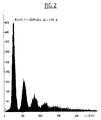
- Table I shows a comparative test between a negative control (beads covered with antibodies but absence of enterotoxin) for which 10.5% of agglutinated beads are obtained (FIG. 1 and column A of Table I) and - detection of enterotoxin A, by the method in accordance with the invention (FIG. 2 and column B of Table I), for which 85% of agglutinated beads are obtained, in the presence of a sample containing 10 ng of enterotoxin AT ; agglutination is proportional to the concentration of enterotoxin A in a given concentration range.
- FIG. 1 shows the result obtained with latex beads coupled to antibodies (negative control) and corresponds to the results mentioned in table I, column A.
- FIG. 2 shows, in the form of a histogram, the results mentioned in table I, column B.
- Figure 3 shows the result obtained with fluorescent latex beads not coupled to antibodies (another negative control), but in the presence of antigen. An agglutination of less than 2% is observed.
- Table II shows the results obtained with a negative control (beads covered with antibodies, but in the absence of corresponding antigen) under slightly different operating conditions (gentle stirring for only 30 minutes). In this case, 1.6% of agglutinated beads are obtained (very low background noise and interference).
- Example 2 Study of the stability of the beads coated with appropriate antibodies.
- green fluorescent beads means beads marked with coumarin and by red fluorescent beads, beads marked with phycoerythrin R.
- Fluorescent beads coated with toxoplasmic antigen are prepared as well as fluorescent beads coated with anti-IgG antibodies and beads coated with anti-IgM antibodies as in Example 1 (1a).
- the objective is to simultaneously test for the presence of anti-toxoplasm antibodies of the IgG and IgM isotypes.
- Green fluorescent beads are coated with toxoplasmic antigen and are then incubated with the blood sample in the presence of green beads coated with anti-IgG antibodies and red beads coated with anti-IgM antibodies.
- the proportion of green / green doublets on the one hand and green / red on the other hand makes it possible to simultaneously search and quantify the antibodies IgG and IgM. Aggregates with 3 or more balls are analyzed for their red and green components. In addition, a reference curve is established.
- Example 4 Rapid determination of isomers or denatured epitopes.
- the fluorescent beads are prepared covered with an appropriate antiligand as in Example 1.
- a monoclonal antibody common to all isomers or recognizing all native and denatured forms of a protein covers green beads.
- a monoclonal antibody specific for each modified form is coupled to either green or red beads. The search for green / green and green / red aggregates gives simultaneously the total amount of antigen and the proportion of the two (or more, if we choose several colors of beads) forms of the molecule.
- Example 6 Search for specific nucleic acid sequences.
Landscapes
- Life Sciences & Earth Sciences (AREA)
- Health & Medical Sciences (AREA)
- Engineering & Computer Science (AREA)
- Molecular Biology (AREA)
- Biomedical Technology (AREA)
- Chemical & Material Sciences (AREA)
- Hematology (AREA)
- Immunology (AREA)
- Urology & Nephrology (AREA)
- Food Science & Technology (AREA)
- Biochemistry (AREA)
- Cell Biology (AREA)
- Biotechnology (AREA)
- Medicinal Chemistry (AREA)
- Physics & Mathematics (AREA)
- Analytical Chemistry (AREA)
- Microbiology (AREA)
- General Health & Medical Sciences (AREA)
- General Physics & Mathematics (AREA)
- Pathology (AREA)
- Investigating Or Analysing Materials By The Use Of Chemical Reactions (AREA)
- Investigating, Analyzing Materials By Fluorescence Or Luminescence (AREA)
- Investigating Or Analysing Materials By Optical Means (AREA)
- Investigating Or Analysing Biological Materials (AREA)
- Measuring Or Testing Involving Enzymes Or Micro-Organisms (AREA)
Claims (11)
- Verfahren zum Nachweis und/oder zur Bestimmung von mehreren zu analysierenden Liganden in einer flüssigen, halbflüssigen oder pastösen Probe, durch ein direktes oder indirektes Agglutinationsverfahren oder ein kompetitives Agglutinationshemmverfahren, durch Einsetzen von fluoreszierenden Strukturen, nachstehend als Kügelchen bezeichnet, mit der Eignung, einen geeigneten Antiliganden zu fixieren, dadurch gekennzeichnet, daß zur spezifischen und gleichzeitigen Bestimmung von mindestens zwei Liganden- man die zu analysierende Probe mit mindestens zwei verschiedenen Populationen von fluoreszierenden Kügelchen in Kontakt bringt, wobei die Kügelchen, die jede Population bilden, identische Eigenschaften was ihre Emissionswellenlänge, ihren Durchmesser, ihre Fluorochromdichte und ihre Anzahl der auf ihrer Oberfläche fixierten Antiliganden betrifft, besitzen und- man die Probe, die die Kügelchen enthält, mit Hilfe einer Meßvorrichtung für einen einzigen Fluoreszenzmeßparameter pro Ligand analysiert, um gleichzeitig die Anzahl der nicht agglutinierten Kügelchen, die Anzahl der agglutinierten Kügelchen, die Anzahl der Aggregate von Kügelchen, und für jedes Aggregat, die Anzahl der Kügelchen, die es umfaßt, nachzuweisen und/oder zu zählen.
- Verfahren nach Anspruch 1, dadurch gekennzeichnet, daß die Kügelchen mindestens zwei auf ihrer Oberfläche fixierte Antiliganden umfassen.
- Verfahren nach Anspruch 1 oder 2, dadurch gekennzeichnet, daß die Kügelchen einen Durchmesser zwischen 0,05 »m und 10 »m besitzen.
- Verfahren nach einem der Ansprüche 1 bis 3, dadurch gekennzeichnet, daß der Antiligand aus der Gruppe, umfassend Antigene, Antikörper, Rezeptoren, Lektine, Proteine zur Fixierung an Immunglobuline vom Typ A oder G, Avidine, welche für den zu bestimmenden Liganden spezifisch sind, ausgewählt wird.
- Verfahren nach Anspruch 4, dadurch gekennzeichnet, daß die Antikörper monoclonale Antikörper sind.
- Verfahren nach Anspruch 4, dadurch gekennzeichnet, daß die Antikörper polyclonale Antikörper sind.
- Verfahren nach einem der Ansprüche 1 bis 6, dadurch gekennzeichnet, daß das Mittel zur Messung der Fluoreszenz aus der Gruppe, umfassend ein Durchflußzytometer, einen Bildanalysator und ein System zur Laserabtastung, ausgewählt wird.
- Gebrauchsfertiges Kit oder Reagenszusammenstellung zur Durchführung des Nachweis- und/oder Bestimmungsverfahrens nach einem der Ansprüche 1 bis 7, dadurch gekennzeichnet, daß es mindestens zwei Populationen von Kügelchen, auf denen mindestens ein geeigneter Antiligand fixiert ist, gegebenenfalls zusammen mit geeigneten Puffern, umfaßt.
- Gebrauchsfertiges Kit oder Reagenszusammenstellung zur Durchführung des Verfahrens zum Nachweis und/oder zur Bestimmung nach einem der Ansprüche 1 bis 7, dadurch gekennzeichnet, daß es mindestens zwei Populationen an Kügelchen umfaßt, auf denen mindestens zwei verschiedene geeignete Antiliganden fixiert sind.
- Verwendung des Verfahrens nach Anspruch 1 zur Analyse eines komplexen Kohlenhydrats, dadurch gekennzeichnet, daß man die zu analysierende Probe mit mindestens zwei Populationen an fluoreszierenden Kügelchen in Kontakt bringt, auf denen Lektine mit verschiedenen Spezifitäten fixiert sind.
- Verwendung des Verfahrens nach Anspruch 1 zur Analyse eines Nucleinsäurematerials zum Absuchen auf das Vorhandensein spezifischer Sequenzen, dadurch gekennzeichnet, daß man die zu analysierende Probe mit mindestens zwei Populationen an fluoreszierenden Kügelchen in Kontakt bringt, auf denen Nucleinsäuresonden fixiert sind, die mit den komplementären Sequenzen auf einem gleichen Gen hybridisieren.
Applications Claiming Priority (3)
| Application Number | Priority Date | Filing Date | Title |
|---|---|---|---|
| FR8814420A FR2638848B1 (fr) | 1988-11-04 | 1988-11-04 | Procede de detection et/ou de dosage dans un milieu liquide ou semi-liquide d'au moins une substance organique, biologique ou medicamenteuse soluble, par une methode d'agglutination |
| FR8814420 | 1988-11-04 | ||
| PCT/FR1989/000573 WO1990005307A1 (fr) | 1988-11-04 | 1989-11-03 | Methode d'agglutination pour l'analyse d'une substance |
Publications (2)
| Publication Number | Publication Date |
|---|---|
| EP0397828A1 EP0397828A1 (de) | 1990-11-22 |
| EP0397828B1 true EP0397828B1 (de) | 1995-05-24 |
Family
ID=9371582
Family Applications (1)
| Application Number | Title | Priority Date | Filing Date |
|---|---|---|---|
| EP89912640A Expired - Lifetime EP0397828B1 (de) | 1988-11-04 | 1989-11-03 | Agglutinationsverfahren zur Bestimmung von mehreren Liganden |
Country Status (8)
| Country | Link |
|---|---|
| US (2) | US5219763A (de) |
| EP (1) | EP0397828B1 (de) |
| JP (1) | JPH03502246A (de) |
| AT (1) | ATE123150T1 (de) |
| AU (1) | AU4518689A (de) |
| DE (1) | DE68922844T2 (de) |
| FR (1) | FR2638848B1 (de) |
| WO (1) | WO1990005307A1 (de) |
Families Citing this family (68)
| Publication number | Priority date | Publication date | Assignee | Title |
|---|---|---|---|---|
| US5547839A (en) * | 1989-06-07 | 1996-08-20 | Affymax Technologies N.V. | Sequencing of surface immobilized polymers utilizing microflourescence detection |
| JPH03225277A (ja) * | 1990-01-31 | 1991-10-04 | Fujirebio Inc | 多項目の免疫化学的測定法 |
| DE69132905T2 (de) * | 1990-12-06 | 2002-08-01 | Affymetrix, Inc. (N.D.Ges.D.Staates Delaware) | Detektion von Nukleinsäuresequenzen |
| WO1994007138A1 (en) | 1992-09-14 | 1994-03-31 | Fodstad Oystein | Detection of specific target cells in specialized or mixed cell population and solutions containing mixed cell populations |
| US5561045A (en) * | 1994-01-04 | 1996-10-01 | Intracel Corporation | Detection reagent, article, and immunoassay method |
| NO180658C (no) | 1994-03-10 | 1997-05-21 | Oeystein Fodstad | Fremgangsmåte og anordning for deteksjon av spesifikke målceller i spesialiserte eller blandede cellepopulasjoner og opplösninger som inneholder blandede cellepopulasjoner |
| US6159748A (en) * | 1995-03-13 | 2000-12-12 | Affinitech, Ltd | Evaluation of autoimmune diseases using a multiple parameter latex bead suspension and flow cytometry |
| DE69638321D1 (de) | 1995-10-11 | 2011-03-03 | Luminex Corp | Gleichzeitige mehrfachanalyse klinischer proben |
| US5736330A (en) * | 1995-10-11 | 1998-04-07 | Luminex Corporation | Method and compositions for flow cytometric determination of DNA sequences |
| US5981180A (en) * | 1995-10-11 | 1999-11-09 | Luminex Corporation | Multiplexed analysis of clinical specimens apparatus and methods |
| NO961031D0 (no) | 1996-03-13 | 1996-03-13 | Det Norske Radiumshospital Tum | Fremgangsmåte til å drepe uönskede målceller |
| US5747349A (en) * | 1996-03-20 | 1998-05-05 | University Of Washington | Fluorescent reporter beads for fluid analysis |
| US7144119B2 (en) * | 1996-04-25 | 2006-12-05 | Bioarray Solutions Ltd. | System and method for programmable illumination pattern generation |
| US6387707B1 (en) * | 1996-04-25 | 2002-05-14 | Bioarray Solutions | Array Cytometry |
| US6958245B2 (en) | 1996-04-25 | 2005-10-25 | Bioarray Solutions Ltd. | Array cytometry |
| US7041510B2 (en) | 1996-04-25 | 2006-05-09 | Bioarray Solutions Ltd. | System and method for programmable illumination pattern generation |
| JP4034351B2 (ja) | 1996-04-25 | 2008-01-16 | バイオアレイ ソリューションズ エルエルシー | 粒子近接表面の光制御した動電学的アッセンブリ |
| US6449562B1 (en) | 1996-10-10 | 2002-09-10 | Luminex Corporation | Multiplexed analysis of clinical specimens apparatus and method |
| PT849595E (pt) * | 1996-12-18 | 2001-10-31 | Stiftung Fur Diagnostische For | Particulas sinteticas como reagentes de aglutinacao |
| NO308755B1 (no) * | 1996-12-20 | 2000-10-23 | Iystein Fodstad | FremgangsmÕte til karakterisering av unormale celler, anvendelse og sett for utførelse av fremgangsmÕten |
| US20030027126A1 (en) | 1997-03-14 | 2003-02-06 | Walt David R. | Methods for detecting target analytes and enzymatic reactions |
| US7622294B2 (en) | 1997-03-14 | 2009-11-24 | Trustees Of Tufts College | Methods for detecting target analytes and enzymatic reactions |
| WO1998053093A1 (en) * | 1997-05-23 | 1998-11-26 | Bioarray Solutions Llc | Color-encoding and in-situ interrogation of matrix-coupled chemical compounds |
| US6908770B1 (en) | 1998-07-16 | 2005-06-21 | Board Of Regents, The University Of Texas System | Fluid based analysis of multiple analytes by a sensor array |
| US7189519B2 (en) * | 1998-08-10 | 2007-03-13 | Stc.Unm | Bead-based detection of ligand-GPCR-G protein complexes |
| US7018846B1 (en) | 1998-08-10 | 2006-03-28 | Science & Technology Corporation @ Unm | Display of receptors and analysis of binding interactions and drug libraries |
| CA2254223A1 (en) * | 1998-11-16 | 2000-05-16 | Biophys, Inc. | Device and method for analyzing a biologic sample |
| US7297554B2 (en) * | 1998-11-18 | 2007-11-20 | Microdiagnostics, Inc. | Immunoassay system |
| US6815172B1 (en) | 1999-06-11 | 2004-11-09 | The United States Of America As Represented By The Department Of Health And Human Services | Methods and compositions for opsonophagocytic assays |
| CA2379130A1 (en) | 1999-07-16 | 2001-01-25 | Board Of Regents, The University Of Texas System | Method and apparatus for the delivery of samples to a chemical sensor array |
| US7022517B1 (en) | 1999-07-16 | 2006-04-04 | Board Of Regents, The University Of Texas System | Method and apparatus for the delivery of samples to a chemical sensor array |
| WO2001055701A1 (en) * | 2000-01-31 | 2001-08-02 | Board Of Regents, The University Of Texas System | System and method for the analysis of bodily fluids |
| US9709559B2 (en) | 2000-06-21 | 2017-07-18 | Bioarray Solutions, Ltd. | Multianalyte molecular analysis using application-specific random particle arrays |
| DE60117556T2 (de) | 2000-06-21 | 2006-11-02 | Bioarray Solutions Ltd. | Multianalytische molekularanalyse durch verwendung anwendungsspezifischer zufallspartikelarrays |
| US7057704B2 (en) * | 2000-09-17 | 2006-06-06 | Bioarray Solutions Ltd. | System and method for programmable illumination pattern generation |
| US20030045005A1 (en) * | 2000-10-17 | 2003-03-06 | Michael Seul | Light-controlled electrokinetic assembly of particles near surfaces |
| US7691645B2 (en) * | 2001-01-09 | 2010-04-06 | Agilent Technologies, Inc. | Immunosubtraction method |
| WO2002061392A2 (en) * | 2001-01-31 | 2002-08-08 | Board Of Regents, The University Of Texas System | Method and apparatus for the confinement of materials in a micromachined chemical sensor array |
| WO2002063270A2 (en) * | 2001-02-05 | 2002-08-15 | Board Of Regents, The University Of Texas System | The use of mesoscale self-assembly and recognition to effect delivery of sensing reagent for arrayed sensors |
| US7262063B2 (en) | 2001-06-21 | 2007-08-28 | Bio Array Solutions, Ltd. | Directed assembly of functional heterostructures |
| EP1463825B1 (de) | 2001-10-15 | 2017-12-06 | BioArray Solutions Ltd. | Gemultiplexte analyse polymorphischer stellen durch gleichzeitige abfrage und enzymvermittelte detektion |
| US6838289B2 (en) * | 2001-11-14 | 2005-01-04 | Beckman Coulter, Inc. | Analyte detection system |
| US20040171076A1 (en) * | 2001-12-20 | 2004-09-02 | Dejneka Matthew J. | Detectable micro to nano sized structures, methods of manufacture and use |
| US7241629B2 (en) | 2001-12-20 | 2007-07-10 | Corning Incorporated | Detectable labels, methods of manufacture and use |
| US8257967B2 (en) | 2002-04-26 | 2012-09-04 | Board Of Regents, The University Of Texas System | Method and system for the detection of cardiac risk factors |
| ATE339687T1 (de) * | 2002-05-22 | 2006-10-15 | Sysmex Corp | Immunologische verfahren, vorrichtungen und reagenzien |
| US7526114B2 (en) | 2002-11-15 | 2009-04-28 | Bioarray Solutions Ltd. | Analysis, secure access to, and transmission of array images |
| US7232659B1 (en) | 2003-02-04 | 2007-06-19 | Stc.Unm | Multiplex analysis for high throughput discrimination of GPCR agonists and antagonists |
| US20050064452A1 (en) * | 2003-04-25 | 2005-03-24 | Schmid Matthew J. | System and method for the detection of analytes |
| WO2004104922A2 (en) * | 2003-05-16 | 2004-12-02 | Board Of Regents, The University Of Texas System | Image and part recognition technology |
| US9317922B2 (en) | 2003-05-16 | 2016-04-19 | Board Of Regents The University Of Texas System | Image and part recognition technology |
| EP1641809B2 (de) * | 2003-07-05 | 2018-10-03 | The Johns Hopkins University | Verfahren und zusammensetzungen zum nachweis und zur auflistung genetischer variationen |
| WO2005029705A2 (en) | 2003-09-18 | 2005-03-31 | Bioarray Solutions, Ltd. | Number coding for identification of subtypes of coded types of solid phase carriers |
| CA2539824C (en) | 2003-09-22 | 2015-02-03 | Xinwen Wang | Surface immobilized polyelectrolyte with multiple functional groups capable of covalently bonding to biomolecules |
| US20050079484A1 (en) * | 2003-10-10 | 2005-04-14 | Heineman William Richard | Method of detecting biological materials in liquid |
| CA2899287A1 (en) | 2003-10-28 | 2005-05-12 | Bioarray Solutions Ltd. | Optimization of gene expression analysis using immobilized capture probes |
| WO2005045060A2 (en) | 2003-10-29 | 2005-05-19 | Bioarray Solutions, Ltd. | Multiplexed nucleic acid analysis by fragmentation of double-stranded dna |
| CA2549190A1 (en) * | 2003-12-11 | 2005-06-30 | Board Of Regents, The University Of Texas System | Method and system for the analysis of saliva using a sensor array |
| US8105849B2 (en) | 2004-02-27 | 2012-01-31 | Board Of Regents, The University Of Texas System | Integration of fluids and reagents into self-contained cartridges containing sensor elements |
| US8101431B2 (en) | 2004-02-27 | 2012-01-24 | Board Of Regents, The University Of Texas System | Integration of fluids and reagents into self-contained cartridges containing sensor elements and reagent delivery systems |
| US7848889B2 (en) | 2004-08-02 | 2010-12-07 | Bioarray Solutions, Ltd. | Automated analysis of multiplexed probe-target interaction patterns: pattern matching and allele identification |
| WO2007053186A2 (en) | 2005-05-31 | 2007-05-10 | Labnow, Inc. | Methods and compositions related to determination and use of white blood cell counts |
| US8486629B2 (en) | 2005-06-01 | 2013-07-16 | Bioarray Solutions, Ltd. | Creation of functionalized microparticle libraries by oligonucleotide ligation or elongation |
| EP2508867A1 (de) * | 2005-06-24 | 2012-10-10 | Board Of Regents, The University Of Texas System | Systeme und Verfahren einschliesslich in sich geschlossener Kassetten mit Nachweissystemen und Flüssigkeitszufuhrsystemen |
| US20070043510A1 (en) * | 2005-08-19 | 2007-02-22 | Beckman Coulter, Inc. | Assay system |
| US7572990B2 (en) * | 2007-03-30 | 2009-08-11 | Intermec Ip Corp. | Keypad overlay membrane |
| JP6277099B2 (ja) * | 2014-09-09 | 2018-02-07 | 富士フイルム株式会社 | 試薬キット、測定キット及び被検物質の測定方法。 |
| ES3042225T3 (en) | 2019-06-13 | 2025-11-19 | Fundacio Hospital Univ Vall Dhebron Institut De Recerca | Synthrocyte: erythrocyte-mimicking reagent and fast methods for pathogen characterization and serology testing |
Family Cites Families (15)
| Publication number | Priority date | Publication date | Assignee | Title |
|---|---|---|---|---|
| GB2123146B (en) * | 1982-06-28 | 1985-09-25 | Abbott Lab | Dual parameter flow immunoassays |
| US4564598A (en) * | 1982-07-12 | 1986-01-14 | Syntex (U.S.A.) Inc. | Limited volume method for particle counting |
| US4499052A (en) * | 1982-08-30 | 1985-02-12 | Becton, Dickinson And Company | Apparatus for distinguishing multiple subpopulations of cells |
| US4717655A (en) * | 1982-08-30 | 1988-01-05 | Becton, Dickinson And Company | Method and apparatus for distinguishing multiple subpopulations of cells |
| US4550017A (en) * | 1982-10-15 | 1985-10-29 | Syntex (U.S.A.) Inc. | Fluorescence screening for blood typing |
| DE3322373C2 (de) * | 1983-05-19 | 1986-12-04 | Ioannis Dr. 3000 Hannover Tripatzis | Testmittel und Verfahren zum Nachweis von Antigenen und/oder Antikörpern |
| US4745075A (en) * | 1984-09-06 | 1988-05-17 | Burroughs Wellcome Co. | Diagnostic test methods |
| JPS61128169A (ja) * | 1984-11-27 | 1986-06-16 | Mitsubishi Chem Ind Ltd | 免疫分析法 |
| US4918004A (en) * | 1984-12-24 | 1990-04-17 | Caribbean Microparticles Corporation | Method of calibrating a flow cytometer or fluorescence microscope for quantitating binding antibodies on a selected sample, and microbead calibration kit therefor |
| CA1291031C (en) * | 1985-12-23 | 1991-10-22 | Nikolaas C.J. De Jaeger | Method for the detection of specific binding agents and their correspondingbindable substances |
| JPH07104349B2 (ja) * | 1987-04-11 | 1995-11-13 | 株式会社日立製作所 | 細胞測定法 |
| US4829011A (en) * | 1987-08-27 | 1989-05-09 | Biotrack, Inc. | Agglutination assay |
| FR2627286B1 (fr) * | 1988-02-15 | 1993-08-20 | Canon Kk | Procede et appareil pour l'examen d'un echantillon en immunologie |
| US4934811A (en) * | 1988-04-01 | 1990-06-19 | Syntex (U.S.A.) Inc. | Apparatus and method for detection of fluorescence or light scatter |
| US5047321A (en) * | 1988-06-15 | 1991-09-10 | Becton Dickinson & Co. | Method for analysis of cellular components of a fluid |
-
1988
- 1988-11-04 FR FR8814420A patent/FR2638848B1/fr not_active Expired - Fee Related
-
1989
- 1989-11-03 EP EP89912640A patent/EP0397828B1/de not_active Expired - Lifetime
- 1989-11-03 DE DE68922844T patent/DE68922844T2/de not_active Expired - Fee Related
- 1989-11-03 AU AU45186/89A patent/AU4518689A/en not_active Abandoned
- 1989-11-03 AT AT89912640T patent/ATE123150T1/de not_active IP Right Cessation
- 1989-11-03 WO PCT/FR1989/000573 patent/WO1990005307A1/fr not_active Ceased
- 1989-11-03 JP JP1511669A patent/JPH03502246A/ja active Pending
- 1989-11-03 US US07/499,509 patent/US5219763A/en not_active Expired - Fee Related
-
1993
- 1993-02-25 US US08/022,321 patent/US5405784A/en not_active Expired - Fee Related
Non-Patent Citations (2)
| Title |
|---|
| BIOLOGICAL ABSTRACTS, vol. 82, no. 5, 1986, Philadelphia, PA (US); P.K. BJORNSEN, p. AB-574, no. 45417# * |
| PATENT ABSTRACTS OF JAPAN, vol. 10, no. 322 (P-511)(2378), 31 octobre 1986# * |
Also Published As
| Publication number | Publication date |
|---|---|
| AU4518689A (en) | 1990-05-28 |
| FR2638848B1 (fr) | 1993-01-22 |
| ATE123150T1 (de) | 1995-06-15 |
| US5219763A (en) | 1993-06-15 |
| FR2638848A1 (fr) | 1990-05-11 |
| DE68922844T2 (de) | 1995-12-21 |
| WO1990005307A1 (fr) | 1990-05-17 |
| EP0397828A1 (de) | 1990-11-22 |
| US5405784A (en) | 1995-04-11 |
| JPH03502246A (ja) | 1991-05-23 |
| DE68922844D1 (de) | 1995-06-29 |
Similar Documents
| Publication | Publication Date | Title |
|---|---|---|
| EP0397828B1 (de) | Agglutinationsverfahren zur Bestimmung von mehreren Liganden | |
| US5236826A (en) | Immunoassay for the detection or quantitation of an analyte | |
| US4459361A (en) | Ligand assay with one or two particulate reagents and filter | |
| CN100507568C (zh) | 正向和反向abo血型的同步测定 | |
| FR2917174A1 (fr) | Analyse multiple d'echantillons sanguins | |
| EP0248892A1 (de) | Immunotestverfahren der an teilchen gebundenen bindungskomponenten | |
| EP0311492A2 (de) | Immuntestsatz und -verfahren für ganze Zellen | |
| Visentin et al. | Calibration free concentration analysis by surface plasmon resonance in a capture mode | |
| BE1012241A3 (fr) | Procede de depistage d'analyte et trousse pour la mise en oeuvre d'un tel procede. | |
| FR2708348A1 (fr) | Procédé de dosage d'une substance immunologique au moyen de particules de latex magnétiques et de particules non-magnétiques. | |
| JP2009122088A (ja) | 吸光物質含有コロイドシリカ粒子を用いた生体分子の検出ないしは定量方法 | |
| EP3325969A1 (de) | Verfahren zur beurteilung von zelloberflächenrezeptoren von blutzellen | |
| EP0389381B1 (de) | Für ganze Zellen geeigneter Satz und Verfahren zu enzymatischen Bestimmungen | |
| EP0217845B1 (de) | Verfahren zur immunologischen bestimmung einer biologischen substanz in einer probe | |
| AU592528B2 (en) | Specific binding flow cytometry method | |
| JP2005077301A (ja) | 免疫学的検出担体および測定法 | |
| EP0107551B1 (de) | Verfahren zur Feststellung und Bestimmung eines biologischen Stoffes durch Erythroadsorption | |
| US20050074902A1 (en) | Method for obtaining a unique calibration system applied to multi-parametric doses of biological samples, immunologicaLreagent prepared for that purpose, and dosage method | |
| FR2638849A1 (fr) | Procede d'amplification d'un signal fluorescent pour la recherche specifique de la presence eventuelle de particules et application a la detection et a la numeration desdites particules | |
| EP1497652B1 (de) | Verfahren, system und kit zum nachweis eines analyten in einer probe | |
| EP0916951B1 (de) | Eichmethode für Dosiersysteme vom Typ Ligand-Antiligand | |
| JP3618797B2 (ja) | 免疫測定法 | |
| JPS6336151A (ja) | 微粒子の螢光強度測定による定量方法 | |
| JPS6281566A (ja) | 微粒子の螢光強度測定による定量方法 | |
| FR2857097A1 (fr) | Procede d'obtention d'un systeme d'etalonnage unique applique au dosage multiparametrique d'anticorps preferentiellement d'au moins les anticorps anti-gliadine et anti-transglutaminase. |
Legal Events
| Date | Code | Title | Description |
|---|---|---|---|
| PUAI | Public reference made under article 153(3) epc to a published international application that has entered the european phase |
Free format text: ORIGINAL CODE: 0009012 |
|
| 17P | Request for examination filed |
Effective date: 19900629 |
|
| AK | Designated contracting states |
Kind code of ref document: A1 Designated state(s): AT BE CH DE FR GB IT LI LU NL SE |
|
| 17Q | First examination report despatched |
Effective date: 19920525 |
|
| GRAA | (expected) grant |
Free format text: ORIGINAL CODE: 0009210 |
|
| AK | Designated contracting states |
Kind code of ref document: B1 Designated state(s): AT BE CH DE FR GB IT LI LU NL SE |
|
| PG25 | Lapsed in a contracting state [announced via postgrant information from national office to epo] |
Ref country code: NL Free format text: LAPSE BECAUSE OF NON-PAYMENT OF DUE FEES Effective date: 19950524 Ref country code: AT Effective date: 19950524 Ref country code: IT Free format text: LAPSE BECAUSE OF FAILURE TO SUBMIT A TRANSLATION OF THE DESCRIPTION OR TO PAY THE FEE WITHIN THE PRESCRIBED TIME-LIMIT;WARNING: LAPSES OF ITALIAN PATENTS WITH EFFECTIVE DATE BEFORE 2007 MAY HAVE OCCURRED AT ANY TIME BEFORE 2007. THE CORRECT EFFECTIVE DATE MAY BE DIFFERENT FROM THE ONE RECORDED. Effective date: 19950524 |
|
| REF | Corresponds to: |
Ref document number: 123150 Country of ref document: AT Date of ref document: 19950615 Kind code of ref document: T |
|
| REF | Corresponds to: |
Ref document number: 68922844 Country of ref document: DE Date of ref document: 19950629 |
|
| PG25 | Lapsed in a contracting state [announced via postgrant information from national office to epo] |
Ref country code: SE Effective date: 19950824 |
|
| GBT | Gb: translation of ep patent filed (gb section 77(6)(a)/1977) |
Effective date: 19950906 |
|
| NLV1 | Nl: lapsed or annulled due to failure to fulfill the requirements of art. 29p and 29m of the patents act | ||
| PG25 | Lapsed in a contracting state [announced via postgrant information from national office to epo] |
Ref country code: LU Free format text: LAPSE BECAUSE OF NON-PAYMENT OF DUE FEES Effective date: 19951130 Ref country code: CH Effective date: 19951130 Ref country code: BE Effective date: 19951130 Ref country code: LI Effective date: 19951130 |
|
| PLBE | No opposition filed within time limit |
Free format text: ORIGINAL CODE: 0009261 |
|
| STAA | Information on the status of an ep patent application or granted ep patent |
Free format text: STATUS: NO OPPOSITION FILED WITHIN TIME LIMIT |
|
| 26N | No opposition filed | ||
| BERE | Be: lapsed |
Owner name: CHEMUNEX Effective date: 19951130 |
|
| REG | Reference to a national code |
Ref country code: CH Ref legal event code: PL |
|
| PG25 | Lapsed in a contracting state [announced via postgrant information from national office to epo] |
Ref country code: FR Effective date: 19960731 |
|
| REG | Reference to a national code |
Ref country code: FR Ref legal event code: ST |
|
| PGFP | Annual fee paid to national office [announced via postgrant information from national office to epo] |
Ref country code: GB Payment date: 19961101 Year of fee payment: 8 |
|
| PGFP | Annual fee paid to national office [announced via postgrant information from national office to epo] |
Ref country code: DE Payment date: 19961104 Year of fee payment: 8 |
|
| PG25 | Lapsed in a contracting state [announced via postgrant information from national office to epo] |
Ref country code: GB Free format text: LAPSE BECAUSE OF NON-PAYMENT OF DUE FEES Effective date: 19971103 |
|
| GBPC | Gb: european patent ceased through non-payment of renewal fee |
Effective date: 19971103 |
|
| PG25 | Lapsed in a contracting state [announced via postgrant information from national office to epo] |
Ref country code: DE Free format text: LAPSE BECAUSE OF NON-PAYMENT OF DUE FEES Effective date: 19980801 |