EP0397348B1 - Punktmustersignal-Generator - Google Patents
Punktmustersignal-Generator Download PDFInfo
- Publication number
- EP0397348B1 EP0397348B1 EP90304408A EP90304408A EP0397348B1 EP 0397348 B1 EP0397348 B1 EP 0397348B1 EP 90304408 A EP90304408 A EP 90304408A EP 90304408 A EP90304408 A EP 90304408A EP 0397348 B1 EP0397348 B1 EP 0397348B1
- Authority
- EP
- European Patent Office
- Prior art keywords
- dots
- data
- outline
- dot
- cluster
- Prior art date
- Legal status (The legal status is an assumption and is not a legal conclusion. Google has not performed a legal analysis and makes no representation as to the accuracy of the status listed.)
- Expired - Lifetime
Links
Images

Classifications
-
- G—PHYSICS
- G06—COMPUTING OR CALCULATING; COUNTING
- G06K—GRAPHICAL DATA READING; PRESENTATION OF DATA; RECORD CARRIERS; HANDLING RECORD CARRIERS
- G06K15/00—Arrangements for producing a permanent visual presentation of the output data, e.g. computer output printers
- G06K15/02—Arrangements for producing a permanent visual presentation of the output data, e.g. computer output printers using printers
-
- B—PERFORMING OPERATIONS; TRANSPORTING
- B41—PRINTING; LINING MACHINES; TYPEWRITERS; STAMPS
- B41B—MACHINES OR ACCESSORIES FOR MAKING, SETTING, OR DISTRIBUTING TYPE; TYPE; PHOTOGRAPHIC OR PHOTOELECTRIC COMPOSING DEVICES
- B41B19/00—Photoelectronic composing machines
- B41B19/01—Photoelectronic composing machines having electron-beam tubes producing an image of at least one character which is photographed
-
- G—PHYSICS
- G06—COMPUTING OR CALCULATING; COUNTING
- G06K—GRAPHICAL DATA READING; PRESENTATION OF DATA; RECORD CARRIERS; HANDLING RECORD CARRIERS
- G06K2215/00—Arrangements for producing a permanent visual presentation of the output data
- G06K2215/0002—Handling the output data
- G06K2215/004—Generic data transformation
- G06K2215/0042—Rasterisation
- G06K2215/0045—Converting outline to bitmap
Definitions
- the present invention relates to a pattern signal generator for storing as outline data pattern data for characters, for example, and for generating dot patterns from such outline data.
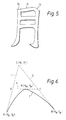
- the outline of the character pattern is divided into a plurality of segments J0, J1, J2 (see Figure 5), the co-ordinates of the starting point and ending point of each of these segments J0, J1, J2 ... are stored as the outline data, and these co-ordinates are converted into dot pattern data for providing a display or printed output.
- a conic spline curve J (see Figure 6) obtained as an approximation of the segment J2 forming a part of the outline of the character pattern has the property that, if the tangents F, G are drawn from the starting point A and the ending point B and the intersection of the tangents F, G is assumed as the control point C, the line H connecting the intermediate points D, E of the tangents F and G in relation to the control point C, the starting point A and the ending point B is in contact at its intermediate point M with the conic spline curve J.
- the outline can be reproduced by storing the co-ordinates (X A , Y A ), (X B , Y B ) and (X C , Y C ) or (X M , Y M ) respectively of the starting point A, the ending point B, the control point C or the intermediate point M as the data indicating the outline.
- WO-A-86/01154 discloses a process and apparatus for decoding characters and graphic elements using polynomials calculated with spline functions.
- EP-A-0-215 664 describes a method and apparatus for creating and storing characters for display on a video screen.
- the shape of the graphic character is displayed at various degrees of resolution.
- the characters are stored as coefficients of spline curves which can be scaled up or down to give different character sizes.
- the present invention seeks to provide a dot pattern signal generator in which the generation of separated dots, for example in reduced characters, is prevented.
- a dot pattern signal generator comprising an outline data memory for storing data representing an outline of pattern, outline reproducing means responsive to an external signal for selectively reading out the stored data and for calculating outline data on the basis of the read out data, dot pattern generating means for supplying dot pattern data according to the calculated outline data, and dot pattern compensating means comprising: means for detecting a dot or cluster of dots isolated from the main body of the dot pattern; means for determining whether the number of dots comprising the dot or isolated dot cluster is less than the minimum number of dots required to comprise a character element scaled according to the reduction factor; and means for filling in the missing dots in the region between the isolated dot or cluster of dots with dots (W) when the number of dots in the cluster is less than the said minimum number.
- a dot pattern signal generator comprising an outline data memory for storing data representing an outline of pattern, outline reproducing means responsive to an external signal for selectively reading out the stored data and for calculating outline data on the basis of the read out data, dot pattern generating means for supplying dot pattern data according to the calculated outline data, and dot pattern compensating means comprising means for detecting a dot or cluster of dots isolated from the main body of the dot pattern; means for determining whether the number of dots comprising the dot or isolated dot cluster is less than the minimum number of dots required to comprise a character element scaled according to the reduction factor; and means for removing the isolated dot or cluster of dots when the number of dots in the cluster is less than the said minimum number.
- a method for generating a signal corresponding to a character code having an outline formed as a plurality of dots forming a body of said outline comprising the steps of: storing character code data corresponding to an outline of standard size; receiving a reduction signal and said stored character code data and calculating character outline data in response thereto; converting said character outline data into dot pattern data characterised by detecting whether a dot or cluster of said dot pattern data are isolated from a main body of said character outline; determining whether the number of dots comprising the dot or isolated dot cluster is less than the minimum number of dots required to comprise a character element scaled according to the reduction factor; and filling in the region between the isolated dot or cluster of dots with dots (W) when the number of dots in the cluster is less than the said minimum number.
- a method for generating a signal corresponding to a character code having an outline formed as a plurality of dots forming a body of said outline compromising the steps of: storing character code data corresponding to an outline of standard size; receiving a reduction signal and said stored character code data and calculating character outline data in response thereto; converting said character outline data into dot pattern data characterised by detecting whether dot or cluster of dots of said dot pattern data are isolated from a main body of said character outline; determining whether the number of dots comprising the dot or isolated dot cluster is less than the minimum number of dots required to comprise a character element scaled according to the reduction factor; and removing the isolated dot or cluster of dots when the number of dots in the cluster is less than the said minimum number.
- Figure 1 is a block diagram of an embodiment of the present invention comprising an outline data memory circuit 1, in which: a character code is divided into a plurality of addresses C1 ... C n ; an outline for a character of a standard size is separated into a plurality of segments J0, J1, J2 as indicated in Figure 5; and the co-ordinates of a starting point (X A , Y A ), an ending point (X B , Y B ) and a control point (X C , Y C ) or an auxiliary point (X M , Y M ) of the respective conic spline curve approximating each of the segments J0, J1, J2 are stored as data.
- a character code is divided into a plurality of addresses C1 ... C n ; an outline for a character of a standard size is separated into a plurality of segments J0, J1, J2 as indicated in Figure 5; and the co-ordinates of a starting point (X A , Y A ), an ending
- an outline data calculation circuit 3 converts the co-ordinates of the starting point, the ending point, the control point or the auxiliary point read out from the memory circuit 1 by a read out circuit 2 so that the co-ordinates match a designated character size.
- a dot pattern generating circuit 4 receives outline data sent from the outline calculation circuit 3 and generates dot pattern data accordingly.
- a dot pattern compensating circuit 5 receives the dot pattern data from the circuit 4 and, when a gathering or cluster of dots fewer than a constant number of dots, for example two dots, among the dot pattern data generated by the dot pattern generating circuit 4 is detected, assumes that a space or separation S exists between such gathering of dots and a character body T and supplies dots W to connect the character body and the gathering.
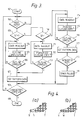
- step 101 character data is supplied from a host unit (not shown) in step 102.
- the data is reviewed in step 103 to establish whether it contains a character signal representing a scale factor of 1 (standard size).
- the outline data calculation circuit 3 calculates the outline data of segments and curves forming the outline of a character from the co-ordinates of the starting point, ending point and auxiliary or control point read out from the outline data memory circuit 1 and the conic spline function (steps 104 and 105).
- the dot pattern generating circuit 4 When the formation of the outline of a character is completed (step 106), the dot pattern generating circuit 4 generates a dot signal for filling in the region surrounded by the outline, converts such a signal to a dot pattern signal and then outputs this signal to an external device (step 107).
- the outline data calculation circuit 3 converts the co-ordinates of the starting point, ending point and auxiliary or control point read from the outline data memory circuit 1 into co-ordinates corresponding to the designated magnified size and calculates the outline data from these converted co-ordinates and the conic spline function (steps 112 and 113).
- the dot pattern generating circuit 4 generates a dot signal for filling in the region surrounded by the outline and then converts it to a dot pattern signal (steps 113 and 107).
- the outline data calculation circuit 3 converts the co-ordinates of the starting point, ending point and auxiliary or control point read from the outline data memory circuit 1 into co-ordinates corresponding to the designated reduced size and calculates the outline data corresponding to the reduction factor from these converted co-ordinates and the conic spline function (steps 114 and 115).
- the dot pattern generating circuit 4 generates a dot signal for filling in the region surrounded by the outline to generate the dot pattern data (steps 116 and 117).
- this dot pattern data represents a dot pattern in which dots V separated by the space S from the character body T are generated at a part, particularly at a "skipping part", of the character (as shown in Figure 4 (a)) to be formed intrinsically as continuous dots.
- the dot pattern compensating circuit 5 receives the dot pattern data from the dot pattern generating circuit 4 and decides whether there exist dots in such a number as is smaller than a minimum value determined according to the reduction factor for establishing whether a gathering of the dots represent, for example, an element such as a comma "," or not. When there exists such dots in numbers less than the minimum value, the dot pattern compensating circuit 5 considers such dots to be separated dots, (step 118). In a case where there are such separated dots, dots W are supplied by the dot pattern compensating circuit 5 to the space S on a line connecting the separated dots and character body in the shortest distance (step 119). Thereby, the separated dots V generated in the dot pattern generating circuit 4 can be integrated with the character body T by the dots W supplied to the space S (as shown in Figure 4 (b)).
- the separated dots and the character body are connected by extra dots supplied, but in the case where a character size is particularly small, sufficient character quality for practical use may be maintained by eliminating the separated dots instead.
- the present invention comprises the outline data memory means 1 for storing outline data for a character pattern of standard size, the read out means 2 for reading the data in response to an external reading signal, the outline data calculation means 3 for calculating outline data corresponding to a magnification factor based on the stored data and external magnification factor data, the dot pattern generating means 4 for outputting dot pattern data based on the outline data sent from the calculation means 3, and the dot pattern compensating means 5 for detecting from the dot pattern data the existence of separated dots when a regulated number of dots or less are present and for giving dots to the space in the case where such separation is smaller than a standard value.
- a high quality character dot pattern can be provided by reliably preventing the production of separated dots, which may be generated easily during the formation of the dot patterns for reduced characters.
Landscapes
- Engineering & Computer Science (AREA)
- General Engineering & Computer Science (AREA)
- Physics & Mathematics (AREA)
- General Physics & Mathematics (AREA)
- Theoretical Computer Science (AREA)
- Controls And Circuits For Display Device (AREA)
- Image Analysis (AREA)
- Facsimile Image Signal Circuits (AREA)
- Image Processing (AREA)
- Digital Computer Display Output (AREA)
- Image Generation (AREA)
Claims (5)
- Punktmustersignalgenerator umfassend einen Umrißdatenspeicher (1) zum Speichern von einen Umriß eines Musters darstellenden Daten, auf ein externes Signal ansprechende Umrißwiedergabemittel (2, 3) zum wahlweisen Auslesen der gespeicherten Daten und zum Berechnen von Umrißdaten auf Basis der ausgelesenen Daten, Punktmustererzeugungsmittel (4) zum Liefern von Punktmusterdaten gemäß den berechneten Umrißdaten, gekennzeichnet durch Punktmusterkompensationsmittel (5) umfassend:
Mittel zum Erfassen eines Punkts oder eines Punkteclusters, welcher von dem Hauptkörper des Punktmusters getrennt ist;
Mittel zum Bestimmen, ob die Anzahl der den Punkt oder isolierten Punktecluster bildenden Punkte kleiner als die Minimalanzahl von Punkten ist, welche für ein gemäß dem Verkleinerungsfaktor skaliertes Zeichenelement erforderlich ist; und
Mittel zum Auffüllen der fehlenden Punkte im Bereich zwischen dem isolierten Punkt oder Punktecluster mit Punkten (W), wenn die Anzahl von Punkten in dem Cluster kleiner als die Minimalanzahl ist. - Punktmustersignalgenerator umfassend einen Umrißdatenspeicher (1) zum Speichern von einen Umriß eines Musters darstellenden Daten, auf ein externes Signal ansprechende Umrißwiedergabemittel (2, 3) zum wahlweisen Auslesen der gespeicherten Daten und zum Berechnen von Umrißdaten auf Basis der ausgelesenen Daten, Punktmustererzeugungsmittel (4) zum Liefern von Punktmusterdaten gemäß den berechneten Umrißdaten, gekennzeichnet durch Punktmusterkompensationsmittel (5) umfassend:
Mittel zum Erfassen eines Punkts oder eines Punkteclusters, welcher von dem Hauptkörper des Punktmusters getrennt ist;
Mittel zum Bestimmen, ob die Anzahl der den Punkt oder isolierten Punktecluster bildenden Punkte kleiner als die Minimalanzahl von Punkten ist, welche für ein gemäß dem Verkleinerungsfaktor skaliertes Zeichenelement erforderlich ist; und Mittel zum Entfernen des isolierten Punkts oder Punkteclusters, wenn die Anzahl von Punkten in dem Cluster kleiner als die Minimalanzahl ist. - Punktmustersignalgenerator nach einem der Ansprüche 1 bis 2, dadurch gekennzeichnet, daß die in dem Umrißspeicher gespeicherten Daten ein Muster mit Standardgröße darstellen und daß die Punktmusterkompensationsmittel dazu eingerichtet sind, betriebswirksam zu sein, wenn die berechneten Umrißdaten ein Muster verkleinerter Größe darstellen.
- Verfahren zum Erzeugen eines Signals, welches einem Zeichencode mit einem Umriß entspricht, welcher als eine Mehrzahl von einen Körper dieses Umrisses bildenden Punkten gebildet ist,
umfassend die Schritte:
Speichern von Zeichencodedaten, welche einem Umriß mit Standardgröße entsprechen;
Empfangen eines Verkleinerungssignals und der gespeicherten Zeichencodedaten und Berechnen von Zeichenumrißdaten in Antwort darauf;
Umwandeln der Zeichenumrißdaten in Punktmusterdaten, gekennzeichnet durch
Erfassen, ob ein Punkt oder Punktecluster der Punktmusterdaten von einem Hauptkörper dieses Zeichenumrisses isoliert ist;
Bestimmen, ob die Anzahl der den Punkt oder isolierten Punktecluster bildenden Punkte kleiner als die Minimalanzahl von Punkten ist, welche für ein gemäß dem Verkleinerungsfaktor skaliertes Zeichenelement erforderlich ist; und
Auffüllen des Bereichs zwischen dem isolierten Punkt oder Punktecluster mit Punkten (W), wenn die Anzahl von Punkten in dem Cluster kleiner als die Minimalanzahl ist. - Verfahren zum Erzeugen eines Signals, welches einem Zeichencode mit einem Umriß entspricht, welcher als eine Mehrzahl von einen Körper dieses Umrisses bildenden Punkten gebildet ist,
umfassend die Schritte:
Speichern von Zeichencodedaten, welche einem Umriß mit Standardgröße entsprechen;
Empfangen eines Verkleinerungssignals und der gespeicherten Zeichencodedaten und Berechnen von Zeichenumrißdaten in Antwort darauf;
Umwandeln der Zeichenumrißdaten in Punktmusterdaten, gekennzeichnet durch
Erfassen, ob ein Punkt oder Punktecluster der Punktmusterdaten von einem Hauptkörper dieses Zeichenumrisses isoliert ist;
Bestimmen, ob die Anzahl der den Punkt oder isolierten Punktecluster bildenden Punkte kleiner als die Minimalanzahl von Punkten ist, welche für ein gemäß dem Verkleinerungsfaktor skaliertes Zeichenelement erforderlich ist; und
Entfernen des isolierten Punkts oder Punkteclusters, wenn die Anzahl von Punkten in dem Cluster kleiner als die Minimalanzahl ist.
Applications Claiming Priority (2)
| Application Number | Priority Date | Filing Date | Title |
|---|---|---|---|
| JP118095/89 | 1989-05-10 | ||
| JP1118095A JPH02296291A (ja) | 1989-05-10 | 1989-05-10 | 文字ドットパターン信号発生装置 |
Publications (3)
| Publication Number | Publication Date |
|---|---|
| EP0397348A2 EP0397348A2 (de) | 1990-11-14 |
| EP0397348A3 EP0397348A3 (de) | 1991-09-11 |
| EP0397348B1 true EP0397348B1 (de) | 1995-08-02 |
Family
ID=14727877
Family Applications (1)
| Application Number | Title | Priority Date | Filing Date |
|---|---|---|---|
| EP90304408A Expired - Lifetime EP0397348B1 (de) | 1989-05-10 | 1990-04-25 | Punktmustersignal-Generator |
Country Status (5)
| Country | Link |
|---|---|
| US (1) | US5150459A (de) |
| EP (1) | EP0397348B1 (de) |
| JP (1) | JPH02296291A (de) |
| DE (1) | DE69021260T2 (de) |
| HK (1) | HK108996A (de) |
Families Citing this family (8)
| Publication number | Priority date | Publication date | Assignee | Title |
|---|---|---|---|---|
| JPH0747335B2 (ja) * | 1988-08-05 | 1995-05-24 | 株式会社日立製作所 | 文字発生装置および文字発生方法 |
| US5200740A (en) * | 1989-08-01 | 1993-04-06 | Adobe Systems Incorporated | Dropout-free center point fill method for displaying characters |
| JP2697918B2 (ja) * | 1989-09-26 | 1998-01-19 | キヤノン株式会社 | 印刷装置 |
| JPH03225395A (ja) * | 1990-01-31 | 1991-10-04 | Canon Inc | 出力装置 |
| KR960005014B1 (ko) * | 1992-11-27 | 1996-04-18 | 삼성전자주식회사 | 도트매트릭스 이미지 데이타를 페이지 프린터에서 처리하는 방법 및 회로 |
| US5649028A (en) * | 1994-10-20 | 1997-07-15 | Hollinger; Steven J. | Connect-the-dots drawing production device |
| US7922939B2 (en) * | 2008-10-03 | 2011-04-12 | The Board Of Trustees Of The University Of Illinois | Metal nanoparticle inks |
| JP5018739B2 (ja) * | 2008-11-04 | 2012-09-05 | コニカミノルタビジネステクノロジーズ株式会社 | 画像処理装置、画像処理方法及び画像処理プログラム |
Family Cites Families (6)
| Publication number | Priority date | Publication date | Assignee | Title |
|---|---|---|---|---|
| DE3429110A1 (de) * | 1984-08-03 | 1986-02-13 | H. Berthold Ag, 1000 Berlin | Verfahren zum kodieren und dekodieren von schriftzeichen |
| IE852259L (en) * | 1985-09-13 | 1987-03-13 | Scottish & Newcastle Breweries | A method and apparatus for constructing, storing and¹displaying characters |
| US4785391A (en) * | 1986-02-07 | 1988-11-15 | Bitstream Inc. | Automated bitmap character generation from outlines |
| US5027364A (en) * | 1987-04-16 | 1991-06-25 | Siemens Aktiengesellschaft | Laser diode with buried active layer and lateral current limitation |
| JPH01111276A (ja) * | 1987-10-23 | 1989-04-27 | Nippon Sheet Glass Co Ltd | ドットパターンの自動作図装置 |
| JP2681367B2 (ja) * | 1988-05-24 | 1997-11-26 | 株式会社日立製作所 | 図形処理方法及びその装置 |
-
1989
- 1989-05-10 JP JP1118095A patent/JPH02296291A/ja active Pending
-
1990
- 1990-04-25 EP EP90304408A patent/EP0397348B1/de not_active Expired - Lifetime
- 1990-04-25 DE DE69021260T patent/DE69021260T2/de not_active Expired - Fee Related
- 1990-05-11 US US07/524,400 patent/US5150459A/en not_active Expired - Lifetime
-
1996
- 1996-06-27 HK HK108996A patent/HK108996A/en not_active IP Right Cessation
Also Published As
| Publication number | Publication date |
|---|---|
| HK108996A (en) | 1996-07-05 |
| JPH02296291A (ja) | 1990-12-06 |
| EP0397348A3 (de) | 1991-09-11 |
| DE69021260D1 (de) | 1995-09-07 |
| EP0397348A2 (de) | 1990-11-14 |
| US5150459A (en) | 1992-09-22 |
| DE69021260T2 (de) | 1996-01-04 |
Similar Documents
| Publication | Publication Date | Title |
|---|---|---|
| US5526476A (en) | Method and apparatus for generating character patterns expressed by coordinates of a coordinate system | |
| US4655622A (en) | Printer control apparatus | |
| JPS63205257A (ja) | 印刷制御装置 | |
| US4962465A (en) | Character processor provided with dot pattern correcting function | |
| US4712185A (en) | Dot interpolation control system | |
| HK108996A (en) | Dot pattern signal generator | |
| KR100306862B1 (ko) | 문자 패턴 생성 장치 및 문자 패턴 생성 장치 제어 프로그램을 기억한 매체 | |
| US5562350A (en) | Output apparatus that selects a vector font based on character size | |
| EP0435579B1 (de) | Zeichenausgabegerät | |
| EP0461811B1 (de) | Musterverarbeitungsverfahren | |
| EP0471849A1 (de) | Verfahren zur erzeugung von punktsignalen für zeichenmuster und einrichtung hierzu | |
| EP0385508B1 (de) | Anordnung zur Erzeugung von Matrix-Zeichenmustern | |
| JP2952915B2 (ja) | ドットパターンデータ発生装置 | |
| EP0394066B1 (de) | Buchstabengenerator | |
| EP0391670B1 (de) | Punktmustersignalgenerator | |
| EP0420575B1 (de) | Druckgerät | |
| JPS6346429B2 (de) | ||
| JP3119094B2 (ja) | 文字出力装置 | |
| JP2637921B2 (ja) | 文字記号発生装置 | |
| JP3099556B2 (ja) | データ変換装置 | |
| JP3055918B2 (ja) | フォントのデータ変換処理方法 | |
| JPH0630927B2 (ja) | パターン出力方法 | |
| JPH06312555A (ja) | 印刷装置 | |
| JPH08186708A (ja) | 画像拡大装置 | |
| JPH0736434A (ja) | 文字出力装置 |
Legal Events
| Date | Code | Title | Description |
|---|---|---|---|
| PUAI | Public reference made under article 153(3) epc to a published international application that has entered the european phase |
Free format text: ORIGINAL CODE: 0009012 |
|
| AK | Designated contracting states |
Kind code of ref document: A2 Designated state(s): DE FR GB |
|
| PUAL | Search report despatched |
Free format text: ORIGINAL CODE: 0009013 |
|
| AK | Designated contracting states |
Kind code of ref document: A3 Designated state(s): DE FR GB |
|
| 17P | Request for examination filed |
Effective date: 19920310 |
|
| 17Q | First examination report despatched |
Effective date: 19940218 |
|
| GRAA | (expected) grant |
Free format text: ORIGINAL CODE: 0009210 |
|
| AK | Designated contracting states |
Kind code of ref document: B1 Designated state(s): DE FR GB |
|
| REF | Corresponds to: |
Ref document number: 69021260 Country of ref document: DE Date of ref document: 19950907 |
|
| ET | Fr: translation filed | ||
| PLBE | No opposition filed within time limit |
Free format text: ORIGINAL CODE: 0009261 |
|
| STAA | Information on the status of an ep patent application or granted ep patent |
Free format text: STATUS: NO OPPOSITION FILED WITHIN TIME LIMIT |
|
| 26N | No opposition filed | ||
| REG | Reference to a national code |
Ref country code: GB Ref legal event code: IF02 |
|
| PGFP | Annual fee paid to national office [announced via postgrant information from national office to epo] |
Ref country code: FR Payment date: 20080312 Year of fee payment: 19 Ref country code: DE Payment date: 20080502 Year of fee payment: 19 |
|
| PGFP | Annual fee paid to national office [announced via postgrant information from national office to epo] |
Ref country code: GB Payment date: 20080430 Year of fee payment: 19 |
|
| GBPC | Gb: european patent ceased through non-payment of renewal fee |
Effective date: 20090425 |
|
| REG | Reference to a national code |
Ref country code: FR Ref legal event code: ST Effective date: 20091231 |
|
| PG25 | Lapsed in a contracting state [announced via postgrant information from national office to epo] |
Ref country code: DE Free format text: LAPSE BECAUSE OF NON-PAYMENT OF DUE FEES Effective date: 20091103 |
|
| PG25 | Lapsed in a contracting state [announced via postgrant information from national office to epo] |
Ref country code: GB Free format text: LAPSE BECAUSE OF NON-PAYMENT OF DUE FEES Effective date: 20090425 Ref country code: FR Free format text: LAPSE BECAUSE OF NON-PAYMENT OF DUE FEES Effective date: 20091222 |