EP0394792A1 - Formylpiperazingruppen enthaltende (Meth)acrylsäurederivate - Google Patents
Formylpiperazingruppen enthaltende (Meth)acrylsäurederivate Download PDFInfo
- Publication number
- EP0394792A1 EP0394792A1 EP90107142A EP90107142A EP0394792A1 EP 0394792 A1 EP0394792 A1 EP 0394792A1 EP 90107142 A EP90107142 A EP 90107142A EP 90107142 A EP90107142 A EP 90107142A EP 0394792 A1 EP0394792 A1 EP 0394792A1
- Authority
- EP
- European Patent Office
- Prior art keywords
- meth
- acrylic acid
- formylpiperazine
- acid derivatives
- preparations
- Prior art date
- Legal status (The legal status is an assumption and is not a legal conclusion. Google has not performed a legal analysis and makes no representation as to the accuracy of the status listed.)
- Withdrawn
Links
- CERQOIWHTDAKMF-UHFFFAOYSA-N Methacrylic acid Chemical class CC(=C)C(O)=O CERQOIWHTDAKMF-UHFFFAOYSA-N 0.000 title claims abstract description 31
- MSSDTZLYNMFTKN-UHFFFAOYSA-N 1-Piperazinecarboxaldehyde Chemical group O=CN1CCNCC1 MSSDTZLYNMFTKN-UHFFFAOYSA-N 0.000 title claims abstract description 18
- 238000002360 preparation method Methods 0.000 claims abstract description 32
- 239000000463 material Substances 0.000 claims abstract description 23
- 239000000853 adhesive Substances 0.000 claims abstract description 18
- 230000001070 adhesive effect Effects 0.000 claims abstract description 18
- 102000008186 Collagen Human genes 0.000 claims abstract description 12
- 108010035532 Collagen Proteins 0.000 claims abstract description 12
- 229920001436 collagen Polymers 0.000 claims abstract description 12
- 125000002496 methyl group Chemical group [H]C([H])([H])* 0.000 claims description 9
- 125000001931 aliphatic group Chemical group 0.000 claims description 8
- 229910052739 hydrogen Inorganic materials 0.000 claims description 8
- 239000001257 hydrogen Substances 0.000 claims description 8
- 125000004435 hydrogen atom Chemical group [H]* 0.000 claims description 8
- 239000003999 initiator Substances 0.000 claims description 8
- 230000008439 repair process Effects 0.000 claims description 4
- VGGSQFUCUMXWEO-UHFFFAOYSA-N Ethene Chemical compound C=C VGGSQFUCUMXWEO-UHFFFAOYSA-N 0.000 claims 1
- 239000005977 Ethylene Substances 0.000 claims 1
- 239000002639 bone cement Substances 0.000 claims 1
- 230000003081 coactivator Effects 0.000 claims 1
- 125000004956 cyclohexylene group Chemical group 0.000 claims 1
- 150000001875 compounds Chemical class 0.000 abstract description 10
- 238000000034 method Methods 0.000 abstract description 6
- -1 Phosphoric acid Chemical class 0.000 description 24
- 150000004885 piperazines Chemical class 0.000 description 13
- 210000004268 dentin Anatomy 0.000 description 12
- OKKJLVBELUTLKV-UHFFFAOYSA-N Methanol Chemical compound OC OKKJLVBELUTLKV-UHFFFAOYSA-N 0.000 description 9
- 238000011049 filling Methods 0.000 description 9
- XLYOFNOQVPJJNP-UHFFFAOYSA-N water Substances O XLYOFNOQVPJJNP-UHFFFAOYSA-N 0.000 description 9
- HEDRZPFGACZZDS-MICDWDOJSA-N Trichloro(2H)methane Chemical compound [2H]C(Cl)(Cl)Cl HEDRZPFGACZZDS-MICDWDOJSA-N 0.000 description 8
- 0 C1[C@@]2[C@]1CC*2 Chemical compound C1[C@@]2[C@]1CC*2 0.000 description 7
- 239000002253 acid Substances 0.000 description 7
- 239000007788 liquid Substances 0.000 description 7
- 239000000203 mixture Substances 0.000 description 7
- VNQXSTWCDUXYEZ-UHFFFAOYSA-N 1,7,7-trimethylbicyclo[2.2.1]heptane-2,3-dione Chemical compound C1CC2(C)C(=O)C(=O)C1C2(C)C VNQXSTWCDUXYEZ-UHFFFAOYSA-N 0.000 description 6
- CSCPPACGZOOCGX-UHFFFAOYSA-N Acetone Chemical compound CC(C)=O CSCPPACGZOOCGX-UHFFFAOYSA-N 0.000 description 6
- YMWUJEATGCHHMB-UHFFFAOYSA-N Dichloromethane Chemical compound ClCCl YMWUJEATGCHHMB-UHFFFAOYSA-N 0.000 description 6
- BDAGIHXWWSANSR-UHFFFAOYSA-N Formic acid Chemical class OC=O BDAGIHXWWSANSR-UHFFFAOYSA-N 0.000 description 6
- ZMANZCXQSJIPKH-UHFFFAOYSA-N Triethylamine Chemical compound CCN(CC)CC ZMANZCXQSJIPKH-UHFFFAOYSA-N 0.000 description 6
- 229930006711 bornane-2,3-dione Natural products 0.000 description 6
- 125000004432 carbon atom Chemical group C* 0.000 description 6
- KRKNYBCHXYNGOX-UHFFFAOYSA-N citric acid Chemical compound OC(=O)CC(O)(C(O)=O)CC(O)=O KRKNYBCHXYNGOX-UHFFFAOYSA-N 0.000 description 6
- ZWEHNKRNPOVVGH-UHFFFAOYSA-N 2-Butanone Chemical compound CCC(C)=O ZWEHNKRNPOVVGH-UHFFFAOYSA-N 0.000 description 5
- SXRSQZLOMIGNAQ-UHFFFAOYSA-N Glutaraldehyde Chemical compound O=CCCCC=O SXRSQZLOMIGNAQ-UHFFFAOYSA-N 0.000 description 5
- 150000007513 acids Chemical class 0.000 description 5
- 230000003750 conditioning effect Effects 0.000 description 5
- 239000000945 filler Substances 0.000 description 5
- FCMPRZYOEFYUED-UHFFFAOYSA-N n-[2-(4-formylpiperazin-1-yl)ethyl]-2-methylprop-2-enamide Chemical compound CC(=C)C(=O)NCCN1CCN(C=O)CC1 FCMPRZYOEFYUED-UHFFFAOYSA-N 0.000 description 5
- 150000003254 radicals Chemical class 0.000 description 5
- 238000005160 1H NMR spectroscopy Methods 0.000 description 4
- DHMQDGOQFOQNFH-UHFFFAOYSA-N Glycine Chemical compound NCC(O)=O DHMQDGOQFOQNFH-UHFFFAOYSA-N 0.000 description 4
- NBIIXXVUZAFLBC-UHFFFAOYSA-N Phosphoric acid Chemical compound OP(O)(O)=O NBIIXXVUZAFLBC-UHFFFAOYSA-N 0.000 description 4
- GLUUGHFHXGJENI-UHFFFAOYSA-N Piperazine Chemical compound C1CNCCN1 GLUUGHFHXGJENI-UHFFFAOYSA-N 0.000 description 4
- LCTONWCANYUPML-UHFFFAOYSA-N Pyruvic acid Chemical compound CC(=O)C(O)=O LCTONWCANYUPML-UHFFFAOYSA-N 0.000 description 4
- VYPSYNLAJGMNEJ-UHFFFAOYSA-N Silicium dioxide Chemical compound O=[Si]=O VYPSYNLAJGMNEJ-UHFFFAOYSA-N 0.000 description 4
- BGTOWKSIORTVQH-UHFFFAOYSA-N cyclopentanone Chemical compound O=C1CCCC1 BGTOWKSIORTVQH-UHFFFAOYSA-N 0.000 description 4
- 125000002485 formyl group Chemical group [H]C(*)=O 0.000 description 4
- TZIHFWKZFHZASV-UHFFFAOYSA-N methyl formate Chemical compound COC=O TZIHFWKZFHZASV-UHFFFAOYSA-N 0.000 description 4
- 239000000126 substance Substances 0.000 description 4
- CEBWNBAWNUABRE-UHFFFAOYSA-N 2-(4-formylpiperazin-1-yl)ethyl 2-methylprop-2-enoate Chemical compound CC(=C)C(=O)OCCN1CCN(C=O)CC1 CEBWNBAWNUABRE-UHFFFAOYSA-N 0.000 description 3
- QTBSBXVTEAMEQO-UHFFFAOYSA-N Acetic acid Chemical compound CC(O)=O QTBSBXVTEAMEQO-UHFFFAOYSA-N 0.000 description 3
- LFQSCWFLJHTTHZ-UHFFFAOYSA-N Ethanol Chemical compound CCO LFQSCWFLJHTTHZ-UHFFFAOYSA-N 0.000 description 3
- XEKOWRVHYACXOJ-UHFFFAOYSA-N Ethyl acetate Chemical compound CCOC(C)=O XEKOWRVHYACXOJ-UHFFFAOYSA-N 0.000 description 3
- WSFSSNUMVMOOMR-UHFFFAOYSA-N Formaldehyde Chemical compound O=C WSFSSNUMVMOOMR-UHFFFAOYSA-N 0.000 description 3
- MUBZPKHOEPUJKR-UHFFFAOYSA-N Oxalic acid Chemical compound OC(=O)C(O)=O MUBZPKHOEPUJKR-UHFFFAOYSA-N 0.000 description 3
- ONIBWKKTOPOVIA-UHFFFAOYSA-N Proline Natural products OC(=O)C1CCCN1 ONIBWKKTOPOVIA-UHFFFAOYSA-N 0.000 description 3
- HEMHJVSKTPXQMS-UHFFFAOYSA-M Sodium hydroxide Chemical compound [OH-].[Na+] HEMHJVSKTPXQMS-UHFFFAOYSA-M 0.000 description 3
- 239000004809 Teflon Substances 0.000 description 3
- 229920006362 Teflon® Polymers 0.000 description 3
- 150000001299 aldehydes Chemical class 0.000 description 3
- ZTQSAGDEMFDKMZ-UHFFFAOYSA-N butyric aldehyde Natural products CCCC=O ZTQSAGDEMFDKMZ-UHFFFAOYSA-N 0.000 description 3
- 150000001728 carbonyl compounds Chemical class 0.000 description 3
- 239000000543 intermediate Substances 0.000 description 3
- 239000000178 monomer Substances 0.000 description 3
- 239000004033 plastic Substances 0.000 description 3
- 229920003023 plastic Polymers 0.000 description 3
- 239000002904 solvent Substances 0.000 description 3
- 238000003786 synthesis reaction Methods 0.000 description 3
- JLEHUCNAWHLRON-UHFFFAOYSA-N 4-(2-aminoethyl)piperazine-1-carbaldehyde Chemical compound NCCN1CCN(C=O)CC1 JLEHUCNAWHLRON-UHFFFAOYSA-N 0.000 description 2
- IINWNNKUXOSZAI-UHFFFAOYSA-N 4-(2-hydroxyethyl)piperazine-1-carbaldehyde Chemical compound OCCN1CCN(C=O)CC1 IINWNNKUXOSZAI-UHFFFAOYSA-N 0.000 description 2
- KWOLFJPFCHCOCG-UHFFFAOYSA-N Acetophenone Chemical compound CC(=O)C1=CC=CC=C1 KWOLFJPFCHCOCG-UHFFFAOYSA-N 0.000 description 2
- NLZUEZXRPGMBCV-UHFFFAOYSA-N Butylhydroxytoluene Chemical compound CC1=CC(C(C)(C)C)=C(O)C(C(C)(C)C)=C1 NLZUEZXRPGMBCV-UHFFFAOYSA-N 0.000 description 2
- ZLQUUMARLOVRLO-UHFFFAOYSA-N CC(C)OC(NC)=O Chemical compound CC(C)OC(NC)=O ZLQUUMARLOVRLO-UHFFFAOYSA-N 0.000 description 2
- KCXVZYZYPLLWCC-UHFFFAOYSA-N EDTA Chemical compound OC(=O)CN(CC(O)=O)CCN(CC(O)=O)CC(O)=O KCXVZYZYPLLWCC-UHFFFAOYSA-N 0.000 description 2
- 239000004471 Glycine Substances 0.000 description 2
- CPELXLSAUQHCOX-UHFFFAOYSA-N Hydrogen bromide Chemical compound Br CPELXLSAUQHCOX-UHFFFAOYSA-N 0.000 description 2
- WOBHKFSMXKNTIM-UHFFFAOYSA-N Hydroxyethyl methacrylate Chemical compound CC(=C)C(=O)OCCO WOBHKFSMXKNTIM-UHFFFAOYSA-N 0.000 description 2
- KFZMGEQAYNKOFK-UHFFFAOYSA-N Isopropanol Chemical compound CC(C)O KFZMGEQAYNKOFK-UHFFFAOYSA-N 0.000 description 2
- AMIMRNSIRUDHCM-UHFFFAOYSA-N Isopropylaldehyde Chemical compound CC(C)C=O AMIMRNSIRUDHCM-UHFFFAOYSA-N 0.000 description 2
- NPKSPKHJBVJUKB-UHFFFAOYSA-N N-phenylglycine Chemical compound OC(=O)CNC1=CC=CC=C1 NPKSPKHJBVJUKB-UHFFFAOYSA-N 0.000 description 2
- AMFGWXWBFGVCKG-UHFFFAOYSA-N Panavia opaque Chemical compound C1=CC(OCC(O)COC(=O)C(=C)C)=CC=C1C(C)(C)C1=CC=C(OCC(O)COC(=O)C(C)=C)C=C1 AMFGWXWBFGVCKG-UHFFFAOYSA-N 0.000 description 2
- NBBJYMSMWIIQGU-UHFFFAOYSA-N Propionic aldehyde Chemical compound CCC=O NBBJYMSMWIIQGU-UHFFFAOYSA-N 0.000 description 2
- FAPWRFPIFSIZLT-UHFFFAOYSA-M Sodium chloride Chemical compound [Na+].[Cl-] FAPWRFPIFSIZLT-UHFFFAOYSA-M 0.000 description 2
- WYURNTSHIVDZCO-UHFFFAOYSA-N Tetrahydrofuran Chemical compound C1CCOC1 WYURNTSHIVDZCO-UHFFFAOYSA-N 0.000 description 2
- YRKCREAYFQTBPV-UHFFFAOYSA-N acetylacetone Chemical compound CC(=O)CC(C)=O YRKCREAYFQTBPV-UHFFFAOYSA-N 0.000 description 2
- 150000001252 acrylic acid derivatives Chemical class 0.000 description 2
- 238000007605 air drying Methods 0.000 description 2
- 150000001298 alcohols Chemical class 0.000 description 2
- 229910000147 aluminium phosphate Inorganic materials 0.000 description 2
- 125000003118 aryl group Chemical group 0.000 description 2
- HNYOPLTXPVRDBG-UHFFFAOYSA-N barbituric acid Chemical compound O=C1CC(=O)NC(=O)N1 HNYOPLTXPVRDBG-UHFFFAOYSA-N 0.000 description 2
- HUMNYLRZRPPJDN-UHFFFAOYSA-N benzaldehyde Chemical compound O=CC1=CC=CC=C1 HUMNYLRZRPPJDN-UHFFFAOYSA-N 0.000 description 2
- ISAOCJYIOMOJEB-UHFFFAOYSA-N benzoin Chemical compound C=1C=CC=CC=1C(O)C(=O)C1=CC=CC=C1 ISAOCJYIOMOJEB-UHFFFAOYSA-N 0.000 description 2
- 230000015572 biosynthetic process Effects 0.000 description 2
- NMJJFJNHVMGPGM-UHFFFAOYSA-N butyl formate Chemical compound CCCCOC=O NMJJFJNHVMGPGM-UHFFFAOYSA-N 0.000 description 2
- 125000002915 carbonyl group Chemical group [*:2]C([*:1])=O 0.000 description 2
- 125000003178 carboxy group Chemical group [H]OC(*)=O 0.000 description 2
- JHIVVAPYMSGYDF-UHFFFAOYSA-N cyclohexanone Chemical compound O=C1CCCCC1 JHIVVAPYMSGYDF-UHFFFAOYSA-N 0.000 description 2
- 125000004989 dicarbonyl group Chemical group 0.000 description 2
- 150000002148 esters Chemical class 0.000 description 2
- 235000019253 formic acid Nutrition 0.000 description 2
- HYBBIBNJHNGZAN-UHFFFAOYSA-N furfural Chemical compound O=CC1=CC=CO1 HYBBIBNJHNGZAN-UHFFFAOYSA-N 0.000 description 2
- LEQAOMBKQFMDFZ-UHFFFAOYSA-N glyoxal Chemical compound O=CC=O LEQAOMBKQFMDFZ-UHFFFAOYSA-N 0.000 description 2
- 229910052736 halogen Inorganic materials 0.000 description 2
- 150000002576 ketones Chemical class 0.000 description 2
- 238000005259 measurement Methods 0.000 description 2
- 229910052751 metal Inorganic materials 0.000 description 2
- 239000002184 metal Chemical class 0.000 description 2
- 125000005397 methacrylic acid ester group Chemical group 0.000 description 2
- VHRYZQNGTZXDNX-UHFFFAOYSA-N methacryloyl chloride Chemical compound CC(=C)C(Cl)=O VHRYZQNGTZXDNX-UHFFFAOYSA-N 0.000 description 2
- 238000002156 mixing Methods 0.000 description 2
- VLKZOEOYAKHREP-UHFFFAOYSA-N n-Hexane Chemical compound CCCCCC VLKZOEOYAKHREP-UHFFFAOYSA-N 0.000 description 2
- 150000002847 norbornane derivatives Chemical class 0.000 description 2
- ZRSNZINYAWTAHE-UHFFFAOYSA-N p-methoxybenzaldehyde Chemical compound COC1=CC=C(C=O)C=C1 ZRSNZINYAWTAHE-UHFFFAOYSA-N 0.000 description 2
- RZXMPPFPUUCRFN-UHFFFAOYSA-N p-toluidine Chemical compound CC1=CC=C(N)C=C1 RZXMPPFPUUCRFN-UHFFFAOYSA-N 0.000 description 2
- TZMFJUDUGYTVRY-UHFFFAOYSA-N pentane-2,3-dione Chemical compound CCC(=O)C(C)=O TZMFJUDUGYTVRY-UHFFFAOYSA-N 0.000 description 2
- QCCDLTOVEPVEJK-UHFFFAOYSA-N phenylacetone Chemical compound CC(=O)CC1=CC=CC=C1 QCCDLTOVEPVEJK-UHFFFAOYSA-N 0.000 description 2
- 239000000843 powder Substances 0.000 description 2
- 125000002924 primary amino group Chemical group [H]N([H])* 0.000 description 2
- KIDHWZJUCRJVML-UHFFFAOYSA-N putrescine Chemical compound NCCCCN KIDHWZJUCRJVML-UHFFFAOYSA-N 0.000 description 2
- 229940107700 pyruvic acid Drugs 0.000 description 2
- 238000010526 radical polymerization reaction Methods 0.000 description 2
- SMQUZDBALVYZAC-UHFFFAOYSA-N salicylaldehyde Chemical compound OC1=CC=CC=C1C=O SMQUZDBALVYZAC-UHFFFAOYSA-N 0.000 description 2
- 235000012239 silicon dioxide Nutrition 0.000 description 2
- 125000000391 vinyl group Chemical group [H]C([*])=C([H])[H] 0.000 description 2
- 229920002554 vinyl polymer Polymers 0.000 description 2
- MTCFGRXMJLQNBG-REOHCLBHSA-N (2S)-2-Amino-3-hydroxypropansäure Chemical compound OC[C@H](N)C(O)=O MTCFGRXMJLQNBG-REOHCLBHSA-N 0.000 description 1
- QZNNVYOVQUKYSC-JEDNCBNOSA-N (2s)-2-amino-3-(1h-imidazol-5-yl)propanoic acid;hydron;chloride Chemical compound Cl.OC(=O)[C@@H](N)CC1=CN=CN1 QZNNVYOVQUKYSC-JEDNCBNOSA-N 0.000 description 1
- XKZZNHPZEPVUQK-JEDNCBNOSA-N (2s)-2-amino-4-methylpentanoic acid;hydron;chloride Chemical compound Cl.CC(C)C[C@H](N)C(O)=O XKZZNHPZEPVUQK-JEDNCBNOSA-N 0.000 description 1
- BJEPYKJPYRNKOW-REOHCLBHSA-N (S)-malic acid Chemical compound OC(=O)[C@@H](O)CC(O)=O BJEPYKJPYRNKOW-REOHCLBHSA-N 0.000 description 1
- YFKBXYGUSOXJGS-UHFFFAOYSA-N 1,3-Diphenyl-2-propanone Chemical compound C=1C=CC=CC=1CC(=O)CC1=CC=CC=C1 YFKBXYGUSOXJGS-UHFFFAOYSA-N 0.000 description 1
- SMZOUWXMTYCWNB-UHFFFAOYSA-N 2-(2-methoxy-5-methylphenyl)ethanamine Chemical compound COC1=CC=C(C)C=C1CCN SMZOUWXMTYCWNB-UHFFFAOYSA-N 0.000 description 1
- HIXDQWDOVZUNNA-UHFFFAOYSA-N 2-(3,4-dimethoxyphenyl)-5-hydroxy-7-methoxychromen-4-one Chemical compound C=1C(OC)=CC(O)=C(C(C=2)=O)C=1OC=2C1=CC=C(OC)C(OC)=C1 HIXDQWDOVZUNNA-UHFFFAOYSA-N 0.000 description 1
- NIXOWILDQLNWCW-UHFFFAOYSA-N 2-Propenoic acid Natural products OC(=O)C=C NIXOWILDQLNWCW-UHFFFAOYSA-N 0.000 description 1
- HWSSEYVMGDIFMH-UHFFFAOYSA-N 2-[2-[2-(2-methylprop-2-enoyloxy)ethoxy]ethoxy]ethyl 2-methylprop-2-enoate Chemical compound CC(=C)C(=O)OCCOCCOCCOC(=O)C(C)=C HWSSEYVMGDIFMH-UHFFFAOYSA-N 0.000 description 1
- FXKZPKBFTQUJBA-UHFFFAOYSA-N 2-[2-[bis(carboxymethyl)amino]ethyl-(carboxymethyl)amino]acetic acid;sodium;dihydrate Chemical compound O.O.[Na].[Na].OC(=O)CN(CC(O)=O)CCN(CC(O)=O)CC(O)=O FXKZPKBFTQUJBA-UHFFFAOYSA-N 0.000 description 1
- JQPFYXFVUKHERX-UHFFFAOYSA-N 2-hydroxy-2-cyclohexen-1-one Natural products OC1=CCCCC1=O JQPFYXFVUKHERX-UHFFFAOYSA-N 0.000 description 1
- BQZJOQXSCSZQPS-UHFFFAOYSA-N 2-methoxy-1,2-diphenylethanone Chemical compound C=1C=CC=CC=1C(OC)C(=O)C1=CC=CC=C1 BQZJOQXSCSZQPS-UHFFFAOYSA-N 0.000 description 1
- WFCSWCVEJLETKA-UHFFFAOYSA-N 2-piperazin-1-ylethanol Chemical compound OCCN1CCNCC1 WFCSWCVEJLETKA-UHFFFAOYSA-N 0.000 description 1
- YYVYAPXYZVYDHN-UHFFFAOYSA-N 9,10-phenanthroquinone Chemical compound C1=CC=C2C(=O)C(=O)C3=CC=CC=C3C2=C1 YYVYAPXYZVYDHN-UHFFFAOYSA-N 0.000 description 1
- HRPVXLWXLXDGHG-UHFFFAOYSA-N Acrylamide Chemical class NC(=O)C=C HRPVXLWXLXDGHG-UHFFFAOYSA-N 0.000 description 1
- NIXOWILDQLNWCW-UHFFFAOYSA-M Acrylate Chemical compound [O-]C(=O)C=C NIXOWILDQLNWCW-UHFFFAOYSA-M 0.000 description 1
- 239000004475 Arginine Substances 0.000 description 1
- DCXYFEDJOCDNAF-UHFFFAOYSA-N Asparagine Natural products OC(=O)C(N)CC(N)=O DCXYFEDJOCDNAF-UHFFFAOYSA-N 0.000 description 1
- FERIUCNNQQJTOY-UHFFFAOYSA-M Butyrate Chemical compound CCCC([O-])=O FERIUCNNQQJTOY-UHFFFAOYSA-M 0.000 description 1
- YMLMNCAFOVWVSV-UHFFFAOYSA-N CC(NCCNC)=O Chemical compound CC(NCCNC)=O YMLMNCAFOVWVSV-UHFFFAOYSA-N 0.000 description 1
- 101710167800 Capsid assembly scaffolding protein Proteins 0.000 description 1
- OKTJSMMVPCPJKN-UHFFFAOYSA-N Carbon Chemical compound [C] OKTJSMMVPCPJKN-UHFFFAOYSA-N 0.000 description 1
- 239000004215 Carbon black (E152) Substances 0.000 description 1
- 229920000742 Cotton Polymers 0.000 description 1
- FEWJPZIEWOKRBE-JCYAYHJZSA-N Dextrotartaric acid Chemical compound OC(=O)[C@H](O)[C@@H](O)C(O)=O FEWJPZIEWOKRBE-JCYAYHJZSA-N 0.000 description 1
- QSJXEFYPDANLFS-UHFFFAOYSA-N Diacetyl Chemical group CC(=O)C(C)=O QSJXEFYPDANLFS-UHFFFAOYSA-N 0.000 description 1
- VEXZGXHMUGYJMC-UHFFFAOYSA-N Hydrochloric acid Chemical compound Cl VEXZGXHMUGYJMC-UHFFFAOYSA-N 0.000 description 1
- XUJNEKJLAYXESH-REOHCLBHSA-N L-Cysteine Chemical compound SC[C@H](N)C(O)=O XUJNEKJLAYXESH-REOHCLBHSA-N 0.000 description 1
- ONIBWKKTOPOVIA-BYPYZUCNSA-N L-Proline Chemical compound OC(=O)[C@@H]1CCCN1 ONIBWKKTOPOVIA-BYPYZUCNSA-N 0.000 description 1
- QNAYBMKLOCPYGJ-REOHCLBHSA-N L-alanine Chemical compound C[C@H](N)C(O)=O QNAYBMKLOCPYGJ-REOHCLBHSA-N 0.000 description 1
- ODKSFYDXXFIFQN-BYPYZUCNSA-P L-argininium(2+) Chemical compound NC(=[NH2+])NCCC[C@H]([NH3+])C(O)=O ODKSFYDXXFIFQN-BYPYZUCNSA-P 0.000 description 1
- DCXYFEDJOCDNAF-REOHCLBHSA-N L-asparagine Chemical compound OC(=O)[C@@H](N)CC(N)=O DCXYFEDJOCDNAF-REOHCLBHSA-N 0.000 description 1
- ZDXPYRJPNDTMRX-VKHMYHEASA-N L-glutamine Chemical compound OC(=O)[C@@H](N)CCC(N)=O ZDXPYRJPNDTMRX-VKHMYHEASA-N 0.000 description 1
- HNDVDQJCIGZPNO-YFKPBYRVSA-N L-histidine Chemical compound OC(=O)[C@@H](N)CC1=CN=CN1 HNDVDQJCIGZPNO-YFKPBYRVSA-N 0.000 description 1
- AGPKZVBTJJNPAG-WHFBIAKZSA-N L-isoleucine Chemical compound CC[C@H](C)[C@H](N)C(O)=O AGPKZVBTJJNPAG-WHFBIAKZSA-N 0.000 description 1
- ROHFNLRQFUQHCH-YFKPBYRVSA-N L-leucine Chemical compound CC(C)C[C@H](N)C(O)=O ROHFNLRQFUQHCH-YFKPBYRVSA-N 0.000 description 1
- KDXKERNSBIXSRK-YFKPBYRVSA-N L-lysine Chemical compound NCCCC[C@H](N)C(O)=O KDXKERNSBIXSRK-YFKPBYRVSA-N 0.000 description 1
- FFEARJCKVFRZRR-BYPYZUCNSA-N L-methionine Chemical compound CSCC[C@H](N)C(O)=O FFEARJCKVFRZRR-BYPYZUCNSA-N 0.000 description 1
- COLNVLDHVKWLRT-QMMMGPOBSA-N L-phenylalanine Chemical compound OC(=O)[C@@H](N)CC1=CC=CC=C1 COLNVLDHVKWLRT-QMMMGPOBSA-N 0.000 description 1
- AYFVYJQAPQTCCC-GBXIJSLDSA-N L-threonine Chemical compound C[C@@H](O)[C@H](N)C(O)=O AYFVYJQAPQTCCC-GBXIJSLDSA-N 0.000 description 1
- QIVBCDIJIAJPQS-VIFPVBQESA-N L-tryptophane Chemical compound C1=CC=C2C(C[C@H](N)C(O)=O)=CNC2=C1 QIVBCDIJIAJPQS-VIFPVBQESA-N 0.000 description 1
- OUYCCCASQSFEME-QMMMGPOBSA-N L-tyrosine Chemical compound OC(=O)[C@@H](N)CC1=CC=C(O)C=C1 OUYCCCASQSFEME-QMMMGPOBSA-N 0.000 description 1
- KZSNJWFQEVHDMF-BYPYZUCNSA-N L-valine Chemical compound CC(C)[C@H](N)C(O)=O KZSNJWFQEVHDMF-BYPYZUCNSA-N 0.000 description 1
- ROHFNLRQFUQHCH-UHFFFAOYSA-N Leucine Natural products CC(C)CC(N)C(O)=O ROHFNLRQFUQHCH-UHFFFAOYSA-N 0.000 description 1
- KDXKERNSBIXSRK-UHFFFAOYSA-N Lysine Natural products NCCCCC(N)C(O)=O KDXKERNSBIXSRK-UHFFFAOYSA-N 0.000 description 1
- 239000004472 Lysine Substances 0.000 description 1
- PWHULOQIROXLJO-UHFFFAOYSA-N Manganese Chemical compound [Mn] PWHULOQIROXLJO-UHFFFAOYSA-N 0.000 description 1
- 241001465754 Metazoa Species 0.000 description 1
- AFBPFSWMIHJQDM-UHFFFAOYSA-N N-methyl-N-phenylamine Natural products CNC1=CC=CC=C1 AFBPFSWMIHJQDM-UHFFFAOYSA-N 0.000 description 1
- 229930192627 Naphthoquinone Natural products 0.000 description 1
- GRYLNZFGIOXLOG-UHFFFAOYSA-N Nitric acid Chemical compound O[N+]([O-])=O GRYLNZFGIOXLOG-UHFFFAOYSA-N 0.000 description 1
- 101710130420 Probable capsid assembly scaffolding protein Proteins 0.000 description 1
- OFOBLEOULBTSOW-UHFFFAOYSA-N Propanedioic acid Natural products OC(=O)CC(O)=O OFOBLEOULBTSOW-UHFFFAOYSA-N 0.000 description 1
- 101710204410 Scaffold protein Proteins 0.000 description 1
- MTCFGRXMJLQNBG-UHFFFAOYSA-N Serine Natural products OCC(N)C(O)=O MTCFGRXMJLQNBG-UHFFFAOYSA-N 0.000 description 1
- 244000028419 Styrax benzoin Species 0.000 description 1
- 235000000126 Styrax benzoin Nutrition 0.000 description 1
- 235000008411 Sumatra benzointree Nutrition 0.000 description 1
- FEWJPZIEWOKRBE-UHFFFAOYSA-N Tartaric acid Natural products [H+].[H+].[O-]C(=O)C(O)C(O)C([O-])=O FEWJPZIEWOKRBE-UHFFFAOYSA-N 0.000 description 1
- AYFVYJQAPQTCCC-UHFFFAOYSA-N Threonine Natural products CC(O)C(N)C(O)=O AYFVYJQAPQTCCC-UHFFFAOYSA-N 0.000 description 1
- 239000004473 Threonine Substances 0.000 description 1
- QIVBCDIJIAJPQS-UHFFFAOYSA-N Tryptophan Natural products C1=CC=C2C(CC(N)C(O)=O)=CNC2=C1 QIVBCDIJIAJPQS-UHFFFAOYSA-N 0.000 description 1
- KZSNJWFQEVHDMF-UHFFFAOYSA-N Valine Natural products CC(C)C(N)C(O)=O KZSNJWFQEVHDMF-UHFFFAOYSA-N 0.000 description 1
- OCBFFGCSTGGPSQ-UHFFFAOYSA-N [CH2]CC Chemical compound [CH2]CC OCBFFGCSTGGPSQ-UHFFFAOYSA-N 0.000 description 1
- IKHGUXGNUITLKF-XPULMUKRSA-N acetaldehyde Chemical compound [14CH]([14CH3])=O IKHGUXGNUITLKF-XPULMUKRSA-N 0.000 description 1
- 235000011054 acetic acid Nutrition 0.000 description 1
- KXKVLQRXCPHEJC-UHFFFAOYSA-N acetic acid trimethyl ester Natural products COC(C)=O KXKVLQRXCPHEJC-UHFFFAOYSA-N 0.000 description 1
- 125000005396 acrylic acid ester group Chemical group 0.000 description 1
- 239000013543 active substance Substances 0.000 description 1
- 239000000654 additive Substances 0.000 description 1
- 235000004279 alanine Nutrition 0.000 description 1
- 125000003545 alkoxy group Chemical group 0.000 description 1
- BJEPYKJPYRNKOW-UHFFFAOYSA-N alpha-hydroxysuccinic acid Natural products OC(=O)C(O)CC(O)=O BJEPYKJPYRNKOW-UHFFFAOYSA-N 0.000 description 1
- 229910000323 aluminium silicate Inorganic materials 0.000 description 1
- 150000001408 amides Chemical class 0.000 description 1
- 150000001412 amines Chemical class 0.000 description 1
- 125000004103 aminoalkyl group Chemical group 0.000 description 1
- IMUDHTPIFIBORV-UHFFFAOYSA-N aminoethylpiperazine Chemical compound NCCN1CCNCC1 IMUDHTPIFIBORV-UHFFFAOYSA-N 0.000 description 1
- ODKSFYDXXFIFQN-UHFFFAOYSA-N arginine Natural products OC(=O)C(N)CCCNC(N)=N ODKSFYDXXFIFQN-UHFFFAOYSA-N 0.000 description 1
- 235000009582 asparagine Nutrition 0.000 description 1
- 229960001230 asparagine Drugs 0.000 description 1
- 229910052788 barium Inorganic materials 0.000 description 1
- DSAJWYNOEDNPEQ-UHFFFAOYSA-N barium atom Chemical compound [Ba] DSAJWYNOEDNPEQ-UHFFFAOYSA-N 0.000 description 1
- 150000001555 benzenes Chemical class 0.000 description 1
- WURBFLDFSFBTLW-UHFFFAOYSA-N benzil Chemical compound C=1C=CC=CC=1C(=O)C(=O)C1=CC=CC=C1 WURBFLDFSFBTLW-UHFFFAOYSA-N 0.000 description 1
- WPYMKLBDIGXBTP-UHFFFAOYSA-M benzoate Chemical compound [O-]C(=O)C1=CC=CC=C1 WPYMKLBDIGXBTP-UHFFFAOYSA-M 0.000 description 1
- 229960002130 benzoin Drugs 0.000 description 1
- RWCCWEUUXYIKHB-UHFFFAOYSA-N benzophenone Chemical compound C=1C=CC=CC=1C(=O)C1=CC=CC=C1 RWCCWEUUXYIKHB-UHFFFAOYSA-N 0.000 description 1
- 239000012965 benzophenone Substances 0.000 description 1
- 210000000988 bone and bone Anatomy 0.000 description 1
- 235000010354 butylated hydroxytoluene Nutrition 0.000 description 1
- 239000006227 byproduct Substances 0.000 description 1
- 229910052799 carbon Inorganic materials 0.000 description 1
- 150000001735 carboxylic acids Chemical class 0.000 description 1
- 210000000845 cartilage Anatomy 0.000 description 1
- 238000005266 casting Methods 0.000 description 1
- 239000004568 cement Substances 0.000 description 1
- 238000006243 chemical reaction Methods 0.000 description 1
- 239000007795 chemical reaction product Substances 0.000 description 1
- 238000004140 cleaning Methods 0.000 description 1
- 238000000576 coating method Methods 0.000 description 1
- 239000012230 colorless oil Substances 0.000 description 1
- 239000002131 composite material Substances 0.000 description 1
- 230000001143 conditioned effect Effects 0.000 description 1
- 239000000470 constituent Substances 0.000 description 1
- 125000004122 cyclic group Chemical group 0.000 description 1
- CGZZMOTZOONQIA-UHFFFAOYSA-N cycloheptanone Chemical compound O=C1CCCCCC1 CGZZMOTZOONQIA-UHFFFAOYSA-N 0.000 description 1
- OILAIQUEIWYQPH-UHFFFAOYSA-N cyclohexane-1,2-dione Chemical compound O=C1CCCCC1=O OILAIQUEIWYQPH-UHFFFAOYSA-N 0.000 description 1
- IIRFCWANHMSDCG-UHFFFAOYSA-N cyclooctanone Chemical compound O=C1CCCCCCC1 IIRFCWANHMSDCG-UHFFFAOYSA-N 0.000 description 1
- CIISBNCSMVCNIP-UHFFFAOYSA-N cyclopentane-1,2-dione Chemical compound O=C1CCCC1=O CIISBNCSMVCNIP-UHFFFAOYSA-N 0.000 description 1
- XUJNEKJLAYXESH-UHFFFAOYSA-N cysteine Natural products SCC(N)C(O)=O XUJNEKJLAYXESH-UHFFFAOYSA-N 0.000 description 1
- 235000018417 cysteine Nutrition 0.000 description 1
- 210000003298 dental enamel Anatomy 0.000 description 1
- 239000005548 dental material Substances 0.000 description 1
- 125000005442 diisocyanate group Chemical group 0.000 description 1
- 125000005594 diketone group Chemical group 0.000 description 1
- HNPSIPDUKPIQMN-UHFFFAOYSA-N dioxosilane;oxo(oxoalumanyloxy)alumane Chemical compound O=[Si]=O.O=[Al]O[Al]=O HNPSIPDUKPIQMN-UHFFFAOYSA-N 0.000 description 1
- 238000009826 distribution Methods 0.000 description 1
- 239000000975 dye Substances 0.000 description 1
- 239000003822 epoxy resin Substances 0.000 description 1
- WBGTUUOKNJTUDK-UHFFFAOYSA-N ethane-1,2-diamine;hydrobromide Chemical compound Br.NCCN WBGTUUOKNJTUDK-UHFFFAOYSA-N 0.000 description 1
- RTZKZFJDLAIYFH-UHFFFAOYSA-N ether Substances CCOCC RTZKZFJDLAIYFH-UHFFFAOYSA-N 0.000 description 1
- WBJINCZRORDGAQ-UHFFFAOYSA-N ethyl formate Chemical class CCOC=O WBJINCZRORDGAQ-UHFFFAOYSA-N 0.000 description 1
- 239000000706 filtrate Substances 0.000 description 1
- 150000003948 formamides Chemical group 0.000 description 1
- 230000022244 formylation Effects 0.000 description 1
- 238000006170 formylation reaction Methods 0.000 description 1
- 239000011521 glass Substances 0.000 description 1
- ZDXPYRJPNDTMRX-UHFFFAOYSA-N glutamine Natural products OC(=O)C(N)CCC(N)=O ZDXPYRJPNDTMRX-UHFFFAOYSA-N 0.000 description 1
- 229940015043 glyoxal Drugs 0.000 description 1
- 235000019382 gum benzoic Nutrition 0.000 description 1
- 125000005843 halogen group Chemical group 0.000 description 1
- 150000002367 halogens Chemical class 0.000 description 1
- 125000000623 heterocyclic group Chemical group 0.000 description 1
- HNDVDQJCIGZPNO-UHFFFAOYSA-N histidine Natural products OC(=O)C(N)CC1=CN=CN1 HNDVDQJCIGZPNO-UHFFFAOYSA-N 0.000 description 1
- 229930195733 hydrocarbon Natural products 0.000 description 1
- 125000002768 hydroxyalkyl group Chemical group 0.000 description 1
- 125000004464 hydroxyphenyl group Chemical group 0.000 description 1
- 239000003112 inhibitor Substances 0.000 description 1
- 230000000622 irritating effect Effects 0.000 description 1
- AGPKZVBTJJNPAG-UHFFFAOYSA-N isoleucine Natural products CCC(C)C(N)C(O)=O AGPKZVBTJJNPAG-UHFFFAOYSA-N 0.000 description 1
- 229960000310 isoleucine Drugs 0.000 description 1
- 239000004611 light stabiliser Substances 0.000 description 1
- VZCYOOQTPOCHFL-UPHRSURJSA-N maleic acid Chemical compound OC(=O)\C=C/C(O)=O VZCYOOQTPOCHFL-UPHRSURJSA-N 0.000 description 1
- 239000011976 maleic acid Substances 0.000 description 1
- 239000001630 malic acid Substances 0.000 description 1
- 235000011090 malic acid Nutrition 0.000 description 1
- 229910052748 manganese Inorganic materials 0.000 description 1
- 239000011572 manganese Substances 0.000 description 1
- 229910000000 metal hydroxide Inorganic materials 0.000 description 1
- 150000004692 metal hydroxides Chemical class 0.000 description 1
- FQPSGWSUVKBHSU-UHFFFAOYSA-N methacrylamide Chemical class CC(=C)C(N)=O FQPSGWSUVKBHSU-UHFFFAOYSA-N 0.000 description 1
- WSFSSNUMVMOOMR-NJFSPNSNSA-N methanone Chemical compound O=[14CH2] WSFSSNUMVMOOMR-NJFSPNSNSA-N 0.000 description 1
- 229930182817 methionine Natural products 0.000 description 1
- GYVGXEWAOAAJEU-UHFFFAOYSA-N n,n,4-trimethylaniline Chemical compound CN(C)C1=CC=C(C)C=C1 GYVGXEWAOAAJEU-UHFFFAOYSA-N 0.000 description 1
- DIAIBWNEUYXDNL-UHFFFAOYSA-N n,n-dihexylhexan-1-amine Chemical compound CCCCCCN(CCCCCC)CCCCCC DIAIBWNEUYXDNL-UHFFFAOYSA-N 0.000 description 1
- 150000002791 naphthoquinones Chemical class 0.000 description 1
- 210000005036 nerve Anatomy 0.000 description 1
- 229910017604 nitric acid Inorganic materials 0.000 description 1
- 125000004433 nitrogen atom Chemical group N* 0.000 description 1
- 231100000252 nontoxic Toxicity 0.000 description 1
- 230000003000 nontoxic effect Effects 0.000 description 1
- 239000003921 oil Substances 0.000 description 1
- 239000003960 organic solvent Substances 0.000 description 1
- 235000006408 oxalic acid Nutrition 0.000 description 1
- TWNQGVIAIRXVLR-UHFFFAOYSA-N oxo(oxoalumanyloxy)alumane Chemical compound O=[Al]O[Al]=O TWNQGVIAIRXVLR-UHFFFAOYSA-N 0.000 description 1
- QNGNSVIICDLXHT-UHFFFAOYSA-N para-ethylbenzaldehyde Natural products CCC1=CC=C(C=O)C=C1 QNGNSVIICDLXHT-UHFFFAOYSA-N 0.000 description 1
- 239000002245 particle Substances 0.000 description 1
- 125000001997 phenyl group Chemical group [H]C1=C([H])C([H])=C(*)C([H])=C1[H] 0.000 description 1
- COLNVLDHVKWLRT-UHFFFAOYSA-N phenylalanine Natural products OC(=O)C(N)CC1=CC=CC=C1 COLNVLDHVKWLRT-UHFFFAOYSA-N 0.000 description 1
- ZWLUXSQADUDCSB-UHFFFAOYSA-N phthalaldehyde Chemical compound O=CC1=CC=CC=C1C=O ZWLUXSQADUDCSB-UHFFFAOYSA-N 0.000 description 1
- 239000000049 pigment Substances 0.000 description 1
- 229920000768 polyamine Polymers 0.000 description 1
- 229920000647 polyepoxide Polymers 0.000 description 1
- 229920001223 polyethylene glycol Polymers 0.000 description 1
- 239000003505 polymerization initiator Substances 0.000 description 1
- 238000006116 polymerization reaction Methods 0.000 description 1
- 229920005862 polyol Polymers 0.000 description 1
- 150000003077 polyols Chemical class 0.000 description 1
- 150000007519 polyprotic acids Polymers 0.000 description 1
- 239000002244 precipitate Substances 0.000 description 1
- BDERNNFJNOPAEC-UHFFFAOYSA-N propan-1-ol Chemical compound CCCO BDERNNFJNOPAEC-UHFFFAOYSA-N 0.000 description 1
- NDCKJWQCEZPQOJ-UHFFFAOYSA-N propane-1,2-diamine;hydrochloride Chemical compound Cl.CC(N)CN NDCKJWQCEZPQOJ-UHFFFAOYSA-N 0.000 description 1
- AOHJOMMDDJHIJH-UHFFFAOYSA-N propylenediamine Chemical compound CC(N)CN AOHJOMMDDJHIJH-UHFFFAOYSA-N 0.000 description 1
- 239000010453 quartz Substances 0.000 description 1
- 150000004053 quinones Chemical class 0.000 description 1
- 238000010992 reflux Methods 0.000 description 1
- 150000003839 salts Chemical class 0.000 description 1
- 238000000926 separation method Methods 0.000 description 1
- 239000000741 silica gel Substances 0.000 description 1
- 229910002027 silica gel Inorganic materials 0.000 description 1
- 239000000377 silicon dioxide Substances 0.000 description 1
- 210000003491 skin Anatomy 0.000 description 1
- 239000011780 sodium chloride Substances 0.000 description 1
- 239000003381 stabilizer Substances 0.000 description 1
- 238000003756 stirring Methods 0.000 description 1
- 239000011975 tartaric acid Substances 0.000 description 1
- 235000002906 tartaric acid Nutrition 0.000 description 1
- 238000009864 tensile test Methods 0.000 description 1
- YLQBMQCUIZJEEH-UHFFFAOYSA-N tetrahydrofuran Natural products C=1C=COC=1 YLQBMQCUIZJEEH-UHFFFAOYSA-N 0.000 description 1
- 239000004753 textile Substances 0.000 description 1
- VZCYOOQTPOCHFL-UHFFFAOYSA-N trans-butenedioic acid Natural products OC(=O)C=CC(O)=O VZCYOOQTPOCHFL-UHFFFAOYSA-N 0.000 description 1
- 125000005270 trialkylamine group Chemical group 0.000 description 1
- OUYCCCASQSFEME-UHFFFAOYSA-N tyrosine Natural products OC(=O)C(N)CC1=CC=C(O)C=C1 OUYCCCASQSFEME-UHFFFAOYSA-N 0.000 description 1
- JOYRKODLDBILNP-UHFFFAOYSA-N urethane group Chemical group NC(=O)OCC JOYRKODLDBILNP-UHFFFAOYSA-N 0.000 description 1
- HGBOYTHUEUWSSQ-UHFFFAOYSA-N valeric aldehyde Natural products CCCCC=O HGBOYTHUEUWSSQ-UHFFFAOYSA-N 0.000 description 1
- 239000004474 valine Substances 0.000 description 1
- MWOOGOJBHIARFG-UHFFFAOYSA-N vanillin Chemical compound COC1=CC(C=O)=CC=C1O MWOOGOJBHIARFG-UHFFFAOYSA-N 0.000 description 1
- FGQOOHJZONJGDT-UHFFFAOYSA-N vanillin Natural products COC1=CC(O)=CC(C=O)=C1 FGQOOHJZONJGDT-UHFFFAOYSA-N 0.000 description 1
- 235000012141 vanillin Nutrition 0.000 description 1
Classifications
-
- C—CHEMISTRY; METALLURGY
- C07—ORGANIC CHEMISTRY
- C07D—HETEROCYCLIC COMPOUNDS
- C07D295/00—Heterocyclic compounds containing polymethylene-imine rings with at least five ring members, 3-azabicyclo [3.2.2] nonane, piperazine, morpholine or thiomorpholine rings, having only hydrogen atoms directly attached to the ring carbon atoms
- C07D295/16—Heterocyclic compounds containing polymethylene-imine rings with at least five ring members, 3-azabicyclo [3.2.2] nonane, piperazine, morpholine or thiomorpholine rings, having only hydrogen atoms directly attached to the ring carbon atoms acylated on ring nitrogen atoms
- C07D295/18—Heterocyclic compounds containing polymethylene-imine rings with at least five ring members, 3-azabicyclo [3.2.2] nonane, piperazine, morpholine or thiomorpholine rings, having only hydrogen atoms directly attached to the ring carbon atoms acylated on ring nitrogen atoms by radicals derived from carboxylic acids, or sulfur or nitrogen analogues thereof
- C07D295/182—Radicals derived from carboxylic acids
-
- A—HUMAN NECESSITIES
- A61—MEDICAL OR VETERINARY SCIENCE; HYGIENE
- A61K—PREPARATIONS FOR MEDICAL, DENTAL OR TOILETRY PURPOSES
- A61K6/00—Preparations for dentistry
- A61K6/40—Primers
-
- A—HUMAN NECESSITIES
- A61—MEDICAL OR VETERINARY SCIENCE; HYGIENE
- A61L—METHODS OR APPARATUS FOR STERILISING MATERIALS OR OBJECTS IN GENERAL; DISINFECTION, STERILISATION OR DEODORISATION OF AIR; CHEMICAL ASPECTS OF BANDAGES, DRESSINGS, ABSORBENT PADS OR SURGICAL ARTICLES; MATERIALS FOR BANDAGES, DRESSINGS, ABSORBENT PADS OR SURGICAL ARTICLES
- A61L24/00—Surgical adhesives or cements; Adhesives for colostomy devices
- A61L24/04—Surgical adhesives or cements; Adhesives for colostomy devices containing macromolecular materials
- A61L24/06—Surgical adhesives or cements; Adhesives for colostomy devices containing macromolecular materials obtained by reactions only involving carbon-to-carbon unsaturated bonds
-
- C—CHEMISTRY; METALLURGY
- C08—ORGANIC MACROMOLECULAR COMPOUNDS; THEIR PREPARATION OR CHEMICAL WORKING-UP; COMPOSITIONS BASED THEREON
- C08F—MACROMOLECULAR COMPOUNDS OBTAINED BY REACTIONS ONLY INVOLVING CARBON-TO-CARBON UNSATURATED BONDS
- C08F20/00—Homopolymers and copolymers of compounds having one or more unsaturated aliphatic radicals, each having only one carbon-to-carbon double bond, and only one being terminated by only one carboxyl radical or a salt, anhydride, ester, amide, imide or nitrile thereof
- C08F20/02—Monocarboxylic acids having less than ten carbon atoms, Derivatives thereof
- C08F20/10—Esters
- C08F20/34—Esters containing nitrogen, e.g. N,N-dimethylaminoethyl (meth)acrylate
- C08F20/36—Esters containing nitrogen, e.g. N,N-dimethylaminoethyl (meth)acrylate containing oxygen in addition to the carboxy oxygen, e.g. 2-N-morpholinoethyl (meth)acrylate or 2-isocyanatoethyl (meth)acrylate
-
- C—CHEMISTRY; METALLURGY
- C08—ORGANIC MACROMOLECULAR COMPOUNDS; THEIR PREPARATION OR CHEMICAL WORKING-UP; COMPOSITIONS BASED THEREON
- C08F—MACROMOLECULAR COMPOUNDS OBTAINED BY REACTIONS ONLY INVOLVING CARBON-TO-CARBON UNSATURATED BONDS
- C08F20/00—Homopolymers and copolymers of compounds having one or more unsaturated aliphatic radicals, each having only one carbon-to-carbon double bond, and only one being terminated by only one carboxyl radical or a salt, anhydride, ester, amide, imide or nitrile thereof
- C08F20/02—Monocarboxylic acids having less than ten carbon atoms, Derivatives thereof
- C08F20/52—Amides or imides
- C08F20/54—Amides, e.g. N,N-dimethylacrylamide or N-isopropylacrylamide
- C08F20/60—Amides, e.g. N,N-dimethylacrylamide or N-isopropylacrylamide containing nitrogen in addition to the carbonamido nitrogen
-
- C—CHEMISTRY; METALLURGY
- C09—DYES; PAINTS; POLISHES; NATURAL RESINS; ADHESIVES; COMPOSITIONS NOT OTHERWISE PROVIDED FOR; APPLICATIONS OF MATERIALS NOT OTHERWISE PROVIDED FOR
- C09J—ADHESIVES; NON-MECHANICAL ASPECTS OF ADHESIVE PROCESSES IN GENERAL; ADHESIVE PROCESSES NOT PROVIDED FOR ELSEWHERE; USE OF MATERIALS AS ADHESIVES
- C09J4/00—Adhesives based on organic non-macromolecular compounds having at least one polymerisable carbon-to-carbon unsaturated bond ; adhesives, based on monomers of macromolecular compounds of groups C09J183/00 - C09J183/16
Definitions
- the invention relates to new (meth) acrylic acid derivatives of the formula (I) containing formylpiperazine groups and to preparations for use as an adhesive component for the treatment of collagen-containing materials which contain these compounds, and to processes for the preparation and use of the preparations.
- the new (meth) acrylic acid esters and (meth) acrylic acid amides containing formylpiperazine groups correspond to the formula (I) in the R1 is hydrogen or methyl, R2 is a divalent aliphatic or cycloaliphatic radical and X has the meaning of -O- or -NH-.
- the invention also relates to preparations for use as an adhesive component for the treatment of collagen-containing materials which contain compounds (I) and optionally initiators and solvents, processes for the preparation and use of the preparations.
- Materials containing collagen are scaffold protein bodies and main components of human and animal intercellular support substances such as cartilage and bone tissue, skin and dentin (dentin).
- the adhesive components are preferably used for the treatment of dentin in connection with tooth repairs.
- Another method is to etch the dentin and the enamel surface with acids, e.g. Phosphoric acid, and then makes the filling. Apart from the fact that the acid has an irritating effect in the mouth area, it also easily penetrates through the dentine channels into the tooth and damages the nerve (pulp).
- acids e.g. Phosphoric acid
- EP-A 0 141 324 describes compositions of an aldehyde and an olefinically unsaturated monomer with active hydrogen, which have good binding to dentine.
- the new preparations based on (meth) acrylic acid esters or (meth) acrylic acid amides (I) containing formylpiperazine groups bring about a strong bond between materials which are to be attached to the collagen, e.g. a composite adhesion of tooth filling material in a cavity on the tooth.
- N-formyl-N '- [(meth) acryloyloxyalkyl] piperazines and N-formyl-N' - [(meth) acryloylaminoalkyl] piperazines (I) as an adhesive component for collagen-containing materials according to the invention was surprising because they contain no reactive groups that can build suitable chemical bonds to collagen-containing materials under mild conditions.
- (meth) acrylic acid esters or (meth) acrylic acid amides are the esters or amides of acrylic acid and methacrylic acid.
- a divalent aliphatic radical (R2) generally means a divalent, straight-chain or branched hydrocarbon radical having 1 to 6, preferably 1 or 2, carbon atoms.
- divalent aliphatic radicals may be mentioned, for example: Hexanediyl, pentanediyl, neopentandinyl, butanediyl, dimethylethanediyl, propanediyl, ethanediyl.
- a divalent cycloaliphatic radical (R2) generally means a cyclic hydrocarbon radical having 4 to 6 carbon atoms. Examples include the following divalent cycloaliphatic radicals: cyclobutanediyl, cyclopentanediyl, cyclohexanediyl.
- N-Formyl-N '- (methacryloyloxethyl) piperazine and N-formyl-N' - (methacryloylaminoethyl) piperazine of the formulas are particularly preferred
- N-formyl-N '- [(meth) acryloyloxyalkyl] piperazines according to the invention can be prepared by reacting N- (hydroxyalkyl) piperazines with formic acid esters and (meth) acrylic acid chloride.
- N-Formyl-N ′ - [(meth) acryloylaminoalkyl] piperazines can surprisingly be prepared by appropriate successive reaction of N- (aminoalkyl) piperazines (II) with formic acid alkyl esters (III) and (meth) acrylic acid chloride (IV):
- the invention also relates to the new N-formyl-N'-aminoalkylpiperazines (V) obtained as intermediates. These compounds have not hitherto been obtainable because the aminoalkylpiperazines (II) cannot be reacted selectively on the secondary N atom with phenyl formate (DE-OS 2 209 853) or with free carboxylic acids (US 3,385,858).
- Formic acid esters of short-chain alcohols such as butyl formate or propyl formate are advantageously used for this purpose.
- Methyl or formic acid ethyl esters are particularly preferred.
- the intermediates (V) according to the invention are not only important for the preparation of N-formyl-N '- [(methyl) acryloylaminoalkyl] piperazines (Ib) according to the invention, but can also be used as intermediates for syntheses of active substances.
- Initiators in the context of the present invention are radical formers which trigger free-radical polymerization.
- Photoinitiators which trigger free-radical polymerization under the action of light for example UV light, visible light or laser light, are preferred.
- photo polymerization initiators are known per se (Houben-Weyl, Methods of Organic Chemistry, Volume E 20, page 50 ff, Georg Thieme Verlag Stuttgart 1987). They are preferably mono- or dicarbonyl compounds, such as benzoin and its derivatives, in particular benzoin methyl ether, benzil and benzene derivatives, for example 4,4-oxidibenzil and other dicarbonyl compounds, such as diacetyl, 2,3-pentanedione and ⁇ -diketo derivatives of norbornane and substituted Norbornanes, metal carbonyls such as pentacarbonyl manganese or quinones such as 9,10-phenanthrenequinone and naphthoquinone. Camphorquinone is particularly preferred.
- the preparations according to the invention generally contain 0.01 to 2 parts by weight, preferably 0.2 to 0.5 part by weight, of the initiator, based on 1 part by weight of the (meth) acrylic acid esters or (meth) acrylic acid esters containing N-formylpiperazine groups.
- Meth) acrylic acid amides are 0.01 to 2 parts by weight, preferably 0.2 to 0.5 part by weight, of the initiator, based on 1 part by weight of the (meth) acrylic acid esters or (meth) acrylic acid esters containing N-formylpiperazine groups.
- Meth) acrylic acid amides Meth) acrylic acid amides.
- the initiator in the adhesive component can also be dispensed with entirely.
- the solvents in the context of the present invention should dissolve the component and, depending on the application, should be non-toxic.
- Water and volatile organic solvents such as methanol, ethanol, propanol, isopropanol, acetone, methyl ethyl ketone, tetrahydrofuran, methyl or ethyl acetate are preferred.
- Suitable accelerators are, for example, amines such as p-toluidine, dimethyl-p-toluidine, trialkylamines such as trihexylamine, polyamines such as N, N, N ', N'-tetraalkylalkylenediamine, barbituric acid and dialkyl barbituric acid.
- the coactivators are generally used in an amount of 0.02 to 4% by weight, preferably 0.2 to 1% by weight, based on the amount of polymerizable compounds.
- compositions according to the invention can contain carbonyl compounds as a further component.
- Carbonyl compounds in the context of the present invention are aldehydes and ketones which contain 1 to 20, preferably 1 to 10, and particularly preferably 2 to 6 carbon atoms.
- the carbonyl function can be bound to an aliphatic, aromatic and heterocyclic part of the molecule.
- Aliphatic mono- or dialdehydes may be mentioned as aldehydes.
- Formaldehyde, acetaldehyde, propionaldehyde, 2-methylpropionaldehyde, butyraldehyde, benzaldehyde, vanillin, furfural, anisaldehyde, salicylaldehyde, glyoxal, glutardialdehyde and phthaldialdehyde are preferred.
- Glutardialdehyde is particularly preferred.
- Aliphatic mono- and diketones are particularly mentioned as ketones.
- Cyclopentanone is particularly preferred.
- compositions according to the invention can contain (meth) acrylic acid esters as a further component, which can form crosslinks.
- (Meth) acrylic acid esters that can form crosslinks generally contain 2 or more polymerizable active groups in the molecule. Esters of (meth) acrylic acid with 2- to 5-valent alcohols with 2 to 30 carbon atoms are preferred. Alkoxy (meth) acrylates and (meth) acrylates containing urethane groups are particularly preferred.
- Examples include (meth) acrylic acid esters of the formula in the A is a straight-chain, branched, cyclic, aliphatic, aromatic or mixed aliphatic-aromatic radical with 2 to 25 carbon atoms, which is interrupted by -O-, NH- or O-CO-NH bridges and with hydroxy, oxy, carboxy, amino or Halogen can be substituted, means Means RH or methyl and n represents an integer from 2 to 8, preferably 2 to 4, called.
- n is a number from 1 to 4 and m represents a number from 0 to 5.
- the preparations according to the invention generally contain 5 to 80 parts by weight, preferably 10 to 60 parts by weight, of carboxyl compounds, based on the N-formylpiperazine derivatives.
- compositions according to the invention can contain fillers as a further component.
- Fine powders which have a particle diameter in the range from 0.1 to 100 ⁇ m (optionally also in a polydisperse distribution).
- Fillers can be fillers customary in the dental field (RS Baratz, J. Biomat. Applications, Vol 1, 1987 , S 316 ff) such as inorganic glasses, silicon dioxide, aluminum oxide or quartz powder.
- a proportion of fillers in the preparations according to the invention results in adhesive cements which are particularly suitable for fastening bridge, crown and other veneering materials.
- the proportion of the filler is generally 20 to 80 parts by weight, preferably 40 to 70 parts by weight, based on the entire preparation.
- the adhesive components according to this invention can further contain up to 10 parts by weight of conventional additives such as stabilizers, inhibitors, light stabilizers, dyes, pigments or fluorescent substances.
- conventional additives such as stabilizers, inhibitors, light stabilizers, dyes, pigments or fluorescent substances.
- the preparations according to the invention can be prepared by mixing the (meth) acrylic acid esters or methacrylic acid amides containing formylpiperazine groups, initiators and, if appropriate, the other components by vigorous stirring.
- the preparations can also be solvent-free.
- the preparations according to the invention can be used as an adhesive component for the treatment of materials containing collagen.
- the collagen-containing material is conditioned with a liquid having a pH in the range from 0.1 to 3.5 before treatment with the preparation according to the invention.
- the conditioning acids can contain the following acids, for example: Phosphoric acid, nitric acid, pyruvic acid, citric acid, oxalic acid, ethylenediaminetetraacetic acid, acetic acid, tartaric acid, malic acid, maleic acid.
- Preferred amphoteric amino compounds are compounds of the formula in the R1 represents a carboxyl group
- R2 is hydrogen, optionally through hydroxy, thio, methylthio, carboxy, amino, phenyl, hydroxyphenyl or the groups substituted lower alkyl radical
- R3 is hydrogen or phenyl, wherein the radicals R1 and R3 can be connected by a propyl radical, or in the R1 represents hydrogen, R2 for the group -A-NH3X, in the A for a divalent alkylene radical with 1 to 6 carbon atoms and X represents halogen, means and R3 means hydrogen, called.
- amphoteric amino compounds examples include the following amphoteric amino compounds: glycine, serine, threonine, cysteine, tyrosine, asparagine, glutamine, alanine, valine, leucine, isoleucine, proline, methionine, phenylalanine, tryptophan, lysine, arginine, histidine, N-phenylglycine, ethylenediaminine hydrochloride, ethylene diamine hydrobromide, propylene diamine hydrochloride, propylene diamine hydrobromide, butylene diamine hydrochloride, butylene diamine hydrobromide, leucine hydrochloride and histidine hydrochloride.
- the conditioning liquid can also contain substances from the group of polyethylene glycols and metal hydroxides.
- the polybasic acids listed above can also be used as partial metal salts as long as free acid functions remain.
- Conditioning liquids which contain at least one of the acids from the group of pyruvic acid, ethylenediaminetetraacetic acid and citric acid and optionally an amphoteric amino compound from the group of glycine, N-phenylglycine and prolin are particularly preferred.
- preparations according to the invention can be used, for example, as follows:
- the conditioning liquid is first applied with a little cotton wool, left to act for a short time (for example 60 seconds), the tooth material is rinsed with water and dried in an air stream. Then the preparation according to the invention is applied, for example with a small brush, in a thin layer and dried in a stream of air. After the treatment according to the invention, the actual filling compound is worn, for example have customary plastic filling materials in the dental field (K. Eichner, "Dental Materials and Their Processing", Vol. 2, p. 135 ff, Weghig Verlag, 5th ed. 1985).
- the preparations according to the invention can be used for fastening crowns, bridges and similar aids.
- Preliminary stage 80 g (1.33 mol) of methyl formate were added dropwise to a stirred solution of 520.8 g (4.00 mol) of N-2-hydroxyethylpiperazine in 500 ml of methanol and the mixture was heated under reflux for four hours. After stripping off volatile constituents, the residue obtained was rectified at 0.1 torr, 169.6 g (81% of theory) of N-formyl-N'-2-hydroxyethylpiperazine being obtained in the form of a colorless liquid between 135 and 140 ° C. .
- the adhesives according to the invention are produced by intensive mixing of the components listed in the following examples.
- Example 3 47 g water 53 g of N-formyl-N ′ - (methacryloyloxyethyl) piperazine 159 mg camphorquinone
- Example 4 36 g water 48 g of N-formyl-N ′ - (methacryloyloxyethyl) piperazine 16 g 25% by weight aqueous glutardialdehyde solution 144 mg camphorquinone
- Example 5 48 g water 52 g of N-formyl-N ′ - (methacryloylaminoethyl) piperazine 144 mg camphorquinone
- Example 6 37 g water 48 g of N-formyl-N ′ - (methacryloylaminoethyl) piperazine 15 g of 25% by weight aqueous glutardialdehyde solution 144 mg camphorquinone
- the suitability of the adhesives (II) according to Examples 3 to 6 is checked by determining the bond strength of the light-activated plastic filling compound based on multifunctional methacrylic acid esters and barium aluminosilicate Lumifor® on dentin, which is subsequently treated with the conditioning liquid (consisting of 81.2 g water, 1 , 7 g sodium hydroxide and 17 g ethylenediaminetetraacetic acid disodium dihydrate: 60 seconds exposure time, water rinsing, air drying), the adhesive (60 seconds exposure time, air drying) and a closure material based on polyfunctional methacrylic acid ester (Bayer Resin L®) (application and thin in the air stream distribute) has been pretreated.
- the conditioning liquid consisting of 81.2 g water, 1 , 7 g sodium hydroxide and 17 g ethylenediaminetetraacetic acid disodium dihydrate: 60 seconds exposure time, water rinsing, air drying
- the adhesive 60 seconds exposure time, air drying
- Human teeth extracted and stored in a moist state are used for the test.
- the teeth are embedded in epoxy resin by casting; a smooth dentin surface is created by regrinding.
- the subsequent sanding is done with carbon paper 1000.
- a cylindrical, split Teflon mold is clamped onto the dentin surface treated as described above (Scand. J. Dent. Res. 88 , 348-351 (1980)).
- a commercially available plastic filling material is filled in as a filling compound.
- a round drill No. 016 clamped in a hole in a drill holder is attached to the Teflon mold and pressed from above into the material layer still in the hardening process.
- the entire assembly is left undisturbed for 10 minutes at room temperature (25 ° C), after which the drill holder and the Teflon mold are removed and the sample is placed under water at a temperature of 23 ° C. After 15 minutes, the sample is mounted with the drill into an Instron tensile test apparatus (Scand. J. Dent. Res. 88, 348-351 (1980)); at a speed of 1 mm / min. a tensile strength measurement is carried out. The tensile strength is calculated by dividing the load applied when the filling breaks with the cross-sectional area in the fracture surface of the test specimen. In each case 5 measurements were carried out on test specimens.
Landscapes
- Chemical & Material Sciences (AREA)
- Health & Medical Sciences (AREA)
- Organic Chemistry (AREA)
- Chemical Kinetics & Catalysis (AREA)
- Polymers & Plastics (AREA)
- Medicinal Chemistry (AREA)
- Animal Behavior & Ethology (AREA)
- Veterinary Medicine (AREA)
- General Health & Medical Sciences (AREA)
- Life Sciences & Earth Sciences (AREA)
- Public Health (AREA)
- Epidemiology (AREA)
- Oral & Maxillofacial Surgery (AREA)
- Surgery (AREA)
- Dental Preparations (AREA)
- Organic Low-Molecular-Weight Compounds And Preparation Thereof (AREA)
- Adhesives Or Adhesive Processes (AREA)
- Materials For Medical Uses (AREA)
Abstract
Die Erfindung betrifft neue Formylpiperazingruppen enthaltende (Meth)acrylsäureester und (Meth)acrylsäureamide (I) der allgemeinen Formel (I) <IMAGE> in der R¹, R² und X die in der Beschreibung angegebene Bedeutung haben und Zubereitungen (II) zur Verwendung als Adhäsivkomponente zur Behandlung kollagenhaltiger Materialien, die diese Verbindungen enthalten, Verfahren zur Herstellung und die Verwendung der Zubereitungen.
Description
- Die Erfindung betrifft neue Formylpiperazingruppen enthaltende (Meth)acrylsäurederivate der Formel (I) und Zubereitungen zur Verwendung als Adhäsivkomponente zur Behandlung kollagenhaltiger Materialien, die diese Verbindungen enthalten, sowie Verfahren zur Herstellung und die Verwendung der Zubereitungen.
- Die neuen Formylpiperazingruppen enthaltenden (Meth)acrylsäureester und (Meth)acrylsäureamide entsprechen der Formel (I)

R¹ Wasserstoff oder Methyl bedeutet,
R² ein zweiwertiger aliphatischer oder cycloaliphatischer Rest bedeutet und
X die Bedeutung von -O- oder -NH- hat. - Die Erfindung betrifft außerdem Zubereitungen zur Verwendung als Adhäsivkomponente zur Behandlung kollagenhaltiger Materialien, die Verbindungen (I) und gegebenenfalls Initiatoren und Lösungsmittel enthalten, Verfahren zur Herstellung und die Verwendung der Zubereitungen.
- Kollagenhaltige Materialien sind Gerüsteiweißkörper und Hauptbestandteile der menschlichen und tierischen interzellularen Stützsubstanzen wie Knorpel- und Knochengewebe, Haut und Zahnbein (Dentin). Im Rahmen der vorliegenden Erfindung werden die Adhäsivkomponenten bevorzugt zur Behandlung von Dentin im Zusammenhang mit Zahnreparaturen verwendet.
- Besonders im Dentalbereich werden härtende, polymere Materialien als Füllmaterialien bei Zahnreparaturen verwendet. Als härtende, polymere Materialien werden im allgemeinen Füllungen auf Acrylatbasis bevorzugt. Diese polymeren Füllungen haben jedoch den Nachteil, daß sie schlecht am Dentin haften bleiben. Um dieses Problem zu lösen, hat man bisher teilweise Unterschneidungen am Zahnbein vorgenommen; dazu war es erforderlich, über den angegriffenen Bereich hinaus, beachtliche Mengen an frischem Dentin zu entfernen.
- Nach einer anderen Methode ätzt man das Dentin und die Schmelzoberfläche mit Säuren, wie z.B. Phosphorsäure, an, und nimmt dann die Füllung vor. Abgesehen davon, daß die Säure eine Reizwirkung im Mundbereich ausübt, dringt sie auch leicht durch die Dentinkanäle in den Zahn und schädigt den Nerv (Pulpa).
- In J. Dent, Res. 57, 500-505 (1978), werden aldehydgruppenhaltige Methacrylate der isomeren Hydroxybenzaldehyde beschrieben, die als Grundierungsmittel für Füllungen im Dentalbereich verwendet werden können. Die Bindung zwischen Dentin und Füllmasse bleibt jedoch auch nach einer solchen Grundierung unbefriedigend.
- In Scand. J. Dent. Res. 92, 480-483 (1984) und J. Dent. Res. 63, 1087-1089 (1984) werden Grundierungsmittel aus wäßrigem Formaldehyd oder Glutaraldehyd und β-Hydroxyethylmethacrylat (HEMA) beschrieben.
- Außerdem sind in der EP-A 0 141 324 Zusammensetzungen aus einem Aldehyd und einem olefinisch ungesättigten Monomer mit aktivem Wasserstoff beschrieben, die eine gute Anbindung an Dentin aufweisen.
- Die neuen Zubereitungen auf Basis von Formylpiperazingruppen enthaltenden (Meth)acrylsäureestern bzw. (Meth)acrylsäureamiden (I) bewirken eine starke Verbundhaftung von Materialien, die am Kollagen befestigt werden sollen, z.B. eine Verbundhaftung von Zahnfüllungsmaterial in einer Kavität am Zahn.
- Formamidgruppen enthaltende (Meth)acrylsäurealkylester sind aus der DE-A 2 507 189 bekannt. In der DE-A 2 507 189 wird auch beschrieben, diese Acrylsäureester als Überzüge oder Klebemittel für Papier und Textilien zu verwenden.
- Die Verwendung der erfindungsgemäßen N-Formyl-N′-[(meth)acryloyloxyalkyl]piperazine und N-Formyl-N′-[(meth)acryloylaminoalkyl]piperazine (I) als Adhäsivkomponente für kollagenhaltige Materialien war überraschend, weil sie keine reaktiven Gruppen enthalten, die unter milden Bedingungen geeignete chemische Bindungen zu kollagenhaltigen Materialien aufbauen können.
- (Meth)acrylsäureester bzw. (Meth)acrylsäureamide im Rahmen der vorliegenden Erfindung sind die Ester bzw. Amide der Acrylsäure und der Methacrylsäure.
- Ein zweiwertiger aliphatischer Rest (R²) bedeutet im allgemeinen einen zweiwertigen, geradkettigen oder verzweigten Kohlenwasserstoffrest mit 1 bis 6, bevorzugt 1 oder 2, Kohlenstoffatomen.
- Beispielsweise seien die folgenden zweiwertigen aliphatischen Reste genannt:
Hexandiyl, Pentandiyl, Neopentandinyl, Butandiyl, Dimethylethandiyl, Propandiyl, Ethandiyl. - Ein zweiwertiger cycloaliphatischer Rest (R²) bedeutet im allgemeinen einen cyclischen Kohlenwasserstoffrest mit 4 bis 6 Kohlenstoffatomen. Beispielsweise seien die folgenden zweiwertigen cycloaliphatischen Reste genannt: Cyclobutandiyl, Cyclopentandiyl, Cyclohexandiyl.
- Beispielsewise seien die folgenden Formylpiperazingruppen enthaltenden (Meth)acrylsäureester und (Meth)acrylsäureamide genannt:
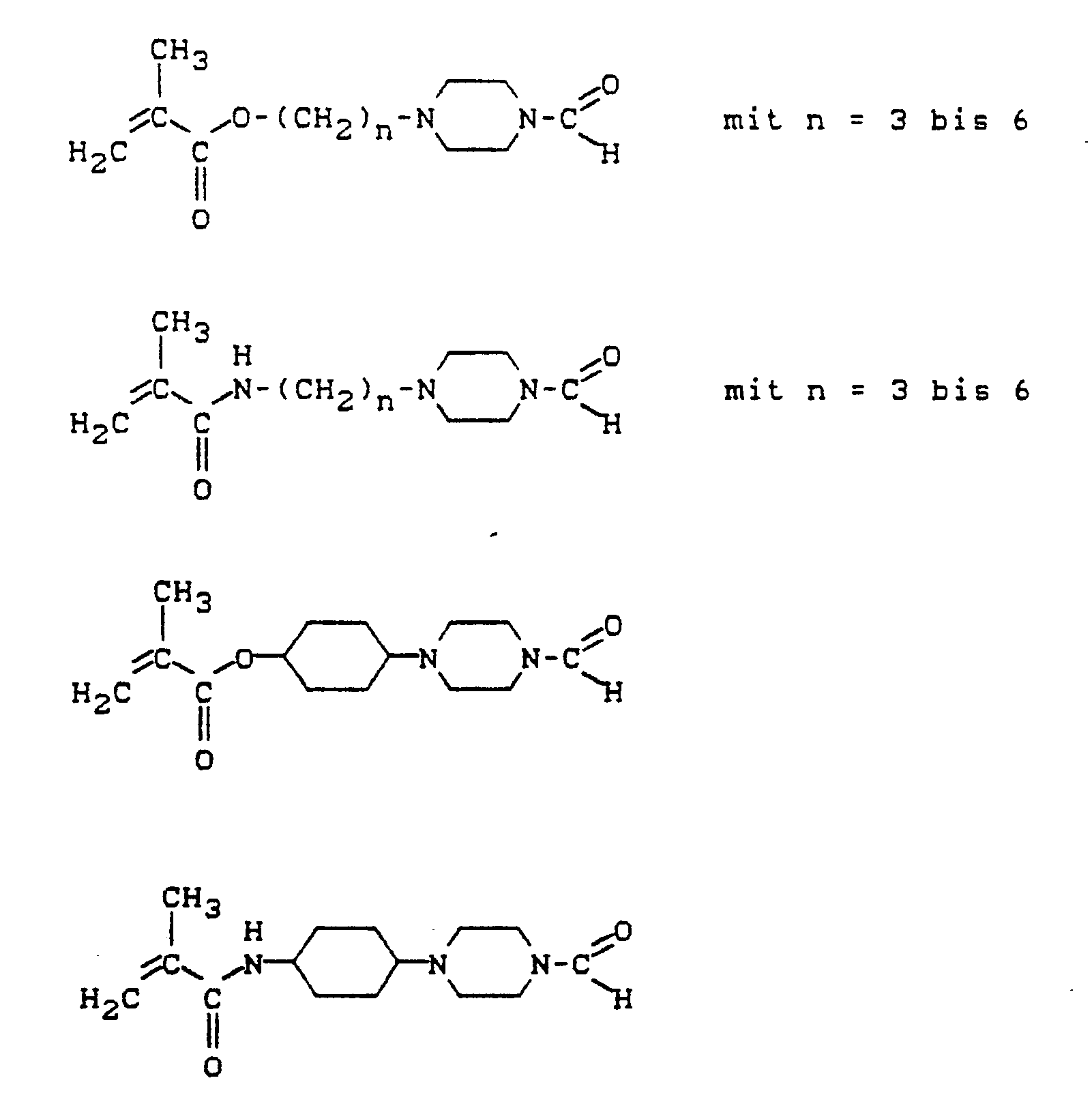
- Besonders bevorzugt sind N-Formyl-N′-(methacryloyloxethyl)piperazin und N-Formyl-N′-(methacryloylaminoethyl)piperazin der Formeln

- Beispielsweise können die erfindungsgemäßen N-Formyl-N′-[(meth)acryloyloxyalkyl]piperazine durch Umsetzung von N-(Hydroxyalkyl)piperazinen mit Ameisensäureestern und (Meth)acrylsäurechlorid hergestellt werden.
- N-Formyl-N′-[(meth)acryloylaminoalkyl]piperazine können überraschenderweise durch entsprechende sukzessive Umsetzung von N-(Aminoalkyl)piperazinen (II) mit Ameisensäurealkylestern (III) und (Meth)acrylsäurechlorid (IV) hergestellt werden:
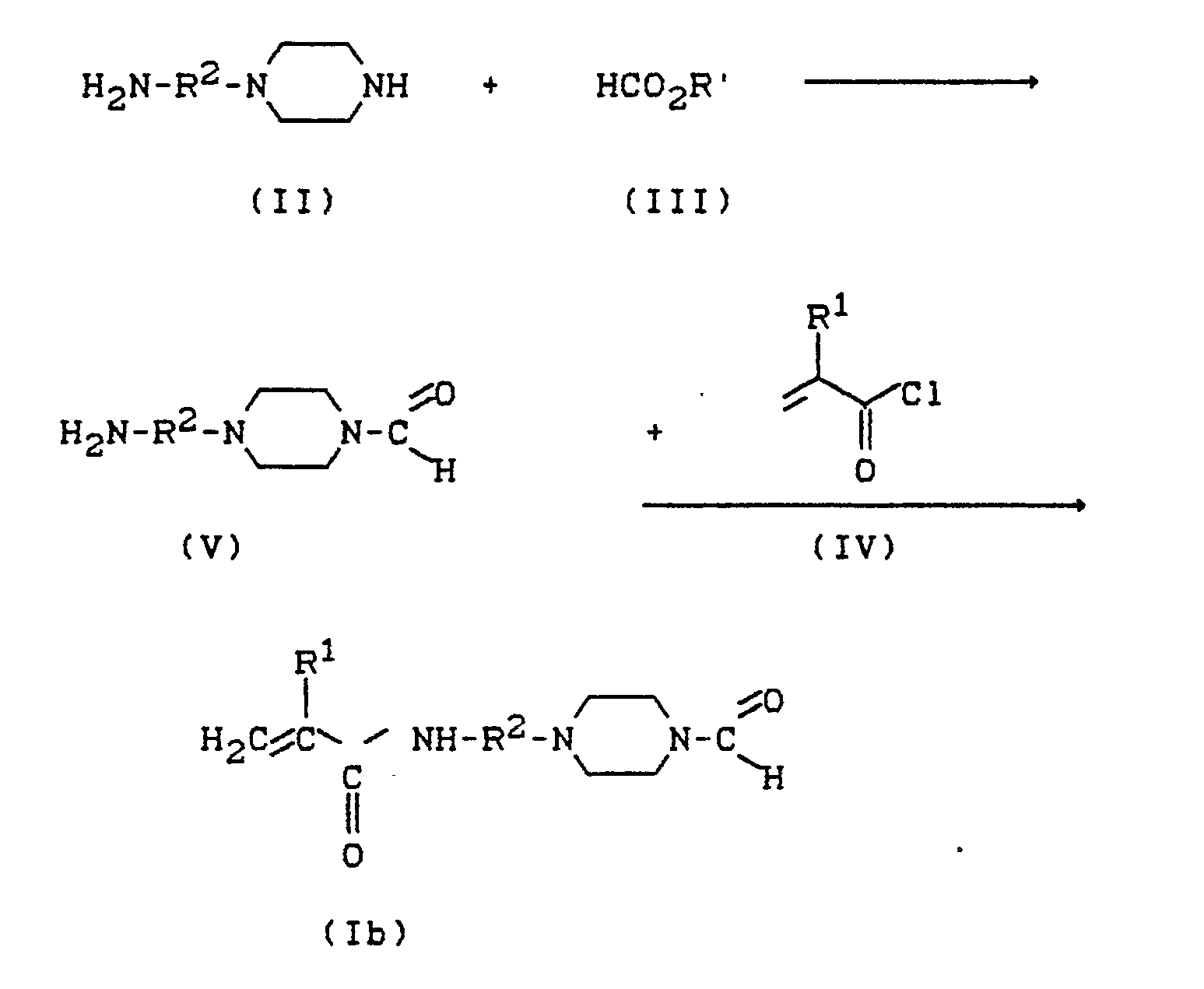
- Die Erfindung betrifft außerdem die neuen als Zwischenprodukte erhaltenen N-Formyl-N′-aminoalkylpiperazine (V). Diese Verbindungen konnten bisher nicht erhalten werden, da sich die Aminoalkylpiperazine (II) mit Ameisensäurephenylester (DE-OS 2 209 853) oder auch mit freien Carbonsäuren (US 3 385 858) nicht selektiv am sekundären N-Atom umsetzen ließen.
- Es wurde nun gefunden, daß sich diese Formylierung von Aminoalkylpiperazinen (II) mit Ameisensäurealkylestern (III) in hoher Selektivität zu den erfindungsgemäßen N-Formyl-N′-aminoalkylpiperazinen (V) durchführen läßt.
- Hierzu werden vorteilhaft Ameisensäureester kurzkettiger Alkohole wie Ameisensäurebutylester oder Ameisensäurepropylester eingesetzt. Besonders bevorzugt sind Ameisensäuremethyl- oder Ameisensäureethylester.
- Die erfindungsgemäßen Zwischenstufen (V) sind nicht nur bedeutend für die Darstellung erfindungsgemäßer N-Formyl-N′-[(methyl)acryloylaminoalkyl]-piperazine (Ib), sondern ebenfalls als Zwischenprodukte für Wirkstoffsynthesen einsetzbar.
- Initiatoren im Rahmen der vorliegenden Erfindung sind Radikalbildner, die eine radikalische Polymerisation auslösen. Bevorzugt sind Fotoinitiatoren, die unter der Einwirkung von Licht, beispielsweise UV-Licht, sichtbarem Licht oder Laserlicht, eine radikalische Polymerisation auslösen.
- Die sogenannten Fotopolymerisationsinitiatoren sind an sich bekannt (Houben-Weyl, Methoden der organischen Chemie, Band E 20, Seite 50 ff, Georg Thieme Verlag Stuttgart 1987). Vorzugsweise handelt es sich um Mono- oder Dicarbonylverbindungen, wie Benzoin und dessen Derivate, insbesondere Benzoinmethylether, Benzil und Benzilderivate, beispielsweise 4,4-Oxidibenzil und andere Dicarbonylverbindungen wie Diacetyl, 2,3-Pentandion und α-Diketo-Derivate des Norbornans und substituierter Norbornane, Metallcarbonyle wie Pentacarbonylmangan oder Chinone wie 9,10-Phenanthrenchinon und Naphthochinon. Besonders bevorzugt ist Campherchinon.
- Die erfindungsgemäßen Zubereitungen erhalten im allgemeinen 0,01 bis 2 Gew.-Teile, bevorzugt 0,2 bis 0,5 Gew.-Teile des Initiators, bezogen auf 1 Gew.-Teil der N-Formylpiperazingruppen enthaltenden (Meth)acrylsäureester bzw. (Meth)acrylsäureamide.
- Enthält eines der mit der erfindungsgemäßen Adhäsivkomponente im Kontakt stehenden Fügeteile bereits einen Initiator der beschriebenen Art, kann auf den Initiator in der Adhäsivkomponente auch ganz verzichtet werden.
- Die Lösungsmittel im Rahmen der vorliegenden Erfindung sollen die Komponente lösen und sollen, durch die Anwendung bedingt, untoxisch sein. Bevorzugt seien Wasser und flüchtige organische Lösungsmittel wie Methanol, Ethanol, Propanol, Isopropanol, Aceton, Methylethylketon, Tetrahydrofuran, Essigsäuremethyl- oder -ethylester genannt.
- Im allgemeinen setzt man 10 bis 1000 Gew.-Teile, bevorzugt 50 bis 300 Gew.-Teile des Lösungsmittels, bezogen auf die N-Formylpiperazinderivate ein.
- Es kann vorteilhaft sein, den erfindungsgemäßen Zubereitungen Coaktivatoren zuzusetzen, die die Polymerisationsreaktion beschleunigen. Bekannte Beschleuniger sind beispielsweise Amine wie p-Toluidin, Dimethyl-p-toluidin, Trialkylamine wie Trihexylamin, Polyamine wie N,N,N′,N′-Tetraalkylalkylendiamin, Barbitursäure und Dialkylbarbitursäure.
- Die Coaktivatoren werden im allgemeinen in einer Menge von 0,02 bis 4 Gew.-%, bevorzugt 0,2 bis 1 Gew.-%, bezogen auf die Menge an polymerisierbaren Verbindungen eingesetzt.
- Als weitere Komponente können die erfindungsgemäßen Zusammensetzungen Carbonylverbindungen enthalten.
- Carbonylverbindungen im Rahmen der vorliegenden Erfindung sind Aldehyde und Ketone, die 1 bis 20, bevorzugt 1 bis 10, und besonders bevorzugt 2 bis 6 Kohlenstoffatome, enthalten. Die Carbonylfunktion kann an einem aliphatischen, aromatischen und heterocyclischen Molekülteil gebunden sein.
- Als Aldehyde seien aliphatische Mono- oder Dialdehyde genannt. Bevorzugt werden Formaldehyd, Acetaldehyd, Propionaldehyd, 2-Methylpropionaldehyd, Butyraldehyd, Benzaldehyd, Vanillin, Furfural, Anisaldehyd, Salicylaldehyd, Glyoxal, Glutardialdehyd und Phthaldialdehyd. Besonders bevorzugt ist der Glutardialdehyd.
- Als Ketone seien besonders aliphatische Mono- und Diketone genannt. Bevorzugt sind Butanon, Aceton, Cyclooctanon, Cycloheptanon, Cyclohexanon, Cyclopentanon, Acetophenon, Benzophenon, 1-Phenyl-2-propanon, 1,3-Diphenyl-2-propanon, Acetylaceton, 1,2-Cyclohexandion, 1,2-Cyclopentandion und Campherchinon. Besonders bevorzugt ist Cyclopentanon.
- Im allgemeinen setzt man 1 bis 1000 Gew.-Teile, bevorzugt 5 bis 50 Gew.-Teile der Carbonylverbindungen, bezogen auf die N-Formylpiperazinderivate ein.
- Als weitere Komponente können die erfindungsgemäßen Zusammensetzungen (Meth)-acrylsäureester enthalten, die Vernetzungen ausbilden können. (Meth)-acrylsäureester, die Vernetzungen ausbilden können, enthalten im allgemeinen 2 oder mehr polymerisierbare aktive Gruppen im Molekül. Bevorzugt seien Ester der (Meth)-acrylsäure mit 2- bis 5-wertigen Alkoholen mit 2 bis 30 Kohlenstoffatomen genannt. Besonders bevorzugt werden Alkoxy(meth)acrylate und Urethangruppen enthaltende (Meth)acrylate.
- Beispielsweise seien (Meth)-acrylsäureester der Formel

A einen geradkettigen, verzweigten, cyclischen, aliphatischen, aromatischen oder gemischt aliphatischaromatischen Rest mit 2 bis 25 C-Atomen, der durch -O-, NH- oder O-CO-NH-Brücken unterbrochen und mit Hydroxy, Oxy, Carboxy, Amino oder Halogen substituiert sein kann,
bedeutet,
R H oder Methyl bedeutet und
n für eine ganze Zahl von 2 bis 8, vorzugsweise 2 bis 4, steht,
genannt. - Vorzugsweise seien Verbindungen der folgenden Formeln genannt:


n eine Zahl von 1 bis 4 und
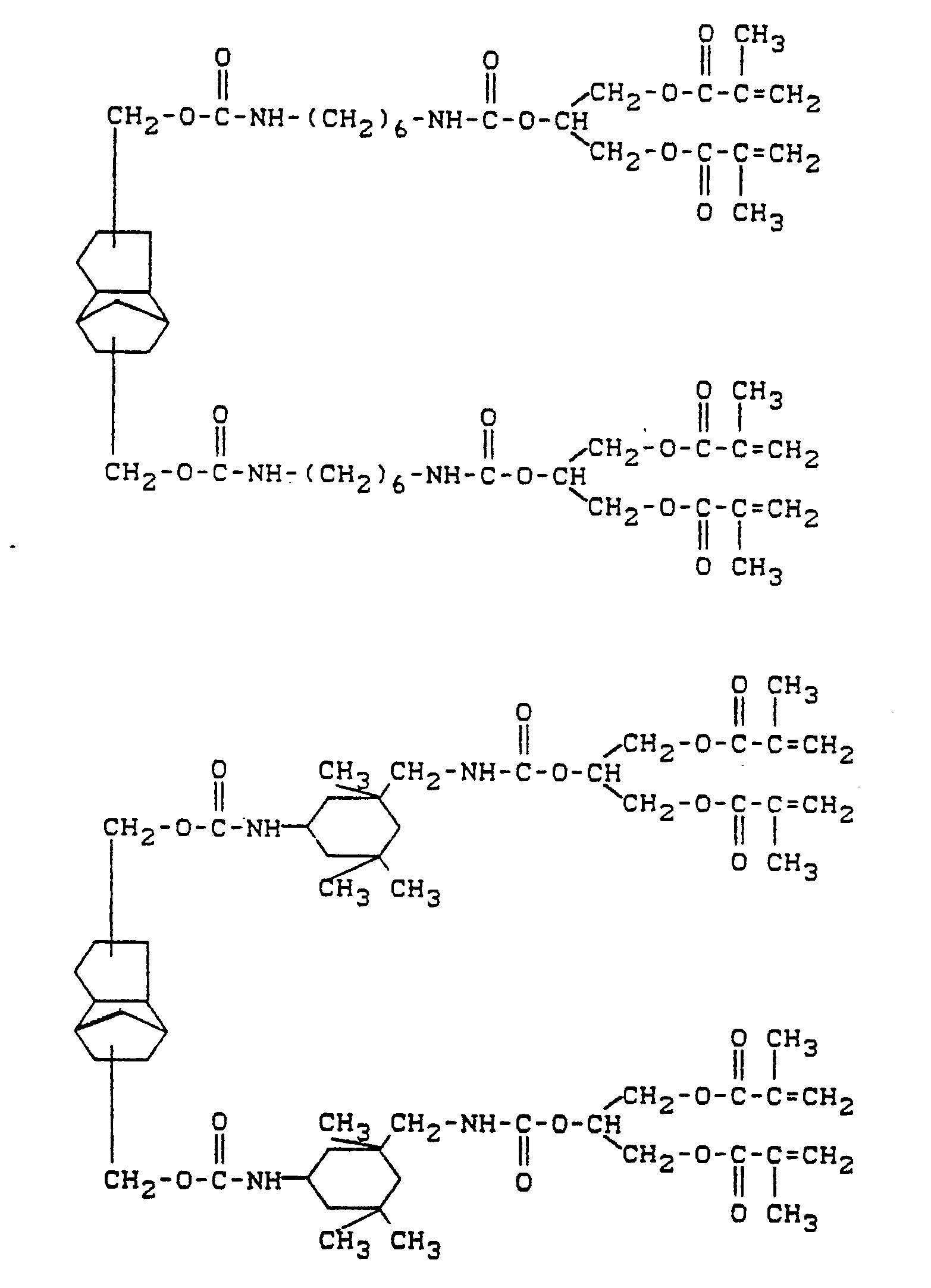
m eine Zahl von 0 bis 5 bedeutet. - Außerdem seien Derivate des Tricyclodecans (EP-A 00 23 686) und Umsetzungsprodukte aus Polyolen, Diisocyanaten und Hydroxyalkylmethacrylaten (DE-A 37 03 120, DE-A 37 03 080 und DE-A 37 03 130) genannt. Beispielsweise seien die folgenden Monomeren genannt:

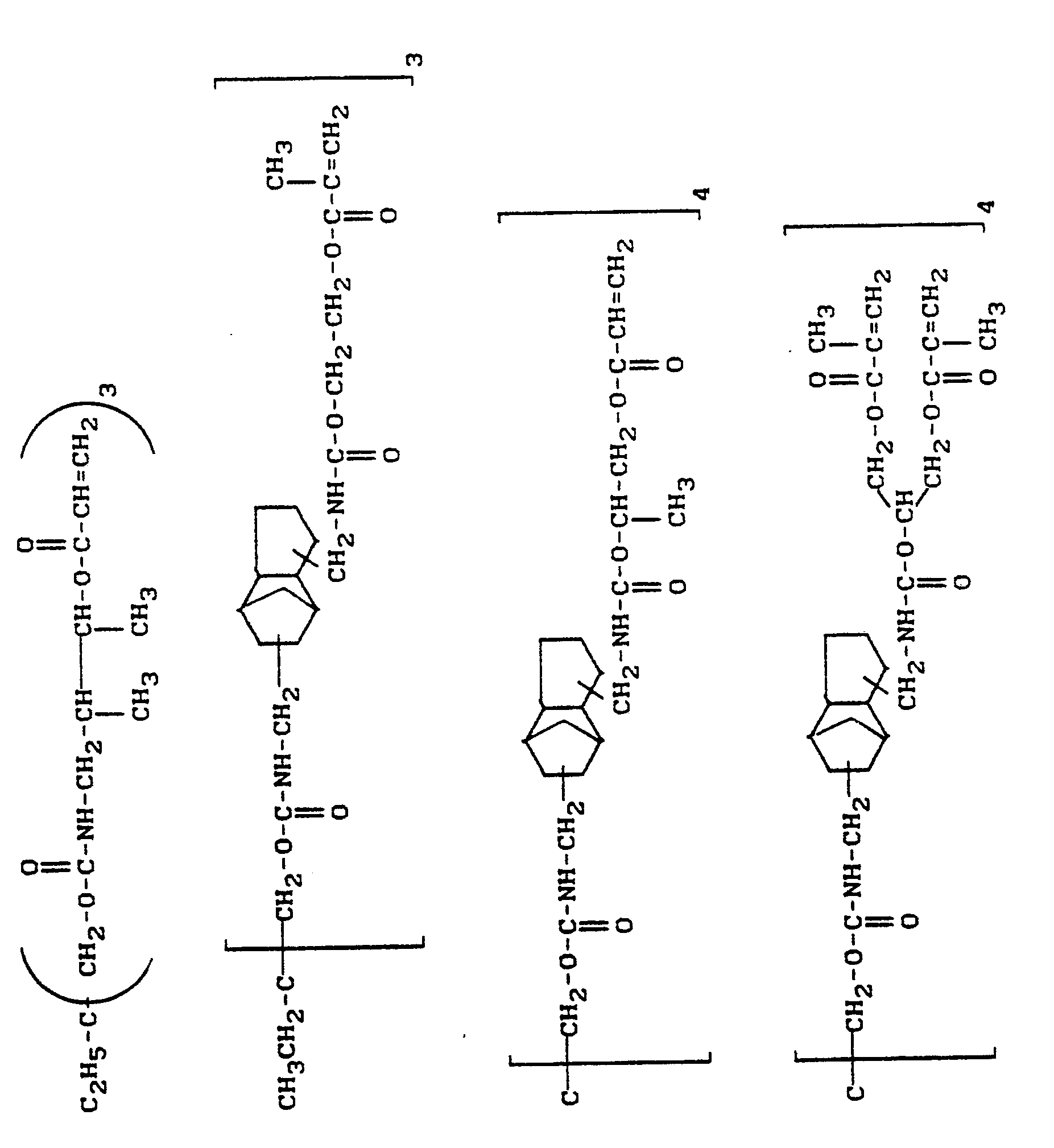

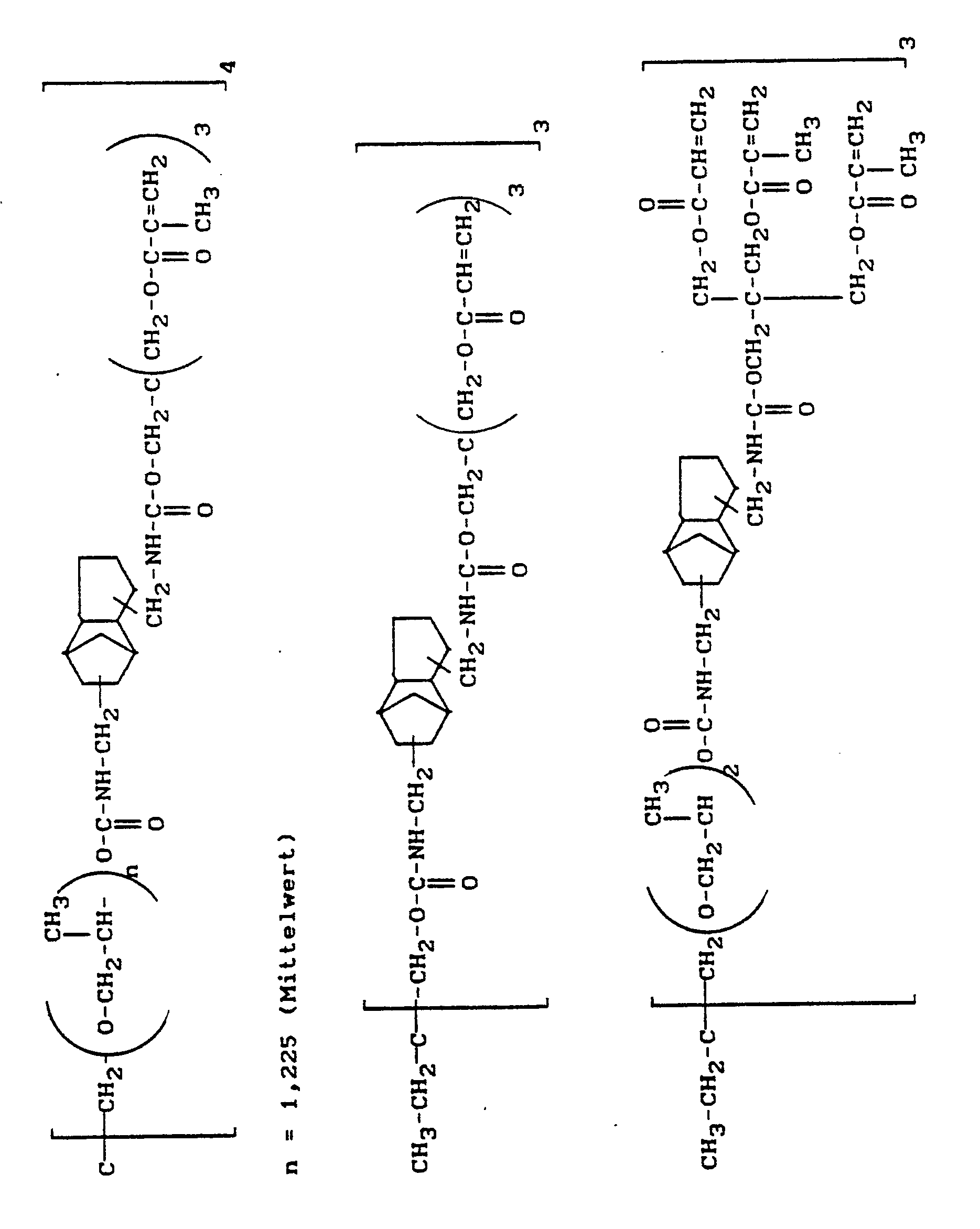




- Besonders bevorzugt als Monomer wird das sogenannte Bis-GMA der Formel

- Selbstverständlich ist es möglich, Mischungen der verschiedenen (Meth)-Acrylsäureester, die Vernetzungen ausbilden können, einzusetzen. Beispielsweise seien Mischungen von 20 bis 70 Gew.-Teilen Bis-GMA und 30 bis 80 Gew.-Teilen Triethylenglykoldimethacrylat genannt.
- Die erfindungsgemäßen Zubereitungen enthalten im allgemeinen 5 bis 80 Gew.-Teile, bevorzugt 10 bis 60 Gew.-Teile Carboxylverbindungen, bezogen auf die N-Formylpiperazinderivate.
- Als weitere Komponente können die erfindungsgemäßen Zusammensetzungen Füllstoffe enthalten. Als Füllstoffe werden feine Pulver bevorzugt, die einen Teilchendurchmesser im Bereich von 0,1 bis 100 µm (gegebenenfalls auch in einer polydispersen Verteilung) haben. Füllstoffe können im Dentalbereich übliche Füllstoffe (R. S. Baratz, J. Biomat. Applications, Vol 1, 1987, S 316 ff) wie anorganische Gläser, Siliziumdioxid-, Aluminiumoxid- oder Quarzpulver sein.
- Durch einen Anteil an Füllstoffen in den erfindungsgemäßen Zubereitungen entstehen Klebezemente, die besonders zur Befestigung von Brücken-, Kronen- und anderen Verblendmaterialen geeignet sind.
- Der Anteil des Füllstoffs beträgt im allgemeinen 20 bis 80 Gew.-Teile, bevorzugt 40 bis 70 Gew.-Teile, bezogen auf die gesamte Zubereitung.
- Die Adhäsivkomponenten gemäß dieser Erfindung können weiterhin bis zu 10 Gew.-Teilen üblicher Zusätze wie Stabilisatoren, Inhibitoren, Lichtschutzmittel, Farbstoffe, Pigmente oder Fluoreszenzstoffe enthalten.
- Die erfindungsgemäßen Zubereitungen können hergestellt werden, indem man die Formylpiperazingruppen enthaltenden (Meth)-acrylsäureester bzw. Methacrylsäureamide, Initiatoren und gegebenenfalls die anderen Komponenten durch kräftiges Rühren mischt.
- Die Zubereitungen können auch lösungsmittelfrei vorliegen.
- Die erfindungsgemäßen Zubereitungen können als Adhäsivkomponente zur Behandlung kollagenhaltiger Materialien verwendet werden.
- In einer besonderen Ausführungsform konditioniert man das kollagenhaltige Material vor der Behandlung mit der erfindungsgemäßen Zubereitung mit einer Flüssigkeit mit einem pH-Wert im Bereich von 0,1 bis 3,5.
- Diese enthält im allgemeinen Säuren mit einem pKs-Wert kleiner als 5 und gegebenenfalls eine amphotere Aminoverbindung mit einem pKs-Wert im Bereich von 9,0 bis 10,6 und einem pKB-Wert im Bereich von 11,5 bis 12,5. Folgende Säuren können z.B. in der Konditionierflüssigkeit enthalten sein:
Phosphorsäure, Salpetersäure, Brenztraubensäure, Zitronensäure, Oxalsäure, Ethylendiamintetraessigsäure, Essigsäure, Weinsäure, Äpfelsäure, Maleinsäure. - Als amphotere Aminoverbindungen seien vorzugsweise Verbindungen der Formel

R¹ für eine Carboxylgruppe steht,
R² Wasserstoff, gegebenenfalls durch Hydroxy, Thio, Methylthio, Carboxy, Amino, Phenyl, Hydroxy-phenyl oder die Gruppen
R³ Wasserstoff oder Phenyl bedeutet,
wobei die Reste R¹ und R³ durch einen Propylrest verbunden sein können, oder
in der
R¹ für Wasserstoff steht,
R² für die Gruppe
-A-NH₃X ,
in der
A für einen zweibindigen Alkylenrest mit 1 bis 6 Kohlenstoffatomen und
X für Halogen steht,
bedeutet und
R³ Wasserstoff bedeutet,
genannt. - Beispielsweise seien die folgenden amphoteren Aminoverbindungen genannt: Glycin, Serin, Threonin, Cystein, Tyrosin, Asparagin, Glutamin, Alanin, Valin, Leucin, Isoleucin, Prolin, Methionin, Phenylalanin, Tryptophan, Lysin, Arginin, Histidin, N-Phenylglycin, Ethylendiamin hydrochlorid, Ethylendiaminhydrobromid, Propylendiaminhydrochlorid, Propylendiaminhydrobromid, Butylendiaminhydrochlorid, Butylendiaminhydrobromid, Leucinhydrochlorid und Histidinhydrochlorid.
- Weiterhin kann die Konditionierflüssigkeit Stoffe aus der Gruppe der Polyethylenglykole und Metallhydroxide enthalten. Insbesondere können die oben aufgeführten mehrbasigen Säuren auch als teilweise Metallsalze eingesetzt werden solange freie Säurefunktionen verbleiben.
- Konditionierflüssigkeiten, die mindestens eine der Säuren aus der Gruppe der Brenztraubensäure, Ethylendiamintetraessigsäure und Zitronensäure sowie gegebenenfalls eine amphotere Aminoverbindung aus der Gruppe des Glycins, N-Phenylglycins und Prolins enthalten, sind besonders bevorzugt.
- Die Anwendung der erfindungsgemäßen Zubereitungen kann beispielsweise wie folgt durchgeführt werden:
- Bei einer Zahnreparatur zum Beispiel trägt man beispielsweise nach einer mechanischen Reinigung des kollagenhaltigen Zahnmaterials zuerst die Konditionierflüssigkeit mit etwas Watte auf, läßt eine kurze Zeit (beispielsweise 60 Sekunden) einwirken, spült das Zahnmaterial mit Wasser und trocknet es im Luftstrom. Dann trägt man die erfindungsgemäße Zubereitung beispielsweise mit einem kleinen Pinsel in einer dünnen Schicht auf und trocknet im Luftstrom. Nach der erfindungsgemäßen Behandlung trägt man die eigentliche Füllmasse, beispiels weise im Dentalbereich übliche Kunststoffüllungsmassen (K. Eichner, "Zahnärztliche Werkstoffe und ihre Verarbeitung", Bd. 2, S. 135 ff, Hüthig Verlag, 5. Aufl. 1985) auf.
- In ähnlicher Weise können die erfindungsgemäßen Zubereitungen zur Befestigung von Kronen, Brücken und ähnlichen Hilfsmitteln verwendet werden.
- Vorstufe:
Zu einer gerührten Lösung aus 520,8 g (4,00 mol) N-2-Hydroxyethylpiperazin in 500 ml Methanol wurden 80 g (1,33 mol) Ameisensäuremethylester getropft und vier Stunden zum Rückfluß erhitzt. Nach Abziehen leicht flüchtiger Bestandteile wurde der erhaltene Rückstand bei 0,1 Torr rektifiziert, wobei zwischen 135 und 140°C 169,6 g (81 % der Theorie) N-Formyl-N′-2-hydroxyethylpiperazin in Form einer farblosen Flüssigkeit erhalten wurden.
IR (Film): ν= 3400, 2930, 1680, 1660, 1440, 1400, 1275, 1218, 1142, 1047, 1008, 760 cm⁻¹
¹H-NMR (CDCl₃, 200 MHz): δ = 2.53
- Folgestufe:
Zu einer gerührten Lösung aus 160 g (1,01 mol) N-Formyl-N′-2-hydroxyethylpiperazin, 111 g (1,10 mol) Triethylamin und 100 mg 2,6-Di-tert.butyl-4-methylphenol in 300 ml Dichlormethan wurden zwischen -30 und -35°C 105,5 g (1,01 mol) Methacrylsäurechlorid getropft und zwei Stunden bei gleicher Temperatur gerührt. Der ausgefallene Niederschlag wurde abfiltriert, das Filtrat mit Natriumchlorid-Lösung gewaschen, getrocknet und zu 166,8 g (73 % der Theorie) eines klaren Öles von N-Formyl-N′-(methacryloyloxyethyl)piperazin eingeengt. Dieses ließ sich von einer Kieselgelsäule nach Abtrennung kleiner Mengen an Nebenprodukten mit Ether/n-Hexan (6:4) methanolisch in hoher Reinheit eluieren.
IR (Film): ν =2940, 2800, 1725, 1675, 1442, 1400, 1318, 1294, 1194, 1160, 1010, 940 cm⁻¹
¹H-NMR (CDCl₃, 200 MHz): δ = 1,96 (bs, 3H, CH₃), 2,53
- Vorstufe:
Entsprechend Beispiel 1 wurden 774,3 g (6,00 mol) N-2-Aminoethylpiperazin in 300 ml Methanol mit 120,0 g (2,00 mol) Ameisensäuremethylester umgesetzt und bei 0,1 Torr zwischen 115 und 120°C 151,6 g (48 % der Theorie) N-2-Aminoethyl-N′-formylpiperazin in Form einer gelblichen Flüssigkeit erhalten.
IR (Film): ν = 3300, 2930, 2800, 1668, 1441, 1396, 1272, 1203, 1130, 1013 cm⁻¹
¹H-NMR (CDCl₃, 200 MHz): δ = 1,64 (bs, 2H, NH₂), 2,47
- Folgestufe:
117,9 g (0,75 mol) N-2-Aminoethyl-N′-formylpiperazin, 85,8 g (0,85 mol) Triethylamin und 100 mg 2,6-Di-tert.butyl-4-methylphenol wurden in 230 ml Dichlormethan mit 78,4 g (0,75 mol) Methacrylsäurechlorid wie in Beispiel 1 beschrieben umgesetzt und aufgearbeitet. 73,9 g (44 % d. Th.) N-Formyl-N′-(methacryloylaminoethyl)piperazin wurden auf diese Weise als farbloses Öl erhalten.
IR (Film): ν = 3350, 2950, 2820, 1675, 1665, 1618, 1532, 1442, 1221, 1152, 101, 925 cm⁻¹
¹H-NMR (CDCl₃, 200 MHz): δ = 1,98 (bs, 3H, CH₃), 2,50
- Die erfindungsgemäßen Klebemittel werden durch intensives Vermischen der in folgenden Beispielen aufgeführten Bestandteile erzeugt.
Beispiel 3: 47 g Wasser
53 g N-Formyl-N′-(methacryloyloxyethyl)piperazin
159 mg Campherchinon
Beispiel 4: 36 g Wasser
48 g N-Formyl-N′-(methacryloyloxyethyl)piperazin
16 g 25 Gew.-%ige wäßrige Glutardialdehyd-Lösung
144 mg Campherchinon
Beispiel 5: 48 g Wasser
52 g N-Formyl-N′-(methacryloylaminoethyl)piperazin
144 mg Campherchinon
Beispiel 6: 37 g Wasser
48 g N-Formyl-N′-(methacryloylaminoethyl)piperazin
15 g 25 Gew.-%ige wäßrige Glutardialdehyd-Lösung
144 mg Campherchinon - Die Eignung der Klebemittel (II) entsprechend der Beispiele 3 bis 6 wird geprüft, indem die Bindungsfestigkeit der lichtaktivierten Kunststoffüllungsmasse auf Basis mehrfunktioneller Methacrylsäureester und Bariumaluminosilikat Lumifor® auf Dentin bestimmt wird, das nacheinander mit der Konditionierflüssigkeit (bestehend aus 81,2 g Wasser, 1,7 g Natriumhydroxid und 17 g Ethylendiamintetraessigsäure-Dinatrium-Dihydrat: 60 Sekunden Einwirkzeit, Wasserspülung, Lufttrocknung), dem Klebemittel (60 Sekunden Einwirkzeit, Lufttrocknung) und einem Verschlußmaterial auf Basis polyfunktioneller Methacrylsäureester (Bayer Resin L®) (Auftragen und im Luftstrom dünn verteilen) vorbehandelt worden ist.
- Für den Test werden herausgezogene und im feuchten Zustand aufbewahrte Menschenzähne benutzt. Die Zähne werden durch Guß in Epoxidharz eingelagert; durch Nachschleifen wird eine glatte Dentinoberfläche erzeugt. Das anschließende Schleifen erfolgt mit Carbonpapier 1000.
- Zur Herstellung eines Probekörpers zum Messen der Bindungsstärke wird eine zylindrische, gespaltete Teflonform auf die wie vorstehend beschrieben behandelte Dentinoberfläche gespannt (Scand. J. Dent. Res. 88, 348-351 (1980)). Als Füllmasse wird ein handelsübliches Kunststoffüllungsmaterial eingefüllt. Ein in einem Loch in einer Bohrerhalterung eingespannter Rundbohrer Nr. 016 wird an der Teflonform befestigt und von oben in die noch im Härteprozeß befindliche Materialschicht gepreßt.
- Die gesamte Anordnung wird 10 Minuten lang bei Zimmertemperatur (25°C) ungestört stehengelassen, wonach die Bohrerhalterung und die Teflonform abgenommen und die Probe unter Wasser mit einer Temperatur von 23°C abgesetzt wird. Nach 15 Minuten wird die Probe mit dem Bohrer in eine Instron-Zugversuchsapparatur (Scand. J. Dent. Res. 88, 348-351 (1980)) montiert; mit einer Geschwindigkeit von 1 mm/Min. wird eine Zugfestigkeitsmessung durchgeführt. Die Zugfestigkeit errechnet sich aus der Division der beim Bruch der Füllung angelegten Belastung mit dem Querschnittsareal in der Bruchfläche des Probekörpers. Es wurden jeweils 5 Messungen an Probekörpern durchgeführt.
- Die Ergebnisse sind in der folgenden Tabelle zusammengefaßt:
Zubereitung nach Beispiel Nr. Zugbindungsfestigkeit [N/mm²] 3 7 ± 2 4 12 ± 3 5 9 ± 2 6 9 ± 3
Claims (10)
1. Formylpiperazingruppen enthaltende (Meth)acrylsäurederivate der Formel (I)

in der
R¹ Wasserstoff oder Methyl bedeutet,
R² ein zweiwertiger aliphatischer oder cycloaliphatischer Rest bedeutet und
X die Bedeutung von -O- oder -NH- hat.
R¹ Wasserstoff oder Methyl bedeutet,
R² ein zweiwertiger aliphatischer oder cycloaliphatischer Rest bedeutet und
X die Bedeutung von -O- oder -NH- hat.
2. Formylpiperazingruppen enthaltende (Meth)acrylsäurederivate nach Anspruch 1
worin
R² Ethylen bedeutet.
worin
R² Ethylen bedeutet.
3. Formylpiperazingruppen enthaltende (Meth)acrylsäurederivate nach Anspruch 1,
worin
R² Cyclohexylen bedeutet.
worin
R² Cyclohexylen bedeutet.
4. Zubereitungen, enthaltend Formylpiperazingruppen enthaltende (Meth)acrylsäurederivate gemäß den Ansprüchen 1 bis 3, und gegebenenfalls Initiatoren als Adhäsivkomponente zur Behandlung kollagenhaltiger Materialien.
5. Zubereitung gemäß Anspruch 4, dadurch gekennzeichnet, daß ein Coaktivator zugesetzt wird.
6. Zubereitung gemäß Anspruch 4, dadurch gekennzeichnet, daß als weitere Komponente (Meth)acrylsäureester, die Vernetzungen ausbilden können, zugesetzt werden.
7. Verwendung von Zubereitungen enthaltend Formylpiperazingruppen enthaltende (Meth)acrylsäurederivate der Formel (I),

in der
R¹ Wasserstoff oder Methyl bedeutet,
R² ein zweiwertiger aliphatischer oder cycloaliphatischer Rest bedeutet und
X die Bedeutung von -O- oder -NH- hat
und gegebenenfalls Initiatoren, als Adhäsivkomponente zur Behandlung kollagenhaltiger Materialien.
R¹ Wasserstoff oder Methyl bedeutet,
R² ein zweiwertiger aliphatischer oder cycloaliphatischer Rest bedeutet und
X die Bedeutung von -O- oder -NH- hat
und gegebenenfalls Initiatoren, als Adhäsivkomponente zur Behandlung kollagenhaltiger Materialien.
8. Verwendung von Zubereitungen gemäß Anspruch 7 als Klebemittel zur Befestigung von Zahnreparaturmaterialien am Zahn.
9 Verwendung der Zubereitung nach Anspruch 7 als Klebemittel in Knochenzement.
10. N-Formyl-N′-aminoalkylpiperazine der Formel (V)

in der
R² ein zweiwertiger aliphatischer oder cycloaliphatischer Rest bedeutet.
R² ein zweiwertiger aliphatischer oder cycloaliphatischer Rest bedeutet.
Applications Claiming Priority (2)
| Application Number | Priority Date | Filing Date | Title |
|---|---|---|---|
| DE3913940 | 1989-04-27 | ||
| DE3913940A DE3913940A1 (de) | 1989-04-27 | 1989-04-27 | N-formyl-n'-((meth)acryloyloxyalkyl)piperazin und n-formyl-n'-((meth)acryloylaminoalkyl)piperazin, adhaesivkomponenten zur behandlung kollagenhaltiger materialien, enthaltend diese verbindungen, sowie herstellung und anwendung dieser adhaesivkomponenten |
Publications (1)
| Publication Number | Publication Date |
|---|---|
| EP0394792A1 true EP0394792A1 (de) | 1990-10-31 |
Family
ID=6379613
Family Applications (1)
| Application Number | Title | Priority Date | Filing Date |
|---|---|---|---|
| EP90107142A Withdrawn EP0394792A1 (de) | 1989-04-27 | 1990-04-13 | Formylpiperazingruppen enthaltende (Meth)acrylsäurederivate |
Country Status (6)
| Country | Link |
|---|---|
| US (1) | US5068264A (de) |
| EP (1) | EP0394792A1 (de) |
| JP (1) | JPH032175A (de) |
| DD (1) | DD298396A5 (de) |
| DE (1) | DE3913940A1 (de) |
| PT (1) | PT93875A (de) |
Cited By (2)
| Publication number | Priority date | Publication date | Assignee | Title |
|---|---|---|---|---|
| EP0441187A3 (en) * | 1990-02-06 | 1992-05-13 | Bayer Ag | Use of (meth)acryloylaminoalkylesters of carboxylic acids as adhesive components for the treatment of collagen containing materials |
| US6953832B2 (en) | 2001-01-15 | 2005-10-11 | Ivoclar Vivadent Ag | Dental materials based on polyfunctional amides |
Families Citing this family (8)
| Publication number | Priority date | Publication date | Assignee | Title |
|---|---|---|---|---|
| JP2899031B2 (ja) * | 1989-12-28 | 1999-06-02 | キヤノン株式会社 | 自動露出制御装置 |
| DE4105550A1 (de) * | 1991-02-22 | 1992-08-27 | Bayer Ag | Adhaesivkomponente zur behandlung der zahnhartsubstanz |
| AU6956394A (en) * | 1993-06-04 | 1995-01-03 | Henkel Corporation | Polymerizable compounds |
| US6344664B1 (en) * | 1999-12-02 | 2002-02-05 | Tera Connect Inc. | Electro-optical transceiver system with controlled lateral leakage and method of making it |
| CH696355A5 (de) * | 2002-11-14 | 2007-05-15 | Clariant Speciality Fine Chemi | Katalytisches Verfahren zur Herstellung von Carbonyl-Verbindungen. |
| DK1566381T3 (da) * | 2002-11-28 | 2010-01-25 | Kowa Co | Fremgangsmåde til fremstilling af 1- 2-(benzimidazol-2-ylthio)ethyl-piperazin eller salte deraf |
| ATE485804T1 (de) * | 2007-03-15 | 2010-11-15 | Ivoclar Vivadent Ag | Dentalmaterialien auf der basis von radikalisch polymerisationsfähigen, n,o-funktionalisierten acrylsäure-hydroxamiden |
| DE102009026819A1 (de) * | 2008-09-08 | 2010-03-11 | Evonik Röhm Gmbh | Monomermischung, Polymer, Beschichtungsmittel und Verfahren zur Herstellung einer Beschichtung |
Citations (6)
| Publication number | Priority date | Publication date | Assignee | Title |
|---|---|---|---|---|
| GB742450A (en) * | 1952-12-15 | 1955-12-30 | Abbott Lab | Improvements in or relating to piperazine derivatives and process of preparing the same |
| DE2507189A1 (de) * | 1975-02-20 | 1976-09-02 | Basf Ag | Formamidgruppen enthaltende polymerisate |
| DE2550547A1 (de) * | 1975-11-11 | 1977-05-18 | Basf Ag | Piperazin- oder piperaziniumgruppen enthaltende polymerisate |
| US4456603A (en) * | 1979-08-14 | 1984-06-26 | Eisai Co., Ltd. | Polyprenylcarboxylic acid amides useful for treating liver dysfunction |
| EP0141324A2 (de) * | 1983-10-25 | 1985-05-15 | Bayer Ag | Die Adhäsion förderndes Mittel, Verfahren zu dessen Herstellung und dessen Verwendung auf kollagenähnlichem Material |
| DE3703080A1 (de) * | 1986-07-25 | 1988-01-28 | Bayer Ag | (meth)-acrylsaeureester |
Family Cites Families (2)
| Publication number | Priority date | Publication date | Assignee | Title |
|---|---|---|---|---|
| US4380432A (en) * | 1980-09-03 | 1983-04-19 | Scientific Pharmaceuticals | Method for adhering structures to teeth |
| JP2568397B2 (ja) * | 1986-05-13 | 1997-01-08 | ライオン株式会社 | 義歯安定剤 |
-
1989
- 1989-04-27 DE DE3913940A patent/DE3913940A1/de not_active Withdrawn
-
1990
- 1990-04-12 US US07/509,000 patent/US5068264A/en not_active Expired - Fee Related
- 1990-04-13 EP EP90107142A patent/EP0394792A1/de not_active Withdrawn
- 1990-04-25 DD DD90340097A patent/DD298396A5/de not_active IP Right Cessation
- 1990-04-25 JP JP2107694A patent/JPH032175A/ja active Pending
- 1990-04-26 PT PT93875A patent/PT93875A/pt not_active Application Discontinuation
Patent Citations (6)
| Publication number | Priority date | Publication date | Assignee | Title |
|---|---|---|---|---|
| GB742450A (en) * | 1952-12-15 | 1955-12-30 | Abbott Lab | Improvements in or relating to piperazine derivatives and process of preparing the same |
| DE2507189A1 (de) * | 1975-02-20 | 1976-09-02 | Basf Ag | Formamidgruppen enthaltende polymerisate |
| DE2550547A1 (de) * | 1975-11-11 | 1977-05-18 | Basf Ag | Piperazin- oder piperaziniumgruppen enthaltende polymerisate |
| US4456603A (en) * | 1979-08-14 | 1984-06-26 | Eisai Co., Ltd. | Polyprenylcarboxylic acid amides useful for treating liver dysfunction |
| EP0141324A2 (de) * | 1983-10-25 | 1985-05-15 | Bayer Ag | Die Adhäsion förderndes Mittel, Verfahren zu dessen Herstellung und dessen Verwendung auf kollagenähnlichem Material |
| DE3703080A1 (de) * | 1986-07-25 | 1988-01-28 | Bayer Ag | (meth)-acrylsaeureester |
Cited By (3)
| Publication number | Priority date | Publication date | Assignee | Title |
|---|---|---|---|---|
| EP0441187A3 (en) * | 1990-02-06 | 1992-05-13 | Bayer Ag | Use of (meth)acryloylaminoalkylesters of carboxylic acids as adhesive components for the treatment of collagen containing materials |
| US5207577A (en) * | 1990-02-06 | 1993-05-04 | Bayer Aktiengesellschaft | (meth)acryloylaminoalkyl carboxylates for treatment of collagen-containing materials |
| US6953832B2 (en) | 2001-01-15 | 2005-10-11 | Ivoclar Vivadent Ag | Dental materials based on polyfunctional amides |
Also Published As
| Publication number | Publication date |
|---|---|
| JPH032175A (ja) | 1991-01-08 |
| DD298396A5 (de) | 1992-02-20 |
| DE3913940A1 (de) | 1990-10-31 |
| PT93875A (pt) | 1990-11-20 |
| US5068264A (en) | 1991-11-26 |
Similar Documents
| Publication | Publication Date | Title |
|---|---|---|
| EP0394787B1 (de) | Zubereitungen enthaltend Carbonamidgruppen enthaltende (Meth)acrylsäureester, zur Anwendung als Adhäsivkomponenten zur Behandlung kollagenhaltiger Materialien in der Medizin, sowie Herstellung dieser Zubereitungen | |
| EP0499923B1 (de) | Dentaladhäsive | |
| US5068264A (en) | Formylpiperazinyl-(meth)acrylic acid derivatives for treatment of collagen | |
| EP0418684B1 (de) | Alkandiyl-bis-carbonamide, Adhäsivkomponenten zur Behandlung kollagenhaltiger Materialien zur Anwendung in der Medizin, enthaltend diese Verbindungen | |
| EP0471252B1 (de) | N-Alkyl-N-(meth)acryloyloxyalkylcarboxamide aromatischer Carbonsäuren und aromatischer Carbonsäureanhydride sowie Adhäsive enthaltend diese Verbindungen | |
| EP0531802B1 (de) | Adhäsivkomponente zur Restaurierung der Zahnhartsubstanz | |
| EP2065363B1 (de) | Dentalmaterialien auf der Basis von Alkylendiamin-N,N,N',N'-tetraessigsäure-(meth)acrylamiden | |
| EP0794952B1 (de) | Polymerisierbare aromatische carbonsäuren und carbonsäureanhydride mit cyclischen carbonatgruppen sowie zubereitungen, enthaltend diese verbindungen | |
| US5277739A (en) | Process for bonding a material to a collagen-containing material | |
| EP0355562B1 (de) | Adhäsivkomponente zur Behandlung kollagenhaltiger Materialien | |
| EP0361033B1 (de) | Beschichtungsmittel für kollagenhaltige Materialien | |
| EP0441187A2 (de) | Carbonsäure-(meth)acryloylaminoalkylester in Adhäsivkomponenten zur Behandlung kollagenhaltiger Materialien | |
| EP0794935A1 (de) | Derivate aromatischer carbonsäuren aus aromatischen carbonsäureanhydriden und hydroxy(meth)acrylaten sowie zubereitungen, enthaltend diese verbindungen | |
| DE19544670C2 (de) | Verfahren zur Herstellung oligomerer Kondensationsprodukte aromatischer Tricarbonsäuren und Epoxy(meth)acrylaten |
Legal Events
| Date | Code | Title | Description |
|---|---|---|---|
| PUAI | Public reference made under article 153(3) epc to a published international application that has entered the european phase |
Free format text: ORIGINAL CODE: 0009012 |
|
| 17P | Request for examination filed |
Effective date: 19900413 |
|
| AK | Designated contracting states |
Kind code of ref document: A1 Designated state(s): AT BE CH DE DK ES FR GB GR IT LI LU NL SE |
|
| 17Q | First examination report despatched |
Effective date: 19921002 |
|
| STAA | Information on the status of an ep patent application or granted ep patent |
Free format text: STATUS: THE APPLICATION HAS BEEN WITHDRAWN |
|
| 18W | Application withdrawn |
Withdrawal date: 19930630 |