EP0392270B2 - Verfahren zur Gewinnung von C3 bis C4-Monoalkylchloriden - Google Patents
Verfahren zur Gewinnung von C3 bis C4-Monoalkylchloriden Download PDFInfo
- Publication number
- EP0392270B2 EP0392270B2 EP90105989A EP90105989A EP0392270B2 EP 0392270 B2 EP0392270 B2 EP 0392270B2 EP 90105989 A EP90105989 A EP 90105989A EP 90105989 A EP90105989 A EP 90105989A EP 0392270 B2 EP0392270 B2 EP 0392270B2
- Authority
- EP
- European Patent Office
- Prior art keywords
- water
- reaction
- alcohol
- hcl
- hydrogen chloride
- Prior art date
- Legal status (The legal status is an assumption and is not a legal conclusion. Google has not performed a legal analysis and makes no representation as to the accuracy of the status listed.)
- Expired - Lifetime
Links
- 238000000034 method Methods 0.000 title claims description 15
- 238000011084 recovery Methods 0.000 title description 3
- VEXZGXHMUGYJMC-UHFFFAOYSA-N Hydrochloric acid Chemical compound Cl VEXZGXHMUGYJMC-UHFFFAOYSA-N 0.000 claims abstract description 71
- 229910000041 hydrogen chloride Inorganic materials 0.000 claims abstract description 53
- IXCSERBJSXMMFS-UHFFFAOYSA-N hydrogen chloride Substances Cl.Cl IXCSERBJSXMMFS-UHFFFAOYSA-N 0.000 claims abstract description 53
- XLYOFNOQVPJJNP-UHFFFAOYSA-N water Substances O XLYOFNOQVPJJNP-UHFFFAOYSA-N 0.000 claims abstract description 46
- 238000006243 chemical reaction Methods 0.000 claims abstract description 28
- 239000008346 aqueous phase Substances 0.000 claims abstract description 17
- 239000007795 chemical reaction product Substances 0.000 claims abstract description 16
- 230000015572 biosynthetic process Effects 0.000 claims abstract description 15
- 238000003786 synthesis reaction Methods 0.000 claims abstract description 15
- 239000012074 organic phase Substances 0.000 claims abstract description 12
- 239000000047 product Substances 0.000 claims abstract description 9
- 238000005406 washing Methods 0.000 claims abstract description 9
- LFQSCWFLJHTTHZ-UHFFFAOYSA-N Ethanol Chemical compound CCO LFQSCWFLJHTTHZ-UHFFFAOYSA-N 0.000 claims description 33
- 150000001348 alkyl chlorides Chemical class 0.000 claims description 32
- 238000004821 distillation Methods 0.000 claims description 10
- 239000003054 catalyst Substances 0.000 claims description 9
- 238000001035 drying Methods 0.000 claims description 4
- 238000000926 separation method Methods 0.000 claims description 4
- 239000000470 constituent Substances 0.000 claims description 2
- 238000010420 art technique Methods 0.000 claims 1
- 239000002351 wastewater Substances 0.000 abstract description 7
- 125000003158 alcohol group Chemical group 0.000 abstract description 2
- LRHPLDYGYMQRHN-UHFFFAOYSA-N N-Butanol Chemical compound CCCCO LRHPLDYGYMQRHN-UHFFFAOYSA-N 0.000 description 12
- 239000000243 solution Substances 0.000 description 8
- XLYOFNOQVPJJNP-ZSJDYOACSA-N Heavy water Chemical compound [2H]O[2H] XLYOFNOQVPJJNP-ZSJDYOACSA-N 0.000 description 6
- HEMHJVSKTPXQMS-UHFFFAOYSA-M Sodium hydroxide Chemical compound [OH-].[Na+] HEMHJVSKTPXQMS-UHFFFAOYSA-M 0.000 description 6
- JIAARYAFYJHUJI-UHFFFAOYSA-L zinc dichloride Chemical compound [Cl-].[Cl-].[Zn+2] JIAARYAFYJHUJI-UHFFFAOYSA-L 0.000 description 6
- 239000012071 phase Substances 0.000 description 5
- 238000005191 phase separation Methods 0.000 description 5
- KFZMGEQAYNKOFK-UHFFFAOYSA-N Isopropanol Chemical compound CC(C)O KFZMGEQAYNKOFK-UHFFFAOYSA-N 0.000 description 3
- 150000008044 alkali metal hydroxides Chemical class 0.000 description 3
- 239000006227 byproduct Substances 0.000 description 3
- 239000007789 gas Substances 0.000 description 3
- 239000011592 zinc chloride Substances 0.000 description 3
- 235000005074 zinc chloride Nutrition 0.000 description 3
- FAPWRFPIFSIZLT-UHFFFAOYSA-M Sodium chloride Chemical compound [Na+].[Cl-] FAPWRFPIFSIZLT-UHFFFAOYSA-M 0.000 description 2
- 150000001298 alcohols Chemical class 0.000 description 2
- 239000003513 alkali Substances 0.000 description 2
- 229910001854 alkali hydroxide Inorganic materials 0.000 description 2
- 238000010438 heat treatment Methods 0.000 description 2
- 239000011780 sodium chloride Substances 0.000 description 2
- -1 C 3 chloroalkanes Chemical class 0.000 description 1
- 239000006096 absorbing agent Substances 0.000 description 1
- 238000009825 accumulation Methods 0.000 description 1
- 150000001336 alkenes Chemical class 0.000 description 1
- 239000007864 aqueous solution Substances 0.000 description 1
- BTANRVKWQNVYAZ-UHFFFAOYSA-N butan-2-ol Chemical compound CCC(C)O BTANRVKWQNVYAZ-UHFFFAOYSA-N 0.000 description 1
- 150000001805 chlorine compounds Chemical class 0.000 description 1
- 238000004140 cleaning Methods 0.000 description 1
- 238000003776 cleavage reaction Methods 0.000 description 1
- 238000011109 contamination Methods 0.000 description 1
- 238000010924 continuous production Methods 0.000 description 1
- 238000005260 corrosion Methods 0.000 description 1
- 230000007797 corrosion Effects 0.000 description 1
- 238000010586 diagram Methods 0.000 description 1
- 150000001983 dialkylethers Chemical class 0.000 description 1
- 238000009826 distribution Methods 0.000 description 1
- 238000000605 extraction Methods 0.000 description 1
- 239000013505 freshwater Substances 0.000 description 1
- 239000011521 glass Substances 0.000 description 1
- 238000002955 isolation Methods 0.000 description 1
- 238000004519 manufacturing process Methods 0.000 description 1
- 239000000203 mixture Substances 0.000 description 1
- 238000006386 neutralization reaction Methods 0.000 description 1
- 238000010943 off-gassing Methods 0.000 description 1
- 238000002360 preparation method Methods 0.000 description 1
- 238000000746 purification Methods 0.000 description 1
- 230000009257 reactivity Effects 0.000 description 1
- 238000004064 recycling Methods 0.000 description 1
- 230000007017 scission Effects 0.000 description 1
Images
Classifications
-
- C—CHEMISTRY; METALLURGY
- C07—ORGANIC CHEMISTRY
- C07C—ACYCLIC OR CARBOCYCLIC COMPOUNDS
- C07C17/00—Preparation of halogenated hydrocarbons
- C07C17/093—Preparation of halogenated hydrocarbons by replacement by halogens
- C07C17/16—Preparation of halogenated hydrocarbons by replacement by halogens of hydroxyl groups
-
- C—CHEMISTRY; METALLURGY
- C07—ORGANIC CHEMISTRY
- C07C—ACYCLIC OR CARBOCYCLIC COMPOUNDS
- C07C17/00—Preparation of halogenated hydrocarbons
- C07C17/38—Separation; Purification; Stabilisation; Use of additives
Definitions
- the present invention relates to a process for working up the reaction product of the continuous reaction of C 3 to C 4 monoalkanols with hydrogen chloride at elevated temperature and, if appropriate, in the presence of a catalyst for obtaining C 3 or.
- C 4 -monoalkyl chlorides by stripping off the vaporous reaction product, purification and separation of the alkyl chloride by water washing, drying and, if appropriate, distillation of the crude alkyl chloride.
- Alkyl chlorides can be prepared by reacting the corresponding alkanols with hydrogen chloride at elevated temperature and preferably in the presence of catalysts.
- DE-PS 24 22 969 describes a process for the separation of C 1 to C 3 chloroalkanes from mixtures which are obtained by reacting C 1 to C 3 alkanols with hydrogen chloride to obtain a superheated steam consisting of chloroalkane, the unreacted starting components alkanol and Hydrogen chloride and water have been produced.
- the superheated steam is treated in a distillation column with an aqueous solution of alkali hydroxide, with the majority of the hydrogen chloride present, and the solution obtained is removed, the alkyl chloride vapor which flows off is passed into an alkali cleaning column and there with alkali hydroxide Washed 10 to 50 ° C with binding of the remaining hydrogen chloride, the resulting washing solution for treating the superheated steam, the cleaned alkyl chloride vapor passed into a cooled packed column, where the unreacted alkanol liquefied and removed and the alkyl chloride isolated in a conventional manner.
- the unreacted alcohol on the one hand and the water of reaction on the other hand can only be separated off by simultaneous neutralization of the HCl contained therein with aqueous alkali metal hydroxide solution.
- a more or less large amount of saline wastewater is obtained depending on the conversion, which must be freed of organic cargo in a strip column before treatment as wastewater.
- the invention was based on the object of developing a continuous process which does not have the disadvantages of the prior art described and in particular allows the isolation and reuse of unconverted HCl and avoids the accumulation of saline wastewater.
- the unreacted alcohol and HCl are separated from the water of reaction by distillation in a recycle column.
- the top product is HCl and water-containing alcohols, which - depending on the type of alcohol - contain more or less HCl and water and which are recycled to alkyl chloride synthesis.
- the water of reaction which contains a maximum of 21% HCl, is drawn off at the bottom of the recycle column and, if necessary, fed to the generation of HCl.
- the amount of unreacted hydrogen chloride contained in the heavy aqueous phase is reduced by direct recycling to the process and is limited to a maximum of 21% in the water of reaction.
- hydrochloric acid is produced than water of reaction.
- the hydrochloric acid is obtained with such a purity that it can be used either as a sales product or for the production of hydrogen chloride.
- the remaining water of reaction can be used to extract the HCl and alcohol residues dissolved in the alkyl chloride, thus significantly reducing the amount of fresh water used or the amount of waste water.
- the separation process takes into account the azeotropic relationships between alkyl chlorides and alcohols, which increase with increasing C number, as well as the special features of the selectivity in the different Alkyl chloride synthesis.
- the reaction product to be worked up by the process according to the invention is prepared by reacting the corresponding C 3 or C 4 monoalkanol with hydrogen chloride in the presence of a customary catalyst, for example zinc chloride, at elevated temperature.
- a customary catalyst for example zinc chloride
- the reaction temperature at atmospheric pressure is usually about 100 to 180 ° C, preferably 100 to 150 ° C.
- a crude gaseous reaction product is obtained which, in addition to unreacted hydrogen chloride and unreacted alcohol, contains alkyl chloride and water, the corresponding dialkyl ethers and olefins.
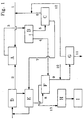
- FIG. 1 An exemplary embodiment of the method according to the invention is shown in the method diagram shown as FIG. 1 and is described in more detail below:
- Fresh alcohol is fed via line 1, possibly after passing through an exhaust gas scrubber, not shown, together with the alcohol recycle stream via line 6 and the hydrogen chloride via line 2 in a molar ratio of 1: 1 from below to the reactor A constructed as a reboiler.
- a 60 to 70% solution of zinc chloride in water is specified as the catalyst solution.
- the amount of catalyst used depends on the particular synthesis requirements in accordance with the intended maximum catalyst load.
- the reaction temperature in reactor A is set according to the conversion and selectivity requirements of the alkyl chloride to be produced in each case.
- the reaction product of alkyl chloride, water, by-products as well as unreacted alcohol and HCl is removed in vapor form from the reactor via line 3, condensed and separated in separator B into a light organic phase which contains the alkyl chloride and a heavy water phase.
- the heavy water phase is fed via line 5 directly to the recycle column C, in which the water of reaction at the bottom of the column is generally drawn off as the maximum azeotrope of water / HCl with 21% by weight HCl via line 7.
- the hydrogen chloride contained in the water of reaction is returned to the synthesis insert via the second stage E of the HCl recovery plant D / E.
- All other constituents contained in the heavy water phase such as alcohol, alkyl chloride, azeotropic water and the rest of the unreacted hydrogen chloride, are separated off as top product and used as azeotropic alcohol recycle stream via line 6 together with the fresh alcohol for synthesis.
- Slight HCl outgassings from the return vessel of the recycle column C are taken up by the fresh alcohol together with possible exhaust gas from the separator B of the alkyl chloride synthesis in the exhaust gas scrubber (not shown) and thus returned to the synthesis.
- the crude alkyl chloride from the separator B which contains small amounts of the unreacted alcohol, hydrogen chloride, water and the by-products of the respective synthesis, is fed unchanged via line 4 to the multistage countercurrent extractor F and washed with water.
- the extract phase, the wash water, is then discharged via line 9 and neutralized with NaOH from line 10 and freed from dissolved organic components, such as alcohol and alkyl chloride, in the stripping column G.
- the organic fractions are fed via line 12 to the azeotropic alcohol recycle from the recycle column C in line 6 and used with the fresh alcohol for synthesis.
- the neutralized washing water, which has been freed from dissolved organic components, is fed to the waste water via line 11.
- the ratio of wash water: alkyl chloride enables the residual alcohol content specified for the pure alkyl chloride to be set in accordance with the respective distribution coefficients.
- drying Before distilling the washed, still moist alkyl chloride, which is discharged from the countercurrent extractor F via line 13, drying may be provided in an absorber, not shown. If this drying of the alkyl chloride, which prevents corrosion of the first distillation column, proves to be unnecessary, it can be omitted. Instead, the water can be separated off azeotropically in the first distillation column.
- the pure distillation of the alkyl chloride produced is carried out in a manner known per se in two ways, depending on the nature of the product, and depending on its respective by-product content, in two distillation columns to be operated continuously, low-boiler column H and high-boiler column I.
- the heavy aqueous phase was fed directly and continuously to the recycle column, in which the aqueous phase was separated by distillation at a top temperature of 98.5 ° C. and a bottom temperature of 110 ° C. in such a way that 318 g of azeotropic alcohol recycle stream, which was immediately added to the Reactor was fed, and 64 g of 21% hydrochloric acid were obtained at the bottom of the column.
- the light organic phase was continuously fed into the countercurrent extractor and treated with water to give alcohol-free and salt-free crude alkyl chloride, which was then subjected to distillation in the low and high boiler columns.
- Phase separation produced 1170 g of light organic phase and 376 g of aqueous phase in the separator.
- the heavy aqueous phase was separated in the recycle column in 62 g of azeotropic alcohol recycle stream and 314 g of hydrochloric acid with 15.6% HCl.
- the alcohol recycle stream is HCl-free in this example and the HCl concentration in the reaction water outlet is less than 21%.
Landscapes
- Chemical & Material Sciences (AREA)
- Organic Chemistry (AREA)
- Organic Low-Molecular-Weight Compounds And Preparation Thereof (AREA)
Description
- Die vorliegende Erfindung bezieht sich auf ein Verfahren zur Aufarbeitung des Reaktionsproduktes der kontinuierlichen Umsetzung von C3 bis C4-Monoalkanolen mit Chlorwasserstoff bei erhöhter Temperatur und ggf. in Gegenwart eines Katalysators zur Gewinnung von C3 -bzw. C4-Monoalkylchloriden durch Abtreiben des dampfförmigen Reaktionsproduktes, Reinigung und Abtrennung des Alkylchlorides durch Wasserwäsche, Trocknung und ggf. Destillation des rohen Alkylchlorides.
- Alkylchloride können durch Umsetzung der entsprechenden Alkanole mit Chlorwasserstoff bei erhöhter Temperatur und bevorzugt in Gegenwart von Katalysatoren hergestellt werden.
- In der DE-PS 24 22 969 ist ein Verfahren zur Abtrennung von C1 bis C3 Chloralkanen aus Gemischen beschrieben, die durch Umsetzung von C1 bis C3 Alkanolen mit Chlorwasserstoff unter Erhalt eines überhitzten Dampfes bestehend aus Chloralkan, den nichtumgesetzten Ausgangkomponenten Alkanol und Chlorwasserstoff sowie Wasser hergestellt worden sind. Nach dem Verfahren dieser deutschen Patentschrift wird der überhitzte Dampf in einer Destillationskolonne mit einer wäßrigen Lösung von Alkalihydroxid unter Bindung des überwiegenden Teiles des anwesenden Chlorwasserstoffes behandelt und die anfallende Lösung entfernt, der abströmende Alkylchlorid-Dampf in eine Alkali-Reinigungskolonne geleitet und dort mit Alkalihydroxid bei 10 bis 50°C unter Bindung des restlichen Chlorwasserstoffes gewaschen, die anfallende Waschlösung zur Behandlung des überhitzten Dampfes zurückgeführt, der gereinigte Alkylchlorid-Dampf in eine gekühlte Füllkörperkolonne geleitet, dort das nichtumgesetzte Alkanol verflüssigt und entfernt sowie das Alkylchlorid in an sich bekannter Weise isoliert.
- Die Abtrennung des nichtumgesetzten Alkohols einerseits und des Reaktionswassers andererseits ist nur durch gleichzeitige Neutralisation des darin enthaltenen HCl mit wäßriger Alkalilauge zu erreichen. Neben dem Verlust an nicht umgesetztem HCl wird damit je nach Umsatz eine mehr oder weniger große salzhaltige Abwassermenge erhalten, die vor der Behandlung als Abwasser in einer Stripkolonne von organischer Fracht befreit werden muß.
- Der Erfindung lag die Aufgabe zugrunde, ein kontinuierliches Verfahren zu entwickeln, das die Nachteile des geschilderten Standes der Technik nicht aufweist und inbesondere die Isolierung und Wiedereinsetzung von nichtumgesetztem HCl gestattet und den Anfall salzhaltiger Abwassermengen vermeidet.
- Diese Aufgabe wird erfindungsgemäß durch das Verfahren des Anspruches 1 gelöst.
- Nach einer bevorzugten Ausführungsform des erfindungsgemäßen Verfahrens wird das HCl-enthaltende Reaktionswasser in Chlorwasserstoff und Wasser aufgetrennt, der Chlorwasserstoff in die Synthese zurückgeführt und das Wasser zur Waschung des Alkylchlorids eingesetzt, wobei ggf. das Waschwasser zunächst auf einem pH-Wert

- Erfindungsgemäß erfolgt die Trennung von nichtumgesetztem Alkohol und HCl vom Reaktionswasser durch Destillation in einer Recyclekolonne. Als Kopfprodukt fallen dabei HCl und wasserhaltige Alkohole an, die - je nach Alkoholtyp - mehr oder weniger HCl und Wasser enthalten und die im Kreislauf zur Alkylchloridsynthese zurückgeführt werden. Am Kolonnensumpf der Recyclekolonne wird das Reaktionswasser, das maximal 21 % HCl enthält, abgezogen und ggf. der HCl-Erzeugung zugeführt.
- Das erfindungsgemäße Verfahren unterscheidet sich gegenüber dem Stand der Technik in den folgenden wesentlichen Merkmalen:
- Es wird grundsätzlich eine Kontaktierung mit Alkali bei der Aufbereitung des Reaktorausgangsproduktes und damit sowohl die Rückspaltung der Alkylchloride als auch die Verunreinigung von Salzsäure vermieden.
- Die Menge des in der schweren wäßrigen Phase enthaltenen nichtumgesetzten Chlorwasserstoffs wird durch direkte Rückführung in den Prozeß verringert und auf maximal 21 % im Reaktionswasser begrenzt.
- Es wird nicht mehr Salzsäure produziert als Reaktionswasser anfällt. Die Salzsäure fällt mit einer solchen Reinheit an, daß sie entweder als Verkaufsprodukt oder zur Chlorwasserstoffgewinnung verwendet werden kann.
- Gewinnt man daraus Chlorwasserstoff, so kann das verbleibende Reaktionswasser zur Extraktion der im Alkylchlorid gelösten HCl- und Alkoholreste genutzt und damit der Frischwassereinsatz bzw. Abwasseranfall deutlich reduziert werden.
- Das Trennverfahren berücksichtigt insgesamt die mit steigender C-Zahl zunehmenden azeotropen Beziehungen zwischen Alkylchloriden und Alkoholen sowie die Besonderheiten der Selektivität bei den verschiedenen Alkylchloridsynthesen.
- Das nach dem erfindungsgemäßen Verfahren aufzuarbeitende Reaktionsprodukt wird durch Umsetzung des entsprechenden C3 bzw. C4-Monoalkanols mit Chlorwasserstoff in Gegenwart eines üblichen Katalysators, z.B. Zinkchlorid, bei erhöhter Temperatur hergestellt. Die Reaktionstemperatur bei Atmosphärendruck beträgt in der Regel etwa 100 bis 180°C, vorzugsweise 100 bis 150°C. Es wird dabei ein rohes gasförmiges Reaktionsprodukt erhalten, das neben nichtumgesetztem Chlorwasserstoff und nichtumgesetztem Alkohol Alkylchlorid sowie Wasser, die entsprechenden Dialkylether und Olefine enthält.
- Ein Ausführungsbeispiel des erfindungsgemäßen Verfahrens ist in dem als Fig. 1 wiedergegebenen Verfahrensschema dargestellt und wird im folgenden näher beschrieben:
- Frischalkohol wird über Leitung 1, ggf. nach Durchlaufen eines nicht dargestellten Abgaswäschers, gemeinsam mit dem Alkoholrückführstrom über Leitung 6 und dem Chlorwasserstoff über Leitung 2 im Molverhältnis 1:1 von unten dem als Aufkocher konstruierten Reaktor A zugeführt.
- Als Katalysatorlösung wird eine 60- bis 70-%ige Lösung von Zinkchlorid in Wasser vorgegeben. Hierbei richtet sich die eingesetzte Katalysatormenge nach den jeweiligen Synthesebedürfnissen ent-sprechend der vorgesehenen maximalen Katalysatorbelastung.
- Die Reaktionstemperatur im Reaktor A wird den Umsatz- und Selektivitätsforderungen des jeweils zu erzeugenden Alkylchlorids entsprechend eingestellt. Das Reaktionsprodukt aus Alkylchlorid, Wasser, Nebenprodukten sowie nichtumgesetztem Alkohol und HCl wird dampfförmig aus dem Reaktor über Leitung 3 abgeführt, kondensiert und in Abscheider B in eine leichte organische Phase, die das Alkylchlorid enthält, und eine schwere Wasserphase getrennt.
- Die schwere Wasserphase wird über Leitung 5 direkt der Recyclekolonne C zugeführt, in der am Kolonnensumpf das Reaktionswasser in der Regel als Maximumazeotrop von Wasser/HCl mit 21 Gew.% HCl über Leitung 7 abgezogen wird. Der im Reaktionswasser enthaltene Chlorwasserstoff wird über die zweite Stufe E der HCl-Gewinnungsanlage D/E wieder zum Syntheseeinsatz zurückgegeben. Alle anderen in der schweren Wasserphase enthaltenen Bestandteile wie Alkohol, Alkylchlorid, Azeotropwasser und der Rest an nicht umgesetztem Chlorwasserstoff werden als Kopfprodukt abgetrennt und als azeotroper Alkoholrückführstrom über Leitung 6 zusammen mit dem Frischalkohol wieder zur Synthese eingesetzt. Leichte HCl-Ausgasungen aus dem Rücklaufbehälter der Recyclekolonne C werden gemeinsam mit möglichem Abgas aus dem Abscheider B der Alkylchlorid-Synthese im Abgaswäscher (nicht gezeigt) vom Frischalkohol aufgenommen und so wieder zur Synthese zurückgeführt.
- Das rohe Alkylchlorid aus dem Abscheider B, das kleine Mengen des nichtumgesetzten Alkohols, Chlorwasserstoffs, Wasser und die Nebenprodukte der jeweiligen Synthese enthält, wird unverändert über Leitung 4 dem mehrstufigen Gegenstromextraktor F zugeführt und mit Wasser gewaschen. Als Extraktionswasser kann Kondensat, zweckmäßigerweise unter Einbeziehung des neutralisierten Abwassers aus der HCl-Gewinnungsanlage D/E über Leitung 8, eingesetzt werden. Der pH-Wert eines solchen Wassers sollte nach Möglichkeit pH = 8 nicht übersteigen.
- Die Extraktphase, das Waschwasser, wird anschließend über Leitung 9 abgeführt und mit NaOH aus Leitung 10 neutralisiert und in der Stripkolonne G von gelösten organischen Anteilen, wie Alkohol und Alkylchlorid, befreit. Die organischen Anteile werden über Leitung 12 dem azeotropen Alkoholrecycle von der Recyclekolonne C in Leitung 6 zugeführt und mit dem Frischalkohol zur Synthese eingesetzt. Das neutralisierte und von gelösten organischen Anteilen befreite Waschwasser wird über Leitung 11 dem Abwasser zugeführt.
- Durch das Verhältnis Waschwasser : Alkylchlorid kann entsprechend den jeweiligen Verteilungskoeffizienten der für das reine Alkylchlorid spezifizierte Alkoholrestgehalt eingestellt werden.
- Vor der Destillation des gewaschenen, noch feuchten Alkylchlorids, das über Leitung 13 aus dem Gegenstromextraktor F abgeführt wird, mag eine Trocknung in einem nicht dargestellten Absorber vorgesehen sein. Erweist sich diese, einer möglichen Korrosion der ersten Destillationskolonne vorbeugende Trocknung des Alkylchlorids als nicht notwendig, so kann diese entfallen. Stattdessen kann das Wasser in der ersten Destillationskolonne H azeotrop abgetrennt werden.
- Die Reindestillation des erzeugten Alkylchlorids wird je nach Beschaffenheit des Produkts in unterschiedlicher Weise und abhängig von ihrem jeweiligen Nebenproduktgehalt in zwei kontinuierlich zu betreibenden Destillationskolonnen, Leichtsieder-Kolonne H und Schwersieder-Kolonne I, in an sich bekannter Weise durchgeführt.
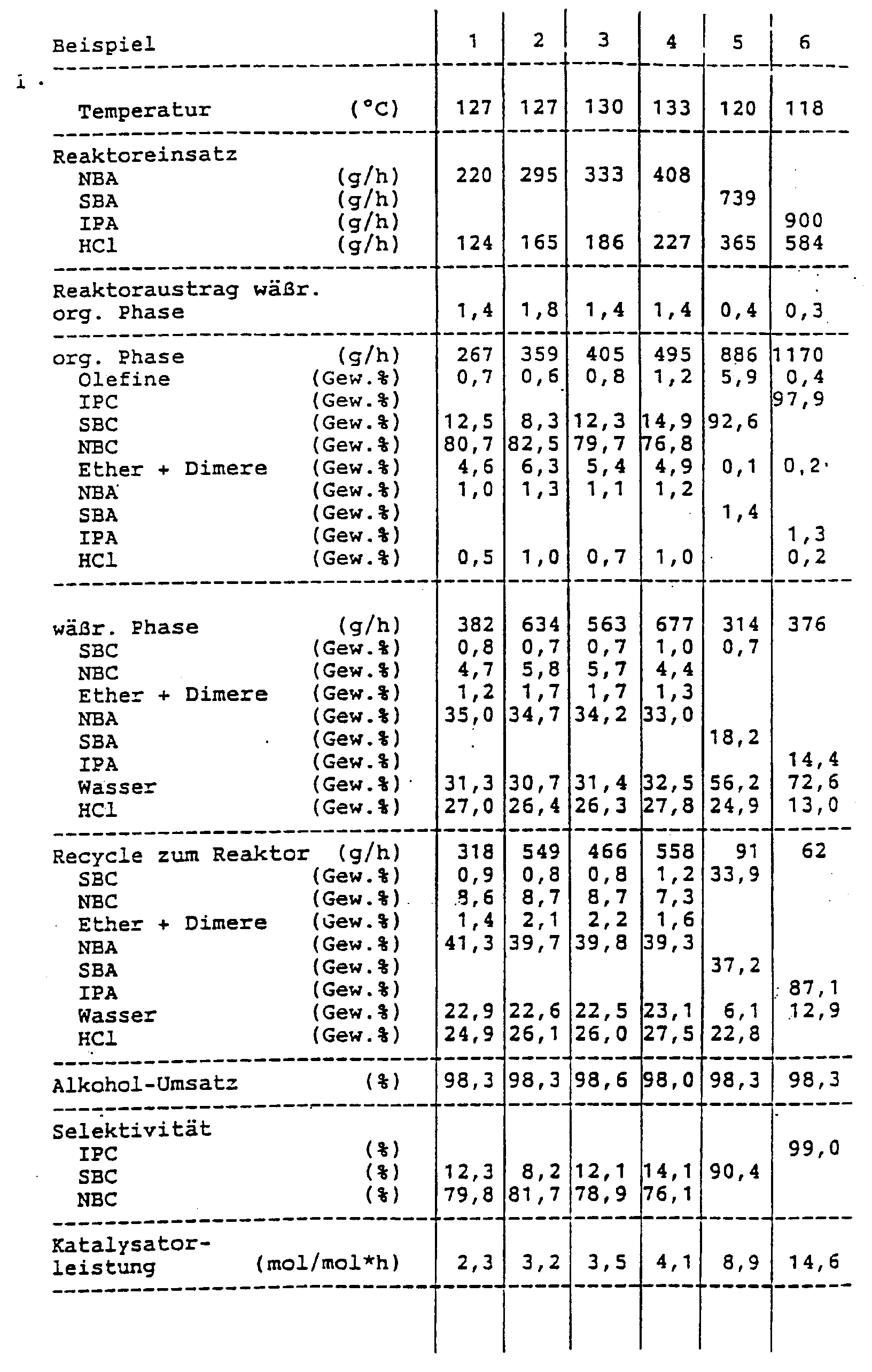
- Die folgenden Beispiele erläutern das erfindungsgemäße Verfahren. Die Ergebnisse der Beispiele sind in Tabelle I zusammengestellt.
- In einem Glasreaktor mit einer lichten Weite von 40 mm und einer Länge von 550 mm, der bis zu einer Höhe von 280 mm mit einem mit Heißöl beheizten Heizmantel umgeben war, wurden 1,0 Mol = 136,3 g Zinkchlorid (70 % in Wasser gelöst) als Katalysatorlösung gegeben. Der Heißölumlauf durch den Heizmantel wurde so eingestellt, daß sich eine konstante Temperatur von 127°C in der Katalysatorlösung einstellte. Es wurden sodann stündlich 3 Mol = 220 g n-Butylalkohol und 3,4 Mol = 124 g Chlorwasserstoff gemeinsam mit 318 g eines azeotropen Rückalkohols aus der Recyclekolonne von unten zugeführt und gleichzeitig am Kopf des Reaktors 649 g Reaktionsprodukt dampfförmig abgezogen und kondensiert. Das Reaktionsprodukt wurde abgeführt und in dem Abscheider in 267 g einer leichten organischen Phase und 382 g einer schweren wäßrigen Phase aufgetrennt und separat weitergeleitet.
- Die schwere wäßrige Phase wurde direkt und kontinuierlich der Recyclekolonne zugeführt, in der durch Destillation bei einer Kopftemperatur von 98,5°C und einer Sumpftemperatur von 110°C die wäßrige Phase so aufgetrennt wurde, daß am Kolonnenkopf 318 g azeotroper Alkoholrückführstrom, der unmittelbar dem Reaktor zugeführt wurde, und am Kolonnensumpf 64 g 21-%ige Salzsäure anfielen.
- Bis auf den im Sumpfprodukt der Recyclekolonne enthaltenen Chlorwasserstoff, der in HCl-Aufkonzentrierungskolonnen zurückgewonnen werden kann, wurde der gesamte, bei der Synthese notwendige HCl-Überschuß gemeinsam mit dem nichtumgesetzten Alkohol und in Gegenwart von Wasser in die Synthese zurückgeführt.
- Die leichte organische Phase wurde kontinuierlich in den Gegenstromextraktor geführt und mit Wasser behandelt, wobei alkohol- und salzfreies rohes Alkylchlorid erhalten wurde, das anschließend einer Destillation in den Leicht- und Schwersiederkolonnen unterworfen wurde.
- In der Stripkolonne wurde dann nur noch das Waschwasser des Gegenstromextraktors, das mit Natronlauge neutralisiert wurde, abgestreift.
- Gemäß Beispiel 1 wurden stündlich 4 Mol = 295 g n-Butylalkohol und 4,5 Mol = 165 g Chlorwasserstoff gemeinsam mit 549 g eines azeotropen Alkoholrückführstroms eingesetzt und bei einer Reaktionstemperatur von 127°C 993 g Reaktionsprodukt dampfförmig abgezogen und kondensiert. Durch Phasentrennung fielen im Abscheider 359 g leichte organische Phase und 634 g schwere wäßrige Phase an. Die wäßrige Phase wurde in der Recyclekolonne in 549 g azeotropen Alkoholrückführstrom und 85 g 21-%iger Salzsäure aufgetrennt.
- Gemäß Beispiel 1 wurden stündlich 4,5 Mol = 333 g n-Butylalkohol und 5,1 Mol = 186 g Chlorwasserstoff gemeinsam mit 466 g eines azeotropen Alkoholrückführstroms eingesetzt und bei einer Reaktionstemperatur von 130°C 968 g Reaktionsprodukt dampfförmig abgezogen und kondensiert. Durch Phasentrennung fielen im Abscheider 405 g leichte organische Phase und 563 g schwere wäßrige Phase an. Die schwere wäßrige Phase wurde in der Recyclekolonne in 466 g azeotropen Alkohol rückführstrom und 97 g 21-%iger Salzsäure aufgetrennt.
- Gemäß Beispiel 1 wurden stündlich 5,5 Mol = 408 g n-Butylalkohol und 6,2 Mol = 227 g Chlorwasserstoff gemeinsam mit 558 g eines azeotropen Alkoholrückführstroms eingesetzt und bei einer Reaktionstemperatur von 133°C 1172 g Reaktionsprodukt dampfförmig abgezogen und kondensiert. Durch Phasentrennung fielen im Abscheider 495 g leichte organische Phase und 677 g schwere wäßrige Phase an. Die wäßrige Phase wurde in der Recyclekolonne in 558 g azeotropen Alkoholrückführstrom und 119 g 21-%ige Salzsäure aufgetrennt.
- Gemäß Beispiel 1 wurden stündlich 10 Mol = 739 g s-Butylalkohol und 10 Mol = 365 g Chlorwasserstoff gemeinsam mit 91,4 g eines azeotropen Alkoholrückführstroms eingesetzt und bei einer Reaktionstemperatur von 120°C 1200 g Reaktionsprodukt dampfförmig abgezogen und kondensiert. Durch Phasentrennung fielen im Abscheider 886 g leichte organische Phase und 314 g schwere wäßrige Phase an. Die schwere wäßrige Phase wurde in der Recyclekolonne in 91,4 g azeotropen Alkoholrückführstrom und 222 g 21-%iger Salzsäure aufgetrennt.
- Gemäß Beispiel 1 wurden stündlich 15,0 Mol = 900 g Isopropylalkohol und 16,0 Mol = 584 g Chlorwasserstoff gemeinsam mit 62 g eines azeotropen Alkoholrückführstroms eingesetzt und bei einer Reaktionstemperatur von 118°C 1546 g Reaktionsprodukt dampfförmig abgezogen und kondensiert. Durch Phasentrennung fielen im Abscheider 1170 g leichte organische Phase und 376 g schwere wäßrige Phase an. Die schwere wäßrige Phase wurde in der Recyclekolonne in 62 g azeotropen Alkoholrückführstroms und 314 g Salzsäure mit 15,6 % HCl aufgetrennt.
- Die Reaktivität in IPA bedingt nur einen geringen HCl-Überschuß bei gutem Umsatz. Aus diesem Grund ist bei diesem Beispiel der Alkoholrückführstrom HCl-frei und die HCl-Konzentration im Reaktionswasserauslaß kleiner als 21 %.
Claims (2)
- Verfahren zur Aufarbeitung des Reaktionsproduktes der kontinuierlichen Umsetzung von C3- bis C4- Monoalkanolen mit Chlorwasserstoff bei erhöhter Temperatur und in Gegenwart eines Katalysators zur Gewinnung von C3- bzw. C4- Monoalkylchloriden durch Abtrieben des dampfförmigen Reaktionsproduktes, Reinigung und Abtrennung des Alkylchlorides durch Wasserwäsche, Trocknung und ggf. Destillation des rohen Alkylchlorides, dadurch gekennzeichnet, daß man- das durch Umsetzung bei einer Temperatur im Bereich von 100-180° C entsprechend den Umsatz- und Selektivitätsforderungen des jeweils zu erzeugenden Alkylchlorids erhaltene Reaktionsprodukt ohne destillative Trennung dampfförmig austreibt, wobei der Reaktoraustrag Anteile nicht umgesetzten Alkohols und Chlorwasserstoffs nebst Wasser enthält,- diesen Reaktoraustrag kondensiert, und das erhaltene Kondensat in eine leichte organische Phase und in eine schwere wäßrige Phase auftrennt,- die schwere wäßrige Phase unmittelbar destilliert, als Sumpfprodukt das Reaktionswasser mit maximal 21% HCl und als Kopfprodukt einen HCl- und wasserhaltigen Alkoholstrom gewinnt, den Alkoholstrom zusammen mit dem Frischalkohol in die Synthese zurückführt und- die leichte organische Phase mit Wasser wäscht, das Alkylchlorid abtrennt und in an sich bekannter Weise reinigt, das Waschwasser neutralisiert, zur Befreiung von gelösten organischen Anteilen abstreift und aus dem System entfernt.
- Verfahren nach Anspruch 1, dadurch gekennzeichnet, daß man das HCl-enthaltende Reaktionswasser in Chlorwasserstoff und Wasser auftrennt, den Chlorwassserstoff in die Synthese zurückführt und das Wasser zur Waschung des Alkylchlorids einsetzt.
Priority Applications (1)
| Application Number | Priority Date | Filing Date | Title |
|---|---|---|---|
| AT90105989T ATE90659T1 (de) | 1989-04-13 | 1990-03-29 | Verfahren zur gewinnung von c3 bis c4monoalkylchloriden. |
Applications Claiming Priority (2)
| Application Number | Priority Date | Filing Date | Title |
|---|---|---|---|
| DE3912094 | 1989-04-13 | ||
| DE3912094A DE3912094A1 (de) | 1989-04-13 | 1989-04-13 | Verfahren zur gewinnung von c(pfeil abwaerts)3(pfeil abwaerts) bis c(pfeil abwaerts)4(pfeil abwaerts) -monoalkylchloriden |
Publications (3)
| Publication Number | Publication Date |
|---|---|
| EP0392270A1 EP0392270A1 (de) | 1990-10-17 |
| EP0392270B1 EP0392270B1 (de) | 1993-06-16 |
| EP0392270B2 true EP0392270B2 (de) | 1997-05-07 |
Family
ID=6378569
Family Applications (1)
| Application Number | Title | Priority Date | Filing Date |
|---|---|---|---|
| EP90105989A Expired - Lifetime EP0392270B2 (de) | 1989-04-13 | 1990-03-29 | Verfahren zur Gewinnung von C3 bis C4-Monoalkylchloriden |
Country Status (6)
| Country | Link |
|---|---|
| US (1) | US5132476A (de) |
| EP (1) | EP0392270B2 (de) |
| JP (1) | JP2723652B2 (de) |
| AT (1) | ATE90659T1 (de) |
| CA (1) | CA1325019C (de) |
| DE (2) | DE3912094A1 (de) |
Families Citing this family (13)
| Publication number | Priority date | Publication date | Assignee | Title |
|---|---|---|---|---|
| CN1035507C (zh) * | 1991-08-01 | 1997-07-30 | 中国石油化工总公司 | 一种生产氯代正丁烷的方法 |
| DE19625283A1 (de) * | 1996-06-25 | 1998-01-02 | Hoechst Ag | Verfahren zur Herstellung und Auftrennung eines Gemischs aus Dimethylether und Chlormethan mit Wasser als Extraktionsmittel |
| DE19625284A1 (de) * | 1996-06-25 | 1998-01-02 | Hoechst Ag | Verfahren zur Trennung von Gemischen aus Dimethylether und Chlormethan |
| US5856597A (en) * | 1997-04-25 | 1999-01-05 | Albemarle Corporation | Preparation of lucas reagent of enhanced utility and its use in synthesis of cycloaliphatic chlorides |
| DE19820330C2 (de) * | 1997-05-28 | 2003-08-28 | Degussa | Verfahren zur Reinigung von n-Butylchlorid |
| US6093286A (en) * | 1997-05-28 | 2000-07-25 | Huels Aktiengesellschaft | Process for purifying n-butyl chloride |
| PT3401410T (pt) | 2010-06-26 | 2021-04-05 | Virdia Llc | Métodos para produção de misturas de açúcar |
| IL206678A0 (en) | 2010-06-28 | 2010-12-30 | Hcl Cleantech Ltd | A method for the production of fermentable sugars |
| IL207329A0 (en) | 2010-08-01 | 2010-12-30 | Robert Jansen | A method for refining a recycle extractant and for processing a lignocellulosic material and for the production of a carbohydrate composition |
| IL207945A0 (en) | 2010-09-02 | 2010-12-30 | Robert Jansen | Method for the production of carbohydrates |
| GB2524906B8 (en) | 2011-04-07 | 2016-12-07 | Virdia Ltd | Lignocellulose conversion processes and products |
| EP3337777B1 (de) * | 2015-08-19 | 2025-01-01 | SPOLCHEMlE Zebra, a.s. | Verfahren zur herstellung von c3-chlorierten alkan- und alkenverbindungen |
| CN113501744A (zh) * | 2021-07-09 | 2021-10-15 | 岳阳隆兴实业有限公司 | 一种氯代仲丁烷的合成方法 |
Family Cites Families (5)
| Publication number | Priority date | Publication date | Assignee | Title |
|---|---|---|---|---|
| US2153170A (en) * | 1936-08-22 | 1939-04-04 | Standard Oil Dev Co | Process for producing alkyl halides |
| US2516638A (en) * | 1947-03-03 | 1950-07-25 | Dow Chemical Co | Continuous process for the manufacture of ethyl chloride |
| GB1463139A (en) * | 1973-05-14 | 1977-02-02 | Gen Electric | Process for the preparation of alkyl chlorides |
| DE2640852C2 (de) * | 1974-07-08 | 1983-08-04 | The Dow Chemical Co., 48640 Midland, Mich. | Verfahren zur Herstellung trockener Monochloralkane, die 1 bis 4 Kohlenstoffatome aufweisen |
| US4220604A (en) * | 1978-07-14 | 1980-09-02 | Phillips Petroleum Company | Oxidative rearrangement of olefins |
-
1989
- 1989-04-13 DE DE3912094A patent/DE3912094A1/de not_active Withdrawn
- 1989-09-25 CA CA000612962A patent/CA1325019C/en not_active Expired - Lifetime
-
1990
- 1990-03-29 DE DE9090105989T patent/DE59001753D1/de not_active Expired - Lifetime
- 1990-03-29 AT AT90105989T patent/ATE90659T1/de not_active IP Right Cessation
- 1990-03-29 EP EP90105989A patent/EP0392270B2/de not_active Expired - Lifetime
- 1990-04-13 JP JP2096633A patent/JP2723652B2/ja not_active Expired - Lifetime
-
1991
- 1991-06-24 US US07/719,660 patent/US5132476A/en not_active Expired - Lifetime
Also Published As
| Publication number | Publication date |
|---|---|
| US5132476A (en) | 1992-07-21 |
| EP0392270B1 (de) | 1993-06-16 |
| JP2723652B2 (ja) | 1998-03-09 |
| ATE90659T1 (de) | 1993-07-15 |
| EP0392270A1 (de) | 1990-10-17 |
| CA1325019C (en) | 1993-12-07 |
| JPH02292231A (ja) | 1990-12-03 |
| DE3912094A1 (de) | 1990-10-25 |
| DE59001753D1 (de) | 1993-07-22 |
Similar Documents
| Publication | Publication Date | Title |
|---|---|---|
| DE69305766T2 (de) | Verfahren zur Herstellung von Epichlorhydrin | |
| EP0392270B1 (de) | Verfahren zur Gewinnung von C3 bis C4-Monoalkylchloriden | |
| EP0270852B1 (de) | Verfahren zur Herstellung von reinem Dimethylether | |
| EP1242346B1 (de) | Verfahren zur reinigung von durch hydrierung hergestelltem trimethylolpropan durch kontinuierliche destillation | |
| DD295627A5 (de) | Verfahren zur kontinuierlichen Herstellung von niedrigsiedenden Acrylaten | |
| DE10227350B4 (de) | Verfahren zur Herstellung von Isobutylen und Methanol | |
| DE3872786T2 (de) | Verfahren zur produktion von gammabutyrolacton. | |
| EP0080572B1 (de) | Verfahren zur Herstellung reinen Methylals | |
| EP0025843A1 (de) | Herstellung von Monoalkylethern von Hydroxyphenolen und deren Umwandlung zu Hydroxycumaranen | |
| EP0789013B1 (de) | Verfahren zur Herstellung von Alkylchloriden | |
| DE69800446T2 (de) | Verfahren zur Herstellung von tertiären Olefinen durch Spaltung von tertiären Alkylethern in dem die erste Reinigungsstufe eine Wäsche mit Wasser ist | |
| DE2903890C2 (de) | Verfahren zur kontinuierlichen Herstellung von Äthylenglykolmonoäthylätheracetat | |
| DE10227351B4 (de) | Verfahren zur Herstellung von Isobutylen und Methanol | |
| EP0535430B1 (de) | Verfahren zur Herstellung von Dimethylether | |
| DE69308810T2 (de) | Verfahren zur industriellen Herstellung von Dimethoxyethanal | |
| EP0137433B1 (de) | Verfahren zur kontinuierlichen Herstellung von Alkoholen | |
| EP0302440B1 (de) | Verfahren zur Gewinnung von N-Ethylpiperazin | |
| DE2533429C3 (de) | Verfahren zur Herstellung von 2-Chlorbutadien-U3) | |
| EP0230951B1 (de) | Halbacetale von Glyoxylsäureestern sowie Verfahren zur Isolierung von Glyoxylsäureestern | |
| DE3782370T2 (de) | Verfahren. | |
| DE2301208B2 (de) | Verfahren zur Herstellung von Alkoholen durch Hydratisierung von Olefinen mit 2 - 3 C-Atomen | |
| DE19820330C2 (de) | Verfahren zur Reinigung von n-Butylchlorid | |
| CH642616A5 (de) | Verfahren zur herstellung von n-aethylaethylendiamin. | |
| DE69705562T2 (de) | Verfahren zur Transformation der leichtsiedenden Nebenprodukte gebildet bei der thermischen Spaltung von 1,2-Dichlorethan | |
| EP0564979B1 (de) | Verfahren zur Herstellung von Dixylylpropan |
Legal Events
| Date | Code | Title | Description |
|---|---|---|---|
| PUAI | Public reference made under article 153(3) epc to a published international application that has entered the european phase |
Free format text: ORIGINAL CODE: 0009012 |
|
| AK | Designated contracting states |
Kind code of ref document: A1 Designated state(s): AT BE CH DE DK ES FR GB IT LI NL SE |
|
| 17P | Request for examination filed |
Effective date: 19901215 |
|
| 17Q | First examination report despatched |
Effective date: 19920817 |
|
| GRAA | (expected) grant |
Free format text: ORIGINAL CODE: 0009210 |
|
| AK | Designated contracting states |
Kind code of ref document: B1 Designated state(s): AT BE CH DE DK ES FR GB IT LI NL SE |
|
| PG25 | Lapsed in a contracting state [announced via postgrant information from national office to epo] |
Ref country code: IT Free format text: LAPSE BECAUSE OF FAILURE TO SUBMIT A TRANSLATION OF THE DESCRIPTION OR TO PAY THE FEE WITHIN THE PRESCRIBED TIME-LIMIT;WARNING: LAPSES OF ITALIAN PATENTS WITH EFFECTIVE DATE BEFORE 2007 MAY HAVE OCCURRED AT ANY TIME BEFORE 2007. THE CORRECT EFFECTIVE DATE MAY BE DIFFERENT FROM THE ONE RECORDED. Effective date: 19930616 Ref country code: DK Effective date: 19930616 Ref country code: SE Effective date: 19930616 Ref country code: BE Effective date: 19930616 Ref country code: NL Effective date: 19930616 Ref country code: ES Free format text: THE PATENT HAS BEEN ANNULLED BY A DECISION OF A NATIONAL AUTHORITY Effective date: 19930616 |
|
| REF | Corresponds to: |
Ref document number: 90659 Country of ref document: AT Date of ref document: 19930715 Kind code of ref document: T |
|
| REF | Corresponds to: |
Ref document number: 59001753 Country of ref document: DE Date of ref document: 19930722 |
|
| ET | Fr: translation filed | ||
| NLV1 | Nl: lapsed or annulled due to failure to fulfill the requirements of art. 29p and 29m of the patents act | ||
| PLBI | Opposition filed |
Free format text: ORIGINAL CODE: 0009260 |
|
| PG25 | Lapsed in a contracting state [announced via postgrant information from national office to epo] |
Ref country code: AT Effective date: 19940329 |
|
| GBT | Gb: translation of ep patent filed (gb section 77(6)(a)/1977) |
Effective date: 19940307 |
|
| 26 | Opposition filed |
Opponent name: HUELS AKTIENGESELLSCHAFT Effective date: 19940304 |
|
| PLAW | Interlocutory decision in opposition |
Free format text: ORIGINAL CODE: EPIDOS IDOP |
|
| PLAW | Interlocutory decision in opposition |
Free format text: ORIGINAL CODE: EPIDOS IDOP |
|
| PUAH | Patent maintained in amended form |
Free format text: ORIGINAL CODE: 0009272 |
|
| STAA | Information on the status of an ep patent application or granted ep patent |
Free format text: STATUS: PATENT MAINTAINED AS AMENDED |
|
| 27A | Patent maintained in amended form |
Effective date: 19970507 |
|
| AK | Designated contracting states |
Kind code of ref document: B2 Designated state(s): AT BE CH DE DK ES FR GB IT LI NL SE |
|
| REG | Reference to a national code |
Ref country code: CH Ref legal event code: AEN Free format text: AUFRECHTERHALTUNG DES PATENTES IN GEAENDERTER FORM |
|
| ET3 | Fr: translation filed ** decision concerning opposition | ||
| GBTA | Gb: translation of amended ep patent filed (gb section 77(6)(b)/1977) | ||
| REG | Reference to a national code |
Ref country code: GB Ref legal event code: IF02 |
|
| REG | Reference to a national code |
Ref country code: CH Ref legal event code: PUE Owner name: RWE-DEA AKTIENGESELLSCHAFT FUER MINERALOEL UND CHE Ref country code: CH Ref legal event code: NV Representative=s name: TROESCH SCHEIDEGGER WERNER AG |
|
| REG | Reference to a national code |
Ref country code: GB Ref legal event code: 732E |
|
| REG | Reference to a national code |
Ref country code: FR Ref legal event code: CD Ref country code: FR Ref legal event code: TP |
|
| REG | Reference to a national code |
Ref country code: CH Ref legal event code: PUE Owner name: SASOL SOLVENTS GERMANY GMBH Free format text: SASOL GERMANY GMBH#ANCKELMANNSPLATZ 1#20537 HAMBURG (DE) -TRANSFER TO- SASOL SOLVENTS GERMANY GMBH#ANCKELMANNSPLATZ 1#20537 HAMBURG (DE) |
|
| REG | Reference to a national code |
Ref country code: FR Ref legal event code: TP |
|
| REG | Reference to a national code |
Ref country code: GB Ref legal event code: 732E |
|
| PGFP | Annual fee paid to national office [announced via postgrant information from national office to epo] |
Ref country code: GB Payment date: 20090324 Year of fee payment: 20 Ref country code: CH Payment date: 20090325 Year of fee payment: 20 |
|
| PGFP | Annual fee paid to national office [announced via postgrant information from national office to epo] |
Ref country code: DE Payment date: 20090527 Year of fee payment: 20 |
|
| PGFP | Annual fee paid to national office [announced via postgrant information from national office to epo] |
Ref country code: FR Payment date: 20090318 Year of fee payment: 20 |
|
| REG | Reference to a national code |
Ref country code: CH Ref legal event code: PL |
|
| REG | Reference to a national code |
Ref country code: GB Ref legal event code: PE20 Expiry date: 20100328 |
|
| PG25 | Lapsed in a contracting state [announced via postgrant information from national office to epo] |
Ref country code: GB Free format text: LAPSE BECAUSE OF EXPIRATION OF PROTECTION Effective date: 20100328 |
|
| PG25 | Lapsed in a contracting state [announced via postgrant information from national office to epo] |
Ref country code: DE Free format text: LAPSE BECAUSE OF EXPIRATION OF PROTECTION Effective date: 20100329 |