EP0379684B1 - Verfahren und Vorrichtung zum kontinuierlichen Kristallisieren von Polyestermaterial - Google Patents
Verfahren und Vorrichtung zum kontinuierlichen Kristallisieren von Polyestermaterial Download PDFInfo
- Publication number
- EP0379684B1 EP0379684B1 EP89122500A EP89122500A EP0379684B1 EP 0379684 B1 EP0379684 B1 EP 0379684B1 EP 89122500 A EP89122500 A EP 89122500A EP 89122500 A EP89122500 A EP 89122500A EP 0379684 B1 EP0379684 B1 EP 0379684B1
- Authority
- EP
- European Patent Office
- Prior art keywords
- fluidised bed
- impact
- sec
- granulate
- bed
- Prior art date
- Legal status (The legal status is an assumption and is not a legal conclusion. Google has not performed a legal analysis and makes no representation as to the accuracy of the status listed.)
- Expired - Lifetime
Links
- 229920000728 polyester Polymers 0.000 title claims abstract description 21
- 238000000034 method Methods 0.000 title claims description 33
- 238000002425 crystallisation Methods 0.000 title claims description 28
- 239000008187 granular material Substances 0.000 claims abstract description 68
- 229920001634 Copolyester Polymers 0.000 claims abstract description 14
- 238000002156 mixing Methods 0.000 claims abstract description 10
- 230000008569 process Effects 0.000 claims description 22
- 239000000463 material Substances 0.000 claims description 15
- -1 polytetrafluoroethylene Polymers 0.000 claims description 10
- 238000001035 drying Methods 0.000 claims description 8
- 238000009833 condensation Methods 0.000 claims description 6
- 239000000843 powder Substances 0.000 claims description 5
- 238000001816 cooling Methods 0.000 claims description 4
- 238000005422 blasting Methods 0.000 claims description 3
- 238000005192 partition Methods 0.000 claims description 3
- 230000002093 peripheral effect Effects 0.000 claims description 3
- 229920001343 polytetrafluoroethylene Polymers 0.000 claims description 3
- 239000004810 polytetrafluoroethylene Substances 0.000 claims description 3
- 230000010349 pulsation Effects 0.000 claims description 3
- 239000011248 coating agent Substances 0.000 claims description 2
- 238000000576 coating method Methods 0.000 claims description 2
- 230000009191 jumping Effects 0.000 claims description 2
- 238000003860 storage Methods 0.000 claims description 2
- 238000004381 surface treatment Methods 0.000 claims description 2
- 230000007704 transition Effects 0.000 claims description 2
- 239000000853 adhesive Substances 0.000 abstract description 2
- 230000001070 adhesive effect Effects 0.000 abstract description 2
- 230000008025 crystallization Effects 0.000 description 26
- 239000007789 gas Substances 0.000 description 23
- 229920000139 polyethylene terephthalate Polymers 0.000 description 12
- 239000005020 polyethylene terephthalate Substances 0.000 description 11
- 238000009826 distribution Methods 0.000 description 7
- 230000033001 locomotion Effects 0.000 description 7
- 229920000642 polymer Polymers 0.000 description 7
- LYCAIKOWRPUZTN-UHFFFAOYSA-N Ethylene glycol Chemical compound OCCO LYCAIKOWRPUZTN-UHFFFAOYSA-N 0.000 description 6
- KKEYFWRCBNTPAC-UHFFFAOYSA-N Terephthalic acid Chemical compound OC(=O)C1=CC=C(C(O)=O)C=C1 KKEYFWRCBNTPAC-UHFFFAOYSA-N 0.000 description 6
- 230000015572 biosynthetic process Effects 0.000 description 6
- 150000002009 diols Chemical class 0.000 description 6
- 239000007790 solid phase Substances 0.000 description 5
- IKHGUXGNUITLKF-UHFFFAOYSA-N Acetaldehyde Chemical compound CC=O IKHGUXGNUITLKF-UHFFFAOYSA-N 0.000 description 4
- 230000008901 benefit Effects 0.000 description 4
- QQVIHTHCMHWDBS-UHFFFAOYSA-N isophthalic acid Chemical compound OC(=O)C1=CC=CC(C(O)=O)=C1 QQVIHTHCMHWDBS-UHFFFAOYSA-N 0.000 description 4
- 239000012071 phase Substances 0.000 description 4
- 239000000047 product Substances 0.000 description 4
- 238000012360 testing method Methods 0.000 description 4
- OFOBLEOULBTSOW-UHFFFAOYSA-N Malonic acid Chemical compound OC(=O)CC(O)=O OFOBLEOULBTSOW-UHFFFAOYSA-N 0.000 description 3
- 239000000654 additive Substances 0.000 description 3
- 238000004026 adhesive bonding Methods 0.000 description 3
- 239000007795 chemical reaction product Substances 0.000 description 3
- 239000000428 dust Substances 0.000 description 3
- 238000004519 manufacturing process Methods 0.000 description 3
- 239000000203 mixture Substances 0.000 description 3
- 239000002245 particle Substances 0.000 description 3
- 238000012545 processing Methods 0.000 description 3
- XLYOFNOQVPJJNP-UHFFFAOYSA-N water Substances O XLYOFNOQVPJJNP-UHFFFAOYSA-N 0.000 description 3
- QPFMBZIOSGYJDE-UHFFFAOYSA-N 1,1,2,2-tetrachloroethane Chemical compound ClC(Cl)C(Cl)Cl QPFMBZIOSGYJDE-UHFFFAOYSA-N 0.000 description 2
- IJGRMHOSHXDMSA-UHFFFAOYSA-N Atomic nitrogen Chemical compound N#N IJGRMHOSHXDMSA-UHFFFAOYSA-N 0.000 description 2
- GWEVSGVZZGPLCZ-UHFFFAOYSA-N Titan oxide Chemical compound O=[Ti]=O GWEVSGVZZGPLCZ-UHFFFAOYSA-N 0.000 description 2
- WNLRTRBMVRJNCN-UHFFFAOYSA-N adipic acid Chemical compound OC(=O)CCCCC(O)=O WNLRTRBMVRJNCN-UHFFFAOYSA-N 0.000 description 2
- 230000005587 bubbling Effects 0.000 description 2
- 238000013461 design Methods 0.000 description 2
- 238000010586 diagram Methods 0.000 description 2
- 150000001991 dicarboxylic acids Chemical class 0.000 description 2
- 230000000694 effects Effects 0.000 description 2
- 238000010438 heat treatment Methods 0.000 description 2
- 229920001519 homopolymer Polymers 0.000 description 2
- 239000007924 injection Substances 0.000 description 2
- 238000002347 injection Methods 0.000 description 2
- 230000002427 irreversible effect Effects 0.000 description 2
- 238000005259 measurement Methods 0.000 description 2
- 230000001105 regulatory effect Effects 0.000 description 2
- CXMXRPHRNRROMY-UHFFFAOYSA-N sebacic acid Chemical compound OC(=O)CCCCCCCCC(O)=O CXMXRPHRNRROMY-UHFFFAOYSA-N 0.000 description 2
- 238000000926 separation method Methods 0.000 description 2
- 238000001228 spectrum Methods 0.000 description 2
- 239000000126 substance Substances 0.000 description 2
- 238000007669 thermal treatment Methods 0.000 description 2
- 229920001169 thermoplastic Polymers 0.000 description 2
- 239000004416 thermosoftening plastic Substances 0.000 description 2
- 238000012546 transfer Methods 0.000 description 2
- 241000196324 Embryophyta Species 0.000 description 1
- 241001635598 Enicostema Species 0.000 description 1
- 239000004705 High-molecular-weight polyethylene Substances 0.000 description 1
- 206010027626 Milia Diseases 0.000 description 1
- ISWSIDIOOBJBQZ-UHFFFAOYSA-N Phenol Chemical compound OC1=CC=CC=C1 ISWSIDIOOBJBQZ-UHFFFAOYSA-N 0.000 description 1
- 238000005411 Van der Waals force Methods 0.000 description 1
- 238000005299 abrasion Methods 0.000 description 1
- 230000000996 additive effect Effects 0.000 description 1
- 235000011037 adipic acid Nutrition 0.000 description 1
- 239000001361 adipic acid Substances 0.000 description 1
- 238000005054 agglomeration Methods 0.000 description 1
- 230000002776 aggregation Effects 0.000 description 1
- 150000001298 alcohols Chemical class 0.000 description 1
- 229920006125 amorphous polymer Polymers 0.000 description 1
- WERYXYBDKMZEQL-UHFFFAOYSA-N butane-1,4-diol Chemical compound OCCCCO WERYXYBDKMZEQL-UHFFFAOYSA-N 0.000 description 1
- 235000014171 carbonated beverage Nutrition 0.000 description 1
- 150000001735 carboxylic acids Chemical class 0.000 description 1
- 239000012876 carrier material Substances 0.000 description 1
- 230000008859 change Effects 0.000 description 1
- 238000006243 chemical reaction Methods 0.000 description 1
- 238000007796 conventional method Methods 0.000 description 1
- 229920001577 copolymer Polymers 0.000 description 1
- 239000013078 crystal Substances 0.000 description 1
- 239000002178 crystalline material Substances 0.000 description 1
- VKONPUDBRVKQLM-UHFFFAOYSA-N cyclohexane-1,4-diol Chemical compound OC1CCC(O)CC1 VKONPUDBRVKQLM-UHFFFAOYSA-N 0.000 description 1
- 230000007423 decrease Effects 0.000 description 1
- 238000006731 degradation reaction Methods 0.000 description 1
- 238000001739 density measurement Methods 0.000 description 1
- 238000011161 development Methods 0.000 description 1
- 150000005690 diesters Chemical class 0.000 description 1
- 238000005516 engineering process Methods 0.000 description 1
- 238000002474 experimental method Methods 0.000 description 1
- 239000000835 fiber Substances 0.000 description 1
- 239000010419 fine particle Substances 0.000 description 1
- 239000012530 fluid Substances 0.000 description 1
- 238000005243 fluidization Methods 0.000 description 1
- 239000011888 foil Substances 0.000 description 1
- 238000009472 formulation Methods 0.000 description 1
- 238000005469 granulation Methods 0.000 description 1
- 230000003179 granulation Effects 0.000 description 1
- 230000007062 hydrolysis Effects 0.000 description 1
- 238000006460 hydrolysis reaction Methods 0.000 description 1
- 239000011261 inert gas Substances 0.000 description 1
- 238000009434 installation Methods 0.000 description 1
- 238000005339 levitation Methods 0.000 description 1
- 229920002521 macromolecule Polymers 0.000 description 1
- 238000010907 mechanical stirring Methods 0.000 description 1
- 239000000155 melt Substances 0.000 description 1
- 238000002844 melting Methods 0.000 description 1
- 230000008018 melting Effects 0.000 description 1
- 229910052751 metal Inorganic materials 0.000 description 1
- 239000002184 metal Substances 0.000 description 1
- KYTZHLUVELPASH-UHFFFAOYSA-N naphthalene-1,2-dicarboxylic acid Chemical class C1=CC=CC2=C(C(O)=O)C(C(=O)O)=CC=C21 KYTZHLUVELPASH-UHFFFAOYSA-N 0.000 description 1
- 229910052757 nitrogen Inorganic materials 0.000 description 1
- 239000005022 packaging material Substances 0.000 description 1
- 239000008188 pellet Substances 0.000 description 1
- 230000000704 physical effect Effects 0.000 description 1
- 229920003023 plastic Polymers 0.000 description 1
- 239000004033 plastic Substances 0.000 description 1
- 229920006395 saturated elastomer Polymers 0.000 description 1
- 238000012163 sequencing technique Methods 0.000 description 1
- 238000007873 sieving Methods 0.000 description 1
- 238000005549 size reduction Methods 0.000 description 1
- 239000011877 solvent mixture Substances 0.000 description 1
- 239000007858 starting material Substances 0.000 description 1
- 238000003756 stirring Methods 0.000 description 1
- 239000004753 textile Substances 0.000 description 1
- 239000004408 titanium dioxide Substances 0.000 description 1
Images



Classifications
-
- C—CHEMISTRY; METALLURGY
- C08—ORGANIC MACROMOLECULAR COMPOUNDS; THEIR PREPARATION OR CHEMICAL WORKING-UP; COMPOSITIONS BASED THEREON
- C08G—MACROMOLECULAR COMPOUNDS OBTAINED OTHERWISE THAN BY REACTIONS ONLY INVOLVING UNSATURATED CARBON-TO-CARBON BONDS
- C08G63/00—Macromolecular compounds obtained by reactions forming a carboxylic ester link in the main chain of the macromolecule
- C08G63/88—Post-polymerisation treatment
-
- B—PERFORMING OPERATIONS; TRANSPORTING
- B29—WORKING OF PLASTICS; WORKING OF SUBSTANCES IN A PLASTIC STATE IN GENERAL
- B29B—PREPARATION OR PRETREATMENT OF THE MATERIAL TO BE SHAPED; MAKING GRANULES OR PREFORMS; RECOVERY OF PLASTICS OR OTHER CONSTITUENTS OF WASTE MATERIAL CONTAINING PLASTICS
- B29B13/00—Conditioning or physical treatment of the material to be shaped
-
- B—PERFORMING OPERATIONS; TRANSPORTING
- B29—WORKING OF PLASTICS; WORKING OF SUBSTANCES IN A PLASTIC STATE IN GENERAL
- B29B—PREPARATION OR PRETREATMENT OF THE MATERIAL TO BE SHAPED; MAKING GRANULES OR PREFORMS; RECOVERY OF PLASTICS OR OTHER CONSTITUENTS OF WASTE MATERIAL CONTAINING PLASTICS
- B29B13/00—Conditioning or physical treatment of the material to be shaped
- B29B13/06—Conditioning or physical treatment of the material to be shaped by drying
-
- B—PERFORMING OPERATIONS; TRANSPORTING
- B29—WORKING OF PLASTICS; WORKING OF SUBSTANCES IN A PLASTIC STATE IN GENERAL
- B29B—PREPARATION OR PRETREATMENT OF THE MATERIAL TO BE SHAPED; MAKING GRANULES OR PREFORMS; RECOVERY OF PLASTICS OR OTHER CONSTITUENTS OF WASTE MATERIAL CONTAINING PLASTICS
- B29B13/00—Conditioning or physical treatment of the material to be shaped
- B29B13/06—Conditioning or physical treatment of the material to be shaped by drying
- B29B13/065—Conditioning or physical treatment of the material to be shaped by drying of powder or pellets
-
- C—CHEMISTRY; METALLURGY
- C08—ORGANIC MACROMOLECULAR COMPOUNDS; THEIR PREPARATION OR CHEMICAL WORKING-UP; COMPOSITIONS BASED THEREON
- C08G—MACROMOLECULAR COMPOUNDS OBTAINED OTHERWISE THAN BY REACTIONS ONLY INVOLVING UNSATURATED CARBON-TO-CARBON BONDS
- C08G63/00—Macromolecular compounds obtained by reactions forming a carboxylic ester link in the main chain of the macromolecule
- C08G63/78—Preparation processes
- C08G63/80—Solid-state polycondensation
-
- F—MECHANICAL ENGINEERING; LIGHTING; HEATING; WEAPONS; BLASTING
- F26—DRYING
- F26B—DRYING SOLID MATERIALS OR OBJECTS BY REMOVING LIQUID THEREFROM
- F26B3/00—Drying solid materials or objects by processes involving the application of heat
- F26B3/02—Drying solid materials or objects by processes involving the application of heat by convection, i.e. heat being conveyed from a heat source to the materials or objects to be dried by a gas or vapour, e.g. air
- F26B3/06—Drying solid materials or objects by processes involving the application of heat by convection, i.e. heat being conveyed from a heat source to the materials or objects to be dried by a gas or vapour, e.g. air the gas or vapour flowing through the materials or objects to be dried
- F26B3/08—Drying solid materials or objects by processes involving the application of heat by convection, i.e. heat being conveyed from a heat source to the materials or objects to be dried by a gas or vapour, e.g. air the gas or vapour flowing through the materials or objects to be dried so as to loosen them, e.g. to form a fluidised bed
-
- B—PERFORMING OPERATIONS; TRANSPORTING
- B29—WORKING OF PLASTICS; WORKING OF SUBSTANCES IN A PLASTIC STATE IN GENERAL
- B29B—PREPARATION OR PRETREATMENT OF THE MATERIAL TO BE SHAPED; MAKING GRANULES OR PREFORMS; RECOVERY OF PLASTICS OR OTHER CONSTITUENTS OF WASTE MATERIAL CONTAINING PLASTICS
- B29B9/00—Making granules
- B29B9/16—Auxiliary treatment of granules
- B29B2009/165—Crystallizing granules
-
- B—PERFORMING OPERATIONS; TRANSPORTING
- B29—WORKING OF PLASTICS; WORKING OF SUBSTANCES IN A PLASTIC STATE IN GENERAL
- B29K—INDEXING SCHEME ASSOCIATED WITH SUBCLASSES B29B, B29C OR B29D, RELATING TO MOULDING MATERIALS OR TO MATERIALS FOR MOULDS, REINFORCEMENTS, FILLERS OR PREFORMED PARTS, e.g. INSERTS
- B29K2105/00—Condition, form or state of moulded material or of the material to be shaped
- B29K2105/0002—Condition, form or state of moulded material or of the material to be shaped monomers or prepolymers
Definitions
- the invention relates to a method for the continuous crystallization of polyester material, such as granules or coarse powder, according to the preamble of patent claim 1, and to a device suitable for carrying out the method, according to the preamble of patent claim 7.
- Linear, thermoplastic polyesters primarily polyethylene terephthalate
- polyethylene terephthalate have become very important due to their good physical properties and have found many applications.
- the vast majority is processed into textile fibers and filaments.
- foils are produced therefrom as carrier or packaging material and injection molded articles.
- a growing market is the use of high molecular weight polyethylene terephthalate for bottles or containers in the food industry, especially for carbonated beverages.
- polyester material Depending on the intended use, special properties of the polyester material are required. Certain properties can already be modified in a targeted manner during the formulation of the polyester by means of diol and / or dicarboxylic acid co-components and additives. Other properties such as high molecular weight (high intrinsic viscosity) and high purity (low acetaldehyde content for the food sector) can only be achieved by post-treatment in a solid phase. In many cases, polyester production and further processing to the finished article are carried out separately, so that an intermediate stage is used to produce granules which are obtained in amorphous form because of the low rate of crystallization and rapid cooling. The granulate absorbs moisture during granulation and storage.
- the granulate Since any present If water later melts to the corresponding hydrolysis of the polyester, the granulate must first be dried to a very low water content. At temperatures above 100 ° C, however, the amorphous polyester granules have a strong tendency to stick together. At the same time, crystallization starts in the case of crystallizing polyesters, but as with all macromolecules it is only partial (final value for polyethylene terephthalate approx. 45% under normal conditions). So that the granulate no longer sticks and remains free-flowing in the subsequent thermal treatment stages (be it drying or solid-phase post-condensation), it must be according to Whitehead in "Industrial Engineering Chemistry, Process Design Development, Vol. 16, No.
- the difficulty with crystallization is to prevent the formation of agglomerates and caking in the crystallizer during the critical gluing phase. Van der Waals forces, which are effective at the granule boundaries, are responsible for gluing. These are saturated by crystallization. In the quiescent state, however, crystalline areas (spherulites) can also grow from one polymer particle to the other in the course of crystallization at the contact points, which can lead to irreversible connections. Therefore, in order to prevent sticking, the granules are kept in constant motion in many crystallization processes in order to dissolve the points of contact before the critical contact time expires, so that the cross-particle crystal growth processes are interrupted at the initial stage and no permanent bonds can form. These processes include crystallization in a tumble mixer. However, it is apparatus-specific and, due to the batch procedure, also very complex to operate. Continuous crystallization in a stirred bed is common.
- the corresponding containers have stirring elements which move the granules essentially transversely to the direction of flow.
- Such crystallizers are known both as horizontal apparatus (e.g. US Pat. No. 4,223,128 and US Pat. No. 4,161,578) and as a vertical, upper part of shaft reactors (e.g. DE-OS 32 13 025). Due to the forced movement of the stirrer, uncontrolled high mechanical loads with abrasion or deformation in the plastic state can occur in the granulate. Material can bake on the stirrer itself, and if there is contact heating over the wall, there is also the problem of excess temperature in the peripheral zone.
- a fluidized bed works without mechanical installations.
- a fluidized bed apparatus has a larger specific volume and, for energy reasons, requires the process gas (air) to be guided in a circuit.
- the main disadvantage of a common fluidized bed e.g. According to DE-OS 1 467 213, in continuous operation, however, there is a wide range of residence times, which results in a scatter in the degree of crystallization and the predrying which takes place at the same time.
- Fluidized beds with a more homogeneous residence time spectrum e.g. According to DE-AS 20 53 876 but have a relatively small throughput, and a low thermal efficiency.
- DE-OS 25 44 048 describes a method and a device for the thermal treatment of sticky materials.
- the levitation and vibration dryers used cause the particles to stick together due to uneven drying. It is known to use a fluidized bed with mixing characteristics (US-A-3 544 525), but crystallized and not fully crystallized pellets are mixed. A bubble bed with mixed characteristics is also described in FR-PS 1 352 614.
- the downstream shaft dryer also causes the goods to clump (see also FR-A-1 478 224 and "The drying of thermoplastics" (M. Enders in: Processing Technology, Vol. 14, No. 9/1973, pages 566-570) .
- Polyethylene terephthalate is often no longer used today, especially for bottle production, but the PET is modified with co-components. Any diols or dicarboxylic acids (or corresponding diesters) through which the ethylene glycol and / or the terephthalic acid are partially replaced are possible as co-components.
- Any diols or dicarboxylic acids (or corresponding diesters) through which the ethylene glycol and / or the terephthalic acid are partially replaced are possible as co-components.
- For bottle granulate e.g. Cyclohexane-1,4-dimethylol or isophthalic acid used in the range of 0-5 mol% (based on amounts of diol or dicarboxylic acid). Copolymers have a lower melting point than the homopolymer.
- polyester is to be understood here to mean all polymers composed of diol and dicarboxylic acid components.
- diols these are primarily alkylene glycols such as ethylene, 1,3-propylene or 1,4-butylene glycol and cycloalkanediols such as cyclohexane-1,4-diol or cyclohexane-1,4-dimethylol.
- dicarboxylic acids terephthalic and isophthalic acid, naphthalenedicarboxylic acids and adipic acid, sebacic acid etc. are to be mentioned primarily.
- dicarboxylic acids terephthalic and isophthalic acid, naphthalenedicarboxylic acids and adipic acid, sebacic acid etc.
- mixtures thereof and small amounts of polyfunctional alcohols and carboxylic acids are also suitable, as well as organic or inorganic additives up to about 20 percent by weight.
- the most important types of polyester are polyethylene terephthalate and the copolyesters based on it.
- the grain geometry can range from coarse powder to the various types of granules.
- polyester material is passed through two fluidized beds connected in series, the first of which is a bubbling fluidized bed with a mixed characteristic and the second is a fluidized bed with a piston flow characteristic. After the second fluidized bed, the remaining small agglomerates can be re-crushed in a baffle device, independently of the crystallization.
- Advantageous refinements of the method according to the invention relate to the temperatures of the granules and the treatment gas, the gas throughput and the gas velocity in the fluidized beds, and also the proportions of the fluidized beds. They also affect the bouncing to shred the granules.
- the device according to the invention for practicing the method is characterized in that a second fluidized bed with a mixing characteristic is followed by a second fluidized bed with a piston flow characteristic.
- Advantageous embodiments of the device according to the invention relate to the containers of the fluidized beds, their proportions, their discharge devices and the impact device.
- the invention further relates to the use of the method and device according to the invention for the treatment of very slowly crystallizing copolyesters.
- the incoming amorphous granulate stream 4 is heated and pre-crystallized in the bubble bed 1 with intensive movement and mixing with existing crystalline material.
- Heated air or an inert gas, for example nitrogen, is used as the fluidizing gas, which also acts as a heat transfer medium.
- the exhaust gas 10 is normally routed back to the inlet 9 in a circuit (with dust separation).
- the inlet temperature of the gas is adjusted so that an average granule temperature of 140-180 ° C, preferably about 160 ° C results.
- the corresponding gas inlet temperature is 150-190 ° C, preferably 170-175 ° C.
- the aim is to mix as in an ideally stirred kettle.
- the average residence time to be selected in the bubble bed 1 depends on the tendency of the material to stick and is between approx. 5 minutes for a good-natured PET and approx. 60 minutes or more for a sticky copolyester (the mean residence time is divided by the hold-up of the fluidized bed) through the granulate throughput).
- the granulate stream 5 emerging from the bubble bed 1 reaches the fluidized bed 2, in which fluidization also takes place, but only so weakly that there is practically no mixing and the material shifts like a plug with slight movement. This ensures that the approximately 2-5%, typically 3-4%, still amorphous granules (recognizable by the transparency) of stream 5 have a minimum residence time of approximately 2-25 minutes in fluidized bed 2 in order to maintain the crystalline state ( to reach the semi-crystalline final value).
- the temperature of the hot gas 11 supplied is 0-20 ° C., preferably approximately 10 ° C. above that of stream 9.
- the material in the fluidized bed 2 heats up again by 10-30 ° C., preferably to approximately 180 ° C.
- the specific gas throughput is 1.5-15 m 3rd n per kg of granulate throughput.
- the exhaust gas 12 is normally also recycled in a circuit. Because of the step-like course of heating and crystallization and the guarantee of a corresponding minimum dwell time, the granulate of the emerging stream 6, despite the strong broadening of the dwell time spectrum by the bubble bed 1, has such a uniform degree of crystallinity as was previously only possible with batch crystallizers or continuous devices with a very narrow dwell time distribution was achievable. Compared to conventional devices, the combination of bubble and fluidized bed has the advantage that, even without mechanical stirrers, even extremely sticky copolyesters can be crystallized evenly under stable stationary conditions without caking and the proportion and size of the agglomerates are kept within such limits.
- the impact device 3 is advantageously arranged after the granule cooler; in this case the stream 7 entering the impact device would still correspond to stream 6 from the point of view of the agglomerates, but would have a higher molecular weight and a lower temperature.
- impact speeds of the order of 10-50 m / sec, preferably 20-35 m / sec, are sufficient.
- the agglomerates can be dissolved with any device in which these speeds occur (for example pneumatically).
- a throwing crusher in which the agglomerate-containing granules are thrown from a rotor at a defined circumferential speed onto impact surfaces (impact plates or impact ring).
- impact surfaces impact plates or impact ring.
- Processors are required to have an agglomerate content in the granulate of less than 0.1 percent by weight as a quality feature. This value can be achieved with the device according to the invention without sieving out agglomerates, unless agglomerates are already present in the amorphous starting granulate, which are mostly more melted together and can no longer be separated by impact.
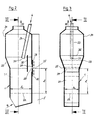
- the first fluidized bed shown in FIGS. 2, 3, ie the bubble bed 1 has a container 21 which is provided at the bottom with a perforated base 22 to which the stream 9 of the treatment gas is supplied.
- the exhaust gas 10 escapes at the top and is mostly recycled.
- the granulate stream 4 enters the container 21 through a downpipe 23.
- the stream 5 of the treated granulate emerges from the container 21 through a discharge gap 25, the upper edge 27 of which is formed by a vertically adjustable plate 28, and the lower edge 29 of which is a vertical one adjustable plate 30.
- the height and width of the discharge gap 25 can thus be adjusted or regulated.
- a vertical partition wall 32 is arranged between the feed point formed by the outlet 31 of the downpipe 23 and the discharge gap 25 in order to prevent granules from jumping directly from the feed point to the discharge gap 25.
- the partition wall 32 can consist entirely or partially of perforated sheet metal.
- the container 21 Approximately at the level of the discharge gap 25, the container 21 widens into a transition part 33, which leads to the upper part 34. This reduces the speed of the treatment gas, so that entrained grains fall back into the fluidized bed.
- the active part of the fluidized bed in the container 21 has a length l 1, which is measured in the direction of the horizontal component of the path between the feed point 31 and the discharge gap 25. Its height h 1 is measured between the perforated bottom 22 and the lower edge 29 of the discharge gap 25.
- K1 l1 / h1 from 0.5 to 1.5.
- the width b1 is less critical, but should not be chosen too small.
- a surface treatment of the surfaces of the container 21 coming into contact with the polyester material is advantageous in order to avoid sticking. This effect is achieved by either a PTFE-polytetrafluoroethylene coating or a pearl blasting of the inner surface.
- PTFE has the lowest surface energy of all substances and so nothing sticks.
- Pearl blasting creates a structured surface with protruding points and edges with the formation of small craters, which greatly reduces the contact area.
- the second fluidized bed shown in Figs. 4, 5, i.e. the fluidized bed 2 has a channel-shaped container 41 which is provided at the bottom with a perforated base 42 to which the stream 11 of the treatment gas is fed.
- the exhaust gas 12 escapes at the top and is mostly recycled.
- the stream 11 of the treatment gas is conducted via a rotating flap 48 which is driven by a motor 45 and a belt drive 46 and which generates a gas pulsation.
- the flap 48 can be provided several times, so that different parts of the perforated base 42 are acted upon by gas pulses that are shifted in time.
- the granulate stream 5 passes through an inlet 51 into the container 41.
- the stream 6 of the treated granulate emerges from the container 41 via a weir 52, the upper edge 54 of which is formed by an obliquely adjustable plate 55 which is hinged about the horizontal axis 56 is pivotable.
- the height of the weir 52 can thus be adjusted or regulated.
- the active part of the fluidized bed in the container 41 has a length l2, which is measured between the wall 58 bordering the inlet 43 and the weir 45.
- the height h2 is measured between the perforated bottom 42 and the upper edge of the weir 45th
- the composition was a copolyester consisting of terephthalic acid and the two diol components ethylene glycol and cyclohexane-1,4-dimethylol in a molar ratio of 96.5: 3.5.
- the intrinsic viscosity was 0.57 dl / g, measured in a solvent mixture of phenol and 1,1,2,2-tetrachloroethane in a ratio of 60:40 percent by weight. This material shows a very sticky behavior during crystallization. With a throughput of 60kg / h, it was metered into a bubble reactor 1 in a pilot plant.
- the average residence time was 40 minutes.
- the hot supply air had a temperature of 170 ° C and a flow velocity of 3.1 m / s. This flow velocity relates on the entire surface of the perforated floor 21, because the air is distributed almost immediately above this perforated floor 21 over the entire horizontal cross-section (base area) of the fluidized bed 1.
- the specific air consumption was 12.3 m 3rd n per kg of granulate throughput.
- the average granule temperature was 160 ° C., with which the product stream was passed into the fluidized bed 2. There the granulate was treated with supply air of 180 ° C at an average (pulsating) outflow speed of 1.2 m / s for 15 minutes.
- the finished crystallized product was finally allowed to flow through a throwing crusher 3 at a temperature of approximately 100 ° C., where the agglomerates disintegrated into perfect individual granules at a rotor peripheral speed of 25 m / s.
- the whole process, in particular the bubble bed 1 was absolutely stable during the entire test phase, without disruptions due to caking or clumping.
- the small agglomerates were barely visible in the process.
- the proportion of agglomerates (sorted out without exerting force) and their size distribution at the various points in the process see FIG.
- Table 1 Agglomerates (percentages by weight) amorphous starting granulate (4) after bubble bed (5) to fluid bed (6) in front of throwing crusher (7) after throwing crusher (8) Total share 4.3 51.4 49.3 38.5 3.2 of which couples 100 68.5 64.9 83.1 100 of which threesomes - 21.3 24.0 13.2 - Foursome and more - 10.2 11.1 3.7 -
- a specific gas throughput of 5-20 m is advantageous 3rd n especially 12 m 3rd n selected per kg of granulate throughput.
- the flow velocity is 2-6 m / sec., Preferably 2.5-3.5 m / sec, in particular 3m / sec.
- a specific gas throughput of 2-8 m is advantageous 3rd n , especially 4m 3rd n selected per kg of granulate throughput.
- the inflow speed is 0.8-3m / sec., Preferably 1-1.5 m / sec, in particular 1.2 m / sec.
Landscapes
- Engineering & Computer Science (AREA)
- Mechanical Engineering (AREA)
- Chemical & Material Sciences (AREA)
- Health & Medical Sciences (AREA)
- Chemical Kinetics & Catalysis (AREA)
- Medicinal Chemistry (AREA)
- Polymers & Plastics (AREA)
- Organic Chemistry (AREA)
- Life Sciences & Earth Sciences (AREA)
- Microbiology (AREA)
- General Engineering & Computer Science (AREA)
- Polyesters Or Polycarbonates (AREA)
- Processing And Handling Of Plastics And Other Materials For Molding In General (AREA)
- Processes Of Treating Macromolecular Substances (AREA)
- Devices And Processes Conducted In The Presence Of Fluids And Solid Particles (AREA)
- Organic Low-Molecular-Weight Compounds And Preparation Thereof (AREA)
Description
- Die Erfindung betrifft ein Verfahren zum kontinuierlichen Kristallisieren von Polyestermaterial, wie Granulat oder grobem Pulver, gemäß dem Oberbegriff des Patentanspruchs 1, sowie eine zur Durchführung des Verfahrens geeignete Vorrichtung, gemäß dem Oberbegriff des Patentanspruchs 7.
- Lineare, thermoplastische Polyester, in erster Linie Polyäthylenterephthalat, haben aufgrund ihrer guten physikalischen Eigenschaften eine große Bedeutung erlangt und viele Anwendungen gefunden. Der überwiegende Anteil wird zu textilen Fasern und Filamenten verarbeitet. Des weiteren werden Folien als Träger- oder Verpackungsmaterial und Spritzgußartikel daraus hergestellt. Ein wachsender Markt besteht im Einsatz von hochmolekularen Polyäthylenterephthalat für Flaschen oder Behälter in der Lebensmittelindustrie, vor allem für kohlensäurehaltige Getränke.
- Je nach Verwendungszweck sind besondere Eigenschaften des Polyestermateriales erforderlich. Gewisse Eigenschaften können bereits bei der Rezeptur des Polyesters durch Diol- und/oder Dicarbonsäure-Co-Komponenten sowie Additive gezielt modifiziert werden. Andere Eigenschaften wie hohes Molekulargewicht (hohe Intrinsic-Viskosität) und hohe Reinheit (tiefer Acetaldehydgehalt für den Lebensmittelbereich) sind erst durch eine Nachbehandlung in fester Phase erreichbar. Vielfach werden Polyesterproduktion und Weiterverarbeitung zum Fertigartikel getrennt durchgeführt, so daß man als Zwischenstufe ein Granulat herstellt, welches wegen der geringen Kristallisationsgeschwindigkeit und der schnellen Abkühlung in amorpher Form anfällt. Beim Granulieren und der Lagerung nimmt das Granulat Feuchtigkeit auf. Da jegliches anwesendes Wasser beim späteren Wiederaufschmelzen zu entsprechender Hydrolyse des Polyesters führt, muß das Granulat zuvor auf einen sehr tiefen Wassergehalt getrocknet werden. Bei Temperaturen von über 100°C haben die amorphen Polyestergranulate aber eine starke Tendenz, miteinander zu verkleben. Gleichzeitig setzt bei kristallisierenden Polyestern die Kristallisation ein, die jedoch wie bei allen Makromolekülen nur partiell ist (Endwert bei Polyäthylenterephthalat ca. 45% unter üblichen Bedingungen). Damit das Granulat in den nachfolgenden thermischen Behandlungsstufen (sei es nun Trocknung oder Festphasennachkondensation) nicht mehr klebt und rieselfähig bleibt, muß es gemäß Whitehead in "Industrial Engineering Chemistry, Process Design Development, Vol. 16, No. 3, 1977, 341-346" im Falle von Polyäthylenterephthalat eine Mindestdichte von 1,37 g/cm³ (entsprechend einem Kristallisationsgrad von 31%) aufweisen. Von anderen Autoren, z.B. in DE-OS 2 140 265, werden etwas niedrigere Werte angegeben.
- Die Schwierigkeit bei der Kristallisation besteht darin, während der kritischen Klebephase die Bildung von Agglomeraten und Anbackungen im Kristallisationsapparat zu verhindern. Für das Kleben sind Van-der-Waals'sche Kräfte verantwortlich, die an den Granulatgrenzen wirksam sind. Diese werden durch Kristallisation abgesättigt. Im ruhenden Zustand können im Verlaufe der Kristallisation an den Berührungsstellen aber kristalline Bereiche (Sphärolithe) auch von einem Polymerteilchen zum anderen hinüberwachsen, was zu irreversiblen Verbindungen führen kann. Deshalb werden zur Verhinderung von Verklebungen die Granulatkörner bei vielen Kristallisationsverfahren in ständiger Bewegung gehalten, um die Berührungspunkte jeweils vor Ablauf der kritischen Kontaktzeit wieder aufzulösen, so daß die teilchenüberschreitenden Kristallwachstumsprozesse schon im Anfangsstadium unterbrochen werden, und sich keine permanenten Verklebungen ausbilden können. Zu diesen Verfahren gehört die Kristallisation im Taumelmischer. Sie ist aber apparativ und wegen der Chargenfahrweise auch in der Bedienung sehr aufwendig. Verbreitet ist die kontinuierliche Kristallisation in einer gerührten Schüttung.
- Die entsprechenden Behälter weisen Rührorgane auf, welche das Granulat im wesentlichen quer zur Fließrichtung bewegen. Solche Kristallisatoren sind sowohl als liegende Apparate (z.B. US-PS 4 223 128 und US-PS 4 161 578) als auch als vertikaler, oberer Teil von Schachtreaktoren bekannt (z.B. DE-OS 32 13 025). Durch die Zwangsbewegung des Rührers können aber im Granulat unkontrolliert hohe mechanische Belastungen mit Abriebbildung oder Deformation im plastischen Zustand auftreten. Am Rührorgan selber kann Material anbacken, und bei Kontaktheizung über die Wand kommt noch das Problem der Uebertemperatur in der Randzone dazu.
- Ohne mechanische Einbauten arbeitet eine Wirbelschicht. Ein Wirbelbettapparat hat ein grösseres spezifisches Volumen und bedingt aus energetischen Gründen die Führung des Prozessgases (Luft) in einem Kreislauf. Der Hauptnachteil einer üblichen Wirbelschicht, z.B. nach der DE-OS 1 467 213, besteht bei kontinuierlichem Betrieb aber im breiten Verweilzeitspektrum, das eine Streuung des Kristallisationsgrades und der gleichzeitig stattfindenden Vortrocknung zur Folge hat. Wirbelbetten mit homogenerem Verweilzeitspektrum, z.B. nach der DE-AS 20 53 876 haben aber einen relativ kleinen Durchsatz, und einen tiefen thermischen Wirkungsgrad.
- Als Konsequenz der obigen Nachteile wurden Kristallisationsverfahren entwickelt, die das Verkleben des Granulates nicht mehr zu vermeiden suchen, sondern die Granulatsäule in einem Schachtapparat bewußt zusammenkleben liessen (DE-AS 25 58 730 und DE-OS 26 42 102). Dadurch erhielt man eine einheitliche Verweilzeit und musste das Granulat während der Kristallisation nicht mechanisch beanspruchen. Durch schichtweises Abtragen von der Unterseite her, sollte der Agglomeratklotz wieder in ein rieselfähiges Granulat überführt werden. Wegen schwierig zu kontrollierender Temperaturführung (wegen der Exothermie der Kristallisation) mit nicht genau einstellbarer Verklebungsstärke konnte es aber zu derart starker Agglomerierung kommen, daß die mechanische Abtragung nicht mehr möglich war. Im Normalbetrieb entstand durch die Agglomeratzerkleinerung störender Staub.
- In Anbetracht der Schwierigkeiten bei der Kristallisation wurde als Ersatz dafür auch schon vorgeschlagen, zur Unterbindung der Klebeneigung die Granulatoberfläche mit einem feinen Pulver zu bedecken. Dieses Verfahren hat aber den Nachteil, dass der Polyester nachher eine zusätzliche Substanz enthält (nicht anwendbar für Flaschengranulat) oder das Additiv nach der Temperaturbehandlung wieder quantitativ entfernt werden muss (z.B. US-PS 4 130 551) Zudem ist eine Vorrichtung für die Pulverzugabe notwendig. Anwendbar wäre das Verfahren höchstens mit Titandioxid für schlecht kristallisierende Copolyester, die ohnehin mattiert würden (vgl. DE-OS 2 124 203).
- In der DE-OS 25 44 048 werden ein Verfahren und eine Einrichtung zur thermischen Behandlung klebriger Materialien beschrieben. Die zur Anwendung kommenden Schwebe- und Vibrationstrockner bewirken jedoch ein Verkleben der Teilchen durch ungleichmäßige Trocknung. Bekannt ist die Anwendung eines Wirbelbettes mit Mischcharakteristik (US-A-3 544 525), wobei jedoch kristallisierte und nicht fertig kristallisierte Pellets vermischt werden. Ein Sprudelbett mit Mischcharakteristik wird auch in der FR-PS 1 352 614 beschrieben. Der nachgeschaltete Schachttrockner bewirkt ebenfalls eine Verklumpungsneigung des Gutes (vgl. auch FR-A- 1 478 224 und "Das Trocknen von Thermoplasten" (M. Enders in: Aufbereitungstechnik, Bd. 14, Nr. 9/1973, Seiten 566-570).
- Ein verbessertes Kristallisationsverfahren ist in der CH-Patentschrift 665 473 beschrieben: verwendet wird eine sprudelnde Wirbelschicht, der durch eine besondere Konstruktion eine Kolbenströmung überlagert ist, so daß eine enge Verweilzeitverteilung resultiert und die mittlere Aufenthaltszeit kurz sein kann. Verfahren und Vorrichtung stellen für Polyäthylenterephthalat eine gute wirtschaftliche Lösung dar. Für sehr langsam kristallisierende und dadurch eine längere Klebephase aufweisende Copolyester ist allerdings dieser Apparat nicht geeignet, da sich trotz wirbelnder Bewegung Agglomerat-Klumpen bilden können.
- Speziell für die Flaschenherstellung wird heute oft nicht mehr reines Polyäthylenterephthalat eingesetzt, sondern das PET wird mit Co-Komponenten modifiziert. Als Co-Komponenten kommen beliebige Diole oder Dicarbonsäuren (bzw. entsprechende Diester) in Frage, durch welche das Aethylenglykol und/oder die Terephthalsäure teilweise erstetzt werden. Für Flaschengranulat werden z.B. Cyclohexan-1,4-dimethylol oder Isophthalsäure im Bereich von 0-5 mol-% verwendet (bezogen auf Diol- bzw. Dicarbonsäuremengen). Copolymere haben gegenüber dem Homopolymer einen erniedrigten Schmelzpunkt. Dies bringt bei der Flaschenherstellung den Vorteil mit sich, daß tiefere (um ca 5°C) Verarbeitungstemperaturen möglich sind, wodurch beim Spritzgiessen der Vorformlinge die nochmalige Bildung von Acetaldehyd durch thermische Abbaureaktionen reduziert wird. Der zweite Vorteil der einkondensierten Co-Komponenten liegt in der Behinderung der Kristallisation, was glasklare (100% amorphe) Vorformlinge und Flaschen ergibt (bei reinem PET kommen trotz schneller Abkühlung gelegentlich leichte Trübungen vor). Letzterer Umstand bedeutet natürlich, daß das Copolyestergranulat bei der Kristallisation ein extrem klebriges Verhalten zeigt. Ein derartiges Material konnte mit den bisherigen Verfahren gemäß dem Stand der Technik nicht störungsfrei kristallisiert werden. Theoretisch könnte zwar auch sehr klebriges Granulat sogar ohne Bewegung und ohne Agglomeratbildung kristallisiert werden, wenn dafür gesorgt würde, daß kein Granulatkorn ein anderes berührt. Eine solche Einzelkornbehandlung würde aber riesige Apparate geringer Produktivität bedingen, so daß diese Möglichkeit aus wirtschaftlichen Gründen außer Betracht fällt.
- Der Erfindung liegt die Aufgabe zugrunde, die Kristallisation von zu starkem Kleben neigenden Polyestern in einem kontinuierlichen, kostengünstigen Prozeß mit den entsprechenden Vorrichtungen zuverlässig, materialschonend und mit einheitlicher Endqualität durchzuführen. Unter Polyester sollen hierbei sämtliche aus Diol- und Dicarbonsäurekomponenten aufgebauten Polymere verstanden werden. Bei den Diolen sind dies vor allem Alkylenglykole wie Aethylen-, 1,3-Propylen- oder 1,4 Butylenglykol sowie Cycloalkandiole wie Cyclohexan-1,4-diol oder Cyclohexan-1,4-dimethylol. Bei den Dicarbonsäuren sind in erster Linie Terephthal- und Isophthalsäure, Naphthalindicarbonsäuren sowie Adipin-, Sebazinsäure etc. zu nennen. Selbstverständlich kommen auch Gemische davon sowie geringe Anteile mehrfunktioneller Alkohole und Carbonsäuren in Frage, sowie organische oder anorganische Zusätze bis etwa 20 Gewichtsprozent. Die wichtigsten Polyesterarten sind aber Polyäthylenterephthalat und die darauf basierenden Copolyester. Die Korngeometrie kann von grobem Pulver bis zu den verschiedenen Granulatformen reichen.
- Diese Aufgaße wird erfindungsgemäß dadurch gelöst, daß das Polyestermaterial durch zwei hintereinander geschaltete Wirbelbetten geführt wird, von denen das erste eine sprudelnde Wirbelschicht mit Mischcharakteristik, und das zweite ein Fliessbett mit Kolbenströmungscharakteristik ist. Nach dem zweiten Wirbelbett können unabhängig und getrennt von der Kristallisation die verbliebenen Kleinagglomerate in einer Prallvorrichtung nachzerkleinert werden.
- Daß dieses Vorgehen eine störungsfreie Kristallisation von klebrigem Polyester ermöglicht und am Schluß ein agglomeratfreies Granulat einheitlichen Kristallinitätsgrades liefert, ist überraschend und war nicht vorherzusehen. Eine Verbreiterung der Verweilzeitverteilung, wie sie durch das Sprudelbett zustande kommt, wurde bisher für unvereinbar mit einem homogenen Endprodukt gehalten. Zudem ließen sich sehr klebrige Copolyester bis jetzt nur unter mechanischer Rührung (mit den oben beschriebenen Nachteilen) kristallisieren. Unerwartet ist auch die Tatsache, daß die Kohäsionskraft der unter den erfindungsgemässen Bedingungen entstandenen Kleinagglomerate so gering ist, daß diese mit mässigem Kraftaufwand im Anschluss an die Kristallisation in die Einzelkörner aufgelöst werden können, wohingegen bei den konventionellen Verfahren unmittelbar während der Klebe- und Kristallisationsphase unter unkontrollierbaren Bedingungen eingegriffen werden muß, um irreversible Verklebungen zu verhindern.
- Vorteilhafte Ausgestaltungen des erfindungsgemässen Verfahrens betreffen die Temperaturen der Granulate und des Behandlungsgases, den Gasdurchsatz und die Gasgeschwindigkeit in den Wirbelbetten, ferner Massverhältnisse der Wirbelbetten. Sie betreffen auch das Prallen zum Nachzerkleinern der Granulate.
- Die erfindungsgemäße Vorrichtung zum Ausüben des Verfahrens ist dadurch gekennzeichnet, daß einem ersten Wirbelbett mit Mischcharakteristik ein zweites Wirbelbett mit Kolbenströmungscharakteristik nachgeschaltet ist. Vorteilhafte Ausgestaltungen der erfindungsgemässen Vorrichtung betreffen die Behälter der Wirbelbetten, ihre Maßverhältnisse, ihre Austragsvorrichtungen sowie die Prallvorrichtung.
- Die Erfindung betrifft ferner die Anwendung des erfindungsgemässen Verfahrens und der erfindungsgemäßen Vorrichtung für die Behandlung von sehr langsam kristallisierenden Copolyestern.
- Die Erfindung wird nachfolgend anhand eines zeichnerisch dargestellten Ausführungsbeispieles näher erläutert. Es zeigt:
- Fig. 1
- ein Fließschema des erfindungsgemäßen Verfahrens und der Vorrichtung, um das Nacheinanderschalten von Apparaten und die Granulatbewegung darzustellen,
- Fig. 2
- einen vertikalen Schnitt durch ein Ausführungsbeispiel des ersten Wirbelbettes der erfindungsgemäßen Vorrichtung längs der Linie II-II nach Fig. 3
- Fig. 3
- einen Schnitt längs der Linie III-III nach Fig. 2,
- Fig. 4
- einen vertikalen Schnitt durch ein Ausführungsbeispiel des zweiten Wirbelbettes der erfindungsgemäßen Vorrichtung längs der Linie IV-IV nach Fig. 5
- Fig. 5
- einen Grundriss des Wirbelbettes der Fig. 4,
- Fig. 6
- ein Diagramm, das den Agglomeratanteil in Funktion der mittleren Verweilzeit im ersten Wirbelbett zeigt.
- Die Fig. 1 zeigt das Sprudelbett als erstes Wirbelbett 1, das Fließbett als zweites Wirbelbett 2 und die Prallvorrichtung 3. Der eintretende, amorphe Granulatstrom 4 wird im Sprudelbett 1 unter intensiver Bewegung und Mischung mit bereits vorhandenen, kristallinem Material aufgeheizt und vorkristallisiert. Als Fluidisierungsgas, welches gleichzeitig als Wärmeträgermedium wirkt, wird erhitzte Luft oder ein Inertgas, z.B. Stickstoff, verwendet. Das Abgas 10 wird aus energetischen Gründen normalerweise in einem Kreislauf (mit Staubabscheidung) wieder an den Eintritt 9 geführt. Die Eintrittstemperatur des Gases wird so eingestellt, daß sich eine mittlere Granulattemperatur von 140-180°C, vorzugsweise von ca. 160°C ergibt. Die entsprechende Gaseintrittstemperatur beträgt 150-190°C, vorzugsweise 170-175°C. Der spezifische Gasdurchsatz zur Ausbildung einer intensiv bewegten Sprudelschicht beträgt 3-30 m


- Brückenbildung tritt bei der Kleinheit der Agglomerate (grösstenteils Paare von Granulatkörnern, Rest Dreier- und etwas Vierergrüppchen) nicht auf, und auf die Trocknungs- oder Nachkondensationsgeschwindigkeit wirken sich die entstandenen Agglomerate nicht verlangsamend aus, da diese in der Regel nicht Fläche an Fläche kleben, sondern über eine Kante, so daß sich die Oberfläche praktisch nicht verkleinert. Letzteres ist auch der Grund für die relativ geringe mechanische Festigkeit der beschriebenen Agglomerate. Es zeigte sich übrigens, daß die Agglomerate fast ausschließlich im Sprudelbett 1 entstehen und im Anteil und der Grössenverteilung im Fließbett 2 keine signifikante Änderung mehr erfahren. Da bei der Agglomeratzerkleinerung auch unter schonenden Bedingungen immer eine geringe Menge Bruchstücke und Staub entsteht, ist es bei einer Festphasennachkondensation von Vorteil, die Nachzerkleinerung (und allfällige Windsichtung) erst nachher zu machen, da Feinanteile schneller nachkondensieren (inhomogenes Endprodukt) und zudem noch eher zum Kleben neigen. Bei reiner Trocknung mit direkt nachfolgendem Extruder ist eine Nachzerkleinerung nicht notwendig, obwohl diese auch im heissen Zustand möglich wäre, da keine Extruder-Einzugsstörungen zu befürchten sind. Bei einer Festphasen-Nachkondensation ordnet man die Prallvorrichtung 3 vorteilhafterweise nach dem Granulatkühler an; in diesem Fall würde der in die Prallvorrichtung eintretende Strom 7 von den Agglomeraten her gesehen noch dem Strom 6 entsprechen, aber höheres Molekulargewicht und tiefere Temperatur aufweisen. Zum Auflösen der entstandenen Kleinagglomerate genügen Aufprallgeschwindigkeiten in der Grössenordnung von 10-50 m/sec, vorzugsweise 20-35 m/sec. Das Auflösen der Agglomerate kann im Prinzip mit jeder Vorrichtung geschehen, in der diese Geschwindigkeiten auftreten (z.B. auch pneumatisch). Vorteilhaft ist jedoch die Verwendung eines Wurfbrechers (Impactor), bei dem das agglomerathaltige Granulat von einem Rotor aus unter definierter Umfangsgeschwindigkeit auf Prallflächen (Prallplatten oder Prallring) geschleudert wird. Durch Drehzahlvariierung kann die minimale Aufprallgeschwindigkeit exakt ermittelt werden, die notwendig ist, um sämtliche Agglomerate aufzubrechen, und somit ist es möglich, das Produkt schonend unter genau kontrollierten physikalischen Bedingungen in ein einwandfreies Einzelgranulat überzuführen (Endproduktstrom 8). Von Weiterverarbeitern wird als Qualitätsmerkmal ein Agglomeratanteil im Granulat von weniger als 0,1 Gewichts-Prozent gefordert. Dieser Wert ist mit der erfindungsgemäßen Vorrichtung ohne Aussieben von Agglomeraten erreichbar, sofern nicht bereits im amorphen Ausgangsgranulat Agglomerate vorhanden sind, die meist stärker zusammengeschmolzen sind und sich mittels Aufprall nicht mehr trennen lassen.
- Das in den Fig. 2, 3 dargestellte erste Wirbelbett, d.h. das Sprudelbett 1, weist einen Behälter 21 auf, der unten mit einem Lochboden 22 versehen ist, dem der Strom 9 des Behandlungsgases zugeführt wird. Das Abgas 10 entweicht oben und wird meistens im Rundlauf zurückgeführt.
- Der Granulatstrom 4 gelangt durch ein Fallrohr 23 in den Behälter 21. Der Strom 5 des behandelten Granulates tritt aus dem Behälter 21 durch einen Austragsspalt 25, deren oberer Rand 27 durch eine vertikal einstellbare Platte 28 gebildet ist, und deren unterer Rand 29 durch eine vertikal einstellbare Platte 30. Damit sind Höhenlage und Breite des Austragsspaltes 25 einstellbar, beziehungsweise regulierbar. Zwischen der durch den Auslass 31 des Fallrohres 23 gebildete Zufuhrstelle und dem Austragsspalt 25 ist eine vertikale Trennwand 32 angeordnet, um zu vermeiden, daß Granulatkörner direkt von der Zufuhrstelle zum Austragsspalt 25 springen. Aus Strömungsgründen kann die Trennwand 32 ganz oder teilweise aus Lochblech bestehen.
- Ungefähr auf der Höhe des Austragsspaltes 25 erweitert sich der Behälter 21 in einen Uebergangsteil 33, der zum Oberteil 34 führt. Damit vermindert sich die Geschwindigkeit des Behandlungsgases, so daß mitgerissene Körner in die Wirbelschicht zurückfallen.
- Der aktive Teil des Wirbelbettes im Behälter 21 hat eine Länge l₁, die in Richtung der horizontalen Komponente des Weges zwischen der Zufuhrstelle 31 und dem Austragsspalt 25 gemessen wird. Seine Höhe h₁ ist gemessen zwischen dem Lochboden 22 und dem unteren Rand 29 des Austragsspaltes 25.
- Um eine sichere und rasche Vermischung des Granulates im Wirbelbett zu gewährleisten wählt man den Koeffizienten

- Bei einer Versuchsanlage wurden

- Vorteilhaft ist eine Oberflächenbehandlung der mit dem Polyestermaterial in Berührung kommenden Flächen des Behälters 21 um Ankleben zu vermeiden. Diese Wirkung erreicht man durch entweder eine PTFE-Polytetrafluoräthylen-Beschichtung oder ein Perlstrahlen der Innenfläche. PTFE hat die niedrigste Oberflächenenergie aller Stoffe und so bleibt nichts haften. Beim Perlstrahlen entsteht eine strukturierte Oberfläche mit vorstehenden Punkten und Kanten mit Bildung kleiner Krater, was die Kontaktfläche stark reduziert.
- Das in den Fig. 4, 5 dargestellte zweite Wirbelbett, d.h. das Fließbett 2 weist einen kanalförmigen Behälter 41 auf, der unten mit einem Lochboden 42 versehen ist, dem der Strom 11 des Behandlungsgases zugeführt wird. Das Abgas 12 entweicht oben und wird meistens im Rundlauf zurückgeführt.
- Der Strom 11 des Behandlungsgases wird über eine durch einen Motor 45 und einen Riementrieb 46 angetriebene drehende Klappe 48 geleitet, die eine Gaspulsation erzeugt. Wie in der DE-PS 21 01 143 gezeigt kann die Klappe 48 mehrfach vorgesehen werden, damit verschiedene Teile des Lochbodens 42 mit zeitlich verschobenen Gaspulsationen beaufschlagt werden.
- Der Granulatstrom 5 gelangt durch einen Einlauf 51 in den Behälter 41. Der Strom 6 des behandelten Granulates tritt aus dem Behälter 41 über ein Wehr 52 dessen oberer Rand 54 durch eine schräg einstellbare Platte 55 gebildet ist, die mittels eines Scharniers um die horizontale Achse 56 schwenkbar ist. Damit ist die Höhenlage des Wehres 52 einstellbar, beziehungsweise regulierbar.
- Der aktive Teil des Wirbelbettes im Behälter 41 hat eine Länge l₂, die zwischen der am Einlauf 43 grenzenden Wand 58 und dem Wehr 45 gemessen wird. Die Höhe h₂ wird gemessen zwischen dem Lochboden 42 und dem oberen Rand des Wehrs 45.
- Mit Vorteil wählt man den Koeffizenten

- Für die Kristallisation könnte man sich auch einen Kombiapparat vorstellen, der sowohl ein Sprudel- als auch ein Fließbett enthält und eventuell mit nur einem Gaskreislauf auskommt.
- Als amorphes Ausgangsmaterial wurde ein kantiges Stranggranulat mit den Dimensionen ca. 2x2x3mm verwendet. Von der Zusammensetzung her handelte es sich um einen Copolyester, bestehend aus Terephthalsäure und den beiden Diol-Komponenten Aethylenglykol und Cyclohexan-1,4-dimethylol im Molverhältnis 96,5:3,5. Die Intrinsic-Viskosität betrug 0,57 dl/g, gemessen in einem Lösungsmittelgemisch von Phenol und 1,1,2,2-Tetrachloräthan im Verhältnis von 60:40 Gewichtsprozent. Dieses Material zeigt bei der Kristallisation ein sehr klebriges Verhalten. Mit einem Durchsatz von 60kg/h wurde es in einer Pilotanlage in einen Sprudelreaktor 1 eindosiert. Die mittlere Verweilzeit darin betrug 40 Minuten. Die heisse Zuluft hatte eine Temperatur von 170°C und eine Anströmgeschwindigkeit von 3,1m/s. Diese Anströmgeschwindigkeit bezieht sich auf die ganze Fläche des Lochbodens 21, weil die Luft sich fast unmittelbar oberhalb dieses Lochbodens 21 auf dem ganzen horizontalen Querschnitt (Grundfläche) des Wirbelbettes 1 verteilt. Der spezifische Luftverbrauch betrug 12,3 m

Tabelle 1 Agglomerate (Anteile in Gewichts-%) amorphes Ausgangsgranulat (4) nach Sprudelbett (5) nach Fliessbett (6) vor Wurfbrecher (7) nach Wurfbrecher (8) Totalanteil 4,3 51,4 49,3 38,5 3,2 davon Paare 100 68,5 64,9 83,1 100 davon Dreier - 21,3 24,0 13,2 - Vierer u.mehr - 10,2 11,1 3,7 - - Man sieht, daß die Agglomerate im Sprudelbett 1 entstehen, diese sind aber so schwach, dass sie bereits auf dem Transport zum Wurfbrecher 3 teilweise zerfallen. Als Maß für den Kristallinitätsgrad wurde die Dichte gemessen. Für die Umrechnung gilt:

- K
- = gewichtsbezogener kristalliner Anteil
- ρ
- = gemessene mittlere Polymerdichte eines Granulatkornes
- ρa
- = Dichte von völlig amorphem Polymer
- ρc
- = Dichte von 100% kristallinem Polymer (theoretischer Wert, berechnet aus den Abmessungen einer kristallinen Elementarzelle).
- Für die Grenzwerte von PET (bei 20°C) gilt gemäss J. Brandrup, E.H. Immergut: Polymer Handbook, 2nd Edition 1975, Wiley-Interscience:
= 1,335 g/cm³
= 1,455 g/cm³. - Um den momentanen Zustand einzufrieren, wurden die Proben für die Dichtemessung sofort in kaltem Wasser abgeschreckt. Nach dem Sprudelbett 1 war die Dichteverteilung noch erwartungsgemäß breit, d.h. sie reichte von 1,325 (ca. 3,5% noch transparente, amorphe Granulatkörner) bis 1, 365 (kristalliner Hauptanteil). Die Granulatkörner nach dem Wirbelbett 2 wiesen jedoch eine überraschend enge Verteilung, ja praktisch einen einheitlichen Wert von 1,365 ± 0,001 g/cm³ (Grenzen der Extremwerte an 100 repräsentativen Körnern) auf. Dieser Wert entspricht ca. 33% Kristallinitätsgrad, wenn man annehmen darf, daß ρa für den vorliegenden Copolyester ca. 1,325 beträgt.
- Allfällige Bedenken, das Granulat könnte wegen den teilweisen langen Verweilzeiten in der heißen Luft eventuell oxidativ geschädigt werden, wurden durch Farbwertmessungen widerlegt: Im gebräuchlichen Farbmaßsystem L*a*b* lagen die b*-Werte aller, auch nach mehreren Stunden genommenen Proben leicht im negativen Bereich (ca. -0,7), was bedeutet, daß anstelle eines auf Schädigung hinweisenden Gelbstiches (positive b*-Werte) tendenziell eher eine leichter Blauton vorlag.
- In weiteren Versuchsvarianten wurde bei sonst gleichen Einstellungen der Einfluß der mittleren Verweilzeit im Sprudelbett 1 auf die Agglomeratbildung untersucht. Es ergab sich die in Fig. 6 dargestellte Abhängigkeit. Bei zu kurzer Verweilzeit entstanden so viele Agglomerate (über 60%), daß das Sprudelbett 1 keinen stabilen Zustand mehr erreichte und durch stärker werdende Verklebung "umkippte", was jeweils kurz vor dem Kollaps bereits an der enger werdenden Schwankungsbreite des Druckabfalls über das Sprudelbett 1 vorauszusehen war. Unterhalb der kritischen Grenze nimmt der Agglomeratanteil mit zunehmender Verweilzeit ab. Um das Sprudelbett 1 aber nicht größer als nötig zu bauen, wird vorteilhafterweise eine nicht allzu weit von der kritischen Grenze entfernte Verweilzeit gewählt, wie dies im Beispiel 1 der Fall war. Zum Vergleich wurde auch noch ein normales PET (Homopolymer) eingesetzt, das erahnen läßt, um wieviel klebriger der Copolyester war.
- Im ersten Wlrbelbett 1 wird mit Vorteil ein spezifischer Gasdurchsatz von 5-20m


- Im zweiten Wirbelbett 2 wird mit Vorteil ein spezifischer Gasdurchsatz von 2-8m


Claims (10)
- Verfahren zum kontinuierlichen Kristallisieren von Polyestermaterial, wie Granulat oder grobem Pulver, unter Anwendung an sich bekannter Wirbelbetten mit Mischcharakteristik dadurch gekennzeichnet,
daß Polyestermaterial durch zwei hintereinandergeschaltete Wirbelbetten (1, 2) geführt wird, von denen das erste eine sprudelnde Wirbelschicht (1) mit Mischcharakteristik, und das zweite ein Fließbett (2) mit Kolbenströmungscharakteristik ist. - Verfahren nach Anspruch 1, dadurch gekennzeichnet, daß wenigstens eines der folgenden Merkmale vorgesehen ist:a) im ersten Wirbelbett (1) erreicht die Temperatur der Granulate 140°C bis 180°C, vorzugsweise 160°C, wobei die mittlere Verweilzeit 5-60 min., bei klebrigen Copolyestern auch über 60 min., beträgt;b) die Eintrittstemperatur des Behandlungsgases beträgt beim ersten Wirbelbett (1) 150°C bis 190°C, vorzugsweise 170°C bis 175°C;c) im ersten Wirbelbett (1) beträgt der spezifische Gasdurchsatz 3-30 m


 d) im zweiten Wirbelbett (2) wird die Temperatur der Granulate um 10-30°C erhöht, vorzugsweise auf 180°C, wobei die mittlere Verweilzeit 2-25 min. beträgt, vorzugsweise 15 min;e) die Eintrittstemperatur des Behandlungsgases beträgt beim zweiten Wirbelbett (2) 0-20°C und liegt vorzugsweise ca. 10°C über der jenigen des Behandlungsgases im ersten Wirbelbett (1);f) im zweiten Wirbelbett (2) beträgt der spezifische Gasdurchsatz 1,5-15 m

 g) der Anteil der noch amorphen Granulatkörner die vom ersten (1) zum zweiten Wirbelbett (2) übergehen, beträgt 2 bis 5%, vorzugsweise 3 bis 4%;h) der Koeffizient K₁, der durch das Verhältnis der Länge l₁ zur Höhe h₁ des ersten Wirbelbettes (1) gebildet wird, beträgt 0,5 bis 2, insbesondere 1;i) der Koeffizient K₂, der durch das Verhältnis der Länge l₂ zur Höhe h₂ des zweiten Wirbelbettes (2) gebildet wird, beträgt 2,5 bis 10, vorzugsweise 4 bis 8, insbesondere 5;j) das Verhältnis des Koeffizienten K₂ des zweiten Wirbelbettes (2) (K₂ = Länge l₂/Höhe h₂) zum Koeffizienten K₁ des ersten Wirbelbettes (1) (K₁ = Länge l₁/Höhe h₁), ist grösser als 2, insbesondere grösser als 3.
 - Verfahren nach Anspruch 1 oder 2, dadurch gekennzeichnet, daß nach dem zweiten Wirbelbett (2) das Polyestermaterial in einer Prallvorrichtung (3) zum Nachzerkleinern der Kleinagglomerate geprallt wird.
- Verfahren nach Anspruch 3, dadurch gekennzeichnet, daß das Prallen direkt nach dem zweiten Wirbelbett (2) erfolgt.
- Verfahren nach Anspruch 3, dadurch gekennzeichnet, daß das Produkt nach dem zweiten Wirbelbett (2) und vor dem Prallen einer Nachtrocknung, bzw. einer Nachkondensation, bzw. einer Kühlung, z.B. in einem Schachttrockner, bzw. -kühler, unterzogen wird.
- Verfahren nach einem der Ansprüche 3, 4 oder 5, dadurch gekennzeichnet, daß wenigstens eines der folgenden Merkmale vorgesehen ist:a) das Produkt wird vor dem Prallen gelagert;b) das Prallen geschieht mit einer Aufprallgeschwindigkeit von 10 bis 50 m/sec, vorzugsweise 20 bis 35 m/sec, insbesondere 25m/sec;c) das Produkt wird durch das Fördern in einer pneumatischen Förderleitung geprallt;d) das Produkt wird durch Umlaufprall, z.B. in einem zentrifugalen Impactor (3) geprallt, wobei die Umfangsgeschwindigkeit ca. 25 m/sec, bei einem Rotordurchmesser von 0,4 m und einer Drehzahl von 1200 U/min. beträgt.
- Vorrichtung zur Ausführung des Verfahrens unter Anwendung an sich bekannter Wirbelbetten mit Mischcharakteristik nach einem der Ansprüche 1 bis 6, dadurch gekennzeichnet, daß einem ersten Wirbelbett (1) mit Mischcharakteristik ein zweites Wirbelbett (2) mit Kolbenströmungscharakteristik nachgeschaltet ist.
- Vorrichtung nach Anspruch 7, dadurch gekennzeichnet, daß wenigstens eines der folgenden Merkmale vorgesehen ist:a) das erste Wirbelbett (1) weist einen Behälter (21) auf, dessen Austragswehr (29) auf einer Höhe h₁ liegt, die bei einer Länge l₁ des Behälters (21) einen Koeffizienten
 b) der Behälter (21) des ersten Wirbelbettes (1) erweitert sich oberhalb des Wehrs (29) (Übergangsteil 33), wobei die Durchgangsfläche für das Granulat als Austragsspalt (25) ausgebildet ist, und wobei der untere (29) und der obere Rand (27) dieses Austragsspaltes (25) durch vertikale bewegliche Platten (30, 28) gebildet sind, die eine Regulierung der Höhenlage und der Breite des Austragsspaltes (25) erlauben;c) zwischen der Zufuhrstelle (31) für die Granulatkörner und dem Austragsspalt (25) des ersten Wirbelbettes (1) ist eine vertikale Trennwand (32) vorhanden, um zu vermeiden, daß Granulatkörner direkt von der Zufuhrstelle (31) zum Austragsspalt (25) springen;d) eine Antikleb-Oberflächenbehandlung der mit dem Polyestermaterial in Berührung kommenden Flächen des Behälters (21) des ersten Wirbelbettes (1) ist vorgesehen, um ein Ankleben zu vermeiden, wobei z.B. ein Beschichten mit Polytetrafluoräthylen oder ein Perlstrahlen in Frage kommen;e) das zweite Wirbelbett (2) weist einen, vorzugsweise kanalförmigen, Behälter (41) auf, dessen Austragswehr (52) auf einer Höhe (h₂) liegt, die bei einer Länge l₂ des Behälters einen Koeffizienten
 f) das Verhältnis des Koeffizienten K₂ zum Koeffizienten K₁ ist größer als 2, insbesondere größer als 3;g) die Luftzufuhr (11) zu mindestens einem der Wirbelbetten (1 bzw. 2), vorzugsweise des zweiten (2), erfolgt über eine Gaspulsationseinrichtung (45-48), die insbesondere verschiedene Teile des Lochbodens (42) mit zeitlich verschobenen Gaspulsationen beaufschlagt;h) ein kombinierter Apparat enthält die beiden Wirbelbetten (1, 2), gegebenenfalls übereinanderliegend, wobei ein einziger Gaskreislauf (11, 12, 9, 10) vorgesehen ist.
 - Vorrichtung nach Anspruch 7 oder 8, dadurch gekennzeichnet, daß dem Wirbelbett (2) mit Kolbenströmungscharakteristik eine Prallvorrichtung (3) unmittelbar oder nach Weiterbehandlungsapparaten bzw. einer Lagerung nachgeschaltet ist,
wobei die Prallvorrichtung (3) vorzugsweise
entweder eine pneumatische Förderleitung
und/oder
einen Impactor mit einem Schleuderrotor aufweist, der die Körner gegen einen Ring oder gegen Prallplatten wirft, wobei die Prallplatten vorzugsweise um parallel zur Achse des Rotors liegenden Achsen einstellbar sind, um einen rechtwinkligen Aufprall zu ermöglichen. - Anwendung des Verfahrens nach einem der Ansprüche 1 bis 6 und/oder der Vorrichtung nach einem der Ansprüche 7 bis 9 für die Behandlung von klebrigen Copolyestern.
Priority Applications (1)
| Application Number | Priority Date | Filing Date | Title |
|---|---|---|---|
| AT89122500T ATE96369T1 (de) | 1988-12-23 | 1989-12-06 | Verfahren und vorrichtung zum kontinuierlichen kristallisieren von polyestermaterial. |
Applications Claiming Priority (2)
| Application Number | Priority Date | Filing Date | Title |
|---|---|---|---|
| CH4796/88 | 1988-12-23 | ||
| CH479688 | 1988-12-23 |
Publications (3)
| Publication Number | Publication Date |
|---|---|
| EP0379684A2 EP0379684A2 (de) | 1990-08-01 |
| EP0379684A3 EP0379684A3 (de) | 1992-01-22 |
| EP0379684B1 true EP0379684B1 (de) | 1993-10-27 |
Family
ID=4282698
Family Applications (1)
| Application Number | Title | Priority Date | Filing Date |
|---|---|---|---|
| EP89122500A Expired - Lifetime EP0379684B1 (de) | 1988-12-23 | 1989-12-06 | Verfahren und Vorrichtung zum kontinuierlichen Kristallisieren von Polyestermaterial |
Country Status (7)
| Country | Link |
|---|---|
| US (2) | US5090134A (de) |
| EP (1) | EP0379684B1 (de) |
| JP (1) | JP3073498B2 (de) |
| KR (1) | KR0137659B1 (de) |
| AT (1) | ATE96369T1 (de) |
| DE (1) | DE58906032D1 (de) |
| ES (1) | ES2060728T3 (de) |
Cited By (3)
| Publication number | Priority date | Publication date | Assignee | Title |
|---|---|---|---|---|
| DE19505680C1 (de) * | 1995-02-20 | 1996-05-23 | Inventa Ag | Kondensations-Spritzgußverfahren zur Herstellung von Flaschenvorformlingen aus Polyethylenterephthalat und/oder seinen Copolyestern sowie nach diesem Verfahren herstellbare Vorformlinge |
| DE19953659A1 (de) * | 1999-11-08 | 2001-05-10 | Buehler Ag | Verfahren und Vorrichtung zur Dekontamination von Polykondensaten |
| DE19500383C2 (de) * | 1995-01-09 | 2001-10-18 | Buehler Ag | Vorrichtung zum kontinuierlichen Kristallisieren von Polyestermaterial |
Families Citing this family (59)
| Publication number | Priority date | Publication date | Assignee | Title |
|---|---|---|---|---|
| DE4200789A1 (de) | 1991-03-01 | 1992-09-03 | Bayer Ag | Verfahren zur nachkristallisation von teilkristallinen thermoplasten |
| DE4215867A1 (de) * | 1992-05-14 | 1993-11-18 | Kgt Giessereitechnik Gmbh | Verfahren und Vorrichtung zur Regelung des Sandaustrages bei der thermischen Regenerierung von Gießerei-Altsand in Wirbelschichtöfen |
| CH685003A5 (de) * | 1992-08-11 | 1995-02-28 | Buehler Ag | Verfahren zum kontinuierlichen Kristallisieren und Polymerisieren von Kunststoffmaterial und Vorrichtung hierfür. |
| CH684697A5 (de) * | 1993-01-21 | 1994-11-30 | Buehler Ag | Verfahren zum kontinuierlichen Kristallisieren und Polykondensieren von Polyestermaterial. |
| IT1271073B (it) * | 1994-11-21 | 1997-05-26 | M & G Ricerche Spa | Procedimento per la cristallizzazione di resine poliestere |
| IT1271293B (it) * | 1994-12-16 | 1997-05-27 | M & G Ricerche Spa | Procedimento per la policondensazione allo stato solido di resine poliestere |
| US5497562A (en) * | 1995-03-03 | 1996-03-12 | Hosokawa Bepex Corporation | Radiant heater system for solid phase crystallization and polymerization of polymers |
| US5532335A (en) * | 1995-04-26 | 1996-07-02 | Hosokawa Bepex Corporation | Method for thermally processing polyester pellets |
| US5648032A (en) * | 1995-08-01 | 1997-07-15 | Eastman Chemical Company | Process for producing polyester articles having low acetaldehyde content |
| IT1283644B1 (it) | 1996-08-01 | 1998-04-23 | Sinco Eng Spa | Procedimento perfezionato per la produzione di resine poliestere |
| DE19709517A1 (de) * | 1997-03-10 | 1998-09-17 | Hoechst Trevira Gmbh & Co Kg | Vorrichtung zur Kristallisation von Polymergranulaten sowie Verfahren zur Kristallisation von Polymergranulaten |
| DE19849485B9 (de) * | 1998-10-27 | 2006-09-14 | Uhde Gmbh | Verfahren und Anlage zum Herstellen von Granulat aus polyfunktionellen Carbonsäuren und Alkoholen, insbesondere PET-Granulat |
| FR2786123B1 (fr) * | 1998-11-25 | 2001-02-09 | Schmalbach Lubeca | Procede et installation pour la fabrication d'une preforme, mettant en oeuvre des moyens de sechage perfectionnes, et recipient plastique obtenu a partir de la preforme |
| FR2786494B1 (fr) * | 1998-11-27 | 2001-01-05 | Tergal Fibres | Procede de fabrication de copolyesters poly(ethylene terephtalate)-poly(ethylene isophtalate) |
| DE19902458A1 (de) * | 1999-01-22 | 2000-07-27 | Buehler Ag | Vorrichtung und Verfahren zum Behandeln von Kunststoffmaterial |
| JP2002536203A (ja) | 1999-02-04 | 2002-10-29 | ビユーラー・アクチエンゲゼルシヤフト | プラスチック材料の品質を良くするための方法 |
| ES2177363B2 (es) * | 1999-06-04 | 2004-01-01 | Universdiad Complutense De Mad | Dispositivo para secar solidos muy humedos. |
| AT411161B (de) | 1999-09-22 | 2003-10-27 | Bacher Helmut | Verfahren und vorrichtung zum recyclen von pet-gut |
| US6344539B1 (en) * | 2000-03-28 | 2002-02-05 | Walter M Palmer | Process for crystallization polyester granules |
| ES2186610T3 (es) * | 2000-12-15 | 2003-05-16 | Cleanaway Deutschland Ag & Co | Dispositivo para purificar y/o descontaminar poliesteres. |
| CN1224634C (zh) | 2001-02-26 | 2005-10-26 | 布勒股份公司 | 聚酯材料在固相中连续缩聚反应的方法及装置 |
| DE10144747A1 (de) | 2001-09-11 | 2003-03-27 | Buehler Ag | Kontinuierliche thermische Behandlung von Schüttgütern |
| DE10158793A1 (de) * | 2001-11-30 | 2003-06-26 | Zimmer Ag | Verfahren und Vorrichtung zur Herstellung von hochkondensierten Polyestern in der festen Phase |
| US20050167876A1 (en) * | 2002-10-04 | 2005-08-04 | Jan-Udo Kreyenborg | Method for granulating plastics |
| EP1491253A1 (de) * | 2003-06-26 | 2004-12-29 | Urea Casale S.A. | Vorrichtung und Verfahren zur Wirbelschichtgranulation |
| WO2005044901A1 (de) * | 2003-10-17 | 2005-05-19 | Bkg Bruckmann & Kreyenborg Granuliertechnik Gmbh | Verfahren zur thermischen behandlung von polyesterpellets |
| DE102004010680A1 (de) | 2004-03-04 | 2005-10-06 | Zimmer Ag | Verfahren zur Herstellung von hochkondensierten Polyestern in der festen Phase |
| EP1843861A4 (de) * | 2004-11-22 | 2010-02-17 | Invista North America Sarl | Verfahren zur kristallisierung und festkörperpolymerisierung von polymeren und das beschichtete polymer |
| US20060287471A1 (en) * | 2005-06-16 | 2006-12-21 | Schreiber Benjamin R | Accelerated acetaldehyde testing of polymers |
| US8557950B2 (en) * | 2005-06-16 | 2013-10-15 | Grupo Petrotemex, S.A. De C.V. | High intrinsic viscosity melt phase polyester polymers with acceptable acetaldehyde generation rates |
| ATE485329T1 (de) | 2005-09-01 | 2010-11-15 | Mitsubishi Chem Corp | Verfahren zur wärmebehandlung von polyesterteilchen und verfahren zur mehrstufigen festphasenpolykondensation von polyesterteilchen |
| US9267007B2 (en) * | 2005-09-16 | 2016-02-23 | Grupo Petrotemex, S.A. De C.V. | Method for addition of additives into a polymer melt |
| US7655746B2 (en) * | 2005-09-16 | 2010-02-02 | Eastman Chemical Company | Phosphorus containing compounds for reducing acetaldehyde in polyesters polymers |
| US8431202B2 (en) | 2005-09-16 | 2013-04-30 | Grupo Petrotemex, S.A. De C.V. | Aluminum/alkaline or alkali/titanium containing polyesters having improved reheat, color and clarity |
| US7838596B2 (en) * | 2005-09-16 | 2010-11-23 | Eastman Chemical Company | Late addition to effect compositional modifications in condensation polymers |
| US7932345B2 (en) | 2005-09-16 | 2011-04-26 | Grupo Petrotemex, S.A. De C.V. | Aluminum containing polyester polymers having low acetaldehyde generation rates |
| US20070149756A1 (en) * | 2005-12-26 | 2007-06-28 | Futura Polyesters Limited | Compositions and methods of manufacturing polytrimethylene naphthalate |
| JP4527670B2 (ja) * | 2006-01-25 | 2010-08-18 | 東京エレクトロン株式会社 | 加熱処理装置、加熱処理方法、制御プログラムおよびコンピュータ読取可能な記憶媒体 |
| DE102006012587B4 (de) * | 2006-03-16 | 2015-10-29 | Lurgi Zimmer Gmbh | Verfahren und Vorrichtung zur Kristallisation von Polyestermaterial |
| WO2007116416A2 (en) * | 2006-04-10 | 2007-10-18 | Reliance Industries Ltd | Plant with reactor internals coated with low surface energy materials and production of polyester resin using same |
| US7877895B2 (en) * | 2006-06-26 | 2011-02-01 | Tokyo Electron Limited | Substrate processing apparatus |
| US7709593B2 (en) * | 2006-07-28 | 2010-05-04 | Eastman Chemical Company | Multiple feeds of catalyst metals to a polyester production process |
| US7745368B2 (en) * | 2006-07-28 | 2010-06-29 | Eastman Chemical Company | Non-precipitating alkali/alkaline earth metal and aluminum compositions made with organic hydroxyacids |
| US7709595B2 (en) * | 2006-07-28 | 2010-05-04 | Eastman Chemical Company | Non-precipitating alkali/alkaline earth metal and aluminum solutions made with polyhydroxyl ether solvents |
| US20080027207A1 (en) * | 2006-07-28 | 2008-01-31 | Jason Christopher Jenkins | Non-precipitating alkali/alkaline earth metal and aluminum compositions made with mono-ol ether solvents |
| US8563677B2 (en) * | 2006-12-08 | 2013-10-22 | Grupo Petrotemex, S.A. De C.V. | Non-precipitating alkali/alkaline earth metal and aluminum solutions made with diols having at least two primary hydroxyl groups |
| DE102006058642A1 (de) * | 2006-12-11 | 2008-06-12 | Bühler AG | Verfahren zur Herstellung homogen kristallisierter Polykondensatgranulate |
| US7908765B2 (en) * | 2006-12-22 | 2011-03-22 | Collette Nv | Continuous granulating and drying apparatus |
| EP2095048B1 (de) * | 2006-12-29 | 2019-08-21 | Basell Poliolefine Italia S.r.l. | Verfahren und vorrichtung zum trocknen eines polymers |
| US8207289B2 (en) | 2007-05-23 | 2012-06-26 | Grupo Petrotemex, S.A. De C.V. | High molecular weight polyester polymers with reduced acetaldehyde |
| EP2460833B1 (de) | 2010-11-08 | 2019-05-15 | EMS-Patent AG | Verfahren zur Reinigung von Polymergranulat |
| CN103260847B (zh) * | 2010-12-15 | 2016-09-14 | 富士胶片株式会社 | 聚酯膜的制造方法、太阳能电池用聚酯膜、以及太阳能电池发电模块 |
| FR2981600B1 (fr) | 2011-10-25 | 2013-11-15 | Rhodia Operations | Procede de preparation de granules de polyamide |
| US9364985B2 (en) * | 2012-05-24 | 2016-06-14 | Henkel IP & Holding GmbH | Process for preparing flowable amorphous poly-alpha olefin adhesive pellets |
| DE102012011641A1 (de) | 2012-06-12 | 2013-12-12 | Automatik Plastics Machinery Gmbh | Verfahren und Vorrichtung zurn Trocknen und Kristallisieren von Granulat |
| DE102013219684A1 (de) * | 2013-09-30 | 2015-04-02 | Krones Ag | Vorrichtung zum Erwärmen von Kunststoffbröckchen |
| AR100196A1 (es) * | 2014-10-21 | 2016-09-21 | Enye Tech S A | Método para elaborar un insumo proveniente del reciclado de material plástico de residuos industriales y post consumo, apto para ser utilizado por las impresoras 3d |
| US11111350B2 (en) | 2017-10-26 | 2021-09-07 | Wrh Technology, Llc | Method for production of low density polyester foam and articles made thereof utilizing low I.V. polyester feedstock |
| IT201800004069A1 (it) | 2018-03-29 | 2019-09-29 | Point Plastic S R L | Metodo per la realizzazione di un materiale espanso a base di pet riciclato |
Family Cites Families (19)
| Publication number | Priority date | Publication date | Assignee | Title |
|---|---|---|---|---|
| CH450367A (de) * | 1963-02-05 | 1968-01-31 | Miag Muehlenbau & Ind Gmbh | Vorrichtung zum kontinuierlichen Behandeln von Korn- und/oder Staubgut mit Gas |
| FR1352614A (fr) * | 1963-04-04 | 1964-02-14 | Metallgesellschaft Ag | Procédé pour le séchage de granulés de matière plastique |
| DE1454847B1 (de) * | 1964-03-21 | 1971-10-28 | Jiyuichi Nara | Verfahren zum zweistufigen Trocknen von stueckchenfoermigen Kunststoffen |
| FR1478224A (fr) * | 1965-05-05 | 1967-04-21 | Metallgesellschaft Ag | Procédé et installation pour le traitement, notamment pour la cristallisation, de granules amorphes en matière plastique avec des gaz très chauds |
| FR1550402A (de) * | 1967-11-08 | 1968-12-20 | ||
| US3544525A (en) * | 1968-03-26 | 1970-12-01 | Allied Chem | Process for crystallization,drying and solid-state polymerization of polyesters |
| CH518510A (de) * | 1970-01-14 | 1972-01-31 | Buehler Ag Geb | Vorrichtung zur kontinuierlichen thermischen Behandlung von körnigem Gut mittels eines Gases |
| DE2124203B2 (de) * | 1971-05-13 | 1977-08-18 | Karl Fischer Apparate- & Rohrleitungsbau, 1000 Berlin | Verfahren zur beseitigung der klebeneigung von granuliertem polyester oder copolyester |
| DE2140265B2 (de) * | 1971-08-11 | 1976-04-15 | Davy International Ag, 6000 Frankfurt | Verfahren zur trocknung und kristallisation von bandfoermigem oder geschnitzeltem polyestermaterial |
| JPS5551723B2 (de) * | 1971-08-18 | 1980-12-26 | ||
| GB1362927A (en) * | 1971-11-10 | 1974-08-07 | Miag Muehlenbau & Ind Gmbh | Device for producing a non-adherent plastics granulate of prede termined low moisture content |
| DE2544048A1 (de) * | 1975-10-02 | 1977-04-21 | Kloeckner Humboldt Deutz Ag | Verfahren und einrichtung zur thermischen behandlung von nicht rieselfaehigen, klebrigen, klumpigen, temperaturempfindlichen materialien |
| DE2558730C3 (de) * | 1975-12-24 | 1982-04-22 | Hoechst Ag, 6000 Frankfurt | Verfahren zum Kristallisieren und Trocknen von Polyethylenterephthalat und Vorrichtung zur Durchführung des Verfahrens |
| DE2642102C3 (de) * | 1976-09-18 | 1984-10-04 | Bühler-Miag GmbH, 3300 Braunschweig | Vorrichtung zum Kristallisieren von Kunststoffgranulat |
| US4161578A (en) * | 1978-05-12 | 1979-07-17 | Bepex Corporation | Process for solid phase polymerization of polyester |
| US4223128A (en) * | 1978-05-16 | 1980-09-16 | Celanese Corporation | Process for preparing polyethylene terephthalate useful for beverage containers |
| DE3213025C2 (de) * | 1982-04-02 | 1997-06-12 | Fischer Karl Ind Gmbh | Verfahren zur Nachkondensation von Polykondensaten |
| CH665473A5 (en) * | 1985-07-18 | 1988-05-13 | Schweizerische Viscose | Crystallising and drying PET polymer granules - by feeding continuously into rising current of hot air where dust is removed and dried prod. falls out |
| JP5328956B2 (ja) | 2012-04-13 | 2013-10-30 | グンゼ株式会社 | コンジュゲート繊維 |
-
1989
- 1989-12-06 DE DE89122500T patent/DE58906032D1/de not_active Expired - Fee Related
- 1989-12-06 EP EP89122500A patent/EP0379684B1/de not_active Expired - Lifetime
- 1989-12-06 AT AT89122500T patent/ATE96369T1/de not_active IP Right Cessation
- 1989-12-06 ES ES89122500T patent/ES2060728T3/es not_active Expired - Lifetime
- 1989-12-20 KR KR1019890019044A patent/KR0137659B1/ko not_active Expired - Fee Related
- 1989-12-22 US US07/456,107 patent/US5090134A/en not_active Expired - Lifetime
- 1989-12-22 JP JP01331430A patent/JP3073498B2/ja not_active Expired - Fee Related
-
1991
- 1991-08-21 US US07/748,321 patent/US5119570A/en not_active Expired - Lifetime
Cited By (3)
| Publication number | Priority date | Publication date | Assignee | Title |
|---|---|---|---|---|
| DE19500383C2 (de) * | 1995-01-09 | 2001-10-18 | Buehler Ag | Vorrichtung zum kontinuierlichen Kristallisieren von Polyestermaterial |
| DE19505680C1 (de) * | 1995-02-20 | 1996-05-23 | Inventa Ag | Kondensations-Spritzgußverfahren zur Herstellung von Flaschenvorformlingen aus Polyethylenterephthalat und/oder seinen Copolyestern sowie nach diesem Verfahren herstellbare Vorformlinge |
| DE19953659A1 (de) * | 1999-11-08 | 2001-05-10 | Buehler Ag | Verfahren und Vorrichtung zur Dekontamination von Polykondensaten |
Also Published As
| Publication number | Publication date |
|---|---|
| KR0137659B1 (ko) | 1998-04-30 |
| JPH02269119A (ja) | 1990-11-02 |
| EP0379684A2 (de) | 1990-08-01 |
| DE58906032D1 (de) | 1993-12-02 |
| ES2060728T3 (es) | 1994-12-01 |
| EP0379684A3 (de) | 1992-01-22 |
| ATE96369T1 (de) | 1993-11-15 |
| US5090134A (en) | 1992-02-25 |
| KR900009112A (ko) | 1990-07-02 |
| JP3073498B2 (ja) | 2000-08-07 |
| US5119570A (en) | 1992-06-09 |
Similar Documents
| Publication | Publication Date | Title |
|---|---|---|
| EP0379684A2 (de) | Verfahren und Vorrichtung zum kontinuierlichen Kristallisieren von Polyestermaterial | |
| DE69935535T2 (de) | Verfahren zur zustandsverbesserung von zum recycling bestimmtem kunststoff-material | |
| DE19811280C2 (de) | Verfahren und Vorrichtung zur Rückgewinnung von linearem Polyester | |
| EP1441885B1 (de) | Verfahren und vorrichtung zur erhöhung der grenzviskosität von polyester | |
| EP2029267B1 (de) | Verfahren und vorrichtung zur kontinuierlichen polymerisation von polymer in fester phase | |
| EP2433771B1 (de) | Verfahren zur Erhöhung des Molekulargewichts unter Nutzung der Restwärme von Polyestergranulat | |
| DE1905677A1 (de) | Verfahren zum Kristallisieren von Polyestern | |
| DD265336A5 (de) | Verfahren und vorrichtung zum granulieren und granuliertes produkt | |
| EP2209599B1 (de) | Verfahren zur kristallisation von kristallisierbaren polymeren mit hoher klebeneigung | |
| WO2007104579A1 (de) | Verfahren und vorrichtung zur kristallisation von polyestermaterial | |
| EP0451546A2 (de) | Behandlungsturm für pulver- oder granulatförmiges Material und Verfahren zu seinem Betreiben | |
| EP2101972B1 (de) | Verfahren zur herstellung homogen kristallisierter polykondensatgranulate | |
| EP0633108B1 (de) | Verfahren und Vorrichtung zur Wiederaufbereitung von festem Polyestermaterial | |
| DE102007042636B4 (de) | Verfahren und Vorrichtung zur Herstellung eines Polyestergranulats nach dem Latentwärmekristallisationsverfahren | |
| EP3650186B1 (de) | Verfahren und vorrichtung zur direktkristallisation von polykondensaten | |
| EP1448659A1 (de) | Verfahren und vorrichtung zur herstellung von hochkondensierten polyestern in der festen phase | |
| EP3283544B1 (de) | Verfahren zur kristallisation und abtrennung niedermolekularer komponenten aus einem granulat eines kristallisationsfähigen thermoplastischen materials sowie vorrichtung hierzu | |
| EP1885772B1 (de) | Verfahren zur thermischen behandlung von polyesterpellets, um eine teilkristallisation zu erreichen | |
| WO2013053571A1 (de) | Verfahren zur direkten herstellung von formkörpern aus polyesterschmelzen | |
| WO2007031255A1 (de) | Verfahren und vorrichtung zum behandeln von kunststoffmaterial und einrichtung zum fördern und gleichzeitigen heizen von material, insbesondere kunststoffteilen | |
| AT508252B1 (de) | Verfahren und vorrichtung zur herstellung von teilkristallinem polymermaterial |
Legal Events
| Date | Code | Title | Description |
|---|---|---|---|
| PUAI | Public reference made under article 153(3) epc to a published international application that has entered the european phase |
Free format text: ORIGINAL CODE: 0009012 |
|
| AK | Designated contracting states |
Kind code of ref document: A2 Designated state(s): AT BE CH DE ES FR GB GR IT LI LU NL SE |
|
| PUAL | Search report despatched |
Free format text: ORIGINAL CODE: 0009013 |
|
| AK | Designated contracting states |
Kind code of ref document: A3 Designated state(s): AT BE CH DE ES FR GB GR IT LI LU NL SE |
|
| 17P | Request for examination filed |
Effective date: 19911213 |
|
| 17Q | First examination report despatched |
Effective date: 19921111 |
|
| ITF | It: translation for a ep patent filed | ||
| GRAA | (expected) grant |
Free format text: ORIGINAL CODE: 0009210 |
|
| AK | Designated contracting states |
Kind code of ref document: B1 Designated state(s): AT BE CH DE ES FR GB GR IT LI LU NL SE |
|
| REF | Corresponds to: |
Ref document number: 96369 Country of ref document: AT Date of ref document: 19931115 Kind code of ref document: T |
|
| REF | Corresponds to: |
Ref document number: 58906032 Country of ref document: DE Date of ref document: 19931202 |
|
| ET | Fr: translation filed | ||
| GBT | Gb: translation of ep patent filed (gb section 77(6)(a)/1977) |
Effective date: 19931108 |
|
| EPTA | Lu: last paid annual fee | ||
| REG | Reference to a national code |
Ref country code: GR Ref legal event code: FG4A Free format text: 3009538 |
|
| PLBE | No opposition filed within time limit |
Free format text: ORIGINAL CODE: 0009261 |
|
| STAA | Information on the status of an ep patent application or granted ep patent |
Free format text: STATUS: NO OPPOSITION FILED WITHIN TIME LIMIT |
|
| 26N | No opposition filed | ||
| REG | Reference to a national code |
Ref country code: ES Ref legal event code: FG2A Ref document number: 2060728 Country of ref document: ES Kind code of ref document: T3 |
|
| EAL | Se: european patent in force in sweden |
Ref document number: 89122500.5 |
|
| REG | Reference to a national code |
Ref country code: GB Ref legal event code: IF02 |
|
| PGFP | Annual fee paid to national office [announced via postgrant information from national office to epo] |
Ref country code: CH Payment date: 20041112 Year of fee payment: 16 |
|
| PGFP | Annual fee paid to national office [announced via postgrant information from national office to epo] |
Ref country code: GB Payment date: 20041129 Year of fee payment: 16 |
|
| PGFP | Annual fee paid to national office [announced via postgrant information from national office to epo] |
Ref country code: SE Payment date: 20041209 Year of fee payment: 16 |
|
| PGFP | Annual fee paid to national office [announced via postgrant information from national office to epo] |
Ref country code: LU Payment date: 20041210 Year of fee payment: 16 Ref country code: NL Payment date: 20041210 Year of fee payment: 16 |
|
| PGFP | Annual fee paid to national office [announced via postgrant information from national office to epo] |
Ref country code: DE Payment date: 20041213 Year of fee payment: 16 Ref country code: FR Payment date: 20041213 Year of fee payment: 16 Ref country code: AT Payment date: 20041213 Year of fee payment: 16 |
|
| PGFP | Annual fee paid to national office [announced via postgrant information from national office to epo] |
Ref country code: ES Payment date: 20041215 Year of fee payment: 16 |
|
| PGFP | Annual fee paid to national office [announced via postgrant information from national office to epo] |
Ref country code: GR Payment date: 20041223 Year of fee payment: 16 |
|
| PGFP | Annual fee paid to national office [announced via postgrant information from national office to epo] |
Ref country code: BE Payment date: 20050118 Year of fee payment: 16 |
|
| PG25 | Lapsed in a contracting state [announced via postgrant information from national office to epo] |
Ref country code: IT Free format text: LAPSE BECAUSE OF NON-PAYMENT OF DUE FEES;WARNING: LAPSES OF ITALIAN PATENTS WITH EFFECTIVE DATE BEFORE 2007 MAY HAVE OCCURRED AT ANY TIME BEFORE 2007. THE CORRECT EFFECTIVE DATE MAY BE DIFFERENT FROM THE ONE RECORDED. Effective date: 20051206 Ref country code: GB Free format text: LAPSE BECAUSE OF NON-PAYMENT OF DUE FEES Effective date: 20051206 Ref country code: AT Free format text: LAPSE BECAUSE OF NON-PAYMENT OF DUE FEES Effective date: 20051206 |
|
| PG25 | Lapsed in a contracting state [announced via postgrant information from national office to epo] |
Ref country code: SE Free format text: LAPSE BECAUSE OF NON-PAYMENT OF DUE FEES Effective date: 20051207 Ref country code: ES Free format text: LAPSE BECAUSE OF NON-PAYMENT OF DUE FEES Effective date: 20051207 |
|
| PG25 | Lapsed in a contracting state [announced via postgrant information from national office to epo] |
Ref country code: LI Free format text: LAPSE BECAUSE OF NON-PAYMENT OF DUE FEES Effective date: 20051231 Ref country code: BE Free format text: LAPSE BECAUSE OF NON-PAYMENT OF DUE FEES Effective date: 20051231 Ref country code: CH Free format text: LAPSE BECAUSE OF NON-PAYMENT OF DUE FEES Effective date: 20051231 Ref country code: LU Free format text: LAPSE BECAUSE OF NON-PAYMENT OF DUE FEES Effective date: 20051231 |
|
| PG25 | Lapsed in a contracting state [announced via postgrant information from national office to epo] |
Ref country code: NL Free format text: LAPSE BECAUSE OF NON-PAYMENT OF DUE FEES Effective date: 20060701 Ref country code: DE Free format text: LAPSE BECAUSE OF NON-PAYMENT OF DUE FEES Effective date: 20060701 |
|
| REG | Reference to a national code |
Ref country code: CH Ref legal event code: PL |
|
| EUG | Se: european patent has lapsed | ||
| GBPC | Gb: european patent ceased through non-payment of renewal fee |
Effective date: 20051206 |
|
| PG25 | Lapsed in a contracting state [announced via postgrant information from national office to epo] |
Ref country code: FR Free format text: LAPSE BECAUSE OF NON-PAYMENT OF DUE FEES Effective date: 20060831 |
|
| NLV4 | Nl: lapsed or anulled due to non-payment of the annual fee |
Effective date: 20060701 |
|
| REG | Reference to a national code |
Ref country code: FR Ref legal event code: ST Effective date: 20060831 |
|
| REG | Reference to a national code |
Ref country code: ES Ref legal event code: FD2A Effective date: 20051207 |
|
| BERE | Be: lapsed |
Owner name: *BUHLER G.M.B.H. Effective date: 20051231 Owner name: *BUHLER A.G. Effective date: 20051231 |
|
| PG25 | Lapsed in a contracting state [announced via postgrant information from national office to epo] |
Ref country code: GR Free format text: LAPSE BECAUSE OF NON-PAYMENT OF DUE FEES Effective date: 19931027 |