EP0348873B1 - Ferroelektrisches Flüssigkristallpolymer und Epoxyd zur Herstellung des Polymers - Google Patents
Ferroelektrisches Flüssigkristallpolymer und Epoxyd zur Herstellung des Polymers Download PDFInfo
- Publication number
- EP0348873B1 EP0348873B1 EP89111623A EP89111623A EP0348873B1 EP 0348873 B1 EP0348873 B1 EP 0348873B1 EP 89111623 A EP89111623 A EP 89111623A EP 89111623 A EP89111623 A EP 89111623A EP 0348873 B1 EP0348873 B1 EP 0348873B1
- Authority
- EP
- European Patent Office
- Prior art keywords
- reaction
- epoxide
- acid
- chart
- solution
- Prior art date
- Legal status (The legal status is an assumption and is not a legal conclusion. Google has not performed a legal analysis and makes no representation as to the accuracy of the status listed.)
- Expired - Lifetime
Links
- 0 *c(cc1)ccc1-c(cc1)ccc1O Chemical compound *c(cc1)ccc1-c(cc1)ccc1O 0.000 description 5
- QIGBRXMKCJKVMJ-UHFFFAOYSA-N Oc(cc1)ccc1O Chemical compound Oc(cc1)ccc1O QIGBRXMKCJKVMJ-UHFFFAOYSA-N 0.000 description 1
Images








Classifications
-
- C—CHEMISTRY; METALLURGY
- C07—ORGANIC CHEMISTRY
- C07C—ACYCLIC OR CARBOCYCLIC COMPOUNDS
- C07C43/00—Ethers; Compounds having groups, groups or groups
- C07C43/02—Ethers
- C07C43/03—Ethers having all ether-oxygen atoms bound to acyclic carbon atoms
- C07C43/14—Unsaturated ethers
- C07C43/17—Unsaturated ethers containing halogen
-
- C—CHEMISTRY; METALLURGY
- C07—ORGANIC CHEMISTRY
- C07C—ACYCLIC OR CARBOCYCLIC COMPOUNDS
- C07C43/00—Ethers; Compounds having groups, groups or groups
- C07C43/02—Ethers
- C07C43/20—Ethers having an ether-oxygen atom bound to a carbon atom of a six-membered aromatic ring
- C07C43/23—Ethers having an ether-oxygen atom bound to a carbon atom of a six-membered aromatic ring containing hydroxy or O-metal groups
-
- C—CHEMISTRY; METALLURGY
- C07—ORGANIC CHEMISTRY
- C07D—HETEROCYCLIC COMPOUNDS
- C07D303/00—Compounds containing three-membered rings having one oxygen atom as the only ring hetero atom
- C07D303/02—Compounds containing oxirane rings
- C07D303/12—Compounds containing oxirane rings with hydrocarbon radicals, substituted by singly or doubly bound oxygen atoms
- C07D303/18—Compounds containing oxirane rings with hydrocarbon radicals, substituted by singly or doubly bound oxygen atoms by etherified hydroxyl radicals
- C07D303/20—Ethers with hydroxy compounds containing no oxirane rings
- C07D303/24—Ethers with hydroxy compounds containing no oxirane rings with polyhydroxy compounds
-
- C—CHEMISTRY; METALLURGY
- C08—ORGANIC MACROMOLECULAR COMPOUNDS; THEIR PREPARATION OR CHEMICAL WORKING-UP; COMPOSITIONS BASED THEREON
- C08G—MACROMOLECULAR COMPOUNDS OBTAINED OTHERWISE THAN BY REACTIONS ONLY INVOLVING UNSATURATED CARBON-TO-CARBON BONDS
- C08G65/00—Macromolecular compounds obtained by reactions forming an ether link in the main chain of the macromolecule
- C08G65/02—Macromolecular compounds obtained by reactions forming an ether link in the main chain of the macromolecule from cyclic ethers by opening of the heterocyclic ring
- C08G65/04—Macromolecular compounds obtained by reactions forming an ether link in the main chain of the macromolecule from cyclic ethers by opening of the heterocyclic ring from cyclic ethers only
- C08G65/06—Cyclic ethers having no atoms other than carbon and hydrogen outside the ring
- C08G65/08—Saturated oxiranes
-
- C—CHEMISTRY; METALLURGY
- C09—DYES; PAINTS; POLISHES; NATURAL RESINS; ADHESIVES; COMPOSITIONS NOT OTHERWISE PROVIDED FOR; APPLICATIONS OF MATERIALS NOT OTHERWISE PROVIDED FOR
- C09K—MATERIALS FOR MISCELLANEOUS APPLICATIONS, NOT PROVIDED FOR ELSEWHERE
- C09K19/00—Liquid crystal materials
- C09K19/04—Liquid crystal materials characterised by the chemical structure of the liquid crystal components, e.g. by a specific unit
- C09K19/38—Polymers
- C09K19/3833—Polymers with mesogenic groups in the side chain
- C09K19/3876—Polyoxyalkylene polymers
- C09K19/388—Polyepoxides
Definitions
- the present invention relates to novel ferroelectric liquid-crystalline polymers and to epoxides that are usable as monomers for preparation of the ferroelectric liquid-crystalline polymer. More particularly, the present invention relates to ferroelectric liquid-crystalline polymers which not only exhibit ferroelectricity even at temperatures around room temperature, but also have such a high speed of response to external factors that they can be used for displaying moving pictures, and are able to be advantageously used as display devices for large displays or curved displays.
- Such liquid-crystalline polymers are useful in optoelectronics fields as various electronic optical devices, particularly, as display devices for desk calculators, clocks and watches, etc., electronic optical shutters, electronic optical diaphragms, optical modulators, optical-path transfer switches in optical communication systems, memories, liquid crystal printer heads, variable-focal-length lenses, and so forth.
- Display devices employing low molecular weight liquid-crystalline compounds have been widely used for digital display in desk calculators, clocks and watches, etc.
- conventional low molecular weight liquid crystal compounds are sandwiched between a couple of glass substrates, the space between the glass substrates being adjusted with a precision to an extent of micrometers.
- such a precise adjustment of the space has actually been impossible in large displays or curved displays.
- liquid crystal polymers resulting from the above attempts have an disadvantage in tht the polymers do not exhibit any liquid crystal properties unless they are heated at temperatures between their glass transition temperatures and their clearing points, said temperature lying far above room temperature.
- An object of the present invention is to provide liquid-crystalline polymers which exhibit ferroelectricity in a wide range of temperature including room temperature and further respond to external factors, particularly to electric field at a high speed in a wide range of temperature. That is, an object of the present invention is to provide novel ferroelectric liquid-crystalline polymers which when they are used as display devices, make it possible to display moving pictures and to produce large displays or curved displays.
- Another object of the present invention is to provide epoxides which are usable as the monomers to the production of the ferroelectric liquid-crystalline polymers of the present invention.
- a ferroelectric liquid-crystalline polymer consisting essentially of at least one repeating unit represented by the following general formula: wherein k is an integer having a value of 2 to 30; R1 is X is -COO- or -OCO-; and R2 is -COOR3, -OCOR3 or -OR3; wherein R3 is wherein each of R4 and R5 is independently -CH3, a halogen atom or -CN; each of m and n is independently an integer having a value of 0 to 10, with the proviso that when R4 is -CH3, n is not an integer having a value of 0; p is an integer having a value of 0 or 1; and C marked with * is an asymmetric carbon atom.
- an epoxide having the structure represented by the following general formula: wherein k is an integer having a value of 2 to 30; R1 is X is -COO- or -OCO-; and R2 is -COOR3, -OCOR3 or -OR3; wherein R3 is wherein each of R4 and R5 is independently -CH3, a halogen atom or -CN; each of m and n is independently an integer having a value of 0 to 10, with the proviso that when R4 is -CH3, n is not an integer having a value of 0; p is an integer having a value of 0 or 1; and C marked with * is an asymmetric carbon atom.
- Fig. 1 is a chart of NMR spectrum of the epoxide obtained in Example 1
- Fig. 2 is a chart of NMR spectrum of the ferroelectric liquid-crystalline polymer obtained in Example 1.
- Fig. 3 is a chart of NMR spectrum of the epoxide obtained in Example 2
- Fig. 4 is a chart of NMR spectrum of the ferroelectric liquid-crystalline polymer obtained in Example 2.
- Fig. 5 is a chart of NMR spectrum of the epoxide obtained in Example 3
- Fig. 6 is a chart of NMR spectrum of the ferroelectric liquid-crystalline polymer obtained in Example 3.
- Fig. 7 is a chart of NMR spectrum of the epoxide obtained in Example 4
- Fig. 8 is a chart of NMR spectrum of the ferroelectric liquid-crystalline polymer obtained in Example 4.
- Fig. 9 is a chart of NMR spectrum of the epoxide obtained in Example 5
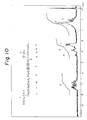
- Fig. 10 is a chart of NMR spectrum of the ferroelectric liquid-crystalline polymer obtained in Example 5.
- Fig. 11 is a chart of NMR spectrum of the epoxide obtained in Example 6, and Fig. 12 is a chart of NMR spectrum of the ferroelectric liquid-crystalline polymer obtained in Example 6.
- Fig. 13 is a chart of NMR spectrum of the epoxide obtained in Example 7
- Fig. 14 is a chart of NMR spectrum of the ferroelectric liquid-crystalline polymer obtained in Example 7.
- Fig. 15 is a chart of NMR spectrum of the epoxide obtained in Example 8
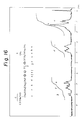
- Fig. 16 is a chart of NMR spectrum of the ferroelectric liquid-crystalline polymer obtained in Example 8.
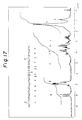
- Fig. 17 is a chart of NMR spectrum of the epoxide obtained in Example 9
- Fig. 18 is a chart of NMR spectrum of the ferroelectric liquid-crystalline polymer obtained in Example 9.
- Fig. 19 is a chart of NMR spectrum of the epoxide obtained in Example 10
- Fig. 20 is a chart of NMR spectrum of the ferroelectric liquid-crystalline polymer obtained in Example 10.
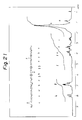
- Fig. 21 is a chart of NMR spectrum of the epoxide obtained in Example 11
- Fig. 22 is a chart of NMR spectrum of the ferroelectric liquid-crystalline polymer obtained in Example 11.
- Fig. 23 is a chart of NMR spectrum of the ferroelectric liquid-crystalline polymer obtained in Example 12.
- the preferred liquid-crystalline polymers of the present invention are those having a number average molecular weight of 1,000 to 400,000. If the number average molecular weight is less than 1,000, the moldability of the polymers into films or coated films may be sometimes deteriorated. If it is more than 400,000, there may sometimes appear undesirable effects such as the lowered speed of response.
- the particularly preferred range of the number average molecular weight cannot be uniformly limited because it varies depending on the kind of R1, the numerical value of "k", the optical purity of R3, etc., but is generally from 1,000 to 200,000.
- k is an integer having a value of 2 to 30, preferably 4 to 20.
- m and n is independently an integer having a value of 0 to 10, preferably 0 to 6.
- the liquid-crystalline polymers of the present invention may be prepared by using the epoxides of the present invention. That is, the liquid-crystalline polymers of the present invention may be prepared by polymerizing at least one monomer that is an epoxide represented by the following general formula: wherein k, X, R1, R2, R3, R4, R5, m, n and p are as defined above.
- the epoxides that are the above monomers may be obtained by, for example, as follows.
- epoxides which are the monomers for the production of the polymers of the present invention, include those represented by the following formulas.
- the ferroelectric liquid-crystalline polymers of the present invention are prepared by polymerizing one or more of the monomers thus obtained, and any known method of polymerization such as cationic polymerization may be employed for the preparation.
- the catalysts that can be used for the cationic polymerization in the present invention are known ones including protonic acids such as sulfuric acid, phosphoric acid or perchloric acid, lewis acids such as boron trifluoride, aluminum chloride, titanium tetrachloride or stannic chloride, and etherates of boron trifluoride.
- protonic acids such as sulfuric acid, phosphoric acid or perchloric acid
- lewis acids such as boron trifluoride, aluminum chloride, titanium tetrachloride or stannic chloride
- etherates of boron trifluoride such as boron trifluoride
- stannic chloride may be suitably used.
- the polymers are prepared by coordination polymerization by using organic aluminum complexes, etc. as catalysts.
- the polymers having a number average molecular weight of not less than 30,000 can be obtained.
- the polymerization techniques that can be employed in the present invention are various known techniques such as bulk polymerization technique, slurry polymerization technique, and a solution polymerization technique, and a solution polymerization technique may be preferably employed.
- the suitable polymerization temperature is not uniformly specified since it varies depending on the kind of the catalyst, but it can be usually from 0 to 30°C.
- the suitable polymerization time varies depending on other polymerization conditions including the polymerization temperature, etc., but it can be usually from several hours to six days.
- control of the molecular weight of the polymers can be conducted by addition of a known molecular weight controlling agent and/or by control of the concentration of catalyst to monomers.
- the polymers may be directly fixed between a couple of substrates in a state of adhering to the substrates by sufficiently mixing one or more monomers with an initiator, sufficiently de-aerating the mixture, introducing the de-aerated mixture between two substrates such as glass substrates, and then heating.
- the solvent to be used in the slurry polymerization and the solution polymerization may be any known inert solvent.
- the illustrative examples of the solvents to be suitably used include hexane, dichloromethane or aromatic solvents such as benzene, toluene, and xylene.
- liquid-crystalline polymers may be used in the form of a film by forming them by a known film forming technique such as casting technique, T-die technique, inflation technique, calender technique, or stretching technique.
- films of the polymers of the present invention are applicable in various optoelectronics fields, such as liquid crystal displays, electronic optical shutters, and electronic optical diaphragms, by disposing them between a couple of large glass substrates, curved glass substrates, polyester films, etc., not to mention two usual glass substrates.
- the polymers may also be directly formed into films adhering to a substrate by dissolving a polymer in a suitable solvent, applying the resulting polymer solution to a surface of a substrate such as a glass substrate, and then evaporating the solvent.
- the ferroelectric liquid-crystalline polymers of the present invention exhibit the chiral smectic C phase liquid crystal state at a wide temperature range including temperatures around room temperature. It was also confirmed that they have high speeds of response to electric field, for example several milliseconds, at temperatures around room temperature. In addition, the ferroelectric liquid-crystalline polymers of the present invention have another advantage in attaining high contrast ratio when used in optical display devices. These facts indicate that the ferroelectric liquid-crystalline polymers of the present invention are very useful materials which can be used in a wide temperature range including room temperature.
- the ferroelectric liquid-crystalline polymers of the present invention have both of the properties of liquid crystals having smectic phases and a typical property of polymers, i.e. excellent moldability, they have many possibilities of usage in the fields of integrated optics, optoelectronics, and information memory. That is, the polymers of the present invention may be used as various electronic optical devices, for example liquid crystal displays such as digital displays of various forms, electronic optical shutters, optical-path transfer switches in optical communication systems, electronic optical diaphragms, memory devices, optical modulators, liquid crystal optical printer heads, and variable-focal-length.
- liquid crystal displays such as digital displays of various forms, electronic optical shutters, optical-path transfer switches in optical communication systems, electronic optical diaphragms, memory devices, optical modulators, liquid crystal optical printer heads, and variable-focal-length.
- the ferroelectric liquid-crystalline polymers of the present invention may be further improved, at need, by various treatments well known in this industry, for example mixing two or more polymers of the present invention, mixing with other polymers, addition of additives, such as various inorganic or organic compounds or metals, including stabilizers, plasticizers, etc.
- phase transition temperatures were each conducted by the use of a DSC and a polarization microscope, respectively.
- glass glass state
- Cry crystal state
- S unidentified smectic phase
- SmC* chiral smectic C phase
- SmA smectic A phase
- N nematic phase
- Ch cholesteic phase
- Iso isotropic phase
- the numerals in phase transition behavior schemes represent the phase transition temperatures in °C unit.
- a polymer was sandwiched between two glass substrates of 0.2 cm2 in area each having an ITO circular, a transparent electrode and was adjusted to 10 ⁇ m thickness with a spacer.
- a triangular voltage having a crest value of 200 V was applied thereto, and the spontaneous polarization intensity was calculated from the signal of polarization inversion current that was observed at the time of applying the voltage.
- the phenyl benzoate compound exhibited liquid crystal state at room temperature.
- the obtained monomer was a liquid having a high viscosity at room temperature.
- the monomer was then used in the subsequent reaction without conducting any more purification.
- allyl alcohol a mixture of sodium hydride and a mineral oil having a sodium hydride content of 60 % by weight.
- a solution consisting of 33 g of 1,8-dibromooctane and 10 ml of THF was added dropwise to the mixture. After the conclusion of the dropping, the temperature was raised to reflux the mixture for 12 hours. After the conclusion of the reaction, the remaining sodium hydride was decomposed by adding a small amount of water.
- a toluene solution of the acid chloride compound obtained above was added dropwise to a toluene solution containing 2.5 g of (R)-(-)-2-pentanol and 3.4 g of triethylamine, and the mixture was stirred at room temperature for 5 hours. After the conclusion of the reaction, the reaction mixture was washed with water and dried over magnesium sulfate, and then the solvent was distilled out under reduced pressure to obtain an ester compound.
Landscapes
- Chemical & Material Sciences (AREA)
- Organic Chemistry (AREA)
- Crystallography & Structural Chemistry (AREA)
- Chemical Kinetics & Catalysis (AREA)
- Medicinal Chemistry (AREA)
- Polymers & Plastics (AREA)
- Health & Medical Sciences (AREA)
- Engineering & Computer Science (AREA)
- Materials Engineering (AREA)
- Epoxy Compounds (AREA)
- Liquid Crystal Substances (AREA)
- Organic Low-Molecular-Weight Compounds And Preparation Thereof (AREA)
- Polyethers (AREA)
Claims (6)
- Ferroelektrisches flüssigkristallines Polymer, welches im wesentlichen aus mindestens einer durch die folgende allgemeine Formel dargestellten wiederkehrenden Einheit besteht:

k eine ganze Zahl mit einem Wert von 2 bis 30 ist;
R¹
X -COO oder -OCO- ist; und
R² -COOR³, -OCOR³ oder -OR³ ist;
worin
R³
worin
R⁴ und R⁵ jeweils unabhängig voneinander -CH₃, ein Halogenatom oder -CN sind;
m und n jeweils unabhängig voneinander eine ganze Zahl mit einem Wert von 0 bis 10 sind, unter der Voraussetzung, daß wenn R⁴ -CH₃ ist, n keine ganze Zahl mit einem Wert von 0 ist;
p eine ganze Zahl mit einem Wert von 0 oder 1 ist; und
C, markiert mit * ein asymmetrisches Kohlenstoffatom ist. - Ferroelektrisches flüssigkristallines Polymer gemäß Anspruch 1, worin k eine ganze Zahl mit einem Wert von 4 bis 20, m eine ganze Zahl mit einem Wert von 0 bis 6 und n eine ganze Zahl mit einem Wert von 0 bis 6 ist.
- Ferroelektrisches flüssigkristallines Polymer gemäß Anspruch 1 oder 2, worin R¹

und R³
- Epoxid mit einer durch die folgende allgemeine Formel dargestellten Struktur:

k eine ganze Zahl mit einem Wert von 2 bis 30 ist;
R¹
X -COO- oder -OCO- ist; und
R² -COOR³, -OCOR³ oder -OR³ ist;
worin
R³
worin
R⁴ und R⁵ jeweils unabhängig voneinander -CH₃, ein Halogenatom oder -CN sind;
m und n jeweils unabhängig voneinander eine ganze Zahl mit einem Wert von 0 bis 10 sind, unter der Voraussetzung, daß wenn R⁴ -CH₃ ist, n nicht eine ganze Zahl mit einem Wert von 0 ist;
p eine ganze Zahl mit einem Wert von 0 oder 1 ist; und
C, markiert mit einem *, ein asymmetrisches Kohlenstoffatom ist. - Epoxid gemäß Anspruch 4, worin k eine ganze Zahl mit einem Wert von 4 bis 20 ist, m eine ganze Zahl mit einem Wert von 0 bis 6 ist, und n eine ganze Zahl mit einem Wert von 0 bis 6 ist.
- Epoxid gemäß Anspruch 4 oder 5, worin R¹


Applications Claiming Priority (4)
| Application Number | Priority Date | Filing Date | Title |
|---|---|---|---|
| JP156789/88 | 1988-06-27 | ||
| JP15678988 | 1988-06-27 | ||
| JP1105788A JP2765942B2 (ja) | 1988-06-27 | 1989-04-27 | 液晶性ポリマー及びその製造に用いられるエポキシ化合物 |
| JP105788/89 | 1989-04-27 |
Publications (3)
| Publication Number | Publication Date |
|---|---|
| EP0348873A2 EP0348873A2 (de) | 1990-01-03 |
| EP0348873A3 EP0348873A3 (de) | 1991-07-17 |
| EP0348873B1 true EP0348873B1 (de) | 1993-06-09 |
Family
ID=26446023
Family Applications (1)
| Application Number | Title | Priority Date | Filing Date |
|---|---|---|---|
| EP89111623A Expired - Lifetime EP0348873B1 (de) | 1988-06-27 | 1989-06-26 | Ferroelektrisches Flüssigkristallpolymer und Epoxyd zur Herstellung des Polymers |
Country Status (3)
| Country | Link |
|---|---|
| US (1) | US4954600A (de) |
| EP (1) | EP0348873B1 (de) |
| DE (1) | DE68906968T2 (de) |
Families Citing this family (19)
| Publication number | Priority date | Publication date | Assignee | Title |
|---|---|---|---|---|
| JPH0778218B2 (ja) * | 1987-06-29 | 1995-08-23 | 出光興産株式会社 | 液晶ポリマ−組成物 |
| US5585036A (en) * | 1988-03-04 | 1996-12-17 | Displaytech, Inc. | Liquid crystal compounds containing chiral 2-halo-2-methyl ether and ester tails |
| US5167855A (en) * | 1988-03-04 | 1992-12-01 | University Research Corporation | Ferroelectric liquid crystal compositions chiral haloalkoxy tail units |
| US5051506A (en) * | 1988-03-04 | 1991-09-24 | Displaytech, Inc. | Ferroelectric liquid crystal compounds containing chiral haloalkyoxy tail units and compositions containing them |
| JP2761781B2 (ja) * | 1988-12-30 | 1998-06-04 | キヤノン株式会社 | 高分子液晶化合物、モノマー性の液晶化合物、それらの液晶組成物及びそれらの液晶素子 |
| US5266660A (en) * | 1989-01-17 | 1993-11-30 | The Dow Chemical Co. | Curable compositions containing mesogenic epoxy compounds and cured products thereof |
| US5292831A (en) * | 1989-01-17 | 1994-03-08 | The Dow Chemical Company | Mesogenic epoxy compounds |
| US5270404A (en) * | 1989-01-17 | 1993-12-14 | The Dow Chemical Company | Curable compositions of mesogen-containing advanced epoxy resins and curing agents therefor |
| US5270405A (en) * | 1989-01-17 | 1993-12-14 | The Dow Chemical Company | Mesogenic epoxy compounds |
| US5463091A (en) * | 1989-01-17 | 1995-10-31 | The Dow Chemical Company | Diglycidyl ether of 4,4'-dihydroxy-α-methylstilbene |
| KR900014300A (ko) * | 1989-03-22 | 1990-10-23 | 우메모토 요시마사 | 광학활성 화합물, 이 화합물을 함유한 액정 조성물 및 이조성물을 사용한 액정 광변조 장치 |
| JP2832864B2 (ja) * | 1989-08-08 | 1998-12-09 | キヤノン株式会社 | 高分子液晶組成物及び高分子液晶素子 |
| DE4007144A1 (de) * | 1990-03-07 | 1991-09-12 | Hoechst Ag | Verfahren zur orientierung fluessigkristalliner polymere und ihr einsatz als orientierungsschicht in fluessigkristall-, schalt- und -anzeigevorrichtungen |
| US5380460A (en) * | 1991-09-20 | 1995-01-10 | Displaytech, Inc. | Ferroelectric liquid crystal compounds containing chiral haloalkoxy tail units and compositions containing them |
| JP2627679B2 (ja) * | 1990-10-19 | 1997-07-09 | 高砂香料工業株式会社 | 光学活性化合物、それを含む液晶組成物及び液晶電気光学素子 |
| US5316693A (en) * | 1991-04-18 | 1994-05-31 | Idemitsu Kosan Co., Ltd. | Liquid crystal composition and information display apparatus using the liquid crystal composition |
| JPH05107530A (ja) * | 1991-06-03 | 1993-04-30 | Sumitomo Electric Ind Ltd | 液晶表示素子およびその製造方法 |
| EP0571276A1 (de) * | 1992-05-20 | 1993-11-24 | Showa Shell Sekiyu Kabushiki Kaisha | Flüssigkristallmonomerverbindung sowie mit ihr modifizierte Flüssigkristallpolymerverbindung |
| GB9803935D0 (en) * | 1998-02-26 | 1998-04-22 | Secr Defence | Liquid crystal polymer devices and materials |
Family Cites Families (7)
| Publication number | Priority date | Publication date | Assignee | Title |
|---|---|---|---|---|
| US3408407A (en) * | 1964-03-27 | 1968-10-29 | Union Carbide Corp | Novel bisphenols of cyclohexadiene |
| DE3514347A1 (de) * | 1985-04-20 | 1986-10-23 | Basf Ag, 6700 Ludwigshafen | Epoxidharz-mischungen |
| DE3622613A1 (de) * | 1986-07-05 | 1988-01-14 | Bayer Ag | Verfahren zur herstellung von polymeren netzwerken mit ueberstrukturen, entsprechende polymere netzwerke und ihre verwendung |
| DE3622610A1 (de) * | 1986-07-05 | 1988-01-14 | Bayer Ag | Fluessig-kristalline diglycidylverbindungen, ihre herstellung und verwendung in haertbaren epoxid-gemischen |
| EP0274128B1 (de) * | 1986-12-29 | 1999-03-31 | Idemitsu Kosan Company Limited | Flüssigkristallines Polymer |
| US4746718A (en) * | 1987-04-06 | 1988-05-24 | Amoco Corporation | Novel oligomeric diamine hardeners and their use for curing epoxy resin systems |
| JPH0778218B2 (ja) * | 1987-06-29 | 1995-08-23 | 出光興産株式会社 | 液晶ポリマ−組成物 |
-
1989
- 1989-06-16 US US07/367,252 patent/US4954600A/en not_active Expired - Lifetime
- 1989-06-26 EP EP89111623A patent/EP0348873B1/de not_active Expired - Lifetime
- 1989-06-26 DE DE89111623T patent/DE68906968T2/de not_active Expired - Fee Related
Also Published As
| Publication number | Publication date |
|---|---|
| EP0348873A2 (de) | 1990-01-03 |
| EP0348873A3 (de) | 1991-07-17 |
| DE68906968T2 (de) | 1994-01-27 |
| DE68906968D1 (de) | 1993-07-15 |
| US4954600A (en) | 1990-09-04 |
Similar Documents
| Publication | Publication Date | Title |
|---|---|---|
| EP0274128B1 (de) | Flüssigkristallines Polymer | |
| EP0228703B1 (de) | Ferroelektrisches Flüssigkristallpolymer | |
| EP0258898B1 (de) | Flüssigkristallpolymere | |
| EP0348873A2 (de) | Ferroelektrisches Flüssigkristallpolymer und Epoxyd zur Herstellung des Polymers | |
| EP0297554B1 (de) | Polymere Flüssigkristallzusammensetzung | |
| EP0355772B1 (de) | Flüssigkristallpolymer | |
| EP0362714B1 (de) | Flüssigkristallverbindungen und Flüssigkristallpolymere | |
| JPS63264629A (ja) | ポリマー | |
| EP0493601B1 (de) | Flüssigkristallcopolymer, seine herstellung, dienverbindung zur herstelllung des copolymers und die herstellung dieser dienverbindung | |
| JP2765942B2 (ja) | 液晶性ポリマー及びその製造に用いられるエポキシ化合物 | |
| JP2726532B2 (ja) | 側鎖型高分子液晶及びその製造法、並びにその製造に用いられるエポキシ化合物及びその製造法 | |
| JPH01131234A (ja) | 液晶重合体 | |
| JP2795918B2 (ja) | 液晶化合物及び液晶ポリマー | |
| Akiyama et al. | A new synthetic approach to side-chain liquid crystalline polyacrylates containing siloxane spacers and their thermal behaviours | |
| JPH01156971A (ja) | 新規化合物 | |
| JPH0699555B2 (ja) | 液晶性高分子及びその中間体 | |
| JPH01234414A (ja) | 液晶性架橋ポリマー | |
| US5248446A (en) | Liquid-crystalline copolymer | |
| JPH0269522A (ja) | 液晶共重合体 | |
| JPS63273608A (ja) | 液晶ポリマ− | |
| JPH0269428A (ja) | 液晶化合物及び液晶ポリマー | |
| US5243065A (en) | Liquid-crystalline compounds and liquid-crystalline polymers | |
| JPH0381391A (ja) | 液晶共重合体 | |
| JPH0674236B2 (ja) | 新規化合物 | |
| JPH03123758A (ja) | 液晶中間体及び液晶ポリマー |
Legal Events
| Date | Code | Title | Description |
|---|---|---|---|
| PUAI | Public reference made under article 153(3) epc to a published international application that has entered the european phase |
Free format text: ORIGINAL CODE: 0009012 |
|
| AK | Designated contracting states |
Kind code of ref document: A2 Designated state(s): BE CH DE FR GB IT LI NL SE |
|
| RIN1 | Information on inventor provided before grant (corrected) |
Inventor name: HACHIYA, SATOSHI C/O IDEMITSU KOSAN CO.,LTD. |
|
| 17P | Request for examination filed |
Effective date: 19901219 |
|
| PUAL | Search report despatched |
Free format text: ORIGINAL CODE: 0009013 |
|
| AK | Designated contracting states |
Kind code of ref document: A3 Designated state(s): BE CH DE FR GB IT LI NL SE |
|
| 17Q | First examination report despatched |
Effective date: 19920709 |
|
| GRAA | (expected) grant |
Free format text: ORIGINAL CODE: 0009210 |
|
| ITF | It: translation for a ep patent filed | ||
| AK | Designated contracting states |
Kind code of ref document: B1 Designated state(s): BE CH DE FR GB IT LI NL SE |
|
| PG25 | Lapsed in a contracting state [announced via postgrant information from national office to epo] |
Ref country code: SE Effective date: 19930609 Ref country code: LI Effective date: 19930609 Ref country code: CH Effective date: 19930609 Ref country code: BE Effective date: 19930609 |
|
| REF | Corresponds to: |
Ref document number: 68906968 Country of ref document: DE Date of ref document: 19930715 |
|
| ET | Fr: translation filed | ||
| REG | Reference to a national code |
Ref country code: CH Ref legal event code: PL |
|
| PLBE | No opposition filed within time limit |
Free format text: ORIGINAL CODE: 0009261 |
|
| STAA | Information on the status of an ep patent application or granted ep patent |
Free format text: STATUS: NO OPPOSITION FILED WITHIN TIME LIMIT |
|
| 26N | No opposition filed | ||
| PGFP | Annual fee paid to national office [announced via postgrant information from national office to epo] |
Ref country code: FR Payment date: 19950609 Year of fee payment: 7 |
|
| PGFP | Annual fee paid to national office [announced via postgrant information from national office to epo] |
Ref country code: GB Payment date: 19950615 Year of fee payment: 7 |
|
| PGFP | Annual fee paid to national office [announced via postgrant information from national office to epo] |
Ref country code: DE Payment date: 19950617 Year of fee payment: 7 |
|
| PGFP | Annual fee paid to national office [announced via postgrant information from national office to epo] |
Ref country code: NL Payment date: 19950628 Year of fee payment: 7 |
|
| PG25 | Lapsed in a contracting state [announced via postgrant information from national office to epo] |
Ref country code: GB Effective date: 19960626 |
|
| PG25 | Lapsed in a contracting state [announced via postgrant information from national office to epo] |
Ref country code: NL Effective date: 19970101 |
|
| GBPC | Gb: european patent ceased through non-payment of renewal fee |
Effective date: 19960626 |
|
| PG25 | Lapsed in a contracting state [announced via postgrant information from national office to epo] |
Ref country code: FR Effective date: 19970228 |
|
| PG25 | Lapsed in a contracting state [announced via postgrant information from national office to epo] |
Ref country code: DE Effective date: 19970301 |
|
| NLV4 | Nl: lapsed or anulled due to non-payment of the annual fee |
Effective date: 19970101 |
|
| REG | Reference to a national code |
Ref country code: FR Ref legal event code: ST |
|
| PG25 | Lapsed in a contracting state [announced via postgrant information from national office to epo] |
Ref country code: IT Free format text: LAPSE BECAUSE OF NON-PAYMENT OF DUE FEES Effective date: 20050626 |