EP0348737B1 - Heteroaryloxyessigsäure-N-isopropylanilide - Google Patents
Heteroaryloxyessigsäure-N-isopropylanilide Download PDFInfo
- Publication number
- EP0348737B1 EP0348737B1 EP89110799A EP89110799A EP0348737B1 EP 0348737 B1 EP0348737 B1 EP 0348737B1 EP 89110799 A EP89110799 A EP 89110799A EP 89110799 A EP89110799 A EP 89110799A EP 0348737 B1 EP0348737 B1 EP 0348737B1
- Authority
- EP
- European Patent Office
- Prior art keywords
- chlorine
- fluorine
- formula
- isopropyl
- thiadiazol
- Prior art date
- Legal status (The legal status is an assumption and is not a legal conclusion. Google has not performed a legal analysis and makes no representation as to the accuracy of the status listed.)
- Expired - Lifetime
Links
- 0 CC(C)*1CCCCC1 Chemical compound CC(C)*1CCCCC1 0.000 description 3
Classifications
-
- C—CHEMISTRY; METALLURGY
- C07—ORGANIC CHEMISTRY
- C07D—HETEROCYCLIC COMPOUNDS
- C07D285/00—Heterocyclic compounds containing rings having nitrogen and sulfur atoms as the only ring hetero atoms, not provided for by groups C07D275/00 - C07D283/00
- C07D285/01—Five-membered rings
- C07D285/02—Thiadiazoles; Hydrogenated thiadiazoles
- C07D285/04—Thiadiazoles; Hydrogenated thiadiazoles not condensed with other rings
- C07D285/12—1,3,4-Thiadiazoles; Hydrogenated 1,3,4-thiadiazoles
-
- C—CHEMISTRY; METALLURGY
- C07—ORGANIC CHEMISTRY
- C07D—HETEROCYCLIC COMPOUNDS
- C07D271/00—Heterocyclic compounds containing five-membered rings having two nitrogen atoms and one oxygen atom as the only ring hetero atoms
- C07D271/02—Heterocyclic compounds containing five-membered rings having two nitrogen atoms and one oxygen atom as the only ring hetero atoms not condensed with other rings
- C07D271/06—1,2,4-Oxadiazoles; Hydrogenated 1,2,4-oxadiazoles
- C07D271/07—1,2,4-Oxadiazoles; Hydrogenated 1,2,4-oxadiazoles with oxygen, sulfur or nitrogen atoms, directly attached to ring carbon atoms, the nitrogen atoms not forming part of a nitro radical
-
- A—HUMAN NECESSITIES
- A01—AGRICULTURE; FORESTRY; ANIMAL HUSBANDRY; HUNTING; TRAPPING; FISHING
- A01N—PRESERVATION OF BODIES OF HUMANS OR ANIMALS OR PLANTS OR PARTS THEREOF; BIOCIDES, e.g. AS DISINFECTANTS, AS PESTICIDES OR AS HERBICIDES; PEST REPELLANTS OR ATTRACTANTS; PLANT GROWTH REGULATORS
- A01N43/00—Biocides, pest repellants or attractants, or plant growth regulators containing heterocyclic compounds
- A01N43/72—Biocides, pest repellants or attractants, or plant growth regulators containing heterocyclic compounds having rings with nitrogen atoms and oxygen or sulfur atoms as ring hetero atoms
- A01N43/74—Biocides, pest repellants or attractants, or plant growth regulators containing heterocyclic compounds having rings with nitrogen atoms and oxygen or sulfur atoms as ring hetero atoms five-membered rings with one nitrogen atom and either one oxygen atom or one sulfur atom in positions 1,3
-
- A—HUMAN NECESSITIES
- A01—AGRICULTURE; FORESTRY; ANIMAL HUSBANDRY; HUNTING; TRAPPING; FISHING
- A01N—PRESERVATION OF BODIES OF HUMANS OR ANIMALS OR PLANTS OR PARTS THEREOF; BIOCIDES, e.g. AS DISINFECTANTS, AS PESTICIDES OR AS HERBICIDES; PEST REPELLANTS OR ATTRACTANTS; PLANT GROWTH REGULATORS
- A01N43/00—Biocides, pest repellants or attractants, or plant growth regulators containing heterocyclic compounds
- A01N43/72—Biocides, pest repellants or attractants, or plant growth regulators containing heterocyclic compounds having rings with nitrogen atoms and oxygen or sulfur atoms as ring hetero atoms
- A01N43/82—Biocides, pest repellants or attractants, or plant growth regulators containing heterocyclic compounds having rings with nitrogen atoms and oxygen or sulfur atoms as ring hetero atoms five-membered rings with three ring hetero atoms
-
- C—CHEMISTRY; METALLURGY
- C07—ORGANIC CHEMISTRY
- C07D—HETEROCYCLIC COMPOUNDS
- C07D271/00—Heterocyclic compounds containing five-membered rings having two nitrogen atoms and one oxygen atom as the only ring hetero atoms
- C07D271/02—Heterocyclic compounds containing five-membered rings having two nitrogen atoms and one oxygen atom as the only ring hetero atoms not condensed with other rings
- C07D271/10—1,3,4-Oxadiazoles; Hydrogenated 1,3,4-oxadiazoles
-
- C—CHEMISTRY; METALLURGY
- C07—ORGANIC CHEMISTRY
- C07D—HETEROCYCLIC COMPOUNDS
- C07D271/00—Heterocyclic compounds containing five-membered rings having two nitrogen atoms and one oxygen atom as the only ring hetero atoms
- C07D271/02—Heterocyclic compounds containing five-membered rings having two nitrogen atoms and one oxygen atom as the only ring hetero atoms not condensed with other rings
- C07D271/10—1,3,4-Oxadiazoles; Hydrogenated 1,3,4-oxadiazoles
- C07D271/113—1,3,4-Oxadiazoles; Hydrogenated 1,3,4-oxadiazoles with oxygen, sulfur or nitrogen atoms, directly attached to ring carbon atoms, the nitrogen atoms not forming part of a nitro radical
-
- C—CHEMISTRY; METALLURGY
- C07—ORGANIC CHEMISTRY
- C07D—HETEROCYCLIC COMPOUNDS
- C07D277/00—Heterocyclic compounds containing 1,3-thiazole or hydrogenated 1,3-thiazole rings
- C07D277/02—Heterocyclic compounds containing 1,3-thiazole or hydrogenated 1,3-thiazole rings not condensed with other rings
- C07D277/20—Heterocyclic compounds containing 1,3-thiazole or hydrogenated 1,3-thiazole rings not condensed with other rings having two or three double bonds between ring members or between ring members and non-ring members
- C07D277/32—Heterocyclic compounds containing 1,3-thiazole or hydrogenated 1,3-thiazole rings not condensed with other rings having two or three double bonds between ring members or between ring members and non-ring members with hetero atoms or with carbon atoms having three bonds to hetero atoms with at the most one bond to halogen, e.g. ester or nitrile radicals, directly attached to ring carbon atoms
-
- C—CHEMISTRY; METALLURGY
- C07—ORGANIC CHEMISTRY
- C07D—HETEROCYCLIC COMPOUNDS
- C07D277/00—Heterocyclic compounds containing 1,3-thiazole or hydrogenated 1,3-thiazole rings
- C07D277/02—Heterocyclic compounds containing 1,3-thiazole or hydrogenated 1,3-thiazole rings not condensed with other rings
- C07D277/20—Heterocyclic compounds containing 1,3-thiazole or hydrogenated 1,3-thiazole rings not condensed with other rings having two or three double bonds between ring members or between ring members and non-ring members
- C07D277/32—Heterocyclic compounds containing 1,3-thiazole or hydrogenated 1,3-thiazole rings not condensed with other rings having two or three double bonds between ring members or between ring members and non-ring members with hetero atoms or with carbon atoms having three bonds to hetero atoms with at the most one bond to halogen, e.g. ester or nitrile radicals, directly attached to ring carbon atoms
- C07D277/34—Oxygen atoms
-
- C—CHEMISTRY; METALLURGY
- C07—ORGANIC CHEMISTRY
- C07D—HETEROCYCLIC COMPOUNDS
- C07D277/00—Heterocyclic compounds containing 1,3-thiazole or hydrogenated 1,3-thiazole rings
- C07D277/02—Heterocyclic compounds containing 1,3-thiazole or hydrogenated 1,3-thiazole rings not condensed with other rings
- C07D277/20—Heterocyclic compounds containing 1,3-thiazole or hydrogenated 1,3-thiazole rings not condensed with other rings having two or three double bonds between ring members or between ring members and non-ring members
- C07D277/32—Heterocyclic compounds containing 1,3-thiazole or hydrogenated 1,3-thiazole rings not condensed with other rings having two or three double bonds between ring members or between ring members and non-ring members with hetero atoms or with carbon atoms having three bonds to hetero atoms with at the most one bond to halogen, e.g. ester or nitrile radicals, directly attached to ring carbon atoms
- C07D277/56—Carbon atoms having three bonds to hetero atoms with at the most one bond to halogen
-
- C—CHEMISTRY; METALLURGY
- C07—ORGANIC CHEMISTRY
- C07D—HETEROCYCLIC COMPOUNDS
- C07D285/00—Heterocyclic compounds containing rings having nitrogen and sulfur atoms as the only ring hetero atoms, not provided for by groups C07D275/00 - C07D283/00
- C07D285/01—Five-membered rings
- C07D285/02—Thiadiazoles; Hydrogenated thiadiazoles
- C07D285/04—Thiadiazoles; Hydrogenated thiadiazoles not condensed with other rings
- C07D285/08—1,2,4-Thiadiazoles; Hydrogenated 1,2,4-thiadiazoles
-
- C—CHEMISTRY; METALLURGY
- C07—ORGANIC CHEMISTRY
- C07D—HETEROCYCLIC COMPOUNDS
- C07D285/00—Heterocyclic compounds containing rings having nitrogen and sulfur atoms as the only ring hetero atoms, not provided for by groups C07D275/00 - C07D283/00
- C07D285/01—Five-membered rings
- C07D285/02—Thiadiazoles; Hydrogenated thiadiazoles
- C07D285/04—Thiadiazoles; Hydrogenated thiadiazoles not condensed with other rings
- C07D285/12—1,3,4-Thiadiazoles; Hydrogenated 1,3,4-thiadiazoles
- C07D285/125—1,3,4-Thiadiazoles; Hydrogenated 1,3,4-thiadiazoles with oxygen, sulfur or nitrogen atoms, directly attached to ring carbon atoms, the nitrogen atoms not forming part of a nitro radical
-
- C—CHEMISTRY; METALLURGY
- C07—ORGANIC CHEMISTRY
- C07D—HETEROCYCLIC COMPOUNDS
- C07D285/00—Heterocyclic compounds containing rings having nitrogen and sulfur atoms as the only ring hetero atoms, not provided for by groups C07D275/00 - C07D283/00
- C07D285/01—Five-membered rings
- C07D285/02—Thiadiazoles; Hydrogenated thiadiazoles
- C07D285/04—Thiadiazoles; Hydrogenated thiadiazoles not condensed with other rings
- C07D285/12—1,3,4-Thiadiazoles; Hydrogenated 1,3,4-thiadiazoles
- C07D285/125—1,3,4-Thiadiazoles; Hydrogenated 1,3,4-thiadiazoles with oxygen, sulfur or nitrogen atoms, directly attached to ring carbon atoms, the nitrogen atoms not forming part of a nitro radical
- C07D285/13—Oxygen atoms
Definitions
- the invention relates to novel heteroaryloxyacetic acid N-isopropyl anilides, a process for their preparation and their use as herbicides.
- the new heteroaryloxyacetic acid-N-isopropyl-anilides of the general formula (I) show much better selective properties than the known 2- (5-chloro-1,3,4-thiadiazol-2-yl-oxy) acetic acid with a strong herbicidal action -N-methyl-anilide.
- Formula (II) provides a general definition of the heteroarenes to be used as starting materials in the process according to the invention for the preparation of compounds of the formula (I).
- A, B and X have those preferred meanings which have been given in the above formulas (Ia), (Ib) and (Ic) for A, B and X and D is preferably halogen or C1-C4 - Alkylsulfonyl, especially for chlorine or methylsulfonyl.
- the starting materials of the formula (II) are known and / or can be prepared by processes known per se (cf. US Pat. No. 4,645,525 and cited therein; J. Heterocycl. Chem. 11 (1974), 343-345 ; J. Org. Chem. 27 (1962), 2589-2592; DE-OS 34 22 861).
- Formula (III) provides a general definition of the hydroxyacetic acid-N-isopropylanilides to be used further as starting materials in the process according to the invention.
- R1 and R2 have the preferred meanings given for formulas (Ia), (Ib) and (Ic) for R1 and R2, respectively.
- Examples of the starting materials of the formula (III) are: Hydroxyacetic acid-N-isopropyl-anilide, -2-fluoro-anilide, -3-fluoro-anilide, -4-fluoro-anilide, -2-chloro-anilide, -3-chloro-anilide, -4-chloro-anilide, -3-methyl anilide, -4-methyl anilide, -3-methoxy anilide, -4-methoxy anilide, -3-trifluoromethyl anilide and -4-trifluoromethyl anilide.
- hydroxyacetic acid-N-isopropyl-anilides of the formula (III) are known and / or can be prepared by processes known per se (cf. US Pat. Nos. 4,509,971 and 4,645,525; furthermore Nos. 4,334,073) , DE-A 3 038 598, DE-A 3 038 636, EP-A 37 526).
- the process according to the invention for the preparation of the new heteroaryloxyacetic acid N-isopropylanilides of the formula (I) is preferably carried out using diluents.
- diluents preferably include hydrocarbons, such as. As toluene, xylene or cyclohexane, halogenated hydrocarbons, such as. B. methylene chloride, Ethylene chloride, chloroform or chlorobenzene, ethers such as e.g. As diethyl ether, dipropyl ether, diisopropyl ether, dibutyl ether, diisobutyl ether, glycol dimethyl ether, tetrahydrofuran and dioxane, alcohols, such as.
- ketones such as. As methanol, ethanol, propanol, isopropanol or butanol, ketones, such as. As acetone, methyl ethyl ketone, methyl isopropyl ketone and methyl isobutyl ketone, esters such as. B. methyl acetate and ethyl acetate, amides, such as. B. dimethylformamide, dimethylacetamide and N-methyl-pyrrolidone, nitriles, such as. B. acetonitrile and propionitrile, sulfoxides such. B. dimethyl sulfoxide and water or aqueous salt solutions.
- ketones such as. As acetone, methyl ethyl ketone, methyl isopropyl ketone and methyl isobutyl ketone
- esters such as. B. methyl acetate and ethyl acetate
- amides such as. B. dimethyl
- the salts used here are preferably chlorides or sulfates of alkali or alkaline earth metals, such as sodium chloride, potassium chloride or calcium chloride. Sodium chloride is particularly preferred.
- the process according to the invention is advantageously carried out using acid binders.
- strongly basic alkali and alkaline earth metal compounds for example oxides, such as, for. B. sodium, potassium, magnesium and calcium oxide, hydroxides such.
- sodium, potassium, magnesium and calcium hydroxide and / or carbonates such as. B. sodium, potassium, magnesium and calcium carbonate are used.
- phase transfer catalyst may prove advantageous in some cases.
- a phase transfer catalyst examples include: Tetrabutylammonium chloride, tetrabutylammonium bromide, tributyl-methylphosphonium bromide, trimethyl-C13 / C15-alkyl-ammonium chloride, dibenzyl dimethyl ammonium methyl sulfate, dimethyl-C12 / C14-alkyl benzyl ammonium chloride, tetrabutylammonium hydroxide, 18-crown-6, triethylbenzylammonium chloride, trimethylbenzylammonium bromide, tetraethylammonium bromide.
- reaction temperatures can be varied within a wide range in the process according to the invention. In general, temperatures between -50 ° C and +110 ° C, preferably at temperatures between -20 ° C and +100 ° C.
- the process according to the invention is generally carried out under normal pressure, but it can also be carried out under increased or reduced pressure, for example between 0.1 and 10 bar.
- reaction components generally 0.5 to 5 mol, preferably 0.8 to 1.5 mol, of hydroxyacetic acid-N-isopropylanilide of the formula (III) are used per mol of heteroarene of the formula (II).
- the reaction components can be combined in any order. In each case, the reaction mixture is stirred until the end of the reaction and worked up by customary methods.
- the active compounds according to the invention can be used as defoliants, desiccants, haulm killers and in particular as weed killers. Weeds in the broadest sense are understood to mean all plants that grow up in places where they are undesirable. Whether the substances according to the invention act as total or selective herbicides depends essentially on the amount used.
- the active compounds according to the invention can be used, for example, in the following plants: Dicotyledon weeds of the genera: Sinapis, Lepidium, Galium, Stellaria, Matricaria, Anthemis, Galinsoga, Chenopodium, Urtica, Senecio, Amaranthus, Portulaca, Xanthium, Convolvulus, Ipomoea, Polygonum, Sesbania, Ambrosia, Cirsium, Carduippum, Sonuanum , Rotala, Lindernia, Lamium, Veronica, Abutilon, Emex, Datura, Viola, Galeopsis, Papaver, Centaurea.
- the compounds are suitable for total weed control, e.g. on industrial and track systems and on paths and squares with and without tree cover.
- the compounds for weed control in permanent crops e.g. Forests, ornamental trees, fruit, wine, citrus, nut, banana, coffee, tea, rubber, oil palm, cocoa, berry fruit and hop plants and for selective weed control in annual crops.
- the compounds of formula (I) according to the invention are particularly suitable for the selective control of monocotyledon weeds in monocotyledon and dicotyledon crops, especially in the pre-emergence process. They are particularly well tolerated in barley, wheat, corn, rice, sunflowers and soy.
- the active ingredients can be converted into the customary formulations, such as solutions, emulsions, wettable powders, suspensions, powders, dusts, pastes, soluble powders, granules, suspension emulsion concentrates, natural and synthetic substances impregnated with active substances, and very fine encapsulations in polymeric substances.
- formulations are prepared in a known manner, e.g. B. by mixing the active ingredients with extenders, as liquid solvents and / or solid carriers, optionally using surface-active agents, ie emulsifiers and / or dispersants and / or foam-generating agents.
- organic solvents can also be used as auxiliary solvents.
- auxiliary solvents e.g. organic solvents
- aromatics such as xylene, toluene, or alkylnaphthalenes
- chlorinated aromatics and chlorinated aliphatic hydrocarbons such as chlorobenzenes, chlorethylenes or methylene chloride
- aliphatic hydrocarbons such as cyclohexane or paraffins, e.g.
- Petroleum fractions mineral and vegetable oils, alcohols such as butanol or glycol and their ethers and esters, ketones such as acetone, methyl ethyl ketone, methyl isobutyl ketone or cyclohexanone, strongly polar solvents such as dimethylformamide and dimethyl sulfoxide, and water.
- alcohols such as butanol or glycol and their ethers and esters
- ketones such as acetone, methyl ethyl ketone, methyl isobutyl ketone or cyclohexanone
- strongly polar solvents such as dimethylformamide and dimethyl sulfoxide, and water.
- solid carriers e.g. ammonium salts and natural rock powders, such as kaolins, clays, talc, chalk, quartz, attapulgite, montmorillonite or diatomaceous earth and synthetic rock powders, such as highly disperse silica, aluminum oxide and silicates, as solid carriers for granulates are possible: e.g.
- suitable emulsifying and / or foam-generating agents are: for example nonionic and anionic emulsifiers, such as polyoxyethylene fatty acid esters, polyoxyethylene fatty alcohol ethers, for example alkylaryl polyglycol ethers, alkyl sulfonates, alkyl sulfates, aryl sulfonates and protein hydrolyzates;
- suitable emulsifying and / or foam-generating agents are: for example nonionic and anionic emulsifiers, such as polyoxyethylene fatty acid esters, polyoxyethylene fatty alcohol ethers, for example alkylaryl polyglycol ethers, alkyl sulfonates, alkyl sulfates, aryl sulfonates and protein hydrolyzates;
- dispersants for example lignin sulfite waste liquor and methyl cellulose.
- Adhesives such as carboxymethyl cellulose, natural and synthetic powdery, granular or latex-shaped polymers, such as gum arabic, polyvinyl alcohol, polyvinyl acetate, and natural phospholipids, such as cephalins and lecithins and synthetic phospholipids, can be used in the formulations.
- Other additives can be mineral and vegetable oils.
- Dyes such as inorganic pigments, e.g. Iron oxide, titanium oxide, ferrocyan blue and organic dyes such as alizarin, azo and metal phthalocyanine dyes and trace nutrients such as salts of iron, manganese, boron, copper, cobalt, molybdenum and zinc can be used.
- the formulations generally contain between 0.1 and 95 percent by weight of active compound, preferably between 0.5 and 90%.
- the active compounds according to the invention can also be used in a mixture with known herbicides for weed control, finished formulations or tank mixes being possible.
- Known herbicides such as 1-amino-6-ethylthio-3- (2,2-dimethylpropyl) -1,3,5-triazine-2,4 (1H, 3H) -dione (AMETHYDIONE) or N- (2-benzothiazolyl) -N, N'-dimethyl-urea (METABENZTHIAZURON) for weed control in cereals; 4-amino-3-methyl-6-phenyl-1,2,4-triazin-5 (4H) -one (METAMITRON) for weed control in sugar beets and 4-amino-6- (1,1-dimethylethyl) -3- methylthio-1,2,4-triazin-5 (4H) -one (METRIBUZIN) for weed control in soybeans, in question; also 2-chloro-4-ethylamino-6-isopropylamino-1,3,5-triazine (ATRAZIN); 2 - [[[[(
- a mixture with other known active compounds such as fungicides, insecticides, acaricides, nematicides, bird repellants, plant nutrients and agents which improve soil structure, is also possible.
- the active compounds can be used as such, in the form of their formulations or in the use forms prepared therefrom by further dilution, such as ready-to-use solutions, suspensions, emulsions, powders, pastes and granules. They are used in the usual way, e.g. by pouring, spraying, spraying, sprinkling.
- the active compounds according to the invention can be applied both before and after emergence of the plants.
- the amount of active ingredient used can vary over a wide range. It essentially depends on the type of effect desired. In general, the Application rates between 0.01 and 10 kg of active ingredient per hectare of soil, preferably between 0.05 and 5 kg per ha.
- active compound 1 part by weight of active compound is mixed with the stated amount of solvent, the stated amount of emulsifier is added and the concentrate is diluted with water to the desired concentration.
- Seeds of the test plants are sown in normal soil and watered with the preparation of active compound after 24 hours.
- the amount of water per unit area is expediently kept constant.
- the concentration of active substance in the preparation is irrelevant, the only decisive factor is the amount of active substance applied per unit area.
- the compounds according to the preparation examples: (1), (5) and (33) show a clear superiority in crop selectivity compared to the prior art.
Landscapes
- Chemical & Material Sciences (AREA)
- Organic Chemistry (AREA)
- Life Sciences & Earth Sciences (AREA)
- Wood Science & Technology (AREA)
- Environmental Sciences (AREA)
- Plant Pathology (AREA)
- Health & Medical Sciences (AREA)
- Engineering & Computer Science (AREA)
- Dentistry (AREA)
- General Health & Medical Sciences (AREA)
- Agronomy & Crop Science (AREA)
- Zoology (AREA)
- Pest Control & Pesticides (AREA)
- Agricultural Chemicals And Associated Chemicals (AREA)
- Plural Heterocyclic Compounds (AREA)
- Nitrogen- Or Sulfur-Containing Heterocyclic Ring Compounds With Rings Of Six Or More Members (AREA)
- Heterocyclic Carbon Compounds Containing A Hetero Ring Having Nitrogen And Oxygen As The Only Ring Hetero Atoms (AREA)
- Thiazole And Isothizaole Compounds (AREA)
- Pharmaceuticals Containing Other Organic And Inorganic Compounds (AREA)
- Nitrogen Condensed Heterocyclic Rings (AREA)
Description
- Die Erfindung betrifft neue Heteroaryloxyessigsäure-N-isopropyl-anilide, ein Verfahren zu ihrer Herstellung und ihre Verwendung als Herbizide.
- Es ist bekannt, daß bestimmte Heteroaryloxyessigsäure-anilide, wie z. B. 2-(5-Chlor-1,3,4-thiadiazol-2-yl-oxy)-essigsäure-N-methyl-anilid, herbizide Eigenschaften aufweisen (vgl. EP-A 192 117). Die Nutzpflanzenverträglichkeit dieser bekannten Verbindung ist jedoch nicht immer ganz befriedigend. Vorbeschrieben ist ferner die Verbindung (5-Trifluormethyl-1,3,4-thiadiazol-2-yl)-oxyessigsäure-N-isopropyl-anilid (DE-A-32 18 482; EP-A-94 541; US-A-4,585,471).
- Es wurden nun neue Heteroaryloxyessigsäure-N-isopropylanilide der allgemeinen Formel (I) gefunden,

in welcher - A
- für Stickstoff oder die Gruppierung C-R³ steht, wobei
- R³
- für Fluor, Chlor, Brom, Cyano, für gegebenenfalls durch Fluor und/oder Chlor substituiertes C₁-C₄-Alkyl, für gegebenenfalls durch Fluor und/oder Chlor substituiertes C₁-C₄-Alkoxy, für gegebenenfalls durch Fluor und/oder Chlor substituiertes C₁-C₄-Alkylthio, für C₁-C₄-Alkylsulfinyl oder C₁-C₄-Alkylsulfonyl steht,
- B
- für Stickstoff oder die Gruppierung C-R⁴ steht, wobei
- R⁴
- für Fluor, Chlor, Cyano, für gegebenenfalls durch Fluor und/oder Chlor substituiertes C₁-C₄-Alkyl, für gegebenenfalls durch Fluor und/oder Chlor substituiertes C₁-C₄-Alkoxy, für gegebenenfalls durch Fluor und/oder Chlor substituiertes C₁-C₄-Alkylthio, für gegebenenfalls durch Fluor und/oder Chlor substituiertes C₁-C₄-Alkylsulfinyl, für gegebenenfalls durch Fluor und/oder Chlor substituiertes C₁-C₄-Alkylsulfonyl, für gegebenenfalls durch Fluor, Chlor, Brom, C₁-C₄-Alkyl, Trifluormethyl, C₁-C₄-Alkoxy oder Trifluormethoxy substituiertes Phenyl oder die Gruppierung -CY₂-Z-R⁵ steht, wobei
- R⁵
- für gegebenenfalls durch Fluor und/oder Chlor, C₁-C₄-Alkoxy oder C₁-C₄-Alkylthio substituiertes C₁-C₄-Alkyl oder für gegebenenfalls durch Fluor, Chlor, Brom, C₁-C₄-Alkyl, Trifluormethyl, C₁-C₄-Alkoxy, Trifluormethoxy, C₁-C₄-Alkylthio oder Trifluormethylthio substituiertes Phenyl steht,
- Y
- für Wasserstoff, Fluor oder Chlor steht,
- Z
- für Sauerstoff, Schwefel, SO oder SO₂ steht,
- R¹
- für Wasserstoff, Fluor, Chlor, Brom, Cyano, Nitro, für gegebenenfalls durch Fluor und/oder Chlor substituiertes C₁-C₄-Alkyl, für gegebenenfalls durch Fluor und/oder Chlor substituiertes C₁-C₄-Alkoxy oder für gegebenenfalls durch Fluor und/oder Chlor substituiertes C₁-C₄-Alkylthio steht,
- R²
- für Wasserstoff, Fluor, Chlor, Brom, Methyl, Trifluormethyl oder Methoxy steht und
- X
- für Sauerstoff oder Schwefel steht,
- Weiterhin wurde gefunden, daß man die neuen Heteroaryloxyessigsäure-N-isopropyl-anilide der allgemeinen Formel (I) erhält, wenn man Heteroarene der allgemeinen Formel (II)

in welcher - A, B und X
- die oben angegebene Bedeutung haben und
- D
- für eine nucleofuge Abgangsgruppe steht,
- Schließlich wurde gefunden, daß die neuen Heteroaryloxyessigsäure-N-isopropyl-anilide der allgemeinen Formel (I) interessante herbizide Eigenschaften besitzen.
- Überraschenderweise zeigen die neuen Heteroaryloxyessigsäure-N-isopropyl-anilide der allgemeinen Formel (I) bei starker Herbizidwirkung wesentlich bessere selektive Eigenschaften als das bekannte 2-(5-Chlor-1,3,4-thiadiazol-2-yl-oxy)-essigsäure-N-methyl-anilid.
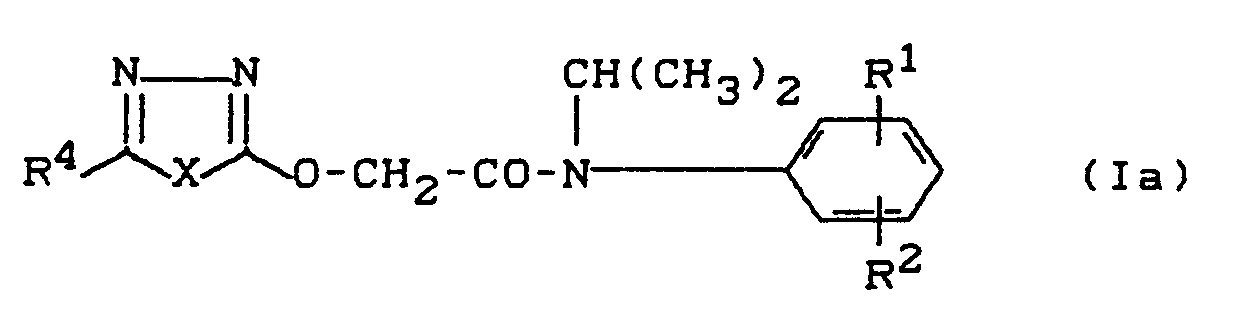
- Eine besonders bevorzugte Gruppe von Verbindungen der Formel (I) sind diejenigen der Formel (Ia)
in welcher - R¹
- für Wasserstoff, Fluor, Chlor, Methyl, Trifluormethyl oder Methoxy steht,
- R²
- für Wasserstoff steht,
- R⁴
- für Chlor, Trifluormethyl, Chlordifluormethyl, Fluordichlormethyl, Dichlormethyl, Trichlormethyl, Pentafluorethyl, Heptafluorpropyl, Methylthio, Ethylthio, Propylthio, Methylsulfinyl, Ethylsulfinyl, Propylsulfinyl, Methylsulfonyl, Ethylsulfonyl, Propylsulfonyl oder Phenyl steht und
- X
- für Sauerstoff oder Schwefel steht,
- Eine weitere besonders bevorzugte Gruppe von Verbindungen der Formel (I) sind diejenigen der Formel (Ib)

in welcher - R¹
- für Wasserstoff, Fluor, Chlor, Methyl, Trifluormethyl oder Methoxy steht,
- R²
- für Wasserstoff steht,
- R³
- für Chlor, Difluormethyl, Trifluormethyl, Chlordifluormethyl, Fluordichlormethyl, Dichlormethyl, Methyl, Ethyl, Propyl, Isopropyl, Methylthio, Ethylthio, Propylthio, Methylsulfonyl, Ethylsulfonyl, Propylsulfonyl, Methylsulfinyl, Ethylsulfinyl oder Propylsulfinyl steht und
- X
- für Sauerstoff oder Schwefel steht,
- Eine dritte besonders bevorzugte Gruppe von Verbindungen der Formel (I) sind diejenigen der Formel (Ic)

in welcher - R¹
- für Wasserstoff, Fluor, Chlor, Methyl, Trifluormethyl oder Methoxy steht,
- R²
- für Wasserstoff steht,
- R³
- für Chlor, Fluor, Methyl, Difluormethyl, Dichlormethyl, Chlordifluormethyl, Fluordichlormethyl, Trichlormethyl oder Trifluormethyl steht und
- R⁴
- für Chlor, Cyano, Difluormethyl, Dichlormethyl, Chlordifluormethyl, Fluordichlormethyl, Trichlormethyl oder Trifluormethyl steht.
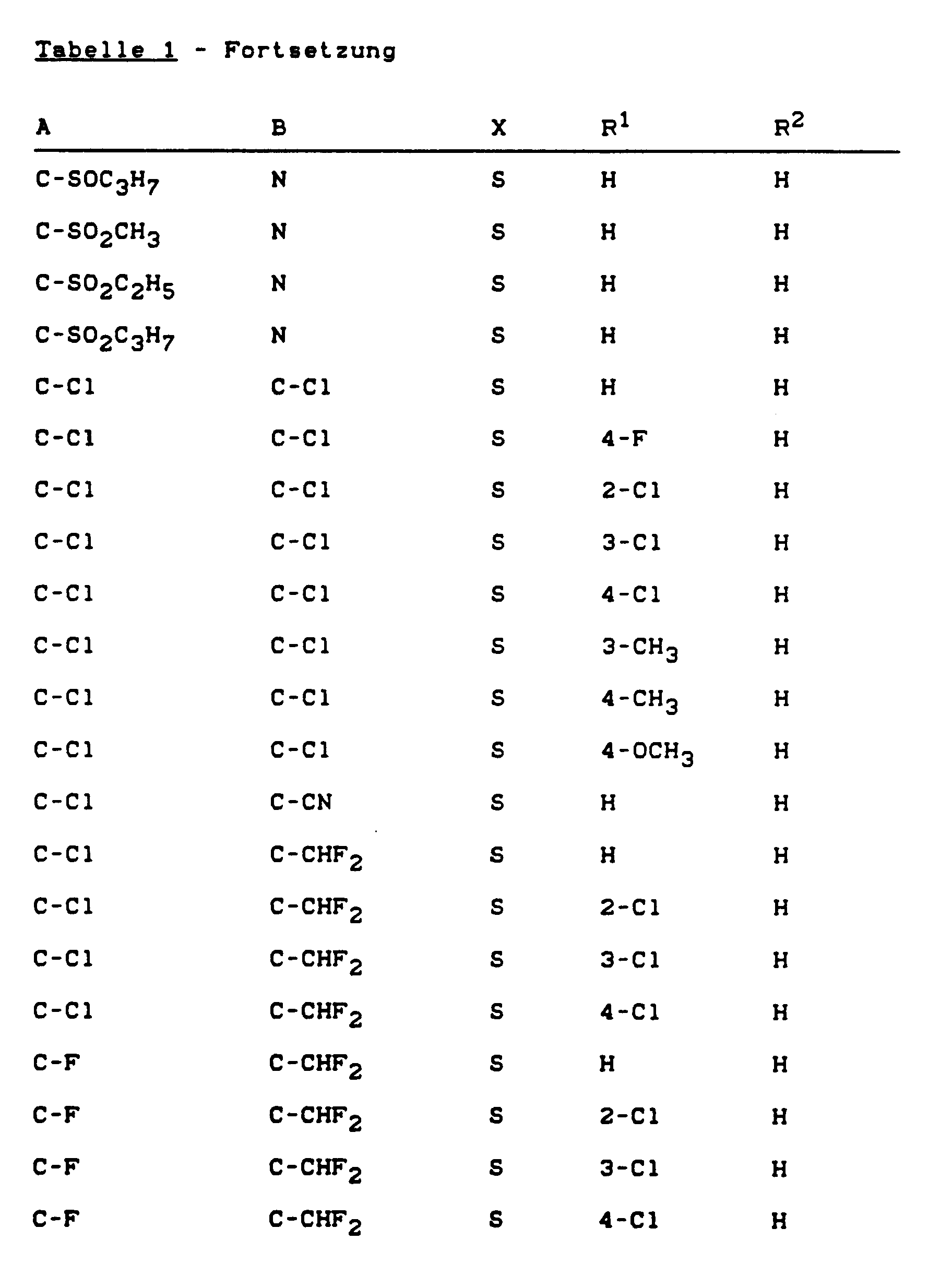
- Beispiele für die Verbindungen der Formel (I) sind in der nachstehenden Tabelle 1 aufgeführt - vgl. auch die Herstellungsbeispiele.



- Verwendet man beispielsweise 2,4,5-Trichlorthiazol und Hydroxyessigsäure-N-isopropyl-anilid als Ausgangsstoffe, so läßt sich der Reaktionsablauf beim erfindungsgemäßen Verfahren durch das folgende Formelschema darstellen:

- Die beim erfindungsgemäßen Verfahren zur Herstellung von Verbindungen der Formel (I) als Ausgangsstoffe zu verwendenden Heteroarene sind durch die Formel (II) allgemein definiert.
- In Formel (II) haben A, B und X diejenigen bevorzugten Bedeutungen, die bei den obigen Formeln (Ia), (Ib) und (Ic) für A, B bzw. X angegeben wurden und D steht vorzugsweise für Halogen oder C₁-C₄- Alkylsulfonyl, insbesondere für Chlor oder Methylsulfonyl.
- Als Beispiele für die Ausgangsstoffe der Formel (II) seien genannt:
2,4,5-Trichlor-thiazol, 2,4-Dichlor-5-cyano-thiazol, 2,4-Dichlor-5-difluormethyl-thiazol, 2,4-Dichlor-5-dichlormethyl-thiazol, 2,4-Dichlor-5-trichlormethyl-thiazol, 2-Chlor-4-fluor-5-difluormethyl-thiazol, 2-Chlor-4-fluor-5-dichlormethyl-thiazol, 2-Chlor-4-fluor-5-trifluormethyl-thiazol, 2-Chlor-4-trifluormethyl-5-cyano-thiazol, 2-Chlor-4-methyl-5-cyano-thiazol, 2,4-Dichlor-5-chlordifluormethyl-thiazol, 2,4-Dichlor-5-fluor-dichlormethyl-thiazol, 2,5-Dichlor-4-methyl-thiazol, 2,5-Dichlor-4-difluormethyl-thiazol, 2,5-Dichlor-4-trichlormethyl-thiazol, 2,5-Dichlor-4-chlordifluormethyl-thiazol, 3,5-Dichlor-1,2,4-thiadiazol, 3-Difluormethyl-5-chlor-1,2,4-thiadiazol, 3-Trifluormethyl-5-chlor-1,2,4-thiadiazol, 3-Chlor-difluormethyl-5-chlor-1,2,4-thiadiazol, 3-Fluordichlormethyl-5-chlor-1,2,4-thiadiazol, 3-Dichlormethyl-5-chlor-1,2,4-thiadiazol, 3-Trichlormethyl-5-chlor-1,2,4-thiadiazol, 3-Methyl-5-chlor-1,2,4-thiadiazol, 3-Methylthio-5-chlor-1,2,4-thiadiazol, 3-Methylsulfinyl-5-chlor-1,2,4-thiadiazol, 3-Methylsulfonyl-5-chlor-1,2,4-thiadiazol, 2,5-Dichlor-1,3,4-thiadiazol, 2-Chlor-5-methylsulfonyl-1,3,4-thiadiazol, 2-Chlor-5-trifluormethyl-1,3,4-thiadiazol, 2-Methylsulfonyl-5-trifluormethyl-1,3,4-thiadiazol, 2-Chlor-5-chlordifluormethyl-1,3,4-thiadiazol, 2-Chlor-5-fluordichlormethyl-1,3,4-thiadiazol, 2-Chlor-5-dichlormethyl-1,3,4-thiadiazol, 2-Chlor-5-trichlormethyl-1,3,4-thiadiazol, 2-Chlor-5-pentafluorethyl-1,3,4-thiadiazol, 2-Chlor-5-heptafluorpropyl-1,3,4-thiadiazol, 2-Chlor-5-methylthio-1,3,4-thiadiazol und 2-Chlor-5-methyl-sulfinyl-1,3,4-thiadiazol. - Die Ausgangsstoffe der Formel (II) sind bekannt und/oder können nach an sich bekannten Verfahren hergestellt werden (vgl. US-P 4 645 525 und dort zit. Lit.; J. Heterocycl. Chem. 11 (1974), 343 - 345; J. Org. Chem. 27 (1962), 2589 - 2592; DE-OS 34 22 861).
- Die beim erfindungsgemäßen Verfahren weiter als Ausgangsstoffe zu verwendenden Hydroxyessigsäure-N-isopropyl-anilide sind durch die Formel (III) allgemein definiert.
- In der Formel (III) haben R¹ und R² diejenigen bevorzugten Bedeutungen, die bei den obigen Formeln (Ia), (Ib) und (Ic) für R¹ bzw. R² angegeben wurden.
- Als Beispiele für die Ausgangsstoffe der Formel (III) seien genannt:
Hydroxyessigsäure-N-isopropyl-anilid, -2-fluor-anilid, -3-fluor-anilid, -4-fluor-anilid, -2-chlor-anilid, -3-chlor-anilid, -4-chlor-anilid, -3-methyl-anilid, -4-methyl-anilid, -3-methoxy-anilid, -4-methoxy-anilid, -3-trifluormethyl-anilid und -4-trifluormethyl-anilid. - Die Hydroxyessigsäure-N-isopropyl-anilide der Formel (III) sind bekannt und/oder können nach an sich bekannten Verfahren hergestellt werden (vgl. US-P 4 509 971 und US-P 4 645 525; ferner US-P 4 334 073, DE-A 3 038 598, DE-A 3 038 636, EP-A 37 526).
- Das erfindungsgemäße Verfahren zur Herstellung der neuen Heteroaryloxyessigsäure-N-isopropylanilide der Formel (I) wird vorzugsweise unter Verwendung von Verdünnungsmitteln duchgeführt. Hierzu gehören vorzugsweise Kohlenwasserstoffe, wie z. B. Toluol, Xylol oder Cyclohexan, Halogenkohlenwasserstoffe, wie z. B. Methylenchlorid, Ethylenchlorid, Chloroform oder Chlorbenzol, Ether, wie z. B. Diethylether, Dipropylether, Diisopropylether, Dibutylether, Diisobutylether, Glycoldimethylether, Tetrahydrofuran und Dioxan, Alkohole, wie z. B. Methanol, Ethanol, Propanol, Isopropanol oder Butanol, Ketone, wie z. B. Aceton, Methylethylketon, Methylisopropylketon und Methylisobutylketon, Ester, wie z. B. Essigsäuremethylester und Essigsäureethylester, Amide, wie z. B. Dimethylformamid, Dimethylacetamid und N-Methyl-pyrrolidon, Nitrile, wie z. B. Acetonitril und Propionitril, Sulfoxide, wie z. B. Dimethylsulfoxid sowie Wasser oder wäßrige Salzlösungen.
- Als Salze verwendet man hierbei vorzugsweise Chloride oder Sulfate von Alkali- oder Erdalkalimetallen, wie beispielsweise Natriumchlorid, Kaliumchlorid oder Calciumchlorid. Besonders bevorzugt ist Natriumchlorid.
- Das erfindungsgemäße Verfahren wird vorteilhaft unter Verwendung von Säurebindemitteln durchgeführt. Als solche werden vorzugsweise stark basische Alkali- und Erdalkalimetallverbindungen, beispielsweise Oxide, wie z. B. Natrium-, Kalium-, Magnesium- und Calciumoxid, Hydroxide, wie z. B. Natrium-, Kalium-, Magnesium- und Calciumhydroxid und/oder Carbonate, wie z. B. Natrium-, Kalium-, Magnesium- und Calciumcarbonat verwendet.
- Der Zusatz von 0,01 bis 10 Gew.-% (bezogen auf eingesetztes Glycolsäureamid der Formel (III)) eines Phasentransferkatalysators mag sich in einigen Fällen als vorteilhaft erweisen. Als Beispiele für solche Katalysatoren seien genannt:
Tetrabutylammoniumchlorid, Tetrabutylammoniumbromid, Tributyl-methylphosphoniumbromid, Trimethyl-C₁₃/C₁₅-alkyl-ammoniumchlorid, Dibenzyl-dimethyl-ammonium-methylsulfat, Dimethyl-C₁₂/C₁₄-alkyl-benzylammoniumchlorid, Tetrabutylammoniumhydroxid, 18-Krone-6, Triethylbenzylammoniumchlorid, Trimethylbenzylammoniumchlorid, Tetraethylammoniumbromid. - Die Reaktionstemperaturen können bei dem erfindungsgemäßen Verfahren in einem größeren Bereich variiert werden. Im allgemeinen arbeitet man bei Temperaturen zwischen -50 °C und +110 °C, vorzugsweise bei Temperaturen zwischen -20 °C und +100 °C.
- Das erfindungsgemäße Verfahren wird im allgemeinen bei Normaldruck durchgeführt, es kann aber auch bei erhöhtem oder vermindertem Druck, etwa zwischen 0,1 und 10 bar, durchgeführt werden.
- Zur Durchführung des erfindungsgemäßen Verfahrens setzt man je Mol Heteroaren der Formel (II) im allgemeinen 0,5 bis 5 Mol, vorzugsweise 0,8 bis 1,5 Mol, Hydroxyessigsäure-N-isopropyl-anilid der Formel (III) ein. Die Reaktionskomponenten können in beliebiger Reihenfolge zusammengegeben werden. Man rührt jeweils das Reaktionsgemisch bis zum Ende der Umsetzung und arbeitet nach üblichen Methoden auf.
- Die erfindungsgemäßen Wirkstoffe können als Defoliants, Desiccants, Krautabtötungsmittel und insbesondere als Unkrautvernichtungsmittel verwendet werden. Unter Unkraut im weitesten Sinne sind alle Pflanzen zu verstehen, die an Orten aufwachsen, wo sie unerwünscht sind. Ob die erfindungsgemäßen Stoffe als totale oder selektive Herbizide wirken, hängt im wesentlichen von der angewendeten Menge ab.
- Die erfindungsgemäßen Wirkstoffe können z.B. bei den folgenden Pflanzen verwendet werden:
Dikotyle Unkräuter der Gattungen: Sinapis, Lepidium, Galium, Stellaria, Matricaria, Anthemis, Galinsoga, Chenopodium, Urtica, Senecio, Amaranthus, Portulaca, Xanthium, Convolvulus, Ipomoea, Polygonum, Sesbania, Ambrosia, Cirsium, Carduus, Sonchus, Solanum, Rorippa, Rotala, Lindernia, Lamium, Veronica, Abutilon, Emex, Datura, Viola, Galeopsis, Papaver, Centaurea. - Dikotyle Kulturen der Gattungen: Gossypium, Glycine, Beta, Daucus, Phaseolus, Pisum, Solanum, Linum, Ipomoea, Vicia, Nicotiana, Lycopersicon, Arachis, Brassica, Lactuca, Cucumis, Cucurbita.
- Monokotyle Unkräuter der Gattungen: Echinochloa, Setaria, Panicum, Digitaria, Phleum, Poa, Festuca, Eleusine, Brachiaria, Lolium, Bromus, Avena, Cyperus, Sorghum, Agropyron, Cynodon, Monochoria, Fimbristylis, Sagittaria, Eleocharis, Scirpus, Paspalum, Ischaemum, Sphenoclea, Dactyloctenium, Agrostis, Alopecurus, Apera.
- Monokotyle Kulturen der Gattungen: Oryza, Zea, Triticum, Hordeum, Avena, Secale, Sorghum, Panicum, Saccharum, Ananas, Asparagus, Allium.
- Die Verwendung der erfindungsgemäßen Wirkstoffe ist jedoch keineswegs auf diese Gattungen beschränkt, sondern erstreckt sich in gleicher Weise auch auf andere Pflanzen.
- Die Verbindungen eignen sich in Abhängigkeit von der Konzentration zur Totalunkrautbekämpfung z.B. auf Industrie- und Gleisanlagen und auf Wegen und Plätzen mit und ohne Baumbewuchs. Ebenso können die Verbindungen zur Unkrautbekämpfung in Dauerkulturen, z.B. Forst, Ziergehölz-, Obst-, Wein-, Citrus-, Nuß-, Bananen-, Kaffee-, Tee-, Gummi-, Ölpalm-, Kakao-, Beerenfrucht- und Hopfenanlagen und zur selektiven Unkrautbekämpfung in einjährigen Kulturen eingesetzt werden.
- Die erfindungsgemäßen Verbindungen der Formel (I) eignen sich inbesondere zur selektiven Bekämpfung von monokotylen Unkräutern in monokotylen und dikotylen Kulturen, vor allem im Vorauflauf-Verfahren. Sie zeichnen sich besonders durch gute Verträglichkeit in Gerste, Weizen, Mais, Reis, Sonnenblumen und Soja aus.
- Die Wirkstoffe können in die üblichen Formulierungen überführt werden, wie Lösungen, Emulsionen, Spritzpulver, Suspensionen, Pulver, Stäubemittel, Pasten, lösliche Pulver, Granulate, Suspensions-Emulsions-Konzentrate, Wirkstoff-imprägnierte Natur- und synthetische Stoffe sowie Feinstverkapselungen in polymeren Stoffen.
- Diese Formulierungen werden in bekannter Weise hergestellt, z. B. durch Vermischen der Wirkstoffe mit Streckmitteln, als flüssigen Lösungsmitteln und/oder festen Trägerstoffen, gegebenenfalls unter Verwendung von oberflächenaktiven Mitteln, also Emulgiermitteln und/oder Dispergiermitteln und/oder schaumerzeugenden Mitteln.
- Im Falle der Benutzung von Wasser als Streckmittel können z.B. auch organische Lösungsmittel als Hilfslösungsmittel verwendet werden. Als flüssige Lösungsmittel kommen im wesentlichen in Frage: Aromaten, wie Xylol, Toluol, oder Alkylnaphthaline, chlorierte Aromaten und chlorierte aliphatische Kohlenwasserstoffe, wie Chlorbenzole, Chlorethylene oder Methylenchlorid, aliphatische Kohlenwasserstoffe, wie Cyclohexan oder Paraffine, z.B. Erdölfraktionen, mineralische und pflanzliche Öle, Alkohole, wie Butanol oder Glykol sowie deren Ether und Ester, Ketone wie Aceton, Methylethylketon, Methylisobutylketon oder Cyclohexanon, stark polare Lösungsmittel, wie Dimethylformamid und Dimethylsulfoxid, sowie Wasser.
- Als feste Trägerstoffe kommen in Frage:
z.B. Ammoniumsalze und natürliche Gesteinsmehle, wie Kaoline, Tonerden, Talkum, Kreide, Quarz, Attapulgit, Montmorillonit oder Diatomeenerde und synthetische Gesteinsmehle, wie hochdisperse Kieselsäure, Aluminiumoxid und Silikate, als feste Trägerstoffe für Granulate kommen in Frage: z.B. gebrochene und fraktionierte natürliche Gesteine wie Calcit, Marmor, Bims, Sepiolith, Dolomit sowie synthetische Granulate aus anorganischen und organischen Mehlen sowie Granulate aus organischem Material wie Sägemehl, Kokosnußschalen, Maiskolben und Tabakstengeln; als Emulgier- und/oder schaumerzeugende Mittel kommen in Frage: z.B. nichtionogene und anionische Emulgatoren, wie Polyoxyethylen-Fettsäure-Ester, Polyoxyethylen-Fettalkohol-Ether, z.B. Alkylaryl-polyglykolether, Alkylsulfonate, Alkylsulfate, Arylsulfonate sowie Eiweißhydrolysate; als Dispergiermittel kommen in Frage: z.B. Lignin-Sulfitablaugen und Methylcellulose. - Es können in den Formulierungen Haftmittel wie Carboxymethylcellulose, natürliche und synthetische pulvrige, körnige oder latexförmige Polymere verwendet werden, wie Gummiarabicum, Polyvinylalkohol, Polyvinylacetat, sowie natürliche Phospholipide, wie Kephaline und Lecithine und synthetische Phospholipide. Weitere Additive können mineralische und vegetabile Öle sein.
- Es können Farbstoffe wie anorganische Pigmente, z.B. Eisenoxid, Titanoxid, Ferrocyanblau und organische Farbstoffe, wie Alizarin-, Azo- und Metallphthalocyaninfarbstoffe und Spurennährstoffe wie Salze von Eisen, Mangan, Bor, Kupfer, Kobalt, Molybdän und Zink verwendet werden.
- Die Formulierungen enthalten im allgemeinen zwischen 0,1 und 95 Gewichtsprozent Wirkstoff, vorzugsweise zwischen 0,5 und 90 %.
- Die erfindungsgemäßen Wirkstoffe können als solche oder in ihren Formulierungen auch in Mischung mit bekannten Herbiziden zur Unkrautbekämpfung Verwendung finden, wobei Fertigformulierungen oder Tankmischungen möglich sind.
- Für die Mischungen kommen bekannte Herbizide wie z.B. 1-Amino-6-ethylthio-3-(2,2-dimethylpropyl)-1,3,5-triazin-2,4(1H,3H)-dion (AMETHYDIONE) oder N-(2-Benzthiazolyl)-N,N′-dimethyl-harnstoff (METABENZTHIAZURON) zur Unkrautbekämpfung in Getreide; 4-Amino-3-methyl-6-phenyl-1,2,4-triazin-5(4H)-on (METAMITRON) zur Unkrautbekämpfung in Zuckerrüben und 4-Amino-6-(1,1-dimethylethyl)-3-methylthio-1,2,4-triazin-5(4H)-on (METRIBUZIN) zur Unkrautbekämpfung in Sojabohnen, in Frage; ferner auch 2-Chlor-4-ethylamino-6-isopropylamino-1,3,5-triazin (ATRAZIN); 2-[[[[[(4,6-Dimethoxypyrimidin-2-yl)-amino]-carbonyl]-amino]-sulfonyl]-methyl]-benzoesäuremethylester (BENSULFURON); 5-Amino-4-chlor-2-phenyl-2,3-dihydro-3-oxy-pyridazin (CHLORIDAZON); Ethyl-2-{[(4-chlor-6-methoxy-2-pyrimidinyl)-aminocarbonyl]-aminosulfonyl}-benzoat (CHLORIMURON); 2-Chlor-N-{[(4-methoxy-6-methyl-1,3,5-triazin-2-yl)-amino]-carbonyl}-benzolsulfonamid (CHLORSULFURON); 2-Chlor-4-ethylamino-6-(3-cyanopropylamino)-1,3,5-triazin (CYANAZIN); 4-Amino-6-t-butyl-3-ethylthio-1,2,4-triazin-5(4H)-on (ETHIOZIN); 1-Methyl-3-phenyl-5-(3-trifluormethylphenyl)-4-pyridon (FLURIDONE); 5-(2-Chlor-4-trifluormethyl-phenoxy)-N-methylsulfonyl-2-nitrobenzamid (FOMESAFEN); Methyl-2-[4,5-dihydro-4-methyl-4-(1-methylethyl)-5-oxo-1H-imidazol-2-yl]-4(5)-methylbenzoat (IMAZAMETHABENZ); 2-[5-Methyl-5-(1-methylethyl)-4-oxo-2-imidazolin-2-yl]-3-chinolincarbonsäure (IMAZAQUIN); N-Methyl-2-(1,3-benzthiazol-2-yloxy)-acetanilid (MEFENACET); 2-{[[((4-Methoxy-6-methyl-1,3,5-triazin-2-yl)-amino)-carbonyl]-amino]-sulfonyl}-benzoesäure oder deren Methylester (METSULFURON); N-(1-Ethylpropyl)-3,4-dimethyl-2,6-dinitroanilin (PENDIMETHALIN); 2-Chlor-4,6-bis-(ethylamino)-1,3,5-triazin (SIMAZIN); 2,4-Bis-[N-ethylamino]-6-methylthio-1,3,5-triazin (SIMETRYNE); 4-Ethylamino-2-t-butylamino-6-methylthio-s-triazin (TERBUTRYNE); 3-[[[[(4-Methoxy-6-methyl-1,3,5-triazin-2-yl)-amino]-carbonyl]-amino]-sulfonyl]-thiophen-2-carbonsäuremethylester (THIAMETURON) und 2,6-Dinitro-4-trifluormethyl-N,N-dipropylanilin (TRIFLURALIN). Einige Mischungen zeigen überraschenderweise auch synergistische Wirkung.
- Auch eine Mischung mit anderen bekannten Wirkstoffen, wie Fungiziden, Insektiziden, Akariziden, Nematiziden, Schutzstoffen gegen Vogelfraß, Pflanzennährstoffen und Bodenstrukturverbesserungsmitteln ist möglich.
- Die Wirkstoffe können als solche, in Form ihrer Formulierungen oder den daraus durch weiteres Verdünnen bereiteten Anwendungsformen, wie gebrauchsfertige Lösungen, Suspensionen, Emulsionen, Pulver, Pasten und Granulate angewandt werden. Die Anwendung geschieht in üblicher Weise, z.B. durch Gießen, Spritzen, Sprühen, Streuen.
- Die erfindungsgemäßen Wirkstoffe können sowohl vor als auch nach dem Auflaufen der Pflanzen appliziert werden.
- Sie können auch vor der Saat in den Boden eingearbeitet werden.
- Die angewandte Wirkstoffmenge kann in einem größeren Bereich schwanken. Sie hängt im wesentlichen von der Art des gewünschten Effektes ab. Im allgemeinen liegen die Aufwandmengen zwischen 0,01 und 10 kg Wirkstoff pro Hektar Bodenfläche, vorzugsweise zwischen 0,05 und 5 kg pro ha.
- Die Herstellung und die Verwendung der erfindungsgemäßen Wirkstoffe geht aus den nachfolgenden Beispielen hervor.
-
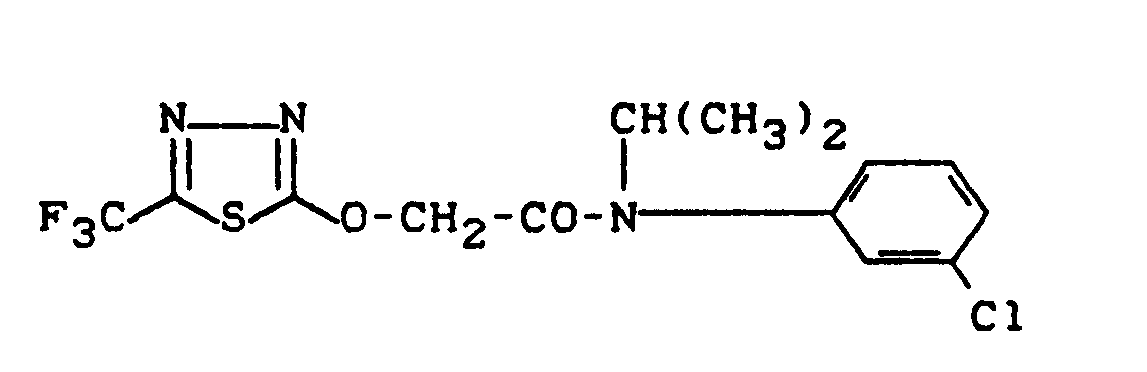
- 11,8 g (0,05 Mol) 2-Methylsulfonyl-5-trifluormethyl-1,3,4-thiadiazol werden zusammen mit 11,4 g (0,05 Mol) Hydroxyessigsäure-N-isopropyl-(3-chlor-anilid) in 100 ml Aceton gelöst. Bei -20 °C wird eine Lösung aus 2,4 g Natriumhydroxidpulver und 9 ml Wasser langsam zugetropft. Dann läßt man 3 Stunden bei -20 °C nachrühren und gießt das Reaktionsgemisch dann auf Wasser. Das kristalline Produkt wird durch Absaugen isoliert.
- Man erhält 16,1 g (85 % der Theorie) (5-Trifluormethyl-1,3,4-thiadiazol-2-yl)-oxyessigsäure-N-isopropyl-(3-chlor-anilid) vom Brechungsindex n

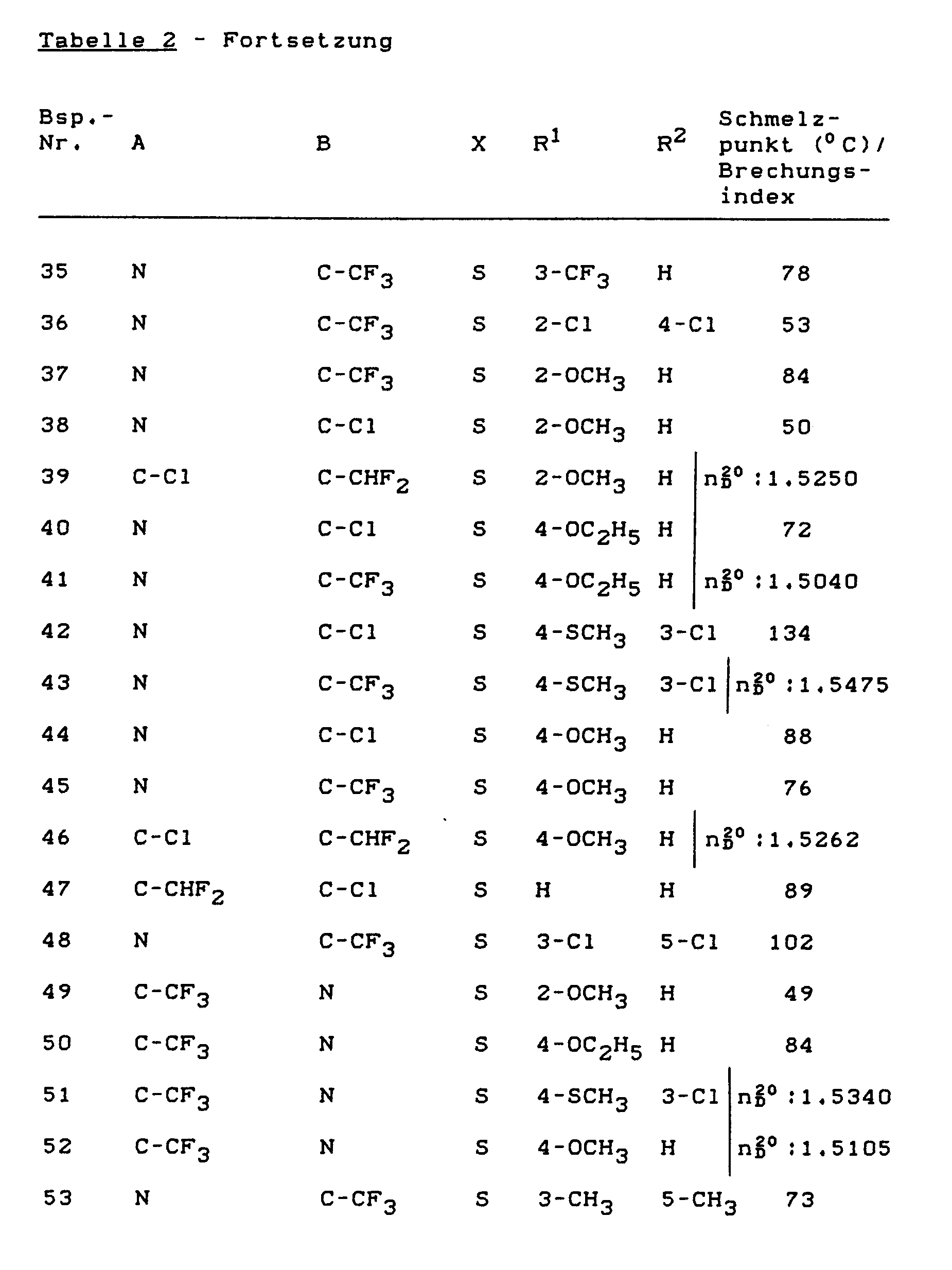
- Analog Beispiel 1 und entsprechend der allgemeinen Beschreibung des erfindungsgemäßen Herstellungsverfahrens können auch die in der nachstehenden Tabelle 2 aufgeführten Verbindungen der Formel (I) hergestellt werden:


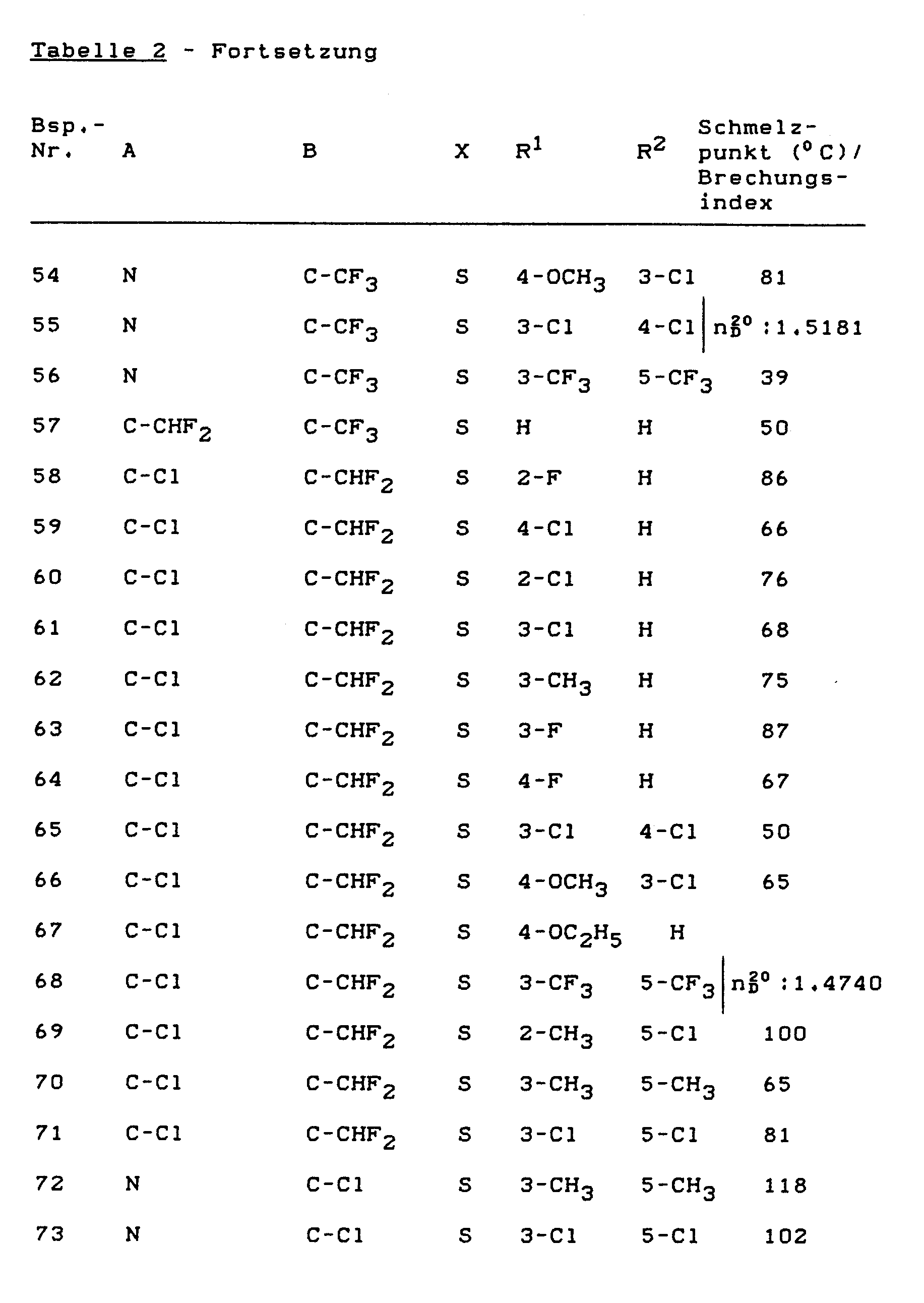

-

- 259 g (1,91 Mol) N-Isopropylanilin werden zusammen mit 182 g (2,29 Mol) Pyridin in 2,2 l Toluol gelöst. Bei 0 - 5 °C werden dann 259,7 g (1,91 Mol) Acetoxyacetylchlorid hinzugetropft. Dann läßt man bei 0 - 5 °C 1 Stunde und bei 20 °C 12 Stunden nachrühren. Zur Aufarbeitung wird die Toluolphase mit Wasser und verdünnter Salzsäure ausgeschüttelt, mit Wasser neutralgewaschen, getrocknet und eingeengt. Es bleibt ein kristalliner beigefarbener Feststoff zurück, der bei 101 °C schmilzt.
- Man erhält so 340 g (76 % der Theorie) Acetoxyessigsäure-N-isopropylanilid.
- Hiervon werden 334 g (1,42 Mol) in 500 ml Methanol suspendiert. Diese Suspension wird in eine Lösung aus 500 ml Wasser und 63 g Natriumhydroxyd (1,57 Mol) eingetragen. Man läßt 3 Stunden bei 40 °C und dann noch 12 Stunden bei 20 °C rühren. Die Reaktionslösung wird dann mit konzentrierter Salzsäure auf pH 6 eingestellt und am Rotationsverdampfer zur Hälfte eingeengt. Dann gibt man 500 ml Wasser hinzu und extrahiert das Reaktionsprodukt mit 700 ml Chloroform. Die organische Phase wird mit Wasser gewaschen, mit Natriumsulfat getrocknet, filtriert und eingeengt.
- Man erhält so 256 g (94 % der Theorie) Hydroxyessigsäure-N-isopropyl-anilid als kristallinen Rückstand vom Schmelzpunkt 39 °C.
- Analog Beispiel (III-1) können auch die in der nachfolgenden Tabelle 3 aufgeführten Verbindungen der Formel (III) hergestellt werden:

- Im folgenden Anwendungsbeispiel wird die Verbindung nachstehender Formel als Vergleichssubstanz verwendet:

2-(5-Chlor-1,3,4-thiadiazol-2-yl-oxy)-essigsäure-N-methyl-anilid
(bekannt aus EP-A 192 117). -
- Lösungsmittel:
- 5 Gewichtsteile Aceton
- Emulgator:
- 1 Gewichtsteil Alkylarylpolyglykolether
- Zur Herstellung einer zweckmäßigen Wirkstoffzubereitung vermischt man 1 Gewichtsteil Wirkstoff mit der angegebenen Menge Lösungsmittel, gibt die angegebene Menge Emulgator zu und verdünnt das Konzentrat mit Wasser auf die gewünschte Konzentration.
- Samen der Testpflanzen werden in normalen Boden ausgesät und nach 24 Stunden mit der Wirkstoffzubereitung begossen. Dabei hält man die Wassermenge pro Flächeneinheit zweckmäßigerweise konstant. Die Wirkstoffkonzentration in der Zubereitung spielt keine Rolle, entscheidend ist nur die Aufwandmenge des Wirkstoffs pro Flächeneinheit. Nach drei Wochen wird der Schädigungsgrad der Pflanzen bonitiert in % Schädigung im Vergleich zur Entwicklung der unbehandelten Kontrolle. Es bedeuten:
0 % = keine Wirkung (wie unbehandelte Kontrolle)
100 % = totale Vernichtung
Eine deutliche Überlegenheit in Nutzpflanzenselektivität gegenüber dem Stand der Technik zeigen in diesem Test z.B. die Verbindungen gemäß den Herstellungsbeispielen: (1), (5) und (33).
(3-Trichlormethyl-1,2,4-thiadiazol-5-yl)-oxy-essigsäure-N-isopropyl-anilid,
(3-Chlor-1,2,4-thiadiazol-5-yl)-oxyessigsäure-N-isopropyl-anilid,
(3-Chlor-1,2,4-thiadiazol-5-yl)-oxyessigsäure-N-isopropyl-N-(3-chorphenyl)-amid,
(3-Chlor-1,2,4-thiadiazol-5-yl)-oxyessigsäure-N-isopropyl-N-(4-chlorphenyl)-amid,
(3-Chlor-1,2,4-thiadiazol-5-yl)-oxyessigsäure-N-isopropyl-N-(2,4-dichlorphenyl)-amid und
(3-Chlor-1,2,4-thiadiazol-5-yl)-oxyessigsäure-N-isopropyl-N-(2-chlorphenyl)-amid.

in welcher
R¹ und R² die oben angegebenen Bedeutungen haben,
gegebenenfalls in Gegenwart eines Verdünnungsmittels, gegebenenfalls in Gegenwart eines Säurebindemittels und gegebenenfalls in Gegenwart eines Katalysators umsetzt.
(3-Chlor-1,2,4-thiadiazol-5-yl)-oxyessigsäure-N-isopropyl-anilid,
(3-Chlor-1,2,4-thiadiazol-5-yl)-oxyessigsäure-N-isopropyl-N-(3-chlorphenyl)-amid,
(3-Chlor-1,2,4-thiadiazol-5-yl)-oxyessigsäure-N-isopropyl-N-(4-chlorphenyl)-amid und
(3-Chlor-1,2,4-thiadiazol-5-yl)-oxyessigsäure-N-isopropyl-N-(2-chlorphenyl)-amid.
Claims (10)
- Heteroaryloxyessigsäure-N-isopropyl-anilide der allgemeinen Formel (I)
 A für Stickstoff oder die Gruppierung C-R³ steht, wobeiR³ für Fluor, Chlor, Brom, Cyano, für gegebenenfalls durch Fluor und/oder Chlor substituiertes C₁-C₄-Alkyl, für gegebenenfalls durch Fluor und/oder Chlor substituiertes C₁-C₄-Alkoxy, für gegebenenfalls durch Fluor und/oder Chlor substituiertes C₁-C₄-Alkylthio, für C₁-C₄-Alkylsulfinyl oder C₁-C₄-Alkylsulfonyl steht,B für Stickstoff oder die Gruppierung C-R⁴ steht, wobeiR⁴ für Fluor, Chlor, Cyano, für gegebenenfalls durch Fluor und/oder Chlor substituiertes C₁-C₄-Alkyl, für gegebenenfalls durch Fluor und/oder Chlor substituiertes C₁-C₄-Alkoxy, für gegebenenfalls durch Fluor und/oder Chlor substituiertes C₁-C₄-Alkylthio, für gegebenenfalls durch Fluor und/oder Chlor substituiertes C₁-C₄-Alkylsulfinyl, für gegebenenfalls durch Fluor und/oder Chlor substituiertes C₁-C₄-Alkylsulfonyl, für gegebenenfalls durch Fluor, Chlor, Brom, C₁-C₄-Alkyl, Trifluormethyl, C₁-C₄-Alkoxy oder Trifluormethoxy substituiertes Phenyl oder die Gruppierung -CY₂-Z-R⁵ steht, wobeiR⁵ für gegebenenfalls durch Fluor und/oder Chlor, C₁-C₄-Alkoxy oder C₁-C₄-Alkylthio substituiertes C₁-C₄-Alkyl oder für gegebenenfalls durch Fluor, Chlor, Brom, C₁-C₄-Alkyl, Trifluormethyl, C₁-C₄-Alkoxy, Trifluormethoxy, C₁-C₄-Alkylthio oder Trifluormethylthio substituiertes Phenyl steht,Y für Wasserstoff, Fluor oder Chlor steht,Z für Sauerstoff, Schwefel, SO oder SO₂ steht,R¹ für Wasserstoff, Fluor, Chlor, Brom, Cyano, Nitro, für gegebenenfalls durch Fluor und/oder Chlor substituiertes C₁-C₄-Alkyl, für gegebenenfalls durch Fluor und/oder Chlor substituiertes C₁-C₄-Alkoxy oder für gegebenenfalls durch Fluor und/oder Chlor substituiertes C₁-C₄-Alkylthio steht,R² für Wasserstoff, Fluor, Chlor, Brom, Methyl, Trifluormethyl oder Methoxy steht undX für Sauerstoff oder Schwefel steht,ausgenommen die Verbindungen (5-Trifluormethyl-1,3,4-thiadiazol-2-yl)-oxyessigsäure-N-isopropyl-anilid,
(3-Trichlormethyl-1,2,4-thiadiazol-5-yl)-oxyessigsäure-N-isopropyl-anilid,
(3-Chlor-1,2,4-thiadiazol-5-yl)-oxyessigsäure-N-isopropyl-anilid,
(3-Chlor-1,2,4-thiadiazol-5-yl)-oxyessigsäure-N-isopropyl-N-(3-chlorphenyl)-amid,
(3-Chlor-1,2,4-thiadiazol-5-yl)-oxyessigsäure-N-isopropyl-N-(4-chlorphenyl)-amid,
(3-Chlor-1,2,4,-thiadiazol-5-yl)-oxyessigsäure-N-isopropyl-N-(2,4-dichlorphenyl)-amid und
(3-Chlor-1,2,4-thiadiazol-5-yl)-oxyessigsäure-N-isopropyl-N-(2-chlorphenyl)-amid. - Heteroaryloxyessigsäure-N-isopropyl-anilide der Formel (Ia)
 R¹ für Wasserstoff, Fluor, Chlor, Methyl, Trifluormethyl oder Methoxy steht,R² für Wasserstoff steht,R⁴ für Chlor, Trifluormethyl, Chlordifluormethyl, Fluordichlormethyl, Dichlormethyl, Trichlormethyl, Pentafluorethyl, Heptafluorpropyl, Methylthio, Ethylthio, Propylthio, Methylsulfinyl, Ethylsulfinyl, Propylsulfinyl, Methylsulfonyl, Ethylsulfonyl, Propylsulfonyl oder Phenyl steht undX für Sauerstoff oder Schwefel steht,gemäß Anspruch 1, ausgenommen die Verbindung (5-Trifluormethyl-1,3,4-thiadiazol-2-yl)-oxyessigsäure-N-isopropyl-anilid.
 - Heteroaryloxyessigsäure-N-isopropyl-anilide der Formel (Ib)
 R¹ für Wasserstoff, Fluor, Chlor, Methyl, Trifluormethyl oder Methoxy steht,R² für Wasserstoff steht,R³ für Chlor, Difluormethyl, Trifluormethyl, Chlordifluormethyl, Fluordichlormethyl, Dichlormethyl, Methyl, Ethyl, Propyl, Isopropyl, Methylthio, Ethylthio, Propylthio, Methylsulfonyl, Ethylsulfonyl, Propylsulfonyl, Methylsulfinyl, Ethylsulfinyl oder Propylsulfinyl steht undX für Sauerstoff oder Schwefel steht,gemäß Anspruch 1, ausgenommen die Verbindungen (3-Chlor-1,2,4-thiadiazol-5-yl)-oxyessigsäure-N-isopropyl-anilid,
(3-Chlor-1,2,4-thiadiazol-5-yl)-oxyessigsäure-N-isopropyl-N-(3-chlorphenyl)-amid,
(3-Chlor-1,2,4-thiadiazol-5-yl)-oxyessigsäure-N-isopropyl-N-(4-chlorphenyl)-amid und
(3-Chlor-1,2,4-thiadiazol-5-yl)-oxyessigsäure-N-isopropyl-N-(2-chlorphenyl)-amid. - Heteroaryloxyessigsäure-N-isopropyl-anilide der Formel (Ic)
 R¹ für Wasserstoff, Fluor, Chlor, Methyl, Trifluormethyl oder Methoxy steht,R² für Wasserstoff steht,R³ für Chlor, Fluor, Methyl, Difluormethyl, Dichlormethyl, Chlordifluormethyl, Fluordichlormethyl, Trichlormethyl oder Trifluormethyl steht undR⁴ für Chlor, Cyano, Difluormethyl, Dichlormethyl, Chlordifluormethyl, Fluordichlormethyl, Trichlormethyl oder Trifluormethyl steht,gemäß Anspruch 1.
 - (5-Trifluormethyl-1,3,4-thiadiazol-5-yl)-oxyessigsäure-N-isopropyl-N-(4-fluorphenyl)-amid der Formel

- Verfahren zur Herstellung von Heteroaryloxyessigsäure-N-isopropyl-aniliden der allgemeinen Formel (I) gemäß Anspruch 1, dadurch gekennzeichnet, daß man Heteroarene der allgemeinen Formel (II)
 A, B und X die in Anspruch 1 angegebenen Bedeutungen haben undD für eine nucleofuge Abgangsgruppe steht,mit Hydroxyessigsäure-N-isopropyl-aniliden der allgemeinen Formel (III)
R¹ und R² die in Anspruch 1 angegebenen Bedeutungen haben,
gegebenenfalls in Gegenwart eines Verdünnungsmittels, gegebenenfalls in Gegenwart eines Säurebindemittels und gegebenenfalls in Gegenwart eines Katalysators umsetzt. - Herbizide Mittel, gekennzeichnet durch einen Gehalt an mindestens einem Heteroaryloxyessigsäure-N-isopropyl-anilid der Formel (I) gemäß Anspruch 1.
- Verfahren zur Bekämpfung von unerwünschtem Pflanzenwachstum, dadurch gekennzeichnet, daß man auf die Pflanzen oder ihren Lebensraum Heteroaryloxyessigsäure-N-isopropyl-anilide der Formel (I) gemäß Anspruch 1 einwirken läßt.
- Verwendung von Heteroaryloxyessigsäure-N-isopropyl-aniliden der Formel (I) gemäß Anspruch 1 zur Bekämpfung von unerwünschtem Pflanzenwachstum.
- Verfahren zur Herstellung von herbiziden Mitteln, dadurch gekennzeichnet, daß man Heteroaryloxyessigsäure-N-isopropyl-anilide der Formel (I) gemäß Anspruch 1 mit Streckmitteln und/oder oberflächenaktiven Mitteln vermischt.
Applications Claiming Priority (2)
| Application Number | Priority Date | Filing Date | Title |
|---|---|---|---|
| DE3821600 | 1988-06-27 | ||
| DE3821600A DE3821600A1 (de) | 1988-06-27 | 1988-06-27 | Heteroaryloxyessigsaeure-n-isopropylanilide |
Publications (2)
| Publication Number | Publication Date |
|---|---|
| EP0348737A1 EP0348737A1 (de) | 1990-01-03 |
| EP0348737B1 true EP0348737B1 (de) | 1993-08-04 |
Family
ID=6357325
Family Applications (1)
| Application Number | Title | Priority Date | Filing Date |
|---|---|---|---|
| EP89110799A Expired - Lifetime EP0348737B1 (de) | 1988-06-27 | 1989-06-14 | Heteroaryloxyessigsäure-N-isopropylanilide |
Country Status (12)
| Country | Link |
|---|---|
| US (2) | US4968342A (de) |
| EP (1) | EP0348737B1 (de) |
| JP (1) | JP2909097B2 (de) |
| KR (1) | KR0128344B1 (de) |
| AR (1) | AR248015A1 (de) |
| AU (1) | AU654084B2 (de) |
| BR (1) | BR8903106A (de) |
| CA (1) | CA1334422C (de) |
| CL (1) | CL2004001113A1 (de) |
| DE (2) | DE3821600A1 (de) |
| DK (1) | DK175225B1 (de) |
| ES (1) | ES2058396T3 (de) |
Cited By (1)
| Publication number | Priority date | Publication date | Assignee | Title |
|---|---|---|---|---|
| US9370183B2 (en) | 2011-05-04 | 2016-06-21 | Bayer Intellectual Property Gmbh | Use of ALS inhibitor herbicides for control of unwanted vegetation in ALS inhibitor herbicide tolerant Brassica, such as B. napus, plants |
Families Citing this family (46)
| Publication number | Priority date | Publication date | Assignee | Title |
|---|---|---|---|---|
| DE3505425A1 (de) * | 1985-02-16 | 1986-08-21 | Bayer Ag, 5090 Leverkusen | 5-chlor-1,3,4-thiadiazol-2-yloxy-acetamide |
| US5817876A (en) * | 1990-02-02 | 1998-10-06 | Bayer Aktiengesellschaft | Preparation of N-alkyl-arylamines |
| DE4031158A1 (de) * | 1990-04-21 | 1991-10-24 | Bayer Ag | Aryloxycarbonylverbindungen |
| CA2077737A1 (en) * | 1991-09-11 | 1993-03-12 | Shinichi Kawamura | Herbicidal composition |
| DE4223465A1 (de) | 1992-07-16 | 1994-01-20 | Bayer Ag | Herbizide Mittel auf Basis von Heteroaryloxyacetamiden |
| US6017661A (en) | 1994-11-09 | 2000-01-25 | Kimberly-Clark Corporation | Temporary marking using photoerasable colorants |
| US5547967A (en) * | 1993-12-08 | 1996-08-20 | Kali-Chemie Pharma Gmbh | (Phenylalkylaminoalkyloxy)-heteroaryl-compounds, processes and intermediates for their production and pharmaceutical compositions containing them |
| DE4415338A1 (de) * | 1994-05-02 | 1995-11-09 | Bayer Ag | Alkylsulfinyl- und Alkylsulfonyl-1,2,4-thiadiazolyloxyacetamide |
| DE4437049A1 (de) * | 1994-10-17 | 1996-04-18 | Bayer Ag | Selektive Herbizide auf Basis von Carbamoyltriazolinonen und Heteroaryloxyacetamiden |
| US5912206A (en) * | 1994-12-09 | 1999-06-15 | Rhone-Poulenc Agrochimie | Herbicidal compositions |
| GB9424853D0 (en) * | 1994-12-09 | 1995-02-08 | Bayer Ag | New herbicidal compositions |
| DE19546751B4 (de) * | 1994-12-23 | 2005-02-17 | Bayer Cropscience Ag | Selektive Herbizide auf Basis von Heteroaryloxy-acetamiden |
| ES2128984B1 (es) * | 1996-05-24 | 2000-02-01 | Bayer Ag | Herbicidas a base de heteroariloxi-acetamidas para el empleo en el cultivo de arroz. |
| DE19634701A1 (de) | 1996-08-28 | 1998-03-05 | Bayer Ag | Herbizide Mittel auf Basis von 4-Brom-l-methyl-5-trifluormethyl-3-(2-fluor-4-chlor-5-isopropoxycarbonsylphenyl)pyrazol |
| US5792872A (en) * | 1997-12-12 | 1998-08-11 | Bayer Corporation | Process for producing N-(4-fluorophenyl)-N-(1-methylethyl)-2- (5-trifluoromethyl-1,3,4-thiadiazol-2-yl)oxy!acetamide |
| US5895818A (en) * | 1997-12-12 | 1999-04-20 | Bayer Corporation | Process for making N-(4-fluorophenyl)-N-(1-methylethyl)-2- (5-trifuloromethyl)-1,3,4-thiadiazol-2-yl)oxy!acetamide using an aprotic, aromatic solvent |
| US5852202A (en) * | 1997-12-12 | 1998-12-22 | Bayer Corporation | Process for isolating N-(4-fluorophenyl)-N-(1-methylethyl)-2- (5-trifluoromethyl)-1,3,4-thiadiazol-2-yl)oxy!acetamide |
| KR100725197B1 (ko) * | 1999-06-22 | 2007-06-07 | 바스프 악티엔게젤샤프트 | 디니트로아닐린 및 옥시아세트아미드 제초제의 유화성농축 제초 조성물 |
| US6340655B1 (en) | 1999-06-22 | 2002-01-22 | American Cyanamid Co. | Herbicidal emulsifiable concentrate compositions of dinitroaniline and oxyacetamide herbicides |
| DE19933936A1 (de) | 1999-07-20 | 2001-01-25 | Bayer Ag | Substituierte Heteroaryloxyacetanilide |
| DE19935964A1 (de) * | 1999-07-30 | 2001-02-01 | Bayer Ag | 5-Chlordifluormethyl-1,3,4-thiadiazol-2-yl-oxyacetanilide |
| DE60005694T2 (de) * | 1999-08-03 | 2004-08-19 | Dongbu Hannong Chemical Co., Ltd. | Hochselektive herbizide phenoxypropionsäure-alkoxycarbonylanilide und verfahren zu ihrer herstellung |
| DE19946625A1 (de) * | 1999-09-29 | 2001-04-05 | Bayer Ag | Trifluormethylsubstituierte spirocyclische Ketoenole |
| EP1351571A2 (de) | 1999-11-17 | 2003-10-15 | Bayer CropScience AG | Selektive herbizide auf basis von 2,6-disubstituierten pyridin-derivaten |
| HUP0300564A3 (en) * | 2000-04-04 | 2005-11-28 | Basf Ag | Synergistic herbicidal composition and its use |
| SK287461B6 (sk) * | 2000-05-22 | 2010-10-07 | Bayer Cropscience Ag | Prostriedok na ničenie nežiaducich rastlín, jeho použitie, spôsob ničenia a spôsob jeho výroby |
| DE10041619A1 (de) | 2000-05-22 | 2001-11-29 | Bayer Ag | Selektive Herbizide auf Basis von Heteroaryloxyacetamiden |
| GB0022835D0 (en) | 2000-09-18 | 2000-11-01 | Aventis Cropscience Sa | New herbicidal composition |
| GB0022833D0 (en) * | 2000-09-18 | 2000-11-01 | Aventis Cropscience Sa | New herbicidal composition |
| GB0022932D0 (en) | 2000-09-18 | 2000-11-01 | Aventis Cropscience Sa | New herbicidal composition |
| EP2052606A1 (de) | 2007-10-24 | 2009-04-29 | Bayer CropScience AG | Herbizid-Kombination |
| DE102008037620A1 (de) | 2008-08-14 | 2010-02-18 | Bayer Crop Science Ag | Herbizid-Kombination mit Dimethoxytriazinyl-substituierten Difluormethansulfonylaniliden |
| ES2569216T3 (es) * | 2009-04-07 | 2016-05-09 | Bayer Intellectual Property Gmbh | Defoliante a base de tidiazurona y flufenacet |
| NO2627183T3 (de) | 2010-10-15 | 2018-03-03 | ||
| RS57806B2 (sr) | 2012-12-13 | 2022-07-29 | Bayer Cropscience Ag | Upotreba als inhibitora herbicida za kontrolu neželjene vegetacije kod beta vulgaris biljaka tolerantnih na als inhibitore herbicida |
| EP2947075B8 (de) | 2013-02-05 | 2017-11-08 | Oriental(Luzhou) Agrochemicals Co., Ltd | Verfahren zur synthese eines thiadiazolylamidderivats |
| WO2015074180A1 (zh) * | 2013-11-19 | 2015-05-28 | 泸州东方农化有限公司 | 噻二唑酰胺类化合的物制备方法 |
| WO2016173964A1 (en) | 2015-04-27 | 2016-11-03 | Bayer Cropscience Aktiengesellschaft | Use of certain herbicide combinations in tuberous root crop plants |
| BR112017023248A2 (pt) | 2015-04-27 | 2018-08-07 | Bayer Cropscience Ag | uso de determinadas combinações de herbicida em plantas de raiz tuberosa. |
| CN106212481A (zh) * | 2016-07-26 | 2016-12-14 | 江苏省农用激素工程技术研究中心有限公司 | 氟噻草胺水分散粒剂及其制备方法 |
| GB2589919A (en) * | 2019-12-13 | 2021-06-16 | Rotam Agrochem Int Co Ltd | Novel crystalline forms of flufenacet, methods for their preparation and use of the same |
| GB2592888A (en) * | 2019-12-13 | 2021-09-15 | Rotam Agrochem Int Co Ltd | Novel crystalline forms of Flufenacet, methods for their preparation and use of the same |
| BE1028935B1 (nl) | 2020-12-22 | 2022-07-19 | Globachem | Herbicide preparaten |
| CN118201483A (zh) | 2021-10-15 | 2024-06-14 | 科沃施种子欧洲股份两合公司 | ALS抑制剂除草剂耐受的甜菜(Beta Vulgaris)突变体 |
| WO2024023035A1 (en) | 2022-07-25 | 2024-02-01 | Syngenta Crop Protection Ag | Herbicidal compositions |
| EP4786456A1 (de) * | 2025-02-03 | 2026-08-05 | Globachem NV | Thiadiazolverbindungen mit herbizider wirkung |
Family Cites Families (18)
| Publication number | Priority date | Publication date | Assignee | Title |
|---|---|---|---|---|
| DE2961415D1 (en) | 1978-05-20 | 1982-01-28 | Bayer Ag | Heteroaryloxy-acetamides, process for their preparation and their use as herbicides |
| DE2904490A1 (de) | 1979-02-07 | 1980-08-21 | Bayer Ag | Verfahren zur herstellung von alpha -hydroxycarbonsaeureamiden |
| DE3060330D1 (en) * | 1979-04-06 | 1982-06-09 | Bayer Ag | Azolyloxy-acetamides, process for their preparation and their use as herbicides |
| JPS56140981A (en) | 1980-04-07 | 1981-11-04 | Nippon Tokushu Noyaku Seizo Kk | Substituted acetanilide compound, its preparation and herbicide containing the same as active constituent |
| DE3038635A1 (de) * | 1980-10-13 | 1982-05-27 | Bayer Ag, 5090 Leverkusen | Substituierte 5-phenyl-1,3,4-thiadiazol-2-yl-oxyessigsaeureamide, verfahren zu ihrer herstellung und ihre verwendung als herbizide |
| DE3038598A1 (de) | 1980-10-13 | 1982-05-19 | Bayer Ag, 5090 Leverkusen | Verfahren zur herstellung von (alpha)-hydroxy-carbonsaeureamiden, neue zwischenprodukte hierfuer und verfahren zu deren herstellung |
| DE3038636A1 (de) | 1980-10-13 | 1982-05-27 | Bayer Ag, 5090 Leverkusen | Verfahren zur herstellung von substituierten oxyessigsaeureamiden |
| DE3218482A1 (de) | 1982-05-15 | 1983-11-17 | Bayer Ag, 5090 Leverkusen | Substituierte 5-trifluormethyl-1,3,4-thiadiazol-2-yloxyessigsaeureamide, verfahren zu ihrer herstellung und ihre verwendung als herbizide |
| DE3228132A1 (de) * | 1982-07-28 | 1984-02-02 | Bayer Ag, 5090 Leverkusen | Verfahren zur herstellung von substituierten thiadiazolyloxyacetamiden |
| DE3228131A1 (de) * | 1982-07-28 | 1984-02-02 | Bayer Ag, 5090 Leverkusen | Substituierte 3-trichlormethyl-1,2,4-thiadiazol-5-yl-oxyessigsaeureamide, verfahren zu ihrer herstellung und ihre verwendung als herbizide |
| DE3228147A1 (de) * | 1982-07-28 | 1984-02-09 | Bayer Ag, 5090 Leverkusen | Substituierte 3-trihalogenmethyl-1,2,4-thiadiazol-5-yl-oxyessigsaeureamide, verfahren zu ihrer herstellung und ihre verwendung als herbizide |
| DE3400168A1 (de) * | 1984-01-04 | 1985-07-11 | Bayer Ag, 5090 Leverkusen | 5-halogenalkyl-1,3,4-thiadiazol-2-yloxyacetamide |
| DE3422861A1 (de) | 1984-06-20 | 1986-01-02 | Bayer Ag, 5090 Leverkusen | Verfahren zur herstellung von heteroaryloxyacetamiden |
| DE3505425A1 (de) | 1985-02-16 | 1986-08-21 | Bayer Ag, 5090 Leverkusen | 5-chlor-1,3,4-thiadiazol-2-yloxy-acetamide |
| DE3505902A1 (de) * | 1985-02-21 | 1986-08-21 | Bayer Ag, 5090 Leverkusen | 4,5-disubstituierte 1,3-thiazol-2-yloxyacetamide |
| GB8520655D0 (en) * | 1985-08-17 | 1985-09-25 | Fbc Ltd | Herbicides |
| JPS63152367A (ja) * | 1986-08-25 | 1988-06-24 | Shionogi & Co Ltd | 3―パーフルオロアルキル―5―置換オキシイソオキサゾール誘導体およびそれを有効成分として含有する除草剤 |
| DE3884703D1 (de) * | 1987-07-23 | 1993-11-11 | Bayer Ag | Halogenierte Thiadiazolyl-oxyessig-säureamide, Verfahren und Zwischenprodukte zu ihrer Herstellung und ihre Verwendung als Herbizide. |
-
1988
- 1988-06-27 DE DE3821600A patent/DE3821600A1/de not_active Withdrawn
-
1989
- 1989-06-14 DE DE8989110799T patent/DE58905119D1/de not_active Expired - Lifetime
- 1989-06-14 EP EP89110799A patent/EP0348737B1/de not_active Expired - Lifetime
- 1989-06-14 ES ES89110799T patent/ES2058396T3/es not_active Expired - Lifetime
- 1989-06-15 US US07/366,577 patent/US4968342A/en not_active Expired - Lifetime
- 1989-06-23 CA CA000603725A patent/CA1334422C/en not_active Expired - Lifetime
- 1989-06-26 BR BR898903106A patent/BR8903106A/pt not_active IP Right Cessation
- 1989-06-26 KR KR1019890008789A patent/KR0128344B1/ko not_active Expired - Lifetime
- 1989-06-26 DK DK198903161A patent/DK175225B1/da not_active IP Right Cessation
- 1989-06-26 JP JP1160993A patent/JP2909097B2/ja not_active Expired - Lifetime
- 1989-06-27 AR AR89314262A patent/AR248015A1/es active
-
1990
- 1990-08-20 US US07/569,880 patent/US5090991A/en not_active Expired - Lifetime
-
1993
- 1993-04-23 AU AU37159/93A patent/AU654084B2/en not_active Expired
-
2004
- 2004-05-18 CL CL200401113A patent/CL2004001113A1/es unknown
Cited By (1)
| Publication number | Priority date | Publication date | Assignee | Title |
|---|---|---|---|---|
| US9370183B2 (en) | 2011-05-04 | 2016-06-21 | Bayer Intellectual Property Gmbh | Use of ALS inhibitor herbicides for control of unwanted vegetation in ALS inhibitor herbicide tolerant Brassica, such as B. napus, plants |
Also Published As
| Publication number | Publication date |
|---|---|
| AU654084B2 (en) | 1994-10-20 |
| DE58905119D1 (de) | 1993-09-09 |
| AU3642389A (en) | 1990-01-04 |
| ES2058396T3 (es) | 1994-11-01 |
| EP0348737A1 (de) | 1990-01-03 |
| US5090991A (en) | 1992-02-25 |
| CL2004001113A1 (es) | 2005-04-29 |
| KR910000682A (ko) | 1991-01-30 |
| AU3715993A (en) | 1993-07-01 |
| DK316189A (da) | 1989-12-28 |
| JPH0245475A (ja) | 1990-02-15 |
| DE3821600A1 (de) | 1989-12-28 |
| US4968342A (en) | 1990-11-06 |
| DK175225B1 (da) | 2004-07-12 |
| AR248015A1 (es) | 1995-05-31 |
| AU635705B2 (en) | 1993-04-01 |
| DK316189D0 (da) | 1989-06-26 |
| KR0128344B1 (ko) | 1998-04-03 |
| CA1334422C (en) | 1995-02-14 |
| BR8903106A (pt) | 1990-02-06 |
| JP2909097B2 (ja) | 1999-06-23 |
Similar Documents
| Publication | Publication Date | Title |
|---|---|---|
| EP0348737A1 (de) | Heteroaryloxyessigsäure-N-isopropylanilide | |
| EP0425948B1 (de) | Halogenierte Sulfonylaminocarbonyltriazolinone | |
| EP0412358A1 (de) | 3-Amino-5-aminocarbonyl-1,2,4-triazol-Derivate | |
| EP0334133A1 (de) | Pyrazolylpyrrolinone | |
| EP0472925B1 (de) | Substituierte Pyridine | |
| EP0300344B1 (de) | Halogenierte Thiadiazolyl-oxyessig-säureamide, Verfahren und Zwischenprodukte zu ihrer Herstellung und ihre Verwendung als Herbizide | |
| EP0348734B1 (de) | Neue Difluormethyl-thiadiazolyl-oxyessigsäureamiden | |
| EP0268951A2 (de) | Triazolo-pyrimidin-2-sulfonamide | |
| EP0484750A1 (de) | Substituierte Sulfonylaminotriazolylpyrimidine | |
| EP0355385B1 (de) | Substituierte 4-Sulfonylamino-2-azinyl-1,2,4-triazol-3-one, Verfahren sowie Zwischenprodukte zu ihrer Herstellung und ihre Verwendung als Herbizide | |
| EP0100045B1 (de) | Substituierte 3-Trichlormethyl-1,2,4-thiadiazol-5-yl-oxyessigsäureamide, Verfahren zu ihrer Herstellung und ihre Verwendung als Herbizide | |
| EP0348736B1 (de) | Substituierte Thiadiazolyloxyessigsäureamide | |
| EP0384244A1 (de) | Sulfonylimino-azinylheteroazole, Verfahren und Zwischenprodukte zu ihrer Herstellung und ihre Verwendung als Herbizide | |
| EP0337232A1 (de) | Triazoloazine | |
| EP0173312A1 (de) | 1-(2-Trifluormethoxy-phenylsulfonyl)-3-heteroaryl-(thio)-harnstoffe | |
| EP0343462B1 (de) | Aminoguanidinoazine | |
| EP0372326A2 (de) | Sulfonylaminoazine, Verfahren zu ihrer Herstellung und ihrer Verwendung als Herbizide | |
| EP0510479A1 (de) | 7-Chlor-Benzthiazolyloxyacetamide | |
| DE4112329A1 (de) | Cyanothiazolderivate | |
| DE3821598A1 (de) | 5-chlor-4-cyano-thiazol-2-yl-oxyessigsaeureamide | |
| EP0431270A1 (de) | Substituierte Sulfonylamidinohydrazone | |
| EP0384250A2 (de) | Sulfonylierte Azinyliminoheteroazole, Verfahren und Zwischenprodukte zu ihrer Herstellung und ihre Verwendung als Herbizide | |
| EP0460479A1 (de) | Cycloalkyl-substituierte Thiadiazolyloxyessigsäureamide | |
| DE4005225A1 (de) | Chlorfluormethyl-thiadiazolyloxyessigsaeureamide | |
| EP0332029A2 (de) | Triazolopyrimidin-2-sulfonamide |
Legal Events
| Date | Code | Title | Description |
|---|---|---|---|
| PUAI | Public reference made under article 153(3) epc to a published international application that has entered the european phase |
Free format text: ORIGINAL CODE: 0009012 |
|
| 17P | Request for examination filed |
Effective date: 19890614 |
|
| AK | Designated contracting states |
Kind code of ref document: A1 Designated state(s): BE CH DE ES FR GB IT LI NL SE |
|
| RIN1 | Information on inventor provided before grant (corrected) |
Inventor name: BECK, GUNTHER, DR. Inventor name: KYSELA, ERNST, DR. Inventor name: SCHMIDT, ROBERT R., DR. Inventor name: ANDREE, ROLAND, DR. Inventor name: FOERSTER, HEINZ, DR. Inventor name: SANTEL, HANS-JOACHIM, DR. Inventor name: STRANG, HARRY, DR. |
|
| 17Q | First examination report despatched |
Effective date: 19920402 |
|
| GRAA | (expected) grant |
Free format text: ORIGINAL CODE: 0009210 |
|
| AK | Designated contracting states |
Kind code of ref document: B1 Designated state(s): BE CH DE ES FR GB IT LI NL SE |
|
| GBT | Gb: translation of ep patent filed (gb section 77(6)(a)/1977) |
Effective date: 19930810 |
|
| REF | Corresponds to: |
Ref document number: 58905119 Country of ref document: DE Date of ref document: 19930909 |
|
| ITF | It: translation for a ep patent filed | ||
| ET | Fr: translation filed | ||
| PLBE | No opposition filed within time limit |
Free format text: ORIGINAL CODE: 0009261 |
|
| STAA | Information on the status of an ep patent application or granted ep patent |
Free format text: STATUS: NO OPPOSITION FILED WITHIN TIME LIMIT |
|
| 26N | No opposition filed | ||
| REG | Reference to a national code |
Ref country code: DE Ref legal event code: 8364 Ref document number: 58905119 Country of ref document: DE Kind code of ref document: A |
|
| REG | Reference to a national code |
Ref country code: ES Ref legal event code: FG2A Ref document number: 2058396 Country of ref document: ES Kind code of ref document: T3 |
|
| EAL | Se: european patent in force in sweden |
Ref document number: 89110799.7 |
|
| REG | Reference to a national code |
Ref country code: DE Ref legal event code: V448 Ref document number: 58905119 Country of ref document: DE Free format text: PRODUCT NAME: FLUTHIAMID; REGISTRATION NO/DATE: 04404-00, 19980305; 4359-00, 19980921 Spc suppl protection certif: 198 75 025 Filing date: 19980612 |
|
| REG | Reference to a national code |
Ref country code: FR Ref legal event code: CP Free format text: PRODUCT NAME: FLUFENACET OU FLUTHIAMIDE; METOSULAM; NAT. REGISTRATION NO/DATE: 96 00339 19980115; FIRST REGISTRATION: FR - 96 00339 19980115 Spc suppl protection certif: 98C0021 Filing date: 19980708 |
|
| REG | Reference to a national code |
Ref country code: FR Ref legal event code: C1 Free format text: FRC1 98C0021, 980708 |
|
| REG | Reference to a national code |
Ref country code: FR Ref legal event code: CP |
|
| CCHV | Be: grant of a complementary protection certificate for herbicides |
Free format text: 098C0032, EXPIRES: 20121201 |
|
| REG | Reference to a national code |
Ref country code: CH Ref legal event code: SPCF Free format text: PRODUCT NAME: HETEROARYLOXYESSIGSAEURE-N-ISOPROPYLANILIDE; REGISTRATION NO/DATE: BLW W 5936 20000127 Spc suppl protection certif: C00348737/01 Filing date: 20000317 |
|
| FITB | It: supplementary protection certificate for herbicidal products: suspended |
Free format text: CCPF 71, 20000626; BAYER AKTIENGESELLSCHAFT |
|
| REG | Reference to a national code |
Ref country code: DE Ref legal event code: V457 Ref document number: 58905119 Country of ref document: DE Free format text: PRODUCT NAME: FLUTHIAMID; REGISTRATION NO/DATE: 04404-00, 19980305; 4359-00, 19980921 Spc suppl protection certif: 198 75 025 Filing date: 19980612 |
|
| REG | Reference to a national code |
Ref country code: GB Ref legal event code: IF02 |
|
| REG | Reference to a national code |
Ref country code: CH Ref legal event code: SPCG Free format text: PRODUCT NAME: HETEROARYLOXYESSIGSAEURE-N-ISOPROPYLANILIDE; REGISTRATION NO/DATE: BLW W 5936 20000127 Spc suppl protection certif: C00348737/01 Filing date: 20000317 Extension date: 20140613 |
|
| REG | Reference to a national code |
Ref country code: FR Ref legal event code: C2 Free format text: FRC2 98C0021, 19980708, EXPIRES: 20130115 |
|
| REG | Reference to a national code |
Ref country code: DE Ref legal event code: 8327 Ref document number: 58905119 Country of ref document: DE Kind code of ref document: A Owner name: BAYER CROPSCIENCE AG, 40789 MONHEIM, DE |
|
| REG | Reference to a national code |
Ref country code: FR Ref legal event code: TP |
|
| REG | Reference to a national code |
Ref country code: FR Ref legal event code: C2 Free format text: 98C0021, 19980708, EXPIRES: 20130115 Spc suppl protection certif: 98C0021 Filing date: 19980708 |
|
| REG | Reference to a national code |
Ref country code: FR Ref legal event code: AV |
|
| REG | Reference to a national code |
Ref country code: BE Ref legal event code: CCRE Free format text: PRODUCT NAME: FLUVENACET Extension date: 20050703 |
|
| REG | Reference to a national code |
Ref country code: DE Ref legal event code: V448 Ref document number: 58905119 Country of ref document: DE Free format text: PRODUCT NAME: FLUFENACET; REGISTRATION NO/DATE: 4404-00, 20040721 Spc suppl protection certif: 12 2006 000 042 Filing date: 20060807 |
|
| REG | Reference to a national code |
Ref country code: DE Ref legal event code: R065 Ref document number: 58905119 Country of ref document: DE Free format text: PRODUCT NAME: FLUFENACET; AUTHORISATION NO/DATE: 4404-00 20040721 Spc suppl protection certif: 122006000042 |
|
| REG | Reference to a national code |
Ref country code: CH Ref legal event code: SPCN Free format text: FORMER REPRESENTATIVE: E. BLUM AND CO. PATENTANWAELTE, CH Spc suppl protection certif: C00348737/01 Representative=s name: E. BLUM AND CO. AG PATENT- UND MARKENANWAELTE VSP Ref country code: CH Ref legal event code: PFA Owner name: BAYER AKTIENGESELLSCHAFT Free format text: BAYER AKTIENGESELLSCHAFT# #D-51368 LEVERKUSEN (DE) -TRANSFER TO- BAYER AKTIENGESELLSCHAFT# #D-51368 LEVERKUSEN (DE) |
|
| REG | Reference to a national code |
Ref country code: BE Ref legal event code: CCRE Free format text: PRODUCT NAME: FLUFENACET Spc suppl protection certif: 093C0032 |
|
| PGFP | Annual fee paid to national office [announced via postgrant information from national office to epo] |
Ref country code: CH Payment date: 20080611 Year of fee payment: 20 |
|
| PGFP | Annual fee paid to national office [announced via postgrant information from national office to epo] |
Ref country code: IT Payment date: 20080625 Year of fee payment: 20 |
|
| PGFP | Annual fee paid to national office [announced via postgrant information from national office to epo] |
Ref country code: SE Payment date: 20080609 Year of fee payment: 20 Ref country code: DE Payment date: 20080517 Year of fee payment: 20 Ref country code: ES Payment date: 20080717 Year of fee payment: 20 Ref country code: NL Payment date: 20080603 Year of fee payment: 20 |
|
| PGFP | Annual fee paid to national office [announced via postgrant information from national office to epo] |
Ref country code: FR Payment date: 20080617 Year of fee payment: 20 |
|
| PGFP | Annual fee paid to national office [announced via postgrant information from national office to epo] |
Ref country code: GB Payment date: 20080618 Year of fee payment: 20 |
|
| PGFP | Annual fee paid to national office [announced via postgrant information from national office to epo] |
Ref country code: BE Payment date: 20080814 Year of fee payment: 20 |
|
| REG | Reference to a national code |
Ref country code: CH Ref legal event code: PL |
|
| BE20 | Be: patent expired |
Owner name: *BAYER A.G. Effective date: 20090614 |
|
| REG | Reference to a national code |
Ref country code: GB Ref legal event code: PE20 Expiry date: 20090613 |
|
| PG25 | Lapsed in a contracting state [announced via postgrant information from national office to epo] |
Ref country code: NL Free format text: LAPSE BECAUSE OF EXPIRATION OF PROTECTION Effective date: 20090614 |
|
| NLV7 | Nl: ceased due to reaching the maximum lifetime of a patent |
Effective date: 20090614 |
|
| EUG | Se: european patent has lapsed | ||
| REG | Reference to a national code |
Ref country code: ES Ref legal event code: FD2A Effective date: 20090615 |
|
| PG25 | Lapsed in a contracting state [announced via postgrant information from national office to epo] |
Ref country code: ES Free format text: LAPSE BECAUSE OF EXPIRATION OF PROTECTION Effective date: 20090615 |
|
| PG25 | Lapsed in a contracting state [announced via postgrant information from national office to epo] |
Ref country code: GB Free format text: LAPSE BECAUSE OF EXPIRATION OF PROTECTION Effective date: 20090613 |
|
| REG | Reference to a national code |
Ref country code: DE Ref legal event code: R078 Ref document number: 58905119 Country of ref document: DE Free format text: PRODUCT NAME: FLUFENACET; AUTHORISATION NO/DATE: 4404-00 20040721 Spc suppl protection certif: 122006000042 |
|
| REG | Reference to a national code |
Ref country code: BE Ref legal event code: CCRE Free format text: PRODUCT NAME: FLUFENACET; NAT. REGISTRATION NO/DATE: 9026/B 19980324; FIRST REGISTRATION NO/DATE: FR 9600339 19971201 Spc suppl protection certif: 98C0032 Filing date: 19991005 Expiry date: 20090614 Extension date: 20121201 Effective date: 20121201 |
|
| REG | Reference to a national code |
Ref country code: DE Ref legal event code: R071 Ref document number: 58905119 Country of ref document: DE Free format text: PRODUCT NAME: FLUTHIAMID; REGISTRATION NO/DATE: 4359-00 19980921 Spc suppl protection certif: 19875025 Filing date: 19980612 Expiry date: 20090615 Extension date: 20130921 |
|
| REG | Reference to a national code |
Ref country code: DE Ref legal event code: R002 Ref document number: 58905119 Country of ref document: DE Free format text: PRODUCT NAME: FLUFENACET; REGISTRATION NO/DATE: 4404-00 20040721 Spc suppl protection certif: 122006000042 Filing date: 20060807 Expiry date: 20090615 Ref country code: DE Ref legal event code: SPC2 Ref document number: 58905119 Country of ref document: DE Free format text: PRODUCT NAME: FLUFENACET; REGISTRATION NO/DATE: 4404-00 20040721 Spc suppl protection certif: 122006000042 Filing date: 20060807 Expiry date: 20090615 Ref country code: DE Ref legal event code: SPC2 Ref document number: 58905119 Country of ref document: DE Free format text: PRODUCT NAME: FLUFENACET; AUTHORISATION NO/DATE: 4404-00 20040721 Spc suppl protection certif: 122006000042 |
|
| REG | Reference to a national code |
Ref country code: DE Ref legal event code: R003 Ref document number: 58905119 Country of ref document: DE Free format text: PRODUCT NAME: FLUFENACET; REGISTRATION NO/DATE: 4404-00 20040721 Spc suppl protection certif: 122006000042 Filing date: 20060807 Expiry date: 20090615 Ref country code: DE Ref legal event code: SPC3 Ref document number: 58905119 Country of ref document: DE Free format text: PRODUCT NAME: FLUFENACET; REGISTRATION NO/DATE: 4404-00 20040721 Spc suppl protection certif: 122006000042 Filing date: 20060807 Expiry date: 20090615 Ref country code: DE Ref legal event code: SPC3 Ref document number: 58905119 Country of ref document: DE Free format text: PRODUCT NAME: FLUFENACET; AUTHORISATION NO/DATE: 4404-00 20040721 Spc suppl protection certif: 122006000042 |
|
| REG | Reference to a national code |
Ref country code: CH Ref legal event code: SPCL Spc suppl protection certif: C00348737/01 |