EP0347660B1 - Strahlungsempfindliches Gemisch und hieraus hergestelltes strahlungsempfindliches Aufzeichnungsmaterial - Google Patents
Strahlungsempfindliches Gemisch und hieraus hergestelltes strahlungsempfindliches Aufzeichnungsmaterial Download PDFInfo
- Publication number
- EP0347660B1 EP0347660B1 EP89110425A EP89110425A EP0347660B1 EP 0347660 B1 EP0347660 B1 EP 0347660B1 EP 89110425 A EP89110425 A EP 89110425A EP 89110425 A EP89110425 A EP 89110425A EP 0347660 B1 EP0347660 B1 EP 0347660B1
- Authority
- EP
- European Patent Office
- Prior art keywords
- denotes
- hydrogen
- alkyl
- mixture
- group
- Prior art date
- Legal status (The legal status is an assumption and is not a legal conclusion. Google has not performed a legal analysis and makes no representation as to the accuracy of the status listed.)
- Expired - Lifetime
Links
- 239000000203 mixture Substances 0.000 title claims description 46
- 239000000463 material Substances 0.000 title claims description 8
- 229920000642 polymer Polymers 0.000 claims description 34
- 229910052739 hydrogen Inorganic materials 0.000 claims description 32
- 239000001257 hydrogen Substances 0.000 claims description 32
- UFHFLCQGNIYNRP-UHFFFAOYSA-N Hydrogen Chemical compound [H][H] UFHFLCQGNIYNRP-UHFFFAOYSA-N 0.000 claims description 30
- 125000003118 aryl group Chemical group 0.000 claims description 26
- 150000001875 compounds Chemical class 0.000 claims description 25
- 125000004432 carbon atom Chemical group C* 0.000 claims description 23
- 125000000217 alkyl group Chemical group 0.000 claims description 22
- 230000005855 radiation Effects 0.000 claims description 22
- 239000011230 binding agent Substances 0.000 claims description 19
- UHOVQNZJYSORNB-UHFFFAOYSA-N Benzene Chemical compound C1=CC=CC=C1 UHOVQNZJYSORNB-UHFFFAOYSA-N 0.000 claims description 15
- 239000002253 acid Substances 0.000 claims description 15
- 229910052736 halogen Inorganic materials 0.000 claims description 14
- 125000005843 halogen group Chemical group 0.000 claims description 14
- 150000002367 halogens Chemical class 0.000 claims description 14
- 150000002431 hydrogen Chemical class 0.000 claims description 14
- 125000004178 (C1-C4) alkyl group Chemical group 0.000 claims description 11
- 125000003545 alkoxy group Chemical group 0.000 claims description 9
- 125000002887 hydroxy group Chemical group [H]O* 0.000 claims description 8
- 125000002496 methyl group Chemical group [H]C([H])([H])* 0.000 claims description 8
- XFXPMWWXUTWYJX-UHFFFAOYSA-N Cyanide Chemical compound N#[C-] XFXPMWWXUTWYJX-UHFFFAOYSA-N 0.000 claims description 6
- 125000004423 acyloxy group Chemical group 0.000 claims description 6
- 125000004453 alkoxycarbonyl group Chemical group 0.000 claims description 6
- 125000005161 aryl oxy carbonyl group Chemical group 0.000 claims description 5
- 125000003178 carboxy group Chemical group [H]OC(*)=O 0.000 claims description 5
- 125000001624 naphthyl group Chemical group 0.000 claims description 5
- 125000004169 (C1-C6) alkyl group Chemical group 0.000 claims description 4
- 125000002837 carbocyclic group Chemical group 0.000 claims description 4
- 239000000470 constituent Substances 0.000 claims description 4
- 125000002252 acyl group Chemical group 0.000 claims description 3
- 125000003917 carbamoyl group Chemical group [H]N([H])C(*)=O 0.000 claims description 3
- 238000004132 cross linking Methods 0.000 claims description 3
- 150000008065 acid anhydrides Chemical class 0.000 claims description 2
- 239000012670 alkaline solution Substances 0.000 claims description 2
- 125000004429 atom Chemical group 0.000 claims description 2
- 125000002485 formyl group Chemical group [H]C(*)=O 0.000 claims description 2
- 150000003949 imides Chemical class 0.000 claims description 2
- 125000003107 substituted aryl group Chemical group 0.000 claims description 2
- 239000000243 solution Substances 0.000 description 15
- OKKJLVBELUTLKV-UHFFFAOYSA-N Methanol Chemical compound OC OKKJLVBELUTLKV-UHFFFAOYSA-N 0.000 description 14
- 239000000178 monomer Substances 0.000 description 13
- WYURNTSHIVDZCO-UHFFFAOYSA-N Tetrahydrofuran Chemical compound C1CCOC1 WYURNTSHIVDZCO-UHFFFAOYSA-N 0.000 description 12
- -1 hydroxynaphthyl radical Chemical class 0.000 description 11
- ZWEHNKRNPOVVGH-UHFFFAOYSA-N 2-Butanone Chemical compound CCC(C)=O ZWEHNKRNPOVVGH-UHFFFAOYSA-N 0.000 description 10
- 238000007639 printing Methods 0.000 description 10
- XLYOFNOQVPJJNP-UHFFFAOYSA-N water Chemical compound O XLYOFNOQVPJJNP-UHFFFAOYSA-N 0.000 description 10
- LFQSCWFLJHTTHZ-UHFFFAOYSA-N Ethanol Chemical compound CCO LFQSCWFLJHTTHZ-UHFFFAOYSA-N 0.000 description 9
- HEMHJVSKTPXQMS-UHFFFAOYSA-M Sodium hydroxide Chemical compound [OH-].[Na+] HEMHJVSKTPXQMS-UHFFFAOYSA-M 0.000 description 9
- 230000015572 biosynthetic process Effects 0.000 description 9
- 239000000126 substance Substances 0.000 description 9
- 238000003786 synthesis reaction Methods 0.000 description 9
- OZAIFHULBGXAKX-UHFFFAOYSA-N 2-(2-cyanopropan-2-yldiazenyl)-2-methylpropanenitrile Chemical compound N#CC(C)(C)N=NC(C)(C)C#N OZAIFHULBGXAKX-UHFFFAOYSA-N 0.000 description 8
- KETQAJRQOHHATG-UHFFFAOYSA-N 1,2-naphthoquinone Chemical compound C1=CC=C2C(=O)C(=O)C=CC2=C1 KETQAJRQOHHATG-UHFFFAOYSA-N 0.000 description 6
- ZMXDDKWLCZADIW-UHFFFAOYSA-N N,N-Dimethylformamide Chemical compound CN(C)C=O ZMXDDKWLCZADIW-UHFFFAOYSA-N 0.000 description 6
- QAOWNCQODCNURD-UHFFFAOYSA-N Sulfuric acid Chemical compound OS(O)(=O)=O QAOWNCQODCNURD-UHFFFAOYSA-N 0.000 description 6
- 229920001577 copolymer Polymers 0.000 description 6
- 238000011161 development Methods 0.000 description 6
- 238000000034 method Methods 0.000 description 6
- YLQBMQCUIZJEEH-UHFFFAOYSA-N tetrahydrofuran Natural products C=1C=COC=1 YLQBMQCUIZJEEH-UHFFFAOYSA-N 0.000 description 6
- VEXZGXHMUGYJMC-UHFFFAOYSA-N Hydrochloric acid Chemical compound Cl VEXZGXHMUGYJMC-UHFFFAOYSA-N 0.000 description 5
- 150000002148 esters Chemical class 0.000 description 5
- 229920003986 novolac Polymers 0.000 description 5
- 229920002120 photoresistant polymer Polymers 0.000 description 5
- 239000000047 product Substances 0.000 description 5
- 239000002904 solvent Substances 0.000 description 5
- 125000001424 substituent group Chemical group 0.000 description 5
- VISOTGQYFFULBK-UHFFFAOYSA-N 3-hydroxy-4-phenylpyrrole-2,5-dione Chemical class O=C1C(=O)NC(O)=C1C1=CC=CC=C1 VISOTGQYFFULBK-UHFFFAOYSA-N 0.000 description 4
- RYGMFSIKBFXOCR-UHFFFAOYSA-N Copper Chemical compound [Cu] RYGMFSIKBFXOCR-UHFFFAOYSA-N 0.000 description 4
- 238000006243 chemical reaction Methods 0.000 description 4
- 238000000576 coating method Methods 0.000 description 4
- 229910052802 copper Inorganic materials 0.000 description 4
- 239000010949 copper Substances 0.000 description 4
- 125000004435 hydrogen atom Chemical group [H]* 0.000 description 4
- 238000002360 preparation method Methods 0.000 description 4
- 239000007787 solid Substances 0.000 description 4
- 229920002554 vinyl polymer Polymers 0.000 description 4
- ARXJGSRGQADJSQ-UHFFFAOYSA-N 1-methoxypropan-2-ol Chemical compound COCC(C)O ARXJGSRGQADJSQ-UHFFFAOYSA-N 0.000 description 3
- JESXATFQYMPTNL-UHFFFAOYSA-N 2-ethenylphenol Chemical class OC1=CC=CC=C1C=C JESXATFQYMPTNL-UHFFFAOYSA-N 0.000 description 3
- WEVYAHXRMPXWCK-UHFFFAOYSA-N Acetonitrile Chemical compound CC#N WEVYAHXRMPXWCK-UHFFFAOYSA-N 0.000 description 3
- HRPVXLWXLXDGHG-UHFFFAOYSA-N Acrylamide Chemical group NC(=O)C=C HRPVXLWXLXDGHG-UHFFFAOYSA-N 0.000 description 3
- ISWSIDIOOBJBQZ-UHFFFAOYSA-N Phenol Chemical compound OC1=CC=CC=C1 ISWSIDIOOBJBQZ-UHFFFAOYSA-N 0.000 description 3
- ZMANZCXQSJIPKH-UHFFFAOYSA-N Triethylamine Chemical compound CCN(CC)CC ZMANZCXQSJIPKH-UHFFFAOYSA-N 0.000 description 3
- 239000003795 chemical substances by application Substances 0.000 description 3
- 239000011248 coating agent Substances 0.000 description 3
- 125000004122 cyclic group Chemical group 0.000 description 3
- 238000001035 drying Methods 0.000 description 3
- 239000000975 dye Substances 0.000 description 3
- 230000032050 esterification Effects 0.000 description 3
- 238000005886 esterification reaction Methods 0.000 description 3
- 230000002349 favourable effect Effects 0.000 description 3
- 239000010408 film Substances 0.000 description 3
- 238000004519 manufacturing process Methods 0.000 description 3
- 239000003960 organic solvent Substances 0.000 description 3
- 238000003756 stirring Methods 0.000 description 3
- 238000012360 testing method Methods 0.000 description 3
- UZKWTJUDCOPSNM-UHFFFAOYSA-N 1-ethenoxybutane Chemical compound CCCCOC=C UZKWTJUDCOPSNM-UHFFFAOYSA-N 0.000 description 2
- HTQNYBBTZSBWKL-UHFFFAOYSA-N 2,3,4-trihydroxbenzophenone Chemical compound OC1=C(O)C(O)=CC=C1C(=O)C1=CC=CC=C1 HTQNYBBTZSBWKL-UHFFFAOYSA-N 0.000 description 2
- NXXYKOUNUYWIHA-UHFFFAOYSA-N 2,6-Dimethylphenol Chemical compound CC1=CC=CC(C)=C1O NXXYKOUNUYWIHA-UHFFFAOYSA-N 0.000 description 2
- NLNVSTLNDJGLTL-UHFFFAOYSA-N 2-(4-ethoxynaphthalen-1-yl)-4,6-bis(trichloromethyl)-1,3,5-triazine Chemical compound C12=CC=CC=C2C(OCC)=CC=C1C1=NC(C(Cl)(Cl)Cl)=NC(C(Cl)(Cl)Cl)=N1 NLNVSTLNDJGLTL-UHFFFAOYSA-N 0.000 description 2
- UNNGUFMVYQJGTD-UHFFFAOYSA-N 2-Ethylbutanal Chemical compound CCC(CC)C=O UNNGUFMVYQJGTD-UHFFFAOYSA-N 0.000 description 2
- TWMGONWXQSKRMH-UHFFFAOYSA-N 2-[4-(2-phenylethenyl)phenyl]-4,6-bis(trichloromethyl)-1,3,5-triazine Chemical compound ClC(Cl)(Cl)C1=NC(C(Cl)(Cl)Cl)=NC(C=2C=CC(C=CC=3C=CC=CC=3)=CC=2)=N1 TWMGONWXQSKRMH-UHFFFAOYSA-N 0.000 description 2
- XLLXMBCBJGATSP-UHFFFAOYSA-N 2-phenylethenol Chemical compound OC=CC1=CC=CC=C1 XLLXMBCBJGATSP-UHFFFAOYSA-N 0.000 description 2
- FMFHUEMLVAIBFI-UHFFFAOYSA-N 2-phenylethenyl acetate Chemical compound CC(=O)OC=CC1=CC=CC=C1 FMFHUEMLVAIBFI-UHFFFAOYSA-N 0.000 description 2
- HGINCPLSRVDWNT-UHFFFAOYSA-N Acrolein Chemical compound C=CC=O HGINCPLSRVDWNT-UHFFFAOYSA-N 0.000 description 2
- XKRFYHLGVUSROY-UHFFFAOYSA-N Argon Chemical compound [Ar] XKRFYHLGVUSROY-UHFFFAOYSA-N 0.000 description 2
- IJGRMHOSHXDMSA-UHFFFAOYSA-N Atomic nitrogen Chemical compound N#N IJGRMHOSHXDMSA-UHFFFAOYSA-N 0.000 description 2
- KAKZBPTYRLMSJV-UHFFFAOYSA-N Butadiene Chemical compound C=CC=C KAKZBPTYRLMSJV-UHFFFAOYSA-N 0.000 description 2
- LYCAIKOWRPUZTN-UHFFFAOYSA-N Ethylene glycol Chemical compound OCCO LYCAIKOWRPUZTN-UHFFFAOYSA-N 0.000 description 2
- UFWIBTONFRDIAS-UHFFFAOYSA-N Naphthalene Chemical compound C1=CC=CC2=CC=CC=C21 UFWIBTONFRDIAS-UHFFFAOYSA-N 0.000 description 2
- 229910000978 Pb alloy Inorganic materials 0.000 description 2
- 229930182556 Polyacetal Natural products 0.000 description 2
- VYPSYNLAJGMNEJ-UHFFFAOYSA-N Silicium dioxide Chemical compound O=[Si]=O VYPSYNLAJGMNEJ-UHFFFAOYSA-N 0.000 description 2
- 229910001128 Sn alloy Inorganic materials 0.000 description 2
- PPBRXRYQALVLMV-UHFFFAOYSA-N Styrene Chemical compound C=CC1=CC=CC=C1 PPBRXRYQALVLMV-UHFFFAOYSA-N 0.000 description 2
- DHKHKXVYLBGOIT-UHFFFAOYSA-N acetaldehyde Diethyl Acetal Natural products CCOC(C)OCC DHKHKXVYLBGOIT-UHFFFAOYSA-N 0.000 description 2
- 150000001241 acetals Chemical class 0.000 description 2
- 150000007513 acids Chemical class 0.000 description 2
- 229910052782 aluminium Inorganic materials 0.000 description 2
- XAGFODPZIPBFFR-UHFFFAOYSA-N aluminium Chemical compound [Al] XAGFODPZIPBFFR-UHFFFAOYSA-N 0.000 description 2
- 229910052799 carbon Inorganic materials 0.000 description 2
- 230000005494 condensation Effects 0.000 description 2
- 238000001816 cooling Methods 0.000 description 2
- 239000013039 cover film Substances 0.000 description 2
- ZUOUZKKEUPVFJK-UHFFFAOYSA-N diphenyl Chemical compound C1=CC=CC=C1C1=CC=CC=C1 ZUOUZKKEUPVFJK-UHFFFAOYSA-N 0.000 description 2
- 230000000694 effects Effects 0.000 description 2
- FJKIXWOMBXYWOQ-UHFFFAOYSA-N ethenoxyethane Chemical compound CCOC=C FJKIXWOMBXYWOQ-UHFFFAOYSA-N 0.000 description 2
- 150000002170 ethers Chemical class 0.000 description 2
- 229920001519 homopolymer Polymers 0.000 description 2
- XMBWDFGMSWQBCA-UHFFFAOYSA-N hydrogen iodide Chemical class I XMBWDFGMSWQBCA-UHFFFAOYSA-N 0.000 description 2
- 239000003999 initiator Substances 0.000 description 2
- 229910052751 metal Inorganic materials 0.000 description 2
- 239000002184 metal Substances 0.000 description 2
- 229910001507 metal halide Inorganic materials 0.000 description 2
- 150000005309 metal halides Chemical class 0.000 description 2
- 229910052757 nitrogen Inorganic materials 0.000 description 2
- 125000000962 organic group Chemical group 0.000 description 2
- 150000002905 orthoesters Chemical class 0.000 description 2
- 229920001568 phenolic resin Polymers 0.000 description 2
- 239000005011 phenolic resin Substances 0.000 description 2
- XYFCBTPGUUZFHI-UHFFFAOYSA-O phosphonium Chemical compound [PH4+] XYFCBTPGUUZFHI-UHFFFAOYSA-O 0.000 description 2
- 229920006324 polyoxymethylene Polymers 0.000 description 2
- 238000011417 postcuring Methods 0.000 description 2
- BDERNNFJNOPAEC-UHFFFAOYSA-N propan-1-ol Chemical compound CCCO BDERNNFJNOPAEC-UHFFFAOYSA-N 0.000 description 2
- 150000004760 silicates Chemical class 0.000 description 2
- 235000019795 sodium metasilicate Nutrition 0.000 description 2
- 229910052911 sodium silicate Inorganic materials 0.000 description 2
- 238000003860 storage Methods 0.000 description 2
- RWSOTUBLDIXVET-UHFFFAOYSA-O sulfonium Chemical compound [SH3+] RWSOTUBLDIXVET-UHFFFAOYSA-O 0.000 description 2
- WGTYBPLFGIVFAS-UHFFFAOYSA-M tetramethylammonium hydroxide Chemical compound [OH-].C[N+](C)(C)C WGTYBPLFGIVFAS-UHFFFAOYSA-M 0.000 description 2
- PYOKUURKVVELLB-UHFFFAOYSA-N trimethyl orthoformate Chemical compound COC(OC)OC PYOKUURKVVELLB-UHFFFAOYSA-N 0.000 description 2
- 125000000391 vinyl group Chemical group [H]C([*])=C([H])[H] 0.000 description 2
- 235000012431 wafers Nutrition 0.000 description 2
- 239000000080 wetting agent Substances 0.000 description 2
- UOCLXMDMGBRAIB-UHFFFAOYSA-N 1,1,1-trichloroethane Chemical compound CC(Cl)(Cl)Cl UOCLXMDMGBRAIB-UHFFFAOYSA-N 0.000 description 1
- 229940105324 1,2-naphthoquinone Drugs 0.000 description 1
- JIHQDMXYYFUGFV-UHFFFAOYSA-N 1,3,5-triazine Chemical class C1=NC=NC=N1 JIHQDMXYYFUGFV-UHFFFAOYSA-N 0.000 description 1
- RYHBNJHYFVUHQT-UHFFFAOYSA-N 1,4-Dioxane Chemical compound C1COCCO1 RYHBNJHYFVUHQT-UHFFFAOYSA-N 0.000 description 1
- VIQBABDKNOOCQD-UHFFFAOYSA-N 1,4-bis(dibromomethyl)benzene Chemical compound BrC(Br)C1=CC=C(C(Br)Br)C=C1 VIQBABDKNOOCQD-UHFFFAOYSA-N 0.000 description 1
- KKLSEIIDJBCSRK-UHFFFAOYSA-N 1-(chloromethyl)-2-ethenylbenzene Chemical compound ClCC1=CC=CC=C1C=C KKLSEIIDJBCSRK-UHFFFAOYSA-N 0.000 description 1
- HMDQPBSDHHTRNI-UHFFFAOYSA-N 1-(chloromethyl)-3-ethenylbenzene Chemical compound ClCC1=CC=CC(C=C)=C1 HMDQPBSDHHTRNI-UHFFFAOYSA-N 0.000 description 1
- ZRZHXNCATOYMJH-UHFFFAOYSA-N 1-(chloromethyl)-4-ethenylbenzene Chemical compound ClCC1=CC=C(C=C)C=C1 ZRZHXNCATOYMJH-UHFFFAOYSA-N 0.000 description 1
- WGGLDBIZIQMEGH-UHFFFAOYSA-N 1-bromo-4-ethenylbenzene Chemical compound BrC1=CC=C(C=C)C=C1 WGGLDBIZIQMEGH-UHFFFAOYSA-N 0.000 description 1
- XHAFIUUYXQFJEW-UHFFFAOYSA-N 1-chloroethenylbenzene Chemical compound ClC(=C)C1=CC=CC=C1 XHAFIUUYXQFJEW-UHFFFAOYSA-N 0.000 description 1
- OVGRCEFMXPHEBL-UHFFFAOYSA-N 1-ethenoxypropane Chemical compound CCCOC=C OVGRCEFMXPHEBL-UHFFFAOYSA-N 0.000 description 1
- KJCVRFUGPWSIIH-UHFFFAOYSA-N 1-naphthol Chemical compound C1=CC=C2C(O)=CC=CC2=C1 KJCVRFUGPWSIIH-UHFFFAOYSA-N 0.000 description 1
- WJFKNYWRSNBZNX-UHFFFAOYSA-N 10H-phenothiazine Chemical compound C1=CC=C2NC3=CC=CC=C3SC2=C1 WJFKNYWRSNBZNX-UHFFFAOYSA-N 0.000 description 1
- YQSWHOKVTBVSEE-UHFFFAOYSA-N 2,2,2-tribromo-1-(2,4-dimethylphenyl)ethanone Chemical compound CC1=CC=C(C(=O)C(Br)(Br)Br)C(C)=C1 YQSWHOKVTBVSEE-UHFFFAOYSA-N 0.000 description 1
- XFBXKNYTITZTFT-UHFFFAOYSA-N 2,2,2-tribromo-1-(3-nitrophenyl)ethanone Chemical compound [O-][N+](=O)C1=CC=CC(C(=O)C(Br)(Br)Br)=C1 XFBXKNYTITZTFT-UHFFFAOYSA-N 0.000 description 1
- CCZNFGBAORROPB-UHFFFAOYSA-N 2,4,6-tris(dibromomethyl)-1,3,5-triazine Chemical compound BrC(Br)C1=NC(C(Br)Br)=NC(C(Br)Br)=N1 CCZNFGBAORROPB-UHFFFAOYSA-N 0.000 description 1
- VOZKAJLKRJDJLL-UHFFFAOYSA-N 2,4-diaminotoluene Chemical compound CC1=CC=C(N)C=C1N VOZKAJLKRJDJLL-UHFFFAOYSA-N 0.000 description 1
- SMZOUWXMTYCWNB-UHFFFAOYSA-N 2-(2-methoxy-5-methylphenyl)ethanamine Chemical compound COC1=CC=C(C)C=C1CCN SMZOUWXMTYCWNB-UHFFFAOYSA-N 0.000 description 1
- HIXDQWDOVZUNNA-UHFFFAOYSA-N 2-(3,4-dimethoxyphenyl)-5-hydroxy-7-methoxychromen-4-one Chemical compound C=1C(OC)=CC(O)=C(C(C=2)=O)C=1OC=2C1=CC=C(OC)C(OC)=C1 HIXDQWDOVZUNNA-UHFFFAOYSA-N 0.000 description 1
- LUOPFCDZQGKIDO-UHFFFAOYSA-N 2-(hydroxymethyl)prop-2-enamide Chemical class NC(=O)C(=C)CO LUOPFCDZQGKIDO-UHFFFAOYSA-N 0.000 description 1
- UDYYQHILRSDDMP-UHFFFAOYSA-N 2-(tribromomethyl)quinoline Chemical compound C1=CC=CC2=NC(C(Br)(Br)Br)=CC=C21 UDYYQHILRSDDMP-UHFFFAOYSA-N 0.000 description 1
- BNKYEEOIJLBWAS-UHFFFAOYSA-N 2-(trichloromethyl)-1,3,4-oxadiazole Chemical class ClC(Cl)(Cl)C1=NN=CO1 BNKYEEOIJLBWAS-UHFFFAOYSA-N 0.000 description 1
- ZVFSYTFFWGYEMM-UHFFFAOYSA-N 2-(trichloromethyl)-1h-benzimidazole Chemical compound C1=CC=C2NC(C(Cl)(Cl)Cl)=NC2=C1 ZVFSYTFFWGYEMM-UHFFFAOYSA-N 0.000 description 1
- XNWFRZJHXBZDAG-UHFFFAOYSA-N 2-METHOXYETHANOL Chemical compound COCCO XNWFRZJHXBZDAG-UHFFFAOYSA-N 0.000 description 1
- NIXOWILDQLNWCW-UHFFFAOYSA-N 2-Propenoic acid Natural products OC(=O)C=C NIXOWILDQLNWCW-UHFFFAOYSA-N 0.000 description 1
- ZNQVEEAIQZEUHB-UHFFFAOYSA-N 2-ethoxyethanol Chemical compound CCOCCO ZNQVEEAIQZEUHB-UHFFFAOYSA-N 0.000 description 1
- DCMPJBDMCZMZGU-UHFFFAOYSA-N 2-phenanthren-9-yl-4,6-bis(trichloromethyl)-1,3,5-triazine Chemical compound ClC(Cl)(Cl)C1=NC(C(Cl)(Cl)Cl)=NC(C=2C3=CC=CC=C3C3=CC=CC=C3C=2)=N1 DCMPJBDMCZMZGU-UHFFFAOYSA-N 0.000 description 1
- ZRYCRPNCXLQHPN-UHFFFAOYSA-N 3-hydroxy-2-methylbenzaldehyde Chemical compound CC1=C(O)C=CC=C1C=O ZRYCRPNCXLQHPN-UHFFFAOYSA-N 0.000 description 1
- VUXPFJFDDXIYCA-UHFFFAOYSA-N 4-(2,2-dibromoacetyl)benzoic acid Chemical compound OC(=O)C1=CC=C(C(=O)C(Br)Br)C=C1 VUXPFJFDDXIYCA-UHFFFAOYSA-N 0.000 description 1
- XZWUBUYHFCOTFC-UHFFFAOYSA-N 4-[2-(4-methoxyphenyl)ethenyl]-6-(3,3,3-trichloroprop-1-enyl)pyran-2-one Chemical compound C1=CC(OC)=CC=C1C=CC1=CC(=O)OC(C=CC(Cl)(Cl)Cl)=C1 XZWUBUYHFCOTFC-UHFFFAOYSA-N 0.000 description 1
- HAGVXVSNIARVIZ-UHFFFAOYSA-N 4-chlorosulfonyl-2-diazonionaphthalen-1-olate Chemical compound C1=CC=C2C([O-])=C([N+]#N)C=C(S(Cl)(=O)=O)C2=C1 HAGVXVSNIARVIZ-UHFFFAOYSA-N 0.000 description 1
- NWTKBJNOJSTMMY-UHFFFAOYSA-N 4-methyl-6-(trichloromethyl)pyran-2-one Chemical compound CC=1C=C(C(Cl)(Cl)Cl)OC(=O)C=1 NWTKBJNOJSTMMY-UHFFFAOYSA-N 0.000 description 1
- CMXNFXBFNYHFAL-UHFFFAOYSA-N 5-methylhex-1-en-3-one Chemical compound CC(C)CC(=O)C=C CMXNFXBFNYHFAL-UHFFFAOYSA-N 0.000 description 1
- LSHVNTBFTNATGD-UHFFFAOYSA-N 6-(trichloromethyl)-4-[2-(3,4,5-trimethoxyphenyl)ethenyl]pyran-2-one Chemical compound COC1=C(OC)C(OC)=CC(C=CC2=CC(=O)OC(=C2)C(Cl)(Cl)Cl)=C1 LSHVNTBFTNATGD-UHFFFAOYSA-N 0.000 description 1
- NLHHRLWOUZZQLW-UHFFFAOYSA-N Acrylonitrile Chemical compound C=CC#N NLHHRLWOUZZQLW-UHFFFAOYSA-N 0.000 description 1
- DJHGAFSJWGLOIV-UHFFFAOYSA-N Arsenic acid Chemical compound O[As](O)(O)=O DJHGAFSJWGLOIV-UHFFFAOYSA-N 0.000 description 1
- DKPFZGUDAPQIHT-UHFFFAOYSA-N Butyl acetate Natural products CCCCOC(C)=O DKPFZGUDAPQIHT-UHFFFAOYSA-N 0.000 description 1
- OKTJSMMVPCPJKN-UHFFFAOYSA-N Carbon Chemical compound [C] OKTJSMMVPCPJKN-UHFFFAOYSA-N 0.000 description 1
- VYZAMTAEIAYCRO-UHFFFAOYSA-N Chromium Chemical compound [Cr] VYZAMTAEIAYCRO-UHFFFAOYSA-N 0.000 description 1
- SNRUBQQJIBEYMU-UHFFFAOYSA-N Dodecane Natural products CCCCCCCCCCCC SNRUBQQJIBEYMU-UHFFFAOYSA-N 0.000 description 1
- 239000001856 Ethyl cellulose Substances 0.000 description 1
- ZZSNKZQZMQGXPY-UHFFFAOYSA-N Ethyl cellulose Chemical compound CCOCC1OC(OC)C(OCC)C(OCC)C1OC1C(O)C(O)C(OC)C(CO)O1 ZZSNKZQZMQGXPY-UHFFFAOYSA-N 0.000 description 1
- CERQOIWHTDAKMF-UHFFFAOYSA-N Methacrylic acid Chemical compound CC(=C)C(O)=O CERQOIWHTDAKMF-UHFFFAOYSA-N 0.000 description 1
- 229910004835 Na2B4O7 Inorganic materials 0.000 description 1
- 229910019142 PO4 Inorganic materials 0.000 description 1
- 239000004698 Polyethylene Substances 0.000 description 1
- XBDQKXXYIPTUBI-UHFFFAOYSA-M Propionate Chemical compound CCC([O-])=O XBDQKXXYIPTUBI-UHFFFAOYSA-M 0.000 description 1
- XUIMIQQOPSSXEZ-UHFFFAOYSA-N Silicon Chemical compound [Si] XUIMIQQOPSSXEZ-UHFFFAOYSA-N 0.000 description 1
- 239000004115 Sodium Silicate Substances 0.000 description 1
- NINIDFKCEFEMDL-UHFFFAOYSA-N Sulfur Chemical compound [S] NINIDFKCEFEMDL-UHFFFAOYSA-N 0.000 description 1
- BOTDANWDWHJENH-UHFFFAOYSA-N Tetraethyl orthosilicate Chemical compound CCO[Si](OCC)(OCC)OCC BOTDANWDWHJENH-UHFFFAOYSA-N 0.000 description 1
- XSTXAVWGXDQKEL-UHFFFAOYSA-N Trichloroethylene Chemical group ClC=C(Cl)Cl XSTXAVWGXDQKEL-UHFFFAOYSA-N 0.000 description 1
- XTXRWKRVRITETP-UHFFFAOYSA-N Vinyl acetate Chemical compound CC(=O)OC=C XTXRWKRVRITETP-UHFFFAOYSA-N 0.000 description 1
- 239000006096 absorbing agent Substances 0.000 description 1
- KXKVLQRXCPHEJC-UHFFFAOYSA-N acetic acid trimethyl ester Natural products COC(C)=O KXKVLQRXCPHEJC-UHFFFAOYSA-N 0.000 description 1
- 150000001253 acrylic acids Chemical class 0.000 description 1
- 239000000654 additive Substances 0.000 description 1
- 238000007605 air drying Methods 0.000 description 1
- 150000001298 alcohols Chemical class 0.000 description 1
- 239000003513 alkali Substances 0.000 description 1
- 229910000318 alkali metal phosphate Inorganic materials 0.000 description 1
- 229910052910 alkali metal silicate Inorganic materials 0.000 description 1
- XYLMUPLGERFSHI-UHFFFAOYSA-N alpha-Methylstyrene Chemical compound CC(=C)C1=CC=CC=C1 XYLMUPLGERFSHI-UHFFFAOYSA-N 0.000 description 1
- 150000001408 amides Chemical class 0.000 description 1
- 239000007864 aqueous solution Substances 0.000 description 1
- 229910052786 argon Inorganic materials 0.000 description 1
- 150000001491 aromatic compounds Chemical class 0.000 description 1
- 229940000488 arsenic acid Drugs 0.000 description 1
- 239000002585 base Substances 0.000 description 1
- 125000001797 benzyl group Chemical group [H]C1=C([H])C([H])=C(C([H])=C1[H])C([H])([H])* 0.000 description 1
- 239000004305 biphenyl Substances 0.000 description 1
- 235000010290 biphenyl Nutrition 0.000 description 1
- 238000012662 bulk polymerization Methods 0.000 description 1
- 125000000484 butyl group Chemical group [H]C([*])([H])C([H])([H])C([H])([H])C([H])([H])[H] 0.000 description 1
- 150000001721 carbon Chemical group 0.000 description 1
- 230000003197 catalytic effect Effects 0.000 description 1
- 229920003086 cellulose ether Polymers 0.000 description 1
- 150000008280 chlorinated hydrocarbons Chemical class 0.000 description 1
- 229910052681 coesite Inorganic materials 0.000 description 1
- 238000009833 condensation Methods 0.000 description 1
- 239000007859 condensation product Substances 0.000 description 1
- 238000006482 condensation reaction Methods 0.000 description 1
- 230000003750 conditioning effect Effects 0.000 description 1
- 239000004020 conductor Substances 0.000 description 1
- 238000007796 conventional method Methods 0.000 description 1
- 238000007334 copolymerization reaction Methods 0.000 description 1
- OXBLHERUFWYNTN-UHFFFAOYSA-M copper(I) chloride Chemical compound [Cu]Cl OXBLHERUFWYNTN-UHFFFAOYSA-M 0.000 description 1
- 238000012937 correction Methods 0.000 description 1
- 229910052906 cristobalite Inorganic materials 0.000 description 1
- 125000002704 decyl group Chemical group [H]C([H])([H])C([H])([H])C([H])([H])C([H])([H])C([H])([H])C([H])([H])C([H])([H])C([H])([H])C([H])([H])C([H])([H])* 0.000 description 1
- 238000000151 deposition Methods 0.000 description 1
- 230000008021 deposition Effects 0.000 description 1
- 239000003599 detergent Substances 0.000 description 1
- 125000000664 diazo group Chemical group [N-]=[N+]=[*] 0.000 description 1
- 238000007598 dipping method Methods 0.000 description 1
- BNIILDVGGAEEIG-UHFFFAOYSA-L disodium hydrogen phosphate Chemical compound [Na+].[Na+].OP([O-])([O-])=O BNIILDVGGAEEIG-UHFFFAOYSA-L 0.000 description 1
- 229910000397 disodium phosphate Inorganic materials 0.000 description 1
- 235000019800 disodium phosphate Nutrition 0.000 description 1
- UQGFMSUEHSUPRD-UHFFFAOYSA-N disodium;3,7-dioxido-2,4,6,8,9-pentaoxa-1,3,5,7-tetraborabicyclo[3.3.1]nonane Chemical compound [Na+].[Na+].O1B([O-])OB2OB([O-])OB1O2 UQGFMSUEHSUPRD-UHFFFAOYSA-N 0.000 description 1
- 125000003438 dodecyl group Chemical group [H]C([H])([H])C([H])([H])C([H])([H])C([H])([H])C([H])([H])C([H])([H])C([H])([H])C([H])([H])C([H])([H])C([H])([H])C([H])([H])C([H])([H])* 0.000 description 1
- 239000000428 dust Substances 0.000 description 1
- 230000005670 electromagnetic radiation Effects 0.000 description 1
- 238000010894 electron beam technology Methods 0.000 description 1
- 239000000839 emulsion Substances 0.000 description 1
- 238000007720 emulsion polymerization reaction Methods 0.000 description 1
- 238000005516 engineering process Methods 0.000 description 1
- 150000002084 enol ethers Chemical class 0.000 description 1
- 238000005530 etching Methods 0.000 description 1
- RTZKZFJDLAIYFH-UHFFFAOYSA-N ether Substances CCOCC RTZKZFJDLAIYFH-UHFFFAOYSA-N 0.000 description 1
- 229920001249 ethyl cellulose Polymers 0.000 description 1
- 235000019325 ethyl cellulose Nutrition 0.000 description 1
- 238000001914 filtration Methods 0.000 description 1
- 230000009477 glass transition Effects 0.000 description 1
- 150000002334 glycols Chemical class 0.000 description 1
- 150000002366 halogen compounds Chemical class 0.000 description 1
- 125000004970 halomethyl group Chemical group 0.000 description 1
- 238000010438 heat treatment Methods 0.000 description 1
- 125000000623 heterocyclic group Chemical group 0.000 description 1
- MBAKFIZHTUAVJN-UHFFFAOYSA-I hexafluoroantimony(1-);hydron Chemical compound F.F[Sb](F)(F)(F)F MBAKFIZHTUAVJN-UHFFFAOYSA-I 0.000 description 1
- FUZZWVXGSFPDMH-UHFFFAOYSA-M hexanoate Chemical compound CCCCCC([O-])=O FUZZWVXGSFPDMH-UHFFFAOYSA-M 0.000 description 1
- 125000004051 hexyl group Chemical group [H]C([H])([H])C([H])([H])C([H])([H])C([H])([H])C([H])([H])C([H])([H])* 0.000 description 1
- 229930195733 hydrocarbon Natural products 0.000 description 1
- 150000002430 hydrocarbons Chemical class 0.000 description 1
- 150000004679 hydroxides Chemical class 0.000 description 1
- WGCNASOHLSPBMP-UHFFFAOYSA-N hydroxyacetaldehyde Natural products OCC=O WGCNASOHLSPBMP-UHFFFAOYSA-N 0.000 description 1
- 125000004464 hydroxyphenyl group Chemical group 0.000 description 1
- 239000000976 ink Substances 0.000 description 1
- 239000011810 insulating material Substances 0.000 description 1
- 125000000468 ketone group Chemical group 0.000 description 1
- 150000002576 ketones Chemical class 0.000 description 1
- 229910052743 krypton Inorganic materials 0.000 description 1
- 239000004922 lacquer Substances 0.000 description 1
- 239000007788 liquid Substances 0.000 description 1
- FPYJFEHAWHCUMM-UHFFFAOYSA-N maleic anhydride Chemical compound O=C1OC(=O)C=C1 FPYJFEHAWHCUMM-UHFFFAOYSA-N 0.000 description 1
- QSHDDOUJBYECFT-UHFFFAOYSA-N mercury Chemical compound [Hg] QSHDDOUJBYECFT-UHFFFAOYSA-N 0.000 description 1
- 229910052753 mercury Inorganic materials 0.000 description 1
- 150000002739 metals Chemical class 0.000 description 1
- FQPSGWSUVKBHSU-UHFFFAOYSA-N methacrylamide Chemical compound CC(=C)C(N)=O FQPSGWSUVKBHSU-UHFFFAOYSA-N 0.000 description 1
- XJRBAMWJDBPFIM-UHFFFAOYSA-N methyl vinyl ether Chemical compound COC=C XJRBAMWJDBPFIM-UHFFFAOYSA-N 0.000 description 1
- YOZHLACIXDCHPV-UHFFFAOYSA-N n-(methoxymethyl)-2-methylprop-2-enamide Chemical compound COCNC(=O)C(C)=C YOZHLACIXDCHPV-UHFFFAOYSA-N 0.000 description 1
- YKOPNUQPGUPYFM-UHFFFAOYSA-N n-[(4-hydroxy-3,5-dimethylphenyl)methyl]-2-methylprop-2-enamide Chemical compound CC(=C)C(=O)NCC1=CC(C)=C(O)C(C)=C1 YKOPNUQPGUPYFM-UHFFFAOYSA-N 0.000 description 1
- QVEIBLDXZNGPHR-UHFFFAOYSA-N naphthalene-1,4-dione;diazide Chemical compound [N-]=[N+]=[N-].[N-]=[N+]=[N-].C1=CC=C2C(=O)C=CC(=O)C2=C1 QVEIBLDXZNGPHR-UHFFFAOYSA-N 0.000 description 1
- 125000002347 octyl group Chemical group [H]C([*])([H])C([H])([H])C([H])([H])C([H])([H])C([H])([H])C([H])([H])C([H])([H])C([H])([H])[H] 0.000 description 1
- 238000007645 offset printing Methods 0.000 description 1
- 150000002896 organic halogen compounds Chemical class 0.000 description 1
- 230000003647 oxidation Effects 0.000 description 1
- 238000007254 oxidation reaction Methods 0.000 description 1
- 125000001147 pentyl group Chemical group C(CCCC)* 0.000 description 1
- 150000002989 phenols Chemical class 0.000 description 1
- 125000001997 phenyl group Chemical group [H]C1=C([H])C([H])=C(*)C([H])=C1[H] 0.000 description 1
- 235000021317 phosphate Nutrition 0.000 description 1
- 150000003013 phosphoric acid derivatives Chemical class 0.000 description 1
- 239000000049 pigment Substances 0.000 description 1
- 229920000058 polyacrylate Polymers 0.000 description 1
- 229920000573 polyethylene Polymers 0.000 description 1
- 229920000139 polyethylene terephthalate Polymers 0.000 description 1
- 239000005020 polyethylene terephthalate Substances 0.000 description 1
- 239000010695 polyglycol Substances 0.000 description 1
- 229920000151 polyglycol Polymers 0.000 description 1
- 239000003505 polymerization initiator Substances 0.000 description 1
- 229920000193 polymethacrylate Polymers 0.000 description 1
- 229920001289 polyvinyl ether Polymers 0.000 description 1
- 229920000036 polyvinylpyrrolidone Polymers 0.000 description 1
- 235000013855 polyvinylpyrrolidone Nutrition 0.000 description 1
- 239000011148 porous material Substances 0.000 description 1
- 238000001556 precipitation Methods 0.000 description 1
- 238000012545 processing Methods 0.000 description 1
- LLHKCFNBLRBOGN-UHFFFAOYSA-N propylene glycol methyl ether acetate Chemical compound COCC(C)OC(C)=O LLHKCFNBLRBOGN-UHFFFAOYSA-N 0.000 description 1
- 238000010992 reflux Methods 0.000 description 1
- 230000001105 regulatory effect Effects 0.000 description 1
- 238000005096 rolling process Methods 0.000 description 1
- 150000003839 salts Chemical class 0.000 description 1
- 229920006395 saturated elastomer Polymers 0.000 description 1
- 229910052710 silicon Inorganic materials 0.000 description 1
- 239000010703 silicon Substances 0.000 description 1
- 239000000377 silicon dioxide Substances 0.000 description 1
- 235000012239 silicon dioxide Nutrition 0.000 description 1
- 239000001488 sodium phosphate Substances 0.000 description 1
- NTHWMYGWWRZVTN-UHFFFAOYSA-N sodium silicate Chemical compound [Na+].[Na+].[O-][Si]([O-])=O NTHWMYGWWRZVTN-UHFFFAOYSA-N 0.000 description 1
- PNGLEYLFMHGIQO-UHFFFAOYSA-M sodium;3-(n-ethyl-3-methoxyanilino)-2-hydroxypropane-1-sulfonate;dihydrate Chemical compound O.O.[Na+].[O-]S(=O)(=O)CC(O)CN(CC)C1=CC=CC(OC)=C1 PNGLEYLFMHGIQO-UHFFFAOYSA-M 0.000 description 1
- 229910000679 solder Inorganic materials 0.000 description 1
- 238000005476 soldering Methods 0.000 description 1
- 230000007928 solubilization Effects 0.000 description 1
- 238000005063 solubilization Methods 0.000 description 1
- 239000011877 solvent mixture Substances 0.000 description 1
- 238000004528 spin coating Methods 0.000 description 1
- 239000007921 spray Substances 0.000 description 1
- 238000005507 spraying Methods 0.000 description 1
- 239000007858 starting material Substances 0.000 description 1
- 229910052682 stishovite Inorganic materials 0.000 description 1
- 238000006467 substitution reaction Methods 0.000 description 1
- 239000000758 substrate Substances 0.000 description 1
- 150000003458 sulfonic acid derivatives Chemical class 0.000 description 1
- 229910052717 sulfur Inorganic materials 0.000 description 1
- 239000011593 sulfur Substances 0.000 description 1
- 239000000725 suspension Substances 0.000 description 1
- 238000010557 suspension polymerization reaction Methods 0.000 description 1
- 150000003918 triazines Chemical class 0.000 description 1
- 125000003866 trichloromethyl group Chemical group ClC(Cl)(Cl)* 0.000 description 1
- 229910052905 tridymite Inorganic materials 0.000 description 1
- 230000001960 triggered effect Effects 0.000 description 1
- 125000003258 trimethylene group Chemical group [H]C([H])([*:2])C([H])([H])C([H])([H])[*:1] 0.000 description 1
- AAAQKTZKLRYKHR-UHFFFAOYSA-N triphenylmethane Chemical compound C1=CC=CC=C1C(C=1C=CC=CC=1)C1=CC=CC=C1 AAAQKTZKLRYKHR-UHFFFAOYSA-N 0.000 description 1
- RYFMWSXOAZQYPI-UHFFFAOYSA-K trisodium phosphate Chemical compound [Na+].[Na+].[Na+].[O-]P([O-])([O-])=O RYFMWSXOAZQYPI-UHFFFAOYSA-K 0.000 description 1
- 229910000406 trisodium phosphate Inorganic materials 0.000 description 1
- 235000019801 trisodium phosphate Nutrition 0.000 description 1
- 238000001291 vacuum drying Methods 0.000 description 1
- 239000002966 varnish Substances 0.000 description 1
- ROVRRJSRRSGUOL-UHFFFAOYSA-N victoria blue bo Chemical compound [Cl-].C12=CC=CC=C2C(NCC)=CC=C1C(C=1C=CC(=CC=1)N(CC)CC)=C1C=CC(=[N+](CC)CC)C=C1 ROVRRJSRRSGUOL-UHFFFAOYSA-N 0.000 description 1
- 229910052724 xenon Inorganic materials 0.000 description 1
- FHNFHKCVQCLJFQ-UHFFFAOYSA-N xenon atom Chemical compound [Xe] FHNFHKCVQCLJFQ-UHFFFAOYSA-N 0.000 description 1
Classifications
-
- G—PHYSICS
- G03—PHOTOGRAPHY; CINEMATOGRAPHY; ANALOGOUS TECHNIQUES USING WAVES OTHER THAN OPTICAL WAVES; ELECTROGRAPHY; HOLOGRAPHY
- G03F—PHOTOMECHANICAL PRODUCTION OF TEXTURED OR PATTERNED SURFACES, e.g. FOR PRINTING, FOR PROCESSING OF SEMICONDUCTOR DEVICES; MATERIALS THEREFOR; ORIGINALS THEREFOR; APPARATUS SPECIALLY ADAPTED THEREFOR
- G03F7/00—Photomechanical, e.g. photolithographic, production of textured or patterned surfaces, e.g. printing surfaces; Materials therefor, e.g. comprising photoresists; Apparatus specially adapted therefor
- G03F7/004—Photosensitive materials
- G03F7/022—Quinonediazides
- G03F7/023—Macromolecular quinonediazides; Macromolecular additives, e.g. binders
-
- G—PHYSICS
- G03—PHOTOGRAPHY; CINEMATOGRAPHY; ANALOGOUS TECHNIQUES USING WAVES OTHER THAN OPTICAL WAVES; ELECTROGRAPHY; HOLOGRAPHY
- G03F—PHOTOMECHANICAL PRODUCTION OF TEXTURED OR PATTERNED SURFACES, e.g. FOR PRINTING, FOR PROCESSING OF SEMICONDUCTOR DEVICES; MATERIALS THEREFOR; ORIGINALS THEREFOR; APPARATUS SPECIALLY ADAPTED THEREFOR
- G03F7/00—Photomechanical, e.g. photolithographic, production of textured or patterned surfaces, e.g. printing surfaces; Materials therefor, e.g. comprising photoresists; Apparatus specially adapted therefor
- G03F7/004—Photosensitive materials
- G03F7/022—Quinonediazides
- G03F7/023—Macromolecular quinonediazides; Macromolecular additives, e.g. binders
- G03F7/0233—Macromolecular quinonediazides; Macromolecular additives, e.g. binders characterised by the polymeric binders or the macromolecular additives other than the macromolecular quinonediazides
-
- G—PHYSICS
- G03—PHOTOGRAPHY; CINEMATOGRAPHY; ANALOGOUS TECHNIQUES USING WAVES OTHER THAN OPTICAL WAVES; ELECTROGRAPHY; HOLOGRAPHY
- G03F—PHOTOMECHANICAL PRODUCTION OF TEXTURED OR PATTERNED SURFACES, e.g. FOR PRINTING, FOR PROCESSING OF SEMICONDUCTOR DEVICES; MATERIALS THEREFOR; ORIGINALS THEREFOR; APPARATUS SPECIALLY ADAPTED THEREFOR
- G03F7/00—Photomechanical, e.g. photolithographic, production of textured or patterned surfaces, e.g. printing surfaces; Materials therefor, e.g. comprising photoresists; Apparatus specially adapted therefor
- G03F7/004—Photosensitive materials
- G03F7/0045—Photosensitive materials with organic non-macromolecular light-sensitive compounds not otherwise provided for, e.g. dissolution inhibitors
-
- G—PHYSICS
- G03—PHOTOGRAPHY; CINEMATOGRAPHY; ANALOGOUS TECHNIQUES USING WAVES OTHER THAN OPTICAL WAVES; ELECTROGRAPHY; HOLOGRAPHY
- G03F—PHOTOMECHANICAL PRODUCTION OF TEXTURED OR PATTERNED SURFACES, e.g. FOR PRINTING, FOR PROCESSING OF SEMICONDUCTOR DEVICES; MATERIALS THEREFOR; ORIGINALS THEREFOR; APPARATUS SPECIALLY ADAPTED THEREFOR
- G03F7/00—Photomechanical, e.g. photolithographic, production of textured or patterned surfaces, e.g. printing surfaces; Materials therefor, e.g. comprising photoresists; Apparatus specially adapted therefor
- G03F7/004—Photosensitive materials
- G03F7/022—Quinonediazides
-
- G—PHYSICS
- G03—PHOTOGRAPHY; CINEMATOGRAPHY; ANALOGOUS TECHNIQUES USING WAVES OTHER THAN OPTICAL WAVES; ELECTROGRAPHY; HOLOGRAPHY
- G03F—PHOTOMECHANICAL PRODUCTION OF TEXTURED OR PATTERNED SURFACES, e.g. FOR PRINTING, FOR PROCESSING OF SEMICONDUCTOR DEVICES; MATERIALS THEREFOR; ORIGINALS THEREFOR; APPARATUS SPECIALLY ADAPTED THEREFOR
- G03F7/00—Photomechanical, e.g. photolithographic, production of textured or patterned surfaces, e.g. printing surfaces; Materials therefor, e.g. comprising photoresists; Apparatus specially adapted therefor
- G03F7/004—Photosensitive materials
- G03F7/039—Macromolecular compounds which are photodegradable, e.g. positive electron resists
Definitions
- Positive-working light-sensitive mixtures i.e. Mixtures of the constituents mentioned, the copying layer of which becomes soluble in the exposed areas, are known and are known for a variety of possible uses, such as for the production of photoresists or planographic printing plates.
- Phenol or cresol-formaldehyde condensation products of the novolak type are used almost exclusively as binders for positive copying layers.
- the resulting properties are not yet optimal. This applies in particular to the heat resistance in the case of photoresist applications and the amount of print runs when used as planographic printing plates.
- a positive-working, light-sensitive mixture with an o-naphthoquinonediazide sulfonic acid derivative as the light-sensitive component and a polymeric binder which contains acrylamide units is disclosed in JP-B 52/28 401.
- the amide nitrogen atom of the acrylamide units is linked either directly or via a divalent organic group to a hydroxyphenyl or hydroxynaphthyl radical.
- the propane-1,3-diyl group is specifically disclosed as divalent organic groups.
- R1 is an alkyl group
- this generally contains 1 to 6, preferably 1 or 2 carbon atoms.
- Compounds in which R 1 represents a hydrogen atom or the methyl group are particularly preferred.
- One of the substituents R2, R3 and R vorteilhaft is advantageously a hydrogen atom, preferably at least two hydrogen atoms. If these symbols mean alkyl groups, these generally have 1 to 6, in particular 1 to 3, carbon atoms.
- R5 is advantageously an alkyl group with 1-4 carbon atoms, preferably a methyl group
- R6 is an alkyl group with 1-4 carbon atoms or an aryl group
- R7 is preferably a hydrogen atom.
- alkyl groups are to be understood here as meaning branched and unbranched, saturated and unsaturated groups with cyclic and open chains which can be substituted by halogen atoms or hydroxyl groups or can contain ether or ketone groups. Unbranched alkyl groups with 1 to 4 carbon atoms are preferred.
- Aryl groups are to be understood as hetero- or carbocyclic aromatic ring systems which can be mononuclear or polynuclear, substituted by aryl, alkoxy, hydroxyl groups or halogen atoms.
- the carbocyclic aromatic ring system X can be mononuclear or polynuclear.
- the carbocyclic ring systems include, in particular, benzene and naphthalene systems.
- R5 and R6 are the same or different and are hydrogen, C1 - C4 alkyl or halogen or wherein R5 C1 - C4 alkyl or halogen and R6 C1 - C4 alkyl, halogen or an optionally substituted aryl.
- the monomers with units of the formula I are generally prepared by acid-catalyzed condensation reaction of alkoxymethyl- or hydroxymethylacrylamides with the aromatic ring systems. This Methods and a variety of synthesis examples are described in CH-PS 476 689 and DE-PS 14 43 912.
- the homopolymerization of the monomers with units of the formula I or their copolymerization with other monomers can be carried out by conventional methods, for example in the presence of a polymerization initiator such as azo-bis-isobutyronitrile in organic solvents such as methyl ethyl ketone or ethanol at elevated temperatures for a period of 1 to 20 Hours.
- a polymerization initiator such as azo-bis-isobutyronitrile in organic solvents such as methyl ethyl ketone or ethanol
- a suspension, emulsion or bulk polymerization is also possible, which can also be triggered by radiation, heat or ionic initiators.
- the polymers with units of the formula I can be homopolymers which contain only structural units of the formula I, or copolymers of monomers corresponding to the formula I and one or more other vinyl monomers, if appropriate also with phenolic groups.
- various monomers of the general formula I containing phenol groups can be copolymerized with one another, optionally with further vinyl monomers.
- the hydroxyl number is generally in the range from 100 to about 450, preferably between 200 and 350.
- R9 and R10 are alkyl groups, these generally have 1-4 carbon atoms.
- Representatives for R9 are: alkoxy groups with 1-8 carbon atoms, alkoxycarbonyl groups with 2-13 carbon atoms, acyloxy groups with 2-18 carbon atoms and aryl groups with 6-10 carbon atoms.
- the aminocarbonyl groups can be substituted with 1-8 carbon atoms.
- Examples of such compounds are styrene, ⁇ -chlorostyrene, ⁇ -methylstyrene, 2-, 3- or 4-chloromethylstyrene, 4-bromostyrene, methyl vinyl ether, ethyl vinyl ether, propyl vinyl ether, butyl vinyl ether, acrylonitrile, acrolein, butadiene, acrylic acid, methacrylic acid and methyl ethyl Propyl, butyl, pentyl, hexyl, octyl, decyl, dodecyl, 2-ethylhexyl, phenyl, benzyl, biphenyl, naphthyl esters of these acids, methacrylamide, acrylamide, vinyl acetate, vinyl isobutyl ketone and maleic anhydride.
- the following units have particularly preferred comonomers
- the content of units of the formula I in the copolymer depends on the other components of the mixture and on the application. In general, polymers containing 10 to 100, preferably 15 to 80 mol percent of optionally different units of the formula I are used in the mixture according to the invention.
- the binder described is combined with photosensitive compounds or mixtures whose solubility in an aqueous alkaline developer solution is increased with the exposure.
- photosensitive compounds or mixtures whose solubility in an aqueous alkaline developer solution is increased with the exposure.
- photosensitive compounds or mixtures include 1, 2-quinonediazides and combinations of photolytic acid donors with acid-cleavable compounds.
- Naphthoquinone (1,2) -diazid- (2) -4- or -5-sulfonic acid esters or amides are preferably used as 1,2-quinonediazides. Of these, the esters, especially those of 5-sulfonic acids, are preferred. Suitable compounds of this type are known and e.g. in DE-AS 938 233, corresponding to GB-PS 739 654.
- the amount of o-quinonediazide compounds is generally 3 to 50, preferably 7 to 35 percent by weight, based on the nonvolatile components of the mixture.
- 1,2-quinonediazide compounds in the form of their esters with the polymers according to the invention.
- the esterification of the corresponding 1,2-quinonediazide chlorides with the hydroxyl groups of the polymers on which they are based is carried out by the processes known in the literature (DE-OS 2 507 548, corresponding to US Pat. No. 4,139,384).
- Acid-cleavable compounds of type a) as components of radiation-sensitive mixtures are described in detail in EP-A 0 022 571, corresponding to US Pat. No. 4,311,782; Mixtures containing compounds of type b) are described in DE-PS 23 06 248, corresponding to US Pat. No. 3,779,778, and in DE-PS 27 18 259, corresponding to US Pat. No. 4,189,323; Compounds of type c) are described in EP-A 0 006 627, corresponding to US Pat. No. 4,248,957.
- a large number of known compounds and mixtures such as phosphonium, sulfonium and iodonium salts, halogen compounds and organometal-organohalogen combinations are suitable as radiation-sensitive components which form strong acid on exposure.
- the phosphonium, sulfonium and iodonium compounds mentioned are generally used in the form of their salts which are soluble in organic solvents, mostly as a deposition product with complex acids such as borofluorohydric acid, hexafluorophosphoric acid, hexafluoroantimonic acid and arsenic acid.
- halogen-containing radiation-sensitive and hydrohalic acid-forming compounds can be used as halogen-containing radiation-sensitive and hydrohalic acid-forming compounds (US Pat. No. 3,515,552).
- the s-triazine derivatives with 2 halomethyl groups, in particular trichloromethyl groups and an aromatic or unsaturated substituent in the triazine nucleus, as described in DE-PS 27 18 259, corresponding to US Pat. No. 4,189,323, are preferred.
- 2-Trichloromethyl-1, 3,4-oxdiazoles are also suitable.
- the effect of these halogen-containing compounds can also be spectrally influenced and increased by known sensitizers.
- photochemical acid donors examples include:
- the amount of the photochemical acid donor can also be very different depending on its chemical nature and the composition of the layer.
- Favorable results are obtained with about 0.5 to 20 percent by weight, based on the total solids. 0.1 to 12 percent by weight are preferred.
- 0.1 to 12 percent by weight are preferred.
- Phenolic resins of the novolak type or vinyl polymers such as polyvinyl acetals, polymethacrylates, polyacrylates, polyvinyl ethers and polyvinyl pyrrolidones, which can themselves be modified by comonomers.
- the radiation-sensitive layer can be used for special Requirements such as flexibility, adhesion, gloss, etc. also contain substances such as polyglycols, cellulose ethers, for example ethyl cellulose, wetting agents and finely divided pigments.
- soluble or even finely divided dispersible dyes and, depending on the application, UV absorbers can also be added to the radiation-sensitive mixture.
- the triphenylmethane dyes in particular in the form of their carbinol bases, have proven particularly useful as dyes. The most favorable proportions of the components can easily be determined in individual cases by preliminary tests.
- the invention also relates to a radiation-sensitive recording material having a support and a radiation-sensitive recording layer which contains a mixture according to claim 1 as an essential constituent.
- Suitable solvents for the mixture according to the invention are ketones such as methyl ethyl ketone, chlorinated hydrocarbons such as trichlorethylene and 1,1,1-trichloroethane, alcohols such as n-propanol, ethers such as tetrahydrofuran, alcohol ethers such as ethylene glycol monoethyl ether, propylene glycol monomethyl ether and Esters such as butyl acetate.
- Mixtures can also be used, which can also contain solvents such as acetonitrile, dioxane or dimethylformamide for special purposes. In principle, all solvents can be used that do not react irreversibly with the layer components. Partial ethers of glycols, especially ethylene glycol monomethyl ether and propylene glycol monomethyl ether, alone or in a mixture, are particularly preferred.
- Metals are mostly used as a layer support for layer thicknesses below approx. 10 »m.
- the following can be used for offset printing plates: bright rolled, mechanically and / or electrochemically roughened and optionally anodized aluminum, which is also chemically, e.g. can be pretreated with polyvinylphosphonic acid, silicates, phosphates, hexafluorozirconates or with hydrolyzed tetraethyl orthosilicate.
- the coating of the substrate is carried out in a known manner by spin coating, spraying, dipping, rolling by means of wide slot nozzles, doctor blades or by application by a caster.
- the usual light sources such as tube lamps, xenon pulse lamps, metal halide-doped high-pressure mercury lamps and carbon arc lamps can be used for exposure.
- actinic electromagnetic radiation in wavelength ranges below about 500 nm is too understand. All radiation sources emitting in this wavelength range are suitable in principle.
- laser radiation devices in particular automatic processing systems, which contain an argon or krypton ion laser as the radiation source.
- Irradiation can also be carried out with electron beams.
- compounds not forming light-sensitive acid can also be used as initiators of the solubilization reaction, e.g. halogenated aromatic compounds or halogenated polymeric hydrocarbons.
- X-rays can also be used for image generation.
- the imagewise exposed or irradiated layer can be removed in a known manner with practically the same developers as are known for commercially available naphthoquinonediazide layers and copying varnishes, or the copying behavior of the new materials can be advantageous to the known auxiliaries such as developers and programmed spray development devices be coordinated.
- the aqueous developer solutions can contain, for example, alkali metal phosphates, silicates or hydroxides and also wetting agents and optionally smaller proportions of organic solvents. In certain cases, solvent-water mixtures can also be used as developers. The choice of the cheapest developer can be determined by tests with the layer used in each case. If necessary, the development can be supported mechanically.
- the plates developed can be briefly heated to elevated temperatures, as is known for diazo layers from GB-PS 1 154 749, in order to increase the resistance to printing and the resistance to detergents, correction agents and printing inks curable by UV light .
- radiation-sensitive mixtures and recording materials can now be made available which have a good shelf life, which can be used for printing in large quantities and which, when used as a photoresist, have excellent heat resistance, which can be thermally cured and after post-curing have better chemical resistance than known materials.
- Table 1 shows a number of preferred monomers which are accessible in accordance with this specification. Further examples can be found in CH-PS 476 689 and DE-PS 1 443 912.
- the polymer 10 corresponds to a substance known from EP-A 0 212 440.
- Synthesis example 4 for the preparation of a polymer with hydroxystyrene as a comonomer
- the polymer 16 corresponds to a known substance from DE-OS 34 06 927, the polymer 18 to a substance from EP-A 0 187 517.
- An aluminum plate electrolytically roughened in hydrochloric acid, anodized in sulfuric acid and hydrophilized with polyvinylphosphonic acid is spin-coated with the following solution: 7 pbw (parts by weight) of binder (see Table 4), 1.5 pbw of an esterification product from 3 mol of 1,2-naphthoquinone- (2) -diazide-4-sulfonyl chloride and 1 mol of 2,3,4-trihydroxybenzophenone, 0.2 pbw of 1,2-naphthoquinone (2) diazide-4-sulfonyl chloride, 0.08 Gt Victoriareinblau (Basic Blue 7 CI 42 595), 100 pbw of a solvent mixture of tetrahydrofuran and propylene glycol monomethyl ether (55:45).
- the printing plates are exposed under a 5 kW metal halide lamp at a distance of 110 cm through a halftone step wedge with 13 density steps of 0.15 (exposure wedge "BK 01" from Hoechst AG) in such a way that after a development time of 60 seconds (s) one of the following developers will get an open level 3:
- the plates are then wiped with a commercially available stoving gum (for example RC 99 from Hoechst AG) and baked in a lacquer drying cabinet at 230 ° C for 5 minutes.
- a commercially available stoving gum for example RC 99 from Hoechst AG
- the chemical resistance of the baked plates is checked with dimethylformamide.
- coating solutions are made from:
- the dry resists are laminated in a commercially available laminator on a cleaned, preheated carrier, which consists of an insulating material with one or both sides, 35 »m thick copper layer, after removing the cover film.
- a 5 kW metal halide lamp is used to expose it under a template at a distance of 110 cm and developed after a waiting time of 15 minutes in 1% sodium hydroxide solution 90 seconds.
- the resist stencils created in this way have excellent galvanoresistance, especially in the galvanic structure of copper and Pb / Sn alloys.
- solder pads made of Pb / Sn can be electroplated on the boreholes in a first step, and in a second exposure and development step the conductor pattern can then be transferred to the still existing resist layer.
- etching the exposed copper with ammoniacal Cu (II) chloride solution a printed circuit board is obtained using copper technology, i. that is, the Pb / Sn alloy is only built up where it is required in the subsequent soldering process.
- the following coating solutions are produced to produce high-resolution positive liquid resists: 26 pbw of binder (see Table 7), 4 pbw of an esterification product from 3 mol of 1,2-naphthoquinone- (2) -diazide-4-sulfonyl chloride and 1 mol of 2,3,4-trihydroxybenzophenone, 80 pbw of propylene glycol monomethyl ether acetate.
- the photoresist solutions After filtration through a filter with a pore diameter of 0.2 »m (Millipore), the photoresist solutions are thrown onto commercially available silicon wafers, which are polished as usual and provided with a 0.2» m thick SiO2 layer by oxidation. At a speed of 8000 / min, layer thicknesses between 0.9 and 1.1 »m are obtained.
- the panes coated in this way are dried at 90 ° C. for 30 minutes. After cooling and conditioning to a defined room climate of 23 ° C and 40 to 50% relative humidity, the wafers are exposed in a contact exposure device with an intensity of 4.5 mW / cm2 at 365 nm under a commercially available chrome mask and exposed for 60 seconds in a second Developed 86% tetramethylammonium hydroxide solution. In all cases, it is possible to display 1- »m lines and columns.
Landscapes
- Physics & Mathematics (AREA)
- Spectroscopy & Molecular Physics (AREA)
- General Physics & Mathematics (AREA)
- Materials For Photolithography (AREA)
- Photosensitive Polymer And Photoresist Processing (AREA)
- Addition Polymer Or Copolymer, Post-Treatments, Or Chemical Modifications (AREA)
- Printing Plates And Materials Therefor (AREA)
Description
- Die Erfindung betrifft ein positiv arbeitendes strahlungs- bzw. lichtempfindliches Gemisch, das als wesentliche Bestandteile
- a) ein in Wasser unlösliches in wäßrig-alkalischen Lösungen lösliches polymeres Bindemittel und
- b) ein 1,2-Chinondiazid oder eine Kombination aus
- 1) einer unter Einwirkung von aktinischer Strahlung starke Säure bildenden Verbindung und
- 2) einer Verbindung mit mindestens einer spaltbaren C-O-C-Bindung
- Positiv arbeitende lichtempfindliche Gemische, d.h. Gemische aus den genannten Bestandteilen, deren Kopierschicht an den belichteten Stellen löslich wird, sind bekannt und für vielfältige Anwendungsmöglichkeiten, wie zur Herstellung von Photoresists oder Flachdruckplatten beschrieben.
- Ein wesentlicher Teil der Eigenschaften dieser Kopierschichten wird vom mengenmäßigen Hauptbestandteil des lichtempfindlichen Gemisches, dem Bindemittel, bestimmt.
- Als Bindemittel für Positiv-Kopierschichten werden praktisch ausschließlich Phenol- oder Kresol-Formaldehyd-Kondensationsprodukte vom Novolaktyp eingesetzt. Für einige Anwendungen von Positiv-Kopierschichten sind jedoch die daraus resultierenden Eigenschaften noch nicht optimal. Das betrifft insbesondere die Wärmestandfestigkeit im Falle von Photoresistanwendungen und die Höhe der Druckauflagen bei der Verwendung als Flachdruckplatten.
- Es hat sich gezeigt, daß durch Substitution der Novolake durch Bindemittel mit höherer Glasübergangstemperatur ein generell besseres Eigenschaftsprofil resultiert. So sind eine ganze Reihe von alkalilöslichen Bindemitteln für Positiv-Kopierschichten beschrieben, wie etwa Phenolharze auf Naphtholbasis (US-PS 4 551 409), Homo- und Copolymerisate von Vinylphenolen (DE-A- 2 322 230 entsprechend US-PS 3 869 292 und DE-A-3 406 927 entsprechend US-PS 4 678 737), Polymerisate der Ester von Acrylsäuren mit Phenolen (JP-OS 76/36 129, EP-A 0 212 440 und EP-A-0 212 439) oder Copolymerisate von Hydroxyphenylmaleinsäureimiden (EP-A-0 187 517).
- Ein positiv-arbeitendes, lichtempfindliches Gemisch mit einem o-Naphthochinondiazid-sulfonsäure-Derivat als lichtempfindlicher Komponente und einem polymeren Bindemittel, das Acrylamid-Einheiten enthält, ist in der JP-B 52/28 401 offenbart. Das Amid-Stickstoffatom der Acrylamid-Einheiten ist dabei entweder direkt oder über eine zweiwertige organische Gruppe mit einem Hydroxyphenyl- oder Hydroxynaphthylrest verknüpft. Konkret offenbart als zweiwertige organische Gruppen ist die Propan-1,3-diyl-Gruppe. Die in mit dem Gemisch hergestellten positiven Reliefbilder sind unter den üblichen Einbrennbedingungen nicht thermisch vernetzbar.
- Bindemittel der genannten Art konnten aber bislang keine praktische Anwendung finden. Ein Grund hierfür ist, daß diese Polymeren eine wesentliche Forderung, die an Bindemittel von Positiv-Kopierschichten gestellt wird, nicht beriedigend erfüllen: die der Möglichkeit zur thermischen Selbstvernetzung. Diese Eigenschaft, die bei Novolaken gegeben ist, ist dann von Bedeutung, wenn die Kopierschicht aggresiven Chemikalien standzuhalten hat. In dieser Hinsicht ist auch bekannt, in die Polymeren Einheiten einzubauen, die zwar nicht alkalilöslich sind, aber die thermische Vernetzung ermöglichen (EP-A-0 184 044). Hierdurch werden jedoch andere Eigenschaften, wie etwa das Entwicklungsverhalten und die Lagerstabilität des Gemisches, beeinträchtigt.
- Es war daher Aufgabe der Erfindung, ein positiv arbeitendes strahlungsempfindliches Gemisch zu schaffen, mit dem Flachdruckplatten mit höherer Druckauflagenleistung bzw. Photoresists mit verbessertem Wärmestand bereitgestellt werden können, und das ohne Beeinträchtigung des Lagerungsverhaltens thermisch vernetzbar ist.
- Die Lösung dieser Aufgabe geht von einem strahlungsempfindlichen Gemisch der eingangs genannten Art aus und sie ist dadurch gekennzeichnet, daß das Gemisch als Bindemittel ein Polymeres mit Einheiten der allgemeinen Formel I

enthält, worin - R₁
- ein Wasserstoff- oder Halogenatom, eine Cyanid- oder eine Alkylgruppe,
- R₂, R₃, R₄
- gleich oder verschieden sind und Wasserstoff, Alkyl- oder Arylgruppen,
- R₅, R₆ und ggf. R₇
- gleich oder verschieden sind und Wasserstoff- oder Halogenatome, Alkyl-, Aryl- oder Alkoxygruppen und
- X
- die zur Vervollständigung eines ein- oder mehrkernigen carbocyclischen aromatischen Ringsystems erforderlichen Atome bedeuten und
- n
- 1,2 oder 3 ist.
- In bevorzugter Ausführung enthält das Gemisch als Bindemittel ein Polymeres mit Einheiten der allgemeinen Formel I, wobei
- R₁
- ein Wasserstoff- oder Halogenatom, eine Cyanid- oder eine C₁ - C₆ Alkylgruppe,
- R₂, R₃, R₄
- gleich oder verschieden sind und Wasserstoff oder C₁ - C₆ Alkylgruppen,
- R₅, R₆ und ggf. R₇
- gleich oder verschieden sind und Wasserstoff oder C₁ - C₄ Alkylgruppen und
- X
- die zur Vervollständigung eines Benzol- oder Naphthalinrings erforderlichen Kohlenstoffatome
- n
- 1 ist.
- Besonders vorteilhaft ist ein Gemisch bei dem
- R₁
- Wasserstoff oder eine Methylgruppe,
- R₂, R₃, R₄
- Wasserstoff,
- R₅
- Wasserstoff, eine C₁ - C₄ Alkylgruppe oder ein Halogenatom,
- R₆
- Wasserstoff, eine C₁ - C₄ Alkylgruppe, eine Arylgruppe oder Halogen,
- R₇
- Wasserstoff und
- X
- die zur Vervollständigung eines Benzol- oder Naphthalinrings erforderlichen Kohlenstoffatome
- n
- 1 ist.
- Im Falle, daß R₁ eine Alkylgruppe ist, enthält diese im allgemeinen 1 bis 6, bevorzugt 1 oder 2 Kohlenstoffatome. Besonders bevorzugt werden Verbindungen, in denen R₁ ein Wasserstoffatom oder die Methylgruppe bedeutet.
- Von den Substituenten R₂, R₃ und R₄ ist vorteilhaft einer ein Wasserstoffatom, vorzugsweise sind mindestens zwei Wasserstoffatome. Wenn diese Symbole Alkylgruppen bedeuten, haben diese in der Regel 1 bis 6, insbesondere 1 bis 3 Kohlenstoffatome.
- Von den Substituenten R₅, R₆ und R₇ ist R₅ vorteilhaft eine Alkylgruppe mit 1 - 4 Kohlenstoffatomen, vorzugsweise eine Methylgruppe, R₆ eine Alkylgruppe mit 1 - 4 Kohlenstoffatomen oder eine Arylgruppe. R₇ ist bevorzugt ein Wasserstoffatom.
- Allgemein sind hier unter Alkylgruppen verzweigte und unverzweigte, gesättigte und ungesättigte Gruppen mit cyclischen und offenen Ketten zu verstehen, die durch Halogenatome oder Hydroxygruppen substituiert sein oder Ether- oder Ketongruppen enthalten können. Bevorzugt werden unverzweigte Alkylgruppen mit 1 bis 4 Kohlenstoffatomen. Unter Arylgruppen sind hetero- oder carbocyclische aromatische Ringsysteme zu verstehen, die ein- oder mehrkernig, durch Aryl-, Alkoxy-, Hydroxygruppen oder Halogenatome substituiert sein können.
- Die Position der beschriebenen Substituenten am Ringsystem X unterliegt keinerlei Beschränkungen, sie richtet sich lediglich nach der präparativen Zugänglichkeit der Verbindungen.
- Das carbocyclische aromatische Ringsystem X kann einoder mehrkernig sein. Unter den carbocyclischen Ringsystemen sind insbesondere Benzol- und Naphthalin-Systeme zu nennen.
- Bevorzugte Beispiele für erfindungsgemäß eingesetzte Einheiten sind in den folgenden Formelbildern wiedergegeben:

worin R₅ und R₆ gleich oder verschieden sind und Wasserstoff, C₁ - C₄ Alkyl oder Halogen bedeuten oder
worin R₅ C₁ - C₄ Alkyl oder Halogen und R₆ C₁ - C₄ Alkyl, Halogen oder ein gegebenenfalls substituiertes Aryl bedeuten. - Die Darstellung der Monomeren mit Einheiten der Formel I erfolgt im allgemeinen durch säurekatalysierte Kondensationsreaktion von Alkoxymethyl- oder Hydroxymethylacrylamiden mit den aromatischen Ringsystemen. Dieses Verfahren und eine Vielzahl von Synthesebeispielen sind in CH-PS 476 689 und DE-PS 14 43 912 beschrieben.
- Die Homopolymerisation der Monomeren mit Einheiten der Formel I oder deren Copolymerisation mit anderen Monomeren läßt sich nach konventionellen Methoden durchführen, beispielsweise in Gegenwart eines Polymerisationsinitiators wie Azo-bis-isobuttersäurenitril in organischen Lösungsmitteln wie Methylethylketon oder Ethanol bei erhöhten Temperaturen während eines Zeitraums von 1 bis 20 Stunden. Daneben ist aber auch eine Suspensions-, Emulsions- oder Massepolymerisation möglich, die auch durch Strahlung, Hitze oder ionische Initiatoren ausgelöst werden kann.
- Die Polymeren mit Einheiten der Formel I können Homopolymerisate, welche ausschließlich Struktureinheiten der Formel I enthalten, oder Mischpolymerisate aus Monomeren entsprechend der Formel I und einem oder mehreren anderen Vinylmonomeren, gegebenenfalls auch mit phenolischen Gruppen, sein.
- Weiterhin können verschiedene phenolgruppenhaltige Monomere der allgemeinen Formel I miteinander copolymerisiert werden, gegebenenfalls mit weiteren Vinylmonomeren.
- Das Molekulargewicht der Homo- bzw. Copolymeren kann in weiten Grenzen variiert werden; bevorzugt werden Polymerisate mit Mw = 1000 - 200.000, besonders solche mit Mw = 5000 - 100.000. Die Hydroxylzahl liegt im allgemeinen im Bereich von 100 bis etwa 450, vorzugsweise zwischen 200 und 350.
- Die Auswahl von geeigneten Homo- oder Copolymeren richtet sich im Einzelfall nach der Anwendung und nach der Art der übrigen Komponenten in der Kopierschicht.
- Geeignete Comonomere werden durch Einheiten der allgemeinen Formel IV

wiedergegeben, worin - R₈
- Wasserstoff oder eine Carboxylgruppe, die mit R₉, wenn letzteres eine Carboxylgruppe ist, zu einem Säureanhydrid oder einem ggf. substituierten Imid verbunden sein kann,
- R₉
- eine Alkyl-, Alkoxy-, Alkoxycarbonyl-, Acyl-, Acyloxy-, Aryl-, Aryloxycarbonyl-, Formyl-, Cyanid-, Carboxyl-, Hydroxyl- oder Aminocarbonylgruppe und
- R₁₀
- Wasserstoff, Halogen oder eine Alkylgruppe
- R₈
- Wasserstoff,
- R₉
- eine C₁ - C₄ Alkylgruppe, eine C₁ - C₈ Alkoxygruppe, eine Alkoxycarbonylgruppe mit 2 - 13 Kohlenstoffatomen, eine Acyloxygruppe mit 2 - 18 Kohlenstoffatomen, eine Arylgruppe mit 6 - 10 Kohlenstoffatomen oder eine Aryloxycarbonylgruppe mit 7 - 11 Kohlenstoffatomen, wobei die Arylgruppen durch Hydroxylgruppen substituiert sein können,
- R₁₀
- Wasserstoff oder eine Methylgruppe
- Wenn R₉ und R₁₀ Alkylgruppen sind, haben diese im allgemeinen 1 - 4 Kohlenstoffatome. Als Vertreter für R₉ kommen in Betracht: Alkoxygruppen mit 1 - 8 Kohlenstoffatomen, Alkoxycarbonylgruppen mit 2 - 13 Kohlenstoffatomen, Acyloxygruppen mit 2 - 18 Kohlenstoffatomen und Arylgruppen mit 6 - 10 Kohlenstoffatomen. Die Aminocarbonylgruppen können mit 1 - 8 Kohlenstoffatomen substituiert sein.
- Beispiele für solche Verbindungen sind Styrol, α-Chlorstyrol, α-Methylstyrol, 2-, 3- oder 4-Chlormethylstyrol, 4-Bromstyrol, Methylvinylether, Ethylvinylether, Propylvinylether, Butylvinylether, Acrylnitril, Acrolein, Butadien, Acrylsäure, Methacrylsäure die Methyl- Ethyl-Propyl-, Butyl-, Pentyl-, Hexyl-, Octyl-, Decyl-, Dodecyl-, 2-Ethylhexyl-, Phenyl-, Benzyl-, Biphenyl-, Naphthylester dieser Säuren, Methacrylamid, Acrylamid, Vinylacetat, Vinylisobutylketon und Maleinsäureanhydrid. Besonders bevorzugte Comonomere besitzen folgende Einheiten


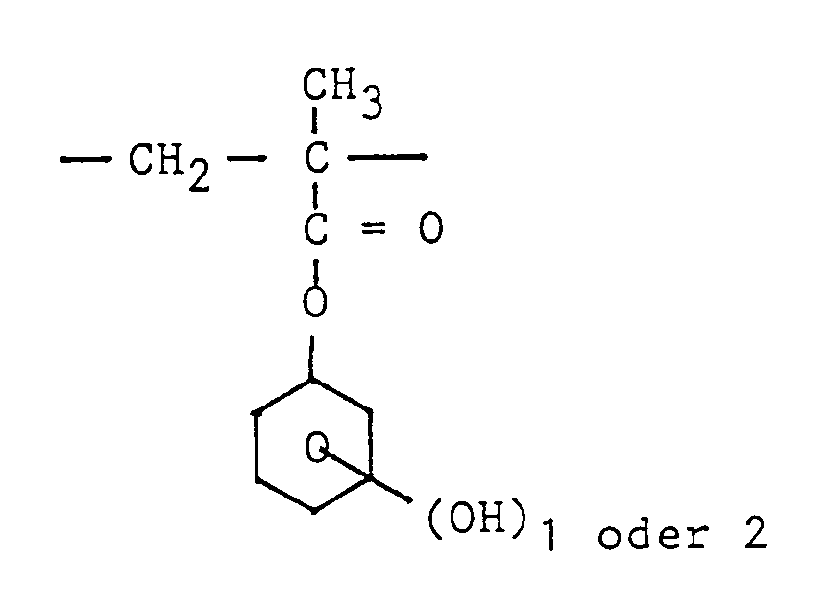
- Der Gehalt an Einheiten der Formel I im Copolymeren richtet sich nach den übrigen Komponenten des Gemisches und nach der Anwendung. Im allgemeinen werden im erfindungsgemäßen Gemisch Polymere mit einem Gehalt von 10 bis 100, vorzugsweise 15 bis 80 Molprozent an gegebenenfalls verschiedenen Einheiten der Formel I eingesetzt.
- Zur Herstellung der erfindungsgemäßen Gemische wird das beschriebene Bindemittel kombiniert mit lichtempfindlichen Verbindungen bzw. Gemischen, deren Löslichkeit in einer wäßrig-alkalischen Entwicklerlösung mit dem Belichten erhöht wird. Hierzu gehören 1 ,2-Chinondiazide und Kombinationen von photolytischen Säurespendern mit säurespaltbaren Verbindungen.
- Als 1,2-Chinondiazide werden bevorzugt Naphthochinon(1,2)-diazid-(2)-4- oder -5-sulfonsäureester oder -amide verwendet. Von diesen werden die Ester, inbesondere die der 5-Sulfonsäuren, bevorzugt. Geeignete Verbindungen dieser Art sind bekannt und z.B. in der DE-AS 938 233, entsprechend GB-PS 739 654 beschrieben.
- Die Menge von o-Chinondiazidverbindungen beträgt im allgemeinen 3 bis 50, bevorzugt 7 bis 35 Gewichtsprozent, bezogen auf die nichtflüchtigen Anteile des Gemisches.
- Es ist auch möglich die 1,2-Chinondiazidverbindungen in Form ihrer Ester mit den erfindungsgemäßen Polymeren einzusetzen. Die Veresterung der entsprechenden 1,2-Chinondiazidsäurechloride mit den Hydroxylgruppen der zugrunde liegenden Polymeren erfolgt nach den in der Literatur bekannten Verfahren (DE-OS 2 507 548, entsprechend US-PS 4 139 384).
- Auch Materialien auf Basis säurespaltbarer Verbindungen lassen sich mit gutem Effekt in dem erfindungsgemäßen Gemisch einsetzen.
- Als durch Säure spaltbare Verbindungen sind in erster Linie zu nennen:
- a) solche mit mindestens einer Orthocarbonsäureester- und bzw. oder Carbonsäureamidacetalgruppierung, wobei die Verbindungen auch polymeren Charakter haben und die genannten Gruppierungen als verknüpfende Elemente in der Hauptkette oder als seitenständige Substituenten auftreten können,
- b) Oligomer- oder Polymerverbindungen mit wiederkehrenden Acetal- und/oder Ketalgruppierungen in der Hauptkette und
- c) Verbindungen mit mindestens einer Enolether- oder N-Acylaminocarbonatgruppierung.
- Durch Säure spaltbare Verbindungen des Typs a) als Komponenten strahlungsempfindlicher Gemische sind in der EP-A 0 022 571, entsprechend US-PS 4 311 782, ausführlich beschrieben; Gemische, die Verbindungen des Typs b) enthalten, sind in der DE-PS 23 06 248, entsprechend US-PS 3 779 778, und in der DE-PS 27 18 259, entsprechend US-PS 4 189 323, beschrieben; Verbindungen des Typs c) werden in EP-A 0 006 627, entsprechend US-PS 4 248 957, beschrieben.
- Als strahlungsempfindliche Komponenten, die beim Belichten starke Säure bilden, sind eine große Anzahl von bekannten Verbindungen und Mischungen wie Phosphonium-, Sulfonium- und Jodoniumsalze, Halogenverbindungen und Organometall-Organohalogen-Kombinationen geeignet.
- Die genannten Phosphonium-, Sulfonium-und Jodoniumverbindungen werden in der Regel eingesetzt in Form ihrer in organischen Lösemitteln löslichen Salze, meist als Abscheidungsprodukt mit komplexen Säuren wie Borfluorwasserstoffsäure, Hexafluorphosphor-, Hexafluorantimon- und -arsensäure.
- Grundsätzlich sind als halogenhaltige strahlungsempfindliche und Halogenwasserstoffsäure bildende Verbindungen alle auch als photochemische Radikalstarter bekannten organischen Halogenverbindungen, beispielsweise solche mit mindestens einem Halogenatom an einem Kohlenstoffatom oder an einem aromatischen Ring brauchbar (US-PS 3 515 552). Von diesen Verbindungen werden die s-Triazinderivate mit 2 Halogenmethylgruppen, insbesondere Trichlormethylgruppen und einem aromatischen bzw. ungesättigten Substituenten im Triazinkern, wie sie in DE-PS 27 18 259, entsprechend US-PS 4 189 323 beschrieben sind, bevorzugt. Ebenso gut geeignet sind 2-Trichlormethyl-1 ,3,4-oxdiazole. Die Wirkung dieser halogenhaltigen Verbindungen kann auch durch bekannte Sensibilisatoren spektral beeinflußt und gesteigert werden.
- Beispiele für geeignete photochemische Säurespender sind:
- 4-methyl-6-trichlormethyl-2-pyron, 4-(3,4,5-Trimethoxystyryl)-6-trichlormethyl-2-pyron, 4-(4-Methoxy-styryl)-6-(3,3,3-trichlorpropenyl)-2-pyron, 2-Trichlormethylbenzimidazol, 2-Tribrommethylchinolin, 2,4-Dimethyl-1-tribromacetyl-benzol, 3-Nitro-1-tribromacetyl-benzol, 4-Dibromacetyl-benzoesäure, 1,4-Bis-dibrommethyl-benzol, Tris-dibrommethyl-s-triazin, 2-(6-Methoxy-naphth-2-yl)-, 2-(Naphth-1-yl)-, 2-(4-Ethoxy-ethylnaphth-1-yl)-, 2-(Benzo-pyran-3-yl)-, 2-(4-Methoxyanthrac-1-yl)-, 2-(4-Styrylphenyl)-, 2-(Phenanthr-9-yl)-4,6-bis-trichlormethyl-s-triazin und die in den Beispielen aufgeführten Verbindungen.
- Die Menge des photochemischen Säurespenders kann je nach seiner chemischen Natur und der Zusammensetzung der Schicht ebenfalls sehr verschieden sein. Günstige Ergebnisse werden erhalten mit etwa 0,5 bis zu 20 Gewichtsprozent, bezogen auf den Gesamtfeststoff. Bevorzugt sind 0,1 bis 12 Gewichtsprozent. Besonders für lichtempfindliche Schichten von Dicken über 0,01 mm empfiehlt es sich, relativ wenig Säurespender zu verwenden.
- Zusätzlich können noch zahlreiche andere Oligomere und Polymere mitverwendet werden, z.B. Phenolharze vom Novolaktyp oder Vinylpolymerisate wie Polyvinylacetale, Polymethacrylate, Polyacrylate, Polyvinylether und Polyvinylpyrrolidone, die selbst durch Comonomere modifiziert sein können.
- Der günstigste Anteil an diesen Zusätzen richtet sich nach den anwendungstechnischen Erfordernissen und dem Einfluß auf die Entwicklungsbedingungen und beträgt im allgemeinen nicht mehr als 20 Gewichtsprozent vom erfindungsgemäß eingesetzten Polymerisat. In geringen Mengen kann die strahlungsempfindliche Schicht für spezielle Erfordernisse wie Flexibilität, Haftung, Glanz etc. außerdem noch Substanzen wie Polyglykole, Celluloseether, z.B. Ethylcellulose, Netzmittel und feinteilige Pigmente enthalten.
- Ferner können dem strahlungsempfindlichen Gemisch noch lösliche oder auch feinteilige dispergierbare Farbstoffe sowie, je nach Anwendungszweck, auch UV-Absorber zugesetzt werden. Als Farbstoffe haben sich die Triphenylmethanfarbstoffe, insbesondere in der Form ihrer Carbinolbasen, besonders bewährt. Die günstigsten Mengenverhältnisse der Komponenten lassen sich im Einzelfall durch Vorversuche leicht ermitteln.
- Die Erfindung betrifft auch ein strahlungsempfindliches Aufzeichnungsmaterial mit einem Schichtträger und einer strahlungsempfindlichen Aufzeichnungsschicht, die als wesentlichen Bestandteil ein Gemisch nach Anspruch 1 enthält.
- Zur Beschichtung eines geeigneten Schichtträgers werden die Gemische im allgemeinen in einem Lösungsmittel gelöst. Die Wahl der Lösungsmittel ist auf das vorgesehene Beschichtungsverfahren, die Schichtdicke und die Trocknungsbedingungen abzustimmen. Geeignete Lösungsmittel für das erfindungsgemäße Gemisch sind Ketone, wie Methylethylketon, chlorierte Kohlenwasserstoffe, wie Trichlorethylen und 1,1,1-Trichlorethan, Alkohole wie n-Propanol, Ether wie Tetrahydrofuran, Alkoholether wie Ethylenglykol-monoethylether, Propylenglykolmonomethylether und Ester wie Butylacetat. Es können auch Gemische verwendet werden, die zudem noch für spezielle Zwecke Lösungsmittel wie Acetonitril, Dioxan oder Dimethylformamid enthalten können. Prinzipiell sind alle Lösungsmittel verwendbar, die mit den Schichtkomponenten nicht irreversibel reagieren. Partialether von Glykolen, insbesondere Ethylenglykolmonomethylether und Propylenglykolmonomethylether allein oder im Gemisch werden besonders bevorzugt.
- Als Schichtträger für Schichtdicken unter ca. 10 »m werden meist Metalle verwendet. Für Offsetdruckplatten können eingesetzt werden: walzblankes, mechanisch und/oder elektrochemisch aufgerauhtes und gegebenenfalls anodisiertes Aluminium, das zudem noch chemisch, z.B. mit Polyvinylphosphonsäure, Silikaten, Phosphaten, Hexafluorozirkonaten oder mit hydrolysiertem Tetraethylorthosilikat vorbehandelt sein kann.
- Die Beschichtung des Schichtträgers erfolgt in bekannter Weise durch Aufschleudern, Sprühen, Tauchen, Walzen mittels Breitschlitzdüsen, Rakeln oder durch Gießer-Antrag.
- Zum Belichten können die üblichen Lichtquellen wie Röhrenlampen, Xenonimpulslampen, metallhalogeniddotierte Quecksilberdampf-Hochdrucklampen und Kohlenbogenlampen verwendet werden.
- Unter Belichtung bzw. Bestrahlung ist in dieser Beschreibung die Einwirkung aktinischer elektromagnetischer Strahlung in Wellenlängenbereichen unterhalb etwa 500 nm zu verstehen. Alle in diesem Wellenlängenbereich emittierenden Strahlungsquellen sind prinzipiell geeignet.
- Mit Vorteil können auch Laserbestrahlungsgeräte, insbesondere automatische Verarbeitungsanlagen verwendet werden, die als Strahlungsquelle einen Argon- oder Krypton-Ionen-Laser enthalten.
- Die Bestrahlung kann auch mit Elektronenstrahlen erfolgen. In diesem Falle können auch im üblichen Sinne nicht lichtempfindliche Säure bildende Verbindungen als Initiatoren der Solubilisierungsreaktion eingesetzt werden, z.B. halogenierte aromatische Verbindungen oder halogenierte polymere Kohlenwasserstoffe. Auch Röntgenstrahlen können zur Bilderzeugung verwendet werden.
- Die bildmäßig belichtete oder bestrahlte Schicht kann in bekannter Weise mit praktisch den gleichen Entwicklern, wie sie für handelsübliche Naphthochinondiazid-Schichten und Kopierlacke bekannt sind, entfernt werden, oder die neuen Materialien können in ihrem Kopierverhalten mit Vorteil auf die bekannten Hilfsmittel wie Entwickler und programmierte Sprühentwicklungsgeräte abgestimmt werden. Die wäßrigen Entwicklerlösungen können z.B. Alkaliphosphate, -silikate oder -hydroxide und ferner Netzmittel sowie gegebenenfalls kleinere Anteile organischer Lösungsmittel enthalten. In bestimmten Fällen sind auch Lösungsmittel-Wasser-Gemische als Entwickler brauchbar. Die Wahl des günstigsten Entwicklers kann durch Versuche mit der jeweils verwendeten Schicht ermittelt werden. Bei Bedarf kann die Entwicklung mechanisch unterstützt werden. Bei der Anwendung als Druckplatten können zur Erhöhung der Widerstandsfähigkeit beim Druck sowie der Resistenz gegen Auswaschmittel, Korrekturmittel und durch UV-Licht härtbare Druckfarben die entwickelten Platten kurzzeitig auf erhöhte Temperaturen erwärmt werden, wie es für Diazoschichten aus der GB-PS 1 154 749 bekannt ist.
- Durch die Erfindung wird erreicht, daß man nunmehr strahlungsempfindliche Gemische und Aufzeichnungsmaterialien zur Verfügung stellen kann, die eine gute Lagerfähigkeit besitzen, mit denen in hoher Auflage gedruckt werden kann, bei der Verwendung als Photoresist einen hervorragenden Wärmestand aufweisen, die thermisch nachgehärtet werden können und nach der Nachhärtung gegenüber den bekannten Materialien eine bessere Chemikalienbeständigkeit besitzen.
- Im folgenden werden Beispiele für bevorzugte Ausführungsformen angegeben. In den Beispielen stehen Gewichtsteile (Gt) und Volumenteile (Vt) im Verhältnis von g zu ccm. Prozent- und Mengenverhältnisse sind, wenn nichts anderes angegeben ist, in Gewichtseinheiten zu verstehen.
- 129 g (1 mol) N-Methoxymethylmethacrylamid
122 g (1 mol) 2.6-Dimethylphenol
0,1 g (0,5 mmol) Thiodiphenylamin
1 g (0,01 mol) Schwefelsäure
werden in 114 g Ethanol gelöst und für 5 Stunden zum Rückfluß erhitzt. Nach Abkühlen der Reaktionslösung auf 10 °C kristallisiert das Produkt aus, wird abfiltriert und bei 50 °C im Vakuum getrocknet. Es resultieren 178 g (81 %) 3,5-Dimethyl-4-hydroxybenzylmethacrylamid, Fp. 135 - 136 °C. - Tabelle 1 gibt eine Reihe von bevorzugten Monomeren wieder, die entsprechend dieser Vorschrift zugänglich sind. Weitere Beispiele können CH-PS 476 689 und DE-PS 1 443 912 entnommen werden.


- 1 mol des Monomeren oder Monomergemisches (vgl. Tabelle 2) und
0,015 mol Azo-bis-isobuttersäurenitril
werden in Ethanol oder Butanon oder Tetrahydrofuran zu einer Ansatzlösung mit einem Feststoffgehalt von 40 % vereint und 17 Stunden bei 70 °C unter Stickstoff-Inertisierung polymerisiert. Dann wird unter starkem Rühren in das 25-fache Volumen Wasser eingetragen. Das ausgefallene Polymere wird bei 50 °C 48 Stunden im Vakuum getrocknet. In Tabelle 2 sind die auf diesem Wege hergestellten Polymeren zusammengefaßt.
- Das Polymer 10 entspricht einer aus EP-A 0 212 440 bekannten Substanz.
- 1 mol des Monomergemisches (wobei Hydroxyphenylmaleinsäureimid in der acetylierten Form eingesetzt wird)
0,015 mol Azo-bis-isobuttersäurenitril
werden in Butanon oder Tetrahydrofuran zu einer Ansatzlösung mit einem Feststoffgehalt von 35 % vereint und wie in Synthesebeispiel 2 polymerisiert. Dann gibt man die 5-fache molare Menge Methanol (bezogen auf acetyliertes Hydroxyphenylmaleinsäureimid) und eine katalytische Menge Schwefelsäure zu und destilliert dann das sich bildende Methylacetat zusammen mit dem Überschuß an Methanol langsam ab. Die Isolierung des Polymeren erfolgt durch Ausfällen des Polymeren in Methanol/Wasser (1:1). Die nach diesem Verfahren synthesierten Polymeren sind in Tabelle 3 aufgeführt (Nr. 17 und 18). - 1 mol des Monomergemisches (wobei Hydroxystyrol in der acetylierten Form eingesetzt wird)
0,015 mol Azo-bis-isobuttersäurenitril
werden in Ethanol zu einer Ansatzlösung mit einem Feststoffgehalt von 40 % vereint und wie in Synthesebeispiel 2 polymerisiert. Dann gibt man NaOH (15 mol% bezogen auf Acetoxystyrol) 10 %ig in Methanol zu und verseift 5 Stunden bei 60 °C. Dann gibt man HCl (15 mol%, bezogen auf Acetoxystyrol) als 37 %ige wäßrige Lösung zu und läßt unter Rühren abkühlen. Die Isolierung des Polymeren erfolgt wie in Synthesebeispiel 2 beschrieben. Die in Tabelle 3 aufgeführten Polymeren 11 - 16 wurden nach diesem Verfahren hergestellt. - 21,9 g Polymer Nr. 1 und
5,37 g (0,02 mol) 1,2-Naphthochinon-2-diazid-5-sulfonylchlorid
werden in 250 ml Tetrahydrofuran gelöst und unter Rühren und Kühlen 2g (0,02 mol) Triethylamin in 10 ml Tetrahydrofuran so zugetropft, daß die Temperatur 25°C nicht übersteigt. Es wird noch 2 Stunden bei Raumtemperatur nachgerührt und dann in 3 l 4 %ige Salzsäure ausgefällt. Das Produkt wird abfiltriert und bei Raumtemperatur im Vakuumtrockenschrank bis zur Gewichtskonstanz getrocknet. Aus dem Schwefelgehalt des Polymeren errechnet sich ein Umsatz von 97,1 %. - Wiederholt man die Reaktion mit 1,2-Napthochinon-2-diazid-4-sulfonylchlorid, so resultiert ein Polymer mit einem Gehalt an 1,2-Chinondiazideinheiten von 93,7 % der Theorie.

- Das Polymer 16 entspricht einer bekannten Substanz aus DE-OS 34 06 927, das Polymer 18 einer Substanz aus EP-A 0 187 517.
- Eine in Salzsäure elektrolytisch aufgerauhte, in Schwefelsäure anodisierte und mit Polyvinylphosphonsäure hydrophilierte Aluminiumplatte wird mit folgender Lösung schleuderbeschichtet:
7 Gt (Gewichtsteile) Bindemittel (vgl. Tabelle 4),
1,5 Gt eines Veresterungsproduktes aus 3 mol 1,2-Naphthochinon- (2)-diazid-4-sulfonylchlorid und 1 mol 2,3,4-Trihydroxybenzophenon,
0,2 Gt 1,2-Naphthochinon-(2)-diazid-4-sulfonylchlorid,
0,08 Gt Victoriareinblau (Basic Blue 7 C.I. 42 595),
100 Gt eines Lösungsmittelgemisches aus Tetrahydrofuran und Propylenglykolmonomethylether (55 : 45). - Nach 2-minütigem Trocknen bei 100 °C resultiert eine Schichtdicke von 2 »m.
- Die Druckplatten werden unter einer 5-kW-Metallhalogenidlampe im Abstand von 110 cm durch einen Halbtonstufenkeil mit 13 Dichtestufen von je 0,15 (Belichtungskeil "BK 01" der Hoechst AG) so belichtet, daß nach einer Entwicklungszeit von 60 Sekunden (s) in einem der folgenden Entwickler eine offene Stufe 3 erhalten wird:
- 8,5 Gt Na₂SiO₃ x 9 H₂O,
0,8 Gt NaOH und
1,5 Gt Na₂B₄O₇ x 10 H₂O in
89,2 Gt H₂O - 5,3 Gt Natriummetasilikat x 9 H₂O,
3,4 Gt Trinatriumphosphat x 12 H₂O,
0,3 Gt Natriumhydrogenphosphat (wasserfrei),
91,0 Gt Wasser. - Anschließend werden die Platten mit einer handelsüblichen Einbrenngummierung (zum Beispiel RC 99 der Hoechst AG) überwischt und 5 Minuten bei 230 °C in einem Lacktrockenschrank eingebrannt. Mit Dimethylformamid wird die Chemikalienresistenz der eingebrannten Platten geprüft.

- Von einer Reihe dieser Platten wurden im nicht thermisch gehärteten Zustand Druckversuche in einer Bogenoffsetmaschine durchgeführt. Tabelle 5 gibt die Ergebnisse wieder.

- Die Ergebnisse zeigen, daß die erfindungsgemäßen polymeren Druckplattenkopierschichten eine höhere Druckauflage als herkömmliche Positivkopierschichten mit Novolaken als Bindemittel ergeben und daß sie durch thermische Nachhärtung resistent gegen aggressive Chemikalien werden.
- Zur Herstellung eines Positivtrockenresists werden Beschichtungslösungen hergestellt aus:

- Diese Lösungen werden jeweils auf 26 »m dicke, biaxial gestreckte und thermofixierte Polyethylenterephthalatfolien aufgeschleudert und anschließend 10 Minuten bei 100 °C im Umlufttrockenschrank nachgetrocknet. Die Umdrehungszahl der Schleuder wird so reguliert, daß eine Schichtdicke von ca. 25 »m resultiert. Zum Schutz gegen Staub und Verkratzungen wird darauf noch eine Polyethylenfolie als Deckfolie kaschiert.
- Zur Herstellung von Leiterplatten werden die Trockenresists nach Abziehen der Deckfolie in einem handelsüblichen Laminator auf einen gereinigten, vorgewärmten Träger, der aus einem Isoliermaterial mit ein- oder beidseitiger, 35 »m dicker Kupferauflage besteht, laminiert. Nach Abziehen der Trägerfolie und eventuellem Nachtrocknen wird unter einer Vorlage mit einer 5-kW-Metallhalogenidlampe in 110 cm Abstand belichtet und nach einer Wartezeit von 15 Minuten in 1%iger Natronlauge 90 Sekunden entwickelt.
- Die auf diese Weise entstandenen Resistschablonen weisen eine hervorragende Galvanoresistenz auf, insbesondere bei dem galvanischen Aufbau von Kupfer und Pb/Sn-Legierungen.
- Derartig behandelte Platten lassen sich anschließend erneut belichten und entwickeln. Mit dieser Arbeitsweise lassen sich in einem ersten Schritt Lötaugen aus Pb/Sn an den Bohrlöchern aufgalvanisieren, in einem zweiten Belichtungs- und Entwicklungsschritt läßt sich dann das Leiterbahnbild auf die noch bestehende Resistschicht übertragen. Nach dem Ätzen des freigelegten Kupfers mit ammoniakalischer Cu(II)-chlorid-Lösung erhält man eine Leiterplatte in Kupfertechnik, d. h., die Pb/Sn-Legierung wird nur dort aufgebaut, wo sie beim nachfolgenden Lötprozeß benötigt wird.
- Die Ergebnisse sind in Tabelle 6 aufgezeigt. Folgende Verbindungen mit säurespaltbaren C-O-C-Einheiten wurden eingesetzt:
- Nr. 1 :
- polymerer Orthoester, hergestellt durch Kondensation von Orthoameisensäuretrimethylester mit 4-Oxa-6,6-bis-hydroxymethyl-octan-1-ol,
- Nr. 2:
- Polyacetal, hergestellt aus Triethylglykol und 2-Ethylbutyraldehyd.
- Folgende photochemischen Säurebildner wurden verwendet:
- Nr. 1 :
- 2-(4-Ethoxy-naphth-1-yl)-4,6-bis-trichlormethyl-s-triazin,
- Nr. 2:
- 2-(4-Styrylphenyl)-4,6-bis-trichlormethyl-s-triazin.
- Zur Herstellung hochauflösender Positiv-Flüssigresists werden folgende Beschichtungslösungen hergestellt:
26 Gt Bindemittel (vgl. Tabelle 7),
4 Gt eines Veresterungsproduktes aus 3 mol 1,2-Naphthochinon-(2)-diazid-4-sulfonylchlorid und 1 mol 2,3,4-Trihydroxybenzophenon,
80 Gt Propylenglykolmonomethyletheracetat. - Nach Filtration durch ein Filter mit Porendurchmesser von 0,2 »m (Millipore) werden die Photoresistlösungen auf käufliche, wie üblich polierte und durch Oxidation mit einer 0,2 »m dicken SiO₂-Schicht versehene Siliciumscheiben geschleudert. Bei einer Umdrehungszahl von 8000/min werden Schichtdicken zwischen 0,9 und 1,1 »m erhalten.
- Die so beschichteten Scheiben werden 30 Minuten bei 90 °C getrocknet. Nach dem Abkühlen und Konditionieren auf ein definiertes Raumklima von 23 °C und 40 bis 50 % relativer Feuchte werden die Wafer in einem Kontaktbelichtungsgerät mit einer Intensität von 4,5 mW/cm² bei 365 nm unter einer handelsüblichen Chrommaske belichtet und 60 Sekunden in einer 2,86%igen Tetramethylammonium-hydroxidlösung entwickelt. In allen Fällen ist eine Wiedergabe von 1-»m-Linien und -Spalten möglich.
- Nach einer Wärmebehandlung von 30 Minuten bei 150 °C werden die Flanken der Strukturen beurteilt. In Tabelle 7 sind die Ergebnisse dargelegt.

enthält. Die Erfindung betrifft auch ein strahlungsempfindliches Aufzeichnungsmaterial aus einem Schichtträger und dem darauf aufgebrachten strahlungsempfindlichen Gemisch.
bedeuten und
bedeuten und
bedeuten. Bevorzugt werden Einheiten berücksichtigt, in denen
bedeuten.

Claims (9)
- Positiv arbeitendes strahlungsempfindliches Gemisch, das als wesentliche Bestandteilea) ein in Wasser unlösliches, in wäßrig-alkalischen Lösungen lösliches polymeres Bindemittel undb) ein 1,2-Chinondiazid oder eine Kombination ausenthält, dadurch gekennzeichnet, daß das Gemisch als Bindemittel ein thermisch selbstvernetzendes Polymeres mit Einheiten der allgemeinen Formel I1) einer unter Einwirkung von aktinischer Strahlung starke Säure bildenden Verbindung und2) einer Verbindung mit mindestens einer spaltbaren C-O-C-Bindung
 R₁ ein Wasserstoff- oder Halogenatom, eine Cyanid- oder eine Alkylgruppe,R₂, R₃ R₄ gleich oder verschieden sind und Wasserstoff Alkyl- oder Arylgruppen,R₅, R₆ und ggf. R₇ gleich oder verschieden sind und Wasserstoffoder Halogenatome, Alkyl-, Aryl- oder Alkoxygruppen undX die zur Vervollständigung eines ein- oder mehrkernigen carbocyclischen aromatischen Ringsystems erforderlichen Atome bedeuten undn 1,2 oder 3 ist.
 - Gemisch nach Anspruch 1, dadurch gekennzeichnet, daßR₁ ein Wasserstoff- oder Halogenatom, eine Cyanid- oder eine C₁-C₆ Alkylgruppe,R₂, R₃, R₄ gleich oder verschieden sind und Wasserstoff oder C₁-C₆ Alkylgruppen,R₅, R₆ und ggf. R₇ gleich oder verschieden sind und Wasserstoff oder C₁-C₄ Alkylgruppen undX die zur Vervollständigung eines Benzol- oder Naphthalinrings erforderlichen Kohlenstoffatomebedeuten undn 1 ist.
- Gemisch nach Anspruch 1 oder 2, dadurch gekennzeichnet, daßR₁ ein Wasserstoff oder eine Methylgruppe,R₂, R₃, R₄ Wasserstoff,R₅ Wasserstoff, eine C₁-C₄ Alkylgruppe oder Halogen,R₆ Wasserstoff, eine C₁-C₄ Alkylgruppe, eine Arylgruppe oder Halogen,R₇ Wasserstoff,X die zur Vervollständigung eines Benzol- oder Naphthalinrings erforderlichen Kohlenstoffatomebedeuten undn 1 ist.
- Gemisch nach Ansprüchen 1 bis 3, dadurch gekennzeichnet, daß das Gemisch als Bindemittel ein Polymeres enthält mit Einheiten der allgemeinen Formel II
 R₅ und R₆ gleich oder verschieden sind und Wasserstoff, C₁-C₄ Alkyl oder Halogenbedeuten.
 - Gemisch nach Ansprüchen 1 bis 3, dadurch gekennzeichnet, daß das Gemisch als Bindemittel ein Polymeres enthält mit Einheiten der allgemeinen Formel III
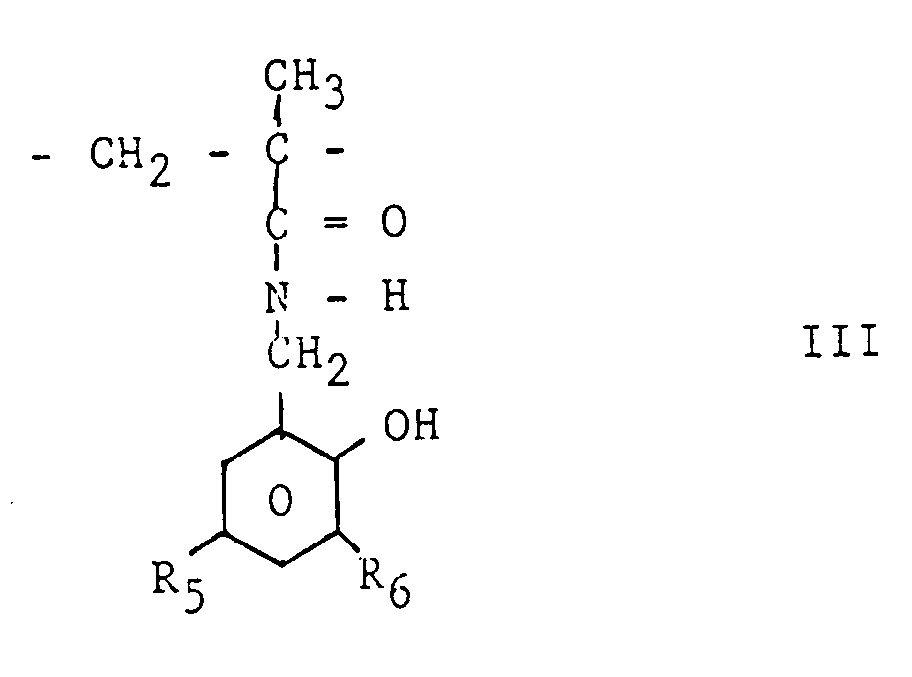 R₅ C₁-C₄ Alkyl oder Halogen undR₆ C₁-C₄ Alkyl, Halogen oder ein ggf. substituiertes Arylbedeuten.
 - Gemisch nach Anspruch 1, dadurch gekennzeichnet, daß das polymere Bindemittel ferner eine oder mehrere verschiedene wiederkehrende Einheiten der allgemeinen Formel IV
 R₈ Wasserstoff oder eine Carboxylgruppe, die mit R₉, wenn letzteres eine Carboxylgruppe ist, zu einem Säureanhydrid oder einem ggf. substituierten Imid verbunden sein kann,R₉ eine Alkyl-, Alkoxy-, Alkoxycarbonyl-, Acyl-, Acyloxy-, Aryl-, Aryloxycarbonyl-, Formyl-, Cyanid-, Carboxyl-, Hydroxyl- oder Aminocarbonylgruppe undR₁₀ Wasserstoff, Halogen oder eine Alkylgruppebedeuten.
 - Gemisch nach Anspruch 6, dadurch gekennzeichnet, daßR₈ Wasserstoff,R₉ eine C₁-C₄ Alkylgruppe, eine C₁-C₈ Alkoxygruppe, eine Alkoxycarbonylgruppe mit 2 - 13 Kohlenstoffatomen, eine Acyloxygruppe mit 2 - 18 Kohlenstoffatomen, eine Arylgruppe mit 6 - 10 Kohlenstoffatomen oder eine Aryloxycarbonylgruppe mit 7 - 11 Kohlenstoffatomen, wobei die Arylgruppen durch Hydroxylgruppen substituiert sein können, undR₁₀ Wasserstoff oder eine Methylgruppebedeuten.
- Gemisch nach Anspruch 6, dadurch gekennzeichnet, daß Formel IV für eine der folgenden Einheiten steht:


- Strahlungempfindliches Aufzeichnungsmaterial mit einem Schichtträger und einer strahlungsempfindlichen Aufzeichnungsschicht, die als wesentlichen Bestandteil ein Gemisch nach Ansprüchen 1 bis 8 enthält.
Applications Claiming Priority (2)
| Application Number | Priority Date | Filing Date | Title |
|---|---|---|---|
| DE3820699A DE3820699A1 (de) | 1988-06-18 | 1988-06-18 | Strahlungsempfindliches gemisch und hieraus hergestelltes strahlungsempfindliches aufzeichnungsmaterial |
| DE3820699 | 1988-06-18 |
Publications (3)
| Publication Number | Publication Date |
|---|---|
| EP0347660A2 EP0347660A2 (de) | 1989-12-27 |
| EP0347660A3 EP0347660A3 (de) | 1991-06-05 |
| EP0347660B1 true EP0347660B1 (de) | 1995-03-22 |
Family
ID=6356788
Family Applications (1)
| Application Number | Title | Priority Date | Filing Date |
|---|---|---|---|
| EP89110425A Expired - Lifetime EP0347660B1 (de) | 1988-06-18 | 1989-06-09 | Strahlungsempfindliches Gemisch und hieraus hergestelltes strahlungsempfindliches Aufzeichnungsmaterial |
Country Status (6)
| Country | Link |
|---|---|
| US (1) | US5068163A (de) |
| EP (1) | EP0347660B1 (de) |
| JP (1) | JP2559852B2 (de) |
| KR (1) | KR0161965B1 (de) |
| BR (1) | BR8902919A (de) |
| DE (2) | DE3820699A1 (de) |
Families Citing this family (11)
| Publication number | Priority date | Publication date | Assignee | Title |
|---|---|---|---|---|
| DE4002397A1 (de) * | 1990-01-27 | 1991-08-01 | Hoechst Ag | Strahlungsempfindliches gemisch und hieraus hergestelltes strahlungsempfindliches aufzeichnungsmaterial |
| DE4003025A1 (de) * | 1990-02-02 | 1991-08-08 | Hoechst Ag | Strahlungsempfindliches gemisch, hiermit hergestelltes strahlungsempfindliches aufzeichnungsmaterial und verfahren zur herstellung von reliefaufzeichnungen |
| DE4126409A1 (de) * | 1991-08-09 | 1993-02-11 | Hoechst Ag | Strahlungsempfindliches gemisch mit einem polymeren bindemittel mit einheiten aus (alpha)-(beta)-ungesaettigten carbonsaeuren |
| US5314782A (en) * | 1993-03-05 | 1994-05-24 | Morton International, Inc. | Deep UV sensitive resistant to latent image decay comprising a diazonaphthoquinone sulfonate of a nitrobenzyl derivative |
| EP0709410A3 (de) | 1994-10-26 | 1997-03-26 | Ocg Microelectronic Materials | Polymere |
| DE19507618A1 (de) * | 1995-03-04 | 1996-09-05 | Hoechst Ag | Polymere und diese enthaltendes lichtempfindliches Gemisch |
| DE19803564A1 (de) | 1998-01-30 | 1999-08-05 | Agfa Gevaert Ag | Polymere mit Einheiten aus N-substituiertem Maleimid und deren Verwendung in strahlungsempfindlichen Gemischen |
| EP1074887B1 (de) | 1999-08-02 | 2004-10-06 | Kodak Polychrome Graphics GmbH | Strahlungsempfindliche Zusammensetzungen für Druckplatten mit verbesserter chemischer Beständigkeit und Entwickler-Beständigkeit und mit diesen Zusammensetzungen hergestellte Druckplatten |
| DE19936333A1 (de) * | 1999-08-02 | 2001-03-15 | Kodak Polychrome Graphics Gmbh | Strahlungsempfindliche Zusammensetzungen für Druckplatten zur Steigerung der Chemikalien- und Entwicklerresistenz |
| DE19936332A1 (de) * | 1999-08-02 | 2001-03-15 | Kodak Polychrome Graphics Gmbh | Druckplatten mit hoher Chemikalien-Entwicklerresistenz |
| EP1577330B1 (de) * | 2003-08-22 | 2012-02-15 | Okamoto Chemical Industry Co., Ltd | Copolymer, bilderzeugende Zusammensetzung und Platte für Lithographie |
Family Cites Families (25)
| Publication number | Priority date | Publication date | Assignee | Title |
|---|---|---|---|---|
| NL88160C (de) * | 1953-03-11 | |||
| DE1443912C3 (de) * | 1964-12-08 | 1975-07-10 | Bayer Ag, 5090 Leverkusen | 3,5-Dialkyl-4-hydroxy-benzylamide der Acryl- bzw. Methacrylsäure und Verfahren zu ihrer Herstellung |
| DE1447963B2 (de) * | 1965-11-24 | 1972-09-07 | KaIIe AG, 6202 Wiesbaden Biebnch | Verfahren zur herstellung einer offsetdruckform aus einem vorsensibilisierten druckplattenmaterial |
| US3515552A (en) * | 1966-09-16 | 1970-06-02 | Minnesota Mining & Mfg | Light-sensitive imaging sheet and method of using |
| GB1232010A (de) * | 1967-09-04 | 1971-05-19 | ||
| US3779778A (en) * | 1972-02-09 | 1973-12-18 | Minnesota Mining & Mfg | Photosolubilizable compositions and elements |
| GB1375461A (de) * | 1972-05-05 | 1974-11-27 | ||
| JPS5024641B2 (de) * | 1972-10-17 | 1975-08-18 | ||
| JPS5228401B2 (de) * | 1973-09-21 | 1977-07-26 | ||
| US4139384A (en) * | 1974-02-21 | 1979-02-13 | Fuji Photo Film Co., Ltd. | Photosensitive polymeric o-quinone diazide containing lithographic printing plate and process of using the plate |
| JPS5136129A (en) * | 1974-09-20 | 1976-03-26 | Konishiroku Photo Ind | Kankoseisoseibutsu |
| DE2718254C3 (de) * | 1977-04-25 | 1980-04-10 | Hoechst Ag, 6000 Frankfurt | Strahlungsempfindliche Kopiermasse |
| US4189323A (en) * | 1977-04-25 | 1980-02-19 | Hoechst Aktiengesellschaft | Radiation-sensitive copying composition |
| DE2829511A1 (de) * | 1978-07-05 | 1980-01-24 | Hoechst Ag | Strahlungsempfindliches gemisch und verfahren zur herstellung von reliefbildern |
| DE2928636A1 (de) * | 1979-07-16 | 1981-02-12 | Hoechst Ag | Strahlungsempfindliches gemisch und verfahren zur herstellung von reliefbildern |
| US4439516A (en) * | 1982-03-15 | 1984-03-27 | Shipley Company Inc. | High temperature positive diazo photoresist processing using polyvinyl phenol |
| US4551409A (en) * | 1983-11-07 | 1985-11-05 | Shipley Company Inc. | Photoresist composition of cocondensed naphthol and phenol with formaldehyde in admixture with positive o-quinone diazide or negative azide |
| DE3406927A1 (de) * | 1984-02-25 | 1985-08-29 | Hoechst Ag, 6230 Frankfurt | Strahlungsempfindliches gemisch auf basis von saeurespaltbaren verbindungen |
| DE3442756A1 (de) * | 1984-11-23 | 1986-05-28 | Hoechst Ag, 6230 Frankfurt | Strahlungsempfindliches gemisch, daraus hergestelltes aufzeichnungsmaterial und verfahren zur herstellung von waermebestaendigen reliefaufzeichnungen |
| CA1254432A (en) * | 1984-12-28 | 1989-05-23 | Conrad G. Houle | High-temperature resistant, selectively developable positive-working resist |
| DE3528930A1 (de) * | 1985-08-13 | 1987-02-26 | Hoechst Ag | Polymere verbindungen und diese enthaltendes strahlungsempfindliches gemisch |
| DE3528929A1 (de) * | 1985-08-13 | 1987-02-26 | Hoechst Ag | Strahlungsempfindliches gemisch, dieses enthaltendes strahlungsempfindliches aufzeichnungsmaterial und verfahren zur herstellung von reliefbildern |
| JP2549366B2 (ja) * | 1986-10-03 | 1996-10-30 | 三菱化学株式会社 | 感光性平版印刷版 |
| JPS6397946A (ja) * | 1986-10-14 | 1988-04-28 | Konica Corp | 感光性組成物および感光性平版印刷版 |
| EP0287212B1 (de) * | 1987-03-12 | 1994-12-28 | Mitsubishi Chemical Corporation | Lichtempfindliche positive Flachdruckplatte |
-
1988
- 1988-06-18 DE DE3820699A patent/DE3820699A1/de not_active Withdrawn
-
1989
- 1989-06-07 US US07/362,688 patent/US5068163A/en not_active Expired - Fee Related
- 1989-06-09 EP EP89110425A patent/EP0347660B1/de not_active Expired - Lifetime
- 1989-06-09 DE DE58909124T patent/DE58909124D1/de not_active Expired - Lifetime
- 1989-06-16 BR BR898902919A patent/BR8902919A/pt not_active IP Right Cessation
- 1989-06-17 KR KR1019890008362A patent/KR0161965B1/ko not_active Expired - Fee Related
- 1989-06-19 JP JP1154797A patent/JP2559852B2/ja not_active Expired - Fee Related
Also Published As
| Publication number | Publication date |
|---|---|
| US5068163A (en) | 1991-11-26 |
| KR0161965B1 (ko) | 1999-01-15 |
| DE58909124D1 (de) | 1995-04-27 |
| KR900000726A (ko) | 1990-01-31 |
| JP2559852B2 (ja) | 1996-12-04 |
| BR8902919A (pt) | 1990-02-06 |
| EP0347660A2 (de) | 1989-12-27 |
| DE3820699A1 (de) | 1989-12-21 |
| JPH0252349A (ja) | 1990-02-21 |
| EP0347660A3 (de) | 1991-06-05 |
Similar Documents
| Publication | Publication Date | Title |
|---|---|---|
| EP0153682B1 (de) | Strahlungsempfindliches Gemisch auf Basis von säurespaltbaren Verbindungen | |
| EP0212439B1 (de) | Polymere Verbindungen und diese enthaltendes strahlungsempfindliches Gemisch | |
| EP0933682B1 (de) | Strahlungsempfindliche Gemische mit Bindemitteln aus Polymeren mit Einheiten aus N-substituiertem Maleimid | |
| EP0184044B1 (de) | Strahlungsempfindliches Gemisch, daraus hergestelltes Aufzeichnungsmaterial und Verfahren zur Herstellung von wärmebeständigen Reliefaufzeichnungen | |
| EP0266654B1 (de) | Lichtempfindliches Gemisch, dieses enthaltendes Aufzeichnungsmaterial und Verfahren zur Herstellung von positiven oder negativen Reliefkopien unter Verwendung dieses Materials | |
| EP0417556B1 (de) | Positiv-arbeitendes strahlungsempfindliches Gemisch und daraus hergestelltes Aufzeichnungsmaterial | |
| EP0031593B1 (de) | Durch Strahlung polymerisierbares Gemisch und damit hergestelltes strahlungsempfindliches Kopiermaterial | |
| EP0098982B1 (de) | Photopolymerisierbares Gemisch und damit hergestelltes photopolymerisierbares Kopiermaterial | |
| EP0006626B1 (de) | Strahlungsempfindliches Gemisch und Verfahren zur Herstellung von Reliefbildern | |
| EP0212440B1 (de) | Strahlungsempfindliches Gemisch, dieses enthaltendes strahlungsempfindliches Aufzeichnungsmaterial und Verfahren zur Herstellung von Reliefbildern | |
| EP0440086B1 (de) | Strahlungsempfindliches Gemisch, hiermit hergestelltes strahlungsempfindliches Aufzeichnungsmaterial und Verfahren zur Herstellung von Reliefaufzeichnungen | |
| EP0440057B1 (de) | Strahlungsempfindliches Gemisch und hieraus hergestelltes strahlungsempfindliches Aufzeichnungsmaterial | |
| DE3621376A1 (de) | Strahlungsempfindliches aufzeichnungsmaterial | |
| DE3821585A1 (de) | Positiv arbeitendes strahlungsempfindliches gemisch und daraus hergestelltes strahlungsempfindliches aufzeichnungsmaterial fuer hochenergetische strahlung | |
| EP0303108B1 (de) | Lichtempfindliches Gemisch, daraus hergestelltes lichtempfindliches Kopiermaterial und Verfahren zur Herstellung von negativen Reliefkopien | |
| EP0347660A2 (de) | Strahlungsempfindliches Gemisch und hieraus hergestelltes strahlungsempfindliches Aufzeichnungsmaterial | |
| EP0285014A2 (de) | Lichtempfindliches Gemisch, daraus hergestelltes Kopiermaterial und Verfahren zur Herstellung von Druckformen | |
| EP0602377B1 (de) | Polymere mit N,N-disubstituierten Sulfonamid-Seitengruppen und deren Verwendung in strahlungsempfindlichen Gemischen | |
| EP0602376B1 (de) | N,N-Disubstituierte Sulfonamide und damit hergestelltes strahlungsempfindliches Gemisch | |
| EP0387623B1 (de) | Positiv arbeitendes strahlungsempfindliches Gemisch und daraus hergestelltes strahlungsempfindliches Aufzeichnungsmaterial für hochenergetische Strahlung | |
| DE4444669A1 (de) | Strahlungsempfindliches Gemisch | |
| EP0307828A2 (de) | Strahlungsempfindliches Gemisch und hieraus hergestelltes Kopiermaterial | |
| DE19507618A1 (de) | Polymere und diese enthaltendes lichtempfindliches Gemisch | |
| DE69513929T2 (de) | Polymere |
Legal Events
| Date | Code | Title | Description |
|---|---|---|---|
| PUAI | Public reference made under article 153(3) epc to a published international application that has entered the european phase |
Free format text: ORIGINAL CODE: 0009012 |
|
| AK | Designated contracting states |
Kind code of ref document: A2 Designated state(s): CH DE FR GB IT LI NL |
|
| PUAL | Search report despatched |
Free format text: ORIGINAL CODE: 0009013 |
|
| AK | Designated contracting states |
Kind code of ref document: A3 Designated state(s): CH DE FR GB IT LI NL |
|
| 17P | Request for examination filed |
Effective date: 19911112 |
|
| 17Q | First examination report despatched |
Effective date: 19930330 |
|
| GRAA | (expected) grant |
Free format text: ORIGINAL CODE: 0009210 |
|
| AK | Designated contracting states |
Kind code of ref document: B1 Designated state(s): CH DE FR GB IT LI NL |
|
| REF | Corresponds to: |
Ref document number: 58909124 Country of ref document: DE Date of ref document: 19950427 |
|
| ET | Fr: translation filed | ||
| ITF | It: translation for a ep patent filed | ||
| GBT | Gb: translation of ep patent filed (gb section 77(6)(a)/1977) |
Effective date: 19950619 |
|
| PLBE | No opposition filed within time limit |
Free format text: ORIGINAL CODE: 0009261 |
|
| STAA | Information on the status of an ep patent application or granted ep patent |
Free format text: STATUS: NO OPPOSITION FILED WITHIN TIME LIMIT |
|
| 26N | No opposition filed | ||
| PGFP | Annual fee paid to national office [announced via postgrant information from national office to epo] |
Ref country code: NL Payment date: 19990406 Year of fee payment: 11 |
|
| PGFP | Annual fee paid to national office [announced via postgrant information from national office to epo] |
Ref country code: CH Payment date: 19990412 Year of fee payment: 11 |
|
| REG | Reference to a national code |
Ref country code: GB Ref legal event code: 746 Effective date: 19991209 |
|
| REG | Reference to a national code |
Ref country code: FR Ref legal event code: D6 |
|
| PG25 | Lapsed in a contracting state [announced via postgrant information from national office to epo] |
Ref country code: LI Free format text: LAPSE BECAUSE OF NON-PAYMENT OF DUE FEES Effective date: 20000630 Ref country code: CH Free format text: LAPSE BECAUSE OF NON-PAYMENT OF DUE FEES Effective date: 20000630 |
|
| PG25 | Lapsed in a contracting state [announced via postgrant information from national office to epo] |
Ref country code: NL Free format text: LAPSE BECAUSE OF NON-PAYMENT OF DUE FEES Effective date: 20010101 |
|
| REG | Reference to a national code |
Ref country code: CH Ref legal event code: PL |
|
| NLV4 | Nl: lapsed or anulled due to non-payment of the annual fee |
Effective date: 20010101 |
|
| REG | Reference to a national code |
Ref country code: GB Ref legal event code: IF02 |
|
| REG | Reference to a national code |
Ref country code: FR Ref legal event code: TP |
|
| REG | Reference to a national code |
Ref country code: GB Ref legal event code: 732E |
|
| REG | Reference to a national code |
Ref country code: FR Ref legal event code: D3 |
|
| PG25 | Lapsed in a contracting state [announced via postgrant information from national office to epo] |
Ref country code: IT Free format text: LAPSE BECAUSE OF NON-PAYMENT OF DUE FEES;WARNING: LAPSES OF ITALIAN PATENTS WITH EFFECTIVE DATE BEFORE 2007 MAY HAVE OCCURRED AT ANY TIME BEFORE 2007. THE CORRECT EFFECTIVE DATE MAY BE DIFFERENT FROM THE ONE RECORDED. Effective date: 20050609 |
|
| REG | Reference to a national code |
Ref country code: GB Ref legal event code: 732E |
|
| PGFP | Annual fee paid to national office [announced via postgrant information from national office to epo] |
Ref country code: DE Payment date: 20080528 Year of fee payment: 20 |
|
| PGFP | Annual fee paid to national office [announced via postgrant information from national office to epo] |
Ref country code: FR Payment date: 20080527 Year of fee payment: 20 |
|
| REG | Reference to a national code |
Ref country code: FR Ref legal event code: TP |
|
| PGFP | Annual fee paid to national office [announced via postgrant information from national office to epo] |
Ref country code: GB Payment date: 20080528 Year of fee payment: 20 |
|
| REG | Reference to a national code |
Ref country code: GB Ref legal event code: PE20 Expiry date: 20090608 |
|
| PG25 | Lapsed in a contracting state [announced via postgrant information from national office to epo] |
Ref country code: GB Free format text: LAPSE BECAUSE OF EXPIRATION OF PROTECTION Effective date: 20090608 |