EP0347568A2 - Procédé de fabrication de pièces coulées résistantes à l'usure - Google Patents
Procédé de fabrication de pièces coulées résistantes à l'usure Download PDFInfo
- Publication number
- EP0347568A2 EP0347568A2 EP89108131A EP89108131A EP0347568A2 EP 0347568 A2 EP0347568 A2 EP 0347568A2 EP 89108131 A EP89108131 A EP 89108131A EP 89108131 A EP89108131 A EP 89108131A EP 0347568 A2 EP0347568 A2 EP 0347568A2
- Authority
- EP
- European Patent Office
- Prior art keywords
- castings
- temperature
- casting
- alloy
- combination
- Prior art date
- Legal status (The legal status is an assumption and is not a legal conclusion. Google has not performed a legal analysis and makes no representation as to the accuracy of the status listed.)
- Granted
Links
- 238000005266 casting Methods 0.000 title claims abstract description 91
- 238000004519 manufacturing process Methods 0.000 title claims abstract description 10
- 238000000034 method Methods 0.000 claims abstract description 66
- 229910045601 alloy Inorganic materials 0.000 claims abstract description 35
- 239000000956 alloy Substances 0.000 claims abstract description 35
- 230000008569 process Effects 0.000 claims abstract description 31
- 239000011159 matrix material Substances 0.000 claims abstract description 29
- 150000001247 metal acetylides Chemical class 0.000 claims abstract description 19
- 229910001018 Cast iron Inorganic materials 0.000 claims abstract description 16
- 229910001566 austenite Inorganic materials 0.000 claims abstract description 11
- 229910001349 ledeburite Inorganic materials 0.000 claims abstract description 8
- OKTJSMMVPCPJKN-UHFFFAOYSA-N Carbon Chemical compound [C] OKTJSMMVPCPJKN-UHFFFAOYSA-N 0.000 claims abstract description 7
- 238000000137 annealing Methods 0.000 claims abstract description 7
- 229910002804 graphite Inorganic materials 0.000 claims abstract description 7
- 239000010439 graphite Substances 0.000 claims abstract description 7
- 238000010791 quenching Methods 0.000 claims abstract description 6
- 230000000171 quenching effect Effects 0.000 claims abstract description 6
- PXHVJJICTQNCMI-UHFFFAOYSA-N Nickel Chemical compound [Ni] PXHVJJICTQNCMI-UHFFFAOYSA-N 0.000 claims description 14
- 238000010438 heat treatment Methods 0.000 claims description 14
- 229910001563 bainite Inorganic materials 0.000 claims description 10
- 238000006243 chemical reaction Methods 0.000 claims description 10
- WFKWXMTUELFFGS-UHFFFAOYSA-N tungsten Chemical compound [W] WFKWXMTUELFFGS-UHFFFAOYSA-N 0.000 claims description 10
- 229910052721 tungsten Inorganic materials 0.000 claims description 10
- 239000010937 tungsten Substances 0.000 claims description 10
- 238000001816 cooling Methods 0.000 claims description 9
- RYGMFSIKBFXOCR-UHFFFAOYSA-N Copper Chemical compound [Cu] RYGMFSIKBFXOCR-UHFFFAOYSA-N 0.000 claims description 7
- ZOKXTWBITQBERF-UHFFFAOYSA-N Molybdenum Chemical compound [Mo] ZOKXTWBITQBERF-UHFFFAOYSA-N 0.000 claims description 7
- 229910052802 copper Inorganic materials 0.000 claims description 7
- 239000010949 copper Substances 0.000 claims description 7
- 229910052750 molybdenum Inorganic materials 0.000 claims description 7
- 239000011733 molybdenum Substances 0.000 claims description 7
- 229910052759 nickel Inorganic materials 0.000 claims description 7
- XEEYBQQBJWHFJM-UHFFFAOYSA-N Iron Chemical compound [Fe] XEEYBQQBJWHFJM-UHFFFAOYSA-N 0.000 claims description 6
- 229910000967 As alloy Inorganic materials 0.000 claims description 5
- 229910001567 cementite Inorganic materials 0.000 claims description 5
- VYZAMTAEIAYCRO-UHFFFAOYSA-N Chromium Chemical compound [Cr] VYZAMTAEIAYCRO-UHFFFAOYSA-N 0.000 claims description 4
- 238000005275 alloying Methods 0.000 claims description 4
- 230000008859 change Effects 0.000 claims description 4
- 229910052804 chromium Inorganic materials 0.000 claims description 4
- 239000011651 chromium Substances 0.000 claims description 4
- 229910052720 vanadium Inorganic materials 0.000 claims description 4
- LEONUFNNVUYDNQ-UHFFFAOYSA-N vanadium atom Chemical compound [V] LEONUFNNVUYDNQ-UHFFFAOYSA-N 0.000 claims description 4
- ZOXJGFHDIHLPTG-UHFFFAOYSA-N Boron Chemical compound [B] ZOXJGFHDIHLPTG-UHFFFAOYSA-N 0.000 claims description 3
- RTAQQCXQSZGOHL-UHFFFAOYSA-N Titanium Chemical compound [Ti] RTAQQCXQSZGOHL-UHFFFAOYSA-N 0.000 claims description 3
- 229910052797 bismuth Inorganic materials 0.000 claims description 3
- JCXGWMGPZLAOME-UHFFFAOYSA-N bismuth atom Chemical compound [Bi] JCXGWMGPZLAOME-UHFFFAOYSA-N 0.000 claims description 3
- 229910052796 boron Inorganic materials 0.000 claims description 3
- 239000011261 inert gas Substances 0.000 claims description 3
- 229910000734 martensite Inorganic materials 0.000 claims description 3
- 239000002244 precipitate Substances 0.000 claims description 3
- 230000005855 radiation Effects 0.000 claims description 3
- 229910052714 tellurium Inorganic materials 0.000 claims description 3
- PORWMNRCUJJQNO-UHFFFAOYSA-N tellurium atom Chemical compound [Te] PORWMNRCUJJQNO-UHFFFAOYSA-N 0.000 claims description 3
- 239000010936 titanium Substances 0.000 claims description 3
- 229910052719 titanium Inorganic materials 0.000 claims description 3
- 230000009466 transformation Effects 0.000 claims description 3
- 238000002485 combustion reaction Methods 0.000 claims description 2
- 238000010894 electron beam technology Methods 0.000 claims description 2
- 229910052742 iron Inorganic materials 0.000 claims description 2
- 229910052738 indium Inorganic materials 0.000 claims 1
- 230000036962 time dependent Effects 0.000 claims 1
- 230000002093 peripheral effect Effects 0.000 abstract 1
- 230000008901 benefit Effects 0.000 description 6
- 239000013078 crystal Substances 0.000 description 5
- 229910001562 pearlite Inorganic materials 0.000 description 5
- 238000000354 decomposition reaction Methods 0.000 description 3
- 238000010586 diagram Methods 0.000 description 3
- 238000005096 rolling process Methods 0.000 description 3
- 238000007711 solidification Methods 0.000 description 3
- 230000008023 solidification Effects 0.000 description 3
- 229910001060 Gray iron Inorganic materials 0.000 description 2
- 239000000470 constituent Substances 0.000 description 2
- 238000002425 crystallisation Methods 0.000 description 2
- 230000008025 crystallization Effects 0.000 description 2
- 230000002401 inhibitory effect Effects 0.000 description 2
- 230000001105 regulatory effect Effects 0.000 description 2
- 230000000717 retained effect Effects 0.000 description 2
- 229910000968 Chilled casting Inorganic materials 0.000 description 1
- FYYHWMGAXLPEAU-UHFFFAOYSA-N Magnesium Chemical compound [Mg] FYYHWMGAXLPEAU-UHFFFAOYSA-N 0.000 description 1
- 238000005299 abrasion Methods 0.000 description 1
- 238000007792 addition Methods 0.000 description 1
- 230000015572 biosynthetic process Effects 0.000 description 1
- 229910052799 carbon Inorganic materials 0.000 description 1
- 230000001419 dependent effect Effects 0.000 description 1
- 238000004512 die casting Methods 0.000 description 1
- 238000009826 distribution Methods 0.000 description 1
- 230000000694 effects Effects 0.000 description 1
- 229910052749 magnesium Inorganic materials 0.000 description 1
- 239000011777 magnesium Substances 0.000 description 1
- 238000012423 maintenance Methods 0.000 description 1
- 239000000155 melt Substances 0.000 description 1
- 238000005065 mining Methods 0.000 description 1
- 230000008092 positive effect Effects 0.000 description 1
- 238000012805 post-processing Methods 0.000 description 1
- 238000004886 process control Methods 0.000 description 1
- 238000012545 processing Methods 0.000 description 1
- 230000002035 prolonged effect Effects 0.000 description 1
- 238000012552 review Methods 0.000 description 1
- 150000003839 salts Chemical class 0.000 description 1
- 239000004576 sand Substances 0.000 description 1
- 239000013589 supplement Substances 0.000 description 1
- 238000005496 tempering Methods 0.000 description 1
- 230000007704 transition Effects 0.000 description 1
Images
Classifications
-
- C—CHEMISTRY; METALLURGY
- C21—METALLURGY OF IRON
- C21D—MODIFYING THE PHYSICAL STRUCTURE OF FERROUS METALS; GENERAL DEVICES FOR HEAT TREATMENT OF FERROUS OR NON-FERROUS METALS OR ALLOYS; MAKING METAL MALLEABLE, e.g. BY DECARBURISATION OR TEMPERING
- C21D9/00—Heat treatment, e.g. annealing, hardening, quenching or tempering, adapted for particular articles; Furnaces therefor
- C21D9/30—Heat treatment, e.g. annealing, hardening, quenching or tempering, adapted for particular articles; Furnaces therefor for crankshafts; for camshafts
-
- C—CHEMISTRY; METALLURGY
- C21—METALLURGY OF IRON
- C21D—MODIFYING THE PHYSICAL STRUCTURE OF FERROUS METALS; GENERAL DEVICES FOR HEAT TREATMENT OF FERROUS OR NON-FERROUS METALS OR ALLOYS; MAKING METAL MALLEABLE, e.g. BY DECARBURISATION OR TEMPERING
- C21D5/00—Heat treatments of cast-iron
Definitions
- the object of the invention is to propose a method with which castings with improved wear resistance and at the same time improved tensile strength and elongation characteristics can be obtained.
- This object is achieved according to the invention in the method described at the outset by annealing the castings at an austenitizing temperature and quenching them to an intermediate stage temperature at which the casting matrix is essentially converted to austenite and the carbides of the alloy are still essentially are undecomposed.
- the cast components treated according to the invention in the ledeburitic edge zones with a bainitic matrix have a significantly improved wear resistance, in particular with regard to rolling fatigue, since the wear-inhibiting effect of the carbides in combination with the bainitic matrix results in a higher fatigue strength.
- This procedure ensures that at least surface areas, if not edge zones of the castings, have a ledeburitic structure in which iron carbide and / or mixed carbides contribute significantly to the wear resistance of the Surface contribute, while at the same time by embedding the carbides in a now bainitic matrix, a very good strength of the component and a high wear resistance, in particular rolling fatigue strength, is guaranteed.
- the method according to the invention is particularly suitable for treating castings which are cast using the hard shell casting method and thereby have ledeburitic edge zones or surface areas, the matrix in these areas, however, being predominantly formed from pearlite.
- Castings that are conventionally cast, i.e. graphitically solidified components or so-called gray cast iron parts, in which, however, surface areas or edge zones were remelted into a ledeburitic structure by means of high-energy radiation, such as that of a tungsten inert gas burner, a laser or an electron beam.
- the optimal holding time for the austenitizing temperature depends, on the one hand, to some extent on the alloying constituents of the cast iron alloy, the decay rate of the carbide crystals being able to be reduced, for example, with certain element additions, and, on the other hand, on the preselected austenitizing temperature itself.
- a holding time for a given Austenitization temperature at which the conversion to austenite takes place at least to about 80% The conversion is preferably carried out almost completely.
- the second essential criterion of the method according to the invention is the maintenance of the carbide crystals. According to special variants of the method according to the invention, these should be retained at least in the order of magnitude of approximately 80% when the casting matrix is converted into austenite, with at least 90% of the carbides still being in crystalline form at the end of the holding time at the austenitizing temperature in a preferred procedure.
- a process control in which more than 95% of the carbides are still present in crystalline form in the casting matrix is most preferred.
- the preheating process is advantageously preceded by annealing at the austenitizing temperature, in which the casting is heated to a temperature of approximately 300 to 700.degree.
- the temperature in this preheating or preheating process is chosen so that the casting structure does not change substantially and, on the other hand, the austenitizing temperature can be reached relatively quickly.
- a largely uniform heating of the cast part should be achieved over the entire cross-section while maintaining the preheating temperature.
- the holding time at the austenitizing temperature can be kept very short when the casting matrix is almost completely converted to austenite, which in turn essentially completely retains the carbide content.
- the holding times for such processes are between 3 and 10 minutes, depending on the individual alloy components and the austenitizing temperature.
- the holding times at the austenitizing temperature can ins in particular, be kept relatively short if the temperature is set in the range from 550 to 650 ° C. during the preheating process.
- This preheating temperature range is optimal because, on the one hand, at a temperature of up to 650 ° C, no decomposition processes of the carbide crystals in the casting matrix can certainly take place and, on the other hand, the entire casting is preheated to close to the austenitizing temperature.
- the subsequent heating to the austenitizing temperature, at which the conversion of pearlite to austenite takes place has the consequence that the interior of the casting is also heated to the austenitizing temperature during the holding time.
- the preheating process preceding the annealing at the austenitizing temperature has the further advantage that the cast part to be treated does not warp due to uneven temperature distribution in the cast part.
- a temperature range of 800 to 960 ° C is preferred. At the lower limit of this temperature range, a somewhat longer holding time at the austenitizing temperature will of course be necessary than at the upper limit of the specified range.
- the austenitizing temperature should be maintained for at least 3 minutes to a maximum of 10 minutes.
- the austenitizing temperature is preferably kept for only 5 to 7 minutes.
- the components are preferably quenched in a warm bath, which allows a targeted generation of the bainite matrix.
- a warm bath which allows a targeted generation of the bainite matrix.
- Oil baths, salt baths or sand fluidized beds are used as warm baths, as is known from another context.
- the warm bath temperature is preferably selected in the range from approximately 220 to 450 ° C. Below 220 ° C, martensite is increasingly obtained on cooling, which has a negative effect on the properties of the castings. Sufficient hardening of the cast part is not achieved above 450 ° C.
- the duration of treatment in the warm bath is between 0.1 and 4 hours.
- the lower limit of 0.1 hours results from the fact that in the case of shorter periods of time there is no longer sufficient conversion into bainite.
- the upper limit for the treatment time of 4 hours results from the fact that there the loss of bainitic properties of the matrix begins, i.e. the already formed bainitic areas are then subject to significant transformation processes.
- the temperature in the hot bath is preferably kept constant, i.e. the temperature is regulated to a value of approx. ⁇ 20 ° C.
- the temperature of the hot bath may be lower in a first period after the castings have been introduced into the hot bath than in the remaining part of the treatment time. This temperature difference is preferably between approximately 30 and 100 ° C.
- an initially lower temperature value of the hot bath can be used to form more crystallization centers in the cast part due to the greater cooling during quenching, so that a finer cast structure results.
- the subsequent increase in temperature to the actual heat bath treatment value is therefore carried out in order to accelerate the desired conversion of austenite into bainite.
- the holding time at the hot bath treatment temperature can thus be significantly reduced.
- the same idea of the invention is embodied in a procedure which is completely different from the previous process, namely in that in a process for the production of castings with ledeburitic marginal zone regions by adding alloying constituents to the alloy prior to casting, which change the time / temperature behavior in such a way that that in an essentially unchanged casting and cooling process, ledeburitic surface areas or edge zones are obtained whose casting matrix essentially comprises bainite.
- a cast alloy which contains the elements chromium, vanadium and tungsten as alloy components individually or in combination, the proportion of each of these elements - if contained - 0.1 to 5% by weight. and the sum of the proportions, if they are in combination, is up to 10% by weight.
- the elements chromium, vanadium and tungsten can be used in particular to regulate the resistance to decomposition of the iron and / or mixed carbides in the austenitic phase.
- cast alloys can be used which contain the elements boron, titanium, tellurium and bismuth as alloy components individually or in combination, the proportion of a single one of these elements - if present - being 0.01 to 0.2% by weight.
- These elements and the variation of their proportions can also be used to regulate the decay rate of the carbides in the austenitic phase or, in other words, to stabilize the iron carbide crystals at least partially or even completely.
- Cast iron alloys which contain copper, nickel and molybdenum as alloy components individually or in combination, each with a respective proportion of 0.1 to 8% by weight, if present, have also proven to be advantageous, in the case of a combination of these elements, the The sum of their shares can be up to 15% by weight.
- All of the aforementioned elements can be used as an alloy component to specifically change the time and temperature-dependent conversion characteristics of the cast alloy or to influence the time / temperature behavior of the alloy in a targeted manner, as has already been explained above.
- this not only opens up the possibility of direct casting with a component which is pronounced according to the invention come, but also in the post-treatment of the castings to a process management in which the conversion processes are so slow that small time differences in the holding times, especially in the austenitizing temperature and in the treatment in a warm bath, no longer lead to serious quality fluctuations.
- the treatment times of the components in the various process stages are lengthened in part, but the advantages obtained by the fact that higher quality standards can be maintained with fewer rejects predominate.
- a further object of the invention is to propose wear-resistant cast parts made of a cast iron alloy with graphite precipitates and ledeburite parts, in which, in addition to excellent tensile strength and elongation values, there is improved rolling fatigue strength on surface areas.
- This object is achieved in the wear-resistant castings from a cast iron alloy with ledeburitic edge zones or surface areas in that a predominantly bainitic matrix of ledeburite is provided, in which Fe3C and / or mixed carbides are embedded.
- Castings with such a structure use on the one hand the properties of the high-strength and wear-resistant bainite structure and supplement this additionally by the hardness of Fe3C and / or the mixed carbides, which in combination lead to an unprecedented wear resistance in castings.
- the castings according to the invention can also comprise austenite and / or martensite fractions without achieving significantly worse results with regard to the abrasion resistance.
- the castings according to the invention are preferably obtained by the processes described above, the castings in the aftertreatment process initially being in a processable state and being subjected to the process according to the invention only in one of the last phases of the production process.
- the direct method described above in which alloy components are added to the alloy in such a way that the time / temperature behavior of the alloy during the casting and solidification process is influenced in such a way that ledeburitic marginal zones are formed, the casting matrix of which essentially comprises bainite, is completely equivalent to this Manufacturing process, which is mainly used when the castings no longer have to be subjected to further processing.
- the alloy components in particular components such as nickel, copper, molybdenum and / or tungsten, are used in a targeted manner to influence the phase transition characteristics of the alloy in such a way that the structure according to the invention is obtained in the edge zones of the cast part with unchanged, natural cooling behavior of the cast part. This means that subsequent heat treatment is no longer necessary and that the cooling process of the castings is in no way prolonged by the process according to the invention.
- the castings according to the invention are used in particular as components for the valve control of internal combustion engines, as camshafts and their counter-rotors, e.g. Levers or plungers, trained and used.
- the casting to be produced in this example is a camshaft, which is first produced using the well-known hard chilled casting process.
- the camshaft already has marginal zone areas made from ledeburite, but in which the matrix for the carbides consists essentially of pearlite.
- a mold is used which, in the solidifying casting, enables such a high solidification front speed in certain areas that the cast iron melt solidifies there in the edge zone of the casting according to the metastable state diagram with ledeburitic structure, the carbide crystals of the ledeburite areas are embedded in a pearlite matrix here .
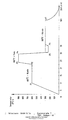
- the short holding time at high temperatures ensures that the carbides in the casting, as they were produced in hard shell casting, remain essentially unchanged, while, on the other hand, the preheating process at approx. 600 ° C (P 1 - P 2) is the prerequisite for an essentially complete transformation to austenite during this short hold time.
- the camshaft is cooled in air to room temperature.
- the figure represents a variant in the range from P 5 to P 6, that is to say in the process step of quenching, in which the temperature of the hot bath is initially selected approximately 50 ° C. below the hot bath temperature subsequently maintained.
- the advantages here are, on the one hand, the possibility of making better use of the bath contents during quenching, since a relatively small ratio of the heat capacity of the bath to the heat capacity of the cast parts to be introduced therein and thus also a relatively small bath volume can be selected. This not only entails lower system costs, but also reduces the energy costs of the system, since a significantly reduced bath content has to be brought to the appropriate post-treatment temperature or intermediate stage compensation temperature. It can also be achieved with this procedure that an increased formation of crystallization centers is caused, which results in a finer structure of the casting structure.
- the component to be treated with the method according to the invention here a camshaft, can likewise be produced instead of in the hard shell casting process by remelting a gray solidified edge zone by means of high-energy radiation, here for example a TIG torch.
- high-energy radiation here for example a TIG torch.
- the following heat treatment corresponded to the procedure according to embodiment 1.
- a combination of alloying elements was added to the cast iron alloy, namely 1.2% nickel, 1% molybdenum and 0.7% copper.
- the camshaft was cast in a manner known per se using the hard chill casting process, without a special temperature control being forced upon the cooling and solidification of the melt.
- a shift in the phase conversion curves in the continuous time / temperature diagram to longer conversion times was achieved that essentially ledeburit with a bainitic matrix was again obtained in the edge zones.
- camshafts were produced in accordance with Example 3, with the difference that instead of the alloy components nickel, molybdenum and copper, only a proportion of 2.5 to 3% by weight of tungsten was added to the cast iron alloy.
Landscapes
- Chemical & Material Sciences (AREA)
- Engineering & Computer Science (AREA)
- Physics & Mathematics (AREA)
- Thermal Sciences (AREA)
- Crystallography & Structural Chemistry (AREA)
- Mechanical Engineering (AREA)
- Materials Engineering (AREA)
- Metallurgy (AREA)
- Organic Chemistry (AREA)
- Heat Treatment Of Articles (AREA)
- Heat Treatment Of Steel (AREA)
Applications Claiming Priority (2)
| Application Number | Priority Date | Filing Date | Title |
|---|---|---|---|
| DE3821169A DE3821169A1 (de) | 1988-06-23 | 1988-06-23 | Verfahren zur herstellung verschleissfester gussteile |
| DE3821169 | 1988-06-23 |
Publications (3)
| Publication Number | Publication Date |
|---|---|
| EP0347568A2 true EP0347568A2 (fr) | 1989-12-27 |
| EP0347568A3 EP0347568A3 (fr) | 1991-04-03 |
| EP0347568B1 EP0347568B1 (fr) | 1996-04-24 |
Family
ID=6357059
Family Applications (1)
| Application Number | Title | Priority Date | Filing Date |
|---|---|---|---|
| EP89108131A Expired - Lifetime EP0347568B1 (fr) | 1988-06-23 | 1989-05-05 | Procédé de fabrication de pièces coulées résistantes à l'usure |
Country Status (2)
| Country | Link |
|---|---|
| EP (1) | EP0347568B1 (fr) |
| DE (2) | DE3821169A1 (fr) |
Cited By (1)
| Publication number | Priority date | Publication date | Assignee | Title |
|---|---|---|---|---|
| WO1999014382A1 (fr) * | 1997-09-16 | 1999-03-25 | Weyburn-Bartel Inc. | Pieces en fonte |
Families Citing this family (3)
| Publication number | Priority date | Publication date | Assignee | Title |
|---|---|---|---|---|
| DE102007006973A1 (de) * | 2007-02-13 | 2008-08-14 | M. Busch Gmbh & Co Kg | Gusseisenlegierung mit Lamellengraphit |
| CN212351801U (zh) * | 2017-12-01 | 2021-01-15 | 米沃奇电动工具公司 | 用于驱动紧固件的工具头 |
| CN109852773B (zh) * | 2019-03-21 | 2020-09-18 | 长春工业大学 | 一种有效提高球墨铸铁硬度的热处理方法 |
Family Cites Families (2)
| Publication number | Priority date | Publication date | Assignee | Title |
|---|---|---|---|---|
| DE2853870A1 (de) * | 1978-12-13 | 1980-07-03 | Schmidt Gmbh Karl | Gusseisen mit kugelgraphit mit austenitisch-bainitischem mischgefuege |
| US4230506A (en) * | 1979-05-06 | 1980-10-28 | Textron, Inc. | Cam shaft manufacturing process |
-
1988
- 1988-06-23 DE DE3821169A patent/DE3821169A1/de not_active Withdrawn
-
1989
- 1989-05-05 EP EP89108131A patent/EP0347568B1/fr not_active Expired - Lifetime
- 1989-05-05 DE DE58909665T patent/DE58909665D1/de not_active Expired - Fee Related
Cited By (1)
| Publication number | Priority date | Publication date | Assignee | Title |
|---|---|---|---|---|
| WO1999014382A1 (fr) * | 1997-09-16 | 1999-03-25 | Weyburn-Bartel Inc. | Pieces en fonte |
Also Published As
| Publication number | Publication date |
|---|---|
| DE3821169A1 (de) | 1989-12-28 |
| DE58909665D1 (de) | 1996-05-30 |
| EP0347568B1 (fr) | 1996-04-24 |
| EP0347568A3 (fr) | 1991-04-03 |
Similar Documents
| Publication | Publication Date | Title |
|---|---|---|
| DE2334992C2 (de) | Isothermisch behandeltes Gußeisen mit Kugelgraphit | |
| DE60019141T2 (de) | Verfahren zum Herstellen von Produkten aus ausscheidungsgehärtetem, martensitischem, nichtrostendem Stahl und Verwendung des Verfahrens | |
| EP2045339B1 (fr) | Pièce soumise à une usure par roulement en acier endurci et méthode de traitement thermique | |
| DE3923999A1 (de) | Verfahren zum aufkohlen und vergueten von stahlteilen | |
| DE69501086T2 (de) | Graphitstahlzusammensetzungen | |
| DE2830850C3 (de) | Verwendung eines Einsatzstahls | |
| DE69812269T2 (de) | Verbundwalze zum kaltwalzen | |
| DE102020004084A1 (de) | Verfahren zum Nachbehandeln eines zumindest bereichsweise additiv gefertigten Bauteils sowie Bauteil | |
| DE10019042A1 (de) | Stickstofflegierter, sprühkompaktierter Stahl, Verfahren zu seiner Herstellung und Verbundwerkstoff hergestellt aus dem Stahl | |
| EP0747154B1 (fr) | Procédé et appareil pour la fabrication des pièces frittées | |
| EP0347568B1 (fr) | Procédé de fabrication de pièces coulées résistantes à l'usure | |
| EP0029539A1 (fr) | Procédé pour la fabrication de fonte alliée au chrome et pièces de fonderie fabriquées avec cette fonte | |
| DE2324750B2 (de) | Waermebehandlungsverfahren fuer stahl | |
| DE3509709A1 (de) | Verfahren zur herstellung eines zwischenstufenvergueteten gusseisenkoerpers mit kugelgraphit und der dabei erhaltene koerper | |
| DE69813975T2 (de) | Verfahren zum Herstellen eines mechanischen Werkstücks mit mindestens ein mittels Induktion oberflächengehartetes Teil und also hergestelltes Werkstück | |
| DE69214421T2 (de) | Rohfabrikate grosser Länge für Herstellungsverfahren durch Kaltumformen, insbesondere für Kaltstauchen von formgebend bearbeitete Erzeugnisse wie Bolzen, und Verfahren zur Herstellung dieser kaltgeformten Gegenstände | |
| DE102006032617B4 (de) | Verfahren zur Herstellung eines zum Formhärten geeigneten Blechhalbzeugs | |
| DE102015016360A1 (de) | Verfahren zur Wärmebehandlung eines Aluminiumgussbauteils und Aluminiumgussbauteil | |
| DE3855540T2 (de) | Zementierter stahl mit niedrigem siliziumgehalt und verfahren zu seiner herstellung | |
| CH360701A (de) | Verfahren zur Oberflächenhärtung von Gusseisen | |
| AT401359B (de) | Verfahren zur herstellung eines herzstückes | |
| DE3407010C2 (de) | Körper aus gehärtetem, metastabilem Gusseisen und Verfahren zur Herstellung desselben | |
| DE2822430A1 (de) | Verfahren zur kontinuierlichen waermebehandlung | |
| DE689192C (de) | Verfahren zur Abkuerzung des Tempervorganges | |
| AT396073B (de) | Verfahren zum warmwalzen und waermebehandeln von stabfoermigem material |
Legal Events
| Date | Code | Title | Description |
|---|---|---|---|
| PUAI | Public reference made under article 153(3) epc to a published international application that has entered the european phase |
Free format text: ORIGINAL CODE: 0009012 |
|
| AK | Designated contracting states |
Kind code of ref document: A2 Designated state(s): DE ES FR GB IT |
|
| PUAL | Search report despatched |
Free format text: ORIGINAL CODE: 0009013 |
|
| AK | Designated contracting states |
Kind code of ref document: A3 Designated state(s): DE ES FR GB IT |
|
| 17P | Request for examination filed |
Effective date: 19910416 |
|
| 17Q | First examination report despatched |
Effective date: 19920911 |
|
| RAP1 | Party data changed (applicant data changed or rights of an application transferred) |
Owner name: MAHLE-J. WIZEMANN GMBH & CO. KG |
|
| GRAH | Despatch of communication of intention to grant a patent |
Free format text: ORIGINAL CODE: EPIDOS IGRA |
|
| GRAA | (expected) grant |
Free format text: ORIGINAL CODE: 0009210 |
|
| AK | Designated contracting states |
Kind code of ref document: B1 Designated state(s): DE ES FR GB IT |
|
| PG25 | Lapsed in a contracting state [announced via postgrant information from national office to epo] |
Ref country code: IT Free format text: LAPSE BECAUSE OF FAILURE TO SUBMIT A TRANSLATION OF THE DESCRIPTION OR TO PAY THE FEE WITHIN THE PRE;WARNING: LAPSES OF ITALIAN PATENTS WITH EFFECTIVE DATE BEFORE 2007 MAY HAVE OCCURRED AT ANY TIME BEFORE 2007. THE CORRECT EFFECTIVE DATE MAY BE DIFFERENT FROM THE ONE RECORDED.SCRIBED TIME-LIMIT Effective date: 19960424 Ref country code: FR Effective date: 19960424 Ref country code: GB Effective date: 19960424 Ref country code: ES Free format text: THE PATENT HAS BEEN ANNULLED BY A DECISION OF A NATIONAL AUTHORITY Effective date: 19960424 |
|
| REF | Corresponds to: |
Ref document number: 58909665 Country of ref document: DE Date of ref document: 19960530 |
|
| EN | Fr: translation not filed | ||
| GBV | Gb: ep patent (uk) treated as always having been void in accordance with gb section 77(7)/1977 [no translation filed] |
Effective date: 19960424 |
|
| PLBE | No opposition filed within time limit |
Free format text: ORIGINAL CODE: 0009261 |
|
| STAA | Information on the status of an ep patent application or granted ep patent |
Free format text: STATUS: NO OPPOSITION FILED WITHIN TIME LIMIT |
|
| 26N | No opposition filed | ||
| PGFP | Annual fee paid to national office [announced via postgrant information from national office to epo] |
Ref country code: DE Payment date: 20010613 Year of fee payment: 13 |
|
| PG25 | Lapsed in a contracting state [announced via postgrant information from national office to epo] |
Ref country code: DE Free format text: LAPSE BECAUSE OF NON-PAYMENT OF DUE FEES Effective date: 20021203 |