EP0343473B1 - Expandierbare Polymere in Partikelform - Google Patents
Expandierbare Polymere in Partikelform Download PDFInfo
- Publication number
- EP0343473B1 EP0343473B1 EP89108685A EP89108685A EP0343473B1 EP 0343473 B1 EP0343473 B1 EP 0343473B1 EP 89108685 A EP89108685 A EP 89108685A EP 89108685 A EP89108685 A EP 89108685A EP 0343473 B1 EP0343473 B1 EP 0343473B1
- Authority
- EP
- European Patent Office
- Prior art keywords
- carbon atoms
- weight
- particle form
- ether
- blowing agent
- Prior art date
- Legal status (The legal status is an assumption and is not a legal conclusion. Google has not performed a legal analysis and makes no representation as to the accuracy of the status listed.)
- Expired - Lifetime
Links
- 239000002245 particle Substances 0.000 title claims description 47
- 229920000642 polymer Polymers 0.000 title claims description 44
- 125000004432 carbon atom Chemical group C* 0.000 claims description 49
- PPBRXRYQALVLMV-UHFFFAOYSA-N Styrene Chemical compound C=CC1=CC=CC=C1 PPBRXRYQALVLMV-UHFFFAOYSA-N 0.000 claims description 37
- 239000004604 Blowing Agent Substances 0.000 claims description 28
- 239000006260 foam Substances 0.000 claims description 26
- RTZKZFJDLAIYFH-UHFFFAOYSA-N Diethyl ether Chemical compound CCOCC RTZKZFJDLAIYFH-UHFFFAOYSA-N 0.000 claims description 21
- 239000000203 mixture Substances 0.000 claims description 18
- 229920001955 polyphenylene ether Polymers 0.000 claims description 18
- LFQSCWFLJHTTHZ-UHFFFAOYSA-N Ethanol Chemical compound CCO LFQSCWFLJHTTHZ-UHFFFAOYSA-N 0.000 claims description 12
- 125000001931 aliphatic group Chemical group 0.000 claims description 12
- 229930195734 saturated hydrocarbon Natural products 0.000 claims description 12
- 150000002148 esters Chemical class 0.000 claims description 10
- 238000000034 method Methods 0.000 claims description 10
- 125000003118 aryl group Chemical group 0.000 claims description 8
- 150000002576 ketones Chemical class 0.000 claims description 7
- 239000000654 additive Substances 0.000 claims description 6
- 125000001309 chloro group Chemical group Cl* 0.000 claims description 6
- 150000004292 cyclic ethers Chemical class 0.000 claims description 6
- 239000000725 suspension Substances 0.000 claims description 6
- 239000007900 aqueous suspension Substances 0.000 claims description 5
- 239000011872 intimate mixture Substances 0.000 claims description 4
- 238000002360 preparation method Methods 0.000 claims description 3
- OFBQJSOFQDEBGM-UHFFFAOYSA-N Pentane Chemical compound CCCCC OFBQJSOFQDEBGM-UHFFFAOYSA-N 0.000 description 10
- WYURNTSHIVDZCO-UHFFFAOYSA-N Tetrahydrofuran Chemical compound C1CCOC1 WYURNTSHIVDZCO-UHFFFAOYSA-N 0.000 description 10
- 239000004793 Polystyrene Substances 0.000 description 8
- 229920002223 polystyrene Polymers 0.000 description 8
- 238000004519 manufacturing process Methods 0.000 description 7
- XLYOFNOQVPJJNP-UHFFFAOYSA-N water Substances O XLYOFNOQVPJJNP-UHFFFAOYSA-N 0.000 description 7
- ZWEHNKRNPOVVGH-UHFFFAOYSA-N 2-Butanone Chemical compound CCC(C)=O ZWEHNKRNPOVVGH-UHFFFAOYSA-N 0.000 description 6
- 238000005470 impregnation Methods 0.000 description 6
- 229920002959 polymer blend Polymers 0.000 description 6
- IMNFDUFMRHMDMM-UHFFFAOYSA-N N-Heptane Chemical compound CCCCCCC IMNFDUFMRHMDMM-UHFFFAOYSA-N 0.000 description 5
- 239000001506 calcium phosphate Substances 0.000 description 5
- YLQBMQCUIZJEEH-UHFFFAOYSA-N tetrahydrofuran Natural products C=1C=COC=1 YLQBMQCUIZJEEH-UHFFFAOYSA-N 0.000 description 5
- QORWJWZARLRLPR-UHFFFAOYSA-H tricalcium bis(phosphate) Chemical compound [Ca+2].[Ca+2].[Ca+2].[O-]P([O-])([O-])=O.[O-]P([O-])([O-])=O QORWJWZARLRLPR-UHFFFAOYSA-H 0.000 description 5
- IJGRMHOSHXDMSA-UHFFFAOYSA-N Atomic nitrogen Chemical compound N#N IJGRMHOSHXDMSA-UHFFFAOYSA-N 0.000 description 4
- 150000008280 chlorinated hydrocarbons Chemical class 0.000 description 4
- 238000002474 experimental method Methods 0.000 description 4
- 238000005187 foaming Methods 0.000 description 4
- 239000007789 gas Substances 0.000 description 4
- QWTDNUCVQCZILF-UHFFFAOYSA-N iso-pentane Natural products CCC(C)C QWTDNUCVQCZILF-UHFFFAOYSA-N 0.000 description 4
- 239000000155 melt Substances 0.000 description 4
- 229910000391 tricalcium phosphate Inorganic materials 0.000 description 4
- 235000019731 tricalcium phosphate Nutrition 0.000 description 4
- 229940078499 tricalcium phosphate Drugs 0.000 description 4
- CSCPPACGZOOCGX-UHFFFAOYSA-N Acetone Chemical compound CC(C)=O CSCPPACGZOOCGX-UHFFFAOYSA-N 0.000 description 3
- DKPFZGUDAPQIHT-UHFFFAOYSA-N Butyl acetate Natural products CCCCOC(C)=O DKPFZGUDAPQIHT-UHFFFAOYSA-N 0.000 description 3
- YMWUJEATGCHHMB-UHFFFAOYSA-N Dichloromethane Chemical compound ClCCl YMWUJEATGCHHMB-UHFFFAOYSA-N 0.000 description 3
- XEKOWRVHYACXOJ-UHFFFAOYSA-N Ethyl acetate Chemical compound CCOC(C)=O XEKOWRVHYACXOJ-UHFFFAOYSA-N 0.000 description 3
- 239000004721 Polyphenylene oxide Substances 0.000 description 3
- YXFVVABEGXRONW-UHFFFAOYSA-N Toluene Chemical compound CC1=CC=CC=C1 YXFVVABEGXRONW-UHFFFAOYSA-N 0.000 description 3
- 239000008346 aqueous phase Substances 0.000 description 3
- 239000006185 dispersion Substances 0.000 description 3
- 239000003063 flame retardant Substances 0.000 description 3
- 239000008187 granular material Substances 0.000 description 3
- 238000009413 insulation Methods 0.000 description 3
- 238000002156 mixing Methods 0.000 description 3
- 238000000465 moulding Methods 0.000 description 3
- VLKZOEOYAKHREP-UHFFFAOYSA-N n-Hexane Chemical compound CCCCCC VLKZOEOYAKHREP-UHFFFAOYSA-N 0.000 description 3
- 238000003756 stirring Methods 0.000 description 3
- MYRTYDVEIRVNKP-UHFFFAOYSA-N 1,2-Divinylbenzene Chemical compound C=CC1=CC=CC=C1C=C MYRTYDVEIRVNKP-UHFFFAOYSA-N 0.000 description 2
- KAKZBPTYRLMSJV-UHFFFAOYSA-N Butadiene Chemical compound C=CC=C KAKZBPTYRLMSJV-UHFFFAOYSA-N 0.000 description 2
- VTYYLEPIZMXCLO-UHFFFAOYSA-L Calcium carbonate Chemical compound [Ca+2].[O-]C([O-])=O VTYYLEPIZMXCLO-UHFFFAOYSA-L 0.000 description 2
- HEDRZPFGACZZDS-UHFFFAOYSA-N Chloroform Chemical compound ClC(Cl)Cl HEDRZPFGACZZDS-UHFFFAOYSA-N 0.000 description 2
- ZAFNJMIOTHYJRJ-UHFFFAOYSA-N Diisopropyl ether Chemical compound CC(C)OC(C)C ZAFNJMIOTHYJRJ-UHFFFAOYSA-N 0.000 description 2
- 239000004908 Emulsion polymer Substances 0.000 description 2
- LRHPLDYGYMQRHN-UHFFFAOYSA-N N-Butanol Chemical compound CCCCO LRHPLDYGYMQRHN-UHFFFAOYSA-N 0.000 description 2
- GRYLNZFGIOXLOG-UHFFFAOYSA-N Nitric acid Chemical compound O[N+]([O-])=O GRYLNZFGIOXLOG-UHFFFAOYSA-N 0.000 description 2
- 229910019142 PO4 Inorganic materials 0.000 description 2
- 239000005062 Polybutadiene Substances 0.000 description 2
- ATUOYWHBWRKTHZ-UHFFFAOYSA-N Propane Chemical compound CCC ATUOYWHBWRKTHZ-UHFFFAOYSA-N 0.000 description 2
- DKGAVHZHDRPRBM-UHFFFAOYSA-N Tert-Butanol Chemical compound CC(C)(C)O DKGAVHZHDRPRBM-UHFFFAOYSA-N 0.000 description 2
- 150000001298 alcohols Chemical class 0.000 description 2
- 238000001816 cooling Methods 0.000 description 2
- 229920001577 copolymer Polymers 0.000 description 2
- 238000005520 cutting process Methods 0.000 description 2
- 239000002270 dispersing agent Substances 0.000 description 2
- GVGUFUZHNYFZLC-UHFFFAOYSA-N dodecyl benzenesulfonate;sodium Chemical compound [Na].CCCCCCCCCCCCOS(=O)(=O)C1=CC=CC=C1 GVGUFUZHNYFZLC-UHFFFAOYSA-N 0.000 description 2
- 229920001971 elastomer Polymers 0.000 description 2
- 238000010097 foam moulding Methods 0.000 description 2
- UAEPNZWRGJTJPN-UHFFFAOYSA-N methylcyclohexane Chemical compound CC1CCCCC1 UAEPNZWRGJTJPN-UHFFFAOYSA-N 0.000 description 2
- IJDNQMDRQITEOD-UHFFFAOYSA-N n-butane Chemical compound CCCC IJDNQMDRQITEOD-UHFFFAOYSA-N 0.000 description 2
- 230000007935 neutral effect Effects 0.000 description 2
- 229910017604 nitric acid Inorganic materials 0.000 description 2
- 229910052757 nitrogen Inorganic materials 0.000 description 2
- FDPIMTJIUBPUKL-UHFFFAOYSA-N pentan-3-one Chemical compound CCC(=O)CC FDPIMTJIUBPUKL-UHFFFAOYSA-N 0.000 description 2
- NBIIXXVUZAFLBC-UHFFFAOYSA-K phosphate Chemical compound [O-]P([O-])([O-])=O NBIIXXVUZAFLBC-UHFFFAOYSA-K 0.000 description 2
- 239000010452 phosphate Substances 0.000 description 2
- 239000004014 plasticizer Substances 0.000 description 2
- 229920002857 polybutadiene Polymers 0.000 description 2
- 229920013636 polyphenyl ether polymer Polymers 0.000 description 2
- 229920000036 polyvinylpyrrolidone Polymers 0.000 description 2
- 239000001267 polyvinylpyrrolidone Substances 0.000 description 2
- 235000013855 polyvinylpyrrolidone Nutrition 0.000 description 2
- 230000002040 relaxant effect Effects 0.000 description 2
- 239000005060 rubber Substances 0.000 description 2
- 210000002966 serum Anatomy 0.000 description 2
- 229940080264 sodium dodecylbenzenesulfonate Drugs 0.000 description 2
- 239000004094 surface-active agent Substances 0.000 description 2
- UOCLXMDMGBRAIB-UHFFFAOYSA-N 1,1,1-trichloroethane Chemical compound CC(Cl)(Cl)Cl UOCLXMDMGBRAIB-UHFFFAOYSA-N 0.000 description 1
- AUTSLLHNWAZVLE-UHFFFAOYSA-N 1,1,2,2,3-pentabromo-3-chlorocyclohexane Chemical compound ClC1(Br)CCCC(Br)(Br)C1(Br)Br AUTSLLHNWAZVLE-UHFFFAOYSA-N 0.000 description 1
- SCYULBFZEHDVBN-UHFFFAOYSA-N 1,1-Dichloroethane Chemical compound CC(Cl)Cl SCYULBFZEHDVBN-UHFFFAOYSA-N 0.000 description 1
- DEIGXXQKDWULML-UHFFFAOYSA-N 1,2,5,6,9,10-hexabromocyclododecane Chemical compound BrC1CCC(Br)C(Br)CCC(Br)C(Br)CCC1Br DEIGXXQKDWULML-UHFFFAOYSA-N 0.000 description 1
- RYHBNJHYFVUHQT-UHFFFAOYSA-N 1,4-Dioxane Chemical compound C1COCCO1 RYHBNJHYFVUHQT-UHFFFAOYSA-N 0.000 description 1
- AWBIJARKDOFDAN-UHFFFAOYSA-N 2,5-dimethyl-1,4-dioxane Chemical compound CC1COC(C)CO1 AWBIJARKDOFDAN-UHFFFAOYSA-N 0.000 description 1
- JHWGFJBTMHEZME-UHFFFAOYSA-N 4-prop-2-enoyloxybutyl prop-2-enoate Chemical compound C=CC(=O)OCCCCOC(=O)C=C JHWGFJBTMHEZME-UHFFFAOYSA-N 0.000 description 1
- NIXOWILDQLNWCW-UHFFFAOYSA-M Acrylate Chemical compound [O-]C(=O)C=C NIXOWILDQLNWCW-UHFFFAOYSA-M 0.000 description 1
- NLHHRLWOUZZQLW-UHFFFAOYSA-N Acrylonitrile Chemical class C=CC#N NLHHRLWOUZZQLW-UHFFFAOYSA-N 0.000 description 1
- XDTMQSROBMDMFD-UHFFFAOYSA-N Cyclohexane Chemical compound C1CCCCC1 XDTMQSROBMDMFD-UHFFFAOYSA-N 0.000 description 1
- KFZMGEQAYNKOFK-UHFFFAOYSA-N Isopropanol Chemical compound CC(C)O KFZMGEQAYNKOFK-UHFFFAOYSA-N 0.000 description 1
- 239000005909 Kieselgur Substances 0.000 description 1
- CERQOIWHTDAKMF-UHFFFAOYSA-N Methacrylic acid Chemical compound CC(=C)C(O)=O CERQOIWHTDAKMF-UHFFFAOYSA-N 0.000 description 1
- RJUFJBKOKNCXHH-UHFFFAOYSA-N Methyl propionate Chemical compound CCC(=O)OC RJUFJBKOKNCXHH-UHFFFAOYSA-N 0.000 description 1
- CTQNGGLPUBDAKN-UHFFFAOYSA-N O-Xylene Chemical compound CC1=CC=CC=C1C CTQNGGLPUBDAKN-UHFFFAOYSA-N 0.000 description 1
- CBENFWSGALASAD-UHFFFAOYSA-N Ozone Chemical compound [O-][O+]=O CBENFWSGALASAD-UHFFFAOYSA-N 0.000 description 1
- 239000004372 Polyvinyl alcohol Substances 0.000 description 1
- VYPSYNLAJGMNEJ-UHFFFAOYSA-N Silicium dioxide Chemical compound O=[Si]=O VYPSYNLAJGMNEJ-UHFFFAOYSA-N 0.000 description 1
- -1 aliphatic ethers Chemical class 0.000 description 1
- XYLMUPLGERFSHI-UHFFFAOYSA-N alpha-Methylstyrene Chemical compound CC(=C)C1=CC=CC=C1 XYLMUPLGERFSHI-UHFFFAOYSA-N 0.000 description 1
- 239000002216 antistatic agent Substances 0.000 description 1
- 150000004945 aromatic hydrocarbons Chemical class 0.000 description 1
- 239000011324 bead Substances 0.000 description 1
- 239000001273 butane Substances 0.000 description 1
- 229940043232 butyl acetate Drugs 0.000 description 1
- 229910000019 calcium carbonate Inorganic materials 0.000 description 1
- 235000010216 calcium carbonate Nutrition 0.000 description 1
- 229910000389 calcium phosphate Inorganic materials 0.000 description 1
- 235000011010 calcium phosphates Nutrition 0.000 description 1
- KYKAJFCTULSVSH-UHFFFAOYSA-N chloro(fluoro)methane Chemical compound F[C]Cl KYKAJFCTULSVSH-UHFFFAOYSA-N 0.000 description 1
- 230000000052 comparative effect Effects 0.000 description 1
- 150000001875 compounds Chemical class 0.000 description 1
- 230000006835 compression Effects 0.000 description 1
- 238000007906 compression Methods 0.000 description 1
- AFABGHUZZDYHJO-UHFFFAOYSA-N dimethyl butane Natural products CCCC(C)C AFABGHUZZDYHJO-UHFFFAOYSA-N 0.000 description 1
- 238000009826 distribution Methods 0.000 description 1
- 238000001035 drying Methods 0.000 description 1
- 239000000975 dye Substances 0.000 description 1
- 238000007720 emulsion polymerization reaction Methods 0.000 description 1
- 150000002170 ethers Chemical class 0.000 description 1
- 229940093499 ethyl acetate Drugs 0.000 description 1
- 238000001125 extrusion Methods 0.000 description 1
- 239000000945 filler Substances 0.000 description 1
- 238000011049 filling Methods 0.000 description 1
- 239000010419 fine particle Substances 0.000 description 1
- 239000004088 foaming agent Substances 0.000 description 1
- 238000010438 heat treatment Methods 0.000 description 1
- FUZZWVXGSFPDMH-UHFFFAOYSA-N hexanoic acid Chemical compound CCCCCC(O)=O FUZZWVXGSFPDMH-UHFFFAOYSA-N 0.000 description 1
- 229930195733 hydrocarbon Natural products 0.000 description 1
- 150000002430 hydrocarbons Chemical class 0.000 description 1
- 230000001771 impaired effect Effects 0.000 description 1
- 239000011810 insulating material Substances 0.000 description 1
- 239000012774 insulation material Substances 0.000 description 1
- ZXEKIIBDNHEJCQ-UHFFFAOYSA-N isobutanol Chemical compound CC(C)CO ZXEKIIBDNHEJCQ-UHFFFAOYSA-N 0.000 description 1
- 239000007791 liquid phase Substances 0.000 description 1
- 239000000314 lubricant Substances 0.000 description 1
- ZLNQQNXFFQJAID-UHFFFAOYSA-L magnesium carbonate Chemical compound [Mg+2].[O-]C([O-])=O ZLNQQNXFFQJAID-UHFFFAOYSA-L 0.000 description 1
- 239000001095 magnesium carbonate Substances 0.000 description 1
- 229910000021 magnesium carbonate Inorganic materials 0.000 description 1
- FPYJFEHAWHCUMM-UHFFFAOYSA-N maleic anhydride Chemical compound O=C1OC(=O)C=C1 FPYJFEHAWHCUMM-UHFFFAOYSA-N 0.000 description 1
- 239000000463 material Substances 0.000 description 1
- 229940017219 methyl propionate Drugs 0.000 description 1
- GYNNXHKOJHMOHS-UHFFFAOYSA-N methyl-cycloheptane Natural products CC1CCCCCC1 GYNNXHKOJHMOHS-UHFFFAOYSA-N 0.000 description 1
- YKYONYBAUNKHLG-UHFFFAOYSA-N n-Propyl acetate Natural products CCCOC(C)=O YKYONYBAUNKHLG-UHFFFAOYSA-N 0.000 description 1
- KKFHAJHLJHVUDM-UHFFFAOYSA-N n-vinylcarbazole Chemical compound C1=CC=C2N(C=C)C3=CC=CC=C3C2=C1 KKFHAJHLJHVUDM-UHFFFAOYSA-N 0.000 description 1
- TWNQGVIAIRXVLR-UHFFFAOYSA-N oxo(oxoalumanyloxy)alumane Chemical compound O=[Al]O[Al]=O TWNQGVIAIRXVLR-UHFFFAOYSA-N 0.000 description 1
- 239000005022 packaging material Substances 0.000 description 1
- 238000004806 packaging method and process Methods 0.000 description 1
- UOURRHZRLGCVDA-UHFFFAOYSA-D pentazinc;dicarbonate;hexahydroxide Chemical compound [OH-].[OH-].[OH-].[OH-].[OH-].[OH-].[Zn+2].[Zn+2].[Zn+2].[Zn+2].[Zn+2].[O-]C([O-])=O.[O-]C([O-])=O UOURRHZRLGCVDA-UHFFFAOYSA-D 0.000 description 1
- OJMIONKXNSYLSR-UHFFFAOYSA-N phosphorous acid Chemical compound OP(O)O OJMIONKXNSYLSR-UHFFFAOYSA-N 0.000 description 1
- 239000000049 pigment Substances 0.000 description 1
- 229920002852 poly(2,6-dimethyl-1,4-phenylene oxide) polymer Polymers 0.000 description 1
- 229920001195 polyisoprene Polymers 0.000 description 1
- 229920006380 polyphenylene oxide Polymers 0.000 description 1
- 229920006327 polystyrene foam Polymers 0.000 description 1
- 229920002451 polyvinyl alcohol Polymers 0.000 description 1
- 239000000843 powder Substances 0.000 description 1
- BDERNNFJNOPAEC-UHFFFAOYSA-N propan-1-ol Chemical compound CCCO BDERNNFJNOPAEC-UHFFFAOYSA-N 0.000 description 1
- 239000001294 propane Substances 0.000 description 1
- 239000003380 propellant Substances 0.000 description 1
- 229940090181 propyl acetate Drugs 0.000 description 1
- FQENQNTWSFEDLI-UHFFFAOYSA-J sodium diphosphate Chemical compound [Na+].[Na+].[Na+].[Na+].[O-]P([O-])(=O)OP([O-])([O-])=O FQENQNTWSFEDLI-UHFFFAOYSA-J 0.000 description 1
- 229940048086 sodium pyrophosphate Drugs 0.000 description 1
- 239000012798 spherical particle Substances 0.000 description 1
- 229920003048 styrene butadiene rubber Polymers 0.000 description 1
- 150000003440 styrenes Chemical class 0.000 description 1
- 239000000126 substance Substances 0.000 description 1
- 238000010557 suspension polymerization reaction Methods 0.000 description 1
- 235000019818 tetrasodium diphosphate Nutrition 0.000 description 1
- 239000001577 tetrasodium phosphonato phosphate Substances 0.000 description 1
- FIQMHBFVRAXMOP-UHFFFAOYSA-N triphenylphosphane oxide Chemical compound C=1C=CC=CC=1P(C=1C=CC=CC=1)(=O)C1=CC=CC=C1 FIQMHBFVRAXMOP-UHFFFAOYSA-N 0.000 description 1
- NQPDZGIKBAWPEJ-UHFFFAOYSA-N valeric acid Chemical compound CCCCC(O)=O NQPDZGIKBAWPEJ-UHFFFAOYSA-N 0.000 description 1
- 238000005406 washing Methods 0.000 description 1
- 229920003169 water-soluble polymer Polymers 0.000 description 1
- 238000003466 welding Methods 0.000 description 1
- 239000008096 xylene Substances 0.000 description 1
Classifications
-
- C—CHEMISTRY; METALLURGY
- C08—ORGANIC MACROMOLECULAR COMPOUNDS; THEIR PREPARATION OR CHEMICAL WORKING-UP; COMPOSITIONS BASED THEREON
- C08J—WORKING-UP; GENERAL PROCESSES OF COMPOUNDING; AFTER-TREATMENT NOT COVERED BY SUBCLASSES C08B, C08C, C08F, C08G or C08H
- C08J9/00—Working-up of macromolecular substances to porous or cellular articles or materials; After-treatment thereof
- C08J9/16—Making expandable particles
- C08J9/18—Making expandable particles by impregnating polymer particles with the blowing agent
-
- C—CHEMISTRY; METALLURGY
- C08—ORGANIC MACROMOLECULAR COMPOUNDS; THEIR PREPARATION OR CHEMICAL WORKING-UP; COMPOSITIONS BASED THEREON
- C08J—WORKING-UP; GENERAL PROCESSES OF COMPOUNDING; AFTER-TREATMENT NOT COVERED BY SUBCLASSES C08B, C08C, C08F, C08G or C08H
- C08J9/00—Working-up of macromolecular substances to porous or cellular articles or materials; After-treatment thereof
- C08J9/04—Working-up of macromolecular substances to porous or cellular articles or materials; After-treatment thereof using blowing gases generated by a previously added blowing agent
- C08J9/12—Working-up of macromolecular substances to porous or cellular articles or materials; After-treatment thereof using blowing gases generated by a previously added blowing agent by a physical blowing agent
- C08J9/14—Working-up of macromolecular substances to porous or cellular articles or materials; After-treatment thereof using blowing gases generated by a previously added blowing agent by a physical blowing agent organic
- C08J9/149—Mixtures of blowing agents covered by more than one of the groups C08J9/141 - C08J9/143
-
- C—CHEMISTRY; METALLURGY
- C08—ORGANIC MACROMOLECULAR COMPOUNDS; THEIR PREPARATION OR CHEMICAL WORKING-UP; COMPOSITIONS BASED THEREON
- C08J—WORKING-UP; GENERAL PROCESSES OF COMPOUNDING; AFTER-TREATMENT NOT COVERED BY SUBCLASSES C08B, C08C, C08F, C08G or C08H
- C08J9/00—Working-up of macromolecular substances to porous or cellular articles or materials; After-treatment thereof
- C08J9/16—Making expandable particles
-
- C—CHEMISTRY; METALLURGY
- C08—ORGANIC MACROMOLECULAR COMPOUNDS; THEIR PREPARATION OR CHEMICAL WORKING-UP; COMPOSITIONS BASED THEREON
- C08L—COMPOSITIONS OF MACROMOLECULAR COMPOUNDS
- C08L25/00—Compositions of, homopolymers or copolymers of compounds having one or more unsaturated aliphatic radicals, each having only one carbon-to-carbon double bond, and at least one being terminated by an aromatic carbocyclic ring; Compositions of derivatives of such polymers
- C08L25/02—Homopolymers or copolymers of hydrocarbons
- C08L25/04—Homopolymers or copolymers of styrene
- C08L25/08—Copolymers of styrene
-
- C—CHEMISTRY; METALLURGY
- C08—ORGANIC MACROMOLECULAR COMPOUNDS; THEIR PREPARATION OR CHEMICAL WORKING-UP; COMPOSITIONS BASED THEREON
- C08J—WORKING-UP; GENERAL PROCESSES OF COMPOUNDING; AFTER-TREATMENT NOT COVERED BY SUBCLASSES C08B, C08C, C08F, C08G or C08H
- C08J2325/00—Characterised by the use of homopolymers or copolymers of compounds having one or more unsaturated aliphatic radicals, each having only one carbon-to-carbon double bond, and at least one being terminated by an aromatic carbocyclic ring; Derivatives of such polymers
- C08J2325/02—Homopolymers or copolymers of hydrocarbons
- C08J2325/04—Homopolymers or copolymers of styrene
- C08J2325/06—Polystyrene
-
- C—CHEMISTRY; METALLURGY
- C08—ORGANIC MACROMOLECULAR COMPOUNDS; THEIR PREPARATION OR CHEMICAL WORKING-UP; COMPOSITIONS BASED THEREON
- C08J—WORKING-UP; GENERAL PROCESSES OF COMPOUNDING; AFTER-TREATMENT NOT COVERED BY SUBCLASSES C08B, C08C, C08F, C08G or C08H
- C08J2371/00—Characterised by the use of polyethers obtained by reactions forming an ether link in the main chain; Derivatives of such polymers
- C08J2371/08—Polyethers derived from hydroxy compounds or from their metallic derivatives
- C08J2371/10—Polyethers derived from hydroxy compounds or from their metallic derivatives from phenols
- C08J2371/12—Polyphenylene oxides
-
- Y—GENERAL TAGGING OF NEW TECHNOLOGICAL DEVELOPMENTS; GENERAL TAGGING OF CROSS-SECTIONAL TECHNOLOGIES SPANNING OVER SEVERAL SECTIONS OF THE IPC; TECHNICAL SUBJECTS COVERED BY FORMER USPC CROSS-REFERENCE ART COLLECTIONS [XRACs] AND DIGESTS
- Y10—TECHNICAL SUBJECTS COVERED BY FORMER USPC
- Y10S—TECHNICAL SUBJECTS COVERED BY FORMER USPC CROSS-REFERENCE ART COLLECTIONS [XRACs] AND DIGESTS
- Y10S521/00—Synthetic resins or natural rubbers -- part of the class 520 series
- Y10S521/91—Plural blowing agents for producing nonpolyurethane cellular products
Definitions
- the invention relates to novel expandable polymers in particle form which are suitable for the production of foam molded parts of any shape with high heat resistance.
- Polystyrene foams have become very important in the insulation and packaging materials market. However, they have an unsatisfactory heat resistance.
- DE-A 32 20 856 discloses a process for producing foams with high heat resistance, in which a mixture of 95 to 20% by weight of a styrene polymer and 5 to 80% by weight of polyphenylene ether is mixed in the melt with pentane and then extruded becomes.
- foams can only be produced in the form of strands or sheets. The method is not suitable for the production of foam molded parts of any shape.
- EP-A 241 258 discloses a process for producing foams with a particularly low density, in which a mixture of at least 50% by weight of polystyrene, 0.06 to 15% by weight of polyphenylene ether and 0.05 to 3% by weight aromatic phosphate in the melt is mixed with a chlorofluorocarbon as a blowing agent and then extruded.
- the aromatic phosphate acts as a plasticizer and leads to foams with unsatisfactory heat resistance.
- the chlorofluorocarbons used as blowing agents pollute the environment because they damage the ozone layer in the atmosphere.
- the extrusion process is furthermore not suitable for the production of foam molded parts of any shape.
- the object of the present invention was to develop an expandable polymer in particle form, from which foam particles are obtainable by expansion, which can be further processed by welding to give moldings of any shape which have a high heat resistance. Another task was to develop expandable polymers in particle form which, when expanded, provide foam particles with a particularly low bulk density and which can be prefoamed with a high throughput per unit of time. It was also an object of the invention to develop a process for producing expandable polymers in particle form which can be carried out at relatively low temperatures and low pressures.
- an expandable polymer in particle form based on styrene polymers and polyphenylene ether which as a blowing agent is a mixture of aliphatic or cycloaliphatic hydrocarbons on the one hand and aromatic hydrocarbons, alcohols, ketones, ethers, esters and / or Chlorinated hydrocarbons, on the other hand, contain.
- the invention further relates to a process for the production of foam particles having a density of 5 to 200 kg / m 3, in which either the hot suspension resulting from the production of the expandable polymers is relaxed in an atmosphere of low pressure or the particles containing the blowing agent are separated off after the suspension has cooled and foams by treating with a hot gas.
- styrene polymers are polystyrene and copolymers of styrene which contain at least 50% by weight of styrene in copolymerized form.
- Comonomers e.g. into consideration ⁇ -methylstyrene, halogenated styrenes, acrylonitrile, esters of (meth) acrylic acid with 1 to 8 carbon atoms, N-vinylcarbazole, maleic anhydride and / or also small amounts of compounds with two polymerizable double bonds, such as butadiene, divinylbenzene or butanediol diacrylate.
- styrene polymers are also the so-called impact-resistant polystyrenes, i.e. Polymers containing at least 50% by weight of copolymerized styrene which, as a graft base or in a finely divided state, contain a rubber, such as polybutadiene, polyisoprene, styrene-butadiene rubber, acrylate rubber or the like. contain. All commercially available ABS and ASA styrene copolymers are therefore also suitable.
- the expandable polymers generally contain the styrene polymer in an amount of 20 to 94.9% by weight, preferably 30 to 93% by weight, in particular 40 to 80% by weight.
- the commercially available poly (2,6-dimethyl-1,4-phenylene oxide) is preferably used as the polyphenylene ether, in an amount of 0.1 to 75% by weight, preferably 2 to 65% by weight.
- products are obtained which, when expanded, provide foam particles with a particularly low bulk density.
- the heat resistance of the foam made from the products increases with increasing content of polyphenylene ether.
- the expandable polymers of the invention contain, as blowing agents, a mixture of a component c1) with only an insignificant plasticizing action and a component c2) with an important plasticizing action.
- component c1) aliphatic or cycloaliphatic saturated hydrocarbons with 3 to 7 carbon atoms are used, such as propane, butane, n-pentane, i-pentane, hexane, heptane, cyclohexane and methylcyclohexane or mixtures thereof.
- Aromatic saturated hydrocarbons with 7 to 8 carbon atoms such as toluene and xylene, are used as component c2); Alcohols with 2 to 4 carbon atoms, such as ethanol, propanol, i-propanol, n-butanol, i-butanol and t-butanol; Ketones with 3 to 5 carbon atoms, such as acetone, methyl ethyl ketone and diethyl ketone; cyclic ethers with 4 to 6 carbon atoms, such as dioxane, dimethyldioxane and tetrahydrofuran; aliphatic ethers with 4 to 6 carbon atoms, such as diethyl ether and diisopropyl ether; Esters with 4 to 6 carbon atoms, such as ethyl acetate, methyl propionate, propyl acetate and butyl acetate; and / or chlorinated hydrocarbons with 1
- the blowing agent is contained in the expandable polymers in an amount of 5 to 20% by weight, preferably 7 to 18% by weight.
- the weight ratio of components c1: c2 is between 50: 1 and 1: 1, preferably between 20: 1 and 2: 1.
- the plasticizing blowing agent component c2 lowers the softening point of the mixture of styrene polymer and polyphenylene oxide and thereby enables the temperature at which the polymer mixture is impregnated with the blowing agent to be lowered. With the lowering of this manufacturing temperature, a corresponding lowering of the pressure during the impregnation is also connected.
- Component c2 also lowers the softening temperature of the expandable polymers and enables foaming at low temperatures and high throughput per unit of time. After the expandable polymers have been foamed, the foam particles generally still contain small amounts of the blowing agent component c2). They are therefore particularly easy to weld into shaped bodies.
- the expandable polymers can also contain customary auxiliaries in customary effective amounts, such as dyes, pigments, antistatic agents, lubricants, flame retardants and fillers.
- Suitable flame retardants are, for example, hexabromocyclododecane, monochloropentabromocyclohexane, trisnonylphenyl phosphite and triphenylphosphine oxide.
- Flame retardants are generally used in an effective amount of 0.5 to 8, preferably 2 to 6,% by weight, based on the sum of the polymers a) and b).
- the individual components are contained in the expandable polymers in a practically homogeneous distribution.
- the expandable polymers have a particle shape and are usually spherical, pearl-shaped or drop-shaped. They generally have an average diameter between 0.2 and 4 mm, preferably 0.3 to 3 mm.
- the expandable polymers according to the invention are prepared by impregnating the styrene polymer-polyphenylene ether particles in aqueous suspension with the blowing agent mixture at elevated temperature and pressure.
- This is based on an intimate mixture of the styrene polymer with the polyphenylene ether and optionally additives, as is obtained, for example, by mixing the components in an extruder.
- the mixture should be in particle form and an average diameter between 0.2 and 4 mm, preferably 0.3 to 3 mm.
- the granulate obtained by hot cutting or cold cutting of the extrudate is suitable for this.
- Impregnation with the blowing agent takes place in a pressure-resistant mixing vessel. It works in aqueous suspension, generally using 90 to 350 parts, preferably 100 to 300 parts of water per 100 parts of polymer.
- suspension aids such as very finely divided aluminum oxide, basic magnesium carbonate, basic zinc carbonate, calcium carbonate, calcium phosphate, diatomaceous earth.
- Conventional water-soluble polymers which greatly increase the viscosity of the aqueous phase, such as polyvinylpyrrolidone and polyvinyl alcohol, are also suitable as dispersants.
- a fine-particle emulsion polymer from the liquid phase (serum) of a styrene emulsion polymerization is also suitable.
- the dispersing aid is generally used in amounts of 0.1 to 10 parts, preferably 0.1 to 4.0 parts, per 100 parts of water.
- the dispersion is heated together with the blowing agent to a temperature at which the polymer softens.
- this softening temperature is generally lower than the softening temperature of the pure one Polymer mixture.
- the optimal temperature can easily be determined by a preliminary test. It is between 100 and 250 ° C.
- the pressure during the impregnation is essentially determined by the vapor pressure of the water and the blowing agent and is generally between 8 and 60 bar.
- the dispersion After the softening temperature has been reached, the dispersion is kept for some time, e.g. 1 to 100 minutes at this temperature. It is then cooled and the expandable polymer is separated from the suspension, optionally washed and dried.
- foam particles can also be produced directly without intermediate insulation of the expandable polymers by draining and relaxing the hot dispersion at the lower end of the pressure vessel, while keeping the pressure and temperature in the vessel practically constant.
- the particles foam up spontaneously when relaxing at low pressure. They are then separated from the aqueous phase and optionally washed and dried.
- Foam particles are also obtained when the expandable polymer is treated with a hot gas, for example with steam or heated nitrogen or air.
- a hot gas for example with steam or heated nitrogen or air.
- the temperature of the gas is above the softening temperature of the expandable polymers.
- PPE contents up to approx. 30%, foaming can take place in conventional foaming agents at steam temperatures of approx. 100 ° C.
- Higher PPE contents require steam temperatures up to 180 ° C and preheated pre-expanders.
- the foam particles can be further foamed after cooling by treating them with hot gas one more time or times.
- the density of the foam particles obtained is between 5 and 200 kg / m3, in particular between 10 and 100 kg / m3.
- the foam particles obtained are outstandingly suitable for the production of foam moldings of any shape. To do this, they are filled in a manner known per se into a mold which does not close in a gas-tight manner and are heated therein to temperatures above the softening point. The particles soften, expand and weld together to form a shaped body that corresponds to the shape of the interior of the mold.
- the foam particles and the moldings made from them are characterized by good heat resistance and low density. They are used as insulating materials, as packaging, and in a large number of other applications in which the properties of heat and cold insulation, high rigidity, heat resistance and low density are desired.
- Example 7 The experiment was carried out analogously to Example 7, except that only a pentane was impregnated without adding a plasticizing blowing agent (2). A material was obtained whose foaming properties, characterized by an increased bulk density of the foamed particles, were impaired. See Table 2 for details.
- the foam moldings were kept in a drying cabinet at 80 ° C. for 3 days in order to drive off any remaining plasticizers.
- a pressure-resistant stirred vessel 270 parts of water, 6 parts of the dispersing agent tricalcium phosphate and 0.03 part of sodium dodecylbenzenesulfonate as the surfactant.
- the polymer mixture has a melt index of 7 [g / 10 '], measured at 250 ° C / 21.6 kg.
- the mixture After adding the indicated softening blowing agent component c2, 21 parts of n-butane are pressed in, the mixture is heated to the specified impregnation temperature and held for 30 minutes. While injecting nitrogen, the contents of the vessel are released into a collecting vessel at this temperature within a few hours.
- the resulting foam particles are treated with nitric acid to remove the tricalcium phosphate, finally washed neutral and dried.
- the foam particles formed directly can be re-foamed in a foamer preheated to 170 ° C with superheated steam at 175 ° C in 1.5 min to lower bulk densities.
- the foam particles obtained according to Examples 13, 14, 15, 17 to 21 are converted into moldings in molds which have been preheated to 170 to 180 ° C. and are not gas-tight with steam overheated to 175 ° C. for 3 minutes.
- the voids between the spherical particles are foamed.
- molded parts with bulk densities are obtained which are up to 10% below or up to 20% above the bulk density used, i.e. between 25 and 80 g / l.
- a molded part of bulk density 55 g / l made from foam particles with a bulk density of 50 g / l (test 14) a compressive stress at 10% compression of 0.4 MPa (DIN 53 421) and a dimensional stability in heat of 171 ° C (DIN 53 424).
Landscapes
- Chemical & Material Sciences (AREA)
- Health & Medical Sciences (AREA)
- Chemical Kinetics & Catalysis (AREA)
- Medicinal Chemistry (AREA)
- Polymers & Plastics (AREA)
- Organic Chemistry (AREA)
- Engineering & Computer Science (AREA)
- Materials Engineering (AREA)
- Manufacture Of Porous Articles, And Recovery And Treatment Of Waste Products (AREA)
- Compositions Of Macromolecular Compounds (AREA)
Description
- Die Erfindung betrifft neuartige expandierbare Polymere in Partikelform, die für die Herstellung von Schaumstoff-Formteilen beliebiger Gestalt mit hoher Wärmeformbeständigkeit geeignet sind.
- Polystyrolschaumstoffe haben auf dem Markt der Dämmstoffe und Verpackungsstoffe eine große Bedeutung erlangt. Sie besitzen jedoch eine unbefriedigende Wärmeformbeständigkeit.
- Aus der DE-A 32 20 856 ist ein Verfahren zur Herstellung von Schaumstoffen mit hoher Wärmeformbeständigkeit bekannt, bei dem ein Gemisch aus 95 bis 20 Gew.% eines Styrolpolymerisats und 5 bis 80 Gew.% Polyphenylenether in der Schmelze mit Pentan vermischt und anschließend extrudiert wird. Derartige Schaumstoffe können jedoch nur in Form von Strängen oder Platten hergestellt werden. Das Verfahren ist für die Herstellung von Schaumstoff-Formteilen beliebiger Gestalt nicht geeignet.
- Aus der EP-A 241 258 ist ein Verfahren zur Herstellung von Schaumstoffen mit besonders niedriger Dichte bekannt, bei dem ein Gemisch aus mindestens 50 Gew.% Polystyrol, 0,06 bis 15 Gew.% Polyphenylenether und 0,05 bis 3 Gew.% aromatischem Phosphat in der Schmelze mit einem Fluorchlorkohlenwasserstoff als Treibmittel vermischt und anschließend extrudiert wird. Dabei wirkt das aromatische Phosphat als Weichmacher und führt zu Schaumstoffen mit unbefriedigender Wärmeformbeständigkeit. Die als Treibmittel verwendeten Fluorchlorkohlenwasserstoffe belasten die Umwelt, da sie die Ozonschicht der Atmosphäre schädigen. Das Extrusionsverfahren ist weiterhin für die Herstellung von Schaumstoff-Formteilen beliebiger Gestalt nicht geeignet.
- Aufgabe der vorliegenden Erfindung war es, ein expandierbares Polymeres in Partikelform zu entwickeln, aus dem durch Expandieren Schaumstoffpartikel erhältich sind, die durch Verschweißen zu Formkörpern beliebiger Gestalt weiter verarbeitet werden können, die eine hohe Wärmeformbeständigkeit aufweisen. Aufgabe war es ferner, expandierbare Polymere in Partikelform zu entwickeln, die beim Expandieren Schaumstoffpartikel mit besonders niedriger Schüttdichte liefern und die mit hohem Durchsatz pro Zeiteinheit vorgeschäumt werden können. Es war weiterhin Aufgabe der Erfindung, ein Verfahren zur Herstellung expandierbarer Polymerer in Partikelform zu entwickeln, das bei verhältnismäßig niedrigen Temperaturen und niedrigen Drücken durchgeführt werden kann.
- Es wurde nun überraschenderweise gefunden, daß die Aufgaben gelöst werden durch ein expandierbares Polymeres in Partikelform auf der Basis von Styrolpolymeren und Polyphenylenether, die als Treibmittel ein Gemisch aus aliphatischen oder cycloaliphatischen Kohlenwasserstoffen einerseits und aromatischen Kohlenwasserstoffen, Alkoholen, Ketonen, Ethern, Estern und/oder Chlorkohlenwasserstoffen andererseits enthalten.
- Gegenstand der Erfindung sind somit expandierbare Polymere in Partikelform, enthaltend
- a) 20 bis 94,9 Gew.% eines Styrolpolymerisats,
- b) 0,1 bis 75 Gew.% eines Polyphenylenethers,
- c) 5 bis 20 Gew.% eines Treibmittelgemisches aus
- c1) aliphatischen oder cycloaliphatischen gesättigten Kohlenwasserstoffen mit 3 bis 7 C-Atomen und
- c2) einem aromatischen gesättigten Kohlenwasserstoff mit 7 bis 8 C-Atomen,
einem Alkohol mit 2 bis 4 C-Atomen,
einem Keton mit 3 bis 5 C-Atomen,
einem cyclischen Ether mit 4 bis 6 C-Atomen,
einem aliphatischen Ether mit 4 bis 6 C-Atomen,
einem Ester mit 4 bis 6 C-Atomen und/oder
einem Chlorkohlenwasserstoff mit 1 bis 2 C-Atomen und 2 bis 3 Chloratomen
- d) übliche Zusatzstoffe in wirksamen Mengen.
- Gegenstand der Erfindung ist ferner ein Verfahren zur Herstellung derartiger expandierbarer Polymerer in Partikelform, bei dem man ein inniges Gemisch aus a) einem Styrolpolymerisat, b) einem Polyphenylenether und gegebenenfalls d) üblichen Zusatzstoffen in wirksamen Mengen, in Partikelform in wäßriger Suspension mit c) einem Treibmittelgemisch aus
- c1) aliphatischen oder cycloaliphatischen gesättigten Kohlenwasserstoffen mit 3 bis 7 C-Atomen und
- c2) einem aromatischen gesättigten Kohlenwasserstoff mit 7 bis 8 C-Atomen,
einem Alkohol mit 2 bis 4 C-Atomen,
einem Keton mit 3 bis 5 C-Atomen,
einem cyclischen Ether mit 4 bis 6 C-Atomen,
einem aliphatischen Ether mit 4 bis 6 C-Atomen,
einem Ester mit 4 bis 6 C-Atomen und/oder
einem Chlorkohlenwasserstoff mit 1 bis 2 C-Atomen und 2 bis 3 Chloratomen - Gegenstand der Erfindung ist weiterhin ein Verfahren zur Herstellung von Schaumstoffpartikeln der Dichte 5 bis 200 kg/m³, bei dem man entweder die bei der Herstellung der expandierbaren Polymeren resultierende heiße Suspension in eine Atmosphäre niederen Drucks entspannt oder nach dem Abkühlen der Suspension die treibmittelhaltigen Partikel abtrennt und durch Behandeln mit einem heißen Gas aufschäumt.
- Styrolpolymerisate im Sinne dieser Erfindung sind Polystyrol und Copolymere des Styrols, die mindestens 50 Gew.% Styrol einpolymerisiert enthalten. Als Comonomere kommen z.B. in Betracht α-Methylstyrol, kernhalogenierte Styrole, Acrylnitril, Ester der (Meth)acrylsäure mit 1 bis 8 C-Atomen, N-Vinylcarbazol, Maleinsäureanhydrid und/oder auch geringe Mengen an Verbindungen mit zwei polymerisierbaren Doppelbindungen, wie Butadien, Divinylbenzol oder Butandioldiacrylat.
- Styrolpolymerisate im Sinne dieser Erfindungen sind ferner die sogenannten schlagzähen Polystyrole, d.h. Polymere mit einem Gehalt an mindestens 50 Gew.% einpolymerisiertem Styrol, die als Pfropfgrundlage oder in feinverteiltem Zustand einen Kautschuk, wie Polybutadien, Polyisopren, Styrol-Butadien-Kautschuk, Acrylatkautschuk o.ä. enthalten. Geeignet sind somit auch alle handelsüblichen ABS und ASA Styrolcopolymeren.
- Die expandierbaren Polymeren enthalten das Styrolpolymerisat im allgemeinen in einer Menge von 20 bis 94,9 Gew.%, vorzugsweise 30 bis 93 Gew.%, insbesondere 40 bis 80 Gew.%.
- Als Polyphenylenether wird vorzugsweise das handelsübliche Poly(2,6-dimethyl-1,4-phenylenoxid) verwendet, und zwar in einer Menge von 0,1 bis 75 Gew.%, vorzugsweise 2 bis 65 Gew.%. Bei Verwendung von bis zu 10 Gew.% erhält man Produkte, die beim Expandieren Schaumstoffpartikel mit besonders niedrigem Schüttgewicht liefern. Die Wärmeformbeständigkeit des aus den Produkten hergestellten Schaumstoffs steigt mit zunehmendem Gehalt an Polyphenylenether an.
- Die expandierbaren Polymeren der Erfindung enthalten als Treibmittel ein Gemisch aus einer Komponente c1) mit einer nur unbedeutenden Weichmacherwirkung und einer Komponente c2) mit einer bedeutenden Weichmacherwirkung. Als Komponente c1) werden aliphatische oder cycloaliphatische gesättigte Kohlenwasserstoffe mit 3 bis 7 C-Atomen verwendet, wie Propan, Butan, n-Pentan, i-Pentan, Hexan, Heptan, Cyclohexan und Methylcyclohexan oder deren Gemische. Als Komponente c2) werden verwendet aromatische gesättigte Kohlenwasserstoffe mit 7 bis 8 C-Atomen, wie Toluol und Xylol; Alkohole mit 2 bis 4 C-Atomen, wie Ethanol, Propanol, i-Propanol, n-Butanol, i-Butanol und t-Butanol; Ketone mit 3 bis 5 C-Atomen, wie Aceton, Methylethylketon und Diethylketon; cyclische Ether mit 4 bis 6 C-Atomen, wie Dioxan, Dimethyldioxan und Tetrahydrofuran; aliphatische Ether mit 4 bis 6 C-Atomen, wie Diethylether und Diisopropylether; Ester mit 4 bis 6 C-Atomen, wie Ethylacetat, Methylpropionat, Propylacetat und Butylacetat; und/oder Chlorkohlenwasserstoffe mit 1 bis 2 C-Atomen und 2 bis 3 Chloratomen, wie Methylenchlorid, Chloroform, Dichlorethan und Trichlorethan; sowie Gemische der genannten Stoffe.
- Das Treibmittel ist in den expandierbaren Polymeren in einer Menge von 5 bis 20 Gew.%, vorzugsweise 7 bis 18 Gew.% enthalten. Das Gewichtsverhältnis der Komponenten c1:c2 liegt zwischen 50:1 und 1:1, vorzugsweise zwischen 20:1 und 2:1.
- Die weichmachende Treibmittelkomponente c2 setzt den Erweichungspunkt des Gemisches aus Styrolpolymerisat und Polyphenylenoxid herab und ermöglicht dadurch eine Erniedrigung der Temperatur, bei der das Polymerengemisch mit dem Treibmittel imprägniert wird. Mit der Erniedrigung dieser Herstellungstemperatur ist gleichzeitig auch eine entsprechende Erniedrigung des Druckes bei der Imprägnierung verbunden.
- Die Komponenten c2 setzt gleichzeitig auch die Erweichungstemperatur der expandierbaren Polymeren herab und ermöglicht ein Aufschäumen bei niederer Temperatur und hohem Durchsatz pro Zeiteinheit. Nach dem Aufschäumen der expandierbaren Polymeren enthalten die Schaumstoffpartikel noch in der Regel geringe Mengen der Treibmittelkomponente c2). Sie lassen sich daher besonders leicht zu Formkörpern verschweißen.
- Die expandierbaren Polymeren können daneben übliche Hilfsstoffe in üblichen wirksamen Mengen enthalten, wie Farbstoffe, Pigmente, Antistatika, Gleitmittel, Flammschutzmittel und Füllstoffe.
- Geeignete Flammschutzmittel sind beispielsweise Hexabromcyclododecan, Monochlorpentabromcyclohexan, Trisnonylphenylphosphit und Triphenylphosphinoxid.
- Flammschutzmittel werden im allgemeinen in einer wirksamen Menge von 0,5 bis 8, vorzugsweise 2 bis 6 Gew.%, bezogen auf die Summe der Polymeren a) und b) verwendet.
- Die einzelnen Komponenten sind in den expandierbaren Polymeren in praktisch homogener Verteilung enthalten. Die expandierbaren Polymeren haben Partikelform und sind in der Regel kugel-, perl- oder tropfenförmig. Sie besitzen im allgemeinen einen mittleren Durchmnesser zwischen 0,2 und 4 mm, vorzugsweise 0,3 bis 3 mm.
- Die Herstellung der erfindungsgemäßen expandierbaren Polymeren erfolgt durch Imprägnieren der Styrolpolymerisat-Polyphenylenether-Partikel in wäßriger Suspension mit dem Treibmittelgemisch bei erhöhter Temperatur und erhöhtem Druck.
- Dabei geht man aus von einem innigen Gemisch des Styrolpolymerisats mit dem Polyphenylenether und gegebenenfalls Zusatzstoffen, wie es beispielsweise durch Vermischen der Komponenten in einem Extruder erhalten wird. Das Gemisch soll in Partikelform und einem mittleren Durchmesser zwischen 0,2 und 4 mm, vorzugsweise 0,3 bis 3 mm vorliegen. Das durch Heißabschlag oder Kaltabschlag des Extrudats erhältliche Granulat ist hierfür geeignet.
- Die Imprägnierung mit dem Treibmittel erfolgt in einem druckfesten Rührgefäß. Man arbeitet in wäßriger Suspension, im allgemeinen unter Verwendung von 90 bis 350 Teilen, vorzugsweise 100 bis 300 Teilen Wasser pro 100 Teile Polymeres.
- Um ein Verkleben der Polymerpartikel zu verhindern, arbeitet man zweckmäßig in Gegenwart von bekannten Suspendierhilfsmitteln, wie feinstteiliges Aluminiumoxid, basisches Magnesiumcarbonat, basisches Zinkcarbonat, Calciumcarbonat, Calciumphosphat, Kieselgur. Als Dispergierhilfsmittel sind auch übliche wasserlösliche Polymere geeignet, die die Viskosität der wäßrigen Phase stark erhöhen, wie Polyvinylpyrrolidon und Polyvinylalkohol. Geeignet ist auch ein feinteiliges Emulsionspolymerisat aus der Flüssigphase (Serum) einer Styrol-Emulsionspolymerisation.
- Das Dispergierhilfsmittel wird im allgemeinen in Mengen von 0,1 bis 10 Teile, vorzugsweise 0,1 bis 4,0 Teile pro 100 Teile Wasser verwendet.
- Die Dispersion wird zusammen mit dem Treibmittel auf eine Temperatur erhitzt, bei der das Polymere erweicht. Diese Erweichungstemperatur liegt in Anwesenheit des Treibmittels, welches zumindest zum Teil bereits in der Kälte bzw. während des Aufheizvorgangs in die Polymerpartikel eindiffundiert, in der Regel niedriger als die Erweichungstemperatur des reinen Polymergemisches. Die optimale Temperatur läßt sich leicht durch einen Vorversuch ermitteln. Sie liegt zwischen 100 und 250°C. Der Druck während des Imprägnierens ist im wesentlichen durch den Dampfdruck des Wassers und des Treibmittels bestimmt und liegt im allgemeinen zwischen 8 und 60 bar.
- Nach Erreichen der Erweichungstemperatur hält man die Dispersion noch einige Zeit, z.B. 1 bis 100 Minuten bei dieser Temperatur. Danach wird abgekühlt und das expandierbare Polymere aus der Suspension abgetrennt, gegebenenfalls gewaschen und getrocknet.
- Man kann aber auch ohne Zwischenisolierung der expandierbaren Polymeren direkt Schaumstoffpartikel herstellen, indem man die heiße Dispersion am unteren Ende des Druckkessels abläßt und entspannt, während man Druck und Temperatur im Kessel praktisch konstant hält. Die Partikel schäumen beim Entspannen auf niederen Druck spontan auf. Sie werden dann von der wäßrigen Phase abgetrennt und gegebenenfalls gewaschen und getrocknet.
- Schaumstoffpartikel erhält man auch dann, wenn das expandierbare Polymere mit einem heißen Gas behandelt wird, beispieslweise mit Dampf oder erhitztem Stickstoff oder Luft. Die Temperatur des Gases liegt dabei oberhalb der Erweichungstemperatur der expandierbaren Polymeren. Das Aufschäumen kann bei PPE-Gehalten bis zu ca. 30 % in üblichen Verschäumern bei Dampftemperaturen von etwa 100°C erfolgen. Höhere PPE-Gehalte erfordern Dampftemperaturen bis 180°C und vorgeheizte Vorschäumer.
- Die Schaumstoffpartikel können nach dem Erkalten noch weiter aufgeschäumt werden, indem man sie ein weiteres Mal oder noch weitere Male mit heißem Gas behandelt. Die Dichte der erhaltenen Schaumstoffpartikel liegt zwischen 5 und 200 kg/m³, insbesondere zwischen 10 und 100 kg/m³.
- Die erhaltenen Schaumstoffpartikel sind in hervorragender Weise für die Herstellung von Schaumstoff-Formteilen beliebiger Gestalt geeignet. Dazu füllt man sie in an sich bekannter Weise in eine Form ein, die nicht gasdicht schließt, und erhitzt sie darin auf Temperaturen oberhalb des Erweichungspunktes. Dabei erweichen die Partikel, dehnen sich aus und schweißen zu einem Formkörper zusammen, der der Gestalt des Formeninnenraums entspricht.
- Die Schaumstoffpartikel und die daraus hergestellten Formkörper zeichnen sich durch eine gute Wärmeformbeständigkeit und niedrige Dichte aus. Sie finden Verwendung als Isoliermaterialien, als Verpackungen, und in einer Vielzahl von weiteren Anwendungen, in denen die Eigenschaften der Wärme- und Kälteisolation, der hohen Steifigkeit, der Wärmeformbeständigkeit und der geringen Dichte erwünscht sind.
- Die in den Beispielen genannten Teile sind Gewichtsteile.
- In einem Druckkessel werden 100 Teile Polystyrol/Polyphenylenether-Granulat der in Tabelle 1 angegebenen Zusammensetzung mit einem mittleren Teilchendurchmesser von 1,2 mm zusammen mit 120 Teilen Wasser, sowie 1,5 Teilen Tricalciumphosphatpulver und 0,15 Teilen Natriumdodecylbenzolsulfonat, gegeben. Das Ganze wird unter Rühren auf 125°C aufgeheizt und bei Erreichen der Temperatur werden Tetrahydrofuran und Pentan (∼ 75 % n-, 25 % iso-Pentan) als Treibmittel innerhalb 2 Stunden nachdosiert. Anschließend wird 8 Std. bei 125°C gehalten. Danach wird der Ansatz abgekühlt und die Partikel von der wäßrigen Phase getrennt. Zur Beseitigung des den Partikeln anhaftenden überschüssigen Tricalciumphosphats wird mit 30 %iger Salpetersäure gewaschen. Nach Neutralwaschen werden die Partikel im Luftstrom getrocknet. Die Eigenschaften der erhaltenen Produkte sind in Tabelle 2 zusammengestellt.
- Die Versuche wurden analog Beispiel 1 durchgeführt, jedoch wurde anstelle von Tetrahydrofuran als weichmachendes Treibmittel Diisopropylether eingesetzt (Tabelle 1). Die Eigenschaften der erhaltenen Produkte sind in Tabelle 2 zusammengestellt.
- Die Versuche wurden analog Beispiel 1 durchgeführt, jedoch wurde anstelle von Tetrahydrofuran als weichmachendes Treibmittel Methylethylketon eingesetzt sowie die Imprägniertemperatur auf 130°C heraufgesetzt. Details siehe Tabelle 1. Die Schäumeigenschaften der treibmittelhaltigen Granulate sind in Tabelle 2 zusammengestellt.
- Die Versuche wurden analog den Beispielen 1 bis 4 durchgeführt, jedoch wurde anstelle von Tetrahydrofuran als weichmachendes Treibmittel n-Butylacetat eingesetzt (Tabelle 1) sowie die Imprägniertemperatur bei 120°C gehalten. Die Eigenschaften der erhaltenen Produkte sind in Tabelle 2 zusammengestellt.
- Der Versuch wurde analog Beispiel 7 durchgeführt, jedoch wurde ohne Zusatz eines weichmachenden Treibmittels (2) nur mit Pentan nachimprägniert. Es wurde ein Material erhalten, dessen Schäumeigenschaften, gekennzeichnet durch eine erhöhte Schüttdichte der geschäumten Partikeln, verschlechtert waren. Details siehe Tabelle 2.
- Zur Bestimmung der Wärmeformbeständigkeit wurden die Schaumstofformkörper jeweils 3 Tage bei 80°C im Trockenschrank gehalten, um restlichen Weichmacher auszutreiben.


- In ein druckfestes Rührgefäß werden eingefüllt: 270 Teile Wasser, 6 Teile des Dispergierhilfsmittels Tricalciumphosphat und 0,03 Teile Natriumdodecylbenzolsulfonat als Tensid. Unter Rühren gibt man 100 Teile einer auf ein Teilchengewicht von 1,7 mg granulierten Polymermischung aus 60 Gew.% Polyphenylenether und 40 Gew.% eines schlagfesten Polystyrols, das 9 % Butadienkautschuk enthält, zu. Die Polymermischung besitzt einen Schmelzindex von 7 [g/10′], gemessen bei 250°C/21,6 kg.
- Nach Zugabe der angegebenen weichmachenden Treibmittelkomponente c2 preßt man 21 Teile n-Butan auf, heizt auf die angegebene Imprägniertemperatur und hält diese 30 min lang. Unter Nachpressen von Stickstoff entspannt man den Gefäßinhalt bei dieser Temperatur innerhalb eniger Stunden in eine Auffanggefäß.
- Die entstandenen Schaumpartikel werden zur Entfernung des Tricalciumphosphats mit Salpetersäure behandelt, schließlich neutral gewaschen und getrocknet.

- Die direkt entstandenen Schaumpartikel lassen sich in einem auf 170°C vorgeheizten Verschäumer mit überhitztem Wasserdampf von 175°C in 1,5 min zu niedrigeren Schüttdichten nachschäumen.
- Man arbeitet wie in Beispiel 12 bis 14, verwendet aber eine Polymermischung aus 75 Gew.% Polyphenylenether und Polystyrol mit einem Schmelzindex von 2,4 [g/10′].
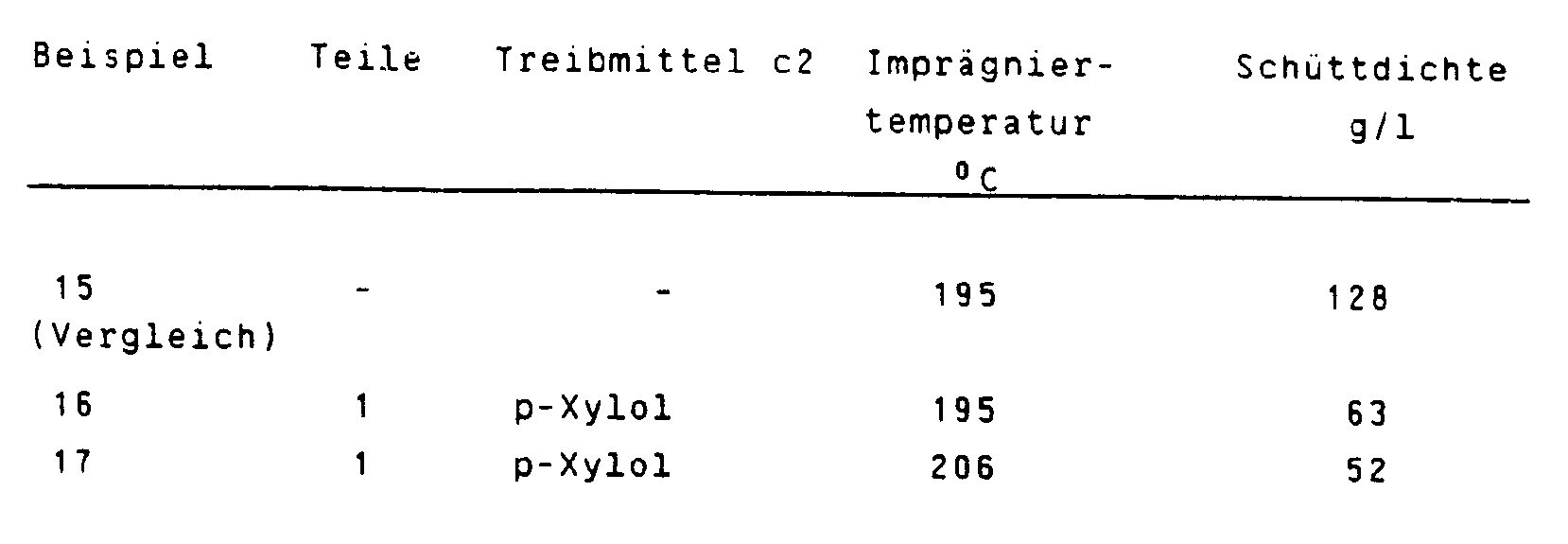
- In ein druckfestes Rührgefäß werden eingefüllt. 180 Teile filtriertes Serum aus einer mit Polyvinylpyrrolidon als Tensid durchgeführten Polystyrol-Suspensionpolymerisation; darin sind noch 0,8 Gew.% Styrol-Emulsionspolymerisat enthalten. Man setzt 0,2 Teile Natriumpyrophosphat und 100 Teile der in den Beispielen 12 bis 14 beschriebenen, granulierten Polymermischung aus Polyphenylenether und schlagfestem Polystyrol zu. Man gibt als Treibmittel c1 14 Teile n/i-Pentangemisch (75/25) bzw. n-Heptan sowie gegebenenfalls weichmachendes Treibmittel c2 zu. Unter Rühren heizt man z.B. auf 235°C und hält diese Temperatur 30 min lang. Nach Abkühlung werden die schaumfähigen Perlen mit Wasser gewaschen und getrocknet.
- Sie werden in einem auf 170°C vorgeheizten Vorschäumer mit durchströmenden, auf 175°C überhitzten Wasserdampf in 2 min aufgeschäumt.

- Die nach den Beispielen 13, 14, 15, 17 bis 21 erhaltenen Schaumstoffpartikeln werden in auf 170 bis 180°C vorgeheizten, nicht gasdichten Formen mit auf 175°C überhitztem Wasserdampf während 3 min in Formteile überführt. Die Hohlräume zwischen den kugelförmigen Teilchen werden dabei ausgeschäumt. Je nach Füllgrad der Form werden dabei Formteile mit Rohdichten erhalten, die bis 10 % unterhalb oder bis 20 % oberhalb der eingesetzten Schüttdichte liegen, d.h zwischen 25 und 80 g/l.
- So besitzt z.B. ein aus Schaumstoffpartikeln der Schüttdichte 50 g/l (Versuch 14) hergestelltes Formteil der Rohdichte 55 g/l eine Druckspannung bei 10 % Stauchung von 0,4 MPa (DIN 53 421) und eine Formbeständigkeit in der Wärme von 171°C (DIN 53 424).
Claims (5)
- Expandierbare Polymere in Partikelform, enthaltenda) 20 bis 94,9 Gew.% eines Styrolpolymerisats,b) 0,1 bis 75 Gew.% eines Polyphenylenethers,c) 5 bis 20 Gew.% eines Treibmittelgemisches ausc1) aliphatischen oder cycloaliphatischen gesättigten Kohlenwasserstoffen mit 3 bis 7 C-Atomen undc2) einem aromatischen gesättigten Kohlenwasserstoff mit 7 bis 8 C-Atomen,im Gewichtsverhältnis c1:c2 zwischen 50:1 und 1:1, sowie gegebenenfalls
einem Alkohol mit 2 bis 4 C-Atomen,
einem Keton mit 3 bis 5 C-Atomen,
einem cyclischen Ether mit 4 bis 6 C-Atomen,
einem aliphatischen Ether mit 4 bis 6 C-Atomen,
einem Ester mit 4 bis 6 C-Atomen und/oder
einem Chlorkohlenwasserstoff mit 1 bis 2 C-Atomen und 2 bis 3 Chloratomend) übliche Zusatzstoffe in wirksamen Mengen. - Expandierbare Polymere in Partikelform gemäß Anspruch 1, gekennzeichnet durch einen mittleren Durchmesser der Partikel zwischen 0,2 und 4 mm.
- Expandierbare Polymere in Partikelform gemäß Ansprüchen 1 und 2, gekennzeichnet durch einen Gehalt an der Komponente a) von 30 bis 93 Gew.% und an der Komponente b) von 2 bis 65 Gew.%.
- Verfahren zur Herstellung von expandierbaren Polymeren in Partikelform gemäß Ansprüchen 1 bis 3, dadurch gekennzeichnet, daß man ein inniges Gemisch aus a) einem Styrolpolymerisat, b) einem Polyphenylenether und gegebenenfalls d) üblichen Zusatzstoffen in wirksamen Mengen, in Partikelform in wäßriger Suspension mit c) einem Treibmittelgemisch ausc1) aliphatischen oder cycloaliphatischen gesättigten Kohlenwasserstoffen mit 3 bis 7 C-Atomen undc2) einem aromatischen gesättigten Kohlenwasserstoff mit 7 bis 8 C-Atomen,bei einer Temperatur von 100 bis 250°C und erhöhtem Druck imprägniert.
einem Alkohol mit 2 bis 4 C-Atomen,
einem Keton mit 3 bis 5 C-Atomen,
einem cyclischen Ether mit 4 bis 6 C-Atomen,
einem aliphatischen Ether mit 4 bis 6 C-Atomen,
einem Ester mit 4 bis 6 C-Atomen und/oder
einem Chlorkohlenwasserstoff mit 1 bis 2 C-Atomen und 2 bis 3 Chloratomen - Verfahren zur Herstellung von Schaumstoffpartikeln der Dichte 5 bis 200 kg/m³, dadurch gekennzeichnet, daß man ein inniges Gemisch aus a) einem Styrolpolymerisat, b) einem Polyphenylenether und gegebenenfalls d) üblichen Zusatzstoffen in wirksamen Mengen, in Partikelform in wäßriger Suspension mit c) einem Treibmittelgemisch ausc1) aliphatischen oder cycloaliphatischen gesättigten Kohlenwasserstoffen mit 3 bis 7 C-Atomen undc2) einem aromatischen gesättigten Kohlenwasserstoff mit 7 bis 8 C-Atomen,bei einer Temperatur von 100 bis 250°C und erhöhtem Druck imprägniert und anschließend entweder die heiße Suspension in eine Atmosphäre niederen Drucks entspannt oder nach dem Abkühlen der Suspension die treibmittelhaltigen Partikel abtrennt und durch Behandeln mit einem heißen Gas aufschäumt.
einem Alkohol mit 2 bis 4 C-Atomen,
einem Keton mit 3 bis 5 C-Atomen,
einem cyclischen Ether mit 4 bis 6 C-Atomen,
einem aliphatischen Ether mit 4 bis 6 C-Atomen,
einem Ester mit 4 bis 6 C-Atomen und/oder
einem Chlorkohlenwasserstoff mit 1 bis 2 C-Atomen und 2 bis 3 Chloratomen
Applications Claiming Priority (2)
| Application Number | Priority Date | Filing Date | Title |
|---|---|---|---|
| DE3817631A DE3817631A1 (de) | 1988-05-25 | 1988-05-25 | Expandierbare polymere in partikelform |
| DE3817631 | 1988-05-25 |
Publications (3)
| Publication Number | Publication Date |
|---|---|
| EP0343473A2 EP0343473A2 (de) | 1989-11-29 |
| EP0343473A3 EP0343473A3 (en) | 1990-03-07 |
| EP0343473B1 true EP0343473B1 (de) | 1992-09-23 |
Family
ID=6355027
Family Applications (1)
| Application Number | Title | Priority Date | Filing Date |
|---|---|---|---|
| EP89108685A Expired - Lifetime EP0343473B1 (de) | 1988-05-25 | 1989-05-13 | Expandierbare Polymere in Partikelform |
Country Status (6)
| Country | Link |
|---|---|
| US (1) | US4927859A (de) |
| EP (1) | EP0343473B1 (de) |
| JP (1) | JP2688248B2 (de) |
| KR (1) | KR970008856B1 (de) |
| DE (2) | DE3817631A1 (de) |
| ES (1) | ES2052808T3 (de) |
Families Citing this family (21)
| Publication number | Priority date | Publication date | Assignee | Title |
|---|---|---|---|---|
| DE3904370A1 (de) * | 1989-02-14 | 1990-08-16 | Basf Ag | Perlfoermige expandierbare formmassen mit hoher waermeformbestaendigkeit und verfahren zu ihrer herstellung |
| US5173514A (en) * | 1989-09-23 | 1992-12-22 | Basf Aktiengesellschaft | Heat distortion resistant, expandable styrene polymers having a high capacity of expansion |
| US5262445A (en) * | 1989-09-23 | 1993-11-16 | Basf Aktiengesellschaft | Heat distortion resistant, expandable styrene polymers having a high capacity for expansion |
| US5091256A (en) * | 1989-12-27 | 1992-02-25 | General Electric Company | Polyphenylene ether foams from low I.V. polyphenylene ether expandable microparticles |
| US5064869A (en) * | 1989-12-27 | 1991-11-12 | General Electric Company | Polyphenlene ether foams from low i.v. polyphenylene ether expandable microparticles |
| DE4005164A1 (de) * | 1990-02-17 | 1991-08-22 | Basf Ag | Schaumstoffplatten mit hoher waermeformbestaendigkeit |
| BR9101167A (pt) * | 1990-04-06 | 1991-11-05 | Dow Chemical Co | Composicao polimerica espumavel,processo para produzir um produto de espuma e produto de espuma |
| US5189072A (en) * | 1990-04-06 | 1993-02-23 | The Dow Chemical Company | Polymeric composition comprising transient foam control agent |
| CA2041537A1 (en) * | 1990-05-30 | 1991-12-01 | Walter R. Harfmann | Method for production of styrenic foam using an alcohol-alkane blowing agent composition |
| US5189071A (en) * | 1992-04-06 | 1993-02-23 | The Dow Chemical Company | Polymeric composition comprising transient foam control agent |
| DE4236579A1 (de) * | 1992-06-04 | 1993-12-09 | Basf Ag | Verfahren zur Herstellung von Schaumstoffplatten mit hoher Druckfestigkeit aus Styrolpolymerisaten |
| HU216025B (hu) * | 1993-01-26 | 1999-04-28 | The Dow Chemical Co. | Megnövelt cellaméretű habok és előállítási eljárásuk |
| DE4416861A1 (de) * | 1994-05-13 | 1995-11-16 | Basf Ag | Expandierbare Styrolpolymerisate |
| DE19540420A1 (de) * | 1995-10-30 | 1997-05-07 | Bayerische Motoren Werke Ag | Formkörper für eine Sonnenblende |
| JP2001139921A (ja) * | 1999-11-16 | 2001-05-22 | Toppan Forms Co Ltd | 感圧接着剤組成物およびそれを用いた感圧接着性シート |
| JP2001139920A (ja) * | 1999-11-16 | 2001-05-22 | Toppan Forms Co Ltd | 感圧接着剤組成物およびそれを用いた感圧接着性シート |
| US6545729B1 (en) * | 2000-08-18 | 2003-04-08 | Mitsubishi Digital Electronics America, Inc. | Foam cabinetry for electronic devices |
| US20040209968A1 (en) * | 2001-05-07 | 2004-10-21 | Jos Bastiaens | Flame retardant expandable poly(arylene ether)/polystyrene compositions and preparation thereof |
| ITMI20020584A1 (it) * | 2002-03-20 | 2003-09-22 | Polimeri Europa Spa | Composizioni a base di polimeri vinilaromatici espandibili a migliorata espandibilita' |
| IT1393962B1 (it) | 2009-05-05 | 2012-05-17 | Polimeri Europa Spa | Articoli espansi con ottima resistenza allo irraggiamento solare e ottime proprieta' termoisolanti e meccaniche |
| KR101371899B1 (ko) * | 2009-08-13 | 2014-03-07 | 아사히 가세이 케미칼즈 가부시키가이샤 | 발포 비드, 이를 이용한 성형체 및 성형체의 제조 방법 |
Family Cites Families (11)
| Publication number | Priority date | Publication date | Assignee | Title |
|---|---|---|---|---|
| US2681321A (en) * | 1950-02-27 | 1954-06-15 | Basf Ag | Production of porous materials from film-forming organic thermoplastic masses |
| US3018257A (en) * | 1959-10-26 | 1962-01-23 | American Cyanamid Co | Method of preparing expandable resins comprising dissolving said resin in a miscibleblend of organic liquids |
| US3175985A (en) * | 1961-05-11 | 1965-03-30 | Monsanto Co | Foamed polymers and process for preparing same |
| US4274637A (en) * | 1979-01-31 | 1981-06-23 | Questor Corporation | Golf ball having cellular cover |
| DE3220856A1 (de) * | 1981-06-04 | 1982-12-23 | Basf Ag, 6700 Ludwigshafen | Verfahren zur herstellung von schaumstoffen |
| US4705811A (en) * | 1986-04-07 | 1987-11-10 | The Dow Chemical Company | Expandable polymeric composition and method |
| US4661302A (en) * | 1986-04-07 | 1987-04-28 | The Dow Chemical Company | Expandable polymeric composition and method |
| US4734441A (en) * | 1986-04-07 | 1988-03-29 | The Dow Chemical Company | Expandable polymeric composition and method |
| US4727093A (en) * | 1986-10-27 | 1988-02-23 | General Electric Company | Low density particles of polyphenylene ether resins |
| US4728674A (en) * | 1986-11-03 | 1988-03-01 | General Electric Company | Modified polyphenylene ether resins having improved foamability and methods of making the same |
| US4857390A (en) * | 1987-06-26 | 1989-08-15 | General Electric Company | Low density extruded foam having high compressive strength |
-
1988
- 1988-05-25 DE DE3817631A patent/DE3817631A1/de not_active Withdrawn
-
1989
- 1989-05-13 ES ES89108685T patent/ES2052808T3/es not_active Expired - Lifetime
- 1989-05-13 DE DE8989108685T patent/DE58902323D1/de not_active Expired - Lifetime
- 1989-05-13 EP EP89108685A patent/EP0343473B1/de not_active Expired - Lifetime
- 1989-05-19 US US07/354,230 patent/US4927859A/en not_active Expired - Fee Related
- 1989-05-24 JP JP1129032A patent/JP2688248B2/ja not_active Expired - Lifetime
- 1989-05-25 KR KR1019890007043A patent/KR970008856B1/ko not_active Expired - Lifetime
Also Published As
| Publication number | Publication date |
|---|---|
| ES2052808T3 (es) | 1994-07-16 |
| EP0343473A3 (en) | 1990-03-07 |
| DE3817631A1 (de) | 1989-11-30 |
| JP2688248B2 (ja) | 1997-12-08 |
| US4927859A (en) | 1990-05-22 |
| EP0343473A2 (de) | 1989-11-29 |
| DE58902323D1 (en) | 1992-10-29 |
| JPH0218428A (ja) | 1990-01-22 |
| KR970008856B1 (ko) | 1997-05-30 |
| KR900018231A (ko) | 1990-12-20 |
Similar Documents
| Publication | Publication Date | Title |
|---|---|---|
| EP0343473A2 (de) | Expandierbare Polymere in Partikelform | |
| EP0981574B1 (de) | Graphitpartikel enthaltende expandierbare styrolpolymerisate | |
| EP1366110B1 (de) | Kohlenstoffpartikel enthaltende expandierbare styrolpolymerisate | |
| EP0542066B1 (de) | Expandierbare Styrolpolymerisate, enthaltend als Treibmittel Kohlendioxid | |
| EP1137701B1 (de) | Graphitpartikel enthaltende expandierbare styrolpolymerisate | |
| EP0046494B1 (de) | Teilchenförmige, treibmittelhaltige Styrolpolymerisate und deren Verwendung | |
| DE69022838T2 (de) | Polyphenylenetherschaumstoffe abgeleitet von expandierbaren Mikroteilchen aus Polyphenylenether mit niedriger Grenzviskosität. | |
| EP2274369B2 (de) | Ps-schaumstoffe mit geringem metallgehalt | |
| EP0711800A1 (de) | Recyclat enthaltende, expandierbare Styrolpolymerisate | |
| DE19819058C5 (de) | Verfahren zur Herstellung von vorgeschäumten EPS-Partikeln mit grober Schaumstruktur aus teilchenförmigen, schwach angeschäumten, expandierten Styrolpolymerisaten | |
| EP0109492B1 (de) | Verfahren zur Herstellung von verbesserten Formmassen aus kleinteiligen blähfähigen Styrolpolymerisaten durch Beschichten und Verwenden des beschichteten Produktes | |
| EP0134414B1 (de) | Feinteilige, expandierbare Styrolpolymerisate, die zur Herstellung schnellentformbarer Zellkörper geeignet sind | |
| EP0373441B1 (de) | Verfahren zur Herstellung von Styrolpolymerisat-Schaumstoffpartikeln | |
| DE3904370A1 (de) | Perlfoermige expandierbare formmassen mit hoher waermeformbestaendigkeit und verfahren zu ihrer herstellung | |
| EP0269983B1 (de) | Expandierbare Styrolpolymerisate und Styrolpolymerisat-Schaumstoffe | |
| EP1142942B1 (de) | Verfahren zur Herstellung Aluminiumpulver enthaltender expandierbarer Styrolpolymerisate | |
| DE2624014A1 (de) | Schnell kuehlende styrolpolymerschaeume | |
| EP0027609B1 (de) | Teilchenförmige, treibmittelhaltige Styrolpolymerisate und deren Verwendung | |
| DE2510943C2 (de) | Verfahren zum Trocknen von verschäumbaren, kleinteiligen Styrolpolymerisaten | |
| DE2226168A1 (de) | Feinteilige expandierbare styrolpolymerisate mit guenstigen verarbeitungseigenschaften | |
| DE2413321A1 (de) | Verschaeumbare pfropfpolymerisate des styrols auf olefinpolymerisaten | |
| DE2420298A1 (de) | Zu schaumstoffen niederer dichte expandierbare styrolpolymerisate | |
| DE1298274B (de) | Herstellung verschaeumbarer feinteiliger Styrolpolymerisate | |
| DE69919610T2 (de) | Verfahren zur Herstellung eines thermoplastischen Schaumstoffes mittels Wasser und eines Ethers | |
| DE1504577C3 (de) | Verfahren zur Herstellung verschäumbarer vinylaromatischer Polymerisatteilchen |
Legal Events
| Date | Code | Title | Description |
|---|---|---|---|
| PUAI | Public reference made under article 153(3) epc to a published international application that has entered the european phase |
Free format text: ORIGINAL CODE: 0009012 |
|
| AK | Designated contracting states |
Kind code of ref document: A2 Designated state(s): BE DE ES FR GB IT NL |
|
| PUAL | Search report despatched |
Free format text: ORIGINAL CODE: 0009013 |
|
| RHK1 | Main classification (correction) |
Ipc: C08J 9/14 |
|
| AK | Designated contracting states |
Kind code of ref document: A3 Designated state(s): BE DE ES FR GB IT NL |
|
| 17P | Request for examination filed |
Effective date: 19900201 |
|
| 17Q | First examination report despatched |
Effective date: 19910627 |
|
| GRAA | (expected) grant |
Free format text: ORIGINAL CODE: 0009210 |
|
| AK | Designated contracting states |
Kind code of ref document: B1 Designated state(s): BE DE ES FR GB IT NL |
|
| ITF | It: translation for a ep patent filed | ||
| REF | Corresponds to: |
Ref document number: 58902323 Country of ref document: DE Date of ref document: 19921029 |
|
| GBT | Gb: translation of ep patent filed (gb section 77(6)(a)/1977) | ||
| ET | Fr: translation filed | ||
| K2C3 | Correction of patent specification (complete document) published |
Effective date: 19920923 |
|
| PLBE | No opposition filed within time limit |
Free format text: ORIGINAL CODE: 0009261 |
|
| STAA | Information on the status of an ep patent application or granted ep patent |
Free format text: STATUS: NO OPPOSITION FILED WITHIN TIME LIMIT |
|
| 26N | No opposition filed | ||
| REG | Reference to a national code |
Ref country code: ES Ref legal event code: FG2A Ref document number: 2052808 Country of ref document: ES Kind code of ref document: T3 |
|
| PGFP | Annual fee paid to national office [announced via postgrant information from national office to epo] |
Ref country code: FR Payment date: 19990427 Year of fee payment: 11 |
|
| PGFP | Annual fee paid to national office [announced via postgrant information from national office to epo] |
Ref country code: GB Payment date: 19990505 Year of fee payment: 11 |
|
| PGFP | Annual fee paid to national office [announced via postgrant information from national office to epo] |
Ref country code: NL Payment date: 19990510 Year of fee payment: 11 Ref country code: ES Payment date: 19990510 Year of fee payment: 11 |
|
| PGFP | Annual fee paid to national office [announced via postgrant information from national office to epo] |
Ref country code: DE Payment date: 19990528 Year of fee payment: 11 |
|
| PGFP | Annual fee paid to national office [announced via postgrant information from national office to epo] |
Ref country code: BE Payment date: 19990601 Year of fee payment: 11 |
|
| PG25 | Lapsed in a contracting state [announced via postgrant information from national office to epo] |
Ref country code: DE Free format text: LAPSE BECAUSE OF THE APPLICANT RENOUNCES Effective date: 20000414 |
|
| PG25 | Lapsed in a contracting state [announced via postgrant information from national office to epo] |
Ref country code: GB Free format text: LAPSE BECAUSE OF NON-PAYMENT OF DUE FEES Effective date: 20000513 |
|
| PG25 | Lapsed in a contracting state [announced via postgrant information from national office to epo] |
Ref country code: ES Free format text: THE PATENT HAS BEEN ANNULLED BY A DECISION OF A NATIONAL AUTHORITY Effective date: 20000516 |
|
| PG25 | Lapsed in a contracting state [announced via postgrant information from national office to epo] |
Ref country code: BE Free format text: LAPSE BECAUSE OF NON-PAYMENT OF DUE FEES Effective date: 20000531 |
|
| BERE | Be: lapsed |
Owner name: BASF A.G. Effective date: 20000531 |
|
| PG25 | Lapsed in a contracting state [announced via postgrant information from national office to epo] |
Ref country code: NL Free format text: LAPSE BECAUSE OF NON-PAYMENT OF DUE FEES Effective date: 20001201 |
|
| GBPC | Gb: european patent ceased through non-payment of renewal fee |
Effective date: 20000513 |
|
| PG25 | Lapsed in a contracting state [announced via postgrant information from national office to epo] |
Ref country code: FR Free format text: LAPSE BECAUSE OF NON-PAYMENT OF DUE FEES Effective date: 20010131 |
|
| NLV4 | Nl: lapsed or anulled due to non-payment of the annual fee |
Effective date: 20001201 |
|
| REG | Reference to a national code |
Ref country code: FR Ref legal event code: ST |
|
| REG | Reference to a national code |
Ref country code: ES Ref legal event code: FD2A Effective date: 20020204 |
|
| PG25 | Lapsed in a contracting state [announced via postgrant information from national office to epo] |
Ref country code: IT Free format text: LAPSE BECAUSE OF NON-PAYMENT OF DUE FEES;WARNING: LAPSES OF ITALIAN PATENTS WITH EFFECTIVE DATE BEFORE 2007 MAY HAVE OCCURRED AT ANY TIME BEFORE 2007. THE CORRECT EFFECTIVE DATE MAY BE DIFFERENT FROM THE ONE RECORDED. Effective date: 20050513 |