EP0342607A2 - FARBBILD-EINGABE-EINHEIT MIT EDELGAS-KALTKATHODEN-ENTLADUNGSRöHRE - Google Patents
FARBBILD-EINGABE-EINHEIT MIT EDELGAS-KALTKATHODEN-ENTLADUNGSRöHRE Download PDFInfo
- Publication number
- EP0342607A2 EP0342607A2 EP89108780A EP89108780A EP0342607A2 EP 0342607 A2 EP0342607 A2 EP 0342607A2 EP 89108780 A EP89108780 A EP 89108780A EP 89108780 A EP89108780 A EP 89108780A EP 0342607 A2 EP0342607 A2 EP 0342607A2
- Authority
- EP
- European Patent Office
- Prior art keywords
- discharge tube
- tube
- rare gas
- input unit
- image
- Prior art date
- Legal status (The legal status is an assumption and is not a legal conclusion. Google has not performed a legal analysis and makes no representation as to the accuracy of the status listed.)
- Granted
Links
Images



Classifications
-
- H—ELECTRICITY
- H01—ELECTRIC ELEMENTS
- H01J—ELECTRIC DISCHARGE TUBES OR DISCHARGE LAMPS
- H01J61/00—Gas-discharge or vapour-discharge lamps
- H01J61/02—Details
- H01J61/54—Igniting arrangements, e.g. promoting ionisation for starting
- H01J61/541—Igniting arrangements, e.g. promoting ionisation for starting using a bimetal switch
- H01J61/544—Igniting arrangements, e.g. promoting ionisation for starting using a bimetal switch and an auxiliary electrode outside the vessel
-
- H—ELECTRICITY
- H01—ELECTRIC ELEMENTS
- H01J—ELECTRIC DISCHARGE TUBES OR DISCHARGE LAMPS
- H01J61/00—Gas-discharge or vapour-discharge lamps
- H01J61/02—Details
- H01J61/56—One or more circuit elements structurally associated with the lamp
Definitions
- the present invention relates to a rare gas cold cathode discharge tube and to an image input unit using it.
- Image input units are used for reading images such as photographs and the like and generating corresponding data which can be input into a computer.
- Known image input units may be classified into mainly three types depending on their reading system.
- the first type is a camera type image input unit using a two-dimensional array of photoelectric transducer elements onto which the image to be read is projected. An image is read during 20 ms or less.
- This camera type image input unit is mainly used for reading images changing with time. Since an optical path length for imaging must be secured in construction, a large space will be required for the unit. Furthermore, since all of a picture image to be read must be irradiated at once and since it is difficult to irradiate a greater area by a uniform brightness, a high accuracy in reading the density values of the picture is hardly achieved. Still further, since the photoelectric transducer elements are arrayed two-dimensionally, a high precision technique is required for manufacturing, leading to high manufacturing costs.
- the second type of image input unit is a drum scanner using an imaging system and a photoelectric transducer element for reading an image point by point. While a picture image is rotating on a drum, the photoelectric transducer element is shifted into the axial direction of the drum. By controlling the rotational speed of the drum and the moving rate of the photoelectric transducer, the reading resolution may be readily selected, and a relatively high resolution may be obtained. However, since the resolution depends on the mechanical precision of the component parts, high cost may result and a large-sized construction will be quite unavoidable with this type of image input unit.
- the third type of image input unit uses a one-dimensional array of photoelectric transducer elements consisting of CCD (charge coupled devices) or the like. Synchronized with data reading, the photoelectric transducer elements are shifted relative to a picture image in a direction perpendicular to the extension of the array, thereby scanning the image line by line.
- This third type of image input unit may be regarded as a system intermediate of the aforementioned two types and enjoying the advantages of those two other types.
- the reading rate of this third type of image input unit is higher than that of the drum scanner and the space required for the unit is the minimum among the three types.
- the image scanner type image input unit using a one-dimensional array of photoelectric transducer elements is optimum as it is cheap, small-sized and allows a high resolution.
- a lighting apparatus used in such an image scanner has to irradiate a picture image in the direction where the photoelectric transducer elements are arrayed.
- An LED array, a fluorescent lamp, a linear halogen lamp and the like are employed for this purpose.
- a sufficient tone representation capacity is required for the image input unit, and unless the density values of the picture image are quantized into for example 8 to 256 gradations, a picture image such as a photograph or the like with a fine change in intermediate density cannot be loaded accurately into a computer. It is necessary therefore that the picture image be irradiated uniformly by a constant brightness, and hence a lighting apparatus emitting a stabilized quantity of light is necessary.
- a rare gas cold cathode discharge tube can be made small in shape and miniaturized in overall size to, for example, a diameter of 1 to 6 mm.
- the power consumption is low, for example 4 to 10 watts.
- the luminous color can be arbitrarily selected depending on a fluorescent material applied to the inside of the tube wall. Therefore, a rare gas cold cathode discharge tube is appropriate not only for facsimile machines but also as a light source of an image scanner for reading color picture images.
- the color correction can be carried out in real time in keeping pace with reading, and data after the color correction may be sent to a host computer.
- RAM semiconductor memory
- the rare gas cold cathode discharge tube is advantageous with respect to the stability of the quantity of light against environmental temperature change, space occupation and so on as compared with a general mercury discharge lamp. It is defective, however, insofar as a light source for reading picture images is concerned. That is, the quantity of light in intermittent lighting which is necessary for a line sequential reading is not stabilized.
- the rare gas cold cathode discharge tube has been used so far under the condition that it was kept lighting continuously for several seconds or longer each time it was energized. In the case of a rare gas cold cathode discharge tube, the gas pressure is 50 to 200 mmHg high, while it is a few 10 mmHg with general mercury discharge lamps.
- a straight bright line called positive column is observed along the discharge tube at the time of lighting.
- an auxiliary electrode is provided along the wall of the tube.
- the positive column when repeating the intermittent lighting at a period of several milliseconds or so, the positive column is not stably drawn toward the auxiliary electrode. Therefore, the quantity of light of the rare gas cold cathode discharge tube is not fixed and the brightness of the read image changes. Specifically, while the positive column exists at all times, the light emitting position fluctuates within the discharge tube to come near or to go away from the picture image, and thus the quantity of light irradiating the picture image fluctuates by 1 to 10 percent.
- the present invention is intended to remedy the above mentioned problems of the prior art and to provide a rare gas cold cathode discharge tube emitting a stabilized quantity of light even if it is intermittently lit at a period of several milliseconds or so. It is another object of the present invention to provide an image input unit using such a rare gas cold cathode discharge tube, which is moderate in cost and high in performance.
- FIG. 3 is a perspective view of an image input unit according to a first embodiment of the invention.
- an image reading unit 10 is shifted successively in the direction indicated by an arrow, by a driving device such as a stepping motor or the like through a timing belt, a wire or the like which is not shown.
- Fig. 4 is a sectional view taken on line A-A′ in Fig. 3 of the image reading unit 10.
- three cold cathode discharge tubes 1-R, 1-B, 1-G filled with rare gas, which constitute a lighting apparatus, are used for reading the picture image 7 placed on a glass bed 6 and emit red, blue and green light, respectively.
- the red tube 1-R is filled with a neon gas under a pressure of 1,3 to 6,7 kPa (10 to 50 Torr), preferably 2,7 kPa (20 Torr).
- a red color is obtained by the luminescence of the gas itself.
- an aperture formed inside or outside of the tube wall by a white film of titanium oxide powder or the like will be effective in directing the light efficiently for irradiation.
- the blue and green discharge tubes 1-B and 1-G are filled with xenon gas under a pressure of 8 to 20 kPa (60 to 150 Torr), preferably 10,7 kPa (80 Torr).
- the tube voltage to be impressed on the discharge tube rises proportionally to the pressure. Since a high voltage requires an expensive driver circuit, the pressure values specified above will be appropriate.
- FIG. 4 A color picture reading method will be described next with reference to Fig. 4 and the timing chart of Fig. 14.
- the image reading unit 10 shown in Fig. 4 is first shifted to an image reading start position by a driving signal shown under (f) in Fig. 14. Then, light of the three primary colors is successively irradiated onto the picture image 7 under the control of lighting signals shown as (a), (c) and (d), respectively, in Fig. 14.
- the reflected light is respectively imaged on a photoelectric transducer 3 by an imaging system 2.
- the rare gas cold cathode discharge tubes are lighted for 5 ms each, and the photoelectric transducer operates for 5 ms for reading, thus finishing the basic reading operation in about 30 ms.
- the lighting time and period are representative in value, and a signal precision and a read rate can be further enhanced by properly selecting the disposition of the rare gas cold cathode discharge tubes and the sensitivity of the photoelectric transducer elements.
- an afterglow is produced due to the physical property of the fluorescent substance used to convert ultraviolet rays of the xenon gas into visible light. Consequently, when MOS type photoelectric transducer elements are used in which a light storage timing varies at every picture elements, an afterglow removing time Trm, shown in Fig. 14, must be set. Unless it is set, the irradiation of red light following that of green light will be mixed with the green light due to the afterglow and, thus, the reproducibility of the red picture image is deteriorated. Trm should be as short as possible since it directly influences the read rate. Depending on the capacity of the used phosphor, a value of 1 to 20 ms, preferably 5 ms, is appropriate.
- a preliminary lighting (intermittent or normally light-on) will be effected for 10 to 100 ms before the start of reading, and the light is switched off when the image reading unit 10 is reset to a reference position after the reading has been completed.
- a white reference picture image uniform in reflection factor is read to obtain reference data.
- Data read from a real picture image are then corrected by means of the reference data, thereby obtaining data correctly representing the density distribution of the read image.
- xenon is the proper rare gas to be charged into the cold cathode discharge tube.
- rare gas other than xenon may be used if a fluorescent substance is developed having its excitation wave length adjusted to the wave length of the light emitted by said other rare gas.
- a fluorescent substance having an excitation wave length of 389 nm is used, helium will be appropriate as the rare gas.
- Rare gases such as argon, krypton, radon and the like are usable likewise.
- the image reading unit 10 can be constructed compactly by using a platelike or rodlike glass of a proper refractive index distribution as the imaging system 2.
- the light emitted by the discharge tubes 1-B, 1-G, 1-R and reflected by the picture image 7 is condensed by the imaging system 2 and irradiated on the photoelectric transducer 3.
- a reflector 4 consists of a white resin such as polycarbonate or the like and functions to condense and reflect the light from the lighting apparatus in the direction of the picture image 7.
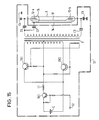
- Discharge tube 1 is controlled for lighting and fed with electric power by a driver circuit 12 to which two main electrodes 13-a and 13-b and an auxiliary electrode 14 of the discharge tube are electrically connected.
- Fig. 15 is a circuit diagram representing one example of the driver circuit 12.
- a battery E is shown as a power source providing 12V or 24V DC power.
- a transistor TR3 is switched on, energizing an inverter circuit including transistors TR1 and TR2 and a boosting transformer T.
- a high-voltage, high-frequency alternating current 500 to 2000V and 10 to 50 kHz is induced in the secondary winding of the boosting transformer T and applied to the discharge tube 1. Thereby, discharge tube 1 is controlled for lighting.
- Capacitors C1, C2 and C3 function to limit the current flowing through the discharge tube and their capacitance is 50 to 200 pF, preferably 120 pF.
- Capacitors C4 and C5 function to stabilize the positive column or bright line formed by the current flowing through the discharge tube.
- Their capacitance is 5 to 30 pF or so.
- the potential of the main electrodes 13-a, 13-b is stabilized by providing the capa citors, and a stable discharge state can be maintained even at the time of intermittent lighting in which the discharge tube is switched on and off repeatedly at milliseconds. It is preferable that one of the terminals of the capacitors C4 and C5 be grounded.
- the auxiliary electrode 14 may be a strip of a hardened, conductive adhesive containing carbon for example, the width of the strip being 0,1 to 2 mm, preferably 0,8 mm and its resistance value 1 to 20 k ⁇ , preferably 3 to 6 k ⁇ per centimeter length.
- Fig. 2 is a perspective enlarged partial view of the discharge tube of Fig. 1, for illustrating the discharge process at the main electrode 13-a and its neighborhood.
- a ring-shaped conductive member 15 of a conductive adhesive containing a powder such as for example copper, carbon or the like is formed on the discharge tube wall around the inner end of the main electrode 13-a (actually, the conductive member 15 is displaced with respect to the inner axial end of the main electrode 13-a in the axial direction for reasons stated later).
- the electrode 13-a has the same electrical potential as that of the auxiliary electrode 14, whereas the electrode 13-b has the reverse electrical potential of that of the auxiliary electrode 14.
- the conductive member 15 is electrically connected with the auxiliary electrode 14.
- the driver circuit 12 When the high-voltage, high-frequency AC voltage is applied to the main electrodes 13-a, 13-b by the driver circuit 12, an electron beam is generated between the main electrodes 13-a and 13-b through the rare gas, for example xenon gas.
- the electron beam brings the rare gas into a plasma state, and excites it to emit ultraviolet rays, visible light and infrared rays, as is characteristic for the gas. This deve lops to a bright line which is observed as a positive column 17.
- the ultraviolet rays excite the fluorescent substance applied to the inner wall of the discharge tube.
- a luminescence of arbitrary visible light as blue, green, red, white and so on may be obtained by selecting the kind of fluorescent substance.
- a voltage is impressed on the auxiliary electrode 14 by the driver circuit 12 in order to establish a potential difference between the main electrodes 13-a, 13-b and the auxiliary electrode 14. Due to this potential difference, the positive column 17 generated between the main electrodes is drawn to the discharge tube inner wall along the auxiliary electrode 14 and stabilized firmly.
- the positive column generated from the main electrode 13-a at the time of lighting start is drawn to the side of the piece of metal (indicated as 17-a in Fig. 2) and its path will not be stabilized along the auxiliary electrode 14 (the same effect will occur with any material other than a piece of metal, provided that it establishes a capacitance to the positive column of discharge an exerts an influence on the formation of the positive column.
- the conductive member 15 functions to surpress a deflection of the positive column.
- the above mentioned problems occur when the piece of metal 16 is disposed in a region surrounding the nose or inner end of the main electrode 13-a.
- the positive column is drawn thereto, since the conductive member 15 and the auxiliary electrode 14 are of the same potential, the positive column is caught on the conductive member 15 and a path 17-b is formed immediately along the auxiliary electrode 14. Once the positive column is caught on the auxiliary electrode 14, the position of the positive column is stabilized since it never comes outside of the position of the auxiliary electrode 14, even if a piece of metal 16 or any equivalent member is disposed nearby.
- the conductive member 15 will preferably be positioned ahead (towards the opposite main electrode) of a discharge position of the main electrode. Concretely, it may preferably by displaced by 1 to 5 mm or so from the axial inner end of the main electrode.
- Fig. 17 is a diagrammatic view showing the positional relation between the discharge tube 1 and the picture image 7.
- the total length of the discharge tube must be long enough such that the length of a portion of the discharge tube emitting a substantially uniform quantity of light covers the width of the picture image 7 to be read.
- the conductive member 15 is made of a transparent material like tin oxide, it is required to be positioned 3 to 10 mm outside of the adjacent edge of the picture image in order to ensure a uniform quantity of light over the whole width of the picture image.
- Figs. 5 to 10 are diagrammatic partial views of alternative embodiments of the rare gas cold cathode discharge tube according to the invention.
- the conductive member 15 consists of a spring piano wire which is fixed on the discharge tube wall by the spring force and which is electrically connected to the auxiliary electrode 14 formed of a conductive adhesive.
- this embodiment is simplified not needing the application of the conductive adhesive for forming the conductive member 15, and thus is moderate in cost.
- a lead wire for connecting the auxiliary electrode 14 to the driver circuit 12 (Fig. 1) is wound on the discharge tube wall, thus forming a conductive member 15 at the same time.
- the conductive member 15 is formed by dipping the end of the discharge tube into a liquid conductive adhesive which is then hardened. In this case, care must be taken to ensure the necessary insulation between the conductive member 15 and the main electrode.
- the conductive member 15 consists of a metallic box-like member or the like, serving as fixing means for the discharge tube at the same time and, hence simplifying the construction.
- the conductive member 15 does not necessarily need to form a closed ring around the discharge tube wall and still may be effective enough to stabilize the positive column.
- a sheet metal of phosphor bronze having spring characteristics and a thickness of about 0.2 mm is curved cylindrically and fixed on the discharge tube wall.
- this conductive member 15 is capable of functioning as a positioning member in the circumferential direction when the discharge tube is fixed.
- a white rare gas cold cathode discharge tube 1 is used for irradiating the picture image 7.
- the white discharge tube called a three-wavelength type discharge tube, is obtainable by using as a fluorescent substance a mixture of green, red and blue emitting substances.
- the image is formed on a CCD photoelectric transducer 3 via a mirror 20 and an imaging system 2.
- More than one mirror may be used in order to minimize the general volume of the unit.
- a tricolor filter 21 including green, red and blue filter portions is disposed in the imaging optical path.
- a driving device 22 is used to shift the green, red and blue filter portions successively into the imaging optical path. Since the filter portions of the filter 21 must be changed within a short time of several milliseconds, the filter 21 advantageously is formed as a circular plate segmented into three 120° portions corresponding to the green, red and blue filter portions. In this case, driving device 22 could be a motor switching from one filter portion to another by a rotation of 120° of the filter plate.
- the three-wavelength type white cold cathode discharge tube 1 is intermittently driven chiefly for adjusting the quantity of light inputted to the photoelectric transducer (MOS type transducer, CCD transducer or the like). The reason for that will be described below.
- Fig. 18 represents a conversion characteristic of a MOS type photoelectric transducer element consisting of amorphous silicon (the situation with a CCD transducer element is similar).
- a storage type transducer In the photoelectric transducer element, generally called a storage type transducer, an output is obtainable in proportion to the integrated quantity of light irradiated within the reading period (domain B in Fig. 18). However, even without any light there exists a background output called noise (domain C in the drawing). This is called a dark output.
- the S/N ratio indicating the precision of the read signals is expressed as the ratio of a signal output to the dark output. Of course, the larger the S/N ratio, the better it is.
- the integrated quantity of light to the photoelectric transducer element has a saturation threshold (domain A in the drawing), i.e. the output voltage of the transducer element becomes constant even if further light is applied. If saturation is reached, a density change in the picture image can no longer be read correctly. Accordingly, for better precision of an outgoing signal to extract, an irradiation lot if the light to use will come in the domain B in Fig. 18. For best results, the amount of light will be just below the saturation point.
- the lighting time of the rare gas cold cathode discharge tube should be set to an optimum value.
- the quantity of light emitted by the discharge tube varies from tube to tube in a mass production according to a statistical dispersion. If the output signal is saturated (domain A in Fig. 18), then the output becomes constant, not reflecting the image density. Therefore, the lighting time at the time of shipment is set somewhat short as compared with the time at which the output is saturated. Further, the quantity of light decreases gradually from a continuous service and thus the S/N ratio drops. Therefore, the capacity inherent in the photoelectric transducer element cannot be made full use of.
- the lighting time of the light source is adjusted to set an optimum quantity of light for the photo electric transducer elements whenever the image input unit is used.
- an intermittent lighting is carried out as mentioned before.
- the quantity of light may be stabilized by using the conductive member 15 on the tube wall due to the reasons mentioned above.
- Fig. 12 diagrammatically shows a further embodiment of the image reading unit according to the invention.
- separate color signals are obtained at a time by providing the transducer elements themselves with a filter at the state of manufacturing. Since mechanically operating parts are not required for color separation, problems like a vibration generated from such operating parts or the like will not occur.
- the three-wavelength type white cold cathode discharge tube 1 is intermittently lighted in this embodiment, too.
- the conductive member 15 is preferably used with the discharge tube 1 in this embodiment.
- Fig. 13 is a diagrammatic view of still another embodiment of the image reading unit according to the invention. While the embodiment of Fig. 4 uses a magnifying imaging optical system, the optical system 2 of the embodiment shown in Fig. 13 is of the reducing type, reducing to one-fifth to one-tenth or so. Like the embodiment shown in Fig. 4, the color separation is achieved by using three discharge tubes 1-R, 1-B and 1-G.
- the intermittent lighting is a discharge tube lighting method required particularly for light adjustment and line sequential reading for color correction. Further, a noise of a high frequency of 20 to 30 kHz produced at the time of discharge tube lighting during the normal reading is capable of affecting the output of the photoelectric transducer. It is therefore effective to carry out an intermittent lighting of the discharge tube including the three-wavelength type tube and also to generate an output of the photoelectric transducer when putting out the light.
- a rare gas cold cathode discharge tube is provided, allowing to stabilize the quantity of emitted light even when an intermittent lighting with a period of several milliseconds is carried out.
- the use of such rare gas cold cathode discharge tube as lighting apparatus allows an image input unit to be realized which is moderate in cost and less space-consuming, still ensuring a color correction function to enhance the color reproducibility of a printing output of the read image and a light adjusting function of the lighting apparatus to enhance the S/N ratio of the read image.
Landscapes
- Facsimile Scanning Arrangements (AREA)
Applications Claiming Priority (4)
| Application Number | Priority Date | Filing Date | Title |
|---|---|---|---|
| JP11870488 | 1988-05-16 | ||
| JP118704/88 | 1988-05-16 | ||
| JP1065029A JPH0249345A (ja) | 1988-05-16 | 1989-03-17 | 希ガス冷陰極放電管、及び画像入力装置 |
| JP65029/89 | 1989-03-17 |
Publications (3)
| Publication Number | Publication Date |
|---|---|
| EP0342607A2 true EP0342607A2 (de) | 1989-11-23 |
| EP0342607A3 EP0342607A3 (de) | 1991-04-03 |
| EP0342607B1 EP0342607B1 (de) | 1995-08-02 |
Family
ID=26406170
Family Applications (1)
| Application Number | Title | Priority Date | Filing Date |
|---|---|---|---|
| EP89108780A Expired - Lifetime EP0342607B1 (de) | 1988-05-16 | 1989-05-16 | FARBBILD-EINGABE-EINHEIT MIT EDELGAS-KALTKATHODEN-ENTLADUNGSRöHRE |
Country Status (4)
| Country | Link |
|---|---|
| EP (1) | EP0342607B1 (de) |
| JP (1) | JPH0249345A (de) |
| DE (1) | DE68923651T2 (de) |
| HK (1) | HK5297A (de) |
Cited By (1)
| Publication number | Priority date | Publication date | Assignee | Title |
|---|---|---|---|---|
| CN103177930A (zh) * | 2013-04-01 | 2013-06-26 | 海宁市新光源照明有限责任公司 | 一种长寿命节能荧光灯 |
Families Citing this family (1)
| Publication number | Priority date | Publication date | Assignee | Title |
|---|---|---|---|---|
| JP3307357B2 (ja) * | 1999-02-15 | 2002-07-24 | 日本電気株式会社 | スキャナ装置及びその制御方法 |
Family Cites Families (8)
| Publication number | Priority date | Publication date | Assignee | Title |
|---|---|---|---|---|
| JPS57121367A (en) * | 1981-01-20 | 1982-07-28 | Canon Inc | Method for reading color original |
| JPS57164658A (en) * | 1981-04-01 | 1982-10-09 | Mitsubishi Electric Corp | Original reader |
| JPS5980059A (ja) * | 1982-10-29 | 1984-05-09 | Minolta Camera Co Ltd | 多色原稿の読取装置 |
| DE3584912D1 (de) * | 1984-06-15 | 1992-01-30 | Sharp Kk | Farbbildlesevorrichtung. |
| JPS62203466A (ja) * | 1986-03-03 | 1987-09-08 | Fuji Xerox Co Ltd | 原稿読取装置 |
| KR900002446B1 (ko) * | 1986-05-30 | 1990-04-14 | 가부시끼 가이샤 도시바 | 불활성 가스 방전등 장치 |
| JPS62281256A (ja) * | 1986-05-30 | 1987-12-07 | Toshiba Corp | 希ガス放電灯装置 |
| JP2600709B2 (ja) * | 1987-09-08 | 1997-04-16 | セイコーエプソン株式会社 | 原稿読取り装置用稀ガス冷陰極ランプ |
-
1989
- 1989-03-17 JP JP1065029A patent/JPH0249345A/ja active Pending
- 1989-05-16 DE DE1989623651 patent/DE68923651T2/de not_active Expired - Lifetime
- 1989-05-16 EP EP89108780A patent/EP0342607B1/de not_active Expired - Lifetime
-
1997
- 1997-01-09 HK HK5297A patent/HK5297A/en not_active IP Right Cessation
Cited By (1)
| Publication number | Priority date | Publication date | Assignee | Title |
|---|---|---|---|---|
| CN103177930A (zh) * | 2013-04-01 | 2013-06-26 | 海宁市新光源照明有限责任公司 | 一种长寿命节能荧光灯 |
Also Published As
| Publication number | Publication date |
|---|---|
| EP0342607A3 (de) | 1991-04-03 |
| DE68923651T2 (de) | 1996-02-22 |
| EP0342607B1 (de) | 1995-08-02 |
| HK5297A (en) | 1997-01-17 |
| JPH0249345A (ja) | 1990-02-19 |
| DE68923651D1 (de) | 1995-09-07 |
Similar Documents
| Publication | Publication Date | Title |
|---|---|---|
| EP0766286B1 (de) | Entladungslampe und Verfahren zu deren Herstellung | |
| US5140221A (en) | Rare gas cold cathode discharge tube and image input device | |
| EP0342607B1 (de) | FARBBILD-EINGABE-EINHEIT MIT EDELGAS-KALTKATHODEN-ENTLADUNGSRöHRE | |
| EP0803899B1 (de) | Leuchte und diese benutzender bildleser | |
| US5258857A (en) | Image input device and method for reading a picture image | |
| JPH08329903A (ja) | 外部電極式蛍光放電管 | |
| JP3616299B2 (ja) | ライン光源およびそれを用いたイメージセンサ | |
| US3914649A (en) | Pulsed metal or metal halide lamps for photocopying applications | |
| US6900593B2 (en) | Light source and image reading device using the same | |
| JP3604606B2 (ja) | 発光制御装置とこの発光制御装置を使用した画像形成装置 | |
| JP3576661B2 (ja) | 希ガス放電灯 | |
| TWI296815B (en) | Lamp tube having a uniform lighting profile and a manufacturing method therefor | |
| JPH06181050A (ja) | 希ガス放電灯装置 | |
| US6396218B1 (en) | Multisegment electroluminescent source for a scanner | |
| JPH09161726A (ja) | 希ガス放電灯および照明装置ならびに画像読取り装置 | |
| JPH05189601A (ja) | 画像入力装置 | |
| EP0559915A1 (de) | Belichtungsvorrichtung und Bild-lesevorrichtung. | |
| JP2003309707A (ja) | 画像読取装置 | |
| JPH06314561A (ja) | 放電ランプ | |
| JPH05227377A (ja) | 原稿照明用光源 | |
| JPH09120704A (ja) | 放電灯装置及び原稿照射装置 | |
| JPH10289791A (ja) | 外面電極希ガス蛍光ランプの点灯回路および照明装置 | |
| JPH01240069A (ja) | カラー画像読取装置 | |
| JPH1198331A (ja) | 画像照射装置とこれを用いる画像読取装置 | |
| JPH0591254A (ja) | 照明装置 |
Legal Events
| Date | Code | Title | Description |
|---|---|---|---|
| PUAI | Public reference made under article 153(3) epc to a published international application that has entered the european phase |
Free format text: ORIGINAL CODE: 0009012 |
|
| AK | Designated contracting states |
Kind code of ref document: A2 Designated state(s): DE FR GB |
|
| PUAL | Search report despatched |
Free format text: ORIGINAL CODE: 0009013 |
|
| AK | Designated contracting states |
Kind code of ref document: A3 Designated state(s): DE FR GB |
|
| RHK1 | Main classification (correction) |
Ipc: H01J 61/10 |
|
| 17P | Request for examination filed |
Effective date: 19910315 |
|
| 17Q | First examination report despatched |
Effective date: 19930421 |
|
| GRAA | (expected) grant |
Free format text: ORIGINAL CODE: 0009210 |
|
| AK | Designated contracting states |
Kind code of ref document: B1 Designated state(s): DE FR GB |
|
| REF | Corresponds to: |
Ref document number: 68923651 Country of ref document: DE Date of ref document: 19950907 |
|
| ET | Fr: translation filed | ||
| PLBE | No opposition filed within time limit |
Free format text: ORIGINAL CODE: 0009261 |
|
| STAA | Information on the status of an ep patent application or granted ep patent |
Free format text: STATUS: NO OPPOSITION FILED WITHIN TIME LIMIT |
|
| 26N | No opposition filed | ||
| REG | Reference to a national code |
Ref country code: GB Ref legal event code: IF02 |
|
| PGFP | Annual fee paid to national office [announced via postgrant information from national office to epo] |
Ref country code: DE Payment date: 20080522 Year of fee payment: 20 |
|
| PGFP | Annual fee paid to national office [announced via postgrant information from national office to epo] |
Ref country code: GB Payment date: 20080521 Year of fee payment: 20 |
|
| REG | Reference to a national code |
Ref country code: GB Ref legal event code: PE20 Expiry date: 20090515 |
|
| PG25 | Lapsed in a contracting state [announced via postgrant information from national office to epo] |
Ref country code: GB Free format text: LAPSE BECAUSE OF EXPIRATION OF PROTECTION Effective date: 20090515 |
|
| PGFP | Annual fee paid to national office [announced via postgrant information from national office to epo] |
Ref country code: FR Payment date: 20080514 Year of fee payment: 20 |