EP0342496A2 - Strahlungsempfindliches Gemisch und Verfahren zur Herstellung von Reliefmustern - Google Patents
Strahlungsempfindliches Gemisch und Verfahren zur Herstellung von Reliefmustern Download PDFInfo
- Publication number
- EP0342496A2 EP0342496A2 EP89108373A EP89108373A EP0342496A2 EP 0342496 A2 EP0342496 A2 EP 0342496A2 EP 89108373 A EP89108373 A EP 89108373A EP 89108373 A EP89108373 A EP 89108373A EP 0342496 A2 EP0342496 A2 EP 0342496A2
- Authority
- EP
- European Patent Office
- Prior art keywords
- radiation
- acid
- radicals
- sensitive mixture
- mol
- Prior art date
- Legal status (The legal status is an assumption and is not a legal conclusion. Google has not performed a legal analysis and makes no representation as to the accuracy of the status listed.)
- Granted
Links
- 0 CC(C1)C(C)C(C)=CC1O* Chemical compound CC(C1)C(C)C(C)=CC1O* 0.000 description 2
Classifications
-
- G—PHYSICS
- G03—PHOTOGRAPHY; CINEMATOGRAPHY; ANALOGOUS TECHNIQUES USING WAVES OTHER THAN OPTICAL WAVES; ELECTROGRAPHY; HOLOGRAPHY
- G03F—PHOTOMECHANICAL PRODUCTION OF TEXTURED OR PATTERNED SURFACES, e.g. FOR PRINTING, FOR PROCESSING OF SEMICONDUCTOR DEVICES; MATERIALS THEREFOR; ORIGINALS THEREFOR; APPARATUS SPECIALLY ADAPTED THEREFOR
- G03F7/00—Photomechanical, e.g. photolithographic, production of textured or patterned surfaces, e.g. printing surfaces; Materials therefor, e.g. comprising photoresists; Apparatus specially adapted therefor
- G03F7/004—Photosensitive materials
- G03F7/0045—Photosensitive materials with organic non-macromolecular light-sensitive compounds not otherwise provided for, e.g. dissolution inhibitors
Definitions
- the invention relates to positive-working radiation-sensitive mixtures which contain an aqueous-alkali-soluble binder which contains up to 40% hydrophobic comonomer units in copolymerized form, and a compound which contains at least one bond which can be cleaved by acid and forms a strong acid under the action of radiation, the Solubility of the compound in an alkaline solvent is increased by the action of the acid.
- These mixtures are sensitive to UV, electron and X-rays and are particularly suitable as resist materials and for the production of relief patterns.
- Positive-working radiation-sensitive mixtures are known. Resist materials which work particularly positively and which contain o-quinonediazides in binders which are soluble in alkaline water, e.g. Novolaks are used commercially. However, the sensitivity of these systems to radiation, especially short-wave radiation, is sometimes unsatisfactory.
- radiation-sensitive mixtures based on acid-cleavable compounds which as binders are an aqueous-alkaline soluble polymer, as well as a compound which photochemically forms a strong acid and a further compound with acid-cleavable bonds which, due to the action of the acid, dissolve them in one increase alkaline developer, contain (see, for example, DE-A-3 406 927).
- binders are an aqueous-alkaline soluble polymer
- a compound which photochemically forms a strong acid and a further compound with acid-cleavable bonds which, due to the action of the acid, dissolve them in one increase alkaline developer, contain see, for example, DE-A-3 406 927.
- Diazonium, phosphonium, sulfonium and iodonium and halogen compounds are mentioned as photochemically strong acid-forming compounds.
- the use of these onium salts as photochemical acid donors in resist materials is also known, for example, from US Pat. No. 4,491,
- Radiation sensitive mixtures of polymers with acid labile side groups and photochemical acid donors are e.g. known from US-A-4 491 628 and FR-A-2 570 844.
- these polymeric binders are hydrophobic and only become alkali-soluble after exposure.
- the polymers are so designed that a large differentiation of polarity is obtained by the action of acid. They therefore contain recurring units with acid-labile groups, so that the splitting off of these groups causes a large loss of mass.
- DE-A-3 721 741 proposes radiation-sensitive mixtures which contain a polymeric binder which is soluble in aqueous alkaline solutions and an organic compound whose solubility in an aqueous alkaline developer is increased by the action of acid and which comprises at least one which is cleavable by acid Grouping contains, this organic compound generates a strong acid under the action of radiation.
- these systems have disadvantages for certain applications.
- the organic compound has two functions, namely to reduce the solubility of the polymeric binder before exposure and to increase it after exposure, and the compound must also be sensitive to radiation.
- it is advantageous to reduce the level of photoactive organic compound e.g. in order to obtain a higher transparency in the short-wave UV region (in the range of 250 nm), so that the task of inhibiting solubility must be supported by other measures.
- the object of the present invention is to provide highly reactive radiation-sensitive systems for the production of relief structures, which can be developed with aqueous alkaline solutions and which enable the production of light-sensitive layers with high transparency in short-wave UV without excessive mass losses occurring.
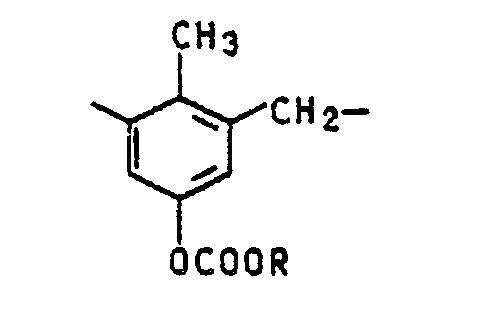
- Radiation-sensitive mixtures with polymeric binders (a) based on polymers of p-hydroxystyrene and / or p-hydroxy- ⁇ -methylstyrene, the phenolic hydroxyl groups of which are 5 to 40 mol% by C5 to C9 alk (s), are preferred. yloxicarbonyloxy residues are replaced, as well as novolaks based on p-cresol and formaldehyde, wherein 5 to 40 mol% of the p-cresol units by groups of the formula are replaced, and R represents an alkyl, alkenyl, alkynyl, cycloalkyl or cycloalkenyl radical each having 5 to 9 carbon atoms.
- Preferred organic compounds (b) are sulfonium salts of the general formula (I) wherein R1, R2 and R3 are the same or different from each other and stand for aliphatic and / or aromatic radicals, which may contain heteroatoms, or two of the radicals R1 to R3 are linked together to form a ring, with the proviso that at least one of the radicals R1 to R3 contains at least one group which can be split off by acid, it being possible for one of the radicals R1 to R3 to be linked to one or more further sulfonium salt radicals , optionally via groups which can be split off by acid, and X ⁇ is a non- nucleophilic counterion.
- R1, R2 and R3 are the same or different from each other and stand for aliphatic and / or aromatic radicals, which may contain heteroatoms, or two of the radicals R1 to R3 are linked together to form a ring, with the proviso that at least one of the radicals R1 to R
- the present invention also relates to a method for producing relief patterns and relief images, a radiation-sensitive mixture according to the invention being used as the photosensitive coating materials.
- the radiation-sensitive mixture After exposure of the radiation-sensitive mixture, it is preferably heated to temperatures between 60 and 120 ° C.
- the radiation-sensitive mixtures according to the invention are distinguished by high transparency in the wavelength range around 250 nm, high sensitivity to short-wave UV radiation ( ⁇ 300 nm) and good resistance to fluorine-containing etching gases. They are therefore ideal for use in deep / UV lithography.
- the polymers (a) according to the invention can be used particularly advantageously as binders in photoresists, since they enable good surface quality, little removal in the unexposed areas and development without swelling that limits resolution.
- phenolic resins such as novolaks, poly- (p-hydroxystyrenes), poly- (p-hydroxy- ⁇ -methylstyrenes) or copolymers of p-hydroxystyrene or p-Hydroxy- ⁇ -methylstyrene, which contain pendant C5 to C9 alkyl carbonate groups, into consideration.
- p-cresol / formaldehyde novolaks whose p-cresol units account for 5 to 40 mol% of the cresol units where R has the meaning given above, are replaced.
- Sterically demanding alcohol radicals RO- having 5 to 9, in particular 5 to 7, carbon atoms, which can also be ethylenically or acetylenically unsaturated, are preferred, such as, for example, cyclohexyloxy, 1-methylcyclohexyloxy, 2-methyl-3-butene -2-oxi, 2-methyl-butane-2-oxi, 2-methyl-hexane-2-oxi, 3-methyl-1-pentene-3-oxi, 3-methyl-pentane-3-oxi -, 2-Methyl-pentan-2-oxi, 3-methyl-2-butanol and 2-methyl-3-butyne-2-oxi residues.
- novolaks are those such as are described, for example, in "Novolak Resins Used in Positive Resist Systems” by T. Pampalone in Solid State Technology, June 1984, pages 115-120.
- Novolaks made of p-cresol and formaldehyde are preferred for exposure in the short-wave UV region. These novolaks can then e.g. with di-t-amyl dicarbonate in the presence of potassium t-butoxide in, for example, tetrahydrofuran so that 5 to 40 mol.% of the phenolic groups are reacted.
- Phenolic resins based on hydroxystyrenes can be copolymerized radically or ionically from several unsaturated monomers by conventional methods.
- Unsaturated components which can preferably be copolymerized are, for example, substituted and unsubstituted hydroxystyrenes, such as p-hydroxistyrene, m-hydroxistyrene, p- (2-methyl-hexane-2-oxy-carbonyloxy) styrene, p- (t-amyloxy) carbonyl-oxi) styrene, p-hydroxy- ⁇ -methyl-styrene or p- (cyclohexyloxi-carbonyl-oxi -) - ⁇ -methylstyrene.
- polymers based on hydroxistyrenes to be used according to the invention can also be obtained by polymer-analogous reaction of e.g. Poly- (p-hydroxystyrene) with the corresponding stoichiometric amounts of pyrocarbonate dialkyl ester, chlorocarbonate alkyl ester or imidazole-N-carboxylic acid alkyl ester are prepared, the alkyl groups of these compounds each having 5 to 9 carbon atoms.
- Poly- (p-hydroxystyrene) with the corresponding stoichiometric amounts of pyrocarbonate dialkyl ester, chlorocarbonate alkyl ester or imidazole-N-carboxylic acid alkyl ester are prepared, the alkyl groups of these compounds each having 5 to 9 carbon atoms.
- the tertiary alcohols can preferably be reacted using the latter method, by first analogous to a process by H. Staab in Angew. Chemie, 12, page 407-423 (1962), the imidazole-N-carboxylic acid alkyl esters and then at elevated temperature, optionally with catalytic amounts of alcoholate or imidazole sodium, in a polymer-analogous reaction with, for example, poly-p-hydroxystyrene or poly-p- hydroxy- ⁇ -methylstyrene are implemented.
- the reaction with chlorocarbonic acid alkyl esters is usually carried out in the presence of bases, e.g. Pyridine, carried out by known methods.
- poly- (p-hydroxystyrene) can furthermore be reacted with the corresponding stoichiometric amount of pyrocarbonic acid dialkyl ester, poly- (p-hydroxystyrene) being dissolved in tetrahydrofuran and with the corresponding amount of potassium t-butoxide is added and then, for example, the pyrocarbonate t-amyl ester, dissolved in tetrahydrofuran, is added dropwise.
- the Polymers according to the invention can be obtained by precipitation in water and purified by reprecipitation several times.
- the polymeric binder (a) contains 5 to 40, preferably 10 to 30, mol% of monomer unit units RO- -O groupings polymerized or condensed or the RO- -O groupings introduced in an appropriate amount by polymer-analogous implementation.
- composition of the copolymers is advantageously determined by thermogravimetric analysis and H-NMR spectroscopy.
- the invention is not limited to the copolymers mentioned above, rather all alkali-soluble copolymers of p-hydroxystyrene can be used which, according to the invention, contain hydrophobic comonomers RO- -O groupings included, but preferred are those which contain a p-hydroxystyrene derivative as a further comonomer unit, in which the phenolic OH group is protected with alkyl carbonates, the alkyl radical containing 5 to 9 carbon atoms.
- the polymeric binder (a) is generally present in the radiation-sensitive mixture according to the invention in an amount of 70 to 98, preferably 80 to 95% by weight, based on the total amount of (a) + (b).
- Preferred organic compounds (b) are those which contain at least one sulfonium salt group and at least one t-butyl carbonate group or at least one silyl ether group. However, other compounds can also be used which form a strong acid under irradiation and which contain an acid-cleavable bond in the same molecule.
- Preferred organic compounds (b) are those of the general formula (I) wherein R1, R2 and R3 are the same or different from each other and stand for aliphatic and / or aromatic radicals, which may contain heteroatoms, or two of the radicals R1 to R3 are linked together to form a ring, with the proviso that at least one of the radicals R1 until R3 contains at least one group which can be split by acid, it being possible for one of the radicals R1 to R3 to be linked to one or more further sulfonium salt radicals , optionally via groups which can be split by acid, and X ⁇ is a non-nucleophilic counterion, such as, for example, dimethyl-4-t- butoxicarbonyloxiphenyl sulfonium salt with hexafluoroarsenate, hexafluoroantimonate, hexafluorophosphate and / or hexafluoroborate as counter ion, phenyl bis- (4
- Component (b) is generally present in the radiation-sensitive mixture according to the invention in an amount of 2 to 30, preferably 5 to 20,% by weight, based on the sum of the percentages by weight of (a) and (b).
- the radiation-sensitive mixtures according to the invention are sensitive to X-ray, electron and UV radiation. If necessary, small amounts of sensitizers, such as pyrene and perylene, can be added to sensitize the compounds in the longer-wave UV to the visible wavelength range. For the exposure in special wavelength ranges, such as in short-wave UV ( ⁇ 300 nm), a high transparency of the layers is required at the respective exposure wavelength. In common exposure devices based on mercury lamps, the 254 nm line is used or excimer lasers are used which emit at 248 nm (KrF). Radiation-sensitive recording materials should therefore have the lowest possible optical densities in this area.
- sensitizers such as pyrene and perylene
- alkali-soluble binders to be used according to the invention which contain 5 to 40 mol% of hydrophobic comonomers with C5 to C9 alkyl carbonate groups, low optical densities in the wavelength range around 250 nm can be set, since the proportion of the solubility-inhibiting components (b), for example in the Can reduce compared to poly-p-hydroxystyrene without pendant hydrophobic groups.
- the mass loss is significantly reduced compared to the polymers described in US-A-4,491,628.
- the proportion of the hydrophobic monomer unit can be reduced in a particularly advantageous manner to proportions well below 40% if the hydrophobic C5-C9-alkyl carbonate groupings are sterically demanding alcohol residues, e.g. Contain t-amyl, cyclohexyl, methylhexyl or methylpentyl.
- a radiation-sensitive recording layer which essentially consists of the radiation-sensitive mixture according to the invention, is irradiated imagewise in such a dose that the solubility of the exposed areas after a thermal baking step at temperatures between 60 ° C. and 120 ° C. aqueous alkaline solvents increases and these areas can be removed selectively with the alkaline developer.
- the polymeric binder (a) and between 2 to 30% by weight, particularly preferably between 5 and 20% by weight, of a compound of type (b), based on the total weight of the compounds (a) and (b), are preferably used Methyl glycol acetate or methyl propylene glycol acetate dissolved, the solids content of the solution advantageously being between 10 and 30% by weight.
- the solution can be passed through a filter with a pore diameter of 0.2 ⁇ m are filtered.
- a resist film can be produced on the wafer by spinning on this resist solution at speeds between 1000 and 10,000 rpm.
- the wafer is then preferably baked at 90 ° C. or 80 ° C. for between 1 and 5 minutes.
- the films can then be irradiated through a chromium-coated structured quartz mask with UV light from a mercury lamp, with excimer laser light, electron beams or X-rays and the irradiated films can be heated at temperatures between 60 ° C. and 120 ° C. for between 5 seconds and 2 minutes.
- the films treated in this way are then developed with alkaline developers, optionally containing alcohols, the exposed areas selectively detaching, while only little removal takes place in the unexposed areas.
- a photoresist solution is made from 10 parts of tris (4-t-butoxicarbonyloxiphenyl) sulfonium hexafluoroarsenate, 90 parts of a copolymer of 70 mol% p-hydroxystyrene and 30 mol% p-tert-amyloxicarbonyloxistyrene ( M w (light scattering) 65,000 g / mol) and 400 parts of methyl propylene glycol acetate.
- the solution is filtered through a filter with a pore diameter of 0.2 ⁇ m and spun onto a silicon wafer with an SiO2 film in a layer thickness of approximately 1.0 ⁇ m (dry). The wafer is dried for one minute at 90 ° C.
- a photoresist solution is made up of 10 parts of tris (4-t-butoxycarbonyloxyphenyl) sulfonium hexafluoroarsenate, 90 parts of poly (p-hydroxistyrene) ( M w (light scattering) 62,000 g / mol) and 400 parts of methyl propylene glycol acetate.
- the procedure is as in Example 1.
- the exposed areas can also be completely removed here during the 30 second development time, but there is a considerable removal of the unexposed areas (52%).
- a photoresist solution was therefore prepared from 20 parts of tris (4-t-butoxicarbonyloxiphenyl) sulfonium hexafluoroarsenate, 80 parts of poly (p-hydroxistyrene) and 300 parts of methyl propylene glycol acetate.
- the optical density of a 1 ⁇ m thick layer is 1.05. The procedure is as in Example 1, but exposure is required for 11 seconds in order to completely remove the exposed areas under the same conditions.
- the resist profiles also have slanted edges.
- This comparative example shows that the use of commercially available sulfonium salts (without acid-labile groups) likewise does not meet the desired reduction in dark erosion to values less than 5%.
- a photoresist solution is prepared from 10 parts of triphenylsulfonium hexafluoroarsenate, 90 parts of the poly- (p-hydroxystyrene-co-30 mol.% T-amyloxicarbonyloxistyrene) mentioned in Example 1 and 400 parts of methyl propylene glycol acetate.
- the solution is filtered through a filter with a pore diameter of 0.2 ⁇ m and spun onto a silicon wafer with an SiO2 film in a layer thickness of 1.03 ⁇ m.
- the wafer is dried at 90 ° C for one minute and then treated with a developer of pH 13.0 for 30 seconds. There is considerable erosion of the unexposed areas (26%).
- a photoresist solution is prepared from 10 parts of tris (4-t-butoxycarbonyloxiphenyl) sulfonium hexafluorophosphate, 90 parts of a copolymer of 80 mol% p-hydroxystyrene and 20 mol% p-2-methyl-hexyl-2-oxycarbonyloxistyrene (K. -Value according to Fikentscher (measured in ethyl acetate: 30.5) and 400 parts of methyl propylene glycol acetate and filtered through a filter with a pore size of 0.2 ⁇ m.
- the photoresist solution is spun onto a silicon wafer, so that a layer thickness of approximately 1 ⁇ m results.
- the wafer is then baked at 80 ° C. for 5 minutes and exposed to a structured test mask in the contact process for 10 seconds using excimer laser light with a wavelength of 248 nm. It is then heated for 60 seconds at 80 ° C. and then developed for 60 seconds with an alkaline developer with a pH of 12.5. Good resist structures are obtained, with no removal of the unexposed areas being measurable.
- a photoresist solution is prepared by mixing 10 parts of tris (4-t-butoxicarbonyloxiphenyl) sulfonium hexafluoroarsenate and 90 parts of a copolymer of 75 mol% p-hydroxistyrene and 25 mol% p-cyclohexyloxicarbonyloxistyrene (K value according to Fikentscher (measured in Ethyl acetate): 26) in 400 parts of ethyl cellosolve acetate and filtered through a filter with a pore size of 0.2 ⁇ m.
- the resist solution is spun onto a silicon wafer, so that a layer thickness of 1 ⁇ m results. It is heated for 5 minutes at 80 ° C. and then exposed for 3 seconds to excimer laser light with a wavelength of 248 nm through a test mask using the contact method. After baking for 60 seconds at 90 ° C., an alkaline developer of pH 12.10 is used for 30 seconds. The exposed areas are completely removed, while the removal of the unexposed areas is less than 2%.
- Example 3 The procedure is as in Example 3, but the polymer used is a copolymer of 88 mol% p-hydroxystyrene and 12 mol% p- (t-amyloxycarbonyloxy) styrene ( M w (light scattering) 45,000 g / mol) is used. The removal of the unexposed areas is approx. 7%. Good quality resist patterns are obtained.
Landscapes
- Physics & Mathematics (AREA)
- Spectroscopy & Molecular Physics (AREA)
- General Physics & Mathematics (AREA)
- Materials For Photolithography (AREA)
- Exposure And Positioning Against Photoresist Photosensitive Materials (AREA)
Abstract
Description
- Die Erfindung betrifft positiv arbeitende strahlungsempfindliche Gemische, die ein wäßrig-alkalisch lösliches Bindemittel, welches bis zu 40 % hydrophobe Comonomereinheiten einpolymerisiert enthält, und eine Verbindung, die mindestens eine durch Säure spaltbare Bindung enthält und unter Einwirkung von Strahlung eine starke Säure bildet, wobei die Löslichkeit der Verbindung in einem alkalischen Lösungsmittel durch die Einwirkung der Säure erhöht wird, enthalten. Diese Gemische sind sensitiv gegenüber UV-, Elektronen- und Röntgenstrahlen und eignen sich besonders als Resistmaterialien und zur Herstellung von Reliefmustern.
- Positiv arbeitende strahlungsempfindliche Gemische sind bekannt. Besonders positiv arbeitende Resistmaterialien, die o-Chinondiazide in wäßrig-alkalisch löslichen Bindemitteln, z.B. Novolaken enthalten, werden kommerziell eingesetzt. Die Empfindlichkeit dieser Systeme gegenüber Strahlung, insbesondere kurzwelliger Strahlung, ist jedoch teilweise unbefriedigend.
- Empfindlichkeitserhöhungen in strahlungsempfindlichen Systemen, die in der Primärphotoreaktion eine Spezies erzeugen, die dann unabhängig von der Strahlung eine katalytische Sekundärreaktion auslösen, sind beschrieben. In der US-A-3 915 706 werden beispielsweise Photoinitiatoren beschrieben, die eine starke Säure erzeugen, die dann in einer Sekundärreaktion säurelabile Gruppen, wie Polyaldehydgruppierungen spalten.
- Weiterhin sind strahlungsempfindliche Gemische auf Basis von säurespaltbaren Verbindungen bekannt, die als Bindemittel ein wäßrig-alkalisch lösliches Polymer, sowie eine Verbindung die photochemisch eine starke Säure bildet und eine weitere Verbindung mit durch Säure spaltbaren Bindungen, die durch die Einwirkung der Säure ihre Löslichkeit in einem alkalischen Entwickler erhöhen, enthalten (vgl. z.B. DE-A-3 406 927). Als photochemisch eine starke Säure bildende Verbindungen werden Diazonium-, Phosphonium-, Sulfonium- und Iodonium-, sowie Halogenverbindungen genannt. Die Verwendung dieser Oniumsalze als photochemische Säurespender in Resistmaterialien ist z.B. auch aus US-A-4 491 628 bekannt. Einen Überblick über die Anwendung von Oniumsalzen in Resistmaterialien gibt Crivello in Org. Coatings and Appl. Polym. Sci., 48, S. 65-69 (1985). Nachteilig bei diesen Photoinitiatoren ist, daß durch die Einwirkung der Strahlung neben der gebildeten Säure keine weiteren Photoprodukte entstehen, die eine Erhöhung der Löslichkeit im alkalischen Entwickler bewirken. Weiterhin benötigen diese Gemische zwingend drei Komponenten.
- Strahlungsempfindliche Gemische von Polymeren mit säurelabilen Seitengruppen und photochemischen Säurespendern sind z.B. aus US-A-4 491 628 und FR-A-2 570 844 bekannt. Diese polymeren Bindemittel sind jedoch hydrophob und werden erst nach der Belichtung alkalilöslich. Die Polymeren sind also so ausgelegt, daß durch die Einwirkung von Säure eine große Differenzierung der Polarität erhalten wird. Sie enthalten daher wiederkehrende Einheiten mit säurelabilen Gruppen, so daß die Abspaltung dieser Gruppen einen großen Massenverlust bedingt.
- In DE-A-3 721 741 werden strahlungsempfindliche Gemische vorgeschlagen, die ein in wäßrig-alkalischen Lösungen lösliches polymeres Bindemittel enthalten sowie eine organische Verbindung, deren Löslichkeit in einem wäßrig-alkalischen Entwickler durch Einwirkung von Säure erhöht wird und die mindestens eine durch Säure spaltbare Gruppierung enthält, wobei diese organische Verbindung unter Einwirkung von Strahlung eine starke Säure erzeugt. Für bestimmte Anwendungszwecke haben diese Systeme jedoch Nachteile. In diesen Systemen hat die organische Verbindung zwei Aufgaben, nämlich die Löslichkeit des polymeren Bindemittels vor der Belichtung zu reduzieren und nach der Belichtung zu erhöhen und zudem muß die Verbindung strahlungsempfindlich sein. Für bestimmte Anwendungen ist es jedoch vorteilhaft, den Anteil der photoaktiven organischen Verbindung zu reduzieren, z.B. um eine höhere Transparenz im kurzwelligen UV-Gebiet (im Bereich von 250 nm) zu erhalten, so daß die Aufgabe der Löslichkeitsinhibierung durch andere Maßnahmen unterstützt werden muß.
- Aufgabe der vorliegenden Erfindung ist es, hochreaktive strahlungsempfindliche Systeme für die Herstellung von Reliefstrukturen zur Verfügung zu stellen, die sich mit wäßrig-alkalischen Lösungen entwickeln lassen und die die Herstellung von lichtempfindlichen Schichten mit hoher Transparenz im kurzwelligen UV ermöglichen, ohne daß übermäßige Massenverluste auftreten.
- Überraschenderweise kann diese Aufgabe durch den Einbau von Alkylcarbonatgruppierungen mit 5 bis 9 Kohlenstoffatomen in der Alkylgruppe sehr vorteilhaft gelöst werden.
- Gegenstand der vorliegenden Erfindung ist ein strahlungsempfindliches Gemisch, enthaltend
- (a) ein in Wasser unlösliches, in wäßrig-alkalischen Lösungen lösliches polymeres Bindemittel und
- (b) eine organische Verbindung, deren Löslichkeit in einem wäßrig-alkalischen Entwickler durch Einwirkung von Säure erhöht wird und die mindestens eine durch Säure spaltbare Gruppierung sowie zusätzlich eine Gruppierung, die unter Einwirkung von Strahlung eine starke Säure bildet, enthält,
- Bevorzugt sind dabei strahlungsempfindliche Gemische mit polymeren Bindemitteln (a) auf Basis von Polymeren des p-Hydroxistyrols und/oder p-Hydroxi-α-methylstyrols, deren phenolische Hydroxylgruppen zu 5 bis 40 Mol.% durch C₅- bis C₉-Alk(en)yloxicarbonyloxireste ersetzt sind, sowie Novolake auf Basis von p-Kresol und Formaldehyd, worin 5 bis 40 Mol.% der p-Kresoleinheiten durch Gruppierungen der Formel

- Als organische Verbindung (b) sind Sulfoniumsalze der allgemeinen Formel (I) bevorzugt

- Gegenstand der vorliegenden Erfindung ist auch ein Verfahren zur Herstellung von Reliefmustern und Reliefbildern, wobei man als lichtempfindliche Beschichtungsmateralien ein erfindungsgemäßes strahlungsempfindliches Gemisch einsetzt.
- Vorzugsweise wird nach der Belichtung des strahlungsempfindlichen Gemisches auf Temperaturen zwischen 60 und 120°C erhitzt.
- Die erfindungsgemäßen strahlungsempfindlichen Gemische zeichnen sich durch hohe Transparenz im Wellenlängenbereich um 250 nm, hohe Empfindlichkeit gegenüber kurzwelliger UV-Strahlung (< 300 nm) und gute Resistenz gegenüber fluorhaltigen Ätzgasen aus. Sie sind daher ideal für die Anwendung in der Deep/UV-Lithographie geeignet. Die erfindungsgemäßen Polymeren (a) können besonders vorteilhaft als Bindemittel in Photoresisten eingesetzt werden, da sie gute Oberflächenqualität, wenig Abtrag in den unbelichteten Bereichen und Entwicklung ohne auflösungsbegrenzende Quellung ermöglichen.
- Zu den Aufbaukomponenten des erfindungsgemäßen Gemisches ist im einzelnen folgendes auszuführen.
- a) Als in Wasser unlösliche, in wäßrig-alkalischen Lösungen lösliche polymere Bindemittel kommen bevorzugt phenolische Harze, wie z.B. Novolake, Poly-(p-hydroxistyrole), Poly-(p-hydroxi-α-methylstyrole) oder Copolymere von p-Hydroxistyrol bzw. p-Hydroxi-α-methylstyrol, die seitenständige C₅- bis C₉-Alkylcarbonatgruppen enthalten, in Betracht.
- Beispielsweise können derartige alkylcarbonathaltige Polymere der nachfolgenden allgemeinen Formel (II)


- Ebenso eignen sich p-Kresol/Formaldehyd-Novolake, deren p-Kresoleinheiten zu 5 bis 40 Mol.% der Kresoleinheiten durch

- Bevorzugt sind sterisch anspruchsvolle Alkoholreste R-O- mit 5 bis 9, insbesondere 5 bis 7 Kohlenstoffatomen, die auch ethylenisch oder acetylenisch ungesättigt sein können, wie beispielsweise Cyclohexyl-oxi-, 1-Methyl-cyclohexyl-oxi-, 2-Methyl-3-buten-2-oxi-, 2-Methyl-butan-2-oxi-, 2-Methyl-hexan-2-oxi-, 3-Methyl-1-penten-3-oxi-, 3-Methyl-pentan-3-oxi-, 2-Methyl-pentan-2-oxi-, 3-Methyl-2-butanol und 2-Methyl-3-butin-2-oxi-reste.
- Als Novolake kommen im Prinzip solche in Frage, wie sie z.B. in "Novolak Resins Used in Positiv Resist Systems" von T. Pampalone in Solid State Technology, June 1984, Seite 115-120, beschrieben sind.
- Für spezielle Anwendungen, z.B. für Belichtung im kurzwelligen UV-Gebiet kommen bevorzugt Novolake aus p-Kresol und Formaldehyd in Frage. Diese Novolake können dann z.B. mit Di-t-amyl-dicarbonat in Gegenwart von Kalium-t-butylat in beispielsweise Tetrahydrofuran so umgesetzt werden, daß 5 bis 40 Mol.% der phenolischen Gruppen umgesetzt werden.
- Phenolische Harze auf Basis von Hydroxystyrolen können nach gängigen Methoden radikalisch oder ionisch aus mehreren ungesättigten Monomeren copolymerisiert werden. Ungesättigte Komponenten, welche bevorzugt copolymerisiert werden können, sind beispielsweise substituierte und unsubstituierte Hydroxistyrole, wie p-Hydroxistyrol, m-Hydroxistyrol, p-(2-Methyl-hexan-2-oxi-carbonyloxi-)styrol, p-(t-Amyloxi-carbonyl-oxi-)styrol, p-Hydroxi-α-methyl-styrol oder p-(Cyclohexyloxi-carbonyl-oxi-)-α-methylstyrol.
- Diese erfindungsgemäß einzusetzenden Polymeren auf Basis von Hydroxistyrolen können ebenfalls durch polymeranaloge Umsetzung von z.B. Poly-(p-hydroxistyrol) mit den entsprechenden stöchiometrischen Mengen Pyrokohlensäure-dialkylester, Chlorkohlensäure-alkylester oder Imidazol-N-carbonsäurealkylester hergestellt werden, wobei die Alkylgruppen dieser Verbindungen jeweils 5 bis 9 C-Atome aufweisen.
- Besonders die tertiären Alkohole lassen sich bevorzugt nach der letztgenannten Methode umsetzen, indem zuerst analog einem Verfahren von H. Staab in Angew. Chemie, 12, Seite 407-423 (1962), die Imidazol-N-Carbonsäurealkylester hergestellt und diese dann bei erhöhter Temperatur, gegebenenfalls mit katalytischen Mengen Alkoholat oder Imidazolnatrium, in einer polymeranalogen Umsetzung mit beispielsweise Poly-p-hydroxystyrol oder Poly-p-hydroxy-α-methylstyrol umgesetzt werden.
- Die Umsetzung mit Chlorkohlensäurealkylestern wird üblicherweise in Gegenwart von Basen, z.B. Pyridin, nach bekannten Verfahren durchgeführt.
- Zur Einführung der Alkylcarbonatgruppe mit 5 bis 9 Kohlenstoffatomen in der Alkylgruppe kann weiterhin beispielsweise Poly-(p-hydroxystyrol) mit der entsprechenden stöchiometrischen Menge Pyrokohlensäure-dialkylester umgesetzt werden, wobei Poly-(p-hydroxistyrol) in Tetrahydrofuran gelöst und mit der entsprechenden Menge Kalium-t-butylat versetzt wird und anschließend beispielsweise der Pyrokohlensäure-t-amylester, gelöst in Tetrahydrofuran, zugetropft wird. Das erfindungsgemäße Polymere kann durch Fällen in Wasser gewonnen und durch mehrmaliges Umfällen gereinigt werden.
- Erfindungsgemäß enthält das polymere Bindemittel (a) 5 bis 40, vorzugsweise 10 bis 30 Mol.% Monomereineinheiten mit
R-O--O-Gruppierungen
einpolymerisiert oder einkondensiert oder die
R-O--O-Gruppierungen
in entsprechender Menge durch polymeranaloge Umsetzung eingeführt. - Die Zusammensetzung der Copolymeren wird zweckmäßigerweise durch thermogravimetrische Analyse und H-NMR-Spektroskopie bestimmt.
- Die Erfindung ist nicht auf die oben erwähnten Copolymeren beschränkt, vielmehr können alle alkalilöslichen Copolymere von p-Hydroxistyrol verwandt werden, welche erfindungsgemäß hydrophobe Comonomere mit
R-O--O-Gruppierungen
enthalten, bevorzugt sind jedoch solche, die als weitere Comonomereinheit ein p-Hydroxistyrolderivat enthalten, in welchem die phenolische OH-Gruppe mit Alkylcarbonaten geschützt ist, wobei der Alkylrest 5 bis 9 Kohlenstoffatome enthält. - Das polymere Bindemittel (a) ist im erfindungsgemäßen strahlungsempfindlichen Gemisch im allgemeinen in einer Menge von 70 bis 98, vorzugsweise 80 bis 95 Gew.%, bezogen auf die Gesamtmenge von (a) + (b) enthalten.
- (b) Als organische Verbindungen (b) sind solche bevorzugt, welche mindestens eine Sulfoniumsalzgruppierung und mindestens eine t-Butylcarbonatgruppierung oder mindestens eine Silylethergruppierung enthalten. Es können jedoch auch andere Verbindungen verwandt werden, welche unter Bestrahlung eine starke Säure bilden und im gleichen Molekül eine säurespaltbare Bindung enthalten.
- Bevorzugte organische Verbindungen (b) sind solche der allgemeinen Formel (I)

- Besonders bevorzugte derartige organische Verbindungen (b) sind solche der allgemeinen Formel (IV)

- Die Synthese der organischen Verbindungen (b) ist beispielsweise in DE-A-37 21 741 bzw. DE-A-37 21 740 beschrieben.
- Komponente (b) ist im erfindungsgemäßen strahlungsempfindlichen Gemisch im allgemeinen in einer Menge von 2 bis 30, vorzugsweise 5 bis 20 Gew.%, bezogen auf die Summe der Gewichtsprozente von (a) und (b) enthalten.
- Die erfindungsgemäßen strahlungsempfindlichen Gemische sind sensitiv gegenüber Röntgen-, Elektronen- und UV-Strahlung. Gegebenenfalls können Sensibilisatoren in geringen Mengen zugesetzt werden, wie beispielsweise Pyren und Perylen, um die Verbindungen im längerwelligen UV- bis hin zum sichtbaren Wellenlängenbereich zu sensibilisieren. Für die Belichtung in speziellen Wellenlängenbereichen, wie beispielsweise im kurzwelligen UV (< 300 nm), ist eine hohe Transparenz der Schichten bei der jeweiligen Belichtungswellenlänge gefordert. In gängigen Belichtungsgeräten auf Basis von Quecksilberlampen nutzt man die 254 nm Linie oder man verwendet Excimer-Laser, die bei 248 nm (KrF) emittieren. Strahlungsempfindliche Aufzeichnungsmaterialien sollten deshalb in diesem Bereich möglichst niedrige optische Dichten aufweisen.
- Mit den erfindungsgemäß einzusetzenden alkalilöslichen Bindemitteln, die 5 bis 40 Mol.% hydrophobe Comonomere mit C₅- bis C₉-Alkylcarbonatgruppierungen enthalten, lassen sich niedrige optische Dichten im Wellenlängenbereich um 250 nm einstellen, da man den Anteil der löslichkeitsinhibierenden Komponenten (b), beispielsweise im Vergleich zu Poly-p-hydroxistyrol ohne seitenständige hydrophobe Gruppen reduzieren kann.
- Der Massenverlust ist gegenüber den in US-A-4 491 628 beschriebenen Polymeren wesentlich reduziert.
- Der Anteil der hydrophoben Monomereinheit läßt sich in besonders vorteilhafter Weise auf Anteile deutlich unter 40 % verringern, wenn die hydrophoben C₅-C₉-Alkylcarbonatgruppierungen sterisch anspruchsvolle Alkoholreste, wie z.B. t-Amyl-, Cyclohexyl-, Methylhexyl- oder Methylpentyl- enthalten.
- Bei dem erfindungsgemäßen Verfahren zur Herstellung von Reliefmustern wird eine strahlungsempfindliche Aufzeichnungsschicht, die im wesentlichen aus dem erfindungsgemäßen strahlungsempfindlichen Gemisch besteht, bildmäßig in solcher Dosis bestrahlt, daß die Löslichkeit der belichteten Bereiche nach einem thermischen Ausheizschritt bei Temperaturen zwischen 60°C und 120°C in wäßrig-alkalischen Lösungsmitteln zunimmt und diese Bereiche selektiv mit dem alkalischen Entwickler entfernt werden können.
- Vorzugsweise wird z.B. das polymere Bindemittel (a) und zwischen 2 bis 30 Gew.%, besonders bevorzugt zwischen 5 und 20 Gew.% einer Verbindung des Typs (b), bezogen auf das Gesamtgewicht der Verbindungen (a) und (b), in Methylglykolacetat oder Methyl-propylenglykol-acetat gelöst, wobei der Feststoffgehalt der Lösung zweckmäßigerweise zwischen 10 und 30 Gew.% beträgt. Die Lösung kann durch ein Filter mit einem Porendurchmesser von 0,2 µm filtriert werden. Durch Aufschleudern dieser Resistlösung bei Umdrehungszahlen zwischen 1000 und 10 000 U/Minute kann ein Resistfilm auf dem Wafer erzeugt werden. Der Wafer wird dann vorzugsweise zwischen 1 und 5 Minuten bei 90°C bzw. 80°C ausgeheizt. Die Filme können dann durch eine chrombeschichtete strukturierte Quarzmaske mit UV-Licht einer Quecksilberlampe, mit Excimer-Laserlicht, Elektronen- oder Röntgenstrahlen bestrahlt und die bestrahlten Filme zwischen 5 Sekunden und 2 Minuten bei Temperaturen zwischen 60°C und 120°C ausgeheizt werden. Die so behandelten Filme werden hierauf mit alkalischen, gegebenenfalls Alkohole enthaltenden Entwicklern entwickelt, wobei sich die belichteten Bereiche selektiv ablösen, während in den unbelichteten Bereichen nur wenig Abtrag stattfindet.
- Die in den Beispielen und Vergleichsbeispielen genannten Teile und Prozente sind, soweit nicht anders angegeben, Gewichtsteile und Gewichtsprozente.
- Eine Photoresistlösung wird aus 10 Teilen Tris-(4-t-butoxicarbonyloxiphenyl-)sulfoniumhexafluoroarsenat, 90 Teilen eines Copolymerisats aus 70 Mol.% p-Hydroxistyrol und 30 Mol.% p-tert.-Amyloxicarbonyloxistyrol (
M w (Lichtstreuung) 65 000 g/mol) und 400 Teilen Methylpropylenglykolacetat hergestellt. Die Lösung wird durch ein Filter mit einem Porendurchmesser von 0,2 µm filtriert und auf einen Siliziumwafer mit einem SiO₂-Film in einer Schichtdicke von ca. 1,0 µm (trocken) aufgeschleudert. Der Wafer wird eine Minute bei 90°C getrocknet und anschließend mit einer bildmäßig strukturierten Testmaske im Kontaktverfahren 3 Sekunden mit Excimer-Laserlicht der Wellenlänge 248 nm belichtet. Danach wird 60 Sekunden bei 80°C ausgeheizt und mit einem Entwickler vom pH-Wert 13,00 30 Sekunden entwickelt. Die belichteten Bereiche sind vollständig abgetragen, während kein Abtrag der unbelichteten Bereiche mit einem Profilometer (α-step der Fa. Tencor) meßbar ist. Die Resistmuster zeigen vertikale Flanken. - Eine Photoresistlösung wird aus 10 Teilen Tris-(4-t-butoxicarbonyloxi-phenyl-)sulfoniumhexafluoroarsenat, 90 Teilen Poly-(p-hydroxistyrol) (
M w (Lichtstreuung) 62 000 g/mol) und 400 Teilen Methylpropylenglykolacetat hergestellt. Es wird wie in Beispiel 1 verfahren. Die belichteten Bereiche lassen sich auch hier während der 30 Sekunden Entwicklungszeit vollständig abtragen, jedoch findet ein erheblicher Abtrag der unbelichteten Bereiche (52 %) statt. - Um den Abtrag in den unbelichteten Bereichen zu reduzieren, kann man den Anteil der Sulfoniumsalze erhöhen. Daher wurde eine Photoresistlösung aus 20 Teilen Tris-(4-t-butoxicarbonyloxiphenyl)-sulfoniumhexafluoroarsenat, 80 Teilen Poly-(p-hydroxistyrol) und 300 Teilen Methyl-propylenglykol-acetat hergestellt. Die optische Dichte einer 1 µm dicken Schicht beträgt 1,05. Es wird wie in Beispiel 1 verfahren, jedoch muß man 11 Sekunden belichten, um die belichteten Bereiche unter den gleichen Bedingungen vollständig abzutragen. Die Resistprofile weisen außerdem schräge Kanten auf.
- Dieses Vergleichsbeispiel zeigt, daß die Verwendung von kommerziell erhältlichen Sulfoniumsalzen (ohne säurelabile Gruppen), ebenfalls nicht die erwünschte Reduzierung des Dunkelabtrages auf Werte kleiner 5 % erfüllt.
- Eine Photoresistlösung wird aus 10 Teilen Triphenylsulfoniumhexafluoroarsenat, 90 Teilen des in Beispiel 1 genannten Poly-(p-hydroxistyrol-co-30 Mol.% t-amyloxicarbonyloxistyrol) und 400 Teilen Methylpropylenglykolacetat hergestellt. Die Lösung wird durch ein Filter mit einem Porendurchmesser von 0,2 µm filtriert und auf einen Siliziumwafer mit einem SiO₂-Film in einer Schichtdicke von 1,03 µm aufgeschleudert. Der Wafer wird eine Minute bei 90°C getrocknet und dann mit einem Entwickler vom pH-Wert 13,0 während 30 Sekunden behandelt. Es findet erheblicher Abtrag der unbelichteten Bereiche (26 %) statt.
- Eine Photoresistlösung wird aus 10 Teilen Tris-(4-t-butoxicarbonyloxiphenyl-)sulfoniumhexafluorophosphat, 90 Teilen eines Copolymeren aus 80 Mol.% p-Hydroxistyrol und 20 Mol.% p-2-Methyl-hexyl-2-oxi-carbonyloxistyrol (K-Wert nach Fikentscher (gemessen in Ethylacetat): 30,5) und 400 Teilen Methylpropylenglykolacetat hergestellt und durch einen Filter mit der Porenweite 0,2 µm filtriert. Die Photoresistlösung wird auf einen Siliziumwafer aufgeschleudert, so daß eine Schichtdicke von ca. 1 µm resultiert. Anschließend wird der Wafer 5 Minuten bei 80°C ausgeheizt und mit einer strukturierten Testmaske im Kontaktverfahren während 10 Sekunden mit Excimer-Laserlicht der Wellenlänge 248 nm belichtet. Man heizt anschließend 60 Sekunden bei 80°C aus und entwickelt dann während 60 Sekunden mit einem alkalischen Entwickler vom pH-Wert 12,5. Es werden gute Resiststrukturen erhalten, wobei kein Abtrag der unbelichteten Bereiche meßbar ist.
- Eine Photoresistlösung wird hergestellt, indem man 10 Teile Tris-(4-t-butoxicarbonyloxiphenyl-)sulfoniumhexafluoroarsenat und 90 Teile eines Copolymeren aus 75 Mol.% p-Hydroxistyrol und 25 Mol.% p-Cyclohexyloxicarbonyloxistyrol (K-Wert nach Fikentscher (gemessen in Ethylacetat): 26) in 400 Teilen Ethyl-cellosolve-acetat löst und durch ein Filter mit der Porenweite 0,2 µm filtriert.
- Die Resistlösung wird auf einen Siliziumwafer aufgeschleudert, so daß eine Schichtdicke von 1 µm resultiert. Es wird 5 Minuten bei 80°C ausgeheizt und dann durch eine Testmaske im Kontaktverfahren 3 Sekunden mit Excimer-Laserlicht der Wellenlänge 248 nm belichtet. Nach dem Ausheizen während 60 Sekunden bei 90°C wird 30 Sekunden mit einem alkalischen Entwickler vom pH 12,10 entwickelt. Die belichteten Bereiche sind vollständig abgetragen, während der Abtrag der unbelichteten Flächen unter 2 % beträgt.
- Es wird wie in Beispiel 3 verfahren, jedoch wird als Polymer ein Copolymer aus 88 Mol.% p-Hydroxystyrol und 12 Mol.% p-(t-Amyloxicarbonyloxi)-styrol (
M w (Lichtstreuung) 45 000 g/mol) eingesetzt. Der Abtrag der unbelichteten Bereiche beträgt ca. 7 %. Es werden Resistmuster guter Qualität erhalten.
R-O-

einpolymerisiert bzw. einkondensiert oder die
R-O-

durch polymeranaloge Umsetzung eingeführt enthält, mit der Maßgabe, daß der Rest R 5 bis 9 Kohlenstoffatome enthält.
Claims (6)
(a) ein in Wasser unlösliches, in wäßrig-alkalischen Lösungen lösliches polymeres Bindemittel und
(b) eine organische Verbindung, deren Löslichkeit in einem wäßrig-alkalischen Entwickler durch Einwirkung von Säure erhöht wird und die mindestens eine durch Säure spaltbare Gruppierung sowie zusätzlich eine Gruppierung, die unter Einwirkung von Strahlung eine starke Säure bildet, enthält,
dadurch gekennzeichnet, daß das polymere Bindemittel (a) 5 bis 40 Mol.% Monomereneinheiten mit
R-O-

einpolymerisiert bzw. einkondensiert oder die
R-O-

durch polymeranaloge Umsetzung eingeführt enthält, mit der Maßgabe, daß der Rest R 5 bis 9 Kohlenstoffatome enthält.

Applications Claiming Priority (2)
| Application Number | Priority Date | Filing Date | Title |
|---|---|---|---|
| DE3817011 | 1988-05-19 | ||
| DE3817011A DE3817011A1 (de) | 1988-05-19 | 1988-05-19 | Strahlungsempfindliches gemisch und verfahren zur herstellung von reliefmustern |
Publications (3)
| Publication Number | Publication Date |
|---|---|
| EP0342496A2 true EP0342496A2 (de) | 1989-11-23 |
| EP0342496A3 EP0342496A3 (en) | 1990-08-29 |
| EP0342496B1 EP0342496B1 (de) | 1993-12-29 |
Family
ID=6354664
Family Applications (1)
| Application Number | Title | Priority Date | Filing Date |
|---|---|---|---|
| EP89108373A Expired - Lifetime EP0342496B1 (de) | 1988-05-19 | 1989-05-10 | Strahlungsempfindliches Gemisch und Verfahren zur Herstellung von Reliefmustern |
Country Status (5)
| Country | Link |
|---|---|
| US (1) | US5075199A (de) |
| EP (1) | EP0342496B1 (de) |
| JP (1) | JP2664475B2 (de) |
| CA (1) | CA1338177C (de) |
| DE (2) | DE3817011A1 (de) |
Cited By (2)
| Publication number | Priority date | Publication date | Assignee | Title |
|---|---|---|---|---|
| EP0424737A3 (en) * | 1989-10-25 | 1992-03-18 | Basf Aktiengesellschaft | Light-sensitive composition, and process for the formation of relief pattern |
| US5338818A (en) * | 1992-09-10 | 1994-08-16 | International Business Machines Corporation | Silicon containing positive resist for DUV lithography |
Families Citing this family (27)
| Publication number | Priority date | Publication date | Assignee | Title |
|---|---|---|---|---|
| EP0366590B2 (de) * | 1988-10-28 | 2001-03-21 | International Business Machines Corporation | Positiv arbeitende hochempfindliche Photolack-Zusammensetzung |
| US5453341A (en) * | 1989-04-29 | 1995-09-26 | Schwalm; Reinhold | Radiation-sensitive polymers and positive-working recording materials |
| EP0410606B1 (de) * | 1989-07-12 | 1996-11-13 | Fuji Photo Film Co., Ltd. | Polysiloxane und positiv arbeitende Resistmasse |
| JP2621533B2 (ja) * | 1990-01-30 | 1997-06-18 | 松下電器産業株式会社 | パターン形成方法 |
| JPH04149445A (ja) * | 1990-10-12 | 1992-05-22 | Mitsubishi Electric Corp | ポジ型感光性組成物 |
| US5258257A (en) * | 1991-09-23 | 1993-11-02 | Shipley Company Inc. | Radiation sensitive compositions comprising polymer having acid labile groups |
| US5384229A (en) | 1992-05-07 | 1995-01-24 | Shipley Company Inc. | Photoimageable compositions for electrodeposition |
| EP0608983B1 (de) * | 1993-01-25 | 1997-11-12 | AT&T Corp. | Ein Verfahren zum gesteuerten Entschützen von Polymeren und Verfahren zur Herstellung einer Vorrichtung welches diese zum Teil entschützten Polymere für Photoresiste benutzt |
| US5405071A (en) * | 1993-08-24 | 1995-04-11 | Baugus; Michael | Nail gun head elevating tool |
| JP2615530B2 (ja) * | 1995-10-06 | 1997-05-28 | 松下電器産業株式会社 | パターン形成方法 |
| JP2647065B2 (ja) * | 1995-10-06 | 1997-08-27 | 松下電器産業株式会社 | パターン形成方法 |
| US5879856A (en) | 1995-12-05 | 1999-03-09 | Shipley Company, L.L.C. | Chemically amplified positive photoresists |
| US6090526A (en) * | 1996-09-13 | 2000-07-18 | Shipley Company, L.L.C. | Polymers and photoresist compositions |
| US6077643A (en) * | 1997-08-28 | 2000-06-20 | Shipley Company, L.L.C. | Polymers and photoresist compositions |
| US7026093B2 (en) * | 1997-08-28 | 2006-04-11 | Shipley Company, L.L.C. | Photoresist compositions |
| US7482107B2 (en) * | 1997-08-28 | 2009-01-27 | Shipley Company, L.L.C. | Photoresist composition |
| US6057083A (en) * | 1997-11-04 | 2000-05-02 | Shipley Company, L.L.C. | Polymers and photoresist compositions |
| US6165674A (en) * | 1998-01-15 | 2000-12-26 | Shipley Company, L.L.C. | Polymers and photoresist compositions for short wavelength imaging |
| US7410753B2 (en) * | 1998-09-03 | 2008-08-12 | Ventana Medical Systems, Inc. | Removal of embedding media from biological samples and cell conditioning on automated staining instruments |
| US6673514B2 (en) | 2001-09-07 | 2004-01-06 | Kodak Polychrome Graphics Llc | Imagable articles and compositions, and their use |
| US7060416B2 (en) * | 2004-04-08 | 2006-06-13 | Eastman Kodak Company | Positive-working, thermally sensitive imageable element |
| JP4789599B2 (ja) | 2004-12-06 | 2011-10-12 | ローム・アンド・ハース・エレクトロニック・マテリアルズ,エル.エル.シー. | フォトレジスト組成物 |
| US7255056B2 (en) * | 2005-03-04 | 2007-08-14 | Lockheed Martin Corporation | Stable, high-speed marine vessel |
| US8828651B2 (en) * | 2005-07-25 | 2014-09-09 | Nissan Chemical Industries, Ltd. | Positive-type photosensitive resin composition and cured film manufactured therefrom |
| US20070254073A1 (en) * | 2006-04-19 | 2007-11-01 | Michael Jensen | Composition(s) for providing glaze on microwave popcorn, products, and methods |
| WO2007132892A1 (ja) * | 2006-05-16 | 2007-11-22 | Nissan Chemical Industries, Ltd. | シロキサン化合物を含有するポジ型感光性樹脂組成物 |
| US8168371B2 (en) * | 2007-01-22 | 2012-05-01 | Nissan Chemical Industries, Ltd. | Positive photosensitive resin composition |
Family Cites Families (8)
| Publication number | Priority date | Publication date | Assignee | Title |
|---|---|---|---|---|
| US3915706A (en) * | 1974-03-11 | 1975-10-28 | Xerox Corp | Imaging system based on photodegradable polyaldehydes |
| US4491628A (en) * | 1982-08-23 | 1985-01-01 | International Business Machines Corporation | Positive- and negative-working resist compositions with acid generating photoinitiator and polymer with acid labile groups pendant from polymer backbone |
| DE3406927A1 (de) * | 1984-02-25 | 1985-08-29 | Hoechst Ag, 6230 Frankfurt | Strahlungsempfindliches gemisch auf basis von saeurespaltbaren verbindungen |
| US4770977A (en) * | 1984-09-21 | 1988-09-13 | Commissariat A L'energie Atomique | Silicon-containing polymer and its use as a masking resin in a lithography process |
| FR2570844B1 (fr) * | 1984-09-21 | 1986-11-14 | Commissariat Energie Atomique | Film photosensible a base de polymere silicie et son utilisation comme resine de masquage dans un procede de lithographie |
| US4663269A (en) * | 1985-08-07 | 1987-05-05 | Polytechnic Institute Of New York | Method of forming highly sensitive photoresist film in the absence of water |
| JPS6238450A (ja) * | 1985-08-13 | 1987-02-19 | Fuji Photo Film Co Ltd | 光可溶化組成物 |
| JPH067263B2 (ja) * | 1985-08-19 | 1994-01-26 | 富士写真フイルム株式会社 | 光可溶化組成物 |
-
1988
- 1988-05-19 DE DE3817011A patent/DE3817011A1/de not_active Withdrawn
-
1989
- 1989-05-10 DE DE89108373T patent/DE58906523D1/de not_active Expired - Lifetime
- 1989-05-10 JP JP1115255A patent/JP2664475B2/ja not_active Expired - Lifetime
- 1989-05-10 EP EP89108373A patent/EP0342496B1/de not_active Expired - Lifetime
- 1989-05-16 US US07/352,383 patent/US5075199A/en not_active Expired - Fee Related
- 1989-05-18 CA CA000600064A patent/CA1338177C/en not_active Expired - Fee Related
Cited By (3)
| Publication number | Priority date | Publication date | Assignee | Title |
|---|---|---|---|---|
| EP0424737A3 (en) * | 1989-10-25 | 1992-03-18 | Basf Aktiengesellschaft | Light-sensitive composition, and process for the formation of relief pattern |
| US5389494A (en) * | 1989-10-25 | 1995-02-14 | Basf Aktiengesellschaft | Radiation-sensitive mixture and production of relief images |
| US5338818A (en) * | 1992-09-10 | 1994-08-16 | International Business Machines Corporation | Silicon containing positive resist for DUV lithography |
Also Published As
| Publication number | Publication date |
|---|---|
| JPH0218565A (ja) | 1990-01-22 |
| CA1338177C (en) | 1996-03-26 |
| EP0342496B1 (de) | 1993-12-29 |
| DE3817011A1 (de) | 1989-11-30 |
| US5075199A (en) | 1991-12-24 |
| DE58906523D1 (de) | 1994-02-10 |
| EP0342496A3 (en) | 1990-08-29 |
| JP2664475B2 (ja) | 1997-10-15 |
Similar Documents
| Publication | Publication Date | Title |
|---|---|---|
| EP0342496B1 (de) | Strahlungsempfindliches Gemisch und Verfahren zur Herstellung von Reliefmustern | |
| EP0342498B1 (de) | Positiv und negativ arbeitende strahlungsempfindliche Gemische sowie Verfahren zur Herstellung von Reliefmustern | |
| EP0342495B1 (de) | Strahlungsempfindliches Gemisch und Verfahren zur Herstellung von Reliefmustern | |
| EP0297443B1 (de) | Strahlungsempfindliches Gemisch für lichtempfindliche Beschichtungsmaterialien | |
| EP0447868B1 (de) | Strahlungsempfindliches Gemisch | |
| DE69322946T2 (de) | Photolackzusammensetzung | |
| DE69809387T2 (de) | Verfahren zur herstellung von resisten | |
| DE68926019T2 (de) | Positiv arbeitende hochempfindliche Photolack-Zusammensetzung | |
| EP0553737B1 (de) | Strahlungsempfindliches Gemisch | |
| DE112004000021T5 (de) | Positiv-Photoresist-Zusammensetzung vom chemisch verstärkten Typ und Methode zur Bildung eines Resistmusters | |
| EP0616258A1 (de) | Strahlungsempfindliches Gemisch und Verfahren zur Herstellung von Reliefstrukturen mit verbessertem Kontrast | |
| EP0508174B1 (de) | Strahlungsempfindliches Gemisch, enthaltend säurelabile Gruppierungen und Verfahren zur Herstellung von Reliefmustern und Reliefbildern | |
| EP0762207B1 (de) | Positivarbeitendes strahlenempfindliches Gemisch und Verfahren zur Herstellung von Reliefstrukturen | |
| EP0367132B1 (de) | Strahlungsempfindliches Gemisch | |
| EP0337257B1 (de) | Positiv arbeitendes, strahlungsempfindliches Gemisch auf Basis von säurespaltbaren und photochemisch säurebildenden Verbindungen und Verfahren zur Herstellung von Reliefmustern und Reliefbildern | |
| EP0540965B1 (de) | Positiv arbeitendes strahlungsempfindliches Gemisch und Verfahren zur Herstellung von Reliefmustern | |
| DE3812325A1 (de) | Strahlungsempfindliches gemisch fuer lichtempfindliche beschichtungsmaterialien und verfahren zur herstellung von reliefmustern und reliefbildern | |
| DE112010003408B4 (de) | Chemisch verstärkte Fotolack-Zusammensetzung und Verfahren zu ihrer Verwendung | |
| EP0762206A2 (de) | Positivarbeitendes strahlungsempfindliches Gemisch und Verfahren zur Herstellung von Reliefstrukturen | |
| EP0443415A2 (de) | Strahlungsempfindliches Gemisch | |
| EP0520265B1 (de) | Positiv arbeitendes strahlungsempfindliches Gemisch mit Disulfonsäurespendern | |
| EP0424737A2 (de) | Strahlungsempfindliches Gemisch und Verfahren zur Herstellung von Reliefmustern | |
| DE19905568B4 (de) | Polymergemisch für ein Photoresist und dieses Gemisch enthaltende Photoresistzusammensetzung |
Legal Events
| Date | Code | Title | Description |
|---|---|---|---|
| PUAI | Public reference made under article 153(3) epc to a published international application that has entered the european phase |
Free format text: ORIGINAL CODE: 0009012 |
|
| AK | Designated contracting states |
Kind code of ref document: A2 Designated state(s): BE CH DE FR GB IT LI NL |
|
| PUAL | Search report despatched |
Free format text: ORIGINAL CODE: 0009013 |
|
| AK | Designated contracting states |
Kind code of ref document: A3 Designated state(s): BE CH DE FR GB IT LI NL |
|
| 17P | Request for examination filed |
Effective date: 19900726 |
|
| 17Q | First examination report despatched |
Effective date: 19920826 |
|
| GRAA | (expected) grant |
Free format text: ORIGINAL CODE: 0009210 |
|
| AK | Designated contracting states |
Kind code of ref document: B1 Designated state(s): BE CH DE FR GB IT LI NL |
|
| PG25 | Lapsed in a contracting state [announced via postgrant information from national office to epo] |
Ref country code: NL Effective date: 19931229 |
|
| ITF | It: translation for a ep patent filed | ||
| REF | Corresponds to: |
Ref document number: 58906523 Country of ref document: DE Date of ref document: 19940210 |
|
| GBT | Gb: translation of ep patent filed (gb section 77(6)(a)/1977) |
Effective date: 19940113 |
|
| ET | Fr: translation filed | ||
| PG25 | Lapsed in a contracting state [announced via postgrant information from national office to epo] |
Ref country code: LI Effective date: 19940531 Ref country code: CH Effective date: 19940531 Ref country code: BE Effective date: 19940531 |
|
| NLV1 | Nl: lapsed or annulled due to failure to fulfill the requirements of art. 29p and 29m of the patents act | ||
| PLBE | No opposition filed within time limit |
Free format text: ORIGINAL CODE: 0009261 |
|
| STAA | Information on the status of an ep patent application or granted ep patent |
Free format text: STATUS: NO OPPOSITION FILED WITHIN TIME LIMIT |
|
| BERE | Be: lapsed |
Owner name: BASF A.G. Effective date: 19940531 |
|
| 26N | No opposition filed | ||
| REG | Reference to a national code |
Ref country code: CH Ref legal event code: PL |
|
| PGFP | Annual fee paid to national office [announced via postgrant information from national office to epo] |
Ref country code: FR Payment date: 20010423 Year of fee payment: 13 |
|
| PGFP | Annual fee paid to national office [announced via postgrant information from national office to epo] |
Ref country code: GB Payment date: 20010503 Year of fee payment: 13 |
|
| PGFP | Annual fee paid to national office [announced via postgrant information from national office to epo] |
Ref country code: DE Payment date: 20010517 Year of fee payment: 13 |
|
| REG | Reference to a national code |
Ref country code: GB Ref legal event code: IF02 |
|
| PG25 | Lapsed in a contracting state [announced via postgrant information from national office to epo] |
Ref country code: GB Free format text: LAPSE BECAUSE OF NON-PAYMENT OF DUE FEES Effective date: 20020510 |
|
| PG25 | Lapsed in a contracting state [announced via postgrant information from national office to epo] |
Ref country code: DE Free format text: LAPSE BECAUSE OF THE APPLICANT RENOUNCES Effective date: 20020518 |
|
| GBPC | Gb: european patent ceased through non-payment of renewal fee |
Effective date: 20020510 |
|
| PG25 | Lapsed in a contracting state [announced via postgrant information from national office to epo] |
Ref country code: FR Free format text: LAPSE BECAUSE OF NON-PAYMENT OF DUE FEES Effective date: 20030131 |
|
| REG | Reference to a national code |
Ref country code: FR Ref legal event code: ST |
|
| PG25 | Lapsed in a contracting state [announced via postgrant information from national office to epo] |
Ref country code: IT Free format text: LAPSE BECAUSE OF NON-PAYMENT OF DUE FEES;WARNING: LAPSES OF ITALIAN PATENTS WITH EFFECTIVE DATE BEFORE 2007 MAY HAVE OCCURRED AT ANY TIME BEFORE 2007. THE CORRECT EFFECTIVE DATE MAY BE DIFFERENT FROM THE ONE RECORDED. Effective date: 20050510 |