EP0341020A2 - Verfahren zum Behandeln von Sojabohnen - Google Patents
Verfahren zum Behandeln von Sojabohnen Download PDFInfo
- Publication number
- EP0341020A2 EP0341020A2 EP89304399A EP89304399A EP0341020A2 EP 0341020 A2 EP0341020 A2 EP 0341020A2 EP 89304399 A EP89304399 A EP 89304399A EP 89304399 A EP89304399 A EP 89304399A EP 0341020 A2 EP0341020 A2 EP 0341020A2
- Authority
- EP
- European Patent Office
- Prior art keywords
- particles
- recited
- steam
- kernels
- portions
- Prior art date
- Legal status (The legal status is an assumption and is not a legal conclusion. Google has not performed a legal analysis and makes no representation as to the accuracy of the status listed.)
- Granted
Links
Images

Classifications
-
- C—CHEMISTRY; METALLURGY
- C11—ANIMAL OR VEGETABLE OILS, FATS, FATTY SUBSTANCES OR WAXES; FATTY ACIDS THEREFROM; DETERGENTS; CANDLES
- C11B—PRODUCING, e.g. BY PRESSING RAW MATERIALS OR BY EXTRACTION FROM WASTE MATERIALS, REFINING OR PRESERVING FATS, FATTY SUBSTANCES, e.g. LANOLIN, FATTY OILS OR WAXES; ESSENTIAL OILS; PERFUMES
- C11B1/00—Production of fats or fatty oils from raw materials
- C11B1/10—Production of fats or fatty oils from raw materials by extracting
-
- A—HUMAN NECESSITIES
- A23—FOODS OR FOODSTUFFS; TREATMENT THEREOF, NOT COVERED BY OTHER CLASSES
- A23L—FOODS, FOODSTUFFS OR NON-ALCOHOLIC BEVERAGES, NOT OTHERWISE PROVIDED FOR; PREPARATION OR TREATMENT THEREOF
- A23L11/00—Pulses, i.e. fruits of leguminous plants, for production of food; Products from legumes; Preparation or treatment thereof
- A23L11/30—Removing undesirable substances, e.g. bitter substances
- A23L11/31—Removing undesirable substances, e.g. bitter substances by heating without chemical treatment, e.g. steam treatment, cooking
-
- C—CHEMISTRY; METALLURGY
- C11—ANIMAL OR VEGETABLE OILS, FATS, FATTY SUBSTANCES OR WAXES; FATTY ACIDS THEREFROM; DETERGENTS; CANDLES
- C11B—PRODUCING, e.g. BY PRESSING RAW MATERIALS OR BY EXTRACTION FROM WASTE MATERIALS, REFINING OR PRESERVING FATS, FATTY SUBSTANCES, e.g. LANOLIN, FATTY OILS OR WAXES; ESSENTIAL OILS; PERFUMES
- C11B1/00—Production of fats or fatty oils from raw materials
- C11B1/02—Pretreatment
- C11B1/04—Pretreatment of vegetable raw material
Definitions
- the present invention pertains to an improved process for treating soybeans so as to extract soybean oil therefrom and to produce soybean meal.
- the flaking mill machine itself is a large, expensive machine that requires considerable energy to run. It requires operator skill to maintain proper flake thickness and is the source of considerable maintenance in periodically removing and grinding the rolls.
- the flaking mill functions to squeeze and impart a slight shear to the steam conditioned kernels resulting in the formation of a thin meal flake having a diameter of around .50 inch and a thickness of about 10-16 mils.
- the traditional approach is to route the flaked meal to a further heat processing step or directly to extraction processes.
- This further heat processing step may occur within a jacketed screw press conveyor with steam being injected into the working section of the conveyor.
- the flakes are there steam treated and are mechanically worked via action of the screw flights and breaker pins which extend radially inwardly into the space between screw flights.
- the flakes are also subjected to back pressure caused by the die plate at the downstream end of the screw conveyor.
- the meal exiting the die orifices of the screw conveyor can best be described as including dust-like particles which are combined in the form of a pellet or pellets.
- the present inventor was faced with the problem of attempting to minimize machine asset expenditures, space requirements, and energy consumption in a soybean process. To this end, it was surprisingly discovered that good quality meal and satisfactory oil recovery could be obtained even when the flaking process was entirely eliminated. Additionally, and as a departure from certain prior art processes involving the use of a second heat treatment step after flaking, only a single heat treatment step upstream from the extraction process station was necessary.
- a process for converting raw soybeans into soybean oil and soybean meal without flaking the soybeans during the process.
- the process comprises cracking the soybeans to form a plurality of kernel portions and hull portions.
- the hull portions are removed from the kernels by a vacuum screen or similar device.
- the kernel portions are pulverized in a hammermill or the like to form powder-like particles having diameters on the order from about 10 to about 20 mils.
- the powder-like particles enter a jacketed screw press conveyor wherein steam is injected into the jacket enclosure.
- the particles are steam treated and advance along the rotating screw flights, they are mechanically worked via the action of breaker pins which are attached to the housing and extend radially inwardly between the screw flights.
- a die plate with orifice openings therein is disposed and the so stream treated and worked soybean particles are caused to exit through the die orifices.
- the particles upon exiting the screw conveyor at the orifice openings are in the form of pellets having a bulk density of about 35-40lb./ft3.
- the pellets are then passed to conventional extractor, desolventizer-toaster, grinding and storage stations.
- U.S. Patent No. 1,684,654 discloses a method in which soybean meal is first obtained. The meal cake is broken up, ground, and dried until the moisture content thereof is about 10%. A second round of grinding and drying forms meal containing about 8% oil. The resulting meal is then ground into a fine flour.
- U.S. Patent No. 2,904,435 (Kruse) and 2,952,540 (Kruse) disclose methods for forming fibrous flaked products from the hull portions of soybeans, oats, etc.
- the separated hulls are mixed with water and optionally with oil or fat.
- the hulls are then steam treated, flaked, broken, and optionally mixed with molasses or the like. They may be used as livestock feed.
- soybeans are heated in a first of two successively related arranged fluidized beds.
- the soybeans are then fed to the second fluidized bed where they are maintained in a heated condition and from which location they are infed in a heated state to a breaking or cracking mill.
- the cracked soybeans are then flaked.
- a mechanical dehuller is located between the first and second fluidized beds.
- Fig. 1 there is shown a conventional prior art process for processing soybeans so as to extract oil therefrom and to produce soybean meal.
- the beans are conveyed to a bean cleaner 2, wherein a shaker screen or the like is provided with impurities being suctioned off from the beans by means of a vacuum or the like.
- the beans then travel to cracking roll station 4 wherein the beans are cracked between the nip of opposed, rotating cylinders.
- the hulls may be eliminated from the process by means of a de-hulling station 22 which is well known in the art.
- the kernel portions of the soybeans are commonly cracked into as many as six parts.
- a conditioner station 6 which basically consists of a large pressure cooker wherein 150 psi steam commonly is utilized to steam-condition the kernels.
- the kernels remain in the conditioning station 6 for about a half hour residence time.
- the resulting kernels are soft and have a high moisture content of about 10%-12%.
- the beans are conveyed to a flaking roll station 8 wherein in accordance with conventional technology, the beans are passed through the nip of rotating rolls which are mechanically or hydraulically forced together.
- the rolls rotate at a slight speed differential so that a slight drawing or stretching is accomplished.
- This ruptures oil cells in the kernels and provides a soybean flake having a thickness of about 10-16 mils and a diameter of about .50 inch.
- the density of the flakes is on the order of about 20-261bs./ft3.
- the beans may be conveyed to an optional screw press station 10 which consists of a rotating screw conveyor provided within a jacket-like enclosure. Steam is admitted through the housing of the screw conveyor.
- the flaked kernels advance along the screw flights and are mechanically worked via the action of the screw flights and by the utilization of breaker pins which are disposed between the screw flights and extend radially inwardly from the housing.
- the kernels are passed through die orifices and exit in the form of pellets having sizes on the order of about 1/2" diameter with about 3/4" lengths.
- the pellets are formed from a fine powdery flake material produced as a result of the flaking roll station 8 and screw press 10 combination.
- the thus treated soybean kernels are then forwarded to an extractor station 12 wherein a solvent for the soybean oil, commonly hexane, is caused to contact and flow through the treated kernels in accordance with conventional techniques.
- a solvent for the soybean oil commonly hexane
- the retained solvent is separated from the extracted material in a desolventizer-toaster 14.
- Steam sparging is usually employed here so as to facilitate separation.
- the desired soybean oil is isolated from the oil-hexane miscella via conventional distillation techniques.
- the thus treated kernel portions or meal is then forwarded to a dryer-cooler station 16, is ground at station 18 and may be stored for use and/or sale at station 20.
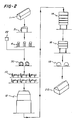
- a process in accordance with the invention is therein depicted.
- the process eliminates utilization of the bean conditioner 6 which is conventionally employed. This is highly advantageous in that the conditioner is a large cumbersome machine which is expensive to buy and to maintain.
- the kernel portions are forwarded to a pulverizing station 30.
- the pulverizer may comprise a hammer mill or like apparatus which is adapted to pulverize the kernel portions so as to result in a multiplicity of powder-like particles commonly having diameters or sizes within the range of about 10 mils to about 20 mils.
- Suitable hammer mills include those sold by Koppers, Inc. under the "Sprout-Waldron CG" trademark. In these hammer mills, the cracked kernels are driven against a breaker plate where primary size reduction is accomplished. The hammers then drive the material against a screen wherein further pulverizing occurs. Final particle size is governed by the diameter of the orifices in the screen.
- hammer mills are built and sold bv Prater, Inc. of Chicago, Illinois, and are classified as “double screen” or “triple screen”. In either instance, pulverizing ruptures oil cells and provides a fine particle size for subsequent delivery to the screw press station.
- a screw press station 10 which is a screw conveyor enclosed within a housing. Breaker pins extend radially inwardly from the housing between rotating screw flights to aid in mechanically working the advancing kernel particles. Pressurized steam is injected through the screw conveyor housing. The screw press continues to rupture oil cells and provides an easily extractable soybean pellet having a bulk density of about 35-40 pounds per cubic foot.
- a preferred screw press is available from French Oil Mill Co., Piqua, Ohio, under the "Enhanser Press" trademark.
- the beans After exiting the screw press 10, the beans are, in similar fashion to the conventional technology shown in Fig. 1, passed to an extractor station 12 wherein hexane or a suitable solvent is intimately admixed with the meal material. Subsequently, the beans are passed to a desolventizer-toaster 14 wherein the retained solvent is separated from the extracted material portion of the beans. The meal is then dried and cooled at station 16, ground at station 18 and may be stored at station 20 for sale and/or subsequent processing.
- Advantages of the process shown in Fig. 2 include reduced capital equipment costs in that the pulverizer and screw presses are much less expensive than the bean conditioning and flaking roll stations conventionally used. Also, an increased density pellet is formed when compared to use of the prior art flaked beans. This allows for utilization of a smaller extractor during the extraction phase of the soybean processing.
- the method in accordance with Fig. 2 will reduce electrical consumption in that the pulverizer will take less power to operate than the bean conditioner of the prior art process. Still further, steam consumption will be reduced by the process herein disclosed and claimed in that the screw press will use much less steam than the conventional bean conditioner does.
- the flaking roll is totally eliminated.
- the flaking rolls are high maintenance headaches because of the roll grinding procedure.
- Another advantage is that use of the present process will no longer necessitate utilization of an experienced preparation operator to maintain proper bean conditioning and flake thickness.
- the pulverizer and screw press are much easier to operate.
Landscapes
- Chemical & Material Sciences (AREA)
- Life Sciences & Earth Sciences (AREA)
- Engineering & Computer Science (AREA)
- Organic Chemistry (AREA)
- Oil, Petroleum & Natural Gas (AREA)
- Wood Science & Technology (AREA)
- Chemical Kinetics & Catalysis (AREA)
- Agronomy & Crop Science (AREA)
- Botany (AREA)
- Health & Medical Sciences (AREA)
- Nutrition Science (AREA)
- Food Science & Technology (AREA)
- Polymers & Plastics (AREA)
- Beans For Foods Or Fodder (AREA)
Applications Claiming Priority (3)
| Application Number | Priority Date | Filing Date | Title |
|---|---|---|---|
| US189260 | 1988-05-02 | ||
| US07/189,260 US4874555A (en) | 1988-05-02 | 1988-05-02 | Soybean process |
| CA000606242A CA1334431C (en) | 1988-05-02 | 1989-07-20 | Soybean process |
Publications (3)
| Publication Number | Publication Date |
|---|---|
| EP0341020A2 true EP0341020A2 (de) | 1989-11-08 |
| EP0341020A3 EP0341020A3 (de) | 1991-06-12 |
| EP0341020B1 EP0341020B1 (de) | 1995-07-19 |
Family
ID=25672900
Family Applications (1)
| Application Number | Title | Priority Date | Filing Date |
|---|---|---|---|
| EP89304399A Expired - Lifetime EP0341020B1 (de) | 1988-05-02 | 1989-05-02 | Verfahren zum Behandeln von Sojabohnen |
Country Status (4)
| Country | Link |
|---|---|
| US (1) | US4874555A (de) |
| EP (1) | EP0341020B1 (de) |
| CA (1) | CA1334431C (de) |
| DE (1) | DE68923481T2 (de) |
Cited By (4)
| Publication number | Priority date | Publication date | Assignee | Title |
|---|---|---|---|---|
| CN1064395C (zh) * | 1998-07-02 | 2001-04-11 | 东北农业大学 | 浸出法制取大豆油脂预处理过程中的大豆挤压膨化加工 |
| CN103981012A (zh) * | 2014-05-31 | 2014-08-13 | 全椒县尹氏油脂有限公司 | 一种提高出油率的大豆油加工方法 |
| CN105733796A (zh) * | 2016-02-24 | 2016-07-06 | 昆明理工大学 | 一种花生油挤压膨化提取方法 |
| WO2022183031A1 (en) * | 2021-02-25 | 2022-09-01 | Crown Iron Works Company | Alcohol solvent recovery for oleaginous material extraction |
Families Citing this family (12)
| Publication number | Priority date | Publication date | Assignee | Title |
|---|---|---|---|---|
| US5077071A (en) * | 1989-09-06 | 1991-12-31 | Epe Incorporated | Oil extrusion process |
| US5200229A (en) * | 1989-09-06 | 1993-04-06 | Epe, Incorporated | Oil extrusion process |
| US5225230A (en) * | 1991-09-17 | 1993-07-06 | West Central Cooperative | Method for preparing a high bypass protein product |
| US5680812A (en) * | 1995-01-23 | 1997-10-28 | Linsgeseder; Helmut | Apparatus and method for the extraction of vegetable oils |
| US5685218A (en) * | 1995-07-14 | 1997-11-11 | The French Oil Mill Machinery Co. | Method for treating oil-bearing material |
| US5744186A (en) * | 1996-12-05 | 1998-04-28 | Pelleting Concepts International, Inc. | Method for preparing animal food pellets |
| US6201142B1 (en) | 1997-12-23 | 2001-03-13 | Bestfoods | Process for recovery of corn oil from corn germ |
| DE102006026511A1 (de) * | 2006-06-06 | 2007-12-13 | Bühler AG | Verfahren zur Herstellung einer Futterzusammensetzung für Rinder |
| US20080063766A1 (en) * | 2006-09-13 | 2008-03-13 | Grovac Southern Select, L.C. | Process to improve the taste and extend the shelf-life of soybeans and products derived therefrom |
| EP3165099A1 (de) | 2015-11-03 | 2017-05-10 | Evonik Degussa GmbH | Entölung und gleichzeitige entfernung von unerwünschten begleitstoffen aus bohnen mit überkritischem co2 |
| CN107043650A (zh) * | 2017-06-01 | 2017-08-15 | 湖北恒贸茶油有限公司 | 生产茶油的挤压蒸籽装置 |
| CN115212155B (zh) * | 2022-08-29 | 2024-04-26 | 山西农业大学经济作物研究所 | 一种利用小豆制备化妆粉饼的装置及方法 |
Family Cites Families (9)
| Publication number | Priority date | Publication date | Assignee | Title |
|---|---|---|---|---|
| US1684654A (en) * | 1925-11-14 | 1928-09-18 | Albers George | Soya-bean flour and process of producing the same |
| US2430535A (en) * | 1945-06-25 | 1947-11-11 | Archer Daniels Midland Co | Vegetable products and process of producing the same |
| US2614045A (en) * | 1949-04-08 | 1952-10-14 | British Soya Products Ltd | Processes for the treatment of soya beans and other leguminous seeds |
| US2585793A (en) * | 1950-11-10 | 1952-02-12 | Central Soya Co | Soybean treating process |
| US2904435A (en) * | 1956-07-06 | 1959-09-15 | Central Soya Co | Preparation of flaked hull product |
| US2952540A (en) * | 1957-04-19 | 1960-09-13 | Central Soya Co | Fibrous flaked product |
| US3033683A (en) * | 1958-06-12 | 1962-05-08 | Central Soya Co | Preparation of oilseed meal containing soybean soapstock |
| CH627625A5 (de) * | 1977-05-25 | 1982-01-29 | Escher Wyss Ag | Verfahren zur herstellung von instantprodukten auf leguminosebasis. |
| CH650385A5 (de) * | 1980-11-04 | 1985-07-31 | Escher Wyss Ag | Verfahren zur behandlung von sojabohnen mit einem vor der flockierung und extraktion erfolgenden brechen. |
-
1988
- 1988-05-02 US US07/189,260 patent/US4874555A/en not_active Expired - Fee Related
-
1989
- 1989-05-02 DE DE68923481T patent/DE68923481T2/de not_active Expired - Fee Related
- 1989-05-02 EP EP89304399A patent/EP0341020B1/de not_active Expired - Lifetime
- 1989-07-20 CA CA000606242A patent/CA1334431C/en not_active Expired - Fee Related
Cited By (4)
| Publication number | Priority date | Publication date | Assignee | Title |
|---|---|---|---|---|
| CN1064395C (zh) * | 1998-07-02 | 2001-04-11 | 东北农业大学 | 浸出法制取大豆油脂预处理过程中的大豆挤压膨化加工 |
| CN103981012A (zh) * | 2014-05-31 | 2014-08-13 | 全椒县尹氏油脂有限公司 | 一种提高出油率的大豆油加工方法 |
| CN105733796A (zh) * | 2016-02-24 | 2016-07-06 | 昆明理工大学 | 一种花生油挤压膨化提取方法 |
| WO2022183031A1 (en) * | 2021-02-25 | 2022-09-01 | Crown Iron Works Company | Alcohol solvent recovery for oleaginous material extraction |
Also Published As
| Publication number | Publication date |
|---|---|
| EP0341020A3 (de) | 1991-06-12 |
| US4874555A (en) | 1989-10-17 |
| DE68923481T2 (de) | 1995-12-07 |
| CA1334431C (en) | 1995-02-14 |
| EP0341020B1 (de) | 1995-07-19 |
| DE68923481D1 (de) | 1995-08-24 |
Similar Documents
| Publication | Publication Date | Title |
|---|---|---|
| US4874555A (en) | Soybean process | |
| EP1074605B1 (de) | Verfahren und Einrichtung zur Herstellung von Speiseöl aus Rapssaat | |
| US4122104A (en) | Process for extracting oils from oil containing raw materials | |
| JPS6247239B2 (de) | ||
| CN101235340A (zh) | 高含油油料膨化预榨浸出制油方法 | |
| US20230094035A1 (en) | Method for obtaining protein preparations from sunflower and/or canola oil seeds, and protein preparation | |
| JPS648989B2 (de) | ||
| US3253930A (en) | Method of heat treating soybeans | |
| CN102513177A (zh) | 一种生产亚麻籽胶和亚麻籽仁的方法 | |
| US6201142B1 (en) | Process for recovery of corn oil from corn germ | |
| Tang et al. | Palm kernel oil extraction‐The malaysian experience | |
| RU2533006C1 (ru) | Способ получения продуктов размола семян амаранта и технологическая линия для осуществления способа | |
| GB2269084A (en) | Animal feeds | |
| EP3953442B1 (de) | Verfahren und vorrichtung zur industriellen gewinnung von rapskernöl und rapsproteinkonzentrat aus rapssaat | |
| JPS60256352A (ja) | 油種子から製品を製造する方法 | |
| US2158427A (en) | Process for extracting oil or fat containing substances and the like | |
| WO2022043248A1 (de) | Verfahren zur industriellen gewinnung von kaltgepresstem kernöl und proteinkonzentrat aus geschälten ölhaltigen saaten unter einsatz einer saat-eigenen presshilfe | |
| Carr | Oilseeds processing | |
| US2247851A (en) | Process for preparing food from oleaginous, protein-base, organic material | |
| GB2485814A (en) | Dry ice assisted mechanical extraction process | |
| RU2067610C1 (ru) | Способ извлечения масла из семян зернобобовых культур и устройство для его осуществления | |
| RU2602191C1 (ru) | Способ отделения оболочки от семян сои | |
| US2594117A (en) | Prepared cotton seed material for solvent extraction and processes for preparation and solvent extraction of cotton seed materials | |
| US998113A (en) | Method of producing cocoa powder. | |
| RU2745669C1 (ru) | Способ получения амарантовой муки из амарантового жмыха |
Legal Events
| Date | Code | Title | Description |
|---|---|---|---|
| PUAI | Public reference made under article 153(3) epc to a published international application that has entered the european phase |
Free format text: ORIGINAL CODE: 0009012 |
|
| AK | Designated contracting states |
Kind code of ref document: A2 Designated state(s): BE DE FR GB IT |
|
| 17P | Request for examination filed |
Effective date: 19901220 |
|
| PUAL | Search report despatched |
Free format text: ORIGINAL CODE: 0009013 |
|
| AK | Designated contracting states |
Kind code of ref document: A3 Designated state(s): BE DE FR GB IT |
|
| RHK1 | Main classification (correction) |
Ipc: C11B 1/10 |
|
| 17Q | First examination report despatched |
Effective date: 19931130 |
|
| GRAA | (expected) grant |
Free format text: ORIGINAL CODE: 0009210 |
|
| AK | Designated contracting states |
Kind code of ref document: B1 Designated state(s): BE DE FR GB IT |
|
| REF | Corresponds to: |
Ref document number: 68923481 Country of ref document: DE Date of ref document: 19950824 |
|
| ET | Fr: translation filed | ||
| ITF | It: translation for a ep patent filed | ||
| PLBE | No opposition filed within time limit |
Free format text: ORIGINAL CODE: 0009261 |
|
| STAA | Information on the status of an ep patent application or granted ep patent |
Free format text: STATUS: NO OPPOSITION FILED WITHIN TIME LIMIT |
|
| 26N | No opposition filed | ||
| PGFP | Annual fee paid to national office [announced via postgrant information from national office to epo] |
Ref country code: GB Payment date: 20010509 Year of fee payment: 13 |
|
| PGFP | Annual fee paid to national office [announced via postgrant information from national office to epo] |
Ref country code: FR Payment date: 20010523 Year of fee payment: 13 Ref country code: BE Payment date: 20010523 Year of fee payment: 13 |
|
| PGFP | Annual fee paid to national office [announced via postgrant information from national office to epo] |
Ref country code: DE Payment date: 20010605 Year of fee payment: 13 |
|
| REG | Reference to a national code |
Ref country code: GB Ref legal event code: IF02 |
|
| PG25 | Lapsed in a contracting state [announced via postgrant information from national office to epo] |
Ref country code: GB Free format text: LAPSE BECAUSE OF NON-PAYMENT OF DUE FEES Effective date: 20020502 |
|
| PG25 | Lapsed in a contracting state [announced via postgrant information from national office to epo] |
Ref country code: BE Free format text: LAPSE BECAUSE OF NON-PAYMENT OF DUE FEES Effective date: 20020531 |
|
| PG25 | Lapsed in a contracting state [announced via postgrant information from national office to epo] |
Ref country code: DE Free format text: LAPSE BECAUSE OF NON-PAYMENT OF DUE FEES Effective date: 20021203 |
|
| GBPC | Gb: european patent ceased through non-payment of renewal fee |
Effective date: 20020502 |
|
| PG25 | Lapsed in a contracting state [announced via postgrant information from national office to epo] |
Ref country code: FR Free format text: LAPSE BECAUSE OF NON-PAYMENT OF DUE FEES Effective date: 20030131 |
|
| REG | Reference to a national code |
Ref country code: FR Ref legal event code: ST |
|
| PG25 | Lapsed in a contracting state [announced via postgrant information from national office to epo] |
Ref country code: IT Free format text: LAPSE BECAUSE OF NON-PAYMENT OF DUE FEES Effective date: 20050502 |