EP0339208B1 - 6-Oxo-pyridazinderivate, Verfahren zu ihrer Herstellung und diese Verbindungen enthaltende Arzneimittel - Google Patents
6-Oxo-pyridazinderivate, Verfahren zu ihrer Herstellung und diese Verbindungen enthaltende Arzneimittel Download PDFInfo
- Publication number
- EP0339208B1 EP0339208B1 EP89103651A EP89103651A EP0339208B1 EP 0339208 B1 EP0339208 B1 EP 0339208B1 EP 89103651 A EP89103651 A EP 89103651A EP 89103651 A EP89103651 A EP 89103651A EP 0339208 B1 EP0339208 B1 EP 0339208B1
- Authority
- EP
- European Patent Office
- Prior art keywords
- methyl
- group
- mmol
- imidazol
- nitro
- Prior art date
- Legal status (The legal status is an assumption and is not a legal conclusion. Google has not performed a legal analysis and makes no representation as to the accuracy of the status listed.)
- Expired - Lifetime
Links
- 150000001875 compounds Chemical class 0.000 title claims abstract description 54
- AAILEWXSEQLMNI-UHFFFAOYSA-N 1h-pyridazin-6-one Chemical class OC1=CC=CN=N1 AAILEWXSEQLMNI-UHFFFAOYSA-N 0.000 title claims abstract description 10
- 238000002360 preparation method Methods 0.000 title claims abstract description 4
- 238000000034 method Methods 0.000 title claims description 11
- 239000003814 drug Substances 0.000 title abstract description 8
- 125000001997 phenyl group Chemical group [H]C1=C([H])C([H])=C(*)C([H])=C1[H] 0.000 claims description 10
- 150000003839 salts Chemical class 0.000 claims description 10
- 125000005843 halogen group Chemical group 0.000 claims description 8
- 125000006273 (C1-C3) alkyl group Chemical group 0.000 claims description 6
- 125000004093 cyano group Chemical group *C#N 0.000 claims description 6
- 125000004435 hydrogen atom Chemical group [H]* 0.000 claims description 6
- VZJYGLIMHHXSDF-UHFFFAOYSA-N 2-[3-(1h-imidazol-5-yl)propyl]-1-[2-[4-(4-methyl-6-oxo-4,5-dihydro-1h-pyridazin-3-yl)-2-nitroanilino]ethyl]guanidine Chemical compound CC1CC(=O)NN=C1C(C=C1[N+]([O-])=O)=CC=C1NCCNC(=N)NCCCC1=CNC=N1 VZJYGLIMHHXSDF-UHFFFAOYSA-N 0.000 claims description 4
- 125000000449 nitro group Chemical group [O-][N+](*)=O 0.000 claims description 4
- DEONTBCSLCBMMO-UHFFFAOYSA-N 2-[3-(1h-imidazol-5-yl)propyl]-1-[3-[4-[4-(4-methyl-6-oxo-4,5-dihydro-1h-pyridazin-3-yl)-2-nitrophenyl]piperazin-1-yl]propyl]guanidine Chemical compound CC1CC(=O)NN=C1C(C=C1[N+]([O-])=O)=CC=C1N1CCN(CCCNC(=N)NCCCC=2N=CNC=2)CC1 DEONTBCSLCBMMO-UHFFFAOYSA-N 0.000 claims description 3
- 125000004029 hydroxymethyl group Chemical group [H]OC([H])([H])* 0.000 claims description 3
- 125000004178 (C1-C4) alkyl group Chemical group 0.000 claims description 2
- 125000004169 (C1-C6) alkyl group Chemical group 0.000 claims description 2
- 125000001624 naphthyl group Chemical group 0.000 claims description 2
- 125000000951 phenoxy group Chemical group [H]C1=C([H])C([H])=C(O*)C([H])=C1[H] 0.000 claims description 2
- 125000003356 phenylsulfanyl group Chemical group [*]SC1=C([H])C([H])=C([H])C([H])=C1[H] 0.000 claims description 2
- 125000003545 alkoxy group Chemical group 0.000 claims 3
- 125000004414 alkyl thio group Chemical group 0.000 claims 1
- 239000000126 substance Substances 0.000 abstract description 6
- 230000000694 effects Effects 0.000 abstract description 4
- 230000000297 inotrophic effect Effects 0.000 abstract description 3
- OKKJLVBELUTLKV-UHFFFAOYSA-N Methanol Chemical compound OC OKKJLVBELUTLKV-UHFFFAOYSA-N 0.000 description 106
- IAZDPXIOMUYVGZ-WFGJKAKNSA-N Dimethyl sulfoxide Chemical compound [2H]C([2H])([2H])S(=O)C([2H])([2H])[2H] IAZDPXIOMUYVGZ-WFGJKAKNSA-N 0.000 description 74
- LFQSCWFLJHTTHZ-UHFFFAOYSA-N Ethanol Chemical compound CCO LFQSCWFLJHTTHZ-UHFFFAOYSA-N 0.000 description 51
- YMWUJEATGCHHMB-UHFFFAOYSA-N Dichloromethane Chemical compound ClCCl YMWUJEATGCHHMB-UHFFFAOYSA-N 0.000 description 48
- WEVYAHXRMPXWCK-UHFFFAOYSA-N Acetonitrile Chemical compound CC#N WEVYAHXRMPXWCK-UHFFFAOYSA-N 0.000 description 42
- 239000002904 solvent Substances 0.000 description 40
- ZMXDDKWLCZADIW-UHFFFAOYSA-N N,N-Dimethylformamide Chemical compound CN(C)C=O ZMXDDKWLCZADIW-UHFFFAOYSA-N 0.000 description 38
- XEKOWRVHYACXOJ-UHFFFAOYSA-N Ethyl acetate Chemical compound CCOC(C)=O XEKOWRVHYACXOJ-UHFFFAOYSA-N 0.000 description 36
- 239000007787 solid Substances 0.000 description 35
- 239000003480 eluent Substances 0.000 description 26
- 238000005160 1H NMR spectroscopy Methods 0.000 description 25
- IHDFTEVCMVTMSP-UHFFFAOYSA-N 3-(1h-imidazol-5-yl)propan-1-amine Chemical compound NCCCC1=CN=CN1 IHDFTEVCMVTMSP-UHFFFAOYSA-N 0.000 description 24
- HEDRZPFGACZZDS-UHFFFAOYSA-N Chloroform Chemical compound ClC(Cl)Cl HEDRZPFGACZZDS-UHFFFAOYSA-N 0.000 description 24
- QGZKDVFQNNGYKY-UHFFFAOYSA-N Ammonia Chemical compound N QGZKDVFQNNGYKY-UHFFFAOYSA-N 0.000 description 22
- 239000000243 solution Substances 0.000 description 21
- 125000004194 piperazin-1-yl group Chemical group [H]N1C([H])([H])C([H])([H])N(*)C([H])([H])C1([H])[H] 0.000 description 20
- 239000000203 mixture Substances 0.000 description 19
- VYPSYNLAJGMNEJ-UHFFFAOYSA-N Silicium dioxide Chemical compound O=[Si]=O VYPSYNLAJGMNEJ-UHFFFAOYSA-N 0.000 description 18
- 239000000741 silica gel Substances 0.000 description 18
- 229910002027 silica gel Inorganic materials 0.000 description 18
- KFZMGEQAYNKOFK-UHFFFAOYSA-N Isopropanol Chemical compound CC(C)O KFZMGEQAYNKOFK-UHFFFAOYSA-N 0.000 description 17
- 238000001704 evaporation Methods 0.000 description 17
- 238000002844 melting Methods 0.000 description 16
- 230000008018 melting Effects 0.000 description 16
- TYJJADVDDVDEDZ-UHFFFAOYSA-M potassium hydrogencarbonate Chemical class [K+].OC([O-])=O TYJJADVDDVDEDZ-UHFFFAOYSA-M 0.000 description 16
- -1 for example Chemical class 0.000 description 15
- 238000010992 reflux Methods 0.000 description 15
- 125000002140 imidazol-4-yl group Chemical group [H]N1C([H])=NC([*])=C1[H] 0.000 description 14
- 230000008020 evaporation Effects 0.000 description 13
- 239000012074 organic phase Substances 0.000 description 13
- 239000013078 crystal Substances 0.000 description 12
- BWHMMNNQKKPAPP-UHFFFAOYSA-L potassium carbonate Chemical compound [K+].[K+].[O-]C([O-])=O BWHMMNNQKKPAPP-UHFFFAOYSA-L 0.000 description 12
- 239000000843 powder Substances 0.000 description 12
- XLYOFNOQVPJJNP-UHFFFAOYSA-N water Substances O XLYOFNOQVPJJNP-UHFFFAOYSA-N 0.000 description 12
- 229910021529 ammonia Inorganic materials 0.000 description 11
- 239000000725 suspension Substances 0.000 description 10
- 239000012071 phase Substances 0.000 description 9
- UMGDCJDMYOKAJW-UHFFFAOYSA-N thiourea Chemical compound NC(N)=S UMGDCJDMYOKAJW-UHFFFAOYSA-N 0.000 description 9
- JUJWROOIHBZHMG-UHFFFAOYSA-N Pyridine Chemical compound C1=CC=NC=C1 JUJWROOIHBZHMG-UHFFFAOYSA-N 0.000 description 8
- QTBSBXVTEAMEQO-UHFFFAOYSA-N Acetic acid Chemical compound CC(O)=O QTBSBXVTEAMEQO-UHFFFAOYSA-N 0.000 description 7
- 0 CC(C1)C(c2cc([N+]([O-])=O)c(CCCN*(NCCCC(N=CN)=CC)=N)cc2)=NNC1OC Chemical compound CC(C1)C(c2cc([N+]([O-])=O)c(CCCN*(NCCCC(N=CN)=CC)=N)cc2)=NNC1OC 0.000 description 7
- 238000001035 drying Methods 0.000 description 7
- 239000011541 reaction mixture Substances 0.000 description 7
- NLXLAEXVIDQMFP-UHFFFAOYSA-N Ammonia chloride Chemical compound [NH4+].[Cl-] NLXLAEXVIDQMFP-UHFFFAOYSA-N 0.000 description 6
- VEXZGXHMUGYJMC-UHFFFAOYSA-N Hydrochloric acid Chemical compound Cl VEXZGXHMUGYJMC-UHFFFAOYSA-N 0.000 description 6
- WYURNTSHIVDZCO-UHFFFAOYSA-N Tetrahydrofuran Chemical compound C1CCOC1 WYURNTSHIVDZCO-UHFFFAOYSA-N 0.000 description 6
- CPEKAXYCDKETEN-UHFFFAOYSA-N benzoyl isothiocyanate Chemical compound S=C=NC(=O)C1=CC=CC=C1 CPEKAXYCDKETEN-UHFFFAOYSA-N 0.000 description 6
- INQOMBQAUSQDDS-UHFFFAOYSA-N iodomethane Chemical compound IC INQOMBQAUSQDDS-UHFFFAOYSA-N 0.000 description 6
- 229910000027 potassium carbonate Inorganic materials 0.000 description 6
- 229920006395 saturated elastomer Polymers 0.000 description 6
- 238000001816 cooling Methods 0.000 description 5
- 239000012043 crude product Substances 0.000 description 5
- 125000006308 propyl amino group Chemical group 0.000 description 5
- 125000001436 propyl group Chemical group [H]C([*])([H])C([H])([H])C([H])([H])[H] 0.000 description 5
- 238000001953 recrystallisation Methods 0.000 description 5
- RYHBNJHYFVUHQT-UHFFFAOYSA-N 1,4-Dioxane Chemical compound C1COCCO1 RYHBNJHYFVUHQT-UHFFFAOYSA-N 0.000 description 4
- OKKJLVBELUTLKV-MZCSYVLQSA-N Deuterated methanol Chemical compound [2H]OC([2H])([2H])[2H] OKKJLVBELUTLKV-MZCSYVLQSA-N 0.000 description 4
- QAOWNCQODCNURD-UHFFFAOYSA-N Sulfuric acid Chemical compound OS(O)(=O)=O QAOWNCQODCNURD-UHFFFAOYSA-N 0.000 description 4
- XSQUKJJJFZCRTK-UHFFFAOYSA-N Urea Natural products NC(N)=O XSQUKJJJFZCRTK-UHFFFAOYSA-N 0.000 description 4
- 238000006243 chemical reaction Methods 0.000 description 4
- 238000011097 chromatography purification Methods 0.000 description 4
- 239000000706 filtrate Substances 0.000 description 4
- XMBWDFGMSWQBCA-UHFFFAOYSA-N hydrogen iodide Chemical compound I XMBWDFGMSWQBCA-UHFFFAOYSA-N 0.000 description 4
- 230000009090 positive inotropic effect Effects 0.000 description 4
- UMJSCPRVCHMLSP-UHFFFAOYSA-N pyridine Natural products COC1=CC=CN=C1 UMJSCPRVCHMLSP-UHFFFAOYSA-N 0.000 description 4
- JBARCTHFPUHCED-UHFFFAOYSA-N 2-(1h-imidazol-2-yl)guanidine Chemical class NC(=N)NC1=NC=CN1 JBARCTHFPUHCED-UHFFFAOYSA-N 0.000 description 3
- VGBVWJYIDWXKPO-UHFFFAOYSA-N 4-methyl-3-(3-nitro-4-piperazin-1-ylphenyl)-4,5-dihydro-1h-pyridazin-6-one Chemical compound CC1CC(=O)NN=C1C(C=C1[N+]([O-])=O)=CC=C1N1CCNCC1 VGBVWJYIDWXKPO-UHFFFAOYSA-N 0.000 description 3
- 241000700199 Cavia porcellus Species 0.000 description 3
- HEMHJVSKTPXQMS-UHFFFAOYSA-M Sodium hydroxide Chemical compound [OH-].[Na+] HEMHJVSKTPXQMS-UHFFFAOYSA-M 0.000 description 3
- ZMANZCXQSJIPKH-UHFFFAOYSA-N Triethylamine Chemical compound CCN(CC)CC ZMANZCXQSJIPKH-UHFFFAOYSA-N 0.000 description 3
- YICCDLRNYULNNP-UHFFFAOYSA-N [amino(methylsulfanyl)methylidene]-[1-[4-(4-methyl-6-oxo-4,5-dihydro-1h-pyridazin-3-yl)-2-nitrophenyl]piperidin-4-yl]azanium;iodide Chemical compound [I-].C1CC([NH+]=C(N)SC)CCN1C1=CC=C(C=2C(CC(=O)NN=2)C)C=C1[N+]([O-])=O YICCDLRNYULNNP-UHFFFAOYSA-N 0.000 description 3
- 229960000583 acetic acid Drugs 0.000 description 3
- 239000002253 acid Substances 0.000 description 3
- 235000019270 ammonium chloride Nutrition 0.000 description 3
- 239000008346 aqueous phase Substances 0.000 description 3
- PFKFTWBEEFSNDU-UHFFFAOYSA-N carbonyldiimidazole Chemical compound C1=CN=CN1C(=O)N1C=CN=C1 PFKFTWBEEFSNDU-UHFFFAOYSA-N 0.000 description 3
- KRKNYBCHXYNGOX-UHFFFAOYSA-N citric acid Chemical compound OC(=O)CC(O)(C(O)=O)CC(O)=O KRKNYBCHXYNGOX-UHFFFAOYSA-N 0.000 description 3
- 229940079593 drug Drugs 0.000 description 3
- 239000006260 foam Substances 0.000 description 3
- 238000009472 formulation Methods 0.000 description 3
- 230000000004 hemodynamic effect Effects 0.000 description 3
- 125000002496 methyl group Chemical group [H]C([H])([H])* 0.000 description 3
- NLKNQRATVPKPDG-UHFFFAOYSA-M potassium iodide Chemical compound [K+].[I-] NLKNQRATVPKPDG-UHFFFAOYSA-M 0.000 description 3
- 238000003756 stirring Methods 0.000 description 3
- YLQBMQCUIZJEEH-UHFFFAOYSA-N tetrahydrofuran Natural products C=1C=COC=1 YLQBMQCUIZJEEH-UHFFFAOYSA-N 0.000 description 3
- 125000006274 (C1-C3)alkoxy group Chemical group 0.000 description 2
- CCTMWQXSXCTVGO-UHFFFAOYSA-N 1-[3-(1h-imidazol-5-yl)propyl]-2-[3-[4-(4-methyl-6-oxo-4,5-dihydro-1h-pyridazin-3-yl)-2-nitroanilino]propyl]guanidine Chemical compound CC1CC(=O)NN=C1C(C=C1[N+]([O-])=O)=CC=C1NCCCNC(=N)NCCCC1=CNC=N1 CCTMWQXSXCTVGO-UHFFFAOYSA-N 0.000 description 2
- SSDAKJLEKSSAMH-UHFFFAOYSA-N 2,4-dihydro-1h-pyridazin-3-one Chemical class O=C1CC=CNN1 SSDAKJLEKSSAMH-UHFFFAOYSA-N 0.000 description 2
- XNWFRZJHXBZDAG-UHFFFAOYSA-N 2-METHOXYETHANOL Chemical compound COCCO XNWFRZJHXBZDAG-UHFFFAOYSA-N 0.000 description 2
- ZGVACHUZOPIOKU-UHFFFAOYSA-N 2-[3-(1h-imidazol-5-yl)propyl]-1-[1-[4-(4-methyl-6-oxo-4,5-dihydro-1h-pyridazin-3-yl)-2-nitrophenyl]piperidin-4-yl]guanidine Chemical compound CC1CC(=O)NN=C1C(C=C1[N+]([O-])=O)=CC=C1N1CCC(NC(=N)NCCCC=2N=CNC=2)CC1 ZGVACHUZOPIOKU-UHFFFAOYSA-N 0.000 description 2
- HCBRBGMLFXUVOX-UHFFFAOYSA-N 2-[3-(1h-imidazol-5-yl)propyl]-1-[4-(4-methyl-6-oxo-4,5-dihydro-1h-pyridazin-3-yl)-3-nitrophenyl]guanidine Chemical compound CC1CC(=O)NN=C1C(C(=C1)[N+]([O-])=O)=CC=C1NC(N)=NCCCC1=CN=CN1 HCBRBGMLFXUVOX-UHFFFAOYSA-N 0.000 description 2
- MYWMOJLXLYZAFI-UHFFFAOYSA-N 3-[4-(2-aminoethylamino)-3-nitrophenyl]-4-methyl-4,5-dihydro-1h-pyridazin-6-one Chemical compound CC1CC(=O)NN=C1C1=CC=C(NCCN)C([N+]([O-])=O)=C1 MYWMOJLXLYZAFI-UHFFFAOYSA-N 0.000 description 2
- DKCWALAHBZTYHE-UHFFFAOYSA-N 3-[4-(3-aminopropylamino)-3-nitrophenyl]-4-methyl-4,5-dihydro-1h-pyridazin-6-one Chemical compound CC1CC(=O)NN=C1C1=CC=C(NCCCN)C([N+]([O-])=O)=C1 DKCWALAHBZTYHE-UHFFFAOYSA-N 0.000 description 2
- RFXSQZNWHLPQGQ-UHFFFAOYSA-N 3-[4-(4-aminopiperidin-1-yl)-3-nitrophenyl]-4-methyl-4,5-dihydro-1h-pyridazin-6-one Chemical compound CC1CC(=O)NN=C1C(C=C1[N+]([O-])=O)=CC=C1N1CCC(N)CC1 RFXSQZNWHLPQGQ-UHFFFAOYSA-N 0.000 description 2
- WKBOTKDWSSQWDR-UHFFFAOYSA-N Bromine atom Chemical group [Br] WKBOTKDWSSQWDR-UHFFFAOYSA-N 0.000 description 2
- 241000700198 Cavia Species 0.000 description 2
- PXGOKWXKJXAPGV-UHFFFAOYSA-N Fluorine Chemical compound FF PXGOKWXKJXAPGV-UHFFFAOYSA-N 0.000 description 2
- VZCYOOQTPOCHFL-OWOJBTEDSA-N Fumaric acid Chemical compound OC(=O)\C=C\C(O)=O VZCYOOQTPOCHFL-OWOJBTEDSA-N 0.000 description 2
- ZRALSGWEFCBTJO-UHFFFAOYSA-N Guanidine Chemical compound NC(N)=N ZRALSGWEFCBTJO-UHFFFAOYSA-N 0.000 description 2
- NTYJJOPFIAHURM-UHFFFAOYSA-N Histamine Chemical compound NCCC1=CN=CN1 NTYJJOPFIAHURM-UHFFFAOYSA-N 0.000 description 2
- CPELXLSAUQHCOX-UHFFFAOYSA-N Hydrogen bromide Chemical compound Br CPELXLSAUQHCOX-UHFFFAOYSA-N 0.000 description 2
- AFVFQIVMOAPDHO-UHFFFAOYSA-N Methanesulfonic acid Chemical compound CS(O)(=O)=O AFVFQIVMOAPDHO-UHFFFAOYSA-N 0.000 description 2
- NBIIXXVUZAFLBC-UHFFFAOYSA-N Phosphoric acid Chemical compound OP(O)(O)=O NBIIXXVUZAFLBC-UHFFFAOYSA-N 0.000 description 2
- 239000000150 Sympathomimetic Substances 0.000 description 2
- HEDRZPFGACZZDS-MICDWDOJSA-N Trichloro(2H)methane Chemical compound [2H]C(Cl)(Cl)Cl HEDRZPFGACZZDS-MICDWDOJSA-N 0.000 description 2
- DTQVDTLACAAQTR-UHFFFAOYSA-N Trifluoroacetic acid Chemical compound OC(=O)C(F)(F)F DTQVDTLACAAQTR-UHFFFAOYSA-N 0.000 description 2
- OUEMKIUMRIEKFU-UHFFFAOYSA-N [amino(methylsulfanyl)methylidene]-[2-[4-(4-methyl-6-oxo-4,5-dihydro-1h-pyridazin-3-yl)-2-nitroanilino]ethyl]azanium;iodide Chemical compound [I-].C1=C([N+]([O-])=O)C(NCC[NH+]=C(N)SC)=CC=C1C1=NNC(=O)CC1C OUEMKIUMRIEKFU-UHFFFAOYSA-N 0.000 description 2
- 239000004480 active ingredient Substances 0.000 description 2
- 239000003513 alkali Substances 0.000 description 2
- 230000003177 cardiotonic effect Effects 0.000 description 2
- 238000004587 chromatography analysis Methods 0.000 description 2
- 238000002425 crystallisation Methods 0.000 description 2
- 230000008025 crystallization Effects 0.000 description 2
- 239000003085 diluting agent Substances 0.000 description 2
- XBDQKXXYIPTUBI-UHFFFAOYSA-N dimethylselenoniopropionate Natural products CCC(O)=O XBDQKXXYIPTUBI-UHFFFAOYSA-N 0.000 description 2
- 201000010099 disease Diseases 0.000 description 2
- 208000037265 diseases, disorders, signs and symptoms Diseases 0.000 description 2
- WYKNEGMJHLREAO-UHFFFAOYSA-N ethyl n-[n'-[3-(1h-imidazol-5-yl)propyl]-n-[1-[4-(4-methyl-6-oxo-4,5-dihydro-1h-pyridazin-3-yl)-2-nitrophenyl]piperidin-4-yl]carbamimidoyl]carbamate Chemical compound C=1N=CNC=1CCCN=C(NC(=O)OCC)NC(CC1)CCN1C(C(=C1)[N+]([O-])=O)=CC=C1C1=NNC(=O)CC1C WYKNEGMJHLREAO-UHFFFAOYSA-N 0.000 description 2
- 238000000605 extraction Methods 0.000 description 2
- 238000001914 filtration Methods 0.000 description 2
- 229910052731 fluorine Inorganic materials 0.000 description 2
- 239000011737 fluorine Substances 0.000 description 2
- 239000012362 glacial acetic acid Substances 0.000 description 2
- 230000007062 hydrolysis Effects 0.000 description 2
- 238000006460 hydrolysis reaction Methods 0.000 description 2
- MURRAGMMNAYLNA-UHFFFAOYSA-N impromidine Chemical compound N1C=NC(CSCCNC(N)=NCCCC=2NC=NC=2)=C1C MURRAGMMNAYLNA-UHFFFAOYSA-N 0.000 description 2
- 229950005073 impromidine Drugs 0.000 description 2
- 238000001802 infusion Methods 0.000 description 2
- 230000002401 inhibitory effect Effects 0.000 description 2
- 239000007924 injection Substances 0.000 description 2
- 238000002347 injection Methods 0.000 description 2
- 229910052500 inorganic mineral Inorganic materials 0.000 description 2
- 210000004731 jugular vein Anatomy 0.000 description 2
- 239000000155 melt Substances 0.000 description 2
- BDAGIHXWWSANSR-UHFFFAOYSA-N methanoic acid Natural products OC=O BDAGIHXWWSANSR-UHFFFAOYSA-N 0.000 description 2
- 239000011707 mineral Substances 0.000 description 2
- DQMWMUMCNOJLSI-UHFFFAOYSA-N n-carbamothioylbenzamide Chemical compound NC(=S)NC(=O)C1=CC=CC=C1 DQMWMUMCNOJLSI-UHFFFAOYSA-N 0.000 description 2
- 210000000056 organ Anatomy 0.000 description 2
- 239000002504 physiological saline solution Substances 0.000 description 2
- GLBJJMFZWDBELO-UHFFFAOYSA-N pimobendane Chemical compound C1=CC(OC)=CC=C1C1=NC2=CC=C(C=3C(CC(=O)NN=3)C)C=C2N1 GLBJJMFZWDBELO-UHFFFAOYSA-N 0.000 description 2
- 239000000047 product Substances 0.000 description 2
- 102000005962 receptors Human genes 0.000 description 2
- 108020003175 receptors Proteins 0.000 description 2
- 230000001975 sympathomimetic effect Effects 0.000 description 2
- 229940064707 sympathomimetics Drugs 0.000 description 2
- 239000003826 tablet Substances 0.000 description 2
- 238000004809 thin layer chromatography Methods 0.000 description 2
- 230000000699 topical effect Effects 0.000 description 2
- 230000002861 ventricular Effects 0.000 description 2
- NWZSZGALRFJKBT-KNIFDHDWSA-N (2s)-2,6-diaminohexanoic acid;(2s)-2-hydroxybutanedioic acid Chemical compound OC(=O)[C@@H](O)CC(O)=O.NCCCC[C@H](N)C(O)=O NWZSZGALRFJKBT-KNIFDHDWSA-N 0.000 description 1
- 125000000229 (C1-C4)alkoxy group Chemical group 0.000 description 1
- RITRYDMHTMLKSK-UHFFFAOYSA-N 1-[1-[2-cyano-4-(6-oxo-4,5-dihydro-1h-pyridazin-3-yl)phenyl]piperidin-4-yl]-2-[3-(1h-imidazol-5-yl)propyl]guanidine Chemical compound C1CN(C=2C(=CC(=CC=2)C=2CCC(=O)NN=2)C#N)CCC1NC(=N)NCCCC1=CNC=N1 RITRYDMHTMLKSK-UHFFFAOYSA-N 0.000 description 1
- MAFQBUQCOCGKBI-UHFFFAOYSA-N 1-[1-[4-[4-(hydroxymethyl)-6-oxo-4,5-dihydro-1h-pyridazin-3-yl]-2-nitrophenyl]piperidin-4-yl]-2-[3-(1h-imidazol-5-yl)propyl]guanidine Chemical compound OCC1CC(=O)NN=C1C(C=C1[N+]([O-])=O)=CC=C1N1CCC(NC(=N)NCCCC=2N=CNC=2)CC1 MAFQBUQCOCGKBI-UHFFFAOYSA-N 0.000 description 1
- PAJDRZYEPOIKBR-UHFFFAOYSA-N 1-[3-(1H-imidazol-5-yl)propyl]-2-[[1-[4-(4-methyl-6-oxo-4,5-dihydro-1H-pyridazin-3-yl)-2-nitrophenyl]piperidin-4-yl]methyl]guanidine Chemical compound N1C=NC(=C1)CCCNC(=N)NCC1CCN(CC1)C1=C(C=C(C=C1)C1=NNC(CC1C)=O)[N+](=O)[O-] PAJDRZYEPOIKBR-UHFFFAOYSA-N 0.000 description 1
- OMDKNTPUMAZRAO-UHFFFAOYSA-N 1-[3-(1h-imidazol-5-yl)propyl]-2-[3-[4-(4-methyl-6-oxo-4,5-dihydro-1h-pyridazin-3-yl)-2-nitrophenyl]propyl]guanidine Chemical compound CC1CC(=O)NN=C1C(C=C1[N+]([O-])=O)=CC=C1CCCN=C(N)NCCCC1=CN=CN1 OMDKNTPUMAZRAO-UHFFFAOYSA-N 0.000 description 1
- AZUYLZMQTIKGSC-UHFFFAOYSA-N 1-[6-[4-(5-chloro-6-methyl-1H-indazol-4-yl)-5-methyl-3-(1-methylindazol-5-yl)pyrazol-1-yl]-2-azaspiro[3.3]heptan-2-yl]prop-2-en-1-one Chemical compound ClC=1C(=C2C=NNC2=CC=1C)C=1C(=NN(C=1C)C1CC2(CN(C2)C(C=C)=O)C1)C=1C=C2C=NN(C2=CC=1)C AZUYLZMQTIKGSC-UHFFFAOYSA-N 0.000 description 1
- YFGRLNZQDANSHI-UHFFFAOYSA-N 2-[3-(1h-imidazol-5-yl)propyl]-1-[4-[4-(4-methyl-6-oxo-4,5-dihydro-1h-pyridazin-3-yl)-2-nitroanilino]butyl]guanidine Chemical compound CC1CC(=O)NN=C1C(C=C1[N+]([O-])=O)=CC=C1NCCCCNC(N)=NCCCC1=CN=CN1 YFGRLNZQDANSHI-UHFFFAOYSA-N 0.000 description 1
- LKKHXVGHRIZQDY-UHFFFAOYSA-N 2-[3-[4-[4-(4-methyl-6-oxo-4,5-dihydro-1h-pyridazin-3-yl)-2-nitrophenyl]piperazin-1-yl]propyl]isoindole-1,3-dione Chemical compound CC1CC(=O)NN=C1C(C=C1[N+]([O-])=O)=CC=C1N1CCN(CCCN2C(C3=CC=CC=C3C2=O)=O)CC1 LKKHXVGHRIZQDY-UHFFFAOYSA-N 0.000 description 1
- MPJIOYSCKYHPSW-UHFFFAOYSA-N 2-[3-[4-[4-(hydroxymethyl)-6-oxo-4,5-dihydro-1h-pyridazin-3-yl]-2-nitroanilino]propyl]-1-[3-(1h-imidazol-5-yl)propyl]guanidine Chemical compound OCC1CC(=O)NN=C1C(C=C1[N+]([O-])=O)=CC=C1NCCCNC(=N)NCCCC1=CNC=N1 MPJIOYSCKYHPSW-UHFFFAOYSA-N 0.000 description 1
- YNGQBSTZNMZQJX-UHFFFAOYSA-N 2-[4-(4-methyl-6-oxo-4,5-dihydro-1h-pyridazin-3-yl)-2-nitroanilino]ethylthiourea Chemical compound CC1CC(=O)NN=C1C1=CC=C(NCCNC(N)=S)C([N+]([O-])=O)=C1 YNGQBSTZNMZQJX-UHFFFAOYSA-N 0.000 description 1
- WLJVXDMOQOGPHL-PPJXEINESA-N 2-phenylacetic acid Chemical compound O[14C](=O)CC1=CC=CC=C1 WLJVXDMOQOGPHL-PPJXEINESA-N 0.000 description 1
- SJDUCSHAXHNOFO-UHFFFAOYSA-N 3-(3-nitro-4-piperazin-1-ylphenyl)-4,5-dihydro-1h-pyridazin-6-one Chemical compound [O-][N+](=O)C1=CC(C=2CCC(=O)NN=2)=CC=C1N1CCNCC1 SJDUCSHAXHNOFO-UHFFFAOYSA-N 0.000 description 1
- QABZKECKKQKKQZ-UHFFFAOYSA-N 3-(4-amino-3-nitrophenyl)-4-methyl-4,5-dihydro-1h-pyridazin-6-one Chemical compound CC1CC(=O)NN=C1C1=CC=C(N)C([N+]([O-])=O)=C1 QABZKECKKQKKQZ-UHFFFAOYSA-N 0.000 description 1
- PDDFFGBRSTVWFL-UHFFFAOYSA-N 3-[4-(3-aminopropylamino)-3-nitrophenyl]-4-(hydroxymethyl)-4,5-dihydro-1h-pyridazin-6-one Chemical compound C1=C([N+]([O-])=O)C(NCCCN)=CC=C1C1=NNC(=O)CC1CO PDDFFGBRSTVWFL-UHFFFAOYSA-N 0.000 description 1
- ILJKDBCVCCPVAL-UHFFFAOYSA-N 3-[4-(4-methyl-6-oxo-4,5-dihydro-1h-pyridazin-3-yl)-2-nitroanilino]propylthiourea Chemical compound CC1CC(=O)NN=C1C1=CC=C(NCCCNC(N)=S)C([N+]([O-])=O)=C1 ILJKDBCVCCPVAL-UHFFFAOYSA-N 0.000 description 1
- DOCAWWDKPHEVHL-UHFFFAOYSA-N 3-[4-[4-(3-aminopropyl)piperazin-1-yl]-3-nitrophenyl]-4-methyl-4,5-dihydro-1h-pyridazin-6-one Chemical compound CC1CC(=O)NN=C1C(C=C1[N+]([O-])=O)=CC=C1N1CCN(CCCN)CC1 DOCAWWDKPHEVHL-UHFFFAOYSA-N 0.000 description 1
- BMYNFMYTOJXKLE-UHFFFAOYSA-N 3-azaniumyl-2-hydroxypropanoate Chemical compound NCC(O)C(O)=O BMYNFMYTOJXKLE-UHFFFAOYSA-N 0.000 description 1
- OSWFIVFLDKOXQC-UHFFFAOYSA-N 4-(3-methoxyphenyl)aniline Chemical compound COC1=CC=CC(C=2C=CC(N)=CC=2)=C1 OSWFIVFLDKOXQC-UHFFFAOYSA-N 0.000 description 1
- XNMLQSFTYMHIPQ-UHFFFAOYSA-N 4-[2-nitro-4-(6-oxo-4,5-dihydro-1h-pyridazin-3-yl)phenyl]piperazine-1-carbothioamide Chemical compound C1CN(C(=S)N)CCN1C1=CC=C(C=2CCC(=O)NN=2)C=C1[N+]([O-])=O XNMLQSFTYMHIPQ-UHFFFAOYSA-N 0.000 description 1
- YTMDOWSMVRDASG-UHFFFAOYSA-N 4-[4-(4-methyl-6-oxo-4,5-dihydro-1h-pyridazin-3-yl)-2-nitrophenyl]piperazine-1-carbothioamide Chemical compound CC1CC(=O)NN=C1C(C=C1[N+]([O-])=O)=CC=C1N1CCN(C(N)=S)CC1 YTMDOWSMVRDASG-UHFFFAOYSA-N 0.000 description 1
- VINHHXLWNQSPFV-UHFFFAOYSA-N 7a-(3-bromopropyl)-3ah-isoindole-1,3-dione Chemical compound C1=CC=CC2C(=O)NC(=O)C21CCCBr VINHHXLWNQSPFV-UHFFFAOYSA-N 0.000 description 1
- 208000031104 Arterial Occlusive disease Diseases 0.000 description 1
- FMKDTXYAQSQZSJ-UHFFFAOYSA-N CCCN(C)CCNC Chemical compound CCCN(C)CCNC FMKDTXYAQSQZSJ-UHFFFAOYSA-N 0.000 description 1
- KZBUYRJDOAKODT-UHFFFAOYSA-N Chlorine Chemical compound ClCl KZBUYRJDOAKODT-UHFFFAOYSA-N 0.000 description 1
- 206010056370 Congestive cardiomyopathy Diseases 0.000 description 1
- FEWJPZIEWOKRBE-JCYAYHJZSA-N Dextrotartaric acid Chemical compound OC(=O)[C@H](O)[C@@H](O)C(O)=O FEWJPZIEWOKRBE-JCYAYHJZSA-N 0.000 description 1
- WDJUZGPOPHTGOT-OAXVISGBSA-N Digitoxin Natural products O([C@H]1[C@@H](C)O[C@@H](O[C@@H]2C[C@@H]3[C@@](C)([C@@H]4[C@H]([C@]5(O)[C@@](C)([C@H](C6=CC(=O)OC6)CC5)CC4)CC3)CC2)C[C@H]1O)[C@H]1O[C@@H](C)[C@H](O[C@H]2O[C@@H](C)[C@@H](O)[C@@H](O)C2)[C@@H](O)C1 WDJUZGPOPHTGOT-OAXVISGBSA-N 0.000 description 1
- LTMHDMANZUZIPE-AMTYYWEZSA-N Digoxin Natural products O([C@H]1[C@H](C)O[C@H](O[C@@H]2C[C@@H]3[C@@](C)([C@@H]4[C@H]([C@]5(O)[C@](C)([C@H](O)C4)[C@H](C4=CC(=O)OC4)CC5)CC3)CC2)C[C@@H]1O)[C@H]1O[C@H](C)[C@@H](O[C@H]2O[C@@H](C)[C@H](O)[C@@H](O)C2)[C@@H](O)C1 LTMHDMANZUZIPE-AMTYYWEZSA-N 0.000 description 1
- 241000792859 Enema Species 0.000 description 1
- JOYRKODLDBILNP-UHFFFAOYSA-N Ethyl urethane Chemical compound CCOC(N)=O JOYRKODLDBILNP-UHFFFAOYSA-N 0.000 description 1
- 206010019280 Heart failures Diseases 0.000 description 1
- 102000003710 Histamine H2 Receptors Human genes 0.000 description 1
- 108090000050 Histamine H2 Receptors Proteins 0.000 description 1
- 206010020772 Hypertension Diseases 0.000 description 1
- ISGNVOVQKPVLEQ-UHFFFAOYSA-N I.C1CN(CCCNC(=N)SC)CCN1C1=CC=C(C=2C(CC(=O)NN=2)C)C=C1[N+]([O-])=O Chemical compound I.C1CN(CCCNC(=N)SC)CCN1C1=CC=C(C=2C(CC(=O)NN=2)C)C=C1[N+]([O-])=O ISGNVOVQKPVLEQ-UHFFFAOYSA-N 0.000 description 1
- 206010061216 Infarction Diseases 0.000 description 1
- UEZVMMHDMIWARA-UHFFFAOYSA-N Metaphosphoric acid Chemical compound OP(=O)=O UEZVMMHDMIWARA-UHFFFAOYSA-N 0.000 description 1
- 241001465754 Metazoa Species 0.000 description 1
- CHJJGSNFBQVOTG-UHFFFAOYSA-N N-methyl-guanidine Natural products CNC(N)=N CHJJGSNFBQVOTG-UHFFFAOYSA-N 0.000 description 1
- GRYLNZFGIOXLOG-UHFFFAOYSA-N Nitric acid Chemical compound O[N+]([O-])=O GRYLNZFGIOXLOG-UHFFFAOYSA-N 0.000 description 1
- PMZURENOXWZQFD-UHFFFAOYSA-L Sodium Sulfate Chemical compound [Na+].[Na+].[O-]S([O-])(=O)=O PMZURENOXWZQFD-UHFFFAOYSA-L 0.000 description 1
- FAPWRFPIFSIZLT-UHFFFAOYSA-M Sodium chloride Chemical compound [Na+].[Cl-] FAPWRFPIFSIZLT-UHFFFAOYSA-M 0.000 description 1
- 206010043087 Tachyphylaxis Diseases 0.000 description 1
- FEWJPZIEWOKRBE-UHFFFAOYSA-N Tartaric acid Natural products [H+].[H+].[O-]C(=O)C(O)C(O)C([O-])=O FEWJPZIEWOKRBE-UHFFFAOYSA-N 0.000 description 1
- QRHDIPKQTRBYDF-UHFFFAOYSA-N [1-[4-(4-methyl-6-oxo-4,5-dihydro-1h-pyridazin-3-yl)-2-nitrophenyl]piperidin-4-yl]thiourea Chemical compound CC1CC(=O)NN=C1C(C=C1[N+]([O-])=O)=CC=C1N1CCC(NC(N)=S)CC1 QRHDIPKQTRBYDF-UHFFFAOYSA-N 0.000 description 1
- UTUOFFCUXUILNA-UHFFFAOYSA-N [I-].C(#N)C1=C(C=CC(=C1)C1=NNC(CC1)=O)N1CCC(CC1)NC(SC)=[NH2+] Chemical compound [I-].C(#N)C1=C(C=CC(=C1)C1=NNC(CC1)=O)N1CCC(CC1)NC(SC)=[NH2+] UTUOFFCUXUILNA-UHFFFAOYSA-N 0.000 description 1
- QAEBETOROMLBIH-UHFFFAOYSA-N [amino(methylsulfanyl)methylidene]-[1-[4-[4-(hydroxymethyl)-6-oxo-4,5-dihydro-1h-pyridazin-3-yl]-2-nitrophenyl]piperidin-4-yl]azanium;iodide Chemical compound [I-].C1CC([NH+]=C(N)SC)CCN1C1=CC=C(C=2C(CC(=O)NN=2)CO)C=C1[N+]([O-])=O QAEBETOROMLBIH-UHFFFAOYSA-N 0.000 description 1
- CYSLLMBXSNKFIJ-UHFFFAOYSA-N [amino(methylsulfanyl)methylidene]-[3-[4-(4-methyl-6-oxo-4,5-dihydro-1h-pyridazin-3-yl)-2-nitroanilino]propyl]azanium;iodide Chemical compound [I-].C1=C([N+]([O-])=O)C(NCCC[NH+]=C(N)SC)=CC=C1C1=NNC(=O)CC1C CYSLLMBXSNKFIJ-UHFFFAOYSA-N 0.000 description 1
- PNXHOCIONAXLHR-UHFFFAOYSA-N [amino(methylsulfanyl)methylidene]-[4-[4-(4-methyl-6-oxo-4,5-dihydro-1h-pyridazin-3-yl)-2-nitroanilino]butyl]azanium;iodide Chemical compound [I-].C1=C([N+]([O-])=O)C(NCCCC[NH+]=C(N)SC)=CC=C1C1=NNC(=O)CC1C PNXHOCIONAXLHR-UHFFFAOYSA-N 0.000 description 1
- OTVOBESPFMRIEG-UHFFFAOYSA-N [amino(methylsulfanyl)methylidene]-[[1-[4-(4-methyl-6-oxo-4,5-dihydro-1h-pyridazin-3-yl)-2-nitrophenyl]piperidin-4-yl]methyl]azanium;iodide Chemical compound [I-].C1CC(C[NH+]=C(N)SC)CCN1C1=CC=C(C=2C(CC(=O)NN=2)C)C=C1[N+]([O-])=O OTVOBESPFMRIEG-UHFFFAOYSA-N 0.000 description 1
- 235000011054 acetic acid Nutrition 0.000 description 1
- 238000005903 acid hydrolysis reaction Methods 0.000 description 1
- 230000002378 acidificating effect Effects 0.000 description 1
- 150000007513 acids Chemical class 0.000 description 1
- 239000000556 agonist Substances 0.000 description 1
- 230000001270 agonistic effect Effects 0.000 description 1
- 150000001298 alcohols Chemical class 0.000 description 1
- 229910000147 aluminium phosphate Inorganic materials 0.000 description 1
- 150000001412 amines Chemical class 0.000 description 1
- 125000004682 aminothiocarbonyl group Chemical group NC(=S)* 0.000 description 1
- 210000000709 aorta Anatomy 0.000 description 1
- 210000002376 aorta thoracic Anatomy 0.000 description 1
- 210000001765 aortic valve Anatomy 0.000 description 1
- 239000008135 aqueous vehicle Substances 0.000 description 1
- 230000004872 arterial blood pressure Effects 0.000 description 1
- 238000010009 beating Methods 0.000 description 1
- 238000009835 boiling Methods 0.000 description 1
- GDTBXPJZTBHREO-UHFFFAOYSA-N bromine Substances BrBr GDTBXPJZTBHREO-UHFFFAOYSA-N 0.000 description 1
- 229910052794 bromium Inorganic materials 0.000 description 1
- 239000002775 capsule Substances 0.000 description 1
- 150000004649 carbonic acid derivatives Chemical class 0.000 description 1
- 230000000747 cardiac effect Effects 0.000 description 1
- 210000000748 cardiovascular system Anatomy 0.000 description 1
- 210000001715 carotid artery Anatomy 0.000 description 1
- 238000012512 characterization method Methods 0.000 description 1
- 239000003795 chemical substances by application Substances 0.000 description 1
- 150000008280 chlorinated hydrocarbons Chemical class 0.000 description 1
- 239000000460 chlorine Substances 0.000 description 1
- 229910052801 chlorine Inorganic materials 0.000 description 1
- 125000001309 chloro group Chemical group Cl* 0.000 description 1
- 238000004140 cleaning Methods 0.000 description 1
- 229940110456 cocoa butter Drugs 0.000 description 1
- 235000019868 cocoa butter Nutrition 0.000 description 1
- 239000006071 cream Substances 0.000 description 1
- 238000001514 detection method Methods 0.000 description 1
- 229940082657 digitalis glycosides Drugs 0.000 description 1
- WDJUZGPOPHTGOT-XUDUSOBPSA-N digitoxin Chemical compound C1[C@H](O)[C@H](O)[C@@H](C)O[C@H]1O[C@@H]1[C@@H](C)O[C@@H](O[C@@H]2[C@H](O[C@@H](O[C@@H]3C[C@@H]4[C@]([C@@H]5[C@H]([C@]6(CC[C@@H]([C@@]6(C)CC5)C=5COC(=O)C=5)O)CC4)(C)CC3)C[C@@H]2O)C)C[C@@H]1O WDJUZGPOPHTGOT-XUDUSOBPSA-N 0.000 description 1
- 229960000648 digitoxin Drugs 0.000 description 1
- LTMHDMANZUZIPE-PUGKRICDSA-N digoxin Chemical compound C1[C@H](O)[C@H](O)[C@@H](C)O[C@H]1O[C@@H]1[C@@H](C)O[C@@H](O[C@@H]2[C@H](O[C@@H](O[C@@H]3C[C@@H]4[C@]([C@@H]5[C@H]([C@]6(CC[C@@H]([C@@]6(C)[C@H](O)C5)C=5COC(=O)C=5)O)CC4)(C)CC3)C[C@@H]2O)C)C[C@@H]1O LTMHDMANZUZIPE-PUGKRICDSA-N 0.000 description 1
- 229960005156 digoxin Drugs 0.000 description 1
- LTMHDMANZUZIPE-UHFFFAOYSA-N digoxine Natural products C1C(O)C(O)C(C)OC1OC1C(C)OC(OC2C(OC(OC3CC4C(C5C(C6(CCC(C6(C)C(O)C5)C=5COC(=O)C=5)O)CC4)(C)CC3)CC2O)C)CC1O LTMHDMANZUZIPE-UHFFFAOYSA-N 0.000 description 1
- 201000011304 dilated cardiomyopathy 1A Diseases 0.000 description 1
- SWSQBOPZIKWTGO-UHFFFAOYSA-N dimethylaminoamidine Natural products CN(C)C(N)=N SWSQBOPZIKWTGO-UHFFFAOYSA-N 0.000 description 1
- 230000006806 disease prevention Effects 0.000 description 1
- 239000002270 dispersing agent Substances 0.000 description 1
- 230000003828 downregulation Effects 0.000 description 1
- 239000003937 drug carrier Substances 0.000 description 1
- 230000002526 effect on cardiovascular system Effects 0.000 description 1
- 239000000839 emulsion Substances 0.000 description 1
- 239000007920 enema Substances 0.000 description 1
- 229940079360 enema for constipation Drugs 0.000 description 1
- 125000003754 ethoxycarbonyl group Chemical group C(=O)(OCC)* 0.000 description 1
- RIFGWPKJUGCATF-UHFFFAOYSA-N ethyl chloroformate Chemical compound CCOC(Cl)=O RIFGWPKJUGCATF-UHFFFAOYSA-N 0.000 description 1
- 125000001495 ethyl group Chemical group [H]C([H])([H])C([H])([H])* 0.000 description 1
- CGTSRXDDJFGQHR-UHFFFAOYSA-N ethyl n-(diphenoxymethylidene)carbamate Chemical compound C=1C=CC=CC=1OC(=NC(=O)OCC)OC1=CC=CC=C1 CGTSRXDDJFGQHR-UHFFFAOYSA-N 0.000 description 1
- 230000002349 favourable effect Effects 0.000 description 1
- 239000012065 filter cake Substances 0.000 description 1
- 235000019253 formic acid Nutrition 0.000 description 1
- 239000001530 fumaric acid Substances 0.000 description 1
- 239000000499 gel Substances 0.000 description 1
- 125000005456 glyceride group Chemical group 0.000 description 1
- 229940093915 gynecological organic acid Drugs 0.000 description 1
- 229960001340 histamine Drugs 0.000 description 1
- 150000004677 hydrates Chemical class 0.000 description 1
- IKDUDTNKRLTJSI-UHFFFAOYSA-N hydrazine monohydrate Substances O.NN IKDUDTNKRLTJSI-UHFFFAOYSA-N 0.000 description 1
- 229910000042 hydrogen bromide Inorganic materials 0.000 description 1
- 229940071870 hydroiodic acid Drugs 0.000 description 1
- KRZGKJJPEOUIBI-UHFFFAOYSA-N hydron;thiourea;iodide Chemical compound I.NC(S)=N KRZGKJJPEOUIBI-UHFFFAOYSA-N 0.000 description 1
- 150000004679 hydroxides Chemical class 0.000 description 1
- 239000005457 ice water Substances 0.000 description 1
- 238000000338 in vitro Methods 0.000 description 1
- 238000001727 in vivo Methods 0.000 description 1
- 230000007574 infarction Effects 0.000 description 1
- 239000013067 intermediate product Substances 0.000 description 1
- 238000001990 intravenous administration Methods 0.000 description 1
- JMMWKPVZQRWMSS-UHFFFAOYSA-N isopropanol acetate Natural products CC(C)OC(C)=O JMMWKPVZQRWMSS-UHFFFAOYSA-N 0.000 description 1
- 125000001449 isopropyl group Chemical group [H]C([H])([H])C([H])(*)C([H])([H])[H] 0.000 description 1
- 210000005240 left ventricle Anatomy 0.000 description 1
- 239000006210 lotion Substances 0.000 description 1
- 230000014759 maintenance of location Effects 0.000 description 1
- 230000010534 mechanism of action Effects 0.000 description 1
- VNWKTOKETHGBQD-UHFFFAOYSA-N methane Natural products C VNWKTOKETHGBQD-UHFFFAOYSA-N 0.000 description 1
- 229940098779 methanesulfonic acid Drugs 0.000 description 1
- IUBSYMUCCVWXPE-UHFFFAOYSA-N metoprolol Chemical compound COCCC1=CC=C(OCC(O)CNC(C)C)C=C1 IUBSYMUCCVWXPE-UHFFFAOYSA-N 0.000 description 1
- 229960002237 metoprolol Drugs 0.000 description 1
- VKFHVRIEURVUHM-UHFFFAOYSA-N n-(diphenoxymethylidene)benzamide Chemical compound C=1C=CC=CC=1C(=O)N=C(OC=1C=CC=CC=1)OC1=CC=CC=C1 VKFHVRIEURVUHM-UHFFFAOYSA-N 0.000 description 1
- HXAUFRQWSSDJHD-UHFFFAOYSA-N n-[3-(1h-imidazol-5-yl)propyl]-4-[4-(4-methyl-6-oxo-4,5-dihydro-1h-pyridazin-3-yl)-2-nitrophenyl]piperazine-1-carboxamide Chemical compound CC1CC(=O)NN=C1C(C=C1[N+]([O-])=O)=CC=C1N1CCN(C(=O)NCCCC=2NC=NC=2)CC1 HXAUFRQWSSDJHD-UHFFFAOYSA-N 0.000 description 1
- BERXFGWNJHCLAO-UHFFFAOYSA-N n-[4-[2-nitro-4-(6-oxo-4,5-dihydro-1h-pyridazin-3-yl)phenyl]piperazine-1-carbothioyl]benzamide Chemical compound [O-][N+](=O)C1=CC(C=2CCC(=O)NN=2)=CC=C1N(CC1)CCN1C(=S)NC(=O)C1=CC=CC=C1 BERXFGWNJHCLAO-UHFFFAOYSA-N 0.000 description 1
- DXTDSDILYSVWJN-UHFFFAOYSA-N n-[4-[4-(4-methyl-6-oxo-4,5-dihydro-1h-pyridazin-3-yl)-2-nitrophenyl]piperazine-1-carbothioyl]benzamide Chemical compound CC1CC(=O)NN=C1C(C=C1[N+]([O-])=O)=CC=C1N1CCN(C(=S)NC(=O)C=2C=CC=CC=2)CC1 DXTDSDILYSVWJN-UHFFFAOYSA-N 0.000 description 1
- HVMJZAPRTAOBPU-UHFFFAOYSA-N n-[n'-[3-(1h-imidazol-5-yl)propyl]-n-[1-[4-(4-methyl-6-oxo-4,5-dihydro-1h-pyridazin-3-yl)-2-nitrophenyl]piperidin-4-yl]carbamimidoyl]benzamide Chemical compound CC1CC(=O)NN=C1C(C=C1[N+]([O-])=O)=CC=C1N1CCC(NC(NC(=O)C=2C=CC=CC=2)=NCCCC=2NC=NC=2)CC1 HVMJZAPRTAOBPU-UHFFFAOYSA-N 0.000 description 1
- 125000004123 n-propyl group Chemical group [H]C([H])([H])C([H])([H])C([H])([H])* 0.000 description 1
- 229910017604 nitric acid Inorganic materials 0.000 description 1
- 238000000655 nuclear magnetic resonance spectrum Methods 0.000 description 1
- 239000002674 ointment Substances 0.000 description 1
- 150000007524 organic acids Chemical class 0.000 description 1
- 235000005985 organic acids Nutrition 0.000 description 1
- 239000003960 organic solvent Substances 0.000 description 1
- WLJNZVDCPSBLRP-UHFFFAOYSA-N pamoic acid Chemical compound C1=CC=C2C(CC=3C4=CC=CC=C4C=C(C=3O)C(=O)O)=C(O)C(C(O)=O)=CC2=C1 WLJNZVDCPSBLRP-UHFFFAOYSA-N 0.000 description 1
- 238000007911 parenteral administration Methods 0.000 description 1
- 230000010412 perfusion Effects 0.000 description 1
- 229960002164 pimobendan Drugs 0.000 description 1
- 239000002798 polar solvent Substances 0.000 description 1
- 230000003389 potentiating effect Effects 0.000 description 1
- 238000004237 preparative chromatography Methods 0.000 description 1
- 239000003755 preservative agent Substances 0.000 description 1
- OGHBATFHNDZKSO-UHFFFAOYSA-N propan-2-olate Chemical compound CC(C)[O-] OGHBATFHNDZKSO-UHFFFAOYSA-N 0.000 description 1
- 235000019260 propionic acid Nutrition 0.000 description 1
- IUVKMZGDUIUOCP-BTNSXGMBSA-N quinbolone Chemical compound O([C@H]1CC[C@H]2[C@H]3[C@@H]([C@]4(C=CC(=O)C=C4CC3)C)CC[C@@]21C)C1=CCCC1 IUVKMZGDUIUOCP-BTNSXGMBSA-N 0.000 description 1
- 210000005245 right atrium Anatomy 0.000 description 1
- 150000003333 secondary alcohols Chemical class 0.000 description 1
- 229910052938 sodium sulfate Inorganic materials 0.000 description 1
- 235000011152 sodium sulphate Nutrition 0.000 description 1
- 238000003797 solvolysis reaction Methods 0.000 description 1
- 239000007921 spray Substances 0.000 description 1
- 238000005507 spraying Methods 0.000 description 1
- 230000006641 stabilisation Effects 0.000 description 1
- 238000011105 stabilization Methods 0.000 description 1
- 239000003381 stabilizer Substances 0.000 description 1
- 230000000087 stabilizing effect Effects 0.000 description 1
- 230000005477 standard model Effects 0.000 description 1
- 239000000829 suppository Substances 0.000 description 1
- 239000002511 suppository base Substances 0.000 description 1
- 239000000375 suspending agent Substances 0.000 description 1
- 239000006188 syrup Substances 0.000 description 1
- 235000020357 syrup Nutrition 0.000 description 1
- 239000011975 tartaric acid Substances 0.000 description 1
- 235000002906 tartaric acid Nutrition 0.000 description 1
- 150000003509 tertiary alcohols Chemical class 0.000 description 1
- 230000001225 therapeutic effect Effects 0.000 description 1
- 231100001274 therapeutic index Toxicity 0.000 description 1
- 210000003437 trachea Anatomy 0.000 description 1
- VZCYOOQTPOCHFL-UHFFFAOYSA-N trans-butenedioic acid Natural products OC(=O)C=CC(O)=O VZCYOOQTPOCHFL-UHFFFAOYSA-N 0.000 description 1
- 238000009423 ventilation Methods 0.000 description 1
- 238000005406 washing Methods 0.000 description 1
Classifications
-
- C—CHEMISTRY; METALLURGY
- C07—ORGANIC CHEMISTRY
- C07D—HETEROCYCLIC COMPOUNDS
- C07D401/00—Heterocyclic compounds containing two or more hetero rings, having nitrogen atoms as the only ring hetero atoms, at least one ring being a six-membered ring with only one nitrogen atom
- C07D401/02—Heterocyclic compounds containing two or more hetero rings, having nitrogen atoms as the only ring hetero atoms, at least one ring being a six-membered ring with only one nitrogen atom containing two hetero rings
- C07D401/12—Heterocyclic compounds containing two or more hetero rings, having nitrogen atoms as the only ring hetero atoms, at least one ring being a six-membered ring with only one nitrogen atom containing two hetero rings linked by a chain containing hetero atoms as chain links
-
- C—CHEMISTRY; METALLURGY
- C07—ORGANIC CHEMISTRY
- C07D—HETEROCYCLIC COMPOUNDS
- C07D401/00—Heterocyclic compounds containing two or more hetero rings, having nitrogen atoms as the only ring hetero atoms, at least one ring being a six-membered ring with only one nitrogen atom
- C07D401/14—Heterocyclic compounds containing two or more hetero rings, having nitrogen atoms as the only ring hetero atoms, at least one ring being a six-membered ring with only one nitrogen atom containing three or more hetero rings
-
- A—HUMAN NECESSITIES
- A61—MEDICAL OR VETERINARY SCIENCE; HYGIENE
- A61P—SPECIFIC THERAPEUTIC ACTIVITY OF CHEMICAL COMPOUNDS OR MEDICINAL PREPARATIONS
- A61P9/00—Drugs for disorders of the cardiovascular system
-
- A—HUMAN NECESSITIES
- A61—MEDICAL OR VETERINARY SCIENCE; HYGIENE
- A61P—SPECIFIC THERAPEUTIC ACTIVITY OF CHEMICAL COMPOUNDS OR MEDICINAL PREPARATIONS
- A61P9/00—Drugs for disorders of the cardiovascular system
- A61P9/04—Inotropic agents, i.e. stimulants of cardiac contraction; Drugs for heart failure
-
- C—CHEMISTRY; METALLURGY
- C07—ORGANIC CHEMISTRY
- C07D—HETEROCYCLIC COMPOUNDS
- C07D237/00—Heterocyclic compounds containing 1,2-diazine or hydrogenated 1,2-diazine rings
-
- C—CHEMISTRY; METALLURGY
- C07—ORGANIC CHEMISTRY
- C07D—HETEROCYCLIC COMPOUNDS
- C07D403/00—Heterocyclic compounds containing two or more hetero rings, having nitrogen atoms as the only ring hetero atoms, not provided for by group C07D401/00
- C07D403/02—Heterocyclic compounds containing two or more hetero rings, having nitrogen atoms as the only ring hetero atoms, not provided for by group C07D401/00 containing two hetero rings
- C07D403/12—Heterocyclic compounds containing two or more hetero rings, having nitrogen atoms as the only ring hetero atoms, not provided for by group C07D401/00 containing two hetero rings linked by a chain containing hetero atoms as chain links
Definitions
- Digitalis glycosides such as digoxin and digitoxin have been used in the treatment of heart failure for 200 years.
- sympathomimetics are the only therapeutic alternative.
- both classes of substances have a number of disadvantages, such as a narrow therapeutic index, tachyphylaxis or a lack of oral availability.
- Histamine H2 agonists such as impromidine (GJ Durant et al., J.Med.Chem. 28 , 1414 (1985)), are a new group of cardiotonic substances which, because of their different mechanism of action, are used for the treatment of the above Diseases represent an interesting alternative. It is also known that pyridazinone derivatives, such as, for example, pimobendan (INN) (DE-OS 28 37 161, US Pat. No. 4,361,563), and impromidine potentiate in their positive inotropic action.
- INN pimobendan
- EP-A-0 208 518 6-phenyl-pyridazinyl compounds of the general formula wherein R1, R2 and R3 have the meanings given in this publication. According to the information in this document, the compounds described therein are positively inotropic compounds. Evidence of a PDE-inhibiting effect of these dihydropyridazinone derivatives is not found in EP-A-0 208 518.
- EP-A-0 304 534 which falls under Article 54 (3) EPC, relates to dihydropyridazinone derivatives of the general formula wherein R1, R2, A and B have the meanings given there. For these compounds too, only positive inotropic effects are mentioned.
- the object of the invention is to produce new positive inotropic compounds which have a higher and more selective inotropy-increasing activity.
- the invention therefore relates to 6-oxopyridazine derivatives of the general formula (I) in which A represents a hydrogen atom, a C1-C3 alkyl group or a hydroxymethyl group, B is a hydrogen atom, a halogen atom, a cyano group or a nitro group, X the group or means in which m has the value 2, 3, 4, 5 or 6 and n has the value 0, 1, 2, 3 or 4, as well as the physiologically acceptable salts thereof.
- A represents a hydrogen atom, a C1-C3 alkyl group or a hydroxymethyl group
- B is a hydrogen atom, a halogen atom, a cyano group or a nitro group
- X the group or means in which m has the value 2, 3, 4, 5 or 6 and n has the value 0, 1, 2, 3 or 4, as well as the physiologically acceptable salts thereof.
- A represents a hydrogen atom, a C1-C3 alkyl group or a hydroxymethyl group.
- C1-C3 alkyl group examples are the methyl, ethyl, n-propyl and the isopropyl group, with the methyl group being preferred.
- B represents a hydrogen atom, a halogen atom, for example a fluorine, chlorine or bromine atom, a cyano group or a nitro group. Of the halogen atoms, the fluorine and chlorine atoms are preferred. Compounds in which B represents a nitro group are particularly preferred.
- X means the group or where m is 2, 3, 4, 5 or 6, with 2, 3 or 4 being preferred. n has the value 0, 1, 2, 3 or 4.
- a preferred group of compounds according to the invention is characterized in that X is the group is.
- X is the group means.
- X is the group means in which n has the value 0, 1, 2, 3 or 4.
- Preferred individual compounds are the following compounds: 6- [4- [4- [3- (1H-imidazol-4-yl) propylamino iminomethylene] piperazin-1-yl] -3-nitro-phenyl] -4,5-dihydro-5-methyl- 3 (2H) pyridazinone, N1- [3- (1H-Imidazol-4-yl) propyl] -N3- [3- [4- (4-methyl-6-oxo-1,4,5,6-tetrahydropyridazin-3-yl ) -2-nitro-phenyl] piperazin-1-yl] propyl] guanidine, N1- [3- (1H-Imidazol-4-yl) propyl] -N3- [2- [4- (4-methyl-6-oxo-1,4,5,6-tetrahydropyridazin-3-yl) -2 -nitro-anilino] -ethyl] -guan
- the compounds of the general formulas II and IV are preferably used in a ratio of 1: 1 to 0.8: 1, particularly preferably in equimolar amounts, based on the compounds of the general formulas III and V, respectively.
- the reactions are carried out in a polar solvent such as acetonitrile, pyridine, dimethylformamide or alcohol, preferably secondary or tertiary alcohol such as isopropanol or mixtures thereof, and at temperatures from 20 ° C. to the reflux temperature of the solvent used.
- the acidic hydrolysis takes place, for example, in an aqueous mineral acid, such as hydrochloric acid or hydrobromic acid or sulfuric acid, and at temperatures from 20 to 100 ° C., preferably 30 to 80 ° C.
- aqueous mineral acid such as hydrochloric acid or hydrobromic acid or sulfuric acid
- Such gentler methods are e.g. B. the solvolysis with trifluoroacetic acid in a chlorinated hydrocarbon, such as dichloromethane or chloroform, or the reaction with hydrogen bromide in glacial acetic acid.
- the basic hydrolysis takes place in a dilute solution of alkali or alkaline earth carbonates or alkali or alkaline earth hydroxides in water, lower alcohols or mixtures of both and at temperatures from room temperature to the reflux temperature of the solvent used.
- the compounds obtained according to the individual process variants are isolated and purified in the customary manner, for example by recrystallization, chromatographic procedures, etc.
- the compounds obtained in the individual process variants can, if appropriate, be converted into their physiologically acceptable salt.
- These salts can, for example, with mineral acids, such as hydrochloric, bromine, hydroiodic acid, phosphoric acid, metaphosphoric acid, nitric acid or sulfuric acid, or with organic acids, such as formic acid, acetic acid, propionic acid, phenylacetic acid, tartaric acid, citric acid, fumaric acid, methanesulfonic acid, embonic acid etc. be formed.
- the compounds of general formula I according to the invention can exist in a number of tautomeric forms as well as in several stereoisomeric forms.
- the invention therefore also includes all tautomeric and stereoisomeric forms.
- the compounds of the invention can be formulated for administration in any manner.
- the invention therefore also includes medicaments which contain at least one compound according to the invention for use in human or veterinary medicine. Such drugs can conventionally be made using one or more pharmaceutically acceptable carriers or diluents.
- the compounds according to the invention can therefore be used for oral, buccal, topical, parenteral or rectal administration.
- the drug may be in the form of, for example, tablets, capsules, powders, solutions, syrups or suspensions, which have been prepared in a conventional manner using acceptable diluents.
- the drug can take the form of tablets or sachets that have been formulated in a conventional manner.
- the compounds of the invention can be formulated for parenteral administration by bolus injection or continuous infusion.
- Formulations for injection can be in unit dose form as ampoules or in multi-dose containers with added preservatives.
- the medicaments can take such forms as suspensions, solutions or emulsions in oily or aqueous vehicles and they can contain formulation auxiliaries such as suspending, stabilizing and / or dispersing agents.
- the active ingredient can also be in powder form for reconstitution with a suitable carrier, for example sterile, pyrogen-free water, before use.
- the compounds according to the invention can also be formulated for rectal preparations, for example suppositories or retention enemas, which contain, for example, conventional suppository bases, such as cocoa butter or other glycerides.
- the compounds according to the invention can be formulated in a conventional manner as ointments, creams, gels, lotions, powders or sprays.
- a suitable daily dose of compounds according to the invention is 1 to 4 doses up to a total of 5 mg to 1 g / day, depending on the condition of the patient.
- 6-oxopyridazine derivatives of the general formula I according to the invention have pronounced cardiovascular, in particular cardiotonic, effects and are therefore suitable for the treatment and prevention of diseases of the heart and cardiovascular system.
- a) Method The animals are anesthetized with urethane (1.5 g / kg). The trachea is cannulated for volume-controlled ventilation. Afterwards, both carotids are surgically exposed; A tip catheter (3F) is inserted over the right carotid, which is then introduced into the left ventricle via the ascending aorta with continuous pressure registration. The successful passage of the aortic valves is recognized by the typical left ventricular pressure curve. For thermodilution, a thermistor sensor (3F, F. Edwards) is pushed into the aortic arch via the left carotid artery. The thermistor sensor also has a lumen for arterial blood pressure registration.
- a catheter is placed in front of the right atrium through the right jugular vein to apply the cold injectate (0.2 ml 0.9% NaCl, 15 ° C). All substances are dissolved in physiological saline and are infused through the left jugular vein (infusion volume 0.02 ml / min); the application takes place after hemodynamic stabilization and with ⁇ -blockade (metoprolol 2 mg / kg im). All circulatory parameters are continuously recorded on a direct writer. The contractility (dp / dt) is calculated using the volume curve.
- b) Measured values Example No. Dose ⁇ g / kg / min Maximum increase in contractility LV dp / dt 1 5 + 100% 3rd 10th + 90% 6 5 + 200%
- the preparative chromatography was carried out using silica gel (Merck, Art. No. 7734 and 7749).
- the thin layer chromatography was carried out on silica gel films Polygram SIL G / UV254 (Machery-Nagel).
Landscapes
- Chemical & Material Sciences (AREA)
- Organic Chemistry (AREA)
- Health & Medical Sciences (AREA)
- Engineering & Computer Science (AREA)
- Bioinformatics & Cheminformatics (AREA)
- Cardiology (AREA)
- Nuclear Medicine, Radiotherapy & Molecular Imaging (AREA)
- Life Sciences & Earth Sciences (AREA)
- General Chemical & Material Sciences (AREA)
- Medicinal Chemistry (AREA)
- Heart & Thoracic Surgery (AREA)
- Veterinary Medicine (AREA)
- Pharmacology & Pharmacy (AREA)
- Chemical Kinetics & Catalysis (AREA)
- Animal Behavior & Ethology (AREA)
- General Health & Medical Sciences (AREA)
- Public Health (AREA)
- Hospice & Palliative Care (AREA)
- Pharmaceuticals Containing Other Organic And Inorganic Compounds (AREA)
- Plural Heterocyclic Compounds (AREA)
Description
- Digitalisglykoside, wie Digoxin und Digitoxin, sind seit nunmehr 200 Jahren in der Therapie der Herzinsuffizienz eingeführt. Daneben sind die Sympathomimetika die einzige therapeutische Alternative. Beide Substanzklassen weisen jedoch eine Reihe von Nachteilen, wie geringe therapeutische Breite, Tachyphylaxie oder fehlende orale Verfügbarkeit, auf.
- Außerdem ist die Wirksamkeit der Sympathomimetika bei gewissen Krankheitsbildern aus prinzipiellen Gründen eingeschränkt, da es zum Beispiel beim Herzinfarkt oder der kongestiven Cardiomyopathie zu einer ausgeprägten Schädigung des β-adrenergen Systems mit einer Down-Regulation der Rezeptoren kommt.
- Histamin-H₂-Agonisten, wie zum Beispiel Impromidin (G.J. Durant et al., J.Med.Chem. 28, 1414 (1985)), sind eine neue Gruppe von cardiotonen Substanzen, die aufgrund ihres anderen Wirkungsmechanismus für die Behandlung der oben genannten Erkrankungen eine interessante Alternative darstellen. Es ist außerdem bekannt, daß Pyridazinonderivate, wie zum Beispiel Pimobendan (INN) (DE-OS 28 37 161, US-PS 4 361 563), und Impromidin sich in ihrer positiv inotropen Wirkung potenzieren.
- Weiterhin sind aus der EP-A-0 208 518 6-Phenyl-pyridazinyl-verbindungen der allgemeinen Formel

worin R¹, R² und R³ die in dieser Druckschrift angegebenen Bedeutungen haben. Nach den Angaben dieser Druckschrift handelt es sich bei den darin beschriebenen Verbindungen um positiv inotrope Verbindungen. Hinweise auf eine PDE-hemmende Wirkung dieser Dihydropyridazinonderivate finden sich aber in der EP-A-0 208 518 nicht. - In der EP-A-0 262 448 werden neue Imidazolylguanidinderivate beschrieben, die aufgrund ihrer agonistischen Wirkung auf Histamin-H₂-Rezeptoren sowie zum Teil wegen ihrer zusätzlichen H₁-antagonistischen Rezeptoraktivität bei Erkrankungen des Herzens, bei bestimmten Formen der Hypertonie sowie bei arteriellen Verschlußkrankheiten eingesetzt werden können. Diese Imidazolylguanidinderivate sind durch die allgemeine Formel

charakterisiert, worin R, R' und X die dort angegebenen Bedeutungen besitzen. Auch in dieser Druckschrift finden sich keine Hinweise auf eine PDE-hemmende Wirkung der dort beschriebenen Imidazolylguanidinderivate. - Gegenstand der EP-A-0 304 534, die unter Artikel 54(3) EPÜ fällt, sind Dihydropyridazinon-Derivate der allgemeinen Formel

worin R¹, R², A und B die dort angegebenen Bedeutungen besitzen. Auch für diese Verbindungen werden nur positiv inotrope Wirkungen genannt. - Demgegenüber liegt der Erfindung die Aufgabe zugrunde, neue positiv inotrope Verbindungen herzustellen, die eine höhere und selektivere inotropiesteigernde Wirksamkeit aufweisen.
- Gegenstand der Erfindung sind daher 6-Oxo-pyridazinderivate der allgemeinen Formel (I)

in der A für ein Wasserstoffatom, eine C₁-C₃-Alkylgruppe oder eine Hydroxymethylgruppe steht,
B ein Wasserstoffatom, ein Halogenatom, eine Cyanogruppe oder eine Nitrogruppe ist,
X die Gruppe
oder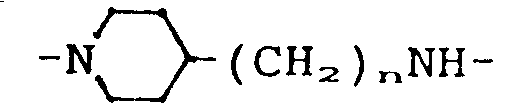
bedeutet, worin m den Wert 2, 3, 4, 5 oder 6 und n den Wert 0, 1, 2, 3 oder 4 haben,
sowie die physiologisch annehmbaren Salze davon. - In der allgemeinen Formel I bedeutet A ein Wasserstoffatom, eine C₁-C₃-Alkylgruppe oder eine Hydroxymethylgruppe.
- Beispiele für die C₁-C₃-Alkylgruppe sind die Methyl-, Ethyl-, n-Propyl- und die Isopropylgruppe, wobei die Methylgruppe bevorzugt wird. B bedeutet ein Wasserstoffatom, ein Halogenatom, beispielsweise ein Fluor-, Chlor- oder Bromatom, eine Cyanogruppe oder eine Nitrogruppe. Von den Halogenatomen werden das Fluor- und das Chloratom bevorzugt. Besonders bevorzugt werden Verbindungen, bei denen B für eine Nitrogruppe steht.
- X bedeutet die Gruppe

oder
worin m den Wert 2, 3, 4, 5 oder 6 hat, wobei der Wert 2, 3 oder 4 bevorzugt wird. n hat den Wert 0, 1, 2, 3 oder 4. - Eine bevorzugte Gruppe von erfindungsgemäßen Verbindungen ist dadurch gekennzeichnet, daß X die Gruppe
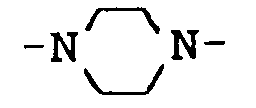
ist. - Eine weitere bevorzugte Gruppe von erfindungsgemäßen Verbindungen ist dadurch gekennzeichnet, daß X die Gruppe
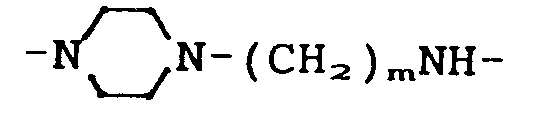
bedeutet. - Eine weitere Gruppe von bevorzugten Verbindungen ist dadurch gekennzeichnet, daß X die Gruppe

bedeutet, worin n den Wert 0, 1, 2, 3 oder 4 hat. - Bevorzugte Einzelverbindungen sind die folgenden Verbindungen:
6-[4-[4-[3-(1H-Imidazol-4-yl)-propylamino-iminomethylen]-piperazin-1-yl]-3-nitro-phenyl]-4,5-dihydro-5-methyl-3(2H)-pyridazinon,
N¹-[3-(1H-Imidazol-4-yl)propyl]-N³-[3-[4-(4-(4-methyl-6-oxo-1,4,5,6-tetrahydropyridazin-3-yl)-2-nitro-phenyl]-piperazin-1-yl]propyl]-guanidin,
N¹-[3-(1H-Imidazol-4-yl)propyl]-N³-[2-[4-(4-methyl-6-oxo-1,4,5,6-tetrahydropyridazin-3-yl)-2-nitro-anilino]-ethyl]-guanidin. - Die erfindungsgemäßen Verbindungen sowie die physiologisch annehmbaren Salze davon können durch ein Verfahren hergestellt werden, das dadurch gekennzeichnet ist, daß man
- a) eine Verbindung der allgemeinen Formel (II)

mit einer Verbindung der Formel (III)
- b) eine Verbindung der allgemeinen Formel (IV)

mit einer Verbindung der allgemeinen Formel (V)
zu einer Verbindung der allgemeinen Formel (I) umsetzt oder - c) eine Verbindung der allgemeinen Formel (Ia)


sauer oder basisch zu einer Verbindung der allgemeinen Formel (I) hydrolysiert und gegebenenfalls die nach den Verfahrensvarianten a) bis c) erhaltene Verbindung der allgemeinen Formel (I) in an sich bekannter Weise in ihr physiologisch annehmbares Salz umwandelt. - Die Verbindungen der allgemeinen Formeln II und IV werden vorzugsweise im Verhältnis 1:1 bis 0,8:1, besonders bevorzugt in äquimolaren Mengen, bezogen auf die Verbindungen der allgemeinen Formeln III bzw. V, eingesetzt. Die Umsetzungen werden in einem polaren Lösungsmittel, wie Acetonitril, Pyridin, Dimethylformamid, oder Alkohol, vorzugsweise sekundärem oder tertiärem Alkohol, wie zum Beispiel Isopropanol oder Gemischen davon, und bei Temperaturen von 20°C bis zur Rückflußtemperatur des verwendeten Lösungsmittels durchgeführt.
- Im Falle der Variante (c) erfolgt die saure Hydrolyse beispielsweise in einer wäßrigen Mineralsäure, wie Chlor- oder Bromwasserstoffsäure oder Schwefelsäure, und bei Temperaturen von 20 bis 100°C, vorzugsweise 30 bis 80°C. Gegebenenfalls kann es aber auch günstiger sein, nicht-wässrige Reaktionsbedingungen anzuwenden. Solche schonenderen Methoden sind z. B. die Solvolyse mit Trifluoressigsäure in einem Chlorkohlenwasserstoff, wie Dichlormethan oder Chloroform, oder die Umsetzung mit Bromwasserstoff in Eisessig.
- Die basische Hydrolyse erfolgt in einer verdünnten Lösung von Alkali- oder Erdalkalicarbonaten bzw. Alkali- oder Erdalkalihydroxiden in Wasser, niedrigen Alkoholen oder Gemischen von beiden und bei Temperaturen von Raumtemperatur bis zur Rückflußtemperatur des verwendeten Lösungsmittels.
- Die nach den einzelnen Verfahrensvarianten erhaltenen Verbindungen werden in üblicher Weise isoliert und gereinigt, beispielsweise durch Umkristallisation, chromatographische Arbeitsweisen usw. Die bei den einzelnen Verfahrensvarianten erhaltenen Verbindungen können gegebenenfalls in ihr physiologisch annehmbares Salz umgewandelt werden. Diese Salze können zum Beispiel mit Mineralsäuren, wie Chlor-, Brom-, Jodwasserstoffsäure, Phosphorsäure, Metaphosphorsäure, Salpetersäure oder Schwefelsäure, oder mit organischen Säuren, wie Ameisensäure, Essigsäure, Propionsäure, Phenylessigsäure, Weinsäure, Zitronensäure, Fumarsäure, Methansulfonsäure, Embonsäure etc. gebildet werden.
Die erfindungsgemäßen Verbindungen der allgemeinen Formel I können sowohl in einer Reihe von tautomeren Formen als auch in mehreren stereoisomeren Formen vorliegen. Die Erfindung umfaßt daher neben den Salzen und Hydraten der oben beschriebenen Verbindungen der allgemeinen Formel I auch alle tautomeren und stereoisomeren Formen.
Die erfindungsgemäßen Verbindungen können zur Verabreichung in jeder beliebigen Weise formuliert werden. Die Erfindung umfaßt daher auch Arzneimittel, die mindestens eine erfindungsgemäße Verbindung zur Verwendung in der Human- oder Veterinärmedizin enthalten. Solche Arzneimittel können herkömmlicherweise unter Verwendung eines oder mehrerer pharmazeutisch annehmbarer Träger oder Verdünnungsmitteln hergestellt werden. - Die erfindungsgemäßen Verbindungen können daher für die orale, bukkale, topische, parenterale oder rektale Verabreichung formuliert werden.
- Für die orale Verabreichung kann das Arzneimittel in Form von beispielsweise Tabletten, Kapseln, Pulvern, Lösungen, Sirups oder Suspensionen vorliegen, die unter Verwendung von annehmbaren Verdünnungsmitteln auf herkömmliche Weise hergestellt worden sind.
- Für die bukkale Verabreichung kann das Arzneimittel die Form von Tabletten oder Briefchen einnehmen, die in herkömmlicher Weise formuliert worden sind.
- Die erfindungsgemäßen Verbindungen können für die parenterale Verabreichung durch Bolusinjektion oder kontinuierliche Infusion formuliert werden. Formulierungen zur Injektion können in Dosiseinheitsform als Ampullen oder in Mehrfachdosenbehältern mit zugesetztem Konservierungsmittel vorliegen. Die Arzneimittel können solche Formen, wie Suspensionen, Lösungen oder Emulsionen in öligen oder wäßrigen Trägern, einnehmen, und sie können Formulierungshilfsmittel, wie Suspendierungs-, Stabilisierungs- und/oder Dispergierungsmittel, enthalten.
Alternativ kann der Wirkstoff auch in Pulverform zur Rekonstitution mit einem geeigneten Träger, zum Beispiel sterilem, pyrogenfreiem Wasser, vor dem Gebrauch vorliegen.
Die erfindungsgemäßen Verbindungen können auch für rektale Zubereitungen, zum Beispiel Suppositorien oder Retentionseinläufe, formuliert werden, die zum Beispiel herkömmliche Suppositoriengrundlagen, wie Kakaobutter oder andere Glyceride, enthalten. - Zur topischen Anwendung können die erfindungsgemäßen Verbindungen als Salben, Cremes, Gels, Lotionen, Pulver oder Sprays in herkömmlicher Weise formuliert werden.
Für die orale Verabreichung ist eine geeignete Tagesdosis an erfindungsgemäßen Verbindungen 1 bis 4 Dosen bis insgesamt 5 mg bis 1 g/Tag, je nach Zustand des Patienten. Im Einzelfall kann es gegebenenfalls erforderlich sein, von den genannten Mengen abzuweichen, und zwar in Abhängigkeit vom individuellen Verhalten gegenüber dem Wirkstoff bzw. der Art seiner Formulierung und dem Zeitpunkt bzw. Intervall, zu welchem die Verabreichung erfolgt. So gibt es zum Beispiel Fälle, in denen mit weniger als der oben genannten Mindestmenge ausgekommen werden kann, während in anderen Fällen die genannte obere Grenze überschritten werden muß. - Die erfindungsgemäßen 6-Oxo-pyridazinderivate der allgemeinen Formel I zeigen ausgeprägte cardiovaskuläre, insbesondere cardiotone Wirkungen und eignen sich daher zur Behandlung und Vorbeugung von Erkrankungen des Herzens und des Kreislaufs.
- So zeigen sie eine ausgezeichnete positiv inotrope Wirkung in einer Reihe von in vitro- und in vivo- Standardmodellen, z. B. im isolierten, perfundierten Langendorff-Herzen und am narkotisierten Meerschweinchen nach intravenöser Applikation.
-
a) Methode
Zur Bestimmung der hämodynamischen Effekte der erfindungsgemäßen Verbindungen an isolierten, perfundierten Meerschweinchenherzen wurde die Anordnung von Langendorff nach P.R.Beckett (J. Pharm. Pharmacol 22,818 (1970)) und R. M. Abel und R. L. Reis (Circ. Res. 27, 961 (1970)) modifiziert. Die spontan schlagenden Meerschweinchenherzen sind linksventrikulär katheterisiert und werden mit Lösungen der Prüfsubstanzen in physiologischer Kochsalzlösung/Ethanol (9:1) in Konzentrationen von 1o⁻⁴ bis 10⁻⁸ mol/l mit einem konstanten Perfusionsdruck von 60 mm Hg perfundiert.
b) MeßwerteBeispiel Nr. Konzentration (mol/l) Zunahme der Kontraktilität LV dp/dt gegenüber den Ausgangswerten 1 10⁻⁶ + 90 % 10⁻⁵ + 100 % 3 10⁻⁶ + 50 % 10⁻⁵ + 100 % 5 10⁻⁵ + 200 % 6 10⁻⁷ + 67 % 10⁻⁶ + 220 % -
a) Methode
Die Tiere werden mit Urethan (1,5 g/kg) narkotisiert. Zur volumenkontrollierten Beatmung wird die Trachea kanüliert. Danach erfolgt die operative Freilegung beider Karotiden; über die rechte Karotis wird ein Tip-Katheter (3F) eingeführt, der unter fortlaufender Druckregistrierung dann über die Aorta ascendens in den linken Ventrikel vorgeführt wird. Die erfolgreiche Passage der Aortenklappen wird hierbei durch die typische linksventrikuläre Druckkurve erkannt. Über die linke Karotis wird zur Thermodilution ein Thermistorfühler (3F, F. Edwards) in den Aortenbogen vorgeschoben. Der Thermistorfühler hat gleichzeitig ein Lumen zur arteriellen Blutdruckregistrierung. Zur Applikation des Kälteinjektats (0,2 ml 0,9 % NaCl, 15°C) wird durch die rechte Vena jugularis ein Katheter vor den rechten Vorhof plaziert. Alle Substanzen sind in physiologischer Kochsalzlösung gelöst und werden über die linke Vena jugularis infundiert (Infusionsvolumen 0,02 ml/min); die Applikation erfolgt nach hämodynamischer Stabilisierung und unter β-Blockade (Metoprolol 2 mg/kg i.m.). Alle Kreislaufparameter werden kontinuierlich auf einem Direktschreiber registriert. Die Kontraktilität (dp/dt) wird über die Volumenkurve berechnet.
b) MeßwerteBeispiel Nr. Dosis µg/kg/min Maximale Zunahme der Kontraktilität LV dp/dt 1 5 + 100 % 3 10 + 90 % 6 5 + 200 % - Die folgenden Beispiele erläutern die Erfindung. Es wird jedoch angemerkt, daß die Beispiele 1, 4, 9 und 18-22 sich nicht auf in den Ansprüchen definierte Verbindungen beziehen. Die Zwischenprodukte wurden routinemäßig auf die Reinheit durch Dünnschichtchromatographie überprüft, wobei für den Nachweis UV-Licht sowie Sprühreagentien, wie Echtblausalz B/Natronlauge, verwendet wurden.
- Die präparative Chromatographie wurde unter Verwendung von Kieselgel (Merck, Art. Nr. 7734 und 7749) durchgeführt.
- Die Dünnschichtchromatographie wurde an Kieselgel-Folien Polygram SIL G/UV₂₅₄ (Machery-Nagel) durchgeführt.
- Für die Elutionsmittel werden folgende Abkürzungen verwendet:
A Dichlormethan/Methanol 95:5 B Dichlormethan/Methanol/konz. Ammoniak 90:7:3 C Dichlormethan/Methanol/konz. Ammoniak 85:13:2 D Ethylacetat/Puffer* 50:50 E Ethylacetat/Puffer* 60:40 F Ethylacetat/Methanol/konz. Ammoniak 80:18:2 G Ethylacetat/Puffer 70:30 H Dichlormethan/Methanol 90:10 * Puffer:Methanol/konz. Ammoniak gesättigt mit Ammoniumchlorid 95:5 -

-
- a) N¹-Benzoyl-N²-[2-[4-(4-methyl-6-oxo-1,4,5,6-tetrahydropyridazin-3-yl)-2-nitro-anilino]ethyl]-thioharnstoff
Eine Suspension von 5,0 g (17,1 mmol) N-[4-(4-Methyl-6-oxo-1,4,5,6-tetrahydropyridazin-3-yl)-2-nitro-phenyl]-ethylendiamin in 50 ml Acetonitril wird mit 2,8 g (17,1 mmol) Benzoylisothiocyanat versetzt und eine Stunde bei Raumtemperatur gerührt. Der ausgefallene Feststoff wird abgesaugt, mit etwas Acetonitril gewaschen und mit 100 ml Ethanol aufgekocht. Nach Abkühlen und Absaugen erhält man 6,4 g (82%) eines orangegelben Feststoffs vom Schmp. 177°C.
C₂₁H₂₂N₆O₄S (454,50)
Rf = 0,73 (Laufmittel H) - b) N-[2-[4-(4-Methyl-6-oxo-1,4,5,6-tetrahydropyridazin-3-yl)-2-nitro-anilino]ethyl]-thioharnstoff
2,00 g (4,4 mmol) N¹-Benzoyl-N²-[2-[4-(4-methyl-6-oxo-1,4,5,6-tetrahydropyridazin-3-yl)-2-nitro-anilino]ethyl]-thioharnstoff werden mit 1,20 g (8,7 mmol) Kaliumcarbonat in 75 ml Methanol und 15 ml Wasser eine Stunde gekocht. Der ausgefallene Feststoff wird abgesaugt und aus Methanol umkristallisiert. Man erhält 1,37 g (89%) eines orangefarbenen Feststoffs vom Schmp. 231-233°C.
C₁₄H₁₈N₆O₃S (350,39)
Rf = 0,43 (Laufmittel H) - c) N-[2-[4-(4-Methyl-6-oxo-1,4,5,6-tetrahydropyridazin-3-yl)-2-nitro-anilino]ethyl]-S-methyl-isothiuroniumjodid.
1,35 g (3,85 mmol) des Thioharnstoffs aus Stufe b) werden mit 0,26 ml (4,2 mmol) Methyljodid 2,5 Stunden in 20 ml Dimethylformamid bei Raumtemperatur gerührt. Die Lösung wird filtriert und das Filtrat bei 70°C i. Vak. eingedampft. Der Rückstand ergibt nach Kristallisation mit 20 ml Ethanol 1,33 g (70%) orangefarbene Kristalle vom Schmp. 145-147°C.
C₁₅H₂₁JN₆O₃S (492,33)
Rf = 0,18 (Laufmittel H) - d) N¹-[3-(1H-Imidazol-4-yl)propyl]-N³-[2-[4-(4-methyl-6-oxo-1,4,5,6-tetrahydropyridazin-3-yl)-2-nitro-anilino]ethyl]-guanidin
1,00 g (2,03 mmol) N-[2-[4-(4-Methyl-6-oxo-1,4,5,6-tetrahydropyridazin-3-yl)-2-nitro-anilino]ethyl]-S-methyl-isothiuroniumjodid und 0,28 g (2,23 mmol) 3-(1H-Imidazol-4-yl)-propylamin werden in 20 ml Pyridin 3 Stunden gekocht. Nach Abkühlen wird die rote Lösung i. Vak. eingedampft und der Rückstand an Kieselgel mit Ethylacetat/Methanol/konz. Ammoniak gesättigt mit Ammoniumchlorid (50:47,5:2,5) als Laufmittel chromatographiert. Die Hauptfraktion wird i. Vak. eingedampft, der Rückstand in 10 ml gesättigter Kaliumcarbonat-Lösung aufgenommen und die wässrige Phase mit 3x10 ml Isopropanol extrahiert. Die organischen Phasen ergeben nach Trocknen, Filtrieren und Eindampfen i. Vak. einen orangegelben Schaum, der mit Ethanol kristallisiert wird. Man erhält 0,40 g (45%) eines unscharf schmelzenden Feststoffs.
C₂₀H₂₇N₉O₃ (441,49)
Rf = 0,38 (Laufmittel D)- ¹H-NMR-Daten (DMSO-d₆, TMS als interner Standard)
- δ = 1,05 (d) 3H
1,72 (quin) 2H
2,15-2,80 (m) 4H
3,10 (t) 2H
3,2 -3,6 (m) 5H
6,75 (s) 1H
7,23 (d) 1H
7,50 (s) 1H
7,95 (dd) 1H
8,38 (d) 1H
8,6 (breit) 6H,
austauschbar mit
D₂O
ppm
-

- 2,00 g (4,2 mmol) 6-[4-[4-(Methylthio-iminomethylen)piperazin-1-yl]phenyl]-4,5-dihydro-5-methyl-3(2H)-pyridazinon-hydrojodid und 0,58 g (4,7 mmol) 3-(1H-Imidazol-4-yl)-propylamin werden in 50 ml Acetonitril 3 Stunden unter Rückfluß gekocht. Das nach Eindampfen der Lösung i. Vak. erhaltene Öl wird mit Ethylacetat/Methanol/konz. Ammoniak gesättigt mit Ammoniumchlorid (70:28,5:1,5) als Laufmittel an Kieselgel chromatographiert. Die Hauptfraktion wird im Vakuum eingedampft, der Rückstand in 10 ml gesättigter Kaliumcarbonat-Lösung aufgenommen und mit 2 x 10 ml Isopropanol extrahiert. Nach Trocknen und Einengen der organ. Phase verbleibt ein amorpher Feststoff, der beim Verreiben mit wenig Isopropanol als Isopropanolat kristallisiert.
C₂₂H₃₀N₈OxC₃H₈O (482,61)
Rf = 0,55 (Laufmittel D) - ¹H-NMR-Daten (DMSO-d₆,TMS als interner Standard)
- δ= 1,02-1,14 (2d) 9H
1,76 (quin) 2H
2,4-3,9 (m) 16H
6,70 (s) 1H
6,98 (d) 2H
7,49 (s) 1H
7,63 (d) 2H
10,85 (breit) 1 H
austauschbar mit D₂O -

-
- a) 6-[4-[4-(Benzoylamino-thiocarbonyl)piperazin-1-yl]-3-nitro-phenyl]-4,5-dihydro-5-methyl-3(2H)-pyridazinon
52,4 g (0,165 mol) 6-[4-(1-Piperazinyl)-3-nitro-phenyl]-4,5-dihydro-5-methyl-3(2H)-pyridazinon in 1200 ml 1,4-Dioxan werden bei RT mit 27,0 g (0,165 mol) Benzoylisothiocyanat versetzt. Man rührt 2 h bei RT, konzentriert das Reaktionsgemisch auf 700 ml im Vakuum und läßt kristallisieren. Nach dem Absaugen erhält man 76,05 g (96% d. Th.) orangegelber Kristalle, die bei 174,5-177°C schmelzen.
C₂₃H₂₄N₆O₄S (480,55)
Rf = 0,58 (Laufmittel B) - b) 6-[4-[4-(Amino-thiocarbonyl)piperazin-1-yl]-3-nitro-phenyl]-4,5-dihydro-5-methyl-3(2H)-pyridazinon
66,6 g (0,139 mol) der wie unter a) synthetisierten Verbindung werden in 1200 ml Methanol und 150 ml Wasser in Gegenwart von 21,6 g (0,156 mol) Kaliumcarbonat unter Rückfluß gekocht.
Nach 12 h destilliert man 500 ml Methanol ab und kühlt auf Raumtemperatur. Es kristallisieren 35,5 g (68% d. Th.) des Produkts als orangerote Kristalle vom Schmp. 238,0-239,5°C aus.
C₁₆H₂₀N₆O₃S (376,44)
Rf = 0,62 (Laufmittel F) - c) 6-[4-[4-(Methylthio-iminomethylen)piperazin-1-yl]-3-nitro-phenyl]-4,5-dihydro-5-methyl-3(2H)-pyridazinon-hydrojodid
Eine Suspension von 42,4 g (0,113 mol) der wie unter b) erhaltenen Verbindung in 300 ml Dimethylformamid wird tropfenweise mit 8,0 ml (0,127 mol) Methyljodid in 20 ml DMF versetzt.
Die klare Lösung wird noch 4 h bei RT gerührt.
Nach dem Abdestillieren des Dimethylformamids im Feinvakuum verbleibt ein rotes Öl, aus dem nach Zugabe von 200 ml Ethanol 52,7 g (90% d. Th.) eines orangegelben Feststoffs kristallisieren, der einen Schmelzbereich von 179,8-181,3°C hat.
C₁₇H₂₃INO₃S (518,37)
Rf = 0,58 (Laufmittel F) - d) 6-[4-[4-[3-(1H-Imidazol-4-yl)propylamino-iminomethylen]piperazin-1-yl]-3-nitro-phenyl]-4,5-dihydro-5-methyl-3(2H)-pyridazinon
2,07 g (4 mmol) der wie unter c) erhaltenen Verbindung werden mit 0,50 g (4 mmol) 3-(1H-Imidazol-4-yl)-propylamin in 10 ml Pyridin 15 h bei RT gerührt.
Man versetzt mit 10 ml 10%-iger wäßriger Kaliumcarbonat-Lösung und extrahiert mit insgesamt 50 ml Chloroform/Methanol (80/20 vv). Nach dem Abziehen der organischen Lösungsmittel im Vakuum versetzt man den Rückstand mit 20 ml Ethanol. Es kristalliereren 1,4 g (75% d. Th.) der Titelverbindung als gelbes Pulver vom Schmelzpunkt 225-226°C.
C₂₂H₂₉N₉O₃ (467,54)
RF = 0,38 (Laufmittel D) - ¹H-NMR-Daten (DMSO-d₆, TMS als interner Standard)
- δ= 1,06 (d) 3H
1,83 (q) 2H
2,25 (d) 1H
2,56 (t) 2H
2,71 (dd) 1H
3,24 (m) 6H
3,42 (m) 1H
3,58 (m) 4H
6,63 (s) 1H
7,37 (d) 1H
7,59 (s) 1H
7,4-8,4 (breit) 2H,
austauschbar mit D₂O,
7,99 (dd) 1H
8,21 (d) 1H
11,05 (s) 1H
11,8 (breit) 1H,
austauschbar mit D₂O, ppm -

-
- a) N¹-Benzoyl-N²-[4-(4-methyl-6-oxo-1,4,5,6-tetrahydro-pyridazin-3-yl)-3-nitro-phenyl]-thioharnstoff
10,0 g (40,3 mmol) 6-(4-Amino-3-nitro-phenyl)-4,5-dihydro-5-methyl-3(2H)-pyridazinon werden mit 7,2 g (44,3 mmol) Benzoylisothiocyanat in 300 ml Dioxan 10 h unter Rückfluß gekocht. Das Lösungsmittel wird im Vakuum abgezogen, und der Rückstand in 200 ml Ethanol 30 min unter Rückfluß gekocht. Nach dem Abkühlen auf RT und Absaugen erhält man 14,0 g (84 % d. Th.) eines orangegelben Pulvers vom Schmp. 204,9-205,4°C.
C₁₉H₁₇N₅O₄S (411,44)
Rf = 0,69 (Laufmittel A) - b) 6-(4-Cyanamino-3-nitro-phenyl)-4,5-dihydro-5-methyl-3(2H)-pyridazinon
10,0 g (24,3 mmol) der wie unter a) erhaltene Verbindung werden in 200 ml Methanol und 35 ml Wasser mit 3,4 g (24,3 mmol) Kaliumcarbonat 2 h unter Rückfluß gekocht. Die dunkelrote Lösung wird abgekühlt, man saugt vom ausgefallenen Feststoff ab und wäscht mit wenig Methanol nach. Der Filterkuchen wird in 70 ml heißem Wasser gelöst und mit Eisessig bis pH 5 angesäuert.
Nach erneutem Absaugen in der Kälte erhält man 3,4 g (51 % d. Th.) hellgelber Kristalle, die bei 234,5-235,9°C schmelzen.
C₁₂H₁₁N₅O₃ (273,29)
Rf = 0,41 (Laufmittel A) - c) N¹-[3-(1H-Imidazol-4-yl)propyl]-N³-[4-(4-methyl-6-oxo-1,4,5,6-tetrahydro-pyridazin-3-yl)-3-nitro-phenyl]-guanidin
Zu einer Lösung von 1,8 g (6,6 mmol) des wie unter b) erhaltenen Feststoffs und 1,2 g ( 9,9 mmol) 3-(1H-Imidazol-4-yl)-propylamin in 40 ml Methoxyethanol gibt man 1,0 g einer 33%-igen isopropanolischen Salzsäure.
Man kocht 3 h unter Rückfluß, kühlt ab, versetzt mit 10 ml einer gesättigten, wäßrigen Kaliumcarbonat-Lösung und extrahiert mit Tetrahydrofuran.
Nach dem Abziehen des Lösungsmittels unter vermindertem Druck chromatographiert man den Rückstand an Kieselgel (Laufmittel E).
Die Hauptfraktionen werden eingeengt, der Rückstand zwischen wäßriger Kaliumcarbonat-Lösung und Tetrahydrofuran verteilt und die organische Phase eingeengt.
Durch Behandeln des Rückstands mit Ethanol erhält man 1,1 g (42 % d. Th.) eines orangegelben Pulvers, das ab 155°C erweicht und 1/3 Molequivalent Ethanol enthält.
C₁₈H₂₂N₈O₃ x 1/3 C₂H₆O (413,78)
Rf = 0,65 (Laufmittel D) - ¹H-NMR-Daten (DMSO-d₆, TMS als interner Standard)
- δ= 1,07 (d) 3H
1.75 (q) 2H
2,23 (d) 1H
2,56 (m) 2H
3,13 (q) 2H
3,43 (m) 1H
5,54 (s) 2H,
austauschbar mit D₂O,
6,09 (t) 1H,
austauschbar mit D₂O,
6,74 (s) 1H
7,02 (d) 1H
7,49 (s) 1H
7,80 (dd) 1H
8,06 (d) 1H
10,94 (s) 1H
11,79 (breit) 1H,
austauschbar mit D₂O,
ppm -

-
- a) 6-[4-[4-(Benzoylamino-thiocarbonyl)piperazin-1-yl]-3-nitro-phenyl]-4,5-dihydro-3(2H)-pyridazinon
Zu einer Suspension von 8,8 g (29 mmol) 6-[4-(1-Piperazinyl)-3-nitro-phenyl]-4,5-dihydro-3(2H)-pyridazinon in 300 ml Chloroform tropft man bei RT eine Lösung von 5,2 g (32 mmol) Benzoylisothiocyanat in 20 ml Chloroform.
Man rührt 2 h bei 30°C, kühlt im Eisbad und saugt vom ausgefallenen Feststoff ab. Nach dem Trocknen verbleiben 12,5 g (93 % d. Th.) orangefarbener Kristalle vom Schmp. 140-141,5°C.
C₂₂H₂₂N₆O₄S (466,52)
Rf = 0,72 (Laufmittel F) - b) 6-[4-[4-(Amino-thiocarbonyl)piperazin-1-yl]-3-nitro-phenyl]-4,5-dihydro-3(2H)-pyridazinon
12,0 g (25,7 mmol) der wie unter a) erhaltenen Benzoylverbindung werden mit 5,4 g (39 mmol) Kaliumcarbonat in 210 ml Methanol und 35 ml Wasser unter Rückfluß gekocht.
Nach 22 h läßt man auf RT abkühlen, wobei ein Feststoff auskristallisiert.
Nach Absaugen und Nachwaschen mit wenig Methanol erhält man 7,19 g (76 % d. Th.) eines orangenen Feststoffs vom Schmp. 222,5-223,8°C.
C₁₅H₁₈N₆O₃S (362,41)
Rf = 0,51 (Laufmittel F) - c) 6-[4-[4-(Methylthio-iminomethylen)piperazin-1-yl]-3-nitro-phenyl]-4,5-dihydro-3(2H)-pyridazinon-hydrojodid
6,7 g (18,5 mmol) des wie unter b) erhaltenen Thioharnstoffs werden in 500 ml CHCl₃ und 120 ml CH₃OH suspendiert und mit 7,5 ml Methyljodid versetzt.
Man kocht 5 h unter Rückfluß, läßt das Reaktionsgemisch abkühlen, saugt ab und wäscht mit wenig Chloroform nach.
Man erhält 6,8 g (73 % d. Th.) gelber Kristalle vom Schmp. 209-212°C.
C₁₆H₂₁IN₆O₃S (504,34)
Rf = 0,65 (Laufmittel B) - d) 6-[4-[4-[3-(1H-Imidazol-4-yl)propylamino-iminomethylen] piperazin-1-yl]-3-nitro-phenyl]-4,5-dihydro-3(2H)-pyridazinon
3,0 g (5,9 mmol) 6-[4-[4-(Methylthio-iminomethylen)piperazin-1-yl]-3-nitro-phenyl]-4,5-dihydro-3(2H)-pyridazinon werden mit 1,1 g (8,9 mmol) 3-(1H-Imidazol-4-yl)-propylamin in 100 ml Acetonitril 2 h unter Rückfluß gekocht.
Nach dem Abkühlen wird das Reaktionsgemisch mit 40 ml einer gesättigten wäßrigen Kaliumcarbonat-Lösung versetzt, die organische Phase abgetrennt und die wäßrige mit 50 ml Chloroform/Methanol (80/2 v/v) extrahiert. Die organischen Phasen werden vereinigt, eingeengt, und der Rückstand wird an Kieselgel chromatographiert (Laufmittel F).
Die Hauptfraktionen werden vereinigt und eingeengt. Der Rückstand wird mit ges. Kaliumcarbonat-Lösung versetzt und mit Chloroform /Methanol (80/20 v/v) extrahiert. Das Lösungsmittel wird im Vakuum eingedampft und das verbleibende Öl aus wenig Isopropanol kristallisiert. Man erhält 0,56 g (21 % d. Th.) eines orangeroten Pulvers vom Schmelzpunkt 204,8-205,4°C.
C₂₁H₂₇N₉O₃ (453,51)
Rf = 0,40 (Laufmittel D) - ¹H-NMR-Daten (DMSO-d₆, TMS als interner Standard)
- δ= 1,73 (m) 2H
2,4 - 2,6 (m) 6H
2,9 (m) 2H
3,0 (m) 4H
3,3 (m) 4H
3,0 - 3.8 (breit) 3H,
austauschbar mit D₂O,
6,69 (s) 1H
7,34 (d) 1H
7,48 (s) 1H
7,92 (dd) 1H
8,13 (s) 1H
10,95 (breit) 1H,
austauschbar mit D₂O, ppm -

-
- a) 6-[3-Nitro-4-[4-(3-phthalimido-propyl)piperazin-1-yl] phenyl]-5-methyl-4,5-dihydro-3(2H)-pyridazinon
31,63 g (0,1 mol) 6-[4-(1-Piperazinyl-3-nitro-phenyl]-4,5-dihydro-5-methyl-3(2H)-pyridazinon und 26,81 g (0,1 mol) 1-(3-Brompropyl)-phthalimid werden in 500 ml DMF in Gegenwart von 13,8 g (0,1 mol) Kaliumcarbonat und 0,4 g Kaliumjodid 24 h bei 100°C gerührt.
Man läßt auf 40°C abkühlen und gießt auf 1,6 l Eiswasser. Nach 1h saugt man vom ausgefallenen Feststoff ab, wäscht mit Wasser nach und trocknet im Vakuum.
Die Umkristallisation aus Ethanol ergibt 26 g (52 % d.Th.) orangefarbener Kristalle vom Schmelzpunkt 179,5-180°C.
C₂₆H₂₈N₆O₅ (504,55)
Rf = 0,28 (Laufmittel A) - b) 6-[4-[4-(3-Aminopropyl)piperazin-1-yl]-3-nitro-phenyl]-5-methyl-4,5-dihydro-3(2H)-pyridazinon
32,0 g (64 mmol) der wie unter a) erhaltenen Phthalimidoverbindung werden mit 30 ml Hydrazinhydrat (80 % in Wasser) in 700 ml Ethanol 5 h unter Rückfluß gekocht.
Das Ethanol wird weitgehend im Vakuum abdestilliert, der Rückstand mit 200 ml Wasser versetzt und bis pH 2 mit konz. Salzsäure angesäuert.
Man saugt vom Feststoff ab, stellt das Filtrat alkalisch (pH 12) und extrahiert mit Dichlormethan.
Die organische Phase wird eingeengt und der Rückstand aus Isopropanol kristallisiert.
Die Ausbeute beträgt 16,0 g (67 % d. Th.) eines orangeroten Pulvers vom Schmp. 110-111°C.
C₁₈H₂₆N₆O₃ (374,45)
Rf = 0,27 (Laufmittel C) - c) S-Methyl-N-[3-[4-[4-(4-methyl-6-oxo-1,4,5,6-tetrahydro-pyridazin-3-yl)-2-nitro-phenyl]piperazin-1-yl]propyl]-isothioharnstoff-hydrojodid
11,23 g (30 mmol) des wie unter b) erhaltenen Amins werden mit 8,22 g (33 mmol) Dithiocarbimidsäure-S,S-dimethylester-hydrojodid in 240 ml Acetonitril 5 h unter Rückfluß gekocht. Man engt im Vakuum ein und rührt den Rückstand in 200 ml Ethylacetat. Nach dem Absaugen erhält man 17,2 g (100 % d. Th) eines roten amorphen Pulvers, das ausreichend rein ist für die weitere Umsetzung.
C₂₀H₃₀IN₇O₃S (575,47)
Rf = 0,4 (Laufmittel C) - d) N¹-[3-(1H-Imidazol-4-yl)propyl]-N³-[3-[4-[4-(4-methyl-6-oxo-1,4,5,6-tetrahydro-pyridazin-3-yl)-2-nitro-phenyl] piperazin-1-yl]propyl]-guanidin
2,88 g (5 mmol) des wie unter c) erhaltenen Isothiouronium-Salzes werden mit 0,63 g (5 mmol) 3-(1H-Imidazol-4-yl)-propylamin in 10 ml DMF 12 h bei RT gerührt.
Nach Zugabe von 5 ml einer ges. wäßrigen Kaliumcarbonatlösung extrahiert man mit Dichlormethan/Methanol (80/20 v/v). Die organische Phase wird eingeengt und der Rückstand an Kieselgel chromatographiert (Laufmittel D).
Die Hauptfraktionen werden vereinigt und eingeengt, der Rückstand mit wäßriger Kaliumcarbonat-Lösung versetzt und mit Chloroform/Methanol (80/20 v/v) extrahiert.
Nach Einengen der organischen Phasen erhält man 0,32 g (12 % d. Th.) eines orangeroten Schaums mit einem Erweichungsbereich von 117-119°C.
C₂₅H₃₆N₁₀O₃ (524,63)
Rf = 0,32 (Laufmittel D) - ¹H-NMR-Daten (DMSO-d₆, TMS als interner Standard)
- δ=1,05 (d) 3H
1,70 (m) 4H
2,1 - 2,9 (m) 6H
3,08 (m) 9H
3,36 (m) 4H
6,78 (s) 1H
7,31 (d) 1H
7,53 (s) 1H
7,4 - 8,3 (breit) 1H,
austauschbar mit D₂O,
8,05 (dd) 1H
8,14 (d) 1H
9,2 (breit) 1H
und 11,8 (breit) 1H,
austauschbar mit D₂O,
11,03 (s) 1H ppm -

- 3,0 g (9,5 mmol) 6-[4-(1-Piperazinyl)-3-nitro-phenyl]-4,5-dihydro-5-methyl-3(2H)-pyridazinon werden mit 1,7 g (10,5 mmol) Carbonyl-diimidazol in 30 ml DMF 2 h bei RT gerührt.
Anschließend versetzt man mit 1,88 g (15 mmol) 3-(1H-Imidazol-4-yl)-propylamin und erhitzt 8 h auf 70°C.
Nach dem Abkühlen gibt man 10 ml einer gesättigten wäßrigen Kaliumcarbonat-Lösung zu und extrahiert mit Chloroform. Die organische Phase wird im Vakuum eingedampft und der Rückstand an Kieselgel chromatographiert (Laufmittel F).
Durch Einengen der Hauptfraktionen und Kristallisation des Rückstands erhält man 2,3 g (52 % d. Th.) orangener Kristalle, die einen Schmelzpunkt von 182°C haben.
C₂₂H₂₈N₈O₄ (468,52)
Rf = 0,36 (Laufmittel F) - ¹H-NMR-Daten (DMSO-d₆, TMS als interner Standard)
- δ= 1,06 (d) 3H
1,70 (q) 2H
2,24 (d) 1H
2,45 (m) 2H
2,69 (dd) 1H
3,06 (m) 4H
3,4 (m) 7H
6,68 (t) 1H,
austauschbar mit D₂O,
6,74 (s) 1H
7,36 (d) 1H
7,50 (s) 1H
7,96 (dd) 1H
11,04 (s) 1H
11,8 (breit) 1H,
austauschbar mit D₂O, ppm -

- 2,7 g (9,5 mmol) N-Ethoxycarbonyl-imidokohlensäurediphenylester werden in eine Suspension von 3,0 g (9,4 mmol) 6-[3-Nitro-4-(1-piperazinyl)-phenyl]-4,5-dihydro-5-methyl-3(2H)-pyridazinon in 30 ml Tetrahydrofuran eingetragen. Nach 20-stündigem Rühren bei Raumtemperatur wird die Lösung filtriert und das Filtrat i. Vak. eingedampft. Der Rückstand wird in 40 ml Acetonitril aufgenommen. Nach Zugabe von 1,2 g (9,6 mmol) 3-(1H-Imidazol-4-yl)-propylamin wird das Gemisch 3,5 Stunden unter Rückfluß gekocht. Die Lösung wird i. Vak. eingedampft und der erhaltene Rückstand an Kieselgel mit Laufmittel G chromatographiert.
Die orangefarbene polare Fraktion wird i. Vak. eingedampft, der Rückstand in 10 ml gesättigter Kaliumcarbonat-Lösung aufgenommen und die wässrige Phase mit 3 x 10 ml Isopropanol extrahiert. Die vereinigten organischen Phasen ergeben nach Trocknen mit Kaliumcarbonat, Filtrieren und Eindampfen i. Vak. 3,83 g (75%) eines orangegelben, amorphen Feststoffs.
C₂₅H₃₃N₉O₅ (539,60)
Rf = 0,34 (Laufmittel D) - ¹H-NMR-Daten (DMSO-d₆, TMS als interner Standard)
- δ= 1,04 (d) 3H
1,14 (t) 3H
1,78 (m) 2H
2,20-2,72 (m) 2H
2,49 (t) 2H
3,0 -3,6 (m) 10H
3,78 (quin) 1H
3,91 (q) 2H
6,74 (s) 1H
7,34 (d) 1H
7,52 (s) 1H
7,96 (dd) 1H
8,19 (d) 1H ppm -

-
- a) N¹-Benzoyl-N²-[3-[4-(4-methyl-6-oxo-1,4,5,6-tetrahydropyridazin-3-yl)-2-nitro-anilino]propyl]-thioharnstoff
Aus 7,00 g (22,9 mmol) N-[4-(4-Methyl-6-oxo-1,4,5,6-tetrahydropyridazin-3-yl)-2-nitro-phenyl]-1,3-propandiamin und 3,75 g (23 mmol) Benzoylisothiocyanat werden analog zu Beispiel 1a) 7,51 g (70 %) eines orangegelben Feststoffs vom Schmp. 118-120°C erhalten.
C₂₂H₂₄N₆O₄ (468,54)
Rf = 0,93 (Laufmittel F) - b) N-[3-[4-(4-Methyl-6-oxo-1,4,5,6-tetrahydropyridazin-3-yl)-2-nitro-anilino]-propyl]-thioharnstoff
Aus 7,5 g (16,0 mmol) des wie unter a) hergestellten Benzoylthioharnstoffs werden analog zu Beispiel 1b) 4,0 g (69 %) eines orangegelben Feststoffs vom Schmelzpunkt 199-203°C erhalten.
C₁₅H₂₀N₆O₃S (364,43)
Rf = 0,53 (Laufmittel F) - c) N-[3-[4-(4-Methyl-6-oxo-1,4,5,6-tetrahydropyridazin-3-yl)-2-nitro-anilino]propyl]-S-methyl-isothiuroniumjodid
2,00 g (5,5 mmol) des Thioharnstoffs aus Stufe b) werden analog zu Beispiel 1c) mit 0,40 ml (6,4 mmol) Methyljodid methyliert. Nach Umkristallisieren des Rohprodukts aus Ethylacetat/Methanol (7:3) verbleiben 0,70 g (25 %) eines orangegelben Feststoffs vom Schmp. 152-154°C.
C₁₆H₂₃JN₆O₃S (506,37)
Rf = 0,34 (Laufmittel G) - d) N¹-[3-(1H-Imidazol-4-yl)propyl]-N³-[3-[4-(4-methyl-6-oxo-1,4, 5,6-tetrahydropyridazin-3-yl)-2-nitro-anilino]propyl]-guanidin
0,60 g (1,18 mmol) des wie unter c) erhaltenen Isothiuroniumjodids werden mit 0,15 g (1,19 mmol) 3-(1H-Imidazol-4-yl)-propylamin in 20 ml Dioxan 4 Stunden unter Rückfluß gekocht. Der nach Eindampfen der Lösung im Vakuum erhaltene Rückstand wird an Kieselgel mit Laufmittel D chromatographiert. Die Produktfraktionen werden vereinigt, i. Vak. eingedampft und der Rückstand in 10 ml gesättigter Kaliumcarbonat-Lösung aufgenommen. Nach Extraktion mit 3 x 10 ml Isopropanol, Trocknen der vereinigten organischen Phasen und Eindampfen i. Vak. verbleiben 0,16 g (30 %) eines orangegelben, amorphen Feststoffs.
C₂₁H₂₉N₉O₃ (455,52)
Rf = 0,42 (Laufmittel D) -
- ¹H-NMR-Daten (DMSO-d₆, TMS als interner Standard)
- δ= 1,05 (d) 3H
1,6-1,95 (m) 4H
2,1-3,6 (m) 11H
6,75 (s) 1H
7,18 (d) 1H
7,53 (s) 1H
7,95 (dd) 1H
8,38 (d) 1H
8,0 und 8,5 (breit) 6H,
austauschbar mit D₂O, ppm. -

-
- a) N¹-Benzoyl-N²-[1-[4-(4-methyl-6-oxo-1,4,5,6-tetrahydropyridazin-3-yl)-2-nitro-phenyl]piperidin-4-yl]-thioharnstoff
Zu einer Suspension von 1,20 g (3,62 mmol) 6-[4-(4-Aminopiperidin-1-yl)-3-nitro-phenyl]-4,5-dihydro-5-methyl-3(2H)-pyridazinon in 30 ml Acetonitril werden 0,60 g (3,67 mmol) Benzoylisothiocyanat in 5 ml Acetonitril getropft. Nach zweistündigem Rühren bei Raumtemperatur wird der ausgefallene Feststoff abgesaugt, mit 10 ml Acetonitril gewaschen und i. Vak. getrocknet. Es werden 1,09 g (61 %) eines gelben Feststoffs vom Schmp. 192-194°C erhalten.
C₂₄H₂₆N₆O₄S (494,58)
Rf = 0,68 (Laufmittel H) - b) N-[1-[4-(4-Methyl-6-oxo-1,4,5,6-tetrahydropyridazin-3-yl)-2-nitro-phenyl]-piperidin-4-yl]-thioharnstoff
Aus 1,00 g (2,02 mmol) des wie unter a) hergestellten Benzoylthioharnstoffs erhält man durch Hydrolyse analog zu Beispiel 1b) 0,73 g (93 %) eines gelben Feststoffs vom Schmp. 222-224°C.
C₁₇H₂₂N₆O₃S (390,47)
Rf = 0,58 (Laufmittel F) - c) N-[1-[4-(4-Methyl-6-oxo-1,4,5,6-tetrahydropyridazin-3-yl)-2-nitro-phenyl]-piperidin-4-yl]-S-methyl-isothiuroniumjodid
0,60 g (1,53 mmol) des Thioharnstoffs aus Stufe b) werden mit 0,11 ml (1,76 mmol) Methyljodid in 30 ml Methanol 20 Std. bei Raumtemperatur gerührt. Der nach Abdampfen des Lösungsmittels i. Vak. erhaltene Schaum (0,85 g) ist DC-rein und wird ohne weitere Aufarbeitung in die nächste Stufe eingesetzt.
C₁₈H₂₅JN₆O₃S (532,41)
Rf = 0,51 (Laufmittel F) - d) N¹-[3-(1H-Imidazol-4-yl)propyl]-N³-[1-[4-(4-methyl-6-oxo-1,4,5,6-tetrahydropyridazin-3-yl)-2-nitro-phenyl]piperidin-4-yl]-guanidin
0,75 g (1,41 mmol) N-[1-[4-(4-Methyl-6-oxo-1,4,5,6-tetrahydropyridazin-3-yl)-2-nitro-phenyl]piperidin-4-yl]-S-methyl-isothiuroniumjodid und 0,20 g (1,59 mmol) 3-(1H-Imidazol-4-yl) propylamin werden zusammen in 30 ml Acetonitril 3 Stunden unter Rückfluß gekocht. Der nach Abdampfen des Lösungsmittels i. Vak. erhaltene Rückstand wird wie in Beispiel 9d) chromatographisch gereinigt. Man erhält 0,57 g (84 %) eines orangegelben, amorphen Feststoffs.
C₂₃H₃₁N₉O₃ (481,56)
Rf = 0,57 (Laufmittel D) -
- ¹H-NMR-Daten (DMSO-d₆, TMS als interner Standard)
- δ= 1,05 (d) 3H
1,4- 3,7 (m) 18H
6,77 (s) 1H
7,34 (d) 1H
7,54 (s) 1H
7,93 (dd) 1H
8,15 (d) 1H
8,4 (breit) 5H,
austauschbar mit D₂O ppm. -

- Die Titelverbindung wird analog zu Beispiel 3d) aus 1,60 g (3 mmol) 6-[4-[4-(Methylthio-iminomethylen)-piperazin-1-yl]-3-nitro-phenyl]-4,5-dihydro-5-hydroxymethyl-3(2H)-pyridazinon-hydrojodid und 0,40 g (3,4 mmol) 3-(1H-Imidazol-4-yl)-propylamin in 8 ml Dimethylformamid erhalten.
Das Rohprodukt wird an Kieselgel mit Laufmittel E chromatographisch gereinigt und aus Ethanol umkristallisiert.
Man erhält 0,22 g (15 %) orangegelbe Kristalle vom Schmp. 196,7-197,3 °C.
C₂₂H₂₉N₉O₄ (483,53)
Rf = 0,22 (Laufmittel D) - ¹H-NMR-Daten (DMSO-d₆, TMS als interner Standard)
- δ= 1,73 (quin) 2H
2,43-2,75(m) 4H
2,96 (t) 4H
3,0-3,4 (m) 12H,
1H austauschb. mitD₂O
6,69 (s) 1H
7,33 (d) 1H
7,48 (s) 1H
7,95 (dd) 1H
8,17 (d) 1H
ppm. -

- Analog zu Beispiel 3d) werden aus 0,90 g (1,83 mmol) 6-[3-Fluor-4-[4-(methylthio-iminomethylen)-piperazin-1-yl]-phenyl]-4,5-dihydro-5-methyl-3(2H)-pyridazinon-hydrojodid und 0,23 g (1,83 mmol) 3-(1H-Imidazol-4-yl)-propylamin nach chromatographischer Reinigung des Rohprodukts an Kieselgel mit Laufmittel D 0,54 g (67 %) eines blaßgelblichen, amorphen Feststoffes erhalten.
C₂₂H₂₉FN₈O (440,53)
Rf = 0,50 (Laufmittel D) - ¹H-NMR-Daten (DMSO-d₆, TMS als interner Standard)
- δ= 1,11 (d) 3H
1,78 (quin) 2H
2,33-2,67(m) 4H
2,9-3,5 (m) 11H
6,75 (s) 1H
7,06 (t) 1H
7,40-7,58(m) 4H,
1H austauschb. mit D₂O
7,9 (breit) 2H,
austauschbar mit D₂O
10,8 (breit) 1H,
austauschbar mit D₂O ppm. -

- 1,00 g (2,1 mmol) 6-[3-Cyano-4-[4-(methylthio-iminomethylen)-piperazin-1-yl]-phenyl]-4,5-dihydro-3(2H)-pyridazinon-hydrojodid und 0,36 g (2,88 mmol) 3-(1H-Imidazol-4-yl)-propylamin werden in 20 ml Acetonitril und 10 ml Dimethylformamid 11 Stunden unter Rückfluß gekocht.
Nach Abdampfen des Lösungsmittels i. Vak. wird der erhaltene Rückstand an Kieselgel mit Laufmittel G chromatographiert. Der aus der Hauptfraktion nach Eindampfen erhaltene Rückstand wird in 10 ml gesättigter Kaliumcarbonatlösung aufgenommen.
Dabei kristallisieren 0,52 g (57 %) eines farblosen Feststoffes vom Schmp. 263,8 - 265,6 °C (Zers.).
C₂₂H₂₇N₉O (433,52)
Rf = 0,25 (Laufmittel E) - ¹H-NMR-Daten (DMSO-d₆, TMS als interner Standard)
- δ= 1,85 (m) 2H
2,31-2,63(m) 4H
2,95 (t) 2H
3,0-3,8 (m) 10H
6,83 (s) 1H
7,23 (d) 1H
7,59 (s) 1H
7,95-8,04(s+d) 2H
8,7 (breit) 2H,
austauschbar mit D₂O
11,0 (s) 1H,
austauschbar mit D₂O ppm. -

- Zu einer Lösung von 1,80 g (5 mmol) 6-[3-Cyano-4-[4-(aminothiocarbonyl)-piperazin-1-yl]-phenyl]-4,5-dihydro-5-methyl-3(2H)-pyridazinon in 30 ml Dimethylformamid werden 0,47 ml (7,5 mmol) Methyljodid gegeben und das Reaktionsgemisch bei Raumtemperatur gerührt.
Nach 16 Stunden werden 0,69 g (5,5 mmol) 3-(1H-imidazol-4-yl)-propylamin zugegeben und die Lösung 2 Tage weitergerührt. Man versetzt mit 20 ml 10%-iger wäßriger Kaliumcarbonatlösung und extrahiert mit 3 x 20 ml Chloroform/ Methanol (80/20 v/v.).
Nach Trocknen und Eindampfen der organischen Phasen i. Vak. wird der Rückstand an Kieselgel mit Laufmittel E chromatographiert.
Die eingedampfte Hauptfraktion wird mit Ethylacetat kristallisiert.
Es werden 1,12 g (50 %) eines farblosen Feststoffes erhalten, der nach NMR-Spektrum ca. 1/3 Mol Ethylacetat enthält und unscharf ab 140 °C schmilzt.
C₂₃H₂₉N₉O (447,55)
Rf = 0,37 (Laufmittel D) - ¹H-NMR-Daten (DMSO-d₆, TMS als interner Standard)
- δ= 1,05 (d) 3H
1,80 (quin) 2H
2,11-2,78(m) 4H
3,0-3,7 (m) 11H
6,73 (s) 1H
7,21 (d) 1H
7,50 (s) 1H
7,96-8,06(m) 2H
9,1 (breit) 2H,
austauschbar mit D₂O
11,1 (breit) 1H,
austauschbar mit D₂O ppm. -

- 2,11 g (4,1 mmol) N-[1-[4-(4-Hydroxymethyl-6-oxo-1,4,5,6-tetrahydropyridazin-3-yl)-2-nitro-phenyl]-piperidin-4-yl]-S-methyl-isothiuroniumjodid und 0,57 g (4,5 mmol) 3-(1H-Imidazol-4-yl)-propylamin werden in 50 ml Dimethylformamid 9 Stunden bei 90 °C gerührt.
Das weitgehend i. Vak. eingeengte Reaktionsgemisch wird in 70 ml Dichlormethan/ Methanol (80/20 v/v) aufgenommen und mit 20 ml 50%-iger Kaliumcarbonatlösung ausgeschüttelt.
Die organische Phase wird mit Natriumsulfat getrocknet, filtriert und i. Vak. eingedampft. Nach chromatographischer Reinigung an Kieselgel mit Laufmittel E wird der erhaltene Feststoff aus Acetonitril kristallisiert. Man erhält 0,52 g (25 %) eines orangen Pulvers vom Schmp. 135 - 137 °C.
C₂₃H₃₁N₉O₄ (497,56)
Rf = 0,28 (Laufmittel E) - ¹H-NMR-Daten (DMSO-d₆, TMS als interner Standard)
- δ= 1,45-2,0 (m) 6H
2,2-2,8 (m) 4H
2,93 (t) 2H
3,05-3,72(m) 9H,
1H austauschb. mit D₂O
6,78 (s) 1H
7,32 (d) 1H
7,54 (s) 1H
7,8 (breit) 3H,
austauschbar mit D₂O
7,94 (dd) 1H
8,16 (d) 1H
ppm. -

1,20 g (2,2 mmol) S-Methyl-N-[[1-[4-(4-methyl-6-oxo-1,4,5,6-tetrahydropyridazin-3-yl)-2-nitro-phenyl]-piperidin-4-yl]methyl]-isothiuroniumjodid und 0,30 g (2,4 mmol) 3-(1H-Imidazol-4-yl)-propylamin werden in 30 ml Pyridin 3 Stunden unter Rückfluß gekocht.
Der nach Abdampfen des Lösungsmittels i. Vak. erhaltene Rückstand wird wie in Beispiel 9d) chromatographisch gereinigt.
Man erhält 0,57 g (53 %) eines orangegelben Feststoffes.
C₂₄H₃₃N₉O₃ (495,59)
Rf = 0,57 (Laufmittel D) - ¹H-NMR-Daten (DMSO-d₆, TMS als interner Standard)
- δ= 1,04 (d) 3H
1,2-3,5 (m) 20H
6,76 (s) 1H
7,31 (d) 1H
7,53 (s) 1H
7,92 (dd) 1H
8,12 (d) 1H
8,4 (breit) 5H,
austauschbar mit D₂O ppm. -
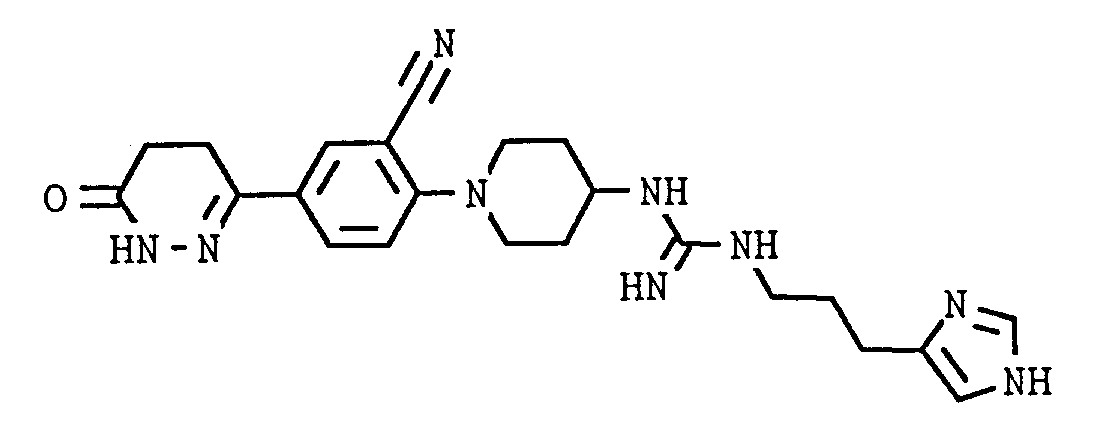
- Aus 1,00 g (2,0 mmol) N-[1-[2-Cyano-4-(6-oxo-1,4,5,6-tetrahydropyridazin-3-yl)-phenyl]-piperidin-4-yl]-S-methyl-isothiuroniumjodid und 0,25 g (2,0 mmol) 3-(1H-Imidazol-4-yl)-propylamin werden analog zu Beispiel 13) nach chromatographischer Reinigung an Kieselgel mit Laufmittel G und Kristallisation mit Isopropanol/Ethylacetat 0,36 g (40 %) eines hellbeigen Feststoffes vom Schmp. 144 - 148 °C erhalten.
C₂₃H₂₉N₉O (447,55)
Rf = 0,33 (Laufmittel E) - ¹H-NMR-Daten (DMSO-d₆, TMS als interner Standard)
- δ= 1,4-2,1 (m) 6H
2,28-2,6 (m) 4H
2,8-3,8 (m) 9H
6,77 (s) 1H
7,20 (d) 1H
7,53 (s) 1H
7,85-7,98(m) 2H
8,6 (breit) 4H,
austauschbar mit D₂O ppm. -
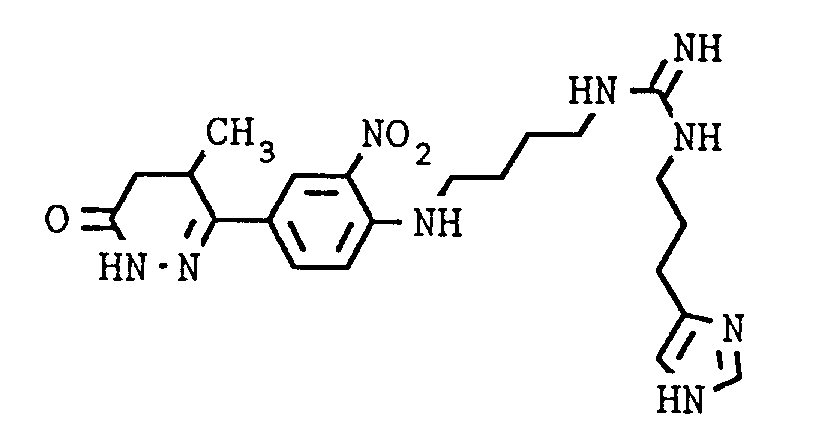
- Aus 1,40 g (2,7 mmol) N-[4-[4-(4-Methyl-6-oxo-1,4,5,6-tetrahydropyridazin-3-yl)-2-nitro-anilino]butyl]-S-methyl-isothiuroniumjodid und 0,34 g (2,7 mmol) 3-(1H-Imidazol-4-yl)-propylamin werden analog zu Beispiel 1d) 0,50 g (39 %) der Titelverbindung in Form eines orangefarbenen, amorphen Feststoffes erhalten.
C₂₂H₃₁N₉O₃ (469,55)
Rf = 0,48 (Laufmittel D) - ¹H-NMR-Daten (DMSO-d₆, TMS als interner Standard)
- δ= 1,06 (d) 3H
1,4-1,9 (m) 6H
2,15-2,80(m) 4H
2,95-3,53(m) 7H
6,76 (s) 1H
7,14 (d) 1H
7,54 (s) 1H
7,95 (dd) 1H
8,37 (d) 1H
8,5 (breit) 5H,
austauschbar mit D₂O ppm. -

- 2,0 g (4 mmol) N-[3-[4-(4-Methyl-6-oxo-1,4,5,6-tetrahydropyridazin-3-yl)-2-nitro-phenyl]propyl]-S-methyl-isothuroniumjodid und 0,5 g (4 mmol) 3-(1H-Imidazol-4-yl)-propylamin werden in 15 ml Dimethylformamid 2 Tage bei Raumtemperatur gerührt.
Nach Abdampfen des Lösungsmittels im Feinvakuum wird der Rückstand mit 10 ml gesättigter Kaliumcarbonat-Lösung versetzt und mit 3x20 ml Chloroform/ Methanol (80/20 v/v) extrahiert.
Der nach Abdampfen der Lösungsmittel i. Vak. erhaltene Rückstand wird zur Reinigung an Kieseigel mit Laufmittel D chromatographiert.
Nach Aufarbeitung analog zu Beispiel 1d) werden 0,46 g (26 %) eines gelblich-beigen Pulvers vom Schmelzbereich 96-99 °C erhalten, das nach ¹H-NMR 1/3 Mol Kristallethanol enthält.
C₂₁H₂₈N₈O₃ x 1/3 C₂H₆O (440,51)
Rf = 0,36 (Laufmittel D) - ¹H-NMR-Daten (DMSO-d₆, TMS als interner Standard)
- δ= 1,03-1,23(m) 3H
+ 3H (EtOH)
1,60-1,90(m) 4H
2,4-2,75 (m) 4H
2,87 (t) 2H
3,03-3,3 (m) 5H
3,38 (q) 2H (EtOH)
6,76 (s) 1H
7,52 (s) 1H
7,59 (d) 1H
8,00 (dd) 1H
8,23 (d) 1H
8,6 (breit) 4H,
austauschbar mit D₂0 ppm. -

- Zu einer Lösung von 1,93 g (6 mmol) N-[4-(4-Hydroxymethyl-6-oxo-1,4,5,6-tetrahydropyridazin-3-yl)-2-nitro-phenyl]-1,3-propandiamin in 10 ml Dimethylformamid werden 1,50 g (6 mmol) Dithiocarbimidsäure-S,S-dimethylester-hydrojodid gegeben.
Nach zweitägigem Rühren bei Raumtemperatur werden 1,12 g (9 mmol) 3-(1H-Imidazol-4-yl)-propylamin zugegeben und das Reaktionsgemisch 12 Stunden weitergerührt.
Nach Aufarbeitung analog Beispiel 19 (Laufmittel G) erhält man 1,10 g (39 %) eines orangefarbenen, amorphen Pulvers mit einem Schmelzbereich von 113-116 °C.
C₂₁H₂₉N₉O₄ (471,52)
Rf = 0,24 (Laufmittel G) - ¹H-NMR-Daten (DMSO-d₆, TMS als interner Standard)
- δ= 1,6-2,0 (m) 4H
2,4-2,7 (m) 4H
3,1-3,6 (m) 10H
1H austauschb. mit D₂O
6,79 (s) 1H
7,21 (d) 1H
7,55 (s) 1H
7,98 (dd) 1H
8,43 (d) 1H
8,5 (breit) 5H,
austauschbar mit D₂O ppm. -

- Eine Suspension von 1,98 g (6,8 mmol) N-[4-(4-Methyl-6-oxo-1,4, 5,6-tetrahydropyridazin-3-yl)-2-nitro-phenyl]-ethylendiamin in 40 ml Dioxan wird mit 1,11 g (6,84 mmol) Carbonyldiimidazol versetzt und 5 Stunden bei Raumtemperatur gerührt.
0,85 g (6,8 mmol) 3-(1H-Imidazol-4-yl)-propylamin werden zugegeben und danach wird die Suspension 3 Stunden unter Rückfluß gekocht.
Zum abgekühlten Reaktionsgemisch werden 30 ml Wasser gegeben, der ausgefallene Feststoff wird abgesaugt und das Filtrat mit 3x30 ml Dichlormethan/ Methanol (90/10 v/v) extrahiert.
Der nach Eindampfen der vereinigten organischen Phasen i. Vak. erhaltene Feststoff wird zweimal aus Methanol umkristallisiert.
Man erhält 0,35 g (12 %) orangegelbe Kristalle vom Schmp. 177-178 °C.
C₂₀H₂₆N₈O₄ (442,48)
Rf = 0,64 (Laufmittel F) - ¹H-NMR-Daten (DMSO-d₆, TMS als interner Standard)
- δ= 1,06 (d) 3H
1,65 (quin) 2H
2,16-2,82(m) 4H
2,9-3,6 (m) 7H
6,08 (t) 1H,
austauschbar mit D₂O
6,17 (breit) 1H,
austauschbar mit D₂O
6,73 (s) 1H
7,22 (d) 1H
7,51 (s) 1H
7,95 (dd) 1H
8,39 (d) 1H
8,51 (t) 1H,
austauschbar mit D₂O
10,96 (s) 1H,
austauschbar mit D₂O
11,7 (breit) 1H,
austauschbar mit D₂O ppm. -

- Analog zu Beispiel 21 werden aus 2,0 g (6,5 mmol) N-[4-(4-Methyl-6-oxo-1,4,5,6-tetrahydropyridazin-3-yl)-2-nitro-phenyl]-1,3-propandiamin, 1,06 g (6,5 mmol) Carbonyldiimidazol und 0,82 g (6,5 mmol) 3-(1H-Imidazol-4-yl)-propylamin nach chromatographischer Reinigung des Rohprodukts an Kieselgel mit Laufmittel Dichlormethan/ Methanol/ konz. Ammoniak (90:9:1) und Umkristallisation aus Methanol 0,51 g (17 %) eines orangegelben Feststoffes vom Schmp. 177-179 °C erhalten.
C₂₁H₂₈N₈O₄ (456,51)
Rf = 0,30 (Dichlormethan:Methanol:konz. Ammoniak 90:9:1) - ¹H-NMR-Daten (DMSO-d₆, TMS als interner Standard)
- δ = 1,07 (d) 3H
1,56-1,82(m) 4H
2,17-2,76(m) 4H
2,9-3,5 (m) 7H
5,95 (t) 1H,
austauschbar mit D₂O
6,01 (t) 1H,
austauschbar mit D₂O
6,73 (s) 1H
7,13 (d) 1H
7,50 (s) 1H
7,96 (dd) 1H
8,39 (d) 1H
9,47 (t) 1H,
austauschbar mit D₂O
10,94 (s) 1H,
austauschbar mit D₂O
11,8 (breit) 1H,
austauschbar mit D₂O ppm. -

- 1,70 g (5,13 mmol) 6-[4-(4-Amino-piperidin-1-yl)-3-nitro-phenyl]-4,5-dihydro-5-methyl-3(2H)-pyridazinon, 1,60 g (5,04 mmol) N-Benzoyl-imidokohlensäure-diphenylester und 0,65 g (5,2 mmol) 3-(1H-Imidazol-4-yl)-propylamin werden analog zu Beispiel 8 umgesetzt.
Das Rohprodukt wird in 15 ml Methoxyethanol in der Siedehitze gelöst und nach Abkühlen der Lösung auf Raumtemperatur durch Zugabe von 20 ml Methanol ausgefällt.
Man erhält 0,58 g (20 %) orangegelbe Kristalle vom Schmp. 192-193 °C.
C₃₀H₃₅N₉O₄ (585,67)
Rf = 0,43 (Dichlormethan:Methanol:konz. Ammoniak 90:10:1) - ¹H-NMR-Daten (CD₃OD, TMS als interner Standard)
- δ= 1,17 (d) 3H
1,67-2,10(m) 6H
2,32-2,86(m) 4H
3,06 (t) 2H
3,1-3,7 (m) 6H
4,9 (breit) 4H,
austauschbar mit D₂O
6,83 (s) 1H
7,28-7,53(m) 4H
7,57 (s) 1H
7,96 (dd) 1H
8,02-8,17(m) 2H
8,20 (d) 1H ppm. -

-
- a) N¹-Ethoxycarbonyl-N²-[1-[4-(4-methyl-6-oxo-1,4,5,6-tetrahydropyridazin-3-yl)-2-nitro-phenyl]-piperidin-4-yl]-S-methyl-isothioharnstoff
Eine Suspension von 0,90 g (1,69 mmol) N-[1-[4-(4-Methyl-6-oxo-1,4,5,6-tetrahydropyridazin-3-yl)-2-nitro-phenyl]-piperidin-4-yl]-S-methyl-isothiuroniumjodid in 20 ml Dichlormethan wird langsam mit 1,18 ml (8,46 mmol) Triethylamin versetzt und 10 Minuten gerührt.
Zur entstandenen Lösung werden 0,20 ml (2,09 mmol) Chlorameisensäureethylester in 10 ml Dichlormethan getropft. Die Lösung wird 2 Stunden bei Raumtemperatur gerührt und dann zweimal mit 10 ml Wasser gewaschen.
Nach Trocknen der organ. Phase und Eindampfen i. Vak. erhält man einen orangegelben Feststoff, der nach Umkristallisieren aus 15 ml Ethylacetat bei 193-195 °C schmilzt.
Ausbeute 0,70 g (87 %)
C₂₁H₂₈N₆O₅S (476,56)
Rf = 0,64 (Laufmittel H) - b) N²-Ethoxycarbonyl-N¹-[3-(1H-imidazol-4-yl)propyl]-N³-[1-[4-(4-methyl-6-oxo-1,4,5,6-tetrahydropyridazin-3-yl)-2-nitro-phenyl]-piperidin-4-yl]-guanidin
0,65 g (1,36 mmol) der unter a) erhaltenen Verbindung und 0,38 g (3,04 mmol) 3-(1H-Imidazol-4-yl)-propylamin werden in 20 ml Acetonitril 8 Stunden unter Rückfluß gekocht.
Der nach Abdampfen des Lösungsmittels i.Vak. erhaltene Rückstand wird an Kieselgel mit Dichlormethan:Methanol:konz.
Ammoniak (90:10:1) als Laufmittel chromatographiert.
Die polare, orangefarbene Hauptfraktion ergibt nach Eindampfen i. Vak. 0,19 g (26 %) einen orangegelben, amorphen Feststoff.
C₂₆H₃₅N₉O₅ (553,63)
Rf = 0,36 (Dichlormethan:Methanol:konz. Ammoniak 90:10:1) -
- ¹H-NMR-Daten (CDCl₃, TMS als interner Standard)
- δ= 1,24 (d) 3H
1,31 (t) 3H
1,7-2,2 (m) 6H
2,40-2,81(m) 4H
2,94-3,10(m) 2H
3,2-3,5 (m) 6H
4,12 (q) 2H
4,2 (breit) 1H,
austauschbar mit D₂O
6,81 (s) 1H
7,11 (d) 1H
7,68 (s,breit) 1H
7,87 (dd) 1H
8,17 (d) 1H
9,00 (s) 1H,
austauschbar mit D₂O
9,2 (breit) 1H,
austauschbar mit D₂O ppm.
Claims (9)
- 6-Oxo-pyridazinderivate der allgemeinen Formel (I)

B ein Wasserstoffatom, ein Halogenatom, eine Cyanogruppe oder eine Nitrogruppe ist,
X die Gruppe

sowie die Salze davon. - 6-Oxo-pyridazinderivate nach Anspruch 1, dadurch gekennzeichnet, daß X die Gruppe
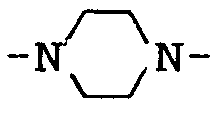
- 6-Oxo-pyridazinderivate nach Anspruch 1, dadurch gekennzeichnet, daß X die Gruppe

- 6-Oxo-pyridazinderivate nach Anspruch 1, dadurch gekennzeichnet, daß X die Gruppe

- 6-[4-[4-[3-(1H-Imidazol-4-yl)-propylamino-iminomethylen]-piperazin-1-yl]-3-nitro-phenyl]-4,5-dihydro-5-methyl-3(2H)-pyridazinon.
- N¹-[3-(1H-Imidazol-4-yl)propyl]-N³-[3-[4-[4-(4-methyl-6-oxo-1,4,5,6-tetrahydropyridazin-3-yl)-2-nitro-phenyl]-piperazin-1-yl]propyl]-guanidin.
- N¹-[3-(1H-Imidazol-4-yl)propyl]-N³-[2-[4-(4-methyl-6-oxo-1,4,5,6-tetrahydropyridazin-3-yl)-2-nitro-anilino]-ethyl]-guanidin.
- Verfahren zur Herstellung von 6-Oxo-pyridazinderivaten nach den Ansprüchen 1 bis 7 sowie der Salze davon, dadurch gekennzeichnet, daß mana) eine Verbindung der allgemeinen Formel (II)

mit einer Verbindung der Formel (III) b) eine Verbindung der allgemeinen Formel (IV)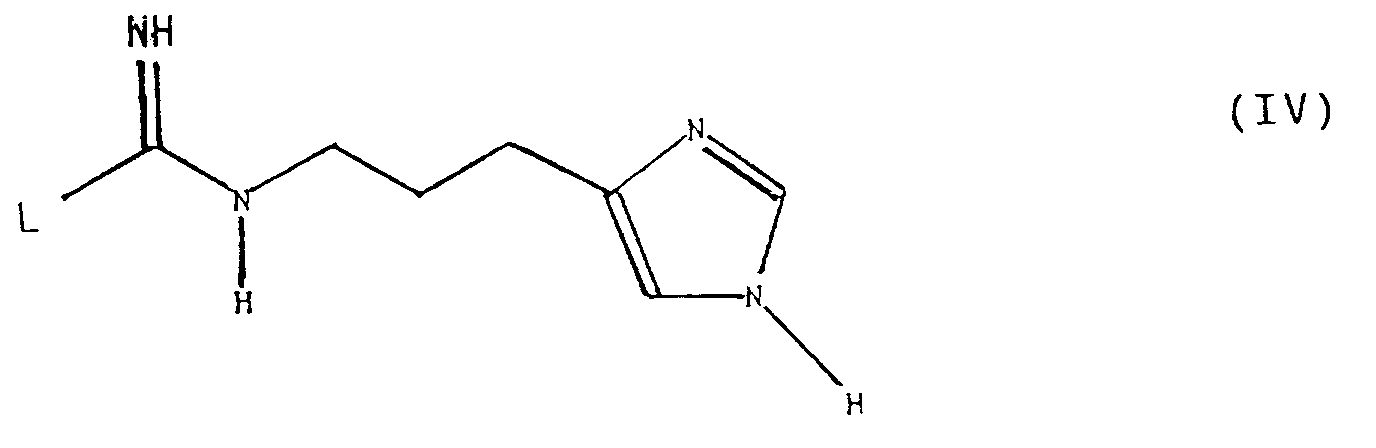
mit einer Verbindung der allgemeinen Formel (V)
zu einer Verbindung der allgemeinen Formel (I) umsetzt oderc) eine Verbindung der allgemeinen Formel (Ia)


sauer oder basisch zu einer Verbindung der allgemeinen Formel (I) hydrolysiert und gegebenenfalls die nach den Verfahrensvarianten a) bis c) erhaltene Verbindung der allgemeinen Formel (I) in an sich bekannter Weise in ihr Salz umwandelt.
Applications Claiming Priority (2)
| Application Number | Priority Date | Filing Date | Title |
|---|---|---|---|
| DE3814057A DE3814057A1 (de) | 1988-04-26 | 1988-04-26 | 6-oxo-pyridazinderivate, verfahren zu ihrer herstellung und diese verbindungen enthaltende arzneimittel |
| DE3814057 | 1988-04-26 |
Publications (2)
| Publication Number | Publication Date |
|---|---|
| EP0339208A1 EP0339208A1 (de) | 1989-11-02 |
| EP0339208B1 true EP0339208B1 (de) | 1996-02-07 |
Family
ID=6352905
Family Applications (1)
| Application Number | Title | Priority Date | Filing Date |
|---|---|---|---|
| EP89103651A Expired - Lifetime EP0339208B1 (de) | 1988-04-26 | 1989-03-02 | 6-Oxo-pyridazinderivate, Verfahren zu ihrer Herstellung und diese Verbindungen enthaltende Arzneimittel |
Country Status (16)
| Country | Link |
|---|---|
| US (1) | US4968683A (de) |
| EP (1) | EP0339208B1 (de) |
| JP (1) | JPH01313475A (de) |
| KR (1) | KR890016018A (de) |
| AT (1) | ATE133949T1 (de) |
| AU (1) | AU612236B2 (de) |
| CA (1) | CA1322000C (de) |
| DE (2) | DE3814057A1 (de) |
| DK (1) | DK197689A (de) |
| ES (1) | ES2084585T3 (de) |
| GR (1) | GR3018938T3 (de) |
| HU (1) | HU201059B (de) |
| IL (1) | IL89335A (de) |
| NZ (1) | NZ228871A (de) |
| PT (1) | PT90337B (de) |
| ZA (1) | ZA891234B (de) |
Families Citing this family (8)
| Publication number | Priority date | Publication date | Assignee | Title |
|---|---|---|---|---|
| DE3913597A1 (de) * | 1989-04-25 | 1990-11-08 | Heumann Pharma Gmbh & Co | Diazinderivate, verfahren zu ihrer herstellung und diese verbindungen enthaltende arzneimittel |
| CA2451699A1 (en) * | 2001-06-26 | 2003-01-09 | Beth Israel Deaconess Medical Center | Compositions and methods for inhibiting platelet activation and thrombosis |
| PE20070182A1 (es) * | 2005-07-29 | 2007-03-06 | Wyeth Corp | Derivados cianopirrol-fenil amida como moduladores del receptor de progesterona |
| PE20070341A1 (es) * | 2005-07-29 | 2007-04-13 | Wyeth Corp | Derivados de pirrol como moduladores del receptor de progesterona |
| RS52626B (sr) | 2006-07-25 | 2013-06-28 | Cephalon Inc. | Derivati piridizinona |
| US9388126B2 (en) | 2012-07-19 | 2016-07-12 | Drexel University | Sigma receptor ligands and methods of modulating cellular protein homeostasis using same |
| WO2019089902A1 (en) | 2017-11-01 | 2019-05-09 | Drexel University | Compounds, compositions, and methods for treating diseases |
| CN110117257B (zh) * | 2018-02-05 | 2022-12-06 | 安徽省新星药物开发有限责任公司 | 一种含胍基的p2y12受体拮抗剂、制备方法及其用途 |
Citations (2)
| Publication number | Priority date | Publication date | Assignee | Title |
|---|---|---|---|---|
| DE2207517A1 (de) * | 1971-02-22 | 1972-12-14 | BDH Pharmaceuticals Ltd, Edinburgh (Großbritannien) | Pyridazinone, Verfahren zu ihrer Herstellung und diese Verbindungen ent haltende Arzneipraparate |
| EP0304534A1 (de) * | 1987-08-26 | 1989-03-01 | HEUMANN PHARMA GMBH & CO | Dihydropyridazinon-Derivate, Verfahren zu ihrer Herstellung und diese Verbindungen enthaltende Arzneimittel |
Family Cites Families (8)
| Publication number | Priority date | Publication date | Assignee | Title |
|---|---|---|---|---|
| ES8101067A1 (es) * | 1978-08-25 | 1980-12-01 | Thomae Gmbh Dr K | Procedimiento para la preparacion de nuevos bencimidazoles sustituidos en posicion 5 o 6 con un anillo de piridazinona |
| DE2837161A1 (de) * | 1978-08-25 | 1980-03-06 | Thomae Gmbh Dr K | Neue benzimidazole und deren verwendung |
| HU190412B (en) * | 1981-09-17 | 1986-09-29 | Warner-Lambert Co,Us | Process for producing substituted 4,5-dihiydro-6-bracket-substituted-bracket closed-phenyl-3-bracket-2h-bracket closed-pyridazinones and 6-bracket-substituted-bracket closed-phenyl-3-bracket-2h-bracket closed-pyridazinones |
| DE3302021A1 (de) * | 1983-01-22 | 1984-07-26 | Basf Ag, 6700 Ludwigshafen | 6-aryl-4,5-dihydro-3(2h)-pyridazinone, ihre herstellung und verwendung |
| JPS6144873A (ja) * | 1984-08-10 | 1986-03-04 | Mitsubishi Chem Ind Ltd | ピリダジノン誘導体またはその塩類 |
| AU581324B2 (en) * | 1985-07-05 | 1989-02-16 | Smith Kline & French Laboratories Limited | Substituted 6-phenyl-4,5-dihydro pyradazin-3-ones |
| JPS6314774A (ja) * | 1986-07-07 | 1988-01-21 | Mitsubishi Chem Ind Ltd | ピリダジノン誘導体又はその塩類 |
| DE3631334A1 (de) * | 1986-09-15 | 1988-03-17 | Heumann Pharma Gmbh & Co | Neue imidazolylguanidinderivate, verfahren zu ihrer herstellung und diese verbindungen enthaltende arzneimittel |
-
1988
- 1988-04-26 DE DE3814057A patent/DE3814057A1/de not_active Ceased
-
1989
- 1989-02-17 ZA ZA891234A patent/ZA891234B/xx unknown
- 1989-02-17 IL IL89335A patent/IL89335A/xx not_active IP Right Cessation
- 1989-02-22 AU AU30193/89A patent/AU612236B2/en not_active Ceased
- 1989-03-02 EP EP89103651A patent/EP0339208B1/de not_active Expired - Lifetime
- 1989-03-02 ES ES89103651T patent/ES2084585T3/es not_active Expired - Lifetime
- 1989-03-02 DE DE58909594T patent/DE58909594D1/de not_active Expired - Fee Related
- 1989-03-02 AT AT89103651T patent/ATE133949T1/de not_active IP Right Cessation
- 1989-03-28 CA CA000594797A patent/CA1322000C/en not_active Expired - Fee Related
- 1989-04-14 US US07/337,938 patent/US4968683A/en not_active Expired - Fee Related
- 1989-04-21 KR KR1019890005301A patent/KR890016018A/ko not_active Ceased
- 1989-04-24 DK DK197689A patent/DK197689A/da not_active Application Discontinuation
- 1989-04-24 NZ NZ228871A patent/NZ228871A/en unknown
- 1989-04-24 JP JP1104380A patent/JPH01313475A/ja active Pending
- 1989-04-24 HU HU891969A patent/HU201059B/hu not_active IP Right Cessation
- 1989-05-21 PT PT90337A patent/PT90337B/pt not_active IP Right Cessation
-
1996
- 1996-02-08 GR GR960400280T patent/GR3018938T3/el unknown
Patent Citations (2)
| Publication number | Priority date | Publication date | Assignee | Title |
|---|---|---|---|---|
| DE2207517A1 (de) * | 1971-02-22 | 1972-12-14 | BDH Pharmaceuticals Ltd, Edinburgh (Großbritannien) | Pyridazinone, Verfahren zu ihrer Herstellung und diese Verbindungen ent haltende Arzneipraparate |
| EP0304534A1 (de) * | 1987-08-26 | 1989-03-01 | HEUMANN PHARMA GMBH & CO | Dihydropyridazinon-Derivate, Verfahren zu ihrer Herstellung und diese Verbindungen enthaltende Arzneimittel |
Non-Patent Citations (3)
| Title |
|---|
| CHEMICAL ABSTRACTS, Band 103, Nr. 19, 11. November 1985, Seite 708, Zusammenfassung Nr. 160462a, Columbus, Ohio, USA; I. SIRCAR et al.: "Cardiotonic agents. 2. Synthesis and structure-activity relationships of 4,5-dihydro-6-(4-(H-imidazol-1-yl)phenyl)-3(2H)-pyridazinones: a new class of positive inotropic agents"; & J. Med. Chem. 1985, 28(10), 1405-13 * |
| Drugs of the Future, Vol. 14, no. 12, 1989, pp. 1161-1162 * |
| JOURNAL OF MEDICINAL CHEMISTRY, Band 28, 1985, Seiten 1414-1422; G.J. DURANT et al.: "The Histamine H2 Receptor Agonist Impromidine: Synthesis and Structure-Activity Considerations" * |
Also Published As
| Publication number | Publication date |
|---|---|
| GR3018938T3 (en) | 1996-05-31 |
| IL89335A (en) | 1993-08-18 |
| DE58909594D1 (de) | 1996-03-21 |
| EP0339208A1 (de) | 1989-11-02 |
| HUT49876A (en) | 1989-11-28 |
| HU201059B (en) | 1990-09-28 |
| DK197689A (da) | 1989-10-27 |
| ATE133949T1 (de) | 1996-02-15 |
| IL89335A0 (en) | 1989-09-10 |
| NZ228871A (en) | 1990-05-28 |
| CA1322000C (en) | 1993-09-07 |
| AU612236B2 (en) | 1991-07-04 |
| JPH01313475A (ja) | 1989-12-18 |
| AU3019389A (en) | 1989-11-02 |
| ZA891234B (en) | 1989-10-25 |
| DE3814057A1 (de) | 1989-11-09 |
| KR890016018A (ko) | 1989-11-28 |
| DK197689D0 (da) | 1989-04-24 |
| US4968683A (en) | 1990-11-06 |
| PT90337A (pt) | 1989-11-10 |
| ES2084585T3 (es) | 1996-05-16 |
| PT90337B (pt) | 1994-08-31 |
Similar Documents
| Publication | Publication Date | Title |
|---|---|---|
| EP0042593B1 (de) | Aryloxypropanolamine, Verfahren zu ihrer Herstellung und diese Verbindungen enthaltende Arzneimittel | |
| DE4337609A1 (de) | Neue Pyrazincarboxamidderivate, ihre Herstellung und ihre Verwendung in Arzneimitteln | |
| EP0327800B1 (de) | 6-Phenyldihydro-3(2H)-pyridazinone, Verfahren zu ihrer Herstellung und diese Verbindungen enthaltende Arzneimittel | |
| EP0054132A1 (de) | Neue Pyrimidinone, ihre Herstellung und Arzneimittel mit einem Gehalt an diesen Stoffen | |
| WO1993004048A1 (de) | Neue pyrazinderivative, ihre herstellung und verwendung | |
| DE3331808A1 (de) | Carbostyrilderivate, verfahren zu deren herstellung und arzneimittel, welche diese enthalten | |
| DE3780259T2 (de) | Imidazolidinon-verbindungen, verfahren zu deren herstellung, zusammensetzungen die diese verbindungen enthalten und deren anwendung fuer die fabrikation von arzneimitteln mit einem therapeutischen wert. | |
| EP0339208B1 (de) | 6-Oxo-pyridazinderivate, Verfahren zu ihrer Herstellung und diese Verbindungen enthaltende Arzneimittel | |
| DE2847621A1 (de) | Phthalazin-derivate, verfahren zu ihrer herstellung und solche derivate enthaltende arzneimittel | |
| US4921856A (en) | Dihydropyridazinone derivatives, a process for their preparation and pharmaceutical preparations containing these compounds | |
| EP0071059B1 (de) | 6-(5-(Omega-(1-Imidazolyl)-alkyl)-thien-2-yl)-3-oxo-2,3,4,5-tetrahydropyridazine und deren Säureadditionssalze, Verfahren zu ihrer Herstellung und diese enthaltende pharmazeutische Präparate | |
| EP0310737A1 (de) | Benzimidazole, Verfahren zu ihrer Herstellung und diese Verbindungen enthaltende Arzneimittel | |
| EP0515940B1 (de) | Neue 2-Amino-5-cyano-1,4-dihydropyridine, Verfahren zu ihrer Herstellung und ihre Verwendung in Arzneimitteln | |
| DE3923675A1 (de) | Amonoalkylsubstituierte 2-aminothiazole und diese enthaltende therapeutische mittel | |
| DE3223877C2 (de) | ||
| EP0302164B1 (de) | Guanidincarbonsäureester, Verfahren zu ihrer Herstellung und diese Verbindungen enthaltende Arzneimittel | |
| EP0399196A1 (de) | Diazinderivate, Verfahren zu ihrer Herstellung und diese Verbindungen enthaltende Arzneimittel | |
| EP0250725B1 (de) | 1,4-Dihydropyridinderivate, Verfahren zu ihrer Herstellung und diese Verbindungen enthaltende Arzneimittel | |
| EP0379953A2 (de) | Substituierte Benzo (b) pyrane, Verfahren zu ihrer Herstellung, ihre Verwendung sowie pharmazeutische Präparate auf Basis dieser Verbindungen | |
| EP0141119A2 (de) | Sulfenamidderivate, Verfahren zu ihrer Herstellung und diese Verbindungen enthaltende Arzneimittel | |
| EP0437645B1 (de) | Imidazolylpropylguanidinderivat, Verfahren zu seiner Herstellung und diese Verbindung enthaltende Arzneimittel | |
| EP0108981B1 (de) | Semicarbazide, ihre Herstellung und Verwendung | |
| DE3708129A1 (de) | Chinazolin-derivate, verfahren zu deren herstellung und diese enthaltende arzneimittel | |
| DE3723649A1 (de) | Indol-derivate, ihre herstellung und sie enthaltende arzneimittel | |
| CH493557A (de) | Verfahren zur Herstellung von N1-(2'Tetrahydrofuryl)- und N1-(2'Tetrahydropyranyl)-Derivaten 5-substituierter Urazile und deren Alkalimetallsalzen |
Legal Events
| Date | Code | Title | Description |
|---|---|---|---|
| PUAI | Public reference made under article 153(3) epc to a published international application that has entered the european phase |
Free format text: ORIGINAL CODE: 0009012 |
|
| AK | Designated contracting states |
Kind code of ref document: A1 Designated state(s): AT BE CH DE ES FR GB GR IT LI LU NL SE |
|
| RIN1 | Information on inventor provided before grant (corrected) |
Inventor name: AHRENS, KURT-HENNING, DR. Inventor name: WEIDNER, REINHOLD, DR. DIPL.-CHEM. Inventor name: PFAHLERT, VOLKER, DR. Inventor name: ENGLER, HEIDRUN, DR. Inventor name: HERTER, ROLF, DR. DIPL.-CHEM. Inventor name: MOERSDORF, PETER, DR. DIPL-CHEM. |
|
| 17P | Request for examination filed |
Effective date: 19900420 |
|
| 17Q | First examination report despatched |
Effective date: 19920629 |
|
| GRAA | (expected) grant |
Free format text: ORIGINAL CODE: 0009210 |
|
| AK | Designated contracting states |
Kind code of ref document: B1 Designated state(s): AT BE CH DE ES FR GB GR IT LI LU NL SE |
|
| REF | Corresponds to: |
Ref document number: 133949 Country of ref document: AT Date of ref document: 19960215 Kind code of ref document: T |
|
| ITF | It: translation for a ep patent filed | ||
| PGFP | Annual fee paid to national office [announced via postgrant information from national office to epo] |
Ref country code: GB Payment date: 19960222 Year of fee payment: 8 |
|
| PGFP | Annual fee paid to national office [announced via postgrant information from national office to epo] |
Ref country code: NL Payment date: 19960229 Year of fee payment: 8 |
|
| PGFP | Annual fee paid to national office [announced via postgrant information from national office to epo] |
Ref country code: LU Payment date: 19960301 Year of fee payment: 8 |
|
| PGFP | Annual fee paid to national office [announced via postgrant information from national office to epo] |
Ref country code: CH Payment date: 19960304 Year of fee payment: 8 |
|
| PGFP | Annual fee paid to national office [announced via postgrant information from national office to epo] |
Ref country code: GR Payment date: 19960306 Year of fee payment: 8 Ref country code: ES Payment date: 19960306 Year of fee payment: 8 |
|
| PGFP | Annual fee paid to national office [announced via postgrant information from national office to epo] |
Ref country code: DE Payment date: 19960308 Year of fee payment: 8 |
|
| PGFP | Annual fee paid to national office [announced via postgrant information from national office to epo] |
Ref country code: SE Payment date: 19960313 Year of fee payment: 8 |
|
| REF | Corresponds to: |
Ref document number: 58909594 Country of ref document: DE Date of ref document: 19960321 |
|
| ET | Fr: translation filed | ||
| PGFP | Annual fee paid to national office [announced via postgrant information from national office to epo] |
Ref country code: FR Payment date: 19960328 Year of fee payment: 8 Ref country code: AT Payment date: 19960328 Year of fee payment: 8 |
|
| REG | Reference to a national code |
Ref country code: CH Ref legal event code: NV Representative=s name: RITSCHER & SEIFERT PATENTANWAELTE VSP |
|
| PGFP | Annual fee paid to national office [announced via postgrant information from national office to epo] |
Ref country code: BE Payment date: 19960409 Year of fee payment: 8 |
|
| GBT | Gb: translation of ep patent filed (gb section 77(6)(a)/1977) |
Effective date: 19960315 |
|
| REG | Reference to a national code |
Ref country code: GR Ref legal event code: FG4A Free format text: 3018938 |
|
| REG | Reference to a national code |
Ref country code: ES Ref legal event code: FG2A Ref document number: 2084585 Country of ref document: ES Kind code of ref document: T3 |
|
| PLBE | No opposition filed within time limit |
Free format text: ORIGINAL CODE: 0009261 |
|
| STAA | Information on the status of an ep patent application or granted ep patent |
Free format text: STATUS: NO OPPOSITION FILED WITHIN TIME LIMIT |
|
| 26N | No opposition filed | ||
| PG25 | Lapsed in a contracting state [announced via postgrant information from national office to epo] |
Ref country code: LU Free format text: LAPSE BECAUSE OF NON-PAYMENT OF DUE FEES Effective date: 19970302 Ref country code: GB Effective date: 19970302 Ref country code: AT Effective date: 19970302 |
|
| PG25 | Lapsed in a contracting state [announced via postgrant information from national office to epo] |
Ref country code: SE Effective date: 19970303 Ref country code: ES Free format text: LAPSE BECAUSE OF NON-PAYMENT OF DUE FEES Effective date: 19970303 |
|
| PG25 | Lapsed in a contracting state [announced via postgrant information from national office to epo] |
Ref country code: LI Effective date: 19970331 Ref country code: CH Effective date: 19970331 Ref country code: BE Effective date: 19970331 |
|
| BERE | Be: lapsed |
Owner name: HEUMANN PHARMA G.M.B.H. & CO. Effective date: 19970331 |
|
| PG25 | Lapsed in a contracting state [announced via postgrant information from national office to epo] |
Ref country code: GR Free format text: THE PATENT HAS BEEN ANNULLED BY A DECISION OF A NATIONAL AUTHORITY Effective date: 19970930 |
|
| PG25 | Lapsed in a contracting state [announced via postgrant information from national office to epo] |
Ref country code: NL Effective date: 19971001 |
|
| GBPC | Gb: european patent ceased through non-payment of renewal fee |
Effective date: 19970302 |
|
| REG | Reference to a national code |
Ref country code: GR Ref legal event code: MM2A Free format text: 3018938 |
|
| REG | Reference to a national code |
Ref country code: CH Ref legal event code: PL |
|
| PG25 | Lapsed in a contracting state [announced via postgrant information from national office to epo] |
Ref country code: FR Free format text: LAPSE BECAUSE OF NON-PAYMENT OF DUE FEES Effective date: 19971128 |
|
| NLV4 | Nl: lapsed or anulled due to non-payment of the annual fee |
Effective date: 19971001 |
|
| PG25 | Lapsed in a contracting state [announced via postgrant information from national office to epo] |
Ref country code: DE Effective date: 19971202 |
|
| EUG | Se: european patent has lapsed |
Ref document number: 89103651.9 |
|
| REG | Reference to a national code |
Ref country code: FR Ref legal event code: ST |
|
| REG | Reference to a national code |
Ref country code: ES Ref legal event code: FD2A Effective date: 19990405 |
|
| PG25 | Lapsed in a contracting state [announced via postgrant information from national office to epo] |
Ref country code: IT Free format text: LAPSE BECAUSE OF NON-PAYMENT OF DUE FEES;WARNING: LAPSES OF ITALIAN PATENTS WITH EFFECTIVE DATE BEFORE 2007 MAY HAVE OCCURRED AT ANY TIME BEFORE 2007. THE CORRECT EFFECTIVE DATE MAY BE DIFFERENT FROM THE ONE RECORDED. Effective date: 20050302 |