EP0338577A2 - Organosiloxane und Verfahren zu deren Herstellung - Google Patents
Organosiloxane und Verfahren zu deren Herstellung Download PDFInfo
- Publication number
- EP0338577A2 EP0338577A2 EP89107226A EP89107226A EP0338577A2 EP 0338577 A2 EP0338577 A2 EP 0338577A2 EP 89107226 A EP89107226 A EP 89107226A EP 89107226 A EP89107226 A EP 89107226A EP 0338577 A2 EP0338577 A2 EP 0338577A2
- Authority
- EP
- European Patent Office
- Prior art keywords
- represented
- group
- general formula
- integer
- alkyl group
- Prior art date
- Legal status (The legal status is an assumption and is not a legal conclusion. Google has not performed a legal analysis and makes no representation as to the accuracy of the status listed.)
- Withdrawn
Links
Images

Classifications
-
- C—CHEMISTRY; METALLURGY
- C07—ORGANIC CHEMISTRY
- C07F—ACYCLIC, CARBOCYCLIC OR HETEROCYCLIC COMPOUNDS CONTAINING ELEMENTS OTHER THAN CARBON, HYDROGEN, HALOGEN, OXYGEN, NITROGEN, SULFUR, SELENIUM OR TELLURIUM
- C07F7/00—Compounds containing elements of Groups 4 or 14 of the Periodic Table
- C07F7/02—Silicon compounds
- C07F7/08—Compounds having one or more C—Si linkages
- C07F7/18—Compounds having one or more C—Si linkages as well as one or more C—O—Si linkages
-
- C—CHEMISTRY; METALLURGY
- C08—ORGANIC MACROMOLECULAR COMPOUNDS; THEIR PREPARATION OR CHEMICAL WORKING-UP; COMPOSITIONS BASED THEREON
- C08G—MACROMOLECULAR COMPOUNDS OBTAINED OTHERWISE THAN BY REACTIONS ONLY INVOLVING UNSATURATED CARBON-TO-CARBON BONDS
- C08G77/00—Macromolecular compounds obtained by reactions forming a linkage containing silicon with or without sulfur, nitrogen, oxygen or carbon in the main chain of the macromolecule
- C08G77/04—Polysiloxanes
- C08G77/06—Preparatory processes
- C08G77/08—Preparatory processes characterised by the catalysts used
-
- C—CHEMISTRY; METALLURGY
- C08—ORGANIC MACROMOLECULAR COMPOUNDS; THEIR PREPARATION OR CHEMICAL WORKING-UP; COMPOSITIONS BASED THEREON
- C08G—MACROMOLECULAR COMPOUNDS OBTAINED OTHERWISE THAN BY REACTIONS ONLY INVOLVING UNSATURATED CARBON-TO-CARBON BONDS
- C08G77/00—Macromolecular compounds obtained by reactions forming a linkage containing silicon with or without sulfur, nitrogen, oxygen or carbon in the main chain of the macromolecule
- C08G77/04—Polysiloxanes
- C08G77/22—Polysiloxanes containing silicon bound to organic groups containing atoms other than carbon, hydrogen and oxygen
- C08G77/24—Polysiloxanes containing silicon bound to organic groups containing atoms other than carbon, hydrogen and oxygen halogen-containing groups
Definitions
- the present invention relates to a novel organosiloxane compound suitable for the modification of silicone rubbers and synthetic resins, a novel organosiloxane compound useful as its intermediate, and a process for preparing them.
- a fluorine-containing group has been introduced into silicone rubbers for the purpose of improving oil resistance and solvent resistance.
- a typical example of the fluorine-containing group is a 3.3,3-trifiuoropropyi group, and the fluorine-containing group is usually introduced into a pendant site (branch site of a polysiloxane chain).
- Such fluorosilicone rubbers have been used singly and in the form of blends and copolymers of these rubbers and ordinary silicone rubbers.
- siloxane resins have been used in synthetic resins with the intention of providing the synthetic resins with interfacial characteristics such as repellency, release properties and stain resistance as well as other characteristics such as heat resistance which a siloxane compounds have.
- the straight-chain polysiloxane compounds are mainly used.
- the polysiloxane compound not having any group which is reactive to a synthetic resin is introduced into the synthetic resin by blending them, and the polysiloxane compound having the group which is reactive thereto is introduced thereinto by chemical bond.
- the polysiloxane compound can be also used as a raw material of graft polymers for the modification of the synthetic resin to which much attention is paid of late, and particularly in this case, the so-called one terminal-modified polysiloxane compound has been used in which one terminal alone has a reactive group and another terminal is terminated with a trimethylsiloxy group.
- the polysiloxane having the functional group,only at the one terminal may be prepared by hydrolyzing an organic dichlorosilane or utilizing an equilibrating reaction between a cyclosiloxane and a terminal terminator which is a usual manufacturing process for the polysiloxane.
- this method has the drawbacks that it is hard to obtain the products having a narrow molecular distribution, and that it is difficult to attach the functional group only to the one terminal.
- Japanese Patent Laid-open Publication Nos Japanese Patent Laid-open Publication Nos.
- the siloxane compound not having any reactive group for the synthetic resin is used for the purpose of improving the specific characteristics of the synthetic resin, the improvement depends upon the fuction of the polysiloxane.
- the improvement effect of the synthetic resin is insufficient in view of the fact that the demand of the specific characteristics is now increased.
- a great deal of the polysiloxane compound is required, which leads to the problem that the other physical properties are adversely affected.
- the one terminal-modified siloxane compound also has the similar disadvantages, because the other terminal of the molecular chain which has no reactive group for the synthetic resin is terminated with the trimethylsiloxy group.
- a trialkylsilanolate is used as an initiator, and thus an additional step is necessary in which a trialkylsilanol is reacted with an alkali metal compound to produce the trialkylsilanolate.
- this alkali metal compound usually a lithium catalyst
- this alkali metal compound which is expensive is used in an amount equivalent to the trialkylsilanol, and the smaller the molecular weight of the polysiloxane product is and the greater the production of the polysiloxane is, the greater the required amount of the catalyst is.
- the cost of the prepared siloxane compound is high, and for this reason, uses of the siloxane compound are limited inconveniently.
- An object of the present invention is to provide a novel siloxane compound having a fluoroalkyl group at one molecular chain terminal thereof and a reactive group at the other molecular chain terminal in its one molecule, and another object of the present invention is to provide a process for preparing this siloxane compound inexpensively. According to the present invention, the above-mentioned problems can be solved.
- the present inventors have intensively conducted researches to achieve the above-mentioned objects, and they have completed a compound represented by the following general formula (I); a siloxane compound obtained by making the compound as the intermediate having a fluorine atom-containing substituent at the a-position, the a-position or a -position, or the a-position, a -position or a -position and having a hydrosilyl group at the ⁇ -position; and a process for preparing these compounds.
- general formula (I) a siloxane compound obtained by making the compound as the intermediate having a fluorine atom-containing substituent at the a-position, the a-position or a -position, or the a-position, a -position or a -position and having a hydrosilyl group at the ⁇ -position
- the first feature of this invention is directed to a siloxane compound represented by the general formula (I) wherein i is an integer of 4 to 2000, and R 1 is a pentafluorophenyl group or a substituent which is a straight-chain or a branched fluoroalkyl group represented by the formula (II) wherein a is an integer of 3 to 18, and b is an integer of 0 to 2a.
- the second feature of this invention is directed to a siloxane compound represented by the general formula (I) regarding the first feature'of this invention in which the substituent represented by R 1 is a 3,3,3-trifluoropropyl group, a tridecafluoro-1,1,2,2-tetrahydrooctyl group or a heptadecafluoro-1,1,2,2-tetrahydrodecyl group.
- the third feature of this invention is directed to a process for preparing a siloxane compound represented by the general formula (1) regarding the first invention which comprises the step of anion polymerizing hexamethylcyclotrisiloxane by the use of a trialkylsilanol represented by the general formula (III) wherein R 1 is a pentafluorophenyl group or a substituent which is a straight-chain or a branched fluoroalkyl group represented by the formula (II) wherein a is an integer of 3 to 18, and b is an integer of 0 to 2a, as an initiator in the presence of a lithium catalyst in an amount of 0.05 to 50 mole% based on the initiator in a polar solvent having no active hydrogen.
- a trialkylsilanol represented by the general formula (III) wherein R 1 is a pentafluorophenyl group or a substituent which is a straight-chain or a branched fluoroalkyl group represented
- the fourth feature of this invention is directed to a siloxane compound represented by the general formula (IV) wherein j is an integer of 1 to 2000, R is an alkyl group having 1 to 4 carbon atoms, and R 1 is a pentafluorophenyl group or a substituent which is a straight-chain or a branched fluoroalkyl group represented by the formula (II) wherein a is an integer of 3 to 18, and b is an integer of 0 to 2a.
- j is an integer of 1 to 2000
- R is an alkyl group having 1 to 4 carbon atoms
- R 1 is a pentafluorophenyl group or a substituent which is a straight-chain or a branched fluoroalkyl group represented by the formula (II) wherein a is an integer of 3 to 18, and b is an integer of 0 to 2a.
- the fifth feature of this invention is directed to a siloxane compound represented by the general formula (IV) regarding the fourth feature of this invention in which the substitutent represented by R 1 is a 3,3,3-trifluoropropyl group, a tridecafluoro-1,1,2,2-tetrahydrooctyl group or a heptadecafluoro-1,1,2,2-tetrahydrodecyl group.
- the sixth feature of this invention is directed to a siloxane compound represented by the general formula (V) wherein each of k and t is an integer of 1 to 2000, R is an alkyl group having 1 to 4 carbon atoms, and each of R 2 and R 3 is an alkyl group having 1 to 4 carbon atoms, a pentafluorophenyl group or a substituent which is a straight-chain or a branched fluoroalkyl group represented by the formula (II) wherein a is an integer of 3 to 18, and b is an integer of 0 to 2a, and at least one of R 2 and R 3 is a fluorine atom-containing substituent other than the aforesaid alkyl group.
- V siloxane compound represented by the general formula (V) wherein each of k and t is an integer of 1 to 2000, R is an alkyl group having 1 to 4 carbon atoms, and each of R 2 and R 3 is an alkyl group having 1 to 4 carbon
- the seventh feature of this invention is directed to a siloxane compound represented by the general formula (V) regarding the sixth feature of this invention in which the substitutent represented by each of R 2 and R 3 is an alkyl group having 1 to 4 carbon atoms, a 3,3,3-trifluoropropyl group, a tridecafiuoro-1,1,2.2-tetrahydrooctyl group or a heptadecafluoro-1,1,2,2-tetrahydrodecyl group, and at least one of R 2 and R 3 is a fluorine atom-containing substituent other than the aforesaid alkyl group.
- the substitutent represented by each of R 2 and R 3 is an alkyl group having 1 to 4 carbon atoms, a 3,3,3-trifluoropropyl group, a tridecafiuoro-1,1,2.2-tetrahydrooctyl group or a heptadecafluoro-1,1,2,2-
- the eighth feature of this invention is directed to a siloxane compound represented by the general formula (VI) wherein each of m, n and p is an integer of 1 to 2000, and a substituent represented by each of R 4 , R 5 and R 6 is an alkyl group having 1 to 4 carbon atoms, a pentafluorophenyl group or a substituent which is a straight-chain or a branched fluoroalkyl group represented by the formula (II) wherein a is an integer of 3 to 18, and b is an integer of 0 to 2a, and at least one of R 4 , R 5 and R 6 is a fluorine atom-containing substituent other than the aforesaid alkyl group.
- a substituent represented by each of R 4 , R 5 and R 6 is an alkyl group having 1 to 4 carbon atoms, a pentafluorophenyl group or a substituent which is a straight-chain or a branched fluoroal
- the ninth feature of this invention is directed to a siloxane compound represented by the general formula (VI) regarding the eighth feature of this invention in which the substitutent represented by each of R 4 , R 5 and R 6 is an alkyl group having 1 to 4 carbon atoms, a 3,3,3-trifluoropropyl group, a tridecafluoro-1,1,2,2-tetrahydrooctyl group or a heptadecafluoro-1,1,2,2-tetrahydrodecyl group, and at least one of R4, R 5 and R 6 is a fluorine atom-containing substituent other than the aforesaid alkyl group.
- the tenth feature of this invention is directed to a process for preparing a siloxane compound represented by the general formula (IV) regarding the fourth feature of this invention which comprises the step of reacting a compound represented by the general formula (I') wherein d is an integer of 1 to 2000 and R' is a pentafluorophenyl group or a substituent which is a straight-chain or a branched fluoroalkyl group represented by the formula (II) wherein a is an integer of 3 to 18, and b is an integer of 0 to 2a, with a chlorosilane represented by the general formula (VII) wherein R is an alkyl group having 1 to 4 carbon atoms.
- the eleventh feature of this invention is directed to a process for preparing a siloxane compound represented by the general formula (V) regarding the sixth feature of this invention or a siloxane compound represented by the general formula (VI) regarding the eighth invention which comprises the step of reacting a compound or a mixture of two or more compounds represented by the general formula (I ) in the tenth feature of this invention, or a mixture of the compound represented by the general formula (I ) and one or more kinds of compounds represented by the general formula (VIII) wherein q is an integer of 1 to 2000 and R 7 is an alkyl group having 1 to 4 carbon atoms, with a chlorosilane represented by the general formula (IX) wherein c is an integer of 2 or 3 and R is an alkyl group having 1 to 4 carbon atoms.
- the twelfth feature of this invention is directed to a process for preparing a siloxane compound represented by the general formula (IV) regarding the fourth feature of this invention, a siloxane compound represented by the general formula (V) regarding the sixth feature of this invention or a siloxane compound represented by the general formula (VI) regarding the eighth feature of this invention which comprises the steps of anion polymerizing hexamethylcyclotrisiloxane by the use of one kind or a mixture of two or more kinds of trialkylsilanols represented by the general formula (III) in the third feature of this invention, or a mixture of the trialkylsilanol represented by the general formula (III) and one or more kinds of trialkylsilanols represented by the general formula (X) wherein R 8 is an alkyl group having 1 to 4 carbon atoms, as an initiator in the presence of a lithium catalyst in an amount of 0.05 to 50 mole% based on the initiator in a polar solvent having no active hydrogen
- the thirteenth feature of this invention is directed to a process for preparing a siloxane compound according to the third or the twelfth feature of this invention wherein the lithium catalyst is metallic lithium, butyl lithium, lithium hydroxide, a lithium trialkylsilanolate represented by the general formula (XI) wherein each of R 9 , R 10 and R 11 is an alkyl group having 1 to 4 carbon atoms, a phenyl group, a pentafluorophenyl group, or a straight-chain or a branched fluoroalkyl group represented by the formula (II) wherein a is an integer of 3 to 18, and b is an integer of 0 to 2a, or a mixture of two or more thereof.
- the lithium catalyst is metallic lithium, butyl lithium, lithium hydroxide, a lithium trialkylsilanolate represented by the general formula (XI) wherein each of R 9 , R 10 and R 11 is an alkyl group having 1 to 4 carbon atoms,
- the fourteenth feature of this invention is directed to a process for preparing a siloxane compound according to the third, the twelfth or the thirteenth feature of this invention wherein the amount of the lithium catalyst is in the range of 0.05 to 10 mole% based on the trialkylsilanol which is the polymerization initiator.
- the fifteenth feature of this invention is directed to a process for preparing a siloxane compound according to the third, the twelfth, the thirteenth or the fourteenth feature of this invention wherein the polar solvent having no active hydrogen is tetrahydrofuran, 1,4-dioxane, ethylene glycol dimethyl ether, diethylene glycol dimethyl ether, dimethylformamide, dimethyl sulfoxide or a mixture of two or more thereof.
- a compound represented by the general formula (I) regarding the first feature of this invention is characterized by having a terminal silanol group portion and a terminal substituent portion with a fluorine atom simultaneously in one molecule thereof, as is apparent from the general formula (I). This constitution is maintained even in the high-molecular polymer in which i of the general formula (I) has a great value, and each of the molecules constituting the polymer has the terminal silanol group portion and the terminal substituent portion with the fluorine atom in the one molecule thereof. Additionally, the polymer of the present invention is characterized in that its dispersity is in a preferable case, from 1.1 to 1.2, which means that the distribution of the molecular weight is controlled very well.
- the parameter i in the compound of the general formula (I) indicates the number of dimethylsiloxane units in a polydimethylsiloxane straight-chain portion, and the value of i is preferably in the range of 4 to 2000 so as to surely exert the specific function of the polydimethylsiloxane when the compound (I) is introduced into a silicone rubber or a synthetic resin, to facilitate the introduction of the compound (I) into the synthetic resin, and to facilitate the synthesis of the compound (I) itself.
- the parameter a is preferably in the range of 3 to 18 for the sake of the easy availability of a raw material, the effective exertion of the function which the fluoroalkyl group has, and the ease synthesis of the group (II).
- the value of i in the compound having the general formula (I) is preferably 700 or less, depending upon a kind and characteristics of the synthetic resin and a desired function.
- the compound represented by the general formula (I) regarding the first feature of this invention can be used as an intermediate at the time of the synthesis of the compound represented by the general formula (IV) of the fourth feature of this invention, the general formula (V) of the sixth feature of this invention or the general formula (VI) of the eighth feature of this invention.
- the compound represented by the general formula (I) regarding the first feature of this invention can be itself used as a siloxane compound which is useful for the improvement of the specific characteristics of a synthetic resin such as a polyurethane or a polyester, and in this case, the hydroxyl group present at one terminal of the molecule is reacted with the synthetic resin capable of reacting with the hydroxyl group, so that the compound is incorporated therein by a chemical bond.
- the siloxane compound represented by the general formula (IV) of the fourth feature of this invention, the general formula (V) of the sixth feature of this invention or the general formula (VI) of the eighth feature of this invention is characterized by having the terminal hydrosilyl group portion and the terminal substituent portion with a fluorine atom simultaneously in one molecule thereof, as shown in each general formula. This constitution is maintained even in the high-molecular polymer in which j in the general formula (IV), k and t in the general formula (V), or m, n and p in the general formula (VI) have a great value, and each of the molecules constituting the polymer has the terminal hydrosilyl group portion and the terminal substituent portion with the fluorine atom in the one molecule thereof.
- the polymer of the present invention is characterized in that its dispersity is in a preferable case, from 1.1 to 1.2, which means that the distribution of the molecular weight is controlled very well.
- Each parameter of j, k, t, m, n and p in the general formulae (IV), (V) and (VI) indicates the number of dimethylsiloxane units in a polydimethylsiloxane straight-chain portion, and the value of each parameter is preferably in the range of 1 to 2000 so as to surely exert the specific function of the polydimethylsiloxane when the compound of the present invention is introduced into a silicone rubber or a synthetic resin, to facilitate the introduction of the compound into the synthetic resin, and to facilitate the synthesis of the compound itself.
- each value of j, k, t, m, n and p in the general formulae (IV), (V) and (VI) is most preferably 700 or less, depending upon a kind, characteristics and a desired function of the silicone rubber or the synthetic resin.
- the parameter a is preferably in the range of 3 to 18 for the sake of the easy availability of a raw material, the effective exertion of the function which the fluoroalkyl group has, and the ease synthesis of the group (II).
- the siloxane compound of the present invention is characterized by three kinds of structures. That is, the siloxane compound represented by the general formula (IV) of the fourth invention has one siloxane chain, the compound represented by the general formula (V) of the sixth feature of this invention has two siloxane chains, and the compound represented by the general formula (VI) of the eighth feature of this invention has three siloxane chains on the basis of a hydrosilyl group. Therefore, the above-mentioned structure of the siloxane compound can be optionally selected in compliance with the kind and desired functional properties of silicone rubber or synthetic resin.
- the respective siloxane chains preferably have the same chain length in most of the cases where the siloxane compound is used as a graft polymer to modify the silicone rubber or the synthetic resin.
- the siloxane compound can have different molecular chain lengths in accordance with a purpose.
- the substituents represented by R 2 and R 3 in the general formula (VI) having the two molecular chains and the substituents represented by R4-, R 5 and R 6 in the general formula (VI) having the three molecular chains may be different from each other.
- the compound preferably has the same siloxane chain length and the same substituents, because if they are not the same, manufacturing steps increase and the tolerance of synthetic conditions is restricted.
- the compound of the present invention represented by the general formula (IV) of the fourth feature of this invention, the general formula (V) of the sixth feature of this invention or the general formula (VI) of the eighth feature of this invention can be used as a raw material of a modifier for silicone rubbers which can be obtained by reacting the hydrosilyl group present in the molecule of the compound with another siloxane compound containing a vinyl group, and can be also used as a modifier for a-polyolefin synthetic resins capable of reacting with the hydrosilyl group present in the compound molecule of the present invention.
- the compound of the present invention can be used as an intermediate for a siloxane compound, because a substituent which is reactive to a desired synthetic resin can be introduced into the compound of the present invention by a hydrosilyl-forming reaction, whereby new characteristics can be added to the desired synthetic resin.
- the trialkylsilanol used as the initiator for the anion polymerization which is represented by the general formula (III) of the third feature of this invention or the general formula (X) of the twelfth feature of this invention is easily available by hydrolyzing a trialkylchlorosilane having a desired alkyl group.
- trialkylchlorosilane examples include trimethylchlorosilane, ethyldimethylchlorosilane, n-butyldimethylchlorosilane, t-butyldimethylchlorosilane, isopropyldimethylchlorosilane, n-propyldimethylchlorosilane, pentafluorophenyl- dimethylchlorosilane, 3,3,3-trifluoropropyldimethylchlorosilane, (tridecafluoro-1,1,2,2-tetrahydrooctyl)-dimethylchlorosilane and (heptadecafluoro-1,1,2,2-tetrahydrodecyl)dimethylchlorosilane.
- lithium catalyst used in synthesizing the compound of the present invention examples include metallic lithium, butyl lithium, lithium hydroxide and lithium trialkylsilanolates represented the following general formula (XI), and they can be used singly or as a mixture of two or more thereof.
- each of R 9 , R 10 and R" is an alkyl group having 1 to 4 carbon atoms, a phenyl group, a pentafluorophenyl group or a straight-chain or a branched fluoroalkyl group represented by the formula (II) wherein a is an integer of 3 to 18, and b is an integer of 0 to 2a.
- Catalysts other than these lithium catalysts for example, alkali metal compounds such as sodium catalysts and potassium catalysts are also usable, but when such a kind of catalyst is used to form the desired siloxane compound represented by the general formula (I) of the first feature of this invention, the general formula (IV) of the fourth feature of this invention, the general formula (V) of the sixth feature of this invention or the general formula (VI) of the eighth feature of this invention, the yield of the product is low. In consequence, the catalysts other than the lithium catalysts are improper in the synthesis of the compound regarding the present invention.
- the amount of the catalyst is preferably in the range of 0.05 to 50 mole%, more preferably 0.05 to 10 mole%, based on the trialkylsilanol which is the polymerization initiator.
- the upper limit of the amount of the catalyst is 50 mole% or less, preferably 10 mole% or less, when a small amount of the catalyst is used in the synthesis on a small scale and in the production of the compound having a high molecular weight, i.e., when it is difficult to precisely measure the catalyst. Even if the amount of the catalyst is in excess of 50 mole%, a higher effect cannot be expected, and the use of the dangerous catalyst in an amount beyond the necessary level leads to the decrease of safety, the drop in manufacturing efficiency and the rise of manufacturing cost inconveniently.
- the thus synthesized polysiloxane compound has the feature that the polymer is densely constituted of the molecules each containing dimethylsiloxane units the number of which can vary one by one.
- the polymer is constituted of the molecules containing siloxane units of the cyclic siloxane which is a raw material, and the number of the silioxane units varies several by several.
- FIGS. 1 and 2 show charts of the gel permeation chromatography concerning siloxane compounds having a molecular weight of 1,000 which were synthesized by the preparation process of the present invention (the lithium catalyst was used in an amount of 1.0 mole% based on the trialkylsilanol) and the conventional manufacturing process (the trialkylsilanol and the lithium catalyst were each used in an equimolar amount) under the same conditions except for the amounts of the catalysts.
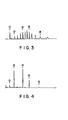
- Figs. 3 and 4 are charts of the gas chromatography concerning the compounds which correspond to those of Figs. 1 and 2. Peaks 10 to @ in Figs. 3 and 4 correspond to the following compounds:
- Fig. 1 showing the chart concerning the compound synthesized in accordance with the process of the present invention
- one definite peak is present, because the polymer is composed of one by one siloxane unit and is not separated by the gel permeation chromatography.
- Fig 2 showing the chart concerning the compound synthesized by the conventional process
- a plurality of peaks are present.
- the chart concerning the compound obtained by the conventional process in Fig. 4 indicates that tall peaks of the siloxane units are present in every third place.
- the gas chromatography cannot analyze samples which do not gasify at a certain temperature. Therefore, the greater the molecular weight of the polymer is, the harder the gasification is, and in Figs. 3 and 4, the height of the peaks on the low-molecular side is not proportional to that of the peaks on the high-molecular side (the peaks on the right side of Figs. 3 and 4 denote the polymers having higher molecular weights), and therefore the peaks shown in Figs. 3 and 4 do not always indicate a quantitative ratio of the polymers. Accordingly, it is impossible to understand the distribution of molecular weight from the gas chromatograms of Figs. 3 and 4. The molecular weight distributions of the polymers are indicated by the gel permeation chromatograms (Figs. 1 and 2).
- Suitable examples of the polar solvent not having any active hydrogen which is used in the synthesis of the present invention include tetrahydrofuran, 1,4-dioxane, ethylene glycol dimethyl ether, diethylene glycol dimethyl ether, dimethylformamide and dimethyl sulfoxide, and they may be used singly or in combination. Above all, tetrahydrofuran is particularly preferable. When a solvent having active hydrogen is used, the reaction is hindered, and when a non-polar solvent is used, the reaction scarcely proceed. Therefore, the employment of these kinds of solvents is not preferable.
- Reaction temperature is preferably in the range of 0 to 50 C, more preferably 15 to 25° C.
- the rate of the polymerization is low and impractical; when it is more than 50 C, the molecular weight distribution of the produced polysiloxane is enlarged unpreferably.
- Reaction time depends upon the reaction temperature, and it is preferred that the reaction is brought to an end at the point of time when about 95% of hexamethylcyclotrisiloxane has been comsumed.
- the reaction temperature is in the range of 15 to 20 .
- the reaction time is suitably in the range of 10 to 20 hours. The unnecessarily prolonged reaction time is not preferable, since the molecular weight distribution expands.
- the control of the molecular weight can be accomplished by changing conditions for living polymerization.
- the number of the siloxane chain on the basis of the hydrosilyl group is one in the general formula (IV) of the fourth feature of this invention, two in the general formula (V) of the sixth feature of this invention, and three in the general formula (VI) of the eighth feature of this invention, but the chain number can be controlled by adjusting the number of the chlorine atom bonded to a silicon atom in the chlorosilane which is represented by the general formula (IX) wherein g is an interger of 1 to 3 and R is an alkyl group having 1 to 4 carbon atoms.
- the aforesaid chlorosilane is what is used as a chain terminator after the trialkylsilanol has been anion polymerized.
- the obtained compound has one siloxane chain on the basis of the hydrosilyl group, as shown in the general formula (IV) of the fourth feature of the invention.
- the alkyldichlorosilane in which the number of the chlorine atom in the general formula (IX) is two, is used as the chain terminator, the obtained compound has two siloxane chains on the basis of the hydrosilyl group, as shown in the general formula (V) of the sixth feature of this invention.
- the obtained compound has three siloxane chains on the basis of the hydrosilyl group, as shown in the general formula (VI) of the eighth feature of this invention.
- the compounds represented by the general formula (IV) of the fourth feature of this invention, the general formula (V) of the sixth feature of this invention and the general formula (VI) of the eighth feature of this invention can be rapidly and easily obtained in the following manner:
- Several intermediates having different molecular weights and having fluorine substituents at the termials thereof are previously prepared in the form of a terminal silanol represented by the general formula (l) used in the tenth feature of this invention, and a chlorosilane corresponding to the desired number of the siloxane. chain is reacted with the previously prepared intermediate, as in the tenth and the eleventh feature of this invention. This is the greatest feature of the preparation process regarding the present invention.
- the siloxane compound having two or three siloxane chains on the basis of the hydrosilyl group in which the length and the terminal substituents of the siloxane chains are different can be synthesized in the following manner: Compounds having the desired two or more substituents and the desired siloxane chain length are separately produced by the anion polymerization at a desired ratio, and then unified, and chain termination is made by the use of an alkyldichlorosilane or trichlorosilane.
- the siloxane compound having the same chain length and the two or more different substituents is synthesized, a mixture of two or more kinds of trialkylsilanols, which are initiators, in a desired ratio is used as an initiator in the anion polymerization, and the chain of the polymer is then terminated with the alkyldichlorosilane or trichlorosilane.
- the compound (XIV) obtained in the above-mentioned process is treated with a weak acid such as acetic acid or calcareous water at room temperature so as to effect chain termination, whereby a compound represented by the undermentioned formula (XV) is obtained in which one terminal group of its molecular chain is a silanol.
- a compound represented by the formula (XVI) can be prepared.
- Bu is a butyl group
- X 1 is a hydrogen atom or a lithium atom
- e is an integer of 1 to 1999
- f is an integer of 0 to 1999.
- methyldichlorosilane can be used in place of dimethylchlorosilane as the chain terminator, so that a polysiloxane compound represented by the formula (XVII) is obtained which has two siloxane chains on the basis of the hydrosilyl group.
- X 1 is a hydrogen atom or a lithium atom
- f is an integer of 0 to 1999.
- trichlorosilane can be used as the chain terminator, so that a polysiloxane compound represented by the formula (XVIII) is easily obtained which has three siloxane chains on the basis of the hydrosilyl group.
- X 1 is a hydrogen atom or a lithium atom
- f is an integer of 0 to 1999.
- the novel siloxane compound having the fluorine atom containing group at the a-position, the a-position or a -position, or the a-position, a -position or a -position and having the hydrosilyl group at the ⁇ -position can be prepared easily and inexpensively.
- the compound having a silanol group at the molecular chain terminal thereof according to the present invention is reacted with a synthetic resin such as a polyurethane or a polyester capable of reacting with this compound in order to incorporate it in the resin via a chemical bond, the following functional effects can be obtained.
- the density of the fluoroalkyl group can be more heightened in the surface portions of these products than in the interiors thereof, because the fluoroalkyl group is present at the longest distance from the reactive group capable of chemically bonding to the silicone rubber of the like, and the degree of freedom of the fluoroalkyl group is higher than in the case that the fluoroalkyl group is present on the pendant site.
- the compound of the present invention can obtain the great improvement effect of the surface characteristics under the influence of the small amount of the fluoroalkyl group in contrast to the conventional compound in which the fluoroalkyl group exists only in the pendant portion, and the molecular chain length of the compound according to the present invention can be altered so as to control the characteristics.
- the siloxane compound having the fluoroalkyl group with more fluorine atoms can be synthesized more easily than the compound having the group in the pendant site, and when the fluoroalkyl groups are introduced into both the pendant portion and the molecular chain terminal, the silicone rubber can possess improved oil resistance and solvent resistance.
- the compound of the present invention is able to have a very narrow molecular weight distribution (dispersity) of 1.1 to 1.2, and therefore, when the compound is introduced into the synthetic resin, the latter can take a more uniform structure than when a compound having an ununiformed molecular chain length is used.
- the synthetic process of the present invention by the utilization of the living polymerization does not form any cyclic compounds of dimethylsiloxane which cannot be removed by any means, though the equilibrating reaction using an acidic or basic catalyst cannot avoid the production of the cyclic compounds. Accordingly, the deterioration in physical properties and bleeding of the modified synthetic resins and scatter of products quality, which are attributable to these cyclic compounds,can be inhibited, so that the physical properties and the like can be improved.
- the compound of the present invention having the hydrosilyl group at the terminal thereof is introduced into an a-polyolefin synthetic resin, and in the case that in place of a conventional one terminal-modified polysiloxane compound not having any reactive group and fluoroalkyl group in one molecule, the compound of the present invention having the hydrosilyl group portion, to which the reactive group capable of bonding to the desired synthetic resin has been added by a hydrosilyl-forming treatment, is introduced into the synthetic resin so as to improve the sepcific characteristics of the resin, the following effects can be obtained.
- Peaks (D to 5 in Figs. 3 and 4 correspond to the following compounds:
- siloxane compound had the following structure:
- the obtained siloxane compound had two siloxane chains on the basis of the hydrosilyl group in which s and t in the following formula had about the same value, judging from the fact that moleculare weights obtained from the GPC data and H (ppm) were about twice as much as those in Example 8 (the number of siloxane chain on the basis of a hydrosilyl group was 1) in which the same conditions as in this example were repeated on the identical scale with the exception that the kind of chlorosilane was only changed.
- the obtained siloxane compound had three siloxane chains on the basis of the hydrosilyl group in which u, v and w in the following formula had about the same value, judging from the fact that moleculare weights obtained from the GPC data and H (ppm) were about thrice as much as those in Example 8 (the number of siloxane chain on the basis of hydrosilyl group was 1) in which the same conditions as in this example were repeated on the identical scale with the exception that the kind of chlorosilane was only changed.
Landscapes
- Chemical & Material Sciences (AREA)
- Organic Chemistry (AREA)
- Health & Medical Sciences (AREA)
- Chemical Kinetics & Catalysis (AREA)
- Medicinal Chemistry (AREA)
- Polymers & Plastics (AREA)
- Silicon Polymers (AREA)
- Compositions Of Macromolecular Compounds (AREA)
Applications Claiming Priority (2)
| Application Number | Priority Date | Filing Date | Title |
|---|---|---|---|
| JP99686/88 | 1988-04-22 | ||
| JP63099686A JP2538308B2 (ja) | 1988-04-22 | 1988-04-22 | オルガノシロキサン |
Publications (2)
| Publication Number | Publication Date |
|---|---|
| EP0338577A2 true EP0338577A2 (de) | 1989-10-25 |
| EP0338577A3 EP0338577A3 (de) | 1991-03-06 |
Family
ID=14253922
Family Applications (1)
| Application Number | Title | Priority Date | Filing Date |
|---|---|---|---|
| EP19890107226 Withdrawn EP0338577A3 (de) | 1988-04-22 | 1989-04-21 | Organosiloxane und Verfahren zu deren Herstellung |
Country Status (4)
| Country | Link |
|---|---|
| US (1) | US4992521A (de) |
| EP (1) | EP0338577A3 (de) |
| JP (1) | JP2538308B2 (de) |
| KR (1) | KR900016234A (de) |
Cited By (7)
| Publication number | Priority date | Publication date | Assignee | Title |
|---|---|---|---|---|
| DE4116014A1 (de) * | 1991-05-16 | 1992-11-26 | Wacker Chemie Gmbh | Verfahren zur herstellung von organo(poly)siloxanen |
| US5434234A (en) * | 1991-04-25 | 1995-07-18 | Wacker-Chemie Gmbh | Organo(poly)siloxanes, their preparation and their use |
| EP0705864A1 (de) * | 1994-08-25 | 1996-04-10 | Dow Corning Corporation | Verfahren zur Emulsions-Polymerisation |
| US7683198B2 (en) | 2005-05-18 | 2010-03-23 | Wacker Chemie Ag | Process for preparing diorganopolysiloxanes |
| WO2020108750A1 (de) | 2018-11-28 | 2020-06-04 | Wacker Chemie Ag | Entschäumerformulierungen enthaltend organopolysiloxane |
| US11925883B2 (en) | 2018-11-28 | 2024-03-12 | Wacker Chemie Ag | Defoaming formulations containing organopolysiloxanes |
| US12064711B2 (en) | 2018-11-28 | 2024-08-20 | Wacker Chemie Ag | Defoaming formulations containing organopolysiloxanes |
Families Citing this family (8)
| Publication number | Priority date | Publication date | Assignee | Title |
|---|---|---|---|---|
| JP2907515B2 (ja) * | 1990-09-07 | 1999-06-21 | 松下電器産業株式会社 | 末端パーフルオロアルキルシラン化合物及びその製造方法 |
| US5360869A (en) * | 1992-10-30 | 1994-11-01 | University Of North Carolina At Chapel Hill | Method of making fluorinated copolymers |
| EP0657486B1 (de) * | 1993-12-09 | 1998-08-26 | Kao Corporation | Fluormodifiziertes Silikon, Verfahren zu seiner Herstellung und dieses enthaltende Kosmetika |
| US5446114A (en) * | 1994-12-15 | 1995-08-29 | Siltech Inc. | Fluorinated dimethicone copolyols |
| US5473038A (en) * | 1994-12-15 | 1995-12-05 | Siltech Inc. | Alkyl fluorinated silicone polymers |
| US6013752A (en) * | 1997-06-04 | 2000-01-11 | Ameron International Corporation | Halogenated resin compositions |
| WO2003020798A1 (en) * | 2001-08-30 | 2003-03-13 | Mitsubishi Chemical Corporation | Perfluoroalkyl-bearing polysiloxane, compositions containing the same, compositions containing silicon components and fluorine components, and deicing and snow-removing members |
| JP4821959B2 (ja) * | 2005-05-30 | 2011-11-24 | 信越化学工業株式会社 | フロロシリコーンゴム組成物及びゴム成型物 |
Family Cites Families (9)
| Publication number | Priority date | Publication date | Assignee | Title |
|---|---|---|---|---|
| US3146251A (en) * | 1961-07-31 | 1964-08-25 | Dow Corning | Preparation of linear siloxanes |
| NL126403C (de) * | 1963-10-07 | 1900-01-01 | ||
| NL126418C (de) * | 1965-04-15 | |||
| US3337497A (en) * | 1966-04-11 | 1967-08-22 | Gen Electric | Ordered organopolysiloxanes |
| US3974120A (en) * | 1975-05-05 | 1976-08-10 | General Electric Company | Fluorosilicone copolymers and process for the preparation thereof |
| JPS5978236A (ja) * | 1982-10-28 | 1984-05-07 | Toagosei Chem Ind Co Ltd | ビニル重合反応性直鎖シリコ−ン高分子量モノマ−の製造法 |
| JPS61148184A (ja) * | 1984-12-22 | 1986-07-05 | Chisso Corp | 片末端カルボキシル基含有シロキサン化合物 |
| US4727172A (en) * | 1985-09-12 | 1988-02-23 | Shin-Etsu Chemical Co., Ltd. | Method for the preparation of an organosiloxane oligomer and a novel organosiloxane oligomer thereby |
| JPH0826151B2 (ja) * | 1987-10-12 | 1996-03-13 | チッソ株式会社 | ポリシロキサンの製造方法 |
-
1988
- 1988-04-22 JP JP63099686A patent/JP2538308B2/ja not_active Expired - Lifetime
-
1989
- 1989-04-21 EP EP19890107226 patent/EP0338577A3/de not_active Withdrawn
- 1989-04-21 KR KR1019890005254A patent/KR900016234A/ko not_active Ceased
- 1989-04-21 US US07/341,225 patent/US4992521A/en not_active Expired - Lifetime
Cited By (9)
| Publication number | Priority date | Publication date | Assignee | Title |
|---|---|---|---|---|
| US5434234A (en) * | 1991-04-25 | 1995-07-18 | Wacker-Chemie Gmbh | Organo(poly)siloxanes, their preparation and their use |
| DE4116014A1 (de) * | 1991-05-16 | 1992-11-26 | Wacker Chemie Gmbh | Verfahren zur herstellung von organo(poly)siloxanen |
| DE4116014C2 (de) * | 1991-05-16 | 1993-07-22 | Wacker-Chemie Gmbh, 8000 Muenchen, De | |
| EP0705864A1 (de) * | 1994-08-25 | 1996-04-10 | Dow Corning Corporation | Verfahren zur Emulsions-Polymerisation |
| US7683198B2 (en) | 2005-05-18 | 2010-03-23 | Wacker Chemie Ag | Process for preparing diorganopolysiloxanes |
| WO2020108750A1 (de) | 2018-11-28 | 2020-06-04 | Wacker Chemie Ag | Entschäumerformulierungen enthaltend organopolysiloxane |
| US11925883B2 (en) | 2018-11-28 | 2024-03-12 | Wacker Chemie Ag | Defoaming formulations containing organopolysiloxanes |
| US11931673B2 (en) | 2018-11-28 | 2024-03-19 | Wacker Chemie Ag | Defoaming formulations containing organopolysiloxanes |
| US12064711B2 (en) | 2018-11-28 | 2024-08-20 | Wacker Chemie Ag | Defoaming formulations containing organopolysiloxanes |
Also Published As
| Publication number | Publication date |
|---|---|
| JPH01272634A (ja) | 1989-10-31 |
| KR900016234A (ko) | 1990-11-13 |
| JP2538308B2 (ja) | 1996-09-25 |
| EP0338577A3 (de) | 1991-03-06 |
| US4992521A (en) | 1991-02-12 |
Similar Documents
| Publication | Publication Date | Title |
|---|---|---|
| US4575545A (en) | Terminal cluster acrylate silicones | |
| US4992521A (en) | Organosiloxane and process for preparing the same | |
| US6127502A (en) | Polyorganosiloxanes having at least one organofunctional group with multiple hydrolyzable groups | |
| US4575546A (en) | Terminal cluster vinyl silicones and acrylate cluster silicones therefrom | |
| US5484867A (en) | Process for preparation of polyhedral oligomeric silsesquioxanes and systhesis of polymers containing polyhedral oligomeric silsesqioxane group segments | |
| JP2739211B2 (ja) | オルガノシロキサン化合物 | |
| JP2843620B2 (ja) | 片末端分岐状アミノアルキル基封鎖オルガノポリシロキサン及びその製造方法 | |
| US20130345318A1 (en) | Silicone polyethers and preparation thereof from polyethers bearing methylidene groups | |
| JP2678624B2 (ja) | アミノ基を有するオルガノシロキサン化合物 | |
| US5292849A (en) | Process for the manufacturing of acrylic organopolysiloxanes | |
| EP2301986B1 (de) | Auf einem Terminal reaktives Organopolysiloxan mit einer Polyalkylenoxidgruppe am Omega-Terminal und Herstellungsverfahren dafür | |
| US5110967A (en) | Crosslinkers and chain extenders for room temperature vulcanization or crosslinking of polymers | |
| JP2671030B2 (ja) | エポキシ基を有するオルガノシロキサン化合物 | |
| US5140087A (en) | Organosiloxane and process for preparing the same | |
| JP2655683B2 (ja) | ポリオルガノシロキサン | |
| JP3224862B2 (ja) | アミノ基含有オルガノポリシロキサンおよびその製造方法 | |
| EP0186705B1 (de) | Silikone mit endständigem akrylatmolekülknäuel | |
| JP3408370B2 (ja) | ブロック状ハイドロジェン変性シリコーン及びその製造法 | |
| US5157095A (en) | Hydrosilylation of unsaturated aliphatic isocyanates | |
| US3464955A (en) | Carbalkoxyalkyl-containing organopolysiloxanes | |
| JP2769840B2 (ja) | 水酸基含有置換基を有するシロキサン化合物 | |
| US5750588A (en) | Radiation-curable silicone composition | |
| JP3047877B2 (ja) | エポキシ樹脂改質剤及び半導体封止用樹脂組成物 | |
| JP3257414B2 (ja) | 環状エーテル基を有するオルガノポリシロキサン | |
| JPS63108028A (ja) | イミドポリシロキサン |
Legal Events
| Date | Code | Title | Description |
|---|---|---|---|
| PUAI | Public reference made under article 153(3) epc to a published international application that has entered the european phase |
Free format text: ORIGINAL CODE: 0009012 |
|
| AK | Designated contracting states |
Kind code of ref document: A2 Designated state(s): DE FR GB IT |
|
| PUAL | Search report despatched |
Free format text: ORIGINAL CODE: 0009013 |
|
| AK | Designated contracting states |
Kind code of ref document: A3 Designated state(s): DE FR GB IT |
|
| STAA | Information on the status of an ep patent application or granted ep patent |
Free format text: STATUS: THE APPLICATION IS DEEMED TO BE WITHDRAWN |
|
| 18D | Application deemed to be withdrawn |
Effective date: 19911103 |