EP0336525B1 - Verfahren zur Bildung eines ausgesparten Profils in einem Ferrit-Einkristall durch chemische Ätzung - Google Patents
Verfahren zur Bildung eines ausgesparten Profils in einem Ferrit-Einkristall durch chemische Ätzung Download PDFInfo
- Publication number
- EP0336525B1 EP0336525B1 EP89300126A EP89300126A EP0336525B1 EP 0336525 B1 EP0336525 B1 EP 0336525B1 EP 89300126 A EP89300126 A EP 89300126A EP 89300126 A EP89300126 A EP 89300126A EP 0336525 B1 EP0336525 B1 EP 0336525B1
- Authority
- EP
- European Patent Office
- Prior art keywords
- etching
- single crystal
- ferrite
- ferrite single
- phosphoric acid
- Prior art date
- Legal status (The legal status is an assumption and is not a legal conclusion. Google has not performed a legal analysis and makes no representation as to the accuracy of the status listed.)
- Expired - Lifetime
Links
- 229910000859 α-Fe Inorganic materials 0.000 title claims description 164
- 239000013078 crystal Substances 0.000 title claims description 79
- 238000000034 method Methods 0.000 title claims description 59
- 238000003486 chemical etching Methods 0.000 title description 21
- 238000005530 etching Methods 0.000 claims description 178
- NBIIXXVUZAFLBC-UHFFFAOYSA-N Phosphoric acid Chemical compound OP(O)(O)=O NBIIXXVUZAFLBC-UHFFFAOYSA-N 0.000 claims description 84
- 229910000147 aluminium phosphate Inorganic materials 0.000 claims description 39
- 239000000243 solution Substances 0.000 claims description 35
- 239000007864 aqueous solution Substances 0.000 claims description 30
- -1 amine compound Chemical class 0.000 claims description 28
- 238000011282 treatment Methods 0.000 claims description 24
- 229910003460 diamond Inorganic materials 0.000 claims description 16
- 239000010432 diamond Substances 0.000 claims description 16
- 238000000137 annealing Methods 0.000 claims description 10
- 150000001412 amines Chemical class 0.000 claims description 5
- 125000001931 aliphatic group Chemical group 0.000 claims description 2
- 150000004982 aromatic amines Chemical class 0.000 claims description 2
- 150000004985 diamines Chemical class 0.000 claims description 2
- 239000007788 liquid Substances 0.000 claims 2
- 235000011007 phosphoric acid Nutrition 0.000 description 42
- HZAXFHJVJLSVMW-UHFFFAOYSA-N 2-Aminoethan-1-ol Chemical compound NCCO HZAXFHJVJLSVMW-UHFFFAOYSA-N 0.000 description 36
- 229940031098 ethanolamine Drugs 0.000 description 18
- 230000008569 process Effects 0.000 description 11
- 230000000052 comparative effect Effects 0.000 description 6
- 239000011521 glass Substances 0.000 description 5
- 230000006872 improvement Effects 0.000 description 5
- 230000015572 biosynthetic process Effects 0.000 description 4
- 238000004140 cleaning Methods 0.000 description 4
- 238000001312 dry etching Methods 0.000 description 4
- 239000000945 filler Substances 0.000 description 4
- 238000007654 immersion Methods 0.000 description 4
- 238000010884 ion-beam technique Methods 0.000 description 4
- 239000000463 material Substances 0.000 description 4
- 229920002120 photoresistant polymer Polymers 0.000 description 4
- ZMANZCXQSJIPKH-UHFFFAOYSA-N Triethylamine Chemical compound CCN(CC)CC ZMANZCXQSJIPKH-UHFFFAOYSA-N 0.000 description 3
- 230000001965 increasing effect Effects 0.000 description 3
- 238000003754 machining Methods 0.000 description 3
- 239000002184 metal Substances 0.000 description 3
- 238000004381 surface treatment Methods 0.000 description 3
- XLYOFNOQVPJJNP-UHFFFAOYSA-N water Substances O XLYOFNOQVPJJNP-UHFFFAOYSA-N 0.000 description 3
- VVJKKWFAADXIJK-UHFFFAOYSA-N Allylamine Chemical compound NCC=C VVJKKWFAADXIJK-UHFFFAOYSA-N 0.000 description 2
- PAYRUJLWNCNPSJ-UHFFFAOYSA-N Aniline Chemical compound NC1=CC=CC=C1 PAYRUJLWNCNPSJ-UHFFFAOYSA-N 0.000 description 2
- QUSNBJAOOMFDIB-UHFFFAOYSA-N Ethylamine Chemical compound CCN QUSNBJAOOMFDIB-UHFFFAOYSA-N 0.000 description 2
- VYPSYNLAJGMNEJ-UHFFFAOYSA-N Silicium dioxide Chemical compound O=[Si]=O VYPSYNLAJGMNEJ-UHFFFAOYSA-N 0.000 description 2
- QAOWNCQODCNURD-UHFFFAOYSA-N Sulfuric acid Chemical compound OS(O)(=O)=O QAOWNCQODCNURD-UHFFFAOYSA-N 0.000 description 2
- 239000002253 acid Substances 0.000 description 2
- 150000007513 acids Chemical class 0.000 description 2
- WGQKYBSKWIADBV-UHFFFAOYSA-N benzylamine Chemical compound NCC1=CC=CC=C1 WGQKYBSKWIADBV-UHFFFAOYSA-N 0.000 description 2
- HQABUPZFAYXKJW-UHFFFAOYSA-N butan-1-amine Chemical compound CCCCN HQABUPZFAYXKJW-UHFFFAOYSA-N 0.000 description 2
- 239000002131 composite material Substances 0.000 description 2
- 238000007796 conventional method Methods 0.000 description 2
- 238000005336 cracking Methods 0.000 description 2
- 238000005259 measurement Methods 0.000 description 2
- 230000008018 melting Effects 0.000 description 2
- 238000002844 melting Methods 0.000 description 2
- 239000003960 organic solvent Substances 0.000 description 2
- 238000000059 patterning Methods 0.000 description 2
- 238000000206 photolithography Methods 0.000 description 2
- 238000012545 processing Methods 0.000 description 2
- WGYKZJWCGVVSQN-UHFFFAOYSA-N propylamine Chemical compound CCCN WGYKZJWCGVVSQN-UHFFFAOYSA-N 0.000 description 2
- 230000009467 reduction Effects 0.000 description 2
- 238000004544 sputter deposition Methods 0.000 description 2
- GSEJCLTVZPLZKY-UHFFFAOYSA-N Triethanolamine Chemical compound OCCN(CCO)CCO GSEJCLTVZPLZKY-UHFFFAOYSA-N 0.000 description 1
- 239000006061 abrasive grain Substances 0.000 description 1
- 230000009471 action Effects 0.000 description 1
- 229910052681 coesite Inorganic materials 0.000 description 1
- 229910052906 cristobalite Inorganic materials 0.000 description 1
- 238000005520 cutting process Methods 0.000 description 1
- 230000007423 decrease Effects 0.000 description 1
- 230000003247 decreasing effect Effects 0.000 description 1
- 238000011161 development Methods 0.000 description 1
- ZBCBWPMODOFKDW-UHFFFAOYSA-N diethanolamine Chemical compound OCCNCCO ZBCBWPMODOFKDW-UHFFFAOYSA-N 0.000 description 1
- 229940043237 diethanolamine Drugs 0.000 description 1
- HPNMFZURTQLUMO-UHFFFAOYSA-N diethylamine Chemical compound CCNCC HPNMFZURTQLUMO-UHFFFAOYSA-N 0.000 description 1
- WEHWNAOGRSTTBQ-UHFFFAOYSA-N dipropylamine Chemical compound CCCNCCC WEHWNAOGRSTTBQ-UHFFFAOYSA-N 0.000 description 1
- 238000009826 distribution Methods 0.000 description 1
- 230000002708 enhancing effect Effects 0.000 description 1
- 238000011156 evaluation Methods 0.000 description 1
- 238000010438 heat treatment Methods 0.000 description 1
- 150000002500 ions Chemical class 0.000 description 1
- 230000000873 masking effect Effects 0.000 description 1
- 230000005855 radiation Effects 0.000 description 1
- 238000007650 screen-printing Methods 0.000 description 1
- 239000000377 silicon dioxide Substances 0.000 description 1
- 235000012239 silicon dioxide Nutrition 0.000 description 1
- 239000007787 solid Substances 0.000 description 1
- 229910052682 stishovite Inorganic materials 0.000 description 1
- 239000000126 substance Substances 0.000 description 1
- 150000004992 toluidines Chemical class 0.000 description 1
- 229910052905 tridymite Inorganic materials 0.000 description 1
- 229940086542 triethylamine Drugs 0.000 description 1
- 229960004418 trolamine Drugs 0.000 description 1
- 238000001771 vacuum deposition Methods 0.000 description 1
Images




Classifications
-
- G—PHYSICS
- G11—INFORMATION STORAGE
- G11B—INFORMATION STORAGE BASED ON RELATIVE MOVEMENT BETWEEN RECORD CARRIER AND TRANSDUCER
- G11B5/00—Recording by magnetisation or demagnetisation of a record carrier; Reproducing by magnetic means; Record carriers therefor
- G11B5/127—Structure or manufacture of heads, e.g. inductive
- G11B5/187—Structure or manufacture of the surface of the head in physical contact with, or immediately adjacent to the recording medium; Pole pieces; Gap features
- G11B5/193—Structure or manufacture of the surface of the head in physical contact with, or immediately adjacent to the recording medium; Pole pieces; Gap features the pole pieces being ferrite or other magnetic particles
-
- C—CHEMISTRY; METALLURGY
- C30—CRYSTAL GROWTH
- C30B—SINGLE-CRYSTAL GROWTH; UNIDIRECTIONAL SOLIDIFICATION OF EUTECTIC MATERIAL OR UNIDIRECTIONAL DEMIXING OF EUTECTOID MATERIAL; REFINING BY ZONE-MELTING OF MATERIAL; PRODUCTION OF A HOMOGENEOUS POLYCRYSTALLINE MATERIAL WITH DEFINED STRUCTURE; SINGLE CRYSTALS OR HOMOGENEOUS POLYCRYSTALLINE MATERIAL WITH DEFINED STRUCTURE; AFTER-TREATMENT OF SINGLE CRYSTALS OR A HOMOGENEOUS POLYCRYSTALLINE MATERIAL WITH DEFINED STRUCTURE; APPARATUS THEREFOR
- C30B29/00—Single crystals or homogeneous polycrystalline material with defined structure characterised by the material or by their shape
- C30B29/10—Inorganic compounds or compositions
- C30B29/16—Oxides
- C30B29/22—Complex oxides
- C30B29/24—Complex oxides with formula AMeO3, wherein A is a rare earth metal and Me is Fe, Ga, Sc, Cr, Co or Al, e.g. ortho ferrites
-
- C—CHEMISTRY; METALLURGY
- C30—CRYSTAL GROWTH
- C30B—SINGLE-CRYSTAL GROWTH; UNIDIRECTIONAL SOLIDIFICATION OF EUTECTIC MATERIAL OR UNIDIRECTIONAL DEMIXING OF EUTECTOID MATERIAL; REFINING BY ZONE-MELTING OF MATERIAL; PRODUCTION OF A HOMOGENEOUS POLYCRYSTALLINE MATERIAL WITH DEFINED STRUCTURE; SINGLE CRYSTALS OR HOMOGENEOUS POLYCRYSTALLINE MATERIAL WITH DEFINED STRUCTURE; AFTER-TREATMENT OF SINGLE CRYSTALS OR A HOMOGENEOUS POLYCRYSTALLINE MATERIAL WITH DEFINED STRUCTURE; APPARATUS THEREFOR
- C30B33/00—After-treatment of single crystals or homogeneous polycrystalline material with defined structure
-
- G—PHYSICS
- G11—INFORMATION STORAGE
- G11B—INFORMATION STORAGE BASED ON RELATIVE MOVEMENT BETWEEN RECORD CARRIER AND TRANSDUCER
- G11B5/00—Recording by magnetisation or demagnetisation of a record carrier; Reproducing by magnetic means; Record carriers therefor
- G11B5/10—Structure or manufacture of housings or shields for heads
-
- G—PHYSICS
- G11—INFORMATION STORAGE
- G11B—INFORMATION STORAGE BASED ON RELATIVE MOVEMENT BETWEEN RECORD CARRIER AND TRANSDUCER
- G11B5/00—Recording by magnetisation or demagnetisation of a record carrier; Reproducing by magnetic means; Record carriers therefor
- G11B5/127—Structure or manufacture of heads, e.g. inductive
- G11B5/187—Structure or manufacture of the surface of the head in physical contact with, or immediately adjacent to the recording medium; Pole pieces; Gap features
- G11B5/1871—Shaping or contouring of the transducing or guiding surface
-
- Y—GENERAL TAGGING OF NEW TECHNOLOGICAL DEVELOPMENTS; GENERAL TAGGING OF CROSS-SECTIONAL TECHNOLOGIES SPANNING OVER SEVERAL SECTIONS OF THE IPC; TECHNICAL SUBJECTS COVERED BY FORMER USPC CROSS-REFERENCE ART COLLECTIONS [XRACs] AND DIGESTS
- Y10—TECHNICAL SUBJECTS COVERED BY FORMER USPC
- Y10T—TECHNICAL SUBJECTS COVERED BY FORMER US CLASSIFICATION
- Y10T29/00—Metal working
- Y10T29/49—Method of mechanical manufacture
- Y10T29/49002—Electrical device making
- Y10T29/4902—Electromagnet, transformer or inductor
- Y10T29/49021—Magnetic recording reproducing transducer [e.g., tape head, core, etc.]
- Y10T29/49032—Fabricating head structure or component thereof
- Y10T29/49036—Fabricating head structure or component thereof including measuring or testing
- Y10T29/49041—Fabricating head structure or component thereof including measuring or testing with significant slider/housing shaping or treating
-
- Y—GENERAL TAGGING OF NEW TECHNOLOGICAL DEVELOPMENTS; GENERAL TAGGING OF CROSS-SECTIONAL TECHNOLOGIES SPANNING OVER SEVERAL SECTIONS OF THE IPC; TECHNICAL SUBJECTS COVERED BY FORMER USPC CROSS-REFERENCE ART COLLECTIONS [XRACs] AND DIGESTS
- Y10—TECHNICAL SUBJECTS COVERED BY FORMER USPC
- Y10T—TECHNICAL SUBJECTS COVERED BY FORMER US CLASSIFICATION
- Y10T29/00—Metal working
- Y10T29/49—Method of mechanical manufacture
- Y10T29/49002—Electrical device making
- Y10T29/4902—Electromagnet, transformer or inductor
- Y10T29/49021—Magnetic recording reproducing transducer [e.g., tape head, core, etc.]
- Y10T29/49032—Fabricating head structure or component thereof
- Y10T29/49048—Machining magnetic material [e.g., grinding, etching, polishing]
- Y10T29/49052—Machining magnetic material [e.g., grinding, etching, polishing] by etching
Definitions
- the present invention relates in general to a method of forming a desired recessed portion on a surface of a ferrite single crystal, and more particularly to such a method adapted to chemically etch a surface of the ferrite single crystal, so as to produce a magnetic head core having an inclined surface or surfaces, such as a head core for a rigid magnetic disk drive (RDD), or a composite type magnetic head core wherein only a portion adjacent to the magnetic gap of the head core is formed of a magnetic metal.
- RDD rigid magnetic disk drive
- a Mn-Zn ferrite single crystal has been used as a material for magnetic head cores.
- the crystal should be precisely shaped as required.
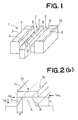
- a monolithic type head core 1 as illustrated in Fig. 1 is known as a typical magnetic head core for a rigid magnetic disk drive (RDD).
- a sliding surface for sliding contact with a recording medium includes air-bearing surfaces 3 and a signal recording/reproducing (writing/reading) track 4, which surfaces 3 and track 4 are defined by grooves 2 formed in the ferrite single crystal.
- the edges are chamferred as indicated at 5, 6, 7, 8, 9 and 10. These chamferred or inclined surfaces 5-10 define the nominal widths of the air-bearing surfaces 3 and track 4.
- the grooves 2 and the chamferred or inclined surfaces 5-10 of the magnetic head core 1 are formed by grinding with a diamond wheel, or by other machining operations.
- the grooving and chamferring by grinding require a total of eight grinding passes or paths for each head core, and are the most time-consuming step of the process for forming the desired profile.
- the surfaces finished by the diamond wheel inevitably suffers from chipping of one micrometer or more.
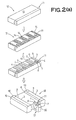
- monolithic RDD magnetic head cores are prepared from a so-called ferrite bar 12 formed of a ferrite single crystal, as illustrated in Fig. 2(a).
- the ferrite bar 12 has a predetermined magnetic gap 11, and an annular magnetic path formed so as to include the gap.
- the ferrite bar 12 has a surface 13 which corresponds to a sliding surface of each magnetic head core produced.
- the sliding surface 13 is mirror-ground, and is subjected to a process for removing residual strain due to the grinding operation.
- a resist 14 is applied to the processed surface of the ferrite bar 12, so as to form an appropriate etching mask in a pattern corresponding to a recessed portion to be formed on the surface 13.
- the ferrite bar 12 with the etching mask 14 is subjected to a chemical etching operation, whereby the recessed portion having a predetermined cross sectional profile partly defined by the air-bearing surfaces 3 and track 4 is formed on the ferrite bar 12.
- the recessed portion to be formed by etching on the surface of the ferrite single crystal have a high degree of dimensional accuracy. Namely, consistent dimensional accuracy is required of side etching widths W and straightness of straight ridges 15 which define the dimensions of the track 4 and chamferred surfaces 7, 8, for example, as indicated in Fig. 2(b). As indicated above, the dimensional accuracy to within ⁇ 1 ⁇ m is important to assure improved recording density, magnetic characteristics and reliability of the magnetic head core.
- the ferrite bar 12 of a Mn-Zn ferrite single crystal for a magnetic head core has a glass filler at the magnetic gap 11. Since the ferrite bar 12 with the glass filler cannot be heated to a temperature higher than a melting point of the glass, a strain on the surface of the ferrite single crystal caused in the grinding process cannot be eliminated. As a result, the side etching widths W tend to be excessive with respect to the nominal values, and the straightness of the straight edges 15 tends to be deteriorated. Thus, the chemical etching process suffers from difficulty in obtaining acceptable dimensional accuracy of the recessed profile formed on the ferrite bar 12.
- EP-A-148014 describes a process in which a ferrite core element, e.g. of Mn-Zn-ferrite, is subjected to chemical etching to remove a top portion of a projection adjacent a previously formed recess. One side surface of the recess is inclined. See figure 5 of EP-A-148014 Also, dry etching methods such as sputtering and ion-beam etching rather than chemical etching are proposed to process the ferrite bar 12 to form thereon a recessed portion having a desired cross sectional shape. Examples of such dry etching methods are disclosed in JP-A-51-114111 and JP-A-54-12819 of unexamined Japanese Patent Applications. However, the dry etching methods suffer from a low etching rate, and are difficult to practice in an industrially justifiable manner.
- the present invention was developed to solve the problems of the prior art discused above. It is therefore an object of the present invention to provide a method suitable for forming a desired recessed portion on a surface of a Mn-Zn ferrite single crystal, to economically produce a highly reliable magnetic head core which has an improved degree of dimensional accuracy.
- the invention is set out in claim 1.
- the desired recessed portion is formed by etching on the surface of the Mn-Zn ferrite single crystal such that each straight ridge as indicated at 15 in Fig. 2(b) defining a boundary between two adjacent surfaces (4; 7, 8) of the recessed portion lies in a (100) or (110) plane of the ferrite single crystal which is perpendicular to the surface on which the etching mask is formed.
- This arrangement permits an improvement in the linearity or straightness of each straight ridge which defines an edge of the inclined surface formed as a result of the chemical etching. Accordingly, the dimensional accuracy of the recessed portion formed on the surface of the ferrite single crystal can be improved. Namely, the dimensional error may be held to within ⁇ 1 ⁇ m.
- the present invention makes it possible to enjoy the inherent advantages of a chemical etching process over a machining process, i.e., absence of chipping and/or cracking of the ferrite single crystal, and a comparatively large area of processing at one time.
- the instant method employing a chemical etching is also advantageous over a dry etching method, in terms of etching rate.
- a dry etching method in terms of etching rate.
- an ion-beam etching method using Ar ions is capable of etching at a rate of only 3 ⁇ m per hours, while the etching rate of the present method may be 20 ⁇ m per hour, that is, as large as more than six times that of the ion-beam etching. Consequently, the present method provides a significant increase in the productivity of magnetic head cores using a Mn-Zn single ferrite crystal.
- the method further comprises a step of exposing the surface of the Mn-Zn ferrite single crystal to a solution which contains an amine compound, prior to forming the etching mask on the surface of the ferrite single crystal.
- this preliminary treatment of the ferrite crystal surface with the solution containing the amine compound is effected after the surface is cleaned with an organic solvent or pure water. It is also preferable that the preliminary treatment be effected after the Mn-Zn ferrite single crystal is annealed.
- the method further comprises a step of exposing the surface of the Mn-Zn ferrite single crystal to an aqueous solution containing phosphoric acid, so as to etch the surface to a depth of at least 1 nm.
- This preliminary etching treatment with the aqueous solution of phosphoric acid is also preferably effected after the ferrite crystal surface is cleaned with an organic solvent or pure water.
- the above forms of the invention assure increased adhesion between the etching mask and the relevant surface of the Mn-Zn ferrite single crystal, thereby considerably improving the straightness of the straight ridge or ridges of the recessed portion, and accordingly enhancing the dimensional accuracy of the recessed portion.
- the Mn-Zn ferrite single crystal to which the present method is applicable may be a single crystal of ferrite, or a monocrystalline portion of a Mn-Zn ferrite material. Where such a monocrystalline portion of a Mn-Zn ferrite is used, an exposed monocrystalline surface of the monocrystalline portion is usually mirror-ground to desired smoothness with a diamond abrasive grain, in a known manner. This preliminary surface treatment of the monocrystalline surface is desired since the condition of the monocrystalline surface prior to the subsequent chemical etching has an influence on the chemically etched surface, even if the chemical etching process occurs uniformly on the entire surface area.
- the mirror-grinding operation is preferably conducted by using a diamond abrasive whose grain size is four micrometer or smaller.
- a strain adjacent to the surface of the ferrite single crystal lowers the etching rate of the surface, and degrades the dimensional accuracy of the etched crystal. Therefore, it is recommended to remove such a strain adjacent to the surface to be chemically etched, before the chemical etching process according to the principle of the invention.
- This strain removal may be accomplished by preliminary chemical or ion-beam etching, or annealing (heat treatment) in an inert atmosphere such as N2.
- annealing heat treatment
- both of the preliminary etching and the annealing are performed to remove the strain.
- the annealing operation is generally effected at a temperature between 200°C and 600°C, preferably between 250°C and 550°C, for at least 10 minutes, preferably at least 30 minutes.
- the Mn-Zn ferrite bar has a glass filler at a magnetic gap or other portions, the upper limit of the annealing temperature is certainly below the melting point of the glass filler.
- the monocrystalline surface of the Mn-Zn ferrite is preferably subjected to a treatment with a solution containing an amine compound, as described above, in order to suitably reduce the side etching widths W of the recessed portion and improve the straightness of the straight ridges.
- the treatment with the amine compound solution greatly contributes to improvement in the dimensional and configurational accuracy of the profile of the recessed portion to be formed on the finally chemically etched surface of the ferrite.
- the amine compounds are preferably selected from alkanol amines such as ethanol amine, diethanol amine and triethanol amine.
- alkanol amines such as ethanol amine, diethanol amine and triethanol amine.
- the other amine compounds such as: aliphatic primary amines such as ethyl amine, propyl amine and butyl amine; aliphatic secondary amines such as diethyl amine and dipropyl amine; aliphatic tertiary amines such as triethyl amine; aliphatic unsaturated amines such as allyl amine; alicyclic amines; diamines; triamines; and aromatic amines such as aniline, toluidine and benzyl amine.
- the selected amine compound is generally used as an aqueous solution, in which the monocrystalline surface of the Mn-Zn ferrite is immersed, for an intended cleaning.
- the cleaning conditions such as the concentration of the amine compound and the temperature and time are determined depending upon the specific amine compound and the desired cleaning result. Since there is a recognition that the concentration of the amine compound in the treating solution has some relationship with the side etching width W, the amine compound concentration is generally held not higher than 50%, preferably within 5-25%, so that the treatment with the amine compound solution provides an intended result.
- the preliminary treatment with the amine compound solution may be replaced by a preliminary etching with a solution of phosphoric acid, which is also effected prior to the application of the etching mask to the surface of the Mn-Zn ferrite single crystal.
- the Mn-Zn ferrite surface on which the etching mask is formed is etched to a depth of at least 1 nm.
- the instant preliminary treatment also effectively reduces the side etching widths W of the recessed portion to be eventually formed on the relevant surface, considerably improves the straightness of the straight ridges of the recessed portion, and greatly enhances the dimensional and configurational accuracy of the recessed portion.
- the relevant surface of the ferrite is immersed in the phosphoric acid solution, and the etching is effected similarly as the subsequently effected etching operation to form the desired recessed portion, as described below.
- the phosphoric acid concentration and the etching temperature and time are determined depending upon the desired etching depth.
- the appropriate etching mask is formed on the treated surface, e.g. by a suitable known method such as screen printing, which method is selected according to the required patterning accuracy and economy. From the standpoint of the patterning accuracy and ease of formation of the mask pattern, it is recommended to form the etching mask by exposing a layer of a photo resist to a radiation through an appropriate photomask.
- the photo resist may be either a positive type or a negative type.
- the etching mask may be formed of a suitable metal such as Cr, or SiO or SiO2, by vacuum deposition, sputtering or CVD.
- the material of the etching mask and the method to form the mask are suitably selected, from the standpoint of adequacy to meet the desired degree of adhesion of the mask to the ferrite surface, as well as taking the operational ease and economy into consideration.
- Figs. 2(a) and 2(b) there are indicated in dashed lines in Fig. 2(b) two parallel straight ridges 15, 15 which are formed as a result of chemical etching of the ferrite bar 12 of a ferrite single crystal through the etching mask 14. These straight ridges 15 define the width of the track 4. Similar straight ridges 15, 15 are formed so as to define the width of each air-bearing surface 3 as indicated in Fig. 2(a). Therefore, it is desired that the straightness of the ridges 15 be held to within 1 micrometer.
- the ferrite bar 12 is chemically etched so as to form the desired recessed portion having a predetermined cross sectional shape, so that the straight ridges 15 lie in a (100) or (110) plane or face of the crystal which is perpendicular to the surface on which the etching mask is formed.
- the recessed portion to be formed by etching includes the air-bearing surfaces 3 each defined by the two straight ridges 15, it is desired that the etched portion has a symmetrical cross sectional shape, for easier subsequent processing and improved flying characteristics of the magnetic head core produced.
- the cross sectional shape of the recessed portion formed by etching is influenced by a vertical etching rate Vv in the direction of depth perpendicular to the surface being etched, and horizontal etching rates Vh1 and Vh2 in the direction of width between the straight ridges 15, 15, as indicated in Fig. 2(b). It will be understood that the recessed or etched portion is given a symmetrical cross sectional shape where the horizontal etching rates Vh1 and Vh2 are equal to each other.
- one of the planes (100), (110), (211), (311), (332), (611) and (331) of the ferrite single crystal is preferably selected as the surface to be etched, for assuring a symmetrical cross sectional shape and improved magnetic characteristics of the magnetic head core.
- the etched surface is selected from among the crystal planes indicted above, and the straight ridges are formed so as to extend in the (100) or (110) plane of the crystal perpendicular to the etched surface.
- the ridges should extend in the direction ⁇ 100 ⁇ or ⁇ 110 ⁇ . If the (311) plane is selected as the surface to be etched, the ridges should extend in the direction ⁇ 332 ⁇ .
- the other combinations of the plane of the etched surface of the ferrite single crystal and the direction in which the straight ridge or ridges extend include: (110) and ⁇ 100 ⁇ ; (110) and ⁇ 110 ⁇ ; (211) and ⁇ 111 ⁇ ; (332) and ⁇ 311 ⁇ ; (611) and ⁇ 331 ⁇ ; and (331) and ⁇ 611 ⁇ .
- An angle ⁇ of the inclined surfaces 7, 8 relative to the etched surface of the ferrite single crystal is determined by a ratio of Vh1 or Vh2 to Vv. Further, the angle may be controlled depending upon the crystal plane selected as the surface to be etched.
- the monocrystalline surface of the Mn-Zn ferrite with the appropriate etching mask is then subjected to a chemical etching, whereby the desired recessed portion having the predetermined cross sectional shape is formed on the Mn-Zn ferrite.
- the chemical etching to form the recessed pattern is effected, most preferably by using an aqueous solution consisting of water and the balance being consisting principally of phosphoric acid.
- This aqueous solution may contain a small amount of other acids such as sulfuric acid in addition to phosphoric acid.
- the above-indicated balance is considered to consist principally of phosphoric acid if the content of phosphoric acid is 80% or more with respect to the entire amount of the acids contained in the aqueous solution.
- a relationship between the concentration of phosphoric acid in the aqueous solution, and the etching rate is shown a relationship between the concentration of phosphoric acid in the aqueous solution, and the etching rate. It follows from the graph that the etching rate is extremely high at the phosphoric acid concentration exceeding 80%. It is also noted that the rate of increase in the etching rate with the phosphoric acid concentration becomes high when the concentration exceeds the 80% level. Accordingly, with the phosphoric acid concnetration exceeding 80%, it is difficult to accurately control the etching amount, and therefore difficult to control the widths of the track 4 and the air-bearing surfaces 3 as shown in Fig. 2(a).
- the etching rate is also influenced by the etching temperature, as indicated in the graph of Fig. 4.
- the etching temperature As indicated in the graph of Fig. 4.
- the etching depth indicated at H in Fig. 2(b) is desirably 10 ⁇ m or more.
- the etching operation requires more than about five hours, if the etching temperature is 50°C or lower, as is understood from the graph of Fig. 4. This etching time is too long to be industrially justified.
- the reduction of the etching time is desirable for another reason. That is, where the etching mask is formed of a photo resist, the adhesion between the etching mask and the ferrite surface is decreased due to expansion of the photo resist during a long period of immersion in the etching solution. For improved dimensional accuracy of the etched portion, it is desirable to minimize the etching time.
- the etching temperature exceeds 90°C, the amount of an aqueous component of the etching solution containing phosphoric acid changes to an appreciable extent, and the temperature distribution within the etching solution becomes uneven, whereby the etching amount considerably differs at the local areas of the ferrite surface. For this reason, it is recommended that the etching temperature be 90°C or lower, preferably within a range between 50°C and 90°C.
- the etching solution preferably has the phosphoric acid concentration of 5-80% by weight.
- the etching temperature and the phosphoric acid concentration of the etching solution are not limited to those indicated above, particularly when the required etching amount is comparatively small and where the etching mask has a high degree of adhesion to the ferrite surface. In this case, the optimum etching conditions are also determined by the other factors.
- the method of the present invention has been described in connection with a magnetic head core for a rigid magnetic disk drive, the principle of the invention is equally applicable to the formation of any recessed patterns having desired cross sectional shapes, on a surface of a ferrite single crystal, for example, for forming air-bearing surfaces, tracks, magnetic gaps and other portions of magnetic head cores for a floppy disk drive or a video cassette recorder, or a composite type magnetic head core having a magnetic metal layer adjacent to the magnetic gap.
- the instant method makes it possible to form minute recesses, grooves or holes that cannot be formed by a conventional machining operation.
- Ferrite bars each consisting of a Mn-Zn ferrite single crystal were prepared.
- the (110) surface of each ferrite single crystal bar was mirror-ground in an ordinary manner by a diamond abrasive having a grain size of 1/4 ⁇ m.
- the Mn-Zn ferrite bars were subjected to a preliminary treatment using aqueous solutions having different concentrations of ethanol amine from 0% to 100%. That is, the ferrite bars were immersed for 30 minutes, in the respective different solutions kept at 25°C.
- An etching resist mask was formed by a photolithographic method, on the mirror-ground surface of each of the thus treated ferrite bars, under the conditions indicated in Table 1.
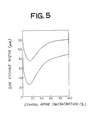
- the horizontal etching amount or side etching width of the recessed portion formed on each Mn-Zn ferrite bar was measured, and indicated in the graph of Fig. 5, in relation to the concentration of ethanol amine of the corresponding preliminary treatment solution.
- the upper and lower curves in the graph show the maximum and minimum values of the horizontal etching amount.
- the side etching width or horizontal etching amount has dependence upon the ethanol amine concentration of the treating preliminary treatment solution. It is noted that the preliminary treatments with the ethanol amine concentration of 50% or lower, preferably 5-25% provided desirable results in terms of the dimensional accuracy and the straightness of the straight ridges of the chemically etched recessed portion on the ferrite bars.
- the (110) plane of each of Mn-Zn ferrite single crystal bars was mirror-ground in an ordinary manner with a diamond abrasive having a grain size of 1/4 ⁇ m.
- the etching resist mask was formed on the mirror-ground surface of each ferrite bar, under the same condition as indicated in Table 1.
- the masked ferrite bars were chemically etched in an aqueous solution containing 77.8% of phosphoric acid (H3PO4) kept at 80°C.
- H3PO4 aqueous solution containing 77.8% of phosphoric acid
- the side etching width and the straightness of the straight ridges of the recessed portion formed on each ferrite bar of Comparative Example 1 were measured and observed.
- the measurements of the side etching widths ranged from 90 ⁇ m to 135 ⁇ m, which are not desirable to obtain the intended recessed portion.
- the straight ridges of the recessed portion showed poor straightness.
- the absence of preliminary treatment of the mirror-ground surface of the Mn-Zn ferrite bar resulted in excessively large side etching widths and poor straightness of the straight ridges.
- Ferrite bars each consisting of a Mn-Zn ferrite single crystal were prepared.
- the (110) surface of each ferrite single crystal bar was mirror-ground in an ordinary manner by a diamond abrasive having a grain size of 1/4 ⁇ m.
- the Mn-Zn ferrite bars were subjected to a preliminary treatment using an aqueous solution containing 20% of ethanol amine kept at 25°C or 80°C.
- the ferrite bars were immersed in the solutions, for different time periods from 25 minutes to 100 minutes.
- an etching resist mask was formed by photolithography on the mirror-ground surface of each of the thus treated ferrite bars, under the conditions indicated in Table 1.
- the masked ferrite bars were chemically etched in an aqueous solution containing 77.8% of phosphoric acid (H3PO4) kept at 80°C.
- H3PO4 phosphoric acid
- the graphs of Figs. 6 and 7 show relationships between the side etching width of the recessed portion formed on the ferrite bars and the time of immersion of the bars in the ethanol amine solution.
- the ferrite bars whose side etching width is shown in Fig. 6 were immersed in the ethanol amine solution kept at 25°C, while the ferrite bars whose side etching width is shown in Fig. 7 were immersed in the ethanol amine solution kept at 80°C.
- the maximum value of the side etching width is indicated in dashed curves, while the minimum value is indicated in solid curves.
- the dashed curves mean comparatively poor straightness of the straight ridges of the recessed portions formed on the ferrite bars.
- Table 2 shows the different preliminary treatment conditions, and the corresponding straightness and side etching width of the recessed portions formed on the ferrite bars.
- TABLE 2 Preliminary Treatment Straightness Side Etching Width ( ⁇ m) Ethanol Amine Concentration Temp. (°C) Time (min.) 20% 25 30 Good 27-76 20% 25 100 Fair 26 20% 80 30 Good 20-40 20% 80 100 Excellent 21
- the (110) surface of a Mn-Zn ferrite single crystal bar was mirror-ground in an ordinary manner with a diamond abrasive having a grain size of 1/4 ⁇ m.
- the ferrite bar was then annealed at 500°C for 2 hours in an atmosphere of N2.
- An etching resist mask was formed on the annealed surface of the ferrite bar, under the photolithographic condition indicated in Table 1.
- the masked ferrite bar was chemically etched in an aqueous solution containing 77.8% of phosphoric acid (H3PO4) kept at 80°C.
- a recessed portion corresponding to the etching mask pattern was formed on the mirror-ground surface of each Mn-Zn ferrite bar, with a vertical etching amount of 20 ⁇ m.
- the straightness of the straight ridges of the recessed portion was found to be excellent, the side etching width was as large as 105 ⁇ m. This indicates that the mere preliminary annealing of the mirror-ground surface of the ferrite bar at 500°C for two hours is not effective enough to assure sufficient reduction in the side etching width of the recessed portion formed on the surface of the ferrite single crystal.
- the (110) surface of a Mn-Zn ferrite single crystal bar was mirror-ground in an ordinary manner with a diamond abrasive having a grain size of 1/4 ⁇ m.
- the ferrite bar was then annealed at 500°C for 2 hours in an atmosphere of N2, and was subjected to a preliminary surface treatment for 30 minutes in an aqueous solution containing 1.5% of ethanol amine kept at 25°C.
- An etching resist mask was then formed on the annealed surface of the ferrite bar, under the photolithographic condition indicated in Table 1.
- the masked ferrite bar was chemically etched in an aqueous solution containing 77.8% of phosphoric acid (H3PO4) kept at 80°C.
- H3PO4 phosphoric acid
- the side etching width and the straightness of the ridges of the recessed portion thus formed by chemical etching on the Mn-Zn ferrite surface were measured and observed.
- the straightness was found to be excellent, and the side etching width was as small as 18 ⁇ m.
- the instant example indicates that the annealing of the Mn-Zn ferrite surface prior to the immersion in the ethanol amine solution permits a sufficiently small side etching width and excellent ridge straightness of the recessed portion, even where the concentration of ethanol amine in the treatment solution is relatively low and the time of immersion in the solution is relatively short.
- each of prepared Mn-Zn ferrite single crystal bars was mirror-ground in an ordinary manner with a diamond abrasive having a grain size of 1/4 ⁇ m.
- the ferrite bars were then immersed for different periods of time in an aqueous solution containing 77.8% of phosphoric acid kept at 50°C, to etch their mirror-ground surfaces to different preliminary etching depths.
- the preliminary etching time per 15 nm of preliminary etching depth was 30 seconds.
- Etching resist masks were formed under the photolithographic condition of Table 1, on the mirror-ground surfaces of the ferrite bars which were given the different preliminary etching depths.
- the masked surfaces were then chemically etched in an aqueous solution containing 77.8% of phosphoric acid kept at 80°C, whereby the appropriate recessed portions were formed on the mirror-ground surfaces of the ferrite bars, with a vertical etching amount of 20 ⁇ m.
- the graph of Fig. 8 shows the measured side etching widths of the recessed portions of the Mn-Zn ferrite single crystal bars, in relation to the preliminary etching depth obtained in the preliminary etching step.
- the minimum side etching width was reduced from 95 ⁇ m to 35 ⁇ m by subjecting the mirror-ground surface of the ferrite bar to a preliminary etching by 1.6 nm. Further, the difference between the maximum and minimum side etching widths (variation of the side etching width) was reduced from 37 ⁇ m to 7 ⁇ m. Thus, it was found that the preliminary etching step provided a considerable improvement in the dimensional and configurational accuracy of the formed recessed portions of the ferrite bars.
- the depth of the preliminary etching prior to the formation of the etching mask is preferably at least 100 nm, for further improvement in the dimensional and configuration accuracy of the formed recessed portion of the ferrite bar.
- the side etching width of the ferrite bars was consistently held at about 20 ⁇ m, with a minimum variation from one ferrite bar to another.
- the (110) plane of each of Mn-Zn ferrite single crystal bars was mirror-ground in an ordinary manner with a diamond abrasive having a grain size of 1/4 ⁇ m.
- the etching resist mask was formed on the mirror-ground surface of each ferrite bar, under the same condition as indicated in Table 1.
- the masked ferrite bars were chemically etched in an aqueous solution containing 77.8% of phosphoric acid (H3PO4) kept at 80°C.
- H3PO4 aqueous solution containing 77.8% of phosphoric acid
- the side etching width and the straightness of the straight ridges of the recessed portion formed on the ferrite bar of Comparative Example 3 were measured and observed.
- the measurements of the side etching widths ranged from 90 ⁇ m to 135 ⁇ m, which are not desirable to obtain the intended recessed portion.
- the straight ridges of the recessed portion showed poor straightness.
- the absence of preliminary treatment of the mirror-ground surface of the Mn-Zn ferrite bar with the phosphoric acid aqueous solution resulted in excessively large side etching widths and poor straightness of the straight ridges.
- each of Mn-Zn ferrite single crystal bars was mirror-ground in an ordinary manner with a diamond abrasive having a grain size of 1/4 ⁇ m.
- the ferrite bars were then annealed at 500°C for 2 hours in an atmosphere of N2.
- the ferrite bars were then immersed for different periods of time in an aqueous solution containing 77.8% of phosphoric acid kept at 50°C, under the same condition as in Example 1, whereby the mirror-ground surfaces of the ferrite bars were etched to different preliminary etching depths.
- Etching resist masks were formed under the photolithographic condition of Table 1, on the mirror-ground surfaces of the ferrite bars which were given the different preliminary etching depths.
- the masked surfaces were then chemically etched in an aqueous solution containing 77.8% of phosphoric acid kept at 80°C, whereby the appropriate recessed portions were formed on the mirror-ground surfaces of the ferrite bars, with a vertical etching amount of 20 ⁇ m.
- the graph of Fig. 9 shows the measured side etching widths of the recessed portions of the Mn-Zn ferrite single crystal bars of Example 5, in relation to the preliminary etching depth obtained in the preliminary etching step.
- a selected surface of each of Mn-Zn ferrite single crystal bars having different crystal orientations was mirror-ground in an ordinary manner with a diamond abrasive having a grain size of 1/4 ⁇ m.
- the ferrite bars were then annealed at 500°C for 2 hours in an atmosphere of N2.
- the ferrite bars were then immersed in an aqueous solution containing 77.8% of phosphoric acid kept at 50°C, under the same condition as in Example 1, whereby the mirror-ground surfaces of the ferrite bars were etched to a preliminary etching depth of 10 nm.
- Etching resist masks were formed under the photolithographic condition of Table 1, on the preliminarily etched mirror-ground surfaces of the ferrite bars. The masked surfaces were then chemically etched in an aqueous solution containing 77.8% of phosphoric acid kept at 80°C, whereby the appropriate recessed portions were formed on the mirror-ground surfaces of the ferrite bars, with a vertical etching amount of 10 ⁇ m.
- Table 4 shows the dimensional accuracy and cross sectional shape of the recessed portions formed on the ferrite single crystal bars which have the different crystal orientations.
- the dimensional accuracy of the recessed portions is comparatively low and the cross sectional shape of the recessed portions is asymmetrical, where the straight ridges each defining a boundary between two adjacent surfaces do not lie in a (100) or (110) plane of the ferrite single crystal which is perpendicular to the etched surface on which the recessed portion is formed by chemical etching through the etching mask.
- the following combinations of the etched surface and the direction of the ridges are relatively poor in the dimensional accuracy and symmetry of the recessed portion formed on the ferrite single crystal, and the recessed portion cannot suitably be used as a track of a magenetic head core: (211) and ⁇ 110 ⁇ ; (311) and ⁇ 110 ⁇ ; and (332) and ⁇ 110 ⁇ .
- a ferrite bar 12 as shown in Fig. 2(a) for monolithic RDD magnetic head cores was prepared from two ferrite single crystals which were bonded together so as to form an annular magnetic path, such that the surfaces defining the magnetic gap 11 were defined by (100) planes of the two crystals while the sliding surface 13 and the side surfaces of the bar 12 were defined by (110) planes of the crystals.
- the sliding surface 13 was mirror-ground in an ordinary manner with a diamond abrasive having a grain size of 1/4 ⁇ m, and then annealed for two hours at 500°C in an atmosphere of N2.
- the annealed surface 13 was subjected to a preliminary etching in an aqueous solution containing 77.8% of phosphoric acid kept at 50°C, to etch the surface to a preliminary etching depth of 10 nm.
- the etching resist mask 14 was formed on the thus treated surface 13, by the photolithographic method whose condition is indicated in Table 1.
- the masked surface was chemically etched in an aqueous solution containing 77.8% of phosphoric acid kept at 80°C.
- the side etching width was also 20 ⁇ m. Therefore, the width of the portions of the etching mask 14 which correspond to the air-bearing surfaces 3 and track 4 should be larger by 40 ⁇ m than the nominal width of the air-bearing surfaces and track 3, 4.
- the chamferred surfaces 16 were then formed at the end portions of the air-bearing surfaces and tracks 3, 4 of the recessed portions, as shown in Fig. 2(a). Then, the ferrite bar 12 was subjected to a cutting operation so that the yoke portion 17 including the track 4 was left for each recessed portion which corresponds to one monolithic RDD magnetic head core. Finally, the ferrite bar 12 was cut into the individual magnetic head cores.
- the air-bearing surfaces 3 and the track 4, and the chamferred surfaces 5-10 adjacent to the surfaces 3 and track 4 were concurrently formed, such that the widths of the surfaces 3 and track 4 were determined by the parallel edges (straight ridges 15) of the chamferred surfaces 5-10. Accordingly, the number of process steps of the present method to form the magnetic head cores is considerably reduced, as compared with the conventional method by grinding with a diamond wheel.
- the present method assures extremely high dimensional accuracy of the air-bearing surfaces 3 and track 4 to within ⁇ 1 ⁇ m, which is determined by the dimensional accuracy of the photolithographically formed etching mask and by the side etching width accuracy in the chemical etching step.
- This dimensional accuracy of the air-bearing surfaces and track 3, 4 is a significant improvement over the highest possible dimensional accuracy of about ⁇ 10 ⁇ m which is available in the conventional method wherein the chamferred surfaces defining the widths of the air-bearing surfaces and track 3, 4 are formed by grinding.
Landscapes
- Engineering & Computer Science (AREA)
- Chemical & Material Sciences (AREA)
- Manufacturing & Machinery (AREA)
- Crystallography & Structural Chemistry (AREA)
- Materials Engineering (AREA)
- Metallurgy (AREA)
- Organic Chemistry (AREA)
- Inorganic Chemistry (AREA)
- Magnetic Heads (AREA)
- Crystals, And After-Treatments Of Crystals (AREA)
- Soft Magnetic Materials (AREA)
Claims (17)
- Verfahren zum Ausbilden eines Ausnehmungsabschnitts auf einer Oberfläche eines Mn-Zn-Ferrit-Einkristalls, wobei der genannte Ausnehmungsabschnitt eine geneigte Oberfläche (7,8) und zumindest einen geraden Steg (15) aufweist, der eine Kante der genannten geneigten Oberfläche (7,8) begrenzt, wobei die genannte geneigte Oberfläche zum genannten Steg parallel verläuft, wobei das Verfahren folgende Schritte umfaßt: das Ausbilden einer Ätzmaske (14) auf dem genannten Ferrit-Einkristall und das Aussetzen des genannten Ferrit-Einkristalls mit der genannten Ätzmaske darauf einer Ätzflüssigkeit, wodurch der genannte Ferrit-Einkristall chemisch geätzt wird, um den genannten geraden Steg (15) zu erzeugen, dadurch gekennzeichnet, daß die genannte geneigte Oberfläche (7,8) durch den genannten Ätzschritt mit der genannten Maske (14) darauf gebildet wird und daß der genannte zumindest eine gerade Steg in einer Ebene (100) oder (110) des genannten Ferrit-Einkristalls liegt, die zur genannten Oberfläche senkrecht steht.
- Verfahren nach Anspruch 1, worin die Kombination der Ebene der genannten Oberfläche des genannten Ferrit-Einkristalls und der Ausdehnungsrichtung des genannten zumindest einen geraden Stegs aus den folgenden Kombinationen ausgewählt ist: - (100) und 〈100〉; (100) und 〈110〉; (110) und 〈110〉; (211) und 〈111〉; (311) und 〈332〉; (332) und 〈311〉; (611) und 〈331〉; und (331) und 〈611〉.
- Verfahren nach Anspruch 1 oder 2, das weiters den Schritt des Aussetzens der genannten Oberfläche des Mn-Zn-Ferrit-Einkristalls einer eine Aminverbindung enthaltenden Lösung vor dem Ausbilden der genannten Ätzmaske auf der genannten Oberfläche umfaßt.
- Verfahren nach Anspruch 1 oder 2, das weiters einen Schritt des Wegnehmens einer Belastung bzw. Spannung vom genannten Mn-Zn-Ferrit-Einkristall vor dem Ausbilden der genannten Ätzmaske (14) auf der genannten Oberfläche umfaßt.
- Verfahren nach Anspruch 4, welches den Schritt des Aussetzens der genannten Oberfläche des Mn-Zn-Ferrit-Einkristalls einer eine Aminverbindung enthaltenden Lösung vor dem Ausbilden der genannten Ätzmaske auf der genannten Oberfläche umfaßt.
- Verfahren nach Anspruch 5, das weiters die Durchführung des genannten Schritts des Wegnehmens von Belastung bzw. Spannung durch Tempern des genannten Mn-Zn-Ferrit-Einkristalls vor der Behandlung mit der genannten eine Aminverbindung enthaltenden Lösung umfaßt.
- Verfahren nach Anspruch 6, worin der genannte Schritt des Temperns des genannten Mn-Zn-Ferrit-Einkristalls bei einer Temperatur von 200-600°C für einen Zeitraum von zumindest 10 Minuten in einer Inertatmosphäre durchgeführt wird.
- Verfahren nach einem der Ansprüche 3 und 5 bis 7, worin die genannte Aminverbindung ausgewählt ist aus: Alkanolaminen; aliphatischen primären Aminen; aliphatischen sekundären Aminen; aliphatischen tertiären Aminen; aliphatischen ungesättigten Aminen; alizyklischen Aminen; Diaminen; Triaminen; und aromatischen Aminen.
- Verfahren nach Anspruch 8, worin die genannte Aminverbindung aus Alkanolaminen ausgewählt ist.
- Verfahren nach einem der Ansprüche 3 und 5 bis 9, worin die Konzentration der genannten Aminverbindung in der genannten Lösung in einem Bereich gehalten wird, der 50 Gew.-% nicht übersteigt.
- Verfahren nach Anspruch 1 oder 2, das weiters einen Schritt des Aussetzens der genannten Oberfläche des Mn-Zn-Ferrit-Einkristalls einer Phosphorsäure enthaltenden wässerigen Lösung umfaßt, um die genannte Oberfläche bis in eine Tiefe von zumindest 1 nm (10 Ångstrom) zu ätzen, bevor die genannte Ätzmaske auf der genannten Oberfläche ausgebildet wird.
- Verfahren nach einem der Ansprüche 1 bis 11, das weiters einen Schritt des Spiegel- bzw. Hochglanzschleifens der genannten Oberfläche des genannten Mn-Zn-Ferrit-Einkristalls vor dem Ausbilden der genannten Ätzmaske auf der genannten Oberfläche umfaßt.
- Verfahren nach Anspruch 12, worin der genannte Schritt des Spiegelschleifens der genannten Oberfläche des genannten Mn-Zn-Ferrit-Einkristalls mit einem Diamantschleifer mit einer Körnung von 1/4 µm ausgeführt wird.
- Verfahren nach einem der Ansprüche 1 bis 13, worin die genannte Oberfläche des Mn-Zn-Ferrit-Einkristalls in einer Ebene (110) des genannten Kristalls ausgebildet wird, während sich der genannte zumindest eine gerade Steg in einer Richtung 〈100〉 des Kristalls erstreckt.
- Verfahren nach einem der Ansprüche 1 bis 14, worin die genannte Ätzflüssigkeit eine wässerige Lösung von Phosphorsäure ist.
- Verfahren nach Anspruch 15, worin die genannte wässerige Lösung 5-80 Gew.-% Phosphorsäure enthält.
- Verfahren nach Anspruch 16, worin die genannte wässerige Lösung bei einer Temperatur von 50-90°C gehalten wird.
Applications Claiming Priority (2)
| Application Number | Priority Date | Filing Date | Title |
|---|---|---|---|
| JP63075744A JPH0770384B2 (ja) | 1988-03-29 | 1988-03-29 | Mn−Znフェライトの加工方法 |
| JP75744/88 | 1988-03-29 |
Publications (2)
| Publication Number | Publication Date |
|---|---|
| EP0336525A1 EP0336525A1 (de) | 1989-10-11 |
| EP0336525B1 true EP0336525B1 (de) | 1993-08-25 |
Family
ID=13585094
Family Applications (1)
| Application Number | Title | Priority Date | Filing Date |
|---|---|---|---|
| EP89300126A Expired - Lifetime EP0336525B1 (de) | 1988-03-29 | 1989-01-06 | Verfahren zur Bildung eines ausgesparten Profils in einem Ferrit-Einkristall durch chemische Ätzung |
Country Status (4)
| Country | Link |
|---|---|
| US (1) | US4875970A (de) |
| EP (1) | EP0336525B1 (de) |
| JP (1) | JPH0770384B2 (de) |
| DE (1) | DE68908589T2 (de) |
Families Citing this family (8)
| Publication number | Priority date | Publication date | Assignee | Title |
|---|---|---|---|---|
| JPH01260611A (ja) * | 1988-04-12 | 1989-10-17 | Ngk Insulators Ltd | 磁気ヘッド用コアの製造法及びそれによって得られた磁気ヘッド用コア |
| US5138508A (en) * | 1988-04-12 | 1992-08-11 | Ngk Insulators, Ltd. | Magnetic head core |
| JPH0730465B2 (ja) * | 1989-01-09 | 1995-04-05 | 日本碍子株式会社 | 負圧形磁気ヘッドスライダ及びその製造方法 |
| US5645774A (en) * | 1989-09-19 | 1997-07-08 | Ferronics Incorporated | Method for establishing a target magnetic permeability in a ferrite |
| FR2664729B1 (fr) * | 1990-07-11 | 1992-09-18 | Commissariat Energie Atomique | Procede de fabrication de tete magnetique possedant un entrefer presentant un azimut controlable. |
| US5225033A (en) * | 1990-11-19 | 1993-07-06 | Sanyo Electric Co., Ltd. | Process for producing magnetic head of the floating type |
| US5114532A (en) * | 1991-03-21 | 1992-05-19 | Seagate Technology, Inc. | Process of etching iron-silicon-aluminum trialloys and etchant solutions used therefor |
| KR100460131B1 (ko) * | 2002-05-08 | 2004-12-03 | 한국과학기술연구원 | 초 고밀도 자기기록용 플래너형 기록헤드의 특성 최적화방법 |
Family Cites Families (8)
| Publication number | Priority date | Publication date | Assignee | Title |
|---|---|---|---|---|
| JPS51114111A (en) * | 1975-03-31 | 1976-10-07 | Nippon Telegr & Teleph Corp <Ntt> | Method of manufacturing magnetic heads |
| US4169026A (en) * | 1976-07-23 | 1979-09-25 | Matsushita Electric Industrial Co., Ltd. | Etchant for electrolytic etching of a ferrite for a magnetic head and method of producing a magnetic head |
| JPS56163518A (en) * | 1980-05-16 | 1981-12-16 | Hitachi Ltd | Magnetic head |
| JPH0740335B2 (ja) * | 1983-12-27 | 1995-05-01 | 日本碍子株式会社 | 磁気ヘッド用コアの製造方法 |
| US4751779A (en) * | 1986-04-02 | 1988-06-21 | Ds Scanner Co., Ltd. | Method of producing a core for magnetic head |
| JPS62234214A (ja) * | 1986-04-03 | 1987-10-14 | Alps Electric Co Ltd | 磁気ヘツドの製造方法 |
| JPH05236016A (ja) * | 1992-02-19 | 1993-09-10 | Fujitsu Ltd | 転送データ長変換方式 |
| JPH06283483A (ja) * | 1993-03-24 | 1994-10-07 | Sanyo Electric Co Ltd | エッチング方法 |
-
1988
- 1988-03-29 JP JP63075744A patent/JPH0770384B2/ja not_active Expired - Lifetime
- 1988-12-29 US US07/291,648 patent/US4875970A/en not_active Expired - Fee Related
-
1989
- 1989-01-06 EP EP89300126A patent/EP0336525B1/de not_active Expired - Lifetime
- 1989-01-06 DE DE89300126T patent/DE68908589T2/de not_active Expired - Fee Related
Also Published As
| Publication number | Publication date |
|---|---|
| EP0336525A1 (de) | 1989-10-11 |
| DE68908589T2 (de) | 1994-03-03 |
| JPH0770384B2 (ja) | 1995-07-31 |
| JPH01248505A (ja) | 1989-10-04 |
| US4875970A (en) | 1989-10-24 |
| DE68908589D1 (de) | 1993-09-30 |
Similar Documents
| Publication | Publication Date | Title |
|---|---|---|
| KR920002579B1 (ko) | 고정자기 디스크 장치용 헤드 코아 슬라이더 및 그 제조방법 | |
| US4947541A (en) | Method for producing a thin film head | |
| JPS60133516A (ja) | 薄膜磁気ヘツドの製造方法 | |
| EP0336525B1 (de) | Verfahren zur Bildung eines ausgesparten Profils in einem Ferrit-Einkristall durch chemische Ätzung | |
| US4425701A (en) | Methods of making magnetic recording heads | |
| JP2543629B2 (ja) | 磁気ディスク装置用コアスライダ及びその製造方法 | |
| US6212033B1 (en) | Slider and method for manufacturing the same | |
| US6555294B1 (en) | Method for collective production of magnetic heads with rounded bearing surface | |
| JP2503071B2 (ja) | 磁気ヘッド用コアの製造方法 | |
| US5225033A (en) | Process for producing magnetic head of the floating type | |
| JP2824815B2 (ja) | 磁気ヘッド | |
| KR900004744B1 (ko) | 자기헤드의 제조방법 | |
| JPH02263795A (ja) | フェライト単結晶の加工方法 | |
| JPH066796B2 (ja) | フェライト単結晶の加工方法 | |
| JPH0416841B2 (de) | ||
| JPS62124684A (ja) | ヘツドスライダ | |
| JPH06259737A (ja) | 浮上式磁気ヘッドの製造方法 | |
| JPH10334412A (ja) | 薄膜磁気ヘッド及び磁気ディスク装置 | |
| JPH05258231A (ja) | 磁気ヘッド及びその製造方法 | |
| JPH0581614A (ja) | 薄膜磁気ヘツドおよびその製造方法 | |
| JPH06124418A (ja) | 薄膜磁気ヘッド用基板の製造方法 | |
| JPH03194709A (ja) | 狭トラック複合型磁気ヘッドの製造方法 | |
| JPH06274813A (ja) | 磁気ヘッドの製造方法 | |
| JPH0550044B2 (de) | ||
| JPH06139523A (ja) | 薄膜磁気ヘッドの製造方法 |
Legal Events
| Date | Code | Title | Description |
|---|---|---|---|
| PUAI | Public reference made under article 153(3) epc to a published international application that has entered the european phase |
Free format text: ORIGINAL CODE: 0009012 |
|
| 17P | Request for examination filed |
Effective date: 19890220 |
|
| AK | Designated contracting states |
Kind code of ref document: A1 Designated state(s): DE IT NL |
|
| 17Q | First examination report despatched |
Effective date: 19910506 |
|
| GRAA | (expected) grant |
Free format text: ORIGINAL CODE: 0009210 |
|
| AK | Designated contracting states |
Kind code of ref document: B1 Designated state(s): DE IT NL |
|
| REF | Corresponds to: |
Ref document number: 68908589 Country of ref document: DE Date of ref document: 19930930 |
|
| ITF | It: translation for a ep patent filed | ||
| PLBE | No opposition filed within time limit |
Free format text: ORIGINAL CODE: 0009261 |
|
| STAA | Information on the status of an ep patent application or granted ep patent |
Free format text: STATUS: NO OPPOSITION FILED WITHIN TIME LIMIT |
|
| 26N | No opposition filed | ||
| PGFP | Annual fee paid to national office [announced via postgrant information from national office to epo] |
Ref country code: DE Payment date: 20010122 Year of fee payment: 13 |
|
| PGFP | Annual fee paid to national office [announced via postgrant information from national office to epo] |
Ref country code: NL Payment date: 20010123 Year of fee payment: 13 |
|
| PG25 | Lapsed in a contracting state [announced via postgrant information from national office to epo] |
Ref country code: NL Free format text: LAPSE BECAUSE OF NON-PAYMENT OF DUE FEES Effective date: 20020801 Ref country code: DE Free format text: LAPSE BECAUSE OF NON-PAYMENT OF DUE FEES Effective date: 20020801 |
|
| NLV4 | Nl: lapsed or anulled due to non-payment of the annual fee |
Effective date: 20020801 |
|
| PG25 | Lapsed in a contracting state [announced via postgrant information from national office to epo] |
Ref country code: IT Free format text: LAPSE BECAUSE OF NON-PAYMENT OF DUE FEES;WARNING: LAPSES OF ITALIAN PATENTS WITH EFFECTIVE DATE BEFORE 2007 MAY HAVE OCCURRED AT ANY TIME BEFORE 2007. THE CORRECT EFFECTIVE DATE MAY BE DIFFERENT FROM THE ONE RECORDED. Effective date: 20050106 |
|
| PGFP | Annual fee paid to national office [announced via postgrant information from national office to epo] |
Ref country code: IT Payment date: 20071017 Year of fee payment: 19 |
|
| PGRI | Patent reinstated in contracting state [announced from national office to epo] |
Ref country code: IT Effective date: 20091201 |
|
| PGRI | Patent reinstated in contracting state [announced from national office to epo] |
Ref country code: IT Effective date: 20091201 |