EP0334760B1 - Verfahren zur Herstellung von Hochleistungsteilen aus Magnesium-Aluminium-Spinell, insbesondere transparente Teile im infraroten und sichtbaren Bereich - Google Patents
Verfahren zur Herstellung von Hochleistungsteilen aus Magnesium-Aluminium-Spinell, insbesondere transparente Teile im infraroten und sichtbaren Bereich Download PDFInfo
- Publication number
- EP0334760B1 EP0334760B1 EP19890400819 EP89400819A EP0334760B1 EP 0334760 B1 EP0334760 B1 EP 0334760B1 EP 19890400819 EP19890400819 EP 19890400819 EP 89400819 A EP89400819 A EP 89400819A EP 0334760 B1 EP0334760 B1 EP 0334760B1
- Authority
- EP
- European Patent Office
- Prior art keywords
- infrared
- spinel
- powder
- mgo
- objects
- Prior art date
- Legal status (The legal status is an assumption and is not a legal conclusion. Google has not performed a legal analysis and makes no representation as to the accuracy of the status listed.)
- Expired - Lifetime
Links
- 229910052596 spinel Inorganic materials 0.000 title claims description 51
- 239000011029 spinel Substances 0.000 title claims description 28
- 238000000034 method Methods 0.000 title claims description 21
- 230000008569 process Effects 0.000 title claims description 12
- 229910052749 magnesium Inorganic materials 0.000 title claims description 10
- 239000011777 magnesium Substances 0.000 title claims description 10
- -1 magnesium aluminate Chemical class 0.000 title description 10
- 229910026161 MgAl2O4 Inorganic materials 0.000 claims description 23
- 230000005540 biological transmission Effects 0.000 claims description 21
- 239000000843 powder Substances 0.000 claims description 21
- 238000005245 sintering Methods 0.000 claims description 18
- 238000004519 manufacturing process Methods 0.000 claims description 17
- CPLXHLVBOLITMK-UHFFFAOYSA-N Magnesium oxide Chemical compound [Mg]=O CPLXHLVBOLITMK-UHFFFAOYSA-N 0.000 claims description 11
- 238000000280 densification Methods 0.000 claims description 11
- 239000000395 magnesium oxide Substances 0.000 claims description 6
- FYYHWMGAXLPEAU-UHFFFAOYSA-N Magnesium Chemical compound [Mg] FYYHWMGAXLPEAU-UHFFFAOYSA-N 0.000 claims description 4
- 239000011261 inert gas Substances 0.000 claims description 2
- 238000001513 hot isostatic pressing Methods 0.000 claims 2
- 238000003825 pressing Methods 0.000 claims 2
- 238000002156 mixing Methods 0.000 claims 1
- 239000000203 mixture Substances 0.000 claims 1
- 230000006835 compression Effects 0.000 description 20
- 238000007906 compression Methods 0.000 description 20
- 238000007872 degassing Methods 0.000 description 8
- 230000003287 optical effect Effects 0.000 description 8
- 239000000919 ceramic Substances 0.000 description 5
- 229910010293 ceramic material Inorganic materials 0.000 description 5
- 230000007547 defect Effects 0.000 description 5
- 238000005204 segregation Methods 0.000 description 5
- 239000000126 substance Substances 0.000 description 5
- 238000010521 absorption reaction Methods 0.000 description 4
- 239000002775 capsule Substances 0.000 description 4
- 239000012535 impurity Substances 0.000 description 4
- 230000005855 radiation Effects 0.000 description 4
- 229910052566 spinel group Inorganic materials 0.000 description 4
- 239000000292 calcium oxide Substances 0.000 description 3
- ODINCKMPIJJUCX-UHFFFAOYSA-N calcium oxide Inorganic materials [Ca]=O ODINCKMPIJJUCX-UHFFFAOYSA-N 0.000 description 3
- 238000004364 calculation method Methods 0.000 description 3
- 238000005056 compaction Methods 0.000 description 3
- 238000005336 cracking Methods 0.000 description 3
- 230000000694 effects Effects 0.000 description 3
- 239000007789 gas Substances 0.000 description 3
- 238000010438 heat treatment Methods 0.000 description 3
- 229910052746 lanthanum Inorganic materials 0.000 description 3
- 229910052745 lead Inorganic materials 0.000 description 3
- 239000000463 material Substances 0.000 description 3
- XKRFYHLGVUSROY-UHFFFAOYSA-N Argon Chemical compound [Ar] XKRFYHLGVUSROY-UHFFFAOYSA-N 0.000 description 2
- MCMNRKCIXSYSNV-UHFFFAOYSA-N Zirconium dioxide Chemical compound O=[Zr]=O MCMNRKCIXSYSNV-UHFFFAOYSA-N 0.000 description 2
- 150000004645 aluminates Chemical class 0.000 description 2
- PNEYBMLMFCGWSK-UHFFFAOYSA-N aluminium oxide Inorganic materials [O-2].[O-2].[O-2].[Al+3].[Al+3] PNEYBMLMFCGWSK-UHFFFAOYSA-N 0.000 description 2
- 125000002091 cationic group Chemical group 0.000 description 2
- 229910052593 corundum Inorganic materials 0.000 description 2
- 230000007423 decrease Effects 0.000 description 2
- QDOXWKRWXJOMAK-UHFFFAOYSA-N dichromium trioxide Chemical compound O=[Cr]O[Cr]=O QDOXWKRWXJOMAK-UHFFFAOYSA-N 0.000 description 2
- 238000009792 diffusion process Methods 0.000 description 2
- 239000000428 dust Substances 0.000 description 2
- 238000005538 encapsulation Methods 0.000 description 2
- 150000002222 fluorine compounds Chemical class 0.000 description 2
- 239000011159 matrix material Substances 0.000 description 2
- 230000007246 mechanism Effects 0.000 description 2
- 239000002245 particle Substances 0.000 description 2
- 238000005498 polishing Methods 0.000 description 2
- 239000011148 porous material Substances 0.000 description 2
- 229910001845 yogo sapphire Inorganic materials 0.000 description 2
- RUDFQVOCFDJEEF-UHFFFAOYSA-N yttrium(III) oxide Inorganic materials [O-2].[O-2].[O-2].[Y+3].[Y+3] RUDFQVOCFDJEEF-UHFFFAOYSA-N 0.000 description 2
- 229910004829 CaWO4 Inorganic materials 0.000 description 1
- 235000015842 Hesperis Nutrition 0.000 description 1
- 235000012633 Iberis amara Nutrition 0.000 description 1
- 229910010215 LiAl5O8 Inorganic materials 0.000 description 1
- 229910003112 MgO-Al2O3 Inorganic materials 0.000 description 1
- 230000009471 action Effects 0.000 description 1
- 230000004913 activation Effects 0.000 description 1
- 239000000654 additive Substances 0.000 description 1
- 125000000129 anionic group Chemical group 0.000 description 1
- 229910052786 argon Inorganic materials 0.000 description 1
- 229910001632 barium fluoride Inorganic materials 0.000 description 1
- LTPBRCUWZOMYOC-UHFFFAOYSA-N beryllium oxide Inorganic materials O=[Be] LTPBRCUWZOMYOC-UHFFFAOYSA-N 0.000 description 1
- 244000309464 bull Species 0.000 description 1
- WUKWITHWXAAZEY-UHFFFAOYSA-L calcium difluoride Chemical compound [F-].[F-].[Ca+2] WUKWITHWXAAZEY-UHFFFAOYSA-L 0.000 description 1
- 229910001634 calcium fluoride Inorganic materials 0.000 description 1
- BRPQOXSCLDDYGP-UHFFFAOYSA-N calcium oxide Chemical compound [O-2].[Ca+2] BRPQOXSCLDDYGP-UHFFFAOYSA-N 0.000 description 1
- 150000001768 cations Chemical class 0.000 description 1
- 150000004770 chalcogenides Chemical class 0.000 description 1
- 239000000470 constituent Substances 0.000 description 1
- 238000001816 cooling Methods 0.000 description 1
- 230000003247 decreasing effect Effects 0.000 description 1
- 238000001514 detection method Methods 0.000 description 1
- 230000008030 elimination Effects 0.000 description 1
- 238000003379 elimination reaction Methods 0.000 description 1
- 238000005516 engineering process Methods 0.000 description 1
- 230000003628 erosive effect Effects 0.000 description 1
- 230000001747 exhibiting effect Effects 0.000 description 1
- 230000004927 fusion Effects 0.000 description 1
- CMIHHWBVHJVIGI-UHFFFAOYSA-N gadolinium(III) oxide Inorganic materials [O-2].[O-2].[O-2].[Gd+3].[Gd+3] CMIHHWBVHJVIGI-UHFFFAOYSA-N 0.000 description 1
- 238000001033 granulometry Methods 0.000 description 1
- 229910052735 hafnium Inorganic materials 0.000 description 1
- 238000000265 homogenisation Methods 0.000 description 1
- 238000007731 hot pressing Methods 0.000 description 1
- 230000006872 improvement Effects 0.000 description 1
- 238000004433 infrared transmission spectrum Methods 0.000 description 1
- 229910052742 iron Inorganic materials 0.000 description 1
- 239000004816 latex Substances 0.000 description 1
- 229920000126 latex Polymers 0.000 description 1
- 230000000670 limiting effect Effects 0.000 description 1
- 239000007791 liquid phase Substances 0.000 description 1
- 230000007774 longterm Effects 0.000 description 1
- 229910001635 magnesium fluoride Inorganic materials 0.000 description 1
- AXZKOIWUVFPNLO-UHFFFAOYSA-N magnesium;oxygen(2-) Chemical compound [O-2].[Mg+2] AXZKOIWUVFPNLO-UHFFFAOYSA-N 0.000 description 1
- 238000002844 melting Methods 0.000 description 1
- 230000008018 melting Effects 0.000 description 1
- 238000001000 micrograph Methods 0.000 description 1
- 238000005457 optimization Methods 0.000 description 1
- 239000005416 organic matter Substances 0.000 description 1
- 239000012071 phase Substances 0.000 description 1
- 230000000704 physical effect Effects 0.000 description 1
- 238000002360 preparation method Methods 0.000 description 1
- 230000001681 protective effect Effects 0.000 description 1
- 230000002285 radioactive effect Effects 0.000 description 1
- 230000002829 reductive effect Effects 0.000 description 1
- HYXGAEYDKFCVMU-UHFFFAOYSA-N scandium(III) oxide Inorganic materials O=[Sc]O[Sc]=O HYXGAEYDKFCVMU-UHFFFAOYSA-N 0.000 description 1
- SBIBMFFZSBJNJF-UHFFFAOYSA-N selenium;zinc Chemical compound [Se]=[Zn] SBIBMFFZSBJNJF-UHFFFAOYSA-N 0.000 description 1
- 230000035939 shock Effects 0.000 description 1
- 239000007787 solid Substances 0.000 description 1
- 241000894007 species Species 0.000 description 1
- FIXNOXLJNSSSLJ-UHFFFAOYSA-N ytterbium(III) oxide Inorganic materials O=[Yb]O[Yb]=O FIXNOXLJNSSSLJ-UHFFFAOYSA-N 0.000 description 1
- 229910052725 zinc Inorganic materials 0.000 description 1
- XLOMVQKBTHCTTD-UHFFFAOYSA-N zinc oxide Inorganic materials [Zn]=O XLOMVQKBTHCTTD-UHFFFAOYSA-N 0.000 description 1
- 229910052726 zirconium Inorganic materials 0.000 description 1
Images

Classifications
-
- C—CHEMISTRY; METALLURGY
- C04—CEMENTS; CONCRETE; ARTIFICIAL STONE; CERAMICS; REFRACTORIES
- C04B—LIME, MAGNESIA; SLAG; CEMENTS; COMPOSITIONS THEREOF, e.g. MORTARS, CONCRETE OR LIKE BUILDING MATERIALS; ARTIFICIAL STONE; CERAMICS; REFRACTORIES; TREATMENT OF NATURAL STONE
- C04B35/00—Shaped ceramic products characterised by their composition; Ceramics compositions; Processing powders of inorganic compounds preparatory to the manufacturing of ceramic products
- C04B35/01—Shaped ceramic products characterised by their composition; Ceramics compositions; Processing powders of inorganic compounds preparatory to the manufacturing of ceramic products based on oxide ceramics
- C04B35/44—Shaped ceramic products characterised by their composition; Ceramics compositions; Processing powders of inorganic compounds preparatory to the manufacturing of ceramic products based on oxide ceramics based on aluminates
- C04B35/443—Magnesium aluminate spinel
-
- C—CHEMISTRY; METALLURGY
- C04—CEMENTS; CONCRETE; ARTIFICIAL STONE; CERAMICS; REFRACTORIES
- C04B—LIME, MAGNESIA; SLAG; CEMENTS; COMPOSITIONS THEREOF, e.g. MORTARS, CONCRETE OR LIKE BUILDING MATERIALS; ARTIFICIAL STONE; CERAMICS; REFRACTORIES; TREATMENT OF NATURAL STONE
- C04B35/00—Shaped ceramic products characterised by their composition; Ceramics compositions; Processing powders of inorganic compounds preparatory to the manufacturing of ceramic products
- C04B35/622—Forming processes; Processing powders of inorganic compounds preparatory to the manufacturing of ceramic products
- C04B35/64—Burning or sintering processes
- C04B35/645—Pressure sintering
- C04B35/6455—Hot isostatic pressing
Definitions
- the present invention relates to a process for manufacturing high performance magnesium aluminate spinel parts, that is to say comprising a minimum of defects, in particular transparent parts in the infrared and visible range.
- Parts transmitting infrared radiation can find various applications which can range from the field of infrared lenses and related optical components to the field of infrared windows for lasers, infrared spectrometers and fusion reactors, irdomes for infrared guidance.
- red rockets, and missile domes that work primarily to protect detection systems from the environment.
- Transparent parts in the visible range can find applications in transparent and camera lens shields.
- the transmission in the infrared range is close to 100% of the theoretical transmission at the desired wavelength in order to prevent the heating and the resulting distortions. or even the merger of the constituents.
- parts with a transmission slightly less than 100% of the theoretical transmission can be tolerated.
- the transmission in the infrared of the part is an important property, but it is also necessary that these parts resist thermal shocks which can be produced by aerodynamic heating. as well as the long-term effects of rain and erosion by solid particles. In some cases, it is also necessary for the parts to be resistant to hostile environments, for example radioactive, corrosive or at high temperature.
- such parts must have good mechanical properties, high optical transparency in the range from visible to infrared radiation up to wavelengths of 4.5 ⁇ m, and preferably good resistance to hostile environments.
- the ceramic materials which can be used for the production of such pieces can be spinels such as magnesium aluminate spinels MgAl2O4 and garnets; simple or mixed oxides such as MgO, Y2O3, Yb2O3, ZrO2 doped with Y2O3, Sc2O3, Gd2O3, ZnO, BeO, Al2O3, (Y, La) 2O3, CaWO4, PbWO4, PbMoO4; and oxides doped with fluorides such as CaO doped with CaF2 and MgO doped with LiF.
- spinels such as magnesium aluminate spinels MgAl2O4 and garnets
- simple or mixed oxides such as MgO, Y2O3, Yb2O3, ZrO2 doped with Y2O3, Sc2O3, Gd2O3, ZnO, BeO, Al2O3, (Y, La) 2O3, CaWO4, PbWO4, PbMoO4
- magnesium aluminate spinels of formula MgAl2O4 are preferred because they offer the best compatibilities between good intrinsic optical properties and good physicochemical properties such as mechanical strength, hardness, resistance to high temperatures, chemical resistance, resistance to irradiation and the dielectric constant.
- Translucent ceramic pieces of this type could be prepared by natural sintering of a powder of the ceramic material, at high temperatures, by adding to the powder a very small amount (0.1 to 1%) of an oxide to facilitate sintering, for example calcium oxide CaO, as described by RJ Bratton in Journal of The American Ceramic Society, vol. 57, no.7 (1974) p.283-286.
- this method is limited to obtaining parts of small thickness and limited transmission; moreover, natural sintering results in a relatively large grain size (approximately 50 ⁇ m), which does not make it possible to obtain the desired mechanical properties.
- Document US-A-3,767,745 relates to obtaining transparent fine-grain ceramics, in particular MgAl2O4 spinels.
- the process consists of preparing a compact preform by cold compression, degassing it by heating to 600 ° C and then placing it in a matrix where it is simultaneously subjected to a pressure of 6000 to 7000 psi (41.4x10⁶ Pa at 48.30x10⁶ Pa) and at an increasing temperature in steps of 50 ° C from 1150 ° C to 1500 ° C.
- the subject of the present invention is precisely a process for manufacturing high performance magnesium aluminate MgAl2O4 spinel parts, which makes it possible to obtain appropriate transmission in the infrared and visible range, as well as good mechanical properties while giving the possibility of obtaining good reproducibility and good homogeneity, at inexpensive conditions.
- This process consists essentially of preparing, by cold compression, from a spinel powder containing an excess of 0.5% to 5% of MgO magnesia, a consolidated spinel preform, to submit this part to a natural sintering to obtain a degassed product with low closed porosity, then to carry out a post-densification by hot isostatic compression which ensures the homogenization and the total densification of the parts.
- the process which is the subject of the invention is a process during which the hot isostatic compaction only plays the role of post-densification of previously sintered spinel parts with closed porosity, in air or under vacuum, natural sintering allowing prior degassing pushed from the spinel piece before its final densification.
- This process also allows the use of a slow rate of temperature rise, necessary for the manufacture of medium and large parts without cracking while avoiding the appearance of defects in the form of white dots previously mentioned: it consists in introducing into the starting spinel powder an excess of MgO relative to the stoichiometric amount. This excess weight must be between 0.5 and 5% and preferably between 1% and 3%.
- the minimum energy state of spinel ceramic corresponds to a higher MgO concentration at the grain boundaries or at the grain surface. It follows that in the absence of addition, during the rise in temperature during sintering, the magnesia tends to migrate from the inside to the outside of the grains and to segregate. As the spinel preform has many microstructural (large pores) or chemical heterogeneities (MgO concentration gradient, impurities, etc.), this segregation is preferentially carried out in certain zones in point form. Thus in these zones where the energy has decreased and which are less reactive during sintering, the elimination of microporosity can become difficult and incomplete, it is these heterogeneous microzones, with residual porosity, which appear in the form of white dots throughout the transparent matrix.
- the homogeneous segregation of the MgO oxide without addition requires a rapid temperature rise rate which does not allow the manufacture of large parts without cracking (or tension).
- the addition of MgO ensures a chemical equilibrium between the grains and their surface which avoids these segregation phenomena (volume diffusion). A proportion of 0.5 to 5% is necessary for an excess of initial MgO to be sufficiently present on the surface of the grains to be effective and achieve this chemical equilibrium.
- the addition of MgO can also compensate for the losses of MgO in the form of vapor which can occur during the thermal sintering treatment.
- MgO can also compensate for the losses of MgO in the form of vapor which can occur during the thermal sintering treatment.
- it ensures the minimum stoichiometric MgO in the whole of the part, especially when it is of large size and thermally treated with a slow rise in temperature, especially if this treatment takes place under vacuum.
- the natural sintering operation is carried out by the action of heat, under vacuum or in an oven in the open air, the temperature T1 being of the order of 1430 ° C to 1700 ° C and the time of level t1 of the order of 15 minutes to 3 hours.
- the optimization of these parameters depends on the characteristics of the powders (specific surface, particle size, etc.).
- the excess of MgO also plays the role of activation of the sintering and its proportion can intervene in the choice of these parameters. This operation thus achieves the almost total degassing and closing of the porosity of the spinel specimen, in which only very few interconnected air or vacuum zones remain.
- the hot isostatic compression is carried out at a temperature T2 generally greater than or equal to the temperature T1.
- This temperature difference is preferably between 10 and 200 ° C.
- the bearing pressure P2 is preferably greater than 800 ⁇ 105 Pa (800 bars).
- the process of the invention thus essentially breaks down into three main stages, each of which brings its specific features to the part obtained.
- the first step allows the preparation of the compact preform of cold spinel; the second natural sintering step leads to degassing of the pores and almost complete closure of the porosity; the third stage carries out the final hot densification, while ensuring good homogeneity and eliminating the majority of defects and in particular microporosities.
- the fact of carrying out the hot isostatic compression after a sintering step makes it possible to avoid the use of a capsule for the hot isostatic compression since the part subjected to this isostatic compression is degassed and since it does not have no open porosity, it provides its own tightness to compression gas.
- the method of the invention is advantageous since it makes it possible to avoid the use of a capsule. Furthermore, it makes it possible to obtain parts of large dimensions under inexpensive conditions, with high reliability of reproducibility with regard to the homogeneity of the parts obtained, in particular their microstructure and their infrared transmission, without it being necessary to fine-tune the manufacturing parameters.
- the good optical properties of the part obtained. are accompanied by good physicochemical properties, in particular good mechanical strength, due in particular to the fineness of the grains and to the absence of a second phase at the grain boundaries.
- cold compression is first carried out and preferably cold isostatic compression of the powder of the ceramic material to form a preform which is then subjected to natural sintering.
- the starting ceramic material powder is preferably a high purity powder, for example having at most 100 ppm of cationic impurities apart from the impurities introduced voluntarily in the case where it is desired to color the part.
- the granulometry of the starting powder and its specific surface also play an important role because they condition the densification mechanisms and exert an influence on the microporist of the part. Indeed, the larger the specific surface of the powder, the more the densification mechanisms are favored, but the degassing ability decreases as a function of the specific surface of the powder. Also, it is necessary to find a compromise between these two opposite effects, and a powder is preferably chosen whose specific surface ranges from 30 to 180 m2 / cm3.
- the hot isostatic compression can be carried out by means of an inert gas such as argon.
- an inert gas such as argon.
- the pressure used is generally greater than 800.105 Pa (800 bars).
- the temperature and pressure conditions allow essentially to optimize the optical qualities of the part in the visible and near infrared domain.
- the pressure P2 and the temperature T2 can be maintained for a period ranging from 10 min to 2 hours.
- the consolidated spinel cylinder thus formed is then placed in an atmosphere furnace to be sintered there according to the following cycle: temperature rise at 2 ° C / minute to 1600 ° C - 2 hour level at 1600 ° C - cooling at 2 ° C / minute.
- the treatment can be carried out in air, but it is advantageous to carry out it under vacuum.
- the sintered part thus produced has a low closed porosity, less than 4.5%.
- this part is post-densified by hot isostatic compression directly without encapsulation - constituted by a treatment of 1700 ° C under 1100.105 Pa (1100 bars) for 45 minutes.
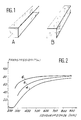
- a transparent piece with a diameter of 50 mm is thus obtained, in which it is possible to cut bars and discs, which after polishing are characterized by FIGS. 1, 3 and 5.
- FIGS. 1A and 1B clearly illustrate the effect of adding MgO according to the process which is the subject of the invention.
- Figure 1A relates to the bar cut in the room, it is completely transparent and free from defects.
- FIG. 1B relating to a spinel part, manufactured without adding MgO, shows a certain number of white dots (in black in the drawing of course), located in the grain network and which make this part in spinel completely unsuitable for use as a transparent body, in particular to infrared radiation.
- FIG 3 there is shown the infrared transmission of the part obtained as a function of the number of waves (in cm ⁇ 1) and the wavelength (in microns).
- curve 1 relates to a disc with a thickness of 5.94 mm
- n is substantially equal to 1.72 and it follows that (1-R) is equal to 0.86.
- (1-R) is equal to 0.86.
- the theoretical transmission of MgAl2O4 is 86%.
- Curves 2 and 3 illustrate the infrared transmission obtained by the calculation of parts 1 and 3 mm thick, respectively.
- the part obtained by the method of the invention (curve 1) has a low absorption coefficient over the entire transmission range which ranges, in FIG. 3, from 4000 to 25000 cm ⁇ 1 (2.5 to 4 , 5 micrometers). However, there is a very slight absorption peak OH ⁇ around 2.9 micrometers, but this can be eliminated by carrying out a more thorough degassing.
- curve 4 relates to the part which has a thickness of 5.94 mm and curves 5 and 6 are obtained by calculation according to the Lambert-Bouger law, for thicknesses of 3 and 1 mm respectively.
- Example 2 manufacture of a cylinder colored in red.
- a MgAl2O4 spinel powder is used, the specific surface of which is 35 m2 / g and containing 2% MgO and 200 ppm of Cr2O3. As in Example 1, this powder is cold isostatically compressed to 2.5.105 k Pa (2.5 kbars).
- the cylinder thus formed is sintered in air at 1550 ° C for 1 hour.
- the part obtained has an overall porosity close to 4%.
- Hot isostatic compression is carried out at 1580 ° C, under 1500 105 Pa (1500 bars) for 30 minutes.
- the cylinder obtained (diameter 40 mm, height 80 mm) is completely dense, free from defects and appears, after polishing, red and translucent throughout its mass.
Landscapes
- Engineering & Computer Science (AREA)
- Chemical & Material Sciences (AREA)
- Ceramic Engineering (AREA)
- Manufacturing & Machinery (AREA)
- Materials Engineering (AREA)
- Structural Engineering (AREA)
- Organic Chemistry (AREA)
- Inorganic Chemistry (AREA)
- Compositions Of Oxide Ceramics (AREA)
Claims (4)
- Verfahren zur Herstellung von Hochleistungsteilen aus MgAl₂O₄-Spinell mit einer Transparenz im infraroten und sichtbaren Bereich entsprechend einer Transmission von 50 bis 84 % für Wellenlängen bis zu 4,5 Mikrometer, ausgehend von einem Vorformling, der durch Kaltpressen von MgAl₂O₄-Pulver erhalten wird, umfassend:
Das Verwenden eines Spinellpulvers für diesen Schritt des Kaltpressens, dem man, vorzugsweise im Laufe der Herstellung des Pulvers, einen Überschuß von 0,5 bis 5 Gewichtsprozent von Magnesiumoxid MgO, bezogen auf die stöchiometrische Zusammensetzung, zugegeben hat;
das Sintern (frittage naturel) dieses Vorformlings, um ein entgastes Produkt mit einer geringen geschlossenen Porosität, unterhalb von 4,5 %, zu erhalten;
das Ausführen einer Nachverdichtung und Homogenisierung dieses Vorformlings durch heißisostatisches Pressen. - Verfahren zur Herstellung nach Anspruch 1, dadurch gekennzeichnet daß der Überschuß an Magnesiumoxid MgO vorzugsweise zwischen 1 und 3 Gewichtsprozent liegt.
- Verfahren zur Herstellung nach einem der Ansprüche 1 und 2, dadurch gekennzeichnet, daß das Sintern in einem Ofen unter Vakuum oder an der Luft bei einer Temperatur in der Größenordnung von 1430 bis 1700°C stattfindet.
- Verfahren zur Herstellung nach einem der Ansprüche 1 bis 3, dadurch gekennzeichnet, daß der Schritt des heißisostatischen Pressens in einer Inertgasatmosphäre bei einer Temperatur von 1580 bis 1700°C und unter einem Druck zwischen 800·10⁵ und 2000·10⁵ Pa (800 und 2000 bar) während eines Zeitraums von 10 Minuten bis maximal 2 Stunden durchgeführt wird.
Applications Claiming Priority (2)
| Application Number | Priority Date | Filing Date | Title |
|---|---|---|---|
| FR8803941 | 1988-03-25 | ||
| FR8803941A FR2629075B1 (fr) | 1988-03-25 | 1988-03-25 | Procede de fabrication de pieces en spinelle d'aluminate de magnesium a hautes performances, notamment de pieces transparentes dans le domaine infrarouge et visible |
Publications (2)
| Publication Number | Publication Date |
|---|---|
| EP0334760A1 EP0334760A1 (de) | 1989-09-27 |
| EP0334760B1 true EP0334760B1 (de) | 1993-05-26 |
Family
ID=9364646
Family Applications (1)
| Application Number | Title | Priority Date | Filing Date |
|---|---|---|---|
| EP19890400819 Expired - Lifetime EP0334760B1 (de) | 1988-03-25 | 1989-03-23 | Verfahren zur Herstellung von Hochleistungsteilen aus Magnesium-Aluminium-Spinell, insbesondere transparente Teile im infraroten und sichtbaren Bereich |
Country Status (3)
| Country | Link |
|---|---|
| EP (1) | EP0334760B1 (de) |
| DE (1) | DE68906698T2 (de) |
| FR (1) | FR2629075B1 (de) |
Cited By (5)
| Publication number | Priority date | Publication date | Assignee | Title |
|---|---|---|---|---|
| DE102009055987A1 (de) | 2009-11-20 | 2011-06-09 | Schott Ag | Spinell-Optokeramiken |
| DE102009055984A1 (de) | 2009-11-20 | 2011-06-09 | Schott Ag | Gefärbte Spinell-Optokeramiken |
| US9309156B2 (en) | 2014-05-27 | 2016-04-12 | Fraunhofer-Gesellschaft Zur Foerderung Der Angewandten Forschung E.V. | Transparent spinel ceramics and method for the production thereof |
| WO2017189818A1 (en) * | 2016-04-27 | 2017-11-02 | The Government Of The Usa, As Represented By The Secretary Of The Navy | High strength ceramics with novel fracture mode |
| DE102021110208A1 (de) | 2020-04-28 | 2021-10-28 | Schott Ag | Abdeckplatte, Verfahren zu deren Herstellung sowie deren Verwendung |
Families Citing this family (8)
| Publication number | Priority date | Publication date | Assignee | Title |
|---|---|---|---|---|
| JP3270839B2 (ja) * | 1990-05-22 | 2002-04-02 | 独立行政法人産業技術総合研究所 | 透光性コーディエライト焼結体及びその製造法 |
| DE19515490A1 (de) * | 1995-04-27 | 1996-10-31 | Abb Patent Gmbh | Keramischer Werkstoff sowie Verfahren zu seiner Herstellung |
| US5640667A (en) * | 1995-11-27 | 1997-06-17 | Board Of Regents, The University Of Texas System | Laser-directed fabrication of full-density metal articles using hot isostatic processing |
| DE102004004259B3 (de) | 2004-01-23 | 2005-11-24 | Fraunhofer-Gesellschaft zur Förderung der angewandten Forschung e.V. | Transparente polykristalline Sinterkeramik kubischer Kristallstruktur |
| WO2008090909A1 (ja) * | 2007-01-23 | 2008-07-31 | World Lab. Co., Ltd. | 透明スピネルセラミックス及びその製造方法ならびにその透明スピネルセラミックスを用いた光学材料 |
| EP2949633B1 (de) | 2014-05-27 | 2019-04-24 | Fraunhofer-Gesellschaft zur Förderung der angewandten Forschung e.V. | Transparente Spinellkeramiken und Verfahren zu ihrer Herstellung |
| KR102066530B1 (ko) | 2014-05-27 | 2020-01-15 | 프라운호퍼-게젤샤프트 추르 푀르데룽 데어 안제반텐 포르슝 에 파우 | 투명 스피넬 세라믹 및 그 제조방법 |
| DE102020000978A1 (de) | 2020-02-13 | 2021-08-19 | Philipp Enhelhardt | Verfahren und Vorrichtung geeignet zur Erhöhung der Festigkeit eines gefügten oder addifiv gefertigten Bauteils |
Family Cites Families (3)
| Publication number | Priority date | Publication date | Assignee | Title |
|---|---|---|---|---|
| US3974249A (en) * | 1970-09-16 | 1976-08-10 | Coors Porcelain Company | Method for manufacturing a transparent ceramic body |
| US3767745A (en) * | 1972-02-07 | 1973-10-23 | Us Army | Hot pressing ceramic oxides to transparency by heating in isothermal increments |
| US3950504A (en) * | 1974-09-26 | 1976-04-13 | Quigley Company, Inc. | Process for producing magnesium aluminate spinel |
-
1988
- 1988-03-25 FR FR8803941A patent/FR2629075B1/fr not_active Expired - Lifetime
-
1989
- 1989-03-23 DE DE1989606698 patent/DE68906698T2/de not_active Expired - Fee Related
- 1989-03-23 EP EP19890400819 patent/EP0334760B1/de not_active Expired - Lifetime
Cited By (7)
| Publication number | Priority date | Publication date | Assignee | Title |
|---|---|---|---|---|
| DE102009055987A1 (de) | 2009-11-20 | 2011-06-09 | Schott Ag | Spinell-Optokeramiken |
| DE102009055984A1 (de) | 2009-11-20 | 2011-06-09 | Schott Ag | Gefärbte Spinell-Optokeramiken |
| US8679996B2 (en) | 2009-11-20 | 2014-03-25 | Schott Ag | Spinel optoceramics |
| DE102009055987B4 (de) | 2009-11-20 | 2018-10-18 | Schott Ag | Spinell-Optokeramiken |
| US9309156B2 (en) | 2014-05-27 | 2016-04-12 | Fraunhofer-Gesellschaft Zur Foerderung Der Angewandten Forschung E.V. | Transparent spinel ceramics and method for the production thereof |
| WO2017189818A1 (en) * | 2016-04-27 | 2017-11-02 | The Government Of The Usa, As Represented By The Secretary Of The Navy | High strength ceramics with novel fracture mode |
| DE102021110208A1 (de) | 2020-04-28 | 2021-10-28 | Schott Ag | Abdeckplatte, Verfahren zu deren Herstellung sowie deren Verwendung |
Also Published As
| Publication number | Publication date |
|---|---|
| DE68906698T2 (de) | 1993-11-18 |
| EP0334760A1 (de) | 1989-09-27 |
| FR2629075A1 (fr) | 1989-09-29 |
| FR2629075B1 (fr) | 1990-11-16 |
| DE68906698D1 (de) | 1993-07-01 |
Similar Documents
| Publication | Publication Date | Title |
|---|---|---|
| EP0334760B1 (de) | Verfahren zur Herstellung von Hochleistungsteilen aus Magnesium-Aluminium-Spinell, insbesondere transparente Teile im infraroten und sichtbaren Bereich | |
| WO2009004230A2 (fr) | Produit fritte de structure cubique | |
| EP2112127A1 (de) | Transparente spinellkeramiken, herstellungsverfahren dafür und optisches material unter verwendung der transparenten spinellkeramiken | |
| US20070091472A1 (en) | Optical lens or lens group, process for the production thereof, as well as optical image acquisition device | |
| CN104507892B (zh) | 多晶体硫族化物陶瓷材料 | |
| KR840004542A (ko) | 광학적으로 반투명한 세라믹 | |
| CN101312926B (zh) | 透光性陶瓷及其制造方法、以及光学零件及光学装置 | |
| FR2527590A1 (fr) | Procede de production d'un corps de mullite polycristallin optiquement translucide et corps obtenu | |
| Hass et al. | Optical film materials and their applications | |
| JPH11295501A (ja) | 多結晶硫化亜鉛光学部品及びその製造方法 | |
| US6812441B2 (en) | Method and apparatus for the preparation of transparent alumina ceramics by microwave sintering | |
| JP4245047B2 (ja) | 透光性セラミックおよびその製造方法、ならびに光学部品および光学装置 | |
| JP2016069720A (ja) | 薄膜の形成方法、多孔性薄膜及び光学素子 | |
| JP4314830B2 (ja) | 透光性セラミックスならびにそれを用いた光学部品および光学素子 | |
| JP4605220B2 (ja) | 透光性セラミックおよびその製造方法、ならびに光学部品および光学装置 | |
| EA008276B1 (ru) | Способ формирования монокристаллической структуры и кремниевый материал, стойкий к воздействию н и он | |
| EP3605154A1 (de) | Dünnschichtbildungsverfahren und poröser dünnschicht | |
| CN100491284C (zh) | 透光性陶瓷及其制造方法、以及光学部件和光学装置 | |
| JP4314787B2 (ja) | 透光性セラミックスならびにそれを用いた光学部品および光学素子 | |
| CN101107204A (zh) | 透明陶瓷及其制造方法、和光学元件与光学装置 | |
| CN107102383B (zh) | 红外线透射膜、光学膜、防反射膜、光学部件、光学系统及摄像装置 | |
| JP2022056102A (ja) | 光学部材の製造方法及び光学部材 | |
| Katsuyama et al. | Transmission loss characteristics of telluride‐based chalcogenide glass optical fibers | |
| JP4314784B2 (ja) | 透光性セラミックスならびにそれを用いた光学部品および光学素子 | |
| JP4314783B2 (ja) | 透光性セラミックスならびにそれを用いた光学部品および光学素子 |
Legal Events
| Date | Code | Title | Description |
|---|---|---|---|
| PUAI | Public reference made under article 153(3) epc to a published international application that has entered the european phase |
Free format text: ORIGINAL CODE: 0009012 |
|
| AK | Designated contracting states |
Kind code of ref document: A1 Designated state(s): DE GB IT NL |
|
| 17P | Request for examination filed |
Effective date: 19900303 |
|
| 17Q | First examination report despatched |
Effective date: 19920131 |
|
| GRAA | (expected) grant |
Free format text: ORIGINAL CODE: 0009210 |
|
| AK | Designated contracting states |
Kind code of ref document: B1 Designated state(s): DE GB IT NL |
|
| PG25 | Lapsed in a contracting state [announced via postgrant information from national office to epo] |
Ref country code: IT Free format text: LAPSE BECAUSE OF FAILURE TO SUBMIT A TRANSLATION OF THE DESCRIPTION OR TO PAY THE FEE WITHIN THE PRE;WARNING: LAPSES OF ITALIAN PATENTS WITH EFFECTIVE DATE BEFORE 2007 MAY HAVE OCCURRED AT ANY TIME BEFORE 2007. THE CORRECT EFFECTIVE DATE MAY BE DIFFERENT FROM THE ONE RECORDED.SCRIBED TIME-LIMIT Effective date: 19930526 Ref country code: NL Effective date: 19930526 |
|
| REF | Corresponds to: |
Ref document number: 68906698 Country of ref document: DE Date of ref document: 19930701 |
|
| GBT | Gb: translation of ep patent filed (gb section 77(6)(a)/1977) |
Effective date: 19930812 |
|
| NLV1 | Nl: lapsed or annulled due to failure to fulfill the requirements of art. 29p and 29m of the patents act | ||
| PLBE | No opposition filed within time limit |
Free format text: ORIGINAL CODE: 0009261 |
|
| STAA | Information on the status of an ep patent application or granted ep patent |
Free format text: STATUS: NO OPPOSITION FILED WITHIN TIME LIMIT |
|
| 26N | No opposition filed | ||
| PGFP | Annual fee paid to national office [announced via postgrant information from national office to epo] |
Ref country code: GB Payment date: 20000320 Year of fee payment: 12 |
|
| PGFP | Annual fee paid to national office [announced via postgrant information from national office to epo] |
Ref country code: DE Payment date: 20000405 Year of fee payment: 12 |
|
| PG25 | Lapsed in a contracting state [announced via postgrant information from national office to epo] |
Ref country code: GB Free format text: LAPSE BECAUSE OF NON-PAYMENT OF DUE FEES Effective date: 20010323 |
|
| GBPC | Gb: european patent ceased through non-payment of renewal fee |
Effective date: 20010323 |
|
| PG25 | Lapsed in a contracting state [announced via postgrant information from national office to epo] |
Ref country code: DE Free format text: LAPSE BECAUSE OF NON-PAYMENT OF DUE FEES Effective date: 20020101 |