EP0334091B1 - Separator aus Glasfaservlies - Google Patents
Separator aus Glasfaservlies Download PDFInfo
- Publication number
- EP0334091B1 EP0334091B1 EP89103907A EP89103907A EP0334091B1 EP 0334091 B1 EP0334091 B1 EP 0334091B1 EP 89103907 A EP89103907 A EP 89103907A EP 89103907 A EP89103907 A EP 89103907A EP 0334091 B1 EP0334091 B1 EP 0334091B1
- Authority
- EP
- European Patent Office
- Prior art keywords
- separator
- nonwoven
- fibre
- binder
- pressed
- Prior art date
- Legal status (The legal status is an assumption and is not a legal conclusion. Google has not performed a legal analysis and makes no representation as to the accuracy of the status listed.)
- Expired - Lifetime
Links
Images
Classifications
-
- H—ELECTRICITY
- H01—ELECTRIC ELEMENTS
- H01M—PROCESSES OR MEANS, e.g. BATTERIES, FOR THE DIRECT CONVERSION OF CHEMICAL ENERGY INTO ELECTRICAL ENERGY
- H01M10/00—Secondary cells; Manufacture thereof
- H01M10/34—Gastight accumulators
- H01M10/342—Gastight lead accumulators
-
- H—ELECTRICITY
- H01—ELECTRIC ELEMENTS
- H01M—PROCESSES OR MEANS, e.g. BATTERIES, FOR THE DIRECT CONVERSION OF CHEMICAL ENERGY INTO ELECTRICAL ENERGY
- H01M50/00—Constructional details or processes of manufacture of the non-active parts of electrochemical cells other than fuel cells, e.g. hybrid cells
- H01M50/40—Separators; Membranes; Diaphragms; Spacing elements inside cells
- H01M50/409—Separators, membranes or diaphragms characterised by the material
- H01M50/431—Inorganic material
- H01M50/434—Ceramics
- H01M50/437—Glass
-
- H—ELECTRICITY
- H01—ELECTRIC ELEMENTS
- H01M—PROCESSES OR MEANS, e.g. BATTERIES, FOR THE DIRECT CONVERSION OF CHEMICAL ENERGY INTO ELECTRICAL ENERGY
- H01M50/00—Constructional details or processes of manufacture of the non-active parts of electrochemical cells other than fuel cells, e.g. hybrid cells
- H01M50/40—Separators; Membranes; Diaphragms; Spacing elements inside cells
- H01M50/409—Separators, membranes or diaphragms characterised by the material
- H01M50/44—Fibrous material
-
- H—ELECTRICITY
- H01—ELECTRIC ELEMENTS
- H01M—PROCESSES OR MEANS, e.g. BATTERIES, FOR THE DIRECT CONVERSION OF CHEMICAL ENERGY INTO ELECTRICAL ENERGY
- H01M2300/00—Electrolytes
- H01M2300/0002—Aqueous electrolytes
- H01M2300/0005—Acid electrolytes
-
- Y—GENERAL TAGGING OF NEW TECHNOLOGICAL DEVELOPMENTS; GENERAL TAGGING OF CROSS-SECTIONAL TECHNOLOGIES SPANNING OVER SEVERAL SECTIONS OF THE IPC; TECHNICAL SUBJECTS COVERED BY FORMER USPC CROSS-REFERENCE ART COLLECTIONS [XRACs] AND DIGESTS
- Y02—TECHNOLOGIES OR APPLICATIONS FOR MITIGATION OR ADAPTATION AGAINST CLIMATE CHANGE
- Y02E—REDUCTION OF GREENHOUSE GAS [GHG] EMISSIONS, RELATED TO ENERGY GENERATION, TRANSMISSION OR DISTRIBUTION
- Y02E60/00—Enabling technologies; Technologies with a potential or indirect contribution to GHG emissions mitigation
- Y02E60/10—Energy storage using batteries
Definitions
- the invention relates to a separator for lead accumulators made from a glass fiber fleece with a binder, and to a method for producing such a separator.
- the field of application of the invention extends in particular to gas-tight lead accumulators.
- Glass fiber fleeces in the form of mats or as tape material are compressible, highly porous and have a capillary effect. They serve for electrical insulation and have therefore been used for a long time in battery technology, in particular in gas-tight accumulator cells of the lead-acid type, as separating elements between a positive and a negative electrode plate. Due to the narrow installation of the plate blocks between the cell walls, they are already subjected to certain compression forces during assembly, which change their original capillary properties.
- glass fiber nonwovens takes place in a very similar way to paper production, namely by slurrying glass fibers in water and further processing the fiber pulp by sieving, dewatering and drying, whereby a random fiber nonwoven is obtained, which, if necessary, has a certain strength through impregnation with an acid-resistant binder can be awarded.
- a separator material consisting of glass fibers and manufactured according to such a standard technique for use in maintenance-free, in particular acid-leak-proof, lead acid batteries is described, for example, in DE-AS 28 39 845.
- Such a fleece separator is highly absorbent, at the same time compressible and thus completely fills the space between adjacent electrode plates.
- the acid electrolyte present in the accumulator cell is largely absorbed by the separator and only a small remainder by the active electrode material.
- an excessive compressive force within the installed plate stack e.g. can be avoided by exceeding the tolerance in the plate thicknesses, because it increases the density of the separator with the result that the electrolyte absorption capacity of the separator decreases.
- the amount of electrolyte sucked up by the separator becomes insufficient and the battery performance also deteriorates.
- a fleece separator is known in which spacers with support surfaces are incorporated in such a way that they guarantee a minimum thickness of the separator even after compression of the plate set and ensure that the separator material bears against the electrode plates with a defined surface pressure .
- Another non-woven fabric which is used as a separating element in a sealed lead-acid battery, is said to maintain sufficient absorption capacity after installation, according to DE-OS 35 08 783, that the fiber material fills the space between two plates in a layer arrangement, such that the electrode polarities always there is a layer of fibers with a small diameter and the middle is occupied by a thicker layer of fibers of large thickness.
- the invention is based on the object of specifying a glass fleece separator for lead accumulators which can be processed well together with the electrode plates and which closely conforms to the surfaces of the latter when it is tightly installed.
- the glass fleece separator contrary to the usual quality and loose consistency, there is a glass fiber fleece which has been put into a state of prestress by compression and from which state the fleece seeks to free itself as soon as it is mixed with an aqueous electrolyte, here the battery acid. is wetted.
- the release of the pretension is manifested by a corresponding expansion pressure, under the effect of which the fleece nestles against the adjacent electrodes.
- the separator according to the invention is capable of this behavior thanks to impregnation with a water-soluble or acid-soluble binder which fixes the fiber structure in the compressed state and blocks the natural restoring forces of the elastic glass fibers, but in contact with the sulfuric acid dissolves or swells in it, so that the restoring forces are now released.
- the fleece tries to spring back into a tension-free initial state, which is prevented by the narrow plate space in the cell.
- the elastic resilience counteracts at least every further decrease in the thickness of the nonwoven under the influence of the compression forces inside the cell and ensures permanent surface contact with the plate surfaces.
- a fleece according to the invention should have a thickness reduced by 30 ° to 50 °%, preferably by approximately 40%.
- the concentration of water-soluble binder in the fiber material which is sufficient to maintain the state of the prestress produced by the pre-pressing at least until the time of complete electrolyte wetting when the acid is filled in, should be between 0.1% and 5.0%, preferably at approx. 0.25%.
- cellulose derivatives are suitable as binders or "thickeners" suitable for the purpose according to the invention, in addition to the preferred methyl cellulose, e.g. Carboxymethyl cellulose, ethyl hydroxyethyl cellulose, hydroxypropyl methyl cellulose or hydroxyethyl cellulose, also fish glue, soybean glue, guar flour (from the fruit of the carob tree) and finally adhesives based on starch or dextrin.
- methyl cellulose e.g. Carboxymethyl cellulose, ethyl hydroxyethyl cellulose, hydroxypropyl methyl cellulose or hydroxyethyl cellulose
- fish glue soybean glue
- guar flour from the fruit of the carob tree
- method claims 4 and 5 basically two manufacturing methods for the battery separator lead to the goal.
- the more economical of the two provides for the pre-pressing of the separating material, which is essential to the invention, to be included directly in its production process.
- a water- or acid-soluble binder is first added to the glass fiber-water mixture according to the invention and the pulp is then placed on a sieve or other devices known from paper manufacture for separating or suctioning off the main amount of liquid, with which residues of the binder also flow off. It is also possible to spray the fiber pulp with a binder solution after it has been sieved.
- the concentration of the binder in the fiber slurry or in the spray solution should be about 0.1 ° to 0.3%. It should be adjusted so that the final, dried nonwoven contains between 0.1% and 5.0%, preferably about 0.25%, of binder.
- a favorable mixture can, for example, be composed of 2/3 of fibers with a diameter of 2.7 ⁇ m and 1/3 of fibers with a diameter of 0.9 ⁇ m.
- the still moist binder-containing nonwoven material is pre-pressed according to the invention in such a way that the thickness of the nonwoven is reduced by 30% to 50%.
- This pressing is particularly expedient and close to production on a glass fleece belt during drying, if it still contains between 50% and 60% moisture, by running it through a pair of rollers, a specific nip producing the specified pre-pressing.
- the still moist fiber structure which in normal glass fleeces with 5% to 15 vol.% Of their total solids content, should "bake” in the compacted state with the binder and firmly bond in this state through the subsequent final drying.
- the finished nonwoven material can already contain binders of a water-insoluble type, e.g. based on synthetic resins. It is initially "returned” to the state of a fiber pulp by watering with the addition of methyl cellulose or another binder according to the invention or by direct impregnation with a solution thereof, dewatered and then pre-pressed and finally dried in the manner already described.
- binders of a water-insoluble type e.g. based on synthetic resins.
- the pre-pressing of the glass fleece separator according to the invention has proven to be extraordinarily advantageous both for its handling when assembling the plate sets and for the battery function, in particular for the tightly sealed accumulator with fixed electrolyte. Thanks to their dimensional stability in the dry state of use, they can be easily installed and aligned manually, which is important because a certain protrusion over the outline of the panel must be observed to avoid short circuits.
- the main advantage of the measures according to the invention arises only when the battery is filled with the electrolyte, in that the binder dissolves or swells as a result of the acid wetting and the fiber structure tries to rise from the pre-pressed state.
- the preloaded separator creates pressure on the adjacent electrode plates. This pressure prevents the separator from undergoing further compression due to the installation-related compression pressure within the plate block. Rather, this pressure, with the combined resilience of the tensioned glass fibers, counteracts any compression of the fleece and ensures firm mutual contact with the adjacent electrode surfaces.
- the rising of the separator from the pre-pressing not only enables better distribution and diffusion of the acid, but also the electrolyte absorption ratio is increased in comparison to the pressed dry state. This fulfills essential requirements in order not only to achieve good electrical values, but also to be able to give guarantees that extend, for example, to capacities or cycle life with greater certainty.
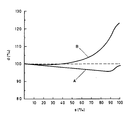
- a figure shows the different behavior of an ordinary microglass fleece (A) bonded with an acrylic resin, which was not pre-pressed, and a fleece of the same type (B) aftertreated according to the invention when absorbing acid.
- Another advantage of the method according to the invention results from the fact that the bonded glass fiber nonwovens are readily formable when still moist and, from this aspect, the production of preformed separators, e.g. for round cells, appears to be possible. As a result, the previously used carrier material, which is used for shaping, could be omitted.
- the residual water content of 50% to 60% already mentioned would also be very favorable for this application because the adhesive effect is correspondingly great due to the high binder concentration achieved therein.
Landscapes
- Chemical & Material Sciences (AREA)
- Chemical Kinetics & Catalysis (AREA)
- Electrochemistry (AREA)
- General Chemical & Material Sciences (AREA)
- Engineering & Computer Science (AREA)
- Ceramic Engineering (AREA)
- Inorganic Chemistry (AREA)
- Manufacturing & Machinery (AREA)
- Cell Separators (AREA)
- Glass Compositions (AREA)
- Seal Device For Vehicle (AREA)
Priority Applications (1)
| Application Number | Priority Date | Filing Date | Title |
|---|---|---|---|
| AT89103907T ATE85163T1 (de) | 1988-03-25 | 1989-03-06 | Separator aus glasfaservlies. |
Applications Claiming Priority (2)
| Application Number | Priority Date | Filing Date | Title |
|---|---|---|---|
| DE3810125 | 1988-03-25 | ||
| DE3810125A DE3810125A1 (de) | 1988-03-25 | 1988-03-25 | Separator aus glasfaservlies |
Publications (2)
| Publication Number | Publication Date |
|---|---|
| EP0334091A1 EP0334091A1 (de) | 1989-09-27 |
| EP0334091B1 true EP0334091B1 (de) | 1993-01-27 |
Family
ID=6350682
Family Applications (1)
| Application Number | Title | Priority Date | Filing Date |
|---|---|---|---|
| EP89103907A Expired - Lifetime EP0334091B1 (de) | 1988-03-25 | 1989-03-06 | Separator aus Glasfaservlies |
Country Status (4)
| Country | Link |
|---|---|
| EP (1) | EP0334091B1 (es) |
| AT (1) | ATE85163T1 (es) |
| DE (2) | DE3810125A1 (es) |
| ES (1) | ES2037893T3 (es) |
Cited By (1)
| Publication number | Priority date | Publication date | Assignee | Title |
|---|---|---|---|---|
| WO2021166647A1 (ja) * | 2020-02-19 | 2021-08-26 | 日信化学工業株式会社 | 無機繊維用バインダー及び無機繊維マット |
Families Citing this family (7)
| Publication number | Priority date | Publication date | Assignee | Title |
|---|---|---|---|---|
| US5091275A (en) * | 1990-04-25 | 1992-02-25 | Evanite Fiber Corporation | Glass fiber separator and method of making |
| US5240468A (en) * | 1991-08-21 | 1993-08-31 | General Motors Corporation | Method of making a mat-immobilized-electrolyte battery |
| EP0528473B1 (en) * | 1991-08-21 | 1996-04-24 | General Motors Corporation | Separator for mat-immobilized-electrolyte battery |
| US5250372A (en) * | 1991-08-21 | 1993-10-05 | General Motors Corporation | Separator for mat-immobilized-electrolyte battery |
| US5336275A (en) * | 1992-05-11 | 1994-08-09 | Hollingsworth & Vose Company | Method for assembling battery cells containing pre-compressed glass fiber separators |
| US5512065A (en) * | 1993-10-12 | 1996-04-30 | Gnb Battery Technologies Inc. | Methods for assembling lead-acid batteries |
| DE102019201126A1 (de) | 2019-01-29 | 2020-07-30 | Audi Ag | Batteriemodul für ein Kraftfahrzeug und Kraftfahrzeug mit einem solchen Batteriemodul |
Family Cites Families (3)
| Publication number | Priority date | Publication date | Assignee | Title |
|---|---|---|---|---|
| DE711484C (de) * | 1937-01-19 | 1941-10-01 | Kap Asbest Werke Akt Ges Deuts | Sammlerscheider |
| DE2720250C3 (de) * | 1977-05-05 | 1980-05-22 | Accumulatorenfabrik Sonnenschein Gmbh, 6470 Buedingen | Separator fur einen Bleiakkumulator |
| JPS5445755A (en) * | 1977-09-19 | 1979-04-11 | Yuasa Battery Co Ltd | Separator for storage battery |
-
1988
- 1988-03-25 DE DE3810125A patent/DE3810125A1/de not_active Withdrawn
-
1989
- 1989-03-06 DE DE8989103907T patent/DE58903370D1/de not_active Expired - Fee Related
- 1989-03-06 EP EP89103907A patent/EP0334091B1/de not_active Expired - Lifetime
- 1989-03-06 AT AT89103907T patent/ATE85163T1/de not_active IP Right Cessation
- 1989-03-06 ES ES198989103907T patent/ES2037893T3/es not_active Expired - Lifetime
Cited By (1)
| Publication number | Priority date | Publication date | Assignee | Title |
|---|---|---|---|---|
| WO2021166647A1 (ja) * | 2020-02-19 | 2021-08-26 | 日信化学工業株式会社 | 無機繊維用バインダー及び無機繊維マット |
Also Published As
| Publication number | Publication date |
|---|---|
| ATE85163T1 (de) | 1993-02-15 |
| ES2037893T3 (es) | 1993-07-01 |
| DE58903370D1 (de) | 1993-03-11 |
| DE3810125A1 (de) | 1989-10-12 |
| EP0334091A1 (de) | 1989-09-27 |
Similar Documents
| Publication | Publication Date | Title |
|---|---|---|
| DE69327727T2 (de) | Vorverdichtete glasfaserseparatoren für batterien und verfahren zur montage von batteriezellen | |
| DE2839845B2 (de) | Separator fur galvanische Elemente, insbesondere gasdichte Bleiakkumulatoren | |
| DE69120534T2 (de) | Glasfaserseparator und verfahren zu dessen herstellung | |
| DE977069C (de) | Elektrode fuer alkalische Akkumulatoren | |
| DE69819111T2 (de) | Zylindrischer alkalischer Akkumulator und Verfahren zu seiner Herstellung | |
| DE1921610C3 (de) | Elektrolytkondensator | |
| DE2137900C3 (de) | Wiederaufladbare, abgedichtete alkalische galvanische Zelle mit einer Zink enthaltenden negativen Elektrode und einem mehrschichtigen Separator | |
| DE1013341B (de) | Staendig gas- und fluessigkeitsdicht verschlossener alkalischer Akkumulator | |
| EP0334091B1 (de) | Separator aus Glasfaservlies | |
| EP2368285B1 (de) | Textiles flächiges material für eine batterieelektrode | |
| DE1949958C3 (de) | Separator für wartungsfreie Akkumulatoren | |
| DE69210136T2 (de) | Separator für eine Batterie mit einem Matte-immobilisierten Elektrolyt | |
| DE1496358A1 (de) | Elektrode fuer Akkumulatoren | |
| DE69125460T2 (de) | Verfahren zum Verbinden eines metallischen Ableiters an eine ein Schaumgerüst als Trägerteil enthaltende Elektrode für einen elektrochemischen Generator und bei diesem Verfahren erhaltene Elektrode | |
| DE69216230T2 (de) | Alkali-akkumulator mit bipolarer elektrode und verfahren zu dessen herstellung | |
| DE69804675T2 (de) | Mit glasfasern verstärkter, saugfähiger separator | |
| DE60100698T2 (de) | Verfahren zur Herstellung einer positiven Elecktrodenplatte | |
| DE60011171T2 (de) | Alkalische Speicherbatterie mit zwei Separatoren | |
| DE60313779T2 (de) | Hochleistungsbleiakkumulator mit verlängerter Lebensdauer | |
| DE1796231A1 (de) | Alkalische elektrische Batterie und Verfahren zu ihrer Herstellung | |
| DE4019092C2 (es) | ||
| DE955614C (de) | Verfahren zur Herstellung von Scheidern fuer Blei-Saeure-Trockenakkumulatoren | |
| CH662212A5 (de) | Batterie mit organischem elektrolyt. | |
| AT224724B (de) | Elektrolytische Zelle oder Nickel-Kadmium-Akkumulator | |
| DE1814650C3 (de) | Verfahren zur Herstellung einer negativen Elektrode mit faserförmigem Trägermaterial für alkalische Akkumulatoren |
Legal Events
| Date | Code | Title | Description |
|---|---|---|---|
| PUAI | Public reference made under article 153(3) epc to a published international application that has entered the european phase |
Free format text: ORIGINAL CODE: 0009012 |
|
| AK | Designated contracting states |
Kind code of ref document: A1 Designated state(s): AT DE ES FR GB IT SE |
|
| 17P | Request for examination filed |
Effective date: 19900219 |
|
| 17Q | First examination report despatched |
Effective date: 19910927 |
|
| GRAA | (expected) grant |
Free format text: ORIGINAL CODE: 0009210 |
|
| AK | Designated contracting states |
Kind code of ref document: B1 Designated state(s): AT DE ES FR GB IT SE |
|
| REF | Corresponds to: |
Ref document number: 85163 Country of ref document: AT Date of ref document: 19930215 Kind code of ref document: T |
|
| ITF | It: translation for a ep patent filed | ||
| ET | Fr: translation filed | ||
| GBT | Gb: translation of ep patent filed (gb section 77(6)(a)/1977) |
Effective date: 19930208 |
|
| REF | Corresponds to: |
Ref document number: 58903370 Country of ref document: DE Date of ref document: 19930311 |
|
| PLBE | No opposition filed within time limit |
Free format text: ORIGINAL CODE: 0009261 |
|
| STAA | Information on the status of an ep patent application or granted ep patent |
Free format text: STATUS: NO OPPOSITION FILED WITHIN TIME LIMIT |
|
| 26N | No opposition filed | ||
| REG | Reference to a national code |
Ref country code: GB Ref legal event code: 732E |
|
| REG | Reference to a national code |
Ref country code: FR Ref legal event code: TP |
|
| REG | Reference to a national code |
Ref country code: ES Ref legal event code: PC2A Owner name: VB AUTOBATTERIE GMBH. |
|
| EAL | Se: european patent in force in sweden |
Ref document number: 89103907.5 |
|
| REG | Reference to a national code |
Ref country code: GB Ref legal event code: IF02 |
|
| PGFP | Annual fee paid to national office [announced via postgrant information from national office to epo] |
Ref country code: GB Payment date: 20020306 Year of fee payment: 14 Ref country code: ES Payment date: 20020306 Year of fee payment: 14 |
|
| PGFP | Annual fee paid to national office [announced via postgrant information from national office to epo] |
Ref country code: SE Payment date: 20020307 Year of fee payment: 14 |
|
| PGFP | Annual fee paid to national office [announced via postgrant information from national office to epo] |
Ref country code: AT Payment date: 20020322 Year of fee payment: 14 |
|
| PGFP | Annual fee paid to national office [announced via postgrant information from national office to epo] |
Ref country code: FR Payment date: 20020329 Year of fee payment: 14 |
|
| PGFP | Annual fee paid to national office [announced via postgrant information from national office to epo] |
Ref country code: DE Payment date: 20020418 Year of fee payment: 14 |
|
| PG25 | Lapsed in a contracting state [announced via postgrant information from national office to epo] |
Ref country code: GB Free format text: LAPSE BECAUSE OF NON-PAYMENT OF DUE FEES Effective date: 20030306 Ref country code: AT Free format text: LAPSE BECAUSE OF NON-PAYMENT OF DUE FEES Effective date: 20030306 |
|
| PG25 | Lapsed in a contracting state [announced via postgrant information from national office to epo] |
Ref country code: SE Free format text: LAPSE BECAUSE OF NON-PAYMENT OF DUE FEES Effective date: 20030307 Ref country code: ES Free format text: LAPSE BECAUSE OF NON-PAYMENT OF DUE FEES Effective date: 20030307 |
|
| PG25 | Lapsed in a contracting state [announced via postgrant information from national office to epo] |
Ref country code: DE Free format text: LAPSE BECAUSE OF NON-PAYMENT OF DUE FEES Effective date: 20031001 |
|
| GBPC | Gb: european patent ceased through non-payment of renewal fee |
Effective date: 20030306 |
|
| EUG | Se: european patent has lapsed | ||
| PG25 | Lapsed in a contracting state [announced via postgrant information from national office to epo] |
Ref country code: FR Free format text: LAPSE BECAUSE OF NON-PAYMENT OF DUE FEES Effective date: 20031127 |
|
| REG | Reference to a national code |
Ref country code: FR Ref legal event code: ST |
|
| REG | Reference to a national code |
Ref country code: ES Ref legal event code: FD2A Effective date: 20030307 |
|
| PG25 | Lapsed in a contracting state [announced via postgrant information from national office to epo] |
Ref country code: IT Free format text: LAPSE BECAUSE OF NON-PAYMENT OF DUE FEES Effective date: 20050306 |