EP0333602B1 - Armature textile utilisable pour la réalisation de complexes stratifiés et complexes stratifiés en forme comportant une telle armature - Google Patents
Armature textile utilisable pour la réalisation de complexes stratifiés et complexes stratifiés en forme comportant une telle armature Download PDFInfo
- Publication number
- EP0333602B1 EP0333602B1 EP89420075A EP89420075A EP0333602B1 EP 0333602 B1 EP0333602 B1 EP 0333602B1 EP 89420075 A EP89420075 A EP 89420075A EP 89420075 A EP89420075 A EP 89420075A EP 0333602 B1 EP0333602 B1 EP 0333602B1
- Authority
- EP
- European Patent Office
- Prior art keywords
- fabric
- textile
- threads
- jersey
- laminated composites
- Prior art date
- Legal status (The legal status is an assumption and is not a legal conclusion. Google has not performed a legal analysis and makes no representation as to the accuracy of the status listed.)
- Expired - Lifetime
Links
- 239000004753 textile Substances 0.000 title claims description 16
- 239000002131 composite material Substances 0.000 title 2
- 239000000463 material Substances 0.000 claims description 18
- 230000002787 reinforcement Effects 0.000 claims description 16
- 238000009940 knitting Methods 0.000 claims description 14
- 239000004744 fabric Substances 0.000 claims description 12
- 239000003365 glass fiber Substances 0.000 claims description 6
- 238000004519 manufacturing process Methods 0.000 claims description 6
- 239000000835 fiber Substances 0.000 claims description 5
- 239000004952 Polyamide Substances 0.000 claims description 3
- 229920002647 polyamide Polymers 0.000 claims description 3
- 229920006149 polyester-amide block copolymer Polymers 0.000 claims description 2
- 238000009958 sewing Methods 0.000 claims 1
- 229920000728 polyester Polymers 0.000 description 5
- 241001639412 Verres Species 0.000 description 4
- 239000011347 resin Substances 0.000 description 4
- 229920005989 resin Polymers 0.000 description 4
- 238000000465 moulding Methods 0.000 description 3
- 238000000576 coating method Methods 0.000 description 2
- 238000005520 cutting process Methods 0.000 description 2
- 238000009826 distribution Methods 0.000 description 2
- 230000006872 improvement Effects 0.000 description 2
- 238000000034 method Methods 0.000 description 2
- 239000000203 mixture Substances 0.000 description 2
- 238000005303 weighing Methods 0.000 description 2
- CYJRNFFLTBEQSQ-UHFFFAOYSA-N 8-(3-methyl-1-benzothiophen-5-yl)-N-(4-methylsulfonylpyridin-3-yl)quinoxalin-6-amine Chemical compound CS(=O)(=O)C1=C(C=NC=C1)NC=1C=C2N=CC=NC2=C(C=1)C=1C=CC2=C(C(=CS2)C)C=1 CYJRNFFLTBEQSQ-UHFFFAOYSA-N 0.000 description 1
- 241001080024 Telles Species 0.000 description 1
- 230000009471 action Effects 0.000 description 1
- 230000004075 alteration Effects 0.000 description 1
- 239000011248 coating agent Substances 0.000 description 1
- 150000001875 compounds Chemical class 0.000 description 1
- 238000001035 drying Methods 0.000 description 1
- 239000012530 fluid Substances 0.000 description 1
- 239000011521 glass Substances 0.000 description 1
- -1 grids Substances 0.000 description 1
- 230000014759 maintenance of location Effects 0.000 description 1
- 239000004745 nonwoven fabric Substances 0.000 description 1
- 230000003014 reinforcing effect Effects 0.000 description 1
- XLYOFNOQVPJJNP-UHFFFAOYSA-N water Substances O XLYOFNOQVPJJNP-UHFFFAOYSA-N 0.000 description 1
Images
Classifications
-
- D—TEXTILES; PAPER
- D04—BRAIDING; LACE-MAKING; KNITTING; TRIMMINGS; NON-WOVEN FABRICS
- D04H—MAKING TEXTILE FABRICS, e.g. FROM FIBRES OR FILAMENTARY MATERIAL; FABRICS MADE BY SUCH PROCESSES OR APPARATUS, e.g. FELTS, NON-WOVEN FABRICS; COTTON-WOOL; WADDING ; NON-WOVEN FABRICS FROM STAPLE FIBRES, FILAMENTS OR YARNS, BONDED WITH AT LEAST ONE WEB-LIKE MATERIAL DURING THEIR CONSOLIDATION
- D04H1/00—Non-woven fabrics formed wholly or mainly of staple fibres or like relatively short fibres
- D04H1/40—Non-woven fabrics formed wholly or mainly of staple fibres or like relatively short fibres from fleeces or layers composed of fibres without existing or potential cohesive properties
- D04H1/42—Non-woven fabrics formed wholly or mainly of staple fibres or like relatively short fibres from fleeces or layers composed of fibres without existing or potential cohesive properties characterised by the use of certain kinds of fibres insofar as this use has no preponderant influence on the consolidation of the fleece
- D04H1/4209—Inorganic fibres
- D04H1/4218—Glass fibres
-
- B—PERFORMING OPERATIONS; TRANSPORTING
- B29—WORKING OF PLASTICS; WORKING OF SUBSTANCES IN A PLASTIC STATE IN GENERAL
- B29C—SHAPING OR JOINING OF PLASTICS; SHAPING OF MATERIAL IN A PLASTIC STATE, NOT OTHERWISE PROVIDED FOR; AFTER-TREATMENT OF THE SHAPED PRODUCTS, e.g. REPAIRING
- B29C70/00—Shaping composites, i.e. plastics material comprising reinforcements, fillers or preformed parts, e.g. inserts
- B29C70/04—Shaping composites, i.e. plastics material comprising reinforcements, fillers or preformed parts, e.g. inserts comprising reinforcements only, e.g. self-reinforcing plastics
- B29C70/06—Fibrous reinforcements only
- B29C70/08—Fibrous reinforcements only comprising combinations of different forms of fibrous reinforcements incorporated in matrix material, forming one or more layers, and with or without non-reinforced layers
-
- B—PERFORMING OPERATIONS; TRANSPORTING
- B29—WORKING OF PLASTICS; WORKING OF SUBSTANCES IN A PLASTIC STATE IN GENERAL
- B29C—SHAPING OR JOINING OF PLASTICS; SHAPING OF MATERIAL IN A PLASTIC STATE, NOT OTHERWISE PROVIDED FOR; AFTER-TREATMENT OF THE SHAPED PRODUCTS, e.g. REPAIRING
- B29C70/00—Shaping composites, i.e. plastics material comprising reinforcements, fillers or preformed parts, e.g. inserts
- B29C70/04—Shaping composites, i.e. plastics material comprising reinforcements, fillers or preformed parts, e.g. inserts comprising reinforcements only, e.g. self-reinforcing plastics
- B29C70/28—Shaping operations therefor
- B29C70/40—Shaping or impregnating by compression not applied
- B29C70/42—Shaping or impregnating by compression not applied for producing articles of definite length, i.e. discrete articles
- B29C70/46—Shaping or impregnating by compression not applied for producing articles of definite length, i.e. discrete articles using matched moulds, e.g. for deforming sheet moulding compounds [SMC] or prepregs
- B29C70/467—Shaping or impregnating by compression not applied for producing articles of definite length, i.e. discrete articles using matched moulds, e.g. for deforming sheet moulding compounds [SMC] or prepregs and impregnating the reinforcements during mould closing
-
- B—PERFORMING OPERATIONS; TRANSPORTING
- B29—WORKING OF PLASTICS; WORKING OF SUBSTANCES IN A PLASTIC STATE IN GENERAL
- B29C—SHAPING OR JOINING OF PLASTICS; SHAPING OF MATERIAL IN A PLASTIC STATE, NOT OTHERWISE PROVIDED FOR; AFTER-TREATMENT OF THE SHAPED PRODUCTS, e.g. REPAIRING
- B29C70/00—Shaping composites, i.e. plastics material comprising reinforcements, fillers or preformed parts, e.g. inserts
- B29C70/04—Shaping composites, i.e. plastics material comprising reinforcements, fillers or preformed parts, e.g. inserts comprising reinforcements only, e.g. self-reinforcing plastics
- B29C70/28—Shaping operations therefor
- B29C70/54—Component parts, details or accessories; Auxiliary operations, e.g. feeding or storage of prepregs or SMC after impregnation or during ageing
- B29C70/543—Fixing the position or configuration of fibrous reinforcements before or during moulding
-
- D—TEXTILES; PAPER
- D04—BRAIDING; LACE-MAKING; KNITTING; TRIMMINGS; NON-WOVEN FABRICS
- D04B—KNITTING
- D04B21/00—Warp knitting processes for the production of fabrics or articles not dependent on the use of particular machines; Fabrics or articles defined by such processes
- D04B21/14—Fabrics characterised by the incorporation by knitting, in one or more thread, fleece, or fabric layers, of reinforcing, binding, or decorative threads; Fabrics incorporating small auxiliary elements, e.g. for decorative purposes
- D04B21/16—Fabrics characterised by the incorporation by knitting, in one or more thread, fleece, or fabric layers, of reinforcing, binding, or decorative threads; Fabrics incorporating small auxiliary elements, e.g. for decorative purposes incorporating synthetic threads
- D04B21/165—Fabrics characterised by the incorporation by knitting, in one or more thread, fleece, or fabric layers, of reinforcing, binding, or decorative threads; Fabrics incorporating small auxiliary elements, e.g. for decorative purposes incorporating synthetic threads with yarns stitched through one or more layers or tows, e.g. stitch-bonded fabrics
-
- D—TEXTILES; PAPER
- D04—BRAIDING; LACE-MAKING; KNITTING; TRIMMINGS; NON-WOVEN FABRICS
- D04H—MAKING TEXTILE FABRICS, e.g. FROM FIBRES OR FILAMENTARY MATERIAL; FABRICS MADE BY SUCH PROCESSES OR APPARATUS, e.g. FELTS, NON-WOVEN FABRICS; COTTON-WOOL; WADDING ; NON-WOVEN FABRICS FROM STAPLE FIBRES, FILAMENTS OR YARNS, BONDED WITH AT LEAST ONE WEB-LIKE MATERIAL DURING THEIR CONSOLIDATION
- D04H1/00—Non-woven fabrics formed wholly or mainly of staple fibres or like relatively short fibres
- D04H1/40—Non-woven fabrics formed wholly or mainly of staple fibres or like relatively short fibres from fleeces or layers composed of fibres without existing or potential cohesive properties
- D04H1/44—Non-woven fabrics formed wholly or mainly of staple fibres or like relatively short fibres from fleeces or layers composed of fibres without existing or potential cohesive properties the fleeces or layers being consolidated by mechanical means, e.g. by rolling
- D04H1/46—Non-woven fabrics formed wholly or mainly of staple fibres or like relatively short fibres from fleeces or layers composed of fibres without existing or potential cohesive properties the fleeces or layers being consolidated by mechanical means, e.g. by rolling by needling or like operations to cause entanglement of fibres
- D04H1/498—Non-woven fabrics formed wholly or mainly of staple fibres or like relatively short fibres from fleeces or layers composed of fibres without existing or potential cohesive properties the fleeces or layers being consolidated by mechanical means, e.g. by rolling by needling or like operations to cause entanglement of fibres entanglement of layered webs
-
- D—TEXTILES; PAPER
- D04—BRAIDING; LACE-MAKING; KNITTING; TRIMMINGS; NON-WOVEN FABRICS
- D04H—MAKING TEXTILE FABRICS, e.g. FROM FIBRES OR FILAMENTARY MATERIAL; FABRICS MADE BY SUCH PROCESSES OR APPARATUS, e.g. FELTS, NON-WOVEN FABRICS; COTTON-WOOL; WADDING ; NON-WOVEN FABRICS FROM STAPLE FIBRES, FILAMENTS OR YARNS, BONDED WITH AT LEAST ONE WEB-LIKE MATERIAL DURING THEIR CONSOLIDATION
- D04H13/00—Other non-woven fabrics
-
- B—PERFORMING OPERATIONS; TRANSPORTING
- B29—WORKING OF PLASTICS; WORKING OF SUBSTANCES IN A PLASTIC STATE IN GENERAL
- B29K—INDEXING SCHEME ASSOCIATED WITH SUBCLASSES B29B, B29C OR B29D, RELATING TO MOULDING MATERIALS OR TO MATERIALS FOR MOULDS, REINFORCEMENTS, FILLERS OR PREFORMED PARTS, e.g. INSERTS
- B29K2105/00—Condition, form or state of moulded material or of the material to be shaped
- B29K2105/06—Condition, form or state of moulded material or of the material to be shaped containing reinforcements, fillers or inserts
- B29K2105/08—Condition, form or state of moulded material or of the material to be shaped containing reinforcements, fillers or inserts of continuous length, e.g. cords, rovings, mats, fabrics, strands or yarns
- B29K2105/0809—Fabrics
-
- B—PERFORMING OPERATIONS; TRANSPORTING
- B29—WORKING OF PLASTICS; WORKING OF SUBSTANCES IN A PLASTIC STATE IN GENERAL
- B29K—INDEXING SCHEME ASSOCIATED WITH SUBCLASSES B29B, B29C OR B29D, RELATING TO MOULDING MATERIALS OR TO MATERIALS FOR MOULDS, REINFORCEMENTS, FILLERS OR PREFORMED PARTS, e.g. INSERTS
- B29K2105/00—Condition, form or state of moulded material or of the material to be shaped
- B29K2105/06—Condition, form or state of moulded material or of the material to be shaped containing reinforcements, fillers or inserts
- B29K2105/08—Condition, form or state of moulded material or of the material to be shaped containing reinforcements, fillers or inserts of continuous length, e.g. cords, rovings, mats, fabrics, strands or yarns
- B29K2105/0809—Fabrics
- B29K2105/0836—Knitted fabrics
-
- B—PERFORMING OPERATIONS; TRANSPORTING
- B29—WORKING OF PLASTICS; WORKING OF SUBSTANCES IN A PLASTIC STATE IN GENERAL
- B29K—INDEXING SCHEME ASSOCIATED WITH SUBCLASSES B29B, B29C OR B29D, RELATING TO MOULDING MATERIALS OR TO MATERIALS FOR MOULDS, REINFORCEMENTS, FILLERS OR PREFORMED PARTS, e.g. INSERTS
- B29K2105/00—Condition, form or state of moulded material or of the material to be shaped
- B29K2105/06—Condition, form or state of moulded material or of the material to be shaped containing reinforcements, fillers or inserts
- B29K2105/08—Condition, form or state of moulded material or of the material to be shaped containing reinforcements, fillers or inserts of continuous length, e.g. cords, rovings, mats, fabrics, strands or yarns
- B29K2105/0854—Condition, form or state of moulded material or of the material to be shaped containing reinforcements, fillers or inserts of continuous length, e.g. cords, rovings, mats, fabrics, strands or yarns in the form of a non-woven mat
Definitions
- the invention relates to an improvement made to the textile reinforcements used for the production of laminate complexes, that is to say articles based on resin (polyester or others), reinforced by a textile reinforcement ply; it also relates to a new type of shaped laminated article comprising such a frame.
- Such a material is particularly suitable for producing deep-drawn laminates such as, for example, helmets or similar articles.
- the materials according to the invention are particularly suitable for making stamped laminated articles, such as for example helmets.
- These articles which are also part of the invention, are characterized in that, during their production, the face of the knitted fabric (jersey) is arranged on the "punch" side of the mold, so that in the finished laminate, this element is located on the concave side (inside the helmet for example).
- this element is located on the concave side (inside the helmet for example).
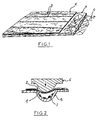
- the material according to the invention consists, in its simplest form, of a complex comprising a mat (1) of staple (or continuous) fibers such as for example a mat of glass fibers, this mat being associated on one of its faces with a jersey knit (2), these two elements being linked together by sewing-knitting. Sewing-knitting is carried out in the material according to the invention so that the yarns on a needle (mesh columns) referenced (3) are located on the jersey side (2) while the yarns "under” ( 4) connecting said columns are, in turn, arranged on the surface of the nonwoven textile web (1).
- Such a configuration favors the deformation of the complex during use and, moreover, ensures perfect retention of the fibers of the nonwoven web, in particular when the latter are not linked.
- the connection by sewing-knitting is carried out in a known manner.
- Such a material is particularly suitable for producing laminated parts by stamping as shown in FIG. 2.
- the mold comprises a die (5) and a punch (6).
- the material is arranged so that the jersey side (2) is located on the punch side (6). It has been found that by proceeding in this way, it promotes stamping and that very homogeneous articles are obtained.
- it could however be envisaged to reverse the positioning of the material inside the mold, but the abovementioned embodiment is however preferable when it is desired to obtain stamped articles of the "helmet" type.
- FIG. 1 On a conventional sewing-knitting loom, a material is produced in accordance with the invention and which is illustrated in FIG. 1.
- a helmet is produced in the manner illustrated in FIG. 2, taking care to arrange the jersey part opposite the punch (6).
- the molding is carried out in a conventional manner, the resin being for example deposited by means of a "compound” (7) (mixture of resin and fibers) previously placed inside the mold (5).
- Such a material could be produced in applications other than the reinforcement of resin, for example as a support for various coatings.
- nonwoven mat with other elements, for example an additional reinforcement consisting of transverse longitudinal threads, or even of nonwoven grids.
- binding son are preferably made of the same material as that used in the production of the deformable knit, it could be envisaged to use other types of binding son.
Landscapes
- Engineering & Computer Science (AREA)
- Textile Engineering (AREA)
- Chemical & Material Sciences (AREA)
- Mechanical Engineering (AREA)
- Composite Materials (AREA)
- Inorganic Chemistry (AREA)
- Knitting Of Fabric (AREA)
- Laminated Bodies (AREA)
- Manufacturing Of Multi-Layer Textile Fabrics (AREA)
- Reinforced Plastic Materials (AREA)
Description
- L'invention concerne un perfectionnement apporté aux armatures textiles utilisées pour la réalisation de complexes stratifiés, c'est-à-dire d'articles à base de résine (polyester ou autres), armés par une nappe textile de renforcement; elle concerne également un nouveau type d'articles stratifiés en forme comportant une telle armature.
- A ce jour, en fonction des applications et des caractéristiques recherchées, de très nombreuses structures textiles de renforcement sont utilisées dans le domaine des complexes stratifiés tels que par exemple tissus, grilles, textiles, non-tissés ou combinaisons de tels éléments.
- Lorsque ces armatures sont constituées de différentes couches superposées, pour assurer la liaison des différentes couches entre elles, on utilise très souvent la technique dite "couture-tricotage". De tels complexes ressortent notamment des brevets français 1469065, 1095507, 2048071 et des brevets US 2890579 et 3044146.
- Ces matériaux donnent satisfaction, notamment lorsque l'on souhaite réaliser des stratifiés plans. En revanche, lorsque l'on souhaite réaliser des stratifiés emboutis, soit ils présentent une résistance à la déformation trop importante lorsqu'ils comportent des renforts constitués de tissus, soit ils se déchirent ou se déforment de manière irrégulière lorsqu'ils sont à base de mat fibreux.
- Pour résoudre ce problème, ainsi que cela ressort notamment des brevets français 2559099 et 2567807, il a été proposé d'utiliser des armatures à base de tissus ayant des contextures bien précises et qui sont complexes et délicats à réaliser.
- Par ailleurs, de telles armatures tissées ne permettent pas d'avoir des renforts de forte épaisseur, ce qui est recherché pour certaines applications.
- Or on a trouvé, et c'est ce qui fait l'objet de la présente invention un perfectionnement apporté aux armatures textiles comportant une pluralité de couches liées entre elles par couture-tricotage qui, non seulement permet de conserver les propriétés de telles structures (épaisseurs notamment), mais également présente la caractéristique de pouvoir être déformé facilement et ce, sans déchirure ni altération dans la répartition du mat fibreux que comportent de telles armatures.
- Un tel matériau est particulièrement adapté pour réaliser des stratifiés emboutis de manière profonde tels que par exemple des casques ou articles similaires.
- D'une manière générale, l'invention concerne donc un nouveau type d'armature textile utilisable pour la réalisation d'articles stratifiés, cette armature étant du type constitué par au moins une nappe de fibres disposées au hasard les unes par rapport aux autres, associée à une structure textile ordonnée, ces deux éléments étant liés entre eux par couture-tricotage et elle se caractérise en ce que:
- ― la nappe textile à base de fils ordonnés est constituée par un tricot déformable;
- ― le liage est réalisé de telle sorte que les jetées sur une aiguille (côté colonnes de mailles) soient réalisées du côté du tricot alors que les jetées sous plusieurs aiguilles (flottés) sont, quant à elles, réalisés côté nappe fibreuse.
- Avantageusement et en pratique, conformément à l'invention:
- ― le tricot est un tricot jersey réalisé sur un métier à mailles jetées ou à mailles cueillies;
- ― le non-tissé et le tricot ainsi que les fils de liage peuvent être soit à base de matière similaire, soit à base de matières différentes; selon une forme préférentielle de l'invention, le non-tissé est à base de fibres de verre ayant une longueur de coupe relativement importante (par exemple 110 mm de long), alors que le tricot ainsi que les fils de liage sont à base de fils synthétiques tels que par exemple de fils polyester ou polyamide.
- Les matériaux conformes à l'invention sont particulièrement adaptés pour réaliser des articles stratifiés emboutis, tels que par exemple des casques. Ces articles, qui font également partie de l'invention se caractérisent en ce que, lors de leur réalisation, la face du tricot (jersey) est disposée du côté "poinçon" du moule, de telle sorte que dans le stratifié terminé, cet élément se trouve situé côté concave (à l'intérieur du casque par exemple). Bien entendu, pour d'autres applications, il pourrait être envisagé d'avoir la disposition inverse.
- L'invention et les avantages qu'elle apporte seront cependant mieux compris grâce à l'exemple de réalisation donné ci-après à titre indicatif et non limitatif et qui est illustré par les deux figures annexées, figures dans lesquelles:
- ― la figure 1 est une vue en perspective éclatée d'un matériau conforme à l'invention;
- ― la figure 2 illustre de manière schématique la mise en oeuvre d'un tel matériau pour la réalisation d'un article embouti (casque par exemple).
- Si on se reporte à la figure 1 annexée, le matériau conforme à l'invention est constitué, dans sa forme la plus simple, d'un complexe comportant un mat (1) de fibres discontinues (ou continues) tel que par exemple un mat de fibres de verre, ce mat étant associé sur l'une de ses faces à un tricot jersey (2), ces deux éléments étant liés entre eux par couture-tricotage. La couture-tricotage est réalisée dans le matériau conforme à l'invention de telle sorte que les jetées sur une aiguille (colonnes de mailles) référencées (3) se trouvent situées du côté du jersey (2) alors que les jetées "sous" (4) reliant lesdites colonnes sont, quant à elles, disposées en surface de la nappe textile non tissée (1). Une telle configuration favorise lors de l'utilisation la déformation du complexe et, par ailleurs, assure un maintien parfait des fibres de la nappe non tissée, notamment lorsque ces dernières ne sont pas liées. La liaison par couture-tricotage est réalisée de manière connue.
- Un tel matériau est particulièrement adapté pour réaliser des pièces stratifiées par emboutissage ainsi que cela est illustré à la figure 2. Dans une telle technique, le moule comporte une matrice (5) et un poinçon (6). Lors du moulage, le matériau est disposé de telle sorte que la face jersey (2) soit située du côté poinçon (6). On a constaté qu'en procédant de cette manière, on favorisait l'emboutissage et que l'on obtenait des articles très homogènes. Pour d'autres applications, il pourrait cependant être envisagé d'inverser le positionnement du matériau à l'intérieur du moule, mais le mode de réalisation précité est cependant préférentiel lorsque l'on souhaite obtenir des articles emboutis du type "casque".
- Sur un métier conventionnel de couture-tricotage, on réalise un matériau conforme à l'invention et qui est illustré par la figure 1.
- On utilise comme éléments de base rentrant dans la composition d'un tel matériau:
- ― comme nappe non tissée (1), un mat de verre pesant 800 grammes/mètre carré, obtenu par découpe de fibres de verre et nappage conventionnel par voie sèche ; de préférence, les fibres de verre sont coupées à une longueur relativement importante de l'ordre de 110 millimètres;
- ― comme tricot jersey (2), un tricot réalisé sur un métier circulaire, à base de fils de polyester et pesant environ 100 grammes/mètre carré.
- Ces deux éléments sont réunis de manière connue par couture-tricotage sur un métier du type Malimo, les fils de liage étant des fils de polyester. Le poids de fils de liage pour l'ensemble de l'article est d'environ dix grammes/mètre carré.
- A partir d'un tel matériau, on réalise un casque de la manière illustrée à la figure 2 en prenant soin de disposer la partie jersey en regard du poinçon (6).
- Le moulage s'effectue de manière conventionnelle, la résine étant par exemple déposée au moyen d'un "compound" (7) (mélange de résine et de fibres) disposé préalablement à l'intérieur du moule (5).
- On a constaté qu'en procédant de cette manière, on obtenait un article embouti présentant une très grande homogénéité, le mat ne se déchirant pas et la répartition des fibres de verre restant uniforme, ce qu'il n'était pas possible d'obtenir avec les complexes antérieurs constitués d'un mat et d'un tissu chaîne et trame ou d'un mat seul.
- Bien entendu, l'invention n'est pas limitée à l'exemple de réalisation donné précédemment mais elle en couvre toutes les variantes réalisées dans le même esprit.
- Ainsi, un tel matériau pourrait être réalisé dans d'autres applications que le renforcement de résine, par exemple comme support d'enductions diverses.
- De plus, préalablement à l'opération de moulage, il pourrait être envisagé de soumettre le complexe à un traitement additionnel, tel que par exemple un traitement d'enchevêtrement sous l'action de jets de fluide (air, eau..).
- En outre, il pourrait être envisagé d'associer le mat non tissé avec d'autres éléments, par exemple un renfort additionnel constitué de fils longitudinaux transversaux, voire même de grilles non tissées.
- Enfin, si les fils de liage sont de préférence constitués dans la même matière que celle entrant dans la réalisation du tricot déformable, il pourrait être envisagé d'utiliser d'autres types de fils de liage.
Claims (4)
Applications Claiming Priority (2)
| Application Number | Priority Date | Filing Date | Title |
|---|---|---|---|
| FR8803482A FR2628448B1 (fr) | 1988-03-14 | 1988-03-14 | Armature textile utilisable pour la realisation de complexes stratifies et complexes stratifies en forme comportant une telle armature |
| FR8803482 | 1988-03-14 |
Publications (2)
| Publication Number | Publication Date |
|---|---|
| EP0333602A1 EP0333602A1 (fr) | 1989-09-20 |
| EP0333602B1 true EP0333602B1 (fr) | 1991-10-30 |
Family
ID=9364364
Family Applications (1)
| Application Number | Title | Priority Date | Filing Date |
|---|---|---|---|
| EP89420075A Expired - Lifetime EP0333602B1 (fr) | 1988-03-14 | 1989-02-28 | Armature textile utilisable pour la réalisation de complexes stratifiés et complexes stratifiés en forme comportant une telle armature |
Country Status (4)
| Country | Link |
|---|---|
| EP (1) | EP0333602B1 (fr) |
| CA (1) | CA1310178C (fr) |
| DE (1) | DE68900371D1 (fr) |
| FR (1) | FR2628448B1 (fr) |
Cited By (1)
| Publication number | Priority date | Publication date | Assignee | Title |
|---|---|---|---|---|
| US10260197B2 (en) | 2007-12-14 | 2019-04-16 | Johns Manville | Base interlining, methods for their manufacture and application thereof |
Families Citing this family (26)
| Publication number | Priority date | Publication date | Assignee | Title |
|---|---|---|---|---|
| NL9000519A (nl) * | 1990-03-07 | 1991-10-01 | Gen Electric | Werkwijze ter versterking van een met vezels gewapende materiaallaag uit thermoplastische kunststof. |
| DE4323482C2 (de) * | 1993-07-14 | 1996-12-05 | Manfred Dr Gehring | Kantenschutzrichtwinkel |
| FR2715601B1 (fr) * | 1994-01-31 | 1996-04-12 | Plastic Omnium Cie | Procédé de fabrication de pièces renforcées en matière thermoplastique et pièces obtenues par ce procédé. |
| DE4411034C1 (de) * | 1994-03-30 | 1995-10-19 | Rockwool Mineralwolle | Verfahren zum Annähen eines Drahtnetzes an eine Mineralwollematte |
| FR2718670B1 (fr) * | 1994-04-18 | 1996-06-14 | Aerospatiale | Pièce comportant au moins une plaque de revêtement de matière composite et procédé pour réaliser ladite pièce. |
| FR2718760B1 (fr) * | 1994-04-19 | 1996-05-31 | Protecma | Etoffe composite liant un tricot métallique et des nappes non tissées. |
| FR2722802B1 (fr) * | 1994-07-21 | 1996-08-23 | Chomarat & Cie | Armature textile utilisable pour la realisation de materiaux composites |
| NL9500414A (nl) * | 1995-03-02 | 1996-10-01 | Syncoglas Sa Nv | Versterkingsmateriaal. |
| DE19531001A1 (de) * | 1995-08-23 | 1997-02-27 | Hoechst Trevira Gmbh & Co Kg | Textiler Verbundstoff, Verfahren zu dessen Herstellung, dessen Verwendung sowie Gelege enthaltend Mischgarne |
| DE19618775A1 (de) * | 1996-05-10 | 1997-11-13 | Hoechst Trevira Gmbh & Co Kg | Trägereinlage, Verfahren zu deren Herstellung und deren Verwendung |
| DE19620361C5 (de) * | 1996-05-10 | 2004-01-15 | Johns Manville International, Inc., Denver | Trägereinlage und deren Verwendung |
| EP1108525B1 (fr) * | 1999-12-15 | 2009-10-14 | Top Glass S.p.A. | Procédé pour la fabrication d'un objet au moins partiellement en un matériau recyclé et objet obtenu par ledit procédé |
| EP1110706A1 (fr) * | 1999-12-15 | 2001-06-27 | Top Glass S.p.A. | Structure renforcée par des fibres et procédé pour la fabrication |
| DE10156875B4 (de) * | 2001-11-14 | 2007-05-31 | Institut Für Verbundwerkstoffe Gmbh | Dreidimensionale Verstärkungsstrukur für Faser-Kunststoff-Verbundwerkstoffe und Verfahren zu deren Herstellung aus einer ebenen Struktur |
| FR2834303B1 (fr) * | 2001-12-31 | 2005-06-24 | Chomarat Composites | Complexe fibreux a face decoree pour la realisation de pieces composites et pieces composites en faisant application |
| NL1025846C2 (nl) * | 2004-03-30 | 2005-10-03 | Saint Gobain Syncoglas N V | Versterkingsmaterialen, versterkingsdekens, en composieten omvattende deze versterkingsmaterialen. |
| FR2893635B1 (fr) * | 2005-11-18 | 2008-05-23 | Florence Blanche Louis Regnier | Materiau textile ajoure reversible, utilisable dans les domaines de l'habillement, de l'ameublement et de la decoration interieure, et procede de realisation de celui-ci |
| DE202006021073U1 (de) | 2006-12-20 | 2012-04-30 | Johns Manville Europe Gmbh | Trägereinlage und deren Verwendung |
| DE102006060241A1 (de) | 2006-12-20 | 2008-06-26 | Johns Manville Europe Gmbh | Trägereinlage, Verfahren zu deren Herstellung und deren Verwendung |
| DE102007060494A1 (de) | 2007-12-14 | 2009-06-18 | Johns Manville Europe Gmbh | Trägereinlage, Verfahren zu deren Herstellung und deren Verwendung |
| DE202008010258U1 (de) | 2008-07-30 | 2008-10-30 | Johns Manville, Denver | Trägereinlage und beschichtete Dachbahnen |
| DE102009005587A1 (de) | 2009-01-21 | 2010-07-22 | Johns Manville Europe Gmbh | Verfahren zur Qualitätssicherung von verstärkten flächigen Gebilden |
| DE102010007939A1 (de) | 2010-02-12 | 2011-08-18 | Johns Manville Europe GmbH, 86399 | Vorkonfektionierte Trägereinlage und beschichtete Dachbahnen |
| EP3530804B1 (fr) | 2018-02-27 | 2023-09-06 | Synthomer Deutschland GmbH | Structure de fibre textile liée au latex pour des applications de construction |
| GB201911659D0 (en) | 2019-08-15 | 2019-10-02 | Synthomer Deutschland Gmbh | Latex for bonding fiber structures |
| CN112810187A (zh) * | 2020-12-31 | 2021-05-18 | 湖北三江航天红阳机电有限公司 | 一种喷管扩张段及其成型方法 |
Family Cites Families (3)
| Publication number | Priority date | Publication date | Assignee | Title |
|---|---|---|---|---|
| US3044146A (en) * | 1958-10-27 | 1962-07-17 | Owens Corning Fiberglass Corp | Composite fibrous glass bodies |
| NL7008333A (fr) * | 1969-06-30 | 1971-12-13 | ||
| GB1370787A (en) * | 1971-11-08 | 1974-10-16 | Marling Ind Ltd | Sheet reinforcement materials |
-
1988
- 1988-03-14 FR FR8803482A patent/FR2628448B1/fr not_active Expired - Lifetime
-
1989
- 1989-02-27 CA CA000592238A patent/CA1310178C/fr not_active Expired - Lifetime
- 1989-02-28 EP EP89420075A patent/EP0333602B1/fr not_active Expired - Lifetime
- 1989-02-28 DE DE8989420075T patent/DE68900371D1/de not_active Expired - Lifetime
Cited By (4)
| Publication number | Priority date | Publication date | Assignee | Title |
|---|---|---|---|---|
| US10260197B2 (en) | 2007-12-14 | 2019-04-16 | Johns Manville | Base interlining, methods for their manufacture and application thereof |
| US11248338B2 (en) | 2007-12-14 | 2022-02-15 | Johns Manville | Base interlining, methods for their manufacture and application thereof |
| US11408123B2 (en) | 2007-12-14 | 2022-08-09 | Johns Manville | Base interlining, methods for their manufacture and application thereof |
| US12359370B2 (en) | 2007-12-14 | 2025-07-15 | Johns Manville | Base interlining, methods for their manufacture and application thereof |
Also Published As
| Publication number | Publication date |
|---|---|
| CA1310178C (fr) | 1992-11-17 |
| DE68900371D1 (de) | 1991-12-05 |
| FR2628448A1 (fr) | 1989-09-15 |
| FR2628448B1 (fr) | 1990-11-16 |
| EP0333602A1 (fr) | 1989-09-20 |
Similar Documents
| Publication | Publication Date | Title |
|---|---|---|
| CA1310178C (fr) | Armature textile utilisable pour la realisation de complexes stratifies et complexes stratifies en forme comportant une telle armature | |
| EP0395548B1 (fr) | Armature textile utilisable pour la réalisation de matériaux composites et articles en forme comportant une telle armature | |
| CA1260250A (fr) | Armature textile utilisable pour la realisation de complexes stratifies et type de stratifies comportant une telle armature | |
| EP0315553B1 (fr) | Complexe textile multicouches à base de nappes fibreuses ayant des caractéristiques différentes | |
| EP0193478B1 (fr) | Armature textile utilisable pour la réalisation de complexes stratifiés | |
| FR2568275A1 (fr) | Armature textile a base de fils de verre utilisable pour la realisation de complexes stratifies | |
| EP0745716B1 (fr) | Procédé pour la fabrication d'une armature textile utilisable pour la réalisation de matériaux composites | |
| FR2686628A1 (fr) | Structure textile complexe a base de nappes fibreuses non tissees et procede et installation pour son obtention. | |
| FR2644043A1 (fr) | Textile thermocollant destine a l'entoilage et son procede de fabrication | |
| FR2594858A1 (fr) | Armature textile utilisable pour la realisation de complexes stratifies | |
| EP0193479B1 (fr) | Armature textile utilisable pour la réalisation de complexes stratifiés et procédé pour son obtention | |
| FR2572426A1 (fr) | Geotextile. | |
| FR2949238A1 (fr) | Armature textile a fils de verre continus | |
| FR2647125A1 (fr) | Armature textile utilisable pour la realisation de complexes divers et procede pour sa fabrication | |
| EP0659922B1 (fr) | Armature textile utilisable pour la réalisation de matériaux composites | |
| EP0672776B1 (fr) | Armature textile utilisable pour la réalisation de complexes stratifiés | |
| EP0285533A1 (fr) | Matériau à base d'une nappe textile non tissée utilisable comme armature de renforcement de revêtements d'étanchéité | |
| FR2775300A1 (fr) | Support textile pour le renforcement d'un vetement ou de pieces de vetement, procede de fabrication d'un tel support textile, ses applications | |
| MC829A1 (fr) | Dispositif d'accrochage formé de deux supports pourvus d'organes d'accrochage | |
| CA1280053C (fr) | Produit composite a base d'armature de fils ou fibres notamment tisses ou tricotes enroulee sur elle-meme ou en couches concentriques | |
| WO1996013627A1 (fr) | Armature textile utilisable pour la realisation de materiaux composites | |
| FR2602178A1 (fr) | Materiau pour le renforcement d'articles statifies | |
| EP0296996A1 (fr) | Complexe textile pour matériaux composites et son procédé de fabrication | |
| FR2585741A1 (fr) | Article textile complexe forme de plusieurs nappes superposees et procede pour son obtention. | |
| EP0873441B1 (fr) | Materiau de renfort |
Legal Events
| Date | Code | Title | Description |
|---|---|---|---|
| PUAI | Public reference made under article 153(3) epc to a published international application that has entered the european phase |
Free format text: ORIGINAL CODE: 0009012 |
|
| AK | Designated contracting states |
Kind code of ref document: A1 Designated state(s): BE CH DE ES GB IT LI SE |
|
| 17P | Request for examination filed |
Effective date: 19890929 |
|
| 17Q | First examination report despatched |
Effective date: 19910411 |
|
| GRAA | (expected) grant |
Free format text: ORIGINAL CODE: 0009210 |
|
| AK | Designated contracting states |
Kind code of ref document: B1 Designated state(s): BE CH DE ES GB IT LI SE |
|
| PG25 | Lapsed in a contracting state [announced via postgrant information from national office to epo] |
Ref country code: SE Effective date: 19911030 Ref country code: ES Free format text: THE PATENT HAS BEEN ANNULLED BY A DECISION OF A NATIONAL AUTHORITY Effective date: 19911030 |
|
| ITF | It: translation for a ep patent filed | ||
| REF | Corresponds to: |
Ref document number: 68900371 Country of ref document: DE Date of ref document: 19911205 |
|
| GBT | Gb: translation of ep patent filed (gb section 77(6)(a)/1977) | ||
| PGFP | Annual fee paid to national office [announced via postgrant information from national office to epo] |
Ref country code: DE Payment date: 19920221 Year of fee payment: 4 |
|
| PG25 | Lapsed in a contracting state [announced via postgrant information from national office to epo] |
Ref country code: LI Effective date: 19920229 Ref country code: CH Effective date: 19920229 |
|
| PGFP | Annual fee paid to national office [announced via postgrant information from national office to epo] |
Ref country code: BE Payment date: 19920409 Year of fee payment: 4 |
|
| PLBE | No opposition filed within time limit |
Free format text: ORIGINAL CODE: 0009261 |
|
| STAA | Information on the status of an ep patent application or granted ep patent |
Free format text: STATUS: NO OPPOSITION FILED WITHIN TIME LIMIT |
|
| 26N | No opposition filed | ||
| REG | Reference to a national code |
Ref country code: CH Ref legal event code: PL |
|
| PG25 | Lapsed in a contracting state [announced via postgrant information from national office to epo] |
Ref country code: GB Effective date: 19930228 Ref country code: BE Effective date: 19930228 |
|
| BERE | Be: lapsed |
Owner name: ETS LES FILS D'AUGUSTE CHOMARAT & CIE. S.A. Effective date: 19930228 |
|
| GBPC | Gb: european patent ceased through non-payment of renewal fee |
Effective date: 19930228 |
|
| PG25 | Lapsed in a contracting state [announced via postgrant information from national office to epo] |
Ref country code: DE Effective date: 19931103 |
|
| PG25 | Lapsed in a contracting state [announced via postgrant information from national office to epo] |
Ref country code: IT Free format text: LAPSE BECAUSE OF NON-PAYMENT OF DUE FEES;WARNING: LAPSES OF ITALIAN PATENTS WITH EFFECTIVE DATE BEFORE 2007 MAY HAVE OCCURRED AT ANY TIME BEFORE 2007. THE CORRECT EFFECTIVE DATE MAY BE DIFFERENT FROM THE ONE RECORDED. Effective date: 20050228 |