EP0333547A2 - Gepfropfte Polyestersulfone, Verfahren für ihre Herstellung und ihre Anwendung für das Schlichten von Garnen und Textilfasern - Google Patents
Gepfropfte Polyestersulfone, Verfahren für ihre Herstellung und ihre Anwendung für das Schlichten von Garnen und Textilfasern Download PDFInfo
- Publication number
- EP0333547A2 EP0333547A2 EP89400592A EP89400592A EP0333547A2 EP 0333547 A2 EP0333547 A2 EP 0333547A2 EP 89400592 A EP89400592 A EP 89400592A EP 89400592 A EP89400592 A EP 89400592A EP 0333547 A2 EP0333547 A2 EP 0333547A2
- Authority
- EP
- European Patent Office
- Prior art keywords
- weight
- parts
- sulfonated
- water
- ethylenically unsaturated
- Prior art date
- Legal status (The legal status is an assumption and is not a legal conclusion. Google has not performed a legal analysis and makes no representation as to the accuracy of the status listed.)
- Granted
Links
Images
Classifications
-
- C—CHEMISTRY; METALLURGY
- C08—ORGANIC MACROMOLECULAR COMPOUNDS; THEIR PREPARATION OR CHEMICAL WORKING-UP; COMPOSITIONS BASED THEREON
- C08F—MACROMOLECULAR COMPOUNDS OBTAINED BY REACTIONS ONLY INVOLVING CARBON-TO-CARBON UNSATURATED BONDS
- C08F283/00—Macromolecular compounds obtained by polymerising monomers on to polymers provided for in subclass C08G
-
- C—CHEMISTRY; METALLURGY
- C08—ORGANIC MACROMOLECULAR COMPOUNDS; THEIR PREPARATION OR CHEMICAL WORKING-UP; COMPOSITIONS BASED THEREON
- C08F—MACROMOLECULAR COMPOUNDS OBTAINED BY REACTIONS ONLY INVOLVING CARBON-TO-CARBON UNSATURATED BONDS
- C08F283/00—Macromolecular compounds obtained by polymerising monomers on to polymers provided for in subclass C08G
- C08F283/02—Macromolecular compounds obtained by polymerising monomers on to polymers provided for in subclass C08G on to polycarbonates or saturated polyesters
-
- C—CHEMISTRY; METALLURGY
- C08—ORGANIC MACROMOLECULAR COMPOUNDS; THEIR PREPARATION OR CHEMICAL WORKING-UP; COMPOSITIONS BASED THEREON
- C08F—MACROMOLECULAR COMPOUNDS OBTAINED BY REACTIONS ONLY INVOLVING CARBON-TO-CARBON UNSATURATED BONDS
- C08F299/00—Macromolecular compounds obtained by interreacting polymers involving only carbon-to-carbon unsaturated bond reactions, in the absence of non-macromolecular monomers
- C08F299/02—Macromolecular compounds obtained by interreacting polymers involving only carbon-to-carbon unsaturated bond reactions, in the absence of non-macromolecular monomers from unsaturated polycondensates
- C08F299/04—Macromolecular compounds obtained by interreacting polymers involving only carbon-to-carbon unsaturated bond reactions, in the absence of non-macromolecular monomers from unsaturated polycondensates from polyesters
- C08F299/0478—Copolymers from unsaturated polyesters and low molecular monomers characterised by the monomers used
-
- D—TEXTILES; PAPER
- D06—TREATMENT OF TEXTILES OR THE LIKE; LAUNDERING; FLEXIBLE MATERIALS NOT OTHERWISE PROVIDED FOR
- D06M—TREATMENT, NOT PROVIDED FOR ELSEWHERE IN CLASS D06, OF FIBRES, THREADS, YARNS, FABRICS, FEATHERS OR FIBROUS GOODS MADE FROM SUCH MATERIALS
- D06M15/00—Treating fibres, threads, yarns, fabrics, or fibrous goods made from such materials, with macromolecular compounds; Such treatment combined with mechanical treatment
- D06M15/19—Treating fibres, threads, yarns, fabrics, or fibrous goods made from such materials, with macromolecular compounds; Such treatment combined with mechanical treatment with synthetic macromolecular compounds
- D06M15/37—Macromolecular compounds obtained otherwise than by reactions only involving carbon-to-carbon unsaturated bonds
- D06M15/507—Polyesters
- D06M15/5075—Polyesters containing sulfonic groups
Definitions
- the subject of the present invention is sulfonated polyesters grafted with units derived from vinyl monomers, their process of preparation and their application to the sizing of textile threads and fibers.
- aqueous dispersions or solutions of acrylic or more generally vinyl copolymers have been proposed; it has been found that such products, in particular those based on vinyl acetate, are not suitable for sizing all textile yarns: for example their adhesion to yarns based on polyesters is insufficient.
- a high-performance sizing agent can be obtained by reducing on the one hand notably the rate of water-dispersible sulfonated polyester and by replacing on the other hand the major part of the (meth) acrylic esters with vinyl acetate for example, which is significantly less expensive.
- the new sulfonated polyesters grafted with units derived from vinyl monomers are characterized in that they contain: - from 3 to 30 parts by weight, preferably from 3 to 15 and very particularly from 5 to 8 parts by weight, of a backbone polymer consisting of a water-dispersible sulfonated polyester - and 100 parts by weight of grafts derived from a monomer composition comprising: . from 5 to 13 parts by weight, preferably from 6 to 9 parts by weight, of at least one ethylenically unsaturated carboxylic acid; .
- a preferred product according to the invention consists of a trunk of water-dispersible sulfonated polyester carrying grafts derived from at least one ethylenically unsaturated carboxylic acid, butyl acrylate (approximately 10% by weight of said acrylate which can be replaced by methacrylate butyl) and at least one monoethylenically unsaturated ester of a carboxylic acid, with a weight ratio of butyl acrylate / water-dispersible sulfonated polyester of the order of 0.8 to 8.5 and preferably of the order of 2.5 to 4.
- the basic water-dispersible sulfonated polyesters constituting the trunk are well-known products in the field of sizing of textile threads. They can be prepared by co-condensation of an organic diacid (such as a saturated or unsaturated aliphatic diacid, an aromatic diacid, a diacid having several aromatic rings, an arylaliphatic diacid), one of its diesters or its anhydride and of a sulfonated organic diacid or one of its diesters with a diol, in the presence of a usual polyesterification catalyst such as tetraisopropyl orthotitanate.
- an organic diacid such as a saturated or unsaturated aliphatic diacid, an aromatic diacid, a diacid having several aromatic rings, an arylaliphatic diacid
- a sulfonated organic diacid or one of its diesters with a diol in the presence of a usual polyesterification catalyst such as
- - organic diacids saturated or unsaturated aliphatic diacids, aromatic diacids, such as succinic, adipic, suberic, sebacic acids, maleic, fumaric, itaconic acids, orthophthalic, isophthalic, terephthalic acids, the anhydrides of these acids and their diesters such as methyl, ethyl, propyl, butyl diesters.
- the preferred compounds are adipic acid, orthophthalic, isophthalic, terephthalic acids; - sulfonated organic diacids: sodium diacid sulfonates or their diesters such as dialkoylisophthalates and dialkoylsulfosuccinates such as sodium dimethylisophthalate-5 sulfonate or sodium dimethylsulfosuccinate; - diols: aliphatic glycols such as ethylene glycol, diethylene glycol, dipropylene glycol and higher homologs, butanediol - 1,4, hexanediol-1,6, neopentylglycol and cyclanic glycols such as cyclohexanediol, dicyclohexanediolpropane .
- the diols preferably chosen are ethylene glycol and diethylene glycol.
- the preferred water-dispersible sulfonated polyesters for constituting the trunk are those which have a number average molecular mass of between 10,000 and 35,000, an acid number of less than 5 mg of KOH / g, a sulfur content of between 0.8 and 2 % by weight, preferably between 1.2 and 1.8%.
- ethylenically unsaturated carboxylic acid acrylic acid, methacrylic acid
- - monoethylenically unsaturated ester of carboxylic acid vinyl acetate, vinyl propionate, vinyl butyrate, vinyl stearate, vinyl benzoate ...
- comonomer (s) copolymerizable (s) with monoethylenically unsaturated carboxylic acids, monoethylenically unsaturated esters of carboxylic acid and butyl acrylate: C1-C20 alkyl acrylates or methacrylates such as methyl, ethyl, propyl, heptadecanyl ...; acrylonitrile; acrylamide; styrene ...
- the products forming the subject of the invention can be obtained by copolymerization in aqueous medium of 100 parts by weight, of a monomer composition consisting of: . from 5 to 13 parts by weight, preferably from 6 to 9 parts by weight, of at least one ethylenically unsaturated carboxylic acid; .
- up to approximately 10% of the weight of butyl acrylate can be replaced by methyl methacrylate.
- a preferred embodiment consists in using a mixture consisting of at least one ethylenically unsaturated carboxylic acid, butyl acrylate (approximately 10% by weight of said acrylate which can be replaced by butyl methacrylate) and at least a monoethylenically unsaturated ester of a carboxylic acid, in the presence of a water-dispersible sulphonated polyester, with a weight ratio of butyl acrylate / water-dispersible sulphonated polyester of the order of 0.8 to 8.5 and preferably of the order 2.5 to 4.
- the polymerization operation can be carried out in aqueous emulsion in a conventional manner, in the presence of a water-soluble polymerization initiator, an emulsifier and optionally a chain-limiting agent.
- the water-soluble initiator can be represented more particularly by hydroperoxides such as hydrogen peroxide, cumene hydroperoxide, tert-butyl hydroperoxide, diisopropylbenzene hydroperoxide, and by persulfates such as sodium persulfate, persulfate potassium, ammonium persulfate.
- hydroperoxides such as hydrogen peroxide, cumene hydroperoxide, tert-butyl hydroperoxide, diisopropylbenzene hydroperoxide
- persulfates such as sodium persulfate, persulfate potassium, ammonium persulfate.
- reducing agent such as bisulfite or sodium formaldehyde sulfoxylate, polyethyleneamines, sugars: dextrose, sucrose, metal salts.
- the amounts of reducing agent used vary from 0 to 3% by weight relative to the weight of the monomer composition.
- emulsifying agent it is possible to use the conventional anionic agents represented in particular by fatty acid salts, alkylsulfates, alkylsulfonates, alkylarylsulfonates, sulfosuccinates, alkali metal alkylphosphates, acid salts abietic hydrogenated or not, nonionic agents such as polyethoxylated fatty alcohols, polyethoxylated alkylphenols, sulfated polyethyoxylated alkylphenols, polyethoxylated fatty acids ...
- nonionic agents such as polyethoxylated fatty alcohols, polyethoxylated alkylphenols, sulfated polyethyoxylated alkylphenols, polyethoxylated fatty acids ...
- the chain limiting agent can optionally be used in proportions ranging from 0 to 3% by weight relative to the monomer composition. It is generally chosen from mercaptans such as N-dodecylmercaptan, tertiododecyl mercaptan; cyclohexene; halogenated hydrocarbons such as chloroform, bromoform, carbon tetrachloride, carbon tetrabromide; the dimers of ⁇ methylstyrene.
- mercaptans such as N-dodecylmercaptan, tertiododecyl mercaptan
- cyclohexene cyclohexene
- halogenated hydrocarbons such as chloroform, bromoform, carbon tetrachloride, carbon tetrabromide
- the dimers of ⁇ methylstyrene the dimers of ⁇ methylstyrene.
- the polymerization operation can be carried out at a temperature of the order of 60 to 80 ° C, preferably of the order of 70 ° C.
- This operation lasts on the order of 6 to 12 hours and generally on the order of 10 hours.
- the latex obtained which generally contains around 10 to 60% by weight of grafted sulfonated polyester, can be atomized to be stored and transported more easily.
- the product in the latex state or in the dry state can be dissolved in water using an alkaline substance, preferably volatile (volatile amines, ammonia).
- the solution thus obtained generally contains around 5 to 30% of its weight of grafted sulfonated polyester.
- the latex or preferably its solution is particularly well suited to the sizing of threads or fibers, in particular on a water jet loom or on dry looms in a humid atmosphere.
- the present invention also relates to a process for sizing chains of textile yarns (yarns), which consists in applying the grafted sulfonated polyester polyesters described above in an aqueous medium, according to a conventional technique, the principle of which is to immerse the yarns in a aqueous bath containing the sizing product at the desired concentration and temperature, then wringing out the said threads by passing between rollers and finally drying the glued threads on heating cylinders, possibly by prior passage in hot rooms: the warp is then ready to be woven.
- the sizing products of the invention are particularly advantageous for preparing synthetic yarns (filament yarns) of polyethylene terephthalate which are among the most difficult textile yarns (yarns) but can also be used for fibers (spun yarns) ) of polyethylene terephthalate mixed with natural fibers for glass fibers or for other yarns such as: synthetic yarns such as acrylic, polyimides, chlorofiber, polyethylene, polypropylene or artificial yarns such as acetates, triacetates, viscose. ..
- a very important advantage of these products is that they resist the performance constraints of new looms. They allow gluing and weaving at high speed. In addition, they are easily removed with water.
- the mixture is brought to 70 ° C. with stirring at 150 rpm.
- the medium is left at 70 ° C. for 1 hour and then cooled.
- a latex of 40.8% dry extract is obtained.
- Example 1 The operation described in Example 1 is repeated from the following quantities of products: - 2024 g of water - 9.4 g of sodium acetate - 9.4 g of partially sulfated ethoxylated nonylphenol - 103 g of GEROL PS 20, expressed as dry product (392 g of 26.3% aqueous solution) - 9.4 g of ammonium persulfate in 65 g of water - 1294 g of vinyl acetate - 169 g of acrylic acid - 375 g of butyl acrylate - 37.5 butyl methacrylate - 0 g of tertiododecylmercaptan - 7.5 g of tert-butyl hydroperoxide
- a latex of 40% dry extract is obtained.
- Example 1 The operation described in Example 1 is repeated from the following quantities of products: - 1005 g of water - 7.5 g of sodium acetate - 7.5 g of partially sulfated ethoxylated nonylphenol - 450 g of GEROL PS 20, expressed as dry product (1711 g of 26.3% aqueous solution) - 7.5 g of ammonium persulfate in 75 g of water - 1095 g of vinyl acetate - 105 g of acrylic acid - 300 g of butyl acrylate - 0 g of tertiododecylmercaptan - 8.57 g of tert-butyl hydroperoxide
- a latex of 40.5% dry extract is obtained.
- Example 1 The operation described in Example 1 is repeated from the following quantities of products: - 909 g of water - 6.25 g of sodium acetate - 6.25 g of partially sulfated ethoxylated nonylphenol - 375 g of GEROL PS 20, expressed as dry product (1431 g of 26.2% aqueous solution) - 6.25 g of ammonium persulfate in 30 g of water - 1012.5 g of vinyl acetate - 87.5 g of acrylic acid - 150 g of butyl acrylate - 7.5 g of tertiododecylmercaptan - 7.14 g of tert-butyl hydroperoxide - 2.5 g of mercaptoethanol
- a latex of 40.5% dry extract is obtained.
- Example 1 The operation described in Example 1 is repeated from the following quantities of products: - 2084 g of water - 9.36 g of sodium acetate - 9.37 g of partially sulfated ethoxylated nonylphenol - 150 g of GEROL PS 20, expressed as dry product (569 g of 26.4% aqueous solution) - 9.37 g of ammonium persulfate in 65 g of water - 1406 g of vinyl acetate - 337.5 g of butyl acrylate - 7.5 g of tertiododecylmercaptan - 131.2 g of acrylic acid - 7.5 g of tert-butyl hydroperoxide
- a latex of 41% dry extract is obtained.
- Example 1 The operation described in Example 1 is repeated from the following quantities of products: - 1385 g of water - 7.5 g of sodium acetate - 7.5 g of partially sulfated ethoxylated nonylphenol - 180 g of GEROL PS 20, expressed as dry product (679 g of 26.5% aqueous solution) - 7.5 g of ammonium persulfate in 75 g of water - 945 g of vinyl acetate - 105 g of acrylic acid - 450 g of butyl acrylate - 0 g of tertiododecylmercaptan - 8.57 g of tert-butyl hydroperoxide
- a latex of 40.6% dry extract is obtained.
- Example 1 The operation described in Example 1 is repeated from the following quantities of products: - 1005 g of water - 7.5 g of sodium acetate - 7.5 g of partially sulfated ethoxylated nonylphenol - 450 g of GEROL PS 20, expressed as dry product (1711 g of 26.3% aqueous solution) - 7.5 g of ammonium persulfate in 75 g of water - 945 g of vinyl acetate - 105 g of acrylic acid - 450 g of butyl acrylate - 0 g of tertiododecylmercaptan - 8.57 g of tert-butyl hydroperoxide
- a latex of 40.4% dry extract is obtained.
- the mixture is brought to 80 ° C. with stirring at 150 rpm. 1.875 g of ammonium persulfate dissolved in 20 g of water are added.
- the medium is left at 80 ° C. for 1 hour and cooled.
- a latex with 43% dry extract is obtained.
- Example 8 The operation described in Example 8 is repeated, using 150 g (instead of 450 g) of GEROL PS 20 sec and 1700 g (instead of 2156 g) water.
- Gluing tests were carried out using aqueous solutions of the products of Examples 1 to 9, solutions constituting the adhesive baths.
- the gluing operation is carried out using a SUCKER laboratory machine (marketed by SUCKER) adapted to operate in a "primary ply" system, on a 100 decitex polyester warp, 88 strands, not twisted, the speed of passage on the gluing machine being 100 m / min; the settings are optimized in order to deposit on the wire 10% by weight of dry polymer relative to the mass of the wire.
- SUCKER laboratory machine marketed by SUCKER
- the principle of the operation is as follows: the polyester chain is immersed in the adhesive bath and then dried by passage through chambers heated to 145 ° C. and then on cylinders heated to decreasing temperatures from 125 to 100 ° C; a lubricant (wax melted at 90 ° C) is applied to the wire at a rate of 0.3% relative to the mass of the wire, at the outlet of the drying cylinders. After cooling in a cooling chamber, the wires are wound on the primary beams; these are then brought together to make a beam for the weaving loom.
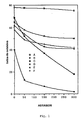
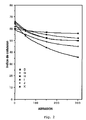
- This test consists in measuring the ability of a polymer to stick together the individual strands forming the wire.
- the device records and counts the vibrations emitted during the sectioning of the individualized elements consisting of a unitary strand or of several glued strands.
- the cohesion index is measured before and after work on a WEBTESTER usometer from the Textile Institute in Reutligen (measurement after 50, 150 and 300 cycles).
- Examples 1 to 5 are also compared: - to a solution of GEROL AS 10 marketed by RHONE-POULENC ("all acrylic" copolymer based on butyl acrylate, that is to say not derived from monomers other than acrylic or methacrylic esters or acids and free of of sulfonated polyester patterns).
- GEROL AS 10 marketed by RHONE-POULENC
- all acrylic copolymer based on butyl acrylate, that is to say not derived from monomers other than acrylic or methacrylic esters or acids and free of of sulfonated polyester patterns
- - a solution of GEROL VS 30 marketed by RHONE-POULENC (copolymer derived from vinyl acetate in high proportion, butyl acrylate and unsaturated carboxylic acid and devoid of sulfonated polyester units)
- GEROL PS 20 water-dispersible sulfonated polyester
- example 7 presents good results of cohesion test, but is however not usable industrially because it generates blocking ("blocking on beams" - bonding on beams) during the reunification of the primary beams or the course of the beam of the beam on the loom.
- Example 6 The method of Example 6 could not undergo the cohesion test because numerous breaks in the unit strands of the bonded wire due to blocking were observed during the unwinding of the coils to carry out the test.
Landscapes
- Chemical & Material Sciences (AREA)
- Chemical Kinetics & Catalysis (AREA)
- Health & Medical Sciences (AREA)
- Medicinal Chemistry (AREA)
- Polymers & Plastics (AREA)
- Organic Chemistry (AREA)
- Engineering & Computer Science (AREA)
- Textile Engineering (AREA)
- Treatments For Attaching Organic Compounds To Fibrous Goods (AREA)
- Graft Or Block Polymers (AREA)
- Addition Polymer Or Copolymer, Post-Treatments, Or Chemical Modifications (AREA)
Priority Applications (1)
| Application Number | Priority Date | Filing Date | Title |
|---|---|---|---|
| AT89400592T ATE77396T1 (de) | 1988-03-11 | 1989-03-03 | Gepfropfte polyestersulfone, verfahren fuer ihre herstellung und ihre anwendung fuer das schlichten von garnen und textilfasern. |
Applications Claiming Priority (2)
| Application Number | Priority Date | Filing Date | Title |
|---|---|---|---|
| FR8803169A FR2628431B1 (fr) | 1988-03-11 | 1988-03-11 | Nouveaux polyesters sulfones greffes, leur procede de preparation et leur application a l'encollage des fils et fibres textiles |
| FR8803169 | 1988-03-11 |
Publications (3)
| Publication Number | Publication Date |
|---|---|
| EP0333547A2 true EP0333547A2 (de) | 1989-09-20 |
| EP0333547A3 EP0333547A3 (en) | 1989-10-04 |
| EP0333547B1 EP0333547B1 (de) | 1992-06-17 |
Family
ID=9364173
Family Applications (1)
| Application Number | Title | Priority Date | Filing Date |
|---|---|---|---|
| EP89400592A Expired - Lifetime EP0333547B1 (de) | 1988-03-11 | 1989-03-03 | Gepfropfte Polyestersulfone, Verfahren für ihre Herstellung und ihre Anwendung für das Schlichten von Garnen und Textilfasern |
Country Status (18)
| Country | Link |
|---|---|
| US (1) | US5156651A (de) |
| EP (1) | EP0333547B1 (de) |
| JP (1) | JPH075692B2 (de) |
| KR (1) | KR890014611A (de) |
| CN (1) | CN1037717A (de) |
| AR (1) | AR243560A1 (de) |
| AT (1) | ATE77396T1 (de) |
| BR (1) | BR8901137A (de) |
| CA (1) | CA1334693C (de) |
| DE (1) | DE68901794T2 (de) |
| DK (1) | DK116489A (de) |
| ES (1) | ES2032659T3 (de) |
| FI (1) | FI891167A7 (de) |
| FR (1) | FR2628431B1 (de) |
| HU (1) | HUT50199A (de) |
| IL (1) | IL89555A0 (de) |
| PT (1) | PT89975B (de) |
| ZA (1) | ZA891132B (de) |
Cited By (8)
| Publication number | Priority date | Publication date | Assignee | Title |
|---|---|---|---|---|
| WO1990010665A1 (fr) * | 1989-03-08 | 1990-09-20 | Rhone-Poulenc Chimie | Polymeres modifies a base de polyester greffe et son procede de preparation |
| EP0532961A1 (de) * | 1991-09-20 | 1993-03-24 | BASF Aktiengesellschaft | Pfropfcopolymerisate von Sulfonsäuregruppen enthaltenden Polyestern als Propfgrundlage, Verfahren zu ihrer Herstellung und ihre Verwendung |
| US5342877A (en) * | 1992-07-06 | 1994-08-30 | Eastman Chemical Company | Blends of polyesters and alkylhydroxy (meth)acrylate compounds |
| WO1995001381A1 (en) * | 1993-06-29 | 1995-01-12 | Eastman Chemical Company | Polymer blends comprising sulfonate group-containing surfactants |
| FR2728915A1 (fr) * | 1994-12-30 | 1996-07-05 | Rhone Poulenc Chimie | Copolyesters sulfones a motifs polyorganosiloxanes comme agents d'encollage textile et procede d'encollage de fils ou de fibres textiles a l'aide desdits agents |
| WO1998006765A1 (en) * | 1996-08-09 | 1998-02-19 | Millipore Corporation | Polysulfone copolymer compositions |
| EP0774020B1 (de) * | 1994-07-22 | 1999-04-21 | Rhodia Chimie | Verfahren zum schlichten von garnen oder textilfasern mittels einer latexzusammensetzung |
| US6255366B1 (en) | 1999-10-01 | 2001-07-03 | Eastman Chemical Company | Sulfopolymers as emulsion stabilizers with improved coagulum level |
Families Citing this family (21)
| Publication number | Priority date | Publication date | Assignee | Title |
|---|---|---|---|---|
| US5266322A (en) * | 1992-05-29 | 1993-11-30 | Eastman Kodak Company | Cosmetic film forming compositions |
| DE4345086B4 (de) * | 1993-01-05 | 2007-04-05 | Toyo Boseki K.K. | Wäßrige Polyester-Dispersion |
| US5294650A (en) * | 1993-02-08 | 1994-03-15 | Eastman Chemical Company | Process for preparing sulfo-polyester/acrylic resin blends without volatile organic compounds |
| WO1995005413A1 (en) | 1993-08-12 | 1995-02-23 | Eastman Chemical Company | Water-dispersible acrylic-modified polyester resins used in coatings and process for their preparation |
| JP3353435B2 (ja) * | 1994-01-07 | 2002-12-03 | 大日本インキ化学工業株式会社 | プラスティック被覆用水性樹脂組成物 |
| ES2139443T3 (es) * | 1996-01-31 | 2000-02-01 | Eastman Chem Co | Latex hibridos de poliester/materiales acrilicos de pequeño tamaño de particulas. |
| US6136884A (en) * | 1997-02-04 | 2000-10-24 | Eastman Chemical Company | Hair care compositions |
| US6749836B1 (en) | 1998-01-30 | 2004-06-15 | Eastman Chemical Company | Hair care compositions |
| US6638992B1 (en) | 1998-01-30 | 2003-10-28 | Eastman Chemical Company | Hair care compositions |
| US6344503B1 (en) * | 1999-09-29 | 2002-02-05 | Bp Corporation North America Inc. | Method for preparing low VOC polyester-acrylic graft resin compositions |
| US7390441B2 (en) * | 2002-05-23 | 2008-06-24 | Columbian Chemicals Company | Sulfonated conducting polymer-grafted carbon material for fuel cell applications |
| US7241334B2 (en) * | 2002-05-23 | 2007-07-10 | Columbian Chemicals Company | Sulfonated carbonaceous materials |
| US7459103B2 (en) * | 2002-05-23 | 2008-12-02 | Columbian Chemicals Company | Conducting polymer-grafted carbon material for fuel cell applications |
| US7195834B2 (en) * | 2002-05-23 | 2007-03-27 | Columbian Chemicals Company | Metallized conducting polymer-grafted carbon material and method for making |
| BR0311226A (pt) * | 2002-05-23 | 2008-01-29 | Columbian Chem | material de carbono enxertado com polìmero condutor sulfonado para aplicações em células de combustìvel |
| KR20050012748A (ko) | 2002-05-23 | 2005-02-02 | 콜롬비안케미컬스컴파니 | 연료 전지 용도를 위한 전도성 중합체-그라프트된 탄소 물질 |
| US7144600B2 (en) * | 2003-02-18 | 2006-12-05 | Milliken & Company | Wax-free lubricant for use in sizing yarns, methods using same and fabrics produced therefrom |
| US7579047B2 (en) * | 2003-05-20 | 2009-08-25 | Milliken & Company | Lubricant and soil release finish for textured yarns, methods using same and fabrics produced therefrom |
| US6958308B2 (en) | 2004-03-16 | 2005-10-25 | Columbian Chemicals Company | Deposition of dispersed metal particles onto substrates using supercritical fluids |
| US20060068987A1 (en) * | 2004-09-24 | 2006-03-30 | Srinivas Bollepalli | Carbon supported catalyst having reduced water retention |
| CA2744066C (en) | 2008-11-21 | 2017-09-05 | Mcneil-Ppc, Inc. | Chiller box |
Family Cites Families (6)
| Publication number | Priority date | Publication date | Assignee | Title |
|---|---|---|---|---|
| JPS5034153A (de) * | 1973-07-27 | 1975-04-02 | ||
| US4073777A (en) * | 1975-01-17 | 1978-02-14 | Eastman Kodak Company | Radiation crosslinkable polyester and polyesteramide compositions containing sulfonate groups in the form of a metallic salt and unsaturated groups |
| US4158083A (en) * | 1976-07-02 | 1979-06-12 | Basf Wyandotte Corporation | Fibrous article sized with a branched water-dispersible polyester |
| US4119680A (en) * | 1976-08-23 | 1978-10-10 | Eastman Kodak Company | Copolyesters as improved binders and finishes for polyester-containing fabrics |
| EP0010582A3 (de) * | 1978-08-28 | 1980-11-26 | Basf Wyandotte Corporation | Pfropfpolyester-Produkte, Verfahren zum Schlichten von Garnen mit diesen Produkten und mit solchen Pfropfpolyesterprodukten geschlichteter synthetischer Faser |
| JPS61201079A (ja) * | 1985-02-28 | 1986-09-05 | ユシロ化学工業株式会社 | 経糸糊剤 |
-
1988
- 1988-03-11 FR FR8803169A patent/FR2628431B1/fr not_active Expired - Lifetime
-
1989
- 1989-02-14 ZA ZA891132A patent/ZA891132B/xx unknown
- 1989-03-03 AT AT89400592T patent/ATE77396T1/de active
- 1989-03-03 EP EP89400592A patent/EP0333547B1/de not_active Expired - Lifetime
- 1989-03-03 DE DE8989400592T patent/DE68901794T2/de not_active Expired - Lifetime
- 1989-03-03 ES ES198989400592T patent/ES2032659T3/es not_active Expired - Lifetime
- 1989-03-09 AR AR89313374A patent/AR243560A1/es active
- 1989-03-09 IL IL89555A patent/IL89555A0/xx unknown
- 1989-03-10 CA CA000593377A patent/CA1334693C/fr not_active Expired - Fee Related
- 1989-03-10 FI FI891167A patent/FI891167A7/fi not_active IP Right Cessation
- 1989-03-10 JP JP1056540A patent/JPH075692B2/ja not_active Expired - Lifetime
- 1989-03-10 DK DK116489A patent/DK116489A/da not_active Application Discontinuation
- 1989-03-10 HU HU891183A patent/HUT50199A/hu unknown
- 1989-03-10 BR BR898901137A patent/BR8901137A/pt unknown
- 1989-03-10 PT PT89975A patent/PT89975B/pt not_active IP Right Cessation
- 1989-03-11 KR KR1019890003019A patent/KR890014611A/ko not_active Withdrawn
- 1989-03-11 CN CN89102589A patent/CN1037717A/zh active Pending
-
1990
- 1990-08-09 US US07/564,710 patent/US5156651A/en not_active Expired - Fee Related
Cited By (10)
| Publication number | Priority date | Publication date | Assignee | Title |
|---|---|---|---|---|
| WO1990010665A1 (fr) * | 1989-03-08 | 1990-09-20 | Rhone-Poulenc Chimie | Polymeres modifies a base de polyester greffe et son procede de preparation |
| EP0532961A1 (de) * | 1991-09-20 | 1993-03-24 | BASF Aktiengesellschaft | Pfropfcopolymerisate von Sulfonsäuregruppen enthaltenden Polyestern als Propfgrundlage, Verfahren zu ihrer Herstellung und ihre Verwendung |
| US5342877A (en) * | 1992-07-06 | 1994-08-30 | Eastman Chemical Company | Blends of polyesters and alkylhydroxy (meth)acrylate compounds |
| US5492959A (en) * | 1992-07-06 | 1996-02-20 | Clark; Mark D. | Blends of polyesters and alkylhydroxy (meth)acrylate compounds |
| WO1995001381A1 (en) * | 1993-06-29 | 1995-01-12 | Eastman Chemical Company | Polymer blends comprising sulfonate group-containing surfactants |
| EP0774020B1 (de) * | 1994-07-22 | 1999-04-21 | Rhodia Chimie | Verfahren zum schlichten von garnen oder textilfasern mittels einer latexzusammensetzung |
| CN1077629C (zh) * | 1994-07-22 | 2002-01-09 | 罗纳·布朗克化学公司 | 用于纱线或纺织纤维的经纱上浆方法 |
| FR2728915A1 (fr) * | 1994-12-30 | 1996-07-05 | Rhone Poulenc Chimie | Copolyesters sulfones a motifs polyorganosiloxanes comme agents d'encollage textile et procede d'encollage de fils ou de fibres textiles a l'aide desdits agents |
| WO1998006765A1 (en) * | 1996-08-09 | 1998-02-19 | Millipore Corporation | Polysulfone copolymer compositions |
| US6255366B1 (en) | 1999-10-01 | 2001-07-03 | Eastman Chemical Company | Sulfopolymers as emulsion stabilizers with improved coagulum level |
Also Published As
| Publication number | Publication date |
|---|---|
| DK116489A (da) | 1989-09-12 |
| CA1334693C (fr) | 1995-03-07 |
| BR8901137A (pt) | 1989-10-31 |
| KR890014611A (ko) | 1989-10-24 |
| ZA891132B (en) | 1991-12-24 |
| HUT50199A (en) | 1989-12-28 |
| PT89975A (pt) | 1989-11-10 |
| FR2628431B1 (fr) | 1992-01-10 |
| JPH075692B2 (ja) | 1995-01-25 |
| PT89975B (pt) | 1994-05-31 |
| FR2628431A1 (fr) | 1989-09-15 |
| DK116489D0 (da) | 1989-03-10 |
| FI891167L (fi) | 1989-09-12 |
| US5156651A (en) | 1992-10-20 |
| FI891167A0 (fi) | 1989-03-10 |
| EP0333547A3 (en) | 1989-10-04 |
| ATE77396T1 (de) | 1992-07-15 |
| FI891167A7 (fi) | 1989-09-12 |
| DE68901794D1 (de) | 1992-07-23 |
| CN1037717A (zh) | 1989-12-06 |
| DE68901794T2 (de) | 1992-12-17 |
| IL89555A0 (en) | 1989-09-10 |
| EP0333547B1 (de) | 1992-06-17 |
| AR243560A1 (es) | 1993-08-31 |
| ES2032659T3 (es) | 1993-02-16 |
| JPH01297414A (ja) | 1989-11-30 |
Similar Documents
| Publication | Publication Date | Title |
|---|---|---|
| EP0333547B1 (de) | Gepfropfte Polyestersulfone, Verfahren für ihre Herstellung und ihre Anwendung für das Schlichten von Garnen und Textilfasern | |
| EP0774020B1 (de) | Verfahren zum schlichten von garnen oder textilfasern mittels einer latexzusammensetzung | |
| CN1037750A (zh) | 聚合物纤维表面处理剂 | |
| CH494784A (fr) | Procédé et préparation d'un polymère à base d'esters acryliques et de nitriles acryliques | |
| WO2005075559A1 (fr) | Composition pour fils ; fils a proprietes ameliorees et utilisation de ces fils. | |
| EP0119882B1 (de) | Stärkemittelzusammensetzung, ihre Herstellung und ihre Verwendung zum Schlichten von textilen Fäden | |
| WO1990010665A1 (fr) | Polymeres modifies a base de polyester greffe et son procede de preparation | |
| US10161081B2 (en) | Sizing composition and process for textile materials | |
| CH633023A5 (fr) | Latex de polymeres vinyliques stables aux electrolytes. | |
| WO1999020837A1 (fr) | Additifs pour amliorer la resistance a l'etat humide et a sec du papier | |
| JPS61201079A (ja) | 経糸糊剤 | |
| CN106832096A (zh) | 一种高性能快干高速喷水浆料制备方法 | |
| FR2879630A1 (fr) | Nouvelle composition d'encollage de fils textiles | |
| JP3375394B2 (ja) | ウォータージェットルーム用糊剤の製造方法及び糊剤組成物 | |
| KR100300470B1 (ko) | 실또는텍스타일섬유의사이징용라텍스조성물및사이징방법 | |
| CA1211581A (fr) | Fils et fibres a base de melanges de polychlorure de vinyle et acetate de cellulose et leur procede d'obtention | |
| FR2728915A1 (fr) | Copolyesters sulfones a motifs polyorganosiloxanes comme agents d'encollage textile et procede d'encollage de fils ou de fibres textiles a l'aide desdits agents | |
| CA1211592A (fr) | Fils et fibres a base de melanges de polychlorure de vinyle et polymere acrylique et leur procede d'obtention | |
| JP4243882B2 (ja) | 疎水性高分子成形品のグラフト重合加工品及びその製造方法 | |
| FR2769926A1 (fr) | Nouveau procede de fabrication de papier tres fortement resistant a l'etat humide | |
| JPH0246711B2 (ja) | Tekusutairuyaannosaijinguho |
Legal Events
| Date | Code | Title | Description |
|---|---|---|---|
| PUAI | Public reference made under article 153(3) epc to a published international application that has entered the european phase |
Free format text: ORIGINAL CODE: 0009012 |
|
| PUAL | Search report despatched |
Free format text: ORIGINAL CODE: 0009013 |
|
| AK | Designated contracting states |
Kind code of ref document: A2 Designated state(s): AT BE CH DE ES FR GB GR IT LI LU NL SE |
|
| AK | Designated contracting states |
Kind code of ref document: A3 Designated state(s): AT BE CH DE ES FR GB GR IT LI LU NL SE |
|
| 17P | Request for examination filed |
Effective date: 19900105 |
|
| 17Q | First examination report despatched |
Effective date: 19910328 |
|
| ITF | It: translation for a ep patent filed | ||
| GRAA | (expected) grant |
Free format text: ORIGINAL CODE: 0009210 |
|
| AK | Designated contracting states |
Kind code of ref document: B1 Designated state(s): AT BE CH DE ES FR GB GR IT LI LU NL SE |
|
| PG25 | Lapsed in a contracting state [announced via postgrant information from national office to epo] |
Ref country code: SE Effective date: 19920617 Ref country code: NL Effective date: 19920617 Ref country code: GR Free format text: LAPSE BECAUSE OF FAILURE TO SUBMIT A TRANSLATION OF THE DESCRIPTION OR TO PAY THE FEE WITHIN THE PRESCRIBED TIME-LIMIT Effective date: 19920617 |
|
| REF | Corresponds to: |
Ref document number: 77396 Country of ref document: AT Date of ref document: 19920715 Kind code of ref document: T |
|
| REF | Corresponds to: |
Ref document number: 68901794 Country of ref document: DE Date of ref document: 19920723 |
|
| GBT | Gb: translation of ep patent filed (gb section 77(6)(a)/1977) | ||
| NLV1 | Nl: lapsed or annulled due to failure to fulfill the requirements of art. 29p and 29m of the patents act | ||
| REG | Reference to a national code |
Ref country code: ES Ref legal event code: FG2A Ref document number: 2032659 Country of ref document: ES Kind code of ref document: T3 |
|
| PG25 | Lapsed in a contracting state [announced via postgrant information from national office to epo] |
Ref country code: LU Free format text: LAPSE BECAUSE OF NON-PAYMENT OF DUE FEES Effective date: 19930331 Ref country code: LI Effective date: 19930331 Ref country code: CH Effective date: 19930331 |
|
| PLBE | No opposition filed within time limit |
Free format text: ORIGINAL CODE: 0009261 |
|
| STAA | Information on the status of an ep patent application or granted ep patent |
Free format text: STATUS: NO OPPOSITION FILED WITHIN TIME LIMIT |
|
| 26N | No opposition filed | ||
| REG | Reference to a national code |
Ref country code: CH Ref legal event code: PL |
|
| PGFP | Annual fee paid to national office [announced via postgrant information from national office to epo] |
Ref country code: GB Payment date: 19990302 Year of fee payment: 11 |
|
| PGFP | Annual fee paid to national office [announced via postgrant information from national office to epo] |
Ref country code: DE Payment date: 19990315 Year of fee payment: 11 |
|
| PGFP | Annual fee paid to national office [announced via postgrant information from national office to epo] |
Ref country code: AT Payment date: 19990324 Year of fee payment: 11 |
|
| PGFP | Annual fee paid to national office [announced via postgrant information from national office to epo] |
Ref country code: ES Payment date: 19990325 Year of fee payment: 11 |
|
| PGFP | Annual fee paid to national office [announced via postgrant information from national office to epo] |
Ref country code: FR Payment date: 19990329 Year of fee payment: 11 |
|
| PGFP | Annual fee paid to national office [announced via postgrant information from national office to epo] |
Ref country code: BE Payment date: 19990414 Year of fee payment: 11 |
|
| PG25 | Lapsed in a contracting state [announced via postgrant information from national office to epo] |
Ref country code: GB Free format text: LAPSE BECAUSE OF NON-PAYMENT OF DUE FEES Effective date: 20000303 Ref country code: AT Free format text: LAPSE BECAUSE OF NON-PAYMENT OF DUE FEES Effective date: 20000303 |
|
| PG25 | Lapsed in a contracting state [announced via postgrant information from national office to epo] |
Ref country code: ES Free format text: LAPSE BECAUSE OF NON-PAYMENT OF DUE FEES Effective date: 20000304 |
|
| PG25 | Lapsed in a contracting state [announced via postgrant information from national office to epo] |
Ref country code: BE Free format text: LAPSE BECAUSE OF NON-PAYMENT OF DUE FEES Effective date: 20000331 |
|
| BERE | Be: lapsed |
Owner name: RHONE-POULENC CHIMIE Effective date: 20000331 |
|
| GBPC | Gb: european patent ceased through non-payment of renewal fee |
Effective date: 20000303 |
|
| PG25 | Lapsed in a contracting state [announced via postgrant information from national office to epo] |
Ref country code: FR Free format text: LAPSE BECAUSE OF NON-PAYMENT OF DUE FEES Effective date: 20001130 |
|
| REG | Reference to a national code |
Ref country code: FR Ref legal event code: ST |
|
| PG25 | Lapsed in a contracting state [announced via postgrant information from national office to epo] |
Ref country code: DE Free format text: LAPSE BECAUSE OF NON-PAYMENT OF DUE FEES Effective date: 20010103 |
|
| REG | Reference to a national code |
Ref country code: ES Ref legal event code: FD2A Effective date: 20010910 |
|
| PG25 | Lapsed in a contracting state [announced via postgrant information from national office to epo] |
Ref country code: IT Free format text: LAPSE BECAUSE OF NON-PAYMENT OF DUE FEES;WARNING: LAPSES OF ITALIAN PATENTS WITH EFFECTIVE DATE BEFORE 2007 MAY HAVE OCCURRED AT ANY TIME BEFORE 2007. THE CORRECT EFFECTIVE DATE MAY BE DIFFERENT FROM THE ONE RECORDED. Effective date: 20050303 |