EP0332091A2 - Ablenkungsschaltung mit Rasterverzerrungskorrektur - Google Patents
Ablenkungsschaltung mit Rasterverzerrungskorrektur Download PDFInfo
- Publication number
- EP0332091A2 EP0332091A2 EP89103820A EP89103820A EP0332091A2 EP 0332091 A2 EP0332091 A2 EP 0332091A2 EP 89103820 A EP89103820 A EP 89103820A EP 89103820 A EP89103820 A EP 89103820A EP 0332091 A2 EP0332091 A2 EP 0332091A2
- Authority
- EP
- European Patent Office
- Prior art keywords
- retrace
- coupled
- deflection
- pulse voltage
- capacitance
- Prior art date
- Legal status (The legal status is an assumption and is not a legal conclusion. Google has not performed a legal analysis and makes no representation as to the accuracy of the status listed.)
- Granted
Links
Images



Classifications
-
- H—ELECTRICITY
- H04—ELECTRIC COMMUNICATION TECHNIQUE
- H04N—PICTORIAL COMMUNICATION, e.g. TELEVISION
- H04N3/00—Scanning details of television systems; Combination thereof with generation of supply voltages
- H04N3/10—Scanning details of television systems; Combination thereof with generation of supply voltages by means not exclusively optical-mechanical
- H04N3/16—Scanning details of television systems; Combination thereof with generation of supply voltages by means not exclusively optical-mechanical by deflecting electron beam in cathode-ray tube, e.g. scanning corrections
-
- H—ELECTRICITY
- H04—ELECTRIC COMMUNICATION TECHNIQUE
- H04N—PICTORIAL COMMUNICATION, e.g. TELEVISION
- H04N3/00—Scanning details of television systems; Combination thereof with generation of supply voltages
- H04N3/10—Scanning details of television systems; Combination thereof with generation of supply voltages by means not exclusively optical-mechanical
- H04N3/16—Scanning details of television systems; Combination thereof with generation of supply voltages by means not exclusively optical-mechanical by deflecting electron beam in cathode-ray tube, e.g. scanning corrections
- H04N3/22—Circuits for controlling dimensions, shape or centering of picture on screen
- H04N3/23—Distortion correction, e.g. for pincushion distortion correction, S-correction
- H04N3/233—Distortion correction, e.g. for pincushion distortion correction, S-correction using active elements
-
- H—ELECTRICITY
- H04—ELECTRIC COMMUNICATION TECHNIQUE
- H04N—PICTORIAL COMMUNICATION, e.g. TELEVISION
- H04N5/00—Details of television systems
- H04N5/63—Generation or supply of power specially adapted for television receivers
-
- H—ELECTRICITY
- H02—GENERATION; CONVERSION OR DISTRIBUTION OF ELECTRIC POWER
- H02M—APPARATUS FOR CONVERSION BETWEEN AC AND AC, BETWEEN AC AND DC, OR BETWEEN DC AND DC, AND FOR USE WITH MAINS OR SIMILAR POWER SUPPLY SYSTEMS; CONVERSION OF DC OR AC INPUT POWER INTO SURGE OUTPUT POWER; CONTROL OR REGULATION THEREOF
- H02M1/00—Details of apparatus for conversion
- H02M1/0003—Details of control, feedback or regulation circuits
- H02M1/0032—Control circuits allowing low power mode operation, e.g. in standby mode
-
- Y—GENERAL TAGGING OF NEW TECHNOLOGICAL DEVELOPMENTS; GENERAL TAGGING OF CROSS-SECTIONAL TECHNOLOGIES SPANNING OVER SEVERAL SECTIONS OF THE IPC; TECHNICAL SUBJECTS COVERED BY FORMER USPC CROSS-REFERENCE ART COLLECTIONS [XRACs] AND DIGESTS
- Y02—TECHNOLOGIES OR APPLICATIONS FOR MITIGATION OR ADAPTATION AGAINST CLIMATE CHANGE
- Y02B—CLIMATE CHANGE MITIGATION TECHNOLOGIES RELATED TO BUILDINGS, e.g. HOUSING, HOUSE APPLIANCES OR RELATED END-USER APPLICATIONS
- Y02B70/00—Technologies for an efficient end-user side electric power management and consumption
- Y02B70/10—Technologies improving the efficiency by using switched-mode power supplies [SMPS], i.e. efficient power electronics conversion e.g. power factor correction or reduction of losses in power supplies or efficient standby modes
Definitions
- This invention relates to a deflection circuit in which the amplitude of a deflection current may be varied or modulated over a relatively wide range for correcting a raster distortion. Modulation of the deflection current amplitude may be desirable for purposes such as, for example, correction of outside and of inside east-west pincushion distortion.
- the horizontal deflection circuit includes an output stage having a deflection switch, a horizontal deflection winding and a trace capacitance that supplies deflection current to the deflection winding during each trace interval.
- a first retrace capacitance is coupled across the deflection winding during the retrace interval to form a retrace resonant circuit. Energy is replenished during retrace via a flyback transformer.
- the retrace resonant circuit is coupled via a relatively small output impedance, of an east-west control circuit, to the primary winding of the flyback transformer throughout retrace.
- the retrace capacitance may be slightly discharged during retrace due to the aforementioned loading. This may result in a discharge current from the trace capacitance into the retrace capacitance through the deflection winding and a resulting slight drop of the voltage across the trace capacitance due to the white horizontal strips of the crosshatch pattern.
- the charge of the trace capacitance is replenished during the retrace intervals associated with the scan lines that display the black picture portion underneath the white crosshatch stripes. This causes a small current in the opposite direction, at a low frequency, to flow through the deflection winding during the trace intervals.
- the charge and discharge current of the trace capacitance produces a small raster displacement and results in low frequency oscillations modulating the deflection winding trace current.
- This low frequency modulation may cause each vertical strip of the crosshatch pattern to have of a zig-zag shape, instead of a straight line shape.
- the zig-zag shape appears in a given vertical direction immediately below the intersection point with a horizontal strip.
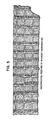
- Such distortions occurring at such low frequency sometimes referred to as "mouseteeth" distortions, are illustrated in the crosshatch pattern of FIGURE 5.
- mouseteeth distortions appear, during and just after the times in which high beam current transients occur, because the deflection circuit, that represents a low impedance energy flywheel during retrace, supplies the transient increase in energy requirement of the ultor circuit.
- energy transferred from the deflection circuit to the ultor circuit may tend to cause variations in the deflection winding trace current.
- a modulation switching current is formed by a bidirectional modulation switch during retrace.
- the modulation switch coupled to the retrace resonant circuit that includes the first retrace capacitance, has a conduction time that is phase modulated during horizontal retrace in accordance with a vertical rate parabolic voltage.
- a second retrace capacitor is coupled in parallel with the modulation switch.
- the modulation switch is conductive during the trace interval and is turned-off at a controllable instant during retrace.
- the modulation switch forms, when conductive, a low impedance across the second retrace capacitor that clamps the voltage across the second retrace capacitor to zero.
- a controllable retrace pulse voltage having an amplitude that is controllable and a width that is variable is developed across the second retrace capacitor when the modulation switch during a portion of retrace is nonconductive.
- the retrace voltage across the second retrace capacitor varies the magnitude of a retrace voltage that is developed across the first retrace capacitor and, in this way, provides the desired deflection winding current modulation so as to correct for outside and inside pincushion distortion.
- mouseteeth distortion is reduced.
- Mouseteeth distortion is reduced because, when the modulation switch is nonconductive during the other portion of horizontal retrace, the flyback transformer primary winding is coupled to the retrace resonant circuit via an impedance formed by the second retrace capacitor.
- impedance is high at low frequencies that are associated with mouseteeth distortion. Such frequencies are substantially lower than the retrace resonant frequency.
- the retrace voltage in a secondary winding of the flyback transformer may be used to provide a synchronizing feedback signal that is used for providing timing information to a phase-control-circuit.
- the phase-control-circuit generates a control signal that synchronizes the horizontal deflection current to a horizontal synchronizing input signal.
- the second retrace capacitance causes the flyback transformer feedback signal to be maintained in phase with respect to the retrace voltage developed across the deflection winding.
- the feedback signal provides correct horizontal timing information of the horizontal deflection current throughout vertical scan.
- a television deflection apparatus embodying an aspect of the invention includes a source of a first input signal at a frequency that is related to a first deflection frequency and a retrace resonant circuit.
- the retrace resonant circuit includes a deflection winding and a first retrace capacitance.
- a deflection current is generated in the deflection winding and a first retrace pulse voltage is generated in the first retrace capacitance during a retrace interval of a given deflection cycle.
- a second retrace capacitance is coupled to the retrace resonant circuit for generating in the second retrace capacitance a second retrace pulse voltage during the retrace interval.
- a supply inductance coupled to a source of an input supply voltage couples the first and second retrace pulse voltages therethrough to a load circuit.
- a source of a modulation second input signal at a frequency that is related to a second deflection frequency is coupled to a switching arrangement. The switching arrangement varies, in accordance with the second input signal, a difference between a time when the second retrace pulse voltage is initiated and a time when the first retrace pulse voltage is initiated to produce a modulation of the deflection current.
- an impedance arrangement that includes the second retrace capacitance, that is high at frequencies that are substantially lower than a retrace resonance frequency of the retrace resonant circuit, is interposed between the supply inductance and the retrace resonant circuit.
- the high impedance isolates the supply inductance from the retrace resonant circuit at the lower frequencies.
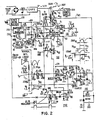
- a horizontal deflection circuit 250 of FIGURE 2 provides horizontal deflection in, for example, an FS color cathode ray tube (CRT) type A66EAS00X01.
- Circuit 250 includes a switching transistor Q1 operating at a horizontal frequency f H and an anti-parallel damper diode D Q1 , both being constructed as one integrated circuit.
- a retrace capacitance C1 is coupled in parallel with transistor Q1 and diode D Q1 .
- a deflection winding L H is coupled in series with an S-shaping trace capacitance C s to form a circuit branch that is coupled in parallel with each of transistor Q1, diode D Q1 and retrace capacitance C1 to form a retrace resonant circuit 100 during horizontal retrace.
- a phase-control stage 101 that includes a horizontal oscillator and a phase detector, not shown in detail in FIGURES, is responsive to a horizontal synchronizing signal H s .
- Signal H s is derived from, for example, a video detector of a television receiver, not shown in the FIGURES.
- Stage 101 applies, via a transistor Q6, a drive voltage 101a to a primary winding T 2a of a driver transformer T2.
- Secondary winding T 2b of transformer T2 is coupled via a voltage divider, that includes resistors R1 and R2, to the base-emitter junction of transistor Q1 for producing a base drive current i b at the horizontal frequency f H .
- a primary winding W1 of a flyback transformer T1 is coupled between a source of a B+ voltage and the collector of transistor Q1.
- a secondary winding W2 of transformer T1 is coupled to stage 101 to provide a feedback retrace signal H r for generating drive signal 101a that synchronizes a horizontal deflection current i2 in winding L H to signal H s .
- a switched raster correction circuit 200 includes an E-W control circuit 300 that controls the switching timing of a switching transistor Q2.
- Transistor Q2 is conductive throughout the trace interval and becomes nonconductive during a controllable instant within the retrace interval.
- the collector of transistor Q2 is coupled to a junction terminal 50 between the emitter of transistor Q1 and retrace capacitor C1.
- the emitter of transistor Q2 is coupled to ground via a small current sampling resistor R101.
- a damper diode D Q2 coupled in parallel with transistor Q2, is constructed with transistor Q2 as one integrated circuit.
- a second retrace capacitor C2 is coupled between the collector of transistor Q2 and ground.
- a retrace voltage V r generated across a winding W4 of transformer T1 provides a high voltage, used for generating an ultor voltage in an ultor power supply 556 that includes rectifying diodes, not shown in the FIGURES.
- a first hypothetical example that is used for explanation purpose represents a first extreme operating condition in which transistor Q2 is maintained conductive throughout trace and retrace.
- deflection circuit 250 generates deflection current i2 in a manner that is well known but without East-West correction. As explained later on, current i2 is at a maximum peak-to-peak amplitude, in this case.
- a second hypothetical example that is also used for explanation purposes, represents a second extreme operating condition in which switching transistor Q2 is in cutoff throughout an entire retrace interval.
- the first one, resonant circuit 100 of FIGURE 2 includes retrace capacitor C1, winding L H and trace capacitor C S .
- the second one includes flyback transformer winding W1 and retrace capacitor C2 that are coupled in series.
- each of the pair of retrace resonant circuits is tuned to a frequency that is lower than a required nominal retrace frequency.
- the resonant circuits are coupled to form a combined resonant circuit. Therefore, the resulting common retrace frequency of the combined resonant circuit is higher than each of its constituents and is made equal to the required nominal retrace frequency that is, illustratively, 43 KHz in the PAL system.
- secondary winding W2 of transformer T1 provides horizontal synchronizing retrace signal H r .
- Each pulse of signal H r represents the retrace interval in deflection winding L H .
- Horizontal synchronizing signal H r is coupled to phase-control-stage 101 for providing feedback synchronization information.
- the synchronization information contained in the pulses of signal H r is indicative of the phase of current i2 in deflection winding L H .
- Signal H r and horizontal sync pulses H s are used to adjust the phase and the frequency of the horizontal oscillator output signal that is included in stage 101.
- primary winding W1 of transformer T1 is coupled to retrace resonant circuit 100 through a capacitive voltage divider that includes capacitors C1 and C2 to form the combined resonant circuit.
- the combined retrace resonant circuit enables proper synchronization without causing mouseteeth distortion.
- the advantages of forming such combined retrace resonant circuit are explained in detail in U.S. Patent 4,634,937 in the name of P.E. Haferl, entitled "EAST-WEST CORRECTION CIRCUIT".
- Retrace voltage V4 developed across winding L H and across capacitor C1, determines the amplitude of deflection current i2.
- Retrace voltage V4 is equal to retrace voltage V1 minus retrace voltage V2. Because current i3 in transistor Q2 is zero during the second portion of retrace when transistor Q2 is nonconductive, retrace current i1 flows substantially entirely as current i4 through capacitor C2 and generates retrace voltage V2.
- modulation of deflection current is obtained by a modulation of the turn-off instant of transistor Q2 during the first half of the retrace interval in a way that mouseteeth distortions are reduced.
- the retrace frequency remains the same during both the first portion of retrace, when transistor Q2 is conductive, and during the second portion of retrace, when transistor Q2 is nonconductive. Consequently, the phase of voltage V1 in winding W1 relative to that of deflection current i2 is unaffected by the conduction state of transistor Q2.
- Modulation of the turn-off instant is permissible because both the retrace time and a retrace voltage V r developed from voltage V1 in winding W4 of transformer T1 are, advantageously, substantially unaffected by the state of conductance of transistor Q2, during retrace.
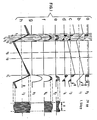
- FIGURES 1a-1h illustrate idealized waveforms useful for explaining the operation of the circuit of FIGURE 2. Similar symbols and numerals in FIGURES 2 and in FIGURES 1a-1h indicate similar items or functions.
- E-W control circuit 300 of FIGURE 2 generates a pulsed voltage V3 which drives the base of transistor Q2.
- Voltage V3 causes transistor Q2 to be conductive throughout the trace interval.
- the falling edge of voltage V3 is phase modulated in the range t2-t3 of FIGURE 1a.
- switching transistor Q2 of FIGURE 2 is conductive prior to time t2 of FIGURE 1a and switched into cut-off after time t2 at the phase modulated instant within the range t2-t3.
- transistor Q2 clamps retrace voltage V2 to zero and varies the instant when the generation of voltage v2 occurs.
- the turn-off time of transistor Q2, determined by the falling edge of voltage V3 of FIGURE 1a, is increasingly delayed within interval t2 - t3.
- the result is a decreasing peak amplitude of voltage V2 of FIGURE 2, an increasing peak amplitude of voltage V4 and an increasing peak amplitude of deflection current i2.
- voltage V2 starts increasing at time t3 of FIGURE 1e and becomes zero at time t5 of each horizontal period.
- deflection current i2 is proportional to retrace voltage V4 and inversely proportional to retrace voltage V2 that is modulated in accordance with the turn-off instant of transistor Q2.
- the falling edge of voltage V3 of FIGURE 1a is phase modulated in a parabolic manner at a vertical rate to obtain the vertical rate envelopes shown in conjunction with waveforms 1e, 1f and 1h.
- the variation of the turn-off time of transistor Q2 of FIGURE 2 modulates also the time when voltage V2 of FIGURE 1e becomes zero near the end of retrace.
- the center of the retrace pulse waveform of voltage V2 during horizontal retrace is maintained the same relative to the center of horizontal retrace time t4 throughout vertical scan.
- voltages V4 and V2 of FIGURE 2 are maintained in phase with respect to voltage V1. It follows that, advantageously, signal H r is maintained in phase with deflection current i2.
- Signal H r developed across winding W2 provides phase information of the phase of deflection current i2.
- Signal H r is applied to stage 101 for synchronizing the horizontal oscillator of stage 101 to sync pulses H s of the video signal. Because capacitor C2 couples winding W1 to winding L H to form a combined resonant circuit, the phase information of signal H r is substantially identical to that of deflection current i2.
- a further advantage provided by the switched operation of transistor Q2 is that inductive components are not required to be coupled in series with transistor Q2. Also, the switched operation of transistor Q2 results in low power dissipation in transistor Q2. Therefore, transistor Q2 may not require a heat sink.
- An additional advantage over other east-west circuits such as a conventional diode modulator is that deflection current i2 does not flow through a damper diode during the second half of trace, resulting in lower deflection losses and lower asymmetric linearity error.
- deflection resonant circuit 100 is coupled to flyback transformer T1 by capacitor C2 having a high impedance, after transistor Q2 becomes nonconductive.
- the ultor voltage rectifying diodes not shown, are conducting.
- the high impedance of capacitor C2 substantially isolates windings L H and W1 at frequencies associated with mouseteeth distortion that are substantially lower than the retrace frequency of resonant circuit 100 during retrace; thereby, raster distortions known as "mouseteeth" are prevented from occurring.
- junction terminal 50 between capacitors C1 and C2 is clamped to ground potential by transistor Q2 during the entire trace interval. Therefore, raster disturbances referred to as "Organ Pipes" do not appear. Organ Pipes type raster disturbances may occur if such clamping were not used as a result of oscillatory current or ringings in the flyback transformer primary current. Such ringings are suppressed because transistor Q1 is clamped to ground by transistor Q2 during the entire trace interval.
- damper diodes D Q1 and D Q2 may be constructed with the corresponding transistor using the integrated circuit technology for further reducing the required discrete components count.
- a protection diode D1 is coupled between the collector of transistor Q2 and a terminal W1a of primary winding W1 of transformer T1.
- Diode D1 protects transistor Q2 from excessive peak voltage that may occur when power is initially turned on.
- Transistor Q2 is protected by diode D1 which limits voltage V2 to a maximum of 350V.
- Transformer T2 has, preferably, 400V isolation capability between the primary and secondary windings.
- a remote control receiver 201 generates an on/off control signal 201a that is coupled to an on/off transistor switch Q7 of a +12V regulator.
- transistor Q7 When transistor Q7 is nonconductive, an output supply voltage +12V is generated that causes phase-control-stage 101 to be energized during power-up operation.
- stage 101 When transistor Q7 is conductive, stage 101 is de-energized that causes stand-by mode operation.
- phase-control-stage 101 supplies base drive to the base of transistor Q6 to cause driver transistor Q6 of transformer T2 to be turned-off.
- on/off control signal 201a is coupled through a resistor R81 and a conductor 555 to the base electrode of a transistor Q5 that provides base drive to transistor Q2, causing transistor Q2 to turn off immediately after the power-on-to-standby transition. Since both transistors Q1 and Q2 are coupled in series, turning off transistor Q2 causes the current in both transistors to cease. Thus transistors Q1 and Q2 are protected. However, such fast shut-down arrangement may require a fast spot suppression circuit to prevent beam spot related damage to the CRT, not shown.
- FIGURE 2 An alternative protection arrangement, which advantageously, may not require fast spot suppression is also shown in FIGURE 2.
- a feedback arrangement that includes a series arrangement of a diode D10 and a resistor R91 is coupled between the emitter of transistor Q2, as shown by the dashed line, and the base of transistor Q5, via conductor 555.
- the emitter of transistor Q2 is coupled to ground via current sampling resistor R101, causing current i3 to be sampled across resistor R101.
- a resulting voltage V oc developed across resistor R101 controls the base voltage of transistor Q5.
- transistor Q5 is turned on by voltage V oc and reduces the base drive of transistor Q2.
- current i3 is limited to a peak of 1.8 ampere when, for example, resistor R101 equals 1 ohm.
- the feedback provided by diode D10 and resistor R91 advantageously, protects both transistors Q1 and Q2 that are coupled in series during operation and, in particular, during the power-up-to-standby transition. It should be understood that such feedback arrangement may also be used together with, or instead of the arrangement in which signal 201a is coupled to the base of transistor Q5 that was explained before. When, for example, both arrangements are used together, current i3 may become substantially reduced to, for example, zero for providing the required over-current protection or for providing on/off operation.
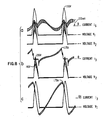
- FIGURE 6a illustrates an envelope of a waveform of current i3 of FIGURE 2 immediately after corresponding transitions between normal operation power-up mode and standby mode without the protection circuit, that would occur if conductor 555 were disconnected for disabling the operation of the protection circuit.
- FIGURE 6b illustrates the envelope of the waveform of current i3 of FIGURE 2 when conductor 555 is connected that enables the operation of the protection circuit. Note that current i3 of FIGURE 6b is limited to the maximum of 1.8 amperes.
- FIGURE 6c illustrates an envelope of collector current of Q1 when the protection circuit is disabled and FIGURE 6d illustrates the envelope of collector current of Q1 when the protection circuit is enabled.
- the operation of the protection circuit is also discussed in U.K. Patent Application 8805757, entitled PROTECTION ARRANGEMENT OF A DEFLECTION CIRCUIT, in the name of the same Applicant, filed 10 March 1988.
- E-W control circuit 300 of FIGURE 2 includes a differential amplifier formed by transistors Q3 and Q4 and Darlington driver transistor Q5 which drives switching transistor Q2.
- the differential amplifier that includes transistors Q3 and Q4 compares a vertical parabola voltage V6 to an exponentially shaped ramp portion V 5a of a voltage V5 having a waveform that is shown in FIGURE 2.
- the crossover points of the compared voltages determines the timing of control voltage V3 of FIGURE 1a.
- horizontal retrace pulses H w3 of FIGURE 2 developed in a winding W3 of transformer T1 are coupled via a resistor R4 to a zener diode D3.
- a speed-up network that includes a capacitor C4, a resistor R5 and a diode D2 generates a gating pulse V D3 across diode D3 having a leading edge with a fast rise time. Faster leading edge, results,advantageously, in a larger dynamic range of E-W control circuit 300.
- Pulse V D3 across diode D3 is applied via resistors R6 and R7 to a capacitor C5 and to a resistor R9 for generating the exponentially shaped ramp portion V 5a of voltage V5.
- Pulsed voltage V5 that includes exponentially increasing top portion V 5a is applied to the base of transistor Q4.
- a vertical rate parabolic voltage V p of FIGURE 2 that includes a superimposed sawtooth voltage is coupled from a DC blocking capacitor C c of a conventional vertical deflection circuit 350 to the base of transistor Q3 via a capacitor C8, a resistor R20 and a resistor R19.
- Resistors R14, R15 and R16 provide dc bias to the base of transistor Q3.
- Voltage V2 that is coupled via a resistor R13 to the base of transistor Q3 and to an integrating capacitor C6 provides a negative feedback, causing the vertical rate envelope of voltage V2 to track parabolic voltage V p that is developed in capacitor C c .
- a vertical sawtooth voltage V RS developed across a sampling resistor R s is coupled, via a resistor R10 and a resistor R9, to a capacitor C5 for developing a voltage V7 having an exponential upramping portion at a peak amplitude that is determined by voltage V RS .
- Voltage V7 is coupled to the base of transistor Q4 of E-W control circuit 300. In this way, Voltage V RS is also coupled via capacitor C c to the base of transistor Q3. Because voltage V RS is applied in a differential manner, voltage V RS is prevented from substantially affecting the switching operation of transistors Q3 and Q4.
- a vertical parabola voltage V 6 developed at the base of transistor Q3 is compared to horizontal ramp voltage V5. The crossover points of voltages V5 and V6 determine the timing of the leading and trailing edges of voltage V3, as indicated before.
- Exponentially shaped ramp portion V 5a of voltage V5 linearizes the east-west raster correction or modulator circuit 200 by compensating for the decreasing level of current i1 of FIGURE 1b, during retrace.
- Linearization occurs because a small amount of modulation of voltage V3 near time t2 of FIGURE 1a results in a higher amplitude modulation of voltage V2 of FIGURE 1e than the same amount of modulation of voltage V3 near time t3 of FIGURE 1a. This is so because the amplitude of each of currents i1 and i4 of FIGURES 1b and 1d, respectively, is higher at time t2 than at time t3 and because voltage V2 is proportional to the value of ⁇ i4. dt.
- the exponentially shaped ramp voltage V5 is steeper near time t2 than at time t3 of FIGURE 1g. Consequently, for a given voltage variation at the base of transistor Q3, the modulation of voltage V3 is smaller around time t2 than around time t3.
- the exponentially shaped ramp portion V 5a of voltage V5 linearizes the operation of E-W raster correction circuit 200.
- Resistor R15 raises the dc average of voltage V5. Compensation of picture width variations as a function of beam current, that may be referred to as anti-breathing, may be applied via the base of transistor Q3.
- FIGURES 3a-3b and 4 illustrate waveforms obtained in operating horizontal deflection circuit 250 of FIGURE 2. Similar symbols and numerals in FIGURES 1a-1h, 2, 3a-3b and 4 indicate similar items or functions.
- voltage V1 of FIGURE 3a and current i1 are substantially unmodulated.
- transistor Q2 of FIGURE 2 is switched to cutoff.
- Diode D Q2 starts conducting between time t5 and t6 of FIGURE 3b.
- voltage V2 of FIGURE 3b is centered around the center of voltage V1 of FIGURE 3a.
- current i3 of FIGURE 3b is zero. Note that deflection current i2 of FIGURE 4 is modulated to provide outside pincushion distortion correction.
- Transistor Q5 of FIGURE 2 having a base that is coupled to the junction of a load resistor R12 and a collector of transistor Q3, applies a base drive to transistor Q2 from a load resistor R17 that is coupled to the collector of transistor Q5.
- the collector of transistor Q5 is coupled via a parallel arrangement of a capacitor C7 and a resistor R18 for generating a fast transition of a falling edge portion of voltage V3 to obtain a fast turn-off of transistor Q2.
- the fast turn-off allows interrupting current i3 immediately after time t1 of FIGURE 1c and allows using the full modulation range between time t1 and t4.
- the turn-off delay of transistor Q2 of FIGURE 2 is less than 1 microsecond.
- the use of a MOSFET in place of Q2 may further reduce the turn-off delay.
- the fast turn-off feature may be desirable in a situation that requires a deflection current at, for example, a higher frequency such as 2xf H .
- FIGURE 7 illustrates a horizontal deflection circuit 250′ that is similar to circuit 250 of FIGURE 2 and that is used for providing horizontal scanning in, for example, a Philips 45AX Picture tube, not shown. Similar numbers and symbols in FIGURES 7 and 2 indicate similar items or functions.
- circuit 250′ of FIGURE 7 provides, in addition to outside pincushion correction that is provided as explained before with respect to FIGURE 2, also inside pincushion correction. Inside pincushion correction is obtained by the operation of a resonance circuit 60 that includes an inductor L1, a capacitor C′ S and that is coupled to a resistor R22.
- Current i5 modulates the trace voltage across capacitor C S .
- the amount of inside correction may be adjusted by adjusting the value of inductor L1. This adjustment, however, is not critical, and a fixed coil of, for example, 2.2mH may be used.
- the required value of capacitor C2 of FIGURE 7 is greater than that in the circuit of FIGURE 2 because inductor L1 of FIGURE 7 is coupled in parallel with winding W1 of transformer T1 during retrace.
- a current such as current i5 is modulated to provide inside pincushion correction is described in more detail in U.S. Patent No. 4,719,392, entitled RASTER CORRECTION CIRCUIT, in the name of P.E. Haferl.
- FIGURES 8a-8c illustrate waveforms obtained during operation of circuit 250′ of FIGURE 7. Similar numerals and symbols in FIGURES 8a-8c and 7 illustrate similar items or functions. Note that current i3 of FIGURE 8b is anti-"S"-shaped during trace, as a result of current i5 of FIGURE 7. Without inside pincushion correction, current i3 would have basically increased in a linear manner, as ideally shown in FIGURE 1c.
- transistor Q2 of FIGURE 7 also provides a current path for current i5, during trace. Note that both currents i5 of FIGURE 8a and current i3 of FIGURE 8b are modulated to provide inside pincushion distortion correction.
Landscapes
- Engineering & Computer Science (AREA)
- Multimedia (AREA)
- Signal Processing (AREA)
- Details Of Television Scanning (AREA)
Applications Claiming Priority (2)
| Application Number | Priority Date | Filing Date | Title |
|---|---|---|---|
| GB888805758A GB8805758D0 (en) | 1988-03-10 | 1988-03-10 | Raster corrected horizontal deflection |
| GB8805758 | 1988-03-10 |
Publications (3)
| Publication Number | Publication Date |
|---|---|
| EP0332091A2 true EP0332091A2 (de) | 1989-09-13 |
| EP0332091A3 EP0332091A3 (de) | 1992-04-22 |
| EP0332091B1 EP0332091B1 (de) | 1996-05-22 |
Family
ID=10633213
Family Applications (1)
| Application Number | Title | Priority Date | Filing Date |
|---|---|---|---|
| EP89103820A Expired - Lifetime EP0332091B1 (de) | 1988-03-10 | 1989-03-04 | Ablenkungsschaltung mit Rasterverzerrungskorrektur |
Country Status (12)
| Country | Link |
|---|---|
| EP (1) | EP0332091B1 (de) |
| JP (1) | JP2596824B2 (de) |
| KR (1) | KR970005218B1 (de) |
| CN (1) | CN1018043B (de) |
| CA (1) | CA1299741C (de) |
| DE (1) | DE68926519T2 (de) |
| ES (1) | ES2091753T3 (de) |
| FI (1) | FI92783C (de) |
| GB (1) | GB8805758D0 (de) |
| HK (1) | HK1004318A1 (de) |
| SG (1) | SG80520A1 (de) |
| TR (1) | TR25808A (de) |
Cited By (3)
| Publication number | Priority date | Publication date | Assignee | Title |
|---|---|---|---|---|
| EP0493824A1 (de) * | 1991-01-04 | 1992-07-08 | RCA Thomson Licensing Corporation | Schaltung zur Korrektur von Rasterverzerrungen |
| EP0530809A1 (de) * | 1991-09-06 | 1993-03-10 | Sony Corporation | Ablenkstromerzeugungsschaltungen |
| EP0664644A3 (en) * | 1994-01-25 | 1995-08-16 | Rca Thomson Licensing Corp | Inner raster distortion correction circuit. |
Families Citing this family (3)
| Publication number | Priority date | Publication date | Assignee | Title |
|---|---|---|---|---|
| TW319939B (de) * | 1993-12-13 | 1997-11-11 | Thomson Consumer Electronics | |
| GB9405799D0 (en) * | 1994-03-24 | 1994-05-11 | Thomson Consumer Electronics | Shaped parabolic correction waveform for curved face plate display tube |
| US6586895B2 (en) * | 2001-05-08 | 2003-07-01 | Thomson Licensing S.A. | Raster distortion correction circuit |
Family Cites Families (7)
| Publication number | Priority date | Publication date | Assignee | Title |
|---|---|---|---|---|
| US3737572A (en) * | 1971-07-23 | 1973-06-05 | Zenith Radio Corp | Series-connected power supply and deflection circuits utilizing a single shunt regulator |
| JPS5419324A (en) * | 1977-07-14 | 1979-02-14 | Sony Corp | Current control circuit |
| US4625154A (en) * | 1985-07-30 | 1986-11-25 | Rca Corporation | Deflection circuit with a switched mode modulator circuit |
| GB8604865D0 (en) * | 1986-02-27 | 1986-04-03 | Rca Corp | Raster correction circuit |
| PT84306B (pt) * | 1986-02-27 | 1989-10-04 | Gen Electric | Dispositivo de deflexao |
| GB2193407A (en) * | 1986-07-18 | 1988-02-03 | Philips Electronic Associated | Television line output circuit |
| US4794307A (en) * | 1986-11-04 | 1988-12-27 | Haferl Peter E | Raster distortion correction for a deflection circuit |
-
1988
- 1988-03-10 GB GB888805758A patent/GB8805758D0/en active Pending
-
1989
- 1989-03-03 FI FI891026A patent/FI92783C/fi not_active IP Right Cessation
- 1989-03-04 DE DE68926519T patent/DE68926519T2/de not_active Expired - Fee Related
- 1989-03-04 SG SG9602380A patent/SG80520A1/en unknown
- 1989-03-04 EP EP89103820A patent/EP0332091B1/de not_active Expired - Lifetime
- 1989-03-04 ES ES89103820T patent/ES2091753T3/es not_active Expired - Lifetime
- 1989-03-07 KR KR1019890002756A patent/KR970005218B1/ko not_active Expired - Fee Related
- 1989-03-09 JP JP1059495A patent/JP2596824B2/ja not_active Expired - Fee Related
- 1989-03-09 CN CN89101248A patent/CN1018043B/zh not_active Expired
- 1989-03-09 TR TR89/0214A patent/TR25808A/xx unknown
- 1989-03-09 CA CA000593225A patent/CA1299741C/en not_active Expired - Fee Related
-
1998
- 1998-04-27 HK HK98103518A patent/HK1004318A1/en not_active IP Right Cessation
Cited By (7)
| Publication number | Priority date | Publication date | Assignee | Title |
|---|---|---|---|---|
| EP0493824A1 (de) * | 1991-01-04 | 1992-07-08 | RCA Thomson Licensing Corporation | Schaltung zur Korrektur von Rasterverzerrungen |
| EP0530809A1 (de) * | 1991-09-06 | 1993-03-10 | Sony Corporation | Ablenkstromerzeugungsschaltungen |
| US5285133A (en) * | 1991-09-06 | 1994-02-08 | Sony Corporation | Deflection current generating circuits |
| EP0664644A3 (en) * | 1994-01-25 | 1995-08-16 | Rca Thomson Licensing Corp | Inner raster distortion correction circuit. |
| US5661375A (en) * | 1994-01-25 | 1997-08-26 | Rca Thomson Licensing Corporation | Inner raster distortion correction circuit |
| CN1076922C (zh) * | 1994-01-25 | 2001-12-26 | Rca·汤姆森许可公司 | 内光栅畸变校正电路 |
| KR100374053B1 (ko) * | 1994-01-25 | 2003-04-26 | 알씨에이 라이센싱 코오포레이숀 | 내측래스터왜곡보정회로 |
Also Published As
| Publication number | Publication date |
|---|---|
| FI92783B (fi) | 1994-09-15 |
| EP0332091A3 (de) | 1992-04-22 |
| CA1299741C (en) | 1992-04-28 |
| KR970005218B1 (ko) | 1997-04-14 |
| JPH01268355A (ja) | 1989-10-26 |
| ES2091753T3 (es) | 1996-11-16 |
| JP2596824B2 (ja) | 1997-04-02 |
| FI92783C (fi) | 1994-12-27 |
| GB8805758D0 (en) | 1988-04-07 |
| FI891026A0 (fi) | 1989-03-03 |
| CN1036676A (zh) | 1989-10-25 |
| EP0332091B1 (de) | 1996-05-22 |
| DE68926519D1 (de) | 1996-06-27 |
| HK1004318A1 (en) | 1998-11-20 |
| FI891026A7 (fi) | 1989-09-11 |
| CN1018043B (zh) | 1992-08-26 |
| TR25808A (tr) | 1993-08-06 |
| SG80520A1 (en) | 2001-05-22 |
| DE68926519T2 (de) | 1996-12-12 |
| KR890015565A (ko) | 1989-10-30 |
Similar Documents
| Publication | Publication Date | Title |
|---|---|---|
| EP0588114B1 (de) | Horizontale Ablenkungswellenform-Korrekturschaltung | |
| US4906902A (en) | Raster distortion corrected deflection circuit | |
| IL48507A (en) | Vertical deflection circuit for cathode ray tubes | |
| EP0211569B1 (de) | Ablenkungsschaltung mit Modulatorschaltung mit Schaltmodus | |
| US5399945A (en) | Raster distortion correction circuit | |
| HK1000196B (en) | A deflection circuit with a switched mode modulator circuit | |
| EP0332091B1 (de) | Ablenkungsschaltung mit Rasterverzerrungskorrektur | |
| HK1004318B (en) | Raster distortion corrected deflection circuit | |
| US5115171A (en) | Raster distortion correction circuit | |
| EP0332089B1 (de) | Schutzanordnung für eine Ablenkungsschaltung | |
| IE41941B1 (en) | Deflection system such as for television receivers including a switched mode vertical (field) deflection circuit | |
| US4572993A (en) | Television deflection circuit with raster width stabilization | |
| HK1004317B (en) | Protection arrangement of a deflection circuit | |
| US4916366A (en) | Power supply protection circuit | |
| US4441058A (en) | Deflection circuit with linearity correction | |
| JP3479089B2 (ja) | テレビジョン偏向装置 | |
| HK1004316B (en) | Raster distortion correction circuit | |
| JPH07254996A (ja) | 水平偏向回路 |
Legal Events
| Date | Code | Title | Description |
|---|---|---|---|
| PUAI | Public reference made under article 153(3) epc to a published international application that has entered the european phase |
Free format text: ORIGINAL CODE: 0009012 |
|
| AK | Designated contracting states |
Kind code of ref document: A2 Designated state(s): DE ES FR GB IT SE |
|
| PUAL | Search report despatched |
Free format text: ORIGINAL CODE: 0009013 |
|
| AK | Designated contracting states |
Kind code of ref document: A3 Designated state(s): DE ES FR GB IT SE |
|
| 17P | Request for examination filed |
Effective date: 19920923 |
|
| 17Q | First examination report despatched |
Effective date: 19940811 |
|
| GRAH | Despatch of communication of intention to grant a patent |
Free format text: ORIGINAL CODE: EPIDOS IGRA |
|
| GRAA | (expected) grant |
Free format text: ORIGINAL CODE: 0009210 |
|
| AK | Designated contracting states |
Kind code of ref document: B1 Designated state(s): DE ES FR GB IT SE |
|
| REF | Corresponds to: |
Ref document number: 68926519 Country of ref document: DE Date of ref document: 19960627 |
|
| ITF | It: translation for a ep patent filed | ||
| ET | Fr: translation filed | ||
| REG | Reference to a national code |
Ref country code: ES Ref legal event code: FG2A Ref document number: 2091753 Country of ref document: ES Kind code of ref document: T3 |
|
| PLBE | No opposition filed within time limit |
Free format text: ORIGINAL CODE: 0009261 |
|
| STAA | Information on the status of an ep patent application or granted ep patent |
Free format text: STATUS: NO OPPOSITION FILED WITHIN TIME LIMIT |
|
| 26N | No opposition filed | ||
| REG | Reference to a national code |
Ref country code: GB Ref legal event code: IF02 |
|
| PGFP | Annual fee paid to national office [announced via postgrant information from national office to epo] |
Ref country code: GB Payment date: 20060123 Year of fee payment: 18 |
|
| PGFP | Annual fee paid to national office [announced via postgrant information from national office to epo] |
Ref country code: SE Payment date: 20060202 Year of fee payment: 18 |
|
| PGFP | Annual fee paid to national office [announced via postgrant information from national office to epo] |
Ref country code: ES Payment date: 20060306 Year of fee payment: 18 |
|
| PGFP | Annual fee paid to national office [announced via postgrant information from national office to epo] |
Ref country code: DE Payment date: 20060322 Year of fee payment: 18 |
|
| PGFP | Annual fee paid to national office [announced via postgrant information from national office to epo] |
Ref country code: FR Payment date: 20060330 Year of fee payment: 18 |
|
| PGFP | Annual fee paid to national office [announced via postgrant information from national office to epo] |
Ref country code: IT Payment date: 20060331 Year of fee payment: 18 |
|
| PG25 | Lapsed in a contracting state [announced via postgrant information from national office to epo] |
Ref country code: SE Free format text: LAPSE BECAUSE OF NON-PAYMENT OF DUE FEES Effective date: 20070305 |
|
| EUG | Se: european patent has lapsed | ||
| GBPC | Gb: european patent ceased through non-payment of renewal fee |
Effective date: 20070304 |
|
| REG | Reference to a national code |
Ref country code: FR Ref legal event code: ST Effective date: 20071130 |
|
| PG25 | Lapsed in a contracting state [announced via postgrant information from national office to epo] |
Ref country code: DE Free format text: LAPSE BECAUSE OF NON-PAYMENT OF DUE FEES Effective date: 20071002 |
|
| PG25 | Lapsed in a contracting state [announced via postgrant information from national office to epo] |
Ref country code: GB Free format text: LAPSE BECAUSE OF NON-PAYMENT OF DUE FEES Effective date: 20070304 |
|
| REG | Reference to a national code |
Ref country code: ES Ref legal event code: FD2A Effective date: 20070305 |
|
| PG25 | Lapsed in a contracting state [announced via postgrant information from national office to epo] |
Ref country code: FR Free format text: LAPSE BECAUSE OF NON-PAYMENT OF DUE FEES Effective date: 20070402 Ref country code: ES Free format text: LAPSE BECAUSE OF NON-PAYMENT OF DUE FEES Effective date: 20070305 |
|
| PG25 | Lapsed in a contracting state [announced via postgrant information from national office to epo] |
Ref country code: IT Free format text: LAPSE BECAUSE OF NON-PAYMENT OF DUE FEES Effective date: 20070304 |