EP0332025B1 - Chirale Derivate des 1,2 -Difluorbenzols - Google Patents
Chirale Derivate des 1,2 -Difluorbenzols Download PDFInfo
- Publication number
- EP0332025B1 EP0332025B1 EP89103497A EP89103497A EP0332025B1 EP 0332025 B1 EP0332025 B1 EP 0332025B1 EP 89103497 A EP89103497 A EP 89103497A EP 89103497 A EP89103497 A EP 89103497A EP 0332025 B1 EP0332025 B1 EP 0332025B1
- Authority
- EP
- European Patent Office
- Prior art keywords
- atoms
- formula
- groups
- radical
- diyl
- Prior art date
- Legal status (The legal status is an assumption and is not a legal conclusion. Google has not performed a legal analysis and makes no representation as to the accuracy of the status listed.)
- Expired - Lifetime
Links
- GOYDNIKZWGIXJT-UHFFFAOYSA-N 1,2-difluorobenzene Chemical class FC1=CC=CC=C1F GOYDNIKZWGIXJT-UHFFFAOYSA-N 0.000 title claims description 13
- -1 piperidine-1,4-diyl Chemical group 0.000 claims description 84
- 150000001875 compounds Chemical class 0.000 claims description 81
- 125000004432 carbon atom Chemical group C* 0.000 claims description 39
- 125000000217 alkyl group Chemical group 0.000 claims description 31
- 125000002496 methyl group Chemical group [H]C([H])([H])* 0.000 claims description 23
- 229910052731 fluorine Inorganic materials 0.000 claims description 19
- 229910052736 halogen Inorganic materials 0.000 claims description 15
- 239000000460 chlorine Substances 0.000 claims description 14
- 239000004990 Smectic liquid crystal Substances 0.000 claims description 13
- 229910052801 chlorine Inorganic materials 0.000 claims description 13
- 150000002367 halogens Chemical class 0.000 claims description 13
- 229910052799 carbon Inorganic materials 0.000 claims description 10
- 229910052757 nitrogen Inorganic materials 0.000 claims description 10
- 125000003545 alkoxy group Chemical group 0.000 claims description 9
- 125000001140 1,4-phenylene group Chemical group [H]C1=C([H])C([*:2])=C([H])C([H])=C1[*:1] 0.000 claims description 6
- ZAMOUSCENKQFHK-UHFFFAOYSA-N Chlorine atom Chemical compound [Cl] ZAMOUSCENKQFHK-UHFFFAOYSA-N 0.000 claims description 6
- 125000002947 alkylene group Chemical group 0.000 claims description 6
- 239000011737 fluorine Substances 0.000 claims description 6
- 125000001153 fluoro group Chemical group F* 0.000 claims description 6
- 125000004430 oxygen atom Chemical group O* 0.000 claims description 6
- 125000004955 1,4-cyclohexylene group Chemical group [H]C1([H])C([H])([H])C([H])([*:1])C([H])([H])C([H])([H])C1([H])[*:2] 0.000 claims description 5
- 229910052794 bromium Inorganic materials 0.000 claims description 5
- 125000001424 substituent group Chemical group 0.000 claims description 5
- PXGOKWXKJXAPGV-UHFFFAOYSA-N Fluorine Chemical compound FF PXGOKWXKJXAPGV-UHFFFAOYSA-N 0.000 claims description 4
- 125000004423 acyloxy group Chemical group 0.000 claims description 4
- 125000004453 alkoxycarbonyl group Chemical group 0.000 claims description 4
- 229910052739 hydrogen Inorganic materials 0.000 claims description 4
- KWKAKUADMBZCLK-UHFFFAOYSA-N 1-octene Chemical group CCCCCCC=C KWKAKUADMBZCLK-UHFFFAOYSA-N 0.000 claims description 3
- 125000001309 chloro group Chemical group Cl* 0.000 claims description 2
- 230000001939 inductive effect Effects 0.000 claims description 2
- 125000005010 perfluoroalkyl group Chemical group 0.000 claims description 2
- 125000004434 sulfur atom Chemical group 0.000 claims description 2
- YMWUJEATGCHHMB-UHFFFAOYSA-N Dichloromethane Chemical compound ClCCl YMWUJEATGCHHMB-UHFFFAOYSA-N 0.000 description 49
- 239000012071 phase Substances 0.000 description 45
- 239000000203 mixture Substances 0.000 description 37
- WYURNTSHIVDZCO-UHFFFAOYSA-N Tetrahydrofuran Chemical compound C1CCOC1 WYURNTSHIVDZCO-UHFFFAOYSA-N 0.000 description 36
- YXFVVABEGXRONW-UHFFFAOYSA-N Toluene Chemical compound CC1=CC=CC=C1 YXFVVABEGXRONW-UHFFFAOYSA-N 0.000 description 30
- RTZKZFJDLAIYFH-UHFFFAOYSA-N Diethyl ether Chemical compound CCOCC RTZKZFJDLAIYFH-UHFFFAOYSA-N 0.000 description 29
- ZMXDDKWLCZADIW-UHFFFAOYSA-N N,N-Dimethylformamide Chemical compound CN(C)C=O ZMXDDKWLCZADIW-UHFFFAOYSA-N 0.000 description 25
- JUJWROOIHBZHMG-UHFFFAOYSA-N pyridine Substances C1=CC=NC=C1 JUJWROOIHBZHMG-UHFFFAOYSA-N 0.000 description 21
- 238000006243 chemical reaction Methods 0.000 description 20
- VHYFNPMBLIVWCW-UHFFFAOYSA-N 4-Dimethylaminopyridine Chemical compound CN(C)C1=CC=NC=C1 VHYFNPMBLIVWCW-UHFFFAOYSA-N 0.000 description 18
- VLKZOEOYAKHREP-UHFFFAOYSA-N n-Hexane Chemical compound CCCCCC VLKZOEOYAKHREP-UHFFFAOYSA-N 0.000 description 18
- YLQBMQCUIZJEEH-UHFFFAOYSA-N tetrahydrofuran Natural products C=1C=COC=1 YLQBMQCUIZJEEH-UHFFFAOYSA-N 0.000 description 18
- KWYUFKZDYYNOTN-UHFFFAOYSA-M Potassium hydroxide Chemical compound [OH-].[K+] KWYUFKZDYYNOTN-UHFFFAOYSA-M 0.000 description 17
- XLYOFNOQVPJJNP-UHFFFAOYSA-N water Substances O XLYOFNOQVPJJNP-UHFFFAOYSA-N 0.000 description 16
- CSCPPACGZOOCGX-UHFFFAOYSA-N Acetone Chemical compound CC(C)=O CSCPPACGZOOCGX-UHFFFAOYSA-N 0.000 description 15
- UHOVQNZJYSORNB-UHFFFAOYSA-N Benzene Chemical compound C1=CC=CC=C1 UHOVQNZJYSORNB-UHFFFAOYSA-N 0.000 description 15
- LFQSCWFLJHTTHZ-UHFFFAOYSA-N Ethanol Chemical compound CCO LFQSCWFLJHTTHZ-UHFFFAOYSA-N 0.000 description 15
- MZRVEZGGRBJDDB-UHFFFAOYSA-N N-Butyllithium Chemical compound [Li]CCCC MZRVEZGGRBJDDB-UHFFFAOYSA-N 0.000 description 13
- ZMANZCXQSJIPKH-UHFFFAOYSA-N Triethylamine Chemical compound CCN(CC)CC ZMANZCXQSJIPKH-UHFFFAOYSA-N 0.000 description 13
- 239000011541 reaction mixture Substances 0.000 description 13
- 238000000034 method Methods 0.000 description 12
- 125000001570 methylene group Chemical group [H]C([H])([*:1])[*:2] 0.000 description 12
- BWHMMNNQKKPAPP-UHFFFAOYSA-L potassium carbonate Chemical compound [K+].[K+].[O-]C([O-])=O BWHMMNNQKKPAPP-UHFFFAOYSA-L 0.000 description 12
- FYSNRJHAOHDILO-UHFFFAOYSA-N thionyl chloride Chemical compound ClS(Cl)=O FYSNRJHAOHDILO-UHFFFAOYSA-N 0.000 description 12
- 230000003197 catalytic effect Effects 0.000 description 11
- QOSSAOTZNIDXMA-UHFFFAOYSA-N Dicylcohexylcarbodiimide Chemical compound C1CCCCC1N=C=NC1CCCCC1 QOSSAOTZNIDXMA-UHFFFAOYSA-N 0.000 description 10
- 239000002253 acid Substances 0.000 description 10
- 238000001816 cooling Methods 0.000 description 10
- 238000005886 esterification reaction Methods 0.000 description 10
- UMJSCPRVCHMLSP-UHFFFAOYSA-N pyridine Natural products COC1=CC=CN=C1 UMJSCPRVCHMLSP-UHFFFAOYSA-N 0.000 description 10
- HEMHJVSKTPXQMS-UHFFFAOYSA-M sodium hydroxide Inorganic materials [OH-].[Na+] HEMHJVSKTPXQMS-UHFFFAOYSA-M 0.000 description 10
- 238000003756 stirring Methods 0.000 description 10
- OKKJLVBELUTLKV-UHFFFAOYSA-N Methanol Chemical compound OC OKKJLVBELUTLKV-UHFFFAOYSA-N 0.000 description 9
- 239000002585 base Substances 0.000 description 9
- 230000032050 esterification Effects 0.000 description 9
- 239000000047 product Substances 0.000 description 9
- 150000003254 radicals Chemical class 0.000 description 9
- 239000000126 substance Substances 0.000 description 9
- 229960000549 4-dimethylaminophenol Drugs 0.000 description 8
- QGZKDVFQNNGYKY-UHFFFAOYSA-N Ammonia Chemical compound N QGZKDVFQNNGYKY-UHFFFAOYSA-N 0.000 description 8
- 238000004587 chromatography analysis Methods 0.000 description 8
- CSJLBAMHHLJAAS-UHFFFAOYSA-N diethylaminosulfur trifluoride Chemical compound CCN(CC)S(F)(F)F CSJLBAMHHLJAAS-UHFFFAOYSA-N 0.000 description 8
- 238000007327 hydrogenolysis reaction Methods 0.000 description 8
- 239000002904 solvent Substances 0.000 description 8
- RIOQSEWOXXDEQQ-UHFFFAOYSA-N triphenylphosphine Chemical compound C1=CC=CC=C1P(C=1C=CC=CC=1)C1=CC=CC=C1 RIOQSEWOXXDEQQ-UHFFFAOYSA-N 0.000 description 8
- QTBSBXVTEAMEQO-UHFFFAOYSA-N Acetic acid Chemical compound CC(O)=O QTBSBXVTEAMEQO-UHFFFAOYSA-N 0.000 description 7
- KWYHDKDOAIKMQN-UHFFFAOYSA-N N,N,N',N'-tetramethylethylenediamine Chemical compound CN(C)CCN(C)C KWYHDKDOAIKMQN-UHFFFAOYSA-N 0.000 description 7
- 239000012442 inert solvent Substances 0.000 description 7
- 150000002989 phenols Chemical class 0.000 description 7
- 239000002243 precursor Substances 0.000 description 7
- 150000003839 salts Chemical class 0.000 description 7
- VEXZGXHMUGYJMC-UHFFFAOYSA-N Hydrochloric acid Chemical compound Cl VEXZGXHMUGYJMC-UHFFFAOYSA-N 0.000 description 6
- ISWSIDIOOBJBQZ-UHFFFAOYSA-N Phenol Chemical compound OC1=CC=CC=C1 ISWSIDIOOBJBQZ-UHFFFAOYSA-N 0.000 description 6
- UIIMBOGNXHQVGW-UHFFFAOYSA-M Sodium bicarbonate Chemical compound [Na+].OC([O-])=O UIIMBOGNXHQVGW-UHFFFAOYSA-M 0.000 description 6
- 150000001735 carboxylic acids Chemical class 0.000 description 6
- 239000003054 catalyst Substances 0.000 description 6
- 230000005494 condensation Effects 0.000 description 6
- FAMRKDQNMBBFBR-UHFFFAOYSA-N ethyl n-ethoxycarbonyliminocarbamate Chemical compound CCOC(=O)N=NC(=O)OCC FAMRKDQNMBBFBR-UHFFFAOYSA-N 0.000 description 6
- 230000003287 optical effect Effects 0.000 description 6
- CTSLXHKWHWQRSH-UHFFFAOYSA-N oxalyl chloride Chemical compound ClC(=O)C(Cl)=O CTSLXHKWHWQRSH-UHFFFAOYSA-N 0.000 description 6
- 229910000027 potassium carbonate Inorganic materials 0.000 description 6
- 239000002244 precipitate Substances 0.000 description 6
- 238000002360 preparation method Methods 0.000 description 6
- 230000009467 reduction Effects 0.000 description 6
- 0 *C(C**c(ccc([*+])c1F)c1F)CN Chemical compound *C(C**c(ccc([*+])c1F)c1F)CN 0.000 description 5
- FCABHFOMGWBMSU-UHFFFAOYSA-N 2,3-difluoro-4-(4-heptoxyphenyl)benzoic acid Chemical compound C1=CC(OCCCCCCC)=CC=C1C1=CC=C(C(O)=O)C(F)=C1F FCABHFOMGWBMSU-UHFFFAOYSA-N 0.000 description 5
- QLOGSXTVNXUXHC-UHFFFAOYSA-N 2,3-difluoro-4-(4-heptoxyphenyl)phenol Chemical group C1=CC(OCCCCCCC)=CC=C1C1=CC=C(O)C(F)=C1F QLOGSXTVNXUXHC-UHFFFAOYSA-N 0.000 description 5
- ZWEHNKRNPOVVGH-UHFFFAOYSA-N 2-Butanone Chemical compound CCC(C)=O ZWEHNKRNPOVVGH-UHFFFAOYSA-N 0.000 description 5
- 150000001299 aldehydes Chemical class 0.000 description 5
- 125000001797 benzyl group Chemical group [H]C1=C([H])C([H])=C(C([H])=C1[H])C([H])([H])* 0.000 description 5
- FAMRKDQNMBBFBR-BQYQJAHWSA-N diethyl azodicarboxylate Substances CCOC(=O)\N=N\C(=O)OCC FAMRKDQNMBBFBR-BQYQJAHWSA-N 0.000 description 5
- 239000000706 filtrate Substances 0.000 description 5
- 239000000463 material Substances 0.000 description 5
- 230000010287 polarization Effects 0.000 description 5
- 235000011118 potassium hydroxide Nutrition 0.000 description 5
- 230000002269 spontaneous effect Effects 0.000 description 5
- 239000007858 starting material Substances 0.000 description 5
- 238000010626 work up procedure Methods 0.000 description 5
- SWMFGSPOFIKKMJ-UHFFFAOYSA-N (2,3-difluoro-4-phenylmethoxyphenyl)boronic acid Chemical compound FC1=C(F)C(B(O)O)=CC=C1OCC1=CC=CC=C1 SWMFGSPOFIKKMJ-UHFFFAOYSA-N 0.000 description 4
- NGNBDVOYPDDBFK-UHFFFAOYSA-N 2-[2,4-di(pentan-2-yl)phenoxy]acetyl chloride Chemical compound CCCC(C)C1=CC=C(OCC(Cl)=O)C(C(C)CCC)=C1 NGNBDVOYPDDBFK-UHFFFAOYSA-N 0.000 description 4
- NLXLAEXVIDQMFP-UHFFFAOYSA-N Ammonia chloride Chemical compound [NH4+].[Cl-] NLXLAEXVIDQMFP-UHFFFAOYSA-N 0.000 description 4
- CURLTUGMZLYLDI-UHFFFAOYSA-N Carbon dioxide Chemical compound O=C=O CURLTUGMZLYLDI-UHFFFAOYSA-N 0.000 description 4
- IAZDPXIOMUYVGZ-UHFFFAOYSA-N Dimethylsulphoxide Chemical compound CS(C)=O IAZDPXIOMUYVGZ-UHFFFAOYSA-N 0.000 description 4
- DGAQECJNVWCQMB-PUAWFVPOSA-M Ilexoside XXIX Chemical compound C[C@@H]1CC[C@@]2(CC[C@@]3(C(=CC[C@H]4[C@]3(CC[C@@H]5[C@@]4(CC[C@@H](C5(C)C)OS(=O)(=O)[O-])C)C)[C@@H]2[C@]1(C)O)C)C(=O)O[C@H]6[C@@H]([C@H]([C@@H]([C@H](O6)CO)O)O)O.[Na+] DGAQECJNVWCQMB-PUAWFVPOSA-M 0.000 description 4
- SMWDFEZZVXVKRB-UHFFFAOYSA-N Quinoline Chemical compound N1=CC=CC2=CC=CC=C21 SMWDFEZZVXVKRB-UHFFFAOYSA-N 0.000 description 4
- CDBYLPFSWZWCQE-UHFFFAOYSA-L Sodium Carbonate Chemical compound [Na+].[Na+].[O-]C([O-])=O CDBYLPFSWZWCQE-UHFFFAOYSA-L 0.000 description 4
- QAOWNCQODCNURD-UHFFFAOYSA-N Sulfuric acid Chemical compound OS(O)(=O)=O QAOWNCQODCNURD-UHFFFAOYSA-N 0.000 description 4
- 150000001298 alcohols Chemical class 0.000 description 4
- 229910052783 alkali metal Inorganic materials 0.000 description 4
- 150000008064 anhydrides Chemical class 0.000 description 4
- 230000015572 biosynthetic process Effects 0.000 description 4
- 150000001721 carbon Chemical group 0.000 description 4
- 230000008878 coupling Effects 0.000 description 4
- 238000010168 coupling process Methods 0.000 description 4
- 238000005859 coupling reaction Methods 0.000 description 4
- 239000012039 electrophile Substances 0.000 description 4
- 150000002148 esters Chemical class 0.000 description 4
- LZCLXQDLBQLTDK-UHFFFAOYSA-N ethyl 2-hydroxypropanoate Chemical compound CCOC(=O)C(C)O LZCLXQDLBQLTDK-UHFFFAOYSA-N 0.000 description 4
- 125000001495 ethyl group Chemical group [H]C([H])([H])C([H])([H])* 0.000 description 4
- 238000010438 heat treatment Methods 0.000 description 4
- 125000002887 hydroxy group Chemical group [H]O* 0.000 description 4
- 150000002576 ketones Chemical class 0.000 description 4
- 239000012074 organic phase Substances 0.000 description 4
- KDLHZDBZIXYQEI-UHFFFAOYSA-N palladium Substances [Pd] KDLHZDBZIXYQEI-UHFFFAOYSA-N 0.000 description 4
- XHXFXVLFKHQFAL-UHFFFAOYSA-N phosphoryl trichloride Chemical compound ClP(Cl)(Cl)=O XHXFXVLFKHQFAL-UHFFFAOYSA-N 0.000 description 4
- 235000011181 potassium carbonates Nutrition 0.000 description 4
- 238000003786 synthesis reaction Methods 0.000 description 4
- NQRYJNQNLNOLGT-UHFFFAOYSA-N tetrahydropyridine hydrochloride Natural products C1CCNCC1 NQRYJNQNLNOLGT-UHFFFAOYSA-N 0.000 description 4
- NQPDZGIKBAWPEJ-UHFFFAOYSA-N valeric acid Chemical compound CCCCC(O)=O NQPDZGIKBAWPEJ-UHFFFAOYSA-N 0.000 description 4
- RYHBNJHYFVUHQT-UHFFFAOYSA-N 1,4-Dioxane Chemical compound C1COCCO1 RYHBNJHYFVUHQT-UHFFFAOYSA-N 0.000 description 3
- KVSNCHXZOIMHMI-UHFFFAOYSA-N 2-cyano-2-methylhexanoic acid Chemical compound CCCCC(C)(C#N)C(O)=O KVSNCHXZOIMHMI-UHFFFAOYSA-N 0.000 description 3
- XTHFKEDIFFGKHM-UHFFFAOYSA-N Dimethoxyethane Chemical compound COCCOC XTHFKEDIFFGKHM-UHFFFAOYSA-N 0.000 description 3
- XEKOWRVHYACXOJ-UHFFFAOYSA-N Ethyl acetate Chemical compound CCOC(C)=O XEKOWRVHYACXOJ-UHFFFAOYSA-N 0.000 description 3
- BZLVMXJERCGZMT-UHFFFAOYSA-N Methyl tert-butyl ether Chemical compound COC(C)(C)C BZLVMXJERCGZMT-UHFFFAOYSA-N 0.000 description 3
- HCHKCACWOHOZIP-UHFFFAOYSA-N Zinc Chemical compound [Zn] HCHKCACWOHOZIP-UHFFFAOYSA-N 0.000 description 3
- 229960000583 acetic acid Drugs 0.000 description 3
- QVGXLLKOCUKJST-UHFFFAOYSA-N atomic oxygen Chemical compound [O] QVGXLLKOCUKJST-UHFFFAOYSA-N 0.000 description 3
- 150000001732 carboxylic acid derivatives Chemical class 0.000 description 3
- 238000009833 condensation Methods 0.000 description 3
- 239000000470 constituent Substances 0.000 description 3
- UAOMVDZJSHZZME-UHFFFAOYSA-N diisopropylamine Chemical compound CC(C)NC(C)C UAOMVDZJSHZZME-UHFFFAOYSA-N 0.000 description 3
- 239000002019 doping agent Substances 0.000 description 3
- 238000006266 etherification reaction Methods 0.000 description 3
- 230000007717 exclusion Effects 0.000 description 3
- 230000002349 favourable effect Effects 0.000 description 3
- 239000007789 gas Substances 0.000 description 3
- 125000000623 heterocyclic group Chemical group 0.000 description 3
- 229930195733 hydrocarbon Natural products 0.000 description 3
- 150000002430 hydrocarbons Chemical class 0.000 description 3
- 125000004435 hydrogen atom Chemical group [H]* 0.000 description 3
- 239000000543 intermediate Substances 0.000 description 3
- 239000007788 liquid Substances 0.000 description 3
- 238000004519 manufacturing process Methods 0.000 description 3
- 229910052751 metal Inorganic materials 0.000 description 3
- 239000002184 metal Substances 0.000 description 3
- 150000002825 nitriles Chemical class 0.000 description 3
- 229910052760 oxygen Inorganic materials 0.000 description 3
- 239000001301 oxygen Substances 0.000 description 3
- 238000010992 reflux Methods 0.000 description 3
- 238000007142 ring opening reaction Methods 0.000 description 3
- 229910052708 sodium Inorganic materials 0.000 description 3
- 235000017557 sodium bicarbonate Nutrition 0.000 description 3
- 229910000030 sodium bicarbonate Inorganic materials 0.000 description 3
- JOXIMZWYDAKGHI-UHFFFAOYSA-N toluene-4-sulfonic acid Chemical compound CC1=CC=C(S(O)(=O)=O)C=C1 JOXIMZWYDAKGHI-UHFFFAOYSA-N 0.000 description 3
- 125000005490 tosylate group Chemical group 0.000 description 3
- 239000011701 zinc Substances 0.000 description 3
- 229910052725 zinc Inorganic materials 0.000 description 3
- CMAJZWMXEYGGIM-UHFFFAOYSA-N (6-bromopyridin-3-yl) acetate Chemical compound CC(=O)OC1=CC=C(Br)N=C1 CMAJZWMXEYGGIM-UHFFFAOYSA-N 0.000 description 2
- QVCNGPQWEUTXPU-UHFFFAOYSA-N 1,2-difluoro-3-(4-heptoxyphenyl)benzene Chemical group C1=CC(OCCCCCCC)=CC=C1C1=CC=CC(F)=C1F QVCNGPQWEUTXPU-UHFFFAOYSA-N 0.000 description 2
- 150000000185 1,3-diols Chemical class 0.000 description 2
- IVJFXSLMUSQZMC-UHFFFAOYSA-N 1,3-dithiole Chemical compound C1SC=CS1 IVJFXSLMUSQZMC-UHFFFAOYSA-N 0.000 description 2
- ARSCIYBVKPWUMR-UHFFFAOYSA-N 2,3-difluoro-4-phenylmethoxybenzenecarboximidamide Chemical compound FC1=C(F)C(C(=N)N)=CC=C1OCC1=CC=CC=C1 ARSCIYBVKPWUMR-UHFFFAOYSA-N 0.000 description 2
- KTOHSVJTKXHGEM-UHFFFAOYSA-N 2,3-difluoro-4-pyrimidin-2-ylphenol Chemical class FC1=C(C=CC(=C1F)O)C1=NC=CC=N1 KTOHSVJTKXHGEM-UHFFFAOYSA-N 0.000 description 2
- OISVCGZHLKNMSJ-UHFFFAOYSA-N 2,6-dimethylpyridine Chemical compound CC1=CC=CC(C)=N1 OISVCGZHLKNMSJ-UHFFFAOYSA-N 0.000 description 2
- YWNJQQNBJQUKME-UHFFFAOYSA-N 2-bromo-5-methylpyridine Chemical compound CC1=CC=C(Br)N=C1 YWNJQQNBJQUKME-UHFFFAOYSA-N 0.000 description 2
- DDTJFSPKEIAZAM-UHFFFAOYSA-N 2-chloro-3-methylbutanoic acid Chemical compound CC(C)C(Cl)C(O)=O DDTJFSPKEIAZAM-UHFFFAOYSA-N 0.000 description 2
- NJWSNNWLBMSXQR-UHFFFAOYSA-N 2-hexyloxirane Chemical compound CCCCCCC1CO1 NJWSNNWLBMSXQR-UHFFFAOYSA-N 0.000 description 2
- YPUSLQFSBBYBCE-UHFFFAOYSA-N 3-(dimethylamino)-2-phenylmethoxyprop-2-enal Chemical compound CN(C)C=C(C=O)OCC1=CC=CC=C1 YPUSLQFSBBYBCE-UHFFFAOYSA-N 0.000 description 2
- CIBZJYJCXAAQIX-UHFFFAOYSA-N 4-(2,3-difluoro-4-heptoxyphenyl)benzoic acid Chemical compound FC1=C(F)C(OCCCCCCC)=CC=C1C1=CC=C(C(O)=O)C=C1 CIBZJYJCXAAQIX-UHFFFAOYSA-N 0.000 description 2
- RXQIMSBNQMJDDQ-UHFFFAOYSA-N 5-phenylmethoxypyrimidine Chemical compound C=1C=CC=CC=1COC1=CN=CN=C1 RXQIMSBNQMJDDQ-UHFFFAOYSA-N 0.000 description 2
- PTEFNEALEPSHLC-UHFFFAOYSA-N 6-bromopyridin-3-ol Chemical compound OC1=CC=C(Br)N=C1 PTEFNEALEPSHLC-UHFFFAOYSA-N 0.000 description 2
- USFZMSVCRYTOJT-UHFFFAOYSA-N Ammonium acetate Chemical compound N.CC(O)=O USFZMSVCRYTOJT-UHFFFAOYSA-N 0.000 description 2
- VHUUQVKOLVNVRT-UHFFFAOYSA-N Ammonium hydroxide Chemical compound [NH4+].[OH-] VHUUQVKOLVNVRT-UHFFFAOYSA-N 0.000 description 2
- IJGRMHOSHXDMSA-UHFFFAOYSA-N Atomic nitrogen Chemical compound N#N IJGRMHOSHXDMSA-UHFFFAOYSA-N 0.000 description 2
- ZTQSAGDEMFDKMZ-UHFFFAOYSA-N Butyraldehyde Chemical compound CCCC=O ZTQSAGDEMFDKMZ-UHFFFAOYSA-N 0.000 description 2
- VTYYLEPIZMXCLO-UHFFFAOYSA-L Calcium carbonate Chemical compound [Ca+2].[O-]C([O-])=O VTYYLEPIZMXCLO-UHFFFAOYSA-L 0.000 description 2
- OKTJSMMVPCPJKN-UHFFFAOYSA-N Carbon Chemical compound [C] OKTJSMMVPCPJKN-UHFFFAOYSA-N 0.000 description 2
- HEDRZPFGACZZDS-UHFFFAOYSA-N Chloroform Chemical compound ClC(Cl)Cl HEDRZPFGACZZDS-UHFFFAOYSA-N 0.000 description 2
- XFXPMWWXUTWYJX-UHFFFAOYSA-N Cyanide Chemical compound N#[C-] XFXPMWWXUTWYJX-UHFFFAOYSA-N 0.000 description 2
- XDTMQSROBMDMFD-UHFFFAOYSA-N Cyclohexane Chemical compound C1CCCCC1 XDTMQSROBMDMFD-UHFFFAOYSA-N 0.000 description 2
- WXODJVGTGIASRA-UHFFFAOYSA-N FC1=C(C=CC(=C1F)O)C1=NC=CC=C1 Chemical class FC1=C(C=CC(=C1F)O)C1=NC=CC=C1 WXODJVGTGIASRA-UHFFFAOYSA-N 0.000 description 2
- KFZMGEQAYNKOFK-UHFFFAOYSA-N Isopropanol Chemical compound CC(C)O KFZMGEQAYNKOFK-UHFFFAOYSA-N 0.000 description 2
- 238000005684 Liebig rearrangement reaction Methods 0.000 description 2
- 239000012448 Lithium borohydride Substances 0.000 description 2
- IMNFDUFMRHMDMM-UHFFFAOYSA-N N-Heptane Chemical compound CCCCCCC IMNFDUFMRHMDMM-UHFFFAOYSA-N 0.000 description 2
- 229910019213 POCl3 Inorganic materials 0.000 description 2
- CZPWVGJYEJSRLH-UHFFFAOYSA-N Pyrimidine Chemical compound C1=CN=CN=C1 CZPWVGJYEJSRLH-UHFFFAOYSA-N 0.000 description 2
- LOUPRKONTZGTKE-WZBLMQSHSA-N Quinine Chemical compound C([C@H]([C@H](C1)C=C)C2)C[N@@]1[C@@H]2[C@H](O)C1=CC=NC2=CC=C(OC)C=C21 LOUPRKONTZGTKE-WZBLMQSHSA-N 0.000 description 2
- 229910006124 SOCl2 Inorganic materials 0.000 description 2
- QAOWNCQODCNURD-UHFFFAOYSA-L Sulfate Chemical compound [O-]S([O-])(=O)=O QAOWNCQODCNURD-UHFFFAOYSA-L 0.000 description 2
- XSQUKJJJFZCRTK-UHFFFAOYSA-N Urea Chemical compound NC(N)=O XSQUKJJJFZCRTK-UHFFFAOYSA-N 0.000 description 2
- 239000000654 additive Substances 0.000 description 2
- 230000001476 alcoholic effect Effects 0.000 description 2
- 150000001340 alkali metals Chemical class 0.000 description 2
- 125000005194 alkoxycarbonyloxy group Chemical group 0.000 description 2
- 235000019270 ammonium chloride Nutrition 0.000 description 2
- 235000011114 ammonium hydroxide Nutrition 0.000 description 2
- RDOXTESZEPMUJZ-UHFFFAOYSA-N anisole Chemical compound COC1=CC=CC=C1 RDOXTESZEPMUJZ-UHFFFAOYSA-N 0.000 description 2
- 238000005899 aromatization reaction Methods 0.000 description 2
- ZYTLPUIDJRKAAM-UHFFFAOYSA-N benzyl 2-hydroxypropanoate Chemical compound CC(O)C(=O)OCC1=CC=CC=C1 ZYTLPUIDJRKAAM-UHFFFAOYSA-N 0.000 description 2
- 235000010290 biphenyl Nutrition 0.000 description 2
- 239000001569 carbon dioxide Substances 0.000 description 2
- 229910002092 carbon dioxide Inorganic materials 0.000 description 2
- 238000004440 column chromatography Methods 0.000 description 2
- 238000002425 crystallisation Methods 0.000 description 2
- 230000008025 crystallization Effects 0.000 description 2
- NZNMSOFKMUBTKW-UHFFFAOYSA-N cyclohexanecarboxylic acid Chemical compound OC(=O)C1CCCCC1 NZNMSOFKMUBTKW-UHFFFAOYSA-N 0.000 description 2
- JHIVVAPYMSGYDF-UHFFFAOYSA-N cyclohexanone Chemical compound O=C1CCCCC1 JHIVVAPYMSGYDF-UHFFFAOYSA-N 0.000 description 2
- 125000000113 cyclohexyl group Chemical group [H]C1([H])C([H])([H])C([H])([H])C([H])(*)C([H])([H])C1([H])[H] 0.000 description 2
- IGARGHRYKHJQSM-UHFFFAOYSA-N cyclohexylbenzene Chemical class C1CCCCC1C1=CC=CC=C1 IGARGHRYKHJQSM-UHFFFAOYSA-N 0.000 description 2
- WVIIMZNLDWSIRH-UHFFFAOYSA-N cyclohexylcyclohexane Chemical class C1CCCCC1C1CCCCC1 WVIIMZNLDWSIRH-UHFFFAOYSA-N 0.000 description 2
- 230000018044 dehydration Effects 0.000 description 2
- 238000006297 dehydration reaction Methods 0.000 description 2
- SBZXBUIDTXKZTM-UHFFFAOYSA-N diglyme Chemical compound COCCOCCOC SBZXBUIDTXKZTM-UHFFFAOYSA-N 0.000 description 2
- ZUOUZKKEUPVFJK-UHFFFAOYSA-N diphenyl Chemical compound C1=CC=CC=C1C1=CC=CC=C1 ZUOUZKKEUPVFJK-UHFFFAOYSA-N 0.000 description 2
- 238000005516 engineering process Methods 0.000 description 2
- 150000002170 ethers Chemical class 0.000 description 2
- LZCLXQDLBQLTDK-BYPYZUCNSA-N ethyl (2S)-lactate Chemical compound CCOC(=O)[C@H](C)O LZCLXQDLBQLTDK-BYPYZUCNSA-N 0.000 description 2
- AFRFSWINLKRPMK-UHFFFAOYSA-N ethyl 2-cyano-2-methylhexanoate Chemical compound CCCCC(C)(C#N)C(=O)OCC AFRFSWINLKRPMK-UHFFFAOYSA-N 0.000 description 2
- YMUSKLAPOQSFAH-UHFFFAOYSA-N ethyl 2-cyanohexanoate Chemical compound CCCCC(C#N)C(=O)OCC YMUSKLAPOQSFAH-UHFFFAOYSA-N 0.000 description 2
- 239000012362 glacial acetic acid Substances 0.000 description 2
- 150000004820 halides Chemical class 0.000 description 2
- GNOIPBMMFNIUFM-UHFFFAOYSA-N hexamethylphosphoric triamide Chemical compound CN(C)P(=O)(N(C)C)N(C)C GNOIPBMMFNIUFM-UHFFFAOYSA-N 0.000 description 2
- 150000004694 iodide salts Chemical class 0.000 description 2
- 125000000959 isobutyl group Chemical group [H]C([H])([H])C([H])(C([H])([H])[H])C([H])([H])* 0.000 description 2
- 125000001972 isopentyl group Chemical group [H]C([H])([H])C([H])(C([H])([H])[H])C([H])([H])C([H])([H])* 0.000 description 2
- 239000004973 liquid crystal related substance Substances 0.000 description 2
- 238000002844 melting Methods 0.000 description 2
- 230000008018 melting Effects 0.000 description 2
- 238000006263 metalation reaction Methods 0.000 description 2
- 125000002560 nitrile group Chemical group 0.000 description 2
- 229910000069 nitrogen hydride Inorganic materials 0.000 description 2
- 239000012038 nucleophile Substances 0.000 description 2
- 150000007530 organic bases Chemical class 0.000 description 2
- 239000007800 oxidant agent Substances 0.000 description 2
- 230000003647 oxidation Effects 0.000 description 2
- 238000007254 oxidation reaction Methods 0.000 description 2
- 150000002924 oxiranes Chemical class 0.000 description 2
- 150000004707 phenolate Chemical class 0.000 description 2
- 229940031826 phenolate Drugs 0.000 description 2
- 125000001997 phenyl group Chemical group [H]C1=C([H])C([H])=C(*)C([H])=C1[H] 0.000 description 2
- 229910052700 potassium Inorganic materials 0.000 description 2
- SCVFZCLFOSHCOH-UHFFFAOYSA-M potassium acetate Chemical compound [K+].CC([O-])=O SCVFZCLFOSHCOH-UHFFFAOYSA-M 0.000 description 2
- 235000015320 potassium carbonate Nutrition 0.000 description 2
- 125000006239 protecting group Chemical group 0.000 description 2
- AOJFQRQNPXYVLM-UHFFFAOYSA-N pyridin-1-ium;chloride Chemical compound [Cl-].C1=CC=[NH+]C=C1 AOJFQRQNPXYVLM-UHFFFAOYSA-N 0.000 description 2
- 150000003222 pyridines Chemical class 0.000 description 2
- 150000003230 pyrimidines Chemical class 0.000 description 2
- 230000002829 reductive effect Effects 0.000 description 2
- 238000007127 saponification reaction Methods 0.000 description 2
- 125000002914 sec-butyl group Chemical group [H]C([H])([H])C([H])([H])C([H])(*)C([H])([H])[H] 0.000 description 2
- 239000011734 sodium Substances 0.000 description 2
- 239000001632 sodium acetate Substances 0.000 description 2
- 235000017281 sodium acetate Nutrition 0.000 description 2
- 229910000029 sodium carbonate Inorganic materials 0.000 description 2
- 235000017550 sodium carbonate Nutrition 0.000 description 2
- 235000011121 sodium hydroxide Nutrition 0.000 description 2
- CIHOLLKRGTVIJN-UHFFFAOYSA-N tert‐butyl hydroperoxide Chemical compound CC(C)(C)OO CIHOLLKRGTVIJN-UHFFFAOYSA-N 0.000 description 2
- VZGDMQKNWNREIO-UHFFFAOYSA-N tetrachloromethane Chemical compound ClC(Cl)(Cl)Cl VZGDMQKNWNREIO-UHFFFAOYSA-N 0.000 description 2
- 230000007704 transition Effects 0.000 description 2
- YHKZQSLAIBRGLZ-JOCHJYFZSA-N (2r)-1-[2,3-difluoro-4-(5-nonylpyrimidin-2-yl)phenoxy]octan-2-ol Chemical compound N1=CC(CCCCCCCCC)=CN=C1C1=CC=C(OC[C@H](O)CCCCCC)C(F)=C1F YHKZQSLAIBRGLZ-JOCHJYFZSA-N 0.000 description 1
- NJWSNNWLBMSXQR-MRVPVSSYSA-N (2r)-2-hexyloxirane Chemical compound CCCCCC[C@@H]1CO1 NJWSNNWLBMSXQR-MRVPVSSYSA-N 0.000 description 1
- NMOFYYYCFRVWBK-SSDOTTSWSA-N (2r)-2-pentyloxirane Chemical compound CCCCC[C@@H]1CO1 NMOFYYYCFRVWBK-SSDOTTSWSA-N 0.000 description 1
- NGEWQZIDQIYUNV-BYPYZUCNSA-N (S)-2-hydroxy-3-methylbutyric acid Chemical compound CC(C)[C@H](O)C(O)=O NGEWQZIDQIYUNV-BYPYZUCNSA-N 0.000 description 1
- PKORYTIUMAOPED-UHFFFAOYSA-N 1,2,3,4-tetrahydroquinazoline Chemical compound C1=CC=C2NCNCC2=C1 PKORYTIUMAOPED-UHFFFAOYSA-N 0.000 description 1
- DTLNCGIPFFKTFC-UHFFFAOYSA-N 1,2-difluoro-3-heptoxybenzene Chemical compound CCCCCCCOC1=CC=CC(F)=C1F DTLNCGIPFFKTFC-UHFFFAOYSA-N 0.000 description 1
- BKWQKVJYXODDAC-UHFFFAOYSA-N 1,2-dihydropyridazine Chemical compound N1NC=CC=C1 BKWQKVJYXODDAC-UHFFFAOYSA-N 0.000 description 1
- QWUWMCYKGHVNAV-UHFFFAOYSA-N 1,2-dihydrostilbene Chemical compound C=1C=CC=CC=1CCC1=CC=CC=C1 QWUWMCYKGHVNAV-UHFFFAOYSA-N 0.000 description 1
- ADFXKUOMJKEIND-UHFFFAOYSA-N 1,3-dicyclohexylurea Chemical compound C1CCCCC1NC(=O)NC1CCCCC1 ADFXKUOMJKEIND-UHFFFAOYSA-N 0.000 description 1
- VDFVNEFVBPFDSB-UHFFFAOYSA-N 1,3-dioxane Chemical group C1COCOC1 VDFVNEFVBPFDSB-UHFFFAOYSA-N 0.000 description 1
- QQFSIGWYINAJOB-UHFFFAOYSA-N 1,4-dicyclohexylbenzene Chemical class C1CCCCC1C1=CC=C(C2CCCCC2)C=C1 QQFSIGWYINAJOB-UHFFFAOYSA-N 0.000 description 1
- NXSDJOYGXPKSSD-UHFFFAOYSA-N 1,6-difluoro-2-(4-heptoxyphenyl)cyclohexa-2,4-diene-1-carboxylic acid Chemical compound C1=CC(OCCCCCCC)=CC=C1C1=CC=CC(F)C1(F)C(O)=O NXSDJOYGXPKSSD-UHFFFAOYSA-N 0.000 description 1
- WWOWGYVHUHKENJ-UHFFFAOYSA-N 1-[2,3-difluoro-4-(4-heptoxyphenyl)phenyl]propan-2-ol Chemical group C1=CC(OCCCCCCC)=CC=C1C1=CC=C(CC(C)O)C(F)=C1F WWOWGYVHUHKENJ-UHFFFAOYSA-N 0.000 description 1
- HTKYZQMKBGQOFK-UHFFFAOYSA-N 1-[2,3-difluoro-4-(4-heptoxyphenyl)phenyl]propan-2-yl pentanoate Chemical group C1=CC(OCCCCCCC)=CC=C1C1=CC=C(CC(C)OC(=O)CCCC)C(F)=C1F HTKYZQMKBGQOFK-UHFFFAOYSA-N 0.000 description 1
- RDHVWWPMNUOEOR-UHFFFAOYSA-N 1-[6-(2,3-difluoro-4-octoxyphenyl)pyridin-3-yl]nonan-3-ol Chemical compound FC1=C(F)C(OCCCCCCCC)=CC=C1C1=CC=C(CCC(O)CCCCCC)C=N1 RDHVWWPMNUOEOR-UHFFFAOYSA-N 0.000 description 1
- DURPTKYDGMDSBL-UHFFFAOYSA-N 1-butoxybutane Chemical compound CCCCOCCCC DURPTKYDGMDSBL-UHFFFAOYSA-N 0.000 description 1
- RAYZALBEMJMGEA-UHFFFAOYSA-N 1-cyclohexylnaphthalene Chemical class C1CCCCC1C1=CC=CC2=CC=CC=C12 RAYZALBEMJMGEA-UHFFFAOYSA-N 0.000 description 1
- VTYTZCJKJNWMGA-UHFFFAOYSA-N 2,2-diethoxyethoxymethylbenzene Chemical compound CCOC(OCC)COCC1=CC=CC=C1 VTYTZCJKJNWMGA-UHFFFAOYSA-N 0.000 description 1
- 125000005450 2,3-difluoro-1,4-phenylene group Chemical group [H]C1=C([*:2])C(F)=C(F)C([*:1])=C1[H] 0.000 description 1
- MWXDNRDICAVEIA-VALFACCDSA-N 2,3-difluoro-1-(2-fluorooctoxy)-4-[(4s)-4-pentyl-4-phenylcyclohexa-1,5-dien-1-yl]benzene Chemical group FC1=C(F)C(OCC(F)CCCCCC)=CC=C1C1=CC[C@](CCCCC)(C=2C=CC=CC=2)C=C1 MWXDNRDICAVEIA-VALFACCDSA-N 0.000 description 1
- ZBESAQOYTXLDLL-UHFFFAOYSA-N 2,3-difluoro-1-heptoxy-4-phenylbenzene Chemical group FC1=C(F)C(OCCCCCCC)=CC=C1C1=CC=CC=C1 ZBESAQOYTXLDLL-UHFFFAOYSA-N 0.000 description 1
- TZURSJQVPVWITL-UHFFFAOYSA-N 2,3-difluoro-4-(2-fluoro-4-heptoxyphenyl)benzoic acid Chemical compound C(CCCCCC)OC1=CC(=C(C=C1)C1=C(C(=C(C=C1)C(=O)O)F)F)F TZURSJQVPVWITL-UHFFFAOYSA-N 0.000 description 1
- IRDKTIDOYGZWQQ-UHFFFAOYSA-N 2,3-difluoro-4-(2-fluorooctoxy)benzoic acid Chemical compound CCCCCCC(F)COC1=CC=C(C(O)=O)C(F)=C1F IRDKTIDOYGZWQQ-UHFFFAOYSA-N 0.000 description 1
- FNLQLECQNLOJGP-UHFFFAOYSA-N 2,3-difluoro-4-(3-fluoro-4-heptoxyphenyl)benzoic acid Chemical compound C(CCCCCC)OC1=C(C=C(C=C1)C1=C(C(=C(C=C1)C(=O)O)F)F)F FNLQLECQNLOJGP-UHFFFAOYSA-N 0.000 description 1
- KSBMXSVDIFEXGE-UHFFFAOYSA-N 2,3-difluoro-4-(3-fluorononyl)benzenecarboximidamide;hydrochloride Chemical compound Cl.CCCCCCC(F)CCC1=CC=C(C(N)=N)C(F)=C1F KSBMXSVDIFEXGE-UHFFFAOYSA-N 0.000 description 1
- LBCXPRBFZRTTHF-UHFFFAOYSA-N 2,3-difluoro-4-(4-pentyl-4-phenylcyclohexa-1,5-dien-1-yl)phenol Chemical group C1=CC(CCCCC)(C=2C=CC=CC=2)CC=C1C1=CC=C(O)C(F)=C1F LBCXPRBFZRTTHF-UHFFFAOYSA-N 0.000 description 1
- QSGGVUGJMUDDLA-UHFFFAOYSA-N 2,3-difluoro-4-(5-heptylpyrimidin-2-yl)phenol Chemical compound C(CCCCCC)C=1C=NC(=NC1)C1=C(C(=C(C=C1)O)F)F QSGGVUGJMUDDLA-UHFFFAOYSA-N 0.000 description 1
- BHFDOKCUVAGIFD-UHFFFAOYSA-N 2,3-difluoro-4-(5-nonylpyrimidin-2-yl)phenol Chemical compound N1=CC(CCCCCCCCC)=CN=C1C1=CC=C(O)C(F)=C1F BHFDOKCUVAGIFD-UHFFFAOYSA-N 0.000 description 1
- UROXOTMYRKZGEM-JTQLQIEISA-N 2,3-difluoro-4-[(2s)-2-fluorooctoxy]benzoyl chloride Chemical compound CCCCCC[C@H](F)COC1=CC=C(C(Cl)=O)C(F)=C1F UROXOTMYRKZGEM-JTQLQIEISA-N 0.000 description 1
- WENILJFVUHUBBV-UHFFFAOYSA-N 2,3-difluoro-4-methylbenzonitrile Chemical compound CC1=CC=C(C#N)C(F)=C1F WENILJFVUHUBBV-UHFFFAOYSA-N 0.000 description 1
- MRMLDPUCTWLGMH-UHFFFAOYSA-N 2,3-difluoro-4-phenylmethoxybenzenecarboximidamide;hydrochloride Chemical compound Cl.FC1=C(F)C(C(=N)N)=CC=C1OCC1=CC=CC=C1 MRMLDPUCTWLGMH-UHFFFAOYSA-N 0.000 description 1
- LAHDIBOQQCUSEG-UHFFFAOYSA-N 2,3-difluoro-4-phenylmethoxyphenol Chemical compound FC1=C(F)C(O)=CC=C1OCC1=CC=CC=C1 LAHDIBOQQCUSEG-UHFFFAOYSA-N 0.000 description 1
- RPEPGIOVXBBUMJ-UHFFFAOYSA-N 2,3-difluorophenol Chemical compound OC1=CC=CC(F)=C1F RPEPGIOVXBBUMJ-UHFFFAOYSA-N 0.000 description 1
- OWBDECISILOCJX-UHFFFAOYSA-N 2-(2,3-difluoro-4-nonoxyphenyl)-5-nonylpyrimidine Chemical compound FC1=C(F)C(OCCCCCCCCC)=CC=C1C1=NC=C(CCCCCCCCC)C=N1 OWBDECISILOCJX-UHFFFAOYSA-N 0.000 description 1
- WGRJQVQIJUTAEH-UHFFFAOYSA-N 2-(2,3-difluoro-4-octoxyphenyl)-5-(3-fluorononyl)pyridine Chemical compound FC1=C(F)C(OCCCCCCCC)=CC=C1C1=CC=C(CCC(F)CCCCCC)C=N1 WGRJQVQIJUTAEH-UHFFFAOYSA-N 0.000 description 1
- GDWOEZVDPZIJCA-UHFFFAOYSA-N 2-(2,3-difluoro-4-octoxyphenyl)-5-heptylpyrimidine Chemical compound FC1=C(F)C(OCCCCCCCC)=CC=C1C1=NC=C(CCCCCCC)C=N1 GDWOEZVDPZIJCA-UHFFFAOYSA-N 0.000 description 1
- NPCDPBBFQLMNLU-UHFFFAOYSA-N 2-(2,3-difluoro-4-octoxyphenyl)-5-methylpyridine Chemical compound FC1=C(F)C(OCCCCCCCC)=CC=C1C1=CC=C(C)C=N1 NPCDPBBFQLMNLU-UHFFFAOYSA-N 0.000 description 1
- VPQIQYGDNSLFCA-UHFFFAOYSA-N 2-(4-heptylphenyl)-5-(4-hexoxyphenyl)-1,3,4-thiadiazole Chemical compound C1=CC(CCCCCCC)=CC=C1C1=NN=C(C=2C=CC(OCCCCCC)=CC=2)S1 VPQIQYGDNSLFCA-UHFFFAOYSA-N 0.000 description 1
- QPFDPJJNUKGHBB-UHFFFAOYSA-N 2-(ethoxymethylidene)nonanal Chemical compound CCCCCCCC(C=O)=COCC QPFDPJJNUKGHBB-UHFFFAOYSA-N 0.000 description 1
- CETXQIJWFHDDKF-UHFFFAOYSA-N 2-(hydroxymethyl)-2-methylhexanenitrile Chemical compound CCCCC(C)(CO)C#N CETXQIJWFHDDKF-UHFFFAOYSA-N 0.000 description 1
- LBLYYCQCTBFVLH-UHFFFAOYSA-N 2-Methylbenzenesulfonic acid Chemical compound CC1=CC=CC=C1S(O)(=O)=O LBLYYCQCTBFVLH-UHFFFAOYSA-N 0.000 description 1
- NWRCNLPGBQZNHW-UHFFFAOYSA-N 2-[2,3-difluoro-4-(2-fluorooctoxy)phenyl]-5-heptylpyrimidine Chemical compound N1=CC(CCCCCCC)=CN=C1C1=CC=C(OCC(F)CCCCCC)C(F)=C1F NWRCNLPGBQZNHW-UHFFFAOYSA-N 0.000 description 1
- HNPZZXHYPMOQRH-UHFFFAOYSA-N 2-[2,3-difluoro-4-(3-fluorononyl)phenyl]-5-heptylpyrimidine Chemical compound N1=CC(CCCCCCC)=CN=C1C1=CC=C(CCC(F)CCCCCC)C(F)=C1F HNPZZXHYPMOQRH-UHFFFAOYSA-N 0.000 description 1
- VUQKMGCZZIWQGK-UHFFFAOYSA-N 2-[2,3-difluoro-4-(4-heptoxyphenyl)phenoxy]propan-1-ol Chemical compound C1=CC(OCCCCCCC)=CC=C1C1=CC=C(OC(C)CO)C(F)=C1F VUQKMGCZZIWQGK-UHFFFAOYSA-N 0.000 description 1
- CNMLBIRLYWYECO-UHFFFAOYSA-N 2-[2,3-difluoro-4-(4-heptoxyphenyl)phenoxy]propanenitrile Chemical group C1=CC(OCCCCCCC)=CC=C1C1=CC=C(OC(C)C#N)C(F)=C1F CNMLBIRLYWYECO-UHFFFAOYSA-N 0.000 description 1
- OCHMJPPXUYTPGR-UHFFFAOYSA-N 2-[2,3-difluoro-4-(4-heptoxyphenyl)phenoxy]propyl pentanoate Chemical group C1=CC(OCCCCCCC)=CC=C1C1=CC=C(OC(C)COC(=O)CCCC)C(F)=C1F OCHMJPPXUYTPGR-UHFFFAOYSA-N 0.000 description 1
- SBUFKQKNZCEFHX-UHFFFAOYSA-N 2-[2,3-difluoro-4-(4-hexoxyphenyl)phenyl]-5-heptylpyrimidine Chemical compound N1=CC(CCCCCCC)=CN=C1C1=CC=C(C=2C=CC(OCCCCCC)=CC=2)C(F)=C1F SBUFKQKNZCEFHX-UHFFFAOYSA-N 0.000 description 1
- ZCRJLUNXXZEIJE-SANMLTNESA-N 2-[2,3-difluoro-4-[(2s)-2-fluoroheptoxy]phenyl]-5-(4-heptylphenyl)pyridine Chemical compound C1=CC(CCCCCCC)=CC=C1C1=CC=C(C=2C(=C(F)C(OC[C@@H](F)CCCCC)=CC=2)F)N=C1 ZCRJLUNXXZEIJE-SANMLTNESA-N 0.000 description 1
- YTFLRZPFTHGMNG-QFIPXVFZSA-N 2-[2,3-difluoro-4-[(2s)-2-fluoroheptoxy]phenyl]-5-nonylpyridine Chemical compound N1=CC(CCCCCCCCC)=CC=C1C1=CC=C(OC[C@@H](F)CCCCC)C(F)=C1F YTFLRZPFTHGMNG-QFIPXVFZSA-N 0.000 description 1
- GWEGZOVRSZAPHT-QFIPXVFZSA-N 2-[2,3-difluoro-4-[(2s)-2-fluorooctoxy]phenyl]-5-nonylpyrimidine Chemical compound N1=CC(CCCCCCCCC)=CN=C1C1=CC=C(OC[C@@H](F)CCCCCC)C(F)=C1F GWEGZOVRSZAPHT-QFIPXVFZSA-N 0.000 description 1
- UDPKPWDPPCOBBQ-UHFFFAOYSA-N 2-cyano-2-methylhexanoyl chloride Chemical compound CCCCC(C)(C#N)C(Cl)=O UDPKPWDPPCOBBQ-UHFFFAOYSA-N 0.000 description 1
- YQSAPDQJFZPHOJ-UHFFFAOYSA-N 2-cyclohexyl-1,3-dithiane Chemical compound C1CCCCC1C1SCCCS1 YQSAPDQJFZPHOJ-UHFFFAOYSA-N 0.000 description 1
- SMHSPYVJAUGNOI-UHFFFAOYSA-N 2-cyclohexyl-1,4-dioxane Chemical class C1CCCCC1C1OCCOC1 SMHSPYVJAUGNOI-UHFFFAOYSA-N 0.000 description 1
- HYYFAYFMSHAWFA-UHFFFAOYSA-N 2-cyclohexylethylbenzene Chemical compound C1CCCCC1CCC1=CC=CC=C1 HYYFAYFMSHAWFA-UHFFFAOYSA-N 0.000 description 1
- IBLVSWYGUFGDMF-UHFFFAOYSA-N 2-cyclohexylethylcyclohexane Chemical compound C1CCCCC1CCC1CCCCC1 IBLVSWYGUFGDMF-UHFFFAOYSA-N 0.000 description 1
- VGNXHEOZHHPMOT-UHFFFAOYSA-N 2-fluorooctyl 4-methylbenzenesulfonate Chemical compound CCCCCCC(F)COS(=O)(=O)C1=CC=C(C)C=C1 VGNXHEOZHHPMOT-UHFFFAOYSA-N 0.000 description 1
- 125000004493 2-methylbut-1-yl group Chemical group CC(C*)CC 0.000 description 1
- 125000005916 2-methylpentyl group Chemical group 0.000 description 1
- PLKROHNMZPCGLD-UHFFFAOYSA-N 3-cyclohexylpyridazine Chemical class C1CCCCC1C1=CC=CN=N1 PLKROHNMZPCGLD-UHFFFAOYSA-N 0.000 description 1
- 125000005917 3-methylpentyl group Chemical group 0.000 description 1
- ZRJLGKSMRFSNQL-UHFFFAOYSA-N 4-(2,3-difluoro-4-heptoxyphenyl)-2-fluorobenzoic acid Chemical compound C(CCCCCC)OC1=C(C(=C(C=C1)C1=CC(=C(C=C1)C(=O)O)F)F)F ZRJLGKSMRFSNQL-UHFFFAOYSA-N 0.000 description 1
- ISILSWPGSCFRDV-UHFFFAOYSA-N 4-(2,3-difluoro-4-heptoxyphenyl)-3-fluorobenzoic acid Chemical compound C(CCCCCC)OC1=C(C(=C(C=C1)C1=C(C=C(C=C1)C(=O)O)F)F)F ISILSWPGSCFRDV-UHFFFAOYSA-N 0.000 description 1
- BDDYPNQQJHNKSC-UHFFFAOYSA-N 4-(4-heptoxyphenyl)benzoic acid Chemical compound C1=CC(OCCCCCCC)=CC=C1C1=CC=C(C(O)=O)C=C1 BDDYPNQQJHNKSC-UHFFFAOYSA-N 0.000 description 1
- VCZNNAKNUVJVGX-UHFFFAOYSA-N 4-methylbenzonitrile Chemical compound CC1=CC=C(C#N)C=C1 VCZNNAKNUVJVGX-UHFFFAOYSA-N 0.000 description 1
- NTDQQZYCCIDJRK-UHFFFAOYSA-N 4-octylphenol Chemical compound CCCCCCCCC1=CC=C(O)C=C1 NTDQQZYCCIDJRK-UHFFFAOYSA-N 0.000 description 1
- XVMSFILGAMDHEY-UHFFFAOYSA-N 6-(4-aminophenyl)sulfonylpyridin-3-amine Chemical compound C1=CC(N)=CC=C1S(=O)(=O)C1=CC=C(N)C=N1 XVMSFILGAMDHEY-UHFFFAOYSA-N 0.000 description 1
- 239000005695 Ammonium acetate Substances 0.000 description 1
- WKBOTKDWSSQWDR-UHFFFAOYSA-N Bromine atom Chemical class [Br] WKBOTKDWSSQWDR-UHFFFAOYSA-N 0.000 description 1
- LGORKSSOIBSSJH-GARHLSDISA-N C1C[C@@H](CCCCC)CC[C@@H]1[C@@H]1CC[C@@H](O)CC1 Chemical compound C1C[C@@H](CCCCC)CC[C@@H]1[C@@H]1CC[C@@H](O)CC1 LGORKSSOIBSSJH-GARHLSDISA-N 0.000 description 1
- 239000004215 Carbon black (E152) Substances 0.000 description 1
- 235000001258 Cinchona calisaya Nutrition 0.000 description 1
- SNRUBQQJIBEYMU-UHFFFAOYSA-N Dodecane Natural products CCCCCCCCCCCC SNRUBQQJIBEYMU-UHFFFAOYSA-N 0.000 description 1
- 238000005743 Elbs oxidation reaction Methods 0.000 description 1
- LWUDYUBPOBBFAM-CTCNUIIGSA-N FC1=C(C=CC(=C1F)OC[C@H](CCCCCCC)F)C1=CC=C(C=C1)[C@@H]1CC[C@H](CC1)CCCCC.F[C@H](COS(=O)(=O)C1=CC=C(C)C=C1)CCCCCCC Chemical group FC1=C(C=CC(=C1F)OC[C@H](CCCCCCC)F)C1=CC=C(C=C1)[C@@H]1CC[C@H](CC1)CCCCC.F[C@H](COS(=O)(=O)C1=CC=C(C)C=C1)CCCCCCC LWUDYUBPOBBFAM-CTCNUIIGSA-N 0.000 description 1
- PNKUSGQVOMIXLU-UHFFFAOYSA-N Formamidine Chemical class NC=N PNKUSGQVOMIXLU-UHFFFAOYSA-N 0.000 description 1
- UFHFLCQGNIYNRP-UHFFFAOYSA-N Hydrogen Chemical compound [H][H] UFHFLCQGNIYNRP-UHFFFAOYSA-N 0.000 description 1
- KZSNJWFQEVHDMF-BYPYZUCNSA-N L-valine Chemical compound CC(C)[C@H](N)C(O)=O KZSNJWFQEVHDMF-BYPYZUCNSA-N 0.000 description 1
- NGEWQZIDQIYUNV-UHFFFAOYSA-N L-valinic acid Natural products CC(C)C(O)C(O)=O NGEWQZIDQIYUNV-UHFFFAOYSA-N 0.000 description 1
- 229910010084 LiAlH4 Inorganic materials 0.000 description 1
- WSMYVTOQOOLQHP-UHFFFAOYSA-N Malondialdehyde Chemical group O=CCC=O WSMYVTOQOOLQHP-UHFFFAOYSA-N 0.000 description 1
- SECXISVLQFMRJM-UHFFFAOYSA-N N-Methylpyrrolidone Chemical compound CN1CCCC1=O SECXISVLQFMRJM-UHFFFAOYSA-N 0.000 description 1
- 150000001204 N-oxides Chemical class 0.000 description 1
- 229910018954 NaNH2 Inorganic materials 0.000 description 1
- 239000004988 Nematic liquid crystal Substances 0.000 description 1
- 101100030361 Neurospora crassa (strain ATCC 24698 / 74-OR23-1A / CBS 708.71 / DSM 1257 / FGSC 987) pph-3 gene Proteins 0.000 description 1
- CTQNGGLPUBDAKN-UHFFFAOYSA-N O-Xylene Chemical compound CC1=CC=CC=C1C CTQNGGLPUBDAKN-UHFFFAOYSA-N 0.000 description 1
- CYTYCFOTNPOANT-UHFFFAOYSA-N Perchloroethylene Chemical group ClC(Cl)=C(Cl)Cl CYTYCFOTNPOANT-UHFFFAOYSA-N 0.000 description 1
- ZLMJMSJWJFRBEC-UHFFFAOYSA-N Potassium Chemical compound [K] ZLMJMSJWJFRBEC-UHFFFAOYSA-N 0.000 description 1
- GOOHAUXETOMSMM-UHFFFAOYSA-N Propylene oxide Chemical compound CC1CO1 GOOHAUXETOMSMM-UHFFFAOYSA-N 0.000 description 1
- 229910019020 PtO2 Inorganic materials 0.000 description 1
- VYPSYNLAJGMNEJ-UHFFFAOYSA-N Silicium dioxide Chemical compound O=[Si]=O VYPSYNLAJGMNEJ-UHFFFAOYSA-N 0.000 description 1
- VMHLLURERBWHNL-UHFFFAOYSA-M Sodium acetate Chemical compound [Na+].CC([O-])=O VMHLLURERBWHNL-UHFFFAOYSA-M 0.000 description 1
- FAPWRFPIFSIZLT-UHFFFAOYSA-M Sodium chloride Chemical class [Na+].[Cl-] FAPWRFPIFSIZLT-UHFFFAOYSA-M 0.000 description 1
- ATJFFYVFTNAWJD-UHFFFAOYSA-N Tin Chemical compound [Sn] ATJFFYVFTNAWJD-UHFFFAOYSA-N 0.000 description 1
- KZSNJWFQEVHDMF-UHFFFAOYSA-N Valine Natural products CC(C)C(N)C(O)=O KZSNJWFQEVHDMF-UHFFFAOYSA-N 0.000 description 1
- AZFNGPAYDKGCRB-XCPIVNJJSA-M [(1s,2s)-2-amino-1,2-diphenylethyl]-(4-methylphenyl)sulfonylazanide;chlororuthenium(1+);1-methyl-4-propan-2-ylbenzene Chemical compound [Ru+]Cl.CC(C)C1=CC=C(C)C=C1.C1=CC(C)=CC=C1S(=O)(=O)[N-][C@@H](C=1C=CC=CC=1)[C@@H](N)C1=CC=CC=C1 AZFNGPAYDKGCRB-XCPIVNJJSA-M 0.000 description 1
- VGNXHEOZHHPMOT-AWEZNQCLSA-N [(2s)-2-fluorooctyl] 4-methylbenzenesulfonate Chemical compound CCCCCC[C@H](F)COS(=O)(=O)C1=CC=C(C)C=C1 VGNXHEOZHHPMOT-AWEZNQCLSA-N 0.000 description 1
- VRIOANLLSNVXGA-UHFFFAOYSA-N [2,3-difluoro-4-(5-heptylpyrimidin-2-yl)phenyl] 2-chloro-3-methylbutanoate Chemical compound N1=CC(CCCCCCC)=CN=C1C1=CC=C(OC(=O)C(Cl)C(C)C)C(F)=C1F VRIOANLLSNVXGA-UHFFFAOYSA-N 0.000 description 1
- SULGXJVHMMFHNQ-UHFFFAOYSA-N [2,3-difluoro-4-(5-heptylpyrimidin-2-yl)phenyl] 2-fluorooctanoate Chemical compound N1=CC(CCCCCCC)=CN=C1C1=CC=C(OC(=O)C(F)CCCCCC)C(F)=C1F SULGXJVHMMFHNQ-UHFFFAOYSA-N 0.000 description 1
- FRYXIJFSLVCQPW-UHFFFAOYSA-N [4-(1-ethoxy-1-oxopropan-2-yl)oxy-2,3-difluorophenyl] 4-(4-heptoxyphenyl)benzoate Chemical compound C1=CC(OCCCCCCC)=CC=C1C1=CC=C(C(=O)OC=2C(=C(F)C(OC(C)C(=O)OCC)=CC=2)F)C=C1 FRYXIJFSLVCQPW-UHFFFAOYSA-N 0.000 description 1
- 150000001241 acetals Chemical class 0.000 description 1
- 150000000476 acetylides Chemical class 0.000 description 1
- 150000008065 acid anhydrides Chemical class 0.000 description 1
- 230000002378 acidificating effect Effects 0.000 description 1
- 239000013543 active substance Substances 0.000 description 1
- YKIOKAURTKXMSB-UHFFFAOYSA-N adams's catalyst Chemical compound O=[Pt]=O YKIOKAURTKXMSB-UHFFFAOYSA-N 0.000 description 1
- 125000001931 aliphatic group Chemical group 0.000 description 1
- 229910000288 alkali metal carbonate Inorganic materials 0.000 description 1
- 150000008041 alkali metal carbonates Chemical class 0.000 description 1
- 150000008044 alkali metal hydroxides Chemical class 0.000 description 1
- 229910001860 alkaline earth metal hydroxide Inorganic materials 0.000 description 1
- 125000003342 alkenyl group Chemical group 0.000 description 1
- 150000001347 alkyl bromides Chemical class 0.000 description 1
- 125000005907 alkyl ester group Chemical group 0.000 description 1
- 150000001350 alkyl halides Chemical class 0.000 description 1
- 239000002168 alkylating agent Substances 0.000 description 1
- 229940100198 alkylating agent Drugs 0.000 description 1
- 230000029936 alkylation Effects 0.000 description 1
- 238000005804 alkylation reaction Methods 0.000 description 1
- 150000003978 alpha-halocarboxylic acids Chemical class 0.000 description 1
- 150000001408 amides Chemical class 0.000 description 1
- 150000001409 amidines Chemical class 0.000 description 1
- 125000000909 amidinium group Chemical group 0.000 description 1
- 229910021529 ammonia Inorganic materials 0.000 description 1
- 235000019257 ammonium acetate Nutrition 0.000 description 1
- 229940043376 ammonium acetate Drugs 0.000 description 1
- HOPRXXXSABQWAV-UHFFFAOYSA-N anhydrous collidine Natural products CC1=CC=NC(C)=C1C HOPRXXXSABQWAV-UHFFFAOYSA-N 0.000 description 1
- 239000008346 aqueous phase Substances 0.000 description 1
- 125000005279 aryl sulfonyloxy group Chemical group 0.000 description 1
- 125000004429 atom Chemical group 0.000 description 1
- 150000001540 azides Chemical class 0.000 description 1
- 235000010233 benzoic acid Nutrition 0.000 description 1
- SOPOWEFATMBHSM-UHFFFAOYSA-N benzoic acid;1,1'-biphenyl Chemical class OC(=O)C1=CC=CC=C1.C1=CC=CC=C1C1=CC=CC=C1 SOPOWEFATMBHSM-UHFFFAOYSA-N 0.000 description 1
- 150000001559 benzoic acids Chemical class 0.000 description 1
- AGEZXYOZHKGVCM-UHFFFAOYSA-N benzyl bromide Chemical compound BrCC1=CC=CC=C1 AGEZXYOZHKGVCM-UHFFFAOYSA-N 0.000 description 1
- 238000005574 benzylation reaction Methods 0.000 description 1
- 230000033228 biological regulation Effects 0.000 description 1
- 239000004305 biphenyl Substances 0.000 description 1
- 150000004074 biphenyls Chemical class 0.000 description 1
- 150000001649 bromium compounds Chemical class 0.000 description 1
- 150000005752 bromopyridines Chemical class 0.000 description 1
- 125000000484 butyl group Chemical group [H]C([*])([H])C([H])([H])C([H])([H])C([H])([H])[H] 0.000 description 1
- TVFDJXOCXUVLDH-UHFFFAOYSA-N caesium atom Chemical class [Cs] TVFDJXOCXUVLDH-UHFFFAOYSA-N 0.000 description 1
- 229910000019 calcium carbonate Inorganic materials 0.000 description 1
- AXCZMVOFGPJBDE-UHFFFAOYSA-L calcium dihydroxide Chemical compound [OH-].[OH-].[Ca+2] AXCZMVOFGPJBDE-UHFFFAOYSA-L 0.000 description 1
- 239000000920 calcium hydroxide Substances 0.000 description 1
- 229910001861 calcium hydroxide Inorganic materials 0.000 description 1
- 239000004202 carbamide Substances 0.000 description 1
- BVKZGUZCCUSVTD-UHFFFAOYSA-N carbonic acid Chemical class OC(O)=O BVKZGUZCCUSVTD-UHFFFAOYSA-N 0.000 description 1
- 125000002915 carbonyl group Chemical group [*:2]C([*:1])=O 0.000 description 1
- 238000009903 catalytic hydrogenation reaction Methods 0.000 description 1
- 238000006555 catalytic reaction Methods 0.000 description 1
- 239000003153 chemical reaction reagent Substances 0.000 description 1
- 150000001805 chlorine compounds Chemical class 0.000 description 1
- 230000003098 cholesteric effect Effects 0.000 description 1
- KRVSOGSZCMJSLX-UHFFFAOYSA-L chromic acid Substances O[Cr](O)(=O)=O KRVSOGSZCMJSLX-UHFFFAOYSA-L 0.000 description 1
- LOUPRKONTZGTKE-UHFFFAOYSA-N cinchonine Natural products C1C(C(C2)C=C)CCN2C1C(O)C1=CC=NC2=CC=C(OC)C=C21 LOUPRKONTZGTKE-UHFFFAOYSA-N 0.000 description 1
- 235000013985 cinnamic acid Nutrition 0.000 description 1
- WBYWAXJHAXSJNI-UHFFFAOYSA-N cinnamic acid group Chemical class C(C=CC1=CC=CC=C1)(=O)O WBYWAXJHAXSJNI-UHFFFAOYSA-N 0.000 description 1
- 238000003776 cleavage reaction Methods 0.000 description 1
- UTBIMNXEDGNJFE-UHFFFAOYSA-N collidine Natural products CC1=CC=C(C)C(C)=N1 UTBIMNXEDGNJFE-UHFFFAOYSA-N 0.000 description 1
- 239000008139 complexing agent Substances 0.000 description 1
- 235000014510 cooky Nutrition 0.000 description 1
- 150000003983 crown ethers Chemical class 0.000 description 1
- VZFUCHSFHOYXIS-UHFFFAOYSA-N cycloheptane carboxylic acid Natural products OC(=O)C1CCCCCC1 VZFUCHSFHOYXIS-UHFFFAOYSA-N 0.000 description 1
- 150000001934 cyclohexanes Chemical class 0.000 description 1
- GTMWGXABXQTZRJ-UHFFFAOYSA-N cyclohexene-1-carbonitrile Chemical class N#CC1=CCCCC1 GTMWGXABXQTZRJ-UHFFFAOYSA-N 0.000 description 1
- DQZKGSRJOUYVPL-UHFFFAOYSA-N cyclohexyl benzoate Chemical class C=1C=CC=CC=1C(=O)OC1CCCCC1 DQZKGSRJOUYVPL-UHFFFAOYSA-N 0.000 description 1
- JHAYEQICABJSTP-UHFFFAOYSA-N decoquinate Chemical group N1C=C(C(=O)OCC)C(=O)C2=C1C=C(OCC)C(OCCCCCCCCCC)=C2 JHAYEQICABJSTP-UHFFFAOYSA-N 0.000 description 1
- 125000002704 decyl group Chemical group [H]C([H])([H])C([H])([H])C([H])([H])C([H])([H])C([H])([H])C([H])([H])C([H])([H])C([H])([H])C([H])([H])C([H])([H])* 0.000 description 1
- 230000005595 deprotonation Effects 0.000 description 1
- 238000010537 deprotonation reaction Methods 0.000 description 1
- 150000008050 dialkyl sulfates Chemical class 0.000 description 1
- VILAVOFMIJHSJA-UHFFFAOYSA-N dicarbon monoxide Chemical group [C]=C=O VILAVOFMIJHSJA-UHFFFAOYSA-N 0.000 description 1
- 239000003989 dielectric material Substances 0.000 description 1
- 150000005690 diesters Chemical class 0.000 description 1
- 229940043279 diisopropylamine Drugs 0.000 description 1
- HPYNZHMRTTWQTB-UHFFFAOYSA-N dimethylpyridine Natural products CC1=CC=CN=C1C HPYNZHMRTTWQTB-UHFFFAOYSA-N 0.000 description 1
- 150000002009 diols Chemical class 0.000 description 1
- 150000002012 dioxanes Chemical class 0.000 description 1
- 150000004887 dithianes Chemical class 0.000 description 1
- 150000004662 dithiols Chemical class 0.000 description 1
- 125000003438 dodecyl group Chemical group [H]C([H])([H])C([H])([H])C([H])([H])C([H])([H])C([H])([H])C([H])([H])C([H])([H])C([H])([H])C([H])([H])C([H])([H])C([H])([H])C([H])([H])* 0.000 description 1
- RBBNOVKRLWDEGC-UHFFFAOYSA-M dodecyl-ethyl-dimethylazanium;4-hexoxybenzoate Chemical compound CCCCCCOC1=CC=C(C([O-])=O)C=C1.CCCCCCCCCCCC[N+](C)(C)CC RBBNOVKRLWDEGC-UHFFFAOYSA-M 0.000 description 1
- 239000000975 dye Substances 0.000 description 1
- 230000005684 electric field Effects 0.000 description 1
- 125000005745 ethoxymethyl group Chemical group [H]C([H])([H])C([H])([H])OC([H])([H])* 0.000 description 1
- QUNRRRZSVDICGJ-UHFFFAOYSA-N ethyl 2-[2,3-difluoro-4-(4-heptoxyphenyl)phenoxy]propanoate Chemical compound C1=CC(OCCCCCCC)=CC=C1C1=CC=C(OC(C)C(=O)OCC)C(F)=C1F QUNRRRZSVDICGJ-UHFFFAOYSA-N 0.000 description 1
- OBCUXHBUVACABB-UHFFFAOYSA-N ethyl 2-[2,3-difluoro-4-(5-nonylpyrimidin-2-yl)phenoxy]propanoate Chemical compound N1=CC(CCCCCCCCC)=CN=C1C1=CC=C(OC(C)C(=O)OCC)C(F)=C1F OBCUXHBUVACABB-UHFFFAOYSA-N 0.000 description 1
- ZIUSEGSNTOUIPT-UHFFFAOYSA-N ethyl 2-cyanoacetate Chemical compound CCOC(=O)CC#N ZIUSEGSNTOUIPT-UHFFFAOYSA-N 0.000 description 1
- ZXYAWONOWHSQRU-UHFFFAOYSA-N ethyl 4-oxocyclohexanecarboxylate Chemical compound CCOC(=O)C1CCC(=O)CC1 ZXYAWONOWHSQRU-UHFFFAOYSA-N 0.000 description 1
- 239000005262 ferroelectric liquid crystals (FLCs) Substances 0.000 description 1
- 238000001914 filtration Methods 0.000 description 1
- 238000003682 fluorination reaction Methods 0.000 description 1
- 150000002222 fluorine compounds Chemical class 0.000 description 1
- 125000004428 fluoroalkoxy group Chemical group 0.000 description 1
- 125000003709 fluoroalkyl group Chemical group 0.000 description 1
- AWJWCTOOIBYHON-UHFFFAOYSA-N furo[3,4-b]pyrazine-5,7-dione Chemical compound C1=CN=C2C(=O)OC(=O)C2=N1 AWJWCTOOIBYHON-UHFFFAOYSA-N 0.000 description 1
- LEQAOMBKQFMDFZ-UHFFFAOYSA-N glyoxal Chemical class O=CC=O LEQAOMBKQFMDFZ-UHFFFAOYSA-N 0.000 description 1
- 150000008282 halocarbons Chemical class 0.000 description 1
- 125000005843 halogen group Chemical group 0.000 description 1
- 125000003187 heptyl group Chemical group [H]C([*])([H])C([H])([H])C([H])([H])C([H])([H])C([H])([H])C([H])([H])C([H])([H])[H] 0.000 description 1
- 125000004051 hexyl group Chemical group [H]C([H])([H])C([H])([H])C([H])([H])C([H])([H])C([H])([H])C([H])([H])* 0.000 description 1
- 150000004678 hydrides Chemical class 0.000 description 1
- 239000001257 hydrogen Substances 0.000 description 1
- 238000005984 hydrogenation reaction Methods 0.000 description 1
- 150000002440 hydroxy compounds Chemical class 0.000 description 1
- BDAGIHXWWSANSR-NJFSPNSNSA-N hydroxyformaldehyde Chemical compound O[14CH]=O BDAGIHXWWSANSR-NJFSPNSNSA-N 0.000 description 1
- 239000005457 ice water Substances 0.000 description 1
- 238000011065 in-situ storage Methods 0.000 description 1
- 229910052500 inorganic mineral Inorganic materials 0.000 description 1
- 229910052740 iodine Inorganic materials 0.000 description 1
- INQOMBQAUSQDDS-UHFFFAOYSA-N iodomethane Chemical compound IC INQOMBQAUSQDDS-UHFFFAOYSA-N 0.000 description 1
- 125000004491 isohexyl group Chemical group C(CCC(C)C)* 0.000 description 1
- 125000001449 isopropyl group Chemical group [H]C([H])([H])C([H])(*)C([H])([H])[H] 0.000 description 1
- CFHGBZLNZZVTAY-UHFFFAOYSA-N lawesson's reagent Chemical compound C1=CC(OC)=CC=C1P1(=S)SP(=S)(C=2C=CC(OC)=CC=2)S1 CFHGBZLNZZVTAY-UHFFFAOYSA-N 0.000 description 1
- 230000000670 limiting effect Effects 0.000 description 1
- 229910052744 lithium Inorganic materials 0.000 description 1
- 239000012280 lithium aluminium hydride Substances 0.000 description 1
- BNHFWQQYLUPDOG-UHFFFAOYSA-N lithium;1,2,2,3-tetramethylpiperidine Chemical compound [Li].CC1CCCN(C)C1(C)C BNHFWQQYLUPDOG-UHFFFAOYSA-N 0.000 description 1
- UBJFKNSINUCEAL-UHFFFAOYSA-N lithium;2-methylpropane Chemical compound [Li+].C[C-](C)C UBJFKNSINUCEAL-UHFFFAOYSA-N 0.000 description 1
- WGOPGODQLGJZGL-UHFFFAOYSA-N lithium;butane Chemical compound [Li+].CC[CH-]C WGOPGODQLGJZGL-UHFFFAOYSA-N 0.000 description 1
- FRIJBUGBVQZNTB-UHFFFAOYSA-M magnesium;ethane;bromide Chemical compound [Mg+2].[Br-].[CH2-]C FRIJBUGBVQZNTB-UHFFFAOYSA-M 0.000 description 1
- 229940118019 malondialdehyde Drugs 0.000 description 1
- 238000001465 metallisation Methods 0.000 description 1
- VNWKTOKETHGBQD-UHFFFAOYSA-N methane Natural products C VNWKTOKETHGBQD-UHFFFAOYSA-N 0.000 description 1
- UZKWTJUDCOPSNM-UHFFFAOYSA-N methoxybenzene Substances CCCCOC=C UZKWTJUDCOPSNM-UHFFFAOYSA-N 0.000 description 1
- ZHLFIRVEFRQYRB-UHFFFAOYSA-N methyl 2,3-difluoro-4-hydroxybenzoate Chemical compound COC(=O)C1=CC=C(O)C(F)=C1F ZHLFIRVEFRQYRB-UHFFFAOYSA-N 0.000 description 1
- 235000010755 mineral Nutrition 0.000 description 1
- 239000011707 mineral Substances 0.000 description 1
- UVEWQKMPXAHFST-UHFFFAOYSA-N n,1-diphenylmethanimine Chemical class C=1C=CC=CC=1C=NC1=CC=CC=C1 UVEWQKMPXAHFST-UHFFFAOYSA-N 0.000 description 1
- 229910000510 noble metal Inorganic materials 0.000 description 1
- 125000001400 nonyl group Chemical group [H]C([*])([H])C([H])([H])C([H])([H])C([H])([H])C([H])([H])C([H])([H])C([H])([H])C([H])([H])C([H])([H])[H] 0.000 description 1
- 125000002347 octyl group Chemical group [H]C([*])([H])C([H])([H])C([H])([H])C([H])([H])C([H])([H])C([H])([H])C([H])([H])C([H])([H])[H] 0.000 description 1
- 238000005580 one pot reaction Methods 0.000 description 1
- 230000001590 oxidative effect Effects 0.000 description 1
- 229910052763 palladium Inorganic materials 0.000 description 1
- 230000036961 partial effect Effects 0.000 description 1
- 125000001147 pentyl group Chemical group C(CCCC)* 0.000 description 1
- VLTRZXGMWDSKGL-UHFFFAOYSA-M perchlorate Inorganic materials [O-]Cl(=O)(=O)=O VLTRZXGMWDSKGL-UHFFFAOYSA-M 0.000 description 1
- VLTRZXGMWDSKGL-UHFFFAOYSA-N perchloric acid Chemical compound OCl(=O)(=O)=O VLTRZXGMWDSKGL-UHFFFAOYSA-N 0.000 description 1
- ISWSIDIOOBJBQZ-UHFFFAOYSA-M phenolate Chemical compound [O-]C1=CC=CC=C1 ISWSIDIOOBJBQZ-UHFFFAOYSA-M 0.000 description 1
- BOTNYLSAWDQNEX-UHFFFAOYSA-N phenoxymethylbenzene Chemical compound C=1C=CC=CC=1COC1=CC=CC=C1 BOTNYLSAWDQNEX-UHFFFAOYSA-N 0.000 description 1
- KEUYTTBDXLSWDI-UHFFFAOYSA-N phenyl 2-phenylbenzoate Chemical class C=1C=CC=C(C=2C=CC=CC=2)C=1C(=O)OC1=CC=CC=C1 KEUYTTBDXLSWDI-UHFFFAOYSA-N 0.000 description 1
- NHKJPPKXDNZFBJ-UHFFFAOYSA-N phenyllithium Chemical compound [Li]C1=CC=CC=C1 NHKJPPKXDNZFBJ-UHFFFAOYSA-N 0.000 description 1
- 229910052697 platinum Inorganic materials 0.000 description 1
- 239000011591 potassium Substances 0.000 description 1
- 229960003975 potassium Drugs 0.000 description 1
- 235000011056 potassium acetate Nutrition 0.000 description 1
- 239000011736 potassium bicarbonate Substances 0.000 description 1
- 235000015497 potassium bicarbonate Nutrition 0.000 description 1
- 229910000028 potassium bicarbonate Inorganic materials 0.000 description 1
- TYJJADVDDVDEDZ-UHFFFAOYSA-M potassium hydrogencarbonate Chemical compound [K+].OC([O-])=O TYJJADVDDVDEDZ-UHFFFAOYSA-M 0.000 description 1
- 229940086066 potassium hydrogencarbonate Drugs 0.000 description 1
- 239000004304 potassium nitrite Substances 0.000 description 1
- 235000010289 potassium nitrite Nutrition 0.000 description 1
- ZLMJMSJWJFRBEC-OUBTZVSYSA-N potassium-40 Chemical compound [40K] ZLMJMSJWJFRBEC-OUBTZVSYSA-N 0.000 description 1
- 238000001556 precipitation Methods 0.000 description 1
- 125000001436 propyl group Chemical group [H]C([*])([H])C([H])([H])C([H])([H])[H] 0.000 description 1
- 230000001681 protective effect Effects 0.000 description 1
- GGZRVXCSRWTOME-UHFFFAOYSA-N pyridine;toluene Chemical compound C1=CC=NC=C1.CC1=CC=CC=C1 GGZRVXCSRWTOME-UHFFFAOYSA-N 0.000 description 1
- JWVCLYRUEFBMGU-UHFFFAOYSA-N quinazoline Chemical compound N1=CN=CC2=CC=CC=C21 JWVCLYRUEFBMGU-UHFFFAOYSA-N 0.000 description 1
- 229960000948 quinine Drugs 0.000 description 1
- 230000002441 reversible effect Effects 0.000 description 1
- 230000007017 scission Effects 0.000 description 1
- 239000000741 silica gel Substances 0.000 description 1
- 229910002027 silica gel Inorganic materials 0.000 description 1
- ODZPKZBBUMBTMG-UHFFFAOYSA-N sodium amide Chemical compound [NH2-].[Na+] ODZPKZBBUMBTMG-UHFFFAOYSA-N 0.000 description 1
- 239000012279 sodium borohydride Substances 0.000 description 1
- 229910000033 sodium borohydride Inorganic materials 0.000 description 1
- MNWBNISUBARLIT-UHFFFAOYSA-N sodium cyanide Chemical compound [Na+].N#[C-] MNWBNISUBARLIT-UHFFFAOYSA-N 0.000 description 1
- 229910000104 sodium hydride Inorganic materials 0.000 description 1
- 239000007787 solid Substances 0.000 description 1
- 150000001629 stilbenes Chemical class 0.000 description 1
- 229910000018 strontium carbonate Inorganic materials 0.000 description 1
- HXJUTPCZVOIRIF-UHFFFAOYSA-N sulfolane Chemical compound O=S1(=O)CCCC1 HXJUTPCZVOIRIF-UHFFFAOYSA-N 0.000 description 1
- BDHFUVZGWQCTTF-UHFFFAOYSA-M sulfonate Chemical compound [O-]S(=O)=O BDHFUVZGWQCTTF-UHFFFAOYSA-M 0.000 description 1
- 150000003462 sulfoxides Chemical class 0.000 description 1
- BBDNZMUIQBRBJH-UHFFFAOYSA-N sulfurochloridic acid;toluene Chemical compound OS(Cl)(=O)=O.CC1=CC=CC=C1 BBDNZMUIQBRBJH-UHFFFAOYSA-N 0.000 description 1
- 239000000725 suspension Substances 0.000 description 1
- GFYHSKONPJXCDE-UHFFFAOYSA-N sym-collidine Natural products CC1=CN=C(C)C(C)=C1 GFYHSKONPJXCDE-UHFFFAOYSA-N 0.000 description 1
- 229940066765 systemic antihistamines substituted ethylene diamines Drugs 0.000 description 1
- 150000001911 terphenyls Chemical class 0.000 description 1
- 125000000999 tert-butyl group Chemical group [H]C([H])([H])C(*)(C([H])([H])[H])C([H])([H])[H] 0.000 description 1
- DZLFLBLQUQXARW-UHFFFAOYSA-N tetrabutylammonium Chemical compound CCCC[N+](CCCC)(CCCC)CCCC DZLFLBLQUQXARW-UHFFFAOYSA-N 0.000 description 1
- 229950011008 tetrachloroethylene Drugs 0.000 description 1
- CXWXQJXEFPUFDZ-UHFFFAOYSA-N tetralin Chemical compound C1=CC=C2CCCCC2=C1 CXWXQJXEFPUFDZ-UHFFFAOYSA-N 0.000 description 1
- 239000011135 tin Substances 0.000 description 1
- 125000005407 trans-1,4-cyclohexylene group Chemical group [H]C1([H])C([H])([H])[C@]([H])([*:2])C([H])([H])C([H])([H])[C@@]1([H])[*:1] 0.000 description 1
- 229910052723 transition metal Inorganic materials 0.000 description 1
- 150000003624 transition metals Chemical class 0.000 description 1
- DBGVGMSCBYYSLD-UHFFFAOYSA-N tributylstannane Chemical compound CCCC[SnH](CCCC)CCCC DBGVGMSCBYYSLD-UHFFFAOYSA-N 0.000 description 1
- FIQMHBFVRAXMOP-UHFFFAOYSA-N triphenylphosphane oxide Chemical compound C=1C=CC=CC=1P(C=1C=CC=CC=1)(=O)C1=CC=CC=C1 FIQMHBFVRAXMOP-UHFFFAOYSA-N 0.000 description 1
- 125000002948 undecyl group Chemical group [H]C([*])([H])C([H])([H])C([H])([H])C([H])([H])C([H])([H])C([H])([H])C([H])([H])C([H])([H])C([H])([H])C([H])([H])C([H])([H])[H] 0.000 description 1
- HGBOYTHUEUWSSQ-UHFFFAOYSA-N valeric aldehyde Natural products CCCCC=O HGBOYTHUEUWSSQ-UHFFFAOYSA-N 0.000 description 1
- 239000004474 valine Substances 0.000 description 1
- 239000008096 xylene Substances 0.000 description 1
Classifications
-
- C—CHEMISTRY; METALLURGY
- C07—ORGANIC CHEMISTRY
- C07C—ACYCLIC OR CARBOCYCLIC COMPOUNDS
- C07C25/00—Compounds containing at least one halogen atom bound to a six-membered aromatic ring
- C07C25/02—Monocyclic aromatic halogenated hydrocarbons
- C07C25/13—Monocyclic aromatic halogenated hydrocarbons containing fluorine
-
- C—CHEMISTRY; METALLURGY
- C07—ORGANIC CHEMISTRY
- C07D—HETEROCYCLIC COMPOUNDS
- C07D213/00—Heterocyclic compounds containing six-membered rings, not condensed with other rings, with one nitrogen atom as the only ring hetero atom and three or more double bonds between ring members or between ring members and non-ring members
- C07D213/02—Heterocyclic compounds containing six-membered rings, not condensed with other rings, with one nitrogen atom as the only ring hetero atom and three or more double bonds between ring members or between ring members and non-ring members having three double bonds between ring members or between ring members and non-ring members
- C07D213/04—Heterocyclic compounds containing six-membered rings, not condensed with other rings, with one nitrogen atom as the only ring hetero atom and three or more double bonds between ring members or between ring members and non-ring members having three double bonds between ring members or between ring members and non-ring members having no bond between the ring nitrogen atom and a non-ring member or having only hydrogen or carbon atoms directly attached to the ring nitrogen atom
- C07D213/24—Heterocyclic compounds containing six-membered rings, not condensed with other rings, with one nitrogen atom as the only ring hetero atom and three or more double bonds between ring members or between ring members and non-ring members having three double bonds between ring members or between ring members and non-ring members having no bond between the ring nitrogen atom and a non-ring member or having only hydrogen or carbon atoms directly attached to the ring nitrogen atom with substituted hydrocarbon radicals attached to ring carbon atoms
- C07D213/28—Radicals substituted by singly-bound oxygen or sulphur atoms
- C07D213/30—Oxygen atoms
-
- C—CHEMISTRY; METALLURGY
- C07—ORGANIC CHEMISTRY
- C07C—ACYCLIC OR CARBOCYCLIC COMPOUNDS
- C07C255/00—Carboxylic acid nitriles
- C07C255/01—Carboxylic acid nitriles having cyano groups bound to acyclic carbon atoms
- C07C255/11—Carboxylic acid nitriles having cyano groups bound to acyclic carbon atoms containing cyano groups and singly-bound oxygen atoms bound to the same saturated acyclic carbon skeleton
- C07C255/14—Carboxylic acid nitriles having cyano groups bound to acyclic carbon atoms containing cyano groups and singly-bound oxygen atoms bound to the same saturated acyclic carbon skeleton containing cyano groups and esterified hydroxy groups bound to the carbon skeleton
-
- C—CHEMISTRY; METALLURGY
- C07—ORGANIC CHEMISTRY
- C07C—ACYCLIC OR CARBOCYCLIC COMPOUNDS
- C07C255/00—Carboxylic acid nitriles
- C07C255/01—Carboxylic acid nitriles having cyano groups bound to acyclic carbon atoms
- C07C255/16—Carboxylic acid nitriles having cyano groups bound to acyclic carbon atoms containing cyano groups and singly-bound oxygen atoms bound to the same carbon atom of an acyclic carbon skeleton
-
- C—CHEMISTRY; METALLURGY
- C07—ORGANIC CHEMISTRY
- C07C—ACYCLIC OR CARBOCYCLIC COMPOUNDS
- C07C255/00—Carboxylic acid nitriles
- C07C255/01—Carboxylic acid nitriles having cyano groups bound to acyclic carbon atoms
- C07C255/19—Carboxylic acid nitriles having cyano groups bound to acyclic carbon atoms containing cyano groups and carboxyl groups, other than cyano groups, bound to the same saturated acyclic carbon skeleton
-
- C—CHEMISTRY; METALLURGY
- C07—ORGANIC CHEMISTRY
- C07C—ACYCLIC OR CARBOCYCLIC COMPOUNDS
- C07C43/00—Ethers; Compounds having groups, groups or groups
- C07C43/02—Ethers
- C07C43/20—Ethers having an ether-oxygen atom bound to a carbon atom of a six-membered aromatic ring
- C07C43/225—Ethers having an ether-oxygen atom bound to a carbon atom of a six-membered aromatic ring containing halogen
-
- C—CHEMISTRY; METALLURGY
- C07—ORGANIC CHEMISTRY
- C07D—HETEROCYCLIC COMPOUNDS
- C07D239/00—Heterocyclic compounds containing 1,3-diazine or hydrogenated 1,3-diazine rings
- C07D239/02—Heterocyclic compounds containing 1,3-diazine or hydrogenated 1,3-diazine rings not condensed with other rings
- C07D239/24—Heterocyclic compounds containing 1,3-diazine or hydrogenated 1,3-diazine rings not condensed with other rings having three or more double bonds between ring members or between ring members and non-ring members
- C07D239/26—Heterocyclic compounds containing 1,3-diazine or hydrogenated 1,3-diazine rings not condensed with other rings having three or more double bonds between ring members or between ring members and non-ring members with only hydrogen atoms, hydrocarbon or substituted hydrocarbon radicals, directly attached to ring carbon atoms
-
- C—CHEMISTRY; METALLURGY
- C09—DYES; PAINTS; POLISHES; NATURAL RESINS; ADHESIVES; COMPOSITIONS NOT OTHERWISE PROVIDED FOR; APPLICATIONS OF MATERIALS NOT OTHERWISE PROVIDED FOR
- C09K—MATERIALS FOR MISCELLANEOUS APPLICATIONS, NOT PROVIDED FOR ELSEWHERE
- C09K19/00—Liquid crystal materials
- C09K19/04—Liquid crystal materials characterised by the chemical structure of the liquid crystal components, e.g. by a specific unit
- C09K19/06—Non-steroidal liquid crystal compounds
- C09K19/08—Non-steroidal liquid crystal compounds containing at least two non-condensed rings
- C09K19/10—Non-steroidal liquid crystal compounds containing at least two non-condensed rings containing at least two benzene rings
- C09K19/12—Non-steroidal liquid crystal compounds containing at least two non-condensed rings containing at least two benzene rings at least two benzene rings directly linked, e.g. biphenyls
- C09K19/126—Compounds containing at least one asymmetric carbon atom
-
- C—CHEMISTRY; METALLURGY
- C09—DYES; PAINTS; POLISHES; NATURAL RESINS; ADHESIVES; COMPOSITIONS NOT OTHERWISE PROVIDED FOR; APPLICATIONS OF MATERIALS NOT OTHERWISE PROVIDED FOR
- C09K—MATERIALS FOR MISCELLANEOUS APPLICATIONS, NOT PROVIDED FOR ELSEWHERE
- C09K19/00—Liquid crystal materials
- C09K19/04—Liquid crystal materials characterised by the chemical structure of the liquid crystal components, e.g. by a specific unit
- C09K19/06—Non-steroidal liquid crystal compounds
- C09K19/08—Non-steroidal liquid crystal compounds containing at least two non-condensed rings
- C09K19/10—Non-steroidal liquid crystal compounds containing at least two non-condensed rings containing at least two benzene rings
- C09K19/20—Non-steroidal liquid crystal compounds containing at least two non-condensed rings containing at least two benzene rings linked by a chain containing carbon and oxygen atoms as chain links, e.g. esters or ethers
- C09K19/2007—Non-steroidal liquid crystal compounds containing at least two non-condensed rings containing at least two benzene rings linked by a chain containing carbon and oxygen atoms as chain links, e.g. esters or ethers the chain containing -COO- or -OCO- groups
- C09K19/2021—Compounds containing at least one asymmetric carbon atom
-
- C—CHEMISTRY; METALLURGY
- C09—DYES; PAINTS; POLISHES; NATURAL RESINS; ADHESIVES; COMPOSITIONS NOT OTHERWISE PROVIDED FOR; APPLICATIONS OF MATERIALS NOT OTHERWISE PROVIDED FOR
- C09K—MATERIALS FOR MISCELLANEOUS APPLICATIONS, NOT PROVIDED FOR ELSEWHERE
- C09K19/00—Liquid crystal materials
- C09K19/04—Liquid crystal materials characterised by the chemical structure of the liquid crystal components, e.g. by a specific unit
- C09K19/06—Non-steroidal liquid crystal compounds
- C09K19/08—Non-steroidal liquid crystal compounds containing at least two non-condensed rings
- C09K19/30—Non-steroidal liquid crystal compounds containing at least two non-condensed rings containing saturated or unsaturated non-aromatic rings, e.g. cyclohexane rings
- C09K19/3001—Cyclohexane rings
-
- C—CHEMISTRY; METALLURGY
- C09—DYES; PAINTS; POLISHES; NATURAL RESINS; ADHESIVES; COMPOSITIONS NOT OTHERWISE PROVIDED FOR; APPLICATIONS OF MATERIALS NOT OTHERWISE PROVIDED FOR
- C09K—MATERIALS FOR MISCELLANEOUS APPLICATIONS, NOT PROVIDED FOR ELSEWHERE
- C09K19/00—Liquid crystal materials
- C09K19/04—Liquid crystal materials characterised by the chemical structure of the liquid crystal components, e.g. by a specific unit
- C09K19/06—Non-steroidal liquid crystal compounds
- C09K19/34—Non-steroidal liquid crystal compounds containing at least one heterocyclic ring
- C09K19/3441—Non-steroidal liquid crystal compounds containing at least one heterocyclic ring having nitrogen as hetero atom
-
- C—CHEMISTRY; METALLURGY
- C09—DYES; PAINTS; POLISHES; NATURAL RESINS; ADHESIVES; COMPOSITIONS NOT OTHERWISE PROVIDED FOR; APPLICATIONS OF MATERIALS NOT OTHERWISE PROVIDED FOR
- C09K—MATERIALS FOR MISCELLANEOUS APPLICATIONS, NOT PROVIDED FOR ELSEWHERE
- C09K19/00—Liquid crystal materials
- C09K19/04—Liquid crystal materials characterised by the chemical structure of the liquid crystal components, e.g. by a specific unit
- C09K19/06—Non-steroidal liquid crystal compounds
- C09K19/34—Non-steroidal liquid crystal compounds containing at least one heterocyclic ring
- C09K19/3441—Non-steroidal liquid crystal compounds containing at least one heterocyclic ring having nitrogen as hetero atom
- C09K19/3444—Non-steroidal liquid crystal compounds containing at least one heterocyclic ring having nitrogen as hetero atom the heterocyclic ring being a six-membered aromatic ring containing one nitrogen atom, e.g. pyridine
-
- C—CHEMISTRY; METALLURGY
- C09—DYES; PAINTS; POLISHES; NATURAL RESINS; ADHESIVES; COMPOSITIONS NOT OTHERWISE PROVIDED FOR; APPLICATIONS OF MATERIALS NOT OTHERWISE PROVIDED FOR
- C09K—MATERIALS FOR MISCELLANEOUS APPLICATIONS, NOT PROVIDED FOR ELSEWHERE
- C09K19/00—Liquid crystal materials
- C09K19/04—Liquid crystal materials characterised by the chemical structure of the liquid crystal components, e.g. by a specific unit
- C09K19/06—Non-steroidal liquid crystal compounds
- C09K19/34—Non-steroidal liquid crystal compounds containing at least one heterocyclic ring
- C09K19/3441—Non-steroidal liquid crystal compounds containing at least one heterocyclic ring having nitrogen as hetero atom
- C09K19/345—Non-steroidal liquid crystal compounds containing at least one heterocyclic ring having nitrogen as hetero atom the heterocyclic ring being a six-membered aromatic ring containing two nitrogen atoms
- C09K19/3458—Uncondensed pyrimidines
- C09K19/3463—Pyrimidine with a carbon chain containing at least one asymmetric carbon atom, i.e. optically active pyrimidines
-
- C—CHEMISTRY; METALLURGY
- C09—DYES; PAINTS; POLISHES; NATURAL RESINS; ADHESIVES; COMPOSITIONS NOT OTHERWISE PROVIDED FOR; APPLICATIONS OF MATERIALS NOT OTHERWISE PROVIDED FOR
- C09K—MATERIALS FOR MISCELLANEOUS APPLICATIONS, NOT PROVIDED FOR ELSEWHERE
- C09K19/00—Liquid crystal materials
- C09K19/04—Liquid crystal materials characterised by the chemical structure of the liquid crystal components, e.g. by a specific unit
- C09K19/06—Non-steroidal liquid crystal compounds
- C09K19/08—Non-steroidal liquid crystal compounds containing at least two non-condensed rings
- C09K19/30—Non-steroidal liquid crystal compounds containing at least two non-condensed rings containing saturated or unsaturated non-aromatic rings, e.g. cyclohexane rings
- C09K19/3001—Cyclohexane rings
- C09K19/3003—Compounds containing at least two rings in which the different rings are directly linked (covalent bond)
- C09K2019/3027—Compounds comprising 1,4-cyclohexylene and 2,3-difluoro-1,4-phenylene
-
- C—CHEMISTRY; METALLURGY
- C09—DYES; PAINTS; POLISHES; NATURAL RESINS; ADHESIVES; COMPOSITIONS NOT OTHERWISE PROVIDED FOR; APPLICATIONS OF MATERIALS NOT OTHERWISE PROVIDED FOR
- C09K—MATERIALS FOR MISCELLANEOUS APPLICATIONS, NOT PROVIDED FOR ELSEWHERE
- C09K19/00—Liquid crystal materials
- C09K19/04—Liquid crystal materials characterised by the chemical structure of the liquid crystal components, e.g. by a specific unit
- C09K19/06—Non-steroidal liquid crystal compounds
- C09K19/08—Non-steroidal liquid crystal compounds containing at least two non-condensed rings
- C09K19/30—Non-steroidal liquid crystal compounds containing at least two non-condensed rings containing saturated or unsaturated non-aromatic rings, e.g. cyclohexane rings
- C09K19/3001—Cyclohexane rings
- C09K19/3066—Cyclohexane rings in which the rings are linked by a chain containing carbon and oxygen atoms, e.g. esters or ethers
- C09K19/3068—Cyclohexane rings in which the rings are linked by a chain containing carbon and oxygen atoms, e.g. esters or ethers chain containing -COO- or -OCO- groups
- C09K2019/3075—Cy-COO-Ph
Definitions
- the compounds of the formula I can be used as components of chiral tilted smectic liquid-crystalline phases.
- EP 0 188 222 and EP 0 256 303 propose optically active phenyl, biphenyl benzoates and phenyl biphenyl carboxylates with only one lateral fluorine atom for use as ferroelectric liquid crystals. None of these documents indicates that such substances can be used for doping achiral base materials.
- Chiral tilted smectic liquid crystalline phases with ferroelectric properties can be produced by adding a suitable chiral dopant to base mixtures with one or more tilted smectic phases (LA Beresnev et al., Mol. Cryst. Liq. Cryst. 89 , 327 (1982 HR Brand et al., J. Physique 44 , (lett.), L-771 (1983), such phases can be used as dielectrics for fast switching displays based on the principle of SSFLC technology described by Clark and Lagerwall (NA Clark and ST Lagerwall, Appl. Phys. Lett.
- the elongate molecules are arranged in layers, the molecules being one
- the tilt direction changes by a small angle with respect to a axis perpendicular to the layers, so that a helical structure is formed.
- the smectic layers are arranged perpendicular to the plates of the cell. The helical arrangement of the tilt directions of the molecules is suppressed by a very small distance between the plates (approx. 1-2 ⁇ m).
- a major disadvantage for many applications of the currently available materials with chiral tilted smectic phases is their relatively high optical anisotropy, the switching times which are not sufficiently short due to relatively high viscosity values, and that the dielectric anisotropy values are greater than zero or if negative, has little nonzero values. Negative values of the dielectric anisotropy are required if the required planar orientation is brought about by superimposing the control field with an AC holding field with a small amplitude (J.M. Geary, SID Conference, Orlando / Florida, April / May 1985, Lecture 8.3).
- the compounds of the formula I are therefore particularly suitable as components of chiral tilted smectic liquid-crystalline phases.
- chemically particularly stable chiral tilted smectic liquid crystalline phases with favorable ferroelectric phase ranges, in particular with wide Sc * phase ranges, negative or also positive dielectric anisotropy, low optical anisotropy, favorable pitch height, low viscosity and for such phases high values for the spontaneous polarization and very short switching times can be produced.
- P is the spontaneous polarization in nC / cm2.
- the compounds of formula I have a wide range of uses. Depending on the choice of the substituents, these compounds can serve as base materials from which liquid-crystalline phases are predominantly composed; However, it is also possible to add compounds of the formula I to liquid-crystalline base materials from other classes of compounds, for example to improve the dielectric and / or optical anisotropy and / or the spontaneous polarization and / or the phase range and / or the tilt angle and / or the pitch and / or the Switching times of such a phase vary.
- the compounds of the formula I are also suitable as intermediates for the preparation of other substances which can be used as constituents of liquid-crystalline phases.
- the compounds of the formula I are colorless in the pure state and have favorable values of optical anisotropy. Some of the compounds of the formula I show liquid-crystalline mesophases in a temperature range which is favorably located for electro-optical use, but it is also possible to use isotropic or monotropically liquid-crystalline compounds of the formula I as components of chiral tilted smectic phases. They are very stable chemically, thermally and against light.
- the invention thus relates to the compounds of the formula I and to the use of the compounds of the formula I as components of liquid-crystalline phases.
- the invention also relates to chiral tilted smectic liquid-crystalline phases containing at least one compound of the formula I with at least one carbon atom linked to four different substituents.
- the invention further relates to such phases containing at least one compound of the formula I and to liquid-crystal display elements, in particular ferroelectric electro-optical display elements, which contain such phases.
- Ph in the following means an unsubstituted or substituted by one or two fluorine-1,4-phenylene group, in which one or two CH groups can be replaced by N, Cy is a 1,4-cyclohexylene group, in which one or two are not neighboring CH2 groups can be replaced by O atoms, Thi is a 1,3,4-thiadiazole-2,5-diyl group and Bi is a bicyclo (2,2,2) octylene group.
- PheF2 is a group of the formula
- the compounds of the formula I include, in particular, compounds of the sub-formulas Ia to Id (with two rings) R1-PheF2-A2-Q * Ia R1-PheF2-Z2-A2-Q * Ib Q * -PheF2-A1-R1 Ic Q * -PheF2-Z1-A1-R1 Id and Ie to It (with three rings): R1-PheF2-A2-A2-Q * Ie R1-PheF2-Z2-A2-A2-Q * If R1-PheF2-A2-Z2-A2-Q * Ig R1-PheF2-Z2-A2-Q * Ih R1-A1-PheF2-A2-Q * Ii R1-A1-Z1-PheF2-A2-Q * Ij R1-A1-PheF2-Z2-A2-Q * Ik R1-A1-Z1-PheF2-Z2-A2-Q * Il Q * -PheF2-A1
- R o is an alkyl group different from X and Q2-R2, preferably having 1 to 5 carbon atoms. Methyl and ethyl, in particular methyl, are particularly preferred.
- R2 is an alkyl group with 2 to 10, in particular with 2 to 6, 6 atoms.
- Q1 and Q2 are preferably each independently of the other -O-CO- (where the carbonyl carbon atom is linked to the asymmetric C atom C *), -O-CH2- (where the methylene group is linked to the asymmetric C atom C *), -CH2CH2-, -CH2- or a single bond (-).
- Q1 and Q2 are given in the following table: Q1 -O-CO- -O-CH2- -CH2- -CH2CH2- -CH2- -CH2CH2- Q2 - - -CO-O- -CO-O- -CH2-O- -CH2-O-
- A1 and A2 are preferably Cy or Ph.
- Ph preferably denotes a 1,4-phenylene- (Phe), a pyrimidine-2,5-diyl- (Pyr), a pyridine-2, 5-diyl (pyn), a pyrazine-3,6-diyl or a pyridazine-2,5-diyl group, particularly preferably Phe, Pyr or Pyn.
- the compounds according to the invention preferably contain no more than one 1,4-phenylene group in which one or two CH groups have been replaced by N.
- Cy preferably represents a 1,4-cyclohexylene group.
- Z1 and Z2 are preferably single bonds, in the second place preferably -0-C0-, -C0-0-, -C ⁇ C- or -CH2CH2 groups.
- Z1 is -CO-O, -O-CO-, -C ⁇ C- or -CH2CH2-, in particular the -CH2CH2- and the -C ⁇ C group.
- X in the compounds of the formulas above and below is halogen, CN or CH3, preferably F, Cl, CH3 or CN. F and CN are particularly preferred.
- R o is a preferably straight-chain alkyl group different from X and preferably has up to 5 carbon atoms. Methyl and ethyl, in particular methyl, is particularly preferred.
- Q1 and Q2 is alkylene with 1 to 2 carbon atoms, -O-, -O-CO-, -CO-O- and a single bond. Further preferred meanings of Q1 and Q2 are -CH2O- and -O-CH2-.
- Branched groups of this type usually contain no more than two chain branches.
- R1 is preferably a straight chain group or a branched group with no more than one chain branch.
- X ', Q', Y 'and R5 are particularly preferred: X ' -O- - -O- or -CO-O- -COO-or -O- -OOC- Q ' -CH2- -CH2CH2- - - - Y ' F F CH3 CN F or Cl R5 -Alkyl -Alkyl -COO-alkyl Alkyl Alkyl Alkyl
- Preferred compounds of the formula I and Ia to Ii are those in which at least one of the radicals contained therein has one of the preferred meanings indicated.
- - (A1-Z1) m -PheF2- (Z2-A2) n is preferably a group of the following formulas 1 to 16 or its mirror image: Groups of the formulas 1, 3, 4, 5, 7, 8, 10, 11, 12 and 13, in particular those of the formulas 1, 3, 4, 5 and 10-13, are particularly preferred.
- R in these formulas means straight-chain or single-branched (preferably methyl branching) alkyl having 3 to 12 carbon atoms, in which a CH2 group is represented by - Is replaced by HF and C * is an asymmetrical C atom.
- R ' is straight-chain or single-branched (preferably methyl branching) alkyl with preferably 2 to 10, in particular 3 to 10, carbon atoms.
- R has one of the meanings for R1 and is preferably alkyl, oxaalkyl or alkenyl with preferably 3 to 12, in particular with 5 to 12, carbon atoms.
- the groups R are preferably straight-chain.
- the compounds of the formula A can be prepared by methods known per se, for example by or in analogy to the following synthesis schemes: Compounds of sub-formula I2 'according to the invention are particularly preferred p is 1 or 2. n, A1, Q * and R1 have the meaning given above. A is a 1,3,4-thiadiazole-2,5-diyl, pyrimidine-2,5-diyl, pyridine-2,5-diyl or pyrazine-3,6-diyl group. A0 is preferably
- a particularly preferred smaller group of compounds is that of formula I1 ' p is 1 or 2.
- PheF2, n, Q *, A1 and R1 have the meaning given above.
- the compounds of formula I1 ' can be prepared as indicated in Scheme 1 below: Synthesis possibilities for further preferred compounds are given in the following schemes: The compounds of the formula I are prepared by methods known per se, as described in the literature (for example in the standard works such as Houben-Weyl, Methods of Organic Chemistry, Georg-Thieme-Verlag, Stuttgart), and under reaction conditions, who are known and suitable for the implementations mentioned. Use can also be made of variants which are known per se and are not mentioned here in detail.
- the starting materials can also be formed in situ in such a way that they are not isolated from the reaction mixture, but instead are immediately reacted further to give the compounds of the formula I.
- 1,2-difluorobenzene or 1-substituted 2,3-difluorobenzene is optionally in an inert solvent such as diethyl ether, tetrahydrofuran, dimethoxyethane, tert-butyl methyl ether or dioxane, hydrocarbons such as hexane, heptane, cyclohexane, benzene or toluene or mixtures of these solvents
- a complexing agent such as tetramethylethylenediamine (TMEDA) or hexamethylphosphoric triamide with phenyllithium, lithium tetramethylpiperidine, n-, sec- or tert-butyllithium at temperatures from -100 ° C to +50 ° C, preferably -78 ° C to 0 ° C. Further details can be found in DOS 38 07 910.
- the lithium-2,3-difluorophenyl compounds are reacted at -100 ° C. to 0 ° C., preferably at -50 ° C., with the corresponding electrophiles.
- Suitable electrophiles are aldehydes, ketones, nitriles, epoxides, carboxylic acid derivatives such as esters, anhydrides or halides, halogen formates or carbon dioxide.
- the lithium 2,3-difluorophenyl compounds are transmetallated and coupled with transition metal catalysis.
- Zinc cf. DE OS 36 32 410) or titanium-2,3-difluorophenyl compounds (cf. DE OS 37 36 489) are particularly suitable for this.
- heterocyclic structural elements can be introduced by reacting precursors which already contain these structural elements by the known methods to give the compounds of the formula I.
- heterocycle radicals can also be produced in appropriately structured precursors or substructure units of the compounds of the formula I by methods known per se.
- 2,5-disubstituted 1,3,4-thiadiazoles can be prepared by reacting N, N'-diacylhydrazines with conventional thiating reagents such as P4S10 or Lawesson's reagent.
- the N, N'-diacylhydrazines in turn are accessible by known methods from the corresponding carboxylic acids, it being possible to obtain the carboxylic acids with a 2,3-difluoro-1,4-phenylene structural element as described above by reacting corresponding metallized precursors with carbon dioxide.
- the 2,5-disubstituted pyrimidines can be prepared, for example, by reacting appropriate amidine hydrochlorides (which can be prepared from the corresponding carboxylic acids) with malondialdehyde tetramethyl acetals by methods known per se.
- the 2,5-disubstituted pyridines are by coupling organometallic zinc compounds available with corresponding bromopyridine derivatives according to DE-OS 36 32 410.
- the 2,5-disubstituted pyrazines can be obtained by condensing suitably substituted ethylenediamines with glyoxal derivatives, oxidizing the dihydro compounds with atmospheric oxygen or other oxidizing agents and isolating the desired 2,5-disubstituted pyrazines from the resulting mixture of 2,5- and 2,6- Disubstitution products.
- the 3,6-disubstituted pyridazines are accessible by reacting 1,4-diketones (produced, for example, according to Stetter by addition of an aldehyde to an ⁇ , ⁇ -unsaturated ketone catalyzed by Stetter) and subsequent oxidation of the dihydropyridazine with atmospheric oxygen or other oxidizing agents such as potassium nitrite or chromic acid in glacial acetic acid.
- the particularly preferred compounds with chiral fluoroalkyloxy or fluoroalkyl groups as Q * can be prepared as follows:
- Commercially available optically active 1,2-epoxides are according to S. Brandange et al. (Acta Scand. B 37 (1983) 141-145) with HF / pyridine to the corresponding optically active 2-fluoro-1-alkanols. These can be converted into the corresponding tosylates under standard conditions and then further to the iodides in Finkelstein. Both the tosylates and the iodides are suitable as alkylating agents, with tosylates being preferably used for the etherification of phenols.
- optically active monofluorinated side chains Another possibility for the introduction of optically active monofluorinated side chains is the direct ring opening of optically active 1,2-epoxides by phenolates or suitable carbon nucleophiles. These ring openings run region-specifically on the less substituted C atom of the epoxide and provide the corresponding optically active alcohols, which can then be converted into the optically active fluorine compounds under standard conditions using DAST.
- Carbon nucleophiles suitable for ring opening are, for example, Grignard compounds, acetylides, enolates but also CH-azide methyl groups of heterocycles (for example pyridine) or suitable substituted aromatics (for example p-tolunitrile).
- the compounds of the formula I or suitable precursors for their preparation can be prepared by reducing a compound which otherwise corresponds to the formula I but contains one or more reducible groups and / or C-C bonds instead of H atoms.
- the reduction can be carried out, for example, by catalytic hydrogenation at temperatures between about 0 ° and about 200 ° and pressures between about 1 and 200 bar in an inert solvent, for example an alcohol such as methanol, ethanol or isopropanol, an ether such as tetrahydrofuran (THF) or dioxane , an ester such as ethyl acetate, a carboxylic acid such as acetic acid or a hydrocarbon such as cyclohexane.
- an inert solvent for example an alcohol such as methanol, ethanol or isopropanol, an ether such as tetrahydrofuran (THF) or dioxane , an ester such as ethyl acetate, a carboxylic acid such as acetic acid or a hydrocarbon such as cyclohexane.
- an inert solvent for example an alcohol such as methanol, ethanol or isopropanol, an ether
- Suitable catalysts are suitably noble metals such as Pt or Pd, which can be used in the form of oxides (eg PtO2, PdO), on a support (eg Pd on carbon, calcium carbonate or strontium carbonate) or in finely divided form.
- Pt or Pd which can be used in the form of oxides (eg PtO2, PdO), on a support (eg Pd on carbon, calcium carbonate or strontium carbonate) or in finely divided form.
- Ketones can also by the methods of Clemmensen (with zinc, amalgamated zinc or tin and hydrochloric acid, advantageously in aqueous alcoholic solution or in a heterogeneous phase with water / toluene at temperatures between about 80 and 120 °) to the corresponding compounds of formula I, which contain alkyl groups and / or -CH2CH2 bridges can be reduced.
- arylsulfonyloxy groups can be removed reductively with LiAlH4, in particular p-toluenesulfonyloxymethyl groups can be reduced to methyl groups, advantageously in an inert solvent such as diethyl ether or THF at temperatures between about 0 and 100 °. Double bonds can be hydrogenated (even in the presence of CN groups!) With NaBH4 or tributyltin hydride in methanol; for example the corresponding cyclohexane derivatives from 1-cyanocyclohexene derivatives.
- Esters of the formula I can also be obtained by esterifying corresponding carboxylic acids (or their reactive derivatives) with alcohols or phenols (or their reactive derivatives).
- Suitable reactive derivatives of the carboxylic acids mentioned are in particular the acid halides, especially the chlorides and bromides, and also the anhydrides, e.g. also mixed anhydrides, azides or esters, in particular alkyl esters with 1 to 4 carbon atoms in the alkyl group.
- Suitable reactive derivatives of the alcohols or phenols mentioned are in particular the corresponding metal alcoholates or phenolates, preferably an alkali metal such as Na or K.
- the esterification is advantageously carried out in the presence of an inert solvent.
- ethers such as diethyl ether, di-n-butyl ether, THF, dioxane or anisole, ketones such as acetone, butanone or cyclohexanone, amides such as DMF or phosphoric acid hexamethyltriamide, hydrocarbons such as benzene, toluene or xylene, halogenated hydrocarbons such as carbon tetrachloride or tetrachlorethylene and sulfoxides such as Dimethyl sulfoxide or sulfolane.
- ethers such as diethyl ether, di-n-butyl ether, THF, dioxane or anisole
- ketones such as acetone, butanone or cyclohexanone
- amides such as DMF or phosphoric acid hexamethyltriamide
- hydrocarbons such as benzene, to
- Solvents immiscible with water can at the same time advantageously be used for azeotropically distilling off the water formed during the esterification.
- an excess of an organic base e.g. Pyridine, quinoline or triethylamine can be used as a solvent for the esterification.
- the esterification can also be carried out in the absence of a solvent, e.g. by simply heating the components in the presence of sodium acetate.
- the reaction temperature is usually between -50 ° and + 250 °, preferably between -20 ° and + 80 °. At these temperatures, the esterification reactions are usually complete after 15 minutes to 48 hours.
- reaction conditions for the esterification largely depend on the nature of the starting materials used.
- a free carboxylic acid is usually reacted with a free alcohol or phenol in the presence of a strong acid, for example a mineral acid such as hydrochloric acid or sulfuric acid.
- a preferred reaction mode is the reaction of an acid anhydride or in particular an acid chloride with an alcohol, preferably in a basic medium, the bases being in particular alkali metal hydroxides such as sodium or potassium hydroxide, alkali metal carbonates or hydrogen carbonates such as sodium carbonate, potassium carbonate or potassium hydrogen carbonate, alkali metal acetates such as sodium or Potassium acetate, alkaline earth metal hydroxides such as calcium hydroxide or organic bases such as triethylamine, pyridine, lutidine, collidine or quinoline are important.
- alkali metal hydroxides such as sodium or potassium hydroxide
- alkali metal carbonates or hydrogen carbonates such as sodium carbonate, potassium carbonate or potassium hydrogen carbonate
- alkali metal acetates such as sodium or Potassium acetate
- alkaline earth metal hydroxides such as calcium hydroxide or organic bases such as triethylamine, pyridine, lutidine, collidine or quinoline are important.
- a further preferred embodiment of the esterification consists in first converting the alcohol or the phenol into the sodium or potassium alcoholate or phenolate, for example by treatment with ethanolic sodium or potassium hydroxide solution, isolating it and together with sodium bicarbonate or potassium carbonate with stirring suspended in acetone or diethyl ether and this suspension mixed with a solution of the acid chloride or anhydride in diethyl ether, acetone or DMF, advantageously at temperatures between about -25 ° and + 20 °.
- Dioxane derivatives or dithiane derivatives of the formula I are expediently prepared by reacting an appropriate aldehyde (or one of its reactive derivatives) with a corresponding 1,3-diol or a corresponding 1,3-dithiol (or one of its reactive derivatives), preferably in the presence an inert solvent such as benzene or toluene and / or a catalyst, for example a strong acid such as sulfuric acid, benzene or p-toluenesulfonic acid, at temperatures between 20 ° and about 150 °, preferably between 80 ° and 120 °.
- Acetals are primarily suitable as reactive derivatives of the starting materials.
- aldehydes and 1,3-diols or 1,3-dithiols mentioned and their reactive derivatives are known, and all of them can be prepared without difficulty from standard compounds of organic chemistry from compounds known from the literature.
- the aldehydes can be obtained by oxidation of corresponding alcohols or by reduction of corresponding carboxylic acids or their derivatives, the diols by reduction of corresponding diesters and the dithiols by reaction of corresponding dihalides with NaSH.
- Ethers of the formula I can be obtained by etherification of corresponding hydroxyl compounds, preferably corresponding phenols, the hydroxyl compound advantageously first being converted into a corresponding metal derivative, e.g. is converted into the corresponding alkali metal alcoholate or alkali metal phenolate by treatment with NaH, NaNH2, NaOH, KOH, Na2CO3 or K2CO3.
- corresponding chlorine or bromine compounds of the formula I or suitable precursors can also be reacted with a cyanide, advantageously with a metal cyanide such as NaCN, KCN or Cu2 (CN) 2, e.g. in the presence of pyridine in an inert solvent such as DMF or N-methylpyrrolidone at temperatures between 20 ° and 200 °.
- a cyanide advantageously with a metal cyanide such as NaCN, KCN or Cu2 (CN) 2
- pyridine in an inert solvent such as DMF or N-methylpyrrolidone at temperatures between 20 ° and 200 °.
- optically active compounds of the formula I are obtained by using appropriate optically active starting materials and / or by separating the optical antipodes by means of chromatography using known methods.
- the phases according to the invention contain at least one, preferably at least two compounds of the formula I.
- Particularly preferred are chiral tilted smectic liquid-crystalline phases according to the invention, the achiral base mixture of which contains at least one other component with negative or small positive dielectric anisotropy.
- the chirality is preferably partly or completely based on chiral compounds of the formula I.
- These phases preferably contain one or two chiral compounds of the formula I.
- achiral compounds of the formula I (for example in the form of a racemate) can also be used, the chirality of the phase then being brought about by other optically active compounds .
- R4 and R5 are each preferably alkyl, alkoxy, alkanoyloxy or alkoxycarbonyl, each having 3 to 12 carbon atoms.
- X is preferably O.
- a 1,4-phenylene group can also be substituted laterally by halogen, particularly preferably by fluorine.
- halogen particularly preferably by fluorine.
- one of the groups R4 and R5 is alkyl and the other group is alkoxy.
- R5 and R5 each represent straight-chain alkyl or alkoxy each having 5 to 10 carbon atoms.
- phases according to the invention which, in addition to components of the formulas IIa to IIg, also contain at least one component with clearly negative dielectric anisotropy ( ⁇ ⁇ -2).
- Compounds of the formulas IIIa to IIIc are particularly suitable here, wherein R4 and R5 have the general and preferred meanings given in the formulas IIa to IIg.
- a 1,4-phenylene group can also be substituted laterally by halogen, preferably fluorine.
- the compounds of formula I include, in particular, dinuclear and trinuclear materials. Of the dinuclear ones which are preferred, those are preferred in which R 1 denotes n-alkyl or n-alkoxy having 7 to 12, in particular 7 to 9, carbon atoms.
- the phases according to the invention preferably contain at least one trinuclear compound of the formula I. These phases are distinguished by particularly high S C / S A conversion temperatures.
- the compounds of formula I are also suitable as components of nematic liquid crystalline phases, e.g. to avoid reverse twist.
- liquid-crystalline phases according to the invention consist of 2 to 25, preferably 3 to 15 components, including at least one compound of the formula I.
- the other constituents are preferably selected from the nematic or nematogenic substances, in particular the known substances, from the classes of the azoxybenzenes, benzylidene anilines, Biphenyls, terphenyls, phenyl- or cyclohexylbenzoates, cyclohexane-carboxylic acid phenyl- or cyclohexyl-esters, phenylcyclohexanes, cyclohexylbiphenyls, cyclohexylcyclohexanes, cyclohexylnaphthalenes, 1,4-bis-cyclohexylbenzenes, 4,4′-bis-cyclohexylbylphenyl or cyclohexylpyridazines and their N-oxides, phenyl
- R 'and R ⁇ are different from one another, one of these radicals usually being an alkyl or alkoxy group.
- R 'and R ⁇ are different from one another, one of these radicals usually being an alkyl or alkoxy group.
- other variants of the proposed substituents are also common. Many such substances or mixtures thereof are commercially available. All of these substances are obtainable by methods known from the literature.
- the phases according to the invention contain about 0.1 to 99%, preferably 10 to 95%, of one or more compounds of formula I. Also preferred are liquid-crystalline phases according to the invention, containing 0.1-40%, preferably 0.5-30%, of one or more compounds of formula I.
- the phases according to the invention are produced in a conventional manner.
- the components are dissolved in one another, expediently at elevated temperature.
- liquid-crystalline phases according to the invention can be modified so that they can be used in all types of liquid-crystal display elements which have hitherto become known.
- conductive salts preferably ethyl dimethyldodecylammonium-4-hexyloxybenzoate, tetrabutylammonium tetraphenylboranate or complex salts of crown ethers (see, for example, I. Haller et al., Mol. Cryst.Liq.Cryst. Volume 24 , pages 249-258 (1973)) to improve the conductivity, pleochroic dyes for the production of colored guest-host systems or substances for changing the dielectric anisotropy, the viscosity and / or the orientation of the nematic phases are added.
- Such substances are e.g. in DE-OS 22 09 127, 22 40 864, 23 21 632, 23 38 281, 24 50 088, 26 37 430, 28 53 728 and 29 02 177.
- Mp. Melting point
- Kp. Clearing point. Percentages above and below mean percentages by weight; all temperatures are given in degrees Celsius. "Conventional work-up” means: water is added, the mixture is extracted with methylene chloride, the mixture is separated off, the organic phase is dried, evaporated and the product is purified by crystallization and / or chromatography.
- K crystalline solid state
- S smectic phase (the index indicates the phase type)
- N nematic state
- Ch cholesteric phase
- I isotropic phase. The number between two symbols indicates the transition temperature in degrees Celsius.
- Optically active lactic acid benzyl ester is esterified by means of DCC and a catalytic amount of DMAP with 4'-heptyloxy-2,3-difluorobiphenyl-4-carboxylic acid and then the benzyl group is split off hydrogenolytically. 0.01 mol of the acid thus obtained is converted into the corresponding acid chloride in 50 ml of benzene at room temperature in the presence of catalytic amounts of DMF with 0.02 mol of oxalyl chloride. The reaction mixture is evaporated in vacuo and the residue is taken up in 30 ml of diglyme. With cooling and vigorous stirring, 25 ml of a 30% aqueous ammonia solution are added dropwise.
- Optically active lactic acid benzyl ester is etherified with 4'-heptyloxy-2,3-difluorobiphenyl-4-ol using diethyl azodicarboxylic acid (DEAD) / triphenylphosphine and then the benzyl group is split off by hydrogenolysis. The acid thus obtained is converted into the nitrile as usual (oxalyl chloride, ammonia, thionyl chloride).
- Optically active 4'-heptyloxy-2,3-difluoro-4- (1-cyanoethyloxy) biphenyl is obtained.
- Optically active benzyl S-2-hydroxy-3-methylbutyrate (made from the cesium salt of L- ⁇ -hydroxyisovaleric acid by reaction with benzyl bromide in DMF) and 4'-heptyloxy-2 ', 3'-difluorobiphenyl-4-carboxylic acid (made by metalation of heptyloxy-2,3-difluorobenzene with BuLi and TMEDA in THF at -70 ° C, re-metallization with chlorotriisopropyl orthotitanate and subsequent reaction with 4-cyclohexanone carboxylic acid ethyl ester, dehydration, aromatization with DDQ and saponification with ethanolic KOH at 5 ° C) using DCC and a catalytic The amount of DMAP was esterified and the benzyl group was then split off by hydrogenolysis.
- 2,3-difluorohydroquinone monobenzyl ether prepared from 2,3-difluorophenol by Elbs reaction, benzylation of the sulfate obtained as an intermediate and acidic cleavage of the sulfate
- DEAD / PPh3 and optically active Lactic acid ethyl ester implemented.
- the protective group is then split off hydrogenolytically. With exclusion of moisture, 0.01 mol of the compound obtained in this way and 0.01 mol of 4'-heptyloxybiphenyl-4-carboxylic acid are reacted dropwise at 0 ° C. with 0.01 mol of DCC dissolved in methylene chloride in the presence of a catalytic amount of DMAP.
- Example 18 the compounds are obtained from the corresponding phenols by reaction with (R) -1,2-epoxyheptane and subsequent fluorination with diethylaminosulfur trifluoride (S) -2,3-difluoro-4- (2-fluoroheptyloxy) -4 ′ - (5-n-heptylpyrimidin-2-yl) biphenyl, (S) -2- [2,3-difluoro-4- (2-fluoroheptyloxy) phenyl] -5-n-nonylpyridine and (S) -2- [2,3-difluoro-4- (2-fluoroheptyloxy) phenyl] -5- (4-n-heptylphenyl) pyridine.
Landscapes
- Chemical & Material Sciences (AREA)
- Organic Chemistry (AREA)
- Crystallography & Structural Chemistry (AREA)
- Engineering & Computer Science (AREA)
- Materials Engineering (AREA)
- Liquid Crystal Substances (AREA)
- Organic Low-Molecular-Weight Compounds And Preparation Thereof (AREA)
- Pyridine Compounds (AREA)
- Plural Heterocyclic Compounds (AREA)
- Nitrogen- Or Sulfur-Containing Heterocyclic Ring Compounds With Rings Of Six Or More Members (AREA)
- Hydrogenated Pyridines (AREA)
Description
- Die Erfindung betrifft chirale Derivate des 1,2-Difluorbenzols der Formel I,

worin - R¹
- H, F, Cl, Br, CN, eine Alkyl- oder Perfluoralkyl-Gruppe mit jeweils 1 bis 12 C-Atomen, worin auch eine oder zwei nicht benachbarte CH₂- bzw. CF₂-Gruppen durch O-Atome und/oder -CO-Gruppen und/oder -CO-O-Gruppen und/oder -CH=CH-Gruppen und/oder -CHHalogen und/oder -CO-O-CHCN-Gruppen ersetzt sein können, oder einen optisch aktiven Rest der Formel
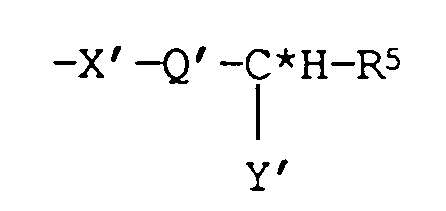
- X'
- -CO-O-, -O-CO-, -O-CO-O, -CO-, -O-, -S-, -CH=CH-, -CH=CH-COO- oder eine Einfachbindung,
- Q'
- Alkylen mit 1 bis 5 C-Atomen, worin auch eine nicht mit X' verknüpfte CH₂-Gruppe durch -O-, -CO-, -O-CO- oder -CH=CH-ersetzt sein kann, oder eine Einfachbindung,
- Y'
- CN, Halogen oder Methyl, und
- R⁵
- eine von Y' verschiedene Alkylgruppe mit 1 bis 15 C-Atomen, worin auch eine oder zwei nicht benachbarte CH₂-Gruppen durch -O-, -CO-, -O-CO-, -CO-O- und/oder -CH=CH- ersetzt sein können,
- A¹ und A²
- jeweils unabhängig voneinander unsubstituiertes oder durch ein oder zwei F- und/oder Cl-Atome und/oder CH₃-Gruppen und/oder CN-Gruppen substituiertes 1,4-Phenylen, worin auch eine oder zwei CH-Gruppen durch N ersetzt sein können, 1,4-Cyclohexylen, worin auch eine oder zwei nicht benachbarte CH₂-Gruppen durch O-Atome und/oder S-Atome ersetzt sein können, Piperidin-1,4-diyl, 1,4-Bicyclo(2,2,2)octylen, 1,3,4-Thiadiazol-2,5-diyl, Naphthalin-2,6-diyl, Decahydronaphthalin-2,6-diyl- oder 1,2,3,4-Tetrahydronaphthalin-2,6-diyl,
- Z¹ und Z²
- jeweils -CO-O, -O-CO-, -CH₂CH₂-, -OCH₂-, -CH₂O-, -C≡C- oder eine Einfachbindung,
- m
- 0, 1 oder 2,
- n
- 0, 1 oder 2,
- (m + n)
- 1 oder 2 und
- Q*
- einen Chiralität induzierenden organischen Rest mit einem asymmetrischen Kohlenstoffatom bedeutet.
- Die Verbindungen der Formel I können wie ähnliche in DE-OS 35 15 373 beschriebene Verbindungen als Komponenten chiraler getilteter smektischer flüssigkristalliner Phasen verwendet werden.
- In den europäischen Patentanmeldungen EP 0 188 222 und EP 0 256 303 werden optisch aktive Phenyl-, Biphenyl-benzoate und Phenyl-biphenylcarboxylate mit nur einem lateralen Fluoratom zur Verwendung als ferroelektrische Flüssigkristalle vorgeschlagen. Keinem dieser Dokumente kann ein Hinweis entnommen werden, daß solche Substanzen zum Dotieren achiraler Basismaterialien eingesetzt werden können.
- Der technischen Lehre dieser Dokumente kann der Fachmann nur entnehmen, daß man die dort beschriebenen Verbindungen zur Herstellung ferroelektrischer Mischungen auch mit anderen optisch aktiven Substanzen mischen kann.
- Chirale getiltete smektische flüssigkristalline Phasen mit ferroelektrischen Eigenschaften können hergestellt werden, indem man Basis-Mischungen mit einer oder mehreren getilteten smektischen Phasen mit einem geeigneten chiralen Dotierstoff versetzt (L.A. Beresnev et al., Mol. Cryst. Liq. Cryst. 89, 327 (1982); H.R. Brand et al., J. Physique 44, (lett.), L-771 (1983). Solche Phasen können als Dielektrika für schnell schaltende Displays verwendet werden, die auf dem von Clark und Lagerwall beschriebenen Prinzip der SSFLC-Technologie (N.A. Clark und S.T. Lagerwall, Appl. Phys. Lett. 36, 899 (1980); USP 4,367,924) auf der Basis der ferroelektrischen Eigenschaften der chiralen getilteten Phase beruhen. In dieser Phase sind die langgestreckten Moleküle in Schichten angeordnet, wobei die Moleküle einen Tiltwinkel zur Schichtennormalen aufweisen. Beim Fortschreiten von Schicht zu Schicht ändert sich die Tiltrichtung um einen kleinen Winkel bezüglich einer senkrecht zu den Schichten stehenden Achse, so daß eine Helixstruktur ausgebildet wird. In Displays, die auf dem Prinzip der SSFLC-Technologie beruhen, sind die smektischen Schichten senkrecht zu den Platten der Zelle angeordnet. Die helixartige Anordnung der Tiltrichtungen der Moleküle wird durch einen sehr geringen Abstand der Platten (ca. 1-2 µm) unterdrückt. Dadurch werden die Längsachsen der Moleküle gezwungen, sich in einer Ebene parallel zu den Platten der Zelle anzuordnen, wodurch zwei ausgezeichnete Tiltorientierungen entstehen. Durch Anlegen eines geeigneten elektrischen Wechselfeldes kann in der eine spontane Polarisation aufweisenden flüssigkristallinen Phase zwischen diesen beiden Zuständen hinund hergeschaltet werden. Dieser Schaltvorgang ist wesentlich schneller als bei herkömmlichen verdrillten Zellen (TN-LCD's), die auf nematischen Flüssigkristallen basieren.
- Ein großer Nachteil für viele Anwendungen der derzeit verfügbaren Materialien mit chiralen getilteten smektischen Phasen (wie z.B. Sc*) ist deren relativ hohe optische Anisotropie, die durch relativ hohe Viskositätswerte bedingten nicht ausreichend kurzen Schaltzeiten, sowie, daß die dielektrische Anisotropie Werte größer Null oder, falls negativ, nur wenig von Null verschiedene Werte aufweist. Negative Werte der dielektrischen Anisotropie sind erforderlich, falls die erforderliche planare Orientierung durch Überlagerung des Ansteuerfeldes mit einem AC-Haltefeld mit kleiner Amplitude bewirkt wird (J.M. Geary, SID-Tagung, Orlando/Florida, April/Mai 1985, Vortrag 8.3).
- Es wurde nun gefunden, daß die Verwendung von Verbindungen der Formel I als Komponenten chiraler getilteter smektischer Mischungen die erwähnten Nachteile wesentlich vermindern kann. Die Verbindungen der Formel I sind somit als Komponenten chiraler getilteter smektischer flüssigkristalliner Phasen vorzüglich geeignet. Insbesondere sind mit ihrer Hilfe chemisch besonders stabile chirale getiltete smektische flüssigkristalline Phasen mit günstigen ferroelektrischen Phasenbereichen, insbesondere mit breiten Sc*-Phasenbereichen, negativer oder auch positiver dielektrischer Anisotropie, niedriger optischer Anisotropie, günstiger Pitchhöhe, niedriger Viskosität und für derartige Phasen hohen Werten für die spontane Polarisation und sehr kurzen Schaltzeiten herstellbar. P ist die spontane Polarisation in nC/cm².
- Mit der Bereitstellung der Verbindungen der Formel I wird außerdem ganz allgemein die Palette der flüssigkristallinen Substanzen, die sich unter verschiedenen anwendungstechnischen Gesichtspunkten zur Herstellung ferroelektrischer Gemische eignen, erheblich verbreitert.
- Die Verbindungen der Formel I besitzen einen breiten Anwendungsbereich. In Abhängigkeit von der Auswahl der Substituenten können diese Verbindungen als Basismaterialien dienen, aus denen flüssigkristalline Phasen zum überwiegenden Teil zusammengesetzt sind; es können aber auch Verbindungen der Formel I flüssigkristallinen Basismaterialien aus anderen Verbindungsklassen zugesetzt werden, um beispielsweise die dielektrische und/oder optische Anisotropie und/oder die spontane Polarisation und/oder den Phasenbereich und/oder den Tiltwinkel und/oder den Pitch und/oder die Schaltzeiten einer solchen Phase zu variieren. Die Verbindungen der Formel I eignen sich ferner als Zwischenprodukte zur Herstellung anderer Substanzen, die sich als Bestandteile flüssigkristalliner Phasen verwenden lassen.
- Die Verbindungen der Formel I sind in reinem Zustand farblos und weisen günstige Werte der optischen Anisotropie auf. Teilweise zeigen die Verbindungen der Formel I flüssigkristalline Mesophasen in einem für die elektrooptische Verwendung günstig gelegenen Temperaturbereich, es können jedoch auch isotrope oder monotrop flüssigkristalline Verbindungen der Formel I als Komponenten chiraler getilteter smektischer Phasen vorteilhaft eingesetzt werden. Chemisch, thermisch und gegen Licht sind sie sehr stabil.
- Gegenstand der Erfindung sind somit die Verbindungen der Formel I sowie die Verwendung der Verbindungen der Formel I als Komponenten flüssigkristalliner Phasen.
- Gegenstand der Erfindung sind auch chirale getiltete smektische flüssigkristalline Phasen mit einem Gehalt an mindestens einer Verbindung der Formel I mit mindestens einem mit vier verschiedenen Substituenten verknüpften Kohlenstoffatom.
- Gegenstand der Erfindung sind ferner solche Phasen mit einem Gehalt an mindestens einer Verbindung der Formel I sowie Flüssigkristallanzeigeelemente, insbesondere ferroelektrische elektrooptische Anzeigeelemente, die derartige Phasen enthalten.
- Der Einfachheit halber bedeuten im folgenden Ph eine unsubstituierte oder durch ein oder zwei Fluor substituierte 1,4-Phenylengruppe, worin auch eine oder zwei CH-Gruppen durch N ersetzt sein können, Cy eine 1,4-Cyclohexylengruppe, worin auch eine oder zwei nicht benachbarte CH₂-Gruppen durch O-Atome ersetzt sein können, Thi eine 1,3,4-Thiadiazol-2,5-diylgruppe und Bi eine Bicyclo(2,2,2)octylengruppe. PheF₂ ist eine Gruppe der Formel

- Vor- und nachstehend haben Q*, A¹, A², Z¹, Z², m und n die angegebene Bedeutung, sofern nicht ausdrücklich etwas anderes vermerkt ist.
- Die Verbindungen der Formel I umfassen dementsprechend insbesondere Verbindungen der Teilformeln Ia bis Id (mit zwei Ringen)
R¹-PheF₂-A²-Q* Ia
R¹-PheF₂-Z²-A²-Q* Ib
Q*-PheF₂-A¹-R¹ Ic
Q*-PheF₂-Z¹-A¹-R¹ Id
und Ie bis It (mit drei Ringen):
R¹-PheF₂-A²-A²-Q* Ie
R¹-PheF₂-Z²-A²-A²-Q* If
R¹-PheF₂-A²-Z²-A²-Q* Ig
R¹-PheF₂-Z²-A²-Z²-A²-Q* Ih
R¹-A¹-PheF₂-A²-Q* Ii
R¹-A¹-Z¹-PheF₂-A²-Q* Ij
R¹-A¹-PheF₂-Z²-A²-Q* Ik
R¹-A¹-Z¹-PheF₂-Z²-A²-Q* Il
Q*-PheF₂-A¹-A¹-R¹ Im
Q*-PheF₂-Z¹-A¹-A¹-R¹ In
Q*-PheF₂-A¹-Z¹-A¹-R¹ Io
Q*-PheF₂-Z¹-A¹-Z¹-A¹-R¹ Ip
Q*-A²-PheF₂-A¹-R¹ Iq
Q*-A²-Z²-PheF₂-A¹-R¹ Ir
Q*-A²-PheF₂-Z¹-A¹-R¹ Is
Q*-A²-Z²-PheF₂-Z¹-A¹-R¹ It
Darunter sind diejenigen der Formeln Ia, Ic, Ie, Im, In und If besonders bevorzugt. - Besonders bevorzugt sind Verbindungen der Formel I'

worin Q¹, Q², Ro und X die in Anspruch 2 angegebene Bedeutung haben. Ro ist eine von X und Q²-R² verschiedene Alkylgruppe mit vorzugsweise 1 bis 5 C-Atomen. Besonders bevorzugt sind Methyl und Ethyl, insbesondere Methyl. R² ist eine Alkylgruppe mit 2 bis 10, insbesondere mit 2 bis 6, 6-Atomen. Q¹ und Q² bedeuten vorzugsweise jeweils unabhängig voneinander -O-CO- (wobei das Carbonylkohlenstoffatom mit dem asymmetrischen C-Atom C* verknüpft ist), -O-CH₂-(wobei die Methylengruppe mit dem asymmetrischen C-Atom C* verknüpft ist), -CH₂CH₂-, -CH₂- oder eine Einfachbindung (-). Besonders bevorzugte Kombinationen von Q¹ und Q² sind in der folgenden Tabelle angegeben:Q¹ -O-CO- -O-CH₂- -CH₂- -CH₂CH₂- -CH₂- -CH₂CH₂- Q² - - -CO-O- -CO-O- -CH₂-O- -CH₂-O- - In den bevorzugten Verbindungen der vor- und nachstehenden Formeln können die Alkylreste, in denen auch eine CH₂-Gruppe (Alkoxy bzw. Oxaalkyl) durch ein 0-Atom ersetzt sein kann, geradkettig oder verzweigt sein. Vorzugsweise haben sie 5, 6, 7, 8, 9 oder 10 C-Atome und bedeuten demnach bevorzugt Pentyl, Hexyl, Heptyl, Octyl, Nonyl, Decyl, Pentoxy, Hexoxy, Heptoxy, Octoxy, Nonoxy oder Decoxy, ferner auch Ethyl, Propyl, Butyl, Undecyl, Dodecyl, Propoxy, Ethoxy, Butoxy, Undecoxy, Dodecoxy, 2-Oxapropyl (= 2-Methoxymethyl), 2- (= Ethoxymethyl) oder 3-Oxabutyl (= 2-Methoxypentyl), 2-, 3- oder 4-Oxapentyl, 2-, 3-, 4- oder 5-Oxahexyl, 2-, 3-, 4-, 5- oder 6-Oxaheptyl.
- A¹ und A² sind bevorzugt Cy oder Ph. In den Verbindungen der vor- und nachstehenden Formeln bedeutet Ph vorzugsweise eine 1,4-Phenylen- (Phe), eine Pyrimidin-2,5-diyl- (Pyr), eine Pyridin-2,5-diyl- (Pyn), eine Pyrazin-3,6-diyl- oder eine Pyridazin-2,5-diyl-Gruppe, insbesondere bevorzugt Phe, Pyr oder Pyn. Vorzugsweise enthalten die erfindungsgemäßen Verbindungen nicht mehr als eine 1,4-Phenylengruppe, worin eine oder zwei CH-Gruppen durch N ersetzt sind. Cy bedeutet vorzugsweise eine 1,4-Cyclohexylengruppe. Insbesondere bevorzugt sind jedoch Verbindungen der Formel I, worin A², eine in 1- oder 4-Position durch CN substituierte 1,4-Cyclohexylengruppe bedeutet und die Nitrilgruppe sich in axialer Position befindet, d.h. die Gruppe A² die folgende Konfiguration aufweist:

Besonders bevorzugt sind Verbindungen der Formel I und der vorstehenden Teilformeln, die eine Gruppierung -Ph-Ph- enthalten. -Ph-Ph- ist vorzugsweise -Phe-Phe-, Phe-Pyr oder Phe-Pyn. Besonders bevorzugt sind die Gruppen
sowie
ferner unsubstituiertes oder ein- oder mehrfach durch Fluor substituiertes 4,4'-Biphenylyl. - Z¹ und Z² sind bevorzugt Einfachbindungen, in zweiter Linie bevorzugt -0-C0-, -C0-0-, -C≡C- oder -CH₂CH₂-Gruppen.
- Besonders bevorzugt für Z¹ ist -CO-O, -O-CO-, -C≡C- oder -CH₂CH₂-, insbesondere die -CH₂CH₂- und die -C≡C-Gruppe.
- X bedeutet in den Verbindungen der vor- und nachstehenden Formeln Halogen, CN oder CH₃, vorzugsweise F, Cl, CH₃ oder CN. Besonders bevorzugt sind F und CN.
- Ro ist eine von X verschiedene, vorzugsweise geradkettige Alkylgruppe mit vorzugsweise bis zu 5 C-Atomen. Besonders bevorzugt wird Methyl und Ethyl, insbesondere Methyl.
- Die bevorzugte Bedeutung von Q¹ und Q² ist Alkylen mit 1 bis 2 C-Atomen, -O-, -O-CO-, -CO-O- und eine Einfachbindung. Ferner bevorzugte Bedeutungen von Q¹ bzw. Q² sind -CH₂O- und -O-CH₂-.
- Verbindungen der vor- und nachstehenden Formeln mit verzweigten Flügelgruppen R¹ können von Bedeutung sein. Verzweigte Gruppen dieser Art enthalten in der Regel nicht mehr als zwei Kettenverzweigungen. R¹ ist vorzugsweise eine geradkettige Gruppe oder eine verzweigte Gruppe mit nicht mehr als einer Kettenverzweigung.
- Bevorzugte verzweigte Reste sind Isopropyl, 2-Butyl (= 1-Methylpropyl), Isobutyl (= 2-Methylpropyl), tert.-Butyl, 2-Methylbutyl, Isopentyl (= 3-Methylbutyl), 2-Methylpentyl, 3-Methylpentyl, 4-Methylpentyl, 2-Ethylhexyl, 5-Methylhexyl, 2-Propylpentyl, 6-Methylheptyl, 7-Methyloctyl, Isopropoxy, 2-Methylpropoxy, 2-Methylbutoxy, 3-Methylbutoxy, 2-Methylpentoxy, 3-Methylpentoxy, 2-Ethylhexoxy, 1-Methylhexoxy, 1-Methylheptoxy, 2-Oxa-3-methylbutyl, 3-Oxa-4-methylpentyl.
- Der Rest R¹ kann auch ein optisch aktiver organischer Rest mit einem asymmetrischen Kohlenstoffatom sein. Vorzugsweise ist dann das asymmetrische Kohlenstoffatom mit zwei unterschiedlich substituierten C-Atomen, einem H-Atom und einem Substituenten ausgewählt aus der Gruppe Halogen (insbesondere F, Cl oder Br), Alkyl oder Alkoxy mit jeweils 1 bis 5 C-Atomen und CN verknüpft. Der optisch aktive organische Rest R¹ hat vorzugsweise die Formel,
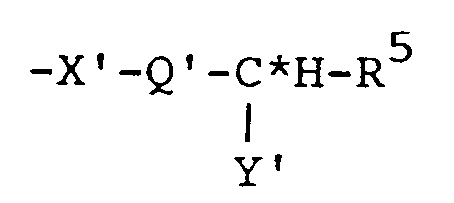
worin - X'
- -CO-O-, -O-CO-, -O-CO-O-, -CO-, -O-, -S-, -CH=CH-, -CH=CH-COO- oder eine Einfachbindung,
- Q'
- Alkylen mit 1 bis 5 C-Atomen, worin auch eine nicht mit X' verknüpfte CH₂-Gruppe durch -O-, -CO-, -O-CO-, -CO-O- oder -CH=CH- ersetzt sein kann, oder eine Einfachbindung,
- Y'
- CN, Halogen oder Methyl und
- R⁵
- eine von Y verschiedene Alkylgruppe mit 1 bis 15 C-Atomen, worin auch eine oder zwei nicht benachbarte CH₂-Gruppen durch -O-, -CO-, -O-CO-, -CO-O- und/oder -CH=CH- ersetzt sein können,
- X'
- ist vorzugsweise -CO-O-, -O-CO-, -O-, -CH=CH-COO-(trans) oder eine Einfachbindung. Besonders bevorzugt sind -O- oder eine Einfachbindung.
- Q'
- ist vorzugsweise -CH₂-, -CH₂CH₂-, -CH₂CH₂CH₂- oder eine Einfachbindung, insbesondere bevorzugt eine Einfachbindung, -CH₂- und -CH₂CH₂-.
- Y'
- ist vorzugsweise CH₃, -CN, F oder Cl, insbesondere bevorzugt CN oder F.
- R⁵
- ist vorzugsweise geradkettiges oder verzweigtes Alkyl mit 1 bis 10, insbesondere mit 1 bis 7, C-Atomen.
- Besonders bevorzugt sind die folgenden 5 Kombinationen von X', Q', Y' und R⁵:
X' -O- - -O- oder -CO-O- -COO-oder -O- -OOC- Q' -CH₂- -CH₂CH₂- - - - Y' F F CH₃ CN F oder Cl R⁵ -Alkyl -Alkyl -COO-Alkyl Alkyl Alkyl - Unter den Verbindungen der Formel I sowie Ia bis Ii sind diejenigen bevorzugt, in denen mindestens einer der darin enthaltenen Reste eine der angegebenen bevorzugten Bedeutungen hat.
- In den Verbindungen der Formel I sowie in den vor- und nachstehenden Teilformeln ist -(A¹-Z¹)m-PheF₂-(Z²-A²)n-vorzugsweise eine Gruppe der folgenden Formeln 1 bis 16 oder deren Spiegelbild:


Gruppen der Formeln 1, 3, 4, 5, 7, 8, 10, 11, 12 und 13, insbesondere diejenigen der Formeln 1, 3, 4, 5 und 10-13, sind besonders bevorzugt. - Diejenigen der vorstehend genannten Formeln, die eine oder mehrere Gruppen Dio, Dit, Pip und/oder Pyr enthalten, umschließen jeweils die beiden möglichen 2,5-(Dio, Dit, Pyr) bzw. 1,4-Stellungsisomeren (Pip).
- Eine kleinere Gruppe von besonders bevorzugten Dotierstoffen ist diejenige der Formeln


Rbedeutet in diesen Formeln geradkettiges oder einfach verzweigtes (vorzugsweise Methylverzweigung) Alkyl mit 3 bis 12 C-Atomen, worin eine CH₂-Gruppe durch - HF-ersetzt ist und C* ein asymmetrisches C-Atom ist. Vorzugsweise ist

worin R' geradkettiges oder einfach verzweigtes (vorzugsweise Methylverzweigung) Alkyl mit vorzugsweise 2 bis 10, insbesondere 3 bis 10, C-Atomen ist. R hat eine der Bedeutungen für R¹ und ist vorzugsweise Alkyl, Oxaalkyl oder Alkenyl mit vorzugsweise 3 bis 12, insbesondere mit 5 bis 12, C-Atomen. Die Gruppen R sind vorzugsweise geradkettig. - Besonders bevorzugt sind ferner Verbindungen der Formel I, worin -(A¹-Z¹)m-PheF₂-(Z²-A²)n-

bedeuten.
X ist N oder CH. r ist 0 oder 1. - Besonders bevorzugt sind weiterhin optisch aktive Verbindungen der Formel A'

worin - R1'
- einen unsubstituierten, einen einfach durch -CN oder einen mindestens einfach durch Fluor oder Chlor substituierten Alkyl- oder Alkenylrest mit bis zu 12 C-Atomen, wobei in diesen Resten auch eine CH₂-Gruppe durch -O-, -CO- oder -CO-O- ersetzt sein kann,
- A1'
- jeweils unabhängig voneinander einen unsubstituierten oder durch ein oder zwei Fluoratome substituierten 1,4-Phenylen-Rest, Pyridin-2,5-diyl-Rest, Pyrimidin-2,5-diyl-Rest, Pyrazin-2,5-diyl-Rest, Pyridazin-3,6-diyl-Rest, 1,3,4-Thiadiazol-2,5-diyl-Rest, trans-1,4-Cyclohexylen-Rest, worin auch eine oder zwei nicht benachbarte CH₂-Gruppen durch -O-und/oder -S- ersetzt sein können, 1,4-Bicyclo(2.2.2)octylen-Rest oder einen Piperidin-1,4-diyl-Rest,
- Z1' und Z2'
- jeweils unabhängig voneinander -CO-O-, -O-CO-, -CH₂O-, -OCH₂-, -CH₂CH₂-, -C≡C- oder eine Einfachbindung
- Q
- -OCH₂-, -COOCH₂- oder -CH₂OCH₂-,
- o
- 1 bis 12,
- r und s
- 0 und der andere 0 oder 1 bedeutet.
- Die Verbindungen der Formel A können nach an sich bekannten Methoden hergestellt werden, beispielsweise nach oder in Analogie zu folgenden Syntheseschemata:


Besonders bevorzugt sind erfindungsgemäße Verbindungen der Teilformel I2'
p ist 1 oder 2. n, A¹, Q* und R¹ haben die oben angegebene Bedeutung. A ist eine 1,3,4-Thiadiazol-2,5-diyl-, Pyrimidin-2,5-diyl-, Pyridin-2,5-diyl oder Pyrazin-3,6-diyl-Gruppe. Vorzugsweise ist A⁰
- Eine besonders bevorzugte kleinere Gruppe von Verbindungen ist diejenige der Formel I1'

p ist 1 oder 2. PheF₂, n, Q*, A¹ und R¹ haben die oben angegebene Bedeutung. Die Verbindungen der Formel I1′ können wie im folgenden Schema 1 angegeben hergestellt werden:
Synthesemöglichkeiten für weitere bevorzugte Verbindungen sind in den folgenden Schemata angegeben:


Die Verbindungen der Formel I werden nach an sich bekannten Methoden hergestellt, wie sie in der Literatur (z.B. in den Standardwerken wie Houben-Weyl, Methoden der Organischen Chemie, Georg-Thieme-Verlag, Stuttgart) beschrieben sind, und zwar unter Reaktionsbedingungen, die für die genannten Umsetzungen bekannt und geeignet sind. Dabei kann man auch von an sich bekannten, hier nicht näher erwähnten Varianten Gebrauch machen. - Die Ausgangsstoffe können gewünschtenfalls auch in situ gebildet werden, derart, daß man sie aus dem Reaktionsgemisch nicht isoliert, sondern sofort weiter zu den Verbindungen der Formel I umsetzt.
- Verbindungen der Formel I bzw. deren Vorstufen sind ausgehend von 1,2-Difluorbenzol zugänglich. Dieses wird nach bekanntem Verfahren (z.B. A.M. Roe et al., J. Chem. Soc. Chem. Comm., 22, 582 (1965)) metalliert und mit dem entsprechenden Elektrophil umgesetzt. Mit dem so erhaltenen 1-substituierten 2,3-Difluorbenzol läßt sich diese Reaktionssequenz ein zweites Mal mit einem geeigneten Elektrophil durchführen und man gelangt so zu den für die Synthesen der Verbindungen der Formel I geeigneten 1,4-disubstituierten 2,3-Difluorbenzolen (z.B. Benzoesäuren oder Phenole). 1,2-Difluorbenzol bzw. 1-substituiertes 2,3-Difluorbenzol wird in einem inerten Lösungsmittel wie Diethylether, Tetrahydrofuran, Dimethoxyethan, tert-Butylmethylether oder Dioxan, Kohlenwasserstoffen wie Hexan, Heptan, Cyclohexan, Benzol oder Toluol oder Gemischen dieser Lösungsmittel gegebenenfalls unter Zusatz eine Komplexierungsmittels wie Tetramethylethylendiamin (TMEDA) oder Hexamethylphosphorsäuretriamid mit Phenyllithium, Lithiumtetramethylpiperidin, n-, sek- oder tert-Butyllithium bei Temperaturen von -100 °C bis +50 °C vorzugsweise -78 °C bis 0 °C umgesetzt. Weitere Einzelheiten können der DOS 38 07 910 entnommen werden.
- Die Lithium-2,3-difluorphenyl-Verbindungen werden bei -100 °C bis 0 °C vorzugsweise bei -50 °C mit den entsprechenden Elektrophilen umgesetzt. Geeignete Elektrophile sind Aldehyde, Ketone, Nitrile, Epoxide, Carbonsäure-Derivate wie Ester, Anhydride oder Halogenide, Halogenameisensäureester oder Kohlendioxid.
- Zur Umsetzung mit aliphatischen oder aromatischen Halogen-Verbindungen werden die Lithium-2,3-difluorphenyl-Verbindungen transmetalliert und unter Übergangsmetallkatalyse gekoppelt. Besonders geeignet sind hierfür die Zink- (vgl. DE OS 36 32 410) oder die Titan-2,3-difluorphenyl-Verbindungen (vgl. DE OS 37 36 489).
- Die Einführung heterocyclischer Strukturelemente kann einerseits dadurch erfolgen, daß man Vorstufen, die diese Strukturelemente bereits enthalten nach den bekannten Methoden zu den Verbindungen der Formel I umsetzt. Andererseits können aber auch in entsprechend strukturierten Vorstufen oder Unterstruktureinheiten der Verbindungen der Formel I nach an sich bekannten Methoden Heterocyclenrest erzeugt werden.
- So können beispielsweise 2,5-disubstituierte 1,3,4-Thiadiazole durch Umsetzung von N,N′-Diacylhydrazinen mit üblichen Thiierungsreagenzien wie P₄S₁₀ oder Lawesson's Reagenz hergestellt werden. Die N,N′-Diacylhydrazine ihrerseits sind nach bekannten Methoden aus der entsprechenden Carbonsäuren zugänglich, wobei die Carbonsäuren mit einem 2,3-Difluor-1,4-phenylen-Strukturelement wie vorstehend beschrieben durch Umsetzung entsprechender metallisierter Vorstufen mit Kohlendioxid erhalten werden können.
- Die 2,5-disubstituierten Pyrimidine können beispielsweise durch Umsetzung entsprechender Amidinhydrochloride (herstellbar aus den entsprechenden Carbonsäuren) mit Malondialdehydtetramethylacetalen nach an sich bekannten Methoden hergestellt werden. Die 2,5-disubstituierten Pyridine sind durch Kopplung von metallorganischen Zinkverbindungen mit entsprechenden Brompyridinderivaten entsprechend DE-OS 36 32 410 erhältlich. Die 2,5-disubstituierten Pyrazine sind erhältlich durch Kondensation von geeignet substituierten Ethylendiaminen mit Glyoxalderivaten, Oxidation der Dihydroverbindungen mit Luftsauerstoff oder anderen Oxidationsmitteln und Isolierung der gewünschten 2,5-disubstituierten Pyrazine aus dem entstandenen Gemisch der 2,5- und 2,6-Disubstitutionsprodukte. Die 3,6-disubstituierten Pyridazine sind zugänglich durch Umsetzung von 1,4-Diketonen (hergestellt z.B. nach Stetter durch thiazoliumsalzkatalysierte Addition eines Aldehyds an ein α,β-ungesättigtes Keton) und anschließende Oxidation des Dihydropyridazins mit Luftsauerstoff oder anderen Oxidationsmitteln wie Kaliumnitrit oder Chromsäure in Eisessig.
- Im folgenden wird die Synthese einiger besonders interesanter Hydroxy-Zwischenstufen beschrieben:
- a) 5-Alkyl-2-(2,3-difluor-4-hydroxyphenyl)-pyridine sind erhältlich durch Umsetzung von 2,3-Difluor-4-benzyloxy-benzamidinhydrochlorid mit 2-Alkyl-3-ethoxyacroleinen bzw. mit in 2-Stellung alkylierten Malonaldehydtetraacetalen oder entsprechend substituierten vinylogen Formamidiniumsalzen (R.M. Wagner und CH. Jutz, Chem. Ber. 104 2975 (1971), indem man vorzugsweise die Komponenten in DMF (Dimethylformamid) erhitzt und anschließend die Schutzgruppe hydrogenolytisch abspaltet.
- b) 5-Hydroxy-2-(2,3-difluor-4-alkylphenyl)-pyrimidine bzw. 5-Hydroxy-2(2,3-difluor-4-alkoxyphenyl)-pyrimidine sind erhältlich durch Kondensation von 4-Alkyl- bzw. 4-Alkoxy-2,4-difluorbenzamidinhydrochlorid mit 2-Benzyloxytrimethiniumperchlorat (A. Holy, Z. Arnold; Collection Czechoslov. Chem. Comm. 38 1371-1380 (1973), oder 2-Benzyloxy-3-dimethylaminoacrolein (H. Horstmann et al., Arzneimittelforsch. 11 682 (1961) und anschließender Hydrogenolyse der Benzylgruppe.
Nach einem Eintopfverfahren erhält man durch Zugabe eines Amidiniumsalzes in einem 12 Stunden bei 50° gerührten Reaktionsgemisch aus POCl₃,DMF und 2-Benzyloxyacetaldehyddiethylacetal und anschließender Zugabe von Triethylamin nach Abdestillieren des Triethylamins das entsprechende 5-Benzyloxypyrimidin. - c) 5-Hydroxy-2(2,3-difluor-4-alkylphenyl)pyridine bzw. 5-Hydroxy-2(2,3-difluor-4-alkoxyphenyl)pyridine sind erhältlich aus 2-Benzyloxytrimethiniumsalz durch Kondensation mit 4-Alkyl- oder 4-Alkoxy-2,3-difluoracetophenonen, Umsetzung mit NH₃/NH₄Cl oder Ammoniumacetat.
Analog der Vorschriften von Ch. Jutz et al. (Liebigs Ann. Chem. 1975 874-900) und anschließende Hydrogenolyse oder aus 4-Alkyl- bzw. 4-Alkoxy-2,3-difluorphenylboronsäure durch Kopplung mit 5-Acetoxy-2-brompyridin (erhältlich aus 5-Hydroxy-2-brompyridin durch Veresterung) in Gegenwart eines Pd-Katalysators entsprechend den Arbeiten von Suzuki et al. (Synth. Commun. 11 513-19 (1981)). - d) 5-Alkoxy-2(2,3-difluor-4-hydroxyphenyl)pyridine sind erhältlich durch Kopplung von 2,3-Difluor-4-benzyloxyphenylboronsäure mit 5-Alkoxy-2-brompyridin entsprechend oben genannter Literatur und anschließende Hydrogenolyse.
- e) 5-Alkyl-2(2,3-difluor-4-hydroxyphenyl)pyridine sind erhältlich durch Kopplung von 2-Brom-5-methylpyridin mit 2,3-Difluor-4-benzyloxyphenylboronsäure und einem Pd-Katalysator unter den bereits genannten Bedingungen, Kettenverlängerung der Methylgruppe durch Deprotonierung mit LDA als Base (-65 °C) und Alkylierung mit einem Alkylbromid und Hydrogenolyse.
- f) 4-Alkoxy-2′,3′-difluor-4′-hydroxybiphenyle bzw. 4-Alkyl-2′,3′-difluor-4′-hydroxybiphenyle sind erhältlich wie oben beschrieben ausgehend von 1,2-Difluorbenzol (vgl. DOS 38 07 910).
- g) 5-Alkyl-2(2,3-difluor-4-hydroxyphenyl)pyrimidine bzw. 5-Alkoxy-2(2,3-difluor-4-hydroxyphenyl)pyrimidine sind herstellbar durch die übliche Kondensation von 2,3-Difluor-4-benzyloxybenzamidin mit 2-Alkylmalonaldehydtetraacetalen oder 2-Alkyl-3-ethoxyacroleinen bzw. 2,3-Dialkoxyacroleinen oder der entsprechenden Immoniumsalze oder Alkoxytrimethiniumsalzen und anschließender Hydrogenolyse.
- Die besonders bevorzugten Verbindungen mit chiralen Fluoralkyloxy bzw. Fluoralkyl-Gruppen als Q* können wie folgt hergestellt werden:
Kommerziell erhältliche optisch aktive 1,2-Epoxide werden nach S. Brandange et al. (Acta Scand. B 37 (1983) 141-145) mit HF/Pyridin zu den entsprechenden optisch aktiven 2-Fluor-1-alkanolen geöffnet. Diese können unter Standardbedingungen in die entsprechenden Tosylate und dann weiter nach Finkelstein in die Jodide überführt werden. Sowohl die Tosylate als auch die Jodide sind als Alkylierungsmittel geeignet, wobei Tosylate bevorzugt zur Veretherung von Phenolen eingesetzt werden. Eine weitere Möglichkeit zur Einführung optisch aktiver monofluorierter Seitenketten bildet die direkte Ringöffnung optisch aktiver 1,2-Epoxide durch Phenolate oder geeignete Kohlenstoffnucleophile. Diese Ringöffnungen verlaufen regiospezifisch am weniger substituierten C-Atom des Epoxids und liefern die entsprechenden optisch aktiven Alkohole, die dann unter Standardbedingungen mit DAST in die optisch aktiven Fluorverbindungen überführt werden können. Zur Ringöffnung geeignete Kohlenstoffnucleophile sind beispielsweise Grignard-Verbindungen, Acetylide, Enolate aber auch CH-azide Methylgruppen von Heterocyclen (z.B. Pyridin) oder geeignete substituierten Aromaten (z.B. p-Tolunitril). - So können die Verbindungen der Formel I oder zu deren Herstellung geeignete Vorstufen hergestellt werden, indem man eine Verbindung, die sonst der Formel I entspricht, aber an Stelle von H-Atomen eine oder mehrere reduzierbare Gruppen und/oder C-C-Bindungen enthält, reduziert.
- Als reduzierbare Gruppen kommen vorzugsweise -CH=CH-gruppen in Betracht, ferner z.B. freie oder veresterte Hydroxygruppen, aromatisch gebundene Halogenatome oder Carbonylgruppen. Bevorzugte Ausgangsstoffe für die Reduktion entsprechen der Formel I, können aber an Stelle einer -CH₂CH₂-Gruppe eine -CH=CH-Gruppe und/oder an Stelle einer -CH₂-Gruppe eine -CO-Gruppe und/oder an Stelle eines H-Atoms eine freie oder eine funktionell (z.B. in Form ihres p-Toluolsulfonats) abgewandelte OH-Gruppe enthalten.
- Die Reduktion kann z.B. erfolgen durch katalytische Hydrierung bei Temperaturen zwischen etwa 0° und etwa 200° sowie Drucken zwischen etwa 1 und 200 bar in einem inerten Lösungsmittel, z.B. einem Alkohol wie Methanol, Ethanol oder Isopropanol, einem Ether wie Tetrahydrofuran (THF) oder Dioxan, einem Ester wie Ethylacetat, einer Carbonsäure wie Essigsäure oder einem Kohlenwasserstoff wie Cyclohexan. Als Katalysatoren eignen sich zweckmäßig Edelmetalle wie Pt oder Pd, die in Form von Oxiden (z.B. PtO₂, PdO), auf einem Träger (z.B. Pd auf Kohle, Calciumcarbonat oder Strontiumcarbonat) oder in feinverteilter Form eingesetzt werden können.
- Ketone können auch nach den Methoden von Clemmensen (mit Zink, amalgamiertem Zink oder Zinn und Salzsäure, zweckmäßig in wäßrig-alkoholischer Lösung oder in heterogener Phase mit Wasser/Toluol bei Temperaturen zwischen etwa 80 und 120°) zu den entsprechenden Verbindungen der Formel I, die Alkylgruppen und/oder -CH₂CH₂-Brücken enthalten, reduziert werden.
- Weiterhin sind Reduktionen mit komplexen Hydriden möglich. Beispielsweise können Arylsulfonyloxygruppen mit LiAlH₄ reduktiv entfernt werden, insbesondere p-Toluolsulfonyloxymethylgruppen zu Methylgruppen reduziert werden, zweckmäßig in einem inerten Lösungsmittel wie Diethylether oder THF bei Temperaturen zwischen etwa 0 und 100°. Doppelbindungen können (auch in Gegenwart von CN-Gruppen!) mit NaBH₄ oder Tributylzinnhydrid in Methanol hydriert werden; so entstehen z.B. aus 1-Cyancyclohexenderivaten die entsprechenden Cyclohexanderivate.
- Ester der Formel I können auch durch Veresterung entsprechender Carbonsäuren (oder ihrer reaktionsfähigen Derivate) mit Alkoholen bzw. Phenolen (oder ihren reaktionsfähigen Derivaten) erhalten werden.
- Als reaktionsfähige Derivate der genannten Carbonsäuren eignen sich insbesondere die Säurehalogenide, vor allem die Chloride und Bromide, ferner die Anhydride, z.B. auch gemischte Anhydride, Azide oder Ester, insbesondere Alkylester mit 1 - 4 C-Atomen in der Alkylgruppe.
- Als reaktionsfähige Derivate der genannten Alkohole bzw. Phenole kommen insbesondere die entsprechenden Metallalkoholate bzw. Phenolate, vorzugsweise eines Alkalimetalls wie Na oder K, in Betracht.
- Die Veresterung wird vorteilhaft in Gegenwart eines inerten Lösungsmittels durchgeführt. Gut geeignet sind insbesondere Ether wie Diethylether, Di-n-butylether, THF, Dioxan oder Anisol, Ketone wie Aceton, Butanon oder Cyclohexanon, Amide wie DMF oder Phosphorsäurehexamethyltriamid, Kohlenwasserstoffe wie Benzol, Toluol oder Xylol, Halogenkohlenwasserstoffe wie Tetrachlorkohlenstoff oder Tetrachlorethylen und Sulfoxide wie Dimethylsulfoxid oder Sulfolan. Mit Wasser nicht mischbare Lösungsmittel können gleichzeitig vorteilhaft zum azeotropen Abdestillieren des bei der Veresterung gebildeten Wassers verwendet werden. Gelegentlich kann auch ein Überschuß einer organischen Base, z.B. Pyridin, Chinolin oder Triethylamin als Lösungsmittel für die Veresterung angewandt werden. Die Veresterung kann auch in Abwesenheit eines Lösungsmittels, z.B. durch einfaches Erhitzen der Komponenten in Gegenwart von Natriumacetat, durchgeführt werden. Die Reaktionstemperatur liegt gewöhnlich zwischen -50° und +250°, vorzugsweise zwischen -20° und +80°. Bei diesen Temperaturen sind die Veresterungsreaktionen in der Regel nach 15 Minuten bis 48 Stunden beendet.
- Im einzelnen hängen die Reaktionsbedinungen für die Veresterung weitgehend von der Natur der verwendeten Ausgangsstoffe ab. So wird eine freie Carbonsäure mit einem freien Alkohol oder Phenol in der Regel in Gegenwart einer starken Säure, beispielsweise einer Mineralsäure wie Salzsäure oder Schwefelsäure, umgesetzt. Eine bevorzugte Reaktionsweise ist die Umsetzung eines Säureanhydrids oder insbesondere eines Säurechlorids mit einem Alkohol, vorzugsweise in einem basischen Milieu, wobei als Basen insbesondere Alkalimetallhydroxide wie Natrium- oder Kaliumhydroxid, Alkalimetallcarbonate bzw. -hydrogencarbonate wie Natriumcarbonat, Kaliumcarbonat oder Kaliumhydrogencarbonat, Alkalimetallacetate wie Natrium- oder Kaliumacetat, Erdalkalimetallhydroxide wie Calciumhydroxid oder organische Basen wie Triethylamin, Pyridin, Lutidin, Kollidin oder Chinolin von Bedeutung sind. Eine weitere bevorzugte Ausführungsform der Veresterung besteht darin, daß man den Alkohol bzw. das Phenol zunächst in das Natrium- oder Kaliumalkoholat bzw. -phenolat überführt, z.B. durch Behandlung mit ethanolischer Natron- oder Kalilauge, dieses isoliert und zusammen mit Natriumhydrogencarbonat oder Kaliumcarbonat unter Rühren in Aceton oder Diethylether suspendiert und diese Suspension mit einer Lösung des Säurechlorids oder Anhydrids in Diethylether, Aceton oder DMF versetzt, zweckmäßig bei Temperaturen zwischen etwa -25° und +20°.
- Dioxanderivate bzw. Dithianderivate der Formel I werden zweckmäßig durch Reaktion eines entsprechenden Aldehyds (oder eines seiner reaktionsfähigen Derivate) mit einem entsprechenden 1,3-Diol bzw. einem entsprechenden 1,3-Dithiol (oder einem ihrer reaktionsfähigen Derivate) hergestellt, vorzugsweise in Gegenwart eines inerten Lösungsmittels wie Benzol oder Toluol und/oder eines Katalysators, z.B. einer starken Säure wie Schwefelsäure, Benzol- oder p-Toluolsulfonsäure, bei Temperaturen zwischen 20° und etwa 150°, vorzugsweise zwischen 80° und 120°. Als reaktionsfähige Derivate der Ausgangsstoffe eignen sich in erster Linie Acetale.
- Die genannten Aldehyde und 1,3-Diole bzw. 1,3-Dithiole sowie ihre reaktionsfähigen Derivate sind zum Teil bekannt, alle können ohne Schwierigkeiten nach Standardverfahren der organischen Chemie aus literaturbekannten Verbindungen hergestellt werden. Beispielsweise sind die Aldehyde durch Oxydation entsprechender Alkohole oder durch Reduktion entsprechender Carbonsäuren oder ihrer Derivate, die Diole durch Reduktion entsprechender Diester und die Dithiole durch Umsetzung entsprechender Dihalogenide mit NaSH erhältlich.
- Ether der Formel I sind durch Veretherung entsprechender Hydroxyverbindungen, vorzugsweise entsprechender Phenole, erhältlich, wobei die Hydroxyverbindung zweckmäßig zunächst in ein entsprechendes Metallderivat, z.B. durch Behandeln mit NaH, NaNH₂, NaOH, KOH, Na₂CO₃ oder K₂CO₃ in das entsprechende Alkalimetallalkoholat oder Alkalimetallphenolat übergeführt wird. Dieses kann dann mit dem entsprechenden Alkylhalogenid, -sulfonat oder Dialkylsulfat umgesetzt werden, zweckmäßig in einem inerten Lösungsmittel wie Aceton, 1,2-Dimethoxyethan, DMF oder Dimethylsulfoxid oder auch einem Überschuß an wäßriger oder wäßrig-alkoholischer NaOH oder KOH bei Temperaturen zwischen etwa 20° und 100°.
- Zur Herstellung von Nitrilen der Formel I oder zur Herstellung von geeigneten Vorstufen können auch entsprechende Chlor- oder Bromverbindungen der Formel I oder geeignete Vorstufen mit einem Cyanid umgesetzt werden, zweckmäßig mit einem Metallcyanid wie NaCN, KCN oder Cu₂(CN)₂, z.B. in Gegenwart von Pyridin in einem inerten Lösungsmittel wie DMF oder N-Methylpyrrolidon bei Temperaturen zwischen 20° und 200°.
- Die optisch aktiven Verbindungen der Formel I erhält man durch den Einsatz entsprechender optisch aktiver Ausgangsmaterialien und/oder durch Trennung der optischen Antipoden mittels Chromatographie nach bekannten Methoden.
- Die erfindungsgemäßen Phasen enthalten mindestens eine, vorzugsweise mindestens zwei Verbindungen der Formel I. Besonders bevorzugt sind erfindungsgemäße chirale getiltete smektische flüssigkristalline Phasen, deren achirale Basismischung mindestens eine andere Komponente mit negativer oder betragsmäßig kleiner positiver dielektrischer Anisotropie enthält. Die Chiralität beruht vorzugsweise teilweise oder vollständig auf chiralen Verbindungen der Formel I. Diese Phasen enthalten vorzugsweise eine oder zwei chirale Verbindungen der Formel I. Es können jedoch auch achirale Verbindungen der Formel I (zum Beispiel in Form eines Racemates) eingesetzt werden, wobei dann die Chiralität der Phase durch andere optisch aktive Verbindungen hervorgerufen wird. Falls chirale Verbindungen der Formel I zum Einsatz kommen, eignen sich neben den reinen optischen Antipoden auch Gemische mit einem Enantiomerenüberschuß. Die oben erwähnten weiteren Komponente(n) der achiralen Basismischung können 1 bis 95 %, vorzugsweise 10 bis 90 %, der Mischung ausmachen. Als weitere Komponenten mit betragsmäßig kleiner positiver oder negativer dielektrischer Anisotropie eignen sich Verbindungen der Teilformeln IIa bis IIg:
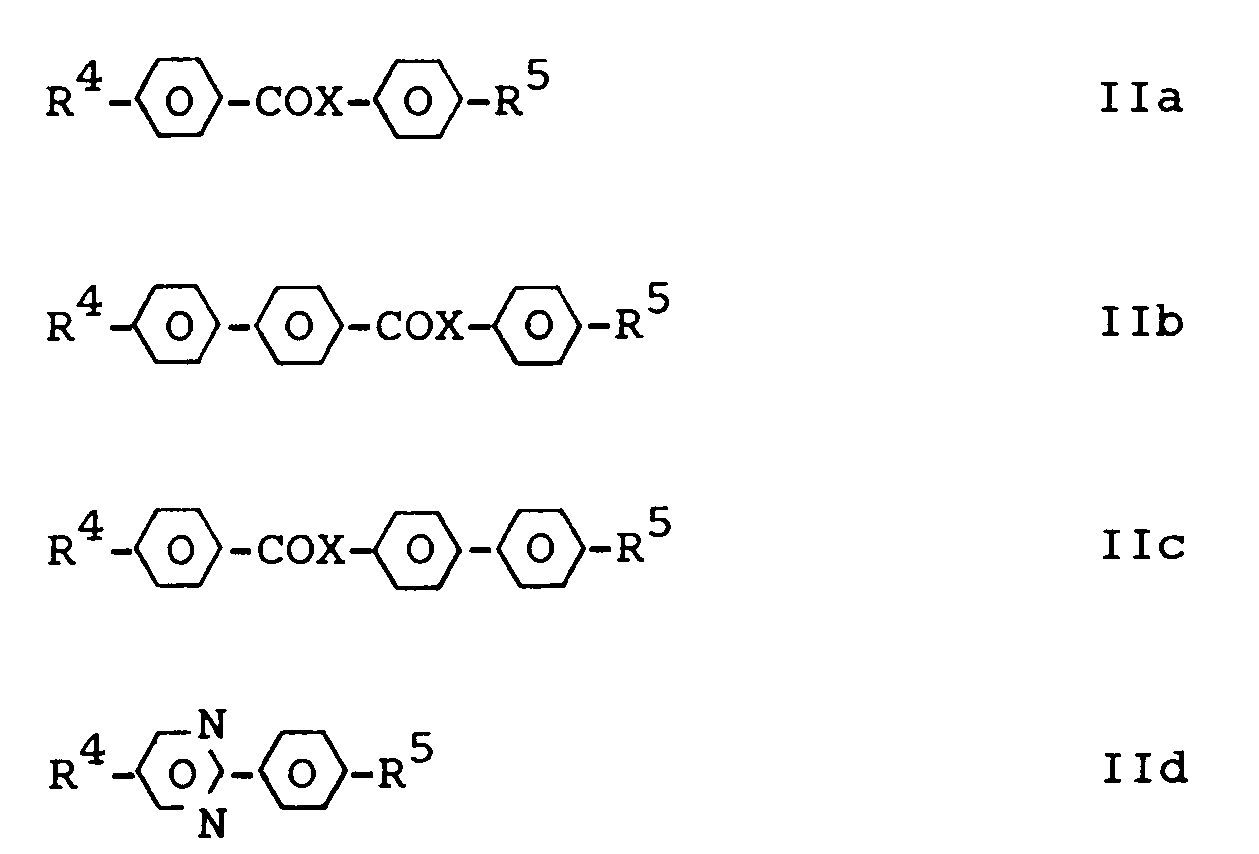

R⁴ und R⁵ sind jeweils vorzugsweise Alkyl, Alkoxy, Alkanoyloxy oder Alkoxycarbonyl mit jeweils 3 bis 12 C-Atomen. X ist vorzugsweise O. In den Verbindungen der Formeln IIa bis IIg kann auch eine 1,4-Phenylengruppe lateral durch Halogen, insbesondere bevorzugt durch Fluor, substituiert sein. Vorzugsweise ist einer der Gruppen R⁴ und R⁵ Alkyl und die andere Gruppe Alkoxy. - Besonders bevorzugt sind die Verbindungen der Teilformeln IIa bis IIg, worin R⁴ und R⁵ jeweils geradkettiges Alkyl oder Alkoxy mit jeweils 5 bis 10 C-Atomen bedeutet.
- Ferner bevorzugt sind erfindungsgemäße Phasen, die neben Komponenten der Formeln IIa bis IIg noch mindestens eine Komponente mit deutlich negativer dielektrischer Anisotropie enthalten (Δε ≦ -2). Besonders geeignet sind hier Verbindungen der Formeln IIIa bis IIIc,

worin R⁴ und R⁵ die bei den Formeln IIa bis IIg angegebenen allgemeinen und bevorzugten Bedeutungen haben. In den Verbindungen der Formeln IIIa, IIIb und IIIc kann auch eine 1,4-Phenylengruppe lateral durch Halogen, vorzugsweise Fluor, substituiert sein. - Die Verbindungen der Formel I umfassen insbesondere zweikernige und dreikernige Materialien. Von den zweikernigen, welche bevorzugt sind, sind diejenigen bevorzugt, worin R¹ n-Alkyl oder n-Alkoxy mit 7 bis 12, insbesondere 7 bis 9, C-Atome bedeutet.
- Die erfindungsgemäßen Phasen enthalten vorzugsweise mindestens eine dreikernige Verbindung der Formel I. Diese Phasen zeichnen sich durch besonders hohe SC/SA-Umwandlungstemperaturen aus.
- Die Verbindungen der Formel I eignen sich auch als Komponenten nematischer flüssigkristalliner Phasen, z.B. zur Vermeidung von reverse twist.
- Diese erfindungsgemäßen flüssigkristallinen Phasen bestehen aus 2 bis 25, vorzugsweise 3 bis 15 Komponenten, darunter mindestens einer Verbindung der Formel I. Die anderen Bestandteile werden vorzugsweise ausgewählt aus den nematischen oder nematogenen Substanzen, insbesondere den bekannten Substanzen, aus den Klassen der Azoxybenzole, Benzylidenaniline, Biphenyle, Terphenyle, Phenyl-oder Cyclohexylbenzoate, Cyclohexan-carbonsäurephenyl-oder cyclohexyl-ester, Phenylcyclohexane, Cyclohexylbiphenyle, Cyclohexylcyclohexane, Cyclohexylnaphthaline, 1,4-Bis-cyclohexylbenzole, 4,4′-Bis-cyclohexylbiphenyle, Phenyl- oder Cyclohexylpyrimidine, Phenyl- oder Cyclohexylpyridazine sowie deren N-Oxide, Phenyl- oder Cyclohexyldioxane, Phenyl- oder Cyclohexyl-1,3-dithiane, 1,2-Diphenylethane, 1,2-Dicyclohexylethane, 1-Phenyl-2-cyclohexylethane, gegebenenfalls halogenierten Stilbene, Benzylphenylether, Tolane und substituierten Zimtsäuren.
- Die wichtigsten als Bestandteile derartiger flüssigkristalliner Phasen in Frage kommenden Verbindungen lassen sich durch die Formel I′ charakterisieren,
R′-L-G-E-R˝ I˝
worin L und E je ein carbo- oder heterocyclisches Ringsystem aus der aus 1,4-disubstituierten Benzol- und Cyclohexanringen, 4,4′-disubstituierten Biphenyl-, Phenylcyclohexan- und Cyclohexylcyclohexansystemen, 2,5-disubstituierten Pyrimidin- und 1,3-Dioxanringen, 2,6-disubstituiertem Naphthalin, Di- und Tetrahydronaphthalin, Chinazolin und Tetrahydrochinazolin gebildeten Gruppe, - G
- -CH=CH- -N(O)=N-
-CH=CY- -CH=N(O)-
-C≡C- -CH₂-CH₂-
-CO-O- -CH₂-O-
-CO-S- -CH₂-S-
-CH=N- -COO-Phe-COO-
oder eine C-C-Einfachbindung,
Y Halogen, vorzugsweise Chlor, oder -CN, und - Bei den meisten dieser Verbindungen sind R′ und R˝ voneinander verschieden, wobei einer dieser Reste meist eine Alkyl- oder Alkoxygruppe ist. Aber auch andere Varianten der vorgesehenen Substituenten sind gebräuchlich. Viele solcher Substanzen oder auch Gemische davon sind im Handel erhältlich. Alle diese Substanzen sind nach literaturbekannten Methoden erhältlich.
- Die erfindungsgemäßen Phasen enthalten etwa 0,1 bis 99, vorzugsweise 10 bis 95 %, einer oder mehrerer Verbindungen der Formel I. Weiterhin bevorzugt sind erfindungsgemäße flüssigkristalline Phasen, enthaltend 0,1-40, vorzugsweise 0,5-30 % einer oder mehrerer Verbindungen der Formel I.
- Die Herstellung der erfindungsgemäßen Phasen erfolgt in an sich üblicher Weise. In der Regel werden die Komponenten ineinander gelöst, zweckmäßig bei erhöhter Temperatur.
- Durch geeignete Zusätze können die flüssigkristallinen Phasen nach der Erfindung so modifiziert werden, daß sie in allen bisher bekannt gewordenen Arten von Flüssigkristallanzeigeelementen verwendet werden können.
- Derartige Zusätze sind dem Fachmann bekannt und in der Literatur ausführlich beschrieben. Beispielsweise können Leitsalze, vorzugsweise Ethyl-dimethyl-dodecyl-ammonium-4-hexyloxybenzoat, Tetrabutylammonium-tetraphenylboranat oder Komplexsalze von Kronenethern (vgl. z.B. I. Haller et al., Mol. Cryst.Liq.Cryst. Band 24, Seiten 249 - 258 (1973)) zur Verbesserung der Leitfähigkeit, pleochroitische Farbstoffe zur Herstellung farbiger Guest-Host-Systeme oder Substanzen zur Veränderung der dielektrischen Anisotropie, der Viskosität und/oder der Orientierung der nematischen Phasen zugesetzt werden.
- Derartige Substanzen sind z.B. in den DE-OS 22 09 127, 22 40 864, 23 21 632, 23 38 281, 24 50 088, 26 37 430, 28 53 728 und 29 02 177 beschrieben.
- Die folgenden Beispiele sollen die Erfindung erläutern, ohne sie zu begrenzen. Fp. = Schmelzpunkt, Kp. = Klärpunkt. Vor- und nachstehend bedeuten Prozentangaben Gewichtsprozent; alle Temperaturen sind in Grad Celsius angegeben. "Übliche Aufarbeitung" bedeutet: man gibt Wasser hinzu, extrahiert mit Methylenchlorid, trennt ab, trocknet die organische Phase, dampft ein und reinigt das Produkt durch Kristallisation und/oder Chromatographie.
- Es bedeuten ferner:
K: Kristallin-fester Zustand, S: smektische Phase (der Index kennzeichnet den Phasentyp), N: nematischer Zustand, Ch: cholesterische Phase, I: isotrope Phase. Die zwischen zwei Symbolen stehende Zahl gibt die Umwandlungstemperatur in Grad Celsius an. -
- a) 323 g Butyraldehyd und 422 g Ethylcyanacetat werden in 750 ml Eisessig gelöst, 15 g Piperidin werden zugegeben und das Reaktionsgemisch gerührt. Dabei erwärmt sich das Reaktionsgemisch auf etwa 55 °C. Nach dem Abkühlen auf Raumtemperatur werden 20 g Pd-C-5 % Katalysator zugegeben, dann wird bei 30° und 2 bar H₂-Druck hydriert bis die berechnete Menge Wasserstoff aufgenommen worden ist (ca. 7 Stunden). Nach dem Abtrennen des Katalysators wird die Hydrierlösung am Rotationsverdampfer eingeengt, der Rückstand in Methyl-tertiärbutyl-Ether (MTB-Ether) aufgenommen und 2mal mit Wasser und anschließend mit 5%iger NaHCO₃-Lösung ausgeschüttelt. Die organische Phase wird getrocknet und eingedampft. Der Rückstand wird im Vakuum (2 x 10⁻² mbar) destilliert (62 °C bis 78°). Man erhält 2-Butylcyanessigsäureethylester.
- b) Unter Ausschluß von Sauerstoff und Luftfeuchtigkeit gibt man bei -60 °C zu 2000 ml einer 1,6 n Lösung von Butyllithium (BuLi) in Hexan und 2000 ml Tetrahydrofuran (THF) nacheinander 450 ml Diisopropylamin, 539 g 2-Butylcyanessigsäureethylester gelöst in 400 ml THF und dann 200 ml Methyljodid ebenfalls gelöst in 200 ml THF. Man läßt langsam auf Raumtemperatur erwärmen und arbeitet nachdem man 12 Stunden gerührt hat wie üblich auf. 256 g KOH-Plätzchen (85 %) werden in 3000 ml Methanol gelöst. Dann werden unter Eiskühlung 595 g 2-Butyl-2-methylcyanessigsäureethylester hinzugegeben und 3 Stunden unter weiterer Eiskühlung gerührt. Dann wird das Reaktionsgemisch mit konz. HCl angesäuert, mit Wasser verdünnt und mit MTB-Ether extrahiert. Die Etherphase wird mit 10%iger NaHCO₃-Lösung extrahiert und der Extrakt erneut unter Eiskühlung mit konz. HCl angesäuert. Das Produkt wird erneut mit MTB-Ether aus der wäßrigen Phase extrahiert, die organische Phase wird mehrmals mit gesättigter Kochsalzlösung gewaschen, anschließend getrocknet und eingeengt.
- c) Racematspaltung
455 g 2-Butyl-2-Methylcyanessigsäure und 908 g Chinin werden in 2000 ml THF unter gelindem Erwärmen gelöst und 2 Stunden gerührt. Die auf Raumtemperatur abgekühlte Lösung gibt man dann langsam unter kräftigem Rühren in 6000 ml auf -50 °C abgekühltes Hexan, rührt 4 Stunden bei -40°/-50 °C und saugt dann den Niederschlag ab und trocknet ihn im Vakuum. Man kristallisiert das Salz mehrfach aus Hexan/THF um bis der Schmelzpunkt von 146,7 °C erreicht ist und setzt anschließend wie üblich die Säure frei.
α
- d) Zu 129 g 2-Butyl-2-Methylcyanessigsäure werden zusammen mit einer katalytischen Menge Dimethylformamid (DMF) auf 60 °C erwärmt, dann tropft man langsam 120 ml SOCl₂ zu. Es setzt eine stürmische Gasentwicklung ein. Wenn diese abgeklungen ist, erhitzt man 2 Stunden am Rückfluß, destilliert dann überschüssiges SOCl₂ im Vakkum ab und fraktioniert den Rückstand (4 x 10⁻² mbar, 52-53 °C).
- e) Man legt 0,1 mol 4′-Heptyloxy-2,3-difluor-4-hydroxybiphenyl (Herstellung: 0,1 mol 2,3-Difluor-4′-heptyloxybiphenyl (hergestellt durch Metallierung von 2,3-Difluorbenzol mit BuLi in Gegenwart von Tetramethylethylendiamin (TMEDA) in THF bei -80 °C und Umsetzung mit Heptyloxcyclohexanon sowie anschließende Dehydratisierung mit Toluol/Toluolsulfonsäure am Wasserabscheider und Aromatisierung mit DDQ) werden in 200 ml THF und 0,1 mol TMEDA gelöst, auf -78 °C abgekühlt und bei dieser Temperatur in 0,105 mol einer 1,6 n-Lösung von BuLi in Hexan metalliert und 3 Stunden gerührt. In der Zwischenzeit gibt man zu einer Lösung von 0,12 mol tert.-Butylhydroperoxid in 50 ml Ether innerhalb von 30 Minuten 70 ml einer 2 n-Lösung von Ethylmagnesiumbromid in Ether zu. Die so bereitete Lösung tropft man vorsichtig in die auf -78 °C gekühlte Lösung des metallierten 2,3-Difluor-4-heptyloxybiphenyls, läßt dann auf Raumtemperatur erwärmen und rührt dann nochmals 2 Stunden. Nach üblicher Aufarbeitung erhält man 4-Hydroxy-2,3-difluor-4′-heptyloxybiphenyl) und 0,11 mol Pyridin in Toluol vor und gibt dazu bei 50-60 °C eine Lösung von 2-Methyl-2-butylcyanessigsäurechlorid in etwas Toluol. Dann rührt man bei der angegebenen Temperatur 5 Stunden und arbeitet wie üblich auf. Man erhält optisch aktiven 2-Butyl-2-methylcyanessigsäure-(4′-heptyloxy-2,3-difluorbiphenyl-4-yl-ester).
- Bei 0 °C gibt man zu einem Gemisch von 0,1 mol 4′-Heptyloxy-2,3-difluorbiphenylcarbonsäure (Herstellung: 0,1 mol 2,3-Difluor-4′-heptyloxybiphenyl und 0,1 mol TMEDA werden in 200 ml THF gelöst, auf -78 °C abgekühlt und bei dieser Temperatur mit 0,105 mol einer 1,6 n-Lösung von BuLi in Hexan umgesetzt. Man rührt 3 Stunden bei -78 °C und kippt dann das Reaktionsgemisch in einem Schwung auf 200 g gestoßenes Trockeneis. Nach üblicher Aufarbeitung erhält man 4′-Heptyloxy-2,3-difluor-biphenyl-4-carbonsäure), 0,1 mol optisch aktivem 2-Cyano-2-methylhexan-1-ol (herstellbar aus optisch aktivem 2-Methyl-2-butylcyanessigsäureethylester durch Reduktion mit LiBH₄) und einer katalytischen Menge 4-N,N′-Dimethylaminopyridin (DMAP) in 200 ml Methylenchlorid 0,1 mol DCC gelöst in Methylenchlorid. Anschließend läßt man 12 Stunden bei Raumtemperatur rühren. Man arbeitet wie üblich auf und reinigt das Produkt durch Kristallisation. Man erhält optisch aktiven 4′-Heptyloxy-2,3-difluorbiphenyl-4-carbonsäure-(2-cyan-2-methylhexylester).
- Zu einer Lösung von 0,15 mol 4′-Heptyloxy-2,3-difluorbiphenyl-4-ol, 0,17 mol L(-)-Ethyllactat und 0,15 mol Triphenylphosphin in 400 ml THF gibt man 0,17 mol Azodicarbonsäurediethylester (DEAD) gelöst in THF. Dabei soll eine Reaktionstemperatur von 50 °C nicht überschritten werden. Man rührt 1 Stunde bei 50 °C und dann über Nacht bei Raumtemperatur. Anschließend destilliert man das Lösungsmittel ab, löst den Rückstand in heißem Toluol und läßt dann langsam abkühlen. Das ausgefallene Triphenylphosphinoxid wird abgesaugt, das Filtrat eingeengt und der Rückstand chromatographisch gereinigt. Man erhält 2-[4-(p-Heptyloxyphenyl)-2,3-difluorphenoxy]-propionsäureethylester.
Analog werden hergestellt: 2-[4-(5-Nonylpyrimidin-2-yl)-2,3-difluorphenoxy]-propionsäureethylester. - Zu 0,05 mol 4′-Heptyloxy-2,3-difluorbiphenyl-4-carbonsäure, 0,05 mol L(-)-Ethyllactat und einer katalytischen Menge DMAP in 70 ml Methylenchlorid gibt man bei 0 °C eine Lösung von 0,05 mol Dicyclohexylcarbodiimid (DCC) in Methylenchlorid. Anschließend rührt man 12 Stunden bei Raumtemperatur, dann saugt man den ausgefallenen Harnstoff ab und arbeitet wie üblich auf. Man erhält optisch aktiven 2-[4-(p-Heptyloxyphenyl)-2,3-difluorbenzoyloxy]-propionsäureethylester.
- Optisch aktiver Milchsäurebenzylester wird mittels DCC und einer katalytischen Menge DMAP mit 4′-Heptyloxy-2,3-difluorbiphenyl-4-carbonsäure verestert und anschließend die Benzylgruppe hydrogenolytisch abgepalten. 0,01 mol der so gewonnenen Säure wir in 50 ml Benzol bei Raumtemperatur in Gegenwart katalytischer Mengen von DMF mit 0,02 mol Oxalylchlorid in das entsprechende Säurechlorid überführt. Das Reaktionsgemisch wird im Vakuum eingedampft und der Rückstand in 30 ml Diglyme aufgenommen. Unter Kühlung und kräftigem Rühren werden tropfenweise 25 ml einer 30%igen wäßrigen Ammoniaklösung zugegeben. Man läßt 2 Stunden bei Raumtemperatur rühren, verdünnt mit Wasser, saugt den Niederschlag ab, wäscht ihn gründlich mit Wasser und trocknet ihn im Vakuum. Anschließend gibt man zu dem Niederschlag 40 ml DMF und 0,08 mol Thionylchlorid. Nachdem die Gasentwicklung nachgelassen hat, rührt man weitere 2 Stunden bei Raumtemperatur, dann hydrolysiert man vorsichtig und arbeitet wie üblich auf. Das Produkt wird chromatographisch gereinigt. Man erhält optisch aktiven 4′-Heptyloxy-2,3-difluorbiphenyl-4-carbonsäure-(1-cyanethylester).
- Optisch aktiver Milchsäurebenzylester wird mittels Azodicarbonsäurediethylester (DEAD)/Triphenylphosphin mit 4′-Heptyloxy-2,3-difluorbiphenyl-4-ol verethert und anschließend die Benzylgruppe hydrogenolytisch abgespalten. Die so gewonnene Säure wird wie üblich in das Nitril überführt (Oxalylchlorid, Ammoniak, Thionylchlorid). Man erhält optisch aktives 4′-Heptyloxy-2,3-difluor-4-(1-cyanethyoxy)-biphenyl.
- Zu einem Gemisch aus 0,1 mol 4′-Heptyloxy-2,3-difluorbiphenyl-4-ol, 0,1 mol optisch aktiver 2-Chlor-3-methylbuttersäure (hergestellt aus Valin) und einer katalytischen Menge DMAP in 250 ml Methylenchlorid gibt man bei 0 °C eine Lösung von 0,1 mol DCC in Methylenchlorid. Anschließend läßt man 12 Stunden bei Raumtemperatur rühren, saugt dann den Niederschlag ab, arbeitet das Filtrat wie üblich auf und erhält 2-Chlor-3-methylbuttersäure-[4-(p-heptyloxyphenyl)-2,3-difluorphenylester].
- Analog werden hergestellt durch Veresterung von analogen chiralen α-Halogencarbonsäuren mit 5-Alkyl-2-(2,3-difluor-4-hydroxyphenyl)-pyrimidinen:
2-Fluoroctansäure-4-(5-heptylpyrimidin-2-yl)-2,3-difluorphenylester , F 39°
2-Chlor-3-methylbuttersäure-4-(5-heptylpyrimidin-2-yl)-2,3-difluorphenylester , F 65° - Unter Ausschluß von Feuchtigkeit gibt man zu einem Gemisch von 0,1 mol Pentansäure, 0,1 mol optisch aktivem 4′-Heptyloxy-2,3-difluor-4(2-hydroxypropyl)biphenyl (herstellbar durch übliche Metallierung von 4′-Heptyloxy-2,3-difluorbiphenyl und Umsetzung mit optisch aktivem Propylenoxid) und einer katalytischen Menge DMAP in 200 ml Methylenchlorid bei 0 °C 0,1 mol DCC gelöst in Methylenchlorid. Nach der Zugabe läßt man 12 Stunden bei Raumtemperatur rühren, saugt den Niederschlag ab und arbeitet wie üblich auf. Das Produkt wird chromatographisch gereinigt. Man erhält optisch aktives 4′-Heptyloxy-2,3-difluor-4-(2-valeroyloxypropyl)-biphenyl.
- Unter Ausschluß von Feuchtigkeit gibt man zu einem Gemisch von 0,1 mol Pentansäure, 0,1 mol optisch aktivem 2(4′-Heptyloxy-2,3-difluorbiphenyl-4-oxy)propan-1-ol (hergestellt durch Reduktion des entsprechenden Milchsäureethylesters mit LiBH₄) und einer katalytischen Menge DMAP in 250 ml Methylenchlorid bei 0 °C 0,1 mol DCC gelöst in Methylenchlorid. Anschließend läßt man bei Raumtemperatur 12 Stunden rühren, saugt den Niederschlag ab, arbeitet das Filtrat wie üblich auf und erhält optisch aktives 4′-Heptyloxy-2,3-difluor-4-(1-valeroyloxy-2-propyloxy)biphenyl.
- Optisch aktiver S-2-Hydroxy-3-methylbuttersäurebenzylester (hergestellt aus dem Cäsiumsalz der L-α-Hydroxyisovaleriansäure durch Umsetzung mit Benzylbromid in DMF) und 4′-Heptyloxy-2′,3′-difluorbiphenyl-4-carbonsäure (hergestellt durch Metallierung von Heptyloxy-2,3-difluorbenzol mit BuLi und TMEDA in THF bei -70 °C, Ummetallisierung mit Chlortriisopropylorthotitanat und anschließende Umsetzung mit 4-Cyclohexanoncarbonsäureethylester, Dehydratisierung, Aromatisierung mit DDQ und Verseifung mit ethanolischer KOH bei 5 °C) wird mittels DCC und einer katalytischen Menge DMAP verestert und anschließend die Benzylgruppe hydrogenolytisch abgespalten. 0,01 mol der so gewonnen Säure wird in 75 ml Toluol bei 25 °C in Gegenwart einer katalytischen Menge DMF mit 0,02 mol Oxalylchlorid in das Säurechlorid überführt. Das Reaktionsgemisch wird im Vakuum eingedampft und der Rückstand in wenig Diglyme aufgenommen und unter Kühlung und kräftigem Rühren tropfenweise mit 30 ml einer 30%igen wäßrigen Ammoniaklösung versetzt. Man läßt 2 Stunden bei Raumtemperatur rühren, verdünnt mit Wasser, saugt den Niederschlag ab, wäscht ihn mit Wasser ammoniakfrei und trocknet ihn im Vakuum. Anschließend gibt man 40 ml DMF und tropfenweise 0,1 mol Thionylchlorid zu. Man rührt zwei 2 Stunden bei Raumtemperatur und gibt dann das Reaktionsgemisch auf Eis/Wasser. Es wird wie üblich aufgearbeitet und das Produkt chromatographisch gereinigt. Man erhält 4′-Heptyloxy-2′,3′-difluorbiphenyl-4-carbonsäure-(1-cyan-2-methylpropylester).
- Analog werden hergestellt:
4′-Heptyloxy-2,2′,3′-trifluorbiphenyl-4-carbonsäure-(1-cyan-2-methylpropylester)
4′-Heptyloxy-3,2′,3′-trifluorbiphenyl-4-carbonsäure-(1-cyan-2-methylpropylester)
4′-Heptyloxy-2,3,3′-trifluorbiphenyl-4-carbonsäure-(1-cyan-2-methylpropylester)
4′-Heptyloxy-2,3,2′-trifluorbiphenyl-4-carbonsäure-(1-cyan-2-methylpropylester) - 2,3-Difluorhydrochinonmonobenzylether (hergestellt aus 2,3-Difluorphenol durch Elbs-Reaktion, Benzylierung des als Zwischenprodukt erhaltenen Sulfates und saure Spaltung des Sulfates) wird mit DEAD/PPh₃ und optisch aktivem Milchsäureethylester umgesetzt. Anschließend wird die Schutzgruppe hydrogenolytisch abgespalten. Unter Feuchtigkeitsausschluß werden in Methylenchlorid 0,01 mol der so erhaltenen Verbindung und 0,01 mol 4′-Heptyloxybiphenyl-4-carbonsäure in Gegenwart einer katalytischen Menge DMAP tropfenweise bei 0 °C mit 0,01 mol DCC gelöst in Methylenchlorid umgesetzt. Man läßt 12 Stunden bei Raumtemperatur rühren, entfernt den ausgefallenen Dicyclohexylharnstoff durch Filtration und arbeitet das Filtrat wie üblich auf. Das Produkt wird chromatographisch gereinigt. Man erhält 2-[2,3-Difluor-4-(p-(p-heptyloxyphenyl)-benzoyloxy)-phenoxy]-propionsäureethylester.
- 0,08 mol 5-Heptyl-2-(2,3-difluor-4-hydroxyphenyl)-pyrimidin werden zusammen mit 11,6 g K₂CO₃ und 25,6 g optisch aktivem 2-Fluor-1-Octyltosylat in 70 ml Methylethylketon unter Schutzgasatmosphäre 12 Stunden am Rückfluß erhitzt. Dann wird das Reaktionsgemisch hydolysiert, das Produkt wie üblich aufgearbeitet und chromatographisch gereinigt. Man erhält optisch aktives 5-n-Heptyl-2-[2,3-difluor-4-(2-fluor-octyloxy)-phenyl)-pyrimidin, F 56° C.
- In völlig analoger Weise können auch alle anderen geeigneten Phenole bzw. Hydroxyverbindungen mit chiralen 2-Fluor-1-alkyltosylaten umgesetzt werden.
- 0,04 mol 5-(3-hydroxynonyl)-2-(2,3-difluor-4-octyl-oxyphenyl)-pyridin (optisch aktiv) [herstellbar aus 5-Methyl-2-(2,3-difluor-4-octyloxyphenyl)-pyridin durch Umsetzung mit LDA bei -70 °C und Zugabe von optisch aktivem 1,2-Epoxyoctan] werden unter Feuchtigkeitsausschluß bei -30 °C in CH₂Cl₂ gelöst. Zu dieser Lösung tropft man langsam unter Kühlung 8 ml DAST gelöst in 15 ml CH₂Cl₂. Dann wird das Reaktionsgemisch 12 Stunden bei Raumtemperatur gerührt und anschließend mit Eiswasser hydrolysiert. Man arbeit wie üblich auf und erhält optisch aktives 5-(3-fluornonyl)-2-(2,3-difluor-4-octyloxyphenyl)-pyridin.
- 0,08 mol 2,3-Difluor-4-(3-fluornonyl)-benzamidinhydrochlorid (optisch aktiv) [erhältlich aus 2,3-Difluor-4-methylbenzonitril durch Umsetzung mit LDA bei -70 °C und Zugabe von chiralem 1,2-Epoxyoctan, Umsetzung des entstandenen Alkohols mit DAST und Überführung der Nitrilgruppe ins Amidin] werden zusammen mit 0,1 mol 2-Heptyl-3-ethoxyacrolein in DMF 24 Stunden erhitzt. Nach üblicher Aufarbeitung erhält man optisch aktives 5-n-Heptyl-2-[2,3-difluor-4-(3-fluor-n-nonyl)-phenyl]-pyrimidin.
- In analoger Weise erhält man aus den 2,3-Dialkoxyacroleinen die entsprechenden 5-n-Alkoxy-pyrimidine.
- 0,05 mol 2,3-Difluor-4-hydroxybenzoesäuremethylester, 0,05 mol (S)-2-Fluoroctanol-1 und 0,06 mol Triphenylphosphin werden in 125 ml Tetrahydrofuran gelöst und unter Rühren und Eiskühlung 0,06 mol Diethylazodicarboxylat zugetropft. Man läßt auf Raumtemperatur kommen und rührt noch 8 Stunden nach. Danach wird das Lösungsmittel abdestilliert und das Methyl-2,3-difluor-4-(2-fluoroctyloxy)-benzoat durch Säulenchromatographie gereinigt. Durch Verseifung mit wäßrig/alkoholischer Kalilauge erhält man daraus die 2,3-Difluor-4-(2-fluoroctyloxy)-benzoesäure.
- 0,01 mol dieser Säure, 0,001 mol 4-Dimethylaminopyridin und 0,01 mol 4-n-Octylphenol werden in 15 ml Dichlormethan vorgelegt, bei 10° unter Rühren eine Lösung von 0,01 mol Dicyclohexylcarbodiimid zugetropft und anschließend 15 Stunden bei Raumtemperatur nachgerührt. Man filtriert über Kieselgel ab, verdampft das Lösungsmittel und erhält als Ruckstand (S)-(4-n-Octylphenyl)-2,3-difluor-4-(2-fluoroctyloxy)-benzoat.
- Analog Beispiel 15 erhält man (S)-[trans,trans-4-(4-n-Pentylcyclohexyl)cyclohexyl]-2,3-difluor-4-(2-fluoroctyloxy)-benzoat, wenn man trans,trans-4-(4-Pentylcyclohexyl)-cyclohexanol als Alkoholkomponente in die vorstehend beschriebene Veresterung einsetzt.
- 0,01 mol (S)-2,3-Difluor-4-(2-fluoroctyloxy)-benzoylchlorid (hergestellt aus der in Beispiel 15 beschriebenen Säure durch Erhitzen mit Thionylchlorid), 0,01 mol 4-trans-4-n-Pentylcyclohexyl)phenol und 0,01 mol Pyridin werden in 20 ml Toluol 2 Stunden unter Rückfluß erhitzt. Nach dem Abkühlen saugt man das Pyridinhydrochlorid ab, verdampft das Toluol und kristallisiert das zurückbleibende (S)-[4-(trans-4-n-Pentylcyclohexyl)phenyl]-2,3-difluor-4-(2-fluoroctyloxy)benzoat aus Ethanol um.
- 0,05 mol 2-(2,3-Difluor-4-hydroxyphenyl)-5-n-nonylpyrimidin, 0,5 mol Kaliumcarbonat und 40 ml Dimethylformamid werden unter Rühren zum Rückfluß erhitzt. Man tropft innerhalb von 5 Minuten 0,05 mol (R)-1,2-epoxyoctan zu und läßt 16 Stunden nachreagieren. Anschließend wird das Reaktionsgemisch auf 100g Eis gegossen und das ausgefallene (R)-2-[2,3-Difluor-4-(2-hydroxyoctyloxy)-phenyl]-5-n-nonylpyrimidin abgesaugt, mit Wasser gewaschen und aus Aceton umkristallisiert.
- 0,03 mol dieser Verbindung werden in 40 ml Dichlormethan gelöst und bei -70° unter Stickstoff zu einer gerührten Lösung von 0,045 mol Diethylaminoschwefeltrifluorid in 15 ml Dichlormethan getropft. Man läßt langsam auf Raumtemperatur kommen und über Nacht nachreagieren. Danach wird das Reaktionsgemisch unter Kühlung mit Wasser versetzt, 30 Minuten gerührt, die organische Phase abgetrennt, mit Wasser gewaschen und getrocknet. Nach dem Abdestillieren des Lösungsmittels wird das (S)-2-[2,3-Difluor-4-(2-fluoroctyloxy)-phenyl]-5-n-nonylpyrimidin aus Ethanol umkristallisiert.
- Analog Beispiel 18 erhält man aus den entsprechenden Phenolen durch Umsetzung mit (R)-1,2-Epoxyheptan und anschließende Fluorierung mit Diethylaminoschwefeltrifluorid die Verbindungen
(S)-2,3-Difluor-4-(2-fluorheptyloxy)-4′-(5-n-heptylpyrimidin-2-yl)-biphenyl,
(S)-2-[2,3-Difluor-4-(2-fluorheptyloxy)-phenyl]-5-n-nonylpyridin und
(S)-2-[2,3-Difluor-4-(2-fluorheptyloxy)-phenyl]-5-(4-n-heptylphenyl)-pyridin. - 0,02 mol 2,3-Difluor-4-hydroxy-4′-pentyl-p-terphenyl, 0,02 mol Kaliumcarbonat und 0,2 mol (S)-2-Fluoroctyl-p-toluolsulfonat (hergestellt aus (S)-2-Fluoroctanol-1 und Toluolsulfochlorid in Gegenwart von Pyridin) werden in 25 ml Dimethylformamid 15 Stunden bei 60° gerührt. Man saugt von den ungelösten Salzen ab und versetzt das Filtrat mit Wasser. Durch extraktive Aufarbeitung und anschließende Säulenchromatographie erhält man das reine (S)-2,3-Difluor-4-(2-fluoroctyloxy)-4'-pentyl-p-terphenyl.
- Analog Beispiel 22 erhält man aus 2,3-Difluor-4-hydroxy-4'-(trans-4-petnylcyclohexyl)-biphenyl durch Veretherung mit (S)-2-Fluornonyl-p-toluolsulfonat (S)-2,3-Difluor-4-(2-fluornonyloxy)-4'-(trans-4-pentylcyclohexyl)-biphenyl.
- Die folgenden Beispiele betreffen erfindungsgemäße flüssigkristalline Phasen:
- Eine achirale SC-Basismischung bestehend aus
4,4 % 2-p-Heptyloxyphenyl-5-heptylpyrimidin,
4,4 % 2-p-Octyloxyphenyl-5-heptylpyrimidin,
4,4 % 2-p-Nonyloxyphenyl-5-heptylpyrimidin,
7,8 % 2-(2,3-Difluor-4-octyloxyphenyl)-5-heptylpyrimidin,
7,8 % 2-p-Hexyloxyphenyl-5-nonylpyrimidin,
25,6 % 2-p-Nonyloxyphenyl-5-nonylpyrimidin,
10,0 % 2-(2,3-Difluor-4-nonyloxyphenyl)-5-nonylpyrimidin,
8,9 % 2-(p-Hexyloxyphenyl)-5-(p-heptylphenyl)-1,3,4-thiadiazol,
11,1 % r-1-Cyan-cis-4-(4'-octyloxybiphenyl-4-yl)-1-octylcyclohexan,
8,9 % 2-(4′-Hexyloxy-2,3-difluorbiphenyl-4-yl)-5-heptylpyrimidin und
6,7 % 2-(2,3-Difluor-4-pentyloxyphenyl)-5-(p-heptylphenyl)-1,3,4,-thiadiazol
wird mit jeweils 10 % der folgenden Dotierstoffe A bis L versetzt. Die Phasenübergangstemperaturen und die Werte der Spontanpolarisation bei Raumtemperatur sind in der folgenden Tabelle zusammengefaßt:

Claims (11)
- Chirale Derivate des 1,2-Difluorbenzols der Formel I,
 R¹ H, F, Cl, Br, CN, eine Alkyl- oder Perfluoralkyl-Gruppe mit jeweils 1 bis 12 C-Atomen, worin auch eine oder zwei nicht benachbarte CH₂- bzw. CF₂-Gruppen durch O-Atome und/oder -CO-Gruppen und/oder -CO-O-Gruppen und/oder -CH=CH-Gruppen und/oder -CHHalogen und/oder -CO-O-CHCN-Gruppen ersetzt sein können, oder einen optisch aktiven Rest der Formel
 X' -CO-O-, -O-CO-, -O-CO-O, -CO-, -O-, -S-, -CH=CH-, -CH=CH-COO- oder eine Einfachbindung,Q' Alkylen mit 1 bis 5 C-Atomen, worin auch eine nicht mit X' verknüpfte CH₂-Gruppe durch -O-, -CO-, -O-CO- oder -CH=CH-ersetzt sein kann, oder eine Einfachbindung,Y' CN, Halogen oder Methyl, undR⁵ eine von Y' verschiedene Alkylgruppe mit 1 bis 15 C-Atomen, worin auch eine oder zwei nicht benachbarte CH₂-Gruppen durch -O-, -CO-, -O-CO-, -CO-O- und/oder -CH=CH- ersetzt sein können,A¹ und A² jeweils unabhängig voneinander unsubstituiertes oder durch ein oder zwei F- und/oder Cl-Atome und/oder CH₃-Gruppen und/oder CN-Gruppen substituiertes 1,4-Phenylen, worin auch eine oder zwei CH-Gruppen durch N ersetzt sein können, 1,4-Cyclohexylen, worin auch eine oder zwei nicht benachbarte CH₂-Gruppen durch O-Atome und/oder S-Atome ersetzt sein können, Piperidin-1,4-diyl, 1,4-Bicyclo(2,2,2)octylen, 1,3,4-Thiadiazol-2,5-diyl, Naphthalin-2,6-diyl, Decahydronaphthalin-2,6-diyl- oder 1,2,3,4-Tetrahydronaphthalin-2,6-diyl,Z¹ und Z² jeweils -CO-O-, -O-CO-, -CH₂CH₂-, -OCH₂-, -CH₂O-, -C≡C- oder eine Einfachbindung,m 0, 1 oder 2,n 0, 1 oder 2,(m + n) 1 oder 2, undQ* einen Chiralität induzierenden organischen Rest mit einem asymmetrischen Kohlenstoffatom bedeutet.
 - Chirale Derivate des 1,2-Difluorbenzols der Formel I nach Anspruch 1, dadurch gekennzeichnet, daß Q* einen Rest der Formel
Q¹-C*RoX-Q²-R²
bedeutet, worinQ¹ und Q² jeweils unabhängig voneinander Alkylen mit 2 bis 4 C-Atomen, worin auch eine CH₂-Gruppe durch -O-, -S-, -CO-, -O-CO-, -CO-O-, -S-CO-, -CO-S-, -CH=CH-COO-, -CH=CH-, -CHHalogen und/oder -CHCN- ersetzt sein kann, oder eine Einfachbindung,X Halogen, CN oder CH₃,Ro H oder eine von X und -Q²-R² verschiedene Alkylgruppe mit 1 bis 10 C-Atomen,R² eine Alkylgruppe mit zwei bis 10 C-Atomen, undC* ein mit vier verschiedenen Substituenten verknüpftes Kohlenstoffatom bedeutet. - Chirale Derivate des 1,2-Difluorbenzols der Formel I nach Anspruch 1, dadurch gekennzeichnet, daß Q* einen Rest der Formel
Q¹-C*RoX-Q²-R²
bedeutet, worinQ¹ und Q² jeweils unabhängig voneinander Alkylen mit 1 bis 2 C-Atomen, -O-, -O-CO-, -CO-O-, -CH₂-O-, -O-CH₂- oder eine Einfachbindung bedeuten, undRo, R², C* und X die in Anspruch 2 angegebene Bedeutung besitzen. - Verbindungen nach einem der Ansprüche 1 bis 3, worin -(A¹-Z¹)m-PheF₂-(Z²-A²)n- eine Gruppe der folgenden Formeln 1 bis 15 oder deren Spiegelbild bedeutet:
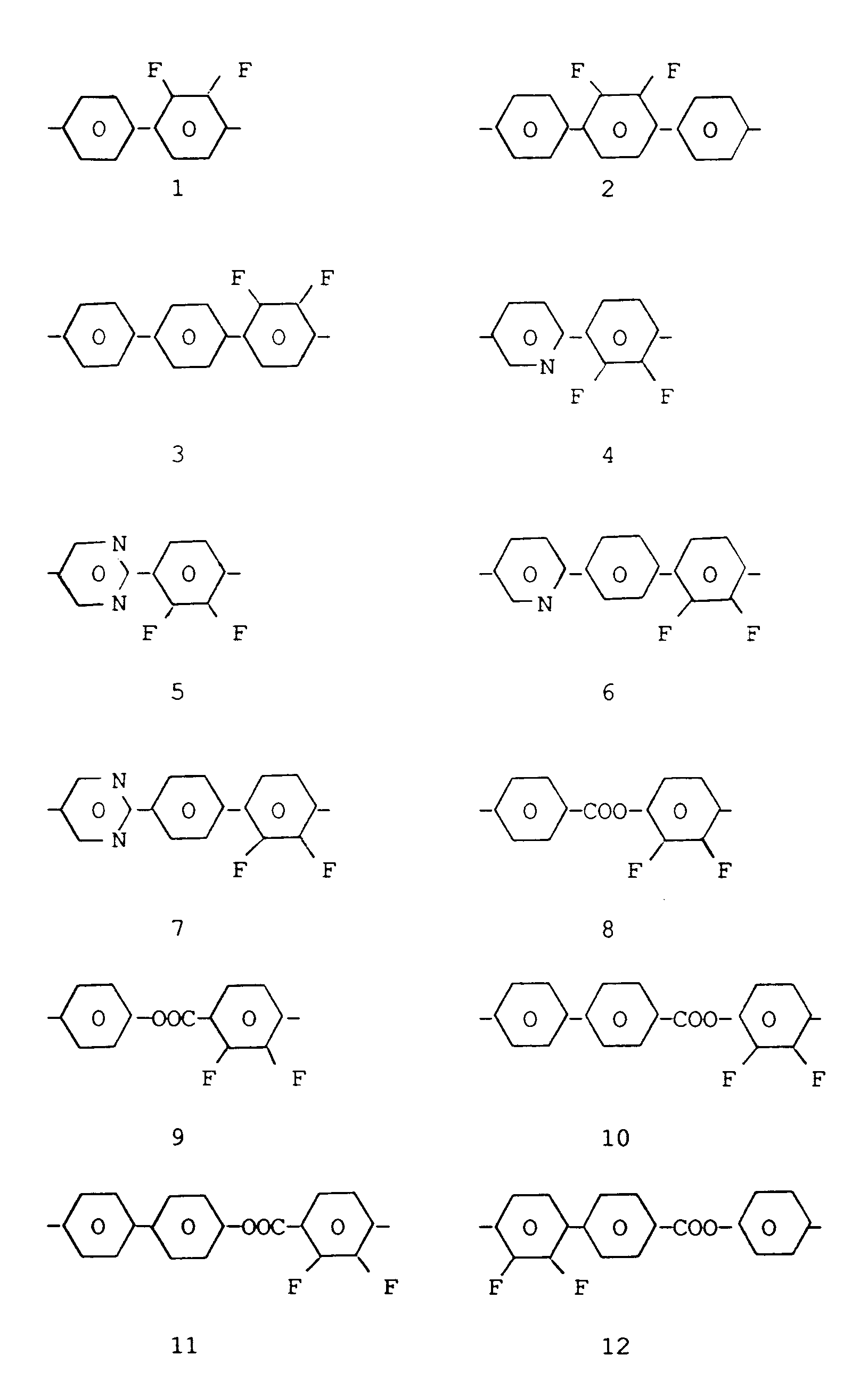
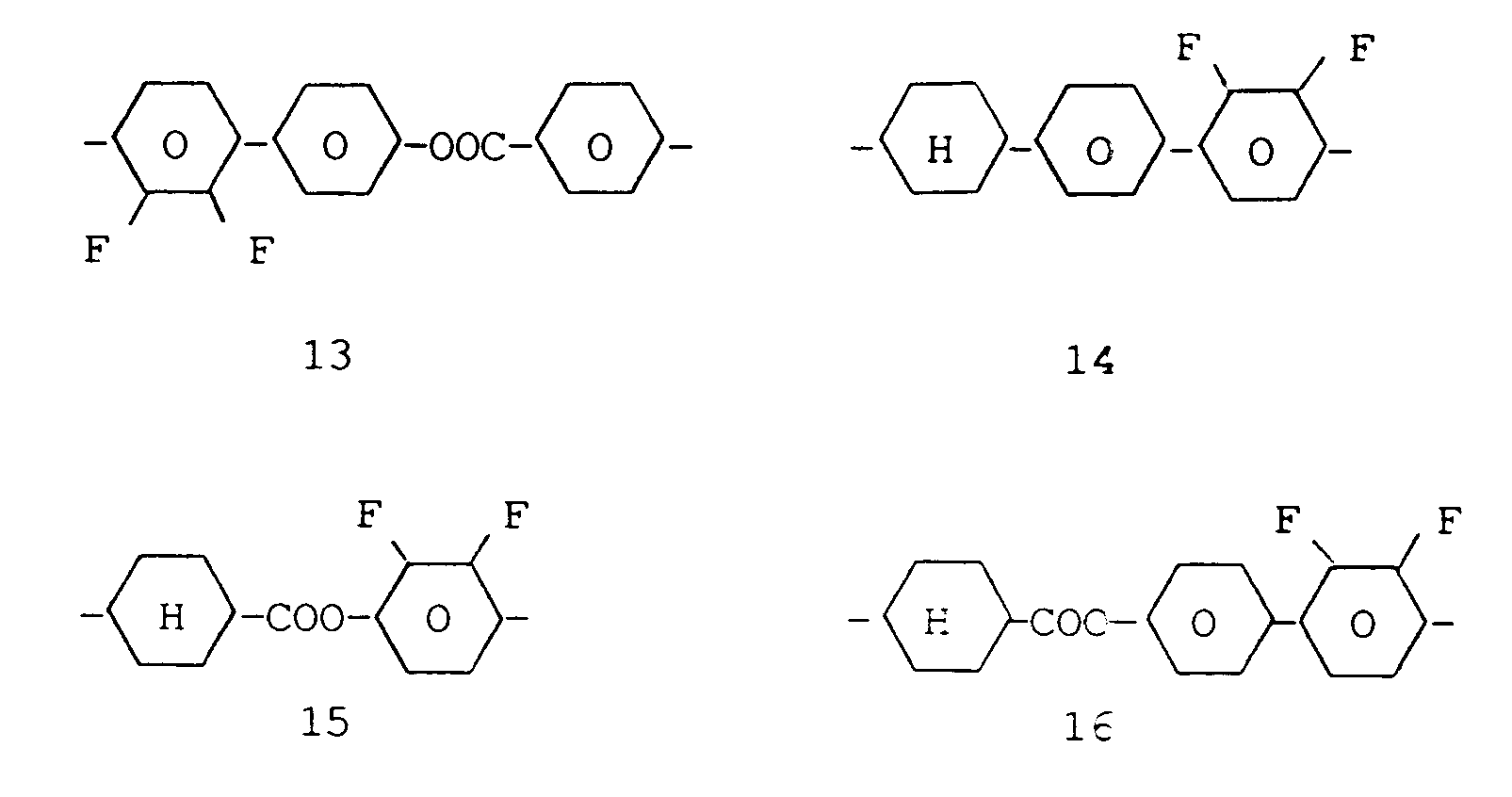
- Verbindungen nach einem der Ansprüche 1 bis 4, ausgewählt aus den Formeln A-M


- Verbindungen nach einem der Ansprüche 1 bis 5 der Formel A'
 R1' einen unsubstituierten, einen einfach durch -CN oder einen mindestens einfach durch Fluor oder Chlor substituierten Alkyl- oder Alkenylrest mit bis zu 12 C-Atomen, wobei in diesen Resten auch eine CH₂-Gruppe durch -O-, -CO- oder -CO-O- ersetzt sein kann,A1' jeweils unabhängig voneinander einen unsubstituierten oder durch ein oder zwei Fluoratome substituierten 1,4-Phenylen-Rest, Pyridin-2,5-diyl-Rest, Pyrimidin-2,5-diyl-Rest, Pyrazin-2,5-diyl-Rest, Pyridazin-3,6-diyl-Rest, 1,3,4-Thiadiazol-2,5-diyl-Rest, trans-1,4-Cyclohexylen-Rest, worin auch eine oder zwei nicht benachbarte CH₂-Gruppen durch -O-und/oder -S- ersetzt sein können, 1,4-Bicyclo(2.2.2)octylen-Rest oder einen Piperidin-1,4-diyl-Rest,Z1' und Z2' jeweils unabhängig voneinander -CO-O-, -O-CO-, -CH₂O-, -OCH₂-, -CH₂CH₂-, -C≡C- oder eine EinfachbindungQ -OCH₂-, -COOCH₂- oder -CH₂OCH₂-o 1 bis 12,und einer der beiden Werter und s 0 und der andere 0 oder 1 bedeutet.
 - Chirale getiltete smektische flüssigkristalline Phase mit mindestens zwei flüssigkristallinen Komponenten, dadurch gekennzeichnet, daß sie mindestens eine Verbindung der Formel I nach Anspruch 1 enthält.
- Phase nach Anspruch 7, dadurch gekennzeichnet, daß sie mindestens eine Verbindung der Teilformeln IIa bis IIg enthält:


- Phase nach Anspruch 8, dadurch gekennzeichnet, daß sie neben Komponenten der Formeln IIa bis IIg noch mindestens eine Verbindung der Formeln IIIa bis IIIc enthält:


- Verwendung der Verbindungen der Formel I nach Anspruch 1 als Komponenten flüssigkristalliner Phasen.
- Ferroelektrisches elektrooptisches Anzeigeelement, dadurch gekennzeichnet, daß es als Dielektrikum eine Phase nach Anspurch 7 enthält.
Applications Claiming Priority (2)
| Application Number | Priority Date | Filing Date | Title |
|---|---|---|---|
| DE3807802 | 1988-03-10 | ||
| DE3807802A DE3807802A1 (de) | 1988-03-10 | 1988-03-10 | Chirale derivate des 1,2-difluorbenzols |
Publications (2)
| Publication Number | Publication Date |
|---|---|
| EP0332025A1 EP0332025A1 (de) | 1989-09-13 |
| EP0332025B1 true EP0332025B1 (de) | 1993-06-23 |
Family
ID=6349274
Family Applications (2)
| Application Number | Title | Priority Date | Filing Date |
|---|---|---|---|
| EP89103497A Expired - Lifetime EP0332025B1 (de) | 1988-03-10 | 1989-02-28 | Chirale Derivate des 1,2 -Difluorbenzols |
| EP89903152A Pending EP0357739A1 (de) | 1988-03-10 | 1989-02-28 | Chirale derivate des 1,2-difluorbenzols |
Family Applications After (1)
| Application Number | Title | Priority Date | Filing Date |
|---|---|---|---|
| EP89903152A Pending EP0357739A1 (de) | 1988-03-10 | 1989-02-28 | Chirale derivate des 1,2-difluorbenzols |
Country Status (6)
| Country | Link |
|---|---|
| US (1) | US5232624A (de) |
| EP (2) | EP0332025B1 (de) |
| JP (1) | JPH02503435A (de) |
| KR (1) | KR900700438A (de) |
| DE (2) | DE3807802A1 (de) |
| WO (1) | WO1989008639A1 (de) |
Families Citing this family (27)
| Publication number | Priority date | Publication date | Assignee | Title |
|---|---|---|---|---|
| JPH0819025B2 (ja) * | 1987-02-16 | 1996-02-28 | チッソ株式会社 | 1,2−プロパンジオ−ル誘導体 |
| DE59009867D1 (de) * | 1989-05-20 | 1995-12-21 | Hoechst Ag | Flüssigkristallmedium mit einer smektischen C-Phase. |
| DE4023867A1 (de) * | 1990-07-27 | 1992-01-30 | Merck Patent Gmbh | Ferroelektrische fluessigkristallanzeige |
| EP0500210A3 (en) * | 1991-01-19 | 1992-10-21 | Sanyo Chemical Industries, Ltd. | Liquid crystal compounds and compositions |
| JPH04360853A (ja) * | 1991-06-03 | 1992-12-14 | Sanyo Chem Ind Ltd | 液晶化合物および組成物 |
| EP0518636A1 (de) * | 1991-06-11 | 1992-12-16 | Sanyo Chemical Industries Ltd. | Flüssigkristalline Verbindungen sowie Flüssigkristallzusammensetzungen |
| TW211581B (de) * | 1991-11-07 | 1993-08-21 | Hoechst Ag | |
| JP3095927B2 (ja) * | 1993-02-10 | 2000-10-10 | キヤノン株式会社 | 光学活性化合物、それを含有する液晶組成物、その使用方法、それを用いた液晶素子及び表示装置 |
| GB2278841A (en) * | 1993-06-11 | 1994-12-14 | Secr Defence | Liquid crystal compounds, mixtures and devices |
| GB2294461B (en) * | 1993-06-11 | 1998-02-25 | Secr Defence | Liquid crystal materials, mixtures and devices |
| US5707547A (en) * | 1993-08-03 | 1998-01-13 | Sumitomo Chemical Company, Limited | Trans-olefin compounds, method for production thereof, liquid crystal composition containing the same as active ingredient, and liquid crystal element using said composition |
| US5399291A (en) * | 1993-09-30 | 1995-03-21 | Minnesota Mining And Manufacturing Company | Liquid crystal compounds having a fluoroether terminal portion |
| DE19502178A1 (de) * | 1994-01-27 | 1995-08-03 | Hoechst Ag | Thiadiazolderivate, Verfahren zu ihrer Herstellung und ihre Verwendung als Vorprodukte zur Herstellung von Flüssigkristallen |
| GB2316077B (en) * | 1995-03-28 | 1999-09-08 | Secr Defence | Pyrimidine Compounds |
| GB9506309D0 (en) * | 1995-03-28 | 1995-05-17 | Secr Defence | Pyrimidine compounds |
| US6121448A (en) * | 1995-03-28 | 2000-09-19 | The Secretary Of State For Defence In Her Brittanic Majesty's Government Of The United Kingdom Of Great Britain And Northern Ireland | Pyrimidine compounds |
| US5702637A (en) * | 1995-04-19 | 1997-12-30 | Minnesota Mining And Manufacturing Company | Liquid crystal compounds having a chiral fluorinated terminal portion |
| CN1214073A (zh) * | 1995-07-17 | 1999-04-14 | 德国赫彻斯特研究技术两合公司 | 铁电性液晶混合物 |
| US5658491A (en) * | 1995-10-12 | 1997-08-19 | Minnesota Mining And Manufacturing Company | Process for controlling cone tilt angle in mixtures of smectic liquid crystal compounds |
| US6022492A (en) * | 1995-12-28 | 2000-02-08 | Hoescht Research & Technology Deutchland Gmbh & Co. | Difluorophenyl pyrimidyl pyridine derivatives and the use thereof in liquid crystal mixtures |
| WO1998027036A1 (fr) * | 1996-12-16 | 1998-06-25 | Chisso Corporation | Derives de difluorophenyle, composes de cristaux liquides et composition de cristaux liquides |
| US5855812A (en) * | 1997-04-11 | 1999-01-05 | Minnesota Mining And Manufacturing Company | Compounds and process for controlling cone tilt angle in mixtures of smectic liquid crystal compounds |
| GB2329391A (en) * | 1997-09-17 | 1999-03-24 | Sharp Kk | Liquid crystal composition containing fluorinated phenylpyrimidines with SmC phase and fluorinated terphenyl(s), and use thereof in a liquid crystal shutter |
| JP4333032B2 (ja) * | 1997-10-24 | 2009-09-16 | チッソ株式会社 | 負の誘電率異方性を有する2,3−ジフルオロフェニル誘導体、液晶組成物および液晶表示素子 |
| US6309561B1 (en) | 1997-12-24 | 2001-10-30 | 3M Innovative Properties Company | Liquid crystal compounds having a chiral fluorinated terminal portion |
| US8252201B1 (en) | 2008-11-09 | 2012-08-28 | Military University of Technology | Liquid crystalline medium |
| CN110903832B (zh) * | 2019-12-20 | 2021-02-12 | 上海瓜呱科技有限公司 | 负性液晶化合物以及含有该化合物的液晶组合物及其应用 |
Family Cites Families (24)
| Publication number | Priority date | Publication date | Assignee | Title |
|---|---|---|---|---|
| DE2967129D1 (en) * | 1979-05-28 | 1984-08-30 | Merck Patent Gmbh | Liquid-crystal compositions |
| DE2933563A1 (de) * | 1979-07-18 | 1981-02-05 | Bbc Brown Boveri & Cie | Anisotrope verbindungen mit negativer dk-anisotropie |
| DE3042391A1 (de) * | 1980-11-10 | 1982-06-16 | Merck Patent Gmbh, 6100 Darmstadt | Fluorhaltige cyclohexylbiphenylderivate, diese enthaltende dielektrika und elektrooptisches anzeigeelement |
| EP0085995B1 (de) * | 1982-02-04 | 1986-04-09 | MERCK PATENT GmbH | Anisotrope Verbindungen und Flüssigkristallmischungen |
| DE3209178A1 (de) * | 1982-03-13 | 1983-09-15 | Merck Patent Gmbh, 6100 Darmstadt | Polyhalogenaromaten |
| DE3317597A1 (de) * | 1983-05-14 | 1984-11-15 | Merck Patent Gmbh, 6100 Darmstadt | Bicyclohexylethane |
| GB8314077D0 (en) * | 1983-05-20 | 1983-06-29 | Secr Defence | Disubstituted ethanes |
| EP0133489B1 (de) * | 1983-08-04 | 1988-01-20 | MERCK PATENT GmbH | Nematische Verbindungen |
| DE3401320A1 (de) * | 1984-01-17 | 1985-07-25 | Merck Patent Gmbh, 6100 Darmstadt | Ethanderivate |
| CH660003A5 (de) * | 1984-04-16 | 1987-03-13 | Merck Patent Gmbh | Anisotrope verbindungen und fk-mischungen mit diesen. |
| DE3685032D1 (de) * | 1985-01-09 | 1992-06-04 | Dainippon Ink & Chemicals | Substituierte fluessigkristallverbindungen. |
| DE3506446A1 (de) * | 1985-02-23 | 1986-08-28 | Merck Patent Gmbh, 6100 Darmstadt | Pyrimidinderivate |
| DE3510434A1 (de) * | 1985-03-22 | 1986-09-25 | Merck Patent Gmbh, 6100 Darmstadt | Cyclohexanderivate |
| DE3515373A1 (de) * | 1985-04-27 | 1986-11-06 | Merck Patent Gmbh, 6100 Darmstadt | Stickstoffhaltige heterocyclen |
| DE3518734A1 (de) * | 1985-05-24 | 1986-11-27 | Merck Patent Gmbh, 6100 Darmstadt | Smektische fluessigkristalline phasen |
| DE3788243D1 (de) * | 1986-05-22 | 1994-01-05 | Hoffmann La Roche | Flüssigkristalline Derivate von Phenylbenzoat. |
| US4886619A (en) * | 1986-06-30 | 1989-12-12 | Minnesota Mining And Manufacturing Company | Fluorine-containing chiral smectic liquid crystals |
| EP0256303A3 (de) * | 1986-07-21 | 1988-10-19 | Polaroid Corporation | Flüssigkristallzusammensetzung mit Fluor enthaltendem Kern |
| EP0281611B1 (de) * | 1986-09-16 | 1993-11-24 | MERCK PATENT GmbH | Flüssigkristalline phasen für elektrooptische anzeigeelemente basierend auf dem ecb-effekt |
| DD257638A1 (de) * | 1987-02-19 | 1988-06-22 | Univ Halle Wittenberg | Ferroelektrische fluessigkristalle |
| JP2587978B2 (ja) * | 1988-03-02 | 1997-03-05 | 津田駒工業株式会社 | 多色よこ糸測長貯留装置の制御装置 |
| US4925590A (en) * | 1988-03-10 | 1990-05-15 | Merck Patent Gesellschaft Mit Beschrankter Haftung | Derivatives of 4-cyano-2,3-difluorophenol |
| US4897216A (en) * | 1988-03-10 | 1990-01-30 | Merck Patent Gesellschaft Mit Beschrankter Haftung | 2,3-difluorophenol derivatives |
| DE3807910A1 (de) * | 1988-03-10 | 1989-09-21 | Merck Patent Gmbh | Verfahren zur herstellung von 2,3-difluorbenzolen |
-
1988
- 1988-03-10 DE DE3807802A patent/DE3807802A1/de not_active Withdrawn
-
1989
- 1989-02-28 US US07/359,663 patent/US5232624A/en not_active Expired - Lifetime
- 1989-02-28 DE DE8989103497T patent/DE58904761D1/de not_active Expired - Fee Related
- 1989-02-28 JP JP1502845A patent/JPH02503435A/ja active Pending
- 1989-02-28 EP EP89103497A patent/EP0332025B1/de not_active Expired - Lifetime
- 1989-02-28 EP EP89903152A patent/EP0357739A1/de active Pending
- 1989-02-28 WO PCT/EP1989/000191 patent/WO1989008639A1/de not_active Ceased
- 1989-11-09 KR KR1019890702086A patent/KR900700438A/ko not_active Withdrawn
Also Published As
| Publication number | Publication date |
|---|---|
| EP0332025A1 (de) | 1989-09-13 |
| WO1989008639A1 (fr) | 1989-09-21 |
| US5232624A (en) | 1993-08-03 |
| DE58904761D1 (de) | 1993-07-29 |
| DE3807802A1 (de) | 1989-09-21 |
| JPH02503435A (ja) | 1990-10-18 |
| KR900700438A (ko) | 1990-08-13 |
| EP0357739A1 (de) | 1990-03-14 |
Similar Documents
| Publication | Publication Date | Title |
|---|---|---|
| EP0257048B1 (de) | Optisch aktive verbindungen | |
| EP0334911B1 (de) | Substituierte phenyltrifluormethylether | |
| EP0357739A1 (de) | Chirale derivate des 1,2-difluorbenzols | |
| EP0306505B1 (de) | Ethinderivate als komponente flüssigkristalliner phasen | |
| DE3807872A1 (de) | Difluorbenzolderivate | |
| DD253832A5 (de) | Ferroelektrische fluessigkristalline phase | |
| DE3405914A1 (de) | Fluessigkristalline verbindungen | |
| EP0482024B1 (de) | Chirale oder achirale ringverbindungen | |
| DE3807801A1 (de) | Derivate des 2,3-difluorhydrochinons | |
| DD260079A5 (de) | Fluessigkristalline phase | |
| EP0373191B1 (de) | Heterocyclische derivate des 1,2-difluorbenzols | |
| DE3807861A1 (de) | 2,3-difluorbiphenyle | |
| DD254589A5 (de) | Chirale getiltete smektische fluessigkristalline phase | |
| DE4137433A1 (de) | 3,6-disubstituierte-2-halogenpyridine | |
| EP0290570B1 (de) | Chirale oder achirale ringverbindungen | |
| EP0146862A2 (de) | Pyridylthiophene | |
| EP0428720B1 (de) | Optisch aktive verbindungen und flüssigkristalline phase | |
| DE3739588A1 (de) | Cyclopentanabkoemmlinge | |
| EP0428665B1 (de) | Fluorphenylpyrimidine | |
| DE3906019A1 (de) | Dihalogenbenzolderivate | |
| DE4030603C2 (de) | Pyridinpyrimidine | |
| DE3812191A1 (de) | Chirale oder achirale ringverbindungen | |
| EP0433826B1 (de) | Fluorphenylpyridine | |
| DE4026223A1 (de) | 5-oxy-2-phenylpyridine und fluessigkristallines medium | |
| DE4034122A1 (de) | Optisch aktive 5-oxypyridin-2-yl-derivate |
Legal Events
| Date | Code | Title | Description |
|---|---|---|---|
| PUAI | Public reference made under article 153(3) epc to a published international application that has entered the european phase |
Free format text: ORIGINAL CODE: 0009012 |
|
| AK | Designated contracting states |
Kind code of ref document: A1 Designated state(s): ES GR |
|
| 17P | Request for examination filed |
Effective date: 19900120 |
|
| 17Q | First examination report despatched |
Effective date: 19910923 |
|
| RBV | Designated contracting states (corrected) |
Designated state(s): CH DE ES FR GB GR IT LI LU NL SE |
|
| XX | Miscellaneous (additional remarks) |
Free format text: VERBUNDEN MIT 89903152.0/0357739 (EUROPAEISCHE ANMELDENUMMER/VEROEFFENTLICHUNGSNUMMER) DURCH ENTSCHEIDUNG VOM 22.11.91. |
|
| GRAA | (expected) grant |
Free format text: ORIGINAL CODE: 0009210 |
|
| AK | Designated contracting states |
Kind code of ref document: B1 Designated state(s): CH DE ES FR GB GR IT LI LU NL SE |
|
| PG25 | Lapsed in a contracting state [announced via postgrant information from national office to epo] |
Ref country code: IT Free format text: LAPSE BECAUSE OF FAILURE TO SUBMIT A TRANSLATION OF THE DESCRIPTION OR TO PAY THE FEE WITHIN THE PRE;WARNING: LAPSES OF ITALIAN PATENTS WITH EFFECTIVE DATE BEFORE 2007 MAY HAVE OCCURRED AT ANY TIME BEFORE 2007. THE CORRECT EFFECTIVE DATE MAY BE DIFFERENT FROM THE ONE RECORDED.SCRIBED TIME-LIMIT Effective date: 19930623 Ref country code: GR Free format text: LAPSE BECAUSE OF FAILURE TO SUBMIT A TRANSLATION OF THE DESCRIPTION OR TO PAY THE FEE WITHIN THE PRESCRIBED TIME-LIMIT Effective date: 19930623 Ref country code: SE Effective date: 19930623 Ref country code: NL Effective date: 19930623 Ref country code: FR Effective date: 19930623 Ref country code: ES Free format text: THE PATENT HAS BEEN ANNULLED BY A DECISION OF A NATIONAL AUTHORITY Effective date: 19930623 |
|
| XX | Miscellaneous (additional remarks) |
Free format text: VERBUNDEN MIT 89903152.0/0357739 (EUROPAEISCHE ANMELDENUMMER/VEROEFFENTLICHUNGSNUMMER) DURCH ENTSCHEIDUNG VOM 22.11.91. |
|
| REF | Corresponds to: |
Ref document number: 58904761 Country of ref document: DE Date of ref document: 19930729 |
|
| GBT | Gb: translation of ep patent filed (gb section 77(6)(a)/1977) |
Effective date: 19930701 |
|
| EN | Fr: translation not filed | ||
| NLV1 | Nl: lapsed or annulled due to failure to fulfill the requirements of art. 29p and 29m of the patents act | ||
| PG25 | Lapsed in a contracting state [announced via postgrant information from national office to epo] |
Ref country code: LU Free format text: LAPSE BECAUSE OF NON-PAYMENT OF DUE FEES Effective date: 19940228 |
|
| PLBE | No opposition filed within time limit |
Free format text: ORIGINAL CODE: 0009261 |
|
| STAA | Information on the status of an ep patent application or granted ep patent |
Free format text: STATUS: NO OPPOSITION FILED WITHIN TIME LIMIT |
|
| 26N | No opposition filed | ||
| PGFP | Annual fee paid to national office [announced via postgrant information from national office to epo] |
Ref country code: CH Payment date: 19960315 Year of fee payment: 8 |
|
| PG25 | Lapsed in a contracting state [announced via postgrant information from national office to epo] |
Ref country code: LI Effective date: 19970228 Ref country code: CH Effective date: 19970228 |
|
| REG | Reference to a national code |
Ref country code: CH Ref legal event code: PL |
|
| PGFP | Annual fee paid to national office [announced via postgrant information from national office to epo] |
Ref country code: GB Payment date: 20000223 Year of fee payment: 12 |
|
| PGFP | Annual fee paid to national office [announced via postgrant information from national office to epo] |
Ref country code: DE Payment date: 20010221 Year of fee payment: 13 |
|
| PG25 | Lapsed in a contracting state [announced via postgrant information from national office to epo] |
Ref country code: GB Free format text: LAPSE BECAUSE OF NON-PAYMENT OF DUE FEES Effective date: 20010228 |
|
| GBPC | Gb: european patent ceased through non-payment of renewal fee |
Effective date: 20010228 |
|
| PG25 | Lapsed in a contracting state [announced via postgrant information from national office to epo] |
Ref country code: DE Free format text: LAPSE BECAUSE OF NON-PAYMENT OF DUE FEES Effective date: 20020903 |