EP0327807A2 - Lichtleiter auf Basis von Polycarbonatfasern und Verfahren zu ihrer Herstellung - Google Patents
Lichtleiter auf Basis von Polycarbonatfasern und Verfahren zu ihrer Herstellung Download PDFInfo
- Publication number
- EP0327807A2 EP0327807A2 EP89100254A EP89100254A EP0327807A2 EP 0327807 A2 EP0327807 A2 EP 0327807A2 EP 89100254 A EP89100254 A EP 89100254A EP 89100254 A EP89100254 A EP 89100254A EP 0327807 A2 EP0327807 A2 EP 0327807A2
- Authority
- EP
- European Patent Office
- Prior art keywords
- optionally substituted
- formula
- radical
- aliphatic
- meth
- Prior art date
- Legal status (The legal status is an assumption and is not a legal conclusion. Google has not performed a legal analysis and makes no representation as to the accuracy of the status listed.)
- Granted
Links
- 239000004417 polycarbonate Substances 0.000 title claims abstract description 40
- 229920000515 polycarbonate Polymers 0.000 title claims abstract description 40
- 239000000835 fiber Substances 0.000 title claims abstract description 28
- 238000004519 manufacturing process Methods 0.000 title abstract description 4
- 239000000203 mixture Substances 0.000 claims abstract description 29
- 125000003118 aryl group Chemical group 0.000 claims abstract description 17
- 238000000034 method Methods 0.000 claims abstract description 13
- 150000001252 acrylic acid derivatives Chemical class 0.000 claims abstract description 12
- CERQOIWHTDAKMF-UHFFFAOYSA-N Methacrylic acid Chemical class CC(=C)C(O)=O CERQOIWHTDAKMF-UHFFFAOYSA-N 0.000 claims abstract description 11
- 239000001301 oxygen Substances 0.000 claims description 27
- 229910052760 oxygen Inorganic materials 0.000 claims description 27
- QVGXLLKOCUKJST-UHFFFAOYSA-N atomic oxygen Chemical compound [O] QVGXLLKOCUKJST-UHFFFAOYSA-N 0.000 claims description 18
- 239000011248 coating agent Substances 0.000 claims description 17
- 238000000576 coating method Methods 0.000 claims description 17
- 125000001931 aliphatic group Chemical group 0.000 claims description 16
- 229930195733 hydrocarbon Natural products 0.000 claims description 12
- 150000002430 hydrocarbons Chemical class 0.000 claims description 11
- 239000004215 Carbon black (E152) Substances 0.000 claims description 10
- NINIDFKCEFEMDL-UHFFFAOYSA-N Sulfur Chemical compound [S] NINIDFKCEFEMDL-UHFFFAOYSA-N 0.000 claims description 9
- 150000004945 aromatic hydrocarbons Chemical class 0.000 claims description 9
- 125000002496 methyl group Chemical group [H]C([H])([H])* 0.000 claims description 9
- 150000001875 compounds Chemical class 0.000 claims description 7
- 239000004033 plastic Substances 0.000 claims description 7
- 229920003023 plastic Polymers 0.000 claims description 7
- UFHFLCQGNIYNRP-UHFFFAOYSA-N Hydrogen Chemical compound [H][H] UFHFLCQGNIYNRP-UHFFFAOYSA-N 0.000 claims description 6
- 125000003710 aryl alkyl group Chemical group 0.000 claims description 6
- 239000001257 hydrogen Substances 0.000 claims description 6
- 229910052739 hydrogen Inorganic materials 0.000 claims description 6
- 229910052717 sulfur Inorganic materials 0.000 claims description 6
- 239000011593 sulfur Substances 0.000 claims description 6
- 125000000547 substituted alkyl group Chemical group 0.000 claims description 5
- VGGSQFUCUMXWEO-UHFFFAOYSA-N Ethene Chemical compound C=C VGGSQFUCUMXWEO-UHFFFAOYSA-N 0.000 claims description 4
- 239000005977 Ethylene Substances 0.000 claims description 4
- 150000001338 aliphatic hydrocarbons Chemical class 0.000 claims description 4
- 125000000217 alkyl group Chemical group 0.000 claims description 4
- 125000004435 hydrogen atom Chemical group [H]* 0.000 claims description 3
- 125000000753 cycloalkyl group Chemical group 0.000 claims description 2
- 230000005855 radiation Effects 0.000 abstract description 2
- -1 aralkyl radical Chemical class 0.000 description 19
- YXFVVABEGXRONW-UHFFFAOYSA-N Toluene Chemical compound CC1=CC=CC=C1 YXFVVABEGXRONW-UHFFFAOYSA-N 0.000 description 18
- 239000007795 chemical reaction product Substances 0.000 description 16
- 150000003254 radicals Chemical class 0.000 description 16
- WNLRTRBMVRJNCN-UHFFFAOYSA-N adipic acid Chemical compound OC(=O)CCCCC(O)=O WNLRTRBMVRJNCN-UHFFFAOYSA-N 0.000 description 10
- MYMOFIZGZYHOMD-UHFFFAOYSA-N Dioxygen Chemical compound O=O MYMOFIZGZYHOMD-UHFFFAOYSA-N 0.000 description 9
- NIMLQBUJDJZYEJ-UHFFFAOYSA-N isophorone diisocyanate Chemical compound CC1(C)CC(N=C=O)CC(C)(CN=C=O)C1 NIMLQBUJDJZYEJ-UHFFFAOYSA-N 0.000 description 9
- 239000000047 product Substances 0.000 description 9
- 239000005058 Isophorone diisocyanate Substances 0.000 description 8
- LYCAIKOWRPUZTN-UHFFFAOYSA-N Ethylene glycol Chemical compound OCCO LYCAIKOWRPUZTN-UHFFFAOYSA-N 0.000 description 6
- MTHSVFCYNBDYFN-UHFFFAOYSA-N diethylene glycol Chemical compound OCCOCCO MTHSVFCYNBDYFN-UHFFFAOYSA-N 0.000 description 6
- 125000002887 hydroxy group Chemical group [H]O* 0.000 description 6
- 229920000728 polyester Polymers 0.000 description 6
- OMIGHNLMNHATMP-UHFFFAOYSA-N 2-hydroxyethyl prop-2-enoate Chemical compound OCCOC(=O)C=C OMIGHNLMNHATMP-UHFFFAOYSA-N 0.000 description 5
- 239000001361 adipic acid Substances 0.000 description 5
- 235000011037 adipic acid Nutrition 0.000 description 5
- DNIAPMSPPWPWGF-GSVOUGTGSA-N (R)-(-)-Propylene glycol Chemical compound C[C@@H](O)CO DNIAPMSPPWPWGF-GSVOUGTGSA-N 0.000 description 4
- PPBRXRYQALVLMV-UHFFFAOYSA-N Styrene Chemical compound C=CC1=CC=CC=C1 PPBRXRYQALVLMV-UHFFFAOYSA-N 0.000 description 4
- 125000005442 diisocyanate group Chemical group 0.000 description 4
- DNIAPMSPPWPWGF-UHFFFAOYSA-N monopropylene glycol Natural products CC(O)CO DNIAPMSPPWPWGF-UHFFFAOYSA-N 0.000 description 4
- NWVVVBRKAWDGAB-UHFFFAOYSA-N p-methoxyphenol Chemical compound COC1=CC=C(O)C=C1 NWVVVBRKAWDGAB-UHFFFAOYSA-N 0.000 description 4
- 229920000570 polyether Polymers 0.000 description 4
- 235000013772 propylene glycol Nutrition 0.000 description 4
- JOXIMZWYDAKGHI-UHFFFAOYSA-N toluene-4-sulfonic acid Chemical compound CC1=CC=C(S(O)(=O)=O)C=C1 JOXIMZWYDAKGHI-UHFFFAOYSA-N 0.000 description 4
- JZODKRWQWUWGCD-UHFFFAOYSA-N 2,5-di-tert-butylbenzene-1,4-diol Chemical compound CC(C)(C)C1=CC(O)=C(C(C)(C)C)C=C1O JZODKRWQWUWGCD-UHFFFAOYSA-N 0.000 description 3
- SMZOUWXMTYCWNB-UHFFFAOYSA-N 2-(2-methoxy-5-methylphenyl)ethanamine Chemical compound COC1=CC=C(C)C=C1CCN SMZOUWXMTYCWNB-UHFFFAOYSA-N 0.000 description 3
- NIXOWILDQLNWCW-UHFFFAOYSA-N 2-Propenoic acid Natural products OC(=O)C=C NIXOWILDQLNWCW-UHFFFAOYSA-N 0.000 description 3
- YMWUJEATGCHHMB-UHFFFAOYSA-N Dichloromethane Chemical compound ClCCl YMWUJEATGCHHMB-UHFFFAOYSA-N 0.000 description 3
- PEDCQBHIVMGVHV-UHFFFAOYSA-N Glycerine Chemical compound OCC(O)CO PEDCQBHIVMGVHV-UHFFFAOYSA-N 0.000 description 3
- VVQNEPGJFQJSBK-UHFFFAOYSA-N Methyl methacrylate Chemical class COC(=O)C(C)=C VVQNEPGJFQJSBK-UHFFFAOYSA-N 0.000 description 3
- 239000004721 Polyphenylene oxide Substances 0.000 description 3
- GOOHAUXETOMSMM-UHFFFAOYSA-N Propylene oxide Chemical compound CC1CO1 GOOHAUXETOMSMM-UHFFFAOYSA-N 0.000 description 3
- 229920001577 copolymer Polymers 0.000 description 3
- 239000007789 gas Substances 0.000 description 3
- FPYJFEHAWHCUMM-UHFFFAOYSA-N maleic anhydride Chemical compound O=C1OC(=O)C=C1 FPYJFEHAWHCUMM-UHFFFAOYSA-N 0.000 description 3
- SLCVBVWXLSEKPL-UHFFFAOYSA-N neopentyl glycol Chemical compound OCC(C)(C)CO SLCVBVWXLSEKPL-UHFFFAOYSA-N 0.000 description 3
- 229920000642 polymer Polymers 0.000 description 3
- 238000006116 polymerization reaction Methods 0.000 description 3
- CXMXRPHRNRROMY-UHFFFAOYSA-N sebacic acid Chemical compound OC(=O)CCCCCCCCC(O)=O CXMXRPHRNRROMY-UHFFFAOYSA-N 0.000 description 3
- XLYOFNOQVPJJNP-UHFFFAOYSA-N water Substances O XLYOFNOQVPJJNP-UHFFFAOYSA-N 0.000 description 3
- PUPZLCDOIYMWBV-UHFFFAOYSA-N (+/-)-1,3-Butanediol Chemical compound CC(O)CCO PUPZLCDOIYMWBV-UHFFFAOYSA-N 0.000 description 2
- WXUAQHNMJWJLTG-UHFFFAOYSA-N 2-methylbutanedioic acid Chemical compound OC(=O)C(C)CC(O)=O WXUAQHNMJWJLTG-UHFFFAOYSA-N 0.000 description 2
- FZQMJOOSLXFQSU-UHFFFAOYSA-N 3-[3,5-bis[3-(dimethylamino)propyl]-1,3,5-triazinan-1-yl]-n,n-dimethylpropan-1-amine Chemical compound CN(C)CCCN1CN(CCCN(C)C)CN(CCCN(C)C)C1 FZQMJOOSLXFQSU-UHFFFAOYSA-N 0.000 description 2
- RTZKZFJDLAIYFH-UHFFFAOYSA-N Diethyl ether Chemical compound CCOCC RTZKZFJDLAIYFH-UHFFFAOYSA-N 0.000 description 2
- JOYRKODLDBILNP-UHFFFAOYSA-N Ethyl urethane Chemical compound CCOC(N)=O JOYRKODLDBILNP-UHFFFAOYSA-N 0.000 description 2
- ATUOYWHBWRKTHZ-UHFFFAOYSA-N Propane Chemical compound CCC ATUOYWHBWRKTHZ-UHFFFAOYSA-N 0.000 description 2
- KDYFGRWQOYBRFD-UHFFFAOYSA-N Succinic acid Natural products OC(=O)CCC(O)=O KDYFGRWQOYBRFD-UHFFFAOYSA-N 0.000 description 2
- KKEYFWRCBNTPAC-UHFFFAOYSA-N Terephthalic acid Chemical compound OC(=O)C1=CC=C(C(O)=O)C=C1 KKEYFWRCBNTPAC-UHFFFAOYSA-N 0.000 description 2
- 239000002253 acid Substances 0.000 description 2
- XYLMUPLGERFSHI-UHFFFAOYSA-N alpha-Methylstyrene Chemical compound CC(=C)C1=CC=CC=C1 XYLMUPLGERFSHI-UHFFFAOYSA-N 0.000 description 2
- QMKYBPDZANOJGF-UHFFFAOYSA-N benzene-1,3,5-tricarboxylic acid Chemical compound OC(=O)C1=CC(C(O)=O)=CC(C(O)=O)=C1 QMKYBPDZANOJGF-UHFFFAOYSA-N 0.000 description 2
- ISAOCJYIOMOJEB-UHFFFAOYSA-N benzoin Chemical compound C=1C=CC=CC=1C(O)C(=O)C1=CC=CC=C1 ISAOCJYIOMOJEB-UHFFFAOYSA-N 0.000 description 2
- 230000015572 biosynthetic process Effects 0.000 description 2
- CDQSJQSWAWPGKG-UHFFFAOYSA-N butane-1,1-diol Chemical compound CCCC(O)O CDQSJQSWAWPGKG-UHFFFAOYSA-N 0.000 description 2
- WERYXYBDKMZEQL-UHFFFAOYSA-N butane-1,4-diol Chemical compound OCCCCO WERYXYBDKMZEQL-UHFFFAOYSA-N 0.000 description 2
- 230000000052 comparative effect Effects 0.000 description 2
- IFDVQVHZEKPUSC-UHFFFAOYSA-N cyclohex-3-ene-1,2-dicarboxylic acid Chemical compound OC(=O)C1CCC=CC1C(O)=O IFDVQVHZEKPUSC-UHFFFAOYSA-N 0.000 description 2
- 150000002148 esters Chemical class 0.000 description 2
- 239000003365 glass fiber Substances 0.000 description 2
- QQVIHTHCMHWDBS-UHFFFAOYSA-N isophthalic acid Chemical compound OC(=O)C1=CC=CC(C(O)=O)=C1 QQVIHTHCMHWDBS-UHFFFAOYSA-N 0.000 description 2
- 239000000463 material Substances 0.000 description 2
- BDJRBEYXGGNYIS-UHFFFAOYSA-N nonanedioic acid Chemical compound OC(=O)CCCCCCCC(O)=O BDJRBEYXGGNYIS-UHFFFAOYSA-N 0.000 description 2
- XNGIFLGASWRNHJ-UHFFFAOYSA-N phthalic acid Chemical compound OC(=O)C1=CC=CC=C1C(O)=O XNGIFLGASWRNHJ-UHFFFAOYSA-N 0.000 description 2
- 239000011541 reaction mixture Substances 0.000 description 2
- 229920005989 resin Polymers 0.000 description 2
- 239000011347 resin Substances 0.000 description 2
- 238000009987 spinning Methods 0.000 description 2
- TYFQFVWCELRYAO-UHFFFAOYSA-N suberic acid Chemical compound OC(=O)CCCCCCC(O)=O TYFQFVWCELRYAO-UHFFFAOYSA-N 0.000 description 2
- UFDHBDMSHIXOKF-UHFFFAOYSA-N tetrahydrophthalic acid Natural products OC(=O)C1=C(C(O)=O)CCCC1 UFDHBDMSHIXOKF-UHFFFAOYSA-N 0.000 description 2
- ARCGXLSVLAOJQL-UHFFFAOYSA-N trimellitic acid Chemical compound OC(=O)C1=CC=C(C(O)=O)C(C(O)=O)=C1 ARCGXLSVLAOJQL-UHFFFAOYSA-N 0.000 description 2
- XSQUKJJJFZCRTK-UHFFFAOYSA-N urea group Chemical group NC(=O)N XSQUKJJJFZCRTK-UHFFFAOYSA-N 0.000 description 2
- DNIAPMSPPWPWGF-VKHMYHEASA-N (+)-propylene glycol Chemical compound C[C@H](O)CO DNIAPMSPPWPWGF-VKHMYHEASA-N 0.000 description 1
- YPFDHNVEDLHUCE-UHFFFAOYSA-N 1,3-propanediol Substances OCCCO YPFDHNVEDLHUCE-UHFFFAOYSA-N 0.000 description 1
- 229940035437 1,3-propanediol Drugs 0.000 description 1
- CDMDQYCEEKCBGR-UHFFFAOYSA-N 1,4-diisocyanatocyclohexane Chemical compound O=C=NC1CCC(N=C=O)CC1 CDMDQYCEEKCBGR-UHFFFAOYSA-N 0.000 description 1
- RTBFRGCFXZNCOE-UHFFFAOYSA-N 1-methylsulfonylpiperidin-4-one Chemical compound CS(=O)(=O)N1CCC(=O)CC1 RTBFRGCFXZNCOE-UHFFFAOYSA-N 0.000 description 1
- WRLRZDGXWKPWEB-UHFFFAOYSA-N 1H-indole-2,3-dione 2-methylphenol phenol Chemical compound C1(=CC=CC=C1)O.C1(=CC=CC=C1O)C.C1(=CC=CC=C1O)C.N1C(=O)C(=O)C2=CC=CC=C12 WRLRZDGXWKPWEB-UHFFFAOYSA-N 0.000 description 1
- KGRVJHAUYBGFFP-UHFFFAOYSA-N 2,2'-Methylenebis(4-methyl-6-tert-butylphenol) Chemical compound CC(C)(C)C1=CC(C)=CC(CC=2C(=C(C=C(C)C=2)C(C)(C)C)O)=C1O KGRVJHAUYBGFFP-UHFFFAOYSA-N 0.000 description 1
- ONJNHSZRRFHSPJ-UHFFFAOYSA-N 2,2,4,4-tetramethylcyclobutane-1,1-diol Chemical compound CC1(C)CC(C)(C)C1(O)O ONJNHSZRRFHSPJ-UHFFFAOYSA-N 0.000 description 1
- JCTXKRPTIMZBJT-UHFFFAOYSA-N 2,2,4-trimethylpentane-1,3-diol Chemical compound CC(C)C(O)C(C)(C)CO JCTXKRPTIMZBJT-UHFFFAOYSA-N 0.000 description 1
- KLZYRCVPDWTZLH-UHFFFAOYSA-N 2,3-dimethylsuccinic acid Chemical compound OC(=O)C(C)C(C)C(O)=O KLZYRCVPDWTZLH-UHFFFAOYSA-N 0.000 description 1
- RWLALWYNXFYRGW-UHFFFAOYSA-N 2-Ethyl-1,3-hexanediol Chemical compound CCCC(O)C(CC)CO RWLALWYNXFYRGW-UHFFFAOYSA-N 0.000 description 1
- NLGDWWCZQDIASO-UHFFFAOYSA-N 2-hydroxy-1-(7-oxabicyclo[4.1.0]hepta-1,3,5-trien-2-yl)-2-phenylethanone Chemical compound OC(C(=O)c1cccc2Oc12)c1ccccc1 NLGDWWCZQDIASO-UHFFFAOYSA-N 0.000 description 1
- XMLYCEVDHLAQEL-UHFFFAOYSA-N 2-hydroxy-2-methyl-1-phenylpropan-1-one Chemical compound CC(C)(O)C(=O)C1=CC=CC=C1 XMLYCEVDHLAQEL-UHFFFAOYSA-N 0.000 description 1
- SLRMQYXOBQWXCR-UHFFFAOYSA-N 2154-56-5 Chemical compound [CH2]C1=CC=CC=C1 SLRMQYXOBQWXCR-UHFFFAOYSA-N 0.000 description 1
- GTQKHMFSKLQHLL-UHFFFAOYSA-N 4-[1-(4-hydroxycyclohexyl)propyl]cyclohexan-1-ol Chemical compound C1CC(O)CCC1C(CC)C1CCC(O)CC1 GTQKHMFSKLQHLL-UHFFFAOYSA-N 0.000 description 1
- HIEQAAYYWBQNFI-UHFFFAOYSA-N 4-[4-(4-hydroxycyclohexyl)-4-methylpentan-2-yl]cyclohexan-1-ol Chemical compound C1CC(O)CCC1C(C)CC(C)(C)C1CCC(O)CC1 HIEQAAYYWBQNFI-UHFFFAOYSA-N 0.000 description 1
- WSSSPWUEQFSQQG-UHFFFAOYSA-N 4-methyl-1-pentene Chemical compound CC(C)CC=C WSSSPWUEQFSQQG-UHFFFAOYSA-N 0.000 description 1
- PMZBHPUNQNKBOA-UHFFFAOYSA-N 5-methylbenzene-1,3-dicarboxylic acid Chemical compound CC1=CC(C(O)=O)=CC(C(O)=O)=C1 PMZBHPUNQNKBOA-UHFFFAOYSA-N 0.000 description 1
- NIXOWILDQLNWCW-UHFFFAOYSA-M Acrylate Chemical compound [O-]C(=O)C=C NIXOWILDQLNWCW-UHFFFAOYSA-M 0.000 description 1
- YTSYERJGJBOMIJ-UHFFFAOYSA-N C1CC2C3C(CO)(CO)CCC3C1C2 Chemical compound C1CC2C3C(CO)(CO)CCC3C1C2 YTSYERJGJBOMIJ-UHFFFAOYSA-N 0.000 description 1
- SNRUBQQJIBEYMU-UHFFFAOYSA-N Dodecane Natural products CCCCCCCCCCCC SNRUBQQJIBEYMU-UHFFFAOYSA-N 0.000 description 1
- YCKRFDGAMUMZLT-UHFFFAOYSA-N Fluorine atom Chemical compound [F] YCKRFDGAMUMZLT-UHFFFAOYSA-N 0.000 description 1
- 239000005057 Hexamethylene diisocyanate Substances 0.000 description 1
- ALQSHHUCVQOPAS-UHFFFAOYSA-N Pentane-1,5-diol Chemical compound OCCCCCO ALQSHHUCVQOPAS-UHFFFAOYSA-N 0.000 description 1
- 239000004952 Polyamide Substances 0.000 description 1
- 244000028419 Styrax benzoin Species 0.000 description 1
- 235000000126 Styrax benzoin Nutrition 0.000 description 1
- 235000008411 Sumatra benzointree Nutrition 0.000 description 1
- ZJCCRDAZUWHFQH-UHFFFAOYSA-N Trimethylolpropane Chemical compound CCC(CO)(CO)CO ZJCCRDAZUWHFQH-UHFFFAOYSA-N 0.000 description 1
- YIMQCDZDWXUDCA-UHFFFAOYSA-N [4-(hydroxymethyl)cyclohexyl]methanol Chemical compound OCC1CCC(CO)CC1 YIMQCDZDWXUDCA-UHFFFAOYSA-N 0.000 description 1
- 238000010521 absorption reaction Methods 0.000 description 1
- 239000000654 additive Substances 0.000 description 1
- 125000003545 alkoxy group Chemical group 0.000 description 1
- JFCQEDHGNNZCLN-UHFFFAOYSA-N anhydrous glutaric acid Natural products OC(=O)CCCC(O)=O JFCQEDHGNNZCLN-UHFFFAOYSA-N 0.000 description 1
- 239000003963 antioxidant agent Substances 0.000 description 1
- 238000005452 bending Methods 0.000 description 1
- 229960002130 benzoin Drugs 0.000 description 1
- RWCCWEUUXYIKHB-UHFFFAOYSA-N benzophenone Chemical compound C=1C=CC=CC=1C(=O)C1=CC=CC=C1 RWCCWEUUXYIKHB-UHFFFAOYSA-N 0.000 description 1
- 239000012965 benzophenone Substances 0.000 description 1
- 125000001797 benzyl group Chemical group [H]C1=C([H])C([H])=C(C([H])=C1[H])C([H])([H])* 0.000 description 1
- 239000006085 branching agent Substances 0.000 description 1
- BMRWNKZVCUKKSR-UHFFFAOYSA-N butane-1,2-diol Chemical compound CCC(O)CO BMRWNKZVCUKKSR-UHFFFAOYSA-N 0.000 description 1
- OWBTYPJTUOEWEK-UHFFFAOYSA-N butane-2,3-diol Chemical compound CC(O)C(C)O OWBTYPJTUOEWEK-UHFFFAOYSA-N 0.000 description 1
- KDYFGRWQOYBRFD-NUQCWPJISA-N butanedioic acid Chemical compound O[14C](=O)CC[14C](O)=O KDYFGRWQOYBRFD-NUQCWPJISA-N 0.000 description 1
- 239000003795 chemical substances by application Substances 0.000 description 1
- PMMYEEVYMWASQN-IMJSIDKUSA-N cis-4-Hydroxy-L-proline Chemical compound O[C@@H]1CN[C@H](C(O)=O)C1 PMMYEEVYMWASQN-IMJSIDKUSA-N 0.000 description 1
- 238000005336 cracking Methods 0.000 description 1
- VCVOSERVUCJNPR-UHFFFAOYSA-N cyclopentane-1,2-diol Chemical compound OC1CCCC1O VCVOSERVUCJNPR-UHFFFAOYSA-N 0.000 description 1
- NUUPJBRGQCEZSI-UHFFFAOYSA-N cyclopentane-1,3-diol Chemical compound OC1CCC(O)C1 NUUPJBRGQCEZSI-UHFFFAOYSA-N 0.000 description 1
- 125000001511 cyclopentyl group Chemical group [H]C1([H])C([H])([H])C([H])([H])C([H])(*)C1([H])[H] 0.000 description 1
- 125000002704 decyl group Chemical group [H]C([H])([H])C([H])([H])C([H])([H])C([H])([H])C([H])([H])C([H])([H])C([H])([H])C([H])([H])C([H])([H])C([H])([H])* 0.000 description 1
- 150000001991 dicarboxylic acids Chemical class 0.000 description 1
- 235000014113 dietary fatty acids Nutrition 0.000 description 1
- 239000000539 dimer Substances 0.000 description 1
- OREAFAJWWJHCOT-UHFFFAOYSA-N dimethylmalonic acid Chemical compound OC(=O)C(C)(C)C(O)=O OREAFAJWWJHCOT-UHFFFAOYSA-N 0.000 description 1
- USIUVYZYUHIAEV-UHFFFAOYSA-N diphenyl ether Natural products C=1C=CC=CC=1OC1=CC=CC=C1 USIUVYZYUHIAEV-UHFFFAOYSA-N 0.000 description 1
- SZXQTJUDPRGNJN-UHFFFAOYSA-N dipropylene glycol Chemical compound OCCCOCCCO SZXQTJUDPRGNJN-UHFFFAOYSA-N 0.000 description 1
- 125000003438 dodecyl group Chemical group [H]C([H])([H])C([H])([H])C([H])([H])C([H])([H])C([H])([H])C([H])([H])C([H])([H])C([H])([H])C([H])([H])C([H])([H])C([H])([H])C([H])([H])* 0.000 description 1
- UHESRSKEBRADOO-UHFFFAOYSA-N ethyl carbamate;prop-2-enoic acid Chemical compound OC(=O)C=C.CCOC(N)=O UHESRSKEBRADOO-UHFFFAOYSA-N 0.000 description 1
- 125000001495 ethyl group Chemical group [H]C([H])([H])C([H])([H])* 0.000 description 1
- 230000008020 evaporation Effects 0.000 description 1
- 238000001704 evaporation Methods 0.000 description 1
- 238000001125 extrusion Methods 0.000 description 1
- 229930195729 fatty acid Natural products 0.000 description 1
- 239000000194 fatty acid Substances 0.000 description 1
- 150000004665 fatty acids Chemical class 0.000 description 1
- 229910052731 fluorine Inorganic materials 0.000 description 1
- 239000011737 fluorine Substances 0.000 description 1
- 235000019382 gum benzoic Nutrition 0.000 description 1
- 125000003187 heptyl group Chemical group [H]C([*])([H])C([H])([H])C([H])([H])C([H])([H])C([H])([H])C([H])([H])C([H])([H])[H] 0.000 description 1
- RRAMGCGOFNQTLD-UHFFFAOYSA-N hexamethylene diisocyanate Chemical compound O=C=NCCCCCCN=C=O RRAMGCGOFNQTLD-UHFFFAOYSA-N 0.000 description 1
- TZMQHOJDDMFGQX-UHFFFAOYSA-N hexane-1,1,1-triol Chemical compound CCCCCC(O)(O)O TZMQHOJDDMFGQX-UHFFFAOYSA-N 0.000 description 1
- AVIYEYCFMVPYST-UHFFFAOYSA-N hexane-1,3-diol Chemical compound CCCC(O)CCO AVIYEYCFMVPYST-UHFFFAOYSA-N 0.000 description 1
- OHMBHFSEKCCCBW-UHFFFAOYSA-N hexane-2,5-diol Chemical compound CC(O)CCC(C)O OHMBHFSEKCCCBW-UHFFFAOYSA-N 0.000 description 1
- 239000003112 inhibitor Substances 0.000 description 1
- 239000003999 initiator Substances 0.000 description 1
- 125000000959 isobutyl group Chemical group [H]C([H])([H])C([H])(C([H])([H])[H])C([H])([H])* 0.000 description 1
- 125000001449 isopropyl group Chemical group [H]C([H])([H])C([H])(*)C([H])([H])[H] 0.000 description 1
- QSHDDOUJBYECFT-UHFFFAOYSA-N mercury Chemical compound [Hg] QSHDDOUJBYECFT-UHFFFAOYSA-N 0.000 description 1
- 229910052753 mercury Inorganic materials 0.000 description 1
- 239000006082 mold release agent Substances 0.000 description 1
- 125000004108 n-butyl group Chemical group [H]C([H])([H])C([H])([H])C([H])([H])C([H])([H])* 0.000 description 1
- 125000001280 n-hexyl group Chemical group C(CCCCC)* 0.000 description 1
- 125000001971 neopentyl group Chemical group [H]C([*])([H])C(C([H])([H])[H])(C([H])([H])[H])C([H])([H])[H] 0.000 description 1
- 125000001400 nonyl group Chemical group [H]C([*])([H])C([H])([H])C([H])([H])C([H])([H])C([H])([H])C([H])([H])C([H])([H])C([H])([H])C([H])([H])[H] 0.000 description 1
- 230000003287 optical effect Effects 0.000 description 1
- 239000013307 optical fiber Substances 0.000 description 1
- 125000000913 palmityl group Chemical group [H]C([*])([H])C([H])([H])C([H])([H])C([H])([H])C([H])([H])C([H])([H])C([H])([H])C([H])([H])C([H])([H])C([H])([H])C([H])([H])C([H])([H])C([H])([H])C([H])([H])C([H])([H])C([H])([H])[H] 0.000 description 1
- WXZMFSXDPGVJKK-UHFFFAOYSA-N pentaerythritol Chemical compound OCC(CO)(CO)CO WXZMFSXDPGVJKK-UHFFFAOYSA-N 0.000 description 1
- 125000001147 pentyl group Chemical group C(CCCC)* 0.000 description 1
- 150000003003 phosphines Chemical class 0.000 description 1
- AQSJGOWTSHOLKH-UHFFFAOYSA-N phosphite(3-) Chemical class [O-]P([O-])[O-] AQSJGOWTSHOLKH-UHFFFAOYSA-N 0.000 description 1
- 229920002647 polyamide Polymers 0.000 description 1
- 229920005906 polyester polyol Polymers 0.000 description 1
- 229920001451 polypropylene glycol Polymers 0.000 description 1
- 229920001296 polysiloxane Polymers 0.000 description 1
- 229920000166 polytrimethylene carbonate Polymers 0.000 description 1
- 238000001556 precipitation Methods 0.000 description 1
- HJWLCRVIBGQPNF-UHFFFAOYSA-N prop-2-enylbenzene Chemical compound C=CCC1=CC=CC=C1 HJWLCRVIBGQPNF-UHFFFAOYSA-N 0.000 description 1
- 239000001294 propane Substances 0.000 description 1
- 125000001436 propyl group Chemical group [H]C([*])([H])C([H])([H])C([H])([H])[H] 0.000 description 1
- 238000010992 reflux Methods 0.000 description 1
- 125000002914 sec-butyl group Chemical group [H]C([H])([H])C([H])([H])C([H])(*)C([H])([H])[H] 0.000 description 1
- 229920002050 silicone resin Polymers 0.000 description 1
- 239000002904 solvent Substances 0.000 description 1
- 239000007921 spray Substances 0.000 description 1
- 239000003381 stabilizer Substances 0.000 description 1
- 125000004079 stearyl group Chemical group [H]C([*])([H])C([H])([H])C([H])([H])C([H])([H])C([H])([H])C([H])([H])C([H])([H])C([H])([H])C([H])([H])C([H])([H])C([H])([H])C([H])([H])C([H])([H])C([H])([H])C([H])([H])C([H])([H])C([H])([H])C([H])([H])[H] 0.000 description 1
- 125000000999 tert-butyl group Chemical group [H]C([H])([H])C(*)(C([H])([H])[H])C([H])([H])[H] 0.000 description 1
- YRHRIQCWCFGUEQ-UHFFFAOYSA-N thioxanthen-9-one Chemical compound C1=CC=C2C(=O)C3=CC=CC=C3SC2=C1 YRHRIQCWCFGUEQ-UHFFFAOYSA-N 0.000 description 1
- RUELTTOHQODFPA-UHFFFAOYSA-N toluene 2,6-diisocyanate Chemical compound CC1=C(N=C=O)C=CC=C1N=C=O RUELTTOHQODFPA-UHFFFAOYSA-N 0.000 description 1
- ZIBGPFATKBEMQZ-UHFFFAOYSA-N triethylene glycol Chemical compound OCCOCCOCCO ZIBGPFATKBEMQZ-UHFFFAOYSA-N 0.000 description 1
- QXJQHYBHAIHNGG-UHFFFAOYSA-N trimethylolethane Chemical compound OCC(C)(CO)CO QXJQHYBHAIHNGG-UHFFFAOYSA-N 0.000 description 1
- AAAQKTZKLRYKHR-UHFFFAOYSA-N triphenylmethane Chemical compound C1=CC=CC=C1C(C=1C=CC=CC=1)C1=CC=CC=C1 AAAQKTZKLRYKHR-UHFFFAOYSA-N 0.000 description 1
- 238000009281 ultraviolet germicidal irradiation Methods 0.000 description 1
Classifications
-
- G—PHYSICS
- G02—OPTICS
- G02B—OPTICAL ELEMENTS, SYSTEMS OR APPARATUS
- G02B6/00—Light guides; Structural details of arrangements comprising light guides and other optical elements, e.g. couplings
- G02B6/02—Optical fibres with cladding with or without a coating
- G02B6/02033—Core or cladding made from organic material, e.g. polymeric material
-
- C—CHEMISTRY; METALLURGY
- C08—ORGANIC MACROMOLECULAR COMPOUNDS; THEIR PREPARATION OR CHEMICAL WORKING-UP; COMPOSITIONS BASED THEREON
- C08F—MACROMOLECULAR COMPOUNDS OBTAINED BY REACTIONS ONLY INVOLVING CARBON-TO-CARBON UNSATURATED BONDS
- C08F290/00—Macromolecular compounds obtained by polymerising monomers on to polymers modified by introduction of aliphatic unsaturated end or side groups
- C08F290/02—Macromolecular compounds obtained by polymerising monomers on to polymers modified by introduction of aliphatic unsaturated end or side groups on to polymers modified by introduction of unsaturated end groups
- C08F290/06—Polymers provided for in subclass C08G
-
- C—CHEMISTRY; METALLURGY
- C08—ORGANIC MACROMOLECULAR COMPOUNDS; THEIR PREPARATION OR CHEMICAL WORKING-UP; COMPOSITIONS BASED THEREON
- C08G—MACROMOLECULAR COMPOUNDS OBTAINED OTHERWISE THAN BY REACTIONS ONLY INVOLVING UNSATURATED CARBON-TO-CARBON BONDS
- C08G18/00—Polymeric products of isocyanates or isothiocyanates
- C08G18/06—Polymeric products of isocyanates or isothiocyanates with compounds having active hydrogen
- C08G18/28—Polymeric products of isocyanates or isothiocyanates with compounds having active hydrogen characterised by the compounds used containing active hydrogen
- C08G18/67—Unsaturated compounds having active hydrogen
- C08G18/671—Unsaturated compounds having only one group containing active hydrogen
- C08G18/672—Esters of acrylic or alkyl acrylic acid having only one group containing active hydrogen
-
- C—CHEMISTRY; METALLURGY
- C09—DYES; PAINTS; POLISHES; NATURAL RESINS; ADHESIVES; COMPOSITIONS NOT OTHERWISE PROVIDED FOR; APPLICATIONS OF MATERIALS NOT OTHERWISE PROVIDED FOR
- C09D—COATING COMPOSITIONS, e.g. PAINTS, VARNISHES OR LACQUERS; FILLING PASTES; CHEMICAL PAINT OR INK REMOVERS; INKS; CORRECTING FLUIDS; WOODSTAINS; PASTES OR SOLIDS FOR COLOURING OR PRINTING; USE OF MATERIALS THEREFOR
- C09D4/00—Coating compositions, e.g. paints, varnishes or lacquers, based on organic non-macromolecular compounds having at least one polymerisable carbon-to-carbon unsaturated bond ; Coating compositions, based on monomers of macromolecular compounds of groups C09D183/00 - C09D183/16
-
- G—PHYSICS
- G02—OPTICS
- G02B—OPTICAL ELEMENTS, SYSTEMS OR APPARATUS
- G02B1/00—Optical elements characterised by the material of which they are made; Optical coatings for optical elements
- G02B1/04—Optical elements characterised by the material of which they are made; Optical coatings for optical elements made of organic materials, e.g. plastics
- G02B1/045—Light guides
- G02B1/048—Light guides characterised by the cladding material
Definitions
- the invention relates to new light guides based on aromatic polycarbonate fibers coated with plastics and to a method for producing these light guides.
- Light guides based on plastic-coated polyester fibers e.g. Polycarbonate fibers are known (see for example (a) EP-A-0 203 327 and the published Japanese applications (b) JA-A-84/216 104; (c) 84/216 105; (d) 84/218 404; (e) 86/231 510; (f) 86/240 206; (g) 86/245 110; (h) 86/278 807).
- the invention further relates to the light guide obtained by the method according to the invention consisting of a polycarbonate core which is coated with a plastic layer, which by applying the polymerizable by UV rays mixture of the above components A, B and C and subsequent polymerization of the mixture on the Fibers was created.
- Those polyfunctional (meth) acrylates of the formula (I) are preferably used in the process according to the invention in which m, D, Ri, Z 1 , Z 2 , Z ⁇ , Z 4 , n, p, q, r and 1 have the formula ( I) have the meaning given and A1, A 2 , A 3 , A 4 and A independently of one another represent an optionally substituted, 2-valent aliphatic or cycloaliphatic hydrocarbon radical.
- the tetravalent residues of aliphatic or aromatic hydrocarbons for example the tetravalent aliphatic alcohols, such as pentaerythritol, are the underlying hydrocarbon residues.
- the trivalent radicals of aliphatic or aromatic hydrocarbons are, for example, the aliphatic triols, such as glycerol, trimethylolethane, trimethylolpropane or hexanetriol, aromatic tricarboxylic acids, such as benzene-1,2,4-tricarboxylic acid or benzene-1,3,5-tricarboxylic acid or aromatic triisocyanates, such as 2,4,6-tolylene triisocyanate or 4,4 ', 4' 'triphenylmethane triisocyanate, on which the underlying hydrocarbon radicals are based.
- the aliphatic triols such as glycerol, trimethylolethane, trimethylolpropane or hexanetriol
- aromatic tricarboxylic acids such as benzene-1,2,4-tricarboxylic acid or benzene-1,3,5-tricarboxylic acid or aromatic triisocyanates, such as 2,4,6
- the optionally substituted divalent radicals of aliphatic, cycloaliphatic, araliphatic or aromatic hydrocarbons are, above all, the aliphatic diols, such as ethylene glycol, 1,2-propanediol, 1,3 Propanediol, 2,2-dimethyl-1,3-propanediol, 1,2-butanediol, 1,3-butanediol, 2,3-butanediol, 1,4-butanediol, 1,5-pentanediol, 1,6- and 2,5-hexanediol, diethylene glycol, triethylene glycol, dipropylene glycol, 2,2,4-trimethylpentanediol-1,3, 2-methylpentanediol-2,4 and 2-ethylhexanediol-1,3, or cyclo aliphatic dio
- the aliphatic dicarboxylic acids such as succinic acid, dimethylmalonic acid, glutaric acid, methyl succinic acid, adipic acid, dimethyl succinic acid, pimellic acid, suberic acid, azelaic acid, sebacic acid, decanedicarboxylic acid or dimer fatty acid, or cycloaliphatic dicarboxylic acids such as 1,2-, 1,3-dicarboxylic acids such as 1,2 , 4-cyclohexanedicarboxylic acid, and aromatic carboxylic acids such as terephthalic acid, isophthalic acid, phthalic acid, naphthalene-1,2-, -1,4-, -1,5-, -1,8-dicarboxylic acid, 5-methylisophthalic acid, tetrahydrophthalic acid and hexahydroendomethylene tetrahydrophthalic acid Called hydrocarbon residues.
- the optionally substituted, divalent aliphatic, cycloaliphatic, araliphatic or aromatic hydrocarbon radicals are, above all, the aliphatic diisocyanates, such as hexamethylene diisocyanate or trimethylhexamethylene diisocyanate-1,6, cycloaliphatic diisocyanates, such as cyclohexane-1,4- diisocyanate, cydopentane-1,3-diisocyanate, methylene bis (4,4-cyclohexyl) diisocyanate and 1-isocyanatomethyl-5-isocyanato-1,3,3-trimethylcyclohexane, and aromatic diisocyanates such as 2,4- and 2 , 6-tolylene diisocyanate, 3,3'-dimethyl-4,4'-diphenylmethane diisocyanate, 4,4'-diphenyimethane diisocyanate and 4,4'-diphenyl ether diis
- the optionally substituted alkyl radicals are Ci-Cis-alkyl radicals such as methyl, ethyl, propyl, n-butyl, sec-butyl, i-propyl, tert-butyl, i-butyl, pentyl, i-pentyl, neopentyl, heptyl, n-hexyl, 2-ethylhexyl, nonyl, decyl, cetyl, dodecyl and stearyl, as cycloaliphatic radicals, cyclopentyl and cyclohexyl radicals optionally substituted by methyl groups; araliphatic radicals are, above all, the benzyl radical and benzyl radicals substituted by methyl and lower alkoxy groups.
- the polyfunctional (meth) acrylic acid derivatives of the formula (I) are compounds containing ether, ester, urethane and / or urea groups. It is preferably polyethers and / or polyester polyols reacted with (meth) acrylic acid derivatives.
- the monofunctional (meth) acrylates of the formula (III) are (meth) acrylic acid esters which additionally have an ester, urethane and / or urea group.
- the mixtures to be used according to the invention may also contain conventional additives, such as solvents which are inert to polycarbonates, furthermore polymerization inhibitors, antioxidants, etc.
- photo initiators are e.g. called: benzoin, benzoin ether, benzyl ketals, benzophenone, thioxanthone and their derivatives e.g. Benzyldimethyl ketal and 2-hydroxy-2-methyl-1-phenyl-propan-i-one.
- the polycarbonates to be coated according to the invention and to be used as light guides are known. These polycarbonates and the common processes for their production are e.g. in "Chemistry and Physics of Polycarbonates” Polymer Rev. Vol. 9, Interscience Publishers. You can optionally add known chain terminators (see EP-A-0 010 602, DE-OS 3 143 252), branching agents such as trisphenoias and / or isatin biscresol (phenol) (see German Offenlegungsschriften 1,570,533, 1,595,762, 2,500 092), stabilizers such as phosphines and / or phosphites (see EP-A-0 143 906, DE-OS 21 40 207) and mold release agents (see German Offentechnischsschriften 2 507 748, 2 729 485 and 2 064 095).
- the polycarbonates are worked up in a known manner by precipitation, spray evaporation or extrusion. The relative viscosity of a 0.5% solution of the polycarbonate
- the viscosity of the mixtures of components A, B and C which can be polymerized by UV rays and applied to the polycarbonate fibers according to the invention can be varied within wide limits by the choice of the molecular weight of components A and B and / or by the quantitative ratio of components A and B. the intended spinning speeds and spinning temperatures are set.
- the mixtures to be used according to the invention preferably have a viscosity of 500 to 10,000 cP at 25 ° C.
- the mixtures to be used according to the invention can be processed at temperatures of 15 to 140 ° C.
- the polycarbonate core of the light guide can first be produced and later provided with the coating materials to be applied according to the invention. However, it is more advantageous to apply the coating immediately after the polycarbonate fiber has been produced.
- the thickness of the coating to be applied to the polycarbonate fiber according to the invention should be ⁇ 50 ⁇ m.
- the light guides according to the invention can be processed into single-core or multi-core cables by the light guides individually for themselves or several light guides combined into a bundle with further polymer layers, e.g. by coextrusion.
- a polycarbonate fiber (diameter: 1.0 mm) was pulled vertically from top to bottom centrally through a vessel which had a nozzle (diameter: 1.2 mm) at its bottom.
- the vessel was filled with one of the coating mixtures described below. Due to the annular gap remaining between the thread and the nozzle, the fiber was uniformly coated with the mixture in question.
- a 20 cm long medium pressure mercury lamp parallel to the thread, the focal line of which was focused on the thread by means of parabolic mirrors in order to obtain the highest possible light output for the UV polymerization of the coating mixtures.
- the coated thread was wound on a large drum, which ensured that the thread was pulled through the system by means of a motor drive, the speed constant was 5 m / min.
- the thickness of the coating applied to the polycarbonate thread was 10 to 30 ⁇ m in all cases.
- the results obtained with the individual mixtures and the compositions of the mixtures are summarized in Table 1 below.
- the mixtures were applied to a polycarbonate plate using a doctor blade (film thickness: 50 ⁇ m).
- the coated polycarbonate sheets were passed at a certain speed under a UV irradiation system (UV laboratory device from U. Steinemann AG; 80 W / cm).
- Examples 9 to 12 are comparative examples (comparative mixtures).
- reaction products a to h used as component A in mixtures 1 to 12 were obtained as follows:
- reaction product a 500 g of a linear polyester containing OH groups (average molecular weight: 1000; OH number 112; reaction product of adipic acid and neopentyl glycol), 255 g of 2-hydroxyethyl acrylate and 350 g of isophorone diisocyanate were reacted in the manner described for reaction product a).
- reaction product a 500 g of unbranched polyester containing hydroxyl groups (average molecular weight: 2250; reaction product of adipic acid and butanediol), 300 g of 2-hydroxyethyl acrylate and 335 g of isophorone diisocyanate were reacted in the manner described for reaction product a).
- the product obtained was then filled in a 1 l flask equipped with a stirrer, thermometer and gas inlet tube, and 0.1 g of Desmorapid SO and 0.05 g of di-tert-butyl hydroquinone were added and the mixture was heated to 60 to 65.degree. At this temperature, 50 g of isophorone diisocyanate are added dropwise while passing dry air through. The reaction mixture was then stirred at 60 to 65 ° C until the NCO number had dropped below 0.1%.
- reaction product a 500 g of a linear polyether containing hydroxyl groups (average molecular weight: 1000; reaction product of 1,2-propanediol with propylene oxide), 500 g of 2-hydroxyethyl acrylate and 590 g of isophorone diisocyanate are reacted under the conditions described for reaction product a).
Landscapes
- Chemical & Material Sciences (AREA)
- Physics & Mathematics (AREA)
- Organic Chemistry (AREA)
- Chemical Kinetics & Catalysis (AREA)
- Polymers & Plastics (AREA)
- Medicinal Chemistry (AREA)
- Health & Medical Sciences (AREA)
- General Physics & Mathematics (AREA)
- Optics & Photonics (AREA)
- Engineering & Computer Science (AREA)
- Life Sciences & Earth Sciences (AREA)
- Materials Engineering (AREA)
- Wood Science & Technology (AREA)
- Macromonomer-Based Addition Polymer (AREA)
- Surface Treatment Of Glass Fibres Or Filaments (AREA)
- Polymerisation Methods In General (AREA)
- Paints Or Removers (AREA)
- Addition Polymer Or Copolymer, Post-Treatments, Or Chemical Modifications (AREA)
- Optical Fibers, Optical Fiber Cores, And Optical Fiber Bundles (AREA)
- Multicomponent Fibers (AREA)
Abstract
Description
- Die Erfindung betrifft neue Lichtleiter auf Basis von mit Kunststoffen beschichteten aromatischen Polycarbonatfasern und ein Verfahren zur Herstellung dieser Lichtleiter.
- Lichtleiter auf Basis kunststoffbeschichteter Polyesterfasern, z.B. Polycarbonat-Fasern, sind bekannt (siehe z.B. (a) EP-A-0 203 327 und die veröffentlichten japanischen Anmeldungen (b) JA-A-84/216 104; (c) 84/216 105; (d) 84/218 404; (e) 86/231 510; (f) 86/240 206; (g) 86/245 110; (h) 86/278 807). In diesen Veröffentlichungen sind Lichtleiter auf Basis von Polycarbonat-Fasern beschrieben, deren Polycarbonatkern mit bestimmten Fluor enthaltenden Polymerisaten (siehe (a), (e), (f), (h)), mit bestimmten Mischpolymerisaten aus Methylmethacrylaten, Styrol oder Vinyltoluol und Maleinsäureanhydrid (siehe (b)), mit bestimmten Mischpolymerisaten aus Methylmethacrylaten, a-Methylstyrol und Maleinsäureanhydrid (siehe (c)), mit bestimmten Mischpolymerisaten aus Methylmethacrylat, a-Methylstyrol, Styrol und Maleinsäureanhydrid (siehe (d)) und mit Siliconharzen, Silicon-Acrylat-Harzen, Urethan-Acrylat-Harzen, Polyamiden oder Poly-4-methylpenten-1 (siehe (g)) überzogen sind.
- Diese bislang für die Beschichtung von aromatischen Polycarbonatfasern vorgeschlagenen Kunststoffe befriedigen jedoch nicht, weil sie eine unzureichende Wärmeformbeständigkeit ((b), (c), (d)), eine zu geringe Reißdehnung ((b), (c), (d), (g)) und/oder eine unzureichende Haftung auf dem Polycarbonat aufweisen ((a), (e), (f), (g), (h)), für eine Anwendung im technischen Maßstab zu teuer sind ((a), (e), (f), (h)) und/oder zur Bildung von Spannungsrissen im Polycarbonatkern führen (g).
- Es bestand daher die Aufgabe, Beschichtungsmaterialien für als Lichtleiter zu verwendende aromatische Polycarbonatfasern zu finden, die die vorstehend genannten Nachteile nicht aufweisen, sondern die die vorteilhaften Eigenschaften der Polycarbonatfasern (Transparenz, hoher Brechungsindex, hohe Wärmeformbeständigkeit, gute mechanische Eigenschaften, z.B. hohe Biege- und Reißfestigkeit, ferner ein geringes Wasseraufnahmevermögen), die die Polycarbonatfasern gegenüber anderen als Lichtleiter verwendeten Kunststoff-Fasern auszeichnen, nicht nur nicht beeinträchtigen, sondern sogar noch verstärken.
- Es wurde gefunden, daß man eine Beschichtung von Lichtleitfasern auf Basis aromatischer Polyester, insbesondere auf Basis aromatischer Polycarbonate erhält, die sowohl die erforderlichen optischen Eigenschaften als auch die gewünschten thermischen und mechanischen Eigenschaften aufweist, eine hohe Härtungsgeschwindigkeit besitzt und die außerdem zu keiner Spannungsrißbildung in der Polycarbonatfaser führt, wenn man die Polycarbonatfasern mit einem mit UV-Strahlen polymerisierbaren Gemisch beschichtet, das polyfunktionelle (Meth)Acrylsäurederivate eines speziellen Typs, monofunktionelle (Meth)Acrylate eines speziellen Typs und übliche Fotoinitiatoren enthält, und dieses Gemisch auf der Faser durch UV-Bestrahlung polymerisiert.
- Die Erfindung betrifft daher ein Verfahren zur Herstellung von Lichtleitern auf Basis aromatischer Polycarbonate, durch Beschichten der Polycarbonatfasern mit Kunststoffen, das dadurch gekennzeichnet ist, daß man für die Beschichtung durch UV-Strahlen polymerisierbare Gemische verwendet, die
- A) 25 bis 75 Gew.-%, bezogen auf das Gesamtgewicht der polymerisierbaren Verbindungen, polyfunktionelle (Meth)Acrylsäurederivate der Formel


- B) 75 bis 25 Gew.-%, bezogen auf das Gesamtgewicht der polymerisierbaren Verbindungen, monofunktionelle (Meth)Acrylsäureester der Formel

- C) 0,1 bis 10 Gew.-%, bezogen auf das Gesamtgewicht der polymerisierbaren Verbindungen, Fotoinitiatoren enthalten und die Gemische auf den Fasern durch UV-Strahlen polymerisiert.
- Die Erfindung betrifft ferner die nach dem erfindungsgemäßen Verfahren erhaltenen Lichtleiter bestehend aus einem Polycarbonatkern, der mit einer Kunststoffschicht überzogen ist, die durch Aufbringen des durch UV-Strahlen polymerisierbaren Gemisches aus den vorstehend genannten Komponenten A, B und C und nachfolgende Polymerisation des Gemisches auf den Fasern erzeugt wurde.
- Es ist bekannt, durch UV-Strahlen polymerisierbare Mischungen aus poly- und monofunktionellen (Meth)Acrylaten für die Beschichtung von als Lichtleiter zu verwendenden Glasfasern einzusetzen (siehe z.B. (a) EP-A 0 125 710; (ß) EP-A 0 145 929; (y) EP-A 0 167 199; (ö) DE-OS 3 522 980).
- Diese vorbeschriebenen, für die Beschichtung von Glasfasern entwickelten Gemische sind für aromatische Polycarbonatfasern ungeeignet, da sie zur Bildung von Spannungsrissen im Polycarbonatkern führen und außerdem einen zu hohen Brechungsindex aufweisen.
- Bevorzugt werden im erfindungsgemäßen Verfahren solche polyfunktionellen (Meth)Acrylate der Formel (I) eingesetzt, in der m, D, Ri, Z1, Z2, Zε, Z4, n, p, q, r und 1 die unter Formel (I) angegebene Bedeutung haben und A1, A2, A3, A4 und A unabhängig voneinander für einen gegebenenfalls substituierten, 2- wertigen aliphatischen oder cycloaliphatischen Kohlenwasserstoffrest stehen.
- Besonders bevorzugt sind solche polyfunktionellen (Meth)Acrylate der Formel (I), in der D, I, m, n und r die unter Formel (I) angegebene Bedeutung haben,
- p und q den Wert 1 haben,
- Z2 und Z3 Sauerstoff bedeuten,
- Z1 für Sauerstoff, oder die Gruppe


- Z4 für Sauerstoff oder eine der Gruppen


- A, ein Ethylen- oder Propylen-1,2-Rest ist und
- A2, A3 und A4 unabhängig voneinander gegebenenfalls substituierte, zweiwertige Reste, vorzugsweise C2-Cs-Reste, aliphatischer oder cycloaliphatischer Kohlenwasserstoffe sind.
- Bevorzugt werden im erfindungsgemäßen Verfahren solche monofunktionellen (Meth)Acrylate der Formel (III) eingesetzt, in der R2 die unter Formel (111) angegebene Bedeutung hat,
- As ein gegebenenfalls substituierter C2-C6-Alkylen-Rest ist,
- Zs und Zs unabhängig voneinander für Sauerstoff oder die -NH-Gruppe stehen und R3 ein C1-C18-Alkylrest ist.
- Besonders bevorzugt sind solche monofunktionellen (Meth)Acrylate der Formel (III), in der
- R2 die unter Formel (III) angegebene Bedeutung hat und
- R3 für einen gegebenenfalls substituierten C1-C5-Alkylrest,
- As für einen Ethylenrest und
- Zs für Sauerstoff und Zs für die -NH-Gruppe stehen.
- Für D seien als 4-wertige Reste aliphatischer oder aromatischer Kohlenwasserstoffe beispielsweise die 4-wertigen aliphatischen Alkoholen, wie Pentaerythrit, zugrundeliegenden Kohlenwasserstoffreste genannt.
- Für D seien als 3-wertige Reste aliphatischer oder aromatischer Kohlenwasserstoffe beispielsweise die aliphatischen Triolen, wie Glycerin, Trimethylolethan, Trimethylolpropan oder Hexantriol, aromatischen Tricarbonsäuren, wie Benzol-1,2,4-tricarbonsäure oder Benzol-1,3,5-tricarbonsäure, oder aromatischen Triisocyanaten, wie 2,4,6-Toluylentriisocyanat oder 4,4',4''-Triphenylmethantriisocyanat, zugrundeliegenden Kohlenwasserstoffreste genannt.
- Für D, A1, A2, A3, A4 und As seien als gegebenenfalls substituierte 2-wertige Reste aliphatischer, cycloaliphatischer, araliphatischer oder aromatischer Kohlenwasserstoffe vor allem die aliphatischen Diolen, wie Ethylenglykol, 1,2-Propandiol, 1,3-Propandiol, 2,2-Dimethyl-1,3-propandiol, 1,2-Butandiol, 1,3-Butandiol, 2,3-Butandiol, 1,4-Butandiol, 1,5-Pentandiol, 1,6- und 2,5-Hexandiol, Diethylenglykol, Triethylenglykol, Dipropylenglykol, 2,2,4-Trimethylpentandiol-1,3, 2-Methylpentandiol-2,4 und 2-Ethylhexandiol-1,3, oder cyclo aliphatischen Diolen, wie 2,2-Dimethyl-4,4-dimethylcyclobutandiol, 1,2-Cyclopentandiol, 1,3-Cyclopentandiol, 1,2-, 1,3- und 1,4-Cyclohexandiol, 1,4-Bishydroxymethylcyclohexan, 2,2-Bis-(4-hydroxycyclohexyl)-propan, 1 -Methyl-2,2-bis-(4-hydroxycyclohexyl)-ethan, 2-Methyl-2,4-bis-(4-hydroxycyclohexyl)-pentan und Bis- hydroxymethyl-hexahydro-4,7-methano-indan, zugrundeliegenden Kohlenwasserstoffreste genannt.
- Für As seien darüber hinaus noch die aliphatischen Dicarbonsäuren wie Bernsteinsäure, Dimethylmalonsäure, Glutarsäure, Methylbernsteinsäure, Adipinsäure, Dimethylbernsteinsäure, Pimellinsäure, Korksäure, Azelainsäure, Sebacinsäure, Decandicarbonsäure oder Dimerfettsäure, oder cycloaliphatischen Dicarbonsäuren wie 1,2-, 1,3-, 1,4-Cyclohexandicarbonsäure, und aromatischen Carbonsäuren wie Terephthalsäure, Isophthalsäure, Phthalsäure, Naphthalin-1,2-, -1,4-, -1,5-, -1,8-dicarbonsäure, 5-Methylisophthalsäure, Tetrahydrophthalsäure und Hexahydroendomethylentetrahydrophthalsäure, zugrundeliegenden Kohlenwasserstoffreste genannt.
- Für A seien als gegebenenfalls substituierte, 2-wertige aliphatische, cycloaliphatische, araliphatische oder aromatische Kohlenwasserstoffreste vor allem die aliphatischen Diisocyanaten, wie Hexamethylendiisocyanat oder Trimethylhexamethylendiisocyanat-1,6, cycloaliphatischen Diisocyanate, wie Cyclohexan-1,4-diisocyanat, Cydopentan-1,3-diisocyanat, Methylen-bis-(4,4-cyclohexyl)-diisocyanat und 1-Isocyanatomethyl-5-isocyanato-1,3,3-trimethylcyclohexan, und aromatischen Diisocyanaten wie 2,4- und 2,6-Toluylen-diisocyanat, 3,3'-Dimethyl-4,4'-diphenylmethandiisocyanat, 4,4'-Diphenyimethandiisocyanat und 4,4'-Diphenyletherdiisocyanat, zugrundeliegenden Kohlenwasserstoffreste genannt.
- Für R3 seien als gegebenenfalls substituierte Alkylreste Ci-Cis-Alkylreste wie der Methyl-, Ethyl-, Propyl-, n-Butyl-, sec.-Butyl-, i-Propyl, tert.-Butyl, i-Butyl, Pentyl, i-Pentyl, Neopentyl, Heptyl, n-Hexyl-, 2-Ethylhexyl-, Nonyl, Decyl, Cetyl, Dodecyl- und Stearylrest, als cycloaliphatische Reste gegebenenfalls durch Methylgruppen substituierte Cyclopentyl- und Cyclohexylreste genannt; als araliphatische Reste kommen vor allen Dingen der Benzylrest und durch Methyl- und niedere Alkoxygruppen substituierte Benzylreste in Betracht.
- Bei den polyfunktionellen (Meth)Acrylsäurederivaten der Formel (I) handelt es sich um Ether-, Ester-, Urethan-und/oder Harnstoff-Gruppen enthaltende Verbindungen. Vorzugsweise sind es mit (Meth)-Acrylsäurederivaten umgesetzte Polyether und/oder Polyester-Polyole.
- Bei den monofunktionellen (Meth)Acrylaten der Formel (III) handelt es sich um (Meth)Acrylsäureester, die zusätzlich eine Ester-, Urethan- und/oder Harnstoffgruppe aufweisen.
- Die erfindungsgemäß zu verwendenden Gemische können zusätzlich zu den Komponenten A, B und C noch übliche Zusatzstoffe wie Lösungsmittel, die gegen Polycarbo nate inert sind, ferner Polymerisationsinhibitoren, Antioxidantien usw. enthalten.
- Als Fotoinitiatoren seien z.B. genannt: Benzoin, Benzoinether, Benzylketale, Benzophenon, Thioxanthon und deren Derivate z.B. Benzyldimethylketal und 2-Hydroxy-2-methyl-1-phenyl-propan-i-on.
- Die erfindungsgemäß zu beschichtenden, als Lichtleiter zu verwendenden Polycarbonate sind bekannt. Diese Polycarbonate und die gängigen Verfahren zu ihrer Herstellung sind z.B. in "Chemistry and Physics of Polycarbonates" Polymer Rev. Vol. 9, Interscience Publishers beschrieben. Sie können gegebenenfalls unter Zusatz bekannter Kettenabbrecher (siehe EP-A-0 010 602, DE-OS 3 143 252), Verzweiger wie Trisphenoien und/oder Isatinbiskresol(phenol) (siehe die deutschen Offenlegungsschriften 1 570 533, 1 595 762, 2 500 092), Stabilisatoren wie Phosphanen und/oder Phosphiten (siehe EP-A-0 143 906, DE-OS 21 40 207) und Entformungsmitteln (siehe die deutschen Offenlegungsschriften 2 507 748, 2 729 485 und 2 064 095) hergestellt werden. Die Aufarbeitung der Polycarbonate wird in bekannter Weise durch Fällen, Sprühverdampfen oder Extrusion vorgenommen. Die Relative Viskosität einer 0,5 %igen Lösung des Polycarbonates in Methylenchlorid sollte bei 25 C zwischen 1,18 und 1,32 liegen.
- Die Viskosität der erfindungsgemäß auf die Polycarbonatfasern aufzubringenden, durch UV-Strahlen polymerisierbaren Gemische der Komponenten A, B und C kann durch die Wahl des Molekulargewichts der Komponenten A und B und/oder durch das Mengenverhältnis der Komponenten A und B in weiten Grenzen variiert und auf die vorgesehenen Abspinngeschwindigkeiten und Spinntemperaturen eingestellt werden. Bevorzugt weisen die erfindungsgemäß zu verwendenden Gemische eine Viskosität von 500 bis 10000 cP bei 25°C auf. Die erfindungsgemäß zu verwendenden Gemische können bei Temperaturen von 15 bis 140 C verarbeitet werden.
- Verfahrensmäßig kann zunächst der Polycarbonat-Kern des Lichtleiters hergestellt und später mit den erfindungsgemäß aufzubringenden Beschichtungsmaterialien versehen werden. Vorteilhafter ist es jedoch, die Beschichtung unmittelbar nach der Herstellung der Polycarbonatfaser vorzunehmen. Die Dicke der erfindungsgemäß auf die Polycarbonatfaser aufzubringenden Beschichtung sollte <50 µm sein.
- Die erfindungsgemäßen Lichtleiter können zu ein- oder mehradrigen Kabeln verarbeitet werden, indem man die Lichtleiter einzeln für sich oder mehrere zu einem Bündel zusammengefaßte Lichtleiter mit weiteren Polymerschichten, z.B. durch Coextrusion, umhüllt.
- Eine Polycarbonatfaser (Durchmesser: 1,0 mm) wurde senkrecht von oben nach unten zentrisch durch ein Gefäß gezogen, welches an seinem Boden eine Düse (Durchmesser: 1,2 mm) besaß. Das Gefäß wurde jeweils mit einem der nachstehend beschriebenen Beschichtungsgemische gefüllt. Durch den zwischen Faden und Düse verbleibenden Ringspalt erfolgte die gleichmäßige Beschichtung der Faser mit dem betreffenden Gemisch.
- Unterhalb des Beschichtungsgefäßes befand sich parallel zum Faden eine 20 cm lange Quecksilbermitteldrucklampe (Leistung: 120 W/cm), deren Brennlinie mittels Parabolspiegel auf dem Faden fokussiert war, um eine möglichst hohe Lichtausbeute für die UV-Polymerisation der Beschichtungsgemische zu erhalten.
- Nach Passieren einer Umlenkrolle wurde der beschichtete Faden auf eine große Trommel gewickelt, die mittels eines Motorantriebs für das Durchziehen des Fadens durch die Anlage sorgte, wobei die Geschwindigkeit konstant 5 m/min betrug.
- Die Dicke der auf den Polycarbonatfaden aufgebrachten Beschichtung betrug in allen Fällen 10 bis 30 µm.
- Die erhaltenen, mit UV-polymerisierter Beschichtung versehenen Polycarbonatfasern wurden 1 Monat bei Raumtemperatur gelagert und anschließend auf eine etwaige Schädigung des Polycarbonatkerns, z.B. durch Spannungsrisse, geprüft. In der folgenden Tabelle 1 sind die mit den einzelnen Gemischen erhaltenen Ergebnisse sowie die Zusammensetzungen der Gemische zusammengestellt.
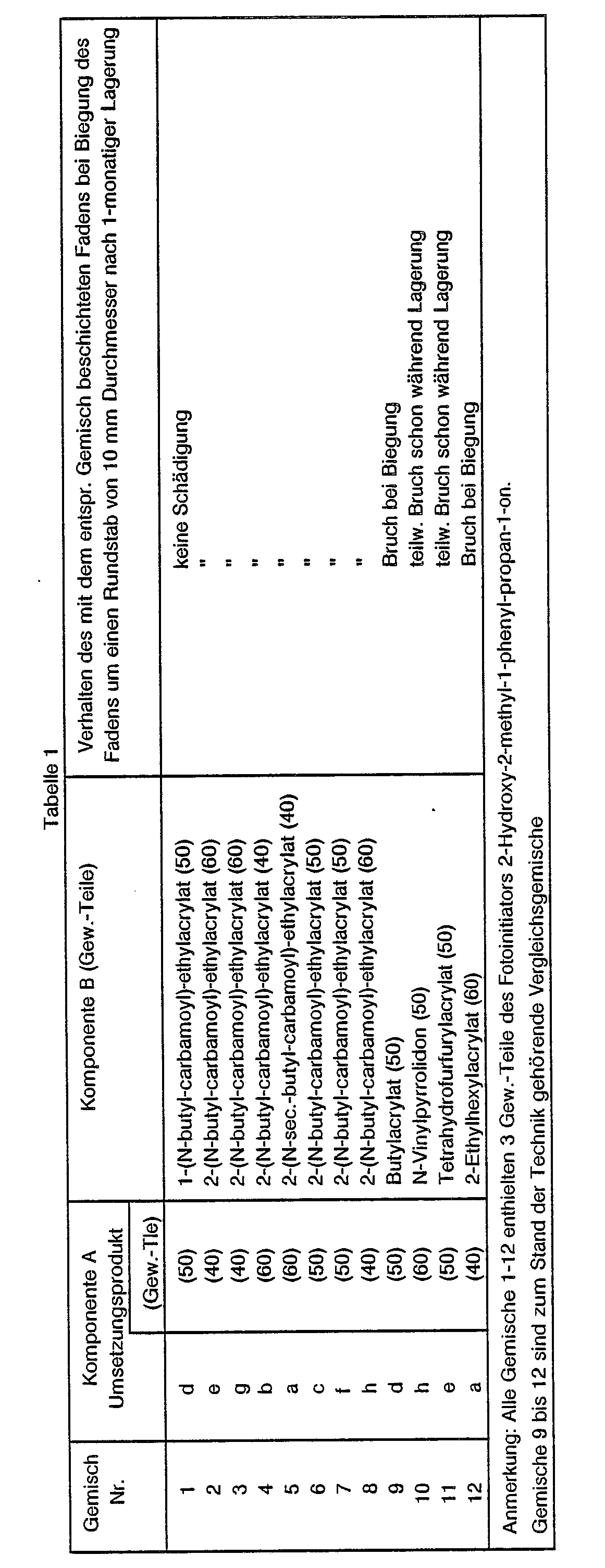
- Die maximale Härtungsgeschwindigkeit der einzelnen Gemische wurde in der nachstehend beschriebenen vereinfachten Weise an beschichteten Folien bestimmt; die an den Folien erhaltenen Ergebnisse sind jedoch ohne weiteres auf Fasern übertragbar.
- Die Gemische wurden mit einer Handrakel auf eine Polycarbonatplatte aufgebracht (Filmdicke: 50 µm). Die beschichteten Polycarbonatplatten wurden mit eine bestimmten Geschwindigkeit unter einer UV-Bestrahlungsanlage (UV-Laborgerät der Firma U. Steinemann AG; 80 W/cm) hindurchgeführt. Bestimmt wurde die für die Durchhärtung des jeweiligen Gemisches gerade noch zulässige Bandgeschwindigkeit (= maximale Bandgeschwindigkeit [m/min]).

- Bei den Beispielen 9 bis 12 (Gemischen 9 bis 12) handelt es sich um Vergleichsbeispiele (Vergleichsgemische).
- Die in den Gemischen 1 bis 12 als Komponente A verwendeten Umsetzungsprodukte a bis h wurden wie folgt erhalten:
- In einem mit Rührer, Thermometer und Gaseinleitungsrohr versehenen 2 I-Kolben wurden 500 g eines linearen Polyethers (mittleres Molekulargewicht: -1000; Umsetzungsprodukt von Propandiol-1,2 mit Propylenoxid), 167 g 2-Hydroxyethylacrylat, 0,5 g Desmorapid SO und 0,3 g p-Methoxyphenol vorgelegt. Bei 60 bis 65 °C und unter Durchleiten von trockener Luft wurden anschließend 265 g Isophorondiisocyanat zugetropft. Die Reaktionsmischung wurde anschließend solange bei 60 bis 65. °C gerührt, bis die NCO-Zahl unter 0,1 % gesunken war.
- 500 g eines OH-Gruppen aufweisenden linearen Polyesters (mittleres Molekulargewicht: 1000; OH-Zahl 112; Umsetzungsprodukt aus Adipinsäure und Neopentylglykol), 255 g 2-Hydroxyethylacrylat und 350 g isophorondiisocyanat wurden in der für das Umsetzungsprodukt a) beschriebenen Weise umgesetzt.
- 500 g unverzweigter, hydroxylgruppenhaltiger Polyester (mittleres Molekulargewicht: 2250; Umsetzungsprodukt aus Adipinsäure und Butandiol), 300 g 2-Hydroxyethylacrylat und 335 g Isophorondiisocyanat wurden in der für das Umsetzungsprodukt a) beschriebenen Weise umgesetzt.
- 500 g eines linearen Polypropylenglykols (mittleres Molekulargewicht: 2000), 250 g 2-Hydroxyethylacrylat und 290 g lsophorondiisocyanat wurden in der für das Umsetzungsprodukt a) beschriebenen Weise umgesetzt.
- In einem mit Rührer, Thermometer, Gaseinleitungsrohr und Wasserabscheider versehenen 1 I-Kolben wurden 500 g eines hydroxylgruppenhaltigen linearen Polyesters (mittleres Molekulargewicht: 1000; OH-Zahl 112; Umsetzungsprodukt aus Adipinsäure und Neopentylglykol), 40 g Acrylsäure, 2 g p-Toluoisulfonsäure, 0,3 g p-Methoxyphenol, 0,3 g Di-tert.-butyl-hydrochinon und 190 g Toluol vorgelegt und unter Durchleiten von Luft auf Rückflußtemperatur erhitzt. Nach Abspaltung der theoretischen Wassermenge wurde das Toluol in Vakuum abdestilliert.
- Das erhaltene Produkt wurde anschließend in einem mit Rührer, Thermometer und Gaseinleitungsrohr versehenen 1 I-Kolben gefüllt und mit 0,1 g Desmorapid SO sowie 0,05 g Di-tert.-butyl-hydrochinon versetzt und auf 60 bis 65 C erhitzt. Bei dieser Temperatur werden unter Durchleiten von trockener Luft 50 g Isophorondiisocyanat zugetropft. Die Reaktionsmischung wurde anschließend solange bei 60 bis 65°C gerührt, bis die NCO-Zahl unter 0,1 % abgesunken war.
- 500 g eines hydroxygruppenaufweisenden linearen Polyethers (mittleres Molekulargewicht: 1000; Umsetzungsprodukt von Propandiol-1,2 mit Propylenoxid), 40 g Acrylsäure, 2,7 g p-Toluolsulfonsäure, 0,3 g p-Methoxyphenol, 0,3 g Di-tert.-butyl-hydrochinon und 190 g Toluol wurden in der für das Umsetzungsprodukt e) beschriebenen Weise umgesetzt und nach Abdestillieren des Toluols mit 50 g Isophorondiisocyanat ebenfalls wie für Umsetzungsprodukt e) beschrieben, umgesetzt.
- 600 g eines linearen hydroxylgruppenhaltigen Polyesters (mittleres Molekulargewicht: 2000; Umsetzungsprodukt aus Adipinsäure mit Ethylenglykol, Diethylenglykol und Butandiol), 22,7 g Acrylsäure, 3,1 g p-Toluolsulfonsäure, 0,3 g p-Methoxyphenol, 0,3 g Di-tert.-butyl-hydrochinon und 220 g Toluol werden nach der für Umsetzungsprodukt e) beschriebenen Weise umgesetzt und nach Entfernen des Toluols mit 31,6 g lsophorondiisocyanat ebenfalls wie für Umsetzunsprodukt e) beschrieben, umgesetzt.
- 500 g eines hydroxygruppenaufweisenden linearen Polyethers (mittleres Molekulargewicht: 1000; Umsetzungsprodukt von Propandiol-1,2 mit Propylenoxid), 500 g 2-Hydroxyethylacrylat und 590 g Isophorondiisocyanat werden unter den für Umsetzungsprodukt a) beschriebenen Bedingungen umgesetzt.
Claims (6)
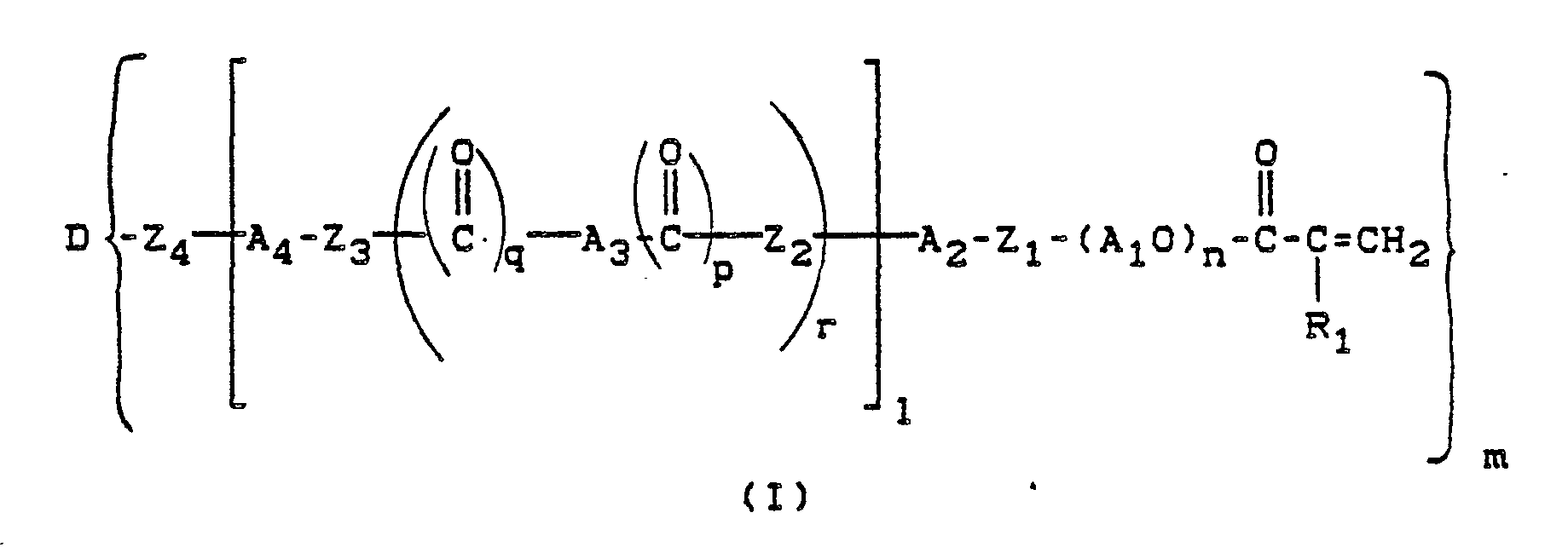





A1, A2, A3, A4 und A unabhängig voneinander für einen gegebenenfalls substituierten, 2-wertigen aliphatischen oder cycloaliphatischen Kohlenwasserstoffrest stehen.


Applications Claiming Priority (2)
| Application Number | Priority Date | Filing Date | Title |
|---|---|---|---|
| DE3801576A DE3801576A1 (de) | 1988-01-21 | 1988-01-21 | Lichtleiter auf basis von polycarbonatfasern und verfahren zu ihrer herstellung |
| DE3801576 | 1988-01-21 |
Publications (3)
| Publication Number | Publication Date |
|---|---|
| EP0327807A2 true EP0327807A2 (de) | 1989-08-16 |
| EP0327807A3 EP0327807A3 (de) | 1991-09-25 |
| EP0327807B1 EP0327807B1 (de) | 1994-04-20 |
Family
ID=6345642
Family Applications (1)
| Application Number | Title | Priority Date | Filing Date |
|---|---|---|---|
| EP89100254A Expired - Lifetime EP0327807B1 (de) | 1988-01-21 | 1989-01-09 | Lichtleiter auf Basis von Polycarbonatfasern und Verfahren zu ihrer Herstellung |
Country Status (4)
| Country | Link |
|---|---|
| US (1) | US4919514A (de) |
| EP (1) | EP0327807B1 (de) |
| JP (1) | JPH026905A (de) |
| DE (2) | DE3801576A1 (de) |
Cited By (3)
| Publication number | Priority date | Publication date | Assignee | Title |
|---|---|---|---|---|
| WO2002029458A1 (de) * | 2000-10-02 | 2002-04-11 | Bayer Aktiengesellschaft | Lichtleiter |
| WO2002029447A1 (de) * | 2000-10-02 | 2002-04-11 | Bayer Aktiengesellschaft | Lichtleiter aus polycarbonat |
| WO2002042804A1 (de) * | 2000-11-27 | 2002-05-30 | Bayer Aktiengesellschaft | Lichtleiter |
Families Citing this family (13)
| Publication number | Priority date | Publication date | Assignee | Title |
|---|---|---|---|---|
| US5002362A (en) * | 1987-05-01 | 1991-03-26 | Daicel Chemical Industries, Ltd. | Plastic optical fiber |
| US5229208A (en) * | 1987-10-09 | 1993-07-20 | Fujitsu Limited | Resin molded body for optical parts |
| US5859174A (en) * | 1996-07-22 | 1999-01-12 | Ppg Industries, Inc. | Amide functional monomers and acrylic polymers with amide functionality |
| SE508067C2 (sv) * | 1996-10-18 | 1998-08-24 | Ericsson Telefon Ab L M | Optisk ledare tillverkad av ett polymert material innefattande glycidylakrylat och pentafluorstyren |
| DE19856008C2 (de) * | 1998-12-04 | 2002-01-03 | Bayer Ag | Berührungssensor |
| DE19856007A1 (de) | 1998-12-04 | 2000-06-21 | Bayer Ag | Anzeigevorrichtung mit Berührungssensor |
| US6126993A (en) * | 1999-01-19 | 2000-10-03 | Alcatel | Coating compositions for optical fibers, and a method of coating optical fibers |
| JP3587755B2 (ja) | 2000-03-14 | 2004-11-10 | シスメックス株式会社 | 粒子測定装置およびその方法 |
| US20040091754A1 (en) * | 2000-09-26 | 2004-05-13 | Willi Bette | Method for operating a fuel cell arrangement and fuel cell arrangement for carrying out the method |
| US6944115B2 (en) | 2000-09-29 | 2005-09-13 | General Electric Company | Colored data storage media |
| DE10054935A1 (de) * | 2000-11-06 | 2002-05-08 | Bayer Ag | Lichtleiter |
| US6475589B1 (en) * | 2001-12-17 | 2002-11-05 | General Electric Company | Colored optical discs and methods for making the same |
| WO2015153966A1 (en) * | 2014-04-04 | 2015-10-08 | Sabic Global Technologies B.V. | Polycarbonate fibers and substrates comprising same |
Family Cites Families (9)
| Publication number | Priority date | Publication date | Assignee | Title |
|---|---|---|---|---|
| CA1138375A (en) * | 1978-11-01 | 1982-12-28 | James E. Moore | Photocurable acrylic coated polycarbonate articles |
| EP0125710A3 (de) * | 1983-04-11 | 1985-07-10 | International Standard Electric Corporation | Mittels U.V.-Strahlen härtbare Beschichtung für optische Faser |
| NL8401981A (nl) * | 1984-06-22 | 1986-01-16 | Philips Nv | Optische glasvezel voorzien van een kunststofbedekking en werkwijze voor de vervaardiging daarvan. |
| JPS6116970A (ja) * | 1984-07-02 | 1986-01-24 | Mitsui Toatsu Chem Inc | 活性エネルギ−線硬化被覆用組成物 |
| NL8403179A (nl) * | 1984-10-18 | 1986-05-16 | Philips Nv | Werkwijze voor de vervaardiging van een optische vezel voorzien van een kunststofbedekking en optische vezel met kunststofbedekking vervaardigd volgens de werkwijze. |
| JPH0646244B2 (ja) * | 1985-05-17 | 1994-06-15 | 三菱レイヨン株式会社 | プラスチック系光ファイバ |
| JPS62119141A (ja) * | 1985-11-19 | 1987-05-30 | Shin Etsu Chem Co Ltd | 放射線硬化性光フアイバ−用被覆剤 |
| FR2600937B1 (fr) * | 1986-07-02 | 1988-11-25 | Bosc Dominique | Procede de fabrication de fibres optiques polymeres mettant en oeuvre une preforme partiellement et preforme partielle |
| CA1317063C (en) * | 1986-08-06 | 1993-04-27 | Takashi Yamamoto | Plastic cladding composition for plastic core optical fiber, and plastic core optical fiber prepared therefrom |
-
1988
- 1988-01-21 DE DE3801576A patent/DE3801576A1/de not_active Withdrawn
-
1989
- 1989-01-05 US US07/294,079 patent/US4919514A/en not_active Expired - Fee Related
- 1989-01-09 EP EP89100254A patent/EP0327807B1/de not_active Expired - Lifetime
- 1989-01-09 DE DE58907478T patent/DE58907478D1/de not_active Expired - Fee Related
- 1989-01-19 JP JP1008771A patent/JPH026905A/ja active Pending
Cited By (5)
| Publication number | Priority date | Publication date | Assignee | Title |
|---|---|---|---|---|
| WO2002029458A1 (de) * | 2000-10-02 | 2002-04-11 | Bayer Aktiengesellschaft | Lichtleiter |
| WO2002029447A1 (de) * | 2000-10-02 | 2002-04-11 | Bayer Aktiengesellschaft | Lichtleiter aus polycarbonat |
| US6907174B2 (en) | 2000-10-02 | 2005-06-14 | Bayer Aktiengesellschaft | Optical fiber |
| WO2002042804A1 (de) * | 2000-11-27 | 2002-05-30 | Bayer Aktiengesellschaft | Lichtleiter |
| US6950587B2 (en) | 2000-11-27 | 2005-09-27 | Bayer Aktiengesellschaft | Optical fibers |
Also Published As
| Publication number | Publication date |
|---|---|
| DE58907478D1 (de) | 1994-05-26 |
| EP0327807A3 (de) | 1991-09-25 |
| US4919514A (en) | 1990-04-24 |
| DE3801576A1 (de) | 1989-08-03 |
| EP0327807B1 (de) | 1994-04-20 |
| JPH026905A (ja) | 1990-01-11 |
Similar Documents
| Publication | Publication Date | Title |
|---|---|---|
| EP0327807B1 (de) | Lichtleiter auf Basis von Polycarbonatfasern und Verfahren zu ihrer Herstellung | |
| DE1964547C3 (de) | Verfahren zur Herstellung eines durch Strahlung härtbaren Überzugsmaterials | |
| DE2542314C2 (de) | Verfahren zur Herstellung von Lösungen urethanmodifizierter Acrylate und deren Verwendung | |
| DE3048823C2 (de) | ||
| DE3013827C2 (de) | ||
| DE3882835T2 (de) | Mittels 2-Glycerylacrylat oder 2-Glycerylmethacrylat vernetzte Polyurethane und Polyurethan-Polyharnstoffe. | |
| EP0071142B1 (de) | Verfahren zum Verkleben von Folien | |
| EP0029929B1 (de) | Härtbare Überzugsmittel und Verfahren zur Herstellung kratzfester Überzüge auf Kunststoffen | |
| DE2651507B2 (de) | Verwendung von Triacrylaten von oxäthyliertem Trimethylolpropan mit einem Oxäthylierungsgrad von 23 bis 4 als Verdünnungsmittel in strahlenhärtbaren Zusammensetzungen | |
| EP0752408B1 (de) | Strahlungshärtbare Acrylate mit eingebauten Photoinitiatoren | |
| EP0315020A2 (de) | Verfahren zur Herstellung von Isocyanuratgruppen und olefinische Doppelbindungen aufweisenden Verbindungen und ihre Verwendung als Bindemittel | |
| WO2002037148A2 (de) | Lichtleiter | |
| DE2355874A1 (de) | Haertbare massen | |
| WO1998022545A1 (de) | Lufttrocknende bindemittel | |
| JPH0580921B2 (de) | ||
| DE2618986B2 (de) | Durch Elektronenstrahlung härtbares Überzugsmittel | |
| EP0017798A1 (de) | Durch energiereiche Strahlung härtbare modifizierte Polyesterimide, Verfahren zu ihrer Herstellung und deren Verwendung zur Isolierung von elektrischen Drähten | |
| DE2618980C3 (de) | Verfahren zur Herstellung durch Elektronenstrahlen härtbarer Überzugsmittel | |
| DE2929313A1 (de) | Formkoerper mit mikrostrukturierter oberflaeche sowie verfahren und formmassen zu deren herstellung | |
| EP1325369B1 (de) | Lichtleiter | |
| DE10048796A1 (de) | Lichtleiter | |
| EP1340105A1 (de) | Lichtleiter | |
| DE3140522A1 (de) | Haertbare ueberzugsmittel und verfahren zur herstellung kratzfester ueberzuege auf kunststoffen | |
| JPH0374148B2 (de) | ||
| JPS6278131A (ja) | 光学ガラスフアイバ用被覆材料 |
Legal Events
| Date | Code | Title | Description |
|---|---|---|---|
| PUAI | Public reference made under article 153(3) epc to a published international application that has entered the european phase |
Free format text: ORIGINAL CODE: 0009012 |
|
| 17P | Request for examination filed |
Effective date: 19890109 |
|
| AK | Designated contracting states |
Kind code of ref document: A2 Designated state(s): DE FR GB IT NL |
|
| PUAL | Search report despatched |
Free format text: ORIGINAL CODE: 0009013 |
|
| AK | Designated contracting states |
Kind code of ref document: A3 Designated state(s): DE FR GB IT NL |
|
| 17Q | First examination report despatched |
Effective date: 19930816 |
|
| GRAA | (expected) grant |
Free format text: ORIGINAL CODE: 0009210 |
|
| AK | Designated contracting states |
Kind code of ref document: B1 Designated state(s): DE FR GB IT NL |
|
| REF | Corresponds to: |
Ref document number: 58907478 Country of ref document: DE Date of ref document: 19940526 |
|
| ITF | It: translation for a ep patent filed | ||
| ET | Fr: translation filed | ||
| GBT | Gb: translation of ep patent filed (gb section 77(6)(a)/1977) |
Effective date: 19940728 |
|
| PLBE | No opposition filed within time limit |
Free format text: ORIGINAL CODE: 0009261 |
|
| STAA | Information on the status of an ep patent application or granted ep patent |
Free format text: STATUS: NO OPPOSITION FILED WITHIN TIME LIMIT |
|
| 26N | No opposition filed | ||
| PGFP | Annual fee paid to national office [announced via postgrant information from national office to epo] |
Ref country code: DE Payment date: 19951213 Year of fee payment: 8 |
|
| PGFP | Annual fee paid to national office [announced via postgrant information from national office to epo] |
Ref country code: FR Payment date: 19951228 Year of fee payment: 8 |
|
| PGFP | Annual fee paid to national office [announced via postgrant information from national office to epo] |
Ref country code: GB Payment date: 19960102 Year of fee payment: 8 |
|
| PGFP | Annual fee paid to national office [announced via postgrant information from national office to epo] |
Ref country code: NL Payment date: 19960131 Year of fee payment: 8 |
|
| PG25 | Lapsed in a contracting state [announced via postgrant information from national office to epo] |
Ref country code: GB Effective date: 19970109 |
|
| PG25 | Lapsed in a contracting state [announced via postgrant information from national office to epo] |
Ref country code: NL Effective date: 19970801 |
|
| GBPC | Gb: european patent ceased through non-payment of renewal fee |
Effective date: 19970109 |
|
| PG25 | Lapsed in a contracting state [announced via postgrant information from national office to epo] |
Ref country code: FR Effective date: 19970930 |
|
| NLV4 | Nl: lapsed or anulled due to non-payment of the annual fee |
Effective date: 19970801 |
|
| PG25 | Lapsed in a contracting state [announced via postgrant information from national office to epo] |
Ref country code: DE Effective date: 19971001 |
|
| REG | Reference to a national code |
Ref country code: FR Ref legal event code: ST |
|
| PG25 | Lapsed in a contracting state [announced via postgrant information from national office to epo] |
Ref country code: IT Free format text: LAPSE BECAUSE OF NON-PAYMENT OF DUE FEES;WARNING: LAPSES OF ITALIAN PATENTS WITH EFFECTIVE DATE BEFORE 2007 MAY HAVE OCCURRED AT ANY TIME BEFORE 2007. THE CORRECT EFFECTIVE DATE MAY BE DIFFERENT FROM THE ONE RECORDED. Effective date: 20050109 |