EP0321778A2 - Basische Farbstoffe - Google Patents
Basische Farbstoffe Download PDFInfo
- Publication number
- EP0321778A2 EP0321778A2 EP88120387A EP88120387A EP0321778A2 EP 0321778 A2 EP0321778 A2 EP 0321778A2 EP 88120387 A EP88120387 A EP 88120387A EP 88120387 A EP88120387 A EP 88120387A EP 0321778 A2 EP0321778 A2 EP 0321778A2
- Authority
- EP
- European Patent Office
- Prior art keywords
- formula
- methyl
- dyes
- hydrogen
- ethyl
- Prior art date
- Legal status (The legal status is an assumption and is not a legal conclusion. Google has not performed a legal analysis and makes no representation as to the accuracy of the status listed.)
- Withdrawn
Links
- CJHAEZJOSSYDJM-SREVYHEPSA-N CC/C(/C)=C(/CNC)\C(N)O Chemical compound CC/C(/C)=C(/CNC)\C(N)O CJHAEZJOSSYDJM-SREVYHEPSA-N 0.000 description 1
Classifications
-
- C—CHEMISTRY; METALLURGY
- C09—DYES; PAINTS; POLISHES; NATURAL RESINS; ADHESIVES; COMPOSITIONS NOT OTHERWISE PROVIDED FOR; APPLICATIONS OF MATERIALS NOT OTHERWISE PROVIDED FOR
- C09B—ORGANIC DYES OR CLOSELY-RELATED COMPOUNDS FOR PRODUCING DYES, e.g. PIGMENTS; MORDANTS; LAKES
- C09B43/00—Preparation of azo dyes from other azo compounds
- C09B43/40—Preparation of azo dyes from other azo compounds by substituting hetero atoms by radicals containing other hetero atoms
-
- C—CHEMISTRY; METALLURGY
- C09—DYES; PAINTS; POLISHES; NATURAL RESINS; ADHESIVES; COMPOSITIONS NOT OTHERWISE PROVIDED FOR; APPLICATIONS OF MATERIALS NOT OTHERWISE PROVIDED FOR
- C09B—ORGANIC DYES OR CLOSELY-RELATED COMPOUNDS FOR PRODUCING DYES, e.g. PIGMENTS; MORDANTS; LAKES
- C09B29/00—Monoazo dyes prepared by diazotising and coupling
- C09B29/34—Monoazo dyes prepared by diazotising and coupling from other coupling components
- C09B29/36—Monoazo dyes prepared by diazotising and coupling from other coupling components from heterocyclic compounds
- C09B29/3604—Monoazo dyes prepared by diazotising and coupling from other coupling components from heterocyclic compounds containing only a nitrogen as heteroatom
- C09B29/3665—Monoazo dyes prepared by diazotising and coupling from other coupling components from heterocyclic compounds containing only a nitrogen as heteroatom containing a six-membered heterocyclic ring with two nitrogen atoms
- C09B29/3669—Monoazo dyes prepared by diazotising and coupling from other coupling components from heterocyclic compounds containing only a nitrogen as heteroatom containing a six-membered heterocyclic ring with two nitrogen atoms from a pyrimidine ring
- C09B29/3673—Barbituric acid and derivatives thereof
-
- C—CHEMISTRY; METALLURGY
- C09—DYES; PAINTS; POLISHES; NATURAL RESINS; ADHESIVES; COMPOSITIONS NOT OTHERWISE PROVIDED FOR; APPLICATIONS OF MATERIALS NOT OTHERWISE PROVIDED FOR
- C09B—ORGANIC DYES OR CLOSELY-RELATED COMPOUNDS FOR PRODUCING DYES, e.g. PIGMENTS; MORDANTS; LAKES
- C09B44/00—Azo dyes containing onium groups
- C09B44/02—Azo dyes containing onium groups containing ammonium groups not directly attached to an azo group
- C09B44/08—Azo dyes containing onium groups containing ammonium groups not directly attached to an azo group from coupling components containing heterocyclic rings
-
- C—CHEMISTRY; METALLURGY
- C09—DYES; PAINTS; POLISHES; NATURAL RESINS; ADHESIVES; COMPOSITIONS NOT OTHERWISE PROVIDED FOR; APPLICATIONS OF MATERIALS NOT OTHERWISE PROVIDED FOR
- C09B—ORGANIC DYES OR CLOSELY-RELATED COMPOUNDS FOR PRODUCING DYES, e.g. PIGMENTS; MORDANTS; LAKES
- C09B69/00—Dyes not provided for by a single group of this subclass
-
- Y—GENERAL TAGGING OF NEW TECHNOLOGICAL DEVELOPMENTS; GENERAL TAGGING OF CROSS-SECTIONAL TECHNOLOGIES SPANNING OVER SEVERAL SECTIONS OF THE IPC; TECHNICAL SUBJECTS COVERED BY FORMER USPC CROSS-REFERENCE ART COLLECTIONS [XRACs] AND DIGESTS
- Y10—TECHNICAL SUBJECTS COVERED BY FORMER USPC
- Y10S—TECHNICAL SUBJECTS COVERED BY FORMER USPC CROSS-REFERENCE ART COLLECTIONS [XRACs] AND DIGESTS
- Y10S534/00—Organic compounds -- part of the class 532-570 series
- Y10S534/01—Mixtures of azo compounds
Definitions
- the invention relates to basic dyes of the formula or their tautomeric forms, wherein R1, R2 for hydrogen, C1-C4-alkyl, C1-C4-alkoxy or halogen, Q - E for CS, CO, C-NH, - , A for C1-C4 alkylene, W for the remainder of an aliphatic mono-, di-, tri-, tetra-, penta-, hexa- or heptamine, which can be protonated or quaternized, n for 0 to 1.5 and p stands for 1.3 to 10, their manufacture and their use for dyeing materials dyeable with basic dyes.
- Halogen is preferably chlorine or bromine.
- R9 is hydrogen, C1-C4-alkyl, C2-C4-alkyl substituted by OH, NH2 or C1-C4-alkoxy.
- Anions are all the organic and inorganic anions customary for cationic dyes. Colorless anions are preferred.
- the anion is generally given by the manufacturing process and the possible purification of the starting materials.
- the anions can also be exchanged for other anions in a known manner.
- An are: halides such as chloride, bromide and iodide; Sulfate, hydrogen sulfate, methyl sulfate, ethyl sulfate, amidosulfate, perchlorate, phosphate, hydroxide, formate, acetate, propionate, oxalate, malonate, succinate, maleinate, chloroacetate, trichloroacetate, hydroxyacetate, methoxyacetate, ethoxyacetate, lactate, methanesulfonate, benzate Benzenesulfonate, p-toluenesulfonate, carbonate, tetrachlorozincate and tetrafluoroborate.
- halides such as chloride, bromide and iodide
- dyes of formula (I) are those of the formula or their tautomeric forms are preferred, wherein R1 ′ for hydrogen, methoxy, ethoxy or chlorine, R2 ′ represents hydrogen, methyl, ethyl, methoxy or ethoxy, p ′ for 1.5 to 6, W ′ for With R5 ′ methyl, ethyl, n-propyl or -CH2-CH2-OH, R7 ′ is hydrogen, methyl, ethyl, n-propyl or -CH2-CH2-OH, With R9 ′ methyl, ethyl, -CH2-CH2-OH or -CH2-CH2-NH2, 3.
- R4 ' is hydrogen, methyl, ethyl, n-propyl or -CH2-CH2-OH or NR4′R5 ′ stands for one of the following rings:
- Basic dyes of the formula are particularly preferred or their tautomeric forms, wherein R2 ⁇ for hydrogen or methyl, n 'represent 0.2 to 1.2 and W 'and p' have the meaning given under formula (II).
- dyes of the formula (III) are those of the formula or their tautomeric forms are highlighted, wherein W ⁇ stands for the following residues With B2 ⁇ ethylene or propylene, t '2, 3 or 4 and s + t ′ 3 or 4 and n ⁇ for 0.4 to 0.9 and p ⁇ stand for 2 to 5.
- the invention also relates to a process for the preparation of dyes of the formula (I), which is characterized in that a compound of the formula with an amine of the formula HW (VI) or reacting with mixtures of amines of this formula in an aqueous alkaline medium.
- the symbols used in the formulas (V) and (VI) have the meaning given under formula (I).
- a process for the preparation of dyes of the formula (III) is preferred, which is characterized in that a compound of the formula with an amine of the formula HW ′ (VIII) or with mixtures of amines of this formula in water at pH 9-12, preferably pH 10.0 to 11.5 and a temperature of 20-100 ° C., preferably 35-70 ° C.
- the symbols W 'and R2 ⁇ and n' have the meanings mentioned under the formulas (II) and (III).
- the pH is maintained by adding an alkaline agent, especially an alkali hydroxide such as sodium or potassium hydroxide.
- an alkaline agent especially an alkali hydroxide such as sodium or potassium hydroxide.
- the dyes are isolated in that, after the reaction has ended, the pH is reduced to 5-9, preferably to 6-8, before suctioning off.
- the solids can be dried or processed in the form of their moist presscakes in liquid form.
- the invention further relates to a process for the preparation of compounds of the formula (V) by reacting a chromophore of the formula in high-percentage sulfuric or phosphoric acid or in polyphosphoric acid, optionally with the addition of water-releasing agents such as sulfur trioxide (oleum), phosphorus pentoxide, acetic anhydride, benzene or toluenesulfonic acid, with paraformaldehyde and an amide of the formula H2N-CO alkylene halogen (X) at 0 to 140 ° C.
- water-releasing agents such as sulfur trioxide (oleum), phosphorus pentoxide, acetic anhydride, benzene or toluenesulfonic acid, with paraformaldehyde and an amide of the formula H2N-CO alkylene halogen (X) at 0 to 140 ° C.
- a process is preferred in which paraformaldehyde and an amide of the formula (X) are first reacted in 96 to 100% strength sulfuric acid or up to 10% strength oleum at 0 to 60 ° C. and then a chromophore of the formula (IX) admits and carries out the further reaction at 0 to 140 ° C.
- a process for the preparation of compounds of the formula (VII) is preferred, in which paraformaldehyde and 2-chloroacetamide are first reacted in 98 to 100% strength sulfuric acid or up to 3% strength oleum at 15-40 ° C. and then a chromophore of the formula with R2 ⁇ as mentioned above for hydrogen or methyl enters the resulting solution and carries out the further reaction at 0 to 80 ° C. It is advantageous to start at 0 to 5 ° C and to increase the temperature later.
- the process according to the invention has the advantage that the formation of the N-methylolamide of the formula (XII) and its reaction with the chromophore of the formula (IX) can be carried out in one step. Surprisingly, in this one-pot reaction according to the invention there are no disruptive side reactions which impair the product quality compared to the conventional process.
- the dyes obtained in the ways shown can be used as readily water-soluble dyes from an aqueous-acidic solution for dyeing a wide variety of materials such as cellulose materials, polyacrylonitrile, acid-modified polyamide and polyester, wool and leather.
- the dyes of the invention are particularly suitable for dyeing a wide variety of paper types in clear, yellow tones.
- the dyeings have good to very good light and wet fastness properties. They are very resistant to the effects of water, alcohols, soaps or aqueous organic acids.
- the product of the above example can also be obtained if 100 g of the compound and 45 g of N-methylolchloroacetamide as a mixture in 500 ml of 2% oleum at 0-5 ° C and stirred for 2 hours at this temperature. After stirring at room temperature overnight, the solution is briefly heated to 120 ° C. and, after cooling, worked up as in Example 1.
- Example 5 The same product as in Example 5 is obtained if the procedure of Example 1 is followed, but only 10 g of paraformaldehyde and 31 g of chloroacetamide are used.
- linkage isomer amine-chromophore bond via the primary amino group
- bridged products linkage of two chromophores via an amine
- Example 7 471 g of the moist filter cake from Example 2 are introduced into 3.1 l of water. 39 g of 3-amino-1-methylaminopropane are added, the mixture is heated to 40 ° C. and the pH is kept at 10.5. After 1 hour, adjust to pH 11 and hold at 40 ° until the pH remains constant. If one proceeds as described in Example 7, 115 g of a product are obtained after drying, in which the compound of the formula Main component is. This product colors paper a little reddish yellow.
- the preliminary product from Example 1 is reacted with the amounts of the amines listed in Table 1 instead of with 37 g of 3-amino-1-methylaminopropane.
- the products thus obtained contain dyes of the general formula as the main component where X stands for a monovalent radical of the amines listed.
- the dyes turn paper a little reddish yellow.
- mixtures of the amines mentioned in the examples can also be used.
- Example 8 the precursor from Example 2 is reacted according to Example 8 instead of 39 g of 3-amino-1-methylaminopropane with the amounts of the amines listed there in Table 2.
- the products thus obtained contain dyes of the general formula as the main component where X stands for a monovalent radical of the amines listed.
- the dyes turn paper a little reddish yellow.
- mixtures of the amines mentioned in the examples can also be used.
- the precursor from example 3 is reacted according to example 9 instead of with 14.5 g of 3-amino-1-methylaminopropane with the amounts of the amines listed there in table 3.
- the products thus obtained contain dyes of the general formula as the main component where X stands for a monovalent radical of the amines listed. Mixtures of the amines mentioned in the examples can also be used. The dyes turn paper a little reddish yellow.
- Example 59 111 g of the product from Example 59 are reacted in 3.2 l of water with 56 g of N- (2-aminoethyl) piperazine according to Example 8. This gives 113 g of a product with a main component of the formula The product turns paper neutral yellow.
- Example 60 107 g of the product from Example 60 are reacted in 2 l of water with 62 g (H2N-CH2-CH2-CH2) 2N-CH3 according to Example 8. This gives 107 g of a product with a main component of the formula The product turns paper a little greenish yellow.
- Example 61 the compound from Example 61 is used as the starting material instead of that from Example 60, 109 g of a product with a main component of the formula are obtained The product turns paper neutral yellow.
- Example 8 110 g of the compound from Example 62 are reacted in 2 l of water with 62 g of N- (3-aminopropyl) morpholine according to Example 8, giving 109 g of a product of the formula receives, the paper turns neutral yellow.
- a mixture of 12 g of paraformaldehyde and 43 g of 3-chloropropionic acid amide is introduced into 300 ml of monohydrate at room temperature with cooling. The mixture is then held at 30 ° C. for 1 hour, cooled to 0 ° to 5 ° C. and 100 g of the compound are carried slowly. If the procedure is otherwise as in Example 1, 141 g of the compound are obtained after drying Elemental analysis 8.0% chlorine.
- Example 11 The product from Example 11 is slurried in the form of its moist press cake in 1 liter of water without prior drying. 17 ml of dimethyl sulfate are added, and the mixture is kept at pH 9 at room temperature by adding 1N NaOH solution. After 2 hours, the mixture is warmed to 40 ° C. and is kept at pH 9. After a further 2 hours, the mixture is brought to pH 6 with dilute hydrochloric acid , 5 set, heated to 80 ° and suctioned off. Salt-free washing and drying provide 54 g of a dye of the formula the paper turns somewhat reddish yellow.
Landscapes
- Chemical & Material Sciences (AREA)
- Organic Chemistry (AREA)
- Paper (AREA)
- Coloring (AREA)
Abstract
Basische Farbstoffe der Formel
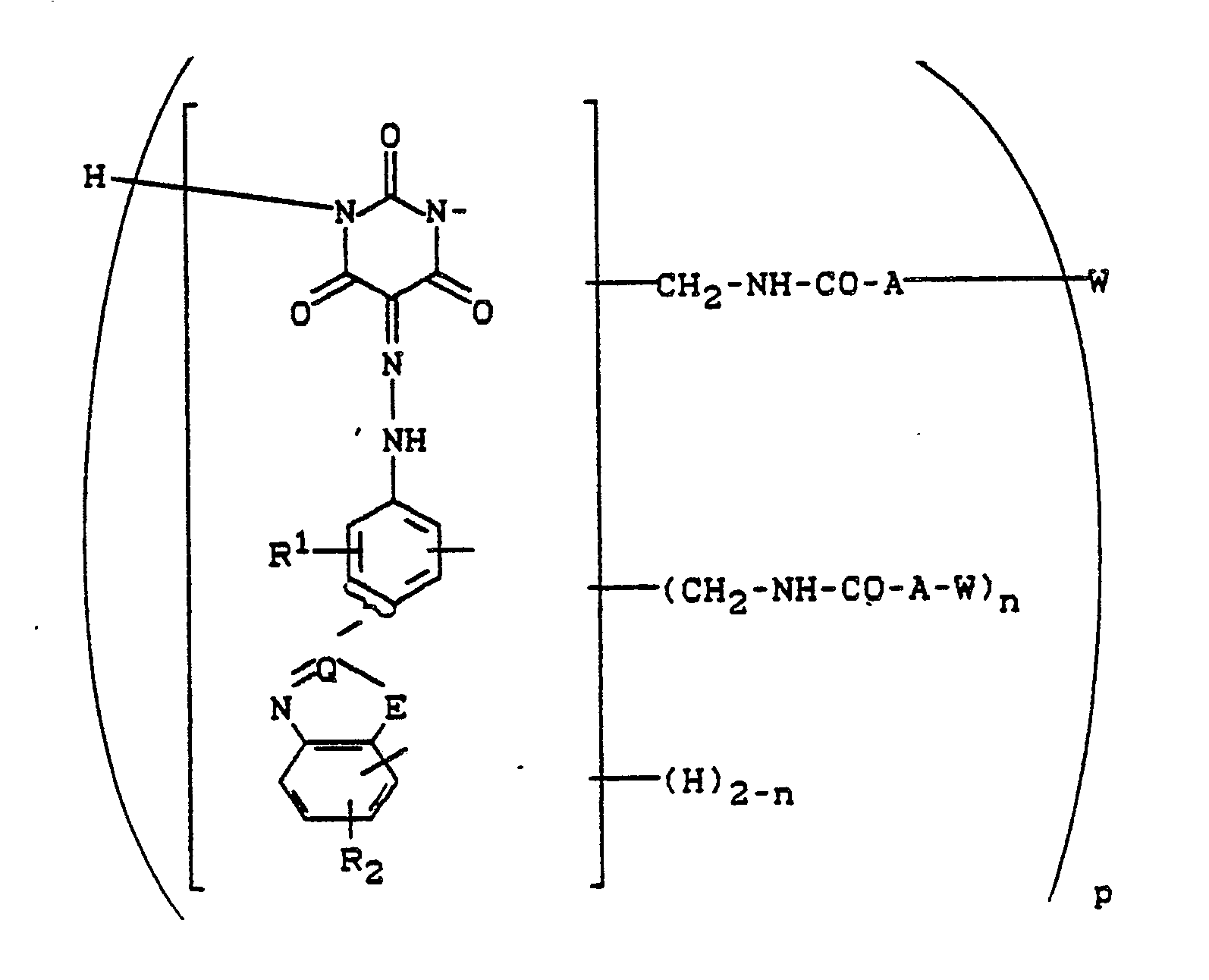
oder deren tautomere Formen, worin
R₁, R₂ für Wasserstoff, C₁-C₄-Alkyl, C₁-C₄-Alkoxy oder Halogen,
Q - E für C-S, C-O, C-NH, -
- ,
,
A für C₁-C₄-Alkylen,
W für den Rest eines aliphatischen Mono-, Di-, Tri-, Tetra-, Penta-, Hexa- oder Heptamins, der protoniert oder quaterniert sein kann,
n für 0 bis 1,5 und
p für 1,3 bis 10 stehen,
sind zum Färben von mit basischen Farbstoffen färbbaren Materialien geeignet.
R₁, R₂ für Wasserstoff, C₁-C₄-Alkyl, C₁-C₄-Alkoxy oder Halogen,
Q - E für C-S, C-O, C-NH,
A für C₁-C₄-Alkylen,
W für den Rest eines aliphatischen Mono-, Di-, Tri-, Tetra-, Penta-, Hexa- oder Heptamins, der protoniert oder quaterniert sein kann,
n für 0 bis 1,5 und
p für 1,3 bis 10 stehen,
sind zum Färben von mit basischen Farbstoffen färbbaren Materialien geeignet.
Description
- Die Erfindung betrifft basische Farbstoffe der Formel

R₁, R₂ für Wasserstoff, C₁-C₄-Alkyl, C₁-C₄-Alkoxy oder Halogen,
Q - E für C-S, C-O, C-NH,- ,
,
A für C₁-C₄-Alkylen,
W für den Rest eines aliphatischen Mono-, Di-, Tri-, Tetra-, Penta-, Hexa- oder Heptamins, der protoniert oder quaterniert sein kann,
n für 0 bis 1,5 und
p für 1,3 bis 10 stehen,
ihre Herstellung und ihre Verwendung zum Färben von mit basischen Farbstoffen färbbaren Materialien. - Halogen steht vorzugsweise für Chlor oder Brom.
- W steht vorzugsweise für den Rest

m 0, 1, 2 oder 3,
q,r 0 oder 1,
s 0, 1 oder 2,
x 0, 1, 2 oder 3,
B₁, B₂ C₂- oder C₃-Alkylen,
B₃ C₂-C₆-Alkylen oder C₄-C₁₀-Alkylen, das durch 1 bis 3 Sauerstoffe unterbrochen ist, und
R₃ bis R₇ Wasserstoff, C₁-C₄-Alkyl, durch OH oder C₁-C₄-Alkoxy substituiertes C₂-C₄-Alkyl bedeuten, oder
R₄ und R₅ oder - wenn m + q + r + s = 0 -
R₅ und R₇ zu einem 5- oder 6-gliedrigen Ring geschlossen sind,
R₈ Methyl, Ethyl, Hydroxyethyl oder Hydroxypropyl und
An die Ladung x (+) kompensierende Äquivalente eines Anions bedeuten. - Als 5- bzw. 6-gliedrige Ringe sind bevorzugt

R₉ Wasserstoff, C₁-C₄-Alkyl, durch OH, NH₂ oder C₁-C₄-Alkoxy substituiertes C₂-C₄-Alkyl. - Als Anionen An kommen alle die für kationische Farbstoffe üblichen organischen und anorganischen Anionen in Betracht. Bevorzugt sind farblose Anionen.
- Das Anion ist im allgemeinen durch das Herstellungsverfahren und die eventuell vorgenommene Reinigung der Ausgangsstoffe gegeben. Die Anionen können aber auch in bekannter Weise gegen andere Anionen ausgetauscht werden. Als Beispiele für An seien genannt: Halogenide wie Chlorid, Bromid und Jodid; Sulfat, Hydrogensulfat, Methylsulfat, Ethylsulfat, Amidosulfat, Perchlorat, Phosphat, Hydroxid, Formiat, Acetat, Propionat, Oxalat, Malonat, Succinat, Maleinat, Chloracetat, Trichloracetat, Hydroxyacetat, Methoxyacetat, Ethoxyacetat, Lactat, Citrat, Benzoat, Methansulfonat, Ethansulfonat, Benzolsulfonat, p-Toluolsulfonat, Carbonat, Tetrachlorzinkat und Tetrafluoroborat.
- Von den Farbstoffen der Formel (I) sind die der Formel

R₁′ für Wasserstoff, Methoxy, Ethoxy oder Chlor,
R₂′ für Wasserstoff, Methyl, Ethyl, Methoxy oder Ethoxy,
p′ für 1,5 bis 6,
W′ für
R₅′ Methyl, Ethyl, n-Propyl oder -CH₂-CH₂-OH,
R₇′ Wasserstoff, Methyl, Ethyl, n-Propyl oder -CH₂-CH₂-OH,
R₉′ Methyl, Ethyl, -CH₂-CH₂-OH oder -CH₂-CH₂-NH₂,
3. -NH-B₃′-NH₂
mit
B₃′ Ethylen, Propylen, Trimethylen, Hexamethylen oder -(CH₂)₃-O-CH₂-CH₂-O-(CH₂)₃-
B₁′ Ethylen oder Trimethylen
R₄′ Wasserstoff, Methyl, Ethyl, n-Propyl oder -CH₂-CH₂-OH oder
NR₄′R₅′ steht für einen der folgenden Ringe:

t = 1, 2, 3, 4 oder 5
s + t = 2, 3, 4 oder 5
B₂′ = Ethylen, Propylen, Trimethylen
R₁₁ = Methyl oder Ethyl
- Besonders bevorzugt sind basische Farbstoffe der Formel

R₂˝ für Wasserstoff oder Methyl,
n′ für 0,2 bis 1,2 stehen und
W′ und p′ die unter Formel (II) genannte Bedeutung haben. - Von den Farbstoffen der Formel (III) seien die der Formel

W˝ für die folgenden Reste steht

B₂˝ Ethylen oder Propylen,
t′ 2, 3 oder 4 und
s + t′ 3 oder 4 und
n˝ für 0,4 bis 0,9 und
p˝ für 2 bis 5 stehen. - Gegenstand der Erfindung ist auch ein Verfahren zur Herstellung von Farbstoffen der Formel (I), das dadurch gekennzeichnet ist, daß man eine Verbindung der Formel

HW (VI)
oder mit Mischungen von Aminen dieser Formel in wäßrigalkalischem Medium zur Reaktion bringt. Dabei haben die in den Formeln (V) und (VI) verwendeten Symbole die unter Formel (I) angegebene Bedeutung. - Bevorzugt ist ein Verfahren zur Herstellung von Farbstoffen der Formel (III), das dadurch gekennzeichnet ist, daß man eine Verbindung der Formel

HW′ (VIII)
oder mit Mischungen von Aminen dieser Formel in Wasser bei pH 9-12, vorzugsweise pH 10,0 bis 11,5 und einer Temperatur von 20-100°C, vorzugsweise 35-70°C zur Reaktion bringt. Dabei haben die Symbole W′ bzw. R₂˝ und n′ die unter den Formeln (II) bzw. (III) genannten Bedeutungen. - Der pH-Wert wird durch Zugabe eines alkalisch reagierenden Mittels, besonders eines Alkalihydroxids wie Natrium- oder Kaliumhydroxid aufrechterhalten.
- Die Isolierung der Farbstoffe erfolgt bei dem erfindungsgemäßen Verfahren dadurch, daß nach beendeter Reaktion der pH-Wert auf 5-9, vorzugsweise auf 6-8 gesenkt wird, bevor man absaugt. Die Feststoffe können getrocknet werden oder in Form ihrer feuchten Preßkuchen in Flüssigeinstellungen verarbeitet werden.
- Gegenstand der Erfindung ist ferner ein Verfahren zur Herstellung von Verbindungen der Formel (V) durch Umsetzung eines Chromophors der Formel

H₂N-CO-Alkylen-Halogen (X)
bei 0 bis 140°C. - Bevorzugt ist ein Verfahren, bei dem man zunächst Paraformaldehyd und ein Amid der Formel (X) in 96 bis 100 %iger Schwefelsäure oder bis zu 10 %igem Oleum bei 0 bis 60°C zur Reaktion bringt und anschließend einen Chromophor der Formel (IX) zugibt und die weitere Umsetzung bei 0 bis 140°C durchführt.
- Bevorzugt ist ein Verfahren zur Herstellung von Verbindungen der Formel (VII), bei dem man zunächst Paraformaldehyd und 2-Chloracetamid in 98 bis 100 %iger Schwefelsäure oder bis zu 3 %igem Oleum bei 15-40°C zur Reaktion bringt und anschließend einen Chromophor der Formel

- Gegenüber dem herkömmlichen Verfahren zur Herstellung von Vorprodukten der Formel (V), bei dem ein Chromophor der Formel (IX) mit einem N-Methylolamid der Formel
HO-CH₂-NH-CO-Alkylen-Halogen (XII)
umgesetzt wird, hat das erfindungsgemäße Verfahren den Vorteil, daß sich bei ihm die Bildung des N-Methylolamids der Formel (XII) und seine Umsetzung mit dem Chromophor der Formel (IX) in einer Stufe durchführen läßt. Bei dieser erfindungsgemäßen Eintopfreaktion treten überraschenderweise keine störenden Nebenreaktionen auf, die die Produktqualität gegenüber dem herkömmlichen Verfahren beeinträchtigen. - Die auf den gezeigten Wegen erhaltenen Farbstoffe können als gut wasserlösliche Farbstoffe aus wäßrig-saurer Lösung zum Färben von verschiedensten Materialien wie Cellulosematerialien, Polyacrylnitril, sauer modifiziertem Polyamid und Polyester, Wolle und Leder Verwendung finden.
- Hervorragend geeignet sind die erfindungsgemäßen Farbstoffe vor allem zur Färben von verschiedensten Papierarten in klaren, gelben Tönen.
- Beim Färben werden hohe Ausziehgrade erreicht, erkenntlich an der geringen Abwasserbelastung mit Farbstoff. Die Färbungen weisen gute bis sehr gute Licht- und Naßechtheiten auf. Sie sind gegen Einwirkung von Wasser, Alkoholen, Seifen oder wäßrigen organischen Säuren sehr beständig.
- In 350 ml Monohydrat (= 100 %ige Schwefelsäure) werden bei Raumtemperatur 19,8 g Paraformaldehyd und anschließend 61,5 g Chloracetamid unter Kühlung eingetragen. Nach 2 Stunden Nachrühren wird auf 0°C gekühlt. Unter Kühlung bei 0-5°C werden 100 g der Verbindung


λmax (DMF) 412 nm. - Zu dem gleichen Ergebnis gelangt man, wenn man zunächst Chloracetamid und anschließend Paraformaldehyd oder eine Mischung beider Substanzen in Schwefelsäure einträgt.
- Verfährt man wie in Beispiel 1, setzt jedoch 15 g Paraformaldehyd und 47 g Chloracetamid ein, erhält man 620 g feuchte Ware entsprechend 150 g trockenes Produkt der Formel

λmax (DMF) 412 nm - Verfährt man wie in Beispiel 1, setzt jedoch 12 g Paraformaldehyd und 37 g Chloracetamid ein erhält man 706 g feuchte Ware entsprechend 131 g trockenes Produkt der Formel

λmax (DMF) 411 nm - Zu dem Produkt des vorstehenden Beispiels gelangt man auch, wenn man 100 g der Verbindung

- Verfährt man wie in Beispiel 4, setzt aber nur 40 g N-Methylolchloracetamid ein, erhält man 120 g der Verbindung

λmax (DMF) 410 nm - Zu dem gleichen Produkt wie in Beispiel 5 gelangt man, wenn man gemäß Beispiel 1 verfährt, jedoch nur 10 g Paraformaldehyd und 31 g Chloracetamid einsetzt.
- 371 g des feuchten Nutschkuchens aus Beispiel 1 werden in 2,7 l Wasser eingetragen. Man fügt 37 g 3-Amino-1-methylaminopropan hinzu und heizt auf 45°C auf, wobei der pH-Wert durch Zugabe von 1n NaOH bei 11 gehalten wird. Man rührt so lange bei 45°C bis der pH-Wert konstant ist. Nach weiteren 3 Stunden wird mit verdünnter Salzsäure auf pH 6,5 gestellt, auf 80°C erhitzt und nach Kaltrühren abgesaugt. Man wäscht mit entsalztem Wasser chloridfrei und erhält so 242 g feuchte Ware. Nach Trocknen bei 60° werden daraus 94 g einer Verbindung der Formel

- Als Nebenkomponenten treten des Verknüpfungsisomere (Amin-Chromophor-Bindung über die primäre Aminogruppe) und verbrückte Produkte (Verknüpfung zweier Chromophore über ein Amin) auf. Die Verbindung färbt Papier etwas rotstichig gelb λmax (20 %ige Essigsäure) 410 nm.
- 471 g des feuchten Nutschkuchens aus Beispiel 2 werden in 3,1 l Wasser eingetragen. Man fügt 39 g 3-Amino-1-methylaminopropan hinzu, heizt auf 40°C und hält dabei den pH-Wert bei 10,5. Nach 1 Stunde stellt man auf pH 11 und hält so lange bei 40° bis der pH-Wert konstant bleibt. Verfährt man nun wie in Beispiel 7 angegeben erhält man nach Trocknen 115 g eines Produktes, in dem die Verbindung der Formel

- 296 g des feuchten Nutschkuchens aus Beispiel 3 werden bei Raumtemperatur in 1,9 l Wasser eingetragen. Man fügt 14,5 g 3-Amino-1-methylaminopropan hinzu, heizt auf 60°C auf und hält durch Zugabe von 1n NaOH den pH-Wert bei 10,5. Wenn er sich nach ca. 4 Stunden nicht mehr verändert, wird mit halbkonzentrierter Salzsäure auf pH 7 gestellt, auf 80°C erhitzt und 1 Stunde gehalten. Das Produkt wird heiß abgesaugt, chloridfrei gewaschen und bei 60°C getrocknet. Man erhält 54 g des Farbstoffes mit einer Hauptkomponente der Formel

- 296 g des feuchten Nutschkuchens aus Beispiel 3 werden bei Raumtemperatur in 1,9 l Wasser eingetragen. Man fügt 44 g 3-Amino-1-dimethylaminopropan hinzu und verfährt im weiteren wie in Beispiel 9. Nach Trocknen erhält man 51 g des Farbstoffes der Formel

- Verfährt man wie in Beispiel 10, setzt aber nur 16,5 g 3-Amino-1-dimethylaminopropan ein, erhält man 51 g des Farbstoffes der Formel

- 30 g der Verbindung aus Beispiel 5 oder 6 werden bei Raumtemperatur in 50 ml 3-Amino-1-dimethylaminopropan gelöst. Die Lösung wird bei 50-60° im Vakuum eingeengt und das verbleibende gelbe Öl durch digerieren mit Aceton in ein Pulver überführt. Dieses wird abgesaugt und mit Aceton nachgewaschen. Trocknen bei 60° liefert 34 g des Farbstoffes der Formel

- In den folgenden Beispielen wird gemäß Beispiel 7 das Vorprodukt aus Beispiel 1 statt mit 37 g 3-Amino-1-methylaminopropan mit den in Tabelle 1 angegebenen Mengen der dort aufgeführten Amine umgesetzt. Die so erhaltenen Produkte enthalten als Hauptkomponente Farbstoffe der allgemeinen Formel


- In den folgenden Beispielen wird gemäß Beispiel 8 das Vorprodukt aus Beispiel 2 statt mit 39 g 3-Amino-1-methylaminopropan mit den in Tabelle 2 angegebenen Mengen der dort aufgeführten Amine umgesetzt. Die so erhaltenen Produkte enthalten als Hauptkomponente Farbstoffe der allgemeinen Formel


- In den folgenden Beispielen wird gemäß Beispiel 9 das Vorprodukt aus Beispiel 3 statt mit 14,5 g 3-Amino-1-methylaminopropan mit den in Tabelle 3 angegebenen Mengen der dort aufgeführten Amine umgesetzt. Die so erhaltenen Produkte enthalten als Hauptkomponente Farbstoffe der allgemeinen Formel


- In den folgenden Beispielen werden die in Tabelle 4 aufgeführten Mengen chromophorer Verbindungen der allgemeinen Formel


- 111 g des Produktes aus Beispiel 59 werden in 3,2 l Wasser mit 56 g N-(2-Aminoethyl)-piperazin gemäß Beispiel 8 umgesetzt. Man erhält so 113 g eines Produktes mit einer Hauptkomponente der Formel

- 107 g des Produktes aus Beispiel 60 werden in 2 l Wasser mit 62 g (H₂N-CH₂-CH₂-CH₂)₂N-CH₃ gemäß Beispiel 8 umgesetzt. Man erhält so 107 g eines Produktes mit einer Hauptkomponente der Formel

- Verfährt man wie im vorstehenden Beispiel setzt jedoch als Edukt die Verbindung aus Beispiel 61 statt der aus Beispiel 60 ein, erhält man 109 g eines Produktes mit einer Hauptkomponente der Formel

- 110 g der Verbindung aus Beispiel 62 werden in 2 l Wasser mit 62 g N-(3-Aminopropyl)-morpholin gemäß Beispiel 8 umgesetzt, wodurch man 109 g eines Produktes der Formel

- Verfährt man wie im vorstehenden Beispiel, setzt aber als Edukt die Verbindung aus Beispiel 63 statt der aus Beispiel 62 ein, erhält man 110 g eines Produktes der Formel

- 116 g des Produktes aus Beispiel 64 bei Raumtemperatur in 3 l Wasser eingetragen und auf 40°C erwärmt. Man gibt auf einmal 58 g 3-Amino-1-diethylaminopropan hinzu und hält durch Zugabe von wäßriger KOH-Lösung den pH-Wert bei 11. Innerhalb von 6 Stunden wird die Temperatur auf 70° erhöht, dann wird durch Zugabe verdünnter Schwefelsäure auf pH 6 gestellt und abgesaugt. Nach Neutralwaschen und Trocknen erhält man 112 g des Farbstoffes der nachstehenden Formel, der Papier rotstichig gelb färbt.

- In 300 ml Monohydrat wird bei Raumtemperatur eine Mischung von 12 g Paraformaldehyd und 43 g 3-Chlorpropionsäureamid unter Kühlung eingetragen. Man hält dann 1 Stunde bei 30°C, kühlt auf 0 bis 5°C ab und trägt 100 g der Verbindung


- Die Verwendung der äquimolaren Menge 3-Brompropionsäureamid führt zu der analogen Bromverbindung.
- In 1,5 l Wasser werden 55 g der Verbindung aus Beispiel 71 eingetragen, 16,5 g 3-Amino-1-dimethylaminopropan hinzugefügt und durch Zugabe von Soda der pH-Wert bei 10,7 gehalten. Dabei wird auf 60° erwärmt. Wenn nach ca. 5 Stunden der pH-Wert konstant bleibt wird mit konzentrierter Salzsäure langsam auf pH 7 gestellt, 1 Stunde bei 80°C nachgerührt und heiß abgesaugt. Salzfrei waschen und bei 60°C trocknen liefert 52 g eines Farbstoffes der Formel

λmax (20 %ige Essigsäure) 411 nm. - Verfährt man wie in Beispiel 7, setzt aber als Amin 93 g 54 %ige wäßrige Dimethylaminlösung ein, erhält man Trocknen 91 g einer Verbindung der Formel

- Das Produkt aus Beispiel 11 wird ohne vorherige Trocknung in Form seines feuchten Preßkuchens in 1 l Wasser angeschlämmt. Man versetzt mit 17 ml Dimethylsulfat und hält bei Raumtemperatur durch Zugabe von 1 n NaOH-Lösung bei pH 9. Nach 2 Stunden erwärmt man auf 40°C und hält dabei weiterhin bei pH 9. Nach weiteren 2 Stunden wird mit verdünnter Salzsäure auf pH 6,5 gestellt, auf 80° erhitzt und abgesaugt. Salzfreiwaschen und Trocknen liefert 54 g eines Farbstoffes der Formel

Claims (10)
1. Basische Farbstoffe der Formel

oder deren tautomere Formen, worin
R₁, R₂ für Wasserstoff, C₁-C₄-Alkyl, C₁-C₄-Alkoxy oder Halogen,
Q - E für C-S, C-O, C-NH, -
- ,
,
A für C₁-C₄-Alkylen,
W für den Rest eines aliphatischen Mono-, Di-, Tri-, Tetra-, Penta-, Hexa- oder Heptamins, der protoniert oder quaterniert sein kann,
n für 0 bis 1,5 und
p für 1,3 bis 10 stehen.
R₁, R₂ für Wasserstoff, C₁-C₄-Alkyl, C₁-C₄-Alkoxy oder Halogen,
Q - E für C-S, C-O, C-NH,
A für C₁-C₄-Alkylen,
W für den Rest eines aliphatischen Mono-, Di-, Tri-, Tetra-, Penta-, Hexa- oder Heptamins, der protoniert oder quaterniert sein kann,
n für 0 bis 1,5 und
p für 1,3 bis 10 stehen.
2. Farbstoffe gemäß Anspruch 1, dadurch gekennzeichnet, daß
W für den Rest 
steht, worin
m 0, 1, 2 oder 3,
q,r 0 oder 1,
s 0, 1 oder 2,
x 0, 1, 2 oder 3,
B₁, B₂ C₂- oder C₃-Alkylen,
B₃ C₂-C₆-Alkylen oder C₄-C₁₀-Alkylen, das durch 1 bis 3 Sauerstoffe unterbrochen ist, und
R₃ bis R₇ Wasserstoff, C₁-C₄-Alkyl, durch OH oder C₁-C₄-Alkoxy substituiertes C₂-C₄-Alkyl bedeuten, oder
R₄ und R₅ oder - wenn m + q + r + s = 0 -
R₅ und R₇ zu einem 5- oder 6-gliedrigen Ring geschlossen sind,
R₈ Methyl, Ethyl, Hydroxyethyl oder Hydroxypropyl und
An die Ladung x (+) kompensierende Äquivalente eines Anions bedeuten.
W für den Rest
m 0, 1, 2 oder 3,
q,r 0 oder 1,
s 0, 1 oder 2,
x 0, 1, 2 oder 3,
B₁, B₂ C₂- oder C₃-Alkylen,
B₃ C₂-C₆-Alkylen oder C₄-C₁₀-Alkylen, das durch 1 bis 3 Sauerstoffe unterbrochen ist, und
R₃ bis R₇ Wasserstoff, C₁-C₄-Alkyl, durch OH oder C₁-C₄-Alkoxy substituiertes C₂-C₄-Alkyl bedeuten, oder
R₄ und R₅ oder - wenn m + q + r + s = 0 -
R₅ und R₇ zu einem 5- oder 6-gliedrigen Ring geschlossen sind,
R₈ Methyl, Ethyl, Hydroxyethyl oder Hydroxypropyl und
An die Ladung x (+) kompensierende Äquivalente eines Anions bedeuten.
3. Farbstoffe gemäß Anspruch 1 der Formel

oder deren tautomere Formen, worin
R₁′ für Wasserstoff, Methoxy, Ethoxy oder Chlor,
R₂′ für Wasserstoff, Methyl, Ethyl, Methoxy oder Ethoxy,
p′ für 1,5 bis 6,
W′ für 
mit
R₅′ Methyl, Ethyl, n-Propyl oder -CH₂-CH₂-OH,
R₇′ Wasserstoff, Methyl, Ethyl, n-Propyl oder -CH₂-CH₂-OH, 
mit
R₉′ Methyl, Ethyl, -CH₂-CH₂-OH oder -CH₂-CH₂-NH₂,
3. -NH-B₃′-NH₂
mit
B₃′ Ethylen, Propylen, Trimethylen, Hexamethylen oder -(CH₂)₃-O-CH₂-CH₂-O-(CH₂)₃- 
mit
B₁′ Ethylen oder Trimethylen,
R₄′ Wasserstoff, Methyl, Ethyl, n-Propyl oder -CH₂-CH₂-OH oder
NR₄′R₅′ steht für einen der folgenden Ringe: 
R₁₀ Wasserstoff, Methyl oder Ethyl

mit
t = 1, 2, 3, 4 oder 5
s + t = 2, 3, 4 oder 5
B₂′ = Ethylen, Propylen, Trimethylen 
mit
R₁₁ = Methyl oder Ethyl 
stehen, und Q-E und n die in Anspruch 1 genannte Bedeutung haben.
R₁′ für Wasserstoff, Methoxy, Ethoxy oder Chlor,
R₂′ für Wasserstoff, Methyl, Ethyl, Methoxy oder Ethoxy,
p′ für 1,5 bis 6,
W′ für
R₅′ Methyl, Ethyl, n-Propyl oder -CH₂-CH₂-OH,
R₇′ Wasserstoff, Methyl, Ethyl, n-Propyl oder -CH₂-CH₂-OH,
R₉′ Methyl, Ethyl, -CH₂-CH₂-OH oder -CH₂-CH₂-NH₂,
3. -NH-B₃′-NH₂
mit
B₃′ Ethylen, Propylen, Trimethylen, Hexamethylen oder -(CH₂)₃-O-CH₂-CH₂-O-(CH₂)₃-
B₁′ Ethylen oder Trimethylen,
R₄′ Wasserstoff, Methyl, Ethyl, n-Propyl oder -CH₂-CH₂-OH oder
NR₄′R₅′ steht für einen der folgenden Ringe:
t = 1, 2, 3, 4 oder 5
s + t = 2, 3, 4 oder 5
B₂′ = Ethylen, Propylen, Trimethylen
R₁₁ = Methyl oder Ethyl
4. Farbstoffe gemäß Anspruch 1 der Formel

oder deren tautomere Formen, worin
R₂˝ für Wasserstoff oder Methyl,
n′ für 0,2 bis 1,2 stehen und
W′ und p′ die in Anspruch 2 genannte Bedeutung haben.
R₂˝ für Wasserstoff oder Methyl,
n′ für 0,2 bis 1,2 stehen und
W′ und p′ die in Anspruch 2 genannte Bedeutung haben.
5. Farbstoffe gemäß Anspruch 1 der Formel

oder deren tautomere Formen, worin
W˝ für die folgenden Reste 
steht mit
B₂˝ Ethylen oder Propylen,
t′ 2, 3 oder 4 und
s + t′ 3 oder 4 und
n˝ für 0,4 bis 0,9 und
p˝ für 2 bis 5 stehen.
W˝ für die folgenden Reste
B₂˝ Ethylen oder Propylen,
t′ 2, 3 oder 4 und
s + t′ 3 oder 4 und
n˝ für 0,4 bis 0,9 und
p˝ für 2 bis 5 stehen.
6. Verfahren zur Herstellung von Farbstoffen des Anspruchs 1, dadurch gekennzeichnet, daß man eine Verbindung der Formel

mit einem Amin der Formel
HW
oder mit Mischungen von Aminen dieser Formel in wäßrig-alkalischem Medium zur Reaktion bringt.
HW
oder mit Mischungen von Aminen dieser Formel in wäßrig-alkalischem Medium zur Reaktion bringt.
7. Verfahren nach Anspruch 6 zur Herstellung von Farbstoffen des Anspruchs 4, dadurch gekennzeichnet, daß man eine Verbindung der Formel

mit einem Amin der Formel
HW′
oder mit Mischungen von Aminen dieser Formel in Wasser bei pH 9-12 und einer Temperatur von 20 bis 100°C zur Reaktion bringt.
HW′
oder mit Mischungen von Aminen dieser Formel in Wasser bei pH 9-12 und einer Temperatur von 20 bis 100°C zur Reaktion bringt.
8. Verfahren zur Herstellung von Verbindungen der Formel

dadurch gekennzeichnet, daß man eine Verbindung der Formel

in hochprozentiger Schwefel- oder Phosphorsäure oder in Polyphosphorsäure, gegebenenfalls unter Zusatz wasserabspaltender Mittel wie Schwefeltrioxid (Oleum), Phosphorpentoxid, Acetanhydrid, Benzol- oder Toluolsulfonsäure, mit Paraformaldehyd und einem Amid der Formel
H₂N-CO-Alkylen-Halogen (X)
bei 0 bis 140°C umsetzt.
H₂N-CO-Alkylen-Halogen (X)
bei 0 bis 140°C umsetzt.
9. Verfahren nach Anspruch 8 zur Herstellung von Verbindungen der Formel

dadurch gekennzeichnet, daß man Paraformaldehyd und 2-Chloracetamid in 98 bis 100 %iger Schwefelsäure oder bis zu 3 %igem Oleum bei 15-40°C zur Reaktion bringt, einen Chromophor der Formel

in die entstandene Lösung einträgt und die weitere Umsetzung bei 0 bis 80°C durchführt.
10. Verwendung der Farbstoffe des Anspruchs 1 zum Färben von mit basischen Farbstoffen färbbaren Materialien, insbesondere Papier.
Applications Claiming Priority (2)
| Application Number | Priority Date | Filing Date | Title |
|---|---|---|---|
| DE19873743235 DE3743235A1 (de) | 1987-12-19 | 1987-12-19 | Basische farbstoffe |
| DE3743235 | 1987-12-19 |
Publications (2)
| Publication Number | Publication Date |
|---|---|
| EP0321778A2 true EP0321778A2 (de) | 1989-06-28 |
| EP0321778A3 EP0321778A3 (de) | 1991-10-09 |
Family
ID=6343070
Family Applications (1)
| Application Number | Title | Priority Date | Filing Date |
|---|---|---|---|
| EP19880120387 Withdrawn EP0321778A3 (de) | 1987-12-19 | 1988-12-07 | Basische Farbstoffe |
Country Status (4)
| Country | Link |
|---|---|
| US (1) | US5001229A (de) |
| EP (1) | EP0321778A3 (de) |
| JP (1) | JPH021766A (de) |
| DE (1) | DE3743235A1 (de) |
Families Citing this family (2)
| Publication number | Priority date | Publication date | Assignee | Title |
|---|---|---|---|---|
| WO2005118551A2 (en) * | 2004-05-28 | 2005-12-15 | Ligand Pharmaceuticals Inc. | Thrombopoietin activity modulating compounds and methods |
| MX2007004765A (es) * | 2004-10-25 | 2007-07-09 | Ligand Pharm Inc | Compuestos y metodos que modulan la actividad de la trombopoyetina. |
Family Cites Families (10)
| Publication number | Priority date | Publication date | Assignee | Title |
|---|---|---|---|---|
| CA918643A (en) * | 1970-10-19 | 1973-01-09 | Blackwell John | Green-yellow monazo paper dyes derived from barbituric acid |
| US3862116A (en) * | 1972-01-03 | 1975-01-21 | Du Pont | Dehydrothio-p-toluidinesulfonic acid azo-hexahydro-4,6-dioxopyrimidineurea or cyanamide direct dyes for paper |
| DE2403736A1 (de) * | 1973-02-01 | 1974-08-08 | Sandoz Ag | Sulfonsaeuregruppenfreie basische azoverbindungen, ihre herstellung und verwendung |
| GB1593859A (en) * | 1976-12-09 | 1981-07-22 | Clayton Aniline Co Ltd | Process for preparing concentrated aqueous solutions of phenylbenzthiazolmonoazo dyes |
| US4525583A (en) * | 1982-01-19 | 1985-06-25 | Ciba-Geigy Corporation | Quaternary ammonium substituted benzothiazolylphenyl azo pyrimidine dyes |
| DE3434920A1 (de) * | 1984-09-22 | 1986-05-07 | Sandoz-Patent-GmbH, 7850 Lörrach | Salze anionischer farbstoffe und konzentrierte loesungen davon |
| DE3434922A1 (de) * | 1984-09-22 | 1986-04-03 | Sandoz-Patent-GmbH, 7850 Lörrach | Heterocyclische monoazoverbindungen |
| DE3434923A1 (de) * | 1984-09-22 | 1986-04-03 | Sandoz-Patent-GmbH, 7850 Lörrach | Salze sulfogruppenhaltiger heterocyclischer monoazoverbindungen |
| JPS61236861A (ja) * | 1985-04-15 | 1986-10-22 | Nippon Kagaku Kogyosho:Kk | 新規なモノアゾ染料、その製法およびそれを用いる染色法 |
| US4894447A (en) * | 1986-04-16 | 1990-01-16 | Ciba-Geigy Corporation | Surflonated azo dyes containing a diazo component consisting of a two ring heterocycle with an aminophenylene group |
-
1987
- 1987-12-19 DE DE19873743235 patent/DE3743235A1/de not_active Withdrawn
-
1988
- 1988-12-07 EP EP19880120387 patent/EP0321778A3/de not_active Withdrawn
- 1988-12-13 JP JP63313071A patent/JPH021766A/ja active Pending
- 1988-12-16 US US07/285,478 patent/US5001229A/en not_active Expired - Fee Related
Also Published As
| Publication number | Publication date |
|---|---|
| DE3743235A1 (de) | 1989-06-29 |
| US5001229A (en) | 1991-03-19 |
| EP0321778A3 (de) | 1991-10-09 |
| JPH021766A (ja) | 1990-01-08 |
Similar Documents
| Publication | Publication Date | Title |
|---|---|---|
| DE2710464A1 (de) | Farbstoffe und verfahren zu ihrer herstellung | |
| DE1179317B (de) | Verfahren zur Herstellung wasserloeslicher Phthalocyaninfarbstoffe | |
| EP0357915B1 (de) | Disazoreaktivfarbstoffe | |
| EP0038296B1 (de) | Disazoverbindungen | |
| CH630945A5 (de) | Waessrige farbstoffzubereitungen fuer cellulose oder cellulosehaltiges fasermaterial. | |
| DE2531445C3 (de) | Sulfogruppenfreie wasserlösliche Azofarbstoffe und deren Verwendung zum Färben und/oder Bedrucken von synthetischen Textilfasern | |
| DE2431343C2 (de) | Goldgelbe, wasserlösliche Monoazoverbindungen, Verfahren zu ihrer Herstellung und ihre Verwendung als Farbstoffe | |
| DE3743235A1 (de) | Basische farbstoffe | |
| DE2030783A1 (de) | Neue Farbstoffe, insbesondere zum Far ben hydrophober Fasern geeignet | |
| DE1644175C3 (de) | Sulfonsäure- und carbonsäurefreie Azofarbstoffe, Verfahren zu deren Herstellung und ihre Verwendung | |
| DE2653478B2 (de) | Wasserlösliche Farbstoffe, Verfahren zu deren Herstellung und ihre Verwendung zum Färben und Bedrucken von Cellulose- und Polyamidfasermaterialien | |
| DE2009421C3 (de) | Wasserlösliche Monoazofarbstoffe, Verfahren zu ihrer Herstellung und ihre Verwendung zum Färben oder Bedrucken von Leder, Wolle, Seide, Polyamid-, Polyurethan- und/oder nativen oder regenerierten Cellulosefasermaterialien | |
| EP0258686B1 (de) | Wasserlösliche Triphendioxazin-Verbindungen, Verfahren zu ihrer Herstellung und ihre Verwendung als Farbstoffe | |
| DE2423546A1 (de) | Verfahren zur herstellung von 4-amino-1,8- naphthalsaeure-n-arylimidverbindungen | |
| DE2922225C3 (de) | Neue Anthrachinonverbindungen und deren Gemische, Verfahren zu ihrer Herstellung und ihre Verwendung | |
| EP0603116A1 (de) | Azoreaktivfarbstoffe | |
| EP0198349B1 (de) | Disazoreaktivfarbstoffe | |
| DE3717667A1 (de) | Wasserloesliche naphthyl-azo-pyrazolon-verbindungen, verfahren zu ihrer herstellung und ihre verwendung als farbstoffe | |
| EP0126406A2 (de) | Farbstoffmischungen | |
| EP0374661A1 (de) | Reaktivfarbstoffe | |
| EP0036555A1 (de) | Neue Zinkchloridkomplexverbindungen, Verfahren zu ihrer Herstellung sowie ihre Verwendung und Verfahren zur Herstellung von Phenoxazinverbindungen | |
| EP0465829B1 (de) | Azoreaktivfarbstoffe | |
| DE2161698C3 (de) | Wasserlösliche, faserreaktive Azofarbstoffe, Verfahren zu ihrer Herstellung und ihre Verwendung zum Färben oder Bedrucken von Leder, Wolle, Seide, Polyamidfasern, Polyurethanfasern, nativen oder regenerierten Cellulosefasern | |
| EP0624628A1 (de) | Kationische Diazacyaninfarbstoffe | |
| EP0026913B1 (de) | Kupferkomplex-Naphthylazonaphthyl-Verbindungen, Verfahren zu ihrer Herstellung und ihre Verwendung zum Färben und Bedrucken von Fasermaterialien und Leder |
Legal Events
| Date | Code | Title | Description |
|---|---|---|---|
| PUAI | Public reference made under article 153(3) epc to a published international application that has entered the european phase |
Free format text: ORIGINAL CODE: 0009012 |
|
| 17P | Request for examination filed |
Effective date: 19881207 |
|
| AK | Designated contracting states |
Kind code of ref document: A2 Designated state(s): CH DE FR GB LI |
|
| PUAL | Search report despatched |
Free format text: ORIGINAL CODE: 0009013 |
|
| AK | Designated contracting states |
Kind code of ref document: A3 Designated state(s): CH DE FR GB LI |
|
| STAA | Information on the status of an ep patent application or granted ep patent |
Free format text: STATUS: THE APPLICATION HAS BEEN WITHDRAWN |
|
| 18W | Application withdrawn |
Withdrawal date: 19930628 |