EP0258686B1 - Wasserlösliche Triphendioxazin-Verbindungen, Verfahren zu ihrer Herstellung und ihre Verwendung als Farbstoffe - Google Patents
Wasserlösliche Triphendioxazin-Verbindungen, Verfahren zu ihrer Herstellung und ihre Verwendung als Farbstoffe Download PDFInfo
- Publication number
- EP0258686B1 EP0258686B1 EP87111513A EP87111513A EP0258686B1 EP 0258686 B1 EP0258686 B1 EP 0258686B1 EP 87111513 A EP87111513 A EP 87111513A EP 87111513 A EP87111513 A EP 87111513A EP 0258686 B1 EP0258686 B1 EP 0258686B1
- Authority
- EP
- European Patent Office
- Prior art keywords
- group
- carbon atoms
- radical
- groups
- compound
- Prior art date
- Legal status (The legal status is an assumption and is not a legal conclusion. Google has not performed a legal analysis and makes no representation as to the accuracy of the status listed.)
- Expired - Lifetime
Links
- 150000001875 compounds Chemical class 0.000 title claims description 82
- 238000000034 method Methods 0.000 title claims description 23
- XLYOFNOQVPJJNP-UHFFFAOYSA-N water Substances O XLYOFNOQVPJJNP-UHFFFAOYSA-N 0.000 title claims description 15
- 238000002360 preparation method Methods 0.000 title claims description 6
- -1 aliphatic radical Chemical class 0.000 claims description 74
- 125000004432 carbon atom Chemical group C* 0.000 claims description 69
- QAOWNCQODCNURD-UHFFFAOYSA-N Sulfuric acid Chemical compound OS(O)(=O)=O QAOWNCQODCNURD-UHFFFAOYSA-N 0.000 claims description 37
- 125000000020 sulfo group Chemical group O=S(=O)([*])O[H] 0.000 claims description 37
- 229910052801 chlorine Inorganic materials 0.000 claims description 31
- 150000003254 radicals Chemical class 0.000 claims description 28
- 125000000217 alkyl group Chemical group 0.000 claims description 26
- 125000004435 hydrogen atom Chemical group [H]* 0.000 claims description 25
- 125000001495 ethyl group Chemical group [H]C([H])([H])C([H])([H])* 0.000 claims description 18
- AKEJUJNQAAGONA-UHFFFAOYSA-N sulfur trioxide Chemical compound O=S(=O)=O AKEJUJNQAAGONA-UHFFFAOYSA-N 0.000 claims description 18
- WKBOTKDWSSQWDR-UHFFFAOYSA-N Bromine atom Chemical compound [Br] WKBOTKDWSSQWDR-UHFFFAOYSA-N 0.000 claims description 17
- 125000001309 chloro group Chemical group Cl* 0.000 claims description 17
- 125000002496 methyl group Chemical group [H]C([H])([H])* 0.000 claims description 17
- 229910052721 tungsten Inorganic materials 0.000 claims description 17
- 125000003545 alkoxy group Chemical group 0.000 claims description 16
- 239000000460 chlorine Substances 0.000 claims description 15
- 238000007363 ring formation reaction Methods 0.000 claims description 15
- 125000001424 substituent group Chemical group 0.000 claims description 15
- 239000002253 acid Substances 0.000 claims description 12
- 238000004043 dyeing Methods 0.000 claims description 12
- 239000002657 fibrous material Substances 0.000 claims description 12
- 239000000463 material Substances 0.000 claims description 12
- 125000000449 nitro group Chemical group [O-][N+](*)=O 0.000 claims description 12
- CIUQDSCDWFSTQR-UHFFFAOYSA-N [C]1=CC=CC=C1 Chemical compound [C]1=CC=CC=C1 CIUQDSCDWFSTQR-UHFFFAOYSA-N 0.000 claims description 11
- 125000003178 carboxy group Chemical group [H]OC(*)=O 0.000 claims description 10
- ZAMOUSCENKQFHK-UHFFFAOYSA-N Chlorine atom Chemical compound [Cl] ZAMOUSCENKQFHK-UHFFFAOYSA-N 0.000 claims description 9
- 239000003513 alkali Substances 0.000 claims description 9
- 229910052783 alkali metal Inorganic materials 0.000 claims description 9
- 239000000975 dye Substances 0.000 claims description 9
- 125000000956 methoxy group Chemical group [H]C([H])([H])O* 0.000 claims description 9
- 125000003277 amino group Chemical group 0.000 claims description 8
- 125000001301 ethoxy group Chemical group [H]C([H])([H])C([H])([H])O* 0.000 claims description 8
- 125000000547 substituted alkyl group Chemical group 0.000 claims description 8
- KZBUYRJDOAKODT-UHFFFAOYSA-N Chlorine Chemical compound ClCl KZBUYRJDOAKODT-UHFFFAOYSA-N 0.000 claims description 7
- 125000003107 substituted aryl group Chemical group 0.000 claims description 7
- UHOVQNZJYSORNB-UHFFFAOYSA-N Benzene Chemical compound C1=CC=CC=C1 UHOVQNZJYSORNB-UHFFFAOYSA-N 0.000 claims description 6
- 125000002993 cycloalkylene group Chemical group 0.000 claims description 6
- 125000005842 heteroatom Chemical group 0.000 claims description 6
- 125000002887 hydroxy group Chemical group [H]O* 0.000 claims description 6
- 125000000391 vinyl group Chemical group [H]C([*])=C([H])[H] 0.000 claims description 6
- 150000001340 alkali metals Chemical class 0.000 claims description 5
- 229910052784 alkaline earth metal Inorganic materials 0.000 claims description 5
- 125000002947 alkylene group Chemical group 0.000 claims description 5
- 150000005840 aryl radicals Chemical class 0.000 claims description 5
- 230000015572 biosynthetic process Effects 0.000 claims description 5
- 125000005843 halogen group Chemical group 0.000 claims description 5
- 125000004433 nitrogen atom Chemical group N* 0.000 claims description 5
- 125000004430 oxygen atom Chemical group O* 0.000 claims description 5
- 238000006277 sulfonation reaction Methods 0.000 claims description 5
- 238000003786 synthesis reaction Methods 0.000 claims description 5
- 239000003795 chemical substances by application Substances 0.000 claims description 4
- 125000000623 heterocyclic group Chemical group 0.000 claims description 4
- 125000002768 hydroxyalkyl group Chemical group 0.000 claims description 4
- 239000007800 oxidant agent Substances 0.000 claims description 4
- 125000002252 acyl group Chemical group 0.000 claims description 3
- 150000001342 alkaline earth metals Chemical class 0.000 claims description 3
- GDTBXPJZTBHREO-UHFFFAOYSA-N bromine Substances BrBr GDTBXPJZTBHREO-UHFFFAOYSA-N 0.000 claims description 3
- 229910052794 bromium Inorganic materials 0.000 claims description 3
- 229910052760 oxygen Inorganic materials 0.000 claims description 3
- 239000001301 oxygen Substances 0.000 claims description 3
- 229910052717 sulfur Chemical group 0.000 claims description 3
- 125000004434 sulfur atom Chemical group 0.000 claims description 3
- 125000005392 carboxamide group Chemical group NC(=O)* 0.000 claims 2
- 238000006243 chemical reaction Methods 0.000 description 19
- PAYRUJLWNCNPSJ-UHFFFAOYSA-N Aniline Chemical compound NC1=CC=CC=C1 PAYRUJLWNCNPSJ-UHFFFAOYSA-N 0.000 description 17
- LFQSCWFLJHTTHZ-UHFFFAOYSA-N Ethanol Chemical compound CCO LFQSCWFLJHTTHZ-UHFFFAOYSA-N 0.000 description 13
- 239000000203 mixture Substances 0.000 description 13
- OKKJLVBELUTLKV-UHFFFAOYSA-N Methanol Chemical compound OC OKKJLVBELUTLKV-UHFFFAOYSA-N 0.000 description 12
- 239000000243 solution Substances 0.000 description 11
- 239000000985 reactive dye Substances 0.000 description 9
- CDBYLPFSWZWCQE-UHFFFAOYSA-L Sodium Carbonate Chemical compound [Na+].[Na+].[O-]C([O-])=O CDBYLPFSWZWCQE-UHFFFAOYSA-L 0.000 description 8
- WQYVRQLZKVEZGA-UHFFFAOYSA-N hypochlorite Chemical compound Cl[O-] WQYVRQLZKVEZGA-UHFFFAOYSA-N 0.000 description 8
- CSCPPACGZOOCGX-UHFFFAOYSA-N Acetone Chemical compound CC(C)=O CSCPPACGZOOCGX-UHFFFAOYSA-N 0.000 description 7
- AZQWKYJCGOJGHM-UHFFFAOYSA-N para-benzoquinone Natural products O=C1C=CC(=O)C=C1 AZQWKYJCGOJGHM-UHFFFAOYSA-N 0.000 description 7
- WCUXLLCKKVVCTQ-UHFFFAOYSA-M Potassium chloride Chemical compound [Cl-].[K+] WCUXLLCKKVVCTQ-UHFFFAOYSA-M 0.000 description 6
- ZMANZCXQSJIPKH-UHFFFAOYSA-N Triethylamine Chemical compound CCN(CC)CC ZMANZCXQSJIPKH-UHFFFAOYSA-N 0.000 description 6
- 239000002609 medium Substances 0.000 description 6
- 239000000047 product Substances 0.000 description 6
- 150000003839 salts Chemical class 0.000 description 6
- 239000007858 starting material Substances 0.000 description 6
- UGNWTBMOAKPKBL-UHFFFAOYSA-N tetrachloro-1,4-benzoquinone Chemical compound ClC1=C(Cl)C(=O)C(Cl)=C(Cl)C1=O UGNWTBMOAKPKBL-UHFFFAOYSA-N 0.000 description 6
- 0 CCCCC(C)(CC*(C)C)C[C@@](*)C(OC(C)N)=CC1(*)*(C)=C1 Chemical compound CCCCC(C)(CC*(C)C)C[C@@](*)C(OC(C)N)=CC1(*)*(C)=C1 0.000 description 5
- 229920003043 Cellulose fiber Polymers 0.000 description 5
- 239000011734 sodium Substances 0.000 description 5
- DGAQECJNVWCQMB-PUAWFVPOSA-M Ilexoside XXIX Chemical compound C[C@@H]1CC[C@@]2(CC[C@@]3(C(=CC[C@H]4[C@]3(CC[C@@H]5[C@@]4(CC[C@@H](C5(C)C)OS(=O)(=O)[O-])C)C)[C@@H]2[C@]1(C)O)C)C(=O)O[C@H]6[C@@H]([C@H]([C@@H]([C@H](O6)CO)O)O)O.[Na+] DGAQECJNVWCQMB-PUAWFVPOSA-M 0.000 description 4
- 239000000706 filtrate Substances 0.000 description 4
- 238000002844 melting Methods 0.000 description 4
- 230000008018 melting Effects 0.000 description 4
- 150000002828 nitro derivatives Chemical class 0.000 description 4
- 239000012429 reaction media Substances 0.000 description 4
- 229910000029 sodium carbonate Inorganic materials 0.000 description 4
- 235000017550 sodium carbonate Nutrition 0.000 description 4
- CHQMHPLRPQMAMX-UHFFFAOYSA-L sodium persulfate Chemical compound [Na+].[Na+].[O-]S(=O)(=O)OOS([O-])(=O)=O CHQMHPLRPQMAMX-UHFFFAOYSA-L 0.000 description 4
- 238000003756 stirring Methods 0.000 description 4
- 238000006467 substitution reaction Methods 0.000 description 4
- 238000005160 1H NMR spectroscopy Methods 0.000 description 3
- ZWEHNKRNPOVVGH-UHFFFAOYSA-N 2-Butanone Chemical compound CCC(C)=O ZWEHNKRNPOVVGH-UHFFFAOYSA-N 0.000 description 3
- QTBSBXVTEAMEQO-UHFFFAOYSA-N Acetic acid Chemical compound CC(O)=O QTBSBXVTEAMEQO-UHFFFAOYSA-N 0.000 description 3
- 229920000742 Cotton Polymers 0.000 description 3
- ZMXDDKWLCZADIW-UHFFFAOYSA-N N,N-Dimethylformamide Chemical compound CN(C)C=O ZMXDDKWLCZADIW-UHFFFAOYSA-N 0.000 description 3
- SECXISVLQFMRJM-UHFFFAOYSA-N N-Methylpyrrolidone Chemical compound CN1CCCC1=O SECXISVLQFMRJM-UHFFFAOYSA-N 0.000 description 3
- PXHVJJICTQNCMI-UHFFFAOYSA-N Nickel Chemical compound [Ni] PXHVJJICTQNCMI-UHFFFAOYSA-N 0.000 description 3
- HEMHJVSKTPXQMS-UHFFFAOYSA-M Sodium hydroxide Chemical compound [OH-].[Na+] HEMHJVSKTPXQMS-UHFFFAOYSA-M 0.000 description 3
- YXFVVABEGXRONW-UHFFFAOYSA-N Toluene Chemical compound CC1=CC=CC=C1 YXFVVABEGXRONW-UHFFFAOYSA-N 0.000 description 3
- 150000001412 amines Chemical class 0.000 description 3
- PASDCCFISLVPSO-UHFFFAOYSA-N benzoyl chloride Chemical compound ClC(=O)C1=CC=CC=C1 PASDCCFISLVPSO-UHFFFAOYSA-N 0.000 description 3
- 125000005521 carbonamide group Chemical group 0.000 description 3
- 239000003054 catalyst Substances 0.000 description 3
- 239000007859 condensation product Substances 0.000 description 3
- 239000003651 drinking water Substances 0.000 description 3
- 235000020188 drinking water Nutrition 0.000 description 3
- 239000003792 electrolyte Substances 0.000 description 3
- 238000001704 evaporation Methods 0.000 description 3
- 230000008020 evaporation Effects 0.000 description 3
- 239000000835 fiber Substances 0.000 description 3
- 238000005984 hydrogenation reaction Methods 0.000 description 3
- 125000005385 peroxodisulfate group Chemical group 0.000 description 3
- 125000001997 phenyl group Chemical group [H]C1=C([H])C([H])=C(*)C([H])=C1[H] 0.000 description 3
- 239000001103 potassium chloride Substances 0.000 description 3
- 235000011164 potassium chloride Nutrition 0.000 description 3
- 125000006308 propyl amino group Chemical group 0.000 description 3
- 229910052708 sodium Inorganic materials 0.000 description 3
- 239000002904 solvent Substances 0.000 description 3
- 239000000758 substrate Substances 0.000 description 3
- RFFLAFLAYFXFSW-UHFFFAOYSA-N 1,2-dichlorobenzene Chemical compound ClC1=CC=CC=C1Cl RFFLAFLAYFXFSW-UHFFFAOYSA-N 0.000 description 2
- LWHDQPLUIFIFFT-UHFFFAOYSA-N 2,3,5,6-tetrabromocyclohexa-2,5-diene-1,4-dione Chemical compound BrC1=C(Br)C(=O)C(Br)=C(Br)C1=O LWHDQPLUIFIFFT-UHFFFAOYSA-N 0.000 description 2
- 125000000094 2-phenylethyl group Chemical group [H]C1=C([H])C([H])=C(C([H])=C1[H])C([H])([H])C([H])([H])* 0.000 description 2
- ZCYVEMRRCGMTRW-UHFFFAOYSA-N 7553-56-2 Chemical compound [I] ZCYVEMRRCGMTRW-UHFFFAOYSA-N 0.000 description 2
- VTYYLEPIZMXCLO-UHFFFAOYSA-L Calcium carbonate Chemical compound [Ca+2].[O-]C([O-])=O VTYYLEPIZMXCLO-UHFFFAOYSA-L 0.000 description 2
- XEEYBQQBJWHFJM-UHFFFAOYSA-N Iron Chemical compound [Fe] XEEYBQQBJWHFJM-UHFFFAOYSA-N 0.000 description 2
- WHXSMMKQMYFTQS-UHFFFAOYSA-N Lithium Chemical compound [Li] WHXSMMKQMYFTQS-UHFFFAOYSA-N 0.000 description 2
- KDLHZDBZIXYQEI-UHFFFAOYSA-N Palladium Chemical compound [Pd] KDLHZDBZIXYQEI-UHFFFAOYSA-N 0.000 description 2
- 239000004952 Polyamide Substances 0.000 description 2
- ZLMJMSJWJFRBEC-UHFFFAOYSA-N Potassium Chemical compound [K] ZLMJMSJWJFRBEC-UHFFFAOYSA-N 0.000 description 2
- UIIMBOGNXHQVGW-UHFFFAOYSA-M Sodium bicarbonate Chemical compound [Na+].OC([O-])=O UIIMBOGNXHQVGW-UHFFFAOYSA-M 0.000 description 2
- FAPWRFPIFSIZLT-UHFFFAOYSA-M Sodium chloride Chemical compound [Na+].[Cl-] FAPWRFPIFSIZLT-UHFFFAOYSA-M 0.000 description 2
- 230000002378 acidificating effect Effects 0.000 description 2
- 239000012736 aqueous medium Substances 0.000 description 2
- 125000003118 aryl group Chemical group 0.000 description 2
- 125000001797 benzyl group Chemical group [H]C1=C([H])C([H])=C(C([H])=C1[H])C([H])([H])* 0.000 description 2
- 239000011230 binding agent Substances 0.000 description 2
- 239000012928 buffer substance Substances 0.000 description 2
- 235000001465 calcium Nutrition 0.000 description 2
- OSGAYBCDTDRGGQ-UHFFFAOYSA-L calcium sulfate Chemical compound [Ca+2].[O-]S([O-])(=O)=O OSGAYBCDTDRGGQ-UHFFFAOYSA-L 0.000 description 2
- 125000003917 carbamoyl group Chemical group [H]N([H])C(*)=O 0.000 description 2
- 125000000031 ethylamino group Chemical group [H]C([H])([H])C([H])([H])N([H])[*] 0.000 description 2
- 239000005457 ice water Substances 0.000 description 2
- 229910052740 iodine Inorganic materials 0.000 description 2
- 239000011630 iodine Substances 0.000 description 2
- 239000012948 isocyanate Substances 0.000 description 2
- 150000002513 isocyanates Chemical class 0.000 description 2
- 229910052744 lithium Inorganic materials 0.000 description 2
- 239000000395 magnesium oxide Substances 0.000 description 2
- CPLXHLVBOLITMK-UHFFFAOYSA-N magnesium oxide Inorganic materials [Mg]=O CPLXHLVBOLITMK-UHFFFAOYSA-N 0.000 description 2
- AXZKOIWUVFPNLO-UHFFFAOYSA-N magnesium;oxygen(2-) Chemical compound [O-2].[Mg+2] AXZKOIWUVFPNLO-UHFFFAOYSA-N 0.000 description 2
- 239000003960 organic solvent Substances 0.000 description 2
- DGTNSSLYPYDJGL-UHFFFAOYSA-N phenyl isocyanate Chemical compound O=C=NC1=CC=CC=C1 DGTNSSLYPYDJGL-UHFFFAOYSA-N 0.000 description 2
- BASFCYQUMIYNBI-UHFFFAOYSA-N platinum Chemical compound [Pt] BASFCYQUMIYNBI-UHFFFAOYSA-N 0.000 description 2
- 229920002647 polyamide Polymers 0.000 description 2
- 159000000001 potassium salts Chemical class 0.000 description 2
- XXQBEVHPUKOQEO-UHFFFAOYSA-N potassium superoxide Chemical compound [K+].[K+].[O-][O-] XXQBEVHPUKOQEO-UHFFFAOYSA-N 0.000 description 2
- 239000000843 powder Substances 0.000 description 2
- 238000001694 spray drying Methods 0.000 description 2
- 230000019635 sulfation Effects 0.000 description 2
- 238000005670 sulfation reaction Methods 0.000 description 2
- 239000000725 suspension Substances 0.000 description 2
- 210000004243 sweat Anatomy 0.000 description 2
- NAWXUBYGYWOOIX-SFHVURJKSA-N (2s)-2-[[4-[2-(2,4-diaminoquinazolin-6-yl)ethyl]benzoyl]amino]-4-methylidenepentanedioic acid Chemical compound C1=CC2=NC(N)=NC(N)=C2C=C1CCC1=CC=C(C(=O)N[C@@H](CC(=C)C(O)=O)C(O)=O)C=C1 NAWXUBYGYWOOIX-SFHVURJKSA-N 0.000 description 1
- FYWJWWMKCARWQG-UHFFFAOYSA-N 1,2-dichloro-3-isocyanatobenzene Chemical compound ClC1=CC=CC(N=C=O)=C1Cl FYWJWWMKCARWQG-UHFFFAOYSA-N 0.000 description 1
- XEFUJGURFLOFAN-UHFFFAOYSA-N 1,3-dichloro-5-isocyanatobenzene Chemical compound ClC1=CC(Cl)=CC(N=C=O)=C1 XEFUJGURFLOFAN-UHFFFAOYSA-N 0.000 description 1
- RYHBNJHYFVUHQT-UHFFFAOYSA-N 1,4-Dioxane Chemical compound C1COCCO1 RYHBNJHYFVUHQT-UHFFFAOYSA-N 0.000 description 1
- 229940005561 1,4-benzoquinone Drugs 0.000 description 1
- POEFJRAGZGFQCE-UHFFFAOYSA-N 1-[2-[2-(2-hydroxyethylsulfonyl)-4-nitroanilino]ethyl]-3-phenylurea Chemical compound OCCS(=O)(=O)C1=CC([N+]([O-])=O)=CC=C1NCCNC(=O)NC1=CC=CC=C1 POEFJRAGZGFQCE-UHFFFAOYSA-N 0.000 description 1
- HHIRBXHEYVDUAM-UHFFFAOYSA-N 1-chloro-3-isocyanatobenzene Chemical compound ClC1=CC=CC(N=C=O)=C1 HHIRBXHEYVDUAM-UHFFFAOYSA-N 0.000 description 1
- ADAKRBAJFHTIEW-UHFFFAOYSA-N 1-chloro-4-isocyanatobenzene Chemical compound ClC1=CC=C(N=C=O)C=C1 ADAKRBAJFHTIEW-UHFFFAOYSA-N 0.000 description 1
- DZSGDHNHQAJZCO-UHFFFAOYSA-N 1-isocyanato-3,5-dimethylbenzene Chemical compound CC1=CC(C)=CC(N=C=O)=C1 DZSGDHNHQAJZCO-UHFFFAOYSA-N 0.000 description 1
- CPPGZWWUPFWALU-UHFFFAOYSA-N 1-isocyanato-3-methylbenzene Chemical compound CC1=CC=CC(N=C=O)=C1 CPPGZWWUPFWALU-UHFFFAOYSA-N 0.000 description 1
- PJVRNNRZWASOIT-UHFFFAOYSA-N 1-isocyanato-4-propan-2-ylbenzene Chemical compound CC(C)C1=CC=C(N=C=O)C=C1 PJVRNNRZWASOIT-UHFFFAOYSA-N 0.000 description 1
- BDQNKCYCTYYMAA-UHFFFAOYSA-N 1-isocyanatonaphthalene Chemical compound C1=CC=C2C(N=C=O)=CC=CC2=C1 BDQNKCYCTYYMAA-UHFFFAOYSA-N 0.000 description 1
- SODQFLRLAOALCF-UHFFFAOYSA-N 1lambda3-bromacyclohexa-1,3,5-triene Chemical group Br1=CC=CC=C1 SODQFLRLAOALCF-UHFFFAOYSA-N 0.000 description 1
- NGVNNMUSBYNCMR-UHFFFAOYSA-N 2,3,5,6-tetramethoxycyclohexa-2,5-diene-1,4-dione Chemical compound COC1=C(OC)C(=O)C(OC)=C(OC)C1=O NGVNNMUSBYNCMR-UHFFFAOYSA-N 0.000 description 1
- MHOABWXSMRRVFD-UHFFFAOYSA-N 2,3,5,6-tetraphenoxycyclohexa-2,5-diene-1,4-dione Chemical compound C=1C=CC=CC=1OC=1C(=O)C(OC=2C=CC=CC=2)=C(OC=2C=CC=CC=2)C(=O)C=1OC1=CC=CC=C1 MHOABWXSMRRVFD-UHFFFAOYSA-N 0.000 description 1
- IYZIBLPUKMYISP-UHFFFAOYSA-N 2,3,5-tribromo-6-methylcyclohexa-2,5-diene-1,4-dione Chemical compound CC1=C(Br)C(=O)C(Br)=C(Br)C1=O IYZIBLPUKMYISP-UHFFFAOYSA-N 0.000 description 1
- GUXXHONLTOWSMD-UHFFFAOYSA-N 2,3,5-trichloro-6-methoxycyclohexa-2,5-diene-1,4-dione Chemical compound COC1=C(Cl)C(=O)C(Cl)=C(Cl)C1=O GUXXHONLTOWSMD-UHFFFAOYSA-N 0.000 description 1
- CEOCVKWBUWKBKA-UHFFFAOYSA-N 2,4-dichlorobenzoyl chloride Chemical compound ClC(=O)C1=CC=C(Cl)C=C1Cl CEOCVKWBUWKBKA-UHFFFAOYSA-N 0.000 description 1
- RURLNSBYAXACMP-UHFFFAOYSA-N 2,5-dichloro-3-methylcyclohexa-2,5-diene-1,4-dione Chemical compound CC1=C(Cl)C(=O)C=C(Cl)C1=O RURLNSBYAXACMP-UHFFFAOYSA-N 0.000 description 1
- RSINFFVFOTUDEC-UHFFFAOYSA-N 2,5-dichlorobenzoyl chloride Chemical compound ClC(=O)C1=CC(Cl)=CC=C1Cl RSINFFVFOTUDEC-UHFFFAOYSA-N 0.000 description 1
- LNXVNZRYYHFMEY-UHFFFAOYSA-N 2,5-dichlorocyclohexa-2,5-diene-1,4-dione Chemical compound ClC1=CC(=O)C(Cl)=CC1=O LNXVNZRYYHFMEY-UHFFFAOYSA-N 0.000 description 1
- SMPHMIJKBLNKAT-UHFFFAOYSA-N 2-[2-(2-aminoethylamino)-5-nitrophenyl]sulfonylethanol Chemical compound NCCNC1=CC=C([N+]([O-])=O)C=C1S(=O)(=O)CCO SMPHMIJKBLNKAT-UHFFFAOYSA-N 0.000 description 1
- UKTKKMZDESVUEE-UHFFFAOYSA-N 2-chloro-4-isocyanato-1-methylbenzene Chemical compound CC1=CC=C(N=C=O)C=C1Cl UKTKKMZDESVUEE-UHFFFAOYSA-N 0.000 description 1
- ONIKNECPXCLUHT-UHFFFAOYSA-N 2-chlorobenzoyl chloride Chemical compound ClC(=O)C1=CC=CC=C1Cl ONIKNECPXCLUHT-UHFFFAOYSA-N 0.000 description 1
- RZNHSEZOLFEFGB-UHFFFAOYSA-N 2-methoxybenzoyl chloride Chemical compound COC1=CC=CC=C1C(Cl)=O RZNHSEZOLFEFGB-UHFFFAOYSA-N 0.000 description 1
- GPZXFICWCMCQPF-UHFFFAOYSA-N 2-methylbenzoyl chloride Chemical group CC1=CC=CC=C1C(Cl)=O GPZXFICWCMCQPF-UHFFFAOYSA-N 0.000 description 1
- VAYMIYBJLRRIFR-UHFFFAOYSA-N 2-tolyl isocyanate Chemical compound CC1=CC=CC=C1N=C=O VAYMIYBJLRRIFR-UHFFFAOYSA-N 0.000 description 1
- VTXNOVCTHUBABW-UHFFFAOYSA-N 3,4-dichlorobenzoyl chloride Chemical compound ClC(=O)C1=CC=C(Cl)C(Cl)=C1 VTXNOVCTHUBABW-UHFFFAOYSA-N 0.000 description 1
- PBOOZQFGWNZNQE-UHFFFAOYSA-N 3-bromobenzoyl chloride Chemical compound ClC(=O)C1=CC=CC(Br)=C1 PBOOZQFGWNZNQE-UHFFFAOYSA-N 0.000 description 1
- WHIHIKVIWVIIER-UHFFFAOYSA-N 3-chlorobenzoyl chloride Chemical compound ClC(=O)C1=CC=CC(Cl)=C1 WHIHIKVIWVIIER-UHFFFAOYSA-N 0.000 description 1
- RUQIUASLAXJZIE-UHFFFAOYSA-N 3-methoxybenzoyl chloride Chemical compound COC1=CC=CC(C(Cl)=O)=C1 RUQIUASLAXJZIE-UHFFFAOYSA-N 0.000 description 1
- YHOYYHYBFSYOSQ-UHFFFAOYSA-N 3-methylbenzoyl chloride Chemical group CC1=CC=CC(C(Cl)=O)=C1 YHOYYHYBFSYOSQ-UHFFFAOYSA-N 0.000 description 1
- DENKGPBHLYFNGK-UHFFFAOYSA-N 4-bromobenzoyl chloride Chemical compound ClC(=O)C1=CC=C(Br)C=C1 DENKGPBHLYFNGK-UHFFFAOYSA-N 0.000 description 1
- RKIDDEGICSMIJA-UHFFFAOYSA-N 4-chlorobenzoyl chloride Chemical compound ClC(=O)C1=CC=C(Cl)C=C1 RKIDDEGICSMIJA-UHFFFAOYSA-N 0.000 description 1
- NGWLWEKYLVWRNX-UHFFFAOYSA-N 4-methyl-2-nitrobenzoyl chloride Chemical compound CC1=CC=C(C(Cl)=O)C([N+]([O-])=O)=C1 NGWLWEKYLVWRNX-UHFFFAOYSA-N 0.000 description 1
- NQUVCRCCRXRJCK-UHFFFAOYSA-N 4-methylbenzoyl chloride Chemical compound CC1=CC=C(C(Cl)=O)C=C1 NQUVCRCCRXRJCK-UHFFFAOYSA-N 0.000 description 1
- SKDHHIUENRGTHK-UHFFFAOYSA-N 4-nitrobenzoyl chloride Chemical compound [O-][N+](=O)C1=CC=C(C(Cl)=O)C=C1 SKDHHIUENRGTHK-UHFFFAOYSA-N 0.000 description 1
- QGZKDVFQNNGYKY-UHFFFAOYSA-O Ammonium Chemical compound [NH4+] QGZKDVFQNNGYKY-UHFFFAOYSA-O 0.000 description 1
- OYPRJOBELJOOCE-UHFFFAOYSA-N Calcium Chemical compound [Ca] OYPRJOBELJOOCE-UHFFFAOYSA-N 0.000 description 1
- 241000283153 Cetacea Species 0.000 description 1
- VEXZGXHMUGYJMC-UHFFFAOYSA-N Hydrochloric acid Chemical compound Cl VEXZGXHMUGYJMC-UHFFFAOYSA-N 0.000 description 1
- UFHFLCQGNIYNRP-UHFFFAOYSA-N Hydrogen Chemical compound [H][H] UFHFLCQGNIYNRP-UHFFFAOYSA-N 0.000 description 1
- 229910000564 Raney nickel Inorganic materials 0.000 description 1
- NPXOKRUENSOPAO-UHFFFAOYSA-N Raney nickel Chemical compound [Al].[Ni] NPXOKRUENSOPAO-UHFFFAOYSA-N 0.000 description 1
- KEAYESYHFKHZAL-UHFFFAOYSA-N Sodium Chemical compound [Na] KEAYESYHFKHZAL-UHFFFAOYSA-N 0.000 description 1
- PMZURENOXWZQFD-UHFFFAOYSA-L Sodium Sulfate Chemical compound [Na+].[Na+].[O-]S([O-])(=O)=O PMZURENOXWZQFD-UHFFFAOYSA-L 0.000 description 1
- VMHLLURERBWHNL-UHFFFAOYSA-M Sodium acetate Chemical compound [Na+].CC([O-])=O VMHLLURERBWHNL-UHFFFAOYSA-M 0.000 description 1
- UIIMBOGNXHQVGW-DEQYMQKBSA-M Sodium bicarbonate-14C Chemical compound [Na+].O[14C]([O-])=O UIIMBOGNXHQVGW-DEQYMQKBSA-M 0.000 description 1
- QAOWNCQODCNURD-UHFFFAOYSA-L Sulfate Chemical compound [O-]S([O-])(=O)=O QAOWNCQODCNURD-UHFFFAOYSA-L 0.000 description 1
- 238000010521 absorption reaction Methods 0.000 description 1
- 125000002777 acetyl group Chemical group [H]C([H])([H])C(*)=O 0.000 description 1
- 150000007513 acids Chemical class 0.000 description 1
- 125000004423 acyloxy group Chemical group 0.000 description 1
- 125000001931 aliphatic group Chemical group 0.000 description 1
- 229910001854 alkali hydroxide Inorganic materials 0.000 description 1
- 229910001860 alkaline earth metal hydroxide Inorganic materials 0.000 description 1
- 125000005236 alkanoylamino group Chemical group 0.000 description 1
- 125000004397 aminosulfonyl group Chemical group NS(=O)(=O)* 0.000 description 1
- MXMOTZIXVICDSD-UHFFFAOYSA-N anisoyl chloride Chemical compound COC1=CC=C(C(Cl)=O)C=C1 MXMOTZIXVICDSD-UHFFFAOYSA-N 0.000 description 1
- 239000001000 anthraquinone dye Substances 0.000 description 1
- 239000007864 aqueous solution Substances 0.000 description 1
- 150000001555 benzenes Chemical class 0.000 description 1
- 150000004054 benzoquinones Chemical class 0.000 description 1
- 238000004061 bleaching Methods 0.000 description 1
- 229910021538 borax Inorganic materials 0.000 description 1
- CODNYICXDISAEA-UHFFFAOYSA-N bromine monochloride Chemical compound BrCl CODNYICXDISAEA-UHFFFAOYSA-N 0.000 description 1
- 239000011575 calcium Substances 0.000 description 1
- 229910052791 calcium Inorganic materials 0.000 description 1
- 229910000019 calcium carbonate Inorganic materials 0.000 description 1
- 229910052799 carbon Inorganic materials 0.000 description 1
- 230000003197 catalytic effect Effects 0.000 description 1
- 150000001805 chlorine compounds Chemical class 0.000 description 1
- 238000004040 coloring Methods 0.000 description 1
- 238000007796 conventional method Methods 0.000 description 1
- 238000001816 cooling Methods 0.000 description 1
- 235000014113 dietary fatty acids Nutrition 0.000 description 1
- 150000005125 dioxazines Chemical class 0.000 description 1
- 125000003754 ethoxycarbonyl group Chemical group C(=O)(OCC)* 0.000 description 1
- 125000006125 ethylsulfonyl group Chemical group 0.000 description 1
- 239000004744 fabric Substances 0.000 description 1
- 238000005562 fading Methods 0.000 description 1
- 239000000194 fatty acid Substances 0.000 description 1
- 229930195729 fatty acid Natural products 0.000 description 1
- 150000004665 fatty acids Chemical class 0.000 description 1
- 229910052731 fluorine Inorganic materials 0.000 description 1
- 125000001153 fluoro group Chemical group F* 0.000 description 1
- 229910052736 halogen Inorganic materials 0.000 description 1
- 150000002367 halogens Chemical class 0.000 description 1
- 229910052739 hydrogen Inorganic materials 0.000 description 1
- 239000001257 hydrogen Substances 0.000 description 1
- IXCSERBJSXMMFS-UHFFFAOYSA-N hydrogen chloride Substances Cl.Cl IXCSERBJSXMMFS-UHFFFAOYSA-N 0.000 description 1
- 229910000041 hydrogen chloride Inorganic materials 0.000 description 1
- 150000002497 iodine compounds Chemical class 0.000 description 1
- 229910052742 iron Inorganic materials 0.000 description 1
- 238000010409 ironing Methods 0.000 description 1
- 239000010985 leather Substances 0.000 description 1
- 239000007788 liquid Substances 0.000 description 1
- 238000005259 measurement Methods 0.000 description 1
- 239000003863 metallic catalyst Substances 0.000 description 1
- GKDFSOLNROUMEB-UHFFFAOYSA-N n-[2-[2-(2-hydroxyethylsulfonyl)-4-nitroanilino]ethyl]benzamide Chemical compound OCCS(=O)(=O)C1=CC([N+]([O-])=O)=CC=C1NCCNC(=O)C1=CC=CC=C1 GKDFSOLNROUMEB-UHFFFAOYSA-N 0.000 description 1
- BKSMIZNJSLGXFK-UHFFFAOYSA-N n-[2-[4-amino-2-(2-hydroxyethylsulfonyl)anilino]ethyl]benzamide Chemical compound OCCS(=O)(=O)C1=CC(N)=CC=C1NCCNC(=O)C1=CC=CC=C1 BKSMIZNJSLGXFK-UHFFFAOYSA-N 0.000 description 1
- KKXRFZSZUOFGDT-UHFFFAOYSA-N n-[3-[4-amino-2-(2-hydroxyethylsulfonyl)anilino]propyl]benzamide Chemical compound OCCS(=O)(=O)C1=CC(N)=CC=C1NCCCNC(=O)C1=CC=CC=C1 KKXRFZSZUOFGDT-UHFFFAOYSA-N 0.000 description 1
- NSNPSJGHTQIXDO-UHFFFAOYSA-N naphthalene-1-carbonyl chloride Chemical compound C1=CC=C2C(C(=O)Cl)=CC=CC2=C1 NSNPSJGHTQIXDO-UHFFFAOYSA-N 0.000 description 1
- XNLBCXGRQWUJLU-UHFFFAOYSA-N naphthalene-2-carbonyl chloride Chemical compound C1=CC=CC2=CC(C(=O)Cl)=CC=C21 XNLBCXGRQWUJLU-UHFFFAOYSA-N 0.000 description 1
- 229910052763 palladium Inorganic materials 0.000 description 1
- JRKICGRDRMAZLK-UHFFFAOYSA-L persulfate group Chemical group S(=O)(=O)([O-])OOS(=O)(=O)[O-] JRKICGRDRMAZLK-UHFFFAOYSA-L 0.000 description 1
- 125000000951 phenoxy group Chemical group [H]C1=C([H])C([H])=C(O*)C([H])=C1[H] 0.000 description 1
- 229910052697 platinum Inorganic materials 0.000 description 1
- 239000003880 polar aprotic solvent Substances 0.000 description 1
- 229920000137 polyphosphoric acid Polymers 0.000 description 1
- 229920002635 polyurethane Polymers 0.000 description 1
- 239000004814 polyurethane Substances 0.000 description 1
- 229920006306 polyurethane fiber Polymers 0.000 description 1
- 229910052700 potassium Inorganic materials 0.000 description 1
- 239000011591 potassium Substances 0.000 description 1
- XAEFZNCEHLXOMS-UHFFFAOYSA-M potassium benzoate Chemical compound [K+].[O-]C(=O)C1=CC=CC=C1 XAEFZNCEHLXOMS-UHFFFAOYSA-M 0.000 description 1
- 238000001556 precipitation Methods 0.000 description 1
- 125000002924 primary amino group Chemical group [H]N([H])* 0.000 description 1
- 239000003586 protic polar solvent Substances 0.000 description 1
- 238000000425 proton nuclear magnetic resonance spectrum Methods 0.000 description 1
- 150000004053 quinones Chemical class 0.000 description 1
- 238000006798 ring closing metathesis reaction Methods 0.000 description 1
- 239000013535 sea water Substances 0.000 description 1
- ORFSSYGWXNGVFB-UHFFFAOYSA-N sodium 4-amino-6-[[4-[4-[(8-amino-1-hydroxy-5,7-disulfonaphthalen-2-yl)diazenyl]-3-methoxyphenyl]-2-methoxyphenyl]diazenyl]-5-hydroxynaphthalene-1,3-disulfonic acid Chemical compound COC1=C(C=CC(=C1)C2=CC(=C(C=C2)N=NC3=C(C4=C(C=C3)C(=CC(=C4N)S(=O)(=O)O)S(=O)(=O)O)O)OC)N=NC5=C(C6=C(C=C5)C(=CC(=C6N)S(=O)(=O)O)S(=O)(=O)O)O.[Na+] ORFSSYGWXNGVFB-UHFFFAOYSA-N 0.000 description 1
- 239000001632 sodium acetate Substances 0.000 description 1
- 235000017281 sodium acetate Nutrition 0.000 description 1
- 235000017557 sodium bicarbonate Nutrition 0.000 description 1
- 229910000030 sodium bicarbonate Inorganic materials 0.000 description 1
- 239000011780 sodium chloride Substances 0.000 description 1
- 229910001948 sodium oxide Inorganic materials 0.000 description 1
- 159000000000 sodium salts Chemical class 0.000 description 1
- 229910052938 sodium sulfate Inorganic materials 0.000 description 1
- 235000011152 sodium sulphate Nutrition 0.000 description 1
- 235000010339 sodium tetraborate Nutrition 0.000 description 1
- 239000007787 solid Substances 0.000 description 1
- 230000003381 solubilizing effect Effects 0.000 description 1
- 238000010186 staining Methods 0.000 description 1
- 230000001180 sulfating effect Effects 0.000 description 1
- 229920002994 synthetic fiber Polymers 0.000 description 1
- 229920003002 synthetic resin Polymers 0.000 description 1
- 239000000057 synthetic resin Substances 0.000 description 1
- CZDYPVPMEAXLPK-UHFFFAOYSA-N tetramethylsilane Chemical compound C[Si](C)(C)C CZDYPVPMEAXLPK-UHFFFAOYSA-N 0.000 description 1
- 239000004753 textile Substances 0.000 description 1
- BSVBQGMMJUBVOD-UHFFFAOYSA-N trisodium borate Chemical compound [Na+].[Na+].[Na+].[O-]B([O-])[O-] BSVBQGMMJUBVOD-UHFFFAOYSA-N 0.000 description 1
- 238000005406 washing Methods 0.000 description 1
- 210000002268 wool Anatomy 0.000 description 1
Classifications
-
- C—CHEMISTRY; METALLURGY
- C07—ORGANIC CHEMISTRY
- C07D—HETEROCYCLIC COMPOUNDS
- C07D498/00—Heterocyclic compounds containing in the condensed system at least one hetero ring having nitrogen and oxygen atoms as the only ring hetero atoms
- C07D498/02—Heterocyclic compounds containing in the condensed system at least one hetero ring having nitrogen and oxygen atoms as the only ring hetero atoms in which the condensed system contains two hetero rings
- C07D498/04—Ortho-condensed systems
-
- C—CHEMISTRY; METALLURGY
- C09—DYES; PAINTS; POLISHES; NATURAL RESINS; ADHESIVES; COMPOSITIONS NOT OTHERWISE PROVIDED FOR; APPLICATIONS OF MATERIALS NOT OTHERWISE PROVIDED FOR
- C09B—ORGANIC DYES OR CLOSELY-RELATED COMPOUNDS FOR PRODUCING DYES, e.g. PIGMENTS; MORDANTS; LAKES
- C09B62/00—Reactive dyes, i.e. dyes which form covalent bonds with the substrates or which polymerise with themselves
- C09B62/44—Reactive dyes, i.e. dyes which form covalent bonds with the substrates or which polymerise with themselves with the reactive group not directly attached to a heterocyclic ring
- C09B62/503—Reactive dyes, i.e. dyes which form covalent bonds with the substrates or which polymerise with themselves with the reactive group not directly attached to a heterocyclic ring the reactive group being an esterified or non-esterified hydroxyalkyl sulfonyl or mercaptoalkyl sulfonyl group, a quaternised or non-quaternised aminoalkyl sulfonyl group, a heterylmercapto alkyl sulfonyl group, a vinyl sulfonyl or a substituted vinyl sulfonyl group, or a thiophene-dioxide group
- C09B62/5033—Dioxazine dyes
Definitions
- the present invention is in the field of fiber reactive dyes.
- Fiber-reactive triphendioxazine dyes are known from European patent application publication No. 0 141 996 A, but they still have properties that can be improved.
- the individual formula elements, which also appear twice, can have meanings which are the same or different from one another; they preferably have identical meanings to one another, which is why the compounds (1) are preferably compounds of symmetrical structure.
- Aliphatic radicals are preferably straight-chain or branched alkylene groups of 1 to 6 carbon atoms.
- Substituted alkyl groups are, for example, those which have 1 or 2 substituents from the group chlorine, alkoxy, from 1 to 4 carbon atoms, benzoylamino, sulfobenzoylamino, alkanoylamino from 2 to 5 carbon atoms, hydroxy, sulfato, phosphato, alkanoyloxy from 2 to 5 carbon atoms, sulfo, carboxy or optionally substituted aryl may be substituted.
- Preferred substituents hereof are the carboxy and sulfo groups and sulfato groups.
- Aryl radicals in the groups mentioned above or below are in particular the phenyl and naphthyl radicals; they can be substituted, for example by substituents from the group alkyl of 1 to 4 carbon atoms, such as methyl and ethyl, alkoxy of 1 to 4 carbon atoms, such as methoxy and ethoxy, halogen, such as chlorine and bromine, sulfo, carboxy , Nitro, sulfamoyl and carbamoyl (where sulfamoyl and carbamoyl may be mono- or disubstituted by optionally substituted alkyl of 1 to 4 carbon atoms and / or optionally substituted aryl.
- W or W 1 is preferably an alkylene radical of 2 to 6 C atoms, in particular 2 to 4 C atoms, or, if it is interrupted by one or two hetero groups, an alkylene radical of 2 to 8 C atoms, preferably of 2 to 6, in particular 2 to 4, carbon atoms, the hetero group in the alkylene radical preferably being an oxygen atom or a group -NH-.
- W and W are, for example, cycloalkylene groups of 5 or 6 carbon atoms with optionally 1 to 3 methyl groups as substituents or two such cycloalkylene groups linked with an alkylene radical of 1 to 4 carbon atoms or an alkylene radical of 2 to 6 carbon atoms, the is interrupted by such a cycloalkylene group.
- Residues W1 are, for example, 1,2-ethylene, 1,3-propylene, 1,4-butylene, 1,5-pentylene, 1,6-hexylene, 2-methyl-1,3-propylene , 1,2-dimethyl-1,2-ethylene-, 1,3-dimethyl-1,3-propylene-, 2,2-dimethyl-1,3-propylene- or 1,2-, 1,4- and 1,3-cyclohexylene radical or a divalent radical of the formulas (a) to (s) given below, of which preferably the 1,2-ethylene, 1,3-propylene and 1,4-butylene radical and the rest of formula (a):
- the radicals W are, for example, the groups just mentioned for W 1 , but arranged in a “mirror image”.
- Heterocyclic groupings that form together from the formula residues -BW 1 -N (R *) - or - N (R * ) -WB- are, for example, the bivalent 1,4-piperidino residue.
- Groupings with heterocyclic radicals which form together from the formula radical -BW- are, for example, the rest of the formula (t)
- R * is a hydrogen atom
- this group means a hydrogen atom.
- radicals X1 and X2 are preferably identical to or different from one another, preferably identical to one another, each a hydrogen atom or in particular a halogen atom, such as a bromine atom and in particular a chlorine atom.
- R 1 is preferably a hydrogen atom, the methyl, ethyl, methoxy, ethoxy or sulfo group or a chlorine or bromine atom.
- R2 is preferably a hydrogen atom, the methoxy, ethoxy, carboxy or sulfo group or a chlorine atom, and a is preferably 1 and b is 1 or 2.
- a naphth-2-yl radical substituted by 1, 2 or 3 sulfo groups a phenyl radical substituted by 1 bromine atom and 1 or 2 sulfo groups, a phenyl radical substituted by 1 or 2 ethoxy groups and 1 or 2 sulfo groups , a naphth-2-yl radical substituted by 1 chlorine atom and 1, 2 or 3 sulfo groups, a phenyl radical substituted by 1 or 2 carboxy groups, but especially a phenyl radical substituted by 1 or 2 sulfo groups, a substituted by 1, 2 or 3 sulfo groups Naphth-1-yl radical, a phenyl radical substituted by 1 or 2 methyl groups and 1 or 2 sulfo groups, a phenyl radical substituted by 1 or 2 chlorine atoms and 1 or 2 sulfo groups and a phenyl radical substituted by 1 or 2 methoxy groups and 1
- sulfo groups are groups corresponding to the general formula -SOsM
- carboxy groups are groups corresponding to the general formula -COOM
- sulfato groups are groups corresponding to the general formula -OSOsM
- thiosulfato groups are groups corresponding to the general formula -S-SO 3 M
- phosphato groups are groups corresponding to the general Formula -OPO 3 M 2 , where M has the meaning given above.
- the new dioxazine compounds can be present both in acid form and in the form of their salts. They are preferably in the form of the alkali metal salts and are also preferably used in the form of these salts for dyeing (in the general sense and including printing) materials which contain hydroxyl and / or carbonamide groups, in particular fiber materials.
- the present invention further relates to processes for the preparation of the abovementioned and defined compounds of the general formula (1).
- a compound of the general formula (4) in which Y 'is the vinyl group, the ⁇ -hydroxyethyl group or an ethyl group which, in the ⁇ position, contains a substituent which can be eliminated by an alkali, such as one mentioned for Y, preferably the ⁇ -hydroxyethyl group, A' has the meaning of A, but the groups Z need not necessarily be substituted, not even by a water-solubilizing group, and B, R * , W, W 1 , X 1 and X2 have the abovementioned meanings, and where substituted Alkyl groups in these radicals can also be hydroxy-substituted alkyl groups, the groups -S0 2 -Y 'are preferably bonded in the ortho position to the group B and the benzene nuclei must not be substituted in one of the ortho positions to the stated amino
- the reaction is carried out in a manner known per se, for example in sulfuric acid containing sulfuric acid or sulfur trioxide as the reaction medium, with sulfur trioxide, ammonium or alkali persulfates, iodine or inorganic iodine compounds in the presence of oleum, sodium borate, but preferably sodium or potassium peroxide sulfate ( according to the formulas Na 2 S 2 0a or K 2 S 2 0 8 ), who used the.
- Such procedures are known, for example, from British Patent No. 1,589,915 and European Patent Application Publications No. 0 141 359A and 0 168 751 A.
- the cyclization is preferably carried out in concentrated sulfuric acid, such as 96 to preferably 100% strength sulfuric acid and in particular in sulfuric acid (oleum) containing sulfur trioxide, such as up to 50% strength by weight oleum.
- the reaction temperature is chosen between 0 and 60 ° C.
- the oleum used as the reaction medium and agent usually has a content of 5 to 40% by weight, preferably 10 to 20% by weight, of sulfur trioxide. If peroxodisulfate is added as the oxidizing agent, the cyclization is carried out between 0 and 40 ° C, preferably between 15 and 25 ° C. When using oleum / peroxodisulfate, the reaction temperature should not exceed 30 ° C.
- 10 to 20% oleum is preferred, using an amount of peroxodisulfate double molar to that of compound (4).
- this is used in catalytic amounts in 10 to 50% oleum; here the reaction temperature is usually between 0 and 40 ° C.
- any hydroxyalkyl groups such as, for example, the ⁇ -hydroxyethyl group of the formula radical Y ', can be added by means of a sulfating or phosphating agent such as 96-100% sulfuric acid or sulfuric acid or polyphosphoric acid containing sulfur trioxide the corresponding sulfatoalkyl or phosphatoalkyl groups are esterified.
- a sulfating or phosphating agent such as 96-100% sulfuric acid or sulfuric acid or polyphosphoric acid containing sulfur trioxide the corresponding sulfatoalkyl or phosphatoalkyl groups are esterified.
- hydroxyl groups which are bonded to an alkyl radical of the molecule such as, for example, the above-mentioned ⁇ -hydroxyethyl groups of the formula radical Y 'or hydroxyalkyl groups of the formula radicals R * , W and W l , converted into the corresponding sulfatoalkyl groups.
- sulfo groups can also be introduced into the aromatic rings of the aryl radicals of R * , X 1 , X 2 , Z using 100% sulfuric acid or oleum.
- the sulfonation reaction can also take place after the cyclization, if appropriate in a separate reaction step in the case of the isolated cyclization product (triphendioxazine).
- the sulfonation reaction is usually carried out between 20 and 80 ° C, preferably between 30 and 70 ° C.
- triphendioxazine compounds of the general formula (1) are obtained as a mixture with a different number of sulfo groups.
- the starting compounds of the general formula (4) can also be prepared according to the invention by reacting a compound of the general formula (5) (where W also stands for W 1 and Y 'has the abovementioned meaning and is preferably the ß-hydroxyethyl group and B, R * and A' have the abovementioned meanings, where substituted alkyl groups in these radicals can also be hydroxy-substituted alkyl groups and aryl radicals can also be free from sulfo groups and the groups -S0 2 -Y 'are preferably bonded in the ortho position to group B) with a 1,4-benzoquinone compound of the general formula (6) in which X 1 and X 2 have the meanings given above and X 3 and X 4 are identical to or different from one another and each for a hydrogen atom, an alkoxy group of 1 to 4 carbon atoms Men, such as in particular the methoxy group, or represents a phenoxy group or is preferably a halogen atom,
- reaction of a compound of the general formula (6) or two different amine qy compounds of the general formula (5), in each case in a double equivalent amount, with one equivalent of a compound of the general formula (6) to the compound of the general formula (4) is carried out analogously to known procedures, which are described, for example, in European patent application publications No. 0 141 996A and 0 168 751 A are mentioned and described.
- the reaction can be carried out in an aqueous medium or in an aqueous-organic medium or in a purely organic medium, the organic solvents being polar aprotic and protic solvents, such as, for example, lower alkanols, such as methanol and ethanol, and halogenated benzenes, such as o-dichlorobenzene.
- the quinone (6) is preferably used in a more or less substantial excess, which is generally 5-20%, but can also be up to 100% or more, depending on the quinone chosen.
- the reaction of the amines (5) with the quinones (6) can at a temperature between 20 and 100 ° C, preferably between 50 and 70 ° C, in the presence of an acid-binding agent, such as an alkali or alkaline earth metal carbonate or - acetate, so for example sodium acetate, sodium carbonate or sodium bicarbonate, or an alkali or alkaline earth metal hydroxide, such as sodium hydroxide, or an oxide of an alkaline earth metal, such as magnesium oxide.
- an acid-binding agent such as an alkali or alkaline earth metal carbonate or - acetate, so for example sodium acetate, sodium carbonate or sodium bicarbonate, or an alkali or alkaline earth metal hydroxide, such as sodium hydroxide, or an oxide of an alkaline earth metal, such as magnesium oxide.
- the aniline starting compounds of the general formula (5) are hitherto largely unknown.
- the invention thus also relates to these compounds, processes for their preparation and their use for the synthesis of dyes. They can be prepared analogously to known procedures for the reaction of amino compounds with acid chlorides or isocyanates, for example according to the invention by reacting an amino compound of the general formula (7) in which Y ', B, W and R * have the meanings given above, with a compound corresponding to formulas (8A), (8B) and (8C) specified and defined in the claims, preferably with a compound of the general formula (8a ), (8b) or (8c) or (9a) or (9b) in soft?
- R 4 is a hydrogen atom, an alkyl group of 1 to 4 carbon atoms, such as ethyl group and in particular methyl group, an alkoxy group of 1 to 4 carbon atoms, such as ethoxy group pe and in particular methoxy group, a chlorine or bromine atom or a nitro group
- R5 is a hydrogen atom, an alkyl group of 1 to 4 carbon atoms, such as the ethyl group and in particular methyl group, an alkoxy group of 1 to 4 carbon atoms, such as the ethoxy group and in particular the methoxy group, or is a chlorine atom, and subsequent reduction of the nitro group.
- Preferred compounds of the formula (5) are those in which A 'is a radical of the formula (2c) or (2d) means in which Z 'is a radical of the formula (3d), (3e) or (3f) is in which R i , R 2 , M, d, e, R4 and R5 have the meanings given above.
- reaction of the compounds of the general formula (7) with the compounds (8) or (9) is carried out in accordance with the procedures described in the literature for this type of reaction, for example in an aqueous medium or in an organic medium customary for this type of reaction, as in an alkanol of 1 to 6 carbon atoms, such as especially methanol or ethanol, acetone, methyl ethyl ketone, dioxane, N, N-dimethylformamide, N-methyl-pyrrolidone (2) or toluene or a mixture of water and a water-miscible organic solvent a temperature between 0 and 60 ° C and, if work is carried out in an aqueous or aqueous-organic medium, at a pH between 3 and 12.
- a Add the usual acid-binding agent to bind the hydrogen chloride released.
- Carboxylic acid chlorides of the general formula (8) are, for example, benzoyl chloride, 4-methoxy-benzoyl chloride, 2-methyl, 3-methyl and 4-methyl-benzoyl chloride, 4-chlorobenzoyl chloride, 3-chloro-benzoyl chloride, 2-chloro-benzoyl chloride, 4 -bromo-benzoyl chloride, 3-bromo-benzoyl chloride, 4-nitro-benzoyl chloride, naphthalene-1-carboxylic acid chloride, naphthalene-2-carboxylic acid chloride, 2,5-dichloro-benzoyl chloride, 2,4-dichloro-benzoyl chloride, 3,4-dichloro -benzoyl chloride, 2-methoxy-benzoyl chloride, 3-methoxy-benzoyl chloride, 2-nitro-4-methyl-benzoyl chloride.
- isocyanates of the general formula (9) are phenyl isocyanate, 4-chlorophenyl isocyanate, 3-methylphenyl isocyanate, 3,5-dimethylphenyl isocyanate, 2-methylphenyl isocyanate, 3-chlorophenyl isocyanate, 3,5-dichlorophenyl isocyanate, 2 , 3-dichlorophenyl isocyanate, 3-chloro-4-methylphenyl isocyanate, 1-naphthyl isocyanate and 4-isopropylphenyl isocyanate.
- nitro compounds obtained from the reactions of the compounds (7) with the compounds (8) or (9) according to a general formula (10) in which Y ', B, W, R * and A' have the meanings given above, can then be used per se for conventional methods of reducing aromatic nitro groups by means of hydrogen over a metallic catalyst, such as a palladium, platinum or Raney Nickel catalyst, under pressure in an autoclave or by means of the reduction according to Bechamp when iron shavings are used to convert to the general formula (5).
- a metallic catalyst such as a palladium, platinum or Raney Nickel catalyst
- Starting compounds of the general formula (5) are, for example: 3- ( ⁇ -hydroxyethylsufonyl) -4-N- ( ⁇ -benzoylamino-ethyl) -amino-aniline, 3- ( ⁇ -hydroxyethylsulfonyl) -4-N- (y-benzoylamino -propyl) -amino-aniline, 3- (ß-hydroxyethylsulfonyl) -4-N- (ß-benzoylamino-propyl) -amino-aniline, 3- (ß-hydroxyethylsulfonyl) -4-N- [ß- (2 ' -, 3'- or 4'-methyl-benzoylamino) -ethylamino] -aniline, 3- (ß-hydroxyethyl-sulfonyl) -4-N- [ ß - (4'-chlorobenzoylamino) -ethylamin
- the benzoquinones of the general formula (6) serving as starting compounds are, for example, 2-methyl-3,5,6-tribromo-1,4-benzoquinone, 2-methoxy-3,5,6-trichloro-1,4-benzoquinone, 2 , 3,5,6-tetra-methoxy-1,4-benzoquinone, 2,3,5,6-tetraphenoxy-1,4-benzoquinone, 2-methyl-3,6-dichloro-1,4-benzoquinone, 2 , 5-dichloro-1,4-benzoquinone and preferably 2,3,5,6-tetrabromo-1,4-benzoquinone and in particular 2,3,5,6-tetrachloro-1,4-benzoquinone (chloranil).
- the compounds of the general formula (1) prepared according to the invention can be separated and isolated from the synthesis solutions by generally known methods, for example either by precipitation from the reaction medium by means of electrolytes, such as sodium chloride or potassium chloride, or by evaporation of the reaction solution, for example spray drying.
- a buffer substance can be added to this reaction solution.
- the compounds of the general formula (1) according to the invention - hereinafter referred to as compounds (1) - have fiber-reactive properties and have valuable dye properties. They can therefore be used for dyeing (including printing) natural, regenerated or synthetic materials containing hydroxyl groups and / or carbonamide groups, for example in the form of sheets, such as paper and leather, or in bulk, of polyamide or polyurethane, but in particular of such materials in fiber form , such as cellulose fiber materials, silk, wool and synthetic polyamide and polyurethane fibers can be used.
- the solutions obtained in the synthesis of the compounds (1) if appropriate after adding a buffer substance, if appropriate also after concentration, can be used directly as a liquid preparation for dyeing.
- the compounds (1) can be applied and fixed on the substrates mentioned, in particular on the fiber materials mentioned, according to the application techniques known for water-soluble, in particular fiber-reactive, dyes, for example by compound (1) applies dissolved form to the substrate or introduces it into it and fixes it on or in it, optionally by exposure to heat and / or optionally by the action of an alkaline agent.
- staining and fixing methods have been described in the literature in great numbers, such as, for example, also in European Patent Application Publication No. 0 168 751 A.
- the present invention therefore also relates to the use of the compounds (1) for dyeing (including printing) hydroxyl- and / or carbonamide-containing materials and processes for their use on these substrates.
- the materials are preferably used in the form of fiber materials, in particular in the form of textile fibers, such as yarns, packages and fabrics.
- one can proceed analogously to known methods of application and fixation of fiber-reactive dyes.
- the dyeings and prints produced with the compounds (1) are distinguished by pure, predominantly blue shades.
- the dyeings and prints on cellulose fiber materials have very high color strengths and also very good light fastnesses, including good wet light and perspiration fastness properties, as well as good hypochlorite bleaching and chlorine bath water fastnesses, as well as excellent wet fastnesses, such as good wash fastnesses at 60 to 95 ° C, even in the presence of Perborates, acidic and alkaline whale, over-dyeing and perspiration fastness, alkali, acid, water and seawater fastnesses, furthermore good pleating fastness, ironing fastness and rubbing fastness.
- Some of the compounds (1) are comparable to fiber-reactive anthraquinone dyes in terms of their purity and important fastness properties.
- Parts by weight relate to parts by volume such as kilograms to liters.
- the compounds described by formula in these examples are given in the form of the free acids; in general, they are prepared and isolated in the form of their sodium or potassium salts and used for dyeing in the form of their salts.
- the starting compounds and components mentioned in the following examples, in particular table examples, in the form of the free acid can be used as such or in the form of their salts, preferably alkali metal salts, such as sodium or potassium salts, in the synthesis.
- the absorption maxima (Amax values) were determined in aqueous solution.
- the color indicators refer to the Color Index Hue Indication Chart (Indicator Numbers).
- the 1 H-NMR measurements were carried out in d s -dimethylsulfoxide with tetramethylsilane as the internal standard, unless stated otherwise.
- the alkali metal salt (predominantly potassium salt) of the compound of the formula is obtained (where x should indicate a degree of sulfation of approx. 1.2) as an electrolyte salt-containing (predominantly potassium chloride-containing) powder (the respective ⁇ -sulfatoethylsulfonyl group can also be bound in the other ortho position to the amino group, but is more likely to be in the position given in the above formula).
- good fastness properties such as, in particular, good lightfastness of the dry or moist such as stains moistened with drinking water, good alkaline perspiration fastness, chlorine bath fastness, hypochlorite fastness, alkaline fastness to sweat, fastness to washing, also in the presence of perborates, fast
- triphendioxazine compounds according to the invention likewise have very good fiber-reactive dye properties and, particularly on cellulose fiber materials, give strong colorings and prints with good fastness properties in the shade indicated in the respective table example.
- good fastness properties such as, in particular, good light fastness of the dry or moist dyeings, such as those moistened with drinking water, good alkaline perspiration fastness, chlorine bath fastness, hypochlorite fastness, alkaline sweat fastness, wash fastness, even in the presence of perborates, wet fastness and acid storage stability
- triphendioxazine compounds according to the invention likewise have very good fiber-reactive dyestuffs and, in particular on cellulose fiber materials, give strong colorations and prints with good fastness properties in the hue given in the respective table example.
Landscapes
- Chemical & Material Sciences (AREA)
- Organic Chemistry (AREA)
- Coloring (AREA)
- Nitrogen And Oxygen Or Sulfur-Condensed Heterocyclic Ring Systems (AREA)
- Organic Low-Molecular-Weight Compounds And Preparation Thereof (AREA)
- Low-Molecular Organic Synthesis Reactions Using Catalysts (AREA)
Description
- Die vorliegende Erfindung liegt auf dem Gebiet der faserreaktiven Farbstoffe.
- Aus der europäischen Patentanmeldungs-Veröffentlichung Nr. 0 141 996 A sind faserreaktive Triphendioxazin-Farbstoffe bekannt, die jedoch noch verbesserungswürdige Eigenschaften besitzen.
- Es wurden nunmehr neue wasserlösliche Triphendioxazin-Verbindungen entsprechend der allgemeinen Formel (1)

- B ist ein Sauerstoff- oder Schwefelatom oder eine Aminogruppe der Formel -NH- oder -N(R')-, in welcher
- R' eine Alkylgruppe von 1 bis 6 C-Atomen, bevorzugt von 1 bis 4 C-Atomen, wie die Methyl- oder Ethylgruppe, ist;
- R* ist ein Wasserstoffatom oder eine gegebenenfalls substituierte Alkylgruppe von 1 bis 4 C-Atomen oder ein gegebenenfalls substituierter Arylrest, wie beispielsweise Methyl, Ethyl, Benzyl, Phenethyl, β-Sulfatoethyl, β-Sulfoethyl, Phenyl, Sulfophenyl oder Sulfobenzyl;
- W ist ein bivalenter, aliphatischer oder gegebenenfalls durch Alkyl von 1 bis 4 C-Atomen substituierter (Cs-Clo)-cycloaliphatischer oder gegebenenfalls durch Alkyl von 1 bis 4 C-Atomen substituierter aliphatisch-(C5-C8)-cycloaliphatischer Rest, wobei die aliphatischen Reste durch Heterogruppen, bevorzugt 1 oder 2 Heterogruppen, unterbrochen sein können, die aus den Gruppen -O- , -S- , -S02- , - CO- , 1,4-Piperidino, -NH- und -N(R0)- , worin Ro eine der Bedeutungen von R' hat oder eine Alkanoylgruppe von 2 bis 5 C-Atomen, wie Acetylgruppe, ist, ausgewählt sind, und
- W1 hat eine für W angegebene Bedeutung und ist mit W gleich oder von W verschieden, oder die Gruppierung -B-W1-N(R*)- und die Gruppierung -N(R*)-W-B- , zueinander gleich oder voneinander verschieden, stellt jede gemeinsam den bivalenten Rest eines fünf- oder sechsgliedrigen, zwei Stickstoffatome enthaltenden gesättigten Heterocyclus dar oder
- die Gruppierung -B-W1- und die Gruppierung -W-B- , zueinander gleich oder voneinander verschieden, stellt jeder gemeinsam den bivalenten Rest eines fünf- oder sechsgliedrigen, zwei Stickstoffatome enthaltenden gesättigten Heterocyclus dar, der mit einem der beiden Stickstoffatome über eine Alkylengruppe von 2 bis 4 C-Atomen mit der Gruppierung -B(R*)-A bzw. A-N(R*)- verbunden ist; A ist ein Rest der allgemeinen Formel (2a) oder (2b)
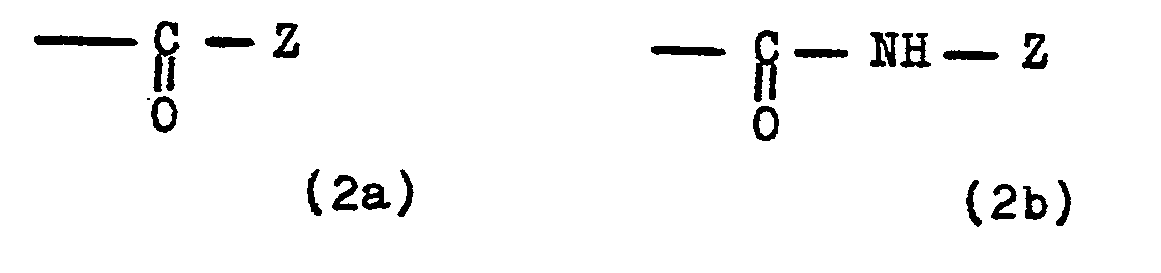
- Z ein Phenylrest oder ein Naphthylrest ist, die beide substituiert sind, wie beispielweise durch Alkyl von 1 bis 4 C-Atomen, Alkoxy von 1 bis 4 C-Atomen, Chlor, Brom, Nitro, Carbalkoxy von 2 bis 5 C-Atomen, Sulfo und Carboxy, wobei mindestens einer dieser Substituenten eine wasserlöslich machende Gruppe, wie eine Sulfo- oder Carboxygruppe, ist;
- X1 ist ein Wasserstoffatom oder ein Halogenatom, wie Chlor- oder Bromatom, eine Alkylgruppe von bis 1 bis 4 C-Atomen, eine Alkoxygruppe von 1 bis 4 C-Atomen oder ein gegebenenfalls substituierter Arylrest;
- X2 ist mit X1 gleich oder von X1 verschieden und hat eine der für Xi angegebenen Bedeutungen;
- Y ist die Vinylgruppe oder eine Ethylgruppe, die in β-Stellung einen durch ein Alkali eliminierbaren Substituenten enthält;
- die Gruppe -S02-Y steht bevorzugt in ortho-Stellung zur Gruppe -B-W-N(R*)-A bzw. A-N(R*)-W-B-gebunden; yon den Sulfogruppen, die im Molekül (1) enthalten sein können, enthält das Molekül (1) mindestens zwei.
- Die einzelnen, auch zweifach erscheinenden Formelglieder, können zueinander gleiche oder voneinander verschiedene Bedeutungen besitzen; vorzugsweise besitzen sie zueinander gleiche Bedeutungen, weswegen die Verbindungen (1) bevorzugt symmetrisch aufgebaute Verbindungen sind.
- Aliphatische Reste sind bevorzugt geradkettige oder verzweigte Alkylengruppen von 1 bis 6 C-Atomen. Substituierte Alkylgruppen sind beispielsweise solche, die durch 1 oder 2 Substituenten aus der Gruppe Chlor, Alkoxy, von 1 bis 4 C-Atomen, Benzoylamino, Sulfobenzoylamino, Alkanoylamino von 2 bis 5 C-Atomen, Hydroxy, Sulfato, Phosphato, Alkanoyloxy von 2 bis 5 C-Atomen, Sulfo, Carboxy oder gegebenenfalls substituiertes Aryl substituiert sein können. Bevorzugte Substituenten sind hiervon die Carboxy- und Sulfogruppen sowie Sulfatogruppen.
- Arylreste in den oben genannten oder nachstehend genannten Gruppen sind insbesondere die Phenyl- und Naphthylreste; sie können substituiert sein, wie beispielsweise durch Substituenten aus der Guppe Alkyl von 1 bis 4 C-Atomen, wie Methyl und Ethyl, Alkoxy von 1 bis 4 C-Atomen, wie Methoxy und Ethoxy, Halogen, wie Chlor und Brom, Sulfo, Carboxy, Nitro, Sulfamoyl und Carbamoyl (wobei Sulfamoyl und Carbamoyl durch gegebenenfalls substituiertes Alkyl von 1 bis 4 C-Atomen und/oder gegebenenfalls substituiertes Aryl mono- oder disubstituiert sein können.
- Bevorzugt ist W bzw. W1 ein Alkylenrest von 2 bis 6 C-Atomen, insbesondere von 2 bis 4 C-Atomen, oder, falls er durch eine oder zwei Heterogruppen unterbrochen ist, ein Alkylenrest von 2 bis 8 C-Atomen, bevorzugt von 2 bis 6, insbesondere von 2 bis 4 C-Atomen, wobei im Alkylenrest die Heterogruppe bevorzugt ein Sauerstoffatom oder eine Gruppe -NH- ist. Weiterhin sind W bzw. W beispielsweise Cycloalkylengruppen von 5 oder 6 C-Atomen mit gegebenenfalls 1 bis 3 Methylgruppen als Substituenten oder zwei solche mit einem Alkylenrest von 1 bis 4 C-Atomen verbundene Cycloalkylengruppen oder ein Alkylenrest von 2 bis 6 C-Atomen, der durch eine solche Cycloalkylengruppe unterbrochen ist.
- Reste W1 sind beispielsweise der 1,2-Ethylen-, 1,3-Propylen-, 1,4-Butylen-, 1,5-Pentylen-, 1,6-Hexylen-, 2-Methyl-1,3-propylen-, 1,2-Dimethyl-1,2-ethylen-, 1,3-Dimethyl-1,3-propylen-, 2,2-Dimethyl-1,3-propylen- oder 1,2-, 1,4- und 1,3-Cyclohexylen-Rest oder ein bivalenter Rest der nachstehend angegebenen Formeln (a) bis (s), hiervon bevorzugt der 1,2-Ethylen-, 1,3-Propylen- und 1,4-Butylen-Rest und der Rest der Formel (a):


- Die Reste W sind beispielweise die eben für W1 genannten, jedoch "spiegelbildlich" angeordneten Gruppen.
- Heterocyclische Gruppierungen, die sich gemeinsam aus den Formelresten -B-W1-N(R*)- bzw. - N(R*)-W-B- bilden, sind beispielsweise der bivalente 1,4-Piperidino-Rest. Gruppierungen mit heterocyclischen Resten, die sich gemeinsam aus dem Formelrest -B-W- bilden, sind beispielsweise der Rest der Formel (t)
-


- - Bevorzugt bedeutet weiterhin B die Gruppe NH und R* ein Wasserstoffatom.
- Bevorzugt ist in den allgemeinen Formeln (2a) und (2b) der Formelrest Z eine Gruppe der Formel (3a) oder (3b)

- M ein Wasserstoffatom oder ein Alkalimetall, wie Natrium, Kalium und Lithium, oder das Äquivalent eines Erdalkalimetalls, wie beispielsweise des Calciums, insbesondere jedoch ein Alkalimetall ist,
- R1 ein Wasserstoffatom, eine Alkylgruppe von 1 bis 4 C-Atomen, wie die Ethylgruppe und insbesondere die Methylgruppe, eine Alkoxygruppe von 1 bis 4 C-Atomen, wie die Ethoxygruppe und insbesondere die Methoxygruppe, ein Chlor - oder Bromatom, eine Nitrogruppe, eine Carbalkoxygruppe von 2 bis 5 C-Atomen, wie die Carbomethoxy- oder Carbethoxygruppe, oder eine Sulfogruppe ist und
- R2 ein Wasserstoffatom, eine Alkylgruppe von 1 bis 4 C-Atomen, wie die Ethylgruppe und insbesondere die Methylgruppe, eine Alkoxygruppe von 1 bis 4 C-Atomen, wie die Ethoxygruppe und insbesondere die Methoxygruppe, ein Chloratom, eine Carboxygruppe oder eine Sulfogruppe bedeutet,
- a für die Zahl Null oder 1 steht, wobei a zwingend 1 ist, falls R1 oder R2 keine der angegebenen wasserlöslich machenden Gruppen bedeutet, und
- b die Zahl Null, 1 oder 2 bedeutet, wobei b zwingend die Zahl 1 oder 2 ist, falls R1 keine der genannten wasserlöslichmachenden Gruppen darstellt.
- Sofern a bzw. b für die Zahl Null steht, bedeutet diese Gruppe ein Wasserstoffatom.
- Bevorzugt sind die Formelreste X1 und X2, zueinander gleich oder voneinander verschieden, bevorzugt zueinander gleich, jedes ein Wasserstoffatom oder insbesondere ein Halogenatom, wie ein Bromatom und insbesondere ein Chloratom.
- Bevorzugt ist R1 ein Wasserstoffatom, die Methyl-, Ethyl-, Methoxy-, Ethoxy- oder Sulfogruppe oder ein Chlor- oder Bromatom. Bevorzugt ist R2 ein Wasserstoffatom, die Methoxy-, Ethoxy-, Carboxy- oder Sulfogruppe oder ein Chloratom, und bevorzugt ist a die Zahl 1 und b die Zahl 1 oder 2.
- Von den Gruppen Z sind insbesondere hervorzuheben: ein durch 1, 2 oder 3 Sulfogruppen substituierter Naphth-2-yl-Rest, ein durch 1 Bromatom und 1 oder 2 Sulfogruppen substituierter Phenylrest, ein durch 1 oder 2 Ethoxygruppen und 1 oder 2 Sulfogruppen substituierter Phenylrest, ein durch 1 Chloratom und 1, 2 oder 3 Sulfogruppen substituierter Naphth-2-yl-Rest ein durch 1 oder 2 Carb oxygruppen substituierter Phenylrest, insbesondere jedoch ein durch 1 oder 2 Sulfogruppen substituierter Phenylrest, ein durch 1, 2 oder 3 Sulfogruppen substituierter Naphth-1-yl-Rest, ein durch 1 oder 2 Methylgruppen und 1 oder 2 Sulfogruppen substituierter Phenylrest, ein durch 1 oder 2 Chloratome und 1 oder 2 Sulfogruppen substituierter Phenylrest und ein durch 1 oder 2 Methoxygruppen und 1 oder 2 Sulfogruppen substituierter Phenylrest, wobei in den substituierten Phenylresten die Anzahl der Substituenten nicht mehr als drei ist.
- Im vorstehenden und nachfolgenden sind Sulfogruppen Gruppen entsprechend der allgemeinen Formel -SOsM , Carboxygruppen Gruppen entsprechend der allgemeinen Formel -COOM , Sulfatogruppen Gruppen entsprechend der allgemeinen Formel -OSOsM , thiosulfatogruppen Gruppen entsprechend der allgemeinen Formel -S-SO3M und Phosphatogruppen Gruppen entsprechend der allgemeinen Formel -OPO3M2 , wobei M jeweils die oben angegebene Bedeutung besitzt.
- Die neuen Dioxazinverbindungen können sowohl in saurer Form als auch in Form ihrer Salze vorliegen. Bevorzugt sind sie in Form der Alkalisalze und finden auch bevorzugt in Form dieser Salze Verwendung zum Färben (im allgemeinen Sinne und einschließlich des Bedruckens verstanden) von hydroxy-und/oder carbonamidgruppenhaltigen Materialien, insbesondere Fasermaterialien.
- Bevorzugte erfindungsgemäße Triphendioxazin-Verbindungen sind solche der allgemeinen Formel (1 a)

- W und W1 beide eine Alkylengruppe von 2 bis 6 C-Atomen, bevorzugt von 2 bis 4 C-Atomen, bedeuten,
- X jedes für ein Bromatom oder insbesondere bevorzugt ein Chloratom steht,
- M die oben genannte Bedeutung besitzt und bevorzugt ein Alkalimetall ist und
- A beide eine Gruppe der obengenannten Formel (2a) oder (2b) bedeuten, in welchen die Gruppe Z, jeweils zueinander gleich oder voneinander verschieden, eine Gruppe der allgemeinen Formel (3c)
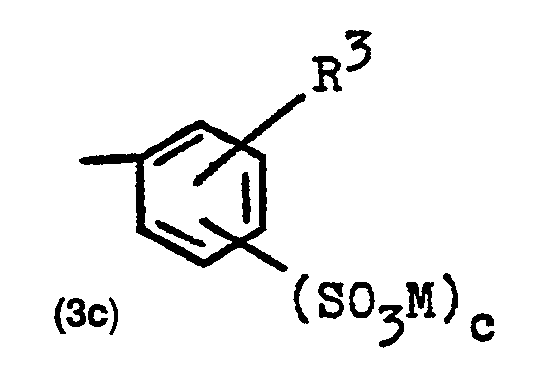
- R3 die Methyl-, Ethyl-, Methoxy- oder Ethoxygruppe oder eine Sulfogruppe oder ein Chlor- oder Bromatom bedeutet, und
- c für die Zahl Null, 1 oder 2 steht, wobei c zwingend die Zahl 1 oder 2 ist, falls R3 keine Sulfogruppe bedeutet.
- Bevorzugt sind insbesondere von diesen Verbindungen der allgemeinen Formel (1a) diejenigen, in welchen beide X für ein Chloratom stehen, W und W1 beide den 1,2-Ethylenrest bedeuten und beide A jeweils eine Gruppe der Formel (2a) oder (2b) darstellen, in welchen Z jeweils eine Sulfophenylgruppe ist.
- Die vorliegende Erfindung betrifft weiterhin Verfahren zur Herstellung der obengenannten und definierten Verbindungen der allgemeinen Formel (1). Diese sind dadurch gekennzeichnet, daß man eine Verbindung der allgemeinen Formel (4)

- Vorzugsweise führt man die Cyclisierung in konzentrierter Schwefelsäure, wie 96- bis bevorzugt 100%iger Schwefelsäure und insbesondere in Schwefeltrioxid enthaltender Schwefelsäure (Oleum), wie bis zu 50 gew.-%igem Oleum, durch. Die Reaktionstemperatur wird zwischen 0 und 60°C gewählt. Das als Reaktionsmedium und Agenz verwendete Oleum besitzt in der Regel einen Gehalt von 5 bis 40 Gew.- %, bevorzugt 10 bis 20 Gew.-% an Schwefeltrioxid. Bei Zusatzvon Peroxodisulfat als Oxidationsmittel führt man die Cyclisierung zwischen 0 und 40°C, bevorzugt zwischen 15 und 25°C durch. Bei Verwendung von Oleum/Peroxodisulfat soll die Reaktionstemperatur 30°C nicht überschreiten. Bevorzugt ist 10 bis 20%iges Oleum unter Verwendung einer zur Verbindung (4) doppelt molaren Menge Peroxodisulfat. Bei Jod als Oxidationsmittel wird dieses in katalytischen Mengen in 10 bis 50%igem Oleum eingesetzt; hier liegt die Reaktionstemperatur in der Regel zwischen 0 und 40°C.
- Gleichzeitig mit der Cyclisierung oder erst nach der Cyclisierungsreaktion können gegebenenfalls vorhandene Hydroxyalkylgruppen, wie beispielsweise die β-Hydroxyethyl-Gruppe des Formelrestes Y', mittels eines Sulfatisierungs- oder Phosphatierungsmittels, wie 96-100%iger Schwefelsäure oder Schwefeltrioxid enthaltender Schwefelsäure bzw. Polyphosphorsäure, in die entsprechenden Sulfatoalkyl- bzw. Phosphatoalkyl-Gruppen verestert werden. Wird also der Ringschluß in Schwefelsäure oder Oleum als Reaktionsmedium ausgeführt, werden Hydroxygruppen, die an einem Alkylrest des Moleküls gebunden sind, wie beispielsweise die oben bereits erwähnten β-Hydroxyethyl-Gruppen des Formelrestes Y' oder Hydroxyalkyl-Gruppen der Formelreste R*, W und Wl, in die entsprechenden Sulfatoalkylgruppen übergeführt.
- Bei Cyclisierungstemperaturen von oberhalb 15°C, insbesondere oberhalb 25°C, lassen sich mittels 100 %iger Schwefelsäure oder Oleum erfindungsgemäß auch Sulfogruppen in die aromatischen Ringe der Arylreste von R*, X1 , X2 , Z einführen. Die Sulfierungsreaktion kann aber auch nach der Cyclisierung, gegebenenfalls in einem gesonderten Reaktionsschritt beim isolierten Cyclisierungsprodukt (Triphendioxazin), erfolgen. Hier wird die Sulfierungsreaktion in der Regel zwischen 20 und 80°C, bevorzugt zwischen 30 und 70°C, geführt.
- Die gleichzeitige oder nachträgliche Sulfierungsreaktion ist eine besonders vorteilhafte Variante des erfindungsgemäßen Verfahrens. Bei dieser erfindungsgemäßen Verfahrensweise erhält man Triphendioxazin-Verbindungen der allgemeinen Formel (1) als Gemisch mit unterschiedlicher Zahl von Sulfogruppen.
- Verbindungen der Formel (1) mit Y gleich einer β-Sulfatoethyl-Gruppe können anschließend gemäß bekannten Verfahrensweise in andere erfindungsgemäße Verbindungen der Formel (1) übergeführt werden, in welcher die Y für Vinylgruppen oder Ethylgruppen mit einem anderen in ß-Stellung befindlichen alkalisch eliminierbaren Substituenten stehen.
- Die Ausgangsverbindungen der allgemeinen Formel (4) können in ebenfalls erfindungsgemäßer Weise durch Umsetzung einer Verbindung der allgemeinen Formel (5)
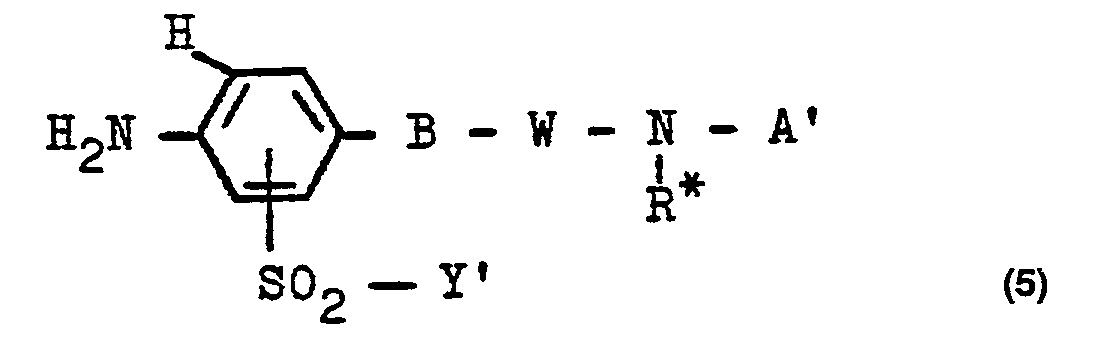

- Die Umsetzung einer Verbindung der allgemeinen Formel (6) oder zweier verschiedener Aminqyerbin- dungen der allgemeinen Formel (5), jeweils in zusammen 2-fach äquivalenter Menge, mit einem Äquivalent einer Verbindung der allgemeinen Formel (6) zur Verbindung der allgemeinen Formel (4) erfolgt analog bekannten Verfahrensweisen, die beispielsweise in den europäischen Patentanmeldungs-Veröffentlichungen Nrs. 0 141 996A und 0 168 751 A erwähnt und beschrieben sind.
- Beispielsweise kann die Umsetzung in wäßrigem Medium oder in wäßrig-organischem Medium oder in rein organischem Medium erfolgen, wobei die organischen Lösemittel polare aprotische und protische Lösungsmittel darstellen, wie beispielsweise niedere Alkanole, wie Methanol und Ethanol, und halogenierte Benzole, wie o-Dichlorbenzol. Bevorzugt wird das Chinon (6) jedoch in einem mehr oder weniger stärkeren Überschuß eingesetzt, der in der Regel 5-20 % beträgt, aber auch, abhängig vom gewählten Chinon, bis zu 100 % oder mehr betragen kann. Die Umsetzung der Amine (5) mit den Chinonen (6) kann bei einer Temperatur zwischen 20 und 100°C, vorzugsweise zwischen 50 und 70°C, in Gegenwart eines säurebindenden Mittels, wie beispielsweise eines Alkali- oder Erdalkalicarbonats oder - acetats, so beispielsweise Natriumacetat, Natriumcarbonat oder Natriumbicarbonat, oder eines Alkali- oder Erdalkalihydroxids, wie Natriumhydroxid, oder eines Oxids eines Erdalkalimetalls, wie beispielsweise Magnesiumoxid, durchgeführt werden. Sofern in einem wäßrigen oder wäßrig-organischen Medium gearbeitet wird, wird ein pH-Bereich zwischen 4 und 7, vorzugsweise zwischen 5,5 und 6,5, eingestellt.
- Die Anilin-Ausgangsverbindungen der allgemeinen Formel (5) sind bisher hoch nicht bekannt. Die Erfindung betrifft somit auch diese Verbindungen, Verfahren zu deren Herstellung und ihre Verwendung zur Synthese von Farbstoffen. Sie lassen sich analog bekannten Verfahrensweisen der Umsetzung von Aminoverbindungen mit Säurechloriden oder Isocyanaten herstellen, so beispielsweise erfindungsgemäß durch Umsetzung einer Aminoverbindung der allgemeinen Formel (7)

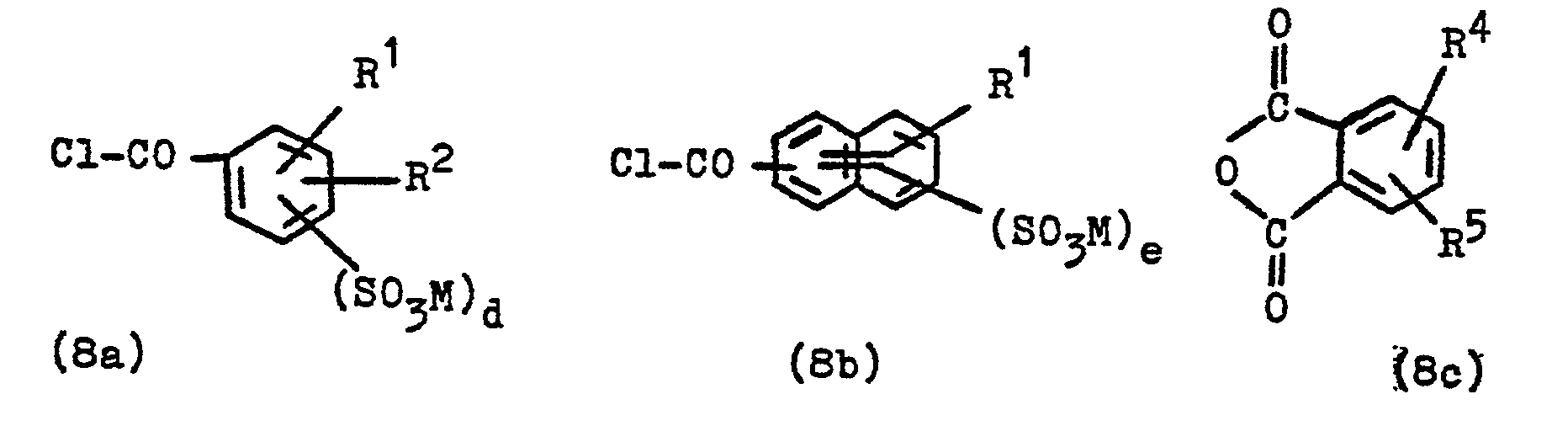

- Bevorzugt sind von den Verbindungen der Formel (5) solche, in welchen A' einen Rest der Formel (2c) oder (2d)


- Die Reaktion der Verbindungen der allgemeinen Formel (7) mit den Verbindungen (8) oder (9) erfolgt gemäß den in der Literatur für diese Reaktionsart beschriebenen Verfahrensweisen, wie beispielsweise in wäßrigem Medium oder auch in einem für diese Reaktionsart gängigen organischen Medium, wie in einem Alkanol von 1 bis 6 C-Atomen, wie insbesondere Methanol oder Ethanol, Aceton, Methylethyketon, Dioxan, N,N-Dimethylformamid, N-Methyl-pyrrolidon(2) oder Toluol oder einem Gemisch von Wasser und einem wassermischbaren organischen Lösemittel, bei einer Temperatur zwischen 0 und 60°C und, sofern in wäßrigem oder wäßrig-organischem Medium gearbeitet wird, bei einem pH-Wert zwischen 3 und 12. Bei der Umsetzung der Verbindungen (7) mit den Verbindungen (8) ist es Zweckmäßig, ein übliches säurebindendes Mittel zuzusetzen, um den freiwerdenden Chlorwasserstoff zu binden.
- Carbonsäurechloride der allgemeinen Formel (8) sind beispielsweise Benzoylchlorid, 4-Methoxy-benzoylchlorid, 2-Methyl-, 3-Methyl- und 4-Methyl-benzoylchlorid, 4-Chlorbenzoylchlorid, 3-Chlor-benzoylchlorid, 2-Chlor-benzoylchlorid, 4-brom-benzoylchlorid, 3-Brom-benzoylchlorid, 4-Nitro-benzoylchlorid, Naphthalin-1-carbonsäurechlorid, Naphthalin-2-carbonsäurenchlorid, 2,5-Dichlor-benzoylchlorid, 2,4-Dichlor-benzoylchlorid, 3,4-Dichlor-benzoylchlorid, 2-Methoxy-benzoylchlorid, 3-Methoxy-benzoylchlorid, 2-Nitro-4-methyl-benzoylchlorid.
- Isocyanate der allgemeinen Formel (9) sind beispielsweise Phenylisocyanat, 4-Chlor-phenylisocyanat, 3-Methyl-phenylisocyanat, 3,5-Dimethyl-phenylisocyanat, 2-Methyl-phenylisocyanat, 3-Chlorphenylisocyanat, 3,5-Dichlor-phenylisocyanat, 2,3-Dichlor-phenylisocyanat, 3-Chlor-4-methylphenyli- socyanat, 1-Naphthyl-isocyanat und 4-Isopropylphenylisocyanat.
- Aus den obigen beispielhaften Angaben ist ersichtlich, daß bevorzugt von solchen Verbindungen ausgegangen werden kann, die im aromatischen Rest nicht durch eine Sulfogruppe substituiert sind, da die Einführung einer (oder mehrerer) Sulfogruppen in die aromatischen Reste bevorzugt und verfahrensgemäß vorteilhafter während oder nach der Ringschlußreaktion zum Triphendioxazin-Gerüst mittels Schwefeltrioxid enthaltender Schwefelsäure oder 100%iger Schwefelsäure, wie oben angegeben erfolgt.
- Die aus den Reaktionen der Verbindungen (7) mit den Verbindungen (8) bzw. (9) erhaltenen Nitroverbindungen entsprechend einer allgemeinen Formel (10)

- - Die Ausgangsverbindungen entsprechend der allgemeinen Formel (7) sind bekannt oder können analog hierzu in an und für sich üblicher Weise hergestellt werden, wie beispielsweise nach den Angaben der deutschen Offenlegungsschrift Nr. 3 502 991.
- Ausgangsverbindungen der allgemeinen Formel (5) sind beispielsweise: 3-(ß-Hydroxyethylsufonyl)-4-N-(ß-benzoylamino-ethyl)-amino-anilin, 3-(ß-Hydroxyethylsulfonyl)-4-N-(y-benzoylamino-propyl)-amino-anilin, 3-(ß-Hydroxyethylsulfonyl)-4-N-(ß-benzoylamino-propyl)-amino- anilin, 3-(ß-Hydroxyethylsulfonyl)-4-N-[ß-(2'-, 3'- oder 4'-methyl-benzoylamino)-ethylamino]-anilin, 3-(ß-Hydroxyethyl-sulfonyl)-4-N-[ß-(4'-chlorbenzoylamino)-ethylamino]-anilin, 3-(ß-Hydroxyethylsulfo nyl)-4-N-[ß-(4!-methoxy-benzoylamino)-ethylamino]-anilin, 3-(ß-Hydroxyethylsulfonyl)-4-N-[ß(2'-Me- thoxybenzoylamino)-ethylamino]-anilin, 3-(ß-Hydroxyethyisulfonyl)-4-N-{ß-[ß'-(4'-Methoxy-benzoylamino)-ethoxy]-ethylamino}-anilin, 3-(ß-Hydroxyethylsulfonyl)-4-N-[ß-(N'-phenylureido)-ethylamino]-anilin, 3-(ß-Hydroxyethyl-sulfonyl)-4-N-[ß-(N'-phenylureido)-propylamino]-anilin, 3-(ß-Hydroxyethyl- sulfonyl)-4-N-[ß-(N'3'-methylphenylureido)-propylamino]-anilin, 3-(ß-Hydroxyethylsulfonyl)-4-N-[y-(N'-2'-methylphenylureido)-propylamino]-anilin, 3-(ß-Hydroxyethylsulfonyl)-4-N-{ß-[ß'-(N'-phenyl- ureido)-ethylsulfonyl]-ethylaminol-anilin und 3-(ß-Hydroxyethylsulfonyl)-4-N-[ß-(N'-naphth-1'-yl- ureido)-erthylamino]-anilin.
- Die als Ausgangsverbindungen dienenden Benzochinone der allgemeinen Formel (6) sind beispielsweise 2-Methyl-3,5,6-tribrom-1,4-benzochinon, 2-Methoxy-3,5,6-trichlor-1,4-benzochinon, 2,3,5,6-Tetra- methoxy-1,4-benzochinon, 2,3,5,6-Tetraphenoxy-1,4-benzochinon, 2-Methyl-3,6-dichlor-1,4-benzochinon, 2,5-Dichlor-1,4-benzochinon und bevorzugt 2,3,5,6-Tetrabrom-1,4-benzochinon und insbesondere 2,3,5,6-Tetrachlor-1,4-benzochinon (Chloranil).
- Die Abscheidung und Isolierung der erfindungegemäß hergestellten Verbindungen der allgemeinen Formel (1) aus den syntheselösungen kann nach allgemein bekannten Methoden erfolgen, so beispielsweise entweder durch Ausfällen aus dem Reaktionsmedium mittels Elektrolyten, wie beispielsweise Natriumchlorid oder Kaliumchlorid, oder durch Eindampfen der Reaktionslösung, beispielsweise Sprühtrocknung, wobei dieser Reaktionslösung eine Puffersubstanz zugefügt werden kann.
- Die erfindungsgemäßen Verbindungen der allgemeinen Formel (1) - im nachfolgenden als Verbindungen (1) bezeichnet - haben faserreaktive Eigenschaften und besitzen wertvolle Farbstoffeigenschaften. Sie können deshalb zum Färben (einschließlich Bedrucken) von natürlichen, regenerierten oder synthetischen hydroxygruppenhaltigen und/oder carbonamidgruppenhaltigen Materialien, beispielsweise in Form von Flächengebilden, wie Papier und Leder, oder in der Masse, von Polyamid oder Polyurethan, insbesondere aber von solchen Materialien in Faserform, wie Cellulosefasermaterialien, Seide, Wolle und synthetische Polyamid- und Polyurethanfasern, verwendet werden. Auch können die bei der Synthese der Verbindungen (1) anfallenden Lösungen, gegebenenfalls nach Zusatz einer Puffersubstanz, gegebenenfalls auch nach Kozentrierung, direkt als Flüssigpräparation der färberischen Verwendung zugeführt werden.
- Die Verbindungen (1) lassen sich, gemäß der erfindungsgemäßen Anwendung, auf den genannten Substraten, insbesondere auf den genannten Fasermaterialien, nach den für wasserlösliche, insbesondere faserreaktive, Farbstoffe bekannten Anwendungstechniken applizieren und fixieren, so beispielsweise, indem man die Verbindung (1) in gelöster Form auf das Substrat aufbringt oder sie darin einbringt und sie auf diesem oder in diesem, gegebenenfalls durch Hitzeeinwirkung und/oder gegebenenfalls durch Einwirkung eines alkalisch wirkenden Mittels, fixiert. Solche Färbe- und Fixierweisen sind in der Literatur zahlreich beschrieben, wie beispielsweise auch in der europäischen Patentanmeldungs-Veröffentlichung Nr. 0 168 751 A.
- Gegenstand der vorliegenden Erfindung ist deshalb auch die Verwendung der Verbindungen (1) zum Färben (einschließlich Bedrucken) von hydroxy- und/oder carbonamidgruppenhaltigen Materialien bzw. Verfahren zu deren Anwendung auf diesen Substraten. Bevorzugt kommen die Materialien in Form von Fasermaterialien zur Anwendung, insbesondere in Form von Textilfasern, wie Garnen, Wickelkörpern und Geweben. Hierbei kann man analog bekannten Verfahrensweisen der Applikation und Fixierung von faserreaktiven Farbstoffen vorgehen.
- Die mit den Verbindungen (1) hergestellten Färbungen und Drucke zeichnen sich durch reine, vorwiegend blaue Farbtöne aus. Insbesondere die Färbungen und Drucke auf Cellulosefasermaterialien besitzen sehr hohe Farbstärken und ebenso sehr gute Lichtechtheiten, einschließlich guter Naßlicht- und Schweißlichtechtheiten, ebenso gute Hypochloritbleich- und Chlorbadewasserechtheiten, weiterhin vorzügliche Naßechtheiten, wie beispielsweise gute Waschechtheiten bei 60 bis 95°C, auch in Gegenwart von Perboraten, saure und alkalische Walk-, Überfärbe- und Schweißechtheiten, Alkali-, Säure-, Wasser- und Seewasserechtheiten, desweiteren eine gute Plissierechtheit, Bügelechtheit und Reibechtheit. Ebenso besitzen sie eine gute Naßliegeechtheit und eine gute Säurelagerbeständigkeit ("acid fading") beim Lagern von feuchten, noch Essigsäure enthaltendem, gefärbtem Material. Desweiteren sind die Färbungen gegen die üblichen Kunstharzappreturen stabil. Ein Teil der Verbindungen (1) sind in der Reinheit des Farbtones und in wichtigen Echtheitseigenschaften mit faserreaktiven Anthrachinonfarbstoffen vergleichbar.
- Die nachstehenden Beispiele dienen zur Erläuterung der Erfindung. Die Teile sind Gewichsteile, die Prozentangaben stellen Gewichstsprozente dar, sofern nicht anders vermerkt. Gewichtsteile beziehen sich zu Volumenteilen wie Kilogramm zu Liter.
- . Die in diesen Beispielen formelmäßig beschriebenen Verbindungen sind in Form der freien Säuren angegeben; im allgemeinen werden sie in Form ihrer Natrium- oder Kaliumsalze hergestellt und isoliert und in Form ihrer Salze zum Färben verwendet. Ebenso können die in den nachfolgenden Beispielen, insbesondere Tabellenbeispielen, in Form der freien Säure genannten Ausgangsverbindungen und Komponenten als solche oder in Form ihrer Salze, vorzugsweise Alkalimetallsalze, wie Natrium- oder Kaliumsalze, in die Synthese eingesetzt werden. Die Absorptionsmaxima (Amax-Werte) wurden in wäßriger Lösung bestimmt. Die Farbkennzahlen beziehen sich auf Colour Index Hue Indication Chart (Indicator Numbers). Die 1H-NMR-Messungen erfolgten in ds-Dimethylsulfoxid mit Tetramethylsilan als innerem Standard, sofern nicht anders angegeben.
-
- a) Zu einer Lösung von 60 Teilen 4-(ß-Aminoethylamino)-3-(ß-hydroxyethylsulfonyl)-nitrobenzol in 150 Teilen N-Methyl-pyrrolidon-(2) gibt man 24 Teile Triethylamin und anschließend stetig 31 Teile Benzoylchlorid, wobei die Reaktionstemperatur auf 45°C ansteigt. Man rührt 3 Stunden nach und rührt den Ansatz sodann auf 1000 Teile Eiswasser. Nach 2 Stunden wird das in reiner Form und hoher Ausbeute angefallene 4-(ß-Benzoylaminoethylamino)-3-(ß-hydroxyethylsulfonyl)-nitrobenzol abgesaugt und getrocknet; es hat eien Schmelzpunkt von 116-118°C.
- b) 50 Teile der unter a) erhaltenen Nitroverbindung werden in 250 Teilen Ethanol gelöst und in Gegenwart eines Nickelkatalysators in einem Autoklaven bei einer Temperatur von bis zu 70°C und einem Druck von 50 bar hydriert. Die Hydrierdauer beträgt etwa vier Stunden. Der Katalysator wird sodann abfiltriert und das Filtrat durch Abdestillation des Lösemittels eingeengt. Die gewünschte Verbindung der Formel

- c) 77 Teile des unter b) synthetisierten 4-(ß-Benzoylaminoethylamino)-3-(ß-hydroxyethylsulfonyl)-anilins werden in einer Mischung aus 700 Teilen Wasser und 300 Teilen Methanol gelöst; zu dieser auf 60°C erwärmten Lösung werden 27 Teile Chloranil unter Einhaltung eines pH-Wertes von 6 bis 6,5 (bspw. mittels Natriumbicarbonat) eingetragen. Nach 30-minütigem Nachrühren wird das ausgefallene Kondensationsprodukt abgesaugt, zunächst mit wäßrigem Ethanol, sodann mit Wasser gewaschen und unter reduziertem Druck bei 80°C getrocknet.
- d) 18 Teile des unter c) synthetisierten Kondensationsproduktes werden in 150 Teile 10 %igem Oleum bei 20°C eingetragen. Der Ansatz wird bis zur vollständigen Lösung gerührt, sodann werden 10 Teile Natriumperoxodisulfat langsam unter Einhaltung einer Reaktionstemperatur von 20 bis 25°C zugegeben. Man rührt noch eine Stunde nach und gießt den Ansazt sodann auf 500 Teile Eis und saugt das ausgefallene Produkt ab. Die erhaltene Triphendioxazin-Verbindung wird in 300 Teilen Wasser angerührt, die Suspension mit Natriumcarbonat auf einen pH-Wert von 6 gestellt, die Triphendioxazin-Verbindung wiederum abgesaugt und getrocknet.
- e) 20 Teile der unter d) erhaltenen Triphendioxazin-Verbindung der Formel

- Man erhält das erfindungsgemäße Alkalimetallsalz (vorwiegend Kaliumsalz) der Verbindung der Formel

- Diese erfindungsgemäße Verbindung besitzt sehr gute faserreaktive Farbstoffeigenschaften (λmax = 610 nm). Sie färbt die in der Beschreibung genannten Materialien, insbesondere Celulosefasermaterialien, wie Baumwolle, nach den in der Technik üblichen und bekannten Verfahrensweisen der Applikation und Fixierung von faserreaktiven Farbstoffen in farbstarken, reinen rotstichig blauen Tönen mit guten Echtheiten, wie insbesondere guter Lichtechtheit der trockenen oder feuchten, wie mit Trinkwasser befeuchteten, Färbungen, guter alkalischen Schweißlichtechtheit, Chlorbadewasserechtheit, Hypochloritechtheit, alkalischer Schweißechtheit, Waschechtheit, auch in Gegenwart von Perboraten, Naßliegeechtheit und Säurelagerbeständigkeit.
-
- a) Zu einer Lösung von 61 Teilen 4-(y-Aminopropylamino)-3-(ß-hydroxyethylsulfonyl)-nitrobenzol in 150 Teilen N- Methyl-pyrrolidon-(2) gibt man 24 Teile Triethylamin und anschließend stetig 31 Teile Benzoylchlorid, wobei die Reaktionstemperatur auf 45°C ansteigt. Man rührt 3 Stunden nach und rührt den Ansatz sodann auf 1000 Teile Eiswasser. Nach 2 Stunden wird das in reiner Form und hoher Ausbeute angefallene 4-(y-Benzoylaminopropylamino)-3-(p-hydroxyethylsulfonyl)-nitrobenzol abgesaugt und getrocknet; es hat einen Schmelzpunkt von 140-142°C und zeigt im 1 H-NMR-Spektrum folgende Daten: 8 = 1,87 ppm (m,2H); 3,38 ppm (m,2H); 3,48 ppm (m,2H), 3,58 ppm (m,2H); 3,77 ppm (m,2H); 4,92 ppm (s,OH); 7,04 ppm (d,1 H); 7,37 ppm (t,NH); 7,45 ppm (m,2H); 7,51 ppm (m,1 H); 7,86 ppm (m,2H); 8,25 ppm (dd,1 H); 8,45 ppm (d,1 H); 8,57 ppm (t,NH).
- b) 50 Teile der unter a) erhaltenen Nitroverbindungen werden in 250 Teilen Ethanol gelöst und in Gegenwart eines Nickelkatalysators in einem autoklaven bei einer Temperatur von bis zu 70°C und einem Druck von 50 bar hydriert. Die Hydrierdauer beträgt etwa vier Stunden. Der Katalysator wird sodann abfiltriert und das Filtrat durch Abdestillation des Lösemittels eingeengt. Die gewünschte Verbindung der Formel

- c) Das aus b) erhaltene 4-(γ-Benzoylaminopropylamino)-3-(β-hydroxyethylsulfonyl)-anilin wird analog den Angaben von Beispiel 1c) und 1d) zur Triphendioxazin-Verbindung umgesetzt, die anschließend gemäß den Angaben des Beispieles 1e) zur erfindungsgemäßen Triphendioxazin-Verbindung sulfiert wird:

- Diese erfindungsgemäße Verbindung besitzt sehr gute faserreaktive Farbstoffeigenschaften (λmax = 606 nm). Sie färbt die in der Beschreibung genannten Materialien, insbesondere Cellulosefasermaterialien, wie Baumwolle, nach den in der Technik üblichen und bekannten Verfahrensweisen der Applikation und Fixierung von faserreaktiven Farbstoffen in farbstarken, reinen rotstichig blauen Tönen mit guten Echtheiten, wie insbesondere guter Lichtechtheit der trockenen oder feuchten, wie mit Trinkwasser befeuchteten, Färbungen, guter alkalischen Schweißlichtechtheit, Chlorbadewasserechtheit, Hypochloritechtheit, alkalischer Schweißechtheit, Waschechtheit, auch in Gegenwart von Perboraten, Naßliegeechtheit und Säurelagerbeständigkeit.
- In den nachfolgenden Tabellenbeispielen sind weitere erfindungsgemäße Triphendioxazin-Verbindungen mit Hilfe der Formelglieder der allgemeinen Formel (A)


- Die erfindungsgemäßen Triphendioxazin-Verbindungen besitzen ebenfalls sehr gute faserreaktive Farbstoffeigenschaften und liefern, insbesondere auf Cellulosefasermaterialien, farbstarke Färbungen und Drucke mit guten Echtheiten in dem in dem jeweiligen Tabellenbeispiel angegebenen Farbton.

-
- a) 58 Teile 4-(ß-Aminoethyl-amino)-3-(ß-hydroxyethylsulfonyl)-nitrobenzol werden in 200 Teilen Aceton angerührt; innerhalb von 20 Minuten gibt man bei einer Temperatur zwischen 10 und 15°C langsam und stetig unter Rühren eine Lösung von 26 Teilen Phenylisocyanat in 30 Teilen Aceton hinzu und rührt anschließend bei Raumtemperatur 6 Stunden nach. Das ausgefallene Produkt wird abgesaugt und getrocknet.
- Das gewünschte 4-[β-(N'-Phenyl-ureido)-ethylamino]-3-(β-hydroxyethylsulfonyl)-nitrobenzol besitzt einen Schmelzpunkt von 157 - 158°C und zeigt folgende 1H-NMR-Daten:
- δ = 3,35 ppn (m,2H); 3,47 ppm (m,4H); 3,70 ppm (m,2H); 4,85 ppm (t,OH); 6,34 ppm (t,1H); 6,87 ppm (m,1 H); 7,10 ppm (d,1 H); 7,20 ppm (m,2H); 7,32 ppm (t, NH); 7,38 ppm (m,2H); 8,22 ppm (dd,1 H); 8,40 ppm (d,1 H); 8,56 ppm (s,NH).
- b) 40 Teile der Nitroverbindung von a) werden in 200 Teilen Methanol gelöst und in Gegenwart eines Nickel-Katalysators in einem autoklaven bei einer Temperatur von bis zu 80°C und einem Druck von 50 bar hydriert. Nach beendeter Hydrierung wird der Katalysator abfiltriert und das Filtrat durch Abdampfen des Lösemittels eingeengt. Die Aminoverbindung der Formel

5 = 3,18 ppm (m,2H); 3,30 ppm (m,2H); 3,35 ppm (m,2H); 3,63 ppm (m,2H); 4,77 ppm (s,NH2); 4,85 ppm (s,OH); 5,48 ppm (t,NH); 6,28 ppm (t,NH); 6,77 ppm (d,1H); 6,85 ppm (dd,1H); 6,90 ppm (t,1H); 6,94 ppm (d,1 H); 7,22 ppm (t,2H); 7,40 ppm (d,2H); 8,50 ppm (s,NH). - c) 15,3 Teile der Anilinverbindung von b), 0,8 Teile Magnesiumoxid und 5,2 Teile Chloranil werden zusammen in 150 Teilen Ethanol während 5 Stunden bei 40°C erwärmt. Das entstandene, ausgefallene Produkt wird abgesaugt, der Rückstand in 150 Teilen Wasser angerührt, wieder abgesaugt und bei reduziertem Druck bei 80°C getrocknet.
9,3 Teile dieses Kondensationsproduktes werden in 95 Teile 10 %igem Oleum innerhalb von 15 Minuten bei 20°C unter Rühren eingetragen; man rührt noch bis zur vollständigen Lösung des Produktes nach. Anschließend werden 4,7 Teile Natriumperoxodisulfat langsam eingetragen, so daß die Temperatur des Ansatzes 25°C nicht Überschreitet. Es wird noch eine Stunde nachgerührt, der Ansatz sodann auf Eis gegeben, diese Suspension mit Calciumcarbonat auf einen pH-Wert zwischen 1 und 1,5 gestellt und anschließend mit Natriumcarbonat bis zur Einstellung eines pH-Wertes von 5,5 versetzt; das Calciumsulfat wird abgesaugt, mit Wasser gewaschen, und die Filtrate werden vereinigt. Die erfindungsgemäße Verbindung kann aus dem fitlrat durch Eindampfen oder Sprühtrocknung isoliert werden. - Es wird das Natriumsalz der Verbindung der Formel

- Diese erfindungsgemäße Verbindung besitzt sehr gute faserreaktive Farbstoffeigenschaften (Amax = 623 nm. Sie färbt die in der Beschreibung genannten Materialien, insbesondere Celulosefasermaterialien, wie Baumwolle, nach den in der Technik üblichen und bekannten Verfahrensweisen der Applikation und Fixierung von faserreaktiven Farbstoffen in farbstarken, reinen blauen Tönen
mit guten Echtheiten, wie insbesondere guter Lichtechtheit der trockenen oder feuchten, wie mit Trinkwasser befeuchteten, Färbungen, guter alkalischen Schweißlichtechtheit, Chlorbadewasserechtheit, Hypochloritechtheit, alkalischer Schweißechtheit, Waschechtheit, auch in Gegenwart von Perboraten, Naßliegeechtheit und Säurelagerbeständigkeit. - In den nachfolgenden Tabellenbeispielen sind weitere erfindungsgemäße Triphendioxazin-Verbindungen mit Hilfe der Formelglieder der allgemeinen Formel (B)


- Diese erfindungsgemäßen Triphendioxazin-Verbindungen besitzen ebenfalls sehr gute faserreaktive Farbstoffeigenshaften und liefern insbesondere auf Cellulosefasermaterialien farbstarke Färbungen und Drucke mit guten Echtheiten in dem in dem jeweiligen Tabellenbeispiel angegebenen Farbton.
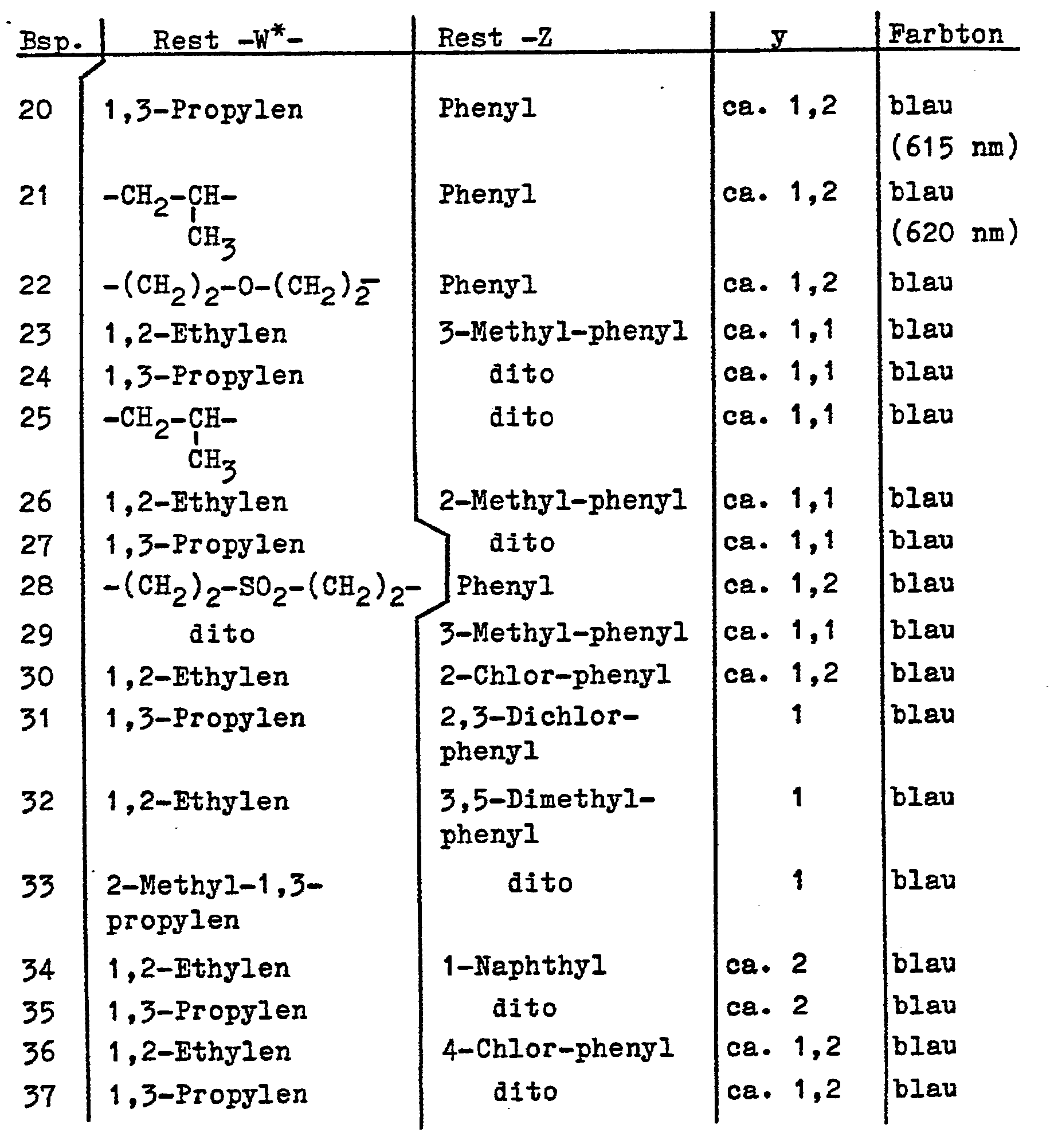
Claims (18)
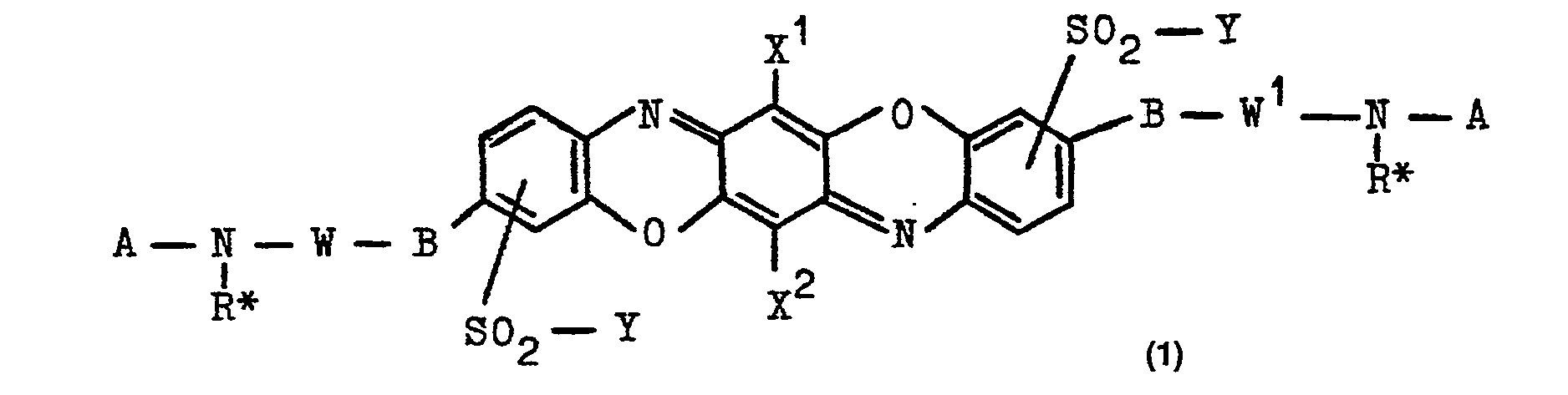



Applications Claiming Priority (2)
| Application Number | Priority Date | Filing Date | Title |
|---|---|---|---|
| DE3627458 | 1986-08-13 | ||
| DE19863627458 DE3627458A1 (de) | 1986-08-13 | 1986-08-13 | Wasserloesliche trophendioxazin-verbindungen, verfahren zu ihrer herstellung und ihre verwendung als farbstoffe |
Publications (2)
| Publication Number | Publication Date |
|---|---|
| EP0258686A1 EP0258686A1 (de) | 1988-03-09 |
| EP0258686B1 true EP0258686B1 (de) | 1990-10-10 |
Family
ID=6307301
Family Applications (1)
| Application Number | Title | Priority Date | Filing Date |
|---|---|---|---|
| EP87111513A Expired - Lifetime EP0258686B1 (de) | 1986-08-13 | 1987-08-08 | Wasserlösliche Triphendioxazin-Verbindungen, Verfahren zu ihrer Herstellung und ihre Verwendung als Farbstoffe |
Country Status (10)
| Country | Link |
|---|---|
| US (1) | US4782150A (de) |
| EP (1) | EP0258686B1 (de) |
| JP (1) | JPS6348285A (de) |
| KR (1) | KR950014570B1 (de) |
| BR (1) | BR8704188A (de) |
| CS (1) | CS264149B2 (de) |
| DE (2) | DE3627458A1 (de) |
| ES (1) | ES2018669B3 (de) |
| IN (1) | IN167864B (de) |
| MX (1) | MX174372B (de) |
Families Citing this family (4)
| Publication number | Priority date | Publication date | Assignee | Title |
|---|---|---|---|---|
| DE3809525A1 (de) * | 1988-03-22 | 1989-10-12 | Bayer Ag | Reaktivfarbstoffe |
| DE3828824A1 (de) * | 1988-08-25 | 1990-03-08 | Hoechst Ag | Wasserloesliche triphendioxazin-verbindungen und deren sulfonylgruppenhaltigen vorprodukte, verfahren zu deren herstellung und verwendung der triphendioxazine als farbstoffe |
| US5532362A (en) * | 1995-05-25 | 1996-07-02 | Hoechst Celanese Corporation | Fiber-reactive triphenodioxazine dyes |
| CN102295840B (zh) * | 2010-06-25 | 2013-12-11 | 上海雅运纺织化工股份有限公司 | 藏青色活性染料组合物及其在纤维上的染色应用 |
Family Cites Families (4)
| Publication number | Priority date | Publication date | Assignee | Title |
|---|---|---|---|---|
| DE3336362A1 (de) * | 1983-10-06 | 1985-04-18 | Bayer Ag, 5090 Leverkusen | Triphendioxazin-reaktivfarbstoffe |
| US4629788A (en) * | 1983-10-11 | 1986-12-16 | Bayer Aktiengesellschaft | Triphendioxazine reactive dyestuffs |
| DE3439755A1 (de) * | 1984-04-05 | 1985-10-17 | Bayer Ag, 5090 Leverkusen | Triphendioxazin-farbstoffe |
| DE3510612A1 (de) * | 1985-03-23 | 1986-09-25 | Bayer Ag, 5090 Leverkusen | Triphendioxazin-farbstoffe |
-
1986
- 1986-08-13 DE DE19863627458 patent/DE3627458A1/de not_active Withdrawn
-
1987
- 1987-07-28 IN IN578/CAL/87A patent/IN167864B/en unknown
- 1987-08-08 DE DE8787111513T patent/DE3765504D1/de not_active Expired - Fee Related
- 1987-08-08 EP EP87111513A patent/EP0258686B1/de not_active Expired - Lifetime
- 1987-08-08 ES ES87111513T patent/ES2018669B3/es not_active Expired - Lifetime
- 1987-08-11 CS CS875933A patent/CS264149B2/cs unknown
- 1987-08-11 JP JP62199266A patent/JPS6348285A/ja active Pending
- 1987-08-11 US US07/084,427 patent/US4782150A/en not_active Expired - Fee Related
- 1987-08-12 BR BR8704188A patent/BR8704188A/pt not_active Application Discontinuation
- 1987-08-12 KR KR1019870008817A patent/KR950014570B1/ko not_active Expired - Lifetime
- 1987-08-13 MX MX007733A patent/MX174372B/es unknown
Also Published As
| Publication number | Publication date |
|---|---|
| JPS6348285A (ja) | 1988-02-29 |
| MX7733A (es) | 1993-07-01 |
| CS593387A2 (en) | 1988-08-16 |
| CS264149B2 (en) | 1989-06-13 |
| US4782150A (en) | 1988-11-01 |
| DE3765504D1 (de) | 1990-11-15 |
| KR950014570B1 (ko) | 1995-12-05 |
| BR8704188A (pt) | 1988-04-12 |
| KR880002875A (ko) | 1988-05-12 |
| ES2018669B3 (es) | 1991-05-01 |
| DE3627458A1 (de) | 1988-02-25 |
| MX174372B (es) | 1994-05-11 |
| EP0258686A1 (de) | 1988-03-09 |
| IN167864B (de) | 1990-12-29 |
Similar Documents
| Publication | Publication Date | Title |
|---|---|---|
| EP0028788B1 (de) | Kupferkomplex-Formazanverbindungen, Verfahren zu ihrer Herstellung und ihre Verwendung als Farbstoffe | |
| EP0222098B1 (de) | Wasserlösliche Triphendioxazin-Verbindungen, Verfahren zu ihrer Herstellung und ihre Verwendung als Farbstoffe | |
| EP0028787B1 (de) | Kupfer-Formazanverbindungen, Verfahren zu ihrer Herstellung und ihre Verwendung als Farbstoffe | |
| EP0111288B1 (de) | Wasserlösliche Naphthylazonaphthol-Verbindungen, Verfahren zu ihrer Herstellung und ihre Verwendung als Farbstoffe | |
| EP0168751B1 (de) | Wasserlösliche Triphendioxazin-Verbindungen, Verfahren zu ihrer Herstellung und ihre Verwendung als Farbstoffe | |
| EP0258493B1 (de) | Wasserlösliche Triphendioxazin-Verbindungen und deren sulfonylgruppenhaltigen Vorprodukte, Verfahren zu deren Herstellung und Verwendung der Triphendioxazine als Farbstoffe | |
| EP0280139B1 (de) | Kupferkomplex-Formazan-Verbindungen, Verfahren zu ihrer Herstellung und ihre Verwendung als Farbstoffe | |
| EP0258686B1 (de) | Wasserlösliche Triphendioxazin-Verbindungen, Verfahren zu ihrer Herstellung und ihre Verwendung als Farbstoffe | |
| EP0534342A1 (de) | Wasserlösliche Monoazoverbindungen, Verfahren zu deren Herstellung und ihre Verwendung als Farbstoffe | |
| EP0355735B1 (de) | Wasserlösliche Triphendioxazin-Verbindungen und deren sulfonyl-gruppenhaltigen Vorprodukte, Verfahren zu deren Herstellung und Verwendung der Triphendioxazine als Farbstoffe | |
| EP0279277B1 (de) | Wasserlösliche Monoazo-pyrazolon-Verbindungen, Verfahren zu ihrer Herstellung und ihre Verwendung als Farbstoffe | |
| EP0292904B1 (de) | Wasserlösliche Naphthyl-azo-pyrazolon-Verbindungen, Verfahren zu ihrer Herstellung und ihre Verwendung als Farbstoffe | |
| EP0229339B1 (de) | Wasserlösliche Triphendioxazin-Verbindungen, deren sulfonylgruppenhaltigen Vorprodukte, Verfahren zu ihrer Herstellung und Verwendung der Triphendioxazine als Farbstoffe | |
| EP0255020B1 (de) | Wasserlösliche Triphendioxazin-Verbindungen, Verfahren zu ihrer Herstellung und ihre Verwendung als Farbstoffe | |
| EP0648815B1 (de) | Wasserlösliche, metallfreie Phthalocyaninfarbstoffe, Verfahren zu ihrer Herstellung und ihre Verwendung | |
| EP0362557B1 (de) | Wasserlösliche Azoverbindungenn, Verfahren zu ihrer Herstellung und ihre Verwendung als Farbstoffe | |
| EP0303081B1 (de) | Wasserlösliche Disazoverbindungen, Verfahren zu ihrer Herstellung und ihre Verwendung als Farbstoffe | |
| DE3903455A1 (de) | Kupferkomplex-formazanverbindungen, verfahren zu ihrer herstellung und ihre verwendung als farbstoffe | |
| EP0026913B1 (de) | Kupferkomplex-Naphthylazonaphthyl-Verbindungen, Verfahren zu ihrer Herstellung und ihre Verwendung zum Färben und Bedrucken von Fasermaterialien und Leder | |
| DE4340160A1 (de) | Wasserlösliche, metallfreie Phthalocyaninfarbstoffe, Verfahren zu ihrer Herstellung und ihre Verwendung | |
| EP0535495A1 (de) | Wasserlösliche Azoverbindungen, Verfahren zu deren Herstellung und ihre Verwendung als Farbstoffe | |
| EP0360003A2 (de) | Wasserlösliche Azoverbindungen, Verfahren zu ihrer Herstellung und ihre Verwendung als Farbstoffe | |
| DE3906353A1 (de) | Wasserloesliche faserreaktive farbstoffe, verfahren zu ihrer herstellung und ihre verwendung | |
| EP0079562A1 (de) | Wasserlösliche Disazoverbindungen, Verfahren zu ihrer Herstellung und ihre Verwendung als Farbstoffe | |
| DE3625386A1 (de) | N(pfeil abwaerts)1(pfeil abwaerts)-substituierte 1h-benzotriazol-hydroxyethyl-sulfon-verbindungen, verfahren zu ihrer herstellung und ihre verwendung zur herstellung von farbstoffen |
Legal Events
| Date | Code | Title | Description |
|---|---|---|---|
| PUAI | Public reference made under article 153(3) epc to a published international application that has entered the european phase |
Free format text: ORIGINAL CODE: 0009012 |
|
| AK | Designated contracting states |
Kind code of ref document: A1 Designated state(s): BE CH DE ES FR GB IT LI |
|
| 17P | Request for examination filed |
Effective date: 19880217 |
|
| 17Q | First examination report despatched |
Effective date: 19890403 |
|
| GRAA | (expected) grant |
Free format text: ORIGINAL CODE: 0009210 |
|
| AK | Designated contracting states |
Kind code of ref document: B1 Designated state(s): BE CH DE ES FR GB IT LI |
|
| REF | Corresponds to: |
Ref document number: 3765504 Country of ref document: DE Date of ref document: 19901115 |
|
| ITF | It: translation for a ep patent filed | ||
| ET | Fr: translation filed | ||
| GBT | Gb: translation of ep patent filed (gb section 77(6)(a)/1977) | ||
| PLBE | No opposition filed within time limit |
Free format text: ORIGINAL CODE: 0009261 |
|
| STAA | Information on the status of an ep patent application or granted ep patent |
Free format text: STATUS: NO OPPOSITION FILED WITHIN TIME LIMIT |
|
| ITTA | It: last paid annual fee | ||
| 26N | No opposition filed | ||
| PGFP | Annual fee paid to national office [announced via postgrant information from national office to epo] |
Ref country code: ES Payment date: 19920806 Year of fee payment: 6 |
|
| PG25 | Lapsed in a contracting state [announced via postgrant information from national office to epo] |
Ref country code: ES Free format text: LAPSE BECAUSE OF THE APPLICANT RENOUNCES Effective date: 19930809 |
|
| PGFP | Annual fee paid to national office [announced via postgrant information from national office to epo] |
Ref country code: FR Payment date: 19950721 Year of fee payment: 9 |
|
| PGFP | Annual fee paid to national office [announced via postgrant information from national office to epo] |
Ref country code: CH Payment date: 19950725 Year of fee payment: 9 |
|
| PGFP | Annual fee paid to national office [announced via postgrant information from national office to epo] |
Ref country code: GB Payment date: 19950731 Year of fee payment: 9 |
|
| PGFP | Annual fee paid to national office [announced via postgrant information from national office to epo] |
Ref country code: BE Payment date: 19950814 Year of fee payment: 9 |
|
| PGFP | Annual fee paid to national office [announced via postgrant information from national office to epo] |
Ref country code: DE Payment date: 19951018 Year of fee payment: 9 |
|
| PG25 | Lapsed in a contracting state [announced via postgrant information from national office to epo] |
Ref country code: GB Effective date: 19960808 |
|
| PG25 | Lapsed in a contracting state [announced via postgrant information from national office to epo] |
Ref country code: LI Effective date: 19960831 Ref country code: CH Effective date: 19960831 Ref country code: BE Effective date: 19960831 |
|
| BERE | Be: lapsed |
Owner name: HOECHST A.G. Effective date: 19960831 |
|
| GBPC | Gb: european patent ceased through non-payment of renewal fee |
Effective date: 19960808 |
|
| REG | Reference to a national code |
Ref country code: CH Ref legal event code: PL |
|
| PG25 | Lapsed in a contracting state [announced via postgrant information from national office to epo] |
Ref country code: FR Effective date: 19970430 |
|
| PG25 | Lapsed in a contracting state [announced via postgrant information from national office to epo] |
Ref country code: DE Effective date: 19970501 |
|
| REG | Reference to a national code |
Ref country code: FR Ref legal event code: ST |
|
| REG | Reference to a national code |
Ref country code: ES Ref legal event code: FD2A Effective date: 19991007 |
|
| PG25 | Lapsed in a contracting state [announced via postgrant information from national office to epo] |
Ref country code: IT Free format text: LAPSE BECAUSE OF NON-PAYMENT OF DUE FEES Effective date: 20050808 |