EP0168751B1 - Wasserlösliche Triphendioxazin-Verbindungen, Verfahren zu ihrer Herstellung und ihre Verwendung als Farbstoffe - Google Patents
Wasserlösliche Triphendioxazin-Verbindungen, Verfahren zu ihrer Herstellung und ihre Verwendung als Farbstoffe Download PDFInfo
- Publication number
- EP0168751B1 EP0168751B1 EP85108476A EP85108476A EP0168751B1 EP 0168751 B1 EP0168751 B1 EP 0168751B1 EP 85108476 A EP85108476 A EP 85108476A EP 85108476 A EP85108476 A EP 85108476A EP 0168751 B1 EP0168751 B1 EP 0168751B1
- Authority
- EP
- European Patent Office
- Prior art keywords
- group
- carbon atoms
- ethyl
- sulfo
- formula
- Prior art date
- Legal status (The legal status is an assumption and is not a legal conclusion. Google has not performed a legal analysis and makes no representation as to the accuracy of the status listed.)
- Expired
Links
- 150000001875 compounds Chemical class 0.000 title claims description 72
- 238000000034 method Methods 0.000 title claims description 33
- 238000002360 preparation method Methods 0.000 title claims description 8
- XLYOFNOQVPJJNP-UHFFFAOYSA-N water Substances O XLYOFNOQVPJJNP-UHFFFAOYSA-N 0.000 title description 27
- -1 sulfo, carboxyl Chemical group 0.000 claims description 124
- 125000004432 carbon atom Chemical group C* 0.000 claims description 57
- 238000004043 dyeing Methods 0.000 claims description 36
- 239000000975 dye Substances 0.000 claims description 28
- UHOVQNZJYSORNB-UHFFFAOYSA-N Benzene Chemical compound C1=CC=CC=C1 UHOVQNZJYSORNB-UHFFFAOYSA-N 0.000 claims description 27
- QAOWNCQODCNURD-UHFFFAOYSA-N Sulfuric acid Chemical compound OS(O)(=O)=O QAOWNCQODCNURD-UHFFFAOYSA-N 0.000 claims description 27
- 239000000463 material Substances 0.000 claims description 25
- 125000001424 substituent group Chemical group 0.000 claims description 21
- 125000000020 sulfo group Chemical group O=S(=O)([*])O[H] 0.000 claims description 18
- 125000001495 ethyl group Chemical group [H]C([H])([H])C([H])([H])* 0.000 claims description 17
- AKEJUJNQAAGONA-UHFFFAOYSA-N sulfur trioxide Chemical compound O=S(=O)=O AKEJUJNQAAGONA-UHFFFAOYSA-N 0.000 claims description 17
- 239000002253 acid Substances 0.000 claims description 16
- 125000000217 alkyl group Chemical group 0.000 claims description 16
- 239000002657 fibrous material Substances 0.000 claims description 16
- 125000004435 hydrogen atom Chemical group [H]* 0.000 claims description 16
- 150000003254 radicals Chemical class 0.000 claims description 15
- UGNWTBMOAKPKBL-UHFFFAOYSA-N tetrachloro-1,4-benzoquinone Chemical compound ClC1=C(Cl)C(=O)C(Cl)=C(Cl)C1=O UGNWTBMOAKPKBL-UHFFFAOYSA-N 0.000 claims description 14
- 239000003513 alkali Substances 0.000 claims description 13
- 125000002496 methyl group Chemical group [H]C([H])([H])* 0.000 claims description 12
- 229910052783 alkali metal Inorganic materials 0.000 claims description 11
- 125000002887 hydroxy group Chemical group [H]O* 0.000 claims description 11
- 125000000391 vinyl group Chemical group [H]C([*])=C([H])[H] 0.000 claims description 11
- 125000003545 alkoxy group Chemical group 0.000 claims description 10
- 125000003277 amino group Chemical group 0.000 claims description 10
- 150000002367 halogens Chemical class 0.000 claims description 10
- 125000002924 primary amino group Chemical group [H]N([H])* 0.000 claims description 10
- 125000005236 alkanoylamino group Chemical group 0.000 claims description 9
- 125000003282 alkyl amino group Chemical group 0.000 claims description 9
- 229910052736 halogen Inorganic materials 0.000 claims description 9
- 239000007858 starting material Substances 0.000 claims description 9
- 150000001340 alkali metals Chemical class 0.000 claims description 8
- 239000011230 binding agent Substances 0.000 claims description 8
- 125000004663 dialkyl amino group Chemical group 0.000 claims description 8
- 238000007363 ring formation reaction Methods 0.000 claims description 7
- 125000003178 carboxy group Chemical group [H]OC(*)=O 0.000 claims description 6
- 125000000449 nitro group Chemical group [O-][N+](*)=O 0.000 claims description 6
- 125000000043 benzamido group Chemical group [H]N([*])C(=O)C1=C([H])C([H])=C([H])C([H])=C1[H] 0.000 claims description 5
- 239000007795 chemical reaction product Substances 0.000 claims description 5
- 229910052757 nitrogen Inorganic materials 0.000 claims description 4
- 125000001997 phenyl group Chemical group [H]C1=C([H])C([H])=C(*)C([H])=C1[H] 0.000 claims description 4
- 150000005840 aryl radicals Chemical class 0.000 claims description 3
- 150000001555 benzenes Chemical class 0.000 claims description 3
- 125000002057 carboxymethyl group Chemical group [H]OC(=O)C([H])([H])[*] 0.000 claims description 3
- 125000002768 hydroxyalkyl group Chemical group 0.000 claims description 3
- 238000002955 isolation Methods 0.000 claims description 3
- 239000007800 oxidant agent Substances 0.000 claims description 3
- 238000006467 substitution reaction Methods 0.000 claims description 3
- CIUQDSCDWFSTQR-UHFFFAOYSA-N [C]1=CC=CC=C1 Chemical compound [C]1=CC=CC=C1 CIUQDSCDWFSTQR-UHFFFAOYSA-N 0.000 claims description 2
- 125000000753 cycloalkyl group Chemical group 0.000 claims description 2
- 125000005842 heteroatom Chemical group 0.000 claims description 2
- 125000001449 isopropyl group Chemical group [H]C([H])([H])C([H])(*)C([H])([H])[H] 0.000 claims description 2
- 125000004433 nitrogen atom Chemical group N* 0.000 claims description 2
- 229920002554 vinyl polymer Polymers 0.000 claims description 2
- HEMHJVSKTPXQMS-UHFFFAOYSA-M Sodium hydroxide Chemical compound [OH-].[Na+] HEMHJVSKTPXQMS-UHFFFAOYSA-M 0.000 description 18
- 210000002268 wool Anatomy 0.000 description 16
- 229920000742 Cotton Polymers 0.000 description 15
- OKKJLVBELUTLKV-UHFFFAOYSA-N Methanol Chemical compound OC OKKJLVBELUTLKV-UHFFFAOYSA-N 0.000 description 15
- 229920003043 Cellulose fiber Polymers 0.000 description 14
- 238000006243 chemical reaction Methods 0.000 description 14
- QTBSBXVTEAMEQO-UHFFFAOYSA-N Acetic acid Chemical compound CC(O)=O QTBSBXVTEAMEQO-UHFFFAOYSA-N 0.000 description 12
- 239000004744 fabric Substances 0.000 description 12
- 239000000243 solution Substances 0.000 description 12
- PAYRUJLWNCNPSJ-UHFFFAOYSA-N Aniline Chemical compound NC1=CC=CC=C1 PAYRUJLWNCNPSJ-UHFFFAOYSA-N 0.000 description 10
- CDBYLPFSWZWCQE-UHFFFAOYSA-L Sodium Carbonate Chemical compound [Na+].[Na+].[O-]C([O-])=O CDBYLPFSWZWCQE-UHFFFAOYSA-L 0.000 description 10
- 239000000835 fiber Substances 0.000 description 10
- 239000000985 reactive dye Substances 0.000 description 10
- 239000002609 medium Substances 0.000 description 8
- 229910052727 yttrium Inorganic materials 0.000 description 8
- WKBOTKDWSSQWDR-UHFFFAOYSA-N Bromine atom Chemical compound [Br] WKBOTKDWSSQWDR-UHFFFAOYSA-N 0.000 description 7
- ZAMOUSCENKQFHK-UHFFFAOYSA-N Chlorine atom Chemical compound [Cl] ZAMOUSCENKQFHK-UHFFFAOYSA-N 0.000 description 7
- 229910052801 chlorine Inorganic materials 0.000 description 7
- 150000003839 salts Chemical class 0.000 description 7
- 239000011734 sodium Substances 0.000 description 7
- DGAQECJNVWCQMB-PUAWFVPOSA-M Ilexoside XXIX Chemical compound C[C@@H]1CC[C@@]2(CC[C@@]3(C(=CC[C@H]4[C@]3(CC[C@@H]5[C@@]4(CC[C@@H](C5(C)C)OS(=O)(=O)[O-])C)C)[C@@H]2[C@]1(C)O)C)C(=O)O[C@H]6[C@@H]([C@H]([C@@H]([C@H](O6)CO)O)O)O.[Na+] DGAQECJNVWCQMB-PUAWFVPOSA-M 0.000 description 6
- UIIMBOGNXHQVGW-UHFFFAOYSA-M Sodium bicarbonate Chemical compound [Na+].OC([O-])=O UIIMBOGNXHQVGW-UHFFFAOYSA-M 0.000 description 6
- FAPWRFPIFSIZLT-UHFFFAOYSA-M Sodium chloride Chemical compound [Na+].[Cl-] FAPWRFPIFSIZLT-UHFFFAOYSA-M 0.000 description 6
- 239000000460 chlorine Substances 0.000 description 6
- 230000007935 neutral effect Effects 0.000 description 6
- BWHMMNNQKKPAPP-UHFFFAOYSA-L potassium carbonate Chemical compound [K+].[K+].[O-]C([O-])=O BWHMMNNQKKPAPP-UHFFFAOYSA-L 0.000 description 6
- 229910052708 sodium Inorganic materials 0.000 description 6
- 235000011121 sodium hydroxide Nutrition 0.000 description 6
- 239000004952 Polyamide Substances 0.000 description 5
- 230000002378 acidificating effect Effects 0.000 description 5
- 150000001412 amines Chemical class 0.000 description 5
- 229920002647 polyamide Polymers 0.000 description 5
- 230000019635 sulfation Effects 0.000 description 5
- 238000005670 sulfation reaction Methods 0.000 description 5
- 0 C*CCS(c(c(OC1=C(C2=NC3C(C)C=C4N(*)*)Cl)c(cc5)N=C1C(Cl)=C2OC3=C4S(CC*)(=O)=O)c5N(C)*)(=O)=O Chemical compound C*CCS(c(c(OC1=C(C2=NC3C(C)C=C4N(*)*)Cl)c(cc5)N=C1C(Cl)=C2OC3=C4S(CC*)(=O)=O)c5N(C)*)(=O)=O 0.000 description 4
- 229910052784 alkaline earth metal Inorganic materials 0.000 description 4
- 230000015572 biosynthetic process Effects 0.000 description 4
- GDTBXPJZTBHREO-UHFFFAOYSA-N bromine Substances BrBr GDTBXPJZTBHREO-UHFFFAOYSA-N 0.000 description 4
- 229910052794 bromium Inorganic materials 0.000 description 4
- 125000005521 carbonamide group Chemical group 0.000 description 4
- 125000001301 ethoxy group Chemical group [H]C([H])([H])C([H])([H])O* 0.000 description 4
- WQYVRQLZKVEZGA-UHFFFAOYSA-N hypochlorite Chemical compound Cl[O-] WQYVRQLZKVEZGA-UHFFFAOYSA-N 0.000 description 4
- 125000000956 methoxy group Chemical group [H]C([H])([H])O* 0.000 description 4
- 239000000203 mixture Substances 0.000 description 4
- 239000012429 reaction media Substances 0.000 description 4
- 229910000029 sodium carbonate Inorganic materials 0.000 description 4
- 235000017550 sodium carbonate Nutrition 0.000 description 4
- 238000003786 synthesis reaction Methods 0.000 description 4
- BFCFYVKQTRLZHA-UHFFFAOYSA-N 1-chloro-2-nitrobenzene Chemical class [O-][N+](=O)C1=CC=CC=C1Cl BFCFYVKQTRLZHA-UHFFFAOYSA-N 0.000 description 3
- SGHZXLIDFTYFHQ-UHFFFAOYSA-L Brilliant Blue Chemical compound [Na+].[Na+].C=1C=C(C(=C2C=CC(C=C2)=[N+](CC)CC=2C=C(C=CC=2)S([O-])(=O)=O)C=2C(=CC=CC=2)S([O-])(=O)=O)C=CC=1N(CC)CC1=CC=CC(S([O-])(=O)=O)=C1 SGHZXLIDFTYFHQ-UHFFFAOYSA-L 0.000 description 3
- KWYUFKZDYYNOTN-UHFFFAOYSA-M Potassium hydroxide Chemical compound [OH-].[K+] KWYUFKZDYYNOTN-UHFFFAOYSA-M 0.000 description 3
- PMZURENOXWZQFD-UHFFFAOYSA-L Sodium Sulfate Chemical compound [Na+].[Na+].[O-]S([O-])(=O)=O PMZURENOXWZQFD-UHFFFAOYSA-L 0.000 description 3
- YXFVVABEGXRONW-UHFFFAOYSA-N Toluene Chemical compound CC1=CC=CC=C1 YXFVVABEGXRONW-UHFFFAOYSA-N 0.000 description 3
- 125000000738 acetamido group Chemical group [H]C([H])([H])C(=O)N([H])[*] 0.000 description 3
- 150000001342 alkaline earth metals Chemical class 0.000 description 3
- 239000012736 aqueous medium Substances 0.000 description 3
- PPSZHCXTGRHULJ-UHFFFAOYSA-N dioxazine Chemical compound O1ON=CC=C1 PPSZHCXTGRHULJ-UHFFFAOYSA-N 0.000 description 3
- 238000001035 drying Methods 0.000 description 3
- 239000003792 electrolyte Substances 0.000 description 3
- 239000000706 filtrate Substances 0.000 description 3
- AXZKOIWUVFPNLO-UHFFFAOYSA-N magnesium;oxygen(2-) Chemical compound [O-2].[Mg+2] AXZKOIWUVFPNLO-UHFFFAOYSA-N 0.000 description 3
- 229920002635 polyurethane Polymers 0.000 description 3
- 239000004814 polyurethane Substances 0.000 description 3
- 229910000027 potassium carbonate Inorganic materials 0.000 description 3
- 239000011541 reaction mixture Substances 0.000 description 3
- 229910000030 sodium bicarbonate Inorganic materials 0.000 description 3
- 235000017557 sodium bicarbonate Nutrition 0.000 description 3
- 239000011780 sodium chloride Substances 0.000 description 3
- 239000000758 substrate Substances 0.000 description 3
- RFFLAFLAYFXFSW-UHFFFAOYSA-N 1,2-dichlorobenzene Chemical compound ClC1=CC=CC=C1Cl RFFLAFLAYFXFSW-UHFFFAOYSA-N 0.000 description 2
- HZAXFHJVJLSVMW-UHFFFAOYSA-N 2-Aminoethan-1-ol Chemical compound NCCO HZAXFHJVJLSVMW-UHFFFAOYSA-N 0.000 description 2
- TZXNFIROZWDBSY-UHFFFAOYSA-N 2-[4-amino-2-(2-hydroxyethylsulfonyl)anilino]ethanol Chemical compound NC1=CC=C(NCCO)C(S(=O)(=O)CCO)=C1 TZXNFIROZWDBSY-UHFFFAOYSA-N 0.000 description 2
- FHVDTGUDJYJELY-UHFFFAOYSA-N 6-{[2-carboxy-4,5-dihydroxy-6-(phosphanyloxy)oxan-3-yl]oxy}-4,5-dihydroxy-3-phosphanyloxane-2-carboxylic acid Chemical compound O1C(C(O)=O)C(P)C(O)C(O)C1OC1C(C(O)=O)OC(OP)C(O)C1O FHVDTGUDJYJELY-UHFFFAOYSA-N 0.000 description 2
- QGZKDVFQNNGYKY-UHFFFAOYSA-N Ammonia Chemical compound N QGZKDVFQNNGYKY-UHFFFAOYSA-N 0.000 description 2
- IJGRMHOSHXDMSA-UHFFFAOYSA-N Atomic nitrogen Chemical compound N#N IJGRMHOSHXDMSA-UHFFFAOYSA-N 0.000 description 2
- VTYYLEPIZMXCLO-UHFFFAOYSA-L Calcium carbonate Chemical compound [Ca+2].[O-]C([O-])=O VTYYLEPIZMXCLO-UHFFFAOYSA-L 0.000 description 2
- LFQSCWFLJHTTHZ-UHFFFAOYSA-N Ethanol Chemical compound CCO LFQSCWFLJHTTHZ-UHFFFAOYSA-N 0.000 description 2
- PXGOKWXKJXAPGV-UHFFFAOYSA-N Fluorine Chemical compound FF PXGOKWXKJXAPGV-UHFFFAOYSA-N 0.000 description 2
- UFHFLCQGNIYNRP-UHFFFAOYSA-N Hydrogen Chemical compound [H][H] UFHFLCQGNIYNRP-UHFFFAOYSA-N 0.000 description 2
- XEEYBQQBJWHFJM-UHFFFAOYSA-N Iron Chemical compound [Fe] XEEYBQQBJWHFJM-UHFFFAOYSA-N 0.000 description 2
- WHXSMMKQMYFTQS-UHFFFAOYSA-N Lithium Chemical compound [Li] WHXSMMKQMYFTQS-UHFFFAOYSA-N 0.000 description 2
- SUZRRICLUFMAQD-UHFFFAOYSA-N N-Methyltaurine Chemical compound CNCCS(O)(=O)=O SUZRRICLUFMAQD-UHFFFAOYSA-N 0.000 description 2
- KDLHZDBZIXYQEI-UHFFFAOYSA-N Palladium Chemical compound [Pd] KDLHZDBZIXYQEI-UHFFFAOYSA-N 0.000 description 2
- ZLMJMSJWJFRBEC-UHFFFAOYSA-N Potassium Chemical compound [K] ZLMJMSJWJFRBEC-UHFFFAOYSA-N 0.000 description 2
- WCUXLLCKKVVCTQ-UHFFFAOYSA-M Potassium chloride Chemical compound [Cl-].[K+] WCUXLLCKKVVCTQ-UHFFFAOYSA-M 0.000 description 2
- UIIMBOGNXHQVGW-DEQYMQKBSA-M Sodium bicarbonate-14C Chemical compound [Na+].O[14C]([O-])=O UIIMBOGNXHQVGW-DEQYMQKBSA-M 0.000 description 2
- XSQUKJJJFZCRTK-UHFFFAOYSA-N Urea Chemical compound NC(N)=O XSQUKJJJFZCRTK-UHFFFAOYSA-N 0.000 description 2
- 238000010521 absorption reaction Methods 0.000 description 2
- 229940072056 alginate Drugs 0.000 description 2
- 235000010443 alginic acid Nutrition 0.000 description 2
- 229920000615 alginic acid Polymers 0.000 description 2
- BFNBIHQBYMNNAN-UHFFFAOYSA-N ammonium sulfate Chemical compound N.N.OS(O)(=O)=O BFNBIHQBYMNNAN-UHFFFAOYSA-N 0.000 description 2
- 229910052921 ammonium sulfate Inorganic materials 0.000 description 2
- 235000011130 ammonium sulphate Nutrition 0.000 description 2
- 239000007864 aqueous solution Substances 0.000 description 2
- 125000003118 aryl group Chemical group 0.000 description 2
- 238000009835 boiling Methods 0.000 description 2
- 239000012928 buffer substance Substances 0.000 description 2
- 235000001465 calcium Nutrition 0.000 description 2
- OSGAYBCDTDRGGQ-UHFFFAOYSA-L calcium sulfate Chemical compound [Ca+2].[O-]S([O-])(=O)=O OSGAYBCDTDRGGQ-UHFFFAOYSA-L 0.000 description 2
- 239000004202 carbamide Substances 0.000 description 2
- 229920002678 cellulose Polymers 0.000 description 2
- 239000001913 cellulose Substances 0.000 description 2
- 239000003795 chemical substances by application Substances 0.000 description 2
- 125000001664 diethylamino group Chemical group [H]C([H])([H])C([H])([H])N(*)C([H])([H])C([H])([H])[H] 0.000 description 2
- 125000002147 dimethylamino group Chemical group [H]C([H])([H])N(*)C([H])([H])[H] 0.000 description 2
- 150000005125 dioxazines Chemical class 0.000 description 2
- 238000001704 evaporation Methods 0.000 description 2
- 230000008020 evaporation Effects 0.000 description 2
- 239000001257 hydrogen Substances 0.000 description 2
- 229910052739 hydrogen Inorganic materials 0.000 description 2
- 239000010985 leather Substances 0.000 description 2
- 229910052744 lithium Inorganic materials 0.000 description 2
- 239000000395 magnesium oxide Substances 0.000 description 2
- CPLXHLVBOLITMK-UHFFFAOYSA-N magnesium oxide Inorganic materials [Mg]=O CPLXHLVBOLITMK-UHFFFAOYSA-N 0.000 description 2
- 150000007522 mineralic acids Chemical class 0.000 description 2
- 150000007524 organic acids Chemical class 0.000 description 2
- 239000003960 organic solvent Substances 0.000 description 2
- 230000001590 oxidative effect Effects 0.000 description 2
- BASFCYQUMIYNBI-UHFFFAOYSA-N platinum Chemical compound [Pt] BASFCYQUMIYNBI-UHFFFAOYSA-N 0.000 description 2
- 159000000001 potassium salts Chemical class 0.000 description 2
- 238000004045 reactive dyeing Methods 0.000 description 2
- 238000006798 ring closing metathesis reaction Methods 0.000 description 2
- 125000000467 secondary amino group Chemical group [H]N([*:1])[*:2] 0.000 description 2
- CHQMHPLRPQMAMX-UHFFFAOYSA-L sodium persulfate Chemical compound [Na+].[Na+].[O-]S(=O)(=O)OOS([O-])(=O)=O CHQMHPLRPQMAMX-UHFFFAOYSA-L 0.000 description 2
- 159000000000 sodium salts Chemical class 0.000 description 2
- GEHJYWRUCIMESM-UHFFFAOYSA-L sodium sulfite Chemical compound [Na+].[Na+].[O-]S([O-])=O GEHJYWRUCIMESM-UHFFFAOYSA-L 0.000 description 2
- 238000001694 spray drying Methods 0.000 description 2
- 238000010025 steaming Methods 0.000 description 2
- 238000003756 stirring Methods 0.000 description 2
- BUUPQKDIAURBJP-UHFFFAOYSA-N sulfinic acid Chemical compound OS=O BUUPQKDIAURBJP-UHFFFAOYSA-N 0.000 description 2
- 239000000725 suspension Substances 0.000 description 2
- 239000004753 textile Substances 0.000 description 2
- 239000002562 thickening agent Substances 0.000 description 2
- KEQGZUUPPQEDPF-UHFFFAOYSA-N 1,3-dichloro-5,5-dimethylimidazolidine-2,4-dione Chemical compound CC1(C)N(Cl)C(=O)N(Cl)C1=O KEQGZUUPPQEDPF-UHFFFAOYSA-N 0.000 description 1
- CPEONABTMRSIKA-UHFFFAOYSA-N 1,4$l^{2}-oxazinane Chemical compound C1COCC[N]1 CPEONABTMRSIKA-UHFFFAOYSA-N 0.000 description 1
- RYHBNJHYFVUHQT-UHFFFAOYSA-N 1,4-Dioxane Chemical compound C1COCCO1 RYHBNJHYFVUHQT-UHFFFAOYSA-N 0.000 description 1
- 150000004057 1,4-benzoquinones Chemical class 0.000 description 1
- NIBRDOKDTKLINO-UHFFFAOYSA-N 2-(2-chloro-5-nitrophenyl)sulfonylethanol Chemical compound OCCS(=O)(=O)C1=CC([N+]([O-])=O)=CC=C1Cl NIBRDOKDTKLINO-UHFFFAOYSA-N 0.000 description 1
- ASASRSMRAPYLQI-UHFFFAOYSA-N 2-(3-aminophenyl)sulfonylethanol Chemical class NC1=CC=CC(S(=O)(=O)CCO)=C1 ASASRSMRAPYLQI-UHFFFAOYSA-N 0.000 description 1
- GWIAAIUASRVOIA-UHFFFAOYSA-N 2-aminonaphthalene-1-sulfonic acid Chemical compound C1=CC=CC2=C(S(O)(=O)=O)C(N)=CC=C21 GWIAAIUASRVOIA-UHFFFAOYSA-N 0.000 description 1
- GNTARUIZNIWBCN-UHFFFAOYSA-N 2-chloro-5-nitrobenzenesulfonic acid Chemical compound OS(=O)(=O)C1=CC([N+]([O-])=O)=CC=C1Cl GNTARUIZNIWBCN-UHFFFAOYSA-N 0.000 description 1
- 125000000094 2-phenylethyl group Chemical group [H]C1=C([H])C([H])=C(C([H])=C1[H])C([H])([H])C([H])([H])* 0.000 description 1
- ZAJAQTYSTDTMCU-UHFFFAOYSA-N 3-aminobenzenesulfonic acid Chemical compound NC1=CC=CC(S(O)(=O)=O)=C1 ZAJAQTYSTDTMCU-UHFFFAOYSA-N 0.000 description 1
- AFPHTEQTJZKQAQ-UHFFFAOYSA-N 3-nitrobenzoic acid Chemical compound OC(=O)C1=CC=CC([N+]([O-])=O)=C1 AFPHTEQTJZKQAQ-UHFFFAOYSA-N 0.000 description 1
- QTBSBXVTEAMEQO-UHFFFAOYSA-M Acetate Chemical compound CC([O-])=O QTBSBXVTEAMEQO-UHFFFAOYSA-M 0.000 description 1
- QGZKDVFQNNGYKY-UHFFFAOYSA-O Ammonium Chemical compound [NH4+] QGZKDVFQNNGYKY-UHFFFAOYSA-O 0.000 description 1
- USFZMSVCRYTOJT-UHFFFAOYSA-N Ammonium acetate Chemical compound N.CC(O)=O USFZMSVCRYTOJT-UHFFFAOYSA-N 0.000 description 1
- 239000005695 Ammonium acetate Substances 0.000 description 1
- 240000008564 Boehmeria nivea Species 0.000 description 1
- 238000006418 Brown reaction Methods 0.000 description 1
- OYPRJOBELJOOCE-UHFFFAOYSA-N Calcium Chemical compound [Ca] OYPRJOBELJOOCE-UHFFFAOYSA-N 0.000 description 1
- 244000025254 Cannabis sativa Species 0.000 description 1
- 235000012766 Cannabis sativa ssp. sativa var. sativa Nutrition 0.000 description 1
- 235000012765 Cannabis sativa ssp. sativa var. spontanea Nutrition 0.000 description 1
- BVKZGUZCCUSVTD-UHFFFAOYSA-L Carbonate Chemical compound [O-]C([O-])=O BVKZGUZCCUSVTD-UHFFFAOYSA-L 0.000 description 1
- 241000283153 Cetacea Species 0.000 description 1
- 240000000491 Corchorus aestuans Species 0.000 description 1
- 235000011777 Corchorus aestuans Nutrition 0.000 description 1
- 235000010862 Corchorus capsularis Nutrition 0.000 description 1
- IAYPIBMASNFSPL-UHFFFAOYSA-N Ethylene oxide Chemical compound C1CO1 IAYPIBMASNFSPL-UHFFFAOYSA-N 0.000 description 1
- OAKJQQAXSVQMHS-UHFFFAOYSA-N Hydrazine Chemical group NN OAKJQQAXSVQMHS-UHFFFAOYSA-N 0.000 description 1
- 241001465754 Metazoa Species 0.000 description 1
- PXHVJJICTQNCMI-UHFFFAOYSA-N Nickel Chemical compound [Ni] PXHVJJICTQNCMI-UHFFFAOYSA-N 0.000 description 1
- 229920000571 Nylon 11 Polymers 0.000 description 1
- 229920001007 Nylon 4 Polymers 0.000 description 1
- 229920002292 Nylon 6 Polymers 0.000 description 1
- 229920002302 Nylon 6,6 Polymers 0.000 description 1
- REYJJPSVUYRZGE-UHFFFAOYSA-N Octadecylamine Chemical compound CCCCCCCCCCCCCCCCCCN REYJJPSVUYRZGE-UHFFFAOYSA-N 0.000 description 1
- 229910000564 Raney nickel Inorganic materials 0.000 description 1
- NPXOKRUENSOPAO-UHFFFAOYSA-N Raney nickel Chemical compound [Al].[Ni] NPXOKRUENSOPAO-UHFFFAOYSA-N 0.000 description 1
- 229920000297 Rayon Polymers 0.000 description 1
- KEAYESYHFKHZAL-UHFFFAOYSA-N Sodium Chemical compound [Na] KEAYESYHFKHZAL-UHFFFAOYSA-N 0.000 description 1
- VMHLLURERBWHNL-UHFFFAOYSA-M Sodium acetate Chemical compound [Na+].CC([O-])=O VMHLLURERBWHNL-UHFFFAOYSA-M 0.000 description 1
- 239000004280 Sodium formate Substances 0.000 description 1
- QAOWNCQODCNURD-UHFFFAOYSA-L Sulfate Chemical compound [O-]S([O-])(=O)=O QAOWNCQODCNURD-UHFFFAOYSA-L 0.000 description 1
- SAQSTQBVENFSKT-UHFFFAOYSA-M TCA-sodium Chemical compound [Na+].[O-]C(=O)C(Cl)(Cl)Cl SAQSTQBVENFSKT-UHFFFAOYSA-M 0.000 description 1
- 125000003668 acetyloxy group Chemical group [H]C([H])([H])C(=O)O[*] 0.000 description 1
- 150000007513 acids Chemical class 0.000 description 1
- 125000004423 acyloxy group Chemical group 0.000 description 1
- 150000008044 alkali metal hydroxides Chemical class 0.000 description 1
- 150000001447 alkali salts Chemical class 0.000 description 1
- 125000005278 alkyl sulfonyloxy group Chemical group 0.000 description 1
- 229910021529 ammonia Inorganic materials 0.000 description 1
- 235000019257 ammonium acetate Nutrition 0.000 description 1
- 229940043376 ammonium acetate Drugs 0.000 description 1
- 239000001000 anthraquinone dye Substances 0.000 description 1
- 150000004982 aromatic amines Chemical class 0.000 description 1
- 125000005333 aroyloxy group Chemical group 0.000 description 1
- 125000004429 atom Chemical group 0.000 description 1
- QVGXLLKOCUKJST-UHFFFAOYSA-N atomic oxygen Chemical compound [O] QVGXLLKOCUKJST-UHFFFAOYSA-N 0.000 description 1
- 125000001797 benzyl group Chemical group [H]C1=C([H])C([H])=C(C([H])=C1[H])C([H])([H])* 0.000 description 1
- 238000004061 bleaching Methods 0.000 description 1
- 239000011575 calcium Substances 0.000 description 1
- 229910052791 calcium Inorganic materials 0.000 description 1
- 229910000019 calcium carbonate Inorganic materials 0.000 description 1
- 235000009120 camo Nutrition 0.000 description 1
- 239000003054 catalyst Substances 0.000 description 1
- 238000009903 catalytic hydrogenation reaction Methods 0.000 description 1
- 235000005607 chanvre indien Nutrition 0.000 description 1
- 125000001309 chloro group Chemical group Cl* 0.000 description 1
- MVPPADPHJFYWMZ-UHFFFAOYSA-N chlorobenzene Substances ClC1=CC=CC=C1 MVPPADPHJFYWMZ-UHFFFAOYSA-N 0.000 description 1
- XTHPWXDJESJLNJ-UHFFFAOYSA-N chlorosulfonic acid Substances OS(Cl)(=O)=O XTHPWXDJESJLNJ-UHFFFAOYSA-N 0.000 description 1
- 239000003086 colorant Substances 0.000 description 1
- 238000004040 coloring Methods 0.000 description 1
- 239000007859 condensation product Substances 0.000 description 1
- 238000010014 continuous dyeing Methods 0.000 description 1
- 238000007796 conventional method Methods 0.000 description 1
- 238000010411 cooking Methods 0.000 description 1
- 238000001816 cooling Methods 0.000 description 1
- MGNCLNQXLYJVJD-UHFFFAOYSA-N cyanuric chloride Chemical compound ClC1=NC(Cl)=NC(Cl)=N1 MGNCLNQXLYJVJD-UHFFFAOYSA-N 0.000 description 1
- 125000000113 cyclohexyl group Chemical group [H]C1([H])C([H])([H])C([H])([H])C([H])(*)C([H])([H])C1([H])[H] 0.000 description 1
- 125000001511 cyclopentyl group Chemical group [H]C1([H])C([H])([H])C([H])([H])C([H])(*)C1([H])[H] 0.000 description 1
- 230000001419 dependent effect Effects 0.000 description 1
- 125000005265 dialkylamine group Chemical group 0.000 description 1
- BNIILDVGGAEEIG-UHFFFAOYSA-L disodium hydrogen phosphate Chemical compound [Na+].[Na+].OP([O-])([O-])=O BNIILDVGGAEEIG-UHFFFAOYSA-L 0.000 description 1
- 239000003651 drinking water Substances 0.000 description 1
- 235000020188 drinking water Nutrition 0.000 description 1
- 125000003754 ethoxycarbonyl group Chemical group C(=O)(OCC)* 0.000 description 1
- 125000000031 ethylamino group Chemical group [H]C([H])([H])C([H])([H])N([H])[*] 0.000 description 1
- 238000005562 fading Methods 0.000 description 1
- 229910052731 fluorine Inorganic materials 0.000 description 1
- 239000011737 fluorine Substances 0.000 description 1
- 210000004209 hair Anatomy 0.000 description 1
- 238000009998 heat setting Methods 0.000 description 1
- 239000011487 hemp Substances 0.000 description 1
- XLYOFNOQVPJJNP-UHFFFAOYSA-M hydroxide Chemical compound [OH-] XLYOFNOQVPJJNP-UHFFFAOYSA-M 0.000 description 1
- 125000005191 hydroxyalkylamino group Chemical group 0.000 description 1
- 238000009413 insulation Methods 0.000 description 1
- 229910052742 iron Inorganic materials 0.000 description 1
- 238000010409 ironing Methods 0.000 description 1
- 239000007788 liquid Substances 0.000 description 1
- 238000004519 manufacturing process Methods 0.000 description 1
- 239000003863 metallic catalyst Substances 0.000 description 1
- 125000000250 methylamino group Chemical group [H]N(*)C([H])([H])[H] 0.000 description 1
- 229910000403 monosodium phosphate Inorganic materials 0.000 description 1
- 235000019799 monosodium phosphate Nutrition 0.000 description 1
- 230000000802 nitrating effect Effects 0.000 description 1
- 150000002828 nitro derivatives Chemical class 0.000 description 1
- 235000005985 organic acids Nutrition 0.000 description 1
- 238000007243 oxidative cyclization reaction Methods 0.000 description 1
- 229910052760 oxygen Inorganic materials 0.000 description 1
- 239000001301 oxygen Substances 0.000 description 1
- 229910052763 palladium Inorganic materials 0.000 description 1
- JRKICGRDRMAZLK-UHFFFAOYSA-L persulfate group Chemical group S(=O)(=O)([O-])OOS(=O)(=O)[O-] JRKICGRDRMAZLK-UHFFFAOYSA-L 0.000 description 1
- 239000002985 plastic film Substances 0.000 description 1
- 229920006255 plastic film Polymers 0.000 description 1
- 229910052697 platinum Inorganic materials 0.000 description 1
- 239000003880 polar aprotic solvent Substances 0.000 description 1
- 229920002451 polyvinyl alcohol Polymers 0.000 description 1
- 235000019422 polyvinyl alcohol Nutrition 0.000 description 1
- 229910052700 potassium Inorganic materials 0.000 description 1
- 239000011591 potassium Substances 0.000 description 1
- 235000011181 potassium carbonates Nutrition 0.000 description 1
- 239000001103 potassium chloride Substances 0.000 description 1
- 235000011164 potassium chloride Nutrition 0.000 description 1
- 150000003112 potassium compounds Chemical class 0.000 description 1
- 235000011118 potassium hydroxide Nutrition 0.000 description 1
- USHAGKDGDHPEEY-UHFFFAOYSA-L potassium persulfate Chemical compound [K+].[K+].[O-]S(=O)(=O)OOS([O-])(=O)=O USHAGKDGDHPEEY-UHFFFAOYSA-L 0.000 description 1
- 235000019353 potassium silicate Nutrition 0.000 description 1
- 239000002244 precipitate Substances 0.000 description 1
- 238000001556 precipitation Methods 0.000 description 1
- 239000000047 product Substances 0.000 description 1
- 239000003586 protic polar solvent Substances 0.000 description 1
- 239000004627 regenerated cellulose Substances 0.000 description 1
- 230000000717 retained effect Effects 0.000 description 1
- 239000013535 sea water Substances 0.000 description 1
- 239000001632 sodium acetate Substances 0.000 description 1
- 235000017281 sodium acetate Nutrition 0.000 description 1
- AJPJDKMHJJGVTQ-UHFFFAOYSA-M sodium dihydrogen phosphate Chemical compound [Na+].OP(O)([O-])=O AJPJDKMHJJGVTQ-UHFFFAOYSA-M 0.000 description 1
- HLBBKKJFGFRGMU-UHFFFAOYSA-M sodium formate Chemical compound [Na+].[O-]C=O HLBBKKJFGFRGMU-UHFFFAOYSA-M 0.000 description 1
- 235000019254 sodium formate Nutrition 0.000 description 1
- 229960001922 sodium perborate Drugs 0.000 description 1
- 239000001488 sodium phosphate Substances 0.000 description 1
- NTHWMYGWWRZVTN-UHFFFAOYSA-N sodium silicate Chemical compound [Na+].[Na+].[O-][Si]([O-])=O NTHWMYGWWRZVTN-UHFFFAOYSA-N 0.000 description 1
- 229910052938 sodium sulfate Inorganic materials 0.000 description 1
- 235000011152 sodium sulphate Nutrition 0.000 description 1
- 235000010265 sodium sulphite Nutrition 0.000 description 1
- YKLJGMBLPUQQOI-UHFFFAOYSA-M sodium;oxidooxy(oxo)borane Chemical compound [Na+].[O-]OB=O YKLJGMBLPUQQOI-UHFFFAOYSA-M 0.000 description 1
- 238000010186 staining Methods 0.000 description 1
- 238000003860 storage Methods 0.000 description 1
- 125000004434 sulfur atom Chemical group 0.000 description 1
- 210000004243 sweat Anatomy 0.000 description 1
- 239000000979 synthetic dye Substances 0.000 description 1
- 229920003002 synthetic resin Polymers 0.000 description 1
- 239000000057 synthetic resin Substances 0.000 description 1
- ZIBGPFATKBEMQZ-UHFFFAOYSA-N triethylene glycol Chemical compound OCCOCCOCCO ZIBGPFATKBEMQZ-UHFFFAOYSA-N 0.000 description 1
- RYFMWSXOAZQYPI-UHFFFAOYSA-K trisodium phosphate Chemical compound [Na+].[Na+].[Na+].[O-]P([O-])([O-])=O RYFMWSXOAZQYPI-UHFFFAOYSA-K 0.000 description 1
- 229910000406 trisodium phosphate Inorganic materials 0.000 description 1
- 235000019801 trisodium phosphate Nutrition 0.000 description 1
- 235000013311 vegetables Nutrition 0.000 description 1
- 238000005406 washing Methods 0.000 description 1
- 238000003466 welding Methods 0.000 description 1
Classifications
-
- C—CHEMISTRY; METALLURGY
- C09—DYES; PAINTS; POLISHES; NATURAL RESINS; ADHESIVES; COMPOSITIONS NOT OTHERWISE PROVIDED FOR; APPLICATIONS OF MATERIALS NOT OTHERWISE PROVIDED FOR
- C09B—ORGANIC DYES OR CLOSELY-RELATED COMPOUNDS FOR PRODUCING DYES, e.g. PIGMENTS; MORDANTS; LAKES
- C09B62/00—Reactive dyes, i.e. dyes which form covalent bonds with the substrates or which polymerise with themselves
- C09B62/44—Reactive dyes, i.e. dyes which form covalent bonds with the substrates or which polymerise with themselves with the reactive group not directly attached to a heterocyclic ring
- C09B62/503—Reactive dyes, i.e. dyes which form covalent bonds with the substrates or which polymerise with themselves with the reactive group not directly attached to a heterocyclic ring the reactive group being an esterified or non-esterified hydroxyalkyl sulfonyl or mercaptoalkyl sulfonyl group, a quaternised or non-quaternised aminoalkyl sulfonyl group, a heterylmercapto alkyl sulfonyl group, a vinyl sulfonyl or a substituted vinyl sulfonyl group, or a thiophene-dioxide group
-
- C—CHEMISTRY; METALLURGY
- C09—DYES; PAINTS; POLISHES; NATURAL RESINS; ADHESIVES; COMPOSITIONS NOT OTHERWISE PROVIDED FOR; APPLICATIONS OF MATERIALS NOT OTHERWISE PROVIDED FOR
- C09B—ORGANIC DYES OR CLOSELY-RELATED COMPOUNDS FOR PRODUCING DYES, e.g. PIGMENTS; MORDANTS; LAKES
- C09B62/00—Reactive dyes, i.e. dyes which form covalent bonds with the substrates or which polymerise with themselves
- C09B62/44—Reactive dyes, i.e. dyes which form covalent bonds with the substrates or which polymerise with themselves with the reactive group not directly attached to a heterocyclic ring
- C09B62/503—Reactive dyes, i.e. dyes which form covalent bonds with the substrates or which polymerise with themselves with the reactive group not directly attached to a heterocyclic ring the reactive group being an esterified or non-esterified hydroxyalkyl sulfonyl or mercaptoalkyl sulfonyl group, a quaternised or non-quaternised aminoalkyl sulfonyl group, a heterylmercapto alkyl sulfonyl group, a vinyl sulfonyl or a substituted vinyl sulfonyl group, or a thiophene-dioxide group
- C09B62/5033—Dioxazine dyes
Definitions
- the present invention is in the field of fiber reactive dyes.
- Triphendioxazine compounds corresponding to the general formula (1) found that have valuable fiber-reactive dye properties.
- Fiber-reactive triphendioxazine compounds of the type excluded here have already been described in the older, non-prepublished European patent application publications EP-A-0 141 996 and EP-A-0 153 599, which fall under Art. 54 (3) EPC.
- Substituents which are bonded according to the formula Y or Y 'in the ⁇ -position of the ethyl group and can be eliminated by an alkali to form the vinyl group are, for example, alkanoyloxy groups of 2 to 5 carbon atoms, such as the acetyloxy group, aroyloxy groups, such as the benzoyloxy -, Sulfobenzoyloxy or carboxybenzoyloxy group, dialkylamino groups with alkyl radicals of 1 to 4 carbon atoms, such as in particular the dimethylamino and diethylamino group, the chlorine atom, the bromine atom, alkylsulfonyloxy groups with alkyl radicals of 1 to 4 carbon atoms, a phosphato group (corresponding to the general formula -OP0 3 M 2 with M of the above meaning) a thiosulfato group (corresponding to the general formula -S-S0 3 M with M of the above meaning) or
- Preferred of the groups corresponding to the formula member Y are the ⁇ -chloroethyl, ⁇ -phosphatoethyl and ⁇ -thiosulfatoethyl groups and in particular the vinyl group and very particularly preferably the ⁇ -sulfatoethyl group.
- the formula member Y ' is preferably the ⁇ -phosphatoethyl, vinyl and ⁇ -sulfatoethyl group.
- the radicals Y and Y 'can have the same or different meanings from one another.
- the alkyl groups representing R 'and R 2 can be substituted, for example by one or two substituents from the amount of the halogen substituents, such as bromine and in particular chlorine, sulfato, phosphato, sulfo, carboxy, carbalkoxy of 2 to 5 carbon atoms, such as carbomethoxy and carbethoxy, alkanoylamino of 2 to 5 carbon atoms, such as acetylamino, alkylamino having 1 to 4 carbon atoms in the alkyl radical, such as methylamino and ethylamino.
- the halogen substituents such as bromine and in particular chlorine, sulfato, phosphato, sulfo, carboxy, carbalkoxy of 2 to 5 carbon atoms, such as carbomethoxy and carbethoxy, alkanoylamino of 2 to 5 carbon atoms, such as acetylamino, alkylamino having 1 to 4 carbon atoms
- Dialkylamino with 1 to 4 carbon atoms in the alkyl radicals such as dimethylamino and diethylamino, one in the alkyl radicals by a sulfo, carboxy, sulfato or phosphato group or an alkoxy group of 1 to 4 carbon atoms or a ⁇ -sulfatoethoxy or ⁇ -sulfato-di-, tri- or tetraglycol ether group substituted alkylamino or dialkylamino, each with 1 to 4 carbon atoms in the alkyl radicals of the mono- or dialkylamine, a group of the formula S0 2 -Y 'with Y' the meaning given above, phenyl and phenyl, which are substituted by substituents from the group alkyl of 1 to 4 carbon atoms, alkoxy of 1 to 4 carbon atoms, halogen, such as bromine and in particular chlorine, nitro.
- Sulfo, carboxy a group of the formula SO 2 -Y 'with Y' of the meaning given above, amino, alkylamino with an alkyl radical of 1 to 4 carbon atoms, alkanoylamino of 2 to 5 carbon atoms, such as acetylamino, benzoylamino, Sulfobenzoylamino and / or carbalkoxy of 2 to 5 carbon atoms is substituted.
- Phenyl-substituted alkyl groups are preferably the benzyl and phenethyl groups.
- the two formula residues -NR 'R 2 preferably have the same meaning.
- the benzene nuclei A are substituted by one of the above-mentioned additional substituents, this is in the ortho position, preferably in the meta or para position to the group -SO 2 -Y. However, the benzene nuclei A are preferably not substituted by one or two further substituents.
- radicals R 'and R 2 those are particularly preferred which represent a hydrogen atom or an alkyl group of 1 to 4 carbon atoms, which can be substituted by a sulfo group, a carboxy group or a sulfato group or are substituted by a monosulfophenyl or disulfophenyl group .
- R 2 is particularly preferably a ⁇ - (monosulfophenyl or disulfophenyl) ethyl or methyl group or a ⁇ -sulfatopropyl group or a y-sulfato-propyl, a ⁇ -sulfatoethyl, a ⁇ , y- Disulfatopropyl, a ⁇ -sulfato-isopropyl, an a-sulfatomethyl-propyl, a ⁇ - ( ⁇ '-sulfatoethoxy) -ethyl or a ⁇ -sulfo-ethyl group.
- the ⁇ -sulfato-ethyl group is preferred.
- triphendioxazine compounds according to the invention are those which have the general formula (2a) correspond in which M is a hydrogen atom or preferably an alkali metal atom, such as in particular sodium, p is the number 3 and R is a sulfo group or the formula radical - (CH 2 ) p -R is the ⁇ -sulfato- ⁇ -ethyl-ethyl -, which is ⁇ - (2,4-disulfophenyl) ethyl or a disulfobenzyl group.
- the new dioxazine compounds can be present both in acid form and in the form of their salts. They are preferably in the form of the salts, in particular the alkali metal and alkaline earth metal salts, and are also preferably used in the form of these salts for dyeing (here and hereinafter understood in the general sense and including printing) of materials containing hydroxyl and / or carbonamide groups, in particular Fiber materials.
- the present invention further relates to processes for the preparation of the abovementioned and defined compounds of the general formula (1).
- These are characterized in that an amino compound of the general formula (3) in which Y 'has the meaning given for Y or is preferably the ⁇ -hydroxyethyl group, R 3 and R 4 , identical to or different from one another, have one of the meanings of R' or R 2 or an alkyl group substituted by a hydroxy group from 1 to 8 carbon atoms, where the group Y 'located in R 3 and / or R 4 in group S0 2 -Y' can also be a ⁇ -hydroxyethyl group, and A has the meaning given above
- the benzene nucleus A must not be substituted in one of the ortho positions to the specified primary amino group, in a double molar amount in procedures which are customary per se and are known per se and are known for the synthesis of triphendioxazine compounds with 2,3,5,6-tetrachlor -1,4-
- the reaction according to the invention of a compound of the general formula (3) or two different amino compounds of the general formula (3), in each case in a double equivalent amount, with one equivalent of chloranil to the compound of the general formula (5) can be carried out in an aqueous medium or in an aqueous-organic medium Medium or in a purely organic medium, the organic solvents being polar aprotic and protic solvents, such as, for example, lower alkanols, such as methanol and ethanol, and halogenated benzenes, such as o-dichlorobenzene.
- the chloranil is preferably used in a more or less substantial excess, which is generally 5-20%.
- the reaction of the amines (3) with chloranil according to the invention can be carried out at a temperature between 20 and 100 ° C., preferably between 50 and 70 ° C., in the presence of an acid-binding agent, such as, for example Alkali or alkaline earth carbonate or acetate, for example sodium acetate, sodium carbonate or sodium bicarbonate, or an alkali or alkaline earth hydroxide, such as sodium hydroxide, or an oxide of an alkaline earth metal, such as magnesium oxide, for example.
- an acid-binding agent such as, for example Alkali or alkaline earth carbonate or acetate, for example sodium acetate, sodium carbonate or sodium bicarbonate, or an alkali or alkaline earth hydroxide, such as sodium hydroxide, or an oxide of an alkaline earth metal, such as magnesium oxide, for example.
- an acid-binding agent such as, for example Alkali or alkaline earth carbonate or acetate, for example sodium acetate, sodium carbonate or
- the anil of the formula (5) is then cyclized, preferably after prior isolation, in a per se customary and known procedure under oxidizing conditions in sulfuric acid or sulfuric acid containing sulfur trioxide as the medium for the triphendioxazine compound.
- the sulfur trioxide itself and ammonium or alkali persulfates, sodium perborate, but preferably sodium or potassium peroxodisulfate (corresponding to the formulas Na 2 S 2 O 8 or K 2 S 2 0 8 ) can serve as the oxidizing agent.
- the reaction is preferably carried out in concentrated sulfuric acid, such as 96% to preferably 100% sulfuric acid, and in particular in sulfuric acid (oleum) containing sulfur trioxide, such as up to 30% by weight oleum.
- the reaction temperature is between 5 and 40 ° C, optionally up to 80 ° C, but preferably between 15 and 25 ° C and particularly preferably between 20 and 25 ° C.
- hydroxyl groups which are bonded to an alkyl radical of the molecule such as, for example, the above-mentioned ⁇ -hydroxyethyl groups of the formula radical Y 1 or hydroxyalkyl groups of the formula radicals R 3 and R 4 , are converted into the corresponding groups Converted sulfatoalkyl groups.
- the reaction temperature should not exceed 30 ° C.
- sulfo groups can also be introduced into the aromatic rings of triphendioxazine (including the corresponding aryl radicals of R ′ and R 2 ).
- the oleum used as the reaction medium and agent generally has a content of 5 to 30% by weight, preferably 10 to 20% by weight, of sulfur trioxide.
- the starting compounds corresponding to general formula (3) are not yet known. However, they can be prepared analogously to known procedures for the reaction of nitrochlorobenzenes with amines, for example by reacting a chloronitrobenzene of the general formula (6) in which A has the meaning given for formula (3), with an amine of the general formula HNR 3 R 4 with R 3 and R 4 of the above meaning either in an excess of the amine of the formula HNR 3 R 4 or in water or an organic Medium, such as an alkanol, for example methanol, dioxane and toluene, or in a mixture of water and water-miscible organic solvents, with the addition of a basic, acid-binding agent, such as potassium carbonate, sodium carbonate or sodium hydroxide, at a temperature between 20 and 90 ° C.
- a basic, acid-binding agent such as potassium carbonate, sodium carbonate or sodium hydroxide
- nitro-aniline compound of the general formula (7) obtainable in this way in which A, R 3 and R 4 have the abovementioned meanings, for A in particular the formulas (3), can then, in and of themselves, conventional methods of reducing aromatic nitro groups by means of hydrogen and a metallic catalyst, such as palladium -, Platinum or Raney nickel catalyst, under pressure in an autoclave or by means of the reduction according to Bechamp when using iron shavings for the compound of the general formula (3), in which Y 'represents the ⁇ -hydroxyethyl group, are synthesized.
- a metallic catalyst such as palladium -, Platinum or Raney nickel catalyst
- From the 2- (ß-hydroxyethylsulfonyl) -1,4-phenylenediamine compound according to the general formula (3) can be the fiber-reactive starting compounds according to the general formula (3), in which Y 'for the vinyl group or an ethyl group, which in ⁇ -position contains a substituent which can be eliminated by alkali, is in a generally known procedure for converting the ⁇ -hydroxyethylsulfonyl group into such groups.
- the ⁇ -hydroxyethylsulfonyl group is preferably converted into the ⁇ -sulfatoethylsulfonyl group.
- triphendioxazine 2,3,5,6-tetrachloro-1,4-benzoquinone via the anil intermediate insulation to give triphendioxazine
- the triphendioxazine compound formed in this way with the ⁇ -hydroxyethylsulfonyl groups is subsequently esterified (sulfated) to and for usual procedures, which are described in large numbers for the conversion of dyes with a ⁇ -hydroxyethylsulfonyl group into dyes with a ⁇ -sulfatoethylsulfonyl group, for example with 95% to 100% sulfuric acid or with chlorosulfonic acid or with sulfuric acid containing sulfur trioxide.
- the sulfation takes place before or during the oxidative ring closure using sulfuric acid or oleum, which can simultaneously serve as the reaction medium, so that starting compounds of the general formula (3) which already contain the ⁇ -sulfatoethylsulfonyl group are used , is not required.
- Chloronitrobenzene compounds corresponding to the general formula (6) are known (see, for example, German Patent 859 462, Example 5). They can be obtained by nitrating a corresponding ( ⁇ -hydroxyethylsulfonyl) chlorobenzene compound in a procedure which is conventional per se or, in a procedure which is likewise known per se, by reducing an appropriate 1-chloro-4-nitro-benzenesulfochloride. Synthesize the compound using sodium sulfite to form the corresponding sulfinic acid and then oxethylate the sulfinic acid to give the ⁇ -hydroxyethylsulfonyl compound.
- Starting compounds of the general formula (3) are, for example, 3- ( ⁇ -hydroxyethylsulfonyl) aniline compounds which are in the 4-position by a ( ⁇ -hydroxyethyl) amino group or by a (y-hydroxypropyl) amino , a (ß-sulfatoethyl) amino, a (y-sulfatopropyl) amino, a (ß-sulfoethyl) amino, a bis (ß-sulfatoethyl) amino or bis (ß-sulfoethyl) -amino group or by another amino group specified in the following table examples corresponding to the formula -NR 3 R 4 and preferably in the 4-position by a ( ⁇ -hydroxyethyl) amino-, (y-hydroxypropyl) -amino-, (ß-Hydroxy-propyl) -amino-, (ß-sulfoethyl) -amino-, (y-sulfo
- the compounds of the general formula (1) prepared according to the invention can be separated and isolated from the synthesis solutions by generally known methods, for example either by precipitation from the reaction medium by means of electrolytes, such as sodium chloride or potassium chloride, or by evaporation of the reaction solution, for example spray drying.
- a buffer substance can be added to this reaction solution.
- the compounds of the general formula (1) according to the invention have fiber-reactive properties and valuable dye properties. They can therefore be used for dyeing (including printing) materials containing hydroxyl groups and / or carbonamide groups, for example in the form of sheet materials, such as paper and leather, or in bulk, of polyamide or polyurethane, but in particular of such materials in fiber form.
- dyeing including printing
- the solutions obtained in the synthesis of the compounds according to the invention, if appropriate after adding a buffer substance, if appropriate also after concentration, can be used directly as a liquid preparation for dyeing.
- the present invention therefore also relates to the use of the compounds of the general formula (1) according to the invention for dyeing (including printing) materials and processes containing hydroxyl and / or carbonamide groups for their use on these substrates.
- the materials are preferably used in the form of fiber materials, in particular in the form of textile fibers, such as yarns, packages and fabrics. This can be done analogously to known procedures.
- Materials containing hydroxyl groups are of natural or synthetic origin, such as cellulose fiber materials or their regenerated products and polyvinyl alcohols.
- Cellulose fiber materials are preferably cotton, but also other vegetable fibers, such as linen, hemp, jute and ramie fibers; Regenerated cellulose fibers are, for example, cellulose and viscose rayon.
- Materials containing carbonamide groups are, for example, synthetic and natural polyamides and polyurethanes, in particular in the form of fibers, for example wool and other animal hair, silk, leather, polyamide-6,6, polyamide-6, polyamide-11 and polyamide-4.
- the compounds of the formula (1) according to the invention can be applied and fixed in accordance with the use according to the invention, on the substrates mentioned, in particular on the fiber materials mentioned, by the application techniques known for water-soluble, in particular fiber-reactive, dyes, for example by using the dioxazine compound of the general formula (1) is applied in dissolved form to the substrate or is introduced therein and is fixed thereon or in it, optionally by exposure to heat and / or optionally by the action of an alkaline agent.
- Such staining and fixing methods are described in the literature in large numbers.
- Dyeing is preferably carried out in an aqueous bath at temperatures between 40 and 100 ° C., if appropriate at temperatures up to 120 ° C. under pressure, and if appropriate in the presence of customary dyeing auxiliaries.
- the neutral salts accelerating the removal of the dye can also be added to the bath only after the actual dyeing temperature has been reached.
- cellulose fibers which are single-phase for example by printing using a printing paste containing the compound according to the invention and sodium bicarbonate or another acid-binding agent and then steaming at 100 to 103 ° C, or two-phase, for example by printing using a compound containing the compound according to the invention neutral or weakly acidic printing paste and subsequent fixing of the compound according to the invention can be carried out either by passing the printed material through a hot alkaline and electrolyte-containing bath or by padding with an alkaline electrolyte-containing pad liquor and then lingering over this padded material or vapors or treatment with dry heat, you get high-color prints with good contours and a clear white background. The failure of the prints is only slightly dependent on changing fixing conditions.
- Hot air from 120 to 200 ° C is used for fixation using dry heat using the usual heat setting processes.
- superheated steam and pressure steam at temperatures up to 160 ° C can also be used.
- the degrees of fixation obtained with the dioxazine compounds according to the invention are high both in the dyeing and in the printing works.
- the acid-binding agents and the fixation of the compound of formula (1) on the cellulose fibers are, for example, water-soluble basic salts of alkali metals and alkaline earth metals of organic or inorganic acids or compounds which release alkali in the heat.
- the alkali metal hydroxides and alkali metal salts of weak to moderately strong inorganic or organic acids should be mentioned, preferably their sodium and potassium compounds.
- Such acid-binding agents are, for example, sodium hydroxide, potassium hydroxide, sodium carbonate, sodium bicarbonate, potassium carbonate, sodium formate, sodium dihydrogen phosphate, disodium hydrogen phosphate, sodium trichloroacetate, water glass or trisodium phosphate.
- the dyes according to the invention are chemically bound to the cellulose fiber;
- the cellulose dyeings show excellent wet fastness properties after the usual aftertreatment by rinsing to remove unfixed dye components, especially since unfixed dye components can be washed out well.
- the dyeings on polyurethane or natural or synthetic polyamide fibers are usually carried out from an acidic environment.
- acetic acid and / or ammonium sulfate and / or acetic acid and ammonium acetate can be added to the dyebath in order to obtain the desired pH.
- conventional leveling aids such as those based on a reaction product of Cyanuric chloride with three times the molar amount of an aminobenzenesulfonic acid and / or an aminonaphthalenesulfonic acid or based on a reaction product of, for example, stearylamine with ethylene oxide.
- the material to be dyed is introduced into the bath at a temperature of around 40 ° C, agitated there for some time, then the dyebath to the desired weakly acidic, preferably weakly acetic acidic pH, such as a pH between 3 , 5 and 5.5, readjusted and the actual dyeing carried out at a temperature between 60 and 98 ° C and under the control of this pH.
- the dyeings can also be carried out at boiling temperature or at temperatures up to 106 ° C or up to 120 ° C (under pressure).
- the pH can be shifted to a neutral and possibly weakly alkaline range up to a pH of 8.5, in order to achieve the full reactive bond between the dye of the formula (1 ) and bring about the fiber.
- the non-reactive dye component is removed.
- the dyeings produced with compounds of the general formula (1) according to the invention and prints are characterized by pure, predominantly blue tones.
- the dyeings and prints on cellulose fiber materials have very high color strengths and also very good light fastnesses, including good wet light and welding light fastnesses, as well as good hypochlorite bleaching and chlorine bath water fastnesses, as well as excellent wet fastnesses, such as good to very good wash fastnesses at 60 to 95 ° C, too in the presence of perborates, acid and alkaline whale, over-dyeing and perspiration fastness, alkali, acid, water and seawater fastnesses, furthermore good pleating fastness, ironing fastness and rubbing fastness.
- the use of the compounds of the general formula (1) according to the invention is also of importance for the fiber-reactive dyeing of wool.
- wool that has been given a felt-free or low-felt finish (see, for example, H. Rath, Textbook of Textile Chemistry, Springer-Verlag, 3rd edition (1972), pp. 295-299, in particular the finishing according to the so-called Hercosett process (p . 298); J. Soc. Dyers and Colorists 1972, 93-99, and 1975, 33-44) with very good fastness properties.
- the color strength of the compounds of the general formula (1) according to the invention is also very high on wool and polyamide fiber materials. They provide clear, predominantly blue dyeings on these fiber materials, especially when reactive dyeing wool. When using dyeing temperatures of 100 to 106 ° C a high bath exhaustion can be determined.
- an otherwise customary ammoniacal aftertreatment of the dyed goods can be dispensed with.
- constitutionally similar, known dyes they surprisingly show a very good color build-up, while the brilliant shade is retained in deep tones.
- they show good combinability with other fiber-reactive wool dyes, which enable surprisingly level dyeing of the fiber.
- material made of wool fibers of different origins can be dyed with the compound according to the invention.
- a customary leveling aid such as, for example, N-methyl taurine, can optionally be added.
- the compounds according to the invention also give level dyeings on wool which has been made free or free of felt. With light to medium depths of color, a very good wet fastness level can be achieved even without ammoniacal aftertreatment, although ammoniacal aftertreatment may be preferred, if necessary.
- the excellent alkaline perspiration fastness and very good wash fastness at 60 ° C., including dyeings in high color depths are particularly good wet fastness properties.
- Parts by weight relate to parts by volume such as kilograms to liters.
- the compounds described by formula in these examples are given in the form of the free acids; in general, they are prepared and isolated in the form of their sodium or potassium salts and used for dyeing in the form of their salts.
- the starting compounds and components mentioned in the following examples, in particular table examples, in the form of the free acid can be used as such or in the form of their salts, preferably alkali metal salts, such as sodium or potassium salts, in the synthesis.
- the triphendioxazine compound according to the invention can be in the form of its sodium salt Evaporation or spray drying of the combined filtrate can be obtained.
- Evaporation or spray drying of the combined filtrate can be obtained.
- free acid it has the presumed formula (the respective ⁇ -sulfatoethylsulfonyl group can also be bound in the other ortho position to the ( ⁇ -sulfatoisopropyl) amino group, but is more likely to be in the position indicated by the above formula in each case ortho-constant to the dioxazine- Oxygen atom and amino nitrogen atom).
- This compound according to the invention has very good fiber-reactive dye properties. It dyes the materials mentioned in the description, in particular cellulose fiber materials, such as cotton, according to the methods of application and fixation of fiber-reactive dyes, which are customary and known in the art, in strong, pure reddish-blue tones with good fastness properties, such as, in particular, good lightfastness of the dry or moist such as coloring moistened with drinking water, good alkaline perspiration light fastness, chlorine bath water fastness, hypochlorite fastness, alkaline sweat fastness, wash fastness, even in the presence of perborates, wet lying fastness and resistance to acid storage.
- good lightfastness of the dry or moist such as coloring moistened with drinking water, good alkaline perspiration light fastness, chlorine bath water fastness, hypochlorite fastness, alkaline sweat fastness, wash fastness, even in the presence of perborates, wet lying fastness and resistance to acid storage.
- triphendioxazine compound according to the invention obtained according to this example and having the (putative) formula given in Example 1 has the same good fiber-reactive dye properties as described in Example 1.
- triphendioxazine compounds according to the invention corresponding to a general formula (1 a) and the corresponding formula radical R 2 . They can be prepared in the manner according to the invention, for example analogously to working examples 1 and 2 above, by reacting chloranil with an aniline compound corresponding to the general formula (3a) with R ' 2 of the meaning given in the respective table example and subsequent sulfation and cyclization.
- These triphendioxazine compounds according to the invention likewise have very good fiber-reactive dye properties and, on the materials mentioned in the description, such as in particular cellulose fiber materials, provide strong, true colorations with the color specified on cotton in the respective table example.
- the absorption maxima ⁇ max in nm) were determined from aqueous solution.
- triphendioxazine compounds according to the invention likewise have very good fiber-reactive dye properties ten and deliver on the materials mentioned in the description, such as cellulose fiber materials in particular, strong, true dyeings with the color specified on cotton in the respective table example.
- triphendioxazine compounds according to the invention corresponding to a general formula (1 b) described with the corresponding formula radicals R 'and R 2 . They can be prepared in the manner according to the invention, for example analogously to working examples 1 and 2 above, by reacting chloranil with an aniline compound corresponding to the general formula (3b) with R ', and R' 2 of the meaning given in the respective table example and subsequent sulfation and cyclization.
- These triphendioxazine compounds according to the invention likewise have very good fiber-reactive dye properties and, on the materials mentioned in the description, such as, in particular, cellulose fiber materials, provide strong, true colorations with the hue indicated on cotton in the respective table example.
- triphendioxazine compounds according to the invention corresponding to the general formula (1 a) and the corresponding formula radical R 2 . They can be prepared in the manner according to the invention, for example analogously to working examples 1 and 2, by reacting chloranil with an aniline compound corresponding to the general formula (3a) with R ' 2 having the meaning given in the respective table example and subsequent sulfation and cyclization.
- These triphendioxazine compounds according to the invention likewise have very good fiber-reactive dye properties and, on the materials mentioned in the description, such as, in particular, cellulose fiber materials, provide strong, true colorations with the hue indicated on cotton in the respective table example.
- an aqueous dye bath which contains 2 parts by volume of 2 parts of the dye from Example 1 or 2, 10 parts of anhydrous sodium sulfate, 10 parts of anhydrous sodium carbonate and 4 parts by volume of a 32.5% strength aqueous sodium hydroxide solution. 100 parts of a cotton fabric are placed in this dyebath and dyed at a temperature of 40 ° C. for between 60 and 90 minutes. After soaping and rinsing in the usual way, a strong, brilliant blue color is obtained with the very good fastness to use and manufacture indicated in the description.
- a printing paste is used which is applied to 1000 parts of 15 parts of the dye from Example 1 or 2, 50 parts of urea, 410 parts of water, 500 parts of a neutral 4% aqueous alginate thickener, 15 parts of sodium bicarbonate and 10 parts of the sodium salt which contains m-nitrobenzoic acid.
- the cotton fabric is printed in the usual way with this printing paste and, after drying, steamed for 10 to 15 minutes with steam at 101 to 103 ° C. After this fixation process, the fabric is finished in the usual way by rinsing with cold and warm water, by soaping at cooking temperature and rinsing again with water and then drying. A brilliant blue print with strong colors is obtained, which has very good light and wet fastness properties.
- an aqueous padding liquor is produced which contains 20 parts of the dye of Example 1 or 2, 100 parts of urea, 30 parts of anhydrous sodium sulfate and 16 parts by volume of an aqueous 32.5% sodium hydroxide solution per liter.
- the cotton fabric is padded at room temperature with a liquor pick-up of 80% of the weight of the cotton fabric, wound up on a dock, wrapped in a plastic film and left at room temperature for 24 hours. During this time the dye fixes. After soaping and rinsing in the usual way, a brilliant blue coloration of the cotton fabric is obtained.
- the fixation takes place in a few seconds, so that the implementation of the printed fabric can be carried out very quickly.
- the tissue is finished in the usual way by rinsing with cold water, by hot washing, rinsing again with water and drying.
- a level, blue print pattern is obtained with the very good light and wet fastness properties mentioned in Example 1.
- an aqueous bath which consists of 0.25 parts by volume of a 60% aqueous acetic acid, 0.15 parts of a commercially available leveling aid for wool and 0.3 parts of ammonium sulfate in 400 parts of water.
- the wool is well wetted at a temperature of 30-40 ° C and a bath pH of 5-5.2.
- a solution of 0.1 part of the dioxazine dye of Example 1 or 2 in 20 parts of water is then added to the bath with stirring.
- the wool is further agitated therein and the temperature is left at 30 to 40 ° C. for 5 minutes, then the dyebath is heated to 85 ° C.
Landscapes
- Chemical & Material Sciences (AREA)
- Organic Chemistry (AREA)
- Coloring (AREA)
- Pharmaceuticals Containing Other Organic And Inorganic Compounds (AREA)
- Organic Low-Molecular-Weight Compounds And Preparation Thereof (AREA)
Description
- Die vorliegende Erfindung liegt auf dem Gebiet der faserreaktiven Farbstoffe.
- Es wurden Triphendioxazin-Verbindungen entsprechend der allgemeinen Formel (1 )

- In dieser Formel (1) bedeuten:
- R' ist ein Wasserstoffatom oder eine Alkylgruppe von 1 bis 8 C-Atomen, bevorzugt von 1 bis 6 C-Atomen, insbesondere von 1 bis 4 C-Atomen, die - ausgenommen durch eine Hydroxygruppe - substituiert sein kann, oder ist eine Cycloalkylgruppe von 5 bis 8 C-Atomen, wie die Cyclopentyl- oder Cyclohexylgruppe, mit gegebenenfalls 1 bis 3 Methylgruppen und/oder einer Aminogruppe, Alkanoylaminogruppe von 2 bis 5 C-Atomen oder Benzoylaminogruppe als Substituenten oder ist der Phenylrest, der durch 1, 2 oder 3, vorzugsweise 1 oder 2, Substituenten aus der Gruppe Sulfo (entsprechend der allgemeinen Formel-S03M mit M der nachstehend angegebenen Bedeutung), Carboxy (entsprechend der allgemeinen Formel-COOM mit M der nachstehend angegbenen Bedeutung), Halogen, wie Brom und insbesondere Chlor, Alkyl von 1 bis 4 C-Atomen, wie Methyl und Ethyl, Alkoxy von 1 bis 4 C-Atomen, wie Methoxy und Ethoxy, Nitro, eine Gruppe der Formel -S02-Y' mit Y' der nachstehend angegebenen Bedeutung, Alkylamino mit einem Alkyrest von 1 bis 4 C-Atomen, Dialkylamino mit Alkylresten von jeweils 1 bis 4 C-Atomen, Alkanoylamino von 2 bis 5 C-Atomen, wie Acetylamino, und Benzoylamino, substituiert sein kann, oder ist ein Naphthylrest, der durch 1, 2 oder 3 Sulfogruppen und/oder eine Gruppe der Formel-SO2-Y' substituiert sein kann,
- R2 besitzt eine der für R' angegebenen Bedeutungen, wobei R2 zu R' gleich oder von R' verschieden ist, oder
- R' und R2 bilden zusammen mit dem Stickstoffatom und einem, zwei oder drei Alkylenresten von 1 bis 5 C-Atomen und gegebenenfalls einem oder zwei weiteren Heteroatomen, wie Stickstoff-, Sauerstoff- oder Schwefelatomen, einen 5- bis 8-gliedrigen heterocyclischen Rest, wie beispielsweise den Piperidino-, Piperazino- oder Morpholinorest,
- wobei die beiden Gruppen -NR1 R2 zueinander gleiche oder voneinader verschiedene Beteutungen besitzen können;
- die beiden Benzolkerne A können durch 1 oder 2 Substituenten, bevorzugt 1 Substituenten, aus der Gruppe Alkyl von 1 bis 6 C-Atomen, bevorzugt von 1 bis 4 C-Atomen, wie insbesondere hiervon Methyl und Ethyl, Alkoxy von 1 bis 5 C-Atomen, bevorzugt von 1 bis 4 C-Atomen, wie insbesondere hiervon Methoxy und Ethoxy, Halogen, wie Fluor und Brom und insbesondere Chlor, Carboxy und Sulfo substituiert sein,
- wobei die Substitution in beiden Benzolkernen A zueinander gleich oder voneinander verschieden sein kann, bevorzugt zueinander gleich ist;
- die Gruppe -SO2-Y steht bevorzugt in ortho-Stellung zur Aminogruppe -NR'R2 gebunden, und beide können voneinander verschiedene oder bevorzugt zueinander gleiche Bedeutungen besitzen;
- Y ist die Vinylgruppe oder eine Ethylgruppe, die in β-Stellung einen durch ein Alkali eliminierbaren Substituenten enthält, insbesondere eine ß-Sulfatoethyl-Gruppe;
- Y' ist die Vinylgruppe oder eine in β-Stellung durch einen durch ein Alkali eliminierbaren Substituenten substituierte Ethylgruppe;
- M ist ein Wasserstoffatom oder ein Alkalimetallatom, wie Natrium, Kalium und Lithium, oder das Äquivalent eines Erdalkalimetalls, wie beispielsweise des Calciums;
- von den Sulfo- und Sulfatogruppen, die im Molekül (1) enthalten sein können, enthält das Molekül (1) zwingend mindestens eine, bevorzugt mindestens zwei davon,
- wobei hiervon solche Triphendioxazin-Verbindungen ausgenommen sind, die der allgemeinen Formel (A)
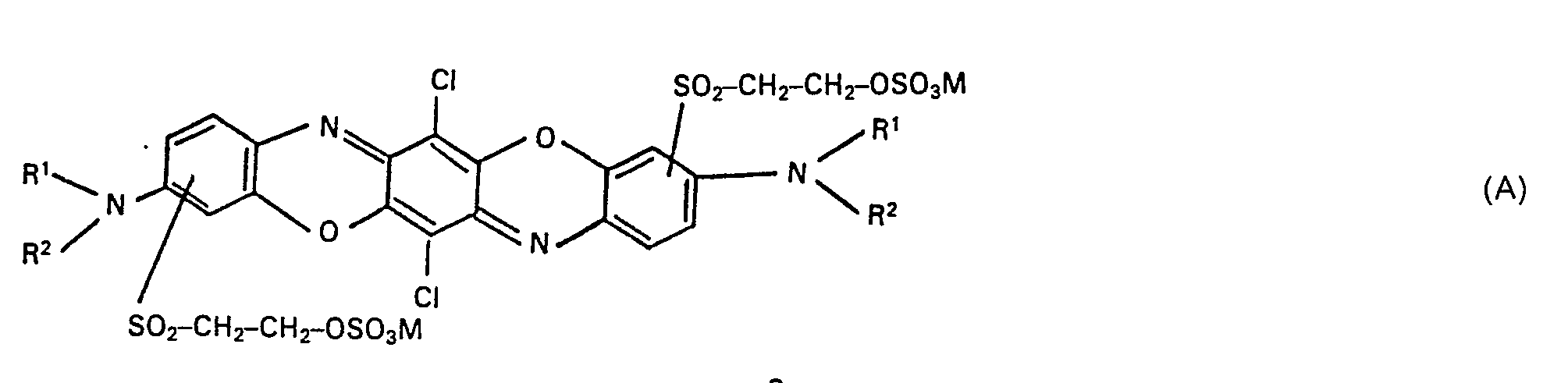
- beide R2 β-Sulfo-ethyl, 8-Sulfo-butyl, 3,5-Disulfophenyl, 3,5-Disulfo-4-amino-phenyl, β-(3-Sulfo-phenoxy)-ethyl, β-(4-Sulfo-phenylami- no)-ethyl, β-(Sulfoacetylamino)-ethyl, β-(2-Nitro-4-sulfo-phenyl-amino)-ethyl, 4-Sulfo-phenethyl, Sulfobenzyl, β-(N-Sulfoamino)-ethyl, Carboxymethyl, eine Gruppe der Formel -(CH2)4-SO2-NH-SO2-CH3, β-Sulfato-ethyl, y-Sulfatopropyl, y-Sulfato-butyl, β-Sulfato-propyl, δ-Sulfatobutyl, β-(β'-Sulfato-ethoxy)-ethyl, β-(β'-Sulfatoethylsulfonyl)-ethyl, β-(β'-Sulfatoethyl- amino)-ethyl, β-Sulfato-α, a-dimethylethyl, β, y-Disulfato-propyl, a, a-Di-(sulfatomethyl)ethyl oder ω-Sulfato-hexyl bedeuten, falls R' für ein Wasserstoffatom steht, und beide R2 ß-Sulfo-ethyl, β-Sulfato-ethyl oder y-Sulfato-propyl sind, falls R'für die Methylgruppe steht, und M ein Wasserstoffatom oder ein Alkalimetall bedeutet.
- Faserreaktive Triphendioxazin-Verbindungen der hier ausgeschlossenen Art sind bereits in den älteren, nicht vorveröffentlichen europäischen Patentanmeldungs-Veröffentlichungen EP-A-0 141 996 und EP-A- 0 153 599, die unter Art. 54(3) EPÜ fallen, beschrieben.
- Substituenten, die gemäss dem Formelglied Y oder Y' in β-Stellung der Ethylgruppe gebunden sind und durch ein Alkali unter Bildung der Vinylgruppe eliminert werden können, sind beispielsweise Alkanoyloxygruppen von 2 bis 5 C-Atomen, wie die Acetyloxygruppe, Aroyloxygruppen, wie die Benzoyloxy-, Sulfobenzoyloxy- oder Carboxybenzoyloxy-Gruppe, Dialkylaminogruppen mit Alkylresten von 1 bis 4 C-Atomen, wie insbesondere die Dimethylamino- und Diethylaminogruppe, das Chloratom, das Bromatom, Alkylsulfonyloxygruppen mit Alkylresten von 1 bis 4 C-Atomen, eine Phosphatogruppe (entsprechend der allgemeinen Formel -OP03M2 mit M der obengenannten Bedeutung) eine Thiosulfatogruppe (entsprechend der allgemeinen Formel -S-S03M mit M der obengenannten Bedeutung) oder eine Sulfatogruppe (entsprechend der allgemeinen Formel -OS03M mit M der obengenannten Bedeutung). Bevorzugt sind von den Gruppen entsprechend dem Formelglied Y die β-Chlorethyl-, β-Phosphatoethyl- und β-Thiosulfatoethyl-Gruppe und insbesondere die Vinylgruppe und ganz besonders bevorzugt die β-Sulfatoethyl-Gruppe.
- Das Formelglied Y' ist bevorzugt die β-Phosphatoethyl-, Vinyl- und β-Sulfatoethylgruppe. Die Reste Y und Y' können zueinander gleiche oder voneinander verschiedene Bedeutungen haben.
- Die für R' und R2 stehenden Alkylgruppen können substiuiert sein, wie beispielsweise durch einen oder zwei Substituenten aus der Menge der Substituenten Halogen, wie Brom und insbesondere Chlor, Sulfato, Phosphato, Sulfo, Carboxy, Carbalkoxy von 2 bis 5 C-Atomen, wie Carbomethoxy und Carbethoxy, Alkanoylamino von 2 bis 5 C-Atomen, wie Acetylamino, Alkylamino mit 1 bis 4 C-Atomen im Alkylrest, wie Methylamino und Ethylamino. Dialkylamino mit 1 bis 4 C-Atomen in den Alkylresten, wie Dimethylamino und Diethylamino, ein in den Alkylresten durch eine Sulfo-, Carboxy-, Sulfato- oder Phosphatogruppe oder eine Alkoxygruppe von 1 bis 4 C-Atomen oder eine β-Sulfatoethoxy- oder β-Sulfato-di-, -tri- oder -tetraglykolether-Gruppe substituiertes Alkylamino oder Dialkylamino mit jeweils 1 bis 4 C-Atomen in den Alkylresten des Mono- bzw. Dialkylamins, eine Gruppe der Formel-S02-Y' mit Y' der oben angegebenen Bedeutung, Phenyl und Phenyl, das durch Substituenten aus der Gruppe Alkyl von 1 bis 4 C-Atomen, Alkoxy von 1 bis 4 C-Atomen, Halogen, wie Brom und insbesondere Chlor, Nitro. Sulfo, Carboxy, eine Gruppe der Formel-SO2-Y' mit Y' der oben angegebenen Bedeutung, Amino, Alkylamino mit einem Akylrest von 1 bis 4 C-Atomen, Alkanoylamino von 2 bis 5 C-Atomen, wie Acetylamino, Benzoylamino, Sulfobenzoylamino und/oder Carbalkoxy von 2 bis 5 C-Atomen substituiert ist. Phenylsubstituierte Alkylgruppen sind bevorzugt die Benzyl- und die Phenethylgruppe.
- Die beiden Formelreste -NR' R2 haben bevorzugt die gleiche Bedeutung.
- Sofern die Benzolkerne A durch einen der obengenannten zusätzlichen Substituenten substituiert sind, steht dieser in ortho-Stellung, bevorzugt in meta- oder para-Stellung zur Gruppe -SO2-Y gebunden ist. Bevorzugt sind die Benzolkerne A jedoch nicht durch einen oder zwei weitere Substituenten substituiert.
- Von den Resten R' und R2 sind insbesondere diejenigen bevorzugt, die ein Wasserstoffatom oder eine Alkylgruppe von 1 bis 4 C-Atomen darstellen, die durch eine Sulfogruppe, eine Carboxygruppe oder eine Sulfatogruppe substiutiert sein können oder durch eine Monosulfophenyl-oder Disulfophenylgruppe substituiert sind. Insbesondere bevorzugt ist R2 ein β-(Monosulfophenyl- oder -disulfophenyl)-ethyl- oder -methyl-Gruppe oder eine β-Sulfatopropyl-Gruppe oder eine y-Sulfato-propyl-, eine β-Sulfatoethyl-, eine β, y-Disulfatopropyl-, eine β-Sulfato-isopropyl-, eine a-Sulfatomethyl-propyl-, eine ß-(ß'-Sulfatoethoxy)-ethyl- oder eine β-Sulfo-ethylGruppe. Bevorzugt ist die β-Sulfato-ethylGruppe. Bevorzugt sind auch Verbindungen der Formel (1), in welcher jedes R' ein Wasserstoffatom ist.
- Besonders hervorzuheben sind von den erfindungsgemässen Triphendioxazin-Verbindungen diejenigen, die der allgemeinen Formel (2a)

- Die neuen Dioxazinverbindungen können sowohl in saurer Form als auch in Form ihrer Salze vorliegen. Bevorzugt sind sie in Form der Salze, insbesondere der Alkali- und Erdalkalimetallsalze, und finden auch bevorzugt in Form dieser Salze Verwendung zum Färben (hier und im folgenden im allgemeinen Sinne und einschliesslich des Bedruckens verstanden) von hydroxy- und/oder carbonamidgruppenhaltigen Materialien, insbesondere Fasermaterialien.
- Die vorliegende Erfindung betrifft weiterhin Verfahren zur Herstellung der obengenannten und definierten Verbindungen der allgemeinen Formel (1). Diese sind dadurch gekennzeichnet, dass man eine Aminoverbindung der allgemeinen Formel (3)


- Verbindungen der Formel (1) mit Y oder Y' gleich einer β-Sulfatoethyl-Gruppe können anschliessend gemäss bekannten Verfahrensweisen in andere erfindungsgemässe Verbindungen der Formel (1 ) übergeführt werden, in welcher Y bzw. Y' für die Vinylgruppe oder eine Ethylgruppe mit einem anderen in β-Stellung befindlichen alkalisch eliminierbaren Substituenten stehen.
- Die erfindungsgemässe Umsetzung einer Verbindung der allgemeinen Formel (3) oder zweier verschiedener Aminoverbindungen der allgemeinen Formel (3), jeweils in zusammen 2fach äquivalenter Menge, mit einem Äquivalent Chloranil zur Verbindung der allgemeinen Formel (5) kann in wässrigem Medium oder in wässrig-organischem Medium oder in rein organischem Medium erfolgen, wobei die organischen Lösemittel polare aprotische und protische Lösungsmittel darstellen, wie beispielsweise niedere Alkanole, wie Methanol und Ethanol, und halogenierte Benzole, wie o-Dichlorbenzol. Bevorzugt wird das Chloranil jedoch in einem mehr oder weniger stärkeren Überschuss eingesetzt, der in der Regel 5-20% beträgt. Die erfindungsgemässe Umsetzung der Amine (3) mit Chloranil kann bei einer Temperatur zwischen 20 und 100°C, vorzugsweise zwischen 50 und 70 °C, in Gegenwart eines säurebindenden Mittels, wie beispielsweise eines Alkali- oder Erdalkalicarbonats oder -acetats so beispielsweise Natriumacetat, Natriumcarbonat oder Natriumbicarbonat, oder eines Alkali- oder Erdalkalihydroxids, wie Natriumhydroxid, oder eines Oxids eines Erdalkalimetalls, wie beispielsweise Magnesiumoxid, durchgeführt werden. Sofern in einem wässrigen oder wässrig-organischen Medium gearbeitet wird, wird ein pH-Bereich zwischen 4 und 7, vorzugsweise zwischen 5,5 und 6,5, eingestellt.
- Das Anil der Formel (5) wird sodann, vorzugsweise nach vorheriger Isolierung, in an und für sich üblicher und bekannter Verfahrensweise unter oxidierenden Bedingungen in Schwefelsäure oder Schwefeltrioxid enthaltender Schwefelsäure als Medium zur Triphendioxazin-Verbindung cyclisiert. Als Oxidationsmittel können das Schwefeltrioxid selbst sowie Ammonium- oder Alkalipersulfate, Natriumperborat, vorzugsweise jedoch Natrium- oder Kaliumperoxodisulfat (entsprechend den Formeln Na2S2O8 bzw. K2S208), dienen.
- Vorzugsweise führt man die Umsetzung in konzentrierter Schwefelsäure, wie 96- bis bevorzugt 100%iger Schwefelsäure und insbesondere in Schwefeltrioxid enthaltender Schwefelsäure (Oleum), wie bis zu 30 gew.-%igem Oleum, durch. Die Reaktionstemperatur wird zwischen 5 und 40 °C, gegebenenfalls auch bis zu 80 °C, bevorzugt jedoch zwischen 15 und 25 °C und insbesondere bevorzugt zwischen 20 und 25 °C gewählt.
- Beim Ringschluss in Schwefelsäure oder Oleum als Reaktionsmedium werden Hydroxygruppen, die an einem Alkylrest des Moleküls gebunden sind, wie beispielsweise die oben bereits erwähnten β-Hydroxyethyl-Gruppen des Formelrestes Y1 oder Hydroxyalkyl-Gruppen der Formelreste R3 und R4, in die entsprechenden Sulfatoalkylgruppen übergeführt. Bei Verwendung von Oleum soll die Reaktionstemperatur 30 °C nicht überschreiten. Bei Temperaturen oberhalb von etwa 35 °C, wie bei Temperaturen zwischen 40 und 60 °C, lassen sich erfindungsgemäss auch Sulfogruppen in die aromatischen Ringe des Triphendioxazins (die entsprechenden Arylreste von R' und R2 eingeschlossen) einführen.
- Das als Reaktionsmedium und Agenz verwendete Oleum besitzt in der Regel einen Gehalt von 5 bis 30 Gew.-%, bevorzugt 10 bis 20 Gew.-% an Schwefeltrioxid.
- Bekannte Verfahrensweisen zur Umsetzung von aromatischen Aminen mit 1,4-Benzochinonen, die zu Triphendioxazinverbindungen führen, sind beispielsweise in K. Venkataraman, «The Chemistry of Synthetic Dyes», Band V, S. 419-427 (1971), und in Ullmanns Encyklopädie der technischen Chemie, 4. Auflage, Band 8, S. 240 + 241 (1974) sowie der deutschen Offenlegungsschrift Nr. 28 23 828 beschrieben.
- Die Ausgangsverbindungen entsprechend der allgemeinen Formel (3) sind bisher noch nicht bekannt. Sie lassen sich jedoch analog bekannten Verfahrensweisen der Umsetzung von Nitrochlorbenzolen mit Aminen herstellen, so beispielsweise durch Umsetzung eines Chlornitrobenzols der allgemeinen Formel (6)
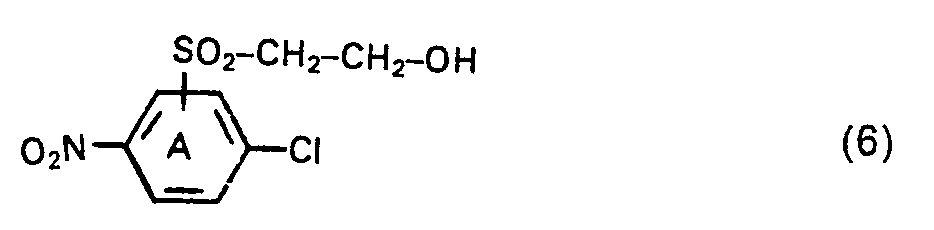
- Die auf diese Weise erhältliche Nitro-anilinVerbindung der allgemeinen Formel (7)

- Besonders vorteilhaft jedoch geht man nicht, wie bereits oben erwähnt, bei der Herstellung der β-Sulfatoethylsulfonyl-Verbindungen der Formel (1) von den faserreaktiven Ausgangsverbindungen aus, sondern von denjenigen der allgemeinen Formel (3), in denen Yl für die β-Hydroxyethyl-Gruppe steht. Diese werden in erfindungsgemässer Weise mit 2,3,5,6-Tetrachlor-1,4-benzochinon über die Anilzwischenisolierung zum Triphendioxazin umgesetzt, und die hierbei entstehende Triphendioxazinverbindung mit den β-Hydroxyethylsulfonyl-Gruppen wird nachträglich verestert (sulfatisiert) nach an und für sich üblichen Verfahrensweisen, die zahlreich für die Überführung von Farbstoffen mit einer β-Hydroxyethylsulfonyl-Gruppe in Farbstoffe mit einer β-Sulfatoethylsulfonyl-Gruppe beschrieben sind, beispielsweise mit 95- bis 100%iger Schwefelsäure oder mit Chlorsulfonsäure oder mit Schwefeltrioxid enthaltender Schwefelsäure. Insbesondere erfolgt die Sulfatierung, wie oben erwähnt, bereits vor oder während des oxidativen Ringschlusses mittels Schwefelsäure oder Oleum, das gleichzeitig als Reaktionsmedium dienen kann, so dass der Einsatz von Ausgangsverbindungen der allgemeinen Formel (3), die die β-Sulfatoethylsulfonyl-Gruppe bereits enthalten, nicht erforderlich ist.
- Chlornitrobenzolverbindungen entsprechend der allgemeinen Formel (6) sind bekannt (s. beispielsweise deutsche Patentschrift 859 462, Beispiel 5). Sie lassen sich durch Nitrierung einer entsprechenden (ß-Hydroxyethylsulfonyl)-chlorbenzol-Verbindung in an und für sich üblicher Verfahrensweise oder, in ebenso an und für sich bekannten Verfahrensweisen, durch Reduktion einer entsprechenden 1-Chlor-4-nitro-benzol- sulfochlorid-Verbindung mittels Natriumsulfit zur entsprechenden Sulfinsäure und anschliessende Oxethylierung der Sulfinsäure zur β-Hydroxyethylsulfonyl-Verbindung synthetisieren.
- Ausgangsverbindungen der allgemeinen Formel (3) sind beispielsweise 3-(ß-Hydroxyethyl- sulfonyl)-anilin-Verbindungen, die in 4-Stellung durch eine (ß- Hydroxyethyl) -amino-Gruppe oder durch eine (y-Hydroxypropyl)-amino-, eine (ß-Sulfatoethyl)-amino-, eine (y-Sulfatopropyl)-amino-, eine (ß-Sulfoethyl)-amino-, eine Bis-(ß-sulfatoethyl)-amino- oder Bis-(ß-sulfoethyl)-amino-Gruppe oder durch eine andere in den nachfolgenden Tabellenbeispielen angegebenen Aminogruppe entsprechend der Formel -NR3R4 substituiert sind und in 4-Stellung bevorzugt durch eine (ß-Hydroxyethyl)-amino-, (y-Hydroxypropyl)-amino-, (ß-Hydroxy-propyl)-amino-, (ß-Sulfoethyl)-amino-, (y-Sulfo-propyl)-amino-, β-(4-Sulfophenyl)-ethyl-amino-, β-(2,4-Disulfophenyl)-ethyl-amino-, β-(2-Sulfo-4-ß-hydroxyethylsulfonyl) -ethyl-amino-, Bis-(ß-hydroxyethyl)-amino-, Bis-(ß-sulfoethyl)-amino-, N-Methyl-N-(ß-hydroxyethyl)-amino-, N-Ethyl-N-(ß-hydroxyethyl)-amino-, N-Methyl-(ß-sulfoethyl)-amino- oder N-Ethyl-N-(ß-sulfo-ethyl)-amino-Gruppe, ganz besonders bevorzugt aber durch eine Hydroxyalkyl-amino-Gruppe von 1 bis 4 C-Atomen, wie die (ß-Hydroxyethyl)-, (y-Hydroxypropyl)- oder (ß-Hydroxypropyl)amino-Gruppe, substituiert sind.
- Die Abscheidung und Isolierung der erfindungsgemäss hergestellten Verbindungen der allgemeinen Formel (1) aus den Syntheselösungen kann nach allgemein bekannten Methoden erfolgen, so beispielsweise entweder durch Ausfällen aus dem Reaktionsmedium mittels Elektrolyten, wie beispielsweise Natriumchlorid oder Kaliumchlorid, oder durch Eindampfen der Reaktionslösung, beispielsweise Sprühtrocknung, wobei dieser Reaktionslösung eine Puffersubstanz zugefügt werden kann.
- Die erfindungsgemässen Verbindungen der allgemeinen Formel (1 ) haben faserreaktive Eigenschaften und besitzen wertvolle Farbstoffeigenschaften. Sie können deshalb zum Färben (einschliesslich Bedrucken) von hydroxygruppenhaltigen und/oder carbonamidgruppenhaltigen Materialien, beispielsweise in Form von Flächengebilden, wie Papier und Leder, oder in der Masse, von Polyamid oder Polyurethan, insbesondere aber von solchen Materialien in Faserform, verwendet werden. Auch können die bei der Synthese der erfindungsgemässen Verbindungen anfallenden Lösungen, gegebenenfalls nach Zusatz einer Puffersubstanz, gegebenenfalls auch nach Konzentrierung, direkt als Flüssigpräparation der färberischen Verwendung zugeführt werden.
- Gegenstand der vorliegenden Erfindung ist deshalb auch die Verwendung der erfindungsgemässen Verbindungen der allgemeinen Formel (1) zum Färben (einschliesslich Bedrucken) von hydroxy- und/oder carbonamidgruppenhaltigen Materialien bzw. Verfahren zu deren Anwendung auf diesen Substraten. Bevorzugt kommen die Materialien in Form von Fasermaterialien zur Anwendung, insbesondere in Form von Textilfasern, wie Garnen, Wickelkörpern und Geweben. Hierbei kann man analog bekannten Verfahrensweisen vorgehen.
- Hydroxygruppenhaltige Materialien sind solche natürlichen oder synthetischen Ursprungs, wie beispielsweise Cellulosefasermaterialien oder deren Regeneratprodukte und Polyvinylalkohole. Cellulosefasermaterialien sind vorzugsweise Baumwolle, aber auch andere Pflanzenfasern, wie Leinen, Hanf, Jute und Ramiefasern; regenerierte Cellulosefasern sind beispielsweise Zellwolle und Viskosekunstseide.
- Carbonamidgruppenhaltige Materialien sind beispielsweise synthetische und natürliche Polyamide und Polyurethane, insbesondere in Form von Fasern, beispielsweise Wolle und andere Tierhaare, Seide, Leder, Polyamid-6,6, Polyamid-6, Polyamid-11 und Polyamid-4.
- Die erfindungsgemässen Verbindungen der Formel (1 ) lassen sich gemäss der erfindungsgemässen Anwendung, auf den genannten Substraten, insbesondere auf den genannten Fasermaterialien, nach den für wasserlösliche, insbesondere faserreaktive, Farbstoffe bekannten Anwendungstechniken applizieren und fixieren, so beispielsweise, indem man die Dioxazinverbindung der allgemeinen Formel (1 ) in gelöster Form auf das Substrat aufbringt oder sie darin einbringt und sie auf diesem oder in diesem, gegebenenfalls durch Hitzeeinwirkung und/oder gegebenenfalls durch Einwirkung eines alkalisch wirkenden Mittels, fixiert. Solche Färbe- und Fixierweisen sind in der Literatur zahlreich beschrieben.
- So erhält man mit ihnen auf Cellulosefasern nach den Ausziehverfahren aus langer Flotte unter Verwendung von verschiedensten säurebindenden Mitteln und gegebenenfalls neutralen Salzen, wie Natriumchlorid oder Natriumsulfat, sehr gute Farbausbeuten sowie einen guten Farbaufbau. Man färbt bevorzugt in wässrigem Bad bei Temperaturen zwischen 40 und 100 °C, gegebenenfalls bei Temperaturen bis zu 120 °C unter Druck, und gegebenenfalls in Gegenwart von üblichen Färbereihilfsmitteln.
- Man kann dabei so vorgehen, dass man das Material in das warme Bad einbringt und dieses allmählich auf die gewünschte Färbetemperatur erwärmt und den Färbeprozess bei dieser Temperatur zu Ende führt. Die das Ausziehen des Farbstoffes beschleunigenden Neutralsalze können dem Bade gewünschtenfalls auch erst nach Erreichen der eigentlichen Färbetemperatur zugesetzt werden.
- Nach dem Klotzverfahren werden auf Cellulosefasern ebenfalls ausgezeichnete Farbausbeuten und ein sehr guter Farbaufbau erhalten, wobei durch Verweilen bei Raumtemperatur oder erhöhter Temperatur, beispielsweise bis zu etwa 60 °C, durch Dämpfen oder mit Trockenhitze im üblicher Weise fixiert werden kann.
- Ebenfalls nach den üblichen Druckverfahren für Cellulosefasern, die einphasig, beispielsweise durch Bedrucken mittels einer die erfindungsgemässe Verbindung und Natriumbicarbonat oder ein anderes säurebindendes Mittel enthaltenden Druckpaste und anschliessendes Dämpfen bei 100 bis 103 °C, oder zweiphasig, beispielsweise durch Bedrucken mittels einer die erfindungsgemässe Verbindung enthaltenden neutralen oder schwach sauren Druckpaste und anschliessendes Fixieren der erfindungsgemässen Verbindung entweder durch Hindurchführen des bedruckten Materials durch ein heisses alkali- und elektrolythaltiges Bad oder durch Überklotzen mit einer alkalischen elektrolythaltigen Klotzflotte und anschliessendes Verweilen dieses überklotzten Materials oder Dämpfen oder Behandlung mit Trokkenhitze, durchgeführt werden können, erhält man farbstarke Drucke mit gutem Stand der Konturen und einem klaren Weissfond. Der Ausfall der Drucke ist von wechselnden Fixierbedingungen nur wenig abhängig.
- Bei der Fixierung mittels Trockenhitze nach den üblichen Thermofixierverfahren verwendet man Heissluft von 120 bis 200 °C. Neben dem üblichen Wasserdampf von 101 bis 103 °C kann auch überhitzter Dampf und Druckdampf von Temperaturen bis zu 160 °C eingesetzt werden.
- Sowohl in der Färberei als auch in der Druckerei sind die mit den erfindungsgemässen DioxazinVerbindungen erhaltenen Fixiergrade hoch.
- Die säurebindenden und die Fixierung der Verbindung der Formel (1) auf den Cellulosefasern bewirkenden Mittel sind beispielsweise wasserlösliche basische Salze der Alkalimetalle und Erdalkalimetalle von organischen oder anorganischen Säuren oder Verbindungen, die in der Hitze Alkali freisetzen. Insbesondere sind die Alkalimetallhydroxide und Alkalimetallsalze von schwachen bis mittelstarken anorganischen oder organischen Säuren zu nennen, vorzugsweise deren Natrium- und Kaliumverbindungen. Solche säurebindenden Mittel sind beispielsweise Natriumhydroxid, Kaliumhydroxid, Natriumcarbonat, Natriumbicarbonat, Kaliumcarbonat, Natriumformiat, Natriumdihydrogenphosphat, Dinatriumhydrogenphosphat, Natriumtrichloracetat, Wasserglas oder Trinatriumphosphat.
- Durch die Behandlung der erfindungsgemässen Verbindungen (Farbstoffe) mit den säurebindenden Mitteln, gegebenenfalls unter Wärmeeinwirkung, werden die erfindungsgemässen Farbstoffe chemisch an die Cellulosefaser gebunden; insbesondere die Cellulosefärbungen zeigen nach der üblichen Nachbehandlung durch Spülen zur Entfernung von nicht fixierten Farbstoffanteilen ausgezeichnete Nassechtheiten, zumal sich nicht fixierte Farbstoffanteile gut auswaschen lassen.
- Die Färbungen auf Polyurethan oder natürlichen oder synthetischen Polyamidfasern werden üblicherweise aus saurem Milieu ausgeführt. So kann man beispielsweise dem Färbebad Essigsäure und/oder Ammoniumsulfat und/oder Essigsäure und Ammoniumacetat zufügen, um den gewünschten pH-Wert zu erhalten, Zwecks Erreichung einer brauchbaren Egalität der Färbung empfiehlt sich ein Zusatz an üblichen Egalisierhilfsmitteln, wie beispielsweise auf Basis eines Umsetzungsproduktes von Cyanurchlorid mit der dreifach molaren Menge einer Aminobenzolsulfonsäure und/oder einer Aminonaphthalinsulfonsäure oder auf Basis eines Umsetzungsproduktes von beispielsweise Stearylamin mit Ethylenoxid. In der Regel wird das zu färbende Material bei einer Temperatur von etwa 40 °C in das Bad eingebracht, dort einige Zeit darin bewegt, das Färbebad dann auf den gewünschten schwach sauren, vorzugsweise schwach essigsauren pH-Wert, wie einen pH-Wert zwischen 3,5 und 5,5, nachgestellt und die eigentliche Färbung bei einer Temperatur zwischen 60 und 98 °C und unter Kontrolle dieses pH-Wertes durchgeführt. Die Färbungen können aber auch bei Siedetemperatur oder bei Temperaturen bis 106 °C oder aber bis zu 120 °C (unter Druck) ausgeführt werden. Gegen Ende der Färbezeit kann der pH-Wert in den neutralen und gegebenenfalls schwach alkalischen Bereich bis zu einem pH-Wert von 8,5 verschoben werden, um besonders bei einer erwünschten Erzielung von hohen Farbtiefen die volle reaktive Bindung zwischen dem Farbstoff der Formel (1) und der Faser herbeizuführen. Gleichzeitig wird der nicht reaktiv gebundene Farbstoffanteil abgelöst.
- Die mit erfindungsgemässen Verbindungen der allgemeinen Formel (1 ) hergestellten Färbungen und Drucke zeichnen sich durch reine, vorwiegend blaue Farbtöne aus. Insbesondere die Färbungen und Drucke auf Cellulosefasermaterialien besitzen sehr hohe Farbstärken und ebenso sehr gute Lichtechtheiten, einschliesslich guter Nasslicht- und Schweisslichtechtheiten, ebenso gute Hypochloritbleich- und Chlorbadewasserechtheiten, weiterhin vorzügliche Nassechtheiten, wie beispielsweise gute bis sehr gute Waschechtheiten bei 60 bis 95 °C, auch in Gegenwart von Perboraten, saure und alkalische Walk-, Überfärbe- und Schweissechtheiten, Alkali-, Säure-, Wasser- und Seewasserechtheiten, des weiteren eine gute Plissierechtheit, Bügelechtheit und Reibechtheit. Ebenso besitzen sie eine gute Nassliegeechtheit und eine sehr gute Säurelagerbeständigkeit («acid fading») beim Lagern von feuchten, noch Essigsäure enthaltendem, gefärbtem Material. Des weiteren sind die Färbungen gegen die üblichen Kunstharzappreturen stabil. Ein Teil der erfindungsgemässen Verbindungen (Farbstoffe) sind in der Reinheit des Farbtones und in wichtigen Echtheitseigenschaften mit faserreaktiven Anthrachinonfarbstoffen vergleichbar.
- Ebenso von Bedeutung ist die erfindungsgemässe Verwendung der Verbindungen der allgemeinen Formel (1 ) für das faserreaktive Färben von Wolle. Insbesondere lässt sich auch filzfrei oder filzarm ausgerüstete Wolle (vgl. bspw. H. Rath, Lehrbuch der Textilchemie, Springer-Verlag, 3. Auflage (1972), S. 295-299, insbesondere die Ausrüstung nach dem sogenannten Hercosett-Verfahren (S. 298); J. Soc. Dyers and Colourists 1972, 93-99, und 1975, 33-44) mit sehr guten Echtheitseigenschaften färben.
- Da die Wasserlöslichkeit der Verbindungen der allgemeinen Formel (1) sehr gut ist, lassen sie sich auch mit Vorteil bei üblichen kontinuierlichen Färbeverfahren einsetzen.
- Die Farbstärke der erfindungsgemässen Verbindungen der allgemeinen Formel (1 ) ist auch auf Wolle und Polyamidfasermaterialien sehr hoch. Sie liefern auf diesen Fasermaterialien, insbesondere beim reaktiven Färben von Wolle, klare, vorwiegend blaue, Färbungen. Bei Anwendung von Färbetemperaturen von 100 bis 106 °C ist eine hohe Baderschöpfung festzustellen.
- Bei den mit den erfindungsgemässen Verbindungen der allgemeinen Formel (1 ) erhältlichen Färbungen kann auf eine ansonsten übliche ammoniakalische Nachbehandlung der gefärbten Ware verzichtet werden. Im Vergleich zu konstitutionellen ähnlichen, bekannten Farbstoffen zeigen sie in überraschender Weise einen sehr guten Farbaufbau, wobei die brillante Nuance in tiefen Tönen erhalten bleibt. Darüber hinaus zeigen sie eine gute Kombinierbarkeit mit anderen faserreaktiven Wollfarbstoffen, die ein überraschend egales Färben der Faser ermöglichen. Ebenso lässt sich Material aus Wollfasern unterschiedlicher Provenienz mit der erfindungsgemässen Verbindung egal färben. Zur Verbesserung des Egalisierverhaltens kann gegebenenfalls ein übliches Egalisierhilfsmittel, wie beispielsweise N-Methyltaurin, zugesetzt werden.
- Unter Verwendung der üblichen faseraffinen Färbehilfsmitteln ergeben die erfindungsgemässen Verbindungen auch auf filzfrei oder filzarm ausgerüsteter Wolle egale Färbungen. Bei hellen bis mittleren Farbtiefen ist auch ohne ammoniakalische Nachbehandlung ein sehr gutes Nassechtheitsniveau zu erzielen, wobei jedoch gegebenenfalls eine ammoniakalische Nachbehandlung bevorzugt werden kann. Neben der hohen Lichtechtheit dieser Wollfärbungen sind als sehr gute Nassechtheitseigenschaften insbesondere die ausgezeichnete alkalische Schweissechtheit und sehr gute Waschechtheit bei 60 °C, auch von Färbungen in hohen Farbtiefen, zu nennen.
- Die nachstehenden Beispiele dienen zur Erläuterung der Erfindung. Die Teile sind Gewichtsteile, die Prozentangaben stellen Gewichtsprozente dar, sofern nicht anders vermerkt. Gewichtsteile beziehen sich zu Volumenteilen wie Kilogramm zu Liter.
- Die in diesen Beispielen formelmässig beschriebenen Verbindungen sind in Form der freien Säuren angegeben; im allgemeinen werden sie in Form ihrer Natrium- oder Kaliumsalze hergestellt und isoliert und in Form ihrer Salze zum Färben verwendet. Ebenso können die in den nachfolgenden Beispielen, insbesondere Tabellenbeispielen, in Form der freien Säure genannten Ausgangsverbindungen und Komponenten als solche oder in Form ihrer Salze, vorzugsweise Alkalimetallsalze, wie Natrium- oder Kaliumsalze, in die Synthese eingesetzt werden.
-
- a) 548 Teile 3-(ß-Hydroxyethylsulfonyl)-4-(ß- hydroxy-isopropyl-amino)-anilin werden in 6000 Teilen Wasser bei 65 °C klar gelöst. 248 Teile Chloranil werden eingetragen, und es wird während der Reaktion mit etwa 180 Teilen Natriumbicarbonat ein pH-Wert von 6 bis 6,5 bei einer Reaktionstemperatur von etwa 65 °C gehalten. Der Ansatz wird noch eine Stunde nachgerührt, das Reaktionsprodukt bei etwa 60 °C abgesaugt, mit 4000 Teilen Wasser gewaschen und unter reduziertem Druck bei 70 °C getrocknet.
- b) 723 Teile des unter a) erhaltenen Anil-Zwischenproduktes werden bei einer Temperatur zwischen 20 und 25 °C in 5000 Teile 10%iges Oleum eingetragen. Der Reaktionsansatz wird anschliessend noch etwa drei Stunden bei dieser Temperatur nachgerührt; sodann werden 481 Teile Natrium-peroxodisulfat eingetragen, und zwar in der Weise, dass die Reaktionstemperatur bei 20 bis 25 °C gehalten werden kann. Man rührt noch 15 Stunden bei dieser Temperatur nach, lässt den Ansatz sodann auf Eis laufen, stellt ihn mit Calciumcarbonat auf einen pH-Wert zwischen 1 und 1,5, sodann mit Natriumcarbonat auf einen pH-Wert von 5,5, filtriert das ausgefallene Calciumsulfat ab, wäscht es mit Wasser aus und vereinigt die Filtrate.
- Die erfindungsgemässe Triphendioxazin-Verbindung kann in Form ihres Natriumsalzes durch Eindampfen oder Sprühtrocknen des vereinigten Filtrates erhalten werden. Sie besitzt, in Form der freien Säure geschrieben, die mutmassliche Formel

- Diese erfindungsgemässe Verbindung besitzt sehr gute faserreaktive Farbstoffeigenschaften. Sie färbt die in der Beschreibung genannten Materialien, insbesondere Cellulosefasermaterialien, wie Baumwolle, nach den in der Technik üblichen und bekannten Verfahrensweisen der Applikation und Fixierung von faserreaktiven Farbstoffen in farbstarken, reinen rotstichig blauen Tönen mit guten Echtheiten, wie insbesondere guter Lichtechtheit der trockenen oder feuchten, wie mit Trinkwasser befeuchteten Färbung, guter alkalischen Schweisslichtechtheit, Chlorbadewasserechtheit, Hypochloritechtheit, alkalischer Schweissechtheit, Waschechtheit, auch in Gegenwart von Perboraten, Nassliegeechtheit und Säurelagerbeständigkeit.
- In wässriger Lösung zeigt sie im sichtbaren Bereich ein Absorptionsmaximum bei 615 nm.
- Die erfindungsgemässe Triphendioxazin-Verbindung des Beispieles 1 kann auch in folgender Weise hergestellt werden:
- a) 548 Teile 3-(β-Hydroxyethylsulfonyl)-4-(β-hydroxy-isopropyl-amino)-anilin, 115 Teile Magnesiumoxid und 248 Teile 2,3,5,6-Tetrachlor-1,4-benzochinon werden in 3000 Teilen Wasser aufgeschlämmt. Die Suspension wird auf 65 °C erwärmt und bei dieser Temperatur noch 2 bis 5 Stunden weitergerührt und anschliessend auf 20°C abgekühlt. Das dunkelbraune Reaktionsprodukt wird abfiltriert, mit Wasser gewaschen und bei 60 °C getrocknet.
- b) 723 Teile des unter a) erhaltenen Kondensationsproduktes (Anilverbindung) werden zwecks Sulfatierung der ß- Hydroxyalkyl- Gruppen zu den β-Sulfatoalkyl-Gruppen und Ringschlussreaktion zur Triphendioxazinverbindung in 4000 Teile 20%iges Oleum unter Rühren eingetragen, und zwar in der Weise, dass die Reaktionstemperatur bei 18 bis 20 °C gehalten werden kann. Die weitere Arbeitsweise erfolgt gemäss der im Beispiel 1 angegebenen Verfahrensweise.
- Die nach diesem Beispiel erhaltene erfindungsgemässe Triphendioxazin-Verbindung mit der im Beispiel 1 angegebenen (mutmasslichen) Formel besitzt dieselben guten faserreaktiven Farbstoffeigenschaften, wie in Beispiel 1 beschrieben.
- Herstellung der Ausgangsverbindung 3-(ß-Hydroxyethylsulfonyl)-4-(ß-hydroxyethylami- no)-anilin:
- Zu einer Lösung von 76,5 Teilen Ethanolamin in 500 Volumenteilen Methanol gibt man bei einer Temperatur von 65 °C 132,8 Teile 2-(ß-Hy- droxyethylsulfonyl)-4-nitro-chlorbenzol langsam hinzu und rührt den Reaktionsansatz bei dieser Temperatur noch 6 Stunden weiter. Anschliessend destilliert man unter gleichzeitigem kontinuierlichem Zulauf von Wasser 400 Volumenteile Methanol aus dem Reaktionsansatz ab. Aus dem nunmehr wässrigen Medium kristallisiert beim Abkühlen das 2-(ß-Hydroxyethylsulfonyl)-4-nitro-1-(ß-hydroxyethyl)-amino-benzol in hoher Reinheit aus. Dieses kann zur Überführung der Nitrogruppe in die Aminogruppe in die katalytische Hydrierung eingesetzt werden. Hierfür werden 58 Teile dieser Nitroverbindung in 400 Volumenteilen Methanol gelöst und in Gegenwart eines Nickelkatalysators in einem Autoklaven bei einer Temperatur von 100 °C und einem Druck von 50 bar Wasserstoff hydriert. Der Katalysator wird anschliessend abfiltriert und das Filtrat durch Abkühlen der methanolischen Lösung auskristallisieren lassen. Das 3-(β-Hydroxyethylsulfonyl)-4-(ß-hydroxyethylamino)-anilin wird in guter Ausbeute und hoher Reinheit erhalten.
- In den nachfolgenden Tabellenbeispielen sind weitere erfindungsgemässe Triphendioxazin-Verbindungen entsprechend einer allgemeinen Formel (1 a) und dem entsprechenden Formelrest R2 beschrieben. Sie lassen sich in erfindungsgemässer Weise, beispielsweise analog den obigen Ausführungsbeispielen 1 und 2, durch Umsetzung von Chloranil mit einer Anilinverbindung entsprechend der allgemeinen Formel (3a) mit R'2 der in dem jeweiligen Tabellenbeispiel angegebenen Bedeutung und nachträglicher Sulfatierung und Cyclisierung herstellen. Diese erfindungsgemässen Triphendioxazin-Verbindungen besitzen ebenfalls sehr gute faserreaktive Farbstoffeigenschaften und liefern auf den in der Beschreibung genannten Materialien, wie insbesondere Cellulosefasermaterialien, farbstarke, echte Färbungen mit dem in dem jeweiligen Tabellenbeispiel auf Baumwolle angegebenen Farbton. Die Absorptionsmaxima λmax in nm) wurden aus wässriger Lösung ermittelt.


- In den nachfolgenden Tabellenbeispielen sind weitere erfindungsgemässe Triphendioxazin-Verbindungen entsprechend einer allgemeinen Formel (1 a) mit den entsprechenden Formelresten R2 beschrieben. Sie lassen sich in erfindungsgemässer Weise, beispielsweise analog den obigen Ausführungsbeispielen 1 und 2, durch Umsetzung von Chloranil mit einer Anilinverbindung entsprechend der allgemeinen Formel (3), in welcher Y1 die β-Sulfatoethyl- oder β-Hydroxyethyl-Gruppe ist, die Gruppe -SO2-Y1 in ortho-Stellung zur Aminogruppe -NR1R2 steht, R' ein Wasserstoffatom ist und R2 die in dem jeweiligen Tabellenbeispiel für Formel (1 a) angegebene Bedeutung hat, und nachträglicher oxidativer Cyclisierung und Sulfatisierung der β-Hydroxyethylsulfonyl-Gruppe herstellen. Diese erfindungsgemässen Triphendioxazin-Verbindungen besitzen ebenfalls sehr gute faserreaktive Farbstoffeigenschaften und liefern auf den in der Beschreibung genannten Materialien, wie insbesondere Cellulosefasermaterialien, farbstarke, echte Färbungen mit dem in dem jeweiligen Tabellenbeispiel auf Baumwolle angegebenen Farbton.


- In den nachfolgenden Tabellenbeispielen sind weitere erfindungsgemässe Triphendioxazin-Verbindungen entsprechend einer allgemeinen Formel (1 b)


- In den nachfolgenden Tabellenbeispielen sind weitere erfindungsgemässe Triphendioxazin-Verbindungen entsprechend der allgemeinen Formel (1 a) und dem entsprechenden Formelrest R2 beschrieben. Sie lassen sich in erfindungsgemässer Weise, beispielsweise analog den Ausführungsbeispielen 1 und 2, durch Umsetzung von Chloranil mit einer Anilinverbindung entsprechend der allgemeinen Formel (3a) mit R'2 der in dem jeweiligen Tabellenbeispiel angegebenen Bedeutung und nachträglicher Sulfatierung und Cyclisierung herstellen. Diese erfindungsgemässen Triphendioxazin-Verbindungen besitzen ebenfalls sehr gute faserreaktive Farbstoffeigenschaften und liefern auf den in der Beschreibung genannten Materialien, wie insbesondere Cellulosefasermaterialien, farbstarke, echte Färbungen mit dem in dem jeweiligen Tabellenbeispiel auf Baumwolle angegebenen Farbton.


- Zur Färbung eines Baumwollgewebes wird ein wässriges Färbebad hergestellt, das in 2000 Volumenteilen 2 Teile des Farbstoffes von Beispiel 1 oder 2, 10 Teile wasserfreies Natriumsulfat, 10 Teile wasserfreies Natriumcarbonat und 4 Volumenteile einer 32,5%igen wässrigen Natronlauge gelöst enthält. In dieses Färbebad werden 100 Teile eines Baumwollgewebes gegeben, das bei einer Temperatur von 40 °C zwischen 60 und 90 Minuten gefärbt wird. Nach Seifen und Spülen in üblicher Weise erhält man eine farbstarke, brillante blaue Färbung mit den in der Beschreibung angegebenen sehr guten Gebrauchs- und Fabrikationsechtheiten.
- Zum Bedrucken eines mercerisierten Baumwollgewebes wird eine Druckpaste verwendet, die auf 1000 Teile 15 Teile des Farbstoffes von Beispiel 1 oder 2, 50 Teile Harnstoff, 410 Teile Wasser, 500 Teile einer neutralen 4%igen wässrigen Alginatverdickung, 15 Teile Natriumbicarbonat und 10 Teile des Natriumsalzes der m-Nitrobenzoesäure enthält. Das Baumwollgewebe wird in üblicher Weise mit dieser Druckpaste bedruckt und nach dem Trocknen 10 bis 15 Minuten lang mit Wasserdampf von 101 bis 103 °C gedämpft. Nach diesem Fixierungsvorgang wird das Gewebe in üblicher Weise durch Spülen mit kaltem und warmem Wasser, durch Seifen bei Kochtemperatur und erneutem Spülen mit Wasser und anschliessendem Trocknen fertiggestellt. Man erhält einen farbstarken brillanten blauen Druck, der sehr gute Licht- und Nassechtheiten besitzt.
- Zur Färbung eines Baumwollgewebes wird eine wässrige Klotzflotte hergestellt, die im Liter 20 Teile des Farbstoffes von Beispiel 1 oder 2, 100 Teile Harnstoff, 30 Teile wasserfreies Natriumsulfat und 16 Volumenteile einer wässrigen 32,5%igen Natronlauge enthält. Das Baumwollgewebe wird bei Zimmertemperatur mit einer Flottenaufnahme von 80% des Gewichtes des Baumwollgewebes foulardiert, auf eine Docke aufgewickelt, in eine Plastikfolie gehüllt und 24 Stunden lang bei Raumtemperatur liegengelassen. Während dieser Zeit fixiert der Farbstoff. Nach dem Seifen und Spülen in üblicher Weise erhält man eine farbstarke brillante blaue Färbung des Baumwollgewebes.
- Es werden 15 Teile des Farbstoffes von Beispiel 1 oder 2 in 200 Teilen Wasser von 70 °C gelöst; diese Lösung wird in 500 Teile einer neutralen oder schwach sauren, 4%igen Alginatverdickung eingerührt. Mit 285 Teilen Wasser wird diese verdickte Farbstofflösung auf 1000 Teile aufgefüllt. Mit der so hergestellten Druckpaste wird in üblicher Weise ein Gewebe aus mercerisierter Baumwolle bedruckt, das anschliessend getrocknet und zur Fixierung des Farbstoffes durch ein 90 bis 105 °C heisses wässriges Fixierbad geführt wird, das in 1000 Teilen Wasser 100 Teile Natriumchlorid, 150 Teile wasserfreies Natriumcarbonat, 50 Teile wasserfreies Kaliumcarbonat und 70 Volumenteile einer 35%igen wässrigen Natronlauge enthält. Die Fixierung erfolgt hierbei bereits in wenigen Sekunden, so dass die Durchführung des bedruckten Gewebes sehr schnell ausgeführt werden kann. - Nach dieser Fixierbehandlung wird das Gewebe in üblicher Weise durch Spülen mit kaltem Wasser, durch heisses Waschen, erneutes Spülen mit Wasser und Trocknen fertiggestellt. Man erhält ein egales, blaues Druckmuster mit den in Beispiel 1 genannten sehr guten Licht-und Nassechtheiten.
- Zwecks Färbung von 10 Teilen eines Garnes aus Wolle wird ein wässriges Bad hergestellt, das aus 0,25 Volumenteilen einer 60%igen wässrigen Essigsäure, 0,15 Teilen eines handelsüblichen Egalisierhilfsmittels für Wolle und 0,3 Teilen Ammoniumsulfat in 400 Teilen Wasser besteht. Die Wolle wird bei einer Temperatur von 30-40 °C und einem pH-Wert des Bades von 5-5,2 darin gut benetzt. Dem Bad wird sodann eine Lösung von 0,1 Teilen des Dioxazinfarbstoffes von Beispiel 1 oder 2 in 20 Teilen Wasser unter Rühren zugegeben. Man bewegt die Wolle weiterhin darin und lässt die Temperatur 5 Minuten bei 30 bis 40 °C, erhitzt sodann das Färbebad innerhalb von 40 Minuten auf 85 °C, färbt bei dieser Temperatur 10 Minuten weiter und erhitzt sodann das Färbebad innerhalb von 10 Minuten zum Sieden. Es wird 1 Stunde lang kochend weitergefärbt. Anschliessend wird das Bad auf 80 °C abgekühlt. Der verwendete Farbstoff ist auf der Wolle sehr gut aufgezogen. Die Nachbehandlung des gefärbten Wollgarnes kann deshalb im selben Bad erfolgen. Man gibt Ammoniak bis auf einen pH-Wert von 8-8,5 hinzu und behandelt das Material 15 Minuten bei diesem pH und bei einer Temperatur von 80 °C. Man nimmt es heraus, spült es mit warmem und kaltem Wasser und trocknet es. Es wird eine farbstarke blaue Färbung mit sehr guten Licht-und Nassechtheiten erhalten.
- Verfährt man in einer der obenbeschriebenen Verfahrensweisen gemäss der vorliegenden Erfindung zum Färben und Bedrucken von Wolle oder von synthetischen Polyamidmaterialien oder von Cellulosefasermaterialien, beispielsweise analog den obigen Anwendungsbeispielen 1 bis 5, und setzt hierfür als Farbstoff erfindungsgemäss eine der in den anderen vorherigen Ausführungsbeispielen oder Tabellenbeispielen beschriebenen erfindungsgemässen Dioxazinfarbstoffe ein, so erhält man ebenfalls kräftige blaue Färbungen und Drucke mit guten Echtheiten.
Claims (17)


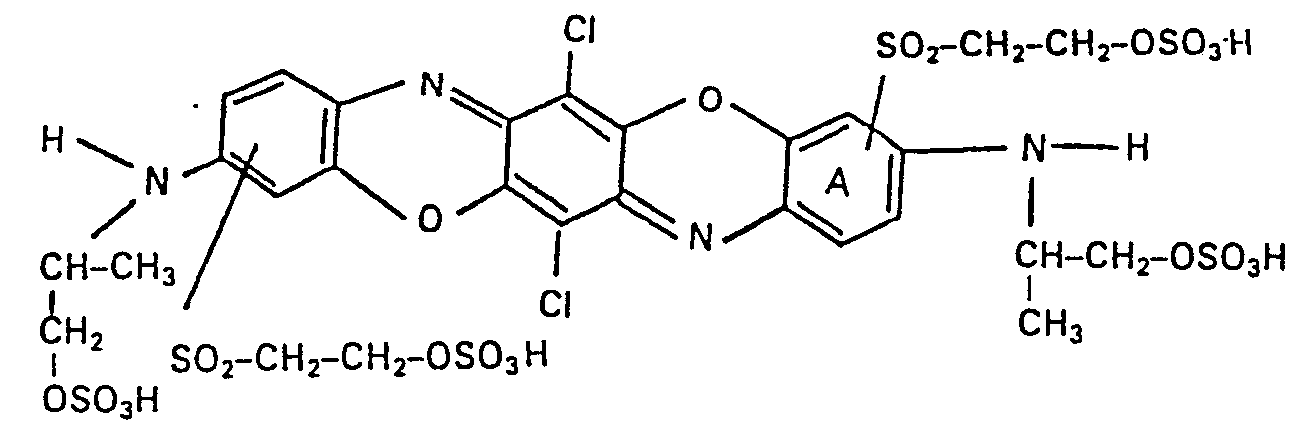

Applications Claiming Priority (2)
| Application Number | Priority Date | Filing Date | Title |
|---|---|---|---|
| DE19843426727 DE3426727A1 (de) | 1984-07-20 | 1984-07-20 | Wasserloesliche triphendioxazin-verbindungen, verfahren zu ihrer herstellung und ihre verwendung als farbstoffe |
| DE3426727 | 1984-07-20 |
Publications (2)
| Publication Number | Publication Date |
|---|---|
| EP0168751A1 EP0168751A1 (de) | 1986-01-22 |
| EP0168751B1 true EP0168751B1 (de) | 1989-02-08 |
Family
ID=6241102
Family Applications (1)
| Application Number | Title | Priority Date | Filing Date |
|---|---|---|---|
| EP85108476A Expired EP0168751B1 (de) | 1984-07-20 | 1985-07-09 | Wasserlösliche Triphendioxazin-Verbindungen, Verfahren zu ihrer Herstellung und ihre Verwendung als Farbstoffe |
Country Status (7)
| Country | Link |
|---|---|
| US (1) | US4785098A (de) |
| EP (1) | EP0168751B1 (de) |
| JP (1) | JPS6137847A (de) |
| KR (1) | KR930009242B1 (de) |
| BR (1) | BR8503451A (de) |
| DE (2) | DE3426727A1 (de) |
| IN (1) | IN166361B (de) |
Families Citing this family (12)
| Publication number | Priority date | Publication date | Assignee | Title |
|---|---|---|---|---|
| DE3625347A1 (de) * | 1985-09-19 | 1987-03-26 | Hoechst Ag | Wasserloesliche triphendioxazin-verbindungen, verfahren zu ihrer herstellung und ihre verwendung als farbstoffe |
| DE3625346A1 (de) * | 1986-07-26 | 1988-01-28 | Hoechst Ag | Wasserloesliche triphendioxazin-verbindungen, verfahren zu ihrer herstellung und ihre verwendung als farbstoffe |
| DE3628084A1 (de) * | 1986-08-19 | 1988-03-03 | Hoechst Ag | Wasserloesliche triphendioxazine, deren herstellung, verwendung als farbstoffe sowie nitro- und aminobenzolsulfon-vorprodukte |
| US4841049A (en) * | 1986-09-12 | 1989-06-20 | Ciba-Geigy Corporation | Reactive dyes of the dioxazine series |
| DE3703738A1 (de) * | 1987-02-07 | 1988-08-18 | Bayer Ag | Verfahren zur herstellung einer konzentrierten waessrigen reaktivfarbstoff-loesung |
| DE3717832A1 (de) * | 1987-05-27 | 1988-12-08 | Hoechst Ag | Verfahren zur herstellung von triphendioxazinverbindungen |
| DE3828824A1 (de) * | 1988-08-25 | 1990-03-08 | Hoechst Ag | Wasserloesliche triphendioxazin-verbindungen und deren sulfonylgruppenhaltigen vorprodukte, verfahren zu deren herstellung und verwendung der triphendioxazine als farbstoffe |
| GB9211110D0 (en) * | 1992-05-26 | 1992-07-08 | Ici Plc | Compound |
| GB9323881D0 (en) * | 1993-11-19 | 1994-01-05 | Zeneca Ltd | Organic chemicals |
| JP3297972B2 (ja) * | 1995-04-17 | 2002-07-02 | 株式会社パイオラックス | 固定クリップ |
| JP3914710B2 (ja) | 2001-01-15 | 2007-05-16 | 株式会社ニフコ | 留め具 |
| CN102295840B (zh) * | 2010-06-25 | 2013-12-11 | 上海雅运纺织化工股份有限公司 | 藏青色活性染料组合物及其在纤维上的染色应用 |
Citations (2)
| Publication number | Priority date | Publication date | Assignee | Title |
|---|---|---|---|---|
| EP0141996A2 (de) * | 1983-10-11 | 1985-05-22 | Bayer Ag | Triphendioxazin-Reaktivfarbstoffe |
| EP0153599A2 (de) * | 1984-02-11 | 1985-09-04 | Bayer Ag | Triphendioxazin-vinylsulfon-Farbstoffe |
Family Cites Families (11)
| Publication number | Priority date | Publication date | Assignee | Title |
|---|---|---|---|---|
| GB1450746A (en) * | 1974-01-31 | 1976-09-29 | Ici Ltd | Tripendioxazine dyestuffs |
| AU497288B2 (en) * | 1975-04-15 | 1978-12-07 | Imperial Chemical Industries Limited | Dyestuffs |
| CH606349A5 (de) * | 1976-08-03 | 1978-10-31 | Hoechst Ag | |
| GB1559752A (en) * | 1977-07-12 | 1980-01-23 | Ici Ltd | Triphendioxazine dyestuffs |
| US4336377A (en) * | 1979-02-02 | 1982-06-22 | Ciba-Geigy Corporation | Basic dioxazine compounds |
| GB2059985A (en) * | 1979-10-08 | 1981-04-29 | Ici Ltd | Triphendioxazine dyes |
| DE3045471A1 (de) * | 1980-12-02 | 1982-07-08 | Bayer Ag, 5090 Leverkusen | Dioxazin-reaktivfarbstoffe, verfahren zu ihrer herstellung und ihre verwendung zum faerben und bedrucken von hydroxyl- oder amidgruppenhaltigen fasermaterialien |
| EP0084718B1 (de) * | 1982-01-27 | 1986-04-16 | Imperial Chemical Industries Plc | Triphendioxazinfarbstoffe |
| EP0095255A3 (de) * | 1982-05-24 | 1984-02-29 | Imperial Chemical Industries Plc | Farbstoffe der Triphendioxazinreihe, Verfahren zu deren Herstellung und Verwendung derselben zum Färben von Substraten aus Cellulose |
| EP0101665A3 (de) * | 1982-08-19 | 1984-10-10 | Ciba-Geigy Ag | Reaktivfarbstoffe der Dioxazinreihe, deren Herstellung und Verwendung |
| DE3439755A1 (de) * | 1984-04-05 | 1985-10-17 | Bayer Ag, 5090 Leverkusen | Triphendioxazin-farbstoffe |
-
1984
- 1984-07-20 DE DE19843426727 patent/DE3426727A1/de not_active Withdrawn
-
1985
- 1985-07-09 EP EP85108476A patent/EP0168751B1/de not_active Expired
- 1985-07-09 DE DE8585108476T patent/DE3568180D1/de not_active Expired
- 1985-07-15 IN IN519/CAL/85A patent/IN166361B/en unknown
- 1985-07-18 US US06/756,770 patent/US4785098A/en not_active Expired - Fee Related
- 1985-07-19 KR KR1019850005155A patent/KR930009242B1/ko not_active Expired - Fee Related
- 1985-07-19 BR BR8503451A patent/BR8503451A/pt not_active IP Right Cessation
- 1985-07-19 JP JP15847085A patent/JPS6137847A/ja active Pending
Patent Citations (2)
| Publication number | Priority date | Publication date | Assignee | Title |
|---|---|---|---|---|
| EP0141996A2 (de) * | 1983-10-11 | 1985-05-22 | Bayer Ag | Triphendioxazin-Reaktivfarbstoffe |
| EP0153599A2 (de) * | 1984-02-11 | 1985-09-04 | Bayer Ag | Triphendioxazin-vinylsulfon-Farbstoffe |
Also Published As
| Publication number | Publication date |
|---|---|
| KR930009242B1 (ko) | 1993-09-24 |
| BR8503451A (pt) | 1986-04-15 |
| DE3426727A1 (de) | 1986-01-23 |
| DE3568180D1 (en) | 1989-03-16 |
| JPS6137847A (ja) | 1986-02-22 |
| EP0168751A1 (de) | 1986-01-22 |
| US4785098A (en) | 1988-11-15 |
| IN166361B (de) | 1990-04-21 |
| KR860001174A (ko) | 1986-02-24 |
Similar Documents
| Publication | Publication Date | Title |
|---|---|---|
| EP0094055B1 (de) | Monoazoverbindungen, Verfahren zu ihrer Herstellung und ihre Verwendung als Farbstoffe | |
| EP0036582B1 (de) | Wasserlösliche Azoverbindungen, Verfahren zu ihrer Herstellung und ihre Verwendung als Farbstoffe | |
| EP0168751A1 (de) | Wasserlösliche Triphendioxazin-Verbindungen, Verfahren zu ihrer Herstellung und ihre Verwendung als Farbstoffe | |
| EP0775730B1 (de) | Reaktivfarbstoffe, Verfahren zu deren Herstellung und deren Verwendung | |
| EP0064250B1 (de) | Anthrachinonverbindungen, Verfahren zu ihrer Herstellung und ihre Verwendung als Farbstoffe | |
| EP0065211B1 (de) | Azoverbindungen, Verfahren zu ihrer Herstellung und ihre Verwendung als Farbstoffe | |
| EP0280139B1 (de) | Kupferkomplex-Formazan-Verbindungen, Verfahren zu ihrer Herstellung und ihre Verwendung als Farbstoffe | |
| EP0169457B1 (de) | Wasserlösliche Pyridon-Monoazoverbindungen, Verfahren zu ihrer Herstellung und ihre Verwendung als Farbstoffe | |
| DE19821573A1 (de) | Farbstoffmischung von wasserlöslichen faserreaktiven Azofarbstoffen, Verfahren zu ihrer Herstellung und ihre Verwendung | |
| EP0212635B1 (de) | Wasserlösliche Triphendioxazin-Verbindungen, Verfahren zu ihrer Herstellung und ihre Verwendung als Farbstoffe | |
| EP0474596B1 (de) | Reaktivfarbstoffe, Verfahren zu deren Herstellung und deren Verwendung | |
| EP0071985B1 (de) | Wasserlösliche Monoazoverbindungen, Verfahren zu ihrer Herstellung und ihre Verwendung als Farbstoffe | |
| DE3327713A1 (de) | Wasserloesliche disazoverbindungen, verfahren zu deren herstellung und ihre verwendung als farbstoffe | |
| DE3628084A1 (de) | Wasserloesliche triphendioxazine, deren herstellung, verwendung als farbstoffe sowie nitro- und aminobenzolsulfon-vorprodukte | |
| EP0072557B1 (de) | Wasserlösliche Azoverbindungen, Verfahren zu ihrer Herstellung und ihre Verwendung als Farbstoffe | |
| EP0231836B1 (de) | Wasserlösliche Disazoverbindungen, Verfahren zu ihrer Herstellung und ihre Verwendung als Farbstoffe | |
| EP0258686B1 (de) | Wasserlösliche Triphendioxazin-Verbindungen, Verfahren zu ihrer Herstellung und ihre Verwendung als Farbstoffe | |
| EP0374815B1 (de) | Kupferkomplex-Formazan-Verbindungen, Verfahren zu ihrer Herstellung und ihre Verwendung als Farbstoffe | |
| EP0149170A2 (de) | Reaktivfarbstoffe, deren Herstellung und Verwendung | |
| EP0365478B1 (de) | Reaktivfarbstoffe, deren Herstellung und Verwendung | |
| EP0064711B1 (de) | Diphenyläther-Azoverbindungen, Verfahren zu ihrer Herstellung und ihre Verwendung als Farbstoffe | |
| EP0278903B1 (de) | Reaktivfarbstoffe, deren Herstellung und Verwendung | |
| DE3517755A1 (de) | Wasserloesliche mono- und disazoverbindungen, verfahren zu deren herstellung und ihre verwendung als farbstoffe | |
| EP0570333B1 (de) | Faserreaktive Anthrachinonfarbstoffe, Verfahren zu deren Herstellung und deren Verwendung | |
| EP0636665A1 (de) | Wasserlösliche Azoverbindungen, Verfahren zu ihrer Herstellung und ihre Verwendung als Farbstoffe |
Legal Events
| Date | Code | Title | Description |
|---|---|---|---|
| PUAI | Public reference made under article 153(3) epc to a published international application that has entered the european phase |
Free format text: ORIGINAL CODE: 0009012 |
|
| AK | Designated contracting states |
Designated state(s): CH DE FR GB IT LI |
|
| 17P | Request for examination filed |
Effective date: 19860628 |
|
| 17Q | First examination report despatched |
Effective date: 19870318 |
|
| GRAA | (expected) grant |
Free format text: ORIGINAL CODE: 0009210 |
|
| AK | Designated contracting states |
Kind code of ref document: B1 Designated state(s): CH DE FR GB IT LI |
|
| ITF | It: translation for a ep patent filed | ||
| REF | Corresponds to: |
Ref document number: 3568180 Country of ref document: DE Date of ref document: 19890316 |
|
| GBT | Gb: translation of ep patent filed (gb section 77(6)(a)/1977) | ||
| ET | Fr: translation filed | ||
| PLBE | No opposition filed within time limit |
Free format text: ORIGINAL CODE: 0009261 |
|
| STAA | Information on the status of an ep patent application or granted ep patent |
Free format text: STATUS: NO OPPOSITION FILED WITHIN TIME LIMIT |
|
| 26N | No opposition filed | ||
| ITTA | It: last paid annual fee | ||
| PGFP | Annual fee paid to national office [announced via postgrant information from national office to epo] |
Ref country code: FR Payment date: 19950621 Year of fee payment: 11 |
|
| PGFP | Annual fee paid to national office [announced via postgrant information from national office to epo] |
Ref country code: GB Payment date: 19950626 Year of fee payment: 11 Ref country code: CH Payment date: 19950626 Year of fee payment: 11 |
|
| PGFP | Annual fee paid to national office [announced via postgrant information from national office to epo] |
Ref country code: DE Payment date: 19950920 Year of fee payment: 11 |
|
| PG25 | Lapsed in a contracting state [announced via postgrant information from national office to epo] |
Ref country code: GB Effective date: 19960709 |
|
| PG25 | Lapsed in a contracting state [announced via postgrant information from national office to epo] |
Ref country code: LI Effective date: 19960731 Ref country code: CH Effective date: 19960731 |
|
| GBPC | Gb: european patent ceased through non-payment of renewal fee |
Effective date: 19960709 |
|
| REG | Reference to a national code |
Ref country code: CH Ref legal event code: PL |
|
| PG25 | Lapsed in a contracting state [announced via postgrant information from national office to epo] |
Ref country code: FR Effective date: 19970328 |
|
| PG25 | Lapsed in a contracting state [announced via postgrant information from national office to epo] |
Ref country code: DE Effective date: 19970402 |
|
| REG | Reference to a national code |
Ref country code: FR Ref legal event code: ST |