EP0321401A2 - Farbbildende polymerische Kuppler - Google Patents
Farbbildende polymerische Kuppler Download PDFInfo
- Publication number
- EP0321401A2 EP0321401A2 EP88810842A EP88810842A EP0321401A2 EP 0321401 A2 EP0321401 A2 EP 0321401A2 EP 88810842 A EP88810842 A EP 88810842A EP 88810842 A EP88810842 A EP 88810842A EP 0321401 A2 EP0321401 A2 EP 0321401A2
- Authority
- EP
- European Patent Office
- Prior art keywords
- polymer according
- colour
- monomer
- dye
- residue
- Prior art date
- Legal status (The legal status is an assumption and is not a legal conclusion. Google has not performed a legal analysis and makes no representation as to the accuracy of the status listed.)
- Granted
Links
Images

Classifications
-
- G—PHYSICS
- G03—PHOTOGRAPHY; CINEMATOGRAPHY; ANALOGOUS TECHNIQUES USING WAVES OTHER THAN OPTICAL WAVES; ELECTROGRAPHY; HOLOGRAPHY
- G03C—PHOTOSENSITIVE MATERIALS FOR PHOTOGRAPHIC PURPOSES; PHOTOGRAPHIC PROCESSES, e.g. CINE, X-RAY, COLOUR, STEREO-PHOTOGRAPHIC PROCESSES; AUXILIARY PROCESSES IN PHOTOGRAPHY
- G03C7/00—Multicolour photographic processes or agents therefor; Regeneration of such processing agents; Photosensitive materials for multicolour processes
- G03C7/30—Colour processes using colour-coupling substances; Materials therefor; Preparing or processing such materials
- G03C7/32—Colour coupling substances
- G03C7/327—Macromolecular coupling substances
- G03C7/3275—Polymers obtained by reactions involving only carbon-to-carbon unsaturated bonds, e.g. vinyl polymers
Definitions
- This invention relates to new polymeric colour couplers and to their use in photographic materials.
- camera speed film material which comprises silver halide and colour couplers in a silver halide emulsion layer which yields on colour development a so-called monochromatic dye image.
- This material has some advantages over the conventional black and white camera speed film material in that the dye images are virtually grainless compared with the silver image obtained using high-speed film material.
- film material of this type can be processed using conventional colour film processing chemistry.
- Most processing houses are now set-up to process only colour film and thus it is a great convenience to be able to process the monochromatic camera speed film material in a colour film processing system.
- a polymeric colour coupler which comprises the residue of three monomeric colour couplers of the formulae :- where R1 is hydrogen, alkyl, chlorine or bromine, R2 is a divalent organic radical and W1, W2 and W3 are each an active colour former moiety capable of forming upon chromogenic development of exposed silver halide material with a primary aromatic amine colour developing agent a dye, W1 forming a yellow dye, W2 forming a magenta dye and W3 forming a cyan dye.
- the three moieties W1, W2 and W3 are present in the polymer in such a ratio that a black or blackish dye is obtained upon colour development.
- W1, W2 and W3 can be any coupler moiety known in the art such as those described below.
- R1 is hydrogen or methyl.
- R2 the divalent organic radical may be the residue of a urethane, a urea, a carbonate, an ester, an ether, a ketone or an amide. More preferably however it is a simple amido linkage -C(O)-NH-.
- the polymeric colour coupler of the type described may be formed as a polymer latex which is not isolated but is used as such. Or it may be formed as a water-soluble solid. If it is formed as a polymer latex there is preferably present in the polymer unit at least one other simple, non-colour-coupling photograhically inert comonomer. The presence of other monomers in the polymer is particularly desirable if the polymer is to be incorporated in photographic material as a latex.
- a latex polymer is produced having optimum physical properties, such as glass transition temperature, compatibility with the gelatin used in preparing coating solutions, suitable refractive index, as well as beneficial rates of copolymerisation between the coupler monomers and the photographically inert comonomers and the ability to confer lowered viscosity and reasonable miscibility with the mixture of coupler monomers.
- the polymeric colour coupler of the type described is formed as a water-soluble solid there is present in the polymer from 40 - 60% by weight of the residue of a monomer which has the formula IV where R1 has the meaning assigned to it above, L is an alkylene or interrupted alkylene linking group and R1 and R11 are alkyl groups having 1 to 4 carbon atoms and X is an anion.
- L is preferably an alkylene chain having from 2 to 6 carbon atoms or is an interupted alkylene chain having from 2 to 6 carbon atoms there being an oxygen from or an -NH- group in the chain.
- a particularly suitable monomer residue of this type has the formula V :-
- Suitable comonomers which may be present when the polymeric colour coupler is formed as a polymer latex or as a water soluble polymer include methyl acrylate, ethyl acrylate, butyl acrylate, ethyl hexyl acrylate, vinyl acetate; hydroxyethyl methacrylate, hydroxypropylmethacrylate; methacrylic acid, acrylic acid, itaconic acid, 2-carboxyethyl acrylate and the salts thereof, acrylamide, methacrylamide, N-hydroxymethyl acrylamide, styrene, N-vinyl pyrrolidone, 1-vinyl imidazole; 4-vinylpyridine, dimethylaminoethyl methacrylate, tetrahydrofurfuryl methacrylate; sulfphoethyl methacrylate, vinyl sulphonic acid and salts thereof, acrylonitrile and vinylidene chloride, although this list is
- crosslinking monomers may be present such as divinyl benzene, ethylene dimethacrylate, trivinyl cyclohexane and trimethylol propane triacylate.
- the surface active agents used in the preparation of the polymer latex may be any of those well known in the art, for example nonionic wetting agents including alcohol ethoxylates, sorbitan esters, aryl phenol alkoxylates, alkyl alkanolamides, anionic wetting agents including alkyl sulphates and sulphonates, sulphosucciniates, aryl sulphonates, polyalkoxy sulphates, alkyl phosphates, aryl phenol phosphates, alkyl taurates, sarcosinates, and copolymerisable surfactants such as allyl sulphosuccinates, again this list is not intended to be exhaustive.
- nonionic wetting agents including alcohol ethoxylates, sorbitan esters, aryl phenol alkoxylates, alkyl alkanolamides
- anionic wetting agents including alkyl sulphates and sulphonates, sul
- the initiators and initiator systems used for the preparation of the latices may be persulphates, azo compounds, peroxides or any of the other well known initiators used for emulsion polymerisation, including redox systems. Examples of these initiator systems may be found in the book “Emulsion Polymerisation” by D. Blackely, Applied Science Publishers, 1975 especially pages 155 to 250.
- latices may make use of techniques such as “seed” polymerisation and core-shell techniques, as well as “power-feed” procedures and other methods well known in the art.
- Latices may be prepared in bulk, semi-continuously or continuously using any of the known designs of apparatus.
- photographic material having at least one gelatino silver halide emulsion layer which comprises a polymeric colour coupler of the type described. More preferably, the photographic material comprises a polymeric colour coupler which comprises the residues of monomers A, B and C shown below.
- the polymeric colour coupler of the type described is present in the silver halide emulsion layer as a polymer latex.
- the colour coupler of the type described is added to the silver halide emulsion layer as an aqueous solution.
- any of the monomeric colour couplers described in the prior art may be used in the polymeric colour coupler of the present invention.
- the colour coupler portion of the monomer may comprise ballasting groups or leaving groups for example so that the colour coupler may act as a two equivalent coupler.
- yellow dye forming monomeric colour couplers examples include couplers of the general formula VI- wherein each of R3, R4, R5 and R6 are hydrogen, halogen, alkoxy, sulphoxy or sulphonamido, R1 and R2 are as defined above, R7 is hydrogen or a leaving group and L1 and L2 are direct linkages or -NH-.
- linking groups R2 are -CO-NH- and -O-CH2-CH2-NH SO2-
- one of L1 and L2 is a direct linkage.
- An example of such a monomer is Monomer B which is used in the Examples which follow. This monomer has the formula VII :
- Another class of yellow dye forming monomeric colour couplers have a pivaloyl end group rather than a benzoyl and group.
- Such colour couplers have the general formula X :- where R1, R2, R6 and R7 have the meanings assigned to them above.
- magenta dye forming monomeric colour couplers examples include couplers of the general formula XII :- where R1 and R2 are as defined above, R8 is hydrogen or a leaving group and R10 R11 and R12 are each hydrogen, halogen or alkoxy.
- the alkoxy group comprises an alkyl moiety having up to six carbon atoms.
- R1 is hydrogen or -CH3
- R2 is -CO NH -
- R2 is -CO NH(CH2) x -O-CO-NH where x is 2 to 6, where in the above two formulae the phenylene group is optionally substituted by chlorine alkyl having 1 to 4 carbon atoms.
- Particularly useful monomers of formula XII are those wherein at least two of R10, R11 and R12 are chlorine atoms.
- R7 or R8 examples include the group -S- R9 where R9 is a long chain alkyl group having over 10 carbon atoms or is a substituted phenyl group having at least one alkyl or alkoxy group. Preferably R9 when an alkyl group has from 12 to 30 carbon atoms or the chain.
- Monomeric magenta colour couplers of formula XII are described in EP 133262.
- magenta dye forming monomeric colour couplers are those of general formula XVI :- wherein R1, R8 and R10 are as defined above and is alkyl, dialkyl amino, optionally substituted phenyl and optionally substituted acylamino.
- Substituents in the phenyl or ecylamino group include alkyl groups having 2 to 6 carbon atom and chloric.
- couplers may be prepared by reacting magenta colour couplers of the formula with acryloyl or methacryloyl chloride
- cyan dye forming monomeric colour couplers examples include phenol couplers of the general formula XVIII :- and of general formula XIX : and a naphthol coupler of the general formula XX :- wherein the above three formulae R1 and R12 are as defined above, R14 is hydrogen or a leaving group such as a halogen atom or a substituted alkoxy group, R13 is a hydrogen atom or an alkyl group having 1 to 5 carbon atoms, R15 is an optionally substituted alkyl or acylamino group and R17 is a linking group and y is 0 or 1, and R16 is an alkoxy, amino, amido or sulphonamido group or hydrogen atom.
- R1 is hydrogen or methyl.
- linking groups R17 include alkylene chains of 2 to 6 carbon atoms including interrupted alkylene chains and an alkyl group for example
- interupted chains have from 2 to 6 carbon atoms and - O - or - NH - group in the chain.
- Examples of monomers of formula XIX are those of formulae :-
- Examples of monomers of formula XX are those of formulae :-
- Monomeric colour couplers of general formula XX are described in B.P. 2133170.
- the colour couplers of the type described are of particular use in monochromatic camera speed silver halide film material.
- the photographic material after imagewise exposure is developed in a colour developing bath by use of a para - phenylene diamine developing agent to yield a developed silver image and black dye image.
- the material is then subjected to a bleach fix treatment which removes the developed silver image and then unexposed silver halide leaving the black dye negative image which can be used to print all types of black and white paper including variable contrast paper.
- the colour couplers of the type described can also be used to prepare monochromatic paper. That is to say paper which can be processed using colour processing chemistry to yield a black dye image instead of a silver image. Paper of this type is of particular use from which to prepare proof prints.
- the colour coupler of the type described can also be used to reinforce silver halide images at such time that, as occurred some years ago, the price of silver becomes too prohibitive to use in photography when a very dense silver image is required.
- the photographic material of the present invention preferably comprises gelatin as the binder in the silver halide emulsion layer.
- the halide used can be any of the silver halides normally used in photography e.g. silver bromide, silver iodobromide, silver chloride, silver chlorobromide and silver iodochlorobromide.
- the silver halide grains may be both optically and chemically sensitised.
- the silver halide emulsion may contain stabiliser, bacteriocides and any of the other additives commonly found in photographic silver halide emulsions.
- the gelatin may have been hardened and may contain coating aids as usual when preparing coated silver halide emulsions.
- the base can be any of the usual transparent bases used in photography for example subbed polyester, polycarbonate or polystyrene base, or may be a cellulose triacetate or cellulose acetate - butyrate base. If the material is to be used for proof prints the base may be any opaque base in common use for photographic print material for example baryta coated paper base or polyethylene laminated paper base.
- a monomer solution was made by dissolving in 2.00 g hydroxy propyl methacrylate and 3.00 g butyl acrylate 0.34 g Monomer A, (magenta monomer), 0.34g Monomer B (yellow monomer) and 0.34 g Monomer C (cyan monomer).
- the vessel containing this solution was maintained at about 30 to 40°C.
- a surfactant solution was prepared by dissolving in 5.80 g water sodium oleylmethyl taurate 0.16 g and potassium persulphate 40 mg.
- the surfactant and monomer solutions were then fed slowly into the 100 ml vessel which comprised the initiator solution first set forth. These additions were made over 2 hours.
- the resultant latex formed in the 100 ml vessel was maintained at 80°C for 11 ⁇ 2 hours. The contents were then cooled and filtered.
- the latex as just prepared was used to prepare colour photographic material.
- To 2.2 ml of an undyed twinned crystal iodobromide gelatino emulsion there was added 0.4 ml of the latex and 7 ml of water.
- To this emulsion there was added 0.4 ml. of water.
- To this emulsion there was added 0.4 ml of a 3% solution of a triazine hardener.
- the emulsion was then coated on clear cellulose triacetate base to provide a silver coating weight of 12 mg/dm2.
- the coating was dried and inspected in green light to show a clear, glossy coating.
- This photographic material was then exposed to a white light source for 10 seconds and processed in a colour developing solution for 3.25 minutes at 38°C.
- the photographic material was then passed to a bleach bath for 6.5 minutes at 35°C.
- the formula of the bleach bath used is as follows :- ammonium bromide 150 g ferric EDTA 1.8 M 150 ml sodium nitrate 20 g water to 1 litre
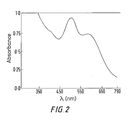
- the material was then washed for 3 minutes in water at 30°C and then dried. A neutral grey image was present on the photographic material. This image has the visible absorption spectrum shown in the accompanying Figure 1. This shows that the material has good absorption in the blue, green and red regions of the visible spectrum.
- One of the negatives obtained thereby was placed in a photographic enlarger and was used to print normal non-optically sensitised black and white paper. After processing the exposed paper a bright image having clear highlights and dark shadows was obtained.
- the other of the negatives obtained was placed in a photographic enlarger provided with a filter to enable variable contrast photographic paper to be printed. An inspection of the image on the enlarger baseboard indicated that a No. 2 contrast filter should be used. This was placed in position with a sheet of variable contrast material below it and was printed using the negative. After processing the print was examined. As before a bright print having clear highlights and dark shadows was obtained.
- p-Toluene sulphonic acid (4g) was dissolved in industrial alcohol (30 ml). Sufficient of the monomer dimethyl-aminoethyl methacrylate was added with stirring to raise the pH to 7. This required 5.2 g.
- This solution was placed in a 50 ml flask to which were added 1 g of Monomer A (the magenta monomer), 0.5 g of Monomer B (the yellow monomer) and 0.5 g of Monomer C (the cyan monomer).
- the flask was equipped with a condenser, nitrogen inlet, oil bath and magnetic stirrer. Nitrogen was bubbled through for 10 minutes at room temperature. The flask was then heated to 70°C and maintained at that temperature.
- a free radical initiator solution was prepared which comprised 0.5 g azobis(isobutyronitrile) in 50 ml of industrial alcohol. 4.8 ml of this solution was added to the flask. After 2 hours a further 1.2 ml of the initiator solution was added and this was repeated after a further 2 hours. After 7 hours reaction time the contents of the flask were added to ether (500 ml) and a tacky brown solid precipitated. This solid was dissolved in industrial alcohol and reprecipitated in ether to give a free flowing white powder. Yield 7.13 g (67.3 %). This powder was found to be completely water soluble.
- Example 1 0.1g of this solid was then added to an emulsion as prepared in Example 1. A clear glossy coating was used in Example 1. A clear glossy coating was found on inspection in green light. As in Example 1 the coating was exposed to white light for 10 seconds and then was processed as set forth in Example 1.
Landscapes
- Physics & Mathematics (AREA)
- Chemical & Material Sciences (AREA)
- Chemical Kinetics & Catalysis (AREA)
- Spectroscopy & Molecular Physics (AREA)
- General Physics & Mathematics (AREA)
- Silver Salt Photography Or Processing Solution Therefor (AREA)
- Addition Polymer Or Copolymer, Post-Treatments, Or Chemical Modifications (AREA)
Applications Claiming Priority (2)
| Application Number | Priority Date | Filing Date | Title |
|---|---|---|---|
| GB8729196 | 1987-12-15 | ||
| GB878729196A GB8729196D0 (en) | 1987-12-15 | 1987-12-15 | Polymeric colour couplers |
Publications (3)
| Publication Number | Publication Date |
|---|---|
| EP0321401A2 true EP0321401A2 (de) | 1989-06-21 |
| EP0321401A3 EP0321401A3 (en) | 1989-09-13 |
| EP0321401B1 EP0321401B1 (de) | 1992-06-24 |
Family
ID=10628499
Family Applications (1)
| Application Number | Title | Priority Date | Filing Date |
|---|---|---|---|
| EP19880810842 Expired EP0321401B1 (de) | 1987-12-15 | 1988-12-07 | Farbbildende polymerische Kuppler |
Country Status (4)
| Country | Link |
|---|---|
| EP (1) | EP0321401B1 (de) |
| JP (1) | JPH02953A (de) |
| DE (1) | DE3872365T2 (de) |
| GB (1) | GB8729196D0 (de) |
Cited By (4)
| Publication number | Priority date | Publication date | Assignee | Title |
|---|---|---|---|---|
| US5141844A (en) * | 1990-05-07 | 1992-08-25 | Eastman Kodak Company | Polymeric dye-forming couplers |
| WO1993012465A1 (en) * | 1991-12-19 | 1993-06-24 | Eastman Kodak Company | Chromogenic black-and-white photographic imaging systems |
| US5364747A (en) * | 1992-11-25 | 1994-11-15 | Eastman Kodak Company | Color correcting layers consisting essentially of at least one dye-forming coupler and gelatin in chromogenic black-and-white photographic imaging systems |
| US5972586A (en) * | 1995-11-22 | 1999-10-26 | Fuji Photo Film Co., Ltd. | Silver halide color photosensitive material |
Families Citing this family (1)
| Publication number | Priority date | Publication date | Assignee | Title |
|---|---|---|---|---|
| DE69813757T2 (de) * | 1998-01-19 | 2004-03-18 | Société des Produits Nestlé S.A. | Gekühltes wässriges Gelee und Verfahren zu dessen Herstellung |
Family Cites Families (6)
| Publication number | Priority date | Publication date | Assignee | Title |
|---|---|---|---|---|
| US3497350A (en) * | 1965-06-28 | 1970-02-24 | Eastman Kodak Co | Multicolor elements for color photography |
| JPS6011342B2 (ja) * | 1975-11-07 | 1985-03-25 | 小西六写真工業株式会社 | ハロゲン化銀写真感光材料の画像形成方法 |
| JPS6026221B2 (ja) * | 1977-06-24 | 1985-06-22 | キヤノン株式会社 | スクリ−ン状感光体の張設方法 |
| JPS5810737B2 (ja) * | 1978-10-25 | 1983-02-26 | コニカ株式会社 | ハロゲン化銀多層カラ−写真感光材料 |
| JPS58215645A (ja) * | 1982-06-10 | 1983-12-15 | Mitsubishi Paper Mills Ltd | 画像形成方法 |
| US4520093A (en) * | 1984-01-30 | 1985-05-28 | E. I. Du Pont De Nemours And Company | Photosensitive composition and method for forming a neutral black image |
-
1987
- 1987-12-15 GB GB878729196A patent/GB8729196D0/en active Pending
-
1988
- 1988-12-07 EP EP19880810842 patent/EP0321401B1/de not_active Expired
- 1988-12-07 DE DE19883872365 patent/DE3872365T2/de not_active Expired - Fee Related
- 1988-12-15 JP JP31521788A patent/JPH02953A/ja active Pending
Cited By (5)
| Publication number | Priority date | Publication date | Assignee | Title |
|---|---|---|---|---|
| US5141844A (en) * | 1990-05-07 | 1992-08-25 | Eastman Kodak Company | Polymeric dye-forming couplers |
| WO1993012465A1 (en) * | 1991-12-19 | 1993-06-24 | Eastman Kodak Company | Chromogenic black-and-white photographic imaging systems |
| US5362616A (en) * | 1991-12-19 | 1994-11-08 | Eastman Kodak Company | Chromogenic black-and-white photographic imaging systems |
| US5364747A (en) * | 1992-11-25 | 1994-11-15 | Eastman Kodak Company | Color correcting layers consisting essentially of at least one dye-forming coupler and gelatin in chromogenic black-and-white photographic imaging systems |
| US5972586A (en) * | 1995-11-22 | 1999-10-26 | Fuji Photo Film Co., Ltd. | Silver halide color photosensitive material |
Also Published As
| Publication number | Publication date |
|---|---|
| JPH02953A (ja) | 1990-01-05 |
| DE3872365T2 (de) | 1993-02-11 |
| EP0321401A3 (en) | 1989-09-13 |
| GB8729196D0 (en) | 1988-01-27 |
| DE3872365D1 (de) | 1992-07-30 |
| EP0321401B1 (de) | 1992-06-24 |
Similar Documents
| Publication | Publication Date | Title |
|---|---|---|
| US3761272A (en) | Photographic elements containing ultra violet absorbing polymers | |
| US4435503A (en) | Silver halide color photographic light-sensitive material | |
| US4396706A (en) | Silver halide photographic light-sensitive material and image forming method | |
| JP3193528B2 (ja) | 高分子紫外線吸収剤を組み込んだ写真要素 | |
| US4409320A (en) | Silver halide color photographic light-sensitive material | |
| US4612278A (en) | Photographic materials and process comprising polymeric couplers with alkoxyalkylacrylate comonomers | |
| US4201589A (en) | Silver halide photo-sensitive material prepared with solvent and solvent soluble polymer | |
| US3370952A (en) | Color formers | |
| GB2133170A (en) | Silver halide color photographic material containing polymeric cyan-forming coupler | |
| US3767412A (en) | Polymeric colour couplers and their use in colour photography | |
| GB2125571A (en) | Polymeric cyan-forming coupler | |
| EP0321401B1 (de) | Farbbildende polymerische Kuppler | |
| EP0321399A2 (de) | Herstellung von Latizes von Farbkuppler-Polymeren | |
| GB1581439A (en) | Polymeric coupler latices for use in silver halide photography | |
| US4106941A (en) | Photographic silver halide elements containing optical brightening water-soluble interpolymers | |
| GB2116738A (en) | Silver halide color photographic material containing magenta polymer coupler | |
| JPS5965844A (ja) | ハロゲン化銀カラ−写真感光材料 | |
| US4557998A (en) | Colorless ligand-releasing monomers and polymers and their use to provide dyes with metal ions | |
| US4496650A (en) | Silver halide color photographic light-sensitive material | |
| US5547819A (en) | Silver halide photographic material | |
| US4555478A (en) | Photographic element and process for providing metal complex color images | |
| CA1046189A (en) | Polymers having active methylene group | |
| DE3341352A1 (de) | Photographisches lichtempfindliches silberhalogenidmaterial | |
| US4645735A (en) | Silver halide photographic light-sensitive material containing ultraviolet ray absorbing polymer latex | |
| DE3324932A1 (de) | Farbphotographisches lichtempfindliches silberhalogenidmaterial und verfahren zu erzeugung eines farbbildes |
Legal Events
| Date | Code | Title | Description |
|---|---|---|---|
| PUAI | Public reference made under article 153(3) epc to a published international application that has entered the european phase |
Free format text: ORIGINAL CODE: 0009012 |
|
| 17P | Request for examination filed |
Effective date: 19881209 |
|
| AK | Designated contracting states |
Kind code of ref document: A2 Designated state(s): BE CH DE FR GB IT LI NL |
|
| PUAL | Search report despatched |
Free format text: ORIGINAL CODE: 0009013 |
|
| RAP1 | Party data changed (applicant data changed or rights of an application transferred) |
Owner name: ILFORD LIMITED |
|
| AK | Designated contracting states |
Kind code of ref document: A3 Designated state(s): BE CH DE FR GB IT LI NL |
|
| 17Q | First examination report despatched |
Effective date: 19910619 |
|
| GRAA | (expected) grant |
Free format text: ORIGINAL CODE: 0009210 |
|
| AK | Designated contracting states |
Kind code of ref document: B1 Designated state(s): BE CH DE FR GB IT LI NL |
|
| PG25 | Lapsed in a contracting state [announced via postgrant information from national office to epo] |
Ref country code: NL Effective date: 19920624 Ref country code: LI Effective date: 19920624 Ref country code: CH Effective date: 19920624 |
|
| REF | Corresponds to: |
Ref document number: 3872365 Country of ref document: DE Date of ref document: 19920730 |
|
| ET | Fr: translation filed | ||
| ITF | It: translation for a ep patent filed | ||
| REG | Reference to a national code |
Ref country code: CH Ref legal event code: PL |
|
| NLV1 | Nl: lapsed or annulled due to failure to fulfill the requirements of art. 29p and 29m of the patents act | ||
| PLBE | No opposition filed within time limit |
Free format text: ORIGINAL CODE: 0009261 |
|
| STAA | Information on the status of an ep patent application or granted ep patent |
Free format text: STATUS: NO OPPOSITION FILED WITHIN TIME LIMIT |
|
| 26N | No opposition filed | ||
| PGFP | Annual fee paid to national office [announced via postgrant information from national office to epo] |
Ref country code: FR Payment date: 19941108 Year of fee payment: 7 |
|
| PGFP | Annual fee paid to national office [announced via postgrant information from national office to epo] |
Ref country code: GB Payment date: 19941116 Year of fee payment: 7 |
|
| PGFP | Annual fee paid to national office [announced via postgrant information from national office to epo] |
Ref country code: DE Payment date: 19941122 Year of fee payment: 7 |
|
| PGFP | Annual fee paid to national office [announced via postgrant information from national office to epo] |
Ref country code: BE Payment date: 19941125 Year of fee payment: 7 |
|
| PG25 | Lapsed in a contracting state [announced via postgrant information from national office to epo] |
Ref country code: GB Effective date: 19951207 |
|
| PG25 | Lapsed in a contracting state [announced via postgrant information from national office to epo] |
Ref country code: BE Effective date: 19951231 |
|
| BERE | Be: lapsed |
Owner name: ILFORD LTD Effective date: 19951231 |
|
| GBPC | Gb: european patent ceased through non-payment of renewal fee |
Effective date: 19951207 |
|
| PG25 | Lapsed in a contracting state [announced via postgrant information from national office to epo] |
Ref country code: FR Effective date: 19960830 |
|
| PG25 | Lapsed in a contracting state [announced via postgrant information from national office to epo] |
Ref country code: DE Effective date: 19960903 |
|
| REG | Reference to a national code |
Ref country code: FR Ref legal event code: ST |
|
| PG25 | Lapsed in a contracting state [announced via postgrant information from national office to epo] |
Ref country code: IT Free format text: LAPSE BECAUSE OF NON-PAYMENT OF DUE FEES;WARNING: LAPSES OF ITALIAN PATENTS WITH EFFECTIVE DATE BEFORE 2007 MAY HAVE OCCURRED AT ANY TIME BEFORE 2007. THE CORRECT EFFECTIVE DATE MAY BE DIFFERENT FROM THE ONE RECORDED. Effective date: 20051207 |