EP0321101A2 - Hin- und her bewegendes Mechanismus für einen Schermechanismus in gerader Linie - Google Patents
Hin- und her bewegendes Mechanismus für einen Schermechanismus in gerader Linie Download PDFInfo
- Publication number
- EP0321101A2 EP0321101A2 EP88311012A EP88311012A EP0321101A2 EP 0321101 A2 EP0321101 A2 EP 0321101A2 EP 88311012 A EP88311012 A EP 88311012A EP 88311012 A EP88311012 A EP 88311012A EP 0321101 A2 EP0321101 A2 EP 0321101A2
- Authority
- EP
- European Patent Office
- Prior art keywords
- arm
- drive rod
- sleeve
- drive
- rod
- Prior art date
- Legal status (The legal status is an assumption and is not a legal conclusion. Google has not performed a legal analysis and makes no representation as to the accuracy of the status listed.)
- Granted
Links
Images

Classifications
-
- C—CHEMISTRY; METALLURGY
- C03—GLASS; MINERAL OR SLAG WOOL
- C03B—MANUFACTURE, SHAPING, OR SUPPLEMENTARY PROCESSES
- C03B7/00—Distributors for the molten glass; Means for taking-off charges of molten glass; Producing the gob, e.g. controlling the gob shape, weight or delivery tact
- C03B7/10—Cutting-off or severing the glass flow with the aid of knives or scissors or non-contacting cutting means, e.g. a gas jet; Construction of the blades used
Definitions
- the present invention relates to straight line shear mechanisms and more particularly to an improved drive assembly therefor.
- U.S. Patent No. 4,215,611 discloses an apparatus for straight line shearing of molten glass wherein upper and lower shear blade assemblies are each reciprocably mounted on carriage members, the upper and lower carriage members being driven by a pneumatic cylinder assembly and rack and pinion arrangement.
- one of the shear blade carriage arms (or “flange portions") is coupled to a forward portion of the operating rod driven by the pneumatic cylinder assembly, while the other carriage arm is indirectly driven in the opposite direction by means of a parallel rack and pinion linkage between such carriage arm and a rear portion of the operating rod.
- the flange portion, or carriage arm is secured to the driving rod or rack using washers, lock washer, and a nut member to secure the connection.
- the carriage arms are in turn connected to the shear blade carriages via tubular portions of the carriages which are slidingly mounted on guide rods, the opposite ends of the carriage being slidingly mounted on a guide rail.
- the shear blades are reciprocated between open and shearing positions along an axis parallel to the axes of the guide rods, and ideally, to the axes of the operating rod and racks.
- the invention provides an improved drive assembly for a reciprocably mounted mechanism in a glassware forming machine, of the type including an arm secured to the mechanism, at least one slidingly mounted drive rod having an axis essentially parallel to an axis of reciprocation of the mechanism, said drive rod being joined to said arm so that the arm and mechanism move in parallel with said drive rod, and drive means for reciprocating said drive rod along its axis; wherein the improvement comprises an improved joint between the arm and the drive rod, comprising first and second annular members projecting from a circumferential member fitted to or integral with said drive rod, said annular members having facing radial surfaces; and a bushing member secured to or integral with said arm and placed around said drive rod intermediate the radial surfaces of said annular members; there being a radial clearance region between the circumferential member and said bushing member to permit limited radial motion of the arm relative to the drive rod, and an axial clearance region between the bushing member and the radi
- the drive rod, first and second annular members, and bushing member all are circular in radial cross section.
- the radial clearance region is on the order of .01-.1 inch in width.
- these are separated by an axial gap which is preferably an order of .001 to .003 inches in width.
- a hard sleeve is provided for the drive rod which forms the circumference of the rod within the bushing member, such sleeve having a flange which comprises the first annular member.
- the second annular member comprises a rod nut which is located at the end of the sleeve opposite its flange.
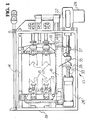
- the shear mechanism is generally of the design disclosed in commonly assigned U.S. Patent No. 4,215,611, which discloses a straight line shearing mechanism utilizing a pneumatic drive system to cause the operation of the shears, but includes certain modifications to adapt shear mechanism 10 to a servo motor drive, in accordance with commonly assigned U.S. Patent No. 4,699,643 ( Figure 1).
- the shear mechanism 10 is driven by servo motor 28, rather than a pneumatic drive source as in the '611 patent.
- the air cylinder 26 seen at the lower left in Figure 1 does not serve as a drive source, but rather to separate the shears for safety purposes in the event of an electrical malfunction.
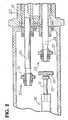
- drive rods and racks There is a substantially different configuration of drive rods and racks as will be further explained below with reference to Figure 2.
- upper and lower shear assemblies 15 and 17, respectively are reciprocably mounted.
- the upper shear assembly 15 has a tubular portion 16 which slides on a guide rail 13 seen in phantom, shear assembly 15 also slides on guide rail 14.
- Lower shear assembly 17 has a tubular portion 18 (only partially visible in Figure 1) which slides on a guide rail not visible in this view, and lower shear assembly 17 also slides on guide rail 14.
- the tubular portion 16 of upper shear assembly 15 has a flange portion or arm 35 which links the shear assembly to a drive rod 20 which is driven from servomotor 28 as explained below with reference to Figure 2.
- the tubular portion 18 of lower shear assembly 17 also has a double flange portion, comprising opposing arms 37, 38. Arm 37 is linked to a drive rod 24 (seen in phantom in Figure 1) driven by servomotor 28, while arm 38 is aligned with but not linked to a piston rod 31 from air cylinder 26, as further explained below.
- the main frame 19 of shear mechanism 10 is an integrally formed structure, which has advantages noted below. It should be noted that the guide rails 13 and 14 and the drive rods 20, 24 ideally are parallel to each other.
- the drive structures of the shear assembly 10 include a pair of upper and lower rack rods 20 and 24 with respective rack portions the upper one of which is seen at 21.
- the rack portions are geared to a pinion gear within housing 22, such pinion gear being directly coupled to the shaft of the servo motor 28 to be rotated thereby.
- the rack rods 20 and 24 are respectively coupled to the arms 35 and 37 by adaptable joints 30 and 32 in accordance with the present invention, the detailed design of which will be discussed below.
- adaptable joints 30 and 32 permit a certain amount of radial repositioning of the arms 35 and 37 relative to the axes of rods 20 and 24, and additionally a lesser degree of axial displacement and axial skew.
- the piston rod 31 extending from air cylinder 26 has at its end nearest arm 38 a bumper 33.
- Air cylinder 26 is actuated in the event of an electrical malfunction of the shear mechanism 10 to drive the bumper 33 against the arm 38 and thereby move the lower shear assembly 17 out from its central, shearing position.
- adaptable joints such as those shown at 30 and 32 in Figure 2 are incorporated in a pneumatically driven shear mechanism such as that shown in commonly assigned U.S. Patent No. 4,215,611.
- the drive source is an air cylinder-piston assembly rather than a servo-motor
- the piston rod-arm linkage is an adjustable joint rather than a fixed joint.
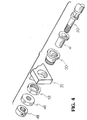
- Rack rod 20 has a hardened sleeve 41 fitted near the end of the rod, and includes a threaded portion 20t at the rod end.
- Hardened sleeve 41 includes a flange portion 43 at its inner end, and a rod nut 46 is threaded onto rod end 20T at the other end of sleeve 41.
- a radial surface 44 of sleeve flange 43 and radial surface 47 of rod nut 46 define between them a circumferential region 42 around the hardened sleeve 41.
- Split collar 48 retains rod nut 46 at the end of the rack rod 20.
- Region 42 contains bushing 50, bushing nut 58, and arm 35, which form an integral structure wherein the bushing 50 is secured within a cylindrical aperture of arm 35 by bushing nut 58, which is threaded onto a threaded surface 50t of bushing 50.
- the outer diameter of the body of sleeve 41 is less than the inner diameter of bushing 50 to provide a radial clearance region 70 between these structures.
- a gap on the order of 0.25 - 2.5 mm is provided between these structures.
- the axial length of bushing 50 is about 0.025 - 0.075 mm less than the separation of radial surfaces 44 and 47, so as to provide an axial clearance region 80. The effect of this is to permit radial repositioning of the arm 35 relative to the drive rod 20, and to a lesser extent, to permit relative axial displacement or axial skew of arm 35 relative to rod 20.
- joints 30 and 32 permit radial repositioning and axial reorientation of arms 35 and 37 relative to drive rods 20 and 22, and thereby prevent premature wear of the moving parts of shear mechanism 10 due to side loading from non-parallelism of the guide rails to the drive rods. Furthermore, by permitting a radial repositioning of the shear assemblies 15 and 17 and their inter-connected structures relative to the drive rods 20 and 24, the shear mechanism 10 is able to adapt to variations within dimensional tolerances of the various structures of the shear mechanism drive.
- Figure 5 shows in section an alternative design of a flexible joint 30′ generally similar to the joint 30 shown in Figure 3, with the difference that in lieu of a separate bushing 50 and bushing nut 58 secured to arm 35, the arm 35′ of Figure 5 includes a cylindrical rim 60 having similar dimensions to those of bushing 50. That is, the length of rim 60 between its end surfaces 53, 54 and its inner diameter at surface 61 is comparable to the length and inner diameter of bushing 50.
Landscapes
- Chemical & Material Sciences (AREA)
- Engineering & Computer Science (AREA)
- Materials Engineering (AREA)
- Organic Chemistry (AREA)
- Transmission Devices (AREA)
- Shearing Machines (AREA)
Applications Claiming Priority (2)
| Application Number | Priority Date | Filing Date | Title |
|---|---|---|---|
| US134277 | 1987-12-17 | ||
| US07/134,277 US4781746A (en) | 1987-12-17 | 1987-12-17 | Drive apparatus for straight line shear mechanism |
Publications (3)
| Publication Number | Publication Date |
|---|---|
| EP0321101A2 true EP0321101A2 (de) | 1989-06-21 |
| EP0321101A3 EP0321101A3 (en) | 1990-09-12 |
| EP0321101B1 EP0321101B1 (de) | 1993-04-07 |
Family
ID=22462608
Family Applications (1)
| Application Number | Title | Priority Date | Filing Date |
|---|---|---|---|
| EP88311012A Expired - Lifetime EP0321101B1 (de) | 1987-12-17 | 1988-11-22 | Hin- und her bewegendes Mechanismus für einen Schermechanismus in gerader Linie |
Country Status (7)
| Country | Link |
|---|---|
| US (1) | US4781746A (de) |
| EP (1) | EP0321101B1 (de) |
| JP (1) | JPH01197332A (de) |
| CN (1) | CN1014983B (de) |
| BR (1) | BR8806322A (de) |
| DE (1) | DE3880108T2 (de) |
| MX (1) | MX163171B (de) |
Families Citing this family (4)
| Publication number | Priority date | Publication date | Assignee | Title |
|---|---|---|---|---|
| US4781746A (en) * | 1987-12-17 | 1988-11-01 | Emhart Industries, Inc. | Drive apparatus for straight line shear mechanism |
| US4859227A (en) * | 1989-01-27 | 1989-08-22 | Emhart Industries, Inc. | Straight line shear mechanism |
| US4869746A (en) * | 1989-02-27 | 1989-09-26 | Emhart Industries, Inc. | Straight line shear mechanism |
| JP3796794B2 (ja) * | 1996-02-21 | 2006-07-12 | 旭硝子株式会社 | 溶融ガラス切断装置 |
Family Cites Families (9)
| Publication number | Priority date | Publication date | Assignee | Title |
|---|---|---|---|---|
| US3996037A (en) * | 1974-02-08 | 1976-12-07 | Emhart Industries, Inc. | Pass through shears for molten glass feeder |
| US4174647A (en) * | 1978-02-08 | 1979-11-20 | Emhart Industries, Inc. | Apparatus for straight line shearing |
| US4214494A (en) * | 1979-02-21 | 1980-07-29 | Emhart Industries, Inc. | Apparatus for straight line shearing |
| US4215611A (en) * | 1979-02-21 | 1980-08-05 | Emhart Industries, Inc. | Apparatus for straight line shearing |
| US4450741A (en) * | 1982-07-14 | 1984-05-29 | Owens-Illinois, Inc. | Multiple gob shearing mechanism operating in a straight line |
| US4500334A (en) * | 1983-08-02 | 1985-02-19 | Maul Technology Corporation | Glass stream cutting apparatus |
| GB8412249D0 (en) * | 1984-05-14 | 1984-06-20 | Bhf Eng Ltd | Straight-line shearing |
| US4699643A (en) * | 1985-05-07 | 1987-10-13 | Emhart Industries, Inc. | Straight line shear |
| US4781746A (en) * | 1987-12-17 | 1988-11-01 | Emhart Industries, Inc. | Drive apparatus for straight line shear mechanism |
-
1987
- 1987-12-17 US US07/134,277 patent/US4781746A/en not_active Expired - Fee Related
-
1988
- 1988-11-22 DE DE8888311012T patent/DE3880108T2/de not_active Expired - Fee Related
- 1988-11-22 EP EP88311012A patent/EP0321101B1/de not_active Expired - Lifetime
- 1988-11-28 BR BR888806322A patent/BR8806322A/pt unknown
- 1988-12-15 MX MX14211A patent/MX163171B/es unknown
- 1988-12-16 JP JP63318346A patent/JPH01197332A/ja active Pending
- 1988-12-16 CN CN88108663.0A patent/CN1014983B/zh not_active Expired
Also Published As
| Publication number | Publication date |
|---|---|
| EP0321101B1 (de) | 1993-04-07 |
| DE3880108T2 (de) | 1993-07-15 |
| US4781746A (en) | 1988-11-01 |
| CN1014983B (zh) | 1991-12-04 |
| BR8806322A (pt) | 1989-08-15 |
| CN1033613A (zh) | 1989-07-05 |
| EP0321101A3 (en) | 1990-09-12 |
| MX163171B (es) | 1991-09-30 |
| JPH01197332A (ja) | 1989-08-09 |
| DE3880108D1 (de) | 1993-05-13 |
Similar Documents
| Publication | Publication Date | Title |
|---|---|---|
| US4802374A (en) | Device for controlling the displacement of an element, in particular of a seat or parts of a seat of a motor vehicle, in relation to a base | |
| DE102010007631B4 (de) | Parallelroboter mit einem Handgelenkabschnitt mit drei Freiheitsgraden | |
| US7600718B2 (en) | Pivoted flap mechanism for adjusting an aerodynamic pivoted flap associated with a wing | |
| US4669325A (en) | Telescopic assembly | |
| JP2537386B2 (ja) | 産業用ロボットの直動軸構造 | |
| US5477744A (en) | Position adustable steering column assembly for a motor vehicle | |
| DE102010006155A1 (de) | Parallelroboter | |
| EP0182123A2 (de) | Wischvorrichtung für Scheiben von Fahrzeugen | |
| DE69901301T2 (de) | Kinematische parallelstruktur einer werkzeugmaschine | |
| EP0321101A2 (de) | Hin- und her bewegendes Mechanismus für einen Schermechanismus in gerader Linie | |
| JP2524976B2 (ja) | 直線シヤ− | |
| US5042282A (en) | Small-diameter metallic conduit bending machine | |
| CN109261995B (zh) | 一种五自由度快速伺服刀架微动平台 | |
| JPS626958B2 (de) | ||
| US6543568B2 (en) | Dual variable-tooth rack and single pinion steering system | |
| US3209612A (en) | Control assembly | |
| NZ510924A (en) | Right hand drive steering system and conversion method from left hand drive vehicle | |
| EP1525166B1 (de) | Pressstempelmechanismus einer glasformmaschine | |
| KR102116864B1 (ko) | 차량 액슬 제작용 지그 장치 | |
| DE68919855T2 (de) | Gelenkfahrzeug mit lenkgestänge. | |
| JP5988392B2 (ja) | ツール駆動装置 | |
| US20220048554A1 (en) | Bracket and steering apparatus | |
| EP0478823B1 (de) | Honmaschine | |
| US4593573A (en) | Inversion cam and cylinder power means | |
| CN219883860U (zh) | 一种道岔扳轨装置 |
Legal Events
| Date | Code | Title | Description |
|---|---|---|---|
| PUAI | Public reference made under article 153(3) epc to a published international application that has entered the european phase |
Free format text: ORIGINAL CODE: 0009012 |
|
| AK | Designated contracting states |
Kind code of ref document: A2 Designated state(s): DE FR GB IT |
|
| RAP1 | Party data changed (applicant data changed or rights of an application transferred) |
Owner name: EMHART INDUSTRIES, INC. |
|
| PUAL | Search report despatched |
Free format text: ORIGINAL CODE: 0009013 |
|
| AK | Designated contracting states |
Kind code of ref document: A3 Designated state(s): DE FR GB IT |
|
| 17P | Request for examination filed |
Effective date: 19901012 |
|
| RAP1 | Party data changed (applicant data changed or rights of an application transferred) |
Owner name: EMHART GLASS MACHINERY INC., |
|
| RAP1 | Party data changed (applicant data changed or rights of an application transferred) |
Owner name: EMHART GLASS MACHINERY INVESTMENTS INC. |
|
| 17Q | First examination report despatched |
Effective date: 19920114 |
|
| GRAA | (expected) grant |
Free format text: ORIGINAL CODE: 0009210 |
|
| AK | Designated contracting states |
Kind code of ref document: B1 Designated state(s): DE FR GB IT |
|
| REF | Corresponds to: |
Ref document number: 3880108 Country of ref document: DE Date of ref document: 19930513 |
|
| ET | Fr: translation filed | ||
| ITF | It: translation for a ep patent filed | ||
| PLBE | No opposition filed within time limit |
Free format text: ORIGINAL CODE: 0009261 |
|
| STAA | Information on the status of an ep patent application or granted ep patent |
Free format text: STATUS: NO OPPOSITION FILED WITHIN TIME LIMIT |
|
| 26N | No opposition filed | ||
| PGFP | Annual fee paid to national office [announced via postgrant information from national office to epo] |
Ref country code: FR Payment date: 19951013 Year of fee payment: 8 |
|
| PGFP | Annual fee paid to national office [announced via postgrant information from national office to epo] |
Ref country code: GB Payment date: 19951020 Year of fee payment: 8 |
|
| PGFP | Annual fee paid to national office [announced via postgrant information from national office to epo] |
Ref country code: DE Payment date: 19951027 Year of fee payment: 8 |
|
| PG25 | Lapsed in a contracting state [announced via postgrant information from national office to epo] |
Ref country code: GB Effective date: 19961122 |
|
| GBPC | Gb: european patent ceased through non-payment of renewal fee |
Effective date: 19961122 |
|
| PG25 | Lapsed in a contracting state [announced via postgrant information from national office to epo] |
Ref country code: FR Effective date: 19970731 |
|
| PG25 | Lapsed in a contracting state [announced via postgrant information from national office to epo] |
Ref country code: DE Effective date: 19970801 |
|
| REG | Reference to a national code |
Ref country code: FR Ref legal event code: ST |
|
| PG25 | Lapsed in a contracting state [announced via postgrant information from national office to epo] |
Ref country code: IT Free format text: LAPSE BECAUSE OF NON-PAYMENT OF DUE FEES;WARNING: LAPSES OF ITALIAN PATENTS WITH EFFECTIVE DATE BEFORE 2007 MAY HAVE OCCURRED AT ANY TIME BEFORE 2007. THE CORRECT EFFECTIVE DATE MAY BE DIFFERENT FROM THE ONE RECORDED. Effective date: 20051122 |