EP0318324A2 - Lichtempfindliche Kunststoffzusammensetzung und Verfahren zur Herstellung von Feinstrukturen - Google Patents
Lichtempfindliche Kunststoffzusammensetzung und Verfahren zur Herstellung von Feinstrukturen Download PDFInfo
- Publication number
- EP0318324A2 EP0318324A2 EP88311221A EP88311221A EP0318324A2 EP 0318324 A2 EP0318324 A2 EP 0318324A2 EP 88311221 A EP88311221 A EP 88311221A EP 88311221 A EP88311221 A EP 88311221A EP 0318324 A2 EP0318324 A2 EP 0318324A2
- Authority
- EP
- European Patent Office
- Prior art keywords
- group
- atom
- hydrogen atom
- photosensitive resin
- alkyl group
- Prior art date
- Legal status (The legal status is an assumption and is not a legal conclusion. Google has not performed a legal analysis and makes no representation as to the accuracy of the status listed.)
- Withdrawn
Links
Images
Classifications
-
- G—PHYSICS
- G03—PHOTOGRAPHY; CINEMATOGRAPHY; ANALOGOUS TECHNIQUES USING WAVES OTHER THAN OPTICAL WAVES; ELECTROGRAPHY; HOLOGRAPHY
- G03F—PHOTOMECHANICAL PRODUCTION OF TEXTURED OR PATTERNED SURFACES, e.g. FOR PRINTING, FOR PROCESSING OF SEMICONDUCTOR DEVICES; MATERIALS THEREFOR; ORIGINALS THEREFOR; APPARATUS SPECIALLY ADAPTED THEREFOR
- G03F7/00—Photomechanical, e.g. photolithographic, production of textured or patterned surfaces, e.g. printing surfaces; Materials therefor, e.g. comprising photoresists; Apparatus specially adapted therefor
- G03F7/004—Photosensitive materials
- G03F7/09—Photosensitive materials characterised by structural details, e.g. supports, auxiliary layers
- G03F7/091—Photosensitive materials characterised by structural details, e.g. supports, auxiliary layers characterised by antireflection means or light filtering or absorbing means, e.g. anti-halation, contrast enhancement
Definitions
- This invention relates to a photosensitive resin composition for forming fine patterns in the field of semiconductor and a method for producing fine patterns using the same. More particularly, it relates to a photosensitive resin composition which is applied to a resist and exposed to light to form a fine pattern having improved dimensional precision and improved resolution.
- high-gamma resist a resist having high contrast
- a high-gamma resist surely improves the resolution to some extent.
- the high-gamma resist can be produced through control of molecular weight and degree of dispersion of a polymer in the resist, there is a restriction on the material to be used, and a great improvement on resolution has not yet been reached.
- the method of using a multi-layer resist provides patterns having a high resolution of 1 ⁇ m or less, but is still unsatisfactory as industrial technique because the process involved is complicated and time-consuming for the production of semiconductor devices and also the productivity is low.
- the aim of the method of coating a photosensitive resin on a resist film lies in improvement of resolution through the following mechanism.
- a light immediately after passing through a mask has high contrast, but the contrast is reduced after the light passes through a space and a lens.
- the thus reduced contrast of the light can be again enhanced on passage through the photosensitive resin layer to thereby improve the resolution.
- the photosensitive resin contains a photobleachable material.
- the photobleachable material so far proposed includes nitron compounds as disclosed in JP-A-59-104642 (the term "JP-A” as used herein means an "unexamined published Japanese patent application") and diazonium salts as disclosed in JP-A-60-238829.
- the method of using the diazonium salt is still unsatisfactory in terms of improvement on resolution in using i-line (365 nm) for exposure.
- the diazonium salt to be used leaves room for improvement on preservation stability. Namely, neither resolution of 0.5 ⁇ m nor long-term preservability of the material used has been achieved.
- the inventors have conducted studies on the above-described technique using a resist having provided thereon a photosensitive resin layer which is bleached by light. A particular aim was taken at the use of a diazonium salt as a photobleachable reagent in a method in which the photosensitive layer (upper layer) and the resist (lower layer) can be developed simultaneously, expecting that the process would be simplified and also resolution would be greatly improved.
- the A value is generally represented by equation. where T(0) represents an initial transmittance; T( ⁇ ) represents a final transmittance; and d represents a film thickness.
- the A value can be increased by reducing the film thickness (d), giving a high transmittance to the photosensitive layer (upper layer) after bleaching (i.e., getting the value of T( ⁇ ) closer to 100% as possible), and reducing the initial transmittance T(0) as low as possible.
- Reduction of T(0) can be achieved by increasing the concentration of a diazonium salt as a photobleachable reagent in the photosensitive layer. It should be noted, however, that the increase of the diazonium salt concentration is accompanied by precipitation of crystals of the photobleachable agent after coating, which rather results in reduction of the resolution.
- the diazonium salt of interest has poor heat stability.
- the inventors have hence investigated possibility of improving stability of a diazonium salt by addition of a stabilizer commonly known for diazonium salts, e.g., phosphoric acid, organic phosphoric acids, citric acid, tartaric acid, etc. Since some improving effects were confirmed, addition of a large quantity of such an additive was tried to see if further improvement could be obtained. As a result, the coating properties were deteriorated, and the resolution was reduced.
- a stabilizer commonly known for diazonium salts e.g., phosphoric acid, organic phosphoric acids, citric acid, tartaric acid, etc. Since some improving effects were confirmed, addition of a large quantity of such an additive was tried to see if further improvement could be obtained. As a result, the coating properties were deteriorated, and the resolution was reduced.
- One object of this invention is to provide a photosensitive resin composition which is applicable to production of fine patterns by exposure to i-line with high precision through a simple process.
- Another object of this invention is to provide a method for forming fine patterns using the above-described photosensitive resin composition.
- the counter anion which can be used in the present invention is not particularly limited and includes, for example, ⁇ HSO4 and organic carboxylic acids. Any of compounds containing an organic acid group or a sulfo group having a low pKa can be used.
- R represents a hydrogen atom, an alkyl group, an aryl group, an aralkyl group, an alkoxy group, a phenyl group, a halogen atom, a hydroxyl group or a carboxyl group
- X′ represents a hydrogen atom, a lithium atom, a sodium atom, a potassium atom or an ammonium group
- m and n each represents 0 or an integer of from 1 to 5, provided that the sum of them is not more than 5, and/or those represented by formula (II): wherein R and X′ are as defined above; and m′ and n′ each represents 0 or an integer of from 1 to 7, provided that the sum of them is not more than 7.
- the sulfo group to diazo group molar ratio is preferably 1.1/1 or more.
- the polymer which can be used in the photosensitive resin composition of the present invention includes any polymers which are, when dissolved in water, dissociated into ions to have a pKa of 2 or less. Preferred of them are those having a sulfo group, such as polyvinylsulfonic acid, chondroitin sulfuric acid, and salts of these acids.
- R5, R6, and R7 each represents a hydrogen atom, an alkyl group having from 1 to 4 carbon atoms, a halogen atom or a nitrile group
- R8 represents a hydrogen atom, an alkyl group having from 1 to 4 carbon atoms, a halogen atom, a hydroxyl group or a carboxyl group
- Y represents a hydrogen atom, an alkali metal atom, an alkaline earth metal atom or an ammonium group.
- the polymer having the unit of formula (III) may be a copolymer of comonomers selected from among compounds providing the unit of formula (III) or a copolymer of a compound providing the unit of formula (III) and other generally known copolymerizable compounds.
- Examples of the compounds copolymerizable with the compound providing the unit of formula (III) are styrene, ⁇ -methylstyrene, vinylpyridine, acenaphthylene, vinylaniline, vinylnaphthalene, vinylacetophenone, acrylic acid or derivatives thereof, methacrylic acid or esters thereof, acrylonitrile, maleic anhydride, maleimide or derivatives thereof, allyl esters, vinyl esters, acrolein, acrylamide or modified products thereof, propenylanisole, vinyl ethers, indene, isoprene, and so on.
- the copolymerization ratio of the benzenesulfonic acid group-containing structural unit to other copolymerizable compound, such as those enumerated above, is not particularly restricted, but it is preferred that the polymer contains at least 50 mol% of the benzenesulfonic acid group-containing unit.
- the solvent in the photosensitive resin composition may be any of known compounds as long as it does not dissolve the lower resist layer, with water being preferred.
- the photosensitive resin composition of the invention may further contain additives, such as phosphoric acid, benzenesulfonic acid or salts thereof, sulfosalicylic acid or salts thereof, nicotinic acid, caffeine, etc.
- additives such as phosphoric acid, benzenesulfonic acid or salts thereof, sulfosalicylic acid or salts thereof, nicotinic acid, caffeine, etc.
- a functional group in the polymer of the photosensitive layer can be made use of as a counter anion of a diazonium ion, thereby making it possible to dissolve a large quantity of the diazonium salt in a solvent without impairing coating properties and, at the same time, improving stability of the diazonium slat. That is, this pattern formation technique is characterized in that the counter anion of the diazonium ion is a functional group of the polymer present in the photosensitive layer.
- the polymer which can be used in the photosensitive resin composition of the present invention includes any polymers which are, when dissolved in water, dissociated into ions to have a low pKa.
- Preferred of them are those having a sulfo group, such as polyvinylsulfonic acid, chondroitin sulfuric acid, and salts of these acids.
- Particularly preferred are those having a structural unit represented by formula (IV): wherein R5, R6, R7, and R8 are as defined above.
- the counter cation of these polymers includes the counter cation such as the diazonium ion in the photosensitive resin composition as well as a hydrogen ion, an alkali metal ion, an alkaline earth metal ion, an ammonium ion, etc.
- the polymer for this use may be a copolymer of comonomers selected from among compounds providing the structural unit of formula (IV) or a copolymer of the compound providing the structural unit of formula (IV) and other generally known copolymerizable compounds.
- Examples of the compounds copolymerizable with the compound providing the unit of formula (III) are styrene, ⁇ -methylstyrene, vinylpyridine, acenaphthylene, vinylaniline, vinylnaphthalene, vinylacetophenone, acrylic acid or derivatives thereof, methacrylic acid or esters thereof, acrylonitrile, maleic anhydride, maleimide or derivatives thereof, allyl esters, vinyl esters, acrolein, acrylamide or modified products thereof, propenylanisole, vinyl ethers, indene, isoprene, and so on.
- the copolymerization ratio of the benzenesulfonic acid group-containing structural unit to other copolymerizable compound, such as those enumerated above, is not particularly restricted, but it is preferred that the polymer contains at least 50 mol% of the benzenesulfonic acid group-containing unit.
- the molar ratio of the functional group serving as a counter anion of the diazonium salt to free functional groups is not particularly limited, but the proportion of free functional groups is preferably at least 30% based on the total functional groups.
- the photosensitive resin composition of the invention may further contain additives known as stabilizer for diazonium salts, such as phosphoric acid, organic acids, citric acid, tartaric acid, etc.
- additives known as stabilizer for diazonium salts such as phosphoric acid, organic acids, citric acid, tartaric acid, etc.
- the photosensitive resin composition containing a diazonium salt and a polymer in which the counter anion of the diazonium salt is a functional group of the polymer can be prepared, for example, by mixing an aqueous solution of a diazonium salt with a stoichiometrical excess of the above-described polymer and then removing low-molecular weight salts by dialysis or the like technique.
- a diazonium salt whose counter cation is represented by formulae (V) and/or (VI): wherein R1, R1′, R1 ⁇ , and R2 each represents a hydrogen atom, an alkyl group or an acetyl group; R3 and R3′ each represents a hydrogen atom, an alkyl group, an acetyl group, a hydroxyl group, an alkoxy group, a halogen atom or a nitrile group; and X represents an oxygen atom, a sulfur atom or NR4, wherein R4 represents a hydrogen atom, an alkyl group or an acetyl group, has an absorption maximum near to the wavelength of i-line (ca. 365 nm) and shows a higher solubility to the above-described counter anion as compared with other diazonium salts by 30 to 40%.
- Such a diazonium salt provides a photosensitive layer having its A value increased to 10 or greater, which is suitable for resolution of patterns of, for example, 0.5 ⁇ m, the minimum module of 16 MB DRAM in the processing.
- a commonly employed resist preferably a positive photoresist
- Any positive photoresist can be used here as long as a developing solution therefor is capable of simultaneously removing the photosensitive resin off the wafer by dissolving.
- the resist thus coated is subjected to prebaking. Thereafter, a photosensitive resin composition comprising the diazonium salt and polymer according to the present invention, and water and/or an organic solvent is spin-coated on the resist layer.
- the resulting coated material is exposed to light rays to which both the upper and lower layers are sensitive and then treated with a developing solution for the resist, thereby developing the resist and, at the same time, removing the photosensitive resin layer off the wafer to form a fine pattern of the resist on the wafer.
- a large quantity of a diazonium salt sensitive to i-line can be dissolved in a photosensitive resin composition to thereby increase the A value, indicative of improvement of resolution.
- the present invention also achieves improvement on stability of diazonium salts.
- the present invention hence makes it possible to form a resist pattern of about 0.5 ⁇ m in line width with satisfactory stability and resolution.
- the photosensitive resin aqueous solution was spin-coated on a quartz substrate to form a uniform thin film having a thickness of 0.25 ⁇ m.
- the A value of the film at 365 nm was calculated from the transmittances before and after exposure and was found to be 11.5.
- the photosensitive resin aqueous solution was then allowed to stand in a thermostat set at 35°C for 25 days.
- the A value after the standing was found to be 11.5.
- the coating film of the solution after the standing showed no change of film thickness. Preservation stability of the photosensitive resin solution was thus proved satisfactory.
- An aqueous photosensitive resin solution was prepared by mixing 3 g of a 4-morpholinobenzenediazonium 1/2 ⁇ ZnCl2 salt as a diazonium salt, 10 g of polyvinylpyrrolidone (produced by Nakarai Kagaku Yakuhin Co., Ltd.; molecular weight: 24,500), and 90 g of water.
- the A value as determined in the same manner as in Example 1 was 4.6.
- the A value as determined after preservation at 35°C for 20 days in the same manner as in Example 1 was found to be 1.6, that was too low for application to practical use.
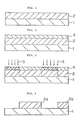
- a positive photoresist 2 ("OFPR-800" produced by Tokyo Ohka Kogyo Co., Ltd.) was coated on a silicon wafer 1 to a thickness of 0.9 ⁇ m and prebaked at 80°C for 10 minutes (Fig. 1).
- the photosensitive resin solution 4 as prepared in Example 1 was then coated thereon to a thickness of 0.25 ⁇ m (Fig. 2).
- the coated material was exposed to an i-line light 3 (at 365 nm) by means of an i-line 10/1-reduction projection exposure apparatus (stepper) equipped with a lens having a numerical aperture of 0.42 (Fig. 3), and then developed with a developer ("NMD-3" produced by Tokyo Ohka Kogyo Co., Ltd.) (Fig. 4).
- a developer ("NMD-3" produced by Tokyo Ohka Kogyo Co., Ltd.)
- a resist pattern was produced in the same manner as in Example 2, except for omitting the coating of the photosensitive resin solution. In this case, the exposure required for pattern transfer was about 1/2 of that in Example 1. An electron microscopic observation revealed that a 0.6 ⁇ m pattern could not be resolved.
- Pattern transfer was carried out in the same manner as in Example 2, except for replacing the photosensitive resin solution as used in Example 2 with that prepared in Comparative Example 1. As a result, the resist could not resolve a 0.5 ⁇ m pattern and, besides, the resulting resist pattern had a poor shape and a low contrast of 65°, which showed unsuitability for practical use.
- a diazonium compound of formula shown below was synthesized in a known manner:
- ammonium polystyrenesulfonate (obtainable by replacing sodium in PS-5 by ammonium by using an ion-exchange resin followed by dehydration to dryness) and 90 g of water to prepare a photosensitive resin solution.
- the photosensitive resin solution of Preparation Example 2 was spin-coated on a quartz substrate to form a uniform thin film having a thickness of 0.29 ⁇ m.
- the A value of the film at 365 nm was found to be 12.2.
- the film formed in the same manner as described above had an A value of 12.2 and showed no deterioration of coating properties, indicating satisfactory preservability of the photosensitive resin solution.
- a photosensitive resin solution was prepared by mixing 1.8 g of a diazonium salt of formula: 10 g of polyvinylpyrrolidone as used in Comparative Example 1, and 90 g of water. The A value was found to be 4.8.
- the A value was found to be 1.2, which was too low to be used for practical use.
- a positive photoresist "OFPR-800” was spin-coated on a silicon wafer to a thickness of 0.9 ⁇ m and prebaked at 80°C for 10 minutes.
- the photosensitive resin solution prepared in Preparation Example 2 was then coated thereon to a film thickness of 0.22 ⁇ m.
- the coated material was exposed to light by means of an i- line 10/1 stepper equipped with a lens having a numerical aperture of 0.42 and then developed with a developer "NMD-3".
- An electron microscopic observation of the cross section of the resist pattern revealed that there was formed a rectangular and sharp 0.5 ⁇ m line/space pattern.
- Example 4 The procedure of Example 4 was repeated, except for using the photosensitive resin solution prepared in Comparative Example 4 in place of the photosensitive resin solution prepared in Preparation Example 2. In this case, the exposure required was less than that of Example 4 by 30%. A close observation under the electron microscope revealed that the resolution was 0.8 ⁇ m.
- a photosensitive resin solution 100 ml of a photosensitive resin solution was prepared by mixing 10 g of sodium polystyrenesulfonate "PS-5", 4.8 g of a 4-morpholinobenzenediazonium chloride 1/2 ⁇ zinc chloride complex salt, and 90 g of water.
- the photosensitive resin aqueous solution prepared in Preparation Example 3 was spin-coated on a quartz substrate to form a uniform thin film having a thickness of 0.35 ⁇ m.
- the A value of the film at 365 nm was found to be 12.0.
- the same photosensitive resin aqueous solution was allowed to stand in a thermostat set at 35°C for 20 days in a dark place, the A value was 11.9, indicating satisfactory preservability of the photosensitive resin solution.
- a photosensitive resin aqueous solution was prepared by mixing 3 g of a 4-morpholinobenzenediazonium chloride 1/2 ⁇ zinc chloride complex salt, 10 g of polyvinylpyrrolidone as used in Comparative Example 1, and 90 g of water.
- the A value at 365 nm was 4.6.
- a positive photoresist "OFPR-800" was spin-coated on a silicon wafer to a thickness of 0.9 ⁇ m and prebaked at 80°C for 10 minutes.
- the photosensitive resin solution comprising 4.8 g of a 4-morpholino-2- ethoxybenzenediazonium chloride 1/2 ⁇ zinc chloride complex salt, 10 g of sodium polystyrenesulfonate, and 90 g of water was then coated thereon to a thickness of 0.35 ⁇ m.
- the resulting coated material was exposed to light by the use of an i-line 10/1 stepper equipped with a lens having numerical aperture of 0.42 to transfer a mask pattern to the coating and then developed with a developer "NMD-3" for 1 minute.
- An electron microscopic observation of the cross section of the resist revealed that a rectangular sharp 0.5 ⁇ m line/space pattern had been formed.
- Example 6 The procedure of Example 6 was repeated, except for omitting the coating of the photosensitive resin solution. In this case, the exposure required for pattern transfer was the half of that in Example 6. As a result of electron microscopic observation, the resolution was found to be 1.2 ⁇ m.
- Example 6 The procedure of Example 6 was repeated, except for replacing the sodium polystyrenesulfonate as used in Example 6 with polystyrenesulfonic acid. As a result, the resolution was 0.5 ⁇ m.
- a photosensitive resin solution was prepared in the same manner as in Example 6, except for replacing the sodium polystyrenesulfonate with polyvinylpyrrolidone as used in Comparative Example 1.
- the photosensitive resin solution was coated on the resist film, crystallization of the diazonium salt was observed.
- the coated material was processed in the same manner as in Example 6. An electron microscopic observation revealed that no sharp pattern was obtained, and the resolution was unmeasurable.
- Example 6 The procedure of Example 6 was repeated, except for replacing the diazonium salt as used in Example 6 with a 4-(N,N-dimethylamino)-2-ethoxybenzenediazonium chloride 1/2 zinc chloride complex salt. The resolution was found to be 0.5 ⁇ m.
- the photosensitive resin aqueous solution prepared in Preparation Example 4 was spin-coated on a quartz substrate to form a uniform thin film having a thickness of 0.35 ⁇ m.
- the A value of the film at 365 nm was found to be 10.5.
- the photosensitive resin aqueous solution was allowed to stand at 35°C for 20 days in a dark place, the A value was found to be 10.5, indicating satisfactory preservability of the photosensitive resin solution.
- a photosensitive resin aqueous solution was prepared by mixing 3 g of a 4-morpholinobenzenediazonium chloride 1/2 ⁇ zinc chloride complex salt, 10 g of polyvinylpyrrolidone as used in Comparative Example 1, and 90 g of water.
- the A value at 365 nm was 6.5.
- crystals of the diazonium salt precipitated on coating, failing to form a uniform film.
- the photosensitive resin aqueous solution was left to stand at 35°C for 20 days in a dark place, the A value was found to be 1.6, indicating unsuitability for practical use.
- a positive photoresist "OFPR-800" was spin-coated on a silicon wafer to a film thickness of 0.9 ⁇ m and prebaked at 80°C for 10 minutes.
- the photosensitive resin aqueous solution prepared in Preparation Example 4 was coated thereon to a film thickness of 0.35 ⁇ m.
- the resulting coated material was exposed to light by means of an i-line 10/1 stepper equipped with a lens having a numerical aperture of 0.42 to transfer a mask pattern to the coating and then developed with a developer "NMD-3" for 1 minute.
- the cross section of the resist pattern was observed under the electron microscope and, as a result, it was revealed that a 0.5 ⁇ m line/space pattern having rectangular steep edges was formed.
- a resist pattern was obtained in the same manner as in Example 10, except for omitting the coating of the photosensitive resin solution. In this case, the exposure required was about 1/2 of that in Example 10. Observation under the electron microscope revealed that a pattern of 0.5 ⁇ m could not be resolved.
- Pattern transfer was carried out according to a conventional technique. That is, the procedure of Example 10 was repeated, except for replacing the photosensitive resin solution as used in Example 10 with the photosensitive resin solution obtained in Comparative Example 9. An electron microscopic observation revealed that a pattern of 0.5 ⁇ m could not be resolved and, besides, the shape of the resist pattern obtained was too poor to be used in practice. Namely, the resulting pattern suffered from reduction, and its contrast was as low as 65°.
- a 13.5 wt% photosensitive resin aqueous solution was prepared in the same manner as in Preparation Example 4, except for using 4-(N,N-dimethylamino)-2-ethoxybenzenediazonium chloride as a diazonium salt.
- the A value at 365 nm was found to be 12.0.
- a positive photoresist "OFPR-800" was coated on a silicon wafer to a film thickness of 1.0 ⁇ m and prebaked at 80°C for 10 minutes.
- the above prepared photosensitive resin aqueous solution was then coated thereon to a film thickness of 0.30 ⁇ m.
- the resulting coated material was exposed to light by means of a 10/1 stepper equipped with a lens having a numerical aperture of 0.42 and then developed with a developer "NMD-3" for 1 minute.
- An electron microscopic observation of the cross section of the resulting resist pattern revealed that there was obtained a 0.5 ⁇ m line/space pattern having steep edges.
- a resist pattern was obtained in the same manner as in Example 11, except the photosensitive resin was not coated. In this case, the exposure required was about 2/3 of that in Example 10. As a result of observation under the electron microscope, the resolution was 0.8 ⁇ m.
- a 14 wt% photosensitive resin aqueous solution was prepared in the same manner as in Preparation Example 4, except for using 4-(N,N-dimethylamino)-2-methoxybenzenediazonium chloride as a diazonium salt and polystyrenesulfonic acid as a polymer.
- 4-(N,N-dimethylamino)-2-methoxybenzenediazonium chloride as a diazonium salt
- polystyrenesulfonic acid as a polymer.
- the photosensitive resin composition in accordance with the present invention exhibits satisfactory stability and produces remarkable effects to improve contrast.
- the present invention makes it possible to again increase a reduced contrast of light to a high level without involving complicated processes or using labile materials, to thereby form a fine pattern of about 0.5 ⁇ m with good precision.
Landscapes
- Engineering & Computer Science (AREA)
- Architecture (AREA)
- Structural Engineering (AREA)
- Physics & Mathematics (AREA)
- General Physics & Mathematics (AREA)
- Photosensitive Polymer And Photoresist Processing (AREA)
- Exposure And Positioning Against Photoresist Photosensitive Materials (AREA)
- Materials For Photolithography (AREA)
Applications Claiming Priority (8)
| Application Number | Priority Date | Filing Date | Title |
|---|---|---|---|
| JP299317/87 | 1987-11-27 | ||
| JP299315/87 | 1987-11-27 | ||
| JP299316/87 | 1987-11-27 | ||
| JP29931587 | 1987-11-27 | ||
| JP29931687 | 1987-11-27 | ||
| JP29931787 | 1987-11-27 | ||
| JP295969/88 | 1988-11-25 | ||
| JP63295969A JPH02872A (ja) | 1987-11-27 | 1988-11-25 | 感光性樹脂組成物およびそれを用いたパターン形成法 |
Publications (2)
| Publication Number | Publication Date |
|---|---|
| EP0318324A2 true EP0318324A2 (de) | 1989-05-31 |
| EP0318324A3 EP0318324A3 (de) | 1990-05-23 |
Family
ID=27479670
Family Applications (1)
| Application Number | Title | Priority Date | Filing Date |
|---|---|---|---|
| EP88311221A Withdrawn EP0318324A3 (de) | 1987-11-27 | 1988-11-25 | Lichtempfindliche Kunststoffzusammensetzung und Verfahren zur Herstellung von Feinstrukturen |
Country Status (1)
| Country | Link |
|---|---|
| EP (1) | EP0318324A3 (de) |
Family Cites Families (4)
| Publication number | Priority date | Publication date | Assignee | Title |
|---|---|---|---|---|
| GB818911A (en) * | 1954-09-15 | 1959-08-26 | Ozalid Co Ltd | Improvements in or relating to diazotype materials |
| DE3584306D1 (de) * | 1984-05-14 | 1991-11-14 | Toshiba Kawasaki Kk | Verfahren zur herstellung von schutzlackbildern und zusammensetzung dafuer. |
| EP0249941B1 (de) * | 1986-06-20 | 1992-03-04 | Tosoh Corporation | Verfahren zur Herstellung von Feinstrukturen |
| JPS6370245A (ja) * | 1986-09-12 | 1988-03-30 | Tosoh Corp | 感光性樹脂組成物およびそれを用いた微細パタ−ン形成法 |
-
1988
- 1988-11-25 EP EP88311221A patent/EP0318324A3/de not_active Withdrawn
Also Published As
| Publication number | Publication date |
|---|---|
| EP0318324A3 (de) | 1990-05-23 |
Similar Documents
| Publication | Publication Date | Title |
|---|---|---|
| DE69708301T2 (de) | Antireflexbeschichtung für photoresistzusammensetzungen | |
| US4925770A (en) | Contrast-enhancing agent for photolithography | |
| US5075199A (en) | Radiation sensitive mixture and production of relief patterns | |
| JPH0727203B2 (ja) | フォトレジスト及び該フォトレジストを有する物品の製法 | |
| JPS6239732B2 (de) | ||
| JPH034897B2 (de) | ||
| JPS5835214B2 (ja) | ジユウテンポリマ−ラテツクスソセイブツノ セイゾウホウホウ | |
| EP0161660A2 (de) | Verfahren zur Herstellung von Schutzlackbildern und Zusammensetzung dafür | |
| JPS62284353A (ja) | フォトレジスト組成物および該組成物を用いての製品の製造法 | |
| EP0231028B1 (de) | Hochkontrast-Photolack-Entwicklungsverfahren und -zusammensetzung mit niedrigem Gehalt an Metallionen | |
| CA1221864A (en) | High contrast, high resolution deep ultraviolet lithographic resists | |
| JPH09127700A (ja) | ポジチブ処理用感放射線組成物およびこれを使用するレリーフ構造体の製造方法 | |
| US4729941A (en) | Photoresist processing solution with quaternary ammonium hydroxide | |
| EP0260899B1 (de) | Photoempfindliche Kunststoffzusammensetzung und Verfahren zur Herstellung von Feinstrukturen mit dieser Zusammensetzung | |
| KR890000803B1 (ko) | 포토레지스트 현상액 | |
| EP0249941B1 (de) | Verfahren zur Herstellung von Feinstrukturen | |
| US5223376A (en) | Method for producing fine patterns utilizing specific polymeric diazonium salt, or diazonium salt/sulfone group containing polymer, as photobleachable agent | |
| EP0318324A2 (de) | Lichtempfindliche Kunststoffzusammensetzung und Verfahren zur Herstellung von Feinstrukturen | |
| JPH0727202B2 (ja) | フォトレジスト並びに該フォトレジストを有する製品の製法 | |
| JPS60238829A (ja) | パタ−ン形成方法 | |
| US5108870A (en) | Positive-working photoresist composition containing purified broadband dye and process of using | |
| DE69715020T2 (de) | Einen arylhydrazofarbstoff enthaltende lichtempfindliche zusammensetzung | |
| JPS62299960A (ja) | パタ−ン形成方法 | |
| KR910007227B1 (ko) | 포지티브-워킹 레지스트조성물용 현상액 | |
| US5188924A (en) | Pattern forming method utilizing material with photoresist film underlayer and contrast enhancement overlayer containing photosensitive diazonium salt |
Legal Events
| Date | Code | Title | Description |
|---|---|---|---|
| PUAI | Public reference made under article 153(3) epc to a published international application that has entered the european phase |
Free format text: ORIGINAL CODE: 0009012 |
|
| AK | Designated contracting states |
Kind code of ref document: A2 Designated state(s): BE DE FR GB NL |
|
| PUAL | Search report despatched |
Free format text: ORIGINAL CODE: 0009013 |
|
| AK | Designated contracting states |
Kind code of ref document: A3 Designated state(s): BE DE FR GB NL |
|
| 17P | Request for examination filed |
Effective date: 19901112 |
|
| STAA | Information on the status of an ep patent application or granted ep patent |
Free format text: STATUS: THE APPLICATION HAS BEEN WITHDRAWN |
|
| 18W | Application withdrawn |
Withdrawal date: 19911218 |