EP0317407B1 - Procédé de traitement thermique sous atmosphère gazeuse à base d'azote et d'hydrocarbure - Google Patents
Procédé de traitement thermique sous atmosphère gazeuse à base d'azote et d'hydrocarbure Download PDFInfo
- Publication number
- EP0317407B1 EP0317407B1 EP88402840A EP88402840A EP0317407B1 EP 0317407 B1 EP0317407 B1 EP 0317407B1 EP 88402840 A EP88402840 A EP 88402840A EP 88402840 A EP88402840 A EP 88402840A EP 0317407 B1 EP0317407 B1 EP 0317407B1
- Authority
- EP
- European Patent Office
- Prior art keywords
- nitrogen
- delivery rate
- residual
- dew point
- hydrocarbon
- Prior art date
- Legal status (The legal status is an assumption and is not a legal conclusion. Google has not performed a legal analysis and makes no representation as to the accuracy of the status listed.)
- Expired - Lifetime
Links
- IJGRMHOSHXDMSA-UHFFFAOYSA-N Atomic nitrogen Chemical compound N#N IJGRMHOSHXDMSA-UHFFFAOYSA-N 0.000 title claims description 88
- 229910052757 nitrogen Inorganic materials 0.000 title claims description 43
- 150000002430 hydrocarbons Chemical class 0.000 title claims description 28
- 229930195733 hydrocarbon Natural products 0.000 title claims description 27
- 238000000034 method Methods 0.000 title claims description 25
- 239000004215 Carbon black (E152) Substances 0.000 title claims description 24
- 230000008569 process Effects 0.000 title claims description 19
- 238000007669 thermal treatment Methods 0.000 title claims description 5
- 239000007789 gas Substances 0.000 title description 8
- OKTJSMMVPCPJKN-UHFFFAOYSA-N Carbon Chemical compound [C] OKTJSMMVPCPJKN-UHFFFAOYSA-N 0.000 claims description 29
- 229910052799 carbon Inorganic materials 0.000 claims description 29
- 230000033228 biological regulation Effects 0.000 claims description 19
- 238000005261 decarburization Methods 0.000 claims description 12
- 229910000831 Steel Inorganic materials 0.000 claims description 9
- 239000010959 steel Substances 0.000 claims description 9
- 238000005259 measurement Methods 0.000 claims description 7
- 238000010438 heat treatment Methods 0.000 claims description 6
- 238000000137 annealing Methods 0.000 claims description 5
- 238000009792 diffusion process Methods 0.000 claims description 4
- 239000001257 hydrogen Substances 0.000 claims description 4
- 229910052739 hydrogen Inorganic materials 0.000 claims description 4
- 238000002347 injection Methods 0.000 claims description 4
- 239000007924 injection Substances 0.000 claims description 4
- 230000001681 protective effect Effects 0.000 claims description 2
- 230000001105 regulatory effect Effects 0.000 claims description 2
- 125000004435 hydrogen atom Chemical class [H]* 0.000 claims 1
- 229910001868 water Inorganic materials 0.000 description 27
- 239000000203 mixture Substances 0.000 description 16
- 230000004907 flux Effects 0.000 description 14
- 241000894007 species Species 0.000 description 9
- 238000013401 experimental design Methods 0.000 description 8
- 238000002474 experimental method Methods 0.000 description 8
- 230000006870 function Effects 0.000 description 8
- VNWKTOKETHGBQD-UHFFFAOYSA-N methane Chemical compound C VNWKTOKETHGBQD-UHFFFAOYSA-N 0.000 description 8
- 239000002184 metal Substances 0.000 description 7
- XLYOFNOQVPJJNP-UHFFFAOYSA-N water Substances O XLYOFNOQVPJJNP-UHFFFAOYSA-N 0.000 description 7
- 229910000851 Alloy steel Inorganic materials 0.000 description 5
- 230000009471 action Effects 0.000 description 5
- 238000004364 calculation method Methods 0.000 description 5
- 230000007423 decrease Effects 0.000 description 5
- 230000000694 effects Effects 0.000 description 5
- 230000009467 reduction Effects 0.000 description 5
- 239000000243 solution Substances 0.000 description 5
- 230000003416 augmentation Effects 0.000 description 4
- 239000003345 natural gas Substances 0.000 description 4
- 238000012546 transfer Methods 0.000 description 4
- 150000001875 compounds Chemical class 0.000 description 3
- 238000010790 dilution Methods 0.000 description 3
- 239000012895 dilution Substances 0.000 description 3
- 238000012545 processing Methods 0.000 description 3
- 230000004044 response Effects 0.000 description 3
- 238000005070 sampling Methods 0.000 description 3
- 238000012360 testing method Methods 0.000 description 3
- UFHFLCQGNIYNRP-UHFFFAOYSA-N Hydrogen Chemical compound [H][H] UFHFLCQGNIYNRP-UHFFFAOYSA-N 0.000 description 2
- 230000003213 activating effect Effects 0.000 description 2
- 238000010586 diagram Methods 0.000 description 2
- QJGQUHMNIGDVPM-UHFFFAOYSA-N nitrogen(.) Chemical compound [N] QJGQUHMNIGDVPM-UHFFFAOYSA-N 0.000 description 2
- 238000005457 optimization Methods 0.000 description 2
- 238000010791 quenching Methods 0.000 description 2
- 230000000171 quenching effect Effects 0.000 description 2
- 238000005496 tempering Methods 0.000 description 2
- 241001080024 Telles Species 0.000 description 1
- 238000000540 analysis of variance Methods 0.000 description 1
- 238000013459 approach Methods 0.000 description 1
- 230000008901 benefit Effects 0.000 description 1
- 230000015572 biosynthetic process Effects 0.000 description 1
- 238000006243 chemical reaction Methods 0.000 description 1
- 239000003638 chemical reducing agent Substances 0.000 description 1
- 230000001143 conditioned effect Effects 0.000 description 1
- 230000003750 conditioning effect Effects 0.000 description 1
- 238000000354 decomposition reaction Methods 0.000 description 1
- 238000013461 design Methods 0.000 description 1
- 238000009826 distribution Methods 0.000 description 1
- 239000008246 gaseous mixture Substances 0.000 description 1
- 150000002431 hydrogen Chemical class 0.000 description 1
- 230000003993 interaction Effects 0.000 description 1
- 229910001092 metal group alloy Inorganic materials 0.000 description 1
- 230000004048 modification Effects 0.000 description 1
- 238000012986 modification Methods 0.000 description 1
- 239000002689 soil Substances 0.000 description 1
Images

Classifications
-
- C—CHEMISTRY; METALLURGY
- C21—METALLURGY OF IRON
- C21D—MODIFYING THE PHYSICAL STRUCTURE OF FERROUS METALS; GENERAL DEVICES FOR HEAT TREATMENT OF FERROUS OR NON-FERROUS METALS OR ALLOYS; MAKING METAL MALLEABLE, e.g. BY DECARBURISATION OR TEMPERING
- C21D1/00—General methods or devices for heat treatment, e.g. annealing, hardening, quenching or tempering
- C21D1/74—Methods of treatment in inert gas, controlled atmosphere, vacuum or pulverulent material
-
- C—CHEMISTRY; METALLURGY
- C21—METALLURGY OF IRON
- C21D—MODIFYING THE PHYSICAL STRUCTURE OF FERROUS METALS; GENERAL DEVICES FOR HEAT TREATMENT OF FERROUS OR NON-FERROUS METALS OR ALLOYS; MAKING METAL MALLEABLE, e.g. BY DECARBURISATION OR TEMPERING
- C21D11/00—Process control or regulation for heat treatments
-
- C—CHEMISTRY; METALLURGY
- C21—METALLURGY OF IRON
- C21D—MODIFYING THE PHYSICAL STRUCTURE OF FERROUS METALS; GENERAL DEVICES FOR HEAT TREATMENT OF FERROUS OR NON-FERROUS METALS OR ALLOYS; MAKING METAL MALLEABLE, e.g. BY DECARBURISATION OR TEMPERING
- C21D1/00—General methods or devices for heat treatment, e.g. annealing, hardening, quenching or tempering
- C21D1/74—Methods of treatment in inert gas, controlled atmosphere, vacuum or pulverulent material
- C21D1/76—Adjusting the composition of the atmosphere
Definitions
- the present invention relates to a process for the thermal treatment of non-alloyed or low-alloyed steels at temperatures above 600 ° C., such as annealing, tempering, heating before quenching, etc.
- the said treatment is carried out in a atmosphere containing at least nitrogen, a C x H y hydrocarbon, and optionally hydrogen, said atmosphere being generated by injection of these into the furnace.
- atmospheres of type N2 (+ H2) are used. + C x H y .
- the specifications impose a more or less significant limitation of decarburization.
- atmospheres of the type described above are never at thermodynamic equilibrium in the usual treatment times, which makes any calculation of carbon activity in the atmosphere impossible and therefore any attempt at forecasting. carburization or decarburization of the parts, as well as the a priori control of the treatment.
- an atmospheric composition is determined empirically for each oven and type of treatment, such that the limitations of the specifications can be respected. Often the process used is as follows:
- the experimenter arbitrarily chooses a flow rate and a composition in N2, H2, C x H y . It performs a test and possibly modifies the flow rate and the quantity of C x H y in order to try to obtain a dew point below an empirical value (often - 25 ° C).
- the analysis of the metallurgical samples processed shows him whether his choices are wise. Otherwise it starts again, trying to get a lower dew point.
- the heaviness of the process implies a real non-optimization of the flow rates and the composition of the atmosphere which can make the use of synthetic gases prohibitively expensive, thus leading to the use of endothermic or exothermic generators.
- N2, CO, CO2, H2O, C x H y When using an endothermic type atmosphere (essentially rich in N2, CO, H2) a mixture of the following gaseous species is obtained: N2, CO, CO2, H2O, C x H y .
- This type of atmosphere allows cementation of the parts, that is to say carbon enrichment on the surface of said parts.
- These species are generally in thermodynamic equilibrium with each other except with the hydrocarbons present (mainly CH4).
- This situation is not prejudicial to a control of the atmosphere on the treated parts, based on the existence of a thermodynamic equilibrium, because these hydrocarbons cannot have a direct action on the metal in the presence of a significant quantity CO (eg CO / CH4> 25).
- the hydrocarbons do not participate in the transfer of carbon from the gas mixture to the surface of the metal, but react only in the gas phase. So only the gaseous species of the thermodynamically balanced mixture govern the action of the atmosphere on the treated parts.
- CO / CH4 is substantially equal to 1, the respective contents of CO and CH4 being preferably close to 1%).
- the hydrocarbon (s) present can participate directly in the exchange of carbon with the metal. It is therefore no longer possible to consider only thermodynamic equilibria to control transfers of gas-metal carbon.
- the invention is based on an experimental knowledge of the laws of carbon transfer between the surface of a low alloy steel and a gas mixture applied to protection.
- the study of these laws concluded that the surface carbon flux (as defined in the 1 st Fick law) depends mainly on the temperature and residual concentrations (or partial pressures) of CO species CH4 and H2O produced by injecting an N2 + C x H y mixture into an oven. (and possibly H2).
- the specifications impose a set point of carbon surface flux (through the surface of the treated part) which represents the decarburization tolerance of the parts to be treated.
- This flow setpoint F, as well as the temperature, the residual CO and CH4 contents measured in the furnace are introduced into a computer which calculates from an established formula, from the experimental laws of carbon transfer at the interface. gas-metal, a dew point (physical quantity).
- This new dew point setpoint (which is therefore variable, as a function of the composition of the atmosphere) applies to a PID type regulation which relates to the flow rate of the atmosphere injected into the oven.
- this regulation operates with two adjustable quantities which are the nitrogen flow rate and the hydrocarbon flow rate, so that the residual CH4 content makes it possible to minimize the nitrogen flow rate.
- the subject of the invention is therefore a method as defined in claim 1.
- residual content of a compound is meant the content of this compound measured at the point in the furnace where the decomposition of the injected species has already occurred.
- Za, Zb, Zc, Zd respectively the temperature and the residual contents of CO, CH4, H2O (dew point)
- Za+, Zb+, Zc+, Zd + and a low value Z a ⁇ , Zb ⁇ , Zc ⁇ , Zd ⁇ such that Za ⁇ ⁇ Za ⁇ Za+ (etc 7), with Za ⁇ and Za+ included within the limits fixed above for the parameters of the atmosphere (temperature and residual CO, CH4, H2O contents).
- Each row of the table gives the parameters of an atmosphere in which an experiment is carried out. This experiment consists in reproducing this atmosphere in an oven, and keeping it there for a time gave a sample of low alloy steel. Then, the spectrographic analysis of the treated part (spark spectrography, glow discharge spectography ...) provides the carbon concentration profile (Fig. 1 discrete points (A)); this is reproduced by calculation (Fig. 1 continuous curve (B)) by solving the FICK equations which correspond to experience, by successive approximations of the value of the boundary condition which constitutes the surface of the treated steel. This value corresponds to the surface carbon flux sought at the gas-metal interface. (hereinafter referred to as setpoint flow Fc)
- the coefficients Po to P15 of the linear combination are the average effects of each factor and their interactions.
- the mean effect is understood to mean, for each combination of factor, the average of the 16 responses weighted by the product of the levels +1 or -1 taken by the factors of the combination in each of the atmospheres relative to the responses.
- the experimental design can be carried out from any samples of unalloyed or low alloyed steel and makes it possible to determine the equation of surface carbon flux F which can then be applicable to different types of parts to be treated in the furnace.
- the nature of the samples in the experimental design is not linked to that of the parts subsequently processed in the furnace.
- the flow of surface carbon is therefore a function of the temperature and of the residual concentrations of CO, H2O, and CH4 and this function comes from the exploitation of the results of the experimental design mentioned above.
- the dew point is the quantity that most influences the flow of carbon. An increase in the dew point increases the decarburization of the room; a decrease in dew point decreases the decarburization of the room.
- the quantity to be adjusted is therefore the dew point.
- the permanent analysis of the furnace atmosphere indicates the temperature and the residual CH4 and CO contents which are automatically recorded by the computer; (as well as the H2O concentration, that is to say the dew point measured PRm).
- the set flow setpoint is therefore transformed into a dew point setpoint PR c which varies with the composition of the atmosphere, regularly sampled.
- the dew point can be controlled by varying the nitrogen flow.
- a variation in the nitrogen flow therefore makes it possible to control the point of placement of the oven.
- the control of the nitrogen flow influences the value of the dew point PRc which represents the flow setpoint Fc.
- a variation in the nitrogen flow rate injected into the furnace causes a dilution or a concentration of the residual CH ten and CO contents taken into account.
- F c f (T, CH4, CO, H2O) which is used to convert the flow setpoint F c into a dew point PR c .
- the setting of this residual CH4 setpoint is carried out either manually by the operator or, preferably, by calculation by the computer which searches for the residual CH4 setpoint which gives the highest calculated dew point.
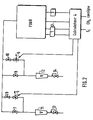
- FIG. 2 represents the basic diagram of an atmosphere regulation making it possible to implement the method of the invention.
- the function of the infrared analyzer 1 is to analyze the residual contents of CH4 and CO; the temperature is measured by a thermocouple 2.
- the analyzers and the thermocouple are connected to a computer 4 which periodically acquires the temperature of the gas mixture and the values of the residual concentrations of CH4 and CO.
- the equation F f (T, CH4, CO, H2O) stored in the computer allows, with the measurements of T, CH4, and CO, to calculate the dew point PRc which gives a flow equal to the set flow.
- This setpoint dew point PRc is compared with the value of the dew point PRm measured in the oven by a hygrometer 3.
- the error signal is sent to a PID type regulator which controls two solenoid valves 5 and 6 and calculates their durations opening hours.
- the nitrogen and hydrocarbon distribution table C x H y operates at a double flow, a low flow, which can be zero and a high flow.
- the solenoid valves 5 and 6 are closed, the low flow rates of nitrogen and of C x H y are adjusted by means of valves 7 and 8. It is possible to adjust for a low flow of nitrogen the proportion of CxHy injected to obtain a fixed residual CH4 content.
- the solenoid valves 5 and 6 are open, additional flows of nitrogen and of hydrocarbon C x H y are adjusted by the valves 9 and 10.
- the nitrogen and C x H y flow rates are read by the rotameters 11 and 12.
- the pressure reducers 13 and 14 allow the pressure in the rotameters to be adjusted for correct reading of the flow rates.
- the residual CH4 content in the furnace can also be kept constant by PID regulation.
- the residual CH4 content (or the residual CH4 setpoint) is imposed manually by the operator or generated by the computer so as to minimize the flow of nitrogen injected into the furnace, as described above.
- the device according to the invention includes solenoid valves 5 and 6 controlled by the computer 4 and valves 7, 8, 9 and 10 controlled manually. Indeed, it is sought, according to the invention to maintain a constant residual rate of CH4 in the atmosphere of the furnace. It was realized that this was not always possible when the flow of nitrogen and of hydrocarbon CxHy injected into the furnace varied with a constant (CxHy) / (N2) ratio. It may therefore, in certain cases, prove to be useful or necessary to be able to vary the ratio (CxHy) / (N2) in order to maintain in all circumstances a constant concentration of residual CH4.
- This equation is stored in the computer which will control the heat treatment process according to the invention by calculating the parameter Xd (dew point PRc) from the values Xa, Xb and Xc measured in the oven (or more exactly Za , Zb, Zc transformed in the computer into Xa, Xb, Xc) and of the imposed set flow value Fc.
- the computer performs sampling at regular time intervals to measure Xa, Xb and Xc. This generally fixed sampling interval is determined by experience, for a given oven.
- the implementation of the invention relates to a heat treatment for annealing XC 22 steel tubes (1022) in a continuous roller oven.
- This flux was calculated according to the same procedure as that of the fluxes in the experimental design (this is the surface flux such that the experimental carbon profile of a tube is a solution of the FICK equations - see Figure 1).
- a high flow rate of 100 Nm3 / h is injected into the oven comprising 98.5% N2 and 1.5% natural gas and a low flow rate of 50 Nm3 / h of a mixture of 98.8% nitrogen and 1.2 % of hydrocarbon (natural gas) to obtain 1% of residual CH4 (value set by the user - first variant above).
- These two flow rates are those which are controlled by PID type regulation (proportional, integral, differential) in response to the information communicated to it by the computer concerning the comparison of the set dew point PRc and the dew point measured PRm.
- the high flow rate is injected about 70% of the time and the weak flow rate about 30% of the time, ie an average flow rate in the oven of the order of 85 Nm3 / h.
- the treated parts meet the specifications imposed, in particular with regard to the maximum decarburization set.
- the user arbitrarily set a residual (CH4) of 0.7%.
- Measurement A indicates that the atmosphere is set, that is to say that the measured dew point PRm is equal to the set dew point PRc.
- the residual (CH4) was set by the operator at 1.0%.
- the PRc setpoint dew point is maximum (- 36 ° C) -
- the atmosphere flow is reduced. It is minimal because the PRc is maximal.
- the measurement C was carried out after the measurement B which represents a minimized stable state which one seeks to reach permanently.
- This measurement shows the appearance of a disturbance in the atmosphere of the furnace (for example introduction of parts, air inlets, etc ...) because the dew point measured increases (- 35 ° C) reflecting an increase in l humidity of the furnace atmosphere.
- the regulation according to the invention will therefore act to induce a return to state B, by varying the overall flow rate of the injected atmosphere (by acting on the high flow rate until return to state E, identical to l 'state B).
- State E identical to state B.
- the state F indicates another disturbance generated during the process, due to an increase in the CO concentration in the atmosphere of the furnace (0.4 instead of 0.3). This leads to a variation in the measured flux (- 3.5) 10 ⁇ 9mol ⁇ cm ⁇ 2s ⁇ 1 which no longer conforms to the value Fc. Consequently, a new setpoint PRc (- 36.6 ° C) is calculated (from the equation in memory) and the overall flow rate is adjusted so as to return to the stable state G, different from B.
- the invention therefore allows, for an equal treatment time and with identical quality of parts, a significant reduction in the flow rate of the atmosphere injected into the furnace, this reduction being in the present case by 47%.
- the nitrogen and hydrocarbon flows are carried out as a function of the amplitude of the difference between the measured dew point PRm and the set dew point PRc.
Landscapes
- Chemical & Material Sciences (AREA)
- Engineering & Computer Science (AREA)
- Physics & Mathematics (AREA)
- Thermal Sciences (AREA)
- Crystallography & Structural Chemistry (AREA)
- Mechanical Engineering (AREA)
- Materials Engineering (AREA)
- Metallurgy (AREA)
- Organic Chemistry (AREA)
- Solid-Phase Diffusion Into Metallic Material Surfaces (AREA)
- Furnace Details (AREA)
- Control Of Heat Treatment Processes (AREA)
Applications Claiming Priority (2)
| Application Number | Priority Date | Filing Date | Title |
|---|---|---|---|
| FR8715860 | 1987-11-17 | ||
| FR8715860A FR2623209B1 (fr) | 1987-11-17 | 1987-11-17 | Procede de traitement thermique sous atmosphere gazeuse a base d'azote et d'hydrocarbure |
Publications (2)
| Publication Number | Publication Date |
|---|---|
| EP0317407A1 EP0317407A1 (fr) | 1989-05-24 |
| EP0317407B1 true EP0317407B1 (fr) | 1992-01-22 |
Family
ID=9356869
Family Applications (1)
| Application Number | Title | Priority Date | Filing Date |
|---|---|---|---|
| EP88402840A Expired - Lifetime EP0317407B1 (fr) | 1987-11-17 | 1988-11-14 | Procédé de traitement thermique sous atmosphère gazeuse à base d'azote et d'hydrocarbure |
Country Status (10)
| Country | Link |
|---|---|
| US (1) | US4992113A (enExample) |
| EP (1) | EP0317407B1 (enExample) |
| JP (1) | JPH01162722A (enExample) |
| KR (1) | KR890008333A (enExample) |
| AU (1) | AU615958B2 (enExample) |
| CA (1) | CA1318839C (enExample) |
| DE (1) | DE3868015D1 (enExample) |
| ES (1) | ES2028338T3 (enExample) |
| FR (1) | FR2623209B1 (enExample) |
| ZA (1) | ZA888534B (enExample) |
Families Citing this family (18)
| Publication number | Priority date | Publication date | Assignee | Title |
|---|---|---|---|---|
| IL89525A0 (en) * | 1988-03-21 | 1989-09-10 | Exxon Chemical Patents Inc | Silicon-bridged transition metal compounds |
| KR930001008B1 (ko) * | 1989-12-26 | 1993-02-12 | 동양나이론 주식회사 | 열처리 가열로의 분위기 조절방법 |
| US5194228A (en) * | 1990-10-12 | 1993-03-16 | General Signal Corporation | Fluidized bed apparatus for chemically treating workpieces |
| US5205485A (en) * | 1992-06-25 | 1993-04-27 | The Boc Group, Inc. | Apparatus and method of controlling moisture content within a reaction vessel |
| US5298090A (en) * | 1992-12-22 | 1994-03-29 | Air Products And Chemicals, Inc. | Atmospheres for heat treating non-ferrous metals and alloys |
| JP3460075B2 (ja) * | 1995-12-28 | 2003-10-27 | 同和鉱業株式会社 | 金属の浸炭方法 |
| NZ314334A (en) * | 1996-04-19 | 1997-09-22 | Boc Group Inc | Method of heat treating a metal with nitrogen rich gas preheated and then having oxygen-reactive gas added |
| JPH1012141A (ja) * | 1996-06-26 | 1998-01-16 | Mitsubishi Electric Corp | Crt内部材の製造方法及び製造装置 |
| FR2777910B1 (fr) * | 1998-04-27 | 2000-08-25 | Air Liquide | Procede de regulation du potentiel carbone d'une atmosphere de traitement thermique et procede de traitement thermique mettant en oeuvre une telle regulation |
| US6612154B1 (en) * | 1998-12-22 | 2003-09-02 | Furnace Control Corp. | Systems and methods for monitoring or controlling the ratio of hydrogen to water vapor in metal heat treating atmospheres |
| US6591215B1 (en) | 1999-02-18 | 2003-07-08 | Furnace Control Corp. | Systems and methods for controlling the activity of carbon in heat treating atmospheres |
| US6635121B2 (en) | 2000-02-04 | 2003-10-21 | American Air Liquide, Inc. | Method and apparatus for controlling the decarburization of steel components in a furnace |
| US6458217B1 (en) | 2000-02-29 | 2002-10-01 | American Air Liquide, Inc. | Superadiabatic combustion generation of reducing atmosphere for metal heat treatment |
| DE10347312B3 (de) * | 2003-10-08 | 2005-04-14 | Air Liquide Deutschland Gmbh | Verfahren zur Wärmebehandlung von Eisenwerkstoffen |
| ATE546242T1 (de) * | 2004-09-15 | 2012-03-15 | Nippon Steel Corp | Verfahren zur herstellung eines hochfesten teiles |
| US20080187850A1 (en) * | 2007-02-06 | 2008-08-07 | Xerox Corporation | Tunable electrophotographic imaging member and method of making same |
| EP3168314A1 (en) * | 2015-11-13 | 2017-05-17 | Air Liquide Deutschland GmbH | Method for heat treating metallic work pieces |
| CN114196809A (zh) * | 2021-12-21 | 2022-03-18 | 新疆八一钢铁股份有限公司 | 一种降低钢坯加热脱碳的方法 |
Family Cites Families (10)
| Publication number | Priority date | Publication date | Assignee | Title |
|---|---|---|---|---|
| US2815305A (en) * | 1955-07-20 | 1957-12-03 | Harold N Ipsen | Method of and apparatus for heat treating metal parts |
| IT649978A (enExample) * | 1960-06-17 | |||
| GB1471880A (en) * | 1973-10-26 | 1977-04-27 | Air Prod & Chem | Furnace atmosphere for the heat treatment of ferrous metal |
| FR2285461A1 (fr) * | 1974-09-20 | 1976-04-16 | Air Liquide | Procede de traitement thermique de l'acier en atmosphere reductrice et non decarburante |
| US4049472A (en) * | 1975-12-22 | 1977-09-20 | Air Products And Chemicals, Inc. | Atmosphere compositions and methods of using same for surface treating ferrous metals |
| CH628092A5 (de) * | 1978-03-21 | 1982-02-15 | Ipsen Ind Int Gmbh | Verfahren und vorrichtung zur regelung des kohlenstoffpegels eines chemisch reagierenden gasgemisches. |
| GB2044804A (en) * | 1979-03-16 | 1980-10-22 | Boc Ltd | Heat treatment method |
| US4445945A (en) * | 1981-01-14 | 1984-05-01 | Holcroft & Company | Method of controlling furnace atmospheres |
| JPS6058286B2 (ja) * | 1982-06-28 | 1985-12-19 | 中外炉工業株式会社 | 雰囲気ガス加湿装置 |
| FR2586259B1 (fr) * | 1985-08-14 | 1987-10-30 | Air Liquide | Procede de cementation rapide dans un four continu |
-
1987
- 1987-11-17 FR FR8715860A patent/FR2623209B1/fr not_active Expired - Fee Related
-
1988
- 1988-11-09 AU AU24965/88A patent/AU615958B2/en not_active Ceased
- 1988-11-14 EP EP88402840A patent/EP0317407B1/fr not_active Expired - Lifetime
- 1988-11-14 DE DE8888402840T patent/DE3868015D1/de not_active Expired - Lifetime
- 1988-11-14 ES ES198888402840T patent/ES2028338T3/es not_active Expired - Lifetime
- 1988-11-15 ZA ZA888534A patent/ZA888534B/xx unknown
- 1988-11-16 CA CA000583270A patent/CA1318839C/fr not_active Expired - Fee Related
- 1988-11-16 KR KR1019880015082A patent/KR890008333A/ko not_active Withdrawn
- 1988-11-17 JP JP63289006A patent/JPH01162722A/ja not_active Ceased
-
1990
- 1990-08-22 US US07/571,022 patent/US4992113A/en not_active Expired - Fee Related
Also Published As
| Publication number | Publication date |
|---|---|
| FR2623209B1 (fr) | 1993-09-03 |
| AU615958B2 (en) | 1991-10-17 |
| ZA888534B (en) | 1989-09-27 |
| JPH01162722A (ja) | 1989-06-27 |
| ES2028338T3 (es) | 1992-07-01 |
| FR2623209A1 (fr) | 1989-05-19 |
| DE3868015D1 (de) | 1992-03-05 |
| EP0317407A1 (fr) | 1989-05-24 |
| US4992113A (en) | 1991-02-12 |
| CA1318839C (fr) | 1993-06-08 |
| KR890008333A (ko) | 1989-07-10 |
| AU2496588A (en) | 1989-05-18 |
Similar Documents
| Publication | Publication Date | Title |
|---|---|---|
| EP0317407A1 (fr) | Procédé de traitement thermique sous atmosphère gazeuse à base d'azote et d'hydrocarbure | |
| Jones et al. | Fast response metal phthalocynanine-based gas sensors | |
| EP0096602B1 (fr) | Procédé de traitement thermique de pièces métalliques par carburation | |
| FR2681332A1 (fr) | Procede et dispositif de cementation d'un acier dans une atmosphere a basse pression. | |
| DD142383A5 (de) | Verfahren und vorrichtung zur regelung des kohlenstoffpegels eines gasgemisches | |
| US4549815A (en) | Measurement of ignition characteristics of distillate fuels | |
| EP0011530A1 (fr) | Capteur électrochimique des concentrations relatives d'espèces réactives dans un mélange de fluide, procédé de fabrication d'un tel capteur et système comportant un tel capteur, notamment pour la régulation | |
| EP0213991B1 (fr) | Procédé de cémentation rapide dans un four continu | |
| Burghaus et al. | CO oxidation by atomically adsorbed oxygen on Ag (110) in the temperature range 100–300 K | |
| EP3802904B1 (fr) | Procédé de cémentation basse pression d'une pièce comprenant de l'acier | |
| CA2563876A1 (fr) | Methode et dispositif pour determiner des caracteristiques petrolieres de sediments geologiques | |
| JP2002311013A (ja) | ガス分析試験装置およびこれに用いる反応装置 | |
| US4417927A (en) | Steel nitriding method and apparatus | |
| FR2500848A1 (fr) | Procede pour reguler la composition de l'atmosphere d'un four de traitement thermique de metaux | |
| EP0661499A1 (fr) | Réglage en temps réel d'un brûleur à gaz de caractéristiques variables, notamment pour four de réchauffage métallurgique | |
| EP1076726A1 (fr) | Procede de cementation ou carbonitruration de pieces metalliques | |
| EP1386012A1 (fr) | Procede pour ameliorer la qualite metallurgique de produits traites dans un four | |
| JP4749823B2 (ja) | フッ素ガス濃度測定方法 | |
| FR2722212A1 (fr) | Procede et installation de traitement de cementation et de carbonitruration des aciers | |
| Stutzmann et al. | Temperature dependence of hydrogen vibrational modes in passivated boron‐doped silicon | |
| Tournour et al. | Molecular oxygen diffusion in vitreous silica | |
| WO2009153263A1 (fr) | Dispositif et procede pour l'estimation precise bornee pseudo-continue et en ligne de la concentration totale en goudrons dans un flux gazeux pouvant etre a haute temperature | |
| Griffiths et al. | The derivation of chemical-diffusion coefficients of oxygen in UO2+ x over the range 180–300° C. Spectroscopic procedure and preliminary results | |
| JP3318316B2 (ja) | 浸炭処理における浸炭状態の制御方法 | |
| BE1006007A3 (fr) | Procede pour le reglage de l'atmosphere dans un four pour traitement thermique. |
Legal Events
| Date | Code | Title | Description |
|---|---|---|---|
| PUAI | Public reference made under article 153(3) epc to a published international application that has entered the european phase |
Free format text: ORIGINAL CODE: 0009012 |
|
| 17P | Request for examination filed |
Effective date: 19881119 |
|
| AK | Designated contracting states |
Kind code of ref document: A1 Designated state(s): BE DE ES FR GB IT NL SE |
|
| 17Q | First examination report despatched |
Effective date: 19910506 |
|
| GRAA | (expected) grant |
Free format text: ORIGINAL CODE: 0009210 |
|
| ITF | It: translation for a ep patent filed | ||
| AK | Designated contracting states |
Kind code of ref document: B1 Designated state(s): BE DE ES FR GB IT NL SE |
|
| PG25 | Lapsed in a contracting state [announced via postgrant information from national office to epo] |
Ref country code: GB Effective date: 19920122 |
|
| REF | Corresponds to: |
Ref document number: 3868015 Country of ref document: DE Date of ref document: 19920305 |
|
| REG | Reference to a national code |
Ref country code: ES Ref legal event code: FG2A Ref document number: 2028338 Country of ref document: ES Kind code of ref document: T3 |
|
| GBV | Gb: ep patent (uk) treated as always having been void in accordance with gb section 77(7)/1977 [no translation filed] | ||
| PLBE | No opposition filed within time limit |
Free format text: ORIGINAL CODE: 0009261 |
|
| STAA | Information on the status of an ep patent application or granted ep patent |
Free format text: STATUS: NO OPPOSITION FILED WITHIN TIME LIMIT |
|
| 26N | No opposition filed | ||
| PG25 | Lapsed in a contracting state [announced via postgrant information from national office to epo] |
Ref country code: NL Effective date: 19930601 |
|
| NLV4 | Nl: lapsed or anulled due to non-payment of the annual fee | ||
| EAL | Se: european patent in force in sweden |
Ref document number: 88402840.8 |
|
| PGFP | Annual fee paid to national office [announced via postgrant information from national office to epo] |
Ref country code: FR Payment date: 19961010 Year of fee payment: 9 |
|
| PGFP | Annual fee paid to national office [announced via postgrant information from national office to epo] |
Ref country code: SE Payment date: 19961018 Year of fee payment: 9 |
|
| PGFP | Annual fee paid to national office [announced via postgrant information from national office to epo] |
Ref country code: BE Payment date: 19961021 Year of fee payment: 9 |
|
| PGFP | Annual fee paid to national office [announced via postgrant information from national office to epo] |
Ref country code: DE Payment date: 19961024 Year of fee payment: 9 |
|
| PGFP | Annual fee paid to national office [announced via postgrant information from national office to epo] |
Ref country code: ES Payment date: 19961111 Year of fee payment: 9 |
|
| PG25 | Lapsed in a contracting state [announced via postgrant information from national office to epo] |
Ref country code: SE Free format text: LAPSE BECAUSE OF NON-PAYMENT OF DUE FEES Effective date: 19971115 Ref country code: ES Free format text: LAPSE BECAUSE OF NON-PAYMENT OF DUE FEES Effective date: 19971115 |
|
| PG25 | Lapsed in a contracting state [announced via postgrant information from national office to epo] |
Ref country code: FR Free format text: THE PATENT HAS BEEN ANNULLED BY A DECISION OF A NATIONAL AUTHORITY Effective date: 19971130 Ref country code: BE Free format text: LAPSE BECAUSE OF NON-PAYMENT OF DUE FEES Effective date: 19971130 |
|
| BERE | Be: lapsed |
Owner name: S.A. L' AIR LIQUIDE POUR L'ETUDE ET L'EXPLOITATION Effective date: 19971130 |
|
| PG25 | Lapsed in a contracting state [announced via postgrant information from national office to epo] |
Ref country code: DE Free format text: LAPSE BECAUSE OF NON-PAYMENT OF DUE FEES Effective date: 19980801 |
|
| EUG | Se: european patent has lapsed |
Ref document number: 88402840.8 |
|
| REG | Reference to a national code |
Ref country code: FR Ref legal event code: ST |
|
| REG | Reference to a national code |
Ref country code: ES Ref legal event code: FD2A Effective date: 19981212 |
|
| PG25 | Lapsed in a contracting state [announced via postgrant information from national office to epo] |
Ref country code: IT Free format text: LAPSE BECAUSE OF NON-PAYMENT OF DUE FEES;WARNING: LAPSES OF ITALIAN PATENTS WITH EFFECTIVE DATE BEFORE 2007 MAY HAVE OCCURRED AT ANY TIME BEFORE 2007. THE CORRECT EFFECTIVE DATE MAY BE DIFFERENT FROM THE ONE RECORDED. Effective date: 20051114 |