EP0315073A2 - Zusammensetzung für Bilderzeugung - Google Patents
Zusammensetzung für Bilderzeugung Download PDFInfo
- Publication number
- EP0315073A2 EP0315073A2 EP88118013A EP88118013A EP0315073A2 EP 0315073 A2 EP0315073 A2 EP 0315073A2 EP 88118013 A EP88118013 A EP 88118013A EP 88118013 A EP88118013 A EP 88118013A EP 0315073 A2 EP0315073 A2 EP 0315073A2
- Authority
- EP
- European Patent Office
- Prior art keywords
- composition
- maleic acid
- group
- acridine
- pattern
- Prior art date
- Legal status (The legal status is an assumption and is not a legal conclusion. Google has not performed a legal analysis and makes no representation as to the accuracy of the status listed.)
- Withdrawn
Links
Images


Classifications
-
- G—PHYSICS
- G03—PHOTOGRAPHY; CINEMATOGRAPHY; ANALOGOUS TECHNIQUES USING WAVES OTHER THAN OPTICAL WAVES; ELECTROGRAPHY; HOLOGRAPHY
- G03F—PHOTOMECHANICAL PRODUCTION OF TEXTURED OR PATTERNED SURFACES, e.g. FOR PRINTING, FOR PROCESSING OF SEMICONDUCTOR DEVICES; MATERIALS THEREFOR; ORIGINALS THEREFOR; APPARATUS SPECIALLY ADAPTED THEREFOR
- G03F7/00—Photomechanical, e.g. photolithographic, production of textured or patterned surfaces, e.g. printing surfaces; Materials therefor, e.g. comprising photoresists; Apparatus specially adapted therefor
- G03F7/004—Photosensitive materials
- G03F7/016—Diazonium salts or compounds
- G03F7/021—Macromolecular diazonium compounds; Macromolecular additives, e.g. binders
-
- G—PHYSICS
- G03—PHOTOGRAPHY; CINEMATOGRAPHY; ANALOGOUS TECHNIQUES USING WAVES OTHER THAN OPTICAL WAVES; ELECTROGRAPHY; HOLOGRAPHY
- G03F—PHOTOMECHANICAL PRODUCTION OF TEXTURED OR PATTERNED SURFACES, e.g. FOR PRINTING, FOR PROCESSING OF SEMICONDUCTOR DEVICES; MATERIALS THEREFOR; ORIGINALS THEREFOR; APPARATUS SPECIALLY ADAPTED THEREFOR
- G03F7/00—Photomechanical, e.g. photolithographic, production of textured or patterned surfaces, e.g. printing surfaces; Materials therefor, e.g. comprising photoresists; Apparatus specially adapted therefor
- G03F7/004—Photosensitive materials
- G03F7/008—Azides
- G03F7/012—Macromolecular azides; Macromolecular additives, e.g. binders
- G03F7/0125—Macromolecular azides; Macromolecular additives, e.g. binders characterised by the polymeric binder or the macromolecular additives other than the macromolecular azides
Definitions
- the present invention relates to a composition for pattern forming materials (resists) usuable for lithography processes in the manufacture of semiconductors, especially lithography using far ultraviolet rays and excimer rays.
- the conventional negative resists exhibit too great absorption of far ultraviolet rays and excimer laser rays (The transmission at 248 nm is generally 20% or less in case of the resist having a thickness of 1 ⁇ m) to transmit well into the lower area of the resist and therefore the reaction in this area only proceeds with difficulty. As a result, the pattern formed becomes of inverted trapezoid shape or the resist pattern peals off from the substrate.
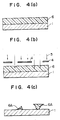
- Fig. 4 the process for forming the pattern is explained by using one of the conventional pattern forming materials and a negative resist for ultraviolet rays RD-2000N (mfd. by Hitachi Chemicals Co., Ltd.).
- RD-2000N which is a negative resist is coated on substrate 1 and oven-baked at 80°C for 20 minutes to give a resist film 3 of 1.0 ⁇ m thickness (Fig. 4a).
- the transmission of rays at 248 nm in the case of this resist film is 17%.
- KrF excimer laser rays 5 are selectively exposed to the film through a mask 4 by using a KrF excimer stepper (248 nm; NA: 0.35) (Fig. 4b).
- the amount of the exposure is 200 mJ/cm2 and the transmission of the thus obtained resist is 25%.
- Resist pattern 6A is formed by developing with an alkaline developer, RD-developer (Hitachi Chemicals Co., Ltd.) for 60 seconds (Fig. 4c).
- pattern 6A of 1 ⁇ m thickness is of inverted trapezoid shape and about 0.5 ⁇ m of that may flow over onto the pattern near-by because of weak adhesiveness to the substrate derived from the inverted trapezoid shape since the rays can not penetrate into the lower area of the resist due to poor transmission of the rays.
- Those patterns mentioned above are unsuitable as a mask for the next etching step, and thus, the fluctuation in the size or the defect in pattern occurs and this leads to decrease in the yield of semiconductor devices.
- novolak resins phenolic resins, maleimide resins, copolymers of styrene and maleic acid derivatives and the like themselves have a property of the capability of forming negative resist by negative-type polymerization with DUV rays, excimer rays or the like.
- the object of the present invention is to provide a composition for pattern forming material free from inverted trapezoid shape derived from over absorption of the irradiated ray and having a miniaturized and high sensitivity and high contrast pattern resolving power.
- the present composition provides pattern forming materials free from the drawbacks of the conventional ones and comprising copolymers of styrene and maleic acid derivatives, and cross-linkable photosensitive substance, or acridine or acridine derivatives and novolak resins, phenolic resins, maleimide resins or copolymers of styrene and maleic acid derivatives as a main component.
- Figs. 1 and 3 are schematic section views of the pattern forming process in which the composition of the present invention is employed.
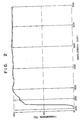
- Fig. 2 is an ultraviolet spectroscopy.
- Fig. 4 are schematic section views of the pattern forming process in which the conventional pattern forming material is employed.
- One of the main components of the present pattern forming material is a polymer.
- a polymer As such a polymer, mention will be made of copolymers of styrene and maleic acid derivatives (In this specification, the term "maleic acid derivatives" sometimes includes maleic acid itself), novolak resins, phenolic resins, maleimide resins.
- the copolymers of styrene and maleic acid derivatives may have the following structural unit in the molecule: wherein m and n are both any intergers, respectively, and R1 and R2 are hydrogen atoms, alkyl groups, cycloalkyl groups, aryl groups which may have the substituents, allyl groups, alkenyl groups, alkinyl groups.
- the alkyl group may be substituted with a halogen atom(s).
- substituents for the aryl group mention may be made of alkyl group, alkenyl group, halogen atom, and the like. Both alkenyl group and alkinyl groups may be substituted by halogen atom, aryl group or the like.
- OR1 or OR2 radical may be replaced by a halogen atom such as fluorine, bromine or chlorine atom.
- the molecular weight of polymer usuable in the present invention may be 1,500 to 20,000, preferably 3,000 to 10,000.
- the amount of polymer to be used in the present composition is usually determined depending upon the purposes for use and kind of polymer to be used, but can be chosen in the same range as that of the conventional amounts.
- the amount of the polymer in the composition is usually chosen from 50% to 95% by weight based on the resist.
- the amount of the cross-linkable photo-sensitive substance is preferably 5% to 50% by weight and that of the polymer is preferably to 50% to 95% by weight.
- the composition is preferably prepared by using 10 to 40% by weight of a solvent based on the total weight of the polymer and the cross-linkable photosensitive substance.
- the present composition is not limited to said amounts.
- any conventional materials usually used for the pattern forming material can also be added.
- maleic derivatives includes maleic acid, maleic mono- and di-ester and the like.
- novolak resins phenolic resins or maleimide resins
- any commercial available polymer can be used as far as they can meet the requirements as a polymer for the negative resist.
- Copolymers of styrene and maleic acid derivatives are preferable because they have a high transmission of the rays having a wavelength in the vicinity of 248 nm corresponding to far ultraviolet rays, especially KrF excimer laser rays, and show 80% or more transmission in a film thickness of 1 ⁇ m. Furthermore, the copolymers of said series do not swell in an alkaline solution, and the present inventors have found if a cross-linkable photosensitive substance is added to this polymer, the exposed area of the polymer in an alkaline solution becomes insoluble, thereby negative resist is formed.
- alkaline soluble styrene copolymers If alkaline soluble styrene copolymers is used in the present composition, it can transmit the irradiated rays to a considerably great extent and thus the rays can easily be transmitted to the lower area of the coated pattern forming material because these copolymers have a transparency of 50% higher than the polymers conventionally used ones for and ultraviolet rays, far ultraviolet rays, thereby the formation of inverted-trapezoid shaped pattern can be prevented. Therefore, alkaline soluble styrene copolymers may be used alone as a polymer in the present composition, too.
- the present inventive pattern forming material does not form a pattern having an inverted trapezoid shape since the irradiated rays can be transmitted easily to the lower area of the resist because of the transparency of the polymer, and thus it can provide high resolution pattern due to nonswellable property of the polymer in an alkaline condition.
- copolymers of styrene and maleic acid derivatives of the present invention are very useful from the viewpoint of the etching resistance due to the existence of aromatic nuclei.
- any cross-linkable photosensitive substance can be used without any limitation as far as it has a sensitivity to far ultraviolet rays, excimer laser rays and the like. That is, diazonium salt compounds, diazo compounds, azido compounds can be illustrated.
- the pattern forming material thermally cross-links at the surface area contacting to the substrate, whereby the formation of inverted trapezoid-shaped pattern can be prevented under certain conditions, which results in the formation of reliable pattern.
- the present composition for pattern forming material may contain polymers such as for example xylenol resins, cresol resins and like and the compounds such as bisphenol A, catechol so as to adjust the solvability of the present inventive polymers, the other polymers usuable in the present composition and cross-linkable photosensitive substance in the solvents used for dissolving those materials mentioned above; and sensitizers for improving the photosensitivity such as and the like.
- polymers such as for example xylenol resins, cresol resins and like and the compounds such as bisphenol A, catechol so as to adjust the solvability of the present inventive polymers, the other polymers usuable in the present composition and cross-linkable photosensitive substance in the solvents used for dissolving those materials mentioned above; and sensitizers for improving the photosensitivity such as and the like.
- cyclohexanone diethylene glycol, dimethyl ether, ethylcellosolve acetate, xylene, cyclopentane and the like. A mixture of these solvents may also be used.
- the present composition for a pattern forming material can be used as a material of negative resist for ultraviolet rays in the case that a cross-linkable photosensitive substance of the present invention is reactive to ultraviolet rays since the present polymer shows high transparency in the ultraviolet range.
- acridine and its derivatives can also act as a cross-linkable photosensitive substance when DUV light rays or excimer laser rays are irradiated on a composition containing acridine or its derivatives and a polymer such as novolak resins, phenol resins, maleimide resins and the like. In that case, the sensitivity and resolution capability of the negative resist can be increased.
- the amount of acridine or a derivative thereof to be added is about 1% by weight based on the weight of the polymer in the composition, and this amount is sufficient for its activity to be shown.
- azido compounds are preferably used since the unexposed area still has a good solubility in an alkaline aqueous solution while the exposed area becomes insoluble in the alkaline aqueous solution due to the increase in the molecular weight as a result of the reaction between; the polymer and the N3 group of azido compounds.
- the unexposed area can easily be removed from the substrate to give negative resist.
- the present composition does not form inverted trapezoid-shaped patterns, and the difference in the unexposed and the exposed area is quite apparent. Therefore, the aspect ratio of the thus obtained pattern is excellent.
- the film loss in the exposed area cannot be expected due to the action of the azido compounds while the styrene copolymers are generally very soluble in an alkaline solution.
- the azido compounds of the present invention may be any commercially available ones and they can be shown by the general formula aforementioned. Additionally, can be added. Of course, a mixture of them can be used.
- the amount of the azido compounds is 100% by weight or less based on the weight of the polymer in the composition. If this amount is more than 100% by weight, the reaction between the polymer and the azido compound is depressed due to the reaction among the azido compound itself when exposed to the ray, thereby the formation of the pattern is disturbed.
- the other cross-linkable photosensitive substance can be used in the present composition.
- acridine or one of acridine derivatives is used as a cross-linkable photosensitive substance in the pattern forming material
- the present inventors have found that there is formed a pattern having high resolution and high aspect ratio.
- phenolic resins, maleimide resins, novolac resins can be used in combination with the copolymers of styrene and maleic acid derivatives or alone.
- any of other resins usuable as a pattern forming polymer can be used together with acridine or a acridine derivative.
- the present composition for pattern forming material was prepared by mixing the following materials: A polymer having the structural unit of wherein m to n is 1 : 1 and the molecular weight of 6000 4,4′-diazidodiphenylmethane 3 g, and cyclohexane 50 g.
- the polymer used herein has a good transmission of 80% or more in the far ultraviolet range and at 248 nm as is shown in Fig. 2 in which the ultraviolet spectroscopy of the polymer at the thickness of 1 ⁇ m is given.
- the present composition was coated onto substrate 1. After baking thus prepared coating in an oven at 80°C for 20 minutes, the resist film 20 having the thickness of 1.0 ⁇ m was obtained. The transmission of 248 nm rays of the thus formed resist film was 42% (Fig. 1a). Then, KrF excimer laser rays 5 were selectively exposed to the film through a mask by use of a KrF excimer laser stepper (248 nm, NA: 0.35) (Fig. 1b). The amount of the exposure was 210 mJ/cm2 and the transmission of 248 nm rays of the thus treated film was 82%. Thereafter, by performing immersion development with Alkali Developer NMD-3 (mfd. by Tokyo Applied chemistry Co., Ltd.) 20% aqueous solution for 60 seconds, resist pattern 2A was obtained (Fig. 1c).
- the resist pattern 2A had a good shape showing an aspect ratio of 82°, free from film loss irrespective of the size of patterns, e.g., both 1 ⁇ m and 0.5 ⁇ m pattern.
- R1, R2, R3 and R4 are respectively alkyl groups such as methyl, isopropyl, ethyl, tert-butyl, heptyl and the like; aryl groups which may have substituent(s) such as C1-C4 alkyl group, a halogen atom; alkenyl groups; and alkinyl groups, and X1 and X2 are respectively halogen atoms such as F, Cl, Br or the like.
- a good resist pattern similar to that of Example 1 was obtained by repeating the procedure of Example 1 except that the following composition of pattern forming material was used and the exposure amount was 225 mJ/cm2.
- a good resist pattern similar to that of Example 1 was obtained by repeating the procedure of Example 1 except that the following composition of pattern forming material was used and the exposure amount was 250 mJ/cm2.
- a good resist pattern similar to that of Example 1 was obtained by repeating the procedure of Example 1 except that the following composition of pattern forming material was used and the exposure amount was 240 mJ/cm2: A copolymer having the following structural unit of wherein m to n is 1 : 1 and the molecular weight of 6000
- a good resist pattern similar to that of Example 1 was obtained by repeating the procedure of Example 1 except that the following composition of the pattern forming material was used and the exposure amount was 200 mJ/cm2: A copolymer having the following structural unit of in which m to n is 1 : 1 and the molecular weight of 6000
- a composition for pattern forming material was prepared by mixing 10 g of polyvinyl phenol resin (Resin M, mfd. by Maruzen Petroleum Co., Ltd.), 0.1 g of acridine and 30 g of diethyleneglycol.
- An acridine derivative such as acridine orange, acridine yellow or the like can also give a good pattern similar to the one obtained using acridine.
- a composition for pattern forming material was prepared by mixing the following materials: A polymer having the structural unit of wherein n is an integer and the molecular weight of about 4000
- the thus prepared composition was coated in the thickness of 1.2 ⁇ m onto substrate 1 (The substrate may be a semiconductor or the like) so as to form coating 3 (Fig. 3a).
- the coating layer was selectively exposed to rays 5 through a mask by the use of a KrF excimer laser ray stepper (NA: 0.36) (Fig. 3b).
- NA KrF excimer laser ray stepper
- aqueous solution pattern 3A was formed (Fig. 3c).
- pattern 3A was of good line-and-space of 0.5 ⁇ m showing an aspect ratio of 88° and film loss of 0, being free from inverted trapezoid shape pattern.
Landscapes
- Physics & Mathematics (AREA)
- Spectroscopy & Molecular Physics (AREA)
- General Physics & Mathematics (AREA)
- Exposure And Positioning Against Photoresist Photosensitive Materials (AREA)
- Compositions Of Macromolecular Compounds (AREA)
Applications Claiming Priority (4)
| Application Number | Priority Date | Filing Date | Title |
|---|---|---|---|
| JP277605/87 | 1987-11-02 | ||
| JP27760587 | 1987-11-02 | ||
| JP17710588 | 1988-07-18 | ||
| JP177105/88 | 1988-07-18 |
Publications (1)
| Publication Number | Publication Date |
|---|---|
| EP0315073A2 true EP0315073A2 (de) | 1989-05-10 |
Family
ID=26497763
Family Applications (1)
| Application Number | Title | Priority Date | Filing Date |
|---|---|---|---|
| EP88118013A Withdrawn EP0315073A2 (de) | 1987-11-02 | 1988-10-28 | Zusammensetzung für Bilderzeugung |
Country Status (1)
| Country | Link |
|---|---|
| EP (1) | EP0315073A2 (de) |
Cited By (1)
| Publication number | Priority date | Publication date | Assignee | Title |
|---|---|---|---|---|
| CN1077438C (zh) * | 1988-06-03 | 2002-01-09 | 霍夫曼-拉罗奇有限公司 | 重组球虫病疫苗 |
-
1988
- 1988-10-28 EP EP88118013A patent/EP0315073A2/de not_active Withdrawn
Cited By (1)
| Publication number | Priority date | Publication date | Assignee | Title |
|---|---|---|---|---|
| CN1077438C (zh) * | 1988-06-03 | 2002-01-09 | 霍夫曼-拉罗奇有限公司 | 重组球虫病疫苗 |
Similar Documents
| Publication | Publication Date | Title |
|---|---|---|
| KR100537381B1 (ko) | 광산 발생제를 포함하는 반사 방지 조성물, 당해 조성물과 감광성 내식막이 피복된 기판 및 감광성 내식막 릴리프 화상의 형성방법 | |
| US5017461A (en) | Formation of a negative resist pattern utilize water-soluble polymeric material and photoacid generator | |
| US6051370A (en) | Radiation-sensitive mixture | |
| EP1046958B1 (de) | Benutzung einer zusammensetzung für eine antireflexunterschicht | |
| EP1311908B1 (de) | Zur bilderzeugung mit tiefer uv-strahlung geeignete photoresistzusammensetzung und diese verwendendes bilderzeugungsverfahren | |
| EP0543761B1 (de) | Vernetzbare, wässrig entwickelbare Photoresistzusammensetzung | |
| JP3239329B2 (ja) | マイクロリソグラフィ構造 | |
| JP3573358B2 (ja) | 放射線感応性組成物 | |
| EP0083078B1 (de) | Lichtempfindliche Harzzusammensetzung und Verfahren zur Herstellung feiner Bildmuster damit | |
| EP0756203B1 (de) | Strahlungsempfindliche Zusammensetzung | |
| JPH05257282A (ja) | 微細加工用レジスト組成物 | |
| EP0917000A2 (de) | Positivphotoresistzusammensetzung und Verfahren zur Herstellung eines Resistmusters | |
| KR20010011768A (ko) | 신규의 포토레지스트용 공중합체 및 이를 이용한 포토레지스트조성물 | |
| KR100211546B1 (ko) | 신규한 포토레지스트용 공중합체 | |
| KR100520163B1 (ko) | 니트로기를 포함하는 신규의 포토레지스트 중합체 및 이를함유하는 포토레지스트 조성물 | |
| CA2020378A1 (en) | Maleimide containing, negative working deep uv photoresist | |
| EP0315073A2 (de) | Zusammensetzung für Bilderzeugung | |
| US5252436A (en) | Process for developing a positive-working photoresist containing poly(p-hydroxystyrene) and sulfonium salt with an aqueous developer containing basic organic compounds | |
| JPH10268519A (ja) | 新規なポリマー及びそれを含有するフォトレジスト組成物 | |
| US20060008731A1 (en) | Novel photoresist monomers and polymers | |
| US6340552B1 (en) | Photosensitive composition containing a dissolution inhibitor and an acid releasing compound | |
| US5204216A (en) | Radiation-sensitive mixture | |
| JPH02177031A (ja) | 感放射線混合物 | |
| JPH08339086A (ja) | 不活性閉塞基を有する重合体を含む感照射線性組成物 | |
| JPH09127699A (ja) | ポジチブ処理用の感放射線組成物およびこれを使用するレリーフ構造体の製造方法 |
Legal Events
| Date | Code | Title | Description |
|---|---|---|---|
| PUAI | Public reference made under article 153(3) epc to a published international application that has entered the european phase |
Free format text: ORIGINAL CODE: 0009012 |
|
| AK | Designated contracting states |
Kind code of ref document: A2 Designated state(s): DE FR GB |
|
| STAA | Information on the status of an ep patent application or granted ep patent |
Free format text: STATUS: THE APPLICATION HAS BEEN WITHDRAWN |
|
| 18W | Application withdrawn |
Withdrawal date: 19901002 |