EP0310296A2 - Drehgiessdüse für ein Gefäss zum Aufbewahren von geschmolzenem Metall - Google Patents
Drehgiessdüse für ein Gefäss zum Aufbewahren von geschmolzenem Metall Download PDFInfo
- Publication number
- EP0310296A2 EP0310296A2 EP88308787A EP88308787A EP0310296A2 EP 0310296 A2 EP0310296 A2 EP 0310296A2 EP 88308787 A EP88308787 A EP 88308787A EP 88308787 A EP88308787 A EP 88308787A EP 0310296 A2 EP0310296 A2 EP 0310296A2
- Authority
- EP
- European Patent Office
- Prior art keywords
- component
- rotatable
- stationary
- stationary component
- rotatable component
- Prior art date
- Legal status (The legal status is an assumption and is not a legal conclusion. Google has not performed a legal analysis and makes no representation as to the accuracy of the status listed.)
- Granted
Links
Images


Classifications
-
- B—PERFORMING OPERATIONS; TRANSPORTING
- B22—CASTING; POWDER METALLURGY
- B22D—CASTING OF METALS; CASTING OF OTHER SUBSTANCES BY THE SAME PROCESSES OR DEVICES
- B22D11/00—Continuous casting of metals, i.e. casting in indefinite lengths
- B22D11/10—Supplying or treating molten metal
-
- B—PERFORMING OPERATIONS; TRANSPORTING
- B22—CASTING; POWDER METALLURGY
- B22D—CASTING OF METALS; CASTING OF OTHER SUBSTANCES BY THE SAME PROCESSES OR DEVICES
- B22D41/00—Casting melt-holding vessels, e.g. ladles, tundishes, cups or the like
- B22D41/14—Closures
Definitions
- This invention relates to a rotary pouring nozzle for a vessel, such as a ladle or tundish, for holding molten metal.
- Rotary pouring nozzles generally comprise an assembly of a stationary component which sealingly secures in an opening in the bottom of a vessel for holding molten metal, and a rotatable component which is rotatably mounted in sealing engagement with the stationary component, the components being provided respectively with a flow aperture and a pouring outlet which by rotation of the rotatable component can be brought into register for molten metal to be poured from the vessel, and moved out of register to stop flow from the vessel.
- the rotatable component is usually operated from the underside of the vessel.
- the stationary component is disc-shaped and is located in sealing engagement with an upper end face of a cylindrical rotatable component co-axial with the stationary component.
- the stationary component is fixed to, and the rotatable component is rotatable in an axial bore of, a frusto-conical brick wedged in an opening in the bottom of the vessel and held by a retaining plate retained to the underside of the vessel by bolts, keys or clamps.
- a thrust plate secured by tension bolts to the retaining plate urges the upper end face of the rotatable component into sealing, sliding, contact with the under face of the stationary component.
- a pouring outlet which extends through the rotatable component, opens co-axially through the bottom of the component but is cranked within the component so that its upper end is off-set from the rotational axis of the rotatable component.
- the rotatable component is retained in the stationary component by an annular plate secured to the underside of the stationary component in overlapping engagement with the bottom end of the rotatable component around the outlet end of the through-passage. Springs acting between the annular plate and the rotatable component urge the latter upwards into bearing contact at its upper end with the closed top of the stationary component which closes off the top end of the through-passage.
- the rotatable component is rotated by means of a lever threadably attached at an inner end radially to the rotatable component and projecting out through a slot in the circumferential wall of the stationary component for operation, the slot permitting sufficient angular movement of the lever and rotatable component to move the channels into and out of register with the flow apertures.
- a further disadvantage is that the slot in the stationary component for the lever introduces a potential point of weakness into that component. It is desirable, therefore, for the slot to be short to reduce its weakening effect on the stationary components, and that restricts the range of rotary movement available for the rotatable component. Furthermore the attachment of the lever at a threaded hole in the rotatable component which concentrates the torque on the component at that single point when the lever is turned introduces a shear stress in the rotatable component which, being of a refractory material, is liable to fail at the high operating temperatures of the nozzle.
- a rotary pouring nozzle for a vessel for holding molten metal comprising a stationary component and a rotatable component sealingly engaged rotatably in the stationary component, in which the stationary component has at least one flow aperture directed laterally of the rotational axis of the rotatable component and the rotatable component has a nozzle outlet which can be moved into and out of communicating register with the flow aperture by rotation of the rotatable component relative to the stationary component, and characterised in that the stationary component and the rotatable component have an interlocking connection inside the stationary component which retains the two components together in their working relationship.
- a first one of the components may be formed, and the second component may be formed subsequently in situ with respect to the first component. It is desirable that the interlocking connection between the two components should resist relative movement between them other than the required rotational movement of the rotatable component.
- the rotatable component may have an enlarged portion which is journalled and trapped within a complementary recessed portion of the stationary component to restrain the rotatable component from movement longitudinally of its rotational axis.
- the rotatable component may have a recessed portion or portions into which one or more portions of, or parts retained in, the stationary component project to interlock the components.
- the stationary component may be upwardly tapered externally and be located in a complementally tapered opening in the vessel, being inserted in the opening from the outside of the vessel. It may be bolted, clamped or otherwise suitably secured rigidly to the exterior.
- the component may alternatively be arranged to be located in the opening in the vessel from the inside of the vessel.
- the component may have an oval or other non-circular external circumferential shape to engage in an opening of corresponding shape in the vessel. An oval shape is preferred because then the pouring nozzle can only be located in either one of two alternative positions which facilitates indexing of the rotatable component between registering and non-registering of the nozzle outlet with the flow aperture or apertures.
- a gas-permeable ring may be located between the two components which provides for gas-film lubrication to prevent the rotatable component from binding in the stationary component.
- Such a ring releases pressurised gas, normally an inert gas such as argon, between the interfaces of the components to provide the lubrication.
- the gas pressurisation between the interfaces may also assist in providing resistance to ingress of metal from the vessel between the components.
- Such a ring is also desirable when, as is useful in the casting of high aluminium content steels, inert gas may be fed to the metal stream as it flows through the nozzle to prevent, or delay, the onset of alumina depositions, which may ultimately block the nozzle.
- a lubricant material such as finely powdered graphite, may be applied, between the interfaces.
- the lubricant material may be applied to the interfaces in the course of manufacture or assembly of the nozzle, or it may be applied, for example by pumping it under pressure, and possibly in combination with an inert gas, during use of the nozzle.
- the rotatable component is closed above the level of the flow aperture or apertures so that metal having entered the nozzle outlet cannot find its way to the interfaces of the components and give rise to binding of the rotatable component.
- the stationary and rotatable components may be made of refractory materials which may be the same or dissimilar. Suitable binding systems such as are well known in the ceramic industry may be combined with the refractory materials to provide ceramic bonding of the material when fired at high temperature.
- the minimum required firing temperature of the components may vary with the refractory and binding system used but it is desirable always for it to be above the maximum potential operational temperature of the nozzle in use.
- the components may be formed in various ways. For example, they may be cast or moulded, or be pressure formed, as for example by linear or isostatic pressure forming, and the two components may be formed by the same or different methods. It may be convenient in some embodiments of the invention, for example, for the rotatable component to be made of a high density refractory material by pressure forming, and for the stationary component to be made of a castable or mouldable refractory material.
- the one component may be formed into or around the other component, as the case may be.
- a method which makes use of the feature of castable or mouldable refractory materials that they shrink slightly upon firing one of the components is cast or moulded first and fired at a lower temperature than that required subsequently for the assembled nozzle, the temperature being high enough to give only reversible linear thermal expansion so that no hysteresis occurs.
- a suitable parting agent which may be a parting compound, a varnish or a separate membrane, is applied to the fired component.
- Varnish which is lost in the full firing of the assembled components, produces smooth contact surfaces on the components which is essential for free rotation of the rotatable component in the stationary component.
- the other component is then cast or moulded inside or around the fired component, as the case may be, and the assembly is fired at a higher temperature which results in permanent linear shrinkage of both components and maintains a clearance between them which leaves the rotatable component able to rotate freely in the stationary component.
- a diamond or other suitable grinding paste may be used to assist in securing a good fit between the components.
- refractory materials are available for optimisation of the performance of the components, as castable, mouldable or high-fired, pre-formed items, and with or without pitch impregnation.
- refractory materials which may be used are alumina, mullite, corundum, andalusite, calcined magnesite (MgO), zircon, zirconia, fused silica, graphitised alumina, refractory silicates, silicon carbide, silicon nitride and boron nitride. These may be used alone or as mixtures.
- the component which is cast or moulded first is subjected to an initial firing temperature in the range 900-1100°C, say 1000°C, and when the other component has been cast or moulded the assembly is fired at the higher temperature in the range 1550-1750°C, say 1650°C.
- More than one flow aperture may be provided in the stationary component for registering with the nozzle outlet.
- the flow apertures may be of differing cross-sectional sizes and be selectively registered with the nozzle by rotation of the rotatable component.
- This facility can provide a more reliable start in a casting operation.
- the larger starting aperture may be used to assist rapid filling of a tundish to its working level so as to minimise heat loss.
- Similar variability may be achieved by providing the nozzle outlet with two or more feeder entries of differing cross-sectional sizes which may be selectively registered with one or more flow apertures in the stationary component.
- the likelihood is reduced of a vortex being formed in the metal in the vessel to which the nozzle is applied.
- the likelihood is further reduced by having the flow apertures in one or more pairs, the apertures of the or each pair being radially opposed about the rotational axis of the rotatable component and being simultaneously registrable with a pair of feeder entries of the nozzle outlet, so that metal can flow into the nozzle from opposite directions.
- the rotatable component may be adapted to be rotated manually, or it may have associated power-driven means for rotating it between operative and inoperative positions.
- the rotatable component projects at one end from the stationary component and an annular drive transmitting element or part is engaged about that projecting end, for example with a non-circular or keyed interconnection, such that the torque on the rotatable component from the driving forces is distributed around the rotational axis of the component and risk of fracture of the component is thereby considerably reduced.
- Power-driven means for rotating the rotatable component may be adapted for automatic control of pouring from the vessel to which the nozzle is applied.
- power-driven means may be controlled, for example, by signals from a mould-level device or other sensor, or sensors, so that pouring from the vessel can be automatically started and stopped.
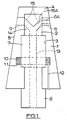
- the nozzle comprises a stationary component 1 and a rotatable component 2. Both components are made in one-piece from refractory materials. They are interlocked so that whilst the rotatable component 2 can be rotated relative to the stationary component 1 they are restrained from relative movement longitudinally and laterally of the rotational axis of the rotatable component, and are inseparable.
- the stationary component 1 is of a frusto-conical shape. It has a hollow interior 3 which opens through the bottom of the component.
- the top 4 of the component is closed.
- a major portion of the rotatable component 2 is contained within the stationary component 1. That portion is cylindrical with an enlarged diameter intermediate part 7.
- the interior 3 of the stationary component is shaped complementally to the portion of the rotatable component which it accommodates. There is a close fitting interconnection between the mating surfaces of the interior 3 at the rotatable component which permits rotation of the rotatable components but resists all other relative movement between the components, and also resists ingress of metal between the surfaces when the nozzle is in use.
- the interconnection at the enlarged intermediate part 7 of the rotatable component locks the two components together against separation.
- a lower end portion of the rotatable component is of square or other suitable non-circular cross-section, or is splined, to form an operating spigot 8 for engagement by a ringed end of a lever 9, Figures 3 and 4, for turning the component manually.
- a porous inert-gas ring 10 is fitted about the enlarged intermediate part 7 of the rotatable component and is engaged in a locating annular recess 11 in the interior 3 of the stationary component.
- a gas feed pipe 12 extends through the refractory material of the stationary component from its bottom face to the ring 10.
- inert gas for example argon
- the gas pressure in the gap also helps to provide further resistance to ingress of metal between the interfaces.
- the ring 10 may be made of a porous refractory material and be formed by a process using a sacrificial reticulated polyurethane foam impregnated with an aqueous slurry of refractory material and a binder. The impregnated foam is dried to remove water and fired to burn off the organic foam to produce a refractory foam replica.
- the ring may be a solid refractory ring which is rendered gas-permeable by drilling very fine bores to form gas conduits.
- a similar ring may be formed by the use of organic filaments which may be incorporated in the refractory ring during manufacture and which on subsequent heating are burnt off to leave fine interconnecting conduits.
- the rotatable component has an axial bore 13 which forms a nozzle outlet and extends through the component from the bottom end face of the operating spigot 8 to an upper end part 14 of the component, above the enlarged diameter intermediate part 7, where it divides into two feeder entries 15.
- the feeder entries 15 extend outwardly and upwardly and open through the circumferential surface of the upper end part 14 at diametrically opposite positions at the level of the flow apertures 6 in the stationary component.
- the feeder entries are of similar diameters to the flow apertures with which they can be moved into and out of register by rotation of the rotatable component relative to the stationary component.
- the division of the axial bore 13 into the feeder entries 15 leaves the upper end of the rotatable component completely closed and solid.
- FIG. 1 An alternative arrangement of the flow apertures in the stationary component and of the feeder entries in the rotatable component is indicated by chain-dot lines in Figure 1.
- running, flow aperture 6A is of smaller diameter than the other, starting, flow aperture 6, and one of the feeder entries, 15A, tapers to a diameter at its mouth, or is for its length of a reduced diameter, corresponding to that of the running flow aperture 6A.
- the flow apertures 6, 6A and feeder entries 15, 15A are so disposed that in one angular position of the rotatable component the starting flow aperture 6 and the feeder entry 15 of corresponding diameter are brought into register, which is a convenient mode of the nozzle for the start of pouring, and in another angular position the running flow aperture 6A and the tapering feeder entry 15A are brought into register instead for continuing the pouring.
- the two components are made from castable refractory materials containing binders. Suitable binders are those including phosphoric acid and an ethyl-silicate, but other binders may be used if preferred.
- the components are made by the preferred method described above. Firstly the rotatable component is produced using a polystyrene, or other appropriate high definition, core to define the axial bore 13 and feeder entries 15 of the component. After establishing green strength, the refractory component is partially fired at the recognised temperature for the binders to become effective but at a temperature which is not high enough for hysteresis to occur. The core is lost by pyrolysis in the course of the partial firing.
- the stationary component is then cast in a conic mould around the partially fired rotatable component, after having first applied a varnish to the latter component.
- the ring 10 is located in the mould prior to casting of the stationary component.
- the varnish is applied to a uniform thickness over the whole of the surface of the interior 3 which is to mate with the rotatable component.
- a non-active refractory, meltable wax or similar, parting compound may alternatively be used but varnish is convenient to use.
- Destructable inserts again conveniently made of polystyrene or other such material which are destructable upon firing, are provided to define the flow apertures 6 of the stationary component.
- the assembly of the two components is then fully cured and fired in the appropriate cycle of temperature and time, the temperature being higher than that at which the rotatable component had been partially fired.
- the rotatable component shrinks away from the stationary component in the course of this full firing.
- the varnish prevents the components from being bonded together during casting of the stationary component and is lost during the full firing of the assembly.
- the stationary component may be cast first using a destructable core to define its interior 3 and the flow apertures 6, and the rotatable component then cast inside it.
- the stationary component is a unitary casting. It may alternatively be of a composite construction.
- the stationary component may be made in two parts which connect together about the rotatable component to form the complete component.
- an upper part 16 formed with the flow apertures 6 and having an internally screw-threaded, co-axial, socket 17 in its bottom end, and a lower part 18 which contains the porous ring 10 and feed pipe 12 and has an axial, externally screw-threaded, spigot 19 which screws into the socket 17 and is surrounded by an annular shoulder 20 at its root.
- the two parts 16 and 18 together define the hollow interior 3 of the component in which the rotatable component 2 is located, its enlarged intermediate part 7 being partially accommodated in each of the two parts.
- the rotatable component is slightly modified in that its lower end portion is of the same circular cross-section as the rest of the component below the intermediate part 7 to aid assembly of the ring 10 and lower part 18 of the stationary component on the rotatable component.
- the upper and lower parts 16, 18 are made separately from one another and from the rotatable component.
- the lower part 18, containing the porous ring 10 is first fitted on to the lower portion of the rotatable component, and then the upper part 16 is slid over the upper portion of the rotatable component and screwed on to the spigot 19 of the lower part.
- the spigot 19 is slightly shorter than the socket 17.
- a collar may be fitted to the lower end portion of the rotatable component, below the lower part of the stationary component, for engagement by a lever, or other suitable implement, for turning the rotatable component manually relative to the stationary component.
- a refractory material from which either one or both of the components may be made is a graphitised alumina composition.
- the composition comprises by weight, 30-60% alumina and 5-30% graphite. This material is known for use in connection with steel and other molten metals.
- One or both of the components described may be made in other ways, as by moulding or a process of isostatic or high pressure linear pressing.
- the spigot 8, or the collar may be adapted for turning the rotatable component by power-driven means, if required.
- the spigot or collar may be connected for turning by a hydraulically-operated piston, or there may be a mechanical drive such as a rack and pinion in which the spigot is engaged with, or the collar may be, the pinion.
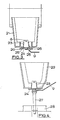
- the nozzle is mounted in the bottom of a vessel which is to hold molten metal for pouring.
- the vessel may, for example, be a foundry type ladle 21 as shown in Figure 3, or a tundish 22 as shown in Figure 4 for use in billet or bloom casting.
- the stationary component of the nozzle is engaged and sealed in a complementary frusto-conical opening 23 in the bottom of the vessel, and is secured by a retaining ring 24 held fast to the underside of the exterior of the vessel by pegs 25 fixed to the vessel and wedges 26.
- the upper end of the stationary component projects into the vessel to an extent such that the flow apertures 6 are above the level of the lining of the vessel.
- the stationary component may be readily disconnected from the vessel for repair or replacement of the nozzle.
- the lever 9 for turning the rotatable component is applied to the component below the retaining ring 24.
- the rotatable component can be turned relative to the stationary component between a pouring position in which the feeder entries 15 are in register with the flow apertures 6 and metal can flow out of the vessel through the nozzle outlet bore 13, and a closed position in which the feeder entries are out of register with the flow apertures.
- all residual metal in the feeder entries and nozzle outlet of the rotatable component drain out of the nozzle.
- the nozzle is self-draining which is particularly advantageous because there is no problem of metal solidifying in the nozzle, and hence the periods for which the nozzle can be left closed between pourings are not limited. Pouring will commence immediately upon turning the rotatable component to the pouring position.
- a submerged entry shroud 27 may be fitted to the rotatable component, for example, for feeding metal into a billet or bloom mould 28 or for shielded casting of steel in a continuous casting process.
- the submerged entry shroud 27 rotates with the rotatable component. It may be straight, as shown, or bifurcated.
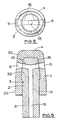
- the stationary component 1 has an oval external circumferential shape.
- the stationary component is located and sealed in an opening of complementary oval shape in the bottom of the vessel to which the nozzle is fitted.
- the interengagement between the stationary component and the opening prevents rotatation of the stationary component with the rotatable component relative to the vessel.
- a lower portion 29 of the stationary component is of a constant cross-section, and an upper portion 30 of the component containing the flow apertures 6 tapers upwardly and merges into the closed top 4 of the component at a well-rounded radius.
- the rotatable component 2 has a cylindrical stem portion 31 and an enlarged, upwardly tapering, head portion 32 accommodated in the complementally shaped interior 3 of the stationary component. The taper of the head portion 32 similarly merges into the top of the head portion at a well-rounded radius.
- the close fitting interconnection between the mating surfaces of the interior 3 of the stationary component at the stem and head portion of the rotatable component permits rotation of the rotatable component in the stationary component but resists other relative movement between the components.
- the nozzle outlet in the rotatable component is again formed by an axial bore 13 from the upper end of which two oppositely directed feeder entries 15, of similar diameter of the inner ends of the flow apertures 6, extend outwardly and slightly upwardly to the tapering circumferential surface of the head portion 32 at the level of the inner ends of the flow apertures.
- a lower part of the stem portion 31 projects out of the bottom of the stationary component to form the operating spigot 8 of the rotatable component, which may be splined or otherwise suitably formed for engagement by a ringed end of a lever or by power-driven means.
- the stationary component 1 of the further modified form of the nozzle illustrated by Figure 7 is of a double frusto-conical external shape tapering towards its opposite ends from a short cylindrical central portion 33.
- a lower frusto-conical portion 34 locates in and is sealed in an opening 23 of complementary shape in the bottom of the vessel to which the nozzle is fitted for use. The location is made from inside the vessel, which is convenient when the vessel is a tundish or small ladle.
- An upper frusto-conical portion 35 contains the flow apertures 6 of which again there are two, being diametrically opposed and outwardly flared.
- the rotatable component 2 has an upwardly tapering head portion 36 within the upper frusto-conical portion 34 of the stationary component, and a stem portion 37 which for the greater part of its length from the head portion flares downwardly and terminates in a downwardly tapering frusto-conical lower end 38 spaced below the bottom of the stationary component.
- Adjacent the stem portion 37 the head portion 36 has a narrow bevelled annular undersurface 39.
- the interior 3 of the stationary component is shaped complementally to the head portion 36, the bevelled undersurface 39 and the adjoining part of the stem portion 37 of the rotatable component to permit rotation of the latter but no other relative movement between the two components.
- the nozzle outlet in the rotatable component is formed, as before, by an axial bore 13 extending down from the head portion, through the stem portion and the lower end 38 and having two oppositely directed feeder entries 15, of similar diameter to the inner ends of the flow apertures 6, extending to the tapering circumferential surface of the head portion at the level of the flow apertures. That part of the stem portion 37 projecting below the stationary component forms the spigot 8 of the rotatable component for turning the component. At the spigot 8, in the region where the flared part of the stem portion 37 and the frusto-conical lower end 38 meet, splines 40 are formed for engagement by a ringed end of a lever or by power-driven means.
- the lower end 38 of the stem portion 37 of the rotatable component can co-operate with a submerged entry shroud 27.
- lower and upper externally tapering portions 34 and 35 of the stationary component have been described as frusto-conical it will be understood that at least the lower portion may also be of tapering oval, or other non-circular, external circumferential shape for engagement with an opening of complementary shape in the bottom of the vessel to which the nozzle is fitted for use.
- the stationary and rotatable components may be interlocked in other ways from those described and illustrated.
- One or the other may be formed with an annular groove or recess with which a keying projection or projections on the other engage to allow the rotatable component to rotate in the stationary component and yet restrain other relative movement between the components.
- an annular groove may be formed in the circumference of the rotatable component, and angularly spaced orifices may be formed in the stationary component opposite the groove into which a castable refractory is injected to enter into the groove and be fixed to the stationary component in the orifices, thereby locking the rotatable component in the stationary component.
- the groove Prior to injecting the castable refractory the groove is coated with varnish or other suitable parting agent to prevent the refractory from bonding to the rotatable component.
- Another possibility is to form a groove in the circumference of the rotatable components and locate pre-formed segments, which may be made of refractory, in an adjacent recess or recesses in the stationary component to project into the groove.
- the segments may be urged into the groove by spring loading, for example provided by helical compression springs held against outer circumferential surfaces of the segments in the recess or recesses by a circumferential band or annulus fitted around the stationary component opposite the recess or recesses.
Landscapes
- Engineering & Computer Science (AREA)
- Mechanical Engineering (AREA)
- Casting Support Devices, Ladles, And Melt Control Thereby (AREA)
- Continuous Casting (AREA)
- Manufacture Of Alloys Or Alloy Compounds (AREA)
- Furnace Charging Or Discharging (AREA)
- Thermally Insulated Containers For Foods (AREA)
- Closures For Containers (AREA)
- Catching Or Destruction (AREA)
- Taps Or Cocks (AREA)
- Forging (AREA)
Priority Applications (1)
| Application Number | Priority Date | Filing Date | Title |
|---|---|---|---|
| AT88308787T ATE85249T1 (de) | 1987-10-01 | 1988-09-22 | Drehgiessduese fuer ein gefaess zum aufbewahren von geschmolzenem metall. |
Applications Claiming Priority (2)
| Application Number | Priority Date | Filing Date | Title |
|---|---|---|---|
| GB878723059A GB8723059D0 (en) | 1987-10-01 | 1987-10-01 | Rotary pouring nozzle |
| GB8723059 | 1987-10-01 |
Publications (3)
| Publication Number | Publication Date |
|---|---|
| EP0310296A2 true EP0310296A2 (de) | 1989-04-05 |
| EP0310296A3 EP0310296A3 (en) | 1990-05-16 |
| EP0310296B1 EP0310296B1 (de) | 1993-02-03 |
Family
ID=10624645
Family Applications (1)
| Application Number | Title | Priority Date | Filing Date |
|---|---|---|---|
| EP88308787A Expired - Lifetime EP0310296B1 (de) | 1987-10-01 | 1988-09-22 | Drehgiessdüse für ein Gefäss zum Aufbewahren von geschmolzenem Metall |
Country Status (11)
| Country | Link |
|---|---|
| US (1) | US4840295A (de) |
| EP (1) | EP0310296B1 (de) |
| JP (1) | JPH01107952A (de) |
| KR (1) | KR890006324A (de) |
| CN (1) | CN1041552A (de) |
| AT (1) | ATE85249T1 (de) |
| AU (1) | AU2270188A (de) |
| BR (1) | BR8805043A (de) |
| DE (1) | DE3878125T2 (de) |
| GB (1) | GB8723059D0 (de) |
| ZA (1) | ZA887363B (de) |
Cited By (4)
| Publication number | Priority date | Publication date | Assignee | Title |
|---|---|---|---|---|
| EP0423449A3 (en) * | 1989-10-17 | 1991-12-04 | Didier-Werke Ag | Shut-off and/or control element for a metallurgical container |
| EP0474863A4 (en) * | 1989-06-01 | 1992-05-06 | Shinagawa Refractories Co., Ltd. | Apparatus for controlling flow rate of molten metal |
| WO1992012815A1 (en) * | 1991-01-18 | 1992-08-06 | Foseco International Limited | Vessel outlet |
| GB2226263B (en) * | 1988-12-22 | 1992-11-04 | Steel Castings Res | Valve for vessel outlet |
Families Citing this family (10)
| Publication number | Priority date | Publication date | Assignee | Title |
|---|---|---|---|---|
| DE3731600A1 (de) * | 1987-09-19 | 1989-04-06 | Didier Werke Ag | Drehschiebeverschluss fuer ein metallurigsches gefaess sowie rotor und/oder stator fuer einen solchen drehverschluss |
| CH676811A5 (de) * | 1988-09-29 | 1991-03-15 | Stopinc Ag | |
| DE4001095A1 (de) * | 1990-01-17 | 1991-07-18 | Didier Werke Ag | Verschlusseinrichtung fuer ein schmelzengefaess |
| CA2084845A1 (en) * | 1992-12-08 | 1994-06-09 | Roderick I.L. Guthrie | Flow control device for the suppression of vortices |
| US5916471A (en) * | 1998-11-10 | 1999-06-29 | North American Refractories Co. | Rotary socket taphole assembly |
| FI120385B (fi) * | 2007-07-06 | 2009-10-15 | Indref Oy | Sulkumekanismi sulan metallin annostelemiseksi ja menetelmä sulkumekanismin valmistamiseksi |
| JP2010188398A (ja) * | 2009-02-19 | 2010-09-02 | Kurosaki Harima Corp | スライディングノズル装置 |
| CN108247033B (zh) * | 2018-01-17 | 2020-07-21 | 武汉科技大学 | 一种连铸中间包用旋流上水口 |
| JP7133948B2 (ja) * | 2018-03-06 | 2022-09-09 | 黒崎播磨株式会社 | 羽口の設置構造 |
| CN109226734B (zh) * | 2018-11-19 | 2023-08-25 | 泰州市旺鑫耐火材料有限公司 | 一种中包水口自动控流装置 |
Family Cites Families (8)
| Publication number | Priority date | Publication date | Assignee | Title |
|---|---|---|---|---|
| US2698630A (en) * | 1951-04-19 | 1955-01-04 | Gen Motors Corp | Valve |
| NL162579B (nl) * | 1969-02-22 | Didier Werke Ag | Inrichting voor het regelen en het afsluiten van de afvoer van gesmolten metaal door een bodemopening uit een reservoir. | |
| DE1910247A1 (de) * | 1969-02-28 | 1970-09-10 | Neitzel Dipl Ing Martin | Vorrichtung und Verfahren zum Abgiessen von metallurgischen Schmelzen und aehnlichen Produkten |
| US3651998A (en) * | 1970-09-23 | 1972-03-28 | Metallurg Exoproducts Corp | Nozzle for a pouring ladle |
| CH553610A (de) * | 1971-06-09 | 1974-09-13 | Bieri Hans | Verschlusseinrichtung fuer die am boden angeordneten auslassoeffnungen von giesspfannen oder zwischenbehaeltern. |
| AT357283B (de) * | 1977-09-16 | 1980-06-25 | Voest Alpine Ag | Drehschieberverschluss fuer mit feuerfester auskleidung versehene gefaesse |
| CH662762A5 (de) * | 1984-05-23 | 1987-10-30 | Stopinc Ag | Drehschiebeverschluss fuer metallurgische schmelzgefaesse. |
| AU591889B2 (en) * | 1985-03-26 | 1989-12-21 | British Steel Plc | Improvements in or relating to outlet valves for metal containing vessels |
-
1987
- 1987-10-01 GB GB878723059A patent/GB8723059D0/en active Pending
-
1988
- 1988-09-19 US US07/246,313 patent/US4840295A/en not_active Expired - Fee Related
- 1988-09-22 AT AT88308787T patent/ATE85249T1/de not_active IP Right Cessation
- 1988-09-22 EP EP88308787A patent/EP0310296B1/de not_active Expired - Lifetime
- 1988-09-22 AU AU22701/88A patent/AU2270188A/en not_active Abandoned
- 1988-09-22 DE DE8888308787T patent/DE3878125T2/de not_active Expired - Fee Related
- 1988-09-28 JP JP63243732A patent/JPH01107952A/ja active Pending
- 1988-09-30 BR BR8805043A patent/BR8805043A/pt unknown
- 1988-09-30 ZA ZA887363A patent/ZA887363B/xx unknown
- 1988-10-01 CN CN88109092A patent/CN1041552A/zh active Pending
- 1988-10-04 KR KR1019880012946A patent/KR890006324A/ko not_active Withdrawn
Cited By (7)
| Publication number | Priority date | Publication date | Assignee | Title |
|---|---|---|---|---|
| GB2226263B (en) * | 1988-12-22 | 1992-11-04 | Steel Castings Res | Valve for vessel outlet |
| EP0474863A4 (en) * | 1989-06-01 | 1992-05-06 | Shinagawa Refractories Co., Ltd. | Apparatus for controlling flow rate of molten metal |
| EP0423449A3 (en) * | 1989-10-17 | 1991-12-04 | Didier-Werke Ag | Shut-off and/or control element for a metallurgical container |
| WO1992012815A1 (en) * | 1991-01-18 | 1992-08-06 | Foseco International Limited | Vessel outlet |
| AU653987B2 (en) * | 1991-01-18 | 1994-10-20 | Foseco International Limited | Vessel outlet |
| ES2085200A2 (es) * | 1991-01-18 | 1996-05-16 | Foseco Int | Boca de salida para recipientes de colada de metal fundido. |
| US5603859A (en) * | 1991-01-18 | 1997-02-18 | Foseco International Limited | Vessel outlet |
Also Published As
| Publication number | Publication date |
|---|---|
| EP0310296A3 (en) | 1990-05-16 |
| BR8805043A (pt) | 1989-05-09 |
| AU2270188A (en) | 1989-04-06 |
| DE3878125T2 (de) | 1993-05-27 |
| EP0310296B1 (de) | 1993-02-03 |
| US4840295A (en) | 1989-06-20 |
| KR890006324A (ko) | 1989-06-13 |
| ATE85249T1 (de) | 1993-02-15 |
| GB8723059D0 (en) | 1987-11-04 |
| CN1041552A (zh) | 1990-04-25 |
| DE3878125D1 (de) | 1993-03-18 |
| JPH01107952A (ja) | 1989-04-25 |
| ZA887363B (en) | 1989-06-28 |
Similar Documents
| Publication | Publication Date | Title |
|---|---|---|
| EP0310296B1 (de) | Drehgiessdüse für ein Gefäss zum Aufbewahren von geschmolzenem Metall | |
| US4946083A (en) | One-piece stopper rod | |
| GB1575601A (en) | Refractory structures for outlet valves for metallurgical vessels | |
| EP0281267B1 (de) | Anlagen und Vorrichtung zum Einblasen von Gas in sehr heisse Flüssigkeiten, beispielsweise in geschmolzene Metalle | |
| EP0022373B2 (de) | Stranggiessvorrichtung | |
| JPH07308757A (ja) | スライディングノズルプレート | |
| US4365731A (en) | Refractory structures | |
| US5819838A (en) | Method of manufacturing a bimetallic grinding wheel | |
| JP3426177B2 (ja) | 鋳造用ストッパー | |
| CN1072536C (zh) | 带有铸造板的耐火材料浇注管及其制造方法 | |
| SU1722220A3 (ru) | Запирающий и/или регулирующий орган дл выпуска жидкого металла из металлургической емкости | |
| EP0509699A1 (de) | Gasdurchlässiger Giesslochstein | |
| CA1340564C (en) | Refractory stator/rotor unit for a valve at the outlet of a vessel containing metal melt | |
| US4555094A (en) | Process for the repair of slide plates | |
| GB2150868A (en) | Porous plug assemblies for molten metal vessels e.g. ladles | |
| US4330107A (en) | Teapot ladle and method of use | |
| EP0882534B1 (de) | Vorrichtung und deren Verwendung zum Herstellen eines Zylinderblockes einer Brennkraftmaschine | |
| US7017647B2 (en) | Method for casting objects with an improved hub core assembly | |
| US3980271A (en) | Pouring of molten metals | |
| JPH09141405A (ja) | 連続鋳造用タンディッシュストッパー | |
| CA2433595A1 (en) | Well block for metallurgical vessel | |
| JPH0235629B2 (de) | ||
| US5695675A (en) | Arrangement and method for connection of a stopper rod for a metallurgical vessel to a lifting device | |
| CA2567598C (en) | Sliding plate | |
| PL187631B1 (pl) | Zespół rury wlewowej dla kadzi do odlewania syfonowego |
Legal Events
| Date | Code | Title | Description |
|---|---|---|---|
| PUAI | Public reference made under article 153(3) epc to a published international application that has entered the european phase |
Free format text: ORIGINAL CODE: 0009012 |
|
| AK | Designated contracting states |
Kind code of ref document: A2 Designated state(s): AT BE CH DE ES FR GB GR IT LI LU NL SE |
|
| PUAL | Search report despatched |
Free format text: ORIGINAL CODE: 0009013 |
|
| AK | Designated contracting states |
Kind code of ref document: A3 Designated state(s): AT BE CH DE ES FR GB GR IT LI LU NL SE |
|
| 17P | Request for examination filed |
Effective date: 19900704 |
|
| 17Q | First examination report despatched |
Effective date: 19911115 |
|
| GRAA | (expected) grant |
Free format text: ORIGINAL CODE: 0009210 |
|
| AK | Designated contracting states |
Kind code of ref document: B1 Designated state(s): AT BE CH DE ES FR GB GR IT LI LU NL SE |
|
| PG25 | Lapsed in a contracting state [announced via postgrant information from national office to epo] |
Ref country code: IT Free format text: LAPSE BECAUSE OF FAILURE TO SUBMIT A TRANSLATION OF THE DESCRIPTION OR TO PAY THE FEE WITHIN THE PRE;WARNING: LAPSES OF ITALIAN PATENTS WITH EFFECTIVE DATE BEFORE 2007 MAY HAVE OCCURRED AT ANY TIME BEFORE 2007. THE CORRECT EFFECTIVE DATE MAY BE DIFFERENT FROM THE ONE RECORDED.SCRIBED TIME-LIMIT Effective date: 19930203 Ref country code: GR Free format text: LAPSE BECAUSE OF FAILURE TO SUBMIT A TRANSLATION OF THE DESCRIPTION OR TO PAY THE FEE WITHIN THE PRESCRIBED TIME-LIMIT Effective date: 19930203 Ref country code: SE Effective date: 19930203 Ref country code: NL Effective date: 19930203 Ref country code: LI Effective date: 19930203 Ref country code: ES Free format text: THE PATENT HAS BEEN ANNULLED BY A DECISION OF A NATIONAL AUTHORITY Effective date: 19930203 Ref country code: AT Effective date: 19930203 Ref country code: CH Effective date: 19930203 |
|
| REF | Corresponds to: |
Ref document number: 85249 Country of ref document: AT Date of ref document: 19930215 Kind code of ref document: T |
|
| REF | Corresponds to: |
Ref document number: 3878125 Country of ref document: DE Date of ref document: 19930318 |
|
| REG | Reference to a national code |
Ref country code: CH Ref legal event code: PL |
|
| ET | Fr: translation filed | ||
| NLV1 | Nl: lapsed or annulled due to failure to fulfill the requirements of art. 29p and 29m of the patents act | ||
| PLBI | Opposition filed |
Free format text: ORIGINAL CODE: 0009260 |
|
| PLBI | Opposition filed |
Free format text: ORIGINAL CODE: 0009260 |
|
| 26 | Opposition filed |
Opponent name: DIDIER-WERKE AG Effective date: 19931102 |
|
| 26 | Opposition filed |
Opponent name: VEITSCH-RADEX AKTIENGESELLSCHAFT FUER FEUERFESTE E Effective date: 19931103 Opponent name: DIDIER-WERKE AG Effective date: 19931102 |
|
| EPTA | Lu: last paid annual fee | ||
| PLAB | Opposition data, opponent's data or that of the opponent's representative modified |
Free format text: ORIGINAL CODE: 0009299OPPO |
|
| R26 | Opposition filed (corrected) |
Opponent name: DIDIER-WERKE AG * 931103 VEITSCH-RADEX AKTIENGESEL Effective date: 19931102 |
|
| PGFP | Annual fee paid to national office [announced via postgrant information from national office to epo] |
Ref country code: LU Payment date: 19950801 Year of fee payment: 8 |
|
| PGFP | Annual fee paid to national office [announced via postgrant information from national office to epo] |
Ref country code: FR Payment date: 19950803 Year of fee payment: 8 |
|
| PGFP | Annual fee paid to national office [announced via postgrant information from national office to epo] |
Ref country code: GB Payment date: 19950815 Year of fee payment: 8 |
|
| PGFP | Annual fee paid to national office [announced via postgrant information from national office to epo] |
Ref country code: DE Payment date: 19950823 Year of fee payment: 8 |
|
| PGFP | Annual fee paid to national office [announced via postgrant information from national office to epo] |
Ref country code: BE Payment date: 19950824 Year of fee payment: 8 |
|
| PG25 | Lapsed in a contracting state [announced via postgrant information from national office to epo] |
Ref country code: LU Free format text: LAPSE BECAUSE OF NON-PAYMENT OF DUE FEES Effective date: 19960922 Ref country code: GB Effective date: 19960922 |
|
| PG25 | Lapsed in a contracting state [announced via postgrant information from national office to epo] |
Ref country code: FR Effective date: 19960930 Ref country code: BE Effective date: 19960930 |
|
| APAC | Appeal dossier modified |
Free format text: ORIGINAL CODE: EPIDOS NOAPO |
|
| APAC | Appeal dossier modified |
Free format text: ORIGINAL CODE: EPIDOS NOAPO |
|
| BERE | Be: lapsed |
Owner name: FOSECO INTERNATIONAL LTD Effective date: 19960930 |
|
| GBPC | Gb: european patent ceased through non-payment of renewal fee |
Effective date: 19960922 |
|
| PG25 | Lapsed in a contracting state [announced via postgrant information from national office to epo] |
Ref country code: DE Effective date: 19970603 |
|
| REG | Reference to a national code |
Ref country code: FR Ref legal event code: ST |
|
| APAC | Appeal dossier modified |
Free format text: ORIGINAL CODE: EPIDOS NOAPO |
|
| PLBL | Opposition procedure terminated |
Free format text: ORIGINAL CODE: EPIDOS OPPC |
|
| REG | Reference to a national code |
Ref country code: FR Ref legal event code: ST |
|
| PLBL | Opposition procedure terminated |
Free format text: ORIGINAL CODE: EPIDOS OPPC |
|
| PLBL | Opposition procedure terminated |
Free format text: ORIGINAL CODE: EPIDOS OPPC |
|
| PLBM | Termination of opposition procedure: date of legal effect published |
Free format text: ORIGINAL CODE: 0009276 |
|
| D27C | Opposition proceedings terminated (deleted) | ||
| PLAD | Information related to termination of opposition procedure modified |
Free format text: ORIGINAL CODE: 0009299OPPC |
|
| STAA | Information on the status of an ep patent application or granted ep patent |
Free format text: STATUS: OPPOSITION PROCEDURE CLOSED |
|
| R27C | Opposition proceedings terminated (corrected) |
Effective date: 19970929 |
|
| APAH | Appeal reference modified |
Free format text: ORIGINAL CODE: EPIDOSCREFNO |