EP0307666A1 - Phenol-terminierte Polyurethane oder Polyharnstoffe und Epoxidharze enthaltend diese Verbindungen - Google Patents
Phenol-terminierte Polyurethane oder Polyharnstoffe und Epoxidharze enthaltend diese Verbindungen Download PDFInfo
- Publication number
- EP0307666A1 EP0307666A1 EP88113697A EP88113697A EP0307666A1 EP 0307666 A1 EP0307666 A1 EP 0307666A1 EP 88113697 A EP88113697 A EP 88113697A EP 88113697 A EP88113697 A EP 88113697A EP 0307666 A1 EP0307666 A1 EP 0307666A1
- Authority
- EP
- European Patent Office
- Prior art keywords
- formula
- terminated
- groups
- compounds
- hydroxyl
- Prior art date
- Legal status (The legal status is an assumption and is not a legal conclusion. Google has not performed a legal analysis and makes no representation as to the accuracy of the status listed.)
- Withdrawn
Links
- 150000001875 compounds Chemical class 0.000 title claims abstract description 96
- 239000003822 epoxy resin Substances 0.000 title claims abstract description 34
- 229920000647 polyepoxide Polymers 0.000 title claims abstract description 34
- LNEPOXFFQSENCJ-UHFFFAOYSA-N haloperidol Chemical compound C1CC(O)(C=2C=CC(Cl)=CC=2)CCN1CCCC(=O)C1=CC=C(F)C=C1 LNEPOXFFQSENCJ-UHFFFAOYSA-N 0.000 title claims abstract description 33
- 239000004814 polyurethane Substances 0.000 title description 17
- 229920002635 polyurethane Polymers 0.000 title description 14
- 229920002396 Polyurea Polymers 0.000 title description 12
- ISWSIDIOOBJBQZ-UHFFFAOYSA-N phenol group Chemical group C1(=CC=CC=C1)O ISWSIDIOOBJBQZ-UHFFFAOYSA-N 0.000 claims abstract description 124
- 239000012948 isocyanate Substances 0.000 claims abstract description 53
- 150000002513 isocyanates Chemical group 0.000 claims abstract description 50
- 125000002887 hydroxy group Chemical group [H]O* 0.000 claims abstract description 32
- 235000013824 polyphenols Nutrition 0.000 claims abstract description 32
- CDAWCLOXVUBKRW-UHFFFAOYSA-N 2-aminophenol Chemical compound NC1=CC=CC=C1O CDAWCLOXVUBKRW-UHFFFAOYSA-N 0.000 claims abstract description 27
- 125000003277 amino group Chemical group 0.000 claims abstract description 16
- 150000008442 polyphenolic compounds Chemical class 0.000 claims abstract description 14
- 239000000853 adhesive Substances 0.000 claims abstract description 7
- 230000001070 adhesive effect Effects 0.000 claims abstract description 7
- 239000001257 hydrogen Substances 0.000 claims abstract description 6
- 229910052739 hydrogen Inorganic materials 0.000 claims abstract description 6
- 125000001997 phenyl group Chemical group [H]C1=C([H])C([H])=C(*)C([H])=C1[H] 0.000 claims abstract description 4
- 239000000203 mixture Substances 0.000 claims description 109
- -1 cycloaliphatic Chemical group 0.000 claims description 70
- 229920005989 resin Polymers 0.000 claims description 55
- 239000011347 resin Substances 0.000 claims description 55
- 229920001228 polyisocyanate Polymers 0.000 claims description 45
- 239000005056 polyisocyanate Substances 0.000 claims description 44
- 150000003254 radicals Chemical class 0.000 claims description 36
- RTZKZFJDLAIYFH-UHFFFAOYSA-N ether Substances CCOCC RTZKZFJDLAIYFH-UHFFFAOYSA-N 0.000 claims description 33
- 229920000570 polyether Polymers 0.000 claims description 25
- IISBACLAFKSPIT-UHFFFAOYSA-N bisphenol A Chemical compound C=1C=C(O)C=CC=1C(C)(C)C1=CC=C(O)C=C1 IISBACLAFKSPIT-UHFFFAOYSA-N 0.000 claims description 23
- 238000006243 chemical reaction Methods 0.000 claims description 22
- 125000001931 aliphatic group Chemical group 0.000 claims description 21
- 125000005442 diisocyanate group Chemical group 0.000 claims description 20
- 238000000034 method Methods 0.000 claims description 19
- 238000002360 preparation method Methods 0.000 claims description 17
- 239000004970 Chain extender Substances 0.000 claims description 16
- 229920001281 polyalkylene Polymers 0.000 claims description 15
- 229920000728 polyester Polymers 0.000 claims description 15
- 229930185605 Bisphenol Natural products 0.000 claims description 14
- 239000004721 Polyphenylene oxide Substances 0.000 claims description 14
- IQPQWNKOIGAROB-UHFFFAOYSA-N isocyanate group Chemical group [N-]=C=O IQPQWNKOIGAROB-UHFFFAOYSA-N 0.000 claims description 13
- 238000004519 manufacturing process Methods 0.000 claims description 13
- 239000004593 Epoxy Substances 0.000 claims description 12
- 229920005862 polyol Polymers 0.000 claims description 11
- 150000002009 diols Chemical class 0.000 claims description 10
- 125000003118 aryl group Chemical group 0.000 claims description 9
- 238000010438 heat treatment Methods 0.000 claims description 9
- 229920001515 polyalkylene glycol Polymers 0.000 claims description 8
- 125000000217 alkyl group Chemical group 0.000 claims description 6
- 125000000882 C2-C6 alkenyl group Chemical group 0.000 claims description 5
- 125000003601 C2-C6 alkynyl group Chemical group 0.000 claims description 5
- 229920002121 Hydroxyl-terminated polybutadiene Polymers 0.000 claims description 5
- XEEYBQQBJWHFJM-UHFFFAOYSA-N Iron Chemical compound [Fe] XEEYBQQBJWHFJM-UHFFFAOYSA-N 0.000 claims description 5
- XSTXAVWGXDQKEL-UHFFFAOYSA-N Trichloroethylene Chemical compound ClC=C(Cl)Cl XSTXAVWGXDQKEL-UHFFFAOYSA-N 0.000 claims description 4
- 125000004432 carbon atom Chemical group C* 0.000 claims description 4
- 239000003795 chemical substances by application Substances 0.000 claims description 4
- UFHFLCQGNIYNRP-UHFFFAOYSA-N Hydrogen Chemical compound [H][H] UFHFLCQGNIYNRP-UHFFFAOYSA-N 0.000 claims description 3
- 229910052736 halogen Inorganic materials 0.000 claims description 3
- 150000002367 halogens Chemical class 0.000 claims description 3
- 239000004922 lacquer Substances 0.000 claims description 3
- 239000011159 matrix material Substances 0.000 claims description 3
- 239000002313 adhesive film Substances 0.000 claims description 2
- 150000005840 aryl radicals Chemical class 0.000 claims description 2
- PXBRQCKWGAHEHS-UHFFFAOYSA-N dichlorodifluoromethane Chemical compound FC(F)(Cl)Cl PXBRQCKWGAHEHS-UHFFFAOYSA-N 0.000 claims description 2
- 239000000565 sealant Substances 0.000 claims description 2
- CVRALZAYCYJELZ-UHFFFAOYSA-N O-(4-bromo-2,5-dichlorophenyl) O-methyl phenylphosphonothioate Chemical compound C=1C=CC=CC=1P(=S)(OC)OC1=CC(Cl)=C(Br)C=C1Cl CVRALZAYCYJELZ-UHFFFAOYSA-N 0.000 claims 1
- 150000002431 hydrogen Chemical class 0.000 claims 1
- 125000004435 hydrogen atom Chemical class [H]* 0.000 abstract description 3
- 125000004169 (C1-C6) alkyl group Chemical group 0.000 abstract 1
- IJGRMHOSHXDMSA-UHFFFAOYSA-N Atomic nitrogen Chemical compound N#N IJGRMHOSHXDMSA-UHFFFAOYSA-N 0.000 description 96
- 125000003580 L-valyl group Chemical group [H]N([H])[C@]([H])(C(=O)[*])C(C([H])([H])[H])(C([H])([H])[H])[H] 0.000 description 79
- 229910052757 nitrogen Inorganic materials 0.000 description 55
- 229920001451 polypropylene glycol Polymers 0.000 description 42
- UKLDJPRMSDWDSL-UHFFFAOYSA-L [dibutyl(dodecanoyloxy)stannyl] dodecanoate Chemical compound CCCCCCCCCCCC(=O)O[Sn](CCCC)(CCCC)OC(=O)CCCCCCCCCCC UKLDJPRMSDWDSL-UHFFFAOYSA-L 0.000 description 32
- 239000012975 dibutyltin dilaurate Substances 0.000 description 31
- 238000004458 analytical method Methods 0.000 description 28
- PLIKAWJENQZMHA-UHFFFAOYSA-N 4-aminophenol Chemical compound NC1=CC=C(O)C=C1 PLIKAWJENQZMHA-UHFFFAOYSA-N 0.000 description 27
- ZJCCRDAZUWHFQH-UHFFFAOYSA-N Trimethylolpropane Chemical compound CCC(CO)(CO)CO ZJCCRDAZUWHFQH-UHFFFAOYSA-N 0.000 description 24
- LYCAIKOWRPUZTN-UHFFFAOYSA-N Ethylene glycol Chemical group OCCO LYCAIKOWRPUZTN-UHFFFAOYSA-N 0.000 description 22
- PUQRJGODUZWXMF-UHFFFAOYSA-N 4-[2-(4-hydroxy-2-prop-2-enylphenyl)propan-2-yl]-3-prop-2-enylphenol Chemical compound C=1C=C(O)C=C(CC=C)C=1C(C)(C)C1=CC=C(O)C=C1CC=C PUQRJGODUZWXMF-UHFFFAOYSA-N 0.000 description 21
- 239000000047 product Substances 0.000 description 19
- 238000003756 stirring Methods 0.000 description 18
- 150000001252 acrylic acid derivatives Chemical class 0.000 description 13
- NIMLQBUJDJZYEJ-UHFFFAOYSA-N isophorone diisocyanate Chemical compound CC1(C)CC(N=C=O)CC(C)(CN=C=O)C1 NIMLQBUJDJZYEJ-UHFFFAOYSA-N 0.000 description 13
- 239000005058 Isophorone diisocyanate Substances 0.000 description 12
- VPWNQTHUCYMVMZ-UHFFFAOYSA-N 4,4'-sulfonyldiphenol Chemical class C1=CC(O)=CC=C1S(=O)(=O)C1=CC=C(O)C=C1 VPWNQTHUCYMVMZ-UHFFFAOYSA-N 0.000 description 10
- WYURNTSHIVDZCO-UHFFFAOYSA-N Tetrahydrofuran Chemical compound C1CCOC1 WYURNTSHIVDZCO-UHFFFAOYSA-N 0.000 description 10
- WERYXYBDKMZEQL-UHFFFAOYSA-N butane-1,4-diol Chemical compound OCCCCO WERYXYBDKMZEQL-UHFFFAOYSA-N 0.000 description 10
- 239000004848 polyfunctional curative Substances 0.000 description 10
- WSFSSNUMVMOOMR-UHFFFAOYSA-N Formaldehyde Chemical compound O=C WSFSSNUMVMOOMR-UHFFFAOYSA-N 0.000 description 9
- YXFVVABEGXRONW-UHFFFAOYSA-N Toluene Chemical compound CC1=CC=CC=C1 YXFVVABEGXRONW-UHFFFAOYSA-N 0.000 description 9
- 239000002253 acid Substances 0.000 description 9
- 150000007513 acids Chemical class 0.000 description 9
- WGCNASOHLSPBMP-UHFFFAOYSA-N hydroxyacetaldehyde Natural products OCC=O WGCNASOHLSPBMP-UHFFFAOYSA-N 0.000 description 9
- 229920001748 polybutylene Polymers 0.000 description 9
- PPBRXRYQALVLMV-UHFFFAOYSA-N Styrene Chemical compound C=CC1=CC=CC=C1 PPBRXRYQALVLMV-UHFFFAOYSA-N 0.000 description 8
- 239000003054 catalyst Substances 0.000 description 8
- XLYOFNOQVPJJNP-UHFFFAOYSA-N water Substances O XLYOFNOQVPJJNP-UHFFFAOYSA-N 0.000 description 8
- 229910000831 Steel Inorganic materials 0.000 description 7
- RRAMGCGOFNQTLD-UHFFFAOYSA-N hexamethylene diisocyanate Chemical group O=C=NCCCCCCN=C=O RRAMGCGOFNQTLD-UHFFFAOYSA-N 0.000 description 7
- 150000002989 phenols Chemical class 0.000 description 7
- 229920000642 polymer Polymers 0.000 description 7
- 239000010959 steel Substances 0.000 description 7
- RYHBNJHYFVUHQT-UHFFFAOYSA-N 1,4-Dioxane Chemical compound C1COCCO1 RYHBNJHYFVUHQT-UHFFFAOYSA-N 0.000 description 6
- BRLQWZUYTZBJKN-UHFFFAOYSA-N Epichlorohydrin Chemical compound ClCC1CO1 BRLQWZUYTZBJKN-UHFFFAOYSA-N 0.000 description 6
- QIGBRXMKCJKVMJ-UHFFFAOYSA-N Hydroquinone Chemical compound OC1=CC=C(O)C=C1 QIGBRXMKCJKVMJ-UHFFFAOYSA-N 0.000 description 6
- PXKLMJQFEQBVLD-UHFFFAOYSA-N bisphenol F Chemical compound C1=CC(O)=CC=C1CC1=CC=C(O)C=C1 PXKLMJQFEQBVLD-UHFFFAOYSA-N 0.000 description 6
- 238000009833 condensation Methods 0.000 description 6
- 230000005494 condensation Effects 0.000 description 6
- QQVIHTHCMHWDBS-UHFFFAOYSA-N isophthalic acid Chemical compound OC(=O)C1=CC=CC(C(O)=O)=C1 QQVIHTHCMHWDBS-UHFFFAOYSA-N 0.000 description 6
- GHMLBKRAJCXXBS-UHFFFAOYSA-N resorcinol Chemical compound OC1=CC=CC(O)=C1 GHMLBKRAJCXXBS-UHFFFAOYSA-N 0.000 description 6
- VYPSYNLAJGMNEJ-UHFFFAOYSA-N silicon dioxide Inorganic materials O=[Si]=O VYPSYNLAJGMNEJ-UHFFFAOYSA-N 0.000 description 6
- 150000003673 urethanes Chemical class 0.000 description 6
- 125000003903 2-propenyl group Chemical group [H]C([*])([H])C([H])=C([H])[H] 0.000 description 5
- PEDCQBHIVMGVHV-UHFFFAOYSA-N Glycerine Chemical compound OCC(O)CO PEDCQBHIVMGVHV-UHFFFAOYSA-N 0.000 description 5
- 239000005057 Hexamethylene diisocyanate Substances 0.000 description 5
- DNIAPMSPPWPWGF-UHFFFAOYSA-N Propylene glycol Chemical compound CC(O)CO DNIAPMSPPWPWGF-UHFFFAOYSA-N 0.000 description 5
- WNLRTRBMVRJNCN-UHFFFAOYSA-N adipic acid Chemical compound OC(=O)CCCCC(O)=O WNLRTRBMVRJNCN-UHFFFAOYSA-N 0.000 description 5
- QGBSISYHAICWAH-UHFFFAOYSA-N dicyandiamide Chemical compound NC(N)=NC#N QGBSISYHAICWAH-UHFFFAOYSA-N 0.000 description 5
- 150000002334 glycols Chemical class 0.000 description 5
- 125000002496 methyl group Chemical group [H]C([H])([H])* 0.000 description 5
- 229920000768 polyamine Polymers 0.000 description 5
- 150000003077 polyols Chemical class 0.000 description 5
- 239000000243 solution Substances 0.000 description 5
- UPMLOUAZCHDJJD-UHFFFAOYSA-N 4,4'-Diphenylmethane Diisocyanate Chemical compound C1=CC(N=C=O)=CC=C1CC1=CC=C(N=C=O)C=C1 UPMLOUAZCHDJJD-UHFFFAOYSA-N 0.000 description 4
- LCFVJGUPQDGYKZ-UHFFFAOYSA-N Bisphenol A diglycidyl ether Chemical compound C=1C=C(OCC2OC2)C=CC=1C(C)(C)C(C=C1)=CC=C1OCC1CO1 LCFVJGUPQDGYKZ-UHFFFAOYSA-N 0.000 description 4
- 239000005494 Chlorotoluron Substances 0.000 description 4
- MUBZPKHOEPUJKR-UHFFFAOYSA-N Oxalic acid Chemical compound OC(=O)C(O)=O MUBZPKHOEPUJKR-UHFFFAOYSA-N 0.000 description 4
- GOOHAUXETOMSMM-UHFFFAOYSA-N Propylene oxide Chemical compound CC1CO1 GOOHAUXETOMSMM-UHFFFAOYSA-N 0.000 description 4
- KKEYFWRCBNTPAC-UHFFFAOYSA-N Terephthalic acid Chemical compound OC(=O)C1=CC=C(C(O)=O)C=C1 KKEYFWRCBNTPAC-UHFFFAOYSA-N 0.000 description 4
- WTEOIRVLGSZEPR-UHFFFAOYSA-N boron trifluoride Chemical compound FB(F)F WTEOIRVLGSZEPR-UHFFFAOYSA-N 0.000 description 4
- 235000013877 carbamide Nutrition 0.000 description 4
- 239000007795 chemical reaction product Substances 0.000 description 4
- JXCGFZXSOMJFOA-UHFFFAOYSA-N chlorotoluron Chemical compound CN(C)C(=O)NC1=CC=C(C)C(Cl)=C1 JXCGFZXSOMJFOA-UHFFFAOYSA-N 0.000 description 4
- 235000014113 dietary fatty acids Nutrition 0.000 description 4
- 239000000194 fatty acid Substances 0.000 description 4
- 229930195729 fatty acid Natural products 0.000 description 4
- 150000004665 fatty acids Chemical class 0.000 description 4
- 230000009477 glass transition Effects 0.000 description 4
- NAQMVNRVTILPCV-UHFFFAOYSA-N hexane-1,6-diamine Chemical compound NCCCCCCN NAQMVNRVTILPCV-UHFFFAOYSA-N 0.000 description 4
- BDJRBEYXGGNYIS-UHFFFAOYSA-N nonanedioic acid Chemical compound OC(=O)CCCCCCCC(O)=O BDJRBEYXGGNYIS-UHFFFAOYSA-N 0.000 description 4
- 229920003986 novolac Polymers 0.000 description 4
- XNGIFLGASWRNHJ-UHFFFAOYSA-N phthalic acid Chemical compound OC(=O)C1=CC=CC=C1C(O)=O XNGIFLGASWRNHJ-UHFFFAOYSA-N 0.000 description 4
- 229920000909 polytetrahydrofuran Polymers 0.000 description 4
- CXMXRPHRNRROMY-UHFFFAOYSA-N sebacic acid Chemical compound OC(=O)CCCCCCCCC(O)=O CXMXRPHRNRROMY-UHFFFAOYSA-N 0.000 description 4
- 150000003512 tertiary amines Chemical class 0.000 description 4
- RIOQSEWOXXDEQQ-UHFFFAOYSA-N triphenylphosphine Chemical compound C1=CC=CC=C1P(C=1C=CC=CC=1)C1=CC=CC=C1 RIOQSEWOXXDEQQ-UHFFFAOYSA-N 0.000 description 4
- ZWEHNKRNPOVVGH-UHFFFAOYSA-N 2-Butanone Chemical compound CCC(C)=O ZWEHNKRNPOVVGH-UHFFFAOYSA-N 0.000 description 3
- 125000001494 2-propynyl group Chemical group [H]C#CC([H])([H])* 0.000 description 3
- RNLHGQLZWXBQNY-UHFFFAOYSA-N 3-(aminomethyl)-3,5,5-trimethylcyclohexan-1-amine Chemical compound CC1(C)CC(N)CC(C)(CN)C1 RNLHGQLZWXBQNY-UHFFFAOYSA-N 0.000 description 3
- WOCGGVRGNIEDSZ-UHFFFAOYSA-N 4-[2-(4-hydroxy-3-prop-2-enylphenyl)propan-2-yl]-2-prop-2-enylphenol Chemical compound C=1C=C(O)C(CC=C)=CC=1C(C)(C)C1=CC=C(O)C(CC=C)=C1 WOCGGVRGNIEDSZ-UHFFFAOYSA-N 0.000 description 3
- OXTJFBHLOXGCPW-UHFFFAOYSA-N 6-cyanatohexyl cyanate Chemical compound N#COCCCCCCOC#N OXTJFBHLOXGCPW-UHFFFAOYSA-N 0.000 description 3
- NLHHRLWOUZZQLW-UHFFFAOYSA-N Acrylonitrile Chemical compound C=CC#N NLHHRLWOUZZQLW-UHFFFAOYSA-N 0.000 description 3
- 229910002019 Aerosil® 380 Inorganic materials 0.000 description 3
- 244000226021 Anacardium occidentale Species 0.000 description 3
- ZAMOUSCENKQFHK-UHFFFAOYSA-N Chlorine atom Chemical compound [Cl] ZAMOUSCENKQFHK-UHFFFAOYSA-N 0.000 description 3
- YMWUJEATGCHHMB-UHFFFAOYSA-N Dichloromethane Chemical compound ClCCl YMWUJEATGCHHMB-UHFFFAOYSA-N 0.000 description 3
- XEKOWRVHYACXOJ-UHFFFAOYSA-N Ethyl acetate Chemical compound CCOC(C)=O XEKOWRVHYACXOJ-UHFFFAOYSA-N 0.000 description 3
- JOYRKODLDBILNP-UHFFFAOYSA-N Ethyl urethane Chemical compound CCOC(N)=O JOYRKODLDBILNP-UHFFFAOYSA-N 0.000 description 3
- YGYAWVDWMABLBF-UHFFFAOYSA-N Phosgene Chemical compound ClC(Cl)=O YGYAWVDWMABLBF-UHFFFAOYSA-N 0.000 description 3
- 230000002378 acidificating effect Effects 0.000 description 3
- 150000001412 amines Chemical class 0.000 description 3
- 150000008064 anhydrides Chemical class 0.000 description 3
- 235000020226 cashew nut Nutrition 0.000 description 3
- 239000000460 chlorine Substances 0.000 description 3
- 229910052801 chlorine Inorganic materials 0.000 description 3
- MTHSVFCYNBDYFN-UHFFFAOYSA-N diethylene glycol Chemical compound OCCOCCO MTHSVFCYNBDYFN-UHFFFAOYSA-N 0.000 description 3
- 229920001971 elastomer Polymers 0.000 description 3
- 239000000806 elastomer Substances 0.000 description 3
- 150000002148 esters Chemical class 0.000 description 3
- 239000000835 fiber Substances 0.000 description 3
- 229910021485 fumed silica Inorganic materials 0.000 description 3
- 229920000578 graft copolymer Polymers 0.000 description 3
- XXMIOPMDWAUFGU-UHFFFAOYSA-N hexane-1,6-diol Chemical compound OCCCCCCO XXMIOPMDWAUFGU-UHFFFAOYSA-N 0.000 description 3
- 229940042795 hydrazides for tuberculosis treatment Drugs 0.000 description 3
- RAXXELZNTBOGNW-UHFFFAOYSA-N imidazole Natural products C1=CNC=N1 RAXXELZNTBOGNW-UHFFFAOYSA-N 0.000 description 3
- VLKZOEOYAKHREP-UHFFFAOYSA-N n-Hexane Chemical compound CCCCCC VLKZOEOYAKHREP-UHFFFAOYSA-N 0.000 description 3
- 239000010466 nut oil Substances 0.000 description 3
- 239000003973 paint Substances 0.000 description 3
- 238000006068 polycondensation reaction Methods 0.000 description 3
- 229920006295 polythiol Polymers 0.000 description 3
- 229920003226 polyurethane urea Polymers 0.000 description 3
- 239000000843 powder Substances 0.000 description 3
- DVKJHBMWWAPEIU-UHFFFAOYSA-N toluene 2,4-diisocyanate Chemical compound CC1=CC=C(N=C=O)C=C1N=C=O DVKJHBMWWAPEIU-UHFFFAOYSA-N 0.000 description 3
- 150000004072 triols Chemical class 0.000 description 3
- KMOUUZVZFBCRAM-OLQVQODUSA-N (3as,7ar)-3a,4,7,7a-tetrahydro-2-benzofuran-1,3-dione Chemical compound C1C=CC[C@@H]2C(=O)OC(=O)[C@@H]21 KMOUUZVZFBCRAM-OLQVQODUSA-N 0.000 description 2
- ZWVMLYRJXORSEP-UHFFFAOYSA-N 1,2,6-Hexanetriol Chemical compound OCCCCC(O)CO ZWVMLYRJXORSEP-UHFFFAOYSA-N 0.000 description 2
- 125000006017 1-propenyl group Chemical group 0.000 description 2
- AHDSRXYHVZECER-UHFFFAOYSA-N 2,4,6-tris[(dimethylamino)methyl]phenol Chemical compound CN(C)CC1=CC(CN(C)C)=C(O)C(CN(C)C)=C1 AHDSRXYHVZECER-UHFFFAOYSA-N 0.000 description 2
- HZAXFHJVJLSVMW-UHFFFAOYSA-N 2-Aminoethan-1-ol Chemical compound NCCO HZAXFHJVJLSVMW-UHFFFAOYSA-N 0.000 description 2
- XLLIQLLCWZCATF-UHFFFAOYSA-N 2-methoxyethyl acetate Chemical compound COCCOC(C)=O XLLIQLLCWZCATF-UHFFFAOYSA-N 0.000 description 2
- WPTUDAOQIXOMIQ-UHFFFAOYSA-N 3-(hydroxymethyl)pentane-2,4-diol Chemical compound CC(O)C(CO)C(C)O WPTUDAOQIXOMIQ-UHFFFAOYSA-N 0.000 description 2
- YBRVSVVVWCFQMG-UHFFFAOYSA-N 4,4'-diaminodiphenylmethane Chemical compound C1=CC(N)=CC=C1CC1=CC=C(N)C=C1 YBRVSVVVWCFQMG-UHFFFAOYSA-N 0.000 description 2
- QGZKDVFQNNGYKY-UHFFFAOYSA-N Ammonia Chemical compound N QGZKDVFQNNGYKY-UHFFFAOYSA-N 0.000 description 2
- PAYRUJLWNCNPSJ-UHFFFAOYSA-N Aniline Chemical compound NC1=CC=CC=C1 PAYRUJLWNCNPSJ-UHFFFAOYSA-N 0.000 description 2
- 229910015900 BF3 Inorganic materials 0.000 description 2
- WKBOTKDWSSQWDR-UHFFFAOYSA-N Bromine atom Chemical compound [Br] WKBOTKDWSSQWDR-UHFFFAOYSA-N 0.000 description 2
- FBPFZTCFMRRESA-FSIIMWSLSA-N D-Glucitol Natural products OC[C@H](O)[C@H](O)[C@@H](O)[C@H](O)CO FBPFZTCFMRRESA-FSIIMWSLSA-N 0.000 description 2
- FBPFZTCFMRRESA-JGWLITMVSA-N D-glucitol Chemical compound OC[C@H](O)[C@@H](O)[C@H](O)[C@H](O)CO FBPFZTCFMRRESA-JGWLITMVSA-N 0.000 description 2
- PIICEJLVQHRZGT-UHFFFAOYSA-N Ethylenediamine Chemical compound NCCN PIICEJLVQHRZGT-UHFFFAOYSA-N 0.000 description 2
- OAKJQQAXSVQMHS-UHFFFAOYSA-N Hydrazine Chemical compound NN OAKJQQAXSVQMHS-UHFFFAOYSA-N 0.000 description 2
- BAVYZALUXZFZLV-UHFFFAOYSA-N Methylamine Chemical compound NC BAVYZALUXZFZLV-UHFFFAOYSA-N 0.000 description 2
- NBIIXXVUZAFLBC-UHFFFAOYSA-N Phosphoric acid Chemical compound OP(O)(O)=O NBIIXXVUZAFLBC-UHFFFAOYSA-N 0.000 description 2
- GLUUGHFHXGJENI-UHFFFAOYSA-N Piperazine Chemical compound C1CNCCN1 GLUUGHFHXGJENI-UHFFFAOYSA-N 0.000 description 2
- ATUOYWHBWRKTHZ-UHFFFAOYSA-N Propane Chemical compound CCC ATUOYWHBWRKTHZ-UHFFFAOYSA-N 0.000 description 2
- AWMVMTVKBNGEAK-UHFFFAOYSA-N Styrene oxide Chemical compound C1OC1C1=CC=CC=C1 AWMVMTVKBNGEAK-UHFFFAOYSA-N 0.000 description 2
- GWEVSGVZZGPLCZ-UHFFFAOYSA-N Titan oxide Chemical compound O=[Ti]=O GWEVSGVZZGPLCZ-UHFFFAOYSA-N 0.000 description 2
- FDLQZKYLHJJBHD-UHFFFAOYSA-N [3-(aminomethyl)phenyl]methanamine Chemical compound NCC1=CC=CC(CN)=C1 FDLQZKYLHJJBHD-UHFFFAOYSA-N 0.000 description 2
- 239000001361 adipic acid Substances 0.000 description 2
- 235000011037 adipic acid Nutrition 0.000 description 2
- 150000001298 alcohols Chemical class 0.000 description 2
- 229910052783 alkali metal Inorganic materials 0.000 description 2
- 150000001340 alkali metals Chemical class 0.000 description 2
- 125000002947 alkylene group Chemical group 0.000 description 2
- XAGFODPZIPBFFR-UHFFFAOYSA-N aluminium Chemical compound [Al] XAGFODPZIPBFFR-UHFFFAOYSA-N 0.000 description 2
- 150000001409 amidines Chemical class 0.000 description 2
- GDTBXPJZTBHREO-UHFFFAOYSA-N bromine Substances BrBr GDTBXPJZTBHREO-UHFFFAOYSA-N 0.000 description 2
- 229910052794 bromium Inorganic materials 0.000 description 2
- VLLYOYVKQDKAHN-UHFFFAOYSA-N buta-1,3-diene;2-methylbuta-1,3-diene Chemical compound C=CC=C.CC(=C)C=C VLLYOYVKQDKAHN-UHFFFAOYSA-N 0.000 description 2
- 229910052799 carbon Inorganic materials 0.000 description 2
- 125000003178 carboxy group Chemical group [H]OC(*)=O 0.000 description 2
- 125000001309 chloro group Chemical group Cl* 0.000 description 2
- 239000011248 coating agent Substances 0.000 description 2
- 238000007334 copolymerization reaction Methods 0.000 description 2
- 238000004132 cross linking Methods 0.000 description 2
- SCONTQOJTFJUQL-UHFFFAOYSA-N cyanic acid 3,5,5-trimethylcyclohex-2-en-1-one Chemical compound OC#N.OC#N.CC1=CC(=O)CC(C)(C)C1 SCONTQOJTFJUQL-UHFFFAOYSA-N 0.000 description 2
- 150000005676 cyclic carbonates Chemical class 0.000 description 2
- QSAWQNUELGIYBC-UHFFFAOYSA-N cyclohexane-1,2-dicarboxylic acid Chemical compound OC(=O)C1CCCCC1C(O)=O QSAWQNUELGIYBC-UHFFFAOYSA-N 0.000 description 2
- JGFBRKRYDCGYKD-UHFFFAOYSA-N dibutyl(oxo)tin Chemical compound CCCC[Sn](=O)CCCC JGFBRKRYDCGYKD-UHFFFAOYSA-N 0.000 description 2
- JXCHMDATRWUOAP-UHFFFAOYSA-N diisocyanatomethylbenzene Chemical compound O=C=NC(N=C=O)C1=CC=CC=C1 JXCHMDATRWUOAP-UHFFFAOYSA-N 0.000 description 2
- 239000000539 dimer Substances 0.000 description 2
- 150000002170 ethers Chemical class 0.000 description 2
- 125000001495 ethyl group Chemical group [H]C([H])([H])C([H])([H])* 0.000 description 2
- 235000011187 glycerol Nutrition 0.000 description 2
- 125000005842 heteroatom Chemical group 0.000 description 2
- 239000012442 inert solvent Substances 0.000 description 2
- 229910052740 iodine Inorganic materials 0.000 description 2
- 229910052751 metal Inorganic materials 0.000 description 2
- 239000002184 metal Substances 0.000 description 2
- 239000000178 monomer Substances 0.000 description 2
- 238000000465 moulding Methods 0.000 description 2
- 125000004108 n-butyl group Chemical group [H]C([H])([H])C([H])([H])C([H])([H])C([H])([H])* 0.000 description 2
- 125000001280 n-hexyl group Chemical group C(CCCCC)* 0.000 description 2
- 125000000740 n-pentyl group Chemical group [H]C([H])([H])C([H])([H])C([H])([H])C([H])([H])C([H])([H])* 0.000 description 2
- 125000004123 n-propyl group Chemical group [H]C([H])([H])C([H])([H])C([H])([H])* 0.000 description 2
- SLCVBVWXLSEKPL-UHFFFAOYSA-N neopentyl glycol Chemical compound OCC(C)(C)CO SLCVBVWXLSEKPL-UHFFFAOYSA-N 0.000 description 2
- QWVGKYWNOKOFNN-UHFFFAOYSA-N o-cresol Chemical compound CC1=CC=CC=C1O QWVGKYWNOKOFNN-UHFFFAOYSA-N 0.000 description 2
- WXZMFSXDPGVJKK-UHFFFAOYSA-N pentaerythritol Chemical compound OCC(CO)(CO)CO WXZMFSXDPGVJKK-UHFFFAOYSA-N 0.000 description 2
- WLJVNTCWHIRURA-UHFFFAOYSA-N pimelic acid Chemical compound OC(=O)CCCCCC(O)=O WLJVNTCWHIRURA-UHFFFAOYSA-N 0.000 description 2
- 239000004417 polycarbonate Substances 0.000 description 2
- 229920000515 polycarbonate Polymers 0.000 description 2
- 229920006149 polyester-amide block copolymer Polymers 0.000 description 2
- 229920006324 polyoxymethylene Polymers 0.000 description 2
- 229920001296 polysiloxane Polymers 0.000 description 2
- YPFDHNVEDLHUCE-UHFFFAOYSA-N propane-1,3-diol Chemical compound OCCCO YPFDHNVEDLHUCE-UHFFFAOYSA-N 0.000 description 2
- 229960004063 propylene glycol Drugs 0.000 description 2
- 235000013772 propylene glycol Nutrition 0.000 description 2
- WQGWDDDVZFFDIG-UHFFFAOYSA-N pyrogallol Chemical compound OC1=CC=CC(O)=C1O WQGWDDDVZFFDIG-UHFFFAOYSA-N 0.000 description 2
- 230000008707 rearrangement Effects 0.000 description 2
- YGSDEFSMJLZEOE-UHFFFAOYSA-N salicylic acid Chemical compound OC(=O)C1=CC=CC=C1O YGSDEFSMJLZEOE-UHFFFAOYSA-N 0.000 description 2
- 239000007787 solid Substances 0.000 description 2
- 239000000600 sorbitol Substances 0.000 description 2
- 238000004611 spectroscopical analysis Methods 0.000 description 2
- TYFQFVWCELRYAO-UHFFFAOYSA-N suberic acid Chemical compound OC(=O)CCCCCCC(O)=O TYFQFVWCELRYAO-UHFFFAOYSA-N 0.000 description 2
- YLQBMQCUIZJEEH-UHFFFAOYSA-N tetrahydrofuran Natural products C=1C=COC=1 YLQBMQCUIZJEEH-UHFFFAOYSA-N 0.000 description 2
- UFDHBDMSHIXOKF-UHFFFAOYSA-N tetrahydrophthalic acid Natural products OC(=O)C1=C(C(O)=O)CCCC1 UFDHBDMSHIXOKF-UHFFFAOYSA-N 0.000 description 2
- YODZTKMDCQEPHD-UHFFFAOYSA-N thiodiglycol Chemical compound OCCSCCO YODZTKMDCQEPHD-UHFFFAOYSA-N 0.000 description 2
- 229950006389 thiodiglycol Drugs 0.000 description 2
- RUELTTOHQODFPA-UHFFFAOYSA-N toluene 2,6-diisocyanate Chemical compound CC1=C(N=C=O)C=CC=C1N=C=O RUELTTOHQODFPA-UHFFFAOYSA-N 0.000 description 2
- JOXIMZWYDAKGHI-UHFFFAOYSA-N toluene-4-sulfonic acid Chemical compound CC1=CC=C(S(O)(=O)=O)C=C1 JOXIMZWYDAKGHI-UHFFFAOYSA-N 0.000 description 2
- 239000013638 trimer Substances 0.000 description 2
- XFNJVJPLKCPIBV-UHFFFAOYSA-N trimethylenediamine Chemical compound NCCCN XFNJVJPLKCPIBV-UHFFFAOYSA-N 0.000 description 2
- QXJQHYBHAIHNGG-UHFFFAOYSA-N trimethylolethane Chemical compound OCC(C)(CO)CO QXJQHYBHAIHNGG-UHFFFAOYSA-N 0.000 description 2
- XSQUKJJJFZCRTK-UHFFFAOYSA-N urea group Chemical group NC(=O)N XSQUKJJJFZCRTK-UHFFFAOYSA-N 0.000 description 2
- 150000003672 ureas Chemical class 0.000 description 2
- 125000000391 vinyl group Chemical group [H]C([*])=C([H])[H] 0.000 description 2
- 229920002554 vinyl polymer Polymers 0.000 description 2
- 239000010456 wollastonite Substances 0.000 description 2
- 229910052882 wollastonite Inorganic materials 0.000 description 2
- PUPZLCDOIYMWBV-UHFFFAOYSA-N (+/-)-1,3-Butanediol Chemical compound CC(O)CCO PUPZLCDOIYMWBV-UHFFFAOYSA-N 0.000 description 1
- NIDNOXCRFUCAKQ-UMRXKNAASA-N (1s,2r,3s,4r)-bicyclo[2.2.1]hept-5-ene-2,3-dicarboxylic acid Chemical compound C1[C@H]2C=C[C@@H]1[C@H](C(=O)O)[C@@H]2C(O)=O NIDNOXCRFUCAKQ-UMRXKNAASA-N 0.000 description 1
- UOCLXMDMGBRAIB-UHFFFAOYSA-N 1,1,1-trichloroethane Chemical compound CC(Cl)(Cl)Cl UOCLXMDMGBRAIB-UHFFFAOYSA-N 0.000 description 1
- VYMPLPIFKRHAAC-UHFFFAOYSA-N 1,2-ethanedithiol Chemical compound SCCS VYMPLPIFKRHAAC-UHFFFAOYSA-N 0.000 description 1
- OUPZKGBUJRBPGC-UHFFFAOYSA-N 1,3,5-tris(oxiran-2-ylmethyl)-1,3,5-triazinane-2,4,6-trione Chemical compound O=C1N(CC2OC2)C(=O)N(CC2OC2)C(=O)N1CC1CO1 OUPZKGBUJRBPGC-UHFFFAOYSA-N 0.000 description 1
- NZPSDGIEKAQVEZ-UHFFFAOYSA-N 1,3-benzodioxol-2-one Chemical compound C1=CC=CC2=C1OC(=O)O2 NZPSDGIEKAQVEZ-UHFFFAOYSA-N 0.000 description 1
- VZWWZEJXAIOUFX-UHFFFAOYSA-N 1,3-bis(3-isocyanato-4-methylphenyl)urea Chemical compound C1=C(N=C=O)C(C)=CC=C1NC(=O)NC1=CC=C(C)C(N=C=O)=C1 VZWWZEJXAIOUFX-UHFFFAOYSA-N 0.000 description 1
- PCHXZXKMYCGVFA-UHFFFAOYSA-N 1,3-diazetidine-2,4-dione Chemical compound O=C1NC(=O)N1 PCHXZXKMYCGVFA-UHFFFAOYSA-N 0.000 description 1
- DEWLEGDTCGBNGU-UHFFFAOYSA-N 1,3-dichloropropan-2-ol Chemical compound ClCC(O)CCl DEWLEGDTCGBNGU-UHFFFAOYSA-N 0.000 description 1
- 125000004955 1,4-cyclohexylene group Chemical group [H]C1([H])C([H])([H])C([H])([*:1])C([H])([H])C([H])([H])C1([H])[*:2] 0.000 description 1
- ATOUXIOKEJWULN-UHFFFAOYSA-N 1,6-diisocyanato-2,2,4-trimethylhexane Chemical compound O=C=NCCC(C)CC(C)(C)CN=C=O ATOUXIOKEJWULN-UHFFFAOYSA-N 0.000 description 1
- XZTUYISAOWDOSC-UHFFFAOYSA-N 1-(4-chlorophenyl)-1,3-dimethylurea Chemical compound CNC(=O)N(C)C1=CC=C(Cl)C=C1 XZTUYISAOWDOSC-UHFFFAOYSA-N 0.000 description 1
- ISNRCPCOXSJZRZ-UHFFFAOYSA-N 1-benzhydryl-2,3,4-triisocyanatobenzene Chemical compound N(=C=O)C1=C(C(=C(C=C1)C(C1=CC=CC=C1)C1=CC=CC=C1)N=C=O)N=C=O ISNRCPCOXSJZRZ-UHFFFAOYSA-N 0.000 description 1
- 125000004973 1-butenyl group Chemical group C(=CCC)* 0.000 description 1
- 125000004972 1-butynyl group Chemical group [H]C([H])([H])C([H])([H])C#C* 0.000 description 1
- NFDXQGNDWIPXQL-UHFFFAOYSA-N 1-cyclooctyldiazocane Chemical compound C1CCCCCCC1N1NCCCCCC1 NFDXQGNDWIPXQL-UHFFFAOYSA-N 0.000 description 1
- 125000006039 1-hexenyl group Chemical group 0.000 description 1
- MCTWTZJPVLRJOU-UHFFFAOYSA-N 1-methyl-1H-imidazole Chemical compound CN1C=CN=C1 MCTWTZJPVLRJOU-UHFFFAOYSA-N 0.000 description 1
- RTBFRGCFXZNCOE-UHFFFAOYSA-N 1-methylsulfonylpiperidin-4-one Chemical compound CS(=O)(=O)N1CCC(=O)CC1 RTBFRGCFXZNCOE-UHFFFAOYSA-N 0.000 description 1
- 125000006023 1-pentenyl group Chemical group 0.000 description 1
- VILCJCGEZXAXTO-UHFFFAOYSA-N 2,2,2-tetramine Chemical compound NCCNCCNCCN VILCJCGEZXAXTO-UHFFFAOYSA-N 0.000 description 1
- JCUZDQXWVYNXHD-UHFFFAOYSA-N 2,2,4-trimethylhexane-1,6-diamine Chemical compound NCCC(C)CC(C)(C)CN JCUZDQXWVYNXHD-UHFFFAOYSA-N 0.000 description 1
- VZDIRINETBAVAV-UHFFFAOYSA-N 2,4-diisocyanato-1-methylcyclohexane Chemical compound CC1CCC(N=C=O)CC1N=C=O VZDIRINETBAVAV-UHFFFAOYSA-N 0.000 description 1
- NSMWYRLQHIXVAP-UHFFFAOYSA-N 2,5-dimethylpiperazine Chemical compound CC1CNC(C)CN1 NSMWYRLQHIXVAP-UHFFFAOYSA-N 0.000 description 1
- RIAIKPXVFURCBS-UHFFFAOYSA-N 2-(2,2,4-trimethylpentoxymethyl)oxirane Chemical compound CC(C)CC(C)(C)COCC1CO1 RIAIKPXVFURCBS-UHFFFAOYSA-N 0.000 description 1
- DAXRGSDCXVUHEW-UHFFFAOYSA-N 2-(benzhydrylamino)ethanol Chemical compound C=1C=CC=CC=1C(NCCO)C1=CC=CC=C1 DAXRGSDCXVUHEW-UHFFFAOYSA-N 0.000 description 1
- YSUQLAYJZDEMOT-UHFFFAOYSA-N 2-(butoxymethyl)oxirane Chemical compound CCCCOCC1CO1 YSUQLAYJZDEMOT-UHFFFAOYSA-N 0.000 description 1
- VVHFXJOCUKBZFS-UHFFFAOYSA-N 2-(chloromethyl)-2-methyloxirane Chemical compound ClCC1(C)CO1 VVHFXJOCUKBZFS-UHFFFAOYSA-N 0.000 description 1
- CUFXMPWHOWYNSO-UHFFFAOYSA-N 2-[(4-methylphenoxy)methyl]oxirane Chemical compound C1=CC(C)=CC=C1OCC1OC1 CUFXMPWHOWYNSO-UHFFFAOYSA-N 0.000 description 1
- OJPDDQSCZGTACX-UHFFFAOYSA-N 2-[n-(2-hydroxyethyl)anilino]ethanol Chemical compound OCCN(CCO)C1=CC=CC=C1 OJPDDQSCZGTACX-UHFFFAOYSA-N 0.000 description 1
- QPKNFEVLZVJGBM-UHFFFAOYSA-N 2-aminonaphthalen-1-ol Chemical class C1=CC=CC2=C(O)C(N)=CC=C21 QPKNFEVLZVJGBM-UHFFFAOYSA-N 0.000 description 1
- SVONRAPFKPVNKG-UHFFFAOYSA-N 2-ethoxyethyl acetate Chemical compound CCOCCOC(C)=O SVONRAPFKPVNKG-UHFFFAOYSA-N 0.000 description 1
- 125000006176 2-ethylbutyl group Chemical group [H]C([H])([H])C([H])([H])C([H])(C([H])([H])*)C([H])([H])C([H])([H])[H] 0.000 description 1
- KXGFMDJXCMQABM-UHFFFAOYSA-N 2-methoxy-6-methylphenol Chemical compound [CH]OC1=CC=CC([CH])=C1O KXGFMDJXCMQABM-UHFFFAOYSA-N 0.000 description 1
- VEORPZCZECFIRK-UHFFFAOYSA-N 3,3',5,5'-tetrabromobisphenol A Chemical compound C=1C(Br)=C(O)C(Br)=CC=1C(C)(C)C1=CC(Br)=C(O)C(Br)=C1 VEORPZCZECFIRK-UHFFFAOYSA-N 0.000 description 1
- RXBBSTXUVVVWRC-UHFFFAOYSA-N 3-[3-[4,4-dimethyl-3-(oxiran-2-ylmethyl)-2,5-dioxoimidazolidin-1-yl]-2-(oxiran-2-ylmethoxy)propyl]-5,5-dimethyl-1-(oxiran-2-ylmethyl)imidazolidine-2,4-dione Chemical compound O=C1N(CC(CN2C(C(C)(C)N(CC3OC3)C2=O)=O)OCC2OC2)C(=O)C(C)(C)N1CC1CO1 RXBBSTXUVVVWRC-UHFFFAOYSA-N 0.000 description 1
- FFWNCSWLUYKKKA-UHFFFAOYSA-N 3-aminophenol Chemical compound NC1=CC=CC(O)=C1.NC1=CC=CC(O)=C1 FFWNCSWLUYKKKA-UHFFFAOYSA-N 0.000 description 1
- AMUBKBXGFDIMDJ-UHFFFAOYSA-N 3-heptyl-1,2-bis(9-isocyanatononyl)-4-pentylcyclohexane Chemical compound CCCCCCCC1C(CCCCC)CCC(CCCCCCCCCN=C=O)C1CCCCCCCCCN=C=O AMUBKBXGFDIMDJ-UHFFFAOYSA-N 0.000 description 1
- NZGQHKSLKRFZFL-UHFFFAOYSA-N 4-(4-hydroxyphenoxy)phenol Chemical compound C1=CC(O)=CC=C1OC1=CC=C(O)C=C1 NZGQHKSLKRFZFL-UHFFFAOYSA-N 0.000 description 1
- DZIHTWJGPDVSGE-UHFFFAOYSA-N 4-[(4-aminocyclohexyl)methyl]cyclohexan-1-amine Chemical compound C1CC(N)CCC1CC1CCC(N)CC1 DZIHTWJGPDVSGE-UHFFFAOYSA-N 0.000 description 1
- WXQZLPFNTPKVJM-UHFFFAOYSA-N 4-[(4-hydroxycyclohexyl)methyl]cyclohexan-1-ol Chemical compound C1CC(O)CCC1CC1CCC(O)CC1 WXQZLPFNTPKVJM-UHFFFAOYSA-N 0.000 description 1
- HDPBBNNDDQOWPJ-UHFFFAOYSA-N 4-[1,2,2-tris(4-hydroxyphenyl)ethyl]phenol Chemical compound C1=CC(O)=CC=C1C(C=1C=CC(O)=CC=1)C(C=1C=CC(O)=CC=1)C1=CC=C(O)C=C1 HDPBBNNDDQOWPJ-UHFFFAOYSA-N 0.000 description 1
- BDBZTOMUANOKRT-UHFFFAOYSA-N 4-[2-(4-aminocyclohexyl)propan-2-yl]cyclohexan-1-amine Chemical compound C1CC(N)CCC1C(C)(C)C1CCC(N)CC1 BDBZTOMUANOKRT-UHFFFAOYSA-N 0.000 description 1
- CDBAMNGURPMUTG-UHFFFAOYSA-N 4-[2-(4-hydroxycyclohexyl)propan-2-yl]cyclohexan-1-ol Chemical compound C1CC(O)CCC1C(C)(C)C1CCC(O)CC1 CDBAMNGURPMUTG-UHFFFAOYSA-N 0.000 description 1
- NUKYPUAOHBNCPY-UHFFFAOYSA-N 4-aminopyridine Chemical compound NC1=CC=NC=C1 NUKYPUAOHBNCPY-UHFFFAOYSA-N 0.000 description 1
- WXNZTHHGJRFXKQ-UHFFFAOYSA-N 4-chlorophenol Chemical compound OC1=CC=C(Cl)C=C1 WXNZTHHGJRFXKQ-UHFFFAOYSA-N 0.000 description 1
- 125000004203 4-hydroxyphenyl group Chemical group [H]OC1=C([H])C([H])=C(*)C([H])=C1[H] 0.000 description 1
- SWVKFORRAJEMKK-UHFFFAOYSA-N 4-methylcyclohexane-1,1-diamine Chemical compound CC1CCC(N)(N)CC1 SWVKFORRAJEMKK-UHFFFAOYSA-N 0.000 description 1
- YWVFNWVZBAWOOY-UHFFFAOYSA-N 4-methylcyclohexane-1,2-dicarboxylic acid Chemical compound CC1CCC(C(O)=O)C(C(O)=O)C1 YWVFNWVZBAWOOY-UHFFFAOYSA-N 0.000 description 1
- QHPQWRBYOIRBIT-UHFFFAOYSA-N 4-tert-butylphenol Chemical compound CC(C)(C)C1=CC=C(O)C=C1 QHPQWRBYOIRBIT-UHFFFAOYSA-N 0.000 description 1
- YIROYDNZEPTFOL-UHFFFAOYSA-N 5,5-Dimethylhydantoin Chemical compound CC1(C)NC(=O)NC1=O YIROYDNZEPTFOL-UHFFFAOYSA-N 0.000 description 1
- OQAPYXJOOYQXDV-UHFFFAOYSA-N 5,5-dimethyl-3-[2-(oxiran-2-ylmethoxy)propyl]-1-(oxiran-2-ylmethyl)imidazolidine-2,4-dione Chemical compound C1OC1COC(C)CN(C(C1(C)C)=O)C(=O)N1CC1CO1 OQAPYXJOOYQXDV-UHFFFAOYSA-N 0.000 description 1
- VQVIHDPBMFABCQ-UHFFFAOYSA-N 5-(1,3-dioxo-2-benzofuran-5-carbonyl)-2-benzofuran-1,3-dione Chemical compound C1=C2C(=O)OC(=O)C2=CC(C(C=2C=C3C(=O)OC(=O)C3=CC=2)=O)=C1 VQVIHDPBMFABCQ-UHFFFAOYSA-N 0.000 description 1
- SVLTVRFYVWMEQN-UHFFFAOYSA-N 5-methylcyclohex-3-ene-1,2-dicarboxylic acid Chemical compound CC1CC(C(O)=O)C(C(O)=O)C=C1 SVLTVRFYVWMEQN-UHFFFAOYSA-N 0.000 description 1
- ULKLGIFJWFIQFF-UHFFFAOYSA-N 5K8XI641G3 Chemical compound CCC1=NC=C(C)N1 ULKLGIFJWFIQFF-UHFFFAOYSA-N 0.000 description 1
- RREANTFLPGEWEN-MBLPBCRHSA-N 7-[4-[[(3z)-3-[4-amino-5-[(3,4,5-trimethoxyphenyl)methyl]pyrimidin-2-yl]imino-5-fluoro-2-oxoindol-1-yl]methyl]piperazin-1-yl]-1-cyclopropyl-6-fluoro-4-oxoquinoline-3-carboxylic acid Chemical compound COC1=C(OC)C(OC)=CC(CC=2C(=NC(\N=C/3C4=CC(F)=CC=C4N(CN4CCN(CC4)C=4C(=CC=5C(=O)C(C(O)=O)=CN(C=5C=4)C4CC4)F)C\3=O)=NC=2)N)=C1 RREANTFLPGEWEN-MBLPBCRHSA-N 0.000 description 1
- ZCYVEMRRCGMTRW-UHFFFAOYSA-N 7553-56-2 Chemical compound [I] ZCYVEMRRCGMTRW-UHFFFAOYSA-N 0.000 description 1
- 239000005995 Aluminium silicate Substances 0.000 description 1
- ZOXJGFHDIHLPTG-UHFFFAOYSA-N Boron Chemical compound [B] ZOXJGFHDIHLPTG-UHFFFAOYSA-N 0.000 description 1
- DKPFZGUDAPQIHT-UHFFFAOYSA-N Butyl acetate Natural products CCCCOC(C)=O DKPFZGUDAPQIHT-UHFFFAOYSA-N 0.000 description 1
- 229920000049 Carbon (fiber) Polymers 0.000 description 1
- MQJKPEGWNLWLTK-UHFFFAOYSA-N Dapsone Chemical compound C1=CC(N)=CC=C1S(=O)(=O)C1=CC=C(N)C=C1 MQJKPEGWNLWLTK-UHFFFAOYSA-N 0.000 description 1
- RPNUMPOLZDHAAY-UHFFFAOYSA-N Diethylenetriamine Chemical compound NCCNCCN RPNUMPOLZDHAAY-UHFFFAOYSA-N 0.000 description 1
- OTMSDBZUPAUEDD-UHFFFAOYSA-N Ethane Chemical compound CC OTMSDBZUPAUEDD-UHFFFAOYSA-N 0.000 description 1
- VGGSQFUCUMXWEO-UHFFFAOYSA-N Ethene Chemical compound C=C VGGSQFUCUMXWEO-UHFFFAOYSA-N 0.000 description 1
- 239000005977 Ethylene Substances 0.000 description 1
- 239000004606 Fillers/Extenders Substances 0.000 description 1
- PXGOKWXKJXAPGV-UHFFFAOYSA-N Fluorine Chemical compound FF PXGOKWXKJXAPGV-UHFFFAOYSA-N 0.000 description 1
- 238000005727 Friedel-Crafts reaction Methods 0.000 description 1
- 239000004831 Hot glue Substances 0.000 description 1
- OYHQOLUKZRVURQ-HZJYTTRNSA-N Linoleic acid Chemical compound CCCCC\C=C/C\C=C/CCCCCCCC(O)=O OYHQOLUKZRVURQ-HZJYTTRNSA-N 0.000 description 1
- NTIZESTWPVYFNL-UHFFFAOYSA-N Methyl isobutyl ketone Chemical compound CC(C)CC(C)=O NTIZESTWPVYFNL-UHFFFAOYSA-N 0.000 description 1
- UIHCLUNTQKBZGK-UHFFFAOYSA-N Methyl isobutyl ketone Natural products CCC(C)C(C)=O UIHCLUNTQKBZGK-UHFFFAOYSA-N 0.000 description 1
- OKIZCWYLBDKLSU-UHFFFAOYSA-M N,N,N-Trimethylmethanaminium chloride Chemical compound [Cl-].C[N+](C)(C)C OKIZCWYLBDKLSU-UHFFFAOYSA-M 0.000 description 1
- KYIMHWNKQXQBDG-UHFFFAOYSA-N N=C=O.N=C=O.CCCCCC Chemical compound N=C=O.N=C=O.CCCCCC KYIMHWNKQXQBDG-UHFFFAOYSA-N 0.000 description 1
- CTQNGGLPUBDAKN-UHFFFAOYSA-N O-Xylene Chemical compound CC1=CC=CC=C1C CTQNGGLPUBDAKN-UHFFFAOYSA-N 0.000 description 1
- ALQSHHUCVQOPAS-UHFFFAOYSA-N Pentane-1,5-diol Chemical compound OCCCCCO ALQSHHUCVQOPAS-UHFFFAOYSA-N 0.000 description 1
- FQYUMYWMJTYZTK-UHFFFAOYSA-N Phenyl glycidyl ether Chemical compound C1OC1COC1=CC=CC=C1 FQYUMYWMJTYZTK-UHFFFAOYSA-N 0.000 description 1
- LGRFSURHDFAFJT-UHFFFAOYSA-N Phthalic anhydride Natural products C1=CC=C2C(=O)OC(=O)C2=C1 LGRFSURHDFAFJT-UHFFFAOYSA-N 0.000 description 1
- 239000004952 Polyamide Substances 0.000 description 1
- 229920002614 Polyether block amide Polymers 0.000 description 1
- 239000004146 Propane-1,2-diol Substances 0.000 description 1
- KDYFGRWQOYBRFD-UHFFFAOYSA-N Succinic acid Natural products OC(=O)CCC(O)=O KDYFGRWQOYBRFD-UHFFFAOYSA-N 0.000 description 1
- ATJFFYVFTNAWJD-UHFFFAOYSA-N Tin Chemical class [Sn] ATJFFYVFTNAWJD-UHFFFAOYSA-N 0.000 description 1
- FZNCGRZWXLXZSZ-CIQUZCHMSA-N Voglibose Chemical compound OCC(CO)N[C@H]1C[C@](O)(CO)[C@@H](O)[C@H](O)[C@H]1O FZNCGRZWXLXZSZ-CIQUZCHMSA-N 0.000 description 1
- YXEBFFWTZWGHEY-UHFFFAOYSA-N [1-(hydroxymethyl)cyclohex-3-en-1-yl]methanol Chemical compound OCC1(CO)CCC=CC1 YXEBFFWTZWGHEY-UHFFFAOYSA-N 0.000 description 1
- YIMQCDZDWXUDCA-UHFFFAOYSA-N [4-(hydroxymethyl)cyclohexyl]methanol Chemical compound OCC1CCC(CO)CC1 YIMQCDZDWXUDCA-UHFFFAOYSA-N 0.000 description 1
- MSILJOYZYPRFDK-UHFFFAOYSA-N [4-[4-(sulfanylmethyl)phenoxy]phenyl]methanethiol Chemical compound C1=CC(CS)=CC=C1OC1=CC=C(CS)C=C1 MSILJOYZYPRFDK-UHFFFAOYSA-N 0.000 description 1
- IKHGUXGNUITLKF-XPULMUKRSA-N acetaldehyde Chemical compound [14CH]([14CH3])=O IKHGUXGNUITLKF-XPULMUKRSA-N 0.000 description 1
- 125000005396 acrylic acid ester group Chemical group 0.000 description 1
- NIXOWILDQLNWCW-UHFFFAOYSA-N acrylic acid group Chemical group C(C=C)(=O)O NIXOWILDQLNWCW-UHFFFAOYSA-N 0.000 description 1
- 239000000654 additive Substances 0.000 description 1
- 239000002318 adhesion promoter Substances 0.000 description 1
- 230000001476 alcoholic effect Effects 0.000 description 1
- 150000001299 aldehydes Chemical class 0.000 description 1
- 239000003513 alkali Substances 0.000 description 1
- 229920000180 alkyd Polymers 0.000 description 1
- HSFWRNGVRCDJHI-UHFFFAOYSA-N alpha-acetylene Natural products C#C HSFWRNGVRCDJHI-UHFFFAOYSA-N 0.000 description 1
- 229910052782 aluminium Inorganic materials 0.000 description 1
- PNEYBMLMFCGWSK-UHFFFAOYSA-N aluminium oxide Inorganic materials [O-2].[O-2].[O-2].[Al+3].[Al+3] PNEYBMLMFCGWSK-UHFFFAOYSA-N 0.000 description 1
- 229910000147 aluminium phosphate Inorganic materials 0.000 description 1
- 235000012211 aluminium silicate Nutrition 0.000 description 1
- 125000003368 amide group Chemical group 0.000 description 1
- 150000001413 amino acids Chemical class 0.000 description 1
- 150000001414 amino alcohols Chemical class 0.000 description 1
- 229910021529 ammonia Inorganic materials 0.000 description 1
- JFCQEDHGNNZCLN-UHFFFAOYSA-N anhydrous glutaric acid Natural products OC(=O)CCCC(O)=O JFCQEDHGNNZCLN-UHFFFAOYSA-N 0.000 description 1
- 238000010539 anionic addition polymerization reaction Methods 0.000 description 1
- 150000001454 anthracenes Chemical class 0.000 description 1
- 239000003963 antioxidant agent Substances 0.000 description 1
- 239000010425 asbestos Substances 0.000 description 1
- 239000010426 asphalt Substances 0.000 description 1
- QVGXLLKOCUKJST-UHFFFAOYSA-N atomic oxygen Chemical compound [O] QVGXLLKOCUKJST-UHFFFAOYSA-N 0.000 description 1
- 239000002585 base Substances 0.000 description 1
- 239000000440 bentonite Substances 0.000 description 1
- 229910000278 bentonite Inorganic materials 0.000 description 1
- SVPXDRXYRYOSEX-UHFFFAOYSA-N bentoquatam Chemical compound O.O=[Si]=O.O=[Al]O[Al]=O SVPXDRXYRYOSEX-UHFFFAOYSA-N 0.000 description 1
- VCCBEIPGXKNHFW-UHFFFAOYSA-N biphenyl-4,4'-diol Chemical group C1=CC(O)=CC=C1C1=CC=C(O)C=C1 VCCBEIPGXKNHFW-UHFFFAOYSA-N 0.000 description 1
- OHJMTUPIZMNBFR-UHFFFAOYSA-N biuret Chemical compound NC(=O)NC(N)=O OHJMTUPIZMNBFR-UHFFFAOYSA-N 0.000 description 1
- 238000012661 block copolymerization Methods 0.000 description 1
- 229910052796 boron Inorganic materials 0.000 description 1
- HQABUPZFAYXKJW-UHFFFAOYSA-N butan-1-amine Chemical compound CCCCN HQABUPZFAYXKJW-UHFFFAOYSA-N 0.000 description 1
- KDYFGRWQOYBRFD-NUQCWPJISA-N butanedioic acid Chemical compound O[14C](=O)CC[14C](O)=O KDYFGRWQOYBRFD-NUQCWPJISA-N 0.000 description 1
- JHIWVOJDXOSYLW-UHFFFAOYSA-N butyl 2,2-difluorocyclopropane-1-carboxylate Chemical compound CCCCOC(=O)C1CC1(F)F JHIWVOJDXOSYLW-UHFFFAOYSA-N 0.000 description 1
- 239000004202 carbamide Substances 0.000 description 1
- 125000002837 carbocyclic group Chemical group 0.000 description 1
- 150000001721 carbon Chemical group 0.000 description 1
- 239000006229 carbon black Substances 0.000 description 1
- 239000004917 carbon fiber Substances 0.000 description 1
- 150000007942 carboxylates Chemical class 0.000 description 1
- 238000005266 casting Methods 0.000 description 1
- 230000003197 catalytic effect Effects 0.000 description 1
- 125000002091 cationic group Chemical group 0.000 description 1
- 238000010538 cationic polymerization reaction Methods 0.000 description 1
- XEHUIDSUOAGHBW-UHFFFAOYSA-N chromium;pentane-2,4-dione Chemical compound [Cr].CC(=O)CC(C)=O.CC(=O)CC(C)=O.CC(=O)CC(C)=O XEHUIDSUOAGHBW-UHFFFAOYSA-N 0.000 description 1
- 239000011280 coal tar Substances 0.000 description 1
- 239000008199 coating composition Substances 0.000 description 1
- 238000000576 coating method Methods 0.000 description 1
- 238000001816 cooling Methods 0.000 description 1
- 229920001577 copolymer Polymers 0.000 description 1
- 150000004292 cyclic ethers Chemical class 0.000 description 1
- 239000011353 cycloaliphatic epoxy resin Substances 0.000 description 1
- 125000000582 cycloheptyl group Chemical class [H]C1([H])C([H])([H])C([H])([H])C([H])([H])C([H])(*)C([H])([H])C1([H])[H] 0.000 description 1
- IFDVQVHZEKPUSC-UHFFFAOYSA-N cyclohex-3-ene-1,2-dicarboxylic acid Chemical compound OC(=O)C1CCC=CC1C(O)=O IFDVQVHZEKPUSC-UHFFFAOYSA-N 0.000 description 1
- VKIRRGRTJUUZHS-UHFFFAOYSA-N cyclohexane-1,4-diamine Chemical compound NC1CCC(N)CC1 VKIRRGRTJUUZHS-UHFFFAOYSA-N 0.000 description 1
- VKONPUDBRVKQLM-UHFFFAOYSA-N cyclohexane-1,4-diol Chemical compound OC1CCC(O)CC1 VKONPUDBRVKQLM-UHFFFAOYSA-N 0.000 description 1
- 150000001934 cyclohexanes Chemical class 0.000 description 1
- FNIATMYXUPOJRW-UHFFFAOYSA-N cyclohexylidene Chemical group [C]1CCCCC1 FNIATMYXUPOJRW-UHFFFAOYSA-N 0.000 description 1
- 150000001940 cyclopentanes Chemical class 0.000 description 1
- 238000007033 dehydrochlorination reaction Methods 0.000 description 1
- 238000000280 densification Methods 0.000 description 1
- 150000004985 diamines Chemical class 0.000 description 1
- 239000012973 diazabicyclooctane Substances 0.000 description 1
- 150000001991 dicarboxylic acids Chemical class 0.000 description 1
- XXBDWLFCJWSEKW-UHFFFAOYSA-N dimethylbenzylamine Chemical compound CN(C)CC1=CC=CC=C1 XXBDWLFCJWSEKW-UHFFFAOYSA-N 0.000 description 1
- 238000004821 distillation Methods 0.000 description 1
- 150000004662 dithiols Chemical class 0.000 description 1
- 239000000975 dye Substances 0.000 description 1
- 230000008030 elimination Effects 0.000 description 1
- 238000003379 elimination reaction Methods 0.000 description 1
- 239000003995 emulsifying agent Substances 0.000 description 1
- 125000003700 epoxy group Chemical group 0.000 description 1
- 238000006266 etherification reaction Methods 0.000 description 1
- 125000002534 ethynyl group Chemical group [H]C#C* 0.000 description 1
- 230000007717 exclusion Effects 0.000 description 1
- 229960004979 fampridine Drugs 0.000 description 1
- 239000000945 filler Substances 0.000 description 1
- 239000003063 flame retardant Substances 0.000 description 1
- 229910052731 fluorine Inorganic materials 0.000 description 1
- 239000011737 fluorine Substances 0.000 description 1
- DYDNPESBYVVLBO-UHFFFAOYSA-N formanilide Chemical compound O=CNC1=CC=CC=C1 DYDNPESBYVVLBO-UHFFFAOYSA-N 0.000 description 1
- 238000009472 formulation Methods 0.000 description 1
- 125000000524 functional group Chemical group 0.000 description 1
- HYBBIBNJHNGZAN-UHFFFAOYSA-N furfural Chemical compound O=CC1=CC=CO1 HYBBIBNJHNGZAN-UHFFFAOYSA-N 0.000 description 1
- ANSXAPJVJOKRDJ-UHFFFAOYSA-N furo[3,4-f][2]benzofuran-1,3,5,7-tetrone Chemical compound C1=C2C(=O)OC(=O)C2=CC2=C1C(=O)OC2=O ANSXAPJVJOKRDJ-UHFFFAOYSA-N 0.000 description 1
- 239000003365 glass fiber Substances 0.000 description 1
- 150000008282 halocarbons Chemical class 0.000 description 1
- PYGSKMBEVAICCR-UHFFFAOYSA-N hexa-1,5-diene Chemical group C=CCCC=C PYGSKMBEVAICCR-UHFFFAOYSA-N 0.000 description 1
- 125000004836 hexamethylene group Chemical group [H]C([H])([*:2])C([H])([H])C([H])([H])C([H])([H])C([H])([H])C([H])([H])[*:1] 0.000 description 1
- WJSATVJYSKVUGV-UHFFFAOYSA-N hexane-1,3,5-triol Chemical compound CC(O)CC(O)CCO WJSATVJYSKVUGV-UHFFFAOYSA-N 0.000 description 1
- FUZZWVXGSFPDMH-UHFFFAOYSA-N hexanoic acid Chemical compound CCCCCC(O)=O FUZZWVXGSFPDMH-UHFFFAOYSA-N 0.000 description 1
- 150000001469 hydantoins Chemical class 0.000 description 1
- YAMHXTCMCPHKLN-UHFFFAOYSA-N imidazolidin-2-one Chemical compound O=C1NCCN1 YAMHXTCMCPHKLN-UHFFFAOYSA-N 0.000 description 1
- 238000007654 immersion Methods 0.000 description 1
- 229910052500 inorganic mineral Inorganic materials 0.000 description 1
- 239000000543 intermediate Substances 0.000 description 1
- 239000011630 iodine Substances 0.000 description 1
- 125000000959 isobutyl group Chemical group [H]C([H])([H])C([H])(C([H])([H])[H])C([H])([H])* 0.000 description 1
- 125000001449 isopropyl group Chemical group [H]C([H])([H])C([H])(*)C([H])([H])[H] 0.000 description 1
- NLYAJNPCOHFWQQ-UHFFFAOYSA-N kaolin Chemical compound O.O.O=[Al]O[Si](=O)O[Si](=O)O[Al]=O NLYAJNPCOHFWQQ-UHFFFAOYSA-N 0.000 description 1
- 150000002576 ketones Chemical class 0.000 description 1
- 150000002596 lactones Chemical class 0.000 description 1
- 238000010030 laminating Methods 0.000 description 1
- 239000004611 light stabiliser Substances 0.000 description 1
- 235000020778 linoleic acid Nutrition 0.000 description 1
- OYHQOLUKZRVURQ-IXWMQOLASA-N linoleic acid Natural products CCCCC\C=C/C\C=C\CCCCCCCC(O)=O OYHQOLUKZRVURQ-IXWMQOLASA-N 0.000 description 1
- 150000002739 metals Chemical class 0.000 description 1
- WSFSSNUMVMOOMR-NJFSPNSNSA-N methanone Chemical compound O=[14CH2] WSFSSNUMVMOOMR-NJFSPNSNSA-N 0.000 description 1
- AYLRODJJLADBOB-UHFFFAOYSA-N methyl 2,6-diisocyanatohexanoate Chemical compound COC(=O)C(N=C=O)CCCCN=C=O AYLRODJJLADBOB-UHFFFAOYSA-N 0.000 description 1
- 239000010445 mica Substances 0.000 description 1
- 229910052618 mica group Inorganic materials 0.000 description 1
- 239000011707 mineral Substances 0.000 description 1
- 239000006082 mold release agent Substances 0.000 description 1
- ZQJDKPPZEMPWFK-UHFFFAOYSA-N n,n-dipentylpentan-1-amine;phenol Chemical compound OC1=CC=CC=C1.CCCCCN(CCCCC)CCCCC ZQJDKPPZEMPWFK-UHFFFAOYSA-N 0.000 description 1
- 125000003136 n-heptyl group Chemical group [H]C([H])([H])C([H])([H])C([H])([H])C([H])([H])C([H])([H])C([H])([H])C([H])([H])* 0.000 description 1
- ZMVMYBGDGJLCHV-UHFFFAOYSA-N n-methyl-4-[[4-(methylamino)phenyl]methyl]aniline Chemical compound C1=CC(NC)=CC=C1CC1=CC=C(NC)C=C1 ZMVMYBGDGJLCHV-UHFFFAOYSA-N 0.000 description 1
- NXPPAOGUKPJVDI-UHFFFAOYSA-N naphthalene-1,2-diol Chemical class C1=CC=CC2=C(O)C(O)=CC=C21 NXPPAOGUKPJVDI-UHFFFAOYSA-N 0.000 description 1
- 230000006855 networking Effects 0.000 description 1
- 150000002825 nitriles Chemical class 0.000 description 1
- 239000012299 nitrogen atmosphere Substances 0.000 description 1
- XZZXKVYTWCYOQX-UHFFFAOYSA-J octanoate;tin(4+) Chemical compound [Sn+4].CCCCCCCC([O-])=O.CCCCCCCC([O-])=O.CCCCCCCC([O-])=O.CCCCCCCC([O-])=O XZZXKVYTWCYOQX-UHFFFAOYSA-J 0.000 description 1
- 239000003960 organic solvent Substances 0.000 description 1
- 235000006408 oxalic acid Nutrition 0.000 description 1
- 239000001301 oxygen Substances 0.000 description 1
- 229910052760 oxygen Inorganic materials 0.000 description 1
- FJKROLUGYXJWQN-UHFFFAOYSA-N papa-hydroxy-benzoic acid Natural products OC(=O)C1=CC=C(O)C=C1 FJKROLUGYXJWQN-UHFFFAOYSA-N 0.000 description 1
- 238000005191 phase separation Methods 0.000 description 1
- 229920001568 phenolic resin Polymers 0.000 description 1
- 239000005011 phenolic resin Substances 0.000 description 1
- 150000004714 phosphonium salts Chemical class 0.000 description 1
- 239000000049 pigment Substances 0.000 description 1
- 229920003023 plastic Polymers 0.000 description 1
- 239000004033 plastic Substances 0.000 description 1
- 239000004014 plasticizer Substances 0.000 description 1
- 229920002755 poly(epichlorohydrin) Polymers 0.000 description 1
- 229920002647 polyamide Polymers 0.000 description 1
- 229920001610 polycaprolactone Polymers 0.000 description 1
- 239000004632 polycaprolactone Substances 0.000 description 1
- 229920005906 polyester polyol Polymers 0.000 description 1
- 238000006116 polymerization reaction Methods 0.000 description 1
- GKKCIDNWFBPDBW-UHFFFAOYSA-M potassium cyanate Chemical compound [K]OC#N GKKCIDNWFBPDBW-UHFFFAOYSA-M 0.000 description 1
- 239000002243 precursor Substances 0.000 description 1
- 150000003142 primary aromatic amines Chemical class 0.000 description 1
- SCUZVMOVTVSBLE-UHFFFAOYSA-N prop-2-enenitrile;styrene Chemical compound C=CC#N.C=CC1=CC=CC=C1 SCUZVMOVTVSBLE-UHFFFAOYSA-N 0.000 description 1
- 239000001294 propane Substances 0.000 description 1
- AOHJOMMDDJHIJH-UHFFFAOYSA-N propylenediamine Chemical compound CC(N)CN AOHJOMMDDJHIJH-UHFFFAOYSA-N 0.000 description 1
- 229940079877 pyrogallol Drugs 0.000 description 1
- 239000010453 quartz Substances 0.000 description 1
- 150000003856 quaternary ammonium compounds Chemical class 0.000 description 1
- 150000003242 quaternary ammonium salts Chemical class 0.000 description 1
- 239000000376 reactant Substances 0.000 description 1
- 239000011541 reaction mixture Substances 0.000 description 1
- 230000001105 regulatory effect Effects 0.000 description 1
- 239000012744 reinforcing agent Substances 0.000 description 1
- 229910052895 riebeckite Inorganic materials 0.000 description 1
- 229960004889 salicylic acid Drugs 0.000 description 1
- 150000003839 salts Chemical class 0.000 description 1
- 229920006395 saturated elastomer Polymers 0.000 description 1
- 150000003336 secondary aromatic amines Chemical class 0.000 description 1
- 150000004760 silicates Chemical class 0.000 description 1
- 239000000377 silicon dioxide Substances 0.000 description 1
- 239000002904 solvent Substances 0.000 description 1
- 238000000638 solvent extraction Methods 0.000 description 1
- 239000007858 starting material Substances 0.000 description 1
- 238000003860 storage Methods 0.000 description 1
- 229920000638 styrene acrylonitrile Polymers 0.000 description 1
- 125000004434 sulfur atom Chemical group 0.000 description 1
- 230000008961 swelling Effects 0.000 description 1
- 239000000454 talc Substances 0.000 description 1
- 229910052623 talc Inorganic materials 0.000 description 1
- ISIJQEHRDSCQIU-UHFFFAOYSA-N tert-butyl 2,7-diazaspiro[4.5]decane-7-carboxylate Chemical compound C1N(C(=O)OC(C)(C)C)CCCC11CNCC1 ISIJQEHRDSCQIU-UHFFFAOYSA-N 0.000 description 1
- 125000000999 tert-butyl group Chemical group [H]C([H])([H])C(*)(C([H])([H])[H])C([H])([H])[H] 0.000 description 1
- 239000004753 textile Substances 0.000 description 1
- 238000002076 thermal analysis method Methods 0.000 description 1
- 229920001169 thermoplastic Polymers 0.000 description 1
- 239000004416 thermosoftening plastic Substances 0.000 description 1
- 125000003396 thiol group Chemical group [H]S* 0.000 description 1
- 239000013008 thixotropic agent Substances 0.000 description 1
- 239000004408 titanium dioxide Substances 0.000 description 1
- HFFLGKNGCAIQMO-UHFFFAOYSA-N trichloroacetaldehyde Chemical compound ClC(Cl)(Cl)C=O HFFLGKNGCAIQMO-UHFFFAOYSA-N 0.000 description 1
- FAQYAMRNWDIXMY-UHFFFAOYSA-N trichloroborane Chemical compound ClB(Cl)Cl FAQYAMRNWDIXMY-UHFFFAOYSA-N 0.000 description 1
- 229960001124 trientine Drugs 0.000 description 1
- ZIBGPFATKBEMQZ-UHFFFAOYSA-N triethylene glycol Chemical compound OCCOCCOCCO ZIBGPFATKBEMQZ-UHFFFAOYSA-N 0.000 description 1
- 238000005829 trimerization reaction Methods 0.000 description 1
- 239000001993 wax Substances 0.000 description 1
- 239000008096 xylene Substances 0.000 description 1
- XOOUIPVCVHRTMJ-UHFFFAOYSA-L zinc stearate Chemical class [Zn+2].CCCCCCCCCCCCCCCCCC([O-])=O.CCCCCCCCCCCCCCCCCC([O-])=O XOOUIPVCVHRTMJ-UHFFFAOYSA-L 0.000 description 1
Classifications
-
- C—CHEMISTRY; METALLURGY
- C08—ORGANIC MACROMOLECULAR COMPOUNDS; THEIR PREPARATION OR CHEMICAL WORKING-UP; COMPOSITIONS BASED THEREON
- C08G—MACROMOLECULAR COMPOUNDS OBTAINED OTHERWISE THAN BY REACTIONS ONLY INVOLVING UNSATURATED CARBON-TO-CARBON BONDS
- C08G59/00—Polycondensates containing more than one epoxy group per molecule; Macromolecules obtained by polymerising compounds containing more than one epoxy group per molecule using curing agents or catalysts which react with the epoxy groups
- C08G59/14—Polycondensates modified by chemical after-treatment
-
- C—CHEMISTRY; METALLURGY
- C08—ORGANIC MACROMOLECULAR COMPOUNDS; THEIR PREPARATION OR CHEMICAL WORKING-UP; COMPOSITIONS BASED THEREON
- C08L—COMPOSITIONS OF MACROMOLECULAR COMPOUNDS
- C08L75/00—Compositions of polyureas or polyurethanes; Compositions of derivatives of such polymers
-
- C—CHEMISTRY; METALLURGY
- C08—ORGANIC MACROMOLECULAR COMPOUNDS; THEIR PREPARATION OR CHEMICAL WORKING-UP; COMPOSITIONS BASED THEREON
- C08G—MACROMOLECULAR COMPOUNDS OBTAINED OTHERWISE THAN BY REACTIONS ONLY INVOLVING UNSATURATED CARBON-TO-CARBON BONDS
- C08G18/00—Polymeric products of isocyanates or isothiocyanates
- C08G18/06—Polymeric products of isocyanates or isothiocyanates with compounds having active hydrogen
- C08G18/08—Processes
- C08G18/10—Prepolymer processes involving reaction of isocyanates or isothiocyanates with compounds having active hydrogen in a first reaction step
-
- C—CHEMISTRY; METALLURGY
- C08—ORGANIC MACROMOLECULAR COMPOUNDS; THEIR PREPARATION OR CHEMICAL WORKING-UP; COMPOSITIONS BASED THEREON
- C08G—MACROMOLECULAR COMPOUNDS OBTAINED OTHERWISE THAN BY REACTIONS ONLY INVOLVING UNSATURATED CARBON-TO-CARBON BONDS
- C08G18/00—Polymeric products of isocyanates or isothiocyanates
- C08G18/06—Polymeric products of isocyanates or isothiocyanates with compounds having active hydrogen
- C08G18/28—Polymeric products of isocyanates or isothiocyanates with compounds having active hydrogen characterised by the compounds used containing active hydrogen
- C08G18/67—Unsaturated compounds having active hydrogen
- C08G18/675—Low-molecular-weight compounds
-
- C—CHEMISTRY; METALLURGY
- C08—ORGANIC MACROMOLECULAR COMPOUNDS; THEIR PREPARATION OR CHEMICAL WORKING-UP; COMPOSITIONS BASED THEREON
- C08G—MACROMOLECULAR COMPOUNDS OBTAINED OTHERWISE THAN BY REACTIONS ONLY INVOLVING UNSATURATED CARBON-TO-CARBON BONDS
- C08G18/00—Polymeric products of isocyanates or isothiocyanates
- C08G18/06—Polymeric products of isocyanates or isothiocyanates with compounds having active hydrogen
- C08G18/70—Polymeric products of isocyanates or isothiocyanates with compounds having active hydrogen characterised by the isocyanates or isothiocyanates used
- C08G18/72—Polyisocyanates or polyisothiocyanates
- C08G18/77—Polyisocyanates or polyisothiocyanates having heteroatoms in addition to the isocyanate or isothiocyanate nitrogen and oxygen or sulfur
- C08G18/771—Polyisocyanates or polyisothiocyanates having heteroatoms in addition to the isocyanate or isothiocyanate nitrogen and oxygen or sulfur oxygen
-
- C—CHEMISTRY; METALLURGY
- C08—ORGANIC MACROMOLECULAR COMPOUNDS; THEIR PREPARATION OR CHEMICAL WORKING-UP; COMPOSITIONS BASED THEREON
- C08G—MACROMOLECULAR COMPOUNDS OBTAINED OTHERWISE THAN BY REACTIONS ONLY INVOLVING UNSATURATED CARBON-TO-CARBON BONDS
- C08G71/00—Macromolecular compounds obtained by reactions forming a ureide or urethane link, otherwise, than from isocyanate radicals in the main chain of the macromolecule
-
- C—CHEMISTRY; METALLURGY
- C08—ORGANIC MACROMOLECULAR COMPOUNDS; THEIR PREPARATION OR CHEMICAL WORKING-UP; COMPOSITIONS BASED THEREON
- C08L—COMPOSITIONS OF MACROMOLECULAR COMPOUNDS
- C08L63/00—Compositions of epoxy resins; Compositions of derivatives of epoxy resins
-
- C—CHEMISTRY; METALLURGY
- C09—DYES; PAINTS; POLISHES; NATURAL RESINS; ADHESIVES; COMPOSITIONS NOT OTHERWISE PROVIDED FOR; APPLICATIONS OF MATERIALS NOT OTHERWISE PROVIDED FOR
- C09J—ADHESIVES; NON-MECHANICAL ASPECTS OF ADHESIVE PROCESSES IN GENERAL; ADHESIVE PROCESSES NOT PROVIDED FOR ELSEWHERE; USE OF MATERIALS AS ADHESIVES
- C09J175/00—Adhesives based on polyureas or polyurethanes; Adhesives based on derivatives of such polymers
Definitions
- the present invention relates to new phenol-terminated polyurethanes and polyureas, curable mixtures containing epoxy resins and these compounds, and the use of these compounds as flexibilizers for epoxy resins and the use of the curable mixtures as adhesives.
- Phenol-capped polyurethanes are known from DE-A-2,152,606.
- the known compounds are obtained by reacting prepolymeric diisocyanates with optionally substituted monophenols. The products no longer have any free, phenolic hydroxyl groups.
- the compounds are combined with epoxy resins and polyamine hardeners to form curable coating agents that are characterized by their particular elasticity.
- Mixtures are known from SU-A-857,156 which contain reaction products of an isocyanate-terminated butadiene isoprene oligomer with a chlorine-containing bisphenol. These mixtures are used as intermediates for the production of polyesters and they usually contain a high excess of bisphenol. The butadiene isoprene oligomers used are not sufficiently compatible with epoxy resins.
- US Pat. No. 4,423,201 discloses water-soluble or partially water-soluble phenol-terminated polyurethanes which differ from water-soluble or partially water-soluble polyalkylene glycols. Derive diisocyanates and bisphenols. These compounds are converted together with epoxy resins and phenols to form water-dispersible epoxy resins.
- the modified epoxy resins can be used as coating agents. Due to their high proportion of hydrophilic groups, the hardened products tend to absorb water and swell during water storage.
- thermoplastic adhesives which are obtained by reacting prepolymeric isocyanates derived from polyalkylene glycols with an essentially stoichiometric amount of cycloaliphatic or aromatic diols.
- the compounds are essentially linear and have a high molecular weight; they can be used as hot melt adhesives. Because of their high molecular weight, these compounds are either insoluble in epoxy resins or they lead to highly viscous products with a tendency to solidify. Phenol-capped prepolymers are not described.
- Combinations of aromatic polyols with polyfunctional isocyanates are known from US Pat. No. 4,396,647. These mixtures have no free phenolic hydroxyl groups and can be cured to insoluble, crosslinked products by gassing with a tertiary amine. Coatings can be produced with the mixtures.
- Storage-stable epoxy compositions are known from US Pat. No. 3,442,974 which contain a polyisocyanate blocked with a mono- or polyphenol. No phenol-capped polyisocyanates are described which have elastomeric properties.
- polyurethanes which are derived from the reaction of polyisocyanates with polyphenols.
- the products either have a high softening point and have a high molecular weight, or they are isocyanate-terminated polyurethanes which can crosslink via the isocyanate groups by exposure to moisture.
- the compounds are suitable as paints.
- the present invention relates to water-insoluble compounds of the formula I. wherein m is 1 or 2, n is 2 to 6, R 'is the n-valent residue of an elastomeric prepolymer which is soluble or dispersible in epoxy resins after removal of the terminal isocyanate or amino groups.
- R 2 is hydrogen, C 1 -C 6 alkyl or phenyl
- R 3 is an m + 1-valent radical of a polyphenol or aminophenol after the removal of the phenolic hydroxyl groups and optionally the Is amino group and X is -0- or -NR 2- .
- a “water-insoluble compound” is understood to mean a compound which dissolves in water to less than 5% by weight, preferably less than 0.5% by weight, and which absorbs only a small amount of water when stored in water , preferably less than 5% by weight, in particular less than 0.5% by weight, or shows only a slight swelling.
- an "elastomeric prepolymer residue R '" is understood to mean a residue of a prepolymer terminated with n-isocyanate or amino groups which, after the capping of these groups, leads to a compound of the formula I, which in combination with epoxy resins after curing the elastomer phase results. These can be homogeneous or heterogeneous combinations with epoxy resins.
- the elastomer phase is usually characterized by a glass transition temperature of less than 0 ° C.
- a "prepolymer soluble or dispersible in epoxy resins” is understood to mean a residue of a prepolymer terminated with n-isocyanate or amino groups which, after the capping of these groups, leads to a compound of the formula I which is soluble in epoxy resins or without further aids, such as Emulsifiers that are dispersible in epoxy resins; which in combination with epoxy resins does not lead to macroscopic phase separation of both components.
- the difference in the solubility parameters of the two components should be between 0.2 and 1.0, preferably between 0.2 and 0.6.
- the prepolymers on which R 'is based generally have molecular weights (number average) from 150 to 10,000, preferably from 1,500 to 3,000.
- the average functionality of these prepolymers is at least 2, preferably 2 to 3, and particularly preferably 2 to 2.5.
- R 2 is preferably methyl, but especially hydrogen.
- the compounds of the formula I can be prepared in different ways.
- prepolymeric isocyanates they can be prepared by reacting compounds of the formula IIa with polyphenols or aminophenols of the formula IIIa (process a)
- Polyureas of the formula I can also be obtained by reacting compounds of the formula IIb with urethanes of the formula Illb (process b)
- R ', R 2 , R 3 and X and the indices m and n have the meaning defined above
- R 12 is a divalent carbocyclic aromatic radical with one of the meanings defined for R 3 , on which the groups -0-and -X- are each in the ortho or peri position to one another.
- the radical R 3 is generally derived from phenols or aminophenols with a mono- or polynuclear carbocyclic-aromatic radical.
- Phenol or aminophenol residues with several carbocyclic-aromatic residues can be condensed or preferably linked via bridge members.
- phenols or aminophenols with condensed radicals are dihydroxynaphthalenes or anthracenes or aminonaphthols.
- R 3 radicals are derived from bisphenols of the formula IV wherein Z is a direct CC bond or a bridge member selected from the group consisting of -CR 6 R 7 -, -0-, -S-, -SO 2 -, -CO-, -COO-, -CONR 8- and -SiR 9 R 10 -, R 4 and R 5 independently of one another represent Ci-C 2 oalkyl, C 2 -C 6 alkenyl, C 2 -C 6 alkynyl or halogen, p and q independently of one another represent 0, 1 or 2, R 6 , R 7 and R 8 are independently hydrogen, -CF 3 or C 1 -C 6 alkyl or R 6 and R 7 together with the common C atom form a cycloaliphatic radical with 5-12 ring C atoms and R 9 and R 10 are C 1 -C 6 alkyl.
- radicals R 3 are derived from compounds of the formula IV in which the hydroxyl groups are bonded in the 4,4'-position; especially of the derivatives in which p and q are 1 and R 4 and R 5 are allyl.
- R 3 are derived from bisphenols of the formula IV, in which Z is selected from the group consisting of -CH 2 -, -C (CF 3 ) 2 -.- 0-, -SO 2 -, a direct CC Bond and especially -C (CH 3 ) z-, p and q are each 0 or 1 and R 4 and R 5 are C 1 -C 6 alkyl, C 2 -C 6 alkenyl, especially allyl, or C 2 -C 6 alkynyl , especially propargyl.
- R 3 radicals are derived from mononuclear aminophenols, for example 2-, 3- or 4-aminophenol.
- R 3 radicals are derived from mononuclear polyphenols, for example from resorcinol, hydroquinone or pyrogallol.
- R 3 radicals are derived from bisphenols; Examples include 4,4'-dihydroxybiphenyl, bis (4-hydroxyphenyl) ether, bis (4-hydroxyphenyl) sulfone, bis (4-hydroxyphenyl) methane, 2,2-bis (4-hydroxyphenyl) ) propane and the corresponding 3,3'-dimethyl, 3,3'-dinonyl, 3,3'diallyl, 3.3'-dichloro, 3,3'-dibromo and 3,3, 5.5 tetrabromo derivatives of these connections.
- R 4 or R 5 are CC 2C Akkvl, then these are straight-chain or branched radicals.
- Examples include methyl, ethyl, n-propyl, isopropyl, n-butyl, isobutyl, tert-butyl, n-pentyl, n-hexyl, 2-ethylbutyl, n-heptyl, n-octyl, 2-ethylhexyl, n-nonyl , n-decyl, n-undecyl, n-dodecyl, n-tetradecyl, n-hexadexyl, n-octadecyl or n-eicosyl.
- R 4 and R 5 are preferably C 1 -C 6 alkyl, particularly preferably straight-chain C 1 -C 6 alkyl and very particularly preferably methyl.
- Any C 1 -C 6 alkyl radicals are preferably straight-chain radicals, that is to say methyl, ethyl, n-propyl, n-butyl, n-pentyl or n-hexyl, but very particularly methyl.
- R 4 and R 5 as C 2 -C 6 alkenyl are, for example, vinyl, allyl, 1-propenyl, 1-butenyl, 1-pentenyl or 1-hexenyl. Vinyl, 1-propenyl and allyl are preferred, very particularly allyl.
- R 4 and R 5 as C 2 -C 6 alkynyl are, for example, ethynyl, propargyl, 1-butynyl, 1-pentynyl or 1-hexynyl. Propargyl is preferred.
- R 4 and R 5 are halogen, it may be fluorine. Act chlorine, bromine or iodine. Chlorine or bromine are preferred.
- Halogenated compounds of formula IV generally increase flame resistance.
- R 6 and R 7 form a cycloaliphatic radical together with the common carbon atom, this is, for example, a cyclopentylidene, cyclohexylidene, cycloheptylidene, cyclooctylidene or cyclododecylidene radical. Cyclohexylidene or cyclododecylidene are preferred.
- the isocyanate of the formula Ila is either a prepolymer a1) which is derived from an addition of a polyisocyanate, preferably a di- or triisocyanate, very particularly preferably a diisocyanate, to a prepolymeric polyhydroxyl or polysulfhydryl component or to a mixture of these prepolymer components, optionally in combination with chain extenders (short-chain polhydroxyl, polysulfhydryl or polyamine compounds); or a prepolymeric polyisocyanate a2) which is derived from a prepolymeric polyamine, preferably from a prepolymeric polyetheramine.
- a prepolymer a1 which is derived from an addition of a polyisocyanate, preferably a di- or triisocyanate, very particularly preferably a diisocyanate, to a prepolymeric polyhydroxyl or polysulfhydryl component or to a mixture of these prepolymer components, optionally in combination
- Prepolymeric components for the production of a1) can be condensation or addition polymers, which can optionally contain grafted-on 1-olefins, it being possible for said 1-olefins to have, in addition to non-polar, also polar groups, such as nitrile, ester or amide groups.
- polymers examples include polyesters, polyethers, polythioethers, polyacetals, polyamides, polyesteramides, polyurethanes, polyureas, alkyd resins, polycarbonates or polysiloxanes, provided that these compounds are hydroxyl- or sulfhydryl-terminated, to give water-insoluble compounds of the formula I which are soluble or dispersible in epoxy resins lead and give these elastomer properties according to the above definition.
- Polyethers or segmented prepolymers containing polyether segments such as polyether amides, polyether urethanes or polyether ureas, are preferred.
- polyurethane chemistry these compounds are known to the person skilled in the field of polyurethane chemistry as structural components for polyurethanes. They can be linear or branched; linear types are preferred.
- Preferred structural components for prepolymeric polyisocyanates a1) are hydroxyl-terminated prepolymers with average molecular weights (number average) of 150-10000, very particularly 1500-3000.
- chain extenders may also be present in the preparation of the prepolymeric polyisocyanates a1).
- Such monomers are preferably difunctional or trifunctional.
- the structural components are to be selected so that an adduct a1) which is soluble or at least swellable in organic solvents is formed.
- the degree of crosslinking when using more highly functional structural components can be regulated in a manner known per se by the type and proportions of these components.
- difunctional prepolymers and trifunctional or higher-functional chain extenders When using difunctional prepolymers and trifunctional or higher-functional chain extenders, only a small proportion of the higher-functional component is generally used, while when combining difunctional and trifunctional or higher-functional prepolymers, a larger amount of the higher-functional chain extender can generally be present without excessive networking.
- the degree of crosslinking will also depend on the functionality of the polyisocyanate. Thus, in the presence of trifunctional or higher-functionality hydroxyl- or sulfhydryl-terminated structural components, diisocyanates are generally used, while when using difunctional hydroxyl- or sulfhydryl-terminated structural components, higher-functional isocyanates are also used. Examples of prepolymer components for the production of polyisocyanates a1) are hydroxyl-terminated polyethers.
- polyalkylene ether polyols which are obtained by anionic polymerization, copolymerization or block copolymerization of alkylene oxides, such as propylene oxide or butylene oxide, with di- or polyfunctional alcohols, such as 1,4-butanediol, 1,1,1-trimethylolethane, 1,1,1- Trimethylolpropane, 1,2,6-hexanetriol, glycerol, pentaerythritol or sorbitol, or with amines, such as methylamine, ethylenediamine or 1,6-hexylenediamine, as starter components or by cationic polymerization or copolymerization of cyclic ethers, such as tetrahydrofuran or propylene oxide with acidic catalysts, such as BF 3.
- alkylene oxides such as propylene oxide or butylene oxide
- di- or polyfunctional alcohols such as 1,4-butanediol, 1,1,1-trimethyl
- glycols which are polycondensable under elimination of water, such as 1, S-hexanediol. in the presence of acidic etherification catalysts, such as p-toluenesulfonic acid. It is also possible to use oxyalkylation products of phosphoric acid or phosphorous acid with propylene oxide, butylene oxide or styrene oxide. These polyalkylene ether polyols can also contain a small proportion of ethylene glycol units, as long as the insolubility of the compound of the formula I is preserved in water.
- hydroxyl-terminated polyethers contain grafted 1-olefins, such as acrylonitrile, styrene or acrylic acid esters.
- the weight fraction of the graft component is generally 10-50%, in particular 10-30%, based on the amount of the polymer used.
- prepolymeric components for the preparation of polyisocyanates a1) are hydroxyl-terminated polyester polyols which are derived from di- and / or polycarboxylic acids and di- and / or polyols, preferably from dicarboxylic acids and diols.
- polycondensates are the hydroxyl-terminated polyesters, which are polycon Densification of adipic acid, sebacic acid, azelaic acid, dimer and trimer fatty acids, phthalic acid, isophthalic acid, terephthalic acid, tetrahydrophthalic acid, hexahydrophthalic acid and endomethylenetetrahydrophthalic acid with propylene glycol, 1,4-butanediol, 1,6-hexanediol, di-, tri- glycolic Tri- and tetrabutylene glycol, 2,2-dimethylpropane-1,3-diol, 1,1,1-trimethylolpropane, 1,1,1-trimethylolethane and 1,2,6-hexanetriol can be obtained.
- polycondensates are the hydroxyl-terminated polyesters, which are polycon Densification of adipic acid, sebacic acid, azelaic acid, dimer and trimer
- prepolymer components for the preparation of polyisocyanates a1) are hydroxyl-terminated polybutadienes, which are used together with other hydroxyl-terminated prepolymers, in particular with polyethers, to form prepolymers which are soluble or dispersible in epoxy resins.
- Suitable prepolymer components for the preparation of polyisocyanates a1) are hydroxyl-terminated polycarbonates of the di- or polyols mentioned; or polyester amides, which can be produced with the additional use of amino alcohols, for example ethanolamine; or polymerization products of lactones, for example of E- caprolactones; or polyalkylene thioether polyols, for example the polycondensation products of thiodiglycol with and with diols and / or polyols, such as 1,6-hexanediol, triethylene glycol, 2,2-dimethyl-1,3-propanediol or 1,1,1-trimethylolpropane; or polyacetals such as, for example, the polycondensation products of formaldehyde and diols and / or polyols, such as, for example, 1,4-butanediol, 1,6-hexanediol, thiodiglycol
- Preferred prepolymer components for the production of polyisocyanates a1) are hydroxyl-terminated polyesters or polyethers.
- prepolymeric components for the preparation of polyisocyanates a1) are mixtures of hydroxyl-terminated polybutadiene and hydroxyl-terminated polyalkylene glycol, in particular polybutylene glycol, or hydroxyl-terminated polyalkylene glycols, in particular polybutylene glycols, containing grafted 1-olefins, in particular styrene or acrylic acid derivatives, or acrylic acid derivatives, or acrylic acid derivatives, or acrylic acid derivatives, or acrylic acid derivatives, or acrylic acid derivatives, or acrylic acid derivatives, or acrylic acid derivatives, or acrylic acid derivatives, or acrylic acid derivatives, or acrylic acid derivatives, or acrylic acid derivatives, or acrylic acid derivatives, or acrylic acid derivatives, or acrylic acid derivatives, or acrylic acid derivatives, or acrylic acid derivatives, or acrylic acid derivatives, or acrylic acid derivatives, or acrylic acid derivatives, or acrylic acid derivatives, such as acrylic or acrylic acid derivatives .
- Very particularly preferred prepolymer components for the preparation of polyisocyanates a1) are hydroxyl-terminated polyethers, in particular hydroxyl-terminated polyalkylene glycols.
- Chain extenders for the preparation of the prepolymeric polyisocyanate a1) are known per se.
- Examples include dia_ further diols and polyols mentioned above for the preparation of the hydroxyl-terminated polyethers, in particular the diols and triols, in particular trimethylolpropane, or also diamines, such as diaminoethane, 1,6-diaminohexane, piperazine, 2,5-dimethylpiperazine, 1- Amino-3-aminomethyl-3,5.5-trimethylcyclohexane, 4,4-diaminocyclohexylmethane, 1,4-diaminocyclohexane and 1,2-propylenediamine or hydrazine, amino acid hydrazides, hydrazides of semicarbazidocarboxylic acids, bis-hydrazides and bis-semicarbazides.
- Short chain diols or triols are preferably used as chain extenders.
- the prepolymeric polyisocyanate a2) can be obtained in a manner known per se from amino-terminated prepolymers of the formula IIIb, in particular from amino-terminated polyethers, by reaction with phosgene or with polyisocyanates, preferably with di- or triisocyanates, particularly preferably with diisocyanates.
- the amino-terminated prepolymers generally contain no further radicals with active hydrogen atoms.
- Prepolymers with terminal amino groups are generally derived from the hydroxyl-terminated condensation or addition polymers described above as the structural component for a1), in particular from polyethers.
- condensation or addition polymers containing secondary hydroxyl groups can be obtained by reacting said condensation or addition polymers containing secondary hydroxyl groups with ammonia or by cyanoethylating said condensation or addition polymers containing primary hydroxyl groups, for example polybutylene glycol, with acrylonitrile, and then hydrogenating these products.
- Prepolymeric amino-terminated poly-THF can also be used according to S. Smith et al. in Macromol. Sci. Chem., A7 (7), 1399-1413 (1973) by terminating a difunctional living cationic THF polymer with potassium cyanate.
- Aliphatic, cycloaliphatic, aromatic or araliphatic di-, tri- or tetraisocyanates or precursors which can be converted into such isocyanates are generally used as the polyisocyanate for the production of components a1) or a2).
- the aliphatic, cycloaliphatic or araliphatic di- or triisocyanates are preferred, very particularly the aliphatic or cycloaliphatic diisocyanates.
- the preferred aliphatic diisocyanates are generally straight-chain or branched a, ⁇ d-diisocyanates.
- the alkylene chains can optionally be interrupted by oxygen or sulfur atoms and can optionally contain ethylenically unsaturated bonds.
- ⁇ , ⁇ -Diisocyanates with straight-chain, saturated C2-C2o alkylene radicals are preferred.
- radicals are ethylene, tri, tetra, penta-, hexa-, hepta-, octa-, deca-, dodeca-, tetradeca-, hexadeca-, octadeca- and eicosamethylene.
- Examples of preferred aliphatic ⁇ , ⁇ -diisocyanate residues interrupted by heteroatoms are - (CH 2 -CH 2 -O) o -CH 2 -CH 2 -, - [CH (CH 3 ) -CH 2 -O] o -CH (CH 3 ) -CH 2 -, - (CH 2 -CH 2 -CH 2 -CH 2 -O) o -CH 2 -CH 2 -CH 2 -und - (CH 2 -CH 2 -S) o- CH 2 -CH 2 -, wherein o is 1 to 20.
- the preferred cycloaliphatic diisocyanates are generally derivatives which are derived from optionally substituted cyclopentanes, cyclohexanes or cycloheptanes. Two such rings can also be connected to one another via a bridge member.
- radicals examples include 1,3- and 1,4-cyclohexylene or dodecahydrodiphenylmethane-4,4'-diyl.
- di- or triisocyanates which are derived from dimer or trimer fatty acids. These compounds can be obtained in a manner known per se from the fatty acids by rearrangement into the corresponding di- or triisocyanate (Curtius, Lossen or Hoffmann rearrangements).
- Examples of preferred aromatic diisocyanates correspond to the examples given above for dihydric phenol radicals in which the -OH groups are replaced by -NCO groups.
- araliphatic diisocyanate residues are 1,2- and 1,4-xylylene.
- suitable polyisocyanates are 2,4-diisocyanatotoluene and its technical mixtures with 2,6-diisocyanatotoluene, 2,6-diisocyanatotoluene, 1,5-diisocyanatonaphthaiine, 4,4'-diisocyanatodiphenylmethane, as well as technical mixtures of various diisocyanatodiphenylmethanes (for example the 4 4'- and 2,4'-isomers), urethanized 4,4'-diisocyanatodiphenylmethane, carbodiimidized 4,4'-diisocyanatodiphenylmethane, the uretdione of 2,4-diisocyanatotoluene, triisocyanatotriphenylmethane, the adduct
- Component a1) or a2) are prepared in a manner known per se by reacting the hydroxyl-, sulfhydryl- or amino-terminated prepolymer component with a polyisocyanate or a mixture of these components. The reactions can optionally be carried out in the presence of a chain extender, ie a monomeric di- or polyfunctional component.
- Component a1) or a2) are prepared in bulk or in solvents which are inert to isocyanates.
- inert solvents examples include esters, such as ethyl acetate, butyl acetate, methyl glycol acetate or ethyl glycol acetate; Ketones such as methyl ethyl ketone or methyl isobutyl ketone; Aromatics such as toluene or xylene or halogenated hydrocarbons such as trichloroethane or dichloromethane
- the hydroxyl-, sulfhydryl- or amino group-containing prepolymers and the monomers which may be present are optionally initially set at 0-25 ° C. with cooling and later optionally over several hours with heating to preferably 50-120 ° C in an NCO / OH or.
- a chain extension reaction is not desired, then a substantially larger excess of di- or polyisocyanate is usually used, for example an NCO / OH, NCO / SH or NCO / NH 2 ratio of 3-5, and no chain extender, and otherwise proceeds as described for low NCO / OH, NCO / SH or NCO / NH 2 ratios.
- the excess di- or polyisocyanate is optionally removed, for example by thin-layer distillation or by solvent extraction.
- reaction of the hydroxyl-, sulfhydryl- or amino-terminated prepolymers with polyisocyanates is carried out in the presence of known catalysts.
- diazabicyclooctane dibutyltin dilaurate or tin-II-octoate.
- These catalysts are used in the usual amounts, for example in amounts of 0.001-2% by weight, based on the amount of polyisocyanate.
- the polyphenol or aminophenol IIla is preferably introduced in an amount such that the free NCO groups are essentially consumed by the reaction and that one -OH or -NH 2 group predominantly reacts per polyphenol or aminophenol.
- the ratio of OH: NCO is generally 1.5: 1.0 to 3.0: 1.0, preferably 1.8: 1.0 to 2.5: 1.0.
- the ratio of NH 2 : NCO is generally 0.8: 1.0 to 1.2: 1.0, preferably 0.8: 1.0 to 1.0: 1.0.
- component IIIa can of course also be used, chain extension being able to occur via the phenol; however, the end product should generally not have more than 50% by weight, preferably less than 10% by weight, based on the total mixture of unreacted component IIIa.
- Mixtures of phenol and / or aminophenol IIIa can also be used to mask the polyisocyanate IIa. These mixtures can also contain small amounts of monophenols. In this variant, the proportion of monophenol is chosen such that the reaction product consists mainly of compounds of the formula I with free phenolic OH groups.
- the amino-terminated prepolymers IIb in processes b) and c) are generally the prepolymeric polyamines which have already been described in process a) and which were used there to prepare the prepolymeric polyisocyanate components IIa.
- Preferred compounds IIb are amino-terminated polyethers as defined above.
- the urethanes IIIb are derived from aminophenols HR 2 NR 3- (OH) m , in which R 2 , R 3 and m have the meaning defined above. To produce urethanes IIIb, these aminophenols are capped in a manner known per se with R 11 -O-CO-Cl. Here, R "has the meaning defined above.
- the reaction of components IIb and Illb is generally carried out by specifying a stoichiometric ratio of the two components or a slight excess of component Illb and by heating the mixture, so that practically all free amino groups be capped by Ilb.
- reaction is preferably carried out in an inert solvent. Examples of this are listed above.
- the cyclic carbonates or urethanes IIlc are derived from ortho- or peri-bisphenols or aminophenols of the formula HO-R ' 2- OH or HR 2 NR 12 -OH.
- R 2 and R ' 2 have the meaning defined above.
- the compounds Illc can be obtained from this by reaction with phosgene.
- Components IIb and IIIc (process c) are generally reacted by specifying a stoichiometric ratio of the two components or a slight excess of component IIIc. Otherwise, the reaction is carried out as described in process a).
- the molecular weight (number average) of the polyurethanes or polyureas according to the invention is usually in the range from 500-20000, preferably 500-3000.
- the viscosity of these compounds is generally less than 150,000 mPas, preferably less than 100,000 mPas (measured at 80 C using the Epprecht viscometer).
- this functionality is determined, for example, by the functionality of the hydroxyl-, sulfhydryl- or amino-terminated prepolymers, by chain extenders which may be used, the functionality of the isocyanate used for the preparation of IIa and the quantitative ratios of the individual reactants.
- Particularly preferred compounds of the formula I are derived from prepolymeric polyisocyanates a) which have an average isocyanate functionality of 2 to 3.
- Compounds of the formula I in which component a1) is an adduct of a polyisocyanate with a hydroxyl-terminated prepolymer having an average molecular weight of 150 are particularly preferred is up to 10,000.
- Compounds of the formula I are very particularly preferred, in which the structural component for the preparation of component a1) is a hydroxyl-terminated polyether or polyester.
- This structural component for the production of component a1) is preferably used in combination with chain extenders.
- component a1) is prepared using a hydroxyl-terminated polyether or polyester in the absence of a chain extender and with an amount of polyisocyanate equivalent or excess to the OH content, and purple compounds are obtained after the reaction with the polyphenol or aminophenol Formula V wherein R 3 , m and n have the meaning defined above, r is an integer between 1 and 3, Y is -0-or -NH-, R 13 is the r + 1-valent radical of an aliphatic, cycloaliphatic, aromatic or araliphatic Polyisocyanate after removal of the isocyanate groups, R 14 is an n-valent hydroxyl-terminated polyester or polyether residue after removal of the terminal OH groups, with the proviso that the index m and the residues R 3 and R 13 within a given Molecule can be different.
- R 3 , m and n have the meaning defined above, r is an integer between 1 and 3, Y is -0-or -NH-, R 13 is the r + 1-valent
- the index m is preferably 1.
- the index n is preferably 2 or 3, very particularly preferably 2.
- the index r is preferably 1.
- the particularly preferred compounds of this last-defined type include those in which n is 2 and R 14 is a structural element of the formula VI wherein s is 3 or 4, x is an integer from 5 to 40 and the units -C s H 2s O- within a given structural element of the formula VI can be different within the given definitions.
- Examples of structural elements of the formula VI are - (CH 2 -CH (CH 3 ) -O) x -CH 2 -CH (CH 3 ) -, - (CH 2 -CH 2 -CH 2 -CH 2 -O) 2 - CH 2 -CH 2 -CH 2 -CH 2 - as well as copolymers containing these structural elements.
- a further preferred embodiment is carried out at the manufacture of the component a2) with an amino-terminated polyalkylene ether, these sets in the absence of a chain extender with the NH 2 content equivalent or excess amount of diisocyanate, or with phosgene to yield, after reaction with the polyphenol or aminophenol purple a compound of formula VII wherein R 3 , m and n have the meaning defined above, Y is -0- or -NH-, t is 0 or 1, R 15 is the divalent radical of an aliphatic, cycloaliphatic, aromatic or araliphatic diisocyanate after removal of the isocyanate groups and R 16 is the n-valent residue of an amino-terminated polyalkylene ether after removal of the terminal NH 2 groups.
- Compounds of formula VII are preferred.
- R ' 5 is the divalent radical of an aliphatic or cycloaliphatic diisocyanate after removal of the isocyanate groups
- R 16 is derived from a divalent amino-terminated polyalkylene ether with very particular preference a molecular weight of 150 to 6000.
- R ' 6 is a structural element of the formulas VIII, IX, X, XI or XII wherein y is 5 to 90, in particular 10 to 70, z is 10 to 40.
- R 17 is a residue of an aliphatic diol after removal of the two OH groups and R 18 is a residue of an aliphatic triol after removal of the three OH groups.
- the compounds of formula I can be used together with epoxy resins as curable mixtures.
- the invention thus also relates to compositions comprising i) an epoxy compound having at least two 1,2-epoxy groups per molecule and ii) a compound of the formula I, as defined above.
- any compound customary in the art of epoxy resins can be used as component i). Mixtures of epoxy resins can also be used.
- cycloaliphatic polycarboxylic acids can also be used. such as tetrah ydrophthalic acid, 4-methyltetrahydrophthalic acid, hexahydrophthalic acid or 4-methylhexahydrophthalic acid.
- Ethers of this type are derived, for example, from acyclic alcohols, such as ethylene glycol, diethylene glycol and higher poly (oxyethylene) glycols, propane-1,2-diol or poly- (oxypropylene) glycols, propane-1,3-diol, butane -1,4-diol, poly- (oxytetramethylene) glycols, pentane-1,5-diol, hexanes-1,6-diol, hexane-2,4,6-triol, glycerin, 1,1,1-trimethylolpropane , Pentaerythritol, sorbitol, and of polyepichlorohydrins.
- acyclic alcohols such as ethylene glycol, diethylene glycol and higher poly (oxyethylene) glycols, propane-1,2-diol or poly- (oxypropylene) glycols, propane-1,3-diol, butane -1
- cycloaliphatic alcohols such as 1,3- or 1,4-dihydroxycyclohexane, bis (4-hydroxycyclohexyl) methane, 2,2-bis (4-hydroxycyclohexyl) propane or 1,1-bis - (Hydroxymethyl) cyclohex-3-ene or they have aromatic nuclei such as N, N-bis (2-hydroxyethyl) aniline or p, p'-bis (2-hydroxyethylamino) diphenylmethane.
- cycloaliphatic alcohols such as 1,3- or 1,4-dihydroxycyclohexane, bis (4-hydroxycyclohexyl) methane, 2,2-bis (4-hydroxycyclohexyl) propane or 1,1-bis - (Hydroxymethyl) cyclohex-3-ene
- aromatic nuclei such as N, N-bis (2-hydroxyethyl) aniline or p, p'-bis (2-hydroxyethylamino
- the epoxy compounds can also be derived from mononuclear phenols, such as resorcinol or hydroquinone; or they are based on polynuclear phenols such as, for example, bis (4-hydroxyphenyl) methane, 4,4-dihydroxydiphenyl, bis (4-hydroxyphenyl) sulfone, 1,1,2,2-tetrakis (4-hydroxyphenyl) -ethane, 2,2-bis (4-hydroxyphenyl) propane, 2,2-bis (3,5-dibromo-4-hydroxyphenyl) propane and on novolaks obtainable by condensation of aldehydes, such as formaldehyde, acetaldehyde , Chloral or furfuraldehyde with phenols such as phenol, or with phenols which are essentially substituted with chlorine atoms or C 1 -C 9 alkyl groups, such as 4-chlorophenol, 2-methylphenol or 4-tert-butylphenol or obtainable by condensation with bisphenols
- Poly (N-glycidyl) compounds obtainable by dehydrochlorination of the reaction products of epichlorohydrin with amines which contain at least two amino hydrogen atoms.
- amines are, for example, aniline, n-butylamine, bis (4-aminophenyl) methane, m-xylylenediamine or bis (4-methylaminophenyl) methane.
- epoxy resins can also be used in which the 1,2-epoxy groups are bonded to different heteroatoms or functional groups; these compounds include, for example, the N, N, O-triglycidyl derivative of 4-aminophenol, the glycidyl ether glycidyl esters of salicylic acid, N-glycidyl-N '- (2-glycidyloxypropyl) -5,5-dimethylhydantoin or 2-glycidyloxy-1, 3-bis (5,5-dimethyl-1-glycidylhydantoin-3-yl) propane.
- these compounds include, for example, the N, N, O-triglycidyl derivative of 4-aminophenol, the glycidyl ether glycidyl esters of salicylic acid, N-glycidyl-N '- (2-glycidyloxypropyl) -5,5-dimethylhydantoin or 2-glycidyloxy-1,
- Particularly preferred epoxy resins are polyglycidyl ethers of bisphenols, such as, for example, 2,2-bis (4-hydroxyphenyl) propane or bis (4-hydroxyphenyl) methane, of novolaks, which are formed by reacting formaldehyde with a phenol. or of the aliphatic diols mentioned above, in particular of butane-1,4-diol, and adducts of bisphenol A and glycidylated aliphatic diols.
- bisphenols such as, for example, 2,2-bis (4-hydroxyphenyl) propane or bis (4-hydroxyphenyl) methane
- the amounts of the epoxy compound i) and the polyurethane or polyurea ii) of the compositions according to the invention are preferably selected such that the ratio of the hydroxyl equivalents of the polyurethane or polyurea ii) to the epoxy equivalents of the epoxy resin i) is between 0.05 and 1.0, preferably 0 , 1 and 0.8.
- component ii) based on the mixture of i) and ii), is used.
- the flexibility of the hardened product also depends on the properties of the individual compo co-determined i) and ii).
- Preferred flexible products are those in which the glass transition temperatures of the flexible phase are less than 0 C, preferably less than -20 C.
- Such systems can be homogeneous or heterogeneous.
- composition from i) and ii) can also be used in the form of a meltable but still curable adduct.
- meltable but still curable adducts are prepared in a manner known per se by heating the epoxy resin i) and the phenol-terminated polyurethane or polyurea ii), if appropriate in the presence of a catalyst, so that a meltable but still curable precondensate is formed.
- component ii) Preferably 20-50% by weight of component ii) is used, based on the amount of i) and ii).
- the catalyst used is, for example, triphenylphosphine, tertiary amines, quaternary ammonium or phosphonium salts or chromium acetylacetonate.
- the invention also relates to these adducts.
- the curable compositions according to the invention can also contain additional hardeners iii) known to the person skilled in the art, such as aliphatic, cycloaliphatic, aromatic and heterocyclic amines, such as bis- (4-aminophenyl) methane, aniline-formaldehyde resins, bis- (4-aminophenyl) sulfone, propane-1,3-diamine, hexamethylene diamine, diethylene triamine, triethylene tetramine, 2,2,4-trimethylhexane-1,6-diamine, m-xylylenediamine, bis (4-aminocyclohexyl) methane, 2,2-bis (4-aminocyclohexyl) propane and 3-aminomethyl-3,5,5 trimethylcyclohexylamine (isophoronediamine); Polyaminoamides, such as those made from aliphatic polyamines and dimerized or trimerized fatty acids; Polyphenols, such
- Phthalic anhydride tetrahydrophthalic anhydride, hexane hydrophthalic anhydride, hexachlorodomethylene tetrahydrophthalic anhydride, pyromellitic anhydride, benzophenone-3,3 ', 4,4'-tetracarboxylic dianhydride, the acids of the aforementioned anhydrides and also isophthalic acid and.
- Catalytic curing agents can also be used, such as tertiary amines [e.g. 2,4,6-tris (dimethylaminoethyl) phenol]; Imidazole or Mannich bases; Alkali metal alcoholates (e.g.
- Na alcoholate of 2,4-dihydroxy-3-hydroxymethylpentane Tin salts of alkanoic acids (e.g. tin octanoate); Friedel-Crafts catalysts such as boron trifluoride and boron trichloride and their complexes and chelates, which can be obtained by reacting boron trifluoride with e.g. 1,3-diketones can be obtained; and amidines, especially dicyandiamide.
- alkanoic acids e.g. tin octanoate
- Friedel-Crafts catalysts such as boron trifluoride and boron trichloride and their complexes and chelates, which can be obtained by reacting boron trifluoride with e.g. 1,3-diketones can be obtained
- amidines especially dicyandiamide.
- accelerators iv) can also be used.
- accelerators iv) are tertiary amines, their salts or quaternary ammonium compounds, such as benzyldimethylamine, 2,4,6-tris (dimethylaminomethyl) phenol, 1-methylimidazole, 2-ethyl-4-methylimidazole, 4-aminopyridine, tripentylammonium phenolate or tetramethylammonium chloride ; or alkali metal alcoholates, such as Na alcoholates of 2,4-dihydroxy-3-hydroxymethylpentane; or substituted ureas, such as N- (4-chlorophenyl) -N, N'-dimethylurea or N- (3-chloro-4-methylphenyl) -N'N'-dimethylurea (chlorotoluron).
- benzyldimethylamine 2,4,6-tris (dimethylaminomethyl) phenol, 1-methylimidazole, 2-ethyl-4-methylimidazole,
- Heat-curable systems in which components i) and ii) are used in combination with primary and / or secondary aromatic amines or with amidines as hardener iii) are preferred.
- the amount of hardener iii) or accelerator iv) depends on the type of hardener and is selected by the person skilled in the art in a manner known per se.
- the preferred hardener is dicyandiamide. In this case, 0.1-0.5 mol of the hardener is preferably used for one mole of epoxy groups.
- hardening can be carried out at lower or higher temperatures.
- the curing temperatures for hot curing are between 80 and 250'C. preferably between 100 and 180 ° C.
- curing can also be carried out in two stages, e.g. interrupts the hardening process or, if a hardening agent is used for higher temperatures, allows the hardenable mixture to harden partially at lower temperatures.
- the products obtained are still meltable and soluble precondensates (so-called "B-stage resins”) and are suitable e.g. for molding compounds, sinter powder or prepregs.
- reactive curable thinners such as e.g. Styrene oxide, butyl glycidyl ether, 2,2,4-trimethylpentyl glycidyl ether, phenyl glycidyl ether, cresyl glycidyl ether or glycidyl ester of synthetic, highly branched, mainly tertiary aliphatic monocarboxylic acids.
- the mixtures according to the invention can also contain, as further customary additives, plasticizers, extenders, fillers and reinforcing agents, such as, for example, coal tar, bitumen, textile fibers, glass fibers, asbestos fibers. Boron fibers, carbon fibers, mineral silicates, mica, quartz powder.
- the mixtures according to the invention can be used, for example, as adhesives, adhesive films, matrix resins, lacquers, sealants, patches or very generally for the production of hardened products. They can be used in a formulation adapted to the specific area of application, in the unfilled or filled state, e.g. can be used as paints, coating compositions, lacquers, molding compositions, immersion resins, casting resins, impregnating resins, laminating resins, matrix resins and adhesives.
- the invention also relates to the use of the mixtures according to the invention for the purposes mentioned above, and to the hardened products.
- Phenol content 1.6 Val / kg.
- Example I Bonding with the Compound According to Example 1
- T-Peel Angular peel resistance
- Example 11 Bonding with the connection according to Example 2:
- the results of the bonding are as follows: tensile shear strength on degreased steel: 28 N / mm 2 ; Glass transition temperature: 70 ° C (determined by means of dynamic mechanical spectroscopy on a DuPont 9000 thermal analysis device); Angular peel resistance ("T-Peel") on 0.8 mm thick degreased steel: 4.9 N / mm (90-100% cohesive failure).
Landscapes
- Chemical & Material Sciences (AREA)
- Health & Medical Sciences (AREA)
- Organic Chemistry (AREA)
- Chemical Kinetics & Catalysis (AREA)
- Medicinal Chemistry (AREA)
- Polymers & Plastics (AREA)
- Emergency Medicine (AREA)
- General Chemical & Material Sciences (AREA)
- Polyurethanes Or Polyureas (AREA)
- Epoxy Resins (AREA)
- Adhesives Or Adhesive Processes (AREA)
- Sealing Material Composition (AREA)
- Compositions Of Macromolecular Compounds (AREA)
Abstract
Beschrieben werden wasserunlösliche Verbindungen der Formel I <IMAGE> worin m 1 oder 2 ist, n 2 bis 6 bedeutet, R¹ der n-wertige Rest eines in Epoxidharzen löslichen oder dispergierbaren, elastomeren Präpolymeren nach dem Entfernen der endständigen Isocyanat- oder Aminogruppen ist, R² Wasserstoff, C1-C6Alkyl oder Phenyl bedeutet, R³ ein m+1-wertiger Rest eines Polyphenols oder Aminophenols nach dem Entfernen der phenolischen Hydroxylgruppen und gegebenenfalls der Aminogruppe ist, und X -O- oder -NR²- bedeutet. Diese Verbindungen lassen sich mit Epoxidharzen zu Klebstoffen kombinieren.
Description
- Die vorliegende Erfindung betrifft neue phenol-terminierte Polyurethane und Polyharnstoffe, härtbare Gemische enthaltend Epoxidharze und diese Verbindungen, sowie die Verwendung dieser Verbindungen als Flexibilisatoren für Epoxidharze und die Verwendung der härtbaren Gemische als Klebstoffe.
- Phenol-verkappte Polyurethane sind aus der DE-A-2,152,606 bekannt. Die vorbekannten Verbindungen werden durch Umsetzung von präpolymeren Diisocyanaten mit gegebenenfalls substituierten Monophenolen erhalten. Die Produkte besitzen keine freien, phenolischen Hydroxylgruppen mehr. Die Verbindungen werden zusammen mit Epoxidharzen und Polyaminhärtern zu härtbaren Beschichtungsmitteln kombiniert, die sich durch besondere Elastizität auszeichnen.
- Aus der SU-A-857,156 sind Gemische bekannt, die Umsetzungsprodukte eines isocyanat-terminierten Butadien-Isoprenoligomeren mit einem chlorhaltigen Bisphenol enthalten. Diese Gemische werden als Zwischenprodukte zur Herstellung von Polyestern eingesetzt und sie enthalten in der Regel einen hohen Ueberschuss an Bisphenol. Die verwendeten Butadien-Isoprenoligomeren sind mit Epoxidharzen nicht genügend verträglich.
- Aus der US-A-4,423,201 sind wasserlösliche oder teilweise wasserlösliche phenol-terminierte Polyurethane bekannt, die sich von wasserlöslichen oder teilweise wasserlöslichen Polyalkylenglykolen. Diisocyanaten und Bisphenolen ableiten. Diese Verbindungen werden zusammen mit Epoxidharzen und Phenolen zu wasserdispergierbaren Epoxidharzen umgesetzt. Die modifizierten Epoxidharze lassen sich als Beschichtungsmittel einsetzen. Aufgrund ihres hohen Anteils an hydrophilen Gruppen neigen die gehärteten Produkte zur Wasseraufnahme und zur Quellung bei der Wasserlagerung.
- Aus der FR-A-1,326,963 sind thermoplastische Klebmittel bekannt, die durch Umsetzung von präpolymeren Isocyanaten, welche sich von Polyalkylenglykolen ableiten, mit einer im wesentlichen stöchiometrischen Menge von cycloaliphatischen oder aromatischen Diolen erhalten werden. Die Verbindungen sind im wesentlichen linear und besitzen ein hohes Molekulargewicht; sie können als Schmelzkleber eingesetzt werden. Aufgrund ihres hohen Molekulargewichts sind diese Verbindungen entweder in Epoxidharzen unlöslich oder sie führen zu hochviskosen Produkten mit einer Tendenz zur Verfestigung. Phenol-verkappte Präpolymere sind nicht beschrieben.
- Aus der US-A-4,396,647 sind Kombinationen von aromatischen Polyolen mit polyfunktionellen Isocyanaten bekannt. Diese Gemische weisen keine freien phenolischen Hydroxylgruppen auf und können durch Begasung mit einem tertiären Amin zu unlöslichen, vernetzten Produkten ausgehärtet werden. Mit den Gemischen lassen sich Beschichtungen herstellen.
- Aus der US-A-3,442,974 sind lagerstabile Epoxidzusammensetzungen bekannt, die ein mit einem Mono-oder Polyphenol blockiertes Polyisocyanat enthalten. Es werden keine phenol-verkappten Polyisocyanate beschrieben, welche elastomere Eigenschaften besitzen.
- Schliesslich sind aus der FR-A-1,518,546 Polyurethane bekannt, die sich von der Umsetzung von Polyisocyanaten mit Polyphenolen ableiten. Die Produkte weisen entweder einen hohen Erweichungspunkt auf und besitzen ein hohes Molekulargewicht, oder es handelt sich um isocyanat-terminierte Polyurethane, die durch Feuchtigkeitseinwirkung über die Isocyanatgruppen vernetzen können. Die Verbindungen eignen sich als Lacke.
- Es wurden jetzt ausgewählte präpolymere phenolverkappte Polyurethane und Polyharnstoffe gefunden, die mit Epoxidharzen gut verträglich sind, über die phenolischen Hydroxylgruppe mit den Epoxidharzen vernetzt werden können und die zu Produkten mit guter Wasserbeständigkeit führen. Diese Polyurethane oder Polyharnstoffe verleihen gehärteten Epoxidharzen eine gute Flexibilität, einen hohen Schälwiderstand. sowie eine sehr gute Haftung auf Metallen, insbesondere auf öligem Stahl.
- Die vorliegende Erfindung betrifft wasserunlösliche Verbindungen der Formel I

- Unter einer "wasserunlöslichen Verbindung" versteht man im Rahmen dieser Beschreibung eine Verbindung, die sich zu weniger als 5 Gew.%, vorzugsweise weniger als 0,5 Gew.%, in Wasser löst, und die bei der Wasserlagerung nur eine geringe Menge Wasser aufnimmt, vorzugsweise weniger als 5 Gew.%, insbesondere weniger als 0,5 Gew.%, oder dabei lediglich eine geringe Quellung zeigt.
- Unter einem "elastomeren Präpolymerrest R'" versteht man im Rahmen dieser Beschreibung einem mit n-Isocyanat- oder -Aminogruppen terminierten Rest eines Präpolymeren, der nach der Verkappung dieser Gruppen zu einer Verbindung der Formel I führt, welche in Kombination mit Epoxidharzen nach der Härtung die Elastomerphase ergibt. Dabei kann es sich um homogene oder um heterogene Kombinationen mit Epoxidharzen handeln. Die Elastomerphase ist in der Regel durch eine Glasübergangstemperatur von weniger als 0 C gekennzeichnet.
- Unter einem "in Epoxidharzen löslichen oder dispergierbaren Präpolymeren" versteht man im Rahmen dieser Beschreibung einen mit n-Isocyanat- oder -Aminogruppen terminierten Rest eines Präpolymeren, der nach der Verkappung dieser Gruppen zur einer Verbindung der Formel I führt, die in Epoxidharzen löslich ist oder ohne weitere Hilfsmittel, wie z.B. Emulgatoren, in Epoxidharzen dispergierbar ist; die also im Kombination mit Epoxidharzen zu keiner makroskopischen Phasenseparation beider Komponenten führt.
- Im Falle von heterogenen Systemen sollte die Differenz der Löslichkeitsparameter beider Komponenten zwischen 0,2 und 1,0, bevorzugt zwischen 0,2 und 0,6, liegen. Diese Auswahlkriterien sind beispielsweise in "C.B. Bucknall: Toughened Plastics, Kapitel 2, Applied Science Publishers Ltd., London 1977" beschrieben.
- Die R' zugrundliegenden Präpolymeren besitzen in der Regel Molekulargewichte (Zahlenmittel) von 150 bis 10000, vorzugsweise von 1500 bis 3000.
- Die mittlere Funktionalität dieser Präpolymeren beträgt wenigstens 2, bevorzugt 2 bis 3, und besonders bevorzugt 2 bis 2,5.
- R2 ist vorzugsweise Methyl, insbesondere aber Wasserstoff.
- Die Verbindungen der Formel I lassen sich, je nach der Natur des R' zugrundeliegenden Präpolymeren, auf unterschiedlichen Wegen herstellen.
- Im Falle von präpolymeren Isocyanaten lassen sie sich durch Umsetzung von Verbindungen der Formel IIa mit Polyphenolen oder Aminophenolen der Formel IIIa herstellen (Verfahren a)


- Polyharnstoffe der Formel I lassen sich auch durch Umsetzung von Verbindungen der Formel IIb mit Urethanen der Formel Illb erhalten (Verfahren b)


- Verbindungen der Formel I mit ortho- oder peri-Phenolen oder Aminophenolen als Endgruppen lassen sich auch durch Umsetzung von Verbindungen der Formel Ilb mit cyclischen Carbonaten oder Urethanen der Formel Illc herstellen (Verfahren c)


- in diesen Formeln Ila, Ilb, Illa, Illb und IIIc besitzen die Reste R', R2, R3 und X sowie die Indizes m und n die weiter oben definierte Bedeutung, R" ist ein als Abgangsgruppe fungierender Rest, beispielsweise ein Alkyl- oder Arylrest, insbesondere C1-C6Alkyl oder Phenyl, und R12 ist ein zweiwertiger carbocyclisch-aromatischer Rest mit einer der für R3 definierten Bedeutungen, an dem die Gruppen -0-und -X- sich jeweils in ortho- oder peri-Stellung zueinander befinden.
- Der Rest R3 leitet sich im allgemeinen von Phenolen oder Aminophenolen mit einem ein- oder mehrkernigen carbocyclisch-aromatischen Rest ab.
- Phenol- oder Aminophenolreste mit mehreren carbocyclisch-aromatischen Resten können kondensiert oder bevorzugt über Brückenglieder verknüpft sein.
- Beispiele für Phenole oder Aminophenole mit kondensierten Resten sind Dihydroxynaphthaline oder -anthracene oder Aminonaphthole.
- Bevorzugte Reste R3 leiten sich von Bisphenolen der Formel IV ab

- Besonders bevorzugte Reste R3 leiten sich von Verbindungen der Formel IV ab, worin die Hydroxylgruppen in 4,4'-Stellung gebunden sind; besonders von den Derivaten, worin p und q 1 sind und R4 und R5 Allyl bedeuten.
- Weitere besonders bevorzugte Reste R3 leiten sich von Bisphenolen der Formel IV ab, worin Z ausgewählt wird aus der Gruppe bestehend aus -CH2-, -C(CF3)2-.-0-, -SO2-, einer direkten C-C Bindung und besonders -C(CH3)z-, p und q jeweils 0 oder 1 sind und R4 und R5 C1-C6Alkyl, C2-C6Alkenyl, besonders Allyl, oder C2-C6Alkinyl, besonders Propargyl, bedeuten.
- Weitere bevorzugte Reste R3 leiten sich von einkernigen Aminophenolen, beispielsweise von 2-, 3- oder 4-Aminophenol, ab.
- Weitere bevorzugte Reste R3 leiten sich von einkernigen Polyphenolen, beispielsweise von Resorcin, Hydrochinon oder Pyrogallol, ab.
- Besonders bevorzugte Reste R3 leiten sich von Bisphenolen ab; Beispiele dafür sind 4,4'-Dihydroxybiphenyl, Bis-(4-hydroxyphenyl)-ether, Bis-(4-hydroxyphenyl)-sulfon, Bis-(4-hydroxyphenyl)-methan, 2,2-Bis-(4-hydroxyphenyl)-propan sowie die entsprechenden 3,3'-Dimethyl-, 3,3'-Dinonyl-, 3,3'Diallyl-, 3.3'-Dichlor-, 3,3'-Dibrom- und 3,3 ,5.5 -Tetrabromderivate dieser Verbindungen.
- Bedeuten R4 oder R5 C-C2CAkkvl, so handelt es sich dabei um geradkettige oder verzweigte Reste.
- Beispiele dafür sind Methyl, Etnyl, n-Propyl, Isopropyl, n-Butyl, Isobutyl, tert.Butyl, n-Pentyl, n-Hexyl, 2-Etyhlbutyl, n-Heptyl, n-Octyl, 2-Ethylhexyl, n-Nonyl, n-Decyl, n-Undecyl, n-Dodecyl, n-Tetradecyl, n-Hexadexyl, n-Octadecyl oder n-Eicosyl.
- Vorzugsweise sind R4 und R5 C1-C6Alkyl, besonders bevorzugt geradkettiges C1-C6Alkyl und ganz besonders bevorzugt Methyl.
- Bedeuten irgendwelche Reste C1-C6Alkyl, so handelt es sich dabei vorzugsweise um geradkettige Reste, also um Methyl, Ethyl, n-Propyl, n-Butyl, n-Pentyl oder n-Hexyl, ganz besonders jedoch Methyl.
- R4 und R5 bedeuten als C2-C6Alkenyl beispielsweise Vinyl, Allyl, 1-Propenyl, 1-Butenyl, 1-Pentenyl oder 1-Hexenyl. Bevorzugt werden Vinyl, 1-Propenyl und Allyl, ganz besonders Allyl.
- R4 und R5 bedeuten als C2-C6Alkinyl beispielsweise Ethinyl, Propargyl, 1-Butinyl, 1-Pentinyl oder 1-Hexinyl. Bevorzugt wird Propargyl.
- Sind R4 und R5 Halogen, so kann es sich dabei um Fluor. Chlor, Brom oder lod handeln. Bevorzugt werden Chlor oder Brom.
- Verbindungen der Formel IV mit Alkyl- oder Alkenylsubstituenten verwendet man bevorzugt, wenn eine hohe Haftfestigkeit auf öligem Stahl gefragt ist.
- Halogenierte Verbindungen der Formel IV erhöhen im allgemeinen die Flammfestigkeit.
- Bilden R6 und R7 zusammen mit dem gemeinsamen C-Atom einen cycloaliphatischen Rest, so handelt es sich dabei beispielsweise um einen Cyclopentyliden-, Cyclohexyliden-, Cycloheptyliden-, Cyclooctyliden-oder Cyclododecylidenrest. Bevorzugt werden Cyclohexyliden oder Cyclododecyliden.
- Bei dem Isocyanat der Formel lla handelt es sich entweder um ein Präpolymeres a1), das sich ableitet von einer Addition eines Polyisocyanats, bevorzugt eines Di- oder Triisocyanats, ganz besonders bevorzugt eines Diisocyanats, an eine präpolymere Polyhydroxyl- oder Polysulfhydrylkomponente oder an ein Gemisch solcher präpolymeren Komponenten gegebenenfalls in Kombination mit Kettenverlängeren (kurzkettigen Polhydroxyl-, Polysulfhydryl- oder Polyaminverbindungen); oder um ein präpolymeres Polyisocyanat a2), das sich ableitet von einem präpolymeren Polyamin, vorzugsweise von einem präpolymeren Polyetheramin.
- Präpolymere Komponenten zur Herstellung von a1) können Kondensations-oder Additionspolymere sein, die gegebenenfalls aufgepfropfte 1-Olefine enthalten können, wobei besagte 1-Olefine neben unpolaren auch polare Gruppen, wie Nitril-, Ester- oder Amidgruppen, aufweisen können. Beispiele für solche Polymere sind Polyester, Polyether, Polythioether, Polyacetale, Polyamide, Polyesteramide, Polyurethane, Polyharnstoffe, Alkydharze, Polycarbonate oder Polysiloxane, sofern diese Verbindungen hydroxyl- oder sulfhydryl-terminiert sind, zu wasserunlöslichen und in Epoxidharzen löslichen oder dispergierbaren Verbindungen der Formel I führen und diesen Elastomereigenschaften gemäss der obigen Definition verleihen. Bevorzugt sind Polyether oder segmentierte Präpolymere enthaltend Polyethersegmente, wie Polyetheramide, Polyether-urethane oder Polyether-harnstoffe.
- Diese Verbindungen sind dem Fachmann auf dem Gebiet der Polyurethanchemie als Aufbaukomponenten für Polyurethane bekannt. Sie können linear oder verzweigt sein; bevorzugt werden lineare Typen. Bevorzugte Aufbaukomponenten für präpolymere Polyisocyanate a1) sind hydroxyl-terminierte Präpolymere mit mittleren Molekulargewichten (Zahlenmittel) von 150-10000, ganz besonders von 1500-3000.
- Bei der Herstellung der präpolymeren Polyisocyanate a1) können neben den hydroxyl- oder sulfhydryl-terminierten Präpolymeren auch noch Kettenverlängerer anwesend sein.
- Solche Monomeren sind bevorzugt difunktionell oder trifunktionell.
- Verwendet man tri- oder höherfunktionell hydroxyl- oder sulfhydrylterminierte Präpolymere oder tri-oder höherfunktionelle Kettenverlängerer zur Herstellung der Komponente a1), so sind die Aufbaukomponenten so zu wählen, dass ein in organischen Lösungsmitteln lösliches oder zumindest quellbares Addukt a1) entsteht.
- Der Vernetzungsgrad bei der Verwendung höherfunktioneller Aufbaukomponenten kann in an sich bekannter Weise durch Art und Mengenverhältnisse dieser Komponenten geregelt werden.
- So wird bei Einsatz von difunktionellen Präpolymeren und tri- oder höherfunktionellen Kettenverlängerern in der Regel nur ein geringer Anteil der höherfunktionellen Komponente eingesetzt, während bei der Kombination von di- und tri- oder höherfunktionellen Präpolymeren in der Regel eine grössere Menge des höherfunktionellen Kettenverlängerer anwesend sein kann, ohne dass eine übermässige Vernetzung eintritt. Ferner wird der Vernetzungsgrad auch von der Funktionalität des Polyisocyanates abhängen. So wird man bei Anwesenheit von tri- oder höherfunktionellen hydroxyl- oder sulfhydryl-terminierten Aufbaukomponenten in der Regel Diisocyanate einsetzen, während man bei der Verwendung von difunktionellen hydroxyl- oder sulfhydryl-terminierten Aufbaukomponenten auch höherfunktionelle Isocyanate verwendet. Beispiele für präpolymere Aufbaukomponenten zur Herstellung von Polyisocyanaten a1) sind hydroxylterminierte Polyether.
- Dazu zählen beispielsweise die Polyalkylenetherpolyole, die durch anionische Polymerisation, Copolymerisation oder Blockcopolymerisation von Alkylenoxiden, wie Propylenoxid oder Butylenoxid, mit di- oder polyfunktionellen Alkoholen, wie 1,4-Butandiol, 1,1,1-Trimethylolethan, 1,1,1-Trimethylolpropan, 1,2,6-Hexantriol, Glycerin, Pentaerithrit oder Sorbit, oder mit Aminen, wie Methylamin, Ethylendiamin oder 1,6-Hexylendiamin, als Starterkomponenten oder durch kationische Polymerisation oder Copolymerisation cyclischer Ether, wie Tetrahydrofuran oder Propylenoxid mit sauren Katalysatoren, wie BF3·Etherat oder durch Polykondensation von unter Wasserabspaltung polykondensierbaren Glykolen, wie 1,S-Hexandiol. in Gegenwart saurer Veretherungskatalysatoren, wie p-Toluolsulfonsäure, erhalten werden. Ferner kann man auch Oxalkylierungsprodukte von Phosphorsäure oder phosphoriger Säure mit Propylenoxid, Butylenoxid oder Styroloxid verwenden. Diese Polyalkylenetherpolyole können auch einen geringen Anteil an Ethylenglykoleinheiten enthalten, solange dadurch die Unlöslichkeit der Verbindung der Formel I in Wasser erhalten bleibt.
- Weitere bevorzugte hydroxyl-terminierte Polyether enthalten aufgepfropfte 1-Olefine, wie Acrylnitril, Styrol oder Acrylsäureester. Dabei beträgt der Gewichtsanteil der Pfropfkomponente in der Regel 10-50 %, insbesondere 10-30 %, bezogen auf die Menge des eingesetzten Polymers.
- Weitere Beispiele für präpolymere Aufbaukomponenten zur Herstellung von Polyisocyanaten a1) sind hydroxyl-terminierte Polyesterpolyole, die sich von Di- und/oder Polycarbonsäuren und Di- und/oder Polyolen, bevorzugt von Dicarbonsäuren und Diolen ableiten.
- Beispiele für solche Polykondensate sind die hydroxyl-terminierten Polyester, die sich durch Polykondensation von Adipinsäure, Sebazinsäure, Azelainsäure, Dimer- und Trimerfettsäuren, Phthalsäure, Isophthalsäure, Terephthalsäure, Tetrahydrophthalsäure, Hexahydrophthalsäure und Endomethylentetrahydrophthalsäure mit Propylenglykol, 1,4-Butandiol, 1,6-Hexandiol, Di-, Tri- und Tetrapropylenglykol, Di-, Tri- und Tetrabutylenglykol, 2,2-Dimethylpropan-1,3-diol, 1,1,1-Trimethylolpropan, 1.1,1-Trimethylolethan und 1,2,6-Hexantriol erhalten lassen.
- Weitere geeignete präpolymere Aufbaukomponenten zur Herstellung von Polyisocyanaten a1) sind hydroxyl-terminierte Polybutadiene, die zusammen mit anderen hydroxyl-terminierten Präpolymeren, insbesondere mit Polyethern, zur Bildung von in Epoxidharzen löslichen oder dispergierbaren Präpolymeren eingesetzt werden.
- Weitere Beispiele für geeignete präpolymere Aufbaukomponenten zur Herstellung von Polyisocyanaten a1) sind hydroxyl-terminierte Polycarbonate der genannten Di- oder Polyole; oder Polyesteramide, die unter zusätzlicher Verwendung von Aminoalkoholen, beispielsweise Ethanolamin, hergestellt werden können; oder Polymerisationsprodukte von Lactonen, beispielsweise von E-Caprolactonen; oder Polyalkylenthioetherpolyole, beispielsweise die Polykondensationsprodukte des Thiodiglykols mit sich und mit Diolen und/oder Polyolen, wie beispielsweise 1,6-Hexandiol, Triethylenglykol, 2,2-Dimethyl-1,3-propandiol oder 1,1,1-Trimethylolpropan; oder Polyacetale wie beispielsweise die Polykondensationsprodukte aus Formaldehyd und Diolen und/oder Polyolen, wie zum Beispiel, 1,4-Butandiol, 1,6-Hexandiol, Thiodiglykol oder 1,1,1-Trimethylolpropan.
- Bevorzugte präpolymere Aufbaukomponenten zur Herstellung von Polyisocyanaten a1) sind hydroxyl- terminierte Polyester oder Polyether.
- Weitere bevorzugte präpolymere Aufbaukomponenten zur Herstelung von Polyisocyanaten a1) sind Gemische von hydroxyl-terminiertem Polybutadien und hydroxyl-terminiertem Polyalkylenglykol, insbesondere Polybutylenglykol, oder hydroxyl-terminierte Polyalkylenglykole, insbesondere Polybutylenglykole, enthaltend aufgepfropfte 1-Olefine, insbesondere Styrol oder Acrylsäurederivate, wie Acrylsäureester oder Acrylnitril.
- Ganz besonders bevorzugte präpolymere Aufbaukomponenten zur Herstellung von Polyisocyanaten a1) sind hydroxylterminierte Polyether, insbesondere hydroxyl-terminierte Polyalkylenglykole.
- Kettenverlängerer zur Herstellung des präpolymeren Polyisocyanats a1) sind an sich bekannt. Beispiele dafür sind dia_ weitere oben zur Herstellung der hydroxyl-terminierten Polyether erwähnten Diole und Polyole, insbesondere die Diole und Triole, insbesondere Trimethylolpropan, oder auch Diamine, wie Diaminoethan, 1,6-Diaminohexan, Piperazin, 2,5-Dimethylpiperazin, 1-Amino-3-aminomethyl-3,5.5-trimethylcyclohexan, 4,4-Diaminocyclohexylmethan, 1,4-Diaminocyclohexan und 1.2-Propylendiamin oder auch Hydrazin, Aminosäurehydrazide, Hydrazide von Semicarbazidocarbonsäuren, Bis-hydrazide und Bis-semicarbazide.
- Vorzugsweise verwendet man kurzkettige Diole oder Triole als Kettenverlängerungsmittel.
- Das präpolymere Polyisocyanat a2) lässt sich in an sich bekannter Weise aus amino-terminierten Präpolymeren der Formel lllb, insbesondere aus amino-terminierten Polyethern durch Umsetzung mit Phosgen oder mit Polyisocyanaten, bevorzugt mit Di- oder Triisocyanaten, besonders bevorzugt mit Diisocyanaten, erhalten. Die amino-terminierten Präpolymeren enthalten neben den Aminogruppen im allgemeinen keine weiteren Reste mit aktiven Wasserstoffatomen. Präpolymere mit terminalen Aminogruppen leiten sich im allgemeinen von den weiter oben als Aufbaukomponente für a1) beschriebenen hydroxyl-terminierten Kondensations- oder Additionspolymeren, insbesondere von Polyethern, ab.
- Sie lassen sich erhalten, indem man besagte Kondensations- oder Additionspolymere enthaltend sekundäre Hydroxylgruppen mit Ammoniak umsetzt oder indem man besagte Kondensations- oder Additionspolymeren enthaltend primäre Hydroxylgruppen, beispielsweise Polybutylenglykol, mit Acrylnitril cyanoethyliert, und diese Produkte anschliessend hydriert.
- Präpolymeres amino-terminiertes Poly-THF lässt sich auch gemäss S. Smith et al. in Macromol. Sci. Chem., A7(7), 1399-1413 (1973) durch Abbruch eines difunktionellen lebenden kationischen THF-Polymers mit Kaliumcyanat erhalten.
- Als Polyisocyanat zur Herstellung der Komponenten a1) bzw. a2) verwendet man in der Regel aliphatische, cycloaliphatische, aromatische oder araliphatische Di-, Tri- oder Tetraisocyanate oder in solche Isocyanate überführbare Vorläufer.
- Bevorzugt werden die aliphatischen, cycloaliphatischen oder araliphatischen Di- oder Triisocyanate, ganz besonders die aliphatischen oder cycloaliphatischen Diisocyanate.
- Bei den bevorzugten aliphatischen Diisocyanaten handelt es sich in der Regel um geradkettige oder verzweigte a,<d-Diisocyanate. Die Alkylenketten können gegebenenfalls durch Sauerstoff- oder Schwefelatome unterbrochen sein und können gegebenenfalls ethylenisch ungesättigte Bindungen enthalten.
- Bevorzugt werden α,ω-Diisocyanate mit geradkettigen, gesättigten C2-C2o Alkylenresten.
- Beispiele für solche Reste sind Ethylen, Tri-, Tetra-, Penta-, Hexa-, Hepta-, Octa-, Deca-, Dodeca-, Tetradeca-, Hexadeca-, Octadeca- und Eicosamethylen.
- Beispiele für bevorzugte, durch Heteroatome unterbrochene aliphatische α,ω-Diisocyanatreste sind --(CH2-CH2-O)o-CH2-CH2-, -[CH(CH3)-CH2-O]o-CH(CH3)-CH2-, -(CH2-CH2-CH2-CH2-O)o-CH2-CH2-CH2-CH2-und -(CH2-CH2-S)o-CH2-CH2-, worin o 1 bis 20 beträgt.
- Bei den bevorzugten cycloaliphatischen Diisocyanaten handelt es sich in der Regel um Derivate, die sich von gegebenenfalls substituierten Cyclopentanen, Cyclohexanen oder Cycloheptanen ableiten. Es können auch zwei solcher Ringe über ein Brückenglied miteinander verbunden sein.
- Beispiele für solche Reste sind 1,3- und 1,4-Cyclohexylen oder Dodecahydrodiphenylmethan-4,4'-diyl.
- Ferner kann man Di- oder Triisocyanate verwenden, die sich von Dimer-oder Trimerfettsäuren ableiten. Diese Verbindungen lassen sich in an sich bekannter Weise aus den Fettsäuren durch Umlagerung in das entsprechende Di- oder Triisocyanat erhalten (Curtius-, Lossen- oder Hoffmann-Umlagerungen).
- Beispiele für bevorzugte aromatische Diisocyanate entsprechen den weiter oben für zweiwertige Phenolreste gegebenen Beispielen, bei denen die -OH-Gruppen durch -NCO-Gruppen ausgetauscht sind.
- Beispiele für araliphatische Diisocyanatreste sind 1,2- und 1,4-Xylylen. Spezifische Beispiele für geeignete Polyisocyanate sind 2,4-Diisocyanatotoluol sowie dessen technische Gemische mit 2,6-Diisocyanatotoluol, 2,6-Diisocyanatotoluol, 1,5-Diisocyanatonaphthaiin, 4,4'-Diisocyanatodiphenylmethan sowie techische Gemische verschiedener Diisocyanatodiphenylmethane (beispielsweise der 4,4'-und 2,4'-Isomeren), urethanisiertes 4,4'-Diisocyanatodiphenylmethan, carbodiimidisiertes 4,4'-Diisocyanatodiphenylmethan, des Uretdion des 2,4-Diisocyanatotoluols, Triisocyanatotriphenylmethan, das Addukt aus Diisocyanatotoluol und Trimethylolpropan, das Trimerisat aus Diisocyanatotoluol, Diisocyanato-m-xylylen, N,N'-Di-(4-methyl-3-isocyanatophenyl)-harnstoff, Mischtrimerisationsprodukte von Diisocyanatotoluol und 1,6-Diisocyanatohexamethylen, 1,6-Diisocyanatohexan, 3,5,5-Trimethyl-1-isocyanato-3-isocyanatomethylcyclohexan (lsophorondiisocyanat), N,N',N"'-Tri-(6-iso cyanatohexyl)-biuret, 2,2,4-Trimethyi-1,6-diisocyanatohexan, 1-Methyl-2,4-diisocyanatocyclohexan, Dimeryldiisocyanat, 4,4'-DÜsocyanatodicyclohexylmethan, trimeres Isophorondiisocyanat, trimeres Hexandiisocyanat und 2,6-Diisocyanatohexansäuremethylester. Die Herstellung der Komponente a1) bzw. a2) erfolgt in an sich bekannter Weise durch Umsetzung der hydroxyl-, sulfhydryl- oder amino-terminierten Präpolymerkomponente mit einem Polyisocyanat oder einem Gemisch dieser Komponenten. Die Umsetzungen können gegebenenfalls in Gegenwart eines Kettenverlängerers, also einer monomeren di- oder polyfunktionellen Komponente vorgenommen werden.
- Die Herstellung der Komponente a1) bzw. a2) erfolgt in Substanz oder in gegenüber Isocyanaten inerten Lösungsmitteln.
- Beispiele für inerte Lösungsmittel sind Ester, wie Ethylacetat, Butylacetat, Methylglykolacetat oder Ethylglykolacetat; Ketone, wie Methylethylketon oder Methylisobutylketon; Aromaten, wie Toluol oder Xylol oder halogenierte Kohlenwasserstoffe, wie Trichlorethan oder Dichlormethan
- Nimmt man eine bestimmte zusätzliche Kettenverlängerungsreaktion über Urethan- oder Harnstoffgruppen in Kauf oder ist diese sogar erwünscht, so setzt man die hydroxyl-, sulfhydryl- oder aminogruppenhaltigen Präpolymeren und die gegebenenfalls anwesenden Monomeren gegebenenfalls zunächst bei 0-25 C und unter Kühlung und später gegebenenfalls über mehrere Stunden unter Erwärmung auf vorzugsweise 50-120° C in einem NCO/OH-bzw. NCO/SH- bzw. NCO/NH2-Verhältnis von 1,5-2,5, bevorzugt 1,8-2,2, mit dem Di- oder Polyisocyanat um.
- Ist eine Kettenverlängerungsreaktion nicht erwünscht, so verwendet man in der Regel einen wesentlich grösseren Ueberschuss an Di- oder Polyisocyanat, beispielsweise ein NCO/OH-, NCO/SH- oder NCO/NH2-Verhältnis von 3-5, und keinen Kettenverlängerer, und verfährt ansonsten wie bei niedrigen NCO/OH-, NCO/SH- oder NCO/NH2-Verhältnissen beschrieben. Nach der Reaktion wird gegebenenfalls das überschüssige Di- oder Polyisocyanat entfernt, beispielsweise durch Dünnschichtdestillation oder durch Lösungsmittelextration.
- Die Umsetzung der hydroxyl-, sulfhydryl- oder amino-terminierten Präpolymeren mit Polyisocyanaten wird in Gegenwart an sich bekannter Katalysatoren durchgeführt.
- Beispiele dafür sind Diazabicyclooctan, Dibutylzinndilaurat oder Zinn-II-octoat. Diese Katalysatoren werden in den üblichen Mengen eingesetzt, beispielsweise in Mengen von 0,001-2 Gew.-%, bezogen auf die Menge an Polyisocyanat.
- Die Reaktion der Komponenten a1) oder a2) (Polyisocyanat Ila) mit dem Phenol oder Aminophenol lila erfolgt in Analogie zur oben beschriebenen Umsetzung der hydroxyl-, sulfhydryl- oder amino-terminierten Aufbaukomponente mit dem Polyisocyanat.
- Das Polyphenol oder Aminophenol Illa wird dabei bevorzugt in einer solchen Menge vorgelegt, dass die freien NCO-Gruppen im wesentlichen durch die Reaktion verbraucht werden, und dass pro Polyphenol oder Aminophenol vorwiegend eine -OH bzw. -NH2 Gruppe reagiert.
- Dies wird in der Regel dann der Fall sein, wenn auf 1 Mol freie Isocyanatgruppen etwa zwei bzw. drei Mol OH-Gruppen des Bis-oder Trisphenols oder etwa ein Mol NH2-Gruppen des Aminophenols vorgelegt werden. Im Falle der Polyphenole IIIa beträgt das Verhältnis von OH:NCO im allgemeinen 1,5:1,0 bis 3,0:1,0, vorzugsweise 1,8:1,0 bis 2,5:1,0. Im Falle der Aminophenole IIIa beträgt das Verhältnis von NH2:NCO im allgemeinen 0,8:1,0 bis 1,2:1,0, bevorzugt 0,8:1,0 bis 1,0:1,0. Natürlich können auch Ueberschussmengen der Komponente IIIa eingesetzt werden, wobei Kettenverlängerung über das Phenol eintreten kann; doch sollte das Endprodukt in der Regel nicht mehr als 50 Gew.-%, bevorzugt weniger als 10 Gew.-% bezogen auf die Gesamtmischung an unreagierter Komponente IIIa aufweisen.
- Im Fall der Aminophenole IIIa ist im allgemeinen eine stöchiometrische Menge erwünscht.
- Zur Verkappung des Polyisocyanats IIa können auch Gemische aus Phenol und/oder Aminophenol IIIa eingesetzt werden. Diese Gemische können ferner geringe Anteile an Monophenolen enthalten. Bei dieser Variante wird der Monophenolanteil so gewählt, dass das Reaktionsprodukte hauptsächlich aus Verbindungen der Formel I mit freien phenolischen OH-Gruppen besteht.
- Bei den amino-terminierten Präpolymeren Ilb in Verfahren b) und c) handelt es sich in der Regel um die präpolymeren Polyamine, die bereits in Verfahren a) beschrieben wurden, und die dort zur Herstellung der präpolymeren Polyisocyanatkomponenten IIa eingesetzt wurden. Bevorzugte Verbindungen Ilb sind amino-terminierte Polyether, wie oben definiert.
- Die Urethane IIIb leiten sich von Aminophenolen HR2N-R3-(OH)m ab, worin R2, R3 und m die oben definierte Bedeutung besitzen. Zur Herstellung von Urethanen lllb verkappt man diese Aminophenole in an sich bekannter Weise mit R11-O-CO-Cl. Dabei besitzt R" die weiter oben definierte Bedeutung. Die Umsetzung der Komponenten IIb und Illb (Verfahren b) erfolgt im allgemeinen durch Vorgabe eines stöchiometrischen Verhältnisses beider Komponenten oder eines geringen Ueberschusses an Komponente Illb und durch Erhitzen des Gemisches, so dass praktisch alle freien Aminogruppen von Ilb verkappt werden.
- Die Reaktion wird bevorzugt in einem inerten Lösungsmittel ausgeführt. Beispiele dafür sind weiter oben aufgelistet.
- Die cyclischen Carbonate oder Urethane IIlc leiten sich von ortho- oder peri-Bisphenolen bzw. Aminophenolen der Formel HO-R'2-OH bzw. HR2N-R12-OH ab. Dabei besitzen R2 und R'2 die weiter oben definierte Bedeutung. Die Verbindungen Illc lassen sich daraus durch Umsetzung mit Phosgen erhalten. Die Umsetzung der Komponenten IIb und IIIc (Verfahren c) erfolgt im allgemeinen durch Vorgabe eines stöchiometrischen Verhältnisses beider Komponenten oder eines geringen Ueberschusses an Komponente lllc. Ansonsten wird die Reaktion wie bei Verfahren a) beschrieben durchgeführt. Das Molekulargewicht (Zahlenmittel) der erfindungsgemässen Polyurethane oder Polyharnstoffe liegt üblicherweise im Bereich von 500-20000, vorzugsweise 500-3000.
- Die Viskosität dieser Verbindungen beträgt in der Regel weniger als 150000 mPas, vorzugsweise weniger als 100000 mPas (gemessen bei 80 C mit dem Epprecht-Viskosimeter).
- Die Strukturen der phenol-terminierten Polyurethane oder Polyharnstoffe der Formel I, welche sich von der Umsetzung gemäss Verfahren a), b) oder c) ableiten, werden sich, je nach der Funktionalität des Präpolymerrestes R', unterscheiden.
- In Verfahren a) wird diese Funktionalität beispielsweise durch die Funktionalität der hydroxyl-, sulfhydryl-oder amino-terminierten Präpolymeren, durch gegebenenfalls eingesetzte Kettenverlängerer, die Funktionalität des zur Herstellung von IIa verwendeten Isocyanats und die Mengenverhältnisse der einzelnen Reaktanden bestimmt.
- Bevorzugt werden Verbindungen der Formel I, worin X -0- ist.
- Ebenfalls bevorzugt werden Verbindungen der Formel I, die im wesentlichen frei von Isocyanatgruppen sind und wenigstens zwei freie phenolische Hydroxylgruppen aufweisen und die erhältlich sind durch Umsetzung von
- a) einem präpolymeren Polyisocyanat, welches
- a1) ein Addukt eines Polyisocyanats an eine präpolymere Polyhydroxyl-oder Polysulfhydrylverbindung oder an ein Gemisch solcher Verbindungen gegebenenfalls in Kombination mit einem Kettenverlängerer ist, oder
- a2) sich ableitet von einem präpolymeren Polyetheramin, mit
- b) mindestens einem Phenol mit zwei oder drei phenolischen Hydroxylgruppen oder mit einem Aminophenol mit eine oder zwei phenolischen Hydroxylgruppen.
- Besonders bevorzugte Verbindungen der Formel I leiten sich von präpolymeren Polyisocyanaten a) ab, die eine mittlere Isocyanatfunktionalität von 2 bis 3 besitzen.
- Besonders bevorzugt werden Verbindungen der Formel I, worin Komponente a1) ein Addukt eines Polyisocyanats an ein hydroxyl-terminiertes Präpolymeres mit einem mittleren Molekulargewicht von 150 bis 10000 ist.
- Ganz besonders bevorzugt werden Verbindungen der Formel I, worin die Aufbaukomponente zur Herstellung von Komponente a1) ein hydroxylterminierter Polyether oder Polyester ist.
- Diese Aufbaukomponente zur Herstellung von Komponente a1) wird vorzugsweise in Kombination mit Kettenverlängern eingesetzt.
- Ganz besonders bevorzugt werden Verbindungen der Formel I, worin das Polyisocyanat zur Herstellung von Komponente a1) ein aliphatisches, cycloaliphatisches, aromatisches oder araliphatisches Di- oder Triisocyanat ist.
- In einer bevorzugten Ausführungsform arbeitet man bei der Herstellung der Komponente a1) mit einem hydroxyl-terminierten Polyether oder Polyester in Abwesenheit eines Kettenverlängerers und mit einer dem OH-Gehalt aequivalenten oder überschüssigen Menge an Polyisocyanat und erhält nach der Umsetzung mit dem Polyphenol oder Aminophenol lila Verbindungen der Formel V

- Bevorzugt werden solche Verbindungen der Formel V.
- Der Index m ist vorzugsweise 1. Der Index n ist vorzugsweise 2 oder 3, ganz besonders bevorzugt 2. Der Index r ist vorzugsweise 1.
- Bevorzugt werden Verbindungen der Formel V, worin m 1 ist, n 2 oder 3 bedeutet, r 1 ist, Y -0- ist, R'3 sich ableitet von einem aliphatischen, cycloaliphatischen oder aromatischen Diisocyanat und R'4 ein zwei-oder dreiwertiger Rest eines hydroxyl-terminierten Polyesters oder Polyethers mit einem Molekulargewicht von 150 bis 10000 nach dem Entfernen der endständigen Hydroxylgruppen ist.
- Ganz besonders bevorzugt werden Verbindungen der Formel V, worin m 1 ist, n 2 oder 3 bedeutet, r 1 ist, Y -0- ist, R13 sich ableitet von einem aliphatischen oder cycloaliphatischen Diisocyanat und R14 ein zwei- oder dreiwertiger Rest eines Polyalkylenetherpolyols mit einem Molekulargewicht von 150 bis 3000 nach dem Entfernen der endständigen Hydroxylgruppen ist.
- Zu den besonders bevorzugten Verbindungen dieses zuletzt definierten Typs zählen diejenigen, worin n 2 bedeutet und R14 ein Strukturelement der Formel VI ist

- Beispiele für Strukturelemente der Formel VI sind -(CH2-CH(CH3)-O)x-CH2-CH(CH3)-, -(CH2-CH2-CH2-CH2-O)2-CH2-CH2-CH2-CH2-sowie Copolymere enthaltend diese Strukturlemente.
- Besonders bevorzugt werden Verbindungen der Formel V, worin R3 sich von einem Bisphenol der Formel IV ableitet.
- Zu den ebenfalls bevorzugten Polyurethanen oder Polyharnstoffen dieser Erfindung zählen Verbindungen, die erhältlich sind durch Umsetzung von
- a) einem Addukt einer im wesentlichen äquivalenten Menge eines Diisocyanates mit einem Gemisch aus einem di- oder tri-hydroxyl-terminierten Polyether oder Polyester und weniger als 1 Mol-%, bezogen auf das hydroxyl-terminierte Präpolymere, eines kurzkettigen Diols oder Triols und
- b) einer dem NCO-Gehalt im wesentlichen äquivalenten Menge eines Bisphenols oder Trisphenols.
- In einer weiteren bevorzugten Ausführungsform arbeitet man bei der Herstellung der Komponente a2) mit einem amino-terminierten Polyalkylenether, setzt diesen in Abwesenheit eines Kettenverlängerers mit einer dem NH2-Gehalt äquivalenten oder überschüssigen Menge an Diisocyanat oder mit Phosgen um und erhält nach der Umsetzung mit dem Polyphenol oder Aminophenol lila eine Verbindung der Formel VII

- Besonders bevorzugt werden Verbindungen der Formel VII, worin m 1 ist, n 2 oder 3 bedeutet, Y -0- ist, R15 sich ableitet von einem aliphatischen, cycloaliphatischen oder aromatischen Diisocyanat und R16 ein zwei- oder dreiwertiger Rest eines amino-terminierten Polyalkylenethers mit einem Molekulargewicht von 150 bis 10000 nach dem Entfernen der endständigen Aminogruppen ist.
- Ganz besonders bevorzugt werden Verbindungen der Formel VII, worin m 1 ist, n 2 bedeutet, t 0 ist, Y -0- bedeutet und R16 sich ableitet von einem zweiwertigen amino-terminierten Polyalkylenether mit einem Molekulargewicht von 150 bis 6000.
- Ganz besonders bevorzugt werden Verbindungen der Formel VII, worin m und t 1 sind, n 2 bedeutet, R'5 der zweiwertige Rest eines aliphatischen oder cycloaliphatischen Diisocyanats nach dem Entfernen der Isocyanatgruppen ist und R16 sich ableitet von einem zweiwertigen amino-terminierten Polyalkylenether mit einem Molekulargewicht von 150 bis 6000.
- Zu den besonders bevorzugten Verbindungen dieser beiden zuletzt definierten Typen zählen diejenigen, worin R'6 ein Strukturelement der Formeln VIII, IX, X, XI oder XII ist


- Die Verbindungen der Formel I lassen sich zusammen mit Epoxidharzen als härtbare Gemische einsetzen.
- Durch die freie phenolische Hydroxylgruppe wird eine Härterfunktion bereitgestellt. Selbstverständlich können diese härtbaren Gemische noch weitere Härter, die in der Technik der Epoxidharze üblich sind, enthalten.
- Die Erfindung betrifft also auch Zusammensetzungen enthaltend i) eine Epoxidverbindung mit wenigstens zwei 1,2-Epoxidgruppen pro Molekül und ii) eine Verbindung der Formel I, wie oben definiert.
- Als Komponente i) kann im Prinzip jede in der Technik der Epoxidharze übliche Verbindung eingesetzt werden. Man kann auch Gemische von Epoxidharzen einsetzen.
- Beispiele für Epoxidharze sind:
- I) Polyglycidyl- und Poly-(ß-methylglycidyl)-ester erhältlich durch Umsetzung einer Verbindung mit mindestens zwei Carboxylgruppen im Molekül und Epichlorhydrin bzw. Glyzerindichlorhydrin bzw. β-Methyl-epichlorhydrin. Die Umsetzung erfolgt zweckmässig in der Gegenwart von Basen. Als Verbindung mit mindestens zwei Carboxylgruppen im Molekül können aliphatische Polycarbonsäuren verwendet werden. Beispiele für diese Polycarbonsäuren sind Oxalsäure. Bernsteinsäure, Glutarsäure, Adipinsäure, Pimelinsäure, Korksäure, Azelainsäure, Sebazinsäure oder dimerisierte bzw. trimerisierte Linolsäure.
- Es können aber auch cycloaliphatische Polycarbonsäuren eingesetzt werden. wie beispielsweise Tetrahydrophthalsäure, 4-Methyltetrahydrophthalsäure, Hexahydrophthalsäure oder 4-Methylhexahydrophthalsäure.
- Weiterhin können aromatische Polycarbonsäuren Verwendung finden, wie beispielsweise Phthalsäure, Isophthalsäure oder Terephthalsäure.
- 11) Polyglycidyl- oder Poly-(ß-methylglycidyl)-ether erhältlich durch Umsetzung einer Verbindung mit mindestens zwei freien alkoholischen Hydroxygruppen und/oder phenolischen Hydroxygruppen und einem geeignet substituierten Epichlorhydrin unter alkalischen Bedingungen, oder in Anwesenheit eines sauren Katalysators und anschliessender Alkalibehandlung.
- Ether dieses Typs leiten sich beispielsweise ab von acyclischen Alkoholen, wie Ethylenglykol, Diethylenglycol und höheren Poly-(oxyethylen)-glykolen, Propan-1,2-diol oder Poly-(oxypropylen)-glykolen, Propan-1,3- diol, Butan-1,4-diol, Poly-(oxytetramethylen)-glykolen, Pentan-1,5-diol, Hexane-1,6-diol, Hexan-2,4,6-triol, Glycerin, 1,1,1-Trimethylolpropan, Pentaerythrit, Sorbit, sowie von Polyepichlorhydrinen.
- Sie leiten sich aber auch beispielsweise ab von cycloaliphatischen Alkoholen wie 1,3- oder 1,4-Dihydroxycyclohexan, Bis-(4-hydroxycyclohexyl)-methan, 2,2-Bis(4-hydroxycyclohexyl)-propan oder 1,1-Bis-(hydroxymethyl)-cyclohex-3-en oder sie besitzen aromatische Kerne wie N,N-Bis-(2-hydroxyethyl)-anilin oder p,p'-Bis-(2-hydroxyethylamino)-diphenylmethan.
- Die Epoxidverbindungen können sich auch von einkernigen Phenolen ableiten, wie beispielsweise von Resorcin oder Hydrochinon; oder sie basieren auf mehrkernigen Phenolen wie beispielsweise Bis-(4-hydroxy phenyl)-methan, 4,4-Dihydroxydiphenyl, Bis-(4-hydroxyphenyl)-sulfon, 1,1,2,2-Tetrakis-(4-hydroxyphenyl)-ethan, 2,2-Bis-(4-hydroxyphenyl)-propan, 2,2-Bis-(3,5-dibrom-4-hydroxyphenyl)-propan sowie auf Novolaken erhältlich durch Kondensation von Aldehyden, wie beispielsweise Formaldehyd, Acetaldehyd, Chloral oder Furfuraldehyd mit Phenolen wie Phenol, oder mit Phenolen, die im Kern mit Chloratomen oder C,-C9Alkylgruppen substituiert sind, wie beispielsweise 4-Chlorphenol, 2-Methylphenol oder 4-tert.Butylphenol oder erhältlich durch Kondensation mit Bisphenolen, so wie oben beschrieben. Für flexible Massen sind glycidylisierte Novolake des Cashewnutöls von besonderer Bedeutung.
- 111) Poly-(N-glycidyl) Verbindungen erhältlich durch Dehydrochlorierung der Reaktionsprodukte von Epichlorhydrin mit Aminen, die mindestens zwei Aminowasserstoffatome enthalten. Bei diesen Aminen handelt es sich zum Beispiel um Anilin, n-Butylamin, Bis-(4-aminophenyl)-methan, m-Xylylendiamin oder Bis-(4-methylaminophenyl)-methan.
- Zu den Poly-(N-glycidyl) Verbindungen zählen aber auch Triglycidylisocyanurat, N,N -Digiycidyiderivate von Cycloalkylenharnstoffen, wie Ethylenharnstoff oder 1,3-Propylenharnstoff, und N,N'-Diglycidylderivate von Hydantoinen, wie von 5,5-Dimethylhydantoin.
- IV) Poly-(S-glycidyl) Verbindungen, beispielsweise Di-S-glycidylderivate, die sich von Dithiolen, wie beispielsweise Ethan-1,2-dithiol oder Bis-(4-merkaptomethylphenyl)-ether ableiten.
- V) Cycloaliphatischen Epoxidharze, beispielsweise Bis-(2,3-epoxicyclopentyl)-ether, 2,3-Epoxicyclopentylglycidylether, 1,2-Bis-(2,3-epoxicyclopentyloxy)-ethan oder 3,4'-Epoxicyclohexylmethyl-3',4'-epoxicy- clohexancarboxylat.
- Es lassen sich aber auch Epoxidharze verwenden, bei denen die 1,2-Epoxidgruppen an unterschiedliche Heteroatome bzw. funktionelle Gruppen gebunden sind; zu diesen Verbindungen zählen beispielsweise das N,N,O-Triglycidylderivat des 4-Aminophenols, der Glycidylether-Glycidylester der Salicylsäure, N-Glycidyl-N'-(2-glycidyloxypropyl)-5,5-dimethylhydantoin oder 2-Glycidyloxy-1,3-bis-(5,5-dimethyl-1-glycidylhydantoin-3-yl)-propan.
- Besonders bevorzugt als Epoxidharze werden Polyglycidylether von Bisphenolen, wie beispielsweise von 2,2-Bis-(4-hydroxyphenyl)-propan oder Bis-(4-hydroxyphenyl)-methan, von Novolaken, die durch Umsetzung von Formaldehyd mit einem Phenol gebildet werden, oder von den oben erwähnten aliphatischen Diolen, insbesondere von Butan-1,4-diol, sowie Addukte von Bisphenol A und glycidylisierten aliphatischen Diolen.
- Die Mengen der Epoxidverbindung i) und des Polyurethans oder Polyharnstoffs ii) der erfindungsgemässen Zusammensetzungen werden vorzugsweise so gewählt, dass das Verhältnis der Hydroxyläquivalente des Polyurethans oder Polyharnstoffs ii) zu den Epoxidäquivalenten des Epoxidharzes i) zwischen 0,05 und 1,0, vorzugsweise 0,1 und 0,8, liegt.
- Wünscht man gehärtete Produkte mit hoher Festigkeit, so setzt man im allgemeinen weniger als 50 Gew.-% der Komponente ii), bezogen auf die Mischung aus i) und ii) ein. Vorzugsweise verwendet man dabei 1-50 Gew: %, besonders 5-25 Gew.-%, an Komponente ii).
- Wünscht man gehärtete Produkte mit einer hohen Flexibilität, so setzt man im allgemeinen 40-80 Gew.- % der Komponente ii), bezogen auf i) und ii), ein.
- Natürlich wird die Flexibilität des gehärteten Produktes auch von den Eigenschaften der Einzelkomponenten i) und ii) mitbestimmt.
- Bevorzugte flexible Produkte sind solche, worin die Glasübergangstermperaturen der flexiblen Phase kleiner als 0 C, vorzugsweise kleiner als -20 C sind.
- Solche Systeme können homogen oder heterogen sein.
- Die Zusammensetzung aus i) und ii) kann auch in Form eines schmelzbaren aber noch härtbaren Adduktes eingesetzt werden.
- Die Herstellung solcher schmelzbaren aber noch härtbaren Addukte erfolgt in an sich bekannter Weise durch Erhitzen des Epoxidharzes i) und des phenol-terminierten Polyurethans oder Polyharnstoffs ii) gegebenenfalls in Gegenwart eines Katalysators, so dass ein schmelzbares aber noch härtbares Vorkondensat entsteht.
- Vorzugsweise verwendet man dabei 20-50 Gew-% der Komponente ii), bezogen auf die Menge an i) und ii).
- Als Katalysator verwendet man beispielsweise Triphenylphosphin, tertiäre Amine, quaternäre Ammonium- oder Phosphoniumsalze oder Chrom-Acetylacetonat.
- Die Erfindung betrifft auch diese Addukte.
- Selbstverständlich können die erfindungsgemässen härtbaren Zusammensetzungen auch noch zusätzliche dem Fachmann bekannte Härter iii) enthalten, wie z.B. aliphatische, cycloaliphatische, aromatische und heterocyclische Amine, wie Bis-(4-aminophenyl)-methan, Anilin-Formaldehyd-Harze, Bis-(4-aminophenyl)-sulfon, Propan-1,3-diamin, Hexamethylendiamin, Diethylentriamin, Triethylentetramin, 2,2,4-Trimethylhexan-1,6-diamin, m-Xylylendiamin, Bis-(4-aminocyclohexyl)methan, 2,2-Bis-(4-aminocyclohexyl)-propan und 3-Aminomethyl-3,5,5-trimethylcyclohexylamin (Isophorondiamin); Polyaminoamide, wie beispielsweise solche aus aliphatischen Polyaminen und dimerisierten oder trimerisierten Fettsäuren; Polyphenole, wie Resorcin, Hydrochinon, 2,2-Bis(4-hydroxyphenyl)propan (Bisphenol A) und Phenol-Aldehyd-Harze; Polythiole, wie die im Handel unter der Bezeichnung "ThiokoieO" erhältlichen Polythiole; Polycarbonsäuren und ihre Anhydride, wie z.B. Phthalsäureanhydrid, Tetrahydrophthalsäureanhydrid, Hexanhydrophthalsäureanhydrid, Hexachlorendomethylentetrahydrophthalsäureanhydrid, Pyromellitsäureanhydrid, Benzophenon-3,3',4,4'-tetracarbonsäuredianhydrid, die Säuren der zuvorgenannten Anhydride sowie auch Isophthalsäure und Terephthalsäure. Es können auch katalytisch wirkende Härtungsmittel verwendet werden, wie beispielsweise tertiäre Amine [z.B. 2,4,6-Tris-(dimethylaminoethyl)-phenol]; Imidazole oder Mannichbasen; Alkalimetallalkoholate (z.B. Na-Alkoholat von 2,4-Dihydroxy-3-hydroxymethylpentan); Zinnsalze von Alkansäuren (z.B. Zinnoctanoat); Friedel-Crafts-Katalysatoren, wie Bortrifluorid und Bortrichlorid und ihre Komplexe und Chelate, die durch Umsetzung von Bortrifluorid mit z.B. 1,3-Diketonen erhalten werden; sowie Amidine, insbesondere Dicyandiamid.
- Zusätzlich zu diesen Härtern können noch Beschleuniger iv) eingesetzt werden.
- Beispiele für Beschleuniger iv) sind tertiäre Amine, deren Salze oder quaternäre Ammoniumverbindungen, wie Benzyldimethylamin, 2,4,6-Tris-(dimethylaminomethyl)phenol, 1-Methylimidazol, 2-Ethyl-4-methylimidazol, 4-Aminopyridin, Tripentylammoniumphenolat oder Tetramethylammoniumchlorid; oder Alkalimetallalkoholate, wie Na-Alkoholate von 2,4-Dihydroxy-3-hydroxymethylpentan; oder substituierte Harnstoffe, wie N-(4-Chlorphenyl)-N,N'-dimethylharnstoff oder N-(3-Chlor-4-methylphenyl)-N'N'-dimethylharnstoff (Chlortoluron).
- Bevorzugt werden heisshärtbare Systeme, worin Komponenten i) und ii) in Kombination mit primären und oder sekundären aromatischen Aminen oder mit Amidinen als Härter iii) eingesetzt werden.
- Die Menge an Härter iii) bzw. an Beschleuniger iv) ist abhängig vom Härtertyp und wird vom Fachmann in an sich bekannter Weise ausgewählt. Bevorzugter Härter ist Dicyandiamid. In diesem Fall setzt man auf ein Mol Epoxidgruppen vorzugsweise 0,1-0,5 Mol des Härters ein.
- Die Härtung kann je nach Härter bei tieferen oder bei höheren Temperaturen vorgenommen werden. Im allgemeinen liegen die Härtungstemperaturen bei der Heisshärtung zwischen 80 und 250'C. bevorzugt zwischen 100 und 180' C. Die Härtung kann gewünschtenfalls auch in zwei Stufen vorgenommen werden, indem man z.B. den Härtungsvorgang unterbricht oder, falls man ein Härtungsmittel für höhere Temperaturen einsetzt, die härtbare Mischung bei tieferen Temperaturen teilweise härten lässt. Die dabei erhaltenen Produkte sind noch schmelzbare und lösliche Präkondensate (sogenannte "B-Stufenharze") und eignen sich z.B. für Pressmassen, Sinterpulver oder Prepregs.
- Gewünschtenfalls kann man den härtbaren Gemischen zur weiteren Herabsetzung der Viskosität reaktive Verdünner, wie z.B. Styroloxid, Butylglycidylether, 2,2,4-Trimethylpentylglycidylether, Phenylglycidylether, Kresylglycidylether oder Glycidylester von synthetischen, hochverzweigten, in der Hauptsache tertiären aliphatischen Monocarbonsäuren, zusetzen.
- Als weitere übliche Zusätze können die erfindungsgemässen Gemische ferner Weichmacher, Streck-, Füll-und Verstärkungsmittel, wie beispielsweise Steinkohlenteer, Bitumen, Textilfasern, Glasfasern, Asbestfasern. Borfasern, Kohlenstoff-Fasern, mineralische Silikate, Glimmer, Quarzmehl. Aluminiumoxidhydrat, Bentonite, Kaolin, Wollastonit, Kieselsäureaerogel oder Metallpulver, z.B. Aluminiumpulver oder Eisenpulver, ferner Pigmente und Farbstoffe, wie Russ, Oxidfarben und Titandioxid, Flammschutzmittel, Thixotropiemittel, Verlaufmittel ("flow control agents"), wie Silicone, Wachse und Stearate, die zum Teil auch als Formtrennmittel Anwendung finden, Haftvermittler, Antioxidantien und Lichtschutzmittel enthalten.
- Die erfindungsgemässen Gemische lassen sich beispielsweise als Klebstoffe, Klebefilme, Matrixharze, Lacke, Dichtungsmassen, Patches oder ganz allgemein zur Herstellung von gehärteten Produkten verwenden. Sie können in jeweils dem speziellen Anwendungsgebiet angepasster Formulierung, in ungefülltem oder gefülltem Zustand, z.B. als Anstrichmittel, Beschichtungsmassen, Lacke, Pressmassen, Tauchharze, Giessharze, lmprägnierharze, Laminierharze, Matrixharze und Klebemittel verwendet werden.
- Die Erfindung betrifft auch die Verwendung der erfindungsgemässen Gemische für die oben erwähnten Zwecke, sowie die gehärteten Produkte.
- Die folgenden Beispiele erläutern die Erfindung.
- Unter Stickstoff legt man in einem trockenen Planschliffkolben 100 g Methylendiphenyldiisocyanat vor und gibt bei 80 °C 354 g Polypropylenglykol (Mw = 2000), das durch zweistündiges Erhitzen bei 100°C und 1,33 Pa Druck getrocknet wurde, sowie 1,8 g Trimethylolpropan und 0,1 ml Dibutylzinndilaurat innerhalb von 15 Minuten zu und rührt 2 Stunden bei 80° C. Dann gibt man 135 g 3,3'-Diallyl-Bisphenol A, welches 2 Stunden bei 100° C und 1,33 Pa Druck getrocknet wurde, zu und rührt 2 Stunden bei 80° C und 45 Minuten bei 120° C bis kein freies Isocyanat mehr nachweisbar ist. Man erhält ein viskoses Harz mit den folgenden Analysendaten:
- Viskosität η80 = 112600 mPas;
- Phenolgehalt: 2,7 Val/kg;
- Molekulargewicht (GPC): Mn = 2350, Mw/Mn = 8,6.
- Unter Stickstoff gibt man zu 54,4 g Hexamethylendiisocyanat bei 100°C 354 g trockenes Polypropylenglykol (Mw = 2000), 1,8 g Trimethylolpropan und 0,1 ml Dibutylzinndilaurat. Nachdem man zwei Stunden bei 100° C gerührt hat und der Isocyanatgehalt unter 4 % abgesunken ist, lässt man dieses Präpolymer bei 80 °C in 135 g trockenes 3,3'-Diallylbisphenol A fliessen und rührt 2,5 Stunden bei 80° C und 30 Minuten bei 100 °C bis kein freies Isocyanat mehr nachweisbar ist. Man erhält ein viskoses Harz mit den folgenden Analysedaten:
- Viskosität n40 = 128600 mPas;
- Phenolgehalt: 2,5 Val/kg;
- Molekulargewicht (GPC): Mn = 1260, Mw/Mn = 11,4.
- Unter Stickstoff legt man in einem trockenen Planschliffkolben 84 g Hexamethylendiioscyanat vor und gibt innerhalb einer Stunde bei 850 C 500 g trockenes Polypropylenglykol (Mw 2000) zu, rührt 2 Stunden bei 100° C und 1 Stunde bei 135°C bis ein Isocyanatgehalt von 3,2 % erreicht ist. Dieses Präpolymer gibt man bei 100°C zu einer Mischung aus 155 g 3,3'-Diallylbisphenol A und 0,1 ml Dibutylzinndilaurat. Nach 3 Stunden Rühren bei 100°C kann kein freies Isocyanat mehr nachgewiesen werden und man erhält 500 g eines viskosen Harzes mit den folgenden Analysedaten:
- Viskosität η40 = 390000 mPas;
- Phenolgehalt: 1.4 Valikg;
- Molekulargewicht (GPC): Mn = 2285, Mw/Mn = 24.
- Unter Stickstoff legt man in einem trockenen Planschliffkolben 67,2 g Hexamethylendiisocyanat vor und gibt innerhalb von 15 Minuten bei 85°C 354 g trockenes Polypropylenglykol (Mw = 2000), 1,8 g Trimethylolpropan und 0,1 ml bibutylzinndilaurat zu und rührt 2 Stunden bei 100°C. Dieses Präpolymer gibt man bei 100°C zu 135 g trockenem 3,3'-Diallylbisphenol A und rührt 5 Stunden bei 100°C und 2 Stunden bei 130° C. Es wird ein viskoses Harz erhalten mit den folgenden Analysedaten:
- Viskosität η40 = 133000 mPas;
- Molekulargewicht (GPC): Mn = 1420, Mw/Mn = 11,5;
- Phenolgehalt: 1,6 Val/kg.
- Unter Stickstoff legt man in einem trockenen Planschliffkolben 40,8 g Hexamethylendiioscyanat vor und gibt bei 100°C 265,5 g trockenes Polybutylenglykol (Mw = 2000), 1,35 g Trimethylolpropan und 0,1 ml Dibutylzinndilaurat zu und rührt 2 Stunden bei 100° C. Das erhaltene Präpolymer wird bei 80°C zu 101,3 g trockenem 3,3'-Diallylbisphenol A gegeben und 4 Stunden bei 100°C und 3 Stunden bei 110 gerührt bis kein freies Isocyanat mehr nachweisbar ist. Man erhält ein viskoses Harz mit den folgenden Analysedaten:
- Viskosität η80 = 56000 mPas;
- Molekulargewicht (GPC): Mn = 1250, Mw/Mn = 17;
- Phenolgehalt: 1,55 Val/kg.
- Unter Stickstoff legt man in einem trockenen Planschliffkolben 54.4 g Hexamethylendiioscyanat vor, gibt bei 100°C nacheinander 354 g trockenes Polypropylenglykol (Mw = 2000), 1,8 g Trimethylolpropan, 0,1 ml Dibutylzinndilaurat und rührt 2 Stunden bei 100°C bis ein Isocyanatgehalt von 3,5 % erreicht ist. Dieses Präpolymer gibt man zu einer Lösung von 100 g Bisphenol A in 300 ml trockenem Dioxan und kocht 5 Stunden am Rückfluss. Dann wird das Dioxan bei 100° C/1,33 Pa abgezogen und man erhält ein viskoses Harz mit den folgenden Analysedaten:
- Viskosität η80 = 60160 mPas;
- Molekulargewicht (GPC): Mw = 31500;
- Phenolgehalt: 1,8 Val/kg.
- Unter Stickstoff legt man in einem trockenen Planschliffkolben 54,4 g Hexamethylendiioscyanat vor, gibt bei 100° C nacheinander 354 g trockenes Polypropylenglykol (Mw = 2000), 1,8 g Trimethylolpropan, 0,1 ml Dibutylzinndilaurat und rührt 2 Stunden bei 100°C bis ein Iso cyanatgehalt von 2,5 % erreicht ist. Dann lässt man dieses Präpolymer zu einer Lösung von 100 g Bisphenol A in 300 ml trockenem Dioxan zufliessen und kocht 5 Stunden am Rückfluss. Das Dioxan wird bei 100°C/1,33 Pa im Vakuum abgezogen und man erhält ein viskoses Harz mit den folgenden Analysedaten:
- Viskositätη80 = 92160 mPas;
- Molekulargewicht (GPC): Mw = 25260; Mn = 840, Mw/Mn = 30;
- Phenolgehalt: 1,8 Va/kg.
- Unter Stickstoff legt man in einem trockenen Planschliffkolben 54.4 g Hexamethylendiioscyanat vor, gibt bei 100°C nacheinander 354 g trockenes Polypropylenglykol (Mw = 2000), 1,8 g Trimethylolpropan, 0,1 ml Dibutylzinndilaurat zu und rührt 2 Stunden bei 100°C. Dieses Präpoylmer wird zu einer Lösung von 110 g Bis-(4-hydroxyphenyl)-sulfon in 300 ml trockenem Dioxan gegeben und 5 Stunden am Rückfluss gekocht. Nach Abziehen des Dioxans bei 90' C/1,33 Pa erhält man ein viskoses Harz mit den folgenden Analysendaten:
- Viskosität η80 = 71700 mPas;
- Molekulargewicht (GPC): Mw = 23720, Mn = 560, Mw/Mn = 42;
- Phenolgehalt: 1,7 Val/kg.
- Unter Stickstoff legt man in einem trockenen Planschliffkolben 54,4 g Hexamethylendiioscyanat vor, gibt bei 100°C nacheinander 354 g trockenes Polypropylenglykol (Mw = 2000), 1,8 g Trimethylolpropan, 0,1 ml Dibutylzinndilaurat zu und rührt 2 Stunden bei 100°C. Das erhaltene Präpolymer wird zu einer Lösung von 135 g 3,3'-Diallylbisphenol A in 300 ml trockenem Toluol gegeben und die Lösung 6 Stunden am Rückfluss gekocht. Nach Abziehen des Toluols bei 110 C/1,33 Pa erhält man ein viskoses Harz mit den folgenden Analysendaten:
- Viskosität η40 = 116500 mPas;
- Molekulargewicht (GPC): Mw = 14750, Mn = 944, Mw/Mn = 16;
- Phenolgehalt: 1,6 Val/kg.
- Unter Stickstoff legt man in einem trockenen Planschliffkolben 76 g Isophorondiioscyanat vor und gibt bei 100°C nacheinander 303 g Polybutylenglykol (Mw = 2000), 1,5 g Trimethylolpropan und 0,1 ml Dibutylzinndilaurat und rührt 2 Stunden bei 100°C bis ein Isocyanatgehalt von 3,3 % erreicht ist. Dieses Präpolymer gibt man zu 115 g trockenem 3,3'-Diallylbisphenol A und rührt 3 Stunden bei 80 °C und 30 Minuten bei 105°C bis kein freies Isocyanat mehr nachweisbar ist. Man erhält ein viskoses Harz mit den folgenden Analysendaten:
- Viskosität η80 = 64000 mPas;
- Molekulargewicht (GPC): Mn = 1740, Mw/Mn = 8,8;
- Phenolgehalt: 1,56 Val/kg.
- Unter Stickstoff legt man in einem trockenen Planschliffkolben 88,8 g Isophorondiisocyanat vor und gibt bei 100°C innerhalb von 15 Minuten nacheinander 354 g Polypropylenglykol (Mw 2000), 1,8 g Trimethylolpropan und 0,1 ml Dibutylzinndilaurat zu und rührt 2 Stunden bei 100° C bis ein Isocyanatgehalt von 4,0 % erreicht ist. Dieses Präpolymer gibt man zu 135 g trockenem 3,3'-Diallylbisphenol A und rührt 3 Stunden bei 80 C und 30 Minuten bei 100°C bis kein freies Isocyanat mehr nachweisbar ist. Man erhält ein viskoses Harz mit den folgenden Analysedaten:
- Viskosität η80 = 12640 mPas;
- Molekulargewicht (GPC): Mn = 1630, Mw/Mn = 7,2;
- Phenolgehalt: 1,5 Val/kg.
- Unter Stickstoff legt man in einem trockenen Planschliffkolben 88,8 g Isophorondiisocyanat vor und gibt bei 100°C innerhalb von 15 Minuten nacheinander 354 g Polypropylenglykol (Mw 2000), 1,8 g Trimethylolpropan und 0,1 ml Dibutylzinndilaurat zu und rührt 2 Stunden bei 100° C bis ein Isocyanatgehalt von 4.0 % erreicht ist. Dann gibt man 44 g p-Aminophenol zu und rührt 3 Stunden bei 120° C. Man erhält ein viskoses Harz mit den folgenden Analysedaten:
- Viskosität η80 = 42800 mPas;
- Molekulargewicht (GPC): Mn = 1090, Mw/Mn = 5,8;
- ; Phenolgehalt: 0,83 Val/kg.
- Unter Stickstoff legt man in einem trockenen Planschliffkolben 88,8 g Isophorondiisocyanat vor und gibt bei 100°C innerhalb von 15 Minuten nacheinander 354 g Polypropylenglykol (Mw 2000), 1,8 g Trimethylolpropan und 0,1 ml Dibutylzinndilaurat zu und rührt 2 Stunden bei 100°C bis ein Isocyanatgehalt von 4,0 % erreicht ist. Dann gibt man 118 g Bisphenol A zu und rührt 3 Stunden bei 120° C bis kein freies Isocyanat mehr nachweisbar ist. Man erhält ein viskoses Harz mit den folgenden Analysedaten:
- Viskosität η80 = 11360 mPas;
- Molekulargewicht (GPC): Mn = 620, Mw/Mn = 9,3;
- Phenolgehalt: 2,4 Val/kg.
- Unter Stickstoff legt man in einem trockenen Planschliffkolben 70 g Toluylendiisocyanatisomerengemisch vor und gibt bei 100°C nacheinander 354 g Polypropylenglykol (Mw 2000), 1.8 g Trimethylolpropan, 0,1 ml Dibutylzinndilaurat zu und rührt 2 Stunden bei 100 C bis ein Isocyanatgehalt von 4,0 % erreicht ist. Dieses Präpolymer lässt man bei 100°C zu 135 g Diallylbisphenol A fliessen und rührt 3 Stunden bei 100°C bis kein freies Isocyanat mehr nachweisbar ist. Es wird ein viskoses Harz mit den folgenden Analysedaten erhalten:
- Viskosität η80 = 17920 mPas;
- Molekulargewicht (GPC): Mn = 2000, Mw/Mn = 6,4;
- Phenolgehalt: 2,2 Val/kg.
- Man rührt 200 g Bisphenol A-diglycidylether (5.4 Val/kg Epoxidgehalt) und 200 g des phenolhaltigen Urethanpräpolymers aus Beispiel 2 in Gegenwart von 4 g Triphenylphosphin zwei Stunden bei 140° unter Stickstoffatmosphäre. Es wird ein viskoses Harz mit den folgenden Analysendaten erhalten:
- Epoxidgehalt: 1,8 Val/kg (ber. 1,4 Valikg);
- Viskosität η80 = 17280 mPas.
- Unter Stickstoff legt man in einem trockenen Planschliffkolben 54.4 g Hexamethylendiisocyanat vor und gibt bei 100°C innerhalb von 60 Minuten eine Mischung aus 200 g trockenem dihydroxylterminiertem Polypropylenglykol (Mn = 2000) und 0.1 ml Dibutylzinndilaurat zu. Dann versetzt man diese Reaktionsmischung mit 11,0 g 1,4-Cyclohexandimethanol, rührt 60 Minuten bei 100°C und gibt dieses so erhaltene Präpolymer unter Stickstoff innerhalb von 30 Minuten bei 100°C zu 135 g 3,3'-Diallylbisphenol A. Nach dreistündigem Rühren bei 100°C ist kein freies Isocyanat mehr nachweisbar, und man erhält ein viskoses Harz mit den folgenden Analysendaten:
- Viskosität η80 = 9600 mPas.
- Unter Stickstoff legt man in einem Planschliffkolben 33,9 g Isophorondiisocyanat und 0,1 ml Dibutylzinndilaurat vor und gibt bei 100° C innerhalb von 1 Stunde eine Mischung aus 137 g trockenem dihydroxylterminiertem Polypropylenglykol (Mn = 2000) und 68,5 g trihydroxylterminiertem Polypropylenglykol (Mn = 4000) zu. Nachdem 2 Stunden bei 100)C gerührt wurde, gibt man dieses Präpolymer zu 50 g 3,3'-Diallylbisphenol A und rührt 3 Stunden bis kein freies Isocyanat mehr nachweisbar ist. Man erhält ein viskoses Harz mit den folgenden Analysendaten:
- Viskosität η40 = 246000 mPas:
- Phenolgehalt: 1,15 Val/kg;
- Molekulargewicht (GPC): Mn = 1830, Mw/Mn = 16.
- Unter Stickstoff legt man in einem trockenen Planschliffkolben 71,8 g Isophorondiisocyanat vor, gibt eine Mischung aus 354 g trockenem dihydroxylterminiertem Polytetrahydrofuran (Mn = 2000), 1,8 g Trimethylolpropan und 0,1 ml Dibutylzinndilaurat zu und rührt 2 Stunen bei 100° C, bis ein Isocyanatgehalt von 2,3 % erreicht ist. Dieses so erhaltene Präpolymer lässt man bei 800 C zu 134 g 3,3'-Diallylbisphenol A fliessen. Nach 3 Stunden Rühren bei 80° C ist kein freies Isocyanat mehr nachweisbar, und man erhält ein viskoses Harz mit den folgenden Analysendaten:
- Viskosität η80 = 37760 mPas;
- Molekulargewicht (GPC): Mn = 1520, Mw/Mn = 13,1.
- Unter Stickstoff legt man in einem trockenen Planschliffkolben 88,8 g Isophorondiioscyanat vor und gibt bei 80 °C unter Rühren innerhalb von 30 Minuten eine Mischung aus 354 g trockenem dihydroxylterminiertem Polycaprolacton (Mn = 2000), 1,8, g Trimethylolpropan und 0,1 ml Dibutylzinnlaurat zu. Nach 2 Stunden gibt man das so erhaltene Präpolymer zu 150 g 3,3'-Diallylbisphenol A und rührt weitere 3 Stunden bei 80 °C bis kein freies Isocyanat mehr nachweisbar ist. Man erhält ein halbfestes Harz mit den folgenden Analysendaten:
- Viskosität η80 = 5760 mPas.
- Unter Stickstoff legt man in einem Planschliffkolben 95,4 g Isophorondiisocyanat vor und gibt bei 80 °C 1,8 g Trimethylolpropan und 0,1 ml Dibutylzinndilaurat zu. Danach lässt man bei 80 C innerhalb von 2 Stunden eine Mischung aus 354 g dihydroxylterminiertem Polypropylenglykol (Mn = 2000) und 80 g Bis-(aminopropyl)-polytetrahydrofuran (Mn = 730) zufliessen, lässt 2 Stunden reagieren und setzt schliesslich 150 g 3,3'-Diallyl-bisphenol A zu. Nach 3 Stunden Reaktion bei 80 C ist kein freies Isocyanat mehr nachweisbar und man erhält ein viskoses Harz mit den folgenden Analysendaten:
- Viskosität η80 = 40960 mPas;
- Molekulargewicht Mn = 1200, Mw/Mn = 18.
- Unter Stickstoff gibt man in einem trockenen Planschliffkolben zu 40 g Bis(isocyanatopropyl)-polytetrahydrofuran (hergestellt durch Phosgenieren eines mit trockenem HCI neutralisierten Bisaminopropyltetrahydrofurans des Molekulargewichts 750; Isocyanatgehalt 8,5 %) 11,6 g p-Aminophenol. Nach dreistündigem Rühren bei 80° C erhält man ein wachsartiges Harz mit den folgenden Analysendaten:
- Viskosität: η25 = 399400 mPas;
- Phenolgehalt: 2,47 Val/kg.
- Unter Stickstoff gibt man in einem trockenen Planschliffkolben zu einem Gemisch aus 24,6 g 3,3'-Diallylbisphenol A und 0,1 ml Dibutylzinndilaurat 30 g Bis(isocyanatopropyl)-polytetrahydrofuran (hergestellt durch Phosgenierung eines mit trockenem HCI neutralisierten Bisaminopropyl-tetrahydrofurans des Molekulargewichts 750, Isocyanatgehalt 8,5 %). Nach dreistündigem Rühren bei 100°C erhält man ein viskoses Harz mit den folgenden Analysendaten:
- Viskosität η25 = 122880 mPas;
- Phenolgehalt: 2,88 Val/kg.
- Unter Stickstoff gibt man in einem trockenen Planschliffkolben zu einem Gemisch aus 28,0 g 3,3'-Diallylbisphenol A und 0,1 ml Dibutylzinndilaurat 50 g Bisisocyanatopropylpolytetrahydrofuran (hergestellt durch Phosgenierung eines mit trockenem HCI neutralisierten Bisaminopropylpolytetrahydrofurans des Molekulargewichts 1100; Isocyanatgehalt 3,1 %). Nach fünfstündigem Rühren bei 80 C erhält man ein viskoses Harz mit den folgenden Analysendaten:
- Viskosität η25 = 21600 mPas;
- Phenolgehalt: 2,18 Val/kg.
- Unter Stickstoff gibt man in einen trockenen Kolben zu 50 g Bisisocyanatopropylpolytetrahydrofuran (hergestellt durch Phosgenierung eines mit trockenem HCI neutralisierten Bisaminopropylpolytetrahydrofurans des Molekulargewichts 1100, Isocyanatgehalt 3,1 %) 10 g p-Aminophenol und rührt 5 Stunden bei 100° C. Man erhält ein viskoses Harz mit den folgenden Analysendaten:
- Viskosität: η25 = 67840 mPas;
- Phenolgehalt: 2,03 Val/kg.
- Unter Stickstoff gibt man in einen trockenen Kolben zu 50 g Bisisocyanatopropylpolytetrahydrofuran (hergestellt durch Phosgenierung eines mit trockenem HCI neutralisierten Bisaminopropylpolytetrahydrofuran des Molekulargewichts 2100, Isocyanatgehalt: 1,2 %) 5,1 g p-Aminophenol. Nach 4 Stunden Rühren bei 100' C erhält man ein viskoses Harz mit den folgenden Analysendaten:
- Viskosität: η25 = 25600 mPas;
- Phenolgehalt: 1,61 Val/kg.
- Unter Stickstoff gibt man in einen trockenen Kolben zu einer Mischung aus 14,6 g 3,3'-Diallylbisphenol A und 0,1 ml Dibutylzinndilaurat 50 g Bisisocyanatopropylpolytetrahydrofuran (hergestellt durch Phosgenierung eines mit trockenem HCl neutralisierten Bisaminopropylpolytetrahydrofurans des Molekulargewichts 2100, Isocyanatgehalt 1,2 %). Nach 4 Stunden Rühren bei 100 C erhält man ein viskoses Harz mit den folgenden Analysendaten:
- Viskosität: η25 = 24320 mPas;
- Phenolgehalt: 0,75 Val/kg.
- Unter Stickstoff gibt man in einen trockenen Kolben zu 20 g diisocyanat-terminiertem Polypropylenglykol (Isocyanatgehalt 20 %, hergestellt durch Phosgenierung von Jeffamine® D230 der Firma Texaco) eine Mischung aus 56,5 g 3,3'-Diallylbisphenol A und 0,1 ml Dibutylzinndilaurat. Nach vierstündigem Erhitzen bei 100 C erhält man ein wachsartiges Harz mit den folgenden Analysendaten:
- Viskosität: η80 = 1520 mPas;
- Phenolgehalt: 4,76 Val/kg.
- Unter Stickstoff gibt man zu 25 g diisocyanat-terminiertem Polypropylenglykol (Isocyanatgehalt 20 %, hergestellt durch Phosgenierung von bisamino-terminiertem Polypropylenglykol des Molekulargewichts 230, erhältlich als Jeffamine@ D230 der Firma Texaco) 23,5 g p-Aminophenol. Nach dreistündigem Rühren bei 100° C erhält man ein viskoses Harz mit den folgenden Analysendaten:
- Viskosität: η120 = 2800 mPas;
- Phenolgehalt: 5,2 Val/kg.
- Unter Stickstoff gibt man in einen trockenen Kolben zu einer Mischung aus 10,8 g 3,3'-Diallyl-bisphenol A und 0,1 ml Dibutylzinndilaurat 29,2 g eines diisocyanat-terminierten Polypropylenglykols (Isocyanatgehalt 3,6 %, hergestellt durch Phosgenierung eines mit trockenem HCI neutralisierten als Jeffamine@ D2000 von Texaco erhältlichen bisamino-terminierten Polypropylenglykols des Molekulargewichts 2000). Nach 6 Stunden Rühren bei 100° C erhält man ein viskoses isocyanatfreies Harz mit den folgenden Analysendaten: Viskosität: η25 = 44160 mPas;
- Phenolgehalt: 1,73 Val/kg.
- Unter Stickstoff gibt man in einen trockenen Kolben zu 44,6 g diisocyanatterminiertem Polypropylenglykol (Isocyanatgehalt 3,6 %, hergestellt durch Phosgenierung eines mit trockenem HCI neutralisierten als Jeffamine@ D 2000 von Texaco erhältlichen bisaminoterminierten Poly propylenglykols des Molekulargewichts 2000) 4,9 g p-Aminophenol. Nach 5 Stunden Rühren bei 100°C erhält man ein isocyanatfreies viskoses Harz mit den folgenden Analysendaten:
- Viskosität η25 = 63360 mPas;
- Phenolgehalt: 0,96 Val/kg.
- Unter Stickstoff gibt man 40 g diisocyanat-terminiertes Polypropylenglykol (Isocyanatgehalt 1,8 %, hergestellt durch Phosgenierung des mit trockenem HCI neutralisierten kommerziell als Jeffamine® D4000 erhältlichen bisamino-terminierten Polypropylenglykols mit dem Molekulargewicht 4000) zu einer Mischung aus 7,2 g 3,3'-Diallylbisphenol A und 0,05 ml Dibutylzinndilaurat. Nachdem 6 Stunden bei 100°C und 1 Stunde bei 140°C erhitzt wurde erhält man ein isocyanatfreies viskoses Harz mit den folgenden Analysendaten:
- Viskosität: η25 = 20480 mPas;
- Phenolgehalt: 0,97 Val/kg.
- Unter Stickstoff gibt man zu 50 g diisocyanat-terminiertem Polypropylenglykol (Isocyanatgehalt 1,8 %. hergestellt durch Phosgenierung des mit trockenem HCI neutralisierten kommerziell als Jeffamine@ D4000 erhältlichen bisamino-terminierten Polypropylenglykols mit dem Molekulargewicht 4000) 3 g p-Aminophenol und rührt 6 Stunden bei 140°C bis ein viskoses isocyanatfreies Harz mit den folgenden Analysendaten gebildet ist:
- Viskosität: η25 = 7040 mPas;
- Phenolgehalt: 0,52 Val/kg.
- Unter Stickstoff gibt man zu 50 g triisocyanat-terminiertem Polypropylenglykol (Isocyanatgehalt 16,1 %, hergestellt durch Phosgenierung des mit trockenem HCI neutralisierten kommerziell als Jeffamine® T403 erhältlichen Polypropylenglykoltriamins mit dem Molekulargewicht 400) 40,5 g p-Aminophenol und lässt 3 Stunden bei 100°C und 2 Stunden bei 140°C reagieren. Man erhält ein bei Raumtemperatur festes Harz mit den folgenden Analysendaten:
- Viskosität: η120 = 24960 mPas;
- Phenolgehalt: 6,84 Val/kg.
- Unter Stickstoff gibt man zu 50 g triisocyanat-terminiertem Polypropylenglykol (Isocyanatgehalt 16.1 %, hergestellt durch Phosgenierung des kommerziell als Jeffamine® T 3000 erhältlichen Polypropylenglykoltriamins mit dem Molekulargewicht von 3000) 5,5 g p-Aminophenol und kocht 5 Stunden bei 100°C. Man erhält ein viskoses Harz mit den folgenden Analysendaten:
- Viskosität: η25 = 89600 mPas:
- Phenolgehalt: 1,0 Val/kg.
- Unter Stickstoff gibt man zu 50 g triisocyanat-terminiertem Polypropylenglykol (Isocyanatgehalt 1,5 %, hergestellt durch Phosgenierung des mit trockenem HCI neutralisierten kommerziell als Jeffamine® T5000 erhältlichen Polypropylenglykoltriamins mit dem Molekulargewicht 5000) 3,27 g p-Aminophenol und rührt 3 Stunden bei 100° C. Man erhält ein viskoses isocyanatfreies Harz mit den folgenden Analysendaten:
- Viskosität: η25 = 58880 mPas;
- Phenolgehalt: 0,55 Val/kg.
- Unter Stickstoff gibt man zu 50 g triisocyanat-terminiertem Polypropylenglykol (isocyanatgehalt 1,6 %, hergestellt durch Phosgenierung des mit trockenem HCI neutralisierten kommerziell als Jeffamine® T 3000 erhältlichen Polypropylenglykoltriamins mit dem Molekulargewicht 3000) eine Mischung aus 15,4 g 3,3'-Diallylbisphenol A und 0,1 ml Dibutylzinnndilaurat und erhitzt 6 Stunden bei 100°C und 2 Stunden bei 140° C bis man ein isocyanatfreies Harz mit den folgenden Analysendaten erhält:
- Viskosität: η25 = 87040 mPas;
- Phenolgehalt: 1,53 Val/kg.
- Unter Stickstoff gibt man zu 50.4 g Hexamethylendiioscyanat innerhalb von 20 Minuten eine Mischung aus 99 g 3,3'-Diallyl-bisphenol A. 400 g diamino-terminiertem Polypropylenglykol des Molekulargewichts 4000 (Jeffamine® D4000) und 0,1 ml Dibutylzinndilaurat. Danach wird 5 Stunden bei 110°C gerührt. Man erhält ein viskoses isocyanatfreies Harz mit den folgenden Analysendaten:
- Viskosität: η4c = 194600 mPas;
- Molekulargewicht (GPC): Mn = 2900, Mw/Mn = 5,7;
- Phenolgehalt: 1,14 Val/kg.
- Unter Stickstoff gibt man innerhalb von 30 Minuten zu 51 g lsophorondiisocyanat eine Mischung aus 400 g diamino-terminiertem Polypropylenglykol des Molekulargewichts 4000 (Jeffamine® D4000), 50 g triamino-terminiertem Polypropylenglykol des Molekulargewichts 5000 (Jeffamine® T5000) und 84 g 3,3'-
- Diallyl-bisphenol A. Nach vierstündigem Rühren bei 110° C erhält man ein isocyanatfreies viskoses Harz mit den folgenden Analysendaten:
- Viskosität η40 = 156160 mPas;
- Molekulargewicht (GPC): Mn = 3000, Mw/Mn = 5,6;
- Phenolgehalt: 0,93 Val/kg.
- Unter Stickstoff gibt man zu 89 g Isophorondiisocyanat innerhalb von 30 Minuten eine Mischung aus 400 g diamino-terminiertem Polypropylenglykol des Molekulargewichts 4000 (Jeffamine@ D4000) und 23 g diamino-terminiertem Polypropylenglykol des Molekulargewichts 230 (Jeffamine® D230) und 136 g 3,3 - Diallylbisphenol A. Danach rührt man 1 Stunde bei 100°C, gibt 0,1 ml Dibutylzinndilaurat zu und rührt 3 Stunden bei 100°C ein isocyanatfreies Harz mit den folgenden Eigenschaften erhalten wird:
- Viskosität η80 = 97280 mPas;
- Molekulargewicht (GPC): Mn = 2400, Mw/Mn = 5,3;
- Phenolgehalt: 1,35 Val/kg.
- Unter Stickstoff gibt man zu 89 g Isophorondiisocyanat innerhalb von 30 Minuten ohne Heizung eine Mischung aus 400 g diamino-terminiertem Polypropylenglykol des Molekulargewichts 2000 (Jeffamine@ D2000) und 136 g 3,3'-Diallylbisphenol A. Danach versetzt man mit 0,1 ml Dibutylzinndilaurat und kocht 3 Stunden bei 100° C. Man erhält ein isocyanatfreies Harz mit den folgenden Analysendaten:
- Viskosität η120 = 7040 mPas;
- Molekulargewicht (GPC): Mn = 2400, Mw/Mn = 6,9;
- Phenolgehalt: 1,38 Val/kg.
- Unter Stickstoff lässt man 27,2 g o-Phenylencarbonat mit 105 g Bisaminopropyl-polybutylenglykol (Mn = 1100) in Gegenwart von 0,5 g Dibutylzinnoxid 6 Stunden bei 120°C reagieren und erhält ein viskoses Harz mit folgenden Analysendaten:
- Viskosität nach Epprecht: 71680 mPas (bei 25° C);
- Phenolgehalt: 1,76 Val/kg.
- Unter Stickstoff lässt man 27 g 2'-Benzoxazolinon mit 105 g Bis-aminopropyl-polybutylenglykol (Mn = 1100) in Gegenwart von 0,5 g Dibutylzinnoxid 6 Stunden bei 160° C reagieren und erhält ein viskoses Harz mit folgenden Analysendaten:
- Viskosität nach Epprecht: 87040 mPas (bei 25° C);
- Phenolgehalt: 1,87 Val/kg.
- Unter Stickstoff gibt man zu 27,2 g Hexamethylendiisocyanat innerhalb von einer Stunde bei 100°C eine Mischung aus 313 g hydroxylterminiertem mit Styrol-Acrylnitril gepfropftem Polyalkylenether (Niax@24-32 von Union Carbide), 0,1 ml Dibutylzinndilaurat und 0,9 g Trimethylolpropan. Nach weiteren zwei Stunden gibt man dieses isocyanatterminierte Präpolymere zu 68,0 g Diallylbisphenol A und rührt 3 Stunden bei 100°C bis kein freies Isocyanat mehr nachweisbar ist. Man erhält ein phenolterminiertes Pfropfpolymer mit den folgenden Analysendaten:
- Viskosität (nach Epprecht): 40900 mPas (80 C).
- Unter Stickstoff gibt man zu 354 g dihydroxylterminiertem Polypropylenglykol (Mw = 2000) innerhalb von 2 Stunden bei 75 C eine Mischung aus 12,5 g Acrylnitril, 37,5 g Styrol, 0,5 g Azoisobutyronitril und lässt vier Stunden bei 80-85°C Innentemperatur reagieren. Nach Zugabe von 0,1 ml Dibutylzinndilaurat lässt man das Pfropfpolymer bei 100°C innerhalb 1 Stunde zu 54,4 g Hexamethylendiisocyanat fliessen. Nach 3 Stunden Rühren bei 100 C gibt man das so erhaltene isocyanat-termi nierte Pfropfpolymer zu 135 g o,o'-Diallylbisphenol A und lässt zwei Stunden bei 100°C reagieren. Man erhält ein Harz mit den folgenden Analysendaten:
- Viskosität (nach Epprecht): 158720 mPas (40°C);
- Phenolgehalt: 1,7 Val/kg.
- Man verfährt wie im Beispiel 44 doch gibt man bei der Pfropfung eine Mischung aus 50 g Styrol und 0,5 g Azoisobutyronitril zu und erhält ein phenolhaltiges Harz mit den folgenden Analysendaten: Viskosität (nach Epprecht): 143360 mPas (40° C);
- Phenolgehalt: 1,6 Val/kg.
- Unter Stickstoff legt man in einem trockenen Planschliffkolben 88 g Isophorondiisocyanat vor und gibt unter Rühren bei 100°C innerhalb von 1 Stunde eine Mischung aus 25 g hydroxylterminiertem Polybutadien (ARCO RD 45 HT) und 0,1 ml Dibutylzinndilaurat zu. Nachdem 1 Stunde gerührt ist, gibt man innerhalb 1 Stunde 300 g trockenes dihydroxylterminiertes Polybutylenglykol (Mn = 2000) zu und lässt anschliessend 2 Stunden bei 100°C rühren. Das so erhaltene isocyanatterminierte Präpolymer wird unter Feuchtigkeitsausschluss zu 150 g 3,3'-Diallyl-Bisphenol A gegeben. Nach 3 Stunden Rühren bei 100°C erhält man ein viskoses isocyanatfreies Harz mit den folgenden Analysendaten:
- Viskosität nach Epprecht: η80 = 56320 mPas
- Phenolgehalt: 1,68 Val/kg
- Molekulargewicht (GPC): Mn = 1700, Mw/Mn = 9,0.
- Die Präpolymerherstellung wird analog Beispiel 46 ausgeführt, doch verwendet man nun 50 g hydroxyl-terminiertes Polybutadien (ARCO RD 45und 250 g Polybutylenglykol. Man erhält ein viskoses isocyanatfreies Harz mit den folgenden Analysendaten:

- Viskosität nach Epprecht: η80 = 84480 mPas
- Phenolgehalt: 1,76 Vallkg
- Molekulargewicht (GPC): Mn = 1890, Mw/Mn = 9,1.
- Auf einem Dreiwalzenstuhl werden 50 g Bisphenol-A-diglycidylether (Epoxidgehalt: 5.4 Va/kg), 3,8 g Dicyandiamid, 1,3 g Chlortoluron, 0.5 g pyrogene Kieselsäure (Aerosil 380) und 20 g Kreide (Durcal 5) mit 30 g der Verbindung gemäss Beispiel 1 gemischt. Bei der Verklebung erhält man folgende Resultate: Zugscherfestigkeit auf entfettetem Stahl: 22.2 N/mm2: Glasübergangstemperatur: 83°C (bestimmt mittels dynamisch-mechanischer Spektroskopie auf einem
- DuPont 9000 Thermoanalysegerät);
- Winkelschälwiderstand ("T-Peel") auf entfettetem Stahl: 3,6 N/mm (100 % Kohäsionsbruch).
- Auf einem Dreiwalzenstuhl werden 50 g Bisphenol-A-diglycidylether (Epoxidgehalt: 5,4 Val/kg), 3,8 g Dicyandiamid, 1,3 g Chlortoluron, 0,5 g pyrogene Kieselsäure (Aerosil 380) und 200 g Kreide (Durcal 5) mit 30 g der Verbindung gemäss Beispiel 2 vermischt. Bei der Verklebung erhält man die folgenden Resultate: Zugscherfestigkeit auf entfettetem Stahl: 28 N/mm2; Glasübergangstemperatur: 70° C (bestimmt mittels dynamisch-mechanischer Spektroskopie auf einem DuPont 9000 Thermoanalysegerät); Winkelschälwiderstand ("T-Peel") auf 0,8 mm dickem entfettetem Stahl: 4,9 N/mm (90-100 % Kohäsionsbruch).
- Eine Mischung von 15 g Epoxy-Cashewnutöl-Novolak mit einem Epoxidgehalt von 2,2 Val/kg (Hergestellt durch Umsetzung von Cashewnutöl mit Formaldehyd und anschliessender Glycidylisierung mit Epichlorhydrin.) und 15 g des phenolischen Urethanpräpolymeren aus Beispiel 2 sowie 10 g Bisphenol A-diglycidylether, 3 g Verdünner (Actrel 400), 8 g Wollastonit P1, 4 g Talk, 0,6 g pyrogene Kieselgsäure (Aerosil 380), 1,0 g Dicyandiamid und 0,3 g Chlortoluron ergibt bei der Härtung (30 Minuten/180° C) eine flexible Masse mit einer Zugscherfestigkeit auf entfettetem, sandgestrahltem 1,5 mm dickem Aluminium von 2,9 N/mm2 und einem Winkelschälwiderstand auf entfettetem 0,8 mm dickem Stahl von 1,4 Nimm.
Claims (28)
1. Zusammensetzungen enthaltend
i) eine Epoxidverbindung mit wenigstens zwei 1,2-Epoxidgruppen pro Molekül und
ii) eine wasserunlösliche Verbindungen der Formel I

worin m 1 oder 2 ist, n 2 bis 6 bedeutet. R' der n-wertige Rest eines in Epoxidharzen löslichen oder dispergierbaren, elastomeren Präpolymeren nach dem Entfernen der endständigen Isocyanat- oder Aminogruppen ist,
R2 Wasserstoff, C1-C6Alkyl oder Phenyl bedeutet,
R3 ein m+1-wertiger Rest eines Polyphenols oder Aminophenols nach dem Entfernen der phenolischen Hydroxylgruppen und gegebenenfalls der Aminogruppe ist, und X -0- oder -NR2- bedeutet.
2. Zusammensetzungen gemäss Anspruch 1, worin der Rest R3 sich ableitet von einem Bisphenol der Formel IV

worin Z eine direkte C-C-Bindung ist oder ein Brückenglied ausgewählt aus der Gruppe bestehend aus -CR6R7-, -O-, -S-, -SO2- -CO-. -COO-, -CONR8- und -SiR9R10- ist. R4 und R5 unabhängig voneinander C1-C2oAlkyl, C2-C6Alkenyl, C2-C6Alkinyl oder Halogen darstellen, p und q unabhängig voneinander 0, 1 oder 2 bedeuten, R6 , R7 und R8 unabhängig voneinander Wasserstoff. -CF3 oder C1-6Alkyl sind oder R6 und R7 zusammen mit dem gemeinsamen C-Atom einen cycloaliphatischen Rest mit 5-12 Ring-C-Atomen bilden und R9 und R10 C1-C6Alkyl bedeuten.
3. Zusammensetzungen gemäss Anspruch 2, worin Z ausgewählt wird aus der Gruppe bestehend aus -CH2-, -C(CF3)2-, -0-, -S02-, einer direkten C-C-Bindung und -C(CH3)2-, p und q jeweils 0 oder 1 sind und R4 und R5 C1-C6Alkyl, C2-C6Alkenyl oder C2-C6Alkinyl bedeuten.
4. Zusammensetzungen gemäss Anspruch 1, worin der Rest R3 sich ableitet von einem einkernigen Aminophenol oder einkernigen Polyphenol.
5. Zusammensetzungen gemäss Anspruch 1, worin die im wesentlichen von Isocyanatgruppen freie Verbindung der Formel I wenigstens zwei freie phenolische Hydroxylgruppen aufweist und erhältlich ist durch Umsetzung von
a) einem präpolymeren Polyisocyanat, welches
a1) ein Addukt eines Polyisocyanats an eine präpolymere Polyhydroxyl-oder Polysulfhydrylverbindung oder an ein Gemisch solcher Verbindungen gegebenenfalls in Kombination mit einem Kettenverlängerer ist, oder
a2) sich ableitet von einem präpolymeren Polyetheramin, mit
b) mindestens einem Phenol mit zwei oder drei phenolischen Hydroxylgruppen oder mit einem Aminophenol mit ein oder zwei phenolischen Hydroxylgruppen.
6. Zusammensetzungen gemäss Anspruch 5, worin Komponente a) ein präpolymeres Polyisocyanat ist, das eine mittlere Isocyanatfunktionalität von 2 bis 3 besitzt.
7. Zusammensetzungen gemäss Anspruch 5, worin Komponente a1) ein Addukt eines Polyisocyanats an ein hydroxyl-terminiertes Präpolymeres mit einem mittleren Molekulargewicht von 150-10000 ist.
8. Zusammensetzungen gemäss Anspruch 5, worin die Aufbaukomponente zur Herstellung von Komponente a1) ein hydroxyl-terminierter Polyether oder Polyester ist.
9. Zusammensetzungen gemäss Anspruch 5, worin die Aufbaukomponente zur Herstellung von Komponente a1) ein Gemisch aus einem hydroxyl-terminierten Polybutadien und einem hydroxyl-terminierten Polyalkylenglykol ist oder ein hydroxyl-terminiertes Polyalkylenglykol mit aufgepfropften 1-Olefinen ist.
10. Zusammensetzungen gemäss Anspruch 5, worin die Aufbaukomponente zur Herstellung von Komponente a1) ein hydroxyl-terminiertes Polyalkylenglykol ist.
11. Zusammensetzungen gemäss Anspruch 1 enthaltend der Formel V

worin R3, m und n die im Anspruch 1 definierte Bedeutung besitzen, r eine ganze Zahl zwischen 1 und 3 ist, Y -0- oder -NH- bedeutet, R13 der r+1-wertige Rest eines aliphatischen, cycloaliphatischen, aromatischen oder araliphatischen Polyisocyanats nach dem Entfernen der Isocyanatgruppen ist, R'4 ein n-wertiger hydroxyl-terminierter Polyester- oder Polyetherrest nach dem Entfernen der enständigen OH-Gruppen ist, mit der Massgabe, dass der Index m und die Reste R3 und R'3 innerhalb eines gegebenen Moleküls unterschiedlich sein können.
12. Zusammensetzungen gemäss Anspruch 11, worin m 1 ist, n 2 oder 3 bedeutet, r 1 ist, Y -O- ist, R'3 sich ableitet von einem aliphatischen, cycloaliphatischen oder aromatischen Diisocyanat und R14 ein zwei-oder dreiwertiger Rest eines hydroxyl-terminierten Polyesters oder Polyethers mit einem Molekulargewicht von 150 bis 10000 nach dem Entfernen der endständigen Hydroxylgruppen ist.
13. Zusammensetzungen gemäss Anspruch 11, worin m 1 ist, n 2 oder 3 bedeutet, r 1 ist, Y -0- ist, R'3 sich ableitet von einem aliphatischen oder cycloaliphatischen Diisocyanat und R14 ein zwei- oder dreiwertiger Rest eines Polyalkylenetherpolyols mit einem Molekulargewicht von 150 bis 3000 nach dem Entfernen der endständigen Hydroxylgruppen ist.
14. Zusammensetzungen gemäss Anspruch 13, worin n 2 bedeutet und R'4 ein Strukturelement der Formel VI ist,

worin s 3 oder 4 bedeutet, x eine ganze Zahl von 5 bis 40 ist und die Einheiten -CSH2s-O- innerhalb eines gegebenen Strukturelementes der Formel VI im Rahmen der gegebenen Definitionen unterschiedlich sein können.
15. Zusammensetzungen gemäss Anspruch 1, worin die Verbindung der Formel I erhältlich ist durch Umsetzung von
a) einem Addukt einer im wesentlichen äquivalenten Menge eines Diisocyanates mit einem Gemisch aus einem di- oder tri-hydroxyl-terminierten Polyether oder Polyester und weniger als 1 Gew.-%, bezogen auf das hydroxyl-terminierte Präpolymere, eines kurzkettigen Diols oder Triols und
b) einer dem NCO-Gehalt im wesentlichen äquivalenten Menge eines Bisphenols oder Trisphenols.
16. Zusammensetzungen gemäss Anspruch 1 enthaltend Verbindungen der Formel VII

worin R3, m und n die in Anspruch 1 definierte Bedeutung besitzen, Y -0- oder -NH- ist, t 0 oder 1 ist, R'5 der zweiwertige Rest eines aliphatischen, cycloaliphatischen, aromatischen oder araliphatischen Diisocyanats nach dem Entfernen der Isocyanatgruppen ist und R16 der n-wertige Rest eines amino-terminierten Polyalkylenethers nach dem Entfernen der endständigen NH2-Gruppen ist.
17. Zusammensetzungen gemäss Anspruch 16, worin m 1 ist, n 2 oder 3 bedeutet. Y -0- ist. R'5 sich ableitet von einem aliphatischen, cycloaliphatischen oder aromatischen Diisocyanat und R'6 ein zwei- oder dreiwertiger Rest eines amino-terminierten Polyalkylenethers mit einem Molekulargewicht von 150 bis 10000 nach dem Entfernen der endständigen Aminogruppen ist.
18. Zusammensetzungen gemäss Anspruch 16, worin m 1 ist, n 2 bedeutet, t 0 ist, Y -0- bedeutet und R16 sich ableitet von einem zweiwertigen amino-terminierten Polyalkylenether mit einem Molekulargewicht von 150 bis 6000.
19. Zusammensetzungen gemäss Anspruch 16, worin m und t 1 sind, n 2 bedeutet, R'5 der zweiwertige Rest eines aliphatischen oder cycloaliphatischen Diisocyanats nach dem Entfernen der Isocyanatgruppen ist und R'6 sich ableitet von einem zweiwertigen amino-terminierten Polyalkylenether mit einem Molekulargewicht von 150 bis 6000.
20. Verfahren zur Herstellung von Verbindungen der Formel I gemäss Anspruch 1 umfassend die Umsetzung einer Verbindung oder mehrerer Verbindungen der Formel Ila mit einer Verbindung oder mehreren Verbindungen der Formel Illa


wobei die Verbindung(en) der Formel IIIa in einer solchen Menge anwesend ist (sind), dass die freien NCO-Gruppen der Verbindung(en) der Formel IIa im wesentlichen durch die Reaktion verbraucht werden, dass pro Verbindung der Formel IIIa vorwiegend eine OH- oder NH2-Gruppe reagiert, und worin R', R3, X, m und n die in Anspruch 1 definierte Bedeutung besitzen.
21. Verfahren zur Herstellung von Verbindungen der Formel I gemäss Anspruch 1, worin X -NR2- bedeutet, umfassend die Umsetzung einer Verbindung oder mehrerer Verbindungen der Formel Ilb mit einer Verbindung oder mehreren Verbindungen der Formel Illb


wobei die Komponenten IIb und Illb im wesentlichen in stöchiometrischem Verhältnis vorgegeben werden oder worin Komponente Illb in geringem Ueberschuss vorliegt, so dass durch Erhitzen des Gemisches praktisch alle freien Aminogruppen von Ilb verkappt werden, und worin R', R2, R3, m und n die in Anspruch 1 definierte Bedeutung besitzen, und R" ein Alkyl-oder Arylrest ist.
22. Verfahren zur Herstellung von Verbindungen der Formel I gemäss Anspruch 1 mit ortho- oder peri-Phenolen oder -Aminophenolen als Endgruppen, umfassend die Umsetzung einer Verbindung oder mehrerer Verbindungen der Formel Ilb mit einer Verbindung oder mehreren Verbindungen der Formel IIIc
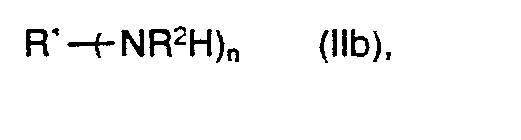

wobei die Komponenten Ilb und lllc im wesentlichen in stöchiometrischem Verhältnis vorgegeben werden oder worin Komponente IIlc in geringem Ueberschuss vorliegt, so dass durch Erhitzen des Gemisches praktisch alle freien Aminogruppen von Ilb verkappt werden, und worin R', R2, X und n die in Anspruch 1 definierte Bedeutung besitzen, und R12 ein zweiwertiger carbocyclisch-aromatischer Rest mit einer der für R3 gemäss Anspruch 1 definierten Bedeutungen ist, an dem die Gruppen -0- und -X- sich jeweils in ortho-oder peri-Stellung zueinander befinden.
23. Verfahren gemäss Anspruch 20 umfassend die Umsetzung von
a) einem präpolymeren Polyisocyanat, welches
a1) ein Addukt eines Polyisocyanats an eine präpolymere Polyhydroxyl-oder Polysulfhydrylverbindung oder an ein Gemisch solcher Verbindungen gegebenenfalls in Kombination mit einem Kettenverlängerer ist, oder
a2) sich ableitet von einem präpolymeren Polyetheramin, mit
b) mindestens einem Phenol mit zwei oder drei phenolischen Hydroxylgruppen oder mit einem Aminophenol mit ein oder zwei phenolischen Hydroxylgruppen.
24. Verfahren gemäss Anspruch 20 umfassend die Umsetzung von
a) einem Addukt einer im wesentlichen äquivalenten Menge eines Diisocyanats mit einem Gemisch aus einem di- oder tri-hydroxyl-terminierten Polyether oder Polyester und weniger als 1 Gew.%, bezogen auf das hydroxyl-terminierte Präpolymere, eines kurzkettigen Diols oder Triols und
b) einer dem NCO-Gehalt im wesentlichen äquivalenten Menge eines Bisphenols oder Trisphenols.
25. Verfahren zur Herstellung schmelzbarer abar noch härtbarer Addukte, dadurch gekennzeichnet, dass man eine Zusammensetzung enthaltend Komponenten i) und ii) gemäss Anspruch 1 in an sich bekannter Weise erhitzt.
26. Verfahren zur Herstellung gehärteter Produkte, dadurch gekennzeichnet, dass man eine Zusammensetzung enthaltend Komponenten i) und ii) gemäss Anspruch 1 in Gegenwart eines Härters für Epoxidharze härtet.
27. Verwendung der Zusammensetzungen gemäss Anspruch 1 oder der Addukte gemäss Anspruch 25 als Klebstoffe, Klebfilme, Matrixharze, Lacke, Dichtungsmassen oder Patches.
28. Verwendung der Verbindungen der Formel I gemäss Anspruch 1 als Flexibilisatoren für Epoxidharze.
Applications Claiming Priority (4)
| Application Number | Priority Date | Filing Date | Title |
|---|---|---|---|
| CH326487 | 1987-08-26 | ||
| CH3264/87 | 1987-08-26 | ||
| CH1070/88 | 1988-03-21 | ||
| CH107088 | 1988-03-21 |
Publications (1)
| Publication Number | Publication Date |
|---|---|
| EP0307666A1 true EP0307666A1 (de) | 1989-03-22 |
Family
ID=25686559
Family Applications (1)
| Application Number | Title | Priority Date | Filing Date |
|---|---|---|---|
| EP88113697A Withdrawn EP0307666A1 (de) | 1987-08-26 | 1988-08-23 | Phenol-terminierte Polyurethane oder Polyharnstoffe und Epoxidharze enthaltend diese Verbindungen |
Country Status (4)
| Country | Link |
|---|---|
| EP (1) | EP0307666A1 (de) |
| JP (1) | JPH01188512A (de) |
| KR (1) | KR890003828A (de) |
| BR (1) | BR8804344A (de) |
Cited By (9)
| Publication number | Priority date | Publication date | Assignee | Title |
|---|---|---|---|---|
| US6884854B2 (en) | 2000-04-10 | 2005-04-26 | Henkel Kommanditgesellschaft Auf Aktien | Composition of epoxy resin, low glass transition temperature copolymer, latent hardener and carboxy-terminated polyamide and/or polyamide |
| DE102007027595A1 (de) * | 2007-06-12 | 2008-12-18 | Henkel Ag & Co. Kgaa | Klebstoffzusammensetzungen |
| US7786214B2 (en) | 2002-05-03 | 2010-08-31 | Sika Technology Ag | Composition of epoxy resin, epoxy adduct, urea derivative thixotropic agent and curing agent |
| US8062468B2 (en) | 2005-07-05 | 2011-11-22 | Sika Technology Ag | Low-temperature impact resistant thermosetting epoxide resin compositions with solid epoxide resins |
| WO2012091842A3 (en) * | 2010-12-26 | 2012-08-23 | Dow Global Technologies Llc | Structural epoxy resin adhesives containing chain-extended elastomeric tougheners capped with phenol, polyphenol or aminophenol compounds |
| US9221969B2 (en) | 2002-12-17 | 2015-12-29 | Sika Technology Ag | Thermally hardenable epoxy resin composition having an improved impact resistance at low temperatures |
| EP3009461A1 (de) * | 2014-10-13 | 2016-04-20 | Sika Technology AG | Polyester-Präpolymere als Schlagzähigkeitsverbesserer in Epoxyformulierungen |
| WO2016196448A1 (en) * | 2015-06-02 | 2016-12-08 | Dow Global Technologies Llc | Blocked polyurethane tougheners for epoxy adhesives |
| CN109715690A (zh) * | 2016-09-15 | 2019-05-03 | 日清纺控股株式会社 | 树脂组合物和使用该树脂组合物的导热性软质片材以及散热结构 |
Families Citing this family (14)
| Publication number | Priority date | Publication date | Assignee | Title |
|---|---|---|---|---|
| KR100474026B1 (ko) * | 1996-07-29 | 2005-05-16 | 텍사스 인스트루먼츠 인코포레이티드 | Dram패스트랜지스터 |
| JP4639506B2 (ja) * | 2001-03-30 | 2011-02-23 | 横浜ゴム株式会社 | 熱硬化型一液ウレタン組成物 |
| JP2005247815A (ja) * | 2004-03-08 | 2005-09-15 | Mitsubishi Gas Chem Co Inc | 分岐型ポリフェノール化合物とその製造方法 |
| TWI443120B (zh) * | 2005-12-15 | 2014-07-01 | Dainippon Ink & Chemicals | 熱硬化性樹脂組成物 |
| JP5040284B2 (ja) * | 2005-12-15 | 2012-10-03 | Dic株式会社 | 熱硬化性樹脂組成物 |
| JP5130795B2 (ja) * | 2007-06-14 | 2013-01-30 | Dic株式会社 | 熱硬化性ポリイミド樹脂組成物 |
| JP4709188B2 (ja) * | 2007-07-10 | 2011-06-22 | 太陽ホールディングス株式会社 | ウレタン樹脂、それを含有する熱硬化性樹脂組成物及びその硬化物 |
| TWI437037B (zh) | 2008-02-21 | 2014-05-11 | Huntsman Adv Mat Americas Inc | 用於高玻璃轉化溫度(tg)應用之以不含鹵素之苯并為主之可固化組合物 |
| EP2331624B1 (de) * | 2008-09-19 | 2012-02-15 | Henkel AG & Co. KGaA | Zusammensetzungen auf benzoxazin-basis mit zähigkeitsvermittlern auf isocyanatbasis |
| WO2013028281A1 (en) * | 2011-08-22 | 2013-02-28 | Dow Global Technologies Llc | Toughener and toughened epoxy adhesive |
| JP5941193B2 (ja) * | 2014-06-18 | 2016-06-29 | 積水フーラー株式会社 | 中空糸膜モジュール用ポッティング剤 |
| WO2019070981A1 (en) | 2017-10-05 | 2019-04-11 | Novomer, Inc. | ISOCYANATES, DERIVATIVES, AND THEIR PRODUCTION PROCESSES |
| US11453743B2 (en) * | 2020-06-05 | 2022-09-27 | Chanda Chemical Corp. | Thermoset epoxy resin, its preparing composition and making process thereof |
| HUE068832T2 (hu) * | 2020-06-22 | 2025-01-28 | Huntsman Adv Mat Switzerland | Fényre keményedõ készítmény |
Citations (6)
| Publication number | Priority date | Publication date | Assignee | Title |
|---|---|---|---|---|
| FR1269477A (fr) * | 1959-09-30 | 1961-08-11 | Bexford Ltd | Préparation de polymères synthétiques, en particulier de polymères contenant des liaisons carbonate et uréthane |
| FR1326963A (fr) * | 1962-06-29 | 1963-05-10 | Cie De Prod Chim Boston | Adhésif pour la fixation de semelles à des empeignes de chaussures |
| FR1518546A (fr) * | 1967-04-13 | 1968-03-22 | Bayer Ag | Procédé de préparation de produits de revêtement à partir de composés hydroxylés polyvalents et d'isocyanates polyvalents |
| US3442974A (en) * | 1965-05-17 | 1969-05-06 | Dow Chemical Co | Thermosettable epoxides containing isocyanate blocked with phenol-formaldehyde novolacs |
| US4396647A (en) * | 1982-02-22 | 1983-08-02 | Ashland Oil, Inc. | Vapor permeation curable coating compositions containing 2,3',4-trihydroxydiphenyl |
| US4423201A (en) * | 1982-10-29 | 1983-12-27 | Celanese Corporation | Co-reactive urethane surfactants and stable aqueous epoxy dispersions |
-
1988
- 1988-08-23 EP EP88113697A patent/EP0307666A1/de not_active Withdrawn
- 1988-08-25 BR BR8804344A patent/BR8804344A/pt unknown
- 1988-08-26 KR KR1019880010929A patent/KR890003828A/ko not_active Withdrawn
- 1988-08-26 JP JP63212281A patent/JPH01188512A/ja active Pending
Patent Citations (6)
| Publication number | Priority date | Publication date | Assignee | Title |
|---|---|---|---|---|
| FR1269477A (fr) * | 1959-09-30 | 1961-08-11 | Bexford Ltd | Préparation de polymères synthétiques, en particulier de polymères contenant des liaisons carbonate et uréthane |
| FR1326963A (fr) * | 1962-06-29 | 1963-05-10 | Cie De Prod Chim Boston | Adhésif pour la fixation de semelles à des empeignes de chaussures |
| US3442974A (en) * | 1965-05-17 | 1969-05-06 | Dow Chemical Co | Thermosettable epoxides containing isocyanate blocked with phenol-formaldehyde novolacs |
| FR1518546A (fr) * | 1967-04-13 | 1968-03-22 | Bayer Ag | Procédé de préparation de produits de revêtement à partir de composés hydroxylés polyvalents et d'isocyanates polyvalents |
| US4396647A (en) * | 1982-02-22 | 1983-08-02 | Ashland Oil, Inc. | Vapor permeation curable coating compositions containing 2,3',4-trihydroxydiphenyl |
| US4423201A (en) * | 1982-10-29 | 1983-12-27 | Celanese Corporation | Co-reactive urethane surfactants and stable aqueous epoxy dispersions |
Non-Patent Citations (1)
| Title |
|---|
| CHEMICAL ABSTRACTS, Band 97, Nr. 18, November 1982, Seite 79, Zusammenfassung Nr. 146252h, Columbus, Ohio, US; V. MIKHEEV et al.: "Polyurethane coatings made of polyamines and oligomers with phenyl carbonate groups", & LAKOKRAS. MATER. IKH PRIMEN. 1982, (4), 11-13 * |
Cited By (21)
| Publication number | Priority date | Publication date | Assignee | Title |
|---|---|---|---|---|
| US6884854B2 (en) | 2000-04-10 | 2005-04-26 | Henkel Kommanditgesellschaft Auf Aktien | Composition of epoxy resin, low glass transition temperature copolymer, latent hardener and carboxy-terminated polyamide and/or polyamide |
| US7786214B2 (en) | 2002-05-03 | 2010-08-31 | Sika Technology Ag | Composition of epoxy resin, epoxy adduct, urea derivative thixotropic agent and curing agent |
| US9221969B2 (en) | 2002-12-17 | 2015-12-29 | Sika Technology Ag | Thermally hardenable epoxy resin composition having an improved impact resistance at low temperatures |
| US8062468B2 (en) | 2005-07-05 | 2011-11-22 | Sika Technology Ag | Low-temperature impact resistant thermosetting epoxide resin compositions with solid epoxide resins |
| DE102007027595A1 (de) * | 2007-06-12 | 2008-12-18 | Henkel Ag & Co. Kgaa | Klebstoffzusammensetzungen |
| WO2012091842A3 (en) * | 2010-12-26 | 2012-08-23 | Dow Global Technologies Llc | Structural epoxy resin adhesives containing chain-extended elastomeric tougheners capped with phenol, polyphenol or aminophenol compounds |
| CN103180400A (zh) * | 2010-12-26 | 2013-06-26 | 陶氏环球技术有限责任公司 | 含有用酚、多酚或氨基酚化合物封端的扩链弹性体增韧剂的结构环氧树脂粘合剂 |
| US20130263995A1 (en) * | 2010-12-26 | 2013-10-10 | Andreas Lutz | Structural epoxy resin adhesives containing chain-extended elastomeric tougheners capped with phenol, polyphenol or aminophenol compounds |
| US9181463B2 (en) * | 2010-12-26 | 2015-11-10 | Dow Global Technologies Llc | Structural epoxy resin adhesives containing chain-extended elastomeric tougheners capped with phenol, polyphenol or aminophenol compounds |
| CN103180400B (zh) * | 2010-12-26 | 2016-08-17 | 陶氏环球技术有限责任公司 | 含有用酚、多酚或氨基酚化合物封端的扩链弹性体增韧剂的结构环氧树脂粘合剂 |
| WO2016059043A1 (de) * | 2014-10-13 | 2016-04-21 | Sika Technology Ag | Polyester-präpolymere als schlagzähigkeitsverbesserer in epoxyformulierungen |
| EP3009461A1 (de) * | 2014-10-13 | 2016-04-20 | Sika Technology AG | Polyester-Präpolymere als Schlagzähigkeitsverbesserer in Epoxyformulierungen |
| CN107001567A (zh) * | 2014-10-13 | 2017-08-01 | Sika技术股份公司 | 作为环氧制剂中的抗冲改进剂的聚酯预聚物 |
| US10273326B2 (en) | 2014-10-13 | 2019-04-30 | Sika Technology Ag | Polyester prepolymers as impact modifiers in epoxy formulations |
| CN107001567B (zh) * | 2014-10-13 | 2021-02-23 | Sika技术股份公司 | 作为环氧制剂中的抗冲改进剂的聚酯预聚物 |
| WO2016196448A1 (en) * | 2015-06-02 | 2016-12-08 | Dow Global Technologies Llc | Blocked polyurethane tougheners for epoxy adhesives |
| CN107646043A (zh) * | 2015-06-02 | 2018-01-30 | 陶氏环球技术有限责任公司 | 用于环氧粘合剂的封闭的聚氨酯增韧剂 |
| CN109715690A (zh) * | 2016-09-15 | 2019-05-03 | 日清纺控股株式会社 | 树脂组合物和使用该树脂组合物的导热性软质片材以及散热结构 |
| KR20190054057A (ko) * | 2016-09-15 | 2019-05-21 | 닛신보 홀딩스 가부시키 가이샤 | 수지 조성물 및 이것을 이용한 열전도성 연질 시트, 및 방열 구조 |
| CN109715690B (zh) * | 2016-09-15 | 2021-06-25 | 日清纺控股株式会社 | 树脂组合物和使用该树脂组合物的导热性软质片材以及散热结构 |
| US11225548B2 (en) | 2016-09-15 | 2022-01-18 | Nisshinbo Holdings Inc. | Resin composition, heat-conductive flexible sheet using same, and heat dissipation structure |
Also Published As
| Publication number | Publication date |
|---|---|
| JPH01188512A (ja) | 1989-07-27 |
| BR8804344A (pt) | 1989-03-21 |
| KR890003828A (ko) | 1989-04-18 |
Similar Documents
| Publication | Publication Date | Title |
|---|---|---|
| EP0308664B1 (de) | Modifizierte Epoxidharze | |
| EP0338985B1 (de) | Modifizierte Epoxidharze | |
| US5278257A (en) | Phenol-terminated polyurethane or polyurea(urethane) with epoxy resin | |
| EP2060592B1 (de) | Hitzehärtende Epoxidharzzusammensetzung enthaltend nichtaromatische Harnstoffe als Beschleuniger | |
| DE2152606C3 (de) | Härtbare Kunststoffmischungen | |
| DE2056080A1 (de) | Hartbare Epoxyharzzubereitungen | |
| EP3207074B1 (de) | Polyester-präpolymere als schlagzähigkeitsverbesserer in epoxyformulierungen | |
| WO2005007720A1 (de) | Hitzehärtende zusammensetzungen mit tieftemperatur-schlagzähigkeitsmodifikatoren | |
| EP1741734A1 (de) | Tieftemperaturschlagzähe hitze-härtbare Epoxidharzzusammensetzung mit Epoxidfestharzen | |
| EP2285862A1 (de) | Hitzehärtende epoxidharzzusammensetzung enthaltend einen beschleuniger mit heteroatomen | |
| EP3677611A1 (de) | Hitzehärtende epoxidharzzusammensetzung mit tiefer aushärtungstemperatur und guter lagerstabilität | |
| JPH01188512A (ja) | フェノールを末端基とするポリウレタンまたはポリ尿素およびこれらの化合物を含有するエポキシド樹脂 | |
| DE2131299B2 (de) | Durch Hitzeeinwirkung härtbare Gemische und Verfahren zur Herstellung von Formkörpern aus diesen Gemischen | |
| EP3749730B1 (de) | Zweikomponenten-strukturklebstoffe | |
| EP0358603B1 (de) | Mit Blockpolymeren und Polyurethanen bzw. Polyharnstoffen modifizierte Epoxidharze. | |
| CN101595180A (zh) | 具有改进的外观、防腐耐性和挠性的阴极电沉积涂料组合物 | |
| KR102566314B1 (ko) | 에폭시 화합물, 이를 포함하는 에폭시 수지 조성물 및 이를 포함하는 일액형 에폭시 접착제 조성물 | |
| DE2338256A1 (de) | Aus zwei komponenten bestehende polymerbildende massen | |
| EP0045892B1 (de) | Verfahren zur Herstellung von Oxazolin-2-on-Ringe aufweisenden Kunststoffvorläufern und ihre Verwendung zur Herstellung von hochmolekularen Kunststoffen | |
| DE19841542A1 (de) | Feste oxazolinterminierte, urethangruppenhaltige Polyaddionsverbindungen, ein Verfahren zu ihrer Herstellung sowie deren Verwendung | |
| US5034495A (en) | Novel hardening agents | |
| DE102019211865A1 (de) | Wasserfeste zweikomponenten-strukturklebstoffe | |
| EP0050780B1 (de) | Isocyanato-oxazolinone, ein Verfahren zur Herstellung von Oxazolin-2-on-Ringe aufweisenden Kunststoffvorläufern und deren Verwendung zur Herstellung von hochmolekularen Kunststoffen | |
| EP0048369A2 (de) | Neue Di- und Polyamine und ihre Verwendung | |
| JPS6314020B2 (de) |
Legal Events
| Date | Code | Title | Description |
|---|---|---|---|
| PUAI | Public reference made under article 153(3) epc to a published international application that has entered the european phase |
Free format text: ORIGINAL CODE: 0009012 |
|
| 17P | Request for examination filed |
Effective date: 19880823 |
|
| AK | Designated contracting states |
Kind code of ref document: A1 Designated state(s): BE CH DE ES FR GB IT LI NL SE |
|
| 17Q | First examination report despatched |
Effective date: 19910620 |
|
| STAA | Information on the status of an ep patent application or granted ep patent |
Free format text: STATUS: THE APPLICATION IS DEEMED TO BE WITHDRAWN |
|
| 18D | Application deemed to be withdrawn |
Effective date: 19911031 |