EP0305917B1 - High hardness fine grained tungsten-carbon alloys and process for making same - Google Patents
High hardness fine grained tungsten-carbon alloys and process for making same Download PDFInfo
- Publication number
- EP0305917B1 EP0305917B1 EP88113932A EP88113932A EP0305917B1 EP 0305917 B1 EP0305917 B1 EP 0305917B1 EP 88113932 A EP88113932 A EP 88113932A EP 88113932 A EP88113932 A EP 88113932A EP 0305917 B1 EP0305917 B1 EP 0305917B1
- Authority
- EP
- European Patent Office
- Prior art keywords
- coating
- dme
- tungsten
- specimens
- ratio
- Prior art date
- Legal status (The legal status is an assumption and is not a legal conclusion. Google has not performed a legal analysis and makes no representation as to the accuracy of the status listed.)
- Expired - Lifetime
Links
- 238000000034 method Methods 0.000 title claims abstract description 61
- 229910001339 C alloy Inorganic materials 0.000 title claims abstract description 55
- 230000008569 process Effects 0.000 title claims description 33
- MEOSMFUUJVIIKB-UHFFFAOYSA-N [W].[C] Chemical compound [W].[C] MEOSMFUUJVIIKB-UHFFFAOYSA-N 0.000 title claims description 27
- 239000000203 mixture Substances 0.000 claims abstract description 86
- 239000010937 tungsten Substances 0.000 claims abstract description 78
- WFKWXMTUELFFGS-UHFFFAOYSA-N tungsten Chemical compound [W] WFKWXMTUELFFGS-UHFFFAOYSA-N 0.000 claims abstract description 63
- 229910052721 tungsten Inorganic materials 0.000 claims abstract description 54
- 229910045601 alloy Inorganic materials 0.000 claims abstract description 32
- 239000000956 alloy Substances 0.000 claims abstract description 32
- 238000000576 coating method Methods 0.000 claims description 265
- 239000011248 coating agent Substances 0.000 claims description 248
- NXHILIPIEUBEPD-UHFFFAOYSA-H tungsten hexafluoride Chemical compound F[W](F)(F)(F)(F)F NXHILIPIEUBEPD-UHFFFAOYSA-H 0.000 claims description 171
- 229910052739 hydrogen Inorganic materials 0.000 claims description 58
- 239000001257 hydrogen Substances 0.000 claims description 58
- PXHVJJICTQNCMI-UHFFFAOYSA-N Nickel Chemical compound [Ni] PXHVJJICTQNCMI-UHFFFAOYSA-N 0.000 claims description 54
- UFHFLCQGNIYNRP-UHFFFAOYSA-N Hydrogen Chemical compound [H][H] UFHFLCQGNIYNRP-UHFFFAOYSA-N 0.000 claims description 49
- OKTJSMMVPCPJKN-UHFFFAOYSA-N Carbon Chemical compound [C] OKTJSMMVPCPJKN-UHFFFAOYSA-N 0.000 claims description 34
- 239000000758 substrate Substances 0.000 claims description 32
- 229910002804 graphite Inorganic materials 0.000 claims description 28
- 239000010439 graphite Substances 0.000 claims description 28
- 229910052759 nickel Inorganic materials 0.000 claims description 26
- 229910052751 metal Inorganic materials 0.000 claims description 18
- 239000002184 metal Substances 0.000 claims description 18
- 239000007789 gas Substances 0.000 claims description 15
- 150000002894 organic compounds Chemical class 0.000 claims description 13
- 239000010410 layer Substances 0.000 claims description 11
- RYGMFSIKBFXOCR-UHFFFAOYSA-N Copper Chemical compound [Cu] RYGMFSIKBFXOCR-UHFFFAOYSA-N 0.000 claims description 10
- 229910052802 copper Inorganic materials 0.000 claims description 10
- 239000010949 copper Substances 0.000 claims description 10
- BASFCYQUMIYNBI-UHFFFAOYSA-N platinum Chemical compound [Pt] BASFCYQUMIYNBI-UHFFFAOYSA-N 0.000 claims description 10
- 239000011229 interlayer Substances 0.000 claims description 9
- 229910017052 cobalt Inorganic materials 0.000 claims description 8
- 239000010941 cobalt Substances 0.000 claims description 8
- GUTLYIVDDKVIGB-UHFFFAOYSA-N cobalt atom Chemical compound [Co] GUTLYIVDDKVIGB-UHFFFAOYSA-N 0.000 claims description 8
- 150000001247 metal acetylides Chemical class 0.000 claims description 7
- KDLHZDBZIXYQEI-UHFFFAOYSA-N Palladium Chemical compound [Pd] KDLHZDBZIXYQEI-UHFFFAOYSA-N 0.000 claims description 6
- BQCADISMDOOEFD-UHFFFAOYSA-N Silver Chemical compound [Ag] BQCADISMDOOEFD-UHFFFAOYSA-N 0.000 claims description 6
- PCHJSUWPFVWCPO-UHFFFAOYSA-N gold Chemical compound [Au] PCHJSUWPFVWCPO-UHFFFAOYSA-N 0.000 claims description 6
- 229910052737 gold Inorganic materials 0.000 claims description 6
- 239000010931 gold Substances 0.000 claims description 6
- 229910052709 silver Inorganic materials 0.000 claims description 6
- 239000004332 silver Substances 0.000 claims description 6
- 239000000919 ceramic Substances 0.000 claims description 5
- 229910052697 platinum Inorganic materials 0.000 claims description 5
- 229910052703 rhodium Inorganic materials 0.000 claims description 4
- 239000010948 rhodium Substances 0.000 claims description 4
- MHOVAHRLVXNVSD-UHFFFAOYSA-N rhodium atom Chemical compound [Rh] MHOVAHRLVXNVSD-UHFFFAOYSA-N 0.000 claims description 4
- 229910052741 iridium Inorganic materials 0.000 claims description 3
- GKOZUEZYRPOHIO-UHFFFAOYSA-N iridium atom Chemical compound [Ir] GKOZUEZYRPOHIO-UHFFFAOYSA-N 0.000 claims description 3
- 229910052763 palladium Inorganic materials 0.000 claims description 3
- 125000004432 carbon atom Chemical group C* 0.000 claims description 2
- 150000002739 metals Chemical class 0.000 claims description 2
- 239000000126 substance Substances 0.000 claims description 2
- 229910000510 noble metal Inorganic materials 0.000 claims 2
- 229910001080 W alloy Inorganic materials 0.000 abstract description 28
- 239000000463 material Substances 0.000 abstract description 20
- 230000008021 deposition Effects 0.000 abstract description 18
- 239000013078 crystal Substances 0.000 abstract description 3
- 239000012071 phase Substances 0.000 description 76
- 230000036961 partial effect Effects 0.000 description 63
- 238000006243 chemical reaction Methods 0.000 description 60
- 230000001427 coherent effect Effects 0.000 description 46
- 230000001464 adherent effect Effects 0.000 description 45
- 229910001220 stainless steel Inorganic materials 0.000 description 43
- XKRFYHLGVUSROY-UHFFFAOYSA-N Argon Chemical compound [Ar] XKRFYHLGVUSROY-UHFFFAOYSA-N 0.000 description 40
- 239000010935 stainless steel Substances 0.000 description 39
- 238000005229 chemical vapour deposition Methods 0.000 description 36
- RTZKZFJDLAIYFH-UHFFFAOYSA-N Diethyl ether Chemical compound CCOCC RTZKZFJDLAIYFH-UHFFFAOYSA-N 0.000 description 33
- 238000002441 X-ray diffraction Methods 0.000 description 31
- 238000000151 deposition Methods 0.000 description 29
- 238000002474 experimental method Methods 0.000 description 29
- 239000008199 coating composition Substances 0.000 description 22
- OKKJLVBELUTLKV-UHFFFAOYSA-N Methanol Chemical compound OC OKKJLVBELUTLKV-UHFFFAOYSA-N 0.000 description 21
- 229910052786 argon Inorganic materials 0.000 description 20
- -1 tungsten halide Chemical class 0.000 description 20
- LFQSCWFLJHTTHZ-UHFFFAOYSA-N Ethanol Chemical compound CCO LFQSCWFLJHTTHZ-UHFFFAOYSA-N 0.000 description 19
- 239000008246 gaseous mixture Substances 0.000 description 19
- 230000035484 reaction time Effects 0.000 description 18
- 230000003628 erosive effect Effects 0.000 description 16
- 230000008859 change Effects 0.000 description 14
- 239000010936 titanium Substances 0.000 description 12
- 150000002431 hydrogen Chemical class 0.000 description 10
- 229910052750 molybdenum Inorganic materials 0.000 description 10
- UHOVQNZJYSORNB-UHFFFAOYSA-N Benzene Chemical compound C1=CC=CC=C1 UHOVQNZJYSORNB-UHFFFAOYSA-N 0.000 description 9
- ZOKXTWBITQBERF-UHFFFAOYSA-N Molybdenum Chemical compound [Mo] ZOKXTWBITQBERF-UHFFFAOYSA-N 0.000 description 9
- YXFVVABEGXRONW-UHFFFAOYSA-N Toluene Chemical compound CC1=CC=CC=C1 YXFVVABEGXRONW-UHFFFAOYSA-N 0.000 description 9
- 230000015572 biosynthetic process Effects 0.000 description 9
- 239000003085 diluting agent Substances 0.000 description 9
- 239000011733 molybdenum Substances 0.000 description 9
- 229910052719 titanium Inorganic materials 0.000 description 9
- UONOETXJSWQNOL-UHFFFAOYSA-N tungsten carbide Chemical compound [W+]#[C-] UONOETXJSWQNOL-UHFFFAOYSA-N 0.000 description 9
- 229910001069 Ti alloy Inorganic materials 0.000 description 8
- PNEYBMLMFCGWSK-UHFFFAOYSA-N aluminium oxide Inorganic materials [O-2].[O-2].[O-2].[Al+3].[Al+3] PNEYBMLMFCGWSK-UHFFFAOYSA-N 0.000 description 8
- KRHYYFGTRYWZRS-UHFFFAOYSA-N Fluorane Chemical compound F KRHYYFGTRYWZRS-UHFFFAOYSA-N 0.000 description 7
- 229910052799 carbon Inorganic materials 0.000 description 7
- 230000003247 decreasing effect Effects 0.000 description 7
- 238000004519 manufacturing process Methods 0.000 description 7
- LCGLNKUTAGEVQW-UHFFFAOYSA-N Dimethyl ether Chemical compound COC LCGLNKUTAGEVQW-UHFFFAOYSA-N 0.000 description 6
- 229910052782 aluminium Inorganic materials 0.000 description 6
- XAGFODPZIPBFFR-UHFFFAOYSA-N aluminium Chemical compound [Al] XAGFODPZIPBFFR-UHFFFAOYSA-N 0.000 description 6
- 229910000040 hydrogen fluoride Inorganic materials 0.000 description 6
- QVGXLLKOCUKJST-UHFFFAOYSA-N atomic oxygen Chemical compound [O] QVGXLLKOCUKJST-UHFFFAOYSA-N 0.000 description 5
- 229910052760 oxygen Inorganic materials 0.000 description 5
- 239000001301 oxygen Substances 0.000 description 5
- 230000005855 radiation Effects 0.000 description 5
- 230000009467 reduction Effects 0.000 description 5
- 229910001213 440C Inorganic materials 0.000 description 4
- 229910000975 Carbon steel Inorganic materials 0.000 description 4
- 229910000990 Ni alloy Inorganic materials 0.000 description 4
- 150000001875 compounds Chemical class 0.000 description 4
- 238000009792 diffusion process Methods 0.000 description 4
- 230000001681 protective effect Effects 0.000 description 4
- 239000000376 reactant Substances 0.000 description 4
- 230000004580 weight loss Effects 0.000 description 4
- CSCPPACGZOOCGX-UHFFFAOYSA-N Acetone Chemical compound CC(C)=O CSCPPACGZOOCGX-UHFFFAOYSA-N 0.000 description 3
- YLQBMQCUIZJEEH-UHFFFAOYSA-N Furan Chemical compound C=1C=COC=1 YLQBMQCUIZJEEH-UHFFFAOYSA-N 0.000 description 3
- KFZMGEQAYNKOFK-UHFFFAOYSA-N Isopropanol Chemical compound CC(C)O KFZMGEQAYNKOFK-UHFFFAOYSA-N 0.000 description 3
- CTQNGGLPUBDAKN-UHFFFAOYSA-N O-Xylene Chemical compound CC1=CC=CC=C1C CTQNGGLPUBDAKN-UHFFFAOYSA-N 0.000 description 3
- 229910000831 Steel Inorganic materials 0.000 description 3
- 238000009826 distribution Methods 0.000 description 3
- 230000000694 effects Effects 0.000 description 3
- 238000005286 illumination Methods 0.000 description 3
- 239000011241 protective layer Substances 0.000 description 3
- 230000002829 reductive effect Effects 0.000 description 3
- 229910052702 rhenium Inorganic materials 0.000 description 3
- WUAPFZMCVAUBPE-UHFFFAOYSA-N rhenium atom Chemical compound [Re] WUAPFZMCVAUBPE-UHFFFAOYSA-N 0.000 description 3
- 239000010959 steel Substances 0.000 description 3
- 238000009827 uniform distribution Methods 0.000 description 3
- 239000008096 xylene Substances 0.000 description 3
- HGINCPLSRVDWNT-UHFFFAOYSA-N Acrolein Chemical compound C=CC=O HGINCPLSRVDWNT-UHFFFAOYSA-N 0.000 description 2
- 229910000838 Al alloy Inorganic materials 0.000 description 2
- IJGRMHOSHXDMSA-UHFFFAOYSA-N Atomic nitrogen Chemical compound N#N IJGRMHOSHXDMSA-UHFFFAOYSA-N 0.000 description 2
- CWYNVVGOOAEACU-UHFFFAOYSA-N Fe2+ Chemical compound [Fe+2] CWYNVVGOOAEACU-UHFFFAOYSA-N 0.000 description 2
- 229910000997 High-speed steel Inorganic materials 0.000 description 2
- STNJBCKSHOAVAJ-UHFFFAOYSA-N Methacrolein Chemical compound CC(=C)C=O STNJBCKSHOAVAJ-UHFFFAOYSA-N 0.000 description 2
- NBBJYMSMWIIQGU-UHFFFAOYSA-N Propionic aldehyde Chemical compound CCC=O NBBJYMSMWIIQGU-UHFFFAOYSA-N 0.000 description 2
- GOOHAUXETOMSMM-UHFFFAOYSA-N Propylene oxide Chemical compound CC1CO1 GOOHAUXETOMSMM-UHFFFAOYSA-N 0.000 description 2
- WYURNTSHIVDZCO-UHFFFAOYSA-N Tetrahydrofuran Chemical compound C1CCOC1 WYURNTSHIVDZCO-UHFFFAOYSA-N 0.000 description 2
- RTAQQCXQSZGOHL-UHFFFAOYSA-N Titanium Chemical compound [Ti] RTAQQCXQSZGOHL-UHFFFAOYSA-N 0.000 description 2
- XXROGKLTLUQVRX-UHFFFAOYSA-N allyl alcohol Chemical compound OCC=C XXROGKLTLUQVRX-UHFFFAOYSA-N 0.000 description 2
- 230000007797 corrosion Effects 0.000 description 2
- 238000005260 corrosion Methods 0.000 description 2
- VNWKTOKETHGBQD-UHFFFAOYSA-N methane Chemical compound C VNWKTOKETHGBQD-UHFFFAOYSA-N 0.000 description 2
- 239000002480 mineral oil Substances 0.000 description 2
- 235000010446 mineral oil Nutrition 0.000 description 2
- 229910052758 niobium Inorganic materials 0.000 description 2
- 239000010955 niobium Substances 0.000 description 2
- GUCVJGMIXFAOAE-UHFFFAOYSA-N niobium atom Chemical compound [Nb] GUCVJGMIXFAOAE-UHFFFAOYSA-N 0.000 description 2
- 239000002245 particle Substances 0.000 description 2
- 230000035515 penetration Effects 0.000 description 2
- BDERNNFJNOPAEC-UHFFFAOYSA-N propan-1-ol Chemical compound CCCO BDERNNFJNOPAEC-UHFFFAOYSA-N 0.000 description 2
- 239000010453 quartz Substances 0.000 description 2
- 239000011541 reaction mixture Substances 0.000 description 2
- 239000012925 reference material Substances 0.000 description 2
- 231100000241 scar Toxicity 0.000 description 2
- HBMJWWWQQXIZIP-UHFFFAOYSA-N silicon carbide Chemical compound [Si+]#[C-] HBMJWWWQQXIZIP-UHFFFAOYSA-N 0.000 description 2
- 229910010271 silicon carbide Inorganic materials 0.000 description 2
- VYPSYNLAJGMNEJ-UHFFFAOYSA-N silicon dioxide Inorganic materials O=[Si]=O VYPSYNLAJGMNEJ-UHFFFAOYSA-N 0.000 description 2
- 238000006467 substitution reaction Methods 0.000 description 2
- 229910052720 vanadium Inorganic materials 0.000 description 2
- QIJNJJZPYXGIQM-UHFFFAOYSA-N 1lambda4,2lambda4-dimolybdacyclopropa-1,2,3-triene Chemical compound [Mo]=C=[Mo] QIJNJJZPYXGIQM-UHFFFAOYSA-N 0.000 description 1
- YACFFSVYSPMSGS-UHFFFAOYSA-N 3-methoxyprop-1-yne Chemical compound COCC#C YACFFSVYSPMSGS-UHFFFAOYSA-N 0.000 description 1
- 229910001018 Cast iron Inorganic materials 0.000 description 1
- 229910000881 Cu alloy Inorganic materials 0.000 description 1
- IMROMDMJAWUWLK-UHFFFAOYSA-N Ethenol Chemical compound OC=C IMROMDMJAWUWLK-UHFFFAOYSA-N 0.000 description 1
- IAYPIBMASNFSPL-UHFFFAOYSA-N Ethylene oxide Chemical compound C1CO1 IAYPIBMASNFSPL-UHFFFAOYSA-N 0.000 description 1
- KRHYYFGTRYWZRS-UHFFFAOYSA-M Fluoride anion Chemical compound [F-] KRHYYFGTRYWZRS-UHFFFAOYSA-M 0.000 description 1
- 229910001209 Low-carbon steel Inorganic materials 0.000 description 1
- XOBKSJJDNFUZPF-UHFFFAOYSA-N Methoxyethane Chemical compound CCOC XOBKSJJDNFUZPF-UHFFFAOYSA-N 0.000 description 1
- 229910039444 MoC Inorganic materials 0.000 description 1
- 229910015255 MoF6 Inorganic materials 0.000 description 1
- 229910000792 Monel Inorganic materials 0.000 description 1
- 229910052581 Si3N4 Inorganic materials 0.000 description 1
- 229910001128 Sn alloy Inorganic materials 0.000 description 1
- 229910052770 Uranium Inorganic materials 0.000 description 1
- 229910000756 V alloy Inorganic materials 0.000 description 1
- QYKIQEUNHZKYBP-UHFFFAOYSA-N Vinyl ether Chemical compound C=COC=C QYKIQEUNHZKYBP-UHFFFAOYSA-N 0.000 description 1
- 238000010521 absorption reaction Methods 0.000 description 1
- IKHGUXGNUITLKF-XPULMUKRSA-N acetaldehyde Chemical compound [14CH]([14CH3])=O IKHGUXGNUITLKF-XPULMUKRSA-N 0.000 description 1
- 150000001298 alcohols Chemical class 0.000 description 1
- 150000001299 aldehydes Chemical class 0.000 description 1
- 230000004075 alteration Effects 0.000 description 1
- 239000005441 aurora Substances 0.000 description 1
- ZTQSAGDEMFDKMZ-UHFFFAOYSA-N butyric aldehyde Natural products CCCC=O ZTQSAGDEMFDKMZ-UHFFFAOYSA-N 0.000 description 1
- 238000004364 calculation method Methods 0.000 description 1
- 150000001721 carbon Chemical group 0.000 description 1
- 230000015556 catabolic process Effects 0.000 description 1
- 239000003518 caustics Substances 0.000 description 1
- 229910010293 ceramic material Inorganic materials 0.000 description 1
- 229910052804 chromium Inorganic materials 0.000 description 1
- 238000004140 cleaning Methods 0.000 description 1
- 229910052593 corundum Inorganic materials 0.000 description 1
- MLUCVPSAIODCQM-NSCUHMNNSA-N crotonaldehyde Chemical compound C\C=C\C=O MLUCVPSAIODCQM-NSCUHMNNSA-N 0.000 description 1
- MLUCVPSAIODCQM-UHFFFAOYSA-N crotonaldehyde Natural products CC=CC=O MLUCVPSAIODCQM-UHFFFAOYSA-N 0.000 description 1
- 238000005520 cutting process Methods 0.000 description 1
- 238000000354 decomposition reaction Methods 0.000 description 1
- 238000006731 degradation reaction Methods 0.000 description 1
- 230000000593 degrading effect Effects 0.000 description 1
- 238000005137 deposition process Methods 0.000 description 1
- 238000001514 detection method Methods 0.000 description 1
- 238000000295 emission spectrum Methods 0.000 description 1
- 238000005530 etching Methods 0.000 description 1
- CCGKOQOJPYTBIH-UHFFFAOYSA-N ethenone Chemical compound C=C=O CCGKOQOJPYTBIH-UHFFFAOYSA-N 0.000 description 1
- 150000002170 ethers Chemical class 0.000 description 1
- 239000011521 glass Substances 0.000 description 1
- 238000000227 grinding Methods 0.000 description 1
- 150000004820 halides Chemical class 0.000 description 1
- 238000010438 heat treatment Methods 0.000 description 1
- 239000001307 helium Substances 0.000 description 1
- 229910052734 helium Inorganic materials 0.000 description 1
- SWQJXJOGLNCZEY-UHFFFAOYSA-N helium atom Chemical compound [He] SWQJXJOGLNCZEY-UHFFFAOYSA-N 0.000 description 1
- 229910001026 inconel Inorganic materials 0.000 description 1
- 239000011261 inert gas Substances 0.000 description 1
- XEEYBQQBJWHFJM-UHFFFAOYSA-N iron Substances [Fe] XEEYBQQBJWHFJM-UHFFFAOYSA-N 0.000 description 1
- 235000000396 iron Nutrition 0.000 description 1
- 150000002561 ketenes Chemical class 0.000 description 1
- 150000002576 ketones Chemical class 0.000 description 1
- 229910001092 metal group alloy Inorganic materials 0.000 description 1
- WSFSSNUMVMOOMR-NJFSPNSNSA-N methanone Chemical compound O=[14CH2] WSFSSNUMVMOOMR-NJFSPNSNSA-N 0.000 description 1
- RLCOZMCCEKDUPY-UHFFFAOYSA-H molybdenum hexafluoride Chemical compound F[Mo](F)(F)(F)(F)F RLCOZMCCEKDUPY-UHFFFAOYSA-H 0.000 description 1
- 229910052757 nitrogen Inorganic materials 0.000 description 1
- 238000009828 non-uniform distribution Methods 0.000 description 1
- 229910052755 nonmetal Inorganic materials 0.000 description 1
- 150000002843 nonmetals Chemical class 0.000 description 1
- 239000003921 oil Substances 0.000 description 1
- 150000002924 oxiranes Chemical class 0.000 description 1
- 238000005240 physical vapour deposition Methods 0.000 description 1
- 239000000843 powder Substances 0.000 description 1
- TVDSBUOJIPERQY-UHFFFAOYSA-N prop-2-yn-1-ol Chemical compound OCC#C TVDSBUOJIPERQY-UHFFFAOYSA-N 0.000 description 1
- IJNJLGFTSIAHEA-UHFFFAOYSA-N prop-2-ynal Chemical compound O=CC#C IJNJLGFTSIAHEA-UHFFFAOYSA-N 0.000 description 1
- 239000003870 refractory metal Substances 0.000 description 1
- HQVNEWCFYHHQES-UHFFFAOYSA-N silicon nitride Chemical compound N12[Si]34N5[Si]62N3[Si]51N64 HQVNEWCFYHHQES-UHFFFAOYSA-N 0.000 description 1
- 239000007790 solid phase Substances 0.000 description 1
- 238000004544 sputter deposition Methods 0.000 description 1
- 238000010998 test method Methods 0.000 description 1
- 239000010409 thin film Substances 0.000 description 1
- 229910052718 tin Inorganic materials 0.000 description 1
- 230000009466 transformation Effects 0.000 description 1
- 238000007740 vapor deposition Methods 0.000 description 1
- 229910001845 yogo sapphire Inorganic materials 0.000 description 1
- 229910052726 zirconium Inorganic materials 0.000 description 1
Images





Classifications
-
- C—CHEMISTRY; METALLURGY
- C23—COATING METALLIC MATERIAL; COATING MATERIAL WITH METALLIC MATERIAL; CHEMICAL SURFACE TREATMENT; DIFFUSION TREATMENT OF METALLIC MATERIAL; COATING BY VACUUM EVAPORATION, BY SPUTTERING, BY ION IMPLANTATION OR BY CHEMICAL VAPOUR DEPOSITION, IN GENERAL; INHIBITING CORROSION OF METALLIC MATERIAL OR INCRUSTATION IN GENERAL
- C23C—COATING METALLIC MATERIAL; COATING MATERIAL WITH METALLIC MATERIAL; SURFACE TREATMENT OF METALLIC MATERIAL BY DIFFUSION INTO THE SURFACE, BY CHEMICAL CONVERSION OR SUBSTITUTION; COATING BY VACUUM EVAPORATION, BY SPUTTERING, BY ION IMPLANTATION OR BY CHEMICAL VAPOUR DEPOSITION, IN GENERAL
- C23C16/00—Chemical coating by decomposition of gaseous compounds, without leaving reaction products of surface material in the coating, i.e. chemical vapour deposition [CVD] processes
- C23C16/06—Chemical coating by decomposition of gaseous compounds, without leaving reaction products of surface material in the coating, i.e. chemical vapour deposition [CVD] processes characterised by the deposition of metallic material
- C23C16/08—Chemical coating by decomposition of gaseous compounds, without leaving reaction products of surface material in the coating, i.e. chemical vapour deposition [CVD] processes characterised by the deposition of metallic material from metal halides
-
- C—CHEMISTRY; METALLURGY
- C23—COATING METALLIC MATERIAL; COATING MATERIAL WITH METALLIC MATERIAL; CHEMICAL SURFACE TREATMENT; DIFFUSION TREATMENT OF METALLIC MATERIAL; COATING BY VACUUM EVAPORATION, BY SPUTTERING, BY ION IMPLANTATION OR BY CHEMICAL VAPOUR DEPOSITION, IN GENERAL; INHIBITING CORROSION OF METALLIC MATERIAL OR INCRUSTATION IN GENERAL
- C23C—COATING METALLIC MATERIAL; COATING MATERIAL WITH METALLIC MATERIAL; SURFACE TREATMENT OF METALLIC MATERIAL BY DIFFUSION INTO THE SURFACE, BY CHEMICAL CONVERSION OR SUBSTITUTION; COATING BY VACUUM EVAPORATION, BY SPUTTERING, BY ION IMPLANTATION OR BY CHEMICAL VAPOUR DEPOSITION, IN GENERAL
- C23C16/00—Chemical coating by decomposition of gaseous compounds, without leaving reaction products of surface material in the coating, i.e. chemical vapour deposition [CVD] processes
- C23C16/22—Chemical coating by decomposition of gaseous compounds, without leaving reaction products of surface material in the coating, i.e. chemical vapour deposition [CVD] processes characterised by the deposition of inorganic material, other than metallic material
- C23C16/30—Deposition of compounds, mixtures or solid solutions, e.g. borides, carbides, nitrides
-
- C—CHEMISTRY; METALLURGY
- C23—COATING METALLIC MATERIAL; COATING MATERIAL WITH METALLIC MATERIAL; CHEMICAL SURFACE TREATMENT; DIFFUSION TREATMENT OF METALLIC MATERIAL; COATING BY VACUUM EVAPORATION, BY SPUTTERING, BY ION IMPLANTATION OR BY CHEMICAL VAPOUR DEPOSITION, IN GENERAL; INHIBITING CORROSION OF METALLIC MATERIAL OR INCRUSTATION IN GENERAL
- C23C—COATING METALLIC MATERIAL; COATING MATERIAL WITH METALLIC MATERIAL; SURFACE TREATMENT OF METALLIC MATERIAL BY DIFFUSION INTO THE SURFACE, BY CHEMICAL CONVERSION OR SUBSTITUTION; COATING BY VACUUM EVAPORATION, BY SPUTTERING, BY ION IMPLANTATION OR BY CHEMICAL VAPOUR DEPOSITION, IN GENERAL
- C23C16/00—Chemical coating by decomposition of gaseous compounds, without leaving reaction products of surface material in the coating, i.e. chemical vapour deposition [CVD] processes
- C23C16/22—Chemical coating by decomposition of gaseous compounds, without leaving reaction products of surface material in the coating, i.e. chemical vapour deposition [CVD] processes characterised by the deposition of inorganic material, other than metallic material
- C23C16/30—Deposition of compounds, mixtures or solid solutions, e.g. borides, carbides, nitrides
- C23C16/32—Carbides
Definitions
- This invention relates to high hardness fine grained tungsten-carbon alloys and to a process for producing the same.
- High hardness materials are widely used as coatings on various types of mechanical components and cutting tools. Such coatings impart wear and erosion resistance and thus increase the wear and erosion life of objects that have been coated.
- the high hardness materials can also be used to produce free standing objects which are wear resistant.
- Chemical vapor deposition processes can be used to produce high hardness coatings and high hardness free standing objects.
- a typical chemical vapor deposition (CVD) process the substrate to be coated is heated in a suitable chamber and then a gaseous reactant mixture is introduced into the chamber.
- the gaseous reactant mixture reacts at the surface of the substrate to form a coherent layer of the desired coating.
- various types of deposited coatings can be produced.
- Deposits produced by chemical vapor deposition both for coating substrates and for producing free standing objects, have suffered certain drawbacks. Although the hardness of the deposits has been satisfactory, the strength and toughness of the materials has often been lower than desired. This lack of strength and toughness is due in large part to the grain size, crystallite size, and structure of the compounds that make up the deposit.
- typical CVD techniques produce coatings having relatively large grains which are arranged in columns. Thus, cross-sectional metallographic examination of a typical chemical vapor deposition deposit will show grains usually in excess of several microns in size which are arranged in columns that extend perpendicularly to the substrate surface.
- Such deposits are typically quite brittle since adjacent columns of grains result in long interstitial regions of weakness. Such regions are easily fractured and attacked by corrosive agents and erosive media. Because of the columnar grain structure, such deposits also have poor surface finish and poor wear and erosion resistance properties.
- US-A-4 162 345 discloses a method for producing deposits of tungsten and carbon or molybdenum and carbon which results in deposits characterized by a structure which is free of columnar grains and instead consists essentially of fine, equiaxial grains. These deposits have unusually high hardness and tensile strength. US-A-4 162 345 discloses use of temperatures varying from 650°C to 1,100°C, which are high enough to severely degrade the mechanical properties of various carbon steels, stainless steels, nickel alloys, titanium alloys and cemented carbide.
- US-A-4 162 345 a sequence of events is made to take place which, although similar to conventional chemical vapor deposition, is not truly that.
- the method employs a reactor which is essentially similar to a chemical vapor deposition reactor.
- the apparatus is operated in such a manner that the typical chemical vapor deposition process does not take place.
- Typical chemical vapor deposition involves a single reaction by the gases in the reactor at the surface of the substrate resulting in the formation of a solid phase deposit directly on the substrate surface.
- US-A-4 162 345 describes a deposition process involving at least two distinct reaction steps.
- an initial reaction is caused to take place displaced from the surface of the substrate.
- This reaction involves a decomposition or partial reduction of a fluoride of tungsten (preferably WF6) by a substitution reaction with an oxygen or oxygen-containing group derived from a gaseous organic compound containing hydrogen, carbon and oxygen. Subsequent reaction with hydrogen gas results in the formation of the final deposits.
- the material of US-A-4 162 345 is a hard metal alloy, consisting primarily of tungsten and carbon. X-ray diffraction analysis of the alloy shows that the deposit is akin to tungsten but with a very finely dispersed carbide, probably in the form WC.
- US-A-4 427 445 also discloses a hard fine grained material which can be produced by thermochemical deposition, but at temperatures lower than those described in the examples of US-A-4 162 345.
- the methodology of US-A-4 427 445 reduces adhesion problems and problems associated with mechanical distortion, metallurgical transformation or stress relief of the substrate.
- the material of US-A-4 427 445 is a tungsten carbon alloy consisting primarily of a two phase mixture of substantially pure tungsten and an A15 structure.
- U.S. Patent 3,368,914 discloses a process for adherently depositing tungsten carbide of substantial thickness on steel and other metal substrates.
- the process involves first diffusing another metal on the surface of the substrate to relax the thermal expansion coefficient zone of the metal substrate.
- the carbide coating is then deposited on the diffused surface by CVD.
- the process claims it is preferable to diffuse the metal forming the carbide into the substrate.
- a thin layer of W is deposited on the metal surface using 600-1000°C temperature. After coating W, the temperature is increased to approximately 1000-1200°C and held there for a significant period of time to permit diffusion of W into the metal.
- the diffused surface is then coated with tungsten carbide using WF6, CO and H2.
- a pack diffusion technique is used for achieving diffusion of W into metal. Temperature ranging from 1000-1200°C is used in the pack diffusion step. The diffused metal surface is then coated with tungsten carbide.
- US-A-3 389 977 discloses a method of depositing substantial pure tungsten carbide in the form of W2C, free from any metal phase. Pure W2C is deposited on a substrate by reacting WF6 and CO. The substrate is heated to a temperature in excess of 400°C. The adherence of W2C to steel is improved by first cleaning the surface and then depositing with a thin film of W followed by W2C using a temperature ranging from 600-1000°C. Since intitial deposition of tungsten is conducted at or above 600°C, the process of US-A-3 389 977 is not feasible for providing erosion and wear resistance coating on various carbon steels, stainless steels, nickel and titanium alloys without severely degrading their mechanical properties. Additionally pure W2C deposited according to the teachings of US-A-3 389 977 consists of columnar grains. US-A-3 389 977 does not describe a process for depositing W2C coating in non-columnar fashion.
- U.S. Patent 3,574,672 discloses a process for depositing W2C by heating a substrate to a temperature between 400-1300°C. The process described in this patent is essentially the same as disclosed in U.S. Patent 3,389,977.
- U.S. Patent 3,721,577 discloses a process for depositing refractory metal or metal carbides on ferrous and non-ferrous base materials heated to at least 1050°C.
- the metal carbides are deposited using halide vapors of the metal along with methane and hydrogen.
- US-A-3 814 625 discloses a process for the formation of tungsten and molybdenum carbide by reacting a mixture of WF6 or MoF6, benzene, toluene or xylene and hydrogen. The process is carried out under atmospheric pressure and temperatures ranging from 400-1000°C. An atomic ratio of W/C in the gaseous mixture varying from 1 to 2 is required to yield W2C.
- the process also suggests that for some substrates such as mild steel, it is advantageous in providing better adhesion to deposit a layer of nickel or cobalt prior to tungsten carbide deposition.
- the process also claims the formation of a mixture of tungsten and tungsten carbide in the presence of large proportions of free hydrogen.
- the mixture of W and W2C coating deposited according to the teaching of US-A-3 814 625 consists of columnar grains. US-A-3 814 625 does not disclose a process for depositing a mixture of W and W2C in non-columnar fashion.
- British Patent 1,326,769 discloses a method for the formation of tungsten carbide by reacting a mixture of WF6, benzene, toluene or xylene and hydrogen under atmospheric pressure and temperatures ranging from 400-1000°C.
- the process disclosed in this patent is essentially the same as disclosed in U.S. Patent 3,814,625.
- British Patent 1,540,718 discloses a process for the formation of W3C using a mixture of WF6, benzene, toluene or xylene and hydrogen under sub-atmospheric pressure and temperature ranging from 350-500°C. An atomic ratio of W/C in the gaseous mixture varying from 3-6 is required to yield W3C.
- the coating deposited according to the teaching of British Patent 1,540,718 consists of columnar grains.
- the British patent 1 540 718 does not teach a process for depositing a non-columnar coating.
- Figure 1 is a photomicrograph of an etched cross-section of tungsten coating on AM-350 stainless steel.
- Figure 2 is a photomicrograph of the surface of AM-350 stainless steel coated with tungsten.
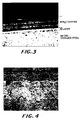
- Figure 3 is an etched cross-sectional photomicrograph of W+W3C coating on AM-350 stainless steel.
- Figure 4 is a photomicrograph of the surface of AM-350 stainless steel coated with W+W3C.
- Figure 5 is an etched cross-sectional photomicrograph of W+W3C coating on SiC-6 graphite.
- Figure 6 is an etched cross-sectional photomicrograph of W+W2C+W3C coating on AM-350 stainless steel.
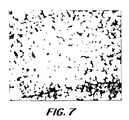
- Figure 7 is a photomicrograph of the surface of AM-350 stainless steel coated with W+W2C+W3C.
- Figure 8A is an unetched cross-sectional photomicrograph of W+W2C coating on AM-350 stainless steel.
- Figure 8B is an etched cross-sectional photomicrograph of W+W2C coating on AM-350 stainless steel.
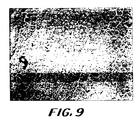
- Figure 9 is a photomicrograph of the surface of AM-350 stainless steel coated with W+W2C.
- Figure 10 is a graph showing the relationship between reaction temperature and WF6/DME ratio.
- Figure 11 is an x-ray diffraction scan of a sample containing W, W2C and W3C phases.
- Figure 12 is an x-ray diffraction scan of a sample containing W, W3C and a trace amount of W2C phases.
- Figure 13 is an x-ray diffraction scan of a sample containing W, W2C and a trace amount of W3C phases.
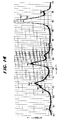
- Figure 14 is an x-ray diffraction scan of a sample containing W and W2C phases.
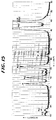
- Figure 15 is an x-ray diffraction scan of a sample containing W+W3C phases.
- FIGS 8A, 8B, 9 and 14 are illustrative of alloys in accordance with the invention.
- the invention discloses hard, fine-grained, non-columnar, substantially lamellar tungsten-carbon alloys consisting essentially of a mixture of a substantially pure tungsten phase and a carbide phase, wherein the carbide phase is W2C.
- the alloys are deposited thermochemically on a substrate, suitably under sub-atmospheric pressure to slightly atmospheric, i.e. within the range of about 133.3 Pa to about 133.3 kPa (about 1 Torr to about 1000 Torr), at a temperature of about 300° to about 650°C., using a mixture of process gases comprising tungsten hexafluoride, hydrogen, and an oxygen- and hydrogen-containing organic compound.
- Tungsten carbon alloys containing W + W2C can be formed using a wide range of process conditions.
- the microstructure, composition, properties, and crystallite size of the new alloys can be controlled by manipulating the process parameters used to make the alloys. More specifically, by conjunctively controlling various interdependent operating parameters, especially the reaction temperature within the range of about 300° to about 650°C, the feed rate of tungsten halide to the oxygen- and hydrogen- containing organic compound to control the W/C atomic ratio within the range from about 1 to about 3.5, and the ratio of hydrogen to tungsten hexafluoride to more than a stoichiometric amount required from the reduction of tungsten halide, namely within the range of about 4 to about 20, and preferably within the range of about 5 to about 10, it is possible to produce a tungsten carbide alloy containing a carbide phase consisting of W + W2C.
- the reaction mixture contains more than a
- the new tungsten carbon alloys of the present invention consist of a mixture of W + W2C. These alloys are unexpectedly found to have non-columnar grains and a lamellar microstructure. The new alloys' hardness values can be manipulated by altering process conditions.
- the present invention discloses new non-columnar tungsten carbon alloys consisting essentially of a mixture of a substantially pure tungsten phase and a carbide phase wherein the carbide phase is comprised of W2C.
- the tungsten carbon alloys of the present invention are comprised of extremely fine equiaxial grains which average about one micrometer or less in size.
- the alloys of the present invention exhibit a well defined lamellar microstructure with layers less than about 2 micrometers thick.
- the alloys of the invention are essentially free of columnar grains and thus are more resistant to corrosion, wear and erosion than are prior art alloys composed of columnar grains.
- the method of the present invention is based on the surprising discovery that deposits consisting of a mixture of a substantially pure tungsten phase and a carbide phase, consisting of W2C, in a fine grain, non-columnar microstructure can be produced by not only controlling the temperature of the reaction but also by controlling the W/C atomic ratio and the ratio of the hydrogen to tungsten halide which takes place in the initial tungsten halide substitution reaction. Since the various operating parameters can be interdependent, the operating parameters should be conjunctively controlled. As used herein the term "conjunctively controlled" means that the operating parameters as whole are controlled; in other words, the affect of a change in one parameter will be used in determining the operating values for the remaining parameters. For example, a change in the reaction temperature may necessitate a change in the ratio of tungsten halide to the oxygen- and hydrogen-containing organic compound.
- FIG. 10 is a graphic representation of the processing and compositional data from Examples 3A-H through 5A-U, as tabulated in Tables 1 and 2.
- this alloy can be produced at a reaction temperature ranging from 375°-475°C, using dimethyether (DME) as an oxygen- and hydrogen-containing organic compound with WF6 as the tungsten halide and a H2/WF6 ratio of about 10.
- DME dimethyether
- the composition of the carbide phase can be manipulated by changing, in a conjunctively controlled manner, the reaction temperature, the W/C atomic ratio, and the ratio of hydrogen to tungsten halide.
- such routine alteration of process parameters is now well within the skill of one skilled in the art, making it possible to utilize the broad teaching of the present invention to create custom tungsten carbon alloys having desired compositions and characteristics.
- preferred pressure is usually sub-atmospheric, down to 133.3 Pa (1 Torr), or up to slightly above atmospheric pressure, 1,33 x 10⁵ Pa (1000 Torr).
- temperatures of about 300°C. to about 650°C. are preferred; temperatures in the range of about 400°C. to about 450°C. are especially preferred.
- the hydrogen gas component of the reaction mixture it is essential for the deposition of the alloys to use more than a stoichiometric amount of hydrogen required for complete conversion of the tungsten fluoride (e.g., WF6) to hydrogen fluoride (HF).
- WF6 tungsten fluoride
- HF hydrogen fluoride
- preferred compounds are selected from group consisting of C1-C4 alcohols and aldehydes, C2-C4 ethers, epoxides and ketenes and C3-C4 ketones, For example, methanol, formaldehyde, ethanol, dimethyl ether, ketene (carbomethane), acetaldehyde, ethylene oxide, vinyl alcohol, acetone, acrolein, allyl alcohol, methyl ethyl ether, isopropyl alcohol, n-propyl alcohol, propylene oxide, propene oxide, propiolaldehyde, propionaldehyde, 2-propyne-1-ol, 3-methoxy propyne, vinyl ether, diethyl ether, furan, tetrahydrofuran, crotonaldehyde, and ⁇ -methyl acrolein.
- the two carbon and one oxygen-containing organic compound di
- the operating range of the tungsten halide to oxygen-and hydrogen- containing organic compound ratio or W/C atomic ratio may change depending on the number of carbon atoms in the oxygen- and hydrogen-containing organic compound.
- a compound such as methanol with one carbon atom, would be expected to reduce the operating range of the tungsten halide to methanol ratio.
- a compound such as diethyl ether which has four carbons, would be expected to increase the operating range of the tungsten halide to diethyl ether ratio.
- the tungsten/carbon alloys of the present invention can be deposited on a number of ferrous metals and alloys such as cast iron, carbon steels, stainless steels and high speed steels, non-ferrous metals and alloys such as copper, nickel, platinum, rhodium, titanium, aluminum, silver, gold, niobium, molybdenum, cobalt, tungsten, rhenium, copper alloys, nickel alloys such as inconel and monel, titanium alloys such as Ti/Al/V, Ti/Al/Sn, Ti/Al/Mo/V, Ti/Al/Sn/Zn/Mo, Ti/Al/V/Cr, Ti/Mo/V/Fe/Al, Ti/Al/V/Cr/Mo/Zr and Ti/Al/V/Sn alloys, non-metals such as graphite, carbides such as cemented carbide, and ceramics such as silicon carbide, silicon nitride, alumina,
- tungsten carbon alloys of the present invention on reactive substrate materials, such as cast irons, carbon steels, stainless steels, high speed steels, titanium and titanium alloys, aluminum and aluminum alloys, and nickel alloys
- a more noble material such as nickel, cobalt, copper, silver, gold, platinum, palladium or iridium, by electrochemical or electroless techniques or by physical vapor deposition such as sputtering.
- no deposition of noble material is required for coating non-reactive materials such as copper, nickel, cobalt, silver, gold, platinum, rhodium, niobium, molybdenum, tungsten, rhenium, graphite, carbides and ceramics.
- Free standing parts of tungsten/carbon alloys of the present invention can be made by depositing the alloy on substrates such as copper, nickel, cobalt, silver, gold, molybdenum, rhenium, and graphite and then removing these substrates by grinding and chemical or electrochemical etching.
- substrates such as copper, nickel, cobalt, silver, gold, molybdenum, rhenium, and graphite
- the deposits of the present invention are comprised of mixtures of W + W2C, W + W3C, and W + W2C + W3C.
- the deposits are characterized by a non-columnar crystal or grain structure consisting essentially of homogeneous fine and equiaxial grains having an average crystallite size of less than about 0.1 ⁇ m (microns). This is in contrast to the typical columnar crystal habit of conventional chemical vapor deposition.
- Deposits made by the method of the present invention are essentially lamellar and have been found to have unusually high wear and erosion resistance and unexpected hardness.
- Examples 1 and 2 illustrate production of prior art tungsten consisting of columnar grains.
- the non-columnar grain containing alloys of the present invention are illustrated in Examples 3-5. More specifically, Examples 3A-I illustrate production of tungsten carbon alloys having a carbide phase consisting of W3C, i.e., a tungsten carbon alloy consisting of W + W3C. Examples 4A-N illustrate production of tungsten carbon alloys having a carbide phase consisting of W2C + W3C, i.e., a tungsten carbon alloy consisting of W + W2C + W3C.
- Examples 5A-Z illustrate production of alloys having a carbide phase consisting of W2C, i.e., a tungsten carbon alloy consisting of W + W2C.
- the data in Examples 5Q to 5X also illustrate that a diluent such as argon can be used during the coating reaction to affect coating hardness without concomitantly affecting coating composition or crystallite size.
- the date in Examples 3I, 4L to 4N, and 5X to 5Z illustrate the effect of using different hydrogen to WF6 ratio on coating composition.
- Example 6 illustrates that tungsten/carbon alloys can be deposited on cemented carbide without a protective layer of noble material.
- Examples 7 and 8 illustrate that tungsten/carbon alloys can be deposited on aluminum and titanium alloys with protective layer of noble materials.
- Example 9 illustrates the ceramic materials such as alumina can be deposited with tungsten/carbon alloys without a protective layer of noble materials.
- Examples 10 and 11 show that tungsten/carbon alloys can be deposited on molybdenum.
- Example 12 shows that a tungsten followed by tungsten/carbon alloy coatings can be deposited on various metals and alloys.
- Example 13 illustrates the erosion performance of some of the alloys of the present invention.
- Examples 14 and 15 illustrate the wear performance of tungsten/carbon alloy (W+W2C) of the present invention.
- Examples 16 to 20 illustrate that several different oxygen-and-hydrogen containing organic compounds can be used to produce tungsten/carbon alloys.
- tungsten hexafluoride WF6
- DME dimethyl ether
- the specimens were found to be coated with a dull, adherent, coherent, and non-uniform coating of 12 to 50 micrometers thick tungsten on each side (see Tables 1 and 2).
- the coating consisted of columnar grains as shown in Figure 1.
- the coating had a very rough surface finish as shown in Figure 2.
- the average surface finish of uncoated AM-350 stainless steel was 0.04 cm (16 micro-inch); whereas, the average surface finish of the coated specimen was 0.09 cm (36 micro-inch). This indicated that the coating degraded the surface finish of the specimen.
- the coating had a hardness of 510 and 465 Vickers on graphite and stainless steel specimens, respectively.
- This Example shows that both nickel and copper interlayers can be used to protect the reactive substrate from the attack of hot HF gas.
- the graphite and stainless steel specimens were coated with a bright smooth, adherent, coherent, and uniform coating.
- the coating thickness on stainless steel specimens was ⁇ 22 micrometer.
- the coating on both graphite and stainless steel specimens was free of columnar grains as shown in Figure 3.
- the dark areas in the etched cross-section of the coating showed areas rich in W3C, indicating non-uniform distribution of W and W3C in the coating.
- the coating had a smooth surface finish as shown in Figure 4.
- the average surface finish of the uncoated AM-350 stainless steel was 0.04 cm (16 micro-inch), whereas, the average surface finish of the coated specimen was 0.018 cm (7 micro-inch). This indicated that the coating improved the surface finish of the specimen.
- the composition of the coating was determined by X-ray diffraction. It consisted of a mixture of W and W3C phases (see Table 2).
- Example 3A The CVD run described in Example 3A was repeated with the exceptions of using 30 minutes reaction time instead of 40 minutes and 442°C reaction temperature instead of 440°C.
- graphite and stainless steel specimens were coated with a bright, smooth, adherent, coherent, and uniform coating.
- the coating thickness on stainless steel and graphite specimens was 15 and 13 micrometers, respectively.
- the coating on graphite and stainless steel specimens was free of columnar grains as shown in Figure 5.
- the etched cross-section of the coating showed some dark areas enriched with W3C, indicating that the distribution of W and W3C in this coating was considerably better than than obtained in Example 3A.
- the coating was found to contain a mixture of W and W3C phases by X-ray diffraction (Table 2).
- Example 3A The CVD run described in Example 3A was repeated once again with the exceptions of using 35 minutes reaction time and 447°C reaction temperature. All the specimens were coated with a bright, smooth, adherent, coherent and uniform coating. The coating thickness on graphite specimens was 16 micrometers. The coating was, once again, free of columnar grains. X-ray diffraction analysis revealed the presence of W and W3C phases in the coating. The crystallite size of W and W3C phases determined by X-ray diffraction technique was 10.2 and 9.2 nm (102 and 92 ⁇ ), respectively, indicating the fine-grain structure of W + W3C coating.
- the crystallite size of W3C unexpectedly increased from 9.2-11.9 nm (92 to 119 ⁇ ) by increasing DME partial pressure from 44-73.3 Pa (0.33 to 0.55 Torr) or decreasing WF6/DME ratio from 10 to 6 or decreasing W/C atomic ratio from 5 to 3.
- Example 3F To determine the effect of coating temperature, another CVD run was conducted using reaction conditions and specimens indentical to those used in Example 3F. A lower temperature (431°C) was used for coating. All the specimens were coated with smooth, bright, adherent, coherent and uniform coating. Coating thickness on AM-350 specimens was 8 ⁇ m. It had non-columnar grains and consisted of a mixture of W and W3C phases. The crystallite size of W and W3C phases was found to be similar to that observed in Example 3F (see Table 2).
- This Example shows that W + W3C coating can be deposited at lower temperature.
- a SiC-6 graphite specimen was coated in a CVD run.
- the specimen was heated to a much lower temperature 371°C and a gaseous mixture of 350 cm3/min of WF6, 3,500 cm3/min of hydrogen and 65 cm3/min of DME was passed into the furnance over the specimen.
- a total pressure of 5333 Pa (40 Torr) was used to provide a DME partial pressure of 88 Pa (0.66 Torr).
- the ratio of WF6/DME and H2/WF6 used in this Example were 5.38 and 10.0, respectively. Additionally, the W/C atomic ratio used in this Example was 2.69.
- the graphite specimen was coated with a bright, smooth, adherent, coherent, and uniform coating. Coating thickness was approximately 6 ⁇ m. It was free of columnar grains and consisted of a mixture of W and W3C phases.
- This Example clearly shows that a mixture of W and W3C coating can be deposited at extremely low temperature ( ⁇ 370°C). Additionally, it shows that high DME partial pressure or low WF6/DME ratio or low W/C atomic ratio can be used at low temperature to yield W + W3C coating.
- This Example clearly shows that a mixture of W and W3C coating can be deposited using high H2/WF6 ratio ( ⁇ 11.0). Additionally, it shows that high DME partial pressure or low WF6/DME ratio or low W/C atomic ratio can be used to yield W + W3C coating.
- the coating thickness on AM-350 stainless steel specimens was ⁇ 8 ⁇ m.
- the coating was free of columnar grains and consisted of coarse layered structure (see Figure 6).
- the etched cross-section of the coating showed uniform distribution of W, W2C and W3C.
- the distribution of W, W2C and W3C was considerably better than the distribution of W and W3C in the coatings described in Examples 3A and 3B.
- the coating had a smooth surface finish as shown in Figure 7.
- the average surface finish of uncoated specimen was 0.04 cm (16 micro-inch); whereas, the average surface finish of coated specimen was 0,013 cm (5 micro-inch). This, therefore, indicated that the coating significantly improved the surface finish.
- the composition of the coating determined by X-ray diffraction revealed presence of a mixture of three phases, namely W, W2C and W3C (see Table 2).
- Example 3H resulted in the formation of W + W3C coating despite the use of lower WF6/DME ratio or lower W/C atomic ratio or higher DME partial pressure.
- Example 4A The CVD run described in Example 4A was repeated using a number of AM-350 specimens.
- the reaction conditions used were the same with the exceptions of using 443°C reaction temperature, 15 minutes reaction time and 300 cc/min of argon gas.
- the addition of argon gas did not alter the WF6/DME, W/C atomic and H2/WF6 ratios, but reduced the DME partial pressure to 80 Pa (0.60 Torr). All the specimens were coated with a bright, smooth, adherent, coherent, and uniform coating.
- the coating thickness was 5 ⁇ m.
- the coating was free of columnar grains and had coarse layered structure. X-ray diffraction analysis of the coating indicated the presence of W, W3C and trace amounts of W2C phases.
- This Example demonstrates the importance of WF6/DME ratio or W/C atomic ratio and temperature for controlling coating composition.
- a small drop in temperature in this Example compared to Example 4A causes a dramatic reduction in the amount of W2C in the coating.
- Example 2 In this Example several AM-350, SS-422 and IN-718 specimens similar to those used in Example 4A were coated using the reaction conditions very similar to those used in Example 4B with the exceptions of using slightly higher DME flow rate and reaction time.
- the DME flow rate used was 60 ml/min causing WF6/DME ratio to decrease to 5.0, W/C atomic ratio to decrease to 2.50 and DME partial pressure increase to 88 Pa (0.66 Torr).
- a H2/WF6 ratio used during coating was 10.0 All the specimens were coated with a bright, smooth, adherent, coherent, and uniform coating. The coating was free of columnar grains and had coarse layered structure. The coating thickness was 12 ⁇ m. It had a hardness of over 2,000 Vickers.
- Example 3I Comparing this Example to Example 3I, it can be seen that H2/WF6 ratio is very important for controlling coating composition and microstructure.
- Example 3I resulted in the formation of W + W3C coating despite the use of similar WF6/DME ratio, W/C atomic ratio and DME partial pressure.
- Example 4C The CVD run described in Example 4C was repeated using similar specimens and reaction conditions with the exception of using lower reaction time (20 min.) and slightly higher DME flow rate (62 cm3/min.). Use of 62 cm3/min. DME flow rate reduced WF6/DME ratio to 4.84, reduced W/C atomic ratio to 2.41 and increased DME partial pressure to 90.6 Pa (0.68 Torr). It, however, did not result in any change in H2/WF6 ratio.
- all the specimens were coated with a bright, smooth, adherent, coherent and uniform coating. The coating thickness was 5 ⁇ m. It was free of columnar grains and had coarse layered structure. X-ray diffraction analysis revealed presence of W, W2C and W3C phases in the coating. The crystallite size of W and W2C phases in the coating are summarized in Table 2.
- This Example shows that at certain DME partial pressure or WF6/DME ratio or W/C atomic ratio, a small increase in DME partial pressure or decrease in WF6/DME ratio or W/C atomic ratio causes a major change in coating composition.
- a small increase in DME partial pressure causes the amount of W2C in the coating to increase from trace amount to minor component.
- Example 4A The CVD run described in Example 4A was repeated using same type of specimens and similar reaction conditions with the exception of using higher reaction temperature (451°C as opposed to 445°C). All the specimens were coated with a bright, smooth, adherent, coherent and uniform coating.
- the coating thickness on AM-350 specimens was 13 ⁇ m. It was free of columnar grains and had coarse layered microstructure.
- the coating consisted of W, W2C and W3C phases, indicating no major change in coating composition by increasing reaction temperature from 445 to 451°C.
- AM-350 stainless steel and SiC-6 graphite specimens were placed in the reactor described earlier.
- AM-350 stainless steel specimens were electroplated with 4-5 ⁇ m thick nickel prior to coating operation.
- the reactor was heated to 462°C and a flow of 300 cm3/min of WF6, 3,000 cm3/min of hydrogen and 60 cm3/min of DME was established through the reactor for 35 minutes.
- a total pressure of 5333 Pa (40 Torr). was maintained during the reaction.
- the coating thickness on AM-350 specimens was 15 ⁇ m. It was free of columnar grains and consisted of fine layered structure.
- X-ray diffraction analysis revealed that the coating consisted of a mixture of W, W2C, and W3C phases, as shown in Table 2.
- the crystallite size of the coating varied from 7.3 to 16.4 nm (73 to 164 ⁇ ), as shown in Table 2.
- This Example therefore, demonstrates that a mixture of W, W2C, and W3C coating can be formed by using WF6/DMF ratio of 5.0 or W/C atomic ratio of 2.50, H2/WF6 ratio of 10.0, DME partial pressure of 94.6 Pa (0.71 Torr), and a temperature of 462°C. It also demonstrates that coating microstructure changes to fine layered structure by increasing the reaction temperature.
- Example 4F An experiment similar to that described in Example 4F was carried out again. This time only SiC-6 graphite specimens were used. The flow rate of DME was increased from 60 to 70 cm3/min to provide a WF6/DME ratio of 4.29 or W/C atomic ratio of 2.14 and a DME partial pressure of 110.6 Pa (0.83 Torr). A H2/WF6 ratio of 10.0 was maintained during the run. A reaction time of 40 min was used. Other conditions were kept the same. Once again, all the specimens were coated with a bright, smooth, adherent and coherent coating of 13 ⁇ m thickness. The coating was free of columnar grains, and consisted of fine layered structure. X-ray diffraction analysis of the coating revealed presence of W, W2C and trace amount of W3C phases (see Table 2). The crystallite size of the coating varied from 12 to 15 nm (120 to 150 ⁇ ), as shown in Table 2.
- This Example clearly shows that a coating consisting of a mixture of W, W2C and W3C can be formed by using 462°C temperature, 4.29 WF6/DME ratio or W/C atomic ratio of 2.14, 10.0 H2/WF6 ratio and 110.6 Pa (0.83 Torr) DME partial pressure. It also indicates that increasing DME partial pressure or decreasing WF6/DME ratio of W/C atomic ratio is responsible for reducing the amount of W3C in the coating.
- a CVD experiment using SiC-6 graphite specimens was carried out in a reactor similar to that described earlier. This time flow rate of 300 cm3/min of WF6, 3,000 cm3/min of hydrogen and a very low flow 40 cm3/min of DME was used. A reaction time of 40 min and a total pressure of 5333 Pa (40 Torr) were used for the coating experiment. These flow rates and pressure provided WF6/DME ratio of 7.5, W/C atomic ratio of 3.75, H2/WF6 ratio of 10.0 and DME partial pressure of 64 Pa (0.48 Torr). A reaction temperature of 467°C was used. All the specimens were coated with a bright, smooth, adherent and coherent coating of ⁇ 22 ⁇ m thickness. The coating was free of columnar grains and consisted of coarse layered structure. X-ray diffraction analysis revealed that the coating consisted of a mixture of W, W3C and trace amount of W2C phases.
- This Example showed that a mixture of W, W2C and W3C can be formed at 467°C, 8.57 WF6/DME ratio, W/C atomic ratio of 4.23, 10.0 H2/WF6 ratio and 56 Pa (0.42 Torr) DME partial pressure.
- Example 4I CVD experiment described in Example 4I was repeated with using 6665 Pa (50 Torr) total pressure and 474°C reaction temperature.
- the change in total pressure caused DME partial pressure to increase from 56 to 69.3 Pa (0.42 to 0.52 Torr), but it did not affect the WF6/DME, W/C atomic and H2/WF6 ratios.
- All the specimens were coated with a bright, smooth, adherent, and coherent coating of ⁇ 22 ⁇ m thickness.
- the coating was free of columnar grains, and consisted of coarse layered structure.
- X-ray diffraction analysis revealed that the coating consisted of a mixture of W, W2C and W3C phases.
- Example 4J CVD experiment described in Example 4J was repeated with using 13330 Pa (100 Torr) total pressure, 24 cm3/min DME, 400 cm3/min WF6 and 4,000 cm3/min hydrogen flow rates, 477°C reaction temperature, and 15 min. reaction time. These flow rates and pressure caused WF6/DME ratio, W/C atomic ratio and DME partial pressure to increase to 16.7, 8.35 and 72 Pa (0.54 Torr), respectively. A constant H2/WF6 ratio of 10.0, however, was used during the run. All the specimens were coated with a bright, smooth, adherent, and coherent coating of 20 ⁇ m thickness. The coating was free of columnar grains, and consisted of coarse layered structure. X-ray diffraction analysis revealed that the coating consisted of a mixture of W, W3C and a trace amount of W2C phases.
- This Example therefore, indicates that a mixture of W, W2C and W3C can be formed by using 477°C temperature, 16.7 WF6/DME ratio, 8.35 W/C atomic ratio, 10.0 H2/WF6 ratio and 72 Pa (0.54 Torr) DME partial pressure.
- Example 4 In this Example, several AM-350 and IN-718 specimens similar to those used in Example 4A were coated. The specimens were heated to a temperature of about 445°C and a gaseous mixture of 220 cm3/min. WF6, 2,400 cm3/min. of hydrogen, 3,000 cm3/min. of argon and 60 cm3/min. of DME was passed into the furnace over the specimens. A total pressure of 5333 Pa (40 Torr) was maintained in the run to give 56 Pa (0.42 Torr) partial pressure of DME. A WF6/DME ratio of 3.33, W/C atomic ratio of 1.67, and a H2/WF6 ratio of 12.0 were also maintained during the run. The deposition was conducted for 90 minutes (see Table 1).
- the coating thickness was AM-350 stainless steel specimens was ⁇ 13 ⁇ m.
- the coating was fine of columnar grains and consisted of course layered structure. X-ray diffraction analysis of the coating indicated the presence of W, W2C and W3C phases (see Table 2).
- This example indicates that a mixture of W, W2C and W3C can be formed using 445°C temperature, 3.33 WF6/DME ratio, 1.67 W/C atomic ratio, 12.0 H2/WF6 ratio, and 56 Pa (0.42 Torr) DME partial pressure. It also indicates that a low WF6/DME ratio or W/C atomic ratio can be used to produce W + W2C coating provided a H2/WF6 ratio of 12.0 is used. This example also indicates the importance of H2/WF6 ratio for controlling coating composition.
- SiC-6 graphite specimens Five 0,24 cm x 2.54 cm x 5.08 cm (0.095 inch x 1 inch x 2 inch) SiC-6 graphite specimens were placed in an inductively heated graphite furnace inside a gas-tight quartz envelope. The specimens were heated to a temperature of 477°C and a gaseous mixture of 400 cm3/min of WF6, 4,000 cm3/min of hydrogen, and 65 cm3/min of DME was passed into the furnace over the specimens. The total pressure within the system was maintained at 1.33 x 10⁴ Pa (100 Torr) to provide a DME partial pressure of 194.6 Pa (1.46 Torr). The ratios of WF6/DME, W/C atomic and H2/WF6 used were 6.15, 3.08 and 10.0, respectively. The deposition was conducted for 15 minutes; thereafter, the flow of the reactive gases was stopped and the specimens were cooled.
- the specimens were found to be coated with a bright, smooth, adherent, coherent, and uniform coating of 25 micrometers thick on each side (see Table 1).
- the coating was free of columnar grains. It consisted of extremely fine grains. Additionally, it had a well defined layered microstructure with layers 1-2 ⁇ m thick.
- the coating had a hardness of 2512 Vickers.
- the composition of the coating was determined by X-ray diffraction. It was comprised of a mixture of W and W2C phases, as shown in Table 2.
- Example 4K Comparing this Example to Example 4K, it can be seen that increasing DME partial pressure and decreasing WF6/DME ratio or W/C atomic ratio simultaneously causes a unexpected change in coating composition. Additionally, it results in higher coating hardness.
- the coating was free of columnar grains. Additionally, it had a well defined fine layered microstructure with layers less than 1 ⁇ m apart. The coating had a hardness of 2758 Vickers. The coating was found to contain a mixture of W and W2C phases. The crystallite size of the coating was less than 5 nm (50 ⁇ ).
- This Example shows that a mixture of W and W2C can be formed by using 463°C temperature, 3.53 WF6/DME ratio, 1.77 W/C atomic ratio, 10.0 H2WF6 ratio and 1.33 x 10⁵ Pa (1.00 Torr) DME partial pressure. Additionally, it indicates that the crystallite size of the coating is considerably smaller than that noted in Examples 3 and 4. Furthermore, it indicates that the hardness of the coating is considerably higher than that noted in Examples 3 and 4.
- Example 5B CVD experiment described in Example 5B was repeated with the exception of using 443°C temperature and 35 minutes reaction time. All the specimens were, once again, coated with bright, smooth, adherent, coherent, and uniform coating of 20 ⁇ m thick on each side (see Table 1). The coating was free of columnar grains. It consisted of a well defined fine layered structure, as shown in Figure 8. The etched cross-section of the coating showed very uniform distribution of W and W2C. The coating had a smooth surface finish as shown in Figure 9. The average surface finish of uncoated AM-350 stainless steel specimen was 0.14 cm (54 micro-inch); whereas, the coated specimen had an average surface finish of 0.08 cm (33 micro-inch). This, therefore, indicated that W + W2C coating considerably improved the surface finish of the specimen. X-ray diffraction analysis of the coating revealed the presence of W and W2C phases in the coating. The crystallite size was less than 5 nm (50 ⁇ ) (see Table 2).
- This Example shows that a mixture of W and W2C can be formed at lower temperature (443°C) as well.
- the WF6/DME ratio was varied from 3.00 to 4.29, the W/C atomic ratio varied from 1.5 to 2.65, and the partial pressure of DME was varied from 101.3 to 144 Pa (0.76 to 1.08 Torr). However, the ratio of H2/WF6 was maintained at 10.0 in all the experiments. Reaction time was also varied in these experiments, as shown in Table 1.
- Coating was extremely hard, as shown in Table 1. It consisted of a mixture of W and W2C phases (see Table 2). The crystallite size of the coating with higher DME partial pressure or lower WF6/DME ratio or lower W/C atomic ratio was similar to the one obtained with lower DME partial pressure or higher WF6/DME ratio or higher W/C atomic ratio.
- the coating was free of columnar grains. It consisted of fine layered microstructure. The hardness of coating was around 2,400 Vickers, which was considerably lower than that observed at very low argon or no argon flow rates. The coating consisted of W and W2C phases, and the crystallite size of the coating was less than 5 nm (50 ⁇ ) (see Table 2).
- AM-350 and IN-718 specimens were coated in a reactor similar to that described in Example 5A.
- a reaction temperature of 445°C, total pressure of 5333 Pa (40 Torr) and flow rate of 200 cm3/min. WF6, 2,000 cm3/min. hydrogen, 3,500 cc/min. argon and 60 cm3/min. of DME were used for the reaction. Reaction time used was 90 min. These conditions provided WF6/DME ratio of 3.33, W/C atomic ratio of 1.67, H2/WF6 ratio of 10.0 and DME partial pressure of 56 Pa (0.42 Torr). All the specimens were coated with a bright, smooth, adherent, coherent, and uniform coating of ⁇ 9 ⁇ m thick (AM-350) on each side (see Table 1).
- the coating was fine of columnar grains. Additionally, it had a well defined five layered microstructure with layers less than 1 ⁇ m apart. The coating had a hardness of 2035 Vickers. The coating was found to contain a mixture of W and W2C phases (see TAble 3). The crystallite size of the coating was less than 5 nm (50 ⁇ ).
- This example shows that a mixture of W and W2C can be produced provided a certain ratio of WF6/DME or W/C atomic ratio and more than stoichiometric amount of hydrogen required for complete conversion of WF6 to HF are used.
- the specimens were coated with a bright, smooth, adherent, coherent, and uniform coating.
- the coating thickness was ⁇ 8 ⁇ m.
- the coating was free of columnar grains and consisted of layered structure.
- the etched cross-section of the coating showed uniform distribution of W, W2C and W3C.
- the coating had a smooth surface finish.
- This example therefore shows that the tungsten/carbon alloy coatings of the present invention can be deposited on cemented carbide. Additionally, it shows that there is no need to provide a nickel or copper inter-layer to protect the cemented carbide while depositing tungsten/carbon alloys.
- two specimens of titanium alloy (Ti/6Al/4V) were coated in a run. Both the specimens were plated with 4-5 ⁇ m thick nickel using electroless nickel technique. The specimens were heated to a temperature of about 445°C and a gaseous mixture of 300 cm3/min. WF6, 3,000 cm3/min. of hydrogen and 55 cm3/min. of DME was passed into the furnace over the specimens. A total pressure of 5333 Pa (40 Torr) was maintained in the run to give 88 Pa (0.66 Torr) partial pressure of DME. A WF6/DME ratio of 5.45 or W/C atomic ratio of 2.73 was also maintained during the run. A H2/WF6 ratio of 10.0 was also maintained during the run. The deposition was conducted for 20 minutes.
- the specimens were coated with a bright, smooth, adherent, coherent, and uniform coating.
- the coating thickness was ⁇ 8 ⁇ m.
- the coating was free of columnar grains and consisted of layered structure.
- X-ray diffraction analysis revealed the presence of W, W2C and W3C in the coating.
- Coating thickness was approximately 5 ⁇ m. It was free of columnar grains and consisted of a mixture of W and W3C phases.
- the specimens were coated with a bright smooth, adherent, coherent and uniform coating of ⁇ 12 ⁇ m thickness.
- the coating was free of columnar grains and consisted of layered structure.
- X-ray diffraction revealed the pressure of W, W2C and W3C in the coating.
- the coating had a smooth surface finish.
- tungsten/carbon alloy coatings of the present invention case be deposited of ceramic substrates such as alumina. Additionally, it shows that there is no need to provide a nickel or copper interlayer to protect the ceramic substrates while depositing tungsten/carbon alloys.
- Both rods were coated with a bright smooth, adherent, coherent and uniform coating of ⁇ 13 ⁇ m thickness. It was free of columnar grains and consisted of a mixture of W and W3C phases. This example shows that tungsten/carbon alloys of the present invention run be deposited on molybdenum without a protective interlayer.
- Example 10 The experiment described in Example 10 was repeated with the exception of using higher (55 cm3/min) DME flow rate.
- This high DME flow rate provided a DME partial pressure of 88 Pa (0.66 Torr).
- the WF6/DME and W/C atomic ratios used were 5.5 and 2.75, respectively.
- the ratio of H2/WF6 used was 10.0.
- Both rods were, once again, coated with a bright, smooth, adherent, coherent and uniform coating of ⁇ 11 ⁇ m thickness. It was free of columnar grains and consisted of mixture of W, W2C and W3C phases.
- a total pressure of 5333 Pa (40 Torr) was maintained during the run to provide a DME partial pressure of 64 Pa (0.48 Torr), a WF6/DME ratio of 7.5, and a W/C atomic ratio of 3.75, respectively. Additionally, a H2/WF6 ratio of 10.0 was used during the coating steps.
- tungsten/carbon alloy All the specimens were coated with 2-3 ⁇ m thick tungsten followed by 27-28 ⁇ m thick tungsten/carbon alloy. The coating was bright, smooth, adherent, coherent and uniform.
- the tungsten interlayer had a well defined columnar structure; whereas, tungsten/carbon alloy had non-columnar structure. It consisted of a mixture of W and W3C phases.
- the erosion performance of some of the coated specimens was determined using a miniature sandblast unit. Crushed glass with average particle size of 50 micrometers was directed at the coated and uncoated specimens at an angle of 90° for 10 minutes using the test procedure summarized in Table 3. The erosion performance of uncoated and coated specimens was determined based upon weight loss as well as calculated volume loss in 10 minutes.
- the erosion performance of W + W2C + W3C coating was far superior to that of W + W3C coating (see Table 4). Additionally, erosion performance of W + W2C coating was considerably better than that of W + W2C + W3C and W + W3C coatings.
- the wear performance of W+W2C coating was determined using a block-on-ring test.
- the test machine was made by Falex Corporation, Aurora, Illinois.
- the wear performance of uncoated 4620 steel rings was determined against coated and uncoated 440C steel blocks.
- the test was conducted in a mineral oil having a viscosity of 62.5 centipoise.
- the oil contained 3.0 ⁇ m alumina particles in a concentration of 2 g/litre.
- the block-on-ring test was performed using a load of 113.4 kg (250 lb.) and 90° oscillating motion at 60 min ⁇ 1 (rpm) for 20,000 cycles. Wear scar width and weight loss were measured to determine and compare the wear performance of coated and uncoated specimens.
- the wear performance of W+W2C coating was once again determined using a pin-on-disc test.
- the test machine was made by Falex Corporation.
- the wear performance of uncoated and coated 440C steel pins was determined against uncoated SiC disc.
- the test was conducted in a mineral oil having a viscosity of 62.5 centipoise. It contained 3.0 ⁇ m alumina in a concentration of 2 g/litre.
- the pin-on-disc test was conducted using a load of 1.8 kg (4 lbs) and continuous motion at 150 min ⁇ 1 (rpm).
- the wear performance of the coated and the uncoated 440C steel pins was compared based upon the pin wear rate.
- all of the specimens are expected to be coated with a bright, smooth, adherent, coherent, and uniform coating of ⁇ 20 ⁇ m thick on each side.
- the coating is expected to be free of columnar grains and a mixture of W and W3C phases.
- Example 16 CVD experiment described in Example 16 is repeated with using 40 cm3/min. DEE instead of 20 cm3/min.
- the increase in DEE flow rate causes a decrease in WF6/DEE ratio to 7.5, a decrease in W/C atomic ratio to 1.88, and an increase in DEE partial pressure to 64 Pa (0.48 Torr). All the other reaction conditions are maintained the same as described in Example 16. All the specimens are expected to be coated with a bright, smooth, adherent, coherent, and uniform coating of ⁇ 15 ⁇ m thick on each side. The coating is expected to be free of columnar grains and a mixture of W and W2C phases.
- Example 18 CVD experiment described in Example 18 is repeated with using 80 cm3/min. ethanol instead of 40 cm3/min.
- the increase in ethanol flow rate causes a decrease in WF6/ethanol ratio to 3.75, a decrease in W/C atomic ratio to 1.88, and an increase in ethanol partial pressure to 126.6 Pa (0.95 Torr).
- All the other reaction conditions are maintained the same as described in Example 3.
- All the specimens are expected to be coated with a bright, smooth, adherent, coherent, and uniform coating and ⁇ 15 ⁇ m thick on each side. The coating is expected to be free of columnar grains and a mixture of W and W2C phases.
- Example 3 CVD experiment described in Example 3 is repeated again with using 80 cm3/min. methanol instead of 40 cm3/min. of ethanol.
- This flow rate of methanol results in WF6/methanol ratio, W/C atomic ratio, and methanol partial pressure of 3.75, 3.75, and 126.6 Pa (0.95 Torr), respectively.
- All the other reaction conditions are maintained the same as described in Example 18.
- All the specimens are expected to be coated with a bright, smooth, adherent, coherent, and uniform coating of ⁇ 20 ⁇ m thick on each side. The coating is expected to be free of columnar grains and a mixture of W and W3C phases.
- the Philips had a variable divergence slit which kept the sample illumination length fixed at 13.2mm. Both instruments had scintillation x-ray detectors. Data output for the Siemens was by strip-chart recording; that for the Philips was in the form of digitized diffraction traces which were stored in files in a dedicated Micro PDP 11-23 computer.
- the volume of sample illuminated by x-rays varied with the type of diffractometer and radiation employed.
- the Siemens illumination area decreased as the diffraction angle (2 ⁇ ) increased, while the Philips illumination area was constant and independent of 2 ⁇ .
- the penetration depth is a function of x-ray wavelength, the linear absorption coefficient of the sample, and diffraction angle.
- a rough calculation showed that 99% of CuK ⁇ diffracted intensity for a reflection whose d-spacing was 225 pm (2.25 ⁇ )(2 ⁇ ⁇ 40°) came from the top ⁇ 2.5 ⁇ m of these tungsten-rich materials.
- the corresponding penetration depth for CrK ⁇ radiation was ⁇ 1.3 ⁇ m. The region between 1.3 ⁇ m and 2.5 ⁇ m, which effectively could not be probed by CrK ⁇ x-rays, accounted for ⁇ 10% of the total CuK ⁇ diffracted intensity.
- Diffraction scans were made for the purpose of phase identification and, in some cases, for measuring cyrstallite size.
- Survey scans over wide angular regions (usually, 5°-90° for CuK ⁇ and 15°-115° for CrK ⁇ ) at rapid scan rates (5°/min. or 2°/min.) were initially obtained. If there was some doubt about the presence of a weakly-diffracting phase, scans were repeated at a slower (1°/min.) scan rate.
- the materials can be divided into three groups. Some were binary mixtures of W and W3C; some were ternary mixtures of W, W3C and W2C; and still others were binary mixtures of W and W2C.
- the crystallite sizes were uniformly small, almost always less than 20 nm (200 ⁇ ) and often less than 10 nm (100 ⁇ ).
- Figure 11 is a Siemens CuK ⁇ scan of a W/W3C/W2C mixture. This pattern is rather more crystalline than the average, and shoes clearly that all three phases are present.
- Figure 12 is a Siemens CuK ⁇ scan of a ternary mixture, but in this case a trace amount of W2C is present in the sample.
- Figure 13 is a Siemens CuK ⁇ scan of a ternary mixture and here a trace amount of W3C is present in the sample.
- Figure 14 is a Siemens CrK ⁇ scan of a very low-crystalline, almost amorphous W/W2C mixture.
- Figure 15 is a typical scan of a W/W3C mixture. No W2C was detected in this scan.
- the present invention discloses extremely hard, fine grained non-columnar tungsten-carbon alloys which consist essentially of a mixture of a substantially pure tungsten phase and at least one carbide phase wherein the carbide phase consists of W2C or W3C or a mixture of W2C and W3C.
- the new alloys are harder and more resistant to fracture, corrosion, erosion and wear than are tungsten-carbon alloys of the prior art that are produced by conventional chemical vapor deposition techniques and thus are composed of large columnar grains.
- the present invention also discloses a method for producing the new tungsten-carbon alloys wherein the composition of the alloy's carbide phase can be controlled by controlling the temperature at which the reactions are run, the ratio of tungsten halide to oxygen- and hydrogen-containing organic compound and the ratio of hydrogen to tungsten halide.
- the method makes it possible for those skilled in the art to produce custom alloys having desired carbide characteristics.
Landscapes
- Chemical & Material Sciences (AREA)
- Mechanical Engineering (AREA)
- General Chemical & Material Sciences (AREA)
- Chemical Kinetics & Catalysis (AREA)
- Engineering & Computer Science (AREA)
- Materials Engineering (AREA)
- Metallurgy (AREA)
- Organic Chemistry (AREA)
- Inorganic Chemistry (AREA)
- Carbon And Carbon Compounds (AREA)
- Chemical Vapour Deposition (AREA)
- Catalysts (AREA)
- Other Surface Treatments For Metallic Materials (AREA)
- Powder Metallurgy (AREA)
Applications Claiming Priority (2)
| Application Number | Priority Date | Filing Date | Title |
|---|---|---|---|
| US92809 | 1987-09-03 | ||
| US07/092,809 US4874642A (en) | 1987-09-03 | 1987-09-03 | Method for depositing a hard, fine-grained, non-columnar alloy of tungsten and carbon on a substrate |
Publications (3)
| Publication Number | Publication Date |
|---|---|
| EP0305917A2 EP0305917A2 (en) | 1989-03-08 |
| EP0305917A3 EP0305917A3 (en) | 1990-03-07 |
| EP0305917B1 true EP0305917B1 (en) | 1995-01-04 |
Family
ID=22235247
Family Applications (1)
| Application Number | Title | Priority Date | Filing Date |
|---|---|---|---|
| EP88113932A Expired - Lifetime EP0305917B1 (en) | 1987-09-03 | 1988-08-26 | High hardness fine grained tungsten-carbon alloys and process for making same |
Country Status (10)
| Country | Link |
|---|---|
| US (1) | US4874642A (da) |
| EP (1) | EP0305917B1 (da) |
| JP (1) | JPH026314A (da) |
| KR (1) | KR910005238B1 (da) |
| AT (1) | ATE116692T1 (da) |
| AU (1) | AU598952B2 (da) |
| CA (1) | CA1330249C (da) |
| DE (1) | DE3852680D1 (da) |
| DK (1) | DK486888A (da) |
| IL (1) | IL87587A (da) |
Families Citing this family (22)
| Publication number | Priority date | Publication date | Assignee | Title |
|---|---|---|---|---|
| US4945640A (en) * | 1987-09-03 | 1990-08-07 | Diwakar Garg | Wear resistant coating for sharp-edged tools and the like |
| US4855188A (en) * | 1988-02-08 | 1989-08-08 | Air Products And Chemicals, Inc. | Highly erosive and abrasive wear resistant composite coating system |
| US4927713A (en) * | 1988-02-08 | 1990-05-22 | Air Products And Chemicals, Inc. | High erosion/wear resistant multi-layered coating system |
| US4873152A (en) * | 1988-02-17 | 1989-10-10 | Air Products And Chemicals, Inc. | Heat treated chemically vapor deposited products |
| US5262202A (en) * | 1988-02-17 | 1993-11-16 | Air Products And Chemicals, Inc. | Heat treated chemically vapor deposited products and treatment method |
| JPH0643243B2 (ja) * | 1988-03-10 | 1994-06-08 | セントラル硝子株式会社 | タングステンカーバイトの製造方法 |
| US5226224A (en) * | 1990-05-31 | 1993-07-13 | Shin Meiwa Industry Co., Ltd. | Method of removing sheath from electric wire in intermediate region |
| US5064686A (en) * | 1990-10-29 | 1991-11-12 | Olin Corporation | Sub-valent molybdenum, tungsten, and chromium amides as sources for thermal chemical vapor deposition of metal-containing films |
| US5277987A (en) * | 1991-02-01 | 1994-01-11 | Air Products And Chemicals, Inc. | High hardness fine grained beta tungsten carbide |
| US5342652A (en) * | 1992-06-15 | 1994-08-30 | Materials Research Corporation | Method of nucleating tungsten on titanium nitride by CVD without silane |
| US5560839A (en) * | 1994-06-27 | 1996-10-01 | Valenite Inc. | Methods of preparing cemented metal carbide substrates for deposition of adherent diamond coatings and products made therefrom |
| US6107199A (en) * | 1998-10-24 | 2000-08-22 | International Business Machines Corporation | Method for improving the morphology of refractory metal thin films |
| KR100603554B1 (ko) | 1999-02-11 | 2006-07-24 | 하다이드 리미티드 | 텅스텐 카바이드 코팅 및 그 제조 방법 |
| WO2002044437A2 (en) | 2000-11-02 | 2002-06-06 | Composite Tool Company, Inc. | High strength alloys and methods for making same |
| GB0207375D0 (en) | 2002-03-28 | 2002-05-08 | Hardide Ltd | Cutting tool with hard coating |
| RU2280098C1 (ru) * | 2005-05-16 | 2006-07-20 | Государственное образовательное учреждение высшего профессионального образования "Московский государственный институт стали и сплавов" (технологический университет) | Способ формирования покрытий из карбида вольфрама |
| CN102234755B (zh) * | 2010-04-23 | 2013-03-27 | 南京梅山冶金发展有限公司 | 一种覆有非晶态碳化钨涂层的新型冷轧活套辊 |
| US9314985B2 (en) | 2011-09-27 | 2016-04-19 | Kennametal Inc. | Coated pelletizing extrusion dies and method for making the same |
| US10189763B2 (en) | 2016-07-01 | 2019-01-29 | Res Usa, Llc | Reduction of greenhouse gas emission |
| US9981896B2 (en) | 2016-07-01 | 2018-05-29 | Res Usa, Llc | Conversion of methane to dimethyl ether |
| US9938217B2 (en) | 2016-07-01 | 2018-04-10 | Res Usa, Llc | Fluidized bed membrane reactor |
| CN107130227B (zh) * | 2017-07-06 | 2019-08-06 | 北京理工大学 | 一种超细纳米晶碳化钨涂层及其制备方法 |
Citations (1)
| Publication number | Priority date | Publication date | Assignee | Title |
|---|---|---|---|---|
| US4162345A (en) * | 1976-07-06 | 1979-07-24 | Chemetal Corporation | Deposition method and products |
Family Cites Families (14)
| Publication number | Priority date | Publication date | Assignee | Title |
|---|---|---|---|---|
| US3230110A (en) * | 1962-01-22 | 1966-01-18 | Temescal Metallurgical Corp | Method of forming carbon vapor barrier |
| US3368914A (en) * | 1964-08-05 | 1968-02-13 | Texas Instruments Inc | Process for adherently depositing a metal carbide on a metal substrate |
| US3389977A (en) * | 1964-08-05 | 1968-06-25 | Texas Instruments Inc | Tungsten carbide coated article of manufacture |
| US3574672A (en) * | 1964-08-05 | 1971-04-13 | Texas Instruments Inc | Cvd process for producing tungsten carbide and article of manufacture |
| US3721577A (en) * | 1966-09-23 | 1973-03-20 | Teeg Research Inc | Process for the deposition of refractory metal and metalloid carbides on a base material |
| US3565676A (en) * | 1968-04-01 | 1971-02-23 | Fansteel Metallurgical Corp | Chemical vapor deposition method |
| GB1326769A (en) * | 1970-10-08 | 1973-08-15 | Fulmer Res Inst Ltd | Formulation of tungsten and molybdenum carbides |
| GB1540718A (en) * | 1975-03-21 | 1979-02-14 | Fulmer Res Inst Ltd | Hard coating and its method of formation |
| US4147820A (en) * | 1976-07-06 | 1979-04-03 | Chemetal Corporation | Deposition method and products |
| US4427445A (en) * | 1981-08-03 | 1984-01-24 | Dart Industries, Inc. | Tungsten alloys containing A15 structure and method for making same |
| JPS58501382A (ja) * | 1981-08-03 | 1983-08-18 | エアー・プロダクツ・アンド・ケミカルズ・インコーポレーテッド | 高硬度材料 |
| US4741975A (en) * | 1984-11-19 | 1988-05-03 | Avco Corporation | Erosion-resistant coating system |
| JPS61157681A (ja) * | 1984-12-28 | 1986-07-17 | Toho Kinzoku Kk | 化学蒸着法 |
| US4873152A (en) * | 1988-02-17 | 1989-10-10 | Air Products And Chemicals, Inc. | Heat treated chemically vapor deposited products |
-
1987
- 1987-09-03 US US07/092,809 patent/US4874642A/en not_active Expired - Fee Related
-
1988
- 1988-08-26 DE DE3852680T patent/DE3852680D1/de not_active Expired - Lifetime
- 1988-08-26 AT AT88113932T patent/ATE116692T1/de active
- 1988-08-26 AU AU21582/88A patent/AU598952B2/en not_active Ceased
- 1988-08-26 EP EP88113932A patent/EP0305917B1/en not_active Expired - Lifetime
- 1988-08-29 IL IL87587A patent/IL87587A/xx not_active IP Right Cessation
- 1988-08-29 CA CA000575909A patent/CA1330249C/en not_active Expired - Fee Related
- 1988-09-01 DK DK486888A patent/DK486888A/da not_active Application Discontinuation
- 1988-09-02 JP JP63220261A patent/JPH026314A/ja active Pending
- 1988-09-03 KR KR1019880011436A patent/KR910005238B1/ko not_active Expired
Patent Citations (1)
| Publication number | Priority date | Publication date | Assignee | Title |
|---|---|---|---|---|
| US4162345A (en) * | 1976-07-06 | 1979-07-24 | Chemetal Corporation | Deposition method and products |
Also Published As
| Publication number | Publication date |
|---|---|
| IL87587A0 (en) | 1989-01-31 |
| AU598952B2 (en) | 1990-07-05 |
| ATE116692T1 (de) | 1995-01-15 |
| DK486888D0 (da) | 1988-09-01 |
| EP0305917A2 (en) | 1989-03-08 |
| AU2158288A (en) | 1989-05-25 |
| DK486888A (da) | 1989-03-04 |
| DE3852680D1 (de) | 1995-02-16 |
| US4874642A (en) | 1989-10-17 |
| JPH026314A (ja) | 1990-01-10 |
| KR910005238B1 (ko) | 1991-07-24 |
| CA1330249C (en) | 1994-06-21 |
| KR890005297A (ko) | 1989-05-13 |
| IL87587A (en) | 1993-01-14 |
| EP0305917A3 (en) | 1990-03-07 |
Similar Documents
| Publication | Publication Date | Title |
|---|---|---|
| EP0305917B1 (en) | High hardness fine grained tungsten-carbon alloys and process for making same | |
| KR0165923B1 (ko) | 피복 절삭공구 및 그 제조방법 | |
| KR100292292B1 (ko) | 산화물 코팅된 코팅체 | |
| RU2131330C1 (ru) | Режущий инструмент с окисным покрытием и способ его нанесения | |
| RU2563080C2 (ru) | Выполненные с покрытием тела из металла, твердого сплава, кермета или керамики и способ нанесения покрытия на такие тела | |
| JP3740647B2 (ja) | 被覆硬質物品とその製造方法 | |
| US5863640A (en) | Coated cutting insert and method of manufacture thereof | |
| EP0413834B1 (en) | Diamond-covered member and process for producing the same | |
| US20040144302A1 (en) | Oxide coated cutting tool | |
| EP0328084B1 (en) | Highly erosive and abrasive wear resistant composite coating system | |
| US4162345A (en) | Deposition method and products | |
| EP3662093B1 (en) | Coated cutting tool and a process for its manufacture | |
| US4427445A (en) | Tungsten alloys containing A15 structure and method for making same | |
| JP7393946B2 (ja) | コーティングされた切削工具 | |
| CN115351317B (zh) | 涂层切削刀具及其制备方法 | |
| US5277987A (en) | High hardness fine grained beta tungsten carbide | |
| US4910091A (en) | High hardness fine grained tungsten-carbon alloys | |
| Gaydaychuk et al. | Influence of Al-Si-N interlayer on residual stress of CVD diamond coatings | |
| EP3461928B1 (en) | Tacno coatings and production process | |
| JP4022042B2 (ja) | 被覆工具及びその製造方法 | |
| EP0549801A1 (en) | Diamond-covered member and production thereof | |
| EP0329085A1 (en) | Heat treated chemically vapor deposited products and treatment method | |
| Raghuram et al. | Structure and microhardness relationships in Ti, Zr and Hf-3Zr carbide deposits synthesized by activated reactive evaporation | |
| Sproul et al. | Some aspects of a sputtered interfacial eta-carbide layer and its effect on a TiC-coated WC-Co cemented carbide | |
| JPS5824501B2 (ja) | タングステンカ−バイド被膜層の製造方法 |
Legal Events
| Date | Code | Title | Description |
|---|---|---|---|
| PUAI | Public reference made under article 153(3) epc to a published international application that has entered the european phase |
Free format text: ORIGINAL CODE: 0009012 |
|
| AK | Designated contracting states |
Kind code of ref document: A2 Designated state(s): AT BE CH DE FR GB IT LI LU NL SE |
|
| PUAL | Search report despatched |
Free format text: ORIGINAL CODE: 0009013 |
|
| AK | Designated contracting states |
Kind code of ref document: A3 Designated state(s): AT BE CH DE FR GB IT LI LU NL SE |
|
| 17P | Request for examination filed |
Effective date: 19900518 |
|
| 17Q | First examination report despatched |
Effective date: 19911104 |
|
| GRAA | (expected) grant |
Free format text: ORIGINAL CODE: 0009210 |
|
| AK | Designated contracting states |
Kind code of ref document: B1 Designated state(s): AT BE CH DE FR GB IT LI LU NL SE |
|
| PG25 | Lapsed in a contracting state [announced via postgrant information from national office to epo] |
Ref country code: IT Free format text: LAPSE BECAUSE OF FAILURE TO SUBMIT A TRANSLATION OF THE DESCRIPTION OR TO PAY THE FEE WITHIN THE PRE;WARNING: LAPSES OF ITALIAN PATENTS WITH EFFECTIVE DATE BEFORE 2007 MAY HAVE OCCURRED AT ANY TIME BEFORE 2007. THE CORRECT EFFECTIVE DATE MAY BE DIFFERENT FROM THE ONE RECORDED.SCRIBED TIME-LIMIT Effective date: 19950104 Ref country code: NL Effective date: 19950104 Ref country code: BE Effective date: 19950104 Ref country code: AT Effective date: 19950104 |
|
| REF | Corresponds to: |
Ref document number: 116692 Country of ref document: AT Date of ref document: 19950115 Kind code of ref document: T |
|
| REF | Corresponds to: |
Ref document number: 3852680 Country of ref document: DE Date of ref document: 19950216 |
|
| PG25 | Lapsed in a contracting state [announced via postgrant information from national office to epo] |
Ref country code: SE Effective date: 19950404 |
|
| PG25 | Lapsed in a contracting state [announced via postgrant information from national office to epo] |
Ref country code: DE Effective date: 19950405 |
|
| ET | Fr: translation filed | ||
| NLV1 | Nl: lapsed or annulled due to failure to fulfill the requirements of art. 29p and 29m of the patents act | ||
| PGFP | Annual fee paid to national office [announced via postgrant information from national office to epo] |
Ref country code: GB Payment date: 19950711 Year of fee payment: 8 |
|
| PGFP | Annual fee paid to national office [announced via postgrant information from national office to epo] |
Ref country code: FR Payment date: 19950814 Year of fee payment: 8 |
|
| PG25 | Lapsed in a contracting state [announced via postgrant information from national office to epo] |
Ref country code: LU Free format text: LAPSE BECAUSE OF NON-PAYMENT OF DUE FEES Effective date: 19950831 |
|
| PGFP | Annual fee paid to national office [announced via postgrant information from national office to epo] |
Ref country code: CH Payment date: 19951024 Year of fee payment: 8 |
|
| PLBE | No opposition filed within time limit |
Free format text: ORIGINAL CODE: 0009261 |
|
| STAA | Information on the status of an ep patent application or granted ep patent |
Free format text: STATUS: NO OPPOSITION FILED WITHIN TIME LIMIT |
|
| 26N | No opposition filed | ||
| PG25 | Lapsed in a contracting state [announced via postgrant information from national office to epo] |
Ref country code: GB Effective date: 19960826 |
|
| PG25 | Lapsed in a contracting state [announced via postgrant information from national office to epo] |
Ref country code: LI Effective date: 19960831 Ref country code: CH Effective date: 19960831 |
|
| REG | Reference to a national code |
Ref country code: CH Ref legal event code: PL |
|
| GBPC | Gb: european patent ceased through non-payment of renewal fee |
Effective date: 19960826 |
|
| PG25 | Lapsed in a contracting state [announced via postgrant information from national office to epo] |
Ref country code: FR Effective date: 19970430 |
|
| REG | Reference to a national code |
Ref country code: FR Ref legal event code: ST |