EP0303518A2 - Verfahren zur Herstellung von wasserabsorbierenden Harzen - Google Patents
Verfahren zur Herstellung von wasserabsorbierenden Harzen Download PDFInfo
- Publication number
- EP0303518A2 EP0303518A2 EP88307546A EP88307546A EP0303518A2 EP 0303518 A2 EP0303518 A2 EP 0303518A2 EP 88307546 A EP88307546 A EP 88307546A EP 88307546 A EP88307546 A EP 88307546A EP 0303518 A2 EP0303518 A2 EP 0303518A2
- Authority
- EP
- European Patent Office
- Prior art keywords
- monomer solution
- water
- mixed monomer
- polymerization
- monomer
- Prior art date
- Legal status (The legal status is an assumption and is not a legal conclusion. Google has not performed a legal analysis and makes no representation as to the accuracy of the status listed.)
- Granted
Links
- 239000011347 resin Substances 0.000 title claims abstract description 25
- 229920005989 resin Polymers 0.000 title claims abstract description 25
- 238000004519 manufacturing process Methods 0.000 title description 4
- 239000000178 monomer Substances 0.000 claims abstract description 275
- 239000003999 initiator Substances 0.000 claims abstract description 99
- NIXOWILDQLNWCW-UHFFFAOYSA-N 2-Propenoic acid Natural products OC(=O)C=C NIXOWILDQLNWCW-UHFFFAOYSA-N 0.000 claims abstract description 82
- 239000012966 redox initiator Substances 0.000 claims abstract description 77
- SMZOUWXMTYCWNB-UHFFFAOYSA-N 2-(2-methoxy-5-methylphenyl)ethanamine Chemical compound COC1=CC=C(C)C=C1CCN SMZOUWXMTYCWNB-UHFFFAOYSA-N 0.000 claims abstract description 74
- 238000002156 mixing Methods 0.000 claims abstract description 74
- XLYOFNOQVPJJNP-UHFFFAOYSA-N water Substances O XLYOFNOQVPJJNP-UHFFFAOYSA-N 0.000 claims abstract description 69
- 238000006116 polymerization reaction Methods 0.000 claims abstract description 53
- 238000000034 method Methods 0.000 claims abstract description 45
- 229920002554 vinyl polymer Polymers 0.000 claims abstract description 28
- 239000007787 solid Substances 0.000 claims abstract description 15
- 238000000354 decomposition reaction Methods 0.000 claims abstract description 4
- 239000003795 chemical substances by application Substances 0.000 claims description 30
- 230000003472 neutralizing effect Effects 0.000 claims description 24
- 239000000203 mixture Substances 0.000 claims description 18
- 230000008569 process Effects 0.000 claims description 18
- 238000006243 chemical reaction Methods 0.000 claims description 16
- 230000000977 initiatory effect Effects 0.000 claims description 15
- 230000000379 polymerizing effect Effects 0.000 claims description 15
- 239000004925 Acrylic resin Substances 0.000 claims description 11
- ZIUHHBKFKCYYJD-UHFFFAOYSA-N n,n'-methylenebisacrylamide Chemical compound C=CC(=O)NCNC(=O)C=C ZIUHHBKFKCYYJD-UHFFFAOYSA-N 0.000 claims description 10
- 239000011837 N,N-methylenebisacrylamide Substances 0.000 claims description 8
- 238000001035 drying Methods 0.000 claims description 8
- 238000004132 cross linking Methods 0.000 claims description 7
- 239000003505 polymerization initiator Substances 0.000 claims description 6
- 239000000843 powder Substances 0.000 claims description 5
- TURITJIWSQEMDB-UHFFFAOYSA-N 2-methyl-n-[(2-methylprop-2-enoylamino)methyl]prop-2-enamide Chemical compound CC(=C)C(=O)NCNC(=O)C(C)=C TURITJIWSQEMDB-UHFFFAOYSA-N 0.000 claims description 4
- 238000010521 absorption reaction Methods 0.000 claims description 4
- 230000002301 combined effect Effects 0.000 claims description 2
- 239000003960 organic solvent Substances 0.000 claims description 2
- 238000010298 pulverizing process Methods 0.000 claims description 2
- 239000007788 liquid Substances 0.000 claims 2
- 229940114077 acrylic acid Drugs 0.000 abstract 1
- 239000000243 solution Substances 0.000 description 152
- KWYUFKZDYYNOTN-UHFFFAOYSA-M Potassium hydroxide Chemical compound [OH-].[K+] KWYUFKZDYYNOTN-UHFFFAOYSA-M 0.000 description 148
- 238000003860 storage Methods 0.000 description 100
- 229940093932 potassium hydroxide Drugs 0.000 description 46
- 235000011118 potassium hydroxide Nutrition 0.000 description 46
- 239000007864 aqueous solution Substances 0.000 description 23
- BWHMMNNQKKPAPP-UHFFFAOYSA-L potassium carbonate Chemical compound [K+].[K+].[O-]C([O-])=O BWHMMNNQKKPAPP-UHFFFAOYSA-L 0.000 description 20
- QGZKDVFQNNGYKY-UHFFFAOYSA-N Ammonia Chemical compound N QGZKDVFQNNGYKY-UHFFFAOYSA-N 0.000 description 18
- HEMHJVSKTPXQMS-UHFFFAOYSA-M Sodium hydroxide Chemical compound [OH-].[Na+] HEMHJVSKTPXQMS-UHFFFAOYSA-M 0.000 description 18
- 239000003431 cross linking reagent Substances 0.000 description 16
- ZLMJMSJWJFRBEC-UHFFFAOYSA-N Potassium Chemical compound [K] ZLMJMSJWJFRBEC-UHFFFAOYSA-N 0.000 description 14
- PPBRXRYQALVLMV-UHFFFAOYSA-N Styrene Chemical compound C=CC1=CC=CC=C1 PPBRXRYQALVLMV-UHFFFAOYSA-N 0.000 description 14
- 229910052700 potassium Inorganic materials 0.000 description 14
- 239000011591 potassium Substances 0.000 description 14
- 229960003975 potassium Drugs 0.000 description 14
- 235000007686 potassium Nutrition 0.000 description 14
- 229920000642 polymer Polymers 0.000 description 12
- 239000007921 spray Substances 0.000 description 11
- CDBYLPFSWZWCQE-UHFFFAOYSA-L Sodium Carbonate Chemical compound [Na+].[Na+].[O-]C([O-])=O CDBYLPFSWZWCQE-UHFFFAOYSA-L 0.000 description 10
- 229910000027 potassium carbonate Inorganic materials 0.000 description 10
- HRPVXLWXLXDGHG-UHFFFAOYSA-N Acrylamide Chemical compound NC(=O)C=C HRPVXLWXLXDGHG-UHFFFAOYSA-N 0.000 description 9
- 229940117913 acrylamide Drugs 0.000 description 9
- 229910021529 ammonia Inorganic materials 0.000 description 9
- JRKICGRDRMAZLK-UHFFFAOYSA-L peroxydisulfate Chemical compound [O-]S(=O)(=O)OOS([O-])(=O)=O JRKICGRDRMAZLK-UHFFFAOYSA-L 0.000 description 9
- AKHNMLFCWUSKQB-UHFFFAOYSA-L sodium thiosulfate Chemical compound [Na+].[Na+].[O-]S([O-])(=O)=S AKHNMLFCWUSKQB-UHFFFAOYSA-L 0.000 description 8
- 229940001474 sodium thiosulfate Drugs 0.000 description 8
- 235000019345 sodium thiosulphate Nutrition 0.000 description 8
- LYCAIKOWRPUZTN-UHFFFAOYSA-N Ethylene glycol Chemical compound OCCO LYCAIKOWRPUZTN-UHFFFAOYSA-N 0.000 description 6
- ROOXNKNUYICQNP-UHFFFAOYSA-N ammonium persulfate Chemical compound [NH4+].[NH4+].[O-]S(=O)(=O)OOS([O-])(=O)=O ROOXNKNUYICQNP-UHFFFAOYSA-N 0.000 description 6
- NIXOWILDQLNWCW-UHFFFAOYSA-M Acrylate Chemical compound [O-]C(=O)C=C NIXOWILDQLNWCW-UHFFFAOYSA-M 0.000 description 5
- ATRRKUHOCOJYRX-UHFFFAOYSA-N Ammonium bicarbonate Chemical compound [NH4+].OC([O-])=O ATRRKUHOCOJYRX-UHFFFAOYSA-N 0.000 description 5
- VHUUQVKOLVNVRT-UHFFFAOYSA-N Ammonium hydroxide Chemical compound [NH4+].[OH-] VHUUQVKOLVNVRT-UHFFFAOYSA-N 0.000 description 5
- 239000001099 ammonium carbonate Substances 0.000 description 5
- 235000012501 ammonium carbonate Nutrition 0.000 description 5
- 239000000908 ammonium hydroxide Substances 0.000 description 5
- 238000010528 free radical solution polymerization reaction Methods 0.000 description 5
- 239000000047 product Substances 0.000 description 5
- 229910000029 sodium carbonate Inorganic materials 0.000 description 5
- 235000017550 sodium carbonate Nutrition 0.000 description 5
- 229940001593 sodium carbonate Drugs 0.000 description 5
- 239000003513 alkali Substances 0.000 description 4
- 150000001412 amines Chemical class 0.000 description 4
- 230000008901 benefit Effects 0.000 description 4
- 239000007795 chemical reaction product Substances 0.000 description 4
- 229940000425 combination drug Drugs 0.000 description 4
- 238000010924 continuous production Methods 0.000 description 4
- 238000010438 heat treatment Methods 0.000 description 4
- QYZFTMMPKCOTAN-UHFFFAOYSA-N n-[2-(2-hydroxyethylamino)ethyl]-2-[[1-[2-(2-hydroxyethylamino)ethylamino]-2-methyl-1-oxopropan-2-yl]diazenyl]-2-methylpropanamide Chemical compound OCCNCCNC(=O)C(C)(C)N=NC(C)(C)C(=O)NCCNCCO QYZFTMMPKCOTAN-UHFFFAOYSA-N 0.000 description 4
- 239000000376 reactant Substances 0.000 description 4
- LNAZSHAWQACDHT-XIYTZBAFSA-N (2r,3r,4s,5r,6s)-4,5-dimethoxy-2-(methoxymethyl)-3-[(2s,3r,4s,5r,6r)-3,4,5-trimethoxy-6-(methoxymethyl)oxan-2-yl]oxy-6-[(2r,3r,4s,5r,6r)-4,5,6-trimethoxy-2-(methoxymethyl)oxan-3-yl]oxyoxane Chemical compound CO[C@@H]1[C@@H](OC)[C@H](OC)[C@@H](COC)O[C@H]1O[C@H]1[C@H](OC)[C@@H](OC)[C@H](O[C@H]2[C@@H]([C@@H](OC)[C@H](OC)O[C@@H]2COC)OC)O[C@@H]1COC LNAZSHAWQACDHT-XIYTZBAFSA-N 0.000 description 3
- KFZMGEQAYNKOFK-UHFFFAOYSA-N Isopropanol Chemical compound CC(C)O KFZMGEQAYNKOFK-UHFFFAOYSA-N 0.000 description 3
- WMFOQBRAJBCJND-UHFFFAOYSA-M Lithium hydroxide Chemical compound [Li+].[OH-] WMFOQBRAJBCJND-UHFFFAOYSA-M 0.000 description 3
- 239000004793 Polystyrene Substances 0.000 description 3
- DNIAPMSPPWPWGF-UHFFFAOYSA-N Propylene glycol Chemical compound CC(O)CO DNIAPMSPPWPWGF-UHFFFAOYSA-N 0.000 description 3
- 230000009102 absorption Effects 0.000 description 3
- 239000002253 acid Substances 0.000 description 3
- 229910001870 ammonium persulfate Inorganic materials 0.000 description 3
- 239000003518 caustics Substances 0.000 description 3
- 238000007334 copolymerization reaction Methods 0.000 description 3
- -1 e.g. Chemical compound 0.000 description 3
- XLYOFNOQVPJJNP-UHFFFAOYSA-M hydroxide Chemical compound [OH-] XLYOFNOQVPJJNP-UHFFFAOYSA-M 0.000 description 3
- 229920000609 methyl cellulose Polymers 0.000 description 3
- 239000001923 methylcellulose Substances 0.000 description 3
- 235000010981 methylcellulose Nutrition 0.000 description 3
- 229960002900 methylcellulose Drugs 0.000 description 3
- 229920000058 polyacrylate Polymers 0.000 description 3
- 229920002223 polystyrene Polymers 0.000 description 3
- KDGNCLDCOVTOCS-UHFFFAOYSA-N (2-methylpropan-2-yl)oxy propan-2-yl carbonate Chemical compound CC(C)OC(=O)OOC(C)(C)C KDGNCLDCOVTOCS-UHFFFAOYSA-N 0.000 description 2
- AOSFMYBATFLTAQ-UHFFFAOYSA-N 1-amino-3-(benzimidazol-1-yl)propan-2-ol Chemical compound C1=CC=C2N(CC(O)CN)C=NC2=C1 AOSFMYBATFLTAQ-UHFFFAOYSA-N 0.000 description 2
- AVTLBBWTUPQRAY-UHFFFAOYSA-N 2-(2-cyanobutan-2-yldiazenyl)-2-methylbutanenitrile Chemical compound CCC(C)(C#N)N=NC(C)(CC)C#N AVTLBBWTUPQRAY-UHFFFAOYSA-N 0.000 description 2
- OZAIFHULBGXAKX-UHFFFAOYSA-N 2-(2-cyanopropan-2-yldiazenyl)-2-methylpropanenitrile Chemical compound N#CC(C)(C)N=NC(C)(C)C#N OZAIFHULBGXAKX-UHFFFAOYSA-N 0.000 description 2
- QMYCJCOPYOPWTI-UHFFFAOYSA-N 2-[(1-amino-1-imino-2-methylpropan-2-yl)diazenyl]-2-methylpropanimidamide;hydron;chloride Chemical compound Cl.NC(=N)C(C)(C)N=NC(C)(C)C(N)=N QMYCJCOPYOPWTI-UHFFFAOYSA-N 0.000 description 2
- WYGWHHGCAGTUCH-UHFFFAOYSA-N 2-[(2-cyano-4-methylpentan-2-yl)diazenyl]-2,4-dimethylpentanenitrile Chemical compound CC(C)CC(C)(C#N)N=NC(C)(C#N)CC(C)C WYGWHHGCAGTUCH-UHFFFAOYSA-N 0.000 description 2
- VFXXTYGQYWRHJP-UHFFFAOYSA-N 4,4'-azobis(4-cyanopentanoic acid) Chemical compound OC(=O)CCC(C)(C#N)N=NC(C)(CCC(O)=O)C#N VFXXTYGQYWRHJP-UHFFFAOYSA-N 0.000 description 2
- PQUCIEFHOVEZAU-UHFFFAOYSA-N Diammonium sulfite Chemical compound [NH4+].[NH4+].[O-]S([O-])=O PQUCIEFHOVEZAU-UHFFFAOYSA-N 0.000 description 2
- PEDCQBHIVMGVHV-UHFFFAOYSA-N Glycerine Chemical compound OCC(O)CO PEDCQBHIVMGVHV-UHFFFAOYSA-N 0.000 description 2
- 239000002202 Polyethylene glycol Substances 0.000 description 2
- 229920002472 Starch Polymers 0.000 description 2
- KYIKRXIYLAGAKQ-UHFFFAOYSA-N abcn Chemical compound C1CCCCC1(C#N)N=NC1(C#N)CCCCC1 KYIKRXIYLAGAKQ-UHFFFAOYSA-N 0.000 description 2
- 150000001340 alkali metals Chemical class 0.000 description 2
- 238000010923 batch production Methods 0.000 description 2
- RQQQALLRAMHWMY-UHFFFAOYSA-N benzhydryl(1-phenylethyl)diazene Chemical compound C=1C=CC=CC=1C(C)N=NC(C=1C=CC=CC=1)C1=CC=CC=C1 RQQQALLRAMHWMY-UHFFFAOYSA-N 0.000 description 2
- 239000000701 coagulant Substances 0.000 description 2
- 150000001875 compounds Chemical class 0.000 description 2
- 238000009833 condensation Methods 0.000 description 2
- 230000005494 condensation Effects 0.000 description 2
- PCAXGMRPPOMODZ-UHFFFAOYSA-N disulfurous acid, diammonium salt Chemical compound [NH4+].[NH4+].[O-]S(=O)S([O-])(=O)=O PCAXGMRPPOMODZ-UHFFFAOYSA-N 0.000 description 2
- 229920000578 graft copolymer Polymers 0.000 description 2
- 230000007062 hydrolysis Effects 0.000 description 2
- 238000006460 hydrolysis reaction Methods 0.000 description 2
- WFKAJVHLWXSISD-UHFFFAOYSA-N isobutyramide Chemical compound CC(C)C(N)=O WFKAJVHLWXSISD-UHFFFAOYSA-N 0.000 description 2
- ZQMHJBXHRFJKOT-UHFFFAOYSA-N methyl 2-[(1-methoxy-2-methyl-1-oxopropan-2-yl)diazenyl]-2-methylpropanoate Chemical compound COC(=O)C(C)(C)N=NC(C)(C)C(=O)OC ZQMHJBXHRFJKOT-UHFFFAOYSA-N 0.000 description 2
- 238000006386 neutralization reaction Methods 0.000 description 2
- 238000013021 overheating Methods 0.000 description 2
- 229920001223 polyethylene glycol Polymers 0.000 description 2
- 239000010802 sludge Substances 0.000 description 2
- 239000008107 starch Substances 0.000 description 2
- 235000019698 starch Nutrition 0.000 description 2
- 239000000126 substance Substances 0.000 description 2
- GJBRNHKUVLOCEB-UHFFFAOYSA-N tert-butyl benzenecarboperoxoate Chemical compound CC(C)(C)OOC(=O)C1=CC=CC=C1 GJBRNHKUVLOCEB-UHFFFAOYSA-N 0.000 description 2
- 239000002562 thickening agent Substances 0.000 description 2
- VILCJCGEZXAXTO-UHFFFAOYSA-N 2,2,2-tetramine Chemical compound NCCNCCNCCN VILCJCGEZXAXTO-UHFFFAOYSA-N 0.000 description 1
- COXCGWKSEPPDAA-UHFFFAOYSA-N 2,4-dimethylpentanenitrile Chemical compound CC(C)CC(C)C#N COXCGWKSEPPDAA-UHFFFAOYSA-N 0.000 description 1
- CCTFAOUOYLVUFG-UHFFFAOYSA-N 2-(1-amino-1-imino-2-methylpropan-2-yl)azo-2-methylpropanimidamide Chemical compound NC(=N)C(C)(C)N=NC(C)(C)C(N)=N CCTFAOUOYLVUFG-UHFFFAOYSA-N 0.000 description 1
- MFGOFGRYDNHJTA-UHFFFAOYSA-N 2-amino-1-(2-fluorophenyl)ethanol Chemical compound NCC(O)C1=CC=CC=C1F MFGOFGRYDNHJTA-UHFFFAOYSA-N 0.000 description 1
- CKSAKVMRQYOFBC-UHFFFAOYSA-N 2-cyanopropan-2-yliminourea Chemical compound N#CC(C)(C)N=NC(N)=O CKSAKVMRQYOFBC-UHFFFAOYSA-N 0.000 description 1
- OPPHXULEHGYZRW-UHFFFAOYSA-N 4-methoxy-2,4-dimethyl-2-phenyldiazenylpentanenitrile Chemical compound COC(C)(C)CC(C)(C#N)N=NC1=CC=CC=C1 OPPHXULEHGYZRW-UHFFFAOYSA-N 0.000 description 1
- FKAJZOZTZXQGTJ-UHFFFAOYSA-N 5,5-dimethyl-1,3-diazabicyclo[2.2.0]hex-3-ene Chemical compound C1N2C(C1(C)C)=NC2 FKAJZOZTZXQGTJ-UHFFFAOYSA-N 0.000 description 1
- PGFZYOCLSPEKSN-UHFFFAOYSA-N 5,5-dimethyl-1,3-diazabicyclo[2.2.0]hex-3-ene dihydrochloride Chemical compound Cl.Cl.CC1(C)CN2CN=C12 PGFZYOCLSPEKSN-UHFFFAOYSA-N 0.000 description 1
- NLHHRLWOUZZQLW-UHFFFAOYSA-N Acrylonitrile Chemical compound C=CC#N NLHHRLWOUZZQLW-UHFFFAOYSA-N 0.000 description 1
- QGZKDVFQNNGYKY-UHFFFAOYSA-O Ammonium Chemical compound [NH4+] QGZKDVFQNNGYKY-UHFFFAOYSA-O 0.000 description 1
- BVKZGUZCCUSVTD-UHFFFAOYSA-L Carbonate Chemical compound [O-]C([O-])=O BVKZGUZCCUSVTD-UHFFFAOYSA-L 0.000 description 1
- 229920002134 Carboxymethyl cellulose Polymers 0.000 description 1
- RPNUMPOLZDHAAY-UHFFFAOYSA-N Diethylenetriamine Chemical compound NCCNCCN RPNUMPOLZDHAAY-UHFFFAOYSA-N 0.000 description 1
- LFQSCWFLJHTTHZ-UHFFFAOYSA-N Ethanol Chemical compound CCO LFQSCWFLJHTTHZ-UHFFFAOYSA-N 0.000 description 1
- CERQOIWHTDAKMF-UHFFFAOYSA-N Methacrylic acid Chemical compound CC(=C)C(O)=O CERQOIWHTDAKMF-UHFFFAOYSA-N 0.000 description 1
- 229920003171 Poly (ethylene oxide) Polymers 0.000 description 1
- 229920002845 Poly(methacrylic acid) Chemical class 0.000 description 1
- 239000004372 Polyvinyl alcohol Substances 0.000 description 1
- DWAQJAXMDSEUJJ-UHFFFAOYSA-M Sodium bisulfite Chemical compound [Na+].OS([O-])=O DWAQJAXMDSEUJJ-UHFFFAOYSA-M 0.000 description 1
- 229920002125 Sokalan® Chemical class 0.000 description 1
- LSNNMFCWUKXFEE-UHFFFAOYSA-N Sulfurous acid Chemical compound OS(O)=O LSNNMFCWUKXFEE-UHFFFAOYSA-N 0.000 description 1
- ZJCCRDAZUWHFQH-UHFFFAOYSA-N Trimethylolpropane Chemical compound CCC(CO)(CO)CO ZJCCRDAZUWHFQH-UHFFFAOYSA-N 0.000 description 1
- 150000001252 acrylic acid derivatives Chemical class 0.000 description 1
- 229910052783 alkali metal Inorganic materials 0.000 description 1
- 150000001339 alkali metal compounds Chemical class 0.000 description 1
- 229910052936 alkali metal sulfate Inorganic materials 0.000 description 1
- 150000003868 ammonium compounds Chemical class 0.000 description 1
- WPKWPKDNOPEODE-UHFFFAOYSA-N bis(2,4,4-trimethylpentan-2-yl)diazene Chemical compound CC(C)(C)CC(C)(C)N=NC(C)(C)CC(C)(C)C WPKWPKDNOPEODE-UHFFFAOYSA-N 0.000 description 1
- 238000009835 boiling Methods 0.000 description 1
- 239000004566 building material Substances 0.000 description 1
- HUCVOHYBFXVBRW-UHFFFAOYSA-M caesium hydroxide Inorganic materials [OH-].[Cs+] HUCVOHYBFXVBRW-UHFFFAOYSA-M 0.000 description 1
- 239000001768 carboxy methyl cellulose Substances 0.000 description 1
- 235000010948 carboxy methyl cellulose Nutrition 0.000 description 1
- 239000008112 carboxymethyl-cellulose Substances 0.000 description 1
- 229940105329 carboxymethylcellulose Drugs 0.000 description 1
- 239000003638 chemical reducing agent Substances 0.000 description 1
- 238000001816 cooling Methods 0.000 description 1
- 229920006037 cross link polymer Polymers 0.000 description 1
- 238000000151 deposition Methods 0.000 description 1
- 125000004386 diacrylate group Chemical group 0.000 description 1
- 150000004683 dihydrates Chemical class 0.000 description 1
- 238000007865 diluting Methods 0.000 description 1
- 238000009826 distribution Methods 0.000 description 1
- GKCPCPKXFGQXGS-UHFFFAOYSA-N ditert-butyldiazene Chemical compound CC(C)(C)N=NC(C)(C)C GKCPCPKXFGQXGS-UHFFFAOYSA-N 0.000 description 1
- 150000002148 esters Chemical class 0.000 description 1
- 238000001704 evaporation Methods 0.000 description 1
- 230000008020 evaporation Effects 0.000 description 1
- 235000011187 glycerol Nutrition 0.000 description 1
- XXMIOPMDWAUFGU-UHFFFAOYSA-N hexane-1,6-diol Chemical compound OCCCCCCO XXMIOPMDWAUFGU-UHFFFAOYSA-N 0.000 description 1
- 229940047889 isobutyramide Drugs 0.000 description 1
- 230000014759 maintenance of location Effects 0.000 description 1
- 239000011259 mixed solution Substances 0.000 description 1
- 230000004048 modification Effects 0.000 description 1
- 238000012986 modification Methods 0.000 description 1
- VXRNYQMFDGOGSI-UHFFFAOYSA-N n-(1,3-dihydroxy-2-methylpropan-2-yl)-2-[[1-[(1,3-dihydroxy-2-methylpropan-2-yl)amino]-2-methyl-1-oxopropan-2-yl]diazenyl]-2-methylpropanamide Chemical compound OCC(C)(CO)NC(=O)C(C)(C)N=NC(C)(C)C(=O)NC(C)(CO)CO VXRNYQMFDGOGSI-UHFFFAOYSA-N 0.000 description 1
- WVFLGSMUPMVNTQ-UHFFFAOYSA-N n-(2-hydroxyethyl)-2-[[1-(2-hydroxyethylamino)-2-methyl-1-oxopropan-2-yl]diazenyl]-2-methylpropanamide Chemical compound OCCNC(=O)C(C)(C)N=NC(C)(C)C(=O)NCCO WVFLGSMUPMVNTQ-UHFFFAOYSA-N 0.000 description 1
- BUGISVZCMXHOHO-UHFFFAOYSA-N n-[1,3-dihydroxy-2-(hydroxymethyl)propan-2-yl]-2-[[1-[[1,3-dihydroxy-2-(hydroxymethyl)propan-2-yl]amino]-2-methyl-1-oxopropan-2-yl]diazenyl]-2-methylpropanamide Chemical compound OCC(CO)(CO)NC(=O)C(C)(C)N=NC(C)(C)C(=O)NC(CO)(CO)CO BUGISVZCMXHOHO-UHFFFAOYSA-N 0.000 description 1
- 239000002245 particle Substances 0.000 description 1
- WXZMFSXDPGVJKK-UHFFFAOYSA-N pentaerythritol Chemical compound OCC(CO)(CO)CO WXZMFSXDPGVJKK-UHFFFAOYSA-N 0.000 description 1
- 229920006350 polyacrylonitrile resin Polymers 0.000 description 1
- 229920005862 polyol Polymers 0.000 description 1
- 150000003077 polyols Chemical class 0.000 description 1
- 229920001451 polypropylene glycol Polymers 0.000 description 1
- 229920002451 polyvinyl alcohol Polymers 0.000 description 1
- 230000036647 reaction Effects 0.000 description 1
- 238000007717 redox polymerization reaction Methods 0.000 description 1
- 150000003839 salts Chemical group 0.000 description 1
- 229940079827 sodium hydrogen sulfite Drugs 0.000 description 1
- 235000010267 sodium hydrogen sulphite Nutrition 0.000 description 1
- 239000002904 solvent Substances 0.000 description 1
- 238000001694 spray drying Methods 0.000 description 1
- CIHOLLKRGTVIJN-UHFFFAOYSA-N tert‐butyl hydroperoxide Chemical compound CC(C)(C)OO CIHOLLKRGTVIJN-UHFFFAOYSA-N 0.000 description 1
- 238000012719 thermal polymerization Methods 0.000 description 1
- 125000000391 vinyl group Chemical group [H]C([*])=C([H])[H] 0.000 description 1
Images
Classifications
-
- C—CHEMISTRY; METALLURGY
- C08—ORGANIC MACROMOLECULAR COMPOUNDS; THEIR PREPARATION OR CHEMICAL WORKING-UP; COMPOSITIONS BASED THEREON
- C08F—MACROMOLECULAR COMPOUNDS OBTAINED BY REACTIONS ONLY INVOLVING CARBON-TO-CARBON UNSATURATED BONDS
- C08F220/00—Copolymers of compounds having one or more unsaturated aliphatic radicals, each having only one carbon-to-carbon double bond, and only one being terminated by only one carboxyl radical or a salt, anhydride ester, amide, imide or nitrile thereof
- C08F220/02—Monocarboxylic acids having less than ten carbon atoms; Derivatives thereof
- C08F220/04—Acids; Metal salts or ammonium salts thereof
- C08F220/06—Acrylic acid; Methacrylic acid; Metal salts or ammonium salts thereof
-
- A—HUMAN NECESSITIES
- A61—MEDICAL OR VETERINARY SCIENCE; HYGIENE
- A61L—METHODS OR APPARATUS FOR STERILISING MATERIALS OR OBJECTS IN GENERAL; DISINFECTION, STERILISATION OR DEODORISATION OF AIR; CHEMICAL ASPECTS OF BANDAGES, DRESSINGS, ABSORBENT PADS OR SURGICAL ARTICLES; MATERIALS FOR BANDAGES, DRESSINGS, ABSORBENT PADS OR SURGICAL ARTICLES
- A61L15/00—Chemical aspects of, or use of materials for, bandages, dressings or absorbent pads
Definitions
- the present invention relates to a method and apparatus for manufacturing polyacrylate resins having improved water absorbing properties and more particularly to an improved process and apparatus for preparing, either batch-wise, or continuously, cross-linked polymers of acrylic acid and a polyvinyl monomer having a new and unexpectedly low free acrylic monomer level.
- "Free monomer” or “free acrylic monomer”, as used herein, includes any free acrylic acid in monomer form, as well as any acrylic monomer in the neutralized or salt form, which has not reacted to form a polymer.
- Water absorbing resins have found wide use in sanitary goods, hygenic goods, water retaining agents, dehydrating agents, sludge coagulants, thickening agents, condensation preventing agents and release control agents for various chemicals.
- Water absorbing resins heretofore known include hydrolysis products of starch-acrylonitrile graft polymers, carboxymethyl-cellulose, cross-linked polyacrylate products and other resins such as polyvinyl alcohol, polyethylene oxide and polyacrylonitrile resins.
- the hydrolysis products of starch and acrylonitrile graft polymers have comparatively high ability to absorb water but require a cumbersome process for production and have the drawbacks of low heat resistance and decaying or decomposing easily due to the presence of starch.
- aqueous solution polymerization One of the processes for polymerizing acrylic acid and acrylates is aqueous solution polymerization.
- the polymer obtained by this process is soluble in water and, therefore, is cross-linked to modify the polymer into a useful water absorbing resin.
- the modification is effected by reacting a cross-linking agent concurrently with or after aqueous solution polymerization, the resulting reaction product is in the form of a highly viscous aqueous solution or a gel containing absorbed water which is difficult to handle.
- the aqueous solution or gel must be dehydrated (dried) to obtain a water absorbing resin in the desired solid or powder form.
- An object of the present invention is to provide a process and apparatus for preparing, either batch-wise, or continuously, a water absorbing cross-linked acrylate resin of low water content and low free monomer content by aqueous solution polymerization.
- Another object of the present invention is to provide a process and apparatus for preparing, either batch-wise, or continuously, a water absorbing cross-linked acrylate resin of low water content and low free monomer content by aqueous solution polymerization without any additional dehydrating or drying step.
- Another object of the present invention is to provide a process and apparatus for preparing, either batch-wise or continuously, a cross-linked polyacrylate resin by polymerization of acrylic acid neutralized 70-100 mole percent, and a water-miscible or water soluble polyvinyl monomer in a combined concentration of 30 to 80 wt. % in water and initiating polymerization without external heating.
- Another object of the present invention is to provide a process and apparatus for preparing, either batch-wise or continuously, a cross-linked polyacrylate resin by co-polymerization of acrylic acid neutralized 70-100 mole percent, with acrylamide and a polyvinyl monomer in proportions of 0 to 30 mole percent acrylamide and 70-100 combined mole percent of neutralized acrylic acid and free acrylic acid.
- Another object of the present invention is to provide a batch of continous process and apparatus for producing a polyacrylate resin cross-linked with .2 weight percent to .6 weight percent based on the weight of monomers, of a water miscible or water soluble polyvinyl monomer cross-linking agent to achieve a "dry feel" to the resin after significant water absorption.
- Still another object of the present invention is to provide a batch or continuous process and apparatus for producing a water absorbing polyacrylate resin wherein a combination of neutralizing agents are used to neutralize acrylic acid 70-100 mole percent, wherein one or more neutralizing agents reacts exothermically with acrylic acid and one or more neutralizing agents reacts endothermically with acrylic acid to avoid overheating of the monomer reactants.
- Another object of the present invention is to provide a new and improved process and apparatus for producing a water absorbing polyacrylate resin by polymerizing acrylic acid substantially completely with a combination of a thermal initiator and a chemically distinct redox initiator, leaving unexpectedly low non-polymerized acrylic acid, or free monomer levels, after polymerization, by using a combination of initiators.
- the present invention is directed to a process and apparatus for preparing, either batch-wise or continuously, water absorbing, cross-linked acrylate resins by aqueous polymerization of (A) acrylic acid neutralized 70 to 100 mole percent for example with ammonia, and/or caustic alkali and/or an amine; with (B) acrylamide in a mole ratio of 70 to 100 mole percent (A) or 30:0 mole percent (B); and (C) a water miscible or a water soluble polyvinyl monomer in an amount of .001 to 0.3 weight percent based on the total weight of (A) and (B).
- a combination of a thermal initiator and a redox initiator is used to achieve free monomer levels less than 1000 PPM, and particularly free monomer levels less than 500 PPM, directly after polymerization, without further treatment.
- the monomer concentration is at least 50 wt. % of the aqueous solution.
- a "dry feel" is obtained at a polyvinyl monomer concentration of at least .2 wt. percent based on the weight of monomer in the aqueous solution.
- a heated aqueous solution comprising (A) acrylic acid neutralized 70 to 100 mole percent for example with ammonia, and/or caustic alkali and/or an amine; and (B) a water-miscible to water-soluble polyvinyl monomer, water and, when desired, and organic solvent having a boiling point of 40 to 150° C, and having a combined monomer concentration of (A) plus (B) or 30 to 80 wt. % is subjected to polymerization, either batch-wise, or continuously, in the presence of a combination of polymerization initiators without external heating while allowing water to evaporate off.
- a cross-linked polyacrylate resin is prepared by aqueous solution polymerization while dehydrating or drying the reaction product during polymerization by utilizing the exothermic heat from the polymerization and cross-linking reactions for drying.
- acrylic acid neutralized in the range of 70 to 100 mole percent will polymerize and cross-link rapidly with a polyvinyl monomer cross-linking agent to drive away excess water leaving a solid water absorbing resin having a desired degree of polymerization as well as new and unexpectedly low free monomer levels and water absorbing capa city.
- a combination of thermal and redox polymerization initiators is added to the aqueous monomer mixture to aid in polymerization and to reduce the free monomer content to unexpectedly low levels.
- a hot aqueous mixed monomer solution is prepared first comprising acrylic acid neutralized 70 to 100 mole percent, a water-miscible or water-soluble polyvinyl monomer, and water wherein the mixed monomer solution contains the acrylate monomer and the polyvinyl monomer in a combined concentration of 30 to 80 wt. %.
- the acrylic acid, acrylate and polyvinyl monomers are present in the mixed monomer solution in a combined concentration of less than 70 weight percent of the monomer solution.
- the combined concentration of the acrylic acid, acrylate and polyvinyl monomers is less than 55 weight percent of the monomer solution.
- the concentration of the monomers is deliberately determined considering the state of the solution (i.e. as to whether or not the monomers can be completely dissolved in water), ease of the reaction of the monomers, and escape of the monomers due to scattering during the reaction.
- the aqueous solution can be prepared easily usually by placing acrylic acid, a strong alkali such as potassium hydroxide and/or ammonium hydroxide or a basic amine for neutralizing the acid, and the polyvinyl monomer into water in such amounts that the resulting solution has the above-mentioned 30-80 wt. % monomer concentration. To dissolve the monomers thoroughly, the mixture can be heated to an elevated temperature.
- any strongly basic alkali metal compound can be used for neutralization of the acrylic acid, such as potassium hydroxide, sodium hydroxide, lithium hydroxide, cesium hydroxide, potassium carbonate or sodium carbonate.
- the neutralizing agent usually in an amount sufficient to neutralize acrylic acid 100 mole %, there is no particular need to neutralize the acid 100% insofar as the neutralizing agent, e.g., hydroxide, is used in such an amount as to achieve not less than about 70% neutralization.
- the aqueous solution may contain up to about 30% of free acrylic acid.
- a combination of neutralizing agents one which reacts endothermically with acrylic acid, e.g., a basic ammonium compound such as ammonium carbonate and/or ammonium hydroxide, and one which reacts exothermically with acrylic acid, e.g., potassium hydroxide, are used to maintain the monomer reactants in the mixed monomer solution at a proper temperature below the decomposition temperature of a thermal initiator without the necessity of cooling the reaction vessel.
- a basic ammonium compound such as ammonium carbonate and/or ammonium hydroxide
- acrylic acid neutralized 70-100 mole percent is mixed with a water-miscible or water-soluble polyvinyl monomer in an aqueous solution at a temperature of about 85° F. to about 150° F. (29.4-65.5°C), generally about 90° F. to about 125° F (32.2-51.7°C), and particularly 90-110° F. (32.2-43.3°C), and continuously fed to a polymerization reaction station.
- the temperature of the mixed monomer solution can vary considerably in accordance with the process of the present invention prior to the addition of the thermal and redox initiators, depending upon the par ticular thermal initiator added.
- the initial temperature of the mixed monomer solution should be below the temperature at which the thermal initiator decomposes or otherwise causes substantial polymerization initiation and the temperature of the mixed monomer solution should be high enough that the redox initiator causes sufficient polymerization at the initial temperature of the mixed monomer solution to raise the temperature of the mixed monomer solution to a level sufficient that the thermal initiator, together with the redox initiator, causes substantially complete polymerization leaving less than about 1000 PPM free monomer, and generally less than about 500 PPM free monomer. Free monomer levels less than 200 PPM and even less than 100 PPM have been achieved in accordance with the process of the present invention.
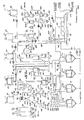
- the combination of initiators can be added to the mixed monomer solution in a batch process, or continuously as shown in the drawing.
- the mixed monomer solution is subjected to a polymerization reaction and a cross-linking reaction by the continuous addition of a combination of polymerization initiators in an in-line mixing device just prior to depositing the initiated mixed monomer solution onto an endless moving conveyor belt.
- the polymerization reaction begins within a very short period of time, e.g., about 30 seconds, as a result of the redox initiator. Once the polymerization reaction begins, the exothermic heat of reaction raises the temperature of the mixed monomer solution to a degree that the thermal initiator also initiates further polymerization to substantial completion.
- the heat of the polymerization and cross-linking reactions will evaporate water rapidly from the reaction product as it travels down the endless belt to form a dry solid (less than 15 percent by weight water) water absorbing resin without the need for any subsequent drying step.
- the solid can be easily pulverized into a powder suitable for any desired use.
- a hot, i.e. at least 85° F., aqueous solution is prepared first including acrylic acid neutralized 70 to 100 mole percent, optionally acrylamide, a water-miscible or water-soluble polyvinyl monomer, and water in one or more mixed monomer solution storage vessels.
- a thermal initiator and a redox initiator are stored in separate initiator storage vessels so that the reactants from the mixed monomer vessel and each of two initiator vessels are fed simultaneously into an in-line mixing device disposed in close proximity to a traveling endless conveyor belt.
- the aqueous solution can be prepared easily by placing (A) acrylic acid, and an amine, and/or a caustic alkali and/or ammonia for neutralizing the acid; (B) acrylamide (0-30 mole percent); and (C) a polyvinyl monomer into water to form a mixed monomer solution.
- the mixture can be heated to an elevated temperature up to about 150° F. (65.5°C), preferably below 125° F. (51.7°C), especially 90-110° F. (32.2-43.3°C).
- polyvinyl monomer to be used in both embodiments of the invention should be miscible with or soluble in water so that the monomer will be uniformly dissolved or dispersed in the aqueous solution of the monomer mixture.
- polyvinyl monomers include bisacrylamides such as N,N′-methylenebisacrylamide and N,N′-methylenebismethacrylamide; polyacrylic (or polymethacrylic) acid esters represented by the following formula (I); and diacrylamides represented by the following formula (II).
- bisacrylamides such as N,N′-methylenebisacrylamide and N,N′-methylenebismethacrylamide
- diacrylamides represented by the following formula (II) especially preferably are N,N′-methylenebisacrylamide, N,N′-methylenebismethacrylamide and like bisacrylamides.
- X is ethylene, propylene, trimethylene, hexamethylene, 2-hydroxypropylene, (CH2CH2O) n CH2CH2 - or n and m are each an integer of from 5 to 40, and k is 1 or 2.
- the compounds of the formula (I) are prepared to reacting polyols, such as ethylene glycol, propylene glycol, trimethylolpropane, 1,6-hexanediol, glycerin, pentaerythritol, polyethylene glycol and polypropylene glycol, with acrylic acid or methacrylic acid.
- polyols such as ethylene glycol, propylene glycol, trimethylolpropane, 1,6-hexanediol, glycerin, pentaerythritol, polyethylene glycol and polypropylene glycol, with acrylic acid or methacrylic acid.
- the compounds of the formula (II) are obtained by reacting polyalkylenepolyamines, such as diethylenetriamine and triethylenetetramine, with acrylic acid.
- the polyvinyl monomer is used in an amount of about 0.001 to 0.6 wt. % of the amount of acrylic monomers in the aqueous monomer mixture.
- the polyvinyl monomer should be present in the aqueous solution in an amount of at least .2 wt. % based on the total weight of monomers to provide a resin sufficiently cross-linked to have a "dry feel" after significant water absorption. If the polyvinyl monomer is included in the aqueous solution in an amount of .2 to .6 weight percent based on the weight of neutralized acrylic acid and polyvinyl monomers, the resulting polymer will have an exceedingly "dry feel" after significant absorption of water.
- the aqueous mixed monomer solution is maintained at a desired temperature, depending upon the temperature at which the thermal initiator decomposes or otherwise becomes effective, and the degree to which the exothermic heat of reaction causes the temperature of the mixed monomer solution to rise as a result of the initiation by the redox initiator.
- the temperature of the mixed monomer solution should be high enough that the redox initiator causes the mixed monomer solution to rise in temperature to a degree that the thermal initiator decomposes or otherwise effectively continues the polymerization reaction.
- the temperature of the mixed monomer solution is usually maintained at about 100° F. to about 145° F. (37.8-62.8°C), in accordance with the preferred thermal initiators disclosed hereinafter, preferably about 115° F. to about 125° F. (46.1-51.7 C)
- a combination of at least one thermal initiator with at least one redox initiator enables efficient polymerisation while limiting the free monomer (acrylic acid and acrylic acid salt) content to less than 1000 PPM, and generally less than 500 PPM in the completed water-absorbing polymer.
- redox initiators examples include a reducing agent, such as a sulfite or bisulfite of an alkali metal, such as ammonium sulfite, ammonium bisulfite, or ammonium metabisulfite; a persulfate of an alkali metal or ammonium persulfate; t-butyl hydroperoxide; di-t-butyl hydroperoxide; t-butyl perbenzoate; t-butyl peroxy isopropyl carbonate; and peroxy-3,3,5 trimethylcyclohexane.
- a reducing agent such as a sulfite or bisulfite of an alkali metal, such as ammonium sulfite, ammonium bisulfite, or ammonium metabisulfite
- a persulfate of an alkali metal or ammonium persulfate t-butyl hydroperoxide; di-
- a redox initiator including a combination of ammonium persulfate and sodium hydrogensulfite.
- These initiators are advantageously used usually in the form of an aqueous solution but can be dissolved in a suitable solvent, e.g., alcohol, if insoluble in water.
- the redox initiator is used in an amount, calculated as solids, of about 0.1 to about 10%, preferably about 0.5 to about 5%, of the combined weight of the monomers, namely acrylate (and free acrylic acid), acrylamide, and polyvinyl monomer.
- the initiator is usable together with isopropyl alcohol, alkylmercaptan or other chain transfer agents to control the molecular weight of the polyacrylate to be obtained.
- thermal initiators include azo initiators such as azobisisobutyronitrile; 4-t-butylazo-4′-cyanovaleric acid; 4,4′-azobis(4-cyanovaleric acid); 2,2′-azobis(2-amidinopropane)dihydrochloride; 2,2′-azobis(2,4-dimethylvaleronitrile); dimethyl 2,2′-azobisisobutyrate; 2,2′-azobis(2,4-dimethylvaleronitrile); (1-phenylethyl)azodiphenylmethane; 2,2′-azobis(2-methylbutyronitrile); 1,1′-azobis(1-cyclohexanecarbonitrile); 2-(carbamoylazo)isobutyronitrile; 2,2′-azobis(2,4,4-trimethylpentane); 2-phenylazo-2,4-dimethyl-4-methoxyvaleronitrile; 2,2′--
- the mixed monomer solution is subjected to continuous polymerization at a polymerization station, such as on a surface of a liquid-impermeable conveyor belt or in a suitable reaction vessel, with evaporation of water without heating the system from outside.
- a polymerization station such as on a surface of a liquid-impermeable conveyor belt or in a suitable reaction vessel, with evaporation of water without heating the system from outside.
- the reaction is carried out by adding the combination of initiators, from separate initiator storage vessels, into the mixed monomer solution in a suitable in-line mixing device and causing the resulting initiated mixture to flow, down onto and spread over a traveling conveyor belt.
- the initiators can be added to the mixed monomer solution as it is poured onto the conveyor belt.
- the polymerization proceeds rapidly after admixing the initiators with the mixed monomer solution and is completed within a short period of time, usually in about 30 seconds to about 10 minutes.
- the reaction is exothermic, so that the reactants are rapidly heated from a reaction temperature of about 90° F. to about 125° F. (32.2-51.7°C) to about 265° F. (129.4°C) by the heat of polymerization. Consequently, particularly where the monomer concentration in the mixed solution is at least 50 percent by weight, the water evaporates from the system rapidly to give a relatively dry, solid polymer of low water content without resorting to any external heating or other further treatment.
- the water content of the polymer is usually up to about 15%, and generally about 8 to 12% by weight as recovered.
- the dry solid polymer can be made into the desired powder easily by a usual method, for example by pulverization, without a drying step.
- polystyrene and/or methyl-cellulose can be added to the mixed monomer solution in an amount of 0.5 to about 10 percent based on the total weight of monomers in the mixed monomer solution to increase the porosity and water absorbing capacity of the polymers. It has been found, quite surprising nonethelessly, that polystyrene and methylcellulose will substantially increase the water absorbing capacity of the resin described herein. To achieve the full advantage of the present invention, the polystyrene and methyl-cellulose should be added in an average grain size of less than or equal to 5 micrometers.
- the water-absorbing polymer powder thus obtained has outstanding water absorbing ability, an unexpectedly low free monomer level, is useful for sanitary goods, paper diapers, disposable diapers and like hygenic goods, agricultural or horticultural water retaining agents, industrial dehydrating agents, sludge coagulants, thickening agents, condensation preventing agents for building materials, release control agents for chemicals and various other applications.
- the apparatus 10 includes a plurality of monomer solution mixing vessels 12, 14, 16 and 18; an acrylic acid storage vessel 20, one or more neutralizing agent storage vessels such as potassium hydroxide storage vessel 22, sodium hydroxide storage vessel 24, ammonium hydroxide storage vessel 26, sodium carbonate storage vessel 28, potassium carbonate storage vessel 30 and neutralizing agent mixing vessels 32 and 34; one or more second monomer storage vessels, such as for acrylamide and styrene, 36 and 38; a plurality of thermal initiator storage vessels 40 and 42; a plurality of redox initiator storage vessels 44 and 46; an in-line mixer or blender 48 for blending the initiators with the mixed monomer solution; and a polymerization station, generally designated 50, including a pair of endless traveling conveyor belts 52 and 53, and a plurality of cross-linking agent storage vessels 54 and 56.
- a polymerization station generally designated 50, including a pair of endless traveling conveyor belts 52 and 53, and a plurality of cross-linking agent storage vessels 54 and 56.
- neutralizing agents such as potassium hydroxide from storage vessel 22, sodium hydroxide from storage vessel 24, and/or ammonium hydroxide from storage vessel 26 and may be combined with one or more other monomers such as acrylamide and/or styrene from second monomer storage vessels 36 and/or 38.
- the acrylic acid solution together with the aqueous solutions of one or more neutralizing agents and, optionally, one or more other monomers for co-polymerization, are combined and fed through monomer solution feed conduits 68, 70, 72, 74, 76, and 78 to the four monomer solution mixing vessels 12, 14, 16 and 18.
- the monomer mixing vessels 12, 14, 16 and 18 are filled in a staggered time sequence such that one monomer mixing vessel, e.g., 12, is completely mixed and ready for transport to the in-line blender 48 while the other monomer solution mixing vessels e.g., 14, 16 and 18, are being filled such that after monomer mixing vessel 12 is depleted, one of the other monomer mixing vessels 14, 16 or 18 is sufficiently mixed and homogenized such that it is ready for transport of the mixed monomer solution to the blender 48 to maintain a continuous flow of mixed monomer solution to the blender 48 for continuous operation. In this manner, a continuous supply of mixed monomer solution is always ready for transport to the blender 48 to maintain the process continuously.
- the potassium hydroxide solution stored in neutralizing agent storage vessel 22 is received, as supplied, at about a 45% by weight concentration as an aqueous solution and is pumped through pump 80 and conduits 82, 84, 86 and 88 to one or more potassium hydroxide storage vessels 32 and/or 34 where the potassium hydroxide solution can be further concentrated, for example to a preferred level of about 56% potassium hydroxide by weight, by the addition of a more concentrated form of potassium hydroxide, such as 100% solid potassium hydroxide, through hopper 90.
- either potassium hydroxide or ammonium carbonate can be added to the hopper 90 and the neutralizing agents conveyed through conduits 92, 94 and 96 to a vacuum separator 98 where the neutralizing agents are conveyed by diverter 100 to either a concentrated potassium hydroxide supply line 102 and concentrated potassium hydroxide storage vessel 106 or to a concentrated ammonium carbonate supply line 104 and concentrated ammonium carbonate storage vessel 108, respectively.
- the concentrated potassium hydroxide from vessel 106 is conveyed by a vibratory feeder 109 to diverter 110 where some of the concentrated potassium hydroxide, e.g., in solid form, is transported through conduit 112 to the potassium hydroxide tank 32 to increase the potassium hydroxide concentration to a desired level, e.g., 56% by weight potassium hydroxide.
- the diverter 110 conveys some of the potassium hydroxide through conduit 114 to a weigh hopper 116 such that some of the concentrated potassium hydroxide can be conveyed by vibratory feeder 118 to a turn head 120 for further, straight addition of potassium hydroxide to the monomer mixing vessels 12, 14, 16 and 18 through conduits 122, 124, 126 and 128.
- the more concentrated aqueous solution of potassium hydroxide in vessel 32 is conveyed through conduits 132, 134 and 136 and pump 138 to the potassium hydroxide storage vessel 34 where the potassium hydroxide is stored at a suitable temperature, such as 65° F. (18.3°C), through an internal heat transfer water supply line 140.
- the more concentrated potassium hydroxide from vessel 34 is fed to the mixing station 66 through an insulated supply conduit 142.
- Sodium carbonate from neutralizing agent supply vessel 28 can be supplied to the monomer solution mixing vessels 12, 14, 16 and/or 18 by vibratory feeder 144, conduit 146, weigh hopper 148, vibratory feeder 150 and turn head 152 through conduits 154, 156, 158 and 160.
- Sodium hydroxide can be conveyed directly from the sodium hydroxide storage vessel 24 through pump 159 and conduit 161 to the combining station 66.
- the sodium carbonate can be substituted with or combined with potassium carbonate from neutralizing agent storage vessel 30, vibratory feeder 162 and conduit 164 leading to weigh hopper 148; or the sodium carbonate can be substituted for and/or combined with ammonium carbonate from ammonium carbonate vessel 108, vibratory feeder 166 and conduit 168 leading to weigh hopper 148, such that any desired neutralizing agent in any desired concentration can be fed directly to the monomer solution mixing vessel 12, 14, 16 and/or 18 through the conduits 154, 156, 158 and 160.
- Ammonium hydroxide from ammonium hydroxide storage vessel 26 optionally can be fed to the mixing station 66 and then to the monomer solution mixing vessels 12, 14, 16 and 18, as described, by feeding the ammonium hydroxide solution through pump 170 and conduits 172 and 174 to the mixing station 66, where the neutralizing agents are combined with the acrylic acid solution, and optionally, one or more other monomers from monomer storage vessel 36 or 38, monomer supply conduits 176 and 178, monomer weigh tank 180 and conduit 182 by pump 184.
- additional monomer for co-polymerization with acrylic acid can be supplied directly to the blender 48 for monomer storage vessel 38 through conduit 186, pump 188 and conduits 190 and 192. In this manner, any desired level of and combination of neutralizing agents and monomers can be supplied to the blender 48 for initiation and polymerization.
- cross-linking agent storage vessels 54 and 56 where the cross-linking agent is weighed on scale 186 and fed manually, as indicated diagrammatically at 188, to the mixing station 66 for supply to the monomer solution mixing vessels 12, 14, 16 and 18.
- one or more thermal initiators are stored in the thermal initiator storage vessels 40 and 42 are are delivered directly to the in-line blender 48 through conduits 190, 192 and 194 and pump 196 and, simultaneously, one or more redox initiators are supplied to the blender 48 through redox initiator storage vessel 44, conduit 200, pump 202 and conduits 204 and 206 for initiation of the mixed monomer solution.
- some of the redox initiator from redox initiator storage tank 44 can be fed onto the surface of the mixed monomer solution as it travels on the liquid-impermeable endless conveyor belt 52 directing some of the initiator through conduit 208 directly onto the surface of the polymerizing mixed monomer solution, such as at spray head 210.
- Conveyor belt 53 is air-permeable to allow air to circulate over and through the polymerized and polymerizing acrylic acid and neutralized acrylic acid, as well as any other polymerized and polymerizing monomer delivered to the impermeable, first belt 52.
- the same or different redox initiator can be fed directly onto the surface of the polymerizing mixed monomer solution from initiator storage vessel 46 through conduit 212, pump 214 and conduits 216 and 218 through the spray head 210.
- a different, polymerization starting redox initiator is held in initiator storage vessel 46 which will initiate the mixed monomer solution at the temperature that the monomer solution has attained when it exits the in-line mixer 48, generally at the storage temperature of the mixed monomer solution in the monomer solution mixing vessels 12, 14, 16 and 18.
- sodium thiosulfate stored in redox initiator storage vessel 46 initiates the acrylic acid polymerization at a sufficiently low temperature that it can be used to start the polymerization reaction and, thereafter, is no longer needed once the polymerization has begun.
- water can be supplied to the thermal initiator storage vessels 40 and 42 and to the redox initiator storage vessels 44 and 46 for diluting the initiator concentration from water supply line 220 and conduits 222, 224, 226, 228, 230, 232 and 234.
- the polymerized dry (less than about 15% by weight water) polymer exits conveyor belts 53 through conduit 238 into a screw or auger discharge screw device 240 and is directed out of the discharge screw 240 through conduit 242 to a bucket elevator.
- the polymer then can be ground to any appropriate particle size distribution.
- 650 pounds (294.8 kg) of potassium carbonate is supplied from vessel 28 to monomer solution mixing vessels 12, 14, 16 and/or 18 by vibratory feeder 144, through conduit 146, weigh hopper 148, vibratory feeder 150 and turn hed 152 through conduit 154, 156, 158 or 160.
- the neutralized monomer from the monomer solution mixing vessel 12, 14, 16 or 18 is delivered to the impermeable first belt 52 through in-line mixer 48 where it is combined with a redox initiator and, a thermal initiator raising the temperature of the mixed monomer solution to 108° F (42.5°C), which is above the decomposition temperature of the thermal initiator.
- the thermal initiator is stored in thermal initiator storage vessels 40 and 42 consisting of a 12% solution of 2,2′-azobis-(2-amidinopropane) hydrochloric acid. 72.2 pounds (32.75 kg) of thermal initiator would be used for the above batch.
- the initiator is delivered to the in-line blender 48 through conduit 190, 192 and 194 and pump 199 and, simultaneously 24.1 pounds (10.93 kg) of 33%, ammonium persulfate redox initiator is supplied to the blender 48 through redox initiator storage vessel 44, conduit 200, pump 202 and conduits 204 and 206 for the initiation of the mixed monomer solution.
- 650 pounds (294.84 kg) of ammonium hydroxide is supplied from vessel 26 to monomer solution mixing vessels 12, 14, 16 and/or 18 by pump 170, through conduits 172 and 174.
- the neutralized monomer from the monomer solution mixing vessel 12, 14, 16 or 18 is delivered to the impermeable first belt 52 through in-line mixer 48 where it is combined with a thermal initiator and a redox initiator.
- the redox initiator raises the temperature of the mixed monomer solution to 150° F. (65.5°C)
- the thermal initiator is stored in thermal initiator storage vessels 40 and 42 consisting of a 12% solution of 2,2′-azobis-(2-amidinopropane) hydrochloride. 72.2 pounds (32.75 kg) of thermal initiator would be used for the above batch.
- the initiator is delivered to the in-line blender 48 through conduit 190, 192 and 194 and pump 199 and, simultaneously 24.1 pounds (10.93 kg) of 33% ammonium sulfite redox initiator is supplied to the blender 48 through redox initiator storage vessel 44, conduit 200, pump 202 and conduits 204 and 206 for the initiation of the mixed monomer solution.
- the neutralized monomer from the monomer solution mixing vessel 12, 14, 16 or 18 is delivered to the impermeable first belt 52 through in-line mixer 48 where it is combined with a thermal initiator and a redox initiator.
- the redox initiator raises the temperature of the mixed monomer solution to 150° F.(655°C)
- the thermal initiator is stored in thermal initiator storage vessels 40 and 42 consisting of a 12% solution of aziobisisobutyronitrile. 72.2 pounds (32.75 kg) of thermal initiator would be used for the above batch.
- the initiator is delivered to the in-line blender 48 through conduit 190, 192 and 194 and pump 199 and, simultaneously 24.1 pounds of 33% ammonium bisulfite persulfate redox initiator is supplied to the blender 48 through redox initiator storage vessel 44, conduit 200, pump 202 and conduits 204 and 206 for the initiation of the mixed monomer solution.
- 1,750 pounds (793.79 kg) of a 45% by wt. potassium hydroxide solution is pumped from storage vessel 22, through pump 80, conduits 82, 84 86 and 88 to one or both potassium hydroxide storage vessels 32 and 34 where the potassium hydroxide solution is further concentrated to a concentration of 53% by wt. and is pumped from vessel 32 through conduits 132, 134 and 136 and pump 138 to potassium hydroxide storage vessel 34 where the potassium hydroxide can be stored before transfer to mixing station 66 through the insulated supply conduit 142 and finally to vessel 12, 14, 16 or 18.
- 650 pounds (294.84 kg) of potassium carbonate is supplied from vessel 28 to monomer solution mixing vessels 12, 14, 16 and/or 18 by vibratory feeder 144, through conduit 146, weigh hopper 148, vibratory feeder 150 and turn hed 152 through conduit 154, 156, 158 or 160.
- the neutralized monomer from the monomer solution mixing vessel 12, 14, 16 or 18 is delivered to the impermeable first belt 52 through in-line mixer 48 where it is combined with a thermal initiator and a redox initiator.
- the redox initiator raises the temperature of the mixed monomer solution to 150° F.(65.5°C)
- the thermal initiator is stored in thermal initiator storage vessels 40 and 42 consisting of a 10% solution of 4-t-butylazo-4′-cyanovaleric acid. 72.2 pounds (32.75 kg) of thermal initiator would be used for the used batch.
- the initiator is delivered to the in-line blender 48 through conduit 190, 192 and 194 and pump 199 and, simultaneously 24.1 pounds of 33% t-butylhydroproxide redox initiator is supplied to the blender 48 through redox initiator storage vessel 44, conduit 200, pump 202 and conduits 204 and 206 for the initiation of the mixed monomer solution.
- 2,500 pounds (1133.98 kg) of acrylic acid solution from acrylic acid storage vessel 20 at 115° F (46.1°C) and a concentration of 99% by weight flows through valve 60 and pump 62 through conduit 64 to a combining station 66 to vessel 12, 14, 16 or 18.
- 400 pounds (181.44 kg) of styrene from second monomer storage vessel 36 flows through pump 184 through conduits 176 and 178 to monomer weigh tank 180 and is charged to combining station 66 and then to vessel 12, 14 16 or 18, together with the acrylic acid.
- 1,600 pounds (725.75 kg) of a 45% by wt. potassium hydroxide solution is pumped from storage vessel 22, through pump 80, conduits 82, 84 86 and 88 to one or both potassium hydroxide storage vessels 32 and 34 where the potassium hydroxide solution is further concentrated to a concentration of 53% by wt. and is pumped from vessel 32 through conduits 132, 134 and 136 and pump 138 to potassium hydroxide storage vessel 34 where the potassium hydroxide can be stored before transfer to mixing station 66 through the insulated supply conduit 142 and finally to vessel 12, 14, 16 or 18.
- 650 pounds (294.84 kg) of potassium carbonate is supplied from vessel 28 to monomer solution mixing vessels 12, 14, 16 and/or 18 by vibratory feeder 144, through conduit 146, weigh hopper 148, vibratory feeder 150 and turn hed 152 through conduit 154, 156, 158 or 160.
- the neutralized monomer from the monomer solution mixing vessel 12, 14, 16 or 18 is delivered to the impermeable first belt 52 through in-line mixer 48 where it is combined with a thermal initiator and a redox initiator.
- the redox initiator raises the temperature of the mixed monomer solution to 150° F. (65.5°C)
- the thermal initiator is stored in thermal initiator storage vessels 40 and 42 consisting of a 12% solution of 2,2′-azobis(2,4-dimethylvaleronitrile. 72. 2 pounds(32.75 kg) of thermal initiator would be used for the above batch.
- the initiator is delivered to the in-line blender 48 through conduit 190, 192 and 194 and pump 199 and, simultaneously 24.1 pounds (1093 kg) of 33% di-t-butyl hydroperoxide redox initiator is supplied to the blender 48 through redox initiator storage vessel 44, conduit 200, pump 202 and conduits 204 and 206 for the initiation of the mixed monomer solution.
- 650 pounds (294.84 kg) of potassium carbonate is supplied from vessel 28 to monomer solution mixing vessels 12, 14, 16 and/or 18 by vibratory feeder 144, through conduit 146, weight hopper 148, vibratory feeder 150 and turn hed 152 through conduit 154, 156, 158 or 160.
- the neutralized monomer from the monomer solution mixing vessel 12, 14, 16 or 18 is delivered to the impermeable first belt 52 through in-line mixer 48 where it is combined with a thermal initiator and a redox initiator.
- the redox initiator raises the temperature of the mixed monomer solution to 150° F.(65.5°C)
- the thermal initiator is stored in thermal initiator storage vessels 40 and 42 consisting of a 12% solution of dimethyl 2,2′-azobisisobutyrate. 72.2 pounds of thermal initiator would be used for the above batch.
- the initiator is delivered to the in-line blender 48 through conduit 190, 192 and 194 and pump 199 and, simultaneously 24.1 pounds of 33% t-butylperbenzoate redox initiator is supplied to the blender 48 through redox initiator storage vessel 44, conduit 200, pump 202 and conduits 204 and 206 for the initiation of the mixed monomer solution.
- 1,700 pounds (771.11 kg) of a 45% by wt. potassium hydroxide is pumped from storage vessel 22, through pump 80, conduits 82, 84 86 and 88 to one or both potassium hydroxide storage vessels 32 and 34 where the potassium hydroxide solution is further concentrated to a concentration of 53% by wt. and is pumped from vessel 32 through conduits 132, 134 and 136 and pump 138 to potassium hydroxide storage vessel 34 where the potassium hydroxide can be stored before transfer to mixing station 66 through the insulated supply conduit 142 and finally to vessel 12, 14, 16 or 18.
- 650 pounds (294.84 kg) of potassium carbonate is supplied from vessel 28 to monomer solution mixing vessels 12, 14, 16 and/ or 18 by vibratory feeder 144, through conduit 146, weigh hopper 148, vibratory feeder 150, and turn hed 152 through conduit 154, 156, 158 or 160.
- the neutralized monomer from the monomer solution mixing vessel 12, 14, 16 or 18 is delivered to the impermeable first belt 52 through in-line mixer 48 where it is combined with a thermal initiator and a redox initiator.
- the thermal initiator raises the temperature of the mixed monomer solution to 150° F.(65.5°C)
- the thermal initiator is stored in thermal initiator storage vessels 40 and 42 consisting of a 12% solution of 1,1′-azobis(1-cyclohexanecarbonitrile). 72.2 pounds of thermal initiator would be used for the above batch.
- the initiator is delivered to the in-line blender 48 through conduit 190, 192 and 194 and pump 199 and, simultaneously 24.1 pounds of 33% t-butylperoxyisopropylcarbonate redox initiator is supplied to the blender 48 through redox initiator storage vessel 44, conduit 200, pump 202 and conduits 204 and 206 for the initiation of the mixed monomer solution.
- 1,700 pounds (771.11 kg) of a 45% by wt. potassium hydroxide is pumped from storage vessel 22, through pump 80, conduits 82, 84 86 and 88 to one or both potassium hydroxide storage vessels 32 and 34 where the potassium hydroxide solution is further concentrated to a concentration of 53% by wt. and is pumped from vessel 32 through conduits 132, 134 and 136 and pump 138 to potassium hydroxide storage vessel 34 where the potassium hydroxide can be stored before transfer to mixing station 66 through the insulated supply conduit 142 and finally to vessel 12, 14, 16 or 18.
- 650 pounds (294.84 kg) of potassium carbonate is supplied from vessel 28 to monomer solution mixing vessels 12, 14, 16 and/or 18 by vibratory feeder 144, through conduit 146, weigh hopper 148, vibratory feeder 150 and turn hed 152 through conduit 154, 156, 158 or 160.
- the neutralized monomer from the monomer solution mixing vessel 12, 14, 16 or 18 is delivered to the impermeable first belt 52 through in-line mixer 48 where is it combined with a thermal initiator and a redox initiator.
- the redox initiator raises the temperature of the mixed monomer solution to 150° F.(75.5°C)
- the thermal initiator is stored in thermal initiator storage vessels 40 and 42 consisting of a 10% solution of (1-phenylethyl)azodiphenylmethane. 72.2 pounds (32.75 kg) of thermal initiator would be used for the above batch.
- the initiator is delivered to the in-line blender 48 through conduit 190, 192 and 194 and pump 199 and, simultaneously 24.1 pounds (10.93 kg) of 33% peroxy-3,3,5-trimethylcyclohexane redox initiator is supplied to the blender 48 through redox initiator storage vessel 44, conduit 200, pump 202 and conduits 204 and 206 for the initiation of the mixed monomer solution.
- 1,700 pounds (771.11 kg) of a 45% by wt. potassium hydroxide is pumped from storage vessel 22, through pump 80, conduits 82, 84 86 and 88 to one or both potassium hydroxide storage vessels 32 and 34 where the potassium hydroxide solution is further concentrated to a concentration of 53% by wt. and is pumped from vessel 32 through conduits 132, 134 and 136 and pump 138 to potassium hydroxide storage vessel 34 where the potassium hydroxide can be stored before transfer to mixing station 66 through the insulated supply conduit 142 and finally to vessel 12, 14, 16 or 18.
- 650 pounds (294.84 kg) of potassium carbonate is supplied from vessel 28 to monomer solution mixing vessels 12, 14, 16 and/or 18 by vibratory feeder 144, through conduit 146, weigh hopper 148, vibratory feeder 150 and turn hed 152 through conduit 154, 156, 158 or 160.
- the neutralized monomer from the monomer solution mixing vessel 12, 14, 16 or 18 is delivered to the impermeable first belt 52 through in-line mixer 48 where it is combined with a thermal initiator and a redox initiator.
- the thermal initiator raises the temperature of the mixed monomer solution to 150° F.
- the thermal initiator is stored in thermal initiator storage vessels 40 and 42 consisting of a 12% solution of 2,2′-azobis-(2-methylbutyronitrile). 72.2 pounds of thermal initiator would be used for the above batch.
- the initiator is delivered to the in-line blender 48 through conduit 190, 192 and 194 and pump 199 and, simultaneously 24.1 pounds of 33% ammonium metabisulfite redox initiator is supplied to the blender 48 through redox initiator storage vessel 44, conduit 200, pump 202 and conduits 204 and 206 for the initiation of the mixed monomer solution.
Landscapes
- Chemical & Material Sciences (AREA)
- Health & Medical Sciences (AREA)
- Chemical Kinetics & Catalysis (AREA)
- Medicinal Chemistry (AREA)
- Polymers & Plastics (AREA)
- Organic Chemistry (AREA)
- Epidemiology (AREA)
- Materials Engineering (AREA)
- Engineering & Computer Science (AREA)
- Life Sciences & Earth Sciences (AREA)
- Animal Behavior & Ethology (AREA)
- General Health & Medical Sciences (AREA)
- Public Health (AREA)
- Veterinary Medicine (AREA)
- Addition Polymer Or Copolymer, Post-Treatments, Or Chemical Modifications (AREA)
- Polymerisation Methods In General (AREA)
- Solid-Sorbent Or Filter-Aiding Compositions (AREA)
Priority Applications (1)
| Application Number | Priority Date | Filing Date | Title |
|---|---|---|---|
| AT88307546T ATE85801T1 (de) | 1987-08-14 | 1988-08-15 | Verfahren zur herstellung von wasserabsorbierenden harzen. |
Applications Claiming Priority (2)
| Application Number | Priority Date | Filing Date | Title |
|---|---|---|---|
| US8597487A | 1987-08-14 | 1987-08-14 | |
| US85974 | 1987-08-14 |
Publications (3)
| Publication Number | Publication Date |
|---|---|
| EP0303518A2 true EP0303518A2 (de) | 1989-02-15 |
| EP0303518A3 EP0303518A3 (en) | 1989-10-18 |
| EP0303518B1 EP0303518B1 (de) | 1993-02-17 |
Family
ID=22195168
Family Applications (1)
| Application Number | Title | Priority Date | Filing Date |
|---|---|---|---|
| EP88307546A Expired - Lifetime EP0303518B1 (de) | 1987-08-14 | 1988-08-15 | Verfahren zur Herstellung von wasserabsorbierenden Harzen |
Country Status (7)
| Country | Link |
|---|---|
| EP (1) | EP0303518B1 (de) |
| JP (1) | JPH01126310A (de) |
| KR (1) | KR0130652B1 (de) |
| AT (1) | ATE85801T1 (de) |
| AU (1) | AU615664B2 (de) |
| BR (1) | BR8804120A (de) |
| DE (1) | DE3878500T2 (de) |
Cited By (16)
| Publication number | Priority date | Publication date | Assignee | Title |
|---|---|---|---|---|
| DE4015085A1 (de) * | 1990-05-11 | 1991-12-12 | Stockhausen Chem Fab Gmbh | Vernetztes, wasserabsorbierendes polymer und verwendung zur herstellung von hygieneartikeln, zur bodenverbesserung und in kabelummantelungen |
| AU620944B2 (en) * | 1988-11-28 | 1992-02-27 | Noveon Ip Holdings Corp. | Crosslinked polyacrylic acid |
| DE4127814A1 (de) * | 1990-09-07 | 1992-03-12 | Sanyo Chemical Ind Ltd | Wasseraufnehmende harzzusammensetzung und verfahren zur herstellung dieses wasseraufnehmenden harzes |
| EP0324385B1 (de) * | 1988-01-15 | 1993-08-04 | The Dow Chemical Company | Verfahren zur Herstellung von wasserquellbaren Polymeren unter Verwendung von Natriumthiosulfat als Teil eines Redoxinitiatorsystems |
| US5380808A (en) * | 1990-07-17 | 1995-01-10 | Sanyo Chemical Industries, Ltd. | Process for producing water-absorbing resins |
| WO1995033878A1 (de) * | 1994-06-09 | 1995-12-14 | Stockhausen Gmbh & Co. Kg | Verfahren zur herstellung eines wasserabsorbierenden flächengebildes und verwendung |
| WO1999026988A1 (de) * | 1997-11-25 | 1999-06-03 | Stockhausen Gmbh & Co. Kg | Verfahren zur herstellung von wasserlöslichen bzw. wasserquellbaren polymerisaten mit sehr niedrigem restmonomergehalt, danach hergestellte produkte und deren verwendung |
| WO1999026987A1 (de) * | 1997-11-25 | 1999-06-03 | Stockhausen Gmbh & Co. Kg | Verfahren zur herstellung von synthetischen polymerisaten mit sehr niedrigem restmonomergehalt, danach hergestellte produkte und deren verwendung |
| EP0922717A1 (de) * | 1997-12-10 | 1999-06-16 | Nippon Shokubai Co., Ltd. | Verfahren zur Herstellung eines wasserabsorbierenden Harzes |
| EP0736060B2 (de) † | 1993-12-23 | 2001-04-25 | STOCKHAUSEN GmbH & CO. KG | Vernetzte synthetische polymerisate mit poröser struktur |
| US6388000B1 (en) | 1992-06-10 | 2002-05-14 | Nippon Shokubai Co., Ltd. | Method for production of hydrophilic resin |
| WO2004013196A1 (de) * | 2002-07-30 | 2004-02-12 | Basf Aktiengesellschaft | Verfahren zur herstellung von polymeren |
| KR100476170B1 (ko) * | 1998-04-28 | 2005-03-10 | 니폰 쇼쿠바이 컴파니 리미티드 | 흡수성수지 함수겔상물의 제조방법 |
| WO2013037863A1 (en) * | 2011-09-15 | 2013-03-21 | Bayer Intellectual Property Gmbh | Method for the continuous production of an aqueous poly(meth)acrylate resin dispersion |
| US9074030B2 (en) | 2010-06-30 | 2015-07-07 | Nippon Shokubai Co., Ltd. | Polyacrylic acid-type water absorbent resin and method for producing same |
| CN115178703A (zh) * | 2022-07-25 | 2022-10-14 | 共享新材料(山东)有限公司 | 一种热芯盒用呋喃树脂及其制备方法和使用方法 |
Families Citing this family (10)
| Publication number | Priority date | Publication date | Assignee | Title |
|---|---|---|---|---|
| JP4087682B2 (ja) | 2002-11-07 | 2008-05-21 | 株式会社日本触媒 | 吸水性樹脂の製造方法および製造装置 |
| MX268188B (es) | 2004-02-05 | 2009-07-09 | Nippon Catalytic Chem Ind | Agente absorbente de agua en particulas, y metodo para su produccion, y articulo para absorber agua. |
| EP1858935B1 (de) * | 2005-03-03 | 2010-06-30 | Basf Se | Wasserabsorbierende vernetzte polymere |
| TWI353360B (en) | 2005-04-07 | 2011-12-01 | Nippon Catalytic Chem Ind | Production process of polyacrylic acid (salt) wate |
| TWI394789B (zh) | 2005-12-22 | 2013-05-01 | Nippon Catalytic Chem Ind | 吸水性樹脂組成物及其製造方法、吸收性物品 |
| RU2009138982A (ru) * | 2007-03-23 | 2011-04-27 | Басф Се (De) | Транспортировка мономерной композиции в транспортном средстве или трубопроводе |
| EP2399944B2 (de) | 2009-02-17 | 2019-08-07 | Nippon Shokubai Co., Ltd. | Wasserabsorbierendes harzpulver auf polyacrylbasis und verfahren zu seiner herstellung |
| CN102548654A (zh) | 2009-09-29 | 2012-07-04 | 株式会社日本触媒 | 颗粒状吸水剂及其制造方法 |
| SG181879A1 (en) | 2009-12-24 | 2012-07-30 | Nippon Catalytic Chem Ind | Water-absorbable polyacrylic acid resin powder, and process for production thereof |
| KR101393681B1 (ko) * | 2010-06-15 | 2014-05-13 | 주식회사 엘지화학 | 고흡수성 수지의 제조 방법 |
Family Cites Families (3)
| Publication number | Priority date | Publication date | Assignee | Title |
|---|---|---|---|---|
| JPH0229085B2 (ja) * | 1982-07-21 | 1990-06-27 | Arakawa Chem Ind | Kansoshitakyusuiseijushinoseizohoho |
| DE3239476C2 (de) * | 1981-10-26 | 1984-06-20 | Arakawa Kagaku Kogyo K.K., Osaka | Verfahren zur Herstellung eines festen, trockenen und wasserabsorbierenden harzes |
| EP0206808A3 (de) * | 1985-06-24 | 1987-08-19 | American Colloid Company | Kontinuverfahren zur Herstellung von Polyacrylat Harzen |
-
1988
- 1988-08-13 KR KR1019880010392A patent/KR0130652B1/ko not_active Expired - Fee Related
- 1988-08-15 AU AU21010/88A patent/AU615664B2/en not_active Expired - Fee Related
- 1988-08-15 JP JP63203065A patent/JPH01126310A/ja active Pending
- 1988-08-15 AT AT88307546T patent/ATE85801T1/de not_active IP Right Cessation
- 1988-08-15 EP EP88307546A patent/EP0303518B1/de not_active Expired - Lifetime
- 1988-08-15 DE DE8888307546T patent/DE3878500T2/de not_active Expired - Fee Related
- 1988-08-15 BR BR8804120A patent/BR8804120A/pt not_active IP Right Cessation
Cited By (23)
| Publication number | Priority date | Publication date | Assignee | Title |
|---|---|---|---|---|
| EP0324385B1 (de) * | 1988-01-15 | 1993-08-04 | The Dow Chemical Company | Verfahren zur Herstellung von wasserquellbaren Polymeren unter Verwendung von Natriumthiosulfat als Teil eines Redoxinitiatorsystems |
| AU620944B2 (en) * | 1988-11-28 | 1992-02-27 | Noveon Ip Holdings Corp. | Crosslinked polyacrylic acid |
| DE4015085A1 (de) * | 1990-05-11 | 1991-12-12 | Stockhausen Chem Fab Gmbh | Vernetztes, wasserabsorbierendes polymer und verwendung zur herstellung von hygieneartikeln, zur bodenverbesserung und in kabelummantelungen |
| US5380808A (en) * | 1990-07-17 | 1995-01-10 | Sanyo Chemical Industries, Ltd. | Process for producing water-absorbing resins |
| DE4127814C2 (de) * | 1990-09-07 | 2000-07-13 | Sanyo Chemical Ind Ltd | Wasseraufnehmende Harze |
| DE4127814A1 (de) * | 1990-09-07 | 1992-03-12 | Sanyo Chemical Ind Ltd | Wasseraufnehmende harzzusammensetzung und verfahren zur herstellung dieses wasseraufnehmenden harzes |
| US7078458B2 (en) | 1992-06-10 | 2006-07-18 | Nippon Shokubai Co., Ltd. | Method for production of hydrophilic resin |
| US6998447B2 (en) | 1992-06-10 | 2006-02-14 | Nippon Shokubai Co., Ltd. | Method for production of hydrophilic resin |
| US6388000B1 (en) | 1992-06-10 | 2002-05-14 | Nippon Shokubai Co., Ltd. | Method for production of hydrophilic resin |
| EP0736060B2 (de) † | 1993-12-23 | 2001-04-25 | STOCKHAUSEN GmbH & CO. KG | Vernetzte synthetische polymerisate mit poröser struktur |
| WO1995033878A1 (de) * | 1994-06-09 | 1995-12-14 | Stockhausen Gmbh & Co. Kg | Verfahren zur herstellung eines wasserabsorbierenden flächengebildes und verwendung |
| WO1999026988A1 (de) * | 1997-11-25 | 1999-06-03 | Stockhausen Gmbh & Co. Kg | Verfahren zur herstellung von wasserlöslichen bzw. wasserquellbaren polymerisaten mit sehr niedrigem restmonomergehalt, danach hergestellte produkte und deren verwendung |
| WO1999026987A1 (de) * | 1997-11-25 | 1999-06-03 | Stockhausen Gmbh & Co. Kg | Verfahren zur herstellung von synthetischen polymerisaten mit sehr niedrigem restmonomergehalt, danach hergestellte produkte und deren verwendung |
| EA002392B1 (ru) * | 1997-11-25 | 2002-04-25 | Штокхаузен Гмбх Унд Ко. Кг | Способ получения водорастворимых или набухающих в воде полимеризатов с низким содержанием остаточных мономеров |
| US7030199B1 (en) * | 1997-11-25 | 2006-04-18 | Stockhausen Gmbh & Co. Kg | Method for producing water-soluble or water-swellable polymerizates with a very low residual monomer content, products produced according to this method and the use thereof |
| US6174978B1 (en) | 1997-12-10 | 2001-01-16 | Nippon Shokubai Co., Ltd. | Production process of water-absorbent resin |
| EP0922717A1 (de) * | 1997-12-10 | 1999-06-16 | Nippon Shokubai Co., Ltd. | Verfahren zur Herstellung eines wasserabsorbierenden Harzes |
| KR100476170B1 (ko) * | 1998-04-28 | 2005-03-10 | 니폰 쇼쿠바이 컴파니 리미티드 | 흡수성수지 함수겔상물의 제조방법 |
| WO2004013196A1 (de) * | 2002-07-30 | 2004-02-12 | Basf Aktiengesellschaft | Verfahren zur herstellung von polymeren |
| US9074030B2 (en) | 2010-06-30 | 2015-07-07 | Nippon Shokubai Co., Ltd. | Polyacrylic acid-type water absorbent resin and method for producing same |
| US9315640B2 (en) | 2010-06-30 | 2016-04-19 | Nippon Shokubai Co., Ltd. | Polyacrylic acid-type water absorbent resin and method for producing same |
| WO2013037863A1 (en) * | 2011-09-15 | 2013-03-21 | Bayer Intellectual Property Gmbh | Method for the continuous production of an aqueous poly(meth)acrylate resin dispersion |
| CN115178703A (zh) * | 2022-07-25 | 2022-10-14 | 共享新材料(山东)有限公司 | 一种热芯盒用呋喃树脂及其制备方法和使用方法 |
Also Published As
| Publication number | Publication date |
|---|---|
| JPH01126310A (ja) | 1989-05-18 |
| AU2101088A (en) | 1989-03-02 |
| ATE85801T1 (de) | 1993-03-15 |
| DE3878500D1 (de) | 1993-03-25 |
| BR8804120A (pt) | 1989-03-07 |
| KR890003818A (ko) | 1989-04-18 |
| AU615664B2 (en) | 1991-10-10 |
| EP0303518B1 (de) | 1993-02-17 |
| DE3878500T2 (de) | 1993-06-03 |
| EP0303518A3 (en) | 1989-10-18 |
| KR0130652B1 (ko) | 1998-04-07 |
Similar Documents
| Publication | Publication Date | Title |
|---|---|---|
| US4985518A (en) | Process for preparing water-absorbing resins | |
| EP0303518B1 (de) | Verfahren zur Herstellung von wasserabsorbierenden Harzen | |
| US4525527A (en) | Production process for highly water absorbable polymer | |
| US4552938A (en) | Process for preparing dry solid water absorbing polyacrylate resin | |
| EP0242478A2 (de) | Wasserabsorbierende Acrylcopolymere | |
| US4820773A (en) | Water absorbent resins prepared by polymerization in the presence of styrene-maleic anhydride copolymers | |
| CN1136233C (zh) | 吸水剂树脂的生产方法 | |
| US9896529B2 (en) | Method for producing polyacrylic acid (salt)-based water-absorbable resin | |
| JP5376420B2 (ja) | 水溶性または水で膨潤可能なポリマー、特に低い残留モノマー含量を有する、アクリルアミドおよび少なくとも1種のイオン性コモノマーからなる水溶性または水で膨潤可能なコポリマーの製造方法 | |
| CN106068297B (zh) | 聚丙烯酸(盐)系吸水性树脂的制造方法 | |
| CN110698696A (zh) | 聚丙烯酸(盐)系吸水性树脂及含有其的物品 | |
| US7718713B2 (en) | Method of manufacturing the super-absorbent polymer (SAP) which is powdery, insoluble in water, and able to absorb water, blood and urine and has slight soluble things | |
| CN111116947A (zh) | 聚丙烯酸系吸水性树脂的制造方法 | |
| EP0206808A2 (de) | Kontinuverfahren zur Herstellung von Polyacrylat Harzen | |
| JPH0214925B2 (de) | ||
| US4820742A (en) | Method for continuous manufacture of solid water absorbing resin | |
| CN111040096A (zh) | 一种聚丙烯酸系吸水性树脂的制造方法 | |
| CN1970584B (zh) | 粉状、不溶于水,可吸收水液、尿液或血液且可溶物含量低的高吸水性树脂的制备方法 | |
| JPH0229085B2 (ja) | Kansoshitakyusuiseijushinoseizohoho | |
| JP7591415B2 (ja) | 吸水性樹脂の製造方法 | |
| JP4459209B2 (ja) | 粉末状で水に不溶であり、水、し尿あるいは血液を吸収し、可溶物含有量の低い高吸水性樹脂の製造方法 | |
| CN101143909A (zh) | 高性能高吸水性树脂的制造方法 | |
| CN100567332C (zh) | 高性能高吸水性树脂的制造方法 | |
| CN100509876C (zh) | 利用多次中和的不饱和单体水溶液以制备高吸水性树脂的制造方法 | |
| CN101173016B (zh) | 高性能高吸水性树脂的制造方法 |
Legal Events
| Date | Code | Title | Description |
|---|---|---|---|
| PUAI | Public reference made under article 153(3) epc to a published international application that has entered the european phase |
Free format text: ORIGINAL CODE: 0009012 |
|
| AK | Designated contracting states |
Kind code of ref document: A2 Designated state(s): AT BE CH DE ES FR GB GR IT LI NL SE |
|
| PUAL | Search report despatched |
Free format text: ORIGINAL CODE: 0009013 |
|
| AK | Designated contracting states |
Kind code of ref document: A3 Designated state(s): AT BE CH DE ES FR GB GR IT LI NL SE |
|
| 17P | Request for examination filed |
Effective date: 19900119 |
|
| RAP1 | Party data changed (applicant data changed or rights of an application transferred) |
Owner name: AMERICAN COLLOID COMPANY |
|
| 17Q | First examination report despatched |
Effective date: 19910621 |
|
| GRAA | (expected) grant |
Free format text: ORIGINAL CODE: 0009210 |
|
| AK | Designated contracting states |
Kind code of ref document: B1 Designated state(s): AT BE CH DE ES FR GB GR IT LI NL SE |
|
| PG25 | Lapsed in a contracting state [announced via postgrant information from national office to epo] |
Ref country code: IT Free format text: LAPSE BECAUSE OF FAILURE TO SUBMIT A TRANSLATION OF THE DESCRIPTION OR TO PAY THE FEE WITHIN THE PRE;WARNING: LAPSES OF ITALIAN PATENTS WITH EFFECTIVE DATE BEFORE 2007 MAY HAVE OCCURRED AT ANY TIME BEFORE 2007. THE CORRECT EFFECTIVE DATE MAY BE DIFFERENT FROM THE ONE RECORDED.SCRIBED TIME-LIMIT Effective date: 19930217 Ref country code: BE Effective date: 19930217 Ref country code: LI Effective date: 19930217 Ref country code: SE Effective date: 19930217 Ref country code: NL Effective date: 19930217 Ref country code: GR Free format text: LAPSE BECAUSE OF FAILURE TO SUBMIT A TRANSLATION OF THE DESCRIPTION OR TO PAY THE FEE WITHIN THE PRESCRIBED TIME-LIMIT Effective date: 19930217 Ref country code: CH Effective date: 19930217 Ref country code: AT Effective date: 19930217 Ref country code: FR Effective date: 19930217 Ref country code: ES Free format text: THE PATENT HAS BEEN ANNULLED BY A DECISION OF A NATIONAL AUTHORITY Effective date: 19930217 |
|
| REF | Corresponds to: |
Ref document number: 85801 Country of ref document: AT Date of ref document: 19930315 Kind code of ref document: T |
|
| REF | Corresponds to: |
Ref document number: 3878500 Country of ref document: DE Date of ref document: 19930325 |
|
| REG | Reference to a national code |
Ref country code: CH Ref legal event code: PL |
|
| EN | Fr: translation not filed | ||
| NLV1 | Nl: lapsed or annulled due to failure to fulfill the requirements of art. 29p and 29m of the patents act | ||
| PLBE | No opposition filed within time limit |
Free format text: ORIGINAL CODE: 0009261 |
|
| STAA | Information on the status of an ep patent application or granted ep patent |
Free format text: STATUS: NO OPPOSITION FILED WITHIN TIME LIMIT |
|
| 26N | No opposition filed | ||
| PGFP | Annual fee paid to national office [announced via postgrant information from national office to epo] |
Ref country code: DE Payment date: 20010806 Year of fee payment: 14 |
|
| PGFP | Annual fee paid to national office [announced via postgrant information from national office to epo] |
Ref country code: GB Payment date: 20010815 Year of fee payment: 14 |
|
| REG | Reference to a national code |
Ref country code: GB Ref legal event code: IF02 |
|
| PG25 | Lapsed in a contracting state [announced via postgrant information from national office to epo] |
Ref country code: GB Free format text: LAPSE BECAUSE OF NON-PAYMENT OF DUE FEES Effective date: 20020815 |
|
| PG25 | Lapsed in a contracting state [announced via postgrant information from national office to epo] |
Ref country code: DE Free format text: LAPSE BECAUSE OF NON-PAYMENT OF DUE FEES Effective date: 20030301 |
|
| GBPC | Gb: european patent ceased through non-payment of renewal fee |
Effective date: 20020815 |