EP0206808A2 - Kontinuverfahren zur Herstellung von Polyacrylat Harzen - Google Patents
Kontinuverfahren zur Herstellung von Polyacrylat Harzen Download PDFInfo
- Publication number
- EP0206808A2 EP0206808A2 EP86304854A EP86304854A EP0206808A2 EP 0206808 A2 EP0206808 A2 EP 0206808A2 EP 86304854 A EP86304854 A EP 86304854A EP 86304854 A EP86304854 A EP 86304854A EP 0206808 A2 EP0206808 A2 EP 0206808A2
- Authority
- EP
- European Patent Office
- Prior art keywords
- polymerization
- water
- monomer solution
- reaction chamber
- reaction
- Prior art date
- Legal status (The legal status is an assumption and is not a legal conclusion. Google has not performed a legal analysis and makes no representation as to the accuracy of the status listed.)
- Withdrawn
Links
Images
Classifications
-
- C—CHEMISTRY; METALLURGY
- C08—ORGANIC MACROMOLECULAR COMPOUNDS; THEIR PREPARATION OR CHEMICAL WORKING-UP; COMPOSITIONS BASED THEREON
- C08F—MACROMOLECULAR COMPOUNDS OBTAINED BY REACTIONS ONLY INVOLVING CARBON-TO-CARBON UNSATURATED BONDS
- C08F220/00—Copolymers of compounds having one or more unsaturated aliphatic radicals, each having only one carbon-to-carbon double bond, and only one being terminated by only one carboxyl radical or a salt, anhydride ester, amide, imide or nitrile thereof
- C08F220/02—Monocarboxylic acids having less than ten carbon atoms; Derivatives thereof
- C08F220/04—Acids; Metal salts or ammonium salts thereof
- C08F220/06—Acrylic acid; Methacrylic acid; Metal salts or ammonium salts thereof
-
- A—HUMAN NECESSITIES
- A61—MEDICAL OR VETERINARY SCIENCE; HYGIENE
- A61L—METHODS OR APPARATUS FOR STERILISING MATERIALS OR OBJECTS IN GENERAL; DISINFECTION, STERILISATION OR DEODORISATION OF AIR; CHEMICAL ASPECTS OF BANDAGES, DRESSINGS, ABSORBENT PADS OR SURGICAL ARTICLES; MATERIALS FOR BANDAGES, DRESSINGS, ABSORBENT PADS OR SURGICAL ARTICLES
- A61L15/00—Chemical aspects of, or use of materials for, bandages, dressings or absorbent pads
- A61L15/16—Bandages, dressings or absorbent pads for physiological fluids such as urine or blood, e.g. sanitary towels, tampons
- A61L15/42—Use of materials characterised by their function or physical properties
- A61L15/60—Liquid-swellable gel-forming materials, e.g. super-absorbents
Definitions
- the present invention relates to a continuous method and apparatus for manufacturing polyacrylate resins having improved water absorbing properties and more particularly to an improved process and apparatus for preparing, continuously, cross-linked polymers of acrylic acid and polyvinyl monomers.
- Water absorbing resins have found wide use in sanitary goods, hygenic goods, water retaining agents, dehydrating agents, sludge coagulants, thickening agents, condensation preventing agents and release control agents for various chemicals.
- Water absorbing resins heretofore known include hydrolysis products of starch-acrylonitrile graft polymers, carboxymethylcellulose, cross-linked polyacrylate products and other resins such as polyvinyl alcohol, polyethylene oxide and polyacrylonitrile resins.
- the hydrolysis products of starch and acrylonitrile graft polymers have comparatively high ability to absorb water but require a cumbersome process for production and have the drawbacks of low heat resistance and decaying or decomposing easily due to the presence of starch.
- aqueous solution polymerization One of the processes for polymerizing acrylic acid and acrylates is aqueous solution polymerization.
- the polymer obtained by this process is soluble in water and, therefore, is cross-linked to modify the polymer into a useful water absorbing resin.
- the modification is effected by reacting a cross-linking agent concurrently with or after aqueous solution polymerization, the resulting reaction product is in the form of a highly viscous aqueous solution or a gel containing absorbed water which is difficult to handle.
- the aqueous solution or gel must be dehydrated (dried) to obtain a water absorbing resin in the desired solid or powder form.
- An object of the present invention is to provide a process and apparatus for preparing, continuously, a water absorbing cross-linked acrylate resin of low water content by aqueous solution polymerization without any additional dehydrating or drying step.
- Another object of the present invention is to provide a process and apparatus for preparing, continuously, a cross-linked polyacrylate resin by polymerization of acrylic acid neutralized 70-100 mole percent, and a water-miscible or water soluble polyvinyl monomer in a combined concentration of 30 to 80 wt. % in water and initiating polymerization without external heating.
- Another object of the present invention is to provide a process and apparatus for preparing, continuously, a cross-linked polyacrylate resin by co-polymerization of acrylic acid neutralized 70-100 mole percent, with acrylamide and a polyvinyl monomer in proportions of 0 to 30 mole percent acrylamide and 70-100 combined mole percent of neutralized acrylic acid and free acrylic acid.
- Another object of the present invention is to provide a continous process and apparatus for producing a polyacrylate resin cross-linked with .2 weight percent to .6 weight percent based on the weight of monomers, of a water or water soluble polyvinyl monomer cross-linking agent to achieve a "dry feel" to the resin after significant water absorption.
- Still another object of the present infention is to provide a continuous process and apparatus for producing a polyacrylate resin wherein a combination of neutralizing agents are used to neutralize acrylic acid 70-100 mole percent, wherein one or more neutralizing agents reacts exothermically with acrylic acid and one or more neutralizing agents reacts endothermically with acrylic acid to avoid overheating of the monomer reactants.
- the present invention is directed to a process and apparatus for preparing, continuously, water absorbing, cross-linked acrylate resins by aqueous polymerization of (A) acrylic acid neutralized 70 to 100 mole percent for example with ammonia, and/or caustic alkali and/or an amine; with (B) acrylamide in a mole ratio of 70 to 100 mole percent (A) to 30:0 mole percent (B); and (C) a water miscible or a water soluble polyvinyl monomer in an amount of .001 to 0.3 weight percent based on the total weight of (A) and (B).
- the monomer concentration is at least 50 wt. % of the aqueous solution.
- a "dry feel" is obtained at a polyvinyl monomer concentration of at least .2 wt. percent of the aqueous solution.
- a heated aqueous solution comprising (A) acrylic acid neutralized 70 to 100 mole percent for example with ammonia, and/or caustic alkali and/or an amine; and (B) a water-miscible to water-soluble polyvinyl monomer, water and, when desired, an organic solvent having a boiling point of 40 to 150° C, and having a combined monomer concentration of (A) plus (B) of 30 to 80 wt. % is subjected to continuous polymerization in the presence of a polymerization initiator without external heating while allowing water to evaporate off.
- a cross-linked polyacrylate resin is prepared by aqueous solution polymerization while dehydrating or drying the reaction product during polymerization by utilizing the exothermic heat from the polymerization and cross-linking reactions for drying.
- acrylic acid neutralized in the range of 70 to 100 mole percent will polymerize and cross-link rapidly with a polyvinyl monomer cross-linking agent to drive away excess water leaving a solid water absorbing resin having a desired degree of polymerization as well as new and unexpected water absorbing capacity.
- One or more polymerization catalysts or initiators can be added to the aqueous monomer mixture to aid in polymerization.
- a hot aqueous solution is prepared first which comprises acrylic acid neutralized 70 to 100 mole percent, a water-miscible or water-soluble polyvinyl monomer, water and, when desired, an organic solvent having a boiling point of 40 to 150° C, and which contains the acrylate monomer and the polyvinyl monomer in a combined concentration of 30 to 80 wt. %.
- the acrylate and polyvinyl monomers are present in a combined concentration of less than 70 weight percent of the monomer solution.
- the combined concentration of the acrylate and polyvinyl monomers is less than 55 weight percent of the monomer solution.
- the concentration of the monomers is deliberately determined considering the state of the solution (i.e. as to whether or not the monomers can be completely dissolved in water), ease of the reaction of the monomers, escape of the monomers due to the scattering during the reaction, etc.
- the aqueous solution can be prepared easily usually by placing acrylic acid, a strong alkali such as potassium hydroxide and/or ammonium hydroxide or a basic amine for neutralizing the acid and the polyvinyl monomer into water in such amounts that the resulting solution has the above-mentioned monomer concentration. To dissolve the monomers thoroughly, the mixture can be heated to an elevated temperature.
- Any strongly basic alkali metal compound can be used for neutralization of the acrylic acid, such as potassium hydroxide, sodium hydroxide, lithium hydroxide, cesium hydroxide, potassium carbonate or sodium carbonate.
- the neutralizing agent usually in an amount sufficient to neutralize acrylic acid 100 mole %, there is no particular need to neutralize the acid 100% insofar as the neutralizing agent, e.g., hydroxide, is used in such an amount as to achieve not less than about 70% neutralization.
- the aqueous solution may contain up to about 30% of free acrylic acid.
- a combination of neutralizing agents one which reacts endothermically with acrylic acid, e.g., a basic ammonium compound such as ammonium carbonate and/or ammonium hydroxide, and one which reacts exothermically with acrylic acid, e.g., potassium hydroxide, are used to maintain the monomer reactants at a proper reaction temperature without the necessity of cooling the reaction vessel.
- a basic ammonium compound such as ammonium carbonate and/or ammonium hydroxide
- acrylic acid e.g., potassium hydroxide
- the aqueous solution further contains an organic solvent having a boiling point of 40 to 150° C, the temperature of the aqueous solution is controllable with great ease and the resulting cross-linked resin has remarkably improved ability to absorb water at an initial rate.
- the aqueous monomer solution When incorporating an organic solvent according to the invention, the aqueous monomer solution has a solidifying point which is about 10 to about 20° C lower than otherwise. This increases the allowable range of temperature control at least about 3 times.
- the organic solvent used is vigorously evaporated along with water by the heat of polymerization of the monomer. Since the latent heat of the evaporation is considerably smaller than that of water, the organic solvent functions as a blowing agent in the polymerization reaction system, consequently rendering the resulting resin porous.
- the resin exhibits about 2 to about 5 times higher initial rate of water absorption than the one obtained without using the organic solvent while possessing high water absorbing ability.
- the organic solvent when added to the aqueous monomer solution, produces improved effects without in any way impairing the advantages resulting from the use of the monomer solution.
- organic solvents to be used in the invention when desired and having a boiling point of 40 to 150° C are methanol, ethanol, propanol and like alcohol solvents, acetone, methyl ethyl ketone and like ketone solvents, cyclohexane, n-hexane, n-heptane and like hydrocarbon solvents, benzene, toluene and like aromatic hydrocarbon solvents, and tetrahydrofuran and like furan solvents. These solvents may be used singly or in admixture.
- the solvent is used in an amount of 0.5 to 15 wt. %, preferably 1 to 10 wt. %, based on the combined amount of the monomers.
- the resulting resin is likely to exhibit reduced water absorbing ability although achieving a high initial rate of water absorption. Moreover the monomers are likely to separate out, hence objectionable. Because the monomer solutiuon is heated prior to polymerization and further because the organic solvent evaporates along with water, the boiling point of the solvent is more preferably in the range of 55 to 120° c.
- acrylic acid neutralized.70-100 mole percent is mixed with a water-miscible or water-soluble polyvinyl monomer in an aqueous solution at a temperature of about 20 to 100° C and continuously fed to a reaction chamber through one reaction chamber inlet.
- the solution is subjected to a polymerization reaction and a cross-linking reaction by the continuous addition of a polymerization initiator through another reaction chamber inlet.
- the polymerization reaction proceeds sufficiently within a very short period of time and if the monomer concentration is at least 30 percent by weight of the aqueous monomer mixture, the heat of the polymerization and cross-linking reactions will evaporate water rapidly from the reaction product as it travels upwardly from an upper surface of the monomer solution onto a conveyor or other means to remove the reaction product (resin) from the reaction vessel to form a dry solid (less than 15 percent by weight water) water absorbing resin without the need for any subsequent drying step.
- the solid can be easily pulverized into a powder suitable for any desired use.
- a hot, i.e. at least 25° C., aqueous solu- - tion is prepared first including acrylic acid neutralized 70 to 100 mole percent, optionally acrylamide, a water-miscible or water-soluble polyvinyl monomer, and water in a first reactant storage vessel.
- a reacting initiator is stored in a second reactant storage vessel so that the reactants from both vessels are fed simultaneously into a lower portion (below a continuously maintained liquid level) in the reaction vessel.
- the aqueous solution can be prepared easily by placing (A) acrylic acid, and an amine, and/or a caustic alkali and/or ammonia for neutralizing the acid; (B) acrylamide (0-30 mole percent); and (C) a polyvinyl monomer into water to form a mixed monomer solution. To dissolve the monomers thoroughly, the mixture can be heated to an elevated temperature up to the boiling point of water i.e. 100° C.
- polyvinyl monomer to be used in both embodiments of the invention should be miscible with or soluble in water so that the monomer will be uniformly dissolved or dispersed in the aqueous solution of the monomer mixture.
- polyvinyl monomers include bisacrylamides such as N,N'-methylenebisacrylamide and N,N'-methylenebismethacrylamide; polyacrylic (or polymethacrylic) acid esters represented by the following formula (1); and diacrylamides represented by the following formula (II).
- bisacrylamides such as N,N'-methylenebisacrylamide and N,N'-methylenebismethacrylamide
- polyacrylic (or polymethacrylic) acid esters represented by the following formula (1) polyacrylic (or polymethacrylic) acid esters represented by the following formula (1)
- diacrylamides represented by the following formula (II) especially preferably are N,N'-methylenebisacrylamide, N,N'-methylenebismethacrylamide and like bisacrylamides.
- X is ethylene, propylene, trimethylene, hexamethylene, 2-hydroxypropylene, (CH 2 CH 2 0) n CH 2 CH 2 - or n and m are each an integer of from 5 to 40, and k is 1 or 2.
- the compounds of the formula (I) are prepared by reacting polyols, such as ethylene glycol, propylene glycol, trimethylolpropane, 1,6-hexanediol, glycerin, pentaerythritol, polyethylene glycol and polypropylene glycol, with acrylic acid or methacrylic acid.
- polyols such as ethylene glycol, propylene glycol, trimethylolpropane, 1,6-hexanediol, glycerin, pentaerythritol, polyethylene glycol and polypropylene glycol, with acrylic acid or methacrylic acid.
- polyols such as ethylene glycol, propylene glycol, trimethylolpropane, 1,6-hexanediol, glycerin, pentaerythritol, polyethylene glycol and polypropylene glycol
- the compounds of the formula (II) are obtained by reacting polyalkylenepolyamines, such as diethylenetriamine and triethylenetetramine, with acrylic acid.
- the polyvinyl monomer is used in an amount of about 0.001 to 0.3 wt. % of the amount of acrylic monomers in the aqueous monomer mixture.
- the polyvinyl monomer should be present in the aqueous solution in an amount of at least .2 wt. % based on the total weight of monomers to provide a resin sufficiently cross-linked to have a "dry feel" after significant water absorption. If the polyvinyl monomer is included in the aqueous solution in an amount of .2 to .6 weight percent based on the weight of neutralized acrylic acid and polyvinyl monomers, the resulting polymer will have an exceedingly "dry feel" on absorption of water.
- the aqueous mixed monomer solution is heated and thereafter fed continuously to the reaction vessel simultaneously with a reaction initiator fed through a separate inlet conduit for polymerization and cross-linking reactions in the reaction vessel.
- a reaction initiator fed through a separate inlet conduit for polymerization and cross-linking reactions in the reaction vessel.
- the temperature of the aqueous mixed monomer solution is not particularly limited since the mixed monomer solution is initiated into polymerization by the addition of the initiator, the temperature is usually about 50 to about 85° C, preferably about 60 to about 75° C.
- Various polymerization initiators are usable which are known for use in preparing polyacrylates.
- redox initiators comprising a reducing agent, such as a sulfite or bisulfite of an alkali metal, ammonium sulfite or ammonium bisulfite, and an initiator, such as a persulfate of an alkali metal or ammonium persulfate, in combination with the reducing agent; azo initiators including azobis-isobutyronitrile, 4-t-butylazo-4'-cyanovaleric acid, 4,4'-azobis(4-cyanovaleric acid) and 2,2'-azobis(2-amidinopropane)-hydrochloric acid salt; trimethylolpropane triacrylate, and the like.
- a reducing agent such as a sulfite or bisulfite of an alkali metal, ammonium sulfite or ammonium bisulfite
- an initiator such as a persulfate of an alkali metal or ammonium persulfate
- initiators can be used singly or in a suitable combination.
- a redox initiator composed of ammonium persulfate and sodium hydrogensulfite
- azo initiators such a azobisisobutyronitrile and 2,2'-azobis(2-amidinopropane)-hydrochloric acid.
- These initiators are advantageously used usually in the form of an aqueous solution but can be used as diluted with a suitable solvent.
- the initiator is used in a usual amount, i.e.
- the initiator in an amount, calculated as solids, of about 0.1 to about 10%, preferably about 0.5 to about 5%, of the combined weight of the monomers, namely acrylate (and free acrylic acid), acrylamide, and polyvinyl monomer.
- the initiator is usable together with isopropyl alcohol, alkylmercaptan or other chain transfer agents to control the molecular weight of the polyacrylate to be obtained.
- the mixed monomer solution is subjected to continuous polymerization in a reaction chamber of the reaction vessel with evaporation of water without heating the system from outside.
- the reaction is carried out by admixing a predetermined amount of the initiator or an aqueous solution thereof with the mixed monomer solution and causing the resulting mixture to flow down onto and spread over a traveling conveyor belt.
- the initiator can be added to the mixed monomer solution as it is poured onto the conveyor belt.
- the polymerization proceeds rapidly after admixing the initiator with the mixed monomer solution and is completed within a short period of time, usually in about 30 seconds to about 10 minutes.
- the reaction is exothermic, so that the reaction system is rapidly heated from a reaction temperature of about 70° C to about 100 to about 130° C by the heat of polymerization. Consequently, particularly where the monomer concentration in the mixed solution is at least 50 percent by weight, the water evaporates from the system rapidly to give a relatively dry, solid polymer of low water content without resorting to any external heating.
- the water content of the polymer is usually up to about 15%, and generally about 8 to 12% by weight as recovered.
- the dry solid polymer can be made into the desired powder easily by a usual method, for example by pulverization, without a drying step.
- polystyrene and/or methylcellulose can be added to the mixed monomer solution in an amount of 0.5 to about 10 percent based on the total weight of monomers in the mixed monomer solution to increase the porosity and water absorbing capacity of the polymers. It has been found, quite surprisingly, the polystyrene and methylcellulose will substantially increase the water absorbing capacity of the resin described herein. To achieve the full advantage of the present invention, the polystyrene and methylcellulose should be added in an average grain size of less than or equal to 5 micrometers.
- the powder thus obtained has outstanding water absorbing ability and is useful for sanitary goods,- paper diaper, disposable diaper and like hygenic goods, agricultural or horticultural water retaining agents, industrial dehydrating agents, sludge coagulants, thickening agents, condensation preventing agents for building materials, release control agents for chemicals and various other applications.
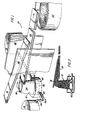
- the apparatus 10 includes a reaction vessel, generally designated 12, a mixed monomer solution storage vessel 14, a polymerization initiator storage vessel 16, an upper reaction product conveyor belt 18, a lower reaction product conveyor belt 20, and a dry cured resin holding vessel 22. If desired, retaining walls 24 and 26 are provided between the two conveyor belts to retain the water absorbinb resin reaction product on the lower conveyor belt 20.
- the mixed monomer solution is stored in storage vessel 14 and the polymerization initiator stored in the initiator storage vessel 16.
- the monomer solution is fed by gravity or otherwise through conduit 28 to a lower position (below the liquid surface) of a reaction chamber 30 of the reaction vessel 12 at a rate of, for example, 4 gallons per minute.
- the polymerization initiator is fed at a rate of, for example, 0.2 gallons per minute by gravity or otherwise through conduit 32 to an opposite side of the reaction chamber, again at a lower portion (below a continuously maintained liquid level) to begin polymerization.
- the reaction product forms from an upper surface of the reactant mixture (mixed monomer solution plus initiator) and travels upwardly through a truncated frustoconical cone shaped upper portion 34 of the reaction chamber 30 as a solid resin.
- the reaction product is sufficiently rigid to proceed upwardly from an upper annular edge 36 of the upper reaction chamber portion 34 until the resin meets the upper conveyor belt 18.
- the upper conveyor belt driven in a counterclockwise direction, pushes the mass of reaction product to the right, as shown in FIG. 1, onto the lower conveyor belt 20 on which the resin cures and dries without the addition of external heat.
- a suitable drying or curing time for the resins produced in accordance with the following examples 1-4 is, for example, 30 minutes.
- the lower conveyor belt can be of a suitable length for complete curing, or final curing and drying can occur in resin holding vessel 22.
- the aqueous solution is maintained at 70° C, and with the solution in reaction chamber 30 are continuously admixed to maintain a concentration of 0.1 5% of 2 , 2 -azobis-(2-amidino-propane)hydrochloric acid.
- the final solution is as follows:
- the polymer is allowed to complete curing for about 30 minutes at ambient temperature to give a dry solid mass of cross-linked potassium polyacrylate and ammonium acrylate product having a water content of 11% and a residual monomer concentration of 1200 ppm.
- the resin is made into a powder by a pulverizer (not shown).
- Polymers are prepared in the same manner as in Example 1 with the exception of varying, at least one of the combined concentration of monomers, the amount of polyvinyl monomer (N,N-methylenebisacrylamide), the kind and amount (degree of neutralization) of neutralizing agent, and the amounts, based on the combined amount of the monomers, of azo polymerization initiator.
- the following compositions were polymerized in the apparatus 10:
- the amount of polyvinyl monomer listed as expressed in % by weight based on the combined amount of potassium acrylate, free acrylic acid and the polyvinyl monomer, and the concentration of initiator is expressed in % by weight based on the combined amount by weight (calculated as solids) of the monomers and the initiator, the same as hereinbefore.
- the aqueous solution is maintained at 70° C, and the solution from conduit 28 is fed at 4 gallons/minute to reaction chamber 30 of reaction vessel 12. Simultaneously is fed at .2 gallons/minute until reactant level L is reached (FIG. 2), 18% aqueous solution of ammonium persulfate (0.5 wt. % based on the combined weight of the potassium acrylate, free acrylic acid and N,N-methylenebisacrylamide, the same as hereinafter). The mixture is fed into the reaction vessel 12. About 30 seconds thereafter, the mixture starts to polymerize, and the reactants are fed continuously to the reaction vessel 12. The maximum temperature of the mixture during the reaction is about 120° C.
- the reaction gives a dry solid of cross-linked potassium polyacrylate product having a water content of 11% and a residual monomer concentration of 1200 ppm.
- the resin is made into a powder by a pulverizer.
- the powder has water absorbing ability of 450 as measured with use of deionized water or 60 as measured with 1% saline.
- Polymers are prepared in the same manner as in Example 5 with the exception of changing at least one of the amount of N,N-methylenebisacrylamide and the kind and amount of the polymerization initiator as listed in Table 1 below. Table 1 also shows the water content and water absorbing ability of each polymer obtained.
- Polymers are prepared in the same manner as in Example 1 except that the compounds listed in Table 2 below are used as polyvinyl monomers in the listed amounts. Table 2 also shows the water content and water absorbing ability of each polymer obtained. * Polyethylene glycol diacrylate used in Examples 20 and 21 is represented by the following formula:
- Acrylic acid (72.1 g), 18.0 g of deionized water, 40.9 g of solid potassium hydroxide (water content 4%) and 5.2 g of one of the solvents (5 wt. % based on the monomers) listed in Table 3 are mixed together, and the mixture is maintained at 75° C. With the mixture is further admixed 4.0 g of 10% aqueous solution of 2,2'-azobis(2-amidinopropane)hydrochloric acid salt in reaction vessel 12. After about 1 minute, the reaction proceeds after which the reactants are continuously fed at the rates of example 1 into a lower portion of the reaction chamber 30. The maximum temperature of the mixture during the reaction is 130 to 135° C. If necessary, water coolant can be circulated through conduit 40, through cooling jacket 42 surrounding the lower portion of the reaction chamber 20 and through outlet 44 to cool the reactants.
- the reaction gives a dry cross-linked potassium polyacrylate product, which is pulverized to a powder 20 to 100 mesh in particle size.
- aqueous monomer solution is prepared in the same manner as in examples 17 to 21 with the exception of not using any organic solvent.
- the solution is thereafter subjected to polymerization in the same manner as in these examples to obtain a powder of dry solid.
- Table 3 also shows the test results obtained with this powder.
Landscapes
- Health & Medical Sciences (AREA)
- Chemical & Material Sciences (AREA)
- Chemical Kinetics & Catalysis (AREA)
- Medicinal Chemistry (AREA)
- Polymers & Plastics (AREA)
- Organic Chemistry (AREA)
- Dispersion Chemistry (AREA)
- Hematology (AREA)
- Engineering & Computer Science (AREA)
- Materials Engineering (AREA)
- Epidemiology (AREA)
- Life Sciences & Earth Sciences (AREA)
- Animal Behavior & Ethology (AREA)
- General Health & Medical Sciences (AREA)
- Public Health (AREA)
- Veterinary Medicine (AREA)
- Addition Polymer Or Copolymer, Post-Treatments, Or Chemical Modifications (AREA)
- Polymerisation Methods In General (AREA)
- Solid-Sorbent Or Filter-Aiding Compositions (AREA)
Applications Claiming Priority (4)
| Application Number | Priority Date | Filing Date | Title |
|---|---|---|---|
| US74824685A | 1985-06-24 | 1985-06-24 | |
| US748246 | 1985-06-24 | ||
| US74852885A | 1985-06-25 | 1985-06-25 | |
| US748528 | 1985-06-25 |
Publications (2)
| Publication Number | Publication Date |
|---|---|
| EP0206808A2 true EP0206808A2 (de) | 1986-12-30 |
| EP0206808A3 EP0206808A3 (de) | 1987-08-19 |
Family
ID=27114900
Family Applications (2)
| Application Number | Title | Priority Date | Filing Date |
|---|---|---|---|
| EP86304854A Withdrawn EP0206808A3 (de) | 1985-06-24 | 1986-06-24 | Kontinuverfahren zur Herstellung von Polyacrylat Harzen |
| EP86304855A Expired - Lifetime EP0207714B1 (de) | 1985-06-24 | 1986-06-24 | Verfahren zur Herstellung wasserabsorbierender Harze |
Family Applications After (1)
| Application Number | Title | Priority Date | Filing Date |
|---|---|---|---|
| EP86304855A Expired - Lifetime EP0207714B1 (de) | 1985-06-24 | 1986-06-24 | Verfahren zur Herstellung wasserabsorbierender Harze |
Country Status (3)
| Country | Link |
|---|---|
| EP (2) | EP0206808A3 (de) |
| AT (1) | ATE66939T1 (de) |
| DE (1) | DE3681210D1 (de) |
Cited By (3)
| Publication number | Priority date | Publication date | Assignee | Title |
|---|---|---|---|---|
| EP1178059A3 (de) * | 2000-08-03 | 2002-05-22 | Nippon Shokubai Co., Ltd. | Wasserabsorbierendes Harz, Hydropolymer, Verfahren zu seiner Herstellung und seiner Verwendung |
| WO2005113619A1 (de) * | 2004-05-10 | 2005-12-01 | Basf Aktiengesellschaft | Verdickte flüssigkeiten |
| CN115505064A (zh) * | 2022-09-27 | 2022-12-23 | 连云港铭磊科技有限公司 | 一种低可溶出物高吸水性树脂的制备方法 |
Families Citing this family (7)
| Publication number | Priority date | Publication date | Assignee | Title |
|---|---|---|---|---|
| KR0130652B1 (ko) * | 1987-08-14 | 1998-04-07 | 존 휴즈 | 수분 흡수성 수지의 제조 방법 |
| WO1989007455A1 (fr) * | 1988-02-12 | 1989-08-24 | Zaepffel Brigitte | Copolymere hydrophile reticule a usage medical et paramedical |
| US4988568A (en) * | 1988-03-30 | 1991-01-29 | Nippon Zeon Co., Ltd. | Hydrophilic fine gel particles and process for production thereof |
| RU2015141C1 (ru) | 1988-12-08 | 1994-06-30 | Ниппон Сокубаи Кагаку Когио Ко., Лтд. | Способ получения абсорбирующей смолы |
| CA1339231C (en) * | 1989-03-30 | 1997-08-05 | Ratana Kanluen | Polyfunctional polymers as deinking agents |
| US5216100A (en) * | 1989-12-18 | 1993-06-01 | Coatex S.A. | Non-toxic stabilizing agent for aqueous suspensions of sodium silico-aluminates |
| FR2658095B1 (fr) * | 1989-12-18 | 1993-10-01 | Coatex Sa | Agent de stabilisation non toxique des suspensions aqueuses de silico-aluminates de sodium. |
Family Cites Families (2)
| Publication number | Priority date | Publication date | Assignee | Title |
|---|---|---|---|---|
| GB1337084A (en) * | 1972-04-27 | 1973-11-14 | Dargenteuil Sarl | Method for the production of water soluble polymers |
| IT1162878B (it) * | 1982-06-16 | 1987-04-01 | Albright & Wilson | Procedimento per la preparazione di polimeri idrosolubili di acidi insaturi e polimeri ottenuti con il procedimento |
-
1986
- 1986-06-24 EP EP86304854A patent/EP0206808A3/de not_active Withdrawn
- 1986-06-24 EP EP86304855A patent/EP0207714B1/de not_active Expired - Lifetime
- 1986-06-24 DE DE8686304855T patent/DE3681210D1/de not_active Expired - Fee Related
- 1986-06-24 AT AT86304855T patent/ATE66939T1/de not_active IP Right Cessation
Cited By (9)
| Publication number | Priority date | Publication date | Assignee | Title |
|---|---|---|---|---|
| EP1178059A3 (de) * | 2000-08-03 | 2002-05-22 | Nippon Shokubai Co., Ltd. | Wasserabsorbierendes Harz, Hydropolymer, Verfahren zu seiner Herstellung und seiner Verwendung |
| US6906159B2 (en) | 2000-08-03 | 2005-06-14 | Nippon Shokubai Co., Ltd. | Water-absorbent resin, hydropolymer, process for producing them, and uses of them |
| US7091253B2 (en) | 2000-08-03 | 2006-08-15 | Nippon Shokubai Co., Ltd. | Water-absorbent resin, hydropolymer, process for producing them, and uses of them |
| EP1903062A3 (de) * | 2000-08-03 | 2008-04-23 | Nippon Shokubai Co.,Ltd. | Wasserabsorbierendes Harz, Hydropolymerverfahren für dessen Herstellung und Verwendung davon |
| US7741400B2 (en) | 2000-08-03 | 2010-06-22 | Nippon Shokubai Co., Ltd. | Water-absorbent resin, hydropolymer, process for producing them, and uses of them |
| EP2206733A1 (de) * | 2000-08-03 | 2010-07-14 | Nippon Shokubai Co., Ltd. | Wasserabsorbierendes Harz, Hydropolymerverfahren für dessen Herstellung und dessen Verwendung |
| US8519212B2 (en) | 2000-08-03 | 2013-08-27 | Nippon Shokubai Co., Ltd. | Water-absorbent resin, hydropolymer, process for producing them, and uses of them |
| WO2005113619A1 (de) * | 2004-05-10 | 2005-12-01 | Basf Aktiengesellschaft | Verdickte flüssigkeiten |
| CN115505064A (zh) * | 2022-09-27 | 2022-12-23 | 连云港铭磊科技有限公司 | 一种低可溶出物高吸水性树脂的制备方法 |
Also Published As
| Publication number | Publication date |
|---|---|
| EP0207714A3 (en) | 1987-08-26 |
| ATE66939T1 (de) | 1991-09-15 |
| DE3681210D1 (de) | 1991-10-10 |
| EP0207714A2 (de) | 1987-01-07 |
| EP0206808A3 (de) | 1987-08-19 |
| EP0207714B1 (de) | 1991-09-04 |
Similar Documents
| Publication | Publication Date | Title |
|---|---|---|
| EP0242478B1 (de) | Wasserabsorbierende Acrylcopolymere | |
| US4703067A (en) | Process for preparing dry solid water absorbing polyacrylate resin | |
| US4525527A (en) | Production process for highly water absorbable polymer | |
| US4985518A (en) | Process for preparing water-absorbing resins | |
| US4820773A (en) | Water absorbent resins prepared by polymerization in the presence of styrene-maleic anhydride copolymers | |
| EP0303518B1 (de) | Verfahren zur Herstellung von wasserabsorbierenden Harzen | |
| AU2010362811B2 (en) | Method for producing water-absorbent resin particles and water-absorbent resin particles | |
| JP2877255B2 (ja) | 耐久性の優れた吸水性樹脂の製造方法 | |
| JP2000026510A (ja) | 樹脂の製造法および吸水性樹脂 | |
| JPH0414684B2 (de) | ||
| JPS5980459A (ja) | 吸水性樹脂粉末組成物 | |
| EP0206808A2 (de) | Kontinuverfahren zur Herstellung von Polyacrylat Harzen | |
| CN111116947A (zh) | 聚丙烯酸系吸水性树脂的制造方法 | |
| US4820742A (en) | Method for continuous manufacture of solid water absorbing resin | |
| JPH0639487B2 (ja) | 高吸水性樹脂の製法 | |
| JP4326612B2 (ja) | 粒子状吸水性樹脂の製造方法 | |
| JPH0214925B2 (de) | ||
| WO2019074099A1 (ja) | 吸水性樹脂及び吸収性物品 | |
| JPH0229085B2 (ja) | Kansoshitakyusuiseijushinoseizohoho | |
| JPH0678390B2 (ja) | 吸水性ポリマーの製造方法 | |
| JP2679280B2 (ja) | 吸水性ポリマーの製造方法 | |
| JP7591415B2 (ja) | 吸水性樹脂の製造方法 | |
| JPH0321562B2 (de) | ||
| CN100509876C (zh) | 利用多次中和的不饱和单体水溶液以制备高吸水性树脂的制造方法 | |
| JPH0356513A (ja) | 吸水性ポリマーの製造方法 |
Legal Events
| Date | Code | Title | Description |
|---|---|---|---|
| PUAI | Public reference made under article 153(3) epc to a published international application that has entered the european phase |
Free format text: ORIGINAL CODE: 0009012 |
|
| AK | Designated contracting states |
Kind code of ref document: A2 Designated state(s): AT BE CH DE FR GB IT LI NL SE |
|
| PUAL | Search report despatched |
Free format text: ORIGINAL CODE: 0009013 |
|
| AK | Designated contracting states |
Kind code of ref document: A3 Designated state(s): AT BE CH DE FR GB IT LI NL SE |
|
| 17P | Request for examination filed |
Effective date: 19880202 |
|
| 17Q | First examination report despatched |
Effective date: 19890621 |
|
| STAA | Information on the status of an ep patent application or granted ep patent |
Free format text: STATUS: THE APPLICATION HAS BEEN WITHDRAWN |
|
| 18W | Application withdrawn |
Withdrawal date: 19900717 |
|
| R18W | Application withdrawn (corrected) |
Effective date: 19900717 |