EP0299296B1 - Bleichbäder mit bleichbeschleunigenden Substanzen - Google Patents
Bleichbäder mit bleichbeschleunigenden Substanzen Download PDFInfo
- Publication number
- EP0299296B1 EP0299296B1 EP88110530A EP88110530A EP0299296B1 EP 0299296 B1 EP0299296 B1 EP 0299296B1 EP 88110530 A EP88110530 A EP 88110530A EP 88110530 A EP88110530 A EP 88110530A EP 0299296 B1 EP0299296 B1 EP 0299296B1
- Authority
- EP
- European Patent Office
- Prior art keywords
- bleaching
- bleach
- acid
- fixing
- bath
- Prior art date
- Legal status (The legal status is an assumption and is not a legal conclusion. Google has not performed a legal analysis and makes no representation as to the accuracy of the status listed.)
- Expired - Lifetime
Links
- 238000004061 bleaching Methods 0.000 title claims description 55
- 150000003839 salts Chemical class 0.000 claims description 15
- 239000007844 bleaching agent Substances 0.000 claims description 14
- 150000001875 compounds Chemical class 0.000 claims description 14
- VTLYFUHAOXGGBS-UHFFFAOYSA-N Fe3+ Chemical compound [Fe+3] VTLYFUHAOXGGBS-UHFFFAOYSA-N 0.000 claims description 11
- 239000001257 hydrogen Substances 0.000 claims description 9
- 229910052739 hydrogen Inorganic materials 0.000 claims description 9
- 125000004178 (C1-C4) alkyl group Chemical group 0.000 claims description 5
- 125000006656 (C2-C4) alkenyl group Chemical group 0.000 claims description 5
- KCXVZYZYPLLWCC-UHFFFAOYSA-N EDTA Chemical compound OC(=O)CN(CC(O)=O)CCN(CC(O)=O)CC(O)=O KCXVZYZYPLLWCC-UHFFFAOYSA-N 0.000 claims description 4
- NBIIXXVUZAFLBC-UHFFFAOYSA-N Phosphoric acid Chemical group OP(O)(O)=O NBIIXXVUZAFLBC-UHFFFAOYSA-N 0.000 claims description 4
- 125000000217 alkyl group Chemical group 0.000 claims description 4
- 125000001495 ethyl group Chemical group [H]C([H])([H])C([H])([H])* 0.000 claims description 2
- 125000000843 phenylene group Chemical group C1(=C(C=CC=C1)*)* 0.000 claims description 2
- 125000004435 hydrogen atom Chemical group [H]* 0.000 claims 4
- LSNNMFCWUKXFEE-UHFFFAOYSA-M Bisulfite Chemical compound OS([O-])=O LSNNMFCWUKXFEE-UHFFFAOYSA-M 0.000 claims 1
- 125000002947 alkylene group Chemical group 0.000 claims 1
- 150000001735 carboxylic acids Chemical class 0.000 claims 1
- 229910052757 nitrogen Inorganic materials 0.000 description 15
- 235000002639 sodium chloride Nutrition 0.000 description 15
- 229910052709 silver Inorganic materials 0.000 description 13
- 239000004332 silver Substances 0.000 description 13
- 239000000243 solution Substances 0.000 description 13
- -1 silver halide Chemical class 0.000 description 12
- BQCADISMDOOEFD-UHFFFAOYSA-N Silver Chemical compound [Ag] BQCADISMDOOEFD-UHFFFAOYSA-N 0.000 description 11
- 239000000463 material Substances 0.000 description 11
- 239000003795 chemical substances by application Substances 0.000 description 7
- XEEYBQQBJWHFJM-UHFFFAOYSA-N Iron Chemical compound [Fe] XEEYBQQBJWHFJM-UHFFFAOYSA-N 0.000 description 6
- XLYOFNOQVPJJNP-UHFFFAOYSA-N water Substances O XLYOFNOQVPJJNP-UHFFFAOYSA-N 0.000 description 6
- 230000000694 effects Effects 0.000 description 5
- 150000003585 thioureas Chemical class 0.000 description 5
- UFHFLCQGNIYNRP-UHFFFAOYSA-N Hydrogen Chemical compound [H][H] UFHFLCQGNIYNRP-UHFFFAOYSA-N 0.000 description 4
- HEMHJVSKTPXQMS-UHFFFAOYSA-M Sodium hydroxide Chemical compound [OH-].[Na+] HEMHJVSKTPXQMS-UHFFFAOYSA-M 0.000 description 4
- 239000002253 acid Substances 0.000 description 4
- QTBSBXVTEAMEQO-UHFFFAOYSA-N Acetic acid Chemical compound CC(O)=O QTBSBXVTEAMEQO-UHFFFAOYSA-N 0.000 description 3
- CSCPPACGZOOCGX-UHFFFAOYSA-N Acetone Chemical compound CC(C)=O CSCPPACGZOOCGX-UHFFFAOYSA-N 0.000 description 3
- DHMQDGOQFOQNFH-UHFFFAOYSA-N Glycine Chemical compound NCC(O)=O DHMQDGOQFOQNFH-UHFFFAOYSA-N 0.000 description 3
- OKKJLVBELUTLKV-UHFFFAOYSA-N Methanol Chemical compound OC OKKJLVBELUTLKV-UHFFFAOYSA-N 0.000 description 3
- KRKNYBCHXYNGOX-UHFFFAOYSA-N citric acid Chemical compound OC(=O)CC(O)(C(O)=O)CC(O)=O KRKNYBCHXYNGOX-UHFFFAOYSA-N 0.000 description 3
- 230000003750 conditioning effect Effects 0.000 description 3
- 150000002431 hydrogen Chemical class 0.000 description 3
- MGFYIUFZLHCRTH-UHFFFAOYSA-N nitrilotriacetic acid Chemical compound OC(=O)CN(CC(O)=O)CC(O)=O MGFYIUFZLHCRTH-UHFFFAOYSA-N 0.000 description 3
- NLKNQRATVPKPDG-UHFFFAOYSA-M potassium iodide Chemical compound [K+].[I-] NLKNQRATVPKPDG-UHFFFAOYSA-M 0.000 description 3
- 239000000126 substance Substances 0.000 description 3
- RNMCCPMYXUKHAZ-UHFFFAOYSA-N 2-[3,3-diamino-1,2,2-tris(carboxymethyl)cyclohexyl]acetic acid Chemical compound NC1(N)CCCC(CC(O)=O)(CC(O)=O)C1(CC(O)=O)CC(O)=O RNMCCPMYXUKHAZ-UHFFFAOYSA-N 0.000 description 2
- FCSKOFQQCWLGMV-UHFFFAOYSA-N 5-{5-[2-chloro-4-(4,5-dihydro-1,3-oxazol-2-yl)phenoxy]pentyl}-3-methylisoxazole Chemical compound O1N=C(C)C=C1CCCCCOC1=CC=C(C=2OCCN=2)C=C1Cl FCSKOFQQCWLGMV-UHFFFAOYSA-N 0.000 description 2
- NLXLAEXVIDQMFP-UHFFFAOYSA-N Ammonia chloride Chemical compound [NH4+].[Cl-] NLXLAEXVIDQMFP-UHFFFAOYSA-N 0.000 description 2
- 0 CN(C*1*)CNC1=S Chemical compound CN(C*1*)CNC1=S 0.000 description 2
- RTZKZFJDLAIYFH-UHFFFAOYSA-N Diethyl ether Chemical compound CCOCC RTZKZFJDLAIYFH-UHFFFAOYSA-N 0.000 description 2
- OAKJQQAXSVQMHS-UHFFFAOYSA-N Hydrazine Chemical compound NN OAKJQQAXSVQMHS-UHFFFAOYSA-N 0.000 description 2
- KQJQICVXLJTWQD-UHFFFAOYSA-N N-Methylthiourea Chemical compound CNC(N)=S KQJQICVXLJTWQD-UHFFFAOYSA-N 0.000 description 2
- WCUXLLCKKVVCTQ-UHFFFAOYSA-M Potassium chloride Chemical compound [Cl-].[K+] WCUXLLCKKVVCTQ-UHFFFAOYSA-M 0.000 description 2
- CDBYLPFSWZWCQE-UHFFFAOYSA-L Sodium Carbonate Chemical compound [Na+].[Na+].[O-]C([O-])=O CDBYLPFSWZWCQE-UHFFFAOYSA-L 0.000 description 2
- FAPWRFPIFSIZLT-UHFFFAOYSA-M Sodium chloride Chemical compound [Na+].[Cl-] FAPWRFPIFSIZLT-UHFFFAOYSA-M 0.000 description 2
- 239000000654 additive Substances 0.000 description 2
- 239000003513 alkali Substances 0.000 description 2
- 239000007864 aqueous solution Substances 0.000 description 2
- 230000015572 biosynthetic process Effects 0.000 description 2
- 150000001768 cations Chemical class 0.000 description 2
- 239000002738 chelating agent Substances 0.000 description 2
- 238000001816 cooling Methods 0.000 description 2
- SHAAJFLFXFNNSF-UHFFFAOYSA-L disodium;acetic acid;cyclohexane-1,1-diamine;diacetate Chemical compound [Na+].[Na+].CC(O)=O.CC(O)=O.CC([O-])=O.CC([O-])=O.NC1(N)CCCCC1 SHAAJFLFXFNNSF-UHFFFAOYSA-L 0.000 description 2
- 229910052742 iron Inorganic materials 0.000 description 2
- 238000000034 method Methods 0.000 description 2
- 125000002496 methyl group Chemical group [H]C([H])([H])* 0.000 description 2
- IOLCXVTUBQKXJR-UHFFFAOYSA-M potassium bromide Chemical compound [K+].[Br-] IOLCXVTUBQKXJR-UHFFFAOYSA-M 0.000 description 2
- BWHMMNNQKKPAPP-UHFFFAOYSA-L potassium carbonate Chemical compound [K+].[K+].[O-]C([O-])=O BWHMMNNQKKPAPP-UHFFFAOYSA-L 0.000 description 2
- 230000002441 reversible effect Effects 0.000 description 2
- JHJLBTNAGRQEKS-UHFFFAOYSA-M sodium bromide Chemical compound [Na+].[Br-] JHJLBTNAGRQEKS-UHFFFAOYSA-M 0.000 description 2
- GEHJYWRUCIMESM-UHFFFAOYSA-L sodium sulfite Chemical compound [Na+].[Na+].[O-]S([O-])=O GEHJYWRUCIMESM-UHFFFAOYSA-L 0.000 description 2
- 238000003786 synthesis reaction Methods 0.000 description 2
- UMGDCJDMYOKAJW-UHFFFAOYSA-N thiourea Chemical compound NC(N)=S UMGDCJDMYOKAJW-UHFFFAOYSA-N 0.000 description 2
- AFBBKYQYNPNMAT-UHFFFAOYSA-N 1h-1,2,4-triazol-1-ium-3-thiolate Chemical compound SC=1N=CNN=1 AFBBKYQYNPNMAT-UHFFFAOYSA-N 0.000 description 1
- JAAIPIWKKXCNOC-UHFFFAOYSA-N 1h-tetrazol-1-ium-5-thiolate Chemical class SC1=NN=NN1 JAAIPIWKKXCNOC-UHFFFAOYSA-N 0.000 description 1
- SUVZGLSQFGNBQI-UHFFFAOYSA-N 2,5-bis(sulfanyl)hexanedioic acid Chemical compound OC(=O)C(S)CCC(S)C(O)=O SUVZGLSQFGNBQI-UHFFFAOYSA-N 0.000 description 1
- PDHFSBXFZGYBIP-UHFFFAOYSA-N 2-[2-(2-hydroxyethylsulfanyl)ethylsulfanyl]ethanol Chemical compound OCCSCCSCCO PDHFSBXFZGYBIP-UHFFFAOYSA-N 0.000 description 1
- XFHQIFFCAQHVMX-UHFFFAOYSA-B 2-[2-[bis(carboxylatomethyl)amino]ethyl-(carboxylatomethyl)amino]acetate;iron(3+) Chemical compound [Fe+3].[Fe+3].[Fe+3].[Fe+3].[O-]C(=O)CN(CC([O-])=O)CCN(CC([O-])=O)CC([O-])=O.[O-]C(=O)CN(CC([O-])=O)CCN(CC([O-])=O)CC([O-])=O.[O-]C(=O)CN(CC([O-])=O)CCN(CC([O-])=O)CC([O-])=O XFHQIFFCAQHVMX-UHFFFAOYSA-B 0.000 description 1
- JKRNNIGZNCVVHA-UHFFFAOYSA-N 2-[2-[bis(carboxylatomethyl)amino]ethyl-(carboxylatomethyl)amino]acetate;trimethylazanium Chemical compound C[NH+](C)C.C[NH+](C)C.C[NH+](C)C.C[NH+](C)C.[O-]C(=O)CN(CC([O-])=O)CCN(CC([O-])=O)CC([O-])=O JKRNNIGZNCVVHA-UHFFFAOYSA-N 0.000 description 1
- XNCSCQSQSGDGES-UHFFFAOYSA-N 2-[2-[bis(carboxymethyl)amino]propyl-(carboxymethyl)amino]acetic acid Chemical compound OC(=O)CN(CC(O)=O)C(C)CN(CC(O)=O)CC(O)=O XNCSCQSQSGDGES-UHFFFAOYSA-N 0.000 description 1
- KWYJDIUEHHCHCZ-UHFFFAOYSA-N 3-[2-[bis(2-carboxyethyl)amino]ethyl-(2-carboxyethyl)amino]propanoic acid Chemical compound OC(=O)CCN(CCC(O)=O)CCN(CCC(O)=O)CCC(O)=O KWYJDIUEHHCHCZ-UHFFFAOYSA-N 0.000 description 1
- QGZKDVFQNNGYKY-UHFFFAOYSA-O Ammonium Chemical compound [NH4+] QGZKDVFQNNGYKY-UHFFFAOYSA-O 0.000 description 1
- FEWJPZIEWOKRBE-JCYAYHJZSA-N Dextrotartaric acid Chemical compound OC(=O)[C@H](O)[C@@H](O)C(O)=O FEWJPZIEWOKRBE-JCYAYHJZSA-N 0.000 description 1
- PQUCIEFHOVEZAU-UHFFFAOYSA-N Diammonium sulfite Chemical compound [NH4+].[NH4+].[O-]S([O-])=O PQUCIEFHOVEZAU-UHFFFAOYSA-N 0.000 description 1
- 239000003109 Disodium ethylene diamine tetraacetate Substances 0.000 description 1
- QZKRHPLGUJDVAR-UHFFFAOYSA-K EDTA trisodium salt Chemical compound [Na+].[Na+].[Na+].OC(=O)CN(CC([O-])=O)CCN(CC([O-])=O)CC([O-])=O QZKRHPLGUJDVAR-UHFFFAOYSA-K 0.000 description 1
- WSFSSNUMVMOOMR-UHFFFAOYSA-N Formaldehyde Chemical compound O=C WSFSSNUMVMOOMR-UHFFFAOYSA-N 0.000 description 1
- AVXURJPOCDRRFD-UHFFFAOYSA-N Hydroxylamine Chemical compound ON AVXURJPOCDRRFD-UHFFFAOYSA-N 0.000 description 1
- FSVCELGFZIQNCK-UHFFFAOYSA-N N,N-bis(2-hydroxyethyl)glycine Chemical compound OCCN(CCO)CC(O)=O FSVCELGFZIQNCK-UHFFFAOYSA-N 0.000 description 1
- QPCDCPDFJACHGM-UHFFFAOYSA-N N,N-bis{2-[bis(carboxymethyl)amino]ethyl}glycine Chemical compound OC(=O)CN(CC(O)=O)CCN(CC(=O)O)CCN(CC(O)=O)CC(O)=O QPCDCPDFJACHGM-UHFFFAOYSA-N 0.000 description 1
- XGEGHDBEHXKFPX-UHFFFAOYSA-N N-methylthiourea Natural products CNC(N)=O XGEGHDBEHXKFPX-UHFFFAOYSA-N 0.000 description 1
- ABLZXFCXXLZCGV-UHFFFAOYSA-N Phosphorous acid Chemical compound OP(O)=O ABLZXFCXXLZCGV-UHFFFAOYSA-N 0.000 description 1
- 229920003171 Poly (ethylene oxide) Polymers 0.000 description 1
- VMHLLURERBWHNL-UHFFFAOYSA-M Sodium acetate Chemical compound [Na+].CC([O-])=O VMHLLURERBWHNL-UHFFFAOYSA-M 0.000 description 1
- FEWJPZIEWOKRBE-UHFFFAOYSA-N Tartaric acid Natural products [H+].[H+].[O-]C(=O)C(O)C(O)C([O-])=O FEWJPZIEWOKRBE-UHFFFAOYSA-N 0.000 description 1
- XSQUKJJJFZCRTK-UHFFFAOYSA-N Urea Natural products NC(N)=O XSQUKJJJFZCRTK-UHFFFAOYSA-N 0.000 description 1
- MJOQJPYNENPSSS-XQHKEYJVSA-N [(3r,4s,5r,6s)-4,5,6-triacetyloxyoxan-3-yl] acetate Chemical compound CC(=O)O[C@@H]1CO[C@@H](OC(C)=O)[C@H](OC(C)=O)[C@H]1OC(C)=O MJOQJPYNENPSSS-XQHKEYJVSA-N 0.000 description 1
- CUMZMPIJUWXMLU-UHFFFAOYSA-N [Na].[Na].C=CC Chemical group [Na].[Na].C=CC CUMZMPIJUWXMLU-UHFFFAOYSA-N 0.000 description 1
- 230000001133 acceleration Effects 0.000 description 1
- VYTBPJNGNGMRFH-UHFFFAOYSA-N acetic acid;azane Chemical compound N.N.CC(O)=O.CC(O)=O.CC(O)=O.CC(O)=O VYTBPJNGNGMRFH-UHFFFAOYSA-N 0.000 description 1
- LRSAWRZHGQQHBJ-UHFFFAOYSA-N acetic acid;benzene-1,2-diamine Chemical compound CC(O)=O.CC(O)=O.CC(O)=O.CC(O)=O.NC1=CC=CC=C1N LRSAWRZHGQQHBJ-UHFFFAOYSA-N 0.000 description 1
- 125000002252 acyl group Chemical group 0.000 description 1
- 150000001299 aldehydes Chemical class 0.000 description 1
- 229910052783 alkali metal Inorganic materials 0.000 description 1
- 229910000147 aluminium phosphate Inorganic materials 0.000 description 1
- 150000001412 amines Chemical class 0.000 description 1
- SWLVFNYSXGMGBS-UHFFFAOYSA-N ammonium bromide Chemical compound [NH4+].[Br-] SWLVFNYSXGMGBS-UHFFFAOYSA-N 0.000 description 1
- 235000019270 ammonium chloride Nutrition 0.000 description 1
- 150000003863 ammonium salts Chemical class 0.000 description 1
- SOIFLUNRINLCBN-UHFFFAOYSA-N ammonium thiocyanate Chemical compound [NH4+].[S-]C#N SOIFLUNRINLCBN-UHFFFAOYSA-N 0.000 description 1
- XYXNTHIYBIDHGM-UHFFFAOYSA-N ammonium thiosulfate Chemical compound [NH4+].[NH4+].[O-]S([O-])(=O)=S XYXNTHIYBIDHGM-UHFFFAOYSA-N 0.000 description 1
- VTYVIFFJJXAHTG-UHFFFAOYSA-M azanium;sodium;dioxido-oxo-sulfanylidene-$l^{6}-sulfane Chemical compound [NH4+].[Na+].[O-]S([O-])(=O)=S VTYVIFFJJXAHTG-UHFFFAOYSA-M 0.000 description 1
- 229910021538 borax Inorganic materials 0.000 description 1
- KGBXLFKZBHKPEV-UHFFFAOYSA-N boric acid Chemical compound OB(O)O KGBXLFKZBHKPEV-UHFFFAOYSA-N 0.000 description 1
- 239000004327 boric acid Substances 0.000 description 1
- 150000003842 bromide salts Chemical class 0.000 description 1
- 230000003139 buffering effect Effects 0.000 description 1
- 125000003178 carboxy group Chemical group [H]OC(*)=O 0.000 description 1
- 238000006243 chemical reaction Methods 0.000 description 1
- 150000003841 chloride salts Chemical class 0.000 description 1
- 239000003086 colorant Substances 0.000 description 1
- 238000000354 decomposition reaction Methods 0.000 description 1
- KYQODXQIAJFKPH-UHFFFAOYSA-N diazanium;2-[2-[bis(carboxymethyl)amino]ethyl-(carboxylatomethyl)amino]acetate Chemical compound [NH4+].[NH4+].OC(=O)CN(CC([O-])=O)CCN(CC(O)=O)CC([O-])=O KYQODXQIAJFKPH-UHFFFAOYSA-N 0.000 description 1
- FGRVOLIFQGXPCT-UHFFFAOYSA-L dipotassium;dioxido-oxo-sulfanylidene-$l^{6}-sulfane Chemical compound [K+].[K+].[O-]S([O-])(=O)=S FGRVOLIFQGXPCT-UHFFFAOYSA-L 0.000 description 1
- 235000019301 disodium ethylene diamine tetraacetate Nutrition 0.000 description 1
- NLFBCYMMUAKCPC-KQQUZDAGSA-N ethyl (e)-3-[3-amino-2-cyano-1-[(e)-3-ethoxy-3-oxoprop-1-enyl]sulfanyl-3-oxoprop-1-enyl]sulfanylprop-2-enoate Chemical compound CCOC(=O)\C=C\SC(=C(C#N)C(N)=O)S\C=C\C(=O)OCC NLFBCYMMUAKCPC-KQQUZDAGSA-N 0.000 description 1
- DEFVIWRASFVYLL-UHFFFAOYSA-N ethylene glycol bis(2-aminoethyl)tetraacetic acid Chemical compound OC(=O)CN(CC(O)=O)CCOCCOCCN(CC(O)=O)CC(O)=O DEFVIWRASFVYLL-UHFFFAOYSA-N 0.000 description 1
- 229940071106 ethylenediaminetetraacetate Drugs 0.000 description 1
- 239000000834 fixative Substances 0.000 description 1
- 239000008098 formaldehyde solution Substances 0.000 description 1
- 235000013905 glycine and its sodium salt Nutrition 0.000 description 1
- NBZBKCUXIYYUSX-UHFFFAOYSA-N iminodiacetic acid Chemical compound OC(=O)CNCC(O)=O NBZBKCUXIYYUSX-UHFFFAOYSA-N 0.000 description 1
- 238000011065 in-situ storage Methods 0.000 description 1
- 150000004694 iodide salts Chemical class 0.000 description 1
- 230000007257 malfunction Effects 0.000 description 1
- 238000002844 melting Methods 0.000 description 1
- 230000008018 melting Effects 0.000 description 1
- 150000007522 mineralic acids Chemical class 0.000 description 1
- 239000000203 mixture Substances 0.000 description 1
- PJUIMOJAAPLTRJ-UHFFFAOYSA-N monothioglycerol Chemical compound OCC(O)CS PJUIMOJAAPLTRJ-UHFFFAOYSA-N 0.000 description 1
- 238000000655 nuclear magnetic resonance spectrum Methods 0.000 description 1
- 230000003287 optical effect Effects 0.000 description 1
- 150000007524 organic acids Chemical class 0.000 description 1
- 235000005985 organic acids Nutrition 0.000 description 1
- 239000003960 organic solvent Substances 0.000 description 1
- 230000001590 oxidative effect Effects 0.000 description 1
- LQPLDXQVILYOOL-UHFFFAOYSA-I pentasodium;2-[bis[2-[bis(carboxylatomethyl)amino]ethyl]amino]acetate Chemical compound [Na+].[Na+].[Na+].[Na+].[Na+].[O-]C(=O)CN(CC([O-])=O)CCN(CC(=O)[O-])CCN(CC([O-])=O)CC([O-])=O LQPLDXQVILYOOL-UHFFFAOYSA-I 0.000 description 1
- 229960003330 pentetic acid Drugs 0.000 description 1
- JRKICGRDRMAZLK-UHFFFAOYSA-L persulfate group Chemical group S(=O)(=O)([O-])OOS(=O)(=O)[O-] JRKICGRDRMAZLK-UHFFFAOYSA-L 0.000 description 1
- 229920000768 polyamine Polymers 0.000 description 1
- 229910000027 potassium carbonate Inorganic materials 0.000 description 1
- 239000001103 potassium chloride Substances 0.000 description 1
- 235000011164 potassium chloride Nutrition 0.000 description 1
- BHZRJJOHZFYXTO-UHFFFAOYSA-L potassium sulfite Chemical compound [K+].[K+].[O-]S([O-])=O BHZRJJOHZFYXTO-UHFFFAOYSA-L 0.000 description 1
- 235000019252 potassium sulphite Nutrition 0.000 description 1
- ZNNZYHKDIALBAK-UHFFFAOYSA-M potassium thiocyanate Chemical compound [K+].[S-]C#N ZNNZYHKDIALBAK-UHFFFAOYSA-M 0.000 description 1
- 229940116357 potassium thiocyanate Drugs 0.000 description 1
- 238000001556 precipitation Methods 0.000 description 1
- 239000003755 preservative agent Substances 0.000 description 1
- IYKVLICPFCEZOF-UHFFFAOYSA-N selenourea Chemical class NC(N)=[Se] IYKVLICPFCEZOF-UHFFFAOYSA-N 0.000 description 1
- 238000002791 soaking Methods 0.000 description 1
- 239000001632 sodium acetate Substances 0.000 description 1
- 235000017281 sodium acetate Nutrition 0.000 description 1
- 229910000029 sodium carbonate Inorganic materials 0.000 description 1
- 239000011780 sodium chloride Substances 0.000 description 1
- 239000001509 sodium citrate Substances 0.000 description 1
- NLJMYIDDQXHKNR-UHFFFAOYSA-K sodium citrate Chemical compound O.O.[Na+].[Na+].[Na+].[O-]C(=O)CC(O)(CC([O-])=O)C([O-])=O NLJMYIDDQXHKNR-UHFFFAOYSA-K 0.000 description 1
- NVIFVTYDZMXWGX-UHFFFAOYSA-N sodium metaborate Chemical compound [Na+].[O-]B=O NVIFVTYDZMXWGX-UHFFFAOYSA-N 0.000 description 1
- DZCAZXAJPZCSCU-UHFFFAOYSA-K sodium nitrilotriacetate Chemical compound [Na+].[Na+].[Na+].[O-]C(=O)CN(CC([O-])=O)CC([O-])=O DZCAZXAJPZCSCU-UHFFFAOYSA-K 0.000 description 1
- 239000001488 sodium phosphate Substances 0.000 description 1
- 229910000162 sodium phosphate Inorganic materials 0.000 description 1
- 235000010265 sodium sulphite Nutrition 0.000 description 1
- 239000004328 sodium tetraborate Substances 0.000 description 1
- 235000010339 sodium tetraborate Nutrition 0.000 description 1
- VGTPCRGMBIAPIM-UHFFFAOYSA-M sodium thiocyanate Chemical compound [Na+].[S-]C#N VGTPCRGMBIAPIM-UHFFFAOYSA-M 0.000 description 1
- AKHNMLFCWUSKQB-UHFFFAOYSA-L sodium thiosulfate Chemical compound [Na+].[Na+].[O-]S([O-])(=O)=S AKHNMLFCWUSKQB-UHFFFAOYSA-L 0.000 description 1
- 235000019345 sodium thiosulphate Nutrition 0.000 description 1
- QWSDEEQHECGZSL-UHFFFAOYSA-M sodium;acetaldehyde;hydrogen sulfite Chemical compound [Na+].CC=O.OS([O-])=O QWSDEEQHECGZSL-UHFFFAOYSA-M 0.000 description 1
- 238000007711 solidification Methods 0.000 description 1
- 230000003381 solubilizing effect Effects 0.000 description 1
- LSNNMFCWUKXFEE-UHFFFAOYSA-L sulfite Chemical class [O-]S([O-])=O LSNNMFCWUKXFEE-UHFFFAOYSA-L 0.000 description 1
- 125000000020 sulfo group Chemical group O=S(=O)([*])O[H] 0.000 description 1
- DHCDFWKWKRSZHF-UHFFFAOYSA-N sulfurothioic S-acid Chemical compound OS(O)(=O)=S DHCDFWKWKRSZHF-UHFFFAOYSA-N 0.000 description 1
- 239000004094 surface-active agent Substances 0.000 description 1
- 239000011975 tartaric acid Substances 0.000 description 1
- 235000002906 tartaric acid Nutrition 0.000 description 1
- ISIJQEHRDSCQIU-UHFFFAOYSA-N tert-butyl 2,7-diazaspiro[4.5]decane-7-carboxylate Chemical compound C1N(C(=O)OC(C)(C)C)CCCC11CNCC1 ISIJQEHRDSCQIU-UHFFFAOYSA-N 0.000 description 1
- JZBRFIUYUGTUGG-UHFFFAOYSA-J tetrapotassium;2-[2-[bis(carboxylatomethyl)amino]ethyl-(carboxylatomethyl)amino]acetate Chemical compound [K+].[K+].[K+].[K+].[O-]C(=O)CN(CC([O-])=O)CCN(CC([O-])=O)CC([O-])=O JZBRFIUYUGTUGG-UHFFFAOYSA-J 0.000 description 1
- UEUXEKPTXMALOB-UHFFFAOYSA-J tetrasodium;2-[2-[bis(carboxylatomethyl)amino]ethyl-(carboxylatomethyl)amino]acetate Chemical compound [Na+].[Na+].[Na+].[Na+].[O-]C(=O)CN(CC([O-])=O)CCN(CC([O-])=O)CC([O-])=O UEUXEKPTXMALOB-UHFFFAOYSA-J 0.000 description 1
- 150000004867 thiadiazoles Chemical class 0.000 description 1
- 150000007979 thiazole derivatives Chemical class 0.000 description 1
- 150000003567 thiocyanates Chemical class 0.000 description 1
- 150000003568 thioethers Chemical class 0.000 description 1
- RYFMWSXOAZQYPI-UHFFFAOYSA-K trisodium phosphate Chemical compound [Na+].[Na+].[Na+].[O-]P([O-])([O-])=O RYFMWSXOAZQYPI-UHFFFAOYSA-K 0.000 description 1
- SOBHUZYZLFQYFK-UHFFFAOYSA-K trisodium;hydroxy-[[phosphonatomethyl(phosphonomethyl)amino]methyl]phosphinate Chemical compound [Na+].[Na+].[Na+].OP(O)(=O)CN(CP(O)([O-])=O)CP([O-])([O-])=O SOBHUZYZLFQYFK-UHFFFAOYSA-K 0.000 description 1
- 238000011144 upstream manufacturing Methods 0.000 description 1
- 238000005406 washing Methods 0.000 description 1
Classifications
-
- C—CHEMISTRY; METALLURGY
- C07—ORGANIC CHEMISTRY
- C07D—HETEROCYCLIC COMPOUNDS
- C07D251/00—Heterocyclic compounds containing 1,3,5-triazine rings
- C07D251/02—Heterocyclic compounds containing 1,3,5-triazine rings not condensed with other rings
- C07D251/08—Heterocyclic compounds containing 1,3,5-triazine rings not condensed with other rings having one double bond between ring members or between a ring member and a non-ring member
-
- C—CHEMISTRY; METALLURGY
- C07—ORGANIC CHEMISTRY
- C07F—ACYCLIC, CARBOCYCLIC OR HETEROCYCLIC COMPOUNDS CONTAINING ELEMENTS OTHER THAN CARBON, HYDROGEN, HALOGEN, OXYGEN, NITROGEN, SULFUR, SELENIUM OR TELLURIUM
- C07F9/00—Compounds containing elements of Groups 5 or 15 of the Periodic Table
- C07F9/02—Phosphorus compounds
- C07F9/547—Heterocyclic compounds, e.g. containing phosphorus as a ring hetero atom
- C07F9/6515—Heterocyclic compounds, e.g. containing phosphorus as a ring hetero atom having three nitrogen atoms as the only ring hetero atoms
- C07F9/6521—Six-membered rings
-
- G—PHYSICS
- G03—PHOTOGRAPHY; CINEMATOGRAPHY; ANALOGOUS TECHNIQUES USING WAVES OTHER THAN OPTICAL WAVES; ELECTROGRAPHY; HOLOGRAPHY
- G03C—PHOTOSENSITIVE MATERIALS FOR PHOTOGRAPHIC PURPOSES; PHOTOGRAPHIC PROCESSES, e.g. CINE, X-RAY, COLOUR, STEREO-PHOTOGRAPHIC PROCESSES; AUXILIARY PROCESSES IN PHOTOGRAPHY
- G03C7/00—Multicolour photographic processes or agents therefor; Regeneration of such processing agents; Photosensitive materials for multicolour processes
- G03C7/30—Colour processes using colour-coupling substances; Materials therefor; Preparing or processing such materials
- G03C7/42—Bleach-fixing or agents therefor ; Desilvering processes
- G03C7/421—Additives other than bleaching or fixing agents
Definitions
- the invention relates to bleaching baths for processing an exposed color photographic light-sensitive silver halide material in which the bleaching function is accelerated, as a result of which the processing time is shortened and the minimum densities are reduced in the case of reversal materials.
- the basic stages of processing color photosensitive materials generally include a color development stage and a silver removal stage. A reversed black / white development and a second exposure are added for reversal materials. In the last stage, the silver produced during development is oxidized with a bleaching agent and dissolved with a fixing agent.
- the removal of the silver can be carried out in two stages with a bleaching bath and a fixing bath or in one stage with a bleach-fixing bath.
- the bleaching process is predominantly carried out using an iron (III) ion complex salt (for example aminopolycarboxylic acid iron (III) complex salt, in particular iron (111) ethylenediaminetetraacetate complex salt).
- iron (III) ion complex salt for example aminopolycarboxylic acid iron (III) complex salt, in particular iron (111) ethylenediaminetetraacetate complex salt. Iodoso compounds and persulfates are also suitable.
- iron (III) ion complex salts have a comparatively low oxidizing power and therefore have an inadequate bleaching power, particularly in the case of reversible materials. Therefore, especially in the case of reversible materials, there was a need to increase the bleaching power of a bleaching solution or bleach-fixing solution which contains a bleaching agent with low bleaching power, in particular an iron (III) ion complex salt.
- bleach accelerators examples include thiourea derivatives (JP-OS 8506/70, US Pat. No. 3,706,561), selenourea derivatives (JP-OS 280/71), mercapto compounds with a five-membered ring (GB-PS 1 138 842) and thiourea derivatives, thiazole derivatives and Thiadiazole derivatives (CH-PS 336 257).
- 5-mercaptotetrazoles are used as accelerating agents for the removal of silver in a bleach-fix solution (GB-PS 1 138 8 42 ).
- these compounds have weak accelerating power, poor solubility, or poor stability in the processing solution.
- DE-OS 3 518 257 describes the bleaching accelerating effect of compounds of the formulas respectively.
- R 'to R 10 are hydrogen, alkyl, acyl or together the remaining members of a ring, m and an integer 1 to 3.
- bleach-fixing baths based on iron-II-EDTA are usually used after the first development, the second exposure and the color development to remove silver from the paper.
- bleach accelerators must be added to the bleach-fix bath in order to achieve bleaching sufficiently quickly and completely.
- compounds such as 3-mercapto-1,2,4-triazole or 5-amino-2-mercapto-1,3,4-thiodiazole are used successfully.
- bleach accelerators in the bleach-fixer has also proven to be useful for color negative paper. If the bleaching is inadequate, residual amounts of silver remain in the materials, which in the case of the mostly IR-controlled cutting device can lead to incorrect information, as a result of which the image strip is not cut between the images but through the middle of the images.
- bleach-fix bath namely bleach bath and fixing bath
- bleach accelerators cannot be used because they no longer have a sufficient accelerating effect and because they are sometimes not sufficiently soluble are. Without bleach accelerator, the insufficiently bleached photo papers in the dark areas of the image show considerable residual silver contents.
- the object of the present invention is to provide bleaching or bleach-fixing baths which are stable and have an excellent bleaching rate. Above all, they should ensure satisfactory bleaching in the case of reversal materials during the usual processing times. Other photographic properties should not be deteriorated.
- R 1 and R 2 are preferably hydrogen, methyl or ethyl
- R is a group (L 1 ) n ⁇ Z 1 -, where Z 1 , C 1 -C 4 -alkylene or phenylene and L 1 is a sulfonic, carboxylic, phosphonic acid - Or phosphoric acid residue
- R 3 is hydrogen, C 2 ⁇ C 4 alkenyl or C 1 -C 4 alkyl optionally substituted by carboxy or sulfo.
- Suitable compounds are, for example
- the compounds to be used according to the invention are made from a thiourea of the formula the approximately equal molar amount of an amine of the formula and the approximately double molar amount of an aldehyde of the formula wherein R, R1, R 2 and R 3 have the meaning given above, prepared in aqueous alkali; the synthesis of compound VII is described below for illustration. The other connections are made analogously.
- the amount of the compound of the present invention in the bleaching and bleach-fixing baths varies depending on the kind of the processing solution, the kind of the photographic material to be processed, the processing temperature, the time required for performing the desired processing, etc. However, an amount of 1 x 10- 5 to 1 mol per liter of bleaching or bleach-fixing bath are suitable, 1 ⁇ 10 -3 to 1 ⁇ 10 -1 mol being preferred. In general, a low bleaching acceleration effect is achieved with a small amount, however, with a larger amount than the required amount, there is a risk of precipitation, which can lead to processing malfunctions. The best range is therefore determined by simple preliminary tests.
- the compound to be used according to the invention can be added directly to the bleaching or bleach-fixing bath or introduced through an upstream conditioning bath.
- Suitable iron (III) ion complex salts are complexes of iron (III) ions and a chelating agent such as an aminopolycarboxylic acid, an aminopolyphosphonic acid or a salt thereof, in particular an alkali metal salt or ammonium salt.
- Typical examples of chelating agents are ethylenediaminetetraacetic acid; Disodium ethylenediaminetetraacetate; Diammonium ethylenediaminetetraacetate; Tetra (trimethylammonium) ethylenediaminetetraacetate; Tetrapotassium ethylenediaminetetraacetate; Tetrasodium ethylenediaminetetraacetate; Trisodium ethylenediaminetetraacetate; Diethylenetriaminepentaacetic acid; Pentasodium diethylenetriaminepentaacetate; Ethylenediamine-N- ( ⁇ -hydroxyethyl) -N, N ', N'-triacetic acid; Trisodium ethylenediamine-N- ( ⁇ -hydroxyethyl) -N, N ', N'-triacetate; Triammonium ethylenediamine-N- ( ⁇ -hydroxyethyl) -N, N ', N'-triacetate; Propyl
- the iron (III) ion complex salt can be used in the form of the complex salt or prepared in situ in the bleach or bleach-fix bath. Suitable cations are alkali cations and ammonium; the latter is preferred.
- the bleaching solution of the present invention may contain rehalogenating agents such as bromides (e.g. potassium bromide, sodium bromide, ammonium bromide, etc.), chlorides (e.g. potassium chloride, sodium chloride, ammonium chloride, etc.), and the like in addition to the bleaching agents.
- rehalogenating agents such as bromides (e.g. potassium bromide, sodium bromide, ammonium bromide, etc.), chlorides (e.g. potassium chloride, sodium chloride, ammonium chloride, etc.), and the like in addition to the bleaching agents.
- additives which have a pH buffering action such as inorganic acids, organic acids or the salts thereof, which are known for use in customary bleaching solutions (for example boric acid, borax, sodium metaborate, acetic acid, sodium acetate, sodium carbonate, potassium carbonate, phosphorous acid , Phosphoric acid, sodium phosphate, citric acid, sodium citrate, tartaric acid
- the pH of the bleaching solution is preferably 3.0 to 8.0, in particular 4.0 to 7.0.
- thiosulfate e.g. sodium thiosulfate, ammonium thiosulfate, ammonium sodium thiosulfate, potassium thiosulfate, etc.
- Thiocyanates e.g. sodium thiocyanate; ammonium thiocyanate; potassium thiocyanate, etc.
- Thioether compounds e.g. ethylene bisthioglycolic acid, 3,6-dithia-1,8-octanediol, etc.
- thioureas can be used alone or in a combination of two or more.
- special bleach-fixing agents containing a combination of a fixing agent and a large amount of a halide compound such as potassium iodide can also be used.
- the iron (III) ion complex salt is usually present in an amount of 0.1 to 1 mol / 1.
- the amount of the fixing agent is generally 0.2 to 4 mol per liter of the bleach-fixing solution.
- Bleach-fix solutions may also contain preservatives such as sulfites (e.g. sodium sulfite, potassium sulfite, ammonium sulfite, etc.), hydroxylamine, hydrazine, alkdehyde-bisulfite adducts (e.g. acetaldehyde sodium bisulfite adduct), etc.
- sulfites e.g. sodium sulfite, potassium sulfite, ammonium sulfite, etc.
- hydroxylamine hydrazine
- alkdehyde-bisulfite adducts e.g. acetaldehyde sodium bisulfite adduct
- various optical brighteners, defoamers, surfactants, organic solvents (e.g. methanol) and known bleach-fix accelerators e.g. Polyamine compounds.
- thioureas US Pat. No.
- the pH of the bleach-fix solution when used is usually 4.0 to 9.0, particularly preferably 5.0 to 8.0.
- the processed step wedges are examined with an infrared silver detector PM 8030 from Photo-Matic, Denmark.
- the table below shows the bleaching times in which silver is still present in the blackening.
- Example 1 is repeated, 10 ml / l of a 1 molar aqueous solution of the compound VI being added to the bleaching bath.
- Example 1 is repeated, 10 ml / l of a 1 molar aqueous solution of compound III being added to the bleaching bath. With a typical bleaching time of 45 seconds, perfect bleaching can be achieved with the compounds according to the invention.
- the substances according to the invention are added in amounts of 0.5-10 g per liter of conventional photographic bleaching baths based on iron-III-EDTA.
- the bleaching baths are at pH values between 4 and 8 at temperatures between 25 ° C and 50 ° C with processing times from 1 min to 6 min.
- Photosensitive materials with the usual multilayer structures for color reversal paper processes are used.
- the photographic processing takes place in the following stages:
- the processing baths are composed as follows:
- the substances according to the invention can also be added to a bleach-fix bath.
Landscapes
- Chemical & Material Sciences (AREA)
- Organic Chemistry (AREA)
- Health & Medical Sciences (AREA)
- Life Sciences & Earth Sciences (AREA)
- Biochemistry (AREA)
- General Health & Medical Sciences (AREA)
- Molecular Biology (AREA)
- Physics & Mathematics (AREA)
- General Physics & Mathematics (AREA)
- Silver Salt Photography Or Processing Solution Therefor (AREA)
Description
- Die Erfindung betrifft Bleichbäder zur Verarbeitung eines belichteten farbfotografischen lichtempfindlichen Silberhalogenidmaterials, bei dem die Bleichfunktion beschleunigt ist, wodurch die Verarbeitungszeit abgekürzt wird und bei Umkehrmaterialien die Minimaldichten verringert werden.
- Die grundlegenden Stufen der Verarbeitung von lichtempfindlichen Farbmaterialien umfassen allgemein eine Farbentwicklungsstufe und eine Silber-Entfernungsstufe. Bei Umkehrmaterialien kommen noch eine vorgeschltete Schwarz/Weiß-Entwicklung und eine Zweitbelichtung hinzu. In der letzten Stufe wird das bei der Entwicklung erzeugte Silber mit einem Bleichmittel oxidiert und mit einem Fixiermittel gelöst.
- Die Entfernung des Silbers kann zweistufig mit einem Bleichbad und einem Fixierbad oder einstufig mit einem Bleich-Fixier-Bad durchgeführt werden.
- Die Bleichverarbeitung wird überwiegend unter Verwendung eines Eisen(III)-ionenkomplexsalzes (zum Beispiel Aminopolycarbonsäure-Eisen(III)-komplexsalz, insbesondere Eisen(111)-ethylendiamintetraacetat- komplexsalz) durchgeführt. Auch lodosoverbindungen und Persulfate sind geeignet.
- Jedoch weisen Eisen(lll)-ionenkomplexsalze eine vergleichsweise geringe Oxidationskraft auf und haben daher insbesondere bei Umkehrmaterialien eine unzurreichende Bleichkraft. Vor allem bei Umkehrmaterialien bestand daher ein Bedürfnis, die Bleichkraft einer Bleichlösung oder Bleich-Fixier-Lösung, die ein Bleichmittel mit geringer Bleichkraft, insbesondere ein Eisen(lll)-ionkomplexsalz enthält, zu erhöhen.
- Um die Bleichkraft einer Bleichlösung oder Bleich-Fixier-Lösung, die ein Eisen(III)-ionkomplexsalz wie Eisen(III)-ethylendiamintetraacetat als Bleichmittel enthält, zu erhöhen wurde vorgeschlagen, verschiedene Bleichbeschleuniger dem Verarbeitungsbad zuzusetzen.
- Beispiele für solche Bleichbeschleuniger umfassen Thioharnstoffderivate, (JP-OS 8506/70, US-PS 3 706 561), Selenoharnstoffderivate (JP-OS 280/71), Mercaptoverbindungen mit fünfgliedrigem Ring (GB-PS 1 138 842) und Thioharnstoffderivate, Thiazolderivate und Thiadiazolderivate (CH-PS 336 257). Außerdem werden 5-Mercaptotetrazole als beschleunigende Mittel für die Entfernung von Silber in einer Bleich-Fixier-Lösung verwendet (GB-PS 1 138 842). Jedoch weisen diese Verbindungen eine schwache beschleunigende Kraft, geringe Löslichkeit oder mangelnde Stabilität in der Verarbeitungslösung auf.
- DE-OS 3 518 257 beschreibt die bleichbeschleunigende Wirkung von Verbindungen der Formeln


- Auch diese Vrbindungen zeigen nur eine mäßige bleichbeschleunigende Wirkung und sind für Color-Umkehrmaterialien, insbesondere für Color-Umkehrpapier wenig geeignet.
- Bei der Colorumkehrpapier-Verarbeitung werden nach der Erstentwicklung, der Zweitbelichtung und der Farbentwicklung zur Silberentfernung aus dem Papier üblicherweise Bleichfixierbäder auf Basis Eisen-II-EDTA benutzt. Im Gegensatz zur Colornegativpapier-Verarbeitung sind hierbei Zusätze von Bleichbeschleunigern zum Bleichfixierbad erforderlich, um das Bleichen ausreichend schnell und vollständig zu bewirken. Dazu werden Verbindungen wie 3-Mercapto-1,2,4-triazol oder 5-Amino-2-mercapto-1,3,4-thiodiazol mit Erfolg benutzt.
- Aber auch bei Colornegativpapier hat sich der Einsatz von Bleichbeschleunigern im Bleichfixierbad als zweckmäßig erwiesen. Bei unzureichendem Bleichen verbleiben Restsilbermengen in den Materialien, was bei dem meist IR-gesteuerten Schneidegerät zu Fehlinformationen führen kann, durch die der Bildstreifen nicht zwischen den Bildern sonern mitten durch die Bilder geschnitten wird.
- Benutzt man statt eines Bleichfixierbades zwei getrennte Bäder, nämlich Bleichbad und Fixierbad, was wegen der leichteren Rückgewinnungsmöglichkeit des gelösten Silbers vorteilhaft sein kann, lassen sich diese Bleichbeschleuniger nicht benutzen, weil sie keine ausreichende, beschleunigende Wirkung mehr haben, und weil sie teilweise nicht ausreichend löslich sind. Ohne Bleichbeschleuniger zeigen die unzureichend gebleichten Photopapiere in den dunklen Bildpartien erhebliche Restsilbergehalte.
- Bei der Colorumkehrpapier-Verarbeitung ist üblicherweise in den Verarbeitungsmaschinen die Zahl der Chemikalien- und Wassertanks begrenzt. Bei getrenntem Bleichen und Fixieren erhöht sich die erforderliche Tankzahl ohnehin um 2, eine zusätzliches Conditionierbad, wie es beim Umkehrfilm gebräuchlich ist, weil sich das üblichwerweie verwendetet Conditioniermittel Thioglyzerin im Bleichbad sehr schnell zersetzt, würde sie um 3 Tanks erhöhen. Das ist in vielen Fällen ohne kostpielige Maschinenumbauten nicht möglich. Um die Zahl der Tanks möglichst gering zu halten, ist man deshalb bestrebt, ein zusätzliches Conditionierbad zu vermeiden.
- Es besteht deshalb Interesse an Zusätzen zu Bleichbädern, die so stark bleichbeschleunigend wirken, daß innerhalb der üblichen Bleichzeiten (1 bis 5 min) auf den Fotopapieren reine Weißen entstehen, und die zudem ausreichend beständig in den üblichen Eisen-III-EDTA-Bleichbädern sind.
- Aufgabe der vorliegenden Erfindung ist die Bereitstellung von Bleich- bzw. Bleichfixierbädern die stabil sind und eine ausgezwichnete Bleichgeschwindigkeit aufweisen. Vor allem sollen sie bei Umkehrmaterialien bei den üblichen Verarbeitungszeiten für eine befriedigende Bleichung sorgen. Dabei sollen andere photographische Eigenschaften nicht verschlechtert werden.
- Die Aufgabe wird dadurch gelöst, daß man Bleich- oder Bleichfixierbädern, die ein Eisen(lll)-ionenkomplexsalz als Bleichmittel enthalten, eine Verbindung der allgemeinen Formel

- R Alkyl oder eine Gruppe (L)n―Z―,
- R1 und R2 unabhängig voneinander Wasserstoff oder C1-C4-Alkyl,
- R3 Wasserstoff oder gegebenenfalls mit wasserlöslich machenden Gruppe substituiertes C1―C4-Alkyl oder C2-C4-Alkenyl,
- L eine wasserlöslich machende Gruppe,
- Z ein Zwischenglied und
- n 1 oder bedeuten.
- Bevorzugt bedeuten R1 und R2 Wasserstoff, Methyl oder Ethyl, R eine Gruppe (L1)n―Z1―, worin Z1, C1-C4-Alkylen oder Phenylen und L1 einen Sulfonsäure-, Carbonsäure-, Phosphonsäure- oder Phosphorsäurerest bedeuten, und R3 Wasserstoff, C2―C4-Alkenyl oder gegebenenfalls durch Carboxy oder Sulfo substituiertes C1-C4-Alkyl.
- Geeignete Verbindungen sind z.B.


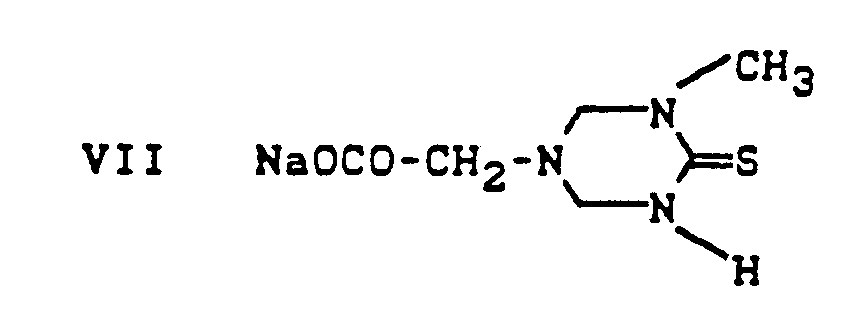


- Die erfindungsgemäß zu verwendenden Verbindungen werden aus einem Thioharnstoff der Formel


- Synthese der Verbindung VII:
- Man trägt in 65 ml Wasser ohne Kühlung ein:
- 45 g (0,6 Mol) Glykokoll
- 24 g (0,6 Mol) Natriumhydroxid
- 45 g (0,5 Mol) N-Methylthioharnstoff
- 120 g (1,2 Mol) einer 30 gew.-%igen wäßrigen Formaldehydlösung.
- Die Temperatur steigt auf 70°C und wird noch 30 Min. auf 70°C gehalten. Nach Abkühlen auf Raumtemperatur kristallisiert das Produkt aus.
- Man digieriert mit 1000 ml Aceton, saugt ab und trocknet an der Luft.
- Ausbeute 180 g. Schmelzpunkt 73-78°C unter Wasseraustritt, nach Wiedererstarren ab 100°C Zersetzung bei 228°C.
- Kernresonanzspektrum: in D20
- CH3: bei 5 = 3,2 ppM
- CH2: bei δ = 3,34, 4,24 und 4,36
- H20: 4,72
- Die Menge der erfindungsgemäßen Verbindung in den Bleich- und Bleichfixierbädern variiet je nach der Art der Verarbeitungslösung, der Art des zu verarbeitenden photographischen Materials, der Verarbeitungstemperatur, der zur Durchführung der gewünschten Verarbeitung benötigten Zeit, usw. Jedoch ist eine Menge von 1 x 10⁻⁵ bis 1 Mol pro Liter Bleich- bzw. Bleichfixierbad geeignet, wobei 1 x 10⁻³ bis 1 x 10⁻¹ Mol bevorzugt sind. Im allgemeinen wird mit einer geringen Menge ein geringer Bleichbeschleunigungseffekt erzeilt, hingegen besteht mit einer größeren als der benötigten Menge die Gefahr einer Ausfällung, die zu Störungen bei der Verarbeitung führen kann. Daher wird der jeweils beste Bereich durch einfache Vorversuche bestimmt. Die erfindungsgemäß zu verwendende Verbindung kann dem Bleich- oder Bleichfixierbad direkt zugesetzt oder durch ein vorgeschaltetes Conditionierbad eingebracht werden.
- Als Eisen(III)-ionenkomplexsalze eignen sich Komplexe von Eisen(III)-ionen und einem chelatbildenden Mittel wie einer Aminopolycarbonsäure, einer Aminopolyphosphonsäure oder einem Salz davon, insbesondere einem Alkalimetallsalz oder Ammoniumsalz.
- Typische Beispiele chelatbildender Mittel sind Ethylendiamintetraessigsäure; Dinatriumethylendiamintetraacetat; Diammoniumethylendiamintetraacetat; Tetra(trimethylammonium)-ethylendiamintetraacetat; Tetrakaliumethylendiamintetraacetat; Tetranatriumethylendiamintetraacetat; Trinatriumethylendiamintetraacetat; Diethylentriaminpentaessigsäure; Pentanatriumdiethylentriaminpentaacetat; Ethylendiamin-N-(ß-hydroxyethyl)-N,N',N'-triessigsäure; Trinatriumethylendiamin-N-(ß-hydroxyethyl)-N,N',N'-triacetat; Triammoniumethylendiamin-N-(ß-hydroxyethyl)-N,N',N'-triacetat; Propylendiamintetraessigsäure; Dinatriumpropylendiamintetraacetat; Nitrilotriessigsäure; Trinantriumnitrilotriacetat; Cyclohexandiamintetraessigsäure; Dinatriumcyclohexandiamintetraacetat; Nitrilotriessigsäure; Trinatriumnitrilotriacetat; Cyclohexandiamintetraessigsäure; Dinatriumcyclohexandiamintetraacetat; Iminodiessigsäure; Dihydroxyethylglycin; Ethylether-diamintetraessigsäure; Glykolether-diamintetraessigsäure; Ethylendiamintetrapropionsäure; Phenylendiamintetraessigsäure; 1,3-Diaminopropanoi-N,N,N',N'-tetramethylenphosphonsäure; Ethylendiamin-N,N,N',N'-tetramethylenphosonsäure; 1,3-Propylendiamin-N,N,N',N'-tetramethylenphosphonsäure, usw.
- Das Eisen(lll)-ionenkomplexsalz kann in der Form des Komplexsalzes verwendet oder in situ in dem Bleich- oder Bleichfixierbad hergestellt werden. Geeignete Kationen sind Alkalikationen und Ammonium; letzteres ist, bevorzugt.
- Die erfindungsgemäße Bleichlösung kann rehalogenierende Mittel wie Bromide (z.B. Kaliumbromid, Natriumbromid, Ammoniumbromid, usw.), Chloride (z.B. Kaliumchlorid, Natriumchchlorid, Ammoniumchlorid, usw.), und dergleichen zusätzlich zu den Bleichmitteln enthalten. Darüber hinaus können Zusätze, die eine pH-Pufferwirkung haben, wie anorganische Säuren, organische Säuren oder die Salze davon, die zur Verwendung in üblichen Bleichlösungen bekannt sind(z.B. Borsäure, Borax, Natriummetaborat, Essigsäure, Natriumacetat, Natriumcarbonat, Kaliumcarbonat, Phosphorige-Säure, Phosphorsäure, Natriumphosphat, Zitronensäure, Natriumzitrat, Weinsäure, usw.) zugesetzt werden.
- Der pH-Wert der Bleichlösung beträgt vorzugsweise 3,0 bis 8,0, insbesondere 4,0 bis 7,0.
- Bei Verwendung in einem Bleich-Fixier-Bad können übliche Fixiermittel, d.h. wasserlösliche, Silberhalogenid auflösende Mittel, wie Thiosulfat (z.B. Natriumthiosulfat, Ammoniumthiosulfat, Ammoniumnatriumthiosulfat, Kaliumthiosulfat, usw.); Thiocyanate (z.B. Natriumthiocyanat; Ammoniumthiocyanat; Kaliumthiocyanat, usw.); Thioetherverbindungen (z.B. Ethylenbisthioglykolsäure, 3,6-Dithia-1,8-octandiol, usw.); und Thioharnstoffe allein oder in einer Kombination von zwei oder mehreren verwendet werden. Zusätzlich können spezielle Bleich-Fixier-Mittel, die eine Kombination eines Fixiermittels und eine große Menge einer Halogenidverbindung wie Kaliumjodid enthalten, ebenfalls verwendet werden.
- In der Bleich-Fixier-Zusammensetzung ist das Eisen(lll)-ionenkomplexsalz üblicherweise in einer Menge von 0,1 bis 1 Mol/1 vorhanden. Die Menge des Fixiermittels beträgt im allgemeinen 0,2 bis 4 Mol pro liter der Bleich-Fixier-Lösung.
- Bleich-Fixier-Lösungen können darüber hinbaus konservierende Mittel wie Sulfite (z.B. Natriumsulfit, Kaliumsulfit, Ammoniumsulfit, usw.), Hydroxylamin, Hydrazin, Alkdehyd-Bisulfit-Addukte (z.B. Acetaldehydnatriumbisulfitaddukt), usw. enthalten. Darüber hinaus können verschiedene optische Aufheller, Entschäumungsmittel, oberflächenaktive Mittel, organische Lösungsmittel (z.B. Methanol) und bekannte Bleich-Fixier-Beschleunigungsmittel, z.B. Polyaminverbindungen. (US―PS 3 578 457), Thioharnstoffe (US-PS 3 617 283), lodide (DE-PS 1 127 715), Polyethylenoxide (DE-PS 966 410), Stickstoff enthaltende heterocyclische Verbindungen (DE-PS 1 290 812) und andere Thioharnstoffe verwendet werden. Der pH-Wert der Bleich-Fixier-Losung liegt bei der Verwendung gewöhnlich bei 4,0 bis 9,0, besonders bevorzugt bei 5,0 bis 8,0.
-

- Die verarbeiteten Stufenkeile werden mit einem Infrarot-Silberdetector PM 8030 der Fa. Photo-Matic, Denmark untersucht. In der nachfolgenden Tabelle ist angegeben, bei welchen Bleichzeiten in den Bildschwärzen noch Silber vorhanden ist.
- Beispiel 1 wird wiederholt, wobei dem Bleichbad 10 ml/I einer 1 molaren wäßrigen Lösung der Verbindung VI zugesetzt werden.
- Beispiel 1 wird wiederholt, wobei dem Bleichbad 10 ml/I einer 1 molaren wäßrigen Lösung der Verbindung III zugesetzt werden.


- Die erfindungsgemäßen Substanzen werden in Mengen von 0,5―10 g pro Liter üblichen fotografischen Bleichbädern auf Eisen-III-EDTA-Basis zugegeben. Die Bleichbäder werden bei pH-Werten zwischen 4 und 8 bei Temperaturen zwischen 25°C und 50°C mit Verarbeitungszeiten von 1 min bis 6 min benutzt.
- Verwendung finden lichtempfindiche Fotomaterialien mit den üblichen Merhrschichtaufbauten für Colorumkehr-Papier-Verfahren.
- Die fotografische Verarbeitung erfolgt in den Stufen:

- Eine Wässerung zwischen Bleich- und Fixierbad ist erforderlich, damit das Fixierbad nicht mit Bleichbad verunreinigt wird, was die Entsilberung erschweren würde.
- Die Verarbeitungsbäder sind wie folgt zusammengesetzt:
-


-

-

- Die Bleichwirkung wird anhand der Bildweißen (Minimale Dichte = Grudschleier) in den 3 Grundfarben densitometrisch ausgemessen.

- Zum Vergleich wird die für Colorumkehrpapier übliche Verarbeitung mit einem Bleichfixierbad herangezogen, das Bleichbad, 3. Wässerung und Fixierbad ersetzt und bei 38°C 120 s einwirkt.

- Die erfindungsgemäßen Substanzen können auch einen Bleichfixierbad zugesetzt werden.
Claims (4)

Applications Claiming Priority (2)
| Application Number | Priority Date | Filing Date | Title |
|---|---|---|---|
| DE3723195 | 1987-07-14 | ||
| DE19873723195 DE3723195A1 (de) | 1987-07-14 | 1987-07-14 | Bleichbaeder mit bleichbeschleunigenden substanzen |
Publications (2)
| Publication Number | Publication Date |
|---|---|
| EP0299296A1 EP0299296A1 (de) | 1989-01-18 |
| EP0299296B1 true EP0299296B1 (de) | 1991-01-23 |
Family
ID=6331517
Family Applications (1)
| Application Number | Title | Priority Date | Filing Date |
|---|---|---|---|
| EP88110530A Expired - Lifetime EP0299296B1 (de) | 1987-07-14 | 1988-07-01 | Bleichbäder mit bleichbeschleunigenden Substanzen |
Country Status (3)
| Country | Link |
|---|---|
| EP (1) | EP0299296B1 (de) |
| JP (1) | JPS6435550A (de) |
| DE (2) | DE3723195A1 (de) |
Families Citing this family (4)
| Publication number | Priority date | Publication date | Assignee | Title |
|---|---|---|---|---|
| JP3471156B2 (ja) * | 1995-05-30 | 2003-11-25 | シャープ株式会社 | イメージシフト機構および撮像装置 |
| JPH0974524A (ja) * | 1995-07-05 | 1997-03-18 | Sharp Corp | 画像入力装置 |
| EP0959174A1 (de) * | 1998-05-18 | 1999-11-24 | Ciba SC Holding AG | Verfahren zur Behandlung von natürlichen oder synthetischen Polyamidfasermaterialien |
| JP3973591B2 (ja) | 2003-04-03 | 2007-09-12 | オリンパス株式会社 | 電磁駆動型アクチュエータ |
Family Cites Families (3)
| Publication number | Priority date | Publication date | Assignee | Title |
|---|---|---|---|---|
| GB1150466A (en) * | 1966-05-06 | 1969-04-30 | Fuji Photo Film Co Ltd | Improvements in Colour Photography Processes |
| DD115566A1 (de) * | 1974-02-04 | 1975-10-12 | ||
| US4601975A (en) * | 1983-12-23 | 1986-07-22 | Konishiroku Photo Industry Co., Ltd. | Method for processing light-sensitive silver halide color photographic material |
-
1987
- 1987-07-14 DE DE19873723195 patent/DE3723195A1/de not_active Withdrawn
-
1988
- 1988-07-01 EP EP88110530A patent/EP0299296B1/de not_active Expired - Lifetime
- 1988-07-01 DE DE8888110530T patent/DE3861639D1/de not_active Expired - Fee Related
- 1988-07-08 JP JP63169188A patent/JPS6435550A/ja active Pending
Also Published As
| Publication number | Publication date |
|---|---|
| DE3861639D1 (de) | 1991-02-28 |
| JPS6435550A (en) | 1989-02-06 |
| DE3723195A1 (de) | 1989-01-26 |
| EP0299296A1 (de) | 1989-01-18 |
Similar Documents
| Publication | Publication Date | Title |
|---|---|---|
| DE2350209C2 (de) | Photographische Silberbleichlösung oder Silberbleich-Fixierlösung und Verwendung dieser Lösungen | |
| EP0321839B1 (de) | Bleichbäder mit bleichbeschleunigenden Substanzen | |
| DE3333227A1 (de) | Verfahren zur behandlung bzw. entwicklung von lichtempfindlichen photographischen silberhalogenidmaterialien | |
| DE3789029T2 (de) | Verfahren zur Behandlung eines lichtempfindlichen farbphotographischen Silberhalogenidmaterials. | |
| DE3687398T2 (de) | Verfahren zur behandlung farbphotographischer silberhalogenidmaterialien. | |
| DE69225168T2 (de) | Chelatbildner enthaltende photographische Verarbeitungszusammensetzung | |
| DE69325863T2 (de) | Photographische Verarbeitungszusammensetzung und photographisches Verarbeitungsverfahren | |
| DE3248359A1 (de) | Farbphotographisches behandlungsverfahren | |
| DE69123392T2 (de) | Verarbeitungszusammensetzungen für farbphotographische Silberhalogenidmaterialien und Verarbeitungsmethode für dieselben Materialien | |
| DE2942339A1 (de) | Verfahren zur behandlung eines farbphotographischen silberhalogenidmaterials | |
| DE3687620T2 (de) | Verfahren zur behandlung eines farbphotographischen silberhalogenidmaterials. | |
| DE2707989C2 (de) | Farbentwickler und dessen Verwendung zum Entwickeln eines belichteten farbphotographischen Silberhalogenidmaterials | |
| JP2648913B2 (ja) | ハロゲン化銀カラー写真感光材料の処理方法 | |
| DE69605752T2 (de) | Bleich- oder Bleichfixier-Lösung enthaltend einen Metallkomplex einer Polyamino-monobeonstein säure | |
| DE3412712A1 (de) | Farbentwickler und verfahren fuer die behandlung eines farbphotographischen silberhalogenidmaterials unter verwendung des farbentwicklers | |
| DE69504126T2 (de) | Verarbeitung eines photographischen Silberhalogenidelement mit einer Wasserstoffperoxid-Bleichzusammensetzung | |
| DE3444091A1 (de) | Photographische farbbildner-zusammensetzung | |
| DE60009638T2 (de) | Gegenüber Calciumionen stabile photographische Farbentwicklungszusammensetzung sowie Verfahren zu ihrer Verwendung | |
| DE69130091T2 (de) | Verfahren zur Verarbeitung farbphotographischer lichtempfindlicher Silberhalogenidmaterialien | |
| EP0299296A1 (de) | Bleichbäder mit bleichbeschleunigenden Substanzen | |
| DE69031026T2 (de) | Farbentwicklungslösung für farbphotographisches lichtempfindliches Silberhalogenidmaterial und Behandlungsverfahren | |
| DE69421509T2 (de) | Zusätze zum Gebrauch in Kombination mit Eisenkomplexzusammensetzungen um Eisenabsetzungen zu verhindern | |
| DE3500628A1 (de) | Verfahren zum behandeln eines lichtempfindlichen farbphotographischen materials | |
| EP0393429B1 (de) | Verfahren zur Verarbeitung eines farbfotografischen Materials | |
| DE69426851T2 (de) | Fotografische Entwicklungs-Lösung, die ternäre Ferri-Komplexsalze enthält |
Legal Events
| Date | Code | Title | Description |
|---|---|---|---|
| PUAI | Public reference made under article 153(3) epc to a published international application that has entered the european phase |
Free format text: ORIGINAL CODE: 0009012 |
|
| 17P | Request for examination filed |
Effective date: 19880707 |
|
| AK | Designated contracting states |
Kind code of ref document: A1 Designated state(s): BE DE FR GB IT |
|
| RAP1 | Party data changed (applicant data changed or rights of an application transferred) |
Owner name: AGFA-GEVAERT AG |
|
| 17Q | First examination report despatched |
Effective date: 19900504 |
|
| GRAA | (expected) grant |
Free format text: ORIGINAL CODE: 0009210 |
|
| AK | Designated contracting states |
Kind code of ref document: B1 Designated state(s): BE DE FR GB IT |
|
| REF | Corresponds to: |
Ref document number: 3861639 Country of ref document: DE Date of ref document: 19910228 |
|
| ET | Fr: translation filed | ||
| ITF | It: translation for a ep patent filed | ||
| GBT | Gb: translation of ep patent filed (gb section 77(6)(a)/1977) | ||
| PLBE | No opposition filed within time limit |
Free format text: ORIGINAL CODE: 0009261 |
|
| STAA | Information on the status of an ep patent application or granted ep patent |
Free format text: STATUS: NO OPPOSITION FILED WITHIN TIME LIMIT |
|
| 26N | No opposition filed | ||
| PGFP | Annual fee paid to national office [announced via postgrant information from national office to epo] |
Ref country code: DE Payment date: 19940615 Year of fee payment: 7 |
|
| PGFP | Annual fee paid to national office [announced via postgrant information from national office to epo] |
Ref country code: GB Payment date: 19940621 Year of fee payment: 7 |
|
| PGFP | Annual fee paid to national office [announced via postgrant information from national office to epo] |
Ref country code: BE Payment date: 19940713 Year of fee payment: 7 |
|
| PGFP | Annual fee paid to national office [announced via postgrant information from national office to epo] |
Ref country code: FR Payment date: 19940722 Year of fee payment: 7 |
|
| PG25 | Lapsed in a contracting state [announced via postgrant information from national office to epo] |
Ref country code: GB Effective date: 19950701 |
|
| PG25 | Lapsed in a contracting state [announced via postgrant information from national office to epo] |
Ref country code: BE Effective date: 19950731 |
|
| BERE | Be: lapsed |
Owner name: AGFA-GEVAERT A.G. Effective date: 19950731 |
|
| GBPC | Gb: european patent ceased through non-payment of renewal fee |
Effective date: 19950701 |
|
| PG25 | Lapsed in a contracting state [announced via postgrant information from national office to epo] |
Ref country code: DE Effective date: 19960402 |
|
| PG25 | Lapsed in a contracting state [announced via postgrant information from national office to epo] |
Ref country code: FR Effective date: 19960430 |
|
| REG | Reference to a national code |
Ref country code: FR Ref legal event code: ST |
|
| REG | Reference to a national code |
Ref country code: FR Ref legal event code: ST |
|
| REG | Reference to a national code |
Ref country code: FR Ref legal event code: ST |
|
| PG25 | Lapsed in a contracting state [announced via postgrant information from national office to epo] |
Ref country code: IT Free format text: LAPSE BECAUSE OF NON-PAYMENT OF DUE FEES;WARNING: LAPSES OF ITALIAN PATENTS WITH EFFECTIVE DATE BEFORE 2007 MAY HAVE OCCURRED AT ANY TIME BEFORE 2007. THE CORRECT EFFECTIVE DATE MAY BE DIFFERENT FROM THE ONE RECORDED. Effective date: 20050701 |