EP0297576B2 - Verfahren zur Herstellung eines Mehrschichtüberzuges und hierfür geeignetes wässriges Überzugsmittel - Google Patents
Verfahren zur Herstellung eines Mehrschichtüberzuges und hierfür geeignetes wässriges Überzugsmittel Download PDFInfo
- Publication number
- EP0297576B2 EP0297576B2 EP88110471A EP88110471A EP0297576B2 EP 0297576 B2 EP0297576 B2 EP 0297576B2 EP 88110471 A EP88110471 A EP 88110471A EP 88110471 A EP88110471 A EP 88110471A EP 0297576 B2 EP0297576 B2 EP 0297576B2
- Authority
- EP
- European Patent Office
- Prior art keywords
- groups
- weight
- monomers
- water
- aqueous dispersion
- Prior art date
- Legal status (The legal status is an assumption and is not a legal conclusion. Google has not performed a legal analysis and makes no representation as to the accuracy of the status listed.)
- Expired - Lifetime
Links
- 239000006185 dispersion Substances 0.000 title claims abstract description 44
- 239000011248 coating agent Substances 0.000 title claims abstract description 34
- 238000004519 manufacturing process Methods 0.000 title claims abstract description 24
- 238000000576 coating method Methods 0.000 title claims abstract description 21
- 238000000034 method Methods 0.000 title claims abstract description 19
- 230000008569 process Effects 0.000 title description 6
- 239000000178 monomer Substances 0.000 claims abstract description 84
- 229920005989 resin Polymers 0.000 claims abstract description 41
- 239000011347 resin Substances 0.000 claims abstract description 41
- 239000002253 acid Substances 0.000 claims abstract description 37
- 239000004814 polyurethane Substances 0.000 claims abstract description 35
- 125000002887 hydroxy group Chemical group [H]O* 0.000 claims abstract description 30
- 229920002635 polyurethane Polymers 0.000 claims abstract description 22
- 229920000728 polyester Polymers 0.000 claims abstract description 20
- 125000003178 carboxy group Chemical group [H]OC(*)=O 0.000 claims abstract description 16
- 229920000642 polymer Polymers 0.000 claims abstract description 14
- 229920000768 polyamine Polymers 0.000 claims abstract description 13
- 239000002245 particle Substances 0.000 claims abstract description 10
- XSQUKJJJFZCRTK-UHFFFAOYSA-N urea group Chemical group NC(=O)N XSQUKJJJFZCRTK-UHFFFAOYSA-N 0.000 claims abstract description 10
- OAKJQQAXSVQMHS-UHFFFAOYSA-N Hydrazine Chemical compound NN OAKJQQAXSVQMHS-UHFFFAOYSA-N 0.000 claims abstract description 9
- 239000003995 emulsifying agent Substances 0.000 claims abstract description 6
- 239000003999 initiator Substances 0.000 claims abstract description 6
- 125000002924 primary amino group Chemical group [H]N([H])* 0.000 claims abstract description 6
- JOYRKODLDBILNP-UHFFFAOYSA-N urethane group Chemical group NC(=O)OCC JOYRKODLDBILNP-UHFFFAOYSA-N 0.000 claims abstract description 6
- 239000012736 aqueous medium Substances 0.000 claims abstract description 4
- 125000000467 secondary amino group Chemical group [H]N([*:1])[*:2] 0.000 claims abstract description 4
- XLYOFNOQVPJJNP-UHFFFAOYSA-N water Substances O XLYOFNOQVPJJNP-UHFFFAOYSA-N 0.000 claims description 57
- 239000000203 mixture Substances 0.000 claims description 28
- 239000002904 solvent Substances 0.000 claims description 22
- 239000000049 pigment Substances 0.000 claims description 18
- 239000005056 polyisocyanate Substances 0.000 claims description 11
- 229920001228 polyisocyanate Polymers 0.000 claims description 11
- 239000003960 organic solvent Substances 0.000 claims description 10
- 239000000758 substrate Substances 0.000 claims description 10
- PPBRXRYQALVLMV-UHFFFAOYSA-N Styrene Chemical compound C=CC1=CC=CC=C1 PPBRXRYQALVLMV-UHFFFAOYSA-N 0.000 claims description 8
- 239000000945 filler Substances 0.000 claims description 6
- 239000002562 thickening agent Substances 0.000 claims description 6
- 239000004922 lacquer Substances 0.000 claims description 5
- NIXOWILDQLNWCW-UHFFFAOYSA-N acrylic acid group Chemical group C(C=C)(=O)O NIXOWILDQLNWCW-UHFFFAOYSA-N 0.000 claims description 4
- 125000003277 amino group Chemical group 0.000 claims description 4
- 229920006395 saturated elastomer Polymers 0.000 claims description 4
- 125000004169 (C1-C6) alkyl group Chemical group 0.000 claims description 3
- 239000000654 additive Substances 0.000 claims description 2
- 229920006037 cross link polymer Polymers 0.000 claims description 2
- 150000003440 styrenes Chemical class 0.000 claims description 2
- 239000002671 adjuvant Substances 0.000 claims 1
- 235000020354 squash Nutrition 0.000 claims 1
- 239000008199 coating composition Substances 0.000 abstract description 6
- 238000006243 chemical reaction Methods 0.000 description 33
- 229920003009 polyurethane dispersion Polymers 0.000 description 32
- CSCPPACGZOOCGX-UHFFFAOYSA-N Acetone Chemical compound CC(C)=O CSCPPACGZOOCGX-UHFFFAOYSA-N 0.000 description 28
- 239000007787 solid Substances 0.000 description 28
- SJRJJKPEHAURKC-UHFFFAOYSA-N N-Methylmorpholine Chemical compound CN1CCOCC1 SJRJJKPEHAURKC-UHFFFAOYSA-N 0.000 description 22
- -1 alkyl radicals Chemical class 0.000 description 22
- ZMANZCXQSJIPKH-UHFFFAOYSA-N Triethylamine Chemical compound CCN(CC)CC ZMANZCXQSJIPKH-UHFFFAOYSA-N 0.000 description 18
- 150000002009 diols Chemical class 0.000 description 18
- 239000010408 film Substances 0.000 description 17
- 239000003973 paint Substances 0.000 description 17
- 239000011230 binding agent Substances 0.000 description 15
- OZAIFHULBGXAKX-UHFFFAOYSA-N 2-(2-cyanopropan-2-yldiazenyl)-2-methylpropanenitrile Chemical compound N#CC(C)(C)N=NC(C)(C)C#N OZAIFHULBGXAKX-UHFFFAOYSA-N 0.000 description 12
- QQVIHTHCMHWDBS-UHFFFAOYSA-N isophthalic acid Chemical compound OC(=O)C1=CC=CC(C(O)=O)=C1 QQVIHTHCMHWDBS-UHFFFAOYSA-N 0.000 description 12
- 229920005862 polyol Polymers 0.000 description 12
- 150000003077 polyols Chemical class 0.000 description 12
- 230000000694 effects Effects 0.000 description 11
- IQPQWNKOIGAROB-UHFFFAOYSA-N isocyanate group Chemical group [N-]=C=O IQPQWNKOIGAROB-UHFFFAOYSA-N 0.000 description 11
- 238000006386 neutralization reaction Methods 0.000 description 11
- SECXISVLQFMRJM-UHFFFAOYSA-N N-Methylpyrrolidone Chemical compound CN1CCCC1=O SECXISVLQFMRJM-UHFFFAOYSA-N 0.000 description 10
- 125000004432 carbon atom Chemical group C* 0.000 description 10
- 150000001875 compounds Chemical class 0.000 description 10
- LYCAIKOWRPUZTN-UHFFFAOYSA-N Ethylene glycol Chemical compound OCCO LYCAIKOWRPUZTN-UHFFFAOYSA-N 0.000 description 9
- 125000001931 aliphatic group Chemical group 0.000 description 9
- 239000000839 emulsion Substances 0.000 description 9
- 239000000243 solution Substances 0.000 description 9
- PTBDIHRZYDMNKB-UHFFFAOYSA-N 2,2-Bis(hydroxymethyl)propionic acid Chemical compound OCC(C)(CO)C(O)=O PTBDIHRZYDMNKB-UHFFFAOYSA-N 0.000 description 8
- 239000005058 Isophorone diisocyanate Substances 0.000 description 8
- WNLRTRBMVRJNCN-UHFFFAOYSA-N adipic acid Chemical compound OC(=O)CCCCC(O)=O WNLRTRBMVRJNCN-UHFFFAOYSA-N 0.000 description 8
- 125000005442 diisocyanate group Chemical group 0.000 description 8
- NIMLQBUJDJZYEJ-UHFFFAOYSA-N isophorone diisocyanate Chemical compound CC1(C)CC(N=C=O)CC(C)(CN=C=O)C1 NIMLQBUJDJZYEJ-UHFFFAOYSA-N 0.000 description 8
- 239000010410 layer Substances 0.000 description 8
- 238000002360 preparation method Methods 0.000 description 8
- VZCYOOQTPOCHFL-OWOJBTEDSA-N Fumaric acid Chemical compound OC(=O)\C=C\C(O)=O VZCYOOQTPOCHFL-OWOJBTEDSA-N 0.000 description 7
- VVQNEPGJFQJSBK-UHFFFAOYSA-N Methyl methacrylate Chemical compound COC(=O)C(C)=C VVQNEPGJFQJSBK-UHFFFAOYSA-N 0.000 description 7
- 239000002585 base Substances 0.000 description 7
- 150000004985 diamines Chemical class 0.000 description 7
- 238000000227 grinding Methods 0.000 description 7
- 238000010438 heat treatment Methods 0.000 description 7
- 238000006116 polymerization reaction Methods 0.000 description 7
- 239000000047 product Substances 0.000 description 7
- 238000003756 stirring Methods 0.000 description 7
- ZWEHNKRNPOVVGH-UHFFFAOYSA-N 2-Butanone Chemical compound CCC(C)=O ZWEHNKRNPOVVGH-UHFFFAOYSA-N 0.000 description 6
- PIICEJLVQHRZGT-UHFFFAOYSA-N Ethylenediamine Chemical compound NCCN PIICEJLVQHRZGT-UHFFFAOYSA-N 0.000 description 6
- ZMXDDKWLCZADIW-UHFFFAOYSA-N N,N-Dimethylformamide Chemical compound CN(C)C=O ZMXDDKWLCZADIW-UHFFFAOYSA-N 0.000 description 6
- 150000007513 acids Chemical class 0.000 description 6
- 125000000217 alkyl group Chemical group 0.000 description 6
- 150000001412 amines Chemical class 0.000 description 6
- 125000003118 aryl group Chemical group 0.000 description 6
- 230000015572 biosynthetic process Effects 0.000 description 6
- 239000007795 chemical reaction product Substances 0.000 description 6
- 238000001035 drying Methods 0.000 description 6
- 239000012948 isocyanate Substances 0.000 description 6
- BDJRBEYXGGNYIS-UHFFFAOYSA-N nonanedioic acid Chemical compound OC(=O)CCCCCCCC(O)=O BDJRBEYXGGNYIS-UHFFFAOYSA-N 0.000 description 6
- VZCYOOQTPOCHFL-UHFFFAOYSA-N trans-butenedioic acid Natural products OC(=O)C=CC(O)=O VZCYOOQTPOCHFL-UHFFFAOYSA-N 0.000 description 6
- POAOYUHQDCAZBD-UHFFFAOYSA-N 2-butoxyethanol Chemical compound CCCCOCCO POAOYUHQDCAZBD-UHFFFAOYSA-N 0.000 description 5
- CFVWNXQPGQOHRJ-UHFFFAOYSA-N 2-methylpropyl prop-2-enoate Chemical compound CC(C)COC(=O)C=C CFVWNXQPGQOHRJ-UHFFFAOYSA-N 0.000 description 5
- NIXOWILDQLNWCW-UHFFFAOYSA-M Acrylate Chemical compound [O-]C(=O)C=C NIXOWILDQLNWCW-UHFFFAOYSA-M 0.000 description 5
- 239000004970 Chain extender Substances 0.000 description 5
- CERQOIWHTDAKMF-UHFFFAOYSA-N Methacrylic acid Chemical compound CC(=C)C(O)=O CERQOIWHTDAKMF-UHFFFAOYSA-N 0.000 description 5
- 229910052782 aluminium Inorganic materials 0.000 description 5
- XAGFODPZIPBFFR-UHFFFAOYSA-N aluminium Chemical compound [Al] XAGFODPZIPBFFR-UHFFFAOYSA-N 0.000 description 5
- WERYXYBDKMZEQL-UHFFFAOYSA-N butane-1,4-diol Chemical compound OCCCCO WERYXYBDKMZEQL-UHFFFAOYSA-N 0.000 description 5
- CQEYYJKEWSMYFG-UHFFFAOYSA-N butyl acrylate Chemical compound CCCCOC(=O)C=C CQEYYJKEWSMYFG-UHFFFAOYSA-N 0.000 description 5
- 150000001991 dicarboxylic acids Chemical class 0.000 description 5
- 238000007865 diluting Methods 0.000 description 5
- 239000001530 fumaric acid Substances 0.000 description 5
- 230000009477 glass transition Effects 0.000 description 5
- 229910052739 hydrogen Inorganic materials 0.000 description 5
- 239000001257 hydrogen Substances 0.000 description 5
- 125000004435 hydrogen atom Chemical group [H]* 0.000 description 5
- 150000002513 isocyanates Chemical class 0.000 description 5
- MYRTYDVEIRVNKP-UHFFFAOYSA-N 1,2-Divinylbenzene Chemical compound C=CC1=CC=CC=C1C=C MYRTYDVEIRVNKP-UHFFFAOYSA-N 0.000 description 4
- OMIGHNLMNHATMP-UHFFFAOYSA-N 2-hydroxyethyl prop-2-enoate Chemical compound OCCOC(=O)C=C OMIGHNLMNHATMP-UHFFFAOYSA-N 0.000 description 4
- 229920000877 Melamine resin Polymers 0.000 description 4
- 239000001361 adipic acid Substances 0.000 description 4
- 235000011037 adipic acid Nutrition 0.000 description 4
- 150000008064 anhydrides Chemical class 0.000 description 4
- 125000000129 anionic group Chemical group 0.000 description 4
- 239000003795 chemical substances by application Substances 0.000 description 4
- 150000002576 ketones Chemical class 0.000 description 4
- 229910052751 metal Inorganic materials 0.000 description 4
- 239000002184 metal Substances 0.000 description 4
- 230000003472 neutralizing effect Effects 0.000 description 4
- 229920000058 polyacrylate Polymers 0.000 description 4
- 229920005749 polyurethane resin Polymers 0.000 description 4
- 150000003254 radicals Chemical class 0.000 description 4
- 238000010992 reflux Methods 0.000 description 4
- 125000001424 substituent group Chemical group 0.000 description 4
- 150000005846 sugar alcohols Polymers 0.000 description 4
- 239000002966 varnish Substances 0.000 description 4
- JHWGFJBTMHEZME-UHFFFAOYSA-N 4-prop-2-enoyloxybutyl prop-2-enoate Chemical compound C=CC(=O)OCCCCOC(=O)C=C JHWGFJBTMHEZME-UHFFFAOYSA-N 0.000 description 3
- 239000005057 Hexamethylene diisocyanate Substances 0.000 description 3
- DNIAPMSPPWPWGF-UHFFFAOYSA-N Propylene glycol Chemical compound CC(O)CO DNIAPMSPPWPWGF-UHFFFAOYSA-N 0.000 description 3
- ZJCCRDAZUWHFQH-UHFFFAOYSA-N Trimethylolpropane Chemical compound CCC(CO)(CO)CO ZJCCRDAZUWHFQH-UHFFFAOYSA-N 0.000 description 3
- IISBACLAFKSPIT-UHFFFAOYSA-N bisphenol A Chemical compound C=1C=C(O)C=CC=1C(C)(C)C1=CC=C(O)C=C1 IISBACLAFKSPIT-UHFFFAOYSA-N 0.000 description 3
- 239000004202 carbamide Substances 0.000 description 3
- 229910052799 carbon Inorganic materials 0.000 description 3
- 239000003054 catalyst Substances 0.000 description 3
- 239000008367 deionised water Substances 0.000 description 3
- 229910021641 deionized water Inorganic materials 0.000 description 3
- 238000007590 electrostatic spraying Methods 0.000 description 3
- 150000002148 esters Chemical class 0.000 description 3
- RRAMGCGOFNQTLD-UHFFFAOYSA-N hexamethylene diisocyanate Chemical compound O=C=NCCCCCCN=C=O RRAMGCGOFNQTLD-UHFFFAOYSA-N 0.000 description 3
- 230000000977 initiatory effect Effects 0.000 description 3
- 150000002596 lactones Chemical class 0.000 description 3
- 239000002952 polymeric resin Substances 0.000 description 3
- 229920005903 polyol mixture Polymers 0.000 description 3
- 230000008439 repair process Effects 0.000 description 3
- 239000007921 spray Substances 0.000 description 3
- 229920003002 synthetic resin Polymers 0.000 description 3
- 150000003512 tertiary amines Chemical class 0.000 description 3
- 125000000391 vinyl group Chemical group [H]C([*])=C([H])[H] 0.000 description 3
- PAPBSGBWRJIAAV-UHFFFAOYSA-N ε-Caprolactone Chemical compound O=C1CCCCCO1 PAPBSGBWRJIAAV-UHFFFAOYSA-N 0.000 description 3
- VOBUAPTXJKMNCT-UHFFFAOYSA-N 1-prop-2-enoyloxyhexyl prop-2-enoate Chemical compound CCCCCC(OC(=O)C=C)OC(=O)C=C VOBUAPTXJKMNCT-UHFFFAOYSA-N 0.000 description 2
- QZPSOSOOLFHYRR-UHFFFAOYSA-N 3-hydroxypropyl prop-2-enoate Chemical compound OCCCOC(=O)C=C QZPSOSOOLFHYRR-UHFFFAOYSA-N 0.000 description 2
- HRPVXLWXLXDGHG-UHFFFAOYSA-N Acrylamide Chemical compound NC(=O)C=C HRPVXLWXLXDGHG-UHFFFAOYSA-N 0.000 description 2
- QGZKDVFQNNGYKY-UHFFFAOYSA-N Ammonia Chemical compound N QGZKDVFQNNGYKY-UHFFFAOYSA-N 0.000 description 2
- 229910000906 Bronze Inorganic materials 0.000 description 2
- SOGAXMICEFXMKE-UHFFFAOYSA-N Butylmethacrylate Chemical compound CCCCOC(=O)C(C)=C SOGAXMICEFXMKE-UHFFFAOYSA-N 0.000 description 2
- GAWIXWVDTYZWAW-UHFFFAOYSA-N C[CH]O Chemical group C[CH]O GAWIXWVDTYZWAW-UHFFFAOYSA-N 0.000 description 2
- PEDCQBHIVMGVHV-UHFFFAOYSA-N Glycerine Chemical compound OCC(O)CO PEDCQBHIVMGVHV-UHFFFAOYSA-N 0.000 description 2
- UFHFLCQGNIYNRP-UHFFFAOYSA-N Hydrogen Chemical compound [H][H] UFHFLCQGNIYNRP-UHFFFAOYSA-N 0.000 description 2
- XEEYBQQBJWHFJM-UHFFFAOYSA-N Iron Chemical compound [Fe] XEEYBQQBJWHFJM-UHFFFAOYSA-N 0.000 description 2
- 239000004640 Melamine resin Substances 0.000 description 2
- YNAVUWVOSKDBBP-UHFFFAOYSA-N Morpholine Chemical compound C1COCCN1 YNAVUWVOSKDBBP-UHFFFAOYSA-N 0.000 description 2
- GLUUGHFHXGJENI-UHFFFAOYSA-N Piperazine Chemical compound C1CNCCN1 GLUUGHFHXGJENI-UHFFFAOYSA-N 0.000 description 2
- 239000004721 Polyphenylene oxide Substances 0.000 description 2
- OFOBLEOULBTSOW-UHFFFAOYSA-N Propanedioic acid Natural products OC(=O)CC(O)=O OFOBLEOULBTSOW-UHFFFAOYSA-N 0.000 description 2
- KKEYFWRCBNTPAC-UHFFFAOYSA-N Terephthalic acid Chemical compound OC(=O)C1=CC=C(C(O)=O)C=C1 KKEYFWRCBNTPAC-UHFFFAOYSA-N 0.000 description 2
- QYKIQEUNHZKYBP-UHFFFAOYSA-N Vinyl ether Chemical class C=COC=C QYKIQEUNHZKYBP-UHFFFAOYSA-N 0.000 description 2
- ORLQHILJRHBSAY-UHFFFAOYSA-N [1-(hydroxymethyl)cyclohexyl]methanol Chemical compound OCC1(CO)CCCCC1 ORLQHILJRHBSAY-UHFFFAOYSA-N 0.000 description 2
- KXBFLNPZHXDQLV-UHFFFAOYSA-N [cyclohexyl(diisocyanato)methyl]cyclohexane Chemical compound C1CCCCC1C(N=C=O)(N=C=O)C1CCCCC1 KXBFLNPZHXDQLV-UHFFFAOYSA-N 0.000 description 2
- 239000003125 aqueous solvent Substances 0.000 description 2
- PXKLMJQFEQBVLD-UHFFFAOYSA-N bisphenol F Chemical compound C1=CC(O)=CC=C1CC1=CC=C(O)C=C1 PXKLMJQFEQBVLD-UHFFFAOYSA-N 0.000 description 2
- 239000010974 bronze Substances 0.000 description 2
- 230000015271 coagulation Effects 0.000 description 2
- 238000005345 coagulation Methods 0.000 description 2
- 239000003086 colorant Substances 0.000 description 2
- 230000005494 condensation Effects 0.000 description 2
- 229920001577 copolymer Polymers 0.000 description 2
- 238000007334 copolymerization reaction Methods 0.000 description 2
- KUNSUQLRTQLHQQ-UHFFFAOYSA-N copper tin Chemical compound [Cu].[Sn] KUNSUQLRTQLHQQ-UHFFFAOYSA-N 0.000 description 2
- PFURGBBHAOXLIO-UHFFFAOYSA-N cyclohexane-1,2-diol Chemical compound OC1CCCCC1O PFURGBBHAOXLIO-UHFFFAOYSA-N 0.000 description 2
- 238000010790 dilution Methods 0.000 description 2
- 239000012895 dilution Substances 0.000 description 2
- 238000005485 electric heating Methods 0.000 description 2
- JBKVHLHDHHXQEQ-UHFFFAOYSA-N epsilon-caprolactam Chemical compound O=C1CCCCCN1 JBKVHLHDHHXQEQ-UHFFFAOYSA-N 0.000 description 2
- 230000032050 esterification Effects 0.000 description 2
- 238000005886 esterification reaction Methods 0.000 description 2
- 150000002170 ethers Chemical class 0.000 description 2
- 229940052303 ethers for general anesthesia Drugs 0.000 description 2
- XXMIOPMDWAUFGU-UHFFFAOYSA-N hexane-1,6-diol Chemical compound OCCCCCCO XXMIOPMDWAUFGU-UHFFFAOYSA-N 0.000 description 2
- 125000002768 hydroxyalkyl group Chemical group 0.000 description 2
- ZFSLODLOARCGLH-UHFFFAOYSA-N isocyanuric acid Chemical compound OC1=NC(O)=NC(O)=N1 ZFSLODLOARCGLH-UHFFFAOYSA-N 0.000 description 2
- 239000004816 latex Substances 0.000 description 2
- 229920000126 latex Polymers 0.000 description 2
- VZCYOOQTPOCHFL-UPHRSURJSA-N maleic acid Chemical compound OC(=O)\C=C/C(O)=O VZCYOOQTPOCHFL-UPHRSURJSA-N 0.000 description 2
- 239000011976 maleic acid Substances 0.000 description 2
- 238000002156 mixing Methods 0.000 description 2
- SLCVBVWXLSEKPL-UHFFFAOYSA-N neopentyl glycol Chemical compound OCC(C)(C)CO SLCVBVWXLSEKPL-UHFFFAOYSA-N 0.000 description 2
- 229940117969 neopentyl glycol Drugs 0.000 description 2
- 230000003287 optical effect Effects 0.000 description 2
- XNGIFLGASWRNHJ-UHFFFAOYSA-N phthalic acid Chemical compound OC(=O)C1=CC=CC=C1C(O)=O XNGIFLGASWRNHJ-UHFFFAOYSA-N 0.000 description 2
- 229920005906 polyester polyol Polymers 0.000 description 2
- 229920000570 polyether Polymers 0.000 description 2
- 229920001451 polypropylene glycol Polymers 0.000 description 2
- AOHJOMMDDJHIJH-UHFFFAOYSA-N propylenediamine Chemical compound CC(N)CN AOHJOMMDDJHIJH-UHFFFAOYSA-N 0.000 description 2
- 150000003839 salts Chemical class 0.000 description 2
- CXMXRPHRNRROMY-UHFFFAOYSA-N sebacic acid Chemical compound OC(=O)CCCCCCCCC(O)=O CXMXRPHRNRROMY-UHFFFAOYSA-N 0.000 description 2
- 239000003381 stabilizer Substances 0.000 description 2
- 239000004575 stone Substances 0.000 description 2
- 239000000126 substance Substances 0.000 description 2
- 230000008961 swelling Effects 0.000 description 2
- WYKYCHHWIJXDAO-UHFFFAOYSA-N tert-butyl 2-ethylhexaneperoxoate Chemical compound CCCCC(CC)C(=O)OOC(C)(C)C WYKYCHHWIJXDAO-UHFFFAOYSA-N 0.000 description 2
- GETQZCLCWQTVFV-UHFFFAOYSA-N trimethylamine Chemical compound CN(C)C GETQZCLCWQTVFV-UHFFFAOYSA-N 0.000 description 2
- QXJQHYBHAIHNGG-UHFFFAOYSA-N trimethylolethane Chemical compound OCC(C)(CO)CO QXJQHYBHAIHNGG-UHFFFAOYSA-N 0.000 description 2
- 229920001567 vinyl ester resin Polymers 0.000 description 2
- 229920002554 vinyl polymer Polymers 0.000 description 2
- 238000004383 yellowing Methods 0.000 description 2
- 150000007934 α,β-unsaturated carboxylic acids Chemical class 0.000 description 2
- DNIAPMSPPWPWGF-VKHMYHEASA-N (+)-propylene glycol Chemical compound C[C@H](O)CO DNIAPMSPPWPWGF-VKHMYHEASA-N 0.000 description 1
- PUPZLCDOIYMWBV-UHFFFAOYSA-N (+/-)-1,3-Butanediol Chemical compound CC(O)CCO PUPZLCDOIYMWBV-UHFFFAOYSA-N 0.000 description 1
- SZCWBURCISJFEZ-UHFFFAOYSA-N (3-hydroxy-2,2-dimethylpropyl) 3-hydroxy-2,2-dimethylpropanoate Chemical compound OCC(C)(C)COC(=O)C(C)(C)CO SZCWBURCISJFEZ-UHFFFAOYSA-N 0.000 description 1
- RBNPOMFGQQGHHO-UHFFFAOYSA-N -2,3-Dihydroxypropanoic acid Natural products OCC(O)C(O)=O RBNPOMFGQQGHHO-UHFFFAOYSA-N 0.000 description 1
- JXLLEVVDVFPMDH-UHFFFAOYSA-N 1,2-bis(ethenyl)-4-methylbenzene Chemical compound CC1=CC=C(C=C)C(C=C)=C1 JXLLEVVDVFPMDH-UHFFFAOYSA-N 0.000 description 1
- FKTHNVSLHLHISI-UHFFFAOYSA-N 1,2-bis(isocyanatomethyl)benzene Chemical compound O=C=NCC1=CC=CC=C1CN=C=O FKTHNVSLHLHISI-UHFFFAOYSA-N 0.000 description 1
- MTZUIIAIAKMWLI-UHFFFAOYSA-N 1,2-diisocyanatobenzene Chemical compound O=C=NC1=CC=CC=C1N=C=O MTZUIIAIAKMWLI-UHFFFAOYSA-N 0.000 description 1
- WVWYODXLKONLEM-UHFFFAOYSA-N 1,2-diisocyanatobutane Chemical compound O=C=NC(CC)CN=C=O WVWYODXLKONLEM-UHFFFAOYSA-N 0.000 description 1
- ZGDSDWSIFQBAJS-UHFFFAOYSA-N 1,2-diisocyanatopropane Chemical compound O=C=NC(C)CN=C=O ZGDSDWSIFQBAJS-UHFFFAOYSA-N 0.000 description 1
- NGIOPMGSHUSVNG-UHFFFAOYSA-N 1,3-bis(ethenyl)-2-nonylbenzene Chemical compound CCCCCCCCCC1=C(C=C)C=CC=C1C=C NGIOPMGSHUSVNG-UHFFFAOYSA-N 0.000 description 1
- UFXYYTWJETZVHG-UHFFFAOYSA-N 1,3-diisocyanatobutane Chemical compound O=C=NC(C)CCN=C=O UFXYYTWJETZVHG-UHFFFAOYSA-N 0.000 description 1
- IKYNWXNXXHWHLL-UHFFFAOYSA-N 1,3-diisocyanatopropane Chemical compound O=C=NCCCN=C=O IKYNWXNXXHWHLL-UHFFFAOYSA-N 0.000 description 1
- YPFDHNVEDLHUCE-UHFFFAOYSA-N 1,3-propanediol Substances OCCCO YPFDHNVEDLHUCE-UHFFFAOYSA-N 0.000 description 1
- MWZJGRDWJVHRDV-UHFFFAOYSA-N 1,4-bis(ethenoxy)butane Chemical compound C=COCCCCOC=C MWZJGRDWJVHRDV-UHFFFAOYSA-N 0.000 description 1
- OVBFMUAFNIIQAL-UHFFFAOYSA-N 1,4-diisocyanatobutane Chemical compound O=C=NCCCCN=C=O OVBFMUAFNIIQAL-UHFFFAOYSA-N 0.000 description 1
- DFPJRUKWEPYFJT-UHFFFAOYSA-N 1,5-diisocyanatopentane Chemical compound O=C=NCCCCCN=C=O DFPJRUKWEPYFJT-UHFFFAOYSA-N 0.000 description 1
- XQUPVDVFXZDTLT-UHFFFAOYSA-N 1-[4-[[4-(2,5-dioxopyrrol-1-yl)phenyl]methyl]phenyl]pyrrole-2,5-dione Chemical compound O=C1C=CC(=O)N1C(C=C1)=CC=C1CC1=CC=C(N2C(C=CC2=O)=O)C=C1 XQUPVDVFXZDTLT-UHFFFAOYSA-N 0.000 description 1
- KTZVZZJJVJQZHV-UHFFFAOYSA-N 1-chloro-4-ethenylbenzene Chemical compound ClC1=CC=C(C=C)C=C1 KTZVZZJJVJQZHV-UHFFFAOYSA-N 0.000 description 1
- QWDQYHPOSSHSAW-UHFFFAOYSA-N 1-isocyanatooctadecane Chemical compound CCCCCCCCCCCCCCCCCCN=C=O QWDQYHPOSSHSAW-UHFFFAOYSA-N 0.000 description 1
- HPVRZSQOEHEUKJ-UHFFFAOYSA-N 1-methoxyhexan-2-one Chemical compound CCCCC(=O)COC HPVRZSQOEHEUKJ-UHFFFAOYSA-N 0.000 description 1
- RTBFRGCFXZNCOE-UHFFFAOYSA-N 1-methylsulfonylpiperidin-4-one Chemical compound CS(=O)(=O)N1CCC(=O)CC1 RTBFRGCFXZNCOE-UHFFFAOYSA-N 0.000 description 1
- YWOYCXNNAGNDKT-UHFFFAOYSA-N 1-prop-2-enoyloxyethyl prop-2-enoate Chemical compound C=CC(=O)OC(C)OC(=O)C=C YWOYCXNNAGNDKT-UHFFFAOYSA-N 0.000 description 1
- QEDJMOONZLUIMC-UHFFFAOYSA-N 1-tert-butyl-4-ethenylbenzene Chemical compound CC(C)(C)C1=CC=C(C=C)C=C1 QEDJMOONZLUIMC-UHFFFAOYSA-N 0.000 description 1
- JVYDLYGCSIHCMR-UHFFFAOYSA-N 2,2-bis(hydroxymethyl)butanoic acid Chemical compound CCC(CO)(CO)C(O)=O JVYDLYGCSIHCMR-UHFFFAOYSA-N 0.000 description 1
- UHAMPPWFPNXLIU-UHFFFAOYSA-N 2,2-bis(hydroxymethyl)pentanoic acid Chemical compound CCCC(CO)(CO)C(O)=O UHAMPPWFPNXLIU-UHFFFAOYSA-N 0.000 description 1
- HPQUMJNDQVOTAZ-UHFFFAOYSA-N 2,2-dihydroxypropanoic acid Chemical compound CC(O)(O)C(O)=O HPQUMJNDQVOTAZ-UHFFFAOYSA-N 0.000 description 1
- QRIMLDXJAPZHJE-UHFFFAOYSA-N 2,3-dihydroxypropyl 2-methylprop-2-enoate Chemical compound CC(=C)C(=O)OCC(O)CO QRIMLDXJAPZHJE-UHFFFAOYSA-N 0.000 description 1
- LHNAURKRXGPVDW-UHFFFAOYSA-N 2,3-diisocyanatobutane Chemical compound O=C=NC(C)C(C)N=C=O LHNAURKRXGPVDW-UHFFFAOYSA-N 0.000 description 1
- WXTMDXOMEHJXQO-UHFFFAOYSA-N 2,5-dihydroxybenzoic acid Chemical compound OC(=O)C1=CC(O)=CC=C1O WXTMDXOMEHJXQO-UHFFFAOYSA-N 0.000 description 1
- GOXQRTZXKQZDDN-UHFFFAOYSA-N 2-Ethylhexyl acrylate Chemical compound CCCCC(CC)COC(=O)C=C GOXQRTZXKQZDDN-UHFFFAOYSA-N 0.000 description 1
- HWSSEYVMGDIFMH-UHFFFAOYSA-N 2-[2-[2-(2-methylprop-2-enoyloxy)ethoxy]ethoxy]ethyl 2-methylprop-2-enoate Chemical compound CC(=C)C(=O)OCCOCCOCCOC(=O)C(C)=C HWSSEYVMGDIFMH-UHFFFAOYSA-N 0.000 description 1
- OAGGYKVXVKGZOZ-UHFFFAOYSA-N 2-amino-1-(dimethylamino)ethanol Chemical compound CN(C)C(O)CN OAGGYKVXVKGZOZ-UHFFFAOYSA-N 0.000 description 1
- LOJSNUXAIXEBPJ-UHFFFAOYSA-N 2-chloro-2-(1,1,2,2,3-pentachlorohexyl)propanedioic acid Chemical compound CCCC(Cl)C(Cl)(Cl)C(Cl)(Cl)C(Cl)(C(O)=O)C(O)=O LOJSNUXAIXEBPJ-UHFFFAOYSA-N 0.000 description 1
- ISRGONDNXBCDBM-UHFFFAOYSA-N 2-chlorostyrene Chemical compound ClC1=CC=CC=C1C=C ISRGONDNXBCDBM-UHFFFAOYSA-N 0.000 description 1
- SFPNZPQIIAJXGL-UHFFFAOYSA-N 2-ethoxyethyl 2-methylprop-2-enoate Chemical compound CCOCCOC(=O)C(C)=C SFPNZPQIIAJXGL-UHFFFAOYSA-N 0.000 description 1
- LZDXRPVSAKWYDH-UHFFFAOYSA-N 2-ethyl-2-(prop-2-enoxymethyl)propane-1,3-diol Chemical compound CCC(CO)(CO)COCC=C LZDXRPVSAKWYDH-UHFFFAOYSA-N 0.000 description 1
- VHSHLMUCYSAUQU-UHFFFAOYSA-N 2-hydroxypropyl methacrylate Chemical compound CC(O)COC(=O)C(C)=C VHSHLMUCYSAUQU-UHFFFAOYSA-N 0.000 description 1
- GWZMWHWAWHPNHN-UHFFFAOYSA-N 2-hydroxypropyl prop-2-enoate Chemical compound CC(O)COC(=O)C=C GWZMWHWAWHPNHN-UHFFFAOYSA-N 0.000 description 1
- UPTHZKIDNHJFKQ-UHFFFAOYSA-N 2-methylprop-2-enoic acid;propane-1,2,3-triol Chemical compound CC(=C)C(O)=O.CC(=C)C(O)=O.OCC(O)CO UPTHZKIDNHJFKQ-UHFFFAOYSA-N 0.000 description 1
- WZHHYIOUKQNLQM-UHFFFAOYSA-N 3,4,5,6-tetrachlorophthalic acid Chemical compound OC(=O)C1=C(Cl)C(Cl)=C(Cl)C(Cl)=C1C(O)=O WZHHYIOUKQNLQM-UHFFFAOYSA-N 0.000 description 1
- PYSRRFNXTXNWCD-UHFFFAOYSA-N 3-(2-phenylethenyl)furan-2,5-dione Chemical compound O=C1OC(=O)C(C=CC=2C=CC=CC=2)=C1 PYSRRFNXTXNWCD-UHFFFAOYSA-N 0.000 description 1
- RNLHGQLZWXBQNY-UHFFFAOYSA-N 3-(aminomethyl)-3,5,5-trimethylcyclohexan-1-amine Chemical compound CC1(C)CC(N)CC(C)(CN)C1 RNLHGQLZWXBQNY-UHFFFAOYSA-N 0.000 description 1
- VTLKLYJOUVMHIY-UHFFFAOYSA-N 3-ethenylpenta-1,3-diene;urea Chemical compound NC(N)=O.CC=C(C=C)C=C VTLKLYJOUVMHIY-UHFFFAOYSA-N 0.000 description 1
- ULMZOZMSDIOZAF-UHFFFAOYSA-N 3-hydroxy-2-(hydroxymethyl)propanoic acid Chemical compound OCC(CO)C(O)=O ULMZOZMSDIOZAF-UHFFFAOYSA-N 0.000 description 1
- GNSFRPWPOGYVLO-UHFFFAOYSA-N 3-hydroxypropyl 2-methylprop-2-enoate Chemical compound CC(=C)C(=O)OCCCO GNSFRPWPOGYVLO-UHFFFAOYSA-N 0.000 description 1
- ATVJXMYDOSMEPO-UHFFFAOYSA-N 3-prop-2-enoxyprop-1-ene Chemical compound C=CCOCC=C ATVJXMYDOSMEPO-UHFFFAOYSA-N 0.000 description 1
- UPMLOUAZCHDJJD-UHFFFAOYSA-N 4,4'-Diphenylmethane Diisocyanate Chemical compound C1=CC(N=C=O)=CC=C1CC1=CC=C(N=C=O)C=C1 UPMLOUAZCHDJJD-UHFFFAOYSA-N 0.000 description 1
- DZIHTWJGPDVSGE-UHFFFAOYSA-N 4-[(4-aminocyclohexyl)methyl]cyclohexan-1-amine Chemical compound C1CC(N)CCC1CC1CCC(N)CC1 DZIHTWJGPDVSGE-UHFFFAOYSA-N 0.000 description 1
- DBCAQXHNJOFNGC-UHFFFAOYSA-N 4-bromo-1,1,1-trifluorobutane Chemical compound FC(F)(F)CCCBr DBCAQXHNJOFNGC-UHFFFAOYSA-N 0.000 description 1
- FIHBHSQYSYVZQE-UHFFFAOYSA-N 6-prop-2-enoyloxyhexyl prop-2-enoate Chemical compound C=CC(=O)OCCCCCCOC(=O)C=C FIHBHSQYSYVZQE-UHFFFAOYSA-N 0.000 description 1
- OAOABCKPVCUNKO-UHFFFAOYSA-N 8-methyl Nonanoic acid Chemical compound CC(C)CCCCCCC(O)=O OAOABCKPVCUNKO-UHFFFAOYSA-N 0.000 description 1
- 239000004925 Acrylic resin Substances 0.000 description 1
- 229920000178 Acrylic resin Polymers 0.000 description 1
- NLHHRLWOUZZQLW-UHFFFAOYSA-N Acrylonitrile Chemical compound C=CC#N NLHHRLWOUZZQLW-UHFFFAOYSA-N 0.000 description 1
- 229910001369 Brass Inorganic materials 0.000 description 1
- OKTJSMMVPCPJKN-UHFFFAOYSA-N Carbon Chemical group [C] OKTJSMMVPCPJKN-UHFFFAOYSA-N 0.000 description 1
- 239000004215 Carbon black (E152) Substances 0.000 description 1
- 229920002134 Carboxymethyl cellulose Polymers 0.000 description 1
- 239000004641 Diallyl-phthalate Substances 0.000 description 1
- RPNUMPOLZDHAAY-UHFFFAOYSA-N Diethylenetriamine Chemical compound NCCNCCN RPNUMPOLZDHAAY-UHFFFAOYSA-N 0.000 description 1
- 229920000663 Hydroxyethyl cellulose Polymers 0.000 description 1
- 239000004354 Hydroxyethyl cellulose Substances 0.000 description 1
- 229920001479 Hydroxyethyl methyl cellulose Polymers 0.000 description 1
- 241001565331 Margarodes Species 0.000 description 1
- CERQOIWHTDAKMF-UHFFFAOYSA-M Methacrylate Chemical compound CC(=C)C([O-])=O CERQOIWHTDAKMF-UHFFFAOYSA-M 0.000 description 1
- JLTDJTHDQAWBAV-UHFFFAOYSA-N N,N-dimethylaniline Chemical compound CN(C)C1=CC=CC=C1 JLTDJTHDQAWBAV-UHFFFAOYSA-N 0.000 description 1
- UJURFSDRMQAYSU-UHFFFAOYSA-N N=C=O.N=C=O.C1=CC=CC2=C(C=CC=C3)C3=C21 Chemical compound N=C=O.N=C=O.C1=CC=CC2=C(C=CC=C3)C3=C21 UJURFSDRMQAYSU-UHFFFAOYSA-N 0.000 description 1
- KYIMHWNKQXQBDG-UHFFFAOYSA-N N=C=O.N=C=O.CCCCCC Chemical compound N=C=O.N=C=O.CCCCCC KYIMHWNKQXQBDG-UHFFFAOYSA-N 0.000 description 1
- JTDWCIXOEPQECG-UHFFFAOYSA-N N=C=O.N=C=O.CCCCCC(C)(C)C Chemical compound N=C=O.N=C=O.CCCCCC(C)(C)C JTDWCIXOEPQECG-UHFFFAOYSA-N 0.000 description 1
- YCZVNBQAIZENBU-UHFFFAOYSA-N NC(=O)N.C(=C)C=CC=C Chemical compound NC(=O)N.C(=C)C=CC=C YCZVNBQAIZENBU-UHFFFAOYSA-N 0.000 description 1
- 229920002845 Poly(methacrylic acid) Polymers 0.000 description 1
- 239000004372 Polyvinyl alcohol Substances 0.000 description 1
- 229910000831 Steel Inorganic materials 0.000 description 1
- 229920000147 Styrene maleic anhydride Polymers 0.000 description 1
- KDYFGRWQOYBRFD-UHFFFAOYSA-N Succinic acid Natural products OC(=O)CCC(O)=O KDYFGRWQOYBRFD-UHFFFAOYSA-N 0.000 description 1
- FEWJPZIEWOKRBE-UHFFFAOYSA-N Tartaric Acid Chemical compound [H+].[H+].[O-]C(=O)C(O)C(O)C([O-])=O FEWJPZIEWOKRBE-UHFFFAOYSA-N 0.000 description 1
- DAKWPKUUDNSNPN-UHFFFAOYSA-N Trimethylolpropane triacrylate Chemical compound C=CC(=O)OCC(CC)(COC(=O)C=C)COC(=O)C=C DAKWPKUUDNSNPN-UHFFFAOYSA-N 0.000 description 1
- IAXXETNIOYFMLW-COPLHBTASA-N [(1s,3s,4s)-4,7,7-trimethyl-3-bicyclo[2.2.1]heptanyl] 2-methylprop-2-enoate Chemical compound C1C[C@]2(C)[C@@H](OC(=O)C(=C)C)C[C@H]1C2(C)C IAXXETNIOYFMLW-COPLHBTASA-N 0.000 description 1
- CQHKDHVZYZUZMJ-UHFFFAOYSA-N [2,2-bis(hydroxymethyl)-3-prop-2-enoyloxypropyl] prop-2-enoate Chemical compound C=CC(=O)OCC(CO)(CO)COC(=O)C=C CQHKDHVZYZUZMJ-UHFFFAOYSA-N 0.000 description 1
- ULQMPOIOSDXIGC-UHFFFAOYSA-N [2,2-dimethyl-3-(2-methylprop-2-enoyloxy)propyl] 2-methylprop-2-enoate Chemical compound CC(=C)C(=O)OCC(C)(C)COC(=O)C(C)=C ULQMPOIOSDXIGC-UHFFFAOYSA-N 0.000 description 1
- APZPSKFMSWZPKL-UHFFFAOYSA-N [3-hydroxy-2,2-bis(hydroxymethyl)propyl] 2-methylprop-2-enoate Chemical compound CC(=C)C(=O)OCC(CO)(CO)CO APZPSKFMSWZPKL-UHFFFAOYSA-N 0.000 description 1
- UKMBKKFLJMFCSA-UHFFFAOYSA-N [3-hydroxy-2-(2-methylprop-2-enoyloxy)propyl] 2-methylprop-2-enoate Chemical compound CC(=C)C(=O)OCC(CO)OC(=O)C(C)=C UKMBKKFLJMFCSA-UHFFFAOYSA-N 0.000 description 1
- YIMQCDZDWXUDCA-UHFFFAOYSA-N [4-(hydroxymethyl)cyclohexyl]methanol Chemical compound OCC1CCC(CO)CC1 YIMQCDZDWXUDCA-UHFFFAOYSA-N 0.000 description 1
- 150000003926 acrylamides Chemical class 0.000 description 1
- 150000001252 acrylic acid derivatives Chemical class 0.000 description 1
- 125000005396 acrylic acid ester group Chemical group 0.000 description 1
- 125000003158 alcohol group Chemical group 0.000 description 1
- 125000002723 alicyclic group Chemical group 0.000 description 1
- 150000001447 alkali salts Chemical class 0.000 description 1
- 150000003973 alkyl amines Chemical class 0.000 description 1
- 125000002947 alkylene group Chemical group 0.000 description 1
- 150000004808 allyl alcohols Chemical group 0.000 description 1
- XYLMUPLGERFSHI-UHFFFAOYSA-N alpha-Methylstyrene Chemical compound CC(=C)C1=CC=CC=C1 XYLMUPLGERFSHI-UHFFFAOYSA-N 0.000 description 1
- 125000003368 amide group Chemical group 0.000 description 1
- 150000001414 amino alcohols Chemical class 0.000 description 1
- 229920003180 amino resin Polymers 0.000 description 1
- LHIJANUOQQMGNT-UHFFFAOYSA-N aminoethylethanolamine Chemical compound NCCNCCO LHIJANUOQQMGNT-UHFFFAOYSA-N 0.000 description 1
- 229910021529 ammonia Inorganic materials 0.000 description 1
- JFCQEDHGNNZCLN-UHFFFAOYSA-N anhydrous glutaric acid Natural products OC(=O)CCCC(O)=O JFCQEDHGNNZCLN-UHFFFAOYSA-N 0.000 description 1
- 150000001450 anions Chemical class 0.000 description 1
- 238000013459 approach Methods 0.000 description 1
- 150000004945 aromatic hydrocarbons Chemical class 0.000 description 1
- 239000012298 atmosphere Substances 0.000 description 1
- 239000011324 bead Substances 0.000 description 1
- 230000008901 benefit Effects 0.000 description 1
- ZPOLOEWJWXZUSP-WAYWQWQTSA-N bis(prop-2-enyl) (z)-but-2-enedioate Chemical compound C=CCOC(=O)\C=C/C(=O)OCC=C ZPOLOEWJWXZUSP-WAYWQWQTSA-N 0.000 description 1
- QUDWYFHPNIMBFC-UHFFFAOYSA-N bis(prop-2-enyl) benzene-1,2-dicarboxylate Chemical compound C=CCOC(=O)C1=CC=CC=C1C(=O)OCC=C QUDWYFHPNIMBFC-UHFFFAOYSA-N 0.000 description 1
- 238000009835 boiling Methods 0.000 description 1
- 239000010951 brass Substances 0.000 description 1
- CDQSJQSWAWPGKG-UHFFFAOYSA-N butane-1,1-diol Chemical compound CCCC(O)O CDQSJQSWAWPGKG-UHFFFAOYSA-N 0.000 description 1
- BMRWNKZVCUKKSR-UHFFFAOYSA-N butane-1,2-diol Chemical compound CCC(O)CO BMRWNKZVCUKKSR-UHFFFAOYSA-N 0.000 description 1
- KDYFGRWQOYBRFD-NUQCWPJISA-N butanedioic acid Chemical compound O[14C](=O)CC[14C](O)=O KDYFGRWQOYBRFD-NUQCWPJISA-N 0.000 description 1
- 150000001721 carbon Chemical group 0.000 description 1
- 239000006229 carbon black Substances 0.000 description 1
- BVKZGUZCCUSVTD-UHFFFAOYSA-N carbonic acid Chemical compound OC(O)=O BVKZGUZCCUSVTD-UHFFFAOYSA-N 0.000 description 1
- 239000001768 carboxy methyl cellulose Substances 0.000 description 1
- 235000010948 carboxy methyl cellulose Nutrition 0.000 description 1
- 150000007942 carboxylates Chemical group 0.000 description 1
- 150000001732 carboxylic acid derivatives Chemical class 0.000 description 1
- 150000001735 carboxylic acids Chemical class 0.000 description 1
- 239000008112 carboxymethyl-cellulose Substances 0.000 description 1
- 125000002091 cationic group Chemical group 0.000 description 1
- 229920003086 cellulose ether Polymers 0.000 description 1
- 230000008859 change Effects 0.000 description 1
- 150000008280 chlorinated hydrocarbons Chemical class 0.000 description 1
- 238000004140 cleaning Methods 0.000 description 1
- 238000003776 cleavage reaction Methods 0.000 description 1
- 239000011247 coating layer Substances 0.000 description 1
- 230000000052 comparative effect Effects 0.000 description 1
- 238000009833 condensation Methods 0.000 description 1
- 239000004020 conductor Substances 0.000 description 1
- 238000001816 cooling Methods 0.000 description 1
- 238000004132 cross linking Methods 0.000 description 1
- 239000003431 cross linking reagent Substances 0.000 description 1
- 125000006165 cyclic alkyl group Chemical group 0.000 description 1
- IFDVQVHZEKPUSC-UHFFFAOYSA-N cyclohex-3-ene-1,2-dicarboxylic acid Chemical compound OC(=O)C1CCC=CC1C(O)=O IFDVQVHZEKPUSC-UHFFFAOYSA-N 0.000 description 1
- QYQADNCHXSEGJT-UHFFFAOYSA-N cyclohexane-1,1-dicarboxylate;hydron Chemical compound OC(=O)C1(C(O)=O)CCCCC1 QYQADNCHXSEGJT-UHFFFAOYSA-N 0.000 description 1
- OIWOHHBRDFKZNC-UHFFFAOYSA-N cyclohexyl 2-methylprop-2-enoate Chemical compound CC(=C)C(=O)OC1CCCCC1 OIWOHHBRDFKZNC-UHFFFAOYSA-N 0.000 description 1
- KQWGXHWJMSMDJJ-UHFFFAOYSA-N cyclohexyl isocyanate Chemical compound O=C=NC1CCCCC1 KQWGXHWJMSMDJJ-UHFFFAOYSA-N 0.000 description 1
- 230000007547 defect Effects 0.000 description 1
- 125000004386 diacrylate group Chemical group 0.000 description 1
- 150000001470 diamides Chemical class 0.000 description 1
- 235000014113 dietary fatty acids Nutrition 0.000 description 1
- HPNMFZURTQLUMO-UHFFFAOYSA-N diethylamine Chemical compound CCNCC HPNMFZURTQLUMO-UHFFFAOYSA-N 0.000 description 1
- GGSUCNLOZRCGPQ-UHFFFAOYSA-N diethylaniline Chemical compound CCN(CC)C1=CC=CC=C1 GGSUCNLOZRCGPQ-UHFFFAOYSA-N 0.000 description 1
- MTHSVFCYNBDYFN-UHFFFAOYSA-N diethylene glycol Chemical class OCCOCCO MTHSVFCYNBDYFN-UHFFFAOYSA-N 0.000 description 1
- SBZXBUIDTXKZTM-UHFFFAOYSA-N diglyme Chemical compound COCCOCCOC SBZXBUIDTXKZTM-UHFFFAOYSA-N 0.000 description 1
- LVTYICIALWPMFW-UHFFFAOYSA-N diisopropanolamine Chemical compound CC(O)CNCC(C)O LVTYICIALWPMFW-UHFFFAOYSA-N 0.000 description 1
- 229940043276 diisopropanolamine Drugs 0.000 description 1
- 238000007598 dipping method Methods 0.000 description 1
- 239000004815 dispersion polymer Substances 0.000 description 1
- 238000004945 emulsification Methods 0.000 description 1
- 230000001804 emulsifying effect Effects 0.000 description 1
- 238000007720 emulsion polymerization reaction Methods 0.000 description 1
- 239000003822 epoxy resin Substances 0.000 description 1
- BXOUVIIITJXIKB-UHFFFAOYSA-N ethene;styrene Chemical compound C=C.C=CC1=CC=CC=C1 BXOUVIIITJXIKB-UHFFFAOYSA-N 0.000 description 1
- SUPCQIBBMFXVTL-UHFFFAOYSA-N ethyl 2-methylprop-2-enoate Chemical compound CCOC(=O)C(C)=C SUPCQIBBMFXVTL-UHFFFAOYSA-N 0.000 description 1
- STVZJERGLQHEKB-UHFFFAOYSA-N ethylene glycol dimethacrylate Substances CC(=C)C(=O)OCCOC(=O)C(C)=C STVZJERGLQHEKB-UHFFFAOYSA-N 0.000 description 1
- 238000001704 evaporation Methods 0.000 description 1
- 230000008020 evaporation Effects 0.000 description 1
- 238000002474 experimental method Methods 0.000 description 1
- 239000000194 fatty acid Substances 0.000 description 1
- 229930195729 fatty acid Natural products 0.000 description 1
- 150000004665 fatty acids Chemical class 0.000 description 1
- 230000002349 favourable effect Effects 0.000 description 1
- 238000010528 free radical solution polymerization reaction Methods 0.000 description 1
- 238000004108 freeze drying Methods 0.000 description 1
- 150000002240 furans Chemical class 0.000 description 1
- 239000007863 gel particle Substances 0.000 description 1
- 239000011521 glass Substances 0.000 description 1
- 235000011187 glycerol Nutrition 0.000 description 1
- VOZRXNHHFUQHIL-UHFFFAOYSA-N glycidyl methacrylate Chemical compound CC(=C)C(=O)OCC1CO1 VOZRXNHHFUQHIL-UHFFFAOYSA-N 0.000 description 1
- 230000005484 gravity Effects 0.000 description 1
- ACCCMOQWYVYDOT-UHFFFAOYSA-N hexane-1,1-diol Chemical compound CCCCCC(O)O ACCCMOQWYVYDOT-UHFFFAOYSA-N 0.000 description 1
- 229930195733 hydrocarbon Natural products 0.000 description 1
- 238000005984 hydrogenation reaction Methods 0.000 description 1
- 235000019447 hydroxyethyl cellulose Nutrition 0.000 description 1
- XXROGKLTLUQVRX-UHFFFAOYSA-N hydroxymethylethylene Natural products OCC=C XXROGKLTLUQVRX-UHFFFAOYSA-N 0.000 description 1
- 238000007654 immersion Methods 0.000 description 1
- 230000001771 impaired effect Effects 0.000 description 1
- 238000010348 incorporation Methods 0.000 description 1
- 239000006115 industrial coating Substances 0.000 description 1
- 239000011261 inert gas Substances 0.000 description 1
- 239000012442 inert solvent Substances 0.000 description 1
- 229910052742 iron Inorganic materials 0.000 description 1
- 229940119545 isobornyl methacrylate Drugs 0.000 description 1
- 150000004658 ketimines Chemical class 0.000 description 1
- 125000000468 ketone group Chemical group 0.000 description 1
- 239000007788 liquid Substances 0.000 description 1
- 239000002609 medium Substances 0.000 description 1
- 229940056960 melamin Drugs 0.000 description 1
- 229910001092 metal group alloy Inorganic materials 0.000 description 1
- 150000002739 metals Chemical class 0.000 description 1
- 125000005397 methacrylic acid ester group Chemical group 0.000 description 1
- 125000000956 methoxy group Chemical group [H]C([H])([H])O* 0.000 description 1
- 239000001923 methylcellulose Substances 0.000 description 1
- 235000010981 methylcellulose Nutrition 0.000 description 1
- 239000011859 microparticle Substances 0.000 description 1
- ZETYUTMSJWMKNQ-UHFFFAOYSA-N n,n',n'-trimethylhexane-1,6-diamine Chemical compound CNCCCCCCN(C)C ZETYUTMSJWMKNQ-UHFFFAOYSA-N 0.000 description 1
- UUORTJUPDJJXST-UHFFFAOYSA-N n-(2-hydroxyethyl)prop-2-enamide Chemical compound OCCNC(=O)C=C UUORTJUPDJJXST-UHFFFAOYSA-N 0.000 description 1
- OKPYIWASQZGASP-UHFFFAOYSA-N n-(2-hydroxypropyl)-2-methylprop-2-enamide Chemical compound CC(O)CNC(=O)C(C)=C OKPYIWASQZGASP-UHFFFAOYSA-N 0.000 description 1
- SYSQUGFVNFXIIT-UHFFFAOYSA-N n-[4-(1,3-benzoxazol-2-yl)phenyl]-4-nitrobenzenesulfonamide Chemical class C1=CC([N+](=O)[O-])=CC=C1S(=O)(=O)NC1=CC=C(C=2OC3=CC=CC=C3N=2)C=C1 SYSQUGFVNFXIIT-UHFFFAOYSA-N 0.000 description 1
- WSTNFGAKGUERTC-UHFFFAOYSA-N n-ethylhexan-1-amine Chemical compound CCCCCCNCC WSTNFGAKGUERTC-UHFFFAOYSA-N 0.000 description 1
- 238000006384 oligomerization reaction Methods 0.000 description 1
- 239000006259 organic additive Substances 0.000 description 1
- 150000001451 organic peroxides Chemical group 0.000 description 1
- HXSACZWWBYWLIS-UHFFFAOYSA-N oxadiazine-4,5,6-trione Chemical compound O=C1ON=NC(=O)C1=O HXSACZWWBYWLIS-UHFFFAOYSA-N 0.000 description 1
- 230000001590 oxidative effect Effects 0.000 description 1
- 238000007591 painting process Methods 0.000 description 1
- WXZMFSXDPGVJKK-UHFFFAOYSA-N pentaerythritol Chemical compound OCC(CO)(CO)CO WXZMFSXDPGVJKK-UHFFFAOYSA-N 0.000 description 1
- 230000002085 persistent effect Effects 0.000 description 1
- 229920001568 phenolic resin Polymers 0.000 description 1
- 125000001997 phenyl group Chemical group [H]C1=C([H])C([H])=C(*)C([H])=C1[H] 0.000 description 1
- DGTNSSLYPYDJGL-UHFFFAOYSA-N phenyl isocyanate Chemical compound O=C=NC1=CC=CC=C1 DGTNSSLYPYDJGL-UHFFFAOYSA-N 0.000 description 1
- 229920003023 plastic Polymers 0.000 description 1
- 239000004033 plastic Substances 0.000 description 1
- 239000004014 plasticizer Substances 0.000 description 1
- 239000002798 polar solvent Substances 0.000 description 1
- 229920000647 polyepoxide Polymers 0.000 description 1
- 229920001225 polyester resin Polymers 0.000 description 1
- 239000004645 polyester resin Substances 0.000 description 1
- 229920000151 polyglycol Polymers 0.000 description 1
- 239000010695 polyglycol Substances 0.000 description 1
- 229920000193 polymethacrylate Polymers 0.000 description 1
- 229920000166 polytrimethylene carbonate Polymers 0.000 description 1
- 229920002451 polyvinyl alcohol Polymers 0.000 description 1
- 239000001267 polyvinylpyrrolidone Substances 0.000 description 1
- 229920000036 polyvinylpyrrolidone Polymers 0.000 description 1
- 235000013855 polyvinylpyrrolidone Nutrition 0.000 description 1
- YOSXAXYCARLZTR-UHFFFAOYSA-N prop-2-enoyl isocyanate Chemical compound C=CC(=O)N=C=O YOSXAXYCARLZTR-UHFFFAOYSA-N 0.000 description 1
- FBCQUCJYYPMKRO-UHFFFAOYSA-N prop-2-enyl 2-methylprop-2-enoate Chemical compound CC(=C)C(=O)OCC=C FBCQUCJYYPMKRO-UHFFFAOYSA-N 0.000 description 1
- HJWLCRVIBGQPNF-UHFFFAOYSA-N prop-2-enylbenzene Chemical compound C=CCC1=CC=CC=C1 HJWLCRVIBGQPNF-UHFFFAOYSA-N 0.000 description 1
- NHARPDSAXCBDDR-UHFFFAOYSA-N propyl 2-methylprop-2-enoate Chemical compound CCCOC(=O)C(C)=C NHARPDSAXCBDDR-UHFFFAOYSA-N 0.000 description 1
- 230000001681 protective effect Effects 0.000 description 1
- 238000010526 radical polymerization reaction Methods 0.000 description 1
- 239000000376 reactant Substances 0.000 description 1
- 230000000630 rising effect Effects 0.000 description 1
- 238000005096 rolling process Methods 0.000 description 1
- 230000007017 scission Effects 0.000 description 1
- 230000035945 sensitivity Effects 0.000 description 1
- 238000004611 spectroscopical analysis Methods 0.000 description 1
- 238000005507 spraying Methods 0.000 description 1
- 239000010959 steel Substances 0.000 description 1
- 238000003860 storage Methods 0.000 description 1
- 238000010557 suspension polymerization reaction Methods 0.000 description 1
- 229920001059 synthetic polymer Polymers 0.000 description 1
- MUTNCGKQJGXKEM-UHFFFAOYSA-N tamibarotene Chemical compound C=1C=C2C(C)(C)CCC(C)(C)C2=CC=1NC(=O)C1=CC=C(C(O)=O)C=C1 MUTNCGKQJGXKEM-UHFFFAOYSA-N 0.000 description 1
- 238000010345 tape casting Methods 0.000 description 1
- 125000000999 tert-butyl group Chemical group [H]C([H])([H])C(*)(C([H])([H])[H])C([H])([H])[H] 0.000 description 1
- BWSZXUOMATYHHI-UHFFFAOYSA-N tert-butyl octaneperoxoate Chemical compound CCCCCCCC(=O)OOC(C)(C)C BWSZXUOMATYHHI-UHFFFAOYSA-N 0.000 description 1
- ISXSCDLOGDJUNJ-UHFFFAOYSA-N tert-butyl prop-2-enoate Chemical compound CC(C)(C)OC(=O)C=C ISXSCDLOGDJUNJ-UHFFFAOYSA-N 0.000 description 1
- 238000012360 testing method Methods 0.000 description 1
- UFDHBDMSHIXOKF-UHFFFAOYSA-N tetrahydrophthalic acid Natural products OC(=O)C1=C(C(O)=O)CCCC1 UFDHBDMSHIXOKF-UHFFFAOYSA-N 0.000 description 1
- 238000005979 thermal decomposition reaction Methods 0.000 description 1
- 229920001169 thermoplastic Polymers 0.000 description 1
- 239000010409 thin film Substances 0.000 description 1
- DVKJHBMWWAPEIU-UHFFFAOYSA-N toluene 2,4-diisocyanate Chemical compound CC1=CC=C(N=C=O)C=C1N=C=O DVKJHBMWWAPEIU-UHFFFAOYSA-N 0.000 description 1
- SRPWOOOHEPICQU-UHFFFAOYSA-N trimellitic anhydride Chemical compound OC(=O)C1=CC=C2C(=O)OC(=O)C2=C1 SRPWOOOHEPICQU-UHFFFAOYSA-N 0.000 description 1
- 238000005829 trimerization reaction Methods 0.000 description 1
- 238000005292 vacuum distillation Methods 0.000 description 1
- 239000003799 water insoluble solvent Substances 0.000 description 1
- 238000009736 wetting Methods 0.000 description 1
Classifications
-
- C—CHEMISTRY; METALLURGY
- C09—DYES; PAINTS; POLISHES; NATURAL RESINS; ADHESIVES; COMPOSITIONS NOT OTHERWISE PROVIDED FOR; APPLICATIONS OF MATERIALS NOT OTHERWISE PROVIDED FOR
- C09D—COATING COMPOSITIONS, e.g. PAINTS, VARNISHES OR LACQUERS; FILLING PASTES; CHEMICAL PAINT OR INK REMOVERS; INKS; CORRECTING FLUIDS; WOODSTAINS; PASTES OR SOLIDS FOR COLOURING OR PRINTING; USE OF MATERIALS THEREFOR
- C09D175/00—Coating compositions based on polyureas or polyurethanes; Coating compositions based on derivatives of such polymers
-
- C—CHEMISTRY; METALLURGY
- C08—ORGANIC MACROMOLECULAR COMPOUNDS; THEIR PREPARATION OR CHEMICAL WORKING-UP; COMPOSITIONS BASED THEREON
- C08F—MACROMOLECULAR COMPOUNDS OBTAINED BY REACTIONS ONLY INVOLVING CARBON-TO-CARBON UNSATURATED BONDS
- C08F283/00—Macromolecular compounds obtained by polymerising monomers on to polymers provided for in subclass C08G
- C08F283/006—Macromolecular compounds obtained by polymerising monomers on to polymers provided for in subclass C08G on to polymers provided for in C08G18/00
-
- B—PERFORMING OPERATIONS; TRANSPORTING
- B05—SPRAYING OR ATOMISING IN GENERAL; APPLYING FLUENT MATERIALS TO SURFACES, IN GENERAL
- B05D—PROCESSES FOR APPLYING FLUENT MATERIALS TO SURFACES, IN GENERAL
- B05D7/00—Processes, other than flocking, specially adapted for applying liquids or other fluent materials to particular surfaces or for applying particular liquids or other fluent materials
- B05D7/50—Multilayers
- B05D7/52—Two layers
- B05D7/53—Base coat plus clear coat type
Definitions
- the invention relates to a method for producing a multilayer coating aqueous non-yellowing coating agents or coating compositions. These can used as water-thinnable plain or metallic base coats and usually with a water-thinnable or clear varnish dissolved in organic solvents.
- binders are particularly e.g. can be used in the automotive industry. They lead to coatings, which, in addition to a good optical effect and excellent mechanical properties, is a good one Result in interim liability. show a low swelling behavior towards water and through trouble-free electrostatic spraying can be applied. They are also suitable for repair purposes, since they have excellent properties after hardening at low temperatures, such as 80 ° C to lead.
- DE-OS 28 60 661 describes water-dilutable acrylate-based binders which Contain polymer microparticles that are insoluble in non-aqueous solvents and water. you will be with the help of steric dispersion stabilizers by polymerization in non-aqueous solvents prepared and then transferred to the aqueous medium. This process of conversion is very complex and also prone to failure, because of fluctuations in the manufacturing process, the effectiveness of Dispersion stabilizer can be affected. In EP-A-38 127 these binders are used Manufacture of metallic basecoats used, the aluminum flakes or pigments with the help a melamine resin in the paint. This works at low baking temperatures Resin like a plasticizer and worsens the film's susceptibility to moisture.
- primers for metal coils are based on acrylic resin-polyurethane dispersions described.
- Special combinations, that are tailored to the requirements of metallic basecoats are not mentioned.
- DE-OS 19 53 348 describes a radical emulsion polymerization of vinyl monomers Presence of aqueous dispersions of high molecular weight polyurethanes with anionic groups.
- the PU dispersions contain alkali salts of 1: 1 adducts of diamines and Sultons. Due to the non-volatile salt content in the film, multi-layer paint structures occur Liability problems. Special information on the selection of suitable PU resins or unsaturated monomers, with which the requirements for metallic basecoats are met are not mentioned.
- DE-OS 35 45 618 is pure PU dispersions for the production of water-based coats for multi-layer coatings.
- a reaction with unsaturated monomers does not take place. she are produced by the reaction of linear polyether and polyester diols with the addition of triols Diisocyanates in inert organic solvents.
- the resulting polyurethanes must be used in the Solvents are easily soluble.
- the neutralization and dilution with water is technically only when used relatively low molecular weight resins and increased amounts of solvent manageable.
- the film properties show a high sensitivity to solvents when applying the clear coat to the basecoat Leads to difficulties. Higher molecular weight polyurethanes are difficult to emulsify in water and lead to very coarse emulsions. Persistent systems need a high salt group content.
- DE-OS 32 10 051 describes water-dilutable polyurethane dispersions for the production of Metallic basecoats used by dispersing a neutralized anionic NCO prepolymer in water and subsequent chain extension with polyamines.
- These coating agents prepare the practical use in serial painting processes problems because of the fast-drying coating agents in the application devices used (e.g. paint spray gun or electrostatic supported high rotation bells) coagulate on the wall and adhere there so well that they can only be major difficulties can be removed. Hence the risk of specks or formation Very large gel particles in the film surface and a quick color change due to difficult cleaning operations difficult.
- acrylic resin solutions large amounts of solvent are also added introduced into the mixture.
- the addition of melamine resins makes it difficult at low baking temperatures, how they are necessary for repairs, the production of suitable water-resistant Film.
- U.S. Patent 4,318,833 discloses thermoplastic polymers by the polymerization of unsaturated Monomers made in the presence of fully reacted water-soluble polyurethanes, either have oxidative drying properties or after the addition of crosslinking agents such as aminoplasts, Phenoplasts or blocked polyisocyanates at 10 to 15 minutes 125 to 175 ° C as pigmentable Top coats are burnable.
- the water-soluble polyurethane resin can be made from polyether or polyester diols are produced and contains anionic or cationic groups. The resin must be in the for Manufacturing necessary inert solvents must be readily soluble. Neutralizing and diluting with water is technically manageable only when using relatively low molecular weight resins and increased amounts of solvent.
- the object was therefore to provide a method for producing a multilayer coating To provide the use of a largely physically drying binder system on an aqueous basis, that does not have the above disadvantages.
- the base coating agent for aqueous coating media it is one that is used in a suitable solvent setting can be sprayed electrostatically without any signs of coagulation, for example high-rotation bells can be used.
- Excellent coatings with an unusual one are obtained Combination of properties. It has been shown that the coatings obtained have no signs of dissolving how curling effects "wet on wet” can be sprayed with clear lacquers and with forced drying e.g. survive storage in water at temperatures in the order of magnitude of, for example, 80 ° C. without surface defects and loss of adhesion.
- Polyurethane dispersions are not cross-linked after freeze-drying in polar solvents such as N-methyl-pyrrolidone or heat-soluble dimethylformamide and as such excellent film formers.
- aqueous dispersion used according to the invention submitted an aqueous dispersion of the above-defined urea group-containing polyurethane b).
- the Radically polymerizable ethylenically unsaturated monomers a) are more suitable in this template Polymerized way.
- the proportions of a): b) are 30:70 to 90:10 each based on the weight of the Monomers a), or the weight of the resin portion of the polyurethane dispersion b).
- the free-radically polymerizable ethylenically unsaturated can be used to prepare the aqueous dispersion
- Monomers a) are slowly added to the aqueous dispersion of polyurethane b). It is it is possible to add all of the monomers at once or only a part submitted and the rest metered in the course of the reaction. However, the monomers can also preferably with the help of a part of the PU dispersion and water in a pre-emulsion then slowly added to the template.
- the feed time of the monomers a) is generally 2 to 8 Hours, preferably about 3 to 4 hours.
- the water-insoluble organic initiators used for the suspension polymerization become for example added to the template or added dropwise together with the monomers. However, you can also in different concentrations to be added proportionally to the template, which is part of the Contains monomers. The rest of the initiator is metered in with the remaining monomers.
- the radical one Initiation takes place by thermal decomposition of organic peroxides such as tert-butyl peroctoate or with Azo compounds such as azo-bis-isobutyronitrile.
- the reaction temperature results from the rate of decay of the initiator and can optionally be reduced by suitable organic redox systems will.
- the polymerization is generally carried out at a temperature of 30 to 100 ° C, in particular at a temperature of 60 to 95 ° C. However, temperatures can rise up to 130 ° C if Pressures up to about 10 bar can be used.
- the dispersions prepared in this way contain polymers with a number average molecular weight (Mn) of 10,000 to 500,000, the lower limit is preferably 20,000, particularly preferably 30,000, the upper limit The limit is preferably 400,000, particularly preferably 300,000. Their acid number is in general between 12 and 40. The lower limit is preferably 15, the upper limit is preferably 30.
- Mn number average molecular weight
- the acrylated polyurethane dispersions preferably have a hydroxyl number of 5 to 100.
- the lower one The limit is particularly preferably 20, the upper limit is particularly preferably 80.
- Dispersions that are suitable for metallic basecoats must be easy to filter and have a speck-free, form a smooth film surface. These properties depend on the particle size. It is complicated Depending on the chemical structure of the PU dispersion, the ratio of polyurethane and Polymer resin depending on the acid number of the PU dispersion, the neutralizing agent and Degree of neutralization, as well as the reaction conditions during the dispersion process such as the temperature and the stirring speed.
- the particle size of those with unsaturated monomers converted dispersion is generally less than 500 nm, preferably less than 300 nm particularly preferred below 200 nm. It is preferably greater than 10 nm, particularly preferably greater than 20 nm preferred range is 20-300 nm.
- Such ethylenically unsaturated monomers are such radically polymerizable monomers Question for which the usual restrictions for copolymerizations apply, which are determined by the Q and e scheme according to Alfrey and Price, or the copolymerization parameters are specified (see e.g. Brandrup and Immergut, Polymer Handbook, 2nd ed., John Wiley + Sons, New York (1975)).
- the glass transition temperature of the acrylated polyurethane dispersion is between 20 and 100 ° C.
- Monomer mixtures are used, preferably those mixtures which form one Lead copolymer whose glass transition temperature is above the glass transition temperature of the submitted Polyurethane resin is.
- the unsaturated monomers which contain no further reactive groups are selected according to the mechanical and compatibility properties.
- Hard monomers with one High glass transition temperature as a polymer are, for example, monomers of the vinyl-o-, m- or p-aromatic type such as styrene, ⁇ -substituted styrenes such as ⁇ -methylstyrene, o-.
- m- or p-alkylstyrenes such as vinyl toluene or p-tert-butylstyrene, halogenated vinylbenzenes such as o- or p-chlorostyrene, methacrylic acid esters short chain such as methyl methacrylate, ethyl methacrylate, propyl methacrylate, butyl methacrylate, cyclohexyl methacrylate, Isobornyl methacrylate, dihydrodicyclopentadienyl methacrylate, (meth) acrylamide and / or (meth) acrylonitrile.
- methacrylic acid esters short chain such as methyl methacrylate, ethyl methacrylate, propyl methacrylate, butyl methacrylate, cyclohexyl methacrylate, Isobornyl methacrylate, dihydrodicyclopentadienyl meth
- "soft” monomers are acrylic acid esters with a long alcohol chain, such as n-butyl acrylate, Isobutyl acrylate, tert-butyl acrylate and / or 2-ethylhexyl acrylate. It can also use unsaturated ethers such as ethoxyethyl methacrylate or tetrahydrofurfuryl acrylate. Vinyl ester type monomers, preferably vinyl esters of versatic acid can, provided that suitable reaction conditions are observed can also be used in part.
- (Meth) acrylic acid hydroxyalkyl esters such as ⁇ -hydroxyethyl acrylate, ⁇ -hydroxypropyl methacrylate, Butanediol-1,4-monoacrylate, propylene glycol monoacrylate, 2,3-dihydroxypropyl methacrylate, Pentaerythritol monomethacrylate, polypropylene glycol monoacrylate or fumaric acid dihydroxyalkyl ester, whose linear, branched or cyclic alkyl group contains 2 to 20 carbon atoms.
- N-hydroxyalkyl (meth) acrylamides or N-hydroxyalkyl-fumaric acid mono- or diamides such as N-hydroxyethyl-acrylamide or N- (2-hydroxypropyl) methacrylamide can be used.
- Particularly elastic Properties are when using a reaction product of hydroxyalkyl (meth) acrylate with ⁇ -caprolactone to obtain.
- hydroxyl groups are allyl alcohol, monovinyl ethers of polyols, especially diols, such as monovinyl ethers of ethylene glycol and butanediol, and hydroxyl-containing ones Allyl ether or ester such as 2,3-di-hydroxypropyl monoallyl ether, trimethylolpropane monoallyl ether or 2,3-dihydroxypropanoic acid allyl ester.
- Hydroxyalkyl (meth) acrylates e.g. Hydroxyethyl (meth) acrylate.
- Examples for A are the o-, m- or p-phenyl radical and radicals of the formula -X-alkyl-X ', in which alkyl preferably has 2 to 18 C atoms, X and X' are identical or different connecting groups, for example -O -, -CONH-, -COO-, -NHCOO- or -NH-CO-NH- are.
- A can be, for example, a benzene ring, such as in divinylbenzene, which may also be substituted, such as p-methyldivinylbenzene or o-nonyldivinylbenzene.
- ethylenically polyunsaturated monomers are reaction products made from polyalcohols, especially dialcohols, with ⁇ , ⁇ -unsaturated carboxylic acids, as already defined.
- ethanediol diacrylate ethylene glycol dimethacrylate, 1,4-butanediol diacrylate, 1,6-hexanediol diacrylate, neopen tylglycol dimethacrylate, triethylene glycol dimethacrylate, polyglycol 400 diacrylate, glycerin dimethacrylate, Trimethylolpropane triacrylate and / or pentaerythritol di-acrylate.
- Polyfunctional urethane and amide groups Monomers are produced by reacting, for example, hexane diisocyanate or Methacrylic acid ⁇ -isocyanatoethyl ester with hydroxyethyl (meth) acrylate or (meth) acrylic acid, examples of differently constructed suitable compounds are allyl methacrylate, diallyl phthalate, butanediol divinyl ether, Divinylethylene urea, divinyl propylene urea, maleic acid diallyl ester, bis-maleimide, glyoxabisacrylamide and / or the reaction product of epoxy resin with (meth) acrylic acid or fumaric acid semiesters.
- difunctional unsaturated monomers such as butanediol diacrylate or Hexanediol diacrylate. If glycidyl methacrylate and methacrylic acid are used, the corresponding results Glycerol dimethacrylate automatically during the polymerization.
- the type and amount of polyunsaturated Monomers is careful with the reaction conditions (catalysts, reaction temperature, solvents) to avoid gelling. The amount of polyunsaturated monomers added serves to increase the average molecular weight without gel formation. It is preferred, however, not a polyunsaturated one To add monomer.
- Preferred monomer combinations are, for example, (meth) acrylic acid alkyl ester, styrene, Hydroxyalkyl (meth) acrylic acid esters as mono-olefinically unsaturated compounds and optionally small Amounts of divinylbenzene, butanediol diacrylate or hexanediol diaycrlate as polyunsaturated Links.
- the polyurethane dispersion used as the template or for pre-emulsifying the monomers is preferably anionic and preferably has a particle size of at most 150 nm, preferably below 100 nm and particularly preferably below 50 nm.
- the particle size of the polyurethane dispersion reacted with unsaturated monomers is strong depending on the acid number of the pure polyurethane dispersion and its proportion in the end product.
- the acid number of the pure polyurethane dispersion should be between 20 and 50.
- the upper limit is preferably below 45, the lower limit preferably above 25.
- This dispersion is prepared by chain extension of an NCO prepolymer with terminal isocyanate groups with polyamines and / or hydrazine after neutralization with tert. Amines and emulsification in water. Here are preferably all isocyanate groups with diamines, optionally with the partial addition of higher Implemented polyamines, with practically no basic amine nitrogen atoms remaining.
- It urea group-containing polyurethane dispersions are preferably produced, the at least 2, preferably Contain 4 urethane groups and at least 1 carboxyl group in the NCO prepolymer. With the help of this The process results in high molecular weight products with improved dispersibility.
- the prepolymer containing isocyanate groups is prepared by reaction of polyalcohols, preferably dialcohols, or dialcohol mixtures, with excess polyisocyanates at temperatures up to 150 ° C, preferably 50 to 130 ° C in organic solvents that do not contain isocyanate groups react. The reaction is carried out until practically all hydroxyl functions have been converted. Around The isocyanate compounds in general become the isocyanate terminal of the prepolymer used in such amounts that a stoichiometric excess of isocyanate of at least Results in 5%.
- the preferred range is about 1.1 to 2.5 NCO groups for each active H atom present.
- the stoichiometric ratio of NCO to OH groups is particularly preferably between 1.3 and 1.1 to 1.
- the excess of NCO can be reduced by reducing the proportion of OH components or vice versa can be obtained by adding di- or triisocyanates.
- the NCO prepolymer contains at least 1 % By weight, preferably at least 2% by weight, of isocyanate groups, based on the solid.
- the upper The limit is around 10% by weight. preferably 5% by weight. It contains at least 5% urethane groups, preferably at least 10% by weight and at most 25% by weight, preferably at most 20% by weight of NHCOO groups.
- the polyols used to produce the prepolymer can be low molecular weight and / or high molecular weight be, but also contain inert carboxyl groups.
- the polyol mixture contains an OH number from 50 to 400; the upper limit is preferably below 300 and particularly preferably below 200. It will obtained by low molecular weight diols, which are partly contained in the mixture and the one Have molecular weights from 90 to about 350 and contain aliphatic, alicyclic or aromatic groups can.
- Examples include 1,4-butanediol, 1,2-butylene glycol, 1,6-hexanediol, 1,2-cyclohexanediol, 1,4-cyclohexanedimethanol, Neopentyl glycol, hydroxypivalic acid neopentyl glycol ester, hydroxyethylated or Hydroxypropylated bisphenol A, bisphenol F, hydrogenated bisphenol A, hydrogenated bishpenol F and their Mixtures.
- the polyols can contain small amounts of higher polyols such as trimethylolpropane, Trimethylolethane included to introduce branching. However, the amount must be so small that no networked products are created.
- Low molecular weight diols are also understood to mean those which, in addition to two hydroxyl groups, also contain a group capable of forming anions, such as, for example, a carboxyl group. They serve to give the polyurethane, which is generally incompatible with water, an acid number which is so high that the neutralized product can be stably emulsified in water.
- Carboxylic acid or carboxylate groups are preferably used. They should be so inert that the isocyanate groups of the diisocyanate preferably react with the hydroxyl groups of the molecule.
- alkanoic acids with two substituents on the ⁇ -terminal carbon atom are used, for example.
- the substituent can be a hydroxyl group, an alkyl group or preferably an alkylol group.
- These polyols have at least one, generally 1 to 3 carboxyl groups in the molecule. They have two to about 25, preferably 3 to 10, carbon atoms. Examples of such compounds are dihydroxypropionic acid, dihydroxysuccinic acid and dihydroxybenzoic acid.
- Examples of such compounds are 2,2-dimethylolacetic acid, 2,2-dimethylolpropionic acid, 2,2-dimethylolbutyric acid and 2,2-dimethylolpentanoic acid.
- the preferred dihydroxyalkanoic acid is 2,2-dimethylolpropionic acid.
- the polyol containing carboxyl groups can contain 3 to 30% by weight. preferably 5-15% by weight of the total polyol components in the NCO prepolymer.
- High molecular weight polyols preferably consist predominantly of saturated polyester diols with a preferred hydroxyl number from 30 to 150, particularly preferably from 60 to 130 and a preferred Molar mass from 400 to 5000, particularly preferably from 800 to 3000.
- the preferably linear polyester diols are by esterification of organic dicarboxylic acids or their anhydrides with organic diols produced or derived from a hydroxycarboxylic acid or a lactone.
- To branched polyester polyols can produce to a small extent polyols or polycarboxylic acids with a higher Value can be used.
- the dicarboxylic acids and diols can be linear or branched aliphatic, be cycloaliphatic or aromatic dicarboxylic acids or diols.
- the diols used to prepare the preferably linear polyesters consist, for example, of Alkylene glycols such as ethylene glycol, propylene glycol, butylene glycol, 1.4-butanediol, 1.6-hexanediol, neopentyl glycol and other diols such as dimethylolcyclohexane.
- Polyol mixtures can also be used, e.g. by esterifying small amounts of higher polyols, such as trimethylolethane, trimethylolpropane, Glycerin or pentaerythritol. The amount must be dosed so that no cross-linked polyurethanes arise.
- the acid component of the polyester consists primarily of low molecular weight dicarboxylic acids or their anhydrides with 2 to 30, preferably 4 to 18 carbon atoms in the molecule.
- Suitable Acids are, for example, o-phthalic acid, isophthalic acid, terephthalic acid, tetrahydrophthalic acid, cyclohexanedicarboxylic acid, Succinic acid, adipic acid, azelaic acid, sebacic acid, maleic acid, fumaric acid, Glutaric acid, hexachlorheptanedicarboxylic acid, tetrachlorophthalic acid and / or dimerized fatty acid.
- polyester polyols can also be small amounts of carboxylic acids with 3 or more carboxyl groups for example, trimellitic anhydride may be present.
- trimellitic anhydride may be present.
- dicarboxylic acids that do not form anhydrides, especially aromatic ones
- Dicarboxylic acids, such as isophthalic acid, and aliphatic dicarboxylic acids, such as adipic acid are preferably used.
- polyester diols are also used which are obtained by reacting a lactone with a Diol can be obtained.
- the unsubstituted ⁇ -caprolactone is used to prepare the polyester diols.
- the reaction with lactone is carried out by low molecular weight polyols such as ethylene glycol, 1,3-propanediol, 1,4-butanediol, Dimethylolcyclohexane started.
- other reaction components such as Ethylene diamine, alkyl dialkanolamines or urea can be reacted with caprolactone.
- Diols are also suitable for polylactam diols obtained by reacting, for example, ⁇ -caprolactam with low molecular weight diols are produced.
- Aliphatic, cycloaliphatic and / or aromatic are suitable as typical multifunctional isocyanates Polyisocyanates with at least two isocyanate groups per molecule. The isomers are preferred or mixtures of isomers of organic diisocyanates. Suitable aromatic diisocyanates are phenylene diisocyanate, Toluene diisocyanate, xylylene diisocyanate, biphenylene diisocyanate, naphthylene diisocyanate and Diphenyl methane diisocyanate.
- aliphatic diisocyanates Due to their good resistance to ultraviolet light, (cyclo) aliphatic diisocyanates produce products with a low tendency to yellowing. Examples include isophorone diisocyanate, cyclopentylene diisocyanate, and the hydrogenation products of aromatic diisocyanates such as cyclohexylene diisocyanate, methylcyclohexylene diisocyanate, and dicyclohexylmethane diisocyanate.
- Aliphatic diisocyanates are compounds of the formula wherein r is an integer from 2 to 20, in particular 6 to 8 and R, which may be the same or different, is hydrogen or a lower alkyl radical having 1 to 8 carbon atoms, preferably 1 or 2 carbon atoms.
- Examples include trimethylene diisocyanate, tetramethylene diisocyanate, pentamethylene diisocyanate, hexamethylene diisocyanate, propylene diisocyanate, ethylethylene diisocyanate, dimethylethylene diisocyanate, methyltrimethylene diisocyanate and trimethylhexane diisocyanate.
- Isophorone diisocyanate and dicyclohexyl methane diisocyanate are particularly preferred as diisocyanates.
- the polyisocyanate component used to form the prepolymer can also contain a proportion of higher quality polyisocyanates, provided that it is not affected by gel formation.
- Products which have been found to be suitable as triisocyanates are those which result from the trimerization or oligomerization of diisocyanates or from the reaction of diisocyanates with compounds containing polyfunctional OH or NH groups. These include, for example, the bluret of hexamethylene diisocyanate and water, the isocyanurate of hexamethylene diisocyanate, the adduct of isophorone diisocyanate with trimethylolpropane or oxadiazinetrione.
- the average functionality can optionally be reduced by adding monoisocyanates. Examples of such chain terminating monoisocyanates are phenyl isocyanate, cyclohexyl isocyanate and stearyl isocyanate.
- the NCO prepolymers used according to the invention can be obtained by simultaneously reacting the Polyols or polyol mixture can be prepared with an excess of diisocyanate.
- the Implementation can also be carried out gradually in the prescribed order.
- the implementation can optionally in the presence of a catalyst such as organotin compounds and / or tertiary amines be performed.
- a catalyst such as organotin compounds and / or tertiary amines be performed.
- organic solvents contain no active hydrogen according to Zerewitinoff, possible.
- solvents that can be used are Dimethylformamide, esters, ethers such as diethylene glycol dimethyl ether, keto esters, ketones such as methyl ethyl ketone and acetone, ketones substituted with methoxy groups, such as methoxyhexanone, glycol ether esters, chlorinated Hydrocarbons, aliphatic and alicyclic hydrocarbon pyrrolidones such as N-methylpyrrolidone, hydrogenated furans, aromatic hydrocarbons and their mixtures.
- the amount of solvent can be in wide limits vary and should form a prepolymer solution with suitable viscosity suffice. Usually 0.01 to 15% by weight of solvent, preferably 0.02 to 8% by weight of solvent, are sufficient based on the solid.
- Solvent ketones such as methyl ethyl ketone, which are completely distilled off after the emulsion has formed
- the anionic groups of the NCO prepolymer are at least partially with a tertiary amine neutralized.
- the resulting increase in dispersibility in water is sufficient for an infinite Dilutability. It is also sufficient to neutralize the chain extension to permanently disperse urea-containing polyurethane.
- Suitable tertiary amines are, for example Trimethylamine, triethylamine, dimethylaniline, diethylaniline, N-methylmorpholine.
- the NCO prepolymer is optionally after mixing with up to 10% by weight, preferably below 6% by weight, of polyisocyanates more than two NCO groups, preferably triisocyanates, and subsequent neutralization with water diluted and then gives a fine dispersion.
- the isocyanate groups still present with diamines, optionally with the addition of higher polyamines with primary ones and / or secondary amino groups as chain extenders.
- This reaction leads to one further linking and increasing the molecular weight.
- the competition reaction between amine and water with the isocyanate must be well coordinated (time, temperature, concentration) in order to obtain optimal properties and be well monitored for reproducible production.
- As a chain extender they become water-soluble Compounds preferred because they have the dispersibility of the polymeric end product in water increase.
- Organic diamines are preferred because they usually have the highest molecular weight, without gelling the resin. The prerequisite for this, however, is that the ratio of the amino groups to the Isocyanate groups is chosen appropriately.
- the amount of chain extender will depend on his Functionality, determined by the NCO content of the prepolymer and the duration of the reaction.
- the Ratio of the reactive amino groups in the chain extender to the NCO groups in the prepolymer should are generally less than 1: 1 and preferably in the range from 1: 1 to 0.5: 1.
- the presence of Excess active hydrogen, especially in the form of primary amino groups, can become polymers lead with undesirably low molecular weight.
- the molecular weight can be increased by adding polyisocyanates, e.g. Diisocyanates or triisocyanates can be increased.
- polyisocyanates with more than two NCO groups supplied to the prepolymers containing NCO groups before or after the chain extension can be used e.g.
- Triisocyanates those with a molecular weight of 165 to 750.
- Triisocyanates with such a molecular weight.
- Another preferred way is to add more than two NCO groups containing polyisocyanates, especially triisocyanates, after the chain extension.
- triisocyanates the above for incorporation into the NCO prepolymer can be used. It is understood that the upper additional amount by the risk of Gel formation or poor dispersibility is limited.
- Polyamines are essentially alkylene polyamines having 1 to 40 carbon atoms, preferably about 2 to 15 carbon atoms. They can carry substituents that are not reactive with isocyanate groups Have hydrogen atoms. Examples are polyamines with linear or branched aliphatic, cycloaliphatic or aromatic structure and at least two primary amino groups.
- diamines are too name ethylenediamine, propylenediamine, 1,4-butyldiamine, piperazine, 1,4-cyclohexyldimethylamine, Hexamethylenediamine-1,6, trimethylhexamethylenediamine, menthandiamine, isophoronediamine, 4,4'-diaminodicyclohexylmethane and aminoethylethanolamine.
- Preferred diamines are alkyl or cycloalkyl diamines such as Propylenediamine and 1-amino-3-aminomethyl-3.5.5-trimethylchyclohexane.
- the chain extension can at least partially done with a polyamine that has at least three amino groups with reactive Has hydrogen, e.g.
- Diethylene triamine Diethylene triamine.
- Diamines can also be used as chain extenders, whose primary amino groups are protected as ketimines, and which are only protected in the presence of water Cleavage of the ketone become reactive. To prevent gelling when extending the chain, you can especially with a very high NCO content, even small amounts of monoamines such as ethylhexylamine be added.
- the polymers defined above form the aqueous-based binders of the invention coating agents used and, if necessary, of non-unreacted monomer by increasing the Temperature and, if necessary, vacuum application while distilling off the excess monomer getting cleaned. If necessary, they can be neutralized further, which makes a sufficient Water thinnability arises.
- For neutralization ammonia and / or amines (especially alkylamines), Amino alcohols and cyclic amines, such as di- and triethylamine, dimethylaminoethanolamine, diisopropanolamine, Morpholine, N-alkylmorpholine, can be used.
- For the neutralization become volatile Amines preferred.
- the aqueous coating compositions used according to the invention are preferably pigmented in color.
- a colorant can e.g. such are used as they are in the German standard DIN 55944, sheet 1-4 of November 1973.
- Commercially available pigment preparations are also suitable.
- the invention Coating agents are particularly suitable for incorporating effect pigments, e.g. Metal pigments (e.g. aluminum bronzes) and / or pearlescent pigments and / or interference pigments, from which excellent Effect paints result.
- the effect pigments, such as the metal pigments or pearlescent pigments can e.g. can be incorporated into the aqueous binders by simple mixing, if appropriate by Proportionate use of solvents, water, dispersing aids and thickeners. A Grinding with mills is not necessary.
- the respective pigments are included a grind resin on e.g. Pearl mills carefully ground (dispersed). Grinding resins that can be used are e.g. the previously described polyurethane dispersions or chain-extending pure polyurethane dispersions after neutralization and swelling with organic solvents and optionally water. Water-thinnable polyester resins, acrylate resins and / or carboxyl groups can also be used containing non-chain extended polyurethane resins. The amount of paste or Grinding resin or grinding agent should be as small as possible, but can be used for poorly wettable Pigments up to 20 wt .-% of the binder can be replaced by the paste resin.
- the unsaturated monomers are those for the preparation of the binder dispersion described unsaturated monomers.
- this preferred resin it is advisable to use monoamines (e.g. aliphatic, as previously described for neutralization) at least partially neutralized and with water to a viscosity suitable for grinding diluted.
- rubbing can also be carried out without the addition of water.
- the paste obtained is then added to the coating agent and, if appropriate, subsequently neutralized and diluted with water.
- the coating agents used according to the invention can contain conventional rheological inorganic or organic additives are added, for example, water-soluble cellulose ethers act as thickeners such as hydroxyethyl cellulose, methyl cellulose or carboxymethyl cellulose, synthetic polymers with ionic and / or associative groups such as polyvinyl alcohol, poly (meth) acrylamide, poly (meth) acrylic acid, Polyvinyl pyrrolidone, styrene-maleic anhydride or ethylene-maleic anhydride copolymers and their derivatives or also hydrophobically modified ethoxylated polyurethanes or polyacrylates.
- carboxyl group-containing polyacrylate copolymers with an acid number of 60 to 780 are preferred, preferably 200 to 500, which can also be used for wetting the metallic effect pigments.
- Solvents and neutralizing agents, as described above for the poly (meth) acrylate resins can be described to correct the rheological properties as well as the pH values and Improved shelf life and sprayability added to the coating agents will.
- the proportion of organic solvents in the coating agents kept as low as possible, for example below 15% by weight, preferably below 12% by weight. The However, the amount of solvent must not be reduced to such an extent that the dispersion coagulates too quickly trouble-free application of the paint is impaired.
- the coating agents are pseudoplastic and generally have a solids content from about 10 to 50% by weight.
- the intrinsic viscosity of the coating agent can be determined by the Solvent content, the neutralizing agent and the degree of neutralization, as well as the solid to adjust.
- the solids content varies with the intended use of the coating agent. For metallic paints For example, it is preferably 10 to 25% by weight. For plain-colored paints it is higher, for example at 15 to 50% by weight.
- the aqueous coating compositions can, if appropriate, even at low temperatures be hardened with the addition of catalysts.
- the hardening can also be done after coating a customary clear coat, which can be predried or preferably wet-on-wet.
- two-component clear coats e.g. acrylic isocyanate and / or polyester isocyanate
- Such hardening temperatures are e.g. at 80 to 130 ° C.
- a one-component clear coat (Acrylic-Meiamin or Polyester-Melamin) temperatures above 120 ° C are preferred.
- the layer thicknesses of the dried films are preferably 10 to 30 ⁇ m for the coatings from the Coating agents and at 30 to 60 microns with the additional use of a clear coat.
- "high solids" are preferably used as clear topcoats.
- the coating with Clear varnish is not absolutely necessary. It is particularly cheap in the automotive industry.
- the water-containing and water-dilutable coating agents have the advantage that they don't turn yellow. They can be used as both base and top coats.
- Prefers is the use as a basecoat, whereby these basecoats after a predrying with a clear Topcoat can be varnished and then both layers can be dried (baked) together.
- clear topcoats can be both the known customary solvent-based lacquers, e.g. One component and Two-component clear coats (and here especially the two-component high-solid types), as well as water-thinnable Clear coats are used. With the coating agent is on the good adhesion achieved on various substrates.
- the invention accordingly also relates to Use of the aqueous coating composition for the production of a coating on a substrate Apply to the surface of the substrate, optionally with a layer in water or in organic solvents dissolved clear coat and heating to temperatures from 60 to 150 ° C.
- Substrates are the usual objects coated with coating agents of this type, in particular motor vehicle parts, which can already be coated with a primer or a filler.
- the paint can be applied according to the methods commonly used in the paint industry, such as e.g. by spraying, knife coating, dipping, rolling, in particular the possibility of electrostatic Spraying, as mentioned at the beginning, on so-called high-rotation bells, is to be mentioned.
- a wide variety of metals and metal alloys are suitable as substrates, for example Iron or steel, aluminum, brass but also plastics and glass.
- the order can be placed directly or, as is common in the automotive industry, after applying a cathaphoresis primer and a filler.
- Preparation B 269 g of the acrylated polyurethane dispersion named in Preparation B are stirred provided with 5 g of N-methylmorpholine and 79 g of butoxyethanol. Then 322 g of a 3% Commercially available thickener solution based on a polyacrylate dispersion was added with stirring and with N-methylmorpholine adjusted to a pH between 7.3 and 7.6.
- 410 g of the acrylated polyurethane dispersion named in Preparation B are stirred with 6.7 g of N-methylmorpholine and then with 364 g of a 3% commercial thickener solution based on a polyacrylate dispersion. After stirring for 15 min, 208 g of that in Example 2 described black tint paste and 52 g of butoxyethanol added. With water is finally up a spray viscosity of 30 s according to DIN 53211.
Landscapes
- Chemical & Material Sciences (AREA)
- Organic Chemistry (AREA)
- Health & Medical Sciences (AREA)
- Chemical Kinetics & Catalysis (AREA)
- Medicinal Chemistry (AREA)
- Polymers & Plastics (AREA)
- Materials Engineering (AREA)
- Engineering & Computer Science (AREA)
- Life Sciences & Earth Sciences (AREA)
- Wood Science & Technology (AREA)
- Paints Or Removers (AREA)
- Polyurethanes Or Polyureas (AREA)
- Application Of Or Painting With Fluid Materials (AREA)
- Polymerisation Methods In General (AREA)
- Medicinal Preparation (AREA)
- Medicines Containing Material From Animals Or Micro-Organisms (AREA)
- Glass Compositions (AREA)
- Macromonomer-Based Addition Polymer (AREA)
Description
- durch elektrostatisches Verspritzen mit z.B. Hochrotationglocken störungsfrei aufgetragen werden können;
- "Naß in Naß" mit konventionellen oder wasserverdünnbaren Klarlacken überspritzbar sein, d.h. es sollten trotz möglichst kurzer Ablüftzeit und/oder möglichst kurzer Aufwärmzeit keine störenden Anlöseerscheinungen durch die (transparente) Deckschicht zu beobachten sein;
- die Metalleffekt-Pigmente räumlich orientieren und fixieren, um einen guten optischen Effekt zu erzielen;
- für Reparaturzwecke schon nach Härten bei niedriger Temperatur, wie 80 °C, zu Filmen mit ausgezeichneten mechanischen Eigenschaften führen, die gemeinsam mit dem Klarlack äußerst bewitterungsbeständig sind.
der so erhaltene Basisüberzug abgelüftet, ein wasserverdünnbares oder in organischen Lösemitteln gelöstet transparentes Überzugsmittel aufgebracht und anschließend das so beschichtete Substrat einer Erwärmung bei Temperaturen bis zu 140 °C unterworfen wird.
insbesondere 35 bis 85 Gew.-% ungesättigte, insbesondere ethylenisch ungesättigte Monomere, die außer der ungesättigten Bindung keine weiteren reaktiven Gruppen tragen,
besonders 10 bis 60 Gew.-%,
insbesondere 15 bis 50 Gew.-% einpolymerisierbare, hydroxylgruppenhaltige Monomere, insbesondere ethylenisch mono-ungesättigte, hydroxylgruppenhaltige Monomere,
insbesondere 0 Gew.-% ethylenisch polyungesättigte Monomere.
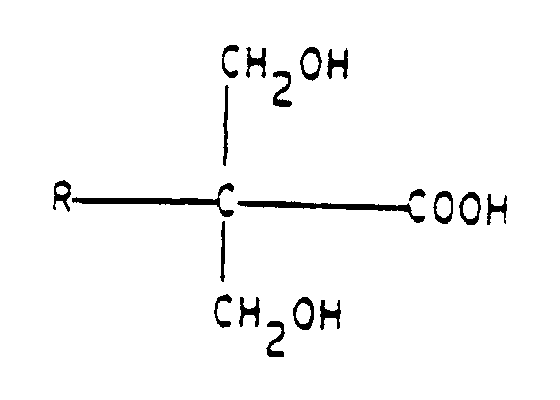

- a) 0 bis 12 Gew.-%,
- insbesondere 1 bis 10 Gew.-% α,β-ungesättigten Carbonsäuren,
- b) 10 bis 65 Gew.-%,
- insbesondere 15 bis 50 Gew.-% einpolymerisierbaren, hydroxylgruppenhaltigen Monomeren, insbesondere ethylenisch mono-ungesättigten, hydroxylgruppenhaltigen Monomeren,
- c) 0 bis 7 Gew.-%,
- insbesondere 0.1 bis 5 Gew.-%, besonders bevorzugt 1.0 bis 3 Gew.-% polyungesättigten Monomeren, insbesondere ethylenisch polyungesättigten Monomeren und
- d) 16 bis 90 Gew.-%,
- insbesondere 35 bis 85 Gew.-% ungesättigten, insbesondere ethylenisch ungesättigten Monomeren, die außer der ungesättigten Bindung keine weiteren reaktiven Gruppen tragen.
- Festkörper : 51.6 Gew.% (30 Min bei 180 °C)
- Säurezahl : 29 mg KOH pro g Festharz
- Viskosität : 29 Pa•s bei Festkörper
(Gew.-Verhältnis, Polyurethan : Monomer - 43 : 57)
(gemessen durch Photonen-Relaxations-Spektroskopie)
Claims (7)
- Verfahren zur Herstellung eines Mehrschichtüberzuges, bei dem auf ein Substrat ein gesättigtes Basisüberzugsmittel aus einer wäßrigen Dispersion eines nicht-vernetzten Polymeren aufgebracht wird, dadurch gekennzeichnet, daß die wäßrige Dispersion Teilchendurchmesser der polymeren Phase von 10 nm bis 500 nm aufweist, das Polymere eine zahlenmittlere Molmasse von 10000 bis 500000 und eine Säurezahl von 12 bis 40 aufweist, und die Dispersion erhalten wurde durch Polymerisation ohne Emulgatorzusatz und in Anwesenheit von nicht-wasserlöslichen Initiatoren, vonund gegebenenfalls anschließenden Zusatz von Pigmenten, Füllstoffen, Lösemitteln, Verdickungsmitteln und/oder übilchen Lackhilfsmitteln und Zusatzstoffen, der so erhaltenen Basisüberzug abgelüftet, ein wasserverdünnbares oder in organischen Lösemitteln gelöstet transparentes Überzugsmittel aufgebracht und anschließend das so beschichtete Substrat einer Erwärmung bei Temperaturen bis zu 140°C unterworfen wird.a) 0.65-g Gewichtstellen einer Monomerenmischung aus 28-90 Gew.% carboxylgruppenfreien ungesättigten Monomeren, die außer der ungasättigten Bindung keine weiteren unter Polymerisations- und Härtungsbedingungen reaktiven Gruppen enthalten, 10-85 Gew.% einpolymerisierbaren hydroxylgruppenhaltigen Monomeren der allgemeinen Formel R"-CH = CR'-X-R'" worinund 0 - 7 Gew.% ethylenisch polyungesättigten Monomeren, inR' = H oder -CnH2n + 1 ;R" = -R' oder -COOCnH2n + 1,n = 1 bis 6,R'" = eine lineare oder verzweigte C1-6-Alkylgruppe mit 1 bis 3 OH-Gruppen; undX = -COO-, -CONH-; -CH2-O- oder -O-;b) 1 Gewichtsteil, bezogen auf den Harzanteil, einer wäßrigen Dispersion eines harnstoffgruppenhaltigen Polyurethans, die durch Kettenverlängerung eines NCO-Gruppen enthaltenden Prepolymeren auf Polyesterbasis mit einem NCO-Gruppen-Gehalt von 1,0 bis 10 % mit mindestens zwei Urethangruppen pro Molekül, mit Carboxylgruppen entsprechend einer Säurezahl von 20 - 50 und einer zahlenmittleren Molmasse von 600 bis 6000, mit einem Polyamin mit primären und/oder sekundären Aminogruppen und/oder mit Hydrazin in wäßrigem Medium ohne Emulgatorzusatz hergestellt wurde,
- Verfahren nach Anspruch 1, dadurch gekennzeichnet, daß 1 bis 5 Gewichtsteile der Komponente a) pro ein Gewichtsteil der Komponente b) verwendet werden.
- Verfahren nach Anspruch 1 cder 2, dadurch gekennzeichnet, daß die Säurezahl des Polymeren in der wäßrigen Dispersion 15 bis 30 beträgt.
- Verfahren nach Anspruch 1, 2 oder 3, dadurch gekennzeichnet, daß die Säurezahl der Komponente b) 25 bis 50 beträgt.
- Verfahren nach einem der Ansprüche 1 bis 4, dadurch gekennzeichnet, daß als carboxylgruppenfreies ungesättigtes Monomeres der Komponente a) Styrol, Styrolderivate und/oder (Meth)acrylderivate vorwendet werden.
- Verfahren nach einem der Ansprüche 1 bis 5, dadurch gekennzeichnet, daß bei der Herstellung der wäßrigen Dispersion des harnstoffgruppenhaltigen Polyurethans b) vor oder nach der Kettenverlängerung des NCO-Gruppen enthaltenden Prepolymeren, Polyisocyanate mit mehr als zwei NCO-Gruppen zugesetzt werden.
- Verfahren nach einem der Ansprüche 1 bis 6, dadurch gekennzeichnet, daß bei der Herstellung der wäßrigen Dispersion des harnstoffgruppenhaltigen Polyurethans b) Polyamine in einer derartigen Menge zugesetzt werden, daß das Verhältnis der reaktiven Aminogruppen zu den NCO-Gruppen geringer als oder gleich 1 : 1 ist und bevorzugt im Bereich von 1 : 1 bis 0,5 : 1 liegt.
Priority Applications (1)
| Application Number | Priority Date | Filing Date | Title |
|---|---|---|---|
| AT88110471T ATE72263T1 (de) | 1987-07-03 | 1988-06-30 | Verfahren zur herstellung eines mehrschichtueberzuges und hierfuer geeignetes waessriges ueberzugsmittel. |
Applications Claiming Priority (2)
| Application Number | Priority Date | Filing Date | Title |
|---|---|---|---|
| DE3722005 | 1987-07-03 | ||
| DE19873722005 DE3722005A1 (de) | 1987-07-03 | 1987-07-03 | Verfahren zur herstellung eines mehrschichtueberzuges und hierfuer geeignetes waessriges ueberzugsmittel |
Publications (3)
| Publication Number | Publication Date |
|---|---|
| EP0297576A1 EP0297576A1 (de) | 1989-01-04 |
| EP0297576B1 EP0297576B1 (de) | 1992-01-29 |
| EP0297576B2 true EP0297576B2 (de) | 1999-07-14 |
Family
ID=6330837
Family Applications (1)
| Application Number | Title | Priority Date | Filing Date |
|---|---|---|---|
| EP88110471A Expired - Lifetime EP0297576B2 (de) | 1987-07-03 | 1988-06-30 | Verfahren zur Herstellung eines Mehrschichtüberzuges und hierfür geeignetes wässriges Überzugsmittel |
Country Status (9)
| Country | Link |
|---|---|
| US (1) | US6329020B1 (de) |
| EP (1) | EP0297576B2 (de) |
| JP (1) | JPS6429471A (de) |
| KR (1) | KR890002355A (de) |
| AT (1) | ATE72263T1 (de) |
| CA (1) | CA1340584C (de) |
| DE (2) | DE3722005A1 (de) |
| ES (1) | ES2032313T5 (de) |
| YU (1) | YU126888A (de) |
Families Citing this family (60)
| Publication number | Priority date | Publication date | Assignee | Title |
|---|---|---|---|---|
| US5006413A (en) * | 1989-09-05 | 1991-04-09 | E. I. Du Pont De Nemours And Company | Waterbased methylol (meth)acrylamide acrylic polymer and polyurethane containing coating composition |
| US5314945A (en) * | 1990-12-03 | 1994-05-24 | E. I. Du Pont De Nemours And Company | Waterbased coating compositions of methylol(meth)acrylamide acrylic polymer, polyurethane and melamine crosslinking agent |
| DE4110520C5 (de) * | 1991-03-30 | 2005-10-20 | Basf Coatings Ag | Mischsystem zur Herstellung wasserverdünnbarer Überzugsmittel |
| DE4107136A1 (de) * | 1991-03-06 | 1992-09-10 | Basf Lacke & Farben | Verfahren zur herstellung einer mehrschichtigen, schuetzenden und/oder dekorativen lackierung |
| DE4143688B4 (de) | 1991-03-30 | 2007-03-29 | Basf Coatings Ag | Verwendung eines Mischsystems sowie Verfahren zur Herstellung von Wasserbasislacken und von wasserverdünnbaren Überzugsmitteln |
| GB9211794D0 (en) † | 1992-06-04 | 1992-07-15 | Ici Resins Bv | Aqueous coating compositions |
| AT400440B (de) * | 1993-12-06 | 1995-12-27 | Vianova Kunstharz Ag | Verfahren zur herstellung von wasserverdünnbaren lackbindemitteln und deren verwendung |
| FR2721034B1 (fr) * | 1994-06-08 | 1996-09-13 | Oreal | Dispersions aqueuses de polymères choisis parmi les polyuréthannes et les polyurées, leur utilisation dans des compositions cosmétiques et compositions cosmétiques les contenant. |
| FR2721209A1 (fr) * | 1994-06-17 | 1995-12-22 | Oreal | Composition de soin ou de maquillage comprenant une dispersion aqueuse de polymères. |
| FR2721206A1 (fr) | 1994-06-17 | 1995-12-22 | Oreal | Composition capillaire comprenant une dispersion aqueuse de polymères. |
| AU689917B2 (en) * | 1994-07-07 | 1998-04-09 | Nippon Paint Co., Ltd. | Water-dispersible resin composition and process for producing the same |
| DE4437535A1 (de) * | 1994-10-20 | 1996-04-25 | Basf Lacke & Farben | Polyurethanmodifziertes Polyacrylat |
| DE4445200A1 (de) * | 1994-12-17 | 1996-06-20 | Herberts Gmbh | Wäßrige Überzugsmittel und deren Verwendung bei Verfahren zur Einschicht- und Mehrschichtlackierung |
| DE19602040A1 (de) * | 1996-01-20 | 1997-07-24 | Herberts Gmbh | Wäßrige Polymer/Polyurethan-Harz-Bindemitteldispersion, deren Herstellung, Überzugsmittel und Verwendung |
| WO1998027166A2 (de) | 1996-12-18 | 1998-06-25 | Basf Coatings Ag | Beschichtungsmittel und verfahren zu dessen herstellung |
| EP0946623B2 (de) * | 1996-12-18 | 2004-06-23 | BASF Coatings Aktiengesellschaft | Beschichtungsmittel und verfahren zu dessen herstellung |
| DE19705219C2 (de) * | 1997-02-12 | 2002-10-24 | Basf Coatings Ag | Universell einsetzbare Pigmentpasten und ihre Verwendung zur Herstellung von wäßrigen Lacken |
| DE19709465C2 (de) | 1997-03-07 | 2001-07-12 | Basf Coatings Ag | Beschichtungsmittel, Verfahren zur Herstellung von Mehrschichtlackierungen und Verwendung der Beschichtungsmittel hierfür |
| DE19722862C1 (de) * | 1997-05-31 | 1999-01-14 | Basf Coatings Ag | Wäßriger Lack und dessen Verwendung zur Herstellung einer zweischichtigen Lackierung |
| DE19805004C2 (de) | 1998-02-07 | 2000-05-31 | Herberts Gmbh | Wäßrige Überzugsmittel, ihre Herstellung und Verwendung bei der Herstellung von Mehrschichtlackierungen |
| EP1137728A1 (de) | 1998-10-31 | 2001-10-04 | BASF Coatings AG | Beschichtungsmittel mit macromer-einheit für die herstellung mehrschichtiger überzüge |
| DE50004723D1 (de) | 1999-02-03 | 2004-01-22 | Basf Coatings Ag | Polyurethan und seine verwendung in der wässrigen kunststofflackierung |
| IL134482A (en) * | 1999-02-16 | 2002-12-01 | Dainichiseika Color Chem | Pigment dispersions and stationery and printers with the dispersions stored within them |
| DE19908013A1 (de) | 1999-02-25 | 2000-08-31 | Basf Coatings Ag | Mit aktinischer Strahlung und gegebenenfalls themisch härtbare Pulverslurrys, Verfahren zu ihrer Herstellung und ihre Verwendung |
| US6630211B1 (en) | 1999-02-25 | 2003-10-07 | Basf Coatings Ag | Utilization of tricyclodecandimethanol for producing multilayer lacquers |
| DE19908001A1 (de) | 1999-02-25 | 2000-08-31 | Basf Coatings Ag | Hochkratzfeste Mehrschichtlackierung, Verfahren zu ihrer Herstellung und ihre Verwendung |
| DE19909894A1 (de) | 1999-03-06 | 2000-09-07 | Basf Coatings Ag | Sol-Gel-Überzug für einschichtige oder mehrschichtige Lackierungen |
| DE19914896A1 (de) | 1999-04-01 | 2000-10-05 | Basf Coatings Ag | Thermisch und/oder mit aktinischer Strahlung härtbarer wäßriger Beschichtungsstoff und seine Verwendung |
| DE19920799A1 (de) | 1999-05-06 | 2000-11-16 | Basf Coatings Ag | Thermisch und mit aktinischer Strahlung härtbarer Beschichtungsstoff und seine Verwendung |
| DE19924172A1 (de) | 1999-05-25 | 2000-11-30 | Basf Coatings Ag | Beschichtungsstoff mit einer Mischung aus Kieselsäuren und Harnstoff und/oder Harnstoffderivaten |
| DE19938759A1 (de) | 1999-08-16 | 2001-02-22 | Basf Coatings Ag | Beschichtungsstoff und seine Verwendung zur Herstellung hochkratzfester mehrschichtiger Klarlackierungen |
| DE19940858A1 (de) | 1999-08-27 | 2001-03-01 | Basf Coatings Ag | Sol-Gel-Überzug für einschichtige oder mehrschichtige Lackierungen |
| DE19944483A1 (de) | 1999-09-16 | 2001-03-29 | Basf Coatings Ag | Integriertes Lackierverfahren für Kunststoffteile enthaltende Karosserien oder Kabinen von PKW und Nutzfahrzeugen sowie deren Ersatzteile und Anbauteile |
| DE10009913B4 (de) * | 2000-03-01 | 2004-12-23 | Basf Coatings Ag | Verfahren zur Herstellung von Mehrschichtlackierungen auf elektrisch leitfähigen Substraten und deren Verwendung |
| DE10011277A1 (de) * | 2000-03-08 | 2001-09-13 | Bayer Ag | Abziehlack |
| DE10043405C1 (de) | 2000-09-04 | 2002-06-27 | Basf Coatings Ag | Verfahren zur Herstellung farb- und/oder effektgebender Lackierungen |
| DE10043810A1 (de) | 2000-09-06 | 2002-04-04 | Basf Coatings Ag | Bindemittellösung und ihre Verwendung für die KFZ-Kleinstreparatur im Teil |
| EP1205808B1 (de) * | 2000-11-08 | 2010-03-17 | Ricoh Company, Ltd. | Elektrophotographischer Photorezeptor, Verfahren zur Herstellung des Photorezeptors, und bildformendes Verfahren sowie Apparat worin der Photorezeptor eingesetzt wird |
| US6685985B2 (en) | 2001-02-09 | 2004-02-03 | Basf Corporation | Method of improving the appearance of coated articles having both vertical and horizontal surfaces, and coating compositions for use therein |
| DE10130972C1 (de) | 2001-06-27 | 2002-11-07 | Basf Coatings Ag | Verfahren zur Herstellung von Beschichtungen aus thermisch und mit aktinischer Strahlung härtbaren Beschichtungsstoffen und mit dem Verfahren herstellbare Lackierungen |
| AT411062B (de) * | 2001-11-19 | 2003-09-25 | Solutia Austria Gmbh | Beschichtungsmittel |
| DE10206225C1 (de) | 2002-02-15 | 2003-09-18 | Basf Coatings Ag | Verfahren zur Herstellung farb- und/oder effektgebender Mehrschichtlackierungen |
| US7001952B2 (en) * | 2002-04-19 | 2006-02-21 | Ppg Industries Ohio, Inc. | Coating compositions containing polyurethane dispersions and highly crosslinked polymer particles |
| US6762240B2 (en) | 2002-04-19 | 2004-07-13 | Ppg Industries Ohio, Inc. | Highly crosslinked polymer particles and coating compositions containing the same |
| US20050228124A1 (en) * | 2002-04-19 | 2005-10-13 | Shanti Swarup | Coating compositions containing highly crosslinked polymer particles and a hydrophobic polymer |
| ATE338090T1 (de) | 2003-02-24 | 2006-09-15 | Basf Ag | Carboxylat-haltige polymere für die metalloberflächenbehandlung |
| CN1294292C (zh) * | 2003-08-08 | 2007-01-10 | 北京有色金属研究总院 | 一步耐磨复合丝材及其应用 |
| DE102005012589B4 (de) | 2005-03-18 | 2007-06-14 | Basf Coatings Ag | Mit UV-A-Strahlung härtbares, lösemittelhaltiges Gemisch, Verfahren zu seiner Herstellung und seine Verwendung |
| DE102007031594A1 (de) | 2007-07-06 | 2009-01-08 | Basf Coatings Ag | Universeller Spotblender für Einkomponenten- und Zweikomponentenklarlacke |
| WO2010074763A1 (en) * | 2008-12-26 | 2010-07-01 | Bomar Specialties Company | Monoisocyanate-acrylate monomers and products utilizing the same |
| WO2014026780A1 (en) | 2012-08-16 | 2014-02-20 | Basf Coatings Gmbh | Coating compositions containing benzotrizol based uv-absorbers |
| US9499718B2 (en) * | 2013-03-21 | 2016-11-22 | Axalta Coating Systems Ip Co., Llc | Process for the production of an OEM base coat/clear top coat multi-layer coating |
| DE102014007805A1 (de) | 2014-05-27 | 2015-12-03 | WindplusSonne GmbH | Solarabsorber, Verfahren zu seiner Herstellung und seine Verwendung |
| DE102014013600A1 (de) | 2014-09-13 | 2016-03-17 | WindplusSonne GmbH | Solarabsorber, Verfahren zu seiner Herstellung und seine Verwendung |
| DE102018207815A1 (de) | 2018-05-18 | 2019-11-21 | Karl Wörwag Lack- Und Farbenfabrik Gmbh & Co. Kg | Mehrschichtige, farb- und/oder effektgebende Lackierung sowie Verfahren zur Bildung einer Basislackschicht |
| CN114222794A (zh) * | 2019-05-13 | 2022-03-22 | Ppg工业俄亥俄公司 | 涂料组合物以及施加此类涂料组合物的系统和方法 |
| EP3815898A1 (de) | 2019-10-28 | 2021-05-05 | Covestro Deutschland AG | Schichtenverbund aus polycarbonat und polycarbonatblend zur verbesserten lackierbarkeit |
| EP4630246A1 (de) | 2022-12-07 | 2025-10-15 | PPG Advanced Surface Technologies, LLC | Laminate mit lichtblockierenden substraten |
| DE102023201121B3 (de) | 2023-02-10 | 2024-06-13 | Volkswagen Aktiengesellschaft | Verfahren zum Lackieren eines Kraftfahrzeuges |
| WO2026080675A1 (en) | 2024-10-11 | 2026-04-16 | Ppg Advanced Surface Technologies, Llc. | Laminate substrates |
Family Cites Families (20)
| Publication number | Priority date | Publication date | Assignee | Title |
|---|---|---|---|---|
| DE1953349C3 (de) * | 1969-10-23 | 1975-07-03 | Bayer Ag, 5090 Leverkusen | Verfahren zur Herstellung wäßriger Dispersionen von Polymerisaten aus olefinisch ungesättigten Monomeren |
| BE757936A (fr) | 1969-10-23 | 1971-04-01 | Bayer Ag | Procede de preparation de polymeres anioniques modifies en emulsion |
| BE757935A (fr) * | 1969-10-23 | 1971-04-01 | Bayer Ag | Procede de preparation de polymeres cationiques modifies en emulsion |
| AU502343B2 (en) | 1975-06-02 | 1979-07-19 | Ppg Industries, Inc. | Aqueous dispersion of a non-gelled polyurethane |
| US4103050A (en) * | 1976-08-13 | 1978-07-25 | Scm Corporation | Aqueous coil coating primer |
| JPS5372088A (en) * | 1976-12-08 | 1978-06-27 | Kao Corp | Preparation of anionic aqueous resin composition |
| DE2860661D1 (en) * | 1977-10-12 | 1981-08-06 | Ici Plc | Preparation of sterically stabilised aqueous polymer dispersions |
| US4318833A (en) * | 1980-05-16 | 1982-03-09 | Inmont Corporation | Water reducible coating compositions of acrylic-urethane polymers |
| DE3129562C2 (de) * | 1980-07-29 | 1994-10-06 | Kao Corp | Farbvertiefendes Mittel |
| JPS6030796B2 (ja) * | 1980-07-29 | 1985-07-18 | 花王株式会社 | 濃色化剤 |
| GB8321933D0 (en) * | 1983-08-15 | 1983-09-14 | Ici Plc | Coating compositions |
| JPS60132641A (ja) * | 1983-12-20 | 1985-07-15 | Dainippon Ink & Chem Inc | ビニル共重合樹脂の水分散液の製造方法 |
| DE3407362A1 (de) * | 1984-02-29 | 1985-08-29 | Bayer Ag, 5090 Leverkusen | Waessrige dispersionen von pfropfpolymerisaten oder -copolymerisaten, ein verfahren zu ihrer herstellung und ihre verwendung als hydrophobierungs- und oleophobierungsmittel fuer textilien |
| NL8401785A (nl) * | 1984-06-04 | 1986-01-02 | Polyvinyl Chemie Holland | Werkwijze voor de bereiding van een waterige dispersie van urethan-acrylaat entcopolymeren, alsmede aldus verkregen stabiele waterige dispersie. |
| US4531027A (en) * | 1984-06-29 | 1985-07-23 | Deere & Company | "Joy-stick" and rocker switch control mechanism |
| JPS61152772A (ja) * | 1984-12-26 | 1986-07-11 | Nippon Paint Co Ltd | ハイソリツド塗料用樹脂組成物 |
| US4644030A (en) * | 1985-02-01 | 1987-02-17 | Witco Corporation | Aqueous polyurethane - polyolefin compositions |
| JPS61197072A (ja) * | 1985-02-27 | 1986-09-01 | Kansai Paint Co Ltd | 塗膜形成方法 |
| DE3545618A1 (de) | 1985-12-21 | 1987-06-25 | Basf Lacke & Farben | Wasserverduennbares ueberzugsmittel zur herstellung der basisschicht eines mehrschichtueberzuges |
| JPH0749561B2 (ja) * | 1988-05-13 | 1995-05-31 | 関西ペイント株式会社 | 水性塗料及びそれを用いる塗装法 |
-
1987
- 1987-07-03 DE DE19873722005 patent/DE3722005A1/de not_active Withdrawn
-
1988
- 1988-06-30 AT AT88110471T patent/ATE72263T1/de not_active IP Right Cessation
- 1988-06-30 CA CA000570945A patent/CA1340584C/en not_active Expired - Fee Related
- 1988-06-30 YU YU01268/88A patent/YU126888A/xx unknown
- 1988-06-30 KR KR1019880008065A patent/KR890002355A/ko not_active Withdrawn
- 1988-06-30 ES ES88110471T patent/ES2032313T5/es not_active Expired - Lifetime
- 1988-06-30 DE DE8888110471T patent/DE3868157D1/de not_active Expired - Lifetime
- 1988-06-30 EP EP88110471A patent/EP0297576B2/de not_active Expired - Lifetime
- 1988-07-02 JP JP63165795A patent/JPS6429471A/ja active Pending
-
1997
- 1997-03-19 US US08/820,525 patent/US6329020B1/en not_active Expired - Fee Related
Also Published As
| Publication number | Publication date |
|---|---|
| JPS6429471A (en) | 1989-01-31 |
| ES2032313T3 (es) | 1993-02-01 |
| EP0297576B1 (de) | 1992-01-29 |
| EP0297576A1 (de) | 1989-01-04 |
| YU126888A (en) | 1989-10-31 |
| DE3722005A1 (de) | 1989-01-12 |
| ES2032313T5 (es) | 1999-12-01 |
| US6329020B1 (en) | 2001-12-11 |
| DE3868157D1 (de) | 1992-03-12 |
| ATE72263T1 (de) | 1992-02-15 |
| KR890002355A (ko) | 1989-04-10 |
| CA1340584C (en) | 1999-06-08 |
Similar Documents
| Publication | Publication Date | Title |
|---|---|---|
| EP0297576B1 (de) | Verfahren zur Herstellung eines Mehrschichtüberzuges und hierfür geeignetes wässriges Überzugsmittel | |
| EP0256540B1 (de) | Wässriges Überzugsmittel, Verfahren zu seiner Herstellung und dessen Verwendung | |
| EP0260447B1 (de) | Wässriges Überzugsmittel, Verfahren zu seiner Herstellung und dessen Verwendung | |
| EP0521040B2 (de) | Verfahren zur herstellung einer mehrschichtigen reparaturlackierung | |
| EP0507819B1 (de) | Verwendung eines Verfahrens zur Herstellung eines mehrschichtigen Überzuges | |
| EP0521928B1 (de) | Verfahren zur herstellung einer mehrschichtigen lackierung und wässriger lack | |
| EP0438090B2 (de) | Bindemittelzusammensetzung zur Herstellung von Pigmentpasten und wässrige Überzugsmittel, die diese Pigmentpasten enthalten | |
| DE19722862C1 (de) | Wäßriger Lack und dessen Verwendung zur Herstellung einer zweischichtigen Lackierung | |
| EP0447428B1 (de) | Verfahren zur herstellung eines mehrschichtigen überzuges, wasserverdünnbare beschichtungszusammensetzungen, wasserverdünnbare emulsionspolymere und verfahren zur herstellung von wasserverdünnbaren emulsionspolymeren | |
| EP1180125B1 (de) | Wässrige bindemitteldispersionen, überzugsmittel und deren verwendung | |
| DE4115042A1 (de) | Physikalisch trocknendes ueberzugsmittel auf waessriger basis und dessen verwendung | |
| EP0662992B1 (de) | Mischsystem zur herstellung wasserverdünnbarer überzugsmittel | |
| DE19837601A1 (de) | Verfahren zur Mehrschichtlackierung | |
| EP0940457B1 (de) | Wässrige Überzugsmittel und deren Verwendung in einem Verfahren zur Herstellung von Mehrschichtüberzügen | |
| EP0720637B1 (de) | Verfahren zur herstellung von decklackschichten und wässrige lacke | |
| WO1990006187A1 (de) | Verfahren zur herstellung einer mehrschichtigen lackierung, wasserverdünnbarer lack, verfahren zur herstellung von vernetzten polymermikroteilchen und vernetzte polymermikroteilchen | |
| WO1995001405A1 (de) | Verfahren zur herstellung von korrosionsschutzgrundierungs- und/oder füllerschichten |
Legal Events
| Date | Code | Title | Description |
|---|---|---|---|
| PUAI | Public reference made under article 153(3) epc to a published international application that has entered the european phase |
Free format text: ORIGINAL CODE: 0009012 |
|
| AK | Designated contracting states |
Kind code of ref document: A1 Designated state(s): AT BE CH DE ES FR GB IT LI NL SE |
|
| 17P | Request for examination filed |
Effective date: 19890325 |
|
| 17Q | First examination report despatched |
Effective date: 19900611 |
|
| GRAA | (expected) grant |
Free format text: ORIGINAL CODE: 0009210 |
|
| AK | Designated contracting states |
Kind code of ref document: B1 Designated state(s): AT BE CH DE ES FR GB IT LI NL SE |
|
| REF | Corresponds to: |
Ref document number: 72263 Country of ref document: AT Date of ref document: 19920215 Kind code of ref document: T |
|
| REF | Corresponds to: |
Ref document number: 3868157 Country of ref document: DE Date of ref document: 19920312 |
|
| GBT | Gb: translation of ep patent filed (gb section 77(6)(a)/1977) | ||
| ET | Fr: translation filed | ||
| ITF | It: translation for a ep patent filed | ||
| PLBI | Opposition filed |
Free format text: ORIGINAL CODE: 0009260 |
|
| PLBI | Opposition filed |
Free format text: ORIGINAL CODE: 0009260 |
|
| 26 | Opposition filed |
Opponent name: BASF AKTIENGESELLSCHAFT, LUDWIGSHAFEN Effective date: 19921022 |
|
| 26 | Opposition filed |
Opponent name: BASF LACKE + FARBEN AG, PATENTABTEILUNG Effective date: 19921029 Opponent name: BASF AKTIENGESELLSCHAFT, LUDWIGSHAFEN Effective date: 19921022 |
|
| REG | Reference to a national code |
Ref country code: ES Ref legal event code: FG2A Ref document number: 2032313 Country of ref document: ES Kind code of ref document: T3 |
|
| NLR1 | Nl: opposition has been filed with the epo |
Opponent name: BASF AG |
|
| NLR1 | Nl: opposition has been filed with the epo |
Opponent name: FARBEN AG. Opponent name: BASF LACKE |
|
| PGFP | Annual fee paid to national office [announced via postgrant information from national office to epo] |
Ref country code: CH Payment date: 19930618 Year of fee payment: 6 |
|
| PG25 | Lapsed in a contracting state [announced via postgrant information from national office to epo] |
Ref country code: LI Effective date: 19940630 Ref country code: CH Effective date: 19940630 |
|
| EAL | Se: european patent in force in sweden |
Ref document number: 88110471.5 |
|
| REG | Reference to a national code |
Ref country code: CH Ref legal event code: PL |
|
| APAC | Appeal dossier modified |
Free format text: ORIGINAL CODE: EPIDOS NOAPO |
|
| PLAW | Interlocutory decision in opposition |
Free format text: ORIGINAL CODE: EPIDOS IDOP |
|
| PLAW | Interlocutory decision in opposition |
Free format text: ORIGINAL CODE: EPIDOS IDOP |
|
| PLAW | Interlocutory decision in opposition |
Free format text: ORIGINAL CODE: EPIDOS IDOP |
|
| PUAH | Patent maintained in amended form |
Free format text: ORIGINAL CODE: 0009272 |
|
| STAA | Information on the status of an ep patent application or granted ep patent |
Free format text: STATUS: PATENT MAINTAINED AS AMENDED |
|
| 27A | Patent maintained in amended form |
Effective date: 19990714 |
|
| AK | Designated contracting states |
Kind code of ref document: B2 Designated state(s): AT BE CH DE ES FR GB IT LI NL SE |
|
| NLR2 | Nl: decision of opposition | ||
| ITF | It: translation for a ep patent filed | ||
| GBTA | Gb: translation of amended ep patent filed (gb section 77(6)(b)/1977) | ||
| ET3 | Fr: translation filed ** decision concerning opposition | ||
| REG | Reference to a national code |
Ref country code: ES Ref legal event code: DC2A Kind code of ref document: T5 Effective date: 19991014 |
|
| NLR3 | Nl: receipt of modified translations in the netherlands language after an opposition procedure | ||
| PGFP | Annual fee paid to national office [announced via postgrant information from national office to epo] |
Ref country code: SE Payment date: 20010406 Year of fee payment: 14 Ref country code: BE Payment date: 20010406 Year of fee payment: 14 |
|
| PGFP | Annual fee paid to national office [announced via postgrant information from national office to epo] |
Ref country code: AT Payment date: 20010613 Year of fee payment: 14 |
|
| PGFP | Annual fee paid to national office [announced via postgrant information from national office to epo] |
Ref country code: NL Payment date: 20010630 Year of fee payment: 14 |
|
| REG | Reference to a national code |
Ref country code: GB Ref legal event code: IF02 |
|
| PGFP | Annual fee paid to national office [announced via postgrant information from national office to epo] |
Ref country code: GB Payment date: 20020520 Year of fee payment: 15 |
|
| PGFP | Annual fee paid to national office [announced via postgrant information from national office to epo] |
Ref country code: FR Payment date: 20020528 Year of fee payment: 15 |
|
| PGFP | Annual fee paid to national office [announced via postgrant information from national office to epo] |
Ref country code: ES Payment date: 20020628 Year of fee payment: 15 |
|
| PG25 | Lapsed in a contracting state [announced via postgrant information from national office to epo] |
Ref country code: BE Free format text: LAPSE BECAUSE OF NON-PAYMENT OF DUE FEES Effective date: 20020630 Ref country code: AT Free format text: LAPSE BECAUSE OF NON-PAYMENT OF DUE FEES Effective date: 20020630 |
|
| PG25 | Lapsed in a contracting state [announced via postgrant information from national office to epo] |
Ref country code: SE Free format text: LAPSE BECAUSE OF NON-PAYMENT OF DUE FEES Effective date: 20020701 |
|
| PGFP | Annual fee paid to national office [announced via postgrant information from national office to epo] |
Ref country code: DE Payment date: 20020826 Year of fee payment: 15 |
|
| BERE | Be: lapsed |
Owner name: *HERBERTS G.M.B.H. Effective date: 20020630 |
|
| PG25 | Lapsed in a contracting state [announced via postgrant information from national office to epo] |
Ref country code: NL Free format text: LAPSE BECAUSE OF NON-PAYMENT OF DUE FEES Effective date: 20030101 |
|
| NLV4 | Nl: lapsed or anulled due to non-payment of the annual fee |
Effective date: 20030101 |
|
| EUG | Se: european patent has lapsed | ||
| PG25 | Lapsed in a contracting state [announced via postgrant information from national office to epo] |
Ref country code: GB Free format text: LAPSE BECAUSE OF NON-PAYMENT OF DUE FEES Effective date: 20030630 |
|
| PG25 | Lapsed in a contracting state [announced via postgrant information from national office to epo] |
Ref country code: ES Free format text: LAPSE BECAUSE OF NON-PAYMENT OF DUE FEES Effective date: 20030701 |
|
| PG25 | Lapsed in a contracting state [announced via postgrant information from national office to epo] |
Ref country code: DE Free format text: LAPSE BECAUSE OF NON-PAYMENT OF DUE FEES Effective date: 20040101 |
|
| GBPC | Gb: european patent ceased through non-payment of renewal fee |
Effective date: 20030630 |
|
| PG25 | Lapsed in a contracting state [announced via postgrant information from national office to epo] |
Ref country code: FR Free format text: LAPSE BECAUSE OF NON-PAYMENT OF DUE FEES Effective date: 20040227 |
|
| REG | Reference to a national code |
Ref country code: FR Ref legal event code: ST |
|
| REG | Reference to a national code |
Ref country code: ES Ref legal event code: FD2A Effective date: 20030701 |
|
| PG25 | Lapsed in a contracting state [announced via postgrant information from national office to epo] |
Ref country code: IT Free format text: LAPSE BECAUSE OF NON-PAYMENT OF DUE FEES;WARNING: LAPSES OF ITALIAN PATENTS WITH EFFECTIVE DATE BEFORE 2007 MAY HAVE OCCURRED AT ANY TIME BEFORE 2007. THE CORRECT EFFECTIVE DATE MAY BE DIFFERENT FROM THE ONE RECORDED. Effective date: 20050630 |
|
| APAH | Appeal reference modified |
Free format text: ORIGINAL CODE: EPIDOSCREFNO |