EP0946623B2 - Beschichtungsmittel und verfahren zu dessen herstellung - Google Patents
Beschichtungsmittel und verfahren zu dessen herstellung Download PDFInfo
- Publication number
- EP0946623B2 EP0946623B2 EP97954821A EP97954821A EP0946623B2 EP 0946623 B2 EP0946623 B2 EP 0946623B2 EP 97954821 A EP97954821 A EP 97954821A EP 97954821 A EP97954821 A EP 97954821A EP 0946623 B2 EP0946623 B2 EP 0946623B2
- Authority
- EP
- European Patent Office
- Prior art keywords
- mixture
- component
- alkoxycarbonylamino
- tris
- hydroxy
- Prior art date
- Legal status (The legal status is an assumption and is not a legal conclusion. Google has not performed a legal analysis and makes no representation as to the accuracy of the status listed.)
- Expired - Lifetime
Links
Classifications
-
- C—CHEMISTRY; METALLURGY
- C08—ORGANIC MACROMOLECULAR COMPOUNDS; THEIR PREPARATION OR CHEMICAL WORKING-UP; COMPOSITIONS BASED THEREON
- C08G—MACROMOLECULAR COMPOUNDS OBTAINED OTHERWISE THAN BY REACTIONS ONLY INVOLVING UNSATURATED CARBON-TO-CARBON BONDS
- C08G18/00—Polymeric products of isocyanates or isothiocyanates
- C08G18/06—Polymeric products of isocyanates or isothiocyanates with compounds having active hydrogen
- C08G18/70—Polymeric products of isocyanates or isothiocyanates with compounds having active hydrogen characterised by the isocyanates or isothiocyanates used
- C08G18/72—Polyisocyanates or polyisothiocyanates
- C08G18/77—Polyisocyanates or polyisothiocyanates having heteroatoms in addition to the isocyanate or isothiocyanate nitrogen and oxygen or sulfur
- C08G18/78—Nitrogen
-
- C—CHEMISTRY; METALLURGY
- C09—DYES; PAINTS; POLISHES; NATURAL RESINS; ADHESIVES; COMPOSITIONS NOT OTHERWISE PROVIDED FOR; APPLICATIONS OF MATERIALS NOT OTHERWISE PROVIDED FOR
- C09D—COATING COMPOSITIONS, e.g. PAINTS, VARNISHES OR LACQUERS; FILLING PASTES; CHEMICAL PAINT OR INK REMOVERS; INKS; CORRECTING FLUIDS; WOODSTAINS; PASTES OR SOLIDS FOR COLOURING OR PRINTING; USE OF MATERIALS THEREFOR
- C09D167/00—Coating compositions based on polyesters obtained by reactions forming a carboxylic ester link in the main chain; Coating compositions based on derivatives of such polymers
-
- C—CHEMISTRY; METALLURGY
- C08—ORGANIC MACROMOLECULAR COMPOUNDS; THEIR PREPARATION OR CHEMICAL WORKING-UP; COMPOSITIONS BASED THEREON
- C08G—MACROMOLECULAR COMPOUNDS OBTAINED OTHERWISE THAN BY REACTIONS ONLY INVOLVING UNSATURATED CARBON-TO-CARBON BONDS
- C08G18/00—Polymeric products of isocyanates or isothiocyanates
- C08G18/06—Polymeric products of isocyanates or isothiocyanates with compounds having active hydrogen
- C08G18/70—Polymeric products of isocyanates or isothiocyanates with compounds having active hydrogen characterised by the isocyanates or isothiocyanates used
- C08G18/72—Polyisocyanates or polyisothiocyanates
- C08G18/77—Polyisocyanates or polyisothiocyanates having heteroatoms in addition to the isocyanate or isothiocyanate nitrogen and oxygen or sulfur
- C08G18/78—Nitrogen
- C08G18/7875—Nitrogen containing heterocyclic rings having at least one nitrogen atom in the ring
- C08G18/7893—Nitrogen containing heterocyclic rings having at least one nitrogen atom in the ring having three nitrogen atoms in the ring
-
- C—CHEMISTRY; METALLURGY
- C08—ORGANIC MACROMOLECULAR COMPOUNDS; THEIR PREPARATION OR CHEMICAL WORKING-UP; COMPOSITIONS BASED THEREON
- C08G—MACROMOLECULAR COMPOUNDS OBTAINED OTHERWISE THAN BY REACTIONS ONLY INVOLVING UNSATURATED CARBON-TO-CARBON BONDS
- C08G18/00—Polymeric products of isocyanates or isothiocyanates
- C08G18/06—Polymeric products of isocyanates or isothiocyanates with compounds having active hydrogen
- C08G18/70—Polymeric products of isocyanates or isothiocyanates with compounds having active hydrogen characterised by the isocyanates or isothiocyanates used
- C08G18/72—Polyisocyanates or polyisothiocyanates
- C08G18/80—Masked polyisocyanates
- C08G18/8061—Masked polyisocyanates masked with compounds having only one group containing active hydrogen
- C08G18/8064—Masked polyisocyanates masked with compounds having only one group containing active hydrogen with monohydroxy compounds
-
- C—CHEMISTRY; METALLURGY
- C09—DYES; PAINTS; POLISHES; NATURAL RESINS; ADHESIVES; COMPOSITIONS NOT OTHERWISE PROVIDED FOR; APPLICATIONS OF MATERIALS NOT OTHERWISE PROVIDED FOR
- C09D—COATING COMPOSITIONS, e.g. PAINTS, VARNISHES OR LACQUERS; FILLING PASTES; CHEMICAL PAINT OR INK REMOVERS; INKS; CORRECTING FLUIDS; WOODSTAINS; PASTES OR SOLIDS FOR COLOURING OR PRINTING; USE OF MATERIALS THEREFOR
- C09D175/00—Coating compositions based on polyureas or polyurethanes; Coating compositions based on derivatives of such polymers
- C09D175/04—Polyurethanes
Definitions
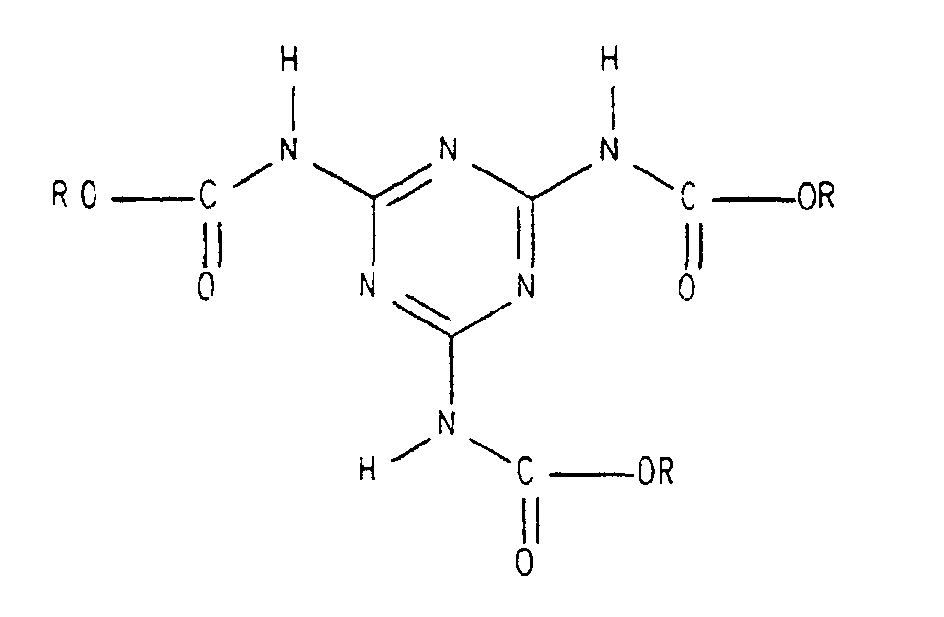
- the present invention relates to a component system for a two-component coating composition containing (1) a hydroxy-functional binder or a mixture of hydroxy-functional binders. (2) Tris (alkoxycarbonylamino) triazine or a mixture of tris (alkoxycarbonylamino) triazines and (3) free isocyanates or a mixture of free polyisocyanates.
- the invention further relates to processes for the production of such Component system and its use.
- a component system is a container made up of different, separately manufactured and stored lacquer components understood, but which are always traded in connection with one another and which are operated by a user, who wants to make a coating from a coating agent, before producing the coating to the coating agent be mixed.
- Such component systems include common for the production of top coats.
- the term topcoats is understood here to mean lacquers which are used to produce the top lacquer layer be used.
- the top lacquer layer can be single-layer or multi-layer, in particular two-layer, his.
- Two-coat top coats consist of a pigmented basecoat and one on the basecoat applied unpigmented or clearcoat layer pigmented only with transparent pigments.
- Two-coat finishes are manufactured today by the wet-on-wet process, in which a pigmented basecoat is prepainted and the base coat layer obtained in this way is repainted with a clear coat without a baking step and then Base tack coat and clear coat are hardened together.
- This process is very economical advantageous, but places high demands on the basecoat and the clearcoat.
- the one on the not yet hardened Basecoat applied clearcoat must not dissolve or otherwise interfere with the basecoat layer, because otherwise paintwork can be obtained with a bad appearance. This applies in particular to paints in which basecoats, the effect pigments (e.g. metal pigments, especially aluminum flakes, or pearlescent pigments) can be used.
- One-component clear coats do not show these problems or only to a limited extent, but can because of their significantly poorer chemical resistance not used instead of two-component clear coats become.
- the present invention is therefore based on the object of providing a coating composition that does not have the above-mentioned disadvantages of conventional two-component clearcoat systems, but a comparable one Resistance to chemicals and weathering like conventional two-component clearcoat systems.
- a coating agent is known from the literature DE 195 29 124 C1, which also Tris (alkoxycarbonylamino) triazine used as a crosslinker.
- the coating compositions described in this reference are, without exception, one-component coating agents. It is a general indication of existence of multicomponent systems, but no information or even hints are given, how different components could be put together.
- hydroxy functional binder or for the mixture of hydroxy functional binders those from the group "binders based on hydroxy-functional polyacrylates, hydroxy-functional Polyesters "and / or mixtures of elements from this group and / or mixtures of different binders of an element of this group
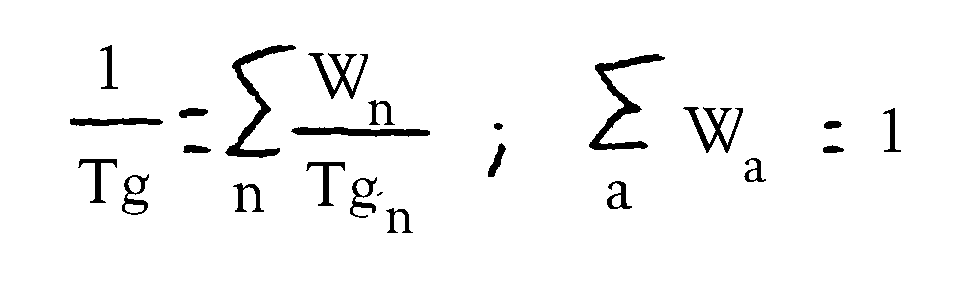
- polyacrylate resins which have hydroxyl numbers from 40 to 240, preferably 60 to 210, very particularly preferably 100 to 200, acid numbers from 0 to 35, preferably 0 to 23, completely particularly preferably 3.9 to 15.5, glass transition temperatures from -35 to +70 ° C, preferably -20 to +40 ° C, entirely particularly preferably -10 to +15 ° C and number average molecular weights of 1500 to 30000, preferably 2000 to 15,000, very particularly preferably 2500 to 5000.
- Measures to control the molecular weight e.g. selection of appropriate polymerization initiators, Use of chain transfer agents etc.
- component (a1) examples include hexahydrophthalic acid, 1,4-cyclohexanedicarboxylic acid, Endomethylene tetrahydrophthalic acid, oxalic acid, malonic acid, succinic acid, glutaric acid, adipic acid, Pimelic acid, suberic acid, azelaic acid and sebacic acid.
- component (b1) examples include Pentaerythritol, trimethylolpropane, trimethylolethane and glycerin.
- component (c1) examples include: Ethylene glycol, diethylene glycol, propylene glycol, neopentyl glycol, 2-methyl-2-propylpropanediol-1,3,2-ethyl-2-butylpropanediol-1,3, 2,2,4-trimethylpentanediol-1,5, 2,2,5-trimethylhexanediol-1,6, hydroxypivalic acid neopentyl glycol ester and dimethylolcyclohexane.
- component (d1) examples include 2-ethylhexanoic acid, lauric acid, Isooctanoic acid, isononanoic acid and monocarboxylic acid mixtures obtained from coconut fat or palm kernel fat become.
- Polyacrylate resins for example, are also used as the hydroxy-functional binder component are obtainable by (A1) 10 to 51% by weight, preferably 25 to 41% by weight, of 4-hydroxy-n-butyl acrylate or 4-hydroxy-n-butyl methacrylate or a mixture of 4-hydroxy-n-butyl acrylate and 4-hydroxy-n-butyl methacrylate, preferably 4-hydroxy-n-butyl acrylate, (A2) 0 to 36% by weight, preferably 0.1 to 20% by weight, one different from (A1) hydroxyl-containing ester of acrylic acid or a hydroxyl-containing ester of methacrylic acid or a mixture of such monomers, (A3) 28 to 85% by weight, preferably 40 to 70% by weight of one of (A1) and (A2) various aliphatic or cycloaliphatic esters of methacrylic acid with at least 4 carbon atoms in the alcohol residue or a mixture of such monomers, (A4) 0 to 3% by weight, preferably
- component (A2) are hydroxyalkyl esters of acrylic acid, such as hydroxyethyl and hydroxypropyl acrylate and hydroxyalkyl esters of methacrylic acid, e.g. Hydroxyethyl methacrylate and Hydroxypropyl methacrylate, the choice being made so that when component (A2) is polymerized alone a polyacrylate resin with a glass transition temperature from 0 to +80 degrees C, preferably from +20 to +60 degrees C. is obtained.
- component (A3) are: aliphatic esters of methacrylic acid with 4 to 20 carbon atoms in the alcohol residue, e.g.
- component (A4) are preferred Acrylic acid and / or methacrylic acid used.
- component (A5) are: vinyl aromatic hydrocarbons, e.g. Styrene, a-alkylstyrene and vinyltuluol, amides of acrylic acid and methacrylic acid, e.g. Methacrylamide and acrylamide, nitriles of acrylic and methacrylic acid, vinyl ethers and vinyl esters.
- Component (A5) preferably vinyl aromatic hydrocarbons, especially styrene, are used.
- the composition of component (A5) should preferably be such that when the component is polymerized alone (A5) a polymer with a glass transition temperature from +70 to +120 degrees C, preferably from +80 to +100 degrees C is obtained.
- These polyacrylate resins can be prepared by generally well known polymerization processes (see e.g. Houben-Weyl, Methods of Organic Chemistry, 4th edition, volume 14/1, pages 24 to 255 (1961)). They are preferably produced using solvent polymerization. This is usually submitted an organic solvent or solvent mixture and heated to boiling.
- the solvent or solvent mixture then becomes the monomer mixture to be polymerized and a or several polymerization initiators are added continuously.
- the polymerization takes place at temperatures between 100 and 160 degrees C, preferably between 130 and 150 degrees C.
- Preferred polymerization initiators are free radical initiators are used. Initiator type and quantity are usually chosen so that that at the polymerization temperature during the feed phase the radical supply is as constant as possible. Examples of initiators that can be used include: dialkyl peroxides, e.g. Di-tert-butyl peroxide and dicumyl peroxide, Hydroperoxides, e.g. Cumene hydroperoxide and tert-butyl hydroperoxide, peresters, e.g.
- tert-butyl perbenzoate tert-butyl perpivalate, tert-butyl per-3,5,5-trimethyl hexanoate and tert-butyl per-2-ethyl hexanoate.
- the polymerization conditions Reaction temperature, feed time of the monomer mixture, amount and type of organic solvent and polymerization initiators, possibly using molecular weight regulators e.g.
- Mercaptans, thioglycolic acid esters and hydrogen chloride are selected so that the polyacrylate resins a number average molecular weight as indicated (determined by gel permeation chromatography using of polystyrene as calibration substance).
- the acid number can be determined by the person skilled in the art using appropriate Quantities of component (A4) can be set. The same applies to the setting of the hydroxyl number. It is about that The amount of component (A1) and (A2) used can be controlled.
- binders based on polyurethane are also suitable.
- the coating composition contains components (2) and (3), which both are crosslinking agents.
- component (3) contains at least one, optionally in one or more organic, optionally water-dilutable solvents, dissolved or dispersed, unblocked di- and / or Polyisocyanate.
- blocked isocyanate or a mixture of blocked polyisocyanates may also be included his.
- the mandatory free polyisocyanate component is any organic Polyisocyanates with aliphatic, cycloaliphatic, araliphatic and / or aromatically bound free isocyanate groups. Polyisocyanates with 2 to 5 isocyanate groups per molecule and with viscosities of 100 to are preferred 2000 mPa.s (at 23 degrees C) used. If necessary, small amounts of organic can still be added to the polyisocyanates Solvents, preferably 1 to 25 wt .-%, based on pure polyisocyanate, are added, so as to incorporate them improve the isocyanate and, if necessary, the viscosity of the polyisocyanate to a value lower within the above ranges.
- Solvents suitable as additives for the polyisocyanates are for example ethoxyethyl propionate, butyl acetate and the like.
- suitable isocyanates are, for example in "Methods of Organic Chemistry", Houben-Weyl, Volume 14/2, 4th edition, Georg Thieme Verlag, Stuttgart 1963, Pages 61 to 70, and by W. Siefken, Liebigs Ann. Chem. 562, 75 to 136.
- isocyanurate groups and / or biuret groups and / or Polyisocyanates containing allophanate groups and / or urethane groups and / or urea groups and / or uretdione groups be used.
- Polyisocyanates containing urethane groups are, for example, by reaction part of the isocyanate groups with polyols, e.g. Trimethylolpropane and glycerin.
- aliphatic or cycloaliphatic polyisocyanates are dimerized and trimerized hexamethylene diisocyanate, isophorone diisocyanate, 2-isocyanatopropylcyclohexyl isocyanate, dicyclohexylmethane-2,4'-diisocyanate or dicyclohexylmethane-4,4'-diisocyanate or mixtures of these polyisocyanates used.
- Allophanate group-containing polyisocyanates based on hexamethylene diisocyanate as obtained by catalytic Oligomerization of hexamethylene diisocyanate using suitable catalysts are used.
- the polyisocyanate constituent can moreover also be made from any mixtures of the free examples mentioned Polyisocyanates exist.
- blocked isocyanate is admixed, it is preferably designed so that it is compatible with both Blocking agent (Z1) and isocyanate groups blocked with a blocking agent (Z2), the Blocking agent (Z1) is a dialkyl malonate or a mixture of dialkyl malonates, the blocking agent (Z2) a blocking agent containing an active methylene group other than (Z1), an oxime or a mixture of these blocking agents and the equivalent ratio between the isocyanate groups blocked with (Z1) and the isocyanate groups blocked with (Z2) between 1.0: 1.0 and 9.0: 1.0, preferably between 8.0: 2.0 and 6.0: 4.0, particularly preferably between 7.5: 2.5 and 6.5: 3.5.
- the blocked isocyanate is preferably like follows manufactured.
- a polyisocyanate or a mixture of polyisocyanates is made in a manner known per se implemented with a mixture of the blocking agents (Z1) and (Z2), the mixture of the blocking agents (Z1) and (Z2) contains the blocking agents (Z1) and (Z2) in a molar ratio between 1.0: 1.0 and 9.0: 1.0, preferably between 8.0: 2.0 and 6.0: 4.0, particularly preferably between 7.5: 2.5 and 6.5: 3.5.
- the polyisocyanate or the mixture of polyisocyanates can be mixed with the mixture of blocking agents (Z1) and (Z2) are reacted until isocyanate groups can no longer be detected.
- paints with good properties are obtained even if at least 50, preferably at least 70 percent of the isocyanate groups of the polyisocyanate or the mixture of polyisocyanates with the Mixture of the blocking agents (Z1) and (Z2) are reacted and the remaining isocyanate groups with a compound containing hydroxyl groups or a mixture of compounds containing hydroxyl groups become.
- Low molecular weight aliphatic or cycloaliphatic are preferably used as compounds containing hydroxyl groups
- Polyols such as neopentyl glycol, dimethylolcyclohexane, ethylene glycol, diethylene glycol, propylene glycol, 2-methyl-2-propylpropanediol-1,3, 2-ethyl-2-butylpropanediol-1, 3,2,2,4-trimethylpentanediol-1,5 and 2,2,5-trimethylhexanediol-1,6 or the hydroxyl-containing binder which can be used as component (1).
- a suitable one Blocked polyisocyanate can also be obtained by using the blocking agent (Z1) or (Z2) blocked polyisocyanates are mixed in such a ratio that a mixture is obtained in which the equivalent ratio between the isocyanate groups blocked with (Z1) and the isocyanate groups blocked with (Z2) between 1.0: 1.0 and 9.0: 1.0, preferably between 8.0: 2.0 and 6.0: 4.0, particularly preferably between 7.5: 2.5 and 6.5: 3.5 lies.
- all polyisocyanates that can be used in the paint field can be used to produce the blocked polyisocyanate be used.
- polyisocyanates examples include hexamethylene diisocyanate, Isophorone diisocyanate, trimethylhexamethylene diisocyanate, dicyclohexylmethane diisocyanate and 1,3-bis (2-isocyanatopropyl-2-) benzene (TMXDI) and adducts of these polyisocyanates with polyols, especially low molecular weight Polyols, e.g. Trimethylolpropane and isocyanurate group and / or biuret group-derived from these polyisocyanates Polyisocyanates.
- TXDI 1,3-bis (2-isocyanatopropyl-2-) benzene
- polyisocyanates are hexamethylene diisocyanate and isophorone diisocyanate, polyisocyanates containing isocyanurate or biuret groups and derived from these diisocyanates preferably contain more than two isocyanate groups in the molecule and reaction products of hexamethylene diisocyanate and isophorone diisocyanate or a mixture of hexamethylene diisocyanate and isophorone diisocyanate with 0.3-0.5 equivalents of a low molecular weight polyol with a molecular weight of 62 to 500, preferably from 104 to 204, in particular a triol, such as trimethylolpropane.
- dialkyl malonates or a mixture of dialkyl malonates are used.
- dialkyl malonates that can be used are called dialkyl malonates each with 1 to 6 carbon atoms in the alkyl radicals, such as dimethyl malonate and diethyl malonate, diethyl malonate being preferred.
- a blocking agent (Z2) are blocking agents and oximes different from (Z1) and contain active methylene groups and mixtures of these blocking agents.
- blocking agents that act as blocking agents (Z2) are used, are called: acetoacetic acid methyl, ethyl, propyl, butyl, pentyl, hexyl, heptyl, octyl, nonyl, decyl or dodecyl ester, acetone oxime, methyl ethyl ketoxime, acetylacetone, formal doxime, acetaldoxime, Benzophenoxime, acetoxime and diisobutyl ketoxime.
- An alkyl acetoacetate is preferably used as the blocking agent (Z2) with 1 to 6 carbon atoms in the alkyl radical or a mixture of such acetoacetic acid alkyl esters or a ketoxime or a mixture of ketoximes.
- Ethyl acetoacetate are particularly preferred or methyl ethyl ketoxime used as a blocking agent (Z2).
- a preferred embodiment of the invention is characterized in that the amounts of the components (1) to (3) in the ratios to one another are chosen such that the ratio OH: (NCO + NH-CO-OR) 1.0: 0.5 to 1.0: 2.0, preferably 1.0: 0.8 to 1.0: 1.5.
- the polyisocyanate component is used in the invention Coating agents e.g. in detail advantageously used in such an amount that the ratio of Hydroxyl groups of the binder (1) to the isocyanate groups of the crosslinking agents (2) and (3) between 1: 2 and 2: 1, is particularly preferably between 1: 1.5 and 1.5: 1.
- the quantitative ratio of the components (2) and (3) to one another is advantageously selected so that the Amount of tris (alkoxycarbonylamino) triazine or a mixture of tris (alkoxycarbonylamino) triazines 1 to 99 wt. %, preferably 5 to 90% by weight, based on the total amount of tris (alkoxycarbonylamino) triazine or Mixture of tris (alkoxycarbonylamino) triazines plus free isocyanates or the mixture of free polyisocyanates. If blocked isocyanates are added, the same applies, only then in each case based on the corresponding total amount of isocyanates instead of just free polyisocyanates.
- the component system can contain UV absorbers, preferably triazine compounds, and free radical scavengers contained in at least one of the two components (I) and / or (II).
- the component system can also Contain catalysts for crosslinking.
- organometallic compounds are used for this, preferably Tin and / or bismuth organic compounds into consideration.
- Tertiary amines can also be used.
- the component system can also contain rheological agents and other paint auxiliaries in at least one of the two Components (I) and / or (II) included.
- pigments of any kind for example color pigments
- color pigments can also be used such as azo pigments, phthalocyanine pigments, carbonyl pigments, dioxazine pigments, titanium dioxide, carbon black, iron oxides and chromium or cobalt oxides, or effect pigments such as metal flake pigments, in particular aluminum flake pigments and pearlescent pigments, incorporated in at least one of the two components (I) and / or (II) his.
- no or transparent pigments are provided.
- the production of the two components (I) and (II) takes place according to the usual methods from the individual Ingredients with stirring.
- the coating agent is also produced from components (I) and (II) by means of stirring or dispersion using the devices normally used, for example using a dissolver or similar or by means of 2-component dosing and mixing systems, which are also commonly used or by means of the process for the preparation described in DE-A-195 10 651, page 2, line 62, to page 4, line 5 aqueous 2-component polyurethane paints.
- the components, especially component (I), can be used as non-aqueous (i.e. with organic solvents) or be formulated as aqueous components.
- a non-aqueous formulation those in the Lacquer production usual organic solvents are used.
- aqueous coating compositions obtained after mixing components (I) and (II). Is an aqueous coating agent
- components (I) and / or (II) can also be largely anhydrous and largely free of organic solvents, but be formulated as water-dispersible. Then the aqueous coating agent obtained by mixing the components and adding water.
- a water-dispersible or Solvable component (I) can be formulated in a customary manner, for example by adding acidic groups to the binder are introduced, which are then with a customary base, for example ammonia or an organic amine how to neutralize triethylamine.
- the solution or dispersion of a water-dispersible component (I) and / or (II) in water is carried out in the usual way e.g. by vigorous stirring, if necessary with slight warming.
- alternative can be a solution or dispersion in water using nonionic emulsifiers. In this respect, is also on Standard procedures for the production of aqueous paints referenced.
- the invention also relates to methods for producing a component system according to the invention.
- a method for producing a component system which is characterized in that the component (I) by mixing the hydroxy-functional binder or the mixture of hydroxy-functional binders with tris (alkoxycarbonylamino) triazine or the mixture is produced from tris (alkoxycarbonylamino) triazines, and component (II) from free polyisocyanate or the mixture of free polyisocyanates is produced.
- component (II) by mixing free isocyanates or the mixture of free polyisocyanates with tris (alkoxycarbonylamino) triazine or the mixture of tris (alkoxycarbonylamino) triazines is prepared, and component (I) from the hydroxy-functional binder or Mixture of hydroxy-functional binders is produced.
- a process for producing a component system which is characterized in that component (II) by mixing free isocyanates or the mixture of free polyisocyanates with a first portion of tris (alkoxycarbonylamino) triazine or the mixture is produced from tris (alkoxycarbonylamino) triazines, and component (I) by mixing the hydroxy-functional Binder or the mixture of hydroxy-functional binders with a second subset of Tris (alkoxycarbonylamino) triazine or the mixture of tris (alkoxycarbonylamino) triazines.
- the amounts of components (1) to (3) are chosen so that the ratio OH: (NCO + NH-CO-OR) is 1.0: 0, 5 to 1, 0: 2, 0, preferably 1, 0: 0, 8 to 1, 0: 1, 5.
- the component system according to the invention is used to produce single- or multi-layer coatings and preferably used for the production of top coats. But it can also be used to make a basecoat clear lacquer to be applied, for example a clear lacquer produced by the wet-on-wet method Multi-layer painting should be determined. Of course, the plastics or the other substrates can also be coated directly with the clear coat or top coat.
- the coating compositions can also be applied to other substrates, such as metal, wood or Paper to be applied.
- the application is carried out with the aid of customary methods, for example spraying, knife coating, dipping or swipe.
- the coating compositions of the invention are preferably cured at 80 to 170 ° C. Especially preferably at temperatures between 100 and 150 ° C. In special application forms of the invention Coating agents can also be used at lower curing temperatures.
- the coating compositions of the invention are preferably used to produce top coats used.
- the coating compositions according to the invention can be used both in series and in refinishing used by automobile bodies. However, they are preferred in the area of series painting used.
- the resulting polymer solution has one Solids content of 62% determined in a forced-air oven for 1 h at 130 degrees C), an acid number of 9 and a viscosity of 21 dPa.s (measured on a 60% solution of the polymer solution in the aromatic solvent described, using an ICI plate cone viscometer at 23 degrees C).
- the contents of the reactor reach 210 degrees C within 8 hours heated up that a uniform reflux of the entrainer occurs.
- the reactor contents are kept at 210 degrees C to an acid number of 17.1 and a viscosity of 15 dPas, measured on a 60% solution of Reaction mixture in the aromatic solvent described in the acrylic resins A and B is reached.
- Then is cooled to 140 degrees C and the contents of the reactor are dissolved with as much of the aromatic solvent mentioned, that a non-volatile fraction of 61% (determined in a convection oven 60 min at 130 degrees C) results
- Alkyd resin solution prepared in this way has an acid number of 17.1 and a viscosity of 15 dPa.s (measured on an ICI plate cone viscometer at 23 degrees C).
- Component (I) of the two-component clearcoats is prepared by weighing the binder solution, then adding, with stirring, the amounts of triazine crosslinking agent, solvent, UV absorber, radical scavenger and leveling agent indicated in Table 1 and stirring well. The amounts in this and the following tables are to be understood as weights.
- Component (II) consists of a solution of commercially available isocyanurate trimers in a suitable solvent. It is prepared by stirring the solvent into the isocyanurate form according to Table 2
- Component (II) consists of a solution of commercially available isocyanurate trimers in a suitable solvent. It is prepared by stirring the solvent into the isocyanurate form according to Table 2 Component 2a Komponente2b Desmodur Z 4470 63.5 26.5 Tolonate HDT 90 24.8 Basonat HI 190 B / S 61.8 Solventnaphra 5.85 5.85 butyl 5.85 5.85
- the clear coats are produced by mixing components (I) and (II) in accordance with the quantitative ratios given in Table 3 and applying them immediately after the mixing. Alternatively, special two-component systems can be used for the application, which are known to the person skilled in the art and therefore need not be described in more detail here.
- Table 3 also contains properties of the clearcoats, which the invention illustrates. Clear coat 1 Klarlack2 Klarlack5 Klarlack6 Comp.1a 73.9 Comp. 1b 93.5 Comp. 1e 76.7 Comp.
Landscapes
- Chemical & Material Sciences (AREA)
- Organic Chemistry (AREA)
- Chemical Kinetics & Catalysis (AREA)
- Health & Medical Sciences (AREA)
- Medicinal Chemistry (AREA)
- Polymers & Plastics (AREA)
- Life Sciences & Earth Sciences (AREA)
- Engineering & Computer Science (AREA)
- Materials Engineering (AREA)
- Wood Science & Technology (AREA)
- Paints Or Removers (AREA)
- Polyurethanes Or Polyureas (AREA)
- Pretreatment Of Seeds And Plants (AREA)
- Medicinal Preparation (AREA)
- Treatments For Attaching Organic Compounds To Fibrous Goods (AREA)
Description
- eine erste Komponente (I) zumindest aus dem hydroxyfunktionellen Bindemittel (1) oder aus der Mischung aus hydroxyfunktionellen Bindemitteln (1) gebildet ist,
- eine zweite Komponente (II) zumindest aus freiem Polyisocyanat (3) oder der Mischung aus freien Polyisocyanaten (3) gebildet ist und
- das Tris(alkoxycarbonylamino)triazin (2) oder die Mischung aus Tris(alkoxycarbonylamino)triazinen (2) alternativ Bestandteil der ersten Komponente (I), der zweiten Komponente (II) oder beider Komponenten (I) und (II) ist,
- (1.1) hydroxyfunktionellen Polyacrylaten, mit einer Hydroxylzahl von 60 bis 200, einer Säurezahl
von 0 bis 35 und einem zahlenmittleren Molekulargewicht von 1500 bis 10000, die, bezogen
auf die jeweilige Gesamtmenge,
- (A 1) 10 bis 51 Gew.-% 4-Hydroxy-n-butylacrylat oder 4-Hydroxy-n-butylmethyacrylat oder deren Mischungen
- (A 2) 0 bis 36 Gew.-% eines von (A 1) verschiedenen hydroxylgruppenhaltigen Esters der Acrylsäure oder eines hydroxylgruppenhaltigen Esters der Methacrylsäure oder eines Gemischs aus solchen Monomeren,
- (A 3) 28 bis 85 Gew.-% eines von (A 1) und (A 2) verschiedenen aliphatischen oder cycloaliphatischen Esters der Methacrylsäure mit mindestens vier Kohlenstoffatomen im Alkoholrest oder eines Gemischs aus solchen Monomeren,
- (A 4) 0 bis 3 Gew.-% einer ethylenisch ungesättigten Carbonsäure oder eine Mischung aus ethylenisch ungesättigten Carbonsäuren und
- (A 5) 0 bis 20 Gew.-% eines von (A 1), (A 2), (A 3) und (A 4) verschiedenen ungesättigten Monomeren oder eines Gemischs aus solchen Monomeren
- Verringertes Anlösen konventioneller Basislacke, das insbesondere an einem verbesserten Metalleffekt bei Metallic-Basislacken erkennbar ist,
- Verbesserte Haftung bei Steinschlagprüfungen,
- Verbesserte Kratzfestigkeit bei gleichzeitig hoher Säurebeständigkeit.
| Komp.1a | Komp.1b | Komp.1e | Komp.1f | |||
| Acrylatharz A | 79,6 | 55,0 | ||||
| Alkydharz C | 72,0 | 62,0 | ||||
| Triazinvernetzer gemäß US 5084541 | 13 | 10,0 | ||||
| Tiniuvin 400 | 1,3 | 1,3 | ||||
| Tiniuvin 123 | 1,0 | 1,0 | ||||
| Tiniuvin 384 | 1,2 | 1,2 | ||||
| Tiniuvin 292 | 1,0 | 1,0 | ||||
| Siliconöl-lösung | 2,5 | 2,5 | 3,0 | 3,0 | ||
| Butyldiglycolacetat | 4,0 | 4,0 | 9,0 | 9,0 | ||
| Butylglycolacetat | 4,0 | 4,0 | 5,5 | 5,5 | ||
| Methoxipropylacetat | 3,0 | 3,6 | ||||
| Solvent-naphta | 5,1 | 5,1 | ||||
| Butylacetat | 4,6 | 15,6 | 3,2 | 3,2 |
| Komponente 2a | Komponente2b | |
| Desmodur Z 4470 | 63,5 | 26,5 |
| Tolonate HDT 90 | 24,8 | |
| Basonat HI 190 B/S | 61,8 | |
| Solventnaphra | 5,85 | 5,85 |
| Butylacetat | 5,85 | 5,85 |
| Klarlack 1 | Klarlack2 | Klarlack5 | Klarlack6 | |||
| Komp. 1a | 73,9 | |||||
| Komp. 1b | 93,5 | |||||
| Komp. 1e | 76,7 | |||||
| Komp. 1f | 86,7 | |||||
| Komp. 2a | 26,1 | 6,5 | ||||
| Komp. 2b | 23,3 | 13,3 | ||||
| Kratzfestig-keit*3 | schlecht | gut | schlecht | gut | ||
| JV(Note)+ 1) | 4,0 | 4,0 | 3,0 | 3,0 | ||
| Steinschla g+2) | schlecht | gut | schlecht | gut | ||
| *1) Note nacn 14 Wochen Freibewitterung in Jacksonville/Florida (1 = keine Schädigung, 10 = Reklamationstall) | ||||||
| *2) Steinschlagprüfüng nach VDA 621-428 (Monoschlag) Progress In organic coatings, vol. 22, 1993 |
Claims (13)
- Komponentensystem für ein Zweikomponenten-Beschichtungsmittel, enthaltendwobei(1) ein hydroxyfunktionelles Bindemittel oder eine Mischung aus hydroxyfunktionellen Bindemitteln,(2) Tris(alkoxycarbonylamino)triazin oder eine Mischung aus Tris(alkoxycarbonylamino)triazinen und(3) freiem Polyisocyanat oder eine Mischung aus freien Polyisocyanaten,dadurch gekennzeichnet, dass das Bindemittel (1) oder die Bindemittel (1) aus der Gruppe, bestehend auseine erste Komponente (I) zumindest aus dem hydroxyfunktionellen Bindemittel (1) oder aus der Mischung aus hydroxyfunktionellen Bindemitteln (1) gebildet ist,eine zweite Komponente (II) zumindest aus freiem Polyisocyanat (3) oder der Mischung aus freien Polyisocyanaten (3) gebildet ist unddas Tris(alkoxycarbonylamino)triazin (2) oder die Mischung aus Tris(alkoxycarbonylamino)triazinen (2) alternativ Bestandteil der ersten Komponente (I), der zweiten Komponente (II) oder beider Komponenten (I) und (II) ist,ausgewählt wird oder werden.(1.1) hydroxyfunktionellen Polyacrylaten, mit einer Hydroxylzahl von 60 bis 200, einer Säurezahl von 0 bis 35 und einem zahlenmittleren Molekulargewicht von 1500 bis 10000, die, bezogen auf die jeweilige Gesamtmenge,einpolymerisiert enthalten, wobei die Summe der Gewichtsteile der Komponenten (A 1) bis (A 5) stets 100% ergibt, und die Zusammensetzung der Komponente (A3) so gewählt wird, daß bei alleiniger Polymerisation der Komponente (A3) ein Polymethacrylatharz mit einer Glasübergangstemperatur von +10 bis +100 Grad C erhalten wird und(A 1) 10 bis 51 Gew.-% 4-Hydroxy-n-butylacrylat oder 4-Hydroxy-n-butylmethyacrylat oder deren Mischungen(A 2) 0 bis 36 Gew.-% eines von (A 1) verschiedenen hydroxylgruppenhaltigen Esters der Acrylsäure oder eines hydroxylgruppenhaltigen Esters der Methacrylsäure oder eines Gemischs aus solchen Monomeren,(A 3) 28 bis 85 Gew.-% eines von (A 1) und (A 2) verschiedenen aliphatischen oder cycloaliphatischen Esters der Methacrylsäure mit mindestens vier Kohlenstoffatomen im Alkoholrest oder eines Gemischs aus solchen Monomeren,(A 4) 0 bis 3 Gew.-% einer ethylenisch ungesättigten Carbonsäure oder eine Mischung aus ethylenisch ungesättigten Carbonsäuren und(A 5) 0 bis 20 Gew.-% eines von (A 1), (A 2), (A 3) und (A 4) verschiedenen ungesättigten Monomeren oder eines Gemischs aus solchen Monomeren(1.2) hydroxyfunktionellen Polyesterharzen, herstellbar, indemmiteinander in einem molaren Verhältnis von (a 1) : (b 1) : (c 1 ) : (d 1) = 1,0 : 0,2 - 1,3 : 0,0 - 1,1 : 0,0 - 1,4 umgesetzt werden,(a 1) eine cycloaliphatische oder aliphatische Polycarbonsäure oder eine Mischung aus solchen Polycarbonsäuren,(b 1) ein aliphatisches oder cycloaliphatisches Polyol mit mehr als zwei Hydroxylgruppen im Molekül oder eine Mischung aus solchen Polyolen,(c 1) ein aliphatisches oder cycloaliphatisches Diol oder eine Mischung aus solchen Diolen und(d 1) eine aliphatische lineare oder verzweigte gesättigte Monocarbonsäure oder eine Mischung aus solchen Monocarbonsäuren
- Komponentensystem nach Anspruch 1, dadurch gekennzeichnet, dass die Menge an Tris(alkoxycarbonylamino)triazin (2) oder an der Mischung aus Tris(alkoxycarbonylamino)triazinen (2) 1 bis 99 Gew.-%, vorzugsweise 5 bis 90 Gew.-%, beträgt, bezogen auf die Gesamtmenge an Tris(alkoxycarbonylamino)triazin (2) bzw. der Mischung aus Tris(alkoxycarbonylamino)triazinen (2) plus freiem Polyisocyanate (3) bzw. der Mischung aus freien Polyisocyanaten (3).
- Komponentensystem nach einem der Ansprüche 1 oder 2, dadurch gekennzeichnet, dass die Menge der Bestandteile (1) bis (3) in den Verhältnissen zueinander so gewählt sind, dass das Verhältnis OH: (NCO + NH-CO-OR) 1,0 : 0,5 bis 1,0 : 2,0, vorzugsweise 1,0 : 0,8 bis 1,0 : 1,5, beträgt.
- Komponentensystem nach einem der Ansprüche 1 bis 3, dadurch gekennzeichnet, dass es UV-Absorber, vorzugsweise Triazinverbindungen, und Radikalfänger in zumindest einer der beiden Komponenten (1) und/oder (II) enthält.
- Komponentensystem nach einem der Ansprüche 1 bis 4, dadurch gekennzeichnet, dass es Rheologiemittel in zumindest einer der beiden Komponenten (I) und/oder (II) enthält.
- Komponentensystem nach einem der Ansprüche 1 bis 5, dadurch gekennzeichnet, dass es metallorganische Katalysatoren, vorzugsweise zinnund/oder bismutorganische Verbindungen und/oder tertiäre Amin enthält.
- Verfahren zur Herstellung eines Komponentensystems nach einem der Ansprüche 1 bis 6, dadurch gekennzeichnet, dassdie Komponente (I) durch Mischen des hydroxyfunktionellen Bindemittels (1) oder der Mischung aus hydroxyfunktionellen Bindemitteln (1) mit Tris(alkoxycarbonylamino)triazin (2) oder der Mischung aus Tris(alkoxycarbonylamino)triazinen (2) hergestellt werden unddie Komponente (II) aus freiem Polyisocyanat (3) oder der Mischung aus freien Polyisocyanaten (3) hergestellt wird.
- Verfahren zur Herstellung eines Komponentensystems nach einem der Ansprüche 1 bis 6, dadurch gekennzeichnet, dassdie Komponente (II) durch Mischen freien Polyisocyanats (3) oder der Mischung aus freien Polyisocyanaten (3) mit Tris(alkoxycarbonylamino)triazin (2) oder der Mischung aus Tris(alkoxycarbonylamino)triazinen (2) hergestellt wird unddie Komponente (I) aus dem hydroxyfunktionellen Bindemittel (1) oder der Mischung aus hydroxyfunktionellen Bindemitteln (1) hergestellt wird.
- Verfahren zur Herstellung eines Komponentensystems nach einem der Ansprüche 1 bis 6, dadurch gekennzeichnet, dassdie Komponente (II) durch Mischen freien Polyisocyanats (3) oder der Mischung aus freien Polyisocyanaten (3) mit einer ersten Teilmenge Tris(alkoxycarbonylamino)triazin (2) oder der Mischung aus Tris(alkoxycarbonylamino)triazinen (2) hergestellt wird unddie Komponente (I) durch Mischen des hydroxyfunktionellen Bindemittels (1) oder der Mischung aus hydroxyfunktionellen Bindemitteln (1) mit einer zweiten Teilmenge Tris(alkoxycarbonylamino)triazin (2) oder der Mischung aus Tris(alkoxycarbonylamino)triazinen (2) hergestellt wird.
- Verfahren nach einem der Ansprüche 7 bis 9, dadurch gekennzeichnet, dass die Menge der Bestandteile (1) bis (3) so gewählt werden, dass das Verhältnis OH: (NCO + NH-CO-OR) 1,0 : 0,5 bis 1,0 : 2,0, vorzugsweise 1,0 : 0,8 bis 1,0 : 1,5, beträgt.
- Verwendung eines Komponentensystems nach einem der Ansprüche 1 bis 6 in einem Verfahren zur Beschichtung eines Substrats mittels eines Beschichtungsmittels, dadurch gekennzeichnet, dass die Komponente (I) und die Komponente (II) vor der Applikation, vorzugsweise unmittelbar vor der Applikation, zu dem Beschichtungsmittel miteinander vermischt, appliziert und gemeinsam eingebrannt werden.
- Verwendung eines Komponentensystems nach einem der Ansprüche 1 bis 6 in einem Verfahren zur Beschichtung eines Substrats mittels eines Beschichtungsmittels, dadurch gekennzeichnet, dass die Komponente (I) und die Komponente (II) mit Hilfe einer speziellen Zweikomponenten-Applikationseinrichtung appliziert und zusammen eingebrannt werden.
- Verwendung eines Komponentensystems nach einem der Ansprüche 1 bis 6 zur Herstellung eines Decklacks oder eines Klarlacks.
Applications Claiming Priority (5)
| Application Number | Priority Date | Filing Date | Title |
|---|---|---|---|
| DE19652886 | 1996-12-18 | ||
| DE19652886 | 1996-12-18 | ||
| DE19725188 | 1997-06-14 | ||
| DE19725188A DE19725188A1 (de) | 1996-12-18 | 1997-06-14 | Beschichtungsmittel und Verfahren zu dessen Herstellung |
| PCT/EP1997/007110 WO1998027134A1 (de) | 1996-12-18 | 1997-12-18 | Beschichtungsmittel und verfahren zu dessen herstellung |
Publications (3)
| Publication Number | Publication Date |
|---|---|
| EP0946623A1 EP0946623A1 (de) | 1999-10-06 |
| EP0946623B1 EP0946623B1 (de) | 2001-02-28 |
| EP0946623B2 true EP0946623B2 (de) | 2004-06-23 |
Family
ID=26032428
Family Applications (1)
| Application Number | Title | Priority Date | Filing Date |
|---|---|---|---|
| EP97954821A Expired - Lifetime EP0946623B2 (de) | 1996-12-18 | 1997-12-18 | Beschichtungsmittel und verfahren zu dessen herstellung |
Country Status (9)
| Country | Link |
|---|---|
| US (1) | US6143367A (de) |
| EP (1) | EP0946623B2 (de) |
| JP (1) | JP4191802B2 (de) |
| KR (1) | KR20000057640A (de) |
| AT (1) | ATE199382T1 (de) |
| BR (1) | BR9713598A (de) |
| CA (1) | CA2274487A1 (de) |
| ES (1) | ES2157094T5 (de) |
| WO (1) | WO1998027134A1 (de) |
Families Citing this family (11)
| Publication number | Priority date | Publication date | Assignee | Title |
|---|---|---|---|---|
| US5965670A (en) * | 1997-12-24 | 1999-10-12 | Ppg Industries Ohio, Inc. | Curable-film forming compositions having improved mar and acid etch resistance |
| BR0010383A (pt) | 1999-03-17 | 2002-02-05 | Du Pont | Composição de revestimento transparente e método de produção de revestimento transparente |
| US6855779B1 (en) | 1999-03-17 | 2005-02-15 | E. I. Du Pont De Nemours And Company | High solid epoxy, melamine and isocyanate compositions |
| AU762095B2 (en) | 1999-03-17 | 2003-06-19 | E.I. Du Pont De Nemours And Company | High solids acid etch and mar resistant clear coating composition |
| BR0010404A (pt) * | 1999-03-17 | 2002-01-08 | Du Pont | Composição de revestimento transparente com alto teor de sólidos e método de produção de revestimento transparente sobre um substrato |
| JP2002539305A (ja) | 1999-03-17 | 2002-11-19 | イー・アイ・デュポン・ドウ・ヌムール・アンド・カンパニー | 高固形分酸腐蝕抵抗性透明塗料組成物 |
| DE102004012570A1 (de) * | 2004-03-12 | 2005-09-29 | Basf Ag | Formulierungen und ihre Verwendung zur Behandlung von flexiblen Substraten |
| CA2646593C (en) * | 2006-03-20 | 2015-12-08 | Duramed Pharmaceuticals, Inc. | Flexible, compressed intravaginal rings, methods of making and using the same, and apparatus for making the same |
| JP5150385B2 (ja) * | 2008-06-26 | 2013-02-20 | ロックペイント株式会社 | 2液速硬化型樹脂組成物 |
| ES2542535T3 (es) * | 2009-02-10 | 2015-08-06 | The Sherwin-Williams Company | Composiciones para revestimiento de múltiples capas y resinas para los mismos |
| EP4486816A4 (de) * | 2022-03-03 | 2025-12-03 | Inx Int Ink Co | Stabile flüssige vernetzerzusammensetzungen für wärmehärtbare tinten |
Family Cites Families (35)
| Publication number | Priority date | Publication date | Assignee | Title |
|---|---|---|---|---|
| DE2639491B1 (de) * | 1976-09-02 | 1978-02-02 | Hoechst Ag | Einbrennlacke auf der Grundlage von freie Hydroxylgruppen enthaltenden Polyester- und/oder Alkydharzen und blockierten Polyisocyanaten |
| NZ186925A (en) * | 1977-04-25 | 1979-12-11 | Ici Ltd | Top-coating based on a basecoat and top-coat compositions not requiring an intermediate baking operation |
| GB2012191B (en) * | 1977-09-29 | 1982-03-03 | Kodak Ltd | Coating process utilising cellulose esters such as cellulose acetate butyrate |
| DE3166673D1 (en) * | 1980-04-14 | 1984-11-22 | Ici Plc | Multi-layer coating process involving use of aqueous basecoat composition containing crosslinked polymer microparticles and having a pseudoplastic or thixotropic character |
| US4397989A (en) * | 1982-02-08 | 1983-08-09 | E. I. Du Pont De Nemours & Co. | High solids coating composition of an acrylic polymer a polyester polyol and an alkylated melamine crosslinking agent |
| DE3210051A1 (de) * | 1982-03-19 | 1983-09-29 | Basf Farben + Fasern Ag, 2000 Hamburg | Wasserverduennbares ueberzugsmittel zur herstellung der basisschicht eines mehrschichtueberzuges |
| DE3333072A1 (de) * | 1983-09-14 | 1985-03-21 | Basf Farben + Fasern Ag, 2000 Hamburg | Ueberzugsmasse, verfahren zur herstellung von ueberzuegen und beschichtetes substrat |
| AT381499B (de) * | 1985-02-27 | 1986-10-27 | Vianova Kunstharz Ag | Wasserverduennbare ueberzugsmittel, verfahren zur herstellung und ihre verwendung fuer basisschichtenbei zweischicht-decklackierung |
| US4720405A (en) * | 1985-12-13 | 1988-01-19 | Ppg Industries, Inc. | Method of providing a substrate with a flexible multilayer coating |
| DE3544423A1 (de) * | 1985-12-16 | 1987-06-19 | Hilti Ag | Vorrichtung zum befestigen von gegenstaenden an einem untergrund |
| US4710542A (en) * | 1986-05-16 | 1987-12-01 | American Cyanamid Company | Alkylcarbamylmethylated amino-triazine crosslinking agents and curable compositions containing the same |
| DE3628124A1 (de) * | 1986-08-19 | 1988-03-03 | Herberts Gmbh | Waessriges ueberzugsmittel, verfahren zu seiner herstellung und dessen verwendung |
| EP0320552A1 (de) * | 1987-12-18 | 1989-06-21 | E.I. Du Pont De Nemours And Company | Verfahren zur Verbesserung des Aussehens eines mehrschichtigen Überzugs |
| DE3814853A1 (de) * | 1987-05-02 | 1988-11-10 | Kansai Paint Co Ltd | Beschichtungsverfahren |
| DE3722005A1 (de) * | 1987-07-03 | 1989-01-12 | Herberts Gmbh | Verfahren zur herstellung eines mehrschichtueberzuges und hierfuer geeignetes waessriges ueberzugsmittel |
| US5084541A (en) * | 1988-12-19 | 1992-01-28 | American Cyanamid Company | Triazine crosslinking agents and curable compositions |
| US4939213A (en) * | 1988-12-19 | 1990-07-03 | American Cyanamid Company | Triazine crosslinking agents and curable compositions containing the same |
| DE3903804C2 (de) * | 1989-02-09 | 2001-12-13 | Bollig & Kemper | Wäßrige Lackdispersionen und deren Verwendung |
| US5380816A (en) * | 1989-05-11 | 1995-01-10 | Sullivan; Carl J. | Linear polyester diols based on isophthalic acid and 2-methyl-1,3-propanediol for thermoset coating compositions |
| EP0541966A3 (en) * | 1991-11-15 | 1994-09-07 | American Cyanamid Co | Process for preparing amide derivatives from halomines and acid halides |
| US5288865A (en) * | 1991-11-15 | 1994-02-22 | American Cyanamid Company | Process for preparing amide derivatives from haloaminotriazines and acid halides |
| DE4204518A1 (de) * | 1992-02-15 | 1993-08-19 | Basf Lacke & Farben | Verfahren zur herstellung einer zweischichtigen lackierung und fuer dieses verfahren geeignete nicht-waessrige lacke |
| US5574103A (en) * | 1992-12-29 | 1996-11-12 | Cytec Technology Corp. | Aminoresin based coatings containing 1,3,5-triazine tris-carbamate co-crosslinkers |
| DE4310414A1 (de) * | 1993-03-31 | 1994-10-06 | Basf Lacke & Farben | Verfahren zur Herstellung einer zweischichtigen Decklackierung auf einer Substratoberfläche |
| TW328955B (en) * | 1993-05-14 | 1998-04-01 | Cytec Tech Corp | Process for preparing bis- or tris-carbamate functional 1,3,5-triazines, substantially halogen contamination free crosslinker compositions and new bis-or tris-carbamate functional 1,3,5-triazines |
| DE4317861C1 (de) * | 1993-05-28 | 1994-11-24 | Herberts Gmbh | Verfahren zur Mehrschichtlackierung von Substraten und Anwendung des Verfahrens |
| DE4407409A1 (de) * | 1994-03-05 | 1995-09-07 | Basf Lacke & Farben | Beschichtungsmittel auf Basis eines hydroxylgruppenhaltigen Polyacrylatharzes und seine Verwendung in Verfahren zur Herstellung einer Mehrschichtlackierung |
| DE19510651A1 (de) * | 1994-06-03 | 1995-12-07 | Bayer Ag | Wäßrige 2-Komponenten-Polyurethanlack-Emulsionen und Verfahren zu deren Herstellung |
| EP0767185B1 (de) * | 1994-06-22 | 1999-09-01 | Mitsubishi Chemical Industries Limited | Acrylatcopolymer und solches enthaltende polymerzusammensetzung |
| US5475073A (en) * | 1994-11-18 | 1995-12-12 | Arco Chemical Technology, L.P. | Hydroxy-functional acrylate resins |
| DE69625900T2 (de) * | 1995-05-01 | 2003-09-18 | Ppg Industries Ohio, Inc. | Härtbare zusammensetzungen für verbundschichten sowie verfahren zur verbesserung der kratz- und abriebfestigkeit |
| DE19529124C1 (de) * | 1995-08-08 | 1996-11-21 | Herberts Gmbh | Überzugsmittel und deren Verwendung in Verfahren zur Herstellung von Mehrschichtüberzügen |
| CA2230604C (en) * | 1995-08-30 | 2008-12-02 | Cytec Technology Corp. | Compositions containing 1,3,5-triazine carbamates and epoxy compounds |
| US5741880A (en) * | 1996-05-10 | 1998-04-21 | The Sherwin-Williams Company | Clearcoating compositions |
| DE19622878A1 (de) * | 1996-06-07 | 1997-12-11 | Basf Lacke & Farben | Mehrschichtige Lackierung, Verfahren zu deren Herstellung und hierfür geeigneter nicht-wäßriger Decklack |
-
1997
- 1997-12-18 EP EP97954821A patent/EP0946623B2/de not_active Expired - Lifetime
- 1997-12-18 JP JP52733298A patent/JP4191802B2/ja not_active Expired - Fee Related
- 1997-12-18 KR KR1019990705443A patent/KR20000057640A/ko not_active Ceased
- 1997-12-18 ES ES97954821T patent/ES2157094T5/es not_active Expired - Lifetime
- 1997-12-18 AT AT97954821T patent/ATE199382T1/de not_active IP Right Cessation
- 1997-12-18 CA CA002274487A patent/CA2274487A1/en not_active Abandoned
- 1997-12-18 US US09/331,104 patent/US6143367A/en not_active Expired - Lifetime
- 1997-12-18 BR BR9713598-4A patent/BR9713598A/pt not_active IP Right Cessation
- 1997-12-18 WO PCT/EP1997/007110 patent/WO1998027134A1/de not_active Ceased
Also Published As
| Publication number | Publication date |
|---|---|
| ES2157094T3 (es) | 2001-08-01 |
| EP0946623B1 (de) | 2001-02-28 |
| KR20000057640A (ko) | 2000-09-25 |
| WO1998027134A1 (de) | 1998-06-25 |
| ATE199382T1 (de) | 2001-03-15 |
| JP4191802B2 (ja) | 2008-12-03 |
| EP0946623A1 (de) | 1999-10-06 |
| US6143367A (en) | 2000-11-07 |
| BR9713598A (pt) | 2000-04-04 |
| ES2157094T5 (es) | 2005-04-01 |
| CA2274487A1 (en) | 1998-06-25 |
| JP2001506298A (ja) | 2001-05-15 |
Similar Documents
| Publication | Publication Date | Title |
|---|---|---|
| EP0707608B1 (de) | Wässriges zweikomponenten-polyurethan-beschichtungsmittel, verfahren zu seiner herstellung und seine verwendung in verfahren zur herstellung einer mehrschichtlackierung | |
| EP0044393B1 (de) | Verfahren zur Herstellung eines Hydroxylgruppen aufweisenden, mit epsilon-Caprolacton modifizierten (Meth)acrylatharzes | |
| DE19809643B4 (de) | Beschichtungsmittel und Klebstoffe, ihre Verwendung und Verfahren zu ihrer Herstellung | |
| EP0692006B1 (de) | Nichtwässriger thixotropierter lack und verfahren zur herstellung mehrschichtiger überzüge damit | |
| EP0791025B1 (de) | Wässriges zweikomponenten-polyurethan-beschichtungsmittel, verfahren zu seiner herstellung und seine verwendung in verfahren zur herstellung einer mehrschichtlackierung | |
| DE69201594T3 (de) | " Beschichtungszusammensetzung ". | |
| DE19529124C1 (de) | Überzugsmittel und deren Verwendung in Verfahren zur Herstellung von Mehrschichtüberzügen | |
| DE4310414A1 (de) | Verfahren zur Herstellung einer zweischichtigen Decklackierung auf einer Substratoberfläche | |
| EP1030871B1 (de) | Verfahren zur herstellung einer zweischichtigen lackierung und für dieses verfahren geeignete lacke | |
| EP1987073B1 (de) | Wässrige zweikomponentensysteme, verfahren zu ihrer herstellung und ihre verwendung | |
| EP0605481A1 (de) | Wässrige lacke und verfahren zur herstellung von automobildecklackierungen. | |
| EP1254934B1 (de) | Nicht-wässriger Lack | |
| EP0889919B1 (de) | Wässriges zweikomponenten-polyurethan-beschichtungsmittel, verfahren zu seiner herstellung und seine verwendung als decklack oder klarlack sowie seine verwendung zur beschichtung von kunststoffen | |
| EP0946622B1 (de) | Beschichtungsmittel und verfahren zu dessen herstellung | |
| EP0856019A1 (de) | Aus mindestens 3 komponenten bestehendes beschichtungsmittel, verfahren zu seiner herstellung sowie seine verwendung | |
| EP0946623B1 (de) | Beschichtungsmittel und verfahren zu dessen herstellung | |
| EP0719307B1 (de) | Nichtwässrige lacke | |
| DE19805421C1 (de) | Beschichtungsmittel und dessen Verwendung sowie Verfahren zu dessen Herstellung | |
| DE10042152A1 (de) | Mit aktinischer Strahlung aktivierbares Thixotropierungsmittel, Verfahren zu seiner Herstellung und seine Verwendung | |
| EP0998508B1 (de) | Beschichtungsmittel und verfahren zu dessen herstellung | |
| DE102016105721B4 (de) | Acrylpolymere, 1K-Beschichtungszusammensetzungen, die dieselben einschließen, und Mehrschichtbeschichtungssysteme, die eine Decklackschicht einschließen, die aus den 1K-Beschichtungszusammensetzungen gebildet wird | |
| DE4317861C1 (de) | Verfahren zur Mehrschichtlackierung von Substraten und Anwendung des Verfahrens | |
| DE19725188A1 (de) | Beschichtungsmittel und Verfahren zu dessen Herstellung | |
| EP1263832A1 (de) | Polyisocyanate als beschichtungskomponenten für festkörperreiche beschichtungsmittel | |
| EP0977817A1 (de) | Wässriges überzugsmittel |
Legal Events
| Date | Code | Title | Description |
|---|---|---|---|
| PUAI | Public reference made under article 153(3) epc to a published international application that has entered the european phase |
Free format text: ORIGINAL CODE: 0009012 |
|
| 17P | Request for examination filed |
Effective date: 19990630 |
|
| AK | Designated contracting states |
Kind code of ref document: A1 Designated state(s): AT BE CH DE ES FR GB IT LI SE |
|
| GRAG | Despatch of communication of intention to grant |
Free format text: ORIGINAL CODE: EPIDOS AGRA |
|
| 17Q | First examination report despatched |
Effective date: 20000210 |
|
| GRAG | Despatch of communication of intention to grant |
Free format text: ORIGINAL CODE: EPIDOS AGRA |
|
| GRAH | Despatch of communication of intention to grant a patent |
Free format text: ORIGINAL CODE: EPIDOS IGRA |
|
| GRAH | Despatch of communication of intention to grant a patent |
Free format text: ORIGINAL CODE: EPIDOS IGRA |
|
| GRAA | (expected) grant |
Free format text: ORIGINAL CODE: 0009210 |
|
| AK | Designated contracting states |
Kind code of ref document: B1 Designated state(s): AT BE CH DE ES FR GB IT LI SE |
|
| PG25 | Lapsed in a contracting state [announced via postgrant information from national office to epo] |
Ref country code: SE Free format text: LAPSE BECAUSE OF FAILURE TO SUBMIT A TRANSLATION OF THE DESCRIPTION OR TO PAY THE FEE WITHIN THE PRESCRIBED TIME-LIMIT Effective date: 20010228 Ref country code: GB Free format text: LAPSE BECAUSE OF FAILURE TO SUBMIT A TRANSLATION OF THE DESCRIPTION OR TO PAY THE FEE WITHIN THE PRESCRIBED TIME-LIMIT Effective date: 20010228 |
|
| REF | Corresponds to: |
Ref document number: 199382 Country of ref document: AT Date of ref document: 20010315 Kind code of ref document: T |
|
| REG | Reference to a national code |
Ref country code: CH Ref legal event code: EP |
|
| REF | Corresponds to: |
Ref document number: 59703084 Country of ref document: DE Date of ref document: 20010405 |
|
| ITF | It: translation for a ep patent filed | ||
| ET | Fr: translation filed | ||
| PLBQ | Unpublished change to opponent data |
Free format text: ORIGINAL CODE: EPIDOS OPPO |
|
| PLBI | Opposition filed |
Free format text: ORIGINAL CODE: 0009260 |
|
| REG | Reference to a national code |
Ref country code: ES Ref legal event code: FG2A Ref document number: 2157094 Country of ref document: ES Kind code of ref document: T3 |
|
| GBV | Gb: ep patent (uk) treated as always having been void in accordance with gb section 77(7)/1977 [no translation filed] |
Effective date: 20010228 |
|
| 26 | Opposition filed |
Opponent name: PPG INDUSTRIES, INC. Effective date: 20010717 |
|
| PG25 | Lapsed in a contracting state [announced via postgrant information from national office to epo] |
Ref country code: AT Free format text: LAPSE BECAUSE OF NON-PAYMENT OF DUE FEES Effective date: 20011218 |
|
| PG25 | Lapsed in a contracting state [announced via postgrant information from national office to epo] |
Ref country code: LI Free format text: LAPSE BECAUSE OF NON-PAYMENT OF DUE FEES Effective date: 20011231 Ref country code: CH Free format text: LAPSE BECAUSE OF NON-PAYMENT OF DUE FEES Effective date: 20011231 Ref country code: BE Free format text: LAPSE BECAUSE OF NON-PAYMENT OF DUE FEES Effective date: 20011231 |
|
| PLBF | Reply of patent proprietor to notice(s) of opposition |
Free format text: ORIGINAL CODE: EPIDOS OBSO |
|
| PLBF | Reply of patent proprietor to notice(s) of opposition |
Free format text: ORIGINAL CODE: EPIDOS OBSO |
|
| PLBF | Reply of patent proprietor to notice(s) of opposition |
Free format text: ORIGINAL CODE: EPIDOS OBSO |
|
| BERE | Be: lapsed |
Owner name: BASF COATINGS A.G. Effective date: 20011231 |
|
| REG | Reference to a national code |
Ref country code: CH Ref legal event code: PL |
|
| PLBC | Reply to examination report in opposition received |
Free format text: ORIGINAL CODE: EPIDOSNORE3 |
|
| PUAH | Patent maintained in amended form |
Free format text: ORIGINAL CODE: 0009272 |
|
| STAA | Information on the status of an ep patent application or granted ep patent |
Free format text: STATUS: PATENT MAINTAINED AS AMENDED |
|
| 27A | Patent maintained in amended form |
Effective date: 20040623 |
|
| AK | Designated contracting states |
Kind code of ref document: B2 Designated state(s): AT BE CH DE ES FR GB IT LI SE |
|
| ET3 | Fr: translation filed ** decision concerning opposition | ||
| REG | Reference to a national code |
Ref country code: ES Ref legal event code: DC2A Date of ref document: 20040920 Kind code of ref document: T5 |
|
| PG25 | Lapsed in a contracting state [announced via postgrant information from national office to epo] |
Ref country code: IT Free format text: LAPSE BECAUSE OF NON-PAYMENT OF DUE FEES Effective date: 20051218 |
|
| REG | Reference to a national code |
Ref country code: FR Ref legal event code: PLFP Year of fee payment: 19 |
|
| REG | Reference to a national code |
Ref country code: FR Ref legal event code: PLFP Year of fee payment: 20 |
|
| PGFP | Annual fee paid to national office [announced via postgrant information from national office to epo] |
Ref country code: FR Payment date: 20161222 Year of fee payment: 20 |
|
| PGFP | Annual fee paid to national office [announced via postgrant information from national office to epo] |
Ref country code: DE Payment date: 20170228 Year of fee payment: 20 |
|
| PGFP | Annual fee paid to national office [announced via postgrant information from national office to epo] |
Ref country code: ES Payment date: 20170127 Year of fee payment: 20 |
|
| REG | Reference to a national code |
Ref country code: DE Ref legal event code: R071 Ref document number: 59703084 Country of ref document: DE |
|
| REG | Reference to a national code |
Ref country code: ES Ref legal event code: FD2A Effective date: 20180508 |
|
| PG25 | Lapsed in a contracting state [announced via postgrant information from national office to epo] |
Ref country code: ES Free format text: LAPSE BECAUSE OF EXPIRATION OF PROTECTION Effective date: 20171219 |