EP0280667B1 - Ventilsteuerungsmechanismus für eine Brennkraftmaschine - Google Patents
Ventilsteuerungsmechanismus für eine Brennkraftmaschine Download PDFInfo
- Publication number
- EP0280667B1 EP0280667B1 EP88850040A EP88850040A EP0280667B1 EP 0280667 B1 EP0280667 B1 EP 0280667B1 EP 88850040 A EP88850040 A EP 88850040A EP 88850040 A EP88850040 A EP 88850040A EP 0280667 B1 EP0280667 B1 EP 0280667B1
- Authority
- EP
- European Patent Office
- Prior art keywords
- lifting arm
- arm
- valve
- rocker
- shaft
- Prior art date
- Legal status (The legal status is an assumption and is not a legal conclusion. Google has not performed a legal analysis and makes no representation as to the accuracy of the status listed.)
- Expired - Lifetime
Links
Images
Classifications
-
- F—MECHANICAL ENGINEERING; LIGHTING; HEATING; WEAPONS; BLASTING
- F01—MACHINES OR ENGINES IN GENERAL; ENGINE PLANTS IN GENERAL; STEAM ENGINES
- F01L—CYCLICALLY OPERATING VALVES FOR MACHINES OR ENGINES
- F01L1/00—Valve-gear or valve arrangements, e.g. lift-valve gear
- F01L1/02—Valve drive
- F01L1/10—Valve drive by means of crank-or eccentric-driven rods
-
- F—MECHANICAL ENGINEERING; LIGHTING; HEATING; WEAPONS; BLASTING
- F01—MACHINES OR ENGINES IN GENERAL; ENGINE PLANTS IN GENERAL; STEAM ENGINES
- F01L—CYCLICALLY OPERATING VALVES FOR MACHINES OR ENGINES
- F01L1/00—Valve-gear or valve arrangements, e.g. lift-valve gear
- F01L1/12—Transmitting gear between valve drive and valve
-
- F—MECHANICAL ENGINEERING; LIGHTING; HEATING; WEAPONS; BLASTING
- F01—MACHINES OR ENGINES IN GENERAL; ENGINE PLANTS IN GENERAL; STEAM ENGINES
- F01L—CYCLICALLY OPERATING VALVES FOR MACHINES OR ENGINES
- F01L1/00—Valve-gear or valve arrangements, e.g. lift-valve gear
- F01L1/12—Transmitting gear between valve drive and valve
- F01L1/18—Rocking arms or levers
-
- F—MECHANICAL ENGINEERING; LIGHTING; HEATING; WEAPONS; BLASTING
- F01—MACHINES OR ENGINES IN GENERAL; ENGINE PLANTS IN GENERAL; STEAM ENGINES
- F01L—CYCLICALLY OPERATING VALVES FOR MACHINES OR ENGINES
- F01L13/00—Modifications of valve-gear to facilitate reversing, braking, starting, changing compression ratio, or other specific operations
- F01L13/0015—Modifications of valve-gear to facilitate reversing, braking, starting, changing compression ratio, or other specific operations for optimising engine performances by modifying valve lift according to various working parameters, e.g. rotational speed, load, torque
- F01L13/0063—Modifications of valve-gear to facilitate reversing, braking, starting, changing compression ratio, or other specific operations for optimising engine performances by modifying valve lift according to various working parameters, e.g. rotational speed, load, torque by modification of cam contact point by displacing an intermediate lever or wedge-shaped intermediate element, e.g. Tourtelot
Definitions
- the present invention relates to a valve mechanism intended for controlling a poppet valve in an internal combustion engine and comprising a control shaft which is driven by the engine crank shaft, and a push rod which is reciprocally driven by the control shaft and which for the purpose of transmitting reciprocal movement is connected to a first arm of a two-arm rocker which is pivotable about a rocker shaft and the other arm of which transmits said movements to the valve, the first arm of the rocker extending substantially at right angles to the push rod and the second arm of the rocker extending substantially parallel with the geometric longitudinal airs of the valve, a lifting arm being provided for transmission of rocker movement to the valve, the second arm of the rocker being provided with actuating means for co-action with the lifting arm.
- control shaft normally comprises a cam shaft for actuation of a push rod, connected to one arm of a rocker, the other arm of which normally acts upon the valve directly, possibly via an intermediate valve lifter.
- Such valve mechanisms have a simple construction and are reliable in operation.
- valve mechanisms of this kind the times at which the valve is opened and closed and also the height to which the valve is lifted is determined by the configuration of the cam on the cam shaft and by the transmission ratio of the rocker, with regard to valve lifting height. Consequently, in order to change the valve opening and closing times, or the valve lifting height, it is necessary to redesign the valve mechanism and/or to change the cam shaft.
- Fr-A-2032705 discloses a valve mechanism which is a development of the conventional valve mechanism and which corresponds substantially to the valve mechanism described in the first paragraph of this description.
- the object of this invention is to provide a valve mechanism which will make it possible to utilize the advantages obtainable with, e.g., the aforementioned systems designed for controlling the working cycle of internal combustion engines.
- This object is achieved with an inventive valve mechanism having the characteristic features set forth in the characterizing clause of claim 1.
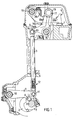
- the valve mechanism illustrated in Figure 1 is fitted to an internal combustion engine, the major parts of which are of conventional construction and are not therefore shown in detail here.
- the valve mechanism is intended to control the movements of a valve 1, of which only a small part of the valve stem is shown.
- the valve mechanism includes a control shaft 2 which is intended to be driven by the engine crank shaft in the same manner as the cam shaft in a valve mechanism of the kind described in the first paragraph of this specification.
- the control shaft 2 drives a push rod 3, in a manner hereinafter described, the lower end of which is coupled to the control shaft 2 and the upper end of which is coupled to a rocker 4.
- the rocker 4 is, in turn, intended to act upon a lifting arm 5, which in turn activates the valve 1.
- control shaft 2 is provided with a crank pin 6 which is connected to a pin 8 on a control arm 9 through the intermediary of a short connecting rod 7.
- One end of the control arm 9 is pivotally mounted on a pin 10 which is fixedly mounted in the engine, whereas the other end of the control arm is pivotally connected to the lower end of the push rod 3 by means of a pin 11.
- a length adjustment means 12 is also located at the lower end of the push rod 3, in the proximity of the pin 11, by means of which the length of the push rod 3 can be adjusted so as to achieve correct functioning of the valve mechanism.
- the upper end of the push rod 3 is pivotally connected to a first arm 14 on the rocker 4 by means of a pin 13.
- the rocker 4 is a double-arm rocker and is journalled on a rocker shaft 15, which is stationarily fitted to the engine.
- the free end of the other rocker arm 16 carries a roller 18 which is journalled for rotation on a pin 17.
- One end of the lifting arm 5 is journalled on a lifting-arm shaft 19, which is fitted stationarily to the engine. As beforementioned, the free end of the lifting arm 5 is intended to act upon the valve 1 when the lifting arm 5 is swung about its shaft 19.
- the upper side of the lifting arm 5 presents a profiled surface 20 which consists of three parts 20a, 20b, 20c of mutually different curvature, as described in more detail hereinafter.
- the profiled surface 20 is intended to co-act with the roller 18 on the rocker 4 so as to produce desired movements of the valve 1.
- the part 20a of the profiled surface is convex and partly cylindrical, and has a radius of curvature such that its centre of curvature coincides essentially with the geometric axis of the rocker shaft 15. This means that when the roller 18 moves over the surface part 20a, in response to rocker movement, the lifting arm 5 is held essentially stationary.
- the surface part 20b adjoins the surface part 20a at the end thereof distal from the lifting arm shaft 19 and has a concave curvature. This means that when the roller 18 moves in over the surface part 20b, the lifting arm will be pressed downwards and will in turn press down the valve 1, causing the valve to open. In this regard, the speed at which the valve is opened, and to which extent, is determined by the diameter of the roller 18 and the curvature of the surface part 20b.
- the surface part 20b is thus curved in the same direction as the peripheral surface of the roller 18, although the radius of curvature of the surface part 20b is larger than the diameter of the roller 18. Because the roller 18 and the surface part 20b are curved in the same direction but have mutually different radii of curvature, it is possible to obtain greater acceleration in valve opening movements than can be obtained with prior art valve mechanisms, without overloading the components.
- This enables the method described in Swedish Patent Application 8503517-8 to be carried out in a particularly simple manner, according to which method the engine exhaust valve is opened a second time during each working cycle of the engine.
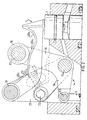
- Figure 2 illustrates a second embodiment of the inventive valve mechanism.
- Those components of the Figure 2 embodiment which find direct correspondence with the Figure 1 embodiment are identified with the same reference numerals, and the lower part of the push rod 3 and the push-rod drive mechanism have been omitted in the Figure 2 illustration.
- the valve mechanism illustrated in Figure 2 operates essentially in the same manner as the valve mechanism illustrated in Figure 1.
- the valve mechanism according to Figure 2 affords a further possibility of adjusting the mutual relationship between the roller 18 on the free end of the other rocker arm 16 and the surface part 20a, 20b and 20c of the profiled surface on the lifting arm 5.
- This further possibility has been provided by mounting the lifting arm shaft 19 of the Figure 2 embodiment on a plate 21 which can be swung around the geometric axis of the rocker shaft 15 and which can be locked firmly in desired positions by means of a lock screw 22.
- a setting screw 23 co-acts with the plate 21, to enable the plate to be adjusted to the position desired.
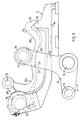
- Figure 3 illustrates a further embodiment of the inventive valve mechanism, wherewith those components which find direct correspondence in the aforedescribed embodiments have been identified with the same reference numerals. Further engine components have been omitted in the Figure 3 embodiment.
- the lifting arm 5 of the Figure 3 embodiment consists of two parts, namely a first part 5a which is journalled on the lifting arm shaft 19 and intended to act on the valve 1, and a second part 5b which is displaceably journalled on the first part 5a and incorporates the profiled surface 20 having the surface parts 20a, 20b and 20c.
- the second part 5b of the lifting arm 5 is provided with a surface 24 which faces the first part 5a and which is part-cylindrical and has a radius such that its centre of curvature coincides essentially with the geometric axis of the rocker shaft 15. As shown in Figure 3, the surface 24 abuts shoulders 25 on the first part 5a of the lifting arm 5.
- the end of the second part 5b facing the lifting arm shaft 19 is provided with a pin 26.
- the lifting arm shaft 19 is also provided with a crankpin 27 and a connecting rod 28 is connected between the crank pin 27 and the pin 26. Rotation of the lifting arm shaft 19 causes the connecting rod 28 to displace the pin 26 axially, under the influence of the crankpin 27, therewith displacing the whole of the second part 5b of the lifting arm 5, this displacement of the lifting arm part 5b being effected through abutment between the surface 24 on the second part 5b and the shoulders 25 on the first part 5a.
- valve mechanism also enables the valve to be opened very rapidly, without the surface pressures between mutually co-acting component parts becoming too high. Because movements of the rocker are guided positively in both directions of movement, the mass of those component parts which are accelerated with the aid of valve springs when closing the valve is also reduced in comparison with the case in prior art valve mechanisms of this kind.
- these component parts namely comprise solely the valve 1 and the lifting arm 5.
Landscapes
- Engineering & Computer Science (AREA)
- Mechanical Engineering (AREA)
- General Engineering & Computer Science (AREA)
- Valve Device For Special Equipments (AREA)
- Valve-Gear Or Valve Arrangements (AREA)
Claims (8)
Priority Applications (1)
| Application Number | Priority Date | Filing Date | Title |
|---|---|---|---|
| AT88850040T ATE71184T1 (de) | 1987-02-26 | 1988-02-02 | Ventilsteuerungsmechanismus fuer eine brennkraftmaschine. |
Applications Claiming Priority (2)
| Application Number | Priority Date | Filing Date | Title |
|---|---|---|---|
| SE8700820 | 1987-02-26 | ||
| SE8700820A SE464367B (sv) | 1987-02-26 | 1987-02-26 | Ventilmekanism foer styrning av en tallriksventil |
Publications (2)
| Publication Number | Publication Date |
|---|---|
| EP0280667A1 EP0280667A1 (de) | 1988-08-31 |
| EP0280667B1 true EP0280667B1 (de) | 1992-01-02 |
Family
ID=20367686
Family Applications (1)
| Application Number | Title | Priority Date | Filing Date |
|---|---|---|---|
| EP88850040A Expired - Lifetime EP0280667B1 (de) | 1987-02-26 | 1988-02-02 | Ventilsteuerungsmechanismus für eine Brennkraftmaschine |
Country Status (6)
| Country | Link |
|---|---|
| US (1) | US4829949A (de) |
| EP (1) | EP0280667B1 (de) |
| JP (1) | JPS63230915A (de) |
| AT (1) | ATE71184T1 (de) |
| DE (1) | DE3867255D1 (de) |
| SE (1) | SE464367B (de) |
Families Citing this family (14)
| Publication number | Priority date | Publication date | Assignee | Title |
|---|---|---|---|---|
| GB2214570A (en) * | 1988-01-22 | 1989-09-06 | Ford Motor Co | Variable lift i.c. engine valves |
| JPH0830403B2 (ja) * | 1989-12-21 | 1996-03-27 | 卓也 松本 | エンジンのバルブ駆動装置 |
| US5093974A (en) * | 1990-04-12 | 1992-03-10 | United Engineering Inc. | Bendable sleeved roll |
| GB9320204D0 (en) * | 1993-09-30 | 1993-11-17 | Lotus Car | Valve operating mechanism for internal combustion engines |
| US5791306A (en) * | 1997-08-13 | 1998-08-11 | Caterpillar Inc. | Internal combustion engine speed-throttle control |
| US6644255B1 (en) * | 1999-10-15 | 2003-11-11 | Vee Two Ptd Ltd. | Guide plate for a poppet valve |
| US6505591B1 (en) * | 2001-07-27 | 2003-01-14 | General Motors Corporation | Valve train with assembly guides |
| GB0200935D0 (en) * | 2002-01-16 | 2002-03-06 | Lotus Car | Valve operating mechanisms |
| US6736096B2 (en) * | 2002-02-21 | 2004-05-18 | Delphi Technologies, Inc. | Method and apparatus for setting valve lift within a cylinder |
| DE10312962A1 (de) * | 2003-03-24 | 2004-10-21 | Thyssen Krupp Automotive Ag | Vorrichtung zur Betätigung von Ladungswechselventilen in Hubkolbenmotoren |
| DE10342075A1 (de) * | 2003-09-10 | 2005-06-16 | Rolf Jung | Vollvariable Hubventilsteuerung einer Brennkraftmaschine |
| JP4254582B2 (ja) * | 2004-03-12 | 2009-04-15 | 日産自動車株式会社 | 内燃機関のバルブリフト量調整機構および調整方法 |
| EP1712747A1 (de) * | 2005-04-17 | 2006-10-18 | Uwe Eisenbeis | Ventiltrieb mit variablem Ventilhub und Steuerzeiten für hochdrehende Verbrennungsmotoren |
| US10125642B1 (en) * | 2016-10-06 | 2018-11-13 | Competition Cams, Inc. | Length adjustable pushrod device for internal combustion engines |
Family Cites Families (7)
| Publication number | Priority date | Publication date | Assignee | Title |
|---|---|---|---|---|
| US1741677A (en) * | 1927-02-24 | 1929-12-31 | Harold F Pitcairn | Valve-adjusting means for internal-combustion engines |
| GB306212A (en) * | 1927-11-30 | 1929-02-21 | Cyril Joseph Bamford | Improvements in internal combustion engines |
| US2954017A (en) * | 1958-03-29 | 1960-09-27 | Porsche Kg | Valve control arrangement for internal combustion engines |
| GB1299673A (en) * | 1969-02-13 | 1972-12-13 | Fiat Spa | Improvements relating to valve actuating mechanisms for internal combustion engines |
| DD155634A1 (de) * | 1980-12-22 | 1982-06-23 | Erich Henker | Ventilsteuerung der gattung koppelrastgetriebe fuer brennkraftmaschinen |
| DE3203791A1 (de) * | 1982-02-04 | 1983-08-11 | Volkswagenwerk Ag, 3180 Wolfsburg | Ventiltrieb, insbesondere fuer eine kraftfahrzeug-brennkraftmaschine |
| US4638773A (en) * | 1986-02-28 | 1987-01-27 | General Motors Corporation | Variable valve lift/timing mechanism |
-
1987
- 1987-02-26 SE SE8700820A patent/SE464367B/sv not_active IP Right Cessation
-
1988
- 1988-02-02 DE DE8888850040T patent/DE3867255D1/de not_active Expired - Lifetime
- 1988-02-02 EP EP88850040A patent/EP0280667B1/de not_active Expired - Lifetime
- 1988-02-02 AT AT88850040T patent/ATE71184T1/de not_active IP Right Cessation
- 1988-02-08 US US07/153,717 patent/US4829949A/en not_active Expired - Lifetime
- 1988-02-26 JP JP63044095A patent/JPS63230915A/ja active Pending
Also Published As
| Publication number | Publication date |
|---|---|
| ATE71184T1 (de) | 1992-01-15 |
| SE464367B (sv) | 1991-04-15 |
| SE8700820D0 (sv) | 1987-02-26 |
| SE8700820L (sv) | 1988-08-27 |
| US4829949A (en) | 1989-05-16 |
| DE3867255D1 (de) | 1992-02-13 |
| EP0280667A1 (de) | 1988-08-31 |
| JPS63230915A (ja) | 1988-09-27 |
Similar Documents
| Publication | Publication Date | Title |
|---|---|---|
| US4829949A (en) | Valve mechanism for an internal combustion engine | |
| US7624711B2 (en) | Variable mechanical valve control for an internal combustion engine | |
| JP2814613B2 (ja) | エンジンの弁作動装置 | |
| US6422187B2 (en) | Variable valve mechanism having an eccentric-driven frame | |
| US5732669A (en) | Valve control for an internal combustion engine | |
| EP0963508B1 (de) | Stellvorrichtung für ventile | |
| KR20050016757A (ko) | 내연 기관의 밸브 작동 장치 | |
| EP0601570A1 (de) | Ventiltrieb für Brennkraftmaschine | |
| EP0434331A1 (de) | Ventilsteueranordnung für eine Brennkraftmaschine | |
| KR101585490B1 (ko) | 가변동 밸브 기구 | |
| WO1995009298A1 (en) | Valve operating mechanism for internal combustion engines | |
| EP1669559B1 (de) | Ventiltriebmechanismus | |
| EP1697619B1 (de) | Verstellbare ventilsteuerung | |
| US6736095B2 (en) | Extended duration cam lobe for variable valve actuation mechanism | |
| CA1056241A (en) | Adjustable cam system for internal combustion engine | |
| EP0397776B1 (de) | Einrichtung zum variablen ventilhub | |
| JPH09256827A (ja) | エンジンの動弁装置 | |
| EP0125096A3 (de) | Mechanismus für das wechselnde Regeln eines Brennkraftmaschinenventils | |
| JPH09195735A (ja) | 往復直線運動用機械装置 | |
| SU1180603A1 (ru) | Устройство дл преобразовани вращательного движени в возвратно-поступательное с регулируемым ходом | |
| SU1574872A1 (ru) | Механизм газораспределени двигател внутреннего сгорани с регулируемыми фазами | |
| KR100245878B1 (ko) | 엔진의 가변 밸브 리프트 장치 | |
| JPH02221612A (ja) | 内燃機関の可変動弁装置 | |
| US4862842A (en) | Arrangements for converting rotary motion into linear motion | |
| GB2082266A (en) | Driving mechanism for fuel injection pumps |
Legal Events
| Date | Code | Title | Description |
|---|---|---|---|
| PUAI | Public reference made under article 153(3) epc to a published international application that has entered the european phase |
Free format text: ORIGINAL CODE: 0009012 |
|
| AK | Designated contracting states |
Kind code of ref document: A1 Designated state(s): AT BE CH DE ES FR GB IT LI NL SE |
|
| 17P | Request for examination filed |
Effective date: 19890223 |
|
| 17Q | First examination report despatched |
Effective date: 19900403 |
|
| GRAA | (expected) grant |
Free format text: ORIGINAL CODE: 0009210 |
|
| ITF | It: translation for a ep patent filed | ||
| AK | Designated contracting states |
Kind code of ref document: B1 Designated state(s): AT BE CH DE ES FR GB IT LI NL SE |
|
| PG25 | Lapsed in a contracting state [announced via postgrant information from national office to epo] |
Ref country code: NL Effective date: 19920102 Ref country code: AT Effective date: 19920102 Ref country code: BE Effective date: 19920102 Ref country code: CH Effective date: 19920102 Ref country code: ES Free format text: THE PATENT HAS BEEN ANNULLED BY A DECISION OF A NATIONAL AUTHORITY Effective date: 19920102 Ref country code: SE Effective date: 19920102 Ref country code: LI Effective date: 19920102 |
|
| REF | Corresponds to: |
Ref document number: 71184 Country of ref document: AT Date of ref document: 19920115 Kind code of ref document: T |
|
| REF | Corresponds to: |
Ref document number: 3867255 Country of ref document: DE Date of ref document: 19920213 |
|
| ET | Fr: translation filed | ||
| REG | Reference to a national code |
Ref country code: CH Ref legal event code: PL |
|
| NLV1 | Nl: lapsed or annulled due to failure to fulfill the requirements of art. 29p and 29m of the patents act | ||
| PLBE | No opposition filed within time limit |
Free format text: ORIGINAL CODE: 0009261 |
|
| STAA | Information on the status of an ep patent application or granted ep patent |
Free format text: STATUS: NO OPPOSITION FILED WITHIN TIME LIMIT |
|
| 26N | No opposition filed | ||
| REG | Reference to a national code |
Ref country code: GB Ref legal event code: IF02 |
|
| PGFP | Annual fee paid to national office [announced via postgrant information from national office to epo] |
Ref country code: DE Payment date: 20070125 Year of fee payment: 20 |
|
| PGFP | Annual fee paid to national office [announced via postgrant information from national office to epo] |
Ref country code: GB Payment date: 20070131 Year of fee payment: 20 |
|
| PGFP | Annual fee paid to national office [announced via postgrant information from national office to epo] |
Ref country code: IT Payment date: 20070625 Year of fee payment: 20 |
|
| REG | Reference to a national code |
Ref country code: GB Ref legal event code: PE20 |
|
| PGFP | Annual fee paid to national office [announced via postgrant information from national office to epo] |
Ref country code: FR Payment date: 20070208 Year of fee payment: 20 |
|
| PG25 | Lapsed in a contracting state [announced via postgrant information from national office to epo] |
Ref country code: GB Free format text: LAPSE BECAUSE OF EXPIRATION OF PROTECTION Effective date: 20080201 |