EP0276432A2 - Schädlingsbekämpfungsmittel - Google Patents
Schädlingsbekämpfungsmittel Download PDFInfo
- Publication number
- EP0276432A2 EP0276432A2 EP87118250A EP87118250A EP0276432A2 EP 0276432 A2 EP0276432 A2 EP 0276432A2 EP 87118250 A EP87118250 A EP 87118250A EP 87118250 A EP87118250 A EP 87118250A EP 0276432 A2 EP0276432 A2 EP 0276432A2
- Authority
- EP
- European Patent Office
- Prior art keywords
- alkyl
- aryl
- phenyl
- formula
- trifluoromethyl
- Prior art date
- Legal status (The legal status is an assumption and is not a legal conclusion. Google has not performed a legal analysis and makes no representation as to the accuracy of the status listed.)
- Withdrawn
Links
- 0 C*1=C**=*1 Chemical compound C*1=C**=*1 0.000 description 2
Classifications
-
- C—CHEMISTRY; METALLURGY
- C07—ORGANIC CHEMISTRY
- C07D—HETEROCYCLIC COMPOUNDS
- C07D271/00—Heterocyclic compounds containing five-membered rings having two nitrogen atoms and one oxygen atom as the only ring hetero atoms
- C07D271/02—Heterocyclic compounds containing five-membered rings having two nitrogen atoms and one oxygen atom as the only ring hetero atoms not condensed with other rings
- C07D271/06—1,2,4-Oxadiazoles; Hydrogenated 1,2,4-oxadiazoles
-
- A—HUMAN NECESSITIES
- A01—AGRICULTURE; FORESTRY; ANIMAL HUSBANDRY; HUNTING; TRAPPING; FISHING
- A01N—PRESERVATION OF BODIES OF HUMANS OR ANIMALS OR PLANTS OR PARTS THEREOF; BIOCIDES, e.g. AS DISINFECTANTS, AS PESTICIDES OR AS HERBICIDES; PEST REPELLANTS OR ATTRACTANTS; PLANT GROWTH REGULATORS
- A01N43/00—Biocides, pest repellants or attractants, or plant growth regulators containing heterocyclic compounds
- A01N43/72—Biocides, pest repellants or attractants, or plant growth regulators containing heterocyclic compounds having rings with nitrogen atoms and oxygen or sulfur atoms as ring hetero atoms
- A01N43/82—Biocides, pest repellants or attractants, or plant growth regulators containing heterocyclic compounds having rings with nitrogen atoms and oxygen or sulfur atoms as ring hetero atoms five-membered rings with three ring hetero atoms
-
- A—HUMAN NECESSITIES
- A01—AGRICULTURE; FORESTRY; ANIMAL HUSBANDRY; HUNTING; TRAPPING; FISHING
- A01N—PRESERVATION OF BODIES OF HUMANS OR ANIMALS OR PLANTS OR PARTS THEREOF; BIOCIDES, e.g. AS DISINFECTANTS, AS PESTICIDES OR AS HERBICIDES; PEST REPELLANTS OR ATTRACTANTS; PLANT GROWTH REGULATORS
- A01N47/00—Biocides, pest repellants or attractants, or plant growth regulators containing organic compounds containing a carbon atom not being member of a ring and having no bond to a carbon or hydrogen atom, e.g. derivatives of carbonic acid
- A01N47/02—Biocides, pest repellants or attractants, or plant growth regulators containing organic compounds containing a carbon atom not being member of a ring and having no bond to a carbon or hydrogen atom, e.g. derivatives of carbonic acid the carbon atom having no bond to a nitrogen atom
- A01N47/06—Biocides, pest repellants or attractants, or plant growth regulators containing organic compounds containing a carbon atom not being member of a ring and having no bond to a carbon or hydrogen atom, e.g. derivatives of carbonic acid the carbon atom having no bond to a nitrogen atom containing —O—CO—O— groups; Thio analogues thereof
-
- A—HUMAN NECESSITIES
- A01—AGRICULTURE; FORESTRY; ANIMAL HUSBANDRY; HUNTING; TRAPPING; FISHING
- A01N—PRESERVATION OF BODIES OF HUMANS OR ANIMALS OR PLANTS OR PARTS THEREOF; BIOCIDES, e.g. AS DISINFECTANTS, AS PESTICIDES OR AS HERBICIDES; PEST REPELLANTS OR ATTRACTANTS; PLANT GROWTH REGULATORS
- A01N47/00—Biocides, pest repellants or attractants, or plant growth regulators containing organic compounds containing a carbon atom not being member of a ring and having no bond to a carbon or hydrogen atom, e.g. derivatives of carbonic acid
- A01N47/08—Biocides, pest repellants or attractants, or plant growth regulators containing organic compounds containing a carbon atom not being member of a ring and having no bond to a carbon or hydrogen atom, e.g. derivatives of carbonic acid the carbon atom having one or more single bonds to nitrogen atoms
- A01N47/10—Carbamic acid derivatives, i.e. containing the group —O—CO—N<; Thio analogues thereof
- A01N47/20—N-Aryl derivatives thereof
-
- A—HUMAN NECESSITIES
- A01—AGRICULTURE; FORESTRY; ANIMAL HUSBANDRY; HUNTING; TRAPPING; FISHING
- A01N—PRESERVATION OF BODIES OF HUMANS OR ANIMALS OR PLANTS OR PARTS THEREOF; BIOCIDES, e.g. AS DISINFECTANTS, AS PESTICIDES OR AS HERBICIDES; PEST REPELLANTS OR ATTRACTANTS; PLANT GROWTH REGULATORS
- A01N47/00—Biocides, pest repellants or attractants, or plant growth regulators containing organic compounds containing a carbon atom not being member of a ring and having no bond to a carbon or hydrogen atom, e.g. derivatives of carbonic acid
- A01N47/08—Biocides, pest repellants or attractants, or plant growth regulators containing organic compounds containing a carbon atom not being member of a ring and having no bond to a carbon or hydrogen atom, e.g. derivatives of carbonic acid the carbon atom having one or more single bonds to nitrogen atoms
- A01N47/10—Carbamic acid derivatives, i.e. containing the group —O—CO—N<; Thio analogues thereof
- A01N47/22—O-Aryl or S-Aryl esters thereof
-
- A—HUMAN NECESSITIES
- A01—AGRICULTURE; FORESTRY; ANIMAL HUSBANDRY; HUNTING; TRAPPING; FISHING
- A01N—PRESERVATION OF BODIES OF HUMANS OR ANIMALS OR PLANTS OR PARTS THEREOF; BIOCIDES, e.g. AS DISINFECTANTS, AS PESTICIDES OR AS HERBICIDES; PEST REPELLANTS OR ATTRACTANTS; PLANT GROWTH REGULATORS
- A01N47/00—Biocides, pest repellants or attractants, or plant growth regulators containing organic compounds containing a carbon atom not being member of a ring and having no bond to a carbon or hydrogen atom, e.g. derivatives of carbonic acid
- A01N47/08—Biocides, pest repellants or attractants, or plant growth regulators containing organic compounds containing a carbon atom not being member of a ring and having no bond to a carbon or hydrogen atom, e.g. derivatives of carbonic acid the carbon atom having one or more single bonds to nitrogen atoms
- A01N47/28—Ureas or thioureas containing the groups >N—CO—N< or >N—CS—N<
- A01N47/30—Derivatives containing the group >N—CO—N aryl or >N—CS—N—aryl
Definitions
- the present invention relates to new 3-phenyl-5-trifluoromethyl-1,2,4-oxadiazole derivatives and pesticides which contain at least one compound of the formula I below or an acid addition compound thereof as active ingredient, the preparation of these compounds or the compositions containing them and methods for combating pests, in particular combating or preventing infestation of plants by phytopathogenic microorganisms.
- Alkyl itself or as a constituent of another substituent means, depending on the number of carbon atoms indicated, straight-chain or branched-chain groups, for example the following: methyl, ethyl, propyl, butyl, pentyl, hexyl, heptyl, octyl or nonyl to pentadecyl and their isomers such as Isopropyl, isobutyl, tert-butyl, sec-butyl or isopentyl.
- Alkenyl is e.g. for propenyl- (1), allyl, butenyl- (1), butenyl- (2) or butenyl- (3).
- Halogen itself or as part of another substituent means fluorine, chlorine, bromine or iodine, preferably fluorine, chlorine or bromine.
- Aryl means phenyl or naphthyl, preferably phenyl.
- Suitable substituents for aryl are halogen, C 1 -C 4 -alkyl, in particular methyl, or C, -C z -haloalkyl with 1 to 3 halogen, in particular trifluoromethyl.
- salt-forming acids are inorganic acids: hydrohalic acid such as hydrofluoric acid, hydrochloric acid, hydrobromic acid or hydroiodic acid as well as sulfuric acid, phosphoric acid, phosphorous acid, nitric acid and organic acids such as acetic acid, trifluoroacetic acid, trichloroacetic acid, propionic acid, tartaric acid, glycolic acid, benzoic acid, cyanic acid, thiocyanoic acid, thiocyanoic acid , Cinnamic acid, oxalic acid, formic acid, benzenesulfonic acid, p-toluenesulfonic acid, methanesulfonic acid, salicylic acid, p-aminosalicylic acid, 2-phenoxybenzoic acid or 2-acetoxybenzoic acid. These acids are added to the relevant free compounds of formula I by known methods.
- hydrohalic acid such as hydrofluoric acid, hydrochloric acid, hydrobromic acid or hydroio
- the compounds of formula I are stable at room temperature. They can be used preventively and curatively in the agricultural sector or related fields for combating plant-damaging microorganisms.
- the active compounds of the formula I are distinguished in wide use concentrations by a very good fungicidal action and problem-free use.
- the compounds have other pesticidal properties. Thus, they can also be used to control nematodes, in particular nematodes which damage plants, and feeding and sucking insects which damage plants.
- all suitable acid binders can be used as bases, such as amines, in particular tertiary amines, and also alkali and alkaline earth compounds.
- bases such as amines, in particular tertiary amines, and also alkali and alkaline earth compounds.
- bases include the hydroxides, oxides and carbonates of lithium, sodium, potassium, magnesium, calcium and barium, as well as further basic compounds such as trimethylamine, triethylamine, tripropylamine, tributylamine, tribenzylamine, tricyclohexylamine, triamylamine, trihexylamine, N, N-dimethylaniline, N, N-dimethyltoluidine, N, N-dimethyl-p-aminopyridine, N-methylpyrrolidine, N-methylpiperidine, N-methylimidazole, N-methylpyrrole, N-methylmorpholine, N-methylhexamethyleneimine, pyridine, quinoline, al
- reaction temperatures in process variants (1.1) to (1.5) are 0 ° to 180 ° C, preferably 40 ° to 120 ° C, and especially in variant ( 1 1.4) 0 ° to 100 ° C, preferably 20 ° C to 80 ° C, and in the process variants (2.1) to (2.4) 20 ° to 180 ° C, preferably 40 ° to 120 ° C.
- the compounds of the formula I according to the invention and the compositions which contain these compounds as active substances have a microbicide spectrum which is very favorable for practical needs against phytopathogenic fungi and bacteria. They have very advantageous curative, systemic and in particular preventive properties and can be used to protect numerous crop plants.
- the microorganisms occurring on plants or on parts of plants (fruits, flowers, foliage, stems, tubers, roots) of different crops can be contained or destroyed, with the result that parts of plants which grow later are also spared by such microorganisms.
- the active ingredients of the formula I are active against the phytopathogenic fungi belonging to the following classes: fungi imperfecti (e.g. botrytis, helminthosporium, fusarium septoria, cercospora and alternaria); Basidiomycetes (e.g. the genera Hemileia, Rhizoctonia, Puccinia); they also act against the class of Ascomycetes (e.g. Venturia, Podosphaera, Erysiphe, Monilinia, Uncinula).
- the compounds of the formula I have a systemic action. They can also be used as dressing agents for the treatment of seeds (fruits, tubers, grains) and plant cuttings for the protection of fungal infections and against phytopathogenic fungi occurring in the soil.
- the active compounds of the formula I have nematicidal properties, which makes them particularly suitable for controlling plant nematodes.
- the agents according to the invention can be used curatively, preventively or systemically. They develop a wide range of activities against the different nematode species and thus meet the requirements of practice.
- the active compounds according to the invention are distinguished by particularly good plant tolerance, including those which are proposed in DE-OS 28 01 509.
- the invention also relates to the use of the compounds of the formula I for combating phytopathogenic microorganisms, in particular fungi which damage plants, or the preventive prevention of an attack on plants.
- the present invention also includes the production of agrochemicals, which is characterized by the intimate mixing of the active substance with at least one formulation aid described herein. Also included is a process for the treatment of plants which is characterized by the application of the compounds of the formula 1 or the new agents.
- target cultures for the indication areas disclosed herein are, for example: the following types of plants: cereals: (wheat, barley, rye, oats, rice, sorghum and relatives); Beets: (sugar and fodder beets); Pome, stone and soft fruit: (apples, pears, plums, peaches, almonds, cherries, strawberries, raspberries and blackberries); Legumes: (beans, lentils, peas, soy); Oil cultures: (rapeseed, mustard, poppy seeds, olives, sunflowers, coconut, castor bean, cocoa, peanuts); Cucumber Family: (Pumpkin, Cucumber, Melon); Fiber plants: (cotton, flax, hemp, jute); Citrus fruits: (oranges, lemons, grapefruit, mandarins); Vegetables: (spinach, lettuce, asparagus, cabbage, carrots, onions, tomatoes, potatoes, peppers); Laurel plants: (avocado, cinnamonum,
- Active ingredients of the formula are usually used in the form of compositions and can be applied simultaneously or in succession with other active ingredients to the environment of the plant to be treated or to the plant itself.
- These other active ingredients can be both fertilizers, trace element mediators or other preparations which influence plant growth. But it can also be selective herbicides, insecticides. Fungicides, bactericides, nematicides, molluscicides or mixtures of several of these preparations, together with any other carriers, surfactants or other application-promoting additives that are customary in formulation technology.
- Suitable carriers and additives can be solid or liquid and correspond to the substances useful in formulation technology, e.g. natural or regenerated mineral substances, solvents, dispersants, wetting agents, adhesives, thickeners, binders or fertilizers.
- a preferred method for applying an active ingredient of the formula I or an agrochemical composition which contains at least one of these active ingredients is application to the foliage (leaf application).
- the number of applications and the application rate depend on the infestation pressure for the corresponding pathogen (type of fungus).
- the active ingredients of formula I can also get into the plant through the roots through the root system (systemic effect) by soaking the location of the plant with a liquid preparation or introducing the substances in solid form into the soil e.g. in the form of granules (floor application).
- the compounds of the formula I can also be applied to seeds (coating) by either soaking the seeds in a liquid preparation of the active ingredient or coating them with a solid preparation.
- other types of application are possible in special cases, e.g. the targeted treatment of plant stems or buds.
- the compounds of the formula I are used in unchanged form or preferably together with the auxiliaries customary in formulation technology and are therefore, for example to emulsion concentrates, spreadable pastes, directly sprayable or dilutable solutions, diluted emulsions, wettable powders, soluble powders. Dusts, granules, by encapsulation in e.g. polymeric materials processed in a known manner.
- the methods of application such as spraying, atomizing, dusting, scattering, brushing or pouring are selected in the same way as the type of agent, in accordance with the desired objectives and the given conditions.
- Favorable application rates are generally 50 g to 5 kg of active substance (AS) per ha; preferably 100 g to 2 kg ai / ha, in particular 100 g to 600 g ai / ha.
- the formulations i.e. the agents, preparations or compositions containing the active ingredient of formula I and optionally a solid or liquid additive are prepared in a known manner, e.g. by intimately mixing and / or grinding the active ingredients with extenders, e.g. with solvents, solid carriers, and optionally surface-active compounds (surfactants).
- extenders e.g. with solvents, solid carriers, and optionally surface-active compounds (surfactants).
- Possible solvents are: aromatic hydrocarbons, preferably the fractions C 1 to C ' 2 ' such as xylene mixtures or substituted naphthalenes, phthalic acid esters such as dibutyl or dioctyl phthalate, aliphatic hydrocarbons such as cyclohexane or paraffins, alcohols and glycols and their ethers and esters, such as ethanol, ethylene glycol, ethylene glycol manomethyl or ethyl ether, ketones such as cyclohexanone, strongly polar solvents such as N-methyl-2-pyrrolidone, dimethyl sulfoxide or dimethylformamide, and optionally epoxidized vegetable oils such as epoxidized coconut oil or soybean oil; or water.
- aromatic hydrocarbons preferably the fractions C 1 to C ' 2 ' such as xylene mixtures or substituted naphthalenes
- phthalic acid esters such as dibutyl or dioct
- solid carriers e.g. for dusting agents and dispersible powders
- natural rock powders such as calcite, talc, kaolin, montmorillonite or attapulgite.
- highly disperse silica or highly disperse absorbent polymer can also be added.
- adsorptive granulate carriers come porous types such as Pumice stone, broken brick, sepiolite or bentonite, as non-sorptive carrier materials e.g. Calcite or sand in question.
- a large number of pregranulated materials of inorganic or organic nature such as, in particular, dolomite or comminuted plant residues can be used.
- suitable surface-active compounds are nonionic, cationic and / or anionic surfactants with good emulsifying, dispersing and wetting properties.
- surfactants are also to be understood as mixtures of surfactants.
- Suitable anionic surfactants can be both so-called water-soluble soaps and water-soluble synthetic surface-active compounds.
- the soaps are the alkali, alkaline earth or optionally substituted ammonium salts of higher fatty acids (C, ä-C, 2), e.g. the Na or K salts of oleic or stearic acid, or of natural fatty acid mixtures, e.g. can be obtained from coconut or tallow oil.
- the fatty acid methyl laurine salts should also be mentioned.
- the fatty alcohol sulfonates or sulfates are generally present as alkali, alkaline earth or optionally substituted ammonium salts and have an alkyl radical with 8 to 22 carbon atoms, alkyl also including the alkyl part of acyl radicals, e.g. The Na or Ca salt of lignin sulfonic acid, dodecylsulfuric acid ester or a fatty alcohol sulfate mixture made from natural fatty acids.
- This subheading also includes the salts of sulfuric acid esters and sulfonic acids from fatty alcohol-ethylene oxide adducts.
- the sulfonated benzimidazole derivatives preferably contain 2-sulfonic acid groups and a fatty acid residue with 8-22 carbon atoms.
- Alkylarylsulfonates are e.g. the sodium, calcium or triethanolamine salts of dodecylbenzenesulfonic acid, dibutylnaphthalenesulfonic acid, or a naphthalenesulfonic acid-formaldehyde condensation product.
- Corresponding phosphates such as e.g. Salts of the phosphoric acid ester of a p-nonylphenol (4-14) ethylene oxide adduct in question.
- Suitable nonionic surfactants are primarily polyglycol ether derivatives of aliphatic or cycloaliphatic alcohols, saturated or unsaturated fatty acids and alkylphenols, which can contain 3 to 30 glycol ether groups and 8 to 20 carbon atoms in the (aliphatic) hydrocarbon radical and 6 to 18 carbon atoms in the alkyl radical of the alkylphenols.
- nonionic surfactants are the water-soluble polyethylene oxide adducts containing 20 to 250 ethylene glycol ether groups and 10 to 100 propylene glycol ether groups with polypropylene glycol, ethylenediaminopolypropylene glycol and alkylpolypropylene glycol with 1 to 10 carbon atoms in the alkyl chain.
- the compounds mentioned usually contain 1 to 5 ethylene glycol units per propylene glycol unit.
- nonionic surfactants are nonylphenol polyethoxyethanols, castor oil polyglycol ethers, polypropylene-polyethylene oxide adducts, tributylphenoxypolyethyleneethanol, polyethylene glycol and octylphenoxypolyethoxyethanol.
- Fatty acid esters of polyoxyethylene sorbitan such as polyoxyethylene sorbitan trioleate, are also suitable.
- the cationic surfactants are primarily quaternary ammonium salts which contain at least one alkyl radical having 8 to 22 carbon atoms as N substituents and have low, optionally halogenated alkyl, benzyl or low hydroxyalkyl radicals as further substituents.
- the salts are preferably in the form of halides, methyl sulfates or ethyl sulfates, e.g. the stearyltrimethylammonium chloride or the benzyldi (2-chloroethyl) ethylammonium bromide.
- the agrochemical preparations generally contain 0.1 to 99% by weight, in particular 0.1 to 95% by weight, of active compound of the formula I, 99.9 to 1% by weight, in particular 99.8 to 5% by weight. -%, a solid or liquid additive and 0 to 25 wt .-%, in particular 0.1 to 25 wt .-%, of a surfactant.
- the agents can also contain other additives such as stabilizers, defoamers, viscosity regulators, binders, adhesives and fertilizers or other active ingredients to achieve special effects.
- Such agrochemicals are part of the present invention.
- the active ingredient is mixed well with the additives and ground well in a suitable mill.
- Spray powder is obtained which can be diluted with water to form suspensions of any desired concentration.
- Emulsions of any desired concentration can be prepared from this concentrate by dilution with water.
- Ready-to-use dusts are obtained by mixing the active ingredient with the carrier and grinding it in a suitable mill.
- the active ingredient is mixed with the additives, ground and moistened with water. This
- the mixture is extruded and then dried in an air stream.
- the finely ground active ingredient is applied evenly in a mixer to the kaolin moistened with polyethylene glycol. In this way, dust-free coating granules are obtained.
- the finely ground active ingredient is intimately mixed with the additives. This gives a suspension concentrate from which suspensions of any desired concentration can be prepared by dilution with water.
- Emulsions of any desired concentration can be prepared from such concentrates by dilution with water.
- the solutions are suitable for use in the form of tiny drops.
- the active ingredient is dissolved in methylene chloride, sprayed onto the carrier and the solvent is then evaporated off in vacuo.
- Ready-to-use dusts are obtained by intimately mixing carrier substances with the active ingredient.
- Example 3 1: Action against Puccinia graminis on wheat
- Wheat plants are sprayed 6 days after sowing with a spray mixture (0.006% active substance) prepared from wettable powder of the active ingredient. After 24 hours, the treated plants are infected with a uredospore suspension of the fungus. After incubation for 48 hours at 95-100% relative humidity and approx. 20 ° C, the infected plants are placed in a greenhouse at approx. 22 ° C. The rust pustule development is assessed 12 days after infection.
- a spray mixture 0.006% active substance
- a spray liquor prepared from wettable powder of the active ingredient is poured into wheat plants 5 days after sowing (0.02% of active ingredient based on the volume of the soil). After 48 hours, the treated plants are infected with a uredospore suspension of the fungus. After incubation for 48 hours at 95-100% relative humidity and approx. 20 ° C, the infected plants are grown in set up in a greenhouse at approx. 22 ° C. The rust pustule development is assessed 12 days after infection.
- 10-15 cm high peanut plants are sprayed with a spray mixture (0.02% active substance) made from wettable powder of the active substance and infected 48 hours later with a conidia suspension of the fungus.
- the infected plants are incubated for 72 hours at approx. 21 ° C and high atmospheric humidity and then placed in a greenhouse until the typical leaf spots appear.
- the fungicidal activity is assessed 12 days after infection based on the number and size of the spots that appear.
- Barley plants 8 cm high are sprayed with a spray mixture (0.006% active substance) made from wettable powder of the active ingredient. After 3-4 hours, the treated plants are dusted with conidia of the fungus. The infected barley plants are placed in a greenhouse at approx. 22 ° C and the fungal attack is assessed after 10 days.
Landscapes
- Life Sciences & Earth Sciences (AREA)
- Agronomy & Crop Science (AREA)
- Pest Control & Pesticides (AREA)
- Plant Pathology (AREA)
- Health & Medical Sciences (AREA)
- Engineering & Computer Science (AREA)
- Dentistry (AREA)
- General Health & Medical Sciences (AREA)
- Wood Science & Technology (AREA)
- Zoology (AREA)
- Environmental Sciences (AREA)
- Chemical & Material Sciences (AREA)
- Organic Chemistry (AREA)
- Heterocyclic Carbon Compounds Containing A Hetero Ring Having Nitrogen And Oxygen As The Only Ring Hetero Atoms (AREA)
- Agricultural Chemicals And Associated Chemicals (AREA)
- Pyridine Compounds (AREA)
Abstract
- R' Wasserstoff, C1-C4-Alkyl, Aryl, substituiertes Aryl, C(X)NRt'(R2'), C(O)XR3' oder COR3';
- R,' C1-C9-Alkyl, C1-C4-Alkoxy, C2-C4-Alkenyl, Aryl oder substituiertes Aryl;
- R2' Wasserstoff oder C1-C4-Alkyl;
- R3' C,-C,s-Alkyl, C2-C4-Alkoxy oder Aryl;
- R4 Halogen, C1-C4-Alkoxy oder Nitro; und
- n 0, 1 oder 2;
- X Sauerstoff oder Schwefel;
- R" C(O)NR"(R2"), C(S)NR1"(R2"), COOR3", COSR3" oder COR3";
- R1" C1-C4-Alkyl, C1-C4-Alkoxy oder Aryl;
- R2" Wasserstoff oder C1-C4-Alkyl und
- R3" C1-C9-Alkyl, C1-C4-Haloalkyl, C3-C4-Alkenyl oder Aryl; einschliesslich ihrer Säureadditionssalze
Description
- Die vorliegende Erfindung betrifft neue 3-Phenyl-5-trifluormethyl-1,2,4-oxadiazol-Derivate und Schädlingsbekämpfungsmittel, die als Wirkstoff mindestens eine Verbindung der nachstehenden Formel I oder eine Säureadditionsverbindung davon enthalten, die Herstellung dieser Verbindungen oder der sie enthaltenden Mittel sowie Verfahren zur Bekämpfung von Schädlingen, insbesondere die Bekämpfung oder Verhütung des Befalls von Pflazne durch phytopathogene Mikroorganismen.
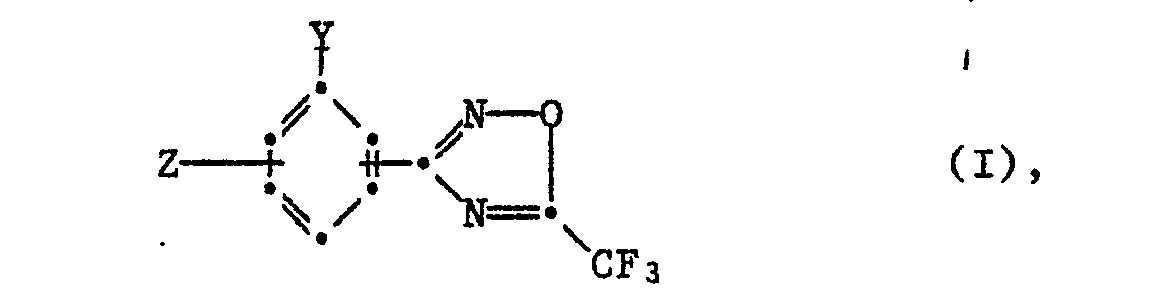
- Die Wirkstoffe entsprechen der Formel I


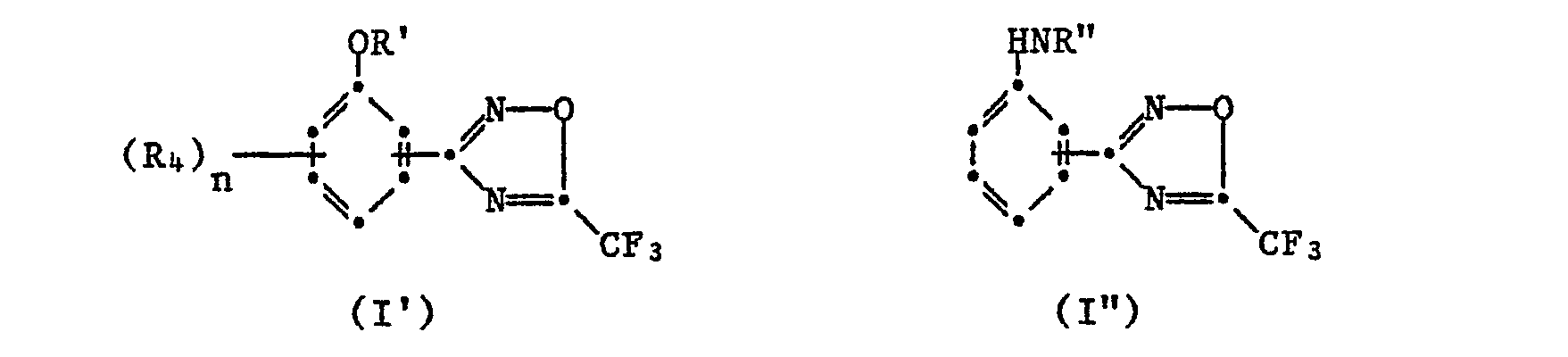
- R' Wasserstoff, C,-C.-Alkyl, Aryl, substituiertes Aryl, C(X)NR1'(R2'), C(O)XR3' oder COR3'; R,' C1-C9-Alkyl, C1-C4-Alkoxy, C2-C4-Alkenyl, Aryl oder substituiertes Aryl;
- R2' Wasserstoff oder C1-C4-Alkyl;
- R3' C1-C15 Alkyl, C2-C4-Alkoxy oder Aryl;
- R4 Halogen, C1-C4-Alkoxy oder Nitro; und
- n 0, 1 oder 2;
- X Sauerstoff oder Schwefel;
- R" C(O)NR1"(R2"), C(S)NR1"(R2"), COOR3", COSR3" oder COR3";
- R," C1-C4-Alkyl, C1-C4-Alkoxy oder Aryl;
- R2" Wasserstoff oder C1-C4-Alkyl und
- R3" C1-C9 Alkyl, C1-C4-Haloalkyl, C3-C4-Alkenyl oder Aryl; einschliesslich ihrer Säureadditionssalze.
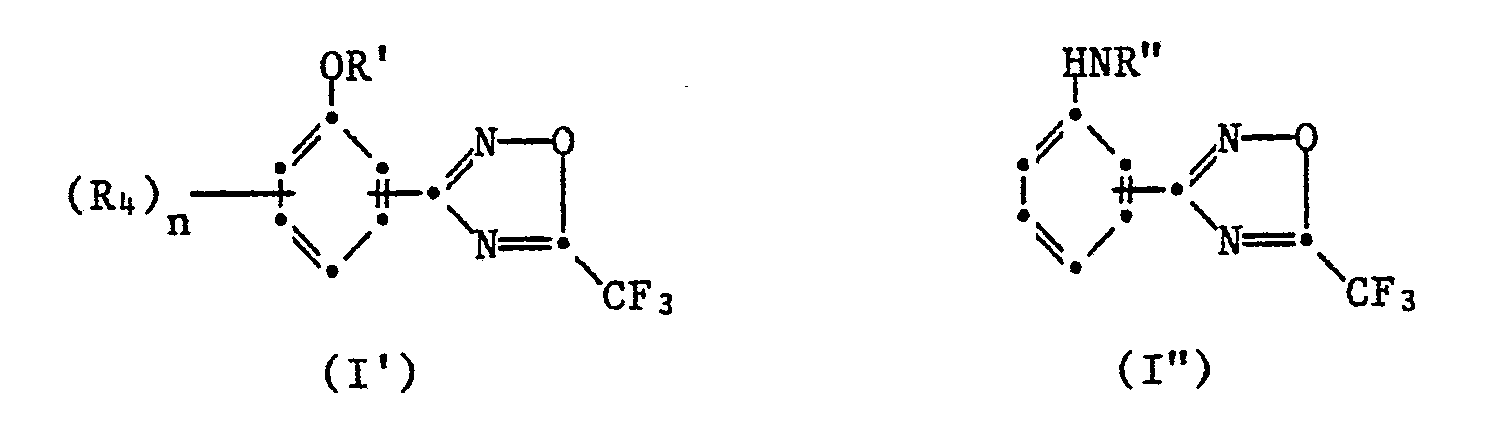
- Verbindungen der Formel I' sind neu und Verbingungen der Formel I" sind teilweise neu.
- Verbindungen der Formel la' stellen eine bevorzugte Gruppe dar:

- in welcher
- R' für Wasserstoff, C,-C.-Alkyl, Aryl, substituiertes Aryl,
- C(X)NR1'(R2'), C(O)XR3' oder COR3' steht;
- R1' C1-C9-Alkyl, C1-C4-Alkoxy, C2-C4-Alkenyl, Aryl oder substituiertes Aryl;
- R2' Wasserstoff oder C1-C4-Alkyl;
- R3' C,-C,s-Alkyl, C2-C4-Alkenyl oder Aryl und
- X Sauerstoff oder Schwefel darstellt, einschliesslich ihrer Säureadditionsalze.
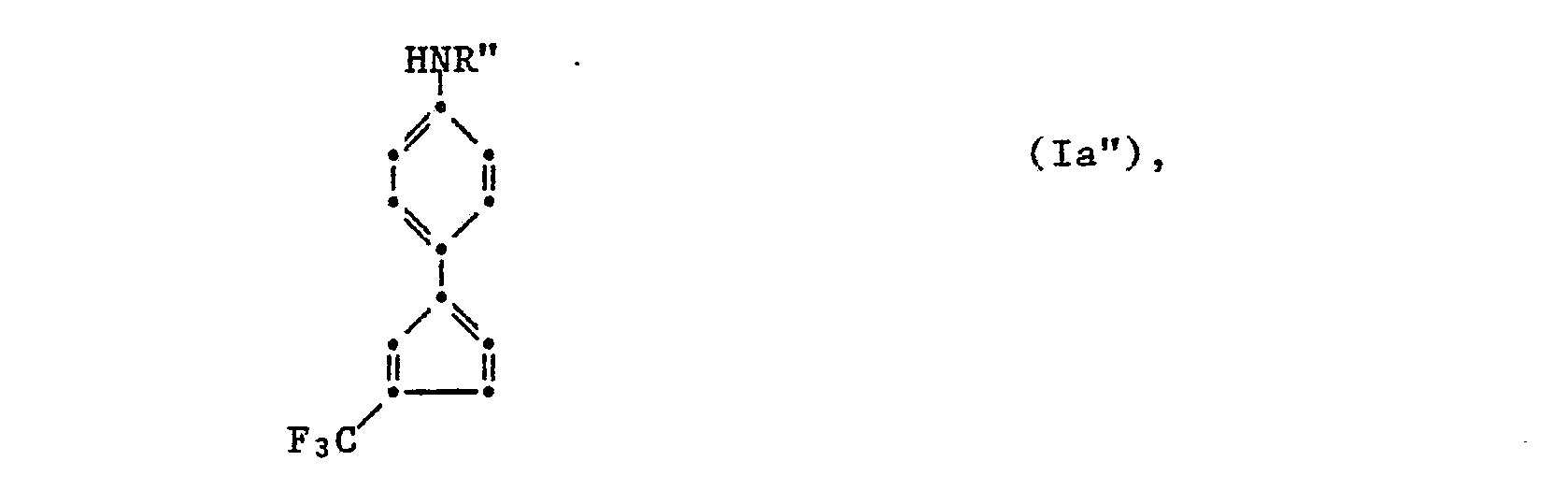
- Eine weitere Gruppe stellen Verbindungen der Formel I' dar, in welcher n 1 oder 2 bedeutet. Verbindungen der Formel I", bei denen der Rest

- Unter Alkyl selbst oder als Bestandteil eines anderen Substituenten sind je nach Zahl der angegebenen Kohlenstoffatome gerad-oder verzweigtkettige Gruppen, beispielsweise folgende, zu verstehen: Methyl, Ethyl, Propyl, Butyl, Pentyl, Hexyl, Heptyl, Octyl oder Nonyl bis Pentadecyl sowie ihre Isomeren wie z.B. Isopropyl, Isobutyl, tert.-Butyl, sek.-Butyl oder Isopentyl.
- Alkenyl steht z.B. für Propenyl-(1), Allyl, Butenyl-(1), Butenyl-(2) oder Butenyl-(3).
- Halogen selbst oder als Bestandteil eines anderen Substituenten bedeutet Fluor, Chlor, Brom oder Jod, vorzugsweise Fluor, Chlor oder Brom.
- Unter Aryl sind Phenyl oder Naphthyl, vorzugsweise Phenyl, zu verstehen. Als Substituenten des Aryl kommen in Frage Halogen, C1-C4-Alkyl, insbesondere Methyl, oder C,-Cz-Haloalkyl mit 1 bis 3 Halogen, insbesondere Trifluormethyl.
- Als Salzbildner mit Verbindungen der Formel I kommen alle organischen und anorganischen Säuren in Frage soweit sie pflanzenphysiologisch verträgliche Salze bilden.
- Beispiele salzbildender Säuren sind anorganische Säuren: Halogenwasserstoffsäure wie Fluorwasserstoffsäure, Chlorwasserstoffsäure, Bromwasserstoffsäure oder Jodwasserstoffsäure sowie Schwefelsäure, Phosphorsäure, Phosphorige Säure, Salpetersäure und organische Säuren wie Essigsäure, Trifluoressigsäure, Trichloressigsäure, Propionsäure, Weinsäure, Glykolsäure, Thiocyansäure, Milchsäure, Bernsteinsäure, Zitronesäure, Benzoesäure, Zimtsäure, Oxalsäure, Ameisensäure, Benzolsulfonsäure, p-Toluolsulfonsäure, Methansulfonsäure, Salicylsäure, p-Aminosalicylsäure, 2-Phenoxybenzoesäure oder 2-Acetoxybenzoesäure. Diese Säuren werden nach an sich bekannten Methoden an die betreffenden freien Verbindungen der Formel I addiert.
- Die Verbindungen der Formel I sind bei Raumtemperatur stabil. Sie lassen sich auf dem Agrarsektor oder verwandten Gebieten insbesondere präventiv und kurativ zur Bekämpfung von pflanzenschädigenden Mikroorganismen einsetzen. Die Wirkstoffe der Formel I zeichnen sich in weiten Anwendungskonzentrationen durch eine sehr gute fungizide Wirkung und problemlose Anwendung aus. Darüber hinaus besitzen die Verbindungen weitere pestizide Eigenschaften. So können sie auch zur Bekämpfung von Nematoden, insbesondere von pflanzenschädigenden Nematoden, und fressenden und saugenden pflanzenschädigenden Insekten eingesetzt werden.
- Aufgrund ihrer ausgeprägten pestiziden, insbesondere mikrobiziden Wirksamkeit sind der Formel la' insbesondere diejenigen Verbindungen bevorzugt, in welchen
- a) R' für Wasserstoff, Phenyl, substituiertes Phenyl, C(X)NR1'(R2'), C(O)XR3' oder COR3' steht; R,' C1-C9 Alkyl, C1-C4-Alkoxy, C2-C4-Alkenyl oder Phenyl;
- R2' Wasserstoff oder C-C4-Alkyl;
- R3' C1-C15-Alkyl, C2-C4-Alkenyl oder Phenyl bedeuten; und
- X Sauerstoff oder Schwefel darstellt, oder
- b) der Rest
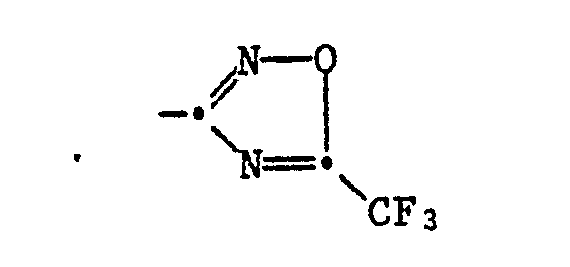
- R' steht für Wasserstoff, Phenyl, durch Halogen oder Methyl substituiertes Phenyl, C(X)NR1'(R2') C(O)XR3' oder COR3', wobei R,' C1-C4-Alkyl, C,-C2-Alkoxy, Allyl oder Phenyl; R2' Wasserstoff oder C,-C2-Alkyl; R3' C,-C9-Alkyl, C2-C4-Alkenyl oder Phenyl bedeuten; und
- X Sauerstoff oder Schwefel darstellt; oder
- R' für Wasserstoff, C1-C4-Alkyl, Phenyl substituiertes Phenyl, C(X)NR1'(R2'), C(O)XR3' oder COR3' steht, wobei R,' C1-C4-Alkyl, C1-C4-Alkoxy, Allyl oder Phenyl; R2' Wasserstoff oder C1-C4-Alkyl; R3' C1-C9-Alkyl, C2-C4-Alkenyl oder Phenyl bedeuten; und X Sauerstoff oder Schwefel darstellt.
- Folgende erfindungsgemässe Einzelverbindungen der Formel la' sind wegen ihrer biologischen Aktivität bevorzugt:
- 3-(4-Methylaminocarbonyloxyphenyl)-5-trifluormethyl-1,2,4-oxadiazol;
- 3-(4-Isopropylaminocarbonyloxyphenyl)-5-trifluormethyl-1,2,4-oxadiazol;
- 3-(4-Ethylaminocarbonyloxyphenyl)-5-trifluormethyl-1,2,4-oxadiazol;
- 3-(4-Allylaminocarbonyloxyphenyl)-5-trifluormethyl-1,2,4-oxadiazol;
- 3-[4-(2-Chlor-4-trifluormethylphenoxy)-phenyl]-5-trifluormethyl-1,2,4-oxadiazol;
- 3-[Methoxy-(methyl)-aminocarbonyloxyphenyl]-5-trifluormethyl-1,2,4-oxadiazol;
- 3-(4-Hexanoyloxyphenyl)-5-trifluormethyl-1,2,4-oxadiazol;
- 3-[4-(phenylaminocarboxy)-phenyl]-5-trifluormethyl-1,2,4-oxadiazol;
- 3-[4-(2-Methyl-3-chlorphenylaminocarboxy)-phenyl]-5-trifluormethyl-1,2,4-oxadiazol;
- 3-[4-(3-Ethylphenylaminocarboxyphenyl)]-5-trifluormethyl-1,2,4-oxadiazol.
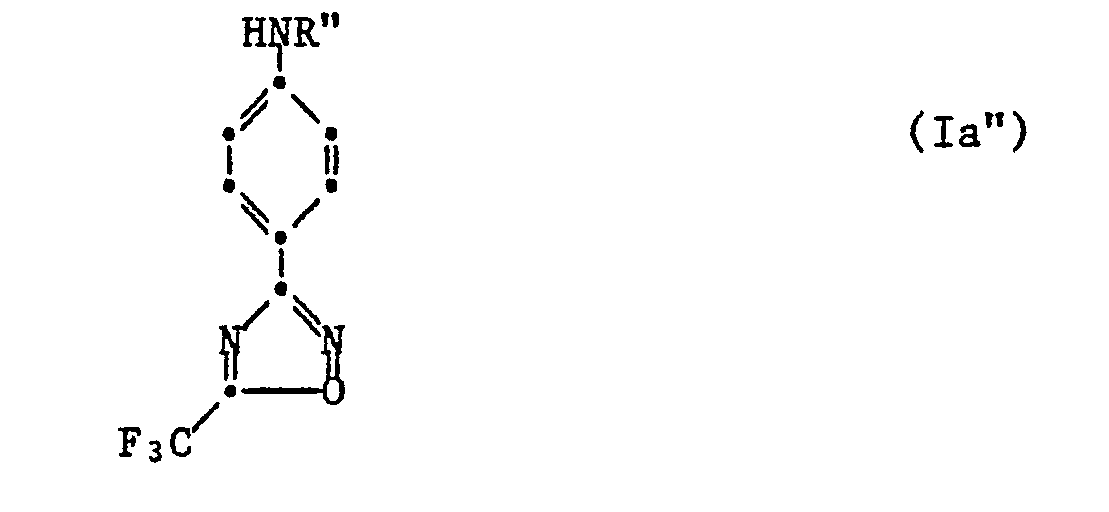
- Von den Verbindungen der Formel I" sind diejenigen bevorzugt, die unter die Formel I"

- R" für die Gruppen C(O)NR1"(R2"), C(S)NR,"), COOR,", COSR," oder COR3" steht, worin
- R," C1-C4-Alkyl, C1-C4-Alkoxy oder Aryl;
- R2" Wasserstoff oder C1-C4-Alkyl und
- R3" C1-C9 Alkyl, C1-C4-Haloalkyl, C3-C4-Alkenyl oder Aryl bedeuten.
- Darüber hinaus sind solche Verbindungen der Formel la" bevorzugt, die folgende Substituenten oder Kombinationen dieser Substituenten untereinander aufweisen:
- R" steht für C(O)NR1"(R2"), C(S)R1"(R2"), COOR3", COSR3" oder COR3", wobei R," C1-C2-Alkyl, C1-C2-Alkoxy oder Phenyl, R2" Wasserstoff oder C1-C2-Alkyl und R3" C,-C3-Alkyl, C1-C2 Haloalkyl, C3-C4-Alkenyl oder Phenyl bedeuten.
- Ferner sind solche Mittel bevorzugt, deren Wirkstoffe Verbindungen der Formel I" sind, die folgende Substituenten oder Kombinationen dieser Substituenten aufweisen:
- R" steht für C(O)NR1"(R2"), C(S)NR1"(R2"), COR,", COOR3", oder COSR3", wobei R," C,-C2-Alkyl, C1-C2-Alkoxy oder Phenyl, R2" Wasserstoff oder C,-C2-Alkyl und R3" C1-C3-Alkyl, C1-C2-Haloalkyl, C3-C4-Alkenyl oder Phenyl bedeuten.
- Folgende erfindungsgemässe Einzelverbindungen sind wegen ihrer biologischen Aktivität bevorzugt:
- 3-[4-(3-Methyl-3-methoxyureido)-phenyl]-5-trifluormethyl-1,2,4-oxodiazol;
- 3-[4-(3,3-Dimethylureido)-phenyl]-5-trifluormethyl-1,2,4-oxadiazol;
- 3-(4-Methyoxycarbonylaminophenyl)-5-trifluormethyl-1,2,4-oxadiazol;
- 3-(4-Ethoxycarbonylaminophenyl)-5-trifluormethyl-1,2,4-oxadiazol;
- 3-(4-Isopropoxycarbonylaminophenyl)-5-trifluormethyl-1,2,4-oxadiazol;
- 3-(4-Phenyloxycarbonylaminophenyl)-5-trifluormethyl-1,2,4-oxadiazol;
- 3-(4-Acetylaminophenyl)-5-trifluormethyl-1,2,4-oxadiazol;
- 3-(4-Allyloxycarbonylaminophenyl)-5-trifluormethyl-1,2,4-oxadiazol;
- 3-[4-(2-Chlorethyloxycarbonylamino)-phenyl]-5-trifluormethyl-1,2,4-oxadiazol;
- 3-[4-(3-Methylthioureido)-phenyl]-5-trifluormethyl-1,2,4-oxadiazol;
- 3-[4-(3,3-Dimethylthioureido)-phenyl]-5-trifluormethyl-1,2,4-oxadiazol;
- 3-[4-(3-Methyl-3-methoxythioureido)-phenyl]-5-trifluormethyl-1,2,4-oxadiazol;
- 3-(4-Ethylthiocarbonylaminophenyl)-5-trifluormethyl-1,2,4-oxadiazol;
- 3-(4-Ethylcarbonylaminophenyl)-5-trifluormethyl-1,2,4-oxadiazol;
- 3-(4-Chlormethylcarbonylaminophenyl)-5-trifluormethyl-1,2,4-oxadiazol.
- Folgende Verbindungen sind als Wirkstoffe von erfindungsgemässen Mitteln wegen ihrer biologischen Aktivität bevorzugt:
- 3-[3-(3,3-Dimethylureido)-phenyl]-5-trifluormethyl-1,2,4-oxadiazol;
- 3-[3-(3-Methyl-3-methoxyureido)-phenyl]-5-trifluormethyl-1,2,4-oxadiazol;
- 3-[3-(3-Methylureido)-phenyl]-5-trifluormethyl-1,2,4-oxadiazol;
- 3-(3-Ethoxycarbonylaminophenyl)-5-trifluormethyl-1,2,4-oxadiazol;
- 3-(3-Chlormethoxycarbonylaminophenyl)-5-trifluormethyl-1,2,4-oxadiazol;
- 3-(3-Methoxycarbonylaminophenyl)-5-trifluormethyl-1,2,4-oxadiazol;
- 3-(3-Isopropoxycarbonylaminophenyl)-5-trifluormethyl-1,2,4-oxadiazol;
- 3-(3-Phenoxycarbonylaminophenyl)-5-trifluormethyl-1,2,4-oxadiazol;
- 3-(3-Ally(oxycarbonylaminophenyl)-5-trifluormethyl-1,2,4-oxadiazol;
- 3-[3-(2-Chlorethoxycarbonylamino)-phenyl]-5-trifluormethyl-1,2,4-oxadiazol.
- Die Verbindungen der Formel I werden wie folgt hergestellt:
- Ein Oximderivat der Formel II'


- 1.1 mit einem Carbamoylchlorid der Formel III' R1'(R2')N-CXCl (III') oder
- 1.2 mit einem Chlorameisensäureester der Formel llla'

- 1.3 mit einem Carbonsäurechlorid der Formel IIIb'

- 1.4 mit Dialkylsulfat oder Alkyhalogenid, vorzugsweise Alkylbromid oder Alkyljodid, mit 1 bis 4 Kohlenstoffatomen in den Alkylgruppen in Gegenwart einer Base als Säureakzeptor zur Reaktion gebracht wird, wobei X Sauerstoff oder Schwefel bedeutet und R,', R2', R3', R4 und n die unter Formel 1 angegebenen Bedeutungen besitzen, oder
- 1.5 ein Oximderivat der Formel Ila'


- Ein Anilinderivat der Formel II"

- 2.1 mit einem Carbamoylchlorid der Formel III"

- 2.2 mit einem Chlorameisensäureester der Formel IIIa"

- 2.3 mit einem Carbonsäurechlorid der Formel Illb"

- 2.4 mit einem Isocyanatderivat der Formel IV
 , R
, R und R3 die unter Formel I" angegebenen Bedeutungen besitzen.
- In den Verfahrensvarianten (1.1) bis (1.4) und (2.1) bis (2.3) können als Basen alle geeigneten Säurebindemittel eingesetzt werden, wie Amine, insbesondere tertiäre Amine, sowie Alkali-und Erdalkaliverbindungen. Beispielhaft seien dafür erwähnt die Hydroxide, Oxide und Karbonate des Lithiums, Natriums, Kaliums, Magnesiums, Calciums und Bariums, ferner weitere basische Verbindungen wie Trimethylamin, Triethylamin, Tripropylamin, Tributylamin, Tribenzylamin, Tricyclohexylamin, Triamylamin, Trihexylamin, N,N-Dimethylanilin, N,N-Dimethyltoluidin, N,N-Dimethyl-p-amino-pyridin, N-Methylpyrrolidin, N-Methyl-piperidin, N-Methylimidazol, N-Methyl-pyrrol, N-Methylmorpholin, N-Methylhexamethylenimin, Pyridin, Chinolin, alpha-Picolin, β-Picolin, Isochinolin, Pyrimidin, Acridin, N,N,N',N'-Tetra-methylethylendiamin, N,N,N',N'-Te- traethylethylendiamin, Chinoxalin, N-Propyldiisopropylamin, N,N-Dimethylcyclohexylamin, 2,6-Lutidin, 2,4-Lutidin, Triethylendiamin.
- In den Verfahrensvarianten (1.1) bis (1.5) und (2.1) bis (2.4) werden in Anspassung an die jeweiligen Reaktionsbedingungen inerte Lösungs-und Verdünnungsmittel verwendet. Als Beispiele sind zu nennen:
- Halogenkohlenwasserstoffe, insbesondere Chlorkohlenwasserstoffe, wie Tetrachlorethylen, Tetrachlorethan, Dichlorpropan, Methylenchlorid, Dichlorbutan, Chloroform, Chlornaphthalin, Dichlornaphthalin, Tetrachlorkohlenstoff, Trichlorethan, Trichlorethylen, Pentachlorethan, Difluorbenzol, 1,2-Dichlorethan, 1,1-Dichlorethan, 1,2-cis-Dichlorethylen, Chlorbenzol, Fluorbenzol, Brombenzol, Jodbenzol, Dichlorbenzol, Dibrombenzol, Chlortoluol, Trichlorbenzol; Ether, wie Ethylpropylether, Methyl-tert.-butylether, n-Butylethylether, Di-n-butylether, Di-isobutylether, Diisoamylether, Diisopropylether, Anisol, Phenetol, Cyclohexylmethylether, Diethyl ether, Ethylenglykoldimethylether, Tetrahydrofuran, Dioxan, Thioanisol, Dichlordiethylether; Nitrokohlenwasserstoffe wie Nitromethan, Nitroethan, Nitrobenzol, Chlornitrobenzol, o-Nitrotoluol; Nitrile wie Acetonitril, Butyronitril, Isobutyronitril, Benzonitril, m-Chlorbenzonitril; aliphatische oder cycloaliphatische Kohlenwasserstoffe, wie Heptan, Pinan, Nonan, Cymol, Benzinfraktionen innerhalb eines Siedepunktintervalles von 70° bis 190°C, Cyclohexan, Methylcyclohexan, Dekalin, Petrolether, Hexan, Ligroin, Trimethylpentan, Octan; Ester wie Ethylacetat, Acetessigester, Isobutylacetat; Amide, z.B. Formamid, Methylformamid, Dimethylformamid; Ketone, wie Aceton, Methylethylketon, gegebenenfalls auch Wasser. Auch Gemische der genannten Lösungs-und Verdünnungsmittel kommen in Betracht.
- Die Reaktionstemperaturen betragen in den Verfahrensvarianten (1.1) bis (1.5) 0° bis 180°C, vorzugsweise 40° bis 120°C, und speziell in der Variante (11.4) 0° bis 100°C, vorzugsweise 20°C bis 80°C, und in den Verfahrensvarianten (2.1) bis (2.4) 20° bis 180°C, vorzugsweise 40° bis 120°C.
- Ein Teil der unter die Formel 1 fallenden Wirkstoffe sind aus der deutschen Offenlegungsschrift 28 01 509 bekannt. Sie werden darin als Wirkstoffe von herbiziden Mitteln vorgeschlagen.
- Es wurde nun überraschend gefunden, dass die erfindungsgemässen Verbindungen der Formel I und die Mittel, die diese Verbindungen als Aktivstoffe enthalten, ein für praktische Bedürfnisse sehr günstiges Mikrobizid-Spektrum gegen phytopathogene Pilze und Bakterien aufweisen. Sie besitzen sehr vorteilhaft kurative, systemische und insbesondere präventive Eigenschaften und lassen sich zum Schutz von zahlreichen Kulturpflanzen einsetzen. Mit den Wirkstoffen der Formel I können an Pflanzen oder an Pflanzenteilen (Früchte, Blüten, Laubwerk, Stengel, Knollen, Wurzeln) von unterschiedlichen Nutzkulturen die auftretenden Mikroorganismen eingedämmt oder vernichtet werden, wobei auch später zuwachsende Pflanzenteile von derartigen Mikroorganismen verschont bleiben.
- Die Wirkstoffe der Formel I sind gegen die den folgenden Klassen angehörenden phytopathogenen Pilze wirksam: Fungi imperfecti (z.B. Botrytis, Helminthosporium, Fusarium Septoria, Cercospora und Alternaria); Basidiomyceten (z.B. die Gattungen Hemileia, Rhizoctonia, Puccinia); ferner wirken sie gegen die Klasse der Ascomyceten (z.B. Venturia, Podosphaera, Erysiphe, Monilinia, Uncinula). Ueberdies wirken die Verbindungen der Formel I systemisch. Sie können ferner als Beizmittel zur Behandlung von Saatgut (Früchte, Knollen, Körner) und Pflanzenstecklingen zum Schutz von Pilzinfektionen sowie gegen im Erdboden auftretende phytopathogene Pilze eingesetzt werden.
- Neben der mikrobiziden Wirksamkeit weisen die Wirkstoffe der Formel I nematizide Eigenschaften auf, was sie insbesondere zur Bekämpfung von Pflanzennematoden geeignet macht. Zu diesem Zweck können die erfindungsgemässen Mittel kurativ, präventiv oder systemisch eingesetzt werden. Dabei entfalten sie eine breit gefächerte Aktivität gegen die verschiedenen Nematodenspecies und werden somit den Erfordernissen der Praxis gerecht.
- In den weiter unten angegebenen Aufwandmengen zeichnen sich die erfindungsgemässen Wirkstoffe durch besonders gute Pflanzenverträglichkeit aus, auch jene, die in der DE-OS 28 01 509 vorgeschlagen sind.
- Die Erfindung betrifft auch die Verwendung der Verbindungen der Formel I zur Bekämpfung phytopathogener Mikroorganismen, insbesondere pflanzenschädigender Pilze bzw. die präventive Verhütung eines Befalls von Pflanzen.
- Darüber hinaus schliesst die vorliegende Erfindung auch die Herstellung agrochemischer Mittel ein, die gekennzeichnet ist durch das innige Vermischen der Aktivsubstanz mit mindestens einem hierin beschriebenen Formulierungshilfsstoff. Eingeschlossen ist auch ein Verfahren zur Behandlung von Pflanzen, das sich durch Applikation der Verbindungen der Formel 1 bzw. der neuen Mittel auszeichnet.
- Als Zielkulturen für die hierin offenbarten Indikationsgebiete gelten im Rahmen dieser Erfindung z.B. folgende Pflanzenarten: Getreide: (Weizen, Gerste, Roggen, Hafer, Reis, Sorghum und Verwandte); Rüben: (Zucker-und Futterrüben); Kern-, Stein-und Beerenobst: (Aepfel, Birnen, Pflaumen, Pfirsiche, Mandeln, Kirschen, Erd-, Him-und Brombeeren); Hülsenfrüchte: (Bohnen, Linsen, Erbsen, Soja); Oelkulturen: (Raps, Senf, Mohn, Oliven, Sonnenblumen, Kokos, Rizinus, Kakao, Erdnüsse); Gurkengewächse: (Kürbis, Gurken, Melonen); Fasergewächse: (Baumwolle, Flachs, Hanf, Jute); Citrusfrüchte: (Orangen, Zitronen, Grapefruit, Mandarinen); Gemüsesorten: (Spinat, Kopfsalat, Spargel, Kohlarten, Möhren, Zwiebeln, Tomaten, Kartoffeln, Paprika); Lorbeergewächse: (Avocado, Cinnamonum, Kampfer) oder Pflanzen wie Mais, Tabak, Nüsse, Kaffee, Zuckerrohr, Tee, Weinreben, Hopfen, Bananen-und Naturkautschukgewächse sowie Zierpflanzen (Blumen. Sträucher, Laubbäume und Nadelbäume wie Koniferen). Die Aufzählung stellt keine Limitierung dar.
- Wirkstoffe der Formel werden üblicherweise in Form von Zusammensetzungen verwendet und können gleichzeitig oder nacheinander mit weiteren Wirkstoffen auf die Umgebung der zu behandelnden Pflanze oder die Pflanze selbst gegeben werden. Diese weiteren Wirkstoffe können sowohl Düngemittel, Spurenelement-Vermittler oder andere das Pflanzenwachstum beeinflussende Präparate sein. Es können aber auch selektive Herbizide, Insektizide. Fungizide, Bakterizide, Nematizide, Molluskizide oder Gemische mehrerer dieser Präparate sein, zusammen mit gegebenenfalls weiteren in der Formulierungstechnik üblichen Trägerstoffen, Tensiden oder anderen applikationsfördernden Zusätzen.
- Geeignete Träger und Zusätze können fest oder flüssig sein und entsprechen den in der Formulierungstechnik zweckdienlichen Stoffen, wie z.B. natürlichen oder regenerierten mineralischen Stoffen, Lösungs-, Dispergier-, Netz, Haft-, Verdickungs-, Binde-oder Düngemitteln.
- Ein bevorzugtes Verfahren zum Aufbringen eines Wirkstoffes der Formel I bzw. eines agrochemischen Mittels, das mindestens einen dieser Wirkstoffe enthält, ist das Aufbringen auf das Blattwerk (Blattapplikation). Anzahl der Applikationen und Aufwandmenge richten sich dabei nach dem Befallsdruck für den entsprechenden Erreger (Pilzsorte). Die Wirkstoffe der Formel I können aber auch über den Erdboden durch das Wurzelwerk in die Pflanze gelangen (systemische Wirkung), indem man den Standort der Pflanze mit einer flüssigen Zubereitung tränkt oder die Substanzen in fester Form in den Boden einbringt z.B. in Form von Granulat (Bodenapplikation). Die Verbindungen der Formel I können aber auch auf Samenkörner aufgebracht werden (Coating), indem man die Körner entweder in einer flüssigen Zubereitung des Wirkstoffs tränkt oder sie mit einer festen Zubereitung beschichtet. Darüber hinaus sind in besonderen Fällen weitere Applikationsarten möglich, so z.B. die gezielte Behandlung der Pflanzenstengel oder der Knospen.
- Die Verbindungen der Formel I werden dabei in unveränderter Form oder vorzugsweise zusammen mit den in der Formulierungstechnik üblichen Hilfsmitteln eingesetzt und werden daher z.B. zu Emulsionskonzentraten, streichfähigen Pasten, direkt versprühbaren oder verdünnbaren Lösungen, verdünnten Emulsionen, Spritzpulvern, löslichen Pulvern. Stäubemitteln, Granulaten, durch Verkapselungen in z.B. polymeren Stoffen in bekannter Weise verarbeitet. Die Anwendungsverfahren wie Versprühen, Vernebeln, Verstäuben, Verstreuen, Bestreichen oder Giessen werden gleich wie die Art der Mittel den angstrebten Zielen und den gegebenen Verhältnissen entsprechend gewählt. Günstige Aufwandmengen liegen im allgemeinen bei 50 g bis 5 kg Aktivsubstanz (AS) je ha; bevorzugt 100 g bis 2 kg AS/ha, insbesondere bei 100 g bis 600 g AS/ha.
- Die Formulierungen, d.h. die den Wirkstoff der Formel I und gegebenenfalls einen festen oder flüssigen Zusatzstoff enthaltenden Mittel, Zubereitungen oder Zusammensetzungen werden in bekannter Weise hergestellt, z.B. durch inniges Vermischen und/oder Vermahlen der Wirkstoffe mit Streckmitteln, wie z.B. mit Lösungsmitteln, festen Trägerstoffen, und gegebenfalls oberflächenaktiven Verbindungen (Tensiden).
- Als Lösungsmittel können in Frage kommen: Aromatische Kohlenwasserstoffe, bevorzugt die Fraktionen C, bis C'2' wie z.B. Xylolgemische oder substituierte Naphthaline, Phthalsäureester wie Dibutyl-oder Dioctylphthalat, aliphatische Kohlenwasserstoffe wie Cyclohexan oder Paraffine, Alkohole und Glykole sowie deren Ether und Ester, wie Ethanol, Ethylenglykol, Ethylenglykolmanomethyl-oder Ethylether, Ketone wie Cyclohexanon, stark polare Lösungsmittel wie N-Methyl-2-pyrrolidon, Dimethylsulfoxid oder Dimethylformamid, sowie gegebenenfalls epoxydierte Pflanzenöle wie epoxydiertes Kokosnussöl oder Sojaöl; oder Wasser.
- Als feste Trägerstoffe, z.B. für Stäubemittel und dispergierbare Pulver, werden, in der Regel natürliche Gesteinsmehle verwendet, wie Calcit, Talkum, Kaolin, Montmorillonit oder Attapulgit. Zur Verbesserung der physikalischen Eigenschaften können auch hochdisperse Kieselsäure oder hochdisperse saugfähige Polymerisat zugesetzt werden. Als gekörnte, adsorptive Granulatträger kommen poröse Typen wie z.B. Bimsstein, Ziegelbruch, Sepiolit oder Bentonit, als nicht sorptive Trägermaterialien z.B. Calcit oder Sand in Frage. Darüber hinaus kann eine Vielzahl von vorgranulierten Materialien anorganischer oder organischer Natur wie insbesondere Dolomit oder zerkleinerte Pflanzenrückstände verwendet werden.
- Als oberflächenaktive Verbindungen kommen je nach Art des zu formulierenden Wirkstoffes der Formel I nichtionogene, kation-und/oder anionaktive Tenside mit guten Emulgier-, Dispergier-und Netzeigenschaften in Betracht. Unter Tensiden sind auch Tensidgemische zu verstehen.
- Geeignete anionische Tenside können sowohl sog. wasserlösliche Seifen, als auch wasserlösliche synthetische oberflächenaktive Verbindungen sein.
- Als Seifen seien die Alkali-, Erdalkali-oder gegebenenfalls substituierten Ammoniumsalze von höheren Fettsäuren (C,ä-C,2), wie z.B. die Na-oder K-Salze der Oel-oder Stearinsäure, oder von natürlichen Fettsäuregemischen, die z.B. aus Kokosnuss-oder Talgöl gewonnen werden können. Ferner sind auch die Fettsäure-methyllaurinsalze zu erwähnen.
- Häufiger werden jedoch sog. synthetische Tenside verwendet, insbesondere Fettalkoholsulfonate, Fettalkoholsulfate, sulfonierte Benzimidazolderivate oder Alkylsulfonate.
- Die Fettalkoholsulfonate oder -sulfate liegen in der Regel als Alkali-, Erdalkali-oder gegebenenfalls substituierte Ammoniumsalze vor und weisen einen Alkylrest mit 8 bis 22 C-Atomen auf, wobei Alkyl auch den Alkylteil von Acylresten einschliesst, z.B. Das Na-oder Ca-Salz der Ligninsulfonsäure, des Dodecylschwefelsäureesters oder eines aus natürlichen Fettsäuren hergestellten Fettalkoholsulfatgemisches. Hierher gehören auch die Salze der Schwefelsäureester und Sulfonsäuren von Fettalkohol-Ethylenoxyd-Addukten. Die sulfonierten Benzimidazolderivate enthalten vorzugsweise 2-Sulfonsäuregruppen und eine Fettsäurerest mit 8-22 C-Atomen. Alkylarylsulfonate sind z.B. die Na-, Ca-oder Triethanolaminsalze der Dodecylbenzolsulfonsäure, der Dibutylnaphthalinsulfonsäure, oder eines Naphthalinsulfonsäure-Formaldehydkondensationsproduktes.
- Ferner kommen auch entsprechende Phosphate wie z.B. Salze des Phosphorsäureesters eines p-Nonylphenol-(4-14)-Ethylenoxyd-Adduktes in Frage.
- Als nichtionische Tenside kommen in erster Linie Polyglykoletherderivate von aliphatischen oder cycloaliphatischen Alkoholen, gesättigten oder ungesättigten Fettsäuren und Alkylphenolen in Frage, die 3 bis 30 Glykolethergruppen und 8 bis 20 Kohlenstoffatome im (aliphatischen) Kohlenwasserstoffrest und 6 bis 18 Kohlenstoffatome im Alkylrest der Alkylphenole enthalten können.
- Weitere geeignete nichtionische Tenside sind die wasserlöslichen, 20 bis 250 Aethylenglykoläthergruppen und 10 bis 100 Propylenglykolethergruppen enthaltenden Polyethylenoxidaddukte an Polypropylenglykol, Aethylendiaminopolypropylenglykol und Alkylpolypropylenglykol mit 1 bis 10 Kohlenstoffatomen in der Alkylkette. Die genannten Verbindungen enthalten üblicherweise pro Propylenglykol-Einheit 1 bis 5 Ethylenglykoleinheiten.
- Als Beispiele nichtionischer Tenside seien Nonylphenolpolyethoxyethanole, Ricinusölpolyglykolether, Polypropylen-Polyethylenoxydaddukte, Tributylphenoxypolyethylenethanol, Polyethylenglykol und Octylphenoxypolyethoxyethanol erwähnt.
- Ferner kommen auch Fettsäureester von Polyoxyethylensorbitan wie das Polyoxyethylensorbitan-trioleat in Betracht.
- Bei den kationischen Tensiden handelt es sich vor allem um quartäre Ammoniumsalze, welche als N-Substituenten mindestens einen Alkylrest mit 8 bis 22 C-Atomen enthalten und als weitere Substituenten niedrige, gegebenenfalls halogenierte Alkyl-, Benzyl-oder niedrige Hydroxyalkylreste aufweisen. Die Salze liegen vorzugsweise als Halogenide, Methylsulfate oder Ethylsulfate vor, z.B. das Stearyltrimethylammoniumchlorid oder das Benzyldi(2-chlorethyl)ethylammoniumbromid.
- Die agrochemischen Zubereitungen enthalten in der Regel 0,1 bis 99 Gew.-%, insbesondere 0,1 bis 95 Gew: %, Wirkstoff der Formel I, 99,9 bis 1 Gew.-%, insbesondere 99,8 bis 5 Gew.-%, eines festen oder flüssigen Zusatzstoffes und 0 bis 25 Gew.-%, insbesondere 0,1 bis 25 Gew.-%, eines Tensides.
- Während als Handelsware eher konzentrierte Mittel bevorzugt werden, verwendet der Endverbraucher in der Regel verdünnte Mittel.
- Die Mittel können auch weitere Zusätze wie Stabilisatoren, Entschäumer, Viskositätsregulatoren, Bindemittel, Haftmittel sowie Dünger oder andere Wirkstoffe zur Erzielung spezieller Effekte enthalten.
- Derartiger agrochemische Mittel sind ein Bestandteil der vorliegenden Erfindung.
- Die nachfolgenden Beispiele dienen zur näheren Erläuterung der Erfindung, ohne dieselbe einzuschränken.
-

- 65,5 g (0,55 Mol) 4-Hydroxibenzonitril und 133,8 g Hydroxylaminhydrochlorid werden in 600 ml 80%igem Ethanol vorgelegt und während 20 Min. portionenweise 296,5 g (2,145 Mol) Kaliumcarbonat zugegeben. Das Reaktionsgemisch wird während 12 Stdn am Rückfluss gerührt, auf Raumtemperatur abgekühlt und abfiltriert. Der Filterkuchen wird mit heissem Ethanol gewaschen und das Filtrat eingedampft. Die hellrote Substanz wird mit Aceton digeriert, abfiltriert und getrocknet. Man erhält 79,6 g (= 76,1 % d. Th.) der Titelverbindung (A) (Smp. 158°-160°C).
-
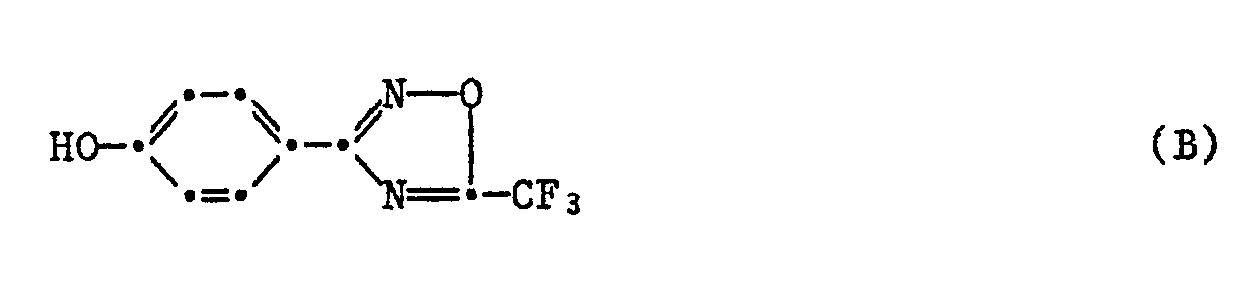
- 152,2 g (0,8 Mol) der Verbindung (A) werden in 1,5 Liter Tetrahydrofuran suspendiert und während 1 Stunde 170 ml (- 1,2 Mol) Trifluoressigsäureanhydrid zugetropft, wobei sich die Suspension unter exothermer Reaktion löst. Durch Kühlen hält man die Innentemperatur bei ca. 40°C. Anschliessend wird bei Rautemperatur während 2 Stdn gerührt und die Reaktionsmischung in Eis/Wasser gegossen. Das ausgeschiedene Oel wird mit Toluol/Essigsäureethylester extrahiert. Der ölige Rückstand kristallisiert beim Stehenlassen aus. Man erhält 102,9 g (47,4 % d. Th.) der Titelverbindung (B) mit einem Smp. von 66°-73°C.
-

- 46 g (0,2 Mol) der Verbindung (B) werden zusammen mit 0,5 g Triäthylendiamin in 300 ml Toluol vorgelegt. Dazu tropft man bei Raumtemperatur 23 ml Methylisocyanat (leicht exotherm) wobei vollständige Lösung eintritt. Nach ca. 15 Min. Rühren beginnt das Reaktionsprodukt auszufallen, wobei die Temperatur bis 30°C ansteigt. Nach Abschluss des Rührvorganges über Nacht werden 170 ml Cyclohexan zugegeben und dann abfiltriert. Man erhält 55,4 g (96,5 % d. Th.) der Titelverbindung mit einem Smp. von 180°-185°C. Beispiel 1.2: Herstellung von

- 13,8 g (0,06 Mol) 3-(4-Hydroxyphenyl)-5-trifluormethyl-1,2,4-oxadiazol werden in 100 ml 2-Butanon vorgelegt und mit 9.9 g (0,072 Mol) Kaliumcarbonat versetzt. Dazu werden 8,6 ml (0,066 Mol) Diäthylsulfat getropft. Die Suspension wird während 18 Stunden bei 80°C gerührt und nach dem Abkühlen auf Raumtemperatur abfiltriert. Nach Abdestillieren des Lösungsmittels erhält man 13,7 g gelbes Oel, das beim Stehenlassen kristallisiert. Smp. 48-51 °C.
-

- 148,1 g (1 Mol) 4-Nitrobenzonitril werden mit 139 g (2 Mol) Hydroxylaminhydrochlorid in 1300 ml Methanol vorgelegt. Dazu gibt man innerhalb von 20 Minuten portionenweise 80 g (2 Mol) Natriumhydroxid (exotherm). Die gelbe Suspension wird während 3,5 Stunden auf Rückflusstemperatur erwärmt und anschliessend heiss filtriert. Durch Zugabe von EisiWasser kristallisiert die Titelverbindung (A) aus. Aubeute: 162,9 g (= 89,9 % d. Th.) Smp. 168°-170°C.
-

- 74,3 g (0,41 Mol) der Verbindung (A) werden in 1400 ml Tetrahydrofuran gelöst und innerhalb 1 Stunde 98,3 g (0,47 Mol) Trifluoressigsäureanhydrid zugetropft. Die Temperatur steigt auf 35°C. Nach 2 Stunden Rühren bei Raumtemperatur wird auf das halbe Volumen eingedampft, mit der doppelten Mengen Wasser verdünnt und mit Toluol/Essigsäureethylester extrahiert. Der Extrakt wird eingedampft und der Rückstand aus Ethanol/Wasser umkristallisiert. Man erhält Kristalle der Titelverbindung (B). Ausbeute: 72,8 g (= 63,5 % d. Th.) Smp. 62°-63°C.
-

- 262.8 g (1,02 Mol) der Verbindung (B) werden in 2200 ml Ethanol bei 35°C gelöst und eine Suspension von 109,2 g Ammoniumchlorid (2 Mol) in 120 ml Wasser zugegeben. Innerhalb von 30 Minuten werden 467,2 g Zinkpulver (7,2 Mol) portionenweise eingestreut und anschliessend das Reaktionsgemisch 10 Stunden bei Rückflusstemperatur und nochmals 10 Stunden bei Raumtemperatur gerührt. Das Zinkpulver wird abfiltriert und das Lösungsmittel abdestilliert. Das erhaltene Rohprodukt wird in Toluol/Essigester 1:2 gelöst, von unlöslichen Nebenprodukten abfiltriert und die Lösung am Rotationsverdampfer eingeengt. Die ausgeschieden Kristalle werden abfiltriert. Man erhält die Titelverbindung (C). Ausbeute: 142,4 g (= 60,9 % d.Th.) Smp. 53°-58°C.
-

- 141,2 g (0,616 Mol) der Verbindung (C) werden bei Raumtemperatur in 480 ml Pyridin gelöst und innerhalb 5 Minuten 135,9 g (1,1 Mol) N-Methyl-N-methoxycarbamoylchlorid zugetropft, wobei die Temperatur auf 53°C ansteigt. Nach 1 Stunde Rühren bei Rautmemperatur wird die Reaktionsmischung in Eis/Wasser gegossen und abfiltriert. Man erhält die Titelverbindung (D). Ausbeute: 177,4 g (= 91,1 % d.Th.) Smp. 88°-90°C.
- Analog dem vorstehend beschriebenen Beispiel lassen sich die nachfolgend aufgeführten Verbindungen herstellen.

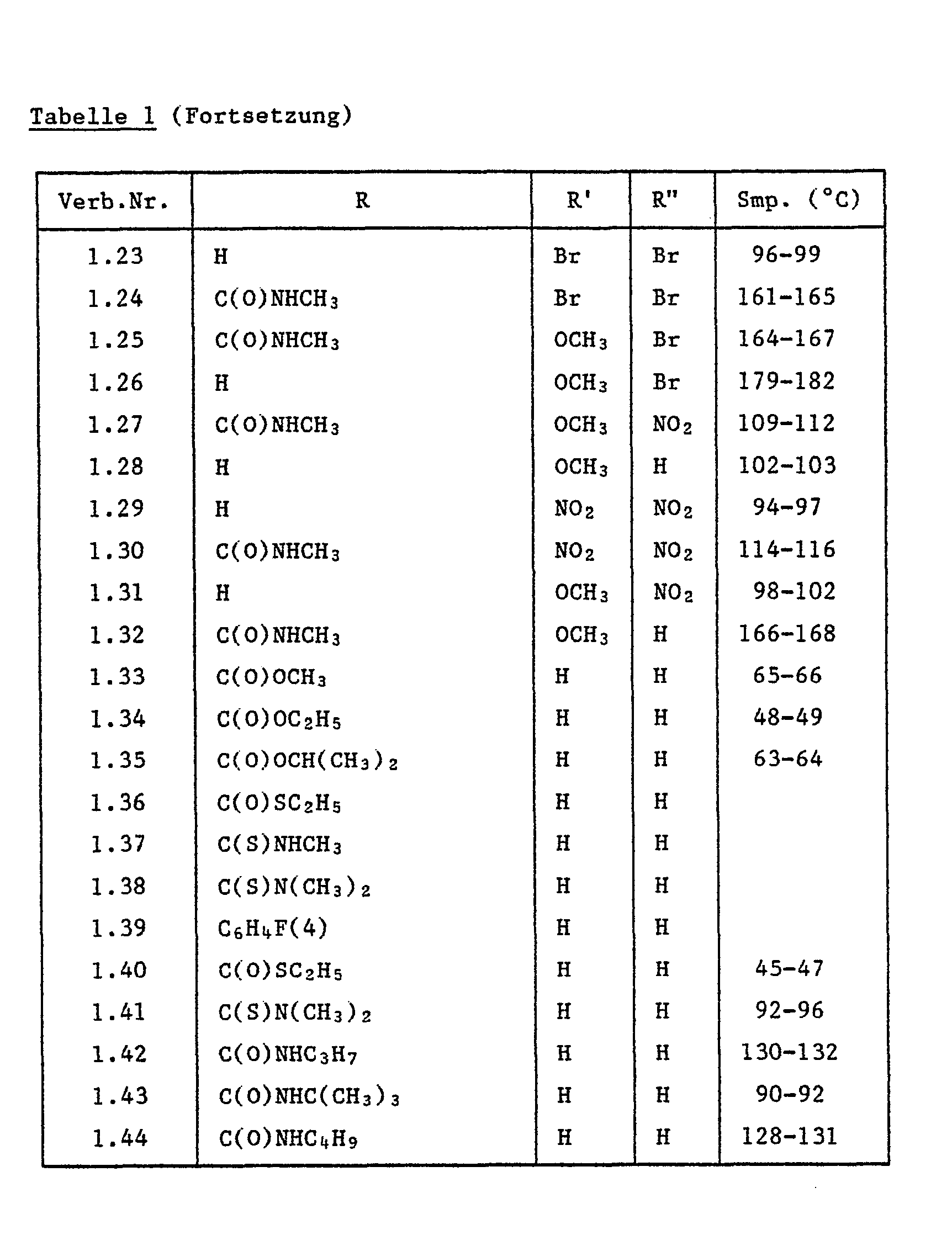
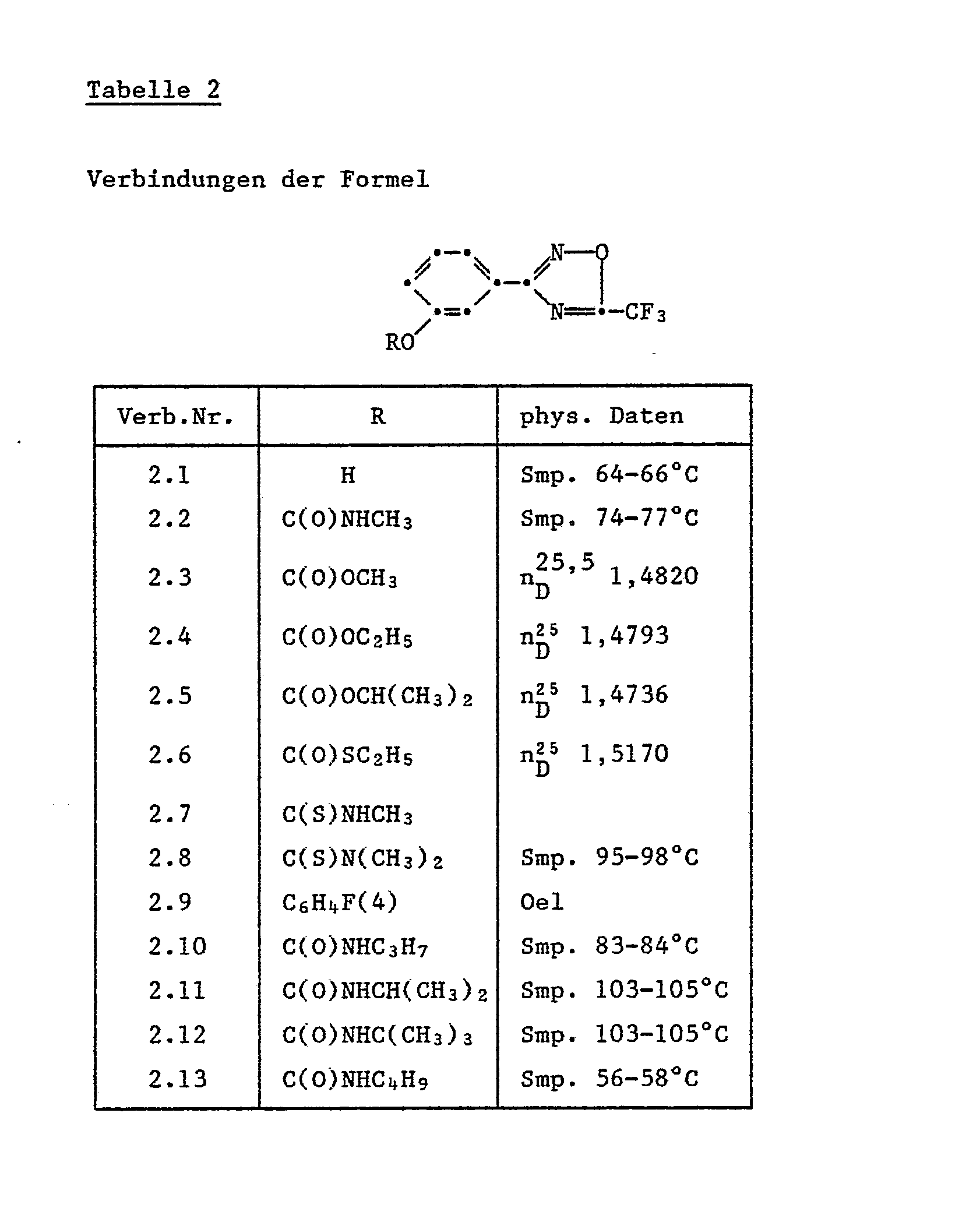

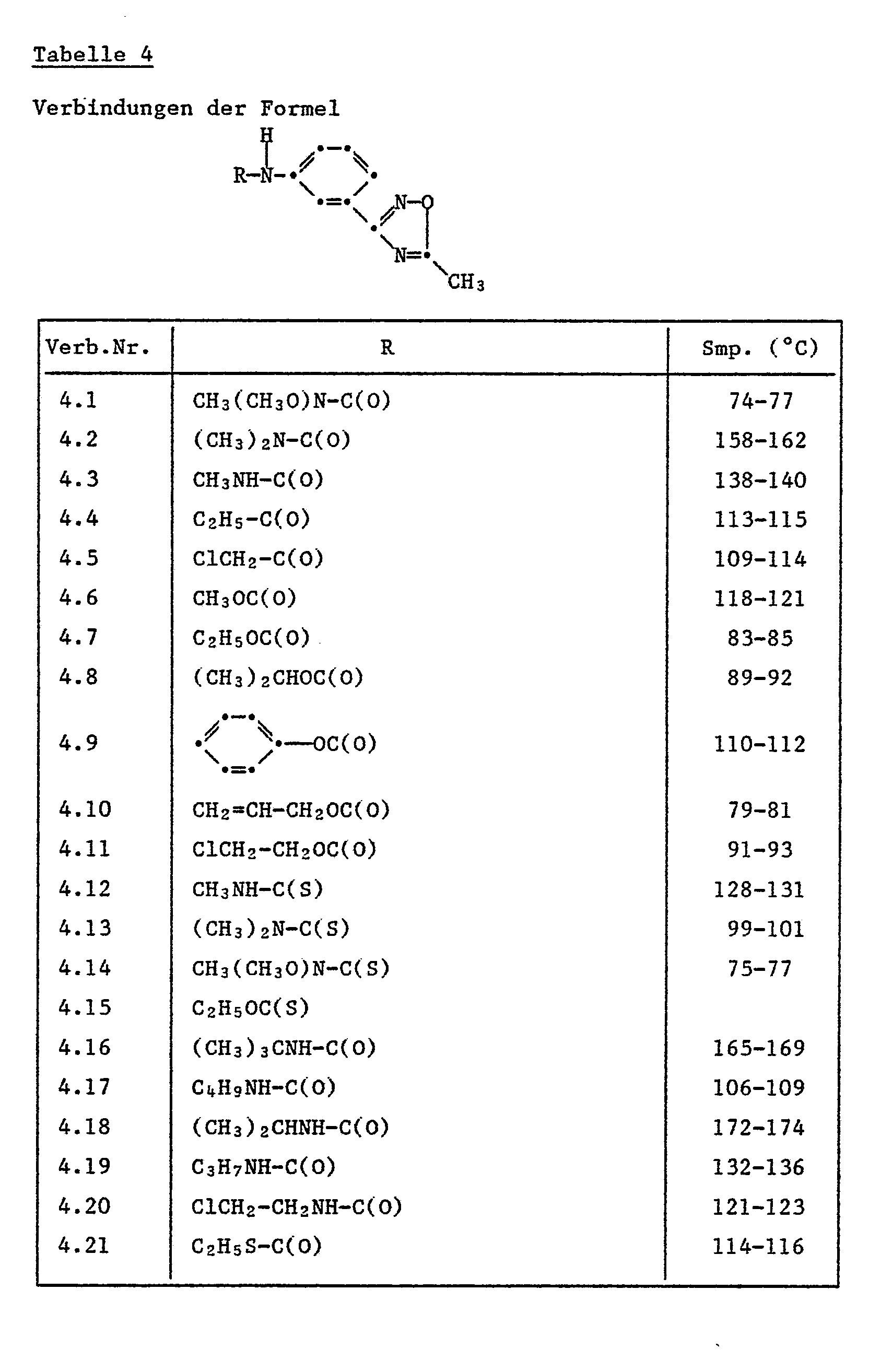
-

- Der Wirkstoff wird mit den Zusatzstoffen gut vermischt und in einer geeigneten Mühle gut vermahlen. Man erhält Spritzpulver, die sich mit Wasser zu Suspensionen jeder gewünschten Konzentration verdünnen lassen.

- Aus diesem Konzentrat können durch Verdünnen mit Wasser Emulsionen jeder gewünschten Konzentration hergestellt werden.

- Man erhält anwendungsfertige Stäubemittel, indem der Wirkstoff mit den Träger vermischt und auf einer geeigneten Mühle vermahlen wird.

- Der Wirkstoff wird mit den Zusatzstoffen vermischt, vermahlen und mit Wasser angefeuchtet. Dieses
- Gemisch wird extrudiert und anschliessend im Luftstrom getrocknet.

- Der fein gemahlene Wirkstoff wird in einem Mischer auf das mit Polyethylenglykol angefeuchtete Kaolin gleichmässig aufgetragen. Auf diese Weise erhält man staubfreie Umhüllungs-Granulate.

- Der fein gemahlene Wirkstoff wird mit den Zusatzstoffen innig vermischt. Man erhält so ein Suspensions-Konzentrat, aus welchem durch Verdünnen mit Wasser Suspensionen jeder gewünschten Konzentration hergestellt werden können.
-
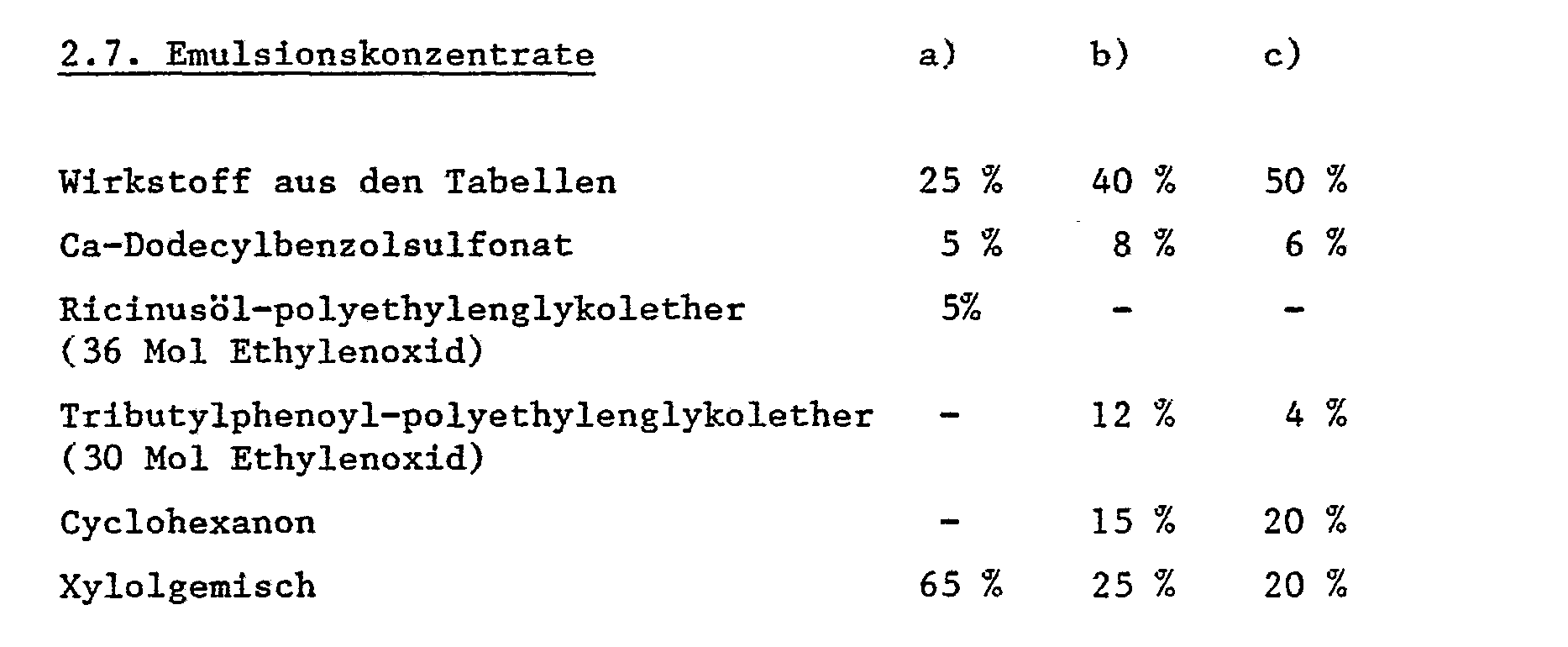
- Aus solchen Konzentraten können durch Verdünnen mit Wasser Emulsionen jeder gewünschten Konzentration hergestellt werden.

- Die Lösungen sind zur Anwendung in Form kleinster Tropfen geeignet.
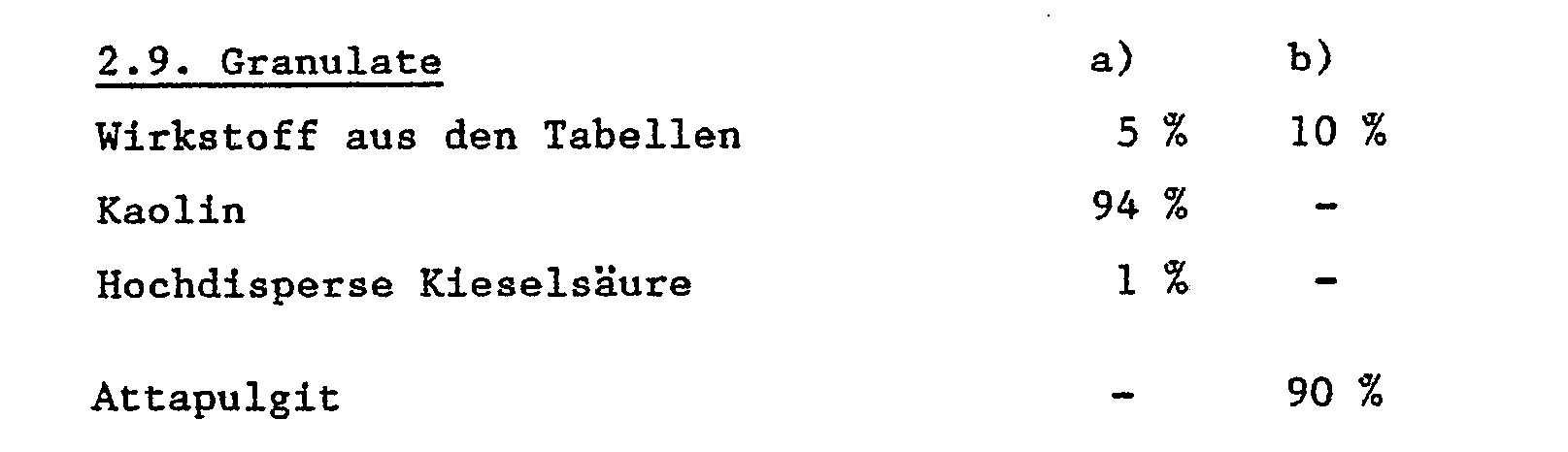
- Der Wirkstoff wird in Methylenchlorid gelöst, auf den Träger aufgesprüht und das Lösungsmittel anschliessend im Vakuum abgedampft.

- Durch inniges Vermischen auf Trägerstoffe mit dem Wirkstoff erhält man gebrauchsfertige Stäubemittel.
- Weizenpflanzen werden 6 Tage nach der Aussaat mit einer aus Spritzpulver des Wirkstoffes hergestellten Spritzbrühe (0,006 % Aktivsubstanz) besprüht. Nach 24 Stunden werden die behandelten Pflanzen mit einer Uredosporensuspension des Pilzes infiziert. Nach einer Inkubation während 48 Stunden bei 95-100 % relativer Luftfeuchtigkeit und ca. 20°C werden die infizierten Pflanzen in einem Gewächshaus bei ca. 22°C aufgestellt. Die Beurteilung der Rostpustelnentwicklung erfolgt 12 Tage nach der Infektion.
- Zu Weizenpflanzen wird 5 Tage nach der Aussaat eine aus Spritzpulver des Wirkstoffes hergestellte Spritzbrühe gegossen (0,02 % Aktivsubstanz bezogen auf das Bodenvolumen). Nach 48 Stunden werden die behandelten Pflanzen mit einer Uredosporensuspension des Pilzes infiziert. Nach einer Inkubation während 48 Stunden bei 95-100 % relativer Luftfeuchtigkeit und ca. 20°C werden die infizierten Pflanzen in einem Gewächshaus bei ca. 22°C aufgestellt. Die Beurteilung der Rostpustelnentwicklung erfolgt 12 Tage nach der Infektion.
- Verbindungen aus den Tabellen zeigen gegen Puccinia-Pilze gute Wirksamkeit. Der Puccinia-Befall wurde durch die Verbindungen Nr. 1.1, 3.1, 3.12 und 4.2 fast vollständig (Befall = 0-10 %) und durch die Verbindungen Nr. 1.14, 1.15, 1.16, 1.18, 1.41, 1.42, 1.43, 2.2, 2.11 und 3.2 zu 80-90 % verhindert. Unbehandelte aber infizierte Kontrollpflanzen weisen dagegen eine Puccinia-Befall von 100 % auf.
- 10-15 cm hohe Erdnusspflanzen werden mit einer aus Spritzpulver der Wirksubstanz hergestellten Spritzbrühe (0,02 % Aktivsubstanz) besprüht und 48 Stunden später mit einer Konidiensuspension des Pilzes infiziert. Die infizierten Pflanzen werden während 72 Stunden bei ca. 21 °C und hoher Luftfeuchtigkeit inkubiert und anschliessend bis zum Auftreten der typischen Blattflecken in einem Gewächshaus aufgestellt. Die Beurteilung der fungiziden Wirkung erfolgt 12 Tage nach der Infektion basierend auf Anzahl und Grösse der auftretenden Flecken.
- Im Vergleich zu unbehandelten, aber infizierten Kontrollpflanzen (Anzahl und Grösse der Flecken = 100 zeigen Erdnusspflanzen, die mit Wirkstoffen aus den Tabellen behandelt wurden, einen stark reduzierten Cercospora-Befall. So verhinderten z.B. die Verbindungen Nr. 1.1 und 1.2 das Auftreten von Blattflecken fast vollständig (Befall = 0-10 %).
- Ca. 8 cm hohe Gerstenpflanzen werden mit einer aus Spritzpulver des Wirkstoffes hergestellten Spritzbrühe (0,006 % Aktivsubstanz) besprüht. Nach 3-4 Stunden werden die behandelten Pflanzen mit Konidien des Pilzes bestäubt. Die infizierten Gerstenpflanzen werden in einem Gewächshaus bei ca. 22°C aufgestellt und der Pilzbefall nach 10 Tagen beuteilt.
- Verbindungen aus den Tabellen zeigen gut Wirksamkeit gegen Erysiphe-Pilze. So verhinderte z.B. die Verbindung Nr. 1.23 den Erysiphe-Befall fast vollständig (Befall = 0-10 %). Unbehandelte jedoch infizierte Kontrollpflanzen weisen dagegen einen Befall von 100 % auf.
- Apfelstecklinge mit 10-20 cm langen Frischtrieben werden mit einer aus Spritzpulver des Wirkstoffes hergestellten Spritzbrühe (0,02 % Aktivsubstanz) besprüht. Nach 24 Stunden werden die behandelten Pflanzen mit einer Konidiensuspension des Pilzes infiziert. Die Pflanzen werden dann während 5 Tagen bei 90-100 % relativer Luftfeuchtigkeit inkubiert und während 10 weiteren Tagen in einem Gewächshaus bei 20-24°C aufgestellt. Der Schorfbefall wird 15 Tage nach der Infektion beurteilt. Verbindungen aus den Tabellen zeigen gute Wirksamkeit gegen Venturia. So verhinderte z.B. die Verbindung Nr. 2.12 den Venturia-Befall fast vollständig (Befall = 0-10 %). Unbehandelte jedoch infizierte Triebe weisen dagegen einen 100%igen Befall auf.
Claims (19)



Applications Claiming Priority (6)
| Application Number | Priority Date | Filing Date | Title |
|---|---|---|---|
| CH4949/86 | 1986-12-12 | ||
| CH494886 | 1986-12-12 | ||
| CH494986 | 1986-12-12 | ||
| CH4948/86 | 1986-12-12 | ||
| CH4134/87 | 1987-10-22 | ||
| CH413487 | 1987-10-22 |
Publications (2)
| Publication Number | Publication Date |
|---|---|
| EP0276432A2 true EP0276432A2 (de) | 1988-08-03 |
| EP0276432A3 EP0276432A3 (de) | 1988-10-26 |
Family
ID=27174729
Family Applications (1)
| Application Number | Title | Priority Date | Filing Date |
|---|---|---|---|
| EP87118250A Withdrawn EP0276432A3 (de) | 1986-12-12 | 1987-12-09 | Schädlingsbekämpfungsmittel |
Country Status (9)
| Country | Link |
|---|---|
| US (1) | US4871753A (de) |
| EP (1) | EP0276432A3 (de) |
| KR (1) | KR880007500A (de) |
| AU (1) | AU8246587A (de) |
| BR (1) | BR8706756A (de) |
| DK (1) | DK650787A (de) |
| IL (1) | IL84776A0 (de) |
| NZ (1) | NZ222868A (de) |
| PT (1) | PT86329B (de) |
Cited By (71)
| Publication number | Priority date | Publication date | Assignee | Title |
|---|---|---|---|---|
| EP0504574A1 (de) * | 1991-03-22 | 1992-09-23 | Wakamoto Pharmaceutical Co., Ltd. | 1,2,4-Oxadiazolderivate mit einer Monoamino-Oxidase-B-Enzymhemmenden Wirkung und Verfahren zu ihrer Herstellung |
| WO1997030047A1 (en) * | 1996-02-17 | 1997-08-21 | Agrevo Uk Limited | Fungicidal 1,2,4-oxadiazoles and analogues |
| WO1998017652A1 (de) * | 1996-10-18 | 1998-04-30 | Boehringer Ingelheim Pharma Kg | Oxadiazole, verfahren zu ihrer herstellung sowie ihre verwendung als arzneimittel |
| WO2017055473A1 (en) | 2015-10-02 | 2017-04-06 | Syngenta Participations Ag | Microbiocidal oxadiazole derivatives |
| WO2017055469A1 (en) * | 2015-10-02 | 2017-04-06 | Syngenta Participations Ag | Microbiocidal oxadiazole derivatives |
| EP3165093A1 (de) | 2015-11-05 | 2017-05-10 | Basf Se | Substituierte oxadiazole zur bekämpfung phytopathogener pilze |
| EP3165094A1 (de) | 2015-11-03 | 2017-05-10 | Basf Se | Verwendung von substituierten oxadiazolonen zur bekämpfung phytopathogener pilze |
| WO2017076757A1 (en) | 2015-11-02 | 2017-05-11 | Basf Se | Substituted oxadiazoles for combating phytopathogenic fungi |
| WO2017076935A1 (en) * | 2015-11-04 | 2017-05-11 | Basf Se | Substituted oxadiazoles for combating phytopathogenic fungi |
| WO2017076739A1 (en) * | 2015-11-03 | 2017-05-11 | Basf Se | Use of substituted oxadiazoles for combating phytopathogenic fungi |
| WO2017076740A1 (en) | 2015-11-04 | 2017-05-11 | Basf Se | Substituted oxadiazoles for combating phytopathogenic fungi |
| EP3167716A1 (de) | 2015-11-10 | 2017-05-17 | Basf Se | Verwendung von substituierten oxadiazolonen zur bekämpfung phytopathogener pilze |
| WO2017081312A1 (en) | 2015-11-13 | 2017-05-18 | Basf Se | Substituted oxadiazoles for combating phytopathogenic fungi |
| WO2017081309A1 (en) * | 2015-11-13 | 2017-05-18 | Basf Se | Substituted oxadiazoles for combating phytopathogenic fungi |
| WO2017081310A1 (en) | 2015-11-13 | 2017-05-18 | Basf Se | Substituted oxadiazoles for combating phytopathogenic fungi |
| WO2017081311A1 (en) * | 2015-11-13 | 2017-05-18 | Basf Se | Substituted oxadiazoles for combating phytopathogenic fungi |
| WO2017085100A1 (en) | 2015-11-19 | 2017-05-26 | Basf Se | Substituted oxadiazoles for combating phytopathogenic fungi |
| WO2017085098A1 (en) | 2015-11-19 | 2017-05-26 | Basf Se | Substituted oxadiazoles for combating phytopathogenic fungi |
| WO2017093019A1 (en) * | 2015-12-03 | 2017-06-08 | Basf Se | Substituted oxadiazoles for combating phytopathogenic fungi |
| WO2017109044A1 (en) * | 2015-12-22 | 2017-06-29 | Syngenta Participations Ag | Microbiocidal oxadiazole derivatives |
| WO2017118689A1 (en) * | 2016-01-08 | 2017-07-13 | Syngenta Participations Ag | Microbiocidal oxadiazole derivatives |
| WO2017148797A1 (en) * | 2016-03-01 | 2017-09-08 | Basf Se | Substituted oxadiazoles for combating phytopathogenic fungi |
| WO2017162868A1 (en) | 2016-03-24 | 2017-09-28 | Syngenta Participations Ag | Microbiocidal oxadiazole derivatives |
| WO2017178549A1 (en) | 2016-04-12 | 2017-10-19 | Syngenta Participations Ag | Microbiocidal oxadiazole derivatives |
| WO2017178245A1 (en) | 2016-04-11 | 2017-10-19 | Basf Se | Substituted oxadiazoles for combating phytopathogenic fungi |
| WO2017211652A1 (en) | 2016-06-09 | 2017-12-14 | Basf Se | Substituted oxadiazoles for combating phytopathogenic fungi |
| WO2017211650A1 (en) | 2016-06-09 | 2017-12-14 | Basf Se | Substituted oxadiazoles for combating phytopathogenic fungi |
| WO2018015447A1 (en) | 2016-07-22 | 2018-01-25 | Syngenta Participations Ag | Microbiocidal oxadiazole derivatives |
| WO2018029242A1 (en) | 2016-08-11 | 2018-02-15 | Syngenta Participations Ag | Microbiocidal oxadiazole derivatives |
| WO2018055135A1 (en) * | 2016-09-23 | 2018-03-29 | Syngenta Participations Ag | Microbiocidal oxadiazole derivatives |
| WO2018065414A1 (en) | 2016-10-06 | 2018-04-12 | Syngenta Participations Ag | Microbiocidal oxadiazole derivatives |
| EP3339297A1 (de) | 2016-12-20 | 2018-06-27 | Basf Se | Verwendung von substituierten oxadiazolonen zur bekämpfung phytopathogener pilze |
| WO2018118781A1 (en) * | 2016-12-20 | 2018-06-28 | Fmc Corporation | Fungicidal oxadiazoles |
| WO2018114393A1 (en) | 2016-12-19 | 2018-06-28 | Basf Se | Substituted oxadiazoles for combating phytopathogenic fungi |
| WO2018153730A1 (en) | 2017-02-21 | 2018-08-30 | Basf Se | Substituted oxadiazoles for combating phytopathogenic fungi |
| WO2018158365A1 (en) * | 2017-03-03 | 2018-09-07 | Syngenta Participations Ag | Microbiocidal oxadiazole derivatives |
| WO2018162643A1 (en) * | 2017-03-10 | 2018-09-13 | Syngenta Participations Ag | Microbiocidal oxadiazole derivatives |
| WO2018177894A1 (en) | 2017-03-31 | 2018-10-04 | Syngenta Participations Ag | Fungicidal compositions |
| WO2018177880A1 (en) | 2017-03-31 | 2018-10-04 | Syngenta Participations Ag | Fungicidal compositions |
| WO2018184984A1 (en) | 2017-04-05 | 2018-10-11 | Syngenta Participations Ag | Microbiocidal oxadiazole derivatives |
| WO2018184986A1 (en) | 2017-04-05 | 2018-10-11 | Syngenta Participations Ag | Microbiocidal oxadiazole derivatives |
| WO2018184985A1 (en) | 2017-04-05 | 2018-10-11 | Syngenta Participations Ag | Microbiocidal oxadiazole derivatives |
| WO2018184970A1 (en) | 2017-04-07 | 2018-10-11 | Basf Se | Substituted oxadiazoles for combating phytopathogenic fungi |
| WO2018184988A1 (en) | 2017-04-05 | 2018-10-11 | Syngenta Participations Ag | Microbiocidal oxadiazole derivatives |
| WO2018185013A1 (en) | 2017-04-03 | 2018-10-11 | Syngenta Participations Ag | Microbiocidal oxadiazole derivatives |
| WO2018184982A1 (en) | 2017-04-05 | 2018-10-11 | Syngenta Participations Ag | Microbiocidal oxadiazole derivatives |
| WO2018184987A1 (en) | 2017-04-05 | 2018-10-11 | Syngenta Participations Ag | Microbiocidal oxadiazole derivatives |
| WO2018188962A1 (en) | 2017-04-11 | 2018-10-18 | Basf Se | Substituted oxadiazoles for combating phytopathogenic fungi |
| WO2018202491A1 (en) | 2017-05-04 | 2018-11-08 | Basf Se | Substituted trifluoromethyloxadiazoles for combating phytopathogenic fungi |
| WO2018202487A1 (en) | 2017-05-04 | 2018-11-08 | Basf Se | Substituted 5-(haloalkyl)-5-hydroxy-isoxazoles for combating phytopathogenic fungi |
| WO2018219773A1 (en) | 2017-06-02 | 2018-12-06 | Syngenta Participations Ag | Fungicidal compositions |
| WO2018219797A1 (en) | 2017-06-02 | 2018-12-06 | Basf Se | Substituted oxadiazoles for combating phytopathogenic fungi |
| WO2019002151A1 (en) | 2017-06-28 | 2019-01-03 | Syngenta Participations Ag | FUNGICIDE COMPOSITIONS |
| WO2019020501A1 (en) | 2017-07-28 | 2019-01-31 | Basf Se | Preparation of substituted 3-aryl-5-trifluoromethyl-1,2,4-oxadiazoles |
| WO2019097054A1 (en) | 2017-11-20 | 2019-05-23 | Syngenta Participations Ag | Microbiocidal oxadiazole derivatives |
| WO2019171234A1 (en) * | 2018-03-09 | 2019-09-12 | Pi Industries Ltd. | Heterocyclic compounds as fungicides |
| WO2019207062A1 (en) | 2018-04-26 | 2019-10-31 | Syngenta Participations Ag | Microbiocidal oxadiazole derivatives |
| WO2020002331A1 (en) | 2018-06-29 | 2020-01-02 | Syngenta Crop Protection Ag | Microbiocidal oxadiazole derivatives |
| WO2020007658A1 (en) | 2018-07-02 | 2020-01-09 | Syngenta Crop Protection Ag | 3-(2-thienyl)-5-(trifluoromethyl)-1,2,4-oxadiazole derivatives as agrochemical fungicides |
| WO2020016180A1 (en) | 2018-07-16 | 2020-01-23 | Syngenta Crop Protection Ag | Microbiocidal oxadiazole derivatives |
| US10555526B2 (en) | 2015-11-05 | 2020-02-11 | Basf Se | Substituted oxadiazoles for combating phytopathogenic fungi |
| WO2020078732A1 (en) | 2018-10-17 | 2020-04-23 | Syngenta Crop Protection Ag | Microbiocidal oxadiazole derivatives |
| US10640497B2 (en) | 2015-12-02 | 2020-05-05 | Syngenta Participations Ag | Microbiocidal oxadiazole derivatives |
| US10785980B2 (en) | 2016-06-09 | 2020-09-29 | Basf Se | Substituted oxadiazoles for combating phytopathogenic fungi |
| WO2020219871A1 (en) * | 2019-04-26 | 2020-10-29 | Celgene Corporation | Heterocyclic compounds and their use for treatment of helminthic infections and diseases |
| EP3756464A1 (de) | 2014-06-06 | 2020-12-30 | Basf Se | Substituierte oxadiazole zur bekämpfung von phytopathogenen pilzen |
| WO2022038500A1 (en) | 2020-08-18 | 2022-02-24 | Pi Industries Limited | Novel heterocyclic compounds for combating phytopathogenic fungi |
| EP3835290A4 (de) * | 2018-08-08 | 2022-03-30 | Nihon Nohyaku Co., Ltd. | Oxadiazolinverbindung oder salz davon, diese verbindung enthaltendes landwirtschaftliches oder gartenbauliches bakterizid und verwendungsverfahren dafür |
| WO2022117653A1 (en) | 2020-12-02 | 2022-06-09 | Syngenta Crop Protection Ag | Fungicidal compositions |
| WO2022234470A1 (en) | 2021-05-05 | 2022-11-10 | Pi Industries Ltd. | Novel fused heterocyclic compounds for combating phytopathogenic fungi |
| US11708358B2 (en) | 2017-04-06 | 2023-07-25 | Fmc Corporation | Fungicidal oxadiazoles |
Families Citing this family (27)
| Publication number | Priority date | Publication date | Assignee | Title |
|---|---|---|---|---|
| EP2786993B1 (de) | 2007-08-13 | 2017-11-15 | Monsanto Technology LLC | Zusammensetzungen und Verfahren zur Kontrolle von Nematoden |
| MX2010006882A (es) * | 2007-12-25 | 2010-10-05 | Kissei Pharmaceutical | Derivado novedoso de catecol, composición farmaceutica que contiene el mismo, uso del derivado de catecol, y uso de la composición farmaceutica. |
| CN110194765A (zh) | 2009-02-10 | 2019-09-03 | 孟山都技术有限公司 | 用于控制线虫的组合物和方法 |
| BR112014000371A2 (pt) | 2011-07-08 | 2017-01-10 | Novartis Ag | derivados de trifluormetil-oxadiazol e uso dos mesmos no tratamento de doença |
| WO2013066835A2 (en) * | 2011-10-31 | 2013-05-10 | Glaxosmithkline Llc | Compounds and methods |
| CN103102322B (zh) * | 2011-11-14 | 2016-02-24 | 上海交通大学 | 噁唑类化合物及其制备方法、药物组合物及其用途 |
| UA118254C2 (uk) * | 2012-12-04 | 2018-12-26 | Монсанто Текнолоджи Ллс | Нематоцидні водні композиції концентрату суспензії |
| EP3328844B1 (de) | 2015-07-27 | 2019-11-27 | Chong Kun Dang Pharmaceutical Corp. | 1,3,4-oxadiazolsulfamidderivate als histondeacetylase-6-hemmer und pharmazeutische zusammensetzung damit |
| CN107922362B (zh) | 2015-07-27 | 2021-06-15 | 株式会社钟根堂 | 作为组蛋白脱乙酰基酶6抑制剂的1,3,4-噁二唑磺酰胺衍生化合物及含有其的医药组合物 |
| EP3330259B1 (de) | 2015-07-27 | 2020-06-10 | Chong Kun Dang Pharmaceutical Corp. | 1,3,4-oxadiazolamidderivatverbindung als histondeacetylasehemmer und pharmazeutische zusammensetzung damit |
| PT3331864T (pt) * | 2015-08-04 | 2022-01-18 | Chong Kun Dang Pharmaceutical Corp | Compostos derivados de 1,3,4-oxadiazol como inibidor de histona desacetilase 6 e a composição farmacêutica compreendendo os mesmos |
| AU2016338118B2 (en) | 2015-10-12 | 2019-03-14 | Chong Kun Dang Pharmaceutical Corp. | Oxadiazole amine derivative compounds as histone deacetylase 6 inhibitor, and the pharmaceutical composition comprising the same |
| US20180319753A1 (en) * | 2015-10-28 | 2018-11-08 | Syngenta Participations Ag | Microbiocidal oxadiazole derivatives |
| CN108368099B (zh) * | 2015-12-17 | 2021-11-12 | 先正达参股股份有限公司 | 杀微生物的噁二唑衍生物 |
| BR112018012378B1 (pt) * | 2015-12-18 | 2022-12-20 | Syngenta Participations Ag | Composto da fórmula (i) e seu uso, composição agroquímica e método de controle ou prevenção de infestação de plantas úteis por microrganismos fitopatogênicos |
| BR112018074943B1 (pt) * | 2016-06-03 | 2022-07-26 | Syngenta Participations Ag | Compostos derivados de oxadiazol microbiocidas, composição agroquímica, método para controlar ou prevenir a infestação de plantas úteis por microrganismos fitopatogênicos e uso dos referidos compostos |
| AR108745A1 (es) | 2016-06-21 | 2018-09-19 | Syngenta Participations Ag | Derivados de oxadiazol microbiocidas |
| CN109476613A (zh) * | 2016-07-22 | 2019-03-15 | 先正达参股股份有限公司 | 杀微生物的噁二唑衍生物 |
| WO2018015458A1 (en) * | 2016-07-22 | 2018-01-25 | Syngenta Participations Ag | Microbiocidal oxadiazole derivatives |
| JP2019151553A (ja) * | 2016-09-23 | 2019-09-12 | 住友化学株式会社 | オキサジアゾール化合物及びその用途 |
| EP3529246B1 (de) | 2016-10-24 | 2023-10-18 | FMC Corporation | Oxadiazole mit fungizider wirkung |
| US11191272B2 (en) | 2017-12-28 | 2021-12-07 | Nihon Nohyaku Co., Ltd. | Oxadiazole compound or salts thereof, agricultural/horticultural fungicide containing said compound, and method for using same |
| KR102316234B1 (ko) | 2018-07-26 | 2021-10-22 | 주식회사 종근당 | 히스톤 탈아세틸화효소 6 억제제로서의 1,3,4-옥사다이아졸 유도체 화합물 및 이를 포함하는 약제학적 조성물 |
| EP3976602A4 (de) | 2019-05-31 | 2023-05-31 | Chong Kun Dang Pharmaceutical Corp. | 1,3,4-oxadiazol-homophthalimid-derivatverbindungen als histon-deacetylase-6-hemmer und pharmazeutische zusammensetzung damit |
| CN110183434B (zh) * | 2019-06-10 | 2022-07-12 | 南京林业大学 | 一种噁二唑类化合物及其制备方法和应用 |
| US12528798B2 (en) | 2019-10-29 | 2026-01-20 | Lg Chem, Ltd. | Compound for crop protectant |
| WO2026046181A1 (zh) * | 2024-08-28 | 2026-03-05 | 青岛清原化合物有限公司 | 取代的芳基酰胺类化合物及其应用 |
Family Cites Families (6)
| Publication number | Priority date | Publication date | Assignee | Title |
|---|---|---|---|---|
| US3227725A (en) * | 1962-04-17 | 1966-01-04 | Union Carbide Corp | Certain 3,5-disubstituted 1,2,4-oxadiazole compounds |
| NL291628A (de) * | 1962-04-17 | |||
| US4003909A (en) * | 1974-07-22 | 1977-01-18 | E. R. Squibb & Sons, Inc. | [(1,2,4-Oxadiazol-3-yl)phenyl]carbamic or thiocarbamic acid esters |
| US4069332A (en) * | 1976-09-10 | 1978-01-17 | The Upjohn Company | Compounds, compositions and methods of use |
| DE2801509A1 (de) * | 1978-01-12 | 1979-07-19 | Schering Ag | 1,2,4-oxadiazolderivate, verfahren zur herstellung dieser verbindungen sowie diese enthaltende selektive herbizide mittel |
| US5135953A (en) * | 1984-12-28 | 1992-08-04 | Ciba-Geigy | Use of acyl urea compounds for controlling endoparasites and ectoparasites of warm-blooded animals |
-
1987
- 1987-12-09 EP EP87118250A patent/EP0276432A3/de not_active Withdrawn
- 1987-12-09 US US07/130,833 patent/US4871753A/en not_active Expired - Fee Related
- 1987-12-10 NZ NZ222868A patent/NZ222868A/xx unknown
- 1987-12-10 PT PT86329A patent/PT86329B/pt not_active IP Right Cessation
- 1987-12-10 IL IL84776A patent/IL84776A0/xx unknown
- 1987-12-11 AU AU82465/87A patent/AU8246587A/en not_active Abandoned
- 1987-12-11 BR BR8706756A patent/BR8706756A/pt unknown
- 1987-12-11 DK DK650787A patent/DK650787A/da not_active Application Discontinuation
- 1987-12-12 KR KR870014264A patent/KR880007500A/ko not_active Withdrawn
Cited By (99)
| Publication number | Priority date | Publication date | Assignee | Title |
|---|---|---|---|---|
| EP0504574A1 (de) * | 1991-03-22 | 1992-09-23 | Wakamoto Pharmaceutical Co., Ltd. | 1,2,4-Oxadiazolderivate mit einer Monoamino-Oxidase-B-Enzymhemmenden Wirkung und Verfahren zu ihrer Herstellung |
| US5356916A (en) * | 1991-03-22 | 1994-10-18 | Wakamoto Pharmaceutical Co., Ltd. | 1,2,4-oxadiazole derivatives having monoamine oxidase B enzyme-inhibitory activity |
| WO1997030047A1 (en) * | 1996-02-17 | 1997-08-21 | Agrevo Uk Limited | Fungicidal 1,2,4-oxadiazoles and analogues |
| WO1998017652A1 (de) * | 1996-10-18 | 1998-04-30 | Boehringer Ingelheim Pharma Kg | Oxadiazole, verfahren zu ihrer herstellung sowie ihre verwendung als arzneimittel |
| EP3756464A1 (de) | 2014-06-06 | 2020-12-30 | Basf Se | Substituierte oxadiazole zur bekämpfung von phytopathogenen pilzen |
| WO2017055469A1 (en) * | 2015-10-02 | 2017-04-06 | Syngenta Participations Ag | Microbiocidal oxadiazole derivatives |
| US10501425B2 (en) | 2015-10-02 | 2019-12-10 | Syngenta Participations Ag | Microbiocidal oxadiazole derivatives |
| WO2017055473A1 (en) | 2015-10-02 | 2017-04-06 | Syngenta Participations Ag | Microbiocidal oxadiazole derivatives |
| US10899724B2 (en) | 2015-10-02 | 2021-01-26 | Syngenta Participations Ag | Microbiocidal oxadiazole derivatives |
| US11066375B2 (en) | 2015-10-02 | 2021-07-20 | Syngenta Participations Ag | Microbiocidal oxadiazole derivatives |
| US11180462B2 (en) | 2015-10-02 | 2021-11-23 | Syngenta Participations Ag | Microbiocidal oxadiazole derivatives |
| WO2017076757A1 (en) | 2015-11-02 | 2017-05-11 | Basf Se | Substituted oxadiazoles for combating phytopathogenic fungi |
| EP3165094A1 (de) | 2015-11-03 | 2017-05-10 | Basf Se | Verwendung von substituierten oxadiazolonen zur bekämpfung phytopathogener pilze |
| WO2017076739A1 (en) * | 2015-11-03 | 2017-05-11 | Basf Se | Use of substituted oxadiazoles for combating phytopathogenic fungi |
| WO2017076740A1 (en) | 2015-11-04 | 2017-05-11 | Basf Se | Substituted oxadiazoles for combating phytopathogenic fungi |
| WO2017076935A1 (en) * | 2015-11-04 | 2017-05-11 | Basf Se | Substituted oxadiazoles for combating phytopathogenic fungi |
| EP3165093A1 (de) | 2015-11-05 | 2017-05-10 | Basf Se | Substituierte oxadiazole zur bekämpfung phytopathogener pilze |
| US10555526B2 (en) | 2015-11-05 | 2020-02-11 | Basf Se | Substituted oxadiazoles for combating phytopathogenic fungi |
| EP3167716A1 (de) | 2015-11-10 | 2017-05-17 | Basf Se | Verwendung von substituierten oxadiazolonen zur bekämpfung phytopathogener pilze |
| WO2017081309A1 (en) * | 2015-11-13 | 2017-05-18 | Basf Se | Substituted oxadiazoles for combating phytopathogenic fungi |
| WO2017081311A1 (en) * | 2015-11-13 | 2017-05-18 | Basf Se | Substituted oxadiazoles for combating phytopathogenic fungi |
| US10492494B2 (en) | 2015-11-13 | 2019-12-03 | Basf Se | Substituted oxadiazoles for combating phytopathogenic fungi |
| US10687532B2 (en) | 2015-11-13 | 2020-06-23 | Basf Se | Substituted oxadiazoles for combating phytopathogenic fungi |
| WO2017081310A1 (en) | 2015-11-13 | 2017-05-18 | Basf Se | Substituted oxadiazoles for combating phytopathogenic fungi |
| WO2017081312A1 (en) | 2015-11-13 | 2017-05-18 | Basf Se | Substituted oxadiazoles for combating phytopathogenic fungi |
| CN108347937A (zh) * | 2015-11-19 | 2018-07-31 | 巴斯夫欧洲公司 | 用于防除植物病原性真菌的取代噁二唑 |
| WO2017085100A1 (en) | 2015-11-19 | 2017-05-26 | Basf Se | Substituted oxadiazoles for combating phytopathogenic fungi |
| US10499644B2 (en) | 2015-11-19 | 2019-12-10 | Basf Se | Substituted oxadiazoles for combating phytopathogenic fungi |
| WO2017085098A1 (en) | 2015-11-19 | 2017-05-26 | Basf Se | Substituted oxadiazoles for combating phytopathogenic fungi |
| US10674727B2 (en) | 2015-11-19 | 2020-06-09 | Basf Se | Substituted oxadiazoles for combating phytopathogenic fungi |
| CN108289449A (zh) * | 2015-11-19 | 2018-07-17 | 巴斯夫欧洲公司 | 用于防除植物病原性真菌的取代噁二唑 |
| US10640497B2 (en) | 2015-12-02 | 2020-05-05 | Syngenta Participations Ag | Microbiocidal oxadiazole derivatives |
| US11206831B2 (en) | 2015-12-03 | 2021-12-28 | Basf Se | Substituted oxadiazoles for combating phytopathogenic fungi |
| WO2017093019A1 (en) * | 2015-12-03 | 2017-06-08 | Basf Se | Substituted oxadiazoles for combating phytopathogenic fungi |
| CN108430980A (zh) * | 2015-12-22 | 2018-08-21 | 先正达参股股份有限公司 | 杀微生物的噁二唑衍生物 |
| CN108430980B (zh) * | 2015-12-22 | 2022-09-02 | 先正达参股股份有限公司 | 杀微生物的噁二唑衍生物 |
| WO2017109044A1 (en) * | 2015-12-22 | 2017-06-29 | Syngenta Participations Ag | Microbiocidal oxadiazole derivatives |
| US10798941B2 (en) | 2016-01-08 | 2020-10-13 | Syngenta Participations Ag | Microbiocidal oxadiazole derivatives |
| WO2017118689A1 (en) * | 2016-01-08 | 2017-07-13 | Syngenta Participations Ag | Microbiocidal oxadiazole derivatives |
| US11259524B2 (en) | 2016-01-08 | 2022-03-01 | Syngenta Participations Ag | Microbiocidal oxadiazole derivatives |
| WO2017148797A1 (en) * | 2016-03-01 | 2017-09-08 | Basf Se | Substituted oxadiazoles for combating phytopathogenic fungi |
| CN109071520B (zh) * | 2016-03-24 | 2022-06-14 | 先正达参股股份有限公司 | 杀微生物的噁二唑衍生物 |
| CN109071520A (zh) * | 2016-03-24 | 2018-12-21 | 先正达参股股份有限公司 | 杀微生物的噁二唑衍生物 |
| WO2017162868A1 (en) | 2016-03-24 | 2017-09-28 | Syngenta Participations Ag | Microbiocidal oxadiazole derivatives |
| US11083196B2 (en) | 2016-03-24 | 2021-08-10 | Syngenta Participations Ag | Microbiocidal oxadiazole derivatives |
| WO2017178245A1 (en) | 2016-04-11 | 2017-10-19 | Basf Se | Substituted oxadiazoles for combating phytopathogenic fungi |
| US10986839B2 (en) | 2016-04-11 | 2021-04-27 | Basf Se | Substituted oxadiazoles for combating phytopathogenic fungi |
| WO2017178549A1 (en) | 2016-04-12 | 2017-10-19 | Syngenta Participations Ag | Microbiocidal oxadiazole derivatives |
| US10785980B2 (en) | 2016-06-09 | 2020-09-29 | Basf Se | Substituted oxadiazoles for combating phytopathogenic fungi |
| WO2017211652A1 (en) | 2016-06-09 | 2017-12-14 | Basf Se | Substituted oxadiazoles for combating phytopathogenic fungi |
| WO2017211650A1 (en) | 2016-06-09 | 2017-12-14 | Basf Se | Substituted oxadiazoles for combating phytopathogenic fungi |
| WO2018015447A1 (en) | 2016-07-22 | 2018-01-25 | Syngenta Participations Ag | Microbiocidal oxadiazole derivatives |
| WO2018029242A1 (en) | 2016-08-11 | 2018-02-15 | Syngenta Participations Ag | Microbiocidal oxadiazole derivatives |
| WO2018055135A1 (en) * | 2016-09-23 | 2018-03-29 | Syngenta Participations Ag | Microbiocidal oxadiazole derivatives |
| WO2018065414A1 (en) | 2016-10-06 | 2018-04-12 | Syngenta Participations Ag | Microbiocidal oxadiazole derivatives |
| WO2018114393A1 (en) | 2016-12-19 | 2018-06-28 | Basf Se | Substituted oxadiazoles for combating phytopathogenic fungi |
| EP3339297A1 (de) | 2016-12-20 | 2018-06-27 | Basf Se | Verwendung von substituierten oxadiazolonen zur bekämpfung phytopathogener pilze |
| WO2018118781A1 (en) * | 2016-12-20 | 2018-06-28 | Fmc Corporation | Fungicidal oxadiazoles |
| US11425910B2 (en) | 2017-02-21 | 2022-08-30 | Basf Se | Substituted oxadiazoles for combating phytopathogenic fungi |
| WO2018153730A1 (en) | 2017-02-21 | 2018-08-30 | Basf Se | Substituted oxadiazoles for combating phytopathogenic fungi |
| US11358957B2 (en) | 2017-03-03 | 2022-06-14 | Syngenta Participations Ag | Microbiocidal oxadiazole derivatives |
| WO2018158365A1 (en) * | 2017-03-03 | 2018-09-07 | Syngenta Participations Ag | Microbiocidal oxadiazole derivatives |
| CN110382492A (zh) * | 2017-03-03 | 2019-10-25 | 先正达参股股份有限公司 | 杀微生物的噁二唑衍生物 |
| CN110382492B (zh) * | 2017-03-03 | 2023-07-14 | 先正达参股股份有限公司 | 杀微生物的噁二唑衍生物 |
| WO2018162643A1 (en) * | 2017-03-10 | 2018-09-13 | Syngenta Participations Ag | Microbiocidal oxadiazole derivatives |
| WO2018177894A1 (en) | 2017-03-31 | 2018-10-04 | Syngenta Participations Ag | Fungicidal compositions |
| WO2018177880A1 (en) | 2017-03-31 | 2018-10-04 | Syngenta Participations Ag | Fungicidal compositions |
| US11974572B2 (en) | 2017-03-31 | 2024-05-07 | Sygenta Participations Ag | Fungicidal compositions |
| WO2018185013A1 (en) | 2017-04-03 | 2018-10-11 | Syngenta Participations Ag | Microbiocidal oxadiazole derivatives |
| CN110506040A (zh) * | 2017-04-03 | 2019-11-26 | 先正达参股股份有限公司 | 杀微生物的噁二唑衍生物 |
| WO2018184985A1 (en) | 2017-04-05 | 2018-10-11 | Syngenta Participations Ag | Microbiocidal oxadiazole derivatives |
| WO2018184988A1 (en) | 2017-04-05 | 2018-10-11 | Syngenta Participations Ag | Microbiocidal oxadiazole derivatives |
| WO2018184984A1 (en) | 2017-04-05 | 2018-10-11 | Syngenta Participations Ag | Microbiocidal oxadiazole derivatives |
| WO2018184986A1 (en) | 2017-04-05 | 2018-10-11 | Syngenta Participations Ag | Microbiocidal oxadiazole derivatives |
| WO2018184987A1 (en) | 2017-04-05 | 2018-10-11 | Syngenta Participations Ag | Microbiocidal oxadiazole derivatives |
| WO2018184982A1 (en) | 2017-04-05 | 2018-10-11 | Syngenta Participations Ag | Microbiocidal oxadiazole derivatives |
| US11708358B2 (en) | 2017-04-06 | 2023-07-25 | Fmc Corporation | Fungicidal oxadiazoles |
| WO2018184970A1 (en) | 2017-04-07 | 2018-10-11 | Basf Se | Substituted oxadiazoles for combating phytopathogenic fungi |
| WO2018188962A1 (en) | 2017-04-11 | 2018-10-18 | Basf Se | Substituted oxadiazoles for combating phytopathogenic fungi |
| WO2018202487A1 (en) | 2017-05-04 | 2018-11-08 | Basf Se | Substituted 5-(haloalkyl)-5-hydroxy-isoxazoles for combating phytopathogenic fungi |
| WO2018202491A1 (en) | 2017-05-04 | 2018-11-08 | Basf Se | Substituted trifluoromethyloxadiazoles for combating phytopathogenic fungi |
| WO2018219797A1 (en) | 2017-06-02 | 2018-12-06 | Basf Se | Substituted oxadiazoles for combating phytopathogenic fungi |
| WO2018219773A1 (en) | 2017-06-02 | 2018-12-06 | Syngenta Participations Ag | Fungicidal compositions |
| WO2019002151A1 (en) | 2017-06-28 | 2019-01-03 | Syngenta Participations Ag | FUNGICIDE COMPOSITIONS |
| WO2019020501A1 (en) | 2017-07-28 | 2019-01-31 | Basf Se | Preparation of substituted 3-aryl-5-trifluoromethyl-1,2,4-oxadiazoles |
| WO2019097054A1 (en) | 2017-11-20 | 2019-05-23 | Syngenta Participations Ag | Microbiocidal oxadiazole derivatives |
| WO2019171234A1 (en) * | 2018-03-09 | 2019-09-12 | Pi Industries Ltd. | Heterocyclic compounds as fungicides |
| WO2019207062A1 (en) | 2018-04-26 | 2019-10-31 | Syngenta Participations Ag | Microbiocidal oxadiazole derivatives |
| WO2020002331A1 (en) | 2018-06-29 | 2020-01-02 | Syngenta Crop Protection Ag | Microbiocidal oxadiazole derivatives |
| WO2020007658A1 (en) | 2018-07-02 | 2020-01-09 | Syngenta Crop Protection Ag | 3-(2-thienyl)-5-(trifluoromethyl)-1,2,4-oxadiazole derivatives as agrochemical fungicides |
| WO2020016180A1 (en) | 2018-07-16 | 2020-01-23 | Syngenta Crop Protection Ag | Microbiocidal oxadiazole derivatives |
| EP3835290A4 (de) * | 2018-08-08 | 2022-03-30 | Nihon Nohyaku Co., Ltd. | Oxadiazolinverbindung oder salz davon, diese verbindung enthaltendes landwirtschaftliches oder gartenbauliches bakterizid und verwendungsverfahren dafür |
| WO2020078732A1 (en) | 2018-10-17 | 2020-04-23 | Syngenta Crop Protection Ag | Microbiocidal oxadiazole derivatives |
| US11505548B2 (en) | 2019-04-26 | 2022-11-22 | Celgene Corporation | Heterocyclic compounds and their use for treatment of helminthic infections and diseases |
| WO2020219871A1 (en) * | 2019-04-26 | 2020-10-29 | Celgene Corporation | Heterocyclic compounds and their use for treatment of helminthic infections and diseases |
| US12338235B2 (en) | 2019-04-26 | 2025-06-24 | Celgene Corporation | Heterocyclic compounds and their use for treatment of helminthic infections and diseases |
| WO2022038500A1 (en) | 2020-08-18 | 2022-02-24 | Pi Industries Limited | Novel heterocyclic compounds for combating phytopathogenic fungi |
| WO2022117653A1 (en) | 2020-12-02 | 2022-06-09 | Syngenta Crop Protection Ag | Fungicidal compositions |
| WO2022234470A1 (en) | 2021-05-05 | 2022-11-10 | Pi Industries Ltd. | Novel fused heterocyclic compounds for combating phytopathogenic fungi |
Also Published As
| Publication number | Publication date |
|---|---|
| US4871753A (en) | 1989-10-03 |
| DK650787A (da) | 1988-06-13 |
| BR8706756A (pt) | 1988-07-19 |
| PT86329A (en) | 1988-01-01 |
| NZ222868A (en) | 1990-09-26 |
| KR880007500A (ko) | 1988-08-27 |
| DK650787D0 (da) | 1987-12-11 |
| PT86329B (pt) | 1990-11-07 |
| EP0276432A3 (de) | 1988-10-26 |
| AU8246587A (en) | 1988-06-16 |
| IL84776A0 (en) | 1988-05-31 |
Similar Documents
| Publication | Publication Date | Title |
|---|---|---|
| EP0276432A2 (de) | Schädlingsbekämpfungsmittel | |
| EP0172786B1 (de) | Pyrimidinderivate wirksam als Schädlingsbekämpfungsmittel | |
| EP0135472B1 (de) | N-(2-Nitrophenyl)-2-aminopyrimidin-Derivate, deren Herstellung und Verwendung | |
| EP0126254B1 (de) | N-(2-Nitrophenyl)-4-aminopyrimidin-Derivate als Mikrobizide | |
| EP0206999B1 (de) | Mikrobizide Mittel | |
| EP0310550B1 (de) | Schädlingsbekämpfungsmittel | |
| EP0295210B1 (de) | Mikrobizide | |
| EP0388838B1 (de) | Schädlingsbekämpfungsmittel | |
| EP0139613A1 (de) | N-(2-Nitrophenyl)-4-aminopyrimidin-Derivate, deren Herstellung und Verwendung | |
| EP0332579A2 (de) | Mittel zum Schutz von Pflanzen gegen Krankheiten | |
| EP0198797B1 (de) | Schädlingsbekämpfungsmittel | |
| EP0430033A2 (de) | Mikrobizide Mittel | |
| EP0310558A2 (de) | Mikrobizide Mittel | |
| EP0130149B1 (de) | 3-Phenyl-4-cyanopyrrol-Derivate, Verfahren zu deren Herstellung und deren Verwendung als Mikrobizide | |
| EP0457726B1 (de) | 2-Anilino-pyrimidin Derivate als Schädlingsbekämpfungsmittel | |
| EP0241429A2 (de) | Mikrobizide Silane | |
| EP0132826B1 (de) | N-(2-Nitrophenyl)-5-aminopyrimidin-Derivate, deren Herstellung und Verwendung | |
| EP0549943B1 (de) | Benzimidazolsulfonsäure-Derivate als Mikrobizide | |
| EP0462931B1 (de) | Benzotriazol-1-sulfonylderivate mit mikrobiziden Eigenschaften | |
| EP0441747B1 (de) | Mikrobizide | |
| EP0207000B1 (de) | Mikrobizide | |
| EP0228343A2 (de) | Mikrobizide 2-(1-Triazolyl)1-phenyl-ethanon-(1)-Ketalderivate | |
| EP0109925A1 (de) | Mikrobizide Imidazolidin-2,4-dion-Derivate | |
| EP0228995A1 (de) | Mikrobizide | |
| EP0175651B1 (de) | Mikrobizide |
Legal Events
| Date | Code | Title | Description |
|---|---|---|---|
| PUAI | Public reference made under article 153(3) epc to a published international application that has entered the european phase |
Free format text: ORIGINAL CODE: 0009012 |
|
| 17P | Request for examination filed |
Effective date: 19871209 |
|
| AK | Designated contracting states |
Kind code of ref document: A2 Designated state(s): AT BE CH DE ES FR GB GR IT LI LU NL SE |
|
| PUAL | Search report despatched |
Free format text: ORIGINAL CODE: 0009013 |
|
| AK | Designated contracting states |
Kind code of ref document: A3 Designated state(s): AT BE CH DE ES FR GB GR IT LI LU NL SE |
|
| 17Q | First examination report despatched |
Effective date: 19910326 |
|
| STAA | Information on the status of an ep patent application or granted ep patent |
Free format text: STATUS: THE APPLICATION IS DEEMED TO BE WITHDRAWN |
|
| 18D | Application deemed to be withdrawn |
Effective date: 19911008 |
|
| RIN1 | Information on inventor provided before grant (corrected) |
Inventor name: ROHR, OTTO, DR. |