EP0276069B1 - Vapor phase epitaxial growth of iron-doped, indium-based, compound group iii-v semiconductors - Google Patents
Vapor phase epitaxial growth of iron-doped, indium-based, compound group iii-v semiconductors Download PDFInfo
- Publication number
- EP0276069B1 EP0276069B1 EP88300203A EP88300203A EP0276069B1 EP 0276069 B1 EP0276069 B1 EP 0276069B1 EP 88300203 A EP88300203 A EP 88300203A EP 88300203 A EP88300203 A EP 88300203A EP 0276069 B1 EP0276069 B1 EP 0276069B1
- Authority
- EP
- European Patent Office
- Prior art keywords
- indium
- iron
- volatile
- compound
- hydride
- Prior art date
- Legal status (The legal status is an assumption and is not a legal conclusion. Google has not performed a legal analysis and makes no representation as to the accuracy of the status listed.)
- Expired - Lifetime
Links
Images

Classifications
-
- C—CHEMISTRY; METALLURGY
- C30—CRYSTAL GROWTH
- C30B—SINGLE-CRYSTAL GROWTH; UNIDIRECTIONAL SOLIDIFICATION OF EUTECTIC MATERIAL OR UNIDIRECTIONAL DEMIXING OF EUTECTOID MATERIAL; REFINING BY ZONE-MELTING OF MATERIAL; PRODUCTION OF A HOMOGENEOUS POLYCRYSTALLINE MATERIAL WITH DEFINED STRUCTURE; SINGLE CRYSTALS OR HOMOGENEOUS POLYCRYSTALLINE MATERIAL WITH DEFINED STRUCTURE; AFTER-TREATMENT OF SINGLE CRYSTALS OR A HOMOGENEOUS POLYCRYSTALLINE MATERIAL WITH DEFINED STRUCTURE; APPARATUS THEREFOR
- C30B25/00—Single-crystal growth by chemical reaction of reactive gases, e.g. chemical vapour-deposition growth
- C30B25/02—Epitaxial-layer growth
-
- C—CHEMISTRY; METALLURGY
- C30—CRYSTAL GROWTH
- C30B—SINGLE-CRYSTAL GROWTH; UNIDIRECTIONAL SOLIDIFICATION OF EUTECTIC MATERIAL OR UNIDIRECTIONAL DEMIXING OF EUTECTOID MATERIAL; REFINING BY ZONE-MELTING OF MATERIAL; PRODUCTION OF A HOMOGENEOUS POLYCRYSTALLINE MATERIAL WITH DEFINED STRUCTURE; SINGLE CRYSTALS OR HOMOGENEOUS POLYCRYSTALLINE MATERIAL WITH DEFINED STRUCTURE; AFTER-TREATMENT OF SINGLE CRYSTALS OR A HOMOGENEOUS POLYCRYSTALLINE MATERIAL WITH DEFINED STRUCTURE; APPARATUS THEREFOR
- C30B29/00—Single crystals or homogeneous polycrystalline material with defined structure characterised by the material or by their shape
- C30B29/10—Inorganic compounds or compositions
- C30B29/40—AIIIBV compounds wherein A is B, Al, Ga, In or Tl and B is N, P, As, Sb or Bi
-
- H—ELECTRICITY
- H01—ELECTRIC ELEMENTS
- H01S—DEVICES USING THE PROCESS OF LIGHT AMPLIFICATION BY STIMULATED EMISSION OF RADIATION [LASER] TO AMPLIFY OR GENERATE LIGHT; DEVICES USING STIMULATED EMISSION OF ELECTROMAGNETIC RADIATION IN WAVE RANGES OTHER THAN OPTICAL
- H01S5/00—Semiconductor lasers
- H01S5/20—Structure or shape of the semiconductor body to guide the optical wave ; Confining structures perpendicular to the optical axis, e.g. index or gain guiding, stripe geometry, broad area lasers, gain tailoring, transverse or lateral reflectors, special cladding structures, MQW barrier reflection layers
- H01S5/22—Structure or shape of the semiconductor body to guide the optical wave ; Confining structures perpendicular to the optical axis, e.g. index or gain guiding, stripe geometry, broad area lasers, gain tailoring, transverse or lateral reflectors, special cladding structures, MQW barrier reflection layers having a ridge or stripe structure
- H01S5/227—Buried mesa structure ; Striped active layer
-
- H—ELECTRICITY
- H01—ELECTRIC ELEMENTS
- H01S—DEVICES USING THE PROCESS OF LIGHT AMPLIFICATION BY STIMULATED EMISSION OF RADIATION [LASER] TO AMPLIFY OR GENERATE LIGHT; DEVICES USING STIMULATED EMISSION OF ELECTROMAGNETIC RADIATION IN WAVE RANGES OTHER THAN OPTICAL
- H01S5/00—Semiconductor lasers
- H01S5/20—Structure or shape of the semiconductor body to guide the optical wave ; Confining structures perpendicular to the optical axis, e.g. index or gain guiding, stripe geometry, broad area lasers, gain tailoring, transverse or lateral reflectors, special cladding structures, MQW barrier reflection layers
- H01S5/24—Structure or shape of the semiconductor body to guide the optical wave ; Confining structures perpendicular to the optical axis, e.g. index or gain guiding, stripe geometry, broad area lasers, gain tailoring, transverse or lateral reflectors, special cladding structures, MQW barrier reflection layers having a grooved structure, e.g. V-grooved, crescent active layer in groove, VSIS laser
-
- H—ELECTRICITY
- H10—SEMICONDUCTOR DEVICES; ELECTRIC SOLID-STATE DEVICES NOT OTHERWISE PROVIDED FOR
- H10H—INORGANIC LIGHT-EMITTING SEMICONDUCTOR DEVICES HAVING POTENTIAL BARRIERS
- H10H20/00—Individual inorganic light-emitting semiconductor devices having potential barriers, e.g. light-emitting diodes [LED]
- H10H20/01—Manufacture or treatment
- H10H20/011—Manufacture or treatment of bodies, e.g. forming semiconductor layers
- H10H20/013—Manufacture or treatment of bodies, e.g. forming semiconductor layers having light-emitting regions comprising only Group III-V materials
-
- H—ELECTRICITY
- H10—SEMICONDUCTOR DEVICES; ELECTRIC SOLID-STATE DEVICES NOT OTHERWISE PROVIDED FOR
- H10H—INORGANIC LIGHT-EMITTING SEMICONDUCTOR DEVICES HAVING POTENTIAL BARRIERS
- H10H20/00—Individual inorganic light-emitting semiconductor devices having potential barriers, e.g. light-emitting diodes [LED]
- H10H20/80—Constructional details
- H10H20/81—Bodies
- H10H20/822—Materials of the light-emitting regions
- H10H20/824—Materials of the light-emitting regions comprising only Group III-V materials, e.g. GaP
- H10H20/8242—Materials of the light-emitting regions comprising only Group III-V materials, e.g. GaP characterised by the dopants
-
- H—ELECTRICITY
- H10—SEMICONDUCTOR DEVICES; ELECTRIC SOLID-STATE DEVICES NOT OTHERWISE PROVIDED FOR
- H10P—GENERIC PROCESSES OR APPARATUS FOR THE MANUFACTURE OR TREATMENT OF DEVICES COVERED BY CLASS H10
- H10P14/00—Formation of materials, e.g. in the shape of layers or pillars
- H10P14/20—Formation of materials, e.g. in the shape of layers or pillars of semiconductor materials
- H10P14/24—Formation of materials, e.g. in the shape of layers or pillars of semiconductor materials using chemical vapour deposition [CVD]
-
- H—ELECTRICITY
- H10—SEMICONDUCTOR DEVICES; ELECTRIC SOLID-STATE DEVICES NOT OTHERWISE PROVIDED FOR
- H10P—GENERIC PROCESSES OR APPARATUS FOR THE MANUFACTURE OR TREATMENT OF DEVICES COVERED BY CLASS H10
- H10P14/00—Formation of materials, e.g. in the shape of layers or pillars
- H10P14/20—Formation of materials, e.g. in the shape of layers or pillars of semiconductor materials
- H10P14/29—Formation of materials, e.g. in the shape of layers or pillars of semiconductor materials characterised by the substrates
- H10P14/2901—Materials
- H10P14/2907—Materials being Group IIIA-VA materials
- H10P14/2909—Phosphides
-
- H—ELECTRICITY
- H10—SEMICONDUCTOR DEVICES; ELECTRIC SOLID-STATE DEVICES NOT OTHERWISE PROVIDED FOR
- H10P—GENERIC PROCESSES OR APPARATUS FOR THE MANUFACTURE OR TREATMENT OF DEVICES COVERED BY CLASS H10
- H10P14/00—Formation of materials, e.g. in the shape of layers or pillars
- H10P14/20—Formation of materials, e.g. in the shape of layers or pillars of semiconductor materials
- H10P14/34—Deposited materials, e.g. layers
- H10P14/3402—Deposited materials, e.g. layers characterised by the chemical composition
- H10P14/3414—Deposited materials, e.g. layers characterised by the chemical composition being group IIIA-VIA materials
- H10P14/3418—Phosphides
-
- H—ELECTRICITY
- H10—SEMICONDUCTOR DEVICES; ELECTRIC SOLID-STATE DEVICES NOT OTHERWISE PROVIDED FOR
- H10P—GENERIC PROCESSES OR APPARATUS FOR THE MANUFACTURE OR TREATMENT OF DEVICES COVERED BY CLASS H10
- H10P14/00—Formation of materials, e.g. in the shape of layers or pillars
- H10P14/20—Formation of materials, e.g. in the shape of layers or pillars of semiconductor materials
- H10P14/34—Deposited materials, e.g. layers
- H10P14/3438—Doping during depositing
- H10P14/3441—Conductivity type
- H10P14/3446—Transition metal elements; Rare earth elements
-
- H—ELECTRICITY
- H01—ELECTRIC ELEMENTS
- H01S—DEVICES USING THE PROCESS OF LIGHT AMPLIFICATION BY STIMULATED EMISSION OF RADIATION [LASER] TO AMPLIFY OR GENERATE LIGHT; DEVICES USING STIMULATED EMISSION OF ELECTROMAGNETIC RADIATION IN WAVE RANGES OTHER THAN OPTICAL
- H01S5/00—Semiconductor lasers
- H01S5/20—Structure or shape of the semiconductor body to guide the optical wave ; Confining structures perpendicular to the optical axis, e.g. index or gain guiding, stripe geometry, broad area lasers, gain tailoring, transverse or lateral reflectors, special cladding structures, MQW barrier reflection layers
- H01S5/22—Structure or shape of the semiconductor body to guide the optical wave ; Confining structures perpendicular to the optical axis, e.g. index or gain guiding, stripe geometry, broad area lasers, gain tailoring, transverse or lateral reflectors, special cladding structures, MQW barrier reflection layers having a ridge or stripe structure
- H01S5/223—Buried stripe structure
- H01S5/2237—Buried stripe structure with a non-planar active layer
-
- H—ELECTRICITY
- H01—ELECTRIC ELEMENTS
- H01S—DEVICES USING THE PROCESS OF LIGHT AMPLIFICATION BY STIMULATED EMISSION OF RADIATION [LASER] TO AMPLIFY OR GENERATE LIGHT; DEVICES USING STIMULATED EMISSION OF ELECTROMAGNETIC RADIATION IN WAVE RANGES OTHER THAN OPTICAL
- H01S5/00—Semiconductor lasers
- H01S5/20—Structure or shape of the semiconductor body to guide the optical wave ; Confining structures perpendicular to the optical axis, e.g. index or gain guiding, stripe geometry, broad area lasers, gain tailoring, transverse or lateral reflectors, special cladding structures, MQW barrier reflection layers
- H01S5/22—Structure or shape of the semiconductor body to guide the optical wave ; Confining structures perpendicular to the optical axis, e.g. index or gain guiding, stripe geometry, broad area lasers, gain tailoring, transverse or lateral reflectors, special cladding structures, MQW barrier reflection layers having a ridge or stripe structure
- H01S5/227—Buried mesa structure ; Striped active layer
- H01S5/2275—Buried mesa structure ; Striped active layer mesa created by etching
- H01S5/2277—Buried mesa structure ; Striped active layer mesa created by etching double channel planar buried heterostructure [DCPBH] laser
Definitions
- This invention relates to a vapor phase epitaxial growth technique utilized to fabricate semiconductor devices such as light emitting devices, light detecting devices, and field-effect transistors.
- BH low threshold buried heterostructure
- InGaAsP/InP materials system A common problem in the fabrication of low threshold buried heterostructure (BH) lasers in the InGaAsP/InP materials system is the control of leakage currents (i.e., currents which bypass the active region of the device). These currents lead to high lasing threshold, low differential quantum efficiency, abnormal temperature dependence of threshold current, and rollover of the light-current (L-I) characteristic. All of these factors have a significant negative impact on the use of BH lasers in transmitters for fiber optic communication systems.
- leakage currents i.e., currents which bypass the active region of the device.
- bifurcated, reverse-biased p-n junctions have also been reported for constraining current to flow through the active region of InGaAsP/InP lasers.
- These blocking junctions have been fabricated by the implanation of Be into n-InP substrates, by the diffusion of Cd into n-InP substrates, and by the epitaxial growth of a p-InP layer onto an n-InP substrate. But, all of these devices are impaired to some extent by leakage currents because of the imperfect blocking characteristics of the reverse-biased junctions.
- InP/InGaAsP CSBH lasers with relatively low leakage currents and low lasing thresholds cans be fabricated by incorporating into the structure a high resistivity Fe-ion-implanted layer which constrains pumping current to flow through the active region.
- the high resistivity layer is produced by an Fe-ion implant into an n-type InP substrate followed by an annealing treatment prior to LPE growth.
- the resistivity of the Fe-ion-implanted layer is stable even after being subjected to the high temperatures characteristic of LPE growth, the thinness of the Fe-implanted layer (about 0.4 ⁇ m) renders it difficult to reproducibly position the thin active layer (about 0.1-0.2 ⁇ m thick) adjacent thereto.
- the active layer is not so placed, shunt paths are created which allow leakage current to flow around the active layer.
- high performance (low threshold, high efficiency) devices are hard to fabricate reproducibly.
- VPE hydride vapor phase epitaxy
- a method of fabricating a device which includes an iron-doped, indium-based, compound Group III-V semiconductor region, comprises the steps of (1) forming a precursor gas comprising a carrier gas, a volatile dopant compound, a volatile indium compound and a Group V hydride, (2) directing the precursor gas through a heated chamber to contact a heated deposition body, and (3) inducing deposition of the compound semiconductor on the body, characterized in that the carrier gas comprises an inert gas, the volatile dopant compound includes iron and is formed by reaction of HCl with solid iron and the volatile indium compound is formed by reaction of HCl with liquid indium, wherein the presence of hydrogen in said precursor gas is limited to that formed by reacting HCl with the iron and indium and to the pyrolysis of the Group V hydride in the heated chamber, such that excessive precipitation of iron is prevented, and the concentrations of said volatile indium compound at the body and of the hydride are maintained sufficient to result in deposition of
- a semi-insulating, iron-doped, InP-based, compound Group III-V semiconductor region is fabricated by using a precursor gas comprising a nitrogen carrier, FeCl2, InCl and PH3, and the concentration of hydrogen in the precursor gas is limited by limiting the amount of pyrolysis of PH3.
- This process is capable of producing a region having a resistivity greater than 108 ⁇ -cm which is suitable for use as a current-blocking region in a number of devices; e.g., light emitting devices, light detecting devices and FETs.
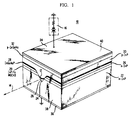
- the semiconductor light emitting device in FIG. 1 may be used as a laser or as an edge-emitting LED.
- the device 10 includes an active region 12 in which the recombination of electrons and holes causes radiation to be emitted at a wavelength characteristic of the bandgap of the semiconductor material of the active region (e.g., about 1.0-1.65 ⁇ m for InGaAsP depending on the specific composition of the alloy).
- the radiation is direction generally along axis 14 and is primarily stimulated emission in the case of a laser and primarily spontaneous emission in the case of an LED.
- This recombination radiation is generated by forward-biasing a p-n junction which causes minority carriers to be injected into the active region.
- Source 16 illustratively depicted as a battery in series with a current-limiting resistor, supplies the forward bias voltage and, in addition, provides pumping current at a level commensurate with the desired optical output power. In a laser, the pumping current exceeds the lasing current threshold.
- the device includes means for constraining the pumping current to flow in a relatively narrow channel through the active region 12.
- this constraining means comprises a bifurcated, high resistivity Fe-doped InP epitaxial layer 20, and the active region 12 has the shape of a stripe which lies in the rectangular opening (top view) of the bifurcated layer 20.
- the layer 20, rather than being bifurcated might take the shape of an annulus surround a cylindrical or mesa-like active region.
- FIG. 1 The structure shown in FIG. 1 is known as a channeled-substrate buried heterostructure (CSBH) laser which includes an n-InP substrate 22 and an Fe-doped high resistivity InP epitaxial layer 20 which is bifurcated by a groove 24.
- the groove is etched or otherwise formed through layer 20 into substrate 22.
- a preferred technique for controllably etching the groove in the shape of a V is described in U.S. Patent No. 4,595,454.
- n-InP first cladding layer 26 (the central portion of which fills at least the bottom portion of groove 24); an unintentionally doped InGaAsP layer 28; a p-InP second cladding layer 30; and a p-InGaAs (or p-InGaAsP) contact-facilitating layer 32.
- Layer 28 includes crescent-shaped active region 12 which, in practice, becomes separated from the remainder of layer 28 because epitaxial growth does not take place along the top edges of the groove 24.
- the active layer is preferably vertically positioned within the thickness of the high resistivity layer 20 in order to reduce leakage current.
- the active layer is below layer 20, but near enough thereto (i.e., ⁇ 1 ⁇ m away), leakage currents are still significantly reduced and nonradiative recombination at the layer 20 interface becomes much less of a problem.
- the high resistivity InP:Fe layer 20 is formed directly on the substrate 22, it may also be formed on an epitaxial buffer layer (not shown) grown on the substrate.
- an epitaxial buffer layer (not shown) grown on the substrate.
- a resistivity in excess of about 1 x 10⁶ ⁇ -cm is desirable.
- this aspect of the invention utilizes the growth of high resistivity InP:Fe layer 20 usisng hydride VPE with N2 as an inert carrier under conditions of limited PH3 pyrolysis in the reactor.
- the invention achieved transport of sufficient FeCl2 (and hence limited the excessive precipitation of iron by hydrogen) to produce InP:Fe with a resistivity of > 108 ⁇ -cm.
- a high resistivity layer prepared by this hydride VPE process maintains its high resistivity even after being subjected to the high temperatures of subsequent process (e.g., LPE) steps.
- Source 16 is connected across electrodes 34 and 36.
- FIG. 1 Although a broad-area cosdntact is depicted in FIG. 1 by layer 32 and electrode 34, it also is possible to delineate a stripe geometry contact as shown in FIG. 2.
- the contact-facilitating layer 32 ⁇ is etched to form a stripe and is aligned within the stripe-shaped opening of SiO2 layer 33.
- a stripe-shaped metal contact 35 is formed on layer 32 ⁇ in the opening of SiO2 layer 33, and a broad area electrode 34 ⁇ is then formed over the top of the device.
- a contact configuration of this type reduces device capacitance and hence increases high speed performance.
- the CSBH laser also includes means for providing optical feedback of the stimulated emission, typically a pair of separated, parallel, cleaved facets 38 and 40 which form an optical cavity resonator as shown in FIG. 1.
- the optical axis of the resonator and the elongated direction of the stripe-shaped active region 12 are generally parallel to one another.
- Other feedback techniques are also suitable, however, including well-known distributed feedback gratings, for example.
- This example describes the fabrication of high resistivity InP:Fe epitaxial layers by a hydride VPE process. These high resistivity layers can be incorporated into CSBH lasers (as described above) as well as into other device structures as described hereinafter.
- CSBH lasers as described above
- Other device structures as described hereinafter.
- the various materials, dimensions, concentrations, etc., are given by way of illustration only and are not intended to limit the invention unless otherwise stated.
- the reactor used for the growth of the InP:Fe is described by R. F. Karlicek et al. in Journal of Applied Physics , Vol. 60, p. 794 (1986).
- the source gases included HCl and PH3 mixtures (5% and 2%, respectively) in ultra high purity N2), and the N2 carrier gas (99.999% pure) was obtained from a standard compressed gas cylinder.
- the concentration of the input was reactive gases was selected using electronic mass flow controllers.
- the transport of iron as the dichloride FeCl2 was accomplished by flowing HCl (5% in N2) through iron powder (99.999% pure) placed on a quartz frit which was located downstream of the In (l) source in the reactor source region.
- the In (l) source temperature, the Fe source temperature, and the growth temperature were kept constant at about 700°C. Between growth experiments, Pd-purified H2 was made to flow through the reactor in place of N2.
- the extent of PH3 pyrolysis was determined by measuring the absorbance of P4 at 230 nm. Since P4 is the dominant species (except for unpyrolyzed PH3) the concentration of P2 was not monitored optically and was not included in the computation of the degree of PH3 pyrolysis during growth. The transport of FeCl2 was also monitored optically, and the concentration was computed from published thermodynamic data for the Fe-Cl system.
- the invention achieves sufficient transport of FeCl2 (and hence limited the escessive precipitation of iron by hydrogen) to produce InP:Fe with a resistivity of > 108 ⁇ -cm.
- InP:Fe The growth of InP:Fe was performed on ⁇ 100> oriented InP:S substrates which were degreased prior to placement in the reactor. Following the preheating of the substrate under a dilute PH3 flow, a brief etch was performed by initiating the flow of HCl through the Fe source. Growth was initiated by starting the flow of HCl over the In (l) source region.
- the specific growth conditions were as follows: PH3 pressure of 1755 Pa (17.9 x 10 ⁇ 3 atm), InCl pressure of 390 Pa (4.0 x 10 ⁇ 3 atm), HCl pressure of 9.8 Pa (0.1 x 10 ⁇ 3 atm), and total flow of 2250 sccm.
- the combination of the inert carrier gas (e.g., N2), the volatile dopant compound (e.g., FeCl2), the volatile indium compound (e.g., InCl) and the Group V hydride (e.g., PH3) are known as a precursor gas. These conditions produced in InP:Fe growth rates of 16 ⁇ m/hr. The resulting InP:Fe layer was measured to have a resistivity of about 2.4 x 10⁸ ⁇ -cm.
- the invention contemplates the ability to grow by hydride VPE InP-based epitaxial layers having the physical characteristics (e.g., resistivities of ⁇ 106 ⁇ -cm and thicknesses of ⁇ 1 ⁇ m) of Fe-doped InP-based layers grown by MOCVD.
- These InP-based layers include, for example, InGaP, InAsP, InGaAsP and InGaAlP.
- DCPBH double channel planar buried heterostructure
- the conventional DCPBH laser is described generally by I. Mito et al. in Journal of Lightwave Technology , Vol. LT-1, No. 1, p. 195 (1983). It employs LPE regrowth in the channels to form reverse-biased blocking junctions which constrain current to flow through the elongated mesa containing the active layer.
- LPE regrowth of blocking junctions is replaced by growth of InP:Fe zones 40 on each side of the mesa.
- a restricted (e.g., stripe geometry) contact 42 is delineated on top of the mesa by a patterned dielectric layer 44 (e.g., SiO2) and an electrode 46 overlays the top of the device.
- a patterned dielectric layer 44 e.g., SiO2
- an electrode 46 overlays the top of the device.
- the active region of the devices described above may include a single active layer or a composite several layers at least one of which is active (in the light-emitting sense).
- several active layers emitting at different wavelengths are also embraced within the definition of an active region.
Landscapes
- Physics & Mathematics (AREA)
- Chemical & Material Sciences (AREA)
- Geometry (AREA)
- Condensed Matter Physics & Semiconductors (AREA)
- Materials Engineering (AREA)
- Metallurgy (AREA)
- Organic Chemistry (AREA)
- Engineering & Computer Science (AREA)
- Optics & Photonics (AREA)
- Crystallography & Structural Chemistry (AREA)
- General Physics & Mathematics (AREA)
- Electromagnetism (AREA)
- Inorganic Chemistry (AREA)
- Chemical Kinetics & Catalysis (AREA)
- General Chemical & Material Sciences (AREA)
- Semiconductor Lasers (AREA)
- Crystals, And After-Treatments Of Crystals (AREA)
- Chemical Vapour Deposition (AREA)
Applications Claiming Priority (2)
| Application Number | Priority Date | Filing Date | Title |
|---|---|---|---|
| US491987A | 1987-01-20 | 1987-01-20 | |
| US4919 | 1987-01-20 |
Publications (3)
| Publication Number | Publication Date |
|---|---|
| EP0276069A2 EP0276069A2 (en) | 1988-07-27 |
| EP0276069A3 EP0276069A3 (en) | 1989-02-15 |
| EP0276069B1 true EP0276069B1 (en) | 1992-12-16 |
Family
ID=21713183
Family Applications (1)
| Application Number | Title | Priority Date | Filing Date |
|---|---|---|---|
| EP88300203A Expired - Lifetime EP0276069B1 (en) | 1987-01-20 | 1988-01-12 | Vapor phase epitaxial growth of iron-doped, indium-based, compound group iii-v semiconductors |
Country Status (6)
| Country | Link |
|---|---|
| EP (1) | EP0276069B1 (OSRAM) |
| JP (1) | JPS63193897A (OSRAM) |
| KR (1) | KR960015483B1 (OSRAM) |
| CA (1) | CA1282874C (OSRAM) |
| DE (1) | DE3876639T2 (OSRAM) |
| ES (1) | ES2036260T3 (OSRAM) |
Cited By (1)
| Publication number | Priority date | Publication date | Assignee | Title |
|---|---|---|---|---|
| EP1000291B2 (en) † | 1998-04-28 | 2009-06-24 | Advanced Technology Materials, Inc. | Fluid storage and dispensing system |
Families Citing this family (2)
| Publication number | Priority date | Publication date | Assignee | Title |
|---|---|---|---|---|
| EP0712169A1 (en) * | 1994-11-14 | 1996-05-15 | The Whitaker Corporation | Semi-insulating edge emitting light emitting diode |
| US5608234A (en) * | 1994-11-14 | 1997-03-04 | The Whitaker Corporation | Semi-insulating edge emitting light emitting diode |
Family Cites Families (4)
| Publication number | Priority date | Publication date | Assignee | Title |
|---|---|---|---|---|
| US4062706A (en) * | 1976-04-12 | 1977-12-13 | Robert Arthur Ruehrwein | Process for III-V compound epitaxial crystals utilizing inert carrier gas |
| JPS5379459A (en) * | 1976-12-24 | 1978-07-13 | Fujitsu Ltd | Doping prodess device |
| US4314873A (en) * | 1977-07-05 | 1982-02-09 | The United States Of America As Represented By The Secretary Of The Navy | Method for depositing heteroepitaxially InP on GaAs semi-insulating substrates |
| CA1210526A (en) * | 1983-10-21 | 1986-08-26 | Judith A. Long | Device having semi-insulating indium phosphides based compositions |
-
1988
- 1988-01-12 DE DE8888300203T patent/DE3876639T2/de not_active Expired - Lifetime
- 1988-01-12 ES ES198888300203T patent/ES2036260T3/es not_active Expired - Lifetime
- 1988-01-12 EP EP88300203A patent/EP0276069B1/en not_active Expired - Lifetime
- 1988-01-18 KR KR1019880000327A patent/KR960015483B1/ko not_active Expired - Fee Related
- 1988-01-18 CA CA000556706A patent/CA1282874C/en not_active Expired - Lifetime
- 1988-01-19 JP JP63007669A patent/JPS63193897A/ja active Granted
Cited By (1)
| Publication number | Priority date | Publication date | Assignee | Title |
|---|---|---|---|---|
| EP1000291B2 (en) † | 1998-04-28 | 2009-06-24 | Advanced Technology Materials, Inc. | Fluid storage and dispensing system |
Also Published As
| Publication number | Publication date |
|---|---|
| EP0276069A3 (en) | 1989-02-15 |
| ES2036260T3 (es) | 1993-05-16 |
| JPS63193897A (ja) | 1988-08-11 |
| EP0276069A2 (en) | 1988-07-27 |
| KR960015483B1 (ko) | 1996-11-14 |
| KR880009417A (ko) | 1988-09-15 |
| CA1282874C (en) | 1991-04-09 |
| JPH0543680B2 (OSRAM) | 1993-07-02 |
| DE3876639T2 (de) | 1993-04-22 |
| DE3876639D1 (de) | 1993-01-28 |
Similar Documents
| Publication | Publication Date | Title |
|---|---|---|
| US4888624A (en) | Semiconductor devices employing high resistivity in-based compound group III-IV epitaxial layer for current confinement | |
| EP0185051B1 (en) | Semiconductor devices with buried heterostructure | |
| CA1276276C (en) | Semiconductor devices employing ti-doped group iii-v epitaxial layer | |
| JP2823476B2 (ja) | 半導体レーザおよびその製造方法 | |
| EP0201599B1 (en) | The fabrication of grooved semiconductor devices | |
| EP0038085B1 (en) | Buried heterostructure laser diode and method for making the same | |
| US4999315A (en) | Method of controlling dopant incorporation in high resistivity In-based compound Group III-V epitaxial layers | |
| KR100187778B1 (ko) | 매몰 헤테로 구조 레이저 및 그 제조 방법 | |
| US5260230A (en) | Method of manufacturing buried heterostructure semiconductor laser | |
| EP0462816B1 (en) | Semiconductor laser producing visible light | |
| EP0473443B1 (en) | Buried-stripe type semiconductor laser device | |
| JP4002422B2 (ja) | 半導体素子およびその作製方法 | |
| JPH11506273A (ja) | 最高30%のアルミニウムを含む半導体材料又はアルミニウムを含まない半導体材料から成る個別の閉じ込め層を有する放射放出半導体ダイオード | |
| CA1282874C (en) | Semiconductor devices employing high resistivity in p-based epitaxial layer forcurrent confinement | |
| US4517674A (en) | Zinc-diffused narrow stripe AlGaAs/GaAs double heterostructure laser | |
| Inoue et al. | Fabrication of AlxGa1-xAs buried heterostructure laser diodes by in-situ gas etching and selective-area metalorganic vapor phase epitaxy | |
| Yoshikawa et al. | A novel technology for formation of a narrow active layer in buried heterostructure lasers by single-step MOCVD | |
| Mikami et al. | 1.5 μm GaInAsP/InP buried heterostructure lasers fabricated by hybrid combination of liquid-and vapour-phase epitaxy | |
| JPH07176830A (ja) | 半導体発光素子の製造方法 | |
| Hafich et al. | AlGaAs/GaAs transverse junction stripe lasers with distributed feedback | |
| Takahashi et al. | Low threshold current coplanar vertical injection laser diode for optoelectronic integrated circuits | |
| JPH03256388A (ja) | 半導体レーザの製造方法 | |
| JPH0770784B2 (ja) | 横方向注入レーザおよびその製造方法 | |
| JPH0730193A (ja) | 半導体レーザ装置およびその製造方法 |
Legal Events
| Date | Code | Title | Description |
|---|---|---|---|
| PUAI | Public reference made under article 153(3) epc to a published international application that has entered the european phase |
Free format text: ORIGINAL CODE: 0009012 |
|
| AK | Designated contracting states |
Kind code of ref document: A2 Designated state(s): DE ES FR GB IT NL SE |
|
| PUAL | Search report despatched |
Free format text: ORIGINAL CODE: 0009013 |
|
| AK | Designated contracting states |
Kind code of ref document: A3 Designated state(s): DE ES FR GB IT NL SE |
|
| 17P | Request for examination filed |
Effective date: 19890809 |
|
| 17Q | First examination report despatched |
Effective date: 19910208 |
|
| GRAA | (expected) grant |
Free format text: ORIGINAL CODE: 0009210 |
|
| AK | Designated contracting states |
Kind code of ref document: B1 Designated state(s): DE ES FR GB IT NL SE |
|
| REF | Corresponds to: |
Ref document number: 3876639 Country of ref document: DE Date of ref document: 19930128 |
|
| ET | Fr: translation filed | ||
| ITF | It: translation for a ep patent filed | ||
| REG | Reference to a national code |
Ref country code: ES Ref legal event code: FG2A Ref document number: 2036260 Country of ref document: ES Kind code of ref document: T3 |
|
| PLBE | No opposition filed within time limit |
Free format text: ORIGINAL CODE: 0009261 |
|
| STAA | Information on the status of an ep patent application or granted ep patent |
Free format text: STATUS: NO OPPOSITION FILED WITHIN TIME LIMIT |
|
| 26N | No opposition filed | ||
| EAL | Se: european patent in force in sweden |
Ref document number: 88300203.2 |
|
| PGFP | Annual fee paid to national office [announced via postgrant information from national office to epo] |
Ref country code: SE Payment date: 20001227 Year of fee payment: 14 |
|
| PGFP | Annual fee paid to national office [announced via postgrant information from national office to epo] |
Ref country code: ES Payment date: 20010118 Year of fee payment: 14 |
|
| REG | Reference to a national code |
Ref country code: GB Ref legal event code: IF02 |
|
| PG25 | Lapsed in a contracting state [announced via postgrant information from national office to epo] |
Ref country code: SE Free format text: LAPSE BECAUSE OF NON-PAYMENT OF DUE FEES Effective date: 20020113 |
|
| PG25 | Lapsed in a contracting state [announced via postgrant information from national office to epo] |
Ref country code: ES Free format text: LAPSE BECAUSE OF NON-PAYMENT OF DUE FEES Effective date: 20020114 |
|
| EUG | Se: european patent has lapsed |
Ref document number: 88300203.2 |
|
| REG | Reference to a national code |
Ref country code: ES Ref legal event code: FD2A Effective date: 20030922 |
|
| PGFP | Annual fee paid to national office [announced via postgrant information from national office to epo] |
Ref country code: NL Payment date: 20070109 Year of fee payment: 20 |
|
| PGFP | Annual fee paid to national office [announced via postgrant information from national office to epo] |
Ref country code: DE Payment date: 20070110 Year of fee payment: 20 |
|
| PGFP | Annual fee paid to national office [announced via postgrant information from national office to epo] |
Ref country code: GB Payment date: 20070119 Year of fee payment: 20 |
|
| PGFP | Annual fee paid to national office [announced via postgrant information from national office to epo] |
Ref country code: IT Payment date: 20070626 Year of fee payment: 20 |
|
| REG | Reference to a national code |
Ref country code: GB Ref legal event code: PE20 |
|
| NLV7 | Nl: ceased due to reaching the maximum lifetime of a patent |
Effective date: 20080112 |
|
| PG25 | Lapsed in a contracting state [announced via postgrant information from national office to epo] |
Ref country code: NL Free format text: LAPSE BECAUSE OF EXPIRATION OF PROTECTION Effective date: 20080112 |
|
| PGFP | Annual fee paid to national office [announced via postgrant information from national office to epo] |
Ref country code: FR Payment date: 20070111 Year of fee payment: 20 |
|
| PG25 | Lapsed in a contracting state [announced via postgrant information from national office to epo] |
Ref country code: GB Free format text: LAPSE BECAUSE OF EXPIRATION OF PROTECTION Effective date: 20080111 |