EP0275789B2 - Dispositif à code modifiable de protection contre le vol pour véhicules automobiles - Google Patents
Dispositif à code modifiable de protection contre le vol pour véhicules automobiles Download PDFInfo
- Publication number
- EP0275789B2 EP0275789B2 EP87402979A EP87402979A EP0275789B2 EP 0275789 B2 EP0275789 B2 EP 0275789B2 EP 87402979 A EP87402979 A EP 87402979A EP 87402979 A EP87402979 A EP 87402979A EP 0275789 B2 EP0275789 B2 EP 0275789B2
- Authority
- EP
- European Patent Office
- Prior art keywords
- code
- memory
- unlocking
- control device
- keyboard
- Prior art date
- Legal status (The legal status is an assumption and is not a legal conclusion. Google has not performed a legal analysis and makes no representation as to the accuracy of the status listed.)
- Expired - Lifetime
Links
- 230000015654 memory Effects 0.000 claims description 94
- 238000000034 method Methods 0.000 claims description 8
- 230000009471 action Effects 0.000 claims description 4
- 230000005540 biological transmission Effects 0.000 claims description 3
- 239000000203 mixture Substances 0.000 claims description 2
- 230000001143 conditioned effect Effects 0.000 claims 1
- 230000008859 change Effects 0.000 description 17
- 230000006870 function Effects 0.000 description 9
- 210000000056 organ Anatomy 0.000 description 5
- 238000006243 chemical reaction Methods 0.000 description 3
- 230000006978 adaptation Effects 0.000 description 2
- 230000008901 benefit Effects 0.000 description 2
- 230000005764 inhibitory process Effects 0.000 description 2
- 230000004048 modification Effects 0.000 description 2
- 238000012986 modification Methods 0.000 description 2
- 230000008569 process Effects 0.000 description 2
- 230000001960 triggered effect Effects 0.000 description 2
- 102000016979 Other receptors Human genes 0.000 description 1
- 238000012508 change request Methods 0.000 description 1
- 238000012217 deletion Methods 0.000 description 1
- 230000037430 deletion Effects 0.000 description 1
- 230000000694 effects Effects 0.000 description 1
- 238000002347 injection Methods 0.000 description 1
- 239000007924 injection Substances 0.000 description 1
- 230000003287 optical effect Effects 0.000 description 1
- 230000008520 organization Effects 0.000 description 1
- 230000037452 priming Effects 0.000 description 1
- 230000001681 protective effect Effects 0.000 description 1
- 238000006467 substitution reaction Methods 0.000 description 1
- 230000009897 systematic effect Effects 0.000 description 1
- 238000012795 verification Methods 0.000 description 1
Images


Classifications
-
- B—PERFORMING OPERATIONS; TRANSPORTING
- B60—VEHICLES IN GENERAL
- B60R—VEHICLES, VEHICLE FITTINGS, OR VEHICLE PARTS, NOT OTHERWISE PROVIDED FOR
- B60R25/00—Fittings or systems for preventing or indicating unauthorised use or theft of vehicles
- B60R25/20—Means to switch the anti-theft system on or off
-
- B—PERFORMING OPERATIONS; TRANSPORTING
- B60—VEHICLES IN GENERAL
- B60R—VEHICLES, VEHICLE FITTINGS, OR VEHICLE PARTS, NOT OTHERWISE PROVIDED FOR
- B60R25/00—Fittings or systems for preventing or indicating unauthorised use or theft of vehicles
- B60R25/01—Fittings or systems for preventing or indicating unauthorised use or theft of vehicles operating on vehicle systems or fittings, e.g. on doors, seats or windscreens
- B60R25/04—Fittings or systems for preventing or indicating unauthorised use or theft of vehicles operating on vehicle systems or fittings, e.g. on doors, seats or windscreens operating on the propulsion system, e.g. engine or drive motor
-
- G—PHYSICS
- G07—CHECKING-DEVICES
- G07C—TIME OR ATTENDANCE REGISTERS; REGISTERING OR INDICATING THE WORKING OF MACHINES; GENERATING RANDOM NUMBERS; VOTING OR LOTTERY APPARATUS; ARRANGEMENTS, SYSTEMS OR APPARATUS FOR CHECKING NOT PROVIDED FOR ELSEWHERE
- G07C9/00—Individual registration on entry or exit
- G07C9/00174—Electronically operated locks; Circuits therefor; Nonmechanical keys therefor, e.g. passive or active electrical keys or other data carriers without mechanical keys
- G07C9/00658—Electronically operated locks; Circuits therefor; Nonmechanical keys therefor, e.g. passive or active electrical keys or other data carriers without mechanical keys operated by passive electrical keys
- G07C9/00674—Electronically operated locks; Circuits therefor; Nonmechanical keys therefor, e.g. passive or active electrical keys or other data carriers without mechanical keys operated by passive electrical keys with switch-buttons
- G07C9/0069—Electronically operated locks; Circuits therefor; Nonmechanical keys therefor, e.g. passive or active electrical keys or other data carriers without mechanical keys operated by passive electrical keys with switch-buttons actuated in a predetermined sequence
Definitions
- the present invention relates to protection including motor vehicles and relates more specifically to protection against theft of vehicles equipped with electronic devices with microprocessor for controlling an organ of the vehicle, such as the engine, gearbox or other.
- a remote control device comprising a box for transmitting a coded message preset and, on board the vehicle, a message receiver coded, coupled to a decoder which, after verification the conformity of the code issued by the issuer to that of the vehicle owner, controls the power supply means of electrically opening the doors of the vehicle.
- Such devices have the disadvantage to be ineffective when it is possible to access inside the vehicle for example by breaking a window or by taking advantage of a ajar window.
- the initial code is an integral part of a processor in the device and cannot be exchange.
- the securities taken for the introduction and memorization of the so-called "convenience" code are weak since this code is stored in a memory volatile which can be unexpectedly erased during a cut of the supply battery.
- a device for protection against theft in particular of a motor vehicle, fitted with a electronic device for controlling a main organ and an organ tender such as the engine.
- This device includes an introduction keyboard a user code, conversion means constituted by a microprocessor of input data from the keyboard in one exit message containing user code, means programmable to memorize a device unlock code engine control, part of the control device and means for comparing the unlocking code stored in said means of storage with user code and unlocking means of the electronic control device when the code of coincidence unlocking with user code.
- This device also includes means for replacing the unlocking code of the motor control by a new unlocking code by action on the keyboard, said replacement means comprising the keyboard to which associated with said conversion means, said means of comparison and said storage means.
- This code change device has drawbacks:
- the invention aims to remedy the drawbacks of known devices by taking advantage of the presence of a microprocessor in vehicles fitted with an electronic operation control device in particular the engine to protect a vehicle against flight.
- a device for protection against theft in particular of a motor vehicle provided with an electronic device for controlling a vehicle organ such as the engine, comprising a keyboard for entering a user code.
- the protective device shown in Fig.1 has a microprocessor 1 which is part of the vehicle engine control box which can be the ignition control unit or injection.
- Microprocessor 1 is associated with a memory non-volatile, electrically programmable EE PROM 2 which has three parts associated with the anti-theft function namely a temporary memory MT, a memory permanent MP and a state memory of the control box of the ME motor.
- the device further comprises a data input keyboard 3 associated with a microprocessor 4 connected to the microprocessor 1 of the control box by an amplifier 5 and an adaptation circuit 5 a .
- the keyboard 3 includes a key 3 a for changing the code.
- An output of the microprocessor 4 is also connected to a relay 6 for controlling the power supply 6 a of the motor control unit, by means of a transistor 7.
- the device is completed by a circuit 11 power supply of microprocessor 4 during establishment contact + APC and by a device 12 of reception of the order + COND of locking of the box control B to be transmitted to the latter by the microprocessor 4.
- the device 12 also controls the supply 11 of the microprocessor 4 and the supply 6 a of the control box B by means of the microprocessor 4, the transistor 7 and the relay 6.
- the microprocessor 4 is also associated an EE PROM type non-volatile memory 8 intended for store codes issued by a control device auxiliary 9, such as an optical pencil for reading barcode, a magnetic card reader, a infrared or other receptor.
- a control device auxiliary 9 such as an optical pencil for reading barcode, a magnetic card reader, a infrared or other receptor.
- the microprocessor 4 acquires the information generated by pressing the keys of the keyboard 3, this information corresponding to the code specific to the user of the vehicle and translates this information in the form of a serial message which is transmitted by the intermediate of the amplifier 5 and of the adaptation circuit 5 a at the input of the microprocessor 1 of the box B of motor control.
- the microprocessor 4 also controls, via the transistor 7 and the relay 6, the supply of the motor control unit B, which allows it, on reception of an order, for example from the positive terminal + COND of the power supply to the vehicle door locking motors, to supply the control box B for an interval of time necessary to give the lock order for the box B.
- the order is transmitted in the form of a serial message by the microprocessor 4 and circuits 5 and 5 a to microprocessor 1 which stores it in the state memory ME.
- the serial message from the microprocessor 4 which unlocks the housing B of engine control contains the personal code of the user.
- This code is stored both in memory temporary MT and in permanent memory MP from memory 2. It is also called unlocking the control box.
- the code reaching microprocessor 1 is successively compared to the code contained in the memory temporary MT and to the code contained in the memory permanent MP.
- the state memory ME goes to the unlocked state and the engine can be started.
- the user wants to change the unlocking of the engine control unit B, it first enter via keyboard 3, the code previous which unlocks the control box B according to the procedure previously described.
- He presses the code change key 3 a forms on the keyboard 3 the new code and validates the operation by pressing the key 3 a again .
- This new code is then sent to the housing 8 which stores it in the temporary memory MT.
- the user has the choice between the old code stored in the HP permanent memory and new code stored in the temporary memory HT.
- the code he then dials on the keyboard 3 will validate the selected code.
- the old code may be used and will remain the only valid code.
- the process is as follows.
- the engine control unit B has new code in the HT temporary memory and the old code in the permanent memory MP.
- microprocessor 1 compares it with the content of HT memory, then with that of memory MP. If there is a coincidence with one of the two contents, the microprocessor 1 on the one hand aligns the content HT and MP memories with the content of the message and on the other hand, switches the memory ME to the unlocked state, allowing it to enter the loop engine control.
- the ability to easily change code securely and have two MP and MT memories allows the use of a specific code for example "0000" to inhibit the anti-theft function, which is interesting when you entrust the vehicle to a garage.
- the control box B works as if the anti-theft function did not exist.
- the procedure is as for a change of code by sending the code corresponding to the memory MP, and then again the same code framed by two actuations of the key 3 has key code change 3.
- the engine control unit B is delivered in the unlocked state with its MT memory at state "0000", its memory MP to a known state, for example 0001 ", and its memory ME in the unlocked state.
- the anti-theft function is not yet activated.
- the message delivered by the device 9 is compared by microprocessor 4 with a contained code in memory 8.
- the user initializes the anti-theft function by causing the memorization of his personal code in the engine control unit B.
- auxiliary code of the control device 9 for example an infrared remote control device
- the memory 8 associated with the microprocessor 4 by controlling a program. followed by pressing the key 3 a to change the code which validates the operation.
- each reception of this same code by the microprocessor 4 causes the latter to send the code user to motor control unit B and unlocking said case by action of the ME memory.
- the memory ME of the housing B being locked, this one gets into the state of receiving a message microprocessor 4.
- the box is powered up during phase 20 which leads to the start of a T1 delay of 1 second during phase 21 followed by an interrogation phase 22 to determine if the control box B is locked or not.
- phase 24 there is interrogation to determine if the message received MR coincides with the code contained in the temporary memory MT.
- the message received MR contains the new HT code intended to be substituted for the unlock code contained in the MP memory and we then proceed during the phase 29, to the substitution of the code contained in the HP memory by the code contained in the HT memory, after which, the box B can be unlocked at during phase 28. However, we skip the phase of timer 27 to prohibit another change of code immediately after this code change.
- phase 30 we align the code contained in the HT memory with the code contained in the HP memory and the time delay phase 27 is triggered in the same way as at the end of the phase 26.
- Box B being unlocked, i.e. the outcome of phase 28, or as a result of phase interrogation 22, we proceed to an interrogation phase 31 to determine if the engine is running and at a interrogation phase 32 to determine whether there is reception a new message from the microprocessor 4.
- box B controls the function engine without worrying about messages that could be sent.
- phase 37 If there is no coincidence between the new message and unlock code, we determine at during phase 37 if timer T2 started during phase 27 (Fig. 2) or phase 36 is finished.
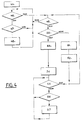
- the associated microprocessor 4 flowchart on the keyboard without additional input for the remote control and without auxiliary memory 8 comes down to acquisition of signals resulting from actuation keyboard keys 3 in a specific order and do not presents no particular difficulty.
- the microprocessor 4 of the device When the power is turned on during the phase 45, the microprocessor 4 of the device is waiting, either a priming coming from the auxiliary device 9 in the form for example of a remote control IR signal infrared, or a pulse from the keyboard 3.
- the interrogation is carried out during phase 46 of the system to determine if a message IR has been received.
- phase 46 If during phase 46, we find no message is received from the controller auxiliary 9, one proceeds during phase 49 to a interrogation relating to reception by the microprocessor 4 of a message composed on the keyboard 3.
- phase 51 when loading the new code in the auxiliary memory 8 and, during the phase 52, when sending the message with the new code to the microprocessor 1 of control box B, where it will be compared according to the procedure described with reference to Fig. 2 and 3 with the codes contained in the memory temporary HT and in the permanent memory HP of the EE PROM 2.
- timer T3 If timer T3 is running, we ensures during phase 56 of the receipt of a IR message from the auxiliary controller 9.
- microprocessor 4 sends the message containing the new code to microprocessor 1 of control box B of the engine, whether or not it coincides with the codes contained in its HT and / or HP memories.
- a malicious person can therefore possibly modify the content of memory 8 relative to the IR message code but it will be in the impossibility of transmitting to box B of engine control a message that will be able to cause it to be unlocked, because any modification IR message code can only be done changing the user code stored in memory 8.
Landscapes
- Engineering & Computer Science (AREA)
- Mechanical Engineering (AREA)
- Physics & Mathematics (AREA)
- General Physics & Mathematics (AREA)
- Lock And Its Accessories (AREA)
Description
lesdits moyens de mémorisation du code de déverrouillage du dispositif électronique de contrôle du moteur comprenant une mémoire permanente de stockage du code de déverrouillage en vigueur et une mémoire temporaire de stockage soit de ce même code de déverrouillage en vigueur lors du fonctionnement du dispositif avec un code d'utilisateur établi, soit d'un nouveau code de déverrouillage composé par l'utilisateur sur le clavier, cette composition étant encadrée par deux actionnements sur une touche de commande de changement de code, et destiné à être substitué au code de déverrouillage en vigueur stocké dans la mémoire permanente,
la procédure de stockage dans la mémoire temporaire du nouveau code de déverrouillage n'étant autorisée que pendant une temporisation initiée après la coïncidence entre le code d'utilisateur établi et la mémoire permanente,
et, à chaque déverrouillage, le contenu des mémoires permanente et temporaire étant aligné sur le contenu de la mémoire permanente ou temporaire dans laquelle est stocké le code ayant permis le déverrouillage.
- la Fig. 1 est une vue schématique d'un dispositif de protection suivant l'invention ;
- les Fig.2 à 4 sont des organigrammes destinés à illustrer le fonctionnement du dispositif de protection de la Fig. 1.
Claims (3)
- Dispositif de protection contre le vol notamment d'un véhicule automobile muni d'un dispositif électronique (B) de contrôle d'un organe du véhicule tel que le moteur, comportant un clavier (3) d'introduction d'un code d'utilisateur, des moyens (4) constitués par un microprocesseur de conversion des données d'entrée provenant du clavier (3) en un message de sortie contenant ledit code d'utilisateur, des moyens (2) programmables de mémorisation du code de déverrouillage du dispositif de contrôle du moteur, faisant partie du dispositif de contrôle, des moyens (1) de comparaison, faisant partie du dispositif de contrôle, du code de déverrouillage stocké dans lesdits moyens de mémorisation avec le code d'utilisateur contenu dans ledit message provenant du clavier (3) et de déverrouillage dudit dispositif électronique (B) de contrôle du moteur lors de la coïncidence du code de déverrouillage contenu dans les moyens de mémorisation (2) avec le code d'utilisateur contenu dans ledit message de sortie, une mémoire d'état (ME) programmable et rémanente permettant de mémoriser l'état verrouillé ou déverrouillé du dispositif électronique de contrôle (B) et des moyens (3,4,1,2) de remplacement du code de déverrouillage du dispositif de contrôle du moteur par un nouveau code de déverrouillage par action sur ledit clavier (3), lesdits moyens de remplacement comprenant ledit clavier (3) auquel sont associés lesdits moyens de conversion (4), le microprocesseur (1) du dispositif (B) de contrôle du moteur et lesdits moyens de mémorisation,lesdits moyens (2) de mémorisation du code de déverrouillage du dispositif électronique de contrôle du moteur comprenant une mémoire permanente (MP) de stockage du code de déverrouillage en vigueur et une mémoire temporaire (MT) de stockage soit de ce même code de déverrouillage en vigueur lors du fonctionnement du dispositif avec un code d'utilisateur établi, soit d'un nouveau code de déverrouillage composé par l'utilisateur sur le clavier (3), cette composition étant encadrée par deux actionnements sur une touche (3a) de commande de changement de code, et destiné à être substitué au code de déverrouillage en vigueur stocké dans la mémoire permanente (MP),la procédure de stockage dans la mémoire temporaire (MT) du nouveau code de déverrouillage n'étant autorisée que pendant une temporisation (T2) initiée après la coïncidence entre le code d'utilisateur établi et la mémoire permanente (MP),et, à chaque déverrouillage, le contenu des mémoires permanente (MP) et temporaire (MT) étant aligné sur le contenu de la mémoire permanente (MP) ou temporaire (MT) dans laquelle est stocké le code ayant permis le déverrouillage.
- Dispositif de protection suivant la revendication 1,
caractérisé en ce que lesdits moyens (2) de mémorisation du code de déverrouillage du dispositif électronique de contrôle du moteur sont constitués par une mémoire (2) électriquement programmable EEPROM. - Dispositif de protection suivant l'une des revendications 1 ou 2
caractérisé en ce qu'il comporte en outre un dispositif auxiliaire (9) de commande automatique de l'émission du code d'utilisateur ainsi qu'une mémoire auxiliaire programmable et rémanente (8) connectée auxdits moyens de conversion associés au clavier (3), ladite mémoire programmable (8) étant destinée à stocker d'une part le code propre du dispositif de commande auxiliaire (9) et d'autre part le code d'utilisateur et en ce que ledit microprocesseur (4) associé au clavier (3) constitue un dispositif de comparaison du code stocké dans ladite mémoire auxiliaire (8) avec le code qu'il reçoit de ce dispositif de commande auxiliaire, la transmission du code d'utilisateur vers ledit dispositif de contrôle à partir du microprocesseur (4) étant conditionnée par la coïncidence entre le code reçu du dispositif de commande auxiliaire (9) et le code stocké dans la mémoire auxiliaire (8).
Applications Claiming Priority (2)
| Application Number | Priority Date | Filing Date | Title |
|---|---|---|---|
| FR8618445 | 1986-12-31 | ||
| FR8618445A FR2609086B1 (fr) | 1986-12-31 | 1986-12-31 | Dispositif a code modifiable de protection contre le vol pour vehicules automobiles |
Publications (3)
| Publication Number | Publication Date |
|---|---|
| EP0275789A1 EP0275789A1 (fr) | 1988-07-27 |
| EP0275789B1 EP0275789B1 (fr) | 1992-06-24 |
| EP0275789B2 true EP0275789B2 (fr) | 1998-02-11 |
Family
ID=9342496
Family Applications (1)
| Application Number | Title | Priority Date | Filing Date |
|---|---|---|---|
| EP87402979A Expired - Lifetime EP0275789B2 (fr) | 1986-12-31 | 1987-12-23 | Dispositif à code modifiable de protection contre le vol pour véhicules automobiles |
Country Status (4)
| Country | Link |
|---|---|
| US (1) | US4888575A (fr) |
| EP (1) | EP0275789B2 (fr) |
| DE (1) | DE3780027T3 (fr) |
| FR (1) | FR2609086B1 (fr) |
Families Citing this family (42)
| Publication number | Priority date | Publication date | Assignee | Title |
|---|---|---|---|---|
| US5103932A (en) * | 1988-02-16 | 1992-04-14 | Myers Holdings Pty. Ltd. | Security system for an environment |
| US5006843A (en) * | 1988-12-01 | 1991-04-09 | Werner Hauer | Security module to preclude unauthorized users to operate motor driven equipment and to protect valuable parts of the motor from unauthorized exchange |
| JPH02204153A (ja) * | 1989-02-03 | 1990-08-14 | Motohiro Gotanda | 自動車の盗難防止装置 |
| DE3905651A1 (de) * | 1989-02-24 | 1990-08-30 | Daimler Benz Ag | Verfahren zur sicherung von codeworten eines fernwirksystems und fernwirksystem mit durch codeworte uebertragbarem code |
| US5023591A (en) * | 1989-11-15 | 1991-06-11 | Allen V. Edwards | Anti-theft control apparatus |
| FR2667026B1 (fr) * | 1990-09-21 | 1996-08-23 | Peugeot | Tableau de bord de vehicule automobile. |
| US6310537B1 (en) * | 1991-03-07 | 2001-10-30 | Siemens Aktiegesellschaft | System with optical or radio remote control for closing motor vehicles |
| US5159344A (en) * | 1991-03-22 | 1992-10-27 | North Atlantic Air, Inc. | Aircraft theft detection and location system |
| US5188069A (en) * | 1991-11-13 | 1993-02-23 | Briggs & Stratton | Safety interlock for a device |
| US5280268A (en) * | 1992-05-15 | 1994-01-18 | Matthews Edward J | Auto anti-theft system |
| DE4232435C1 (de) * | 1992-09-28 | 1993-11-25 | Telefunken Microelectron | Verfahren zum Betrieb einer Alarmanlage für Kraftfahrzeuge |
| US5307048A (en) * | 1992-12-18 | 1994-04-26 | Protect & Defend, Inc. | Vehicle security system including an anti-carjacking system |
| DE4301436C2 (de) * | 1993-01-20 | 1996-06-13 | Kaiser Hans Christian | Sicherungssystem |
| CA2170380A1 (fr) * | 1993-02-11 | 1994-08-18 | O.S. Mogdil | Systeme de telemetrie et de commande |
| US5554891A (en) * | 1993-03-30 | 1996-09-10 | Asahi Denso Kabushiki Kaisha | Antitheft device for a vehicle |
| FR2706393B1 (fr) * | 1993-06-14 | 1995-10-06 | Peugeot | Dispositif de protection contre le vol, par exemple d'un véhicule automobile. |
| US5773368A (en) * | 1996-01-22 | 1998-06-30 | Motorola, Inc. | Method of etching adjacent layers |
| JP2915299B2 (ja) * | 1994-09-09 | 1999-07-05 | 本田技研工業株式会社 | 車両盗難防止装置 |
| JP2954845B2 (ja) * | 1995-01-27 | 1999-09-27 | 本田技研工業株式会社 | 車両盗難防止対応エンジン制御装置 |
| JP3073904B2 (ja) * | 1995-02-17 | 2000-08-07 | 本田技研工業株式会社 | 車両用データ処理装置 |
| DE19511701A1 (de) * | 1995-03-30 | 1996-10-02 | Bayerische Motoren Werke Ag | Diebstahlsicherungsvorrichtung für Kraftfahrzeuge |
| US7492905B2 (en) | 1995-05-17 | 2009-02-17 | The Chamberlain Group, Inc. | Rolling code security system |
| BR9606663A (pt) | 1995-05-17 | 1997-09-16 | Chamberlain Group Inc | Transmissor para enviar um sinal criptografado para controlar um atuador receptor para receber um sinal criptografado de um transmissor e para gerar um sinal de atuação e receptor para receber um sinal de frequência de rádio criptografado de um transmissor e para gerar um sinal de atuação |
| US6690796B1 (en) | 1995-05-17 | 2004-02-10 | The Chamberlain Group, Inc. | Rolling code security system |
| US6980655B2 (en) | 2000-01-21 | 2005-12-27 | The Chamberlain Group, Inc. | Rolling code security system |
| WO1997000366A1 (fr) * | 1995-06-14 | 1997-01-03 | Richard Williams | Serrure a combinaison |
| JPH0958414A (ja) * | 1995-08-23 | 1997-03-04 | Toyota Motor Corp | 車両用盗難防止装置 |
| US5821631A (en) * | 1997-02-07 | 1998-10-13 | Clark Equipment Company | Keyless ignition system with delayed security |
| GB2325447A (en) * | 1997-05-24 | 1998-11-25 | Eaton Corp | Vehicle transmission control by anti-theft system |
| US5986542A (en) * | 1997-07-08 | 1999-11-16 | Chrysler Corporation | Vehicle anti-theft method |
| US5801615A (en) * | 1997-10-07 | 1998-09-01 | Su; Yuan Tai | Motor vehicle security system |
| DE10032916A1 (de) * | 2000-07-06 | 2002-01-24 | Bosch Gmbh Robert | Verfahren und Vorrichtung zur Steuerung einer Absperrung eines Parkraums für ein Fahrzeug |
| JP4108308B2 (ja) * | 2001-09-18 | 2008-06-25 | 本田技研工業株式会社 | ジェット推進艇の暗証番号解除方法 |
| US20050178010A1 (en) * | 2004-01-23 | 2005-08-18 | Alex Petrenko | Chainsaw tool |
| US7009499B2 (en) * | 2004-04-30 | 2006-03-07 | Mack Trucks, Inc. | Vehicle anti-theft entry system |
| US9148409B2 (en) | 2005-06-30 | 2015-09-29 | The Chamberlain Group, Inc. | Method and apparatus to facilitate message transmission and reception using different transmission characteristics |
| US12149618B2 (en) | 2005-01-27 | 2024-11-19 | The Chamberlain Group Llc | Method and apparatus to facilitate transmission of an encrypted rolling code |
| US8422667B2 (en) | 2005-01-27 | 2013-04-16 | The Chamberlain Group, Inc. | Method and apparatus to facilitate transmission of an encrypted rolling code |
| US10652743B2 (en) | 2017-12-21 | 2020-05-12 | The Chamberlain Group, Inc. | Security system for a moveable barrier operator |
| US11074773B1 (en) | 2018-06-27 | 2021-07-27 | The Chamberlain Group, Inc. | Network-based control of movable barrier operators for autonomous vehicles |
| CA3107457A1 (fr) | 2018-08-01 | 2020-02-06 | The Chamberlain Group, Inc. | Operateur de barriere mobile et appariement d'emetteurs sur un reseau |
| US10997810B2 (en) | 2019-05-16 | 2021-05-04 | The Chamberlain Group, Inc. | In-vehicle transmitter training |
Family Cites Families (6)
| Publication number | Priority date | Publication date | Assignee | Title |
|---|---|---|---|---|
| US4206491A (en) * | 1977-08-03 | 1980-06-03 | Kkf Corporation | Entry system |
| US4240516A (en) * | 1979-01-19 | 1980-12-23 | Keycon Corporation | Vehicle securing and lockout prevention system |
| US4437153A (en) * | 1981-09-09 | 1984-03-13 | Kokusan Kinzoku Kogyo Kabushiki Kaisha | Apparatus control system |
| GB2108189A (en) * | 1981-09-11 | 1983-05-11 | Antivols Simplex Sa | Anti theft device for motor vehicle |
| DE3237622A1 (de) * | 1982-10-11 | 1984-04-12 | Bayerische Motoren Werke AG, 8000 München | Sicherheitseinrichtung |
| US4754255A (en) * | 1984-03-12 | 1988-06-28 | Sanders Rudy T | User identifying vehicle control and security device |
-
1986
- 1986-12-31 FR FR8618445A patent/FR2609086B1/fr not_active Expired - Lifetime
-
1987
- 1987-12-23 EP EP87402979A patent/EP0275789B2/fr not_active Expired - Lifetime
- 1987-12-23 DE DE3780027T patent/DE3780027T3/de not_active Expired - Lifetime
- 1987-12-30 US US07/139,800 patent/US4888575A/en not_active Expired - Lifetime
Also Published As
| Publication number | Publication date |
|---|---|
| EP0275789A1 (fr) | 1988-07-27 |
| DE3780027D1 (de) | 1992-07-30 |
| FR2609086B1 (fr) | 1992-12-11 |
| EP0275789B1 (fr) | 1992-06-24 |
| US4888575A (en) | 1989-12-19 |
| FR2609086A1 (fr) | 1988-07-01 |
| DE3780027T3 (de) | 1998-09-17 |
| DE3780027T2 (de) | 1993-01-14 |
Similar Documents
| Publication | Publication Date | Title |
|---|---|---|
| EP0275789B1 (fr) | Dispositif à code modifiable de protection contre le vol pour véhicules automobiles | |
| FR2663074A1 (fr) | Systeme de commande a distance pour des fermetures. | |
| EP0354102B1 (fr) | Système d'antivol électronique pour véhicle à moteur | |
| FR2740414A1 (fr) | Systeme de communication prevu entre une cle de contact et un vehicule et protege contre les fausses manoeuvres | |
| FR2781446A1 (fr) | Systeme antivol pour vehicule automobile | |
| FR2740413A1 (fr) | Dispositif de communication cle-vehicule pour la commande d'un blocage de demarrage et d'une fonction telecommandable | |
| EP3683101A1 (fr) | Dispositif, systeme et procede pour le partage de vehicules | |
| FR2767764A1 (fr) | Procede d'initialisation d'un systeme antivol pour vehicule automobile | |
| FR2474727A1 (fr) | Appareil d'alerte antivol avec memoire electronique et combinaison numerique de mise hors service utilisable notamment dans des vehicules automobiles, des bateaux a moteur ou des engins analogues | |
| FR2737871A1 (fr) | Procede pour faire fonctionner une installation de commande pour un vehicule automobile, avec un mode de fonctionnement en atelier | |
| FR2722461A1 (fr) | Systeme de protection contre le vol pour un vehicule automobile | |
| FR2790238A1 (fr) | Procede permettant de faire demarrer un vehicule automobile et dispositif de mise en marche d'allumage | |
| FR2736883A1 (fr) | Procede de blocage du demarrage et dispositif de blocage du demarrage | |
| FR2544368A1 (fr) | Systeme de serrure electronique, en particulier pour vehicules automobiles | |
| FR2545632A1 (fr) | Systeme antivol comportant un dispositif principal et un element " annexe a proteger " | |
| FR2589405A1 (fr) | Dispositif antivol pour appareil audio | |
| EP0856624B1 (fr) | Système de sécurité pour véhicules automobiles et procédé d'apprentissage associé | |
| FR2767767A1 (fr) | Systeme antivol pour vehicule automobile | |
| EP0582523A1 (fr) | Système d'antivol électronique pour véhicule à moteur | |
| FR2613993A1 (fr) | Dispositif et procede d'antivol electronique d'un vehicule | |
| FR2729349A1 (fr) | Installation de securite pour vehicule automobile | |
| FR2695364A1 (fr) | Système d'antivol électronique pour véhicule à moteur. | |
| FR2706394A1 (fr) | Dispositif de protection contre le vol, notamment d'un véhicule automobile. | |
| EP1808821B1 (fr) | Système de sécurité appartenant à un dispositif d'interverrouillage comportant un ensemble de clés électroniques | |
| EP0546161A1 (fr) | Procede de controle d'aptitude du conducteur a la conduite d'un vehicule, et dispositif de controle correspondant |
Legal Events
| Date | Code | Title | Description |
|---|---|---|---|
| PUAI | Public reference made under article 153(3) epc to a published international application that has entered the european phase |
Free format text: ORIGINAL CODE: 0009012 |
|
| AK | Designated contracting states |
Kind code of ref document: A1 Designated state(s): DE GB IT |
|
| 17P | Request for examination filed |
Effective date: 19880704 |
|
| 17Q | First examination report despatched |
Effective date: 19900814 |
|
| GRAA | (expected) grant |
Free format text: ORIGINAL CODE: 0009210 |
|
| AK | Designated contracting states |
Kind code of ref document: B1 Designated state(s): DE GB IT |
|
| ITF | It: translation for a ep patent filed | ||
| GBT | Gb: translation of ep patent filed (gb section 77(6)(a)/1977) | ||
| REF | Corresponds to: |
Ref document number: 3780027 Country of ref document: DE Date of ref document: 19920730 |
|
| PLBI | Opposition filed |
Free format text: ORIGINAL CODE: 0009260 |
|
| 26 | Opposition filed |
Opponent name: BAYERISCHE MOTOREN WERKE AG, PATENTABTEILUNG AJ-3, Effective date: 19930323 |
|
| APCC | Communication from the board of appeal sent |
Free format text: ORIGINAL CODE: EPIDOS OBAPO |
|
| APAU | Communication from the board of appeal sent |
Free format text: ORIGINAL CODE: EPIDOS OBAP |
|
| APCC | Communication from the board of appeal sent |
Free format text: ORIGINAL CODE: EPIDOS OBAPO |
|
| APCC | Communication from the board of appeal sent |
Free format text: ORIGINAL CODE: EPIDOS OBAPO |
|
| APCC | Communication from the board of appeal sent |
Free format text: ORIGINAL CODE: EPIDOS OBAPO |
|
| APCC | Communication from the board of appeal sent |
Free format text: ORIGINAL CODE: EPIDOS OBAPO |
|
| APAC | Appeal dossier modified |
Free format text: ORIGINAL CODE: EPIDOS NOAPO |
|
| PLAW | Interlocutory decision in opposition |
Free format text: ORIGINAL CODE: EPIDOS IDOP |
|
| PLAW | Interlocutory decision in opposition |
Free format text: ORIGINAL CODE: EPIDOS IDOP |
|
| PLAW | Interlocutory decision in opposition |
Free format text: ORIGINAL CODE: EPIDOS IDOP |
|
| PUAH | Patent maintained in amended form |
Free format text: ORIGINAL CODE: 0009272 |
|
| STAA | Information on the status of an ep patent application or granted ep patent |
Free format text: STATUS: PATENT MAINTAINED AS AMENDED |
|
| 27A | Patent maintained in amended form |
Effective date: 19980211 |
|
| AK | Designated contracting states |
Kind code of ref document: B2 Designated state(s): DE GB IT |
|
| ITF | It: translation for a ep patent filed | ||
| GBTA | Gb: translation of amended ep patent filed (gb section 77(6)(b)/1977) | ||
| REG | Reference to a national code |
Ref country code: GB Ref legal event code: IF02 |
|
| APAH | Appeal reference modified |
Free format text: ORIGINAL CODE: EPIDOSCREFNO |
|
| PGFP | Annual fee paid to national office [announced via postgrant information from national office to epo] |
Ref country code: DE Payment date: 20061124 Year of fee payment: 20 |
|
| PGFP | Annual fee paid to national office [announced via postgrant information from national office to epo] |
Ref country code: GB Payment date: 20061127 Year of fee payment: 20 |
|
| PGFP | Annual fee paid to national office [announced via postgrant information from national office to epo] |
Ref country code: IT Payment date: 20061231 Year of fee payment: 20 |
|
| REG | Reference to a national code |
Ref country code: GB Ref legal event code: PE20 |
|
| PG25 | Lapsed in a contracting state [announced via postgrant information from national office to epo] |
Ref country code: GB Free format text: LAPSE BECAUSE OF EXPIRATION OF PROTECTION Effective date: 20071222 |