EP0266833B1 - Verfahren zum Aufzeichnen eines binären Signals auf einem optisch lesbaren Aufzeichnungsträger und Gerät zum Durchführen des Verfahrens - Google Patents
Verfahren zum Aufzeichnen eines binären Signals auf einem optisch lesbaren Aufzeichnungsträger und Gerät zum Durchführen des Verfahrens Download PDFInfo
- Publication number
- EP0266833B1 EP0266833B1 EP87202061A EP87202061A EP0266833B1 EP 0266833 B1 EP0266833 B1 EP 0266833B1 EP 87202061 A EP87202061 A EP 87202061A EP 87202061 A EP87202061 A EP 87202061A EP 0266833 B1 EP0266833 B1 EP 0266833B1
- Authority
- EP
- European Patent Office
- Prior art keywords
- radiation
- information layer
- recording
- optical properties
- sequence
- Prior art date
- Legal status (The legal status is an assumption and is not a legal conclusion. Google has not performed a legal analysis and makes no representation as to the accuracy of the status listed.)
- Expired - Lifetime
Links
- 238000000034 method Methods 0.000 title claims description 45
- 230000005855 radiation Effects 0.000 claims description 136
- 230000003287 optical effect Effects 0.000 claims description 55
- 230000008859 change Effects 0.000 claims description 22
- 238000010438 heat treatment Methods 0.000 claims description 19
- 238000004519 manufacturing process Methods 0.000 claims description 4
- 239000000463 material Substances 0.000 description 12
- 238000009826 distribution Methods 0.000 description 6
- 230000003111 delayed effect Effects 0.000 description 5
- 230000008901 benefit Effects 0.000 description 2
- 239000000969 carrier Substances 0.000 description 2
- 238000001816 cooling Methods 0.000 description 2
- 230000006870 function Effects 0.000 description 2
- 230000002277 temperature effect Effects 0.000 description 2
- 239000000956 alloy Substances 0.000 description 1
- 229910045601 alloy Inorganic materials 0.000 description 1
- 230000015572 biosynthetic process Effects 0.000 description 1
- 238000006243 chemical reaction Methods 0.000 description 1
- 238000002844 melting Methods 0.000 description 1
- 230000008018 melting Effects 0.000 description 1
- 238000005459 micromachining Methods 0.000 description 1
- 230000004044 response Effects 0.000 description 1
- 238000003860 storage Methods 0.000 description 1
- 230000007704 transition Effects 0.000 description 1
Images




Classifications
-
- G—PHYSICS
- G11—INFORMATION STORAGE
- G11B—INFORMATION STORAGE BASED ON RELATIVE MOVEMENT BETWEEN RECORD CARRIER AND TRANSDUCER
- G11B11/00—Recording on or reproducing from the same record carrier wherein for these two operations the methods are covered by different main groups of groups G11B3/00 - G11B7/00 or by different subgroups of group G11B9/00; Record carriers therefor
- G11B11/10—Recording on or reproducing from the same record carrier wherein for these two operations the methods are covered by different main groups of groups G11B3/00 - G11B7/00 or by different subgroups of group G11B9/00; Record carriers therefor using recording by magnetic means or other means for magnetisation or demagnetisation of a record carrier, e.g. light induced spin magnetisation; Demagnetisation by thermal or stress means in the presence or not of an orienting magnetic field
- G11B11/105—Recording on or reproducing from the same record carrier wherein for these two operations the methods are covered by different main groups of groups G11B3/00 - G11B7/00 or by different subgroups of group G11B9/00; Record carriers therefor using recording by magnetic means or other means for magnetisation or demagnetisation of a record carrier, e.g. light induced spin magnetisation; Demagnetisation by thermal or stress means in the presence or not of an orienting magnetic field using a beam of light or a magnetic field for recording by change of magnetisation and a beam of light for reproducing, i.e. magneto-optical, e.g. light-induced thermomagnetic recording, spin magnetisation recording, Kerr or Faraday effect reproducing
- G11B11/10502—Recording on or reproducing from the same record carrier wherein for these two operations the methods are covered by different main groups of groups G11B3/00 - G11B7/00 or by different subgroups of group G11B9/00; Record carriers therefor using recording by magnetic means or other means for magnetisation or demagnetisation of a record carrier, e.g. light induced spin magnetisation; Demagnetisation by thermal or stress means in the presence or not of an orienting magnetic field using a beam of light or a magnetic field for recording by change of magnetisation and a beam of light for reproducing, i.e. magneto-optical, e.g. light-induced thermomagnetic recording, spin magnetisation recording, Kerr or Faraday effect reproducing characterised by the transducing operation to be executed
- G11B11/10504—Recording
- G11B11/10506—Recording by modulating only the light beam of the transducer
-
- G—PHYSICS
- G11—INFORMATION STORAGE
- G11B—INFORMATION STORAGE BASED ON RELATIVE MOVEMENT BETWEEN RECORD CARRIER AND TRANSDUCER
- G11B11/00—Recording on or reproducing from the same record carrier wherein for these two operations the methods are covered by different main groups of groups G11B3/00 - G11B7/00 or by different subgroups of group G11B9/00; Record carriers therefor
- G11B11/10—Recording on or reproducing from the same record carrier wherein for these two operations the methods are covered by different main groups of groups G11B3/00 - G11B7/00 or by different subgroups of group G11B9/00; Record carriers therefor using recording by magnetic means or other means for magnetisation or demagnetisation of a record carrier, e.g. light induced spin magnetisation; Demagnetisation by thermal or stress means in the presence or not of an orienting magnetic field
- G11B11/105—Recording on or reproducing from the same record carrier wherein for these two operations the methods are covered by different main groups of groups G11B3/00 - G11B7/00 or by different subgroups of group G11B9/00; Record carriers therefor using recording by magnetic means or other means for magnetisation or demagnetisation of a record carrier, e.g. light induced spin magnetisation; Demagnetisation by thermal or stress means in the presence or not of an orienting magnetic field using a beam of light or a magnetic field for recording by change of magnetisation and a beam of light for reproducing, i.e. magneto-optical, e.g. light-induced thermomagnetic recording, spin magnetisation recording, Kerr or Faraday effect reproducing
- G11B11/10502—Recording on or reproducing from the same record carrier wherein for these two operations the methods are covered by different main groups of groups G11B3/00 - G11B7/00 or by different subgroups of group G11B9/00; Record carriers therefor using recording by magnetic means or other means for magnetisation or demagnetisation of a record carrier, e.g. light induced spin magnetisation; Demagnetisation by thermal or stress means in the presence or not of an orienting magnetic field using a beam of light or a magnetic field for recording by change of magnetisation and a beam of light for reproducing, i.e. magneto-optical, e.g. light-induced thermomagnetic recording, spin magnetisation recording, Kerr or Faraday effect reproducing characterised by the transducing operation to be executed
- G11B11/10528—Shaping of magnetic domains, e.g. form, dimensions
-
- G—PHYSICS
- G11—INFORMATION STORAGE
- G11B—INFORMATION STORAGE BASED ON RELATIVE MOVEMENT BETWEEN RECORD CARRIER AND TRANSDUCER
- G11B11/00—Recording on or reproducing from the same record carrier wherein for these two operations the methods are covered by different main groups of groups G11B3/00 - G11B7/00 or by different subgroups of group G11B9/00; Record carriers therefor
- G11B11/10—Recording on or reproducing from the same record carrier wherein for these two operations the methods are covered by different main groups of groups G11B3/00 - G11B7/00 or by different subgroups of group G11B9/00; Record carriers therefor using recording by magnetic means or other means for magnetisation or demagnetisation of a record carrier, e.g. light induced spin magnetisation; Demagnetisation by thermal or stress means in the presence or not of an orienting magnetic field
- G11B11/105—Recording on or reproducing from the same record carrier wherein for these two operations the methods are covered by different main groups of groups G11B3/00 - G11B7/00 or by different subgroups of group G11B9/00; Record carriers therefor using recording by magnetic means or other means for magnetisation or demagnetisation of a record carrier, e.g. light induced spin magnetisation; Demagnetisation by thermal or stress means in the presence or not of an orienting magnetic field using a beam of light or a magnetic field for recording by change of magnetisation and a beam of light for reproducing, i.e. magneto-optical, e.g. light-induced thermomagnetic recording, spin magnetisation recording, Kerr or Faraday effect reproducing
- G11B11/10502—Recording on or reproducing from the same record carrier wherein for these two operations the methods are covered by different main groups of groups G11B3/00 - G11B7/00 or by different subgroups of group G11B9/00; Record carriers therefor using recording by magnetic means or other means for magnetisation or demagnetisation of a record carrier, e.g. light induced spin magnetisation; Demagnetisation by thermal or stress means in the presence or not of an orienting magnetic field using a beam of light or a magnetic field for recording by change of magnetisation and a beam of light for reproducing, i.e. magneto-optical, e.g. light-induced thermomagnetic recording, spin magnetisation recording, Kerr or Faraday effect reproducing characterised by the transducing operation to be executed
- G11B11/1053—Recording on or reproducing from the same record carrier wherein for these two operations the methods are covered by different main groups of groups G11B3/00 - G11B7/00 or by different subgroups of group G11B9/00; Record carriers therefor using recording by magnetic means or other means for magnetisation or demagnetisation of a record carrier, e.g. light induced spin magnetisation; Demagnetisation by thermal or stress means in the presence or not of an orienting magnetic field using a beam of light or a magnetic field for recording by change of magnetisation and a beam of light for reproducing, i.e. magneto-optical, e.g. light-induced thermomagnetic recording, spin magnetisation recording, Kerr or Faraday effect reproducing characterised by the transducing operation to be executed to compensate for the magnetic domain drift or time shift
-
- G—PHYSICS
- G11—INFORMATION STORAGE
- G11B—INFORMATION STORAGE BASED ON RELATIVE MOVEMENT BETWEEN RECORD CARRIER AND TRANSDUCER
- G11B11/00—Recording on or reproducing from the same record carrier wherein for these two operations the methods are covered by different main groups of groups G11B3/00 - G11B7/00 or by different subgroups of group G11B9/00; Record carriers therefor
- G11B11/10—Recording on or reproducing from the same record carrier wherein for these two operations the methods are covered by different main groups of groups G11B3/00 - G11B7/00 or by different subgroups of group G11B9/00; Record carriers therefor using recording by magnetic means or other means for magnetisation or demagnetisation of a record carrier, e.g. light induced spin magnetisation; Demagnetisation by thermal or stress means in the presence or not of an orienting magnetic field
- G11B11/105—Recording on or reproducing from the same record carrier wherein for these two operations the methods are covered by different main groups of groups G11B3/00 - G11B7/00 or by different subgroups of group G11B9/00; Record carriers therefor using recording by magnetic means or other means for magnetisation or demagnetisation of a record carrier, e.g. light induced spin magnetisation; Demagnetisation by thermal or stress means in the presence or not of an orienting magnetic field using a beam of light or a magnetic field for recording by change of magnetisation and a beam of light for reproducing, i.e. magneto-optical, e.g. light-induced thermomagnetic recording, spin magnetisation recording, Kerr or Faraday effect reproducing
- G11B11/10532—Heads
- G11B11/10534—Heads for recording by magnetising, demagnetising or transfer of magnetisation, by radiation, e.g. for thermomagnetic recording
- G11B11/10536—Heads for recording by magnetising, demagnetising or transfer of magnetisation, by radiation, e.g. for thermomagnetic recording using thermic beams, e.g. lasers
-
- G—PHYSICS
- G11—INFORMATION STORAGE
- G11B—INFORMATION STORAGE BASED ON RELATIVE MOVEMENT BETWEEN RECORD CARRIER AND TRANSDUCER
- G11B7/00—Recording or reproducing by optical means, e.g. recording using a thermal beam of optical radiation by modifying optical properties or the physical structure, reproducing using an optical beam at lower power by sensing optical properties; Record carriers therefor
- G11B7/004—Recording, reproducing or erasing methods; Read, write or erase circuits therefor
- G11B7/0045—Recording
Definitions
- the invention relates to a method of recording a binary information signal on an optically readable record carrier comprising an information layer whose optical properties experience a change upon heating, in which method an information pattern corresponding to the information signal is formed on the information layer, which information pattern comprises recorded areas with modified optical properties and non-recorded areas with non-modified optical properties, the recorded areas being obtained in that a system for focussing a radiation beam on the information layer and the information layer are moved relative to each other, every subsequent recording mark of a sequence of consecutive and overlapping recording marks being formed by heating a target area with the aid of the radiation beam so as to bring about the change in optical properties in the target area.
- the invention further relates to an apparatus for carrying out the method comprising a radiation source, an optical system for focussing the radation produced by the radiation source on an information layer of a record carrier, the optical properties of said information layer being subject to a change upon heating, a drive means for moving the record carrier and the optical system relative to one another, and a control device for controlling the radiation source depending on a binary information signal, sequences of consecutive radiation pulses being obtained depending on the binary information signal in order to heat the information layer adequately to produce a recording mark having modified optical properties on the information layer.
- each recording mark is formed by means of one radiation pulse of constant energy content.
- the application of radiation energy results in a recording mark of substanially constant dimensions being formed on the information layer.
- This method is eminently suitable for the ablative recording of signals, the information layer at the location of the recording marks being removed as a result of the applied radiation energy.
- this knwon method is used with information layers where the material at the location of the recording mark is not removed but where the brief temperature rise in the target area caused by the radiation energy gives rise to a change in optical properties of the material at the location of the recording marks, the dimensions of the recording marks are found not to be constant.
- An example of this is an information layer having an amorphous structure which changes into a cristalline structure upon heating. This variation in the dimensions of the recording marks results in distortion of the read signal obtained by reading the information pattern.
- the first recording mark of the sequence is formed by means of at least one preheating radiation pulse which after a predetermined time interval is followed by a writing radiation pulse, the writing radiation pulse producing a recording mark on the information layer and the energy content of the preheating radiation pulse being inadequate to produce the change in optical properties outside the area which is occupied by the recording mark produced by the writing radiation pulse.
- the apparatus is adapted to generate as the first pulse of the sequence of radiaton pulses (p) a preheating radiation pulse being inadequate to produce the change in optical properties outside the area which is occupied by the recording marks produced by other radiation pulses of the said sequence.
- the invention is based on the recognition of the fact that when a recording mark is recorded the target area has already been preheated as a result of the preheating radiation pulse. As a result of this, the dimensions of the recording marks, which dimensions depend on the temperature which is reached in the target area, remain substantially constant. Consequently, the distortion of the read signal is minimal.
- This method in accordance with the invention has the advantage that the amount of radiation energy to be applied by means of the writing radiation-pulse can be limited.
- the dimensions of a recording mark in a method as defined in the opening paragraph, in which the recording marks are formed by changes in the optical properties of the material of the information layer are generally smaller than the dimensions of the recording marks formed by similar ablative recording methods.
- the resulting information pattern formed by recording marks with modified optical properties does not comply with the standards already established, for ablative recording. It is another object of the invention to provide an embodiment of the method in accordance with the invention which mitigates this drawback.
- This object is achieved by means of a method of recording a binary information signal on an optically readable record carrier comprising an information layer whose optical properties experience a change upon heating, in which method an information pattern corresponding to the information signal is formed on the information layer, which information pattern comprises recorded areas with modified optical properties and non-recorded areas with non-modifed optical properties, the recorded areas being obtainedin that a system for focussing a radiation beam on the information layer and the information layer are moved relative to each other, every subsequent recording mark of a sequence of consecutive and overlapping recording marks being formed by heating a target area with the aid of the radiation beam so as to bring about the change in optical properties in the target area, the information signal comprising bit cells, the number of consecutive bit cells of a first logic value being at least equal to n , n being an integer greater than or equal to 2, and an inscribed area corresponding to m bit cells, m being an integer greater than or equal to 2, being obtained by forming the sequence of overlapping recording marks by means of a radiation pulse at every instant of
- An apparatus for carrying out the method comprises a radiation source, an optical system for focussing the radation produced by the radiation source on an information layer of a record carrier, the optical properties ofsaid information layer being subject to a change upon heating, a drive means for moving the record carrier and the optical system relative to one another, and a control device for controlling the radiation source depending on a binary information signal (Vi), sequences of consecutive radiation pulses (p) being obtained depending on the binary information signal comprising bit cells, the number of consecutive bit cells of a first logic value being at least equal to n , n being a integer greater than or equal to 2, for the production of an incribed area corresponding to a sequence of m bit cells the sequence of radiation pulses comprising m-n+1 radiation pulses at substantially equidistant time intervals, and is characterized in that the apparatus is arranged to generate at least one additional radiation pulse preceding the sequence m-n+1 radiation pulses, the time intervals between the additional pulse and the first radiation pulse of the sequence of m-n+1 radiation
- Figure 1a shows a transparent record carrier 1 provided with an information layer 2 of a type whose optical properties can be modified by heating and subsequently cooling the information layer 2.
- an information layer 2 may consist of, for example, a material having an amorphous structure which can be converted into a crystalline structure by locally melting the information layer by applying heat and subsequently rapidly cooling the layer.
- a material may be, for example, an alloy of Te, Se and Sb.
- Figure 1a shows an optical system 3 by means of which a radiation beam 4 produced by a radiation source, for example a laser beam, can be focussed to form a minute radiation spot (of the order of magnitude of 0.9 ⁇ ) on the information layer 2.
- the radiation source can generate a radiation pulse P whose energy content is adequate to heat the information layer to such an extent that changes in optical properties are brought about.
- Figure 1b is a plan view of the information layer 2 on which a recording mark 5 is formed by means of the radiation pulse P using the method described above.
- Figure 1c illustrates the distribution T of the temperature T r along the line 1 of the information 2 immediately after heating by the radiation pulse P.
- the line 6 represents the recording level T s above which the change in optical properties is obtained.
- the heat applied by means of the radiation pulse P spreads to the area surrounding the recording mark 5, causing the temperature at the location of the recording mark 5 to decrease and the temperature in the area surrounding the recording mark to increase.
- T a and T b the temperature distribution within the information layer at two consecutive instants after application of the radiation pulse.
- Figure 2a illustrates a bit sequence of a digital information signal comprising consecutive bit cells having a logic value "0" or "1".
- the signal shown here is encoded in such a way that the number of bit cells having a logic value "1" is at least equal to three.
- An example of such a coding is the EFM (Eight-to-Fourteen Modulation) described in Netherlands Patent Application 8004028 and which is used as a modulation for recording digital audio information on an optically readable disc in the Compact Disc Digital Audio System. As is described in said U.S.
- Patent Specification US 4,473,829 such an EFM encoded information signal can be recorded by forming an information pattern of recording marks 5 in the information layer 2, a sequence of three consecutive bit cells of the logic value "1" being represented by one recording mark 5 (see Figure 2c). A longer sequence of bit cells of the logic value "1" is represented by an area comprising a plurality of overlapping recording marks 5.
- Such a pattern of recording marks can be obtained by moving the record carrier 1 relative to the optical system 3 in the direction indicated by the arrow 7 (see Figure 1a) and by forming in each of the selected time intervals of a sequence of consecutive time intervals a recording mark 5 in the information layer by locally heating the information layer to a temperature above the recording level T s by means of a sequence of radiation pulses P with constant energy.
- the radiation pulses P are designated P1, ..., P6, the index representing the sequence number of each radiation pulse in a sequence of consecutive radiation pulses P.
- P1 the temperature in the area where the next recording mark 5 is to be formed will already exceed the ambient value T o as a result of previous radiation pulses.
- T o1 , T o2 , T o3 , T o5 the ambient value
- the temperature distributions in the information layer are represented by T1, ..., T6 in Figure 2g, the index again representing the sequence number of the corresponding radiation pulse.
- the recording marks 5 thus obtained are shown in Figure 2f.
- Figures 2e-g illustrate the temperature variation T1, T2, ..., T5 in the record carrier and the dimensions of the recording marks in the case that the energy content of each radiation pulse P is the same.
- the temperature during the formation of the recording marks is not the same for all the recording marks 5, as a result of which the diameters of the recording marks 5 are not constant.
- the read signal will be distorted. The amount of radiation reflected by a recording mark 5 is then not the same for each recording mark.
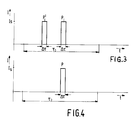
- Figure 3 and 4 illustrates the manner in which the amount of radiation energy applied in the selected time intervals ⁇ can be varied using a method in accordance with the invention.
- the radiation energy is administrered by applying unitary radiation pulses of constant energy content.
- Figure 3 illustrates the application of the radiation energy in the first selected time interval ⁇ of a sequence of consecutive selected time intervals ⁇ . In such a selected time interval ⁇ the radiation energy is applied by means of radiation pulses P' and P, each having an intensity I s and a duration ⁇ .
- Figure 4 illustrates the application of radiation energy in a time interval ⁇ for the second and subsequent selected time intervals ⁇ of a sequence of consecutive selected time intervals ⁇ . The radiation energy is now applied by means of one unitary radiation pulse P.
- Figure 5 illustrates the temperature distribution T1', T1, ..., T9 in the information layer immediately after application of the unitary radiation pulses P', P1, ... P9 in the situation that the radiation energy is applied by the above method using unitary radiation pulses in a sequence of nine consecutive selected time intervals ⁇ 1, ..., ⁇ 9.
- the preheating pulse P1' is dimensioned in such a way that the temperature rise produced by this pulse is inadequate to bring the temperature of the information layer above the recording level T s . Therefore, this first unitary radiation pulse does not produce a change in the optical properties of the information layer 2. This is an advantage because the first recording mark 5 in a sequence of consecutive recording marks then does not become undesirably large.
- the dimension of the recording mark is found to be 1.1 ⁇ .
- the dimension of this recording mark corresponds to a sequence of three bit cells of the logic vlaue "1". Sequences of 4 or more bit cells of the logic value "1" are obtained by extending the information pattern by 0.3 ⁇ by each time forming a subsequent recording mark which overlaps the preceding recording mark. Such a ratio between the dimensions of the recording mark and the extensions yields an optimum duty cycle of the read signal obtained by reading the information pattern.
- Figure 7a illustrates a method of applying radiation energy, in which two overlapping recording marks are obtained in the first selected time intervals ⁇ .
- the radiation energy is applied by means of three radiation pulses P, P ⁇ , P ⁇ of equal energy content, of which P ⁇ serves as a preheating pulse and of which P and P ⁇ serve as writing pulses.
- Figure 7b illustrates the application of the radiation energy for the second and subsequent selected time intervals ⁇ of a sequence of consecutive selected time intervals ⁇ .
- the radiation energy is now applied to the information layer 2 by means of only one unitary radiation pulse.
- Figure 8a shows the unitary radiation pulses P1 ⁇ , P1 ⁇ and P1, ..., P9 which are generated in a sequence of nine consecutive selected time intervals ⁇ 1, ... ⁇ 9, the raidation energy being applied in the manner illustrated in Figure 7.
- Figure 8b illustrates the temperature distribution T1 ⁇ , T1 ⁇ , T1, ..., T9 in the information layer 2 immediately after application of the radiation pulses P ⁇ , P ⁇ , P1, ..., P9.
- the area with modified optical properties formed in the first selected time interval of the sequence bears the reference numeral 10.
- the area 10 comprises two overlapping recording marks 5 produced by radiation pulses P1 ⁇ and P1.
- Figure 15a shows an EFM coded information signal comprising four consecutive bit cells of the logic value "1".
- An information pattern corresponding to this information signal can be written by means of the radiation pulses P**1, P*1, P*2 and P*3 shown in Figure 15b.
- the corresponding temperature differences T**1, T*1, T*2 and T*3 are given in Figure 15c.
- the radiation pulse P**1 functions as a preheating pulse.
- the preheating pulse P**1 causes the temperature T**1 of the information layer to rise to a level above the recording level T S .
- the optical properties of the information layer are modified within an area 50.
- the radiation pulse P*3 the recording mark 5c is recorded, the recording mark 5c overlapping the recording mark 5b to such an extent that the area with modified optical properties formed by the recording marks 5a, 5b and 5c corresponds to four bit cells of the logic value "1".
- the sequence of consecutive radiation pulses P**1, P*1, P*2 and P*3 can be obtained in that the first selected time interval T1 of a sequence of consecutive selected time intervals two radiation pulses which are shifted relative to each other are generated at fixed instants t1 and t2 within the time interval ⁇ 1 and in that subsequently in the second and subsequent selected time intervals ⁇ 2, ⁇ 3, ... each time a radiation pulse is generated at a fixed instant t3 within each of these time intervals.
- FIG 9 shows an embodiment of an apparatus 20 for carrying out the inventive method.
- the apparatus 20 comprises a drive system 21 for rotating the disc-shaped information carrier 1.
- the optical system 3 is arranged opposite the information layer 2 of the rotating record carrier 1 to focus the radiation beam 4 originating from a light source 22 on the information layer 2.
- the radiation source 22 is of a type in which the intensity of the emitted radiation can be modulated by means of a control signal R s generated by a control device 23.
- the radiation source 22 may be, for example, a solid-state laser which can be turned on or off depending on the logic level of the control signal R s .
- the radiation source 22 comprises a laser 25 for continuously generating the radiation beam 4.
- the beam 4 is passed through an acousto-optic modulator 26 which is controlled by the control signal R S .
- the acousto-optic modulator 26 deflects or does not deflect the beam 4 depending on the logic level of the control signal, so that the beam 4 is transmitted to the optical system 3 depending on the control signal R S .
- FIG 11 by way of example shows a control device 23 for generating the control signal R S for the radiation source 22.
- the information signal V i (see Figure 12) is a binary signal in which the number of consecutive bit cells of the logic value "1" is at least equal to three, for example an EFM coded signal.
- the control device 23 comprises a memory 30 for the storage of the information signal V i to be recorded.
- the memory 30 is of a type which delivers the information signal V i on an output in synchronism with a clock signal c1 ⁇ .
- Such a memory may be, for example, a shift register.
- the consecutive periods of the clock signal c1 ⁇ correspond to the said consecutive time intervals ⁇ .
- the clock signal c1 ⁇ is derived from a clock signal c1 whose frequency is eight times as high by means of a 3-bit counter 31.
- Fig. 12 shows the signals c1, c1 ⁇ and V i as a function of time.
- the clock signal c1 is in synchronism with the speed of recording 1 in the area where the information signal V i is to be recorded.
- the manner in which the clock signal is derived falls beyond the scope of the present invention and is therefore not described.
- the Applicant's Netherlands Patent Application no. 8000121 which comprehensively describes a method of deriving a speed-synchronous clock signal for the purpose of recording on an optically readable record carrier.
- the information signal V i supplied by the memory 30 is delayed by two periods of the clock signal c1 ⁇ by means of delay circuits 32 and 33, for example 1-bit shift registers controlled by the clock signal c1 ⁇ .
- the delayed information signal V i ⁇ is shown in Figure 12.
- An AND gate 34 drives from the information signal V i and the delayed permiton signal V i ⁇ a signal V s which indicates the selected time intervals in which a recording mark is to be formed.
- a memory 35 in the form of a flip-flop which is clocked by a clock signal c1 ⁇ the signal V s is stored for one time interval ⁇ .
- a signal V g1 is derived from the signals V s and V s ⁇ , to indicate that the selected time interval ⁇ indicated by V s is preceded by selected time interval ⁇ .
- a signal V g2 is derived from the signals V s and V s ⁇ to indicate that the selected time interval ⁇ indicated by V s is preceded by a non-selected time interval ⁇ .
- two control signals R1 and R2 are derived from the count of the 3-bit counter 31.
- the signal R1 represents the control signal for the radiation source 22 in each first selected time interval ⁇ of a sequence of consecutve selected time intervals ⁇ .
- the signal R2 repre sents the control signal for the radiation source 22 in each second and subsequent selected time interval of each sequence of consecutive selected time intervals ⁇ . If the signal V g2 indicates that a recording mark is to be written in a first one of a sequence of selected time intervals the control signal R1 is transferred to the radiation source 22 by means of an AND-gate 40 and an OR-gate 42. If the signal V g2 indicates that a recording mark is to be written in a second or subsequent time interval of a sequence of selected time intervals ⁇ the control signal R2 is transferred to the radiation source 22 by means of an AND-gate 41 and the OR-gate 42.
- the control signals R1 and R2 shown in Figure 12 comprise pulses of constant duration, in such a way that for R1 three unitary pulses are generated in each time interval ⁇ and for R2 only one unitary pulse is generated in each time interval ⁇ .
- the control signals R1 and R2 may be derived from, for example, the counts of the counter 31 by means of the circuit 39 shown in Figure 13, which circuit comprises a gate circuit 50 for generating three signals S1, S2 and R2 depending on the count of the counter 31.
- Figure 14 shows another example of the circuit 39 for generating control signals R1 and R2, a control pulse of a first width being generated for the signal R1 in each time interval ⁇ and a control pulse of a second width smaller than the first width being generated for the signal R2 in each time interval.
- the circuit comprises two monostable multivibrators 52 and 53 which each generate pulses of different widths in response to a 0-1 transition of the output signal Q1 of the counter 31.
- Figure 16 shows an embodiment of an apparatus for carrying out the method illustrated in Figure 15, the elements of the apparatus corresponding to those in Figure 14 bearing the same reference numerals.
- the signal V i and the signals V i ⁇ delayed by two clock periods of c1 ⁇ instead of the signal V i and the signals V i ⁇ delayed by two clock periods of c1 ⁇ , the signal V i and the signal V ia , which has been delayed by one clock period of c1 ⁇ are applied to the AND-gate 34.
- the output signal V sa which indicates the selected time intervals ⁇ , becomes "1" during (s-1) time intervals for each sequence of s (s being an integer) consecutive bit-cells of the logic value "1".
- the output signal R 1a is transferred to the radiation source 22 by the circuit 39a.
- the signal R 2a is supplied.
- the signals R 1a and R21 can be derived from the count of the counter 31 in the same way as is illustrated, for example, in Figure 13.
- the relationship between R 1a , R 2a and the output signals Q1, Q2 and Q3 of the counter 31 is given in the following Table 2.
- the invention has been described, by way of example, for an EFM-coded information signal.
- the dimensions of the recording mark in a selected time interval correspond to a sequence of 3 bits of the same type. Longer bit sequences of the same type are then obtained by forming overlapping recording marks.
- the inventive method provides compensation for temperature effects caused by the radiation energy applied in preceding time intervals. Such temperature effects also occur when recording information signals in which the length of the recording mark corresponds to a length other than three bits, for example one bit. It is obvious that the invention can readily be applied to such cases.
- the invention is described for an information layer of a material whose structure can be modified from amorphous to crystalline by heating. It will also be obvious to those skilled in the art that the invention can also be utilized with other materials whose optical properties can be modified by heating, for example materials in which the application of heat initiates a chemical reaction which results in a change in optical properties, or with materials used in thermomagnetic recording. For a survey of these materials reference is made to pages 219-225 of the afore-mentioned book "Principles of Optical Disc Systems".
Landscapes
- Physics & Mathematics (AREA)
- Optics & Photonics (AREA)
- Optical Recording Or Reproduction (AREA)
Claims (4)
- Verfahren zum Aufzeichnen eines binären Informationssignals auf einem optisch auslesbaren Aufzeichnungsträger (1) mit einer Informationsschicht (2), deren optische Eigenschaften eine Änderung bei Erwärmung zeigen, bei welchem Verfahren auf der Informationsschicht (2) entsprechend dem Informationssignal ein Informationsmuster gebildet wird, das aufgezeichnete Gebiete mit geänderten optischen Eigenschaften und nichtaufgezeichnete Gebiete (5) umfaßt, wobei die aufgezeichneten Gebiete dadurch erhalten werden, daß ein System zum Fokussieren eines Strahlungsbündels (4) auf der Informationsschicht (2) und die Informationsschicht (2) gegeneinander verschoben werden, jede folgende Aufzeichnungsmarkiervng (5) einer Reihe aufeinanderfolgender und einander überlappender Aufzeichnungsmarkierungen durch Erwärmung eines Zielgebietes mit Hilfe des Strahlungsbündels (4) gebildet wird, wodurch eine Änderung in optischen Eigenschaften im Zielgebiet erreicht wird, dadurch gekennzeichnet, daß die erste Aufzeichnungsmarkierung der Reihe mittels wenigstens eines Vorwärmstrahlungsimpulses (p₁** in Fig. 15) gebildet wird, dem nach einem vorgegebenen Zeitintervall ein Schreibstrahlungsimpuls (p₁*) folgt, daß der Schreibstrahlungsimpuls eine Aufzeichnungsmarkierung (5a) aufder Informationsschicht erzeugt und der Energieinhalt des Vorwärmstrahlungsimpulses zum Erzeugen der Änderung (50) in optischen Eigenschaften außerhalb des Gebiets ungeeignet ist, das die vom Schreibstrahlungsimpuls (p₁*) erzeugte Aufzeichnungsmarkierung (5a) belegt.
- Verfahren zum Aufzeichnen eines binären Informationssignals auf einem optisch auslesbaren Aufzeichnungsträger (1) mit einer Informationsschicht (2), deren optische Eigenschaften eine Änderung bei Erwärmung zeigen, bei welchem Verfahren aufder Informationsschicht (2) entsprechend dem Informationssignal ein Informationsmuster gebildet wird, das aufgezeichnete Gebiete mit geänderten optischen Eigenschaften und nichtaufgezeichnete Gebiete (5) umfaßt, wobei die aufgezeichneten Gebiete dadurch erhalten werden, daß ein System zum Fokussieren eines Strahlungsbündels (4) auf der Informationsschicht (2) und die Informationsschicht (2) gegeneinander verschoben werden, jede folgende Aufzeichnungsmarkierung (5) einer Reihe aufeinanderfolgender und einander überlappender Aufzeichnungsmarkierungen durch Erwärmung eines Zielgebietes mit Hilfe des Strahlungsbündels (4) gebildet werden, wodurch die Änderung in optischen Eigenschaften im Zielgebiet erreicht wird, das Informationssignal Bitzellen enthält, die Anzahl m aufeinanderfolgender Bitzellen mit einem ersten logischen Wert wenigstens gleich n ist, worin n eine ganze Zahl größer als oder gleich 2 ist, und ein erstes eingeschriebenes Gebiet durch die Bildung einer ersten Reihe einander überlappender Aufzeichnungsmarkierungen (5) mittels eines Strahlungsimpulses zujedem Zeitpunkt einer Reihe von m-n+1 im wesentlichen äquidistanten (τ) Zeitpunkten erhalten wird,
dadurch gekennzeichnet, daß ein zweites eingeschriebenes Gebiet, das aus einer einzigen vorangehenden und das erste Gebiet überlappenden Aufzeichnungsmarkierung besteht, mittels wenigstens zwei Strahlungsimpulse (p** p₁* in Fig. 15; p", p in Fig. 8) erzeugt wird, die mit (einem) Zeitintervall(en) kleiner als die Zeitintervalle zwischen den im wesentlichen äquidistanten Zeitpunkten erzeugt werden, zu denen die Strahlungsimpulse für die Erzeugung der folgenden Aufzeichnungsmarkierungen (5b, 5c) der einander überlappenden Aufzeichnungsmarkierungen erzeugt werden, und die ersten und zweiten Gebiete m Bitzellen entsprechen. - Gerät zum Durchführen des Verfahrens nach Anspruch 1 mit einer Strahlungsquelle (22), einem optischen System (3) zum Fokussieren der von der Strahlungsquelle (22) erzeugten Strahlung auf eine Informationsschicht (2) eines Aufzeichnungsträgers (1), wobei die optischen Eigenschaften der Informationsschicht (2) eine Änderung bei Erwärmung erfahren, mit einem Antriebsmittel (21) zum Bewegen des Aufzeichnungsträgers (1) und des optischen Systems gegeneinander, und eine Steuereinrichtung (23) zum Steuern der Strahlungsquelle in Abhängigkeit von einem binären Informationssignal (Vi), wobei Reihen aufeinanderfolgender Strahlungsimpulse (p*) abhängig vom binären Informationssignal erhalten werden, um die Informationsschicht zu erwärmen, zum Erzeugen einer Aufzeichnungsmarkierung mit geänderten optischen Eigenschaften auf der Informationsschicht auf geeignete Weise erwärmt wird, dadurch gekennzeichnet, daß das Gerät zum Erzeugen eines Vorwärmstrahlungsimpulses (p₁**) als des ersten Impulses der Reihe von Strahlungsimpulse (p), und dieser Vorwärmstrahlungsimpuls zum Erzeugen der Änderung in optischen Eigenschaften außerhalb des Gebiets ungeeignet ist, das die von anderen Strahlungsimpulsen (p*) erzeugten Aufzeichnungsmarkierungen (5) belegen.
- Gerät zum Durchführen des Verfahrens nach Anspruch 1 mit einer Strahlungsquelle (22), einem optischen System (3) zum Fokussieren der von der Strahlungsquelle (22) erzeugten Strahlung auf eine Informationsschicht (2) eines Aufzeichnungsträgers (1), wobei die optischen Eigenschaften der Informationsschicht (2) eine Änderung bei Erwärmung erfahren, mit einem Antriebsmittel (21) zum Bewegen des Aufzeichnungsträgers (1) und des optischen Systems gegeneinander, und eine Steuereinrichtung (23) zum Steuern der Strahlungsquelle in Abhängigkeit von einem binären Informationssignal (Vi), wobei Reihen aufeinanderfolgender Strahlungsimpulse (p*) abhängig vom binären Informationssignal erhalten werden, die Anzahl m aufeinanderfolgender Bitzellen mit einem ersten logischen Wert wenigstens gleich n ist, worin n eine ganze Zahl größer als oder gleich 2 ist, zum Erzeugen eines ersten eingeschriebenen Gebiets, wobei die Reihe von Strahlungsimpulsen m-n+1 Strahlungsimpulse zu im wesentlichen äquidistanten (τ) Zeitpunkten umfaßt, dadurch gekennzeichnet, daß die Einrichtung zum Erzeugen wenigstens eines zusätzlichen Strahlungsimpulses (p₁**) vor der Reihe von m-n+1 Strahlungsimpulsen (p₁) ausgelegt ist, wobei die Zeitintervalle zwischen dem zusätzlichen Impuls und dem ersten Strahlungsimpuls der Reihe von m-n+1 Strahlungsimpulsen Kleiner ist als die Zeitintervalle zwischen den m-n+1 Strahlungsimpulsen (p₁*,p₂*), um ein zweites, das erste Gebiet vorangehendes und überlappendes Gebiet einzuschreiben, und die ersten und zweiten Gebiete m Bitzellen entsprechen.
Applications Claiming Priority (2)
| Application Number | Priority Date | Filing Date | Title |
|---|---|---|---|
| NL8602718 | 1986-10-29 | ||
| NL8602718A NL8602718A (nl) | 1986-10-29 | 1986-10-29 | Werkwijze voor het optekenen van een tweewaardig signaal op een optisch uitleesbare registratiedrager en een inrichting voor het uitvoeren van de werkwijze. |
Publications (2)
| Publication Number | Publication Date |
|---|---|
| EP0266833A1 EP0266833A1 (de) | 1988-05-11 |
| EP0266833B1 true EP0266833B1 (de) | 1992-04-01 |
Family
ID=19848740
Family Applications (1)
| Application Number | Title | Priority Date | Filing Date |
|---|---|---|---|
| EP87202061A Expired - Lifetime EP0266833B1 (de) | 1986-10-29 | 1987-10-27 | Verfahren zum Aufzeichnen eines binären Signals auf einem optisch lesbaren Aufzeichnungsträger und Gerät zum Durchführen des Verfahrens |
Country Status (7)
| Country | Link |
|---|---|
| US (2) | US4774522A (de) |
| EP (1) | EP0266833B1 (de) |
| JP (1) | JPH0777026B2 (de) |
| KR (1) | KR950006411B1 (de) |
| CA (1) | CA1296425C (de) |
| DE (1) | DE3777957D1 (de) |
| NL (1) | NL8602718A (de) |
Families Citing this family (24)
| Publication number | Priority date | Publication date | Assignee | Title |
|---|---|---|---|---|
| JPH0810490B2 (ja) * | 1989-03-20 | 1996-01-31 | 富士通株式会社 | 光ディスク情報書込制御方法およびその装置 |
| US5087805A (en) * | 1990-07-06 | 1992-02-11 | Webcraft Technologies, Inc. | Printed and encoded mass distributable response piece and method of making the same |
| CA2020243C (en) * | 1989-06-30 | 1994-12-13 | Eiji Ohno | Optical information recording method and recording apparatus |
| US5278581A (en) * | 1990-09-17 | 1994-01-11 | Kabushiki Kaisha Toshiba | Printer for printing and image formed of 2-dimensionally arranged pixels, and method of printing the same |
| JP2850966B2 (ja) * | 1991-08-02 | 1999-01-27 | シャープ株式会社 | 光磁気記録装置 |
| US5818805A (en) * | 1992-02-14 | 1998-10-06 | Sony Corporation | Reproducing apparatus using an information recording medium wherein multi-bit digital information is represented by a shift amount of a pit edge |
| WO1993016467A1 (fr) * | 1992-02-14 | 1993-08-19 | Sony Corporation | Support d'enregistrement de donnees, appareil d'enregistrement de donnees, appareil de reproduction de donnees et appareil d'enregistrement/reproduction de donnees |
| US5748582A (en) * | 1992-02-14 | 1998-05-05 | Sony Corporation | Information recording medium wherein digital symbols are represented by discrete shift amounts of a pit edge and tracking wobbling pits are shared between adjacent tracks and information recording and reproducing apparatus therefor |
| US5400147A (en) * | 1992-04-10 | 1995-03-21 | Eastman Kodak Company | Method and apparatus for halftone reproduction of continuous tone radiographic images |
| US5194980A (en) * | 1992-05-29 | 1993-03-16 | Eastman Kodak Company | Thresholded, high power laser beam scanning system |
| JP3147255B2 (ja) * | 1992-10-13 | 2001-03-19 | ソニー株式会社 | データ記録方法、データ記録装置およびデータ記録媒体 |
| JP3259204B2 (ja) * | 1992-10-21 | 2002-02-25 | 株式会社ニコン | 光記録方法及び光記録のパルストレイン条件決定方法 |
| EP0594425A3 (en) * | 1992-10-21 | 1996-10-09 | Nippon Kogaku Kk | Pulse train condition/heat shut off condition determination method and apparatus for optical recording, and optical recording method and apparatus |
| US5400313A (en) * | 1992-11-09 | 1995-03-21 | International Business Machines Corporation | Optical data storage system and method with reduced heat buildup |
| JPH06325369A (ja) * | 1993-03-08 | 1994-11-25 | Philips Electron Nv | 光学記録兼読取装置 |
| BE1007029A3 (nl) * | 1993-04-22 | 1995-02-21 | Koninkl Philips Electronics Nv | Werkwijze voor het afleiden van een kwaliteitssignaal uit een uitgelezen signaal, alsmede een optekeninrichting en een uitleesinrichting waarin een dergelijke werkwijze wordt toegepast. |
| JPH0845188A (ja) * | 1994-07-29 | 1996-02-16 | Sony Corp | 記録媒体並びにその記録装置および再生装置 |
| US5530688A (en) * | 1994-10-31 | 1996-06-25 | International Business Machines Corporation | Optical disk recording device using two modulated laser beams for recording information data |
| US5561656A (en) * | 1994-11-18 | 1996-10-01 | International Business Machines Corporation | Pulse width modulation optical disk drive with pulsed laser preheating between marks |
| US5631887A (en) * | 1996-04-30 | 1997-05-20 | International Business Machines Corporation | Pulse width modulation optical disk drive with adjustable pulsed laser write and preheat patterns |
| US6490117B1 (en) * | 1999-03-26 | 2002-12-03 | Seagate Technology Llc | Method of thermally printing servo patterns on magnetic media |
| US6741547B2 (en) | 2000-08-10 | 2004-05-25 | Ricoh Company, Ltd. | Optical recording medium having short wobble period length |
| US10283151B1 (en) | 2017-05-02 | 2019-05-07 | Seagate Technology Llc | Laser diode with integrated temperature control unit for a heat-assisted magnetic recording device |
| US9916851B1 (en) | 2017-05-30 | 2018-03-13 | Seagate Technology Llc | Preheat strategy during sequential writing |
Citations (1)
| Publication number | Priority date | Publication date | Assignee | Title |
|---|---|---|---|---|
| EP0206824A2 (de) * | 1985-06-26 | 1986-12-30 | International Business Machines Corporation | Gerät zur thermischen Aufzeichnung von Daten |
Family Cites Families (8)
| Publication number | Priority date | Publication date | Assignee | Title |
|---|---|---|---|---|
| JPS55139693A (en) * | 1979-04-17 | 1980-10-31 | Fujitsu Ltd | Write system for optical recording medium |
| US4383261A (en) * | 1980-08-21 | 1983-05-10 | The United States Of America As Represented By The Director Of The National Security Agency | Method for laser recording utilizing dynamic preheating |
| NL8201411A (nl) * | 1982-04-02 | 1983-11-01 | Philips Nv | Werkwijze voor het optekenen van een digitaal informatiesignaal op een registratiedrager met een stralingsgevoelige informatielaag, een inrichting hiervoor en een optische registratiedrager voorzien van een dergelijk digitaal informatiesignaal. |
| FR2521760A1 (fr) * | 1982-02-12 | 1983-08-19 | Thomson Csf | Procede thermo-optique d'inscription d'information sur support et dispositif mettant en oeuvre ce procede |
| US4490730A (en) * | 1982-10-28 | 1984-12-25 | The Charles Stark Draper Laboratory, Inc. | Pulsed optical storage system |
| JPS6025032A (ja) * | 1983-07-22 | 1985-02-07 | Nec Corp | 光学的情報記録装置 |
| US4646103A (en) * | 1985-03-20 | 1987-02-24 | Hitachi, Ltd. | Optical recording method |
| JP2559362B2 (ja) * | 1985-03-22 | 1996-12-04 | 株式会社日立製作所 | 光学的記録方法 |
-
1986
- 1986-10-29 NL NL8602718A patent/NL8602718A/nl not_active Application Discontinuation
-
1987
- 1987-03-12 US US07/024,937 patent/US4774522A/en not_active Expired - Lifetime
- 1987-10-20 CA CA000549716A patent/CA1296425C/en not_active Expired - Lifetime
- 1987-10-22 JP JP62268011A patent/JPH0777026B2/ja not_active Expired - Lifetime
- 1987-10-27 DE DE8787202061T patent/DE3777957D1/de not_active Expired - Lifetime
- 1987-10-27 EP EP87202061A patent/EP0266833B1/de not_active Expired - Lifetime
- 1987-10-29 KR KR87011994A patent/KR950006411B1/ko not_active Expired - Lifetime
-
1988
- 1988-06-15 US US07/209,443 patent/US4916465A/en not_active Expired - Fee Related
Patent Citations (1)
| Publication number | Priority date | Publication date | Assignee | Title |
|---|---|---|---|---|
| EP0206824A2 (de) * | 1985-06-26 | 1986-12-30 | International Business Machines Corporation | Gerät zur thermischen Aufzeichnung von Daten |
Also Published As
| Publication number | Publication date |
|---|---|
| CA1296425C (en) | 1992-02-25 |
| JPH0777026B2 (ja) | 1995-08-16 |
| KR950006411B1 (en) | 1995-06-15 |
| US4916465A (en) | 1990-04-10 |
| JPS63153726A (ja) | 1988-06-27 |
| US4774522A (en) | 1988-09-27 |
| EP0266833A1 (de) | 1988-05-11 |
| DE3777957D1 (de) | 1992-05-07 |
| NL8602718A (nl) | 1988-05-16 |
Similar Documents
| Publication | Publication Date | Title |
|---|---|---|
| EP0266833B1 (de) | Verfahren zum Aufzeichnen eines binären Signals auf einem optisch lesbaren Aufzeichnungsträger und Gerät zum Durchführen des Verfahrens | |
| EP0957475B1 (de) | Optisches aufzeichnungsverfahren und optisches aufzeichnungsgerät | |
| CA1213045A (en) | Method of recording a digital information signal on a record carrier having a radiation-sensitive information layer, apparatus for carrying out the method, and optical record carrier provided with such a digital information signal | |
| EP0388897B1 (de) | Schreiben optischer Daten auf eine Scheibe | |
| US5457666A (en) | Light modulation method for forming a mark in magneto-optical recording system | |
| US6181661B1 (en) | Information recording method and apparatus | |
| US5790512A (en) | Optical information carrier | |
| US5179547A (en) | Phase change optical information recording medium including means for preventing movement of the recorded portion | |
| EP0286126B1 (de) | Verfahren und Gerät zur Aufzeichnung von Daten mit reversibler Phasenänderung | |
| US5257256A (en) | Recording waveform for mark-length modulation optical recording | |
| EP0414517B1 (de) | Aufzeichnungsgerät und Aufzeichnungsverfahren für optische Platten | |
| EP0814471B1 (de) | System und Verfahren zur optischen Speicherung und Wiedergewinnung von Daten | |
| US5323365A (en) | Recording method for opto-magnetic disk | |
| US5719614A (en) | Optical reading and recording device containing a radiation source which has a substantially constant mean heat dissipation during reading and recording | |
| KR890002237B1 (ko) | 디지탈 2진 정보 신호 기록장치 및 제어장치 | |
| JP3435272B2 (ja) | 情報の記録媒体と記録方法および記録装置 | |
| JP2788637B2 (ja) | 情報の記録方法及び記録装置 | |
| KR100207615B1 (ko) | 광디스크 기록보상장치 및 그 방법 | |
| JP2770522B2 (ja) | 光学的情報の記録方法 | |
| JPH0565939B2 (de) | ||
| JPS59140638A (ja) | 情報記録方法 | |
| JPH02267756A (ja) | 光磁気記録再生方式 | |
| JPS62223818A (ja) | 光学的記録・消去・再生装置 | |
| JPH03156726A (ja) | 光学的情報の消去方法 | |
| JPH0935275A (ja) | 情報の記録媒体、記録方法および記録装置 |
Legal Events
| Date | Code | Title | Description |
|---|---|---|---|
| PUAI | Public reference made under article 153(3) epc to a published international application that has entered the european phase |
Free format text: ORIGINAL CODE: 0009012 |
|
| AK | Designated contracting states |
Kind code of ref document: A1 Designated state(s): BE DE FR GB NL |
|
| 17P | Request for examination filed |
Effective date: 19881104 |
|
| 17Q | First examination report despatched |
Effective date: 19900601 |
|
| GRAA | (expected) grant |
Free format text: ORIGINAL CODE: 0009210 |
|
| AK | Designated contracting states |
Kind code of ref document: B1 Designated state(s): BE DE FR GB NL |
|
| PG25 | Lapsed in a contracting state [announced via postgrant information from national office to epo] |
Ref country code: NL Effective date: 19920401 Ref country code: BE Effective date: 19920401 |
|
| REF | Corresponds to: |
Ref document number: 3777957 Country of ref document: DE Date of ref document: 19920507 |
|
| ET | Fr: translation filed | ||
| NLV1 | Nl: lapsed or annulled due to failure to fulfill the requirements of art. 29p and 29m of the patents act | ||
| PLBE | No opposition filed within time limit |
Free format text: ORIGINAL CODE: 0009261 |
|
| STAA | Information on the status of an ep patent application or granted ep patent |
Free format text: STATUS: NO OPPOSITION FILED WITHIN TIME LIMIT |
|
| 26N | No opposition filed | ||
| REG | Reference to a national code |
Ref country code: FR Ref legal event code: CD |
|
| PGFP | Annual fee paid to national office [announced via postgrant information from national office to epo] |
Ref country code: GB Payment date: 19960930 Year of fee payment: 10 |
|
| PGFP | Annual fee paid to national office [announced via postgrant information from national office to epo] |
Ref country code: FR Payment date: 19961022 Year of fee payment: 10 |
|
| PGFP | Annual fee paid to national office [announced via postgrant information from national office to epo] |
Ref country code: DE Payment date: 19961218 Year of fee payment: 10 |
|
| PG25 | Lapsed in a contracting state [announced via postgrant information from national office to epo] |
Ref country code: GB Free format text: LAPSE BECAUSE OF NON-PAYMENT OF DUE FEES Effective date: 19971027 |
|
| PG25 | Lapsed in a contracting state [announced via postgrant information from national office to epo] |
Ref country code: FR Free format text: THE PATENT HAS BEEN ANNULLED BY A DECISION OF A NATIONAL AUTHORITY Effective date: 19971031 |
|
| GBPC | Gb: european patent ceased through non-payment of renewal fee |
Effective date: 19971027 |
|
| PG25 | Lapsed in a contracting state [announced via postgrant information from national office to epo] |
Ref country code: DE Free format text: LAPSE BECAUSE OF NON-PAYMENT OF DUE FEES Effective date: 19980701 |
|
| REG | Reference to a national code |
Ref country code: FR Ref legal event code: ST |