EP0264953A2 - Verwendung von N, N'-bis-L-Aminosäure-L-cystinpeptiden in Aminosäure-Präparaten für orale und parenterale Ernährung - Google Patents
Verwendung von N, N'-bis-L-Aminosäure-L-cystinpeptiden in Aminosäure-Präparaten für orale und parenterale Ernährung Download PDFInfo
- Publication number
- EP0264953A2 EP0264953A2 EP87115592A EP87115592A EP0264953A2 EP 0264953 A2 EP0264953 A2 EP 0264953A2 EP 87115592 A EP87115592 A EP 87115592A EP 87115592 A EP87115592 A EP 87115592A EP 0264953 A2 EP0264953 A2 EP 0264953A2
- Authority
- EP
- European Patent Office
- Prior art keywords
- cystine
- amino acid
- bis
- cys
- peptides
- Prior art date
- Legal status (The legal status is an assumption and is not a legal conclusion. Google has not performed a legal analysis and makes no representation as to the accuracy of the status listed.)
- Granted
Links
Images
Classifications
-
- C—CHEMISTRY; METALLURGY
- C07—ORGANIC CHEMISTRY
- C07K—PEPTIDES
- C07K5/00—Peptides containing up to four amino acids in a fully defined sequence; Derivatives thereof
- C07K5/04—Peptides containing up to four amino acids in a fully defined sequence; Derivatives thereof containing only normal peptide links
- C07K5/06—Dipeptides
- C07K5/06008—Dipeptides with the first amino acid being neutral
- C07K5/06017—Dipeptides with the first amino acid being neutral and aliphatic
- C07K5/06034—Dipeptides with the first amino acid being neutral and aliphatic the side chain containing 2 to 4 carbon atoms
-
- A—HUMAN NECESSITIES
- A61—MEDICAL OR VETERINARY SCIENCE; HYGIENE
- A61P—SPECIFIC THERAPEUTIC ACTIVITY OF CHEMICAL COMPOUNDS OR MEDICINAL PREPARATIONS
- A61P1/00—Drugs for disorders of the alimentary tract or the digestive system
- A61P1/16—Drugs for disorders of the alimentary tract or the digestive system for liver or gallbladder disorders, e.g. hepatoprotective agents, cholagogues, litholytics
-
- A—HUMAN NECESSITIES
- A61—MEDICAL OR VETERINARY SCIENCE; HYGIENE
- A61P—SPECIFIC THERAPEUTIC ACTIVITY OF CHEMICAL COMPOUNDS OR MEDICINAL PREPARATIONS
- A61P13/00—Drugs for disorders of the urinary system
- A61P13/02—Drugs for disorders of the urinary system of urine or of the urinary tract, e.g. urine acidifiers
-
- A—HUMAN NECESSITIES
- A61—MEDICAL OR VETERINARY SCIENCE; HYGIENE
- A61P—SPECIFIC THERAPEUTIC ACTIVITY OF CHEMICAL COMPOUNDS OR MEDICINAL PREPARATIONS
- A61P15/00—Drugs for genital or sexual disorders; Contraceptives
-
- A—HUMAN NECESSITIES
- A61—MEDICAL OR VETERINARY SCIENCE; HYGIENE
- A61P—SPECIFIC THERAPEUTIC ACTIVITY OF CHEMICAL COMPOUNDS OR MEDICINAL PREPARATIONS
- A61P43/00—Drugs for specific purposes, not provided for in groups A61P1/00-A61P41/00
-
- C—CHEMISTRY; METALLURGY
- C07—ORGANIC CHEMISTRY
- C07K—PEPTIDES
- C07K5/00—Peptides containing up to four amino acids in a fully defined sequence; Derivatives thereof
- C07K5/04—Peptides containing up to four amino acids in a fully defined sequence; Derivatives thereof containing only normal peptide links
- C07K5/06—Dipeptides
- C07K5/06008—Dipeptides with the first amino acid being neutral
- C07K5/06017—Dipeptides with the first amino acid being neutral and aliphatic
- C07K5/06026—Dipeptides with the first amino acid being neutral and aliphatic the side chain containing 0 or 1 carbon atom, i.e. Gly or Ala
-
- C—CHEMISTRY; METALLURGY
- C07—ORGANIC CHEMISTRY
- C07K—PEPTIDES
- C07K5/00—Peptides containing up to four amino acids in a fully defined sequence; Derivatives thereof
- C07K5/04—Peptides containing up to four amino acids in a fully defined sequence; Derivatives thereof containing only normal peptide links
- C07K5/06—Dipeptides
- C07K5/06008—Dipeptides with the first amino acid being neutral
- C07K5/06078—Dipeptides with the first amino acid being neutral and aromatic or cycloaliphatic
-
- A—HUMAN NECESSITIES
- A61—MEDICAL OR VETERINARY SCIENCE; HYGIENE
- A61K—PREPARATIONS FOR MEDICAL, DENTAL OR TOILETRY PURPOSES
- A61K38/00—Medicinal preparations containing peptides
Definitions
- the sulfur-containing amino acid cysteine and its stable dimeric disulfide product cystine which is easily formed through oxidation, are not among the classic essential amino acids, but cystine is an indispensable component in the nutrition of infants, chronic uraemia, cirrhosis and injuries classified amino acid preparations offered for this.
- the reason for the essentiality in these cases is an inadequate or completely missing synthesis of cystine from the sulfur-containing amino acids methionine or cysteine serving as precursors in the organism.
- Acetylation of cysteine has already created a soluble derivative that is used in small amounts in amino acid preparations.
- this cysteine compound is quickly oxidized to the disulfide product in aqueous solution.
- this N, N ⁇ -bis-acetyl-cystine is relatively readily water-soluble, so that it remains in solution, which is why attempts have also been made to use this diacetylated cystine in the infusion preparations concerned.
- the latest studies clearly prove that acetylated amino acids are poorly utilized in humans and can only be used to a very small extent to build up the body's own protein.
- Diglycyl-cystine has long been known as a soluble cystine compound, which was used as a substrate for peptidase tests, since the cleavage of this peptide can easily be measured because of the precipitation of the insoluble cystine; see. J. Biol. Chemistry, Vol. 128, 241-243 (1939). This cystine peptide has not yet been used in practice for nutritional purposes, although there is a need for this.
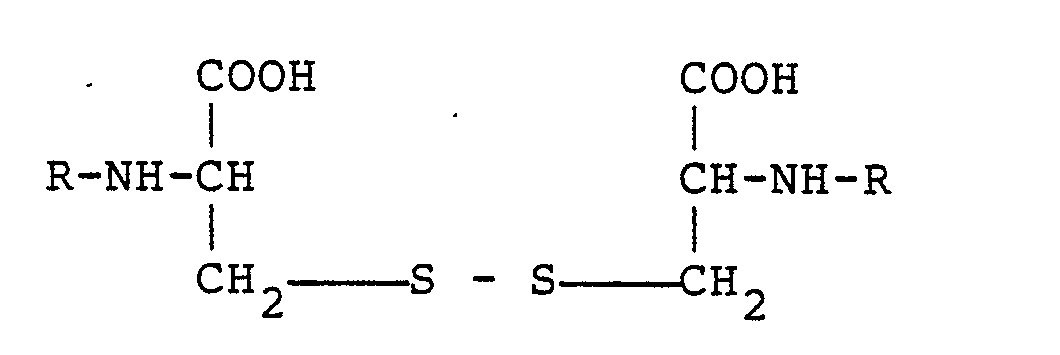
- the N, N ⁇ -bis-L-alanyl-L-cystine peptide and generally the N, N ⁇ -bis-L-amino acid-L-cystine peptides of the general formula where R is an L-amino acid residue are not only readily water-soluble, but also remain stable during heat sterilization in aqueous solution, i.e. have not been changed here and are then easily split and utilized in spite of this stability in the organism, which is why they are considered bioavailable cystine compounds in amino acid and oligopeptide preparations are particularly well suited for oral and parenteral nutrition.
- the amino acid composition of the two types of peptides e.g. where the L-cystinyl-bis-L-alanine and the bis-L-alanyl-L-cystine according to the invention are identical
- the explanation of the surprising stability of the one Tris amino acid peptide type must lie in the different amino acid sequence. If the cystine residue is in the N-terminal position, the two free amino groups of cystine are spatially very close together. Under thermal stress, this could lead to an intramolecular cyclization with elimination of ammonia. However, if cystine is incorporated into the C-terminal position, the free amino groups are located on the substituting amino acid residues.
- cystine tripeptides with a carboxyl-containing cystine residue regardless of the type of the N-containing amino acid, have sufficient thermal stability when sterilizing the solutions for parenteral nutrition.
- the diamino acid cystine peptides can be prepared in a conventional manner using the N-carboxy anhydride method (NCA method), in which case the free amino group of S-acetaminodomethyl-L-cysteine reacts with the respective N-carboxy anhydride of the amino acid to be attached , analogous to that of R. Hirschmann et al in J. Org. Chem., Vol. 32, 3415-3425 (1967); J. Am. Chem. Soc., Vol. 93, 2746-2755 (1971). The corresponding cystine peptide is then obtained by subsequent elimination of the protective group and oxidation.
- NCA method N-carboxy anhydride method
- bis-glycyl-L-cystine and bis-L-alanyl-L-cystine were selected as examples and male Wistar rats were given a single peptide injection (50 ⁇ mol / 100 g body weight or 20 ⁇ mol / 100 g body weight, injection volume 0.5 - 1 ml) injected via a vena cava catheter within 5 seconds.
- Blood was drawn (1 ml in heparinized syringes) 30, 60, 120, 180 and 300 sec after the peptide was administered.
- the plasma obtained by centrifugation was then mixed with 30% SSA (ratio of sample to SSA 10: 1) for protein precipitation, kept at 4 ° C. for 1 h and then centrifuged off.
- Pillar Spherisorb ODS 11 3 ⁇ m (125 ⁇ 4.6 mm) Eluent: (A) 12.5 mM Na phosphate buffer pH 6.6 (B) 40% A; 60% ACN Flow: 1.2 ml / min Detection: Fluorescence Em 550 / Ex 325
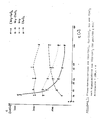
- Figure 1 shows the peptide / amino acid concentrations measured at the different sampling times after a single injection of (Gly-Cys) 2 (50 ⁇ mol / 100 g body weight).
- the concentration of the tripeptide (Gly-Cys) 2 decreases continuously within the investigation period, with 5 min after the injection only about 10% of the value measured after 30 sec.
- the monosubstituted dipeptide Gly- (Cys) 2 (intermediate in the hydrolytic cleavage of the tripeptide [Gly-Cys] 2) can be detected in all samples. While the concentration of this dipeptide remains constant at the first two measuring times, it then drops almost parallel to (Gly-Cys) 2.
- the tripeptide present is rapidly cleaved and only after the tripeptide concentration has decreased does the dipeptide undergo further hydrolysis, which is demonstrated by the measured cystine values.
- the cystine concentration rises continuously up to 5 min after the injection and reaches a value which is approximately 30 times higher than the initial value.
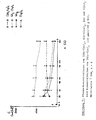
- Figure 2 shows the plasma concentrations determined after the injection of 20 ⁇ mol (Gly-Cys) 2 / 100 g body weight at the different times of withdrawal. Basically, very similar concentration courses can be observed here. At the first time of measurement, the concentrations of the two amino acids glycine and cystine are considerably increased compared to the starting point (Gly: 5-fold; (Cys) 2: 10-fold).
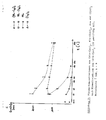
- Figure 3 shows the peptide / amino acid concentrations measured at the various sampling times after injection of (Ala-Cys) 2 (20 ⁇ mol / 100 g body weight).
- the infused tripeptide (Ala-Cys) 2 could only be detected in the first 2 min in all 6 test animals. Already 180 seconds after the injection (Ala-Cys) 2 was only detectable in a sample in low concentration (approx. 25 ⁇ mol / ml). At the last time of removal, none of the animals (Ala-Cys) 2 could be detected.
- the concentration of the hydrolysis intermediate Ala- (Cys) 2 was already 30 seconds after the injection about 5 times higher than that of the tripeptide (Ala-Cys) 2. In the further course, the concentration of Ala- (Cys) 2 decreased very quickly. At the end of the experiment after 300 seconds, only the smallest amounts of Ala- (Cys) 2 could be detected in one experimental animal. During the entire measurement period, the concentration of alanine, which was initially almost 7 times the initial value, decreased continuously. After 300 seconds, a value corresponding to 3 times the initial level was reached. The maximum cystine concentration (23 times the initial concentration) was measured after 60 sec. The concentration of this amino acid decreased slowly but steadily during the investigation period.
- the tripeptide (Ala-Cys) 2 is split into the free amino acids considerably faster than that (Gly-Cys) 2.
- (Gly-Cys) 2 (20 ⁇ mol / 100 KG) 655 ⁇ mol / ml of tripeptide was detected, after a single dose of (Ala-Cys) 2 only 280 ⁇ mol / ml plasma could be determined .
- the half-life of (Ala-Cys) 2 is considerably shorter than for (Gly-Cys) 2.
- the bis-L-leucyl-L-cystine peptide, the bis-L-isoleucyl-L-cystine peptide or the bis-L-phenylalanyl-L-cystine peptide are also well suited for the rapid availability of cystine in the body's own protein structure, whereby If essential amino acids are used for the cystine peptides, these amino acids to be supplied to the body can be made available to the organism with the cystine.
- N, N ⁇ -bis-L-amino acid-L-cystine peptides of the general formula wherein R ⁇ represents an amino acid residue with 3 or more carbon atoms are new compounds and therefore an object of the invention.
- they can be produced from cysteine and subsequent oxidation using the N-carboxy-anhydride method. You are heat stable and are nevertheless rapidly split in the organism or in the cells by the peptidases in question, so that the cystine important for the body's own protein is available in sufficient quantities.
- the carbobenzoxy protective group is then split off by means of catalytic hydrogenation in a manner known per se in an aqueous-organic solvent mixture in the presence of palladium-activated carbon as a catalyst. After the solvent has been separated off, the acetamido protective group is split off, as described in Example 1, and then oxidized to the cystine tripeptide. After purification by gel chromatography, the N, N ⁇ bis-L-isoleucyl-L-cystine with Smp (decomposition point: 209-213 ° C) is isolated.
Landscapes
- Chemical & Material Sciences (AREA)
- Health & Medical Sciences (AREA)
- Organic Chemistry (AREA)
- General Health & Medical Sciences (AREA)
- Medicinal Chemistry (AREA)
- Life Sciences & Earth Sciences (AREA)
- Proteomics, Peptides & Aminoacids (AREA)
- Molecular Biology (AREA)
- Genetics & Genomics (AREA)
- Biophysics (AREA)
- Biochemistry (AREA)
- Nuclear Medicine, Radiotherapy & Molecular Imaging (AREA)
- Engineering & Computer Science (AREA)
- Public Health (AREA)
- Veterinary Medicine (AREA)
- Bioinformatics & Cheminformatics (AREA)
- Animal Behavior & Ethology (AREA)
- Chemical Kinetics & Catalysis (AREA)
- General Chemical & Material Sciences (AREA)
- Pharmacology & Pharmacy (AREA)
- Gastroenterology & Hepatology (AREA)
- Reproductive Health (AREA)
- Endocrinology (AREA)
- Urology & Nephrology (AREA)
- Medicines That Contain Protein Lipid Enzymes And Other Medicines (AREA)
- Peptides Or Proteins (AREA)
- Coloring Foods And Improving Nutritive Qualities (AREA)
- Confectionery (AREA)
- Cosmetics (AREA)
Abstract
Description
- Die schwefelhaltige Aminosäure Cystein und ihr duch Oxidation daraus leicht entstehendes stabiles dimeres Disulfid-Produkt Cystin gehören zwar nicht zu den klassischen essentiellen Aminosäuren, dennoch wird das Cystin bei der Ernährung von Säuglingen, bei chronischer Urämie, bei Leberzirrhose und bei Verletzungen als unentbehrlicher Bestandteil in den hierfür angebotenen Aminosäure-Präparaten eingestuft. Grund für die Essentialität in diesen Fällen ist eine ungenügende oder vollkommen fehlende Synthese von Cystin aus den als Vorstufen dienenden schwefelhaltigen Aminosäuren Methionin bzw. Cystein im Organismus.
- Da in vielen Fällen die Neu- oder Frühgeborenen als auch die Patienten mit den erwähnten Krankheitsbildern intravenös ernährt werden müssen, ist es notwendig, Cystin in adäquaten Mengen in die entsprechenden Nährlösungen einzubringen. Dies wird jedoch durch die sehr geringe Wasserlöslichkeit von freiem Cystin von nur 0,1 g je Liter H₂O verhindert.
- Durch Acetylierung von Cystein hat man bereits ein lösliches Derivat geschaffen, das in geringer Menge in Aminosäure-Präparaten Verwendung findet. Allerdings wird auch diese Cysteinverbindung in wässriger Lösung schnell zum Disulfidprodukt oxidiert. Im Gegensatz zum freien Cystin ist aber dieses N,Nʹ-bis-Acetyl-cystin relativ gut wasserlöslich, so daß es in Lösung bleibt, weshalb man auch versucht hat, dieses diacetylierte Cystin in den betreffenden Infusionspräparaten zu verwenden. Neueste Studien belegen jedoch eindeutig, daß acetylierte Aminosäuren im Menschen nur sehr schlecht verwertet und nur in sehr geringem Maße zum Aufbau von körpereigenem Eiweiß eingesetzt werden können. Seit langem ist bereits das Diglycyl-cystin als lösliche Cystinverbindung bekannt, das als Substrat für Peptidaseuntersuchungen verwendet wurde, da die Spaltung dieses Peptides wegen der Ausfällung des unlöslichen Cystins leicht gemessen werden kann; vgl. J. Biol. Chemistry, Bd. 128, 241-243 (1939). Für Ernährungszwecke wurde dieses Cystinpeptid in der Praxis aber bisher noch nicht verwendet, obwohl hierfür ein Bedürfnis besteht.
- Bekannt ist auch, daß man schwer lösliche Aminosäuren, wie Tyrosin und auch Cystin, durch Kondensieren mit der zweibasischen Aminosäure Lysin in sehr gut wasserlösliche Peptide überführen kann. So ist u.a. in der EP-PS 87 751 die Herstellung und Verwendung des N²L-Cystinyl-N⁶L-cystinyl-L-lysins beschrieben, eines trotz der zwei Cystinylgruppen gut wasserlöslichen Tripeptides, bei dem die zwei Cystinylreste mit jeweils einer ihrer Carboxylgruppen an die beiden Aminogruppen des Lysins gebunden sind.
- Versuche, durch Synthese eines Tripeptids aus 2 Mol Alanin und 1 Mol Cystin, bei denen in analoger Weise wie zu den vorbekannten Lystinderivaten jeweils die Aminogruppe der Alaninmoleküle mit den Carboxylgruppen des Cystins gebunden sind, ein einfacheres und billigeres, aber auch gut metabolisierbares wasserlösliches Cystintripeptid zu schaffen, haben zwar gezeigt, daß dieses L-Cystinyl-bis-L-alanin, bei dem die beiden Carboxygruppen des Cystins jeweils mit der Aminogruppe des Alanins verbunden sind, gut wasserlöslich ist, jedoch bei der Hitzesterilisation (121°C) instabil ist und bereits nach 8 Minuten zur Bildung anderer Derivate führt, wodurch die Bioverfügbarkeit des Cystins vermindert ist bzw. verloren geht.
- Überraschenderweise wurde nun festgestellt, daß im Gegensatz zu diesem Tripeptid das N,Nʹ-bis-L-Alanyl-L-cystin-peptid sowie generell die N,Nʹ-bis-L-Aminosäure-L-cystin-peptide der allgemeinen Formel

- Da die Aminosäuren-Zusammensetzung bei den beiden Peptidarten, z.B. bei dem L-Cystinyl-bis-L-alanin und dem erfindungsgemäßen bis-L-Alanyl-L-cystin, identisch ist, muß die Erklärung der überraschenden Stabilität der einen Tris-Aminosäurepeptidart in der unterschiedlichen Aminosäuren-Sequenz liegen. Befindet sich der Cystin-Rest in N-terminaler Position, liegen die beiden freien Aminogruppen von Cystin räumlich sehr nahe beieinander. Dies könnte unter thermischer Belastung zu einer intramolekularen Cyclisierung unter Ammoniak-Abspaltung führen. Wird Cystin jedoch in die C-terminale Position eingebaut, befinden sich die freien Aminogruppen an den substituierenden Aminosäure-Resten. Eine Ringbildung ist unter diesen Bedingungen dann so gut wie ausgeschlossen, da die Aminogruppen räumlich voneinander getrennt sind. Eine Cyclisierung zwischen den beiden freien Carboxylgruppen (unter Abspaltung von CO₂) scheint aufgrund der geringen Nucleophilie dieser Gruppen bei der Erhitzung nicht einzutreten. Dies zeigt auch der Befund, daß alle bei der Hitzebehandlung des instabilen L-Cystinyl-bis-L-alanins gebildeten Sterilisationsprodukte bei 254 nm absorbieren. Das bedeutet, daß die Disulfidbindung der Cystingruppe während der Sterilisation nicht angegriffen wird. Zudem zeigten alle bei der thermischen Behandlung entstandenen neuen Produkte eine hohe UV-Absorption bei 206 nm, woraus gefolgert werden kann, daß die Peptidbindung als solche noch in unveränderter Form vorliegt.
- Aus den vorliegenden Ergebnissen läßt sich schließen, daß Cystin-Tripeptide mit Carboxyl-ständigem Cystin-Rest unabhängig von der Art der N-ständigen Aminosäure eine bei der Sterilisation der Lösungen für die parenterale Ernährung ausreichende thermische Stabilität besitzen. Dies gilt nicht nur für das N,Nʹ-bis-Alanyl-tripeptid des Cystins, sondern auch für analoge Cystin-peptide, wie das an sich seit längerem bekannte N,Nʹ-bis-Glycyl- L-cystin sowie auch das N,Nʹ-bis-L-Leucyl-L-cystin, N,Nʹ-bis-L-Isoleucyl-L-cystin oder N,Nʹ-bis-L-Phenylalanyl-L-cystin, die daher erfindungsgemäß geeignet sind für die Verwendung als Cystinderivate in Aminosäure- bzw. Oligopeptid-Präparaten für die orale oder parenterale Ernährung, wobei sich jedoch das N,Nʹ-bis-L-Alanyl-L-cystin hierfür besonders gut eignet.
- Die Diaminosäure-cystin-peptide lassen sich in üblicher Weise mittels der N-Carboxy-Anhydrid-Methode (NCA-Methode) herstellen, wobei dann die freie Aminogruppe von S-Acetamindomethyl-L-cystein mit dem jeweiligen N-Carboxyanhydrid der anzuhängenden Aminosäure reagiert, analog dem von R. Hirschmann et al in J. Org. Chem., Bd. 32, 3415-3425 (1967); J. Am. Chem. Soc., Bd. 93, 2746-2755 (1971) beschriebenen Verfahren. Durch anschließende Abspaltung der Schutzgruppe und Oxidation wird dann das entsprechende Cystin-Peptid gewonnen.
- Zu physiologischen Untersuchungen der in vivo-Verwertung von bis-Aminosäure-cystin-peptiden wurden bis-Glycyl-L-cystin und bis-L-Alanyl-L-cystin als Beispiele ausgewählt und männlichen Wistar-Ratten eine Peptid-Einmalinjektion (50 µmol/100 g KG bzw. 20 µmol/100 g KG, Injektionsvolumen 0.5 - 1 ml) über einen vena cava-Katheter innerhalb von 5 sec injiziert. Die Blutentnahme (1 ml in heparinisierten Spritzen) erfolgte 30, 60, 120, 180 und 300 sec nach Gabe des Peptids. Das durch Zentrifugation gewonnene Plasma wurde anschließend zur Proteinfällung mit 30% SSA (Verhältnis Probe zu SSA 10:1) versetzt, 1 h bei 4°C gehalten und anschließend abzentrifugiert.
- Zur Bestimmung der Peptide bis-Glycyl-L-cystin, mono-Glycyl-L-cystin, bis-L-Alanyl-L-cystin, mono-L-Alanyl-L-cystin sowie der freien Aminosäuren Glycin, Alanin und Cystin wurden die gefällten Plasma-Proben nach Vorsäulenderivatisierung mit 5-Dimethylaminonaphtalin-1-sulphonylchlorid(DANSYL-C1) hochdruckflüssigchromatographisch analysiert.
- Die analytischen Bedingungen sind im folgenden zusammengefaßt:
- Säule:
Spherisorb ODS 11 3 µm (125 × 4.6 mm)
Eluent:
(A) 12.5 mM Na-phosphat-Puffer pH 6.6
(B) 40% A; 60% ACN
Fluß:
1.2 ml/min
Detektion:
Fluoreszenz Em 550/Ex 325
- In Abbildung 1 sind die jeweils gemessenen Peptid/Aminosäure-Konzentrationen zu den verschiedenen Probenentnahmezeitpunkten nach Einmalinjektion von (Gly-Cys)₂ (50 µmol/100 g KG) dargestellt. Die Konzentration des Tripeptids (Gly-Cys)₂ nimmt innerhalb des Untersuchungszeitraumes kontinuierlich ab, wobei 5 min nach der Injektion nur noch ca. 10% des nach 30 sec gemessenen Wertes erreicht wird. Neben (Gly-Cys)₂ läßt sich in allen Proben das monosubstituierte Dipeptid Gly-(Cys)₂ (Zwischenprodukt bei der hydrolytischen Spaltung des Tripeptids [Gly-Cys]₂) nachweisen. Während die Konzentration dieses Dipeptids zu den ersten beiden Meßzeitpunkten konstant bleibt, fällt sie danach nahezu parallel zu (Gly-Cys)₂ ab.
- Bereits 30 sec nach der Injektion sind die Konzentrationen von Glycin bzw. Cystin bereits um ein Vielfaches (Gly: 12fach; (Cys)₂: 14fach) gegenüber den Ausgangskonzentrationen erhöht. Obwohl die Konzentration von Glycin zu allen Zeitpunkten auf ähnlich hohem Niveau bleibt, läßt der Kurvenverlauf zwei Maxima bei 60 sec bzw. 180 sec erkennen. Diese Beobachtung könnte durch die schrittweise Hydrolyse von (Gly-Cys)₂ erklärt werden, bei der in der ersten Stufe Glycin und das monosubstituierte Dipeptid Gly-(Cys)₂ freigesetzt und in der zweiten Phase das Dipeptid in die Aminosäuren Glycin und Cystin gespalten wird. Hierbei scheint es zunächst zu einer schnellen Spaltung des vorhandenen Tripeptids und erst nach Abnahme der Tripeptidkonzentration zur weiteren Hydrolyse des Dipeptids zu kommen, was durch die gemessenen Cystinwerte nachgewiesen ist. Im Gegensatz zu Glycin steigt die Cystinkonzentration bis 5 min nach der Injektion kontinuierlich an und erreicht einen Wert, der ca. 30fach über dem Ausgangswert liegt.
- Wird zur kinetischen Auswertung ein 2-Kompartment-Modell zugrunde gelegt, läßt sich unter Anwendung der Residual-Methode eine Halbwertszeit von 240 ± 89 sec (n = 5) berechnen.
- In Abbildung 2 sind die nach der Injektion von 20 µmol (Gly-Cys)₂/100 g KG ermittelten Plasmakonzentrationen zu den verschiedenen Entnahmezeitpunkten dargestellt. Grundsätzlich sind hier sehr ähnliche Konzentrationsverläufe zu beobachten. Zum ersten Meßzeitpunkt sind die Konzentrationen der beiden Aminosäuren Glycin und Cystin beträchtlich gegenüber den Ausgangspunkt erhöht (Gly: 5fach; (Cys)₂: 10fach).
- Während die Konzentration an Cystin kontinuierlich zunimmt, bleibt Glycin während den ersten 180 sec relativ konstant und fällt nach 300 sec leicht ab. Obwohl der nach 180 sec gemessene Wert etwas höher liegt als nach 120 sec, kann hier nicht von einem ausgeprägten zweiten Glycinmaximum gesprochen werden.
- Interessanterweise werden bereits 30 sec nach der Injektion für das Hydrolysezwischenprodukt Gly-(Cys)₂ ähnliche Konzentrationen wie für (Gly-Cys)₂ gemessen. Die Konzentration beider Peptide nimmt dann in weiteren Verlauf kontinuierlich im gleichen Ausmaß ab.
- In Abbildung 3 sind die jeweils gemessenen Peptid/Aminosäurekonzentrationen zu den verschiedenen Probenentnahmezeitpunkten nach Injektion von (Ala-Cys)₂ (20 µmol/100 g KG) dargestellt.
- Das infundierte Tripeptid (Ala-Cys)₂ konnte nur in den ersten 2 min in allen 6 Versuchstieren nachgewiesen werden. Bereits 180 sec nach der Injektion war (Ala-Cys)₂ nur noch in einer Probe in geringer Konzentration (ca. 25 µmol/ml) nachweisbar. Zum letzten Entnahmezeitpunkt konnte in keinem der Tiere (Ala-Cys)₂ nachgewiesen werden.
- Die Konzentration des Hydrolysezwischenproduktes Ala-(Cys)₂ lag bereits 30 sec nach der Injektion ca. 5fach höher als diejenige des Tripeptides (Ala-Cys)₂. Im weiteren Verlauf nahm die Konzentration von Ala-(Cys)₂ sehr rasch ab. Bei Beendigung des Versuchs nach 300 sec konnten nur noch in einem Versuchstier geringste Mengen an Ala-(Cys)₂ nachgewiesen werden. Während des gesamten Meßzeitraumes nahm die Konzentration von Alanin, die anfänglich nahezu 7fach über dem Ausgangswert lag, kontinuierlich ab. Nach 300 sec wurde dabei ein dem 3fachen Ausgangsniveau entsprechender Wert erreicht. Die maximale Cystinkonzentration (das 23 fache der Ausgangskonzentration) wurde nach 60 sec gemessen. Während des Untersuchungszeitraumes nahm die Konzentration dieser Aminosäure zwar langsam, aber stetig ab.
- Aufgrund der immens schnellen Peptidelimination war es anhand der vorliegenden Daten nicht möglich, ähnlich wie bei (Gly-Cys)₂ eine Halbwertszeit zu berechnen. Aus den vorliegenden Daten läßt sich lediglich schließen, daß die Plasma-Halbwertszeit unter 2 min liegen muß.
- Die mit diesen beiden erfindungsgemäß zu verwendenden bis-Aminosäure-cystinpeptiden erhaltenen Ergebnisse zeigen eindeutig, daß sowohl (Gly-Cys)₂ als auch (Ala-Cys)₂ nach der Einmalinjektion rasch aus dem Plasma geklärt werden. Das Auftreten des jeweiligen monosubstituierten Dipeptids und der schnelle Konzentrationsanstieg der entsprechenden freien Aminosäuren Cystin und Glycin bzw. Alanin im Verlgiech zu den Ausgangswerten lassen den Schluß zu, daß die Elimination der Peptide überwiegend auf einer schrittweisen hydrolytischen Spaltung von (Gly-Cys)₂ bzw. (Ala-Cys)₂ beruht. Die hohen Plasmakonzentrationen der monosubstituierten Dipeptide können hierbei als Hinweis für eine Hydrolyse im Plasma bzw. an der Plasmamembran interpretiert werden.
- Wie aus den Abbildungen 2 bzw. 3 ersichtlich, wird das Tripeptid (Ala-Cys)₂ beträchtlich schneller in die freien Aminosäuren gespalten als das (Gly-Cys)₂. Während 30 sec. nach der Injektion von (Gly-Cys)₂ (20 µmol/100 KG) noch 655 µmol/ml an Tripeptid nachgewiesen wurden, konnten nach entsprechender Einmalgabe von (Ala-Cys)₂ nur 280 µmol/ml Plasma bestimmt werden. Obwohl aufgrund der schnellen Hydrolyse von (Ala-Cys)₂ keine pharmakokinetische Auswertung möglich ist, ist es offensichtlich, daß die Halbwertszeit von (Ala-Cys)₂ beträchtlich kürzer ist als für (Gly-Cys)₂.
- Die raschere in vivo-Nutzung von (Ala-Cys)₂ spiegelt sich auch in den Aminosäurenkonzentrationen wider. Während nach (Gly-Cys)₂-Gabe die Konzentration von Glycin innerhalb des Untersuchungszeitraumes auf gleichmäßigem Niveau bleibt und Cystin kontinuierlich ansteigt (Abb. 3), fällt die Konzentration von Alanin bzw. Cystin nach Injektion von (Ala-Cys)₂ bis zum letzten Entnahmezeitpunkt deutlicher ab, wobei die Maxima bereits nach 30 sec (Alanin) bzw. 60 sec (Cystin) beobachtet wurden.
- Diese in vivo-Versuche zur Verwertbarkeit der erfindungsgemäß intravenös verabreichten cystinhaltigen Tripeptide liefern klare Beweise für eine rasche Aufnahme und anschließende Hydrolyse der Peptide (Gly-Cys)₂ und (Ala-Cys)₂.
- Da die vorliegenden Ergebnisse darauf schließen lassen, daß die Peptide entweder im Plasma oder an der Plasmamembran gespalten werden, stellen die beträchtlich schnellere Nutzung von (Ala-Cys)₂ und die damit verbundene beschleunigte Elimination aus dem Plasma durch Aufnahme in die Zellen einen Vorteil des Alanin-Peptids im Vergleich zum (Gly-Cys)₂ dar. Obwohl beide Tripeptide in vivo verwertet und somit geeignete Cystinsubstrate für die parenterale und orale Ernährung darstellen, ist das bis-L-Alanyl-L-cystin-peptid als bevorzugte Cystinquelle anzusehen. Aber auch die höheren bis-Aminosäure-cystin-peptide, wie z.B. das bis-L-Leucyl-L-cystin-peptid, das bis-L-Isoleucyl-L-cystin-peptid oder das bis-L-Phenylalanyl-L-cystinpeptid eignen sich ebenfalls gut zur schnellen Verfügungsstellung von Cystin beim körpereigenen Eiweißaufbau, wobei im Falle der Verwendung essentieller Aminosäuren für die Cystinpeptide diese dem Körper zuzuführenden Aminosäuren mit dem Cystin dem Organismus zur Verfügung gestellt werden können.
- Die N,Nʹ-bis-L-Aminosäure-L-cystin-peptide der allgemeinen Formel

- 4 mmol (0,91 g) S-Acetamidomethyl-L-cystein (S-Acm-Cys) werden mit 4,5 mmol (0,52 g) Alanin-NCA in wäßriger Lösung (250 cm³) bei pH 10,2 und 0°C umgesetzt. Mittels Gel-Chromatographie wird das erhaltene Ala-S(Acm)Cys isoliert und dann die AMC-Schutzgruppe mit Hg(CH₃COO)₂ bei pH 4,0 abgespalten. Nach Fällung des Hg-Salzes mit H₂S und anschließendem Abfiltrieren bei pH 7 wird zum Cystintripeptid oxidiert. Durch gel-chromatographische Aufarbeitung des oxidierten Ansatzes wird das N,Nʹ-bis-L-Alanyl-L-cystin mit Smp (Zersetzungspunkt: 195 - 200°C) isoliert.
- 400 µmol (91,5 mg) S-Acetamidomethyl-L-Cystein . HCl werden in 4 ml 0,1 KCl gelöst, in ein thermostatisiertes Reaktionsgefäß (40°C) eingebracht und mit NaOH auf pH 9,2 eingestellt. Die Reaktion wird durch Zugabe von 200 µmol (72,5 g) Carbobenzoxy-L-Isoleucin-hydroxysuccinimidester, der in Dimethylsulfoxyd aufgelöst worden war, gestartet. Durch kontinuierliches Zutitrieren von NaOH wird der pH konstant gehalten. Nach Beendigung der Reaktion (4 h) wird der Ansatz zur Isolierung des Peptids gel-chromatographisch aufgearbeitet. Danach erfolgt die Abspaltung der Carbobenzoxy-Schutzgruppe mittels katalytischer Hydrierung in an sich bekannter Weise in einem wäßrig-organischem Lösungsmittelgemisch in Gegenwart von Palladiumaktivkohle als Katalysator. Nach Abtrennen des Lösungsmittels wird die Acetamido-Schutzgruppe, wie im Beispiel 1 beschrieben, abgespalten und anschließend zum Cystintripeptid oxidiert. Nach gelchromatographischer Reinigung wird das N,Nʹ bis-L-Isoleucyl-L-cystin mit Smp (Zersetzungspunkt: 209 - 213°C) isoliert.
- Es werden 400 µmol(91,5 mg) Acetamidomethyl-L-cysteins-HCl, wie in Beispiel 2 beschrieben, mit 200 µmol (79,3 mg) Carbobenzoxy-L-Phenylalanin-hydroxysuccinimidester umgesetzt. Nach Aufarbeitung und Abspaltung der Schutzgruppen und Oxidation (wie in Beispiel 2 beschrieben) wird das N, Nʹ-bis-L-Phenylalanyl-cystin mit Smp (Zersetzungspunkt: 217 - 220°C) erhalten.
- Ausgehend von einer Stammlösung des erhaltenen erfindungsgemäßen Tripeptids (2 mmol/l in Tris-Puffer) wurden Lösungen mit den pH-Werten 5,5, 6,5, 7,5 und 8,5 durch Zugabe von 0,1 N HCL bzw. KOH hergestellt. Danach wurden jeweils 0,5 ml dieser Lösung in Chromschwefelsäure-gereinigte Ampullen gefüllt, unter Vakuum zugeschmolzen und 8, 12, 15 bzw. 30 Minuten bei 121°C sterilisert.
- In analoger Weise wurden auch entsprechende Lösungen des Cystinyl-bis-alanin-tripeptids hergestellt und behandelt.
- Sowohl die Stammlösungen als auch die sterilisierten Proben wurden dann mittels Kapillar-isotachophorese und HPLC analysiert. Im Gegensatz zum L-Cystinyl-bis-alanin-tripeptid waren die erfindungsgemäßen N,Nʹ-bis-L-Aminosäure-L-cystin-peptide auch nach 30 min langer Erhitzung praktisch unverändert vorhanden, was deren überraschende Stabilität bei der Hitzesterilisation aufzeigt. Diese Tripeptide sind daher nicht nur für orale Präparate, sondern insbesondere auch für die Herstellung parenteraler Infusionslösungen geeignet.
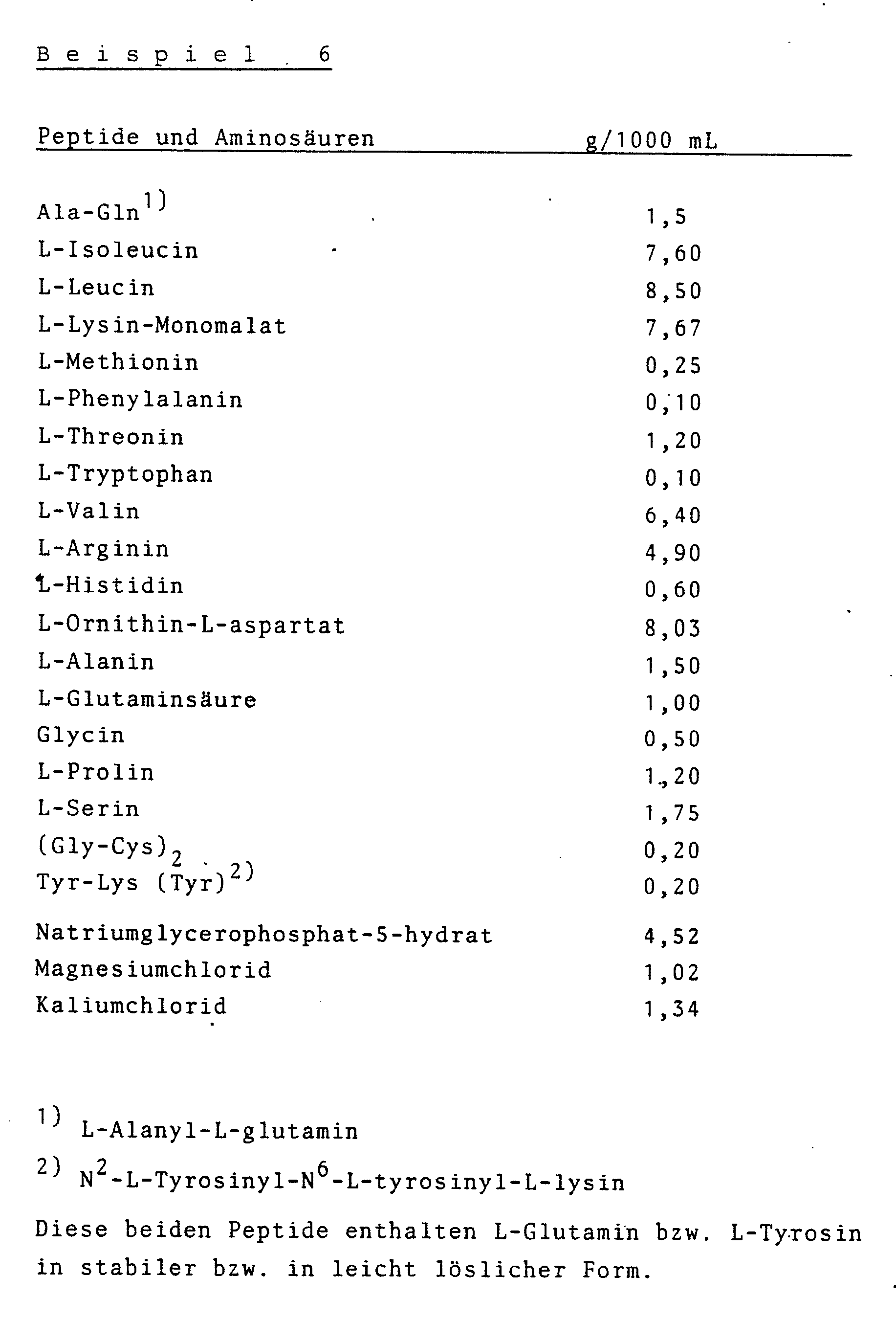
- Die folgenden Beispiele zeigen Infusionslösungen für parenterale Applikationen.



Claims (8)
Priority Applications (1)
| Application Number | Priority Date | Filing Date | Title |
|---|---|---|---|
| AT87115592T ATE63316T1 (de) | 1986-10-24 | 1987-10-23 | Verwendung von n, n'-bis-l-aminosaeure-lcystinpeptiden in aminosaeure-praeparaten fuer orale und parenterale ernaehrung. |
Applications Claiming Priority (2)
| Application Number | Priority Date | Filing Date | Title |
|---|---|---|---|
| DE3636334 | 1986-10-24 | ||
| DE3636334 | 1986-10-24 |
Publications (3)
| Publication Number | Publication Date |
|---|---|
| EP0264953A2 true EP0264953A2 (de) | 1988-04-27 |
| EP0264953A3 EP0264953A3 (en) | 1988-08-31 |
| EP0264953B1 EP0264953B1 (de) | 1991-05-08 |
Family
ID=6312449
Family Applications (1)
| Application Number | Title | Priority Date | Filing Date |
|---|---|---|---|
| EP87115592A Expired - Lifetime EP0264953B1 (de) | 1986-10-24 | 1987-10-23 | Verwendung von N, N'-bis-L-Aminosäure-L-cystinpeptiden in Aminosäure-Präparaten für orale und parenterale Ernährung |
Country Status (9)
| Country | Link |
|---|---|
| US (1) | US4968696A (de) |
| EP (1) | EP0264953B1 (de) |
| JP (1) | JPH01501706A (de) |
| AT (1) | ATE63316T1 (de) |
| AU (1) | AU605214B2 (de) |
| DE (1) | DE3769910D1 (de) |
| ES (1) | ES2039402T3 (de) |
| GR (1) | GR3001922T3 (de) |
| WO (1) | WO1988003150A2 (de) |
Cited By (4)
| Publication number | Priority date | Publication date | Assignee | Title |
|---|---|---|---|---|
| EP0267179A3 (en) * | 1986-11-07 | 1990-02-28 | Bbu-Chemie Gmbh | Cystin compounds, their preparation and their use |
| EP0399656A1 (de) * | 1989-04-24 | 1990-11-28 | Kyowa Hakko Kogyo Kabushiki Kaisha | Nährstoff-Zusammensetzungen für die Ergänzung an Aminosäuren bei Säugetieren |
| FR2711529A1 (fr) * | 1993-10-28 | 1995-05-05 | Clintec Nutrition Cy | Composition à base d'acides aminés destinée au traitement d'une infection ou d'une agression engendrant une réaction inflammatoire, chez les animaux et chez l'homme. |
| WO2021213822A1 (en) * | 2020-04-20 | 2021-10-28 | Evonik Operations Gmbh | Compositions comprising cys-peptides |
Families Citing this family (6)
| Publication number | Priority date | Publication date | Assignee | Title |
|---|---|---|---|---|
| DK53191D0 (da) * | 1991-03-25 | 1991-03-25 | Carlbiotech Ltd As | Organosvovlforbindelse og farmaceutisk praeparat indeholdende en saadan forbindelse |
| DK0545198T3 (da) * | 1991-11-29 | 2000-03-20 | Hoechst Ag | Peptider med insulinagtig virkning |
| FR2872042B1 (fr) * | 2004-06-29 | 2006-09-15 | Soc Extraction Principes Actif | Utilisation d'un dipeptide dimerise en tant qu'agent actif dans ou pour la preparation une composition cosmetique et/ou dermatologique |
| JP5668271B2 (ja) * | 2008-12-25 | 2015-02-12 | ユーハ味覚糖株式会社 | シスチン−アミノ酸複合体及びその製造方法 |
| US20110262965A1 (en) | 2010-04-23 | 2011-10-27 | Life Technologies Corporation | Cell culture medium comprising small peptides |
| EP2610338A4 (de) | 2010-08-02 | 2015-03-25 | Kyowa Hakko Kirin Co Ltd | Verfahren zur herstellung einer substanz |
Family Cites Families (7)
| Publication number | Priority date | Publication date | Assignee | Title |
|---|---|---|---|---|
| NL245033A (de) * | 1900-01-01 | |||
| CH517705A (de) * | 1969-12-16 | 1972-01-15 | Ciba Geigy Ag | Verfahren zur Herstellung von Cystin-haltigen Peptiden |
| BE785933A (fr) * | 1971-07-07 | 1973-01-08 | Ciba Geigy | Procede de preparation de peptides contenant de la cystine |
| US4258193A (en) * | 1978-07-13 | 1981-03-24 | Toyo Jozo Kabushiki Kaisha | Disulfide derivatives having S--S exchange reactivity |
| US4284624A (en) * | 1980-05-02 | 1981-08-18 | E. R. Squibb & Sons, Inc. | Mixed disulfides |
| DE3206784C2 (de) * | 1982-02-25 | 1985-05-09 | Pfrimmer & Co Pharmazeutische Werke Erlangen Gmbh, 8520 Erlangen | Glutaminhaltige Zubereitungen für orale oder intravenöse Applikation |
| US4427582A (en) * | 1982-06-08 | 1984-01-24 | Smithkline Beckman Corporation | Antimicrobial disulfide prodrugs |
-
1987
- 1987-10-23 JP JP62506758A patent/JPH01501706A/ja active Pending
- 1987-10-23 ES ES198787115592T patent/ES2039402T3/es not_active Expired - Lifetime
- 1987-10-23 AU AU82301/87A patent/AU605214B2/en not_active Ceased
- 1987-10-23 WO PCT/EP1987/000631 patent/WO1988003150A2/de not_active Ceased
- 1987-10-23 AT AT87115592T patent/ATE63316T1/de not_active IP Right Cessation
- 1987-10-23 US US07/228,927 patent/US4968696A/en not_active Expired - Fee Related
- 1987-10-23 EP EP87115592A patent/EP0264953B1/de not_active Expired - Lifetime
- 1987-10-23 DE DE8787115592T patent/DE3769910D1/de not_active Expired - Lifetime
-
1991
- 1991-05-09 GR GR91400534T patent/GR3001922T3/el unknown
Cited By (6)
| Publication number | Priority date | Publication date | Assignee | Title |
|---|---|---|---|---|
| EP0267179A3 (en) * | 1986-11-07 | 1990-02-28 | Bbu-Chemie Gmbh | Cystin compounds, their preparation and their use |
| EP0399656A1 (de) * | 1989-04-24 | 1990-11-28 | Kyowa Hakko Kogyo Kabushiki Kaisha | Nährstoff-Zusammensetzungen für die Ergänzung an Aminosäuren bei Säugetieren |
| US5102871A (en) * | 1989-04-24 | 1992-04-07 | Kyowa Hakko Kogyo Co., Ltd. | Nutrient composition |
| FR2711529A1 (fr) * | 1993-10-28 | 1995-05-05 | Clintec Nutrition Cy | Composition à base d'acides aminés destinée au traitement d'une infection ou d'une agression engendrant une réaction inflammatoire, chez les animaux et chez l'homme. |
| EP0655244A1 (de) * | 1993-10-28 | 1995-05-31 | Clintec Nutrition Company | Zusammensetzungen aus Aminosäure zur Behandlung von Infektionen |
| WO2021213822A1 (en) * | 2020-04-20 | 2021-10-28 | Evonik Operations Gmbh | Compositions comprising cys-peptides |
Also Published As
| Publication number | Publication date |
|---|---|
| JPH01501706A (ja) | 1989-06-15 |
| US4968696A (en) | 1990-11-06 |
| DE3769910D1 (de) | 1991-06-13 |
| ES2039402T3 (es) | 1993-10-01 |
| WO1988003150A2 (en) | 1988-05-05 |
| AU605214B2 (en) | 1991-01-10 |
| EP0264953B1 (de) | 1991-05-08 |
| WO1988003150A3 (en) | 1988-07-14 |
| GR3001922T3 (en) | 1992-11-23 |
| AU8230187A (en) | 1988-05-25 |
| EP0264953A3 (en) | 1988-08-31 |
| ATE63316T1 (de) | 1991-05-15 |
Similar Documents
| Publication | Publication Date | Title |
|---|---|---|
| DE69632224T2 (de) | Reduzierung von Gelation von Fettsäureacylierten Proteinen unter Nutzung von Zitratpuffer | |
| EP0087750B2 (de) | Glutaminhaltige Aminosäure-Zubereitungen | |
| DE69021386T2 (de) | Verfahren und zusammensetzungen zur heilung von geschwüren. | |
| DE69026306T2 (de) | Verfahren für die Herstellung von Polyethylenglykolderivate und modifizierte Proteine. | |
| WO1986003493A1 (fr) | Hirudine-pa et ses derives, leur procede de production et leur utilisation | |
| EP0912197A2 (de) | Hämoglobin-hydroxyethylstärke-konjugate als sauerstoff-transport-mittel | |
| DE3587579D1 (de) | Pharmazeutische Zubereitung enthaltend eine Tetrahydropyrrolverbindung als aktiven Bestandteil und Verfahren zur Herstellung dieser Tetrapyrrolverbindung. | |
| EP0264953B1 (de) | Verwendung von N, N'-bis-L-Aminosäure-L-cystinpeptiden in Aminosäure-Präparaten für orale und parenterale Ernährung | |
| DE3877547T2 (de) | Basisches protein phospholipase a2 aus dem gift der schlangen aus der familie der elapiden, deren aminosaeuresequenz, derivate und fragmente dieses proteins, verfahren um es zu erhalten, therapeutische kompositionen und diagnosemittel, alle dieses protein enthaltend und/oder dessen derivate und/oder dessen fragmente. | |
| DK160317B (da) | Fremgangsmaade til fremstilling af et injicerbart chondroitinpolysulfat | |
| DE2920770A1 (de) | Reduktionsmittel fuer technetium-99m und reduktionsverfahren unter bildung von mit technetium markierten stoffen | |
| DE69331479T2 (de) | Polyethylenglycol-Hirudin-Konjugate, deren Verfahren zur Herstellung und Verwendung für die Heilung von Thrombosen | |
| DE2834001A1 (de) | Neue pepstatinderivate und verfahren zu ihrer herstellung | |
| EP0821593B1 (de) | Konjugat aus einem wirkstoff, einem polyether und ggf. einem nicht als körperfremd angesehenen, nativen protein | |
| DE2540544C2 (de) | (1-47)-Urogastron und das entsprechende durch Reduktion der Disulfidbindungen erhältliche Polypeptid, Verfahren zu deren Herstellung und diese Polypeptide enthaltende pharmazeutische Zusammensetzungen | |
| EP0137339B1 (de) | Pharmakologisch aktive Peptide | |
| DE3000749A1 (de) | Zusammensetzung zurdiagnostischen pruefung oder voraussage einer penicillinallergie und testverfahren unter anwendung der zusammensetzung | |
| DE2540545C2 (de) | (1-46)-Urogastron und das entsprechende durch Reduktion der Disulfidbindungen erhältliche Polypeptid, Verfahren zu deren Herstellung und diese Polypeptide enthaltende pharmazeutische Zusammensetzungen | |
| DE3206810C2 (de) | N ↑2↑-L-Tyrosinyl-N ↑6↑-L-tyrosinyl-L-lysin und N ↑2↑-L-Cystinyl-N ↑6↑-L-cystinyl-L-lysin, Verfahren zu deren Herstellung und deren Verwendung | |
| EP1624057B1 (de) | Hyaluronidase enthaltendes Präparat und pharmazeutische Verwendung davon | |
| EP0364942B1 (de) | Neue Isohirudine | |
| DE1231847B (de) | Verfahren zur Herstellung von parenteral applizierbaren waessrigen Loesungen von substituierten Benzochinonen | |
| DE68908958T2 (de) | Peptide. | |
| DE69327498T2 (de) | Antithrombin III - Präparation | |
| DE60317303T2 (de) | Hämoglobin-Konjugate |
Legal Events
| Date | Code | Title | Description |
|---|---|---|---|
| PUAI | Public reference made under article 153(3) epc to a published international application that has entered the european phase |
Free format text: ORIGINAL CODE: 0009012 |
|
| AK | Designated contracting states |
Kind code of ref document: A2 Designated state(s): AT BE CH DE ES FR GB GR IT LI NL SE |
|
| PUAL | Search report despatched |
Free format text: ORIGINAL CODE: 0009013 |
|
| AK | Designated contracting states |
Kind code of ref document: A3 Designated state(s): AT BE CH DE ES FR GB GR IT LI NL SE |
|
| 17P | Request for examination filed |
Effective date: 19881130 |
|
| RAP1 | Party data changed (applicant data changed or rights of an application transferred) |
Owner name: PFRIMMER KABI GMBH & CO. KG |
|
| 17Q | First examination report despatched |
Effective date: 19890720 |
|
| GRAA | (expected) grant |
Free format text: ORIGINAL CODE: 0009210 |
|
| AK | Designated contracting states |
Kind code of ref document: B1 Designated state(s): AT BE CH DE ES FR GB GR IT LI NL SE |
|
| ITF | It: translation for a ep patent filed | ||
| REF | Corresponds to: |
Ref document number: 63316 Country of ref document: AT Date of ref document: 19910515 Kind code of ref document: T |
|
| REF | Corresponds to: |
Ref document number: 3769910 Country of ref document: DE Date of ref document: 19910613 |
|
| GBT | Gb: translation of ep patent filed (gb section 77(6)(a)/1977) | ||
| ET | Fr: translation filed | ||
| PLBE | No opposition filed within time limit |
Free format text: ORIGINAL CODE: 0009261 |
|
| STAA | Information on the status of an ep patent application or granted ep patent |
Free format text: STATUS: NO OPPOSITION FILED WITHIN TIME LIMIT |
|
| 26N | No opposition filed | ||
| REG | Reference to a national code |
Ref country code: GR Ref legal event code: FG4A Free format text: 3001922 |
|
| REG | Reference to a national code |
Ref country code: ES Ref legal event code: FG2A Ref document number: 2039402 Country of ref document: ES Kind code of ref document: T3 |
|
| EAL | Se: european patent in force in sweden |
Ref document number: 87115592.5 |
|
| REG | Reference to a national code |
Ref country code: GB Ref legal event code: IF02 |
|
| NLS | Nl: assignments of ep-patents |
Owner name: PHARMACIA GMBH Owner name: PHARMACIA & UPJOHN GMBH Owner name: KABI PHARMACIA GMBH Owner name: PROCORDIA DEUTSCHLAND GMBH |
|
| PGFP | Annual fee paid to national office [announced via postgrant information from national office to epo] |
Ref country code: GB Payment date: 20041012 Year of fee payment: 18 |
|
| PGFP | Annual fee paid to national office [announced via postgrant information from national office to epo] |
Ref country code: NL Payment date: 20041019 Year of fee payment: 18 Ref country code: FR Payment date: 20041019 Year of fee payment: 18 |
|
| PGFP | Annual fee paid to national office [announced via postgrant information from national office to epo] |
Ref country code: GR Payment date: 20041020 Year of fee payment: 18 |
|
| PGFP | Annual fee paid to national office [announced via postgrant information from national office to epo] |
Ref country code: AT Payment date: 20041022 Year of fee payment: 18 Ref country code: BE Payment date: 20041022 Year of fee payment: 18 |
|
| PGFP | Annual fee paid to national office [announced via postgrant information from national office to epo] |
Ref country code: SE Payment date: 20041025 Year of fee payment: 18 Ref country code: CH Payment date: 20041025 Year of fee payment: 18 |
|
| PGFP | Annual fee paid to national office [announced via postgrant information from national office to epo] |
Ref country code: ES Payment date: 20041026 Year of fee payment: 18 |
|
| REG | Reference to a national code |
Ref country code: CH Ref legal event code: PUE Owner name: FRESENIUS KABI AB Free format text: PHARMACIA GMBH##ERLANGEN (DE) -TRANSFER TO- FRESENIUS KABI AB#RAPSGATAN 7#751 74 UPPSALA (SE) Ref country code: CH Ref legal event code: PUE Owner name: PHARMACIA GMBH Free format text: PFRIMMER KABI GMBH & CO. KG#HOFMANNSTRASSE 26#ERLANGEN (DE) -TRANSFER TO- PHARMACIA GMBH##ERLANGEN (DE) Ref country code: CH Ref legal event code: NV Representative=s name: R. A. EGLI & CO. PATENTANWAELTE |
|
| NLS | Nl: assignments of ep-patents |
Owner name: FRESENIUS KABI AB |
|
| BECA | Be: change of holder's address |
Owner name: *FRESENIUS KABI A.B.RAPSGATAN 7, SE-751 75 UPPSALA Effective date: 20050531 |
|
| BECH | Be: change of holder |
Owner name: *FRESENIUS KABI A.B. Effective date: 20050531 |
|
| REG | Reference to a national code |
Ref country code: ES Ref legal event code: PC2A |
|
| REG | Reference to a national code |
Ref country code: GB Ref legal event code: 732E |
|
| PG25 | Lapsed in a contracting state [announced via postgrant information from national office to epo] |
Ref country code: GB Free format text: LAPSE BECAUSE OF NON-PAYMENT OF DUE FEES Effective date: 20051023 Ref country code: IT Free format text: LAPSE BECAUSE OF NON-PAYMENT OF DUE FEES;WARNING: LAPSES OF ITALIAN PATENTS WITH EFFECTIVE DATE BEFORE 2007 MAY HAVE OCCURRED AT ANY TIME BEFORE 2007. THE CORRECT EFFECTIVE DATE MAY BE DIFFERENT FROM THE ONE RECORDED. Effective date: 20051023 Ref country code: AT Free format text: LAPSE BECAUSE OF NON-PAYMENT OF DUE FEES Effective date: 20051023 |
|
| PG25 | Lapsed in a contracting state [announced via postgrant information from national office to epo] |
Ref country code: ES Free format text: LAPSE BECAUSE OF NON-PAYMENT OF DUE FEES Effective date: 20051024 Ref country code: SE Free format text: LAPSE BECAUSE OF NON-PAYMENT OF DUE FEES Effective date: 20051024 |
|
| PG25 | Lapsed in a contracting state [announced via postgrant information from national office to epo] |
Ref country code: LI Free format text: LAPSE BECAUSE OF NON-PAYMENT OF DUE FEES Effective date: 20051031 Ref country code: CH Free format text: LAPSE BECAUSE OF NON-PAYMENT OF DUE FEES Effective date: 20051031 Ref country code: BE Free format text: LAPSE BECAUSE OF NON-PAYMENT OF DUE FEES Effective date: 20051031 |
|
| PG25 | Lapsed in a contracting state [announced via postgrant information from national office to epo] |
Ref country code: NL Free format text: LAPSE BECAUSE OF NON-PAYMENT OF DUE FEES Effective date: 20060501 |
|
| REG | Reference to a national code |
Ref country code: CH Ref legal event code: PL |
|
| EUG | Se: european patent has lapsed | ||
| GBPC | Gb: european patent ceased through non-payment of renewal fee |
Effective date: 20051023 |
|
| PG25 | Lapsed in a contracting state [announced via postgrant information from national office to epo] |
Ref country code: FR Free format text: LAPSE BECAUSE OF NON-PAYMENT OF DUE FEES Effective date: 20060630 |
|
| NLV4 | Nl: lapsed or anulled due to non-payment of the annual fee |
Effective date: 20060501 |
|
| REG | Reference to a national code |
Ref country code: FR Ref legal event code: ST Effective date: 20060630 |
|
| PGFP | Annual fee paid to national office [announced via postgrant information from national office to epo] |
Ref country code: DE Payment date: 20061031 Year of fee payment: 20 |
|
| REG | Reference to a national code |
Ref country code: ES Ref legal event code: FD2A Effective date: 20051024 |
|
| BECA | Be: change of holder's address |
Owner name: *FRESENIUS KABI A.B.RAPSGATAN 7, SE-751 75 UPPSALA Effective date: 20050531 |
|
| BECH | Be: change of holder |
Owner name: *FRESENIUS KABI A.B. Effective date: 20050531 |
|
| BERE | Be: lapsed |
Owner name: *FRESENIUS KABI A.B. Effective date: 20051031 |
|
| PG25 | Lapsed in a contracting state [announced via postgrant information from national office to epo] |
Ref country code: GR Free format text: LAPSE BECAUSE OF NON-PAYMENT OF DUE FEES Effective date: 19910508 |