EP0264484A1 - Verfahren zum Entcoffeinieren von Naturstoffen, insbesondere Rohkaffee oder Tee - Google Patents
Verfahren zum Entcoffeinieren von Naturstoffen, insbesondere Rohkaffee oder Tee Download PDFInfo
- Publication number
- EP0264484A1 EP0264484A1 EP86114742A EP86114742A EP0264484A1 EP 0264484 A1 EP0264484 A1 EP 0264484A1 EP 86114742 A EP86114742 A EP 86114742A EP 86114742 A EP86114742 A EP 86114742A EP 0264484 A1 EP0264484 A1 EP 0264484A1
- Authority
- EP
- European Patent Office
- Prior art keywords
- solvent
- tea
- pressure
- coffee
- green coffee
- Prior art date
- Legal status (The legal status is an assumption and is not a legal conclusion. Google has not performed a legal analysis and makes no representation as to the accuracy of the status listed.)
- Granted
Links
- 238000000034 method Methods 0.000 title claims abstract description 15
- 241001122767 Theaceae Species 0.000 title claims abstract 5
- 229930014626 natural product Natural products 0.000 title claims description 5
- RYYVLZVUVIJVGH-UHFFFAOYSA-N caffeine Chemical compound CN1C(=O)N(C)C(=O)C2=C1N=CN2C RYYVLZVUVIJVGH-UHFFFAOYSA-N 0.000 claims abstract description 18
- 238000000605 extraction Methods 0.000 claims abstract description 16
- 239000002904 solvent Substances 0.000 claims abstract description 16
- LPHGQDQBBGAPDZ-UHFFFAOYSA-N Isocaffeine Natural products CN1C(=O)N(C)C(=O)C2=C1N(C)C=N2 LPHGQDQBBGAPDZ-UHFFFAOYSA-N 0.000 claims abstract description 9
- VJEONQKOZGKCAK-UHFFFAOYSA-N caffeine Natural products CN1C(=O)N(C)C(=O)C2=C1C=CN2C VJEONQKOZGKCAK-UHFFFAOYSA-N 0.000 claims abstract description 9
- 229960001948 caffeine Drugs 0.000 claims abstract description 9
- 238000000926 separation method Methods 0.000 claims abstract 2
- 239000005445 natural material Substances 0.000 abstract description 3
- XLYOFNOQVPJJNP-UHFFFAOYSA-N water Substances O XLYOFNOQVPJJNP-UHFFFAOYSA-N 0.000 description 6
- 239000000203 mixture Substances 0.000 description 5
- 241000533293 Sesbania emerus Species 0.000 description 3
- 244000269722 Thea sinensis Species 0.000 description 3
- 230000000052 comparative effect Effects 0.000 description 3
- 238000010586 diagram Methods 0.000 description 1
- 238000002474 experimental method Methods 0.000 description 1
- 239000007787 solid Substances 0.000 description 1
Images
Classifications
-
- A—HUMAN NECESSITIES
- A23—FOODS OR FOODSTUFFS; TREATMENT THEREOF, NOT COVERED BY OTHER CLASSES
- A23F—COFFEE; TEA; THEIR SUBSTITUTES; MANUFACTURE, PREPARATION, OR INFUSION THEREOF
- A23F5/00—Coffee; Coffee substitutes; Preparations thereof
- A23F5/20—Reducing or removing alkaloid content; Preparations produced thereby; Extracts or infusions thereof
- A23F5/206—Reducing or removing alkaloid content; Preparations produced thereby; Extracts or infusions thereof by extraction of the beans with selective solvents other than water or aqueous bean extracts, including supercritical gases
-
- A—HUMAN NECESSITIES
- A23—FOODS OR FOODSTUFFS; TREATMENT THEREOF, NOT COVERED BY OTHER CLASSES
- A23F—COFFEE; TEA; THEIR SUBSTITUTES; MANUFACTURE, PREPARATION, OR INFUSION THEREOF
- A23F3/00—Tea; Tea substitutes; Preparations thereof
- A23F3/36—Reducing or removing alkaloid content; Preparations produced thereby; Extracts or infusions thereof
- A23F3/366—Reducing or removing alkaloid content; Preparations produced thereby; Extracts or infusions thereof by extraction of the leaves with selective solvents
-
- B—PERFORMING OPERATIONS; TRANSPORTING
- B01—PHYSICAL OR CHEMICAL PROCESSES OR APPARATUS IN GENERAL
- B01D—SEPARATION
- B01D11/00—Solvent extraction
- B01D11/02—Solvent extraction of solids
- B01D11/0203—Solvent extraction of solids with a supercritical fluid
Definitions
- the present invention relates to a method for decaffeinating natural products, in particular green coffee or tea according to the preamble of the main claim.
- the present invention is therefore based on the object of improving the method mentioned at the outset in such a way that it is possible to work particularly cost-effectively with a short decaffeination time.
- a high weight ratio of solvent to green coffee or tea is initially used, which is preferably reduced continuously, according to requirements, by a factor of 5 to 10.
- the test results have shown that the extraction time is halved by the process according to the invention can be without increasing the residual caffeine content in any way.
- A extract
- the pressure vessel is closed and brought to the extraction pressure of 20 MPa by means of the compressor K by the extraction gas.
- a supercritical mixture of 30 vol.% CO2 with 70 vol% N2O is used as the extraction gas, which is pumped out of the gas supply G and, after saturation with water, is passed through the saturation container S into the extraction container.
- a supercritical mixture is understood to mean a state of the mixture which is higher in pressure than the critical pressure of the mixture (higher than about 8 MPa) and higher in temperature is than the critical temperature of the mixture (higher than about 35 ° C).
- the gas circulation at the throttle valve D is opened.
- the extraction gas now flows from the compressor over the saturator and in the extractor through the bed of raw coffee beans, from which the caffeine is selectively extracted.
- the extraction gas leaves the extraction pressure vessel.
- the pressure is throttled to approximately half the extraction pressure, approximately 10 MPa.
- the gas flows from below into the separating container B.
- the pump P is used to pump caffeine-free water heated to 60 ° C. into the separator B heated to 60 ° C. and sprayed it onto a packed bed.
- the caffeine from the extraction gas is washed in countercurrent by means of the water.
- the water loaded with caffeine is drawn off at the bottom of the separator.
- the caffeine-free gas leaves the separator at the upper end and is returned to the extractor via the compressor.
- the gas cycle is maintained for about 10 hours. A ratio of extraction gas to the amount of coffee used of about 35 l / h is maintained.
- the gas cycle is interrupted and the extractor is released to ambient pressure.
- the coffee beans are dried in a forced-air dryer to the initial moisture content in about 1.5 hours.
- the ratio of extraction gas (solvent) to the amount of coffee used can be reduced according to the invention, which shortens the time required for the desired decaffeination.
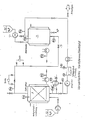
- the single figure shows a schematic flow diagram of the method according to the invention, from which all details emerge.
Landscapes
- Chemical & Material Sciences (AREA)
- Life Sciences & Earth Sciences (AREA)
- Engineering & Computer Science (AREA)
- Food Science & Technology (AREA)
- Polymers & Plastics (AREA)
- Chemical Kinetics & Catalysis (AREA)
- Tea And Coffee (AREA)
- Organic Low-Molecular-Weight Compounds And Preparation Thereof (AREA)
Abstract
Description
- Die vorliegende Erfindung betrifft ein Verfahren zum Entcoffeinieren von Naturstoffen, insbesondere Rohkaffee oder Tee nach dem Oberbegriff des Hauptanspruches.
- Ähnliche Verfahrensweisen finden sich im Stand der Technik in unterschiedlichen Ausführungsformen, so z.B. in den DE-OS 34 45 502, 31 33 032, 26 37 197 etc.. Alle diese vorbekannten Verfahren weisen jedoch eine relativ lange Entcoffeinierungszeit auf, was ihre Wirtschaftlichkeit beeinträchtigt.
- Der vorliegenden Erfindung liegt deshalb die Aufgabe zugrunde, das eingangs erwähnte Verfahren derart zu verbessern, daß besonders kostengünstig mit kurzer Entcoffeinierungszeit gearbeitet werden kann.
- Die vorstehende Aufgabe wird durch das im Anspruch 1 gekennzeichnete Verfahren gelöst. Danach wird erfindungsgemäß anfänglich ein hohes Gewichtsverhältnis von Lösungsmittel zu Rohkaffee bzw. Tee eingesetzt, das vorzugsweise kontinuierlich, den Erfordernissen entsprechend, reduziert wird, etwa um den Faktor 5 bis 10. Die Versuchsergebnisse haben überraschenderweise gezeigt, daß durch das erfindungsgemäße Verfahren die Extraktionsdauer etwa halbiert werden kann, ohne daß sich hierdurch der Restcoffeingehalt in irgendeiner Weise erhöht.
- Weitere Vorteile und Merkmale ergeben sich aus den vorstehenden Unteransprüchen. Im folgenden wird der Verfahrensablauf im Zusammenhang mit einem erfindungsgemäßen Beispiel, dem zwei Vergleichsbeispiele gegenübergestellt sind, bei denen mit konstantem Gewichtsverhältnis von Lösungsmittel zu Naturstoff gearbeitet wird, geschildert:
- 400 g Rohkaffee werden mit 40 - 160 g Wasser intensiv vermischt, bis das Wasser vollkommen von den Kaffeebohnen aufgenommen ist. Die so angefeuchtete rohkaffeemenge wird als Feststoffschüttung in den Druckbehälter A (Extraktor), der in Abb. 1 schematisch dargestellten Versuchsapparatur eingebracht. Der Druckbehälter wird verschlossen und mittels des Kompressors K durch das Extraktionsgas auf den Extraktionsdruck von 20 MPa gebracht. Als Extraktionsgas wird eine überkritische Mischung aus 30 Vol.% CO₂ mit 70 Vol% N₂O verwendet, die aus dem Gasvorrat G gepumpt wird und nach Sättigung mit Wasser durch Durchströmen des Sättigungsbehälters S in den Extraktionsbehälter geführt wird. Als überkritische Mischung wird ein Zustand der Mischung verstanden, der hinsichtlich des Druckes höher liegt als der kritische Druck der Mischung (höher als etwa 8 MPa) und hinsichtlich der Temperatur höher liegt als die kritische Temperatur der Mischung ( höher als etwa 35° C).
- Nach Erreichen des Extraktionsdrucks wird der Gasumlauf am Drosselventil D geöffnet. Das Extraktionsgas strömt nunmehr von Kompressor über den Sättiger und im Extraktor durch die Schüttung roher Kaffeebohnen, aus denen selektiv das Koffein extrahiert wird. Nach Beladung mit Koffein verläßt das Extraktionsgas den Extraktionsdruckbehälter. An dem Drosselventil wird der Druck auf etwa die Hälfte des Extraktionsdrucks, ca. 10 MPa, gedrosselt. Nach der Druckerniedrigung strömt das Gas von unten in den Abscheidebehälter B. Von oben wird mittels der Pumpe P auf 60 ° C erwärmtes koffeinfreies Wasser in den auf 60 ° C erwärmten Abscheider B gepumpt, und auf eine Füllkörperschüttung gesprüht. Im Gegenstrom wird mittels des Wassers das Koffein aus dem Extraktionsgas gewaschen. Das mit Koffein beladene Wasser wird unten am Abscheider abgezogen. Das koffeinfreie Gas verläßt den Abscheider am oberen Ende und wird über den Kompressor wieder dem Extraktor zugeführt. Der Gaskreislauf wird über ca. 10 h aufrechterhalten. Dabei wird ein Verhältnis von Extraktionsgas zu eingesetzter Kaffeemenge von etwa 35 l/h aufrechterhalten.
- Nach Versuchsende wird der Gaskreislauf unterbrochen und der Extraktor auf Umgebungsdruck entspannt. Die Kaffeebohnen werden in einem Umlufttrockner in etwa 1,5 h auf die Ausgangsfeuchte getrocknet.
- Das Verhältnis von Extraktionsgas (Lösungsmittels) zu eingesetzter Kaffeemenge kann erfindungsgemäß reduziert werden, wodurch die für die angestrebte Entkoffeinierung benötigte Zeit verkürzt wird.
-

- Versuchsbedingungen wie im obigen Beispiel
Lösungsmittelmenge: 35,2 kg/kg k.h
Versuchsdauer : 15 h; Restkoffein 0,21 Gew%
Lösungsmittelmenge: 528 kg/kg Kaffee - Versuchsbedingungen wie im obigen Beispiel.
Lösungsmittelmenge: 70,3 kg/kg trockener Kaffee . h
Versuchdauer : 10 h; Restkoffein 0,15 Gew%
Lösungsmittelmenge: 703 kg/kg Kaffee. - An dieser Stelle sei angemerkt, daß sich die geschilderte Verfahrensweise ohne weiteres auf die Entcoffeinierung anderer Naturstoffe, beispielsweise Tee, übertragen läßt.
- In der einzigen Figur wird ein schematisches Fließschema des erfindungsgemäßen Verfahrens gezeigt, aus dem alle Einzelheiten hervorgehen.
Claims (4)
dadurch gekennzeichnet, daß
zunächst ein hohes Gewichtsverhältnis von Lösungsmittel zu Naturstoff eingesetzt und dieses mit voranschreitender Extraktionsdauer mindestens etwa um den Faktor 5- 10 reduziert wird.
Priority Applications (3)
| Application Number | Priority Date | Filing Date | Title |
|---|---|---|---|
| AT86114742T ATE49697T1 (de) | 1986-10-23 | 1986-10-23 | Verfahren zum entcoffeinieren von naturstoffen, insbesondere rohkaffee oder tee. |
| DE8686114742T DE3668408D1 (de) | 1986-10-23 | 1986-10-23 | Verfahren zum entcoffeinieren von naturstoffen, insbesondere rohkaffee oder tee. |
| EP86114742A EP0264484B1 (de) | 1986-10-23 | 1986-10-23 | Verfahren zum Entcoffeinieren von Naturstoffen, insbesondere Rohkaffee oder Tee |
Applications Claiming Priority (1)
| Application Number | Priority Date | Filing Date | Title |
|---|---|---|---|
| EP86114742A EP0264484B1 (de) | 1986-10-23 | 1986-10-23 | Verfahren zum Entcoffeinieren von Naturstoffen, insbesondere Rohkaffee oder Tee |
Publications (2)
| Publication Number | Publication Date |
|---|---|
| EP0264484A1 true EP0264484A1 (de) | 1988-04-27 |
| EP0264484B1 EP0264484B1 (de) | 1990-01-24 |
Family
ID=8195528
Family Applications (1)
| Application Number | Title | Priority Date | Filing Date |
|---|---|---|---|
| EP86114742A Expired - Lifetime EP0264484B1 (de) | 1986-10-23 | 1986-10-23 | Verfahren zum Entcoffeinieren von Naturstoffen, insbesondere Rohkaffee oder Tee |
Country Status (3)
| Country | Link |
|---|---|
| EP (1) | EP0264484B1 (de) |
| AT (1) | ATE49697T1 (de) |
| DE (1) | DE3668408D1 (de) |
Cited By (1)
| Publication number | Priority date | Publication date | Assignee | Title |
|---|---|---|---|---|
| EP2404647A1 (de) * | 2010-07-08 | 2012-01-11 | Dartes Krup, S.L. | Verfahren zur Extraktion von organischen Verbindungen aus granuliertem Kork |
Citations (3)
| Publication number | Priority date | Publication date | Assignee | Title |
|---|---|---|---|---|
| FR2133957A1 (de) * | 1971-04-22 | 1972-12-01 | Hag Ag | |
| FR2140098A1 (de) * | 1971-06-03 | 1973-01-12 | Hag Ag | |
| DE3445502A1 (de) * | 1983-12-13 | 1985-06-20 | Cafe Toro Ltda., Bogota | Verfahren und einrichtung zur entcoffeinierung von gruenem kaffee |
-
1986
- 1986-10-23 EP EP86114742A patent/EP0264484B1/de not_active Expired - Lifetime
- 1986-10-23 DE DE8686114742T patent/DE3668408D1/de not_active Expired - Fee Related
- 1986-10-23 AT AT86114742T patent/ATE49697T1/de active
Patent Citations (3)
| Publication number | Priority date | Publication date | Assignee | Title |
|---|---|---|---|---|
| FR2133957A1 (de) * | 1971-04-22 | 1972-12-01 | Hag Ag | |
| FR2140098A1 (de) * | 1971-06-03 | 1973-01-12 | Hag Ag | |
| DE3445502A1 (de) * | 1983-12-13 | 1985-06-20 | Cafe Toro Ltda., Bogota | Verfahren und einrichtung zur entcoffeinierung von gruenem kaffee |
Non-Patent Citations (1)
| Title |
|---|
| CHEM.-ING.-TECH., Band 50, Nr. 11, 1978, Seiten 842-849, Verlag Chemie GmbH, Weinheim, DE; R. EGGERS et al.: "Entwicklung und Projektierung von Anlagen zur Hochdruck-Extraktion von Naturstoffen" * |
Cited By (1)
| Publication number | Priority date | Publication date | Assignee | Title |
|---|---|---|---|---|
| EP2404647A1 (de) * | 2010-07-08 | 2012-01-11 | Dartes Krup, S.L. | Verfahren zur Extraktion von organischen Verbindungen aus granuliertem Kork |
Also Published As
| Publication number | Publication date |
|---|---|
| ATE49697T1 (de) | 1990-02-15 |
| DE3668408D1 (de) | 1990-03-01 |
| EP0264484B1 (de) | 1990-01-24 |
Similar Documents
| Publication | Publication Date | Title |
|---|---|---|
| DE2212281C3 (de) | Verfahren zur entcoffeinierung von rohkaffee | |
| DE2127642A1 (de) | Verfahren zur herstellung von coffeinfreiem schwarzem tee mit vollem aromagehalt | |
| DE2639066C2 (de) | ||
| DE69010408T2 (de) | Verfahren und Vorrichtung zum kontinuierlichen Kontakt von superkritischem Fluidum mit Feststoffen in Partikelform. | |
| DE2727191A1 (de) | Verfahren zur selektiven extraktion von coffein aus pflanzlichen materialien | |
| DE2039376A1 (de) | Verfahren zur Behandlung von Kaffee | |
| EP0482675B1 (de) | Verfahren zur Entcoffeinierung von Rohkaffee | |
| DE2005293A1 (en) | Decaffeinating green coffee with moist - carbon dioxide in the supercritical state | |
| DE3445502C2 (de) | ||
| DE3640333C2 (de) | ||
| DE3415844C2 (de) | Verfahren zur Herstellung von entkoffeiniertem Tee | |
| DE3228927C2 (de) | Verfahren zur kontinuierlichen Extraktion von schüttfähigen Feststoffen | |
| EP0264484B1 (de) | Verfahren zum Entcoffeinieren von Naturstoffen, insbesondere Rohkaffee oder Tee | |
| DE3838952C2 (de) | ||
| EP0439710B1 (de) | Verfahren zur Entcoffeinierung von Rohkaffee | |
| DE69121206T2 (de) | Eintkaffeinierungsverfahren von kaffee durch eine säurebehandlung | |
| EP0247999B1 (de) | Verfahren zum Behandeln von Kaffee | |
| EP0650328B1 (de) | Verfahren zur abreicherung von coffein und chlorogensäuren aus rohkaffee | |
| CH641934A5 (en) | Process for decaffeinating green coffee | |
| DE19524481C2 (de) | Verfahren zur Entcoffeinierung von schwarzem Tee | |
| EP0151202A1 (de) | Verfahren zur Herstellung von coffeinfreiem löslichem Kaffee- oder Tee-Extrakt-Pulver | |
| DE3719991A1 (de) | Verfahren zur wiedergewinnung von als loesungsmittel fuer coffein verwendetem kohlendioxid | |
| DE4400096C2 (de) | Verfahren zur Entcoffeinierung von schwarzem Tee | |
| EP0264483B1 (de) | Verfahren zum Entcoffeinieren von Kaffee | |
| DE2641146A1 (de) | Verfahren zum entfernen von koffein aus kaffee |
Legal Events
| Date | Code | Title | Description |
|---|---|---|---|
| PUAI | Public reference made under article 153(3) epc to a published international application that has entered the european phase |
Free format text: ORIGINAL CODE: 0009012 |
|
| 17P | Request for examination filed |
Effective date: 19870921 |
|
| AK | Designated contracting states |
Kind code of ref document: A1 Designated state(s): AT BE CH DE ES FR GB GR IT LI LU NL SE |
|
| RBV | Designated contracting states (corrected) |
Designated state(s): AT BE CH DE ES FR GB IT LI NL |
|
| 17Q | First examination report despatched |
Effective date: 19880622 |
|
| GRAA | (expected) grant |
Free format text: ORIGINAL CODE: 0009210 |
|
| AK | Designated contracting states |
Kind code of ref document: B1 Designated state(s): AT BE CH DE ES FR GB IT LI NL |
|
| PG25 | Lapsed in a contracting state [announced via postgrant information from national office to epo] |
Ref country code: IT Free format text: LAPSE BECAUSE OF FAILURE TO SUBMIT A TRANSLATION OF THE DESCRIPTION OR TO PAY THE FEE WITHIN THE PRE;WARNING: LAPSES OF ITALIAN PATENTS WITH EFFECTIVE DATE BEFORE 2007 MAY HAVE OCCURRED AT ANY TIME BEFORE 2007. THE CORRECT EFFECTIVE DATE MAY BE DIFFERENT FROM THE ONE RECORDED.SCRIBED TIME-LIMIT Effective date: 19900124 Ref country code: BE Effective date: 19900124 |
|
| REF | Corresponds to: |
Ref document number: 49697 Country of ref document: AT Date of ref document: 19900215 Kind code of ref document: T |
|
| REF | Corresponds to: |
Ref document number: 3668408 Country of ref document: DE Date of ref document: 19900301 |
|
| ET | Fr: translation filed | ||
| PG25 | Lapsed in a contracting state [announced via postgrant information from national office to epo] |
Ref country code: ES Free format text: LAPSE BECAUSE OF FAILURE TO SUBMIT A TRANSLATION OF THE DESCRIPTION OR TO PAY THE FEE WITHIN THE PRESCRIBED TIME-LIMIT Effective date: 19900505 |
|
| GBT | Gb: translation of ep patent filed (gb section 77(6)(a)/1977) | ||
| PLBE | No opposition filed within time limit |
Free format text: ORIGINAL CODE: 0009261 |
|
| STAA | Information on the status of an ep patent application or granted ep patent |
Free format text: STATUS: NO OPPOSITION FILED WITHIN TIME LIMIT |
|
| 26N | No opposition filed | ||
| PGFP | Annual fee paid to national office [announced via postgrant information from national office to epo] |
Ref country code: GB Payment date: 19931006 Year of fee payment: 8 |
|
| PGFP | Annual fee paid to national office [announced via postgrant information from national office to epo] |
Ref country code: FR Payment date: 19931014 Year of fee payment: 8 |
|
| PGFP | Annual fee paid to national office [announced via postgrant information from national office to epo] |
Ref country code: DE Payment date: 19931021 Year of fee payment: 8 |
|
| PGFP | Annual fee paid to national office [announced via postgrant information from national office to epo] |
Ref country code: AT Payment date: 19931022 Year of fee payment: 8 |
|
| PGFP | Annual fee paid to national office [announced via postgrant information from national office to epo] |
Ref country code: NL Payment date: 19931031 Year of fee payment: 8 |
|
| PGFP | Annual fee paid to national office [announced via postgrant information from national office to epo] |
Ref country code: CH Payment date: 19931119 Year of fee payment: 8 |
|
| PG25 | Lapsed in a contracting state [announced via postgrant information from national office to epo] |
Ref country code: AT Effective date: 19941023 Ref country code: GB Effective date: 19941023 |
|
| PG25 | Lapsed in a contracting state [announced via postgrant information from national office to epo] |
Ref country code: LI Effective date: 19941031 Ref country code: CH Effective date: 19941031 |
|
| PG25 | Lapsed in a contracting state [announced via postgrant information from national office to epo] |
Ref country code: NL Effective date: 19950501 |
|
| NLV4 | Nl: lapsed or anulled due to non-payment of the annual fee | ||
| GBPC | Gb: european patent ceased through non-payment of renewal fee |
Effective date: 19941023 |
|
| PG25 | Lapsed in a contracting state [announced via postgrant information from national office to epo] |
Ref country code: FR Effective date: 19950630 |
|
| REG | Reference to a national code |
Ref country code: CH Ref legal event code: PL |
|
| PG25 | Lapsed in a contracting state [announced via postgrant information from national office to epo] |
Ref country code: DE Effective date: 19950701 |
|
| REG | Reference to a national code |
Ref country code: FR Ref legal event code: ST |