EP0262846B1 - Nonaqueous battery with special separator - Google Patents
Nonaqueous battery with special separator Download PDFInfo
- Publication number
- EP0262846B1 EP0262846B1 EP87308322A EP87308322A EP0262846B1 EP 0262846 B1 EP0262846 B1 EP 0262846B1 EP 87308322 A EP87308322 A EP 87308322A EP 87308322 A EP87308322 A EP 87308322A EP 0262846 B1 EP0262846 B1 EP 0262846B1
- Authority
- EP
- European Patent Office
- Prior art keywords
- battery
- separator
- electrolyte
- lithium
- positive electrode
- Prior art date
- Legal status (The legal status is an assumption and is not a legal conclusion. Google has not performed a legal analysis and makes no representation as to the accuracy of the status listed.)
- Expired - Lifetime
Links
- 239000000463 material Substances 0.000 claims description 44
- 239000003792 electrolyte Substances 0.000 claims description 28
- WHXSMMKQMYFTQS-UHFFFAOYSA-N Lithium Chemical compound [Li] WHXSMMKQMYFTQS-UHFFFAOYSA-N 0.000 claims description 23
- 229910052744 lithium Inorganic materials 0.000 claims description 23
- 239000000178 monomer Substances 0.000 claims description 16
- -1 polypropylene Polymers 0.000 claims description 12
- KMTRUDSVKNLOMY-UHFFFAOYSA-N Ethylene carbonate Chemical compound O=C1OCCO1 KMTRUDSVKNLOMY-UHFFFAOYSA-N 0.000 claims description 9
- 229910001540 lithium hexafluoroarsenate(V) Inorganic materials 0.000 claims description 9
- 229910020050 NbSe3 Inorganic materials 0.000 claims description 8
- RUOJZAUFBMNUDX-UHFFFAOYSA-N propylene carbonate Chemical compound CC1COC(=O)O1 RUOJZAUFBMNUDX-UHFFFAOYSA-N 0.000 claims description 8
- 230000005855 radiation Effects 0.000 claims description 8
- 239000004743 Polypropylene Substances 0.000 claims description 7
- 229910003002 lithium salt Inorganic materials 0.000 claims description 7
- 159000000002 lithium salts Chemical class 0.000 claims description 7
- 229920001155 polypropylene Polymers 0.000 claims description 7
- 229910001290 LiPF6 Inorganic materials 0.000 claims description 5
- YEJRWHAVMIAJKC-UHFFFAOYSA-N 4-Butyrolactone Chemical compound O=C1CCCO1 YEJRWHAVMIAJKC-UHFFFAOYSA-N 0.000 claims description 4
- CERQOIWHTDAKMF-UHFFFAOYSA-N Methacrylic acid Chemical compound CC(=C)C(O)=O CERQOIWHTDAKMF-UHFFFAOYSA-N 0.000 claims description 4
- WHNWPMSKXPGLAX-UHFFFAOYSA-N N-Vinyl-2-pyrrolidone Chemical compound C=CN1CCCC1=O WHNWPMSKXPGLAX-UHFFFAOYSA-N 0.000 claims description 4
- 239000011149 active material Substances 0.000 claims description 4
- QXYJCZRRLLQGCR-UHFFFAOYSA-N dioxomolybdenum Chemical compound O=[Mo]=O QXYJCZRRLLQGCR-UHFFFAOYSA-N 0.000 claims description 4
- AMXOYNBUYSYVKV-UHFFFAOYSA-M lithium bromide Chemical compound [Li+].[Br-] AMXOYNBUYSYVKV-UHFFFAOYSA-M 0.000 claims description 4
- 239000002904 solvent Substances 0.000 claims description 4
- SMZOUWXMTYCWNB-UHFFFAOYSA-N 2-(2-methoxy-5-methylphenyl)ethanamine Chemical compound COC1=CC=C(C)C=C1CCN SMZOUWXMTYCWNB-UHFFFAOYSA-N 0.000 claims description 2
- NIXOWILDQLNWCW-UHFFFAOYSA-N 2-Propenoic acid Natural products OC(=O)C=C NIXOWILDQLNWCW-UHFFFAOYSA-N 0.000 claims description 2
- KGIGUEBEKRSTEW-UHFFFAOYSA-N 2-vinylpyridine Chemical compound C=CC1=CC=CC=N1 KGIGUEBEKRSTEW-UHFFFAOYSA-N 0.000 claims description 2
- 229910000552 LiCF3SO3 Inorganic materials 0.000 claims description 2
- 229910016003 MoS3 Inorganic materials 0.000 claims description 2
- SECXISVLQFMRJM-UHFFFAOYSA-N N-Methylpyrrolidone Chemical compound CN1CCCC1=O SECXISVLQFMRJM-UHFFFAOYSA-N 0.000 claims description 2
- 229910020039 NbSe2 Inorganic materials 0.000 claims description 2
- 229910004211 TaS2 Inorganic materials 0.000 claims description 2
- 229910003092 TiS2 Inorganic materials 0.000 claims description 2
- 229910010322 TiS3 Inorganic materials 0.000 claims description 2
- PQXKHYXIUOZZFA-UHFFFAOYSA-M lithium fluoride Inorganic materials [Li+].[F-] PQXKHYXIUOZZFA-UHFFFAOYSA-M 0.000 claims description 2
- HSZCZNFXUDYRKD-UHFFFAOYSA-M lithium iodide Inorganic materials [Li+].[I-] HSZCZNFXUDYRKD-UHFFFAOYSA-M 0.000 claims description 2
- MHCFAGZWMAWTNR-UHFFFAOYSA-M lithium perchlorate Chemical compound [Li+].[O-]Cl(=O)(=O)=O MHCFAGZWMAWTNR-UHFFFAOYSA-M 0.000 claims description 2
- 229910001486 lithium perchlorate Inorganic materials 0.000 claims description 2
- 229910001537 lithium tetrachloroaluminate Inorganic materials 0.000 claims description 2
- 229910001496 lithium tetrafluoroborate Inorganic materials 0.000 claims description 2
- 229910052961 molybdenite Inorganic materials 0.000 claims description 2
- CWQXQMHSOZUFJS-UHFFFAOYSA-N molybdenum disulfide Chemical compound S=[Mo]=S CWQXQMHSOZUFJS-UHFFFAOYSA-N 0.000 claims description 2
- 229910052982 molybdenum disulfide Inorganic materials 0.000 claims description 2
- TVWWSIKTCILRBF-UHFFFAOYSA-N molybdenum trisulfide Chemical compound S=[Mo](=S)=S TVWWSIKTCILRBF-UHFFFAOYSA-N 0.000 claims description 2
- 239000007774 positive electrode material Substances 0.000 claims description 2
- 150000001875 compounds Chemical class 0.000 claims 1
- 125000005395 methacrylic acid group Chemical group 0.000 claims 1
- 238000000034 method Methods 0.000 description 16
- 230000008569 process Effects 0.000 description 5
- 150000003839 salts Chemical class 0.000 description 5
- 238000005516 engineering process Methods 0.000 description 4
- 229920000642 polymer Polymers 0.000 description 4
- UHOVQNZJYSORNB-UHFFFAOYSA-N Benzene Chemical compound C1=CC=CC=C1 UHOVQNZJYSORNB-UHFFFAOYSA-N 0.000 description 3
- OKKJLVBELUTLKV-UHFFFAOYSA-N Methanol Chemical compound OC OKKJLVBELUTLKV-UHFFFAOYSA-N 0.000 description 3
- 239000004698 Polyethylene Substances 0.000 description 3
- RAXXELZNTBOGNW-UHFFFAOYSA-N imidazole Natural products C1=CNC=N1 RAXXELZNTBOGNW-UHFFFAOYSA-N 0.000 description 3
- 239000012046 mixed solvent Substances 0.000 description 3
- 239000000203 mixture Substances 0.000 description 3
- 229920000573 polyethylene Polymers 0.000 description 3
- 239000000126 substance Substances 0.000 description 3
- RTZKZFJDLAIYFH-UHFFFAOYSA-N Diethyl ether Chemical compound CCOCC RTZKZFJDLAIYFH-UHFFFAOYSA-N 0.000 description 2
- LYCAIKOWRPUZTN-UHFFFAOYSA-N Ethylene glycol Chemical compound OCCO LYCAIKOWRPUZTN-UHFFFAOYSA-N 0.000 description 2
- HCHKCACWOHOZIP-UHFFFAOYSA-N Zinc Chemical compound [Zn] HCHKCACWOHOZIP-UHFFFAOYSA-N 0.000 description 2
- 230000008901 benefit Effects 0.000 description 2
- 239000010406 cathode material Substances 0.000 description 2
- 238000004132 cross linking Methods 0.000 description 2
- 230000005251 gamma ray Effects 0.000 description 2
- 238000004519 manufacturing process Methods 0.000 description 2
- VZGDMQKNWNREIO-UHFFFAOYSA-N tetrachloromethane Chemical compound ClC(Cl)(Cl)Cl VZGDMQKNWNREIO-UHFFFAOYSA-N 0.000 description 2
- 229910052723 transition metal Inorganic materials 0.000 description 2
- 238000009736 wetting Methods 0.000 description 2
- 229910052725 zinc Inorganic materials 0.000 description 2
- 239000011701 zinc Substances 0.000 description 2
- TXHFHCPKVSDSIL-UHFFFAOYSA-N 1,3-dioxolan-2-one;4-methyl-1,3-dioxolan-2-one Chemical compound O=C1OCCO1.CC1COC(=O)O1 TXHFHCPKVSDSIL-UHFFFAOYSA-N 0.000 description 1
- DJHGAFSJWGLOIV-UHFFFAOYSA-K Arsenate3- Chemical compound [O-][As]([O-])([O-])=O DJHGAFSJWGLOIV-UHFFFAOYSA-K 0.000 description 1
- 229920013683 Celanese Polymers 0.000 description 1
- GUTLYIVDDKVIGB-OUBTZVSYSA-N Cobalt-60 Chemical compound [60Co] GUTLYIVDDKVIGB-OUBTZVSYSA-N 0.000 description 1
- 235000015842 Hesperis Nutrition 0.000 description 1
- 235000012633 Iberis amara Nutrition 0.000 description 1
- XUIMIQQOPSSXEZ-UHFFFAOYSA-N Silicon Chemical compound [Si] XUIMIQQOPSSXEZ-UHFFFAOYSA-N 0.000 description 1
- 230000009471 action Effects 0.000 description 1
- 239000010405 anode material Substances 0.000 description 1
- 229940000489 arsenate Drugs 0.000 description 1
- 239000012986 chain transfer agent Substances 0.000 description 1
- 239000003795 chemical substances by application Substances 0.000 description 1
- 238000003776 cleavage reaction Methods 0.000 description 1
- 239000006184 cosolvent Substances 0.000 description 1
- 238000000354 decomposition reaction Methods 0.000 description 1
- 230000000593 degrading effect Effects 0.000 description 1
- 230000000694 effects Effects 0.000 description 1
- 230000007613 environmental effect Effects 0.000 description 1
- 150000002170 ethers Chemical class 0.000 description 1
- 238000002474 experimental method Methods 0.000 description 1
- 230000002349 favourable effect Effects 0.000 description 1
- 239000000835 fiber Substances 0.000 description 1
- 150000002240 furans Chemical class 0.000 description 1
- 229910052739 hydrogen Inorganic materials 0.000 description 1
- 239000001257 hydrogen Substances 0.000 description 1
- 230000002209 hydrophobic effect Effects 0.000 description 1
- WGCNASOHLSPBMP-UHFFFAOYSA-N hydroxyacetaldehyde Natural products OCC=O WGCNASOHLSPBMP-UHFFFAOYSA-N 0.000 description 1
- 230000006872 improvement Effects 0.000 description 1
- 239000011810 insulating material Substances 0.000 description 1
- 150000002500 ions Chemical class 0.000 description 1
- 239000007788 liquid Substances 0.000 description 1
- 230000005923 long-lasting effect Effects 0.000 description 1
- 239000012528 membrane Substances 0.000 description 1
- 229910052751 metal Inorganic materials 0.000 description 1
- 239000002184 metal Substances 0.000 description 1
- 125000000962 organic group Chemical group 0.000 description 1
- 239000004033 plastic Substances 0.000 description 1
- 229920003023 plastic Polymers 0.000 description 1
- 239000002861 polymer material Substances 0.000 description 1
- 239000011148 porous material Substances 0.000 description 1
- 238000002360 preparation method Methods 0.000 description 1
- 230000001737 promoting effect Effects 0.000 description 1
- 150000003254 radicals Chemical class 0.000 description 1
- 230000009257 reactivity Effects 0.000 description 1
- 238000004064 recycling Methods 0.000 description 1
- 230000007017 scission Effects 0.000 description 1
- 229910052710 silicon Inorganic materials 0.000 description 1
- 239000010703 silicon Substances 0.000 description 1
- 125000006850 spacer group Chemical group 0.000 description 1
- 239000004094 surface-active agent Substances 0.000 description 1
- 239000000080 wetting agent Substances 0.000 description 1
Images
Classifications
-
- H—ELECTRICITY
- H01—ELECTRIC ELEMENTS
- H01M—PROCESSES OR MEANS, e.g. BATTERIES, FOR THE DIRECT CONVERSION OF CHEMICAL ENERGY INTO ELECTRICAL ENERGY
- H01M10/00—Secondary cells; Manufacture thereof
- H01M10/05—Accumulators with non-aqueous electrolyte
-
- H—ELECTRICITY
- H01—ELECTRIC ELEMENTS
- H01M—PROCESSES OR MEANS, e.g. BATTERIES, FOR THE DIRECT CONVERSION OF CHEMICAL ENERGY INTO ELECTRICAL ENERGY
- H01M50/00—Constructional details or processes of manufacture of the non-active parts of electrochemical cells other than fuel cells, e.g. hybrid cells
- H01M50/40—Separators; Membranes; Diaphragms; Spacing elements inside cells
- H01M50/409—Separators, membranes or diaphragms characterised by the material
- H01M50/411—Organic material
- H01M50/414—Synthetic resins, e.g. thermoplastics or thermosetting resins
-
- H—ELECTRICITY
- H01—ELECTRIC ELEMENTS
- H01M—PROCESSES OR MEANS, e.g. BATTERIES, FOR THE DIRECT CONVERSION OF CHEMICAL ENERGY INTO ELECTRICAL ENERGY
- H01M2300/00—Electrolytes
- H01M2300/0017—Non-aqueous electrolytes
- H01M2300/0025—Organic electrolyte
-
- H—ELECTRICITY
- H01—ELECTRIC ELEMENTS
- H01M—PROCESSES OR MEANS, e.g. BATTERIES, FOR THE DIRECT CONVERSION OF CHEMICAL ENERGY INTO ELECTRICAL ENERGY
- H01M50/00—Constructional details or processes of manufacture of the non-active parts of electrochemical cells other than fuel cells, e.g. hybrid cells
- H01M50/40—Separators; Membranes; Diaphragms; Spacing elements inside cells
- H01M50/489—Separators, membranes, diaphragms or spacing elements inside the cells, characterised by their physical properties, e.g. swelling degree, hydrophilicity or shut down properties
-
- H—ELECTRICITY
- H01—ELECTRIC ELEMENTS
- H01M—PROCESSES OR MEANS, e.g. BATTERIES, FOR THE DIRECT CONVERSION OF CHEMICAL ENERGY INTO ELECTRICAL ENERGY
- H01M50/00—Constructional details or processes of manufacture of the non-active parts of electrochemical cells other than fuel cells, e.g. hybrid cells
- H01M50/40—Separators; Membranes; Diaphragms; Spacing elements inside cells
- H01M50/489—Separators, membranes, diaphragms or spacing elements inside the cells, characterised by their physical properties, e.g. swelling degree, hydrophilicity or shut down properties
- H01M50/491—Porosity
-
- Y—GENERAL TAGGING OF NEW TECHNOLOGICAL DEVELOPMENTS; GENERAL TAGGING OF CROSS-SECTIONAL TECHNOLOGIES SPANNING OVER SEVERAL SECTIONS OF THE IPC; TECHNICAL SUBJECTS COVERED BY FORMER USPC CROSS-REFERENCE ART COLLECTIONS [XRACs] AND DIGESTS
- Y02—TECHNOLOGIES OR APPLICATIONS FOR MITIGATION OR ADAPTATION AGAINST CLIMATE CHANGE
- Y02E—REDUCTION OF GREENHOUSE GAS [GHG] EMISSIONS, RELATED TO ENERGY GENERATION, TRANSMISSION OR DISTRIBUTION
- Y02E60/00—Enabling technologies; Technologies with a potential or indirect contribution to GHG emissions mitigation
- Y02E60/10—Energy storage using batteries
Definitions
- the invention is a lithium nonaqueous battery incorporating unique separator material.
- Lithium nonaqueous cells have long been known and attractive commercially for a variety of reasons including their known high energy density and long shelf-life.
- Primary lithium nonaqueous cells are used commercially in a variety of applications where high energy density and long shelf life are at a premium. Typical applications are power sources for watches, calculators, pacemakers, rockets, etc.
- a secondary lithium nonaqueous battery which retains the advantages of primary lithium cells but can be cycled a large number of times.
- the range of applications of such a rechargeable lithium nonaqueous cell is enormous and includes, for example, power sources for cordless telephones, portable computers, portable garden tools, portable drills, etc.
- a nonaqueous cell is generally made up of positive and negative electrodes separated by an insulating material called a separator which prevents electrical contact between positive and negative electrodes, but allows ionic conduction between these electrodes.
- the separator is usually made of a polymer material (e.g., polyethylene, polypropylene, etc.) made in the form of a microporous film.
- Typical commercial products are Celgard® 2400 and Celgard® 2402 made by the Celanese Corporation.
- Separator materials play an important part in lithium rechargeable battery operation.
- the separator material must be stable to the conditions of the battery so as not to degrade and allow direct electrical contact between positive and negative electrodes. This is particularly difficult in a lithium nonaqueous battery because of the high reactivity of the materials involved and the high electropotentials involved.
- the separator material should also be highly insulating to prevent current leakage between positive and negative electrodes and remain highly insulating throughout the life of the battery.
- the separator material must permit high ionic conductivity between positive and negative electrodes so that the cell exhibits high charge and discharge rates.
- Such high ionic conductivity requires that the separator material be "wetted" by the electrolyte system, but electrolyte systems for lithium nonaqueous batteries are typically highly inert chemically and do not easily “wet” the separator material.
- a wetting agent in the form of a surfactant is added to the separator such as silicon glycol or imidazole, but such agents react with various materials in the cell (probably lithium) and limit the cycle life of the battery.
- Another solution is to incorporate various substances with low surface tension in the electrolyte (e.g., furans, other ethers, etc.), but these substances also are not as stable as might be desired and might limit the cycle life of the battery.
- Gamma-ray grafting is a well known technique in polymer chemistry. Indeed, it is used extensively in the production of a variety of articles and is the subject matter of various chapters and books (See, for example, Radiation Chemistry of Polymeric Systems , by A. Chapiro, Interscience, New York, 1962, especially chapter XII, and Atomic Radiation and Polymers , by A. Charlesby, Pergamon Press, New York, 1960).
- Li cells featuring grafted separators are known from e.g. US-A-4,009,323 and GB-A-2,028,567
- the invention is a lithium nonaqueous cell according to claim 1
- the invention is based on the discovery that the ionic conductivity through a separator material suitable for use in nonaqueous cells can be increased enormously by subjecting the separator material to a ⁇ -ray grafting procedure with a monomer suitable for use in nonaqueous lithium cells and useful in promoting wetting of the separator material with the electrolyte.
- a variety of grafting procedures may be used in the practice of the invention.
- Various kinds of separator materials may be used and subjected to the grafting process.
- the preferred separator material is a microporous polypropylene, typically hydrophobic with nominal thickness of about one mil (0,00254 cm), porosity of 38 percent and effective pore size of 0.08 microns. Often, a two-ply form of this material is used.
- separator materials may also be used in the practice of the invention including other microporous polypropylene and polyethylene films and fibers.
- the grafting procedure is not critical in the practice of the invention.
- the radiation-grafting procedure is designed to promote maximum (or at least predominant) grafting as opposed to crosslinking. Generally, this means lower radiation levels.
- high energy ⁇ -radiation is used because it causes cleavage of carbon-hydrogen bands of the polymer and yields a highly reactive free radical in the process.
- Olefinic type monomers are preferred because the grafting process occurs preferentially under these conditions.
- the radiation dosage is usually much lower than for crosslinking so as to promote predominantly the grafting process.
- the microporous separator sheet is soaked in a monomer solution. More than one monomer may be used in the solution and often more than one solvent species is used. Use of a chain transfer agent is optional.
- Exemplatory monomers are methacrylic acid and vinyl pyrrolidone. Typical solvents are benzene, carbon tetrachloride, and methanol. Structural formulas for the exemplatory monomers are as follows:
- a typical procedure is as follows: A solution is made up of monomers in a solvent. The microporous separator material is usually rolled up in a container and the monomer solution poured in the container. Often, the separator material is left to soak in the solution for a time (e.g., one or two days) and then the solution and separator material exposed to a ⁇ -radiation source (e.g., a cobalt 60 radiation source) for a predetermined time and at a predetermined radiation level. Typical radiation levels are 1000-20,000 rads/hour and typical times are one hour to 10 days.
- a ⁇ -radiation source e.g., a cobalt 60 radiation source
- the resulting grafted microporous separator material has active organic groups attached to the polymer structure.
- the material is characterized by measuring the conductivity in an electrolyte composed of 1.0M LiAsF6 in propylene carbonate, with the separator material positioned between the electrodes. Conductivity through untreated microporous polypropylene separator material is very low whereas through treated separator material the conductivity is high.
- separator material treated as described above as much lower resistance, showing evidence that the separator material is wetted by the electrolyte.
- This data also shows that the treated separator material in the electrolyte has high ionic conductivity as is desirable in battery applications.
- the grafted separator material may be used advantageously in a variety of nonaqueous battery structures.
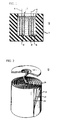
- FIG. 1 A typical rectangular structure is shown in FIG. 1.
- This figure shows a cross-section of a test cell structure 10 with plastic (polypropylene) holder 11, lithium negative electrode 12 with separator 13, and NbSe3 positive electrode 14 with inert spacer material 15 to ensure a close fit in the cell holder 11.
- Metal wires 16 are used to conduct electrical energy out of the cell.
- the electrodes are covered with electrolyte 17 in accordance with the invention.
- Such structures are useful for commercial cells as well as test structures for evaluating various aspects of the cell structure, separator grafting procedure, and electrolyte composition.
- FIG. 2 shows another cell structure 20 useful in the practice of the invention.
- This cell structure is often called the rolled cylindrical cell structure.
- Four layers are put together and rolled into a cylindrical shape.
- the four layers are the negative lithium electrode 21, the separator 22, the positive electrode 23 (e.g., NbSe3), and another separator layer 24.
- the roll is generally put into a cylindrical container with suitable electrical connections to positive and negative electrodes.
- the cylindrical container is filled with electrolyte to permit electrochemical action.
- lithium is preferred because of its high electrochemical potential.
- a large variety of materials can be used as the active material in the positive electrode, including transition-metal chalcogenides. Particularly useful are a number of positive electrode materials such as NbSe2, NbSe3, MoS2, MoS3, TiS2, TiS3, TaS2, V6O13 (stoichiometric and nonstoichiometric) CoO2, and MoO2.
- NbSe2 NbSe3, MoS2, MoS3, TiS2, TiS3, TaS2, V6O13 (stoichiometric and nonstoichiometric) CoO2, and MoO2.
- NbSe2 NbSe3, MoS2, MoS3, TiS2, TiS3, TaS2, V6O13 (stoichiometric and nonstoichiometric) CoO2, and MoO2.
- NbSe3 positive electrodes made from NbSe3. This positive electrode, including procedures for preparation, is shown in U.S. Patent No. 3,864,
- electrolyte systems may also be used in the practice of the invention. Indeed, a particular advantage of the invention is the greater flexibility in choosing materials for the electrolyte system. The reason for this is that a substance need not be included to insure wetting of the separator and a more stable electrolyte system may be used. Particularly useful are mixtures of propylene carbonate and ethylene carbonate plus a suitable current carrying salt (usually a soluble lithium salt).
- a mixed solvent made up of between 10 and 90 weight percent ethylene carbonate, remainder propylene carbonate. More preferred is 10 to 50 weight percent ethylene carbonate, remainder propylene carbonate, and most preferred is 25 to 35 weight percent ethylene carbonate, remainder propylene carbonate. These compositions are preferred because it gives maximum liquid temperature ranges with reasonable improvement in conductivity due to ethylene carbonate.
- Lithium salts are preferred because of compatibility with the chemistry of the lithium electrode.
- Typical salts are LiPF6, LiAsF6, LiClO4, LiCF3SO3, LiBF4, LiAlCl4, LiI, LiF, and LiBr, with LiPF6 and LiAsF6 preferred, and LiAsF6 most preferred from an optional point of view, but LiPF6 is preferred where the arsenate is precluded from use for environmental considerations. Under certain conditions, more than one salt might be used advantageously.
- the concentration of the current-carrying species may vary over large limits; typically from 0.1 molar to saturation. Preferred is a concentration between 0.5 and 1.5 molar for many lithium salts or more advantageously 0.7 to 1.0M. Too low a concentration limits electrolyte conductivity and often limits cycle life because of salt decomposition. Too high a concentration also limits electrolyte conductivity especially at low temperatures, probably because of association of the ions.
- a particularly important aspect of the invention is the cycle behavior of the inventive cell.
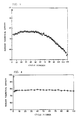
- Data was obtained showing the cycle behavior of a cell containing a lithium negative electrode, a NbSe3 positive electrode, a one mil thick microporous polypropylene separator with grafted monomer, and an electrolyte of 0.8M LiAsF6 dissolved in 50 weight percent ethylene carbonate, 50 weight percent propylene carbonate.
- the discharge rate was c/2 (1.5 mA/cm2) and the charging rate was c/10.
- the monomer used in the grafting procedure was methacrylic acid.
- FIG. 3 where Percent Theoretical Capacity is plotted against Cycle Number. The extremely good cycle behavior is due in part to the grafted separator and the favorable electrolyte system that can be used with grafted separator material.
- FIG. 4 shows further data on a cell using grafted separator material.
- the cell was much like the one used to obtain the data in FIG. 3 except the electrolyte was made up of 0.8M LiAsF6 in 70 weight percent propylene carbonate, 30 weight percent ethylene carbonate.
- the cycle behavior is extremely good, showing a practically constant capacity over many cycles.
- Both rectangular and cylindrical cells can be made using the grafted separator material as well as other types of nonaqueous cells.
Landscapes
- Chemical & Material Sciences (AREA)
- Chemical Kinetics & Catalysis (AREA)
- Electrochemistry (AREA)
- General Chemical & Material Sciences (AREA)
- Engineering & Computer Science (AREA)
- Manufacturing & Machinery (AREA)
- Cell Separators (AREA)
- Secondary Cells (AREA)
Applications Claiming Priority (2)
| Application Number | Priority Date | Filing Date | Title |
|---|---|---|---|
| US06/912,980 US4740433A (en) | 1986-09-29 | 1986-09-29 | Nonaqueous battery with special separator |
| US912980 | 1986-09-29 |
Publications (3)
| Publication Number | Publication Date |
|---|---|
| EP0262846A2 EP0262846A2 (en) | 1988-04-06 |
| EP0262846A3 EP0262846A3 (en) | 1989-03-22 |
| EP0262846B1 true EP0262846B1 (en) | 1993-01-27 |
Family
ID=25432797
Family Applications (1)
| Application Number | Title | Priority Date | Filing Date |
|---|---|---|---|
| EP87308322A Expired - Lifetime EP0262846B1 (en) | 1986-09-29 | 1987-09-21 | Nonaqueous battery with special separator |
Country Status (5)
| Country | Link |
|---|---|
| US (1) | US4740433A (OSRAM) |
| EP (1) | EP0262846B1 (OSRAM) |
| JP (1) | JPS6388750A (OSRAM) |
| CA (1) | CA1306283C (OSRAM) |
| DE (1) | DE3783848T2 (OSRAM) |
Families Citing this family (27)
| Publication number | Priority date | Publication date | Assignee | Title |
|---|---|---|---|---|
| US5183715A (en) * | 1987-02-18 | 1993-02-02 | Gould Electronics Limited | Solid state cell electrolyte |
| CA1308778C (en) * | 1988-07-01 | 1992-10-13 | Nobuhiro Furukawa | Non-aqueous electrolyte cell |
| USH723H (en) | 1988-07-06 | 1990-01-02 | The United States Of America As Represented By The Secretary Of The Army | Lithium electrochemical cell containing diethylcarbonate as an electrolyte solvent additive |
| US4965150A (en) * | 1988-09-08 | 1990-10-23 | Moli Energy Limited | Preparation of VO2 (B) and a non-aqueous secondary cell using VO2 |
| US4892795A (en) * | 1988-09-14 | 1990-01-09 | American Telephone And Telegraph Company, At&T Bell Laboratories | Non-aqueous cell comprising niobium triselenide |
| US4988587A (en) * | 1988-12-19 | 1991-01-29 | At&T Bell Laboratories | Rechargeable non-aqueous cell |
| JP2906422B2 (ja) * | 1989-01-20 | 1999-06-21 | ソニー株式会社 | 充電装置 |
| JPH0834098B2 (ja) * | 1989-02-07 | 1996-03-29 | 日立マクセル株式会社 | Ptc素子付き円筒形有機電解液電池 |
| FR2644295A1 (fr) * | 1989-03-09 | 1990-09-14 | Accumulateurs Fixes | Generateur electrochimique rechargeable a anode de lithium |
| JPH0325865A (ja) * | 1989-06-21 | 1991-02-04 | Matsushita Electric Ind Co Ltd | 非水電解液2次電池 |
| US4963161A (en) * | 1989-07-10 | 1990-10-16 | At&T Bell Laboratories | Non-aqueous alkali battery having an improved cathode |
| US5089027A (en) * | 1990-11-26 | 1992-02-18 | Gould Inc. | Method for producing a solid electrolyte cell |
| CA2045996C (en) * | 1991-06-28 | 2003-04-15 | Shin-Ichi Tobishima | Non-aqueous secondary lithium battery |
| US5252413A (en) * | 1992-04-07 | 1993-10-12 | Eic Laboratories, Inc. | Solid polymer electrolyte lithium batteries |
| US5318866A (en) * | 1993-04-23 | 1994-06-07 | Pall Corporation | Battery separators |
| US5631102A (en) * | 1996-02-12 | 1997-05-20 | Wilson Greatbatch Ltd. | Separator insert for electrochemical cells |
| CA2205767C (en) * | 1996-05-23 | 2001-04-03 | Sharp Kabushiki Kaisha | Nonaqueous secondary battery and a method of manufacturing a negative electrode active material |
| US5902696A (en) * | 1997-06-02 | 1999-05-11 | Wilson Greatbatch Ltd. | Separator for nonaqueous electrochemical cells |
| JP2001338630A (ja) * | 2000-05-30 | 2001-12-07 | Toshiba Battery Co Ltd | リチウム二次電池 |
| US20030113622A1 (en) | 2001-12-14 | 2003-06-19 | Blasi Jane A. | Electrolyte additive for non-aqueous electrochemical cells |
| US20030162099A1 (en) | 2002-02-28 | 2003-08-28 | Bowden William L. | Non-aqueous electrochemical cell |
| WO2005088656A1 (ja) * | 2004-03-12 | 2005-09-22 | Japan Carlit Co., Ltd. | 電気二重層キャパシタ用電解液及び電気二重層キャパシタ |
| US7285356B2 (en) | 2004-07-23 | 2007-10-23 | The Gillette Company | Non-aqueous electrochemical cells |
| US7479348B2 (en) | 2005-04-08 | 2009-01-20 | The Gillette Company | Non-aqueous electrochemical cells |
| US20120102725A1 (en) * | 2010-10-28 | 2012-05-03 | Gm Global Technology Operations, Inc. | Battery Separator |
| US20130149589A1 (en) * | 2011-12-07 | 2013-06-13 | Oliver Gronwald | Electrochemical cells comprising a nitrogen-containing polymer |
| CN107141503A (zh) * | 2017-04-05 | 2017-09-08 | 河南师范大学 | 一种锂硫电池用聚烯烃改性隔膜的制备方法 |
Family Cites Families (14)
| Publication number | Priority date | Publication date | Assignee | Title |
|---|---|---|---|---|
| US3376168A (en) * | 1962-08-02 | 1968-04-02 | Yardney International Corp | Metal-containing graft-polymerized product and method of making same |
| US3864167A (en) * | 1973-04-19 | 1975-02-04 | Bell Telephone Labor Inc | Non-aqueous battery using chalcogenide electrode |
| US4009323A (en) * | 1975-05-12 | 1977-02-22 | The United States Of America As Represented By The Secretary Of The Navy | Storage battery comprising positive electrode of a graphite and lithium fluoride compound |
| JPS5250544A (en) * | 1975-10-20 | 1977-04-22 | Nitto Electric Ind Co | Secondary battery separator |
| US4206275A (en) * | 1977-03-23 | 1980-06-03 | Esb Incorporated | Material for an alkaline cell separator and a process of making |
| JPS5425432A (en) * | 1977-07-26 | 1979-02-26 | Japan Atomic Energy Res Inst | Method of making cell diaphragm |
| US4220693A (en) * | 1978-08-23 | 1980-09-02 | P. R. Mallory & Co. Inc. | Composite separator/absorbent |
| US4287275A (en) * | 1979-01-26 | 1981-09-01 | Sac Membrane Products Corporation | Alkaline cell with graft polymer separator |
| JPS596469B2 (ja) * | 1979-02-05 | 1984-02-10 | 日本原子力研究所 | 寸法安定性のすぐれた電池用隔膜の製造法 |
| JPS567351A (en) * | 1979-06-29 | 1981-01-26 | Matsushita Electric Ind Co Ltd | Separator for cell |
| CA1177534A (en) * | 1980-11-26 | 1984-11-06 | John E. Bennett | Rechargeable lithium/sulfur ammoniate battery |
| US4374186A (en) * | 1981-04-29 | 1983-02-15 | The United States Of America As Represented By The Secretary Of The Navy | Polymer packaged cell in a sack |
| US4414090A (en) * | 1981-10-01 | 1983-11-08 | Rai Research Corporation | Separator membranes for redox-type electrochemical cells |
| US4629666A (en) * | 1985-11-22 | 1986-12-16 | Duracell Inc. | Separators for electrochemical cells |
-
1986
- 1986-09-29 US US06/912,980 patent/US4740433A/en not_active Expired - Lifetime
-
1987
- 1987-09-15 CA CA000546913A patent/CA1306283C/en not_active Expired - Lifetime
- 1987-09-21 DE DE8787308322T patent/DE3783848T2/de not_active Expired - Fee Related
- 1987-09-21 EP EP87308322A patent/EP0262846B1/en not_active Expired - Lifetime
- 1987-09-29 JP JP62242869A patent/JPS6388750A/ja active Granted
Also Published As
| Publication number | Publication date |
|---|---|
| US4740433A (en) | 1988-04-26 |
| JPH0456424B2 (OSRAM) | 1992-09-08 |
| CA1306283C (en) | 1992-08-11 |
| DE3783848D1 (de) | 1993-03-11 |
| DE3783848T2 (de) | 1993-06-03 |
| EP0262846A2 (en) | 1988-04-06 |
| EP0262846A3 (en) | 1989-03-22 |
| JPS6388750A (ja) | 1988-04-19 |
Similar Documents
| Publication | Publication Date | Title |
|---|---|---|
| EP0262846B1 (en) | Nonaqueous battery with special separator | |
| US5512389A (en) | Rechargeable non-aqueous thin film lithium battery | |
| Koksbang et al. | Review of hybrid polymer electrolytes and rechargeable lithium batteries | |
| KR100233394B1 (ko) | 다층화된 전해질 및 그것을 사용하는 전기 화학 셀 | |
| EP1082776B1 (en) | Composite polymer electrolyte for a rechargeable lithium battery | |
| KR100281589B1 (ko) | 블렌드된 중합체 겔 전해질 | |
| US20060078790A1 (en) | Solid electrolytes based on lithium hafnium phosphate for active metal anode protection | |
| US12243980B2 (en) | Multi-layer electrolyte assembly for lithium batteries | |
| KR100325868B1 (ko) | 유기전해액 및 이를 채용한 리튬 2차전지 | |
| EP1225649A2 (en) | High ionic conductivity gel polymer electrolyte for rechargeable polymer batteries | |
| CN103415953A (zh) | 锂-空气电池 | |
| US7279249B2 (en) | Organic electrolytic solution and lithium battery employing the same | |
| JPH1135765A (ja) | 高分子固体電解質とその製造方法 | |
| WO2002061874A1 (en) | A multi-layered, uv-cured polymer electrolyte and lithium secondary battery comprising the same | |
| KR100558843B1 (ko) | 리튬 전지 및 그의 제조방법 | |
| EP1055262B1 (en) | Electrochemical cell comprising a liquid organic electrolyte with a conductive additive | |
| US6521382B1 (en) | Method of preparing polymer electrolyte composition and method of manufacturing lithium secondary battery using the same | |
| Brodd et al. | Polymer battery R&D in the US | |
| KR100407485B1 (ko) | 겔형의 고분자 전해질 및 이를 채용한 리튬 전지 | |
| KR100327487B1 (ko) | 리튬 고분자 이차전지 제조방법 | |
| USH1462H (en) | Solid state electrochemical lithium/polymer cell | |
| JP3215478B2 (ja) | 電 池 | |
| KR20040042749A (ko) | 다공성 고분자가 코팅된 겔화 세퍼레이터 및 이들을이용한 전기화학셀 | |
| KR100361642B1 (ko) | 신규한 다공성 고분자 전해질 조성물(i) 및 그의 제조방법 | |
| JPH10294130A (ja) | 非水系電池用ハイブリッド電解質及び非水系電池 |
Legal Events
| Date | Code | Title | Description |
|---|---|---|---|
| PUAI | Public reference made under article 153(3) epc to a published international application that has entered the european phase |
Free format text: ORIGINAL CODE: 0009012 |
|
| AK | Designated contracting states |
Kind code of ref document: A2 Designated state(s): DE FR GB |
|
| PUAL | Search report despatched |
Free format text: ORIGINAL CODE: 0009013 |
|
| AK | Designated contracting states |
Kind code of ref document: A3 Designated state(s): DE FR GB |
|
| 17P | Request for examination filed |
Effective date: 19890913 |
|
| 17Q | First examination report despatched |
Effective date: 19910103 |
|
| GRAA | (expected) grant |
Free format text: ORIGINAL CODE: 0009210 |
|
| AK | Designated contracting states |
Kind code of ref document: B1 Designated state(s): DE FR GB |
|
| REF | Corresponds to: |
Ref document number: 3783848 Country of ref document: DE Date of ref document: 19930311 |
|
| ET | Fr: translation filed | ||
| PLBE | No opposition filed within time limit |
Free format text: ORIGINAL CODE: 0009261 |
|
| STAA | Information on the status of an ep patent application or granted ep patent |
Free format text: STATUS: NO OPPOSITION FILED WITHIN TIME LIMIT |
|
| 26N | No opposition filed | ||
| PGFP | Annual fee paid to national office [announced via postgrant information from national office to epo] |
Ref country code: FR Payment date: 19990617 Year of fee payment: 13 |
|
| PGFP | Annual fee paid to national office [announced via postgrant information from national office to epo] |
Ref country code: GB Payment date: 19990625 Year of fee payment: 13 |
|
| PGFP | Annual fee paid to national office [announced via postgrant information from national office to epo] |
Ref country code: DE Payment date: 19990930 Year of fee payment: 13 |
|
| PG25 | Lapsed in a contracting state [announced via postgrant information from national office to epo] |
Ref country code: GB Free format text: LAPSE BECAUSE OF NON-PAYMENT OF DUE FEES Effective date: 20000921 |
|
| GBPC | Gb: european patent ceased through non-payment of renewal fee |
Effective date: 20000921 |
|
| PG25 | Lapsed in a contracting state [announced via postgrant information from national office to epo] |
Ref country code: FR Free format text: LAPSE BECAUSE OF NON-PAYMENT OF DUE FEES Effective date: 20010531 |
|
| PG25 | Lapsed in a contracting state [announced via postgrant information from national office to epo] |
Ref country code: DE Free format text: LAPSE BECAUSE OF NON-PAYMENT OF DUE FEES Effective date: 20010601 |
|
| REG | Reference to a national code |
Ref country code: FR Ref legal event code: ST |