EP0254184B1 - Verwendung von härtbaren Reaktionsmassen zur Herstellung von Datenträgern - Google Patents
Verwendung von härtbaren Reaktionsmassen zur Herstellung von Datenträgern Download PDFInfo
- Publication number
- EP0254184B1 EP0254184B1 EP87110145A EP87110145A EP0254184B1 EP 0254184 B1 EP0254184 B1 EP 0254184B1 EP 87110145 A EP87110145 A EP 87110145A EP 87110145 A EP87110145 A EP 87110145A EP 0254184 B1 EP0254184 B1 EP 0254184B1
- Authority
- EP
- European Patent Office
- Prior art keywords
- tert
- weight
- bis
- parts
- laser
- Prior art date
- Legal status (The legal status is an assumption and is not a legal conclusion. Google has not performed a legal analysis and makes no representation as to the accuracy of the status listed.)
- Expired - Lifetime
Links
- 238000002360 preparation method Methods 0.000 title claims description 4
- 238000006243 chemical reaction Methods 0.000 claims abstract description 9
- 239000012876 carrier material Substances 0.000 claims abstract description 6
- 239000000969 carrier Substances 0.000 claims abstract description 5
- 150000001875 compounds Chemical class 0.000 claims description 15
- 125000002496 methyl group Chemical group [H]C([H])([H])* 0.000 claims description 14
- 230000003287 optical effect Effects 0.000 claims description 8
- 229910052736 halogen Inorganic materials 0.000 claims description 4
- MYRTYDVEIRVNKP-UHFFFAOYSA-N 1,2-Divinylbenzene Chemical class C=CC1=CC=CC=C1C=C MYRTYDVEIRVNKP-UHFFFAOYSA-N 0.000 claims description 2
- UVHXEHGUEKARKZ-UHFFFAOYSA-N 1-ethenylanthracene Chemical class C1=CC=C2C=C3C(C=C)=CC=CC3=CC2=C1 UVHXEHGUEKARKZ-UHFFFAOYSA-N 0.000 claims description 2
- IGGDKDTUCAWDAN-UHFFFAOYSA-N 1-vinylnaphthalene Chemical class C1=CC=C2C(C=C)=CC=CC2=C1 IGGDKDTUCAWDAN-UHFFFAOYSA-N 0.000 claims description 2
- JLBJTVDPSNHSKJ-UHFFFAOYSA-N 4-Methylstyrene Chemical compound CC1=CC=C(C=C)C=C1 JLBJTVDPSNHSKJ-UHFFFAOYSA-N 0.000 claims description 2
- 230000005291 magnetic effect Effects 0.000 claims description 2
- 230000007717 exclusion Effects 0.000 claims 2
- 150000002367 halogens Chemical group 0.000 claims 2
- 239000000203 mixture Substances 0.000 abstract description 10
- 229920000642 polymer Polymers 0.000 abstract description 7
- XLYOFNOQVPJJNP-UHFFFAOYSA-N water Substances O XLYOFNOQVPJJNP-UHFFFAOYSA-N 0.000 abstract description 4
- IISBACLAFKSPIT-UHFFFAOYSA-N bisphenol A Chemical compound C=1C=C(O)C=CC=1C(C)(C)C1=CC=C(O)C=C1 IISBACLAFKSPIT-UHFFFAOYSA-N 0.000 description 13
- -1 polyethylene terephthalate Polymers 0.000 description 12
- 230000005855 radiation Effects 0.000 description 10
- 229920000915 polyvinyl chloride Polymers 0.000 description 8
- 239000004800 polyvinyl chloride Substances 0.000 description 8
- 229920001169 thermoplastic Polymers 0.000 description 8
- 239000004416 thermosoftening plastic Substances 0.000 description 8
- 238000001723 curing Methods 0.000 description 7
- 239000011521 glass Substances 0.000 description 7
- 229930185605 Bisphenol Natural products 0.000 description 6
- SOGAXMICEFXMKE-UHFFFAOYSA-N Butylmethacrylate Chemical compound CCCCOC(=O)C(C)=C SOGAXMICEFXMKE-UHFFFAOYSA-N 0.000 description 6
- PXKLMJQFEQBVLD-UHFFFAOYSA-N bisphenol F Chemical compound C1=CC(O)=CC=C1CC1=CC=C(O)C=C1 PXKLMJQFEQBVLD-UHFFFAOYSA-N 0.000 description 6
- 229940106691 bisphenol a Drugs 0.000 description 6
- 239000000126 substance Substances 0.000 description 6
- 239000000758 substrate Substances 0.000 description 6
- 230000009477 glass transition Effects 0.000 description 5
- 239000000463 material Substances 0.000 description 5
- 229920003229 poly(methyl methacrylate) Polymers 0.000 description 5
- VPWNQTHUCYMVMZ-UHFFFAOYSA-N 4,4'-sulfonyldiphenol Chemical class C1=CC(O)=CC=C1S(=O)(=O)C1=CC=C(O)C=C1 VPWNQTHUCYMVMZ-UHFFFAOYSA-N 0.000 description 4
- UHOVQNZJYSORNB-UHFFFAOYSA-N Benzene Chemical compound C1=CC=CC=C1 UHOVQNZJYSORNB-UHFFFAOYSA-N 0.000 description 4
- JLTDJTHDQAWBAV-UHFFFAOYSA-N N,N-dimethylaniline Chemical compound CN(C)C1=CC=CC=C1 JLTDJTHDQAWBAV-UHFFFAOYSA-N 0.000 description 4
- PPBRXRYQALVLMV-UHFFFAOYSA-N Styrene Chemical compound C=CC1=CC=CC=C1 PPBRXRYQALVLMV-UHFFFAOYSA-N 0.000 description 4
- 229910045601 alloy Inorganic materials 0.000 description 4
- 239000000956 alloy Substances 0.000 description 4
- 150000001412 amines Chemical class 0.000 description 4
- 229920001577 copolymer Polymers 0.000 description 4
- GGSUCNLOZRCGPQ-UHFFFAOYSA-N diethylaniline Chemical compound CCN(CC)C1=CC=CC=C1 GGSUCNLOZRCGPQ-UHFFFAOYSA-N 0.000 description 4
- 239000003822 epoxy resin Substances 0.000 description 4
- 239000003112 inhibitor Substances 0.000 description 4
- 238000004519 manufacturing process Methods 0.000 description 4
- 230000015654 memory Effects 0.000 description 4
- 229920000647 polyepoxide Polymers 0.000 description 4
- 238000006116 polymerization reaction Methods 0.000 description 4
- 238000003860 storage Methods 0.000 description 4
- KWVGIHKZDCUPEU-UHFFFAOYSA-N 2,2-dimethoxy-2-phenylacetophenone Chemical compound C=1C=CC=CC=1C(OC)(OC)C(=O)C1=CC=CC=C1 KWVGIHKZDCUPEU-UHFFFAOYSA-N 0.000 description 3
- CERQOIWHTDAKMF-UHFFFAOYSA-M Methacrylate Chemical compound CC(=C)C([O-])=O CERQOIWHTDAKMF-UHFFFAOYSA-M 0.000 description 3
- 238000010521 absorption reaction Methods 0.000 description 3
- 230000008602 contraction Effects 0.000 description 3
- 238000010438 heat treatment Methods 0.000 description 3
- RAXXELZNTBOGNW-UHFFFAOYSA-N imidazole Natural products C1=CNC=N1 RAXXELZNTBOGNW-UHFFFAOYSA-N 0.000 description 3
- 239000003999 initiator Substances 0.000 description 3
- 238000002347 injection Methods 0.000 description 3
- 239000007924 injection Substances 0.000 description 3
- 150000002978 peroxides Chemical class 0.000 description 3
- 229920000515 polycarbonate Polymers 0.000 description 3
- 239000004417 polycarbonate Substances 0.000 description 3
- 239000004926 polymethyl methacrylate Substances 0.000 description 3
- 239000000047 product Substances 0.000 description 3
- PORWMNRCUJJQNO-UHFFFAOYSA-N tellurium atom Chemical compound [Te] PORWMNRCUJJQNO-UHFFFAOYSA-N 0.000 description 3
- 125000000999 tert-butyl group Chemical group [H]C([H])([H])C(*)(C([H])([H])[H])C([H])([H])[H] 0.000 description 3
- WRXCBRHBHGNNQA-UHFFFAOYSA-N (2,4-dichlorobenzoyl) 2,4-dichlorobenzenecarboperoxoate Chemical compound ClC1=CC(Cl)=CC=C1C(=O)OOC(=O)C1=CC=C(Cl)C=C1Cl WRXCBRHBHGNNQA-UHFFFAOYSA-N 0.000 description 2
- POILWHVDKZOXJZ-ARJAWSKDSA-M (z)-4-oxopent-2-en-2-olate Chemical compound C\C([O-])=C\C(C)=O POILWHVDKZOXJZ-ARJAWSKDSA-M 0.000 description 2
- XSVZEASGNTZBRQ-UHFFFAOYSA-N 2-(2-hydroxyphenyl)sulfinylphenol Chemical compound OC1=CC=CC=C1S(=O)C1=CC=CC=C1O XSVZEASGNTZBRQ-UHFFFAOYSA-N 0.000 description 2
- NLGDWWCZQDIASO-UHFFFAOYSA-N 2-hydroxy-1-(7-oxabicyclo[4.1.0]hepta-1,3,5-trien-2-yl)-2-phenylethanone Chemical compound OC(C(=O)c1cccc2Oc12)c1ccccc1 NLGDWWCZQDIASO-UHFFFAOYSA-N 0.000 description 2
- SZNYYWIUQFZLLT-UHFFFAOYSA-N 2-methyl-1-(2-methylpropoxy)propane Chemical compound CC(C)COCC(C)C SZNYYWIUQFZLLT-UHFFFAOYSA-N 0.000 description 2
- OMPJBNCRMGITSC-UHFFFAOYSA-N Benzoylperoxide Chemical compound C=1C=CC=CC=1C(=O)OOC(=O)C1=CC=CC=C1 OMPJBNCRMGITSC-UHFFFAOYSA-N 0.000 description 2
- QIGBRXMKCJKVMJ-UHFFFAOYSA-N Hydroquinone Chemical compound OC1=CC=C(O)C=C1 QIGBRXMKCJKVMJ-UHFFFAOYSA-N 0.000 description 2
- BUGBHKTXTAQXES-UHFFFAOYSA-N Selenium Chemical compound [Se] BUGBHKTXTAQXES-UHFFFAOYSA-N 0.000 description 2
- NIXOWILDQLNWCW-UHFFFAOYSA-N acrylic acid group Chemical group C(C=C)(=O)O NIXOWILDQLNWCW-UHFFFAOYSA-N 0.000 description 2
- WNLRTRBMVRJNCN-UHFFFAOYSA-N adipic acid Chemical compound OC(=O)CCCCC(O)=O WNLRTRBMVRJNCN-UHFFFAOYSA-N 0.000 description 2
- 150000001495 arsenic compounds Chemical class 0.000 description 2
- RWCCWEUUXYIKHB-UHFFFAOYSA-N benzophenone Chemical compound C=1C=CC=CC=1C(=O)C1=CC=CC=C1 RWCCWEUUXYIKHB-UHFFFAOYSA-N 0.000 description 2
- 230000005540 biological transmission Effects 0.000 description 2
- MQDJYUACMFCOFT-UHFFFAOYSA-N bis[2-(1-hydroxycyclohexyl)phenyl]methanone Chemical compound C=1C=CC=C(C(=O)C=2C(=CC=CC=2)C2(O)CCCCC2)C=1C1(O)CCCCC1 MQDJYUACMFCOFT-UHFFFAOYSA-N 0.000 description 2
- JCXGWMGPZLAOME-UHFFFAOYSA-N bismuth atom Chemical compound [Bi] JCXGWMGPZLAOME-UHFFFAOYSA-N 0.000 description 2
- WERYXYBDKMZEQL-UHFFFAOYSA-N butane-1,4-diol Chemical compound OCCCCO WERYXYBDKMZEQL-UHFFFAOYSA-N 0.000 description 2
- 239000003795 chemical substances by application Substances 0.000 description 2
- 238000001816 cooling Methods 0.000 description 2
- BLCKNMAZFRMCJJ-UHFFFAOYSA-N cyclohexyl cyclohexyloxycarbonyloxy carbonate Chemical compound C1CCCCC1OC(=O)OOC(=O)OC1CCCCC1 BLCKNMAZFRMCJJ-UHFFFAOYSA-N 0.000 description 2
- 239000012933 diacyl peroxide Substances 0.000 description 2
- 239000000975 dye Substances 0.000 description 2
- 150000002148 esters Chemical class 0.000 description 2
- 239000011888 foil Substances 0.000 description 2
- 238000001746 injection moulding Methods 0.000 description 2
- 238000002844 melting Methods 0.000 description 2
- 230000008018 melting Effects 0.000 description 2
- 229910052751 metal Inorganic materials 0.000 description 2
- 239000002184 metal Substances 0.000 description 2
- 238000000034 method Methods 0.000 description 2
- GYVGXEWAOAAJEU-UHFFFAOYSA-N n,n,4-trimethylaniline Chemical compound CN(C)C1=CC=C(C)C=C1 GYVGXEWAOAAJEU-UHFFFAOYSA-N 0.000 description 2
- 229910052757 nitrogen Inorganic materials 0.000 description 2
- 150000001451 organic peroxides Chemical class 0.000 description 2
- RZXMPPFPUUCRFN-UHFFFAOYSA-N p-toluidine Chemical class CC1=CC=C(N)C=C1 RZXMPPFPUUCRFN-UHFFFAOYSA-N 0.000 description 2
- 150000002976 peresters Chemical class 0.000 description 2
- 229920000728 polyester Polymers 0.000 description 2
- 239000002861 polymer material Substances 0.000 description 2
- 239000003505 polymerization initiator Substances 0.000 description 2
- BWJUFXUULUEGMA-UHFFFAOYSA-N propan-2-yl propan-2-yloxycarbonyloxy carbonate Chemical compound CC(C)OC(=O)OOC(=O)OC(C)C BWJUFXUULUEGMA-UHFFFAOYSA-N 0.000 description 2
- 238000003847 radiation curing Methods 0.000 description 2
- 229910052711 selenium Inorganic materials 0.000 description 2
- 239000011669 selenium Substances 0.000 description 2
- 229910052714 tellurium Inorganic materials 0.000 description 2
- CIHOLLKRGTVIJN-UHFFFAOYSA-N tert‐butyl hydroperoxide Chemical compound CC(C)(C)OO CIHOLLKRGTVIJN-UHFFFAOYSA-N 0.000 description 2
- 238000012360 testing method Methods 0.000 description 2
- 229910052723 transition metal Inorganic materials 0.000 description 2
- 150000003624 transition metals Chemical class 0.000 description 2
- SYXTYIFRUXOUQP-UHFFFAOYSA-N (2-methylpropan-2-yl)oxy butaneperoxoate Chemical compound CCCC(=O)OOOC(C)(C)C SYXTYIFRUXOUQP-UHFFFAOYSA-N 0.000 description 1
- MYOQALXKVOJACM-UHFFFAOYSA-N (2-methylpropan-2-yl)oxy pentaneperoxoate Chemical compound CCCCC(=O)OOOC(C)(C)C MYOQALXKVOJACM-UHFFFAOYSA-N 0.000 description 1
- FSJSYDFBTIVUFD-SUKNRPLKSA-N (z)-4-hydroxypent-3-en-2-one;oxovanadium Chemical compound [V]=O.C\C(O)=C\C(C)=O.C\C(O)=C\C(C)=O FSJSYDFBTIVUFD-SUKNRPLKSA-N 0.000 description 1
- MFEWNFVBWPABCX-UHFFFAOYSA-N 1,1,2,2-tetraphenylethane-1,2-diol Chemical compound C=1C=CC=CC=1C(C(O)(C=1C=CC=CC=1)C=1C=CC=CC=1)(O)C1=CC=CC=C1 MFEWNFVBWPABCX-UHFFFAOYSA-N 0.000 description 1
- NALFRYPTRXKZPN-UHFFFAOYSA-N 1,1-bis(tert-butylperoxy)-3,3,5-trimethylcyclohexane Chemical compound CC1CC(C)(C)CC(OOC(C)(C)C)(OOC(C)(C)C)C1 NALFRYPTRXKZPN-UHFFFAOYSA-N 0.000 description 1
- HSLFISVKRDQEBY-UHFFFAOYSA-N 1,1-bis(tert-butylperoxy)cyclohexane Chemical compound CC(C)(C)OOC1(OOC(C)(C)C)CCCCC1 HSLFISVKRDQEBY-UHFFFAOYSA-N 0.000 description 1
- BEQKKZICTDFVMG-UHFFFAOYSA-N 1,2,3,4,6-pentaoxepane-5,7-dione Chemical compound O=C1OOOOC(=O)O1 BEQKKZICTDFVMG-UHFFFAOYSA-N 0.000 description 1
- 150000005206 1,2-dihydroxybenzenes Chemical class 0.000 description 1
- MSAHTMIQULFMRG-UHFFFAOYSA-N 1,2-diphenyl-2-propan-2-yloxyethanone Chemical group C=1C=CC=CC=1C(OC(C)C)C(=O)C1=CC=CC=C1 MSAHTMIQULFMRG-UHFFFAOYSA-N 0.000 description 1
- AZQWKYJCGOJGHM-UHFFFAOYSA-N 1,4-benzoquinone Chemical compound O=C1C=CC(=O)C=C1 AZQWKYJCGOJGHM-UHFFFAOYSA-N 0.000 description 1
- HTSGKJQDMSTCGS-UHFFFAOYSA-N 1,4-bis(4-chlorophenyl)-2-(4-methylphenyl)sulfonylbutane-1,4-dione Chemical compound C1=CC(C)=CC=C1S(=O)(=O)C(C(=O)C=1C=CC(Cl)=CC=1)CC(=O)C1=CC=C(Cl)C=C1 HTSGKJQDMSTCGS-UHFFFAOYSA-N 0.000 description 1
- 150000005208 1,4-dihydroxybenzenes Chemical class 0.000 description 1
- UICXTANXZJJIBC-UHFFFAOYSA-N 1-(1-hydroperoxycyclohexyl)peroxycyclohexan-1-ol Chemical compound C1CCCCC1(O)OOC1(OO)CCCCC1 UICXTANXZJJIBC-UHFFFAOYSA-N 0.000 description 1
- ZPOUDMYDJJMHOO-UHFFFAOYSA-N 1-(1-hydroxycyclohexyl)peroxycyclohexan-1-ol Chemical compound C1CCCCC1(O)OOC1(O)CCCCC1 ZPOUDMYDJJMHOO-UHFFFAOYSA-N 0.000 description 1
- JFZVSHAMRZPOPA-UHFFFAOYSA-N 1-[n-(2-hydroxypropyl)-4-methylanilino]propan-2-ol Chemical compound CC(O)CN(CC(C)O)C1=CC=C(C)C=C1 JFZVSHAMRZPOPA-UHFFFAOYSA-N 0.000 description 1
- PZNPLUBHRSSFHT-RRHRGVEJSA-N 1-hexadecanoyl-2-octadecanoyl-sn-glycero-3-phosphocholine Chemical compound CCCCCCCCCCCCCCCCCC(=O)O[C@@H](COP([O-])(=O)OCC[N+](C)(C)C)COC(=O)CCCCCCCCCCCCCCC PZNPLUBHRSSFHT-RRHRGVEJSA-N 0.000 description 1
- 239000012956 1-hydroxycyclohexylphenyl-ketone Substances 0.000 description 1
- HQOVXPHOJANJBR-UHFFFAOYSA-N 2,2-bis(tert-butylperoxy)butane Chemical compound CC(C)(C)OOC(C)(CC)OOC(C)(C)C HQOVXPHOJANJBR-UHFFFAOYSA-N 0.000 description 1
- FKNIDKXOANSRCS-UHFFFAOYSA-N 2,3,4-trinitrofluoren-1-one Chemical compound C1=CC=C2C3=C([N+](=O)[O-])C([N+]([O-])=O)=C([N+]([O-])=O)C(=O)C3=CC2=C1 FKNIDKXOANSRCS-UHFFFAOYSA-N 0.000 description 1
- QIXDHVDGPXBRRD-UHFFFAOYSA-N 2,3,5-trimethylcyclohexa-2,5-diene-1,4-dione Chemical compound CC1=CC(=O)C(C)=C(C)C1=O QIXDHVDGPXBRRD-UHFFFAOYSA-N 0.000 description 1
- CDULGHZNHURECF-UHFFFAOYSA-N 2,3-dimethylaniline 2,4-dimethylaniline 2,5-dimethylaniline 2,6-dimethylaniline 3,4-dimethylaniline 3,5-dimethylaniline Chemical class CC1=CC=C(N)C(C)=C1.CC1=CC=C(C)C(N)=C1.CC1=CC(C)=CC(N)=C1.CC1=CC=C(N)C=C1C.CC1=CC=CC(N)=C1C.CC1=CC=CC(C)=C1N CDULGHZNHURECF-UHFFFAOYSA-N 0.000 description 1
- LLAPDTLOSXJGRH-UHFFFAOYSA-N 2,3-ditert-butylcyclohexa-2,5-diene-1,4-dione Chemical class CC(C)(C)C1=C(C(C)(C)C)C(=O)C=CC1=O LLAPDTLOSXJGRH-UHFFFAOYSA-N 0.000 description 1
- QUWAJPZDCZDTJS-UHFFFAOYSA-N 2-(2-hydroxyphenyl)sulfonylphenol Chemical compound OC1=CC=CC=C1S(=O)(=O)C1=CC=CC=C1O QUWAJPZDCZDTJS-UHFFFAOYSA-N 0.000 description 1
- XMNIXWIUMCBBBL-UHFFFAOYSA-N 2-(2-phenylpropan-2-ylperoxy)propan-2-ylbenzene Chemical compound C=1C=CC=CC=1C(C)(C)OOC(C)(C)C1=CC=CC=C1 XMNIXWIUMCBBBL-UHFFFAOYSA-N 0.000 description 1
- AXWJKQDGIVWVEW-UHFFFAOYSA-N 2-(dimethylamino)butanedioic acid Chemical compound CN(C)C(C(O)=O)CC(O)=O AXWJKQDGIVWVEW-UHFFFAOYSA-N 0.000 description 1
- GOXQRTZXKQZDDN-UHFFFAOYSA-N 2-Ethylhexyl acrylate Chemical compound CCCCC(CC)COC(=O)C=C GOXQRTZXKQZDDN-UHFFFAOYSA-N 0.000 description 1
- MMEDJBFVJUFIDD-UHFFFAOYSA-N 2-[2-(carboxymethyl)phenyl]acetic acid Chemical compound OC(=O)CC1=CC=CC=C1CC(O)=O MMEDJBFVJUFIDD-UHFFFAOYSA-N 0.000 description 1
- MVQUJEUCFOGFJU-UHFFFAOYSA-N 2-[3-chloro-n-(2-hydroxyethyl)anilino]ethanol Chemical compound OCCN(CCO)C1=CC=CC(Cl)=C1 MVQUJEUCFOGFJU-UHFFFAOYSA-N 0.000 description 1
- JUVSRZCUMWZBFK-UHFFFAOYSA-N 2-[n-(2-hydroxyethyl)-4-methylanilino]ethanol Chemical compound CC1=CC=C(N(CCO)CCO)C=C1 JUVSRZCUMWZBFK-UHFFFAOYSA-N 0.000 description 1
- RJGYQHIKNUEBHA-UHFFFAOYSA-N 2-[n-(2-hydroxyethyl)-4-methylanilino]ethanol;phthalic acid Chemical compound OC(=O)C1=CC=CC=C1C(O)=O.CC1=CC=C(N(CCO)CCO)C=C1 RJGYQHIKNUEBHA-UHFFFAOYSA-N 0.000 description 1
- KRDXTHSSNCTAGY-UHFFFAOYSA-N 2-cyclohexylpyrrolidine Chemical compound C1CCNC1C1CCCCC1 KRDXTHSSNCTAGY-UHFFFAOYSA-N 0.000 description 1
- WFUGQJXVXHBTEM-UHFFFAOYSA-N 2-hydroperoxy-2-(2-hydroperoxybutan-2-ylperoxy)butane Chemical compound CCC(C)(OO)OOC(C)(CC)OO WFUGQJXVXHBTEM-UHFFFAOYSA-N 0.000 description 1
- DXIJHCSGLOHNES-UHFFFAOYSA-N 3,3-dimethylbut-1-enylbenzene Chemical class CC(C)(C)C=CC1=CC=CC=C1 DXIJHCSGLOHNES-UHFFFAOYSA-N 0.000 description 1
- FRIBMENBGGCKPD-UHFFFAOYSA-N 3-(2,3-dimethoxyphenyl)prop-2-enal Chemical compound COC1=CC=CC(C=CC=O)=C1OC FRIBMENBGGCKPD-UHFFFAOYSA-N 0.000 description 1
- JIGUICYYOYEXFS-UHFFFAOYSA-N 3-tert-butylbenzene-1,2-diol Chemical class CC(C)(C)C1=CC=CC(O)=C1O JIGUICYYOYEXFS-UHFFFAOYSA-N 0.000 description 1
- NZGQHKSLKRFZFL-UHFFFAOYSA-N 4-(4-hydroxyphenoxy)phenol Chemical compound C1=CC(O)=CC=C1OC1=CC=C(O)C=C1 NZGQHKSLKRFZFL-UHFFFAOYSA-N 0.000 description 1
- ODJUOZPKKHIEOZ-UHFFFAOYSA-N 4-[2-(4-hydroxy-3,5-dimethylphenyl)propan-2-yl]-2,6-dimethylphenol Chemical group CC1=C(O)C(C)=CC(C(C)(C)C=2C=C(C)C(O)=C(C)C=2)=C1 ODJUOZPKKHIEOZ-UHFFFAOYSA-N 0.000 description 1
- TVLYPTZVJFAYSU-UHFFFAOYSA-N 4-hydroperoxy-4-methylpentan-2-one Chemical compound CC(=O)CC(C)(C)OO TVLYPTZVJFAYSU-UHFFFAOYSA-N 0.000 description 1
- YPEZCZIRPXYWSI-UHFFFAOYSA-N 4-methyl-n-propylaniline Chemical compound CCCNC1=CC=C(C)C=C1 YPEZCZIRPXYWSI-UHFFFAOYSA-N 0.000 description 1
- NIXOWILDQLNWCW-UHFFFAOYSA-M Acrylate Chemical compound [O-]C(=O)C=C NIXOWILDQLNWCW-UHFFFAOYSA-M 0.000 description 1
- 229920001342 Bakelite® Polymers 0.000 description 1
- FERIUCNNQQJTOY-UHFFFAOYSA-M Butyrate Chemical compound CCCC([O-])=O FERIUCNNQQJTOY-UHFFFAOYSA-M 0.000 description 1
- 0 C[N-][N+](*)[N+](C)[O-] Chemical compound C[N-][N+](*)[N+](C)[O-] 0.000 description 1
- XDTMQSROBMDMFD-UHFFFAOYSA-N Cyclohexane Chemical compound C1CCCCC1 XDTMQSROBMDMFD-UHFFFAOYSA-N 0.000 description 1
- MHAJPDPJQMAIIY-UHFFFAOYSA-N Hydrogen peroxide Chemical compound OO MHAJPDPJQMAIIY-UHFFFAOYSA-N 0.000 description 1
- YIVJZNGAASQVEM-UHFFFAOYSA-N Lauroyl peroxide Chemical compound CCCCCCCCCCCC(=O)OOC(=O)CCCCCCCCCCC YIVJZNGAASQVEM-UHFFFAOYSA-N 0.000 description 1
- 241000283986 Lepus Species 0.000 description 1
- 241000530268 Lycaena heteronea Species 0.000 description 1
- UIHCLUNTQKBZGK-UHFFFAOYSA-N Methyl isobutyl ketone Natural products CCC(C)C(C)=O UIHCLUNTQKBZGK-UHFFFAOYSA-N 0.000 description 1
- AFBPFSWMIHJQDM-UHFFFAOYSA-N N-methyl-N-phenylamine Natural products CNC1=CC=CC=C1 AFBPFSWMIHJQDM-UHFFFAOYSA-N 0.000 description 1
- 229930192627 Naphthoquinone Natural products 0.000 description 1
- CTQNGGLPUBDAKN-UHFFFAOYSA-N O-Xylene Chemical compound CC1=CC=CC=C1C CTQNGGLPUBDAKN-UHFFFAOYSA-N 0.000 description 1
- BPQQTUXANYXVAA-UHFFFAOYSA-N Orthosilicate Chemical compound [O-][Si]([O-])([O-])[O-] BPQQTUXANYXVAA-UHFFFAOYSA-N 0.000 description 1
- WVPQWGRXBAPLOK-UHFFFAOYSA-M P(O)(O)O.[Cu]Cl Chemical class P(O)(O)O.[Cu]Cl WVPQWGRXBAPLOK-UHFFFAOYSA-M 0.000 description 1
- 229910000639 Spring steel Inorganic materials 0.000 description 1
- KYPYTERUKNKOLP-UHFFFAOYSA-N Tetrachlorobisphenol A Chemical compound C=1C(Cl)=C(O)C(Cl)=CC=1C(C)(C)C1=CC(Cl)=C(O)C(Cl)=C1 KYPYTERUKNKOLP-UHFFFAOYSA-N 0.000 description 1
- DAKWPKUUDNSNPN-UHFFFAOYSA-N Trimethylolpropane triacrylate Chemical compound C=CC(=O)OCC(CC)(COC(=O)C=C)COC(=O)C=C DAKWPKUUDNSNPN-UHFFFAOYSA-N 0.000 description 1
- YRKCREAYFQTBPV-UHFFFAOYSA-N acetylacetone Natural products CC(=O)CC(C)=O YRKCREAYFQTBPV-UHFFFAOYSA-N 0.000 description 1
- 150000008065 acid anhydrides Chemical class 0.000 description 1
- 150000001252 acrylic acid derivatives Chemical class 0.000 description 1
- 239000001361 adipic acid Substances 0.000 description 1
- 235000011037 adipic acid Nutrition 0.000 description 1
- 150000001346 alkyl aryl ethers Chemical class 0.000 description 1
- 229910052787 antimony Inorganic materials 0.000 description 1
- WATWJIUSRGPENY-UHFFFAOYSA-N antimony atom Chemical compound [Sb] WATWJIUSRGPENY-UHFFFAOYSA-N 0.000 description 1
- 150000004982 aromatic amines Chemical class 0.000 description 1
- 230000006399 behavior Effects 0.000 description 1
- WURBFLDFSFBTLW-UHFFFAOYSA-N benzil Chemical compound C=1C=CC=CC=1C(=O)C(=O)C1=CC=CC=C1 WURBFLDFSFBTLW-UHFFFAOYSA-N 0.000 description 1
- 239000012965 benzophenone Substances 0.000 description 1
- 235000019400 benzoyl peroxide Nutrition 0.000 description 1
- VCCBEIPGXKNHFW-UHFFFAOYSA-N biphenyl-4,4'-diol Chemical group C1=CC(O)=CC=C1C1=CC=C(O)C=C1 VCCBEIPGXKNHFW-UHFFFAOYSA-N 0.000 description 1
- 229910052797 bismuth Inorganic materials 0.000 description 1
- 208000002352 blister Diseases 0.000 description 1
- 239000006227 byproduct Substances 0.000 description 1
- 239000004202 carbamide Substances 0.000 description 1
- 229920002678 cellulose Polymers 0.000 description 1
- 239000007795 chemical reaction product Substances 0.000 description 1
- 229910017052 cobalt Inorganic materials 0.000 description 1
- 239000010941 cobalt Substances 0.000 description 1
- GUTLYIVDDKVIGB-UHFFFAOYSA-N cobalt atom Chemical compound [Co] GUTLYIVDDKVIGB-UHFFFAOYSA-N 0.000 description 1
- 150000001869 cobalt compounds Chemical class 0.000 description 1
- 238000010276 construction Methods 0.000 description 1
- 150000001879 copper Chemical class 0.000 description 1
- 229940120693 copper naphthenate Drugs 0.000 description 1
- SEVNKWFHTNVOLD-UHFFFAOYSA-L copper;3-(4-ethylcyclohexyl)propanoate;3-(3-ethylcyclopentyl)propanoate Chemical compound [Cu+2].CCC1CCC(CCC([O-])=O)C1.CCC1CCC(CCC([O-])=O)CC1 SEVNKWFHTNVOLD-UHFFFAOYSA-L 0.000 description 1
- 229920006037 cross link polymer Polymers 0.000 description 1
- YQHLDYVWEZKEOX-UHFFFAOYSA-N cumene hydroperoxide Chemical compound OOC(C)(C)C1=CC=CC=C1 YQHLDYVWEZKEOX-UHFFFAOYSA-N 0.000 description 1
- 239000011353 cycloaliphatic epoxy resin Substances 0.000 description 1
- OIWOHHBRDFKZNC-UHFFFAOYSA-N cyclohexyl 2-methylprop-2-enoate Chemical compound CC(=C)C(=O)OC1CCCCC1 OIWOHHBRDFKZNC-UHFFFAOYSA-N 0.000 description 1
- 238000013500 data storage Methods 0.000 description 1
- LSXWFXONGKSEMY-UHFFFAOYSA-N di-tert-butyl peroxide Chemical compound CC(C)(C)OOC(C)(C)C LSXWFXONGKSEMY-UHFFFAOYSA-N 0.000 description 1
- 238000004455 differential thermal analysis Methods 0.000 description 1
- KPUWHANPEXNPJT-UHFFFAOYSA-N disiloxane Chemical class [SiH3]O[SiH3] KPUWHANPEXNPJT-UHFFFAOYSA-N 0.000 description 1
- 230000000694 effects Effects 0.000 description 1
- 238000005516 engineering process Methods 0.000 description 1
- 150000002170 ethers Chemical class 0.000 description 1
- 238000007046 ethoxylation reaction Methods 0.000 description 1
- 230000005294 ferromagnetic effect Effects 0.000 description 1
- 229940093920 gynecological arsenic compound Drugs 0.000 description 1
- LNEPOXFFQSENCJ-UHFFFAOYSA-N haloperidol Chemical compound C1CC(O)(C=2C=CC(Cl)=CC=2)CCN1CCCC(=O)C1=CC=C(F)C=C1 LNEPOXFFQSENCJ-UHFFFAOYSA-N 0.000 description 1
- XKVNNXBIIBMRKS-UHFFFAOYSA-N hexanedioic acid;1-[n-(2-hydroxypropyl)-4-methylanilino]propan-2-ol Chemical compound OC(=O)CCCCC(O)=O.CC(O)CN(CC(C)O)C1=CC=C(C)C=C1 XKVNNXBIIBMRKS-UHFFFAOYSA-N 0.000 description 1
- 150000002432 hydroperoxides Chemical class 0.000 description 1
- 239000007788 liquid Substances 0.000 description 1
- 230000005415 magnetization Effects 0.000 description 1
- 238000005259 measurement Methods 0.000 description 1
- 239000000155 melt Substances 0.000 description 1
- 150000002734 metacrylic acid derivatives Chemical class 0.000 description 1
- 150000002739 metals Chemical class 0.000 description 1
- 229920003145 methacrylic acid copolymer Polymers 0.000 description 1
- 125000005397 methacrylic acid ester group Chemical group 0.000 description 1
- 125000005395 methacrylic acid group Chemical group 0.000 description 1
- 125000002816 methylsulfanyl group Chemical group [H]C([H])([H])S[*] 0.000 description 1
- 150000002763 monocarboxylic acids Chemical class 0.000 description 1
- 238000000465 moulding Methods 0.000 description 1
- IJDNQMDRQITEOD-UHFFFAOYSA-N n-butane Chemical compound CCCC IJDNQMDRQITEOD-UHFFFAOYSA-N 0.000 description 1
- PCILLCXFKWDRMK-UHFFFAOYSA-N naphthalene-1,4-diol Chemical compound C1=CC=C2C(O)=CC=C(O)C2=C1 PCILLCXFKWDRMK-UHFFFAOYSA-N 0.000 description 1
- 125000005609 naphthenate group Chemical group 0.000 description 1
- 150000002791 naphthoquinones Chemical class 0.000 description 1
- 125000005474 octanoate group Chemical group 0.000 description 1
- 230000010355 oscillation Effects 0.000 description 1
- WIWVNQBYNTWQOW-UHFFFAOYSA-L oxovanadium(2+);diacetate Chemical compound [V+2]=O.CC([O-])=O.CC([O-])=O WIWVNQBYNTWQOW-UHFFFAOYSA-L 0.000 description 1
- 125000005634 peroxydicarbonate group Chemical group 0.000 description 1
- 150000003014 phosphoric acid esters Chemical class 0.000 description 1
- 150000003022 phthalic acids Chemical class 0.000 description 1
- 229920003023 plastic Polymers 0.000 description 1
- 239000004033 plastic Substances 0.000 description 1
- 230000010287 polarization Effects 0.000 description 1
- 229920003227 poly(N-vinyl carbazole) Polymers 0.000 description 1
- 229920000139 polyethylene terephthalate Polymers 0.000 description 1
- 239000005020 polyethylene terephthalate Substances 0.000 description 1
- 229920000137 polyphosphoric acid Polymers 0.000 description 1
- 238000003672 processing method Methods 0.000 description 1
- 150000003254 radicals Chemical class 0.000 description 1
- 239000000376 reactant Substances 0.000 description 1
- 150000003839 salts Chemical class 0.000 description 1
- 229920006395 saturated elastomer Polymers 0.000 description 1
- 238000007789 sealing Methods 0.000 description 1
- 239000000243 solution Substances 0.000 description 1
- 239000008347 soybean phospholipid Substances 0.000 description 1
- 229920003048 styrene butadiene rubber Polymers 0.000 description 1
- 230000008961 swelling Effects 0.000 description 1
- 238000005496 tempering Methods 0.000 description 1
- 229920001897 terpolymer Polymers 0.000 description 1
- OPQYOFWUFGEMRZ-UHFFFAOYSA-N tert-butyl 2,2-dimethylpropaneperoxoate Chemical compound CC(C)(C)OOC(=O)C(C)(C)C OPQYOFWUFGEMRZ-UHFFFAOYSA-N 0.000 description 1
- GJBRNHKUVLOCEB-UHFFFAOYSA-N tert-butyl benzenecarboperoxoate Chemical compound CC(C)(C)OOC(=O)C1=CC=CC=C1 GJBRNHKUVLOCEB-UHFFFAOYSA-N 0.000 description 1
- UGNWTBMOAKPKBL-UHFFFAOYSA-N tetrachloro-1,4-benzoquinone Chemical compound ClC1=C(Cl)C(=O)C(Cl)=C(Cl)C1=O UGNWTBMOAKPKBL-UHFFFAOYSA-N 0.000 description 1
- 229920001187 thermosetting polymer Polymers 0.000 description 1
- CWERGRDVMFNCDR-UHFFFAOYSA-N thioglycolic acid Chemical class OC(=O)CS CWERGRDVMFNCDR-UHFFFAOYSA-N 0.000 description 1
- 150000003573 thiols Chemical class 0.000 description 1
- CNHDIAIOKMXOLK-UHFFFAOYSA-N toluquinol Chemical compound CC1=CC(O)=CC=C1O CNHDIAIOKMXOLK-UHFFFAOYSA-N 0.000 description 1
- 229920006305 unsaturated polyester Polymers 0.000 description 1
- GPPXJZIENCGNKB-UHFFFAOYSA-N vanadium Chemical compound [V]#[V] GPPXJZIENCGNKB-UHFFFAOYSA-N 0.000 description 1
- 229910052720 vanadium Inorganic materials 0.000 description 1
- 150000003682 vanadium compounds Chemical class 0.000 description 1
- 125000005287 vanadyl group Chemical group 0.000 description 1
- 239000008096 xylene Substances 0.000 description 1
Classifications
-
- G—PHYSICS
- G11—INFORMATION STORAGE
- G11B—INFORMATION STORAGE BASED ON RELATIVE MOVEMENT BETWEEN RECORD CARRIER AND TRANSDUCER
- G11B7/00—Recording or reproducing by optical means, e.g. recording using a thermal beam of optical radiation by modifying optical properties or the physical structure, reproducing using an optical beam at lower power by sensing optical properties; Record carriers therefor
- G11B7/24—Record carriers characterised by shape, structure or physical properties, or by the selection of the material
- G11B7/241—Record carriers characterised by shape, structure or physical properties, or by the selection of the material characterised by the selection of the material
- G11B7/252—Record carriers characterised by shape, structure or physical properties, or by the selection of the material characterised by the selection of the material of layers other than recording layers
- G11B7/253—Record carriers characterised by shape, structure or physical properties, or by the selection of the material characterised by the selection of the material of layers other than recording layers of substrates
Definitions
- thermoplastics such as saturated polyester, e.g. B. polyethylene terephthalate or its co-condensates, for. B. with 1,4-butanediol, polyvinyl chloride and vinyl chloride copolymers, u. a. proven materials of the state of the art.
- Butyl methacrylate / methacrylic acid copolymers are also described as materials for data storage (Forestry Ministry Paper, SU 1046736 from 03.06.82 / 07.10.83;
- Copolymers of butyl methacrylate and styrene for the data layers consist of a benzene solution, e.g. B. applied to metallic surfaces (CV Gurasch and others, SU 391 597 from 26.04.71 / 22.11.73); in this context, DE-OS 2 744 479 should also be mentioned, according to which the data carrier layer by radiation polymerization of, for. B. 2-ethylhexyl acrylate, 1,1,1-trimethylolpropane triacrylate on a carrier, e.g. B. films of polyvinyl chloride, polycarbonate, polyester, cellulose ester, etc., is applied.
- a carrier e.g. B. films of polyvinyl chloride, polycarbonate, polyester, cellulose ester, etc.
- the possibly cycloaliphatic epoxy resin combined with acid anhydride and a curing accelerator of the imidazole type must cure in a mold provided with a release agent at 100 ° C. for 5 hours. Such long mold registration times are technically and economically unacceptable for large series production.
- reaction masses according to the present invention consist of A. 30 to 90 - preferably 40 to 80 - parts by weight doubly ethylenically unsaturated polymerizable compounds of the formula I - preferably bisphenol-A and bisphenol-F-bis-methacrylate, optionally in admixture with compounds of the formula II, B. 70 to 10 - preferably 60 to 20 parts by weight copolymerizable compounds III from the series p-methylstyrene, tert-butylstyrenes, divinylbenzenes, vinylnaphthalenes, vinylanthracenes, the sum of A and B per 100 parts by weight added.
- reactants and optionally auxiliaries C. 0.01 to 10 - preferably 0.1 to 4 - parts by weight at least one polymerization initiator and optionally D. 0.00001 to 0.5 - preferably 0.00002 to 0.1 - parts by weight at least one accelerator and optionally E. 0.001 to 2 - preferably 0.001 to 1 - parts by weight at least one additional accelerator (promoter) and optionally F. 0.00001 to 0.5 - preferably 0.0001 to 0.01 - parts by weight at least one inhibitor.
- the amount of I is generally at least 20, preferably at least 40% by weight of II.
- Compounds of formula I in the sense of this invention are acrylic esters and preferably methacrylic acid esters of bisphenols, e.g. B. sulfonyl-bisphenyl, thionyl-bisphenol, 4,4'-dihydroxydiphenyl, 4,4'-dihydroxydiphenyl ether, especially bisphenol A, bisphenol F and mixtures thereof.
- bisphenols e.g. B. sulfonyl-bisphenyl, thionyl-bisphenol, 4,4'-dihydroxydiphenyl, 4,4'-dihydroxydiphenyl ether, especially bisphenol A, bisphenol F and mixtures thereof.
- Compounds in the sense of this invention which correspond to formula II are acrylic esters and preferably methacrylic esters of ethoxylation and / or propoxylation products of bisphenols, e.g. B. sulfonyl bisphenol, thionyl bisphenol, preferably bisphenol A and F or mixtures thereof, with a degree of eth and / or propoxylation of 1-3, preferably 1-2.
- bisphenols e.g. B. sulfonyl bisphenol, thionyl bisphenol, preferably bisphenol A and F or mixtures thereof, with a degree of eth and / or propoxylation of 1-3, preferably 1-2.
- the substances of the formula I correspond to acrylates and preferably methacrylates of bisglycidyl ethers of the bisphenols mentioned or their mixtures, preferably of bisphenol A and F, and the reaction products of bisphenol bis-glycidyl ethers and the same and / or different bisphenols, molar ratio (2: 1) to (5: 4), preferably 2: 1, preferably bisphenol -A and -F, and their core-substituted derivatives such as tetramethyl- and / or tetrachlorobisphenol-A and -F.
- the monoesters obtained as by-products in the industrial preparation of the compounds II are generally harmless for the use according to the invention.
- Accelerators in the sense of this invention are inorganic, preferably organic, salts, as well as complex compounds of metals, preferably of cobalt and vanadium, e.g. B. cobalt octoate, naphthenate, acetylacetonate, vanadylacetylacetonate, vanadyl salts of partial phosphoric acid esters, pyro- or polyphosphoric acid esters, vanadyl octoate, vanadyl acetate, vanadyl p-toluenesulfonate; also amines, preferably tertiary alkylarylamines, e.g. B.
- Amine of formula 1 according to DE-OS 32 02 090, wherein R4 and R5 are methyl groups (xylidine derivative), tert.
- Arylamine type in a mixture with N, N-bis- ( ⁇ -hydroxyethyl) -m-chloroaniline (ratio 1: 1 to 6: 1).
- Additional accelerators in the sense of this invention are the above-mentioned amines for curing with accelerators based on cobalt compounds, preferably N, N-dimethylaniline, N, N-diethylaniline, N, N-dimethyl-p-toluidine, N, N -Bis- ⁇ -hydroxyethyl and / or propyl p-toluidine and / or their esters, e.g. B. with adipic acid, phthalic acids, monocarboxylic acids (C2-C10).
- cobalt compounds preferably N, N-dimethylaniline, N, N-diethylaniline, N, N-dimethyl-p-toluidine, N, N -Bis- ⁇ -hydroxyethyl and / or propyl p-toluidine and / or their esters, e.g. B. with adipic acid, phthalic acids, monocarboxylic acids (C2-C10).
- Additional accelerators for vanadium compounds are: thiols and thiocarboxylic acid esters, preferably thioglycolic acid esters, such as e.g. described in DE-AS 2 025 410.
- Inhibitors in the sense of this invention are: benzoquinone, toluchinone, naphthoquinones, trimethylbenzoquinone, mono- and di-tertiary-butylbenzoquinones and / or their hydroquinones, preferably hydroquinone, toluhydroquinone, 1,4-naphthohydroquinone, pyrocatechols or preferably mono- and / / preferably mono- and / / tert-butyl-catechols - and their mono-alkyl ethers, furthermore chloranil and soluble copper salts and / or complexes, e.g. B. copper naphthenate, octoate, acetylacetonate, copper (I) chloride-phosphite complexes, and mixtures of the compounds mentioned.
- reaction masses can be cured at temperatures of 10 to 100, preferably 20 to 90 ° C.
- the carrier materials can be self-supporting or non-self-supporting, with non-self-supporting materials primarily being intermediate layers (for example on glass, thermoplastics or thermosets).
- 2 silicate (window) glass panes 200 mm x 270 mm x 3 mm are with a 4 mm (round cross-section) or 1 mm (rectangular cross-section) thick soft PVC sealing tape on the 2 long and a short side the disks kept at a distance.
- the combination is fixed on these sides using three spring steel clips (square, U-shaped cross-section, length of the clips: approx. 210 mm).
Landscapes
- Injection Moulding Of Plastics Or The Like (AREA)
- Addition Polymer Or Copolymer, Post-Treatments, Or Chemical Modifications (AREA)
- Optical Record Carriers And Manufacture Thereof (AREA)
- Other Resins Obtained By Reactions Not Involving Carbon-To-Carbon Unsaturated Bonds (AREA)
- Steering Control In Accordance With Driving Conditions (AREA)
- Compositions Of Macromolecular Compounds (AREA)
- Adhesives Or Adhesive Processes (AREA)
- Investigating Or Analysing Materials By The Use Of Chemical Reactions (AREA)
- Steroid Compounds (AREA)
- Organic Low-Molecular-Weight Compounds And Preparation Thereof (AREA)
- Thermal Transfer Or Thermal Recording In General (AREA)
Description
- Als Trägermaterial für Schichten mit magnetisch les- und beschreibbaren Audio-, Video- und EDV-Informationen sind in Form von Bändern, Folien und Platten Thermoplasten, wie gesättigte Polyester, z. B. Polyethylenterephthalat oder dessen Cokondensate, z. B. mit Butandiol-1,4, Polyvinylchlorid und Vinylchloridcopolymerisate, u. a. bewährte Materialien des Standes der Technik.
- Für optisch, vor allem mittels Laser lesbare Systeme werden z. Z. nur Platten als Speichermedien eingesetzt. Bei den Video-(Laser-Vision)-Platten (Durchmesser ca. 30 cm) wird als Trägersubstrat Glas oder Polymethylmethacrylat angewandt.
- Von Interesse und beschrieben sind als Substratmaterialien für optische Datenträger Polyvinylchlorid und Polycarbonat (van den Bruck und andere, Journal of Radiation Curing, Januar 1984, Seite 2 ff; Kunststoffjournal 11/1982, S. 6 ff, Kennziffer 2).
- Als Materialien für die Datenspeicherung sind weiterhin beschrieben Butylmethacrylat/Methacrylsäure-Copolymerisate (Forestry Ministerium-Paper, SU 1046736 vom 03.06.82/ 07.10.83;
- Terpolymerisate aus Alkylmethacrylat, Styrol und N-Vinylphenyl-n-alkyl-oder Arylthio-Harnstoff, Kish University, SU 873 269 vom 30.11.79/15.10.81; thermoplastische Massen, die Poly-N-vinylcarbazol, Trinitrofluorenon, Styrol-Butadien-Copolymerisate enthalten (M. S. Burakina, SU 667 950 vom 05.09.77/25.06.79);
- Polymerisate auf Basis Cyclohexylmethacrylat, JP-A 57186241 vom 11.05.81/16.11.82.
- Copolymerisate aus Butylmethacrylat und Styrol für die Datenschichten, die aus einer benzolischen Lösung, z. B. auf metallische Oberflächen aufgebracht werden (C. V. Gurasch und andere, SU 391 597 vom 26.04.71/22.11.73);
in diesem Zusammenhang ist auch noch die DE-OS 2 744 479 zu nennen, wonach die Datenträgerschicht durch Strahlenpolymerisation von z. B. 2-Ethylhexylacrylat, 1,1,1-Trimethylolpropantriacrylat auf Träger, z. B. Folien aus Polyvinylchlorid, Polycarbonat, Polyester, Celluloseester usw., aufgebracht wird. - Polymere sind als Substrate für Speicherplatten derzeit bei mehreren Technologien wirtschaftlich von Bedeutung und Interesse:
- 1.
- Nicht löschbare optische Speicher (Read Only Memory, ROM) oder Optical - Read - Only Memory (OROM)
- 1.1
- Bei der Herstellung werden durch eine Form digitale Informationen, z. B. in Form von Pits, eingeprägt, die optisch, z. B. mittels Laser, nur zu lesen sind. Dieses Verfahren hat im Audio- und Videobereich mit den sogenannten Compact Discs (CD) und Laser-Vision eine große technische und wirtschaftliche Bedeutung erlangt. Derartige digitale Datenträger werden CD-ROMs genannt.
- 1.2
- Bei den vom Benutzer "Einmal-beschreib- und -sofort-lesbaren-Systemen" (write-once -ROM oder Direct Read After Write, kurz DRAW genannt) wird eine transparente Substratplatte (aus Glas oder Polymermaterial) z. B. mit einer Thermoplastenschicht, mit Farbstoffen oder mit einer leicht schmelzenden Legierung, z. B. auf Basis Selen, Tellur, Bismut oder ähnlichem oder organischen Metallkomplex-Verbindungen, beschichtet und mittels Laser Informations-Spots (Löcher, Blasen, Vertiefungen) durch lokales Schmelzen und Schrumpfen der Schicht erzeugt, die wiederum durch unterschiedliche Reflexion oder Streuung Laser-lesbar sind.
- 2.
- "Vielfach-beschreib- und -danach-sofort-lesbare-Systeme" (Erasable Direct Read After Write, kurz E-DRAW oder O(optical)-E-DRAW genannt) bestehend aus einer Polymer- oder Glasplatte, die mit einer dünnen (z.B. < 10 µm dicken) Informationen speichernden Schicht versehen wird. Diese kann bestehen aus:
- 2.1
- Substanzen, die eine Phasenänderung (Phase Change) bei lokaler starker Laser-Einstrahlung zeigen. Solche Substanzen sind u. a. Selen-, Tellur-, Antimon-, Arsen-Verbindungen. Die durch Laser-Einwirkung erzeugte Information ist wiederum infolge unterschiedlichen Reflexionsverhaltens Laser-lesbar. Diese Systeme werden kurz "PC-E-DRAW-Systeme" genannt.
- 2.2
- Ferromagnetische Legierungen mit einem niedrigen Curie-Punkt, z. B. solche aus der Serie Seltene Erden/Übergangsmetalle, wie Tb-Gd-Fe. Zum "Aus-Lesen" wird die Drehung der Schwingungsrichtung der linear polarisierten Laser-Strahlung genutzt (Kerr-und/oder Faraday-Effekt).
- Beim "Beschreiben der Platte" wird durch einen starken Laser-Impuls bei gleichzeitigem Einwirken eines Magnetfeldes die Magnetisierung der Speicherschicht umgekehrt und nach Abkühlung unter die Curie-Temperatur eine Information magnetisch fixiert. Dieses System bzw. Verfahren wird kurz magnetooptisches (MO-E-DRAW) System genannt.
- Laser-lesbare ca. 1,2 mm dicke Audioplatten (compact discs, CD-ROMs) werden als Kopien derzeit nach dem "normalen" Spritzgießverfahren und nach dem Spritzprägeverfahren aus leicht fließendem Polycarbonat hergestellt (H. Löser, Kunststoffjournal 6/1985, S. 26 ff; Plastverarbeiter 36. Jahrgang, 1985, Nr. 3, S. 10 ff.) Dabei werden die digitalen Informationsträger in Form von 0,2 - 1 mm dicken Metallmatrizen in der Spritzform fixiert.
- Die beschriebenen Materialien und Verarbeitungsmethoden haben jedoch entscheidende Nachteile, die bei den steigenden Anforderungen von der Elektronikindustrie nicht mehr akzeptiert werden können:
- 1.
- Glas ist als Trägermaterial schwer, bruchempfindlich und die entsprechenden qualitativ hochwertigen Platten lassen sich nur schwierig und kostenaufwendig produzieren.
- 2.
- Platten, auch mit Informationen, lassen sich zwar einfach im Spritzguß aus Polymethylmethacrylat und Butylmethacrylat-Copolymerisaten fertigen; eine wesentliche Problematik ist jedoch die durch Wasseraufnahme (1,5 - 3 Gew.-%) hervorgerufene Quellung und die damit verbundenen Spannungen, der Verzug und die Änderung der Doppelbrechung. Bei der Laser-gelesenen Wiedergabe - nicht nur bei CD-ROMs -führt das zu schweren Störungen.
- 3.
- Nachteilig ist auch die geringe Wärmeformbestän digkeit und niedrige Glasübergangstemperatur von Polymethylmethacrylat (Tg: ca. 100 -110° C), Butylmethacrylatcopolymerisaten (Tg: <100° C) und vor allem vom PVC (Tg: ca. 80° C).
- 4.
- PVC hat weiter den Nachteil einer geringen Transmission, z. B. ca. 75 - 85 %, für die Wellenlänge des Lasers.
- 5.
- Weitere Nachteile der im One-Shot aus Thermoplasten hergestellten, mit Informationen (Pits) versehenen, Laser-lesbaren Datenplatten (CD-ROMs) für Audio, Video und EDV können sein: Schwierigkeiten bei Herstellung von Repliken durch ungünstige bis unvollständige Abformbarkeit der Informations-Pits, bedingt durch die relativ zähfließenden Schmelzen;
- 6.
- Problematik der Lebensdauer der Informations-Pits bei höheren Temperaturen (z. B. durch Einwirkung zu hoher Laser-Energie über zu lange Zeit, Temperaturbehandlung zum "Ausheizen" von Spannungen und ferner Abnutzungserscheinungen der Form durch Reibung der zähfließenden Thermoplastenschmelze während der Injektion bei hohen Temperaturen, z. B. 200 bis 360°C).
- Basis des bisher beschriebenen Standes der Technik sind Glas oder thermoplastische Produkte. Die JP-A 59 - 22248 Sumitomo Bakelite Co., Ltd., vom 28.07.82/04.02.84 beansprucht transparente Trägermaterialien für optische Speicher, die aus einem flüssigen Epoxidharz in einer Form hergestellt werden und nach träglich mit einer Information-speichernden Schicht - nicht nur analog den oben beschriebenen DRAW und E-DRAW-Systemen, sondern auch bei CD-ROM-Kopien - versehen werden. Das mit Säureanhydrid und einem Härtungsbeschleuniger vom Imidazoltyp kombinierte, möglichst cycloaliphatische Expoxidharz muß in einer mit Trennmittel versehenen Form 5 Stunden bei 100° C härten. Derartig lange Formenbelegzeiten sind für eine Großserienfabrikation technisch und ökonomisch nicht akzeptabel.
- Dem Fachmann ist bekannt, daß höher vernetzte Polymerisate eine größere Volumenkontraktion aufweisen als die meisten Polyadditionssysteme, vor allem als Epoxidharze. Diese Volumenkontraktion kann z. B. eine geringe Festigkeit, u. a. wegen höherer innerer Spannungen und daraus resultierend höherer Doppelbrechungen, bedingen. Wegen der relativ hohen Volumenkontraktion bei transparenten Systemen, die schon im relativ frühen Härtungsstadium auftreten kann, waren generell bei der Herstellung von Plattenkopien mit Informationen (CD-ROMs) keine guten Abformungen der Informations-Pits zu erwarten, insbesondere bei ungesättigten Polyester-, Acrylat- und Methacrylatsystemen.
- Es wurde nun überraschenderweise gefunden, daß mit einer Auswahl von Reaktionsmassen auf Basis der genannten ungesättigten Verbindungen durch Härtung mit Peroxiden und gegebenenfalls Beschleunigern sowie gegebenenfalls Zusatzbeschleunigern und Inhibitoren und/oder Strahlung, bevorzugt UV-Strahlung, in Gegenwart von Initiatoren sich im Temperaturbereich zwischen 15 und 100°C in weniger als 20 Minuten die beschriebenen transparenten Substrat-und Kopieplatten (mit Informationen in Form von Pits (CD-ROMs)) in hoher Qualität herstellen und entformen lassen. Diese Polymerisationsprodukte zeichnen sich aus durch geringe bis sehr geringe Doppelbrechung (<20 nm/mm, vorzugsweise <5nm/mm bis <1nm/mm), geringe Wasseraufnahme (<0,9 vorzugsweise <0,5 Gew.-%), hohe mechanische Stabilität (Biege-E-Modul >2300 N/mm², vorzugsweise >3000 N/mm², insbesondere >3500 N/mm²) und vor allem durch eine sehr gute Abformung der Informationsoberfläche bei einer hohen Wärmeformbeständigkeit (Tg >140° C, bevorzugt Tg >160° C). Diese Substrat- und Kopieplatten zeigen also die genannten Nachteile der beschriebenen Thermoplasten und des Epoxidharzsystems nicht oder in sehr stark reduziertem Maße. Das gilt im Vergleich zu dem Epoxidharzsystem insbesondere für die wegen langer Formenbelegzeiten langsame Produktionsgeschwindigkeit und die notwendige Anwendung hoher Temperaturen.
- Die Reaktionsmassen gemäß der vorliegenden Erfindung bestehen aus
A.
30 bis 90 - vorzugsweise 40 bis 80 - Gew.-Tl. zweifach ethylenisch ungesättigter polymerisierbarer Verbindungen der Formel I - bevorzugt Bisphenol-A- und Bisphenol-F-bis-methacrylat, gegebenenfalls in Abmischung mit Verbindungen der Formel II,
B.
70 bis 10 - vorzugsweise 60 bis 20 - Gew.-Tl. copolymerisierbarer Verbindungen III aus der Reihe p-Methylstyrol, tert.-Butylstyrole, Divinylbenzole, Vinylnaphthaline, Vinylanthracene,
wobei sich die Summe von A und B auf 100 Gew.-Tl. ergänzt. - Zur Herstellung der Polymeren (Härtung) werden vorzugsweise Reaktionsmittel und gegebenenfalls -hilfsmittel eingesetzt:
C.
0,01 bis 10 - vorzugsweise 0,1 bis 4 - Gew.-Tl. mindestens eines Polymerisationsinitiators und gegebenenfalls
D.
0,00001 bis 0,5 - vorzugsweise 0,00002 bis 0,1 - Gew.-Tl. mindestens eines Beschleunigers und gegebenenfalls
E.
0,001 bis 2 - vorzugsweise 0,001 bis 1 - Gew.-Tl. mindestens eines Zusatzbeschleunigers (Promotors) und gegebenenfalls
F.
0,00001 bis 0,5 - vorzugsweise 0,0001 bis 0,01 - Gew.-Tl. mindestens eines Inhibitors. - Sofern für Komponente A neben Verbindung I auch Verbindung II eingesetzt wird, beträgt die Menge von I im allgemeinen mindestens 20, vorzugsweise mindestens 40 Gew.-% von II.
- Verbindungen der

b = 0 - 4, bevorzugt 0 - 2,
c = 2 - 6,
X - = -CH₃, -Halogen(außer I),

e = 1 - 2, bevorzugt 1,
f = 1 - 5, bevorzugt 1, 3, 5,
g = 1 - 3, bevorzugt 1 - 2,
h = 0 - 4,
X - = -CH₃, -Halogen (außer I)
i = 2 - 6,

- Bevorzugte Reaktionsmassen sind solche auf der Basis der

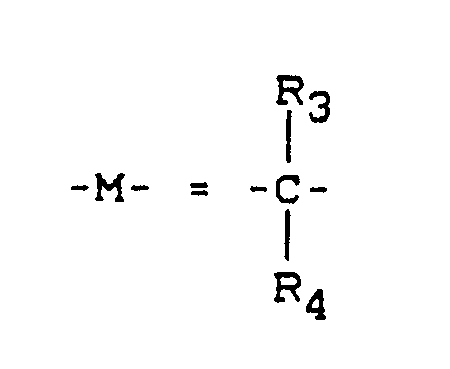
R¹,R²-,R³-,R⁴- = -H,-CH₃
e = 1 - 2, bevorzugt 1,
f = 1, 3,
g = 1 - 2,
h = 0 - 2,
- Besonders bevorzugte Reaktionsmassen sind solche auf der Basis der

- Die Herstellung der Polymerisate erfolgt in bekannter Weise durch Polymerisation bei möglichst niedrigen Temperaturen, vorzugsweise jedoch durch Strahlung, z. B. durch UV-Strahlung, vorzugsweise bei Raumtemperatur, höchstens jedoch bei 100° C. Gegebenenfalls kann die Restpolymerisation, vor allem bei Polymerisaten mit höheren Glasübergangstemperaturen, durch eine Wärmenachbehandlung (Temperung) oberhalb 50° C, jedoch maximal bei einer Temperatur von T = Tg + 20° C, vorzugsweise bei 80 - 100° C erfolgen.
- Verbindungen der Formel I im Sinne dieser Erfindung sind Acrylester und vorzugsweise Methacrylsäureester von Bisphenolen, z. B. Sulfonyl-bisphenyl, Thionyl-bisphenol, 4,4ʹ-Dihydroxydiphenyl, 4,4ʹ-Dihydroxydiphenylether, insbesondere Bisphenol A, Bisphenol F und deren Gemische.
- Verbindungen im Sinne dieser Erfindung, die der Formel II entsprechen, sind Acrylester und vorzugsweise Methacrylester von Ethoxylierungs- und/oder Propoxylierungsprodukten von Bisphenolen, z. B. Sulfonyl-Bisphenol, Thionyl-Bisphenol, bevorzugt Bisphenol A und F oder deren Gemische, mit einem Eth-und/oder Propoxylierungsgrad von 1 - 3, bevorzugt 1 -2. Weiterhin entsprechen den Substanzen der Formel I Acrylate und vorzugsweise Methacrylate von Bisglycidylethern der genannten Bisphenole oder deren Gemische, bevorzugt von Bisphenol A und F, sowie die Reaktionsprodukte aus Bisphenol-bis-glycidylethern und gleichen und/oder unterschiedlichen Bisphenolen, Molverhältnis (2:1) bis (5:4), bevorzugt 2:1, bevorzugt Bisphenol -A und -F, und deren kernsubstituierten Derivaten wie Tetramethyl- und/oder Tetrachlorbisphenol-A und -F.
- Die bei der technischen Herstellung der Verbindungen II als Nebenprodukte anfallenden Monoester sind für die erfindungsgemäße Verwendung im allgemeinen unschädlich.
- Polymerisationsinitiatoren im Sinne dieser Erfindung sind
- 1.
- für die Strahlenhärtung, vorzugsweise mit UV-Strahlen: z. B. Benzophenon, 1-Hydroxycyclohexylphenylketon, 2-Methyl-1-4-(methylthio)phenyl-2-morpholinopropanon-1, Benzoin-ether, vorzugsweise Benzoinisopropyl-und -isobutyl-ether, Benzildiketale, vorzugsweise Benzildimethylketal, und Gemische der genannten Verbindungen;
- 2.
- für die radikalische Härtung mit organischen Peroxiden und/oder Silylethern des Benzpinakols und/oder Strahlungs/Peroxid-Mischhärtungen: Diacylperoxide, Peroxydicarbonate, Perester, Perketale, Dialkylperoxide, Ketonperoxide, Hydroperoxide, z. B.: Bis(2,4-dichlorbenzoyl)-peroxid, Dilauroylperoxid, Dibenzoylperoxid, Di-2-ethylhexylperoxydicarbonat, Diisopropylperoxydicarbonat, Dicyclohexyl-peroxydicarbonat, Bis-(4-tert.-butylcyclohexyl)-peroxydicarbonat, tert.-Butyl-perpivalat, tert.-Butyl-per-2-ethylhexanoat, tert.-Butyl-per-3,5,5-trimethylhexanoat, tert.-Butyl-perbenzoat, tert.-Butylpermaleinat, 1,1-Bis(tert.-butylperoxy)3,3,5-trimethylcyclohexan, 1,1-Bis(tert.-butylperoxy)cyclohexan, 2,2-Bis(tert.-butylperoxy)butan, n-Butyl-4,4-bis(tert.-butylperoxy)valerat, Ethyl-3,3- bis(tert.-butylperoxy)butyrat, Dicumylperoxid, tert.-Butylcumylperoxid, Bis(tert.-butylperoxyisopropyl)benzol, 2,5-Dimethylhexan-2,5-di-tert.-butylperoxid, Di-tert.-butylperoxid, Methylisobutylketonperoxid, Methylethylketonperoxid, Acetylacetonperoxid, Cyclohexanonperoxid, Cumolhydroperoxid, t-Butylhydroperoxid und Gemische der genannten Verbindungen.
- Beschleuniger im Sinne dieser Erfindung sind in den Reaktionsmassen lösliche anorganische, vorzugsweise organische Salze sowie Komplexverbindungen von Metallen, vorzugsweise von Cobalt und Vanadin, z. B. Cobalt-octoat, -naphthenat, -acetylacetonat, Vanadylacetylacetonat, Vanadylsalze von partiellen Phosphorsäureestern, Pyro- oder Polyphosphorsäureestern, Vanadyloctoat, Vanadylacetat, Vanadyl-p-toluolsulfonat; ferner Amine, vorzugsweise tertiäre Alkylarylamine, z. B. N,N-Dimethylanilin, N,N-Diethylanilin, N,N-Dimethyl-p-toluidin, N,N-Bis-(β-hydroxyethyl)p-toluidin, N,N-Bis-(β-hydroxypropyl)p-toluidin, N,N-Bis-(β-hydroxyethyl)-p-toluidin-phthalat, N,N-Bis-(β-hydroxypropyl)-p-toluidinadipat (gemäß DE-OS 19 43 954), tert. Amin der Formel I nach DE-OS 32 02 090, worin R₃, R₅ = -H und R₄ = -CH₃ sind (p-Toluidin-Derivat), tert. Amin der Formel 1 nach DE-OS 32 02 090, worin R₄ und R₅ Methylgruppen sind (Xylidin-Derivat), tert. Arylamin-Typ in Gemisch mit N,N-Bis-(β-hydroxyethyl)-m-chloranilin (Verhältnis 1 : 1 bis 6 : 1).
- Zusatzbeschleuniger (Promotoren) im Sinne dieser Erfindung sind für Härtungen mit Beschleunigern auf Basis von Cobalt-Verbindungen die oben genannten Amine, vorzugsweise N,N-Dimethylanilin, N,N-Diethylanilin, N,N-Dimethyl-p-toluidin, N,N-Bis-β-hydroxyethyl- und/oder -propyl-p-toluidin und/oder deren Ester, z. B. mit Adipinsäure, Phthalsäuren, Monocarbonsäuren (C₂-C₁₀).
- Zusatzbeschleuniger für Vanadinverbindungen sind: Thiole und Thiocarbonsäureester, vorzugsweise Thioglykolsäureester, wie z.B. in der DE-AS 2 025 410 beschrieben.
- Inhibitoren im Sinne dieser Erfindung sind: Benzochinon, Toluchinon, Naphthochinone, Trimethylbenzochinon, Mono-und Di-tertiär-butylbenzochinone und/oder deren Hydrochinone, vorzugsweise Hydrochinon, Toluhydrochinon, 1,4-Napthohydrochinon, Brenzcatechine - vorzugsweise Mono-und/oder Di-tert.-butyl-brenzcatechine - sowie deren Mono-alkylether, ferner Chloranil und lösliche Kupfersalze und/oder -Komplexe, z. B. Kupfer-naphthenat, -octoat, -acetylacetonat, Kupfer(I)chlorid-Phosphit-Kompexe, sowie Gemische der genannten Verbindungen.
- Die Reaktionsmassen können - abhängig von Art und Menge der Komponenten - bei Temperaturen von 10 bis 100, vorzugsweise 20 bis 90° C gehärtet werden.
- Datenträger - Trägermaterialien sind solche, die entweder
- I.
- die Information beinhalten (z.B. in Pits) oder
- II.
- die Information in Form sensibler Stoffe (z.B. Farbstoffe) eingebettet enthalten oder
- III.
- durch eine Informationsschicht (wie sie z.B. Selen-Tellur-Verbindungen und -Legierungen sowie Legierungen und Verbindungen mit tiefem Curie-Punkt darstellen) bedeckt sind.
- Die Trägermaterialien können selbsttragend oder nicht selbsttragend sein, wobei es sich bei nicht selbsttragenden Materialien vornehmlich um Zwischenschichten (z.B. auf Glas, Thermoplasten oder Duroplasten) handelt.
- 2 Silikat-(Fenster-)Glasscheiben (200 mm x 270 mm x 3 mm) werden mit einem ca. 4 mm (runder Querschnitt) oder 1 mm (rechteckiger Querschnitt) dicken Weich-PVC-Dichtungsband an den 2 langen und einer kurzen Seite der Scheiben auf Abstand gehalten. An diesen Seiten wird die Kombination mittels drei Federstahlklammern (eckiger, U-förmiger Querschnitt, Länge der Klammern: ca. 210 mm) fixiert. 2. Trennmittel
- Sojalecithin, 5 %ig in Xylol
-
- 3.1
- Temperatur: im allgemeinen Raumtemperatur (23° C), falls nicht anders angegeben.
- 3.2
- Härtungsmethode: Kontinuierliche oder Intervall-Bestrahlung in Gegenwart von UV-Initiatoren und/oder, falls vermerkt, organischer Peroxide, und Beschleuniger und gegebenenfalls Zusatzbeschleuniger und gegebenenfalls Inhibitoren; senkrecht stehende Form.
- 3.3
- Strahlungsquelle: 4 Leuchtstoffröhren vom Typ TKL 40 W/09, Philips.
- 3.4
- Abstand der Leuchtstoffröhren von der Form: ca. 4,5 cm
- 3.5
- Wärmebehandlung: im allgemeinen über Nacht bei 90° C; Abkühlung im Wärmeschrank auf ca. 30° C; danach Entformung (falls nicht anders angegeben).
-
- Plattendicke:
- 0,1 cm
- Meßgerät:
- Polarisationsmikroskop
- Meßrichtung:
- M₁, d.h. der Meßstrahl verläuft nur senkrecht durch die Gießplatte (senkrecht zur Gießrichtung)
- Opt. Aussehen:
- Zwischen zwei um 90 Grad gedrehten Polarisationsfolien
- nach ISO/R62, DIN 53 495; Plattendicke; 0,1 cm; nach 50 Tagen (falls nicht anders angegeben)
-
- 6.1
- Dynamische Glasübergangstemperatur (dyn. Tg) nach DIN 53 455: Prüfkörper: Flachstab (60 mm x 10 mm x 1 mm).
- 6.2
- Glasübergangstemperatur nach Differentialthermoanalyse (Tg n. DTA)
-
- B-A-BMA
- = Bisphenol-A-bis-methacrylat
- HEB-A-BMA
- = (4,4-Bis(β-hydroxyethyl)-bisphenol-A)-bismethacrylat
- Initiator:
0,3 Gew.-% Benzildimethylketal, bezogen auf Reaktionsmasse

Claims (2)
- Verwendung von härtbaren Reaktionsmassen enthaltendA. 30 bis 90 Gewichtsteile polymersierbarer Verbindungen der Formel


X - = -CH₃, -Halogen(außer I)
R¹-,R²-=-H,-CH₃, -C₂H₅;
b = 0 - 4, bevorzugt 0 - 2
c = 2 - 6
bedeuten,
und gegebenenfalls der Formel


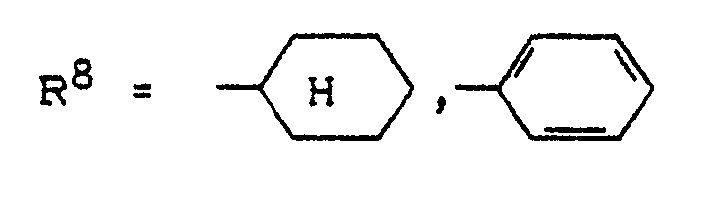
R⁷-, R⁸- = R⁵-,-C₂H₅,
darüber hinaus
e = 1 - 2, bevorzugt 1
f = 1 - 5, bevorzugt 1, 3, 5
g = 1 - 3, bevorzugt 1 - 2
h = 0 - 4
i = 2 - 6
bedeuten, und
B. 70 bis 10 Gewichtsteilen copolymerisierbarer Verbindungen III aus der Reihe p-Methylstyrol, tert.-Butylstyrole, Divinylbenzole, Vinylnaphthaline, Vinylanthracene,wobei sich die Summe der Komponenten A und B auf 100 Gewichtsteile ergänzt,
zur Herstellung von Trägermaterialien für optisch und/oder magnetisch les- und/oder beschreibbare Datenträger. - Verwendung nach Anspruch 1, dadurch gekennzeichnet, daß die Reaktionsmassen 40 bis 80 Gew.-Teile A und 60 bis 20 Gew.-Teile B enthalten, wobei sich die Summe A + B auf 100 Gew.-Teile ergänzt.
Priority Applications (1)
| Application Number | Priority Date | Filing Date | Title |
|---|---|---|---|
| AT87110145T ATE61598T1 (de) | 1986-07-25 | 1987-07-14 | Verwendung von haertbaren reaktionsmassen zur herstellung von datentraegern. |
Applications Claiming Priority (2)
| Application Number | Priority Date | Filing Date | Title |
|---|---|---|---|
| DE19863625169 DE3625169A1 (de) | 1986-07-25 | 1986-07-25 | Verwendung von haertbaren reaktionsmassen zur herstellung von datentraegern |
| DE3625169 | 1986-07-25 |
Publications (3)
| Publication Number | Publication Date |
|---|---|
| EP0254184A2 EP0254184A2 (de) | 1988-01-27 |
| EP0254184A3 EP0254184A3 (en) | 1989-04-19 |
| EP0254184B1 true EP0254184B1 (de) | 1991-03-13 |
Family
ID=6305962
Family Applications (1)
| Application Number | Title | Priority Date | Filing Date |
|---|---|---|---|
| EP87110145A Expired - Lifetime EP0254184B1 (de) | 1986-07-25 | 1987-07-14 | Verwendung von härtbaren Reaktionsmassen zur Herstellung von Datenträgern |
Country Status (6)
| Country | Link |
|---|---|
| US (1) | US4961179A (de) |
| EP (1) | EP0254184B1 (de) |
| JP (1) | JPS6366213A (de) |
| AT (1) | ATE61598T1 (de) |
| DE (2) | DE3625169A1 (de) |
| ES (1) | ES2020532B3 (de) |
Families Citing this family (5)
| Publication number | Priority date | Publication date | Assignee | Title |
|---|---|---|---|---|
| CA2005912A1 (en) * | 1988-12-19 | 1990-06-19 | Peter Jochum | Dental compounds which contain bifunctional acrylic-acid esters or methacrylic-acid esters |
| US5583164A (en) * | 1988-12-19 | 1996-12-10 | Espe Stiftung & Co. Produktions-Und Vertriebs Kg | Dental compositions comprising bifunctional or polyfunctional acrylic-acid esters or methacrylic-acid esters |
| JP2868844B2 (ja) * | 1989-08-29 | 1999-03-10 | 株式会社トクヤマ | ビニルフェニル化合物及びその製造方法 |
| DE69027941T2 (de) * | 1989-11-27 | 1997-01-23 | Nippon Shinyaku Co Ltd | Fettemulsion |
| US5463312A (en) * | 1994-03-03 | 1995-10-31 | Minnesota Mining And Manufacturing Company | Faraday-effect sensing coil with stable birefringence |
Family Cites Families (4)
| Publication number | Priority date | Publication date | Assignee | Title |
|---|---|---|---|---|
| US4235986A (en) * | 1979-04-02 | 1980-11-25 | National Starch And Chemical Corporation | Anaerobic curing adhesive composition and process for making same |
| DE3248602A1 (de) * | 1982-12-30 | 1984-07-12 | Röhm GmbH, 6100 Darmstadt | Acrylharze mit geringer wasseraufnahme |
| JPS61117746A (ja) * | 1984-11-13 | 1986-06-05 | Hitachi Ltd | 光デイスク基板 |
| US4668550A (en) * | 1985-08-28 | 1987-05-26 | Hitachi, Ltd. | Optical disc |
-
1986
- 1986-07-25 DE DE19863625169 patent/DE3625169A1/de not_active Withdrawn
-
1987
- 1987-07-13 US US07/072,395 patent/US4961179A/en not_active Expired - Fee Related
- 1987-07-14 ES ES87110145T patent/ES2020532B3/es not_active Expired - Lifetime
- 1987-07-14 AT AT87110145T patent/ATE61598T1/de active
- 1987-07-14 EP EP87110145A patent/EP0254184B1/de not_active Expired - Lifetime
- 1987-07-14 DE DE8787110145T patent/DE3768575D1/de not_active Expired - Lifetime
- 1987-07-23 JP JP62182424A patent/JPS6366213A/ja active Pending
Also Published As
| Publication number | Publication date |
|---|---|
| DE3625169A1 (de) | 1988-01-28 |
| ES2020532B3 (es) | 1991-08-16 |
| JPS6366213A (ja) | 1988-03-24 |
| EP0254184A3 (en) | 1989-04-19 |
| ATE61598T1 (de) | 1991-03-15 |
| EP0254184A2 (de) | 1988-01-27 |
| DE3768575D1 (de) | 1991-04-18 |
| US4961179A (en) | 1990-10-02 |
Similar Documents
| Publication | Publication Date | Title |
|---|---|---|
| DE3880642T2 (de) | Zusammensetzung , mit aktiven Strahlen härtbar, und Medium für die optische Registrierung mit dieser gehärteten Zusammensetzung. | |
| EP0385109A2 (de) | Formteil für optische Zwecke | |
| DE3786769T2 (de) | Hexagonale Imideinheiten enthaltendes Random-Copolymer, Verfahren zu dessen Herstellung und Substrat einer optischen Platte, hergestellt aus diesem Random-Copolymer. | |
| EP0254184A2 (de) | Verwendung von härtbaren Reaktionsmassen zur Herstellung von Datenträgern | |
| EP0255595B1 (de) | Verfahren zur Herstellung von spannungsarmen Formteilen | |
| EP0254174B1 (de) | Verwendung von härtbaren Reaktionsmassen zur Herstellung von Datenträgern | |
| DE3779476T2 (de) | Loeschbare optische platte mit optisch transparentem substrat. | |
| JPH0459385A (ja) | 光情報記録媒体 | |
| JPH02113019A (ja) | 光学材料用樹脂組成物 | |
| JPS62158706A (ja) | 光学用樹脂組成物の製造法 | |
| JP3429954B2 (ja) | 光学式情報記録媒体 | |
| DE3780603T2 (de) | Substrat fuer optische elemente. | |
| DE3248602A1 (de) | Acrylharze mit geringer wasseraufnahme | |
| JPS63210111A (ja) | 光学用樹脂素材 | |
| DE4013605A1 (de) | Substrat fuer informationsaufzeichnungsmedien | |
| EP0292722B1 (de) | Verwendung von Mischungen aus thermoplastischen Polycarbonaten und Copolymerisaten von Stryrolen mit Acrylnitril als Substrate für optische Datenspeicher | |
| JPH01167315A (ja) | 光ディスク基板 | |
| DE4030908A1 (de) | Polymerisate mit geringer wasseraufnahme, neue (meth)-acrylsaeureester sowie die verwendung der polymerisate zur herstellung von formkoerpern | |
| JPS62192438A (ja) | 光学式情報記録体用基材 | |
| EP0355642A2 (de) | Verwendung von Mischungen aus thermoplastischen Polycarbonaten und Copolymerisaten von Styrolen mit (Meth)-Acrylsäureestern als Substrate für optische Datenspeicher | |
| JPS61231074A (ja) | 光学式デイスク基板の製法 | |
| JPH0755966B2 (ja) | 光ディスクの溝材又は保護膜用樹脂組成物 | |
| JPH03147539A (ja) | 光記録媒体用基板の製造方法 | |
| JPH03283117A (ja) | 情報記録担体 | |
| JPH04229215A (ja) | 板状成形体の製造方法及びそれに用いる金型 |
Legal Events
| Date | Code | Title | Description |
|---|---|---|---|
| PUAI | Public reference made under article 153(3) epc to a published international application that has entered the european phase |
Free format text: ORIGINAL CODE: 0009012 |
|
| 17P | Request for examination filed |
Effective date: 19870714 |
|
| AK | Designated contracting states |
Kind code of ref document: A2 Designated state(s): AT DE ES FR GB IT NL |
|
| PUAL | Search report despatched |
Free format text: ORIGINAL CODE: 0009013 |
|
| AK | Designated contracting states |
Kind code of ref document: A3 Designated state(s): AT DE ES FR GB IT NL |
|
| 17Q | First examination report despatched |
Effective date: 19900808 |
|
| GRAA | (expected) grant |
Free format text: ORIGINAL CODE: 0009210 |
|
| AK | Designated contracting states |
Kind code of ref document: B1 Designated state(s): AT DE ES FR GB IT NL |
|
| REF | Corresponds to: |
Ref document number: 61598 Country of ref document: AT Date of ref document: 19910315 Kind code of ref document: T |
|
| ITF | It: translation for a ep patent filed | ||
| REF | Corresponds to: |
Ref document number: 3768575 Country of ref document: DE Date of ref document: 19910418 |
|
| PGFP | Annual fee paid to national office [announced via postgrant information from national office to epo] |
Ref country code: DE Payment date: 19910619 Year of fee payment: 5 |
|
| ET | Fr: translation filed | ||
| PGFP | Annual fee paid to national office [announced via postgrant information from national office to epo] |
Ref country code: FR Payment date: 19910627 Year of fee payment: 5 |
|
| PGFP | Annual fee paid to national office [announced via postgrant information from national office to epo] |
Ref country code: GB Payment date: 19910703 Year of fee payment: 5 Ref country code: AT Payment date: 19910703 Year of fee payment: 5 |
|
| GBT | Gb: translation of ep patent filed (gb section 77(6)(a)/1977) | ||
| PGFP | Annual fee paid to national office [announced via postgrant information from national office to epo] |
Ref country code: ES Payment date: 19910725 Year of fee payment: 5 |
|
| PGFP | Annual fee paid to national office [announced via postgrant information from national office to epo] |
Ref country code: NL Payment date: 19910731 Year of fee payment: 5 |
|
| PLBE | No opposition filed within time limit |
Free format text: ORIGINAL CODE: 0009261 |
|
| STAA | Information on the status of an ep patent application or granted ep patent |
Free format text: STATUS: NO OPPOSITION FILED WITHIN TIME LIMIT |
|
| 26N | No opposition filed | ||
| PG25 | Lapsed in a contracting state [announced via postgrant information from national office to epo] |
Ref country code: GB Effective date: 19920714 Ref country code: AT Effective date: 19920714 |
|
| PG25 | Lapsed in a contracting state [announced via postgrant information from national office to epo] |
Ref country code: ES Free format text: LAPSE BECAUSE OF THE APPLICANT RENOUNCES Effective date: 19920715 |
|
| PG25 | Lapsed in a contracting state [announced via postgrant information from national office to epo] |
Ref country code: NL Effective date: 19930201 |
|
| GBPC | Gb: european patent ceased through non-payment of renewal fee |
Effective date: 19920714 |
|
| NLV4 | Nl: lapsed or anulled due to non-payment of the annual fee | ||
| PG25 | Lapsed in a contracting state [announced via postgrant information from national office to epo] |
Ref country code: FR Effective date: 19930331 |
|
| PG25 | Lapsed in a contracting state [announced via postgrant information from national office to epo] |
Ref country code: DE Effective date: 19930401 |
|
| REG | Reference to a national code |
Ref country code: FR Ref legal event code: ST |
|
| REG | Reference to a national code |
Ref country code: ES Ref legal event code: FD2A Effective date: 19991007 |
|
| PG25 | Lapsed in a contracting state [announced via postgrant information from national office to epo] |
Ref country code: IT Free format text: LAPSE BECAUSE OF NON-PAYMENT OF DUE FEES;WARNING: LAPSES OF ITALIAN PATENTS WITH EFFECTIVE DATE BEFORE 2007 MAY HAVE OCCURRED AT ANY TIME BEFORE 2007. THE CORRECT EFFECTIVE DATE MAY BE DIFFERENT FROM THE ONE RECORDED. Effective date: 20050714 |