EP0253335A2 - Thermoplastisches Verbundmaterial - Google Patents
Thermoplastisches Verbundmaterial Download PDFInfo
- Publication number
- EP0253335A2 EP0253335A2 EP87110017A EP87110017A EP0253335A2 EP 0253335 A2 EP0253335 A2 EP 0253335A2 EP 87110017 A EP87110017 A EP 87110017A EP 87110017 A EP87110017 A EP 87110017A EP 0253335 A2 EP0253335 A2 EP 0253335A2
- Authority
- EP
- European Patent Office
- Prior art keywords
- layers
- fabric
- thermoplastic
- composite
- core
- Prior art date
- Legal status (The legal status is an assumption and is not a legal conclusion. Google has not performed a legal analysis and makes no representation as to the accuracy of the status listed.)
- Granted
Links
- 239000002131 composite material Substances 0.000 title claims abstract description 91
- 229920001169 thermoplastic Polymers 0.000 title claims abstract description 43
- 239000004416 thermosoftening plastic Substances 0.000 title claims abstract description 43
- 239000004744 fabric Substances 0.000 claims abstract description 71
- 239000000463 material Substances 0.000 claims abstract description 52
- 239000000835 fiber Substances 0.000 claims abstract description 30
- 229920005992 thermoplastic resin Polymers 0.000 claims abstract 13
- 239000012815 thermoplastic material Substances 0.000 claims description 20
- 238000000034 method Methods 0.000 claims description 13
- NIXOWILDQLNWCW-UHFFFAOYSA-N acrylic acid group Chemical group C(C=C)(=O)O NIXOWILDQLNWCW-UHFFFAOYSA-N 0.000 claims description 12
- 229920000049 Carbon (fiber) Polymers 0.000 claims description 6
- 239000003365 glass fiber Substances 0.000 claims description 5
- 239000004760 aramid Substances 0.000 claims description 4
- 229920006231 aramid fiber Polymers 0.000 claims description 4
- 239000004917 carbon fiber Substances 0.000 claims description 4
- 238000000465 moulding Methods 0.000 claims description 4
- 229920005989 resin Polymers 0.000 claims description 2
- 239000011347 resin Substances 0.000 claims description 2
- 239000010410 layer Substances 0.000 description 64
- 229920001187 thermosetting polymer Polymers 0.000 description 19
- 238000010276 construction Methods 0.000 description 15
- 239000011162 core material Substances 0.000 description 10
- 238000004519 manufacturing process Methods 0.000 description 5
- -1 polypropylenes Polymers 0.000 description 5
- 239000004743 Polypropylene Substances 0.000 description 4
- 230000015572 biosynthetic process Effects 0.000 description 4
- 229920001155 polypropylene Polymers 0.000 description 4
- 238000005266 casting Methods 0.000 description 3
- VNWKTOKETHGBQD-UHFFFAOYSA-N methane Chemical compound C VNWKTOKETHGBQD-UHFFFAOYSA-N 0.000 description 3
- 239000011505 plaster Substances 0.000 description 3
- 239000002985 plastic film Substances 0.000 description 3
- 239000002759 woven fabric Substances 0.000 description 3
- OKTJSMMVPCPJKN-UHFFFAOYSA-N Carbon Chemical compound [C] OKTJSMMVPCPJKN-UHFFFAOYSA-N 0.000 description 2
- 239000012792 core layer Substances 0.000 description 2
- 230000032798 delamination Effects 0.000 description 2
- 230000000694 effects Effects 0.000 description 2
- 239000002657 fibrous material Substances 0.000 description 2
- 239000011521 glass Substances 0.000 description 2
- 239000004033 plastic Substances 0.000 description 2
- 229920003023 plastic Polymers 0.000 description 2
- 238000005498 polishing Methods 0.000 description 2
- 238000003856 thermoforming Methods 0.000 description 2
- 239000004698 Polyethylene Substances 0.000 description 1
- 229920006397 acrylic thermoplastic Polymers 0.000 description 1
- 229920003235 aromatic polyamide Polymers 0.000 description 1
- 229910052799 carbon Inorganic materials 0.000 description 1
- 238000012937 correction Methods 0.000 description 1
- 229910002804 graphite Inorganic materials 0.000 description 1
- 239000010439 graphite Substances 0.000 description 1
- 238000010438 heat treatment Methods 0.000 description 1
- 238000010111 plaster casting Methods 0.000 description 1
- 229920003229 poly(methyl methacrylate) Polymers 0.000 description 1
- 229920000573 polyethylene Polymers 0.000 description 1
- 238000003860 storage Methods 0.000 description 1
- 238000006467 substitution reaction Methods 0.000 description 1
- ISXSCDLOGDJUNJ-UHFFFAOYSA-N tert-butyl prop-2-enoate Chemical compound CC(C)(C)OC(=O)C=C ISXSCDLOGDJUNJ-UHFFFAOYSA-N 0.000 description 1
- 239000004634 thermosetting polymer Substances 0.000 description 1
Images
Classifications
-
- B—PERFORMING OPERATIONS; TRANSPORTING
- B32—LAYERED PRODUCTS
- B32B—LAYERED PRODUCTS, i.e. PRODUCTS BUILT-UP OF STRATA OF FLAT OR NON-FLAT, e.g. CELLULAR OR HONEYCOMB, FORM
- B32B27/00—Layered products comprising a layer of synthetic resin
- B32B27/12—Layered products comprising a layer of synthetic resin next to a fibrous or filamentary layer
-
- A—HUMAN NECESSITIES
- A43—FOOTWEAR
- A43B—CHARACTERISTIC FEATURES OF FOOTWEAR; PARTS OF FOOTWEAR
- A43B17/00—Insoles for insertion, e.g. footbeds or inlays, for attachment to the shoe after the upper has been joined
- A43B17/003—Insoles for insertion, e.g. footbeds or inlays, for attachment to the shoe after the upper has been joined characterised by the material
-
- B—PERFORMING OPERATIONS; TRANSPORTING
- B32—LAYERED PRODUCTS
- B32B—LAYERED PRODUCTS, i.e. PRODUCTS BUILT-UP OF STRATA OF FLAT OR NON-FLAT, e.g. CELLULAR OR HONEYCOMB, FORM
- B32B27/00—Layered products comprising a layer of synthetic resin
- B32B27/30—Layered products comprising a layer of synthetic resin comprising vinyl (co)polymers; comprising acrylic (co)polymers
- B32B27/308—Layered products comprising a layer of synthetic resin comprising vinyl (co)polymers; comprising acrylic (co)polymers comprising acrylic (co)polymers
-
- B—PERFORMING OPERATIONS; TRANSPORTING
- B32—LAYERED PRODUCTS
- B32B—LAYERED PRODUCTS, i.e. PRODUCTS BUILT-UP OF STRATA OF FLAT OR NON-FLAT, e.g. CELLULAR OR HONEYCOMB, FORM
- B32B2260/00—Layered product comprising an impregnated, embedded, or bonded layer wherein the layer comprises an impregnation, embedding, or binder material
- B32B2260/02—Composition of the impregnated, bonded or embedded layer
- B32B2260/021—Fibrous or filamentary layer
-
- B—PERFORMING OPERATIONS; TRANSPORTING
- B32—LAYERED PRODUCTS
- B32B—LAYERED PRODUCTS, i.e. PRODUCTS BUILT-UP OF STRATA OF FLAT OR NON-FLAT, e.g. CELLULAR OR HONEYCOMB, FORM
- B32B2260/00—Layered product comprising an impregnated, embedded, or bonded layer wherein the layer comprises an impregnation, embedding, or binder material
- B32B2260/04—Impregnation, embedding, or binder material
- B32B2260/046—Synthetic resin
-
- B—PERFORMING OPERATIONS; TRANSPORTING
- B32—LAYERED PRODUCTS
- B32B—LAYERED PRODUCTS, i.e. PRODUCTS BUILT-UP OF STRATA OF FLAT OR NON-FLAT, e.g. CELLULAR OR HONEYCOMB, FORM
- B32B2262/00—Composition or structural features of fibres which form a fibrous or filamentary layer or are present as additives
- B32B2262/02—Synthetic macromolecular fibres
- B32B2262/0261—Polyamide fibres
- B32B2262/0269—Aromatic polyamide fibres
-
- B—PERFORMING OPERATIONS; TRANSPORTING
- B32—LAYERED PRODUCTS
- B32B—LAYERED PRODUCTS, i.e. PRODUCTS BUILT-UP OF STRATA OF FLAT OR NON-FLAT, e.g. CELLULAR OR HONEYCOMB, FORM
- B32B2262/00—Composition or structural features of fibres which form a fibrous or filamentary layer or are present as additives
- B32B2262/10—Inorganic fibres
- B32B2262/101—Glass fibres
-
- B—PERFORMING OPERATIONS; TRANSPORTING
- B32—LAYERED PRODUCTS
- B32B—LAYERED PRODUCTS, i.e. PRODUCTS BUILT-UP OF STRATA OF FLAT OR NON-FLAT, e.g. CELLULAR OR HONEYCOMB, FORM
- B32B2262/00—Composition or structural features of fibres which form a fibrous or filamentary layer or are present as additives
- B32B2262/10—Inorganic fibres
- B32B2262/106—Carbon fibres, e.g. graphite fibres
-
- Y—GENERAL TAGGING OF NEW TECHNOLOGICAL DEVELOPMENTS; GENERAL TAGGING OF CROSS-SECTIONAL TECHNOLOGIES SPANNING OVER SEVERAL SECTIONS OF THE IPC; TECHNICAL SUBJECTS COVERED BY FORMER USPC CROSS-REFERENCE ART COLLECTIONS [XRACs] AND DIGESTS
- Y10—TECHNICAL SUBJECTS COVERED BY FORMER USPC
- Y10T—TECHNICAL SUBJECTS COVERED BY FORMER US CLASSIFICATION
- Y10T442/00—Fabric [woven, knitted, or nonwoven textile or cloth, etc.]
- Y10T442/30—Woven fabric [i.e., woven strand or strip material]
- Y10T442/3472—Woven fabric including an additional woven fabric layer
- Y10T442/3602—Three or more distinct layers
- Y10T442/365—At least one layer is a preformed synthetic polymeric film or sheet
Definitions
- the present invention relates to a thermoplastic composite material.
- the invention relates to a thermoplastic composite material which may be manufactured in sheet or panel form and with the composite material later thermoformed into a complex shape having complex contours.
- the complex shape may be used for various industrial or medical purposes and one such specific example is an orthotic insert for use within foot gear.
- thermoforming is typically accomplished through the use of heat and pressure, such as vacumn forming, to comform the plastic sheet to the complex shape.
- the plastic sheet would be a thermoplastic material which may be manufactured and sold in sheet form and with a subsequent forming into the complex shape as described above.
- orthotic inserts are currently made using a sheet of acrylic material.
- the sheet of acrylic material may be cut into a desirable shape and then molded under heat and vacumn to conform to the shape of a casting made in representation of the bottom of a foot.
- Other thermoplastic materials may be used in substitution to acrylics such as polypropylenes and polyethylenes.
- the difficulty with all of these materials for use in structures such as orthotics is that, in order to provide the proper level of rigidity necessary to properly serve as an orthotic, these prior art materials are generally quite thick and as an example may vary between 120 to 200 thousandths of an inch. Unfortunately, such thick materials are heavy and is generally too thick to slip into the foot gear already owned. This requires the purchase of larger foot gear to accommodate these prior art orthotic inserts.
- the prior art materials are not only thick, but are not as durable and resistant to breaking as would be desirable.
- thermoset laminate constructions have been used to provide for complex shapes such as orthotic insert.
- prior Patent No. 4,439,934 issued April 3, 1984 for an orthotic insert.
- an insert is formed by a cumbersome technique of laying upon a positive cast a series of layers of various material. These layers may include layers of cloth impregnated with thermoset resin and layers of graphite and with these individual layers thermoset to the desired shape under heat. If the cast is not perfectly accurate, then the insert cannot be adjusted since it has been thermoset (cured) to a specific structural form.
- thermoset process therefore, means that the orthotic insert must be manufactured to the exact shape the first time since the thermoset process does not allow for any post forming at a later time in the field.
- This limitation has, therefore, greatly restricted the use of such thermoset laminate constructions as shown in the above referenced patent. It is much more desirable for the person prescribing the orthotic insert to be able to post form the insert to make adjustments to the orthotic insert. This is acomplished through the use of localized heating to make changes in the complex shape of the insert without in turn destroying the structure or integrity of the insert. For these reasons, thermoplastic orthotic inserts have received far greater acceptance in the orthotic field even with the various limitations described above.
- thermoset laminate described above can be quite thin, such ns 65 to 80 thousandths of an inch. However, the fabrication of the thermoset sandwich is difficult and generally requires special processing and once formed is not post formable. The formed thermoset material is not brittle, but even though the material is quite thin it is heavy.
- thermoplastic materials such as acrylic and polypropylene.
- the inserts are made by first making a plaster mold from the patients foot. This plaster mold forms a negative image of the bottom of the foot. A positive mold is then made from the negative plaster casting and thermoplastic sheet material is thermoformed using heat and vacumn to conform to the positive mold to make the appropriate insert.
- thermoplastic material has the great advantage in that it is post formable so that the orthotic insert may be heat adjusted at a later time office to correct any minor misfit. This is important since it eliminates the necessity of making a new insert as would be necessary with a thermoset laminate constuction.
- thermoplastic composite material which overcomes the various difficulties provided by prior art thermoplastic materials and thermoset laminate instructions.
- the thermoplastic composite material of the present invention is relatively thin, such as 55 to 85 thousandths of an inch, is lightweight yet is strong and not brittle.
- the thermoplastic composite material is easily fabricated into complex shapes such as an orthotic insert and is post formable so that adjustments to the complex shape may be made at a later time.
- thermoplastic construction which is a composite and includes a core of a thermoplastic material such as an acrylic and with outside layers of a fabric made from fibers such as carbon fiber, glass fiber, aramid fiber or combinations thereof.
- the composite construction of the present invention is significantly different than prior art laminate structures in that the fabric layers are located adjacent to the outer surfaces of the composite and with the fiber volume of the fabric layers representing a much smaller fraction of the total volume of the composite than with prior art sandwich constructions.
- the fabric layers may be woven, unidirectional fibers or chopped or continuous random strand matts or combinations thereof. The direction of the fabric layer may be varied depending upon the desired physical characteristics.
- the core material and other resins used in the construction are thermoplastic materials rather than the thermoset materials of the prior art used in laminate constructions.
- the fiber volume for the fabric layers represents a maximum of one third (1/3) of this total volume.
- the range for the fiber volume for the fabric layers relative to the total volume of the composite may be between 5% to 33 1/3%, but with the preferred range between 8 to 25%.
- the prior art thermoset laminate constructions where the fiber volume of the fabric layers represent more than 50% of the total volume of the laminate construction.
- a laminate construction using glass fiber fabric typcally has the fibor volume of the glass fabric representing 52% to 55% for the total volume of the laminate.
- the fiber volume of the carbon fabric typically represents 55% to 62% of the total volume.
- the term fiber volume refers to the volume provided by the sum of the volumes displaced by each individual fiber in the fabric layer.
- the total volume refers to the overall volume displaced by the composite.
- the present invention therefore, provides for a low percentage of the fiber volume for the fabric layers relative to the total volume and also provides for a specific location of these fibric layers adjacent to the outer surfaces of the sheet of composite material.
- the location is important since the location maximizes the rigidity of the composite structure when formed to the desired shape.
- the relatively large thickness for the core of thermoplastic material between the two fabric layers allows the two layers to move independently of each other during thermoforming. This independent freedom of movement provides for the layers of fabric to conform to the desired complex shape without severe wrinkling or delamination and without any significant buckling of the formed composite material.
- the complex shape could not be accomplished without severe wrinkling or delamination and in the extreme case without buckling.
- the composite material of the present invention were constructed with thicker layers of fabric or additional numbers of layers, so that the fiber volume for the fabric layers was more than one third (1/3) of the total volume, then the molded product has undesirable characteristics such as severe wrinkling and buckling. This does not moan that a composite material constructed in accordance with the teachings of the present invention cannot be made with more than two layers, but rather that the maximum fiber volume of the fabric layers relative to the total volume cannot be more than one third (1/3).
- the present invention therefore, provides for a thermoplastic composite including a core of thermoplastic material and at least two outer layers, adjacent the outside surfaces of the core, to provide for a sheet material which may be thermoformed into a complex shape.
- the thermoformed shape may be further post formed in order to provide for adjustments to the complex shape.
- the composite of the present invention is thin, lightweight, rigid and not brittle and is very easy to fabricate.
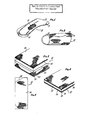
- Figures 1 and 2 illustrate a completed othotic insert 10 formed by a thermoplastic composite of the present invention.
- thermoplastic composite of the present invention may also be used for a wide variety of products in the medical and industrial fields.
- the orthotic insert 10 is formed by a base member 12 molded from the thermoplastic composite of the present invention.
- a heel portion 14 is attached to the base member 12 and a soft durable covering material 16 covers the base member 12.
- the covering material may be of any suitable leather-like material to provide for a comfortable surface adjacent the foot of the user of the orthotic insert.
- the heel portion 14 may be molded from a rigid plastic material to operate as a heel support within the footgear. Both the heel portion 14 and the covering material 16 are known in the prior art and form no part of the present invention.
- Figure 1 also illustrates that the base member 12 formed by the composite has a complex shape conforming to the bottom surface of the foot of the user of the orthotic insert and with each such complex structure tailor made for a particular user.
- the provision of such orthotic inserts is by medical personnel who specialize in fitting such inserts to a user to provide the proper support to the user during various activities.
- plaster molds of the users feet are made and these molds are sent to a laboratory.
- the laboratory in turn makes castings from the molds which castings, thereby represents the bottoms of the user's feet.
- Orthotic inserts are then formed to provide for the proper inserts conforming to the bottoms of the user's feet.
- the laboratory supplies a finished product, but it is important that this finished product be post formable so that adjustments can be made in the field if there are any problems with the inserts.
- the base member 12 of composite material of the present invention does allow for such post forming.
- the base member 12 is a composite and includes layers of woven fabric 18 and 20 which are visible at the exterior surfaces of the base member.
- the composite structure of the base member 12 is formed of a number of layers.
- the layers include a central core 22 which represents the thickest portion of the composite structure for the base member 12.
- Supported on and overlaying the outer surfaces of the core member 22 are the layers of woven fabric material 18 and 20.
- Thin layers of thermoplastic material 24 and 26 overlay the fabric layers and complete the composite structure.
- the thermoplastic composite 12 is formed into a sheet as shown in- Figure 4.
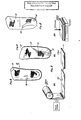
- thermoplastic composite The actual production of the thermoplastic composite is shown in Figure 9 and in the first step (a) the layers of woven fabric 18 and 20 are impregnated with a thermoplastic material such as an acrylic prepolymer.
- the fabric may be formed of carbon fibers, glass fibers or aramid fibers or combinations thereof. Typically the impregnated fabric layers may be then rolled between carrier films for storage. It is to be appreciated that although the preferred structure for the fabric layer is woven, the fabric layer may also be formed of unidirectional fiber or chopped or continuous random strand matts.
- the actual composite sheet 12 is then tormed as shown in step (b) by stacking a layer of impregnated fabric, a layer of the core such as a core of acrylic material and then a layer of impregnated fabric. As shown in step (c) the structure is then heated under pressure to form the composite 12 shown in Figure 4.
- the above method of formation of the composite 12 is illustrative only and other methods may be used.
- the composite may be formed using a continuous cast techique so that all of the materials are formed together at the same time using separate layers of thermoplastic material, such as acrylic, and separate fabric fabric, layers such as carbon, glass or aramid fabric.
- the particular orientation of the direction of the weave may be varied to adjust the rigidity of the composite.
- a significant factor in the formation of the composite is the large thickness of the core layer 22 relative to the fabric layers 18 and 20 and the location of the fabric layers substantially adjacent the outer surfaces of the core layer 22.
- the total thickness may be approximately 70 thousandths of an inch.
- Each of the fabric layers 18 and 20 may have a thickness of approximately 8 to 9 thousandths of an inch in the completed composite.
- the outer layers 24 and 26 of thermoplastic material may be quite thin such as 0.75 to 1.5 thousands of an inch.
- thermoplastic portion represents the majority of the volume of the composite sheet. Specifically, since the fabric layers 18 and 20 are woven and since the thin exterior layers 24 and 26 are impregnated within the layers 18 and 20, the actual fiber volume for the fabric layers 18 and 20 represents approximately 13% of the total volume of the composite.
- the composite may be molded into complex forms without creating any severe wrinkling or buckling of the molded sheet.
- the use of the fabric layers 18 and 20 greatly increases the stiffness and rigidity of the composite relative to a sheet formed only of thermoplastic material.
- the location of the fabric layers and the relatively large amount of thermoplastic material in the core intermediate the fabric layers allows the layers to move independently of each other during forming so that the layers can adjust to the desired shape without preventing the forming to the desired shape.
- thermoset laminate constructions typically used a large number of fabric layers located relatively close to each other, and if such a structure were used even with a thermoplastic material, the structure could not be formed to the desired complex shapes. This is why such prior art laminate constructions are typically formed as a thermoset sandwich where the layers are built up one at a time to individually conform to the desired shape before being thermoset.
- the described embodiment of a composite has a fiber volume for the layers 18 and 20 of approximately 13% relative to the total volume, the actual range of fiber volume relative to the total volume may be between 5% and 33 1/3% and with a preferred range of 8% to 25%.
- the stiffness and rigidity of the composite sheet is reduced while allowing for maximum forming capability.
- the stiffness and rigidity is increased while reducing the possible formation capability.
- the specific embodiment described above provides for the desired rigidity and degree of formation necessary to provide a superior orthotic insert of the type shown in Figures 1 and 2.
- Figures 5 and 6 illustrate the methods of manufacture of the orthotic insert of Figures 1 and 2.
- the large panels of composite formed by the method of Figure 9 may be cut into composite sheets 12 having a flat rectangular form.
- the rectangular form is cut out to represent an orthotic blank 32. This may actually be the blank that would be supplied to the laboratory forming specific orthotic inserts.
- the blank 32 may then be molded by heat and vacumn to conform to the bottom of the foot of a specific user. This is shown by the molded form 34.
- the layers of fabric 18 and 20 must move to adjust to the complex shape representing the bottom of a foot. Since the fabric layers can move independently of each other, there might only be minor rippling as shown by rippling 36.
- the rippling represents portions of the fabric being pushed towards each other so that the outer surface of the composite is slightly raised. This rippling 36 is minor and will ultimately be covered by the layer of material 16 shown in Figure 1.
- the molded blank 34 of Figure 6 is then turned into a complete orthotic insert by grinding away the outer edge to the specific desired shape and then polishing the edge.
- a heel member 14 is added either before or after the polishing and finally the inner surface of the insert is covered with the layer of material 16. This is shown in Figures 1 and 2.
- the completed structure thereby provides the desired rigidity and strength characteristics, but with a much thiner insert than prior art thermoplastic inserts.
- the insert of the present invention is post formable so that adjustments may be made to the insert even after the manufacture of the insert in the laboratory.
- Figures 7 and 8 represent a molded blank 50 similar to the molded blank 34, but with the fabric layers representing a much higher fiber volume relative to the total volume of the composite material.
- the fiber volume is greater than one third (1/3) of the total volume and may actually represent over 50% of the total volume. This is the typical fiber volume for thermoset sandwich constructions.
- the high fiber volume molded blank 50 includes major rippling such as the rippling shown at position 52, but even worse includes buckled portions such as the buckled portions 54 shown on the inside and outside of the molded structure in Figure 7 and 8. These buckled portions result from a failure of the fabric material to properly move relative to each other which produces a locking of the sheet material during molding.
- the present invention therefore, provides for a thermoplastic composite which may be formed into complex structural shapes and produce a resultant structure which is rigid, relatively thin and lightweight.
- the composite material may be post formed so as to provide for adjustments or corrections in the molded product.
Landscapes
- Life Sciences & Earth Sciences (AREA)
- Chemical & Material Sciences (AREA)
- Engineering & Computer Science (AREA)
- Materials Engineering (AREA)
- Wood Science & Technology (AREA)
- Laminated Bodies (AREA)
- Compositions Of Macromolecular Compounds (AREA)
- Footwear And Its Accessory, Manufacturing Method And Apparatuses (AREA)
Priority Applications (1)
| Application Number | Priority Date | Filing Date | Title |
|---|---|---|---|
| AT87110017T ATE68750T1 (de) | 1986-07-16 | 1987-07-10 | Thermoplastisches verbundmaterial. |
Applications Claiming Priority (2)
| Application Number | Priority Date | Filing Date | Title |
|---|---|---|---|
| US886543 | 1986-07-16 | ||
| US06/886,543 US4778717A (en) | 1986-07-16 | 1986-07-16 | Thermoplastic thermoformable composite material |
Publications (3)
| Publication Number | Publication Date |
|---|---|
| EP0253335A2 true EP0253335A2 (de) | 1988-01-20 |
| EP0253335A3 EP0253335A3 (en) | 1989-02-08 |
| EP0253335B1 EP0253335B1 (de) | 1991-10-23 |
Family
ID=25389226
Family Applications (1)
| Application Number | Title | Priority Date | Filing Date |
|---|---|---|---|
| EP19870110017 Expired - Lifetime EP0253335B1 (de) | 1986-07-16 | 1987-07-10 | Thermoplastisches Verbundmaterial |
Country Status (4)
| Country | Link |
|---|---|
| US (1) | US4778717A (de) |
| EP (1) | EP0253335B1 (de) |
| AT (1) | ATE68750T1 (de) |
| DE (1) | DE3774014D1 (de) |
Cited By (3)
| Publication number | Priority date | Publication date | Assignee | Title |
|---|---|---|---|---|
| US7316660B1 (en) | 2003-01-03 | 2008-01-08 | Deroyal Industries, Inc. | Spinal brace having laminate shells |
| US7322950B2 (en) | 2003-01-03 | 2008-01-29 | Deroyal Industries, Inc. | Process for manufacture of laminate shells |
| WO2016185498A1 (en) * | 2015-05-15 | 2016-11-24 | Roberto Giordani | A multilayer composite sole |
Families Citing this family (53)
| Publication number | Priority date | Publication date | Assignee | Title |
|---|---|---|---|---|
| US5068001A (en) * | 1987-12-16 | 1991-11-26 | Reinhold Haussling | Method of making a sound absorbing laminate |
| US4828910A (en) * | 1987-12-16 | 1989-05-09 | Reinhold Haussling | Sound absorbing laminate |
| US5381608A (en) * | 1990-07-05 | 1995-01-17 | L.A. Gear, Inc. | Shoe heel spring and stabilizer |
| US5236776A (en) * | 1991-02-07 | 1993-08-17 | Medical Materials Corporation | Thermoplastic thermoformable composite material and method of forming such material |
| US5336555A (en) * | 1991-05-10 | 1994-08-09 | Darras Robert L | Surgical glove comprising carbon fiber whiskers |
| EP0516874A1 (de) * | 1991-06-06 | 1992-12-09 | Medical Materials Corporation | Versteifungseinlage für Schuhe |
| US5354604A (en) * | 1991-07-17 | 1994-10-11 | Medical Materials Corporation | Thermoplastic thermoformable composite material and method of forming such material |
| US5338600A (en) * | 1991-08-19 | 1994-08-16 | Medical Materials Corporation | Composite thermoplastic material including a compliant layer |
| US5203940A (en) * | 1991-11-22 | 1993-04-20 | Phillips Petroleum Company | Method and apparatus for thermoforming plastic sheets |
| US5312669A (en) * | 1992-01-03 | 1994-05-17 | Becker Orthopedic Appliance Company | Thermoplastic composite reinforcement and method for orthotic, prosthetic and other devices |
| US5401564A (en) * | 1993-03-23 | 1995-03-28 | Hexcel Corporation | Materials and processes for fabricating formed composite articles and use in shoe arch |
| US5560126A (en) * | 1993-08-17 | 1996-10-01 | Akeva, L.L.C. | Athletic shoe with improved sole |
| US5918384A (en) | 1993-08-17 | 1999-07-06 | Akeva L.L.C. | Athletic shoe with improved sole |
| US5529826A (en) * | 1994-02-15 | 1996-06-25 | Tailor; Dilip K. | Fabric-faced thermoplastic composite panel |
| US5624386A (en) * | 1994-02-15 | 1997-04-29 | Bay Mills Limited | Thermoplastic orthopedic brace and method of manufacturing same |
| US7540099B2 (en) | 1994-08-17 | 2009-06-02 | Akeva L.L.C. | Heel support for athletic shoe |
| US5604020A (en) * | 1995-02-16 | 1997-02-18 | Thermocomp Corporation | Thermoplastic thermoformable composite material and method of forming such material |
| US5611152A (en) * | 1995-03-02 | 1997-03-18 | Converse Inc. | Shoe sole construction containing a composite plate |
| US5940991A (en) * | 1995-04-07 | 1999-08-24 | Performance Materials Corporation | Non-planar article formed from thermoplastic composite material and method of forming non-planar article |
| US5806210A (en) * | 1995-10-12 | 1998-09-15 | Akeva L.L.C. | Athletic shoe with improved heel structure |
| US5662981A (en) * | 1996-04-30 | 1997-09-02 | Owens-Corning Fiberglas Technology Inc. | Molded composite product and method of making |
| US6100208A (en) * | 1996-10-31 | 2000-08-08 | Kimberly-Clark Worldwide, Inc. | Outdoor fabric |
| US6048488A (en) * | 1997-04-04 | 2000-04-11 | The United States Of America As Represented By The Secretary Of The Army | One-step resin transfer molding of multifunctional composites consisting of multiple resins |
| GB2333741B (en) | 1998-01-30 | 2002-09-04 | Jason Inc | Vehicle headliner and laminate therefor |
| US6156682A (en) | 1998-09-18 | 2000-12-05 | Findlay Industries, Inc. | Laminated structures with multiple denier polyester core fibers, randomly oriented reinforcement fibers, and methods of manufacture |
| US6558784B1 (en) | 1999-03-02 | 2003-05-06 | Adc Composites, Llc | Composite footwear upper and method of manufacturing a composite footwear upper |
| USD455543S1 (en) | 1999-05-11 | 2002-04-16 | Acushnet Company | Sole adapted for a golf shoe |
| ATE370833T1 (de) * | 1999-12-03 | 2007-09-15 | Arova Schaffhausen Ag | Verfahren zur herstellung eines flächenartig ausgedehnten verbundwerkstoffs mit fasern und kunstoffimprägnierung |
| CN1406258A (zh) | 2000-12-27 | 2003-03-26 | 世界财产股份有限公司 | 聚氨酯泡沫材料及其制造方法 |
| AUPS303202A0 (en) * | 2002-06-20 | 2002-07-11 | Pacific Biolink Pty Limited | Protein based oral lubricant |
| US7025737B2 (en) * | 2003-01-03 | 2006-04-11 | Deroyal Industries, Inc. | Spinal brace having overlapping rigid members |
| EP1663624B8 (de) | 2003-09-10 | 2011-09-14 | Easton Sports, Inc. | Schuhwerkartikel mit einer einteiligen stützkonstruktion und herstellungsverfahren |
| US7178267B2 (en) * | 2003-12-12 | 2007-02-20 | Polyworks, Inc. | Method for forming footwear structures using thermoforming |
| US20050187504A1 (en) * | 2004-02-23 | 2005-08-25 | Modglin Michael D. | Cervical collar utilizing laminated members |
| DE102005062352B4 (de) * | 2005-12-23 | 2009-09-17 | Sks Sitzkomponenten Gmbh & Co. Kg | Verfahren zur Herstellung von Formteillaminaten |
| GB2447833A (en) * | 2006-01-27 | 2008-09-24 | World Properties Inc | Low friction coatings for adhesive dressings and method of manufacture thereof |
| US20070199210A1 (en) * | 2006-02-24 | 2007-08-30 | The Timberland Company | Compression molded footwear and methods of manufacture |
| US7832117B2 (en) * | 2006-07-17 | 2010-11-16 | Nike, Inc. | Article of footwear including full length composite plate |
| WO2008083408A2 (en) * | 2007-01-02 | 2008-07-10 | Polyworks, Inc. | Cushioning materials, methods of making, and articles formed thereby |
| FR2920646B1 (fr) * | 2007-09-10 | 2010-06-04 | Imp Ation De Diffusion Ou Dist | Semelle de chaussure,procede permettant la mise en forme d'une telle semelle et dispositif permettant la mise en oeuvre d'un tel procede. |
| EP2249756B1 (de) * | 2008-01-17 | 2015-07-15 | Tensegrity Technologies, Inc. | Verfahren und system zur konstruktion einer fussorthese |
| US20100239856A1 (en) * | 2009-03-20 | 2010-09-23 | Paul Douglas Olson | Continuous Fiber Reinforced Thermoplastic Parts With In-Situ Molded Features |
| US20110101665A1 (en) | 2009-10-30 | 2011-05-05 | Dasc, Llc | Hockey skate |
| EP2684476A1 (de) * | 2012-07-13 | 2014-01-15 | Bekina NV | Sicherheitsstiefel mit Schutzschicht |
| WO2014111129A1 (en) * | 2013-01-15 | 2014-07-24 | Arkema France | Multilayer composite composition, its manufacturing process, and article obtained thereof |
| US20180252438A9 (en) * | 2014-03-12 | 2018-09-06 | Rechargeable Battery Corporation | Chemically based heater for a bio-mechanical device and article to be heated |
| US9872795B2 (en) | 2014-03-12 | 2018-01-23 | Rechargeable Battery Corporation | Thermoformable medical member with heater and method of manufacturing same |
| US9642736B2 (en) | 2014-03-12 | 2017-05-09 | Rechargeable Battery Corporation | Thermoformable splint structure with integrally associated oxygen activated heater and method of manufacturing same |
| US20160100650A1 (en) * | 2014-10-10 | 2016-04-14 | Easton Sports, Inc. | Skate boot including a thermoformable arch-support region |
| US10462920B2 (en) * | 2014-11-06 | 2019-10-29 | Hewlett-Packard Development Company, L.P. | Polymer fiber composite |
| CA2905856A1 (en) * | 2015-02-10 | 2016-08-10 | Bauer Hockey Corp. | Footbed and other wearable articles |
| US10179056B2 (en) * | 2015-11-25 | 2019-01-15 | Lim Innovations, Inc. | Transfemoral prosthetic socket with a textile-based cover and intra-frame force applicators |
| DE202021104706U1 (de) * | 2021-09-01 | 2021-09-10 | Patrick Meister | Sohle eines Schuhs und Einlegesohle zum Einlegen in einen Schuh |
Family Cites Families (5)
| Publication number | Priority date | Publication date | Assignee | Title |
|---|---|---|---|---|
| US3520750A (en) * | 1966-12-23 | 1970-07-14 | Allied Chem | Novel thermosetting composites and process for making |
| US3542616A (en) * | 1967-03-20 | 1970-11-24 | Deering Milliken Res Corp | Molded articles of wearing apparel |
| CH535319A (de) * | 1971-01-07 | 1973-03-31 | Kepec Chem Fab Gmbh | Dreidimensional verformbares formstabiles Versteifungsmaterial für technische Zwecke, Verfahren zu dessen Herstellung und Verwendung des Materials |
| JPS55100155A (en) * | 1979-01-26 | 1980-07-30 | Toho Beslon Co | Thermal incorporating laminated structure |
| EP0102414B1 (de) * | 1982-07-30 | 1987-01-21 | Foss Manufacturing Company, Inc. | Verstärkungslaminat |
-
1986
- 1986-07-16 US US06/886,543 patent/US4778717A/en not_active Expired - Lifetime
-
1987
- 1987-07-10 AT AT87110017T patent/ATE68750T1/de not_active IP Right Cessation
- 1987-07-10 EP EP19870110017 patent/EP0253335B1/de not_active Expired - Lifetime
- 1987-07-10 DE DE8787110017T patent/DE3774014D1/de not_active Expired - Lifetime
Cited By (3)
| Publication number | Priority date | Publication date | Assignee | Title |
|---|---|---|---|---|
| US7316660B1 (en) | 2003-01-03 | 2008-01-08 | Deroyal Industries, Inc. | Spinal brace having laminate shells |
| US7322950B2 (en) | 2003-01-03 | 2008-01-29 | Deroyal Industries, Inc. | Process for manufacture of laminate shells |
| WO2016185498A1 (en) * | 2015-05-15 | 2016-11-24 | Roberto Giordani | A multilayer composite sole |
Also Published As
| Publication number | Publication date |
|---|---|
| US4778717A (en) | 1988-10-18 |
| ATE68750T1 (de) | 1991-11-15 |
| EP0253335B1 (de) | 1991-10-23 |
| EP0253335A3 (en) | 1989-02-08 |
| DE3774014D1 (de) | 1991-11-28 |
Similar Documents
| Publication | Publication Date | Title |
|---|---|---|
| EP0253335A2 (de) | Thermoplastisches Verbundmaterial | |
| EP0197709B1 (de) | Verfahren zum Formen von Verbundstoffen mit faserverstärkter Kunststoffmatrix | |
| US4753836A (en) | Surfboard construction | |
| US5525412A (en) | Thermoplastic thermoformable composite material and method of forming such material | |
| US5938881A (en) | Decorative molded product and process for the production thereof | |
| US3349157A (en) | Method of molding multi-laminate airfoil structures and the like | |
| JPH06154385A (ja) | スキー板の製作方法 | |
| JP2020055447A5 (de) | ||
| EP1547756A1 (de) | Verfahren zur Herstellung von Flugzeugsteilen | |
| US4807969A (en) | Method of manufacturing a reflector of a fiber-reinforced plastic material | |
| MXPA05001170A (es) | Partes moldeadas con areas de superficie de tejido discontinuas y procesos para su produccion. | |
| WO2015032118A1 (zh) | 一种鞋中底的制作方法及其鞋中底及包含该鞋中底的鞋 | |
| US20090144879A1 (en) | Finished Carbon Fiber Collar Stays And Related Methods | |
| GB2469662A (en) | A shower tray of woven fabric in a resin polymer matrix | |
| US5236776A (en) | Thermoplastic thermoformable composite material and method of forming such material | |
| JP3204529B2 (ja) | 曲面ハニカムパネルの製造方法 | |
| US20120302134A1 (en) | Brassiere Cup Underwire And Manufacturing Method Therefor | |
| US5538757A (en) | Method of making thermoplastic composite material | |
| JP4100718B2 (ja) | 安全履物用の複合プラスチック材料製先芯及びその製造方法 | |
| US20250144893A1 (en) | Method and facility for manufacturing a vacuum-molded part | |
| JP3152478B2 (ja) | 多層ハニカムコアを有する翼形状構造体及びその製造方法 | |
| JP4399687B2 (ja) | 人造大理石浴槽及びその製造方法 | |
| JPH0229007B2 (de) | ||
| JPH11264906A (ja) | 繊維強化プラスチック製反射鏡およびその製造方法 | |
| CN214448687U (zh) | 一种筋肋复合材料结构的整体固化装置 |
Legal Events
| Date | Code | Title | Description |
|---|---|---|---|
| PUAI | Public reference made under article 153(3) epc to a published international application that has entered the european phase |
Free format text: ORIGINAL CODE: 0009012 |
|
| AK | Designated contracting states |
Kind code of ref document: A2 Designated state(s): AT BE CH DE FR GB IT LI NL SE |
|
| PUAL | Search report despatched |
Free format text: ORIGINAL CODE: 0009013 |
|
| AK | Designated contracting states |
Kind code of ref document: A3 Designated state(s): AT BE CH DE FR GB IT LI NL SE |
|
| 17P | Request for examination filed |
Effective date: 19890712 |
|
| 17Q | First examination report despatched |
Effective date: 19900206 |
|
| GRAA | (expected) grant |
Free format text: ORIGINAL CODE: 0009210 |
|
| ITF | It: translation for a ep patent filed | ||
| AK | Designated contracting states |
Kind code of ref document: B1 Designated state(s): AT BE CH DE FR GB IT LI NL SE |
|
| PG25 | Lapsed in a contracting state [announced via postgrant information from national office to epo] |
Ref country code: SE Effective date: 19911023 Ref country code: NL Effective date: 19911023 Ref country code: BE Effective date: 19911023 Ref country code: AT Effective date: 19911023 |
|
| REF | Corresponds to: |
Ref document number: 68750 Country of ref document: AT Date of ref document: 19911115 Kind code of ref document: T |
|
| REF | Corresponds to: |
Ref document number: 3774014 Country of ref document: DE Date of ref document: 19911128 |
|
| ET | Fr: translation filed | ||
| NLV1 | Nl: lapsed or annulled due to failure to fulfill the requirements of art. 29p and 29m of the patents act | ||
| PG25 | Lapsed in a contracting state [announced via postgrant information from national office to epo] |
Ref country code: GB Effective date: 19920710 |
|
| PLBE | No opposition filed within time limit |
Free format text: ORIGINAL CODE: 0009261 |
|
| STAA | Information on the status of an ep patent application or granted ep patent |
Free format text: STATUS: NO OPPOSITION FILED WITHIN TIME LIMIT |
|
| 26N | No opposition filed | ||
| GBPC | Gb: european patent ceased through non-payment of renewal fee |
Effective date: 19920710 |
|
| PGFP | Annual fee paid to national office [announced via postgrant information from national office to epo] |
Ref country code: CH Payment date: 20010720 Year of fee payment: 15 |
|
| PG25 | Lapsed in a contracting state [announced via postgrant information from national office to epo] |
Ref country code: LI Free format text: LAPSE BECAUSE OF NON-PAYMENT OF DUE FEES Effective date: 20020731 Ref country code: CH Free format text: LAPSE BECAUSE OF NON-PAYMENT OF DUE FEES Effective date: 20020731 |
|
| REG | Reference to a national code |
Ref country code: CH Ref legal event code: PL |
|
| PG25 | Lapsed in a contracting state [announced via postgrant information from national office to epo] |
Ref country code: IT Free format text: LAPSE BECAUSE OF NON-PAYMENT OF DUE FEES;WARNING: LAPSES OF ITALIAN PATENTS WITH EFFECTIVE DATE BEFORE 2007 MAY HAVE OCCURRED AT ANY TIME BEFORE 2007. THE CORRECT EFFECTIVE DATE MAY BE DIFFERENT FROM THE ONE RECORDED. Effective date: 20050710 |
|
| REG | Reference to a national code |
Ref country code: FR Ref legal event code: CD |
|
| REG | Reference to a national code |
Ref country code: FR Ref legal event code: CA |
|
| PGFP | Annual fee paid to national office [announced via postgrant information from national office to epo] |
Ref country code: FR Payment date: 20060720 Year of fee payment: 20 |
|
| PGFP | Annual fee paid to national office [announced via postgrant information from national office to epo] |
Ref country code: DE Payment date: 20060830 Year of fee payment: 20 |