EP0253201A2 - Hydrogeniertes amorphes Silizium beinhaltende Struktur und Verfahren zu ihrer Herstellung - Google Patents
Hydrogeniertes amorphes Silizium beinhaltende Struktur und Verfahren zu ihrer Herstellung Download PDFInfo
- Publication number
- EP0253201A2 EP0253201A2 EP87109391A EP87109391A EP0253201A2 EP 0253201 A2 EP0253201 A2 EP 0253201A2 EP 87109391 A EP87109391 A EP 87109391A EP 87109391 A EP87109391 A EP 87109391A EP 0253201 A2 EP0253201 A2 EP 0253201A2
- Authority
- EP
- European Patent Office
- Prior art keywords
- layer
- amorphous silicon
- concentration
- hydrogen
- hydrogenated amorphous
- Prior art date
- Legal status (The legal status is an assumption and is not a legal conclusion. Google has not performed a legal analysis and makes no representation as to the accuracy of the status listed.)
- Granted
Links
Images

Classifications
-
- H—ELECTRICITY
- H10—SEMICONDUCTOR DEVICES; ELECTRIC SOLID-STATE DEVICES NOT OTHERWISE PROVIDED FOR
- H10D—INORGANIC ELECTRIC SEMICONDUCTOR DEVICES
- H10D30/00—Field-effect transistors [FET]
- H10D30/60—Insulated-gate field-effect transistors [IGFET]
- H10D30/67—Thin-film transistors [TFT]
- H10D30/6704—Thin-film transistors [TFT] having supplementary regions or layers in the thin films or in the insulated bulk substrates for controlling properties of the device
- H10D30/6713—Thin-film transistors [TFT] having supplementary regions or layers in the thin films or in the insulated bulk substrates for controlling properties of the device characterised by the properties of the source or drain regions, e.g. compositions or sectional shapes
-
- H—ELECTRICITY
- H01—ELECTRIC ELEMENTS
- H01L—SEMICONDUCTOR DEVICES NOT COVERED BY CLASS H10
- H01L21/00—Processes or apparatus adapted for the manufacture or treatment of semiconductor or solid state devices or of parts thereof
- H01L21/02—Manufacture or treatment of semiconductor devices or of parts thereof
- H01L21/02104—Forming layers
- H01L21/02365—Forming inorganic semiconducting materials on a substrate
- H01L21/02367—Substrates
- H01L21/0237—Materials
-
- H—ELECTRICITY
- H01—ELECTRIC ELEMENTS
- H01L—SEMICONDUCTOR DEVICES NOT COVERED BY CLASS H10
- H01L21/00—Processes or apparatus adapted for the manufacture or treatment of semiconductor or solid state devices or of parts thereof
- H01L21/02—Manufacture or treatment of semiconductor devices or of parts thereof
- H01L21/02104—Forming layers
- H01L21/02365—Forming inorganic semiconducting materials on a substrate
- H01L21/02436—Intermediate layers between substrates and deposited layers
- H01L21/02439—Materials
- H01L21/02441—Group 14 semiconducting materials
- H01L21/0245—Silicon, silicon germanium, germanium
-
- H—ELECTRICITY
- H01—ELECTRIC ELEMENTS
- H01L—SEMICONDUCTOR DEVICES NOT COVERED BY CLASS H10
- H01L21/00—Processes or apparatus adapted for the manufacture or treatment of semiconductor or solid state devices or of parts thereof
- H01L21/02—Manufacture or treatment of semiconductor devices or of parts thereof
- H01L21/02104—Forming layers
- H01L21/02365—Forming inorganic semiconducting materials on a substrate
- H01L21/02518—Deposited layers
- H01L21/02521—Materials
- H01L21/02524—Group 14 semiconducting materials
- H01L21/02532—Silicon, silicon germanium, germanium
-
- H—ELECTRICITY
- H01—ELECTRIC ELEMENTS
- H01L—SEMICONDUCTOR DEVICES NOT COVERED BY CLASS H10
- H01L21/00—Processes or apparatus adapted for the manufacture or treatment of semiconductor or solid state devices or of parts thereof
- H01L21/02—Manufacture or treatment of semiconductor devices or of parts thereof
- H01L21/02104—Forming layers
- H01L21/02365—Forming inorganic semiconducting materials on a substrate
- H01L21/02612—Formation types
- H01L21/02617—Deposition types
- H01L21/0262—Reduction or decomposition of gaseous compounds, e.g. CVD
-
- H—ELECTRICITY
- H10—SEMICONDUCTOR DEVICES; ELECTRIC SOLID-STATE DEVICES NOT OTHERWISE PROVIDED FOR
- H10D—INORGANIC ELECTRIC SEMICONDUCTOR DEVICES
- H10D30/00—Field-effect transistors [FET]
- H10D30/60—Insulated-gate field-effect transistors [IGFET]
- H10D30/67—Thin-film transistors [TFT]
- H10D30/6729—Thin-film transistors [TFT] characterised by the electrodes
- H10D30/673—Thin-film transistors [TFT] characterised by the electrodes characterised by the shapes, relative sizes or dispositions of the gate electrodes
- H10D30/6732—Bottom-gate only TFTs
-
- H—ELECTRICITY
- H10—SEMICONDUCTOR DEVICES; ELECTRIC SOLID-STATE DEVICES NOT OTHERWISE PROVIDED FOR
- H10D—INORGANIC ELECTRIC SEMICONDUCTOR DEVICES
- H10D30/00—Field-effect transistors [FET]
- H10D30/60—Insulated-gate field-effect transistors [IGFET]
- H10D30/67—Thin-film transistors [TFT]
- H10D30/674—Thin-film transistors [TFT] characterised by the active materials
- H10D30/6741—Group IV materials, e.g. germanium or silicon carbide
- H10D30/6743—Silicon
- H10D30/6746—Amorphous silicon
-
- H10P14/24—
-
- H10P14/2901—
-
- H10P14/3211—
-
- H10P14/3411—
Definitions
- the present invention is concerned with a structure for providing semiconductor devices and to a process for fabricating such.
- the present invention is especially applicable to structures that, in turn, are suitable for providing thin-film field effect transistors.
- the present invention provides a relatively simple and readily reproducible process for obtaining such structures.
- the semiconductor material is a deposited thin film (as opposed to bulk grown crystal) material, for example, hydrogenated amorphous silicon, or crystalline silicon formed by the high temperature or laser annealing of the amorphous material.
- a deposited thin film as opposed to bulk grown crystal
- hydrogenated amorphous silicon or crystalline silicon formed by the high temperature or laser annealing of the amorphous material.
- One particular application being thin-film field effect transistors.
- a typical thin-film field effect transistor includes an electrically conductive gate above an insulating substrate such as glass, a gate insulator such as silicon dioxide above the gate, a hydrogenated amorphous silicon layer above the gate insulator, an electrically conductive source and drain regions above the amorphous silicon. It is desired for such devices to control the current such that when the device is in the "on” state, as high a current as possible exists, but when the device is in the "off” state, the residual current is as small as possible. To achieve such it is desirable to provide doping in the amorphous silicon layer beneath the source and drain regions, but to limit the doping in the amorphous silicon layer in the region between the source and drain regions referred to as the "channel".
- such patterns are fabricated by plasma depositing a layer of uniform thickness hydrogenated amorphous silicon, protecting the desired thicker part of the pattern with a resist image, and etching the unprotected area for a predetermined length of time.
- meticulous control of conditions and of timing is required. Such is relatively expensive and often not practical to implement. Accordingly, these methods are not very well developed and not convenient from a manufacturing or commercial viewpoint.
- the present invention is concerned with a structure and process capable of providing a pattern multilevel structure that is relatively simple and readily reproducible.
- the structure of the present invention includes a substrate (1) that has at least one major surface area. Above the major surface area of the substrate is a first layer (4) of hydrogenated amorphous silicon.
- the first layer of hydrogenated amorphous silicon contains a first concentration of hydrogen incorporated therein.
- Located above the first layer of hydrogenated amorphous silicon is a second layer (5) of hydrogenated amorphous silicon.
- the second layer of hydrogenated amorphous silicon has a second concentration of hydrogen incorporated therein that differs from the concentration of hydrogen incorporated in the first layer.
- the present invention is concerned with a process for fabricating a structure.
- the process includes providing a substrate (1) having at least one major surface area. Above the major surface area of the substrate is provided a first layer (4) of hydrogenated amorphous silicon.
- the first layer of hydrogenated amorphous silicon has a first concentration of hydrogen incorporated therein.
- a second layer (5) of hydrogenated amorphous silicon is provided above the first layer. This second layer has a second concentration of hydrogen incorporated therein that differs from the concentration of hydrogen incorporated in the first layer.
- a vertically differentiated pattern is provided by selectively etching the layer of hydrogenated amorphous silicon having the higher hydrogen concentration of the first and second layers.
- the substrate (1) includes any suitable substrate material such as glass (e.g., quartz), sapphire, silicon, metal, or metallized substrate.
- suitable substrate material such as glass (e.g., quartz), sapphire, silicon, metal, or metallized substrate.
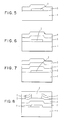
- a first layer (4) of hydrogenated amorphous silicon containing a first concentration of hydrogen incorporated therein is deposited (see Figure 2).
- hydrogenated amorphous silicon layer (4) contains a relatively low concentration of hydrogen as compared to the subsequently to be applied hydrogenated amorphous silicon layer (5).
- the hydrogenated amorphous silicon layer (4) can be provided by well-known plasma deposition techniques such as placing the structure in a plasma reaction chamber using silane as the source of the hydrogenated amorphous silicon.
- temperatures of about 225°C to about 325°C and most preferively about 275°C and at a pressure of about 20 ⁇ bar (15 millitorr) to about 1.33 mbar (1 torr) and most preferably about 306 ⁇ bar (230 millitorr).
- a typical power density is about 5 milliwatts/cm2 of combined surface area of the electrodes exposed to the plasma.
- the power source is typically operated at a radio frequency of about 13.6 megahertz.
- the preferred source of the hydrogenated amorphous silicon is 100% silane, such, if desired, can be diluted with an inert gas such as helium, neon, argon, and krypton or diluted with hydrogen. It is known that the presence of hydrogen in the diluent gas will not significantly effect the amount of hydrogen deposited along with the silicon in the hydrogenated amorphous silicon layer.
- the second layer (5) of hydrogenated amorphous silicon is deposited (see Figure 3).
- the second layer of hydrogenated amorphous silicon (5) contains the greater quantity of hydrogen of the two layers.
- the increased quantity of incorporated hydrogen can be achieved by the same plasma deposition employed for the first hydrogenated amorphous silicon layer, except by employing a reduced temperature and/or increased pressure.
- the temperature employed for the second hydrogenated amorphous silicon layer is reduced to about room temperature to about 200°C and preferably about 125°C while employing the same pressure as used for depositing the first hydrogenated amorphous silicon layer (4).
- thicknesses of the two layers may be chosen at will within the limits of practicality of thin films depositions. Important benefits of the present invention as compared to the prior art will, however, derive when the second layer is thicker or not much thinner than the first layer and when both layers are relatively thin.
- typical thicknesses of the first hydrogenated amorphous silicon layer (4) are about 10 to about 5,000 nm and preferably about 10 to about 100 nm.
- Typical thicknesses of hydrogenated amorphous silicon layer (5) are about 5 to about 5,000 nm and preferably about 10 to about 100 nm.
- the higher concentration of hydrogen in the second hydrogenated amorphous silicon layer results in that layer being more rapidly etched, thereby making it possible to accurately etch down to the interface with first hydrogenated layer (4) allowing for a well-defined remaining thickness as well as a flat surface.
- the second hydrogenated amorphous silicon layer (5) can be patterned (see Figure 4), for instance, by covering the layer (5) with a photoresist material (not shown) exposing the photoresist material to imaging radiation in a predetermined pattern and, thereafter, removing that portion of the photoresist material exposed to the imaging radiation in the case of a positive photoresist material and that material not exposed to radiation in the case of a negative photoresist material as is well-known in the art.
- a photoresist material not shown
- Suitable wet chemical etching compositions include strongly alkaline solutions such as alkali metal hydroxide solutions and, in particular, potassium hydroxide and sodium hydroxide. Such compositions preferably are 1 molar or higher. The etching is preferably carried out at normal room temperatures. When more elevated temperatures are employed, the pH of the solution can be somewhat less than that obtained from a 1 molar solution, such as down to about 12.5. Moreover, if desired, other methods of etching can be employed, although not preferred, such as plasma etching or reactive ion etching. The most pronounced effects from the present invention are achieved when employing a wet chemical etching.
- the etching can be carried out such that the etch rate will slow down as the interface to layer (4) is reached, thereby allowing a well-defined remaining thickness and a planar surface.
- the level of hydrogen in hydrogenated layers (4) and (5) can now be equilibrated once layer (5) has been patterned by merely raising the temperature of the substrate to that at which the first layer was formed, such as at about 225°C to about 325°C and preferably at about 275°C and maintain the substrate there for a sufficient amount of time in order to lower the hydrogen content in the second layer. This usually takes about 1 to about 30 minutes.
- Figure 5 is illustrated a substrate (1) containing an electrically conductive gate (2) thereon and a gate insulator (3).
- the substrate (1) includes any suitable substrate material such as glass (e.g., quartz), sapphire, silicon, metal, or metallized substrate.
- suitable substrate material such as glass (e.g., quartz), sapphire, silicon, metal, or metallized substrate.
- the gate (2) is of a metallic-type high electrical conductivity material, preferably a metal such as chromium, nickel, molybdenum and aluminum, as well as non-metallic materials such as highly doped polycrystalline silicon or intermetallic silicides which, nevertheless, have electrical conductivities of the magnitude generally possessed by metals.
- the gate (2) is defined by well-known photolithographical techniques that need not be discussed herein in any detail.
- Electrically insulating gate (2) is a gate insulator (3) such as silicon dioxide and silicon nitride.
- a first layer (4) of hydrogenated amorphous silicon containing a first concentration of hydrogen incorporated therein is deposited (see Figure 6).
- hydrogenated amorphous silicon layer (4) contains a relatively low concentration of hydrogen as compared to the subsequently to be applied hydrogenated amorphous silicon layer (5).
- the hydrogenated amorphous silicon layer (4) can be provided by well-known plasma deposition techniques such as placing the structure in a plasma reaction chamber using silane as the source of the hydrogenated amorphous silicon.
- temperatures of about 225°C to about 325°C and most preferably about 275°C and at a pressure of about 20 ⁇ bar (15 millitorr) to about 1.33 mbar (1 torr) and most preferably about 306 ⁇ bar (230 millitorr).
- a typical power density is about 5 milliwatts/cm2 of combined surface area of the electrodes exposed to the plasma.
- the power source is typically operated at a radio frequency of about 13.6 megahertz.
- the preferred source of the hydrogenated amorphous silicon is 100% silane, such, if desired, can be diluted with an inert gas such as helium, neon, argon, and krypton or diluted with hydrogen. It is known that the presence of hydrogen in the diluent gas will not significantly effect the amount of hydrogen deposited along with the silicon in the hydrogenated amorphous silicon layer.
- the second layer (5) of hydrogenated amorphous silicon is deposited (see Figure 3).
- the second layer of hydrogenated amorphous silicon (5) contains the greater quantity of hydrogen of the two layers.
- the increased quantity of incorporated hydrogen can be achieved by the same plasma deposition employed for the first hydrogenated amorphous silicon layer, except by employing a reduced temperature and/or increased pressure.
- the temperature employed for the second hydrogenated amorphous silicon layer is reduced to about room temperature to about 200°C and preferably about 125°C while employing the same pressure as used for depositing the first hydrogenated amorphous silicon layer (4).
- the thickness of the two layers may be chosen at will within the limits of practicality of thin films depositions. Important benefits of the present invention as compared to the prior art will, however, derive when the second layer is thicker or not much thinner than the first layer and when both layers are relatively thin.
- typical thicknesses of the first hydrogenated amorphous silicon layer (4) are about 10 to about 5,000 nm and preferably about 10 to about 100 nm.
- Typical thicknesses of hydrogenated amorphous silicon layer (5) are about 5 to about 5,000 nm and preferably about 10 to about 100 nm.
- the second hydrogenated amorphous silicon layer is also doped in order to increase its conductivity.
- a suitable n-type dopant is phosphorous and a suitable p-type dopant is boron.
- the phosphorous can be incorporated, for instance, by including in the plasma gas, phosphine (PH3), such as in amounts of a few ppm to about 1% by volume of the gaseous mixture employed.
- the boron can be provided by using a gaseous boron-containing compound such as diborane (B2H6).
- the higher concentration of hydrogen in the second hydrogenated amorphous silicon layer results in that layer being more rapidly etched, thereby making it possible to accurately etch down to the interface with first hydrogenated layer (4) allowing for a well-defined remaining thickness as well as a flat surface.
- the second hydrogenated amorphous silicon layer (5) can be patterned (see Figure 4), for instance, by covering the layer (5) with a photoresist material (not shown) exposing the photoresist material to imaging radiation in a predetermined pattern and, thereafter, removing that portion of the photoresist material exposed to the imaging radiation in the case of a positive photoresist material and that material not exposed to radiation in the case of a negative photoresist material as is well-known in the art.
- a photoresist material not shown
- Suitable wet chemical etching compositions include strongly alkaline solutions such as alkali metal hydroxide solutions and, in particular, potassium hydroxide and sodium hydroxide. Such compositions preferably are 1 molar or higher. The etching is preferably carried out at normal room temperatures. When more elevated temperatures are employed, the pH of the solution can be somewhat less than that obtained from a 1 molar solution, such as down to about 12.5. Moreover, if desired, other methods of etching can be employed, although not preferred, such as plasma etching or reactive ion etching. The most pronounced effects from the present invention are achieved when employing a wet chemical etching.
- the etching can be carried out such that the etch rate will slow down as the interface to layer (4) is reached, thereby allowing a well-defined remaining thickness and a planar surface.
- That portion of layer (5) that remains is patterned so as to beneath source and drain regions to be subsequently provided, while that portion of layer (5) removed corresponds to the area between the source and drain regions to be provided, referred to as the "channel". Accordingly, by proper doping of layer (5), increased conductivity beneath the source and drain regions can be obtained without concomitantly increasing the conductivity between the source and drain regions when the device is in the "off" state. This, in turn, allows for improved ohmic contact. In other words, increased ohmic contact is provided by the doping between the hydrogenated amorphous silicon and the source and drain regions, but the highly doped amorphous layer is cleanly removed from the channel region between the source and drain regions.
- Source and drain regions (7) and (8) are provided by well-known techniques, for examples, by depositing a blanket metallization (not shown) prior to application of the photoresist on top of layer (5) and patterning it with the mask as used for patterning layer (5).
- the level of hydrogen in hydrogenated layers (4) and (5) can be equilibrated once layer (5) has been patterned by merely raising the temperature of the substrate to that at which the first layer was formed, such as at about 225°C to about 325°C and preferably at about 275°C and maintain the substrate there for a sufficient amount of time in order to lower the hydrogen content in the second layer. This usually takes about 1 to about 30 minutes.
- the etched region can be covered with a passivation or encapsulation layer (6).
- the present invention has been described with respect to only two different layers of hydrogenated amorphous silicon, it is understood that the present invention can be carried out with three or more different layers or thicknesses of hydrogenated amorphous silicon, each having a different concentration of hydrogen as compared to the layer juxtaposed it.
- a number of samples are prepared whereby hydrogenated amorphous silicon is deposited using the same apparatus and conditions, except for the substrate temperature and the presence or absence of dopant gas. No significant variation in the deposition rate of the hydrogenated amorphous silicon layer is observed.
- the substrate employed is glass
- the pressure of the plasma deposition is about 306 ⁇ bar (230 millitorr)
- the power density is about 5 milliwatts/cm2 of combined surface area of the electrodes exposed to the plasma
- the power is radio frequency of about 13.6 megahertz.
- the dopant gas when employed, is phosphine.
- the hydrogen content and distribution of the samples are obtained from infrared spectra.
- the samples are protected with groove-pattern wax and are held in a jig that allows simultaneous immersion into the etchant of all of the samples.
- the etchant is a continuously stirred 1 molar solution of potassium hydroxide at 23°C.
- the depth of grooves etched into the hydrogenated amorphous silicon in three different etch times is measured with a "Tencor Alphastep" instrument. The results obtained are presented hereinbelow in Table I.
- the lowering of the substrate temperature results in a significant increase of the total hydrogen content, of the relative intensity of the hydrogen bending modes (a measure of the fraction of hydrogen in other than monohydride form), and of the etch rate.
- the addition of the dopant, even without a temperature change, has a similar, although much smaller, effect.
- a set of samples, similar to those in Example 1, are prepared.
- the samples are etched in a dry etching apparatus, in the plasma etching mode, at various power levels, at a pressure of 40 ⁇ bar (30 mtorr), in an 80:20 mixture of carbon tetrafluoride and oxygen.
- High hydrogen content samples are found to etch at rates approximately 60 percent higher than corresponding identically doped samples with low hydrogen content.
Landscapes
- Engineering & Computer Science (AREA)
- Microelectronics & Electronic Packaging (AREA)
- Condensed Matter Physics & Semiconductors (AREA)
- General Physics & Mathematics (AREA)
- Manufacturing & Machinery (AREA)
- Computer Hardware Design (AREA)
- Physics & Mathematics (AREA)
- Power Engineering (AREA)
- Chemical & Material Sciences (AREA)
- Materials Engineering (AREA)
- Weting (AREA)
- Thin Film Transistor (AREA)
- Drying Of Semiconductors (AREA)
Applications Claiming Priority (2)
| Application Number | Priority Date | Filing Date | Title |
|---|---|---|---|
| US887167 | 1986-07-17 | ||
| US06/887,167 US4741964A (en) | 1986-07-17 | 1986-07-17 | Structure containing hydrogenated amorphous silicon and process |
Publications (3)
| Publication Number | Publication Date |
|---|---|
| EP0253201A2 true EP0253201A2 (de) | 1988-01-20 |
| EP0253201A3 EP0253201A3 (en) | 1990-01-03 |
| EP0253201B1 EP0253201B1 (de) | 1992-05-13 |
Family
ID=25390582
Family Applications (1)
| Application Number | Title | Priority Date | Filing Date |
|---|---|---|---|
| EP87109391A Expired EP0253201B1 (de) | 1986-07-17 | 1987-06-30 | Hydrogeniertes amorphes Silizium beinhaltende Struktur und Verfahren zu ihrer Herstellung |
Country Status (4)
| Country | Link |
|---|---|
| US (1) | US4741964A (de) |
| EP (1) | EP0253201B1 (de) |
| JP (1) | JP2677338B2 (de) |
| DE (1) | DE3778986D1 (de) |
Cited By (1)
| Publication number | Priority date | Publication date | Assignee | Title |
|---|---|---|---|---|
| US5053354A (en) * | 1988-05-30 | 1991-10-01 | Seikosha Co., Ltd. | Method of fabricating a reverse staggered type silicon thin film transistor |
Families Citing this family (28)
| Publication number | Priority date | Publication date | Assignee | Title |
|---|---|---|---|---|
| DE3241959A1 (de) * | 1981-11-13 | 1983-05-26 | Canon K.K., Tokyo | Halbleiterbauelement |
| JPH01241175A (ja) * | 1988-03-23 | 1989-09-26 | Seikosha Co Ltd | 非晶質シリコン薄膜トランジスタの製造方法 |
| US4951113A (en) * | 1988-11-07 | 1990-08-21 | Xerox Corporation | Simultaneously deposited thin film CMOS TFTs and their method of fabrication |
| JP2811765B2 (ja) * | 1989-07-12 | 1998-10-15 | 松下電器産業株式会社 | 半導体装置およびその製造方法 |
| EP0445535B1 (de) * | 1990-02-06 | 1995-02-01 | Sel Semiconductor Energy Laboratory Co., Ltd. | Verfahren zum Herstellen eines Oxydfilms |
| JPH04226079A (ja) * | 1990-04-17 | 1992-08-14 | Canon Inc | 半導体装置及びその製造方法及びそれを有する電子回路装置 |
| US5602403A (en) * | 1991-03-01 | 1997-02-11 | The United States Of America As Represented By The Secretary Of The Navy | Ion Implantation buried gate insulator field effect transistor |
| JP3197036B2 (ja) * | 1991-11-14 | 2001-08-13 | 鐘淵化学工業株式会社 | 結晶質シリコン薄膜の形成方法 |
| US5404007A (en) * | 1992-05-29 | 1995-04-04 | The United States Of America As Represented By The Secretary Of The Air Force | Radiation resistant RLG detector systems |
| US5281546A (en) * | 1992-09-02 | 1994-01-25 | General Electric Company | Method of fabricating a thin film transistor using hydrogen plasma treatment of the intrinsic silicon/doped layer interface |
| US5273920A (en) * | 1992-09-02 | 1993-12-28 | General Electric Company | Method of fabricating a thin film transistor using hydrogen plasma treatment of the gate dielectric/semiconductor layer interface |
| US5856775A (en) * | 1996-06-18 | 1999-01-05 | Pico Systems, Inc. | Programmable thin film filament resistor and method of constructing same |
| JP2907128B2 (ja) * | 1996-07-01 | 1999-06-21 | 日本電気株式会社 | 電界効果型トランジスタ及びその製造方法 |
| US6444326B1 (en) * | 1999-03-05 | 2002-09-03 | Restek Corporation | Surface modification of solid supports through the thermal decomposition and functionalization of silanes |
| US7867627B2 (en) * | 2004-12-13 | 2011-01-11 | Silcotek Corporation | Process for the modification of substrate surfaces through the deposition of amorphous silicon layers followed by surface functionalization with organic molecules and functionalized structures |
| US8846149B2 (en) * | 2006-02-21 | 2014-09-30 | Taiwan Semiconductor Manufacturing Co., Ltd. | Delamination resistant semiconductor film and method for forming the same |
| US9777368B2 (en) | 2009-10-27 | 2017-10-03 | Silcotek Corp. | Chemical vapor deposition coating, article, and method |
| KR101790206B1 (ko) | 2010-10-05 | 2017-10-25 | 실코텍 코포레이션 | 내마모성 코팅, 물건 및 방법 |
| WO2014186470A1 (en) | 2013-05-14 | 2014-11-20 | Silcotek Corp. | Vapor phase treatment of amorphous carbon films with (perfluoro 1,1,2,2 tetrahydroalkyl)trialkoxysilane |
| US11292924B2 (en) | 2014-04-08 | 2022-04-05 | Silcotek Corp. | Thermal chemical vapor deposition coated article and process |
| US9915001B2 (en) | 2014-09-03 | 2018-03-13 | Silcotek Corp. | Chemical vapor deposition process and coated article |
| US10316408B2 (en) | 2014-12-12 | 2019-06-11 | Silcotek Corp. | Delivery device, manufacturing system and process of manufacturing |
| WO2017040623A1 (en) | 2015-09-01 | 2017-03-09 | Silcotek Corp. | Thermal chemical vapor deposition coating |
| US10323321B1 (en) | 2016-01-08 | 2019-06-18 | Silcotek Corp. | Thermal chemical vapor deposition process and coated article |
| US10487403B2 (en) | 2016-12-13 | 2019-11-26 | Silcotek Corp | Fluoro-containing thermal chemical vapor deposition process and article |
| US11161324B2 (en) | 2017-09-13 | 2021-11-02 | Silcotek Corp. | Corrosion-resistant coated article and thermal chemical vapor deposition coating process |
| WO2020252306A1 (en) | 2019-06-14 | 2020-12-17 | Silcotek Corp. | Nano-wire growth |
| US12473635B2 (en) | 2020-06-03 | 2025-11-18 | Silcotek Corp. | Dielectric article |
Family Cites Families (9)
| Publication number | Priority date | Publication date | Assignee | Title |
|---|---|---|---|---|
| JPS6040702B2 (ja) * | 1976-10-07 | 1985-09-12 | 日本電気株式会社 | 半導体集積回路装置の製造方法 |
| JPS5372473A (en) * | 1976-12-08 | 1978-06-27 | Nec Corp | Manufacture of mis type semicondctor device |
| US4217393A (en) * | 1978-07-24 | 1980-08-12 | Rca Corporation | Method of inducing differential etch rates in glow discharge produced amorphous silicon |
| JPS55146934A (en) * | 1979-05-02 | 1980-11-15 | Agency Of Ind Science & Technol | Processing of surface shape of group 3-5 compound semiconductor |
| US4363828A (en) * | 1979-12-12 | 1982-12-14 | International Business Machines Corp. | Method for depositing silicon films and related materials by a glow discharge in a disiland or higher order silane gas |
| US4285762A (en) * | 1979-12-31 | 1981-08-25 | Exxon Research & Engineering Co. | Plasma etching of amorphous silicon (SE-35) |
| GB8400959D0 (en) * | 1984-01-13 | 1984-02-15 | British Petroleum Co Plc | Semiconductor device |
| US4540647A (en) * | 1984-08-20 | 1985-09-10 | Eastman Kodak Company | Method for the manufacture of photoconductive insulating elements with a broad dynamic exposure range |
| JPH0682839B2 (ja) * | 1984-08-21 | 1994-10-19 | セイコー電子工業株式会社 | 表示用パネルの製造方法 |
-
1986
- 1986-07-17 US US06/887,167 patent/US4741964A/en not_active Expired - Fee Related
-
1987
- 1987-05-20 JP JP62121454A patent/JP2677338B2/ja not_active Expired - Lifetime
- 1987-06-30 EP EP87109391A patent/EP0253201B1/de not_active Expired
- 1987-06-30 DE DE8787109391T patent/DE3778986D1/de not_active Expired - Lifetime
Cited By (1)
| Publication number | Priority date | Publication date | Assignee | Title |
|---|---|---|---|---|
| US5053354A (en) * | 1988-05-30 | 1991-10-01 | Seikosha Co., Ltd. | Method of fabricating a reverse staggered type silicon thin film transistor |
Also Published As
| Publication number | Publication date |
|---|---|
| DE3778986D1 (de) | 1992-06-17 |
| US4741964A (en) | 1988-05-03 |
| EP0253201B1 (de) | 1992-05-13 |
| EP0253201A3 (en) | 1990-01-03 |
| JP2677338B2 (ja) | 1997-11-17 |
| JPS6331169A (ja) | 1988-02-09 |
Similar Documents
| Publication | Publication Date | Title |
|---|---|---|
| EP0253201A2 (de) | Hydrogeniertes amorphes Silizium beinhaltende Struktur und Verfahren zu ihrer Herstellung | |
| US4814842A (en) | Thin film transistor utilizing hydrogenated polycrystalline silicon | |
| US4174217A (en) | Method for making semiconductor structure | |
| US5470768A (en) | Method for fabricating a thin-film transistor | |
| US5591989A (en) | Semiconductor device having first and second gate insulating films | |
| US5170231A (en) | Silicon carbide field-effect transistor with improved breakdown voltage and low leakage current | |
| US9059270B2 (en) | Replacement gate MOSFET with raised source and drain | |
| KR100498104B1 (ko) | 울트라-쉘로우 정션에 사용되는 이리듐을 포함하는, 열안정성이 높은 니켈 실리사이드 및 그 제조방법 | |
| JP3483581B2 (ja) | 半導体装置 | |
| US5216264A (en) | Silicon carbide MOS type field-effect transistor with at least one of the source and drain regions is formed by the use of a schottky contact | |
| KR0180323B1 (ko) | 박막 트랜지스터의 제조방법 | |
| EP0450985B1 (de) | Dünnschichttransistor aus Diamant | |
| US4349395A (en) | Method for producing MOS semiconductor device | |
| EP0111706B1 (de) | Seitenwandisolation der Gate-Elektrode von Feldeffekttransistoren und Verfahren zu ihrer Herstellung | |
| US4444605A (en) | Planar field oxide for semiconductor devices | |
| EP0744775A2 (de) | Dünnfilmtransistor aus mikrokristallinem Silizium | |
| US5319231A (en) | Insulated gate semiconductor device having an elevated plateau like portion | |
| EP0481777A2 (de) | Verfahren zur Herstellung Feld-Effekt-Transistoren mit isoliertem Gate | |
| EP0066675B1 (de) | Verfahren zur Herstellung der Feldeffekttransistoren | |
| EP0379208B1 (de) | Verfahren zur Herstellung einer Vorrichtung mit einer zwischen zwei Halbleiterschichten eingeschlossenen Isolierschicht | |
| GB2126419A (en) | Materials for MOS device gate electrodes | |
| KR0171987B1 (ko) | 반도체 소자의 게이트 전극 형성방법 | |
| KR0179035B1 (ko) | 박막 반도체 장치 및 그 제조방법 | |
| JP3390731B2 (ja) | 半導体装置 | |
| JP3120079B2 (ja) | 絶縁被膜および半導体装置 |
Legal Events
| Date | Code | Title | Description |
|---|---|---|---|
| PUAI | Public reference made under article 153(3) epc to a published international application that has entered the european phase |
Free format text: ORIGINAL CODE: 0009012 |
|
| AK | Designated contracting states |
Kind code of ref document: A2 Designated state(s): DE FR GB IT |
|
| 17P | Request for examination filed |
Effective date: 19880530 |
|
| PUAL | Search report despatched |
Free format text: ORIGINAL CODE: 0009013 |
|
| AK | Designated contracting states |
Kind code of ref document: A3 Designated state(s): DE FR GB IT |
|
| 17Q | First examination report despatched |
Effective date: 19910218 |
|
| GRAA | (expected) grant |
Free format text: ORIGINAL CODE: 0009210 |
|
| AK | Designated contracting states |
Kind code of ref document: B1 Designated state(s): DE FR GB IT |
|
| PG25 | Lapsed in a contracting state [announced via postgrant information from national office to epo] |
Ref country code: IT Free format text: LAPSE BECAUSE OF FAILURE TO SUBMIT A TRANSLATION OF THE DESCRIPTION OR TO PAY THE FEE WITHIN THE PRESCRIBED TIME-LIMIT;WARNING: LAPSES OF ITALIAN PATENTS WITH EFFECTIVE DATE BEFORE 2007 MAY HAVE OCCURRED AT ANY TIME BEFORE 2007. THE CORRECT EFFECTIVE DATE MAY BE DIFFERENT FROM THE ONE RECORDED. Effective date: 19920513 |
|
| REF | Corresponds to: |
Ref document number: 3778986 Country of ref document: DE Date of ref document: 19920617 |
|
| ET | Fr: translation filed | ||
| PLBE | No opposition filed within time limit |
Free format text: ORIGINAL CODE: 0009261 |
|
| STAA | Information on the status of an ep patent application or granted ep patent |
Free format text: STATUS: NO OPPOSITION FILED WITHIN TIME LIMIT |
|
| 26N | No opposition filed | ||
| PGFP | Annual fee paid to national office [announced via postgrant information from national office to epo] |
Ref country code: GB Payment date: 19950522 Year of fee payment: 9 |
|
| PGFP | Annual fee paid to national office [announced via postgrant information from national office to epo] |
Ref country code: FR Payment date: 19950606 Year of fee payment: 9 |
|
| PGFP | Annual fee paid to national office [announced via postgrant information from national office to epo] |
Ref country code: DE Payment date: 19960628 Year of fee payment: 10 |
|
| PG25 | Lapsed in a contracting state [announced via postgrant information from national office to epo] |
Ref country code: GB Effective date: 19960630 |
|
| GBPC | Gb: european patent ceased through non-payment of renewal fee |
Effective date: 19960630 |
|
| PG25 | Lapsed in a contracting state [announced via postgrant information from national office to epo] |
Ref country code: FR Effective date: 19970228 |
|
| REG | Reference to a national code |
Ref country code: FR Ref legal event code: ST |
|
| PG25 | Lapsed in a contracting state [announced via postgrant information from national office to epo] |
Ref country code: DE Free format text: LAPSE BECAUSE OF NON-PAYMENT OF DUE FEES Effective date: 19980303 |